Wishing you all a very happy holiday season from Team Collab
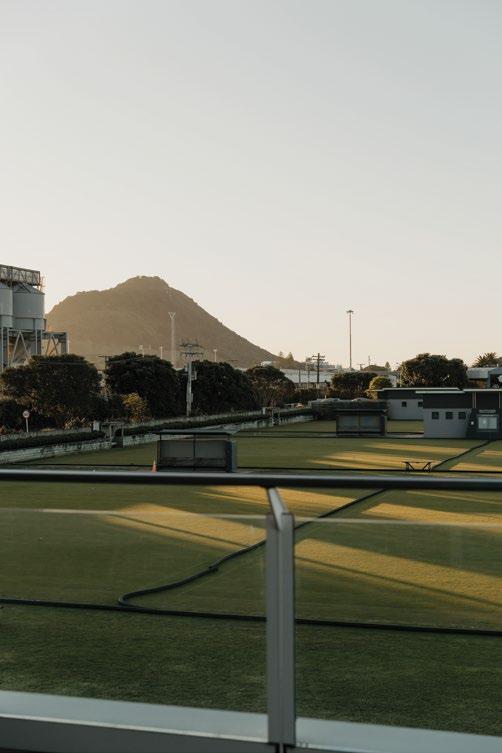
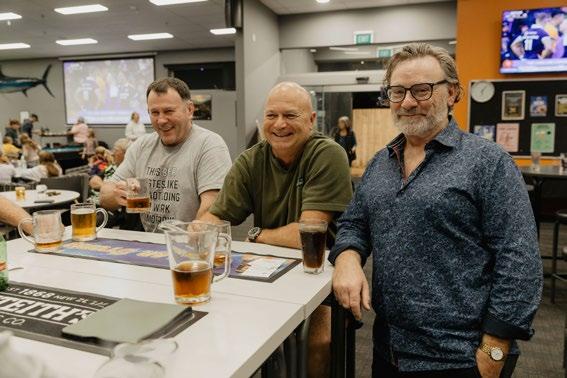
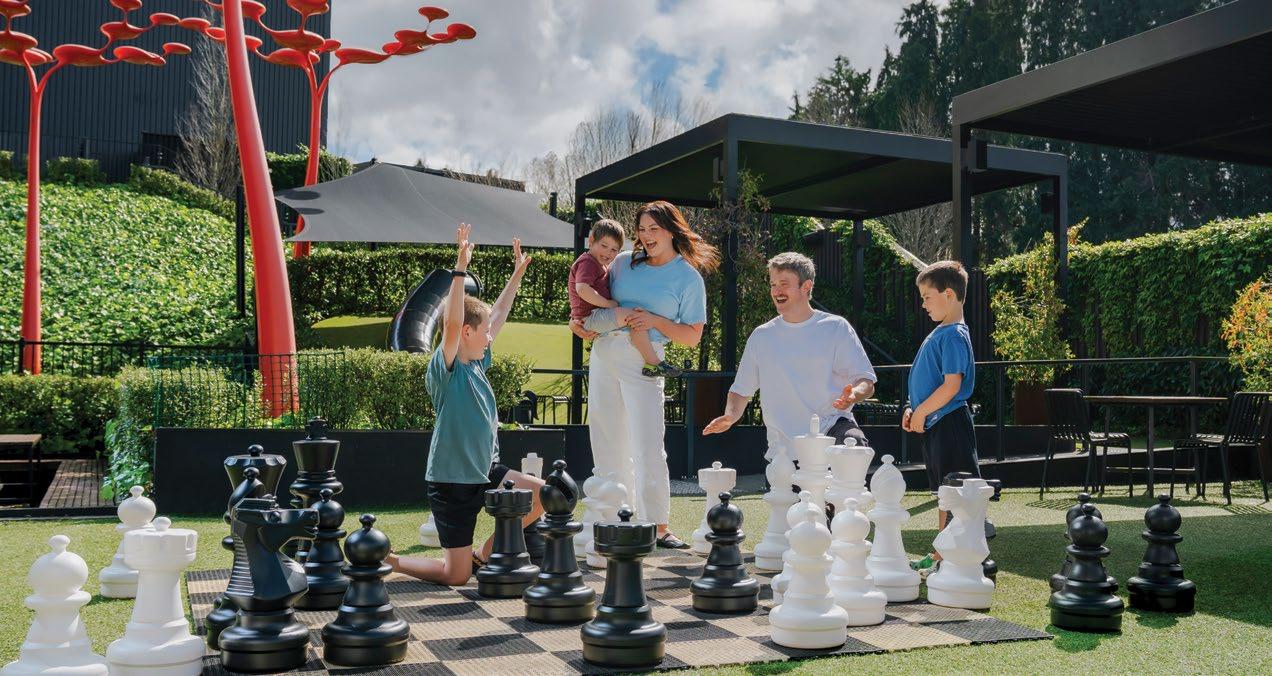
More than a Club. It’s a Community. Step inside Club Mount Maunganui and you’ll find more than just great facilities, you’ll find friends, fun, and a place where everyone feels at home. From bowls on the green to burgers with the family, quiz nights to live music, there’s always something happening. And just in time for summer, our brand-new Garden Bar opens this month, your new go-to spot for sunshine, good vibes, and great company. Whether you're here for a quiet pint, a game of pool, or your next big celebration, we’ve got you. A sports bar with heart, a restaurant with flavour, and a calendar packed with ways to connect, this is your club, your way.
New faces always welcome. Come join the fold.
FROM $121 PER WEEK ~
FROM $121 PER WEEK ~
Life’s too short to work from home
A source for slow-made furniture & homewares
Founders Rachelle & Christopher Du y
Creative director Christopher Du y
Editor Zoe Hunter zoe@ourplacemagazine.co.nz
Social manager Millie Guest social@ourplacemagazine.co.nz
Advertising inquiries Rachelle Du y 021 032 7873 rachelle@ourplacemagazine.co.nz
Contributors
Zoe Hunter, Christopher Du y, Rebecca Lee, Kristin Macfarlane, Stuart Whitaker, Carmen Hall, Laura Boucher, Leisa McGill, Mary-Rose Norton, Madeleine Hughes, Cherie Metcalfe, Emma Schuler
Photographers
Erin Cave, Cam Neate, Jane Keam, Cab Creative, Kristin Macfarlane, Chris Parker, Brydie Thompson
Pick up your copy from The Little Big Markets, plus at selected cafes, restaurants, shops and businesses.
Want to receive regular copies of Our Place for your business to distribute? Email rachelle@ourplacemagazine.co.nz
To tell us about anything happening in your area right now, email zoe@ourplacemagazine.co.nz
Cover & contents
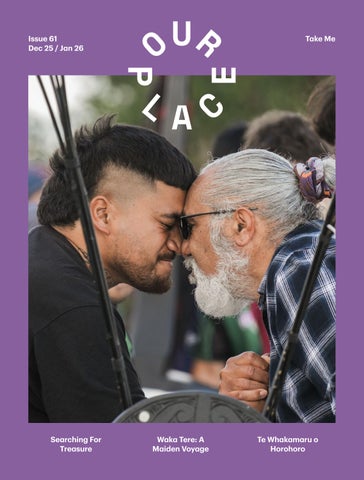
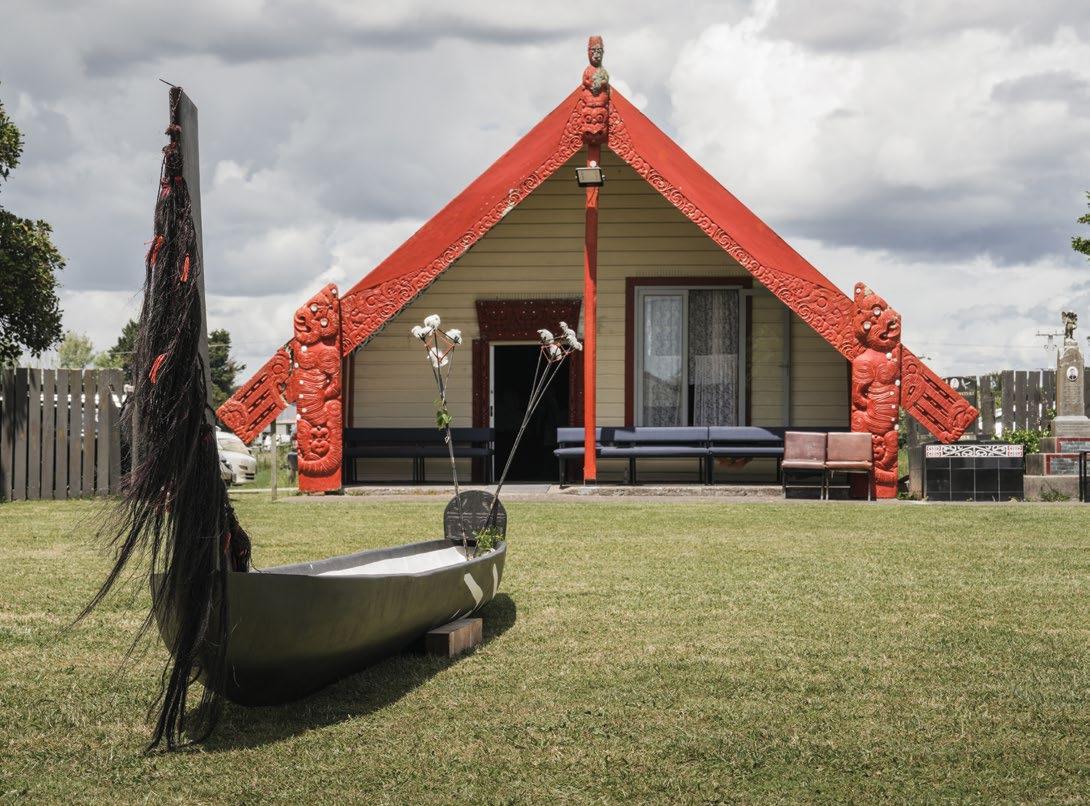
Cover photography: Waka Tere by Cab Creative (page 60). Contents photography: Te Whakamaru o Horohoro by Cam Neate (page 47).
Follow us @ourplacemagazine ourplacemagazine.co.nz
Our summer edition is bursting with stories. As the days grow longer, we invite you to slow down, lean in, and discover the magic of our community.
Welcome to yet another edition celebrating the stories that shape what makes our community so special.
In our main story, writer Rebecca Lee takes us to the river banks where the recently completed wakatētē (river waka) Te Ao Marama took her maiden voyage in Kaituna River (60). Kristin Macfarlane then lets us in on how a community-driven rugby league programme aims to help youth achieve their goals both on and off the field (40). Our editor Zoe Hunter jumps on board the idea of bringing a passenger train coming to Tauranga (23).
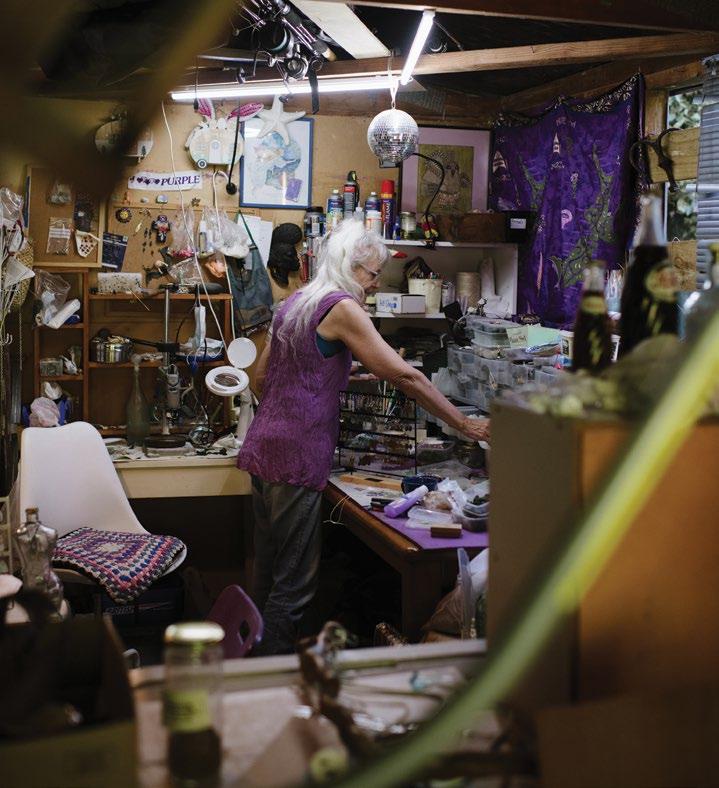
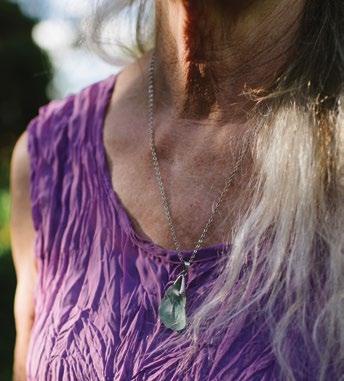
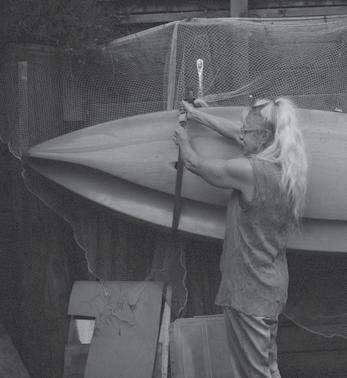
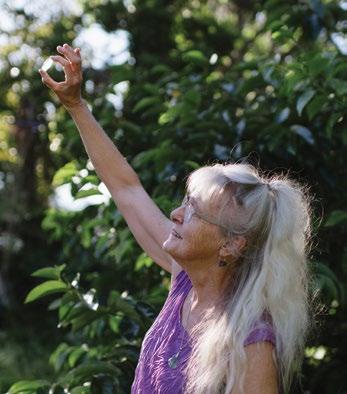
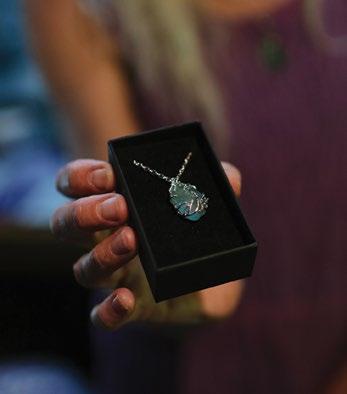
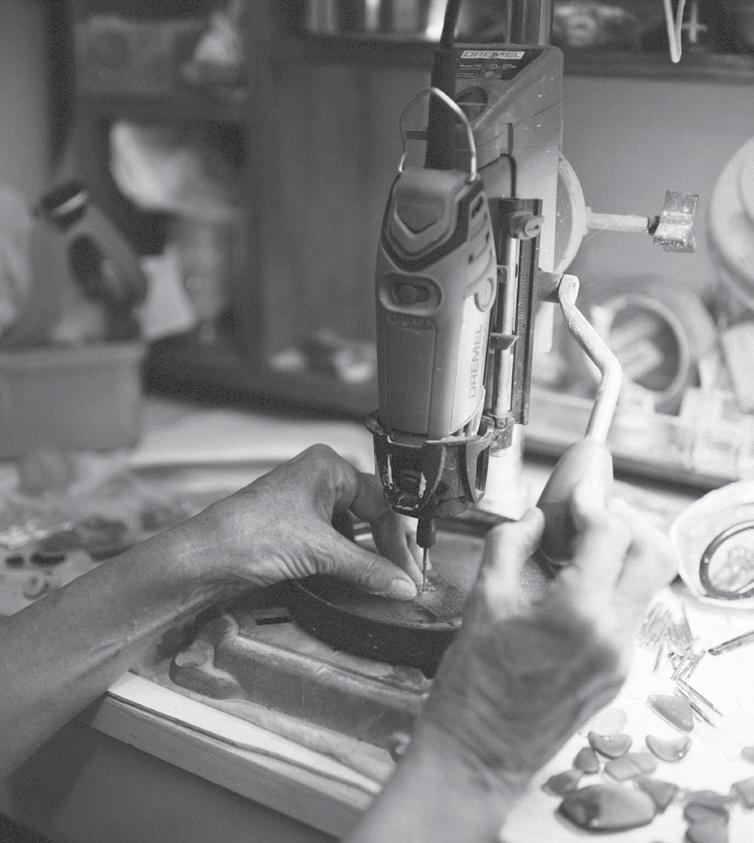
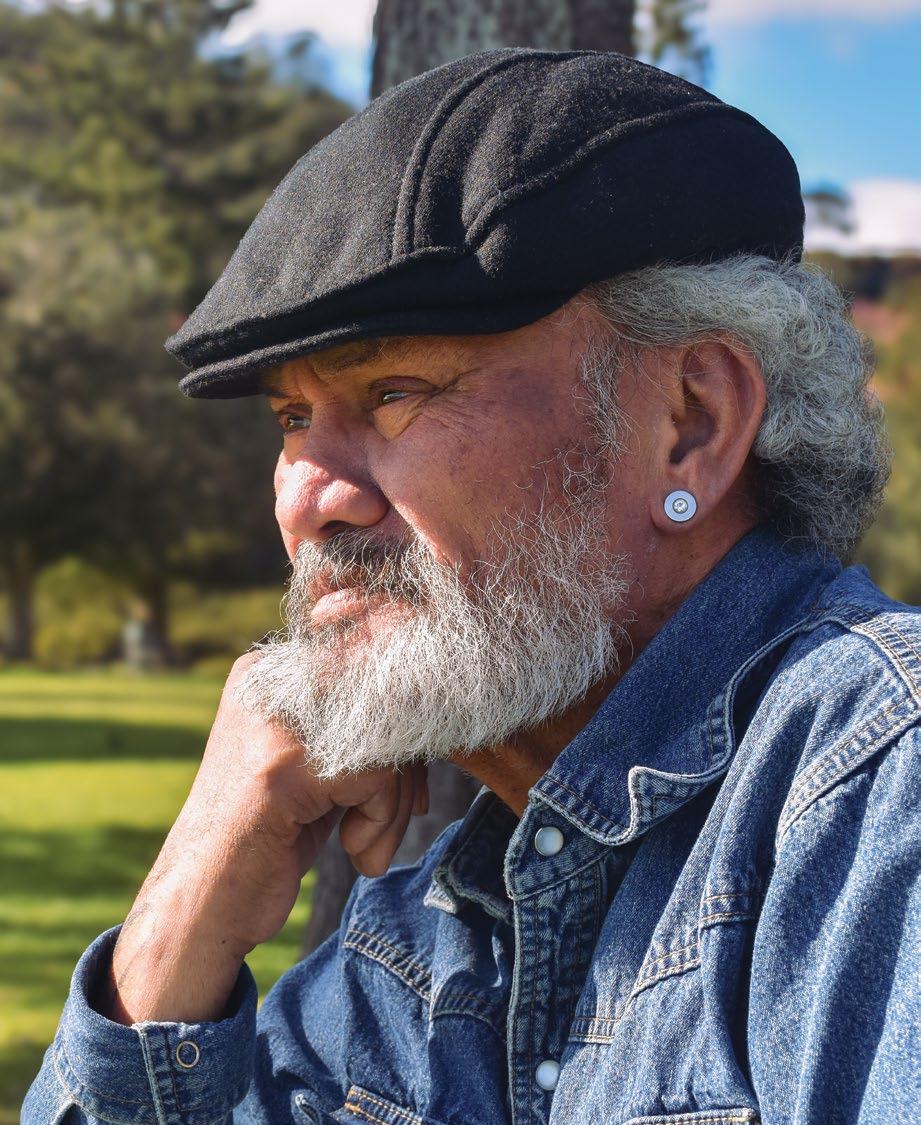
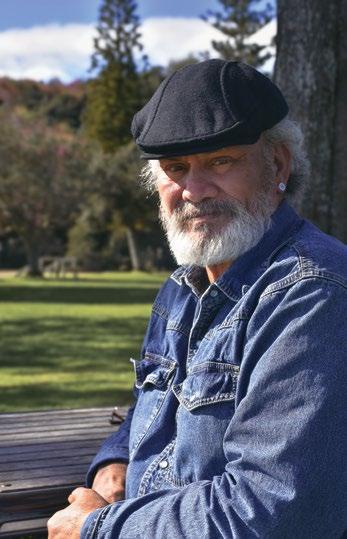
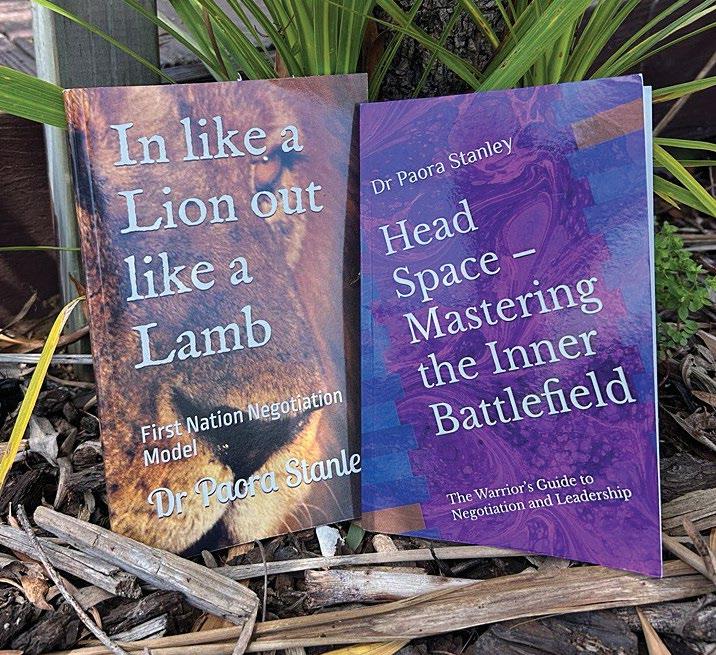
In our Kōrero feature, we meet Kataraina George who is helping to reconnect whānau with Te Horohoroinga-o-nga-ringa-oKahumatamomoe, their sacred Horohoro maunga (47). Plus, Averil Andersen shares with us the magic of beach glass (95). We also go behind the counter of Mount Alterations with Suzi Marks (36) and Ngāi Te Rangi chief, Paora Stanley, shares how his PHD inspired him to write two new books (116).
Our food writer and culinary queen Cherie Metcalfe is back with her top spots to eat this summer (31). Meanwhile, Tauranga private chef Madeleine Hughes serves up some fun, fresh and festive recipes for her favourite time of the year (101).
From our whānau to yours, we wish you a Happy New Year!
Regards, The Our Place team
Our specialist prosthodontist can offer beautiful porcelain veneers and full mouth makeovers.
Scan the QR code to book online or call 07 575 6278.
EVERY THURSDAY
PĀPĀMOA PONY CLUB
5—9PM EVERY SUNDAY
THE
FAMILY-FRIENDLY LICENSED BAR
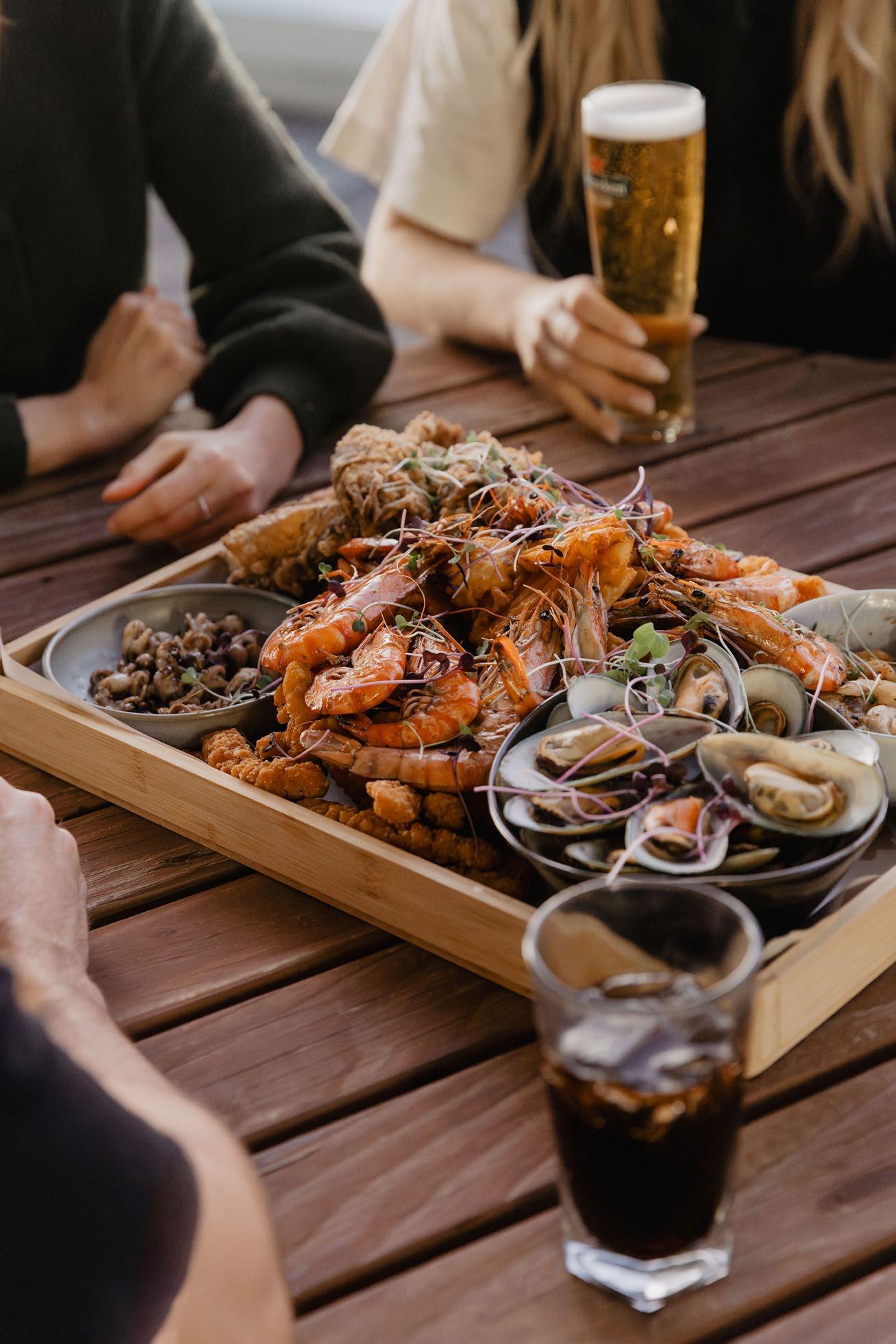
Beast of a Feast
What’s Up
Z Manu World Champs Returns
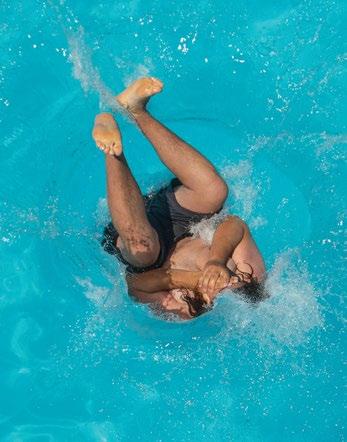
The Z Manu World Champs are back and this year, the championship is international. The competition launched in Dunedin on November 30 before racing across eight New Zealand cities and making a transTasman leap to the Gold Coast for the first-time. The Z Manu World Champs Tauranga Qualifier is taking place on Saturday, December 13, at Tauranga Waterfront’s tidal steps on The Strand. The series features 12 qualifying events and will culminate with a spectacular grand final at Auckland’s Viaduct Harbour as part of Moana Auckland, New Zealand’s Ocean Festival. The Gold Coast event, held over Waitangi Weekend in partnership with Queensland Diving, marks the competition’s first official international qualifier. “It’s always been our intention to go international, so we’re really excited to be expanding to Australia this year, then bringing the finals back to Moana Auckland,” organiser Scott Rice says. “This will be the event of summer.”
The Tauranga qualifier is taking place on December 13. manuworldchamps.com
Beast of a Feast is back for 2026! Your not-so-typical beer festival returns to Mount Maunganui’s Soper Reserve on February 28, 2026. Dance the night away to this year’s line-up, which includes Ladi6, Avalanche City, P-Money, Foo Fighters Cover, Dawson (Live) and Clint Roberts. Wrap your lips around some delicious brews from Mount Brew Co, Morning Cider and Yeastie Boys, Good George, BOP Brewery, Garage Project and more to come! And feast on some of the region’s best bites, with foodies to be announced soon. Whether you’re a craft beer aficionado, a music connoisseur, or a sausage sizzle queen, BOAF will fulfil your needs. Beast of a Feast is proudly presented by ZM. beastofafeast.co.nz
Here comes Yomi
At Yomi, they believe in balance. Because some days you’re all about fresh fruit and probiotics, and other days, it’s chocolate sauce with lollies on top. Founded by Michael and Rachel Sparrow, Yomi was created to bring Mount Maunganui a place that feels equal parts healthy and indulgent – a self-serve frozen yoghurt and açaí bar where you can create exactly what you’re craving. Whether it’s light, protein-packed, or totally decadent, the choice is completely yours. Michael and Rachel are proud to be locals who love the Mount’s energy – the sun, the surf, and the sense of community. That’s why they’ve built Yomi as a space to chill, hang with friends, and where everyone can enjoy something that makes them feel good. Their ingredients are fresh, their fruit is cut daily, their flavours rotate with the seasons, and their vibe is always upbeat and friendly. From probiotic yoghurts to rich chocolate swirls, Yomi is here to celebrate balance, freedom, and joy in what you eat.
yomibowlsnz
the Choice is Easy.
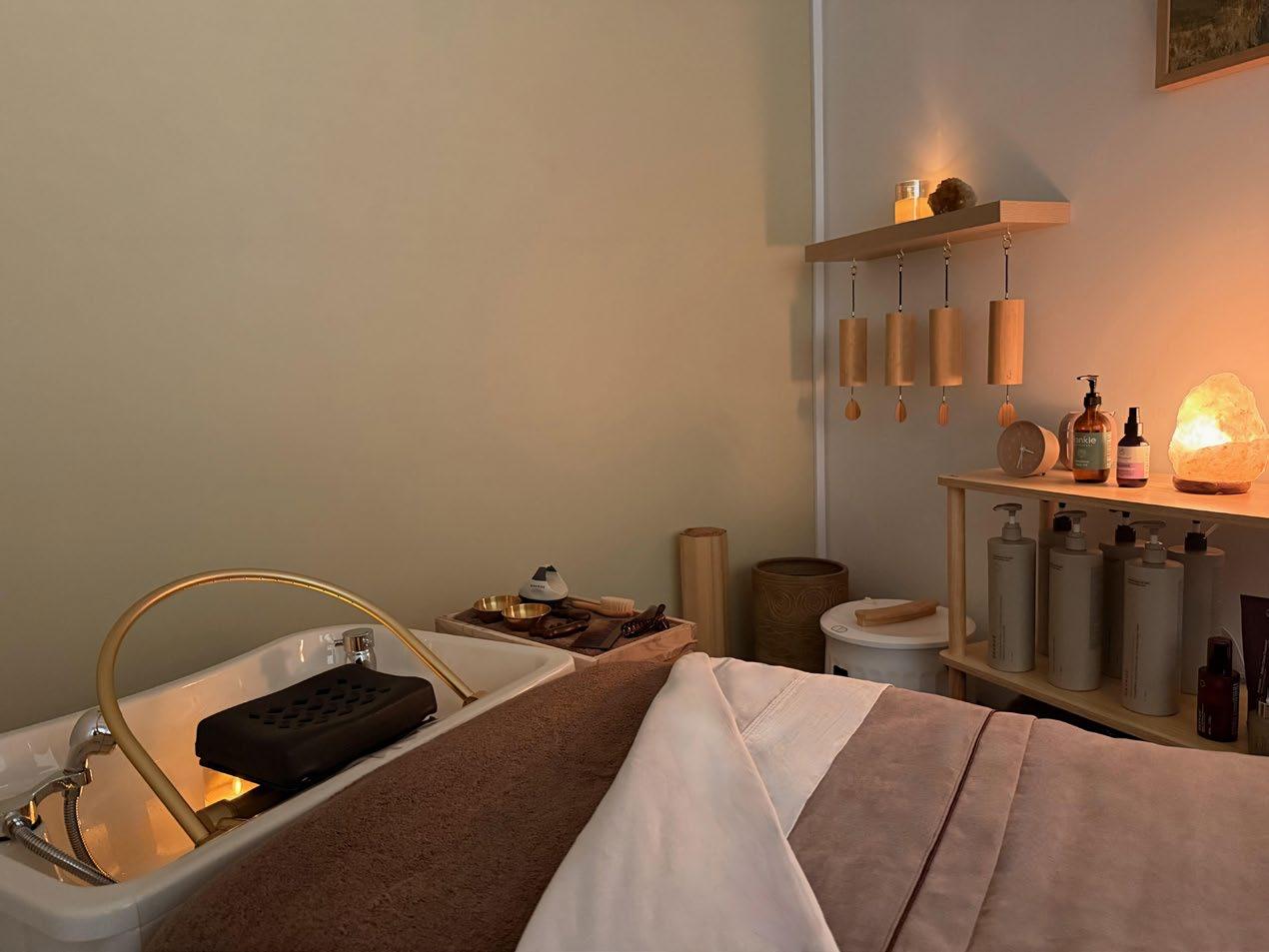
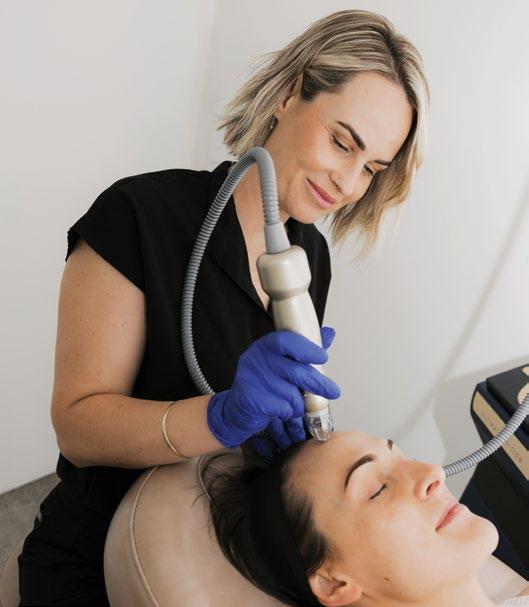
Delight your senses & Restore your well being
Nourish your nervous system through therapeutic head spa, sound immersion & massage
All Aboard!
Words by Zoe Hunter
Photography by Erin Cave
Is it a bird? Is it a plane? No, it’s all aboard the passenger train!
Locals will soon be able to ride a one-off pilot passenger train from Hamilton to Tauranga return.
↑ The train drop-off point on The Strand means exploring city highlights like the
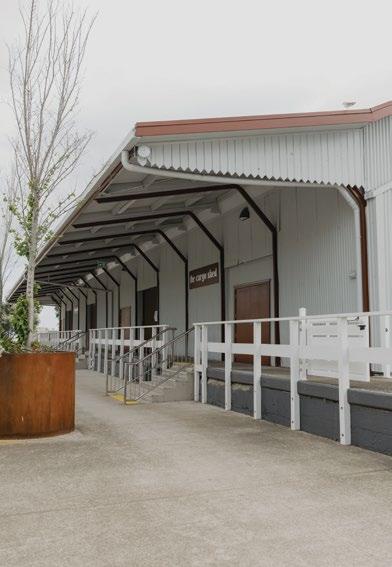
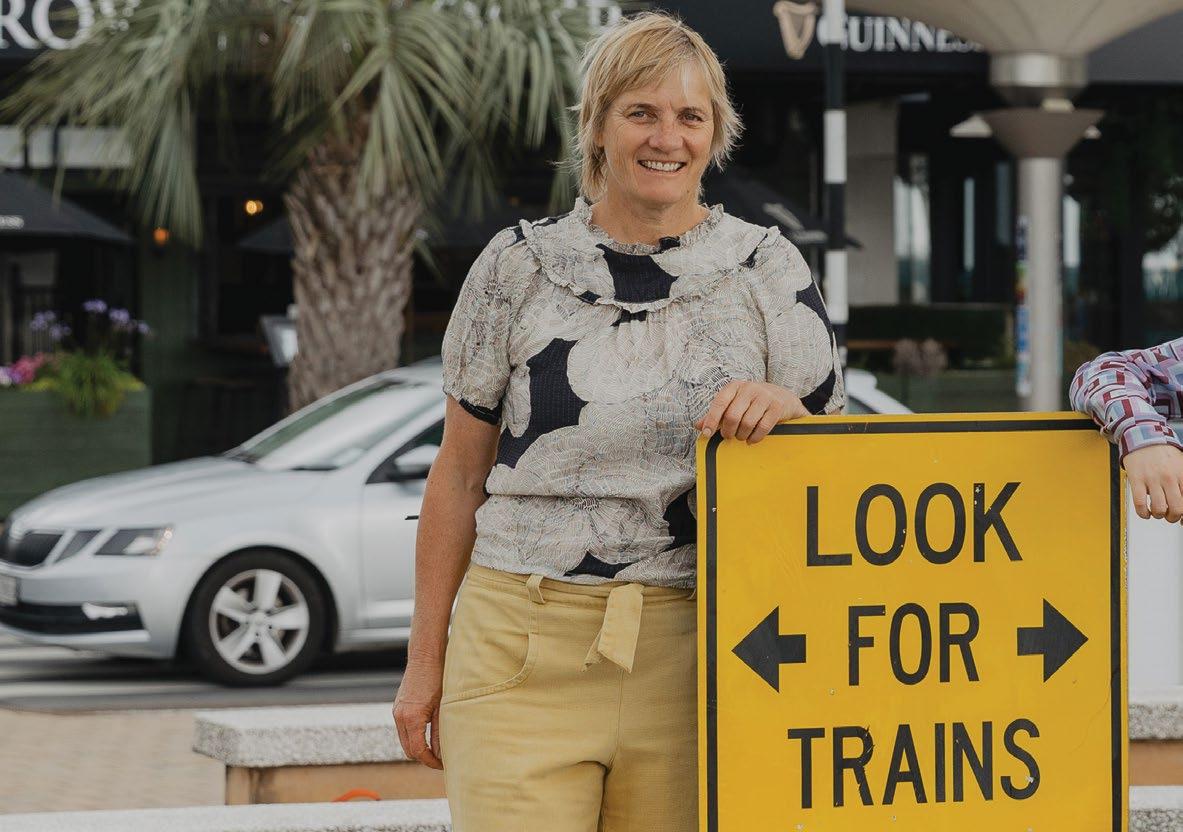
When Lindsey Horne closes her eyes, she imagines a beautiful train station somewhere alongside The Cargo Shed or Dive Crescent along The Strand.
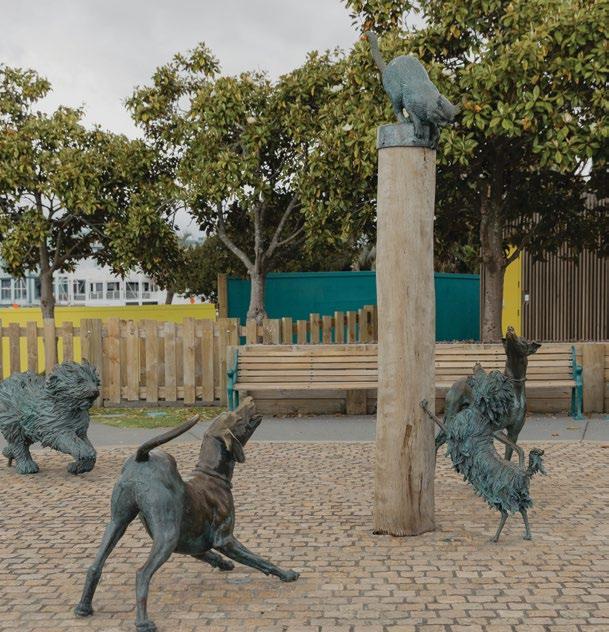
In one carriage, there’s a young family with their wide-eyed children watching out the windows as the train whizzes past the Hairy Maclary sculptures.
In the next carriage along, a couple of teenagers are heading to Tāmaki Makaurau for the latest concert after stopping in Hamilton for an on-site university lecture along the way.
And in another, grandparents clink their champagne glasses on the way to celebrate the arrival of their new grandchild.
Heidi Hughes can’t wait to hear that distant whistle heralding the passenger train’s imminent arrival as it chugs into the station and the conductor yells: “All aboard!”.
Now, their dreams are one step closer to coming true after Glenbrook Vintage Railway Charitable Trust’s application for $25,000 of Tauranga City Council’s Climate Action Fund has been approved to bring a one-off pilot passenger train from Hamilton
to Tauranga return. However, the council is working through details of the agreement before securing the funding, which will cover the cost of bringing Glenbrook Vintage Railway’s 400-seat passenger train to Tauranga.
The Glenbrook Vintage Railway Charitable Trust Board is a registered charity that operates heritage trains on the Glenbrook Vintage Railway, Auckland and New Zealand-wide.
Tauranga City Council’s team leader of climate and resilience, Anna Rengstedt, says it was exciting to see this initiative being delivered as early as May 2026.
“Passenger train transport would be a significant step toward reducing transport emissions, currently responsible for two thirds of Tauranga’s greenhouse gas footprint.
“The project will demonstrate the feasibility and benefits of inter-regional passenger rail, offering a low-carbon alternative to hundreds of car trips, easing congestion, and improving road safety.”
Heidi says they have been advocating for passenger rail to come back to Tauranga for years.
Hairy Maclary sculptures.
“When you think about how much the city has grown in the last 15 years, half of the population live north of the Golden Triangle area, so it just makes sense for it all to be connected with different transport options.”
“It would be so great to have regional rail come back.”
Lindsey, who is a committee member of passenger rail service advocacy group Future is Rail, grew up in Tauranga and, in her mind, a passenger rail connecting the Golden Triangle “just makes sense”.
“When you think about how much the city has grown in the last 15 years, half of the population live north of the Golden Triangle area, so it just makes sense for it all to be connected with different transport options.”
And travelling by train isn’t just for businesspeople in suits.
“It’s for everybody,” she says. That includes older people visiting their grandchildren, parents of teenagers, parents of young children, the list goes on.
“It’s a safe, convenient way to travel.”
Lindsey says getting from Tauranga to Hamilton or Auckland is a common journey, but State Highway 2 from Tauranga to Katikati and SH29 over the Kaimai Range are some of the most dangerous roads in the country to travel.
“For many, driving these routes is no longer just
inconvenient, it’s frightening,” she says.
“Which begs the question: if we already have a rail line connecting these regions, why don’t we have a train?
The long-term goal is to establish a Golden Triangle Passenger Train by the end of 2026.
And Lindsey says unlike many major transport projects, this one doesn’t need to start from scratch.
“The rail line is already in place, Hamilton and Auckland already have stations and Tauranga City Council own land in The Strand that would be ideal for an inner city station.
“With careful planning, we can incrementally build the golden triangle service without waiting decades. “The logical way to go is to build on what we’ve got and take it further, to Tauranga.”
This means extending the Te Huia rail service, which connects Waikato and Auckland, carrying 500plus passengers daily from Frankton to The Strand seven days a week, to the Bay of Plenty.
Lindsey, who now works in Tāmaki Makaurau (Auckland), says she often catches the Te Huia.
The key steps include adding a Tauranga
connection to Te Huia, building a simple bus stopstyle platform in Tauranga’s inner city on The Strand, and ensuring safety through the Kaimai Tunnel.
That means following established procedures for long tunnels, just like the 8.9 kilometre Remutaka and 8.5km Otira tunnels – both of which are longer than the Kaimai tunnel.
And with future electrification of the lines on the horizon, Lindsey says, this will be less of an issue in the future.
“What excites me is that if we get a regional rail service up and running, we can add stops to Omokoroa, Te Puke and all of a sudden we have opened up metro rail in Tauranga.”
Lindsey says travelling by train is a pragmatic approach that aligns with the city’s population growth, as well as giving people safe and different transport options.
“My favourite part is that you can choose to travel solo, or in a group,” she says. “It’s such a beautiful way to see the country.”
Heidi has no doubt people will jump on board the idea of bringing a permanent rail service to the
“Imagine living here without needing a car. If people can get around our city without having a car, then we’re going to have one of the coolest cities.”
city after this summer’s temporary service.
“I don’t think we will have any trouble filling it,” she says. “I think everyone will love it. We’ve got nothing to lose.”
Plus, she says, so much of city space is being used to park cars.
“Imagine living here without needing a car,” she says. “If people can get around our city without having a car, then we’re going to have one of the coolest cities.”
A passenger rail service will also add to the city’s vibrancy, Heidi says.
“It’s a really important piece in bringing our city to life. People love getting on a train. You’ll never have to worry about traffic and the travel time will almost always be the same.”
Imagine sitting back, sipping coffee, watching the Kaimai Ranges roll by as you travel from Auckland to Tauranga, Lindsey says.
“No stress, no traffic, just time – time to think, relax, and connect.”
And it’s entirely possible. “All aboard the Golden Triangle train.”
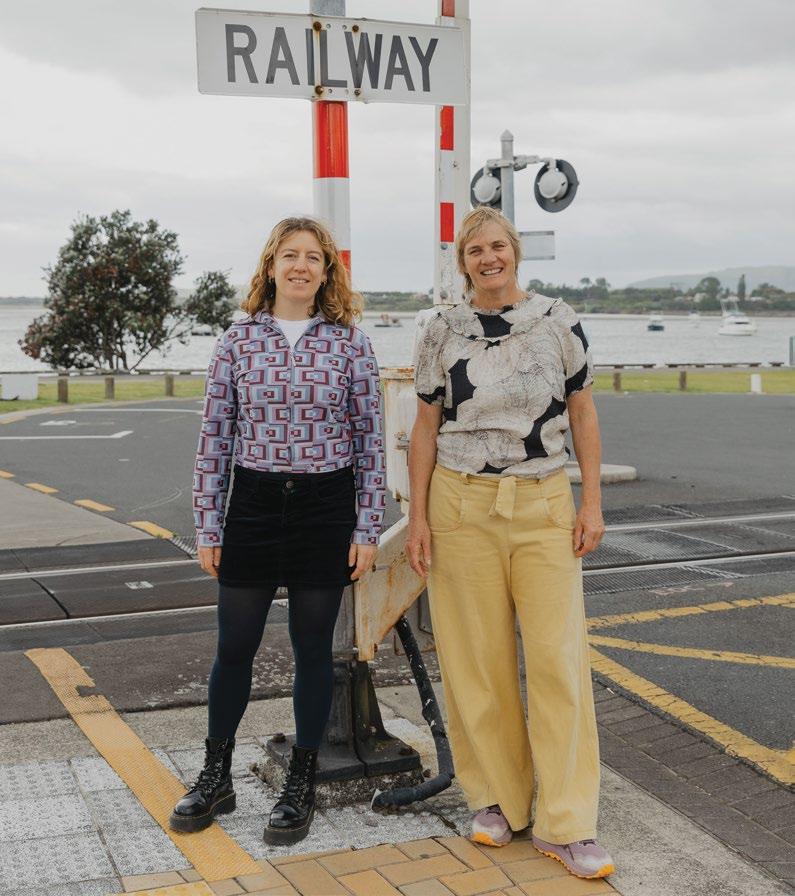
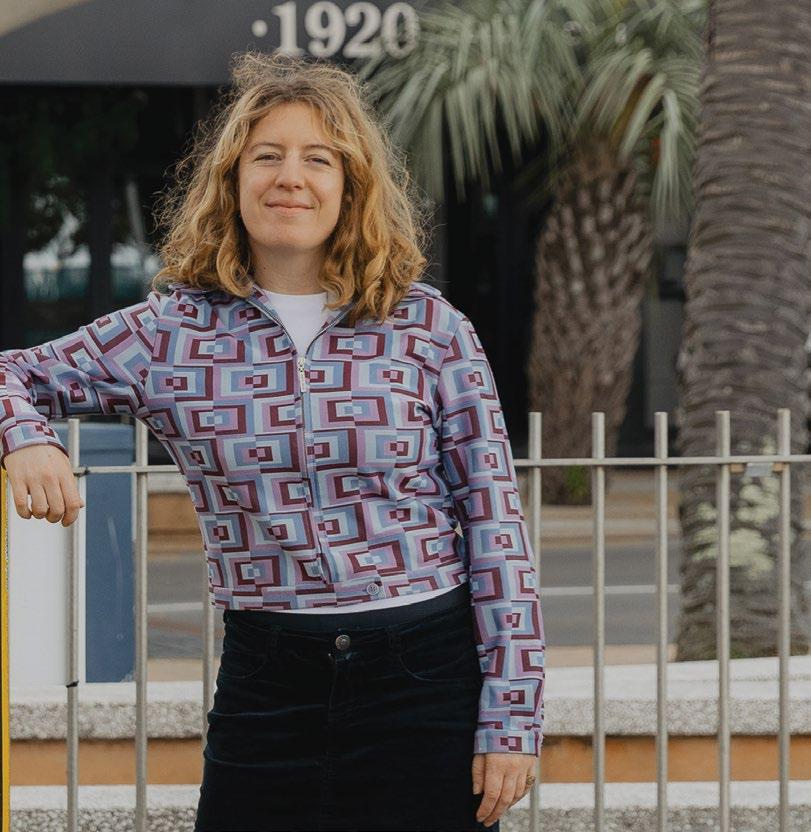
Heidi Hughes (left) and Lindsey Horne (right) are passenger train advocates.
Where to Next?
Words by Emma Schuler
New Year, new possibilities! Finally, you are on holiday and have time over the summer break to ponder your future direction. So, where to next?
You might be employed but ready for that next step up and looking to upskill, or a school leaver awaiting NCEA results to help confirm your next step. Perhaps you are thinking 2026 is your year to pursue a fresh start or completely new career direction?
More than 8000 students choose to study or train at Toi Ohomai Institute of Technology annually. From high school leavers to those with decades of industry experience, we’re here to help people take their next step.
You don’t need to leave paradise to study either. Toi Ohomai delivers vocational education across the Bay of Plenty and South Waikato, as well as online learning and flexible study options to fit in with your lifestyle and life stage.
As the Bay of Plenty’s leading vocational education provider, Toi Ohomai offers more than 100 courses, from certificates, diplomas and degrees to postgraduate studies. Creative minds can explore graphic design, fashion, music and performance, culinary arts, baking, and hospitality. Tech enthusiasts can tackle computing and information technology.
If you’re a hands-on learner you might find your fix in automotive, carpentry or engineering. Want to spend your nine-to-five outdoors? There are training options in agriculture, environmental management and conservation, horticulture and marine studies. A Certificate in Maritime Crewing will help you step into the super yacht industry, or to work
Toi Ohomai offers more than 100 courses, from certificates, diplomas and degrees to postgraduate studies.
on a deep-sea fishing vessel, complete the Certificate in Fishing Vessel crewing.
If you’re business-minded, we offer everything from Accounting to Business Management and Legal Studies courses. Aspiring real estate agents can complete their Certificate in Real Estate (Salesperson) part-time through evening courses online.
Future educators and caregivers can prepare for careers in early childhood education, social services or youth support, and may choose to upskill in Te Reo Māori. Missed out on NCEA? Your ‘where to next’ could be a foundation programme to build confidence and capability ahead of further tertiary study. At Toi Ohomai, the smaller class sizes on offer mean students receive more personalised attention from tutors, and one-on-one support. Our practical learning environments, paired with the theory components of each qualification, cater to the needs of a variety of learner types.
Toi Ohomai prides itself on teaching technical skills and knowledge, as well as organising handson opportunities. These are important as they provide students with real-world experiences and connections to industry. In June, Pro Clima visited Toi Ohomai and provided a practical workshop onsite. They gave our Architectural Technology and Quantity Surveying ākonga (students) hands-on experience installing internal airtightness and external weather-tightness wraps.
Our ākonga apply their textbook learning
Toi Ohomai Institute of Technology Promotion
to real-world construction practices! Across the institute, our tutors are experts in their fields.
They’re well connected to industry already – helping you to get your foot in the door with employers. Based at the Toi Ohomai Tauranga Campus, hospitality tutor Noel Remacle is a multi-award winning, third-generation pastry chef who hails from Belgium and previously worked as a product developer for Guylian Chocolate’s global franchising division. Earlier this year, Noel’s innovative, two-ingredient meringue recipe featured in a global pastry arts summit and made international headlines.
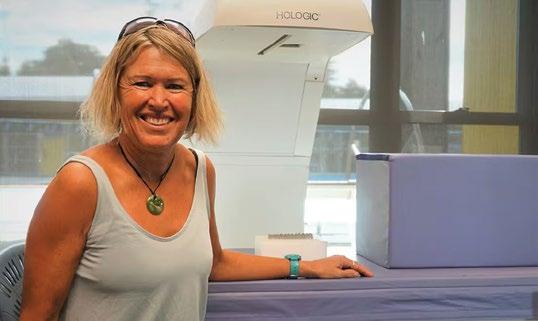
If a career in sport and recreation is your calling, your tutors may include Dr Tracey Clissold, whose research into women’s bone health earned national recognition in 2025.
Each year, the achievements of current learners and graduates continue to inspire others. Across Toi Ohomai, there is an ongoing commitment to building and strengthening industry connections, which continues to lead to greater opportunities for our students. Many of our programmes include internships or work placements, giving learners a
more direct pathway into employment.
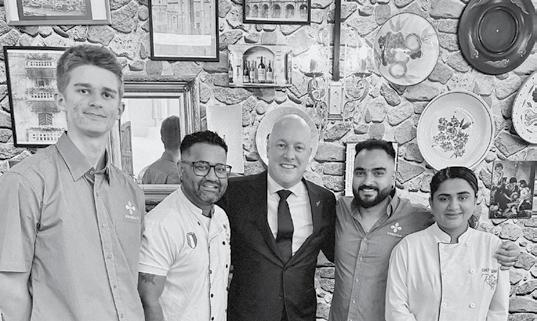
Rain Rua, a Bachelor of Applied IT graduate in 2025, completed a six-month IT internship at Ballance Agri-Nutrients and now works at the co-operative’s Mount Maunganui head office as a business intelligence analyst. Daniel Mulholland, a second-year Bachelor of Accounting student, secured an internship with Baker Tilly Staples Rodway in Auckland over the summer break, and credits the practical learning environment and personalised support at Toi Ohomai for helping him to stand out among a raft of applicants. Culinary Arts graduates, Aman Deep and Veena Devi’s Italian restaurant and pizzeria won a People’s Choice Award, after impressing Prime Minister Christopher Luxon with their signature main-course dish. And baking student, Shania Nickle, was named Most Promising Young Chef at a national dessert competition judged by Peter Gordon. Your ‘where to next’ is up to you.
If your New Year’s resolution is to grow your skills or increase your employability, Toi Ohomai can help make it happen.
For more information about courses or to enrol for 2026, go to www.toiohomai.ac.nz/study
Toi Ohomai Institute of Technology Promotion
One on one tutoring, culinary arts graduates with the Prime Minister and tutor Dr Tracey Clissold.
Cherie’s Foodie Finds
Cherie’s Summer Spots
Words by Pepper & Me’s Cherie Metcalfe
Hello and happy summer, locals! We are blessed to have a wave of cool new foodie spots popping up, each with their own vibe, a good mix of personality, creativity and good food. I’ve taken the liberty of sussing as many as I can out for you. I like to give everyone a month to settle in with staff, menus and the running of day-to-day stuff in general before I visit. I think sometimes a bad experience can put people off when it’s actually not fair to judge them yet.
(Left-handed)
Illustration
by Christopher Duff y
Cherie’s Foodie Finds
Florence Bistro, 90 Devonport Rd
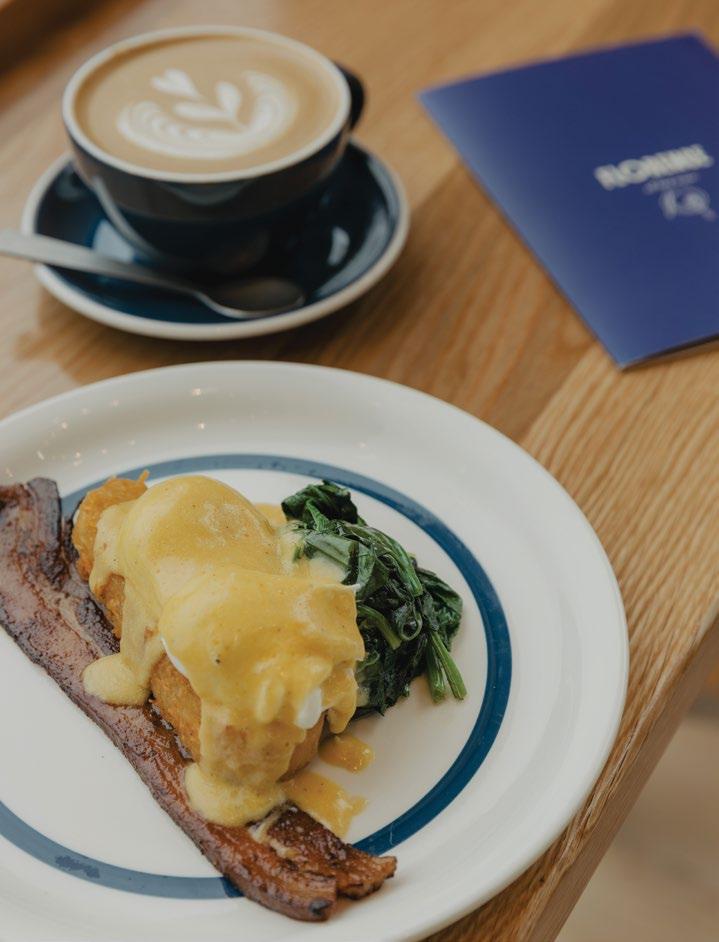
One of the headline newcomers is Florence Bistro in the new council building on Devonport Rd. It’s bright, warm and feels a bit like someone dropped a little slice of Europe into the CBD. The well-seasoned hospo owners and chefs have come up with a really cool spot that has managed to pull out a spectacular menu with epic brunches, lunches, dinners and afternoon aperitivo.
It’s hard to pick favs here. I’ve loved every single dish that I’ve tried here and there’s something for everyone – plus Prosecco on tap and fantastic service. Make this one a must visit.
florencebistro.co.nz
Florence Bistro is a must-visit on Cherie’s top summer spots list.
Neck of the Woods, 50 Taitumu Rd
Out in Tauriko, Neck of the Woods has become the spot everyone’s talking about. It’s part brewery, part café, part hangout, perched on a ridge with wicked views of the Kaimai Range. You can go for a lazy weekend beer, a mid-week brunch, or just soak up the garden bar atmosphere.
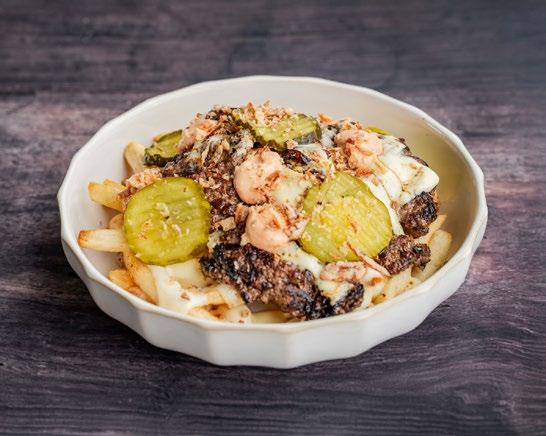
They brew their own beer and the whole place already feels like a neighbourhood hub. The food alone is worth the visit, poutine, jalapeño poppers, loaded focaccia sandos, all the good things in life. Clear your Friday arvo schedule and take the work team out.
neckofthewoods.beer
Lolos, 2 Taurikura Dr
Tauriko is big news this month, actually, because Lolos Authentic Turkish Kitchen is opening a new spot at Tauranga Crossing. If you’ve been to their Mount or Ōmokoroa stores, you already know how excited I am for this!
lolos.nz
Med Lounge & Garden, 159 17th Ave
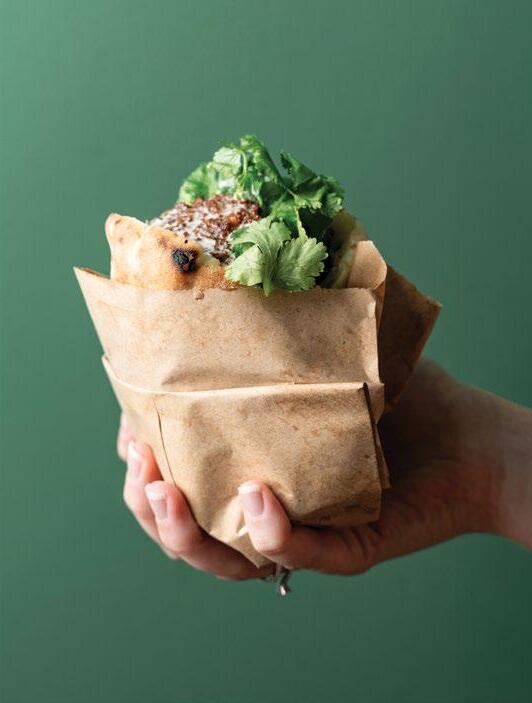
If you haven’t been to The Historic Village lately, now’s the time! The Med Lounge & Garden has been pulling people in for fresh pitas and falafel at lunchtime (if you are a Falafel Metro fan, this is your spot over the bridge to get your falafel fix!) and now they’re running an evening service too.
The dip and pita selection alone is enough to visit, but there’s some really cool sharing plates on the menu too, including chicken and date skewers, beef kufteh on a cinnamon bone, plus loads of beautiful fresh vibrant and delicious salads. The setting is super charming, the food is packed with
flavour and the beer garden has just announced some epic gigs too! Defo a spot to be keeping an eye on.
medlounge.co.nz
Captain Bones, 3/169 Maunganui Rd
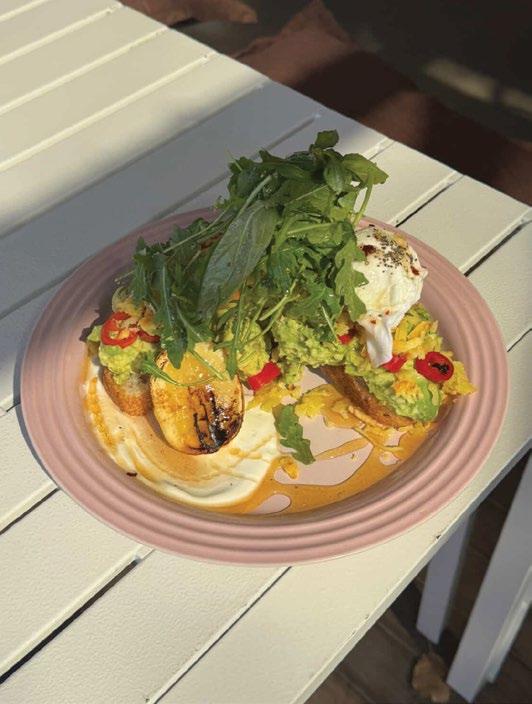
The Cruise Deck in Mount Maunganui has welcomed Captain Bones, which is starting to really pull together a gem of a situation on that wee tucked away deck. The breaky menu was small but perfect, with some fabulous twists on our fav dishes. Little touches like the fresh herbs and charred lemon really get me going. This will be a new regular spot for me for sure. Good coffee and great vibes.
@captainbonesmount
Tauranga’s food scene is changing fast, and it’s exciting. We’re finally getting cool, character-filled local spots that make going out feel like a treat. If you’re local, now’s the perfect time to explore your own backyard and support these great new places!
@pepperandme
↑ Some of the menu items at Captain Bones and Med Lounge & Garden, which are both top spots for Cherie.
Photograph by Tastefully Tash
Sewing Success
Words by Stuart Whitaker
by Erin Cave
Founded more than a decade ago, this small sewing shop began to burst at the seams. It’s owner Suzi has since threaded together a success story built out of more than just stitches and seams. Places where you can get your clothes altered or repaired are getting harder and harder to find.
Fortunately, one of the few remaining, Mount Alterations, is right on our doorstep.
Suzi Marks has customers attracted to her Central Parade shop from all over the country, including one from Guatemala.
A Kiwi, who now lives in the Central American country, returns to the Mount to see family a couple of times a year, bringing with her the clothes she needs altered or repaired.
A little closer to home, but still not exactly next door, Suzi has customers from Wellington, Christchurch, Kaitaia, Kerikeri and Ōmaha.
The reason? There are fewer people offering the service she does.
“Businesses are closing and the younger ones don’t want to take it on,” she says.
Mount Alterations began 11 years ago in central Mount Maunganui.
As business grew, the small upstairs workshop began to burst at the seams and, when a shop lease became available in Central Parade, Suzi took it.
She didn’t need to be central as people sought her out. The move also meant there was somewhere close for customers to park, there was more space, and no stairs.
At the time, Central Parade wasn’t quite the vibrant area it is today and moving was a bit of a gamble for Suzi. Now, she sees it as the best thing she ever did.
Suzi began honing her skills straight out of school, lucky, she says, to secure an apprenticeship in dressmaking with Auckland family fashion
business The House of Raymonde.
After time away from the trade to raise a family, Suzi began making children’s clothes. She was still doing that when the family moved to the Mount, selling them at the Papamoa Box Market.
“I then got into alterations because there was a need for it here, but nothing at the Mount.”
It hadn’t, however, been a long held dream.
“It just happened,” she says. “I had to kind of retrain myself to do alterations because it’s working in a different way, putting things back together like a jigsaw. But you’ve got to have the dressmaking skills to do it.”
Her daughter, Sara Ebdale, began working with Suzi during the Covid-19 pandemic as Suzi’s skills were put to a new use, making masks as part of the Masks for Tauranga initiative. Sara is still part of the operation.
A weekly advertisement in the local newspaper and word of mouth saw the business grow from its early days, but Suzi credits success to something more than her sewing skills alone.
“To me, if you’re going to do something like this, I think you’ve got to be kind and you’ve got to have good customer skills. That’s what makes it.”
A typical day starts at 9am and ends between 5pm and 6pm.
“We would do 10,000 to 15,000 steps in the shop, up, down, up, down, on a typical day. It’s very fast, very demanding and we are probably quite fit now.”
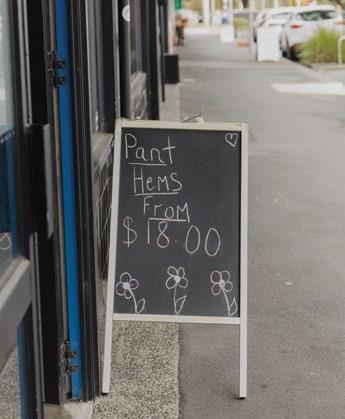
The shop is known for its $18 hem deal.
“I think that’s my carrot. Once people know, they keep coming back.”
Photography
“To me, if you’re going to do something like this, I think you’ve got to be kind and you’ve got to have good customer skills. That’s what makes it.”
together since 2020.
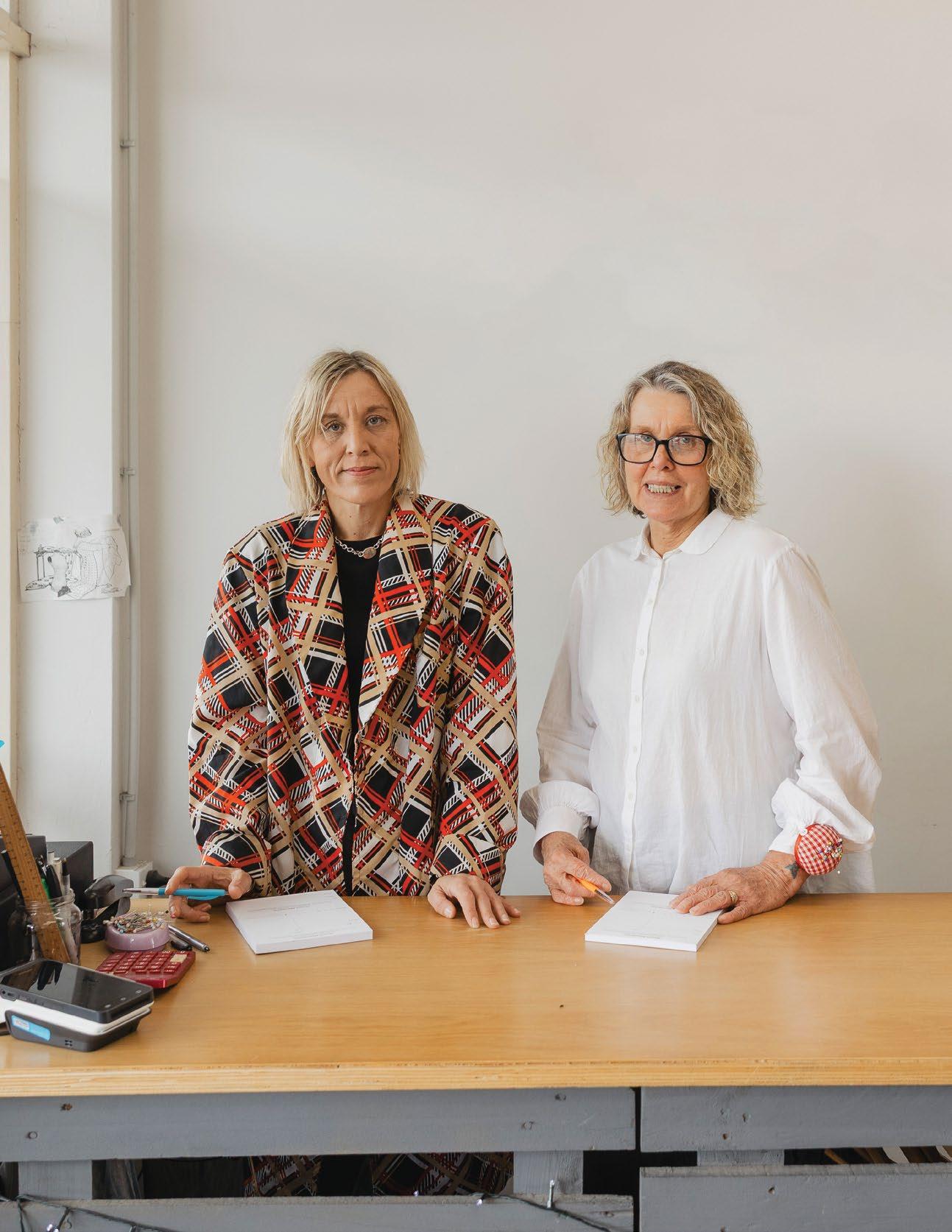
Suzi Marks (right) and her daughter Sara Ebdale (left) have been working
Like many people with face-to-face businesses, Suzi has no hesitation in answering customers when asked about the best part of the job.
“They are amazing and we’ve made some amazing friends here.”
It’s a paradox that her answer is the same when asked about the worst thing. Although, she tempers it by saying an overly demanding customer is very much the exception.
“When I first started, there were three days to wait for an alteration. Now, because other businesses have closed, it can be two-plus weeks before people can get their garment back – and we work really hard to keep it at two-plus weeks.
“We are incredibly booked out. So I think the hardest part for me is when people ring and are demanding.
“It’s a hard thing because you want to help people and you want to make sure that they get their things in time, but sometimes it’s just not possible.”
Another change she has seen is an increase in the number of men using her services.
“It used to be mostly women, but now guys are really keen on how they look and how their garments are, which is really neat.”
Economic reality has also influenced her customers and their needs.
“People are really looking in their own wardrobe when things are like they are and times are a bit tough.
“What people are doing is shopping in their own wardrobe seeing what they’ve got that can be altered rather than buying new.”
Although she jokes about “thinking about retirement every day”, Suzi has no serious plans for Mount Alterations to become the next such business to close. But she admits she is sometimes surprised she has kept going as long as she has.
@mt.alterations
Mt Alterations
Suzi says the shop is known for its $18 hem deal. Once people know, they keep coming back, she says.
Bold Resilient Empowered Development
Words & Photography by Kristin Macfarlane
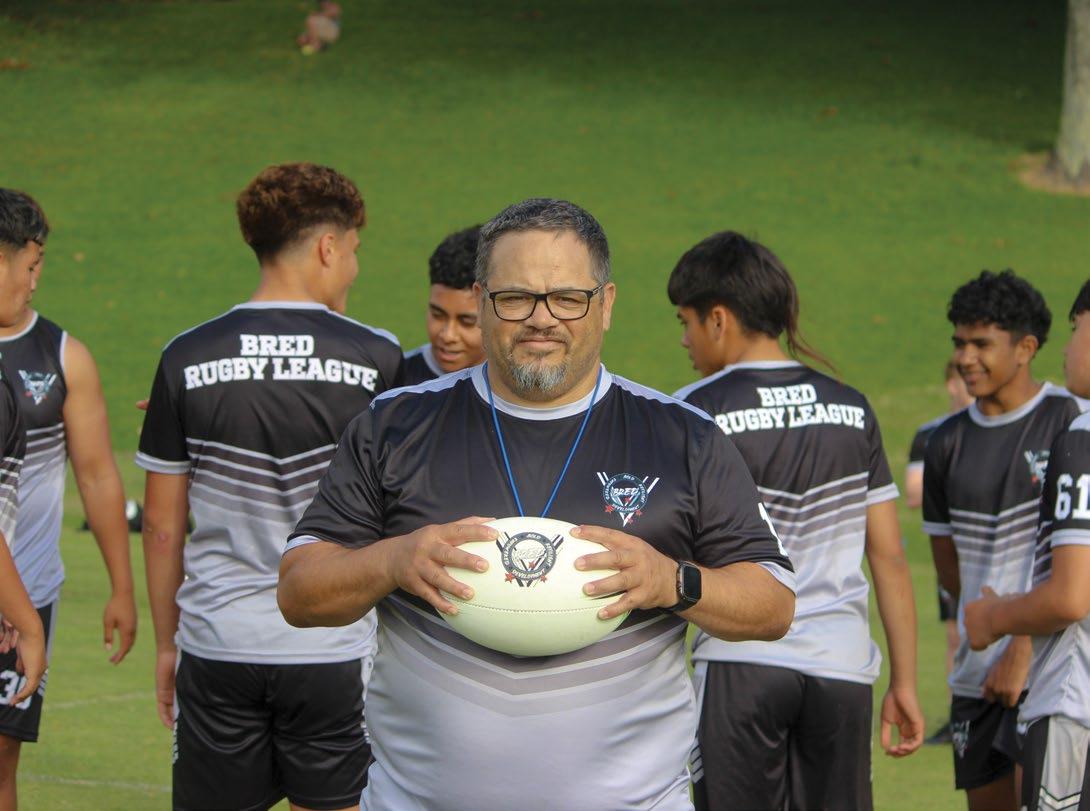
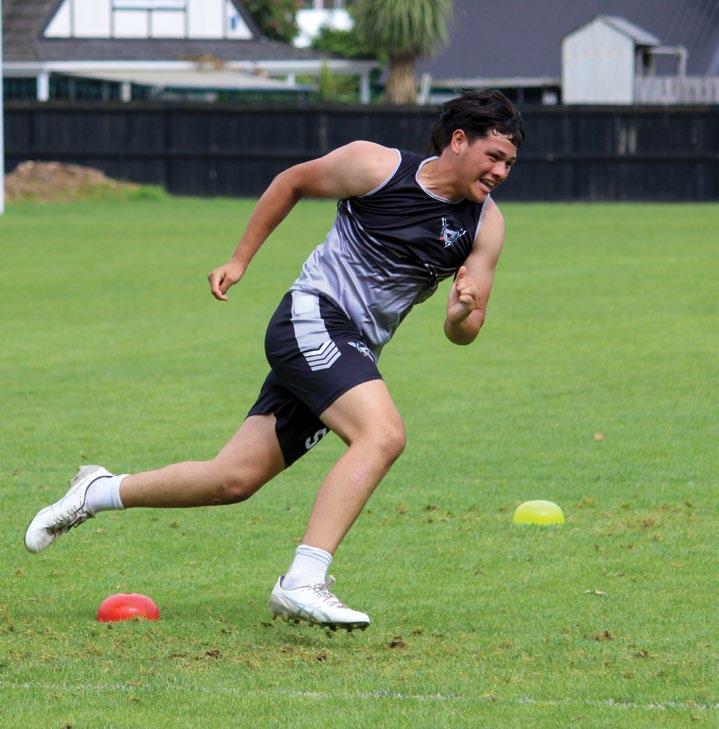
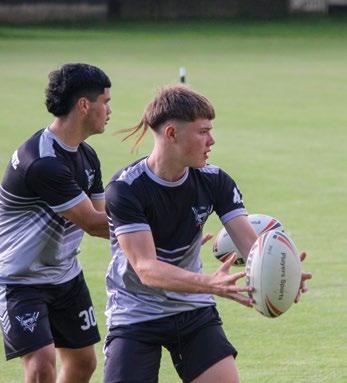
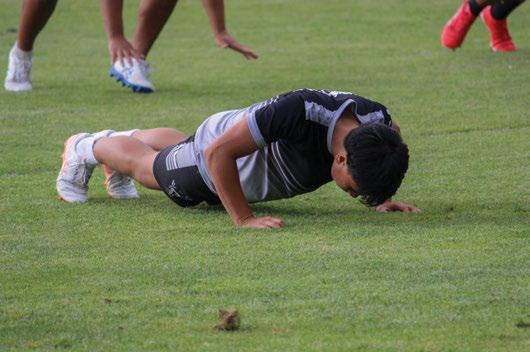
The words bold, resilient, empowered and development stand for BRED – a community-driven rugby league programme that aims to help youth achieve their goals on and off the field.
Bold. Resilient. Empowered. Development.
Those four words are the pillars on which the Tauranga youth rugby league programme known as BRED Development has been built. It aims to help its young members to reach sporting excellence while also instilling in them the essential life skills and leadership qualities they’ll need off the field.
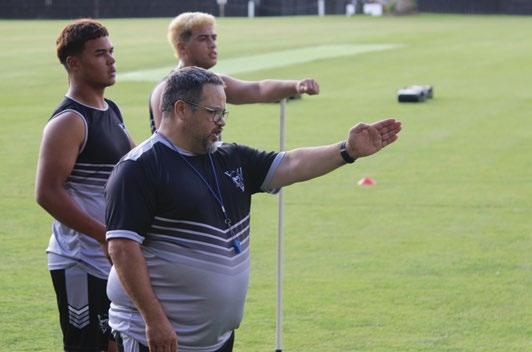
It’s 7.55am on a Sunday morning. While many in Tauranga are just starting to wake, a group of young BRED athletes huddle outside the Tauranga Boxing Academy, listening to coach Rob Taingahue. He’s talking with the young men about the importance of self-management, communication and taking ownership of their opportunities.
In five minutes, their 8am training session will begin. But for the young BRED boys, training starts long before they lace their boots. Being early is part of the programme’s DNA. The boys are expected to take accountability for their training and effort, prepare themselves, fuel their bodies and make the most of every minute they’re given.
“We teach accountability, discipline, and that if
you’re five minutes early, you’re late,” he says.
A blend of structure and support is at the core of what BRED Development is about. While rugby league forms the backbone of BRED, the programme extends well beyond the field, using the sport as a vehicle to connect young men with life skills, meaningful mentorship, and a sense of belonging.
“For me, sport is the vehicle, but we’re teaching them more – cooking, cleaning, and taking care of themselves. We want to help keep kids off the couch and make positive life choices and think positive about life,” Rob says.
“I want them to feel proud about themselves,” he says.
The programme started as a simple idea in December 2023, when Rob and co-founder Mat Milose decided to look for ways to improve their sons’ games and to create more opportunities.
They began hosting small training sessions in Matt’s home gym space, affectionately known as the dungeon, where their sons and a few friends gathered for fitness, strength work, and quiet guidance.
The informal father–son group soon grew.
“We called it Mahi Dogs at first,” Rob says.
Word spread quickly, fueled in part by Mat’s social media content, and by January Rob and Mat knew it was time to think bigger.
“Mat and I sat down and said if we’re going to do this we’ve got to think on a bigger scale. We thought this could go off.”
In February 2024, BRED held its first public, open training session, with about 25 boys turning up as founding members.
Simon Phillips jumped on board, providing funding and sponsorship advice, and the group rebranded with the name it’s known by today, BRED (Bold, Resilient, Empowered, Development), created by Harley Lawrence.
The name captured everything they wanted to build.
“I want our boys to be bold enough to stand up and korero,” Rob says.
“Resilience because rugby league is a hard journey. Empowerment because we give them tools
to advocate for themselves.”
And Development because growth doesn’t happen by accident, he says.
Rob says they made connections with the One NZ Warriors through stalwart Toni Iro, who brought a wealth of knowledge and the Warriors brand to the boys, and it BRED has continued to grow.
“This is the pathway. All our kids are aiming for something,” Rob says.
What started as a makeshift work out session with a few boys in a home gym has today become a structured, serious development pathway that is rooted in identity, pride, and purpose.
Rob says every child is treated as capable and worth investing in but they need to understand that things won’t be handed to them on a platter, they’ve got to earn it.
“We started with just one session a week, but the kids wanted more.
“Now, our sessions run twice a week and include Sunday mornings, integrating recovery and leadership opportunities for older participants.”
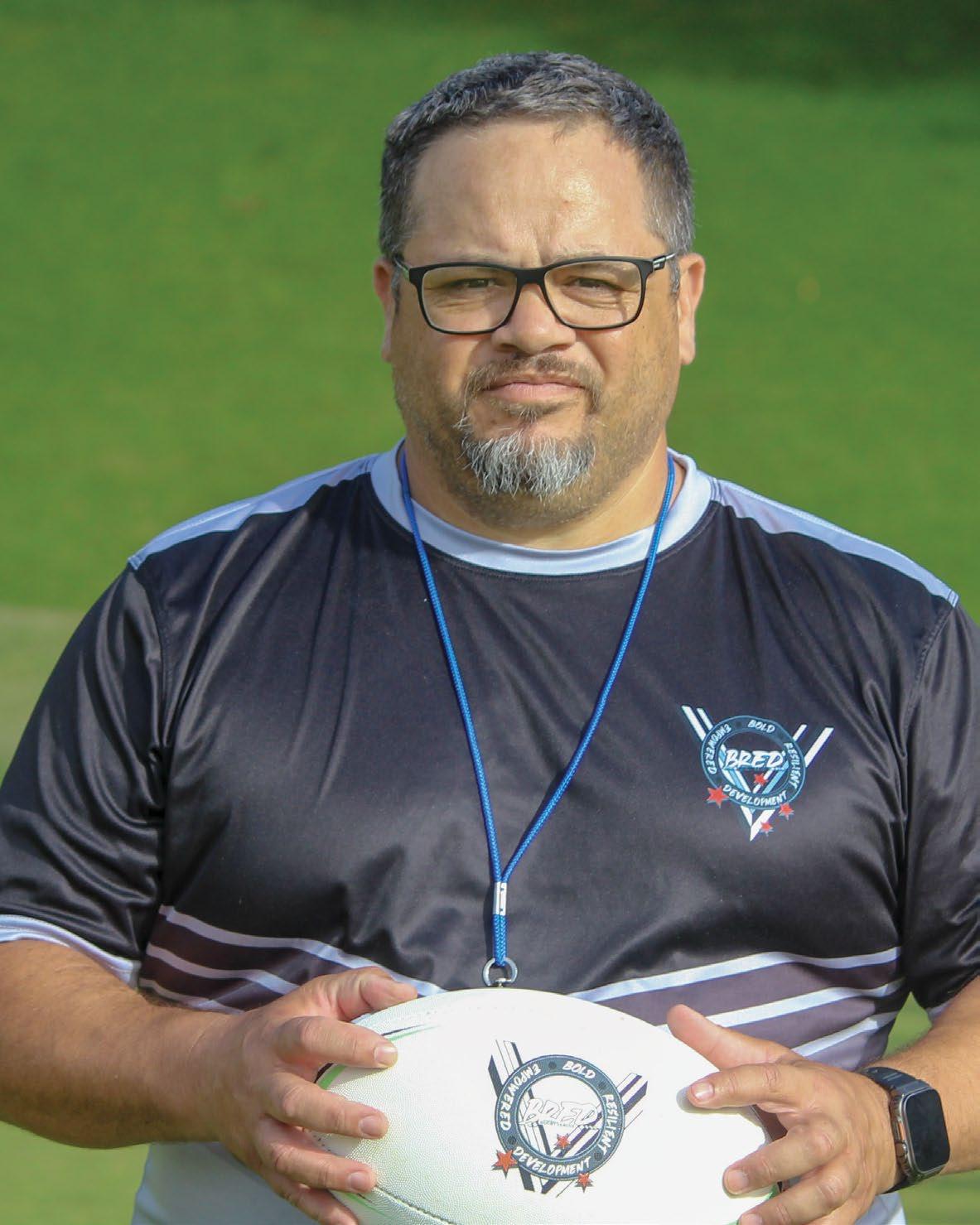
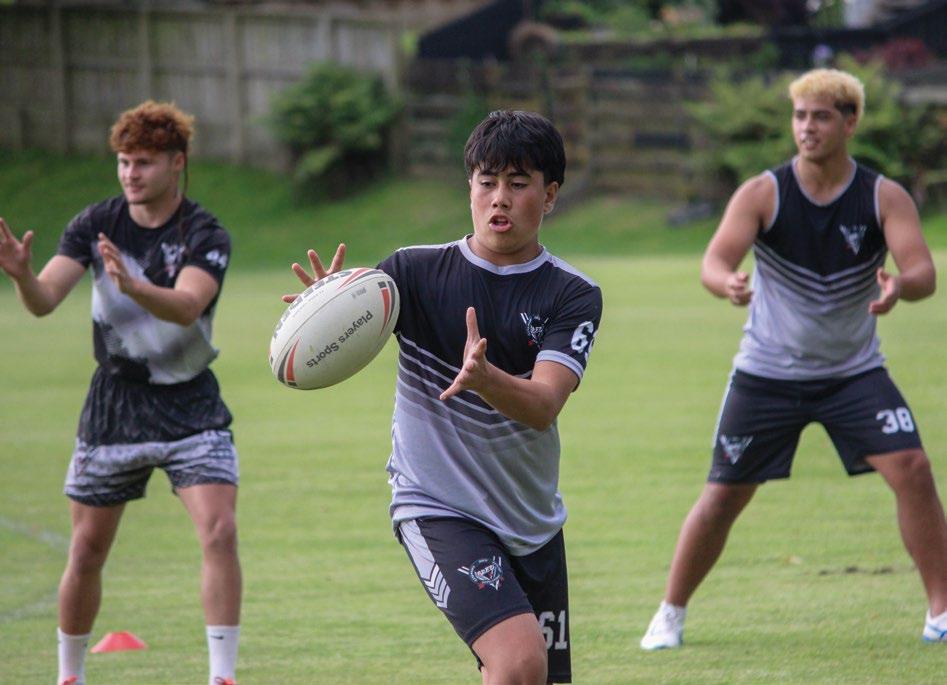
↑ Coach Rob Taingahue and his BRED boys at their twice weekly training sessions.
Leadership plays a major role in the BRED environment. Older participants are encouraged to guide younger ones, not just during drills, but through example by shaking hands, checking gear, welcoming newcomers, maintaining standards.
“We’re creating an environment where older kids are role models,” Rob says.
Behind the scenes, BRED is powered by family. Rob’s whole family is involved - his wife, his sons and daughter-in-law pitch in, covering everything from logistics and communication, to transport and admin.
“My wife is part of the committee, my daughter in law’s part of the committee, my son was one of the coaches, but he’s gone and chased one of his dreams. So pretty much if you’re in my household, there’s something to do, folding clothes, packing clothes, picking up stuff or setting up fields when needed,” he says.
“For me, I love the game, and I love what it can do for kids, so I’m willing to probably, you know, overwork myself in regards to BRED.”
Rob says BRED receives support through use of facilities and coaching at Tauranga Boxing Academy, fundraising opportunities through Bunnings, and young leaders and guest coaches provide invaluable support.
“For me, I love the game, and I love what it can do for kids, so I’m willing to probably, you know, overwork myself in regards to BRED.”
He says more volunteer support wouldn’t go amiss, though.
“I like to sit down with people and get a feel of who they are and what they’re about, as well as for them to get a feel of us and see if we are what we say we are… but yeah, extra help will be much appreciated.”
BRED is spearheaded by a dedicated group, centred on more than just performance on the field, but also on nurturing well-rounded young men ready for life’s challenges – and the young athletes and families have embraced it.
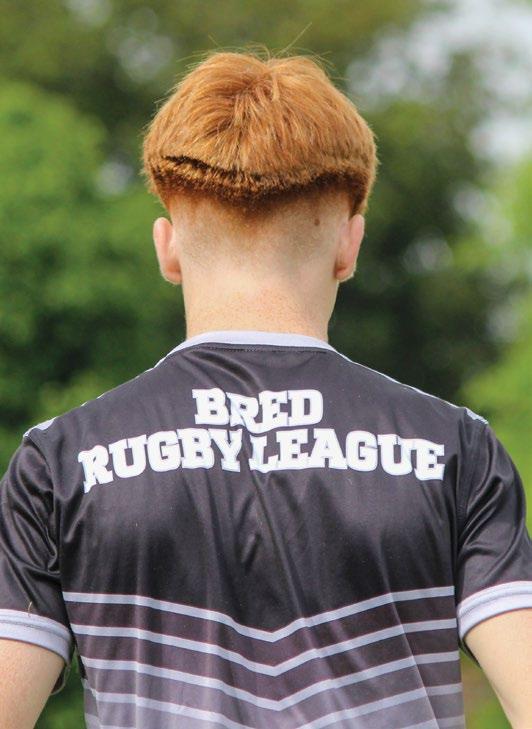
They wear BRED’s official silver and black apparel at every meet up, whether it’s for training or fundraising events, representing BRED, New Zealand colours and unity.
Rob says having a uniform makes people feel good and gives the boys a sense of ownership and pride in who they represent.
“I’m just really grateful that parents entrust us and I’m very appreciative of what the parents have done in regards to sponsoring, by helping the sponsorship and fundraising. That’s been outstanding, and seeing different parents and being able to meet them.”
Even more rewarding has been watching players achieve higher honours.
↑ Coach Rob says BRED wants to nurture the next generation, giving them dreams to chase both on and off the field. BRED’s official black and silver uniform is worn at every meet-up.
Among them is Rhayn Taikato, who recently signed a two-year contract with the One New Zealand Warriors and he has made the New Zealand Schools’ team. Rob says Rhayn has taken himself to another level through the programme, his own commitment and the huge support from his family.
“I think she [Rhayn’s mum] travels twice a week up to Auckland for his training, and then she’ll have to do it three times a week when it comes to season. Rhayn’s got a big future ahead of him and he is a really humble kid too,” Rob says.
Khobi Edwards is another rising star who has been part of the BRED programme, Rob says.
“He’s in Australia at Keebra Park, and he’s turning heads over there, so no doubt he will have something thrown at him very shortly.”
“Ryan Blair was another one from the first crew, he got signed by one of the scouts and moved to Bundaberg for school.”
Zander Phillips, Terua Moana, Ephraim Taingahue, Wesley Lagatule, Tim Saua, Kingston Gwerder-Hall and Nathan Theron have also received higher honours in rugby league or union and are making a name for themselves.
“These achievements bring so much pride, not just to the players, but to the entire programme,” Rob says.
Looking ahead, BRED aims to offer three formal intakes each year, introduce media workshops and player interviews, expand mentoring and life-skills sessions, acquire a dedicated transport vehicle for gear and travel and plan for an international tour to France.
He says BRED wants to nurture the next generation, giving them dreams to chase on the field and in life.
And as each training session wraps up, the boys shake hands. That simple act serves as a reminder that respect comes first, character matters, and true strength is found in how you carry yourself.
It’s one small gesture that says everything –respect, brotherhood, growth and a promise to show up again, work hard, and be better.
For more information about BRED or how you can support or provide sponsorship, email bred_rl_mgmt@gmail.com
Te Whakamaru o Horohoro
Words by Rebecca Lee of Manaaki Kaimai Mamaku Trust
Photography by Cam Neate
Once traversed freely, hapū Ngāti
Kearoa and Ngāti Tuara are dedicated to reconnecting whanau with their sacred Horohoro maunga.
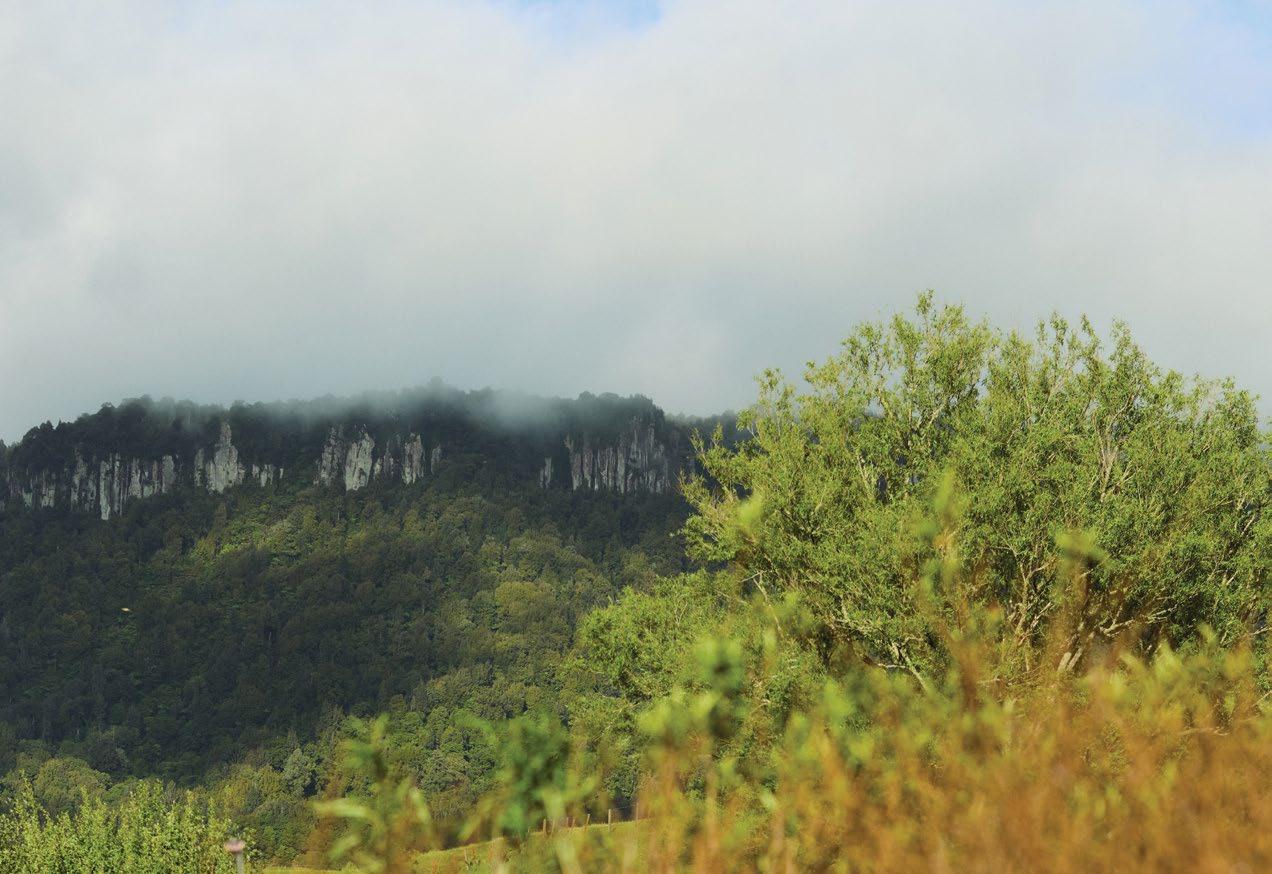
An ocean of commercial pine surrounds islets of indigenous bush.
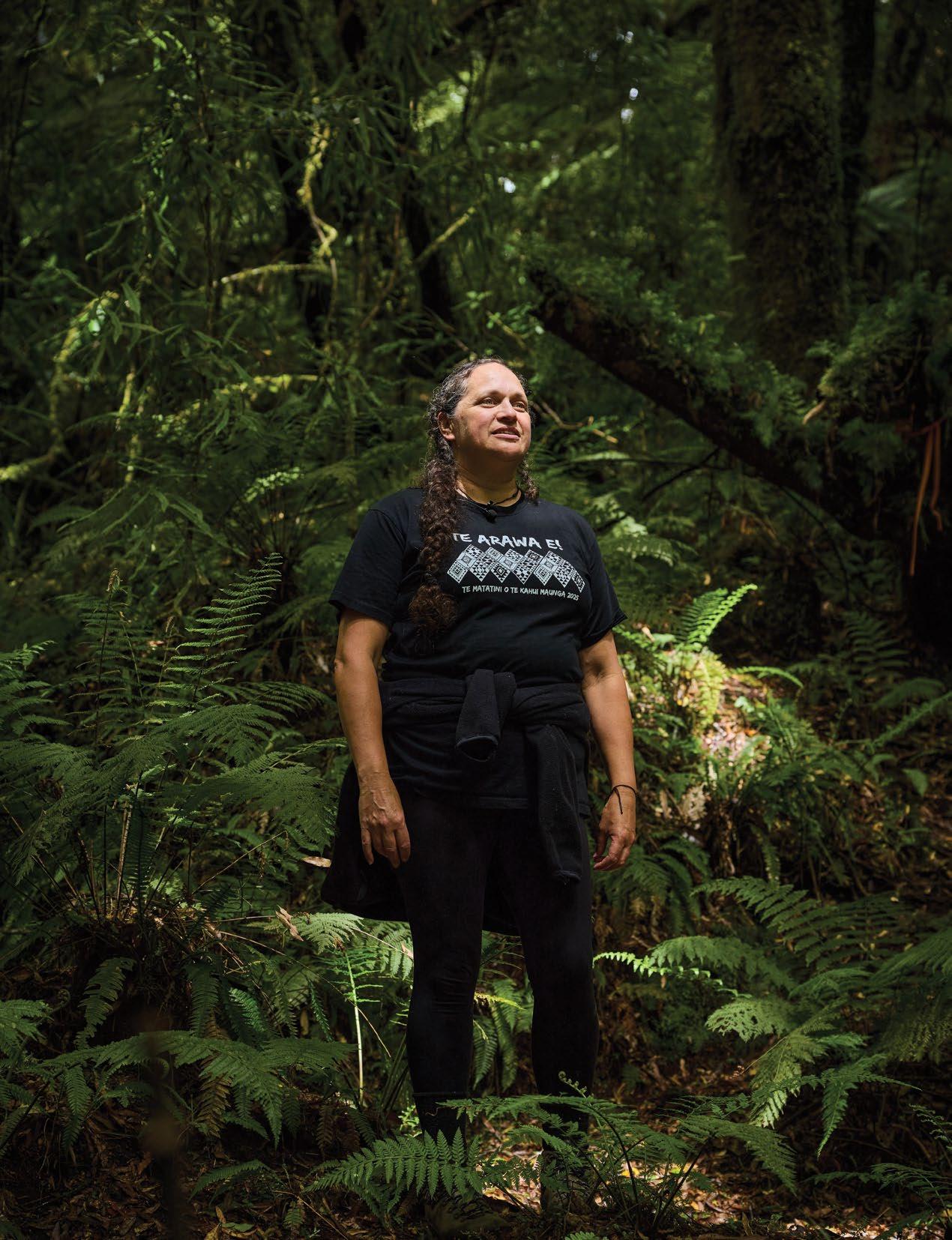
Māori once lived in, travelled and hunted this ngahere freely. Now, they must attain keys to locked gates before stepping foot on this part of their whenua. Kataraina George (Ngāti Tuara, Ngāti Kearoa, Kuki Airani), environment manager of Tipu Environmental, says tūpuna were
so familiar with the maunga, which straddles Rotorua and Tokoroa, there was no need for marked tracks.
“So you have to know the way. You would go along the side of the gully, then there’s a little cliff face and a little trail,” she says.
Although some of the hapū are now physically disconnected, Ngāti Kearoa and Ngāti Tuara are dedicated to reconnecting whānau with Te Horohoroinga-o-nga-ringao-Kahumatamomoe, their sacred Horohoro maunga. One way they are doing this is through conservation.
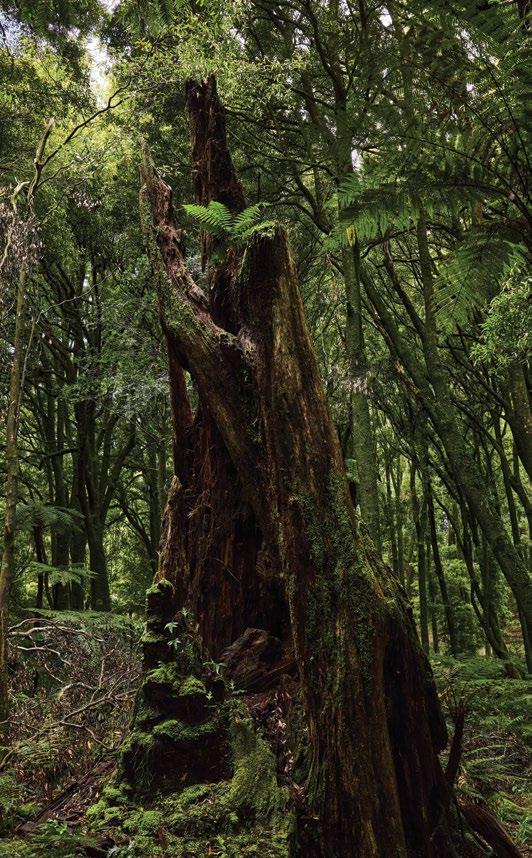
Te Whakamaru o Horohoro, a name based on a traditional kōrero gifted by kaumatua Tāwhiri Morehu, is a hapū-led restoration project that has installed, and is now managing, over 1000 hectares of pest animal control infrastructure on the maunga. They aspire to remove introduced predators, like rats, possums and stoats, from the entire range as a way to protect taonga
flora and fauna. The project is partly on Department of Conservation Public Conservation Land, accessed through commercial pine forest, and a portion is within Māori reservation land, administered by Ngāti Kea Ngāti Tuara Reservations Trust, and not publicly accessible.
Kataraina, a mother-of-three, had been pursuing a career in science and academia however, in 2014, she felt a calling to return home and serve her people. “Some would say this isn’t a proper career. But my goals are just different from what other people’s career goals might be,” she says.
“My goals, that match the aspiration of my hapū, are if we could achieve building a natural corridor from Horohoro to Mokaihaha and having native birds travel between the two spaces, and regeneration of that forest, and kōkako living back on Horohoro… is that not a good goal to achieve?” Before this, she was working
“My goals are just different from what other people’s career goals might be. My goals, that match the aspiration of my hapū, are if we could achieve building a natural corridor from Horohoro to Mokaihaha and having native birds travel between the two spaces, and renegeration of that forest, and kōkako living back on Horohoro… is that not a good goal to achieve?”
↑ Kataraina in the Horohoro Native Nursery. Most of these rākau have been eco-sourced from Horohoro maunga and will return to the whenua when ready.
in aquaculture in Northland with three degrees under her belt — a Bachelor of Science, majoring in Zoology, a Post Graduate Diploma in Marine Science and a Masters Degree in Zoology.
“I wouldn’t go back to science or academia when this is what I’m working towards.”
While Jobs for Nature funding kick-started the predator-control aspect of this project in 2021, Te Rūnanga o Ngāti Kearoa Ngāti Tuara, Ngā Pae o te Māramatanga and Victoria University of Wellington collaborated on a research and monitoring programme for three years prior. They wanted to identify exactly what was, or wasn’t, in the ngahere before they purchased or installed any traps. Dr Rebecca Stirnemann, ecologist and conservation expert, helped them with pekapeka (bat)
monitoring and says it’s one of the largest areas, by landmass, she has surveyed. “We found long-tailed bats, and we found they were utilising the whole of the forest,” she says.
Pekapeka are known to use the edge of forests or open farmland as flight paths, and like to feed on mosquitos and moths along waterways. “Even though there’s a lot of information about how pekapeka like to use edges of forests, they were throughout this forest. And they were there in quite good numbers. It’s a beautiful place, on top of being a great habitat for the long-tailed bats.”
Towards the end of 2020, Kataraina of Te Whakamaru o Horohoro, took to the skies with Waikato Regional Council, for a helicopter flight above the forest canopy. “The ngahere looks quite lovely when you’re in there.
But in a helicopter you can see the disconnection, all of the pine, and the dead larger canopy trees. It made me realise the forest needs our help now.”
The team is focused on restoration of their whenua through pest control, with increased rat control in places where high pekapeka numbers were found. In the coming years, they hope to repeat the survey to confirm the mahi is working.
“You can put out a sound recorder, and then put one out years later and you will hear the night sounds change. And, hopefully, you’ll hear more squeaks. “Some children can hear bats with their own ears, but generally you need sound recorders because they squeak at a really high frequency,” says Dr Rebecca. Last year, when Jobs for Nature funding finalised, it could have been the end
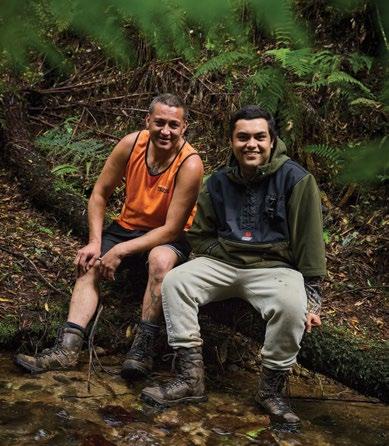
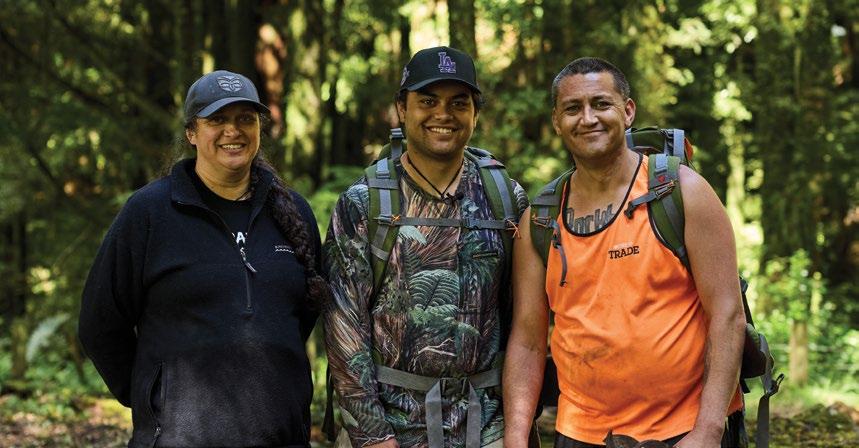
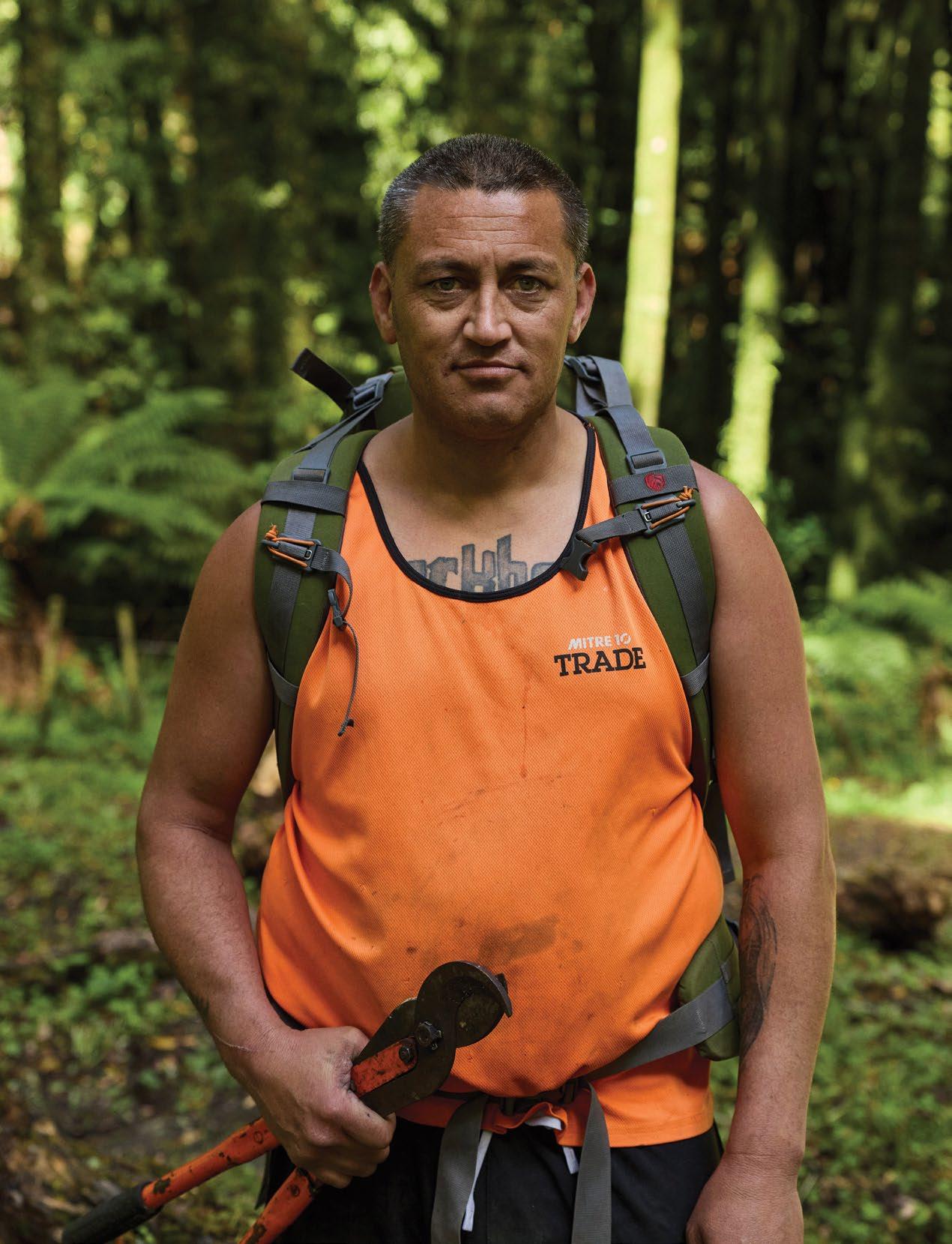
↑ Ngahere within Te Horohoroinga-o-nga-ringa-o-Kahumatamomoe. → Te Whakamaru o Horohoro team Kataraina George, Izaiah Kiel and Kyle Kiel.
“The ngahere looks quite lovely when you’re in there. But in a helicopter you can see the disconnection, all of the pine, and the dead larger canopy trees. It made me realise the forest needs our help now.”
for Te Whakamaru o Horohoro. But Kataraina persisted.
This year, she and the team have brought in enough funding, from Waikato Regional Council, Lottery Grants Board, Rotorua Trust and Bay Trust, to continue the work programme for another two years.
“We’ve been turned down [by funders], we’ve had to adapt our project plans and applications to suit [the funders]. We’ve put a lot of work into it, but in some aspects I feel lucky,” she says. Kataraina is resilient, determined and extremely humble. The whakatauki, ‘Kāore te kūmara e kōrero mō tōna ake reka, the kūmara doesn’t speak of its own sweetness’ is one that sits front of mind as we speak.
“This mahi wouldn’t happen without collaboration,” she says, citing her hapū, Ngāti Kea Ngāti Tuara Reservations Trust, the Rotorua Department of Conservation team, Manaaki Kaimai Mamaku Trust, Tame Malcolm and the father-son kaimahi
(worker) duo Kyle and Izaiah Kiel as instrumental to the success of the project. Kyle has been working with Te Whakamaru o Horohoro for about four years. But by the way he and Kataraina interact and their matching sapphire eyes, you would assume they’re whanau. Like many bushmen, Kyle (Ngāti Kahungunu, Te Arawa, Ngāti Porou) wasn’t interested in academia. He feels most comfortable working with his hands and has a background in dairy farming and labouring. “Our whānau moved [to Horohoro] from the Coast in the 1920s [through the Māori land development scheme initiated by Sir Apirana Ngata]. We have a big whānau with heaps of mouths to feed. So we’ve always hunted,” he says as we stop at the tallest point of the Mamaku ranges –820m above sea level.
Manu (birds), like the miromiro (tomtit), riroriro (grey warbler) and toutouwai (North Island Robin), dance around us as we kōrero about
Opposite: Kyle Kiel (Ngāti Kahungungu, Te Arawa, Ngāti Porou). ← Kyle’s son Izaiah Kiel.
whānau and history. Being in the bush removes any barriers between people and allows you to really get to know someone which can’t happen as quickly away from the rongoa (healing) of the rākau (trees).
“The best part of this mahi is where we are,” he says.
“For me, ‘restoring the mauri’ is giving back after generations, and making sure future generations can enjoy this place. We owe it to our tūpuna. If we don’t look after it, it won’t be around for long,” he says.
Kyle and Izaiah were joined by a ruru once, who carefully watched over them as they worked. “I think he was telling us we’re doing a good job. Now I say ‘Kia ora Matua, thanks for looking after us’. “I feel at home up here.
Getting the mauri from the trees, it’s my getaway. I don’t think about much out here. I just listen to the bush. “The hardest part is going home.”
Art Gallery’s New Era
Photography by Brydie Thompson
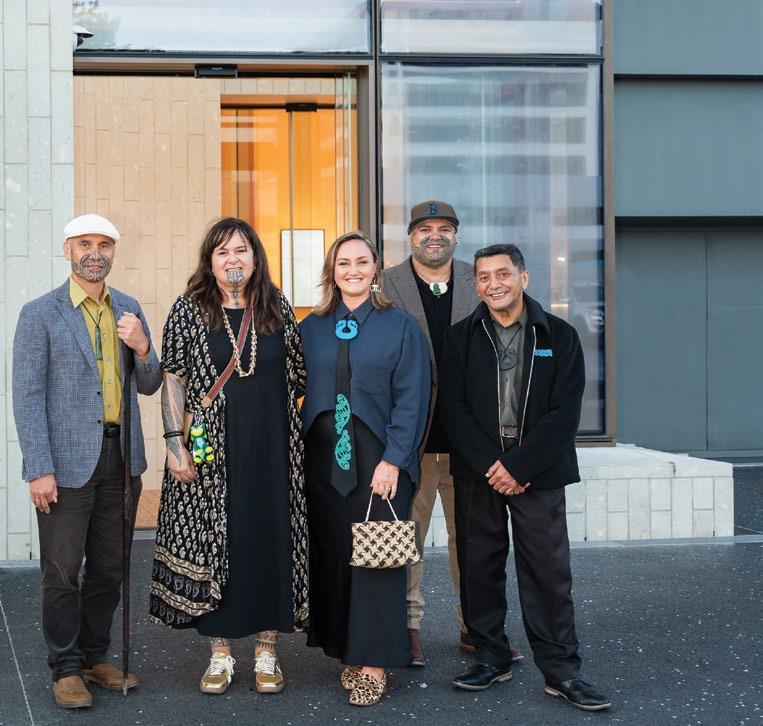
Que Bidois shares the pūrakau behind the mauri stones at the entrance to the newly transformed Toi Tauranga Art Gallery.
← Te Amo from Tamapahore wharenui (1896) image courtesy of Tauranga Museum. ↑ Te Kāhu ō Hinewa captured at the gallery’s blessing and pōwhiri.
Toi Tauranga Art Gallery has been transformed. Take a walk inside and there is a sense that everything has been designed and created with intent and meaning.
For a brief moment, you could catch yourself thinking you were somewhere in the Australian city of Melbourne! But, this is not Melbourne. This is Toi Tauranga Art Gallery – a place deeply connected to the whenua that anchors it. The refreshed gallery on Willow St in the city centre encompasses architectural and cultural realms and its evolution has been guided by Māori Advisory Group, Te Kahu ō Hinewa (the cloak of Hinewa).
Named after a common ancestress, the group comprises respected Māori artists, educators, and
cultural leaders – Que Bidois (Ngāi Te Rangi and Ngāti Ranginui), Ngairo Eruera (Ngāti Ranginui, Ngāti Awa, Ngāi Tūhoe), Arohanoa Matthews (Ngāi Te Rangi and Ngāti Ranginui), Julie Paama-Pengelly (Ngai Te Rangi, Ngai Tuwhiwhia, Ngati Tapu, Ngati Tauaiti) and chair, Tipene Walters (Ngāi Te Rangi, Ngāti Ranginui and Te Rarawa).
Each bringing a collective expertise across Tikanga Māori, Mātauranga Māori, and Toi Māori, their guidance has shaped everything from exhibition programming to design and education.
The gallery is now one which looks outward to the world while staying grounded in the stories of Tauranga Moana. A prominent piece in
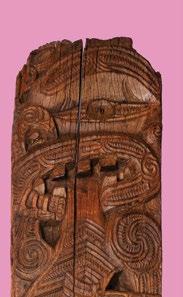
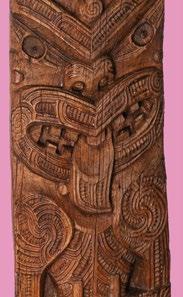
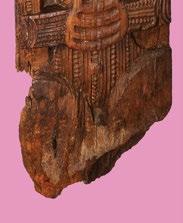
the gallery is Te Amo from Tamapahore wharenui, 1896. Carved by Meihana Te Tawakura (Ngā Pōtiki, Ngāti Awa), from totara in Mataatua style with steel tools, it stands at 2800 x 420 x100mm. Originally carved for the wharenui Tamapahore, built in 1884, Te Amo stood at Mangatawa Marae, Karikari point on the Te Tahuna o Rangataua (tidal estuary).
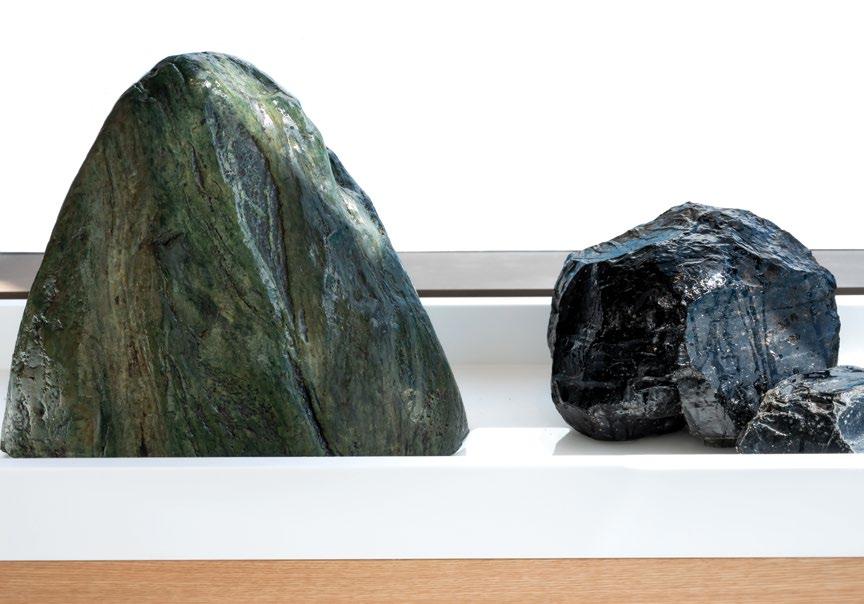
At the entrance of the newly reopened gallery lie the mauri stones, physical markers of the gallery’s living energy. These stones are guardians and the carriers of mauri, the spiritual essence that connects all things.
Que Bidois shared a pūrakau (story) about the stones, titled ‘The Cloak of Poutini: A Tauranga Moana Story’.
Toi Tauranga Art Gallery Promotion
↑ At the entrance to Toi Tauranga lie the mauri stones, physical markers of the gallery’s living energy.
In the time of our ancestors, Poutini was a beautiful and powerful being who travelled with (his friends) Ngahue and Rongoueroa across the Pacific. But Poutini faced many problems. People were drawn to his beauty. Some admired him, others became jealous or obsessed.
He couldn’t find peace, and even in Hawaiki, he was rejected by the guardian Tutarakauika, who said he wasn’t a “real fish”.
Ngahue and Rongoueroa wanted to help. They remembered an old relative who had left Hawaiki long ago and settled in Aotearoa. His name was Tamaahua. He came from a special people who could choose when they wanted to be seen or not. They still live today on Tūhua (Mayor Island), just off the coast of Tauranga Moana.
They believed Tamaahua could help Poutini, especially to protect him from Hine-Tua-Hoanga, a powerful being who was chasing him. Alongside Poutini came Whatukura,
the people of pāua, who had also been rejected by Tutarakauika. They too were looking for safety in the sea.
Tamaahua welcomed them. He gave them a special gift, Korowai, a kind of cloak that could hide them from danger. For the Pāua, this Korowai became their shell, which protects them and shows their inner beauty. For Poutini, the gift was even more special. He was given a stone cloak called “Pounamu”. This allowed him to hide among the rocks, safe and unseen, while still holding his beauty and power within.
This is why pounamu is so treasured. It carries the story of Poutini, his journey, his struggles, and the gift of protection from Tamaahua.
It also explains the deep connection between pāua and pounamu and why pāua shell is often used for the eyes of hei tiki made from greenstone. They share the same story of seeking safety, of being misunderstood, and of finding
strength in their true form.
In this version of the story, we move away from the more negative tales that have been told about Poutini. Stories that say he was a thief or a murderer.
Instead, we see him as a being of beauty and spirit who was simply trying to find a place to belong. Tamaahua didn’t chase him in anger, instead, he gave him a gift of aroha and protection.
Na Te Rua o Hei-Tiki, Wānangā 2020.
This story and some cool art activities are in Toi Tauranga’s Creativity Guide – a free publication especially for tamariki to spend time with at the gallery. Check out one of the pages inspired by Whakairo by artist Kereama Taepa. artgallery.org.nz @taurangaartgallery TaurangaArtGallery
Toi Tauranga Art Gallery Promotion
Kereama Taepa
Kereama Taepa
Te Arawa, Te Āti Awa, Tauranga Moana
Te Arawa, Te Āti Awa, Tauranga Moana
Kereama Taepa
Te Arawa, Te Āti Awa, Tauranga Moana
you (when you return)
ISBN: 978-0-473-76347-3
Written and edited by Angie Ogilvy-Clark
Designed by Extended Whānau
You’re welcome to share or quote from this publication for personal or educational use, as allowed under the Copyright Act 1994 (NZ). For any other use, please ask us first.
Image Credits
by Brydie Thompson.
4. Kereama Taepa, photograph by Naera Ohia.
5. Tyrone Te Waa, photograph by Van Mei.
6. Artwork by Tyrone Te Waa, from ‘Circle Turtle’ exhibition with Reece King at Papakura Art Gallery, 2022.
7. Matthew Harris and his dog Rollo, image courtesy of artist.
8. Tania Lewis-Rickard, image courtesy of artist.
9. Tawhai Rickard, image courtesy of Toi Tauranga Art Gallery.
10. Kaylene Whiskey in the Iwantja Arts studio, photograph by Jackson Lee.
11. Still of Ngura Pukulpa – Happy Place , by Kaylene Whiskey, 2022. Photo courtesy of Roslyn Oxley9 Gallery.
13. Pusi Urale, photo courtesy of I Love Avondale.
14. Pusi Urale, O Pusi Sisiva O Avondale , 2025. Acrylic on stretched canvas.
Kereama is a Māori artist who lives in Tauranga Moana. Sometimes he likes to use his computer to make artworks.
Kereama is a Māori artist who lives in Tauranga Moana. Sometimes he likes to use his computer to make artworks. Kereama often thinks about how Māori made art a long time ago and then uses those ideas to make new modern artworks like Whakairo .
Kereama’s artwork is an augmented reality experience, which is also referred to as AR. This means you need to use a device to see everything he has created. You can download the app to view his artwork using this QR code:
Kereama is a Māori artist who lives in Tauranga Moana. Sometimes he likes to use his computer to make artworks. Kereama often thinks about how Māori made art a long time ago and then uses those ideas to make new modern artworks like Whakairo .
Kereama often thinks about how Māori made art a long time ago and then uses those ideas to make new modern artworks like Whakairo .
Kereama’s artwork is an augmented reality experience, which is also referred to as AR. This means you need to use a device to see everything he has created. You can download the app to view his artwork using this QR code:
Kereama’s artwork is an augmented reality experience, which is also referred to as AR. This means you need to use a device to see everything he has created. You can download the app to view his artwork using this QR code:
15. Pusi Urale, O Le Taimi Ua Te’a , 2017. Triptych paintings, acrylic on stretched canvas.
16. Vaimaila Urale, photograph by Dane Taylor.
What is this artwork about?
17. Vaimaila Urale, Lepo , 2017. Acrylic paint on unstretched canvas.
Whaka-iro means to be like a worm, larvae or grub (like me).
18. Darcy Nicholas QSO, photo supplied by the Nicholas whānau.
Whaka-iro means to be like a worm, larvae or grub (like me).
19. Darcy Nicholas, Manawhenua , 2020. Acrylic on canvas.
20. Darcy Nicholas, Forgotten Warriors , 2024. Acrylic on canvas on board.
21. Maraea Timutimu, photograph supplied by the artist.
Whaka-iro means to be like a worm, larvae or grub (like me).
Whakairo also means the traditional Māori art of carving.
Whakairo also means the traditional Māori art of carving.
22. Self-portraits from the Tamariki Portrait Show, courtesy of Toi Tauranga Art Gallery.
Whakairo also means the traditional Māori art of carving.
The iro eats through the wood making a pattern and Māori carvers try to be like the worm as they carve through the wood, stone or bone.
The iro eats through the wood making a pattern and Māori carvers try to be like the worm as they carve through the wood, stone or bone.
The iro eats through the wood making a pattern and Māori carvers try to be like the worm as they carve
the wood, stone or bone.
1. Cover Image: Artwork by Tyrone Te Waa, from ‘Circle Turtle’ exhibition with Reece King at Papakura Art Gallery, 2022. Image courtesy of Anna Miles Gallery.
2. Te Amo from Tamapahore wharenui (1896). Photograph courtesy of Tauranga Museum.
3. Mauri Stones, photograph
CREATIVE BAY OF PLENTY
Creative Bay of Plenty supports arts, culture and creativity across Tauranga and the Western Bay of Plenty. In 2025, we supported 34 public art projects including murals, exhibitions and sculpture trails. We also mentor artists, deliver workshops, assist with funding applications and provide cultural guidance to help creatives and organisations share inclusive stories of Tauranga Moana.
If you’re planning a creative project in the Bay of Plenty region or would like support as a creative, get in touch with us - we are here to help.
Connect with us at creativebop.org.nz
CREATIVE CONNECTIONS LUNCH
TAURANGA STREET ART FESTIVAL
Waka Tere
The newly carved wakatētē Te Ao Marama has embarked on her maiden voyage, marking a powerful moment of reconnection for this community.
Words by Rebecca Lee
Photography by Cab Creative
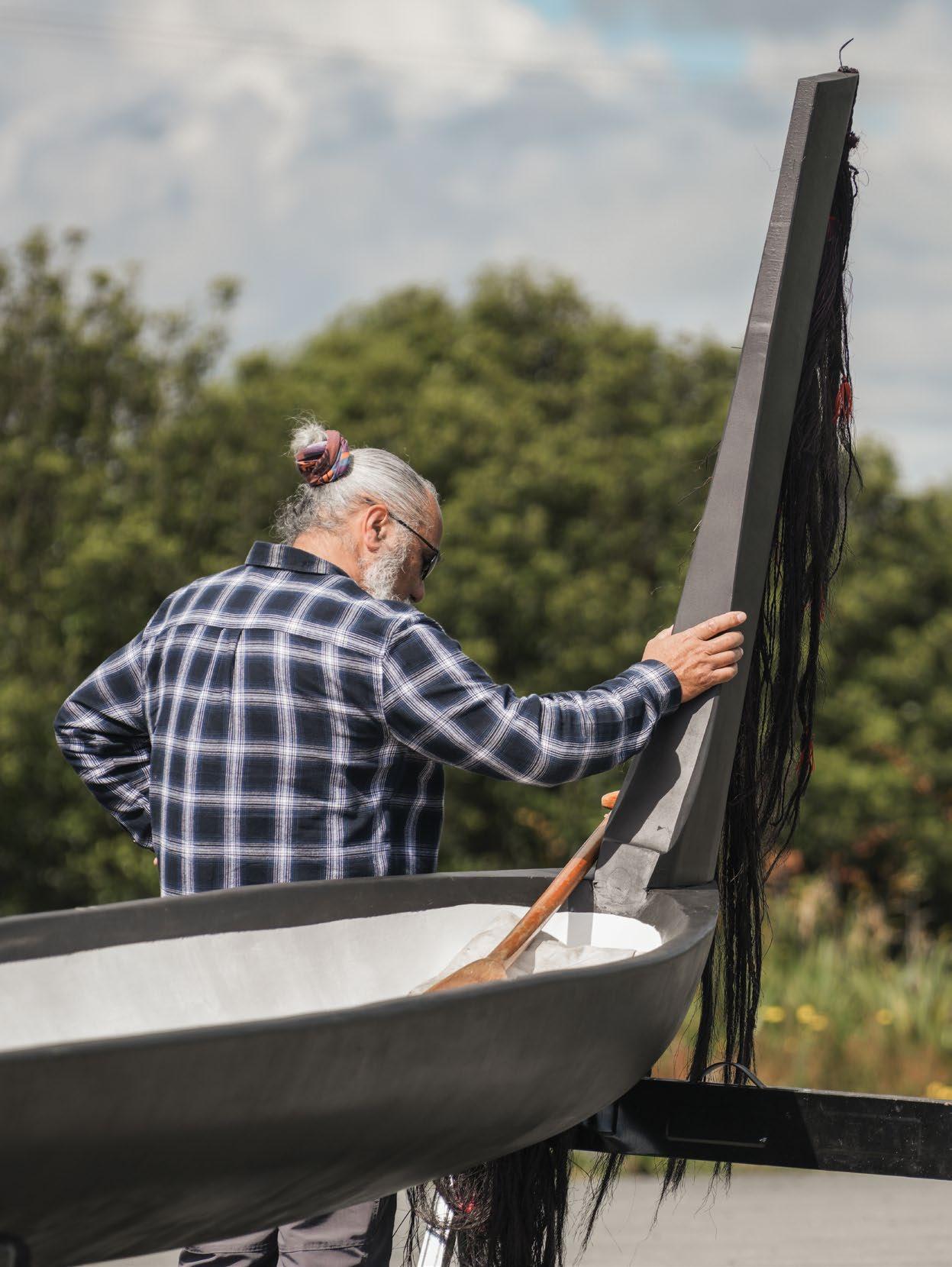
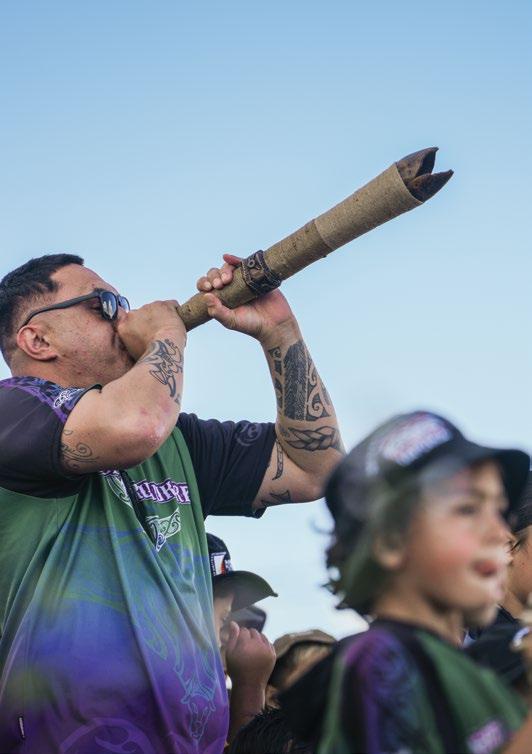
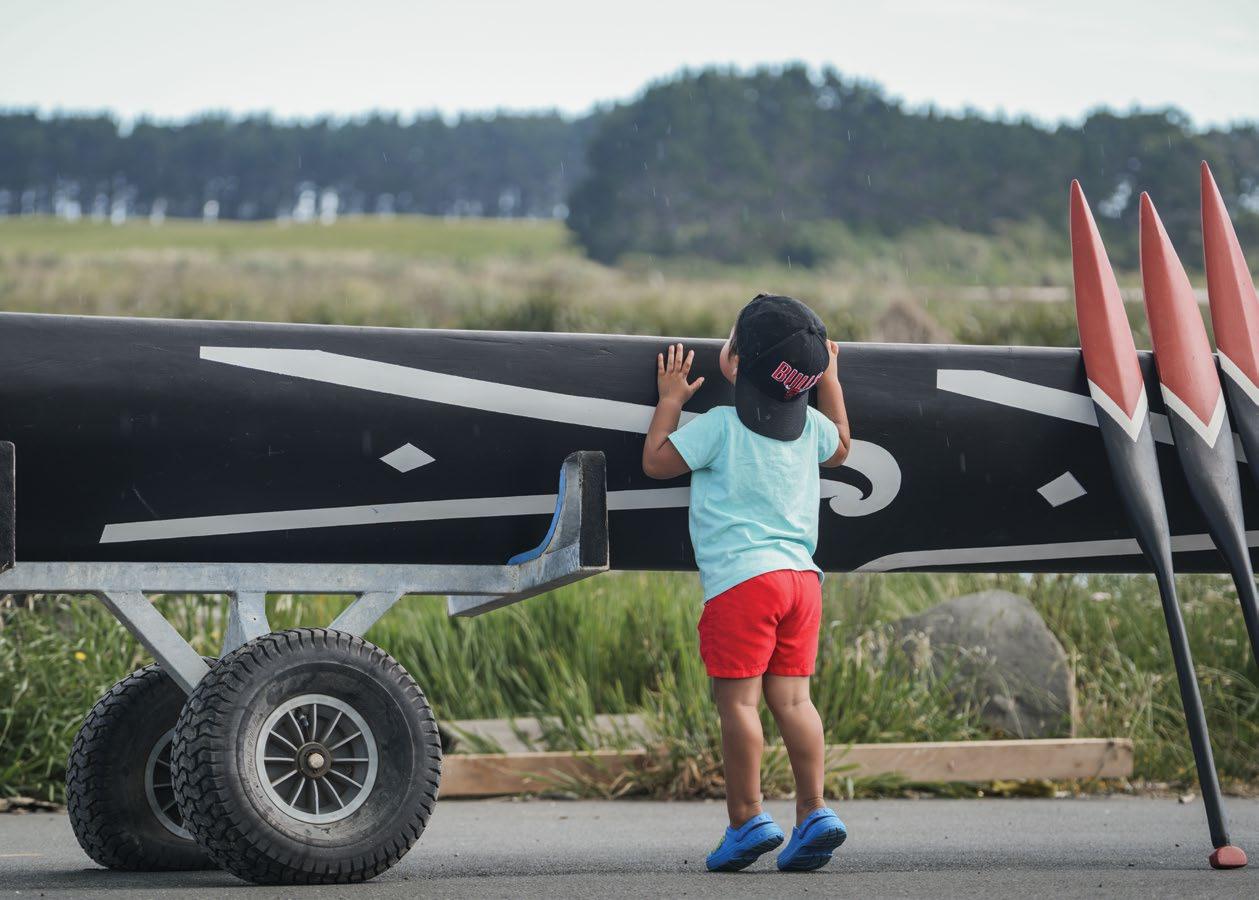
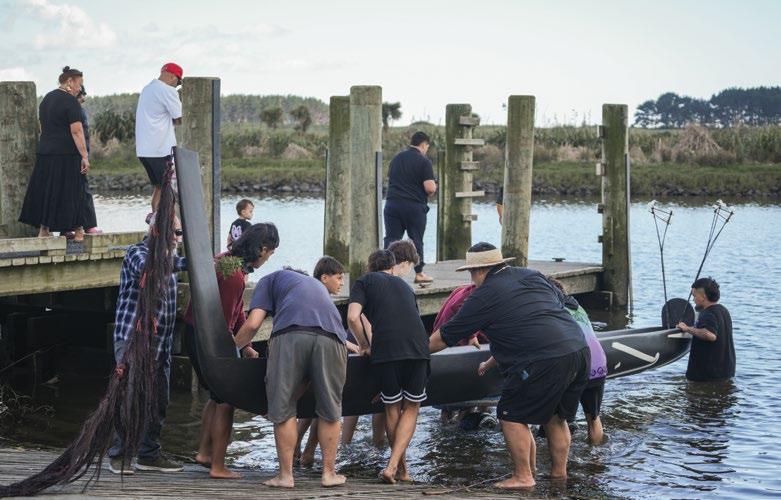
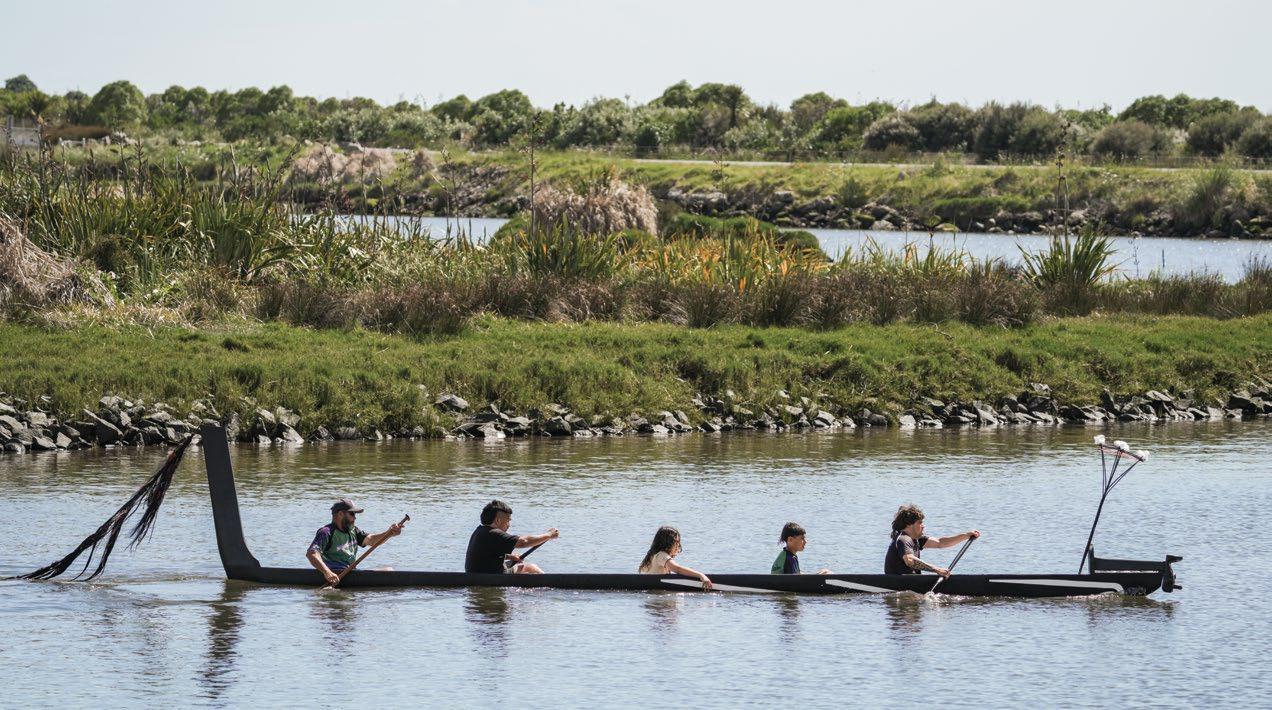
The river banks were bursting with proud whānau and community, as the recently completed wakatētē (river waka) Te Ao Marama took her maiden voyage in Kaituna River. This is the final stage of “Waka Tere” a six-month rangatahi development programme, which aims to empower rangatahi by building their cultural identity and community connections.
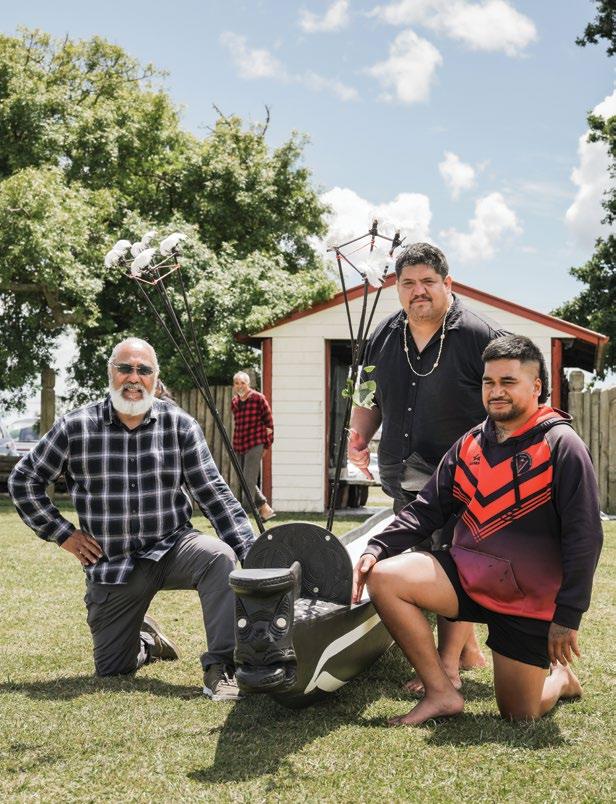
Waka builder Haimona Brown (Ngāti Rangiwewehi, Te Arawa) works with Ngā Kākano Foundation and Tapuika iwi, to bring this worldleading programme to life. “Waka Tere is an initiative that came from the dreams and aspirations of Tapuika leadership and other community leaders who want to look after the river. The launch was a moving, transformative day, it enhanced the spirituality and strength of our people,” he says.
Before this programme began in 2024, there hadn’t been a wakatētē on Kaituna for more than 100 years. While the outcome of the programme is a taonga waka carved from totara, Haimona says Waka Tere is more of a health initiative that uses Mātauranga Māori practices to improve the general wellbeing of the people. “The river is where it all starts from. If the river is healthy, the people are healthy. That’s the main kōrero that resonated with me. So here we are, from that dream to reconnect
our people with the awa and their identity,” the father-of-one says.
Throughout the six-month programme, students spend one day a week either helping to build the waka, or reconnect with Mātauranga Māori. They learn about waka, talk about how their ancestors came to Aotearoa as well as going into the ngahere to learn how to embrace nature. Haimona says he’s helping people learn how to “go with the rhythm of nature”. “This programme reinforces who they are. Building the waka gives them a sense of belonging and brings them closer to how their ancestors used to live,” says Haimona.
Every waka is treated like a person and given an identity and a personality during the launching ceremony. This waka, named “Te Ao Marama”, means the world of light.
“As you build the waka, you take observations. We came up with that name, not just me, it was the community. We sat down and discussed the name as it will impact the iwi. So, the world of light, it talks of a new dawn and hope for the future.”
While only 10 students, mostly from Te Puke High School, were part of the programme, it took the whole community, iwi, hapu to help shape Te Ao Marama, who was carved for Tia Marae,
“The river is where it all starts from. If the river is healthy, the people are healthy. That’s the main kōrero that resonated with me. So here we are, from that dream to reconnect our people with the awa and their identity.”
↑ Whānau celebrate the final stage of Waka Tere.
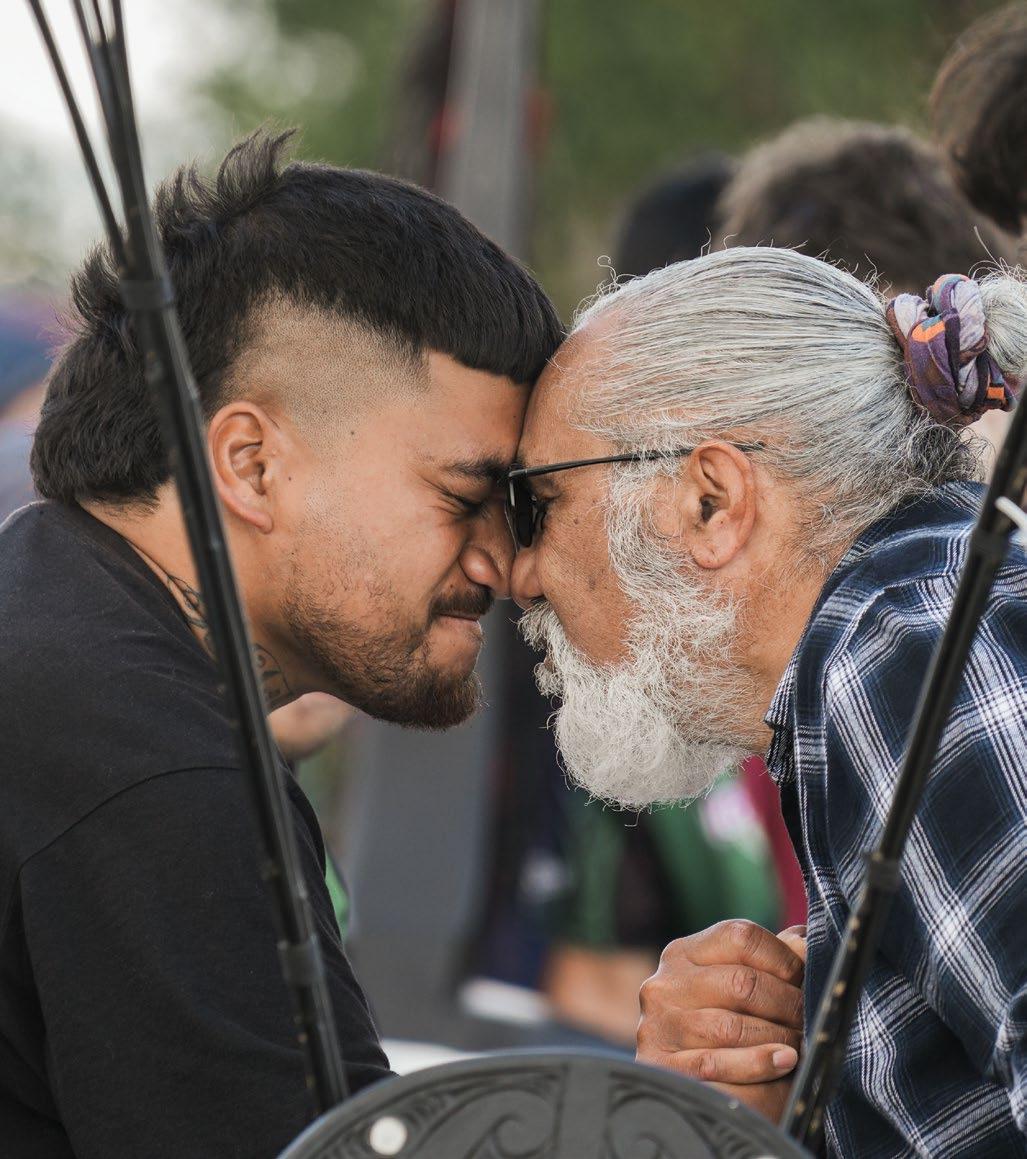
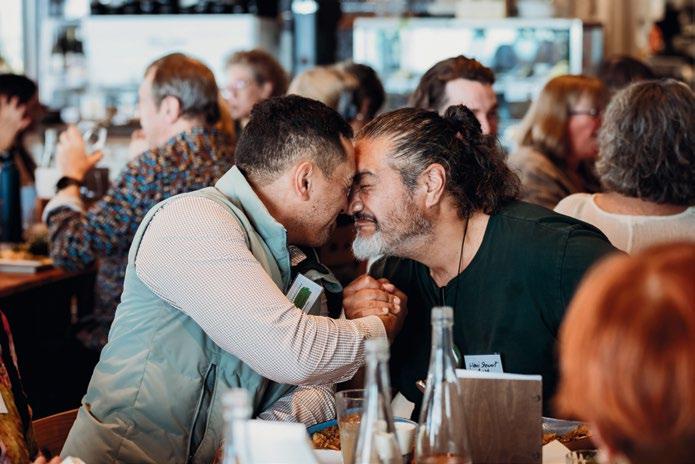
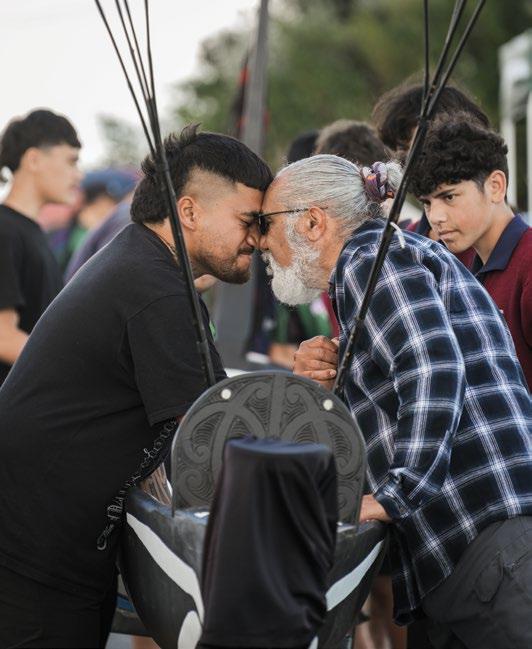
→ Joshua Roberts has a hongi with master carver and Tapuika kaumatua, Dean Flavell, who shares his mātauranga throughout the kaupapa.
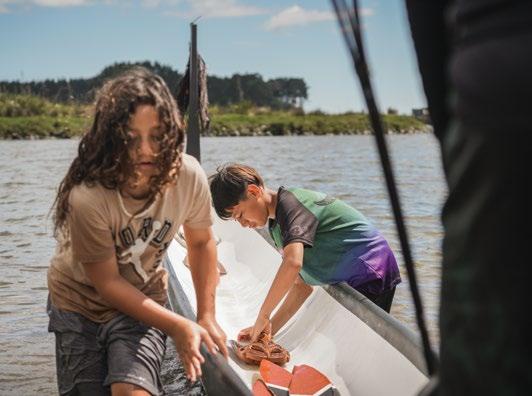
↑ Whānau of all ages took part in the maiden voyage. → Johnny Dinsdale, Joshua Roberts, Hori Brown (waka builder Haimona’s son), Harlem Dinsdale, Te Mano Biel are all students of this year’s programme.
“Out of all of the Māori art forms, waka building is the most endangered. We hadn’t had a waka on the river in a hundred years. It’s an important job to rebuild the waka culture among our people.”
Ngāti Marukukere, Tapuika. “From the people filing the paperwork, to the kaumatua who shared their wisdom, everyone has their input, and that’s what adds to her story, and the mauri.”
This waka was carved “as close to the traditional shape as possible,” based on the remnants of three waka, each more than a hundred years old and living around Rotorua. “These particular waka are “river waka”. They’re everyday waka that we use because the people of the Kaituna are river people. It’s our identity. It’s who we are. It’s my job to reintroduce that to the rangatahi that waka are a symbol of hope and reconnecting to the past.”
↑ Tia Marae. Hapū - Ngati Marukukere. Iwi- Tapuika.
→ Opposite: The carvers of the wakatētē, Te Ao Marama: Dean Flavell, Haimona Brown and Joshua Roberts.
Haimona was brought up on the ocean in the far north and his father was a commercial fisherman. He had grand plans of playing professional rugby, but after breaking some bones his path detoured and he trained to become a teacher. During his studies in 2010, he met master carver and navigator Sir Hekenukumai Busby who in 1992 built and navigated the inaugural voyage of Te Aurere, the first waka hourua (double hulled ocean sailing waka) to be built in Aotearoa in 600 years.
Te Aurere was waiting for her revival in 2012,
which Haimona played a part in. He helped restore her and then spent 10 months on the “Waka Tapu” expedition, where Te Aurere and a newer waka Ngahiraka Mai Tawhiti travelled to Rapanui (Easter Island) and back, retracing the journey of their ancestors. The crew used only traditional celestial navigation to guide them – relying on the stars, sun, moon, ocean swells and currents, along with bird and sea life rather than modern technology such as GPS.
“It was the best thing that ever happened to me,” he says.
“It opened up my eyes to the world and our atua, our gods. Being out at sea you really get to understand how small you are in the grand scale of things. You’re a needle in the haystick and the world’s a big place and you understand your insignificance. It taught me humility. I was also able to embrace ancient whakapapa ties throughout the Pacific Ocean. We share a common culture. It was a trip of a lifetime,” Haimona says.
Following this voyage, Haimona spent three years learning the ancient art form of waka building led by the late Tohunga Sir Hector Busby at the newly established “Te Wananga o Kupe mai Tawhiti”.
“Out of all of the Māori art forms, waka building is the most endangered,” Haimona says.
“We hadn’t had a waka on the river in a hundred years. It’s an important job to rebuild the waka culture among our people.”
This is the second year of Waka Tere. Ngā Kākano Foundation and Tapuika hope to run this programme annually, so all Tapuika marae have a waka, followed by annual events to connect wider communities with Kaituna. “This programme exceeded all expectations,” he says.
Joshua Te Riu Roberts (Tapuika) has been learning the art of waka building under Haimona since the programme began in 2024.
“Ko Tapuika te iwi, we are river people so it runs through my veins. My tūpuna, Tia, built the Te Arawa waka, who then had a son Tapuika who I descend from,” he says. The 29-year-old has always felt connected to his tūpuna and wants to continue this kaupapa.
“Kore he kupu, the feeling is unexplainable. To understand it all, you have to feel it. I would love to carry this kaupapa into the future. It keeps me grounded, humble and disciplined.”
Who am I?
Photography by Pablo Rios
Photographer Pablo Rios has published a book titled ‘Who Am I?’. The book is about the experiences that have shaped his life over the past few years, the places he’s travelled, the people he’s met from all over the globe, and everything he’s learned – all thanks to his camera. In a world where everything is constantly changing, where everyone wants to be an influencer, where tech advances so fast and as people grow older, he can’t help but come back to this question: Who am I?
Hot & Cold at Mount Hot Pools
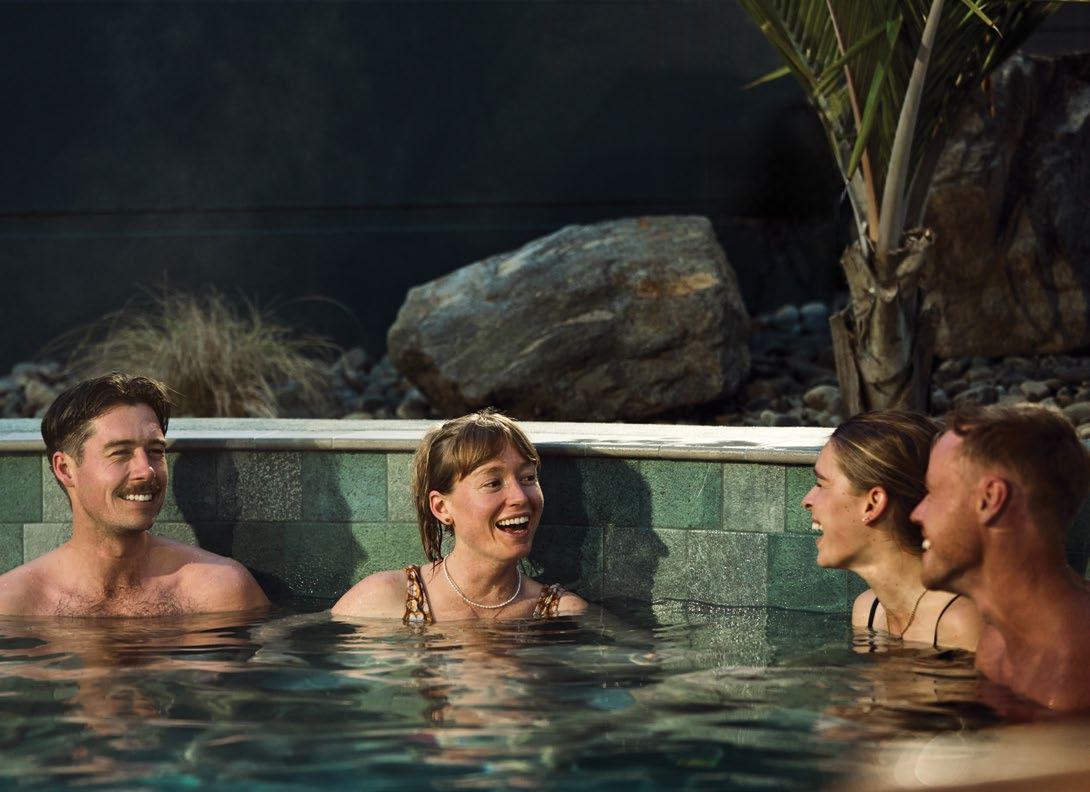
Have you heard the news? Your favourite award-winning Mount Hot Pools has even more to offer this summer season — now there’s both hot, and cold.
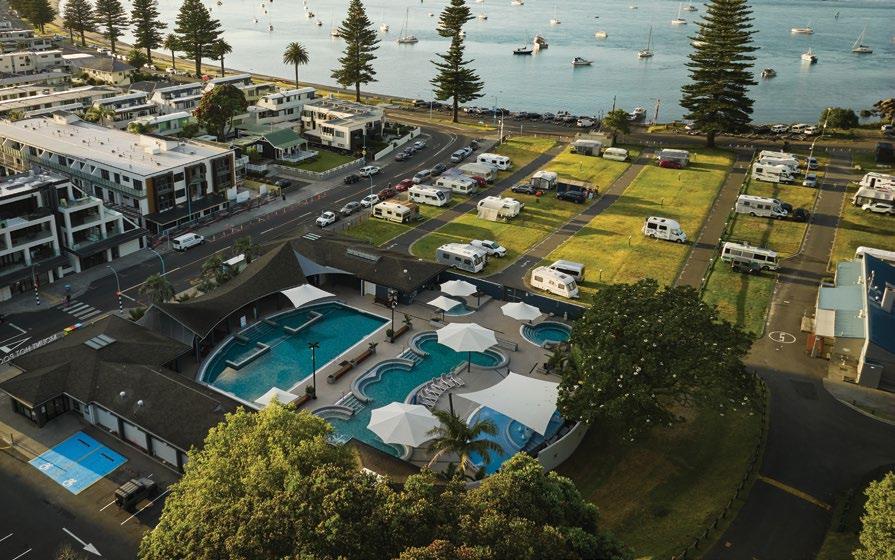
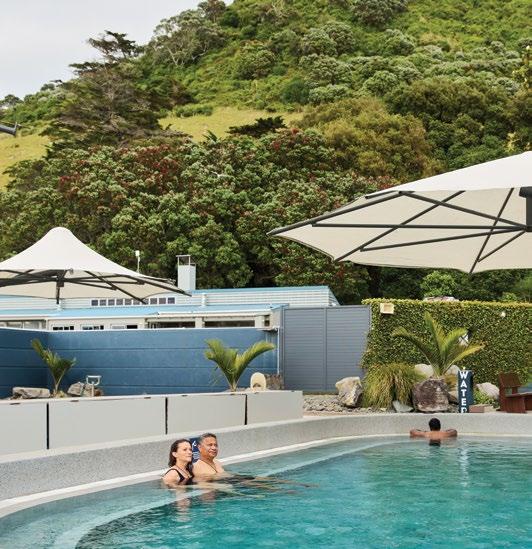
At the base of Mauao, where the ocean meets the mountain, you will find hot ocean water pools enveloped by native bush and birdsong.
At this time of year, the pōhutukawa are blooming bright and local musicians are competing with resident tūī to serenade the Sunday evening soakers.
The iconic Mount Hot Pools is one of the only hot ocean water pool complexes in the world and this summer the award-winning facility has even more to offer.
Now, there’s both hot, and cold.
The Mount Hot Pools is a local favourite and also draws visitors from around New Zealand and the world.
Recently named among the country’s top 10 hot pools by Tourism NZ, it offers five outdoor pools and spas, three indoor private sanctuary pools, onsite massage therapy, and now a new freshwater
cold plunge pool that is set to open in time for the summer holiday period.
Venue manager Letitia Sheehan says the new feature will add to the relaxation and recovery options already offered at the Mount Hot Pools, creating a wider wellness experience for customers.
“The cold plunge pool has been on our wish list for years and is something that our customers have been asking for,” she says.
“We’ve listened to that feedback and delivered, just in time for Christmas. We’re excited to be offering this new wellness experience to our customers – both old and new.”
Access to the freshwater cold plunge pool will be included in the entry to the Mount Hot Pools and will provide a refreshing alternative to the hot ocean water pools.
Studies have found cold water therapy can help circulation, recovery, and the revitalisation of the body.
“This is a special project. It’s about enhancing what people already love about the Mount Hot Pools while also giving them something new to experience this summer and beyond,” Sheehan says.
The new addition also comes off the back of the Mount Hot Pools’ increasing focus on sustainability and wellbeing.
It is one of New Zealand’s most energyefficient aquatic venues, harnessing ocean water,
Mount Hot Pools won the Outstanding Pool Award at the 2025 Recreation Aotearoa Aquatics Awards.
geothermal bore heating, and solar panels to operate sustainably.
Hosting more than 260,000 visits each year, made up of 60 per cent locals and 40 per cent domestic and international tourists, the team at the Mount Hot Pools is looking forward to welcoming new and returning visitors and local regulars this summer season.
“The Mount Hot Pools is a family and accessibility-friendly facility. Our five outdoor pools include a hot relaxation pool, a mild hydrotherapy pool, a children’s pool with a slide, and two spas.
“We also have the three indoor private sanctuary pools.
“Visitors can choose the water temperature and setting that suits them best and now they can also choose to try the rejuvenating balance of hot and cold therapy,” Sheehan says.
On top of the new experiences available at Mount Hot Pools, the popular Soak’n Sounds series, where local musicians play poolside every Sunday evening, will also return from December 14.
“Soak’n Sounds allows visitors to relax and unwind in the pools, enjoy the surroundings and take in the sounds of our talented musos. It’s a great way to spend some of your Sunday.”
About the Mount Hot Pools:
→ Hosts more than 260,000 visits a year, made up of 60 per cent residents and 40 per cent domestic and international visitors.
→ New freshwater cold plunge pool set to open in time for the summer holiday period.
→ Acknowledged by Tourism NZ as one of the top 10 hot pools in New Zealand.
→ Open 7am-10pm Monday to Saturday, and 8am-10pm on Sundays and public holidays (closed Christmas Day).
→ Five outdoor pools, including a hot relaxation pool, a mild hydrotherapy pool, a children’s pool with a slide, and two spas.
→ Three indoor private sanctuary pools and on-site massage therapy.
→ Won the Outstanding Pool Award at the 2025 Recreation Aotearoa Aquatics Awards.
→ One of New Zealand’s most energy-efficient aquatic venues, harnessing ocean water, geothermal bore heating, and solar panels to operate sustainably.
→ Soak’n Sounds starts December 14, with local musicians playing poolside every Sunday evening.
Just steps away from Mount Main Beach, Pilot Bay, cafes and the tracks of Mauao, Mount Hot Pools allows visitors to soak morning and night, a complementing activity following a beach swim or a trek up or around the mountain, or a chance to unwind beneath the stars.
The Mount Hot Pools is a big part of the Bay of Plenty’s tourism and recreation landscape.
Tauranga City Council and Bay Venues have worked hard over the past decade to establish the Mount Hot Pools as a high-quality international destination while also retaining and recognising its cultural and historical significance, and the special character that locals have loved since the first pool opened in 1966.
In August, the facility was honoured with the Outstanding Pool Award at the national Recreation Aotearoa Aquatics Awards, recognising excellence in design, operations, and community impact.
Managed by Bay Venues on behalf of Tauranga City Council, the Mount Hot Pools has also been inducted into the TripAdvisor Hall of Fame and holds the Qualmark Gold Sustainable Tourism Business Accreditation.
mounthotpools.co.nz
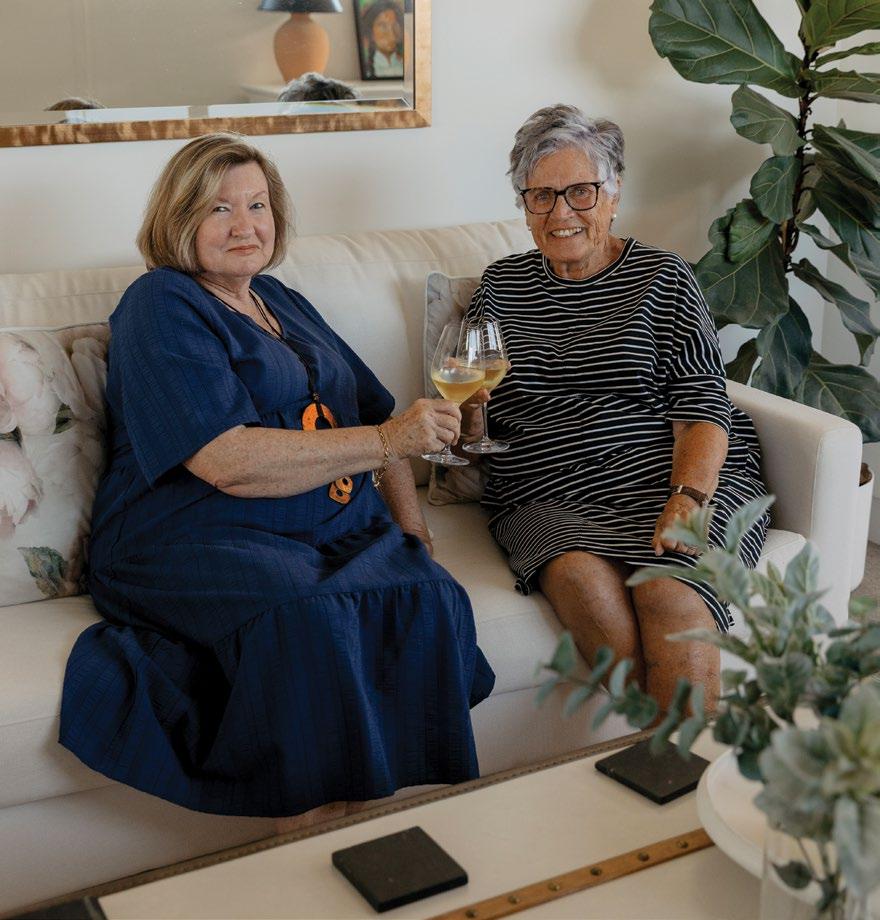
Wine Club? Why not!
Words by Mary-Rose
Norton Photography by Erin Cave
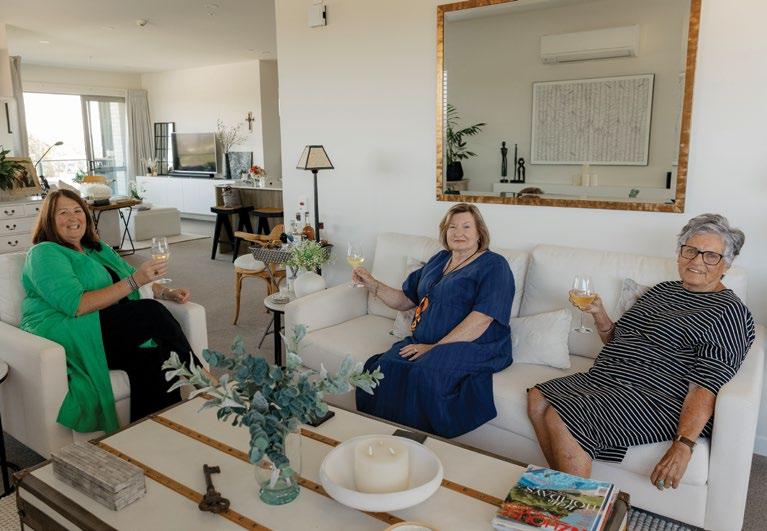
Throw your visions of velvet blazers and speaking fluent ‘oak and tannins’ out the window. Judi and Fiona’s wine club at The Bayview is more about laughter than the labels.
The Bayview sales manager Catherine Weedon is a signed-up member of the village’s wine club. She shares a wine, and a laugh, with Judi and Fiona.
“Nobody knows that much about anything, but we do know we like wine,” Judi laughs, describing her wine club, a bunch so welcoming and unpretentious you don’t even have to drink the stuff to join.
Here, you can throw your visions of velvet blazers and speaking fluent ‘oak and tannins’ out the window – they’re more about the laughter than the labels.
Judi is joined by her friend and co-conspirator, Fiona. Two women on a mission to learn a bit more about their favourite beverage and have a whole lot of fun doing it.
The funny thing is that the pair didn’t even know each other when the idea was sparked.
“One afternoon we were sitting in the courtyard at The Bayview Village and Fiona and her husband came along – I hadn’t met her yet. We got talking and after a while somebody said, ‘We should have a glass of wine’. It was such a nice day. So, we got some wine, and I said, “I’d like to know more about this’.
“I told Fiona I had belonged to a couple of wine
clubs previously and she said, ‘Why don’t we start one?’ It all happened from there.”
Fiona adds that she’s never been a huge fan of reds so she was hopeful the madcap scheme might, as she puts it, ‘broaden her horizons’.
“We started out with just four people,” says one, “…the other two were our husbands!” the other chips in with a note of humour.
That number is now 21 members plus some casual tag-alongs. A year of sniffing, sipping, swirling, and shenanigans later, the pair reflect on how it’s not just about wine – it’s about laughter, learning, and living life to the fullest.
A couple of their members aren’t even drinkers but instead come for companionship.
There’s a frank admission from both Judi and Fiona as they confess their initial apprehension about living in a retirement village.
“We were reluctant because we had no idea about how it would be, or how we’d feel, or who the people were,” Judi explains.
“You make your way and then suddenly you find you’re happy.”
Little did they know they would get more than they bargained for.
“The village is like family to me really because a lot of my family is overseas. With the social offering, you can join in as much as you want, which would be every day, all the time, if you did everything! I love the way that you’re able to meet people of your own sort and form relationships because you are obviously drawn to the same interests.”
Fiona was charmed by the warm welcome the moment she walked in the door, then was won over by everything on offer.
“I’ve got a son-in-law from Germany, he’s
– that’s community spirit.”
The Bayview team gets a gold star in their books, the ladies giving them due credit for their part in making the wine club a reality.
Self-confessed foodie and sales manager Catherine Weedon is a signed-up member herself, often volunteering as their sober driver.
“This 100 per cent couldn’t have happened if we hadn’t had their support, they’re efficient without being intrusive. They’re just lovely,” Fiona and Judi agree.
Supporting local is key, with many of their outings and events incorporating businesses in their backyard – a lunch at Matahuri Lodge, a three-course meal cooked by Toi Ohomai Institute of Technology’s
“We’ve got friends in other villages, and I think they’re envious because they say, ‘we don’t do half of what you do.’ They might live in the most beautiful houses, but what’s a beautiful house without it being full of fun?”
blown away, he says, ‘In Germany we don’t have things like this.’” Judi continues, “It makes our families very happy to see us here. We’re so busy they joke, ‘We’ve got to make an appointment to see you!’ – and they do!”
Village life has rekindled something they feel has been missing for decades.
“Communities are fractured,” says Judi. “People don’t know their neighbours anymore.”
However, at The Bayview they’ve found the perfect balance of privacy and genuine connection.
It’s not just a place to live, it’s a place to belong.
When Fiona’s washing machine recently died, there was no need to drag loads to the laundromat. Instead, they had offers from neighbours to use theirs until they got a replacement. And when she and her husband got sick, they had meals and phone calls from their village friends.
“It was so lovely, I had people check-in saying, ‘I was just ringing to see how you are,’ and I thought
culinary students, a tour of The Cider Factory, tastings with Rowan from EuroVintage (who supplies Vetro), and so much more.
With the year ending, the duo and the club’s growing membership are already busy cooking up plans for next year.
They’re keen to repeat favourite events, including their mulled wine evening where they created their own traditional spiced blends, and new adventures such as trips to other vineyards.
“We’ve got friends in other villages, and I think they’re envious because they say, ‘we don’t do half of what you do.’
They might live in the most beautiful houses, but what’s a beautiful house without it being full of fun?”
They’ve nailed the fun and the fabulous home –now Fiona’s just on the hunt for her ideal glass of red.
thebayviewvillage.co.nz
The Bayview Village, 159 Waihi Rd, Tauranga
Restoring Whenua, Revitalising Community
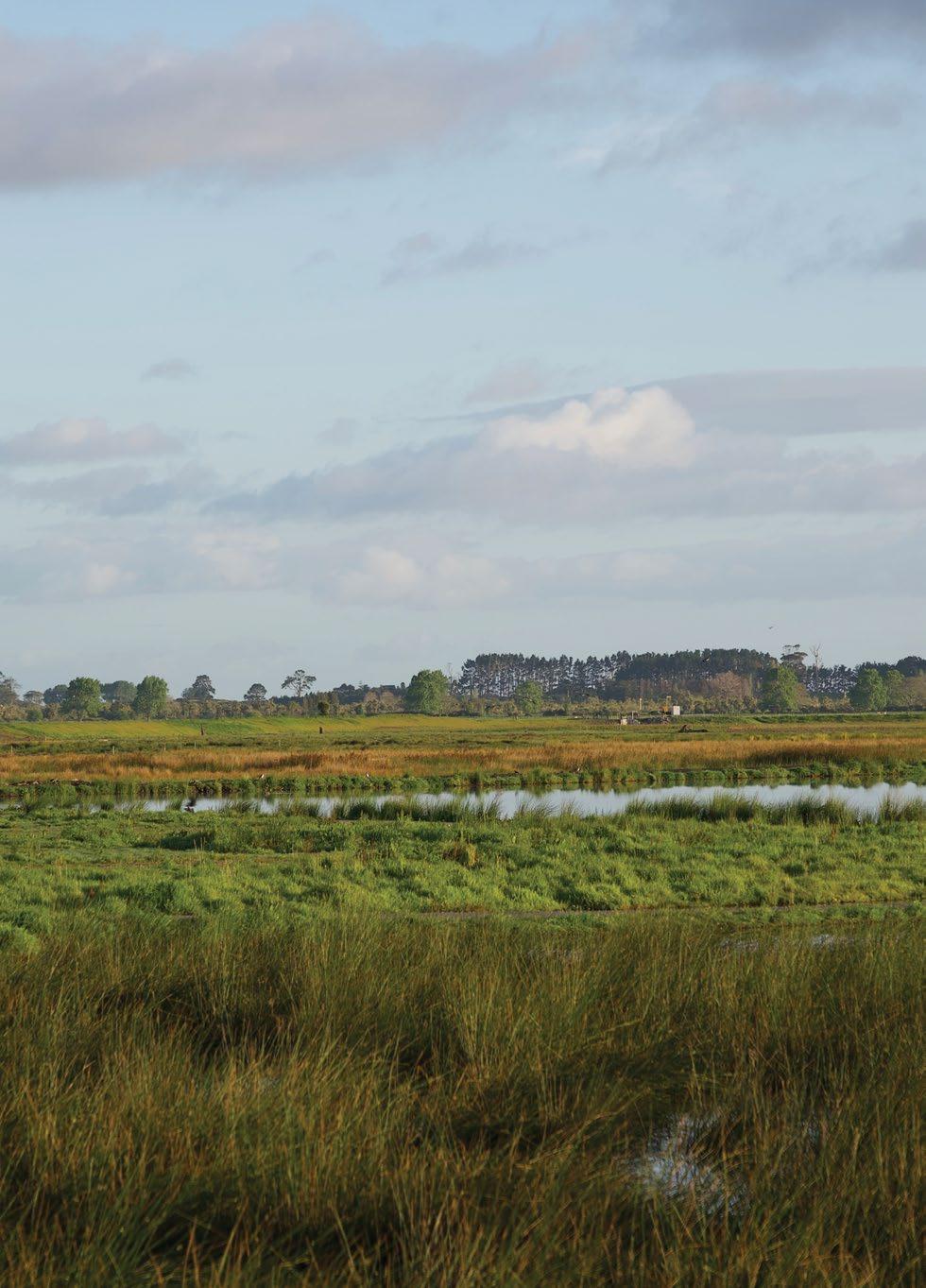
What began as a practical infrastructure project has transformed into a vibrant wetland. At the centre of it all is a team whose mahi is revitalising connections to the whenua, culture and community.
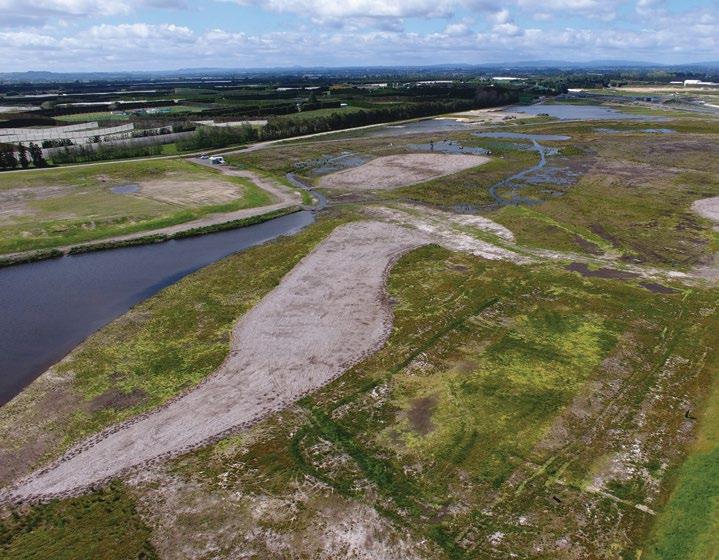
Nestled at the heart of the Rangiuru Business Park, a remarkable transformation is underway.
What began as a practical infrastructure project, a stormwater pond designed to safeguard the park and improve water quality before it enters the Kaituna River, has blossomed into a vibrant wetland, teeming with life and meaning.
At the centre of this evolution stands the Tapuika planting team, whose mahi (work) is not only reshaping the landscape, but also revitalising connections to whenua (land), culture, and community.
The stormwater pond, spanning nearly 48 hectares, was conceived as a solution for water catchment and flood protection.
Yet, its design and delivery have gone far beyond the practical. Tapuika, as Mana Whenua, brought their rich historical knowledge and deep connection to the land, leading the planting of stages 1 and 2.
Over two years, their efforts have not only established the wetland, but also set the stage for ongoing maintenance and stewardship.
“Engaging Mana Whenua to undertake the planting is a good example of how commercial arrangements can open doors to wider outcomes,” says Mark Hatchman, development manager of Quayside Holdings, which is the investment arm of Bay of Plenty Regional Council.
“Our relationship with Tapuika enabled us to deliver environmental benefits alongside our mandate for commercial results.”
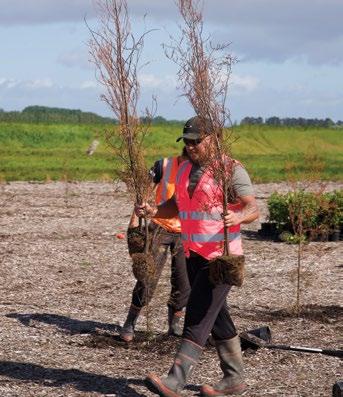
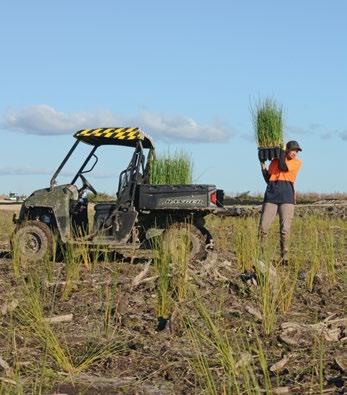
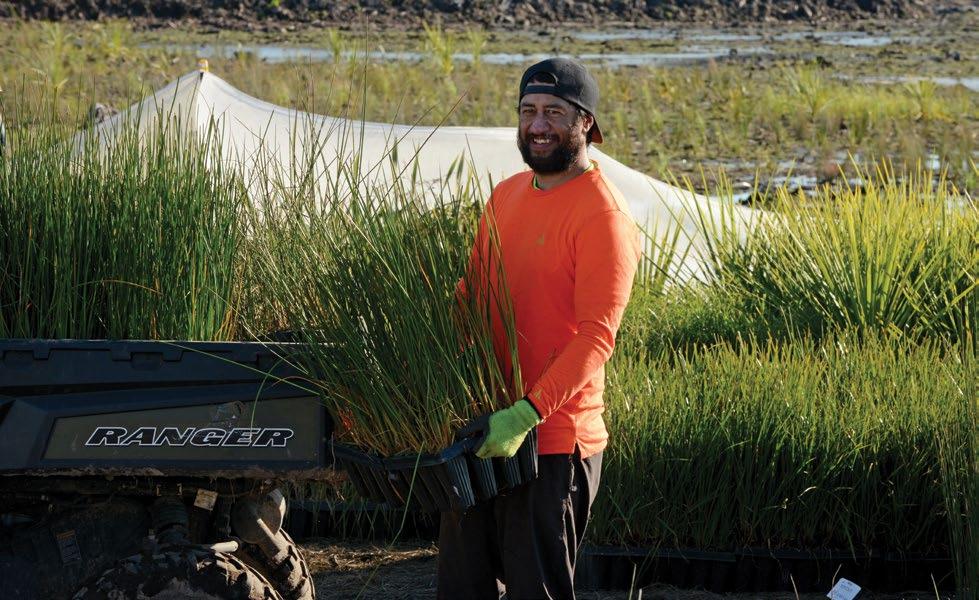
The scale of the planting effort is impressive. In 2024, 120,000 plants took root, followed by 245,000 in 2025. The team, ranging from five-to-10 members depending on the season, has settled into a core group of seven dedicated individuals working tirelessly.
Notably, every plant used in the 2025 season was eco-sourced from Treeline Native Nurseries in Kaharoa, ensuring the integrity and sustainability of the wetland’s ecosystem. While the pond’s primary function is to filter stormwater runoff – absorbing nutrients, sediments, and pollutants – the benefits extend far beyond.
The wetland now provides habitat for native birds, fish, and insects, many of which are returning after generations away. Plans for a surrounding track promise recreational opportunities for the community, inviting walkers and cyclists to enjoy the rejuvenated space.
Among the legacy plantings, nearly 2000 kahikatea (white pine trees) have been established. These towering indigenous trees, once abundant in the lowland swamps around the Kaituna River, play a crucial role in supporting biodiversity and restoring the rohe’s (region’s) ecological heritage. For the Tapuika planting team, the project is
“One thing I’m particularly proud of is seeing the change in our environment. These wetlands have gone from mostly farmland to flourishing ecosystems. Even what we planted last year is thriving now.”
deeply personal.
Their stories reveal the profound impact of working on the land and the sense of fulfilment it brings.
Kiwa Morris (Ngati Rangiwewehi, Ngati Whakaue, Ngati Rangitihi) says they have planted about 360,000 plants since the very beginning.
“Biodiversity has returned to the whenua. Now we have at least 10 or 12 species of birds that weren’t here when I first started.
“Restoring these wetlands has made me feel really fulfilled. It addresses all aspects of my hauora (wellbeing) – social, mental, spiritual, and physical.”
Kiwa’s pride is echoed in the visible changes.
“One thing I’m particularly proud of is seeing the change in our environment.
These wetlands have gone from mostly farmland to flourishing ecosystems. Even what we planted last year is thriving now.”
Natalie Kohu (Ngati Ranginui, Ngai Tamarāwaho) started at the project’s conception in 2024.
“A year on, I’m part of the whānau. They welcomed me in and treated me as one of their own,” she says.
“We share life, laughs, and love together. Looking back, it’s just like growing my own children. The thing I’m most proud of is that my family sees the mahi I’ve done, that I’ve accomplished something being out here.”
Levi Te Wheoro Dinsdale (Tapuika) describes the project as a journey.
“A little boy from Waitangi got to plant his whenua, underneath his maunga, beside his awa, for the next generation.”
Te Wheoro says he has learned different skills, from admin to leadership, and even helped design a feature tree island.
↑
“I want it to be a talking point for our kids, to show that even if you have a hard time at school, you can still succeed in life.
“My proudest moment has been building my people. The growth I’ve seen in our senior operators, Kiwa and Nat, they’ve built our team.”
The wetland’s success is measured not just in plants but in the return of rare and endangered species.
In mid-November, the team discovered that the endangered New Zealand dotterel (Tūturiwhatu) had laid eggs at the site – a sign of the next generation of biodiversity returning.
The area was cordoned off to protect the nest, and the team remains vigilant against pests, hoping to see the chicks hatch.
Another notable returnee is the royal spoonbill, further evidence of the wetland’s ecological revival.
Quayside’s strategic pillars emphasise inclusive and authentic relationships.
The partnership with Tapuika exemplifies these values, blending commercial operations with purposeful stewardship. “Our actions today deliver a better tomorrow,” says Quayside Holdings project manager, Glenda Dufaur.
“We’ve leveraged works that were always being delivered and provided an opportunity to work with Mana Whenua to deliver the work. It’s a commercial operation at market rates, but it also provides so much more.”
Beyond environmental outcomes, the project has fostered a strong sense of pride among the planting team, many of whom whakapapa to Tapuika and are connected to the whenua they now work on.
Team culture has flourished, with a focus on learning and growth.
Individuals have expressed deep pride in their contributions, transforming initial uncertainty into a shared sense of achievement and ownership.
The wetland is more than just a stormwater solution – it’s a living testament to what can be achieved when community, Mana Whenua, ecology, and enterprise align.
As the bush matures and the tree island takes shape, the Rangiuru Business Park wetland promises not only a legacy for future generations, but also a model for how purposeful stewardship and authentic relationships can deliver a better tomorrow.
rangiuru.co.nz
Levi Te Wheoro Dinsdale, supervisor for Tapuika, says his proudest moment has been the opportunity to be a part of revitalising his whenua has filled his heart. ↖ Kiwa Morris (above) Natalie Kohu (below).
Weaving Knowledge, Culture & Community
Words by Connie Jackson
by Chris Parker
A striking artwork hangs in the atrium of Holland Beckett’s new office in the Northern Quarter. But this is more than just a sculpture, it’s a story woven from the values that define them.
Photography
In the heart of Tauranga Moana, a new artwork has taken its place.
Māramatanga, hanging in the atrium of the new Holland Beckett office at Northern Quarter, was commissioned by the firm from local artist Julie Paama-Pengelly of Ngāi Te Rangi iwi.
The work is more than a sculpture; it’s a story woven from threads of knowledge, culture and community which celebrates the creative spirit of the artist, the vision and values of the firm.
Julie Paama-Pengelly, is a talented multidisciplinary artist. She holds a Master of Māori Visual Arts (Hon), a Master of Philosophy (Third World Development) and Toi Iho certification – a unique registered Aotearoa New Zealand trademark of Māori quality and authenticity.
Julie is a driving force behind regional Māori arts strategic development through her role as Chair of Te Tuhi Mareikura Charitable Trust, and an advocate for the restoration of Māori women within tā moko practice.
Her writing, teaching and strategic leadership complement her creative works and successful art studio.
She has an in-depth understanding of Māori design and cultural belief systems gained over 40
years of Toi Māori practice and 35 years of tā moko practice, and brings this knowledge into her other practice areas including painting, printmaking, graphic design, and in the case of this commission, sculpture and public art.
This artwork, Māramatanga, was chosen from submissions of several local artists. Holland Beckett is a long-standing supporter of the arts community and wanted to champion the talent and experience of the community by commissioning the piece locally.
Māramatanga means enlightenment. The suspended piece comprises three sculptural arrangements, which allude to the three bodies of knowledge – kete-aronui, kete-tuauri and kete-tuatea – a powerful metaphor for law as expertise and wisdom.
The artwork is a visual representation of the firm’s brand and values. The Holland Beckett logomark represents the golden pingao fibre valued in tukutuku weaving, an art form which plays an important role in the passing on of stories and expresses Holland Beckett’s commitment to the Bay of Plenty community.
Building on the history and relationship with weaving, Māramatanga focusses on the Tāniko technique of making traps and crayfish pots,
The artwork, Māramatanga, hangs in the atrium of Holland Beckett’s new office at the Northern Quarter.
Māramatanga, which means enlightenment, was created by local artist Julie Paama-Pengelly.
celebrating Tauranga Moana in relation to the sea, and raranga in the woven elements affixed to each basket.
While aligning with the values and history of the firm, the commission also had practical parameters.
The work hangs in the firm’s atrium, viewed from below, above and as you walk up and down the internal stairwell. Julie says that these dynamic viewpoints informed the scale, shape and placement of each detail.
The lowest basket is adorned with fish. This basket represents the knowledge specific to the tangata whenua Māori who have lived their history in and around the waters of Tauranga Moana.
The second basket is adorned with birds, which represent terrestrial knowledge, while the third basket represents Māori celestial knowledge adorned with stars.
This layered experience invites viewers to engage with the work as they move through the space, echoing the journey of learning and discovery, and the firms’ value ‘Dedication to Excellence’ which speaks to knowledge and expertise.
The work also had to be fit for purpose – in this case, lightweight, low-maintenance and long lasting. Each shape was mocked-up in paper and refined, then Julie and her daughter Kaiwhetu created the final elements with recycled aluminium window
blinds – an unconventional choice ideal for the suspended work.
Other practical considerations were around the installation of the piece and how to create, transport and install the work. Local fabricators helped construct the baskets in a way that they would fit in the building’s elevator, then the fish, birds and stars were attached onsite – all while the building was still under construction.
Holland Beckett is thankful to both Julie and the construction team for their adaptability, responding to shifting deadlines and ensuring the process remained smooth and collaborative.
The firm is proud to have Māramatanga as the centrepiece of the new office and the next chapter in the firm’s history.
It is a tribute to the community that Holland Beckett is a part of and the people, history and environment of Tauranga Moana.
The artist honours Māori culture through form and meaning while celebrating the firm’s dedication to knowledge, learning and excellence alongside commitment to supporting the communities they operate within.
It’s a piece that invites interaction and connection, woven not just from aluminium blinds, but from the values that define Holland Beckett.
hobec.co.nz
Searching for Treasure
Words by Zoe Hunter
Photography by Jane Keam
Averil
Andersen combs the region’s shorelines in search of tiny treasures, turning forgotten fragments of glass into jewellery that glows with new life. The best part is, every piece is guaranteed to be unique.
Averil Andersen’s hands sift through a tray of beach glass.
Each one is a different shape and size, and a different shade of green. She’s trying to match them up as best she can to make a pair of earrings.
“It’s like a jigsaw puzzle,” she says. “It’s guaranteed to be unique, because I’m never going to make another pair exactly the same.”
The origins of each piece is unknown. Some from beer bottles, household glassware and pieces of worn pottery. Others from construction materials like old windows and television screens.
Now, Averil is making them into something valuable.
“It’s the circle of life,” she says with a smile. The idea evolved from camping at the beach with her younger sister more than 20 years ago.
“I just collected it up. I got fascinated by it, I guess. Then I just got more and more until I had quite a big collection,” she says as she stands in her garage workshop with trays upon trays of beach glass, each sorted into their colours.
“I got more interested in how it was formed, the different colours, as well as the hunting gathering instinct and the intermittent reward of finding a piece that is rare and beautiful.
“Like when you first find a beautiful sort of piece like this,” she says, grabbing at her necklace with a smooth, aqua-coloured beach glass pendant glistening in the sun. She’s also wearing a matching pair of earrings.
“It becomes a little bit addictive.”
Averil started leaving some of her creations at the campgrounds she would stay at, including beachglass light catchers.
“People seemed to like them,” she says. “They would say, ‘Wow, I never knew this was here on our beach’.”
Now, Averil sells her beach glass jewellery at The Little Big Markets. “It’s just a hobby for me,” she says, explaining she loves the joy of creating something unique.
“People always come up and they reminisce about when we were kids, they used to collect different things along the beach and they would start recommending different beaches to me.
“Everybody’s got a story about collecting beach glass and memories. So it is quite nice.”
Most days, you will find her combing the beach, head down and eyes peeled on a shiny piece of beach glass treasure to take home.
“A lot of kids come along and say, ‘What are you looking for?’ and I’ll say, ‘Treasure’,” she says.
“Back in the day, I used to collect everything that I saw because it was kind of like picking up rubbish in a way. Now, I just pick up the best bits,” she says as if she’s guilty of not doing her bit.
Averil is most definitely doing her bit for the environment. It’s still recycling.
“I console myself with that, because over the years, there’s been more and more rubbish, unfortunately.”
Averil has her favourite beach spots where she’ll find the most “treasure”. As to where exactly, her lips are sealed.
“Now that’s top secret,” she says with a laugh. “That’s what people often ask me and I say, ‘At the beach. It’s as simple as that.”
Often, Averil will jump in her fishing kayak. Averil loves to fish.
“Everywhere I go, I’m always looking. On my
kayak, I can get into the nooks and crannies that other people won’t necessarily get into. Sometimes, I’ll paddle around and pull off on a beach somewhere and have a look,” she says.
“I mean, if you see my collection, technically I don’t actually have to go beach glass collecting anymore. But I want to.”
For Averil, it’s therapeutic.
“I love walking on the beach or paddling out at sea,” she says. “I could just have an online shop, but I like the markets for the chats. I like seeing other people enjoy what I do.”
Back in her workshop, Averil pulls out a jar filled with ‘seafoam’ coloured glass. There’s another tray of ‘milk glass’, another of ‘black or pirate’ glass and plenty of white and green glass.
“Sometimes people will buy something from me and I’ll tell them the bright green pieces have probably come from a Stella Artois or a Heineken bottle and they will laugh,” she says.
“But it’s true. It can come from a whole range of stuff. Anything you can imagine that is made of glass, that’s where it’s come from.”
↑ Averil’s workshop is where the magic happens. Averil will often search for beach glass in her fishing kayak.
“I always like to look at pieces and wonder what sort of bottle it came from or what sort of piece of glass it is.”
↑ Each piece of beach glass jewellery is unique and Averil makes them all by hand from home.
Averil says she’s also finding more beach glass around historical dump sites. “Now that the sea level is rising, it’s washing up.”
On the windowsill of her workshop is a seethrough display of bright red, yellow, turquoise and light pink glass.
“These colours are very rare,” Averil says.
“I always ask people visiting my stall at the markets what they think the most rare colour is and I will say, ‘You won’t find it here’.”
That’s because the rare pieces are Averil’s personal collection. The special hard-to-find beach glass that she would never sell.
“I’ve got a bit of a fascination with light through glass,” she says. “I always like to look at pieces and wonder what sort of bottle it came from or what sort of piece of glass it is.”
Once she’s satisfied with her latest haul, Averil will take the glass back home where she will wash each piece and lay them out to dry in the sun.
First, she will sort the glass by colour, size and quality. The big chunky pieces, the smooth-edged shapes, and the smaller sizes go together.
Then, depending on what she’s making, Averil will start to match pieces together she thinks will make a nice pair of earrings. Sometimes a charm is added for extra flair.
Other pieces will be made into necklaces, bracelets, rings. Or saved for more extravagant pieces like light catchers, or lamp shades.
“Each piece inspires me to make something,” she says. “I’m not a silversmith. I’m a maker and crafter. It’s just part of my personality to create.”
BeachglassNZ
Fresh, Fun & Festive
Words by Madeleine Hughes
Because this is one of my favourite times of the year, I’ve plated up a little bit of summer for you. Here are some recipes bursting with festive, fresh and fun ingredients for the dinner table.
Photography by Erin Cave
This is a very simple salad to throw together, but it’s still a bit special and very festive. It’s also perfect to bring along to a barbecue! Make sure with salads like this you always dress it just before you’re about to eat, otherwise it’ll turn into a soggy mess.
Halloumi & Blackberry Salad with Pistachios & Honey Balsamic Vinaigrette
SERVES 6
1 packet halloumi, sliced into 1cm thick planks
1 punnet blackberries, halved lengthways
1/4 cup pistachios, lightly toasted
1 shallot, sliced very finely
A couple of big handfuls of rocket
Fresh mint, to taste
Dressing
1 Tbsp balsamic vinegar
3 Tbsp good extra virgin olive oil
1 tsp honey
Good pinch of salt & pepper
Method
Whisk dressing ingredients together and set aside. In a hot fry pan with a splash of olive oil, sear halloumi on both sides until golden.
Arrange all remaining salad ingredients on a platter, top with halloumi, and finish with dressing just before you’re ready to serve.
This is a little bit controversial, but I think cucumber goes so beautifully with melon, and this makes for the most delicious, hydrating, cooling dessert or breakfast. Just trust me on this.
Rockmelon, Watermelon & Cucumber
Salad with Honey & Mint
SERVES 6-8
Half of a rockmelon, skinned and seeded
Quarter of a watermelon, peeled
Half of a cucumber
Honey, to taste
Juice of half a lime
A few leaves of fresh mint, finely sliced
Method
Cube the cucumber and melons to thumbnail sized pieces. Place in a big bowl and toss together with a good drizzle of honey, the lime juice, a pinch of salt and the mint.
Pile into a serving bowl and enjoy! Keep refrigerated until ready to eat.
This is a similar take to a classic potato salad, but with zero cooking required! Also, it has lots of fabulous health benefits from the butter beans. I love using fresh herbs as a green vegetable as opposed to just a garnish. They’re full of flavour and nutrients, and growing like crazy at this time of year. Serve this as a side with some pan fried fresh fish, or barbecued spatchcock chicken.
Creamy Butter Bean Salad with Herbs
SERVES 6-8
2 cans butter beans, drained and rinsed
2 spring onions, finely sliced
2 sprigs of celery, finely sliced on the bias
1/2 cup cornichons, finely chopped
Big handful of each: fresh dill, parsley and chives
Dressing
1 Tbsp dijon mustard
1 Tbsp white wine vinegar
90g Greek yoghurt, unsweetened
40g good quality mayo (either Best Foods or Kewpie would be great)
1 tsp maple syrup or sugar
Lots of freshly ground black pepper
Method
For the dressing: Whisk all ingredients together until smooth. Refrigerate until ready to use.
For the salad: Finely chop the herbs, and combine with all remaining salad ingredients in a big mixing bowl.
Before serving, dress the salad, mix to combine, and pile onto a platter or serving bowl.
We all chase a good buzz, but usually at the expense of our biological boiler room. Good Buzz flips the script. It lands in your kisser with a fermented swagger, o ering a complex, fizzy loophole in the social drinking contract. It delivers the ritual of a naughty brew without the high-proof tax, all the while deploying a probiotic army to colonise your insides and it’s the perfect way to look like you’re partying while your gut, in actuality, is at the day spa.
Good Buzz Mandarin Yuzu
Twist the lid o the Mandarin Yuzu and you’re met with an aroma that leaves no chance of misinterpreting its origins. No, this isn’t a synthetic, cloying scent of a servo soda; it’s a sharp, aromatic citrus bouquet with a bit of class, thanks very much.
The mandarin punch actually triggered a visceral flashback to the time I inhaled a bag of the fruit in one sitting, resulting in my lower colon emptying faster than a nightclub after sunrise.
But unlike that fateful afternoon, this isn’t a punishment. The Yuzu steps in to tidy things up, bringing a tart, aromatic edge that cuts right through the juicy sweetness.
There’s a subtle yeasty vibe underneath, a reminder that this is a living thing, not just sugar water. The carbonation is tight and aggressive, scrubbing the palate clean with every sip and leaving a dry finish that mimics a decent brut. It demands to be sipped slowly, o ering the complexity of a cocktail without the need for a morning apology, or worse. It’s a guilt-free banger with a gold medallion from the NZ Artisan Awards nestled among its chest hair.
Good Buzz Hawke’s Bay Peach & Kawakawa
The Hawke’s Bay Peach & Kawakawa pours a dusky gold, smelling like a sun-drenched orchard in peak season. But don’t let the soft, fuzzy aromatic exterior fool you, because this is no tin of peaches. What hits you first is luscious and ripe, lulling you into a false sense of security before the Kawakawa steps in with its peppery demeanour.
The botanical one-two strips the sugar from your tongue and keeps the finish crisp rather than excessively sweet. The result is a worldly, yet earthy brew that feels more like a health tonic, leaving your palate tingling and your gut flora in full bloom.
Good Buzz Blueberry Peach
The Blueberry Peach pours with a juicy pinkishorange hue, an immediate sign this is not your children’s watered-down juice box. Its aroma is heavy with summer nostalgia, like a roadside stall where nature’s fruits are on the verge of transforming into something even more special. On the palate, the peach arrives first: soft and diplomatic, smoothing over the initial carbonated bite. Then the blueberry elbows its way forward, tart, tannic, and packed with enough antioxidants to make you feel quite smug about your life choices. The flavour profile resembles a fruit salad but with an edge that would make your supermarket variety blush. The finish is dry and ciderlike, scrubbing away the sweetness and leaving your microbiome high-fiving in the organic foods aisle.
Good Buzz Fijian Ginger Green Tea
Bula! I used to have a Hawaiian shirt for every day of the week, but for years my quiver has sadly dwindled down to one. This Fijian Ginger Green Tea has got me going troppo though, digging out my Masi Tapa pattern stronghold and channeling the serenity of a hammock among the palms.
The ginger here is not the sugary nonsense found in some other brands. It is a raw, earthy haymaker that builds a slow burn in the back of your throat, reminiscent of the humidity rising before happy hour at a Fijian resort. It cuts right through the grassy, sensible notes of the green tea with a spicy assertiveness that wakes up any island-time bacteria in your digestive tract. In fact, it delivers a finish that feels less like a gentle trade wind and more like riding a sea biscuit over the reef, an invigorating reset.
goodbuzz.nz
goodbuzznz
Wild for Food Out East
Searching for things to do this summer? Why not venture out East? From one of the region’s most iconic food events to beach and jazz festivals, the Eastern Bay of Plenty’s summer calendar is jampacked with events to entertain over the holiday season.
Wild Food Festival
The Local Wild Food Festival is one of the Eastern Bay of Plenty’s most iconic events, celebrating abundant food found in our diverse natural environment.
Showcasing food from the land, rivers, lakes and sea, the festival brings together resourceful people passionate about sustainable living.
You won’t find anything too wild or whacky at this wild food festival – just good food foraged,
grown, caught or hunted from the environment.
The festival has evolved over the years, but the main attraction remains – the Wild Food Cooking Challenge.
The original Local Wild Food Festival was about one thing – inviting trained and amateur chefs to create dishes utilising wild food ingredients.
Entries could include anything caught or foraged from the wild (think hunting, fishing and diving), or something you found on your evening bush walk.
On the day, entrants delight the crowds by preparing dishes on-site to be presented to a judging panel.
Judges look at several things – taste, presentation, creativity, the story behind the dish and the chosen wild ingredient.
Winners take home an impressive selection
of prizes, from Weber BBQs to kids kayaks for the children’s categories.
Alongside the cooking challenge and food demonstrations, there are many ways to immerse yourself in wild food – from the plentiful free samples to food trucks serving up their take on wild.
Every food vendor must include a wild food component to their offering, ensuring the festival stays true to its heart, while educating festival goers on what can be created from food found in our natural environment.
If your tastebuds need a tease, think Whakatōhea Mussels, crayfish, Ōhiwa Harbour oysters, Koura (native crayfish), hangi, whitebait fritters, smoked eel, watercress sausages and a continuous supply of wild game from the smoky zone, where the BBQ runs hot all day.
The festival clearly has a winning formula. In 2025 the Whakatāne Local Wild Food Festival claimed the Community or Not-for-Profit Event of the Year title at the New Zealand Events Association awards ceremony.
Head along for a day of wild food tastings, demonstrations, cooking challenges and live music set among ancient pōhutukawa, overlooking the Best Beach in Aotearoa.
From good food to great tunes and even better views, the Eastern Bay’s summer calendar is full of events to entertain.
miss this iconic event celebrating and showcasing food from the land, rivers, lakes and sea.
Local Wild Food Festival Saturday, February 21, 12pm–6pm localwildfood.com
The Ātea Block Party
Whakatāne is throwing a party for the people. The Ātea Block Party celebrates the Eastern Bay’s new creative space – a celebration of music, kai and community, in the heart of Whakatāne. Every ticket helps build Ātea into a space for everyone.
The line-up for the December 20 event on The Strand includes exciting performances from the likes of Corrella, Black Comet, Rubi Du & JessB, MOHI, Ladz of the Mist, DJ Arok and Big Music. Come for the music, stay for the kaupapa.
Ātea, 266 The Strand Saturday, December 20, 3pm–10pm Tickets on sale at atea.art Kids 12 & under free (with an adult) Licensed event. Under 18s must be with a guardian.
Don’t
The Heartland Way
The Nature’s Road Heartland Way is back, with a twist.
This year it’s more than a ride. Run, walk, paddle your waka, ride a bike or your horse… this is your time to connect.
Bring the whānau and your mates to experience the mana of the ngahere together.
Locals welcome tānata from all walks of life to come together and experience the beauty of Whirinaki and Te Urewera.
Starting in Te Whaiti, the journey takes riders along Nature’s Road, State Highway 38, through Whirinaki and Te Urewera, finishing at Waikaremoana.
Along the way, riders will be welcomed by local whānau from Ngāti Whare and Ngāi Tūhoe, hosted at marae, and supported every step (or pedal) of the way.
Whether you’re chasing a challenge, returning for round two, or keen to experience the ngahere in a new way, nau mai, haere mai rā!
Nature’s Road Heartland Way
January 23 from 12pm to January 26, 3pm
Sun to Surf 2026
A highlight of the Eastern Bay summer calendar, Sun
to Surf 2026 is a family-friendly running and walking event that celebrates movement, community, and the stunning coastal beauty of Ōhope.
With distances for all ages and abilities, it’s the perfect way to kick off the new year with whānau and friends.
Sun to Surf 2026
Saturday, January 31, 6.30am–1pm Port Ōhope Wharf Entry from $25, kids under 10 free suntosurf.nz
O’Hagan’s Home Loans and Insurance Jazz in the Park
Jazz in the Park is a vibrant, family-friendly event held in the beautiful Whakatāne Rose Gardens.
The event combines high-quality jazz performances from local and regional artists with a selection of food trucks to create a relaxed festival atmosphere perfect for picnicking, socialising, and enjoying the summer.
Saturday, February 28, 3pm–8pm, Whakatāne Rose Gardens
Tickets $15 Early Bird (online or at Meadow Club), $20 on the day, under 12 free artswhakatane.co.nz
The Sun to Surf and Jazz in the Park events are highlights on the Eastern Bay of Plenty’s summer calendar.
LEVEL UP YOUR FITNESS
Discover Your Strength at Bay Boxfit, Mount Maunganui
Whether you're lacing up gloves for the first time or you're an experienced athlete, Bay Boxfit is in your corner.
We've built a fun, friendly, and supportive community dedicated to helping you smash your goals and discover a fitness you never knew you had.
• Trainer led box fitness, functional & tech classes
• Full cardio & weights gym with after-hours access
We tailor everything to your event’s vibe and taste. With 20+ years of chef experience, we bring restaurantquality flavor to laid-back or formal events — all with our fun, no-fuss Coastal Chaos energy. | | | |
We tailor everything to your event’s vibe and taste. With we to formal all energy.
BRINGING THE CHEAT DAY ENERGY TO YOUR NEXT EVENT THE CHEAT DAY
Spend a Day Downtown
Some new hot spots are popping up in the heart of Tauranga as the city centre continues to be revitalised. Downtown Tauranga has compiled a list of places to visit when you spend a day downtown.
Whether you are here to eat, shop, play, see or do, Downtown Tauranga has got you covered.
Mainstreet Tauranga manager Genevieve Whitson is super excited to see some new hot spots popping up downtown as the city centre continues to be revitalised. “I encourage everyone to come support local and explore the city through fresh eyes with tasty new restaurants, cafes and bars, as well as a stunning new Toi Tauranga Art Gallery that has been well worth the wait!”
Explore
Toi Tauranga Art Gallery, 108 Willow St Nau mai, haere mai. Welcome to the recently reopened Toi Tauranga Art Gallery, the Bay of Plenty’s preeminent visual arts destination. The gallery celebrates and work with artists from across the
globe. This summer check out a range of shows from Tauranga, Aotearoa, Australia and the Pacific. Grab a Curiosity Guide and dive into art activities with the whole whānau. Sip a coffee over the best pastries in town at their new café Breadhead. Free entry for all New Zealanders, open daily 10am-4pm. artgallery.org.nz
The Elms Heritage, 15 Mission St Nestled in the heart of Tauranga and only five minutes walk from Downtown Tauranga, The Elms | Te Papa is one of the Bay of Plenty’s oldest and most historic sites. It is a place of early contact between Māori and Pākehā and remains at the centre of Tauranga’s history and identity today. The whole one-hectare site is designated an Historic Area and contains listed heritage buildings and nationally significant artefacts. The site is also a Garden
of National Significance with a five-star rating. Including New Zealand’s oldest library that was built in 1839, this incredible little building contains over 1000 original books and other treasures. A copy of the Treaty, New Zealand’s founding document, was kept in this library in 1840 while the signatures of local chiefs were obtained. We highly recommend a visit to this incredible place. 15 Mission St, open seven days, 11am-3pm theelms.org.nz
Play
The Escape Rooms, 75 Elizabeth St
Step into an immersive real-life escape game where you and your team will put your problem-solving skills to the test. Solve the riddles and puzzles, from invisible ink to secret rooms, through your chosen theme! Do you have what it takes?
An escape room is a thrilling blend of mystery and teamwork. You’re racing the clock, piecing together clues, cracking codes, and feeling the pressure rise with every discovery. The atmosphere pulls you in – lights dim, tension builds, and each solved puzzle sparks a surge of excitement. It’s immersive, unpredictable, and deeply satisfying when everything clicks into place. escaperoomsnewzealand.com/tauranga
The Little Big Markets, Tauranga Waterfront
Initially a personal project, this coming together of a community of like-minded people has established itself as an integral event for our local community. Discover a diverse array of local artisans, food vendors, and live entertainment in a lively, familyfriendly atmosphere. Whether you’re searching for handcrafted treasures, fresh produce, or simply want to enjoy a great day out, The Little Big Markets has something for everyone. The markets will be at the waterfront on December 28. thelittlebigmarkets.co.nz
Classic Couture, 67 Devonport Rd
Dress for Success Bay of Plenty’s retail fundraising venture, Classic Couture, at 67 Devonport Rd, sells donated pre-loved clothes and accessories. Dress for Success is an international not-for-profit organisation that empowers women to achieve economic independence by providing a network of support, professional attire, and the development tools to help women thrive in work and in life. The funds raised in store go towards Dress for Success operations. bayofplenty.dressforsuccess.org
The Shoe Lounge, 16 Grey St
Proud to be 100 per cent New Zealand-owned, The Shoe Lounge offers a stunning range of top of the line women’s shoes. From boots and heels to sandals and sneakers, The Shoe Lounge has a selection of fashionable women’s footwear from designers and manufacturers around the world and New Zealand. The Shoe Lounge strives to provide a welcoming, relaxed and enjoyable experience where shoppers can browse, select, try on and buy without pressure – but with great, knowledgeable service. theshoelounge.nz
Eat
Stassano
Deli, 107 Grey St
A new Mediterranean-inspired restaurant at the top of Grey St has opened. Stassano Deli & Wine Bar’s menu offers boutique wines, wood-fired pizza, gelato and Supreme coffee. From rich pasta sauces to artisan cheeses and deli classics, Stassano Deli has everything you need for creating effortless, good taste from the comfort of your own home. stassano.deli
Sachi Japanese Restaurant, 112 Devonport Rd
In the heart of Tauranga, Sachi Japanese Restaurant brings the true flavours of Japan to New Zealand. Led by skilled Japanese chefs, Sachi offers beautifully crafted sushi, sashimi, and seasonal dishes made with local seafood and authentic ingredients from Japan. Dine at the Itamae counter to watch each dish prepared before your eyes – a unique experience found only here. Meaning happiness, Sachi invites travellers to savour the harmony of taste, art, and tradition. Every visit is a chance to experience Japan’s culinary spirit in the warmth of Aotearoa. nzsachi.com
1920 Cuicina & Grill, 85 The Strand
Where great food, good company, and warm hospitality come together. Blending the best of Italian cuisine with modern grill dining, 1920 offers an unforgettable experience full of flavour and flair. From tender slow-cooked meats to delicious pastas and vibrant cocktails, every dish is crafted with care and passion. The stylish, yet welcoming atmosphere is perfect for celebrations, date nights, or relaxed evenings with friends. Discover authentic flavours, exceptional service, and a true taste of something special at 1920 Cucina & Grill. 1920.co.nz
Relax
Thai Touch Tauranga, 64A Elizabeth St
Thai Touch Tauranga is a modern sanctuary in the
Opener: Grab a bite at Stassano Deli. ↖ Experience Japan’s culinary spirit at Sachi (left), or relax at the modern sanctuary of Thai Touch (right). ← Explore the newly re-opened Toi Tauranga Art Gallery.
heart of the city, offering restorative Thai massage grounded in genuine care and traditional technique. Their therapists are highly trained and bring a depth of skill that helps ease tension, rebalance the body, and create a sense of calm that lasts long after you leave. The spacious studio is designed for relaxation, offering an experience that feels welcoming from the moment you step inside. Whether you’re taking a break from work, exploring the city, or needing a moment of stillness, Thai Touch Tauranga provides a restorative escape in the centre of town. thaitouch.co.nz
Luxe Cinemas, 21 Devonport Rd
For the ultimate city centre escape, Luxe Cinemas Tauranga is a must-visit. This boutique theatre brings a touch of glamour to downtown, offering plush seating, intimate cinemas, a hand-picked lineup of blockbusters, arthouse gems, and festivals. It’s the perfect indulgence, whether you’re taking a break from shopping, meeting friends for a stylish afternoon screening, or settling in for a luxurious evening at the movies. Elevate your city centre experience with a film outing that feels unmistakably Luxe. luxecinemas.nz/tauranga
In Like a Lion
Words by Carmen Hall from Ngāi Te Rangi
Photography by Billie Jean Register & Teela Marupo
Paora Stanley cuts an unconventional figure for a CEO, but his fearless leadership, sharp wit and unwavering commitment to his people have shaped a career spanning continents and generations.
Dressed in jeans and a denim shirt, Paora Stanley absentmindedly runs his fingers through his beard. He is in his office sitting on a couch recliner. It has remotes to play music and control the TV in front of him.
There is no desk, but his laptop is on his knee. His phone is permanently tucked into his top pocket. A kākahu (Māori cloak) takes pride of place on one wall, its feathers shine in the sunlight.
By his own admission, he doesn’t fit the usual image associated with a chief executive. He is known for his colourful language and isn’t afraid to call a spade a spade. He’s not particularly worried about what people think about him and he has a fearless approach to business.
The 66-year-old has been at the helm of Ngāi Te Rangi for nearly a decade – after returning from Canada where he was chief executive for Listuguj Mi’gmaq a First Nations tribe and was responsible for a staff of about 700. It was a homecoming to his iwi as he left Ngāi Te Rangi as its operations manager.
“I’ve always known my heart is with my people and I love my job.”
Today, Paora has been invited to a hui at Maungatapu Marae organised by Oranga Tamariki Māori social workers from around the Bay of Plenty. He has mentored one of the kaimahi (workers) and helped change
their life. The group is interested in his input as Ngāi Te Rangi Iwi Services Trust has extensive social services and programmes. These encompass housing, justice, addiction, driver licensing, rangatahi, employment, health, Te Reo Māori and more.
In preparation, he has compiled three short sentences. Two are a reminder for a joke.
The packed wharenui listens with interest as he commands the space for an hour sharing his insights. Paora reminds them to stand strong and how whānau is at the heart of their mahi.
“The work that you do matters,” he says. “You make a difference.”
The speaking engagement is just one of countless commitments he juggles alongside board, government ministry, marae, police, corporate, community and business meetings that can take him around the country and overseas. These often fall into weekends and, i October, his annual leave was spent in California at Barrios Unidos in Santa Cruz – a social justice organisation.
They provide support for prisoners, at-risk youth and drug addicts– with housing and employment opportunities.
Paora met founder and executive director Nane Alejandrez in the 1990s.
The pair has collaborated throughout the years on various programmes designed to help rehabilitate prisoners.
A visit to Soledad State Prison with about 4000 inmates was “heart breaking”.
“There are lots of guys in there who have no hope of parole and they will be there until they die. I met one inmate who spent 25 years in solitary confinement, which is inhumane.”
A former prison officer, Paora says the justice system in New Zealand was fairer. But, in his view, more needed to be done - behind all sides of the bars – before, during and after jail.
This included preventative work to address the root causes of crime, like substance abuse and social disadvantage, programmes to get jobs, counselling and support systems for impacted families.
PHD inspiration behind book writing venture
In August, Paora received a PHD in Business (Negotiation) from the London School of Management and Technology. By October, he had written two books in a five-part series on negotiation and leadership.
Not bad accomplishments for someone who overcame poverty, joined the Navy as a teenager to support his whānau and learnt how to read and write properly at age 26 to
“I’ve always known my heart is with my people and I love my job.”
pursue a Bachelor of Arts (Education) and Master of Arts (First Class Honours).
He followed those up with a Certificate in Adult Teaching and attended a Harvard Law School Executive Programme in Negotiation and Leadership.
“I’ve always believed education is one of the most powerful pathways to success. Many of our people don’t have that privilege because they start far from the goal posts.
“I know because I was one of them. I know what it is like to be brought up poor and looked upon as a ‘dumb Māori’.”
His PHD was accepted without fanfare, although his whānau held a surprise celebration. However, he is adamant the true value of a degree is “not in the title but what you do with it”.
“That is the difference between desperate and dangerous.”
His books ‘In Like a Lion out like a Lamb First Nation Negotiation Model’ and ‘Head Space - Mastering the Inner Battlefield: The Warrior’s
Guide to Negotiation and Leadership’ are designed to help arm future leaders in the boardroom.
“I don’t pretend to have all the answers and these books are not about me. It is about us. They are a guide for anyone who has ever felt the weight of leadership, the burden of injustice, and the call to rise anyway.”
An academic and lecturer in his own right, Paora says often people are bamboozled by literature and advice that is complicated, confusing and hard to grasp.
“I wrote these books to change that. Each one is no longer than 120 pages.”
Too many of our leaders are sent into negotiations unprepared and fuelled by passion but lacking strategy.
They can become overwhelmed by the process, politics and bureaucrats. And when they fail the blame falls on them rather than the system, he says.
Paora wrote the books in his own time drawing on real life scenarios and case studies. There is a focus on outcomes and the
importance of mastering clarity, strength, transformation, ego, fear, time, objectivity and restraint, to use for your advantage.
“Some stories are painful. Others are hilarious because sometimes humour is the only thing standing between a warrior and despair.
“May these books serve as a companion for those who are on a leadership or growth journey – and a reminder that you are never alone. The fight for our people is sacred work.” Not one to sit idle, he has his last three books in the series underway and is about to embark on another PHD.
Asked if taking on another PHD could be perceived as madness, he roars with amusement. “I’d rather be mad than boring.”
‘In Like a Lion out like a Lamb First Nation Negotiation Model’ and ‘Head Space - Mastering the Inner Battlefield: The Warrior’s Guide to Negotiation and Leadership’ by Dr Paora Stanley are available on Amazon.
Opener & below left: Paora Stanley, Ngāi Te Rangi CEO. → Stanley’s books are available on Amazon.
Science, Skin & Confidence
Words by Leisa McGill of Appearance Coach
If you’ve been waiting for a sign to start your skin journey, this is it. Appearance Coach takes the guesswork out of skin health and helps you understand what your skin truly needs to thrive.
How
Appearance Coach is redefining skin rejuvenation in the Bay.
When it comes to skin, there’s a lot of noise out there: quick fixes, miracle creams, big promises.
But at Appearance Coach, we’ve always believed the real magic lies in something quieter, knowledge, care, and science that works with your skin, not against it.
We’re here to take the guesswork out of skin health, to help you understand how your skin behaves, why it changes, and what it truly needs to thrive.
The next chapter in skin rejuvenation
Our goal has always been to bring the very best technology and expertise to the Bay of Plenty and this year, we’ve done exactly that with two worldleading devices: the Sylfirm X Radiofrequency Microneedling and the Helios 785 Pico Laser.
They’re advanced, safe, and clinically proven. More importantly, they align perfectly with our philosophy: treat the skin with intelligence and respect.
Why Sylfirm X is in a league of its own
There are plenty of radiofrequency microneedling devices on the market, but none like Sylfirm X.
Where most devices deliver a single wave of heat that treats everything in its path, Sylfirm X is more refined. It’s like a conductor guiding an orchestra, each pulse precise and in harmony with the skin.
The energy knows exactly where to go, rebuilding collagen and repairing vessels without unnecessary inflammation.
It’s also the only RF microneedling device in the world with dual-wave technology allowing us to both firm and calm the skin in the same treatment. It strengthens where the skin is weak, and calms where it’s inflamed, improving texture, redness, laxity, and tone all at once.
Because it works at such controlled precision, Sylfirm X is safe and effective for all skin tones, even those traditionally considered unsuitable for energybased treatments and is an incredible option for inflammatory conditions like rosacea and melasma.
And if you’ve ever wished you could tighten the delicate skin around your eyes without surgery, here’s your answer: Sylfirm X is the only RF microneedling device FDA-approved to treat eyelid laxity.
That means smoother, lifted eyes, no scalpels, no downtime.
It’s a treatment that reflects everything we stand for at Appearance Coach, precise, intelligent, and restorative rather than aggressive.
We’re not interested in wounding the skin into repair. We focus on true regeneration, rebuilding from within, safely and effectively.
Treating pigmentation the right way
If Sylfirm X is about rebuilding structure, the Helios 785 Pico Laser is about clarity and doing it the right way.
Pigmentation is one of the most common reasons clients visit us, and also one of the most misunderstood. Too often, it’s treated harshly with heat and intensity.
The pigment disappears quickly… until it rebounds months later, darker and deeper than before. Too often we see clients coming to us from having their pigment treated elsewhere too aggressively leaving them with worse pigmentation than when they started.
At Appearance Coach, we take a low-and-slow approach, the safer way leading to a more long term resolution. The Helios 785 Laser works in trillionths of a second, breaking pigment into microscopic particles without generating heat or stress.
It clears what you see on the surface while protecting the skin’s deeper structure giving you results that are brighter, even, and long-lasting.
We treat pigment with respect. Our clients want change that lasts, not a cycle of flare-ups and frustration.
Above: Appearance Coach’s beautiful waiting room; Clients can observe their treatment on screen. Below: Skylfirm X before and after one treatment; a client gets the Skylfirm X treatment.
Planning skin like a project
Healthy skin doesn’t happen in a single appointment. It’s a journey and we plan it like one.
Every client begins with a detailed consultation and Observ 520x skin analysis so we can see what’s happening beneath the surface. From there, we build a plan that’s as individual as you are combining the right technologies, injectables, skincare, and nutrition to achieve your goals.
This is what we call Comprehensive Treatment Planning, a roadmap that considers every layer of your skin, every stage of your life, and every step toward the results you’re after.
For ongoing care, we also offer skin and injectable memberships. Tailored programmes that make looking after your skin simple, structured, and achievable. They’re designed for people who want consistency, accountability, and visible, year-round results.
A team who lives and breathes skin
Behind every plan and every treatment is a team of highly skilled, passionate, and experienced clinicians. We’re nurses, dermal therapists, and skincare specialists, but more importantly, we’re people who care deeply about what we do.
Our conversations are honest, our recommendations are grounded in science, and our results are natural. We’re not here to sell you more;
we’re here to help you understand more. Clients often tell us they feel safe here. That’s the best feedback we can ever receive because it means we’re doing our job right.
Where confidence starts
Our clients tell us what they love most isn’t just how their skin looks, it’s how they feel. More comfortable. More confident. More like themselves again.
That’s what drives us. Because when your skin is functioning at its best, everything else, make-up, confidence, expression falls beautifully into place.
Your skin, our science, real results
If you’ve been waiting for a sign to start your skin journey, this is it. Experience the precision of Sylfirm X, the clarity of Helios 785, and the expertise of a team dedicated to your long-term skin health.
If you would like to learn more, book a complimentary consultation today and see why Appearance Coach is the Bay’s trusted clinic for skin rejuvenation, cosmetic injectables, and lasting confidence.
Appearance Coach
Pāpāmoa, Bay of Plenty appearancecoach.co.nz @appearancecoach Where science meets skin confidence.
The Helios 785 Pico Laser is advanced, safe and clinically proven for the best results.
Doing Things the Bay Way
Words by Laura Boucher
Looking after the Bay we know and love is a shared responsibility. Here are a few ways to help everyone enjoy a safe, beautiful and thriving region this summer season.
Summer in the Bay of Plenty is something special. Whether you’re hiking the hills, swimming in the ocean or cruising the lakes, there’s no shortage of ways to enjoy the season.
But with great summer vibes comes a shared responsibility to look after the places we love.
That’s why Bay of Plenty Regional Council has a few simple ‘dos and don’ts’ to help everyone enjoy a safe, beautiful and thriving region.
Here’s a quick refresher on how you can help make the Bay awesome for everyone.
Stay on the tracks
Regional parks like Pāpāmoa Hills and Onekawa Te Mawhai are treasures, rich in history, culture and natural beauty. These parks are places of deep cultural significance – Pāpāmoa Hills is among the most significant historical and archaeological landscapes in Aotearoa New Zealand, situated in an area with a density of features and number of iwi who date back to the arrival of the Arawa canoe around 1350.
When you stick to the marked tracks, you’re showing respect for the whenua and the stories it holds. It’s a way of honouring the past, while preserving the environment for future generations to enjoy. It’s also safer and more enjoyable for everyone.
Next time you’re out exploring, keep to the paths and leave the dogs, bikes, fires and fireworks at home. It’s small acts like this that make a big difference.
Look before you leap
Before diving into your favourite swimming spot, take a moment to check if the water quality is green for ‘go’ through the Regional Council’s website.
Warm weather and heavy rain can affect water quality quickly, especially in estuaries, lakes and rivers. Between October and March, the Regional Council does weekly sampling at popular locations. We share this data with Bay of Plenty and Lakes Public Health, who assess the information and will issue health warnings if unsafe levels of bacteria or toxic algae are detected.
You can find up-to-date information online through our website or Land, Air, Water Aotearoa (LAWA), so you can swim with peace of mind. It’s a simple check that helps keep summer fun and safe for everyone.
Catch the bus
Traffic jams and parking stress can take the shine off a summer day. Baybus is a great alternative during the busy season. It’s affordable, reliable and better for the environment. Whether you’re heading to the beach, the shops or a summer event, hopping on the bus means fewer cars on the road and more time enjoying the Bay.
Plus, it’s a great way to support a more connected and sustainable region, with every trip on the bus helping to reduce emissions and congestion.
Respect the five knot rule
If you’re out boating, remember the five knot speed limit near swimmers, other boats and the shore.
It’s not just a safety rule – it’s about courtesy and care. Slowing down helps prevent accidents where other people are enjoying our waterways. It also supports our environment, as high-speed boating near the shore can cause erosion and disturb wildlife.
By keeping it slow and steady in designated areas, you’re helping create a safer, more respectful environment on the water.
We all have a part to play in keeping dunes healthy and strong, and respecting the work that has been put in by local Coast Care volunteers over the winter months.
No hoons on the dunes
Sand dunes aren’t just pretty – they’re vital natural barriers that protect homes and habitats from storm surges and erosion. Dunes also provide nesting grounds for native birds and act as buffers against climate change impacts.
Driving on them can cause serious damage. If you’re taking a vehicle onto the beach (where permitted), use the official accessways and steer clear of the dunes.
When we stay off the dunes, we’re helping preserve biodiversity and keeping our coastlines resilient and beautiful. It’s a simple way to protect the coast for future summers.
Awhi our moana
The Motiti Protection Area is a special part of our marine environment. While you can still anchor in and enjoy the area, fishing or collecting marine life is strictly off-limits.
Since the protection area was introduced in 2020, we have been on a mission to better understand the biodiversity and cultural values
of these reefs. Although it’s too soon to draw any conclusions, early signs are encouraging. Respecting this space now helps restore biodiversity and ensures our ocean thrives for generations to come.
Be a waterway hero
Heading out on the Rotorua Te Arawa Lakes this summer? Help protect our precious waterways by stopping the spread of freshwater pests.
Before using the boat ramp to launch your boat or jet ski, make sure you’ve certified that your vessel and trailer are clean, drained and dry.
To make things easy, you can self-certify online using the QR code at each boat ramp. Paper forms are still available at the ramps – just complete, sign and display it on your vehicle’s dashboard.
By checking, cleaning, drying and certifying, you’re helping keep our lakes pest-free and thriving for future summers.
When we all pitch in, we protect what makes this region so special. Whether you’re a local or a visitor, thanks for doing your bit!
boprc.govt.nz/bay-way
17 DEC
THE GREATEST CHRISTMAS SHOW 4pm & 7.30pm
Addison Theatre
Family
Reserved seating
Tickets from $63.40
Grab your whānau for New Zealand’s number one Christmas event, blending heartwarming moments, spectacular dance and world-class entertainment. There’s even a special visit from Santa, who brings all the magic!
18
FEB
AUSTRALIA’S THUNDER FROM DOWN UNDER 7:30pm
Addison Theatre
Male Revue
Reserved seating
Tickets from $62.48
Experience an exhilarating and electrifying extravaganza as Thunder from Down Under, brings their Tempation Tour. Known for their charismatic personalities and chiseled physiques this is the ultimate night out.
14 MAR
MENOPAUSE THE MUSICAL
7.30pm
Addison Theatre
Tickets from $83.99
Ready for a hilarious celebration of women and the change? Set in a department store, four women meet while shopping for a black lace bra and quickly bond over memory loss, hot flashes, night sweats, mood swings and more.