
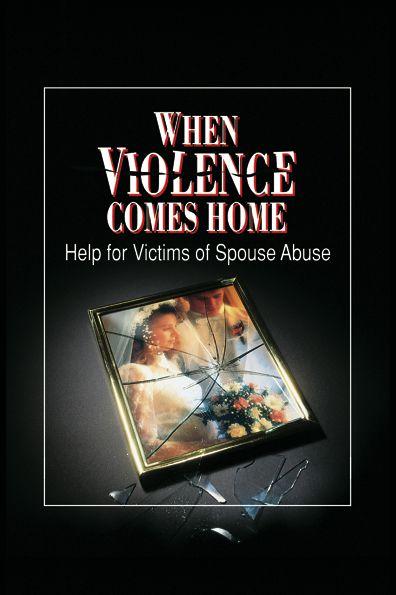
When When V V iolence iolence Comes Home Comes Home
by Tim Jackson and Jeff Olson
TThe woman speaking on the phone was noticeably upset.Her voice shaking uncontrollably,Cindy explained that her husband Ron,who had been drinking the previous night,tracked her down with a loaded gun and threatened to kill her. Cindy was terrified.Yet this was not the first time Ron had been abusive to her.On numerous occasions throughout their 4 troubled years of marriage,he had physically battered and verbally humiliated her.
Unfortunately,marriages like Ron and Cindy’s are not rare—even within the church.Although some may think that the problem of spouse abuse is not widespread in the church,it is alarmingly prevalent.Consider,for example, Bill and Karen’s marriage.On the surface,they seemed to be a “normal”Christian couple.Bill had a successful career.Together they owned a modest house,had two beautiful children,and attended church regularly.But for several years they shared an ugly secret:Bill was relentlessly abusive.
Shortly after the honeymoon,the verbal assaults began.Bill pointed out every mistake Karen made.She didn’t cook “his”meals right. She didn’t keep “his”house clean.She wasn’t sexually responsive enough.Any time she did do something well,he would take the credit,informing her that it was only because he pushed her that she succeeded.Karen felt worthless and inferior. It didn’t take long before Bill started shoving her around.Less than 2 years into their marriage,Bill was slapping Karen on an almost weekly basis.He watched her like a hawk and berated her with harsh criticism.Even on their better days,Karen felt betrayed,trapped,and frightened that the physical abuse would return and escalate.This is not what she expected marriage
to be,and it seemed as if there was nothing she could do about it. How should endangered women like Cindy and Karen respond? What about their role as Christian wives?Does following a Christlike path mean they should continue to be submissive to their abusive husbands? Can they seek protection? Is there a loving way to hold Bill and Ron responsible for their behavior?
Women like Karen and Cindy often feel alone, without hope,and without options.Many blame themselves for their husbands’ anger or violence. Often they are confused about what is really happening not only to them but inside them as well. Because their husbands seem to have everyone else intimidated or fooled with their persuasive charm, these women wonder at
times if they are losing their minds.
If this describes you, you are not alone.Many other women have also experienced the predictable cycle and damages of spouse abuse that will be described in the first half of this booklet.
Coming to terms with what has been happening to you may be frightening.The road ahead will not be easy. But there is hope.There is a dawn beyond the darkness. While many problems will never be solved this side of heaven,there is much that can be done.Many have learned that there is help available from God and from the people He can bring into your life.
You don’t need to waste the pain of your abuse on further denial and passive tolerance of your husband’s illegal and ungodly behavior.There is help for those who learn to respond
in a Christlike and biblical way when violence comes home.
Describing Marital Abuse
How Is Spouse Abuse Defined?
Marital abuse is the misuse of power and control.It’s an attempt to coerce and control one’s spouse through a combination of physical and non-physical means. Specific physical examples include slapping,scratching, biting,kicking,shoving, choking,hitting,sexual assault,stabbing,and shooting.A constant barrage of name-calling, guilt trips,put-downs, criticism,and threats are examples of non-physical attempts to intimidate and control.Abusive spouses may also dominate by limiting their mate’s behavior and friendships, giving the silent treatment,

imposing strict financial restraints,or breaking objects that their mates treasured.
There are many degrees of conflict in marriage.All marital relationships experience at least subtle forms of controlling behavior.Yet at some point, reasonable and fair-minded people recognize that when controlling behavior becomes excessive,it goes beyond what is normal marital conflict and requires intervention. Marital relationships are not above the law.There are criminal statutes against willful endangerment. Many states are developing specific domestic violence legislation to assist in stopping the assault and battery that threatens a growing number of homes.
While it’s true that some wives pose a real threat of endangerment to their husbands,the majority of
incidents involve men abusing their wives. Therefore,this booklet will focus on wife abuse while recognizing that the concepts can be applied to a situation that is reversed.
How Widespread Is Wife Abuse? Research
shows that battering is the leading cause of injury to women in the United States—more than “rapes, muggings,and traffic accidents combined”(Ann Jones, Next Time,She’ll Be Dead,p.87,Beacon Press, 1994).The Bureau Of Justice’s National Crime Survey reports that a woman is battered in her home every 15 seconds (The Battered Woman’s Survival Guide, p.4).
Spouse abuse has no economic,educational, racial,or religious boundaries.It occurs in families from all walks of life.Abused women are
homemakers,doctors, teachers,daycare workers, nurses,secretaries,and bankers.They are married to businessmen and janitors,factory workers and accountants,lawyers and even church leaders.
What Is The Cycle Of Abuse?
An abusive relationship typically follows a cycle that is marked by three wellrecognized phases (The Battered Woman, Lenore E.Walker, 1980).Although there are some variations from this cycle, many abusive relationships will repeat this cycle over and over.
TENSIONBUILDING
The tensionbuilding phase is a period of time when a wife either avoids her husband or frantically works to keep her husband’s world running smoothly.She
does this to prevent triggering another abusive explosion.In this way,she holds some “limited control” in the relationship. Sometimes there are minor skirmishes,but the wife suppresses her anger by either blaming herself (“I should have kept quiet about the credit-card bill”) or something in the man’s environment (“He must have had a tough day at work”) or reasoning that it could have been worse.Each time a small abusive incident occurs, tension in the relationship increases.A nagging sense of helplessness begins to overwhelm her.
Eventually the tension simmers to a boil,bringing on the next phase. Ordinarily,this first phase lasts for long periods of time.
The acute battering or abusive phase is earmarked by increased severity of abuse.Unlike the minor abusive incidents that occurred in the first phase,the incidents in this phase are far more caustic. This phase is usually triggered by some particular event or set of circumstances,though rarely the same and often unpredictable.Like a violent storm that strikes on a clear,sunny day,the physical attack or verbal assault seems to come out of nowhere.It could be a meal that is unsatisfactory or a refusal to have sex that sets off a husband.Normally, this phase lasts from 2 to 24 hours (The Battered Woman, p.60).
Initially,a wife is in a state of shock and disbelief. It’s difficult for her to come to grips with what has happened to her.If she’s been through the abusive
cycle several times,she’s likely to experience a mixture of relief and rage— relief that the inevitable assault is over,and rage over her husband’s empty promises to stop.
She may be faced with the need for medical treatment.She might report her husband to the authorities or inform family members of the abuse. Typically,however,she remains silent and doesn’t expose her husband.Within her is an increasing sense of helplessness and feelings of self-hatred for not doing something to prevent the abuse.
The calm-and-penance phase is a time when the abuser appears to be stricken with grief over his cruel and insensitive actions.He works very hard to make up for what he’s done with apparent acts of kindness,promising never to abuse again.Usually,a
wife welcomes this phase and enjoys the special attention given to her. Because she desperately wants to believe that her husband is sincere,she tends to overrate the genuineness of his remorse. During this time she may drop criminal charges or shrink away from pursuing legal separation or divorce. She will frequently come up with “reasonable” explanations as to why her husband mistreated her. This phase may last a day or a few months.Eventually, however,the tensions will slowly begin to mount and the cycle will repeat.
Sometimes the calm-and-penance phase is substituted with a suddenreturn-to-normal phase.In this phase,there is often a significant period of silence. A wife may be hoping that her husband will apologize. But what usually happens is that her husband
eventually begins to act as if nothing ever happened. The abusive incident is not mentioned and no apology is offered.Life just somehow goes back to “normal.”But because their problems are not exposed and worked through,the tension escalates,leading to another abusive episode.

The Wounds
Of Spouse Abuse
WWhether subtle or blatant,emotional or physical,spouse abuse pierces the body and soul of a woman.While there are varying degrees of damage,all forms of abuse inflict painful wounds.
Visible Wounds.
Countless wives have sought medical attention for the physical trauma they have received at the hands of an enraged,out-of-control husband.These include
bruises,scrapes,scratches, cuts,internal injuries,and broken bones.Others have quietly endured the pain of a bloodied nose or a sprained neck or shoulder.
Invisible Wounds.
Many women claim that the wounds that go unseen hurt the most.These involve the sting of betrayal,feelings of powerlessness,a loss of freedom,and a suppression of dignity.While there is much overlap among the four,it’s helpful to consider each one separately.
The Sting Of Betrayal.
An abused spouse is disillusioned.The marriage relationship is a far cry from what she expected it to be.One abused wife tearfully recalled her dream of being happily married to a man who truly loved and cherished her.Though there may have been a few occasions before their marriage when her husband’s anger was
explosive and way out of proportion,she never dreamed it would be directed toward her to such an extreme.
In the early stages of their relationship,the husband often smothers his wife with kindness.His apparent love and concern for her is what she finds so attractive.Hidden under his cloak of charm and gentleness,however,is a scheme to possess and control her.Eventually her dreams are shattered as she realizes that she’s married to an insecure,possessive, and controlling man.She feels betrayed,and the sting of betrayal deepens as her husband repeatedly breaks his promise to stop the abuse.As a result,abused wives often find it difficult to trust people—even individuals who could help.
Feelings Of Powerlessness. A
husband’s superior physical
strength and intimidating threats,or cultural and religious expectations,or economic restrictions leave an abused wife with the feeling that she is unable to stop the abuse.Her sense of powerlessness intensifies as she begins to recognize that she can’t prevent or end the damage and pain the abuse has caused her and her children.
Over time,an abused wife begins to believe that the abuse is somehow her fault.She doubts herself as a wife,homemaker,mother, and lover.Although she may excel at a job with many important responsibilities, she does not feel competent in her home.After an abusive incident,one woman said,“If only I wouldn’t have asked him to look at the car when it was acting up.Then maybe he wouldn’t have slammed me against the wall.”
Loss Of Freedom. An
abusive marriage is earmarked by limited freedom on the part of a wife.Her husband may limit her social life,tell her whom she can be friends with,or take away the checkbook.In extreme cases,a wife must get “permission”before doing anything out of her normal daily routine.In an attempt to control his wife and keep the abuse silent,the husband often makes all of her major decisions.In any event,a wife begins to feel that she has no life of her own.She feels as though she has no voice to speak; and if she did speak,no one would pay any attention.
Suppression Of Dignity.
None of us can ever fully lose our dignity, though there are times we may feel as if we have.An abusive husband regularly suppresses his wife’s dignity.He may constantly tell her that she can’t think
for herself or treat her like an inanimate object that is used and discarded like an empty pop can. He frequently mocks and discounts her feelings, thoughts,or desires.As a result,she often feels as if she has “ceased to exist as a person.”This sometimes leads to a “hollow” appearance in which she seems emotionally and intellectually barren.
Myths Of Wife Abuse
TThere are several myths surrounding the issue of wife abuse.Let’s look at four of them: MYTH#1: Some Men Can’t Help Themselves. Some believe there are men who don’t have the ability to cope with frustration.They say these men have no choice but to abuse.In
responding to this claim, James and Phyllis Alsdurf state,“If frustrating situations offered only one option,abusers would be equally violent on the job,driving in traffic,or interacting with friends;but that is simply not true.The majority of abusers direct their violence specifically and purposely toward their wives”(Battered Into Submission,p.68).

Others blame alcohol and drug abuse for a batterer’s violent behavior.It’s true that addictive behavior complicates and inflames many abusive marriages. But the solution to the violence is not as simple as eliminating the alcohol and drugs.Not every abuser drinks or does drugs.And not every alcoholic or drug addict is an abuser.And not every abuser who quits drinking quits abusing his spouse.The failure to hold abusers responsible for their
abuse,no matter what other factors may be influencing them,only adds fuel to a fire already burning out of control.
MYTH#2:
Abused Women Are Themselves To Blame.
Some believe that wife abuse would not occur if it were not for women who drive their husbands over the edge.They point out that some women “bait” their husbands with a frigid attitude or constant nagging.They maintain that some women actually “buy” the attention and sympathy of others by provoking their husbands to violence.
While there may be occasions when this kind of “baiting”exists,it’s never an excuse for abuse.It’s a wellknown fact that battered women generally keep the abuse private (Battered Into Submission,p.74).That’s why wife battering is commonly referred to as
the “silent crime.”Battered women normally don’t seek sympathy from others. They keep it to themselves because of the shame they feel and because they’re afraid of what might happen if they report their husbands’ behavior.
mWife battering is commonly referred to as the “silent crime.”n
Some wives admit to provoking their husbands’ rage,not because they like being abused but because they have been through the cycle enough times to know that after the storm their husbands are inclined to be remorseful,kind,and gentle.Additionally,“getting the abuse over with”eases the tension of not knowing
when the next abusive storm will strike.For many abused wives,living with the overwhelming fear of not knowing when the abuse will erupt again is worse than the abusive incident itself.
In some marriages,the wife is more verbal than her husband.She can outmaneuver him in an argument,give him reason to feel weak and incompetent,and sometimes provoke him to anger.When he finally blows up,her moral superiority and low opinion of him appear to be confirmed.He feels even lower about himself,while she,at considerable cost to herself,appears to be vindicated.
Again,while such relationships exist,they do not prove that a woman is to blame for her husband’s abusive reaction.He and he alone is fully responsible for the way he responds.
MYTH#3: The Bible Teaches That An Abused Woman Must Be Willing To Follow Christ’s Example Of Suffering And Endure
Her Husband’s Abuse. This may be the most serious of all myths.Many well-intentioned pastors and counselors have sent wives back into dangerous homes after quoting the apostle Peter’s words: To this you were called, because Christ suffered for you,leaving you an example,that you should follow in His steps.... Wives,in the same way be submissive to your husbands so that,if any of them do not believe the word,they may be won over without words by the behavior of their wives, when they see the purity and reverence of your lives (1 Pet.2:21;3:1-2).
Many battered wives
have remained in abusive marriages because they’ve been taught that the suffering example of Christ requires that they stay and take a beating from their husbands.But neither the broader nor the immediate context of the Bible requires that a wife endure her husband’s abuse.
God is portrayed throughout the Bible as an advocate who “upholds the cause of the oppressed” (Ps.146:7).He has always asked people of strength to come to the assistance of those who are weak and oppressed:
Stop doing wrong,learn to do right! Seek justice, encourage the oppressed. Defend the cause of the fatherless,plead the case of the widow (Isa.1:16-17). It would be inconsistent with the rest of Scripture if Peter were endorsing any
behavior that would have encouraged the oppression of wives by abusive husbands.
Furthermore,it is a mistake to assume that Peter was referring to an abusive marriage in 1 Peter 3:1-6.He clearly described a marriage of a believing wife and an unbelieving husband (v.2).To import abuse into this text is not justifiable by the evidence from the text itself.Peter encouraged wives to influence their husbands not by lecturing them into the kingdom but rather by loving them well.
While there may have been verbal resistance and accusations from an unbelieving husband that would have produced emotional pain for a believing wife (see 3:9,16), there is no evidence that Peter was referring to the kind of abusive and violent marriage described throughout this booklet.
Peter’s focus throughout this passage was not on how to endure abuse,but on how to live good lives that cannot be dismissed or ignored by unbelievers (2:12).He applied the principle of godly living to citizens under pagan governments (2:13-17), slaves under pagan masters (2:18-25),and wives with pagan husbands (3:1-6).
Some have been distracted with Peter’s encouragement to slaves to suffer as Christ suffered (2:21) as somehow also applying to wives in abusive marriages.Peter never endorsed slavery nor spousal abuse.In a first-century Roman culture in which slavery was legal (a slavery that was quite different from the 19th-century slavery of the Americas),Peter encouraged Christian slaves to be the best slaves possible in order to win the respect of their unbelieving masters.
He taught wives to be such radiant women that their actions would capture their husbands’ attention and draw them to Christ.The call to godly living was not based on the response they would get from their unbelieving masters or husbands,but on God’s commendation (2:20;3:4).
mChrist would never require a wife to submit to her husband’s abuse of power.n
Fortunately,in our day, we have laws against domestic violence.By enduring abuse in secret, a battered wife is hiding criminal behavior within her own home that God says needs to be exposed and punished.In fact,a wife is encouraged to risk
suffering emotional pain by loving her husband enough to expose the abuse.In spite of fearing how he might respond,she needs to act in a way that seeks his highest good.That’s what it means to “do what is right”(3:6).
MYTH#4:
When The Bible Requires A Wife To Submit To Her Husband “In Everything,” That Includes Abuse. Many Christian wives suffer in relationships with abusive husbands because they honestly desire to honor God’s calling to “submit to their husbands in everything”(Eph.5:24). Some have mistakenly taught them,however,that “everything”includes abuse and betrayal.The Bible gives no indication that abusive relationships are being addressed in Ephesians 5.In fact,the opposite is true.
Because God knew that the battle within the home would be for control (Gen. 3:16) and that husbands would tend to grab the power and rule harshly over their wives (Col.3:19), He qualified the context for wifely submission.The Bible states that it is “as the church submits to Christ” that a wife is to submit to her husband “in everything” (Eph.5:24).What’s implied is not only how wives are to submit,but the type of leadership that they and the church are to submit to.Christ’s leadership is the model for husbands. His leadership was loving and sacrificial.Christ would never demand the church to submit to an abuse of power.Neither would He advocate a wife submitting to a husband’s abuse of power.Abuse is a destructive distortion of leadership that calls for a radically different response
from a spiritually healthy woman.
A wife has good reason to follow a husband who loves, leads,and sacrifices as Jesus did for the church (Eph.5:23,25,28-29). However,when a husband violates his call to love by a pattern of oppressive control and violence as described earlier in this booklet,a wife must take strong steps to protect herself and her children from his abusive stranglehold.
When a woman finds herself in a marriage with a man who abuses his power and authority,she can still respond in a way that shows love and respect to her husband— even though she doesn’t submit to his abuse. Before discussing what that kind of response might look like,let’s consider why and how a wife tends to respond to a husband who misuses his position of authority to dominate her.

A Wife’s Response To Abuse
Why Does An Abused Wife Respond The Way She Does?
There are many issues stirring inside the wounded heart of an abused woman. Besides the pain and confusion,there is also fear, anger,and disappointment. At any given moment,one or more of these can influence an abused wife’s response to her abuse.
The Fear Within.
A woman in an abusive situation is often terrified. Without question,she has much to fear.She is legitimately afraid of losing everything she holds dear— her husband,her children, her financial support, her house,her family reputation,and her physical and emotional well-being— just to name a few.
Abused women readily
identify with the fear David expressed in Psalm 55 over being deeply betrayed by a close friend:
My heart is in anguish within me;the terrors of death assail me.Fear and trembling have beset me; horror has overwhelmed me.I said,“Oh,that I had the wings of a dove! I would fly away and be at rest—I would flee far away and stay in the desert;I would hurry to my place of shelter,far from the tempest and storm.” ...If an enemy were insulting me,I could endure it . ...But it is you,a man like myself, my companion,my close friend . ...My companion attacks his friends;he violates his covenant. His speech is smooth as butter,yet war is in his heart;his words are more soothing than oil,yet they are drawn swords (Ps. 55:4-8,12-13,20-21).
But while there is much to be afraid of,there is a distinct difference (though often difficult to see) between being afraid and being controlled by fear. An abused woman who is controlled by her fear has lost all confidence that she can make any kind of difference in her life.She feels powerless to stop the endless cycle of abuse.She has learned to tolerate abuse and lives with the constant terror that she is helpless and that her situation is hopeless.In essence,she is paralyzed by fear.
Jill spoke of how she repeatedly turned down the invitations of family and friends to attend social gatherings that she really wanted to attend.She was afraid that if she left Sam alone,she might make him angry.She lived her life striving for his approval by doing all she could to avoid
his angry disapproval and possible rejection.But what Jill eventually discovered was that she could never do enough for him no matter how hard she tried. Something was always wrong or at least deficient with what she did.She felt as though she never measured up to his demands.And for that failure she came to believe that she deserved Sam’s abuse.
In many cases,an abused woman’s greatest fear is that her husband may abandon her.She mistakenly believes that without his acceptance and presence in her life she can’t survive.Her heart flinches at the thought of being left alone.She doesn’t necessarily want him out of her life,she just wants him to stop hurting her.If he does end up rejecting her, what will that say about her? What will others think?
What about the children? What about the economic hardship? How will they make it on their own?
The Anger Within. Although she may not always be aware of it, anger is usually present in the heart of an abused wife. Is it wrong for her to be angry about being abused? Absolutely not! God Himself hates marital violence (Mal. 2:16).He wants us to be angry about the things that anger Him (Prov.6:16-19; Eph.4:26).Part of sharing His goodness is to develop a holy hatred and intolerance for sin in ourselves and in others (Rom.12:9).
The problem,however, is not that an abused wife is angry over her husband’s mistreatment,but that her anger may turn into a bitterness that seeks to return evil for evil. Unresolved,vindictive anger may gradually turn her into a hard woman with
an attitude that will eventually distance her from others as well.
The Disappointment
Within. An abused wife is also motivated by intense disappointment.Her heart legitimately longs for more of her husband’s loving involvement.She wants the abuse to stop and the romance to begin.Yet there is rarely any hope that it will ever happen.Proverbs 13:12 says,“Hope deferred makes the heart sick.” As her disappointment becomes unbearable,she tends to blame herself for
mAn abused wife tends to blame herself for the abuse and may even doubt her worthiness to be loved.n
the abuse and may even doubt her worthiness to be loved.Self-blame seems to make her disappointment easier to bear.She has the illusion of control because she can try to fix whatever she thinks she did wrong to cause the abuse.Self-doubt, on the other hand,begins to deaden the part of her heart that wants her marriage to improve.Believing that she doesn’t deserve to be loved is a subtle way of protecting herself from getting crushed again.
An abused woman can deaden her heart so much that she gives up her will to fight for change. Slowly,she stops trying to “fix”her marriage and resigns herself to the way things are.Whether she stays busy trying to become what she thinks her husband wants or gives way to despair,she forfeits the opportunity to respond in a way that her husband
needs.Instead of being convinced that her husband needs confrontation,she feels unable to seek the intervention required for her out-of-control spouse.
How Does An Abused Wife Respond To Her Husband?
Most typical responses can be categorized as either passive or vindictive.In many instances,fear and disappointment prompt a passive response,and anger arouses a vindictive response.An abused wife is capable of either response, though a passive response is far more common.
A Passive Response.
This is the response that tolerates the abuse.It occurs in all three phases of the abusive cycle (p.5).A passive response pursues peace at any cost and flees from any kind of confrontation.It excuses or minimizes the abuse with statements like, “He had a tough day at
work,”or “At least it wasn’t as bad as the last time.”
Many would view a woman responding this way as a passive “doormat” for her husband to trample. While she may be angry over the way he’s abusing her,she cowers at the thought of doing anything that might incur her husband’s anger.She labors to appease her husband and become what he wants. She “walks on egg shells,” careful not to arouse the sleeping giant lest she or her children bear the brunt of his violent rage.
Some would interpret this woman’s passive response as a way of showing love to her troubled husband.But is she? Is she helping her husband by shouldering the blame and not confronting his sin? Or is she protecting herself? Focusing on her own self-protection is understandable.But facing
the possibility of physical risk isn’t the greatest danger.Worse would be the prolonged loss of her own freedom and dignity. Worse would be following a path of self-protection that allows grievous sin to continue and her own love to grow cold and weak.
A Vindictive Response. Occasionally,an abused wife will lash out at her husband.Although she’s still frightened about many things,there are occasions when she’s been pushed far enough that her anger gets the best of her.Instead of passively enduring the abuse out of fear,she finally lashes back and makes her husband pay.
An abused wife may try to get even with a sarcastic or demeaning comment.She may even try to physically strike back.Quite often, however,an abused wife’s revenge is more passiveaggressive.She may let the
house go,or make her husband late for church or social engagements,or fail to give him an important phone message.These are subtle ways of getting even and controlling him for a change.
A woman’s desire for revenge is not necessarily wrong,but taking revenge is.God says that revenge is His business (Rom.12:19). Instead,God calls a wife to consider responding differently to her abusive husband.This response centers around the goal of showing love and respect without backing away from the gravity of a situation and the need a wife may have to escape to a place of safety.
A battered wife may feel helpless and cornered with few if any options.As powerless as she might feel, in time she can discover there is more within her heart than just fear and
anger.She can find that she has the freedom and power within her to respond in love to a man who is acting as her enemy.
A Loving Response.
During one of the most well-known public speeches of His ministry,Jesus made this unlikely statement: “Love your enemies,do good to those who hate you”(Lk. 6:27).Some may argue that if an abused wife were to apply Jesus’ words to her situation,it would only encourage her husband to be more abusive.Although following Jesus’ counsel may cost her many things, loving and doing good is in no way meant to help an abusive husband indulge in the childish lust for power and control that Jesus clearly condemned (Mk. 10:42-43).Nor does a loving response have anything to do with letting him off the hook for his cruelty.Instead, a loving response refuses to
tolerate the abuse and does whatever is reasonable to help her husband understand the harm he’s causing to others and himself.
mA loving response refuses to tolerate abuse and does whatever is reasonable to help the abuser understand the harm being done to others and to himself.n
A battered wife can begin to live out Jesus’ call to love by confronting the abusive patterns in the marriage. While “love covers over a multitude of sins”(1 Pet. 4:8),it doesn’t cover over all sin.Confronting her
husband’s habitual and grievous sin is often the best way to show him love. Although it’s never a wife’s job to change her husband, confronting the abuse is often the only way to give him the opportunity to acknowledge his sin,repent, and find the forgiveness of God.
While no description can fully capture what it means for an abused wife to lovingly confront her husband,initially confronting the abuse involves at least seeking help from others,careful timing,exposing the abuse, and giving consequences.
1.Seeking Help From Others. For at least two reasons,an abused wife shouldn’t try to confront abuse in her marriage without help.First, confrontation is a long and difficult process.Second,a husband may respond to any confrontation with
physical intimidation and violence.Consequently,she needs to enlist help from those who will support her and help ensure her safety. One woman,for example, had two male friends present when she first confronted her husband. She also arranged for a place for her and her children to stay while her husband contemplated what they discussed.
2.Careful Timing. There is no “good”time to confront abuse,but some moments are better than others. Generally speaking,the best time for a wife to confront an abusive husband is when he is somewhat calm.
Most battered women should not try to confront an abusive husband in the heat of an abusive episode because she is usually alone and unprotected.When a husband is physically and emotionally out of control, the best thing for a wife to 23
do is to lay low and,when she can,call for help or go somewhere where she and her children are safe.One woman,for example,stayed reasonably calm when her husband picked up their toddler by the hair and threatened to break his neck.She knew he was capable of doing anything, so she didn’t want to get him any angrier.Once her child was out of harm’s way, she called the police and then went to stay with her parents.
3.Exposing
The Abuse.
Instead of hiding the abuse, a wife needs to carefully make plans to expose the terrible things her husband has been doing to her behind closed doors (Eph. 5:11-13).In many cases, exposing an abusive husband involves letting others know who not only can assist and protect her but also help her husband. A wife can expose her
husband by simply reporting him to the police or telling the truth about how she really got her bruises.Other situations may require a woman to have more savvy. One woman wisely used a voice-activated tape recorder to capture the barrage of verbal and physical abuse that no one in her church believed she was enduring in her home.Her husband had convinced people in the church that she was the problem.But when the evidence was heard,the truth became abundantly clear and the process of church discipline began (Mt.18:15-20).
4.Giving
Consequences.
Along with exposing the abuse,an abused wife can confront her husband by giving him consequences for his abusive behavior—not to punish,but to bring a selfdeceived man to his senses. A consequence is something a wife decides to do instead
of something she tries to make her husband do.And in this situation,it should be strong enough to shake up his world.
One woman told her husband she would press charges against him the next time he hit her.When he did,she used the Godgiven provisions of human government (Rom.13:1-7; 1 Pet.2:13-14) to lovingly but firmly bring an out-ofcontrol husband to his senses.Being arrested and going through the criminal justice system helped him begin to see the severity of what he was doing to her and their children.
Unfortunately,there is no guarantee of how a husband will respond to a wife who exposes the evil of his abuse and gives him consequences. Even Jesus,whose love was perfect,at times aroused hostility from those He loved (Mk.3:1-6).All too often,the abuser has so hardened his
heart that he is unwilling to admit his sin and accept any responsibility for harm caused to others.In such cases,marital separation may be the only “severe mercy”that can be offered to him.Even so,a wife whose desire is to love her husband will not stop praying for him.
No matter what the outcome,there’s a better way for a wife to respond to her husband’s abuse.This higher path isn’t easier.It doesn’t offer a guarantee of immediate outcome.In some ways,it might even increase the risk of loss. There’s no way to play it safe and still address the abuse with love.Nor is there ever a time to take revenge.Succumbing to a passive or vindictive response will only leave a battered wife trapped in a vicious cycle of fear and anger.
No wife will perfectly love
her abusive husband.Fear will continue to entice her back to passivity.The desire to return evil for evil will at times seem irresistible. But if an abused wife is a follower of Christ,these are not the deepest desires of her heart.Since the Spirit of Christ is in her heart, there will be a greater desire to love her husband, not because she’s afraid of losing him but because she wants what is best for him. As the wife grows in her relationship with the One who showed her amazing love by dying for her sins, she can know more of the power and desire to extend the same kind of love to her abusive husband.And though her husband may never admit his sin— remaining abusive and continuing to put all the blame on her—she can more fully discover,in her pain,that it is God she wants and needs the most.
Is Reconciliation Possible?

WWhenever there has been long-term abuse in a marriage relationship, reconciliation is difficult.If it occurs,it will not happen quickly.Restoration is not an event,it is a process—one that is slow and arduous. Many times it will be three steps forward and two steps back.There are no simple methods to follow or guarantees of success.
Reconciliation must not be misunderstood as encouraging a woman to return to the abusive cycle.Paul used the word reconciliation to denote the cessation of hostility in a relationship (2 Cor.5:17-21; Eph.2:11-18).The death of Christ was the cost of bringing reconciliation between sinful,rebellious people and a holy God.
Reconciliation in an abusive marriage is a cessation of hostility on the part of the abuser against the victim.It means that he must do whatever it takes to ensure that there is not a return to the destructive patterns of the past.
Rebuilding a relationship marred by abuse must eventually cross over the bridge of forgiveness.For many abuse victims,the idea of forgiving their abuser seems like betrayal because it feels as if they are letting him off the hook for what he’s done. The pattern of forgiveness spoken of in Luke 17:3-4, however,makes it clear that forgiveness is a process that also lovingly holds the abuser accountable for his actions.(For a more thorough explanation of the process of forgiveness, see When Forgiveness Seems Impossible CB941.)
What if an abusive
husband is not willing to go through the process of reconciliation? Then a wife must continue to follow a path of spiritual counsel and legal action that may eventually involve divorce. While God hates a divorce that is selfish and exploitive (Mal.2:16a),God equally hates any form of violence that invades and threatens the security of a home (Mal. 2:16b).Even God recognizes that there are some things worse than divorce.
God Himself divorced the northern tribes of Israel (Jer.3:8).He took such action only after enduring their prolonged spiritual unfaithfulness,which He compared to sexual unfaithfulness.
Old Testament divorce laws provide another glimpse of God’s heart toward these matters (Dt.24:1-4).Jesus said that Moses permitted divorce because of hardened hearts (Mt.19:8).Jesus did
not disagree with Moses’ allowance of divorce on the basis on hard-heartedness. Neither did Jesus give us reason to think hard hearts were only an Old Testament problem.What we know from Jesus and Moses is that hard hearts exist today and are not open to reason and grace. In the case of domestic violence,hard hearts call for “damage control”and the protection of victims.
A wife who is in physical danger needs to separate from her husband. Eventually,divorce may be necessary for a wife who is married to a severely abusive husband—even if he is not guilty of sexual immorality (Mt.19:1-12). However,she must carefully consider the name and reputation of Christ and follow the biblical procedures for confronting a sinning brother before taking such strong action (Mt.18:15-17).
It is not as well known, but nonetheless true,that the New Testament allows a woman to walk away from her marriage for unspecified reasons, but without the opportunity for remarriage. Paul wrote,“To the married I give this command (not I, but the Lord):A wife must not separate from her husband.But if she does, she must remain unmarried or else be reconciled to her husband.And a husband must not divorce his wife” (1 Cor.7:10-11).People who have wrestled with what the Bible has to say about marital abuse agree that the kind of hard-hearted attitude and grievous behavior often associated with spouse abuse are what can bring a wife to this unfortunate,but sometimes necessary decision.(For a complete explanation of the biblical grounds for divorce and remarriage,see Divorce And Remarriage Q0806.)
How Can The Church Respond To Spouse Abuse?
WWhen an abused woman finally reaches out for help,the place she most often turns to is her church. In far too many cases, however,the church has been ill-prepared and even hesitant to get involved in such messy situations. Unfortunately,many women become disillusioned and don’t seek help from the church.

to minister to those who are hurting and in desperate need of assistance as well as those who have lost their way.The following are a few basic suggestions for churches that want to take this call seriously.
1. Be Prepared To Get Involved. Plan
God indicted the religious leadership of Ezekiel’s day because,He told them,“You have not strengthened the weak or healed the sick or bound up the injured.You have not brought back the strays or searched for the lost.You have ruled them harshly and brutally”(Ezek.34:4). The call of God’s people is
ahead.Don’t be caught off guard.If a church is truly committed to ministering to families in today’s cultural chaos and to be a light in a dark world,then it must be prepared to provide the needed support structure. This will enable a woman to lovingly hold her husband accountable without the perpetual threat of physical harm and financial ruin.
Consult with professionals in your area to find out how to implement intervention with an abuser and how to provide protection for a victim and her children. Also,seek liability insurance to protect the
church from litigation.It’s a small price to pay for the added potential risk in dealing with these situations.
2. Maintain FollowThrough. Be persistent. It’s easy to get discouraged when working with individuals who come from abusive homes.Progress is usually slow and seems nonexistent at times.Expect the unexpected.It can be draining work,so don’t allow only a few people to carry the load.Don’t become “weary in doing good” (Gal.6:9).An extensive prayer ministry is needed to support this front-line, hand-to-hand combat.
3. Establish A Referral Network For Helping Both Victims And Abusers. This includes housing,food, clothing,medical services, legal advice,protective services,professional counseling,and employment
services.Don’t be afraid to recommend the help of other reputable agencies. The church should be the focal point for coordinating the overall ministry efforts to help this wounded person become a healthier member of the body of Christ.But the church should not be expected to do everything all by itself.
4. Hold The Abuser Accountable. Remember, the church is responsible to minister truth and mercy to both the abuser and the victim.The church’s goal needs to be restoration.If there has been a separation due to physical violence, regular accountability must be maintained.If charges have been pressed and the abuser is incarcerated,he should not be abandoned. He needs to know that while the church sides with God in hating his sin,they (like God) desire his restoration.
What If You Are
An Abused Spouse? II
f after reading this booklet you recognize that you are living in an abusive marriage,there are some important steps that you need to consider:
1. Admit That You Are The Victim Of Spouse Abuse. You didn’t ask for this.Don’t take responsibility for the abuse.Don’t pretend it will get better if you just ignore the problem or work harder to pacify your husband.
2. Get To
A Place
Of Safety. If you are in a situation of immediate danger,go to a friend or family member’s house where you can safely call for help.Notify the authorities as soon as possible in the event of an attack.In most states,mandatory arrest laws have recently been passed to help ensure the safety of the victim of domestic violence.If you don’t have anywhere you can go,call a local shelter for abused women in your area.
3. Break The Silence. If you have been terrorized by an abusive spouse,tell someone you trust about the abuse.By all means,refuse to keep it quiet any longer.Tell your pastor,an elder,or a church leader.Talk to a counselor. Call a local domestic violence hotline in your area.Don’t stop talking about it until someone begins to listen to you and takes your situation seriously.
Above all,when you feel as if there is no one else to turn to,you have the invitation of the One who suffered and died for you.It is Jesus who said,“Come to Me,all you who are weary and burdened,and I will give you rest”(Mt.11:28).
SUGGESTED RESOURCES
Battered Into Submission:The Tragedy Of Wife Abuse In The Christian Home by James and Phyllis Alsdurf (Wipf & Stock Publishers,1998).
Bold Love by Dan B. Allender (NavPress,1993).
The Battered Woman by Lenore E. Walker (HarperCollins, 1980).
RBC BOOKLETS ON RELATED TOPICS
When Words Hurt— verbal abuse in marriage (CB011).
When We Love Too
Much—escaping the control of codependency(CB021).
When Forgiveness Seems Impossible knowing when and how to forgive(CB941).
When Hope Is Lost dealing with depression (CB973).
Divorce & Remarriage—what does the Bible teach? (Q0806). Abigail & Leah—living in a difficult marriage (HP972).
Hot Line For Domestic Violence: 1-800-777-1960
The complete text of all the RBC booklets is available at www.discoveryseries.org.
Authors Tim Jackson and Jeff Olson are licensed counselors in Michigan and work in the RBC biblical correspondence department.
Managing Editor:David Sper
Cover:Michael Forrest
Scripture quotations are from the New International Version,©1973,1978,1984, by the International Bible Society.Used by permission of Zondervan Publishers.
© 1995,2002 RBC Ministries, Grand Rapids,MI.Printed in USA.
Our mission is to make the life-changing wisdom of the Bible understandable and accessible to all.
Discovery Series presents the truth of Jesus Christ to the world in balanced, engaging, and accessible resources that show the relevance of Scripture for all areas of life. All Discovery Series booklets are available at no cost and can be used in personal study, small groups, or ministry outreach.
To partner with us in sharing God’s Word, click this link to donate. Thank you for your support of Discovery Series resources and Our Daily Bread Ministries.
Many people, making even the smallest of donations, enable Our Daily Bread Ministries to reach others with the life-changing wisdom of the Bible. We are not funded or endowed by any group or denomination.