
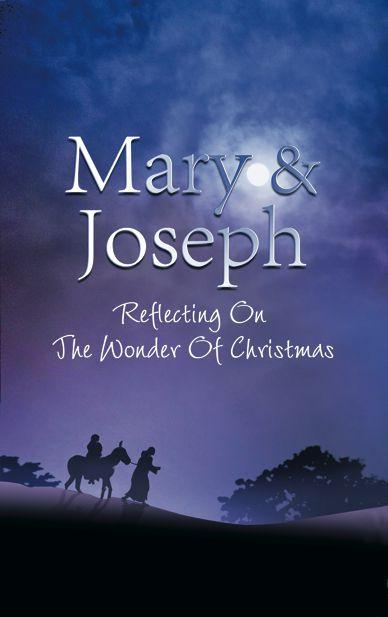
MARY&JOSEPH: Reflecting On The Wonder Of Christmas
IIA Fresh Perspective. . . 2 Mary:The Perspective Of Wonder. . . . . . . . . . 4
Joseph:The Perspective Of Obedience. . . . . . 16 Our Perspective On Christmas .
31
n the middle of the holiday season, it’s possible to see the lights in other people’s windows while sensing that you have lost the spirit of Christmas. While trying to live up to the expectations of others, you may find that your own ability to give has been drained out of you. Even the sounds of church bells and carols can leave you feeling that God is asking more of you than you have to give. If that describes you, maybe it’s time to revisit the wonder of the Christmas story. In the following excerpt of Windows On Christmas, author Bill Crowder captures the spirit of the season and shows us a God who has moved heaven and earth, and two very real people, to give us the greatest Gift of all.
Martin R. De Haan II
Managing Editor:David SperCover Design:Terry Bidgood Unless otherwise indicated, Scripture quotations taken from the New American Standard Bible®. Copyright © 1960,1962,1963,1968,1971,1972,1973,1975,1977,1995 by The Lockman Foundation. Used by permission. This booklet is based on a portion of Windows On Christmas by Bill Crowder, published by Discovery House Publishers,a member of the RBC Ministries family. ©2007 RBC Ministries,Grand Rapids,MichiganPrinted in USA
A FRESH PERSPECTIVE
IIam a Christmas junkie. I love everything about it—the trees, the lights, the food, the gifts, the songs, the food, the celebrations, the traditions, the food, the special worship opportunities, the family gatherings, and yes, the food. Our family, like most families that celebrate Christmas, has developed its own traditions, and each of those expressions of joy brings its own shading and flavoring to the celebration of the birth of Christ. Each one gives another layer of experience and provides another slant and perspective on the familiar Christmas story and its celebration.
Life is all about
perspective, and our own perceptions can be clarified and enriched by seeing life’s events through a number of different windows. The more familiar something is, the more valuable these windows become. A fresh look, a different angle, can revolutionize our appreciation of truth that might be in danger of growing stale and tired.
A fresh look can revolutionize our appreciation of truth that might be in danger of growing stale and tired.
This reality
was underlined for me in a fascinating way by
filmmaker Clint Eastwood. As a lifelong history buff, I anxiously awaited his film Flags Of Our Fathers, about the World War II battle on the small Pacific island of Iwo Jima. And I was not disappointed. I learned things that I had never known about that historic fight and its even more famous flag-raising. But it was all from the perspective of the Americans fighting there.
Eastwood followed this with a second film called, Letters From Iwo Jima. It told the same story, but from the perspective of the Japanese soldiers entrenched there. Eastwood let us look through their eyes by following the letters they wrote to those at home as they described the awful conditions and intense fighting that took place there.
The two films recount the same battle, but the vision of the conflict is very different. It was an important lesson to me on the value and significance of perspective.
In the Christmas story, this fresh look can be found in the familiar Scripture of Luke 2. There we find different perspectives on the events of the nativity, and we can share these perspectives by looking through the windows provided by those who were there, allowing us to see and feel what they saw and felt, and to learn from their responses to these wonderful and powerful events. These timeless wonders:
• Call us to kneel at a humble manger—and anticipate the horrors of a cruel cross.
• Teach us the glory of the incarnation—and
the tragedy of human sin that required a Savior who would bear our sins in His own body.
• Allow us to celebrate the miracle of birth— and rejoice in the miracle of new birth. In short, they allow us to enter into events that altered forever the world and its inhabitants—to join the humble worshipers who welcomed Christ at His birth. They give us what we often need most— fresh perspective.
MARY: The Perspective Of Wonder
OOne of the most haunting Christmas songs is the folksy, air y tune “I Wonder As I Wander.” In the tone and style of a spiritual, it speaks of the
mystery of the Christmas story and the miraculous intervention of God. It tries to express in word and note how difficult it is for the human heart to understand what God chose to do—and why He chose to do it.
I wonder as I wander out under the sky, How Jesus, the Savior, did come for to die. For poor ornery people like you and like I . . . I wonder as I wander out under the sky.
I can’t imagine a more appropriate word to describe that miracle than wonder. But I suspect that, in our world today, wonder isn’t all that wonder-ful anymore.
A recording artist who flops after his first recording is considered a “one-hit wonder.” One of the plainest white breads on the market is known as Wonder Bread, and
we even have Wonder undergarments. Yet somehow these things don’t seem to represent an appropriate use of the word wonder.
Wonder needs to be reserved for that which is beyond human explanation.
The Seven Wonders of the Ancient World (such as the Great Pyramids of Giza and the Hanging Gardens of Babylon) may more closely capture the essence of wonder—something that overwhelms our thought, reminding us that we are too small to think and process things at a certain level. But even those great and often mysterious engineering
feats fall short. They were, after all, created by humans just like us. We may not know quite how they did it, but there is an explanation for it, even if that explanation is yet undiscovered. No, wonder needs to be reserved for that which is beyond human explanation. Wonder speaks of omnipotence and omnipresence and creative power. Wonder speaks of God. So thought George Beverly Shea who penned the words: There’s the wonder of sunset at evening, the wonder as sunrise I see; but the wonder of wonders that thrills my soul is the wonder that God loves me.
O the wonder of it all, the wonder of it all—
Just to think that God loves me!
Why on earth (or in heaven, for that matter) would God love me? That defies understanding. I know me, and frankly I’m not all that lovable. So why would He do that? Wonder.
But to add even more to the sense of wonder surrounding that love, why would He love me the way He did—sending His Son to die for my sins and in my place? That is the very essence of the Christian faith, and there is no easy answer, aside from the nature of God Himself: love.
Because the wonder of God’s love found its fullest expression in the coming of Christ on our behalf, let’s look at the Christmas stor y through the perspective of a young woman who had more cause for wonder
than any other person involved in the story.
The wonder of God’s love found its fullest expression in the coming of Christ on our behalf.
THE WONDER OF PRIVILEGE
An American Express credit card ad used to say, “Membership has its privileges.” They promoted their credit card by appealing to the human desire for being select and elite, for having an opportunity that others could only imagine. The world is divided between the haves and have-nots, between the
welcome and the excluded, between the privileged and the outsiders. People on the outside look in with envy and awe as the lucky few access their “privileges.”
Some privileges, however, are more than just a special treat or a membership card. They carry with them the sense of amazement that you have been selected above all the rest. I don’t believe I ever understood this until I met Marlene, the young woman who later became my wife.
Marlene and I had been dating less than 2 weeks when, while eating dinner together, she said she needed to tell me something. The somber tone of her voice made me assume that I was about to hear about the boyfriend back home or the fiancé in the military, but that wasn’t the case.
She wanted to tell me that she was adopted. After heaving a huge sigh of relief, I asked her to fill me in on the details. After listening to her explain how she had gone from being Kathy in Washington County, Virginia, to Lili Marlene in Raleigh, North Carolina, I asked her, “Have you ever wanted to find your real parents?” “These are my real parents,” she said. “They had an entire orphanage full of kids needing a home—and they chose me. They could have chosen anyone, but they chose me. Me.” For Marlene, privilege was the joy of being chosen!
I suspect that young Mary felt the same way when the angel Gabriel told her that she had been chosen to give birth to the Christ-child. Ever
since the promise of a Messiah had been given, young Jewish women had longed to be selected for this privileged role. Centuries came and went, and no Messiah arrived. Then the message came: The time had come for Messiah to be born, and Mary was to be His mother! Even in Gabriel’s greeting, the wonder of privilege is clear: “Greetings, favored one! The Lord is with you” (Lk. 1:28).
Luke tells us that Mary was “perplexed,” and that she “pondered” the meaning of such a strange greeting. These are strong words. Perplexed means “deeply distressed” and pondered comes from the same word as our word dialogue. She was, in fact, reasoning with herself, in her own mind, about the meaning of all this.
Sensing her confusion, Gabriel explained it further: Do not be afraid, Mary; for you have found favor with God. And behold, you will conceive in your womb and bear a son, and you shall name Him Jesus. He will be great and will be called the Son of the Most High; and the Lord God will give Him the throne of His father David; and He will reign over the house of Jacob forever, and His kingdom will have no end (Lk. 1:30-33).
“Found favor” meant that Mary was privileged. Talk about wonder! And Mary’s response—that she was a virgin—shows how difficult it was for her to grasp such a thing. Gabriel reassured her that even as her cousin Elizabeth had become
pregnant in her old age, the God of the impossible was capable of granting this privilege to her. Awe and wonder dissolved into trust and willingness of heart. Her response to Gabriel was firm and direct: “Behold, the bondslave of the Lord; be it done to me according to your word” (Lk. 1:38). The New Living Translation puts it this way: “I am the Lord’s servant. May everything you have said about me come true.”
Amazingly, Mary understood the magnitude of what she had been chosen to do, and she accepted with humility. Imagine her emotions, her disbelief, her sense of unworthiness, her joy, her amazement. Imagine the wonder in her heart.
Imagine Mary’s emotions,her disbelief,her sense of unworthiness, her joy,her amazement.
Imagine the wonder in her heart.
THE WONDER OF PREGNANCY
Marlene and I have five children, and each of their births remain the most miraculous events I have ever witnessed. It is amazing to see a baby enter the world. To hear the heartbeat for the first time, and to wonder whether the child is a boy or a girl. To see the ultrasound and feel the kicks of the unborn child.
To watch the miracle unfolding behind the veil of the mother’s body. To see the child take its first breath. Few things in life compare to that for sheer wonder.
The Scriptures are largely silent about the 9 months Mary carried the incarnate Christ, but we can make some assumptions based on what we know about life. It would have been a time of new experiences in which Mary felt things she had never known before. She had no frame of reference for what she was feeling, physically and emotionally, with every day of the baby’s growth.
Added to that, she undoubtedly had to endure the looks and whispers of her neighbors in the village of Nazareth— ordinar y people with
ordinary questions about the true father of the extraordinary child she carried. The sting of pointed words and disgusted looks must have cut her deeply. And there certainly might have been times when Mary doubted her own understanding— “Did I really see an angel? Did it all really happen like I remember, or is everyone right in what they say about me and my child?”—until the wonder was affirmed. Early in her pregnancy, Mary traveled to the Judean hill country around Jerusalem to visit her elderly cousin Elizabeth, who was pregnant with the baby who would grow up to be John the Baptizer. The Bible does not tell us why Mary went to visit Elizabeth, but it’s possible that she
left Nazareth to escape the harsh looks and wagging tongues.
Seeking safety and support, she sought out Elizabeth. They were two women, separated by age, but connected by family. Separated by miles, but connected by history. Both were the unlikeliest women to be pregnant—one too old and one a virgin.
Upon seeing Mary, Elizabeth declared: Blessed are you among women, and blessed is the fruit of your womb! And how has it happened to me, that the mother of my Lord would come to me? (Lk. 1:42-43).
Mary’s affirmation had come from a most unexpected source—the unborn baby that had leaped in Elizabeth’s womb at the sound of Mary’s voice. Mary’s
response, sometimes called “the Magnificat,” shows the true sense of wonder she felt at the privilege of her pregnancy: My soul exalts the Lord, and my spirit has rejoiced in God my Savior. For He has had regard for the humble state of His bondslave; for behold, from this time on all generations will count me blessed. For the Mighty One has done great things for me; and holy is His name (Lk. 1:46-49).
Mary’s sense of awe at this miraculous pregnancy is clear in her eloquent response of praise, worship, and thanksgiving. The wonder of this divinely orchestrated pregnancy had grasped her heart, filling her with true and uninhibited wonder.
THE WONDER OF CHILDBIRTH
When Mary was nearing the end of her pregnancy, she and Joseph began the long, arduous journey from Nazareth to Bethlehem to register in the imperial census (Lk. 2:1-3). Writer Walter Wangerin, Jr. imagines the struggles of the journey this way: They were bound for Bethlehem, the city where King David had been born one thousand years before, because Joseph was descended from the house of David. Mary rode the donkey. Joseph had fashioned a small rolled saddle to support her back. She had nearly reached the term of her pregnancy . . . . She was breathless and tired, swollen in
her hands, wrists, and ankles. Her long hair had lost traces of its beauty . . . Mary was determined to go with Joseph to bear her boy in the city of his father David. Though this is just one piece of the overall wonder of the Christmas story, I find it no small thing that, in essence, the sovereign God put the entire Roman Empire in motion for the single purpose of getting Mary where she needed to be at the moment Christ would be born. Perhaps because nothing short of an imperial edict would make a woman nearing childbirth travel about 80 miles on the back of a donkey! (Lk. 2:4-5).
Another miracle. Another wonder.
The Kindness Of Strangers. Bethlehem, the home of Joseph’s
family and ancestors, was a village located about 5 miles south of Jerusalem, not far from the foothills of the Judean desert.
Upon their arrival in Bethlehem, Mary and Joseph found the small community flooded with pilgrims who had come for the census. The inn was groaning under the weight of overflow capacity, and there was no place for the young couple to sleep, let alone give birth to a child.
The city of David was without shelter for the young woman who was ready to deliver. Yet someone (the innkeeper, according to Christmas legend and most church Christmas programs) was willing to go above and beyond the call of duty. He or she cared enough to make accommodation for Mary and Joseph in a stable. Though primitive,
this provided them shelter from the elements and the evening chill, and privacy from the mobs of people. That simple act of kindness guaranteed that the stage was set for the most marvelous reality of all—that the Lamb of God would be born in a stable.
The Birth Of The Son.
“While they were there, the days were completed for her to give birth. And she gave birth to her firstborn son; and she wrapped Him in cloths, and laid Him in a manger, because there was no room for them in the inn” (Lk. 2:6-7).
I am always struck by the simplicity of that description. This remarkable event is so understated, so matterof-fact, that you could almost miss it if you blinked. So much is left unsaid that you are compelled to read it
again . . . and again. A veil of silence is pulled over the young woman as she agonizes through childbirth. The shouts of joy are left unrecorded as Joseph, apparently serving as Mary’s midwife, delivers the baby and hands Him to His mother.
Mary had to have been overwhelmed by the realization that this child she cuddled and nur sed was the Son of God.
another level she had to have been overwhelmed by the realization that this child she cuddled and nursed was the Son of God, and by the thought of what this child had come to do—rescue a lost race from their sins (including herself, His own mother). This Son— promised by an angel, conceived by the Holy Spirit, affirmed by the then-unborn John, carried in the womb to Bethlehem, and surrounded in birth by farm animals—was the One who would be called “Wonderful Counselor, Mighty God, Eternal Father, Prince of Peace” (Isa. 9:6).
On one level, Mary must have experienced ever y wonderful emotion felt by ever y new mother as she held her child for the first time. But on
Nothing in Mary’s young life could have prepared her for all this. She was a normal firstcentur y Jewish girl from an ordinar y family living in an ordinary
This Son— promised by an angel,conceived by the Holy Spirit, affirmed by the then-unborn John, carried in the womb to Bethlehem,and surrounded in birth by farm animals— was the One who would be called “Wonderful Counselor,Mighty God, Eternal Father, Prince of Peace” (Isa.9:6).
God’s extraordinary plan for her life. And the wonder of her 9-month emotional roller coaster brought her to one simple response: “Mary treasured all these things, pondering them in her heart” (Lk. 2:19).
The word pondering was also her response to the message of the angel Gabriel 9 months earlier (Lk. 1:29). Once again Mary, in her own internal dialogue, in her own mind, was trying to understand all that was happening. Today, in our technology-driven culture, we would say that she was “processing.”
• Processing the fulfillment of the promise.
small town. Yet with wonder and obedience she embraced the extraordinar y implications of
• Processing the culmination of the pregnancy.
• Processing the journey from her home to Bethlehem.
• Processing the surroundings in the stable.
• Processing the struggle of childbirth.
• Processing the visit by simple shepherds.
• Processing the wonder of God incarnate in her child.
Two thousand years later, we are still processing. Still caught up in the wonder. Again, the carol “I Wonder As I Wander” puts it well: When Mary birthed Jesus ’twas in a cow’s stall, With wise men and farmers and shepherds and all. But high from God’s heaven a star’s light did fall, And the promise of ages it then did recall. There it is—the promise of the ages. The wonder of Christmas. The wonder of it all.
JOSEPH: ThePerspective OfObedience
IIlove music—all kinds of music. But for years, I deliberately ignored country music (perhaps a little rebellion against my West Virginia roots). Then a few years ago, my daughter convinced me to listen to some “country,” and I got hooked—partly because the lyrics and writing were so clever, and partly because the songs often told stories.
One of the first artists Beth had me listen to was, ironically, a fellow West Virginian. I immediately embraced this singer/songwriter because he shares with me a love for the Cleveland Browns professional football team and the West
Virginia Mountaineer college football team. His name is Brad Paisley, and he is as engaging as he is entertaining. Many of his songs (like “Celebrity” or “I’m Gonna Miss Her”) are knee-slappingly hilarious. Others (like “I Wish You’d Stay” or “When I Get Where I’m Going”) are serious and poignant. In that latter category is a song titled “He Didn’t Have To Be,” which tells the story of a boy who is the only child of a single mom. Whenever a man asks this young mom on a date, the relationship quickly evaporates when the aspiring suitor sees that she has a little boy. Time after time, the boy watches helplessly as his mother loses what he thinks is another chance at happiness, knowing all the while that it’s
because of him. One day, a man comes to call and, with a smile, invites the boy to come along with them on their date. A bond of love and appreciation grows between the boy and the man who eventually becomes his stepfather. Now, singing as an adult, he celebrates growing up with the love and acceptance of a stepfather who made their house a home and their twosome into a trio.
Now married himself, the young man stands outside the observation window of a hospital nursery looking at his own newborn baby, with his stepfather at his side. His longing and desire and prayer? That he will be able to be half the dad his stepfather “didn’t have to be.”
The man he had grown to love as his
father could have turned around and walked away. He had a choice, and he chose to be a dad. He chose to be what he didn’t have to be. He chose to love.
This song reminds me of the Christmas story because it reminds me of a central, though silent and almost invisible, character in the drama
Joseph could have turned and walked away.Instead,he under took willingly and obediently what could arguably have been the most impossible task in the universe—to be the stepfather for the Son of God.
of Christ’s birth: Joseph, the carpenter of Nazareth. He also made choices. He also could have turned and walked away. Instead, he undertook willingly and obediently what could arguably have been the most impossible task in the universe—to be the stepfather for the Son of God. He was obedient, at great personal cost, choosing to be what he didn’t have to be. And it all began with an angelic visitor, as was the case with Mary and with the shepherds.
OBEDIENT TO ANGELIC INSTRUCTIONS
Tradition has held that Joseph was significantly older than Mary, an assumption based on the likelihood that he was dead when Jesus began His public ministry.
Perhaps Joseph had waited many years to marry. And now he anticipated the consummation of his marriage to his young bride. Their betrothal meant that they were legally bound to each other, though not yet living together as husband and wife— quite unlike today’s “engagements,” which can be easily ended.
Imagine Joseph’s heartache, then, when he heard that Mary, his pure and godly young fiancée, was pregnant! Her apparent betrayal must have rocked his world. How could she do this? And who was the man who had participated in that betrayal?
We are not told that Joseph had any contact with Mar y personally about the matter. Ver y likely her father
ashamedly approached Joseph with the news. What was he going to do? Matthew fills in the blanks for us, giving us a window into the quiet character of Joseph’s heart:
Imagine Joseph’s heartache when he heard that Mary, his pure and godly young fiancée, was pregnant!
Now the birth of Jesus Christ was as follows: when His mother Mary had been betrothed to Joseph, before they came together she was found to be with child by the Holy Spirit. And Joseph her husband, being a righteous man and not wanting to 19
disgrace her, planned to send her away secretly (Mt. 1:18-19).
The heartbroken groom-to-be weighed his options. If word of Mary’s pregnancy got out, he would be publicly humiliated, an object of pity and ridicule. Yet his response was not one of revenge, or even of a demand for justice. He could have demanded that his intended bride be stoned to death for the sin of adulter y— sexual promiscuity
If word of Mary’s pregnancy got out, Joseph would be public ly humiliated, an object of pity and ridicule.
occurring during the formal betrothal period. Although there were no sexual relations between bride and groom during the betrothal period, the arrangement was legally binding and could be ended only by a divorce. But instead of revenge or retribution, Joseph looked for ways to protect Mary while still obeying the law of Moses.
His options? Death by stoning, which would publicly exonerate him, or a quiet dissolution of the marriage contract that would remove her from his life.
As Joseph was wrestling with this dilemma, and apparently deciding to end the betrothal quietly, he received a special message from the same messenger who had previously visited Mar y:
When he had considered this, behold, an angel of the Lord appeared to him in a dream, saying, “Joseph, son of David, do not be afraid to take Mary as your wife; for the Child who has been conceived in her is of the Holy Spirit. She will bear a Son; and you shall call His name Jesus, for He will save His people from their sins.” Now all this took place to fulfill what was spoken by the Lord through the prophet: “Behold, the virgin shall be with child and shall bear a Son, and they shall call His name Immanuel,” which translated means, “God with us” (Mt. 1:20-23).
The word considered in verse 20 is significant.
It speaks of deep meditation and intense thought, and shows the degree to which Joseph wrestled with the dilemma. It is also a word whose meaning is synonymous with the “pondering” Mary did after her own visit from the angel Gabriel! An angelic messenger with a heavenly message is no small thing. And the elements of the message are overwhelmingly significant:
• Joseph’s position as a descendant of the great King David, hero of Israel’s past, places his stepson in the line of the royal family.
• The Holy Spirit is the source of Mary’s pregnancy: “Conceived by the Holy Spirit.”
• The child’s name, Jesus, will describe His mission (“He
will save His people from their sins”).
• The child’s birth will be a fulfillment of prophecy from the Jewish Scriptures, explaining not just why the child was coming, but who He was (“God with us”). The message of the angel was both good news and bad news. The good news was that Mary had not been unfaithful to him after all. He could marry her without doubts about her purity or her commitment to him. The bad news? Who would ever believe it? How could he explain to friends and family the true nature of Mary’s pregnancy? Surely such a story would be seen as absurd, and he would be branded a fool for believing such nonsense. Once again, Joseph stood at a crossroads of choice—a choice between self-protection and obedience.
The message of the angel was both good news and bad news.The good news was that Mary had not been unfaithful to him after all....The bad news? Who would ever believe it?
Joseph awoke from his sleep and did as the angel of the Lord commanded him, and took Mary as his wife, but kept her a virgin until she gave birth to a Son; and he called His name Jesus (Mt. 1:24-25). Obedience was Joseph’s response
to a deeply difficult life situation. It was not an easy or painless obedience, and it did not come without cost. It was, however, not the only time that obedience would be the hallmark of his life.
OBEDIENT TO HUMAN GOVERNMENT
For two millennia, the beginning of the Christmas story has been heralded by the familiar words, “And it came to pass in those days, that there went out a decree from Caesar Augustus that all the world should be taxed” (Lk. 2:1 KJV). This passage concisely and clearly describes the reality of the world in which Joseph lived. Rome ruled with absolute authority, and either you submitted to that power or you were crushed
under its weight. The events surrounding Christ’s birth, however, also serve as an impressive reminder that human government does not operate independently or in a vacuum. Proverbs 21:1 reminds us that “the king’s heart is like channels of water in the hand of the Lord; He turns it wherever He wishes.” In Galatians 4:4 we are told that “when the fullness of the time came, God sent forth His Son, born of a woman, born under the Law.” Part of the “fullness of time” was a divine orchestration of the events of human history to prepare the stage for the arrival of the Christ.
Now in those days a decree went out from Caesar Augustus, that a census be taken of all the inhabited
earth. This was the first census taken while Quirinius was governor of Syria. And everyone was on his way to register for the census, each to his own city. Joseph also went up from Galilee, from the city of Nazareth, to Judea, to the city of David which is called Bethlehem, because he was of the house and family of David, in order to register along with Mary, who was engaged to him, and was with child (Lk. 2:1-5).
Notice the political heavyweights involved in generating this decision: Caesar Augustus, who ruled the known world at the time, and Quirinius, who governed a chunk of that world. Yet both of them were ruled by God, the King of heaven and
earth. And the entire world—“all the inhabited earth”—was placed in motion so that Mary would be where she needed to be for Christ to be born where the prophets had said He would be born.
Bible scholars differ in their opinions about whether or not Mary could have been excused from the difficult (and dangerous) journey to Bethlehem for the census because of her advanced pregnancy. But whatever the legal case might have been at the time, Joseph followed the edict to the letter by going to Bethlehem to be counted in the imperial census.
This may seem a small thing, but I don’t think so. I think it reveals the heart of this man and his complete obedience to the One who instructed His followers (and us) about
our relationship with the “powers that be.” It’s an indication of a heart that recognizes the function of authority and accepts it.
As a result of Joseph’s obedience, the Son of God was born in Bethlehem, the city of David, as Micah 5:2 had prophesied.
As a result of Joseph’s obedience, the Son of God was born in Bethlehem, the city of David, as Micah 5:2 had prophesied.
OBEDIENT TO GOD’S WORD
When eight days had passed, before His circumcision, His name was then called Jesus, the name given by the
angel before He was conceived in the womb. And when the days for their purification according to the law of Moses were completed, they brought Him up to Jerusalem to present Him to the Lord (as it is written in the Law of the Lord, “Every firstborn male that opens the womb shall be called holy to the Lord”), and to offer a sacrifice according to what was said in the Law of the Lord, “A pair of turtledoves or two young pigeons” (Lk. 2:21-24).
We see Joseph’s next involvement in the story in an event that was without doubt his responsibility, though he is not named in the text. It was ver y important to a faithful Jewish man that the requirements of the law regarding the 25
birth of a child be honored. The Mosaic law demanded certain sacrificial responses and ceremonial rituals, set forth in these Old Testament mandates:
• Every Jewish male child had to be circumcised. This marked them as sons of Abraham (Gen. 17).
First practiced at the direct command of the voice of God, circumcision became incorporated into Jewish law through Moses as a way of keeping the people of God distinct and separate from the pagan cultures that surrounded them.
• A sacrifice had to be made for the purification of the new mother (Lev. 12). This would have taken place 40 days after the birth of the child, male
or female. The fact that Joseph and Mary offered turtledoves or pigeons as a sacrifice shows that they were not wealthy, as those of means were required to offer a lamb. It would have been the father’s task to fulfill the requirements of the law. And though he is not named in this passage, we can safely assume that Joseph fulfilled the expectations of the law after Christ’s birth, preparing the way for the One who would later say: “Do not think that I came to abolish the Law or the Prophets; I did not come to abolish but to fulfill” (Mt. 5:17).
The Christ who would bring all the law to its true and complete fulfillment followed in the footsteps of an earthly stepfather who
took obedience to God seriously. In all he did, Joseph exemplified the spirit of submission that God expects and deserves from His children.
In all he did, Joseph exemplified the spir it of submission that God expects and deserves from His children.
OBEDIENT TO A HEAVENLY WARNING
Before Joseph’s final appearance in the pages of the Bible, where we find him visiting the temple at Jerusalem with Mar y and 12-year-old Jesus (Lk. 2), we see him faced with two
more opportunities to obey or disobey.
After Jesus was born in Bethlehem of Judea in the days of Herod the king, magi from the east arrived in Jerusalem, saying, “Where is He who has been born King of the Jews? For we saw His star in the east and have come to worship Him.” When Herod the king heard this, he was troubled (Mt. 2:1-3).
The magi’s visit alarmed Herod, who viewed the birth of a new king as a clear and present danger to the stability and longevity of his own kingdom. The repercussions of the magi’s visit to Bethlehem must have been equally troubling for Joseph, albeit in an entirely different way. After these mysterious
strangers showed up on the doorstep, another angelic messenger alerted Joseph to the danger hanging over their head. When they [the magi] had gone, behold, an angel of the Lord appeared to Joseph in a dream and said, “Get up! Take the Child and His mother and flee to Egypt, and remain there until I tell you; for Herod is going to search for the Child to destroy Him.” So Joseph got up and took the Child and His mother while it was still night, and left for Egypt. He remained there until the death of Herod. This was to fulfill what had been spoken by the Lord through the prophet: “Out of Egypt I called My Son” (Mt. 2:13-15).
Mar y and Joseph lived far beneath the notice of
rulers and magistrates. The thought that their child might be in danger from such powers would never have occurred to them. Suddenly Joseph realized that they lived in a world that was far more dangerous than they ever imagined. Only an angelic voice could have convinced them that their baby boy was in danger.
When Joseph received the warning from the angel, he didn’t hesitate. His first instinct was to protect the child. The journey to Egypt would be long, and even dangerous in itself. But with Herod’s threats hanging over them, they could not stay in Bethlehem. In Egypt they would be safe. And out of Egypt, Christ—like the Moses-led children of Israel hundreds of years before—would eventually
return home to live and grow and prepare for His years of public ministry. When Herod died, behold, an angel of the Lord appeared in a dream to Joseph in Egypt, and said, “Get up, take the Child and His mother, and go into the land of Israel; for those who sought the Child’s life are dead.” So Joseph got up, took the Child and His mother, and came into the land of Israel (Mt. 2:19-21).
On a human level, Joseph’s willingness to obey the angel’s warning provided the first of many escapes from peril that Jesus experienced. The One who was often heard to say, “My hour has not yet come” would sur vive this and other threats until the moment arrived for His death on the cross—a death that
would fulfill the law, remove the need for further sacrifices, and redeem a sin-filled world. Joseph’s obedience was part of the preparation for the ministry and accomplishment of the Son who “learned obedience from the things which He suffered” (Heb. 5:8).
7
When we look at the Christmas story through the window of Joseph’s experience, we clearly see his constant heart of obedience. Facing choice after choice after choice, he responded obediently to each challenge set before him.
The beauty of obedience has been somewhat tarnished in our “have it your way” world where “doing your
own thing” has become the rallying cry. Yet, there is still a simple, quiet beauty to the obedient heart. It speaks against the rebellious nature of our fallenness and points us to a better way. It shows us the wisdom of taking God seriously and the folly of selfdetermination. It reminds us that God is sovereign and we are not—and that
The beauty of obedience shows us the wisdom of taking God ser iously and the folly of selfdetermination. It reminds us that God is sovereign and we are not.
this is the way it is supposed to be.
In his excellent book, A Long Obedience In The Same Direction, Eugene Peterson says this: Friedrich Nietzsche . . . wrote, “The essential thing ‘in heaven and earth’ is . . . that there should be long obedience in the same direction; there thereby results, and has always resulted in the long run, something which has made life worth living.” It is this “long obedience in the same direction” which the mood of the world does so much to discourage.
The “long run.” A “long obedience.” Joseph chose to live such a life of obedient trust in a world that discourages long-term commitment in favor of instant gratification. And as
we face the challenge to ignore or obey, to follow the Master or go our own path, Joseph left us an example well worth following. Scripture doesn’t record the words of Joseph. He’s not seen as someone who initiates; he responds. He doesn’t take center stage; he works behind the scenes. But the abiding characteristic of his consistent example is his willingness to obey God. Apparently, he had long before learned to trust God. In fact, Joseph’s obedience teaches us that trust and obedience are inseparable. If we do not first trust God, we will never surrender our choices and destinies to His purposes. And if we do not obey God, we will never see the great and humbling things He wishes to accomplish in and through our lives. No
wonder one of the most beloved hymns of the church echoes this simple truth:
Trust and obey, for there’s no other way
To be happy in Jesus but to trust and obey.
OUR PERSPECTIVE ON CHRISTMAS
PPerhaps you are among the many people for whom Christmas is not a season of joy but a trial and a challenge. For you, Christmas cheer and the reason for celebration have long since been lost in the fog of confusion, disappointment, or loneliness. It isn’t a season to be enjoyed—it has become a season to be endured.
Maybe that’s why one’s perspective is so important. The perspectives of Mary
and Joseph can help us to rediscover the marvelous reality that Christmas is not a season after all. It’s a gift—a gift expressing the extent to which our loving God was willing to go to make us His own.
For Mary and Joseph, there was wonder in those events. The wonder of who Christ is and the wonder of why He came are only the beginning. The wonder of what that can mean in our lives is beyond imagination.
In John 1:12 we read an important promise to us from the God of heaven:
As many as received Him, to them He gave the right to become children of God, even to those who believe in His name.
Imagine‚ the Maker of heaven and earth is the One who makes it possible for us to know
Him, to find forgiveness for all of our wrongdoing, and to receive more than eternal life—to receive the privilege and wonder of becoming part of His family!
God did all that by sending His Son on that first Christmas. If you will talk to Him, admit your failings, express your needs, acknowledge His authority over your life, and accept the gift of forgiveness His Son has made possible, you can know the greatest of all wonders—the wonder of new life in Christ.
“The Wonder Of It All”(p.5) by George Beverly Shea ©Renewed 1985 by The Rodeheaver Co All rights reser ved.
This booklet is excerpted from Windows On Christmas by Bill Crowder,which is published by Discovery House Publishers,a member of the RBC Ministries family.Bill,who spent 20 years in pastoral ministry,is now the Director of Publications for RBC Ministries.He and his wife Marlene have five children.
Our mission is to make the life-changing wisdom of the Bible understandable and accessible to all.
Discovery Series presents the truth of Jesus Christ to the world in balanced, engaging, and accessible resources that show the relevance of Scripture for all areas of life. All Discovery Series booklets are available at no cost and can be used in personal study, small groups, or ministry outreach.
To partner with us in sharing God’s Word, click this link to donate. Thank you for your support of Discovery Series resources and Our Daily Bread Ministries.
Many people, making even the smallest of donations, enable Our Daily Bread Ministries to reach others with the life-changing wisdom of the Bible. We are not funded or endowed by any group or denomination.