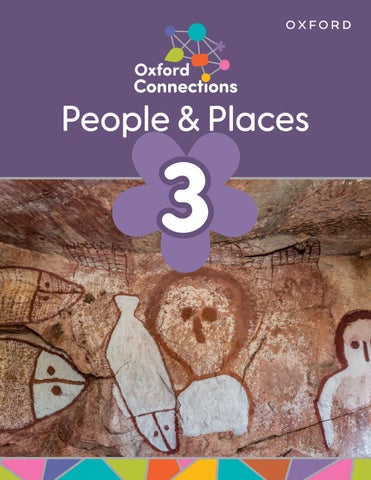
Oxford
Connections
People & Places
3
Contents Unit 1 Caring for Country........................................................2 Lesson 1.1 Sustainability....................................................................................... 2 Lesson 1.2 Using resources.................................................................................. 4 Lesson 1.3 Mapping Country and Place...........................................................6 Lesson 1.4 Trading trails.......................................................................................8
E L
Lesson 1.5 Impact of colonisation.................................................................... 10 Lesson 1.6 Connection to Country....................................................................12
P M A
Lesson 1.7 Caring for Country: Review............................................................14
Unit 2 People, places and patterns...................................... 16 Lesson 2.1 Australia’s states, territories and Nation groups....................... 16
S
Lesson 2.2 Australia’s neighbours.................................................................... 18 Lesson 2.3 Settlement patterns........................................................................20 Lesson 2.4 Natural versus human-made....................................................... 22 Lesson 2.5 Climate zones of Australia............................................................24 Lesson 2.6 Rainfall patterns..............................................................................26 Lesson 2.7 People, places and patterns: Review.........................................28
Unit 3 Ancient civilisations................................................... 30 Lesson 3.1 Mapping ancient worlds................................................................30 Lesson 3.2 The Maya.......................................................................................... 32 Lesson 3.3 Star charts and glyphs...................................................................34
ii
Oxford University Press
Lesson 3.4 Farming the Americas....................................................................36 Lesson 3.5 World environments.......................................................................38 Lesson 3.6 Cultural groups................................................................................40 Lesson 3.7 Ancient civilisations: Review.........................................................42
Unit 4 Australian society...................................................... 44 Lesson 4.1 Celebrations......................................................................................44 Lesson 4.2 Being a citizen.................................................................................46 Lesson 4.3 Local communities..........................................................................48
E L
Lesson 4.4 Identity and belonging..................................................................50 Lesson 4.5 Rule versus law................................................................................52
P M A
Lesson 4.6 Being an active citizen..................................................................54 Lesson 4.7 Australian society: Review.............................................................56
Glossary................................................................................. 58
S
Oxford University Press
iii
Lesson 1.3
Mapping Country and Place
Learning intention We are learning about Aboriginal peoples’ connection to the land and Country.
The Past
Read through the poem “The Past” written by Oodgeroo Noonuccal. In the poem, Oodgeroo reflects on the differences between her life now and the lives of her ancestors and how they lived on the land in the past. Poems and stories are an important part of Aboriginal and Torres Strait Islander culture. They are used to pass down languages and traditions.
Let no one say the past is dead. The past is all about us and within. Haunted by tribal memories, I know This little now, this accidental present Is not the all of me, whose long making Is so much of the past.
E L
Tonight here in suburbia as I sit In easy chair before electric heater, Warmed by the red glow, I fall into dream: I am away At the camp fire in the bush, among My own people, sitting on the ground, No walls about me, The stars over me, The tall surrounding trees that stir in the wind Making their own music, Soft cries of the night coming to us, there Where we are one with all old Nature’s lives Known and unknown, In scenes where we belong but have now forsaken. Deep chair and electric radiator Are but since yesterday, But a thousand thousand camp fires in the forest Are in my blood. Let none tell me the past is wholly gone. Now is so small a part of time, so small a part Of all the race years that have moulded me.
S
P M A
Oodgeroo Noonuccal
6
Oxford University Press
1.
Where is the author sitting at the beginning of the poem?
2. Where does she imagine she is instead? 3. What do you think she means by “a thousand camp fires in the forest are in my blood”?
4. Look at the way the author compares suburbia and the bush. Fill in the table below with the opposites for suburbia (as described in the poem).
E L
Suburbia
The bush
Electric heater
P M A
Easy chair Walls
5. Use the language in the poem to help you visualise the difference between “then and now” as the author has described it. In the boxes below, draw your visualisations
S
for both suburbia and the bush, make sure you include the details that have been described.
Suburbia
Oxford University Press
The bush
7
Lesson 2.4 Natural versus human-made Learning intention We are learning about the natural and constructed features of Australia.
Australia’s natural features Australia has many amazing natural features across its varied landscape, from deserts, to reefs to cave systems. The Great Barrier Reef is the largest coral reef and has been listed as one of the natural wonders of the world. It is so large that it can be seen from outer space. Located off the coast of Queensland, the reef is more than 2,300 kilometres long. It is home to many types of marine life, including fish, turtles and sea snakes. Some species can only be found there. Uluru is located in the southern part of the Northern Territory, near the centre of Australia. It is a sacred site for the Anangu people and was officially handed back to them in 1985 after colonisers had prevented them from accessing their traditional lands. Uluru is a huge ovalshaped rock formation that is roughly 863 metres tall and 3.6 kilometres long. It often appears to glow red at sunrise and sunset.
Lake Hillier is a famous lake in Western Australia because of its bright pink colour. Scientists believe its colour is caused by tiny organisms that live in the water. It is surrounded by forests and is best seen from the air. The 12 Apostles are found along the Great Ocean Road in Victoria. They are limestone stacks that were formed by erosion from the ocean. Visitors can stop at lookout points along the Great Ocean Road to see them. Mitchell Falls is a four-tier waterfall in Western Australia on the Country of the Wunambal Gaambera people. The site can be reached by a four-wheel drive track and a hike, or viewed from a scenic flight. It is best visited during the wet season when the waterfalls are at their fullest. Jenolan Caves are a network of limestone caves in New South Wales. They are thought to be among the oldest cave systems in the world, with rocks dating back about 340 million years.
E L
P M A
S
22
Oxford University Press
1.
Where is the Great Barrier Reef located?
2. Name two animals that live on the reef. 3. What colour does Uluru glow at sunset and sunrise? 4. Why do you think Lake Hillier is best seen from the air?
5. Why do you think Mitchell Falls are best seen in the wet season?
E L
P M A
6. Which natural feature of Australia would you like to visit and why?
7.
S
Pretend that you have visited your chosen natural feature. Write a letter or postcard to a friend that tells them about your visit.
Oxford University Press
23
Lesson 3.2 The Maya Learning intention We are learning about the ancient Maya civilisation and the living legacies of some of their ideas and practices.
Maya glyphs and numbers The Maya people developed their own complex writing system, made up of more than 800 glyphs. Glyphs are symbols that represent words, ideas or sounds. Some glyphs represented whole words, while others represented parts of words or syllables. The glyphs were carved onto stone monuments, temples and other buildings, and they were painted on pottery and other objects. Skilled Maya writers, known as scribes, used the symbols and wrote books called codices. Codices were made from bark paper, which was then folded.
People have studied Maya glyphs for many years to learn more about the culture, history and achievements of the Maya civilisation. The Maya also developed their own number system using lines and dots to represent numbers. A dot represented one and a line represented five. They used a shell-shaped symbol to represent zero. For larger numbers, the Maya grouped them into twenties. This system helped Maya people make calendars and also record dates and events.
E L
P M A
S
A
B
(A) Maya glyphs and (B) number system 32
Oxford University Press
1.
What is a glyph?
2. Where were Maya glyphs found? 3. Draw your age using the Maya number symbols.
4. Design your own set of glyphs for each letter of the alphabet. A
B
C
E
F
G
I
J
M
N
Q
R
U Y
S V
Z
E L
P M A K
O
D H L
P
S
T
W
X
5. Write a sentence using your glyphs. Then swap your glyph alphabet and sentence with a partner and see if they can decode your message.
Oxford University Press
33
Unit 4
Australian society
Lesson 4.1
Celebrations
Learning intention We are learning about important celebrations, events and symbols in Australia, and how they help people feel connected to each other and show respect for people in our community.
Australian schools celebrate Harmony Day Today, primary schools all around Australia are celebrating Harmony Day by learning about different cultures and how people can live together respectfully. Harmony Day is a special time when students talk about kindness, inclusion and making sure everyone feels welcome.
E Lony D
At many schools, students are wearing orange, the colour of Harmony Day, to show that everyone belongs. Some classes are sharing food from different cultures, while others are learning songs, dances and greetings from around the world.
S
H
Teachers say that Harmony Day helps students understand that Australia is made up of people from many backgrounds. Students are learning that even though families may have different traditions, languages or foods, everyone deserves to be treated with respect.
a
y
P M A
m r a
In some schools, students are creating posters about friendship and teamwork to display around the school. Other classes are listening to stories that teach them how to include others and stand up for fairness. Harmony Day reminds students that working together and caring for each other helps make schools and communities happy and safe places to be. 44 44
Celebrating Australia’s cultural diversity
Oxford University Press
1.
What special day are schools celebrating?
2. Name one activity students are doing to celebrate Harmony Day. 3. Why do you think schools want students to learn about different cultures?
4. What does the word “inclusion” mean in the report? Tick the correct answer. Leaving people out Letting everyone join in
E L
Being very quiet Working alone
P M A
5. How does Harmony Day help make schools safer and happier places?
S
6. What is one way your class could help everyone feel welcome, not just on Harmony Day but every day?
Oxford University Press
45
Lesson 4.4 Identity and belonging Learning intention We are learning that people belong to different cultural, religious and social groups and that these groups help shape the identity and character of our communities.
Exploring communities in Australia Aboriginal and Torres Strait Islander peoples Food: Traditionally, people ate foods from the land such as fish, kangaroo, berries, yams and bush honey. Some of these foods are still eaten today.
Celebrations and recognition: Schools and communities learn during NAIDOC Week, Reconciliation Week and National Sorry Day. Many assemblies start with an Acknowledgement of Country to show respect.
How this shapes communities: First Nations cultures teach everyone about respect, caring for nature, and belonging to place, which helps shape how communities live together.
E L
P M A
Indian communities in Australia Food: Students may know foods like butter chicken, naan, samosas, rice dishes and mango lassi (a sweet yoghurt drink).
S
Celebrations: Diwali, the Festival of Lights, is celebrated with lamps, colourful clothes, music and dancing.
How this shapes communities: Indian festivals, food stalls, and community events make neighbourhoods more colourful and welcoming.
Greek and Italian communities in Australia Food: Common foods include pizza, pasta, olives, bread, cheese, souvlaki, and pastries sold in bakeries and cafés. 50
Celebrations: People may celebrate religious holidays, food festivals, and community days with music and dancing.
How this shapes communities: Cafés, bakeries and family restaurants become places where people meet, talk and feel connected.
Oxford University Press
1.
Name one festival celebrated by Indian communities that was mentioned in the text.
2. Tick two foods commonly associated with Greek or Italian communities. Pizza Naan Pasta Dumplings 3. Complete the sentence. Sharing food and celebrations helps people feel
in their
community.
E L
4. Why might Greek or Italian cafes and bakeries help people feel connected in their communities? Tick the correct answer.
P M A
People can meet and talk there. They are very quiet. Only families go there. They close early.
S
5. Use the best word to finish the sentence: exciting, boring, lonely. The word “colourful” tells us the community is
.
6. What is the main idea of all three fact sheets? Tick the correct answer. Different foods taste good.
Different groups help shape communities. All communities are the same. Only schools matter. 7.
What is the main message of these fact sheets?
Oxford University Press
51