Sample Module
Lisa is a practicing solicitor with over 17 years’ experience working as a private practice and in-house lawyer. Her experience includes working as a General Counsel, leading an in-house legal term and providing strategic senior advice to key leaders. Before working as a solicitor, Lisa taught Legal Studies at Melbourne Girls Grammar and held numerous curriculum and assessment roles with the VCAA.
Lisa has previously been involved in the re-accreditation of the VCE Legal Studies course and is a regular presenter at VCE Legal Studies conferences. Lisa also currently owns and operates Commerce Studies Hub, a highly successful educational services business that offers assessment tasks, trial exams and student masterclasses for VCE Legal Studies and Business Management.
Lisa would like to thank her husband, André, for continuing to support her in these endeavours and for giving her the space and encouragement to contribute to these works. She would also like to thank her children, Amélie, Eleanor, and Josiah, who continually bring joy to each day and remain the underlying inspiration for this work. Lisa would also like to thank the Oxford University Press team, including her co-authors, editors and publishers, for their dedication to producing high-quality resources for VCE Legal Studies students and teachers.
Annie is a deeply experienced Legal Studies teacher and author who has been developing teaching and learning resources for over 35 years. Recently retired from teaching, she previously taught at several schools including Camberwell Girls Grammar and Presbyterian Ladies’ College.
Annie would like to thank everyone at Oxford University Press who helped bring this text to publication, especially Anne McKenna, Radha Sekar, Evan Curnow, Trischa Mann and Natasha Broadstock. She also thanks her co-authors, Lisa Filippin and Peter Farrar, offering particular gratitude to Lisa for her invaluable expertise, guidance and support.
Peter is a very experienced Legal Studies teacher and author, with over 35 years of experience. He has been teaching at Star of the Sea College since 2008. He is highly skilled at developing a range of learning materials to meet the needs of a diverse range of students and has co-authored over 25 books throughout his career.
The production of textbooks is a complex business and there are numerous people to acknowledge. Firstly, thanks to my wife, Mim, and my children, James, Julia and Pippa, who for many years have been a constant source of support and encouragement. Also, my co-authors, Lisa Filippin and Annie Wilson, have proven once again that they operate at the highest professional standards. The quality of this book also reflects the strong logistical skills of OUP Senior Publisher Anne McKenna, who managed the entire process with humour and close attention to detail. Finally, the editors, Natasha Broadstock and Trischa Mann, immersed themselves in the writing process, offering insights and advice that were invaluable. We trust that the new generation of VCE Legal Studies students will enjoy this text.
Legal Studies for VCE Units 3 & 4 (Seventeenth Edition) has been purpose-written to provide complete coverage of the VCAA Legal Studies Study Design 2024. It includes a range of flexible print and digital products to suit your school and incorporates a wide variety of features designed to make learning fun, purposeful and accessible to all students!

Module openers
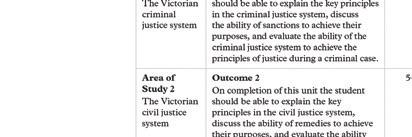
• Each module opens with the outcome for the Area of Study, key knowledge and key skills from the Study Design, and a list of key legal terms.
Study tips
• Targeted study tips help students to achieve better results on assessment tasks.
Margin glossary terms
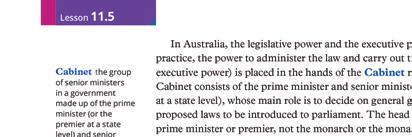
• On-page glossary definitions for key legal terms support student understanding at the point of learning. Key terms also appear in a combined glossary at the back of the book.
Did you know?
• Interesting or quirky facts about the law to engage students.
Extracts
• E xtracts from relevant legislation support student learning.













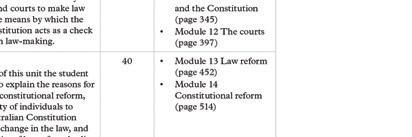
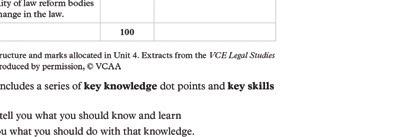
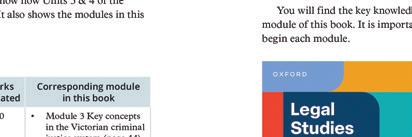

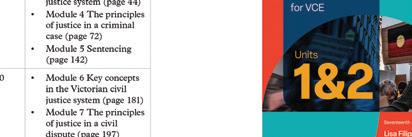










The legal toolkit
• A standalone toolkit module explicitly teaches students the skills required to be successful in the VCE Legal Studies course.
Actual scenarios
• Actual scenarios provide key legal cases and articles to help students understand realworld examples of the law in action, and provide practice for students responding to scenario-based questions.
• At the end of each module, a review activity gives students a chance to consolidate their knowledge and apply the skills they have learnt.
• Graded revision questions and Practice assessment task questions are structured in line with a range of suggested assessment tasks covered in the Study Design
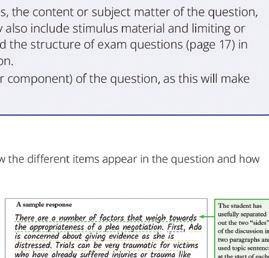
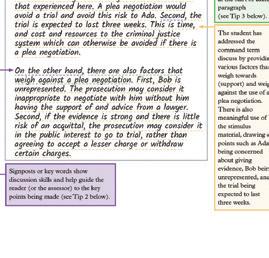
See it in action
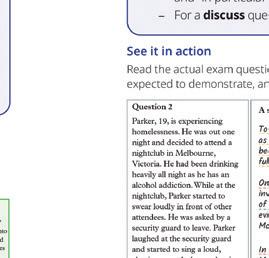
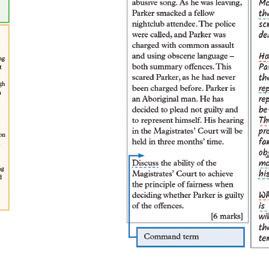
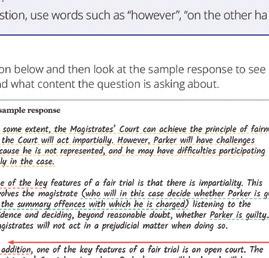
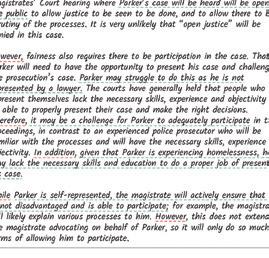
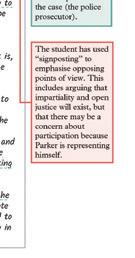
A nnotated sample responses are provided to questions to provide students with a reference framework.
Assessment tips
• T ips to maximise results in assessment tasks in the Unit review.

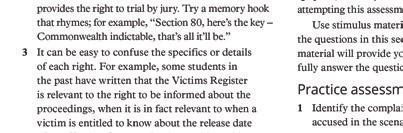
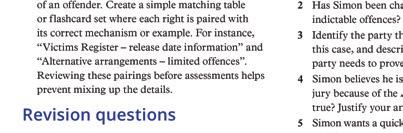

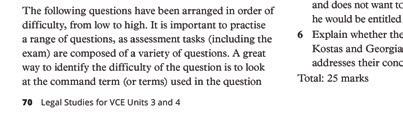



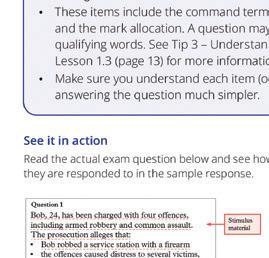
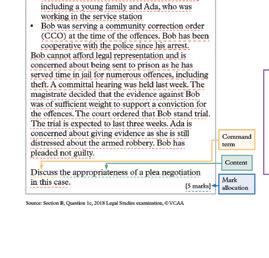
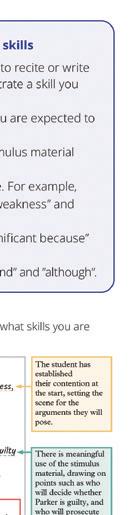


Exam tips
• T hree top exam tips from the module.
Module checklist
• T hese checklists encourage students to evaluate their understanding of the key knowledge for the module.
• H ypothetical scenarios stimulate discussion and illustrate how laws work in different contexts.
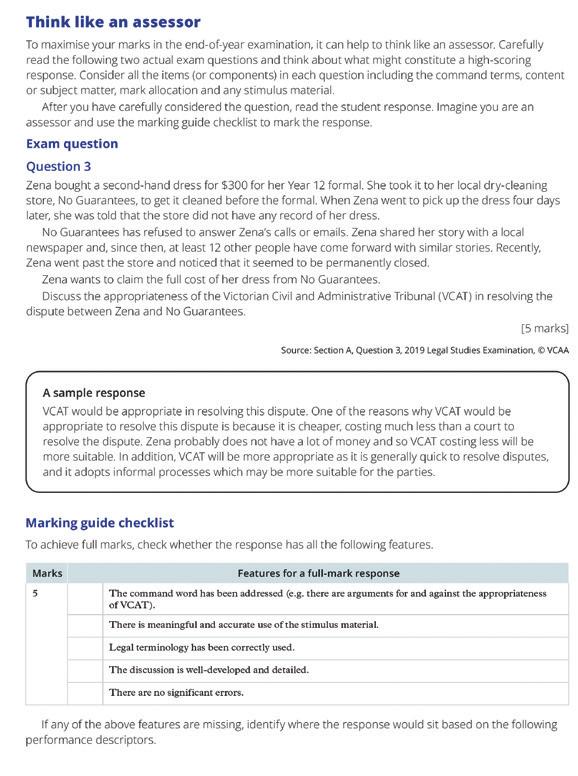
Think like an assessor
• Use marking guides to mark sample responses.
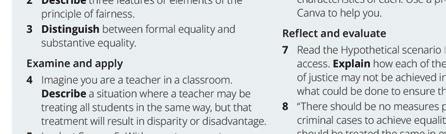
Check your learning


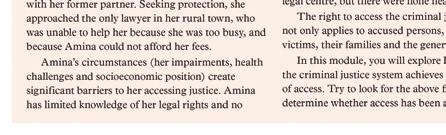


• T hese questions, with bolded command words, enable students to consolidate and extend their learning. Questions are levelled to allow for differentiation - Remember and understand, Examine and apply, and Reflect and evaluate.




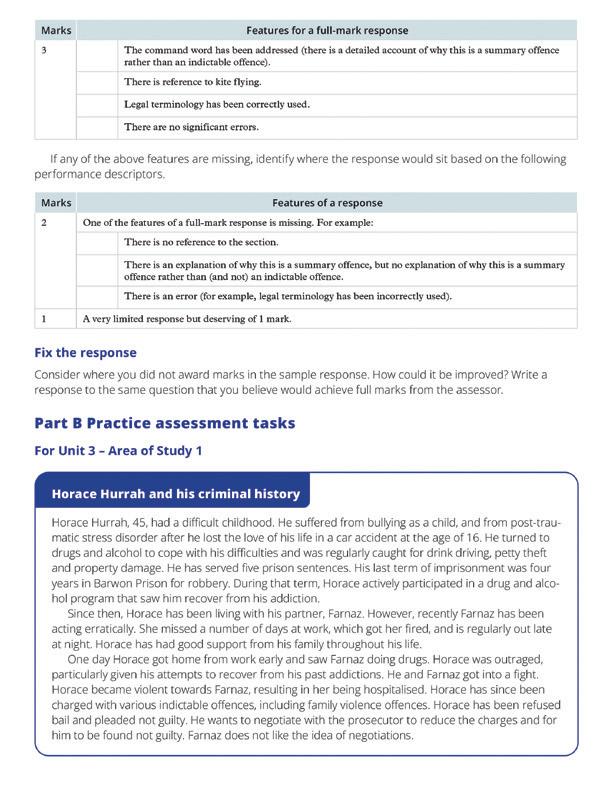
Practice assessment tasks
• More practice assessment tasks to help you hone your skills!
Oxford Digital has been designed in consultation with Australian teachers for Australian classrooms. The new platform delivers fully accessible, reflowable course content with videos, autoand teacher-marked activities, interactives and more, embedded right where you need them. There’s also a range of unique features designed to improve learning outcomes.




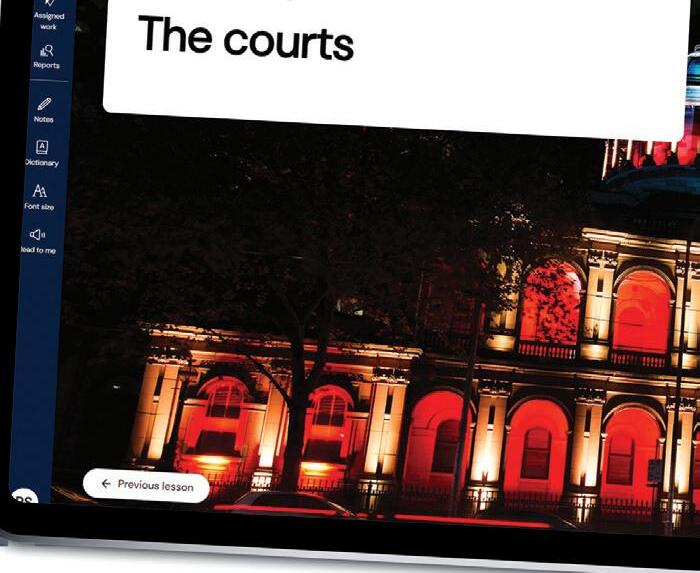





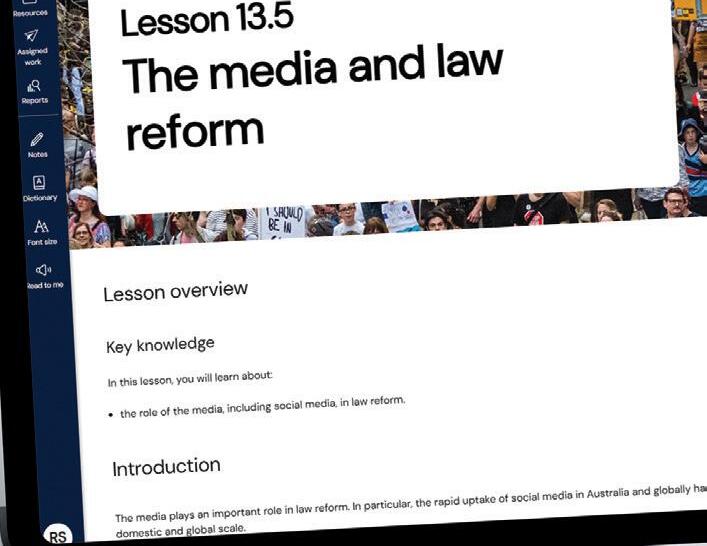




As a student, you can:





> view all Student Book content in a fully accessible, reflowable format that’s delivered in bite-sized chunks so you can work at your own pace
>use the “Read to me” button to have any part of the course read aloud to you
> highlight, take notes, bookmark pages , or define words with the built-in Australian Oxford Dictionary
> watch hundreds of concise key content videos to help you revise anything you don’t understand, catch up on things you’ve missed, or help you with your homework
> complete hundreds of interactive questions and quizzes as you work through the content and get the answers and results sent to you.


As a teacher, you can:

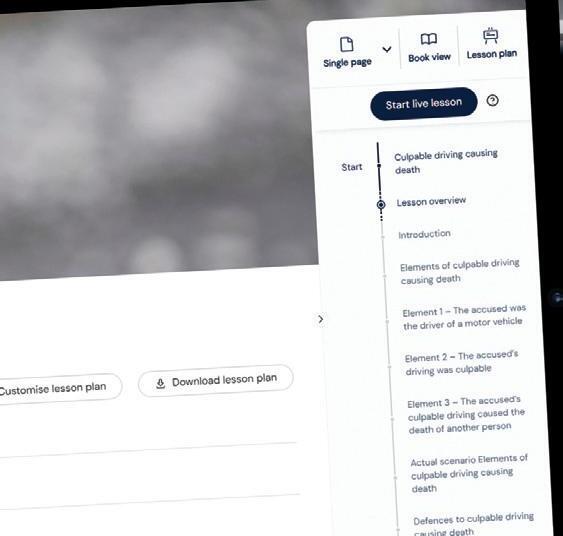
> elevate your teaching and reduce planning and preparation time with Live mode. This is an Australian first that lets you upgrade from traditional printbased plans to fully interactive, perfectly sequenced and timed interactive lessons complete with classroom activities that are ready to go
> personalise learning for every student and differentiate content based on student strengths and weaknesses. Assign support or extension resources to any student using a range of differentiation resources
>begin every lesson with ready-made learning intentions and success criteria
> revolutionise your planning, marking and reporting with powerful analytics on student performance and progress.
> access an Assessment report which shows how students are performing in each online interactive assessment, providing feedback for teachers about areas of understanding

> access a Curriculum report which summarises student performance against specific curriculum content descriptors and curriculum codes























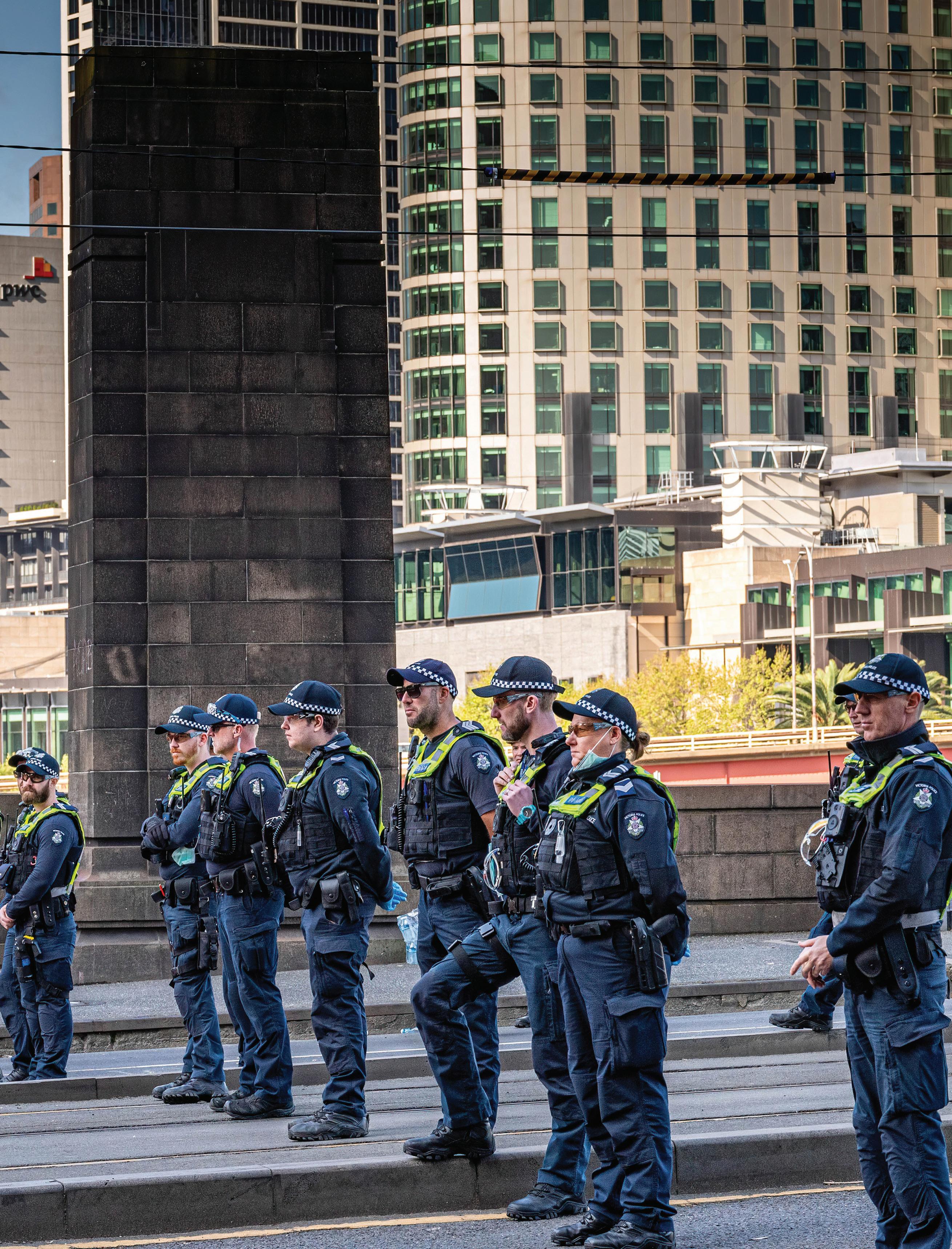
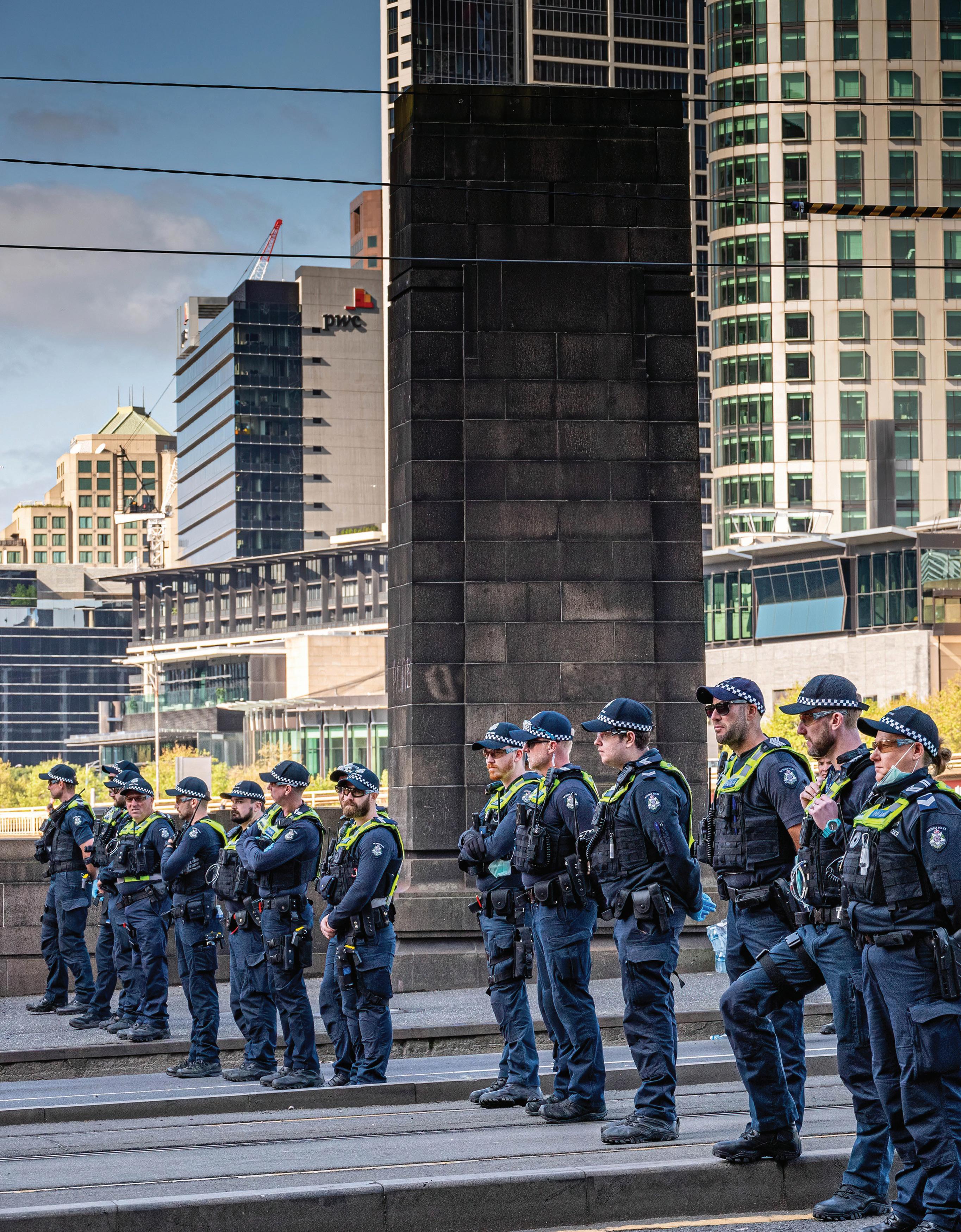
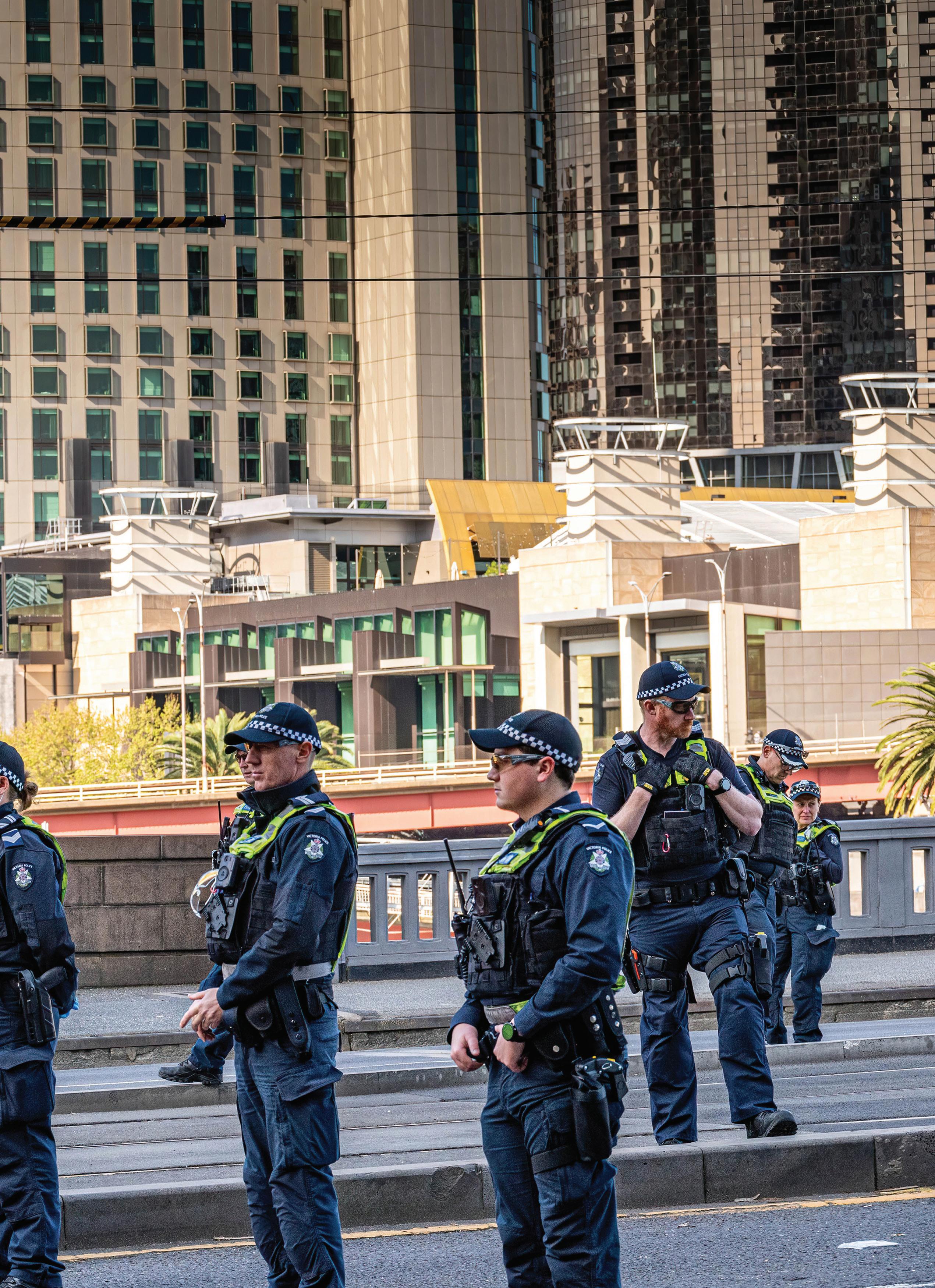
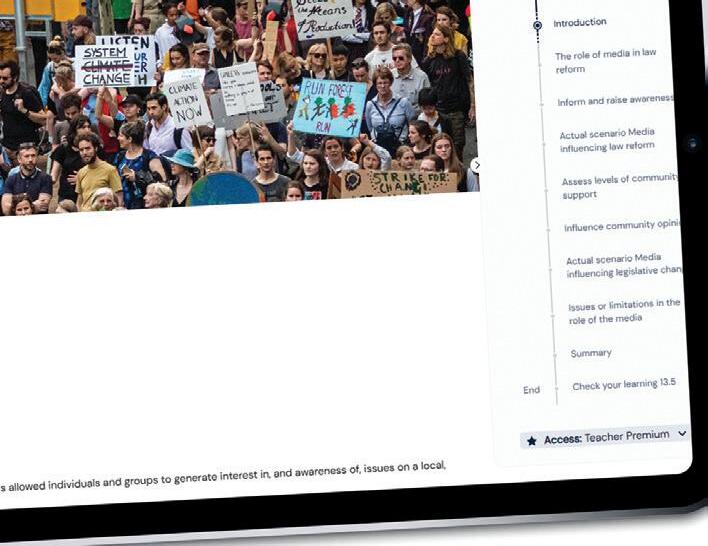
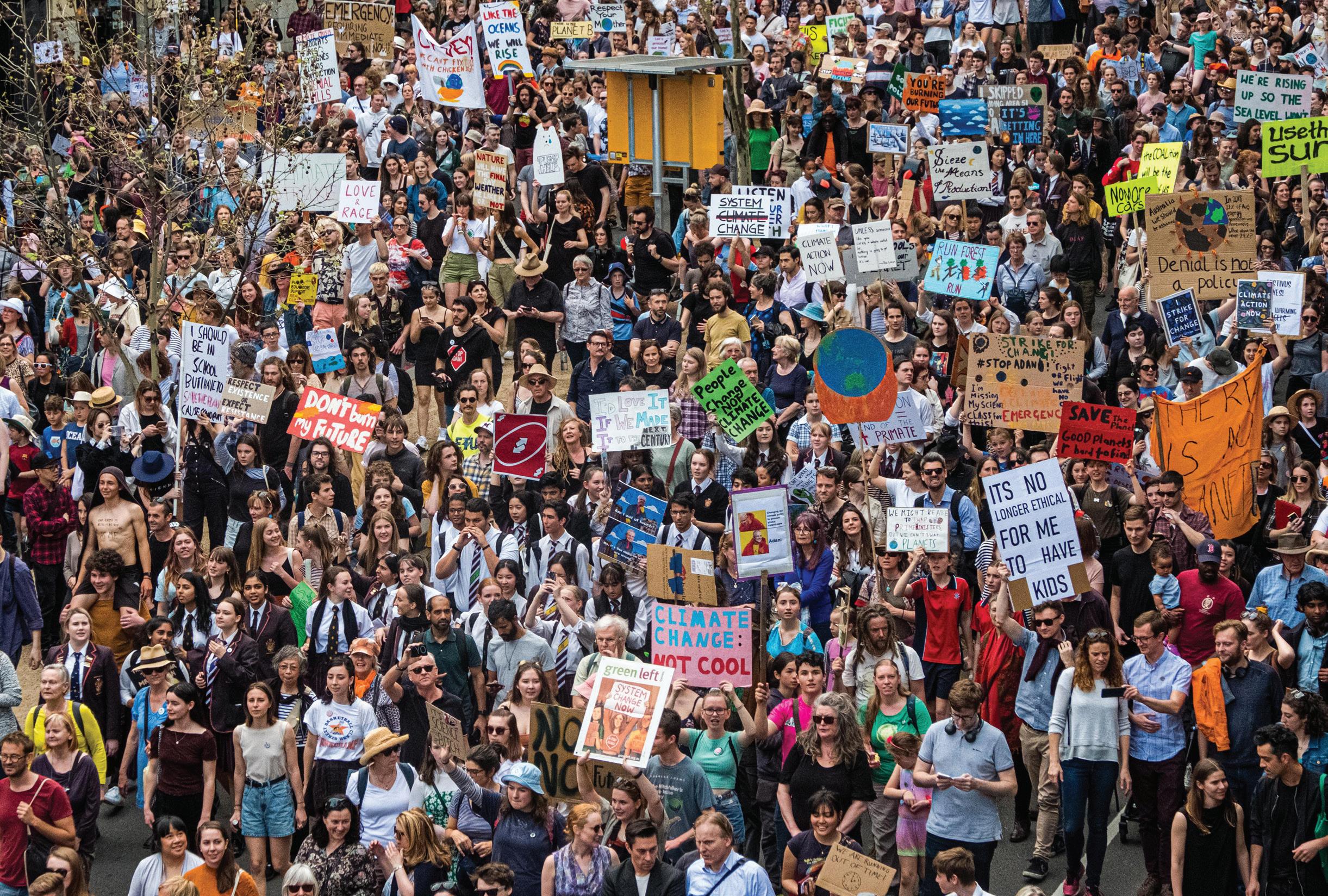
Source 1 Law reform is the process of constantly updating and changing the law so that it remains relevant and effective. One way people can influence law reform is by participating in demonstrations. Each year, thousands of people attend demonstrations in Melbourne (Naarm) and regional Victoria as part of the global movement known as “School Strike 4 Climate”. In this module, you will explore the means by which individuals and groups can influence law reform, including through demonstrations, petitions and the use of the courts, as well as the role of the media and law reform bodies in law reform.
Please note
First Nations readers are advised that this module (and the resources that support it) may contain the names, images, stories and voices of deceased persons.
Non-Indigenous readers should be aware that for some First Nations communities, showing the names and photographs of deceased persons may cause sadness or distress and, in some cases, be contrary to cultural protocols.
By the end of Unit 4 – Area of Study 2 (i.e., Module 13 and Module 14 (page 514)), you should be able to explain the reasons for law reform and constitutional reform, discuss the ability of individuals to change the Australian Constitution and influence a change in the law, and evaluate the ability of law reform bodies to influence a change in the law.
In the module, you will learn about: Law reform
• reasons for law reform
• the means by which individuals or groups can influence law reform including through petitions, demonstrations and the use of the courts
• the role of the media, including social media, in law reform
• the role of the Victorian Law Reform Commission and its ability to influence law reform
• one recent Victorian Law Reform Commission inquiry relating to law reform in the civil or criminal justice system
• the role of Royal Commissions or parliamentary committees in law reform and their ability to influence law reform
• one recent Royal Commission inquiry or one recent parliamentary committee inquiry.
By the end of this module, you should be able to:
• define and use legal terminology
• discuss, interpret and analyse legal principles and information
• evaluate the ability of law reform bodies to influence a change in the law, using recent examples
• synthesise and apply legal principles to actual and/or hypothetical scenarios.
committee system a system in federal, state and territory parliaments in Australia that involves the separate working parties (i.e., committees) to investigate a wide range of legal, social and political issues and report back to the parliament about the need for law reform demonstration a gathering of people to protest or express their common concern or dissatisfaction with an existing law as a means of influencing law reform law reform bodies organisations established by the state and Commonwealth parliaments to investigate the need for change in the law and make recommendations for reform parliamentary committee a small group of members of parliament who consider and report on a single subject in one or both houses. Committee members can come from any party petition a formal, written request to the parliament to take some action or implement law reform
• explain the reasons for law reform using examples
• analyse the role of the media in law reform using examples
• discuss the means by which individuals or groups can influence law reform, using examples
Royal Commission the highest form of inquiry into matters of public concern and importance. Royal Commissions are established by the government and are given wide powers to investigate and report on an important matter of public concern
terms of reference instructions given to a formal body (e.g., a law reform body or Royal Commission) to investigate an important matter. Terms of reference set out the precise scope and purpose of the inquiry and the date by which the final report must be completed Victorian Law Reform Commission (VLRC) Victoria’s leading independent law reform organisation. The VLRC reviews, researches and makes recommendations to the state parliament about possible changes to Victoria’s laws
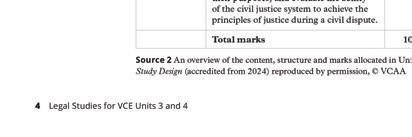
Extracts from the VCE Legal Studies Study Design (accredited from 2024) reproduced by permission, © VCAA
social cohesion a term used to describe the willingness of members of a society to cooperate with each other in order to survive and prosper law reform the process of constantly updating and changing the law so it remains relevant and effective
In this lesson, you will learn about:
→ reasons for law reform.
Laws have many purposes, including to protect society and our safety, and to establish and protect basic human rights. Laws also aim to achieve social cohesion by providing guidelines of acceptable behaviour to prevent or minimise conflict within society. Given that conflict will inevitably arise, laws must also provide ways to resolve disputes.
To be effective, laws need to reflect society’s values, so they are acceptable to individuals and the wider community. They also need to be enforceable, known by the community, and clear and easily understood.
The process of changing the law is referred to as law reform. Law reform must continually take place to ensure our laws remain relevant and effective. There are various reasons why the law may need to change, which include addressing:
• changes in beliefs, values and attitudes
• changes in living conditions
• advances in technology
• a greater need for protection of the community.
Each of these is described in detail below.
In any society, beliefs, values and attitudes change over time. If the law is to remain relevant and acceptable to the majority of people, it must keep up with – and reflect – these changes. On the other hand, rapid changes to the law, which impose change before the community is ready to accept it, may be met with resistance. While most people in our community are generally law-abiding citizens, they will be reluctant to believe in – and obey – laws that do not reflect their basic beliefs and standards.
There are many reasons why community beliefs, values and attitudes change over time. Often, community values and attitudes change as knowledge increases and society becomes more educated and aware. For example, as society understands more about the harm or damage that can be caused by certain behaviours (such as the environmental harm caused by pollution, overconsumption and the burning of fossil fuels like coal and gas and the harm caused by discrimination), community values and attitudes begin to change as people reconsider their longstanding views. As community views and values change, lawmakers will often update and create new laws to ensure the law keeps pace with societal change and remains relevant.
The Actual scenario Increasing awareness of health risks and the Actual scenario Changing attitudes towards animal welfare show how changing community views, values and attitudes can influence law reform. The first examines how Victoria’s anti-smoking laws have developed over time as Victorians have become increasingly aware of the health risks associated with smoking, and attitudes towards smoking and the tobacco industry have changed. The second
scenario examines how society’s increasing awareness of animal welfare issues has resulted in changes to Australian laws to help prevent animal cruelty.
In 1987, the Victorian Parliament first passed the Tobacco Act 1987 (Vic) to discourage smoking and promote public health by restricting the advertising and sale of cigarettes. In particular, the Act banned the advertising of tobacco products (most notably, cigarettes) in cinemas and on billboards and shop fronts, and banned the sale of tobacco products to young people aged under 16 years.
Since this time, the Tobacco Act has been amended (changed) many times to strengthen the control over the sale, advertising and use of tobacco products as society has become more aware of the harm that is caused by smoking and second-hand (or passive) smoking and as new products (such as e-cigarettes or vapes) have entered the market. For example, in 2007, the Act was amended to prohibit smoking in enclosed public spaces (such as restaurants and office buildings) and, in 2017, further amended to ban smoking in outdoor dining areas and public spaces (such as sports venues and public swimming pools) and within the grounds and four metres from the entrance of all schools, childcare centres, hospitals, courts and police stations.
While these laws restricted the rights of individuals to smoke anywhere they chose, they were implemented to improve public health and to benefit the whole community. At first, many people complained, but over time, they adjusted to the new laws, and the incidence of smoking in Victoria decreased. In this way, law reform encouraged a change in community values.
Over recent years, the creation, marketing and rapid uptake of e-cigarettes (or vaping products), especially by children and teenagers, with their potential to encourage nicotine addiction, has led to further law reform in this area. These reforms include:
• an extension of the laws originally drawn up for tobacco smoking so that they now also apply to vaping products
• a ban on the sale, possession or use of nicotine e-cigarettes and vaping products without a prescription from a medical doctor
• a ban on the sale of all e-cigarettes and vaping products to people aged under 18 years – even those products that do not contain nicotine.
Similarly, from February 2026, any retail store or wholesaler that sells tobacco and e-cigarette products must hold a licence and display it in their premises. This licence must be renewed each year. Licensed retailers must also ensure that they display signs to inform consumers of the harm that is caused by smoking (e.g., that “smoking kills” and “smoking damages almost every organ”) and that they do not sell tobacco to people aged under 18 years. Businesses that fail to display these required signs can be fined up to $60,000 depending on their size.
The hope is that these recent restrictions on e-cigarettes and the sale of tobacco products will encourage a change in community attitudes and discourage individuals, particularly young people, from vaping and smoking.
The VCE Legal Studies Study Design expects you to explain the reasons for law reform, using examples. You should create a folder and start collecting examples of law reform. For each example you should:
• describe the law reform outline the reasons for the law reform
• examine the benefits and limitations (pros and cons) of the law reform. You should also keep a list of proposed changes in the law.
In recent decades, public awareness of animal welfare issues in Australia has increased, and people have become more concerned with protecting animal rights. As a result of these changing attitudes, our laws have also changed to reduce cruelty to animals and offer them greater legal protection. For example, in October 2025, the Victorian Parliament passed the Domestic Animals Amendment (Rehoming Cats and Dogs and Other Matters) Bill 2025 to improve the support offered to pet rehoming organisations (such as rescue homes and animal shelters). In particular, the new law enables authorised pet rehoming organisations to hold adoption days at animal shelters and pet shops. The new law also allows people who have died to be buried with the remains of their deceased pets in a public cemetery, a practice that was previously banned.
Between 2020 and 2025, the Victorian Government also worked on the Animal Care and Protection Bill (which has not yet been introduced into the Victorian Parliament), which is aimed at strengthening animal protection. If the Bill is passed, it will introduce new minimum care requirements for animals such as obligations to provide appropriate food and drink to support an animal’s good health and wellbeing, an appropriate physical environment (which includes shade, shelter and clean rest areas with space, a comfortable temperature and lighting), and appropriate health and veterinary care.
The Bill also includes three new animal cruelty offences, including the “intentional cruelty” offence for
the most serious types of cruelty. An individual who is found guilty of this offence would face a maximum penalty of approximately $254,000 (i.e., 1250 penalty units) and/or up to five years’ imprisonment, while the maximum penalty for a company would be $1.27 million (i.e., 6250 penalty units).
Although animal rights activists support the introduction of new laws to strengthen animal protection, in 2025, various groups (including Victoria’s Animal Justice Party) criticised the government for failing to introduce the Bill in the Victorian Parliament, especially given that, once passed, it will take at least another two years to come into force to allow for the development of supporting regulations.

Another example of laws responding to changing community views, values and attitudes can be seen in the development of laws that support equality and legally recognise the rights of all people. The Actual scenario Strengthening the protection of rights examines some of the ways Australian laws have changed over time to support equality and protect people, particularly members of minority or vulnerable groups, from discrimination, hateful conduct and hate speech.
Over the years, society has become more aware of the difficulties faced by members of our community who belong to minority or vulnerable groups (such
as people living with a disability, members of the LGBTQIA+ community, First Nations people and members of certain religious groups) as a
result of inequalities in the law, and the need for greater recognition and acceptance of these people.
As a result, state, territory and Commonwealth parliaments have introduced law reform to ensure all people, regardless of their disability, sexuality, race and faith, are treated equally by the law. For example, in 2022, the Equal Opportunity Act 2010 (Vic) was changed to strengthen legal protections for LGBTQIA+ people by making it unlawful for religious organisations and schools to terminate the employment of individuals, or refuse to hire people, based on their sexuality, gender identity or marital status. Some exceptions exist, however, including in circumstances where the organisation’s religious beliefs are considered integral (or essential) to the job (as may be the case for a religious studies teacher).
Additionally, in 2025, the Victorian Parliament passed legislation to strengthen Victoria’s antivilification laws by providing Victorians with greater protection from vilification or hateful speech and conduct. The new legislation, which amended the Crimes Act 1958 (Vic) and the Equal Opportunity Act 2010 (Vic), bans behaviour that encourages hatred, serious contempt, revulsion or severe ridicule against another person or group of people because of their race and/or religion, and other attributes including disability, sex, gender identity, sexual orientation and sex characteristics. Any person who is a victim of such unlawful discrimination or vilification can seek a remedy through the Victorian Equal Opportunity and Human Rights Commission or the Victorian Civil and Administrative Tribunal.
The new legislation also created two new criminal offences to ban serious types of hate speech and conduct. For example, it is now a criminal offence in Victoria to incite (e.g., provoke or encourage) hatred against another person based not only on their race and religion but on a range of other attributes (or personal characteristics), including their disability, sex and gender identity. A person who is found guilty of this offence faces a maximum penalty of up to three years’ imprisonment. It is also an offence to threaten another person with physical harm or
property damage based on a range of protected attributes. The maximum penalty for this offence is up to five years’ imprisonment.
In 2025, following the tragic events at Bondi Beach, Sydney in December 2025, which saw 15 victims killed and another 40 people injured at a Jewish festival celebration, the Prime Minister announced that legislation would be passed to specifically address antisemitism and hate crimes. These reforms included increasing penalties for hate speech promoting violence, and the creation of new criminal offences to deal with serious vilification and hate speech by leaders who promote violence. In announcing the reforms, the Prime Minister acknowledged that “governments aren’t perfect” and more could have been done to prevent antisemitism and hate speech.
To achieve such changes in the law, members of minority and vulnerable groups and the many people who support equality in the law have continually campaigned to maintain pressure on the government and increase community awareness and support for legislative change.
On the other hand, for some members of society, the law is changing faster than they are comfortable with, notwithstanding the changes in beliefs and attitudes of the majority. For example, some organisations and political parties publicly expressed their disapproval of Victoria’s anti-vilification legislation, claiming that it could threaten free speech.
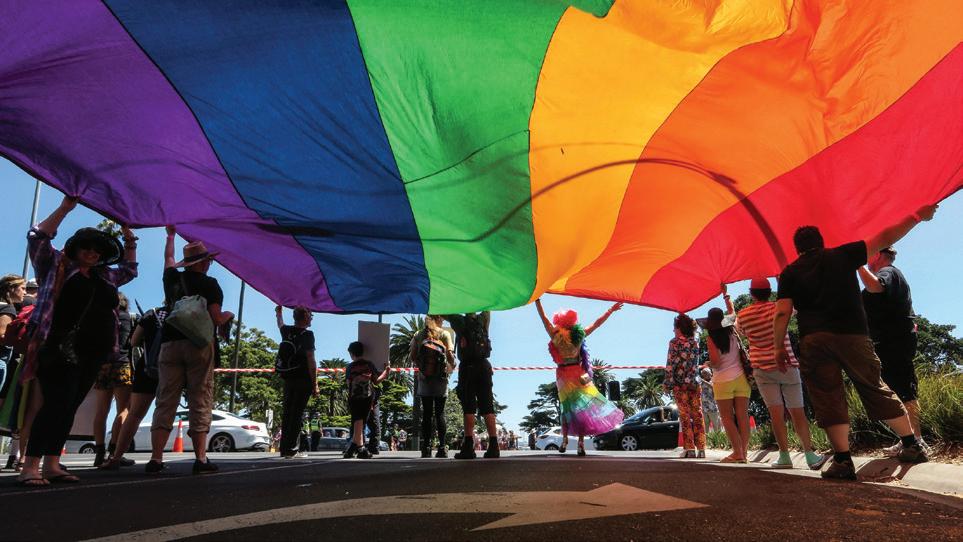
Source 2 Over the years, Australian parliaments have introduced various law reforms to ensure all people, regardless of their personal characteristics (such as their race, religion, sex, gender identity and sexual orientation) are treated equally by the law.
Law reform is a process that never ends. Our laws also need to be continually reformed to make sure they remain relevant and keep up with changes in living conditions such as social, economic and international conditions. Each of these is discussed below.
online gambling using the internet to place bets; including websites, apps, online games and poker machines (pokies) and sports betting
Social conditions refer to a wide range of factors that influence the way people and communities live, including the ability of people to access affordable housing, health care, education and community services, feelings of personal and public safety, and the quality of the environment (including access to clean water and air, and protection from the effects of climate change such as more intense heatwaves, bushfires, droughts and floods).
Changing social conditions can prompt law reform as individuals, groups and organisations place pressure on governments to address the consequences of such change. For example, as Australia’s population grows and changes, Commonwealth, state and territory governments will need to change and implement many new laws to ensure that basic living standards are maintained and people are able to live together peacefully. Notably, projections suggest that over the next 25 years, the number of older Australians (aged 65 to 84 years) will double, while the number of those aged 85 years and over will increase fourfold. These trends have major implications for law reform in many areas, including health care, taxation, welfare payments (including aged pensions) and environmental policy. Similarly, the expected increase in the population to approximately 35 million by 2046 may lead to increased crime and the need for improved law enforcement infrastructure or agencies (including the police, courts and prisons) and more effective procedures within those agencies.
Some other examples of changes in social conditions that have prompted law reform over recent years include an increase in:
• reported family violence
• binge drinking
• gang-related crime
• online gambling.
The Actual scenario Social conditions considers the issue of whether changes to the law are needed to address increasing health issues arising from what we eat, including sugar.
Statistics on the health of Australians, released by the Australian Bureau of Statistics in 2023, indicate that eight in 10 (81.4 per cent) of Australians have at least one long-term health condition and approximately half of the Australian population has one or more chronic health conditions (such as diabetes, heart disease, stroke and vascular (blood vessel) disease). In addition, approximately two-thirds of Australian adults and one-quarter of Australian children (aged between two and 17 years) are categorised as being overweight or obese (meaning, for an adult, they have a Body Mass Index of 30 or above).
services, rising costs of health care and impacts on people’s ability to work (e.g., increased sick leave or absenteeism).
Health issues can have an economic impact on the wider community. For example, some economic costs associated with people with health issues may include increasing demand for medical and hospital
For these reasons and others, there has been pressure to introduce legislation to address the consumption of certain foods. For example, various individuals and health organisations and professionals believe the Commonwealth Parliament should introduce legislation to ban the advertising of junk food (i.e., food that is high in fat and sugar and has little nutritional value), particularly advertising that is directed at young people or appears on television, billboards, public transport or at events. There is also a push to introduce a tax on sugar-sweetened drinks, such as non-diet soft drinks, energy drinks and sports drinks, as well as sugary foods. The purpose of such a tax would be
to increase the price of these items to discourage their consumption.
By 2025, at least 100 countries (including the United Kingdom, France, South Africa and Portugal) had implemented legislation to impose some type of tax on sugar-sweetened drinks, but the Australian Government has so far resisted. Research indicates that this “sugar tax” has been successful in reducing the consumption of sugary drinks and promoting better health, as high consumption of sugary drinks can increase the risk of heart disease, type 2 diabetes and dental (tooth) erosion.
Despite the associated health benefits, politicians would inevitably face great pressure not to introduce a sugar tax from businesses within the fast food and packaged food industries. Critics of sugar taxes also argue that they impose a greater tax burden on low-income earners compared with high-income
earners. Others oppose the tax on the basis that the government should not control the personal choices of individuals.

Source 3 The introduction of legislation to impose a tax on sugary drinks could help address health risks associated with consuming large amounts of
Australia’s economy is continually changing. In particular, technology and globalisation create issues that need to be addressed by the law. Governments need to monitor and change laws that regulate the buying, selling and production of goods and services across different areas of the economy, such as banking and finance, mining, manufacturing and agriculture.
In recent years, there have also been significant changes in the workforce (such as an increase in part-time, casual and short-term employment and people working from home) and in consumer trends (such as an increase in online shopping). These developments have created a need for changes in industrial relations law (i.e., the law regulating wages and workplace conditions), consumer protection and banking law (e.g., laws regulating the enforcement of banking products such as credit cards, loans and guarantees) and international trading law (laws that regulate importing and exporting goods). For example, in 2023 and 2024, the Commonwealth Government introduced legislation to amend the Fair Work Act 2009 (Cth) to provide additional protections for employees.
In particular, the legislation created a new criminal offence of “wage theft” in situations where an employer intentionally does not pay an employee their minimum wages and entitlements. Changes were also made to provide employees with the “right to disconnect”, that is, to refuse to monitor, read or respond to contact (including emails, phone calls and messages) from an employer outside regular working hours, unless the refusal is unreasonable.
The legislation also introduced new protections for people who perform work (referred to as “employee-like” workers) through digital platforms (such as Uber and DoorDash), including ride-sharing and food delivery services. The protections include ensuring that these workers receive the same minimum wages, penalty rates and superannuation as regular workers. They also have some rights if they are unfairly deactivated from the provider’s (or operator’s) digital platform.

The Actual scenario Economic conditions examines legislative reform that has been introduced to address the rising cost of living.
While the cost of living (i.e., expenses associated with necessities such as housing and food) fluctuates over time, it has noticeably increased since 2021–2022, when the cost of many essential household goods and services, such as electricity and gas, transport and food and groceries, began to rise. One factor that contributed to these increases was the global COVID-19 pandemic, which led to supply shortages caused by temporary factory and port closures, and an increased demand for consumer goods as more people spent more time at home.
Since this time, however, several other factors have increased the cost of living in Australia. These include increased interest charges on mortgages (or loans for homes and other property), particularly between July 2022 and July 2024; a housing shortage; global events that caused demand
and supply issues; and insufficient investment in renewable energy.
Over recent years, the Australian Government has introduced a range of legislation and policies to address the rising cost of living. For example, in 2025, the Commonwealth Parliament passed the Treasury Laws Amendment (More Cost of Living Relief) Bill 2025 (Cth) to introduce additional tax cuts for all Australian taxpayers (for 1 July 2026 and 1 July 2027) and adjust the Medicare Levy (a charge imposed on income earners to help fund the cost of universal health care in Australia) so that more lowincome earners would pay less or be exempt from the charge.
In December 2024, the parliament also passed the Future Made in Australia Act 2024 (Cth) to enable the creation and funding of a range of initiatives to strengthen the Australian economy. For example,
the Act allows the government to identify, support and invest in industries that can help Australia develop renewable energy resources for domestic use and export.
In an attempt to address Australia’s housing shortage, the parliament also passed the Housing Australia Future Fund Act 2023 (Cth) to establish a $10 billion fund to build approximately 30,000 units of new social and affordable rental housing by 2029. This includes provision of 4000 homes for women
and children affected by family violence and older women at risk of living homeless. Additionally, in 2025, the government temporarily banned people from overseas (including temporary foreign residents and foreign companies) from buying existing homes (houses and apartments) in Australia until March 2027. The purpose of the ban was to relieve pressure on housing supplies and encourage foreign investors to build new houses.
Changing international circumstances or global events often influence law reform. One example is increasing global violence and the threat of terrorist attacks. Another is international conflict; wars cause a rise in global refugees, and can place pressure on the global supply of goods such as oil. The Commonwealth Government monitors both so it can alter laws if necessary, such as anti-terrorism and migration laws. The Actual scenario International conditions explains the government’s approach to changing counterterrorism laws to address changing circumstances across the world.
Over the past decade, the Commonwealth Parliament has passed legislation to strengthen Australia’s counter-terrorism laws and protect the Australian community from the threat of terrorism. For example, in 2023, the Commonwealth Parliament passed legislation to strengthen Australia’s counter-terrorism laws – the CounterTerrorism Legislation Amendment (Prohibited Hate Symbols and Other Measures) Bill 2023 – to amend the Crimes Act 1914 (Cth) and the Criminal Code Act 1995 (Cth).
The legislation amended existing law to make it a criminal offence to publicly display and buy or sell a prohibited Nazi symbol (such as the Harkenkreuz, commonly called the Nazi “swastika”) or a prohibited terrorist organisation symbol (such as the flag of the Islamic State, a recognised global terrorist organisation). These symbols are commonly considered to be highly offensive and harmful symbols of racism and are often used to promote fear and hatred of various groups within the Australian community.
The legislation also changed the Criminal Code to make it a criminal offence to use a carriage service (e.g., the internet) for violent extremist material (e.g., to access, distribute or promote violent extremist material) or to give instructions on undertaking a terrorist act or praising a terrorist act, if that praise might lead to someone engaging in a terrorist act.
Similarly, in November 2025, the Commonwealth Parliament passed legislation (the Criminal Code Amendment (State Sponsors of Terrorism) Bill 2025) that enables the Commonwealth Government to declare certain foreign state entities (such as the government of a foreign country or an authority of the government of a foreign country) as a “state sponsor of terrorism” and make it a criminal offence to fund, support or associate with these entities.
The purpose of the legislation is to strengthen the government’s ability to take action against foreign state entities that seek to threaten the safety and security of the Australian people. It was introduced after investigations revealed the likelihood that a foreign state entity, Iran’s Islamic Revolutionary
Guard Corps, had directed two attacks in Australia. The attacks involved deliberately setting fire to a Sydney cafe and a Melbourne synagogue (place of worship) in an attempt to promote fear and disunity within the community.
As mentioned in the Actual scenario Strengthening the protection of rights, in January 2025, following the tragic terrorist attack in Bondi Beach, Sydney, the Commonwealth Parliament passed legislation (the Combatting Antisemitism, Hate and Extremism (Criminal and Migration Laws) Act 2026 ) aimed at reducing hatred and extremism in Australia. In particular, the new laws increased penalties for hate crimes and introduced new penalties for preachers and leaders (e.g., religious officials or spiritual leaders) who promote and threaten violence against certain groups of people. The Parliament also passed legislation (the Combatting Antisemitism, Hate and Extremism (Firearms and Customs Laws) Act 2026 ) to strengthen Australia’s gun laws and thereby improve national security and community safety.
In January 2026, the Prime Minister also announced the establishment of a federal Royal Commission to investigate the extent and causes of antisemitism in Australia, the circumstances that led to the Bondi terrorist attack, and ways in which the
federal, state and territory governments can improve their response to antisemitism and social cohesion.
The Royal Commission will investigate ways to decrease and prevent expressions of antisemitism, including making recommendations to improve the way government agencies (such as law enforcement, border control, immigration and security agencies) deal with antisemitism. You will learn more about Royal Commissions and the Royal Commission into Antisemitism and Social Cohesion (2026) in Lesson 13.8 (page 503).

Technology is constantly improving and opening up possibilities not previously imagined. As it improves, our laws need to be altered and updated. Some laws will control and regulate new inventions and opportunities. Others will reduce the likelihood of people being harmed or exploited. For example, the increasing range and use of mobile devices and equipment (such as laptops, smartphones, smartwatches and drones) have created new problems that the law needs to address. These include cyberbullying, cyberstalking, online scams, and invasion of privacy and noise pollution caused by remotely piloted aircraft (drones). In other situations, technology has made it easier for us to work or collaborate, which brings on different challenges. As an example, the emergence of platforms such as ChatGPT could result in the need for legislative reform to control and regulate the use of artificial intelligence.
Technology also makes it easier for cybercriminals to access, disclose (or pass on) or delete personal information from a database without the individual’s permission. Such data breaches invade the right to privacy and can cause individuals and businesses significant financial loss and stress, especially when the breach involves the disclosure of sensitive information (like health and financial records) and personal information (like mobile phone, driver licence
and passport numbers). It has sometimes resulted in “identity theft”, which can cause significant issues for the person whose identity has been stolen.
Cybercrime, therefore, creates the need for better laws to regulate how businesses manage the data they collect from individuals and the way they act when a breach has occurred. This includes promptly notifying affected people of the security or data breach. The Actual scenario Advances in technology highlights law reform designed to encourage businesses to improve their data security.

Source 6 Recent advances in technology and cybercrime have created the need for new laws to encourage businesses to protect consumer data and privacy.
In November 2022, the Commonwealth Parliament passed the Privacy Legislation Amendment (Enforcement and Other Measures) Act 2022 (Cth) to increase the sanctions that can be imposed on an individual or company for serious or repeated privacy breaches. The new law was introduced into parliament after two major cybersecurity attacks occurred in Australia. In September 2022, Optus, a major Australian telecommunications company, became the victim of a cybersecurity and data breach that resulted in the personal information of more than two million customers being exposed. Weeks later, Medibank, a major Australian health insurer, became the victim of a security breach.
Approximately 9.7 million former and current customers had their personal details accessed, and some were released on the dark web.
Under the new law, severe financial penalties will be available to the courts for breaches of the Privacy Act 1988 (Cth), including a maximum fine of approximately $50 million or three times the value of the benefit gained by the misuse of the stolen data, whichever is greater. The new penalties aim to encourage companies to improve their data security by ensuring they effectively manage
and safely store the personal data they collect from customers.
It is, however, difficult for companies and law-makers to keep pace with rapidly developing cyberthreats designed by criminals to access, steal and use other people’s personal information. Individuals can also unintentionally release their data to cybercriminals or fall victim to online scams such as phishing, where cybercriminals send emails and texts that falsely appear to be from a reputable business (such as a bank or telecommunication company) to lure (or induce) individuals into providing their confidential personal information (such as banking details).
Scientific and medical advances also create the need for law reform. Developments in genomics and genetic research have enabled scientists to use genetic data from individuals to identify the cause and risk of developing various illnesses and develop new medical treatments. However, they have also created a new area of science and medicine that needs to be regulated by law.
Over the years, disputes have arisen over the ownership of “genes” and “genetic discoveries”. In one Australian case, the High Court was required
to determine whether a company could take out a patent to own a genetic mutation or “discovery”. The company had spent millions of dollars on research and development to identify a genetic mutation (or change in one or more genes) that increases a person’s risk of developing ovarian and breast cancer. The company’s right to patent the genetic mutation was challenged because it
could potentially limit a person’s ability to use their genetic information without the company’s permission. The Court’s ruling that the company could not own the genetic mutation because the genetic material already existed in nature (and therefore was not a “newly invented product” that could be patented) created Australian law regulating the ownership of genes.
Law reform must continually occur to make sure individuals and different groups within our community are protected and feel safe. One of the major roles of the law is to protect individuals from harm. “Harm” can include:
• physical harm, such as broken bones from violent assault
• emotional harm, such as the destruction of self-esteem and depression that can come from bullying, sexual harassment or neglect
• economic harm or financial damage, such as exploitation because of unfair workplace and trading practices.

Source
Some people in the community also have specific needs and rights that must be protected, especially if they are unable to protect themselves (e.g., children, vulnerable workers, consumers, people with disabilities, and those who may suffer discrimination because of attributes such as race, religion, gender identity or sexuality). Even animals and the environment need protection. Laws are therefore needed to make unlawful those actions that may harm individual members of the community, specific groups within our community, and the community as a whole. As new situations arise, new laws are required. For example, in December 2025, Victorian Parliament passed the Crimes Amendment (Retail, Fast Food, Hospitality and Transport Worker Harm) Act 2025 (Vic) to, among other reforms, make it an indictable offence to assault or threaten to assault a retail, fast food, hospitality or transport worker. The maximum penalty that can be imposed on a person convicted of committing the offence is five years’ imprisonment. The new offence was created to address the alarming increase in the number of violent assaults, threats of assault, and abuse occurring in the retail, fast food, hospitality and transport sectors.
The Victorian Parliament also passed the Crimes Amendment (Performance Crime) Act 2025 (Vic) to ban individuals from “posting and boasting” about certain crimes on social media and messaging apps. This includes a person publishing content (e.g., text, images, audio and recordings) that boasts or brags about their involvement in specified serious criminal offences such as robbery, carjacking, home invasion and violent disorder. This law reform aims to protect Victorians and increase public safety by deterring people from using criminal offending as a way to seek online notoriety (or “fame”) or encourage further offending. It also supports victims of crime by preventing offenders from publicly glorifying their criminal actions.
Another example is set out in the Actual scenario Protection of the community, involving the ban of machetes in Victoria.
Machete ban
Machetes are large, broad-bladed cutting knives that have recently been used in Victoria in a string of crimes, including those committed by youth offenders.
In 2025, the Victorian Parliament passed the Terrorism (Community Protections) and Control of Weapons Amendment Act 2025 (Vic) to ban the sale (both in-store and online) and possession of machetes in Victoria. A person convicted of selling or possessing a machete without a valid exemption will face a maximum penalty of two years’ imprisonment or a fine of approximately $48,000 (240 penalty units).
This law reform aims to protect the Victorian community by safely removing machetes from the streets and requiring people who wish to use or carry a machete for legitimate purposes (e.g., for agricultural purposes, hunting or in situations where there is genuine cultural significance) to apply for an exemption from the law.
To assist in removing machetes from the community, the Victorian Government introduced a process, referred to as the “Machete Amnesty”, during which people had three months to dispose of their machetes by placing them in secure bins (provided at certain police stations), without committing a crime. Check your learning 13.1
Check your learning 13.1
Remember and understand
1 Outline two reasons for law reform. Support your answer with reference to two examples of law reform.
2 Identify one minority or vulnerable group in Australia, and explain one reason why law reform may be necessary for that group.
3 Describe how law reform may relate to animals. In your answer, identify one legislative change that has been made in relation to animals.
Examine and apply
4 Read the Actual scenario International conditions.
a Describe one change made to strengthen Australia’s counter-terrorism laws since 2023.
b Outline the purpose of this reform.
5 Read the Actual scenario Advances in technology.
a What is a data breach?
b Describe the relationship between technological advancements and the introduction of the Privacy Legislation Amendment (Enforcement and Other Measures) Act 2022 (Cth).
c Do you think the Act significantly improved cyber-safety? Justify your answer.
6 Describe one law reform that has been introduced to provide greater protection of the community. Explain why the law reform was introduced and whether you support the reform.
Reflect and evaluate
7 Read the Actual scenario Social conditions and discuss in a small group whether you think the Commonwealth Parliament should impose a tax on sugary drinks and/or other high-sugar and low-nutrient products.
8 “The government should introduce law reform with the aim of encouraging a change in community attitudes.” Discuss the extent to which you agree with this statement.
A famous petition to the Commonwealth Parliament was presented on paper surrounded by bark paintings. It was submitted on behalf of the Yolngu people of Yirrkala, NT. Their traditional land was under threat from mining. The parliament responded by setting up a select committee to investigate.
In this lesson, you will learn about:
→ the means by which individuals or groups can influence law reform, including through petitions.
Parliament has many features and structures to ensure laws are changed when necessary, such as members of parliament speaking to people in their electorates or regions to gauge community values. However, at times, individuals and groups may see the need to influence legislative reform. This may be because they feel that parliament has not responded to the need for a change in the law, or there is a new issue or problem and they want to make parliament aware of it.
petition a formal, written request to the parliament to take some action or implement law reform
Individuals and groups can influence a change in the law in a number of ways, and often they use more than one way or method to try to influence parliament to change the law. Three ways that individuals or groups can change the law, which you will explore in this lesson and in the next lessons, are:
• petitions (this lesson)
• demonstrations (Lesson 13.3 (page 470))
• the use of the courts (Lesson 13.4 (page 475)).
A common way individuals and groups raise awareness of the need for law reform and influence change is by preparing a petition to be presented directly to the parliament. In fact, petitions are the only way in which individuals can directly put their concerns or complaints before the parliament.
A petition is a request to the parliament to act on a matter. For example, a petition might request the parliament to introduce a new law, amend an existing law, or take a particular course of action in relation to a policy matter or complaint. A petition may be either on paper or electronic (an e-petition).
For a petition to be accepted for consideration by the parliament, it must be prepared in a particular format. This format varies depending on whether the petition is presented to one of the state or territory parliaments or the Commonwealth Parliament, and the house in which it is to be presented.
For example, the rules may require that the petition:
• is addressed to the house in which it is being presented
• clearly states the action being requested (e.g., the desired change in the law) and the reasons for the petition
• meets a word limit (e.g., the House of Representatives has a limit of 250 words)
• contains the details of the person who initiates or organises the petition (the principal petitioner)
• is legible and does not contain any offensive or disrespectful language
• has at least one signature
• is an original document (i.e., not a photocopy of a petition) or, in the case of e-petitions, created directly on the parliament’s website using its e-petition system. This means petitions created on sites like Change.org cannot be directly presented to the parliament.
In the House of Representatives, if the petition meets the rules, it will be certified and presented in the House. Alternatively, a member of parliament may be willing to present the petition on behalf of the Standing Committee on Petitions (which receives and processes petitions) and it will then be presented in the House of Representatives.
In the Victorian Parliament, a petition must be sponsored by a member of parliament, who will table the petition in parliament. The petition will be officially recorded and will become part of the public record.
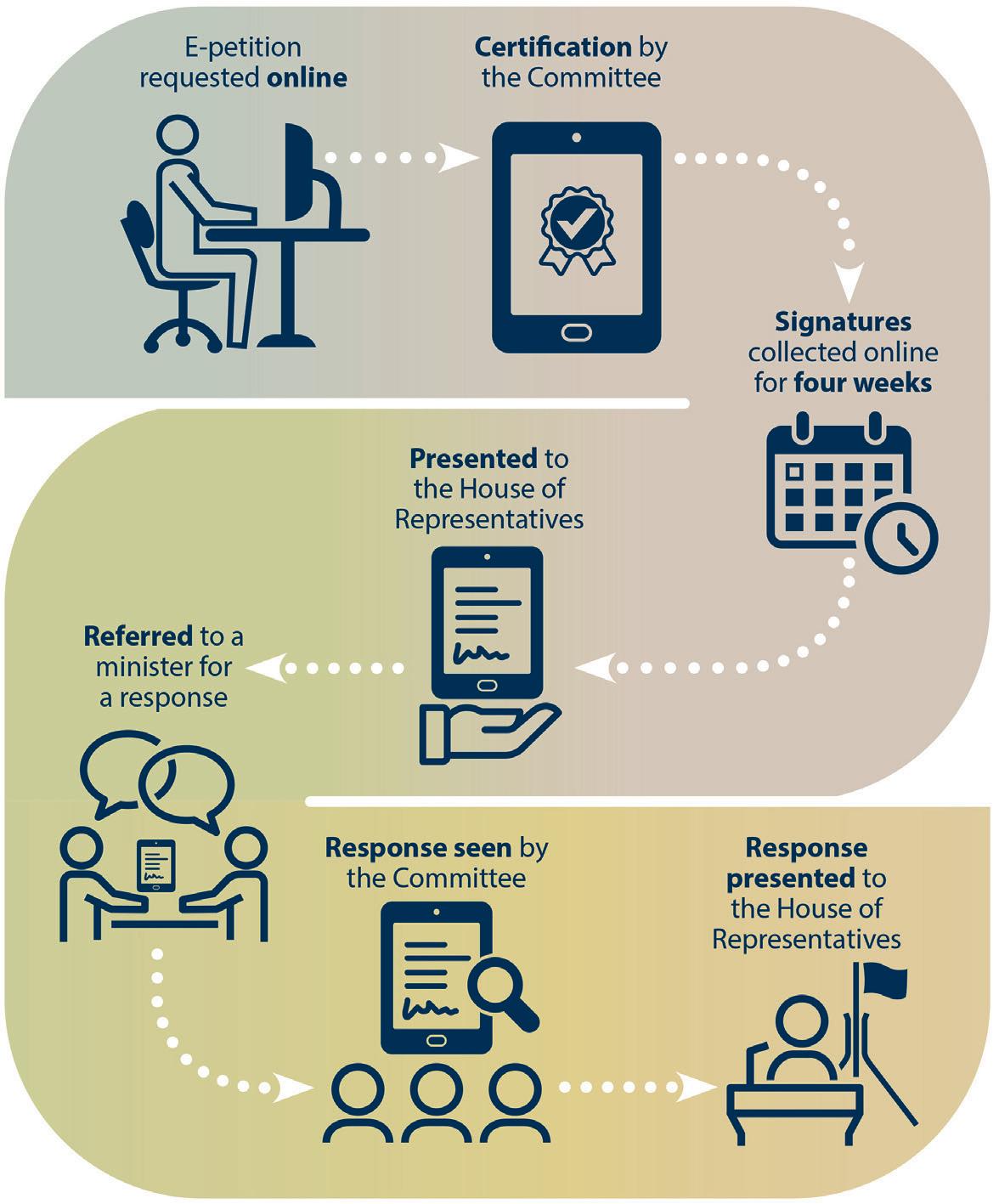
Each year, the state, territory and Commonwealth parliaments receive hundreds of petitions. The petitions may be in relation to an issue of general community interest (such as preventing logging in certain forests, banning live animal exports or banning the release of helium balloons) or an issue relevant to a specific group of people (such as funding for a health centre in a particular community, or to establish a new supervised school crossing in a local area). The parliaments may even be presented with several petitions on the same subject.
principal petitioner the person who initiates or organises a petition, and whose name and contact details must be provided on the first page of the petition
For example, after the Commonwealth Parliament announced its plan to amend the Online Safety Act 2021 (Cth) to prevent young people aged under 16 years from having social media accounts, the federal, state and territory parliaments received dozens of petitions either supporting or opposing the law reform.
Some examples of recent petitions are set out in Source 2.
A 2025 petition to place pressure on the Commonwealth Government to lower the minimum age for the ban on young people holding social media accounts from 16 to 13 years
A 2025 petition to place pressure on the Victorian Government to abolish the Emergency Services and Volunteers Fund Levy (or tax), which was designed to generate money to fund and support the state’s emergency services (including those that respond to fires, floods and storms)
A 2025 petition to place pressure on the Commonwealth Government to make it easier for university students to repay their Higher Education Contribution Scheme (HECS) debts HECS refers to the government loan scheme established to help domestic students pay their university tuition fees.
• In December 2025, new Commonwealth legislation came into effect to require social media platforms (such as Snapchat, TikTok, Instagram, X and Facebook) to take reasonable steps to prevent young people aged under 16 years from having social media accounts. Following the announcement of the new law, several petitions were created at state, territory and Commonwealth level and on third party platforms (like change.org) calling for the law to be abolished or amended.
• This e-petition, which was signed by over 44,000 people, was started by a 14-year-old to highlight some of the benefits of social media use by young people and to call for the government to modify the law so that the ban only applied to people aged under 13 years.
• While the petition was tabled in the Commonwealth Parliament, the government did not introduce legislation to amend the law.
• This petition was started by Victorian Liberal member of parliament, Joe McCracken MP, who, along with the Liberal and National parties, opposed the Labor Government’s emergency services tax, claiming it places an unfair burden on farmers and regional landowners who are required to pay the tax.
• The petition was one of the largest e-petitions presented to the Victorian Parliament, gaining over 43,700 signatures. It generated media attention and significant public debate.
• In November 2025, approximately one month after being tabled in the Victorian Parliament, the petition was debated in the Legislative Council, although ultimately the government did not act on the petition or take steps to abolish the tax.
• This petition was created by Dr Monique Ryan MP, an independent member of parliament who raised concerns about the cost of student HECS debts, which, due to being adjusted for inflation (rising prices), could increase each year despite regular repayments.
• While the petition was generated on a third party platform (change.org) and, as such, could not be officially tabled in the Commonwealth Parliament, it generated significant media attention and public debate. In gathering more than 288,000 signatures, the petition placed great pressure on the government to respond.
• Following the petition, the Commonwealth Government announced it would reform the HECS system, as called for in the petition, and in 2025, it began wiping $3 billion from student debts, benefiting approximately three million Australians who have a HECS debt.
Source 2 Examples of petitions presented in recent years
Source 3 Independent member of parliament
Dr Monique Ryan initiated a petition that placed pressure on the Commonwealth Government to reduce the cost of student HECS debt.

The ability of a petition to influence law reform depends on various factors, including, most obviously, the number of people who show their support by signing the petition. A petition with a large number of signatures will appear more representative of the community and indicate a high level of community support for the requested action. This is important because members of parliament, in accordance with the principle of representative government, will be more likely to make laws that reflect the views and values of the majority of people rather than a few individuals. On the other hand, a petition with very few signatures may not get the attention necessary to generate interest, particularly given the number of petitions parliament receives each year.
Other factors that affect the ability of a petition to impact law reform include the passion and profile of the presenting member of parliament and whether the petition is supported by additional pressure (e.g., an effective media campaign). Similarly, only e-petitions that are created on a parliamentary website can be tabled in parliament. This means, contrary to popular opinion, not all e-petitions are presented to the parliament, which may reduce their effectiveness.
Source 4 sets out points you can make to discuss the use of petitions to influence law reform, including some points for and against their use. These are not the only relevant points you can make; there may be others, depending on a particular petition or scenario.
Explanation points
Discussion points
In 2020, the former Australian Prime Minister, Kevin Rudd, started a petition to raise concerns about the lack of diversity and independence in the Australian media and its potential to affect our democracy by enabling potentially inaccurate and politically biased reporting about social, legal and political issues. With more than 500,000 signatures, the petition remains the largest e-petition, and the third largest petition, ever to be presented to the Commonwealth Parliament.
• Petitions are formal documents, signed by one or more people, requesting parliament to take action or change the law. It is a direct way for individuals to let the parliament know their desire for changes to the law.
• Each parliament will have rules or requirements for a petition to be accepted. The process will ordinarily involve the petition being presented in parliament (sometimes by a member of the house), after which it will be on the public record.
• Petitions are a relatively simple, easy and inexpensive way for people to express support for a change in the law; e-petitions are particularly easy to set up, sign and monitor (in terms of progress).
• In an attempt to make laws that reflect the views of the majority of the community, members of parliament are more likely to consider a petition for law reform that contains many signatures, demonstrating strong support within the community.
• The act of creating a petition and gathering signatures can generate public awareness of an issue and support for the desired legislative change.
• Even if a petition is not initially successful in generating law reform, its tabling can help gain the attention of other members of parliament and the media, which can then generate further community support.
• For privacy reasons, some people are reluctant to put their name, residential address or email address on a petition. Therefore, while they may support the change, they may not be prepared to demonstrate that support by signing a petition.
• To be presented in the parliament, petitions must adhere to certain rules. For example, there may be a word limit, or the petition may have to be tabled by a member of parliament (as in the Victorian Parliament). Petitions that do not adhere to the rules are unlikely to be accepted and therefore may never be presented or get any attention.
• A member of parliament must table a petition in the Victorian Parliament. The ability of a petition to effect change may depend on whether a member is willing to table it, who tables it, and their influence within parliament.
• Parliaments receive hundreds of petitions each year, and there is no guarantee or compulsion for the suggested law reform to be adopted.
• Many petitions do not gain public and media attention after being tabled, especially if there is no other source of community pressure beyond the petition. This means valuable requests for law reform may be overlooked.
• Opposing petitions (putting opposite points of view) and multiple petitions on the same topic can also reduce the impact of a petition.
Source 4 Points to consider when discussing the use of petitions to influence law reform
Check your learning 13.2
Remember and understand
1 Using an example, define the term “petition”.
2 Describe two requirements that most likely need to be met before a petition can be presented to the parliament.
Examine and apply
3 Go to the Parliament of Victoria website. Select the “Sign a petition” hyperlink.
a Who can sign a petition that is to be presented to the Victorian Parliament?
b What information must a person provide when signing a petition (both a paper and e-petition) for the Victorian Parliament?
4 Investigate two petitions that have been presented to the Commonwealth Parliament or the Victorian Parliament or are currently open to sign (other than
those examined in Source 2). Use the Parliament of Australia or Parliament of Victoria websites. On the Parliament of Victoria website, you can access “tabled petitions and responses” by typing “petitions” in the “Quick Search” (on the right side of the home menu). State the name and purpose of each of your selected petitions and explain what you think the parliament’s response to each petition should be.
Reflect and evaluate
5 “Petitions are not an effective way for individuals and groups to influence change in the law.” Discuss the extent to which you agree with this statement. Use one example from Source 2, or your own example, to support your response.
In this lesson, you will learn about:
→ the means by which individuals or groups can influence law reform, including through demonstrations.
demonstration a gathering of people to protest or express their common concern or dissatisfaction with an existing law as a means of influencing law reform
Other than petitions, one of the common ways individuals and groups can influence a change in the law is by organising or participating in a public demonstration. Demonstrations (also referred to as protests or rallies) occur when a group of people gather together to express
their common concern or dissatisfaction with an existing law or other issue. They can be an effective way for individuals and groups to influence law reform by alerting the government to the need for a change in the law. They can also raise awareness of the need for legislative change within the community, which generates further support for the change. Demonstrations can take different forms, but they all aim to bring an issue to the attention of the community and law-makers to influence a change in the law. One example, outlined in the Actual scenario Demonstrations, includes the growing number of people who demonstrate on 26 January, the day designated as Australia Day.
On 26 January each year, demonstrations take place across Australia to protest the Australia Day celebrations held on the anniversary of the arrival of the British and the colonisation of Australia. For some Australians, particularly many First Nations people, celebrating Australia on this date is considered inappropriate and offensive, because it commemorates a day of sorrow when First Nations people lost their independence and sovereign right to control their land, culture and families. Australia Day is therefore sometimes referred to as “Invasion Day” or “Survival Day”.
Each year, demonstrations take place to raise community awareness of the suffering that colonisation caused First Nations peoples. The demonstrations also seek to emphasise the need for legislative changes to address the human rights problems facing First Nations people in Australia.
Many Australians have different views on how or whether Australia Day should be recognised, including:
• changing the date of Australia Day to a more appropriate and inclusive date
• abolishing the notion of Australia Day entirely
• renaming and reframing Australia Day, to recognise and acknowledge the contributions of First Nations peoples and what 26 January 1788 meant for them.
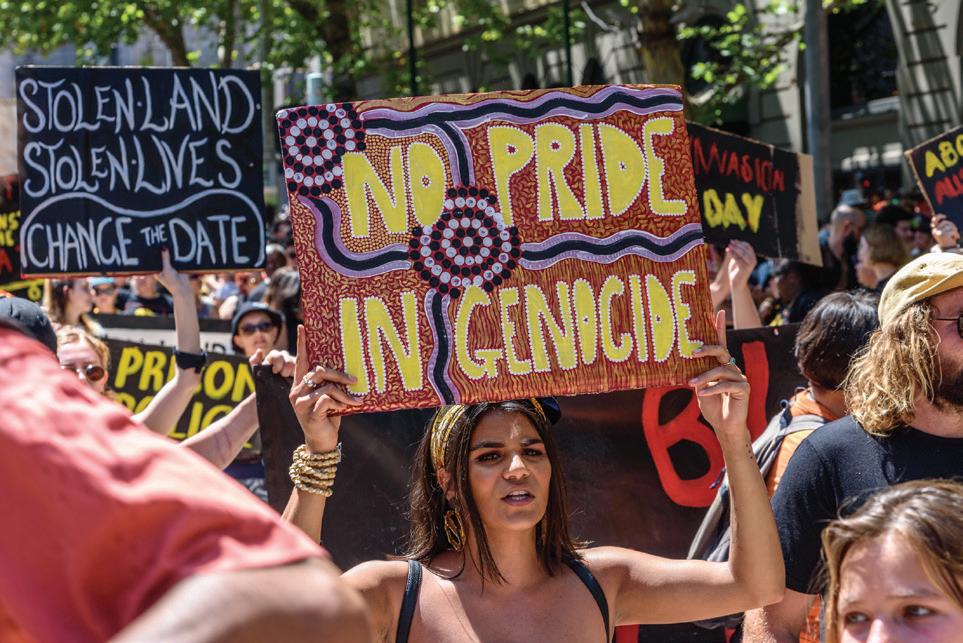
Source 1 While many Australians celebrate Australia Day on 26 January each year, more and more people are now beginning to call it “Invasion Day” because it commemorates the arrival of European colonisers and the loss of rights and freedoms for First Nations Australians. Each year tens of thousands of people gather in Melbourne’s CBD for an “Invasion Day” or “Survival Day” rally.
Each year, thousands of Australians join demonstrations to draw attention to their desire for the parliament to introduce a change in the law. Some demonstrations, such as the National Rally Against Gender-Based Violence, attract large numbers, while others attract fewer people, although they can still be effective in generating media and public interest. For example, in 2024, three protesters gained significant media attention and achieved their aim of raising awareness of the need for the government to take action to address climate change by blocking lanes on the West Gate Bridge with a parked truck covered with the phrase “Climate breakdown has begun”.
Similarly, while many demonstrations are peaceful, some create controversy by causing public inconvenience or violence. Some examples of groups that have organised demonstrations are set out in Source 2.
Each year, climate change activists, including concerned individuals and groups (such as the global movement Extinction Rebellion [XR], Rising Tide and Greenpeace), undertake several protests and demonstrations throughout Australia to raise community awareness and demand that governments act on climate change. These organisations use a range of methods to raise community awareness and demand governments act on climate change, including the use of peaceful rallies (or marches) and non-violent civil disobedience to “disrupt business as usual”.
Each year, concerned individuals and activist organisations (such as Respect Victoria, Safe and Equal, and the Red Heart Campaign) undertake demonstrations throughout Australia to draw attention to the need for community and government action to prevent and eliminate violence against women and girls.
• In November 2025, members of Rising Tide, XR and other climate activists began six days of demonstrations (called the “People’s Blockade”) to demand the end of fossil fuel (gas, coal and oil) projects and exports in Australia. During the demonstrations, thousands of climate activists participated in several activities, including launching a mass flotilla of kayaks to block a large coal port in New South Wales.
• In September 2025, members of XR undertook a week of action in Melbourne to demonstrate against several social issues, including climate change and the harm caused to First Nations peoples by the dispossession of their land. Demonstrations included blocking a bridge in the Melbourne CBD and holding protests outside various businesses and government agencies.
• Each year, between November and December, activists take part in a global campaign (instigated by United Nations Women) called “16 Days of Activism against gender-based violence”. In 2025, more than 8500 activists joined a demonstration in Melbourne, with thousands more joining similar marches in regional areas.
• In May 2025, thousands of protesters joined the “No More” rallies throughout Australia. In Melbourne, over 2000 people joined a demonstration outside the Victorian Parliament calling for the government to provide more funding for violence prevention programs, police training, and emergency housing for victims of family violence.
• On International Women’s Day 2024, Sherele Moody, founder of the Red Heart Campaign (which documents the killing of Australian women and children), created the "She Matters" mural in a Melbourne laneway to honour each woman killed by violence in Australia since 1 January 2024.
Each year, animal rights activists, including concerned individuals and groups (such as Vegan Rising, Dominion, and Justice for Captives), undertake protests and demonstrations throughout Australia to draw attention to animal cruelty.
• In March 2025, animal activists attended a demonstration in the Melbourne CBD to raise awareness of the need for stronger animal protection laws and demand the closure of facilities (called abattoirs) that kill livestock animals (including sheep, cows and pigs) to produce meat for human consumption.
• In December 2025, the Animal Justice Party (a political party that focuses on the prevention of abuse, harm and mistreatment of animals throughout Australia) held a Vegan Market in Melbourne’s Federation Square to raise awareness of animal rights issues and encourage people to sign their petitions calling for greater animal protection.
Source 2 Examples of groups that have organised demonstrations in recent years
Source 3 Activists often use different methods to attract attention to their demonstrations and causes. The “She Matters” mural in Hosier Lane, Melbourne, was created to honour each woman killed by violence in Australia since 1 January 2024.

The effectiveness of demonstrations as a means by which individuals and groups can influence law reform largely depends on their ability to attract the attention of the media and public. If successful, demonstrations can alert and educate members of the community about social, economic, political and legal injustice and the need for law change. The greater the community support for law reform, the more likely it is that members of parliament, who are reliant on the electoral support of the public, will respond to the need for change.
On the other hand, certain factors and circumstances can impact the effectiveness of demonstrations. Violent or inconvenient demonstrations, or those attended by very few people, can have less impact. Disorganised demonstrations, or demonstrations that lack a central message or call for action, can also be less effective.
Source 4 sets out some points you can use to discuss the use of demonstrations to influence law reform, including some points for and against their use. These are not the only points you can make; there may be other relevant points depending on a particular demonstration or scenario.
Explanation points • Demonstrations are public rallies or protests, where groups of people gather together at a central location or locations to express their common concern or dissatisfaction with an existing law.
Discussion points
• Demonstrations can be effective in generating awareness of the need to change the law. For example, large, peaceful demonstrations attended by thousands or hundreds of thousands of people may demonstrate to parliament that the majority of people support a change in the law. This has happened in the past in relation to climate change and gender equality.
• Demonstrations that attract large numbers of participants often attract media attention, which can generate further public support for the desired law reform. This is important because, in an attempt to make laws that reflect the views of the majority of the community, members of parliament are more likely to consider law reform that has strong community support.
• Demonstrations can gain the support of members of parliament who want to “adopt a cause”, particularly ones that might improve their public profile or image.
• Demonstrations can alert and educate members of the community about social, economic, political and legal injustice and the need for law change. This can bring change over time.
• The number of people who attend a demonstration may affect its ability to influence law reform. For example, demonstrations with only a few participants may not generate any interest or awareness, or media attention. However, this may depend on the nature of the demonstration. For example, an original, creative, ongoing or controversial “small” protest may gain the attention of the media.
• The ability of a demonstration to influence law change may depend on the type or nature of the demonstration. For example:
– demonstrations that cause public inconvenience, become violent or lead to breaches of the law may be less effective in generating positive media attention and the support of the community and members of parliament (who may prefer to associate themselves with positive campaigns, rather than ones that cause conflict, public inconvenience or violence). However, disruptive non-violent demonstrations that involve civil disobedience (e.g., forming a human blockade to prevent logging) may generate media attention and discussion, and persuade members of the community to consider various injustices and the need for law reform
– demonstrations that are single events may not generate ongoing support for the desired law reform.
• Demonstrations may focus on an injustice or issue that cannot be changed by parliament (e.g., a human rights issue in a country over which Australia has no authority or little influence), although they may attract global attention and have a longer-term influence.
• Disorganised demonstrations, or demonstrations that have no clear call for action or messaging, may be less effective. Organised demonstrations, particularly where there is a global movement or messaging, may have greater impact.
Source 4

Source 5 In September 2025, ACLED, an independent organisation that monitors armed conflict and global protests, reported that from October 2023 to September 2025, more than 900 demonstrations occurred across Australia in reaction to the escalation of the Israel–Gaza conflict. Many of these demonstrations urged the Australian Government to take action to help end the hostilities, including suspending weapon exports to Israel while the conflict continues.
Check your learning 13.3
Remember and understand
1 Using an example, define the term “demonstration”.
2 Describe one similarity and one difference in the ability of petitions and demonstrations to influence a change in the law.
Examine and apply
3 Read Source 2 and look at the image in Source 3.
a What is Extinction Rebellion Australia? Using one example, explain why their demonstrations are often considered controversial.
b Describe the purpose of one demonstration undertaken by animal activists in 2025.
c In a small groups, discuss the possible benefits and limitations associated with using “shock tactics” (like animal activists holding
dead animals and using graphic images) during demonstrations to influence a change in the law.
4 Conduct online research into two recent demonstrations that have taken place in Melbourne or regional Victoria.
5
a Describe the approximate size of the demonstration, its location and any other relevant information (such as any particular features of the demonstration).
b Outline the main purpose of the demonstration.
c Discuss the extent to which you believe the demonstration was effective in achieving its purpose.
Reflect and evaluate
6 Discuss the ability of a demonstration to be a successful method of influencing law reform.
In this lesson, you will learn about:
→ the means by which individuals or groups can influence law reform, including through the use of the courts.
As you have seen, people in our community can influence a change in the law in many ways. Petitions and demonstrations can be relatively effective in trying to influence a change in the law.
Another way that individuals can try to raise awareness of the need for law reform is by using the courts. For example, an individual may be involved in a dispute, or even a criminal case, that highlights the need for a change in the law. In taking the case to court, while the individual may be trying to prove their own claim rather than trying to change the law, an unclear area of law may be clarified or identified in the process, meaning their case has played a part in changing the law. For example, through statutory interpretation, a court can add to the meaning of the law, as explored in Lesson 12.2 (page 401).
In addition, if parliament has passed a law that is unclear or unfair, an individual may challenge the legislation through the court system in the hope that a judge will interpret and clarify the meaning of the law in their favour, or it may highlight to parliament the need to change the law (e.g., by the courts identifying an ambiguity in the law, or suggesting a law is unworkable). However, except for High Court rulings in constitutional disputes, parliament can always pass legislation to override a court decision.
The role of the courts in influencing changes in the law can also be limited in some ways. First, the courts can only decide a point of law or case (and in doing so change the law) when resolving a dispute that has been brought before them. This is reliant on people being prepared to challenge an existing law in the courts. People can be discouraged from taking a case to court by the high costs involved (such as the cost of engaging legal representatives and of court fees), the amount of time the case may take to resolve, and the uncertainty of the outcome. A party must also have standing to be able to initiate a court action.
Second, the courts can only rule on the issues directly involved in the case before them.
The landmark human rights case outlined in the Actual scenario Gender recognition laws (page 476) shows how an individual can influence legal change by challenging the interpretation of a law in the courts. In this case, the individual sought an interpretation of the law that recognised a person’s sex in a gender-neutral way.
As you saw in Module 11 (page 374) and Module 12 (page 399), individuals may also challenge legislation in the courts, hoping a judge will rule it ultra vires, or made beyond the power of the parliament, and therefore invalid. Similarly, an individual may challenge state legislation on the basis that it conflicts with federal legislation and, under section 109 of the Australian Constitution, should be declared unconstitutional and invalid.
A person who does not identify as being either male or female undertook court action against the decision of the New South Wales Registry of Births, Deaths and Marriages to not allow them to register as being of “non-specific” sex. The Registry claimed that in accordance with the Births, Deaths and Marriages Registration Act 1995 (NSW), it only had the power to change a person’s sex from male to female or vice versa.
The case was ultimately resolved by the High Court, which ruled that the Registry did have the power to record the individual’s sex in a genderneutral way.
While this was a New South Wales case, it generated national attention, including the attention of the Victorian Parliament. Five years after this
case, the Victorian Parliament passed the Births, Deaths and Marriages Registration Amendment Act 2019 (Vic) to change the law to allow people who do not identify as being either male or female to change their sex on their birth certificate without having to undergo surgery to affirm their sex.
While the Act had the support of various organisations, including the Australian Human Rights Commission and gender diversity activists, it was opposed by the Liberal Party, which took the stance that a birth certificate is a record of a person’s biological sex, which is different from gender identification.
In the Actual scenario Challenging the validity of legislation two individuals challenged the validity of Victorian state legislation, arguing that it was made beyond the law-making powers of the Parliament. The High Court declared the relevant legislation invalid.
Electric vehicle charge ruled invalid
In 2022, two people (the plaintiffs) initiated a legal action against the Victorian Government after it introduced a charge on the users of electric and hybrid vehicles. This charge required the plaintiffs, as the owners of electric vehicles, to pay a charge of between 2.3 and 2.8 cents per kilometre travelled. The plaintiffs claimed that the electric vehicle charge – formally referred to as Victoria’s Zero and Low Emission Vehicle (ZLEV) charge – was invalid because the Victorian Parliament did not have the power to make such a law. In particular, the plaintiffs argued that the electric vehicle (or ZLEV) charge was an excise duty (or tax) which, in accordance with the Australian Constitution, can only be made and imposed by the Commonwealth Parliament.
In October 2023, the High Court ruled in favour of the plaintiffs by deciding that the electric
vehicle charge was an excise duty (or “tax on goods”) that, under section 90 of the Constitution, can only be imposed by the Commonwealth. As such, the Court declared that the relevant section of Victoria’s Zero and Low Emission Vehicle Distance-Based Charge Act 2021, under which the electric vehicle charge was created, breached the Constitution and was invalid.
After the High Court’s decision, the Victorian Government stopped imposing the electric vehicle charge and, in 2024, began issuing refunds (totalling approximately $7 million) to the owners of electric and hybrid vehicles who had paid the “unconstitutional” charge while it was operational.
Interestingly, in making its decision, the High Court overruled its own existing precedent set in the Dickenson’s Arcade case (1974). In simple terms, the High Court, in a majority 4–3 ruling, rejected
the decision made in the Dickenson’s Arcade case that a tax imposed on the consumption or use of goods after they are supplied to a consumer (like the Victorian Government’s electric vehicle charge) was not an excise duty and, therefore, could be imposed by the states. Instead, the High Court more broadly interpreted the meaning of “excise duty” to include any taxes imposed on goods before and after they are supplied to a consumer, thereby ensuring that such taxes can, in accordance with section 90 of the Constitution, only be imposed by the Commonwealth.

Source 1 In 2023, the High Court ruled that the Victorian Government did not have the power to impose a tax on the owners of electric vehicles because the tax was an “excise duty” that, in accordance with the Australian Constitution, could only be imposed by the Commonwealth.
The ability to use the courts to change the law depends on various factors including, particularly, whether someone is willing and able to challenge the law in the courts. If someone is prepared to challenge the law in the courts, then it could highlight to parliament an issue with the law, or it can result in the court ruling the law as being made ultra vires or otherwise void. While challenging the law in the courts can lead to a change in the law, it can be an expensive and time-consuming way for an individual to influence law reform and there is no certainty in the outcome of any case. Standing is also a requirement, which means that not everyone can use this method to influence a change in the law.
Source 2 sets out points you can make to discuss the use of the courts to influence law reform, including some points for and against their use.
Explanation points
• Individuals and groups can influence a change in the law by challenging the validity, meaning or fairness of an existing law in the courts. A judge’s decision can lead to a change in the law or clarify the meaning of the law.
• Challenging an existing law (either common law or statute law) in a superior court can clarify a vague or unclear law. For example, courts can expand or limit the meaning of legislation through statutory interpretation. Even if a court challenge is unsuccessful, it may gain significant media coverage that may generate community interest in the decision and the possible need to change a law.
• Judges can rule that legislation made outside the power of the parliament (ultra vires) is invalid.
• Judges’ decisions and comments made in court can encourage parliament to change the law.
• Judges are politically independent and determine cases based on the facts and merit rather than for electoral concerns (i.e., the need to gain voter support).
Discussion points
• Courts are limited in their ability to change the law because they can only do so when a case is brought before them and only in relation to the issues in the case. This relies on individuals being willing to mount a court challenge – which requires them to have standing and be willing to pursue costly, timeconsuming and stressful cases, with no guarantee of success.
• With the exception of High Court disputes involving the interpretation of the Constitution, a judge-made law can be abrogated (cancelled) by parliament.
• Judges must wait for a party to challenge the authority of parliament to legislate before they can make a ruling and declare legislation invalid. That party must also have standing.
• Judges are unelected and their decisions and comments may not necessarily represent community views and values.
Source 2 Points to consider when discussing the use of the courts to influence law reform
media the way information is communicated to the public, including print media (e.g., newspapers and magazines), broadcast media (e.g., film, television, radio) and digital media, which includes media distributed through the internet and electronic devices (e.g., websites, emails and text messages, video games) and social media (e.g., online platforms and applications like Facebook, YouTube and Instagram) Check your learning 13.4
your learning 13.4
Remember and understand
1 Explain how an individual can influence law reform through the courts.
2 Provide two examples of individuals seeking to reform the law by using the courts.
Examine and apply
3 Read the Actual scenario Gender recognition laws and explain why the individual challenged the relevant law through the courts.
4 Read the Actual scenario Challenging the validity of legislation.
a Outline why the two plaintiffs initiated legal action against the Victorian Government.
b The two plaintiffs could not have pursued court action without standing.
What is standing, and why is a plaintiff required to have standing to undertake a court action?
c With reference to the Australian Constitution, explain why the High Court found in the plaintiffs’ favour.
d Use your knowledge from Module 12 (page 397) to explain the meaning of the phrase “the High Court overruled its own existing precedent”.
e Discuss the extent to which this decision is a final statement in law.
Reflect and evaluate
5 Using one example to support your response, discuss the effectiveness of challenging a law in the courts to bring about a change in the law.
In this lesson, you will learn about:
→ the role of the media, including social media, in law reform.
The media plays an important role in law reform. In particular, the rapid uptake of social media in Australia and globally has allowed individuals and groups to generate interest in, and awareness of, issues on a local, domestic and global scale.
In broad terms, media refers to the way information is communicated to the public. Three common types of media are:
• print media, which refers to printed publications such as newspapers and magazines, but may also include other printed publications such as journals, books, brochures and billboards
• broadcast media, which generally refers to the transmission of information through television and radio
• digital media, which generally refers to the distribution of information through the internet and electronic devices (such as computers, laptops, mobile phones and tablets) including websites, e-books and podcasts, live video streaming, virtual reality and social media (e.g., online platforms and applications such as TikTok, Snapchat, Instagram, YouTube and Facebook).
Over the years, advances in technology have created new types of media and changed the way people access information. As the media has gradually transitioned from more traditional forms (such as newspapers, television and radio) to digital media, people now access their news content in a range of ways beyond reading the daily newspaper or listening to the nightly news program.
For example, in 2025, 97 per cent of the Australian population was connected to the internet and used it for approximately six hours each day. In addition, approximately 80 per cent of the Australian population had active social media accounts and spent nearly two hours per day on social media platforms – with the most popular being Facebook, Messenger, Instagram, WhatsApp and TikTok.
This widespread use of digital media enables individuals, groups and organisations to communicate information, including information about the need for law reform, with little restriction or censorship to potentially huge numbers of people. It also allows such information to be instantly received and quickly disseminated, and shared.
Given its ability to communicate information to vast numbers of people, the media can play many roles in law reform, including:
• informing and raising awareness – the media can inform people about social, political and legal issues and the need for law reform, and can also generate interest in, and awareness of, those issues or need
• assessing levels of community support – the media can assist the parliament, government and political parties to assess the level of community support for law reform
• influencing community opinion on a change in the law – the media can influence community views and opinions about social, political and legal issues and the need for law reform.
Each of these roles is described below. You will notice that the roles overlap. For example, in informing people about a legal issue, the media may also be influencing community opinion about the need to change the law.
The media can inform people about social, political and legal issues and the need for law reform in a number of ways. For example, it can:
• provide a platform for members of parliament, governments and political parties to explain to the community the need for law reform or their law reform agenda
• provide a platform for other individuals, groups and organisations (such as activists, advocacy groups, legal experts, academics, and community groups and leaders) to share and promote their opinions and discuss and debate potential law reform within the broader community
• report on personal experiences and situations where existing laws have failed, thereby highlighting the need for law reform.
Media organisations can also use their platforms to themselves seek to influence law reform. For example, media organisations can publish articles, including editorials, that directly express their own opinion on legislative change. The Actual scenario Media influencing law reform is an example of these organisations joining together to raise awareness about certain legislative reforms.
On Monday 21 October 2019, Australia’s biggest newspapers ran front pages that were “redacted” or “blacked out” in a protest against a series of legislation that media organisations believed sought to restrict media freedom. The action was taken as part of the “Right to Know” campaign, formed by a group of Australia’s leading media organisations and industry groups to protect the public’s “right to know” about matters or issues that concern them.
The redacting of the front pages was a coordinated effort by media organisations to campaign against legislation introduced at a federal level that they believed to be placing unreasonable restraints on them, and risked journalists going to jail for reporting on government matters. For example, in June of that year, authorities had raided the home of a journalist as part of an investigation into alleged publishing of classified information after the journalist had published a story about plans to expand the powers of a particular national agency.
The media organisations considered that successive laws that had been passed over time resulted in a culture of secrecy and a threat to
democracy. The Prime Minister at the time, Scott Morrison, defended the actions taken.
The actions taken by the media organisations generated significant media attention around the globe. They became a talking point for the community, with much discussion about why the newspapers had taken the action they did. This raised awareness about an issue the community may not otherwise have known about.
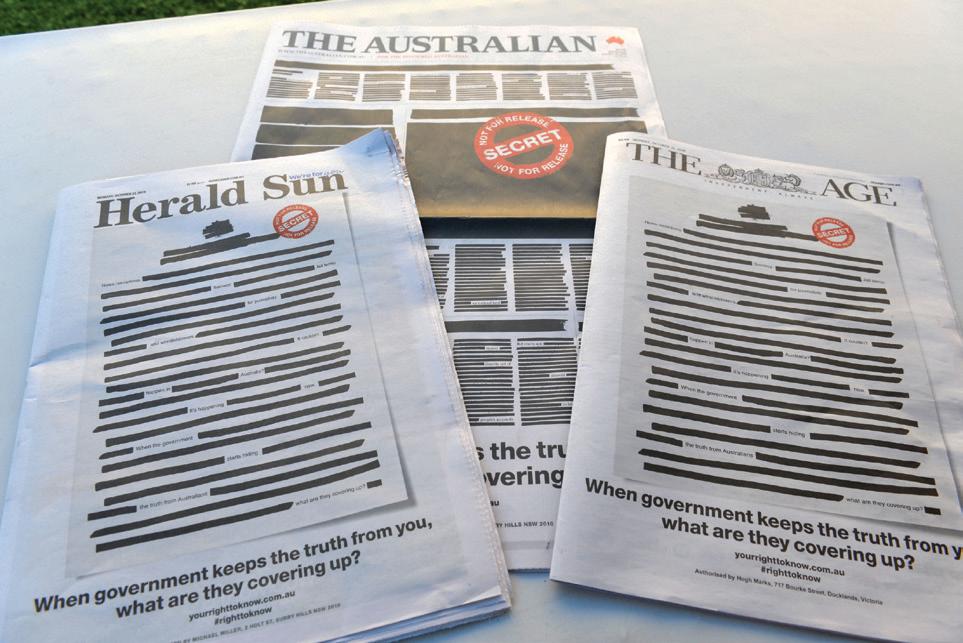
Media can also be used to assist parliament, government and political parties, or even voters themselves, to determine the level of community support for law reform.
The most traditional way this can occur is through media polls (surveys). Polls are used to gauge what readers, viewers and listeners think about a particular social, legal or political issue, or which issues are concerning them the most. The results are often published in the media with additional commentary about what those results mean. This can potentially be used by parliament, government or political parties to assess the people’s support for or opposition to a political issue.
For example, Ipsos Issues Monitor is an ongoing survey that determines which issues are of most concern for Australians. Topics include crime, health care, transport and the cost of living. A survey conducted by Ipsos Issues Monitor in December 2025, for example, showed that the cost of living and housing are key concerns for people. This may result in
governments proposing law reform to address these issues such as seeking to legislate tax cuts, rebates (or reductions) in energy bills, and financial assistance for first home buyers and renters.
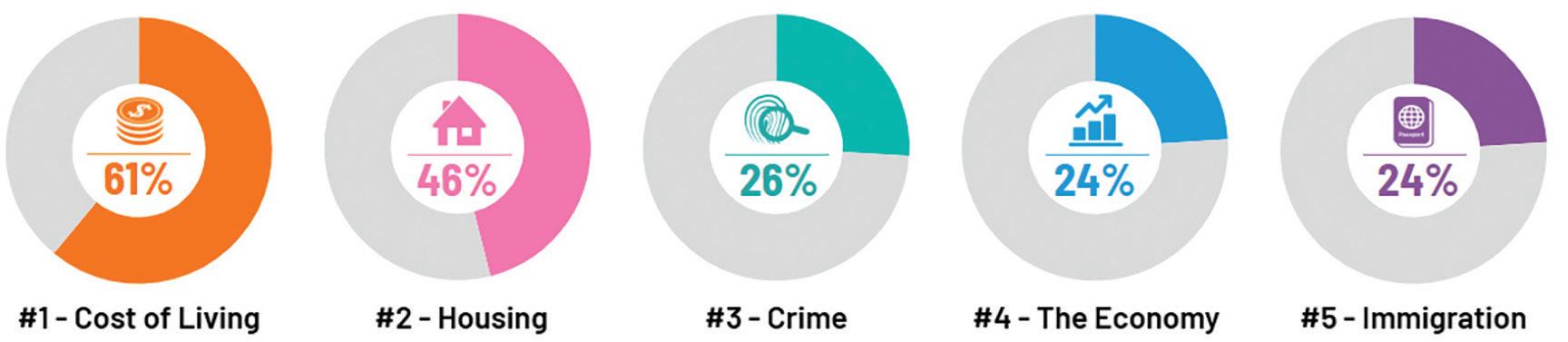
Source 2 The Ipsos Issues Monitor in March 2026 showed that the cost of living and housing were the issues of greatest concern for Australians.
Other ways the media can gauge (or measure) public opinion include:
• using powerful data analytics (tools to track online behaviour, such as the number of times a post, article or page is read or clicked on) to understand what may be concerning or of interest to the community
• monitoring “letters to the editor”, which are published in newspapers, or comments posted on digital newspapers in relation to a particular issue
• measuring the number of likes, shares, reposts and quotes of a particular post on X or posts on social media platforms such as Facebook.
Given the high profile of many media organisations, the media can at times influence community opinion. For example, radio broadcasters who have a large number of listeners each week can influence the way people think on a particular issue or area of law, particularly if those listeners do not obtain information elsewhere on the issue.
The media itself can investigate local, national and global events and circumstances. These investigations may not only seek to inform and generate interest in an issue but also try to influence community opinion about it, or even influence governments to take action as a result.
The Actual scenario Media influencing legislative change contains examples of documentary films and television programs that have highlighted social, political and legal injustices to generate interest in, and potentially support for, law reform. It also illustrates the media’s ability to scrutinise government policy.
Over recent years, hundreds of documentaries and investigative programs have been made to raise community awareness of social, political and legal injustice and influence change in the law.
For example, Documentary Australia, a not-forprofit organisation that supports filmmakers to make documentaries for positive social change, has assisted in the production of hundreds of
Print media is still influential. According to research conducted by the University of Canberra, in 2025, approximately 37 per cent of Australians used television as their main source of news, 26 per cent used social media as their main source of news, and 23 per cent gained their news online. Only five per cent gained their news from print media (e.g., daily newspapers). While this appears to be a small percentage, in 2025, approximately 9.3 million Victorians read content from the Herald Sun and The Age newspapers, in print and online, every month.
documentaries since it was established in 2008. Some notable examples include:
• Our law, which highlights some of the many difficulties facing Australia’s First Nations people when dealing with the legal system, including systemic racism and mistrust of the legal system, and the overrepresentation of First Nations people in Australian prisons.
• Mental Wealth , which examines the state of youth mental health in Australia and highlights the need for federal, state and territory governments to increase funding to improve the care, treatment and rights of young people who suffer mental health issues.
• Cry of the Forest, which highlights the importance of protecting Australia’s forests to preserve native plants, animals and habitats and the need to implement laws to end native forest logging and address climate change.
Australian programs broadcast on television and streaming services, such as the Australian Broadcasting Commission (ABC)’s Four Corners and the Nine Network’s 60 Minutes, can also influence changes in the law by exposing social and legal injustices and policy failures, and generate awareness within the community about the need for law reform. Increased community awareness and discussion about the need for legislative reform can force governments to act or risk losing voter support. Some examples of programs that have exposed injustices and raised awareness of the need for law reform include:
• The Four Corners program titled “Betrayal of trust” (2025), which highlighted the need for greater government control and monitoring of Australia’s childcare sector. In particular, the program documented examples of serious breaches of child health and safety standards in childcare and early learning centres and raised awareness of entrenched problems within the sector, including chronic shortages of qualified staff and the provision, by some providers, of very low-quality services. Shortly after the program aired, the New South Wales Government initiated a parliamentary inquiry into the early childhood education and care
sector in New South Wales. As further allegations of mistreatment in childcare centres became public in the months following the broadcast, the Victorian Government also commissioned an independent Rapid Child Safety Review to identify actions the government could take to improve child safety in early childhood education and care services.
• The 60 Minutes segment titled “Riding for a fall” (2025), which highlighted the need for reform of Australia’s electric bike (e-bike) laws. In particular, the segment raised awareness of the need for legislative change to prevent noncompliant, high-powered and low-quality e-bikes from being sold in Australia. It also examined whether e-bikes should be classified as road vehicles and, as such, be subject to registration and licensing regulations.
• The Four Corners program titled “Losing streak” (2025), which highlighted the need for greater government regulation of Australia’s gambling industry.

While the media has a role to play in law reform, some issues or limitations affect that role. Three of these are:
• media concentration
• the risk of spread of misinformation
• the use of algorithms online.
Media concentration generally refers to the ownership of the mass media by very few individuals or groups. It is widely accepted that Australia has one of the most concentrated news media markets in the world, with the ownership of traditional print media, TV and radio networks and online media owned by very few individuals and corporations. For example, although Australia has hundreds of newspapers covering national, state, territory and regional levels, readership data indicates that two media organisations, News Corp Australia and Nine Entertainment, account for over 80 per cent of the country’s print media market. Similarly, while Australia has over 30 digital television channels, most are owned by three media organisations – Nine Entertainment, Seven West Media and Paramount Networks – as well as the Australian Government, which owns the Australian Broadcasting Corporation (ABC) and the Special Broadcasting Service (SBS).
One of the main concerns associated with Australia’s high concentration of media ownership is that it allows a relatively small number of media organisations and their primary owners to largely shape the news stories and perspectives presented to the public. This is significant because it enables these media organisations to influence community views on legal, social and political issues by deciding the type of information and content that is published or broadcast. For example, the media organisations can shape debates on law reform, government policy and election issues by selecting which politicians, experts and perspectives they will promote or exclude on their programs. This influence may also empower media organisations to place pressure on governments to support law reforms that benefit their primary owners.
In fact, over the years, a number of Australia’s dominant media organisations have faced criticism for allegedly showing political bias. For example, News Corp Australia, which publishes the Herald Sun in Victoria, is perceived to have a “right/conservative” bias, tending to support the Liberal and National parties, while the ABC has been criticised for having a “left bias”, tending to support the Labor Party.


Source 4 At times, newspapers have used their front pages to comment strongly on law reform or how people should vote in elections. The front page on the left was criticised for showing political bias against Anthony Albanese (who, at the time, was the Leader of the Opposition) one month prior to a federal election. The front page on the right was also criticised for showing political bias that showed excessive support of Jess Wilson after she was elected as the leader of the Victorian Liberal Party in November 2025.
The VCE Legal Studies Study Design requires you to analyse the role of the media in law reform. This means you need to examine the media in more detail, more than just explaining its role. Try to identify parts or components of the role or functions of the media in law reform (e.g., in assisting, promoting, restricting or limiting potential change in the law) and try to provide some more detailed commentary on those parts.
Digital platforms are a key source of news and information, and information from documentaries, films and television programs is often shared and spread online. This means that social and online media often reproduce content so that it is spread across Australia and the globe. However, a significant concern is the spread of misinformation on digital platforms. The sharing of misinformation is widespread because the online environment is not regulated in the same way as more traditional media organisations, and anyone can share “news”. This includes those who are not journalists and do not have to follow any codes of ethics. Misinformation can erode people’s trust in professional sources of information (e.g., healthcare or science experts), and generate debate about whether law reform is needed, but in a way that is misinformed or not representative of the facts. Misinformation can also create distrust in governments and organisations.
Examples of this have been in relation to:
• climate change, when people spread misinformation about the science behind climate change
• electoral dishonesty, when people disseminate misinformation about the voting processes, such as ballot papers (or votes) not being counted, to erode public trust in Australia’s democratic systems
• health issues, when people spread misinformation about medical treatments, vaccines and diseases to erode trust in public health experts and government policy.
Finally, the emerging use of platforms such as Facebook and Google to deliver news has changed the way in which people consume and read information, as have their algorithms. An algorithm is a set of instructions that tells a computer what to do. For example, a social media site may use an algorithm that learns from individual user behaviour; users are then shown content that the site predicts the user will read or enjoy, thus making them stay on the site longer. This can then also influence what people read and what information they are getting about a particular issue.
While in some ways algorithms will help people get news and content that is relevant and engaging to them, their use may also mean that readers are not reading news that they “should” read, or might not push them to consider alternative views. It is possible that readers will not even be aware of a particular issue or injustice because they are only presented with other types of news or information based on what they have previously read.
This may impact people’s ability to be informed about, and develop an appreciation of, the need for law reform. It can also potentially limit the content people read on a particular issue, though much is still unknown about how algorithms are used, and whether they may ultimately be useful in delivering news content.
Source 5 provides a summary of the role of media, including social media, in law reform, including the benefits and limitations of the media’s role in influencing change in the law.
Social media
Print and broadcast media
• Social media refers to a range of digital tools, applications and websites used to share information in real time between large groups of people.
• Social media can create interest in social, political and legal issues, and generate awareness of, and support for, the need for law reform, on a massive scale. It can also be used to gauge community support and influence community views and opinions about a particular issue.
• Social media and mobile devices allow people to capture and broadcast images and videos and livestream events to potentially huge audiences, and in real time. For example, footage of crime, cruelty to live export animals and conditions in detention centres for asylum seekers have all been posted on social media to gain support for law reform in these areas.
• Social media connects people around the world and can be used to generate interest and awareness in global issues requiring law reform (such as climate change and the global refugee crisis) at a domestic level.
• Social media can give individuals, groups and organisations direct access to political parties and local members of parliament to gain insight into their views on legal issues and receive up-to-date information, which can in turn increase accountability for political entities’ actions.
• Law-makers themselves, particularly parliamentarians and government departments and bodies, can monitor social (and traditional) media coverage, including remarks in online comment forums, to gauge public opinion and public responses to recent events and proposed law reform.
• Information on social media can be unreliable and can result in confusion about the need for law reform. For example:
– people who post information, opinions, images and videos on social media do not generally follow codes of ethics that are followed by reputable media organisations and journalists. This means information on social media may not be accurate, authenticated or impartial
– social media platforms are highly visual and can include graphic images and livestreams that portray complex legal issues in a simplistic way and may evoke emotional responses based on limited facts and knowledge. This means individuals may make decisions about law reform without having a basic understanding of the issue involved – owners of social media platforms have struggled to stop the spread of harmful or inaccurate stories in the past, given how fast they can be shared.
• The above issues can impact on people’s support for law reform.
• Excessive exposure to graphic or vivid images may cause people to feel overwhelmed and become desensitised to social, political and legal injustices.
• The use of algorithms can influence what people are reading and from whom. This can sway people’s views on areas of law reform or limit the number of opinions or viewpoints they are reading on an issue.
• Print and broadcast media include more traditional forms of media, such as newspapers, television and radio.
• Print and broadcast media can influence law reform through their ability to investigate, report, discuss and inform people about social, political and legal issues, injustices and possible changes to the law. For example, newspapers, television and radio are still a major source of news within our community, and are accessed by millions of readers, viewers and listeners each week.
• Print and broadcast media can assist the parliament, government and political parties in determining whether there is sufficient community support for a change in the law. This includes surveys conducted by newspapers.
• Print and broadcast media can also be used to influence community support for a particular issue. They can also conduct investigations and report on them in news stories or TV programs. This can then prompt governments to act, or encourage people to pressure governments to act.
• Some have questioned whether print and broadcast media always present information in an unbiased and independent manner. For example, more broadcasting time can be given to individuals, groups and parliamentarians who support the views held by the owners of print and broadcast media organisations. Alternatively, at times direct messaging can be used, often on front pages of newspapers, in an attempt to change the community’s perception of a particular issue or even influence the way they vote.
• The high concentration of media ownership, particularly print media, gives the largest media organisations (like News Corp and Nine Entertainment) significant power to influence community views on the need for law reform, particularly if people are not getting news from other sources.
• At the same time, other factors can influence what people are reading beyond print and broadcast media. For example, social and online media have a large role to play in what people are reading, and arguably have a more powerful impact on generating awareness of law reform, given the instantaneous nature of online and social media, and the large volumes of people who use them.
Source 5 Points you can make when analysing the role of the media in law reform
your learning 13.5
your learning 13.5
Remember and understand
1 Distinguish between the terms “media” and “social media”.
2 Explain how social media can be used to influence a change in the law. Provide two examples to support your response.
3 Describe three ways that broadcast media can be used to influence the government to initiate a change in the law. Provide one example to support each of the three ways.
Examine and apply
4 Select one current law reform issue and follow its progress.
a Identify the methods being used by those who are agitating for change to gain support.
b Comment on the amount and type of coverage the proposed law reform is receiving in the media, including social media. For example, in your opinion, is the media coverage narrow or widespread, and positive or negative? Justify your view. You may wish to examine proposed law reform relating to climate action, end-of-life choices, medically supervised injecting rooms, decriminalising personal use of illicit drugs, animal cruelty, or asylum seekers.
5 Select one law reform that you believe the Victorian or Commonwealth Government should introduce.
a Describe the law reform and explain why you think it should be introduced.
b Outline possible objections to the proposed law reform.
c Imagine you had to design a campaign to increase community awareness and support
for the proposed law reform. What would you do? What methods would you use to influence a change in the law?
d Write an email to the editor of a daily Victorian newspaper to convince other readers to support the proposed law reform. Your email cannot be more than 250 words.
6 Select one Australian political party or independent member of parliament and investigate the way they use the media to generate support for their or their party’s law reform agenda. A list of registered political parties is available on the Australian Electoral Commission website.
Reflect and evaluate
7 As a class, gather together screenshots of front pages of newspapers or headlines from media articles from the past five years that you consider to be provocative, or forceful, about a legal or political issue. Find as many as you can.
a Group the front pages or media headlines in themes; for example, for or against a particular political party, or showing a conservative or more progressive approach to the legal issue.
b Come together as a group and discuss any findings or observations.
c As a class, discuss whether social media platforms (such as Facebook, Instagram, TikTok and YouTube) are a reliable source of accurate information about social, legal and political issues.
8 Analyse the role of the Australian media in law reform. Provide two recent examples to support your response.
In this lesson, you will learn about:
→ the role of the Victorian Law Reform Commission and its ability to influence law reform
→ one recent Victorian Law Reform Commission inquiry relating to law reform in the civil or criminal justice system.
Members of parliament often lack the time and resources to undertake a thorough investigation of an issue. In situations like this, parliaments may pass the investigation of the need for law reform to an independent law reform body that can conduct its own investigations and make recommendations for changes to the law.
Formal law reform bodies are organisations established by the Commonwealth, state and territory governments to inform them of changes in society that may require a change in the law. They aim to give impartial advice and make recommendations that are practical and able to be implemented. Parliament is not bound to follow the recommendations of formal law reform bodies, although the government is often influenced by the reports of these organisations when considering changes in the law.
The Victorian Law Reform Commission (VLRC) is Victoria’s leading independent law reform organisation, which reviews, researches and makes recommendations to the AttorneyGeneral about possible changes to Victoria’s laws. The Victorian Parliament established the VLRC in 2001 by passing the Victorian Law Reform Commission Act 2000 (Vic). The VLRC was therefore created by statute and obtains its powers and functions through that statute.
The VLRC aims to assist the Victorian Government in continuing to provide a fair, inclusive and accessible legal system by investigating the need for change in Victorian laws and providing the government with impartial advice and recommendations for change.
While the VLRC was created and is funded by the Victorian Government, it is an independent organisation that is not involved in the political process or influenced by the policies of the government or political parties.
In general terms, the VLRC monitors and coordinates law reform activity in Victoria and investigates and advises the Victorian Government on ways to update and improve Victorian law. When conducting its investigations, the VLRC engages in community-wide consultation and debate to ensure its recommendations for changes to the law meet the needs and desires of the Victorian community. For example, the VLRC will respond to issues and concerns raised by individuals and advocacy groups, and consider newly emerging rights and responsibilities.
law reform bodies organisations established by the state and Commonwealth parliaments to investigate the need for change in the law and make recommendations for reform
Study tip
The VLRC website provides information on all its law reform projects. The site also has an excellent student resource section containing a booklet that examines the VLRC’s role and the way it works, case studies and a poster.
Section 5 of the Victorian Law Reform Commission Act sets out the specific roles of the VLRC, four of which are as follows:
• major inquiry – to examine and report on any proposal or matter referred to it by the Victorian Attorney-General and make recommendations to the Attorney-General for law reform. This includes conducting research, consulting with the community and reporting on law reform projects
Weblink: VLRC –Education resources
• community inquiry – to investigate any relatively minor legal issues that the VLRC believes are of general concern within the community and report back to the AttorneyGeneral with suggestions for law reform. This means that in addition to its main role of examining legal issues and matters referred by the Attorney-General, the VLRC can also examine minor matters or areas of law reform without a reference, provided the review will not consume too many of its resources. These investigations are called community law reform projects
• monitoring – to monitor and coordinate law reform activity in Victoria, including making suggestions to the Attorney-General that they refer a legal issue or matter relating to law reform to it for investigation. In other words, after consultation with various groups and other law reform bodies, the VLRC may suggest to the Attorney-General new references relating to areas where law reform would be desirable
terms of reference instructions given to a formal body (e.g., a law reform body or Royal Commission) to investigate an important matter. Terms of reference set out the precise scope and purpose of the inquiry and the date by which the final report must be completed
• education – to undertake educational programs and inform the community on any area of the law relevant to its investigations or references. This means the VLRC provides information about its work through its website and delivers presentations at conferences and similar forums. One way the VLRC achieves this is by visiting schools throughout Victoria to talk to students about its role and past and current projects. It also provides a vast range of information about its investigations and references on its website. In this lesson, you will primarily be looking at the first two functions above, namely the role of the VLRC when it has been asked to look into a matter referred to it by the AttorneyGeneral, and when it investigates a relatively minor legal issue of community concern.
Before conducting an inquiry, the VLRC first needs to have terms of reference. These will either be received from the Attorney-General or will be drafted by the VLRC about a matter it identifies as a relatively minor legal issue that is of general community concern. The terms of reference set out the matters that the VLRC is to inquire about. They also set out the date by which the VLRC is to complete its inquiry.
In assessing the need for change in the law, the VLRC consults with expert bodies in the area under review and the general community. The other processes it uses will depend on the nature of the inquiry, but the VLRC may:
• undertake initial research and consult experts in the law under review to identify the most important issues
• establish an expert panel, committee or individual to provide advice to the VLRC about the subject matter of the inquiry
• publish a consultation paper (or issues paper) that explains the key issues in the area under review and poses questions about what aspects of the law should be changed, and how, for community consideration
• hold consultations and discussions with, and invite submissions from , parties who are affected by the area under review and members of the Victorian community. Submissions can be made in writing or online. Members of the community may include
interested individuals, groups and organisations. In particular, the VLRC will seek the views and opinions of people from marginalised groups, including people from culturally diverse communities, First nations people and people living in regional and remote communities.
• publish a report with recommendations for changes in the law. Depending on the requirements in the terms of reference, the VLRC may also publish an interim report during its inquiry, which may focus on one particular aspect or area of the inquiry
• present the report to the Attorney-General , who will then table it in the Victorian Parliament within 14 sitting days. The government may decide to implement some or all of the VLRC’s recommendations by incorporating them into a bill, but it is not bound (compelled) to do so, and there is no timeline for the government to respond.
Since its creation in 2001, the VLRC has conducted numerous investigations and made hundreds of recommendations to help ensure Victoria’s laws remain relevant and fair. The VLRC has completed more than 49 inquiries, with the government adopting all or some of the VLRC’s recommendations in approximately 75 per cent of the completed inquiries. The VLRC website contains information on each of these completed and current projects.
Some completed projects include an examination of:
• making Victorian juries more inclusive (2022)
• improving Victoria’s stalking laws (2022)
• the meaning of “recklessness” in the Victorian criminal law (2023)
• improving Victoria’s family violence intervention orders for children and families (2025)
• the opportunities and principles to guide the safe use of artificial intelligence (AI) in Victoria’s courts and tribunals (2025).
Two of these projects, on family violence intervention orders and the use of AI in Victoria’s courts and tribunals, are explored further in the two scenarios that follow.
The Actual scenario Investigating the use of AI in Victoria’s courts and tribunals examines an inquiry into the use of AI in Victoria’s courts and tribunals, undertaken by the VLRC at the Attorney-General’s request.
In 2025, the VLRC completed an inquiry into the use of artificial intelligence (AI) in Victoria’s courts and tribunals. It undertook the inquiry after receiving terms of reference from the Attorney-General asking it to consider matters including the benefits and risks of using AI in Victoria’s courts and tribunals, and ways to enhance existing legislation, regulations and common law to support the use of AI within Victoria’s court system.
Artificial intelligence (AI) tools are being developed at an extraordinary pace and transforming the way individuals, businesses and
organisations, including the courts and tribunals, analyse information, make decisions and perform daily tasks. However, while the use of AI presents opportunities to enhance the operation of the court system, it also carries risks, particularly in relation to the accuracy of AI-generated information (which could be used in submissions, witness statements and expert reports), the security of data (including court documents and records) and accountability and transparency. As such, the inquiry’s terms of reference required it to:
• consider the potential opportunities, benefits and risks of using AI in Victoria’s court system and legal services
• make recommendations about how the law needs to change to ensure the safe use of AI in Victoria’s courts and tribunals. For example, the VLRC was asked to examine how AI might change the way Victoria’s court system and legal services operate and the way people interact with the courts and tribunals (including how AI might be used by judges, magistrates, tribunal members, court staff, lawyers, self-represented litigants and witnesses)
• make recommendations to establish principles and guidelines to support the safe use of AI in all Victorian courts and tribunals, to maintain public trust in courts and tribunals, and to ensure the integrity and fairness in the court system.
The inquiry process involved extensive research and investigation by the VLRC, including considering information, opinions and suggestions from individuals, groups and organisations directly impacted by the use of AI in courts and tribunals. These perspectives were gained through written submissions and consultations.
For example, shortly after the inquiry commenced, the VLRC published a consultation (or issues) paper that examined some of the benefits and risks of AI and possible ways that AI might be used and regulated in Victoria’s courts and tribunals. The VLRC received 29 submissions from a range of interested individuals, groups and organisations, including various legal and civil liberties organisations (such as Victorian Legal Aid, the Law Institute of Victoria, the Juries Commissioner, the Federation of Community Legal Centres, and the Human Rights Law Centre).
The VLRC also held consultations with 49 organisations impacted by the use of AI in the Victorian court system, including the Victorian Magistrates’, County and Supreme Courts, the Victorian Civil and Administrative Tribunal (VCAT), the Office of Public Prosecutions, the Judicial College of Victoria, Juries Victoria, the Victorian Bar Association, and Victoria Police.
various countries and organisations (including the United Kingdom, Singapore, Canada and the European Union).
The terms of reference required the VLRC to prepare and deliver its report to the AttorneyGeneral by 31 October 2025. The report, which was tabled in the Victorian Parliament by the Attorney-General in February 2026, made 30 recommendations about law reform and principles to ensure the safe use of AI in Victoria’s courts and tribunals, including recommending that:
• The Victorian Government collaborate with the Australian Government and other states and territories to develop a consistent national approach to AI regulation, which maintains judicial independence.
• Victoria’s courts and VCAT publicly state how their privacy and AI policies uphold Victoria’s Information Privacy Principles, which guide how government organisations collect, use and store personal information and data.
• The Supreme Court’s existing guidelines for litigants on the “responsible use of AI” be updated to cover a broader scope (e.g., so they apply to all court users including lawyers, litigants and witnesses, and include safeguards to ensure that submissions that have been prepared using AI are checked for accuracy and contain verifiable sources) and then be adopted by all Victorian courts and VCAT.
• Judicial officers (such as judges and magistrates) should not be permitted to use AI for judicial decision-making (i.e., determining court cases).
• Victoria’s judicial officers (such as judges and magistrates), VCAT members, support staff, and lawyers should be provided with ongoing training about AI by appropriate organisations.
Weblink: Artificial Intelligence in Victoria’s Courts and Tribunals inquiry
Weblink: Artificial Intelligence in Victoria’s Courts and Tribunals – Report
The VLRC also considered existing guidelines and examples of justice-focused AI principles from
The Actual scenario Investigating family violence intervention orders is about the VLRC’s inquiry into improving Victoria’s family violence intervention orders for children and families, which was a project initiated by the VLRC.
In September 2024, the VLRC commenced a community law reform project to investigate the need to change family violence laws including the family violence intervention order process for young children and adults. The VLRC initiated the project after members of the community raised concerns about the way the courts deal with children who are protected under family violence intervention orders once they reach the age of 18 years, and that young people felt silenced in the family violence intervention order process.
In Victoria, the Family Violence Protection Act 2008 (Vic) (the Act) protects people (referred to as victimsurvivors) who are experiencing, or have experienced, family violence
One of the main ways the Act achieves this is by giving the courts the power to make a family violence intervention order (FVIO) to protect a person (and, where appropriate, their children or property) from a family member, partner or ex-partner who is using, or has used, violence against them.
In simple terms, the FVIO requires the person who is inflicting (or has inflicted) family violence (referred to as the perpetrator) to follow various conditions to keep the protected person safe. These may include the perpetrator not committing any further acts of family violence, not communicating with the person who is protected by the order, and keeping a specified distance from the protected person’s home and other places they attend (e.g., their workplace).
When an FVIO is made to protect an adult, their children aged under 18 years are sometimes also included in and protected by that order. The Act, however, does not specify whether a FVIO that includes and protects a child continues to apply after that child turns 18 or whether it expires upon their eighteenth birthday. This lack of clarity in the Act has caused the courts to adopt different approaches when making FVIOs that involve the protection of children who will reach 18 years of age during the period of the order. For example, some Magistrates make orders that remove children from an FVIO when they turn 18 years old, while others do not.
family violence behaviour that makes a family member fear for their safety and the safety of other family members (such as their partner, ex-partner, children or relatives) and their property or pets. It can include physical and sexual violence, emotional and economic (or financial) abuse, threats of harm and intimidation, and property damage
The VCE Legal Studies Study Design requires you to evaluate the ability of law reform bodies to influence a change in the law. This means you need to assess the ability of the VLRC to bring about a change in the law by considering (or examining) its strengths as a law reform body and weaknesses, and provide a concluding statement about the Commission’s overall value in influencing law reform.
Such inconsistencies can cause considerable stress and anxiety for young people who continue to need protection from family violence after they turn 18, particularly if they are required to apply for a new FVIO as an independent adult. The expiry of an FVIO when a young person turns 18 can also, in some cases, encourage the perpetrator to make unwanted contact with that young person when they turn 18 and leave some young people feeling unprotected. This can cause them to distrust and disengage with the justice system. Inconsistent approaches by Magistrates can confuse the police who are responsible for enforcing FVIOs and lawyers who need to advise their clients.
The inquiry was undertaken in two parts or stages so that some of the recommendations for law reform could be considered as quickly as possible. In accordance with the terms of reference, the first stage focused on examining the issue of the protection of children who turn 18 while on a FVIO, while the second stage examined the right of children to participate and have their voice heard in the FVIO process (as well as other matters).
14 submissions from, and held 20 consultations with, a range of interested individuals, groups and organisations including legal bodies (such as Victoria Legal Aid, the Magistrates’ Court of Victoria, Victoria Police, Youthlaw, Victorian community legal centres) and various organisations that provide support to children, young people and families who are victim-survivors of family violence.
The VLRC’s report for Stage 1 was tabled in the Victorian Parliament and published in November 2025. The final report included three recommendations to improve the way the courts make decisions about the duration of FVIOs for children who turn 18, including:
• changing the Family Violence Protection Act 2008 (the Act) to make it clear that the courts have the power to make an FVIO that lasts beyond a child’s 18th birthday
• changing the Act to require the courts to consider children’s views and the effect on children of an FVIO expiring at 18 years of age when determining the duration of an FVIO
The inquiry process for each stage of the project was the same and involved the VLRC undertaking extensive research and investigation. For example, the VLRC commenced each stage by publishing an issues paper that examined the operation of the law and called for community responses on key issues, including people’s experiences with the law and their views on possible changes to improve the law. This involved the VLRC receiving written submissions from, and holding numerous consultations with, interested individuals, groups and organisations.
For example, during its investigations in Stage 1, the VRLC received
• providing guidance and training to magistrates so they can consistently interpret and apply the proposed changes to the Act.
Investigations into Stage 2 commenced following the completion of Stage 1, with the final report expected to be completed in 2027.
In November 2025, the Victorian Government introduced law reform into the Victorian Parliament to strengthen the protection offered by Victoria’s family violence laws. The reforms adopted the VLRC’s first recommendation from Stage 1, to ensure that children who are protected by an FVIO can continue to be protected by the order after they turn 18.
Weblink: VLRC – Family Violence Intervention Orders for Children and Young Adults community law reform project
Source 3 The VLRC Report into improving Victoria’s family violence intervention orders for children and families (Stage 1) made three recommendations about law reform and principles to ensure the safe use of AI in Victoria’s courts and tribunals.
The VLRC has an important role in reviewing Victorian law. It makes sure the Victorian Parliament is provided with independent advice and recommendations for law change. However, it has limited scope to investigate major issues other than those referred by the Attorney-General. The Victorian Parliament is not required to implement any of its final recommendations.
The strengths and weaknesses of the VLRC in being able to influence law reform are set out in Source 4.
As the Victorian Government asks the VLRC to investigate the need for law change in specific areas, the government may be more likely or willing to act on the VLRC’s report and recommendations.
While the government may support the VLRC’s recommendations, it may need the support of the crossbench to pass law reform through the parliament, particularly if the government does not have a majority in the upper house. In addition, as noted in Module 11 (page 345), the law-making process is not always quick, so the recommendations may not be immediately implemented.
The VLRC also has the power to investigate and make recommendations on minor matters or areas of law reform without a reference from the Attorney-General, which can lead to important law reform.
The VLRC can measure community views on areas of investigation by holding consultations and receiving public submissions, and then reflect them in its recommendations. This should increase the likelihood of the government implementing its recommendations, because, to maintain and increase voter support, governments generally implement law reforms that reflect the views of the people.
The VLRC is limited by how many projects it can undertake at a time, and can only initiate investigations without a reference if it will not consume too many resources (e.g., money, staff and time). Therefore, its ability to investigate issues without a reference from the Attorney-General is limited.
The VLRC’s investigations can be timeconsuming. For example, inquiries may take 12 to 24 months.
Study tip
The VCE Legal Studies Study Design states that you should know one recent VLRC inquiry that specifically relates to law reform in the civil or criminal justice system. Remember, a recent inquiry is one that has occurred within the last four years. You should review the VCAA advice (available on its website) about the use of one recent inquiry.
The VLRC can also investigate an area comprehensively so the government can initiate new legislation that covers a whole issue.
While investigations can be comprehensive, they are limited to the terms of reference, meaning the VLRC can only investigate and make recommendations for law reform on areas included in the terms of reference even if it considers there are other areas of reform required in that particular matter.
As the VLRC is independent of parliament and political parties, it can remain objective and unbiased in making its recommendations.
Statistics suggest that the VLRC can be highly influential on the Victorian Parliament. All or some of its recommendations have been adopted in approximately 75 per cent of completed inquiries.
The Victorian Parliament is not obliged (or compelled) to support or adopt any of the VLRC’s recommendations for law reform.
The VLRC can only recommend changes to Victorian law, not Commonwealth law. If certain areas of its investigations are governed by a Commonwealth law, the VLRC cannot directly recommend that the Victorian Parliament change this law as that parliament has no ability to do so.
Source 4 The strengths and weaknesses of the VLRC in influencing law reform
Remember and understand
1 When and how was the VLRC established?
2 Describe two functions of the VLRC. Examine and apply
3 Read the Actual scenario Investigating the use of AI in Victoria’s courts and tribunals.
a Explain why the VLRC commenced an inquiry into the use of AI in Victoria’s courts and tribunals. In your answer, identify who issued the terms of reference for the inquiry.
b State how long the VLRC took to complete its investigation.
c Discuss one benefit of using AI in Victoria’s courts and tribunals.
d Outline two recommendations made by the VLRC.
4 Read the Actual scenario Investigating family violence intervention orders.
a What are family violence intervention orders?
b Explain why the VLRC was able to investigate ways to improve Victoria’s family
violence intervention orders for children and young adults when the matter was not referred by the Attorney-General.
c Outline two reasons why Victoria’s family violence intervention orders needed to be improved concerning children and young adults.
d Describe one recommendation for law reform made by the VLRC and explain whether you support the recommendation.
5 Visit the VLRC website and click on the “All Projects” menu. Complete the following tasks:
a Investigate one current project being undertaken by the VLRC relating to the criminal or civil justice system and prepare a summary that:
» identifies the name of the inquiry and the date the Commission received the reference
» outlines the areas or matters under review
» identifies and describes the stage that the Commission is currently working on in terms of the progress of the project.
b Investigate and prepare a summary of one recently completed project related to the criminal or civil justice system. Your summary should include: the name and completion date of the project, names of three interested parties, three recommendations made, three recommendations adopted by the government, and a comment explaining whether you agree with the recommendations and changes.
Weblink: VLRC - All projects
6 Using one recent example, evaluate the ability of the VLRC to influence change in the law.
7 “The Commission makes a significant contribution to maintaining and further developing a just, inclusive and accessible legal system for all Victorians.” (VLRC Annual Report 2024–2025). Discuss the extent to which you agree with this statement.
In this lesson, you will learn about:
→ the role of parliamentary committees in law reform and their ability to influence law reform
→ one recent parliamentary committee inquiry.
Australia’s parliamentary system is based on various principles, and works in a way to ensure federal, state and territory parliaments can effectively perform their main role: to make and change the law.
For example, the parliamentary system is based on the principle of representative government, which ensures that members of parliament make laws on behalf of the voters and that reflect the prevailing views and values of the majority of society (or they risk not being re-elected).
Likewise, having a bicameral system of parliament ensures that any proposed changes to the law (i.e., bills) are thoroughly discussed and debated by both houses of parliament before becoming law.
Another important feature of the Australian parliamentary system is that it includes a committee system, meaning the federal, state and territory parliaments have an extensive range of committees that can investigate a wide range of legal, social and political issues and concerns, and report back to the parliament about the need for law reform.
A parliamentary committee is a group of government and non-government members of parliament who are given the responsibility of investigating a specific issue, policy or proposed law (bill) and reporting their findings and recommendations back to the entire parliament. They are often established so an issue of state or territory community interest or
committee system a system in federal, state and territory parliaments in Australia that involves the of separate working parties (i.e., committees) to investigate a wide range of legal, social and political issues and report back to the parliament about the need for law reform
Study tip
In addition to requiring you to evaluate the ability of the VLRC to influence a change in the law, the VCE Legal Studies Study Design also requires you to know the role of either Royal Commissions or parliamentary committees in law reform and their ability to influence law reform. You are not required to examine both. In this lesson you will look at parliamentary committees, and in the next lesson you will look at Royal Commissions, but you can only be assessed on one.
national interest can be examined more efficiently (i.e., more quickly, more economically and in greater detail) than it could if all members of parliament were involved in the investigation.
The committee system is an important feature of our parliamentary system because it allows members of parliament to examine and evaluate the need for law reform. It also provides a way for members of the community to give input into the issues being investigated and have their views considered in the parliamentary decision-making process. Unlike the Victorian Law Reform Commission, the committee is made up of members of parliament.
When a parliamentary committee investigates a specific issue or matter, one of its main roles is to consult with and consider the views of the community, including interested individuals and experts, groups, business groups and organisations and government departments. Having this ability enables committees to gain and measure an extensive range of views on an issue.
Another benefit of parliamentary committees is that their final reports enable the parliament to be more informed before making important decisions like determining whether to support a bill. Parliamentary committees can also be established to provide a check on the government’s activities because they have the power to call individuals, experts and people who work in government departments to give evidence and answer questions in relation to the specific area under investigation.
There are many different types of parliamentary committees throughout the federal, state and territory parliaments. For example, committees can consist of members from both houses of parliament or just one house, and may be an ongoing committee, or a temporary one to investigate one specific issue. Committees may also vary in size, though Victorian parliamentary committees usually consist of six to 10 members of parliament plus a number of parliamentary employees, called a secretariat, who provide administrative support and help run hearings. At the federal level, committees generally range from seven to 32 members. At the state level, participation is considered one of the duties of an elected member of parliament.
Hansard the official transcript (i.e., written record) of what is said in parliament. Hansard is named after T.C. Hansard (1776–1833), who printed the first parliamentary transcript
While there are different types of parliamentary committees, with each performing specific tasks and functions, most committees have similar processes and procedures. In general, parliamentary committees follow the processes listed below.
• Receives the terms of reference – these specify the precise purpose of the inquiry, the specific issues that must be investigated and the date by which the final report must be completed.
• Publicises its terms of reference and seeks input – this comes from interested individuals, experts, groups and organisations within the community, via written submissions. This includes advertising in broadcast media such as newspapers and using digital media, including social media.
• Undertakes public (or on occasion private) hearings – this involves the committee inviting a range of people (e.g., experts in the matter under review and representatives from different interested groups and organisations) to provide their input, give evidence relating to the matter under investigation, and answer specific questions from committee members. Most committees have the power to call or require certain individuals and experts, like people who work in government departments, to give evidence, answer specific questions and explain their actions. If a person who is called to give evidence to a committee refuses to attend or answer specific questions, they can receive a formal reprimand or some other form of penalty.
• Prepares a written report – once all the submissions have been received and considered, and all hearings have concluded. The report will contain recommendations for law reform or actions and will be presented to the parliament for consideration. Generally, all written submissions and hearings are published in Hansard and made public on the parliament’s website.
The four main types of parliamentary committees in both the Victorian and Commonwealth parliaments are:
• standing committees
• select committees
• joint investigatory committees
• domestic committees.
These are described in Source 1. Examples of Victorian and Commonwealth parliamentary committees are explored further in this lesson under Actual scenario Inquiry into wildlife road strikes in Victoria and Actual scenario Inquiry into Australia’s live music industry.
Types of parliamentary committees Description
Standing committees
Parliamentary committees that are appointed for the life of a parliament (then usually re-established in successive parliaments) to investigate a range of specific issues and provide an ongoing check on government activities. They are ongoing, not temporary, committees. Standing committees can be set up solely within each house, or they can be joint committees with members from both houses. For example, the Victorian Standing Committee on Legal and Social Issues is an ongoing Victorian parliamentary committee that inquires into and reports on any proposal or matter concerned with community services, education, gaming, health, and law and justice.
Select committees Parliamentary committees that are appointed to investigate a specific issue as the need arises. Once the inquiry is completed, the committee ceases to exist. Select committees are made up of members from only one house of parliament.
Joint investigatory committees Parliamentary committees that are appointed each parliamentary term to examine a range of different issues or matters. They are, as the name suggests, made up of members of parliament from both houses.
In Victoria, joint investigatory committees are appointed under the Parliamentary Committees Act 1968 (Vic) Joint committees are usually longstanding committees (i.e., standing committees) that investigate issues on behalf of parliament. They can also be select committees to investigate a particular issue. Examples of joint investigatory committees of the Victorian Parliament include the:
• Scrutiny of Acts and Regulations Committee
• Integrity and Oversight Committee
• Public Accounts and Estimates Committee.
Domestic committees Parliamentary committees that are appointed to specifically examine issues and matters that relate to the internal operations and practices of parliament, including administrative and procedural matters. They are made up of members of one house. For example, the Legislative Assembly has a Privileges Committee that meets when required to investigate complaints relating to breaches of parliamentary privilege in the lower house of the Victorian Parliament.
The Actual scenario Inquiry into wildlife road strikes in Victoria examines an inquiry into wildlife road strikes in Victoria conducted by the Legislative Council Economy and Infrastructure Committee, a Victorian parliamentary standing committee that can examine and report on any proposal, matter or issue concerned with agriculture, commerce, infrastructure, industry, major projects, public sector finances, transport and education.
The VCE Legal Studies Study Design requires you to know one recent Royal Commission inquiry or one recent parliamentary committee inquiry. The term “recent” means an inquiry that has occurred within the last four years.
Wildlife road strikes involve the injury or death of native animals due to motor vehicles. They not only cause great suffering to animals but can also cause distress to people and damage to vehicles, and they can significantly increase the risk of injury or death for drivers and passengers. In Victoria, wildlife road strikes are becoming more frequent as urban developments (such as housing, industrial and infrastructure developments) expand onto land that has previously been the home of native animals, including kangaroos, koalas and wombats.
In August 2024, after gaining approval from the Legislative Council, the Legislative Council Economy and Infrastructure Committee (the Committee) commenced its own inquiry into wildlife road strikes in Victoria. The terms of reference enabled the Committee to consider and report on matters including:
• the ability of existing legislation and regulations to monitor wildlife road strikes, promote driver education and raise public awareness
• the involvement of, training, and expenditure incurred by paid and volunteer animal rescue and rehabilitation organisations and individuals in attending to, and managing, wildlife road strike incidents
• the impact of wildlife road strikes on Victorian motorists
• the impact of development and infrastructure on the incidence of wildlife road strikes.
The inquiry process
The Committee commenced its inquiry by calling for written submissions from the public. It received 469 submissions from interested individuals, experts and organisations including wildlife rescue and animal protection organisations (such as Wildlife Victoria, Surfcoast Wildlife Rescue, Friends of the Koalas Inc. and the International Fund for Animal Welfare), a wide range of community organisations (such as the Victorian National Parks Association, the Sporting Shooters Association of Australia and the National Transport Research Organisation), various local councils and the Law Institute of Victoria.
The Committee also held three days of public hearings to allow interested individuals and organisations to share their experiences, views and suggestions for law reform in greater detail. The Committee heard from approximately 37 individuals, including representatives from government departments, wildlife rescue organisations (such as RSPCA Victoria and the Wildlife Rescue and Information Network), Victoria Police and local councils, as well as wildlife rescuers, farmers, academics and other experts, including veterinarians who treat animals.
The Committee also invited people with a particular interest and expertise in areas relevant to the inquiry to take part in an informal roundtable discussion.

Source 2 In 2025, a Victorian parliamentary inquiry into wildlife road strikes in Victoria made 18 recommendations to improve Victoria’s laws and regulations relating to wildlife road strikes.
The Committee’s report was tabled in the Victorian Parliament in November 2025. The report included 32 findings and 18 recommendations to address the areas of concern outlined in the terms of reference. These included that the Victorian Government should:
• consider amending the Road Safety Act 1986 (Vic) to require motorists to stop and provide assistance to wildlife they have struck, when safe to do so. Assisting could just require drivers to report the collision to a wildlife rescue organisation
• establish a single, statewide phone number for reporting wildlife–vehicle collisions. This would ensure motorists can quickly access assistance and wildlife rescue services, irrespective of their location
• amend the Planning and Environment Act 1987 (Vic) so that planning schemes (i.e., the legal documents that control the use and development of land) include ways to protect wildlife in all proposed developments, including strategies that ensure wildlife populations are not landlocked and have corridors that enable them to move without crossing major roads
• provide the option for Victorians to voluntarily
contribute a nominal (small) amount of money, through their yearly vehicle registration, to be used to fund and support wildlife rescue and shelter in Victoria
• examine whether it is reasonable to introduce variable speed limits, supported by cameras and enforcement, in areas where there is a known high risk of wildlife strikes. This would enable speed limits to be slowed at times when animal movement peaks (such as at dawn and dusk).
The Actual scenario Inquiry into Australia’s live music industry examines an inquiry conducted by a Commonwealth House of Representatives standing committee.
Over recent years, many people and organisations, including promoters, artists, musicians and people who attend live music events, have become concerned about the decline in Australia’s live music industry. While the 2020–2021 COVID pandemic caused the cancellation of many performances and a decline in live music events, a number of other factors have impacted the viability of Australia’s live music industry. For example, in recent years, promoters and artists have been deterred from providing live music events and festivals as the cost of staging such events (including the cost of venue hire, public liability insurance, energy, security, travel and freight) has significantly increased. Additionally, higher ticket prices and the increase in the cost of living appear to have deterred many people, particularly young people, from regularly attending live music events at small or medium-sized venues, and increased the preference for people to attend large stadium concerts in venues that are often owned by state governments and support international, rather than Australian, artists.
In March 2024, the House of Representatives Standing Committee on Communications and the Arts (the Committee) was asked by the Commonwealth Minister for the Arts to conduct an inquiry into, and report on, the Australian live music
industry. In simple terms, the Committee examined the challenges and opportunities facing Australia’s live music industry, and possible ways to expand the industry and ensure live music performances, events and festivals remain viable in the future.
In accordance with the terms of reference, the Committee was required to investigate a range of areas, including:
• the sustainability and growth of Australia’s live music industry
• the suitability and location of venues for organisers, participants and attendees
• capacity building in facilitation and promotion of events and festivals
• audience development and consumer behaviours
• barriers to expanding the Australian industry, both within Australia and overseas.
The Committee’s inquiry process involved undertaking extensive research and investigation, including considering information, opinions and suggestions from individuals, groups and organisations directly involved in the Australian live music industry. These perspectives were gained through written submissions and discussions at public hearings. For example, the Committee
received 129 written submissions from a wide range of interested individuals and organisations including various entertainment organisations (such as the Ticketek Entertainment Group [TEG], the Australian Music Association, the Australian Live Music Business Council, Live Performance Australia, the National Folk Festival and the Musicians Union of Australia), media organisations (such as the Australian Broadcasting Corporation and Spotify AU), local councils, state and territory governments, artists and academics.
The Committee also held 17 days of public hearings to allow individuals and organisations involved with the Australian music industry to provide information, opinions, and suggestions for change. During these public hearings, the Committee heard from a range of organisations and people. This included musicians, creators and artists, educators and researchers, business managers and owners, media organisations (such as broadcasters and streaming services) and Commonwealth, state and territory and local government representatives.
After extensive community consultation, the Committee prepared its report (titled “Am I Ever Gonna See You Live Again?”) and delivered it to the Commonwealth Parliament in March 2025. The report included 20 recommendations to strengthen the Australian live music industry, including that the Australian Government should:
• amend the Australian Consumer Law so it can better regulate the selling of tickets to live music by improving the transparency of fees within the price of tickets and limiting extreme variations in ticket prices caused by “dynamic pricing” (a system whereby the use of algorithms enables the price of event tickets to change in real time, based on demand and supply, and consumer purchasing behaviour)
• work with music streaming services to increase the proportion of Australian content that algorithms or automated playlists generate for Australian users, and if the services do not cooperate, strongly consider passing legislation to make it compulsory for streaming services to provide a higher proportion of Australian music.
The Committee also recommended that state and territory governments re-evaluate the need for a large police presence, and the use of sniffer dogs and strip-searches, at live music events. In Victoria, changing such laws would require the Victorian Government to amend statutes, including the Drug, Poisons and Controlled Substances Act 1981 (Vic) and the Control of Weapons Act 1990 (Vic), which allow police to search a person, without a warrant, if they reasonably suspect that the person is carrying unlawful drugs or a weapon. Drug Detection or “sniffer” dogs assist the police in determining if a person is carrying drugs and are often used at the entrance to music festivals.
• add a small levy (or fee) to the price of tickets to large music events and direct the funds raised to support small venues and grassroots live music
• expand its support for Australian music exports (via Austrade) to assist the global reach of Australian music
In November 2025, the Australian Government released its formal response to the Committee’s report. The response included recognition of the important contribution the music industry makes to Australian culture and a commitment from the government to continue supporting and improving the Australia’s music sector and the arts in general. In particular, the government emphasised its commitment to continue providing support to live music venues and festivals that promote Australian artists by extending Revive Live – a program established in 2024–2025 that provides funding grants to support live music businesses – into 2026–2027.
In response to the Committee’s recommendation that Australian Consumer Law be amended so it can better regulate the selling of tickets to live music, the government noted the recommendation and reaffirmed its previous commitment (announced in October 2024) to introduce legislative reform to ban practices, such as dynamic pricing, that unfairly “manipulate consumer decision making and cause harm”, and strengthen protection against hidden fees.
Similarly, while noting the Committee’s recommendation for state and territory governments to review the policing of live music events, the
government emphasised that legislative reform in this area falls under the jurisdiction of each state and territory.

Although parliamentary committees have some limitations, they have an important role in investigating specific issues, policies and legal matters, reviewing existing law, and reporting their findings and recommendations for law reform to the parliament.
The strengths and weaknesses of parliamentary committees in being able to influence law reform are summarised in Source 4.
Committees can investigate a wide range of legal, social and political issues and concerns, and report back to the parliament about the need for law reform.
Parliamentary committees have the power to request that specific individuals and representatives of organisations appear at hearings to give evidence and answer questions, which enables them to gain extensive and valuable information for their consideration.
Committees can examine issues more efficiently (i.e., more quickly, economically and in greater detail) than having the entire parliament involved in the investigation.
Due to limited resources (e.g., funding and time constraints on members of parliament) a committee cannot be formed to examine all issues and concerns.
Committees are restricted to examining matters and issues within the scope of the terms of reference.
Committee investigations can be time-consuming and costly.
Committees allow members of parliament to be involved in investigations and gain knowledge, expertise and understanding in the area of suggested law reform.
Committees provide a way for members of the community to have input into the issues being investigated and have their views considered in the parliamentary decision-making process.
The reports prepared by committees enable the parliament to be more informed before deciding whether to support a bill.
The large number of committees and the time commitment involved may deter some members of parliament from sitting on committees.
Members of the public may not be aware that a committee inquiry into a specific matter is being undertaken and calls for public submissions have been made.
There is no obligation on parliament to support or introduce law reforms suggested by a committee, although this may be more likely given that committees consist of members of parliament. Source 4 The strengths and weaknesses of parliamentary committees in influencing law reform
Remember and understand
1 What are parliamentary committees?
2 Provide one similarity and one difference between the role of the VLRC and of a parliamentary committee.
Examine and apply
3 Prepare a flow chart that describes the basic process followed by a parliamentary committee when undertaking a specific inquiry.
4 Read the Actual scenario Inquiry into wildlife road strikes in Victoria.
a Describe the role of the Legislative Council Economy and Infrastructure Committee in undertaking the inquiry into wildlife road strikes in Victoria.
b Identify one recommendation for legislative change suggested by the Committee and suggest at least three factors that may influence the likelihood of the recommendation being implemented.
5 Read the Actual scenario Inquiry into Australia’s live music industry.
Committee on Communications and the Arts into Australia’s live music industry.
b What is a public hearing? Use one example from the inquiry into Australia’s live music industry to support your response.
a Describe the general purpose of the inquiry by the House of Representatives Standing
c Go to the Commonwealth Parliament website page on the inquiry into Australia’s live music industry. Conduct some research into the inquiry.
Weblink: Parliament of Australia – Inquiry into Australia’s live music industry
i List five organisations that provided submissions or participated in the public hearings.
ii Outline one recommendation for legislative change made by the Committee. Do you agree with the recommendation? Give reasons for your decision.
iii Locate and briefly summarise the Commonwealth Government’s response to the inquiry’s report.
Reflect and evaluate
6 Using one recent example, evaluate the ability of parliamentary committees to influence a change in the law.
In this lesson, you will learn about:
→ the role of Royal Commissions in law reform and their ability to influence law reform
→ one recent Royal Commission inquiry.
Another type of law reform body is the Royal Commission, which is one of the oldest forms of inquiry in Australia. Royal Commissions are major public inquiries established by the government to investigate an area or matter of public importance or concern in Australia. Royal Commissions can be established at both the state and Commonwealth levels. They often draw the most media attention due to their high-profile nature and the types of matters they investigate.
These commissions are called “royal” commissions because they are created by Australia’s head of state through their representatives. The inquiry is given terms of reference and asked to report on its findings and make recommendations.
Royal Commissions are given special investigatory powers, including the power to summon (or compel) people to attend hearings, give evidence under oath, and be subject to cross-examination.
The power to establish a Royal Commission is provided by statute. At the Commonwealth level, the power is given to the Governor-General through the Royal Commissions Act 1902 (Cth). At the state level, the power is given to the Governor, acting on the advice of the premier (in Victoria, under the Inquiries Act 2014 (Vic)).
Royal Commissions are therefore set up by the executive branch of government (i.e., the Governor-General at the federal level or the Governor at the state level on behalf of the King). However, the King’s representative acts on the advice of the government ministers. Therefore, in reality, it is the government that initiates a Royal Commission in response to a major issue of public interest or concern.
For example, in 2020, the GovernorGeneral established the Commonwealth Royal Commission into National Disaster Arrangements on the advice of the Federal Government. This royal commission aimed to investigate Australia’s preparedness for, and response and recovery to, natural disasters after the 2019–2020 extreme bushfire season that resulted in the loss of life, property and wildlife, and environmental destruction.
Royal Commission the highest form of inquiry into matters of public concern and importance. Royal Commissions are established by the government and are given wide powers to investigate and report on an important matter of public concern
The Australian Parliament and Victorian Parliament websites have a list of all of the Royal Commissions that have taken place at the federal and Victorian state level.
Weblink: Victorian Parliament – Royal commissions

Source 1 A Royal Commission was established to examine Australia’s preparedness to respond to and recover from natural disasters after the 2019–2020 extreme bushfire season that resulted in the loss of life, property and wildlife, and environmental destruction.
Weblink: Australian Parliament – Royal commissions
The Royal Commission Act was amended in 2013 to enable the Royal Commission into Institutional Responses to Child Sexual Abuse to hold private sessions. These types of sessions were unique to this particular royal commission so that commissioners could hear from survivors in private.
In addition to requiring you to evaluate the ability of the VLRC to influence a change in the law, the VCE Legal Studies Study Design also requires you to know the role of either Royal Commissions or parliamentary committees in law reform and their ability to influence law reform. You are not required to examine both. In this lesson, you will look at Royal Commissions and in the previous lesson, you looked at parliamentary committees, but you can only be assessed on one.
In addition to advising the Governor-General or state Governor on the establishment of a Royal Commission, the government also provides the funding and determines the inquiry’s terms of reference and length.
As a form of inquiry, Royal Commissions can be expensive. They are temporary, established on an ad hoc basis to investigate matters of significant importance, and are often surrounded by controversy.
The King’s representative must first issue a letters patent. The letters patent will specify the person or persons who are appointed to constitute the Royal Commission (known as the Commissioner), as well as which of those persons (if there is more than one) will chair the inquiry. The letters patent must also specify a time by which the Royal Commission is to report on its inquiry and the terms of reference.
The Commissioner will then engage people to assist the Royal Commission.
Once the inquiry has been established and the letters patent has been issued, the commission conducts an extensive investigation of the matter of public interest or concern by undertaking a range of tasks, such as those listed below.
• Prepare consultation, research or background papers to provide information to interested parties and the community and form the basis for discussion and submissions. A consultation (or issues) paper outlines the matter or concern being investigated by the commission, poses questions relating to possible reforms that could be implemented to address the areas of concern, and seeks and provides guidance for individuals and organisations that wish to make a written submission.
• Undertake consultation sessions to gain input, views and opinions from a range of individuals and organisations that have an interest in the area being investigated. These can involve roundtable discussions, discussions at a community level, and consultations with experts.
• Seek community input via submissions so the commission can gain input and opinions from individuals who may not otherwise attend consultation sessions. In some situations, submissions may be submitted anonymously to allow individuals to tell their story without fear of people knowing they have done so.
• Obtain documents that are relevant to the subject matter. Royal Commissions have wide-ranging powers to compel organisations and individuals to produce documents. Those documents may help the commission understand the issues or identify where there has been potential misconduct (in commissions that are focused on issues such as misconduct or abuse).
• Hold public hearings to gather evidence relevant to the terms of reference. Royal Commissions have extensive powers to gather evidence at their hearings. For example, they can summon or compel people to attend, give evidence under oath or affirmation, and be subject to cross-examination. They can also hold private hearings. Once an investigation is complete and evidence and submissions have been considered, the Royal Commission will prepare a report on its findings and make recommendations on ways to address the matter under investigation. This might include recommendations for changes in government policy, administrative systems, and in the law and legal system. The commission also has the power to recommend that an individual be prosecuted for unlawful conduct, although the relevant prosecutor (Commonwealth or state level) is not required to act on these recommendations.
Over the years, there have been more than 138 Royal Commissions at the Commonwealth level on a range of issues of significant public interest or concern. Some examples of Commonwealth Royal Commissions over the years include:
• Royal Commission into Aboriginal Deaths in Custody (1987–1991)
• Royal Commission into Institutional Responses to Child Sexual Abuse (2016–2017)
• Royal Commission into Aged Care Quality and Safety (2018–2021)
• Royal Commission into Violence, Abuse, Neglect and Exploitation of People with Disability (2019–2022)
• Royal Commission into the Robodebt Scheme (2022–2023)
• Royal Commission on Antisemitism and Social Cohesion (2026).
Some of the Victorian Royal Commissions over the years have included inquiries into:
• the collapse of the West Gate Bridge (1971–1972)
• the Esso Longford Gas Plant accident (1998–1999)
• the “Black Saturday” bushfires (2009–2010), to inquire into the bushfires in which more than 100 people lost their lives and thousands of properties were destroyed in February 2009
• the management of police informants (2018–2020)
• Victoria’s mental health system (2018–2021)
• Yoorrook Justice Commission (2021–2025).
The Actual scenario Yoorrook Justice Commission examines the Victorian Yoorrook Justice Commission (2021–2025).
Australia’s first-ever Royal Commission was held in 1902, just one year after the Federation of Australia. It was held in response to a public outcry after 17 Australian soldiers died returning home from the Boer War in South Africa, and its purpose was to investigate transport arrangements.
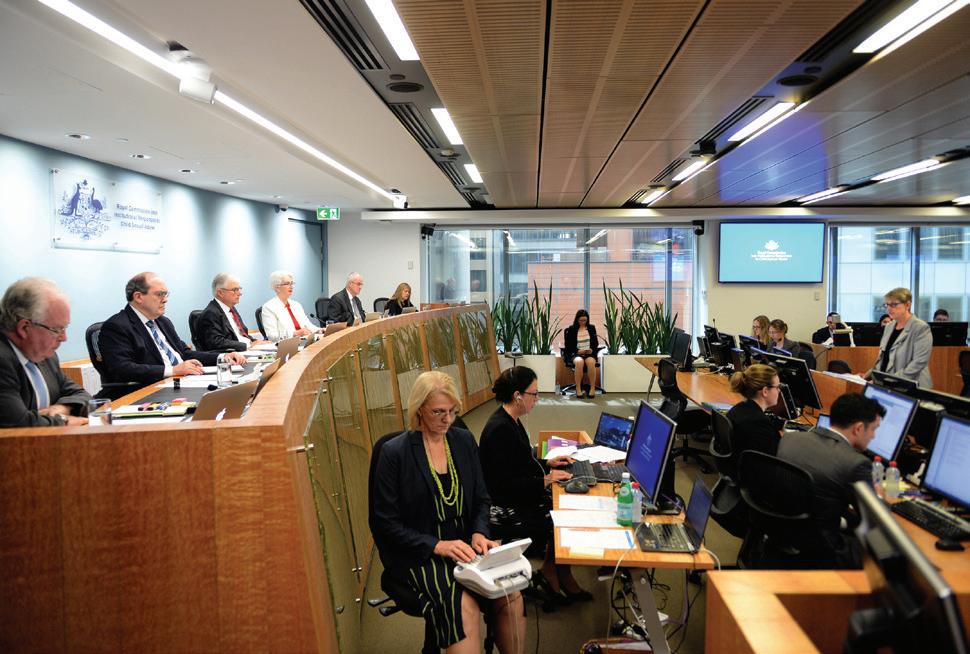
In May 2021, the Governor of Victoria established a Royal Commission, called the Yoorrook Justice Commission, to officially hear, record and address the truths about the historical and ongoing injustices experienced by First Nations Peoples in Victoria since colonisation in 1788 to the present time.
The Royal Commission, the first formal truthtelling body for First Peoples in Australia, gave First Peoples the opportunity to give a publicly documented account of the historic and ongoing systematic injustices they have experienced since colonisation, including why they occurred, and continue to occur, and what or who is responsible. Significantly, the Royal Commission also had the power to make recommendations for law reform and changes in government policy, systems and education to address and remedy injustices.
Like all Royal Commissions, the Yoorrook Justice Commission required substantial funding. In 2021, the Victorian Government allocated more than $58 million to establish and support the Commission, with an additional $6.8 million being allocated to support the process in 2024–2025.
The Yoorrook Justice Commission (the Commission) was set up to inquire into and report on a vast range of areas including:
• historical systemic injustices undertaken by government and non-government organisations such as cultural violations and the denial of First Peoples’ law; theft and destruction of cultural knowledge and property; massacres, wars, killing and genocide; the forced removal of children from
their families (referred to as the Stolen Generation) and other unfair policies and practices relating to child protection, family or welfare matters
• ongoing systemic injustices undertaken by government and non-government organisations in a range of areas including law enforcement and the criminal justice system (including youth detention), healthcare, housing, education, employment and other areas of economic, social and political life
• the causes and consequences of systemic injustice and how it can be fairly acknowledged and redressed in a culturally appropriate way, and make recommendations for law reform and changes in government policy.
The Commission also was asked to make recommendations for law reform and changes in government policy.

Commissioners
A group of five Commissioners were chosen to manage the Commission. To ensure independence, the Commissioners were appointed by an open and transparent process designed by the First Peoples’ Assembly of Victoria and the Victorian Government.
Professor Eleanor Bourke AM (a Wergaia/ Wamba Wamba Elder) was appointed as Chair of the Commission. Professor Bourke had extensive experience working in a number of state and federal government agencies and community organisations (including having been the Co-Chair of Reconciliation Victoria and a Board Member for the Victorian Aboriginal Heritage Council).
and evidence. For example, the Commission held over 400 events, including information sessions, roundtable discussions with various First Nations organisations, academics and experts, and meetings with First Peoples’ Elders (which often took place as group “yarning circles”) to ensure it heard First Peoples’ stories, including the experiences of their families and ancestors. The Commission also heard suggestions for addressing and, as far as possible, rectifying systemic injustices.
The Commission also held more than 60 public hearings (called wurrek tyerrang) to hear stories and gather evidence on a range of important First Peoples issues, including health, education, housing, child protection, criminal justice, land injustice and selfdetermination. These public hearings enabled the Commissioners to meet and talk with vva wide variety of people, including First Peoples, and interested individuals and organisations. All meetings and hearings were conducted in a culturally appropriate and sensitive way, and, as with all Royal Commissions, the Commissioners had the power to ask and, if necessary, compel individuals (e.g., public servants from government agencies, including the Premier of Victoria) to give evidence at hearings under oath.
The Commission also received over 1300 written and oral (verbal) submissions from individuals, families, academics and a wide range of First Nations organisations and other legal and social groups.
In addition to providing the opportunity for First Peoples to have their stories and truths heard and documented for public record and making recommendations for reform, the Commission also generated extensive media coverage, including in the print (local, state and national newspapers), traditional broadcast (television and radio) and digital (online news and social media) media. For example, it was estimated that between April 2022 and May 2025, the Commission was mentioned in at least 21,300 media stories. This coverage helped raise awareness of the Commission’s purpose and the need for law reform.
The information gathering process
Throughout its four-year duration, the Commission used a range of methods to gather information
The Yoorrook Justice Commission produced several interim and final reports, including the:
• Yoorrook for Justice: Report into Victoria’s Child Protection and Criminal Justice Systems (2023), which examined the past
and ongoing injustices experienced by First Nations peoples and communities when having dealings with Victoria’s child protection and criminal justice systems. The report included 46 recommendations to address a wide range of injustices including recommending that the Victorian Government introduce legislation to raise the age of criminal responsibility to 14 years without any exception, to ban the detention of children under 16 years, and to decriminalise offences linked to disadvantage arising from poverty, homelessness, disability, mental ill-health and other forms of social exclusion (such as unlawful camping, loitering and “begging”).
• Yoorrook for Transformation: Third Interim Report (2025), which focused on investigating past and ongoing systemic injustices experienced by First Nations peoples in Victoria in a range of areas (including in relation to land injustice, cultural violations, dispossession, racism, health care, housing security, education and self-determination). The report included 100 recommendations to address a wide range of injustices, including recommending that the Victorian Government make the First People’s Assembly a permanent body to advise the government on matters affecting First Nations Peoples and communities and that it provide redress or compensation to First Nations Peoples for the harm and loss they have suffered as a result of colonisation and the occupation of their land and waters. It also recommended the government strengthen First Nations land rights and provide greater funding to address various areas in which First Nations Peoples experienced inequality (such as housing, education and health).
• Yoorrook: Truth Be Told (2025), which, as the final report of the Commission, provides an official public record of the injustices faced by First Nations Victorians since colonisation, based on their stories and truths about colonisation, for all Victorians.

August 2023. In April 2024, the Victorian Government released its response to this report, indicating that it:
• supported in full four of the 46 recommendations, and supported in principle a further 26 recommendations
• did not support three recommendations and regarded the remaining 15 recommendations as “under consideration”.
As mentioned above, the Yoorrook Justice Commission produced several interim and final reports including the Yoorrook for Justice: Report into Victoria’s Child Protection and the Criminal Justice Systems released in
In fully accepting the four recommendations, the government committed to:
• passing legislation to decriminalise public intoxication (or drunkenness), although such legislation had already been passed by the Victorian Parliament and implemented in November 2023
• addressing the use of solitary confinement at all Victorian adult prisons and youth justice centres, including banning its use on children
• publishing annual statistics about funding for various child protection and family services
• ensuring that new child protection staff complete cultural awareness training.
In contrast, however, the government refused to support recommendations to:
• raise the minimum age of criminal responsibility in Victoria to 14 years without exceptions and to prohibit the detention of children under 16 years.
In fact, although legislation increasing the age of criminal responsibility from 10 to 12 years came into effect in September 2025, the government abandoned its commitment to raise the age to 14 years by 2027 in August 2024.
• enable First Nations people to initiate a civil action at the Victorian Civil and Administrative
Tribunal (VCAT) seeking a remedy (such as compensation) from public authorities that have made decisions that are incompatible with human rights, as protected under the Victorian Human Rights Charter
• amend bail laws to create a presumption in favour of granting bail for all offences other than for most serious offences like murder and terrorism, and place the burden of proving that bail should not be granted on the prosecution, other than for most serious offences like murder and terrorism. In fact, on the contrary, in 2024 and 2025, the Victorian Parliament passed bail reform legislation that increases the likelihood of individuals, particularly First Nations children and adults, being denied bail. For example, the Youth Justice Act (2024) removes the previous requirement that children only be remanded (or held) in custody as a last resort. Additionally, the Bail Further Amendment Bill (Stage 2) Act (2025) requires individuals accused of an indictable offence (such as robbery, motor vehicle theft and assault) while already on bail to demonstrate a ‘compelling reason’ why they should be granted bail again. These and other bail reforms have increased the number of people being held on remand, straining
prison resources and making it harder for prisons to provide adequate healthcare – including mental health and substance abuse treatment – to people who have not faced trial. The laws have also been criticised by several human rights organisations and First Nations groups and advocates who raise concern that they disproportionately affect and harm First Nations peoples, who are significantly overrepresented in Victoria’s prison population. The Commission’s final reports (Yoorrook for Transformation and Yoorrook: Truth be Told ) were tabled in the Victorian Parliament in July 2025 and, although the government response had not yet been published at the time of writing this textbook (February 2026), the Victorian Treaty process, which began over a decade ago in 2016, has addressed some of the recommendations in the Yoorrook for Transformation report. For example, the Statewide Treaty Bill 2025, which was passed by Victorian Parliament in October 2025, establishes a statutory representative body (called Gellung Warl) in Victoria, which includes the First Peoples’ Assembly of Victoria – a body of elected First Nations representatives that will be consulted by the Victorian Government when it is making laws or policies that affect First Nations Victorians.
Another example of a Royal Commission is the Royal Commission on Antisemitism and Social Cohesion (2026), described in the Actual scenario Antisemitism Royal Commission.
On 8 January 2026, the Prime Minister Anthony Albanese announced the establishment of a federal Royal Commission on Antisemitism and Social Cohesion. The announcement came approximately one month after a tragic terrorist attack in Bondi Beach, Sydney, in which 15 victims were killed, and another 40 people were injured, at a Jewish celebration.
In broad terms, and in accordance with the letters patent dated 8 January 2026, the Royal Commission will inquire into the following areas:
• tackling antisemitism by investigating the nature and prevalence of antisemitism in institutions and society, and examining its key drivers in Australia, identifying opportunities to enhance government
responses, making recommendations to counteract and prevent antisemitism, and assessing its impact on the daily life of Jewish Australians
• making recommendations to assist law enforcement, border control, immigration and security agencies to tackle antisemitism (including ensuring these authorities have sufficient powers and resources to do so)
• examining the circumstances surrounding the Bondi terrorist attack on 14 December 2025 (including identifying lessons for security and law enforcement agencies to prevent and respond to similar future attacks)
• make any other recommendations that would contribute to strengthening social cohesion
in Australia, and countering the spread of ideologically and religiously motivated extremism in Australia.
The Commissioner
Virginia Bell AC was appointed as the Commissioner. Ms Bell is a respected and highly experienced former justice of the High Court. She has been awarded an Australian honour (Companion of the Order of Australia) for her outstanding service to the judiciary and the law, including leading criminal law reform and public policy development, and advocating for disadvantaged people.
On the 30 April 2026, Commissioner Bell presented the Royal Commission’s interim report to the Governor-General, Sam Mostyn AC. The report, which focuses on the circumstances surrounding the terrorist attack and any other matters that require urgent action, was also tabled in the Australian Parliament. While the interim report found that there was no gap in current laws that could have prevented the terrorist attack, it contains 14 recommendations
to improve Australia’s counter-terrorism capabilities and law enforcement. For example, the report recommends a review of Australia’s joint counterterrorism teams (which includes state and federal police and the Australian Security Intelligence Organisation (ASIO)) be undertaken and that the New South Wales Police increase security procedures at high-risk Jewish festivals and events, particularly those that involve the public.
The interim report also recommends that the Commonwealth, states and territories prioritise efforts to implement a nationally consistent National Firearms Agreement and the proposed National Gun Buyback Scheme – a scheme that aims to reduce the number of firearms in Australia by enabling the government to purchase surplus, newly banned and illegal firearms.
In May 2026, the Commonwealth Government announced that it accepts all recommendations made in the interim report, and will work closely with state and territory governments to support implementation.
The Royal Commission’s final report (which will address all other matters and terms of reference) is due by 14 December 2026.
As the highest form of inquiry into matters of public concern and importance, Royal Commissions can (while having limitations) be an effective way to influence law reform. Royal Commissions usually generate significant public interest, which places pressure on governments to respond to the findings and recommendations. The strengths and weaknesses of a Royal Commission as a way to influence law reform are examined in Source 5.
Governments can use the findings and recommendations of Royal Commissions to justify making changes in the law and government policy.
Royal Commissions can be important in raising community awareness and interest in a particular area of community concern. They can encourage individuals and groups to not only make submissions to the Royal Commission, but also undertake their own initiatives (including undertaking petitions and demonstrations and using the media) to influence a change in the law.
Because the government asks Royal Commissions to investigate something important, the government may be more likely to act on the Royal Commission’s report and recommendations.
Royal Commissions may lose credibility in situations where the government of the day, which determines the terms of reference, chooses not to include any areas that might be potentially politically damaging for them (i.e., may lead to a loss of voter support), or calls the Royal Commission on a matter to win voter support.
The extent to which a Royal Commission can influence law reform is mixed, and depends on matters such as the subject matter and whether there is bipartisan support for the reform.
Royal Commissions may be used as a tool against political opponents. They may also be used to avoid addressing more critical issues requiring law reform.
Royal Commissions can measure community views on areas of investigation by holding consultations and receiving public submissions.
Royal Commissions can investigate an area comprehensively so the government can initiate a new law that covers the area inquired about.
Royal Commissions have wide-ranging powers, including the power to call anyone to appear before them to give evidence.
Royal Commissions are independent of parliament, and are more likely to remain objective and unbiased in making their recommendations.
There is no obligation on the part of the parliament to support or introduce legislation that adopts any of the recommendations made by Royal Commissions.
Royal Commission investigations can be time-consuming and costly. They take, on average, two to four years to complete, and can be expensive (e.g., the 2001 Royal Commission into the Building and Construction Industry cost $60 million).
Royal Commissions choose how they are to conduct their investigations; therefore it is possible that certain individuals or organisations have relevant information or evidence, but are not called to give evidence or that information is not revealed.
The ability of the Royal Commission to influence law reform depends on the timing of its reporting and its terms of reference. For example, if it is to report immediately after an election, its influence might be diminished.
your learning 13.8 Remember and understand
1 What is a royal commission?
2 Explain why royal commissions are considered the most serious and important types of inquiries into matters of public interest or concern.
3 Describe two differences between a royal commission and a parliamentary committee.
Examine and apply
4 Prepare a chart that describes the main processes followed by a Royal Commission.
5 Read the Actual scenario Yoorrook Justice Commission.
a What is the Yoorrook Justice Commission?
b Briefly describe why the Victorian Government established the Yoorrook Justice Commission.
c Describe the main ways the Royal Commission gained information from First Nations peoples.
d Describe three specific recommendations made by the Royal Commission. You can go to the Yoorrook Justice Commission website to conduct some research into these areas and/or recommendations.
Weblink: Yoorrook Justice Commission
e Referring to this Royal Commission, evaluate two strengths of Royal Commissions as a means of influencing law reform.
6 Read the Actual scenario Antisemitism Royal Commission.
a Explain why the Royal Commission into Antisemitism and Social Cohesion was established.
b Describe two areas the Royal Commission will inquire into.
c Outline two likely ways the Royal Commission will gain information from interested individuals and organisations.
d Go to the Royal Commission on Antisemitism and Social Cohesion website to conduct some research on the Commission’s recommendations. Describe three recommendations for legal change or policy reform.
Weblink: Royal Commission on Antisemitism and Social Cohesion
e Describe one action taken by the Commonwealth Government in response to the recommendations made by the Royal Commission.
Reflect and evaluate
7 Using one recent example, evaluate the ability of Royal Commissions to influence a change in the law.
1 When responding to questions in the final examination, it is not necessary to define key legal terms or organisations (such as parliament, the Victorian Law Reform Commission, parliamentary committee and Royal Commission), unless the question specifically asks for a definition.
2 You must be able to provide examples of the reasons for law reform, the role of the media (including social media) in law reform, and the means by which individuals and groups can influence law reform (i.e., through petitions, demonstrations and the courts). Many examples are included in this module. Try using flashcards that have the explanation of the means or role, and an example on the other side, to help you remember examples.
3 You must be able to evaluate the ability of the Victorian Law Reform Commission and either Royal Commissions or parliamentary committees to influence change in the law. You must provide one recent example of a Victorian Law Reform Commission inquiry relating to law reform in the civil or criminal justice system and one example of either a recent Royal Commission or parliamentary committee inquiry. Students often confuse which example relates to which law reform body, so think of a way not to mix them up.
The following questions have been arranged in order of difficulty, from low to high. It is important to practise
a range of questions, as assessment tasks (including the exam) are composed of a variety of questions. A great way to identify the difficulty of the question is to look at the command term (or terms) used in the question and the mark allocation. Work through these questions to revise what you have learnt in this module.
Difficulty: low
1 Explain how the media can be used to influence a change in the law. (3 marks)
Difficulty: medium
2 Compare the role of the Victorian Law Reform Commission (VLRC) in influencing law reform to that of a parliamentary committee or a Royal Commission. (6 marks)
Difficulty: high
3 “Without the Victorian Law Reform Commission, the Victorian Parliament would not be able to make laws that reflect the views of the community.” To what extent do you agree with this statement? Justify your answer. (8 marks)
Read the information at the beginning of the module relating to the Outcome (page 453), Key knowledge (page 453) and Key skills (page 453) before attempting this assessment task.
Use stimulus material, where provided, to answer the questions in this section. It is not intended that this material will provide you with all the information to fully answer the questions.
In December 2025, the Victorian Parliament passed the Justice Legislation Amendment (Police and Other Matters) Bill 2025 to end violent and hateful behaviour at demonstrations and help keep Victorians safe. The new legislation, introduced by the Victorian Labor Government, aims to deter individuals and groups from engaging in violent demonstrations by giving Victoria Police increased powers to take action against protesters who act in a violent or dangerous way.
For example, the new laws ban protesters from using items (such as locks, glue and ropes) to lock themselves onto other people, surfaces or objects (such as roads, bridges and buildings), in a way that is
likely to cause injury to others or serious risk to public safety, at public protests. A person who is found guilty of locking or securing themselves or another person to another person or “thing” at a public protest now faces a maximum fine of 120 penalty units or 12 months’ imprisonment, or both.
The new laws also allow police to direct a protester to remove any face covering (e.g., a mask) they are wearing at a public protest if the police have reasonable grounds to believe the protester intends to commit an offence, or has committed an offence, during the protest. A person who fails to comply with such a direction faces a maximum fine of five penalty units. Interestingly, the law does not apply to people who are wearing the face covering reasonably and in good faith (e.g., wearing the face covering for a genuine religious or cultural purpose, or a genuine medical purpose).
Although the legislation was passed by the parliament with the support of the Liberal–National Coalition, it was not supported by the Victorian Greens. Several human rights, legal and activist groups also opposed the legislation, claiming some of the new laws it created are vague, unnecessary and restrict the right of people to protest. For example, the Human Rights Law Centre (HRLC) opposed the laws that allow police to direct protesters to remove face coverings at public protests for reasons including that it “demonises” or devalues people who engage in peaceful protests to seek social and legal change. The law could also be used to discriminate against people who wear a mask for safety and for political expression.
Some critics of the legislation also raised concern that banning protesters from using items to lock themselves to other people, surfaces or objects criminalises individuals and groups who use this method of protest to gain media attention and generate awareness of the need for social change (e.g., climate activists who lock themselves together to form human barriers against environmental destruction). Other critics, including climate activist groups, urged members of the community to email their local member of parliament to express their objection to the laws.
1 Describe one reason why laws need to be changed. (3 marks)
2 Explain how an individual could use the courts to influence a change in the new laws created by the passing of the Justice Legislation Amendment (Police and Other Matters) Bill 2025 (Vic). (3 marks)
3 Discuss the effectiveness of environmental and climate action groups using demonstrations to influence a change in the law. (6 marks)
4 The Victorian Government did not ask the Victorian Law Reform Commission to conduct an inquiry into the need to strengthen Victoria’s anti-protest laws. Discuss the potential benefits that could have been gained by doing so. (8 marks)
Total: 20 marks
Now that you have completed this module, reflect on your ability to understand the key knowledge from the Study Design. If you feel you need some more practice, use the revision links to revisit the key knowledge.
Remember that you will also need to be able to draw on and understand the key skills outlined in the Study Design.
Key knowledge
• Reasons for law reform
• The means by which individuals or groups can influence law reform, including through petitions
• The means by which individuals or groups can influence law reform, including through demonstrations
• The means by which individuals or groups can influence law reform, including through the use of the courts
• The role of the media, including social media, in law reform
• The role of the Victorian Law Reform Commission and its ability to influence law reform
• One recent Victorian Law Reform Commission inquiry relating to law reform in the civil or criminal justice system
• The role of parliamentary committees in law reform and their ability to influence law reform
• One recent parliamentary committee inquiry
• The role of Royal Commissions in law reform and their ability to influence law reform
• One recent Royal Commission inquiry
Module review quiz: Law reform
I understand this I need some more practice to understand this
Go back to Lesson 13.1 (page 454).
Go back to Lesson 13.2 (page 466).
Go back to Lesson 13.3 (page 470).
Go back to Lesson 13.4 (page 475).
Go back to Lesson 13.5 (page 478).
Go back to Lesson 13.6 (page 487).
Go back to Lesson 13.7 (page 495).
Go back to Lesson 13.8 (page 503).