Arika Waulu
Artist Arika Waulu discusses their work for WILAM BIIK, an exhibition of knowledge and of the unsevered connection between the First Peoples of South East Australia and their Country, over thousands of generations.
I’m Arika Waulu. I’m a Koolyn, Gunnai, Djap Wurrung, Peek Wurrung and Dhauwurd Wurrung artist.
This work speaks to honouring shared countries and the agreements that we had and can still honour through taking care of Country together. At the moment we know that they’re destroying our shared country and this digging stick can be seen as a symbol of resistance to that.
We use the lava stone (koolor) also as another symbol of resistance. It’s a garden rock that once built our houses so for me the koolor represents the home.
The Gunnai Matriarchal Tree is a representation of the bloodlines on Gunnai country. At the bottom we have the younger generations and then the next layer we have the middle generations and then my mother’s generation and then her mother, father and so on. As it reaches the top, it comes back into a full circle as you can see: the koolor at the top and the koolor at the bottom.
SAMPLE
sense to dream up those yellow fields that was once recorded by first settlers.
The Pun’Yin/murnong, Pun’Yin in my language, is another symbol of resistance and thriving.
I want people to look into the history, I want people to know where they live, learn and play, and I want them to honour that and honour that Country that they’re on, and I want them to honour the animals that live there.
For our people, the murnong is a staple food not just for survival but to be able to thrive. To see the numbers dwindle throughout history – for me it only makes
It’s taking acknowledgement to another level. We can’t just say we acknowledge that we live here and we colonise, it’s not good enough. You have to be active in helping to decolonise. Planting native plants in your garden, the protection of land, the protection of animals. There are original peoples here that have the best interests of the land and waters and animals far beyond anybody, more than any non-government organisation (NGO) could ever have. It goes back to knowing how we are connected and that we are connected and that we are a part of it. We are a part of this land, we are part of the waters, and we are part of the animals. We are not separated.
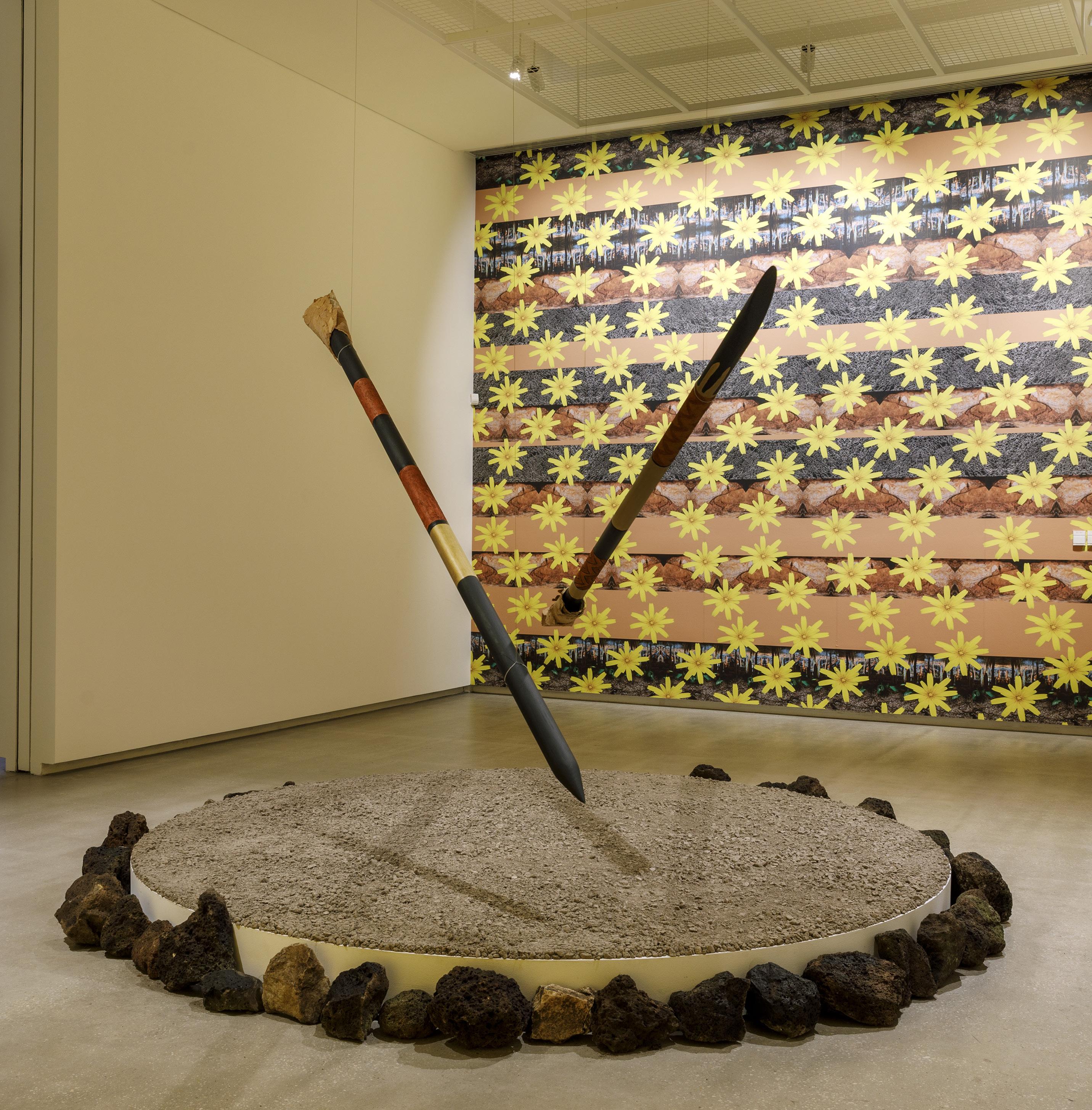
Arika Waulu / Koolyn/Gunnai/Djap Wurrung/Peek Wurrung/Dhauwurd Wurrung / Yuccan Noolert (Mother Possum) 2021 /wood, red ochre, yellow ochre, charcoal, acrylic, ink, melaleuca bark, crushed granite, koolor (lava stone) / dimensions variable (installation view from Wilam Biik 2021) / Courtesy of the artist and TarraWarra Museum of Art / Photograph: Andrew Curtis
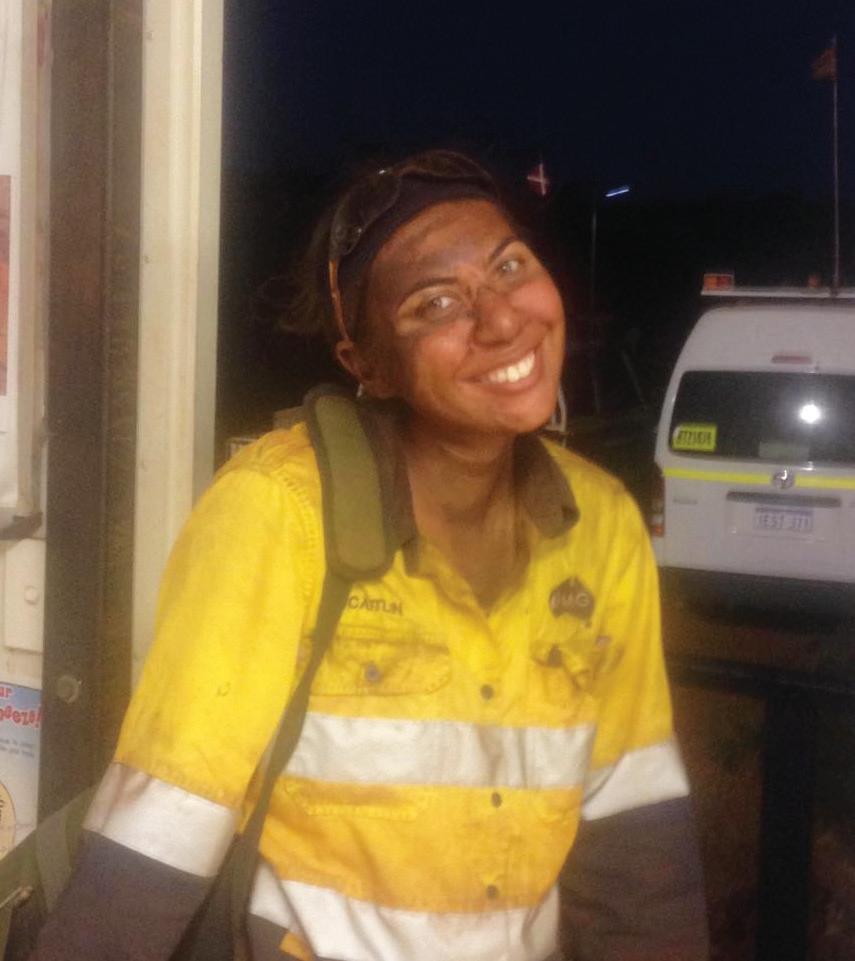
Caitlin Smith, geologist
proud Banjima woman
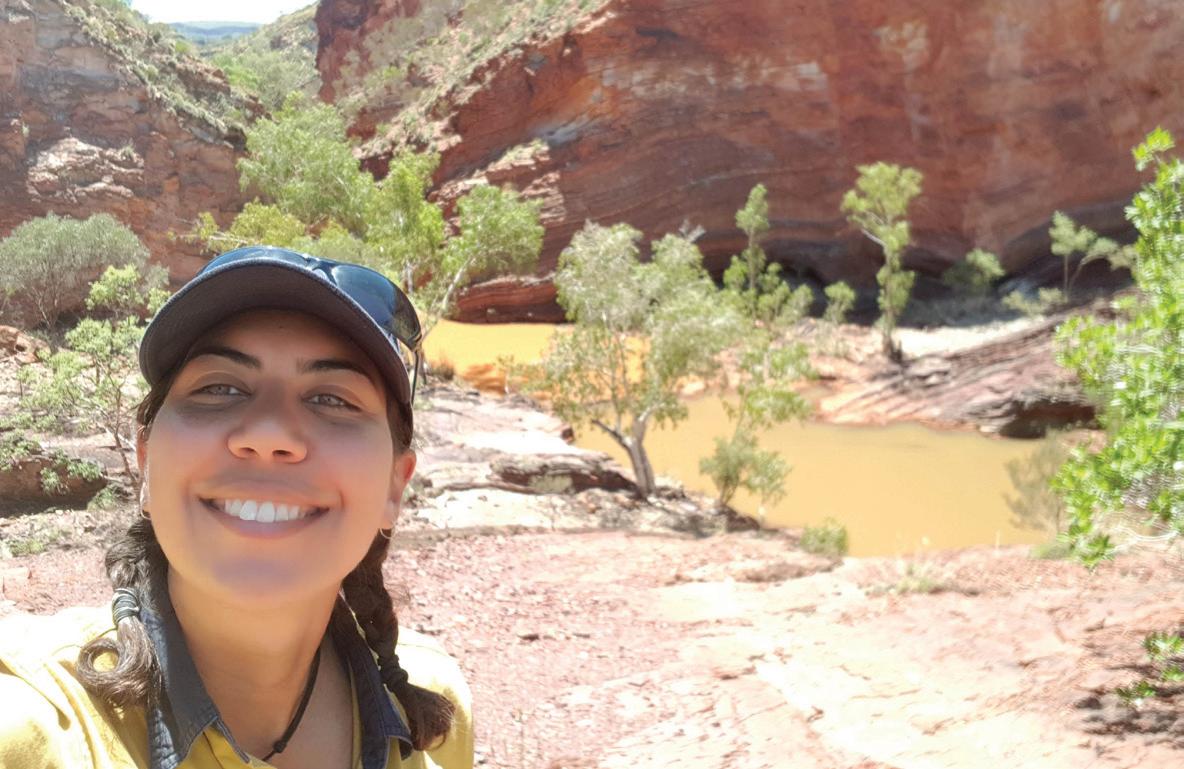
The sky is so big, so big and blue and stretched out over the land I am standing on. The only thing in that sky is the sun beating heat down onto me, my work ute and the silent drill rig taking up the drill pad. The drill crew have driven away in search of a vital piece of equipment. I am all alone. And I love it.
It’s about three hours to the closest town, an hour and a half to camp. But I am not scared. I love the bush, and I love it all the more when it’s just me.
I don’t really walk, more amble, slowly swinging one long leg in front of the other over and over with no pressure to hurry. I think this is how my ancestors would’ve moved through this same bush, and I again feel so lucky to have found a job that lets me work out in the bush that is my home.
SAMPLE
I’m a geologist. When I was growing up, I used to scour the ground in search of interesting or pretty rocks whenever my family went to the beach or out bush. I didn’t even know that rocks were a thing you could study, and I had no idea there were people who went to work to look at rocks. I found that out by accident when I was at university.
Small puffs of red dirt jump out of the way of my work boots as I saunter along the outside of the drill pad. We think of dirt as being brown. But it’s red out here, a pretty bright red sitting under a striking blue sky. I sit down on the windrow, and the dirt burns for a moment before I get used to it. I am looking out across the land, through the skeletal trees at the rocks poking up out of the ground. In my mind, I am trying to map what the rocks look like below. I know the others should be back soon, as they’ve been gone for hours, and I know once they are back, I won’t have any time to map out the geology. I’ll be too busy logging the drill sample and figuring out if we’ve reached the target and can move to the next hole –always on the lookout for asbestos.
I have more responsibility than I was first comfortable with, but now that I’ve been doing this a while, I am confident in calling the shots. It amazes me that I am doing this job, and that I am making important decisions that cost lots and lots and lots of money. Little Caitlin would be amazed to see herself grown up and running the show out here. All she knew was that little girls could be teachers or nurses or work in an office doing office things.
I pull my mind back from the past because I’ve noticed something. I get up, dust myself off and wander over to what turns out to be an old tin box. It’s old and rusted, I can’t make out the flakes peeling up from the surface. It’s funny to think that this old tin box from the last century is the youngest thing out here. It’s also funny to me to think that my ancestors are also young bubbas compared to the rocks I’m standing on.
I hear an engine growling as the drill crew returns from their trip. I amble back to my car, grab a drink of water and get my paperwork together.
“We’ve got what we needed. Give us twenty minutes, and we should be good to go,” the driller tells me as they get out of the car.
“Sweet! I reckon about 10 more metres, and we can finish up here and move to the next hole,” I tell him.
“Rogie.”
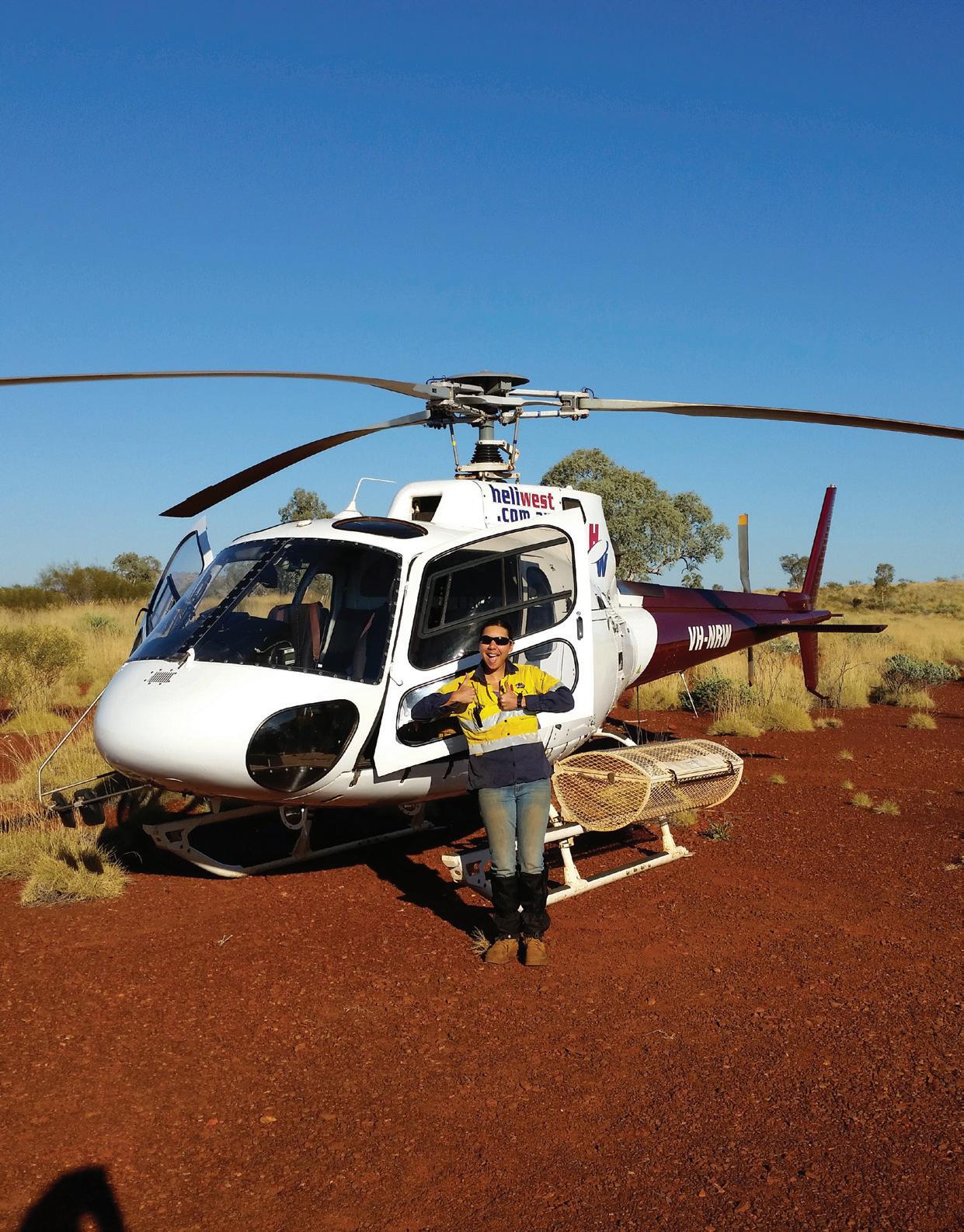
Soon enough, the drill rig is roaring as she hammers her way through the rock underneath, then the pulverised shale comes out of the cyclone in pale pink gloop, looking like melted ice cream. I tell the driller to cut the hole.
Vocabulary
windrow a raised mound of dirt used as a safety barrier along haul roads
cyclone a part of the drill rig from which samples are collected; vital for quality control drill pad a levelled area to provide a stable base for drilling equipment
The Gurindji strike
Wave Hill walk-off
Life on Wave Hill Station
In 1883 the Wave Hill Station was established on the Gurindji people’s traditional lands in the Northern Territory. The station was owned by a British lord, Lord Vestey.
Life changed forever for the Gurindji people. The cattle ate and trampled the desert plant life and fouled the waterholes. Much of their food supply, like kangaroos, were shot by the colonisers.
The Gurindji were forced to work on the cattle station as stockmen, labourers and domestic servants. They were given little remuneration for their work, mostly in the form of minimal food supplies and appalling housing.
In 1947, the Vestey Brothers told an anthropologist that they “are opposed to the payment of wages to [First Nations people], and consider that there has been enough trouble with wage systems. Money seems to be the root of all evil.”
SAMPLE
The food was bad – just flour, tea, sugar and bits of beef like the head or feet of a bullock. The Vestey’s mob were hard men. They didn’t care about blackfellas.”
Enough is enough
Vincent Lingiari was an Elder of the Gurindji and Malgin peoples. From the age of 12, he worked as a stockman at Wave Hill.
On 23 August 1966 Vincent Lingiari took things into his own hands. He led members of the Gurindji people, along with members of the Ngarinman, Bilinara, Warlpiri and Mudbara peoples off Wave Hill Station. Billy Bunter Jampijinpa was only 16 when the walk-off happened:
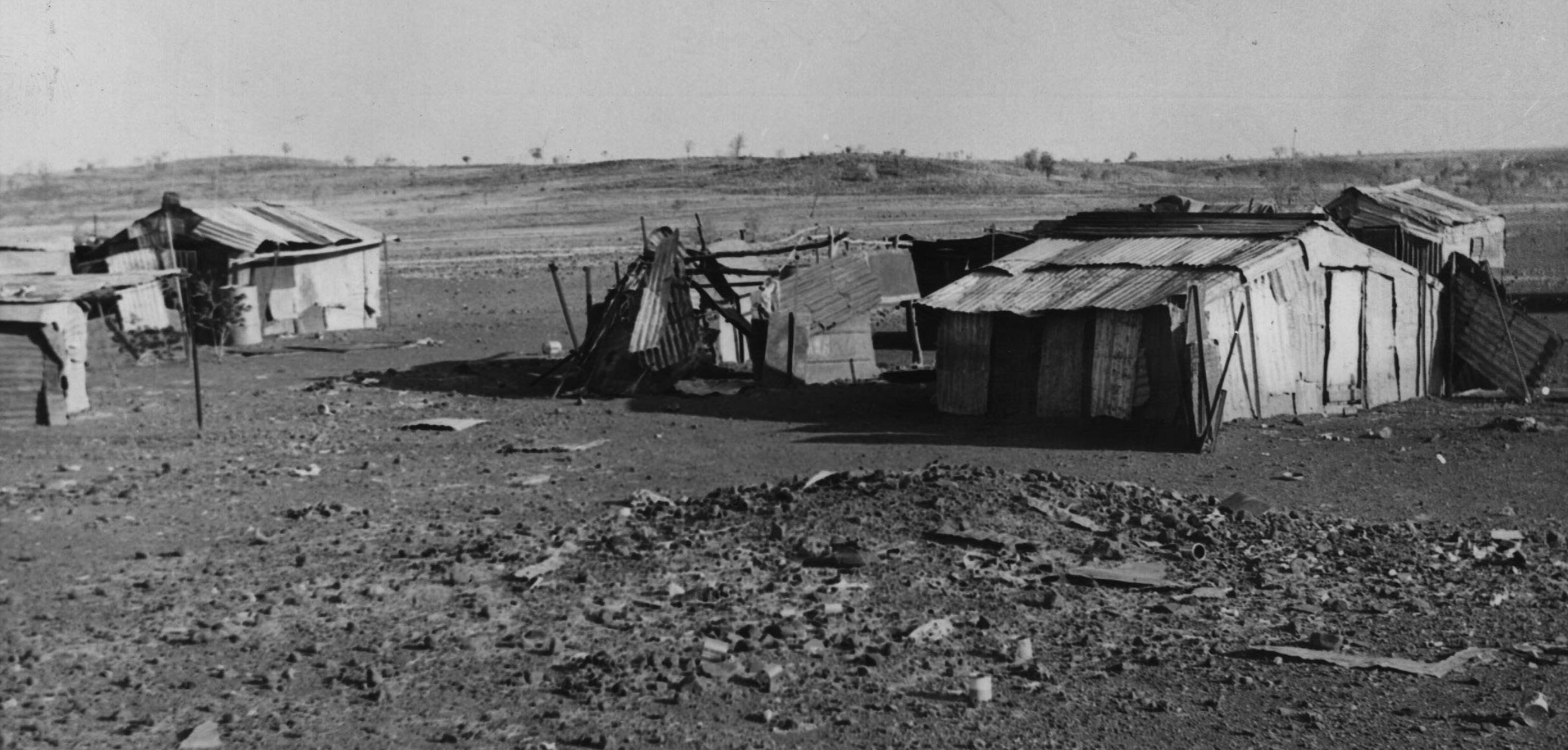
Billy Bunter Jampijinpa lived on Wave Hill Station. He said, “We were treated just like dogs. We were lucky to get paid the 50 quid a month we were due. We lived in tin humpies. You had to crawl in and out on your knees. There was no running water.
“Vincent pulled everyone out on Tuesday and we walked with the kids and our swags to the Victoria River where we camped till after Christmas. After we had been there a couple of days, the Vestey’s mob came and said they would get two killers (slaughtered cattle) and raise our wages if we came back. But old Vincent said, ‘No, we’re stopping here.’ Then in early 1967 we walked to our new promised land, we call it Daguragu (Wattie Creek), back to our sacred places and our Country, our new homeland.”
“ We lived in tin humpies. You had to crawl in and out on your knees.”
Vincent Lingiari and the Gurindji people continued their strike for eight long years at Daguragu despite harassment, threats of violence and evictions and efforts to cut off their food supplies.
The strike that became a land claim
The walk-off that started as a strike over Aboriginal cattle workers’ wages and conditions became something much more. Vincent Lingiari and the Gurindji people were fighting to win back their land. Often the Gurindji were close to starvation. Yet when Lord Vestey offered to pay the Gurindji some “money” wages, Vincent Lingiari refused, telling Lord Vestey, “You can keep your gold, we just want our land back.”
Victory at last
The Gurindji people’s land claim fell on deaf ears for many years until a change of government in 1972. The new government, under the Prime Minister Gough Whitlam,
moved to support the Gurindji claim. A stop was placed on development leases that could damage First Nations rights, mining exploration licences were suspended, and a small grant of land was given at Daguragu (Wattie Creek), as an initial step towards the final land handover.
On 16 August 1975, Gough Whitlam addressed Vincent Lingiari and the Gurindji people, saying, “On this great day, I, Prime Minister of Australia, speak to you on behalf of all Australian people – all those who honour and love this land we live in. For them I want to say to you: I want this to acknowledge that we Australians have still much to do to redress the injustice and oppression that has for so long been the lot of Black Australians. Vincent Lingiari, I solemnly hand to you these deeds as proof, in Australian law, that these lands belong to the Gurindji people and I put into your hands part of the earth itself as a sign that this land will be the possession of you and your children forever.”
Dallas Davis, the Scientist and the City Kids
A play by Gayle Kennedy (Wongaiibon), based on Jared Thomas’s (Nukunu) novel Dallas Davis, the Scientist and the City Kids
Cast:
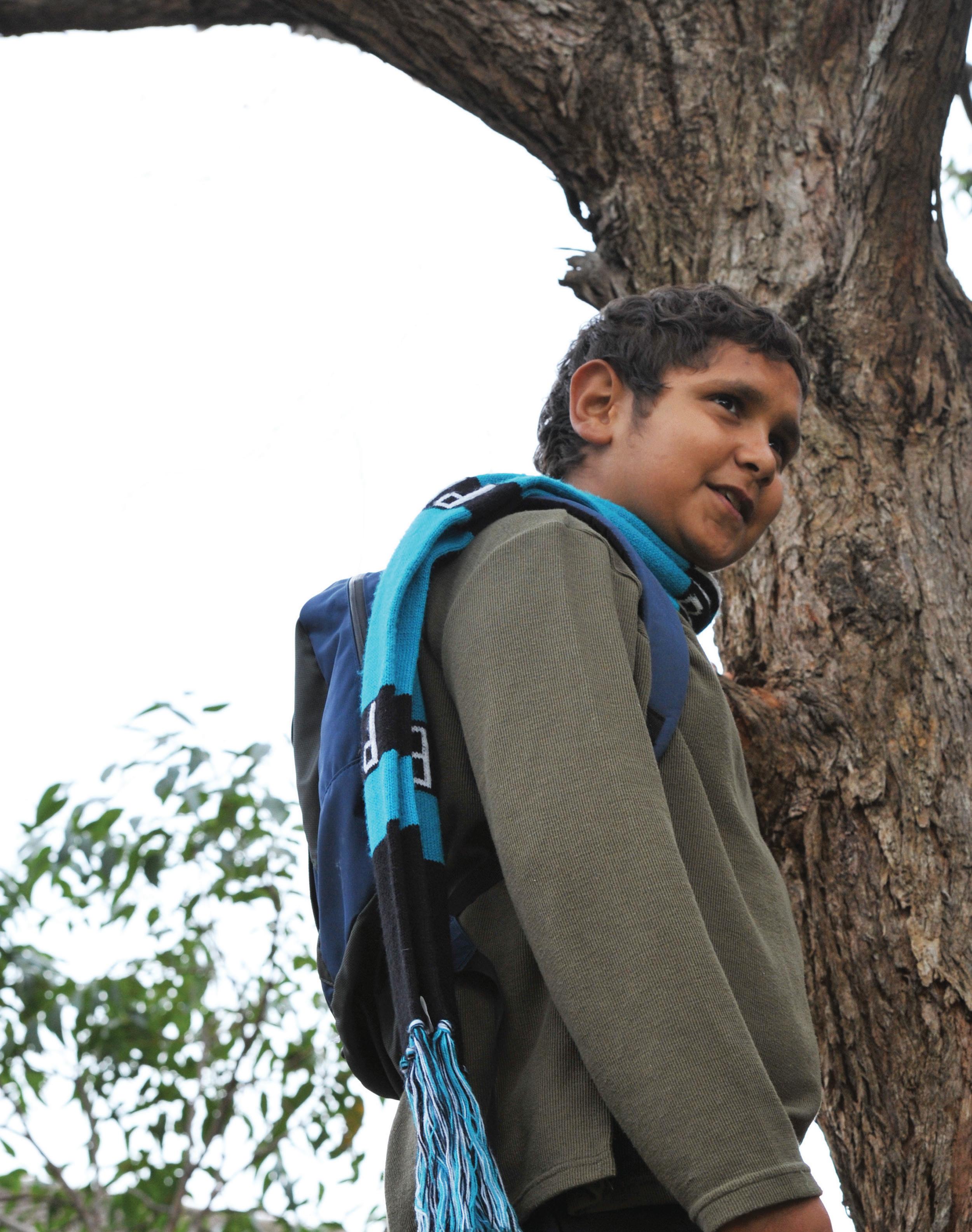
DALLAS DAVIS, 14-year-old Aboriginal boy
BILLY, 10-year-old cousin of Dallas
LYNNE, 8-year-old cousin of Dallas
MICHELLE, 13-year-old non-Aboriginal girl
CHRISTOPHER, 15-year-old nonAboriginal boy
Props:
Fake yabbies, yabby nets, a large esky, a portable radio.
All the kids are in beanies, jeans and jackets. BILLY wears a bandanna around his neck as well. The non-Aboriginal kids are in fairly flash outfits though, with fancy scarves, leather gloves, latest jeans.
Setting:
A fake waterhole filled with fake yabbies. To one side is a large esky, which will hold the yabbies. A portable radio is playing the AFL softly in the background.
BILLY and LYNNE are standing around the waterhole checking the nets. The other kids are sitting around listening to the footy, barracking for Port Adelaide.
CHRISTOPHER: Pow-er! (Claps three times) Pow-er! (Claps three times)
DALLAS: (Looking amazed at CHRISTOPHER) You follow Port Adelaide too?
CHRISTOPHER: (With a superior look) Absolutely. Dad’s got member’s tickets. He and people he works with at the university work with the players.
DALLAS: Doin’ what?
CHRISTOPHER: They advise them on the best food to eat, best ways to train, that kind of stuff.
DALLAS: Wow, that would be awesome. How do you get a job like that?
CHRISTOPHER: Well, you have to have a university degree to start with.
DALLAS: Ohh right! So what’s your school like?
CHRISTOPHER: It’s fairly normal. Got a pool, tennis courts, science labs, gym. You know, the usual stuff!
DALLAS: That’s normal? Man, we don’t even have a lawn or a proper gym with basketball rings at our school!
MICHELLE: He’s just showing off, Dallas. Not all schools have all that. Our parents pay a lot of money in fees for all those things.
DALLAS: Well you mob must have a lot of money then.