Oxford University Press is a department of the University of Oxford. It furthers the University’s objective of excellence in research, scholarship, and education by publishing worldwide. Oxford is a registered trademark of Oxford University Press in the UK and in certain other countries.
Published in Australia by Oxford University Press
Level 8, 737 Bourke Street, Docklands, Victoria 3008, Australia
The moral rights of the authors have been asserted
First published 2016
Second edition 2023
All rights reserved. No part of this publication may be reproduced, stored in a retrieval system, or transmitted, in any form or by any means, without the prior permission in writing of Oxford University Press, or as expressly permitted by law, by licence, or under terms agreed with the reprographics rights organisation. Enquiries concerning reproduction outside the scope of the above should be sent to the Rights Department, Oxford University Press, at the address above.
You must not circulate this work in any other form and you must impose this same condition on any acquirer.
ISBN 9780190331726
Reproduction and communication for educational purposes
The Australian Copyright Act 1968 (the Act) allows educational institutions that are covered by remuneration arrangements with Copyright Agency to reproduce and communicate certain material for educational purposes. For more information, see copyright.com.au.
Edited by Natasha Broadstock
Typeset by Newgen KnowledgeWorks Pvt. Ltd., Chennai, India
Proofread by Katie Lawry
Indexed by Max McMaster
Printed in Singapore by Markono Print Media Pte Ltd
The authors and publisher of Oxford Humanities and Social Sciences second edition Australian Curriculum would like to thank Peter Lawrence and Sally Lawrence (Black Cockatoo) for their review of content concerning First Nations peoples of Australia.
Disclaimer
Aboriginal and Torres Strait Islander peoples are advised that this publication may include images or names of people now deceased.
Links to third party websites are provided by Oxford in good faith and for information only. Oxford disclaims any responsibility for the materials contained in any third party website referenced in this work.
DRAFT
CO NT E T
3B
3C
3.13
Chapter 5
Chapter 6
Geographies of human wellbeing
Chapter 4
4A
4.1
4.2
PART 2
History
Concepts and skills
Chapter
World War II (1939–1945)
Chapter
8A
Building modern Australia (post-1945)
10A How have technological developments impacted popular culture in Australia since 1945?
10.1 Changes in technology since 1945
10.2 Changes in health and population since 1945
10.3 Australia’s role in global conflicts since 1945
10.4 Popular culture: a timeline
10.5 Changes to radio and film
10.6 Changes to music
10.7 The impact of changing technology on television and film
10.8 The birth of Australian soapies and mini-series
10A Skills in Context: The influence of popular culture in Australia
10B How has Australian popular culture influenced global industries since 1945?
10.9 Changes in the music industry
10.10 Changes in the film industry
10.11 Changes in the television industry
10.12 Australian music goes global
10.13 Australian film goes global
10.14 Australian television goes global
10B Skills in Context: ‘Ozploitation’
10C How has the environment movement influenced perceptions and policies since 1945?
10.15 The environment movement: a timeline
10.16 The birth of the environment movement
10.17 The impact of population increase and urbanisation
10.18 The influence of popular culture
10.19 The influence of environmental ideas
10.20 Key campaigns and events, 1945–75
10.21 Nuclear weapons testing
10.22 Nuclear disasters
10.23 Significant events and campaigns in Australia
10.24 Australian government responses
10.25 International responses, protocols and treaties
10C Skills in Context: Environmental threats to the Daintree Rainforest Chapter review
PART 3 Economics and business Skills
Chapter
and business
and
13B What is the con nection between
13.4
13.5
PART 4
Civics and citizenship Skills
Chapter 14
14A
14.1
Chapter 15
15A What are the key features of Australia’s system of government and democracy?
15.1
15.3
15A
15B How does Australia’s system of government compare to others in the region?
15.4
15B
15C What are Australia’s global rights and responsibilities?
15.6 Australia’s regional role and responsibilities 490
15.7 Australia’s role as a member of the United Nations ............. 492
15.8 Australia’s international role and responsibilities 494
15C Skills in Context: Australia’s treatment of
Laws and citizens
Throughout Humanities and Social Sciences, you will study four distinct subjects: Geography, History, Economics & Business and Civics & Citizenship. Each of these subjects has its own set of key skill areas that you will learn about and develop through the course of your study. This table of contents shows where you can find the opportunities to practise these skills, both in the book and on obook pro. For more information on the key skill areas listed, visit the toolkit for each subject.
Geography skills
Key skill
Curriculum sub-strand: Questioning and researching using geographical methods
Curriculum sub-strand: Interpreting and analysing geographical data and information
QUESTIONING & RESEARCHING
INTERPRETING & ANALYSING
Developing geographical questions
Evaluating the reliability of websites
Conducting geographical research
Constructing overlay maps from satellite images
Creating a Google Earth tour
Annotating ground-level photographs
Measuring longshore drift
Mapping environmental change using multiple overlays
Conducting successful fieldwork
Conducting scatterplots using Microsoft Excel
Developing questions from media reports
Collecting and mapping data
Calculating a wellbeing index
Interpreting and creating population pyramids
Constructing a multiple-line graph
Drawing a cross-section using contour lines
Identifying patterns on maps
Using a satellite image to investigate environmental change
Using satellite images to analyse environmental change
Analysing change over time
Analysing topographic maps
Analysing complex maps
Analysing environmental issues using complex maps
Analysing maps
Comparing choropleth maps
Distinguishing between qualitative and quantitative data
Collecting and evaluating geographical photos
DRAFT
Planning, creating and delivering a PowerPoint presentation
Communicating Chapter 2
Communicating Chapter 3
Communicating Chapter 4
Communicating Chapter 5
History skills
Creating a timeline
Exploring German payment of reparations
Exploring Australian propaganda
Sequencing events in Europe during WWII
Sequencing events in the Asia–Pacific during WWII
Exploring the role of women in the workforce
Sequencing the White Australia Policy
Understanding the significance of multiculturalism
Understanding the migration debate
Considering perspectives
Sequencing the struggle for land rights
Identifying and analysing different historical interpretations
Determining the significance of Silent Spring
Sequencing
Writing a historical discussion
Writing a historical discussion
Communicating Chapter 8
Understanding different types of migration
Writing with evidence
Writing historical discussions that use evidence from a range of sources
Creating and delivering an
Chapter 9
Economics & business skills
Civics & citizenship skills
INTRODUCING OXFORD HASS 7–10
Oxford Humanities and Social Sciences Australian Curriculum has been developed to meet the requirements of version 9.0 of the Australian Curriculum: Humanities and Social Sciences across Years 7–10. As well as offering complete coverage of Geography, History, Economics and Business, and Civics and Citizenship, this new edition ensures that students build their Humanities and Social Sciences skills across all four subjects, preparing them for success in HASS subjects in the senior years.
The series offers a completely integrated suite of print and digital resources to meet your needs, including: > Student Book > Student obook pro > Teacher obook pro.
Key
features of Student Books
Visible thinking prompts
• Visible thinking prompts encourage students to develop their critical thinking and analysis skills.
Skills in Context tasks
• Skills in Context tasks provide in-depth skills practice, encouraging students to apply the knowledge and skills they have learnt to a new case study, event or issue.
> The Student Books combine complete curriculum coverage with clear and engaging design.
> Each print Student Book comes with complete access to all of the digital resources available on Student obook pro.
Focus on skill development
Check your learning
• Each topic finishes with a set of questions that enable students to meet the learning intentions and consolidate their learning.
Cognitive verbs
• Questions are generally phrased using bolded cognitive verbs, which state what is expected of a student and helps develop their understanding of questions beyond ‘who, what, when, where and why’.
Key skills
• Key skill activities enable students to practise and master skills in each subject. More key skill activities are available via Student o book pro to provide comprehensive coverage of HASS skills.
Extend your understanding
• These activities challenge students to conduct further research or complete group work to deepen their understanding of an issue or skill.
Focus on engagement
Topic-based approach
• Chapter content is sequenced in numbered topics to support teaching and learning.
Learning intentions
• Each topic begins with a statement of learning intentions, which link the content to the curriculum
Source materials
• A variety of source materials such as photographs, maps, illustrations, text extracts and graphs will spark students’ curiosity and provide rich learning opportunities.
Focus on support for mixed-ability classrooms
Margin glossary terms
• On-page glossary definitions are provided for key terms, supporting students at their point of learning. Key terms also appear in a glossary at the end of the book, and can be revised in a Quizlet game via Student obook pro.
Integrated digital resources
• Digital icons signpost a range of engaging resources that can be accessed via Student o book pro, including drag-and-drop activities, video quizzes, virtual field trips and quick quizzes. These resources are directly integrated with the topic being covered.
Easy-to-access text and design
• The text is written in clear and concise language and the text design is appealing and easy to navigate.
Focus on STEAM
Integrated STEAM projects
DRAFT
Chapter review
• At the end of each chapter, a review activity gives students the chance to consolidate their knowledge and apply the skills they have learnt throughout.
Structured questions
• Questions for each topic are categorised according to the Marzano and Kendall taxonomy, catering for a range of abilities.
• Students are encouraged to self-assess their learning in the chapter checklist at the end of the chapter. If students do not feel confident about their learning, they are directed back to the relevant topic.
Problem solving through
design thinking
• Take the hard work out of cross-curricular learning with engaging STEAM projects. Two fully integrated projects are included at the end of each book in the series, and are scaffolded and mapped to the Humanities and Social Sciences, Science and Maths curricula. The same projects also feature in the corresponding Oxford Science and Oxford Maths series to assist cross-curricular learning.
• Each STEAM project investigates a real-world problem that students are encouraged to problem-solve using design thinking.
Full digital support
• Each STEAM project is supported by a wealth of digital resources, including student booklets to scaffold students through the design thinking process of each project, videos to support key concepts and skills, and implementation and assessment advice for teachers.
INTRODUCING OXFORD HASS 7–10
Key features of Student obook pro
> Student obook pro is a completely digital product delivered via Oxford’s online learning platform, Oxford Digital.
> It offers a complete digital version of the Student Book with interactive note-taking, highlighting and bookmarking functionality, allowing students to revisit points of learning.
> A complete ePDF of the Student Book is also available to download for offline use and read-aloud functionality.
Focus on eLearning
Complete digital version of the Student Book
• This digital version of the Student Book is true to the print version, making it easy to navigate and transition between print and digital.
Interactive assessments
• Each topic in the Student Book is accompanied by an interactive assessment that can be used to consolidate skills and knowledge and for formative assessment.
• These interactive assessments provide a mix of auto- and teacher-corrected questions , with students receiving instant feedback on achievement and progress. Students can also access all their online assessment results to track their own progress and reflect on their learning.
DRAFT
Quizlet
• Integrated Quizlet sets, including real-time online quizzes with live leaderboards, motivate students by providing interactive games that can be played solo or as a class. Quizlet can be used for revision or as a warm-up activity when a chapter is introduced.
Additional resources
• A rich variety of additional resources such as interactive layered maps, videos, worksheets, quizzes and weblinks are linked to individual topics in the book so they can be accessed at the point of learning.
> integrated Australian Concise Oxford Dictionary look-up feature
> interactive assessments to consolidate understanding
> integrated Quizlet sets including real-time online quizzes with live leaderboards
> additional resources available at the point of learning
> access to their online assessment results to track their own progress
Integrated dictionary
• Each digital Student Book provides an integrated Australian Concise Oxford Dictionary lookup feature, so students can quickly access any terminology they aren’t sure of and continue their learning.
Benefits for students
Key features of Teacher obook pro
> Teacher obook pro is a completely digital product delivered via Oxford Digital
> Each chapter and topic of the Student Book is accompanied by full teaching support. Teaching programs clearly direct learning pathways throughout each chapter and provide ideas for differentiation.
> Teachers can use their Teacher obook pro to share notes and easily assign resources or assessments to students, including due dates and email notifications.
Focus on assessment and reporting
Complete teaching support
• Teaching support provides full lesson and assessment planning, ensuring there is more time to focus on students.
DRAFT
Additional resources
• Each chapter of the Student Book is accompanied by additional resources, including answers to every Student Book question, differentiated worksheets and class tests to monitor student progress.
> Teachers have access to all student resources.
> As well as online assessment, teachers have access to editable class tests that are provided at the end of each chapter. These tests can be used as formative or summative assessment and can be edited to suit the class’s learning outcomes.
Curriculum and assessment reports
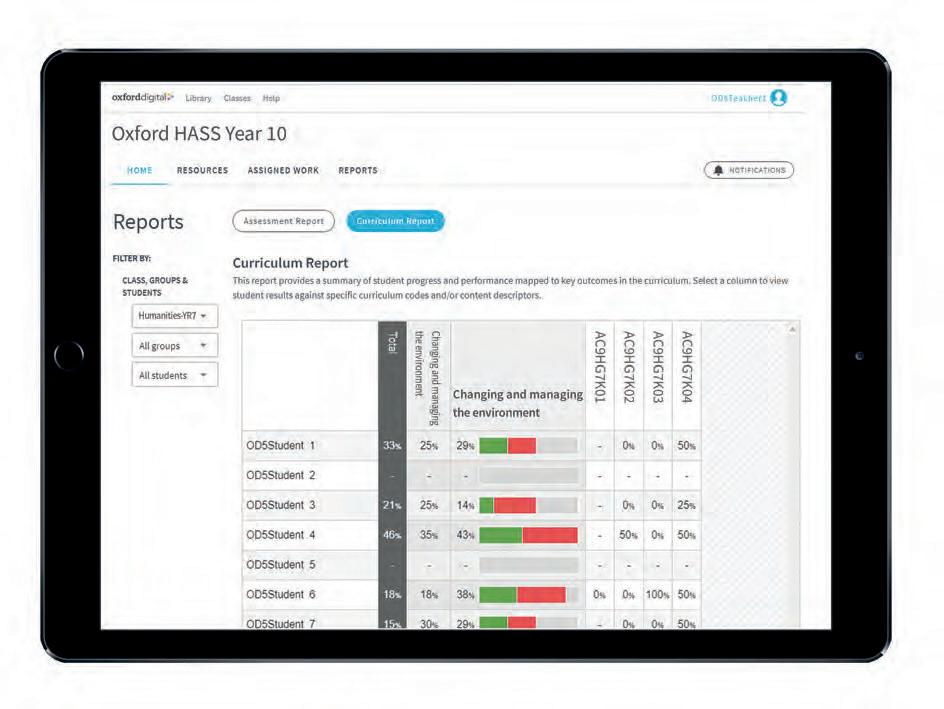
• Teachers are provided with clear and tangible evidence of student learning progress through curriculum and assessment reports.
• Assessment reports directly show how students are performing in each online interactive assessment, providing instant feedback for teachers about areas of understanding.
• Curriculum reports summarise student performance against specific curriculum content descriptions and curriculum codes.
> As students complete online assessments, their results are measured against curriculum outcomes through the curriculum report. This allows easy understanding of how students are progressing, and where they may need support.
Benefits for teachers
What are cognitive verbs and why do we use them?
A cognitive verb is a verb or ‘doing word’ that helps you understand how to answer a question. For example, the word describe is a cognitive verb because it requires you to remember what you know about something and talk about its features. Cognitive verbs are commonly shown in bold in the questions in this book. You will encounter a variety of cognitive verbs as you learn new information.
Common cognitive verbs and the task/s associated with them are given in Source 1 below. Understanding these cognitive verbs and the tasks behind them will help you work out how to best answer a question.
Some cognitive verbs require more thinking and understanding than others. For example, if you were given a picture of an apple and an orange, and asked to name the two fruits, you might instantly remember ‘apple’ and ‘orange’ and could write the names down without much trouble. However, if you were asked to compare the two fruits, you would need to think about the two fruits and identify at least one similarity and one difference between them. In this sense, compare requires a deeper level of thinking than name.
Throughout this book you will notice that the questions in the Check Your Learning boxes are categorised in the following order:
> Retrieve
> Comprehend
> Analyse
> Apply
This is because working in order from ‘Retrieve’ to ‘Comprehend’ to ‘Analyse’ and finally to ‘Apply’ helps your learning process.
Source 1 shows the thought processes required for each type of cognitive verb, and the category to which it belongs.
DRAFT
Cognitive verbs
Cognitive verb Task Category
define give the meaning of a word or term
identify recognise and state a fact or feature
name provide the correct name
state provide the correct piece of information
describe give an account of a situation, event, pattern or process, or of the features of something
explain
summarise
analyse
classify
make an idea or situation plain or clear by describing it in more detail, or providing reasons how or why
outline or give a brief statement of an event, theme or major point/s; present ideas and information in fewer words and in sequence
examine or consider something in order to explain and interpret it, identifying different components and the relationship between them
arrange, distribute or order in classes or categories according to shared qualities or characteristics
compare identify the similarities and differences between things
consider think carefully and reflect on before making a decision
distinguish identify the differences between things
examine inspect something carefully
create make or invent; reorganise or put elements together into a new pattern or structure
discuss
evaluate
examine by argument; examine the considerations for and against; debate; talk or write about a topic taking into account different views and issues
Retrieve – recall information from permanent memory
Comprehend – activate and transfer knowledge from your permanent memory to your working memory
DRAFT
Analyse – use your reasoning to go beyond what was directly taught
examine and determine the value or significance of something, talking about its strengths and weakness and giving your overall opinion
determine decide or come to a resolution
investigate plan, search or inquire into a topic to establish or obtain facts and reach new conclusions
justify give reasons or evidence to support an answer, response or conclusion
propose put forward a suggestion for consideration or action
Source 1 The tasks and categories associated with cognitive verbs
Apply – use your knowledge in specific situations
17 CHAPTER
Sustaining Australia’s democracy
A strong and resilient democracy is one based on core beliefs and values that are shared and respected by most of society. Australia’s democracy is based on the belief that our governments are freely and fairly elected and that they uphold basic human rights and freedoms. Sharing these beliefs helps Australia to function as a cohesive, or united, society. However, factors such as vested interests, corruption, polarisation and the influence of the media (including social media) present challenges to democracies around the world, including Australia.
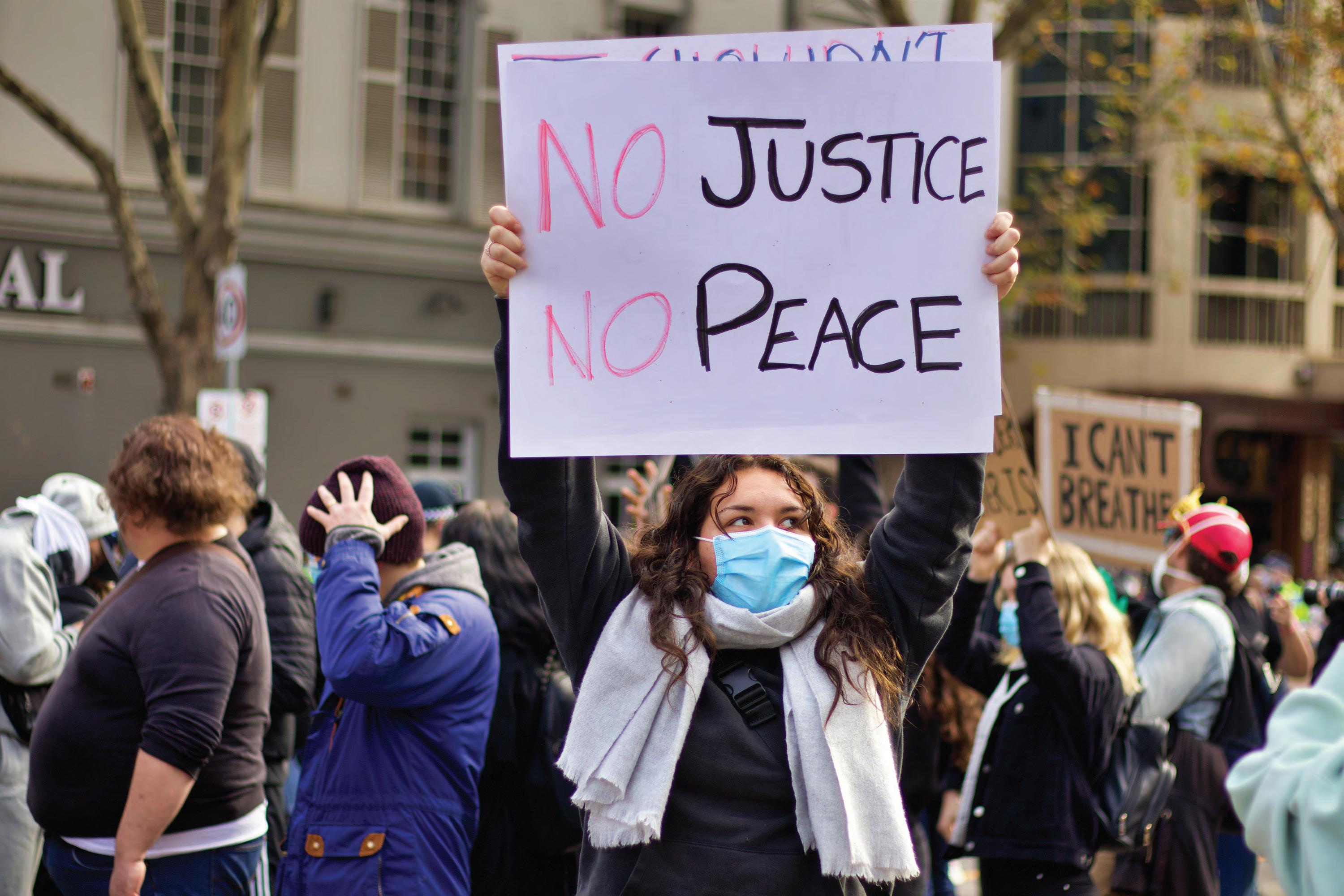
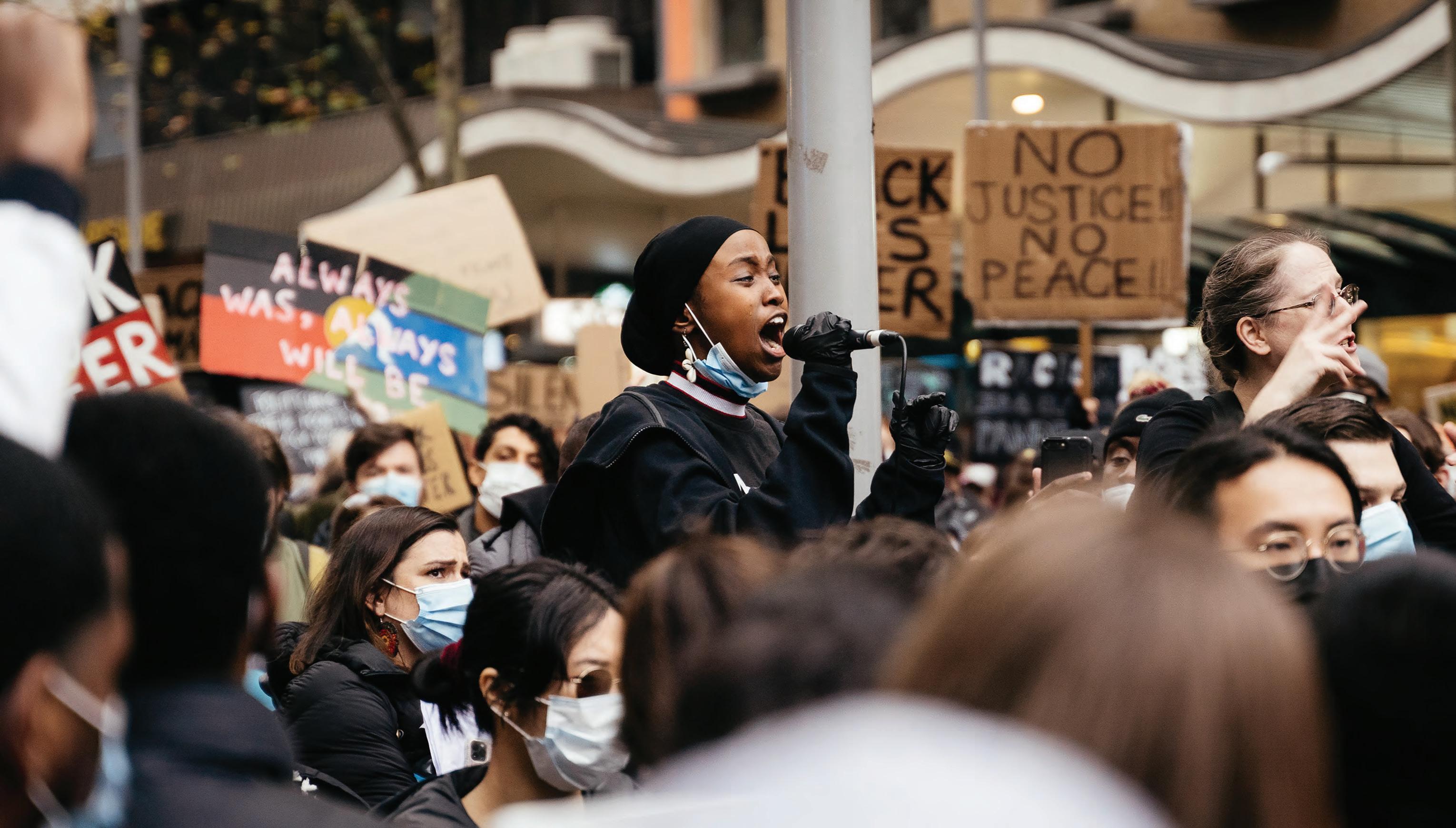
Source 1 In Australia, one of the key principles of our democracy that is protected by law is the freedom of assembly. This grants us the right to protest. Here, a young woman holds a sign at a Black Lives Matter protest in 2020.
Citizenship, diversity and identity
17A
What are the features of a resilient democracy and a cohesive society?
17B
What are the challenges to Australia’s democracy?
Learning intention
By the end of this topic, you will be able to:
» identify the key features of Australia’s democracy and cohesive society.
Australia’s democratic society
In order to have a strong democratic society, Australia’s system of government is based upon core beliefs and attitudes that are respected and valued by most people. For example, our democracy is based on the beliefs that:
• the people elect the government
• elections are free and fair
• governments uphold basic human rights.
These beliefs, along with features such as processes that allow for conflicts to be resolved peacefully, all help to safeguard Australia’s democratic society.
The people elect the government
The federal parliament and the state and territory parliaments of Australia are elected by the people to make laws on their behalf. The intention of compulsory voting is to make sure that our governments have the support of the majority of the people and not just those who bother to vote.
Elections are free and fair
Independent state, territory and federal electoral commissions have the role of ensuring that all state, territory and federal elections in Australia are free, fair and conducted in accordance with state/territory and Commonwealth law. For example:
• The Australian Electoral Commission (AEC) is responsible for managing federal elections and maintaining the Commonwealth electoral roll, which lists the names and addresses of all eligible citizens who have enrolled to vote.
• The AEC must confirm that all eligible voters throughout Australia (that is, over 17 million people) are able to cast their vote in secret. Voting is done in secret to reduce the risk of voters being intimidated or forced into voting for a person or party against their will.
intimidated, punished or discriminated against for how they vote.
• Each citizen may only vote once. Every vote has the same value, regardless of whose it is.
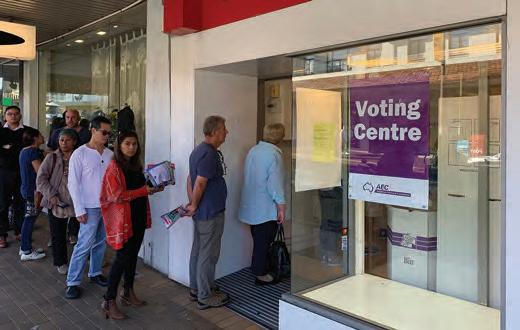
• Voting can take place on election day at venues or polling booths, or at early voting stations or via postal votes for those who cannot attend on the day.
• The AEC must check that votes are honestly counted.
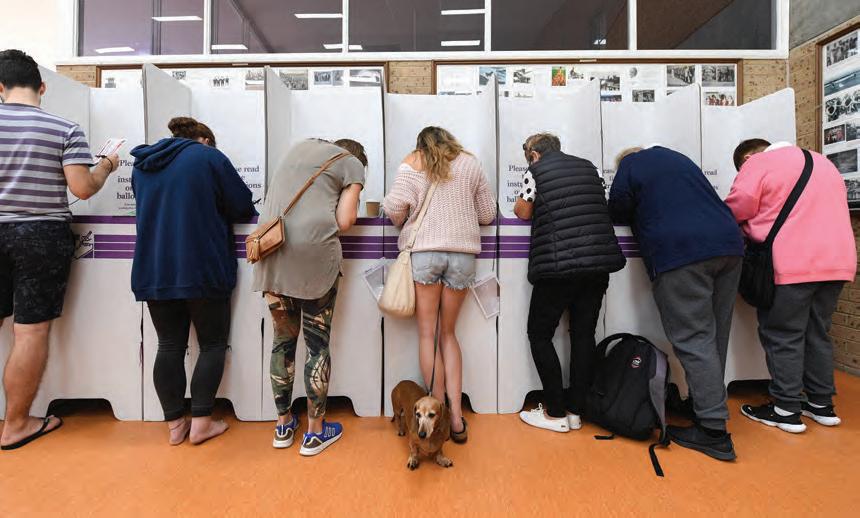
Source 1 Over 17 million Australians were enrolled to cast their vote in the 2022 federal election.
Quiz me! A quick quiz on Australia’s democratic society
17A What are the features of a resilient democracy and a cohesive society?
Governments uphold basic human rights
An underlying feature of democracy in Australia is that our parliaments must make and enforce laws and policies that protect basic human rights, so that all citizens are treated with dignity, equality and mutual respect. This aims to promote social cohesion. Some basic human rights upheld by Australian laws include the right to:
• not be discriminated against on the basis of race, nationality, religion, sex, age, marital status, impairment or disability
• broad freedom of speech, assembly and protest, which enable citizens to debate political issues and openly express their views without fear of being punished
• a fair trial and freedom from torture
• life, liberty and security of person
• work and live in a healthy environment
• basic health care and education.
The right to dissent
DRAFT
Another feature that helps safeguard Australia’s democratic society is that individuals generally have the right to oppose or disagree with the views held by the government. We can also publicly express that disapproval in a lawful manner without fear of being censored or punished. For example, Australian law generally upholds the right to freedom of speech, press and protest, which allows individuals and organisations the ability to debate political issues and openly express their views without fear of being punished. However, these rights are limited to a certain extent for reasons including to protect people from suffering harm as a result of other people making untrue statements or comments that racially offensive, and to protect the national interest.
Peaceful resolution of conflicts
In order to keep the peace in Australian society, processes exist to help groups or individuals resolve their problems or disputes. This can include formal legal procedures that lead to a final decision or more informal discussions between parties that lead to settling a dispute or issue. Such processes might include the following in a formal court setting or informal domestic settings:
• negotiation – a process where the parties get together and try to discuss the key issues in their dispute to reach a settlement between them
• mediation – a method of dispute settlement where the parties meet before an independent third party who helps them to discuss their dispute and reach a mutually acceptable resolution
• reconciliation – the process of renewing a relationship between parties, which usually requires forgiveness on one or both sides.
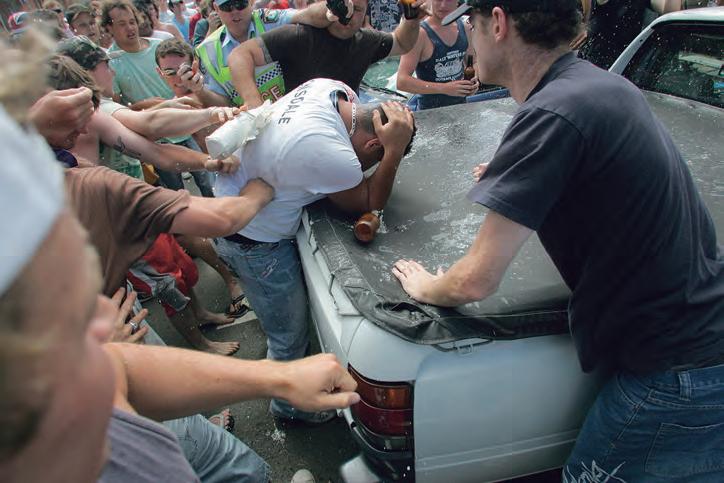
Source 3 The provision of police is one of the ways that government uphold human rights. For example, some clashes between the far-right protest group Reclaim Australia and anti-racism groups at public demonstrations have required police intervention.
In addition to structures such as courts and tribunals, governments also provide services (including hospitals, schools, universities, prisons, and defence and police forces) and social welfare benefits (including aged pensions and unemployment benefits). This is so that Australians can live together in a peaceful, orderly, cooperative and tolerant manner.
I can run as a candidate in an election.
(Freedom of election)
I can follow my religious beliefs. (Freedom of religion)
I can meet up with a group of friends. (Freedom of assembly)
I can go out when I please. (Freedom of movement) I know I won’t be thrown in jail without a trial. (Right to a fair trial)
DRAFT
When I’m 18 I can vote in elections. (Freedom of election)
I know I won’t be arrested for nothing. (Freedom from arbitrary arrest)
I can openly criticise the government. (Freedom of speech)
Source 4 Some liberal democratic rights and values ; Australia is a liberal democracy, which means we aim to protect a range of basic human rights and values. Some of these rights (such as the right to vote) are protected under Australian law.
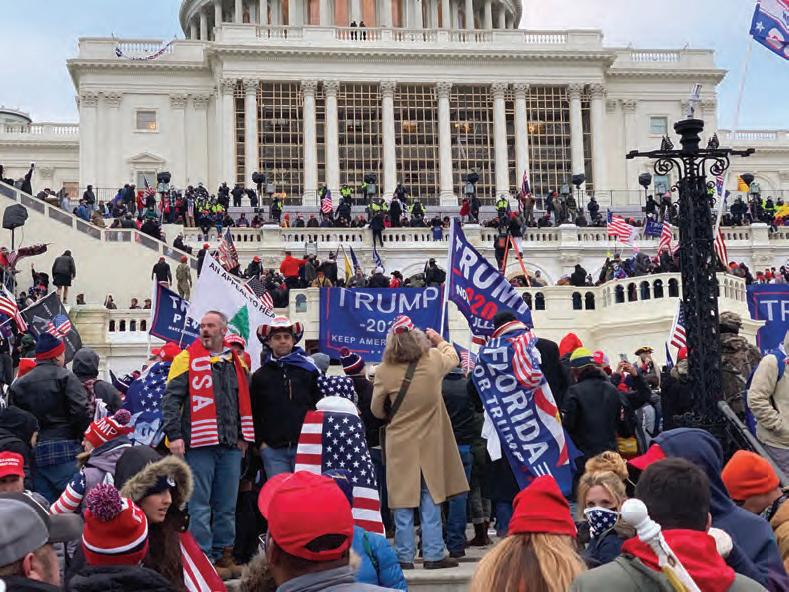
The 2021 US Capitol riots
On 3 November 2020, the USA held a federal election. In the USA, federal elections are held every 4 years, giving Americans the opportunity to vote for new candidates to represent them in the US Congress, and for the president. Although the country was in the grips of the COVID-19 pandemic, a lot of work was done to make sure the election could safely be held. For example, many states allowed early voting and voting by mail.
While the results of this election were very close, the sitting president and leader
of the Republican Party, Donald Trump, did not receive enough votes to be re-elected. Instead, the leader of the main opposing party (the Democratic Party), Joe Biden, received the most votes and was elected as the new president.
After losing the election, Trump and his team filed over 60 lawsuits to try to cancel Biden’s victory. On 6 January 2021, a few weeks before Biden was due to be sworn in as the new president, Trump held a large rally in Washington, DC. He encouraged his supporters to march to the Capitol building,
17A What are the features of a resilient democracy and a cohesive society?
where the US Congress meets, to protest the way the election was held and its results. The protesters, some of whom carried guns, claimed that the election was not properly conducted and that the results were not fair. These claims were made without any clear evidence, and were supported by violence, destruction of property and threats to the lives of public officials. Five people were killed during the riot at the Capitol building. As of 2022, the events of 6 January 2021 are being investigated by a committee created by the US Congress.
17.1 Check your learning
Retrieve
1 State the three beliefs on which Australian democracy is based.
DRAFT
2 Identify four basic human rights that are upheld by Australian law. Comprehend
3 Explain the reasons for having compulsory voting
4 Explain how you think our democracy would be affected if core beliefs and attitudes were not protected. In your answer, give two examples of possible outcomes.
Analyse
5 Examine the case study on the 2021 US Capitol riots. Conduct further research if required to answer the questions below.
a Describe the circumstances that led to the riots.
See, think, wonder Look at Source 5.
• What do you see?
• What do you think?
• What do you wonder?
b Explain two reasons why Donald Trump and some of his supporters claimed the November 2020 US election was unfair (or fraudulent).
c Describe what happened in the months following the riots. In your answer, consider what happened to Donald Trump and the protesters who took part in the riots, how other nations reacted to the news of the riots, and who ultimately formed the US government.
Apply
6 In pairs or small groups, discuss what might happen if people no longer believe in the ideas that democratic societies are based on (for example, that elections are free and fair, or that governments uphold basic human rights).
Source 5 Supporters of former president Donald Trump on the steps of the US Capitol
17A Maintaining a democratic and cohesive society
SKILLS IN CONTEXT
Test me!
Once you’ve finished the topics in this section, test yourself with this quiz and find out which worksheet you should do.
Many different factors influence social cohesion in Australia. For example, when the Scanlon Foundation – an organisation that aims to enhance social cohesion in Australia – conducts research, it examines five key indicators.
These include whether or not Australians have:
• a sense of belonging and pride in being Australian
DRAFT
• a sense of self-worth, or a general feeling that they are happy and satisfied with life and their financial situation and have positive expectations about the future
• a sense that social justice and equity exist in our country
• a willingness to participate in voluntary work and the political process (including a right and willingness to vote and to protest for law changes)
• a sense of legitimacy; that is, feeling accepted, and not rejected or subject to discrimination.
acceptance and rejection, legitimacy
Source 6 Key indicators of social cohesion in Australia, as used by the Scanlon Foundation
In recent years, research undertaken by the Scanlon Foundation has indicated that while Australia is a relatively tolerant society, our sense of social cohesion has experienced change over time. For example, the Foundation’s 2021 national survey (conducted during the second year of the global COVID-19 pandemic) revealed that 16 per cent of respondents felt they had experienced discrimination (in the previous 12 months) on the basis of their race, ethnic origin or religion compared to only 9 per cent in 2007, when the survey began. By contrast, there was an increase in the level of trust respondents had in the government, with 48 per cent of survey participants indicating they trusted the federal government to ‘do the right thing’ always or most of the time in 2021, compared to 39 per cent in 2007.
Views on immigration had also changed, with 67 per cent of respondents believing that immigration levels in recent years were ‘about right or too low’, compared to 55 per cent in 2007.
In 2021, 71 per cent of respondents stated that they were optimistic s future – up from 70 per cent in 2020 (the first year the survey was conducted since the COVID-19 pandemic began) and an increase since 2019, when 63 per cent of respondents were optimistic s future.
The Scanlon Foundation’s five key indicators for social cohesion in Australia include having a sense of legitimacy; that is, feeling accepted, and not rejected or subject to discrimination.
social justice and equity sense of worth sense of belonging
Social cohesion used by the Scanlon Foundation participation
Source 8 Results from the Scanlon Foundation’s social cohesion survey to the question ‘What do you think is the most important problem facing Australia today?’, posed in July 2021
Source: Scanlon Foundation, Mapping Social Cohesion
Report,
p.
KEY SKILL
Questioning & researching
Creating an online survey
Surveys are an effective way to gather information and data so that it may be more easily understood and evaluated. Many online tools and programs allow for the easy generation and analysis of surveys, including Google Docs, Excel, SurveyMonkey and Survey Builder.
When designing an online survey, follow these steps:
Step 1 Determine the purpose or aim of your survey. What information do you want to collect and why?
Step 2 Design appropriate questions. Think about the sort of information you might need to collect to help you investigate the topic, and what type of questions you will need to ask to acquire this information.
Step 3 Consider how long you would like your survey to be. Often people will be reluctant to participate if the survey is too long, confusing or takes too much time to complete.
Step 4 Choose which online survey tool you will use. Then go to its website and follow the steps it outlines to get started. For example, with SurveyMonkey you will need to enter your details and set up a free account.
DRAFT
Step 5 Select what kinds of questions you will ask. To do this, you should consider the range of responses you might expect to receive and provide appropriate options. For example, you may elect to use:
• ‘yes/no’ questions
• multiple choice questions
• ‘true/false’ statements
• rating scales, such as: ‘On a scale of 1 to 5 (with 1 being most likely and 5 being least likely), answer the following questions …’
• comment boxes for more personalised responses. SurveyMonkey has more than 15 types of questions you can use, including multiple choice and true/ false options.
Source 10 SurveyMonkey is a useful online tool for building and analysing surveys.
17A What are the features of a resilient democracy and a cohesive society?
Step 6 Consider what personal details and information you would like your respondents to provide or whether you would prefer to allow them to remain anonymous. Which of these will encourage high participation and honest responses?
Step 7 Consider how many completed surveys you will need to form an accurate assessment. You will need to have a big enough sample size and a mixture of ages, genders and cultural backgrounds in order to give you results that represent the general population.
Step 8 Set up a mailing list to email out your surveys. Your chosen online survey platform will help you do this.
Step 9 Prepare a chart or graph to help analyse your responses. Many online survey programs will compile this information for you.
For more information on this key skill, refer to page 509 of ‘The civics and citizenship toolkit ’
Practise the skill
1 Follow the steps above to conduct your own online survey that will help you to determine which concerns or issues currently threaten social cohesion in your community.
2 Send the survey out to the people on the mailing list you have created.
3 Summarise your findings. Include a list of the top 5 problems or issues that concerned your respondents. Suggest possible reasons for these concerns.
DRAFT
4 Explain any strengths and/or limitations associated with your survey.
Extend your understanding
1 Using the internet, conduct some additional research on social cohesion.
a In your own words, define ‘social cohesion
b Identify the three most significant factors that you believe have the potential to threaten Australia’s sense of social cohesion.
c Discuss your views with the class.
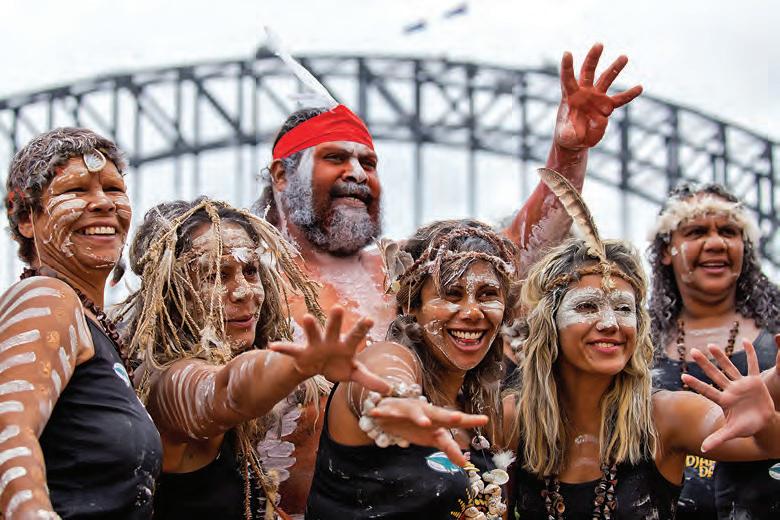
Source 11 Aboriginal dancers strike a pose during the Homeground festival, a major annual celebration of Aboriginal cultures.
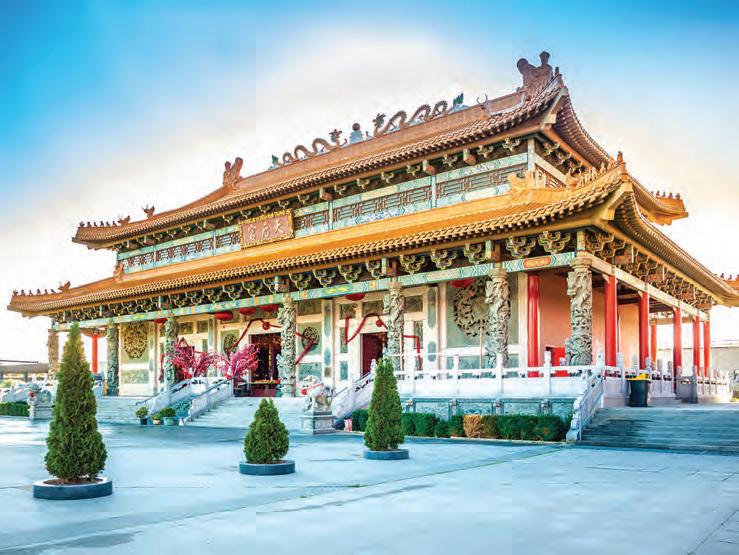
Source 12 Footscray, in Melbourne, Victoria, is home to a diverse range of Asian cultures. Pictured is the Heavenly Queen Temple to the Chinese sea goddess Mazu. It is Australia's largest Taoist temple.
Learning intention
By the end of this topic, you will be able to:
» describe threats to Australia’s democracy, including vested interest groups and corruption
Threats to Australia’s democratic society
While Australia is generally a cohesive and united nation built on democratic principles, various factors – including the influence of groups with vested interests, media bias and our ageing population – could potentially threaten our democratic and harmonious way of life.
Influence of those with vested interests
Having a vested interest means that a person or organisation may support an individual member of parliament or political party to make a personal gain (for example, to increase their own financial wealth or power). Over recent years, there has been increasing concern that a small number of very wealthy individuals and large corporations have been able to have a disproportionate amount of influence over government policy in Australia by making large donations to political parties that benefit their interests. For example, Anthony Pratt, an Australian businessman who oversees Visy Industries and Pratt Industries, was the biggest political donor in 2021. Pratt donated $1.3 million to the Liberal Party ahead of the 2022 federal election.
Source 1 Banks are one example of organisations which have vested interests.
In the period leading up to both state and federal elections, both major parties (the Liberal and Labor Parties) typically receive large donations from wealthy individuals who own businesses that might benefit from their election. The major parties also receive large donations from organisations donating to both parties. For example, in 2021 the Pharmacy Guild of Australia donated $295 000, split largely equally between Labor and Liberal branches. Both political parties receive donations from organisations with specific political interests, including:
• the four major banks (ANZ, Westpac, National Australia Bank and the Commonwealth Bank), which have a vested interest in banking regulations
• the Australian Hotels Association, which has a vested interest in many areas of the law, including liquor licensing and gaming machines
• Phillip Morris, a tobacco company with vested interests in the tobacco laws
I used to think, now I think
Reflect on what you have learnt about donations to political parties and complete the following sentences.
• I used to think ...
• Now I think ... What has changed in your understanding?
• Pfizer and Johnson & Johnson, pharmaceutical companies with vested interests in the regulations surrounding the distribution of medicines, vaccines and health-care products (and which, in 2020, became two of the manufacturers of COVID-19 vaccines).
Corruption
Corruption, or the immoral abuse of power for personal gain, is another factor that threatens democracies globally. Australia has consistently ranked as one of the least corrupt counties in the world. According to the Transparency International Corruptions Perceptions Index (a global measure of anti-corruption efforts) in 2022 Australia ranked 18th out of 180 countries, with a score of 73 (on a scale where 0 is highly corrupt and 100 is very clean). However, this score has declined steadily since 2012, when Australia scored 85 on the Corruption Perceptions Index. This decline is due to the failure to regulate political donations and lobbying and to reform foreign bribery laws, and the failure to establish a federal anti-corruption commission.
Media bias and voting
A democratic system relies on individuals being able to make informed decisions about which political party or independent candidate would make laws that best reflect their views and values. When making such decisions, most voters gain their information from the media. It is therefore essential that the media presents impartial and unbiased information, especially in the lead-up to an election.
But just how impartial is the Australian media, and to what extent does the content in the mainstream media organisations reflect the political interests of their owners and the senior editors, rather than an independent and unbiased view?
It is important to remember that the media is generally not impartial. Many media organisations and forums that distribute news and information to the public – including political parties, special interest (or pressure) groups and businesses – have a perceived bias or political leaning. For example, Crikey.com is often viewed as being a ‘left-leaning’ organisation, meaning it has less-conservative views. Different media outlets also have their own way of presenting events and issues of the day. It can be an interesting exercise to scan different online news services or flick across television news channels to see how the same issue is being presented in a single day by different sources. You may notice subtle or more obvious bias across different news organisations as you look around.
In Australia the two biggest and most influential media organisations, News Corp Australia and Nine Entertainment Co, are often criticised for showing a conservative political bias. Given that News Corp Australia and Nine Entertainment Co account for approximately 85 per cent of all newspaper sales in Australia and have a large online profile, these organisations certainly have the ability to influence a wide audience. The ABC, too, is criticised for being too politically liberal (broad-minded) in the stories that it produces.
DRAFT
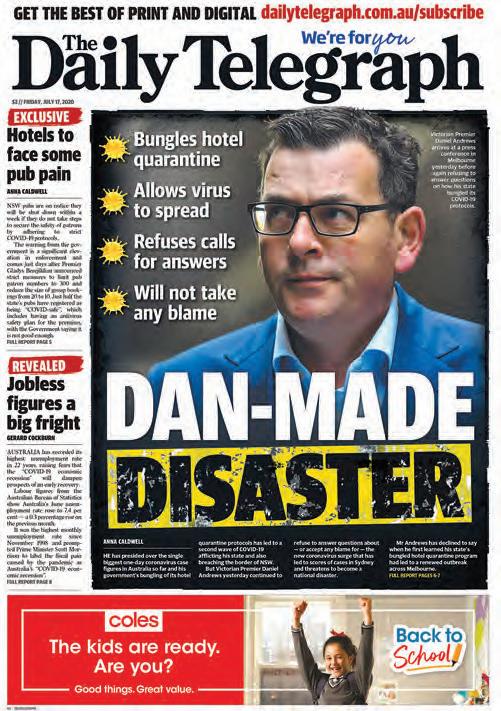
2 This front page of The Daily Telegraph (in Sydney) shows political bias against the Victorian Labor government during the 2020 COVID-19 pandemic.
Source 3 A summary of some major Australian media organisations and their perceived political biases
Print/digital media
News Corp Australia
Nine Entertainment Co
The Australian
The Daily Telegraph (Sydney)
The Herald Sun (Melbourne)
The Bolt Report
The Age (Melbourne)
The Sydney Morning Herald
Australian Broadcasting Commission (ABC) ABC News
independent candidate an individual who stands for election, but does not belong to a political party media organisations and forums that communicate news and information to the public, such as newspapers, magazines, and television and radio broadcasters (often referred to as ‘ traditional media’), and online websites and social media apps (such as Facebook, Twitter and Instagram)
Generally recognised for supporting the Liberal–National Coalition
Generally recognised for supporting the Labor Party
Often viewed as supporting the Labor Party and the Australian Greens
Source
Does the media decide who wins an election?
Over the years, various media organisations have been accused of showing particular bias for and against certain political parties during federal election campaigns. For example, during the 2019 and 2022 federal election campaigns, News Corp Australia was accused of biased antiLabor reporting, with the aim of ensuring the re-election of the Liberal–National Coalition government of the day, under the leadership of Prime Minister Scott Morrison. In the 2022 federal election campaign News Corp Australia was also accused of bias against ‘ teal’ independent candidates (who ran in seats traditionally held by the Liberal Party and advocated for increased action on climate change). News Corp Australia, which owns and publishes approximately 170 newspapers and magazines in Australia, is mainly owned by a multinational media organisation called News Corp, which was founded by its CEO, Rupert Murdoch. With such a large readership base, it certainly has a great ability to influence a wide audience and potentially sway many voters.
DRAFT
It has long been suggested that Murdoch influences anti-Labor reporting in News Corp Australia’s newspapers to further his business interests. For example, it was alleged that Murdoch considered the Labor Party’s commitment to a National Broadband Network a threat to Foxtel, another company largely owned by News Corp.
Having one media organisation own so many newspapers and magazines is unusual in a liberal democracy. Previous prime ministers from both major parties have argued that having one organisation that can dominate media coverage across Australia is dangerous for democracy. Former prime ministers Kevin Rudd (from the Labor Party) and Malcolm Turnbull (from the Liberal Party) have labelled News Corp as ‘the greatest cancer of all on our democratic institutions’ and ‘an absolute threat to our democracy’.
Source 4 The headline on the front page of the Daily Telegraph during the campaign leading up to the 2022 federal election; at the time, Anthony Albanese was the Leader of the Labor Opposition.
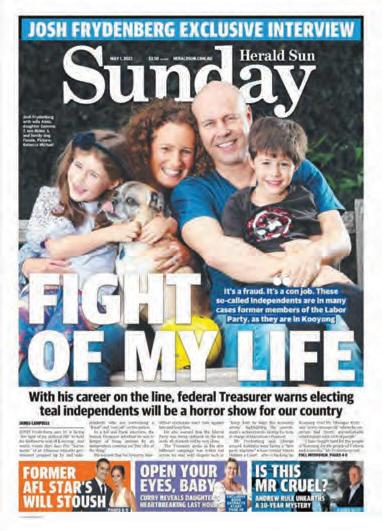
Source 5 The Sunday edition of the Herald Sun in 2022 featured a three-page interview with then federal Treasurer Josh Frydenberg. Frydenberg was campaigning against the independent teal candidate Monique Ryan for the seat of Kooyong in Victoria.
An ageing population
Because families are having fewer children and life expectancy is increasing, Australia is becoming an ageing nation. This will have political consequences that could affect our democracy. For example, in the early 1970s approximately 8 per cent of Australia’s population was aged over 65 years. By 2020 this had increased to 16 per cent and it is predicted to rise to 23 per cent by 2050. As more voters enter the over-65 age group, the elderly will have more political power and be able to place greater pressure on governments. Presumably, the elderly would seek to implement policies and laws that focus on their needs, including increasing aged pensions and the provision of health-care services for the elderly. By contrast, the priorities of younger voters are generally related to the environment, education and enacting social change. For example, a survey conducted by the Australian Election Study on the 2019 federal election noted a trend: that voting for the Greens as a first preference party increased as the age of those surveyed decreased. These political divisions seem to have been amplified by the candidates’ different views on housing prices, tax and climate change. The increasingly ageing population of Australia may sway policy-making away from the priorities of younger voters, potentially unbalancing and threatening social cohesion. 17B
17.2 Check your learning
Retrieve
1 Identify two threats to Australia’s democratic society.
Comprehend
2 Explain how an individual or organisation with a vested interest can influence political outcomes.
3 Explain how an ageing society could be a potential threat to democracy.
Analyse
4 Examine Sources 2, 4 and 5.
a What do you think the meaning or message of each source is?
b Identify the techniques that have been used by the creators to communicate their message.
c Do you think these images show media bias in politics? Justify (give reasons for) your answer.
DRAFT
d Explain how a biased presentation of information in the media could influence Australia’s democracy.
5 Consider what you think are the three biggest threats to social cohesion and unity in Australia today. Suggest ways in which these threats could be minimised.
Apply
6 In groups, discuss whether the following policies or law changes might strengthen or threaten our democratic and cohesive society. Share your response in a wider discussion with the class.
a bringing back the death penalty as a punishment for very serious crimes, such as mass murder and terrorism
b banning political parties from advertising on television and radio during election campaigns
c continuing to severely restrict the number of asylum seekers allowed into Australia
d abolishing compulsory voting
e banning the building of an Islamic mosque in a country town
f teaching children in primary schools about domestic violence.
7 Many countries throughout the world are facing political unrest, and difficulties in achieving and maintaining a democratic system of government.
a Research one country that is currently experiencing threats to its democracy; for example, Hong Kong, Venezuela, Algeria or Myanmar.
b Create a PowerPoint presentation that includes the name of your selected country and a map showing its global location. Include the following information:
• a brief description of the main threats to democracy being experienced; these may include:
– threats to the voting system and free and fair elections (for example, due to the government or military interfering with the voting process, war and corruption, low literacy rates or a lack of reliable reporting of information in the media)
– threats to freedom of speech or movement (for example, due to government laws or policies, or COVID-19)
• an explanation of the impact, or possible impact, of the threats on the country; this may include the impact of the threat on the government, any specific groups or organisations, and the general population. Share your PowerPoint presentation and findings with the class.
Quiz me!
A quick quiz on threats to Australia s democracy
Learning intention
By the end of this topic, you will be able to:
» explain why access to information is important in a democracy.
Discussing controversial issues in democracies
Australia’s democracy is built on a number of values and rights. As in many democratic societies, rights such as freedom of speech are highly valued in Australia for encouraging the public to discuss and debate important issues and encourage civic participation
Discussing controversial ideas and issues
An important part of living in a democracy is the ability of citizens to respectfully engage with values and ideas different from their own. Even in cohesive democratic societies, there are often national or global issues which are controversial. Controversial issues are issues which evoke strong emotions and divide opinions in society. For example, in Australia the date of the national day of Australia is controversial. Many nations have a national day celebrating a date of independence or of becoming a republic or federation. In Australia, the national day marks the founding of the first British colony on the continent in 1788. Currently commemorated on 26 January (it has been held on different dates in the past), Australia Day is sometimes referred to as ‘Invasion Day’ or ‘Day of Mourning’ by parts of the Australian population – led by First Nations peoples – who do not believe our national holiday should be held on this date.
Accessing information
DRAFT
Source 6 Traditional media is still the most popular way to consume news in Australia.
As discussed in topic 17.2, a democracy relies on individuals being able to access information in order to discuss ideas and make informed decisions. How Australians access news and information – and how we discuss and debate issues – has changed greatly over the years and has been further impacted by the COVID-19 pandemic. For example, Digital News Report: Australia 2022 produced by the University of Canberra found that:
traditional and public service broadcasters remain the most popular sources of news in Australia in 2022, with the majority of Australians accessing news via television. An example of traditional broadcaster is the Nine Network, while an example of a public service broadcaster is the ABC.
in Australia, use of social media apps or sites (such as Facebook, Instagram, Twitter or TikTok) to access and share news had declined since 2020. Facebook remains the most popular social media site to access news, though consuming news through Instagram and TikTok had increased.
Social media and polarisation
polarisation the division of societies into two sharply contrasting groups or sets of opinions or beliefs
Social media are internet-based websites or apps which allow interactive communication between many users. Facebook, Instagram, Twitter, TikTok and YouTube are all examples of social media platforms. Social media platforms provide individuals, special interest groups, political parties, businesses and other organisations with the ability to distribute news and information to a huge audience, both nationally and globally. While information distributed through social media can often be accessed and spread more quickly than information distributed through other sources of media, there are concerns that social media platforms can drive polarisation. Polarisation is the
17B What are the challenges to Australia’s democracy?
division of groups or societies into two opposing viewpoints. Social media platforms can drive polarisation because the algorithms that curate or organise the content a user sees on the platform often show users content that aligns with what they already like or believe. This can create an ‘echo chamber’, where users are never presented with values or ideas different from their own. Polarisation is considered an issue in democracies as these differences can be used by political parties or other organisations for their own benefit, reducing cohesion across society over time.
Question
There is a controversy over what the countries of the world, including Australia, should do about the problem of global warming. Please tell me which statement comes closest to your own point of view.
Quiz me! A quick quiz on discussing controversial issues in democracies
Until we are sure that global warming is really a problem, we should not take any steps that would have economic costs.
The problem of global warming should be addressed, but its effects will be gradual, so we can deal with the problem gradually by taking steps that are low in cost.
Global warming is a serious and pressing problem. We should begin taking steps now even if this involves significant costs.
17.3 Check your learning Retrieve
1 In your own words, define the terms: • echo chamber • polarisation.
DRAFT
2 Identify how the majority of Australians access news.
3 Explain why the date of Australia’s national day is controversial in Australia
4 Summarise how social media can contribute to polarisation in society. Apply
5 Examine Source 7 and respond to the following questions.
a Identify the position that the majority of Australians have on global warming.
b Contrast the results of 2012 with the results of 2022. How have the position that ‘we should not take any
Source 7 Polling data from Australians in response to the question ‘ What should Australia do about global warming? ’ There is a controversy over what the countries of the world, including Australia, should do about the problem of global warming. Source: Lowy Institute Poll, 2022.
steps that would have economic costs’ and the position that ‘we should begin taking steps now even if this involves significant costs’ changed over a decade?
c Do you think the positions that Australians hold on what Australia should do about global warming are likely to get further apart, or closer together? Explain your response.
6 According to the Digital News Report: Australia 2022, use of social media apps or sites to access and share news had declined since 2020. Consider one reason why this might be the case.
7 Reflect on the importance of citizens in a democracy having access to information. Why do you think this is important?
8 In pairs, discuss which issues you think are controversial in Australia. List three issues and then compare your list with the class
SKILLS IN CONTEXT 17B Section 17C
Test me!
Once you’ve finished the topics in this section, test yourself with this quiz and find out which worksheet you should do.
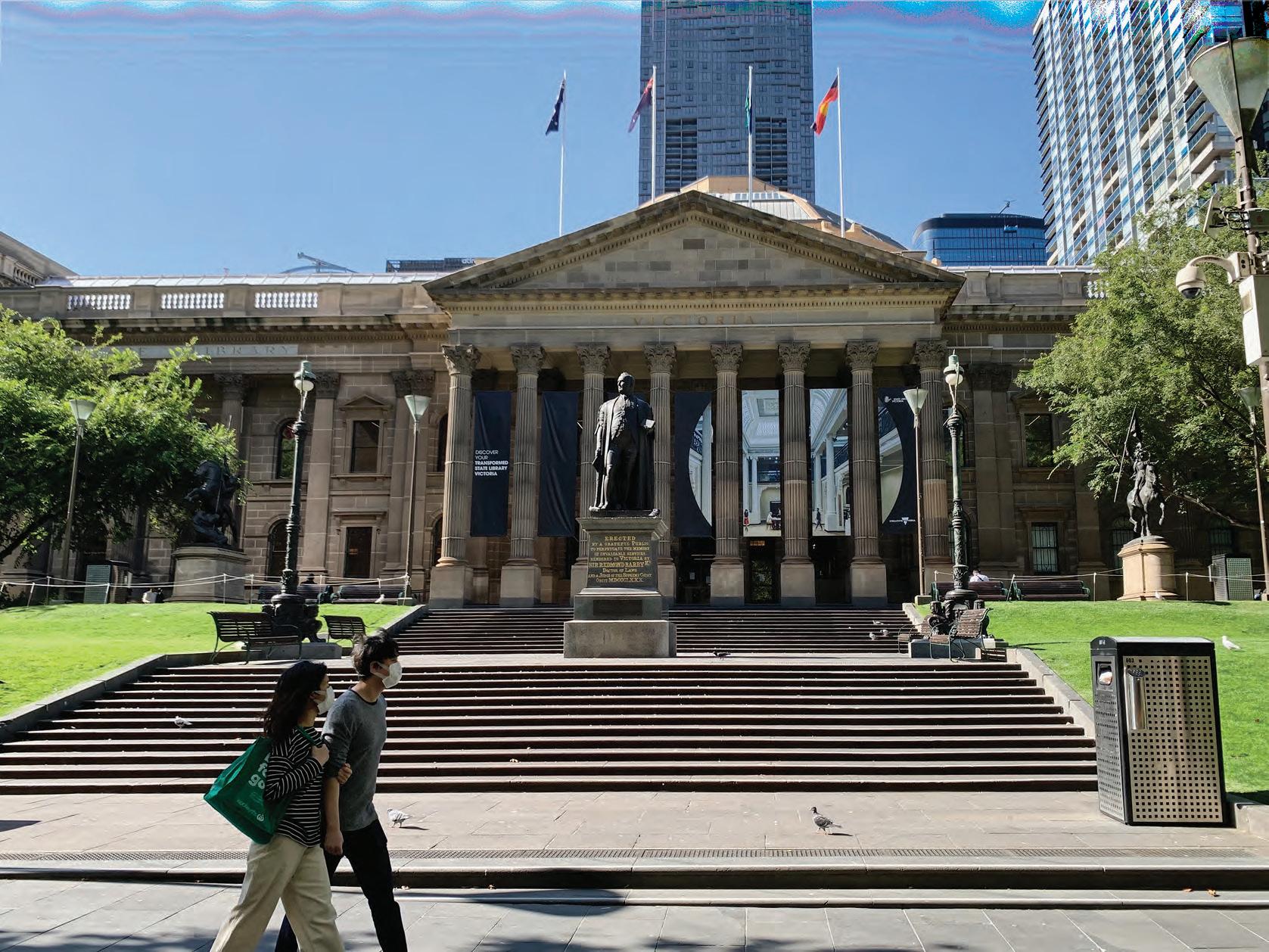
Source 8 Masked-up locals shop for essentials in front of a deserted State Library Victoria in Melbourne amid the COVID-19 pandemic.
In 1975, the Australian federal Labor government passed the Racial Discrimination Act to ensure that all people, regardless of their nationality and background, would be treated equally.
Section 17C of this Act effectively limits freedom of speech by making it illegal for any individual to act in a way that is reasonably likely to ‘offend, insult, humiliate or intimidate’ another person or group due to their race, colour, national or ethnic origin.
In 2014, the federal Liberal–National Party Coalition government announced its intention to strengthen freedom of speech by changing Section 17C of the Racial Discrimination Act to remove the words ‘offend, insult or humiliate’ and inserting the word ‘vilify’, so that it would only be unlawful to ‘intimidate or vilify’ another person or group on the basis of their race or ethnicity. (‘Vilify’ means to speak or write about someone in a degrading manner, so that other people will have a low opinion of them.) This started a debate about whether our laws should allow an individual the right to speak in a manner that may offend, insult or humiliate another on the basis of their race. Eventually this proposed change in the law was dropped.
The following quotes show differing views of Australians about this issue.
Source 9
DRAFT
In 2017, the federal Liberal government again proposed a change to Section 17C. This time, the government proposed replacing the words ‘offend, insult or humiliate’ with the term ‘harass’. The proposal was debated in the Senate for several hours, before being dropped.
In 2020, public discussion around Section 17C emerged again when a spate of racially fuelled attacks took place across Australia. The Australian Human Rights Commission found that one in four people who reported racial discrimination in February and March 2020 linked it to anti-Asian sentiment amid the COVID-19 pandemic. These senseless attacks, based on false beliefs and misconceptions, sparked calls to strengthen Section 17C.
People do have a right to be bigots, you know. In a free country, people do have rights to say things that other people find offensive, insulting or bigoted.
George Brandis, former Commonwealth Attorney-General
The best counter to a bad argument is a good one, and the best antidote to bigotry is decency, proclaimed by people engaging in a free and fair debate.
Tony Abbott, former Prime Minister of Australia
For them [journalists and politicians] it’s a game, it’s a debate about words and abstract principles. For people who have experienced racism, it is a deeply personal debate, and it’s actually a debate about real people and real hurt.
Penny Wong, Labor senator
This matters because ... plenty of white people ... are good at telling coloured people what they should and shouldn’t find racist, without even the slightest awareness that they might not be in prime position to make that call.
Waleed Aly, lawyer and media commentator
Since 2013 the Liberals have fought to undermine the anti-discrimination laws [by] twice trying to scrap the racial hate speech protections in Section 17C ... and have been far too slow to condemn racism and to stand up for all Australians.
Chinese-born Australian man James Lin, who was attacked in March 2020 at the beginning of the COVID-19 pandemic
KEY SKILL Analysis, evaluation & interpretation
Understanding and addressing task words
One important skill you need to develop is the ability to specifically address ‘task words’ when preparing a response to a question, and avoid simply writing everything you know about a topic. The table in Source 10 lists and explains the meaning of some common task words used in humanities and social sciences subjects.
One of the most important task words in humanities and social sciences is compare. To compare, follow these steps:
Step 1 Examine the sources that you have been asked to compare. Use a coloured highlighter to identify any similarities between each of the sources.
Step 2 Read the sources again. Now, use a differentcoloured highlighter to identify any differences between each of the sources.
Step 3 Write a comparison by outlining these similarities and differences.
Step 4 Provide a conclusion that includes your own point of view, based on evaluating the different opinions. For more information on this key skill, refer to page 511 of ‘The civics and citizenship toolkit’.
Practise the skill
1 In small groups, analyse the quotes made by Australians in response to changing Section 17C of the Racial Discrimination Act in Source 9.
Source 10 Some common task words Task word Meaning
analyse Examine or consider something in order to explain and interpret it, identifying different components and the relationship between them.
DRAFT
a Explain the meaning of each quote. Classify each quote as either supporting or opposing the changes to the Act.
b Describe the similarities between the two categories of quotes and the differences between the views expressed in each category.
c Discuss which quotes you most agree with.
d Select two quotes of opposing views. Research the person responsible for the statement. Suggest possible factors that may influence their position on freedom of speech.
compare Identify the similarities and differences between things.
define Give the meaning of a word or term.
describe Give an account of a situation, event, pattern or process, or of the features of something.
discuss Examine by argument; examine the considerations for and against; debate; talk or write about a topic taking into account different views and issues.
evaluate Examine and determine the value or significance of something, talking about its strengths and weakness and giving your overall opinion.
explain Make an idea or situation plain or clear by describing it in more detail, or providing reasons how or why.
Extend your understanding
1 Prepare a written report that discusses the extent to which our laws should uphold and protect freedom of speech. In your report:
• evaluate the main arguments supporting laws that protect free speech
• compare two of the opposing views expressed in the quotes provided in Source 9
• write a conclusion that expresses your personal view.
17 CHAPTER REVIEW
Review activity
Read the case study and answer the following questions.
COVID-19 and democracy
As the global COVID-19 pandemic began to spread in 2020, Australia’s federal, state and territory governments began implementing a range of emergency measures in an attempt to control the spread of the virus. In March 2020, the federal government announced measures such as a non-essential travel ban and a ban on non-essential indoor gatherings over certain numbers of people, which would be implemented by state and territory governments. The federal government also closed Australia’s borders to anyone who was not a citizen or resident (Australia’s borders reopened nearly two years later, in February 2022). From late 2020, the response to the COVID-19 pandemic shifted to state and territory governments, who put in place targeted lockdown restrictions within their borders. The restrictions included the closures of many workplaces, shops, cafes and restaurants, and schools. New South Wales, the Australian Capital Territory and Victoria in particular experienced extended lockdowns during 2021.
While the federal, state and territory governments and many citizens believed the lockdown restrictions were essential to control the spread of COVID-19, others believed the government had exceeded its administrative power and infringed upon basic human rights, including the right to freedom of movement.
Some people voiced their frustrations in the media. Others, at the risk of being fined, defied restrictions. A relatively small number of individuals also participated in ‘anti-lockdown’ demonstrations, some of which resulted in participants being fined for not wearing masks and breaching restrictions related to public gatherings, and being arrested for more serious charges, including assaulting police.
independent check against any potential abuse of power by the government.
1 a Identify three states and territories which experienced extended lockdowns during the COVID-19 pandemic in Australia. (1 mark)
DRAFT
b Summarise the effect of the COVID-19 pandemic in Australia. (3 marks)
2 Describe two democratic values that are illustrated by this case study. (2 marks)
3 a With reference to this case study, explain one way in which the judiciary (that is, the courts) can act as a check on the law-making powers of parliament. (3 marks)
b Explain how this case study illustrates the principle of the separation of powers. (3 marks)
4 Discuss whether you think demonstrations (or protests) are features of a strong and resilient democracy or a threat to democracy. (8 marks)
(Total: 20 marks)
One business owner in Victoria, who lost customers and income due to the implementation of the 5-kilometre travel rule, even took legal action in the High Court in an attempt to have the government’s lockdown policy declared invalid for being in breach of the Australian Constitution (and the right to freedom of movement). While the legal action failed, it demonstrated the ability of the courts to act as an
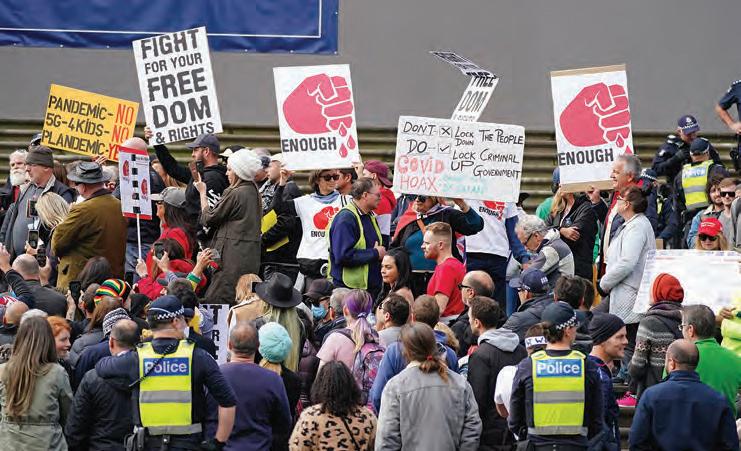
Source 10 Anti-lockdown protesters in Melbourne demonstrate against the restrictions imposed by the Victorian Government in an attempt to control the spread of COVID-19 in 2020.
Chapter checklist
Now that you have completed this chapter, reflect on your ability to do the following: I can do this. I cannot do this yet.
Identify the key features of Australia’s democracy and cohesive society.
Describe threats to Australia's democracy, including vested interest groups and corruption.
Explain why access to information is important in a democracy.
Check your Student obook pro for these digital resources and more:
Student book questions Chapter 17
Key skill worksheet Communicating: Chapter 17 Play a game of Quizlet on Sustaining Australia’s democracy.
Go back to Topic 17.1, page XXX
Go back to Topic 17.2, page XXX
Go back to Topic 17.3, page XXX
Chapter review quiz Chapter 17
[STEAM project 1]
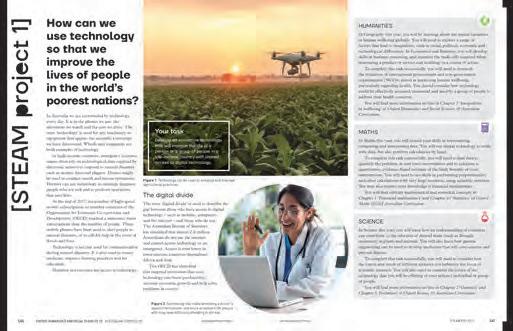
How can we use technology so that we improve the lives of people in the world’s poorest nations?
In Australia we are surrounded by technology every day. It is in the phones we use, the televisions we watch and the cars we drive. The term ‘technology’ is used for any machinery or equipment that applies the scientific knowledge we have discovered. Wheels and computers are both examples of technology.
In high-income countries, emergency response teams often rely on technological data supplied by electronic sensors to respond to natural disasters such as storms, fires and plagues. Drones might be used to conduct search and rescue operations. Doctors can use technology to remotely diagnose people who are sick and to perform operations that save lives.
DRAFT
At the end of 2017, the number of high-speed mobile subscriptions in member countries of the Organisation for Economic Co-operation and Development (OECD) reached a milestone: more subscriptions than the number of people. These mobile phones have been used to alert people to natural disasters, or to call for help in the event of floods and fires.
Technology is not just used for communication during natural disasters. It is also used to create medicine, improve farming practices and for education.
However, not everyone has access to technology.
Your task
Develop an innovative technology that will improve the life of a person or a group of people in a low-income country with limited access to digital technology.
The digital divide
The term ‘digital divide’ is used to describe the gap between those who have access to digital technology – such as mobiles, computers and the internet – and those who do not.
The Australian Bureau of Statistics has identified that almost 2.6 million Australians do not use the internet and cannot access technology in an emergency. Access is even lower in lower-income countries throughout Africa and Asia.
The OECD has identified that targeted innovation that uses technology can boost productivity, increase economic growth and help solve problems in society.
Figure 2 Technology has made attending a doctor’s appointment easier and more accessible for people who may have difficulty attending in person.
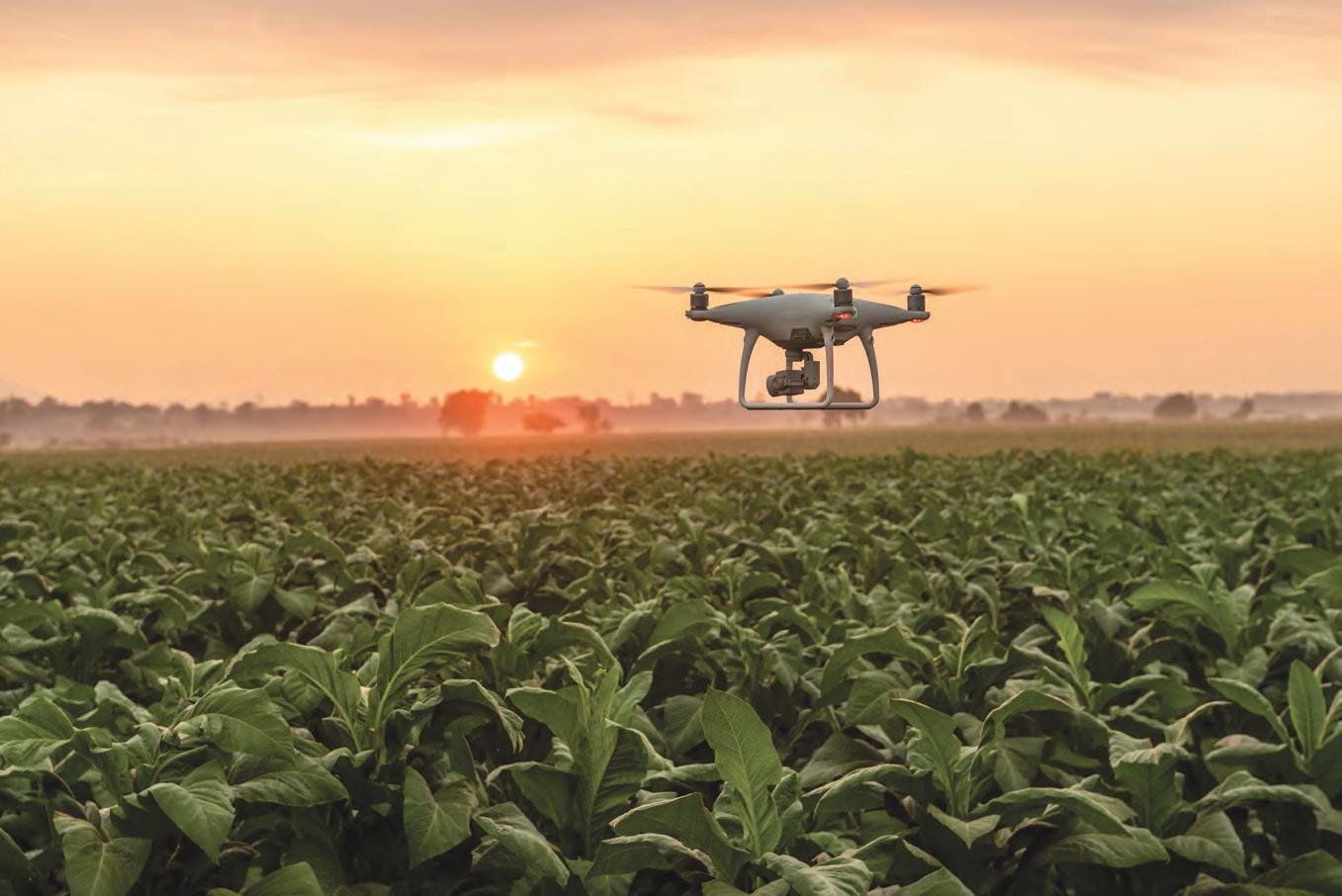
Figure 1 Technology can be used to enhance and improve agricultural practices.
HUMANITIES
In Geography this year, you will be learning about the spatial variations in human wellbeing globally. You will need to explore a range of factors that lead to inequalities, such as social, political, economic and technological differences. In Economics and Business, you will develop skills in business reasoning, and examine the trade-offs required when innovating a product or service and deciding on a course of action.
To complete this task successfully, you will need to research the initiatives of international governments and non-government organisations (NGOs) aimed at improving human wellbeing, particularly regarding health. You should consider how technology could be effectively accessed, resourced and used by a group of people to address their health concerns.
DRAFT
You will find more information on this in Chapter 5 ‘Inequalities in wellbeing’ of Oxford Humanities and Social Sciences 10 Australian Curriculum
MATHS
In Maths this year, you will extend your skills in representing, comparing and interpreting data. You will use digital technology to work with data, but also perform calculations by hand.
To complete this task successfully, you will need to find data to quantify the problem, to cost your interventions and to calculate a quantitative, evidence-based estimate of the likely benefits of your interventions. You will need to use skills in performing proportionality and other calculations with very large numbers, using scientific notation. You may also require your knowledge of financial mathematics.
You will find relevant mathematical and statistical concepts in Chapter 1 ‘Financial mathematics’ and Chapter 10 ‘Statistics’ of Oxford Maths 10/10A Australian Curriculum
SCIENCE
In Science this year, you will learn how an understanding of evolution can contribute to the selection of desired traits (such as drought resistance) in plants and animals. You will also learn how genetic engineering can be used to develop medicines that will cure cancers and prevent disease.
To complete this task successfully, you will need to consider how the values and needs of different societies can influence the focus of scientific research. You will also need to consider the ethics of the technology that you will be offering to your selected individual or group
You will find more information on this in Chapter 2 ‘Genetics’ and Chapter 3 ‘Evolution’ of Oxford Science 10 Australian Curriculum
[STEAM project 1]
The design cycle
To successfully complete this task, you will need to complete each of the phases of the design cycle.
Define your version of the problem
Rewrite the problem so that you describe the group you are helping, the problem they are experiencing and the reason it is important to solve it. Use the following phrase as a guide.
‘How can we help (the group) to solve (the problem) so that (the reason)?’
Determine the criteria
1 Describe the limitations in energy, communications, transport and support personnel that will need to be considered as part of the solution.
2 Describe how many copies of the solution prototype will need to be made to make a difference in the country you have chosen.
Discover
When designing solutions to a problem, you need to know who you are helping and what they need. The people you are helping, who will use your design, are called your end-users.
Consider the following questions to help you empathise with your end-users:
• Who am I designing for?
• What problems are they facing? Why are they facing them?
• What do they need? What do they not need?
• What does it feel like to face these problems? What words would you use to describe these feelings?
To answer these questions, you may need to investigate using different resources, or even conduct interviews or surveys.
Define
Before you start to design your innovative technology, you need to define the parameters you are working towards.
3 Identify who could pay for the construction of the solution prototypes.
4 Describe the social culture that is experienced by the individuals and groups who are affected by the problem. Why might some technologies be viewed as unwanted or even dangerous?
Ideate
Once you know who you’re designing for, and you know what the criteria are, it’s time to get creative!
Outline the criteria or requirements your technological design must fulfil (i.e. cost, size and weight for transportation, and cultural appropriateness).
Brainstorm at least one idea per person that fulfils the criteria.
Remember that there are no bad ideas at this stage. One silly thought could lead to a genius innovation!
Build
Each group member should select one design to draw. Label each part of the design. Include the material that will be used for its construction.
Include in the individual designs:
a a detailed diagram of the design
b a description of how it will change the life of your selected individual or group
c an outline of any similar designs that are already available to buy
d an outline of why your idea or design is better than others that are already available. Present your design to your group.
Build the prototype
Choose one solution and build two or three prototypes. The prototype may be full size, or it may be a scale model (10 cm = 1 m).
Use the following questions as a guideline for your prototype solution.
• What materials or technology will you need to build or represent your prototype solution?
• What skills will you need to construct your prototype design? Does your group have these skills, or who can teach you those skills?
• How will you make sure your prototype design is able to be used by your selected individual or group? Will they need training?
• How will you display or describe the way the prototype design will work?
Test
Prototype 1
Use the scientific method to design an experiment that will test the effectiveness and strength of your first prototype solution. You will test the prototype more than once to compare results, so you will need to control your variables between tests.
What criteria will you use to determine the success of your prototype? Conduct your tests and record your results in an appropriate table.
Prototype 2
If your prototype will be used to help an individual, then you will need to generate a survey to test whether the prototype is appropriate for their use. (How would they use it? Would it make their work easier or harder? Would they consider buying it?)
Prototype 3
Use the information you have obtained from testing the first two versions to adapt your last prototype to be more effective and usable for the group you are helping. You may want to use the first two prototypes to demonstrate how the design has been improved over time.
DRAFT
Communicate
Present your design to the class as though you are trying to get your peers to invest in your designed solution. In your presentation, you will need to:
• outline the situation of the country in which your selected individual or group lives
• outline the challenges faced by your selected individual or group
• include a working model or a detailed series of diagrams with a description of how the prototype of the solution will be used
• include a description of how you changed your design prototype as a result of testing or feedback
• include a description of how the design prototype will improve the lives of your selected individual or group.
Check your Student obook pro for the following digital resources to help you with this STEAM project:
Student guidebook
This helpful booklet will guide you step-by-step through the project.
What is the design cycle?
This video will help you to better understand each phase in the design cycle.
Check your Teacher obook pro for these digital resources and more:
How to manage a project
This ‘how-to’ video will help you to manage your time throughout the design cycle.
How to pitch your idea
This ‘how-to’ video will help you with the ‘Communicate’ phase of your project.
[STEAM project 2]
How can Australia reduce its reliance on fossil fuels so that we protect the environment and the economy?
Fossil fuels such as coal, oil and gas are made from fossilised, decomposed organisms that aged over millions of years in the Earth’s crust. They contain carbon, which can be burned for energy. Due to the length of time it takes for these fuels to form as part of the carbon cycle, they are classified as long-term renewable sources of energy, sometimes called non-renewable.
Australia is a major user, producer and exporter of fossil fuels. Nearly 80 per cent of Australia’s electricity is generated from coal and gas. Seventy-five per cent of coal mined in Australia is exported, making Australia the largest net exporter of this fuel in the world.
DRAFT
In 2019, it was reported that Australia was the world’s third-largest exporter of fossil fuels. Economically, the production and export of fossil fuels contributes hugely to Australia’s GDP, and the mining industry is an important employer.
Coal emits higher amounts of CO2 than oil or gas when used to produce energy. Measuring fossil fuel exports according to their potential to emit CO2 makes Australia’s carbon footprint per capita one of the largest in the world. This is contentious globally, particularly for nations most affected by a changing climate.
Your task
Research a short-term renewable energy and propose how it could be scaled and regarded as secure, reliable and affordable by the public. You must consider how it will reduce reliance on fossil fuels and protect the economy and the environment.
Renewable alternatives
To protect both the environment and the economy, Australia needs to focus more on short-term renewable energy. When deciding on energy alternatives, it is important that energy supply be secure, reliable and affordable.
Short-term renewable energy sources include hydropower, solar power, wind power, bioenergy and ocean energy. Australia’s landscape is suitable for many of these alternatives, but large investments in technology are required. As we invest more in the technology that makes short-term renewable energy possible, the better we get at making it, the more affordable it becomes and the more demand for renewable energy grows (a cyclical process).
Figure 2 A solar farm in Canberra. Solar energy is a source of renewable energy.
Figure 1 Most of Australia’s energy is generated from coal. Almost 80 per cent of the coal produced in Australia is from open-cut mines.
HUMANITIES
In Geography this year, you will learn about environmental change and management. You will explore the environmental, technological and economic factors that have influenced the change and the consequences of human actions on the sustainability of the environment.
In Economics and Business, you will investigate how the performance of Australia’s economy is measured and how Australia’s economic growth has depended on natural resources. You will explore the impact that environmental policies can have on Australia’s economy and living standards.
To complete this task successfully, you will need to understand how stakeholders such as governments, communities and businesses can work together to initiate environmental change and management plans that protect both the environment and the economy.
DRAFT
You will find more information on this in Chapter 2 ‘Changing and managing the environment’, Chapter 12 ‘Economic growth and productivity’ and Chapter 13 ‘Living standards’ of Oxford Humanities and Social Sciences 10 Australian Curriculum
MATHS
In Maths this year, you will extend your skills in representing and interpreting data, including multivariate data sets and time-series data. This will include critical consideration of media reports that use statistics and present graphs. You will use digital technology to work with data but also perform calculations by hand.
To complete this task successfully, you will need to find data to quantify the problem, to cost your interventions and to calculate a quantitative, evidence-based estimate of the likely benefits of your interventions. You will need to have skills in performing proportionality and other calculations with very large numbers, using scientific notation.
You will find relevant mathematical and statistical concepts in Chapter 1 ‘Financial mathematics’ and Chapter 10 ‘Statistics’ of Oxford Maths 10/10A Australian Curriculum .
In Science this year, you will learn about the impacts of fossil fuel combustion reactions in the production of carbon dioxide and carbon monoxide. You will also examine how increased reliance on this form of energy has affected the way carbon cycles through Earth’s spheres, and how the resulting increase in greenhouse gases (including carbon dioxide) has led to enhanced global warming, which is contributing to melting sea ice and permafrost, rising sea levels and an increased number of extreme weather events.
To complete this task successfully, you will need to consider how energy that is generated can be used efficiently.
You will find more information on this in Chapter 6 ‘Global systems’ of Oxford Science 10 Australian Curriculum .
[STEAM project 2]
The design cycle
To successfully complete this task, you will need to complete each of the phases of the design cycle.
‘How can we help (the group) to solve (the problem) so that (the reason)?’
Determine the criteria
1 What type of energy source are you trying to replace? How much of it is currently used and how is it used?
2 How will the renewable energy be used? Will it be easy for the user to access?
3 Will the renewable energy require many changes in the vehicles or equipment being used? Who will pay for this change in infrastructure? How much will it cost?
Discover
When designing solutions to a problem, you need to know who you are helping (your end-users) and what they need.
Consider the following questions to help you empathise with your end-users:
• Who am I designing for? Will I be helping the government or members of the public?
• What problems are they facing? Why are they facing them?
• What do they need? What do they not need? To answer these questions, you may need to investigate using different resources, or even conduct interviews or surveys.
DRAFT
4 How long will it take to generate the resources needed to make this renewable energy resource accessible and affordable for most people?
Ideate
Once you know who you’re designing for, and you know what the criteria are, it’s time to get creative!
Outline the criteria or requirements your design must fulfil (i.e. type of equipment, number and amount of materials, area that needs to be covered).
Brainstorm at least one idea per person that fulfils the criteria.
Remember that there are no bad ideas at this stage. One silly thought could lead to a genius innovation!
Define
Before you start to design your solution for the potential replacement of fossil fuels, you need to define the parameters you are working towards.
Define your version of the problem
Rewrite the problem so that you describe the group you are helping, the problem they are experiencing and the reason it is important to solve it. Use the following phrase as a guide.
Build
Each team member should draw one individual design. Label each part of the design. Include the material that will be used to construct a model of the design.
Include in the individual designs:
a a description of what you see as the biggest problem with the energy source that you are replacing
b a description of the renewable energy that you propose could be used instead
c a description of how this renewable energy could be scaled up so that it can be used more effectively. Present your design to your group.
Build the prototype
As a group, choose one design and plan how to model or build it. You may need to produce two or three to-scale prototypes for your group’s design. Keep each iteration so that you can show the progress of your ideas.
Use the following questions as a guideline for your prototype.
• How will you replicate or model the renewable energy source?
• How will you model how the renewable energy will be used?
• What are the limitations of the renewable energy source? Will it produce enough energy for the equipment that currently uses fossil fuels?
• Calculate the number, density or requirements of energy sources in your area. How will your model provide for these demands?
Test
Use the scientific method to design an experiment that will test the limitations of your renewable energy prototype idea. You will need to model and test more than one prototype to compare results, so you will need to consider all variables between tests.
What criteria will you use to determine the success of your renewable energy prototype?
If your prototype will be used by a particular group of individuals, then you will need to generate a survey to test whether the prototype is appropriate for their use. (How would they use the alternative energy source? Would it make their life easier or harder? Would they consider
buying it? How much would they be prepared to pay to access this form of energy?)
Conduct your tests and record your results in an appropriate table.
Communicate
Present your design to the class as though you are trying to get your peers to invest in your alternative energy design. In your presentation, you will need to:
• outline the energy needs of the selected individual or group you are supporting
• outline the energy challenges faced by your selected individual or group
DRAFT
• create a working model or a detailed series of diagrams, with a description of how the design prototype will be used to replace the current energy demands
• describe how you changed your design prototype as a result of testing or feedback
• describe how the renewable energy prototype will improve the life of your selected individual or group
• estimate the cost of production for each element of your energy design
• estimate the number of each element of your energy design required in your local government area
• estimate the total implementation cost to individuals, or to local, state or national government bodies
• compare how this energy system could be implemented in developed and developing countries.
Student guidebook
This helpful booklet will guide you step-by-step through the project. What is the design cycle?
This video will help you to better understand each phase in the design cycle. How to manage your project
This ‘how-to’ video will help you to manage your time throughout the design cycle.
How to define a problem
This ‘how-to’ video will help you to narrow your ideas down and define a specific problem.
Glossary: Geography
Aanthropogenic
created or caused by humans
aquifers
underground water supplies consisting of a layer of rock or other permeable materials that hold water atmosphere
all of the gases that surround the Earth
Bbiodiversity
the variety of living organisms (e.g. plants, animals, bacteria and fungi) found in an environment biomes
large areas of the Earth that are home to similar plant and animal communities that have adapted to a particular environment over time (e.g. desert, forest, grassland)
blowout dunes
choropleth maps
maps that display data or characteristics (e.g. HDI rankings) across an area by using colour or shade to represent the value of the data (e.g. dark green for high rankings and light green for low rankings)
climate change
a change in global or regional climate patterns; in particular, a change apparent from the mid to late twentieth century onwards and attributed largely to the increased levels of atmospheric carbon dioxide produced by the use of fossil fuels
DRAFT
climate graphs
combination bar and line graph that shows the rainfall and temperature of a given place; also known as climographs
coastal degradation
the deterioration of a coastline due to human effects such as pollution, land use change and tourism
dunes that are moving inland as onshore winds carry grains of sand away from the beach breakwaters
walls built out into the sea to help prevent large waves from reaching the coastline and causing erosion
Ccartogram
a type of map that is distorted to show a representation of statistical data (e.g. access to water, rates of obesity, etc.), rather than land area
caste system
a social system in which people are born into a social group (called a caste); the caste system is generally associated with the Hindu religion in India and is still used today
census
a ‘head count’ or audit of the number of people living in a particular place at a particular time; information collected during a census often includes age, occupation, income, etc.
compound column graph
a type of column graph that features two or more sets of related data at the same time so that they can be compared; information provided in each column is subdivided for further comparison
contour lines
lines drawn on a map that connect points of the same height to show the height and steepness of land correlation
a statistical measure that indicates the extent to which two or more variables are related or linked culture
a term used to describe the shared characteristics (e.g. language, food, religion, beliefs, etc.) of a population or group of people
D deforestation
the removal of trees and other plant life from a forested area, either by cutting down or by burning; usually carried out to clear the land for farming
demographic transition model
a geographic model designed to help explain changes in populations over time, especially the transition from high birth and death rates to low birth and death rates as countries become more developed demographics the statistical data of a population or of groups within a population, especially those related to average age, gender, birth and death deposition the laying down of solid material that has been eroded and transported from another part of the Earth’s surface
desertification
the transformation of fertile land into relatively dry desert developed countries industrialised countries with welldeveloped economies and a relatively high standard of living that is able to support the needs of its citizens developing countries non-industrialised or newly industrialised countries with relatively fragile economies and a low standard of living that is not always able to support the needs of its citizens
digital elevation model (DEM)
a topographic illustration (or digital model) that uses a range of data to generate a 3D representation of the Earth’s surface
Eecosystem services
extreme poverty
the state of living on income of less than US$1.90 a day
Ffalse colour image
an image that depicts an object or area in colours that differ from those seen in nature; false colour images use colours that are different or more exaggerated than those shown in standard photographs, in order to make the thing being shown easier to interpret fieldwork
geographical study that takes place outside the classroom, at the site of inquiry
food security
a term used to describe a condition in which all people at all times have access to enough safe nutritious food to sustain a healthy life
fossil fuels
fuels made from the decomposed (fossilised) remains of plants and animals that lived millions of years ago (e.g. coal, oil, gas)
Ggender inequalities
unequal treatment of individuals within a society based on their gender, whether male or female gender pay gap the difference between the amounts of money paid to women and men, often for doing the same work
global positioning systems (GPSs) devices that use satellites to accurately pinpoint the location of an object on the Earth’s surface (e.g. a car, a mobile phone) and provide data and directions to help with navigation
greenhouse gases
gases, such as carbon dioxide, that absorb radiation from the sun’s rays, trapping heat in the Earth’s atmosphere
Gross Domestic Product (GDP) the total monetary value of all the goods and services produced by a country over a specific time period (usually a year)
groynes
DRAFT
a term used to describe a range of important resources, processes and benefits that healthy ecosystems provide to humans empires
groups of countries and/or areas often speaking different languages and having different cultures, but centrally ruled
erosion
the wearing away of the Earth’s surface by water, wind and ice estuaries
wide tidal mouths of rivers
geographical information system (GIS)
a software application designed to capture, store, manipulate, analyse, manage and present all kinds of geographical information
geographical inquiry
a process that geographers use to guide their investigations, beginning with asking questions and using geographical skills
geographical sketch
a sketch focusing on those parts of the environment relevant to the current geographical inquiry
human-made barriers that jut out from the beach into the water, built to prevent erosion of the beach from the power of destructive waves and longshore drift
HHuman Development Index (HDI) a tool developed by the United Nations to grade and rank the social and economic development of the world’s countries in order from most to least developed; used as a measure of human wellbeing
Iindicator
something that helps show the state of a thing; good indicators are measurable
infant mortality rates
statistical measures of the proportion of children in an area or population under the age of 12 months who die; expressed as number of deaths per 1000 live births
infrastructure the facilities and services necessary for any community, city or country to function (e.g. buildings, electricity, roads, airports and water supply)
internally displaced persons (IDP) people who have been forced to flee their home, but who remain within their own country’s borders
invasive species
a plant, animal or other organism that is not native to an area and whose introduction has negative effects on its new environment
irrigate
supply water to otherwise dry land by artificial means (e.g. pipes, ditches, sprinkler systems) to help with the growing of crops irrigating
watering otherwise dry land by artificial means (e.g. pipes, ditches, sprinkler systems) to help with the growing of crops
Lland degradation
the loss of productivity and the decline in the fertility of land-based environments as a result of human activities
land reclamation
the process of creating new land from oceans, bays, harbours and estuaries by dumping rocks, silt from the sea bed or other materials into the water landfill
a method used to dispose of rubbish by burying it; also used to describe the place where rubbish is buried landform
a natural geographical feature or shape on the Earth’s surface (e.g. a dune, hill, valley, beach or cave)
landscape degradation a process that occurs when the productivity of land is lost levees
long walls or embankments built to prevent flooding from the sea life expectancy
Nnational parks
areas of natural beauty that are protected by law for the use of the general public and the protection of the natural environment
non-government organisations (NGOs)
any not-for-profit organisations independent of the government that are organised and administered on a local, national or international level; NGOs often rely on the support of donors and volunteers
Oocean acidification
the ongoing decease in the pH level (a measure of acidity and alkalinity) of the Earth’s oceans, caused by the uptake of carbon dioxide from the atmosphere by the water
ozone layer
a layer of gases, with a large proportion of ozone, high in the atmosphere that protects the Earth from harmful amounts of the sun’s rays
Pplan view
a way of showing something as if the viewer is looking down on it from above; a bird’s-eye view pollution
any substance released into the environment that causes damage population pyramids
Rrainforest
a dense forest area found in tropical regions, with warm temperatures and heavy rainfall
refugees
people who travel from one country to another country to escape the effects of a natural disaster or conflict, or to avoid persecution
relief
the variations in elevation (height) of areas on the Earth’s surface; on maps, the relief of an area (e.g. the hills and valleys) are often shown more clearly by shading rather than by using contour lines alone
DRAFT
a statistical measure of the average number of years a person in an area of population can expect to live from the year in which they were born literacy rates statistical measures of the percentage of adults (over the age of 15) in an area or population that can read and write
Mmap
a simplified plan of an area shown from directly above
megacities
cities with a population of more than 10 million people
a type of graph that displays the percentage of males and females in a region or population grouped by age
Qqualitative data
information that focuses on quality rather than quantity; as such, it is usually someone’s opinion and may differ from person to person
quantitative data
any information that can be recorded as numbers (e.g. ‘the literacy rate is India is 74 per cent’)
rock armour
rocks piled along the coast to protect the shore from erosion
Ssalinity
a measure of the amount of salt present in the soil
satellite image
an image of a place taken from satellites orbiting above the Earth’s surface
scatterplot
a type of graph that uses two sets of data by plotting points along two axes, the pattern of which shows their correlation; also called a scattergraph or scattergram
sea walls
solid walls built along the coast to protect the land from erosion by the sea services
one of the four ecosystem services; processes that take place in the environment that support life (e.g. seed dispersal and absorption of carbon dioxide by trees and oceans)
sinks
one of the four ecosystem services; processes that take place in the natural environment that absorb waste (e.g. micro-organisms in oceans break down oil spills and bacteria in the soil break down human waste)
sources
one of the four ecosystem services; these are natural products that can be
used or converted by humans for use (e.g. wood from trees)
spatial variations
a term used to describe the way built and natural features (e.g. towns, cities, rivers, mountain ranges, farming regions) are arranged on the Earth’s surface spirituality
one of the four ecosystem services; a sense of wellbeing and spiritual connection offered by the environment (e.g. aesthetic appreciation of certain landscapes, deep connections to the land) spits
narrow, low-lying tongues of sand or other eroded material attached to the coastline at one end
Stolen Generations
First Nations children who were forcibly removed from their families by government officials and church missions in Australia and raised by white Australians; this practice was part of official government policy from about 1909 to 1969
Sustainable Development Goals (SDGs)
a set of 17 goals developed by the United Nations in 2015 that are designed to end poverty, protect the Earth from unsustainable development, and improve the wellbeing of all people
sustainability
the ongoing capacity of Earth to maintain all life
Glossary: History
Aabove-ground nuclear testing the test detonation of nuclear weapons above ground; such tests can cause large amounts of nuclear fallout
Allied Powers the coalition of countries in opposition to the Axis Powers in World War II; they included Britain, the Commonwealth and France, which were joined by the United States and the Soviet Union in 1941
Allies the coalition of countries in opposition to the Central Powers in World War I; they included Britain, the Commonwealth, France and Russia, which were joined by the United States in 1917
apartheid
a system of racial segregation enforced in South Africa from 1948 to 1994; literally meaning ‘the state of being apart’
appeasement
a policy adopted by Britain and France towards Germany from the mid-1930s until 1939; it was designed to avoid a second world war by granting certain allowances to Hitler and the Nazi government
Arbitration Commission
Ttopographic maps
types of map that show the shape of the land, its relief and landforms
Wwater tables
the highest underground level at which the rocks and soil in a particular area are completely wet with groundwater wellbeing
the ability of human beings to access the things they need in order to live happy and healthy lives (e.g. food, water, education, safety and security)
DRAFT
a Federal court and tribunal with powers to make decisions under the Workplace Relations Act 1953–2010 armistice
assimilation
in Australian history, the process by which a minority group adopts the language and customs of a dominant population; in the mid-1900s assimilation of Aboriginal and Torres Strait Islander peoples into white society became official government policy in Australia
asylum seeker
a person who has applied for recognition (or sought protection) as a refugee
Axis Powers
the coalition of countries in opposition to the Allied Powers in World War II; they included Germany, Italy and Japan
AM and FM radio the technology that allows information to be transmitted and received over electromagnetic waves; AM radio creates larger waves, at varied lengths, meaning they can be received from further away; FM radio transmits more consistent waves, which do not travel as far, but create a better sound.
antisemitism prejudice, hatred or discrimination against Jews
a formal agreement during a war to stop fighting and discuss making peace arms race
a situation in which rival countries compete to build and possess the largest military resources; commonly used during the Cold War to refer to the competition between the United States and the Soviet Union to stockpile nuclear weapons artefacts
any objects that are made or changed by humans
Bbaby boomer
someone born between 1946 and 1964; this was the time when there was a spike in birth rates after World War II (known as a baby boom)
Basic Wage Inquiry
an inquiry held periodically by the Commonwealth Court of Conciliation and Arbitration bias
a pre-set view about someone or something that is not altered by the presentation of facts and opinions to the contrary
bipartisan agreement between two political parties that are usually opposed to each other Blitz
a term used to describe a period during World War II when major cities across Britain were the target of sustained bombing campaigns by the German air force
Blitzkrieg
a German term meaning ‘lightning war’; a military tactic adopted by German forces during World War II that involved launching sudden, intense attacks on enemies using fighter aircraft and tanks followed by the advance of ground troops boycotts the withdrawal of political, trade and/ or other contact with a country or an organisation
Ccapitalism a way of organising a society in which investment in, and ownership of, the means of production (e.g. factories, farms and machinery) are privately owned by individuals or corporations and run to generate profits; as opposed to state-owned and state-controlled systems such as socialism and communism
capitalist a society in which investment in, and ownership of, the means of production (e.g. factories, farms and machinery) are privately owned by individuals or corporations and run to generate profits
census a ‘head count’ or audit of the number of people living in a particular place at a particular time; information collected during a census often includes age, occupation, income, etc.
Central Powers
the coalition of countries in opposition to the Allies in World War I; they included Germany and AustriaHungary, which were joined by the Ottoman Empire in November 1914
chronological order
a number of events arranged in the order that they happened chronology
DRAFT
caricature a drawing of a person in which certain characteristics are exaggerated to create a grotesque or comedic effect censored banned or limited information, books or ideas that are considered sensitive or damaging censorship the act or practice of banning or limiting access to information, books or ideas that are considered sensitive or damaging
a record of events in the order they took place
civil rights the rights belonging to every individual, including civil liberties, due legal process, equal protection under the law and freedom from discrimination
Cold War the state of political conflict and hostility that existed between the Soviet Union (and its allies) and the United States (and its allies) from 1945 to 1990; it was characterised by threats, propaganda and public competition in such areas as sport and the space race; while there was no direct fighting between the two key protagonists, the tension played out in a number of key conflicts colonies countries or areas under the full or partial control of another country, and occupied by colonisers from that country
colonisation
to have established control of a country or territory for financial, political or military gain, e.g. Australia was colonised by Britain
colonised took full or partial control of another country, and occupied it
Commonwealth of Nations
a group of 54 nations that are, or were previously, ruled or governed by the United Kingdom; the head of the Commonwealth is the King of England
communism a way of organising a society in which the means of production (e.g. factories, farms and machinery) are publicly owned (by the state) and goods are distributed equally according to need; as opposed to privately owned and controlled systems, such as capitalism concentration camps prisons in which civilians, enemy aliens, political prisoners or prisoners of war are detained under extremely harsh conditions conscription the compulsory recruitment of people to serve in the armed forces, often during times of war contestability refers to explanations or interpretations of past events that are open to debate
convicts
people found guilty of a crime and sentenced by a court to serve some kind of punishment
counter-offensive a large-scale military operation by a defending force against an attacking enemy force
Crown land land belonging to the monarch or to the state in a self-governing country that is part of the British Commonwealth
Ddecolonisation
the process by which a country that was previously a colony of an imperial power becomes politically independent demilitarisation the removal of all military forces democracy a political system (or system of government) where the people determine how they will be managed or governed, and may exercise the power to directly govern themselves or elect representatives to govern on their behalf depression when economic activity is in decline over the long term
desegregation
the elimination of segregation
developed countries industrialised countries with welldeveloped economies and relatively high standards of living that are able to support the needs of their citizens
dictator a political leader who has complete power over a country, especially one who has gained it using military force direct action action that seeks to achieve an end directly and by the most effective means, e.g. by the use of strikes, boycotts and sit-ins discriminated when a person or group has been treated unfavourably because of personal characteristics such as their age, race, disability, physical features or political beliefs discrimination treating, or proposing to treat, a person or group unfavourably because of personal characteristics such as their age, race, disability, physical features or political beliefs
dominion
a self-governing nation or state under British sovereignty; British dominions (at various times) included former colonies such as Australia, Canada, India and New Zealand
domino theory the theory put forward by US President Dwight D. Eisenhower that if one nation in South-East Asia adopted communism, others would follow –just like a row of dominoes topple once the first one is pushed over
EEastern Front
environment; an abbreviation of ‘ecological system’
embassy
a group of people who represent their country in a foreign land; also refers to the building where these people are based
embassy
a group of people who represent their country in a foreign land; also refers to the building where these people are based
emissions trading scheme (ETS)
a scheme that can play out on both a national and international level which offers incentives to businesses and companies for reducing emissions, or pollution
empathy
the ability to understand another person’s point of view, way of life, or decisions by taking their special circumstances and values into consideration
empire
a group of countries and/or areas often speaking different languages and having different cultures, but centrally ruled
Enlightenment
FFair Work Commission
Australia’s national workplace tribunal, which carries out a range of functions concerning working conditions and resolution of workplace disputes
fascism a way of organising a society in which a government ruled by a dictator has complete power over the lives of the people, commerce and industry, and in which any criticism of or opposition to the government is suppressed by force; an extreme form of nationalism fossil fuel
DRAFT
a cultural, philosophical and intellectual movement that took place across Europe during the seventeenth and eighteenth centuries; during this time, thinkers and philosophers questioned beliefs about education, religion, government and society that had been accepted for centuries environmentalism
a broad philosophy and social movement concerned with environmental protection eugenics
the theatre of war between the European Axis Powers, and the Soviet Union and its allies in World War II; it took place in Central and Eastern Europe, and the Baltic and Balkans regions
ecosystem a complex community made up of living organisms that interact with each other and with their
the belief in (and practice of) ‘improving’ the genetic qualities of the human race by discouraging people with ‘genetic defects’ or ‘negative genetic traits’ (characteristics) from reproducing and/or encouraging people with ‘positive genetic traits’ to reproduce executive relating to or having the power to put plans or actions into effect
a fuel made from the decomposed (fossilised) remains of plants and animals that lived millions of years ago (e.g. coal, oil, gas)
Free French Forces
a resistance organisation founded by French General Charles de Gaulle in 1940, committed to fighting the Axis Powers
free settlers
people who leave their homeland by choice to settle in a new country or colony
Ggeneration gap where older and younger people (different generations) do not understand each other because of their different experiences, opinions, habits and behaviour
Geneva Convention
a term used to describe a number of international treaties and agreements that established a code of conduct for all countries during times of war; they outline the rights of prisoners (both military and civilian), and protections for the wounded and for civilians living in and around war zones
genocide the deliberate and systematic mass killing of people based on their race, ethnicity, religion or culture ghettos sections of towns or cities established by the Nazis during World War
II to confine and isolate Jews and other ‘undesirables’ from the wider population globalisation
the increasing interconnections between countries all around the world, particularly economic, political, trade and cultural exchanges to decrease the importance of national barriers to the production and trade of goods and services
Great Depression
a period of severe economic downturn between 1929 and 1934 that affected most countries around the world
Green Revolution
a period of research, development and alteration of agricultural techniques that took place between the 1940s and 1960s, most markedly in the developing world, which saw increased global agricultural production guerrilla an unconventional method of warfare involving an unseen enemy, surprise and ambush tactics
guerrilla war
a form of warfare in which small and independent groups of combatants (known as guerrillas) take part in nontraditional fighting methods, such as ambushes, sabotages and raids
HHolocaust
the deliberate and systematic (planned) mass murder of Jews and other ‘undesirables’ by the Nazis during World War II
so rapidly that money was effectively worthless
hypothesis
a considered opinion, theory or statement, based on research and evidence, about something that has not been proven
I ideology
a set of beliefs and characteristics that a person or social group adopts; most often, the beliefs form the basis of economic or political theory for the person or group in question
immigration act of entering and settling permanently in a country or region to which a person is not native imperialism
the method of extending a country’s power and influence through colonisation, use of military force, or other means
Industrial Revolution
the period of rapid development in manufacturing and industry from 1750 to 1900, particularly in Britain
industrialise to transform from an economy based primarily on agriculture and farming to one based on manufacturing and industry
integration
internment
the detention or imprisonment of people (commonly in large numbers) without trial, especially during times of war
interpretations
the assumptions and conclusions historians make about an event after the fact. Interpretations are formed by examining evidence
JJapanese home islands
the group of islands forming the country of Japan; this term was commonly used in World War II to define the area of Japan to which its sovereignty and the constitutional rule of the emperor would be restricted
Jazz Age
a period in the 1920s, noted for general prosperity, when jazz music became a major cultural form
Kkamikaze
a Japanese term meaning ‘divine wind’; during World War II, Japanese pilots who deliberately crashed their planes into Allied ships were called kamikaze
Ku Klux Klan
DRAFT
home front those citizens who remain at home during a war
human rights
rights that all human beings possess, regardless of their nationality, place of residence, sex, national or ethnic origin, colour, religion, language, or any other status
hyperinflation
extremely rapid and uncontrolled inflation (price rises); Germany experienced hyperinflation from 1921 to 1924, during which time prices rose
an immigration policy introduced during the 1960s after the failure of assimilation; integration was based around the belief that new migrants should conform to the attitudes, values and beliefs of the wider society while concealing their traditional cultures and languages
internal combustion engine
an engine that generates power by burning petrol, oil or another fuel with air inside the engine itself internally displaced person (IDP)
a person who has been forced to flee their home, but who remains within their own country’s border
a secret society of white supremacists originally formed in the southern states of the United States after the American Civil War to protest against the granting of civil rights to freed Black slaves; the group uses violence and acts of intimidation to achieve its goals
Lland rights
the rights and interests in land and the resources in the land of Aboriginal and Torres Strait Islander peoples; also refers to the struggle for those rights League of Nations
an international organisation established at the end of World War I to maintain world peace and prevent the outbreak of future wars by encouraging nations to negotiate with one another; the League of
Nations had some early successes but ultimately failed in its primary purpose of preventing future wars
liberate
to free a country or a person from the control of somebody or something else liberation setting free a country or a person from the control of somebody or something else
life expectancy
the average number of years a person in an area of population can expect to live from the year in which they were born
Mmandatory detention
a feature of Australian immigration policy under which all persons entering the country without a valid visa are compulsorily detained, while security and health checks are undertaken and the legitimacy of their claims is decided
migrant
a person who moves from one country or region to another to settle there; this includes both emigrants (people leaving a country) and immigrants (people entering a country)
militarism
a focus within a country on boosting the strength of the military by growing the armed forces and increasing spending on military equipment
militia
a fighting force that is made up of nonprofessional (civilian) fighters
moratorium
an anti-war protest intended to make the nation pause and reassess its commitment to the war
multicultural when several different cultures coexist peacefully and equitably in a single country
N
nationalism
a sense of pride in and love of, one’s country; also the idea that one nation’s culture and interests are superior to those of another nation
native title
the recognition by Australian law that some Aboriginal and Torres Strait Islander peoples have rights and interests to the land that come from their traditional laws and customs
non-renewable resource
a resource that cannot be regenerated once it has been used up (e.g. oil, coal)
Ooffensive
a large-scale military operation by an attacking force against a defending enemy force
Ppassive resistance
non-violent opposition to authority, including a refusal to cooperate with laws
propaganda information or material that attempts to influence the behaviour or opinions of people within a society; propaganda can take many forms (e.g. posters, flyers, advertising campaigns, films) and is designed to promote a cause or course of action and/or damage the cause of an enemy protection
a government policy introduced in Australia in the 1850s, designed to give the government extensive power over the lives of Aboriginal and Torres Strait Islander peoples (including the regulation of where they lived and worked, who they married and what languages they spoke); under this policy, a number of Reserves and Missions were established around Australia, and many Aboriginal and Torres Strait Islander people were forced to move and live there
DRAFT
Missions settlements established during the nineteenth century (usually by Christian missionaries) to convert Aboriginal and Torres Strait Islander peoples to Christianity and assimilate them into European culture and beliefs
monoculturalism
the practice of actively preserving a single national culture through the exclusion of external influences; it aims to achieve a single, homogeneous society without diversity
paternalism
controlling people in a paternal (‘fatherly’) manner, especially by deciding their needs without allowing them rights or responsibilities
people smugglers those who arrange for asylum seekers to make a sea voyage to another country in return for a fee popular culture music, film, television, sport, etc., that has broad appeal and is international in scope
primary source
a source that existed or was made at the time being studied
pull factors
factors or characteristics that are attractive about a place that a person is considering moving to push factors
factors or characteristics that are unattractive about a place that a person is considering moving away from
Qquota
an official limit on the number or amount of people or things that are allowed
Rratified when a national or state parliament has expressly passed legislation that requires it by law to adopt the various rights and responsibilities set out in a treaty reconciliation
a term used to refer to the bringing together of Aboriginal and Torres Strait Islanders and non-Indigenous Australians; reconciliation is a process that involves working to overcome past divisions and address inequalities between Aboriginal and Torres Strait Islanders and non-Indigenous Australians
re-education camps places of harsh punishment established after the communist victory in Vietnam in 1975
referendum the method for changing the wording of the Australian Constitution; it requires a proposal for change to be approved by the Australian people in a compulsory public vote
refugee
a person who has fled their home country to another country due to a well-founded fear of persecution for reasons recognised by law
remilitarise
to supply a place that has previously been demilitarised with new military resources
reparations money paid by one country to another as compensation for damage, injuries and deaths it has caused during war
Reserves settlements established during the nineteenth century in Australia (usually by colonial powers) to move Aboriginal people away from European-occupied areas, and to assimilate them into European culture and beliefs
reserved occupations occupations that were considered vital to the war effort at home, such as farming and manufacturing; men working in these occupations were not allowed to enlist in the armed forces
Ssatire
segregation in US history, the policy of separating Black American people from white people
self-determination
the right of the people in a particular place to choose the form of government they will put in place and the course of action they will take siege
a military strategy to weaken an area by cutting it off from the outside world
sitcom
situation comedy; a television show with set characters who, every episode, find themselves in humorous situations
sit-ins
a form of non-violent protest where demonstrators occupy a place open to the public, such as a racially segregated lunch counter or bus station, and then refuse to leave social cohesion
the willingness of members of a community to live together in a peaceful and cooperative way in order to survive and prosper
socialism
stateless persons
people who are not recognised as nationals by the laws of any country
Stolen Generations
First Nations children who were forcibly removed from their families by government officials and church Missions in Australia and raised by white Australians; this practice was official government policy from around 1909 to 1969
stormtroopers
the Nazi Party’s ‘assault division’; it was largely made up of former soldiers from World War I, and used methods of violent intimidation
DRAFT
a political and economic theory that promotes the public ownership of a nation’s resources and means of production (e.g. factories, farms and machinery) by all citizens; as opposed to privately owned and controlled ownership in a capitalist system; under socialism, all citizens share equally in economic resources, as allocated by a democratically elected government
superpowers
very powerful and dominant nations; especially used during the Cold War era to refer to the United States and the Soviet Union (both nuclear powers, and considered to be most powerful nations on Earth)
surf music
a style of music originating in the United States in the early 1960s, characterised by high-pitched, harmonised vocals and lyrics relating to surfing
sustainability
a concept that relates to the ongoing capacity of the Earth to maintain all life; this means developing ways to ensure the Earth’s resources are used and managed responsibly, so they can be maintained for future generations
TTerra Nullius
the use of humour, irony, exaggeration or ridicule to expose and criticise people, particularly in politics secondary source a source created after the time being studied
segregation in Australian history, the government policy and practice of separating Aboriginal and Torres Strait Islander peoples from European settlers
socialists people advocating socialism; a political and economic theory that promotes the public ownership of a nation’s resources and means of production by all citizens; under socialism, all citizens share equally in economic resources, as allocated by a democratically elected government sphere of influence
an area in which a foreign power has significant military, political and economic influence or control
a Latin expression meaning ‘land belonging to no one’; a principle used by British colonists to justify the occupation of Australia without treaty or payment
theatre of war
an area where important military events take place
Third Reich
third regime, or third empire; the First Reich dated from 962 ce to 1806; the Second Reich was Imperial Germany (1871–1918); and Nazi Germany (1933–45) was described by Hitler as the Third Reich
timeline
a visual representation of time showing a sequence of related historical events in chronological order Treaty of Versailles the treaty (binding agreement) that ended World War I; it forced Germany to accept responsibility for starting the war and to pay reparations
Uunderground nuclear testing the test detonation of nuclear weapons underground; when the device being tested is buried at sufficient depth, the nuclear explosion may be
contained, with no release of radioactive materials to the atmosphere
United Nations an international organisation established at the end of World War II to increase political and economic cooperation among its member countries, to promote peace and to prevent the future outbreak of armed conflicts around the world
W
Western Front
a long stretch of land that was marked by trenches and fierce fighting in World War I; the Western Front wove
through France and Belgium, from France’s border with Switzerland to the North Sea
White Australia Policy
a term used to describe government policies introduced after Federation in 1901 to stop ‘non-white’ immigrants from settling in Australia, instead favouring those from certain European nations (especially Britain)
Women’s Liberation Movement the movement aimed at achieving recognition of women’s rights, which began in the United States in the late 1960s
Glossary: Economics and business
C
capital equipment
physical items, such as vehicles, machines and computers, that are used in production
cause-and-effect relationship the link between what causes an action and the outcome of that action; an appreciation of the fact that events that take place (both short term and long term) are linked and can have impacts on people and places for many years to come
chain of command
the system by which instructions are passed from one person to another consumer
a person who buys goods or services for personal use
DRAFT
Consumer Price Index (CPI)
a measurement of retail price changes of a constant basket of goods and services
D depreciation
a reduction in value of an asset (such as a computer) over time due to wear and tear
depression when economic activity is in decline over the long term
E
economic growth
an increase in the amount of goods and services produced, per person, within a specific period of time economist
an individual who studies the relationship between the resources that a geographic area (such as a country) has and what it is able to produce economy
a system that involves the production, distribution, trade and consumption of goods and services by individuals, businesses, organisations or governments expenditure the amount of money spent by a person, business or government
Ffinal goods and services
goods and services that are at their furthest stage of production; that is, they will not be used to produce other goods and services
fiscal policy
the government’s management of the federal budget – adjusting expenditure and tax rates to influence the performance of the economy
Ggoods and services
products made for consumers; goods are tangible products that can be touched, such as bread; services are intangible products that cannot be touched but benefit the consumer in some way, such as tutoring government revenue
income a government receives predominantly from taxes, but also from non-tax sources such as loans and dividends from government-owned businesses
Gross Domestic Product (GDP)
the total monetary value of all the goods and services produced by a country over a specific time period (usually a year)
Iimport quotas
physical limits placed on the quantity of an imported good that can enter a country
inflation
an increase in the general level of prices paid for goods and services over a certain period of time interest rates
the amount a borrower must pay to a lender for the use of money – usually expressed as a percentage of the total amount borrowed
Llabour market reform changes in laws and government policies in relation to employment; such reforms aim to increase competitiveness and economic growth while safeguarding against the unfair treatment of workers
labour productivity the amount of goods or services that a worker produces in a given amount of time
living standards
the level of wealth, material goods, comfort and life necessities available to people living in a geographical area
Mmarketing activities that businesses undertake to promote the buying or selling of products
material living standards standards that can be easily measured in terms of income per person, or consumption or purchase of goods and services
microeconomic policy
economic policy that affects a particular company, industry or market; it often focuses on promoting competition, productivity and efficiency
Nnatural resources materials or substances from nature, such as water, forests and fertile land, that can be used in the production of goods and services
non-material living standards standards that are not easily measured as they are intangible and refer to aspects of our lives such as enjoyment of nature and feeling safe in the community
O
OECD
the Organisation for Economic Cooperation and Development, which consists of 30 member countries that discuss and promote economic and social policy
Ppreservation age the earliest age you can access your superannuation once you stop working productivity a measurement of what is produced (output) from a given amount of resources (input)
Rrecession when economic growth falls for two or more quarters in a row
Glossary: Civics and citizenship
Aretirement
a permanent withdrawal from the labour force, usually because of age retirement age the age when someone can retire and still receive an income
Ssubsidies payments by the government or a public body to a producer or industry to support its business and to keep the price of its goods or services low or competitive
DRAFT
absolute majority the requirement for a candidate (or political party) to win over half the votes to be declared the winner of the electoral division (or form the government)
alliances agreements between one or more nations or organisations to work together to achieve a common or mutual interest
appeal
an application to have a higher court review a ruling (i.e. a decision) made by a lower court
asylum
protection or shelter provided by a nation to a person who has been forced to leave their home country due to conflict or political unrest
Australian Constitution a set of rules and principles that guide the way Australia is governed; its formal title is the Commonwealth of Australia Constitution Act 1900 (UK)
Ttariffs
taxes (usually applied to goods being imported or exported)
trade liberalisation
removing or reducing restrictions or barriers to trade between nations
U
unemployment rate the percentage of people in the labour force who are actively seeking employment but cannot find work
W
wellbeing
the ability of human beings to access the things they need in order to live happy and healthy lives
B
bicameral (parliament)
a system of government in which the legislature is made up of two houses bill
a proposal to implement a new law or change an existing law bill of rights also known as a charter of rights; a formal document that lists and protects the most important rights and freedoms belonging to the citizens of a country
Ccandidates
people who put themselves forward (i.e. stands) to be elected as a member of parliament
census
a ‘head count’ or audit of the number of people living in a particular place at a particular time; information collected during a census often includes age, occupation, income, etc.
coalition two or more political parties that join together in an attempt to win an election and form government colonies
countries or areas under the full or partial control of another country, and occupied by colonisers from that country
colonists those who take control of a country or territory for financial, political or military gain
common law law made by judges through decisions made in cases; also known as case law or judge-made law (as opposed to statute law)
common law rights rights established by judges when making decisions to resolve disputes Commonwealth of Nations a group of 54 nations that are, or used to be, ruled or governed by the United Kingdom; the head of the Commonwealth is the Queen or King of England
constitution
Ddeclarations statements or an indication of commitment, especially to moral issues; declarations are not legally binding discriminated when a person or group is treated unfavourably because of personal characteristics such as their age, race, disability, physical features or political beliefs
discrimination the unfavourable treatment of a person based on a certain attribute (e.g. age, gender, disability, ethnicity, religion or gender identity)
Eelectoral divisions (or electorates) geographical areas containing a specified number of people who can vote in an election
express rights rights that are stated (i.e. explicitly written) in the Australian Constitution and can only be removed by a referendum (or compulsory public vote)
Ffederal parliamentary system a political system where the responsibility to make or change laws is shared by one national (or federal) parliament and several state parliaments
freedom of political communication
the right of Australians to exchange information or discuss political issues without fear of being charged and punished by the government freedom of speech the right of individuals to publicly express their views and opinions (provided these statements are not false, hateful or cause harm) on a range of political issues without fear of being punished by the government
GDRAFT
federation a union or joining of independent states (or colonies) to create one central law-making authority
governments
elected members of parliament who make decisions for a nation or state; the government is made up of the party or coalition that has won a majority of seats in the lower house of parliament
greenhouse gas a gas, such as carbon dioxide, that absorbs radiation from the sun’s rays, trapping heat in the Earth’s atmosphere
Hhuman rights
basic freedoms or standards that promote and uphold the dignity of all people and are guaranteed by a moral sense of duty or by the law humanitarian crises events that cause, or threaten to cause, significant harm and suffering to a community or nation; e.g. armed conflicts, global pandemics and natural disasters (such as earthquakes, volcanic eruptions and cyclones)
Ia document that outlines the rules and principles that guide the way an organisation, state or nation is governed (or managed)
constitutional conventions meetings of representatives from the colonies to consider the benefits of, and terms and conditions associated with, creating one central law-making authority
foreign aid assistance in the form of money, skills, goods and services transferred from one country to another, mainly for humanitarian reasons fossil fuels fuels made from the decomposed (fossilised) remains of plants and animals that lived millions of years ago (e.g. coal, oil, gas)
freedom of assembly the right of individuals to peacefully gather together to form a group or association to pursue a common goal
implied rights
rights that are not expressly stated in the Australian Constitution but are considered to exist through interpretation by the High Court independent candidate an individual who stands for election, but does not belong to a political party international legal obligations rights, responsibilities, terms and conditions of international treaties that a nation has legally committed to upholding through ratifications
Jjudiciary
a legal term used to describe the courts and judges (which have the power to interpret and apply the law)
Llegislation
law made by the parliament; also known as Acts of Parliament or statute law (as opposed to common law made by the courts)
living standards
the level of wealth, material goods, comfort and life necessities available to people living in a geographical area
Mmedia
organisations and forums that communicate news and information to the public, such as newspapers, magazines, and television and radio broadcasters (often referred to as ‘traditional media’), and online websites and social media apps (such as Facebook, Twitter and Instagram)
multicultural a society in which many cultures coexist peacefully and equitably
Nnative title
the right of First Nations peoples (Aboriginal and Torres Strait Islander peoples) to have ownership of land (property) based on having a spiritual, religious and cultural connection with the land
Oozone layer
or territory should be managed or governed
precedent
a principle established in a legal case that is followed by courts in cases where the material facts are similar
Prime Minister
the leader of the party that forms the government
provincial (level of government) an intermediary (or secondary) tier or level of government; in Indonesia, for the purposes of governing, the nation is divided into 34 provinces or subdivisions
Rratification
the process of a nation’s parliament expressly passing legislation that requires it by law to adopt the various rights and responsibilities set out in a treaty
reconciliation the bringing together of First Nations and non-Indigenous Australians; it involves working to overcome past divisions and address inequalities between First Nations and nonIndigenous Australians referendum the method for changing the wording of the Australian Constitution; it requires a proposal for change to be approved by the Australian people in a compulsory public vote
responsible government the requirement that the government must be accountable or answerable to the people for its actions and decisions, and that members of the government must carry out their duties in an honest manner or resign right
a moral or legal entitlement to have or do something
royal assent
DRAFT
representative government a system of government (or political system) in which the people elect members of parliament to make laws and manage the country on their behalf; also called representative democracy
the formal signing and approval of a proposed law (called a bill) by the King ’s representative (the governorgeneral), after which the proposal becomes law (also known as a statute or legislation)
rule of law
the principle that everyone in society is bound by law and must obey the law, and that laws should be fair and clear, so people are willing and able to obey them
Sself-determination the right of the people in a particular place to choose the form of government they will put in place and the course of action they will take separation of powers the principle of government that ensures no single group or body within the parliamentary system – i.e. neither the government, the parliament nor the courts – can administer the law, make the law, and interpret and apply the law social cohesion
a layer of gases around the Earth that protects us from excessive harmful ultraviolet radiation from the sun
Pparliament
a formal assembly where elected representatives gather together to discuss political issues and make laws
political party
a group of people with similar views and ideas about how a country, state
republic
a system of government in which the power lies with a group of elected officials rather than a king or queen residual powers areas in which the only the state parliaments can make law, e.g. law and order, education, health and public transport
a term used to describe the willingness of members of a society (or community) to live together in a peaceful and cooperative way in order to survive and prosper
specific powers areas in which the Commonwealth Parliament has the power to make law, e.g. defence, currency, and marriage and divorce statute law
law made by parliament; also known as Acts of Parliament or legislation (as opposed to common law)
Stolen Generations
First Nations children who were forcibly removed from their families by government officials and church Missions in Australia and raised by white Australians; this practice was official government policy from around 1909 to 1969
Sustainable Development Goals (SDGs)
a set of 17 goals developed by the UN in 2015 that are designed to end poverty, protect the Earth from unsustainable development, and improve the wellbeing of all people by 2030
TTerra Nullius
a Latin expression meaning ‘land belonging to no one’; a principle used by British colonists to justify the occupation of Australia without treaty or payment
treaties formal documents, signed by nations or international organisations, that legally require them to follow the conditions set out in the document (also known as a convention, protocol or covenant)
Uultra vires
a Latin term meaning ‘beyond the powers’; a law made beyond (i.e. outside) the powers of the parliament unicameral (parliament) a system of government in which the legislature is made up of one house
United Nations an international organisation formed in 1945 with the aim of increasing political and economic cooperation among member countries
WWhite Australia Policy
a term used to describe a series of government policies introduced after Federation in 1901 that prevented ‘non-white’ immigrants from settling in Australia, instead favouring those from certain European nations (especially Britain)