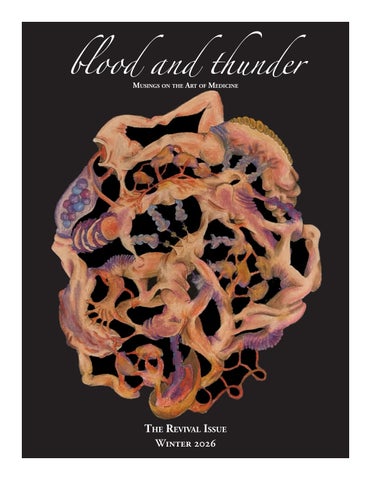
blood and thunder Musings on the Art of Medicine
The Revival Issue Winter 2026
blood and thunder Musings on the Art of Medicine
THE REVIVAL ISSUE Winter 2026
i | Blood and Thunder
blood and thunder Musings on the Art of Medicine
EDITORIAL STAFF Nitin Rangu | Editor in Chief Nitin is a third-year medical student at the University of Oklahoma College of Medicine in Oklahoma City. Nitin enjoys tennis, trivia, and film, and is especially interested in a future career in ophthalmology. He credits his lifelong love of storytelling and the humanities for his desire to help revive Blood and Thunder. His role as a Co-Editor in Chief has centered around bringing together a community of like-minded individuals in bringing the arts back into the heart of medicine. Wesley Tomlin | Editor in Chief Wesley is a third-year medical student at the University of Oklahoma College of Medicine in Oklahoma City. Wesley has a passion for pediatrics and serves as the Co‑Editor of Blood and Thunder. Wesley playfully describes himself as “someone the art gene skipped over,” as he comes from a family of accomplished artists. Outside of his creative and academic endeavors, Wesley restores furniture, tends his garden, and immerses himself in video games. When weather allows, he explores the outdoors with his dog, Azula. In his editorial role, he aims to foster creativity and freedom of expression for medical professionals. Aarya Ghonasgi | Communications Director Aarya is a third-year medical student at the University of Oklahoma College of Medicine in Oklahoma City who is interested in pediatrics and psychiatry. She is passionate about travel, art history, reading, movies & fostering kittens. She loves spending time with her cat (the boss of the house) and trying new crafts and hobbies. Aarya’s role includes creating the visual language of Blood and Thunder, from social media to journal layout. Kian Steppe | Content Managing Editor Kian is a third-year medical student at the University of Oklahoma College of Medicine in Oklahoma City. He has a strong interest in orthopedics, ancient history, paleontology, and the natural world. Outside of medicine and editorial work, he enjoys drawing, fishing, exploring the outdoors, and steadily transforming the space behind his apartment into a thriving garden of vegetables and herbs. Kian’s role included developing submission grading criteria and ensuring adherence to the guidelines necessary to create the finished product we can all enjoy. Piper Tingleaf | Design Editor Piper is a first-year medical student at the University of Oklahoma College of Medicine in Oklahoma City. She enjoys creating art and practicing yoga when outside of the classroom and loves a coffee break. Piper looks forward to exploring the surgical specialties, particularly neurosurgery. As Design Editor, Piper assembles the Blood and Thunder issue using Adobe InDesign with guidance from the team on artistic presentation and aesthetics. CLASS REPRESENTATIVES Kristen Hall Vaishnavi Kumar Max Bouvette Sydney Vu
MS1 MS2 MS3 MS4
iii | Blood and Thunder
SELECTION COMMITTEE Kelly Chong MS1 Lillian Do MS1 Charlie Taylor MS1 Jared Haymore MS2
Andrew Hojjat Allison Hussin Allie Wenger Tom Ashley
MS2 MS2 MS3 MS3
Humza Razaq MS3 John Woods MS4 Anusha Gopalam MS4 Charlie Hojjat MS4 Winter 2026 | ii
Table of Contents Flesh Tangle by Allie Wenger
COVER
Medicare Wellness Check Electrical Unit by Paul Hostovsky
15 16
Introduction
v
Foreword
vi
What PubMed Cannot Answer by Jules Netherland
17 – 18
Descent of the Mind by Kaitlyn N Cameron
1
Sick Like Me by Justin McDevitt
19 – 21
Clinical Terms of Venery by T.R. Ashley
2
Brain Break by Emiline Henderson
22
Resuscitation by Janice Te
3
Veins by Julia Li
23 – 24
Soaking Hypodermics Flame Test Loop Conjoined Twins Separation Irrigating by Willy Conley
4
Seventh Room by María Alejandra López Fajardo
25
Mother 2023 Anxiety Blues by Linda Barrett
7 8
A Breath Too Far I See You The Swirling Line of Uncertainty Mindscape The Story Beneath the Skin by Minna Chang
26 27 – 28 29 30 31 – 32
Red Tape from a Sick Woman by Breighleigh Crawford
9
We Gave Her a Name by Mitchell Lecoultre
33 – 34
Reflections in the OR by Andrew Jea
10
Harbinger of Dementia by John Campbell
35
The Cut That Heals by Sydney Vu
11
First Breath, Last Breath by Zishan Mahmood
36
What Lies Between Sick and Healthy Pain is a Mirror States of Fatigue by Christa Fairbrother
12
Mask Gleaners Masked Masks Confronting COVID-19 Cafe Terrace at COVID Capacity The COVID Card Players by Donald Patten
37
Diaphragm Canthus by Ellen Harrold
40 41
Becoming. by Sophia Reyes
42
5 6
Thinking outside the Alphabet: Abstract Thought 13 on the ABCDEs of Melanoma by Gabe Cohlmia Act of Remembrance by Bara Swain
iii | Blood and Thunder
14
38 39
A Recovery Fibrous Roots Salt Marsh Swampy Places The Lakes Were Open by Kristin LaFollette
43
“Is There A Doctor On Board?” by Daniel Ahlers, MD
46
Gift of Life by Allison Wenger
47 – 48
Recognition The Last Permission by Simal Cheema
49 – 50 51 – 52
INVERTEBRATES BLOWING TRUMPETS A TOUCH by Nidhi Agrawal
53 54
Charts Unfinished by Summer Anwar, Mehak Ali, and Hudia Jamshed
55
In Death, Life by Anuhya Kotta
Live in the Moment by Jacqueline Jules
66
Broken Impaired Bedside manner by Joanne Jagoda
67 – 68 69 70
Teaching the Intern How to Say I Am Sorry Withdrawal, Bedside Triage Begins with Water Code at 3 a.m. by Veronica Tucker
71
The Horror by Christopher Graffeo
73
Compound Fractures Closed or Open by Jenna Rindo
74
Waiting by Mark Liebenow
75 – 78
Modern Murder by Brad MacCosham
79 – 80
56
After the Scan by Jacqueline Oh
81
Babies Born with Internal Organs Outside Their Bodies, an Early History by Matthew J. Spireng
57
MERCHANT OF HOPE by R. Steven Heaps, Ph.D.
82
The Compassion by Cara Coleman
58
Know Your Why by Aurora Jennings
83 – 84
A Eulogy for the Living by Litsa Dremousis
59 – 60
Unsung by Lyra Seaborn
85
In These Halls Let Me Go To Follow Through by Julia London Sirota
61
The Fat Envelope by Michael Eyre
86 87
I Think We Talked COLOR by Ellen Gerneaux Woods
63 64
Portraiture Introductions Visitation by Nathaniel Julien Brame
89
Stroke by Anika Patel
65
The Scalp by Charles Hojjat A Mother’s Thanksgiving by Dylan Becker
90
44 45
62
72
88
Winter 2026 | iv
blood and thunder Musings on the Art of Medicine
Introduction by Rachel Gallant, MD, MS In medicine, we rely on sound science and objective data to understand the basis of disease, improve treatments, and move the field forward. But more important than a deep scientific understanding of medicine is human interaction – the art of medicine. Before we can make a diagnosis or prescribe a treatment plan, we must connect with a patient and learn their story. We do this through the art of questioning, listening, and storytelling – connecting with them as a person, not just a patient. Medical providers face many challenges on a daily basis – the patient who can’t afford their medication, the insurance company that doesn’t cover the prescribed therapy, the intolerable side effects of the medication, the disease that doesn’t respond to treatment as expected – to effectively practice medicine, we must approach these obstacles with creativity, finding a way to work around them to ensure appropriate treatment and quality of life for our patients. Medicine is much more than applying scientific knowledge, it is an art requiring observation, empathy, and creativity. Art can also be an outlet for reflection and a tool for fostering creativity in both our personal and professional lives. Art in medicine curricula implemented in medical training have been shown to improve observation skills, empathy, creativity, and reflection. Blood and Thunder: Musings on the Art of Medicine showcases the visual and literary artistic expressions of artists in healthcare. After a brief hiatus of its publication, a group of University of Oklahoma College of Medicine students saw the value in an art in medicine publication and worked diligently to bring this journal back to life. In addition to serving as a space for artists in healthcare to share their work, we hope that by engaging with the pieces in this issue our readers will develop a deeper appreciation and understanding for the humanistic side of medicine. Rachel Gallant MD, MS Assistant Professor University of Oklahoma College of Medicine
v | Blood and Thunder
blood and thunder Musings on the Art of Medicine
Foreword Blood and Thunder began more than 2 decades ago as a love letter to the humanities championed by students at the University of Oklahoma College of Medicine. For years this journal served a vital role for our community of artists, offering a space for us to articulate and express our souls amidst the often unforgiving circumstances of life in healthcare. Our publication grappled with the complex intersection of health and humanity, allowing for raw understanding of what it means to be sick or well — what it means to be human. Blood and Thunder meant so much to so many. For our absence we offer our deepest apology. Yet, it is with great pride and joy that we welcome you back to our Musings on the Art of Medicine. Like the best things in life, Blood and Thunder’s revival grew from a simple premise: love and friendship. We, the editorial team, close friends bonded through the trials of medical school, realized we were missing a crucial aspect of our education that couldn’t quite be captured from our textbooks and lecture slides. We missed what drew us to medicine in the first place. Inside the weathered fragrance of the classroom, the sterile incandescence of the operating room, or the hum and hush of the clinic, we find meaning in the minute moments of medicine. We share this art to remind all of us how we live within this world. We create and we feel, in every environment and under every circumstance. For five years, these ideals lay crystallized in previous editions, displayed in our medical college yet belonging to past generations. Until now. Through many stops and starts and countless growing pains we are finally ready to welcome you, our cherished reader, back into Blood and Thunder: Musings on the Art of Medicine. The works that we present to you represent the culmination of a lifetime of storytelling from our authors, poets, and artists who humbly have shared their work with us. Let yourself be transported by their words or transfixed in their art. We offer a glimpse into the joy, sorrow, humor, and vibrance that can come from an individual but speak for us all. Words cannot describe how grateful we are for you to read our contribution into the canon of Blood and Thunder: Musings on the Art of Medicine. We hope it will mean to you even a fraction of what it has meant to us. Most of all, we hope it will inspire you to keep sharing your stories, so we can continue to share what it means to be human. Sincerely, Nitin Rangu, Wesley Tomlin, Aarya Ghonasgi, Kian Steppe, Piper Tingleaf Blood and Thunder Executive Team 2025 – 2026
Winter 2026 | vi
Descent of the Mind
Kaitlyn N Cameron
K.N.C. has worked in laboratories since 2006, a career that requires analytical attention to detail. From environmental to healthcare, this field is both rewarding and challenging while providing unique opportunities to find inspiration for creativity.
1 | Blood and Thunder
Clinical Terms of Venery by T.R. Ashley
Collective nouns for animals found outside the hospital, dubbed terms of venery, have been around for centuries: a parliament of owls, a pride of lions, a murder of crows. Despite the medical profession’s love of nomenclature, however, no terms of venery exist for the fauna encountered inside the hospital. As such, the following terms have been proposed to compensate for this glaring hole in current medical knowledge: An ambulation of physical therapists A fluster of interns A beep of floor nurses A bulla of dermatologists A bolus of emergency medicine doctors A chatter of psychiatrists A clog of scrub technicians A confusion of medical students A contraction of obstetricians A convolution of nephrologists A correlate of radiologists A stent of cardiologists A dribble of urologists An exhaustion of residents A fasciculus of neurologists A fixation of orthopedists A flap of plastic surgeons A lavage of pulmonologists A loop of endocrinologists A mass of oncologists A murmur of cardiologists A nebula of respiratory therapists An orbit of ophthalmologists A partition of anesthesiologists A quack of chiropractors A quibble of administrators A roux of bariatric surgeons A sinus of otolaryngologists A smear of hematologists A sniffle of pediatricians A speculum of gynecologists A stain of pathologists
Winter 2026 | 2
“Resuscitation” by Janice Te
When I learned how to perform CPR, No one told me that when their pulse stops, Briefly, yours actually does too. Their neck and their wrists That you had held before Suddenly no longer contain The throbbing of living. When you check to see if they are still breathing, The exhaled air in your ear sounds like The promise of an ocean nearby, And the warmth of it in your ear feels like That time they whispered, “I love you.” And the absence of breath is the loudest thing You have never heard before. When you put your hands on their chest, And center them over their sternum, You remember that their actual heart Lays left, superolaterally, at the place Where you used to rest your head — That same place where currently There is no beat and no rhythm. When you perform compressions, One hand stacked over the other, Fingers interlocked together, You use the very weight of your entire being To apply force over bones to wake the dead. You count audibly, hoping that your voice Is just loud enough to quiet your thoughts — Is the depth enough? Is the recoil enough? Is the timing just right? Did we connect enough? Did I forget too much? Will we have more time? Will you open your eyes again? Janice Te, M.D., graduated from the University of Oklahoma College of Medicine and trained in Internal Medicine and Infectious Diseases at the University of Oklahoma Health Sciences Center. In her spare time, she enjoys playing music, singing, and writing as creative outlets.
3 | Blood and Thunder
Flame Test Loop
Willy Conley
Soaking Hypodermics
Willy Conley
Winter 2026 | 4
Conjoined Twins Separation by Willy Conley
On the morning of November 27, 1984, I was summoned to the operating room to photograph the separation of conjoined twins born just the day before. The twins, joined at the abdomen, shared a digestive system from the small intestines to the bladder. Typically, surgeons wait 4-6 weeks before separating conjoined twins, but these girls had an opening in their abdominal wall, leaving them vulnerable to life-threatening infections. Surgery could not wait. I was instructed to bring plenty of film and extra batteries for my camera and flash, as it was expected to be a marathon operation. The O.R. buzzed with activity—medical teams and even members of the media crowded the space. Despite the high stakes, there was an air of excitement and determination. Two teams of doctors worked simultaneously, a rare necessity when treating two patients at once. The chief of pediatric surgery handed me a notepad, requesting not only essential surgical documentation but also a “pictorial essay” capturing the atmosphere of the room. The procedure stretched over 18 grueling hours. Tragically, one of the twins passed away in the hospital eight months later. The surviving twin, however, grew up to live a full life and now has a family of her own.
5 | Blood and Thunder
Irrigating
Willy Conley
Willy Conley, born profoundly deaf, is an award-winning writer and photographer whose books include Photographic Memories, Plays of Our Own, Listening Through the Bone, and The Deaf Heart. Early in his career he worked as a medical photographer before earning certification as a Registered Biological Photographer. He is now professor emeritus of Theatre and Dance at Gallaudet University, the world’s only liberal arts university for deaf and hard-of-hearing students.
Winter 2026 | 6
Mother 2023 by Linda Barrett
She was always there for me. When I had my tooth pulled out (I must’ve been five then) I awoke from the anesthesia, And she sat next to me, Wiping the blood from my mouth Singing “Linda” She was always there for me. When I went to Temple University, She sat outside on the bell tower’s stand Waiting for me to finish my last class. She was always there for me When I faced crises, She always stood by my side For whatever support I needed. Now, I am there for her. Wash her by the bathroom sink every morning Feed her breakfast Give her the necessary medications. Tuck her in bed at night. Like she did for me.
7 | Blood and Thunder
Anxiety Blues by Linda Barrett
I wake up in the morning: Facing another day of dread. I have to fight the tyranny of time My wrist watch scolds me to get ready My soul takes warning Before I get out of bed. The backs of my legs tingle With thoughts of what will happen When I get behind the wheel of my car And wait for everything to be fine. But it starts all over again I also face getting out of line When I go along a road’s curves People laugh, telling me I’ll be all right But they don’t know what’s wrong with me. I can take the anti-anxiety drugs And wait until it’s over It’s an uphill fight But the pills only keep down the trembling Until I get home. Other people face worse suffering But I feel like I’m all alone When I drive out there. I always make sure I have my phone Something demands I quit I trust my feelings Because I trust them Rather than God
Linda Barrett has always been a writer. Her work is featured in print and online anthologies. This is her third time being published by Blood And Thunder. She lives in Huntingdon Valley PA at a retirement community.
Winter 2026 | 8
Red Tape from a Sick Woman by Breighleigh Crawford
Have we forgotten the sacredness of life, the beauty of birth, and the comfort of dying? Do we live our lives knowing that we are born to live and live to die? Is everything a race to get to the finish line. Is there no middle ground between the life you live and the afterlife? These are the questions that haunt me. I am me, a young and bright soul with dreams to live a long life of wonderful fantasies but fate has dealt me a poor hand and I suffer daily. I cringe with each minuscule movement and tear when I breathe too deeply. My body is diminishing before my very eyes, and yet I am stuck in limbo with what society says I can do. As if they understand, as if they can empathize my excruciating tasks that seem so simple. They can’t. I want to live but I also want to die. I do not fear death; I welcome it like a friend. I want to be at rest, without constant beeping machines and new needles that bruise me, I want serenity. But to gain this, I must be tested and questioned. They want to know if I am suicidal or depressed. They want to know if I am mentally tough enough die. Ha! Who would’ve thought you needed to be strong to die? The tests are done, the jury is in. I don’t pass their impossible questionnaire. They tell me I can’t make my own decisions, that I am not of sound mind. If your body was a vortex of pain and agony you might not be of sound mind either. I am stuck in the midpoint of policies and red tape. When people who know nothing of my condition are the ones who sealed my fate. I will suffer. I will not cherish the final bliss but recall the cold painful eternity I must endure.
Breighleigh Crawford is a third-year medical student at the OU School of Community Medicine in Tulsa, Oklahoma. She brings a compassionate, well-rounded perspective to her training, shaped by a lifelong love of the arts, including modern art and poetry. Outside of her medical studies, Breighleigh is an avid reader and is currently training for her first marathon. 9 | Blood and Thunder
Reflections in the OR
Andrew Jea
Digital photograph 1/80 F5.0 ISO640 of a reflection of an overhead endoscope monitor in the OR showing the entire team working to help a baby with a misshapen head at Oklahoma Children’s Hospital.
Dr. Jea, in 2022, joined the Department of Neurosurgery at the University of Oklahoma College of Medicine in Oklahoma City, Oklahoma; where he is Professor and Chairman of the Department of Neurosurgery, and Chief of Pediatric Neurosurgery at Oklahoma Children’s Hospital. Winter 2026 | 10
The Cut That Heals
Sydney Vu
Collage on paper, constructed entirely from fragments of print media. By layering and reshaping discarded materials into an image of surgeons at work, the collage mirrors the paradox of surgery itself: healing through incision, and repair though deliberate destruction. This piece invites reflection on how both medicine and art transform fragments into wholeness. Sydney Vu is an MS4 at the University of Oklahoma College of Medicine with a strong interest in radiology and the intersections of art and medicine. She has explored ceramics, collage, and film photography as creative outlets throughout her training. Her work often reflects themes of patience, precision, and repair drawn from both clinical and artistic practice. 11 | Blood and Thunder
What Lies Between Sick and Healthy by Christa Fairbrother
Interstitial the doctor decides, a space between. A body has hollows hidden. A voice chirps mind the gap in a clipped British accent in defiance of logic and quantum mechanics, which says to know a thing means you alter the thing in your attempt to know it. How to sample the sweet orange seeds of a passionfruit and leave its skin intact? Space is not something to reach through, pull stars down to palm like marbles. Your knife will slide between my ribs, twist freely.
Pain is a Mirror by Christa Fairbrother
Wishing well on the wall, please tell me all things fair. Your skin is the smoothest, your hair the shiniest, your pain the smallest. A one-sided conversation in profile you fear facing head-on. It only reflects what you already know, you are a body inflamed. A gilt circle of self-recrimination. A mirror is pain. vanity a pretty way to say you deserve more than this
States of Fatigue by Christa Fairbrother
Plasma ferries this fatigued blood oozed over a seat. Where do I start/stop with the oak of the chair, a tree losing its love for the leaves. Leave this moment Does it take more energy to fall apart Yesterday was a gas—superheated a black hole consuming an extreme makeover from the lab I’m tired of this physical disorder
a pooled liquid for the love of the stool? I meld leaves. Gravity always outweighs drop, sink. Physics in action. hold it all together? Does it even matter? luminous. Today, I am ignoble, all darkness. Can I request to crystalize good times? increasing.
Christa Fairbrother, MA, is a disabled poet currently serving as Gulfport, Florida’s poet laureate. She’s had poetry in Crannog, Epiphany, Pleiades, and Salamander, among others, and was a Pushcart Prize nominee. She is the poetry editor at Phylum Press. Winter 2026 | 12
Thinking outside the Alphabet: Abstract Thought on the ABCDEs of Melanoma Gabriel Cohlmia
What at first glance is scattered pieces of abstract art represents something much more profound when thinking about preventative healthcare for patients at risk of melanoma skin cancer. The ABCDEs of melanoma are often depicted with images of skin and therefore cannot encompass every possible manifestation of a pigmented lesion that poses a threat to a patient’s health. This work represents each pillar of melanoma recognition: Asymmetry, Border, Color, Diameter, and Evolving. If people can understand these concepts their most basic level— even in the form of mixed media, two dimensional art— then they can be better prepared to identify threats to their own skin and even their life. Gabriel (Gabe) Cohlmia is a native Oklahoman who is beginning his medical career at the University of Oklahoma College of Medicine. Though he does not consider himself to possess artistic prowess, he recognizes the power of art to convey meaningful messages. Gabe’s primary medical interest is dermatology, where he hopes to care for his community with utmost precision while recognizing humanity and individual stories, we all wear on our skin. 13 | Blood and Thunder
ACT OF REMEMBRANCE by Bara Swain He called me ‘Sadie’ and it stuck like honey on bees, bees on honey. Sadie and Charlie – the sweetest man I ever laid eyes on. I tried to reclaim my birth name once, when Charlie introduced me to your grandparents that first summer we courted. They had a bungalow on Clum Hill Road then, near Tannersville Lake. Such a beautiful beach. A beautiful couple, too -- liberal! … grieving Gandhi’s assassination and the convicted Hollywood Ten. Outspoken and loud … even when no one was listening anymore -- not me, not Charlie, not even the sand gnats that nibbled on our toes that hot August night. And I was still ‘Sadie’ the next morning when we returned to Hunter, and the dragonflies danced along the shore of Schoharie Creek as we skipped stones across the slowly moving stream, and the smell of hot fresh rolls and Skunk Cabbage mixed with the scent of wildflowers that swayed on a sudden cool breeze. “Will you marry me, Sadie?” Charlie asked. A rose by any other name would smell as sweet. A civil ceremony, a baccalaureate degree, and a new non-skid area rug later, my birth name was a point of contention for the first time. Charlie joined me in the delivery room after I labored -- with you -- for almost 27 hours. You were stubborn as a mule, even then, waiting to make an appearance in your own time, on your own terms. And your father -- he was instantly smitten! Charlie snatched you from my breast moments before my own mother framed the doorway -- a load of laundered diapers balanced on one hip, a food hamper on the other, a first edition of Dr. Spock’s “Baby and Child Care” tucked under her chin, tripling it. Bedazzled Charlie -- oblivious! -- drank in your heart-shaped face and rose petal mouth. Then he turned pink, a shade of purple, then a deep red – crimson red, and he whispered, “You are a royal angel sent to me from heaven. I’m going to call you by the Hebrew name ‘Sydelle,’ meaning ‘princess.’” And before another tear slipped down his flushed cheek, your grandmother bellowed so loudly that I bolted up in bed, matching her howl with my own. “You’re an idiot!” my mother hollered. “You imbecile! ‘Sydelle’ is your wife’s given name!” So, here you are, Sydelle -- finally making an appearance … in your own time, on your own terms, as always. I read your father your postcards, filling in the ‘hope you’re feeling betters’ and ‘having a great time in Miami or Austin or the Spanish Virgin Islands’ with stories -- fabricated adventures to distract him from the horror, the sheer terror of his final journey. So when Charlie was diagnosed, you were nursing a failed love affair with a hairdresser in Belize. When his treatment began, you started graduate school in France. When the last round of chemotherapy failed, you had a job opportunity in New Mexico that you simply couldn’t pass up. And on the hottest night of August, when Charlie turned pink, then purple, then crimson red, and whispered on his dying breath, “You are a royal angel sent to me from heaven, Sydelle” --where were you? Where were you then? Where. Have. You. Been?!! You do not belong here, Sydelle. This is my shrine now. I forgave your father for loving you most a long time ago. But I will never forgive you for cheating him of memories, real memories to sustain him during his last brutal years -- pain wracked months, days, hours on this earth, in this home, in our marriage bed. And until I draw my own final breath, I will honor your father every day with a stone from our beloved Schoharie Creek -- a rock as enduring and strong as the memory of his love. This is my act of remembrance, Sydelle. These are my terms. My way to say, “I will never forget the sweetest man I ever laid eyes on.” Never, Charlie. Ever. You know the way out, dear. Bara Swain’s prose is published in print and digitally in various literary and print anthologies. Her plays and monologues have been staged in 300 venues in 33 states and abroad (UK, Ireland, UAE, Canada, Australia, Ukraine). Winter 2026 | 14
Medicare Wellness Check by Paul Hostovsky “Beautiful pulses,” says the nurse practitioner to the morbidly obese man slouching in his wheelchair, the cascading flesh-fall of fat pooling at his kneecaps, his naked left foot cradled in her hands, her slender fingers palpating next to the extensor tendon of his big toe and also the inner side of his ankle. “Thank you,” he says, blushing, the blood doing tumble turns like an Olympic swimmer pushing off the tips of his ears, splashing down at the beautiful pulses of his feet, reaching for the wall of his mortified, flattered heart.
15 | Blood and Thunder
Electrical Unit by Paul Hostovsky
Every year when I taught the electrical unit— the difference between static electricity and circuit electricity—I’d give each kid a balloon, tell them to blow it up and tie the end (they usually needed help tying the end) and rub it on themselves. RUB, RUB,RUB. That was always the fun part. Then we’d put it on the blackboard where of course it would stick— that was always the magical part. Now, if they could tell me the principle behind it—why the balloon was sticking, what was happening with the protons and the electrons— they could keep the balloon. And if they couldn’t, well, we’d pop the balloon. I had a giant safety pin and we’d pop the balloons: POP, POP, POP— that was always how all the other classrooms knew when I was doing the electrical unit. I do so miss teaching. I hated to give it up. Since the amputation here I sit in a wheelchair, waiting for a kidney transplant and a prosthetic leg. I’ve gained twenty pounds since January. I’d like to get back in the classroom, but I need a leg first. Can’t get into the building without a leg. People treat you differently when you’re missing a body part— they will talk to the person you’re with instead of to you. “Yoo-hoo, I’m down here,” I tell them. “Talk to me please in the second person.” Some of them don’t even know what the second person is. Others, it’s like a light bulb goes off in their head and now they finally see me. The kids are wonderful. No inhibitions. They walk right up and point: “What happened to your leg? Where is the leg now?” In the grocery store I have a scooter—the store provides them. The kids all think it’s the cat’s meow. They’d give anything to ride that thing. I’m like the pied piper: they follow me up and down the aisles, asking for a ride, asking where the leg is, asking questions no adult will ask or deign to answer. Paul Hostovsky makes his living in Boston as a sign language interpreter. His poems and essays appear widely online and in print. His newest book is PERFECT DISAPPEARANCES (Kelsay, 2025). He has won a Pushcart Prize, two Best of the Net Awards, and has been featured on Poetry Daily, Verse Daily, and The Writer’s Almanac. Winter 2026 | 16
What PubMed Cannot Answer by Jules Netherland
I haven’t always loved this body I was gifted with. Nor, if I am radically honest, have I always loved this life. And yet, as long as I can remember, awe has come easily – Floored daily by the intricacies and idiosyncrasies, The sweetnesses and humor of creation. But this body, my body, we have battled, haven’t we? Over things that seem so monumental then – And so inconsequential now. Was it only three, maybe four years, before I learned You were harboring cancer that I finally loved you? That I finally understood that each breath in is divinity infusing lungs and heart and each exhale a connection to all that is holy? So recent and ephemeral seem those shining moments When I marveled at my own muscle and sinew, Felt powerful and handsome In a body reshaped, at last, by love. “Stage three invasive lobular carcinoma.” Do you remember believing that you and I, Like Icarus, had felt too good, flown too high? Do you remember how wax slid from sun-warmed wings As the ground rushed up to meet us? And do you remember how I loved us back From the cutting, the burning, the poisoning – with missing breast, swollen arm, aching joints? Loved you even though you were as unfamiliar as a hitchhiker I picked up and Got to know on the road back to some place still miles away from normal? But that was before I knew you had tucked Two glowing, growing green tumors in my belly. Once, decades ago, when I was young and foolish and Had decided this life wasn’t for me, God or divinity (Whoever or Whatever) offered me a deep knowing That appeared to me I can’t say how But with such bell tone clarity, I could not help but heed it: “Love made you.” And in an instant I know this is Truth. 17 | Blood and Thunder
“Metastatic breast cancer. Terminal.” And now as I fear the suffering this body carries and will carry, And now as this body and its disease are laid bare by scans and exams, And now as my days are punctuated by punctures and pills, And now as I wonder how many of those days I even have – How many of those days I even want, And now as I struggle to love this body again, Love this body that has tried to kill me Not once. But twice. Of course now, of course it is now, That You, the cosmic Whoever or Whatever, You offer another – indeed the same – deep knowing: “Love will bring you home.” And in an instant I know this is Truth. I know in that instant that the body trying to kill me Is also the body loving me and allowing me to love. And it is this body that You, the Whoever or Whatever, Crafted from love, hold in love still – This body that is blessed, broken, and given. And in that instant of knowing I also know this – That none of my frenetic PubMed searching: “prognosis stage iv invasive lobular metastatic breast cancer,” That none of my fear can tell me what I want to know, Tell me what never was, and is still not mine, to know. But I do know this, and this is all – Love made me and love will bring me home.
Jules Netherland is a medical sociologist and person living with metastatic breast cancer in New York City. Winter 2026 | 18
Sick Like Me by Justin McDevitt
When I woke up in sharpie-anointed room 20 of the E4 unit, adult psychiatry, at Elmhurst Hospital in Queens, New York, my roommate, Jake, was looking at me. He was tall with long black rocker hair and wide black jeans, an oversized t, and black slides; total emo band vibe. He waved hello. “What’s up?” I yawn-spoke. “Breakfast,” he said. “Cool.” I asked him why he got to wear his own clothes before I asked him his name. “My uncle dropped off a bag,” he explained. “He lives in Sunnyside.” “But you don’t?” “Cali.” “Makes sense,” I said, shifting around in my bed with the thin blue blanket. Was I allowed to get out of bed? “Will I get to wear my own clothes?” “You can ask.” “I didn’t pack anything.” “Most people don’t.” I learned that Jake was a poet and musician who had been a frequent flyer to rehabs and hospitals across the country. Jake was not someone fighting his reality. I decided to be like Jake, to embrace, cucumber-cool, my mad present. The bedroom was sparse but large and my first time having high ceilings. There were twin beds on opposite ends with cubby-style shelves built into the walls. The bathroom had a partial swing door, like a saloon entrance in a western. There was plenty of toilet paper but no shower curtain. No nobs on the shower, either; instead: a single, silver button. This shower was not from the future or fantasy land. This shower was suicide proof, something I observed but didn’t attach any feelings to, as I no longer had suicide on the brain. My cubby was empty except for a towel, toothbrush, toothpaste, and alcohol-free deodorant (all white, all brand less), and Know Your Rights, a packet of information for appealing my involuntary inpatient status. “Why are you here?” asked Jake. “Uh…” “You seem so normal,” he explained. “Thanks,” I said. Then, recognizing the form: “You too.” “Overdose,” he offered. I nodded. “All it did was ruin my insides, so I’m here.” “That happens????”
19 | Blood and Thunder
Every doctor I’ve talked to since my admission to the hospital would make a point to educate me: an overdose almost never succeeded in death but would more likely damage my organs and leave me in a vegetative state. Awesome. “It’s all right,” Jake continued. “When I get outta here I’m going back to California to get my girl. I want to prove to her I’m serious this time.” As Jake laid out his plans for a post-hospital world, I realized I was sharing a room with Jack Kerouac. It was nice to be living in a book. It was nice to be living. “So do they bring us breakfast in here?” I asked. “The cafe.” “Oh, cool. So we can leave our rooms?” He laughed at me and then we went to breakfast. As Jake led me down the one white corridor to the small cafeteria at the end of the hall, I was impressed by the simplicity of the unit. It looked like a movie set, just not for a movie I had seen before. I was not in Valley of the Dolls. I was not in Hellbound: Hellraiser 2. I was not in our patron saint of insane cinema: One Flew Over the Cuckoo’s Nest. Nowhere could I spot isolation tanks or padded cells. No straight-jackets and no shock therapy. None of the nurses had Oscars. We passed Timmy on our way to the cafe. I would guess he was forty, Asian and balding, with a slight hunch. He looked depleted and diminished. He paced the corridor, his zombie-waltz. “Even in prison we had a gym,” he lamented by way of introduction. He walked the halls like he was Jacob Marley. “Hey, I’m Justin.” “Are you crazy?” asked Timmy. “Yes.” “They don’t let us outside,” he said. I didn’t say anything. “They don’t let us outside to exercise, fuck,” said Timmy. “My last place had a pool,” said Jake. They grumbled about the amenities; there was talk of an equestrian program at a clinic upstate and whispers of the Tenth Floor Luxury Unit, reserved for celebs and rich folks (“City hospitals don’t have those,” laughed Sophia — my best friend and an emergency room doc — when I asked her seriously if she had ever been. The unit reminded me of a school hallway. It felt safe. And that’s what I was, finally: safe, protected, relaxed. I wasn’t home but I wasn’t in hell anymore.
“This place is great,” I said. Jake and Timmy looked at me confused, which was when I accepted we must maintain a cordial disdain for the unit, like smokers stationed outside a bar. “Compared to downstairs,” I added. “Oh yeah,” said Jake. “Downstairs is hell.” Timmy looked at Jake for clarification. “CPEP,” said Jake. CPEP was the Comprehensive Psychiatric Emergency Program. Timmy nodded. “Downstairs is hell on earth,” I said. Jake looked at me: pull it back, man. Okay, okay, I nodded. Then we went to breakfast. By the time we had finished our eggs I was ready to ask, “What’s next?” which was when a doctor appeared and asked to speak with me. “I’m Dr. Joe.” Dr. Joe wore blue scrubs and Asics. He led me into a tiny office where we sat on chairs close together. He asked me how I was doing, how I came to be here. I told him what got me to the hospital. I was now getting pretty good at The Story of Me: Demise Edition. He asked about my family history, if anyone else had been sick like me. He asked if I wanted to hurt myself. “No,” I said. “Not since I got to the emergency department.” He nodded. “Oh wait,” I said. He waited. “There was… a flash of something… it was weird, while I was sitting on my gurney and people watching, a flash of death, but it felt so… out of place. But it’s gone, I think.” He nodded. “I’ll be here all weekend,” he said. “If you need anything, have the nurses page me.” While I couldn’t remember in perfect order the events of my first dull day on the unit, it was Timmy who lived at the forefront of my mind. Some people in the unit were crazy. And then there were people who performed their crazy like they were on Broadway, which I wished we were. Madness was everywhere. Madness was all of us othered into isolation, a queering of health, a cattle-call confinement of those with depression, anxiety, PTSD, trauma, and, more clinically: bipolar, borderline, schizophrenia, and schizoaffective. Some of us internalized our pain, fortified against a curious, judgy outside world, while others would take their madness to the streets, to CVS and subway cars, to public spaces for theatrical performances because that was the only pulpit available.
According to Timmy, he was being held against his will because he smoked a cigarette. He knew Malden. He knew Quincy, I wrote in my hospital journal. We discussed Boston’s Chinatown and then he told me he liked hot beer. He’s sitting right next to me, looking over my shoulder. “All I did was smoke a cigarette and my sister had me committed,” he said. I took him at his word. When he told me his favorite cocktail was hot Jameson I believed him, and told him I drank Jameson too, room temp. Timmy told me he liked to drink his own blood. Timmy said, “Mothers hold you too tight.” Timmy keeps saying it was a cigarette that got him here, that his family called 911 because he smoked a cigarette. He’s been to two other hospitals, one in Jamaica, Queens, and one on Manhattan. He prefers the hospital in Jamaica. Timmy asked me, “Who took you here?” “My friends.” “They’re not your friends.” “Yeah they are.” “Nobody has anyone. Nobody has any friends. All you have is yourself.” “Uhhh…..” “I am my only friend.” Later on he asked if he could read my mind, and I said yes. *** I was skeptical of the shower, but took my towel into the bathroom anyway. It was something to do. I pressed the one button and watched the water pouring down in one-minute spurts. Allegedly, the water got warmer, but my first few showers were freezing cold. I quickly adapted to this system: that mid-lather the water would go out but I’d press the button, and keep scrubbing. It reminded me of a week I spent at a hostel in New Orleans, where our showers, by order of the management, had to be limited to two minutes underneath a trickling shower head. At my current apartment in Astoria, I showered with a screwdriver because the nozzles detached and fell off daily. The absurdity of the hospital shower added to my sense of adventure, so that day when I put on a new pair of blue pajamas, I was ready for what’s next. Outside was a different life. Outside were the bloody noses from the blow, the joblessness, recklessness: one billion bottles of Maker’s Mark, and a third as much sweet vermouth. Outside were all the nameless men I fucked last summer. Outside was every filthy DM I ever sent, evidence of an endless and unforgiving appetite, a desire for sex I loathed, regretted, and wanted to kill myself over, to irrevocably destroy my body. “Yes, but this is your summer of sex, drugs, and rock and roll,” someone told me. Continued on next page
Winter 2026 | 20
“Then shouldn’t it feel good?” Outside were the lost days after a bender, the lost days where I’ll never know what I missed: the friends I could have seen, stories I might have written. That’s what was outside. “I can’t wait to drink whisky when I get out of here,” said Timmy. “Will you?” “Oh yeah.” That person over there, on the other side: he was wild, wretched, a wrecked degenerate. He was lonely, broken, desperate for the pain to go away, desperate for the chance death might ameliorate suffering, even if no scientific evidence supported the claim that suicide ended pain painlessly. “The food’s not great,” Jake explained over lunch, “but if you talk to the nutritionist, you can order whatever you want.” I learned Jesse ordered a cheeseburger for all his meals minus breakfast. “It’s the best thing here,” he said. E4 reminded me of a dorm, of my first nervous hours living at Goddard Hall, and those first days at all the different schools I attended as we moved sixteen times before I even got to New York. The only difference between E4 and all the schools I attended was that in E4 I fit in. I was always the new kid in school, the guy who was quiet and weird, who sat alone at lunchtime. I never had any friends, mostly, and I sort of accepted the role I played for a time in history, a long time gone, but now I was finally getting to experience what it was like to belong. Sophia, Thea, and Ri were the best friends I could have ever had, but here in E4 I belonged in a different way from the way I belonged to the three people who saved my life. While the art room and cafe were kept locked off hours, we were free to move about without oversight. We could not go outside, sure, but the hallway always had action: the arrival of a new patient, a phone call to the outside world, or an argument with nurses over meds. “Be prepared to be bored,” said Jake. “I’m sure it’ll be fine,” I said. “Yeah,” he said. “But bored.” Each tiny event was treated with flourish because it broke up the monotony. Lining up for dolls was a thrill. Meds popped out of automatic trays in a small trolley the nurses pushed along the hall. This trolley did not offer Bloody Mary’s, peanuts, or Mets hats. We waited against the walls, just outside our rooms, some with disdain for the medicine, others eagerly, others demanding higher doses. When it came to be my turn, I was instructed to hold out my wrist so the nurse could scan a barcode on my hospital wristband. Then my drawer popped open revealing the day’s goodies, individually wrapped and ready to be scanned. I was obsessed with the organization of this process, and gushed on the phone to Sophia about how cool it was. I loved the
21 | Blood and Thunder
little cups in which they handed you pills because it was the only relic of the process, the only part that looked the same in mental hospitals today, yesterday, and in Hollywood. On a break from hanging with my new friends, I called Sophia. Patients shared two phones built into the wall across from the nurse’s station, phones built into the walls like pay phones, but free. “Do you want me to visit you?” Sophia asked. “No,” I said, fast. “Okay,” she said. It’s not that I don’t want to see you, it’s just that it would destroy me to see you and not be able to leave with you, I said. I know, she said. Except I couldn’t remember if I said that out loud or just in my head, but Sophia got it, so connected were our minds. “You ok?” I was standing in front of the phone, having hung up with Sophia minutes before, but not yet moving, just standing there. I turned to see Jake. “Yeah, I’m good,” I said. He held out his notebook to me. “Do you have time to read my poems?” “Sure.”
Justin Mcdevitt is a writer from New York City. His plays Haunt Me and Honey Fitz have been presented Off Broadway for readings and workshop productions. His writing has appeared in Rue Morgue, Fangoria, the Cobalt Review, and Mania Magazine.
Brain Break
This painting was based on what a study night looks like amongst my medical school classmates. I wanted to show details into our lives within and outside of medicine as we work towards the same goals. It is about camaraderie, comfort, and the desire to take care of people, both future patients and each other.
Emiline Henderson
Emiline Henderson is a second year medical student at the University of Oklahoma College of Medicine in Oklahoma City. She has always been passionate about creativity and using art to show the small details of day to day life and the beauty of human connection. Outside of school, Emiline enjoys painting and needlework, spending time outdoors, and watching OU football.
Winter 2026 | 22
Veins by Julia Li
Ma tells me with a solemn face and pursed lips of the first time I almost died. Six months old, body burning with pent up anger from my mother’s land, the injustice of my brother’s life that never was, and petechiae littering my yellow skin. Ma tells me that the nurses couldn’t find my miniscule veins, that just like she had with my unborn brother, she couldn’t find me that night. I thrashed and cried with a simmering fury that had rattled her own heart, Ma bellowed in broken consonants, her voice a vein Piercing the discourse of crackling monitors and ambient pagers of Mandarin and English for someone to find my veins the floors of Northside Hospital shaking with fervor. Ma tells me that we stayed in the hospital for days after. The doctor brings the news curtly — I survived, but had they not found an entry point to my veins, I would have died that night. I prayed to God. Like any Asian mother, Ma doesn’t acknowledge God until we are in times of crisis, and I imagine my Ma’s anger ringing clear in the night sky of broken vessels stars littering the sky, her furious cries coiling into little veins. Only after midnight, Ma then whispers pleas to God as she waits outside the patient room. One child lost to miscarriage and her lost son Stays in the room with me that night[JL2] A remnant of him, myself, and my mother Our veins, forever intertwined.
23 | Blood and Thunder
Older, I trace my own veins when I get bored of playing Beethoven’s Tempest Staring at the blue-green paths that run below my skin. Light glistens on my hands from the lamp that keeps me company during late night practice sessions, and the twisted lightning appears in the form of my tortuous veins, borrowed and sutured with my unnamed brother’s vasculature. When I sleep at night I sometimes dream of my lost brother Ma’s son snapped by a lightning strike , skin puckering with static crackling phantom muscles contracted then dissolving into A vein in the sky that forever tethers Ma, me, and him.
Julia Li is a first-year physician assistant clinical student at Stanford University School of Medicine. Julia is the recipient of the 2022 Max Apple Prize in Creative Nonfiction and the 2022 George G. Williams Prize in Creative Writing, the 2023 Schumann Brother’s Grant for Travel Journalism, and 2022 English Minter Summer Scholars Scholarship.. When she is not in the classroom learning about cardiac physiology and how to read chest x-rays. Julia is hard at work on her first novel. Winter 2026 | 24
Seventh Room by María Alejandra López Fajardo At the edge— hold back from the abyss. If an angel, an angel of light, or something close enough, keeps me from falling. White walls, white uniforms. Amidst a young nurse— Daniela— seems that angel of light, the light around her hands. She stayed with me. She listened. Long enough for me to believe.
María Alejandra López Fajardo is a fourth-year medical student at Universidad del Valle in Cali, Colombia. Her boundless curiosity leads her to explore new knowledge and to build bridges between science and human experience. In literature, she has found not only refuge but also inspiration to nurture her interest in narrative medicine, a territory where experience unfolds as story and memory is preserved as care. 25 | Blood and Thunder
A Breath Too Far
Minna Chang
This was created using an acrylic pour art technique and demonstrates the different ways that lungs are affected in today’s everyday life— COVID, pneumonia, pollution, smoking, etc. Winter 2026 | 26
I See You by Minna Chang
I wait. And sit with you. And wait. I see the weight you carry, the mask pressed tight against your skin. I feel the burden of it, the quiet labours it has born, holding you together, protecting you, hiding you, silencing your story. I will not pry it from you, but gently let you know That I see you, behind the mask. Gentle, like sunrays in the morning Tough, like a flower in a storm. Your hands shake, your breath trembles, I feel the blizzard behind your eyes, the fierce ache, longing to be seen, the quiet hope that someone might finally accept all of you. And then, a flicker, a pause, a shift. Piece by piece, your mask loosens, and piece by piece it falls. I see you. Raw, trembling, alive.
27 | Blood and Thunder
The lines carved by years of hiding tell stories no one else has read. Every line, every shadow, every ache. You think you are fragile, but you are strong. You think you are broken, but you are whole. Here, in this quiet, in this space, I wait. I sit with you. And we wait. Nothing recoils, nothing judges. Finally, you see that you are accepted, Loved, Valued, Completely, Exactly as you are.
Winter 2026 | 28
The Swirling Line of Uncertainty by Minna Chang
In the quiet where silence stays, A silence thick in winding ways. Not dawn nor dusk, but half-lit dark, I live inside this question mark. The body speaks in riddled tones, Like wrathful ghosts without a soul. Another scan… Another wait… On this black line towards my fate. The doctors search, but can’t define these shadows blurring every line. I brace for answers, sharp and clear, But meet instead the shape of fear. This question mark becomes my bed, A million thoughts now crowd my head. I want concrete facts and proof, Not rooms that open with no roof. And so I walk this looping track, Each step ahead still bending back. No period to still the dark, Just the curling spine of a question mark?
29 | Blood and Thunder
Mindscape
Minna Chang
This was created using an acrylic pour art technique, showing how unique our brains, minds, identities, personalities and emotions are. Noone is perfect, but it is the imperfections that make us so perfectly unique. Winter 2026 | 30
The Story Beneath the Skin by Minna Chang
Mist gathers in the morning, like breath on a frosty day a soft blow over fields that hesitate between ripening and ruin. Rivers move like veins, the dark currents restless, swirling, swelling, bearing stones as blood bears its hidden stories. No map can tell which channel will hold, which will break or where they will go. Mountains wear their strength like marrow against the sky, yet even they erode, grain by grain, cell by cell, unseen, unnoticed, untold. The forest of green vessels: sap climbing as surely as blood, branching, forking, until storm or stillness decides on its fate. In this beating pulse And weaving of the earth, uncertainty is the only constant. Whether friend or foe, It holds them both healing and falling in the same breath.
31 | Blood and Thunder
Still, the meadow flowers open, fragile as skin beneath the sun, their courage not in certainty, but gently unfolding with each heartbeat. We walk within this landscape, our breath its weather, our heart its lantern, our blood its tide. Every step a thread drawn through soil and flesh alike, every moment suspended between flourishing and fall. Perhaps it is this unknowing that keeps us tender, to hold the day as if borrowed, to listen to the river’s changing song, and find in its fragile balance the quiet reverence for the turning of the day.
Minna Chang is a doctor and in her spare time likes to paint, alongside her dog, who likes to make a beautiful, colourful mess! Winter 2026 | 32
We Gave Her a Name by Mitchell Lecoultre
We gave her a name. Every ounce of hope— every ounce of joy poured into one word. Names have meaning, purpose behind their weight, and we used that gravity to imbue her with a mandate of the future. We gave our daughter a name, and, in her infancy, she nearly left us behind. Modern medicine, compassionate healthcare professionals, and her resilient spirit kept that name from being just a shadow. And in place of that grim possibility, I have been given the joy that is her life. Moments of growth, of love, of learning, all there to experience. Her beaming smile and innocent, “Daddy!” greet me day after day, reminding me of my fortunate circumstances. She laughs and runs and jumps with her twin sister before growling at her eldest for daring to comb her hair. She talks my ear off, telling me stories of all that there could possibly be—her imagination only bounded by her experiences. She is all that is a child, a well of endless energy wrapped in the exuberance of youth. A circumstance only possible through the dedication and resources of modern medicine. Respiratory Syncytial Virus, that all too common disease, had broken through her defenses, and alongside, “an estimated 58,000–80,000 children [in the United States] younger than 5 years,1” she was hospitalized. Guilt and shame weighed heavy on my soul in that first waiting room, that rural hospital where we had brought her. We should have come earlier. Did we do something wrong? Wi-will she make it? Dark thoughts swirling around, as the emergency room triaged her case as extremely urgent. We waited in fear, hoping that it would be an easy fix; that in a matter of minutes she would come out healthy and pink like the day before. Yet, that moment did not come. Instead, we were approached with the graven solemnity of a professional who knows the situation is dire. Respect, fear, and understanding wrapped in a delivery of bad news. It seemed like such a burden on them. I know now that it’s a weight upon their soul—one only the brave can endure. They laid out the road ahead: A life flight to the city, a tracheal intubation, medications and lifesaving measures, and, most importantly, the tenacity of our child. “She’s a fighter,” they had said. A statement I wholeheartedly agree with—then 33 | Blood and Thunder
… and now . Her courage in some way helping us push through that tremulous time. Each breath an exercise in patience, a battle against dread. The anxiety of an uncertain future breaking against our resolve, and all we could do was watch. Observe the experts keep our little girl away from that ultimate finality. Then the life flight came, and we said our—hopefully—temporary goodbyes. “I will always be there for you … you can bet on that,” I promised her. My wife and I pouring our hope into the courage of that crew . Our aim and theirs becoming a reality as she made it to the city, made it to the PICU. Days of battle ensued, and her tiny body fought for life against the strain of mortality. Her little hand trying to pull the intubation tube out over and over again. With each rebellion the nurses would check her sedation, her IV , the necessities. And every time they would laugh and say, “She’s a fighter.” Words of comfort to a father who had no clue. Words of power against the dark tumult of despair that was raging inside my mind. “She’s a fighter …” When I reflect on those days, I see so much of her personality in that little PICU bundle. The desire to pull that god-awful tube out of her throat, the constant squirming, the squalling war cry, all classic her—all par for the course. Of course, she has had the chance to show me so much more of who she is. An artist, a mathematician, an acrobat, a sister, a caring soul, a lover of plushies and Pokémon, and a loving daughter. But, maybe most importantly, she’s a fighter … and always will be. Maybe that’s why I switched from a research lab to clinical one? Or maybe the opportunities were better? Maybe it was both? Regardless of my motivation, I can’t deny that I see a reflection of my daughter’s struggle almost every day. Maybe not in the physical interaction that the patient-facing staff enjoy, but in other, more subtle ways. Every little tube that comes through our lab, filled with sample, has become as nondescript as possible—almost to the point that someone could ignore its humanity. Yet, in order to maintain positive identification, you have to keep the patient’s demographics. In that truth, I found the most rewarding part of my work.
Every vial, every tube, every block, every sample comes with something unique, something special … a name. And, just like my own daughter, with every name I see myself in those letters. Someone gave this person a name, I think to myself. Someone sat down and scrolled through a list, looking for a meaning that was impactful, or thought of a loved one lost, or finally got the chance to try a name they always enjoyed. Whatever the reason, they imbued their child with hope, with all the weight of their humanity with just one word—with just a name. And though I only occasionally see the face associated with the name (thank you new electronic health system), I carry that burden with me. I take the responsibility that comes with caring for that name with the seriousness it requires. I execute my duties with the same professionalism and expertise as those who saved my daughter’s life. Maybe all of us in healthcare share that mandate of healing. Together we all try to give the child, the grandpa, the cancer-stricken mother another chance. We do this not because we have to, but because we see the fight in our charges. We see the tenacity and drive of those in our care and we—like all healthcare professionals before us—carry on that fight. Because, just like my daughter, we are fighters as well. Those nurses in the PICU, the crew of that life flight helicopter, the emergency room team in that rural hospital, the doctors who kept my daughter alive, and everyone involved in my her recovery, they … they are all fighters. We are all fighters. We are because of the names we encounter. Because someone put their hope and humanity into that life in our care. Because someone gave our patient a name, and we will fight tooth and nail to keep it from being just a shadow. 1. “RSV in Infants and Young Children.” cdc.gov , August 30th, 2024. https://www .cdc.gov/rsv/infants-young-children/index.html.
Mitchell Lecoultre (Mitch) is proudly a dad to three wonderful daughters. Together they live in Yukon Oklahoma where they enjoy a quiet family life. Mitch was born and raised in a small town in northern Idaho where, alongside a loving family, he learned to loven ature and respect the simpler joys of life. Mitch is a veteran of Operation Iraqi Freedom, graduate of University of Idaho, and a self-published author of the High Fantasy book series, Gods Adrift. Winter 2026 | 34
Harbinger of Dementia by John Campbell
Dr. Campbell is an anatomist and speech language pathologist. He has been a life-long artist and teaches cartooning at the Fine Arts Institute in Edmond, OK. He teaches scientific writing with the Graduate Collage at the OU Health Campus in Oklahoma City. 35 | Blood and Thunder
First Breath, Last Breath by Zishan Mahmood
The airway is a fragile road, lined with soft gates and cartilage arches, a passage carved for survival. It opens without fanfare in the first cry, pulling the world inside, threading oxygen into blood’s restless tide. In your hands, millimeters decide the difference between a whisper and a silence that will not break. The larynx hums like a patient engine, tracheal rings standing guard, lungs swelling in slow applause. You keep it open— through swelling, scar, collapse— knowing that air is the quiet currency of life, and that without it, nothing else the body holds can matter.
Zishan is a fourth-year medical student at the University of Oklahoma College of Medicine. He earned his undergraduate degree in Biology from the University of Oklahoma. His current research focuses on the mutagenicity of electronic cigarettes and head and neck oncology. Outside of the hospital, he enjoys working on his car and working out with his wife. Winter 2026 | 36
Mask Gleaners
Donald Patten
Masked Masks Confronting COVID-19 37 | Blood and Thunder
Donald Patten
Cafe Terrace at COVID Capacity
Donald Patten Winter 2026 | 38
The COVID Card Players
Donald Patten
Donald Patten is an artist and cartoonist from Belfast, Maine. He creates oil paintings, illustrations, ceramics and graphic novels. His art has been exhibited in galleries throughout Maine. 39 | Blood and Thunder
Diaphragm by Ellen Harrold
Inhale Intake Struggle Gasp Drag More Oxygen Down Work the sinew, mining slim vapors from the brachial cracks. It drags the split slip - withering I lock and splutter at a slight catch. Poco a poco crescendo, cast in pitch, and set alight, echoing through the apse. Shuddering in thrall. Whistling out FFF in the hollow of my skull. A crescendo reverberating through my eye sockets, to the open air letting it fall DOWN. and so begins The EXHALE
cough
Exhale Expel Retch Splutter Force The Cacophany Up release the excess, slipping ommissions along the sediment layers. retractive - it forces a slight wheeze. Lingering in the surrounding silence. unsteady percussion struck out of time. A spinal tap, stuck from good intentions and humming through primordial soup. Building to some unnameable state; Long lost and now within reach. I blink and render that noise - to muffled oblivion beyond space. Unlimited. and so ends the BREATH
Winter 2026 | 40
Canthus
by Ellen Harrold Sinewy, the line that divides upper and outer, snapping back when the nerves spin. Periorbital behind the web of skin cells collected in fine-spun threads and lukewarm sunlight. Translucent fatigue rendered in layers of tar-drip aches. Oscillations make merry, colliding in seams of spinal contortions and laboured breath. The muscles contract to their own rhythms in sequence, though, the maths remains unclear. Strumming the ligaments, it becomes its own orchestra. Collecting in the recesses, the pulse – flow of motor-neurotic twitch, the lip side spams simulating vocal tracts to the tune of brain activity. Little fires glowing in the mind mass, where figures dance, and shadows are cast in a two-step beat.
41 | Blood and Thunder
Becoming.
Sophia Reyes
Graphite on paper. Inspired by the short story “Flutter” by Stephanie Shaw, this piece portrays a patient finding hope and renewal amid illness. The butterfly symbolizes transformation and the quiet resilience of the human spirit within healing. Sophia Reyes is a third-year student at the OU College of Pharmacy with a deep passion for both pharmacy and art. She aspires to combine creativity and compassion in her work to make a meaningful impact in healthcare. Sophia hopes to dedicate her career to serving underserved populations and advocating for improved healthcare access within the Hispanic community. Winter 2026 | 42
A Recovery by Kristin LaFollette My family had a room in the basement for skulls, antlers, cords of animal calls, powders and primers, a room I called the taxidermy room. To keep the men from going back to the woods, I wanted to gather everything, the rifles and ammunition, the orange vests and caps, hide it all in the room, and seal it up: a deadhouse of memory and sound. I feared what could be waiting if they went back, feared the branches and groundcover would remember my father and the boy, sense my father’s regenerating body, the boy’s youth, and want to take more— Deep down, I knew that keeping them from the animals would only bring the animals to us & it wasn’t long before we were in the garage, plucking tan hairs from fresh venison, the doe’s body undone, blood at our feet. I watched the boy, his face somehow older and more like our father’s, as he held the deer’s heart in his steady hands, pressed his thumbs into the purple tissue. It smelled like rain.
Fibrous Roots by Kristin LaFollette I read once that physicians’ decisions are influenced by the time of day, what they ate for lunch, which patients they just saw, the day of the week. In this system, there is no certainty. I was told it must be the iron, but the internet search results reiterated bone marrow, bone marrow, disordered respiration, these causes so engrained in my mind that I was afraid I’d summon them just by thinking too much about them. -When the blood is removed, I wonder if there are clues, but there’s never an uncovering, the clear plastic pouch shielded by a white towel, then hidden in the crook of a nurse’s arm and carried to the back like a calm infant. Kept from my own ecosystem, this dynamic and crowded space, I can only conjure stories, imagine my bone cavities as furnaces that consume everything & form it all into hemoglobin and granulocyte—
43 | Blood and Thunder
Salt Marsh by Kristin LaFollette
My grandmother, my mother’s mother, passed out the first time she saw my father in the hospital. As we all flocked to her, I understood her shock, my father like a ghost in the bed, something lost, recovered, & placed carefully in a nest of white sheets. When she woke, everyone was quiet. We gave her water from a tumbler and I thought of communion, of the time I ate so many cucumbers from her garden that I became sick— Years later, we were all rectors in her home, pulling root crops from the walls to fill the watery spaces, to stack like woodpiles around the busy living room. All of it was ceremony, understory, the beginnings of a memorial— The day she was gone, I washed my hands in cold water from the bathroom tap. My blood, crowded and close-packed, ran into the sink, the letting both a relief and an unraveling—
Swampy Places by Kristin LaFollette
We were the first to show up for the tour of the museum. The docent told us he was a retired pelvic surgeon, took us upstairs in an ancient elevator with gold doors, talked us through the polio and childbirth exhibits. While standing next to a statue of Galen, we talked about the four humors and how is still used as a treatment for
bloodletting
polycythemia vera, hemochromatosis: Conditions that make blood like the mouth of a river. I thought of the women who worked in the watch dial factories, how the radium in the paint infiltrated their bones, contaminated the soil. When one factory was shuttered, it became a meatpacking plant: New problems for new people. This is the nature of slow or inherited illness. My own body is a patchwork of endothelium, bright red & velveteen with blood that is heavy and slow. This is one of many things my mother and I share, like the hyperdontia that filled both our mouths with polished stones. When I was a child, my mother had to manage a device glued onto my molars, turn a key to expand the bone until it severed like a collapsed bridge. When the collapse came, we both cried and mourned the loss of my childhood mouth, a geological event of the past and the years to come—
Winter 2026 | 44
The Lakes Were Open by Kristin LaFollette
If there’s one thing I remember from my childhood, it’s teeth, a disorganized mouth, professionals reconfiguring gum and bone. I wanted to become my own provider, so I read all the books I could find, but there was nothing in the medical history texts about dentistry, about the ways people used to suffer before modern medicine, how the phosphorous broke through and eroded the jaws of the workers in the matchstick factories. I replaced my own teeth with waterloo teeth, planted them deep in my sockets in an effort to keep these missing histories and hold them in the dentin, in the most minute & hard-to-find cells. But there wasn’t enough knowledge to keep my own jaw in place, and when it came undone, I placed the orphaned bone in a bowl of milk. By the time everything came back together, I no longer recognized myself, as if I’d grown up without even realizing, a fully formed adult skeleton with adult teeth, bloodless transition from one life to the next—
Kristin LaFollette is the author of Hematology (winner of the 2021 Harbor Editions Laureate Prize) and Body Parts (winner of the 2017 GFT Press Chapbook Prize). She received her Ph.D. from Bowling Green State University and is a professor at the University of Southern Indiana. 45 | Blood and Thunder
“Is There A Doctor On Board?” Daniel Ahlers, MD
Digital Composition: This piece emerged following a high-altitude medical emergency, when I was called to assist a fellow passenger mid-flight. The kaleidoscopic geometry and electric tension reflect the sudden rupture of solitude, the intense focus required of clinical presence, and the surreal liminality of offering care at 30,000 feet. Creating this work helped me metabolize the urgency, vulnerability, and strange beauty of that moment. Daniel Ahlers, MD is a psychiatrist and psychotherapist based in Sacramento, California. He specializes in ketamine-assisted psychotherapy, Internal Family Systems therapy, and relational psychoanalytic psychotherapy. Winter 2026 | 46
Gift of Life by Allison Wenger It was a force of nature that destroyed Oni the Tailor’s hut. A storm came in the night and spared all other structures in the little village, but razed the little dwelling. All that was left was a wet hearth, a patch of black charcoal mud surrounded by scattered rocks which had previously formed a neat and solid fireplace. Oni survived his home’s collapse. He escaped into the storm when he heard the house begin to creak and saw the beams begin to sway. Matana, however, did not survive. Oni and Matana had been neighbors. She’d heard the awful sounds of the hut being ripped apart by the storm, and had run out into it to try and lend aid to him. A rock from the fireplace was whipped up by the wind and thrown against her head. She died instantly, leaving a fire still burning in her home. In the morning, when the rain had abated and the storm’s casualties – human and house– were discovered, the council of Elders met. “A great tragedy has befallen our village,” began Zaken the Eldest. “We have lost a good woman, and Oni has been left with not even a roof over his head. We must take time to mourn Matana, but must also find a way to house Oni soon, for the sky is still heavy with water. Unfortunately, the path forward is not as yet clear to me.” Oni, who was old enough in his sixty-some years to be on the council, spoke up. “Thank you, Zaken, and forgive me, but I feel that there is an easy solution. My neighbor was a good and honorable woman and a dear friend. I think that I should take her home for my own.” Balam, Matana’s brother, stood and replied, “but Oni! While I do not wish to offend you, we all know your hut was built long ago, when you were young. Even now, you are not the best builder among us, and I saw how you did not maintain the place. It is no surprise that it fell to the storm, in fact I wonder at it having lasted these many years! I myself toiled in the construction of my sister’s home. It is well-built, strong, to last. My own son will come of age in two short years, and I feel that he would make a more appropriate steward. Do you really wish to take from my family that which should be ours?” 47 | Blood and Thunder
Next, it was Abah’s turn. “Balam, I agree that Mekabel’s shack was doomed, but your son should build his own home as others have done before him. My wife is with child, our fifth, and we are beginning to be too many for the house I built when I was a single man. I could not have foreseen the blessing of her fertility, and suggest that the house go to shelter my growing family. Remember, friends, it is my family which raises the goats of our village. My children will grow up to be the ones that feed us all. Should they not have the space they require to be healthy and strong?” “There will be a long dry season before either of your families really need a new place!” Oni said desperately. “I need shelter now, for do you not feel the rain returning? I have been splattered with three drops in the last minute alone!” The rain was indeed returning. The council members all looked up to the sky. Zaken spoke. “The storm is here again. We will adjourn for now. Go to your homes, and when the rain stops again we will continue.” The council scattered, rushing away from the circle of stumps with all the speed their old bones could manage, leaving Oni behind. Three hours later, the rain abated once more. The council reconvened. Oni stood waiting in the meeting place, soaking wet and with several new cuts and bruises. The council was called to order. Balam spoke first. “I have considered the matter further, and I find it acceptable that Oni take the house. My son will build one for himself. I do, however, feel that it would be just for Oni to reimburse my family or do some service for the village at large in exchange for the kindness we would offer him.” “Balam, are we not neighbors?” Oni asked. “Do you not see that all I have has been taken from me by the storm? What am I to offer you or the village that I have not given in my years as your tailor, making the very cloth that hangs on your back?”
“You are to offer gratitude at the very least!” cut in Kavod scoldingly. “This council seeks to offer you a shelter from wind and rain, a place of comfort and privacy in your old years. You ought to be kissing our feet for this gift of life. Why, look at you! You are likely to die soon anyways if you continue to deteriorate this way. We may as well let it happen and give the house to someone capable of the dedication and strength it will take to keep it in good condition.” Oni really was looking worse by the minute. He seemed to be shivering violently and his skin had paled. The rain was picking up again. And again, the councilmen were dismissed. Three hours later, the rain abated once more. Zaken began the third meeting of the day with an authoritative speech. He had to raise his voice to be heard over the violent wheezing coming from Oni’s crumpled form on the ground beside him. “After some deliberation,” he said, “I have come to a decision regarding the house. Though Oni is to blame for the destruction of his home due to his neglect of its proper upkeep, and though there are others, perhaps more deserving, who would benefit from Matana’s house, and though Oni is frail and does not fully appreciate the kindness we do him, we will allow him to inhabit the place. That is, if he agrees to report to this council from this time until his death on all changes and upkeep done to the property on a weekly basis, and also to forgo all payment for his tailoring services for the next year. It is a generous offer, but we are a generous community. Perhaps one day our altruism will not be lost on our friend Oni. Would such an agreement be amenable to the council?” After a pause, there came a chorus of “yea”’s. “And what of you, Oni? Do you agree?” Zaken waited for the man’s response, but heard only silence, for the wheezing had stopped, and Oni was dead on the ground.
Allie Wenger is a third-year medical student at OU. She wrote this story during her surgical rotation, during which she was particularly drawn to the ethical issues faced on the transplant service. She is still deciding what kind of doctor she wants to be. Winter 2026 | 48
Recognition by Simal Cheema Summer evening, Ramadan prayers calling— The first time Dad leaves the house in months. “Just lay next to her in case she needs something.” I climb onto the high bed with my favorite Pinkalicious book, Microwave Kraft mac and cheese in the bowl— Something I could make myself Though Mama would never let me eat it. The house holds its breath. My little sister colors on the floor. I read about pink cupcakes. Then the snoring starts— Except Mama never snores. The sound grows louder, stranger, And she begins sliding Toward the edge of the bed. I try to wake her: “Mama, you’re gonna fall.” Nothing. I shake her shoulders: “Please wake up.” Nothing. She keeps sliding and I can’t— I’m eight, barely fifty pounds Trying to hold a grown woman On a bed too high to climb without the little bench. My arms go numb from pushing, But she’s too heavy, too limp, And gravity doesn’t care How much I love her. “Get the phone,” I tell my sister. Dad doesn’t answer. Call again—again—again. Finally, his voice: “I’m calling an ambulance.” When they arrive, boots muddy On white carpet, I think: If she was awake, she’d lose her mind. 49 | Blood and Thunder
They wake her, test her mind: “What city?” “Austin.” “Your address?” She recites every number. “Who is this man?” “My husband.” Her brain works perfectly— Dates, names, places falling From her lips like prayers. Then the EMT points to me Hovering in the hallway, Still holding my empty bowl: “Who’s this little girl?” Mama looks at me, Straight into my eyes, And says without hesitation: “I have no idea who this is.” The bowl slips from my hands. All my life, Dad forgot things— Which Barbie was my favorite, Which vegetables I wouldn’t eat— But Mama knew everything: My dreams before I spoke them, My fears before I named them. No one looks out for you The way your parents do. No one knows you like your mom. So when the one person Who could read my heart With a single glance Forgot I existed— Who would know me now? Who was I if even My own mother Couldn’t remember She had made me? I became nobody. Winter 2026 | 50
The Last Permission by Simal Cheema What do you want for your tenth birthday? Not the Hello Kitty cake from the grocery store, Not toys or dolls, though I wanted them— I wanted five minutes of normal. I wanted my mother to be my mama again. Not the woman who breathed through tubes And forgot my name when the EMTs asked. So she did what mothers do: gave me impossible things. Got out of the hospital bed in our living room, Changed into turquoise chiffon— A shalwar kameez that caught the light, Embroidery that remembered celebrations. She wore diamonds— Bright, brilliant, unafraid— Against the pale skin of her neck. Did her makeup in the mirror That hadn’t seen her face in months. Then came downstairs, Oxygen tank in hand like another Coach purse, Nasal cannula, a strange new accessory. When my sister cried about some toy, Some small injustice of childhood, My mother didn’t say what she always said— “Give in, you’re the bigger sister.” Instead, she held me close and whispered, “It’s okay. Today is your day. Just worry about yourself. Have fun.” Permission I’d never heard before: To be ten and selfish, To put myself first In a house where I’d learned To make myself small. We cut the cake together, Her hands shaking, the oxygen machine humming. 51 | Blood and Thunder
For five minutes, we were normal. For five minutes, she was my mother. For five minutes, I forgot What we were counting down to. At hospice, weeks later, The voice calling “Honey, please come here” Was dry, raspy, Clearing its throat around Words that cost too much to say. In the bed that barely held her, I looked at the pale, lifeless body. Touched fingers so cold Winter had already claimed them. This wasn’t my mama anymore— Just what remained: A shell breathing through machines, A stranger wearing her face. So when she said “Beta, please come here,” I looked her in the eye and walked away. I chose the mother who gave me permission To be selfish on my birthday— Not the ghost who couldn’t remember Who I was when the world was watching. How do you choose which version Of your mother to say goodbye to? How do you know which moment Will be the last one that counts? I carry both women now— The one in turquoise chiffon Cutting the Hello Kitty cake, And the one who called my name In a voice I didn’t recognize, Reaching for a daughter Who didn’t know how to stay When staying meant losing her twice.
Simal Cheema is a Pakistani-American psychology student at the University of Texas at Austin. She lost her mother to cancer at age ten and has dedicated her work to ensuring children and families feel seen in medical environments. Her writing explores the intersection of medicine, culture, and healing through both personal narrative and clinical observation. Winter 2026 | 52
INVERTEBRATES by Nidhi Agrawal I was seven when I had my first acute pancreatitis attack— I call it an attack because it left me paralyzed, distraught by visions of a dead future. Seven: the number of Athena, Minerva— goddesses of war, city protectors. But I, untempted by mango drinks, fought no war, found no sweet spot. In the ICU, ventilators kept me breathing, IV tubes dripped life into me, catheters and drains mapped my small body. I remember a patient drinking pomegranate juice— the crimson I craved, my throat echoing with the agony of wanting what I couldn’t have. This wasn’t the forbidden fruit, but the ache that grows, unstoppable, tearing through without leaving wounds. Pancreas: from Greek pan- (all) + kreas (flesh), an organ without bone, cartilage, a sack of flesh going to war, unarmed. Necrosis is that war— a struggle between hiding in dark or carrying the sun in bare hands. I craved attention; invisible pain swayed in the wind, screaming. Punctures sang dirges, veins forgot their language. I didn’t know this would keep returning, that my math—stuck at seven— would fail me in what came next, out of syllabus, out of shape. Isn’t it beautiful, being a shapeless sack of molecules crashing into some unfashionable tapestry where seagulls murmur: This is the final doorway— all flesh or no flesh. Don’t look for an exit. Float. Flow. 53 | Blood and Thunder
BLOWING TRUMPETS by Nidhi Agrawal Thirteen days after surgery, they conspired to take me to the spewing ghats. My mother let go— No return. Being let go is this: arteries and veins clenched in your own small hands, heart pumping outside the chest— displaced. Days later, I told my surgeon how strangers pulled me from the sand gulf, how days turned black— vomiting bile and sulphur. Now the rooftop incision—draconian— exhales ash over mounds of fermented, fleshless bone. Almost every day, crushed in grief ’s mortar, I sit beside the sand pitchers, whispering: “Prey on me— eat me alive. I cannot bear this separation anymore.”
A TOUCH by Nidhi Agrawal Skin— gossamer, pink, flimsy, peeled from arthritic bone. Highways open, incisions rain red where I was staked at eight. April sun— soaring higher than expected. A grip tightens: squished strawberries bleeding under heat. It loosens, then limbs surrender to gloves of fire. I gasp for touch, for belonging, for a home never inherited— walls unbothered by nakedness only the Goddess is allowed.
Nidhi Agrawal (she/her) has been published in Auscult Magazine, Anodyne, the International Human Rights Art Movement, IFJP, Ars Medica, Altadena Poetry Review, Quadrant Australia, and others, with work forthcoming in the American Psychological Association’s journal and Psychological Perspectives. She was also nominated for Sundress Publications’ Best of the Net anthology in Arts and Poetry. Winter 2026 | 54
Charts Unfinished by Summer Anwar, Mehak Ali, & Hudia Jamshed Subjective: The patient arrives, with no chart, not even an ID in hand. She looks no older than five, with dust in her hair, a pulse like a flicker beneath rubble, and the tremor of walls that have stopped shaking. Objective: Vital signs weak, holding on with every ounce of blood left. Labs showing the consequences of starvation, as the kidney is plagued with dehydration. Imaging shows a residual bullet lodged in the back of her head, somehow barely missing her brain parenchyma. Yet she still smiles at me, thanking me for taking care of her. Assessment: A young child, physically fragile yet profoundly resilient, presenting with polytrauma, malnutrition, and dehydration in the context of armed conflict. Plan: We reach for gauze and clean water, but we no longer have access to those resources. IV lines dangle empty, monitors scream, until the generator sighs into silence. In the absence of morphine, a mother’s hand rests on her child’s forehead, as both pulse and prayer. The eyes, once bright with glimmers of hope, grow distant, glassy, as if seeing beyond this world. As a medical professional, I did not learn how to chart “siege” or how to list “occupation” under etiology. — In sorrow and solidarity, we remember the children of Gaza, whose innocence is a plea for humanity, whose lives remind us of the cost of conflict, may their laughter echo beyond the shadows of war.
55 | Blood and Thunder
In Death, Life
Anuhya Kotta
Anuhya Kotta is a fourth-year medical student at UT Southwestern Medical School and a visual artist who works in acrylics, oils, and watercolors. She enjoys using art as a creative outlet and as a way to bring comfort and connection to others. Winter 2026 | 56
Babies Born with Internal Organs Outside Their Bodies, an Early History by Matthew J. Spireng That they were born, only those attending would see, their mothers never allowed a glimpse, organs outside the body as if torn open by explosion, stomach, liver, intestines exposed— an anatomy illustration come to life. Oh, they might, for a time, live, but death then, so exposed, was only certain. What they would become were they contained as others were would not be known. Those attending might look away, seek each other’s forms for comfort, as only they would know what was born and remember the deformity.
Matthew J. Spireng’s 2019 Sinclair Poetry Prize-winning book Good Work was published by Evening Street Press. A 13-time Pushcart Prize nominee, he is the author of two other full-length poetry books, What Focus Is and Out of Body, winner of the 2004 Bluestem Poetry Award, and five chapbooks, Clear Cut; Young Farmer; Encounters; Inspiration Point, winner of the 2000 Bright Hill Press Poetry Chapbook Competition; and Just This. 57 | Blood and Thunder
The Compassion by Cara Coleman The hospital. The room. The night. The door. The fling. The scrubs. The white coats. The shuffle. The herd. The lights. The banging. The clanging. The coughs. The screens. The glare. The pumps. The alarms. The voices. The flood. The bed. The girl. The blanket. The gown. The tear. The shock. The exposure. The girl. The whimper. The burrow. The hiding. The report. The pieces. The parts. The presentations. The labs. The imaging. The updates. The eyes. The ears. The unseen. The unheard. The unasked. The unsaid. The unfeeling. The herd. The turn. The shuffle. The undone. The next room. The pause. The chief. The step back. The lights. The dark. The quiet. The return. The nod. The smile. The girl. The whisper. The hand. The touch. The shoulder. The reassurance. The other hand. The movement. The redress. The draping. The tuck-in. The cradling. The presence. The girl. The eyes. The sleep. The kindness. The dignity. The care.
Cara runs a non-proft, The Bluebird Way Foundation, committed to using the arts, humanities and narrative medicine to humanize healthcare and health profession education. The foundation is in honor of and carries on the work of her daughter, Justice Hope, who had disabilities and was medically complex. She lives in Virginia with her husband and 3 surviving children. Winter 2026 | 58
A Eulogy for the Living by Litsa Dremousis
1. Recently a beloved friend texted me to see how I was doing and I let him know that my symptoms had worsened. He replied, “Good luck on your journey!” and despite the aforementioned beloved-ness, I wanted to punch him in the freaking throat. Which, to be clear, is something I’d never do, unless the person in question were a proponent of fascism, capers in salads, or insisted Yoko broke up The Beatles. I hate the platitudes and euphemisms that surround illness, perhaps because I’ve been assailed with so many of them since I first became sick then disabled when I was 24 in 1991. My “journey”, such as it is, is living with the degenerative, thus far incurable, and potentially fatal neuro-immuno illness Myalgic Encephalomyelitis. Each day my body is wracked with what feels like an unending, ungodly severe flu, replete with recurring fevers, persistent chills, and unending muscle aches. I’m always dizzy, as if my Seattle apartment were a ship at sea, rocking up and down at the behest of waves only my central nervous system can detect. My lymph nodes have been swollen since early in the first Clinton administration and I’m never not nauseous. My blood pools in my legs and doesn’t return to my heart as it should, making it a challenge to sit up and, indeed, I’m writing this as I’ve written everything I’ve published to date in my career: lying down. My immune system no longer properly fights secondary infections, leading to three protracted bouts of pneumonia, shingles that lasted five months, and a sinus infection entering its third dec-ade. Due to encroaching nerve damage in my right leg, I walk with a walker and am unable to drive, prompting me to either ask loved ones yet again for a ride or to spend my dwindling cash on car fare. Also nestled in this body—for reasons that are perhaps becoming clear, I sometimes I find it useful to think of it as an entity separate from myself—are the vestiges of Stage 3 thyroid cancer that spread to at least four lymph nodes, and the myriad ongoing complications from surgery and radiation treatment four years ago. To boot, several medical tests confirmed my instincts were cor-rect and that I had a small heart attack in November 2022. The cancer and cardiac episode aren’t as random as they might seem: research shows that persons with Myalgic Encephalomyelitis—hereafter called “M.E.” for all our sakes—bear an increased risk for both. I’m not on a journey, but stuck in a maze in hell.
59 | Blood and Thunder
2. In keeping with much of the language surrounding major illness and/or disability, M.E. itself used to be known by a euphemism, “Chronic Fatigue Syndrome”. In an act both hideously stupid and probably misogynistic—we’ve known from the start that most persons with M.E. are women—this is the moniker the Centers for Disease Control bequeathed when laying out its diagnostic crite-ria in 1988. As tens of thousands of us were told by our physicians that we were “just tired” or “burned out” because, after all, “fatigue” was right there in the name, our numbers grew to the hundreds of thousands and today the CDC estimates nearly three million Americans have M.E. and the World Health Organization puts the figure at 20 million worldwide. Out of the original CDC physicians who never thought twice about giving an incapacitating illness a name that proved dan-gerous to those stigmatized by it, only Harvard’s Dr. Anthony Komaroff later apologized. If I hadn’t written about M.E. extensively for the Washington Post, I’d be far more vulnerable to physician error or abuse, both of which shadow persons with M.E. like pigeons on pizza crust. Instead, my work renders me safer than I was at the onset, when I was a young woman struck with such force by what was likely a virus—hold that thought—that over a three week period I went from working out each day to ensconced in a wheelchair, unable to lift my head. Repeatedly, phy-sicians accused me of “faking symptoms” or “seeking attention” and as I asked one cardiologist, “Does it seem like I need to fake an illness to get attention?” Now I can send my doctors links to my WaPo essays which in turn link to the latest research at Stanford Medical School and other un-impeachable facilities. And when my doctors finally acquiesce and read said pieces, i.e. do their jobs, I tell them, “Now you need to treat the waitress with M.E. like I’ve convinced you to treat me.” My bed might be my de facto home now rather than the destination for coital romps it used to be, my physical strength siphoned by each passing moment. But I know I’m very much one of the lucky ones. Even so, most of my life is over and it didn’t have to be this way.
Litsa Dremousis (she/her) is the author of Altitude Sickness (Future Tense Books). Seattle Metropolitan Magazine named it one of the all-time “20 Books Every Seattleite Must Read.” Winter 2026 | 60
In These Halls by Julia London Sirota
In these halls, I hear the echoes of elation Intertwined with cries of despair. Hopes and fears and primal desperation. Love and longing. Pleas and prayer. A whisper in the chorus of this Humming human hive, We bear witness To what it means To be alive. Expecting the worst But feigning believing. Clinging to hope; Preemptively grieving. Their foreheads pressed together; Their tears fall to the mattress. I hold it together, I’m playing my part, I’m playing An actress. Excitement and worry. Nine months of waiting. Sweating, effacing, and endless dilating. It goes exactly like – and not at all like – they assume. And the door never opened, But suddenly There’s another Person Breathing in the room. Dwelling in the highest highs And the lowest lows Leaves you with the knowing That no one really knows. A breathtaking moment. A heart-wrenching call. We’re addicted to the hope And the heartbreak of it all. 61 | Blood and Thunder
Let Me Go by Julia London Sirota I know that I’m leaving you. I know that it’s distressing. We don’t get a say But I’m asking for your blessing. ‘Cause since I have to go To wherever I’m going I hope to take my last breath Knowing: That you’ll be as okay As is realistic to be. That you know how I’ve loved you ‘Cause I know how you’ve loved me. Dear, the end is near. There’s nothing here to fight. Let me at peace As my pieces unite. I know that I’m leaving you. I know that it’s distressing. We don’t get to say But I’m asking for your blessing. Let me finally rest. Let the fastness slow. Let me know you love me. And then, let me go.
To Follow Through by Julia London Sirota
I hope the one you love Truly means it when they vow “In sickness and in health” On the day you say I do. I hope they really mean it. I pray they really do. But I hope they never need to follow through. To hold your hand And hold your hair And hold you tight Through night and day. To dry your tears And hear your fears And never run away. I hope you have the kind of love Who’d do it all for you. But more than that I hope they never need to. No, I hope they never need to follow through. They’ll stay awake so you can sleep, Awaiting the results. Their breathing syncing up To the beeping of your pulse. Enduring more Than they knew Was possible To bear. Restless and worried, But steadfast and there. I hope the one you love Truly means it when they vow “In sickness and in health” On the day you say I do. I hope they really mean it. I pray they really do. But I hope they never need to follow through.
Julia London Sirota is a medical student at Rutgers Robert Wood Johnson Medical School. Winter 2026 | 62
I Think We Talked by Ellen Gerneaux Woods for my Mother
i Did I actually know you or did I only know I wanted to save you? I remember walking down the hallway of the hospital toward your room holding nineteen-month Lil’s hand. we flew to Phoenix from Oakland. you were dying recent diagnosis denial had held me together at home my marriage was over single mom no job we entered the room starkness engulfed me you lying in hospital bed white sheets white blanket small grey-haired head I think we talked what did we say? did I say goodbye to you? did I hold your hand? did I kiss your cheek? did I tell you I loved you? ii I took a job the local hospital ER counseling families son died in motorcycle accident mothers of murder victims fires in the night deaths so atrocious I can’t remember I stood with them the body behind the blue curtains they touched the naked face held the hand for the last time wept tried to say goodbye I could feel their loss I couldn’t feel my own 63 | Blood and Thunder
COLOR by Ellen Gerneaux Woods for my Mother seven decades ago perched on the cedar chest I watch my mother face framed by the mirror her back to me I am captivated by her beauty years later she scratched out her face on a photo daddy had printed in his darkroom her face permanently changed by a rare disease dainty features overgrown halted eventually by science as a young girl she saw her father’s ageing patient same illness untreated shocking visage remembered could she ever shake this fear? mother brushes her hair powders face snaps the compact smiles at me Revlon ruby shaping pursing blotting lips two dots of rouge swirled with finger she turns to me tucks a flaxen strand behind my ear pinches my cheeks to give me color
Ellen Gerneaux Woods is a poet and the author of the chapbook “The Watchful Heart Recedes.” Her most recent poems appear in Patomic Literary Magazine, Overgrowth Literary Press, Workers Write, Monterey Poetry Review, Engine Idling, Literary Revelations, and others. She is on the prose staff at The MacGuffin. Winter 2026 | 64
Stroke
Anika Patel
The flower is painted in watercolor. The viewer is seeing the flower from the lens of a patient having a stroke, which is expressed through the rainbow halo forming around the light, warped lines on the side of the flower, and a loss of peripheral vision shown through the black vignette. While it is a situation of impending doom, graceful objects like a flower can still appear beautiful in a different perspective.
Anika is a second-year medical student. She would doodle on the margins of her homework in middle school and still enjoys art today. She finds enjoyment in aesthetics of biochemistry and the histologic content. 65 | Blood and Thunder
Live in the Moment by Jacqueline Jules
So many self-help gurus advise: Let only the present moment matter. Push out the past and the future. A practice I’ve told you many times, I’d like to try, parroting how it provides the sweet peace more mindful souls possess. And in this moment of our lives, when your hoarse breath keeps me poised by your bed, we must focus, like it or not, on the morning and forget what the afternoon might bring. Will your fever return? Respiration drop? Will you rest or moan? We live in the moment now, watching our past and future dissolve like sugar and lemon in the tea I coax you to sit up and sip.
Jacqueline Jules is the author of Manna in the Morning (Kelsay Books, 2021), Itzhak Perlman’s Broken String, winner of the 2016 Helen Kay Chapbook Prize from Evening Street Press, and Smoke at the Pentagon: Poems to Remember (Bushel & Peck, 2023). Her poetry has appeared in over 100 publications. Winter 2026 | 66
Broken
by Joanne Jagoda broken Ground glass opacity, (GGO), the hazy gray areas that can show up in CT scans or X-rays of the lungs. When I get to the hospital, he looks like Darth Vader in his breathing mask. I joke uneasily, not knowing what changed overnight but sense he is worse. I nudge the nurse to give him some breakfast. He loves his breakfast. She tries a few spoons of cereal; his oxygen dips. Apologetically, quickly, she puts the mask back on. His blue eyes dim, troubled, puzzled. I stand by his bed, mumble words of comfort. His triple bypass surgery went well; he goes home. Ten days later, he wakes me up. He can’t breathe, emergency room 5AM. His newly patched heart checks out, but the doctors admit him, suspecting a reaction to a common drug they gave him after surgery. His lungs are bad, like ground glass they tell us after every x-ray, not the beautiful blue-green glass mosaics we admired in Mikonos shops on our Mediterranean cruise. His x-rays are ugly, cloudy; lungs dense, and he’s not getting better. I am bereft. He can’t breathe, wipe his butt, walk down the hall, even flanked by the kind and watchful physical therapists keeping a wheelchair close behind where he collapses after a few strained steps. I can no longer breathe either. Stretching now to five weeks bedside, I’m with him every day, in that little room, watching from the window as cars zip by on the freeway, envying couples on the street below going about their business, holding lattes from Starbucks and grocery bags from Whole Foods. Warrior’s playoffs on TV; somehow life goes on, but not for us. Our life has stalled. The too-young pulmonologist comes in, tall, buff, like he belongs on a football field, gives us news we do not want to hear that he might need to go to intensive care and be intubated. We are scared, bewildered.
67 | Blood and Thunder
Doctor says he’d check on him in a few hours, but it does not take long for him to return. He is not doing well. The nurses keep checking his breathing and heart rate. We surrender to that too-young doctor, waving a white flag. A team of respiratory therapists with portable oxygen tanks transport him to intensive care on an upper floor. I blindly gather his accumulated stuff; magazines, books, clothes from the cupboard. A hospital worker sees me struggling in the elevator, helps me to my car. I almost lose it in the parking lot, tossing things in the open trunk. He needs me. I try to gather myself. My sister comes and sits with me in a quiet waiting room outside intensive care. I dangle on a tightrope between hope and despair. They prep him, do the procedure. Doctor comes out, talks to us, says it went-well. Sedated, hooked up with tubes, wires, it’s so hard to see my husband of forty- seven years like this. His vitals displayed on screens and monitors; furious lines, squiggles and numbers like some erratic stock market report, blasting their own silent testimony. Nurses busy, constantly moving, checking, charting. I hover—— broken, useless. They send me home. Glass of merlot. Dark chocolate. Fitful sleep. I dream. Death comes to my husband’s hospital room wearing a black fedora humming “fly me to the moon,” pulls a yellow post it with his name on it from his coat pocket, but when he shouts,” fuck off, I’m not leaving my wife and kids,” Death skulks away holding his hat. When I get there the next morning, young-doctor says to us, “he’s doing better, and we can extubate him this afternoon.” I begin to breathe again.
Winter 2026 | 68
Impaired by Joanne Jagoda
When you throw out your diagnoses you who look like you should be in high school so quick, so fast , so matter of fact congestive heart failure, CHF the initials commonplace the words routine to you, ordinary rolling off the tip of your tongue like ordering your usual at Starbucks your Vente Cappuccino with soy milk and an extra shot which you surely do every morning you don’t know what those words feel like to me initials laden with pain and worry as I sit in this room hour after hour seeing him tied to wires and bags, dependent on oxygen you who are so smart, so gifted, working in this fine hospital could you try to say those words gently let them bounce softly in this sacred space and maybe consider for a moment that the heart failure you are alluding to is also the sound of my heart breaking like a china plate in so many pieces and the impaired breathing is also my breath that I am holding for I too can no longer breathe so please say them with a reverence for they are a prayer for me
69 | Blood and Thunder
Bedside Manner by Joanne Jagoda
the hospital staff knows me by name Tommy at reception Connie in the cafeteria and I’ve mastered getting paper towels to come out without the waving dance I’ve been here way too long sitting in your room gazing out the window at the same glorious view envying cars zipping on the freeway people going about their ordinary lives hours stacked upon hours I watch you I’ve learned to track your numbers the waves, the lines, the dips like an erratic stock market report how can your full life my darling be reduced to squiggles and digits my eye transfixed like a demented cyclops though I don’t really know what it all means oh I hate those damn beeps warning when you are teetering breathe, breathe, my love, take deep breaths in and out push that number up, make that one go down breathe, breathe, so that I may breathe again too
Joanne Jagoda, after retiring, one inspiring writing workshop launched her on unexpected writing trajectory. Her prize-winning poetry, short stories and nonfiction appears online and in numerous print anthologies. She has received two Pushcart nominations and published her first book, My Runaway Hourglass in 2020. Joanne explores her craft by taking a variety of Bay Area writing classes and workshops and has worked with noted poets. Winter 2026 | 70
Teaching the Intern How to Say I Am Sorry by Veronica Tucker
We stand outside the curtain and practice the door. You cannot rehearse grief, I say, only your posture. Do not hold the chart like a shield. Sit if they sit. If there is a chair, ask before you take it. Start with the name and end with I am sorry. Say it once with the whole breath. Let silence be the only expert in the room. If they ask for the last moments, give them verbs. Breathing. Holding. Speaking. Do not give them the weather of the machines. When you leave the hallway will look the same. It is allowed to look the same. Wash your hands longer than policy requires. Call your own name in your head and answer it. Then write the note that remembers the living.
Withdrawal, Bedside by Veronica Tucker
He shakes like a drawer of loose cutlery. The gown slips from one shoulder. I name the symptoms slowly so the naming is kind. He nods at some and closes his eyes at others. Scores stack up like a fence he cannot climb. I offer medication and a sandwich. He takes the sandwich first, breathes through the bread. Hunger is a quieter animal to tame. I listen to the exits he has tried. Some locked. Some worse past midnight. We agree on a plan we can hold without breaking. Something for the sweat. Something for the ache. He asks how long until the noises soften. I say sooner with help than alone. We watch his hands find a smaller orbit. Crumbs scatter like proof across the sheet. 71 | Blood and Thunder
Triage Begins with Water by Veronica Tucker
The waiting room is a geography of thirst. I carry a stack of paper cups like a fragile city. A boy asks for two because his sister is small and the fountain scares her with its metal throat. Someone coughs into a sleeve and watches me as if I might name their shadow and send it away. In the back, alarms speak in clipped syllables. I pour and pass, pour and pass, a simple sacrament. A woman with a fever cannot hold the cup steady. I brace her wrist and the water trembles once, then settles as if the cup found its own pulse. Charts wait for signatures that feel like verdicts. Coats fold over laps like tired wings. I write vitals, but the first vital is this: the rim of plastic touching a cracked lip, the nod after a swallow, the way a throat decides to keep going.
Code at 3 a.m. by Veronica Tucker
Someone calls the room before the room exists. We build it as we run, glove by glove. The floor shines with a night shift kind of honesty. The monitor draws a thin uncertain sentence. Hands learn again how to be metronomes. I count compressions and watch the chest listen. Air enters like a promise that knows its limits. A nurse speaks the time with a quiet bell voice. I push a drug that knows only the present tense. The pulse checks are a chorus of careful doubt. In the doorway a custodian waits with a mop the way a chaplain waits with a prayer. After the call the hallway accepts us back. We unhook the room from the silence it borrowed. Someone laughs without a reason. That is mercy.
Veronica Tucker is an emergency medicine and addiction medicine physician in New Hampshire. Her work has appeared in Pulse: Voices from the Heart of Medicine, Medmic, and Eunoia Review, with additional works forthcoming. She writes poetry that explores the intersections of medicine, motherhood, and being human. When not writing or practicing medicine, she enjoys running, travel, and time with her family. Winter 2026 | 72
The Horror
Christopher Graffeo
The Horror (2020). Digital media. Non-contrast coronal head CT exported from DICOM to JPEG with textual annotation post-processing, showing multi-compartment intra-ventricular hyper-density concerning for posterior fossa hemorrhage, intracranial hypertension, and mortal despair. Recommend existential correlation. Christopher Graffeo is a recovering writer, musician, and English major who spends his days off from neurosurgery teaching biostatistics or wondering whether he should publish his creative work under “Doctor Foster Wallace” or “Skullptor.” 73 | Blood and Thunder
Compound Fractures Closed or Open by Jenna Rindo
I can’t order my ruptures into a timeline of clean breaks or threads frayed uneven. A doctor wearing on trend garments partially hidden by her open lab coat frowns with concentration. I’m asked to rank my private trauma the events that are now referred to as a near death experience plus those so closeted by past generations they dangle picked clean and skeletal. I need an array of paint chips numbered by shade gradient or titled by a marketing specialist--yet the rectangles of old blood in brick red porous feel as fresh as the modern hue of pomegranate arils burst and edible. I ask for pencils--prisma boxed or milk paint to color my awkward phases--budding menarche to raw nipples let down and exhausted but you require hash marks on a straight line with a fine tip permanent marker ending with death or hysteria.
Jenna Rindo is a former pediatric intensive care nurse who lives in rural WI. She now tutors and mentors refugee students and trains for races from the 5K to full marathon. Her work is published in AJN, Ars Medica, Calyx, Tampa Review and JAMA. She remains grateful to her health care team post bike versus car trauma. Winter 2026 | 74
Waiting by Mark Liebenow
Early one morning in March, I walk with trepidation across the parking lot looking for the entrance to the building that has the word CANCER on it. Saying I have cancer still catches my breath. The Prostate-Specific Membrane Antigen Positron Emission Tomography scan (PSMA-PET) I’ll get will tell me how much I have and it is located. This will be the last diagnostic test before my doctors decide how to treat me. I am in my 60s, and I am scared. It has taken six months of blood tests, digital rectal exams, a prostate biopsy, a bone biopsy, and whole body bone and CT scans to move me through urology to oncology. I am frustrated that I have had to wait a month for each step to be completed, and with each delay, my anxiety intensified because I could sense my cancer growing. I find an empty chair among the thirty people who are here for their next blood test, infusion, or scan. No one says “hello” as I settle in. The waiting area of the Illinois CancerCare Center is tidy with chairs arranged in several squares, and the walls are warm yellow, avocado and tan. The temperature is comfortable, and the air does not have the pungent, antiseptic smell of a hospital or a doctor’s office. Maybe all the green plants have something to do with this. Some people read a book they brought with them, while many scroll through their iPhones or page idly through magazines left in the rack — Smithsonian, Golf, Conde Nast Traveler. One couple adds a few pieces to a 500-piece jigsaw puzzle of a green forest begun by previous patients. How many people have worked on this puzzle this week? How many pieces are there to my puzzle, and will my doctors find them all? When my urologist said I had prostate cancer, I did not know much about the cancer or the prostate. I searched the Internet and uncovered the daunting statistic that one in eight American men will get prostate cancer in their lifetime, generally when they are older, but none of my friends have said they had it. Most men have the wait-and-watch kind when their doctors say their cancer is so slow-growing that they will die of something else. This is not my situation. My Prostate Specific Antigen test that detects cancer (PSA) was high and each month it has climbed higher. The Gleason score from my biopsy, which identifies the distribution 75 | Blood and Thunder
and aggressiveness of the cancer cells, indicates my cancer has a high risk of progressing to Stage 4 if we do not do something soon. I had not comprehended the depths of the terrors that several of my friends felt when they had different kinds of cancer, and I doubt my words of support were helpful because I did not know what to say. My sisterin-law had breast cancer and recovered. One friend had Hodgkin’s lymphoma and endured the burning sensation of chemotherapy throughout her body as she willed her way back to health. Another friend, with nonHodgkin’s lymphoma, never gave up believing he would survive and pushed his way through. Sitting with my fears among people sitting with theirs, I try not to think about what might be coming — the pain, the side effects that will linger, and the collateral damage that will come with the treatments. Pushing away stray thoughts of dying, I breathe deeply to slow my pulse. I want to be as calm as the thin, older Black man sitting across from me. Outside of a few couples talking quietly to each other, the waiting room is quiet, the silence broken only by a nurse calling someone to the back. We are of different ages and races, and wear comfortable clothing, apparently no longer caring what others think — frayed blue jeans, wrinkled business shirt, blue-print housecoat, purple pajamas, fuzzy slippers. One woman wears a turquoise scarf around her bald head, the edge of a chemo port visible above her blouse. Will my cancer progress to the point of needing chemotherapy? I have not asked why I got cancer, which surprised me. I expected I would get some serious illness eventually, but why did it have to be cancer? Could not it have been an illness that was fixable? I have been here before — the dread, the depression, the darkness that shrouds each day. I experienced them when my first wife died in her 40s from an undiagnosed heart problem. This time it is my life on the line, and I am shaken. It took me three years to pull out of that funk. There may not be any pulling out of this one.
I have not had a life-threatening disease before, and I am not sure how I am supposed to act. I still laugh at jokes. Is this inappropriate? Should I look serious all the time if I am dying? The closest I came was when my appendix burst when I was thirty and sent me spiraling into septic shock. I was so bound up in agony at that point, and medical personnel were moving so quickly, that I did not have time to realize the danger I was in. During my ten days in the hospital, with a feeding tube going in one nostril and down to my stomach, and two tubes draining yellowish-green liquids out of my abdomen, I realized how close to death I came. Having cancer is different, and because it is taking so long to reach a diagnosis, I have had time to fret about every scenario. I do not even know what stage my cancer is. I seem to have symptoms of every stage, and my doctors haven’t revealed their guess. Today’s scan will tell us. More patients filter in and take the seats of those who were called to the back. Some are supported by the arms of their spouses or friends to wait until their names are called. An older man rests in a wheelchair, his face a mixture of resignation and tiredness, hair combed but not washed. His wife smiles hopefully as she cradles his left hand in both of hers. One man who looks lost holds a large teddy bear to his chest, and I wonder if he has dementia in addition to cancer. I overhear another man say to his daughter that he feels bad about being so dependent on her because it takes her away from her work. One nervous-looking teenage girl jiggles her leg as she stares at the carpet. I may end up becoming one of them. Because I had no symptoms, during the six weeks I waited between my first and second PSA tests, I denied it was cancer and waited for a phone call that would say, “Sorry, our mistake. The test was wrong. You do not have cancer.” The only call that came was after the biopsy that said I needed to come in to hear the results from the doctor. Am I going to be a burden on my second wife, Marcia, who is still working, as the treatments go on and I grow more tired and need more assistance to get through the day? When one diagnostic test came back with a grim outlook, I was short with her because I did not want to speculate anymore about what this might mean. “I don’t know what it means!” I came back later and said I was sorry, that the day had been unbearably tense. She held me in a long hug. Marcia is supportive, and I know it is hard on her to think about what might happen. I simply do not know what is going to happen,
which makes it difficult for her to know how to be supportive, other than staying close. While people go to urology to get a problem fixed, oncology is where people can die. Two women I know were diagnosed with Stage 4 breast cancer at the same time and received the same treatments. One survived while the other one did not. Cancer is insidious, invasive and cold-hearted. Some of the people in the waiting room did glance up when I arrived to see if I was someone they knew. I live in Peoria, Illinois, a small, big town that shares friendliness, and chances are good that I would recognize someone. I do not. We barely acknowledge new arrivals with a polite nod of the head. Overwhelmed by the rigors of cancer, I do not think we want anyone we know to see us this sick and needing this much help. Some of us feel ashamed, as if getting sick was a personal failing. Yet each of us has experienced the shock of a cancer diagnosis that dumped a load of concrete on us. We know what everyone here is going through, so why are we keeping to ourselves? I would like someone to welcome me into the fold. We should be able to talk to each other because we will be coming back for quite some time, and we need the support of people who understand cancer, who are not afraid to talk about it, and for whom cancer is not always an omen of doom. I need people who are willing to discuss the challenges of living with cancer. Are we a community that supports each other or not? Maybe Covid made people cautious of getting too physically close to others. My family never discussed cancer, outside of the melanoma on my mother’s nose that was surgically layered off. I did not know that my father had prostate cancer until after he died when my brother mentioned that dad said something to him, but he did not know if dad’s cancer was the slow-growing kind or if he was being treated. Men of dad’s generation didn’t share emotions when they were in pain or feeling vulnerable. Men today still do not. I knew that grandma had some kind of cancer, and I asked dad, but she would not tell him what was going on. He thought it was probably breast cancer. My sister thought grandma had breast and colon cancer. Grandma and my dad grew up in a German-American community where emotions were tightly bound up inside. To them, it was not useful to complain about a problem if there was nothing that could be done, and emotions got in the way of chores. Continued on next page
Winter 2026 | 76
I wonder if grandma’s reticence to get treatment for her breast cancer allowed her cancer to metastasize in her colon? I do not know if I will end up having surgery to remove my prostate or go the radiation route. Surgery would leave me with incontinence and erectile dysfunction for at least several months, and perhaps permanently, but at least I would be alive. Radiation could cause these side effects, too, but it may also damage surrounding organs. It would be paired with two years of leuprolide, a powerful chemotherapy drug that is injected, that would suppress my testosterone and cause hot flashes, fatigue, mental fuzziness, and loss of bone, muscle and libido. It is unblinkingly called chemical castration. It could also result in permanent cardiovascular damage, diabetes, and increase my chances of developing dementia the longer I am on it. Everyone has probably received similar dire warnings for their cancer. An older woman, dressed in a robin’s egg blue top and a crisp white skirt with a brown zig-zag pattern, seems annoyed that she has to be here. Her face looks leathered by what cancer has already done to her. By her expression, I imagine her thinking, “Why am I putting up with these treatments when I do not seem to be getting better?” I hear an older man say to his friend, “If it weren’t for my family, who don’t want me to give up hope, I’d chuck it all, and spend my last months enjoying life as much as I could.” I blindly assume that I will be able to return to the life I had when my treatments are over, although I suspect I will not because my life is going to change in ways that I ca not see. The dreams I had for the future are unraveling, and the possibility of dying early reminds me how fragile everyone’s life is. I doubt that I will live into my late 80s or early 90s like my parents and grandparents. If my cancer metastasizes, I may only have five years left. My priorities are changing, too. I feel the push to get everything important done while I have the energy. No one is trying to look noble or brave. I do not think any of us are proud that we are enduring cancer. Maybe people do feel this way when they are cured, but none of us are there yet. Whatever arrogance we had has been drained away by the endless cycles of tests and infusions. Cancer treatments are humbling, and we submit our bodies to them, but by coming here, we show the courage we have cobbled together in the face of something enormously daunting. As I look around the 77 | Blood and Thunder
room, people are without the masks they put on at home to assure their family and friends that they are doing okay, when every thought about cancer makes them break out in a cold sweat. The nervous, middle-aged man sitting to my right in calico suspenders has a vacant stare like he is also a first timer and still shaken by his diagnosis. What he possibly thought was a minor discomfort that could be fixed with a pill has turned out to be a disease that might kill him. The truth is, I do not know what anyone is feeling. I barely know what I am feeling, outside of the iron weight of dread. Every day I am having to deal with fear, anger, frustration, hope and doubt. I have no idea how it feels to be sitting in this room for the twentieth time, or waiting for test results that would affirm your continuing recovery, or signal a developing new problem, but I will find out. None of us want to be here, and we are angry that cancer has singled us out. My tolerance for idle chit-chat about the weather and sports has evaporated. I want people to go deep into what they are feeling. I want honesty, not superficiality, from myself and others. Beneath the chatter of my fears, and the clatter of speculations about the uncertainties, I want to know what I am feeling so that I can work with my emotions, not bury them away where they will fester. Today I am struggling with uneasiness about what the blood tests and the scan will reveal about how long I have to live. These people could teach me how to handle bad test results without giving up hope. There has to be some kind of fellowship of support that exists among cancer patients. Maybe everyone is so tired of talking about cancer that they just want to get through this appointment, go home and forget how cancer is controlling their life. Cancer either softens us and makes us kinder towards others, or it hardens us and we shut people out. Maybe what unites us goes deeper than simply having cancer. It is our intimacy with death. Up until now we’ve had a nodding acknowledgement that one day we would die, but now we are face to face with it and trying not to flinch. Since my diagnosis, I have been walking the line between the worlds of the living and the dead. With every assurance that my doctors have given me, I have also sensed their uncertainty, and I am beginning to think that cancer treatments are only best guesses.
I do not want whatever suffering I will go through with cancer to define me. I do not want my endurance of pain to become a source of pride or proof of personal strength. I certainly do not want this disease to make me so bitter and angry that I can no longer enjoy what is still good in the world. I want to be present to every day. I want to continue to laugh with people and dance and enjoy nature. If my life is going to be measured by anything, let it be by my compassion for others who are suffering, not by artificial accomplishments. It cannot be that everyone is resigned to living a life where the passage of time is marked by treatment days. There must be hope here, something that is still alive inside that will not let any of us give up. Maybe dealing with cancer is such a long journey that people have settled into easing through. Everyone is trying because we believe we can get better. Many of us will recover and go on with our lives. Some will endure procedures that will keep cancer at bay but force them to adjust to new limitations. A few are holding on to hope for an experimental drug so they will not die, but for some it will not come in time. Like everyone else, I have been given charts and predictions for what could happen to me in each stage, complete with bar graphs of the possibilities and the average lengths of survival. While there are few guarantees when cancer is involved, I hang on to the belief that a cure is possible, even if it takes longer than normal. Only two decades ago, prostate cancer was a death sentence, like it was for musician Dan Fogelberg who grew up in Peoria. His doctors thought they had caught his cancer early, but then they found it had already metastasized in his bones, and he died three years later in 2007. My name is called. I go to the back room and sit in one of the four bays where blood is taken. After the technician ties off my arm with an elastic band, the sharp pinch of alcohol hits my nose as she cleans my arm with a swab. Four vials are drawn to check the functioning of my kidneys, liver, the components of my blood, and my current PSA and testosterone levels. I return to the waiting room until I am called to go through a different door for the PET scan. There are more empty seats now, but a large man chooses to sit next to me. I take a chance and ask what kind of cancer he has. Bill says he has myeloid leukemia and standard treatments have not done anything, so he is getting
ready to go to the Mayo Clinic in a few weeks. Right now he is going through rounds of chemo to get the amount of leukemia cells as low as possible. Then he will go to Mayo for stem cell replacement therapy, using cells from a donor. He says there is a world-wide registry of potential donors, but only two near-matches were found for him. At Mayo all of his red blood cells will be destroyed so that the donor’s healthy stem cells can replace them, and he will live in isolation for three weeks in a hospital apartment as the new cells take root because he will have no immunity. He’s worried that this will not work because he does not think there are any other options. I am relieved to find someone who wants to share, but before I can talk about my situation, my name is called and I go down a hallway to a room, undress, lie down on a hard table and Gallium 68, a radioactive tracer, is injected into me. I lay as still as possible during the scan. I will wait for a week to find out if the cancer is still contained within my prostate or if it has metastasized into my lymph nodes or bones. If it has, then I will need to prepare for a more difficult journey.
Mark Liebenow writes about prostate cancer, nature, grief, and the wisdom of fools. He is an author of four books, essays, poems, and critical reviews published in numerous literary journals. He studied English at the University of WisconsinMadison, and creative nonfiction at Bradley University. Winter 2026 | 78
Modern Murder by Brad MacCosham Modern murder Diffused culture Broken armored Prisoned vultures Dead behind the shell Unearned glory Ruined our story Control worry Made it gory We fall for the spell Nobody blame Nobody shame Nobody came Nobody sane Empty runs the well
Brad MacCosham works as senior manager, accreditation & program evaluation for Undergraduate Medical Education at the University of Ottawa. 79 | Blood and Thunder
Reflective Summary
I wrote “Modern Murder” as a poem to capture my personal experiences and perceptions living with anxiety and depression, or dysthymia to be more specific. This poem is meant to highlight the internal struggles a dysthymic individual can experience when trying to manage perceptions and feelings of suffocating weight from living in a fractured, dehumanizing world. I used clipped lines to mirror the fragmentation of culture, inner disorientation and fractured thinking that comes with living with mental illness. Thus, rather than presenting mental illness here as purely internal to those living with it, I suggest that despair emerges as a rational reaction to a world that feels hollow, broken and indifferent. Thus, my poem is meant to inform healthcare professionals on how mental illness is analyzed as an internal struggle that comes with a high degree of awareness of how external factors impact, or dictate, your life. The first stanza of the poem introduces readers to a world that has lost its vitality. “Modern murder” is not an act of bloodshed in the literal sense, but a gradual dissolution of meaning and authenticity that can lead certain individuals like myself to experience identity crises and search for meaning in their life. Culture has become “diffused”, spread so thin that it no longer nourishes personal development or encourages personal fulfillment thus, leaving us feeling very helpless. Even protective structures such as global governing authorities (e.g., government, healthcare systems) who are meant to aid humanity are shattered, leaving many of us and particularly those experiencing inequities “broken armored.” The image of “prisoned vultures” suggests a society in which predatory forces are trapped, but not gone, still circling, still threatening us at every moment with their authority while also having to face the same realities and constraints they impose on others. The meaning behind the “shell” is twofold, one to emphasize how normalcy lies on knowing death is waiting and that authoritative figures overseeing humanity are quite empty or dead inside given that they can reshape humanity for the better but choose not to. In the second stanza, the focus shifts from decay to corruption. I lament triumphs society celebrates (e.g., things we see advertised on social media, developments in technology that serve no human benefit, a political party winning election but always falling short to meet societal needs, etc.) as “unearned glory” and hollow
victories that distort our shared story and that those who are in the top 1% of wealth forget that the only reason they have achieved or earned what they have is because of the people who invest in them and that must be acknowledged as collaborative rather than an predatory opportunity for personal financial gain. Instead of building meaning, these false triumphs deepen anxiety and the attempt to control individuals’ fear only makes the world bloodier or “gory” as we have seen and will continue to see in protests around human rights and class division, among many other examples of bloodshed (e.g., military combat). This stanza reveals how illusions and manipulations, “the spell”, keep individuals complicit in their own destruction. The third stanza is meant to drive home the theme of apathy. The repetition of “Nobody…” suggests that responsibility and accountability for the behaviour of individuals or people in positions of power over others have dissolved. Wrongdoing happens, but we rarely assign blame or scrutiny, leaving many in various states of anxiety, uncertain what to expect next from societal or global leaders. Pain exists, but nobody seems to feel shame. The communal well and literal water, since there are communities without clean or accessible water that we could easily resolve (I believe) through focused humanistic efforts, once a source of sustenance and meaning, is empty.
Mental Illness as a Response to the World
Read through the lens of lived experience with mental illness, “Modern Murder” is not just a critique of modern culture but a personal testimony as well. The despair I describe is not an abstract philosophical stance; it is the very texture of my mental state and how it governs my life as a mentally ill patient. Yet, crucially, I do not wish to portray my illness as only self-generated, instead, it is society, fragmented, hollow and corrupt, that inflicts the wound I cannot seem to heal. I n this interpretation, my depression and despair are not pathology in isolation, but an uninvited response to the modern living condition. The world’s “unearned glory,” “broken armor” and “empty well” create an environment where it becomes difficult to fully flourish, as my stark perceptions continue to loom in the background of my mind. My mental illness, then, is a symptom of living in a reality that constantly depletes and invalidates the self. Winter 2026 | 80
After the Scan
Jacqueline Oh
Colored pencil on paper. This piece is inspired by the experience of a PET scan and the emotional aftermath of receiving a cancer diagnosis. The vivid heat-map gradients echo the diagnostic imagery, representing the overwhelming external “noise” of disease, medical terminology, and uncertainty. At the center, the stark white silhouette reflects the sudden blankness of mind, a pause where identity, future, and fear collide. The layered profiles suggest the coexistence of body and self, clinical data and lived experience.
81 | Blood and Thunder
MERCHANT OF HOPE by R. Steven Heaps, Ph.D. Although it’s not what I’d planned to sell, for three decades I was a vendor of Hope, an ephemeral product with neither warranty nor money-back provision. My chief desire was to peddle skills; I’d teach people to understand and modify their thought, their feeling, their behavior; but many did not dare to try and droves of others were loath to do the work, to learn new ways to manage events that ruled their lives from within their skin and beyond. While still urging even the unready and unwilling to employ ideas and actions needed for true change, I parceled out Hope, if nothing else, to each person, including those whose lives seemed beyond repair. It was better than nothing, I suppose, but persisting as a psychologist for a fourth decade would have sucked me dry.
R. Steven Heaps, Ph. D., retired psychologist and author of The Rancid Walnut: An Ultrarunning Psychologist’s Journey with Prostate Cancer. He has used writing to deal with prostate cancer, heart surgery, herpes zoster+post-herpetic neuralgia and LIFE. In addition to private practice, he taught at Gonzaga University and the University of Manitoba. Winter 2026 | 82
Know Your Why by Aurora Jennings Sitting in the auditorium with a sea of students dressed in scrubs, I waited eagerly for the speakers to begin. It was the summer before my senior year of high school, and I had driven to St. Louis to participate in the National Youth Leadership Forum: Medicine, joining hundreds of nominated scholars from around the nation. We devoted all week to practicing clinical skills, researching, and listening to panels of speakers like the physicians who came tonight to discuss their specialties. After the speakers concluded, one student questioned the emergency physician about how he persevered through the years of classroom education, months of clinical rotations, and hours of labs and testing that constitutes medical school. His response resonated in my mind. “If you are going to make it through medical school, you have to know your why.” As I pondered the reason I wanted to be a doctor, the reason I was even there in the first place, my memory took me back six and a half years to a day I had relived hundreds of times. A week before my eighth birthday, my dad went to the urgent care for chest pain. Already, I was worried, not just because of it being chest pain, but because my dad never got sick. Never. In fact, he had a blue t-shirt with a red and yellow superman logo in his closet because we called him “Super Dad.” To me and my brother, he was invincible. The urgent care visit with our friend who was a PA quickly escalated into an ambulance ride to the nearest hospital. As it turns out, my dad had had a heart attack. What he thought was heartburn turned out to be completely occluded coronary arteries, despite him running forty miles every week. The fix was (relatively) simple: an angioplasty and a change in diet should have solved the problem. In a few days, my dad returned home with stents and resumed his role in our family as Super Dad. Two days after my birthday, I came home from an allergy appointment to find that my dad had passed away suddenly in the hour and a half my mom and I had been gone. I can play back that day in my head like it was yesterday. Every detail from the span of about twelve hours is seared into my head with intense clarity; the next few weeks are shrouded in a dense blanket of emotional fog. My entire world had transformed in an instant. I went from being a normal second83 | Blood and Thunder
grader concerned with what cartoons I would watch on Saturday morning to a little girl without a father and with a gaping void in her heart. Being an eight-yearold, I more just attempted to live with my new reality than try to process it. My friends, family, and church enveloped me in loving arms and helped me survive the immediate loss and grief. I relied on my community and my faith to move forward in life despite the pain of the adjustment. My outlook changed, however, as I got older. As I matured, I began trying to rationalize everything that had happened. Why me? Why did my dad have to die? I questioned my faith, challenged God, and demanded answers. Unsurprisingly, I found myself facing a wall of unanswerable questions. As months drifted by, I slowly slipped into living in the “what ifs” of life. But the problem I encountered when I started living in the “what ifs” is that I missed what was happening in the present. I became so entangled in my fight with God that I failed to see how He was using the very thing that had pulled me down into this dark spiral to be the north star guiding the next twelve years of my life. I distinctly remember the feeling of helplessness that plagued me the day my dad died. I could not save him. I could not change what happened. But it was in that season of life that the desire to be able to save someone else’s father, family, or friend became deeply rooted in my soul. I could have let myself be swallowed by the grief of losing my dad, and maybe justifiably so, but I chose to use what happened to my family as a catalyst moment in my life. From that moment on, I never doubted what my calling was. I had always had a passion for science, but now I had a passion for medicine. Medicine is the art of healing. Sure, medicine by definition is the application of basic sciences and anatomy to clinical diagnoses and therapeutics, but medicine by nature is caring for people. My EMT supervisor used to say that medicine is the highest form of customer service. And he was not wrong. Medicine gives us the opportunity to show compassion and empathy to people in their most vulnerable states, to bring hope and light into bleak situations. Medicine may be the most noble profession, but so long as we as medical professionals are willing to lay down any sentiment of nobility we think we have to meet our patients where they are at. Medicine affords us the privilege of being able to change someone’s life with a cure, a relief, or maybe even with life itself.
This past July was my white coat ceremony. As I stood with my coat draped over my arm, looking out at my friends and family in the audience through tearfilled eyes, I felt a twinge of a familiar pain in my heart. For twelve years I had waited for this day, this moment, when the mantle of care for the sick and hurting of this world would be symbolically passed down from previous generations of physicians to me and my class through the cloaking of the white coat. But this coat represented so much more to me than that. This coat was a reminder of twelve years of celebrating occasions like today without my dad, of hundreds of exams and standardized tests, of all the people who helped get me here today, and of all the heartbreak, breakthrough, valleys and mountaintops. What I would have given to have my dad there … well, what would I not have given? Still, I would not have traded places with anyone for the world. I have four daunting years of medical school ahead of me and more of residency. But it will all be worth it when seven or eight or nine years down the road I get to look a child or spouse or parent in the eye and say, “They are going to make it. Everything will be okay.” I used to beg God to give me answers as to why my dad died, and for years I fell short of explanations. Now, almost thirteen years after my dad passed away, his death is bringing a deeper meaning, a more compelling why, to my life than I could ever have imagined. I have a passion for serving, for saving, and for giving someone a second chance that blossomed out of my dad’s death. I know I will have moments in the next few years when I want nothing more than to give up, but I have an anchor to keep me steady and to remind me why I chose to pursue this dream. I do not have the remainder of my life with my dad, but I have the rest of my life to give someone else the rest of theirs. And that is my why. Aurora Jennings is an MS1 at the University of Oklahoma College of Medicine. She is an EMT with plans to specialize in emergency medicine. Aurora grew up in Tulsa, OK and now lives with her husband after earning her B.S. in Biomedical Sciences at the University of South Florida in Tampa. In her free time, Aurora enjoys working out, reading, baking, and spending time with her friends and family. Winter 2026 | 84
Unsung by Lyra Seaborn
in the budding dawn the uniformed troops gather shoulder to shoulder in the hushed waxed hall armed with gossip and rags and lemon-scented grease and below their feet, among the panting machines the cooks slinging flame ten thousand eggs in the hot silver gullet, as the sun raps the panes cracks open and spills through the polished glass, onto the folded linen tick tock, go fast now before they see your sweat drip on the fresh varnish past the slick corner sharp with the smell of citrus where, in the locked nest, the doctors huddle screens and crisply-laundered coats mulling battle plans a plate pushed aside half-eaten, a cup cooling dregs gathering gold
85 | Blood and Thunder
Lyra Seaborn (she/her) is a third-year medical student at Baylor College of Medicine, interested in Neurology or Ophthalmology. Between cases and study sessions, she can often be found filling her Notes app with poems and story concepts. Outside of academics, her other side quests include visual arts, long walks in the Texas sun, and anything sci-fi/ fantasy. Her prior work has been published in Pulse.
The Fat Envelope by Michael Eyre
‘Knew it was bad news the moment I saw it.’ She cries helplessly. ‘How come?’ I ask, reading the Breast Screening Service’s long letter. ‘Thin envelopes contain good news. Fat ones are stuffed full of info. about the need to do more tests. I’m so scared. I don’t want to die!’ One long worrying week later, we sit in a busy clinic. The nurse, smiling reassurance, ushers us to a treatment room. The consultant talks with a soft Eastern European accent about ‘the six millimeter mass buried deep in the left breast.’ Pea-sized, not grape or chestnut-sized. Whilst the jollity is contrived, this measurement scale, based on food, seems less clinical, more benign. The large ultrasound screen depicts every step of the biopsy. The needle raised dagger-like skewers the hapless pea with a loud click. A titanium tracking tag is inserted. “It’s so minute,” we are told, “it goes though airport security undetected.” One long worrying week later, another letter from the Breast Screening Service drops on the mat, …this time in a thin envelope.
Michael Eyre (he/him) writes poems, a number of which have been published in literary magazines or been highly commended in poetry competitions across the world. He is a graduate of Liverpool University and the University of Central Lancashire, United Kingdom. Winter 2026 | 86
Portraiture by Nathaniel Julien Brame Subterranean yellow rivers snaking across the ribs Bruise purpling deep beside the crumpled armpit Pale green radiates luminous through the skin’s refraction The white faces of blisters kiss on a pink field —my reserved languageless body knowing no words not even presuming to touch me to get my attention painting anguished canvases in darkness for a week —the gauze curtains drawn back, lurid and eloquent paintings stretched across the trunk of me. We went into surgery again.
Introductions
by Nathaniel Julien Brame My body has been promised to me sight unseen. While I slept, it was being dressed by other hands to meet me when I awoke. My body and I slept in the same bed for a week without seeing each other. I tested my breath against the bandages, trying to feel my body’s shape from the inside. The first time we are introduced, we are chaperoned by a nurse who, after pulling the bandages from between us, leaves us alone in the exam room together. My body and I are mute and mutually frightening. When I look down, there is a vertiginous drop I have to skim past, avoiding my body’s sunken gaze In the glass, we meet at some remove. I take our picture without touching.
87 | Blood and Thunder
Visitation
by Nathaniel Julien Brame My body was so beautiful and self-contained: it had already been acquainted with itself longer than it had been acquainted with me. Looking at it, I didn’t feel so put together, although there were five o’clock shadows around the areolas just as my own face was unshaven. My body and I were harboring strangeness, but I felt more guest than host. Strangeness had entered already, and where had I been?—Asleep upstairs. That my body had affairs I didn’t concern myself with was no bone of contention. I trusted it to keep to itself the untranslatable, assuming there was nothing I’d want to know. In the tripartite silence, I jolted to realize my body had no way to tell me what had happened when it was alone in the room with strangeness leaving its fingerprints everywhere.
Nathaniel Julien Brame is a queer poet from the Great Lakes and lately the Pacific Northwest. His work has appeared in Main Squeeze and Ouch! Magazine, and is forthcoming in trampset. Alongside poetry, his other preoccupations include cave paintings, choral music, and jumping spiders. Winter 2026 | 88
The Scalp by Charles Hojjat We lift the brittle plates one by one each flake of scalp breaking the quiet of the room. Beneath, raw skin a map of years spent hiding under a crown of pain and shame. Each layer we free exposes another truth how long he has carried this how heavy it has grown. We cannot give him the comfort of an ending only the slow discipline of keeping the fire contained of holding the line between flare and calm. And so together we learn the art of tending not to cure but to keep living inside the skin he has.
Charlie is a 4th year medical student at the University of Oklahoma College of Medicine. He is a part of the Medical Humanities Scholars Program and has a passion for work at the intersection of science and art. 89 | Blood and Thunder
A Mother’s Thanksgiving by Dylan Becker
Her worst fears had come to life as her twin boys prematurely made their way Leading her to pray that her boys would even live to see their first Thanksgiving Day The boys spent their early days in the NICU and were putting on quite a pitiful display But she felt a glimmer of hope as they told her the boys may go home on Thanksgiving Day It had been weeks, and the boys still turned blue as their lungs disobeyed And she began to wonder if her heart could bear the wait for Thanksgiving Day She felt the tears well in her eyes as she thought about that hope she had tucked away Yet she now sat and smiled as she waited for her boys to come home for Thanksgiving Day
Dylan Becker is a third-year medical student at OUCOM. He dedicates his work to his mother, father, and the rest of his family for their fighting spirit. Winter 2026 | 90
blood and thunder Musings on the Art of Medicine
Acknowledgements
We would like to acknowledge a few special individuals without whose support this journal would not have come to fruition. We are deeply grateful to Dr. Rachel Gallant, our exemplary faculty mentor, whose guidance was instrumental at every stage of the journal’s revival. Dr. Teresa Scordino and Dr. Katie Smith for championing our revival with the support of student affairs. Megan Louck, Lindsey Manning, and the OU College of Medicine Alumni Association, for helping us spread news of the revival and provide guidance for our marketing and branding efforts. Dr. Mark Fergeson and Dr. Ian Dunn for their institutional support, helping us to legitimize a growing initiative. Lastly, we want to thank our readers like you for choosing to share this experience with us. ———
Submit your work to Blood and Thunder! All interested authors and artists are invited to submit original, health and human experience related, unpublished literary or artistic works. For more information on when call for submissions for the Spring 2026 will be please visit our website at: https://bloodandthunder.ouhsc.edu Contact us at BloodandThunder@ouhsc.edu with any questions or comments!