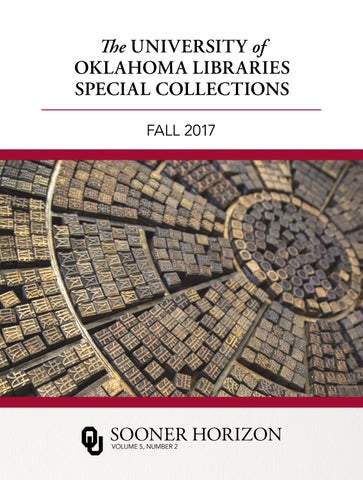
Te UNIVERSITY of OKLAHOMA LIBRARIES SPECIAL COLLECTIONS FALL 2017
SOONER HORIZON VOLUME 5, NUMBER 2
Letter from the Dean
S
tudents and faculty returning to the Bizzell Memorial Library this fall will nd renovated and refreshed spaces, such as the new Daniel & Ruth Boorstin Reading Room, which evokes the history and grandeur of the original 1928 building. Our new Learning Lab on Lower Level 1 expands on the concept of the Helmerich Collaborative Learning Center and provides a one-stop contact point for undergraduates to get research help, meet with subject specialists, consult with Writing Center sta, receive tutoring, and collaborate with their peers. Continuing down our newly renovated seven story stairwell, visitors will nd the new Zarrow Family Faculty and Graduate Student Center, featuring spaces that support interdisciplinary research, teaching, consultation and collaborative work for OU faculty and graduate students. These renovations and improvements ensure that the OU Libraries remains the intellectual crossroads of the university. Upon entering our doors, researchers discover a place filled with innovative research alongside priceless special collections full of rich historical resources. We challenge scholars to explore new connections and possibilities, drawing upon the historical context or rethinking traditional methods aided by emerging technology. One example of this is with our latest exhibition, The Poetics of Invention, which explores the theme of innovation within the context of history. Professor Jonathan Stalling, curator of our Chinese Literature Translation Archive, developed an app for helping speakers of Mandarin Chinese learn English. The Poetics of Invention invites visitors to travel back in time to experience the invention of the app as it might have occurred during earlier periods in history.
This fall, we also celebrate the 90th anniversary of the Western History Collections’ founding with an exhibition in Monnet Hall. What began as a resource for OU history professor Edward Everett Dale’s graduate students in western history, has developed into a truly remarkable collection used for interdisciplinary research across many elds. This exhibition will feature rare books and treasures from the collections’ archives on traditional western American-related themes. Scholars worldwide are recognizing the value of OU Libraries’ special collections, due in part to exhibitions such as Galileo’s World. Researchers are constantly seeking new ways to interact with materials, particularly in the digital realm. In response to this need, I am pleased to announce the launch of our new Special Collections Digital Repository this fall. It brings together digitized versions of our rarest and often-requested books and manuscript collections, and makes them easier to nd online. Researchers will soon be able to access these unique materials at the point of need without the encumbrances of an item’s fragility, physical location, or time of day. The increased discoverability of these collections will facilitate new scholarship in the digital humanities and has the potential to foster more collaborative work between scholars worldwide. Please read on for more information about these and other great stories from our special collections. I thank you for your continued support and invite you to join us as we explore the past, present, and future of OU Libraries Special Collections. Sincerely,
Rick Luce Dean, University Libraries Professor and Peggy V. Helmerich Chair Associate Vice President for Research, Norman
THE UNIVERSITY OF OKLAHOMA LIBRARIES • 2
e Poetics of Invention Stalling, was presented with a Best Inventor Award from the Ronnie K. Irani Center for the Creation of Economic Wealth (ICCEW) at OU. The Pinying app helps Chinese English learners understand standard American phonetics more intuitively by splitting and re-sequencing Chinese sounds. It recombines the sounds from Chinese characters to produce clear English words through interactive word maps, customizable word lists and 3D graphics, along with quizzes and a dictionary of over 130,000 English words.
F
ollowing the success of Galileo’s World, OU Libraries’ new exhibit, The Poetics of Invention, explores an OU invention from its ideation and fabrication to its commercialization through the university’s innovation ecosystem. The invention is an app called Pinying that enables Chinese speakers to learn English in an entirely new way. It was added to the Apple App Store in 2016, and is patented by the University of Oklahoma. Its creator, Professor Jonathan
3 • THE UNIVERSITY OF OKLAHOMA LIBRARIES
The Poetics of Invention exhibition recreates Professor Stalling’s invention of this app in three radically dierent time periods spanning over 1,000 years. It explores the relationship between culture and technology by showing how the same invention would bring very dierent results depending upon the time and place of its creation. The exhibition takes guests deeper into this process through interactive rooms that reveal the elements that drive innovation.
top left All of the Song Dynasty technologies were recreated in OU's Innovation Hub. Students and staff fabricated over 10,000 individual
cubes for the exhibition. left page, top right, bottom left and right Visitors exploring the exhibition opening on September 7, 2017.
Ideation
Commercialization
The process of conceptualizing, developing, and sharing new ideas is an essential part of the design process. In the case of Pinying, the inventor was inspired to recreate and update ancient technologies and methods developed over 1,000 years ago in China. The exhibition recreates Professor Stalling’s ideation process by staging the invention as it would have existed 1,000 years ago, 100 years ago, and as it exists today.
Finally, the exhibition explores how OU student interns in the ICCEW worked with Professor Stalling to create and test hypotheses for the needs of the target market, ultimately launching the Pinying app in the Apple App Store in 2016. This exhibition also reveals the potential next steps for Pinying in the future.
Fabrication
Over 20 OU student interns worked on the Pinying app through the ICCEW entrepreneurship internship center.
The next section of the exhibition focuses on the material process of invention at OU. It follows the inventor’s eorts at the initial disclosure of the invention, through its patenting process, and on to rapid prototyping and testing in OU’s Innovation Hub and Edge creative labs.
THE UNIVERSITY OF OKLAHOMA LIBRARIES • 4
background Rand McNally map of Oklahoma and Indian territories, 1890. Map Collection 2, no. 2-74-8626 top left Edward Everett Dale, professor of history at the University of Oklahoma and first curator of the Phillips Collection. E.E. Dale Collection, no. 1061. top right Chiang Kai-shek congratulating Ambassador Hurley, Chungking, China, January 8, 1945 (Photo by U.S. Army Signal Corps). Patrick J. Hurley Collection, no. 139.
Western History Collections 90th Anniversary
O
n April 5, 1927, University of Oklahoma President William B. Bizzell signed an agreement with oilman Frank Phillips to establish a collection of historical materials on the American West. This agreement was the culmination of discussions between history professor Edward Everett Dale and Frank Phillips. Dale and Phillips had met through their mutual friends Patrick Hurley (an attorney who later became Secretary of War under President Herbert Hoover) and his sister Alice Hurley Mackey. In 1948, the library established a collection of manuscripts on Oklahoma and Western history with grant funds from the Rockefeller Foundation. When Arrell M. Gibson became the curator of both the Phillips Collection and the Manuscripts Division in 1957, both units fell under the same administrator, which paved the way for their consolidation in 1967 as the Western History Collections.1 5 • THE UNIVERSITY OF OKLAHOMA LIBRARIES
The Collections document the history of the American Southwest, Native American history, and westward expansion of the United States. A variety of formats, including photographs, books, papers, sound recordings, posters, maps, and artwork, tell the stories that weave together the strands of this history. As the rst curator, Professor Dale started collecting this wonderful variety, and subsequent curators and sta of the WHC continued to add to the resources available to researchers. To celebrate the 90th anniversary of its founding, the Western History Collections is displaying items to show the diversity of topics covered, the time range of available materials, and the variety of formats. Eight themes were selected to showcase this diversity.
Founding of the Western History Collections
Dear Home: Wartime Correspondence
The contributions of E.E. Dale, Frank Phillips, and Patrick Hurley to the establishment of the Western History Collections are acknowledged with a display of their correspondence and photographs.
The Collections contain poignant letters written during the Civil War, World War I and World War II. We feature letters between servicemen and their families, accompanied by photographs, as well as an original sketch that was done by artist and art educator George “Dord” Fitz during World War II.
Two Territories to Statehood This exhibit illustrates the joining of Indian and Oklahoma Territories using photographs, manuscripts, and maps from the early 20th century.
Buffalo Soldiers: Patrolling the Plains This exhibit highlights the variety of accomplishments and projects undertaken by the Ninth and Tenth Cavalry regiments, units of African-American soldiers, during the 1870s and 1880s while they served in the Great Plains region.
Transmission, Communication and Transformation: Native Languages in Oklahoma The Collections hold many works written in the Native languages of Oklahoma tribes. The display includes hymnals, language instruction books, stories, maps and correspondence, and highlights varied topics such as sign language, changes in Native government, and literacy among Native Americans.
Oklahomans’ Participation in International Affairs The Collections have the papers of several notable Oklahomans who served as diplomats or worked as foreign correspondents. This display draws upon their letters, photographs and artifacts to illustrate their service to the United States.
To Protest: Native American Activism and Advocacy This display draws upon periodicals, papers, and photographs from several collections that demonstrate Native Americans in Oklahoma advocating for increased educational and job opportunities, as well as increased recognition of the sovereign status of Native nations. View the exhibits in Monnet Hall, room 300, through summer 2018. Lina Ortega, Head of Operations Western History Collections
Let’s Eat! Food and Cooking in Oklahoma The Collections have an abundance of recipes, cook lore, and instructions for preparing food in more than 100 cookbooks and across many manuscript collections. A selection of these, as well as images of chuck wagon cooks, Native Americans preparing food, and OU home economics students cooking are displayed.
1
This history was taken from Western History Collections,
University of Oklahoma Libraries Western History Collections, 75 Year Diamond Jubilee, 1927-2002, 2002.
left May 1967 cover of Indians Illustrated magazine featuring Ladonna and Fred Harris. Uncataloged Serials, Box 6. middle Cover of 1903 Willson’s
Monarch Almanac and Cook Book. Edgerton, Wisconsin, 1903. right Color sketch of Camp Atterbury, Indiana, during World War II by Dord Fitz. Dord Fitz Collection, Box 10, Folder 13.
THE UNIVERSITY OF OKLAHOMA LIBRARIES • 6
Exhibits Team Saves Museum Paintings The OU Libraries exhibits team recently found and recovered WPA-era paintings originally created for the early Stovall Museum, now the Sam Noble Museum. Exhibits team member James Burnes recounts the story of how intensive research, a blog post, and quick collaboration among several university departments helped these lost works of art nd their way back home.
T
wo years ago while working on a digitization and archive project at the Sam Noble Museum, I scanned several old photographic negatives containing bits of art. The paintings were not the focus of the photos, but were in the background of interior views at the museum. The artist, Ralph Brownell Shead, served as the state superintendent for OU’s WPA projects. There were so many paintings that I began searching for them in all the usual ways: reviewing historical records and photographs, and asking everyone associated with the old museum. No one knew where they had gone 7 • THE UNIVERSITY OF OKLAHOMA LIBRARIES
when the museum moved buildings. After exhausting the common research avenues, I wrote about them on my OU Create-hosted website. A few weeks later a reader left a comment on one of the posts: “I have information on the possible missing paintings you are looking for.” After a frenzied evening of electronic communications, I met my contact the next day at the shop in a university landscaping oce that once served as storage for the original Stovall Museum. Standing in a corner was one of the paintings I was looking for, and another I had never seen. Two additional paintings were stored elsewhere for protection during ongoing shop
In 1937, paleontologist J. Willis Stovall published an article, illustrated by Shead, in the Journal of Paleontology naming an extinct shrub-ox Euceratherium bizzelli in honor of OU President William Bennett Bizzell.
renovations. The works, painted before and during the WPA years, are striking for their size (measured in feet) and content, featuring mammoths, extinct horses, and battling marine reptiles. Thanks in part to the relationship with the Sam Noble Museum exhibits team through our Galileo’s World collaboration, I was able to directly contact their head of exhibits to inform him of the discovery. He quickly called the Sam Noble Museum art curator, and within a few minutes he was on site inspecting the nearly 80-year-old paintings. Timing was of the utmost importance, as the paintings were scheduled for immediate removal due to impending shop renovations, during which they might have been damaged or destroyed. Drywall was being installed in the room as we loaded the paintings into the truck, and one mural had already been damaged during removal and was slated for disposal the next day. Without the collaborative working relationship between
left page Wooly mammoths during the Ice Age (Pleistocene
epoch), painted in 1934. top A 1938 view of extinct horses. right A 1934 painting of marine reptiles from the Cretaceous period.
the library and museum sta, it is likely that these pieces of university history would have been lost to the ages. It is tting that OU Libraries, as the hub of the university campus, was able to help facilitate the return of these historical paintings to the Sam Noble Museum. With such dynamic relationships the library truly is the intellectual crossroads of the University of Oklahoma. James Burnes, Graduate Assistant Exhibits, History of Science Collections
THE UNIVERSITY OF OKLAHOMA LIBRARIES • 8
Recent Acquisitions History of Science Collections: George Catlin Patent
T
his unique and authentic royal letters patent is a handwritten vellum document dated September 4, 1843. The original tan wax seal, or Royal Seal of the Realm of Queen Victoria, was attached with cording and it proved the authenticity of the document. The patent, itself, granted the right to create and sell “Certain Improvements in the Construction of Vessels for Navigation, Designed to Prevent the Loss of Life in Case of Shipwreck or Other Accidents at Sea” for fourteen years. The person named on the patent was George Catlin (1796-1872), famous for his paintings and artifact collections from Native American tribes of the central plains. In 1839, Catlin was invited to come to England to show his “Indian Gallery,” his large collection of Native American paintings and cultural artifacts. He accepted and traveled to England with 5 tons of materials. Once there, Catlin displayed this collection and oered a live-action show at an exhibition gallery called the
9 • THE UNIVERSITY OF OKLAHOMA LIBRARIES
Egyptian Hall in Piccadilly. Catlin’s time in England was the rst part in a longer tour of Europe with his collection. After being in the United Kingdom for some time and not gaining the nancial success he desired, Catlin began a search for support, including working on lucrative inventions. This patent, no. 9878, established a oating quarter-deck that transformed into a lifeboat for larger ships. Unfortunately, after he invested much time and money into the idea and brought the patent to be signed, Catlin learned the idea had been patented some years before. James M. Babcock, who served as assistant archivist for manuscripts at OU Libraries from 1951-1956, recently gave this patent to the History of Science Collections. He and librarian Jesse L. Rader were among those who received the rst volumes of the book gift that began the History of Science Collections in the early 1950s. Melissa Rickman Registrar, History of Science Collections
background The Western History Collections in Monnet Hall. above Typescript of the October 27, 1950 episode of Lewis Meyer Variety
Show: The Zale Reader, which aired on KOME Tulsa at 10:15 at night. Lewis Meyer Collection, Box 8, Folder 8.
Western History Collections: Lewis Meyer Collection
T
he Western History Collections was delighted to receive the Lewis Meyer Collection in 2016. Lewis Meyer was a Tulsa-based bookstore owner, radio and TV personality from the 1940s through the early 1990s. Meyer is fondly remembered as the proprietor of the Lewis Meyer Bookstore in Tulsa, described by The New York Times as the “best bookstore in the South.” He was well-known for his reviews of books on his TV show, The Lewis Meyer Bookshelf, which was a xture for more than 40 years on KOTV. The collection, donated by family members to the WHC, includes his original typescripts of shows that aired on KVOO, KOME, and KTUL radio stations from 1943 to 1956. Other papers and memorabilia including class notes and assignments from his student days at Dartmouth College, his original poetry and music, correspondence with family members, correspondence
and newspaper clippings about his TV and radio shows and his published books, and videotapes of his TV shows round out the collection. The manual typewriter he used to write scripts and book reviews is an integral part of the collection, too. The Lewis Meyer collection is available for research in the Western History Collections reading room in Monnet Hall, room 300. The collection is a valuable resource for the study of American media and book publishing in the second half of the 20th century, and it provides a snapshot of life in Oklahoma during that time. Lina Ortega, Head of Operations Western History Collections
THE UNIVERSITY OF OKLAHOMA LIBRARIES • 10
left Charles Darwin, Monograph on the Sub-Class Cirripedia, with Figures of All the Species (London, 1854). History of Science Collections. top right A
note from Pvt. Lyle A. Garrett to his wife, Mary, in 1862. Charles Evans Collection, Box 1, Folder 1. Western History Collections. middle Oliver Byrne, The first six books of the Elements of Euclid (London, 1847). History of Science Collections. bottom right A page from the Civil War diary of Charles Kroff. Sherry M. Cress Collection, Box 1, Folder 6. Western History Collections.
Special Collections Digital Repository
T
he Libraries’ rst special collections digital repository was developed, customized, and launched to support the Galileo’s World exhibition with several hundred digitized rare books from OU’s special collections. At the end of the Galileo’s World exhibition, the technical team evaluated the repository, made improvements, tested them, and ultimately decided to rebuild the repository. The result is a lightweight, faster special collections repository that is much easier to maintain and upgrade, with a muchimproved user experience. The entire technical team of the University Libraries was involved to some extent. They developed the workows and software pieces to connect all of the activities needed to add digitized items from the special collections to the repository. This included the workows for not only the digitized images of the items, but also the descriptive information for each item, and all of the software that tracks the les, moves them, and matches them up to be added to the special collections digital repository. 11 • THE UNIVERSITY OF OKLAHOMA LIBRARIES
The rebuilt repository better incorporates the technical decisions made while building the rst version, and it can easily expand to support many dierent types of items digitized from the special collections. The new special collections repository debuts with simple search and display of the rare books, with plans for further improvements to the user experience. New collections and interesting items are being added to the repository, including the early OU yearbooks and more rare books from the History of Science and Bass Business History collections. The next step, as soon as its descriptive information is ready in digital form, is to add the rst manuscript materials to be contributed by the Western History Collections. The goal of the technical underpinnings is, as always, to enable access and discovery. Barbara Laufersweiler Coordinator, Digitization Lab
top row The Mistletoe (1909). left Cover. middle Photograph of Administration Hall, destroyed by fire in 1907. right Illustration for the athletics section of the student yearbook. bottom row The Sooner (1909-1910). left Stamped suede cover. middle left Illustration of “the Sooner” reprinted from Sturm’s Oklahoma Magazine in the student yearbook. middle right Early views of campus building construction progress. right Student Alice Schaff in the 1925 issue of The Sooner yearbook.
Digitizing OU Yearbooks
H
undreds and thousands of faces ll the pages of the OU yearbooks, sharing their pages with the multitude of places, activities, and events of university life seen from the perspective of students. Nearly all of the university’s yearbooks have now been digitized by OU Libraries Digitization Lab for public access online. The rst several decades of digitized yearbooks are being prepared for their debut in the online repository this winter. This low-key digitization project began in December 2014 with The Mistletoe of 1905. Since then, the Western History Collections has provided the uninterrupted run for digitization — both The Mistletoe 1905-1909 and The Sooner 1909 to 2000 and beyond. The plan is to continue digitization up to the most recent volume. The yearbooks are digitized with the lab’s automated book scanner. This book scanner rapidly photographs every page using fully automated page turning and
photography of both facing pages, with set up and monitoring by a student employee. The rst set of digitized yearbooks, 1905-1929, will be available online this winter, with more on the way. The digitization lab’s student employees enjoy digitizing The Mistletoe and The Sooner, especially as they notice changs from year to year, decade to decade. When the yearbooks are available online, many more visitors will be able to leaf through the pages, look for names and faces, and see the years at OU through the eyes of the students. Barbara Laufersweiler Coordinator, Digitization Lab
THE UNIVERSITY OF OKLAHOMA LIBRARIES • 12
e American Organ Institute Archives and Library
O
U Libraries has partnered with the American Organ Institute Archives and Library (AOIAL) to archive Windlines in SHAREOK, our joint institutional repository for the intellectual output of the OU Libraries, Oklahoma State University Libraries, and the University of Central Oklahoma Max Chambers Library. Windlines is the ocial newsletter of the American Organ Institute (AOI) at the OU School of Music. It is an ideal addition to SHAREOK, which features digital theses and dissertations, faculty publications, open access publications, open educational resources, institution-specic content and more. In 2012, the American Theatre Organ Society chose the AOI as the new home for its extensive archives and library. The AOI’s organ program is one of the largest and most diverse in the world, and is the only one in the country to oer theatre organ coursework. This, along with its dedication to the study and revival of theater organ music and its commitment to education, made it the perfect home for these rare materials. Thanks to the dedication of the society and its small but mighty group of enthusiasts, the AOIAL is now home to approximately 1,400 cubic feet of historic theatre organ materials. Collection highlights
include glass slides once used during sing-alongs in silent lms, and the entire collection of Möller master player rolls, which represent some of the earliest sound “recordings” available. Now, the AOIAL is working toward digitizing and making available archival copies of the American Theatre Organ Journal (ATOJ), dating from 1955 to the present. The journal is lled with information about concerts, instruments, and organists from the past that enables students and researchers to better understand theatre organs and their impact on American culture well beyond the early days of silent lm. This summer, the AOI launched an OU Thousands Strong campaign to fund the planning and rst round of digitization of the ATOJ Digitization Project. As testament to the project’s widely recognized worth, the campaign raised over $9,000 in one month – nearly twice the initial goal amount. This digitization project will result in the journal becoming freely accessible and text-searchable online. Bailey Hoffner, Curator & Archivist American Organ Institute Archives & Library University of Oklahoma School of Music
top left Group photo of the American Organ Institute’s faculty, staff, and students. top right A few examples of American Theatre Organ Journal covers. bottom left Archivist and Curator Bailey Hoffner (MLIS) in the AOIAL. bottom right One of over 700 original Möller master player rolls in the AOIAL’s collections.
13 • THE UNIVERSITY OF OKLAHOMA LIBRARIES
Te UNIVERSITY of OKLAHOMA® University of Oklahoma Libraries 401 W. Brooks St. | Norman, OK 73019-6030 405-325-2611 | Libraries.ou.edu
Our special collections are at the core of our mission to provide access to information resources. Our master curators, subject specialists, librarians, archivists and information experts select, preserve, describe and display these exceptional resources which make the collections come alive.
Support OU Libraries: Help support OU Libraries by joining the Bizzell Library Society at libraries.ou.edu/giving or call 405-325-2613.
e University of Oklahoma is an equal opportunity institution. www.ou.edu/eoo is publication, printed by University of Oklahoma Printing Services, is issued by the University of Oklahoma Libraries. 2,000 copies have been prepared and distributed at no cost to the taxpayers of the State of Oklahoma. (10/2017)