MONDAY, MARCH 02, 2026
MONDAY, MARCH 02, 2026
FRESH facts have emerged on the reason why leaders of Nigeria’s opposion par es rejected the newly amended Electoral Act and revised metable of the Independent Na onal Electoral Commission (INEC) ahead of the 2027 general elec ons.
OSUN DEFENDER reports that the coalion, comprising key figures from the Peoples Democra c Party (PDP), Labour Party (LP), New Nigeria Peoples Party (NNPP) and the African Democra c Congress (ADC), on Thursday, accused the ruling All Progressives Congress (APC) of pushing through provisions that could undermine electoral credibility ahead of the next general elec ons.
Those who spoke at the event including former Vice President A ku Abubakar, NNPP Na onal Chairman, Ahmed Ajuji, among others argued that certain amendments to the Act appear to grant excessive discre onary powers to the Independent Na onal Electoral Commission (INEC), parcularly in areas rela ng to result transmission and the management of technological glitches during elec ons.
According to them, the changes create legal loopholes that could be exploited to jus fy delays or inconsistencies in the announcement of results.
They also faulted what they described as the removal or dilu on of mandatory electronic transmission safe-
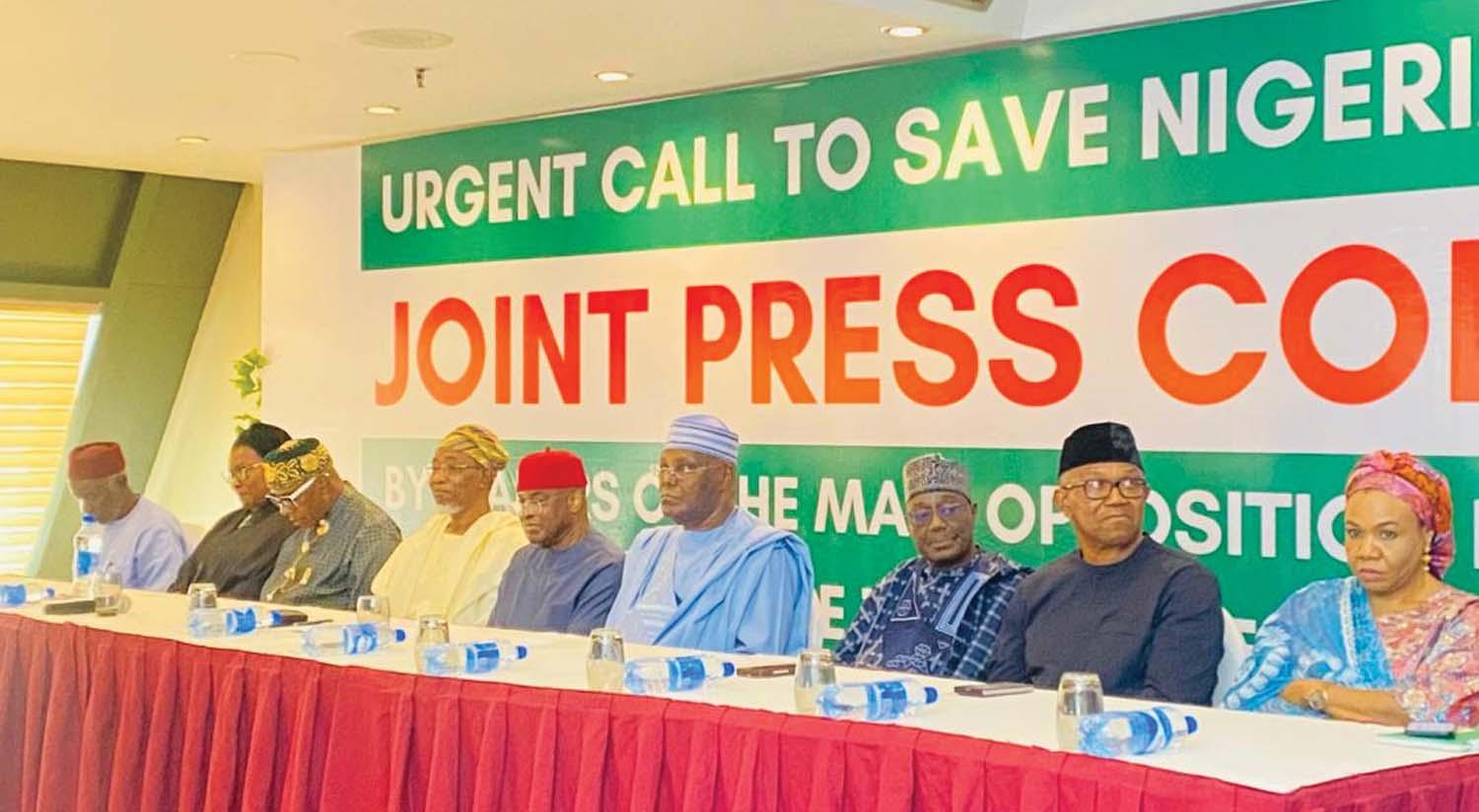
•A cross-section
guards, insis ng that technology remains the most reliable mechanism to curb manipula on at colla on centres.
Another conten ous issue raised by the opposi on is the meline for resolving pre-elecon disputes. The coalion maintained that the revised provisions may compress judicial review windows in ways that could deny aggrieved aspirants and par es fair hearing before elecons are conducted.
The leaders further expressed concern over campaign finance regula ons, alleging that the new limits and disclosure requirements are either ambiguous or selec vely enforceable.
Speaking to OSUN
DEFENDER over the weekend, a top leader of the coali on who spoke under condi on of anonymity, noted that most of the provisions of the new Act were carefully designed to return President Bola Tinubu and the All Progressives Congress (APC) to power.
The coali on leader
contended that major provisions mandatory electronic register for poli cal par es, removal of indirect primaries, and others sta ng that the new law is against the principles of fairness and democra c jus ce.
His words, “The new Electoral Act was authored, directed and finished by the APC and
its leadership. For example, look at electronic register of party members that INEC is demanding for now, it was purposively put there to ensure that some polical par es, without the financial wherewithal of registering party members do not have a window to contest.
“The APC began its
own electronic registra on since last year. Now, they have made it mandatory for all of us. What about the smaller par es without finances. How do they do it in the next few weeks?
“Transmission of results in real- me, abolishment of indirect primaries and all were
MONDAY, MARCH 02, 2026
THE All Progressives
Congress is in Osun State are in limbo following the demands reportedly made by the immediate-past na onal secretary of the party, Senator Iyiola Omisore, to support its gubernatorial candidate, Mr Bola Oyebamiji.
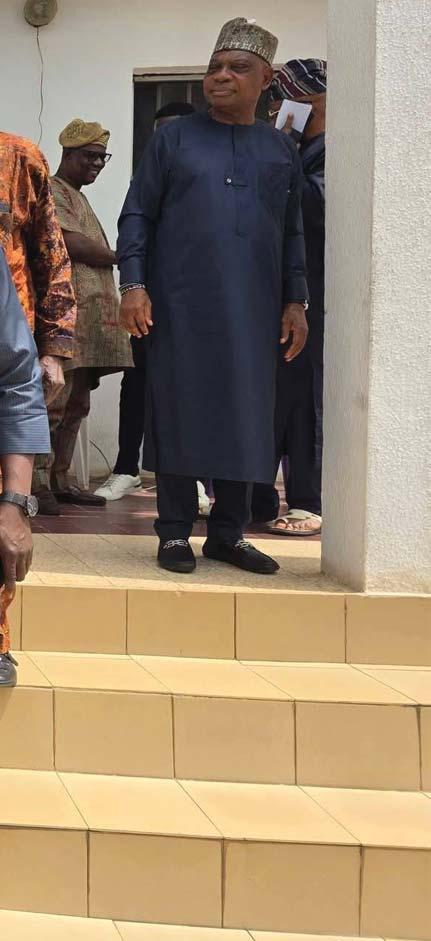
Omisore reportedly made some demands during the visit of the Elder Caucus (Igbimo Agba) of the party to his Ile-Ife residence last Monday.
OSUN DEFENDER reports that some elders, including Engr. Sola Akinwunmi, Chief Shuaib Oyedokun, Mr Akin Omolaoye and Prof. Mojeed Alabi, visited Omisore at his Ile-Ife home last week.
The mee ng, OSUN DEFENDER gathered, was facilitated by the na onal leader of the party, Chief Bisi Akande who was absent from the gathering.
Omisore who posted photographs taken a er the mee ng on his Facebook page, said discussions at the mee ng centred on strengthening the unity, cohesion and con nued progress of the. party.
However, sources at the mee ng said the elder caucus was at Omisore’s house to seek his support for Oyebamiji.
It would be recalled that Omisore and six other gubernatorial aspirants were disqualified by the screening committee of the party ahead of the December 13, 2025 primary elec on.
Others disqualified aspirants include Babatunde Haketer Oralusi, Oyedotun Babayemi, Akin Ogunbiyi, former Deputy Governor Benedict Alabi, Kunle Adegoke (SAN) and Senator Babajide Omoworare.
Omisore, while speaking on his disqualifica on, accused the Minister of Marine and Blue Economy, Gboyega Oyetola of being behind the development.
He said the Minister, who is the cousin of President Bola Tinubu, pressurised the screening commi ee chairman to disqualify them for Mr Bola Oyebamiji.
Following their disqualifica on, Tinubu met with the aspirants where they agreed to endorse Oyebamiji as the consensus candidate of the party.
However, Omisore was absent at the meeting with the President
as well as the primary of the party which ra fied Oyebamiji’s candidature in Osogbo.
A er the primary elec on, Oyebamiji has visited most of the major aspirants to seek their support for the
August 15 poll. He has, however, not been seen with Omisore, just as the former deputy governor also not par cipa ng acvely in the ac vi es of the party.
Speaking with OSUN DEFENDER, a source at
the mee ng said the major thing Omisore demanded during the mee ng was 2 senatorial ckets. He added that the former deputy governor also asked for some House of Representa ves slots as well as House of Assembly ckets.
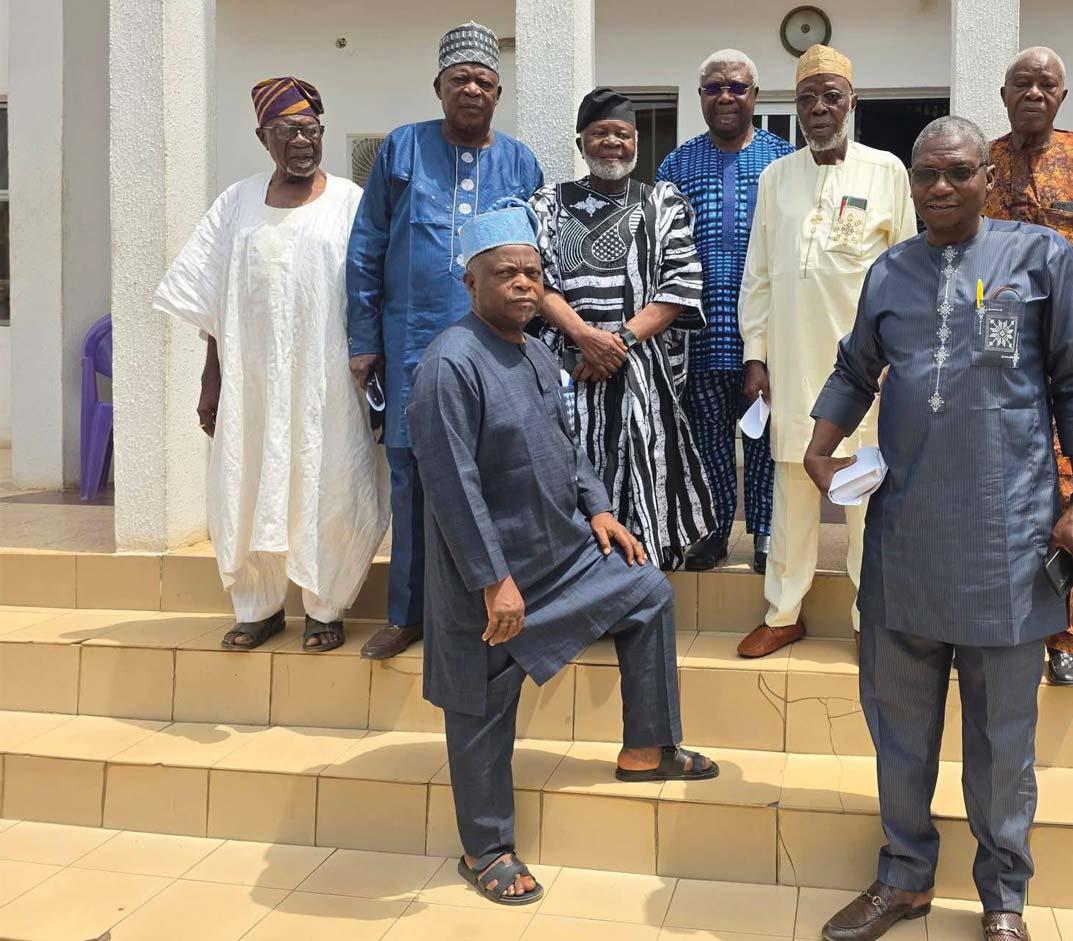
•Members of the Osun APC Elders Caucus after meeting
Monday
The source said, “It is true that the Elder Caucus visited Omisore and the discussion was largely frui ul. The visit was to ask for Omisore’s support for Alhaji Bola Oyebamiji to emerge as the next governor of the state.
“We all know what happened last year when Omisore was disqualified from contes ng. There are some of the elders who knew that the situa on was not handled very well and they needed to wade in because they knew the importance of Ile-Ife votes and they knew Omisore is the number one poli cian in that axis.
“Omisore has been rela vely silent since the emergence of Oyebamiji as the candidate and the supporters of the party’s candidate have not done well either. Some of them are even a acking Omisore and his team on social media.
‘We Are Not Subjecting Ourselves
Abidoun Ogunrinde, Ibadan
ASenior Advocate of Nigeria, Musibau Adetunbi, has accused poli cal actors of undermining the rule of law despite subsis ng court pronouncements on the crisis rocking local governments in Osun State.
Adetunbi, who is counsel to the Osun State Government in the dispute, said the standoff has lingered due to conflic ng interpreta ons of judgments nullifying council elec ons conducted during the administra on of former governor Gboyega Oyetola.
Speaking in an inter-
view with OSUN DEFENDER in Ibadan, the senior lawyer described the situa on as a man-made problem fuelled by abuse of public trust. He also argued that the continued stay in office of the APC Yes/No Chairmen, stressing that there is no subsisting order for them to
remain in office.
According to him, “Two separate judgments of the Federal High Court



•Continued from page 1
carefully designed by the party in power to suit their taste and preference for the next elecons. That is why our leaders have rejected it.
“We want the Naonal Assembly to go back to the drawing board and re-amend the act. It is totally and purely against true democracy and the wishes of the Nigerian people. This is not about opposi on, but ensuring that our ins tu ons are not overtly rendered useless for the ambi on of an individual,” the coalion leader said. Similarly, the African
Democra c Congress (ADC) rejected the revised 2026–2027 electoral metable released by the Independent Na onal Electoral Commission (INEC), alleging that it contains “boobytraps” designed to exclude opposi on par es and pave the way for President Bola Tinubu’s unopposed return in the 2027 general elec ons.
In a statement, the party’s Na onal Publicity Secretary, Bolaji Abdullahi, the ADC faulted new compliance requirements introduced under Secons 77 and 82 of the Electoral Act 2026, say-
ing they impose unfair burdens on opposi on par es while conferring undue advantage on the ruling party.
The party said the meline creates an “almost impossible hurdle” that could prevent opposi on par es from fielding candidates.
ADC also called on civil society groups, democra c stakeholders and Nigerians across party lines to scru nise the metable and demand fairness, warning that democracy cannot survive if electoral rules are designed to produce predetermined outcomes.
nullified the local government elec ons conducted under Oyetola. Out of the two judgments, one was set aside on the ground that the suit was filed prematurely. The other s ll stands. Yet some individuals insist they are entled to remain in office.
“My ques on is simple: where is the subsisting court order authorising them to remain in office? The Federal Government went to the Supreme Court seeking direct payment to local governments. Has that been fully complied with na onwide?
“Apart from Osun, many states are yet to align with that decision. The issue of tenure elonga on is s ll pending before the Federal High Court, so where is their legal authority to stay in office?”
“He made demands during the mee ng and the demands include having two Senators out of the three, some House of Representa ves seats as well as other things. The elders said they will present his demands at the highest level but I know he can’t support the candidate without anything.”
Speaking with OSUN DEFENDER, a loyalist of the former Na onal Secretary of the APC, who does not want his name in print, said Omisore told the party elders at the mee ng that he was not demanding anything for himself but making sure that his loyalists are well taken care of.
“Our principal is a man of principle who cares about his own people. He invested a lot into his gubernatorial ambi on but the rest is history. Whatever demands he made during the mee ng were not for him but for his people.
“He knows his worth and I hope the APC also do. Not only in Ile-Ife but the en re Osun, Omisore is a household name and his support will go a long way in determining the next governor of the state,” the source stated.
This is to inform the general public that I, OGUNTOYINBO DAMILOLA ADURAGBEMI Lost my HND Statement of Result, issued in 2024 with Matric Number 2211950048 obtained from OSCOTECH ESA OKE
All efforts made to trace the document proved abortive.
If found, please return to me or the nearest police station.
Signed: OGUNTOYINBO DAMILOLA ADURAGBEMI Phone: 08089054042
TWO significant poli cal events, unfolding in two different countries, may not be directly connected, yet they offer telling signals about what the future could hold.
Here at home in Nigeria, major opposi on poli cal par es recently came together on a common pla orm to restate their reserva ons about the hurriedly signed Electoral Act. Their posi on aligns with that of a broad segment of the Nigerian public who fear that certain provisions of the new law may weaken electoral transparency. The mee ng was clearly convened for that singular purpose; it did not extend into other areas some had an cipated, such as announcing the first concrete steps toward a unified electoral front.
Across the Atlan c in the United Kingdom, the Green Party of England and Wales recorded a sensa onal upset, winning a seat that had been held by the governing Labour Party for over a century. Labour shockingly came third, while the Conserva ve Party at least nominally the largest opposi on force lost its deposit. Few observers predicted such a drama c shi . Yet its symbolism is unmistakable: poli cal landscapes can change abruptly when
“Moreover, the Nigerian electorate itself is changing. A younger, more politically aware demographic is emerging, driven by digital connectivity and heightened socioeconomic pressures. This generation is less bound by traditional party loyalties and more inclined to demand measurable results. Any viable opposition strategy must therefore harness this energy”

voter frustra on crystallises into acon. In both countries, opposi on pares must urgently undertake strategic reviews to chart a credible roadmap forward. The urgency is underscored by the fact that both Nigeria and the United Kingdom operate the first-pastthe-post electoral system rather than propor onal representa on. Under this arrangement, a candidate does not need to secure 50 per cent plus one of the vote to be declared winner. A fractured opposi on is therefore structurally disadvantaged. In Nigeria’s last general elec on, the ruling All Progressives Congress (APC) secured victory with just 37 per cent of the vote. In theory, a party could win with even
Wahab Abiona
INCE assuming office in 29th May 2023, President Bola Ahmed Tinubu’s administra on has ini ated a series of radical economic reforms that have significantly altered the Nigerian economic landscape. These policies, which include the removal of fuel subsidies, the floa ng of the naira, increased electricity tariffs, import du es, higher interest rates, new tax reform, and the imposi on of new financial levies, were introduced to stabilise public finances and a ract investment.
In any economy, the primary roles of economic policies are to promote economic growth, ensure price stability, maintain full employment, redistribute income and wealth, improve the balance of payments, and ensure sustainable development.
However, for many Nigerians, these reforms have resulted in unprecedented hardship, escala ng poverty, skyrocke ng prices, and rising unemployment with available sta s cs, though the government is trying to manipulate data, claiming the government met bad economic situa on, unfortunately, there is no hiding place because Nigerians are over taxed from all manners to generate Income into the Federa on Account and huge borrowing that never impacted on the life of average Nigerian.
One of the most impac ul decisions made by the Tinubu administra on was the removal of the fuel subsidy. Before this ac on, petrol was sold
less if the opposi on remains splintered.
Compounding this is the entrenched “power of incumbency,” a phenomenon especially potent in developing democracies. Control of state resources, influence over ins tu ons, and the subtle deployment of patronage networks combine to lt the playing field. Recent poli cal developments in places such as Benin City and other flashpoints reinforce concerns that incumbency advantage in Nigeria is not merely theore cal but opera onal.
The lesson is clear: this is a defining moment for strategic thinking. The realis c path forward may lie in forging a broad-based popular front, uni ng opposi on par es with civil society
organisa ons around a coherent, programma c agenda. Such an alliance must transcend personali es and focus instead on shared na onal priori es: electoral reform, economic revival, security restora on and ins tu onal accountability.
History offers precedent. In 1964, disparate opposi on elements coalesced under the banner of the United Progressive Grand Alliance (UPGA). Although that experiment did not ulmately translate into electoral victory largely due to widespread allega ons of electoral malprac ce; it demonstrated that unity in pursuit of democra c change is possible. The principle remains relevant, even if the context has evolved.
Moreover, the Nigerian electorate itself is changing. A younger, more poli cally aware demographic is emerging, driven by digital connec vity and heightened socio-economic pressures. This genera on is less bound by tradional party loyal es and more inclined to demand measurable results. Any viable opposi on strategy must therefore harness this energy, transforming diffuse frustra on into structured civic engagement capable of reshaping electoral outcomes.
Equally important is the need for credible internal democracy within opposi on ranks. Unity cannot be proclaimed rhetorically while undermined by opaque candidate selec on processes or ego-driven rivalries. A genuine coali on must be built on trust, fairness and a clearly ar culated social contract with the electorate.
Nigeria stands today at a debilitating crossroads, burdened by deepening poverty, rising insecurity, and widespread public disillusionment. The moment calls for courage and imaginaon. To navigate the road less travelled - to break decisively with habits that have yielded repeated disappointment — may well be the only path toward electoral success and the long-awaited relief the Nigerian people both desire and deserve.
at ₦185 per litre. Following the removal, pump prices surged to above ₦850 per litre, reflec ng a staggering 360% increase. The result has been an immediate and painful rise in the cost of living. Transporta on costs doubled in most urban and rural areas, with commuters paying 1250% more for basic travel.
The increase in fuel prices triggered a ripple effect on the prices of goods and services across the economy. According to the Na onal Bureau of Sta s cs (NBS), food infla on climbed to 40.66% in May 2024, the highest figure in two decades. Essen al food items such as rice, which cost ₦35,000 per 50kg bag in April 2023, now sell for over ₦80,000, which shows around 130% increase. This surge in prices has severely eroded household purchasing power, pushing millions of Nigerians into abject poverty.
Closely linked to this is the decision to float the naira. The exchange rate moved from ₦471/$1 in May 2023 to over ₦1,550/$1 by July 2024, a 230% devalua on. This policy, intended to unify the foreign exchange market and eliminate distor ons, instead unleashed severe vola-
“There is honour in mentoring the next generation. There is dignity in stepping back. Sometimes, legacy is preserved not by contesting again, but by knowing when enough is enough”
lity.
As Nigeria imports a significant por on of its food, pharmaceu cals, and manufacturing inputs, the devalua on drama cally increased the cost of imports, worsening infla onary pressures. This has indirectly increased the cost of local produc on, even above imported items which has shut down most of the local firms and made the companies reduce workers or lay them off completely.
The World Bank has noted that the naira’s sharp deprecia on contributed significantly to rising food prices and infla on, making basic goods inaccessible to low-income earners and most ci zens with no income at all. Despite these measures, the an cipated influx of foreign investment has not materialised.
OSUN
ISSN : 0794-8050
Telephone : 0809-301-9152
The NBS Capital Importa on Report showed a decline in capital inflow from $5.3 billion in 2022 to $3.9 billion in 2023, represen ng a 26% drop, sugges ng a reduc on in investor confidence in the Nigerian economy. Import du es in Nigeria have significantly contributed to rising prices and economic hardship, par cularly under this administra on. As the government increased tariffs on imported goods, with some reaching up to 35% to boost revenue and protect local industries, the unintended consequence has been a sharp rise in the cost of essen al items. Coupled with the naira’s steep deprecia on has made import costs have tripled in local currency terms.
Website : www.osundefender.com/index.php e-mail : osundefenderhq@gmail.com osundefenderbank@gmail.com
All correspondence to the above email addresses.
•-Abiona is an economist, tax consultant, social media commentator and public affairs analyst.
MONDAY, MARCH 02, 2026 VOL. 21 NO 17 www.osundefender.com, email: osundefenderbank@gmail.com
POLITICS has a long memory. It remembers who stood in the rain when others ran for shelter. It remembers who shared dry bread during seasons of lack. And it also remembers who quietly le the table when the feast no longer revolved around them.
In Osun poli cs, loyalty has o en been spoken of as something sacred. Brotherhood is not just a slogan; it is a bond formed in courtrooms, in campaign grounds, in moments of defeat and in days of victory. But history also teaches that friendship in poli cs can be fragile. It bends under ambi on. It shakes under disappointment. And some mes, it breaks without warning.
The recent withdrawal of Alhaji Moshood Adeo from the Omoluabi Progressives, a caucus within the African Democra c Congress (ADC), has reopened serious conversaons about loyalty and gra tude. Adeo , who served as Secretary to the State Government when Ogbeni Rauf Aregbesola was governor for eight years, has once again stepped away at a defining poli cal moment.
Before his resigna on le er dated November 30, 2025, surfaced, tension was already brewing. Reports had emerged that Dr Najeem Salaam had secured the backing of the group’s apex leaders ahead of the ADC governorship primary. In the internal vote, Salaam reportedly scored 11 votes, while Adeo secured three.
Soon a er, Adeo withdrew. He cited family pressure and the need to rest. He said his decision was not easy. Yet poli cs is rarely about what is said alone; it is also about ming.
Ironically, just days before leaving, during the unveiling of the ADC in Osogbo in November 2025, Adeo while fielding ques ons from journalists spoke passionately about unity.
“I told them that despite the fact that this is a new party, formed barely six months ago, they should not relent,” he said. “With the way they showed up today in their mul tudes, they should go back to their wards and units to mobilise support. By August next year, we will be sure we are winning that elec on.”
He also said, “We should not fight among ourselves. Whoever is picked as the governorship candidate, we should all vote for the person.”
Four days later, he le . The contradic on is striking.
From Struggle to Power
To understand the depth of this moment, one must return to the beginning.
My first encounter with Adeo was in 2009 at the wedding recep on of the late Owa of Igbajo’s daughter, Adegboyega Famoodun. The event took place at the open field of Osogbo Grammar School. He arrived quietly in a brown 1976 model Mitsubishi car, with only a driver and a security man. He looked simple. Not wealthy. Not poor. Just determined.
“There is honour in mentoring the next generation. There is dignity in stepping back. Sometimes, legacy is preserved not by contesting again, but by knowing when enough is enough. Friendship is tested not in appointment, but in disappointment. Gratitude is proven not in comfort, but in seasons of denia”

That day, poli cs entered the celebra on. Speaking for Ogbeni Aregbesola, chairman of Oranmiya worldwide, Felix Awofisayo boldly declared to the then governor, Olagunsoye Oyinlola, “Whether you like it or not, Aregbesola is coming to become Osun governor.” The crowd reacted loudly. It sounded like faith before evidence. Eventually, that faith materialised. A er legal ba les and poli cal struggle, Aregbesola became governor. Through that long journey, Adeo stood firmly by him. Loyalty during struggle is not cheap. It demands sacrifice. When victory came, Adeo was appointed Secretary to the State Government. For eight years, he occupied that powerful office. It appeared that friendship had been rewarded. But the real test of loyalty o en begins when ambi on enters the picture.
In 2018, as succession poli cs intensified, many believed Aregbesola preferred a
GOOD Governance has become a mantra in development discuss globally. As complex as “book people” in management studies think the phrase is, for the common man it is a simple ma er – good government.
Whereas experts say good governance has 8 characteris cs, that “it is par cipatory, consensus-oriented, accountable, transparent, responsive, effec ve and efficient, equitable, inclusive and follows the rule of law,” Pope Francis provides a far simpler way for finding out if a government is good or not. He said “every man, every woman who has to take up the service of government must ask themselves two ques ons:
‘Do I love my people in order to serve them be er? Am I humble and do I listen to everybody, to diverse opinions, in order to choose the best path?’ If you don’t ask those ques ons, your governance will not be good.” Pope Francis, of course, implies not the mere asking of the ques ons but answering them posi vely!
Good governance is the premium dividend of democracy. Every other good thing we have penchant for lis ng follows – infrastructure, security, economic boom, e.t.c. Newton Jibunoh says “The dividends of democracy are simply the benefits enjoyed by the masses who voted for the government in power.” It is expected to be “life, liberty and the pursuit of happiness.”
Good governance by government, though a cons tu onal duty, does not drop from heaven. It is the crea on of good people. When a person goes to
successor from the West Senatorial District. Adeo , being from that zone and a trusted ally, seemed favoured. But poli cal reali es shi ed. Another candidate emerged. Adeo le for the African Democra c Party (ADP).
Yet Aregbesola did not publicly a ack him. No harsh words. No open condemnaon.
The Bible speaks of Judas who walked closely with Jesus but later chose a different path. The Qur’an tells of Iblis who once worshipped among the righteous but allowed pride to redirect his des ny. Proximity does not always guarantee permanence.
Ambi on and the Burden of Repe on A Yoruba proverb says: “Eni to ba so eeyan d’oloriburuku, nii koko fii bu’yan” translated into English as “The one who contributes to your downfall will be the first to mock you”. It is a painful saying, but it reflects human weakness.
When Aregbesola was poli cally wounded, those who stood by him benefited when victory came. When he became Minister of Interior, influence and access remained within the circle. Friendship brought honour and opportunity.
Adeo like others were helped to secure contracts which earned them millions of naira as Aregbesola kept showing he is a leader who cares about his people.
In 2022, Aregbesola worked relessly to support Adeo for the governorship cket. The move unse led members of The Osun Progressives (TOP), yet it showed commitment. The cket did not come. Poli cs moved forward.
The Omoluabi Progressives later emerged and aligned with the African Democra c Congress. Brotherhood was preached again. Unity was emphasised again.
Now, history appears to repeat itself.
In 2018, Adeo wanted to be governor; he did not get the cket. In 2022, he was not on the ballot. Now, discussions surround another ambi on in 2027.
At over 70 years of age, perhaps this season calls for reflec on more than repe on. An elder does not need a soothsayer to know when the sun is se ng.
There is honour in mentoring the next genera on. There is dignity in stepping back. Some mes, legacy is preserved not by contes ng again, but by knowing when enough is enough.
Friendship is tested not in appointment, but in disappointment. Gra tude is proven not in comfort, but in seasons of denial.
•Read full article on www.osundefender.com
featured above
the Automated Teller Machine (ATM) to withdraw money, he definitely expects it to give him or her back the money he or she has there. You do not kneel down to thank it for doing so. Only a faulty ATM machine will give you money when you don’t have a dime there. Likewise, when you see ci zens and communi es thanking government and rolling out the drums for providing them with borehole water or tarred road, there is a fault with the beneficiary and the benefactor!
The fault, in the case of Nigeria (and most of Africa) is simply understood. Government all over the world run on taxing the produc vity of their people. When government governs with tax payer’s money, the payers are emboldened to tax government to govern well. Having all but abolished genuine Federalism in Nigeria, no thanks to donkey years of military rule, governments over the decades are no longer dependent on taxes from the people to “govern” nor interested in their produc vity, relying almost en rely on rent from sales of crude oil, a naturally exis ng resource in Nigeria. They simply collect the monthly sale proceeds, allocate the biggest share to the Federal Government and share the rest to the States and Local Governments – all of them believing it is nobody’s money but their own to freely dispense as they please. The outcome is that whatever those who “govern” do for the ci zens from the money has to be followed with deep gra tude from
the ci zens.
By abandoning the explora on of all other resources (which are in abundance and the most important of which is human resource, the people themselves), produc vity is at its lowest, accompanied by widespread suffering, hustling and criminality. How do you tax a ci zenry whose produc ve poten al and consequent earnings is at a woeful low, hardly sufficient for their survival?
Narendra Modi said “Good governance is not fire-figh ng or crisis-management. Instead of op ng for ad-hoc solu ons, the need of the hour is to tackle the root cause of the problem.” In our case, therefore, there is no escaping the return to genuine federalism and the full produc ve engagement of the people; if any and all our problems must be solved. Modi said “People power must be combined with good governance to bring about real, deep and las ng change. This combina on can achieve almost everything from elimina ng corrup on to ending malnutri on and illiteracy.”
For now that it is a NO for Good Governance in Nigeria, the duty of all genuine democrats is clearly cut for them: without restructuring back to genuine federalism and the full produc ve engagement of the populace, all ad-hoc solu ons and fire-brigade efforts are in vain – for all problems, from cost of bread to security of lives and property.
OSUN DEFENDER is published by Moremi Publishing House Limited, Behind Oranmiyan Building, Gbodofon, Off Gbongan Road, Osogbo, Osun State. All correspondence to the Deputy Editor, MICHAEL BAMIGBOLA, Telephone: 0809-301-9152. ISSN: 0794-8050. Website: www.osundefender.com Email: osundefenderbank@gmail.com, osundefenderhq@gmail.com