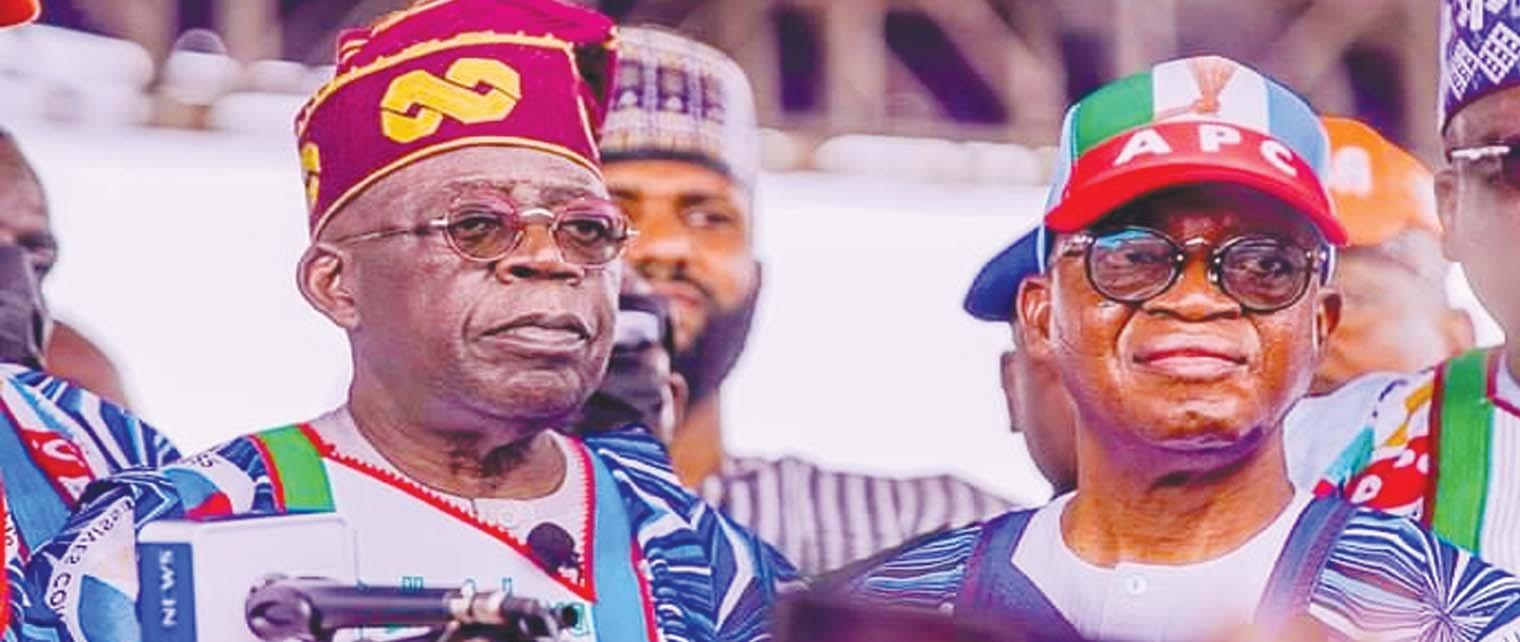
•President Tinubu and former Governor of Osun State, Gboyega Oyetola
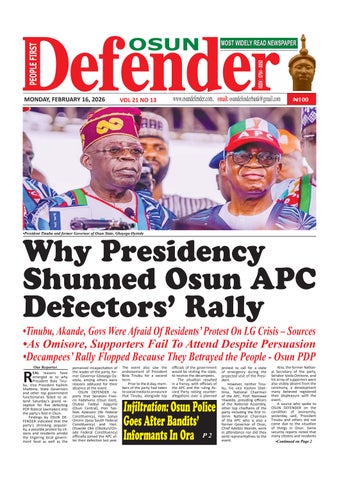
•President Tinubu and former Governor of Osun State, Gboyega Oyetola
REAL reasons have emerged as to why President Bola Tinubu, Vice President Kashim She ma, State Governors and other top government func onaries failed to attend Saturday’s grand recep on for five defec ng PDP federal lawmakers into the party’s fold in Osun.
Findings by OSUN DEFENDER indicated that the party’s shrinking popularity, a possible protest by citizens and residents amidst the lingering local government feud as well as the
perceived incapacita on of the leader of the party, former Governor Gboyega Oyetola, among others were reasons adduced for their absence at the event.
OSUN DEFENDER reports that Senators Francis Fadahunsi (Osun East), Olubiyi Fadeyi Ajagunla (Osun Central), Hon Taofeek Ajilesoro (Ife Federal Cons tuency), Hon. Sanya Omirin (Ijesa South Federal Cons tuency) and Hon. Oluwole Oke (Obokun/Oriade Federal Cons tuency) officially joined the APC after their defec on last year.
The event also saw the endorsement of President Bola Tinubu for a second term.
Prior to the d-day, members of the party had taken to social media to announce that Tinubu, alongside top
officials of the government would be visi ng the state, to receive the decampees.
The situa on resulted in a frenzy, with officials of the APC and the ruling Accord Party raising counterallega ons over a planned
protest to call for a state of emergency during the projected visit of the President.
However, neither Tinubu, his vice Kashim Shetma, Na onal Chairman of the APC, Prof. Nentawe Yilwatda, presiding officers of the Na onal Assembly, other top chie ains of the party including the first Interim Na onal Chairman of the APC who is also a former Governor of Osun, Chief Adebisi Akande, were in a endance nor did they send representa ves to the event.
Also, the former Na onal Secretary of the party, Senator Iyiola Omisore, and his array of supporters were also visibly absent from the ceremony, a development many believed registered their displeasure with the event.
A source who spoke to OSUN DEFENDER on the condi on of anonymity, yesterday, said, ‘President Tinubu and others did not come due to the situa on of things in Osun. Some security reports noted that many ci zens and residents
MONDAY, FEBRUARY 09, 2026
THE Osun State Police Command has gone a er bandit informants in Ora Igbomina community, Ifedayo Local Government Area of the state, OSUN DEFENDER reliably gathered.
An impeccable police source told OSUN DEFENDER that the command had been informed about some suspected bandit informants in the area and it is working to properly idenfy and arrest them.
OSUN DEFENDER gathered that a Fulani herder, iden fied as Bayo, was one of those suspected as informants and has been sent away from the community.
OSUN DEFENDER reports that kidnapping cases are on the rise in Ora Igbomina, a community on the Osun-Kwara boundary with at least three persons abducted in less than two months.
The first incident happened on December 15, 2025, when gunmen attacked the community and abducted a re red Customs officer, Emmanuel Owolabi.
The vic m’s wife, Tilayo, stated that the incident occurred in front of Owolabi’s house on Akisa Road, Ora, a few minutes before 7 p.m.
Ti layo, while narra ng the incident, said her husband had visited her shop shortly a er she closed for the day.
“While he headed to another loca on in the town, I returned home to prepare dinner,” the wife said.
She added that a er finishing the meal and while wai ng for her husband, she heard gunshots at the entrance to their compound.
“When I got home, I cooked and was about to serve my children their food when I heard a gunshot. I ini ally thought the shots were from hunters who some mes come around, but the gunshots became sporadic. Later, I heard my husband’s voice outside our fence.
“I didn’t know he was being held by bandits. I went out to check what was happening. One of the gunmen jumped over the fence into our compound. Those I saw were young boys. I knelt down and spoke Hausa to him because they were speaking Hausa. Instead of responding, he started bea ng me.
“He asked me for money. While all these was going on, they were firing shots. The next thing I heard was the sound of a motorcycle conveying my husband towards the bush.”
Owolabi was however, released on January 13, in Oro Ago, a community in the Ifelodun Local Government Area of Kwara State a er the payment of ransom.
A source in the community told OSUN DEFENDER that some people in the town knew the kidnappers had informants the day Owolabi was kidnapped.
“Yes, the day Mr Owolabi was kidnapped, we knew there were informants because as soon as we heard of the incident, the youths went to block the obvious routes the kidnappers would pass but surprisingly, they didn’t take those routes. They took the route that only insiders knew about,” the source said.
He added that Owolabi a er his release, confirmed their suspicions and informed stakeholders in the town that the bandits knew about his movements and had informants in the area.
“A er his release, Mr Owolabi told us that the gunmen who abducted him had informa on and knew what was going on. He said they keep telling him the moves the community members were making to get him released.
“He also said the bandits knew the day one of the most influen al pastors in Nigeria came to Oke Ila. He told us that the bandits thought the helicopter that brought the clergyman belonged to security operaves who wanted to rescue
him,” the source stated.
Two weeks a er Owolabi’s release, the bandits on February 1, again, abducted two other residents of the town - Tayese Adeyeye and Sunday Adewumi.
The vic ms were reportedly seized by the assailants during an a ack on a private residence along Aran-Orin Road in the Papa area.
Following the abduc on, the kidnappers reached out to the vic m’s family and demanded N100 million to release them.
The vic ms have not been released as of the me of this report.
The growing cases of abduc on have heightened anxiety in the community, with residents calling for increased security presence.
However, the police source, told OSUN DEFENDER that opera ves of the command were working not only to arrest the bandit informants but to apprehend the kidnappers, rescue the vic ms and ensure the community is safe from future invasion.
Speaking with OSUN DEFENDER, the police source said, “The command is aware of the presence of some bandit informants and we are working to iden fy and arrest them. The command under Commissioner of Police, Ibrahim Gotan will not rest un l the informants are fished out.
“Apart from this, a serious search and rescue mission is going on to ensure the safe return of the two people abducted and the arrest of the perpetrators.
“Osun is one of the most peaceful states in Nigeria and the Police Command is working to ensure that remains the same. We want Ora and other communies in the state to be safe from any internal or external invasion or a ack,” the source emphasised.
GSodiq Yusuf
OVERNOR Ademola
Adeleke, a former Speaker of the Osun State House of Assembly, Dr. Najeem Salaam and the immediate-past Managing Director of the Na onal Inland Waterways Authority (NIWA), Bola Oyebamiji, alongside 11 others have been cleared by the Independent Na onal Electoral Commission to contest the August 8, 2026 governorship elec on.
A statement signed by INEC’s Public Affairs Officer in Osun, Musa Olurode, yesterday, indicated that the candidate elected in the December 02. 2025 primary of the Peoples Democra c Party (PDP), Adedamola Adebayo popularly known as Fryo was not recognised by the commission.
The development, according to the commission, means he will not be on the ballot. Similarly, the Labour Party did not also field any candidate for the poll.
Olurode noted that only 14 poli cal par es uploaded details of their candidates after the conclusion of primaries.
The statement reads in part, “The poli cal par es that validly uploaded the names and par culars of their candidates and their running mates
as released by the Headquarters of the Commission, Abuja, are: A, AA, AAC, ADC, ADP, APGA, APC, APM, APP, BP, NNPP, PRP, YPP, and ZLP.
“In accordance with Secon 29(3) of the Electoral Act 2022 and as provided in item 4 of the Timetable and Schedule of Ac vi es for the Osun State Governorship Elec on, the Commission has published the personal par culars of candidates and that of their running mates (Form EC9). Copies of each candidate’s Form EC9, together with all accompanying academic creden als and other documents submi ed, will be displayed at the INEC State Office and in all the thirty (30) Local Government Area Offices and the Area Office of the Commission in Osun State on Monday, 16th February, 2026.
“Poli cal par es, candidates, and members of the public are hereby advised to inspect the published documents as provided by law.
“The Commission further clarifies that only the fourteen (14) poli cal par es listed above, having met the cons tu onal and regulatory requirements within the prescribed period, will par cipate in the forthcoming Osun State Governorship Elec on.”
•Continued from page 1
of the state would have used the opportunity to register their displeasure with the state of affairs at local government areas in the state.
“Knowing this. The President decided not to come. His handlers did not want a situa on that would embarrass him. It was also clear that the President knew that the odds did not favour whatever would make him regret coming to Osun. That is why he decided to just stay away and go to Kebbi.
“You will observe that even Baba Akande did not come. Neither did Senator Omisore who was disqualified alongside several others for controversial reasons during the last primaries attended. It showed that the party is largely divided and the issues stemming from the last primaries are very true. As a party, we s ll need a lot to do win the August 08, elec on.”
Another chie ain of the APC in Osun told the medium that the ‘boyco ’ of Saturday’s event indicated that the leadership of the Minister of Marine and Blue Economy was not strong enough.
The source claimed that many of the party’s bigwigs were only associa ng with Oyetola because of his re-
la onship with President Tinubu.
“Our leader, Oyetola is not a good manager of party affairs. He believes in winner takes all. That is why many people did not come to the programme.
“Since the last primaries, many people even beyond the Omisore camp have not been happy with the way he is leading the party. The majority of those coming into the APC and queuing behind him are doing so because of his rela onship with the President.
“He lacks the strong leadership skills required of him. If President Tinubu leaves power today, you will not see the avalanche of people you see flock around him today anymore.”
However, while speaking during the event, Oyetola noted that the defectors would strengthen the party’s resolve to reclaim the state and restore dignity to governance.
“We are gathered not just to receive our new members, but to affirm a shared convic on — that the sure path to prosperity, stability, and visionary leadership lies in the All Progressives Congress.
“In the APC, there are no strangers — we are one united family. Your arrival strengthens our resolve to
reclaim Osun and restore dignity to governance,” he said.
Oyetola also said that the achievements of President Bola Tinubu since assuming office had laid a solid founda on for Nigeria’s rebirth.
“That is why we proudly and confidently endorse President Bola Ahmed Tinubu for a second term in 2027 — to consolidate these gains and secure lasting prosperity,” he said.
Decampees’ Rally Flopped Because They Betrayed the People - Osun PDP
In its reac on, the facon of the Osun State chapter of the Peoples Democra c Party (PDP) led by Sunday Bisi said the event clearly fell into the category of desperate gatherings built on noise rather than genuine movements built on convic on.
The PDP in a statement said, “You cannot betray the mandate of the people and expect them to clap for you, because these Na onal Assembly members were elected on the pla orm of our party. The people queued under the sun, and in the rain to vote for the PDP. They voted for our vision. They voted for the stability Governor Ademola Jackson Nurudeen Adeleke
has brought to Osun. So, when we saw the empty spaces at that rally, we were not surprised. Osun people do not clap for opportunists; they shun pretenders.
“Let us be sincere with ourselves, if they truly commanded the grassroots as they claimed, yesterday would have been different. The turnout would have spoken louder. Instead, what we saw was a struggle to create momentum where none existed. This flop is a monument to greed, despera on, and poli cal irrelevance.
“It is also instruc ve that President Bola Ahmed Tinubu chose to be in Kebbi State instead of lending his presence to this event in Osun.
“We also found it telling that not even the Naonal Chairman of the APC deemed it fit to grace the occasion. Chief Bisi Akande did not a end and Senator Iyiola Omisore was not officially invited. Their absence indicates the type of leadership controlling Osun APC; autocra c and despo c.
“When a single person decides to do things by himself without consul ng others, when a single person sees others as irrelevant and worthless, you get the kind of empty spectacle witnessed yesterday.”
EVEN a toddler now knows that the Independent Na onal Electoral Commission (INEC) has released the metable for next year’s na onal and state elec ons. In countries with fixed electoral terms, such as the United States, even that same toddler could search online and discover the date of a presiden al elecon twenty years hence. That is how it ought to be in stable democracies. It is a standard towards which we must strive.
Hand in glove with the release of the metable, an -democra c forces are already maneuvering to halt the electronic transmission of results. The arguments advanced are pure sophistry. Our experience over decades shows incontrover bly that the less the human interface, the be er. As Joseph Stalin once remarked, it is not the vo ng that ma ers, but the coun ng. Those opposed to technology seek to frustrate the will of the people and must be exposed. The agita on for electronic transmission must remain unrelen ng.
The coming months will be decisive. They will define and determine an era. It may well be a make-or-break moment. The choice is clear: either we persist with a failed socio-economic order or we reconstruct our polity around a programme of rejuvena on that puts the people first.
The forces resistant to change will, predictably, fight ferociously to preserve the past. Their manoeuvres have already begun; we have been forewarned.
This is why defenders of democracy must ar culate, without delay, a coherent, people-centred programme. With tens of millions of Nigerians trapped in mul dimensional poverty, the na on must rally around an economic pla orm that tackles root causes and wages a vigorous war on


poverty. Contemporary history offers compelling examples. India’s Green Revolu on transformed food security and rural livelihoods. More recently, Brazil’s Bolsa Família programme combined social protec on with producvity and job crea on, using targeted
interven ons to dismantle structural poverty.
Such a programme of rejuvenaon must also rest on the clear impera ve of reinsta ng a genuine federalist ethos as the country’s opera ng framework. An over-centralised state, burdened with sixty-eight items on the Exclusive Legisla ve List, has become a brake on the quest for sustainable development. It requires urgent restructuring. All meaningful development is propelled from the base; federa ng units must be empowered to harness their resources, innovate and compete responsibly within a truly federal arrangement.
It is to the credit of the administra on led by Rauf Aregbesola that a comparable home-grown school feeding ini a ve was implemented in Osun State. That it was later curtailed for poli cal reasons is regrettable.
To rally the Republic around renewal, a broad-based popular front uni ng all democra c strata must emerge in the months ahead. Such a coali on would mobilise ci zens to vote in record numbers and defend their mandate. History teaches that at cri cal junctures, peoples who or-
“Elections, therefore, must not be treated as routine rituals but as instruments of national rescue. The integrity of the process before, during and after polling day will determine whether the ballot becomes a vehicle for transformation or a trigger for deeper disillusionment”
ganise prevail.
Nigeria stands at such a juncture. To paraphrase Antonio Gramsci, in moments of transi on, morbid symptoms abound. Among ours are a deteriora ng security landscape, fearinduced economic stagna on, the erosion of rural livelihoods and the diminishing purchasing power of urban wage earners.
Elec ons, therefore, must not be treated as rou ne rituals but as instruments of na onal rescue. The integrity of the process before, during and a er polling day will determine whether the ballot becomes a vehicle for transforma on or a trigger for deeper disillusionment. Ci zens, civil society, the media and state ins tu ons each have a duty to safeguard transparency and insist upon accountability at every stage.
Ul mately, democracy is sustained not merely by ins tu ons but by vigilance and par cipa on. The metable has been released; the clock is cking. What remains is collec ve resolve - resolve to organise, to mobilise and to insist that governance reflects the sovereign will of the people. The na on needs a clear programme and the courage to implement it. It may well be now—or never.
By Adejumo Kabir & Ola Bello
THE prolonged struggle between the All Progressives Congress (APC) and the People’s Democra c Party (PDP)–led state government over the control and legi macy of local councils has created a governance vacuum at the grassroots in Osun State, Southwest Nigeria.
This paralysis has not only stalled service delivery in all 30 local governments of the state but has also undermined democra c accountability, where it should be most tangible.
While Nigeria’s 1999 Cons tu on, under Sec on 7, guarantees a system of local government by democra cally elected councils, Osun State’s case since 22 February 2025, illustrates a persistent contradic on, as legal disputes and administra ve uncertainty have paralysed council opera ons, turning grassroots governance into collateral damage in a par san struggle.
The governance implica ons are significant. Local governments are responsible for primary healthcare, rural roads, sanita on, markets, and community development services that directly shape human security and economic resilience.
According to residents of the state, rou ne immunisa on outreach, maternal health supervision, and facility maintenance have long been abandoned, leaving ci zens in rural communi es at risk.
It is more troubling that the crisis in Osun’s local government administra on unfolded against the backdrop of a major na onal reform. On 11 July 2024, the Supreme Court affirmed the financial autonomy of Nigeria’s 774 local governments, reinforcing the cons tuonal requirement that local councils receive statutory alloca ons directly, free from statelevel interference.
In line with this judgment, the Federal Government subsequently directed all local governments to open accounts with the Central Bank of Nigeria (CBN) to facilitate the direct disbursement of federal alloca ons.
“Local governments are the frontline institutions through which citizens experience the state. When they fail, democracy fails quietly but decisively. Restoring functional local government administration in Osun is therefore not just a political settlement; it is a governance imperative”
In Osun State, however, the unresolved dispute over the legi macy of local council leadership complicated the implementa on of this direc ve. Ongoing poli cal and legal uncertainty has resulted in the withholding of local government alloca ons, as ques ons persisted over which officials were legally authorised to receive and manage public funds on behalf of the councils.
Rather than consolida ng decentralisa on
and fiscal accountability, the Osun experience illustrates how unresolved poli cal disputes can undermine well-inten oned ins tu onal reforms.
Compara vely, some states offer instruc ve counterpoints.
Despite its own challenges, Lagos State has maintained rela ve regularity in local government elec ons and administra ve con nuity, allowing councils to func on as stable servicedelivery units. Edo State’s reforms to clarify local government tenure and administra ve oversight have also reduced prolonged governance vacuums.
•Read full article on www.osundefender.com
OSUN DEFENDER is published by Moremi Publishing House Limited, Behind Oranmiyan Building, Gbodofon, Off Gbongan Road, Osogbo, Osun State.
ISSN : 0794-8050
Telephone : 0809-301-9152
Website : www.osundefender.com/index.php e-mail : osundefenderhq@gmail.com osundefenderbank@gmail.com All correspondence to the above email addresses.
•Adejumo Kabir Adeniyi is a senior researcher at Good Governance Africa-Nigeria. He is an expert with many years of experience in community development work and governance accountability sector while Dr Bello is the Executive Director for Good Governance Africa (GGA). He has extensive experience in mining governance and economic transformation.

MONDAY, FEBRUARY 16, 2026 VOL. 21 NO 13 www.osundefender.com, email: osundefenderbank@gmail.com
AFRICA’S democra c trajectory over the past three decades has been remarkable, yet electoral credibility remains one of its most persistent challenges. Elec ons, intended as instruments of popular sovereignty, are too o en undermined by high costs, logis cal bo lenecks, delayed result announcements, and recurrent electoral violence. In Nigeria, the stakes are higher: as Africa’s most populous democracy, the country’s electoral outcomes carry profound implica ons for poli cal stability, governance, and na onal development. In this context, Electronic Electoral Transmission (EET) emerges not merely as a technological innova on, but as a cri cal instrument for democra c consolida on.
Electronic Electoral Transmission refers to the digital transfer of elec on results from polling units directly to central collaon pla orms, in real or near-real me. By reducing human interference in the transmission process, EET significantly diminishes opportuni es for manipula on and enhances transparency. In a con nent where manual colla on has historically facilitated malprac ce, the adop on of EET signals a structural shi towards credible, accountable elec ons.
One of the most immediate and measurable benefits of electronic transmission is cost reduc on. Nigeria’s elec ons rank among the world’s most expensive rela ve to na onal economic output. Tradi onal methods demand the physical movement of ballot boxes, result sheets, and personnel across vast, o en inaccessible terrain, exer ng enormous pressure on public resources. Digital transmission reduces this logis cal burden, cu ng transporta on, security, and administra ve costs. While the ini al investment in digital infrastructure is considerable, long-term savings through fewer elec on reruns, reduced liga on, and lower conflict-management expenditure make EET economically ra onal.
Beyond financial considera ons, EET reinforces leadership legi macy. Historical experience shows that electoral manipulaon in Nigeria rarely occurs at polling units; it is during colla on that disputes arise. By transmi ng results directly from the polling sta on, EET limits the scope for tampering, ensuring that winners command genuine public mandate. Credible elecons confer legi macy, which in turn fosters stronger governance, ins tu onal stability, and effec ve policy implementa on. A government elected through transparent processes commands the trust necessary to execute reforms, a ract investment, and engage construc vely with civil society.
Equally important is the poten al of EET to curb electoral violence. Delayed an-
“By allowing civil society, political parties, the media, and ordinary citizens to monitor results in real time, EET enhances accountability and curtails the discretionary power of electoral officials. The introduction of technologies such as the Bimodal Voter Accreditation System (BVAS) and result-viewing portals has demonstrated the potential of digital tools to improve oversight, even if implementation challenges remain”
nouncements and allega ons of manipulaon have repeatedly triggered unrest across Nigeria. By enabling swi , transparent, and verifiable result declara ons, EET reduces uncertainty and tension. When ci zens can independently confirm results, the likelihood of post-elec on conflict diminishes. In this sense, electronic transmission is not just an administra ve convenience; it is a mechanism for safeguarding peace, naonal cohesion, and economic stability. For the ci zenry, the advantages are both tangible and symbolic. At its core, EET protects the voter’s mandate. In Nigeria, many have historically doubted whether their votes truly count. Electronic transmission reassures ci zens that the outcome of the elec on reflects the choice of the electorate. This confidence can boost voter turnout, par cularly among young, digital-
ACROSS many African countries, all the way back to Nigeria and down to the State of Osun, there is a heavy knee on the neck of democracy, threatening to snuff life out of it in the George Floyd manner. Democracy is on oxygen in Chad and Mali and the an -democra c cancer is spreading.
It is a shame that Africa had to contend with internal and external forces that are against democracy and her development right from incep on of na onhood at the point of exit of her colonisers some 70 years ago ll date. At the point of encounter with Europe, a majority of Africans was under one form of monarchy or the other. The inbuilt systems for order, and against tyranny, within those monarchical systems never meant they were anything other than monarchy. Therefore, the transi on to “freedom,” democracy and the Rule of Law (a er the colonist have had their field day and had to leave stylishly or forcibly) was unarguably an imposi on, albeit a welcomed one.
Majority of the ruling elite across Africa, and many of the founding fathers, hooked on monarchical majesty and privileges, never fully embraced modernity and democracy. Therefore, many of them quickly colluded as willing tools in the hands of the departed colonial masters (who never meant us well and were only eager to modernise the colonisa on) to eliminate the few great leaders of vision who have embraced modernism and were intent on pushing African countries to the height of development. Assassina ons and coup d’états were common throughout the 50s, 60s and 70s, where outright apartheid governments were not sustained. Rulership of African
ly literate Nigerians, thereby strengthening the democra c culture and reinforcing the principle of popular sovereignty. Transparency is a further dividend. By allowing civil society, poli cal par es, the media, and ordinary ci zens to monitor results in real me, EET enhances accountability and curtails the discre onary power of electoral officials. The introduc on of technologies such as the Bimodal Voter Accredita on System (BVAS) and resultviewing portals has demonstrated the poten al of digital tools to improve oversight, even if implementa on challenges remain. Sustained, credible use of EET can gradually restore public trust in the Independent Na onal Electoral Commission (INEC) and other democra c ins tu ons.
At a macro level, EET strengthens democra c infrastructure. Reliable digital
elec on data enables be er planning, cons tuency delimita on, voter educa on, and monitoring. It also enhances Nigeria’s global standing, signaling poli cal maturity and a rac ng foreign investment. Credible elec ons are no longer merely a domes c concern; they are a prerequisite for sustainable development, poli cal stability, and interna onal legi macy.
Yet, the transi on to EET is not without obstacles. Infrastructural gaps, poor network coverage in rural areas, cybersecurity threats, and poli cal interference con nue to hinder op mal implementa on. These challenges, however, are surmountable. With robust legal frameworks, con nuous system tes ng, independent audits, stakeholder training, and sustained investment in digital infrastructure, the risks can be mi gated. Most importantly, the poli cal will to safeguard the independence of electoral ins tu ons is non-nego able. Technology must serve democracy, not poli cal expediency.
In conclusion, Electronic Electoral Transmission represents more than a digital innova on; it is a democra c impera ve for Nigeria. By reducing costs, improving leadership legi macy, protec ng the voter’s mandate, and fostering public trust, EET addresses the structural weaknesses that have long plagued African elec ons. For Nigeria, its successful and transparent implementa on is not op onal it is essenal. Properly deployed, EET can form the founda on for accountable leadership, peaceful poli cal compe on, and a resilient democra c future.
featured above
countries was always remote-controlled, o en at any and all costs, into the hands of willing tools of the West in the then bi-polar world which gave way to American Imperial domina on in the uni-polar late 20th and 21st centuries.
If we understand this development, it will be easy to comprehend why a majority of our elites, sustained by former colonial powers, has remained uncommi ed to modernity and democracy all the while, preferring imperial rules and military dictatorships as they build themselves into monsters, refusing to build strong ins tu ons instead. Being merely stranded with the democra c order of the 21st century in which military rule (a crime against humanity) has gone out of fashion, they nevertheless sustain the strongman modality: godfatherism, mafia and cabal operandi, and all sorts of violent and in mida ng “opera ng system” for what Fela Anikulapo Ku referred to as “demo-crazy and demonstra on of craze.”
For the last 70 years though, the above reali es did not go without patrio c struggles from the people and their champions among the elites – writers, journalist, musicians, scholars, poli cians, ar stes, students’ leaders, legal luminaries, and many more who saw through the imperialising and underdevelopment agenda, and fought heroically, some me paying the supreme price, in order to keep the libera on fire burning. In Nigeria, the resistance span from the first stone hauled against the slave traders to the recent #EndSARS and Kaduna NLC protests.
Poli cal par es are one of the strong ins tu ons of Democracy. In the hand of imperial elites, however, they become smokescreens for manipula on of the people by select few who are merely contending bi erly among themselves to be the chief slave drivers. Imposi on, lack of internal democracy, mone sa on of the polity, electoral frauds, crimes and violence; in simple terms, lack of principle, ideology, transparency – while holding out fancy manifestoes and promises to the people – are chief characteris cs of party poli cs across board.
The new genera on of patrio c ci zens, especially youths, seeking freedom from centuries of elite-based, imperial-controlled governance, anywhere in Africa, Nigeria or State of Osun, must realise that democracy works (as the best form of government on earth) only if the people take ownership of it through principled struggle. As grotesque and bastardised as democracy may become, it remains the only hope, rather than the resort to self-helps of all kinds that have propelled us in just a few years to the edge of catastrophe.
Democracy and Party poli cs, however deformed, is s ll a game played according to clearly set out rules. The elites gainfully delight in side-stepping the rules, those who must save democracy from suffoca ng under their brutal knees only need to insist on playing always according to the rules. Democracy can breathe again, survive, and translate to “Unity and Faith, Peace and Progress” only through principled struggle by the young genera on who must embrace it.
OSUN DEFENDER is published by Moremi Publishing House Limited, Behind Oranmiyan Building, Gbodofon, Off Gbongan Road, Osogbo, Osun State. All correspondence to the Deputy Editor, MICHAEL BAMIGBOLA, Telephone: 0809-301-9152. ISSN: 0794-8050. Website: www.osundefender.com Email: osundefenderbank@gmail.com, osundefenderhq@gmail.com