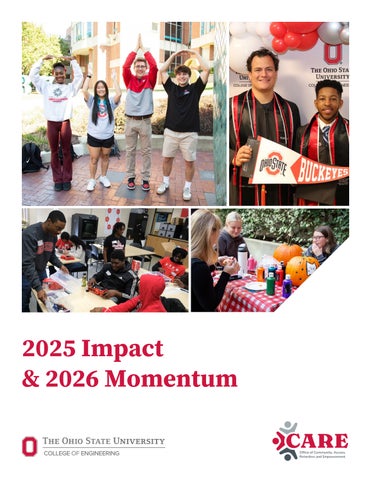
2025 Impact & 2026 Momentum
The Office of Community, Access, Retention and Empowerment (CARE) advanced its mission to support and educate tomorrow’s STEM workforce through a coordinated set of outreach, recruitment and student success initiatives that touched every stage of College of Engineering students’ pathways. Our team strengthened K-12 connections, deepened partnerships with industry and community organizations, and expanded the academic and transition support available to current students. With over $1.3 million raised this year and record-setting gains in student retention and engagement, CARE continues to serve as a cornerstone of access and excellence within the College of Engineering, ensuring students have the encouragement, resources and opportunities they need to enter, persist and thrive at Ohio State.
Community Engagement & Outreach CARE’s community partnerships and K-12 engagement efforts reached record levels, expanding the pool of future engineers, architects and planners. • 1,700+ K-12 students engaged across school visits, summer camps and on-campus events. • Work spanned 14 schools in 10 Ohio school districts. • The six-week LEGO League Camp (“Submerged”) served 63 elementary students representing 25 schools across central Ohio. • CARE -Connected student organizations contributed 460+ volunteer hours each semester, modeling leadership and engineering identity for young learners. • Partnered with Columbus Metropolitan Library in spring and autumn 2025 to host An Evening with CARE, featuring hands-on engineering activities inspired by faculty research and showcasing student project teams. The events reached more than 100 K-12 students and strengthened community STEM engagement. These efforts strengthen Ohio’s STEM ecosystem and increase visibility of engineering as a career pathway.
Recruitment & Pathways In 2025, the CARE Office strengthened pathways and pipelines leading to the College of Engineering by connecting with students and families across Ohio and beyond. • 2,200+ prospective students and families engaged through campus visits, outreach and ambassador-led tours. • Recruitment efforts expanded into 8+ major cities in OH, NY, NJ, PA and IL, as well as Washington D.C., yielding admitted students and increasing visibility in engineering pathways. • Direct admission continued to show strong student outcomes, with first-year retention in engineering at 86.5%.
• Strategically reconfigured staff roles and expanded team to strengthen relationship building and pathway support to campus change students, improving access and creating smoother entry points into the College of Engineering and removing common barriers to entry. Together, these results reflect statewide momentum and the promise of Ohio’s engineering talent pipeline.
Retention & Student Success CARE advanced student success through proactive academic support, financial wellness and experiential learning. • 400+ current engineering students received academic coaching, supplemental instruction or targeted transition support. • More than 12 experiential learning and professional development programs connected students with Fortune 500 partners. • Expanded financial wellness programming provided guidance for students to manage evolving financial aid expectations. • Continued growth in second-year retention (81.6%) underscores the impact of early transition support. These investments strengthen student momentum, reduce barriers to progression, and create the conditions for every engineering student to succeed from their first semester to degree completion.
Philanthropy & External Support The CARE Office exceeded annual fundraising goals thanks to meaningful collaborations with donors and industry partners: • AEP Foundation five-year, $1 million commitment supporting CARE’s workforce readiness and community engagement portfolio. • Shanahan Family Foundation grant renewed for a third year ($250K), and GM Foundation was renewed for the 10th year ($115K), advancing access, academic enrichment, and experiential learning. • Sustained partnerships with The Malcolm Jenkins Foundation – Financial Literacy, City of Columbus, Advanced Drainage Systems, ExxonMobil, Marathon Petroleum Company, and multiple Ohio State alumni, directly supporting scholarships, STEM outreach, and student development programming. • Secured alumni funding to strengthen the CARE Academic Success Hubs in 025 and 122 Hitchcock Hall as a central space for student success, offering academic coaching, financial wellness support, and the Iris Booth, where all COE students access high-quality professional headshots to elevate their career and networking materials.
These investments ensure CARE can scale programming and remove barriers for students across the engineering pathway.
2026 Preview: What’s Ahead In 2026, the CARE Office will build on this year’s momentum by strengthening engineering pathways, expanding academic and financial wellness support, and deepening partnerships across Ohio State and local communities. Our work will align with the university’s “Education for Citizenship 2035” strategic plan and the College of Engineering’s strategic plan, with a focus on access, community building and workforce readiness for every student.
Key Priorities for 2026 Guided by the University's Academic Excellence framework and College of Engineering's vision CARE will advance several initiatives in 2026 to amplify student success and community impact. Strengthening the Ohio Engineering Pipeline • Enhance campus change programming to improve student success when changing campuses. • Confirm at least one new partnership within a district where Ohio State campuses are located. Scaling Student Academic Success Initiatives • Expand early-term coaching and targeted math support in gateway courses to improve student outcomes. • Launch the CARE Undergraduate Research Grant Program ($10K) for faculty working with CARE-Connected students on research. (July 2026 launch) Recruitment, Yield & Transition Support • Improve targeted programming for pre-enrolled students in participating in the University pipeline programs. • Expand direct enrollment to all engineering majors. • Collaborate with University Marketing to optimize webpages and explore AIsupported tools to enhance navigation and student engagement. Workforce Readiness & Experiential Learning • Strengthen partnerships with industry and faculty to increase experiential learning and project-based learning opportunities. • Strengthen staff capacity in AI fluency, with intentional training and workflow integration that supports more efficient processes, better data use and improved service for students.
Learn more about our work at engineering.osu.edu/care