











OSSGA’S INAUGURAL





Honouring industry pioneers while looking to the future

How Ontario’s aggregate sector hopes red tape reform can unlock the future
Road to net zero: Taking the aggregate industry to the next level

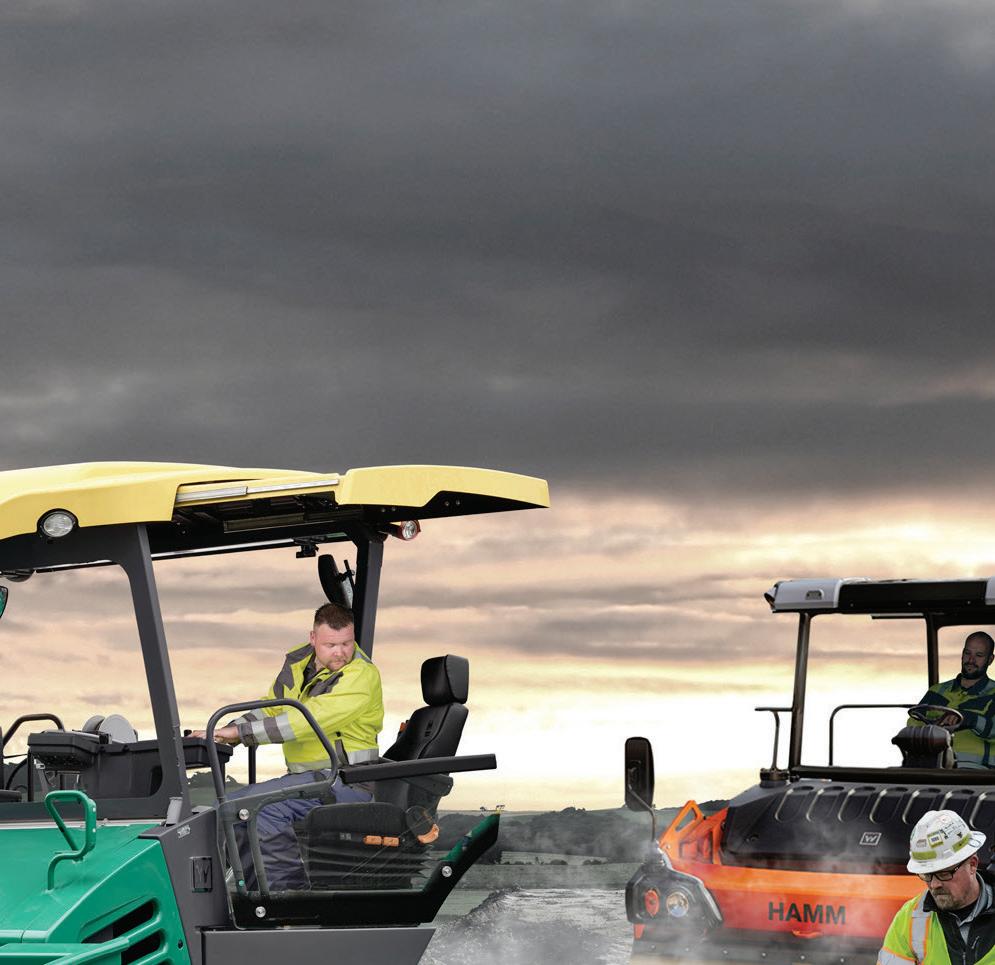
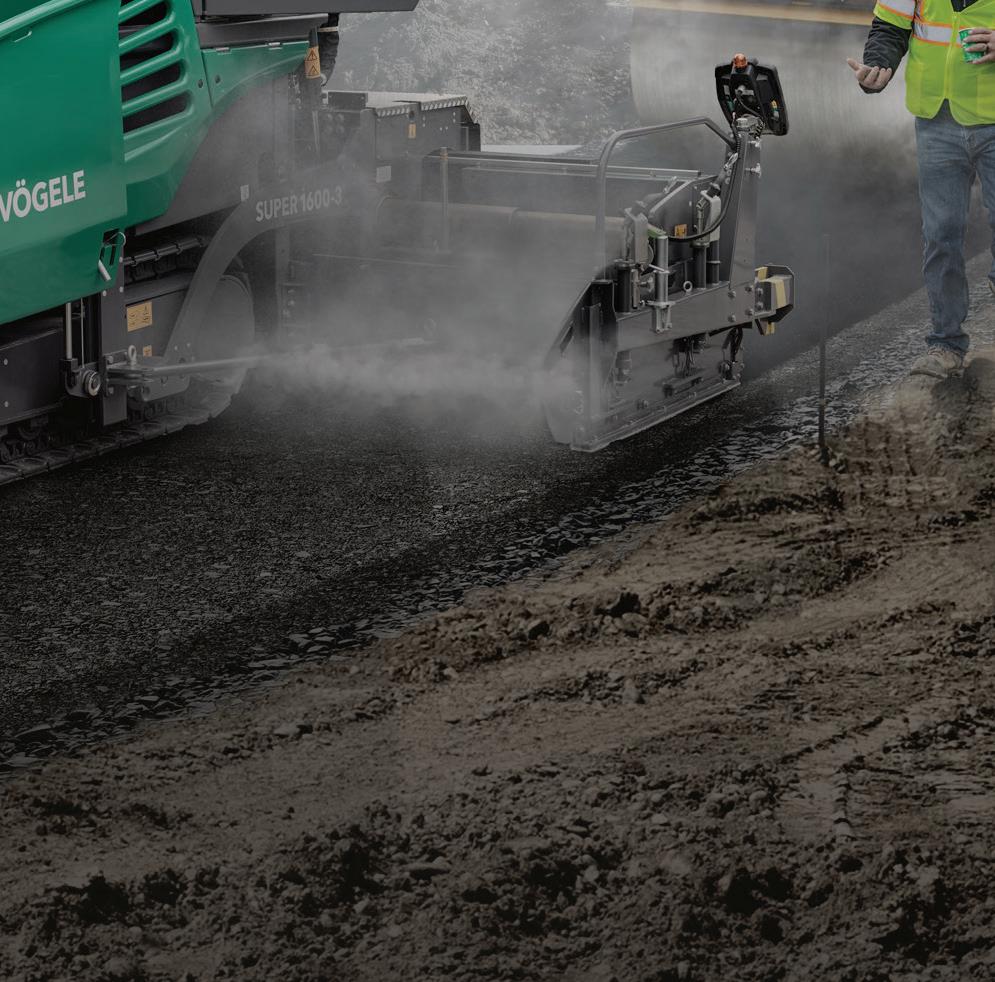

Your equipment is your livelihood. Make sure your Wirtgen equipment is ready to go with a year-end inspection from Brandt. Avoid breakdowns and downtime— count on your equipment to pull through when you need it most.
Increased Uptime Limited-time Offers Longer Machine Life
Your machine can work harder and last longer, meaning a lower cost of ownership and extended machine life.

Book in-shop inspections before March 15, 2026, for up to $650 off.


STAFF WRITER


This year marks a milestone: 70 years of OSSGA supporting and celebrating Ontario’s aggregate industry — one road, one bridge, one community at a time.
Ontario’s infrastructure story cannot be told without stone, sand and gravel. These materials have built neighbourhoods, supported the economy and enabled growth. But the next 70 years must look different. The sector must be ready for a future focused on nation-building projects, sustainability, Indigenous partnerships and collaboration.
Since 1956, OSSGA has connected producers, suppliers, governments and Indigenous communities to strengthen an industry that touches every corner of Ontario. Its shared voice has driven progress, but now more than ever we must raise the profile of the aggregate industry and reinforce how fundamental it is to infrastructure development and provincial growth.
With more than $200 billion in infrastructure investment planned, stakeholders must understand that nothing gets built without aggregate.
This also means respecting roles between provincial and local bodies. OSSGA will continue to advocate for clearer distinctions between municipal and provincial jurisdiction, particularly regarding the Provincial Planning Statement and Aggregate Resources Act. A predictable, transparent framework benefits communities, governments and industry alike. It is essential to delivering the construction materials needed for growth and creating efficiencies in an already burdensome regulatory environment.
Currently, approval timelines for new aggregate sites range from seven to 12 years. Our goal is to reduce that to three to five years. While the provincial government has taken steps to cut red tape, more work is needed. Streamlining approvals is critical to meeting Ontario’s growing demand for aggregate to support housing and infrastructure projects.
Sustainability and Indigenous relations likewise remain top priorities. OSSGA members lead in environmental stewardship, site rehabilitation and biodiversity initiatives. And we embed Indigenous partnership into every stage of development, starting from day one.
Looking ahead, OSSGA will continue to champion clear and efficient permitting, science-based policy, proactive education and outreach, and innovative solutions that minimize environmental impacts while supporting the infrastructure needs of a growing province.
As chair, I am inspired by the passion and leadership of OSSGA members who continue to elevate the industry’s standards and reputation. Our legacy is strong, but our future can be even stronger. Together, we will shape an Ontario where infrastructure is resilient, communities are supported and sustainability is at the heart of everything we do.
OSSGA was founded on the belief that a united industry can build a stronger province. 70 years later, that belief still stands.
Ontario Stone, Sand & Gravel Association
365 Brunel Rd., Suite 2
Mississauga, ON L4Z 1Z5
Tel: (905) 507-0711 www.GraveFacts.ca
Publisher Sharon Armstrong Executive Director (Interim)
Editor
Andres F. Ibarguen Senior Manager, Communications
Sales Executive Sharon Headley
Designer Katrina Teimo
All rights reserved. The contents of this publication may not be reproduced by any means, in whole or in part, without the prior written consent of the association.
Published September 2025
PUBLICATION MAIL AGREEMENT #40787580
Please return undeliverable items to:
Ontario Stone, Sand & Gravel Association
365 Brunel Rd., Suite 2 Mississauga, ON L4Z 1Z5
OSSGA STAFF WRITER
Ontario is preparing for one of the largest waves of infrastructure construction in its history. Homes, highways, hospitals, transit lines and schools are planned at a pace the province hasn’t seen in decades. But while the materials needed for that growth lie beneath Ontario’s soil, producers say the biggest obstacle isn’t geology — it’s paperwork.
OSSGA recently delivered a detailed submission to the Ministry of Red Tape Reduction outlining how regulatory delays, duplicative processes and outdated requirements have become a brake on growth. The submission argues that without significant procedural improvements, the province risks delaying critical projects, driving up costs and undermining its own policy goals around jobs and housing.
For producers, the message is simple: Ontario cannot build the future if its approvals system remains stuck in the past.
A growing mismatch between provincial ambition and regulatory reality
OSSGA’s submission describes an industry ready to support an unprecedented level of construction — but facing timelines that have stretched far beyond what operators say is reasonable. The issue is not with environmental standards or the quality of technical work required. Producers employ engineers, hydrogeologists, planners and other specialists who generate comprehensive applications for environmental compliance, water taking, licensing and site amendments.

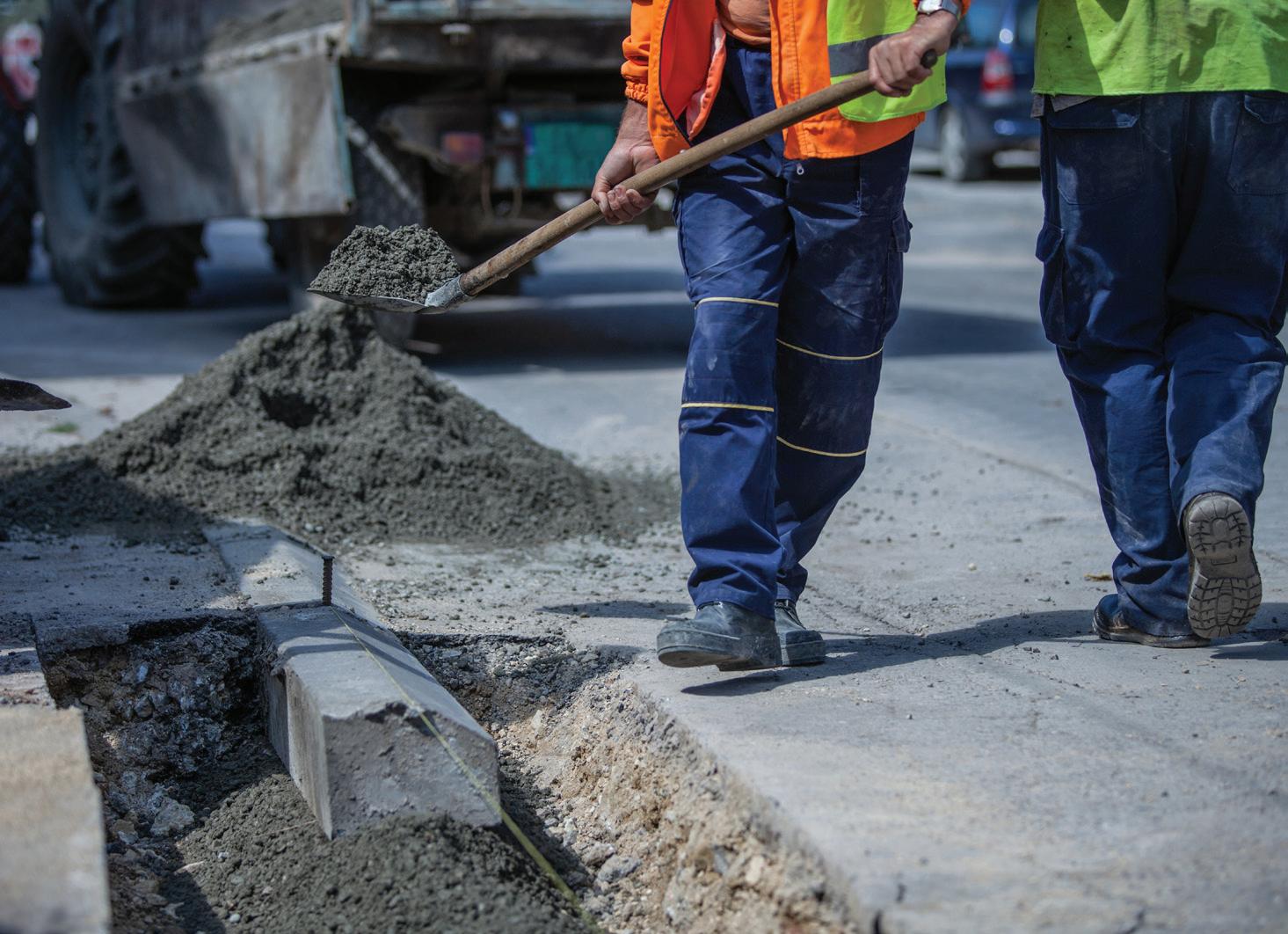
Homes, highways, hospitals, transit lines and schools are planned at a pace the province hasn’t seen in decades. But while the materials needed for that growth lie beneath Ontario’s soil, producers say the biggest obstacle isn’t geology — it’s paperwork.
Yet even routine changes like adjusting extraction sequencing, relocating a berm or importing fill for rehabilitation can take months or years for review. More significant applications can take much longer.
Delays are cascading into real-world consequences: higher construction costs, supply bottlenecks and, in some cases, layoffs. One recent example involved a fully vetted proposal that had already been cleared by multiple ministries, agencies, Indigenous communities and conservation authorities. Despite that, the operator was pulled into years of objections from a small local group, resulting in a four-month Ontario Land Tribunal (OLT) hearing. The costs were measured not only in legal fees but in lost jobs and stalled hiring.
These stories reflect a broader trend that OSSGA argues is both systemic and avoidable — a procedural gridlock that slows down approvals without improving outcomes.
The challenge of managing objections in the digital age
One of the most striking pressures highlighted in the submission is the rise of mass-generated objections. Under existing rules, anyone — whether they live next door or across the world — can submit an objection to an aggregate licence application.
Digital campaigns have turned that into a numbers game. Producers say they now regularly receive thousands of identical form-letter objections, many from individuals with no connection to the site, often in other countries. Each one requires an individualized response through a formal objection form. Completing hundreds or thousands of these forms can take days or require outside consultants at a cost that can reach tens of thousands of dollars.
This system no longer reflects meaningful public participation. Instead, it diverts time and money toward administrative tasks while doing little to improve decisions. The submission proposes limiting objections to those within one kilometre of a site, eliminating the requirement for individualized forms and allowing responses to be delivered electronically without needing explicit consent.
Supporters of these changes say they would preserve legitimate community input while filtering out nuisance submissions that overload the process.
Yet even routine changes like adjusting extraction sequencing, relocating a berm or importing fill for rehabilitation can take months or years for review. More significant applications can take much longer.
When a single unresolved concern can force a full tribunal hearing
Another major bottleneck arises from how the Ministry of Natural Resources handles outstanding objections. While the Aggregate Resources Act (ARA) gives the minister discretion to decide whether a matter needs to go before the OLT, in practice, almost every application with any unresolved objection ends up there.
The association argues that this rigid approach ignores the intent of the legislation, which allows the minister to proceed where concerns have been adequately addressed or lack technical merit. Sending every lingering disagreement, even frivolous or repetitive ones, to a full hearing adds massive costs and years of delay.
A more balanced approach would reserve OLT hearings for cases involving genuine, unresolved issues. In turn, unclogging the system and freeing the tribunal to focus on matters that truly require adjudication.
Consultation requirements that freeze applications in place
Even where an application contains unresolved objections, many cannot advance at all because of an internal practice tied to consultation with Indigenous communities. While duty to consult must remain intact, current ministry practice effectively prevents referral to the tribunal until consultation is considered fully complete — something that, by its nature, is iterative and can continue throughout the review process.
This has led to a backlog in which the majority of applications at the final stage of approval remain stalled. Many of these same files will ultimately require a tribunal hearing to resolve unrelated issues, meaning the delays compound.
Allowing consultation to continue in parallel with tribunal proceedings could shave years off the approval process without reducing the Crown’s obligations. Running these processes sequentially rather than concurrently is slowing the system unnecessarily.
The patchwork of local planning requirements has become another significant source of delay. OSSGA’s submission points to municipalities that have adopted local policies — requiring extra studies, imposing elevated natural heritage constraints or applying restrictions beyond the Provincial Planning Statement (PPS) — that complicate and sometimes contradict provincial direction.
These local layers create uncertainty for new supply and undermine efforts to ensure aggregate availability close to market. Producers argue that municipalities should not be able to impose standards higher than provincial policy, particularly in areas where the province already has clear and comprehensive rules.
THESE LOCAL LAYERS CREATE UNCERTAINTY FOR NEW SUPPLY AND UNDERMINE EFFORTS TO ENSURE AGGREGATE AVAILABILITY CLOSE TO MARKET.
PRODUCERS ARGUE THAT MUNICIPALITIES SHOULD NOT BE ABLE TO IMPOSE STANDARDS HIGHER THAN PROVINCIAL POLICY, PARTICULARLY IN AREAS WHERE THE PROVINCE ALREADY HAS CLEAR AND COMPREHENSIVE RULES.
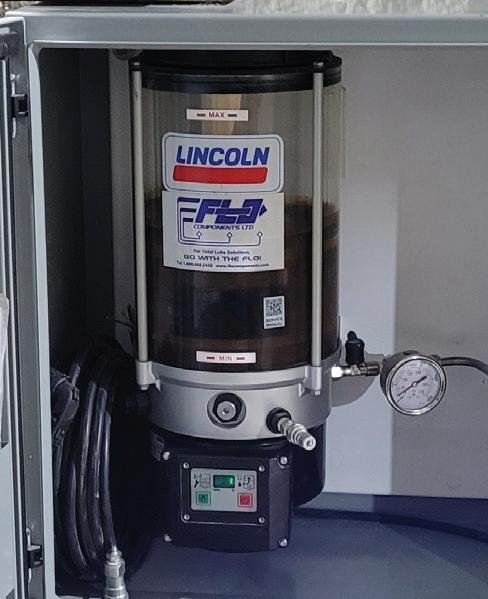
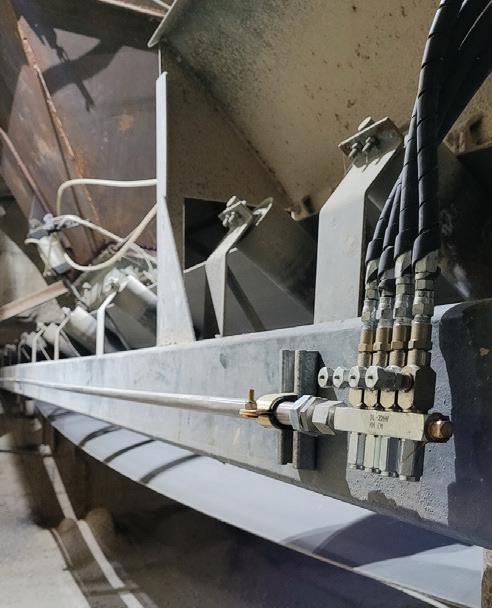
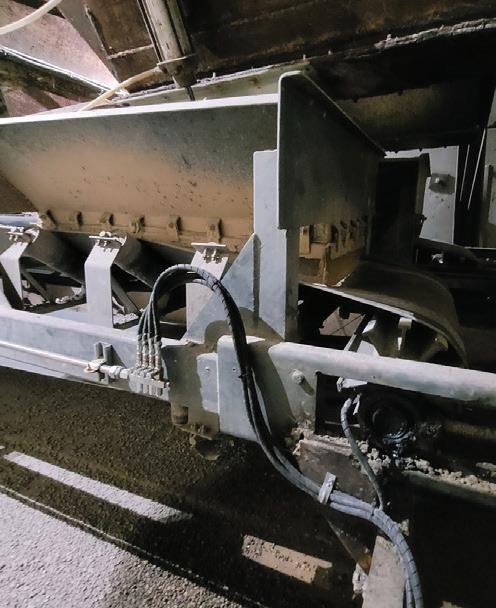
√ No climbing over belts or up hundreds of feet to grease hard-to-reach bearings
√ Greases while plant operates = bearings greased even during busy season
√ Connects to plant PLC to remotely monitor Lube System for alarms
√ Reduces maintenance costs
√ Increases safety for your operator & maintenance personnel
√ Uses your standard in-shop grease


Recent examples, including attempts to impose interim control by-laws used to halt applications while municipalities consider stricter rules, have heightened concern. These measures cost municipalities and operators millions of dollars while creating delays that ripple through the housing and infrastructure sectors.
OSSGA is calling for the province to state explicitly in the PPS that municipal policies cannot exceed provincial requirements when regulating mineral aggregate resources.
Beyond municipal policy, several provincial plans including the Greenbelt Plan, Lake Simcoe Protection Plan, Niagara Escarpment Plan and Oak Ridges Moraine Conservation Plan contain prohibitions that are more stringent than the PPS.
Producers say that some ecological designations, such as “significant woodland,” have become so broadly applied that they encompass tiny or low-functioning features. Because these designations trigger automatic restrictions, the result can be the sterilization of

Cowan Insurance Group®, in partnership with the Ontario Stone, Sand & Gravel Association, has developed a comprehensive program to address the insurance and risk management needs of the aggregate producer.
Exclusive group discount rating
Profit sharing program for OSSGA members
Robust coverage extension package for added security
high-quality aggregate deposits close to markets that need them.
The industry supports environmental protection but believes a more balanced approach is needed, including the ability to use offsetting — restoring or enhancing ecological features elsewhere — rather than applying outright bans. Without reform Ontario will increasingly depend on aggregate hauled from farther afield, increasing emissions, costs and wear on infrastructure.
Adding to the regulatory complexity is wide variation in natural heritage rules across municipal boundaries. Many local policies predate provincial technical manuals or conflict with them. OSSGA notes that municipalities sometimes impose standards beyond what the PPS or ARA require, even when provincial guidelines already set scientifically supported benchmarks.
Contact us today to learn more: programs@cowangroup.ca | Toll-free: 1-866-912-6926 cowangroup.ca/ossga
We care about what you care about.
The association is urging the province to clarify that municipalities must align their natural heritage rules with provincial policy and manuals. Consistent standards would offer predictability for both industry and regulators while maintaining strong environmental protections.
Another long-standing point of confusion on the environmental side involves whether closed-loop wash water systems — which do not discharge to the natural environment — require Environmental Compliance
Approvals (ECA). For decades, they did not. Recently, however, district-level interpretations have shifted, resulting in uneven enforcement. Some sites are ordered to obtain approvals for systems that have operated safely for years.
OSSGA notes that these systems are already subject to detailed requirements under site plans approved through the ARA, including design, recycling performance and sediment controls. Requiring an ECA adds administrative burden without improving environmental protection, particularly when no discharge occurs.
An explicit exemption would resolve confusion and restore consistency across the province.
Excess soil is another area OSSGA sought to address in its submission. Under O. Reg. 244/97, any excess soil placed below the water table must meet the strictest Table 1 Soil Quality Standards. OSSGA says this threshold is far higher than background conditions on most sites and prevents the beneficial reuse of soil that would otherwise support rehabilitation.
Under Ontario’s broader excess soil framework, tools already exist to evaluate appropriate standards based on site conditions and future uses. Producers argue that allowing qualified professionals to use those tools rather than imposing a blanket Table 1 requirement would reduce unnecessary trucking, emissions and costs.
The soil question can also have a significant financial impact. The Ontario Aggregate Resources Corporation tonnage fees, intended to apply to extracted aggregate, are being triggered when operators move soil or overburden between adjacent licensed sites — even when the material never leaves what is effectively one continuous property. In a sense this results in “fees on air,” adding costs where no saleable material is produced. In some cases, the additional cost to move overburden from one side of a site to another can reach hundreds of thousands of dollars.
An exemption where the same operator holds both licences on what is effectively a continuous site and the material is moved strictly for rehabilitation would help reduce the financial burden on operators.
Finally, archaeological assessment requirements present another source of delay. Even Stage 1 and 2 reports that recommend no further study can remain in limbo up to a year while awaiting ministerial confirmation. OSSGA supports allowing licensed archaeologists to self-file these reports, with completion acknowledged upon their entry into the provincial registry.
Moreover, cultural heritage policies use ambiguous language about how areas designated for avoidance may later be accessed. Operators need certainty that once archaeological work is complete and areas are cleared, extraction can continue without new, unpredictable conditions.
A path forward built on collaboration Ultimately, while there are vast areas for improvement when it comes to red tape, OSSGA looks forward to working alongside the Ministry of Red Tape Reduction and other ministries to modernize Ontario’s aggregate regulatory framework.
This first submission laid out immediate steps that can be taken to reduce delays, strengthen consistency and help unlock the aggregate supply needed to build the province’s future. A second part of OSSGA’s reform package, expected early in the new year, will propose broader structural changes.
As Ontario pushes for rapid, large-scale construction and infrastructure growth, timely approvals are now essential. Every day of delay adds cost, slows projects and risks job losses — all while doing little to improve environmental outcomes or public transparency.
Ontario’s needs are significant; we face a housing crisis and an infrastructure deficit in the tens of billions. The materials to build are ready, but the questions remains whether we can get past paperwork and get shovels in the ground.
Building infrastructure and stronger communities through our commitment to
BY OSSGA STAFF WRITER
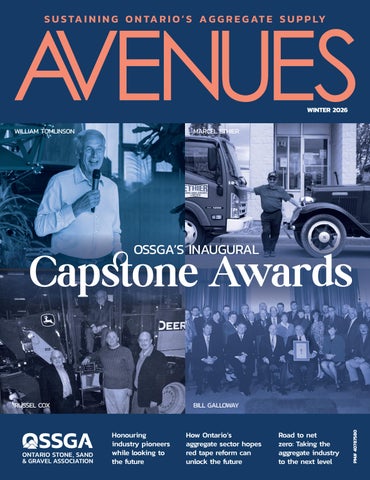
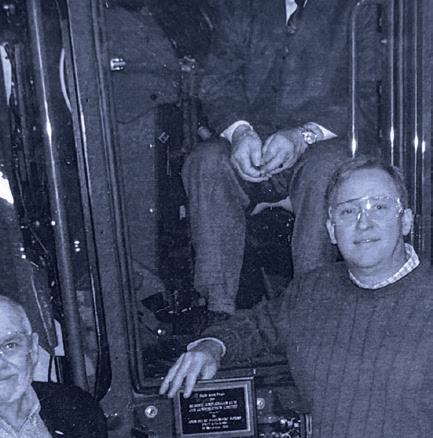
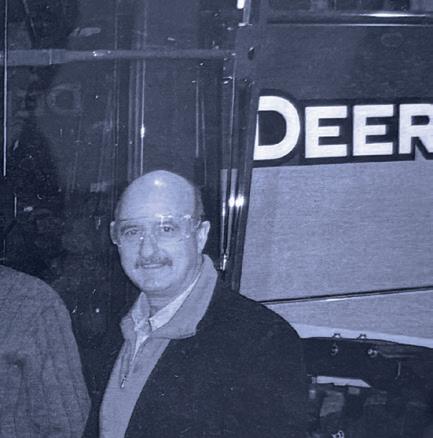
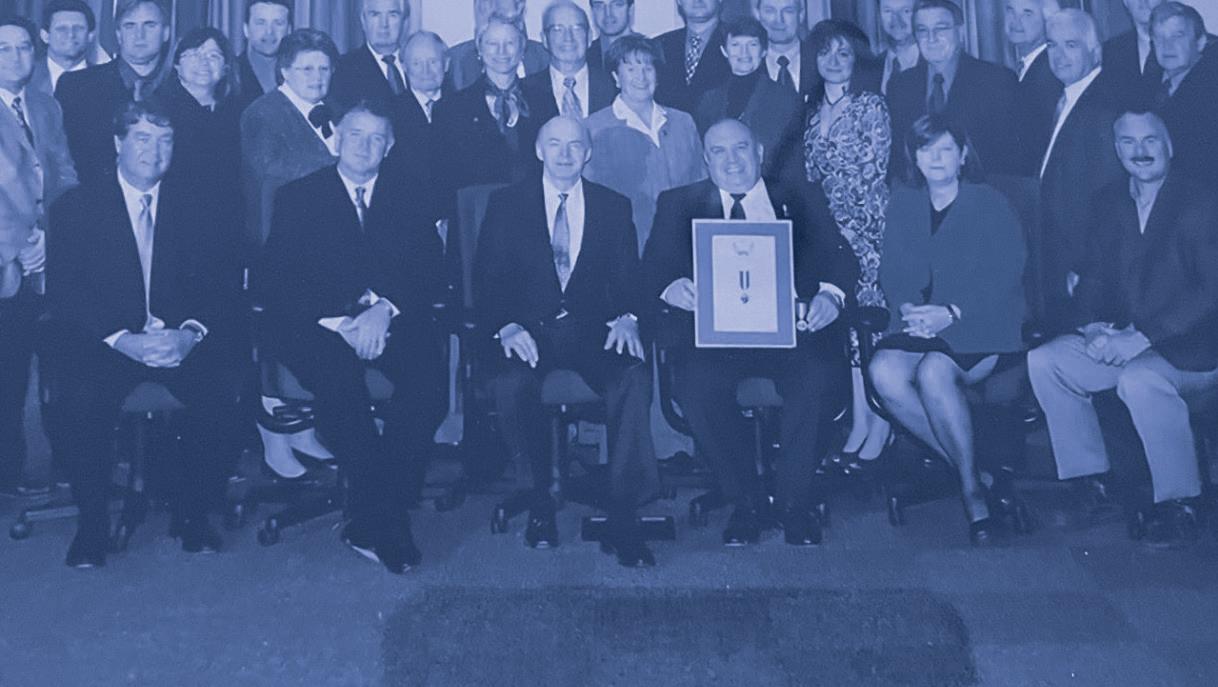
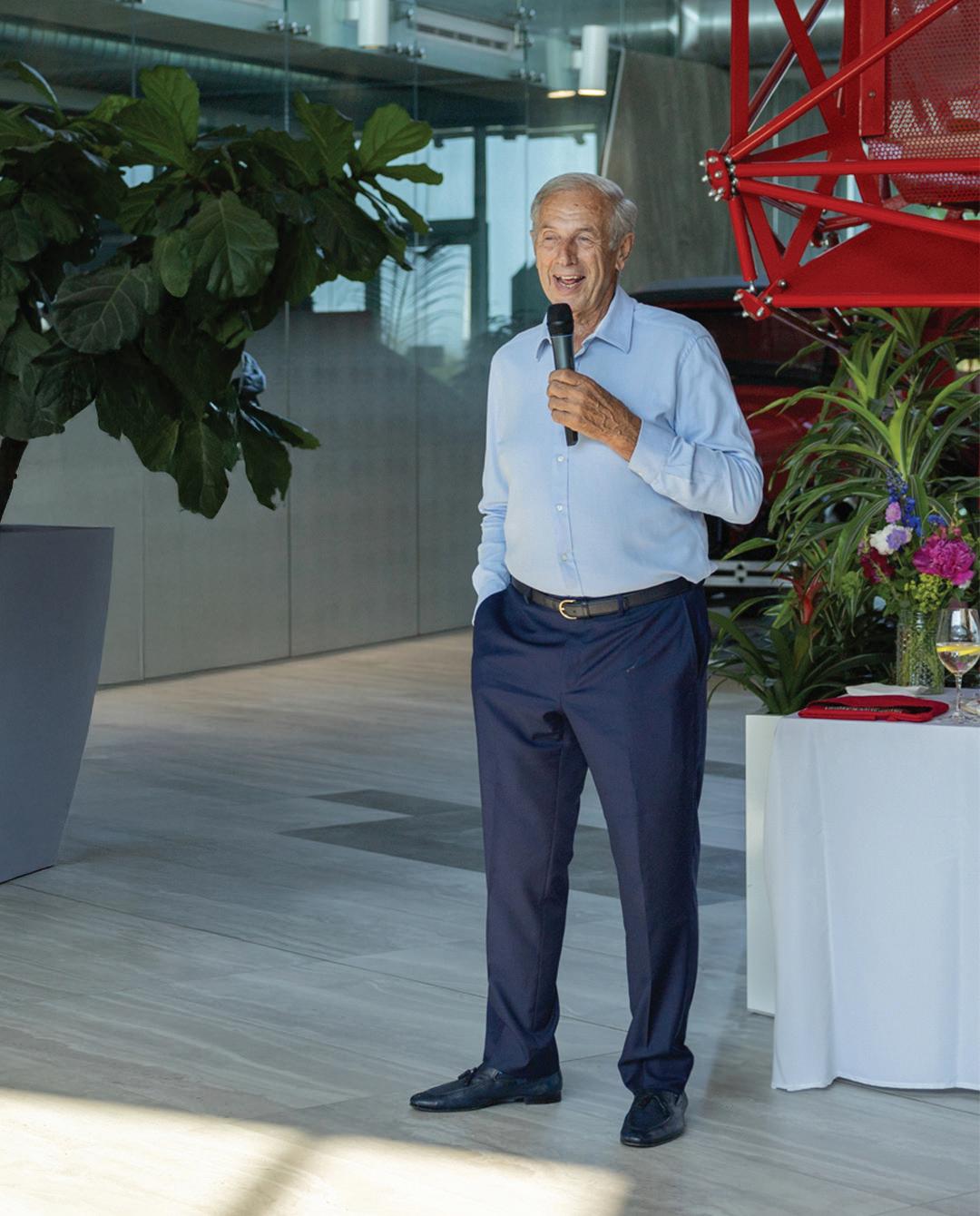
In celebration of the 70th anniversary of OSSGA, the association has decided to introduce a new award recognizing the highest level of achievement in Ontario’s aggregate industry. OSSGA has named four veteran leaders in the industry as recipients of the first‑ever Capstone Award. This distinction recognizes lifetimes of innovation, leadership and community impact, celebrating individuals whose contributions have shaped not only the industry but the very foundation of Ontario’s growth.
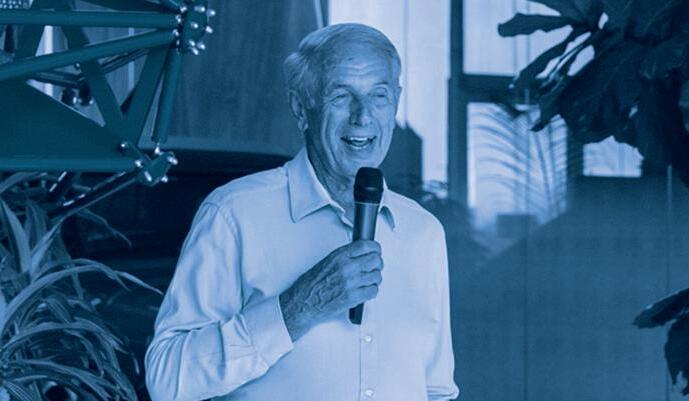
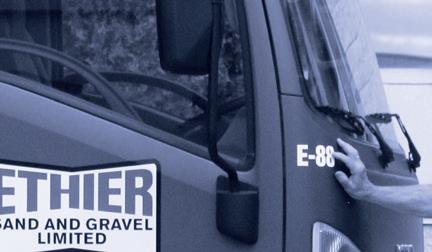
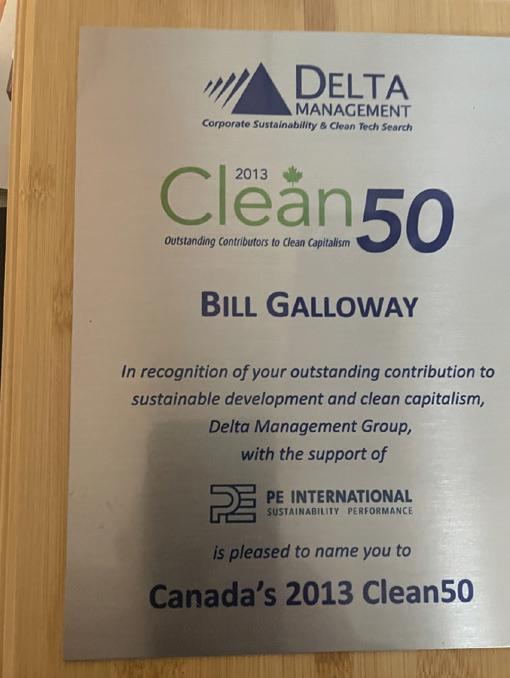
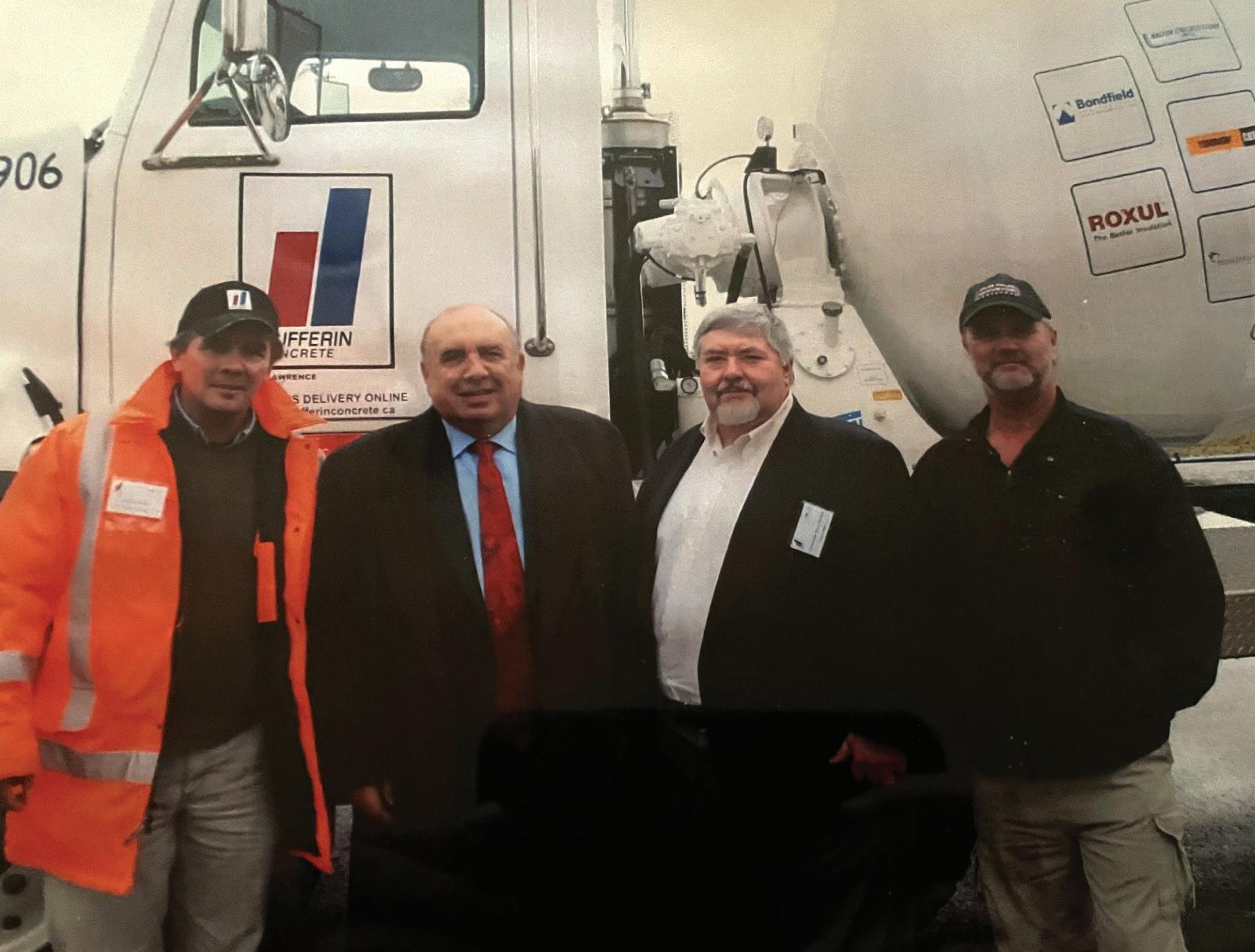
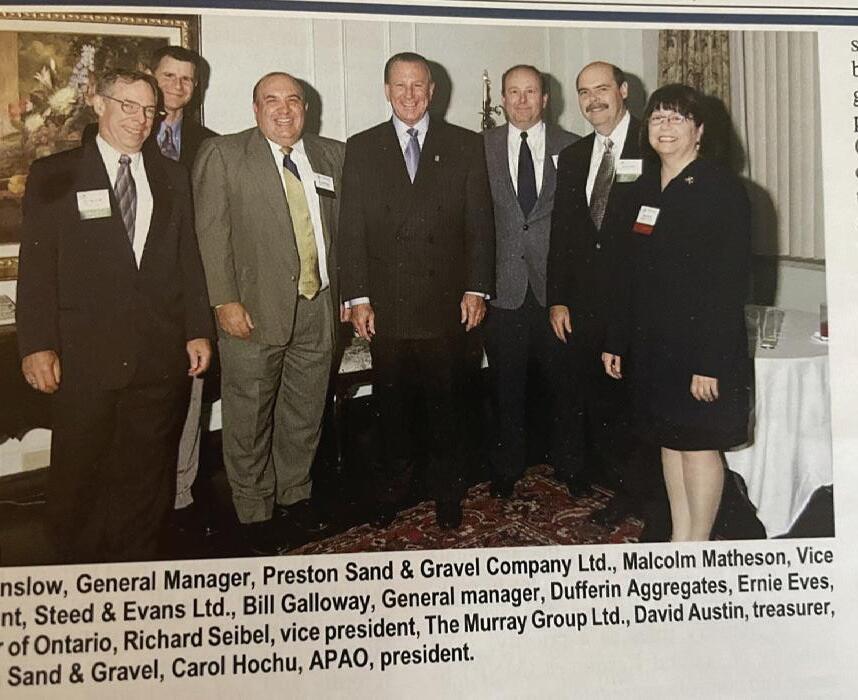
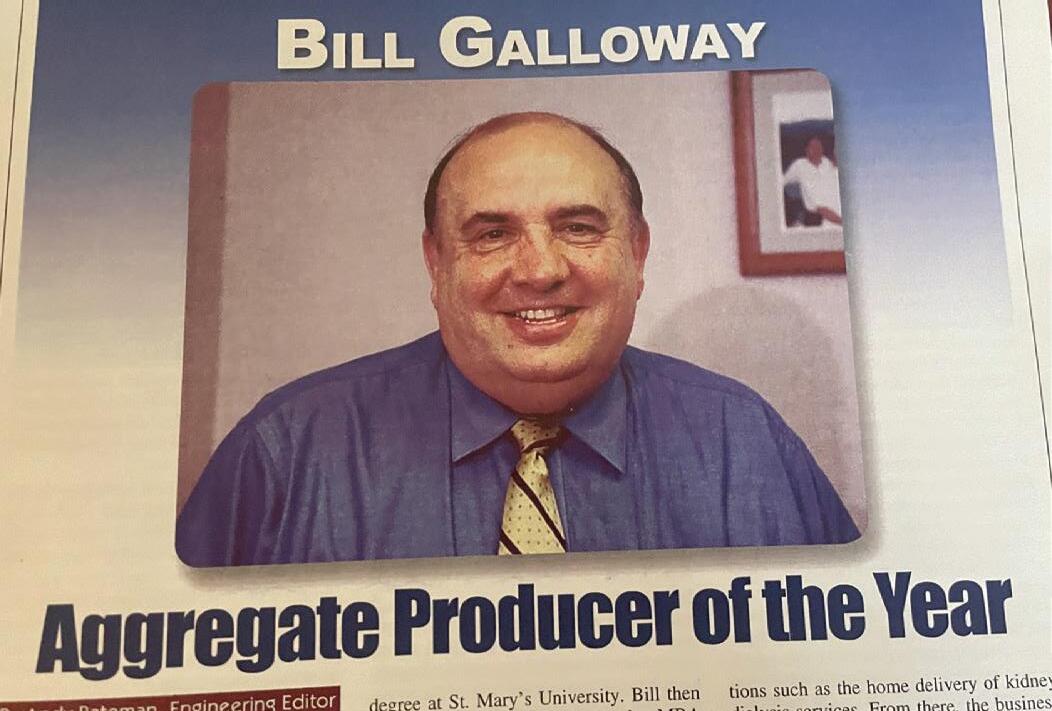
This year’s honourees are Bill Galloway, Russel Cox, William Tomlinson and Marcel Ethier. Each has dedicated decades to advancing the industry and strengthening OSSGA’s mission, sustainable practices and building the infrastructure that supports communities across the province.
The Capstone Award was created to honour those whose work has laid the groundwork for an industry that has contributed immensely to Ontario’s economy over the last century. Aggregate is essential to everything from roads and bridges to homes and hospitals. As Ontario faces increasing demands for housing, transportation and environmental stewardship, the recognition of these trailblazers serves as a call to action for the next generation to lead with vision and responsibility.
“These awards are more than a recognition of leadership in business; they’re a tribute to the integrity and foresight of individuals who have propelled our sector forward,” said John MacKay, OSSGA’s chair. “In an era of rapid change, their legacies remind us why involvement in OSSGA is essential for tackling future challenges and ensuring the continued growth of our industry.”
A pillar of leadership and sustainability
Bill Galloway’s 40-year career exemplifies the enduring impact the Capstone Award seeks to honour. Rising through the ranks of the aggregate industry and leading Dufferin Aggregates, Bill helped shape the company into what it is now as part of CRH Canada. Along the way, he was instrumental in fostering a culture of leadership grounded in excellence, innovation and sustainability extending his influence beyond operations.
THE CAPSTONE AWARD WAS CREATED TO HONOUR THOSE WHOSE WORK HAS LAID THE GROUNDWORK FOR AN INDUSTRY THAT HAS CONTRIBUTED IMMENSELY TO ONTARIO’S ECONOMY OVER THE LAST CENTURY. AGGREGATE IS ESSENTIAL TO EVERYTHING FROM ROADS AND BRIDGES TO HOMES AND HOSPITALS.
He championed environmental initiatives that balanced aggregate extraction with land rehabilitation and resource conservation, setting benchmarks for sustainable practices that influenced provincial policy. His efforts helped protect Ontario’s natural landscapes amid rapid urban expansion and positioned Dufferin Aggregates as a trusted partner to governments and communities alike — emphasizing a reputation for positive community relations.
Equally notable was his ability to build relationships — elevating talent within his organization and forging strong ties with policymakers to help shape the future of the industry. A steadfast supporter of OSSGA, Bill believed industry progress must benefit people, not just projects. His legacy underscores the importance of collaboration and ethical leadership in shaping a resilient future.










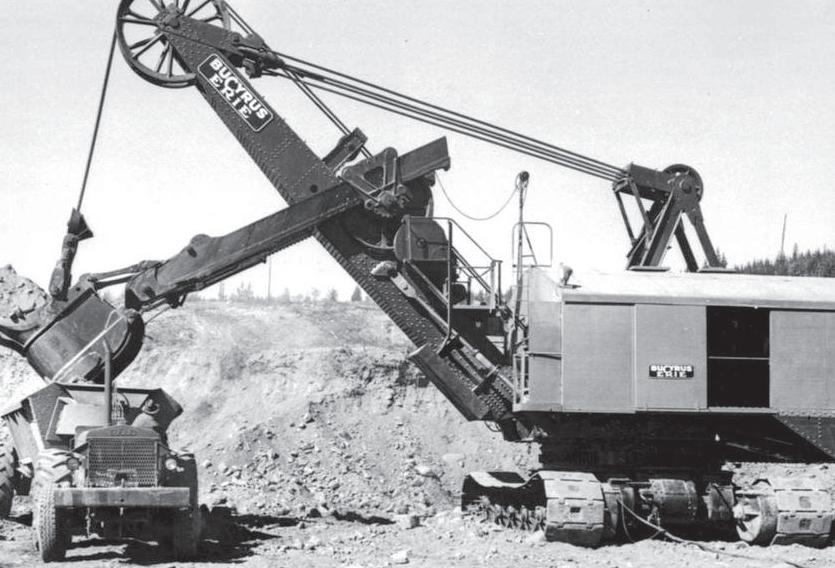
Russel Cox’s nearly 80-year tenure at Cox Construction, reflects a lifetime of innovation and community commitment. After his service as an engineer during the Second World War, Russel returned with a desire to chart his own path, beginning with a single crusher and building a company that became a leader in aggregates and road building.
Among his many contributions, Cox pushed for technological advancements that reshaped industry practices. His advocacy for larger hoppers from Cedarapids allowed wheel loaders to replace wire rope shovels, reducing the need to relocate crushing plants and setting new efficiency standards.
Russel’s dedication to community was equally profound. Through philanthropy and local engagement, he ensured his company’s success translated into benefits for the people of Guelph — a legacy his family carries on today. Within OSSGA, Russel promoted education on emerging technologies and championed practices that integrated aggregates with urban planning, ensuring development enhanced local environments.
His recognition reinforces the enduring value of innovation, determination and association involvement — qualities that will guide the industry through the challenges ahead.
Recognizing leaders like Russel Cox underscores the human element driving progress in Ontario’s aggregate industry. Their careers remind us that success is not measured solely in tonnes of material moved or kilometres of road built, but in the vision, integrity and innovation that transform raw resources into the foundations of thriving communities.
“I stand on the shoulders of these gentlemen. Without their trailblazing leadership, the aggregate industry wouldn’t be what it is today,” said Dwayne McKenzie, incoming chair of OSSGA. “Their example challenges all of us to think bigger, act responsibly and lead with purpose.”

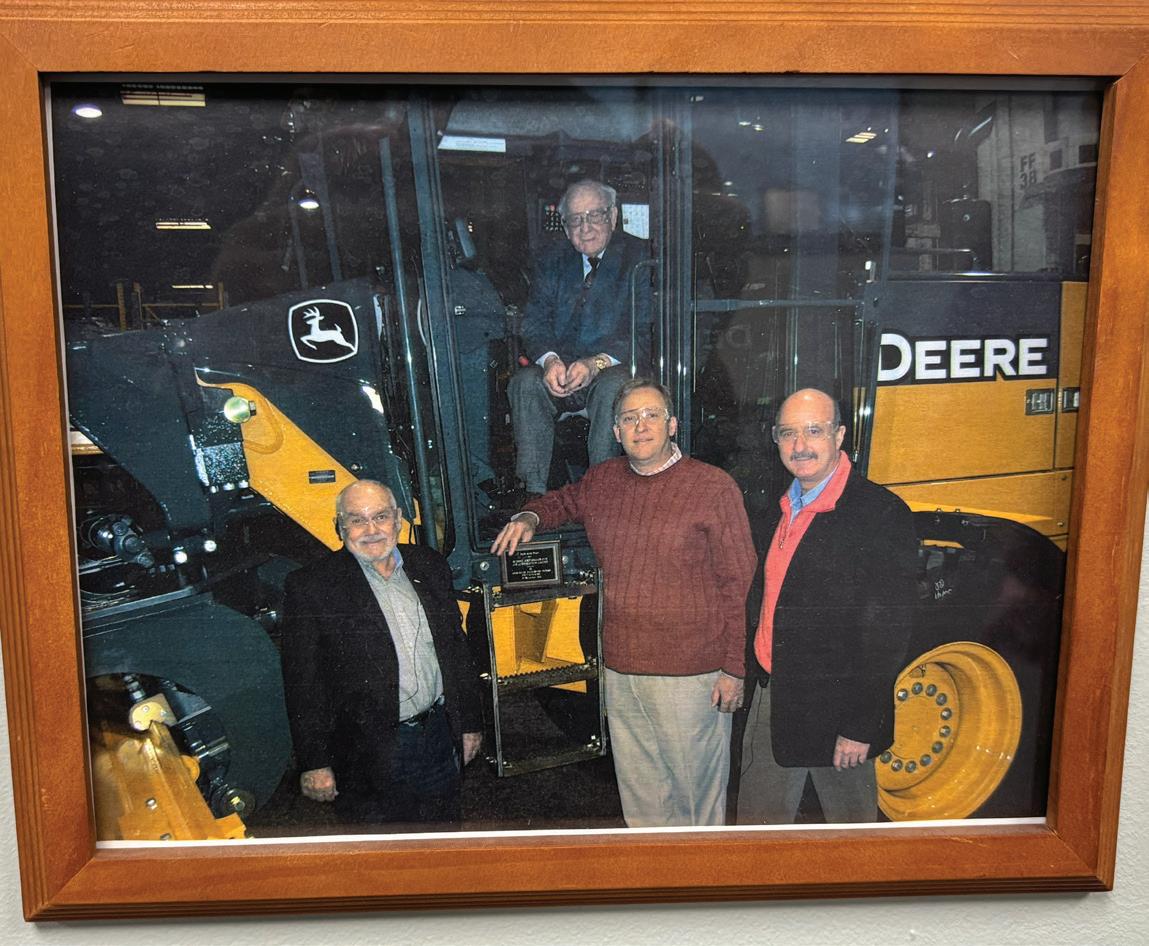



COX’S RECOGNITION REINFORCES THE ENDURING VALUE OF INNOVATION, DETERMINATION AND ASSOCIATION INVOLVEMENT.





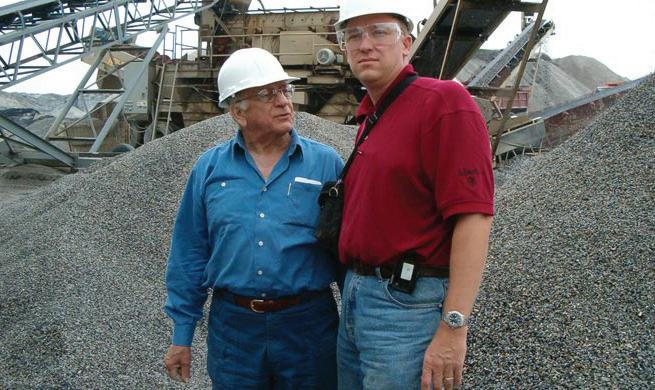


William Tomlinson’s journey to building one of Ontario’s most prominent construction groups reflects a lifetime of vision and perseverance. Under his guidance, the Tomlinson Group has grown into a cornerstone of Ontario’s infrastructure sector, driving innovation in aggregate processing and introducing advanced techniques that improved efficiency while reducing environmental impact.
Tomlinson’s commitment to land rehabilitation transformed exhausted quarries into green spaces and wildlife habitats, creating a model now emulated across the industry. His entrepreneurial spirit extended to OSSGA, where he championed advocacy, mentorship and civic engagement. Through philanthropy and community projects across eastern Ontario, Tomlinson reinforced the industry’s role in building resilient communities.
His story is a testament to how local leadership can influence provincial progress — and why innovation and community stewardship remain central to the aggregate sector’s future.

THESE AWARDS ARE NOT ONLY A CELEBRATION OF PAST ACHIEVEMENTS; THEY ARE A RALLYING CRY FOR THE FUTURE. THEY REMIND US THAT LEADERSHIP IS ABOUT MORE THAN BUSINESS SUCCESS — IT IS ABOUT BUILDING TRUST, PROTECTING THE ENVIRONMENT AND
ENSURING THAT PROGRESS BENEFITS PEOPLE AS
MUCH AS PROJECTS.


Amrize is the partner of choice for the professional builders of North America, covering every project need from foundation to rooftop. With over 1,000 sites, 19,000 teammates, and a highly efficient distribution network, we deliver advanced building solutions for infrastructure, commercial and residential projects in every U.S. state and Canadian province. We are ready to build your ambition.
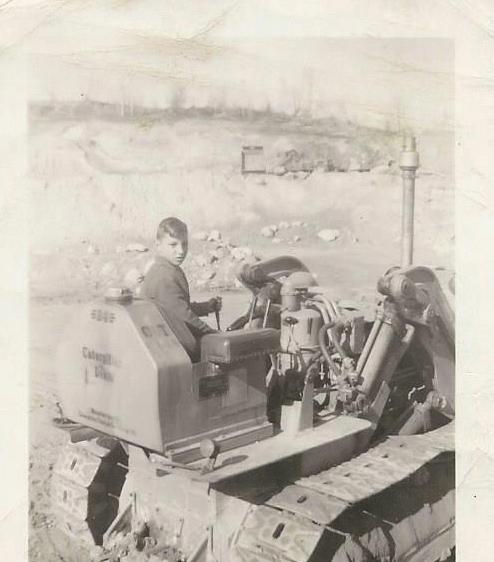
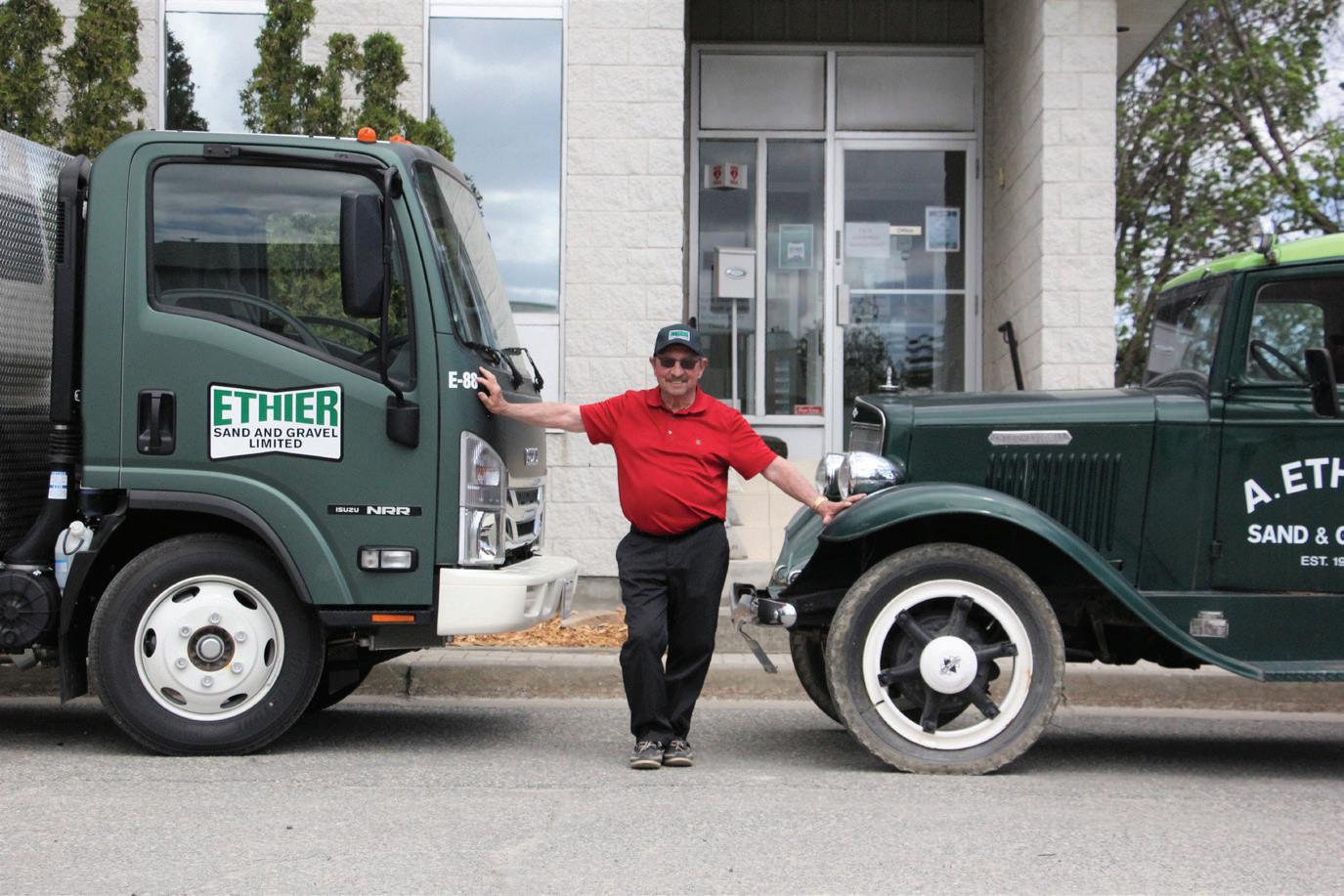
Marcel Ethier’s career began with taking over his father’s business as a young man. Through perseverance and hard work, he transformed Ethier Sand & Gravel from a small business into a leading aggregate producer in northern Ontario. Today’s his company employs dozens of people, including his own son Daniel who recently retired. Throughout his decades of work and the ups and downs of the industry, he endured, building a legacy that continues to stand strong.
Ethier’s leadership at OSSGA helped define the region’s aggregate landscape, blending business acumen with a deep commitment to sustainability. His innovations in operations improved safety and productivity, while his reclamation efforts restored sites for community use — emphasizing environmental stewardship.
Northern Ontario faces unique challenges, but throughout his tenure at OSSGA Ethier sought to keep his home front and centre. His recognition highlights the value of OSSGA membership as a platform for knowledge sharing and collective advocacy in a challenging industry.







As we look back at the last 70 years of OSSGA and look forward to the next, the first-ever Capstone Awards arrive at a pivotal moment. Ontario’s population is growing at an unprecedented pace, and record infrastructure investments from federal and provincial governments promise a surge in demand for stone, sand and gravel over the next decade. Meeting this demand will require more than production capacity — it will demand collaboration, advocacy and a commitment to sustainability. Regulatory hurdles, environmental imperatives and community expectations will shape the path forward, and the industry must rise to meet these challenges with the same ingenuity and resilience that defined these honourees’ careers.
These awards are not only a celebration of past achievements; they are a rallying cry for the future. They remind us that leadership is about more than business success — it is about building trust, protecting the environment and ensuring that progress benefits people as much as projects. As OSSGA and its members advance their mission to build a better Ontario, these legacies serve as a compass, pointing toward a future where innovation and responsibility go hand in hand.
The foundation they laid is strong. Now, it is up to the next generation to build upon it — to embrace new technologies, champion sustainable practices and engage deeply with OSSGA’s vision. In doing so, we honour not only these remarkable leaders but the communities and landscapes that depend on our industry’s continued excellence.
BY MATTHEW BRADFORD
Brick by brick, and among facades across Ontario, locally sourced stone has left its mark on landmarks and structures throughout the province. Ahead are a few of the remaining showpieces that put the value of Ontario stone on display.
Elora Mill, Centre Wellington
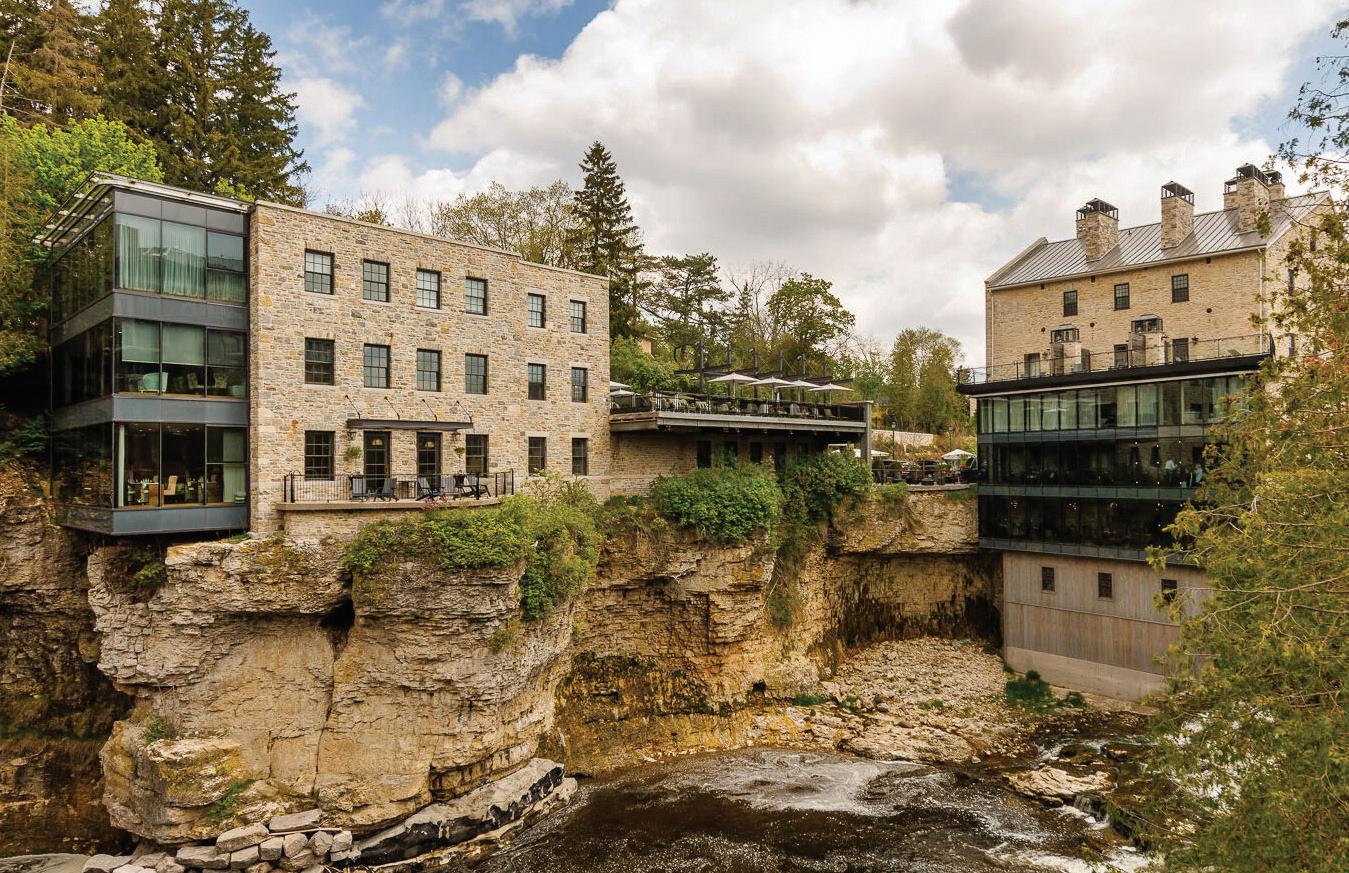
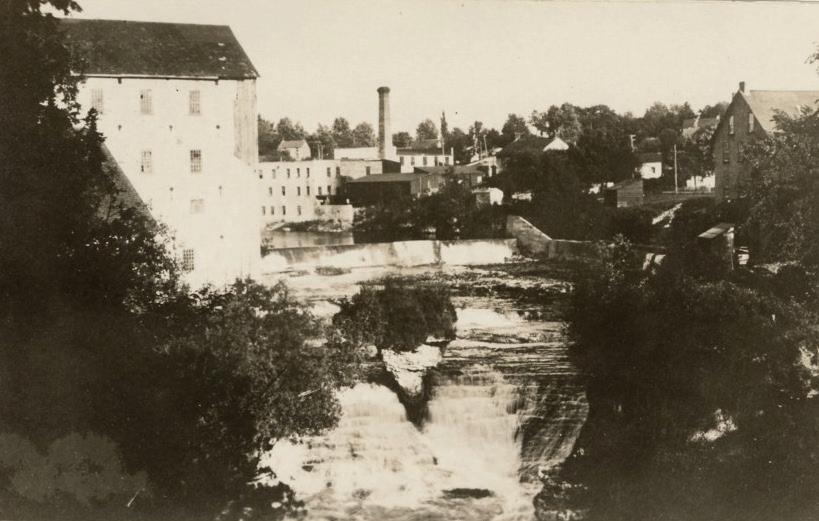
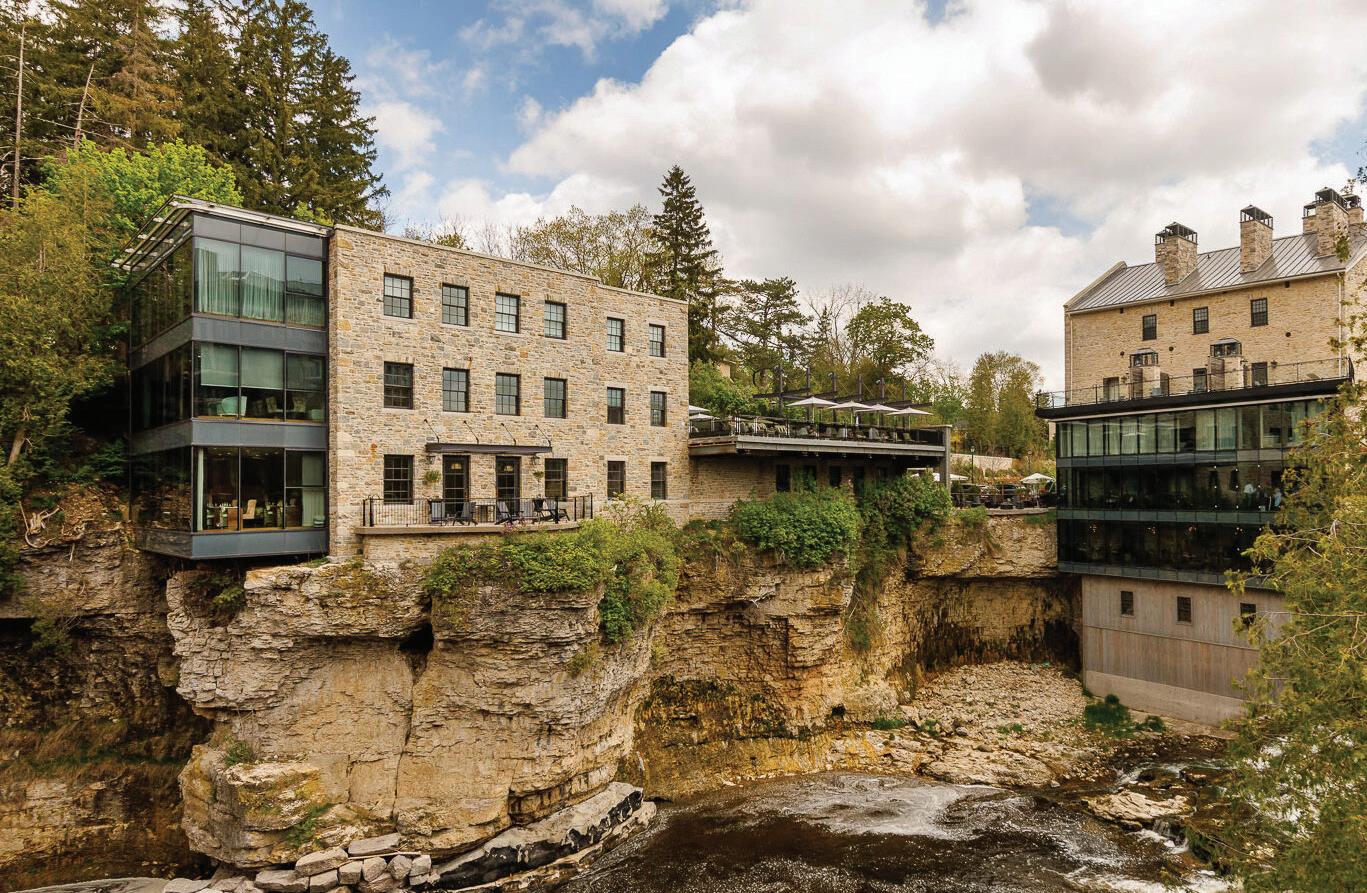
Locally quarried limestone is on display throughout the community of Elora. Among them is the Elora Mill, a five-storey stone structure originally built in the early 1830s by Captain William Gilkison — a central figure in Elora’s foundation — and later rebuilt by Charles Allan in 1843 following the original’s destruction by fire. Still standing along the Grand River at the end of Elora’s Mill Street, the structure is composed of dolomitic limestone quarried from a nearby bedrock source. It was likely quarried by Elora White Lime Co., whose quarry later became the Elora Quarry Conservation Area. The mill ceased operation in 1974 but in 2018 it was reborn as the Elora Mill Hotel and Spa.
Limestone was a common building material for Elora throughout the 19th century. Today, it can still be seen at the Elora Centre for the Arts, built in 1856 as a public school for girls; the Elora Drill Shed, built for militia training in 1865; and several commercial and residential buildings in Elora’s downtown core.
Royal Ontario Museum, Toronto
Beyond housing relics and artifacts from around the world, the Royal Ontario Museum (ROM) is an iconic display of Ontario stone. Its facade features dolostone (Queenston limestone) and brownish-red
sandstone (Credit Valley stone), with dolostone prominently featured in the museum’s rotunda. Meanwhile, sodalite from Bancroft-area quarries was used alongside Ontario marble to create the mosaics that adorn the rotunda floor.
The use of locally quarried stone was an intentional choice during the ROM’s construction. The museum was built at the height of the Great Depression and was used as a “make-work” project by the provincial government, which also required the use of Ontario-sourced materials.

The corner of Queen and Bay Streets is where you’ll find one of Toronto’s most iconic stone structures. Here, Old City Hall stands out among its modern neighbours with its prominent clock tower, classic Romanesque design and a textured, two-toned facade created from sandstone quarried from the Credit River valley, grey stone from Orangeville and brown stone shipped in from New Brunswick.
The heritage building was a $2.5-million project built from 1889 to 1899 to serve as Toronto’s third city hall. It was designed by local architect Edward James Lennox, who, despite being denied a plaque recognizing his role in its construction due to disputes with city councillors, had stonemasons etch his name in its upper-level corbels. Look further up and you’ll find brass gargoyles “protecting” the clock tower, standing in place of their original stone versions.
Toronto’s Old City Hall has served various purposes over the years. In 1966, it was repurposed as a provincial courthouse, which was vacated in April 2025. Today, the city is weighing future uses while using the building to house short-term exhibits and programs.
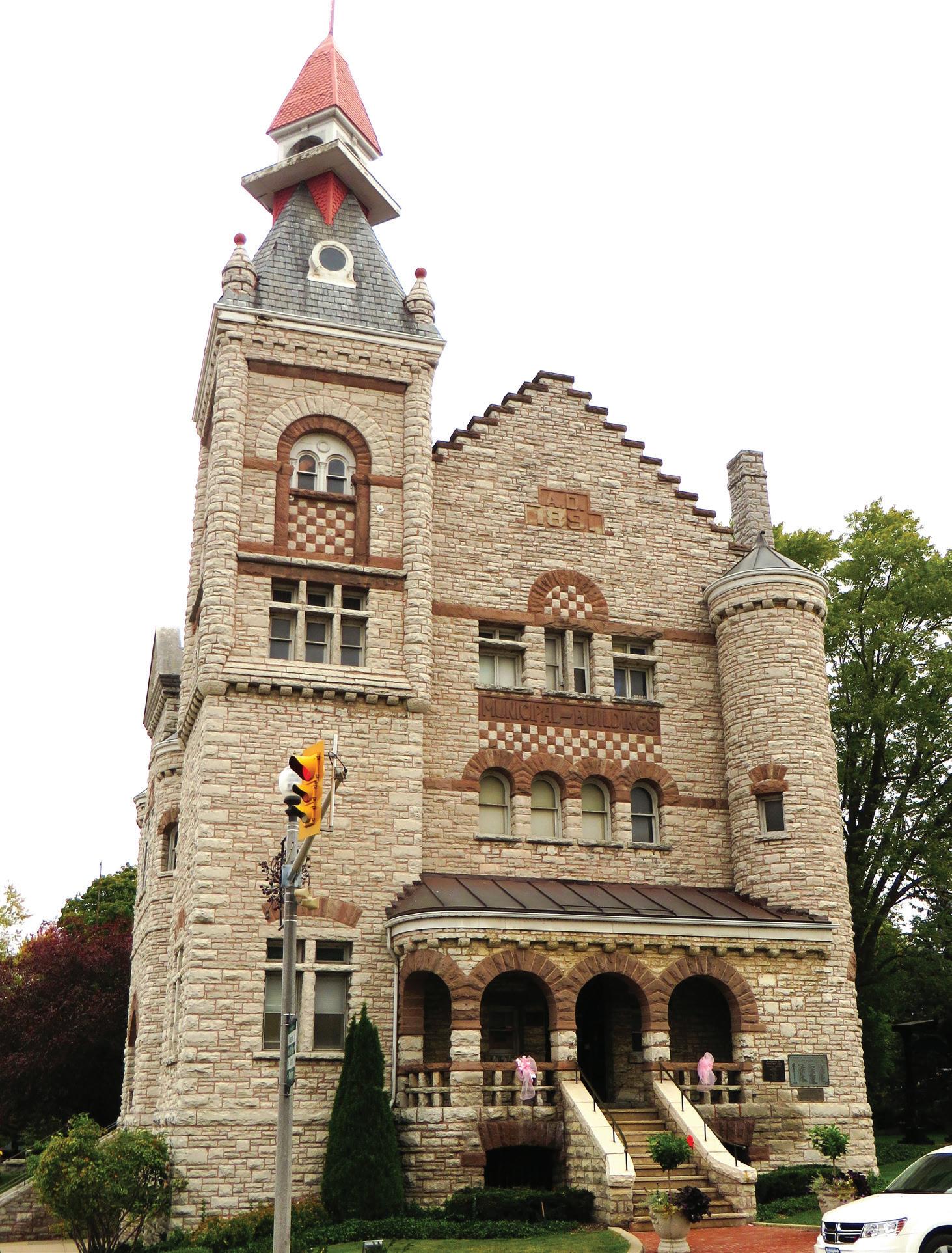
St. Mary’s Town Hall, St. Marys Ontario’s “Stone Town” is home to a number of buildings constructed with locally sourced materials. An eye-catching example is St. Mary’s Town Hall, which has served as the headquarters for municipal services since its construction in 1891.

Situated at the corner of Queen and Church Streets in St. Marys’ downtown core, the Richardsonian Romanesque building comprises a five-storey tower, a turret, a multi-arched portico around the entrance, stone porches, steep gables and other medieval-inspired details. Its “checkerboard” facade is owed to the use of red sandstone and limestone. Today, the town hall continues to house municipal offices, council chambers and an auditorium used by its local theatre group and for various public events.
St. Marys comes by its “Stone Town” nickname honestly. Many of its 19th-century buildings were constructed of limestone taken from the riverbed and banks of the Thames River by quarries such as Thames Quarry Company, which ended operations in the 1930s. They include the opera house (1880), town hall (1891) and public library (1904).
Old City Hall, then and now


St. Mary’s Town Hall, St. Marys
Sir John A. Macdonald Building, Ottawa
Queenston limestone has been trusted in the construction of numerous Canadian landmarks over the past two centuries. One highlight is the Sir John A. Macdonald Building (formerly the Bank of Montreal building) on Wellington Street in Ottawa.
John A.

Completed in 1932, the former home of the Bank of Montreal in Ottawa is clad in Queenston limestone quarried by Queenston Quarry, located on the Niagara Escarpment between the communities of Queenston and St. David’s in the Niagara Region. The classically styled structure features a detailed facade with limestone pillars and carvings by artist Emil Seiburn depicting Canadian history and culture. “As with many landmark buildings across the country, the choice of Queenston stone was as much about function as it was about cultural symbolism,” writes Queenston Limestone on its website. “This project stands among the most important civic commissions to feature our material, and we are proud to have played a role in its enduring legacy.”
The building was acquired by the Government of Canada in 2005, which restored the structure and renamed it the Sir John A. Macdonald Building. Today, it serves as a ceremonial venue for state functions, official receptions and high-level meetings.
Queenston limestone has been used in notable Canadian landmarks, including Brock’s Monument, the Welland Canals, the Queenston-Lewiston Bridge, the Niagaraon-the-Lake Courthouse and the Ontario Legislative Building. It also found its way into international architecture, such as Artpark in Lewiston and Canada House in London. Years later, the stone is still actively quarried and used in new projects.
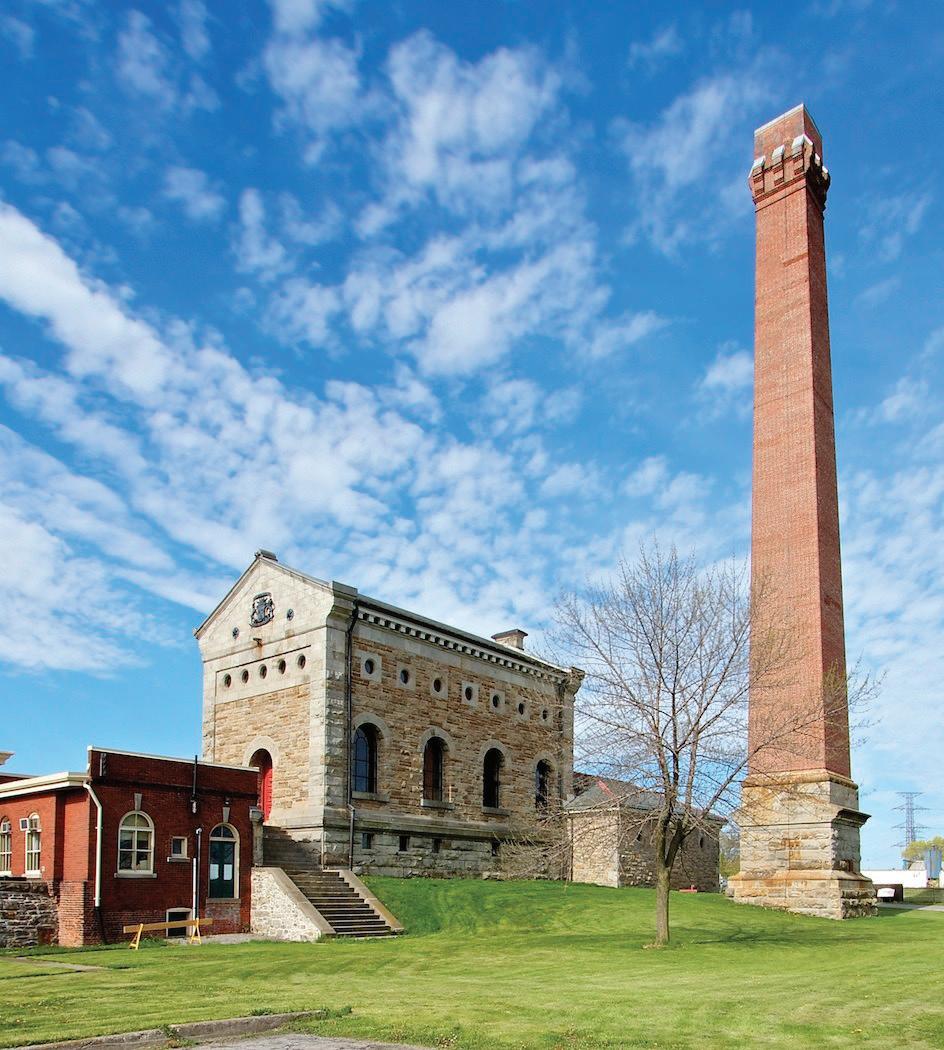
The Hamilton Pumphouse was built between 1856 and 1859. It was the first facility of its kind in the region to pump water from Lake Ontario into the city’s Barton Reservoir on the Niagara Escarpment. Designed by noted engineer Thomas Keefer, the station includes an engine house, a boilerhouse, a chimney and a wood shed. Its main walls are primarily of Eramosa dolomite, while its chimney is made of whirlpool sandstone. Both materials were obtained from quarries around Stoney Creek.
In its prime, the Hamilton Pumphouse delivered millions of gallons of water a day to the growing city. When its operations wound down in 1910, it became a backup station before ceasing operations entirely in 1938. Fortunately, its role in bringing Hamilton to life was recognized in 1977 with a designation as a National Historic Site of Canada. Now, the Pumphouse continues to stand as a testament to the city’s past, housing the Hamilton Museum of Steam and Technology.
Sandstone and dolomite quarries around Hamilton Mountain were a source of material for numerous 19th-century buildings in Hamilton. Other examples include Dundurn Castle, the Church of the Ascension, the Pring Guesthouse (formerly Willing Pring House) and MacNab Street Presbyterian Church.
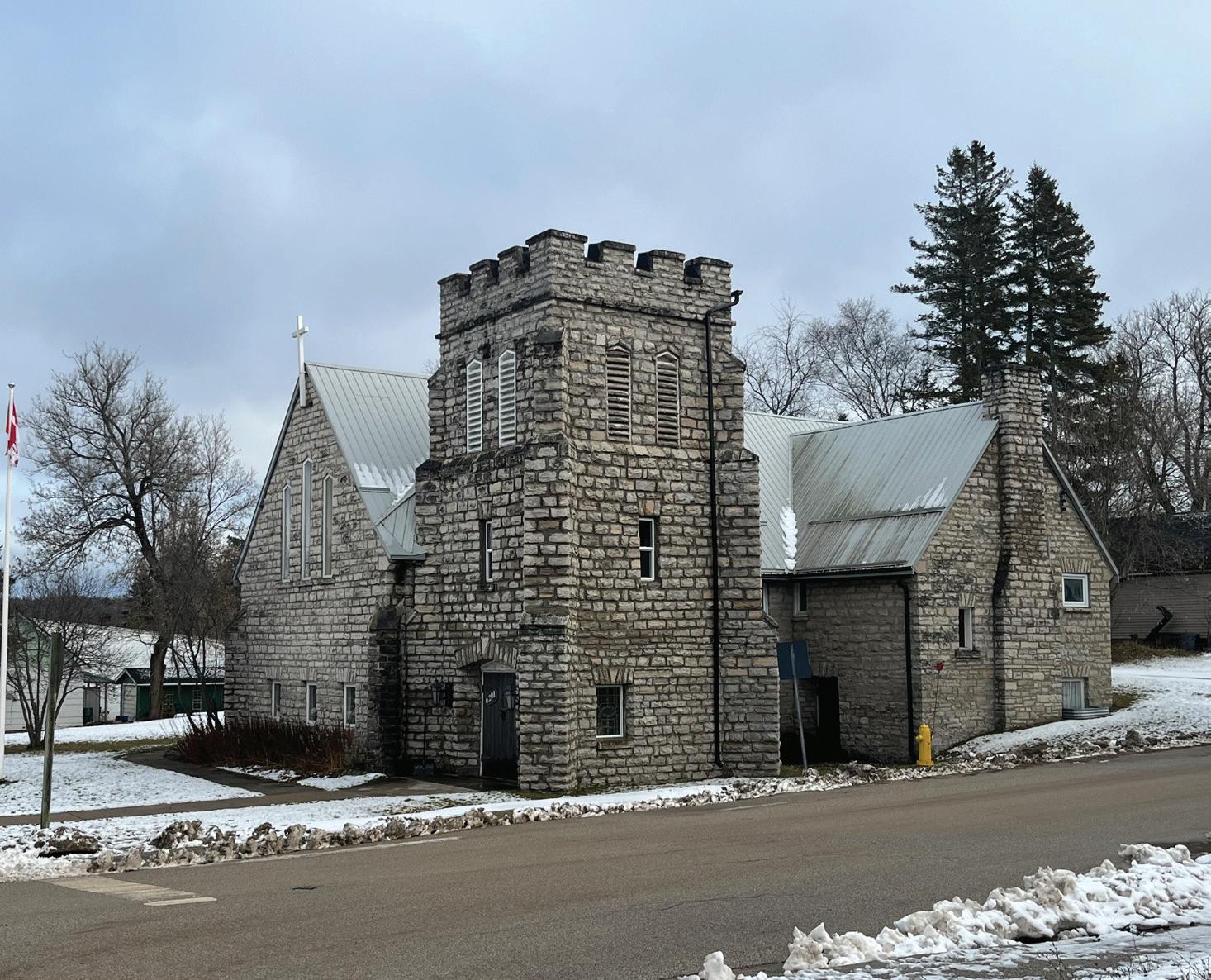
The St. Francis of Assisi Anglican Church in Mindemoya, Ontario, is an enduring example of structures built on Manitoulin Island from the region’s abundant weatheredge limestone. The modest Romanesque structure was built during the Great Depression in 1932 by its parishioners using timbers from nearby forests and stone from local quarries. Today, it is regarded as one of northern Ontario’s “northern icons”
St. Francis of Assisi Anglican Church, Mindemoya


and houses a collection of religious artifacts, including stone from the Canterbury Cathedral in London.
Manitoulin Island is home to numerous structures made with material from Manitoulin quarries. Examples include the Gore Bay Museum, which once served as the former courthouse and jailer’s house; the Old Mill Heritage Centre in Kagawong; the Holy Cross Church in Wiikwemkoong; and several residences throughout Tehkummah Township.
For 137 years and counting, Guelph’s Basilica of Our Lady Immaculate has stood atop Macdonell Street as a stunning display of stonework. Described as High Victorian Gothic Revival style, it was constructed from limestone quarried nearby at the Dolime Quarry, which has contributed to this and many other iconic buildings throughout the city’s history. The basilica’s main work was completed in 1888, but its intricate towers were not finished until 1926. Since then, the structure has undergone several updates and renovations.
The basilica was designed by Joseph Connolly and is considered the IrishCanadian architect’s best work, including churches throughout Canada and overseas. In 1990, it was designated a National Historic Site of Canada, and in December 2014, Pope Francis bestowed the current designation of minor basilica.
Locally quarried limestone adorns numerous buildings in Guelph and its surrounding region. Other examples include the two-storey Provincial Offences Courthouse (originally the Old Guelph City Hall), the downtown Stone Store, the Stoneleigh house, numerous residences and several downtown heritage blocks.
Basilica of Our Lady Immaculate, Guelph
The aggregate industry is continually evolving. The same can be said for the equipment that keeps the materials flowing. For a look at how far pit and quarry technologies have come, Avenues reached out to several OSSGA members who have seen the evolution take shape first-hand.
Few people have watched quarry equipment evolve as closely as Gord DeHaan. With more than 30 years at Fowler Construction, the veteran equipment manager has seen the industry transform from hulking, concreteanchored machines to sleek, modular systems. That’s not to say some of the more reliable machines of old have gone forever. “We actually have one stacker left here,” he says. “It’s a screening plant I thought was old when I started back in ’78. Some of this stuff never changes – but plenty has.”
BY MATTHEW BRADFORD
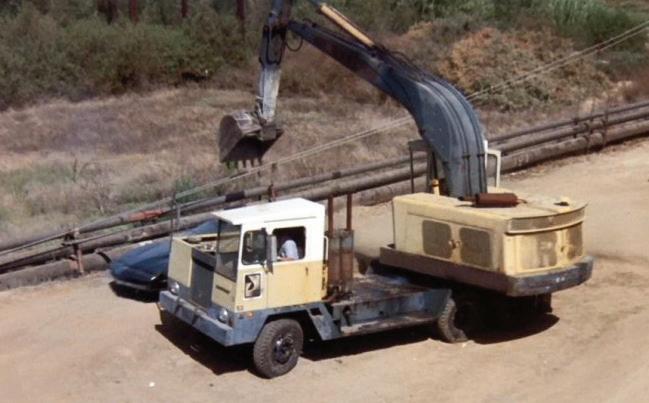
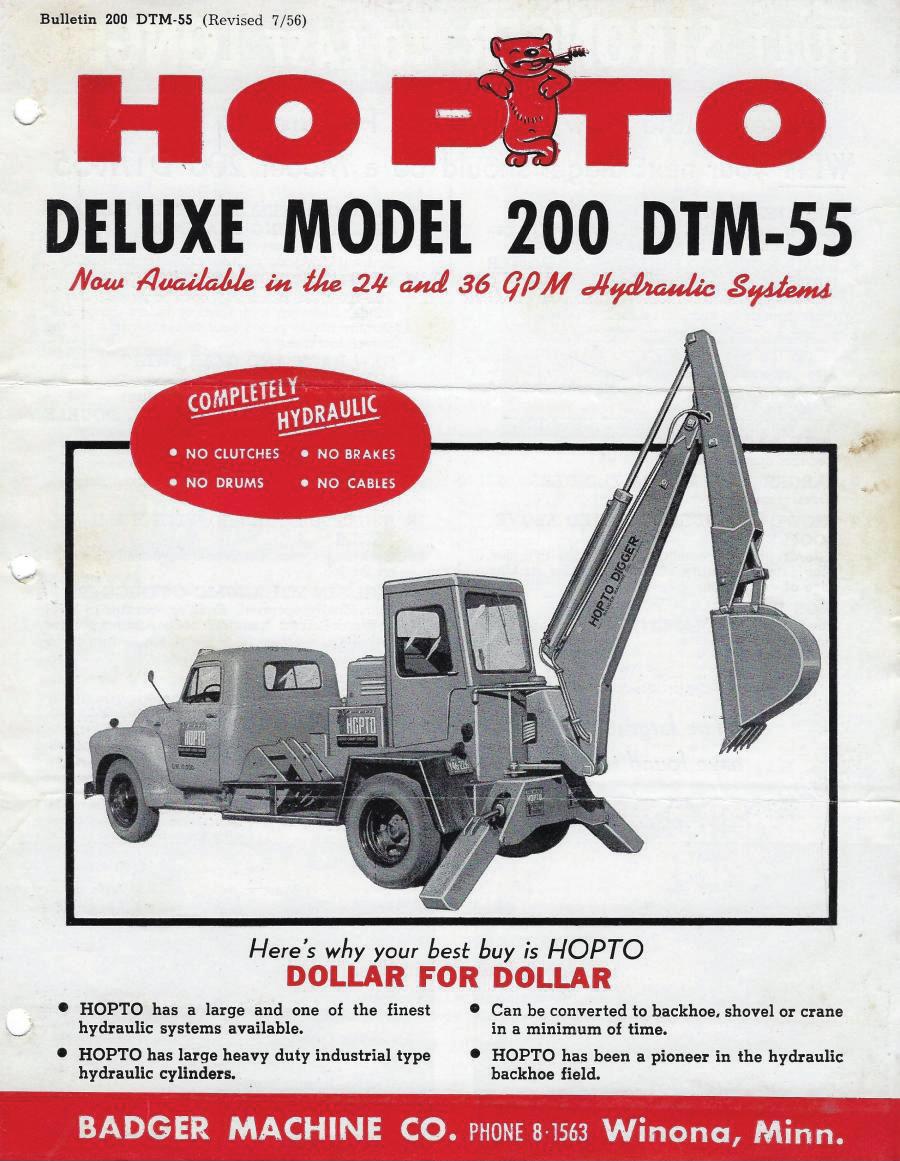
Of course, some machines have vanished entirely. “The one thing you absolutely never see anymore is a truck-mounted excavator,” DeHaan says. “Fowler used to have a few, years and years ago, but they’re almost extinct now.” Likewise, sprawling permanent quarry layouts with massive primary crushers are rare due to their cost and inflexibility.
Advances in portability and transport have also rendered certain equipment unnecessary. Instead of immovable concrete structures, DeHaan suggests quarries are more likely to lean on modular steel setups that can be assembled, dismantled and hauled to the next site. “That flexibility has changed the way quarries operate,” he explains.
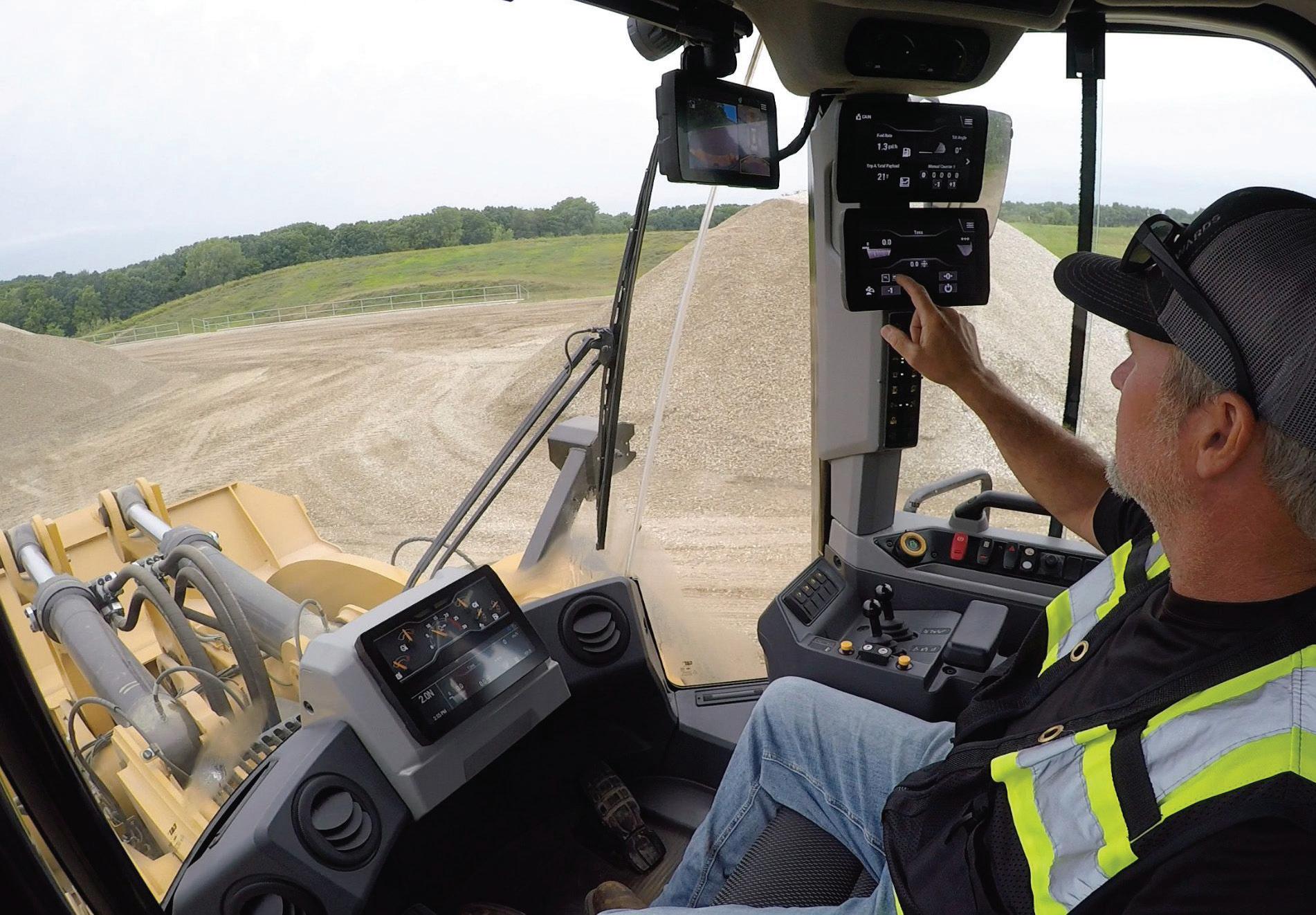
Automation has been another game-changer. In the old days, operators memorized endless shutdown sequences and juggled rows of push buttons. Now, says DeHaan, “You can set up parameters and have things shut off by themselves. That kind of automation has come a long way. And once people are used to it, nobody goes back.”
All told, for DeHaan, the story of quarry equipment isn’t all about shiny new tech; it’s about balance. While there are certainly innovations that have streamlined pit and quarry operations, there are also reliable pieces of equipment that stick around because they simply work. “Some things keep going forever, and others disappear,” he adds. “And then, certain things that fell out of favour come back full circle in the right application.”
Jim Thornton is a key account manager with Toromont Cat who has been part of the aggregate industry since 2001. Beginning in a service role with Toromont Cat, he quickly found himself managing a massive fleet for a major client, which comprised 150 pieces of equipment for which he and his team maintained “everything from stem to stern, except the tires.” That early immersion gave him a unique perspective on how the business operated from the inside, reinforced by mentorship from industry veterans and his peers at OSSGA over the years.
Reflecting on two decades of equipment evolution, Thornton points to evolving emissions standards as being among the biggest influences on equipment design. “When Tier 4 came in, there was a lot of hesitancy in the marketplace — and for good reason. It is much more refined today, but there were still growing pains, and the transition definitely shaped equipment designs.”

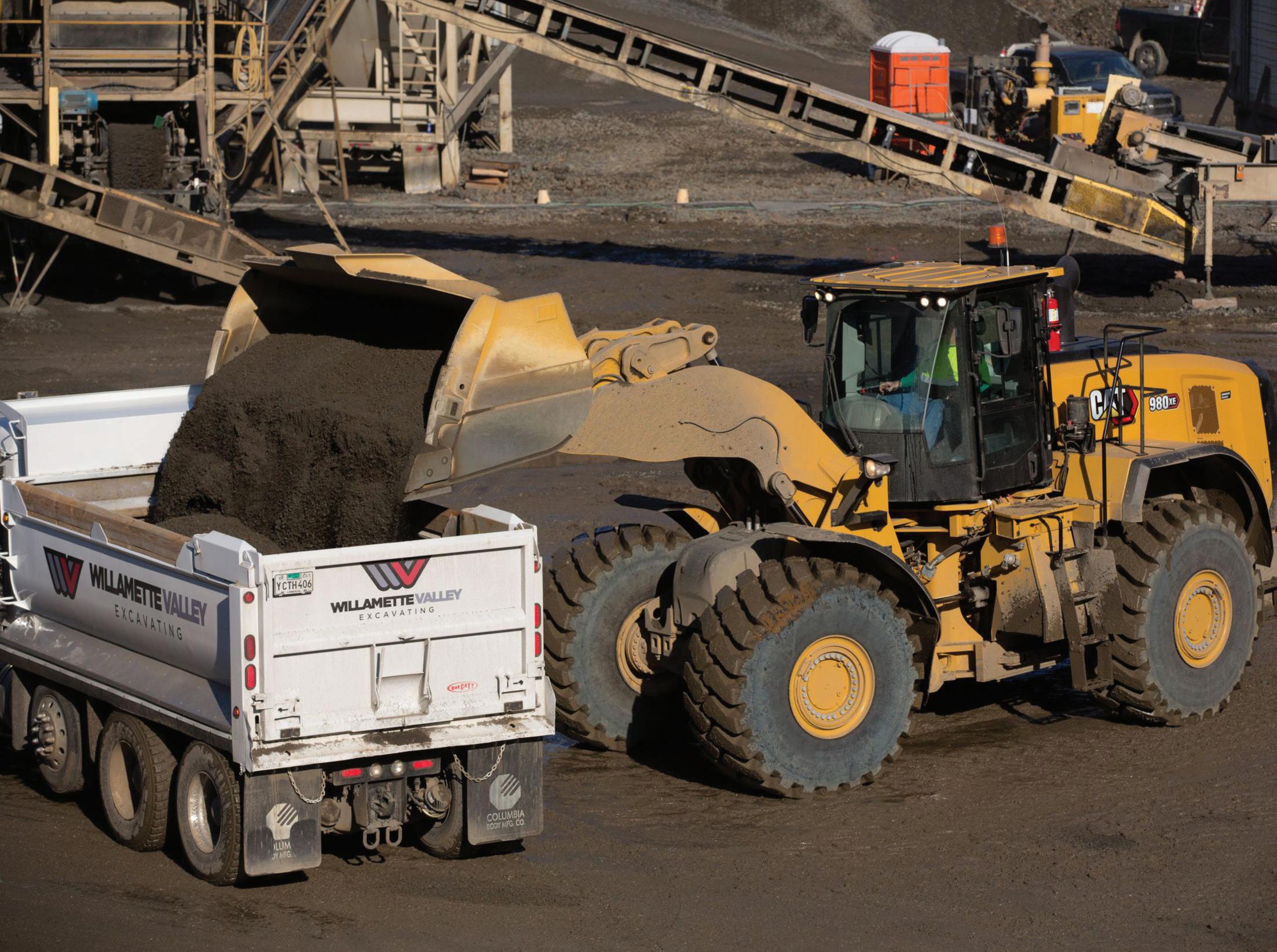
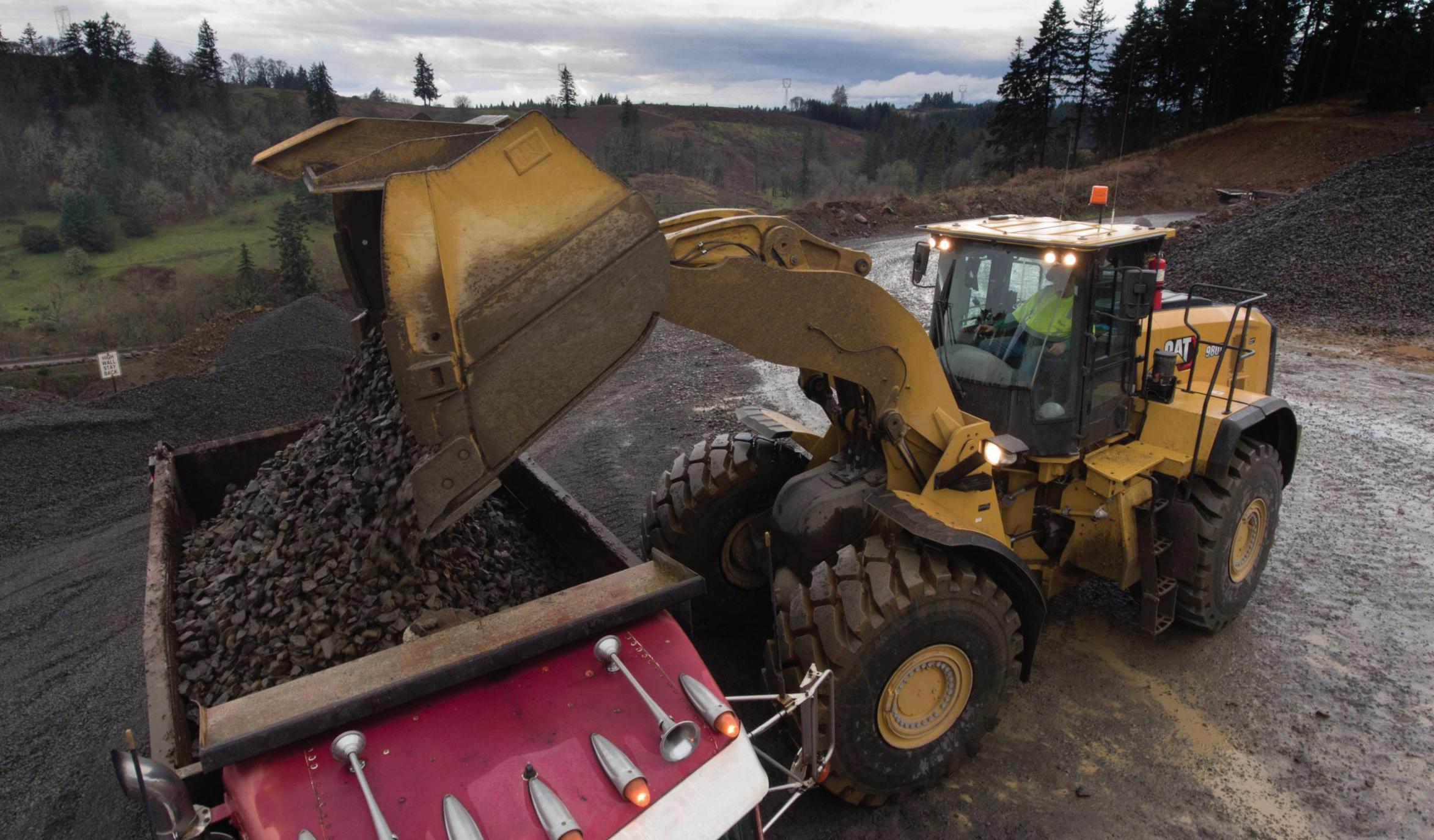
Intensifying sustainability mandates and a strong market push have also spurred the adoption of more fuel-efficient equipment and advanced powertrains. For example, he notes: “In the CAT world, we call it the XE platform, which provides increased efficiency or productivity. For example, on a 988 loader, we now run the power from an engine into a generator and through a motor, which gives improved fuel efficiency. Or on a 980-size loader we offer a hybridstyle transmission that can save about 25 per cent fuel depending on the application, which is a big difference when you look at total lifecycle cost.”
At a broader level, Thornton shares Gord DeHaan’s perspective on the advance of “smarter” and more automated equipment. “The architecture of the machines has changed with a lot more electronic controls,” he explains. “That’s a building block for autonomy and remote control. Now we can even provide integrated operator coaching using feedback based on sensor data about how to dig or load more efficiently.”
The ability to collect and assess equipment data in real time through onboard sensors and internet of things technology has been a gamechanger, as have data platforms that give employees back at the office the tools to understand and act on those insights. “You can really get a grasp on things like job site management, cycle times, bottlenecks or even seat belt reporting,” Thornton says. “Some clients are tying that data into their plants to understand production holdups.”
You can set up parameters and have things shut off by themselves. That kind of automation has come a long way. And once people are used to it, nobody goes back.
From managing fleets to embracing big data, Thornton has witnessed the industry’s shift toward smarter, more efficient and more connected equipment. As he puts it, “All of the electronic integration has been a real generational change. The machines today are building blocks for the future.”
Durability was the priority for aggregate equipment back when Dean Glenn entered the aggregate industry some 25 years ago. “The designs were simple, rugged and mechanical, meant to handle rough conditions with minimal automation,” he recalls.
The focus on durable design hasn’t wavered, but Glenn has seen more factors come into play over the decades, and during his time as vice-president with Assinck. “Today, aggregate equipment incorporates advanced automation, telematics and real-time monitoring systems that provide insights operators never had before,” he explains, noting features such as variable frequency drives, automatic tension systems and remote diagnostics have become commonly integrated into plants. “The emphasis has shifted from just ‘moving material’ to doing it safer, faster and more sustainably, with equipment optimized for worker safety, energy use and maintenance intervals.”
Safety has indeed been a guiding factor in design. Whereas in the past it would have been more common to see mechanical clutches and open transfer points, Glenn says, “all of which would raise a few eyebrows under today’s safety regulations. Sure, they got the job done, but came with challenges in maintenance and operator safety.” Over the years, advancements in available technology, engineering standards and environmental compliance have replaced these designs with enclosed systems, guarded drives and self-cleaning components.
Despite the many changes, Glenn joins his peers in acknowledging the strengths and reliability of some older designs. “There’s no denying that the older machines had a kind of mechanical honesty to them. They were straightforward, easy to understand and could be repaired with basic tools,” he reflects. Still, while older machines carry a sense of familiarity, Glenn admits that modern systems have added something invaluable: predictability. “The biggest advantage we see now is the ability to anticipate wear, optimize load conditions and prevent failures before they happen.”
Overall, for Glenn, the industry’s journey has been clear: from rugged simplicity to smart integration. “While the old machines were resilient, today’s technology-driven equipment is both resilient and responsive, which is what modern operations need.”







www.amedrillsupply.ca




BY MATTHEW BRADFORD
The road to Canada’s net zero future is being shaped by the first step in the supply chain: its aggregate industry. Only through the sustainable extraction of the country’s raw building materials can we hope to meet our decarbonization goals while continuing to meet the infrastructure demands of modern life. The good news is that the aggregate sector is well on its way to adopting high-level ideas, emerging technologies and practical best practices that help strike this important balance.
There are several ways the industry can be — and continue to be — a central player in Canada’s broader decarbonization story. Among the most impactful, says Alexandria Fisher, senior director of environment and sustainability at OSSGA, is simply keeping aggregate close to market. “The largest contributor to greenhouse gas emissions is travel by far,” she notes. “Reducing the distance between pits, quarries and end users immediately cuts fuel consumption, lowers emissions and reduces trucking impacts on communities.”
Optimizing haul routes is yet another transportation-focused solution, as is adopting low-carbon haul trucks, electrifying fleets or moving toward more hybrid or hydrogen-powered alternatives. Granted, large-scale fleet transitions can be capital-intensive, but early adopters throughout the Canadian aggregate industry are offering proof of concept. Fisher points to electrification initiatives at Brent Quarries as one of many examples within OSSGA’s membership that demonstrate how investments in electric equipment and renewable energy can drive lower-carbon aggregate operations while bolstering community impact as a direct result.
Of course, talk of a more sustainable aggregate industry is incomplete without mention of recycled aggregates. Surely, says
There
are several ways the industry can be
and continue to be a central player in Canada’s broader decarbonization story.
Fisher, when material can be processed and reused close to home, transportation emissions fall again and the need for new extraction decreases. “There are different ways to go about this,” she explains. “Whether you’re looking at the inputs or you’re looking at capturing the outputs.”
The ability to capture or reduce carbon is easier said than done. Nevertheless, industry players are taking steps to demonstrate that low-carbon inputs and efficiency gains are already within reach. Companies like Ash Grove Cement are testing innovative approaches, such as Carbon Upcycling’s commercial pilot at Ash Grove’s Mississauga cement plant. Other companies like Amrize are exploring carbon capture and mineralization, as exemplified in its recent pilot of Hyperion’s Tandem Carbon Recycling System at its Bath cement plant.
On the asphalt side, companies like Tomlinson Group are using heat from its Harvest Green waste-to-energy system to conduct lowercarbon batch production, demonstrating how fossil fuels can be cut from one of the more energy-intensive parts of the road building process. “Environmental impact is becoming just as crucial as quality and cost for our customers and partners in the construction sector,” says Josh Macklin, processing and sustainability specialist with Tomlinson Environmental Services. “As an industry leader, we see it as our responsibility to meet these evolving expectations. And
We have an opportunity to reduce our emissions and keep our product economically competitive which is what we’re in the process of doing through our action plan.
–Sarah Petrevan, VP, Cement Association of Canada
by prioritizing innovation and setting high standards, we aim to lead the way toward more responsible practices.”
The cement industry offers several studies in sustainable transformations. And indeed, says Sarah Petrevan, vice-president of industrial decarbonization and sustainability at the Cement Association of Canada, it is a primary focus for a sector that accounts for nearly eight per cent of global CO₂ emissions, driven by both combustion and the chemical reaction that results from the calcination process: “We have an opportunity to reduce our emissions and keep our product economically competitive — which is what we’re in the process of doing through our action plan.”
Near-term solutions involve shifting combustion fuels away from coal and petroleum coke toward cleaner alternatives, as well as expanding the use of blended cements. Portland limestone cement, for example, offers roughly a 10 per cent reduction in emissions compared to traditional general-use cement, and its market share continues to grow.
Medium- and long-term decarbonization will require much larger steps, including carbon capture utilization and storage. And while other Canadian regions, such as Alberta, are geographically suited for large-scale carbon capture and storage projects, Petrevan emphasizes that “this is not something that we solve overnight. It’s going to take work from not only the industry, but from our partners, governments and many different entities.”
Surely, Petrevan adds, governments have an essential role in creating the conditions for sustainable solutions. The public
In 2023, Aggregates Europe released its Roadmap for Climate Neutrality in the Aggregates Industry, outlining strategies that are taking shape throughout Canada’s pits and quarries. At a high‑level summary, they include:
•Decarbonizing energy and transport
•Advancing the circular economy
•Developing carbon sinks
•Promoting low‑carbon construction
•Innovating and aligning policy
Read the full report at www.aggregates‑europe.eu/publications/
sector has a hand to play in increasing sustainably produced Canadian-made materials and making them more attractive in the domestic market, whether through updating building codes, standards and specifications to allow for the wider use of lowercarbon blended cements and recycled aggregates. “We’re increasing the environmental performance and decreasing the amount of emissions that we produce, but we need help to encourage and to help those lower-carbon products find places in the marketplace.”
There are speed bumps along the road to a more sustainable aggregate industry. But as with any challenging industry transformation, tangible benefits await those who stay the course. Fortunately, with these and many other OSSGA members leading the way, Canada’s net zero future is on solid ground.

Shaping sustainable land use and infrastructure through:
•Pit and quarry license applications

•Site plan designs and amendments
•Volume calculations
•Traffic studies
•Noise studies
•Natural environment studies

Arcadis. Improving quality of life.
•Hydrogeological and environmental permitting
•Excess soil management
•Innovative quarry rehabilitation plans
•Ontario Land Tribunal hearings

BY OSSGA STAFF WRITER
Artificial intelligence is often touted as a transformative force across industries, but in Ontario’s aggregate sector, the path to adoption is far from straightforward. While the technology promises efficiencies and cost savings, experts say the real challenge lies in rethinking processes and building trust.
Clive-Anthony Stanberry and Francis La Rosa, co-founders of BookerHQ, an AI consulting and technology company, say the aggregate industry’s posture toward innovation is cautious but not stagnant. “In some ways, the hardware side has been embraced,” La Rosa explains. “The industry has been exploring drones for over a decade. But software adoption is harder because it’s not always easy to communicate the clarity of advantages.”
The aggregate industry operates under strict regulations and entrenched workflows. With more than 25 pieces of legislation governing operations in Ontario, companies face complex compliance requirements alongside rising demand for materials. Billions of dollars in infrastructure projects are planned over the next decade, making efficiency a priority.
Despite the hype surrounding AI, Stanberry cautions against viewing it as a cure-all. “AI is treated as a god or as a religion. It’s not,” he says. “The people and the processes are the critical step. Technology plays a role, but optimization comes from changing how the business thinks.”
This misconception that AI can simply be “plugged in” is common across heavy industries. In reality, implementation requires a deep understanding of workflows, regulatory obligations and site-specific challenges. For example, licensing a new aggregate site can take more than a decade, involving thousands of pages of documentation and multiple government approvals. Optimizing parts of that process could save time, but only if companies commit to long-term change.
Low-hanging
BookerHQ’s approach focuses on incremental wins rather than sweeping overhauls. “The big thing where we’ve found success is
THIS MISCONCEPTION THAT AI CAN SIMPLY BE “PLUGGED IN” IS COMMON ACROSS HEAVY INDUSTRIES. IN REALITY, IMPLEMENTATION REQUIRES A DEEP UNDERSTANDING OF WORKFLOWS, REGULATORY OBLIGATIONS AND SITE‑ SPECIFIC CHALLENGES.
the ROI we can deliver within one quarter,” Stanberry says. “Once companies see that, they’re more open to introducing AI concepts that take longer.”
These quick wins often involve improving information flow between departments. Production, inventory, sales and reporting are interconnected, yet many firms still rely on manual data entry and paper-based systems. Misalignment can lead to oversold inventory, forced purchases from competitors or missed opportunities.
AI can help predict inventory levels and seasonal demand, reducing inefficiencies. Similarly, AI-driven document analysis could streamline compliance by mapping regulatory impacts on operations. But Stanberry emphasizes that these tools only work when paired with process clarity. “Before we can get down the line, we need to really understand all the different processes that could be optimized,” he says.
One barrier is cultural. Many aggregate professionals have decades of experience and are accustomed to established methods. Convincing them to invest time in learning new systems requires trust and collaboration. “We need a lot of trust to build not always what they ask for, but what’s best for the system,” Clive notes. “That back-and-forth between building, using and feedback is the main thing we need.”
Another challenge is the industry’s complexity. Unlike sectors where AI can replace repetitive tasks, such as marketing or customer service, aggregate operations involve dynamic variables like geology, blasting techniques and environmental constraints. Solutions must be tailored to each site, making standardization difficult.
As AI adoption grows, what happens to jobs? Contrary to fears of AI-driven layoffs, Clive predicts expansion. “Efficiency does mean doing more with fewer people, but it also makes the obvious case that with more people, you can do much more,” he says. He points to improved margins allowing companies to grow and create new roles that blend technical and operational expertise.
Upskilling will be essential. Workers may need training in data analysis, software tools and compliance systems. However, it’s important to note that rather than replacing human judgment, AI will augment it — helping workers make faster, more informed decisions.
For now, AI in aggregate remains a gradual evolution rather than a revolution. Some companies in the sector have started to adopt it in different ways, but less so than in other industry, illustrating the sector’s cautious optimism. Early projects that BookerHQ has undertaken have focused on digitizing workflows and improving reporting, laying the groundwork for more advanced applications and future collaboration with the industry.
Stanberry believes the industry will embrace AI when its benefits are more tangible. “Our mission doesn’t start with AI,” he says. “It starts with clarity — where information is and how it moves. As that knowledge increases, adoption and trust will follow.”
Upskilling will be essential. Workers may need training in data analysis, software tools and compliance systems. However, it’s important to note that rather than replacing human judgment, AI will augment it — helping workers make faster, more informed decisions.














what drives her passion for
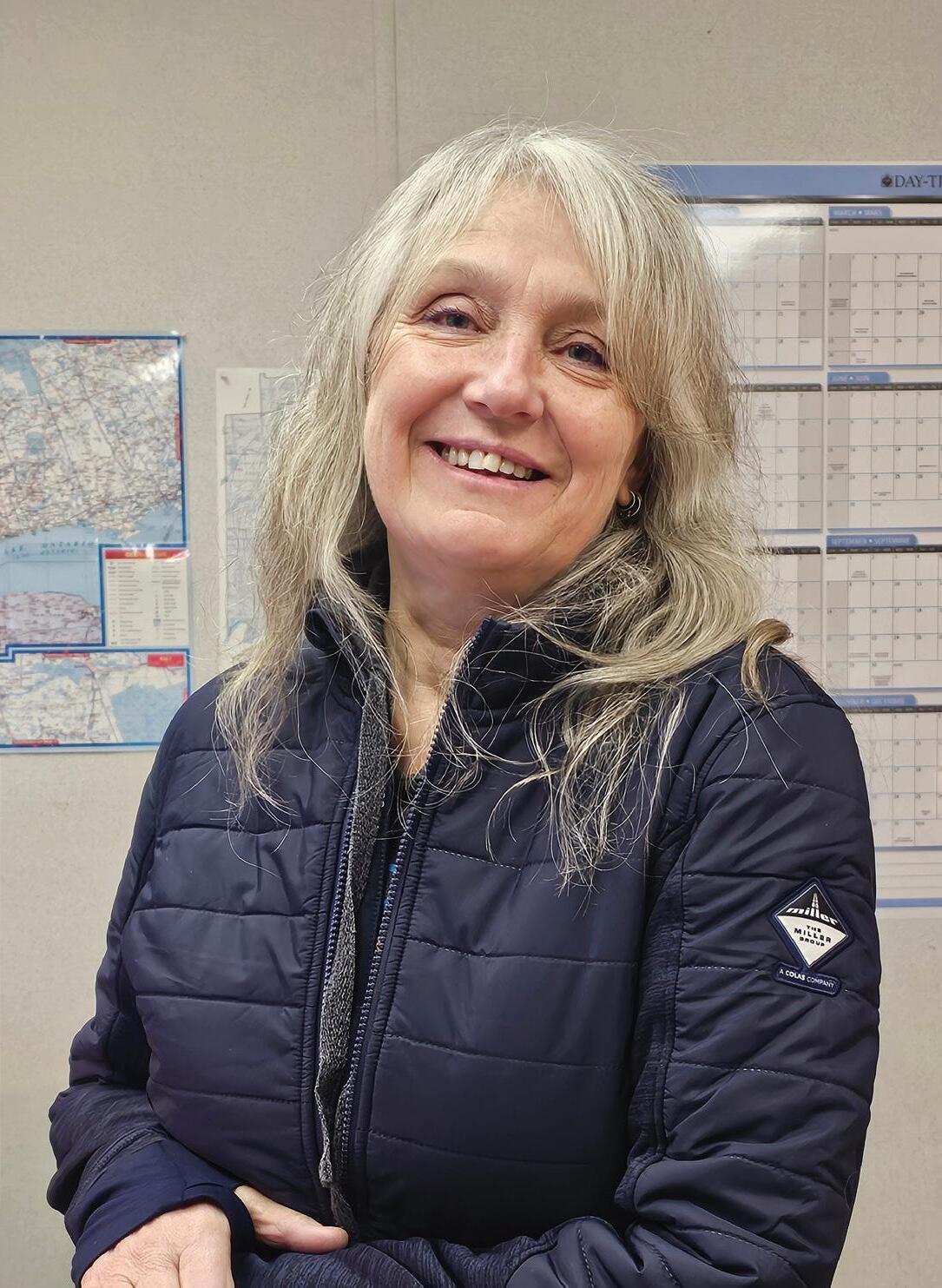
OSSGA: What drew you to the aggregate industry? What makes you want to stay?
Cindy: I was born into the industry. My dad and two of his brothers owned and operated a small construction company, McCarthy Bros., and a quarry that is now the James Dick quarry in Gamebridge. They also did their own drilling and blasting and contracted that service to other quarries in the area when the equipment and operator weren’t needed on our site. They were ahead of what is now an industry standard in terms of vertical integration.
My dad was the company mechanic, among other things, so while he was needed on job sites or in the quarry during the day, he was in the shop late into the night fixing equipment. It made sense for our family to live on the quarry site. That’s where I became interested in the industry and learned my work ethic. I started operating the truck scale when it was required, which wasn’t often back then, when I was about nine years old. I was never not involved in the aggregate industry.
Growing up, I didn’t think I would stay in the industry. I studied journalism at Ryerson and worked for a few years at community newspapers in Toronto until I wanted to settle down and raise a family. Then I felt called to move back home and return to the aggregate industry. It’s good work, good people and a good living.
A lifetime in and around this industry has taught me that many of the people drawn to it tend to be good, hardworking folks who just want to get the work done and make each other’s days better where they can.
I imagine the same thing most managers find challenging — getting the right people into the right roles and ensuring they are engaged while maintaining cohesion within the team. There’s an important balance between keeping people challenged yet not overworked. Get all these things right and you have a powerful and productive team.
How has your role evolved over the course of your career in aggregates?
I started in the scale house (not the McCarthy Bros. scale house when I was nine) working for Standard Aggregates, a company that’s no longer around — it was absorbed by one of the big global corporations. It was a way to make a living at something I knew while raising my children. It’s hard to imagine that that was four decades ago. I continually took on new projects and challenges over the course of my career. Sometimes that meant starting a new role or a new role at a new company, including a short stint at OSSGA a long time ago, working with Eva Da Silva. But it seems all that experience has led me to a job that feels made to order for me. I truly enjoy the work and the people I work with.
What advice would you give to someone considering a career in the aggregate industry?
As I said before, this is a great industry — good work, good people and a good living. My advice to someone considering a career in the aggregate industry would be: Do it.
What do you think is special about a career in the aggregate industry?
It’s great to work in an industry with so many options for roles. There is a wide variety of work needed to make an aggregate operation or company run. There are also opportunities for where the work can be done, particularly with larger companies — rural, urban, in various cities or provinces or even in other countries. Working for a company like The Miller Group/Colas Canada, the opportunities are endless.
A lifetime in and around this industry has taught me that many of the people drawn to it tend to be good, hardworking folks who just want to get the work done and make each other’s days better where they can.
What is your current role and what do you find most rewarding about it?
I am the transportation and compliance manager for Miller’s Southern Ontario Aggregate Group. I have a wide range of responsibilities, from trucking and quality control/quality assurance to regulatory inspections and environmental issues. I also work with several different teams within Miller. I enjoy that each day I may be working on a different issue with different people. It’s interesting and keeps my days moving at a fast pace.
I’m happy to be working for a company like Miller. Miller has brought together a fantastic team of talented people, and it hasn’t happened by accident. The company is always looking for good people and works hard to develop them and keep them happy. Moreover, Miller aims to do the right things for the right reasons, which makes me proud to work for them.
What would you change about your career path if you could start over?
The only thing I would change is I would find my way to Miller and this job sooner.

OSSGA: How did you get into the aggregate industry?
We spoke to Matt McDonald, occupational health and safety manager at James Dick Construction,
about what drives his passion for safety and how he got into health and safety in the
aggregate industry.

Matt: I worked for Jim and Anne Dick in 1992 and 1993 as a university student. At the time, the Brechin quarry was looking for a labourer to work on the primary crusher. Since I was a farm kid and they knew me, I was asked if I wanted to try the job. Having my own grass‑cutting and landscaping business at the time, it seemed like a good idea.
My job involved greasing the plant, maintenance, operating the skid steer, a lot of shovelling and occasionally running a loader. It was fun and I worked with great people. At the end of each season, I returned to school but looked back on my time at the quarry with fond memories and many laughs.
After graduation, I worked at a Greater Toronto Area hospital for about three years as a mental health therapist. I even did some graduate work in personality typing. The funny thing is, every day on my way to work I drove by the quarry wishing I was there instead of working in the field I specialized in at university. It’s the people in our industry that make it so great. They are salt‑of‑the‑earth and good to the core.
Eventually, I listened to my inner voice and in 1996 traded a job in a clinical setting for my roots as a quarry worker. From there, my job evolved from plant labourer to almost every other aspect of the business, including mechanical assistant in the winter, shipping loader operator, the utility person that went everywhere and did everything, quality control and even some drilling and blasting.
The Surface Miner Program really took off for us around 2002, and I was asked to be James Dick Construction’s internal trainer. As the company grew, I became a health and safety specialist in 2006 and then the occupational health and safety manager in 2008.
The most challenging part is helping people understand the risks and safeguards associated with hazards. Often, a hazard is not seen as the danger it is, and underestimating risk and the need for an appropriate safeguard can lead to serious injuries or worse. Nobody wants that, but insight is a funny thing — sometimes you don’t know what you don’t know, even if you think you did.
What advice would you give to someone considering a career in the aggregate industry? Anything you’d change about your own career?
When it comes to safety, my best advice for someone considering a career in the aggregate industry, and for anyone in the industry, is to keep in mind Sesame Street’s simple rule: “Think of what is going to happen next.” If you’re unsure of something, ask. If it feels unsafe, it most likely is unsafe. Follow your gut. There is a safeguard for every hazard; it’s just a matter of thinking it through and looking before you leap.
Having said that, there is nothing I would change about my career path. All the different jobs I’ve done have helped me understand how to help people keep themselves safe and healthy in this industry.
The Surface Miner Program really took off for us around 2002, and I was asked to be James Dick Construction’s internal trainer. As the company grew, I became a health and safety specialist in 2006 and then the occupational health and safety manager in 2008.
What’s made you want to stay in the industry over the years?
I enjoy helping each person go home safe and healthy at the end of each day and having fun at the same time with great people.
I’ve also been able to help others outside James Dick Construction. I have the privilege of being the surface mining and aggregate representative at the Mining Legislative Review Committee (MLRC) and have served on both the MLRC’s Conveyor Guarding Subcommittee and now the Guarding Subcommittee. In addition, I co‑chair the Infrastructure Health and Safety Association’s technical advisory committee for aggregates.
I feel it’s important to get valuable information to those who need it so they can manage workplace hazards. Collaboration with other members at the provincial or industry level is rejuvenating and rewarding.
My career in the aggregate industry has been fun and rewarding so far. Each day is a new adventure, and I look forward to seeing where it goes in the future.
My best advice...for anyone in the industry, is to keep in mind Sesame Street’s simple rule: “Think of what is going to happen next.”
If you’re unsure of something, ask. If it feels unsafe, it most likely is unsafe. Follow your gut. There is a safeguard for every hazard; it’s just a matter of thinking it through and looking before you leap.
Ferma Aggregates Inc. ....................... 24, 28
Hutcheson Sand & Mixes, a Member of the Muskoka Rock Family of Companies www.hutchesonsand.com 29



& ROAD BUILDING
HMA Equipment Company of Canada www.hmaequip.com 28
Skelton, Brumwell & Associates Inc. www.skeltonbrumwell.ca


Skelton, Brumwell & Associates Inc. www.skeltonbrumwell.ca





Powerscreen of Canada Ltd. www.powerscreencanada.com 5
& RENTALS
Powerscreen of Canada Ltd. www.powerscreencanada.com 5 SITE PLAN
Skelton, Brumwell & Associates Inc. www.skeltonbrumwell.ca 29 STACKERS
Powerscreen of Canada Ltd. www.powerscreencanada.com 5
BOX-DESIGN & FABRICATION STACKERS Assinck www.assinck.com 2 SCREENING MEDIA & ACCESSORIES
Haver & Boecker Niagara https://haverniagara.com/ 29 TRAFFIC ENGINEERING & ANALYSIS
Skelton, Brumwell & Associates Inc. www.skeltonbrumwell.ca ....................... 29 VIBRATION ANALYSIS
Haver & Boecker Niagara https://haverniagara.com/ 29
VIBRATING SCREENS
Haver & Boecker Niagara https://haverniagara.com/ 29
Powerscreen of Canada Ltd. www.powerscreencanada.com 5



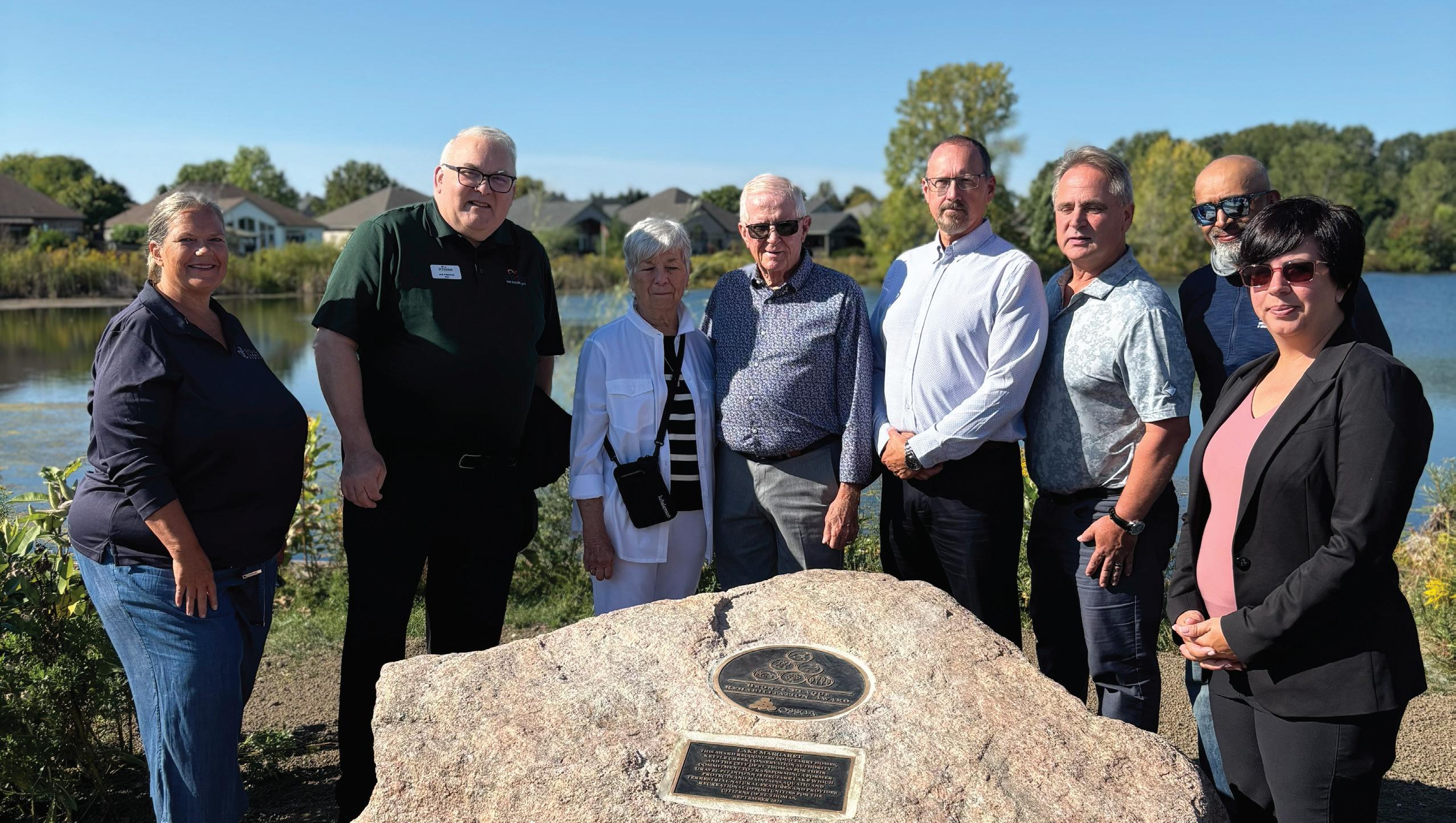
In the heart of St. Thomas, Lake Margaret is a striking example of how former aggregate sites can be transformed into vibrant, sustainable community spaces. Once an active gravel pit supplying construction materials to the growing region, the site has evolved from an industrial operation into one of the city’s most valued natural amenities.
Operating as a gravel pit from the 1940s to 1990s, Lake Margaret is a rare example of a rehabilitation project undertaken by the local community, municipality and industry working together.
Rehabilitation efforts focused on enhancing natural features, restoring shorelines and creating a healthy aquatic ecosystem. Native grasses, trees and shrubs were planted to stabilize soils and support biodiversity. Walking paths, lookouts and community access points were added for public use, balancing recreation with environmental preservation. Over time, Lake Margaret became home to a wide variety of wildlife, including waterfowl, amphibians, fish species and pollinators, transforming the area into a thriving ecological corridor within the city.
A new community anchored by the lake was built by Doug Tarry Homes, contributing to the growth of St. Thomas while leveraging this new community space. Careful planning ensured residential growth respected the natural landscape, preserving the lake as its centrepiece. What was once an active extraction zone is now a peaceful community landmark enjoyed by walkers, cyclists, birdwatchers and families year‑round.
Today, Lake Margaret stands as a model for how rehabilitated aggregate sites can enhance urban environments and improve quality of life. Its combination of ecological restoration, community-centred design and long-term stewardship reflects best practices in modern rehabilitation within Ontario’s aggregate industry.
In recognition of this achievement, Lake Margaret was the recipient of OSSGA’s Bronze Plaque Award in September 2025, honouring its transformation from an industrial site into a flourishing natural and community asset. The award celebrates not only the environmental success of the project but also the collaboration and vision that shaped one of St. Thomas’s most beloved places.