JAREH DAS: FOREWORD
YINKA ILORI, JANE ATFIELD & JAREH DAS
YINKA ILORI & MARTINO GAMPER
CHAIRS
Two Become One
Pa rables
It Started with a Parable Th is Is Where It Started Because the Truth Is Bitter If Chairs Could Talk Home Affairs
Do Good Because of Tomorrow
A Sw imming Pool of Dreams
Ty pes of Happiness
Ind ividual Chair Experiments
There Is Good in All of Us
Iya Ni Wura
INDEX OF WORKS
JULIANKNXX: CHAIRMAN (No Dey Carry Last)
BIOGRAPHY
JAREH DAS FOREWORD
Take a seat. In these collections, as in life, no chair is ever just a chair. It holds who we are and who we are becoming. Chairs have always existed as silent witnesses to our everyday rituals, arguments, dreams, and celebrations. They prop us up, gather us together, or remind us of absence when empty. For Yinka Ilori, chairs are not just functional objects but also vessels of memory, symbols of cultural inheritance, and canvases for wider storytelling. His design practice is rooted in his Nigerian-British heritage, insisting that design can carry joy, honour ancestry, and reimagine how we sit together in the present.
Growing up in a Nigerian household in London, Ilori recalls the everyday chairs that defined the rhythm of domestic life and community life: the ubiquitous plastic chair pulled out for family gatherings, the high-backed seat reserved for elders, or the padded church pew that bore the weight of prayer and song every Sunday. These objects seemed ordinary at the time, yet they were always charged with meaning. They revealed hierarchy, intimacy, and aspiration in equal measure. A child might perch on the edge of a stool to listen in on adult conversations, while a father or pastor’s seat marked authority. In Nigeria, across its diaspora and beyond, chairs are never neutral. They carry power, memory, and imagination.
This is where t he layered resonance of the Chairman becomes vital. In Nigerian Pidgin, “Chairman” is a term of respect, sometimes sincere, sometimes teasing. It can signal authority, leadership, or simply swagger. The “Chairman” is the big man, the oga, the odogwu. It commands respect, but it can also be your friend acting important, your cousin showing off a new car, or the area elder who convenes a meeting. In everyday parlance, it is both playful and profound, a reminder of how language transforms simple words into markers of belonging. To call someone “Chairman”, as Julianknxx reminds us in this book’s epilogue,(p 117) is to grant them a symbolic seat of power, even if only just for the moment.
Ilori has built a career for over a decade around amplifying this tension between the everyday and the exalted. His chairs straddle the line between utility and spectacle, improvisation and monument. They draw on Yoruba parables, West African textiles, and the improvisational genius of Lagos street life, while also speaking directly to the multicultural fabric of London. His is a practice of joyful hybridity, rooted in the lessons of both inheritance and adaptation.
The instinct to reuse and reimagine is also central. Nigerian households, like many across the Global South, have long practised the art of making do, mending broken legs, repurposing discarded furniture, or combining parts to extend an object’s life. For Ilori, upcycling is not just sustainability rhetoric; it is heritage, a lived experience of transformation. His early works emerged from scavenging discarded chairs from the streets of London and recombining them into new, multicoloured forms. This was not only about saving waste, but also about retelling stories, finding beauty in the broken, and imagining new futures from overlooked pasts.
Here, Martino Gamper’s project 100 Chairs in 100 Days is a key catalyst. By reshaping discarded chairs into inventive hybrids, Gamper exposed the narrative possibilities of everyday furniture. For Ilori, this opened a door to thinking critically about design as a form of storytelling. He took this principle and infused it with Nigerian parables, African textiles, colour sensibilities, and diasporic humour. The result was an aesthetic that was not merely functional but also narrative, with each chair serving as a character, a proverb, or a chapter in a larger story of cultural resilience.
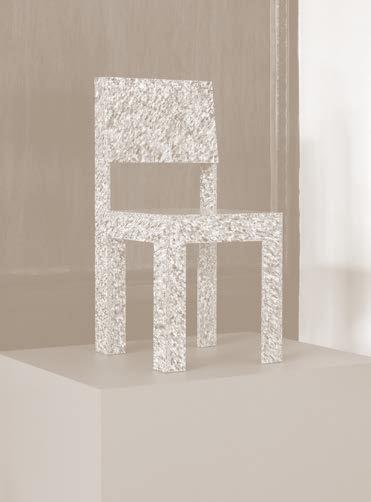
Mentorship and influence are also woven through Ilori’s journey. At university, Jane Atfield’s Our Chair project challenged students to reimagine a standard RCP2 chair (Img. 1) with recycled plastics, asking them to confront questions of sustainability and identity. Atfield’s insistence that material choices are both ethical and aesthetic planted seeds that continue to grow in Ilori’s practice. To upcycle is to acknowledge both scarcity and creativity; it is to insist that design has social, political, and ecological stakes. Ilori has carried this conviction into every project, from his first reassembled chairs to public commissions that reshape entire streetscapes with colour.
Colour itself is Ilori’s most exuberant language. His palette is not merely decorative but communicative, drawing from textiles, the bustle of Lagos markets, and the visual vibrancy of multicultural inner-city London. He uses colour to craft spaces of joy, to resist drab conformity, and to assert presence. In his hands, colour is emotion, rhythm, and resistance. It becomes a way of affirming that design can be a source of collective happiness as much as it is a tool for critical reflection.
Chairs also stage power. The Nigerian photographer George Osodi captured this vividly in his portraits of Nigerian monarchs, Nigerian Monarchs (2006 — 2017), which challenge colonial-era photographs by instead capturing regional rulers in his home country, where thrones become extensions of sovereignty, embodying both theatricality and authority. To sit on such a throne is to be seen, revered, perhaps even feared. Ilori’s work engages with this history while reimagining it. He celebrates the dignity of both throne and stool, acknowledging that every seat can carry majesty. By elevating discarded furniture into sculptural statements, he collapses hierarchies: the humble plastic or wooden chair, when reimagined, can be as regal as any gilded throne.(Img. 2)
At the same time, Ilori’s chairs remind us of the importance of community. To gather around chairs is to gather around stories. The scratches, stitches, and welds of a chair become archives of touch and time. In this sense, his practice is not just about furniture, but about relationships—between people, between cultures, and between past and present. He designs not just for the solitary sitter but for collective memory. His chairs are invitations: sit, converse, imagine, belong. This is perhaps why Ilori’s work resonates so strongly in both gallery and street contexts. In museums, his chairs disrupt conven-
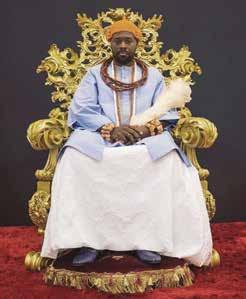
Img. 2: HM Ogiame Atuwatse III, The Olu of Warri Kingdom, 2022. Photo: George Osodi. Courtesy of the artist and TAFETA.
Img. 1: “RCP2” Chair by Jane Atfield, 1992. Photo: Sean Davidson.
tional design narratives by foregrounding diasporic joy and play. In public spaces, they animate everyday life, transforming crossings, staircases, and playgrounds into theatres of colour and connection. His designs reflect a philosophy that rejects the separation between art and life. For Ilori, the chair is not only an object to be looked at but also a proposition about how we might live together.
The question t hen becomes: What stories do our chairs tell? Who gets to sit, and how? What happens when we elevate the overlooked and dignify the ordinary? Ilori’s work urges us to consider these questions. He demonstrates that design is never neutral, that even the most familiar objects carry histories of power, exclusion, aspiration, and joy. By reframing chairs as storytellers, he expands the possibilities of what design can mean and who it can serve.
As you turn these pages, take a seat. Consider the thrones, stools, and hybrids assembled here, reimagined by Yinka Ilori’s chairs. Remember the childhood chairs that shaped your own sense of self, the gatherings they witnessed, the authority or intimacy they signalled. Reflect on how a chair might carry a proverb, a song, or a joke. And allow Ilori’s practice to remind you that design is not only about objects but about the lives we live in their presence.
A chair is never just a chair. It is a memory, a story, a community, a throne. In Ilori’s hands, it is also a vision of joy, resilience, and possibility.
Welcome to the world of the Chairman.
YINKA ILORI & JANE ATFIELD
CONVERSATION
Interview conducted and edited by Jareh Das
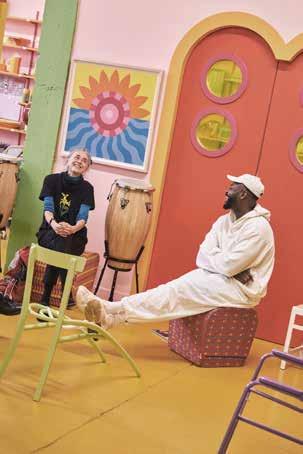
Img. 3: Jane Atfield and Yinka Ilori, 2025.
Photo: Kane Hulse.
Q: Can you each recall your first impressions of one another? What stood out, either in Yinka’s early approach or Jane’s teaching style?
Jane Atfield: I remember Yinka’s big smile! He was a lovely student — enthusiastic and shining with positivity, curiosity, and energy. He brought a real spark to the studio, always open to new ideas and eager to experiment.
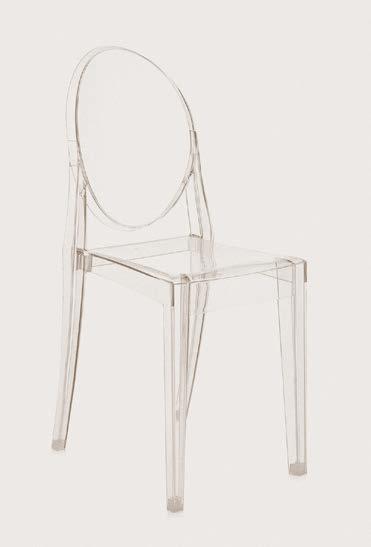
Yinka Ilori: I had two tutors, Jez Bradley and Jane Atfield. Jez was a real design geek. I remember he was really proud of the “Victoria Ghost Chair” (Img. 4) by Philippe Starck in the studio. Jane, on the other hand, taught me once or twice a week. She always had a calm, warm demeanour about her, but was also somewhat elusive, not talking much. However, whenever you engaged with her, it was always positive and calming. She took her time to explain things and helped you find meaning in design. I didn’t see her much, but every interaction was positive.
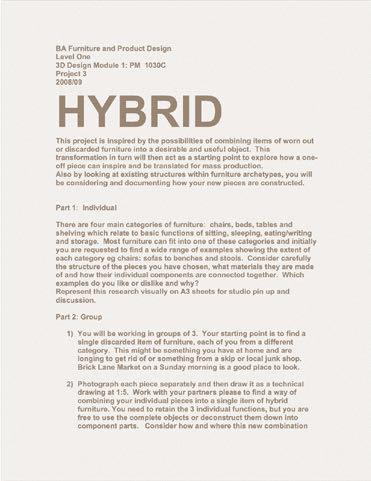
Q: The “Our Chair” project was inspired by Martino Gamper’s “100 Chairs in 100 Days”. Within the “Our Chair” brief,(Img. 5) why did you choose this reference, Jane and Yinka? What did it spark in you at the time?
J. A.: I wrote the “Our Chair” project in 2003 for the firstyear student module, but Martino did not inspire it! He was motivated by the project’s approach and went on to design his own hybrid chairs, which later led to the book “100 Chairs in 100 Days”. The project was intended to encourage furniture that reflected wider environmental and social issues, including waste, reuse, and consumerism, and how discarded objects could be transformed into something meaningful and symbolic of the times. Looking back, the project was a reaction to the hyper-styled, sleek furniture celebrated in the 1980 s. Also, by deconstructing the old chairs, the students would learn how chairs were put together and their component parts.
Y. I.: When I got the brief for “Our Chair”, I thought, “This is about something that belongs to us, a collective, not just one person.” It made me think more deeply about chairs as objects for the community, not just individuals. At home, my parents had their own special chairs. My dad had his chair; my mum had hers. It was personal, almost like a procession. The brief also mentioned Martino Gamper’s “100 Chairs in 100 Days”, which we researched as inspiration. My collaborator was Ronald, a friend from Guyana who was great at making furniture. We planned to set up a studio together after university, but our ideas diverged. We’re still good friends, though.
Q: Yinka, how did the act of dismantling and reassembling old chairs challenge your understanding of function and identity in design?
Y. I.: For me, I started experimenting with chairs early on, looking at how they’re used in different cultural spaces. In a Nigerian home, people often put their legs up on chairs to
Img. 4: “Victoria Ghost Chair” by Philippe Starck, manufactured by Kartell. Courtesy Kartell.
Img. 5: “Our Chair” Brief (later titled “Hybrid”) by Jane Atfield, 2006. Courtesy Jane Atfield.
CHAIRS 2006–2023
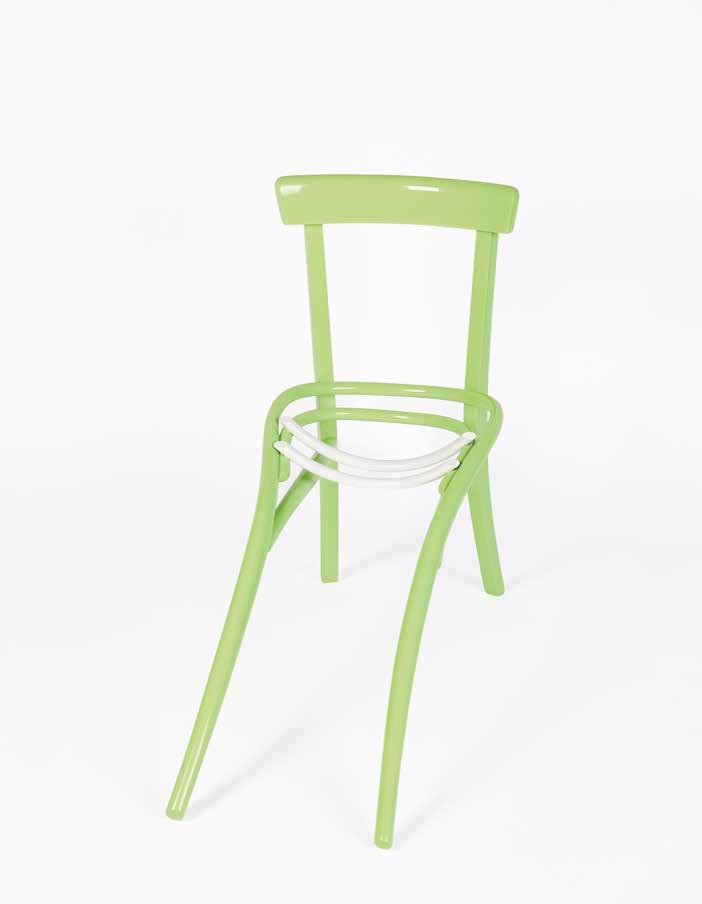
Two Become One is Yinka Ilori’s first chair. It was made from two chairs and represents two lives merging. One chair came from a café, the other from a friend of Ilori. As their stories come together, they shape a new language and identity. The chair was conceived during Ilori’s studies at London Metropolitan University and marked the genesis of his creative practice. This was where storytelling began for him: a moment of exploring narrative freely and instinctively, guided only by how he felt about the chair itself. This curiosity opened his eyes to the hidden stories embedded in everyday objects. The green references hope and also nods to the green and white colour combination of the Nigerian flag.
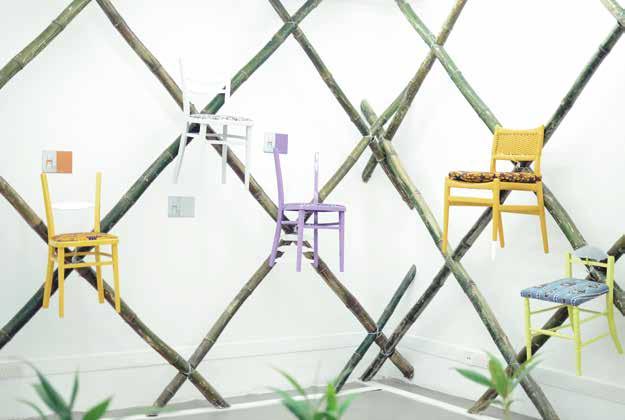
Img. 14: “This Is Where It Started“ Exhibition, A Whitespace Creative Agency, Lagos, 2014. Courtesy A Whitespace Creative Agency.
COLLECTION: THIS IS WHERE IT STARTED
This Is Where It Started was exhibited at A Whitespace Creative Agency in Lagos in 2014, marking Yinka’s first exhibition in West Africa and a homecoming presentation of his desig n practices, sponsored by Arts Council England and the British Council. The collection explores the journey of growth. It features chairs with varying backrest heights, reflecting differences in personal strength both within individuals and between people, acknowledging that some may not yet be at full strength. Through this, Ilori highlights strength as an evolving, developing quality over time.
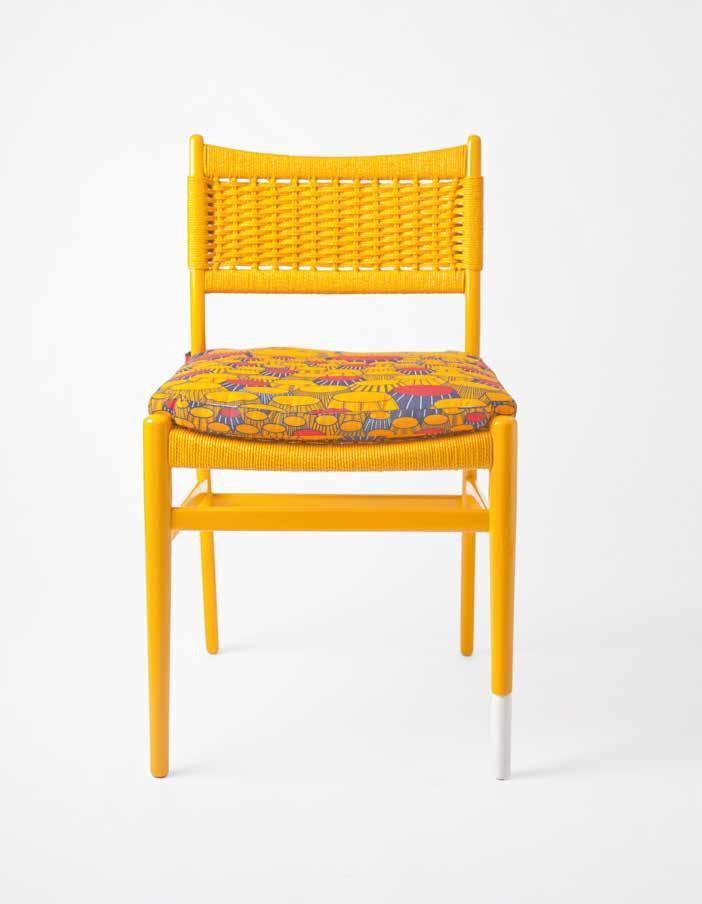
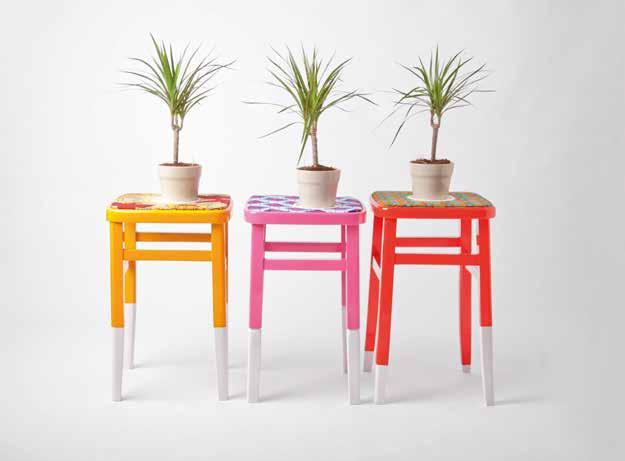
Baba Ibeta I–III are adorned in African wax print (Ankara), featuring a white cut-out representing the yam’s sweet interior. Drawing from the parable, “No matter how hot your anger is, it cannot cook yams,” the work explores patience and transformation, with plants symbolising growth.
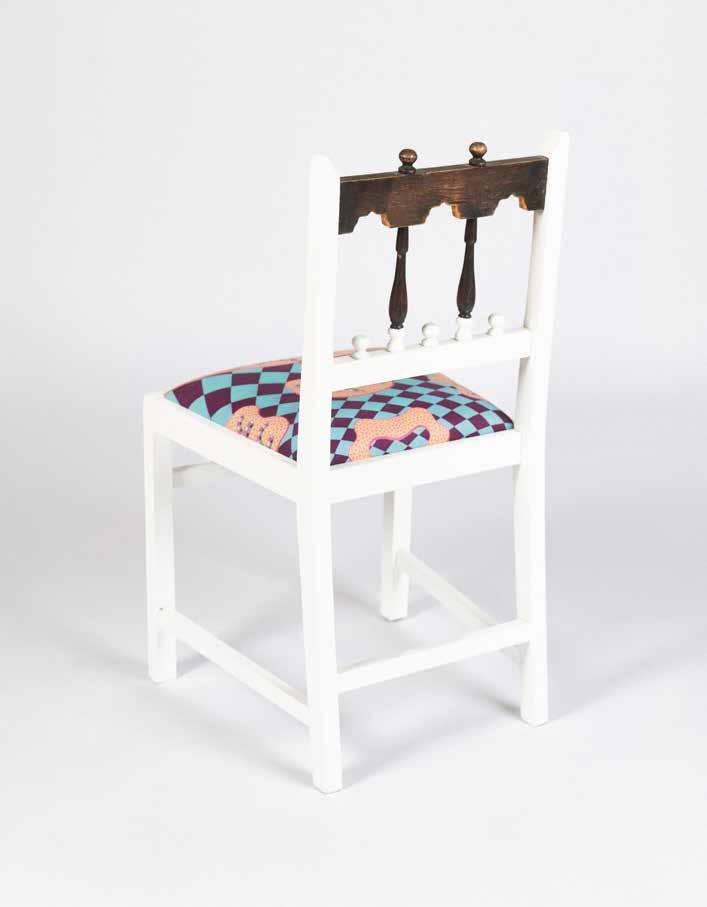
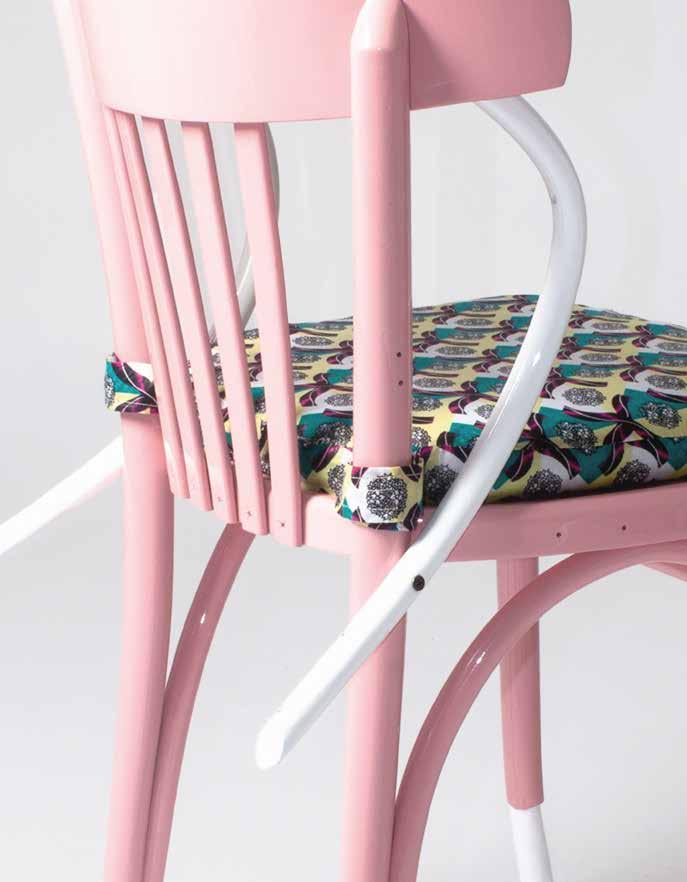

Img. 17: Yinka Ilori as a child, in his childhood home in North London. Courtesy Yinka Ilori.
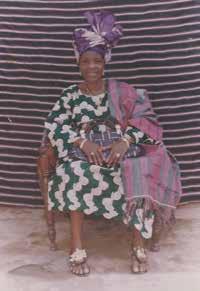
Img. 18: Yinka Ilori’s grandmother, photographed in Ondo State, Nigeria. Courtesy Yinka Ilori.
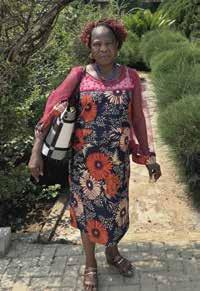
Img. 19: Yinka Ilori’s beloved mother, Jhalobia Recreation Park and Gardens, Lagos, Nigeria, January 2024. Courtesy Yinka Ilori.
Before thrones learned to carry men, before wood bent into obedience, before crowns and titles, the ground was the first throne. Stones already knew whose weight belonged to them. Some men chase height, calling themselves important. But when Chairman enters, his presence sits before his body. The room rearranges itself. Stools shift. Benches shuffle. Even fallen trees adjust. People go whisper: Who be dat?
And another go answer: Na Chairman— wey no dey carry last. Even if he sits on stone, na that stone go feel proud.
Yinka Ilori is a British-Nigerian multi disciplinary artist and designer whose vibrant work fuses his Nigerian heritage with a joyful, community-driven design ethos. He studied Furniture and Product Design at London Metropolitan University (2006–2009) and began his practice around 2011, initially upcycling vintage furniture in London.
Growing up in Islington, North London, to Nigerian immigrant parents, Ilori was profoundly influenced by bright African textiles, the Owambe party aesthetic, Sunday dress, and the storytelling culture of his heritage. These early experiences shaped his belief that design should be accessible, inclusive, and joyful. His practice employs bold colour palettes and patterns to celebrate identity, memory, and community.
Through studio work and public commissions, Ilori transforms furniture, architectural spaces, and urban environments into interactive, vibrant experiences. Notable projects include large-scale chairs from “ Types of Happiness” for London’s The Line art walk and a solo exhibition at the Design Museum. His work often draws on Nigerian parables and oral traditions, presenting design as a storytelling medium that engages diverse audiences. Recognised for his contribution to design, Ilori was awarded an MBE (Member of the Order of the British Empire) for services to design and diversity.
Based in West London, Ilori continues to produce work that brightens everyday environments, fosters connections, and elevates underrepresented perspectives in design.
CHAIRS IN PUBLIC COLLECTIONS
Brighton and Hove Museum
If Chairs Could Talk–A Trapped Star p 52
Victoria and Albert Museum If Chairs Could Talk– Captain Hook p 53
The Metropolitan Museum of Art A Swimming Pool of Dreams–Iya Ati Moto p 64
Museum of London
What God Has Joined Together, Let No Man p 67 Put Asunder
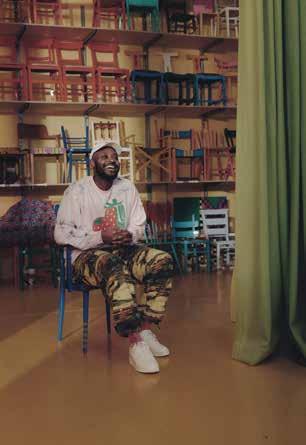
My love of chairs started from an early age. Anything I was sitting on, a car seat, a chair, a tricycle seat, I was obsessed with. There was something about being held by a seat that captured me.
I’ve always loved the family and communal act of sitting together, the way a chair can hold a conversation without saying a single word. That feeling has followed me from childhood into adulthood.
I’ve found beauty and hidden stories inside objects. Chairs became the objects I trusted with my stories; stories about family, and about the people I love. Over the years, they have become sources of joy, comfort, and meaning for me.
Chairs have shown up in so many celebratory moments: the sea of chairs in church, symbolic and spiritual, where people prayed, knelt, touched, and hoped; and at home, in my parents’ house parties in our small London flat, where monoblock chairs became beacons of joy, holding people as they ate, laughed, cried, cuddled, and sang.
And then there are the quieter memories. My parents sitting on chairs in the immigration office, waiting to learn their fate as they hoped to be granted an indefinite stay in the United Kingdom. That image has stayed with me to this day.
For me, chairs are symbols of hope, joy, confusion, and anxiety, each one tied to a specific memory. They are an integral part of my life, my family’s life, and the lives of the people I love.
In this book, it was important for me to explore the power of chairs, whether through hierarchy, status, or deeply personal moments. Chairs may be seen as objects of power, but they also hold our emotions. We cry on chairs. We argue on chairs. We love on chairs. Chairs are witnesses to our lives. We shouldn’t take them for granted.
I hope that as you read this book and dive into its stories, you discover something magical that resonates with you; something you can carry with you and share with others.
Img. 13: Yinka Ilori in his studio, North Acton, London, 2025. Photo: Lewis Khan.