
LOOK INSIDE: Building a Museum, This is Not a Manual

Page 1


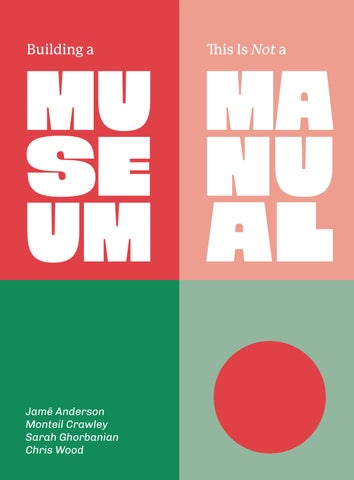
Building a Museum: This Is Not a Manual

© 2025 SmithGroup ORO Editions

Publisher: Gordon Goff New York, New York www.oroeditions.com All rights reserved.

No part of this publication may be reproduced in any form by any electronic or mechanical means (including photocopying, recording, or any other information storage and retrieval system) without prior written permission from the publisher.

You must not circulate this book in any other binding or cover, and you must impose the same condition on any acquirer.

Editors: William Richards Chr ista Montgomery

Design: Pa scale Vonier

First Edition

ISBN: 978-1-966515-56-2

Distributed by ORO Editions

Printed in China

INTRODUCTION

Charging Into New Territory

CHAPTER ONE

How Do I Build the Right Project Team?

CHAPTER TWO

What Does It Mean to Engage?

CHAPTER THREE

What Does It Mean to Plan a Museum?

CHAPTER FOUR

What Does It Mean to Design a Museum?

CHAPTER FIVE

How Do I Align Budget with Purpose?

CHAPTER SIX

How Do We Build the Story of Our Museum?

PREFACE

While architects are planners and designers of buildings, we are more importantly collaborators with our clients in achieving the mission of their institution. We strive to build a level of understanding and empathy with experts and users in wildly varied settings to create spaces that facilitate research, foster learning, gather communities, and heal the environment. With museums, we help those cultural institutions share beauty and create places for thoughtful human interaction.

We are devoted to helping museums across the world at a time when we need their presence more than ever. We commit to this work because of the extraordinary impact museums have on how we think about ourselves, our shared histories, and our greatest ambitions. A museum is never only a building; it is a vessel of memory, exploration, imagination, and possibility. It is a space where communities gather, where knowledge is preserved and reinterpreted, and where new generations are inspired to see the world—and themselves—differently.

As architects, engineers, and planners, our role is both pragmatic and poetic. We must create environments that protect priceless collections, while also designing places that stir wonder the moment someone crosses the threshold. Each museum project is an invitation to ask: how can space itself spark curiosity, encourage dialogue, and nurture belonging? Design, when done with vision and care, elevates the human spirit. It allows light, proportion, and form to shape experiences that move us beyond the ordinary—reminding us that beauty and meaning are not luxuries, but essentials.

This book, Building a Museum, is about more than structures of stone, glass, or steel. It is about designing places for human connection. It is about shaping cultural beacons that stand as testaments to humanity’s creativity and resilience. Ultimately, it is about building hope—brick by brick, vision by vision.

FOREWORD

When The Franklin Institute embarked on our planning process, we weren’t just developing a roadmap for new buildings or exhibitions. We were shaping the future of how people experience this place. Our mission was to create environments that ignite curiosity, foster connection, and reflect the boundless spirit of exploration that has defined The Franklin Institute for generations. What I came to understand through every step of that journey is this: no matter how visionary the plan, its success depends entirely on the people you bring to the table at the very beginning.

Over my career, I’ve learned that the professional team you assemble is the most important design decision you will make. Before a single sketch is drawn or a single budget line is written, you need the right partners—people who understand your institution’s heart and are willing to challenge its habits. A strong team doesn’t just execute a plan; they help discover it. They ask the hard questions, balance aspiration with practicality, and make sure the big idea never loses its human center.

For our planning process, we built a team that represented both continuity and innovation, internal stakeholders who carried the institutional memory and external collaborators who brought new ways of seeing. Architects, planners, designers, landscape designers, and engineers all came together not as consultants but as co-authors of a shared story. From the first workshops, it was clear that the chemistry and mutual respect of this group would define the plan’s success as much as any design concept.

This approach transformed the process into something deeply collaborative. Every discipline had a voice, and every conversation started with the visitor in mind.

We talked as much about how people feel in a space as how they move through it. We looked at architecture, interpretation, technology, and operations as interconnected systems of experience. We asked: How can the museum itself embody curiosity? How can we design places that invite reflection, joy, and discovery—not just in galleries, but in every corner of the building?

Placemaking, at its core, is about aligning vision and people. You can’t create an inspiring place without an inspired team. The final plan became more than a design document—it became a reflection of collective intelligence and shared passion. The way the building flows, the way visitors gather, the way light and sound and story intertwine—these all stem from the strength of the relationships built at the project’s beginning.

For any institution setting out on a similar path, my advice is simple: spend as much time designing your team as you do designing your space. Choose partners not only for their portfolios, but for their curiosity, empathy, and collaborative spirit. This book will help illuminate this process and how to define your shared goals, establish open communication, and build trust as intentionally as you build walls. The right team will help you see your institution not just as it is, but as it could be.

In the end, a planning process is never just about design, it’s about people designing together. When the right minds unite around a common purpose, they create more than spaces. They create experiences that endure, inspire, and belong to everyone who walks through them.

Concept for Richmond National Slavery Museum at Lumpkin’s Slave Jail Site

Charging Into New Territory

We get it. The project in front of you seems huge and maybe even a little intimidating.

That’s understandable. If you’re creating a new museum from scratch everything will be new. But even existing institutions are lucky to undertake a large capital project once in a generation. Apart from a handful of large cultural entities, museums aren’t like universities or hospital systems with robust design and construction departments. More than likely, your senior leadership and limited staff are laser focused on dayto-day operations—caring for your existing building, your collection, and your visitors.

Here’s the good news: hundreds of museums have taken on the challenge of building new or reshaping themselves through a major renovation before you. They’ve made mistakes in planning, stumbled and recovered, explored dead-end paths and unexpected U-turns, and discovered new and exciting destinations. Few would take the same route if they had the chance to do it again, but the lessons of their journeys are invaluable.

We’ve seen the good, solved for the unexpected, and in turn, the lessons have shaped our process. As multidisciplinary design professionals focused exclusively on cultural projects, we’ve had the unique opportunity to guide institutions around common obstacles across hundreds of these project journeys. In a way, it would almost be irresponsible if we didn’t take the time to share what we’ve come to trust as best practices. So don’t worry.

We know it’s a lot.

We know it all feels new.

We’ve got you.

Museums Are Different

Let’s get this out of the way right up front: museums are weird. They are the only building typology that must balance the needs of visitors, staff, and irreplaceable assets. To complicate things, it just so happens that these requirements are occasionally at odds with one another. We’ve all experienced museums that do one or two of these things well—the striking sculptural work of architecture that overshadows the art; the science center hosting colossal traveling exhibitions through an inadequate loading dock; the historic house museum with the fragile works-on-paper collection and an unstable HVAC system. But when the physical structures, systems, and experiential content of a museum nail this balance, the results can be transformative. Ultimately, the very quirks that make museums unique call for an equally distinctive approach to planning, designing, and building them.

As architects who design museums, that’s why we love our jobs. Everything that makes museums different also makes the potential impact of a new project that much more exciting. If you’re reading this book, you’ve probably spent a significant portion of your life making museums work and squeezing every drop of potential out of your building, or perhaps you’ve been part of the process of creating a new museum (or two) during your career. You’ve probably been frustrated at times by how a museum building has fought your best intentions and foiled your plans. Maybe you’ve even quietly cursed the faceless designers and engineers that inadvertently set some of those roadblocks or wondered how on earth one of your predecessors approved a five-footwide art corridor. You’ve thought to yourself, “If I could create something, I’ll make sure it gets done right.” So, this is your big chance. Hopefully, this book will demystify the parts of the planning and design process that haven’t been a part of your day job—until now.

The Story of This Book

We have something in common: we both think about museums every day because it’s our job. Our professions just give us different perspectives on that favorite topic. So, we will naturally have something to learn from one another. That spirit has informed a key principle of our planning and design philosophy: listen first. Complex projects succeed through the intentional, methodical, relentless development of a shared understanding. As architects, we’ll want to develop

a common understanding of project-specific goals and priorities, but we’ll also come to understand the respective skills, strengths, and expertise that each member of our combined team brings to the client–designer table. Let’s be honest about the fact that we all have areas of personal expertise that are works in progress, and even some blind spots. But that’s okay— together, our superpowers will align, and those blind spots will disappear.

That brings us to a confession. A little over a decade ago, the authors of this book were sharing stories and some wine with a few of our frequent collaborators in the world of museum design and construction. The conversation eventually turned to a particular request for proposals for the design of a new museum that had just been released. We were all a little baffled by the document because it laid out scope and submission requirements that were ambiguous in places, hyper-specific in others, and outright contradictory overall. We wondered how or if we would respond, and we lamented the poor institution that would inevitably receive a bundle of proposal responses that would be nearly impossible to evaluate or compare.

In retrospect, we’re not proud of all that complaining—but not every origin story is completely flattering, and we need to live up to our own ideals if we want to claim this book is a place for honesty. Fortunately, once we got the complaint out of our system, one noble anonymous colleague pointed out the obvious: we’re always telling our prospective clients that they should hire us because we build museums for a living. That we stand ready to confidently shepherd them through that process. So how could we criticize a brand-new institution that is actively seeking that guidance? Oof.

This was our call to action. The collective experience gained across dozens of projects and countless collaborations among the architect, exhibit designer, contractor, fundraiser, and cost manager at the table was something we should widely share beyond our individual clients. What good is a start-to-finish process shaped by best practices if we can’t frame it and make it available to museum institutions before they get started? Is it possible to focus our experience into a unified message that could be useful to the broader museum world?

Our team at SmithGroup began monthly planning sessions for what would become a full-day museum planning, design, and construction workshop entitled “Ready, Aim, Build!” that was piloted as a pre-conference session at an American Alliance of Museums conference before becoming part of the day-one program of the Mid-Atlantic Association of Museums’ Building Museums symposium. Over the last ten years, we’ve been privileged to host over 300 museum leaders, board members, administrators, curators, and facilities professionals in our workshop. Our alumni have

applied lessons from the workshop to their own projects, some have become our clients and tested those lessons alongside our team, and some have even returned to teach as co-panelists. But most critically, our museum workshop participants have helped us gradually refine our content. Year after year and listening carefully to feedback, we’ve trimmed, reshaped, and supplemented our workshop materials and delivery methods to make the lessons more intuitive and universal. One message became clear over that decade: “Ready, Aim, Build!” participants wanted to take the workshop home with them. So this book offers something quite different: a carefully distilled manual of best practices that is always there when you need it, in a format that is way more portable than a day-long workshop. It’s a distillation of the lessons we’ve learned and refined over a decade of highly interactive teaching.

We developed foundational concepts that are vital to museum planning—as you’ll read about in Chapter Three especially—with our colleagues at Chora Group, and we would be remiss if we did not acknowledge their influence on our thinking and if we did not thank them for their collegiality and participation over the years.

A Guide to This Guide (Not a Manual)

As much as our museum workshop inspired this book, this guide also takes advantage of what books do best: you can choose what to read first, come back to content when it’s most relevant to your immediate challenges, and share copies with your colleagues so they can focus on the chapters most pertinent to them—or give a copy to that one board member who is convinced they should lead your building committee. We’ve paired plain language and intuitive graphics so the lessons are easier to follow, and where we inevitably drift into using architect jargon or acronyms (sometimes architects can’t help themselves) we’ve provided a handy glossary for definitions of common terms. And since this book is so portable, you can keep that glossary handy when the designers on your project ask if you’re planning, for instance, “to solicit an MBE-certified CMAR through a standard RFQ/RFP process.”

One theme you’ll pick up on as you read this book is the importance of a process—a process in which each step serves a very specific set of purposes, with each building upon the step before it. We’ve done our best to organize our chapters in the order you’re most likely to encounter each step. But there’s a catch. Some of the best practices in this guide will apply to more than one step, so you may think of them as through-lines, or recurring checkpoints. You may also choose to take in some chapters out of the order we’ve suggested. But if you’re new to all of this, we’re confident that reading this guide from cover to cover will prepare you with most of the tools you’ll need to lead your next project.

Are you ready to challenge the status quo and redefine what it means to build a museum? Chapter One will push you to rethink traditional approaches and embrace innovative strategies that could revolutionize your project. This chapter will also discuss the pros and cons of various construction delivery methods, which come later in the process, but represent important choices early on. What if I told you that the success of your museum project hinges not on the building itself, but on the people you choose to bring it to life? This chapter will provoke you to consider the human element as the most critical factor in your project’s success.

Chapter Two examines what it means to engage, emphasizing that stakeholder engagement is more than participation—it’s about creating meaningful connections that inspire trust, curiosity, and collaboration. In the context of museums and cultural projects, engagement means inviting stakeholders into a shared journey where their voices shape the vision and outcomes. It’s not a one-time interaction but an ongoing dialogue that transforms passive audiences into active partners. This chapter explores the principles and practices that turn engagement from a buzzword into a powerful tool for building relationships and sustaining relevance.

Chapter Three explains why planning a museum is far more than designing a building—it’s about shaping an experience that reflects purpose, community, and vision. Effective planning weaves together architecture, storytelling, operations, and sustainability into a cohesive framework that serves both present needs and future aspirations. This chapter explores how thoughtful planning balances creativity with practicality, ensuring that every decision—from site selection to visitor flow—supports the museum’s mission and long-term impact. Here, planning activities and deliverables are defined through the framework of three essential questions. What is it? Who is it for? When should it happen?

Chapter Four discusses how purpose-driven design unfolds from both creative and practical standpoints. After all, it’s not merely about creating a building—it’s about shaping an experience. The design process is an act of translation that takes abstract ideas, cultural missions, and public needs, and renders them into physical space, materials, movement, light, pixels, and pathways. This chapter will leave you poised to work with your design team.

Chapter Five positions budgeting as a catalyst for creativity, not a constraint, challenging the traditional notion that budget limits creativity. It argues that early financial alignment sharpens creativity by forcing teams to prioritize what matters most and innovate within real-world parameters. What if aligning financial strategy with the mission could unlock unprecedented levels of trust and creativity? This chapter explores how cultural institutions can use budgeting not as a brake but as a steering wheel.

We bring it home in Chapter Six by highlighting the critical role of storytelling throughout the life of the project as a tool for shaping public perception and deepening community engagement. This chapter explores how each phase is an opportunity, and every beam and brick can tell a story, turning milestones into moments of connection and visibility.

Museums today face shifting demographics, digital disruption, rising expectations, and volatile funding and construction costs. In response, they’ve evolved from isolated, object-centered institutions into collaborative, visitor-focused engines of soft power. Meeting these challenges requires a planning and design process as distinctive and adaptive as the museums themselves—sometimes even redefining what the museum experience looks like.

The Evolution of Museums

Remember: You Are Not Alone

As a museum professional, you’ve undoubtedly built an impressive network of friends and colleagues across multiple institutions. Remember that time you needed advice on an exhibit case with an integral desiccant tray and your former colleague who’s been at the big art museum for the last ten years referred you to their friend at the history museum because they had just the product you were looking for? That’s the power of the museum professional network. We’re all committed to the same basic mission without the burden of competition or territorialism that exists in other industries. It’s a wonderful thing.

Now that you’re about to embark on a big capital project, it’s a great time to lean on that network. Get out there and attend conferences—especially ones that focus on museum planning—and look to national and regional opportunities for gatherings, too. Seek out accounts of the experiences of others at those gatherings, and don’t neglect online forums run by museum associations. In

our workshop, our participants have the benefit of sitting around the table with staff from peer institutions to share stories, compare notes, and make new connections. So use the chapters of this book to inspire outreach to those same friends and colleagues who may have gone through a project like yours.

As we send you off to explore the exciting chapters of this guide, please remember that you are not alone. Just because you are being tasked with expanding your expertise beyond your own profession, it doesn’t mean you should settle for a learning curve from the planning, design, and construction professionals you hire. When we say we’re here for you, we mean it. We get that books do have one critical shortcoming relative to in-person workshops: you can’t ask questions. But here’s the thing, because we’re writing a niche guide to museum planning, we’re not reclusive, famous authors with agents and handlers. Do you think John Grisham puts his personal email address in the back of his novels? Nope. But we did. (Sort of.)

Reach Out to Us

Email buildingamuseum@smithgroup.com to get in touch with us. When you encounter a topic that doesn’t quite translate to the circumstances of your project, and you’re wondering if or how to adapt that lesson to your challenges, send us an email, and we’d be happy to talk through your questions as a neutral but experienced sounding board. We also recognize that we may not have all the answers, but chances are, we know a friendly collaborator who does. We know that the museum community is well networked—so is the design and construction community. We stand ready to make connections, answer questions, or even just listen if you need to vent. We’re great listeners.

You’ve got this. Let’s get started.

Don’t Call the Architect First

You may be tempted and a little excited to get to that great imagery—to show your donors what your vision is, and to drum up excitement about the project. Perhaps your development team is already asking when the renderings will be ready. We cannot believe we are saying this, but don’t pick up the phone. Do not call your designer, your exhibit designer, or your architect to launch a design process that you may not be ready for. Many of these consultants will be wonderful partners when you are ready. But typically, they lead with design—and you are not there yet.

Instead, hire specialized museum experts that can support your process and your goals. In unique instances this may be an architect, but only a firm that can truly inform early strategic and pre-design efforts, and not one that will only seek to design a new or expanded building as a normal course of action. You need someone who can harness the tool that architects and designers are sometimes well known for—their process (like the one we’re outlining in this book) and their ability to understand what impacts early decisions will have on outcomes.

Be sure to keep the tendency to rush to solutions, placate stakeholders, or press for resolution at bay. You are at the beginning of your project journey and as we will repeat throughout this book, this is a once-in-ageneration-type activity. So there is no need to rush. And don’t call your contractor friend either—not yet. Stay the course, keep things methodical, transparent, and tied to your vision. In fact, your donors, members, staff, colleagues, and external consultants will appreciate a methodical approach that is based on sound planning, metrics, consensus, and of course creative thinking.

You will get to the great imagery—so enjoy the process.

Quick Huddle: Typical Contract Hierarchy

This diagram illustrates a typical project organizational chart in all three major phases: Planning, Design, and Construction. The connections between consultants, and the important line to you will define your contracting responsibilities and inform the management of the project. Understanding the way you prefer for your consultants to relate to one another will inform your next step: making the hire.

Owner’s Rep
Exhibit Designer
Geotech/Hazmat

Chapter Three

What Does It Mean to Plan a MuseuM?

“Without leaps of imagination or dreaming, we lose the excitement of possibilities. Dreaming, after all, is a form of planning.”

The Franklin Institute

What Do I Need to Right-Size My Project?

Investing in this type of study with the appropriate expertise early in the project pays off significantly. It helps ensure your project is scaled appropriately: ambitious enough to inspire, but realistic enough to deliver. This upfront clarity reduces the risk of having to backtrack later. It is best practice to bring in specialists from a range of disciplines— like museum planning, space programming, and professional cost estimating—who have specialized experience with modeling tools for scenario analysis and financial projections. In short, getting a thumbs up from a professionally conducted feasibility study confirms that your project is the right size—and truly achievable.

Determining the feasibility of a project and its rightsize involves multiple steps:

Start: Start by identifying the major and support spaces your project will require, then use that information to develop a space program that defines the total square footage needed. Determine the most likely financial impact of the given square footage, both for construction and into the future. This requires pinning down initial design, construction, and recurring costs.

Include deferred maintenance and other construction costs for the project using output from the Facility and Collections Assessments. Combine this information with the additional annual expenses in a normal year of operation. Then, estimate the potential offsetting revenues flowing from the realized project (for example, enhanced earned revenue due to improved visitor amenities such as retail, event space, and temporary galleries).

Model: Program and link all these assumptions into a spreadsheet model for the project. Think of it as the equivalent of an architectural rendering that connects the project’s parameters such as size, scale, cost, level of finishing, and expected audience impact to budgetary bottom lines. (This includes projected financing gaps over the life of the project.) The model not only throws light on the “true” upfront and recurring cost of the project to the museum but also provides a tool for an informed fine-tuning of the project itself.

Test interest: Reach out to a few carefully chosen potential donors to get a sense of their support for the proposed project—both their enthusiasm for its vision and their willingness to help fund it. This is the “mini” version of the first phase of the eventual Capital Campaign Plan. It beta-tests the project with important potential funders and provides an early reality check of whether or not it can be adequately funded

Iterate: If your initial goals seem too ambitious— for example, if your total capital campaign target (including endowment) is $100 million but key donors believe you can realistically raise only $70 million, it’s time to revisit the first stage. Reassess and adjust the project model by refining key elements such as total square footage, the mix of program and support spaces, or specific design features.

These changes should help lower capital and operating costs while exploring ways to increase revenue potential. Next, assess how this updated version affects both short- and long-term financial outcomes, and ensure it still aligns with your overall mission and goals. Present this revised “2.0” model to selected major donors for feedback. The goal of this recalibration is to close any remaining funding gaps and identify needs that may have been overlooked initially, such as a larger endowment requirement that only a detailed feasibility study can reveal.

Iterate (again): This is a process of trial and refinement—often repeated two or three times— until the project’s scale and scope are aligned with what’s affordable and fundable.

Right-sizing is the final outcome of a thorough feasibility review for a capital project. The process ensures that by the time you break ground, the project is not only achievable but also financially sustainable and fundable.

The Five Phases of the Design Process

Designing a museum is a layered process, equal parts ambition, patience, and coordination. It doesn’t unfold all at once, but through a series of structured phases that help clarify intent, align stakeholders, and incrementally shape the physical and experiential reality of the building. Each phase brings its own goals, methods, deliverables, and risks. Together, they ensure that what starts as a conversation, or an idea, eventually becomes a cohesive, functional, and meaningful place. Design is an iterative process—from high-level visioning to detailed documentation, ideas evolve, budgets shift, and midstream discoveries often prompt teams to revisit earlier decisions. Our goal in describing the phases of design in this chapter is not to prescribe a strict formula (every architect or designer has their own), but to illuminate a flexible framework for thoughtful, well-orchestrated museum design.

Internal stakeholders to a museum capital project—curators, educators, directors, designers, conservators, administrators, and board members—should see the five phases of architectural design not as technical steps reserved for architects, but as structured opportunities for dialogue and influence. Each phase represents a different level of detail and commitment, and stakeholders should calibrate their expectations accordingly.

For example, in the early phases of conceptual and schematic design, when ideas are more fluid, curators and educators should share programmatic needs— such as gallery proportions, light sensitivity, or learning spaces—knowing that this is the time when big-picture changes are most feasible. Conservators should weigh in on environmental standards, while administrators help align spatial requirements with operational realities. These inputs ensure that the architect has the fullest picture before designs solidify.

As the project progresses into design development and documentation, stakeholders should expect fewer opportunities for sweeping revisions, but a growing focus on detail. Designers and conservators may refine specifications for materials, display cases, or mechanical systems, while museum directors and board members track costs and schedule with increasing precision

During later phases, once drawings are complete and construction begins, the architect becomes the primary interpreter between the museum and general contractor. At this stage, stakeholders should see their role less as shaping design and more as supporting decision-making when unexpected issues arise, ensuring the integrity of the institution’s mission is preserved.

Imagine this process as a funnel: wide at the start for vision and input, narrower at the end for execution and stewardship.

Wisconsin History Center

Beyond Earned Media Coverage

Ideally, your communications strategy for your museum project will leverage not just earned press coverage but also include a robust combination of owned and paid media channels.

Your owned channels—your museum’s website, blog, social media channels, video platforms, or any podcast channels—are more important than ever in reaching your audiences and maintaining a cadence of consistent messaging about your project. Publish and regularly update a project fact page (at a minimum) on your website, post regular updates on your blog and social media channels, and broadcast vlogs and podcast episodes about what’s happening.

If you are a newly formed institution, establishing your brand identity will be an important first step once your museum’s vision is established. Standing up your channels (website, social media, etc.) with a consistent name and identity will help lend credibility to your newly formed organization as you work to raise funds, build relationships with the press, and raise public awareness. And working to populate your channels quickly will help accelerate your museum’s momentum as you get established.

If your museum is already well established, you may be thinking that your only goal is to plan communications about your project itself. Instead, you will need to not only plan communications about your project but also evaluate whether your current communications strategies are aligned with the vision and audiences you established during your early planning for your museum project. Are your current channels already reaching the audiences your project hopes to attract? Or do you need to establish new channels to reach these new or expanded audiences? Are your current key messages aligned with those of your project vision?

In short, communications and storytelling are not just tools for the launch or opening—they are essential throughout the life of a museum project and beyond opening day.

Every decision, milestone, and message is an opportunity to build belief, deepen relationships, and make your mission visible to the world.

What Does It Mean to Hire a PR Agency?

Hiring a public relations (PR) agency doesn’t mean outsourcing work—it means amplifying your storytelling. A good agency will help you:

• Craft compelling narratives

• Build media relationships

• Manage crisis communications

• Coordinate press events

If you don’t already have strong working relationships with your local press prior to your project, a PR agency can work with your own internal communications or outreach teams to help you build them through other story opportunities about upcoming exhibitions, leadership changes, and new acquisitions (prior to your project becoming public). These relationships will be essential in helping you tell your stories, timed at the right moments, to the local public. Most local press aren’t savvy about design or construction; you want to build trust with them before your project so that they will seek you out to broadcast accurate and holistic stories

Choosing the right agency for your museum’s needs is crucial.

• During community engagement, early planning, fundraising, and early design, seek an agency with strong relationships with local lifestyle, tourism, and entertainment reporters. If you’re a smaller institution, this kind of agency will likely be able to support you well through the life of your project.

• If your museum draws audiences traveling to visit, consider hiring a regional or national agency specializing in serving arts and entertainment organizations. Vet how broad the agency’s reach is and whether it aligns with your key audiences.

• An agency’s relationships with the press are key. If the agency has no prior experience with cultural institutions, they will have a lot of catching up to do in helping you tell your stories to the audiences you need to reach. Ask for recommendations from peer institutions

CONTRIBUTORS ABOUT SMITHGROUP

SmithGroup is one of the most prominent museum architecture and engineering design firms in the United States. The firm’s cultural experts are renowned for designing dynamic, engaging spaces that enhance community identities and enrich visitor experiences. As an integrated design practice, the firm leverages research, data, and advanced technologies to solve the challenges of their clients and shape the future of museums. SmithGroup’s networked team of cultural designers specializes exclusively in the planning and design of museums, archives and collections facilities, visitor centers, children’s museums, science centers, university arts education environments, performing arts facilities, historic structures, and cultural landscapes. For more than half a century, SmithGroup has delivered award-winning museum projects for some of the world’s most iconic places and prestigious institutions. smithgroup.com

Abigail Bysshe is Chief Experience and Strategy Officer at The Franklin Institute, where she oversees its worldclass touring exhibition program and design of its core visitor experiences that together attract one million guests annually to the renowned science center. Her career is dedicated to delivering museum experiences that spark curiosity and inspire exploration. fi.edu

Maria Elena Gutierrez is President of the Chora Group, where she leads strategic planning, organizational development, feasibility studies, and fundraising services for museums, cultural organizations, and nonprofit enterprises. A recognized expert in museum economics, finance, and operations, she advises Boards of Trustees and executive leadership teams on strengthening governance, improving financial health and operating performance, and building resilient institutions prepared for long-term sustainability. chora-group.com

Christa Montgomery is a senior communications specialist at SmithGroup, where she provides communications strategy and planning for the firm’s Cultural market team. She has led public relations campaigns for many of the firm’s most significant capital project completions in the last decade, collaborating with client teams to amplify their communications objectives.

Troy Thompson, AIA, LEED AP, is a Managing Partner at SmithGroup. He is responsible for driving the firm’s strategy and ensuring SmithGroup remains a leader in shaping the future of the design industry. His leadership approach is centered upon the firm’s mission to design a better future for clients and communities. Thompson’s passion for museums grew over decades as a preservation architect, working with cultural institutions where history, culture, and creativity intersect.

Our Internal Collaborators

Thank you to Tim Ritz, Abby Teibel, and Laura Denlinger from SmithGroup for their work on developing the graphics for Building a Museum. Their contributions—from refining diagrams and infographics to ensuring consistency across chapters—helped shape the visual clarity of the book. We appreciate their attention to detail and collaborative effort throughout the process.

AUTHORS

Jamē Anderson, AIA , has dedicated her career to cultural institutions, gaining her unique blend of experience having previously held positions at the Smithsonian Institution and the National Gallery of Art where she designed hundreds of special exhibitions, permanent collection installations, and special building projects. A vice president at SmithGroup, Anderson’s specialty lies at the intersection of architecture and exhibition design, recognizing how place and space evoke emotion and impact experience. Anderson leads SmithGroup’s national team of architects, planners, and engineers who focus exclusively on cultural projects. Under her leadership, this team has grown to repeatedly be named a top-ranked museum architecture practice. Her portfolio features planning and design for Gilcrease Museum, The Sixth Floor Museum, Smithsonian Institution, The Franklin Institute, Biggs Museum of American Art, and Virginia Museum of Fine Arts, among others. Anderson is a graduate of Rhode Island School of Design and Wake Forest University and often serves as a visiting lecturer at both schools.

Monteil Crawley, AIA, LEED AP, is a leading expert in the planning and design of museums and cultural facilities, shaping a unique design vision for each facility and institution. A senior principal at SmithGroup, he has spent his career with the firm working on structures and places that are essential to the history and culture of the United States, such as the Smithsonian Institution, including the National Museum of African American History & Culture. In addition, his work across the country ranges from projects with the Architect of the Capitol, U.S. National Archives and Records Administration, Museum of Science and History, Whitney Plantation Museum, and Wisconsin Historical Society, as well as cultural facilities on university campuses across the country. Crawley believes that museums should be designed to enrich and serve their communities and become catalysts to uncovering hidden histories. Crawley is a graduate of Hampton University and is dedicated to mentoring the next generation of Black architects at his alma mater.

Sarah Ghorbanian, LEED AP, leans on her unique background in architecture, graphic design, economics, and sociology in the planning and management of cultural capital projects. Ghorbanian, a principal at SmithGroup, is often called upon to oversee the firm’s largest and most complex museum projects, particularly those that incorporate existing facilities or historic structures. Her savvy for being attuned to both micro and macro details of a project instills museum leaders with confidence and engenders collegiality among large multifaceted design and construction teams. She is passionate about proactive coordination between architecture and exhibition design and has lent her skillset to significant projects for the Gilcrease Museum, National Gallery of Art, Cincinnati Museum Center, Museum of the Bible, North Carolina Museum of History, and a wide variety of notable projects for the Smithsonian Institution. Ghorbanian is a graduate of Virginia Polytechnic Institute and State University and The George Washington University and a long-time member of the Mid-Atlantic Association of Museums

Chris Wood, AIA, LEED AP BD+C, has honed his ability to shepherd museum and cultural capital projects from the earliest strategic planning phases through design and construction to opening day and beyond. An expert in the design of collections and archive facilities, Wood enjoys finding the balance between big ideas and tiny details to make such sensitive research facilities flourish. A vice president at SmithGroup, he directs the firm’s eastern region cultural studio from Washington, DC, where he has grown a team of interdisciplinary museum design specialists. Wood leverages his depth of experience to lead the design teams for projects with the Wisconsin Historical Society, The Franklin Institute, United States Holocaust Memorial Museum, Virginia Museum of Fine Arts, Cincinnati Museum Center, and Smithsonian Institution, among others. He is a graduate of Virginia Polytechnic Institute and State University and an active member of the Society of American Archivists, International Association of Museum Facility Administrators, and the Mid-Atlantic Association of Museums.

Turn static files into dynamic content formats.
Create a flipbook