
LOOK INSIDE: All In

Page 1


Foreword / Jocko Weyland / 8

Introduction / J. Grant Brittain / 12

01 / Steve Caballero / 14

02 / Images 1989-1992 / 18

03 / Images 1993-1998 / 44

04 / Jeremy Klein and Ron Chatman / 60

05 / Rob Dyrdek and Eric Koston / 74

06 / Frank Hirata / 90

07 / British Invasion / 102

08 / Images 1999–2004 / 114

09 / Covers / 128

10 / Danny Way / 142

11 / Images 2005–2014 / 154

12 / Pool Glory / 168

13 / Images 2015–2019 / 188

14 / Tony Hawk and Christian Hosoi / 208

15 / Images 2020–2023 / 226

16 / Heath Kirchart / 240

Acknowledgments / 254

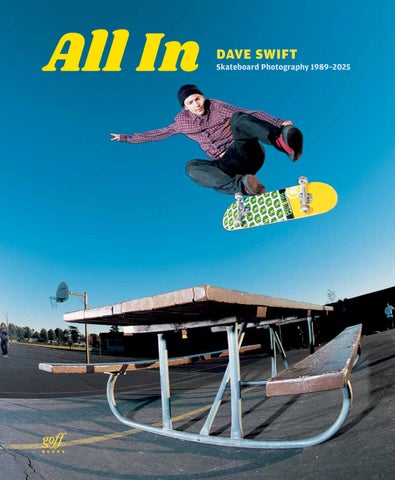
From First Concussion to Ongoing Continuum

Dave Swift is a skateboarder in unison with being a talented, true-blue, nuanced and artful producer of photographs that happen to represent skateboarders.

It’s crucial to note the former is of paramount importance, the latter being just as significant but hypothetical without what came, and comes first. A foundation there from the beginning, a cause and effect, that continues to prodigiously manifest itself through to the present day. A continuum from those first rides on a G&S Team Rider in a ditch behind his childhood home in Rancho Benardo, 1978, where he got his first concussion, to being a certifiable Del Mar local, to the wonderfully comic portrayal of him piloting a vacuum cleaner on the cover of Skate Fate, as well as longtime Schmitt Stix-sponsored amateur and later pro, even while working at Transworld Skateboarding. He got there, and that’s nothing to sneer at; one 1990 N.S.A. contest at the Del Mar Fairgrounds, another at Le Grand-Bornand in the French Alps the same year before hanging up the pro trip, though certainly not skating. He spent almost four decades capturing the action of mostly young (though with time, aging) men and women doing this and that, flying hither and yon, manipulating their 31-inch wooden shred sleds into the air over the top of vertical transitions, as well as up and onto assorted ledges, handrails, gaps, and stairs, along with every confounding variation of all those tendencies ever envisioned or imagined. The camera almost always there, a lifetime devoted to a continuous passion and a livelihood that began with his brother’s borrowed camera at the Desert Ramp Battle in Palmdale in 1983. Following that, an extended hiatus, due to his own camera getting stolen right after that small gathering in the desert that resulted

in the shot of Caballero sporting plaid pants. It wasn’t until six years later upon becoming a contributing photographer to Transworld that the chronicling commenced again—new cameras, professional equipment, a vocation—and since then it’s been pretty much non-stop. An unusually consistent level of perseverance, dedication, and, yes, love of the rarified craft—the art of taking pictures of skateboarders performing a plethora of stunts, tricks, moves, gestures, pirouettes, twirls, maneuvers, and everything else, doing whatever it is they do, however you want to describe it. All shot, captured, reported, and depicted while skillfully and imaginatively encompassing it all, on the level of all his generational peers.

Skating’s been in its modern form for at least half a century, so there’s now a long register of innovators, rippers, shredders, iconoclasts, madmen, madwomen, adapters, popularizers, style mavens, and genius inventors that the list is way too long to go into here, and superfluous anyway. Here are the greats, the ones for the ages, as they should be. But just as elemental are the less celebrated, and in some cases almost forgotten, sometimes thanks to their own initiative. The aforementioned Caballero, as well as Peters, Salba, Miller, Blender, Hawk, Mountain, Gonzales, and Way through to Koston, Rowley, Anderson, Penny, Klein, and Armanto. They belong, self-evidentially. But just as, or even possibly more, instrumental and necessitating a requisite inventory are Nieder, Claar, Youssefpour, Lieu, Carabajal, Hirata, Hooker, McClain, Raybourn, Gardner, Zavalla, Pelka, and all the rest. A full range of stars and anti-stars, who are all leading lights in our firmament, and

by that inclusionary metric a synecdoche for every skater, for anyone who ever ripped or tried to, even if it was only for one hour once when nobody was watching. The whole menagerie, a wide net, the heroes and underground legends, and quite a few other stereotypical and atypical personalities in between. Names and levels of justified notoriety aside, what comes across is their individuality recorded with a consistently staunch adherence to the mission of presenting these misfits, oddballs, and, yes, amazing athletes, doing their now as accepted, celebrated, sanitized, and hypercapitalized as major league baseball pursuit, while remaining still sort of, well, misunderstood on many levels, or just not comprehensible. A ball through a hoop or caught in a mitt is easily understandable to the masses, a tre flip over the hip of a tall bank is not. And that’s the intricate balletic finesse these photos portray no matter how mainstream things get, and is a major factor underpinning the inexplicable, intoxicating beatitude herein.

No matter how societally whitewashed, the actual act remains beyond most people’s grasp, not knowable, essentially still mysterious. Thankfully, there’s a sliver of something uncolonized deep down in the beating heart of it all. Speaking of heart, or endurance coupled with commitment, there’s the steady, unrelenting arc, the throughline, of documenting everything from Caballero’s fakie thruster to Cocona Hiraki’s tail-grab nosegrind over the door at Channel Street 40 years later, which translates into

a symphonic visual cataloguing of the hands, the tilt of the head, facial contortions, in-the-air gesticulations, clothes, hats, hairdos, striped or argyle socks, all on these singular personalities as transmitted through moments of grace in space, on and off the ground and inclined walls. Instants of transcendence, and whether you’ve actually ridden one of the damn things or not, it’s difficult to not be a tad envious of their Icarus-like flouting of the laws of gravity; their escape from the tethers, no matter how fleeting, combined with literally unintelligible technical prowess. It’s mind-boggling actually, and, from this corner, awe-inspiring, inspirational, and seen through a slightly jealous lens. It looks so fun. And in aggregate isn’t that what it’s all about? Certainly, the determination, the fervor, the willingness to sack your balls (or other applicable nether regions) for the sake of adventure and thrills, often without any financial incentive whatsoever. That’s the real fun, derring-do, or just plain insanity. There are not many other realms of “sport” where that happens, and that’s what, still, after all the cooptation and capitulation, sets skating apart. Also, they’re unabashedly gorgeous, with a background of practical mechanical machinations by Swift that are hard to wrap one’s mind around. A lot of work goes into these shots, the timing, the location, the wrangling of wayward skate rats. Through it all he’s stayed in it, both as a skater and photographer. The stoke has kept going, despite the variables, contingencies, and setbacks. It didn’t stop in 1993 or whenever to curdle into a self-promotional campaign for vulgar posterity. That sets him apart, is admirable, to be commended, and even applauded. Dave Swift has kept going forward, and though now is the right time for this particular look back, this isn’t the end by a long shot. Dave Swift continues to forge ahead, both on board and behind the camera, and that’s what counts.

Jocko Weyland, Yuma, AZ, 2025

David Swift: A Skater’s Skate

Photographer

Dave Swift, Del Mar,
Photo by Grant Brittain

I met Dave Swift in the early 1980s at the Del Mar Skateboard Ranch where I worked in the skate pro shop where I was pretty much a babysitter. By the time he skated in off a city bus from Rancho Bernardo to the east of Del Mar, I had already started honing my photographic skills and was the photo editor and senior photographer of a brand-new publication, Transworld Skateboarding Magazine.

Swifto, as he was called by many, was a hardcore skater, that’s what he was hooked on, that’s why he made the two-hour bus trek back and forth from Rancho Bernard to DMSR (Del Mar Skate Ranch) after school four to five days a week. Some years later, after hearing that Transworld had an editorial assistant job available, Dave handed in his embellished resume to the editor. Supposedly, I didn’t want to hire him because I thought he was a troublemaker at DMSR. … That might have been true.

Dave was put to use doing the grunt work of transcribing interviews, which is a tedious and thankless job. After realizing that he would go mad in this position, he recognized that if you could not only write, but also take skate photos, you were a hot commodity, and it could get you out of the office to go on trips and skate a lot more. I loaned Swift an extra camera I had and wrote down some simple photo instructions and he managed to learn from doing, along with some “constructive criticism” from me. Within a few months he had had his first editorial photograph published in the mag and with a lot of successes and failures, like we all have, his photography got better and better over time.

Working for a magazine back then as a photographer was a great way to travel the world, shoot free film, and make new friends. Dave began to assemble his own crew of skaters that he regularly shot; names like Eric Koston, Heath Kirchart, Frank Hirata, and others filled his nocturnal fence-jumping photo excursions. The easy way that you can really judge a skate photographer’s talent is by the company they keep. A top skater isn’t going to take the chance of risking their health with a photographer that isn’t tried and true and isn’t guaranteed to get the goods. Dave was and is a photographer that a skater can always depend on to “get the goods” and he knows what looks good from a skater perspective, that’s what counts in the end, we do this for skateboarders.

Over the 40-plus years I have known Dave Swift, he has evolved from troublemaking skate rat at Del Mar, assistant editor, senior photographer, and editor-in-chief at TWS, and then editor-in-chief and founder at The Skateboard Mag. It has never been easy to follow skateboarding’s course as it has always had its ups and downs and you can never really tell where it’s going. Skate photographers are always trying to keep up with it and document it as it changes and share with others in the best and truest way they can.

Dave Swift is one of the best skate photographers out there and is dedicated to the art of skateboarding and photography to his core. He is the skater’s skate photographer.

It was 1989 and I was in New Zealand on tour with Mike McGill skating demos. Because I could do backside 360 ollies to fakie I wanted to try and learn (Tony) Hawk’s ollie 540s, but I couldn’t even come close.

I decided to try and grab the deck as I came around with my right hand hoping it would help the board stay on my feet. It only took me an hour to land and it was the first melon 540 done on a vert ramp. I was blown away because now I had a 540 in my bag of tricks and was on to winning contests once again.

Steve Caballero
Steve Caballero, Sacramento, CA, 1990
Steve Claar, MĂĽnster, Germany, 1990

02. Images 1989-1992

The MĂĽnster bowl was a really big deal for its time and thanks to Titus Skates of Germany for making it happen. It became a destination for skaters from everywhere, but it was also ugly, cold, and without any real character. No pretty tile, no real pool coping to grind, but it was concrete in a time when that was rare in skating. I loved skating in Europe.

Mark Scott, Portland, OR, 1992

The week leading up to shoot this trick I could not sleep. The rail was constantly on my mind because I had never slid a rail this big and I had no idea what might happen. All I knew was that I was committed and there was no going back.

Alphonzo Rawls
Ron Chatman, Long Beach, CA, 1992
Ron Chatman, Los Angeles, CA, 1992
Jeremy Klein and Ron Chatman
Steve Caballero, San Jose, CA, 1989
Rob Dyrdek and Eric Koston
Rob Dyrdek, Oceanside, CA, 1993
Rob Dyrdek and Eric Koston
Frank Hirata, Vista, CA, 1992

In the Summer of 1991, I was 18 years old. Moving to San Diego had become my new reality. Something that I also knew would happen was one day turning pro, which would manifest itself the following year. It was a special time of change and evolution in skateboarding that directly aligned with skaters my age.

I felt like I belonged and that I was a part of a wave that everyone could sense was swelling and one day becoming tidal. Street skating was emerging as a highly progressive style, pressuring the industry to grow in new directions. Every month something would come out in the magazines that was groundbreaking.

Skate photography was right there evolving with this new generation of skaters. The ones that would be out until 2:00 a.m., skating spots unavailable during the day. [Dave] Swift was down to shoot in all conditions.

Not a problem to lay in the gutter to get the perfect angle or use experimental flash/exposure techniques to make the most of the dark hours. His knack for knowing how tricks should be captured on film created a confidence that was reflected by the many legendary skaters he has worked with.

For me personally, I found the chemistry we shared created a flow to our efficiency and success when shooting that was unmatched. Swift has captured so many skaters in some of the best moments of their lives.

Frank Hirata, San Clemente, CA, 2001
06. Frank Hirata

Baldy Pipe has always been a skateboard heaven/mecca site to so many skaters through the decades. Since it was close to the house I grew up in we started frequenting it when I was 12 years old. That was when I first heard of the tunnel from my friends’ brother who knew Lee (Gahimer) from school. Being part of this legacy with fellow Badlanders Tay Hunt and Curt Kimball has been a thrill. Watching the progression from 1974/75 and seeing it play out and also participating in the movement to what it has become is so awesome.

On this particular day Dave called and said he wanted a Baldy Pipe shot. So of course, I obliged immediately with setting up a session of friends. I’ve always loved the flat wall shots from back in the day, so my goal was to hit the horizontal line on the flat wall next to the pipe. That height always feels so cool and floating down the wall from being super compressed. Pipes are the best. Thanks, Dave, for the photo, it’s one of my favorite pictures from Baldy Pipe.

Steve Alba, Upland, CA, 2002
Kevin Kowalski, Irvine, CA, 2016

Danny Way, 50-50, Encinitas, CA, 1999

After Del Mar [Skate Ranch] closed in 1987 there wasn’t a lot of accessibility to vert ramps. My friends from Vista, (Matt) Hensley, Steve Ortega, and Mario (Rubalcaba), all just started street skating a lot more. I got sucked into that and started progressing with the whole street movement of the time. I owe it all to how much of a pain in the ass it was to get a vert session going in those days.

Danny Way
10. Danny Way

Skateboarding is crazy. I got word of a fullpipe on the back of a truck somewhere on the streets of San Pedro. It was a diamond in the rough, perfect size and good to go. I called [Dave] Swift to drive up and get a shot. A day later the truck and pipe were gone. Bam!

Omar Hassan, Long Beach, CA, 2006
Omar Hassan
Cory Juneau, Oceanside, CA, 2017
Christian Hosoi, Huntington Beach,

What we had in the ’80s was like the greatest rivalry of any sport. I say that because there were different camps or cultural divides. There were sponsor and magazine divides like Indy/ Thrasher vs Tracker/Transworld. Skatepark localism rivalry with me being from Los Angeles and Tony from San Diego. This had been happening since we were really young, it was motivation for both of us and definitely pushed us to progress way faster.

Christian Hosoi
14. Tony Hawk and Christian Hosoi

Turn static files into dynamic content formats.
Create a flipbook