November 7, 2024 • Volume 39, No. 13
Next edition November 21
L’édition de cette semaine à l’intérieur...
Remembering Navan’s first fallen war hero
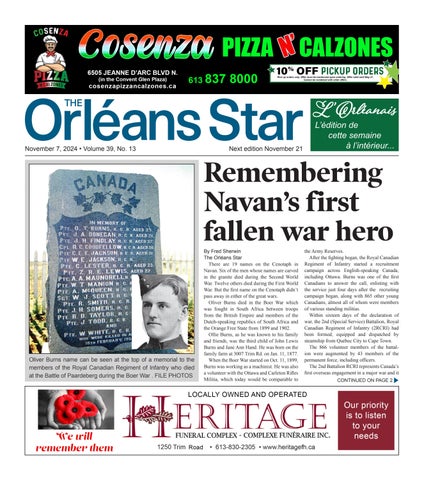
Oliver Burns name can be seen at the top of a memorial to the members of the Royal Canadian Regiment of Infantry who died at the Battle of Paardeberg during the Boer War . FILE PHOTOS
By Fred Sherwin The Orléans Star There are 19 names on the Cenotaph in Navan. Six of the men whose names are carved in the granite died during the Second World War. Twelve others died during the First World War. But the first name on the Cenotaph didn’t pass away in either of the great wars. Oliver Burns died in the Boer War which was fought in South Africa between troops from the British Empire and members of the Dutch-speaking republics of South Africa and the Orange Free State from 1899 and 1902. Ollie Burns, as he was known to his family and friends, was the third child of John Lewis Burns and Jane Ann Hand. He was born on the family farm at 3007 Trim Rd. on Jan. 11, 1877. When the Boer War started on Oct. 11, 1899, Burns was working as a machinist. He was also a volunteer with the Ottawa and Carleton Rifles Militia, which today would be comparable to
the Army Reserves. After the fighting began, the Royal Canadian Regiment of Infantry started a recruitment campaign across English-speaking Canada, including Ottawa. Burns was one of the first Canadians to answer the call, enlisting with the service just four days after the recruiting campaign began, along with 865 other young Canadians, almost all of whom were members of various standing militias. Within sixteen days of the declaration of war, the 2nd (Special Service) Battalion, Royal Canadian Regiment of Infantry (2RCRI) had been formed, equipped and dispatched by steamship from Québec City to Cape Town. The 866 volunteer members of the battalion were augmented by 43 members of the permanent force, including officers. The 2nd Battalion RCRI represents Canada’s first overseas engagement in a major war and it CONTINUED ON PAGE 2