FALL 2026
The Importance of Media Literacy in STEM pg. 3
Jump, Fly, Dive and Climb Into Our New Exhibit pg. 6
Remembering Dr. Tonner pg. 10
FEBRUARY 12-15, 2027 Join us for Orlando Science Center’s biggest STEM celebration of the year! Spark STEM Fest returns with cutting-edge partners, hands-on exhibits, and inspiring experiences designed to ignite curiosity in learners of all ages. This four-day event brings together the region’s leading STEM organizations to engage thousands of youth and adults in discovery and innovation. It’s a dynamic celebration dedicated to inspiring future generations through interactive experiences with scientists, engineers, and STEM professionals. For Teachers: Friday, February 12
Get Involved!
Give your students a day of discovery with immersive, hands-on STEM experiences designed exclusively for school groups. Students will connect with real scientists, engineers, and STEM professionals while participating in interactive activities that bring classroom learning to life, spark curiosity, and inspire future careers.
•
Exhibit your work or become a sponsor to receive exclusive benefits, including premium exhibit space and brand visibility.
•
Learn more at www.osc.org/spark
Teachers: Book early to reserve your spot! Learn more.
•
Spark STEM Fest Seeks To...
•
Raise awareness of STEM in everyday life
STEM for Everyone: February 13-15
•
Bridge the STEM literacy gap
Enjoy a weekend filled with hands-on STEM activities, interactive exhibits, engaging speakers and science demonstrations. Plus, special performances by Cassey Carle's BubbleMania: Science, Art & Comedy Show, a highenergy mix of visual comedy, quick wit, and amazing soap bubble manipulations.
•
Make STEM education accessible
•
Inspire future STEM careers
FOLLOW US AND SIGN UP FOR OUR NEWSLETTER TO STAY UPDATED @orlandosciencecenter
Newsletter Sign-Up
Let’s spark the next generation of innovators together!
777 East Princeton Street, Orlando, Florida 32803 • 407.514.2000 • www.osc.org Orlando Science Center is a private, nonprofit educational facility.
President's Message
2
Science in Our Lives
3
Weddings
4
Board of Trustees
5
New Exhibit: Extreme Sports
6
Theater Showings
7
Calendar
8-9
In Memoriam
10
Nancy Grace Roman Space Telescope
11
Try This at Home!
12
Educational Programs
13-14
Mark Your Calendars
15
Ying Science Competition Winners
16-17
The Light Fantastic
18-19
Science Center Bookshelf
20
Clam Gardens in Bloom
21
Ask A Scientist
22
From Our Sponsor
23
OSC After Dark
24
Support
25-27
Upcoming Exhibits
28
6
18
10
21
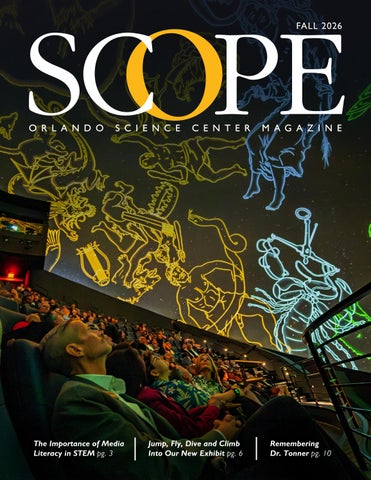
On the Cover: Guests explore the constellations of the night sky in a live planetarium show at the brand-new Dome by Dr. Phillips Charities.
Executive Editor JoAnn Newman Editors Christina Schreiber, Jeff Stanford Contributing Writers Nicholas Chapman, Jill Goddard, Lisa Hardt, Katie Hodges, Ollie Hull, Kevin Horan, Molly Nelson, JoAnn Newman, Adriana Ocana-Lara, Gina Owen, Amy Quesinberry, Gypsy Ray, Lisa Robbins, Christina Schreiber, Dr. MJ Soileau, Jeff Stanford, Hellen Tillem, Angella Van Gelder Graphic Designers Mona De Torres, Kristie Hoover Photographers Sydney Baker, Roberto Gonzalez, Kevin Horan SCOPE Magazine is published three times a year by Orlando Science Center. SCOPE accepts no responsibility for the return of unsolicited manuscripts and/or photographs and assumes no liability for products or services advertised herein. SCOPE reserves the right to edit, rewrite or refuse material and is not responsible for products. CONTACT INFORMATION Phone Number: 407.514.2000 | Website: www.osc.org | Story ideas and suggestions: pr@osc.org Orlando Science Center is supported by United Arts of Central Florida, funded in part by Orange County Government through the Arts & Cultural Affairs Program, and sponsored in part by the State of Florida through the Division of Arts and Culture and the National Endowment for the Arts. © 2026 Orlando Science Center. Title VI of the Civil Rights Act of 1964 prohibits discrimination based on race, color, or national origin including limited English proficiency, in programs or activities receiving Federal financial assistance. To learn more, please contact our Accessibility Coordinator Debra Gordon at 407.514.2029 or dgordon@osc.org, email preferred.
PRESIDENT’S MESSAGE
EXPERIENCE OUR COMMITMENT
TO CONSERVATION When people think about conservation, most conjure images of rainforests, oceans and endangered wildlife. While that’s part of it, I believe conservation begins much closer to home. It starts with an understanding of how the choices you make every day affect the world around you and then deciding to do your part to make things better. Visitors can experience Orlando Science Center’s commitment to conservation firsthand in our Life exhibit, where many of the animals in our care participate in Species Survival Plans managed by the Association of Zoos and Aquariums (AZA). These collaborative programs help ensure the long-term survival of threatened species while inspiring guests to appreciate the incredible diversity of life on our planet. Our dedication to this cause extends well beyond this exhibit. We have spent the last two years involved in the process to achieve accreditation by AZA, which represents the highest level of professional excellence and accountability in animal care, conservation, and operations. OSC recently was the recipient of an onsite inspection, which was the final step in this effort. We should know the results very soon and if accredited, OSC will join less than 300 zoos and aquariums in the United States who have achieved this standard. We have championed conversation beyond our walls by promoting advocacy on our walls. With our Conservation Hallway, visitors discover how OSC support is helping restore habitats for Golden Lion Tamarins in Brazil and assisting with coral reef restoration. In Loch Haven Park, our Purple Martin houses serve as seasonal homes for these migratory birds, reminding us that meaningful conservation can happen right here in Central Florida. Caring for our environment means considering the impact of every decision, both large and small. It is reflected throughout our building from our Gold LEED-certified facility and energy-efficient operations to the locally sourced offerings and sustainable utensils found in 4Roots Café. It is exemplified by our successful outreach collaboration with OUC – The Reliable One, which facilitates learning about alternative energy and water conservation to every fifth grader in this area. Each visit to Orlando Science Center is an opportunity to explore and learn more about the world that we all share. By turning curiosity into action, we contribute to a future where conservation isn't viewed as someone else's responsibility, but as a shared commitment between all of us.
Sincerely,
PRESIDENT/CEO 2
SCIENCE IN OUR LIVES
Media Literacy’s Critical Role in the STEM Community Think about the last time you learned about something new in science or technology. Maybe it was about the recent Artemis II mission, climate change or advances in artificial intelligence. Now, where did you learn about it? Was it from your newspaper subscription? Or perhaps from an online article with a biased point of view? Either way, how do you know that what you read and saw was true? Media literacy is a crucial part of science literacy. Since most people don't read scientific journals every day, we turn toward the media to inform us about STEM news. But it’s important to remember that not all news media is impartial. Some features twist narratives to suit their agenda, which makes it harder for people to evaluate the information and its source. But don't worry! We’re here to help you build resilience against misinformation so that you know what to watch out for and how to decide what’s real and what’s not. First and foremost, you must be able to identify bias. If you’re engaging with media that reports only opinions, it’s likely that you’re missing out on factual information. So, watch out for media outlets (newspapers, broadcast television, blogs or opinion leaders like influencers) that use inflammatory or emotional language. These outlets are relying more on opinions, which are subjective, rather than facts, which are objective. Instead, be sure to engage with media that reports facts. What defines a fact? Facts are objectively true
statements supported by evidence. They might be in the form of data and statistics, or perhaps a photograph or video that hasn’t been manipulated by AI. But no matter the format, information presented as fact should always be cited by credible sources. So, what counts as a credible source? Any information provider that’s unbiased, backed by evidence and created by trusted experts. For example, this may include accredited authors, scientists, organizations and institutions. A credible source will also have verifiable evidence, data and references that are up-to-date and relevant to the topic being discussed. You’ll know when a source is credible if you feel you’ve been informed and educated on a topic; you’ll never feel persuaded or misled. A few examples of credible sources include peer-reviewed journals, academic books, educational institutions, and established news outlets with transparent editorial standards. If you think about it, having strong media literacy habits is a scientific skill. It requires you to evaluate the information that reaches you using the same steps that guide the scientific process: questioning, investigating and evaluating evidence. At Orlando Science Center, we teach people how to think like scientists, empowering them to navigate a complex world with confidence and clarity. To learn more about the importance of media literacy on STEM topics, visit osc.org/science-matters. 3
Dine with the Dinosaurs, Dance Under the Stars, Celebrate with Orlando Science Center. Orlando Science Center invites you to host an unforgettable wedding at a venue as unique as you are. Make a dramatic statement by holding your wedding in our grand five-floor facility conveniently located in beautiful Loch Haven Park. OSC.ORG/WEDDINGS
4
ORLANDO SCIENCE CENTER Board of Trustees Fiscal Year 2027
EXECUTIVE COMMITTEE
Eric Burris
Hassan Khan
E X-OFFICIO TRUSTEES
Jaison Busby
Rania Khouri
Captain Robert Betts
Vice President of Finance, Controller Universal Orlando Resort
Commanding Officer Naval Air Warfare Center Training Systems Division
Juliana Calloway
Eric Lehman
Melissa Byrd
Owner Black Rooster Taqueria
Vice President of Sales Technology West Group
School Board Member, District 7 Orange County Public Schools
Dr. Vanessa CarrollOhmes
Dr. Robert Middleton
Sabrice Guerrier
Chief Medical Officer AdventHealth for Children
Vice Chair of Outpatient Pediatrics Orlando Health
Associate Professor Rollins College
Oluchi Chuku
Sean Murphy
Senior Vice President Bank of America
CEO 3N2 Sports
Director of Sustainability, and the Future-Ready Initiative City of Orlando
Lisy Correa
Mia Poinsette
President and CEO The Poinsette Foundation
Dr. Elizabeth Klonoff
Audit Senior Manager Deloitte, LLP
Tina Henton
Kassandra Crimi
Ben Robinson Partner Holland & Knight
Kristine Kraus
Meteorologist WFTV, Channel 9
Dr. Sarah Layton
Jim DeCarlo
Dr. Bret Scheuplein Chief Medical Officer Complete Care
Dr. Winston Schoenfeld
Shareholder GreenbergTraurig, LLP
Jordan Eichenblatt
Demetria Sloan
Rebecca Church
Vice President of Marketing Massey Services, Inc.
Shilpa DeshpandeFinnerty
Advocacy Attorney / Philanthropist Deshpande Family Foundation
Michelle DeVos
Partner Orlando Magic Ownership Group
Roi Ewell
Founder and Principal Ewell & Associates, LLC
Collin Hayward
Director – Energy & Utilities 1898 & Co. Principal CliftonLarsonAllen, LLP Managing Partner & Broker L & M Wildwood Property Holdings, LLC
Brendan Lynch Shareholder Lowndes
Lynn Sedwick Tax Partner RSM US, LLP
VOTING TRUSTEES Courtney Barnard
Director of Government & External Affairs Verizon
Maureen Brockman
Vice President Embrace Families Foundation
Meteorologist WESH, Channel 2 Vice President, Digital & Technology Orlando Utilities Commission
Head of Partnering and Support Siemens Energy
Partner HIFIVE
Founder and President Vantage Point Coaching, LLC
Valentina Ellison
Eric Sommer
Co-Founder and CEO Evolvending
Christina Epperson
Shareholder, Government Affairs Advisor GrayRobinson, P.A.
Tonja Graham
Supplier Engagement & Diversity Manager Duke Energy
Lawrence Hatch
Executive Vice President, Central Florida Market President First Horizon Bank
Senior Vice President, Market Leader The PNC Financial Services Group
Shawn Strandberg
Mike Hess
Vice Provost and Dean, Retired UCF College of Graduate Studies School Board Member, District 1 Seminole County Public Schools Vice President for Research and Innovation University of Central Florida
Dr. Stephen Summers
Associate Vice President, School of Arts & Sciences Seminole State College
Andrea Wesser-Brawner Chief Strategy Officer and Innovation Officer Florida High Tech Corridor
Vice President of Operations Orlando Health Medical Group
André Williams
Vice President, Engineering & Technology, Engineering Excellence Lockheed Martin
Keshia Woodie
Director of Social Responsibility Orlando Magic
Thank you for your leadership and commitment to inspire science learning for all.
5
TRAVELING EXHIBIT: SEPTEMBER 26 – JANUARY 3
Developed by
Are you ready to jump, fly, dive and climb at Orlando Science Center? Come experience a thrilling new exhibit, Extreme Sports: Beyond Human Limits, presented by Nemours Children’s Health! Opening September 26, this exhilarating exhibit invites adults and children alike to explore some of the most extreme sports in the world.
in partnership with
action in a portaledge hanging tent – yes, rock climbers actually sleep in these! Visitors will engage in a variety of science experiences related to human ability, capacity, drive and motivation. And along the way, you’ll even start to dispel myths and misconceptions surrounding extreme sports.
Discover what it takes to maximize your potential while exploring the psychology and science behind adventure sports. Step into the shoes of an athlete and learn more about the physical strength and razor-sharp mentality that fuels their determination. Plus, hear stories from around the world that highlight the unwavering perseverance these athletes need. Don’t be fooled! Although you may believe that certain sports are exclusively reserved for daredevils and thrill seekers, Extreme Sports: Beyond Human Limits will demonstrate that these activities also require an elite level of technical skill, high intelligence and quick decision-making abilities. With five dedicated zones to explore extreme sports in different environments, visitors will find thrills of all kinds – whether you’re experiencing the excitement of virtual flight, climbing real rock walls (along with kid-sized walls, too!), or racing down an off-road bike path. Challenge your balance on a high line, then keep your adrenaline going with a parkour course! If you have a need for speed, dash through a virtual race or take flight as you pilot a wingsuit in a simulated adventure. Paddle down a virtual white water river course, or take a break from the 6
By the end of this immersive experience, you’ll have explored the creativity, innovation and evolution inherent in extreme sports. Who knows? You may even learn more about your self-motivation, discover a new passion, and grow a deeper connection with adventure sports! Ready to test your athletic abilities? Step into the actionpacked exhibit Extreme Sports: Beyond Human Limits, here at Orlando Science Center September 26 through January 3! MEMBER PREVIEW: SEPTEMBER 26 | 10:00 AM – 12:00 PM Extreme Sports: Beyond Human Limits is developed and produced by Science North, Sudbury, Ontario, Canada in partnership with the Ontario Science Centre.
THEATER SHOWINGS Film schedule is subject to change.
DISCOVER YOUR NIGHT SKY
THE DOME BY DR. PHILLIPS CHARITIES GIANT SCREEN FILMS T.REX Serengeti Ocean Odyssey
FULL DOME Dinosaurs: A Story of Survival One World One Sky A New Blue: An Exoplanet Movie
LIVE PLANETARIUM Orlando Under the Stars Created By OSC Staff
James Webb Telescope: A Story Unfolds Planet Nine
LASER LIGHT SHOWS
Laser light shows are offered during select events and special occasions. Check osc.org for show times.
Orlando Under the Stars Los Angeles may hold the title “City of Stars,” but we have our fair share of stars right here in Orlando. They don’t call us “The City Beautiful” for nothing! Stargazing in a city can be challenging because light pollution from the many buildings and neighborhoods make it difficult for us to see the light of stars shining through. That’s why we’ve designed an original, live planetarium show that you can only see at Orlando Science Center: Orlando Under the Stars. If you’ve ever looked up after dark and wondered just what you’re seeing, join us on an interstellar adventure in The Dome by Dr. Phillips Charities, where you’ll learn how to find stars, constellations, and planets in our local night sky. Come be inspired by the many wonders our universe has to offer!
See what is now playing, check show times, watch trailers, and more at osc.org/theaters. 7
October Halloween Special: Fright Laser November America the Beautiful America 250 Anniversary Laser Always Above December Winter Holiday Laser
DIGITAL ADVENTURE THEATER Horse Power 3D Wild Rescue 3D Winter Holiday Programming
Kung Fu Panda Holiday Special
STORYTIME CINEMA The NeverEnding Story (September 12) Wonka (October 10) October Sky (November 14) The Land Before Time (December 12)
7
CALENDAR *Additional fee required
SEPTEMBER
OCTOBER
FANTASY MONTH
CHEMISTRY MONTH
Step into a world where dragons breathe plasma, wizards wield chemistry, and time travelers unlock the secrets of space! Come explore how potions are really chemistry, how teleportation relates to physics, and how alien ecosystems teach us about our own. Science has never been this spellbinding!
Double, double, toil and trouble, science burn and froth and bubble! Discover the magic of molecules through colorful reactions, kitchen chemistry, slime labs, and more. Uncover the science behind the everyday – and the extraordinary!
3 6
5&6
MONDAY Final Day PHENOMENA: The Exhibition
12
SATURDAY Storytime Cinema The NeverEnding Story (1984) 11:30 am - Based on the novel by Michael Ende
12
SATURDAY Solar Saturday Observatory Open (Weather Permitting) 11:00 am – 4:00 pm
12
SATURDAY Educator Open House
19 & 20
SATURDAY & SUNDAY Fantasy Weekend
SATURDAY Exhibit Premiere Extreme Sports: Beyond Human Limits Presenting Sponsor: Nemours Children's Health Member-Only Preview 10:00 am – 12:00 pm
SATURDAY CoLAB Day
3&4
SATURDAY & SUNDAY Bank of America Weekend
10
SATURDAY Storytime Cinema Wonka (2023) Inspired by Charlie and the Chocolate Factory by Roald Dahl
10
SATURDAY Solar Saturday Observatory Open (Weather Permitting) 11:00 am – 4:00 pm
12
MONDAY Break Camp
28
WEDNESDAY Members-Only Pumpkins & Protons Party* 5:00 – 9:00 pm
31
SATURDAY OSC After Dark* (Ages 21+) Hosted by Young Professionals for OSC 8:00 – 11:30 pm
SATURDAY & SUNDAY Bank of America Weekend
7
26
8
SATURDAY CoLAB Day
All events subject to change
NOVEMBER
DECEMBER
ASTRONOMY MONTH
PALEONTOLOGY MONTH
Join us for a full month of stellar educational programming as we journey through the wonders of the cosmos! Whether you’re exploring deep space during our live planetarium shows or piloting a VR spaceship in the Flight Lab, there’s something for space lovers of all ages.
Stomp back in time and uncover the secrets of ancient life! Join us for hands-on fossil digs, dino-themed crafts, interactive exhibits, and talks from real paleontologists. Learn how scientists piece together the past and discover what life on Earth was like millions of years ago!
7
SATURDAY CoLAB Day
7&8
SATURDAY & SUNDAY Bank of America Weekend
TBD
SATURDAY Dinos In Lights Premieres Presented by Orlando Health Physician Associates
14
SATURDAY Storytime Cinema October Sky (1999) 11:30 am - Based on Rocket Boys by Homer Hickam
14
21
21 & 22
23 – 25
26
SATURDAY Solar Saturday Observatory Open (Weather Permitting) 11:00 am - 4:00 pm SATURDAY Fusion Gallery Opens Gallery of Fluid Motion SATURDAY & SUNDAY Astro Fest
5
5&6
SATURDAY & SUNDAY Bank of America Weekend
12
SATURDAY Storytime Cinema The Land Before Time (1988) 11:30 am
12
SATURDAY Solar Saturday Observatory Open (Weather Permitting) 11:00 am - 4:00 pm
12 & 13
SATURDAY & SUNDAY Fossil Fest
21 – 23
MONDAY – WEDNESDAY Break Camp
24 – 25
THURSDAY – FRIDAY OSC is Closed
28 – JAN 1
MONDAY – FRIDAY Break Camp
31
THURSDAY Noon Year's Eve
MONDAY – WEDNESDAY Break Camp
THURSDAY OSC is Closed Thanksgiving Day
SATURDAY CoLAB Day
9
IN MEMORIAM
Remembering
DR. TONNER It is with great sadness that we share news of the recent passing of Dr. Brian Tonner, who was President and CEO of Orlando Science Center from 2003 to 2008. A former professor, researcher, medical physicist, and UCF Chair of Physics, Dr. Tonner fervently believed in the power of science to inspire curiosity and change lives. His passion and vision helped put Orlando Science Center on the path we are on today. He created the iconic Otronicon technology expo (now Spark STEM Fest) and original exhibits such as Touch the Sky, an aviation exhibit, as well as an exhibit on the science of NASCAR. During his tenure, he brought the acclaimed Our Body: The Universe Within exhibition to Orlando and oversaw the permanent installation of Science on a Sphere, thanks to a collaboration with NOAA. The success Orlando Science Center enjoys today rests in part on the strong foundation Dr. Tonner helped build. His vision expanded what was possible and his passion inspired those around him. Orlando Science Center is proud to be a part of his legacy. We are grateful for his extraordinary contributions that helped bring science to life for curious minds of all ages. Dr. Tonner is remembered as we continue to encourage others to ask questions, seek answers, and embrace the wonder of discovery. Those who knew him remember far more than his impressive accomplishments. They recall his boundless curiosity, his bold creativity, and his unwavering commitment to education. He was a lifelong learner whose interests spanned physics, medicine, aviation, the arts, and social justice. We extend our condolences to his family and friends during this difficult time.
10
SCIENCE MATTERS: THE CASE FOR SPACE
Nancy Grace Roman
Space Telescope: Expanding Our View of an Expanding Universe Humans are inherently curious, which makes us natural scientists. Science teaches us to ask questions and test our ideas to reach conclusions. One of our favorite topics? Space. Humans have always looked skyward, and advances in science and technology have allowed scientists to gain a stronger understanding of the universe. For example, radio and space telescopes help astronomers expand their observations beyond visible light. You can experience the wonder of these images in our live planetarium show, James Webb: The Story Unfolds in The Dome by Dr. Phillips Charities. Despite the fact that the James Webb Space Telescope was launched just five years ago, it’s not NASA’s newest space telescope. That honor belongs to the Nancy Grace Roman Space Telescope, which is set to launch August 30, 2026. Nancy Grace Roman, "Mother of Hubble," circa 1972.
Named for NASA’s first chief astronomer and ‘mother of the Hubble Space Telescope,’ the Nancy Grace Roman Space Telescope is intended to settle essential questions in the areas of dark energy, exoplanets, and infrared astrophysics. Having 100 times the view of the Hubble Space Telescope and being 1,000 times faster than the James Webb Space Telescope, Roman will capture a significantly larger portion of the sky in a fraction of the time. With a primary mission lifetime of five years, the Roman Space Telescope will measure light from a billion galaxies over the course of its mission and will survey the inner Milky Way to find more than 1,000 exoplanets. But what makes this possible are Roman’s two science instruments.
However, Roman won’t replace either Hubble or James Webb. Its true power lies in its ability to work together with NASA’s other two telescopes. Hubble takes images in the visible light spectrum; Webb takes images using infrared light. Roman will identify areas of interest that Hubble and Webb can investigate more closely. NASA is building on its ability to examine our universe, not just upgrading its technology. The Nancy Grace Roman Space Telescope is a stellar invention that will unveil the cosmos in ways that have never been possible. Roman will look at billions of cosmic objects to explore how planets, stars, and galaxies form and develop over time. By capturing never-before-seen pictures of our universe, Roman will allow scientists and astronomers to explore the universe’s greatest mysteries.
First is the Wide Field Instrument, an infrared camera with a large focal plane that provides Roman with a field of view that’s bigger than the apparent size of a full moon. Within five years, Roman will image over 50 times as much sky as Hubble covered in its first 30 years!
Learn more by checking out Science Matters: The Case for Space, an OSC initiative designed to help visitors of all ages better understand why space exploration is so important. Through this program, OSC sparks curiosity and encourages everyone to ask questions Then, there’s the Coronagraph that’ll evolve their understanding of our Instrument. Demonstrating direct imaging universe and our place in it. You can technology, this instrument is a system of explore more about The Case for Space masks, prisms, detectors and mirrors built at osc.org/case-for-space. to block out the glare from distant stars. This will allow Roman to photograph exoplanets with detail up to a thousand times better than other observatories. 11
Image Credits: NASA
TRY THIS AT HOME
Pitching
DED RECOMMEN FOR AGES
3+
Pom-poms You don’t have to be an athlete or a scientist to practice Extreme Sports at home! You can practice building Fine Motor Skills using different types of catapults and aiming for floating targets. It’s simpler than it sounds! Fine Motor Skills include Hand Eye Coordination and Finger Dexterity! By creating your own catapults and using targets as a guide, you can strengthen your ability to move your fingers quickly and independently while handling small objects, and tap into your eyes’ ability to assess the space around you to guide your hands toward perfect aim!
What Do You Need? •
Cardboard Tube
•
Paper Cup
•
Pool Noodle
•
Tape
•
Balloons
•
Scissors
•
Small Household Items
By using objects of different sizes and weights, you can also build your sense of Spatial Reasoning – adding to your set of skills! I.
Make sure the cardboard tube, cup, and pool noodle are open on both sides.
II. Cut the top off of the closed end of the balloon then tie the neck of the balloon in a standard knot. III. Wrap the cut-open end of the balloon around one end of your base – the bottom of the cup, pool noodle, or cardboard tube! Use strong tape to keep it in place where it’s wrapped. IV. Place an item in the base, pull back the neck of the tied balloon and let it fly! Try adding targets to aim for using tape and paper plates in a doorway for an extra challenge! 12
EDUCATION
Homeschool Program for Grades K-8
Now a Direct Ser vic e Prov ider for Ste p Up for Stu dents!
Our Homeschool Programs expose students to a variety of STEM topics, offering the opportunity to utilize critical thinking and collaborate with peers. Through interactive, minds-on experiences, students enage deeply with content that sparks curiosity and inspires a lifelong love of learning. For more details, including pricing and registration, visit osc.org/homeschool. HOMESCHOOL PROGRAMS MAY INCLUDE: • Hands-on Discovery Labs
DISCOVERY LAB TOPICS MAY INCLUDE:
• Engaging Exhibits
Roller Coaster Physics
• NEW: Shows in The Dome by Dr. Phillips Charities
Trampoline Engineering
• Live Shows in the Digital Adventure Theater
Dissection
WHEN SCHOOL’S OUT, BREAK CAMPS ARE IN! Full-day programs are available for children in Preschool* – Grade 5. From robots and slime to critters and creations, engaging Break Camps give children a hands-on and fun way to spend their time off from school and explore the far reaches of STEM. Member pricing is available, but space is limited so register early! Learn more and register today at osc.org/break-camps.
FALL 2026 October 12 November 23-25 December 21-23 Dec. 28 – Jan. 1 *Preschool camps are only available for 5-day breaks. Preschool is a DCF licensed center C09OR0729.
13
Choose from one of our 3 all-inclusive party packages designed to take the hassle out of planning your child’s party so you can relax and celebrate too!
WE HAVE BIRTHDAYS DOWN TO A SCIENCE!
PARTIES INCLUDE:
• Free admission and parking for all your guests • A 60-90 minute private party • Hands-on science programming • Fun themes, food and beverages, and so much more! PICK A THEME, MAKE A GUEST LIST, AND LEAVE THE REST TO US! • Party Animals • Weird Science • Fantastic Jurassic • Exploration Space
Limited times available! Book yours today at OSC.ORG/BIRTHDAYS
STEM Scouting Adventures Scouts, get ready to discover, connect, and take action! Orlando Science Center offers troops hands-on STEM adventures designed to turn curiosity into skills and badges for Daisies and Cubs through Cadettes and Eagles! Each session combines teamwork, problem-solving, and lots of experimentation. Troops can participate in open scouting days, or you can book a specific experience for your troop. Contact classes@osc.org to learn more! Scout Sleuths: Forensic Files Think like an investigator and use evidence to solve a scientific mystery using skills like blood typing and ink sampling. 14
RoboScouts Explore how robots "think" and communicate! Build and program a simple robot to complete a task and decode secret messages.
Troop Circuit Club Spark creativity as you get hands-on with circuits, sensors, and simple coding. Improve your design skills by building a robot of your own creation!
SpeedScout Lab Turn your troop into a pit crew! Design, build and test mini race cars while exploring forces, friction, and how shape affects speed.
MARK YOUR CALENDARS
SEPTEMBER 19 & 20
Fantasy Weekend
Step into a world where dragons breathe plasma, wizards wield chemistry, and time travelers unlock the secrets of space! Explore how potions are really chemistry, how teleportation relates to physics, and how alien ecosystems teach us about our own planet. Science has never been this spellbinding!
NOVEMBER 21 & 22 Embark on a journey through the stars! Experience the wonders of the universe with hands-on-activities, captivating films, and inspiring talks from the expert guest speakers. Whether you’re a stargazer or just space-curious, this event is your ticket to exploring the universe like never before!
DECEMBER 12 & 13
Fossil Fest
Unearth the fascinating world of the ancient creatures through fossil digs, interactive exhibits, and fun activities that bring the science of the past to life. Meet real paleontologists, examine fossils, and lean how scientists uncover the secrets of Earth’s history - one bone at a time!
NOVEMBER – JANUARY SHOWING DAILY! Celebrate the magic of the holiday season with a dino-twist. Gaze upon Stan the T. rex and his fossil friends in a festive light show set to holiday music. Don’t forget the wintery surprise at the end! 15
SCIENCE COMPETITIONS
Orlando Science Center SCIENCE COMPETITIONS Aarit Dixit Wins Dr. Ying Competition Aarit Dixit, a sophomore at Orlando Science High School, took the top prize in this year's prestigious Dr. Nelson Ying Science Competition at Orlando Science Center. His research presents R.A.M.P.A.T., a low-cost, 3D printed drone that takes off vertically and cruises efficiently like an airplane. At a price point under $1,000, Dixit’s drone matches the performance of commercial drones that cost 10 times more. He won a scholarship of $5,000, a $1,000 award for his science teacher, and an additional $1,000 for his school. The winning project was inspired by Dixit’s curiosity about how drones help with rescue efforts after natural disasters. He recognized that drones save lives, but the high cost creates a real barrier to access. With Dixit’s research, he’s found a way to make drones affordable, and therefore accessible, to first responders, offering long flight times and wide search coverage without relying on fragile supply chains. 16
For more than two decades, Dr. Nelson Ying — local scientist, entrepreneur, and philanthropist — has partnered with Orlando Science Center to celebrate outstanding student scientists with this competition. Since its founding in 1999, the Dr. Nelson Ying Science Competition has encouraged young researchers to apply their talents to real-world challenges and make a positive impact on their communities. Past winners of the Dr. Ying Science Competition have continued their research at top universities, earned recognition in national science fairs, and launched meaningful careers in STEM fields, including positions at NASA’s Jet Propulsion Laboratory and starting their own companies. To be eligible, each participant must be a Florida high school
student conducting a research project with the goal of making a positive impact on humanity. This year, submissions were accepted from throughout the state, with finalists selected from schools in Fort Lauderdale, Bartow, and Plantation. The projects explored a wide spectrum of real-world challenges, including coronary artery disease, cancer treatment, gait analysis, and depression and anxiety treatment. In addition to the grand prize winner, each of the remaining finalists also received a cash award to support the continuation of their research projects. For more information about applying for the 2027 competition, please visit Dr. Nelson Ying Science Competition.
SCIENCE COMPETITIONS
Where Passion Meets Purpose Orlando Science Center’s science competitions provide students with more than just awards. They help build essential life skills that last well beyond the event. Participants strengthen their abilities in critical thinking, problem solving, collaboration, and communication skills, while also learning
the importance of adaptability, time management, and staying organized under pressure. In addition to personal growth, students connect with peers who share their interests and receive mentorship from STEM professionals serving as judges.
These connections often evolve into long-term support networks and open doors to future opportunities. For many students, the competition is a defining moment that inspires new passions and helps shape their path toward success in science and beyond.
2026 Dr. Nelson Ying Science Competition Finalists Aman Agrawal – Senior, Pine Crest School, Fort Lauderdale Aman Agrawal’s research focuses on developing a computer code that generates 3D virtual arteries with various calcifications to test of the effectiveness of stents in treating coronary artery disease. His research will increase efficiency and creation time for stents. With a special interest in researching at the intersection of medicine and public health, Agrawal hopes to improve lives through impactful work and research.
Johan Bijiyos (not pictured) – Freshman, Bartow High School, Bartow With a passion for using programming to simulate physical systems, Johan Bijiyos’ research is at the heart of science and technology. His research tests whether combining quantum mechanics with current cancer simulation better predicts how lung cancer cells develop drug resistance over time. By modeling cancer cell populations like quantum particles, this research captures hidden interactions that traditional methods miss, achieving greater accuracy in predicting how tumors evolve under treatment.
Koray Abramson – Junior, Pine Crest School, Fort Lauderdale Koray Abramson’s research focuses on developing inexpensive, portable and accessible gait analysis for patients with conditions that affect how they walk. For example, patients with Cerebral Palsy, Parkinson’s Disease, amputees and stroke survivors. His study develops two deep learning pipelines for customizable 3D gait analysis using synchronized video instead of expensive motion capture systems. Abramson’s interest in this subject was inspired by his older brother who has a neurological condition that impacts the way he moves.
Sophia Fatteh Patil – Freshman, American Heritage Schools, Plantation Sophia Fatteh Patil believes music is a vital part of life, so her research looks at the utility of music in elevating dopamine levels. Her study suggests that music is a possible treatment option for depression and anxiety in humans caused by low serotonin levels. 17
SCIENCE MATTERS: SCIENTIST IN RESIDENCE
THE LIGHT FANTASTIC: The Science Behind the Dome's Laser Light Shows If you, like me, had the pleasure of attending Stellar Nights at Orlando Science Center this Summer, you may have experienced a laser light show in The Dome by Dr. Phillips Charities. As someone with a particular interest in laser photonics (teaching this subject was my career, after all), I was particularly excited to see the new laser projection system in action.
STEP 1:
The basic science that enables this show is embedded in the word laser, which is derived from the description of the source of coherent light: Light Amplification by Stimulated Emission of Radiation, or as an acronym, LASER.
By proving that the velocity of these waves is equal to the speed of light, Maxwell correctly concluded that light was an electromagnetic (EM) field! This is the basis for all of optics: EM waves from gamma rays, X-rays, UV, Light (visible EM radiation), infrared, microwaves, and radio waves.
There are about 100 years of basic science advances that enable us to enjoy “the light fantastic” that we geeks call coherent light. I’ve emphasized the key work for each scientific development, so you can dig deeper if you’re curious. 18
In the mid-19th century, James Clerk Maxwell discovered four second-order partial differential equations that explained a century of research on electricity and magnetism, called Maxwell’s equations. From these equations, Maxwell derived a wave equation describing the propagation of electromagnetic waves; in other words, how the waves travel and spread through a medium.
STEP 2:
Next, scientists needed to develop a deeper understanding of electromagnetism. This required an understanding of the physical world on the atomic and subatomic scales, which we refer to as Quantum Mechanics (QM). The basis of this abstract and highly mathematical branch of physics was laid out in the first two decades of the 20th Century.
STEP 3:
Einstein formulated the QM description of absorption, emission, and stimulated emission of EM radiation between 1916 and 1917, called Einstein’s A and B coefficients. This discovery would be the basis for the S and E part of the LASER acronym (Stimulated Emission).
STEP 4:
He placed a cylinder of pink ruby inside a helical xenon tube (a photographer’s strobe of blue/green light) to excite the chromium ions inside an aluminum oxide crystal. The ruby rod was finely polished on both ends and coated with highly reflective silver. When the flash lamp was fired, out came a burst of deep red, coherent light! Figure 2
In 1951, Nobel Laureate Charles Townes famously conceived the key concept for producing stimulated emission while sitting on a park bench, waiting for a restaurant to open for breakfast. He reasoned that stimulated emission required the medium to be excited to a non-equilibrium state. Townes’ park bench inspiration motivated the 1957 production of the MASER (where M is for microwave) in ammonia gas. He shared the Nobel Prize in Physics with Nikolay Basov and A.M. Prokhorov in 1964. I was privileged to meet and break bread with Townes and Prokhorov. Figure 1
Figure 2. Light leaving a laser cavity is coherent, meaning all the waves have the same frequency and are in lockstep with each other, producing a pencil-like beam of pure color with minimal spreading. Maiman’s discovery launched a torrent of innovation of new lasers and applications. Within a year, lasers were used in eye surgery, and within 8 years, Hollywood was busily producing laser light shows. As technology improved, more applications became practical, which in turn fueled more innovation. High-speed communications, microelectronics, and rapidly emerging nanoelectronics are all enabled by lasers. Orlando Science Center has three RGB (red, green, and blue) laser projectors supported by huge advances in computer hardware and software. The high-brightness laser beams are easy to manipulate, allowing light to be synchronized to music.
Figure 1. Dr. Ted Maiman experimenting in his lab.
STEP 5:
The first optical MASER, or LASER, was made by Dr. Theodore (Ted) Maiman at Hughes Research Labs in Malibu, California, on May 16, 1960.
You can create this on a smaller scale at home using a laser pointer you might have on hand. Bounce your beam off an old CD and see it split into many beams. Then move them around on the wall or floor, perhaps rhythmically with music. You just made your own laser light show! But the best way for you to experience the joy of a laser light show is to take the family to OSC and enjoy the show! CAUTION: NEVER EVER LOOK DIRECTLY INTO A LASER BEAM, EVEN A LASER POINTER! 19
EXTEND YOUR LEARNING
THE SCIENCE CENTER
Bookshelf
Did something in our halls spark your curiosity? The Science Center Bookshelf is your next chapter in discovery! Check out these book recommendations specially curated to help readers of all ages dive deeper into the STEM behind our exhibits.
If you love Extreme Sports presented by Nemours Children’s Health, you might like… “Endure: Mind, Body, and the Curiously Elastic Limits of Human Performance” by Alex Hutchinson Genre: Adult Non-Fiction, Sports Science, Health & Fitness Does the body limit human performance, or is it the mind? In Endure, award-winning science journalist and former national-team distance runner Alex Hutchinson explores the latest research in physiology, neuroscience, and psychology to uncover what happens when we push ourselves to our limits. Through conversations with leading scientists and elite athletes, Hutchinson reveals the science behind extreme sports like climbing, mountaineering, and ultrarunning.
If you love Fantasy Month at Orlando Science Center, you might like… “Project Hail Mary” by Andy Weir Genre: Science Fiction, Fantasy, Adventure When humanity faces extinction, a lone middle school science teacher awakens aboard a spacecraft with one mission: save Earth. Bestselling author Andy Weir blends humor, suspense, and well-researched science into an unforgettable adventure. While the story is fiction, its realistic treatment of physics, engineering, and scientific problem-solving makes it a favorite among scientists and educators alike. Winner of the 2022 Dragon Award for Best Science Fiction Novel.
If your favorite exhibit is DinoDigs and you’re a fan of Paleontology Month, you might like… “The Rise and Fall of the Dinosaurs: A New History of a Lost World” by Steve Brusatte Genre: Adult Non-Fiction, Paleontology, History Paleontologist Steve Brusatte brings the Age of Dinosaurs vividly to life in this accessible and engaging history. Combining the latest fossil discoveries with firsthand accounts from the field, Brusatte explains how dinosaurs evolved, thrived, and ultimately disappeared. A professor of paleontology at the University of Edinburgh and one of the world's leading dinosaur experts, Brusatte has earned widespread praise for making cutting-edge science approachable. Named one of the best books of the year by The Smithsonian and Science Friday.
Celebrate Hispanic Heritage Month and discover one scientist’s journey to space in… “Path to the Stars: My Journey from Girl Scout to Rocket Scientist” by Sylvia Acevedo Genre: Middle-Grade Autobiography, Space Science In this inspiring book for kids ages 8-12, engineer and former NASA rocket scientist Sylvia Acevedo shares how curiosity, determination, and a Girl Scout camping trip helped launch her career in STEM. Acevedo recounts the challenges she overcame as a first-generation Mexican American before pursuing a career in aerospace engineering and later serving as CEO of Girl Scouts of the USA. Winner of the 2019 Eureka! Nonfiction Children's Book Award. 20
SCIENTIST SPOTLIGHT: NATIVE AMERICAN HERITAGE MONTH
Clam Gardens in Bloom How Combining Western Science with Indigenous Traditions is Revitalizing Food Systems Western science has a structure to it. Over the years, the process of scientific inquiry has been steadily refined to ensure that experiments are replicable, results are measurable, and information is verifiable. Formal processes like this lend credibility to the scientists who use them, but that's not to discount the value of less fomal traditions of sharing knowledge, like the oral histories of indigenous communities. Marine ecologist Dr. Marco Hatch is working to combine these two approaches to strengthen the field of clam farming. A member of the Samish Indian Nation, Hatch grew up spending time on the beaches of the Hood Canal in Washington State. From digging up clams to admiring shore crabs, he developed a deep connection to the ocean and a passion for revitalizing indigenous methods of aquaculture. Now, Hatch is a leader in the field of clam gardening, which holds both cultural significance for his people and ecological significance in protecting tidal spaces. Clam gardens are intertidal structures, meaning they exist in the space where the land meets the sea between high and low tides. They use rock walls to trap sediment and flatten the beach slope, creating an expanded area for clams to grow. The gardens drastically increase clam growth and survival, preserving coastal biodiversity and supporting sustainable food systems.
More than that, clam gardening holds immense cultural significance for Coast Salish tribes like the Samish Indian Nation. The practice helps instill cultural values, connect generations and ensure food security – a vital part of helping indigenous people retain sovereignty. Hatch’s work in clam gardening blends Western science and traditional knowledge with the goal of helping nature and humans better coexist.
remove institutional barriers that hinder under-resourced communities from engaging in environmental work. Outside of this, Hatch sits on the advisory committee for the United Nations Ocean Decade Collaborative Center for the Northeast Pacific; on the steering committee for the Clam Garden Network, which continues the long history of Indigenous-led garden management; and on the Board of Trustees for The Nature Conservancy in Washington.
“Many communities are taking the initiative to speak to Tribal elders and tend to ancestral clam gardens and connecting youth and elders to those spaces.” Hatch said in an interview with The Nature Conservancy in Washington, “I am driven by envisioning healthy communities within those ecosystems. When I see beaches that have been neglected due to limited access, overregulation or pollution, I see the potential for grandparents and grandchildren to care for the land by digging for clams and spending time together.” As a professor at Western Washington University (WWU), Hatch oversees the Coastal Communities and Ecology Lab. He and his students work with local communities to learn about and preserve the rich food sources in tidal ecosystems. He advocates heavily to
Dr. Hatch with his students in the field.
Hatch’s work is a testament to the resilience of indigenous practices in aquaculture – though that’s a Western term for a traditional approach to food management. Indigenous knowledge is often extremely place-specific and passed down over generations, making it critical to sustainably caring for our planet across ecosystems and geographies. The resurgence of clam gardening demonstrates the impactful work that can be done when we marry Western systems with traditional practices in pursuit of a common goal. Image Credits: Nature.org, Marco Hatch 21
ASK A SCIENTIST
ASK A SCIENTIST Our inaugural Scientist in Residence, Dr. M.J. Soileau has a passion for learning and educating the community through STEM. You’ve asked him some of your burning questions and he has answered!
Why are scientists called scientists?
What makes things explode?
Are there small rockets?
How does the mass production of green hydrogen from water affect the water cycle?
Science is the knowledge and study of the natural world based on evidence gathered from experiments and observations. People that study and create art are called “artists.” Therefore, scientists are people that study and do science.
Yes! There are all sorts of small rockets. For example, some scientists use small rockets to send probes into large storms, where they gather critical data about the storm. You have also probably seen very small rockets at Fourth of July celebrations. In fact, most firework displays consist of a small rocket used to shoot a payload high above your head. The payloads then explode in beautiful colors! You can read more about what gives fireworks their colors in my answer to the question
“Why is fire different colors?”
Rapid production of heat by energetic chemical reactions cause rapid expansion of air and high pressures, which we call an explosion.
Full question: "I understand that to combat global warming there is a push for green energy. One green energy production source involves the production of green hydrogen using electrolysis to split water into its constituent elements. Since much of the world is also suffering from a water crisis and the water cycle is a closed system (I think), how would the mass production of green hydrogen from water affect the water cycle and hence the availability of water??" The short answer is that using hydrogen fuel produces water as a byproduct. The net result is that no water disappears from the water cycle!
Image Credit: Bungalower
Explore More! Did you know you can launch your very own small rocket? Small rockets, sometimes made to be models of larger rockets like the Saturn V used by NASA, are available at hobby stores and online.
22
It’s important to learn all the proper safety precautions before experimenting with such rockets. Some model rockets carry payloads (like NASA rockets!) that can measure the height of the rocket and the temperature of the air. Make sure that an adult obtains such rockets for you and supervises their use!
To dive a little deeper, given the answer above, one must question "green hydrogen." One can never get more energy out of hydrogen fuel than that required to separate hydrogen from water. Clean energy such as wind and solar provide electricity for electrolysis, which in turn produces "green" hydrogen – a transportable green energy. In other words, by storing solar and wind energy, green hydrogen is energy in a transportable form.
FROM OUR SPONSOR: NEMOURS CHILDREN'S HEALTH
The Science Behind Keeping Young Athletes Healthy This fall, we’re exploring the psychology and science of adventure sports in a new interactive exhibit that features everything from multimedia visual experiences and displays to physical challenges that allow you to test your abilities. Extreme Sports: Beyond Human Limits, sponsored by Nemours Children’s Health, gives visitors of all ages the opportunity to jump, fly, dive, and climb, as you learn firsthand what it takes to participate in some of the world’s most thrilling activities.
Ahead of the exhibit’s debut, we sat down with Dr. Sarah Gibson, an orthopedic and sports medicine physician at Nemours Children’s, to ask her some questions about the importance of keeping your mind and body in top shape for sports – from the extreme to the everyday – especially when it comes to young athletes.
How can a holistic approach to managing a young athlete’s health improve the experience of their sports journey?
yes, I’d say psychology plays just as critical a role as physical fitness does for athletes.
Why is nutrition such an important aspect of enhancing sports performance? Particularly for kids and teens, proper nutrition is essential to optimize growth, bone health, and performance. Young athletes need to ensure they are fueling with enough food for the amount of training they are doing and that their diet contains the right balance of vitamins, minerals, protein, and carbohydrates.
A holistic approach is critical, even more so for young athletes than for adults. An injury that takes a child or teenager away from their sport disrupts their routine and can reduce interactions with their peer group. It can even impact their sense of self. If a teen defines themselves as a “soccer player,” it can be mentally challenging to lose that identity, even if only temporarily.
What role does psychology play in sports for young athletes? Mental health is so important for young athletes. It affects their confidence, resilience, and performance. It can also help them overcome the fears they may have after an injury. So,
Sarah Gibson, MD, is part of the nationally ranked orthopedics and sports medicine program at Nemours Children’s Hospital, Florida. To learn more about how they’re getting kids back into the games they love and helping to keep them healthy, visit Nemours.org. Extreme Sports: Beyond Human Limits runs September 26, 2026 through January 3, 2027. 23
24
SUPPORT
Orlando Science Center’s Neighborhood Science is a placebased after-school outreach program that provides free STEM workshops for K-12 students at three local community centers in low-income neighborhoods. This program would not be possible without the support of generous funders like the Elizabeth Morse Genius Foundation. The Elizabeth Morse Genius Foundation was established in 1959 for the recognition of religious, charitable, scientific, educational, literary, or educational purposes, and to promote the welfare of mankind. Thank you, Elizabeth Morse Genius Foundation, for helping us work towards our vision of a world where everyone values science to make informed decisions and address critical challenges to enhance their communities.
We would like to thank The Joe & Sarah Galloway Foundation for helping us break down financial barriers to spark a lifelong love for STEM learning! Orlando Science Center is thrilled to celebrate the Foundation's ongoing commitment to our Science for All access program. Thanks to the support of dedicated donors like The Joe & Sarah Galloway Foundation, Science for All provides reducedprice admissions and discounted family memberships for EBT and WIC cardholders. This vital initiative ensures that thousands of families across Central Florida, regardless of financial circumstances, can engage with high-quality, handson STEM education. We are deeply grateful to The Joe & Sarah Galloway Foundation for their generous support in making these meaningful community experiences a reality.
Thank you, Chesley G. Magruder Foundation, for helping us inspire curiosity and innovation for generations to come! Orlando Science Center is thrilled to have received a generous grant from the Chesley G. Magruder Foundation in support of our Unlock Science Comprehensive Campaign. Thanks to the support of donors like the Chesley G. Magruder Foundation, we recently opened the newly renovated full dome theater, The Dome by Dr. Phillips Charities, converting it to a digital projector system and restoring the theater’s planetarium capabilities. This renovation has opened the doors for immersive educational programming, live performances, and an optimal viewing experience. We are so grateful to the Chesley G. Magruder Foundation for their continued support.
Incredible funders like the William T. Morris Foundation help Orlando Science Center create opportunities for all members of our community to experience highquality STEM learning. The William T. Morris Foundation, established in 1937, is a private philanthropic organization with a mission to advance knowledge and strengthen our communities, and a vision to leave a healthier world for future generations. Thank you for helping us ensure that everyone has access to the impactful exhibits and programming at Orlando Science Center by breaking down financial barriers through the Science for All and Neighborhood Science programs. These programs ensure that all members of our community are able to experience that spark that ignites curiosity, helping to inspire the innovators of tomorrow. 25
INSPIRED HERE:
The Stories Behind Our Mission Every story has a beginning. In 1955, Orlando Science Center opened its doors with a simple but powerful purpose: to inspire curiosity and foster a lifelong love of science. As we begin preparing to celebrate our 75th Anniversary, we've found ourselves reflecting on something even more meaningful than exhibits, milestones, or growing attendance numbers. We've been thinking about you and your stories. For nearly three quarters of a century, Orlando Science Center has welcomed curious minds of all ages. Some visitors discovered a lifelong passion for science. Others found a career they never imagined. Some found the confidence to ask questions, dream bigger, or believe in themselves. Every one of those experiences became part of our story. More importantly, they became part of yours. That's why, as we look toward our 75th Anniversary, we're launching “Inspired Here,” the stories that celebrate the people whose lives have been touched by Orlando Science Center. Through SCOPE magazine, video interviews, social media, and other publications, we'll share the inspiring memories of children, families, volunteers, educators, donors, and community members whose journeys remind us why our mission matters. Our greatest impact isn't measured by the exhibits we build or the programs we offer but by the lives we help shape. 26
Sometimes those transformations happen in unexpected ways. That’s what happened for Youth Volunteer Marielle. As a shy high school student, Marielle wasn't sure she belonged at Orlando Science Center. When her mother suggested she volunteer as a summer camp counselor, her response was immediate: "But children can smell my fear!" The thought of spending her summer surrounded by young energetic campers felt overwhelming. She worried about saying the wrong thing and often rehearsed conversations in her head before speaking. But when she pushed past her fear and started volunteering, she found connection. She discovered that the children didn't expect perfection, they simply wanted someone who would listen. By kneeling to meet campers at eye level, asking about their interests, and encouraging their endless curiosity, Marielle slowly discovered something about herself. The confidence she nurtured in others began growing within her, too. By the end of the summer, campers eagerly reached for her hands as they explored Orlando Science Center together. Back at school, the young woman who once struggled to speak in front of her classmates found herself confidently addressing her entire student body, something she never imagined possible. Her story reminds us that learning is
never one-sided. Sometimes the teacher becomes the student, and sometimes the act of changing changes us. Marielle's testimonial is just one of countless stories we've had the privilege to witness over the past 75 years. Each story is different, and each one matters. Together, they remind us that behind every exhibit is a memory, behind every program is a person, and behind every act of generosity is an opportunity that may change a life forever. As we get ready to celebrate 75 years of inspiring science learning for all, we'll continue sharing these stories. They remind us that curiosity has the power to shape lives, strengthen communities, and inspire futures we may never fully see. Did Orlando Science Center play a role in your life? Did a visit spark your curiosity? Influence your career? Build your confidence? Inspire a love of learning? Or create a cherished family tradition? We'd love to hear your story. We're collecting memories, photographs, and personal experiences that reflect the many ways Orlando Science Center has inspired our community over the years. If Orlando Science Center has been part of your journey, we invite you to be part of ours. Please send your story and photos to story@osc.org. Because every story begins with curiosity. And every story has the power to inspire the next generation. Thank you for helping us tell the story of Orlando Science Center.
INVEST IN THE FUTURE with a Corporate Membership Partner with Orlando Science Center to align your brand with one of Central Florida’s most trusted community institutions and open a world of possibility for telling your own story. The Science Center offers a wide range of relatable and dynamic content that provides unique opportunities to empower your message and deliver it to a diverse and deeply curious audience. As a Corporate Member, you will support a wide range of rich and dynamic programming that brings STEM education to thousands across Central Florida and beyond. This includes hands-on exhibits, compelling live shows, and impactful programs and events that reach over 680,000 guests annually.
When you join OSC as a Corporate Member you will unlock a world of benefits designed to enrich your corporate culture, engage your employees, and cultivate your clients. Corporate Members receive a range of exclusive benefits based on the level of giving. • Complimentary general admission passes to Orlando Science Center.
• Recognition on OSC’s Donor Wall, Community Impact Report, website, e-blasts, and newsletters.
• Complimentary VIP tickets to special events.
• Exclusive invitations to OSC Board Socials and special receptions.
• Discounts on Annual Memberships.
• Learn more! For more information, contact Heather Mahoney, Director of Corporate Relations, at hmahoney@osc.org or 407.514.2014.
27
OSC MEMBERS
DON’T MISS OUT! Renew early and save 10% on another year of Membership. Check the expiration date on your Membership to make sure it’s active through the next exciting exhibit premiere. To renew early, go to osc.org/myaccount.
Join the quest across land, sea, and space. JA N UA R Y 2 2 – M AY 2 , 2 0 27
Sponsored in part by the State of Florida through the Division of Arts and Culture and the National Endowment for the Arts.
G et to Know Yo ur Bo dy I nside and Out! | May 15 – Sep tembe r 8, 2 0 27
28