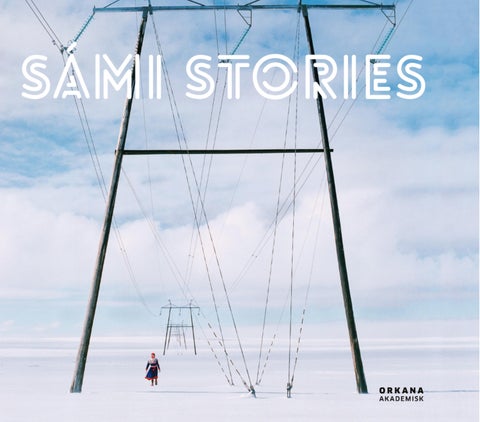
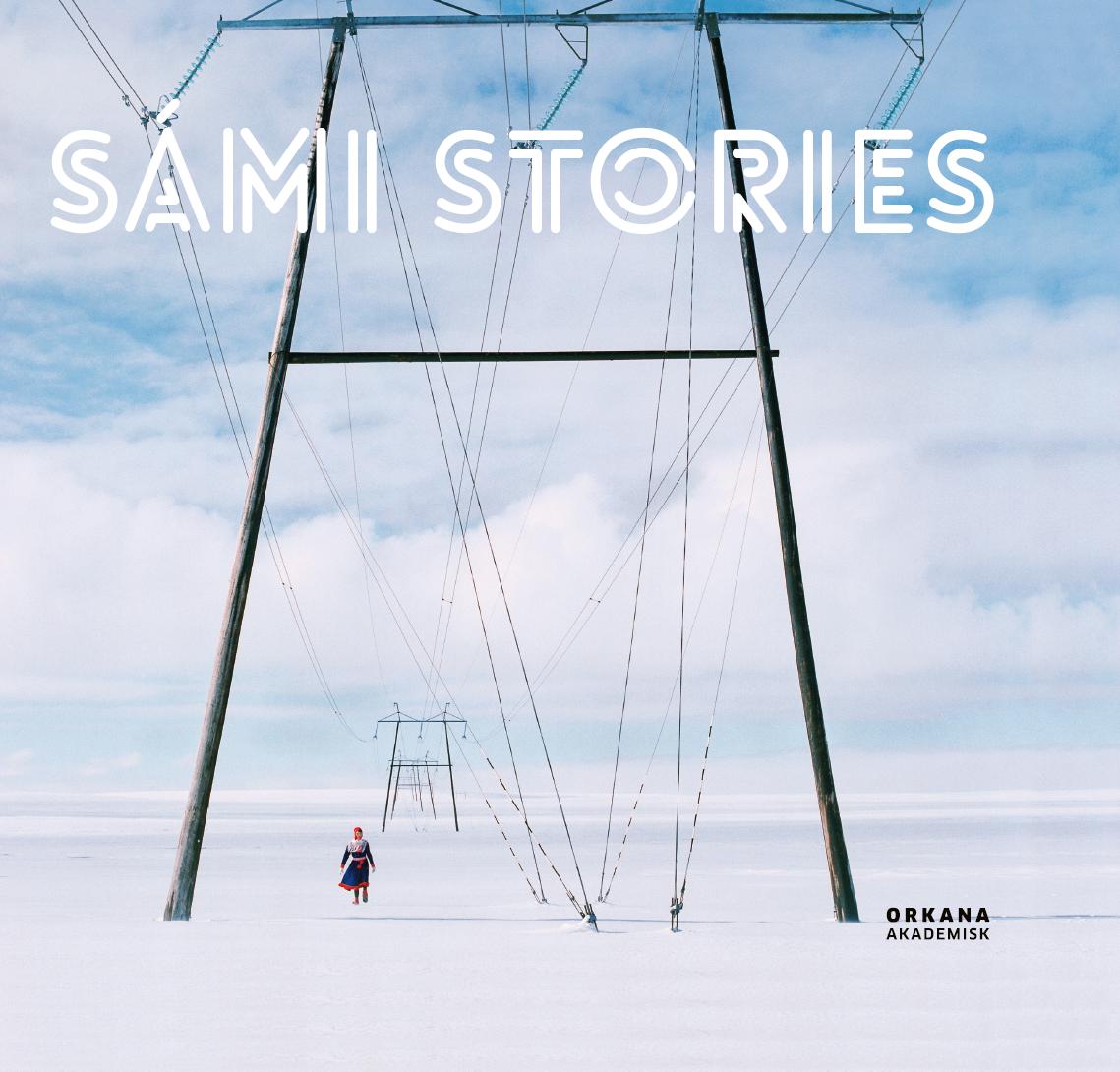
Front cover: Marja helander: Ánnevárri,MountAnnivaara (detail), 2002
Graphic design: Reibo AS Printing and binding: RenessanseMedia AS 2.opplag 2017
ISBN 978-82-8104-238-4
nordnorsk kunstmuseum northern norway art Museum davvi norgga dáiddamusea www.nnkm.no
orkana forlag as n-8340 stamsund www.orkana.no
historioGraPhiCal reFleCtions on sÁMi art and the ParadiGM oF the national in norWeGian art historY
reoPeninG our oriGinal oPenness
CHARIS GULLICKSON
SANDRA LORENTZEN
MONICA GRINI
HANNA HORSBERG HANSEN
FOREWORD
It is with great pleasure that Northern Norway Art Museum presents the exhibition and book Sámi Stories: Art and Identity of an Arctic People in the USA. The museum is a national institution with particular responsibility for the visual arts in the Northern regions of Norway and Sámi art is one of our main fields of interest. Making art from our part of the world known to a wider, international audience is therefore an important museum role.
Sámi Stories is a landmark exhibition examining the history, identity, politics, and visual culture of the Sámi, the indigenous people of Norway, Sweden, and Finland. It focuses on how artists, mainly contemporary, depict important themes within Sámi history and politics and features works by Sámi artists John Savio, Iver Jåks, Aslaug Juliussen and Arnold Johansen from Norway, Britta Marakatt-Labba and Rose-Marie Huuva from Sweden, Marja Helander from Finland and Arvid Sveen who is a Norwegian artist with a particular interest in Sámi themes.
The exhibition commemorates the 200th anniversary of the Norwegian Constitution. In 1988, the Norwegian Parliament adapted its constitution to grant Norway’s indigenous population, the Sámi, recognition as a people. This was formalized in the establishment of the Sámi Parliament (first election 1989), which signaled a revolution in Norwegian Sámi policies and SámiNorwegian relations. In 2014, the 25th anniversary of the first Sámi Parliament therefore coincides with the 200th anniversary of the Norwegian Constitution. The exhibition also coincides with the World Conference on Indigenous Peoples, which will be held at the United Nations Headquarters in New York City in 2014.
Collecting art related to the North and to Sámi culture is an important part of Northern Norway Art Museum’s mission.
Very many of the works in the exhibition are therefore from the museum’s own collection. We have also borrowed from other collections: University of Tromsø – The Arctic University of Norway; The National Museum of Art, Architecture and Design, Oslo; RiddoDuottarMuseat – The Sámi Collections, Karasjok; and Sparebank 1 Nord-Norge’s Art Foundation, Tromsø.
The exhibition and book, Sámi Stories: Art and Identity of an Arctic People, is part of a bigger joint project with Tromsø University Museum. Our thanks go to Tromsø University Museum and to its Director, Marit Hauan, for her never-ending enthusiasm for the project. We also would like to thank the American Scandinavian Foundation and its President, Edward P.Gallagher, for showing the exhibition at Scandinavia House, New York City, in 2014 and the Anchorage Museum at Rasmuson Center and its Director, Julie Decker, for showing the exhibition in Alaska in 2015.
The Fritt Ord Foundation, which promotes freedom of expression, has provided funding for the book which is published by Orkana Academic.
Last but not least, a big thank you to Northern Norway Art Museum’s own staff and in particular to Charis Gullickson, the exhibition curator and Sandra Lorentzen who has been project leader. They are also the chief editors of this book.
tromsø, February 28th, 2014
KNUT L JØGODT
director, northern norway art Museum
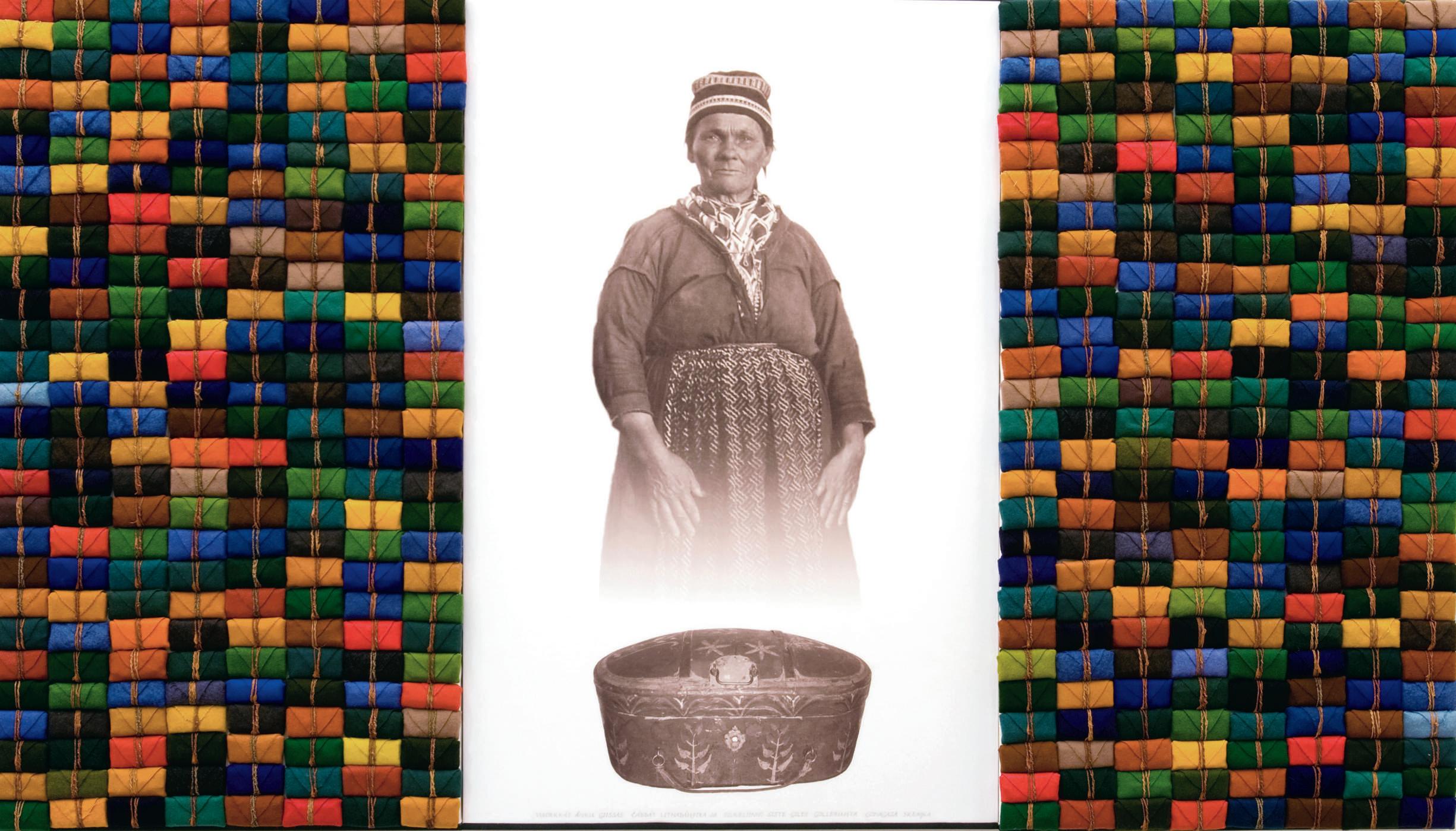
Cat.no. 15
Rose-Marie Huuva
ahkku 448 vuorkkat, Grandmother’s 448 treasures
THE ARTIST AS NOAIDI
CHARIS GULLICKSON
The Sámi shaman, noaidi, communicates with the unseen. In doing so, the shaman narrates what the future holds. The sacred drum and traditional form of song, joik, are the media that transcend the shaman’s spirit to another dimension – an encounter with the spiritual world. Shamans are high-ranking religious figures in Sámi culture. As healers they use their powers to diagnose and treat illness.1
A link between art and shamanism first appeared in the context of modern art during the twentieth century. Artists such as Marc Chagall (1887–1985) and Vasily Kandinsky (1866–1944) drew inspiration from the Western magical tradition of occultism, folklore and mysticism. Kandinsky even regarded himself as a shaman, along with Joseph Beuys (1921–1986) a generation later.2 Associations with shamanism were also based on the techniques utilized by the artist, for example automatic drawing, performance or consciousness altering practices. The notion of “divine madness” was another aspect.
Not unlike the shaman, artists deal with mythical aspects both in meaning and in practice. Acting as an intermediary the noaidi bridged the gap between two worlds, the physical and the spiritual.
When the shaman hammers on a sacred drum he transitions into a trance-like state of consciousness. Early accounts of Sámi art reveal close associations to the shaman’s drum:
Sámi art expression manifests a highly developed ornamentation. Visual expression is already evident in Paleolithic stone carvings. A form of visual art is best documented with the figures painted on the sacred shaman’s drum.3
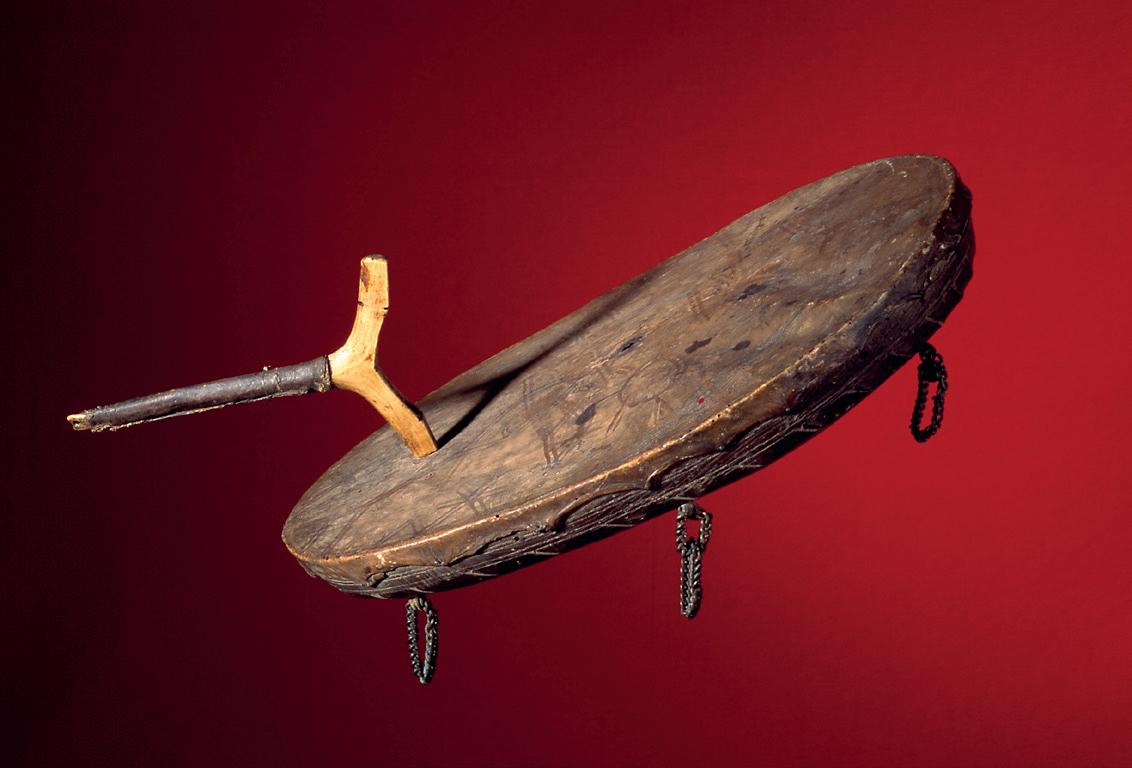
The drum is richly decorated with a diverse set of symbols that represent elements of nature, mythological figures and people in a variety of settings (ill. 1). Located at the center was the sun-rhombus surrounded by four rays representing the four corners of the earth. Although remarkably striking, the images are disconnected and lack a narrative function. Instead, they are the objects by which the shaman makes contact with the spirit world, allowing the capability to look into the past or future. The shaman communicates a story by following a small bone or metal pointer placed on the surface of the drum, moved by the vibrations of the drumming. Art, on the contrary, is a visual narrative. Stories, ideas or emotions serve as a starting point for the artist’s work. Which story or idea does the artist relate? The piece may represent an actual event or simply pure fiction. On the other hand, there might be a mere hint or suggestion compelling the viewer to devise his own story. What sets the shaman’s drum apart from visual art is the need to express something.
ill. 1
shaman’s sacred drum and Mallet tromsø university Museum
HISTORY PAINTING
History painting is a genre dedicated to subjects from history and mythology, and long regarded in art history as the highest form of painting. In Norway, history painting evolved in the nineteenth century, much later than in other European countries. This coincided with a surge of national pride upon the adoption of Norway’s Constitution in 1814.4 Various artists, including Peter Nicolai Arbo (1831–1892), Knud Bergslien (1827–1908) and Olaf Isaachsen (1835–1893), selected themes and subjects from Norse history and mythology. Several of Arbo’s history paintings reveal signs from Sámi culture, e.g. individuals clad in traditional Sámi dress, outfitted with belts decorated with brass rings and traditional Sámi footwear. These figures often appear in the foreground illustrating the contact between Sámi and Norse culture. Yet is there a history genre within the realm of Sámi art? And if so, when does the story begin?
SÁMI NARRATIVES
From the past century until the present day Scandinavian artists have drawn inspiration from historical narratives of Sámi culture. JOHN SAVIO (1902–1938), one of the most celebrated first generation Sámi artists, was also the first Sámi to pursue a formal art education. He studied at the National Academy of Craft and Art Industry in the capital, Kristiania (today’s Oslo).5 While he worked in drawing and painting, Savio is best known for his black-and-white woodcut prints depicting scenes from everyday Sámi society. Savio captures a sense of place and cultural identity. The interplay between man and nature is a recurrent theme in his work, with the Arctic landscape as a backdrop. Distinguishing characteristics of his works are dark figures on a white background and individuals often appear in traditional Sámi dress. Other works feature wildlife-scenes of lone reindeer silently peering into the distance convey a sense of longing. This may be a reflection of the artist’s own life.