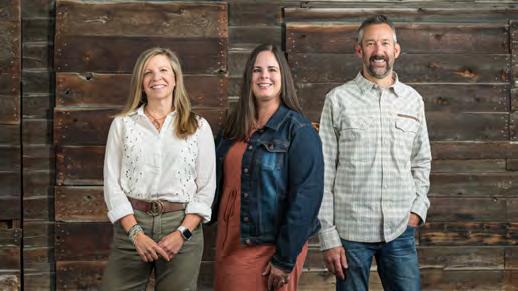
Now doing business as Duke Warner Realty ERA Powered, we are excited about the powerful new tools, expanded resources, and broader opportunities to support our community. What makes this truly special is that Duke Warner Realty remains exactly who we are at our core. Our name, our values, and our culture are not changing. Instead, we’re building on that strong foundation and giving it an exciting boost.
TABLE of CONTENTS
CONTRIBUTORS
EDITOR'S LETTER
IN THE NEWS
SOUL OF CENTRAL OREGON
OUTDOORS
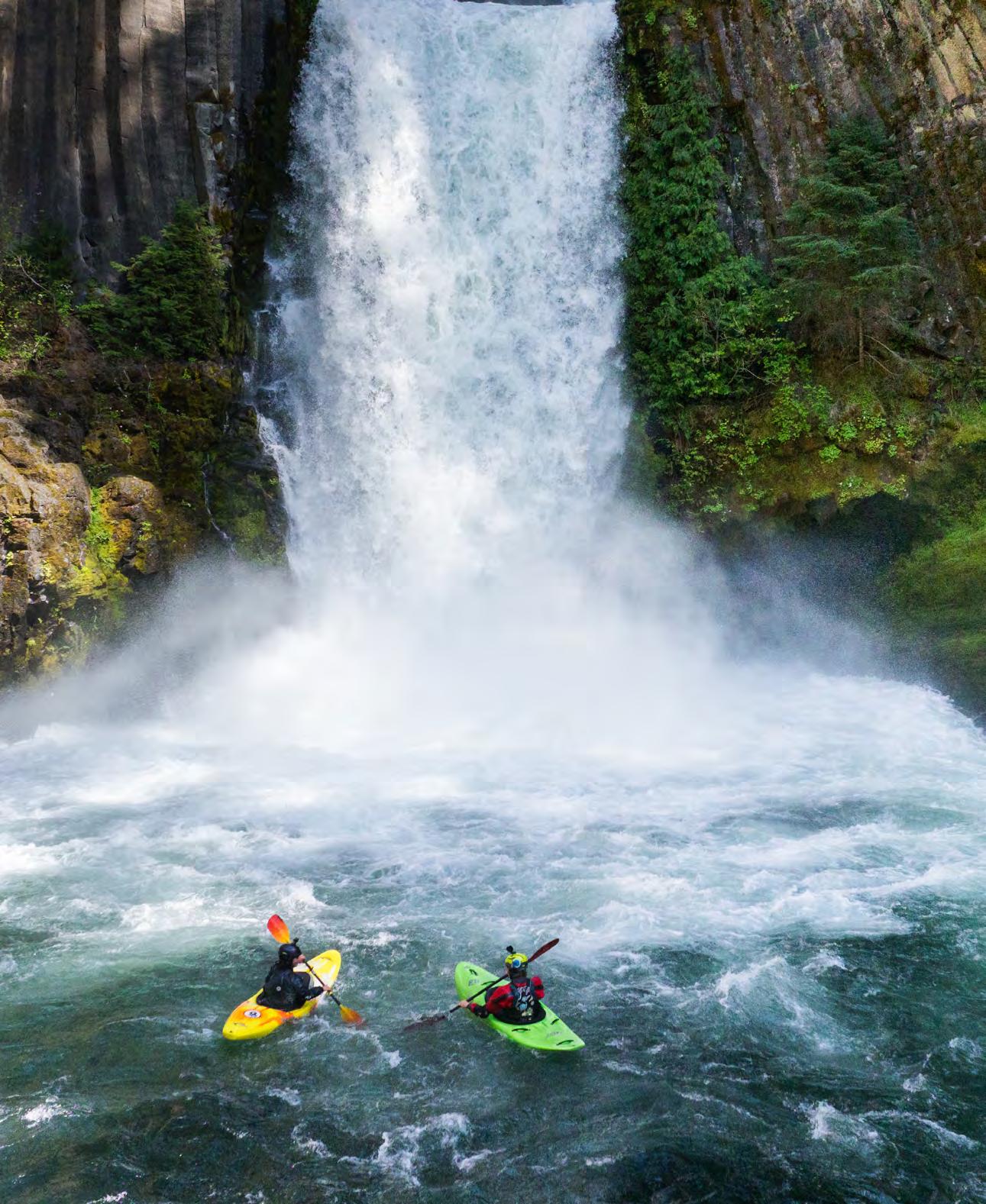
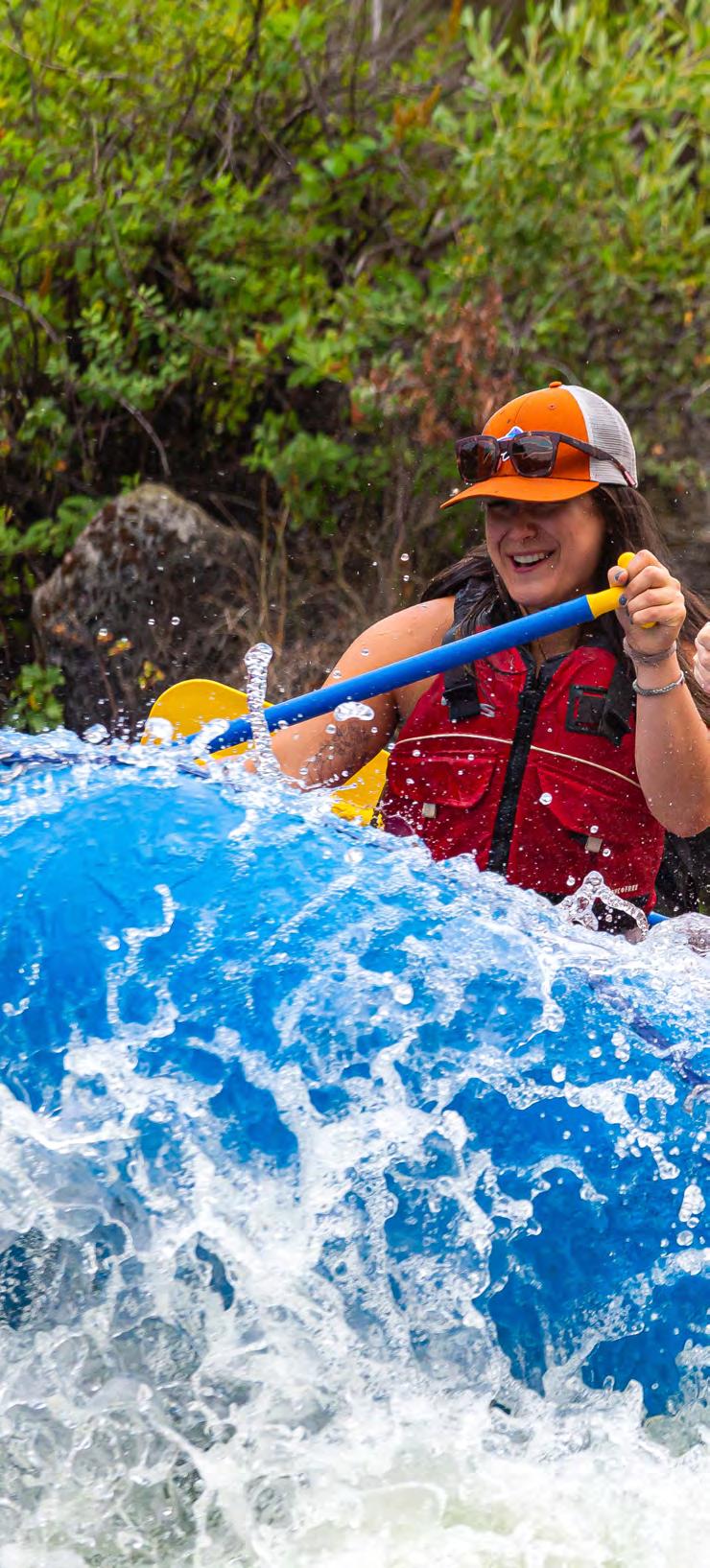
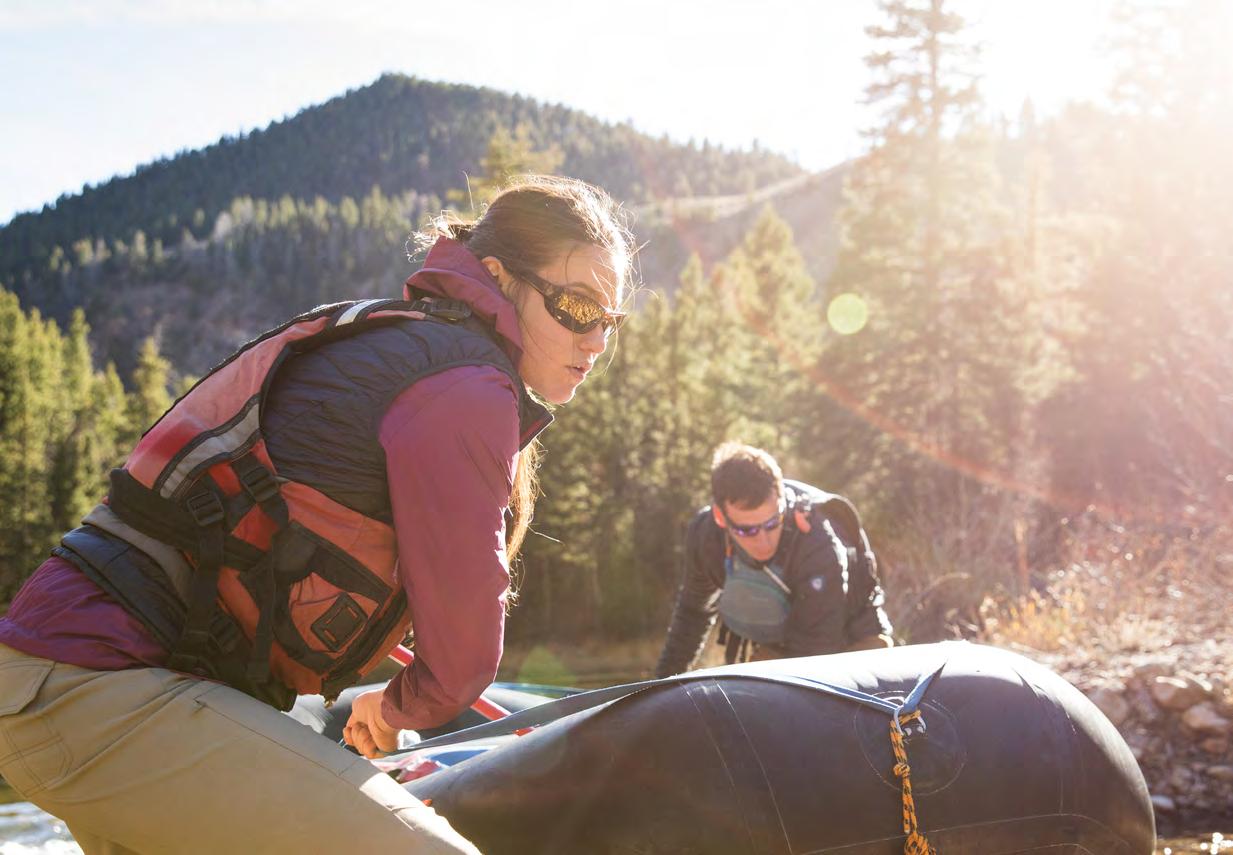
Four late spring whitewater runs suited to every rafting level.
RETREAT
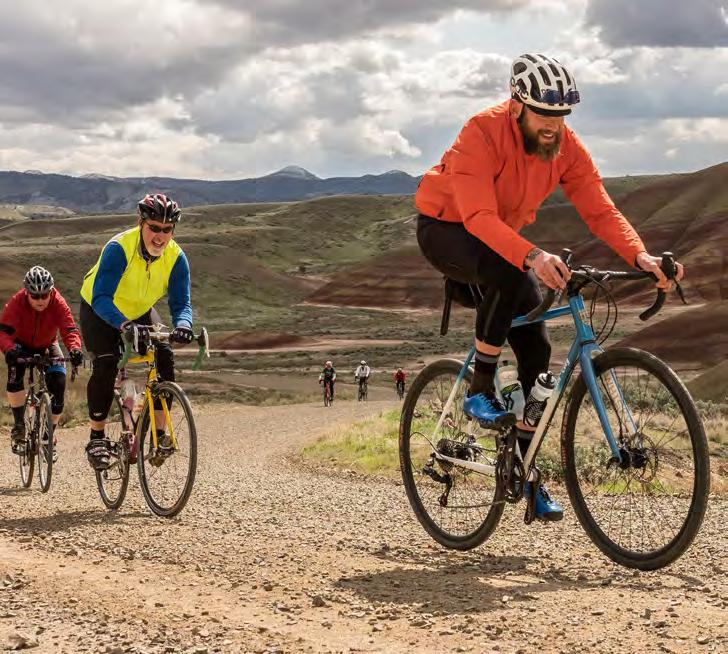
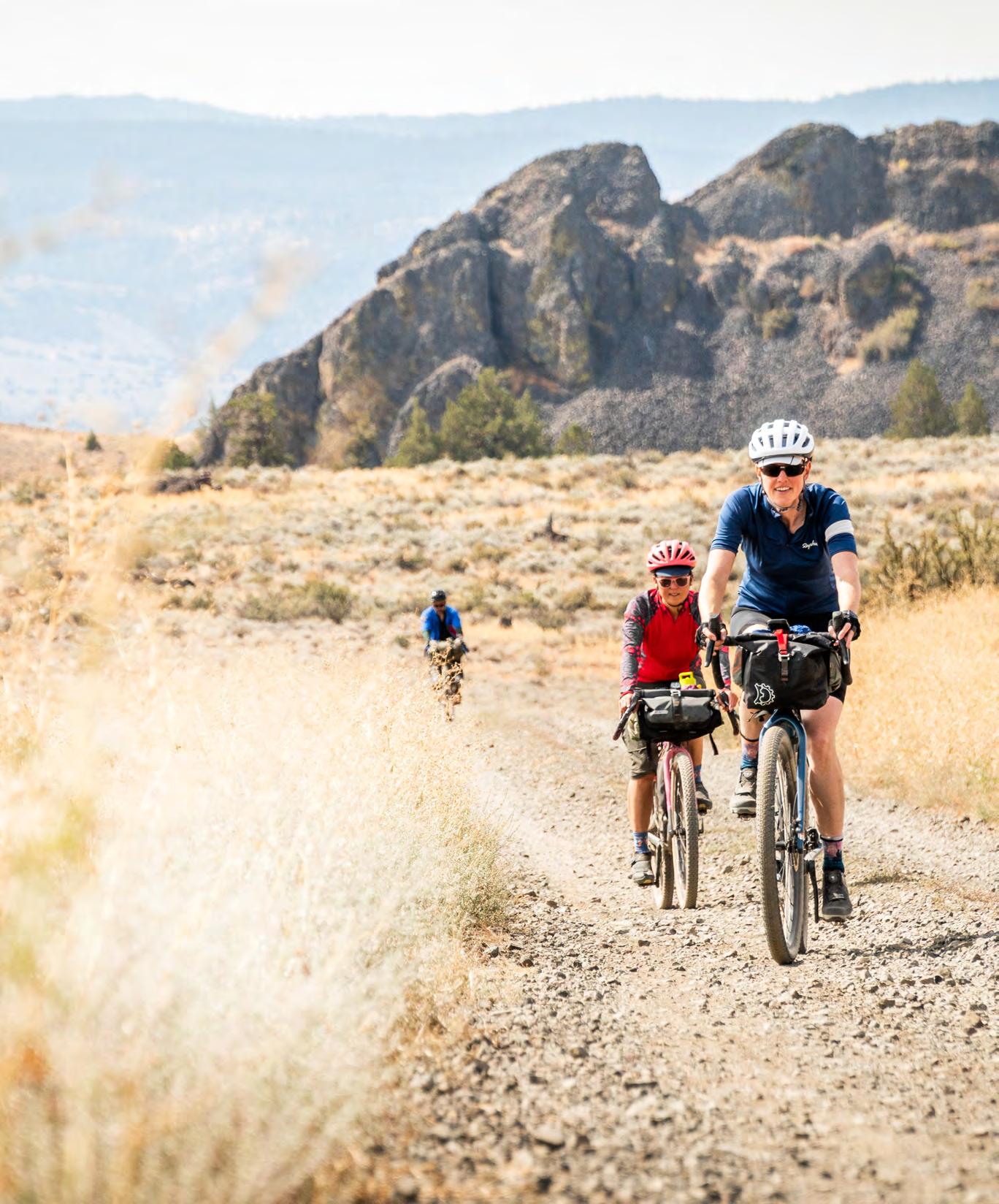
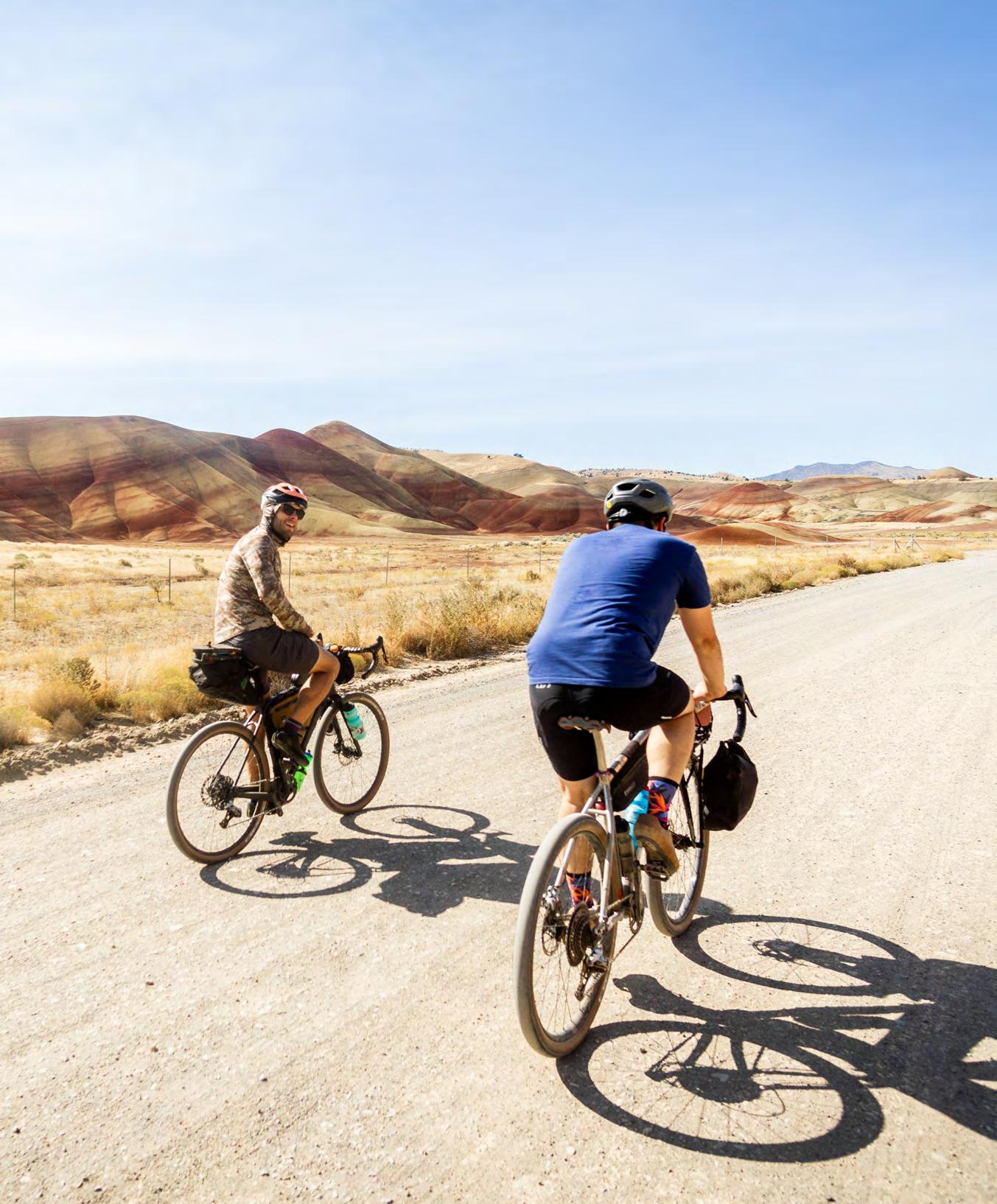
Bikepack through the Painted Hills, then stay awhile at Mitchell's Spoke'n Hostel.
TRAILS
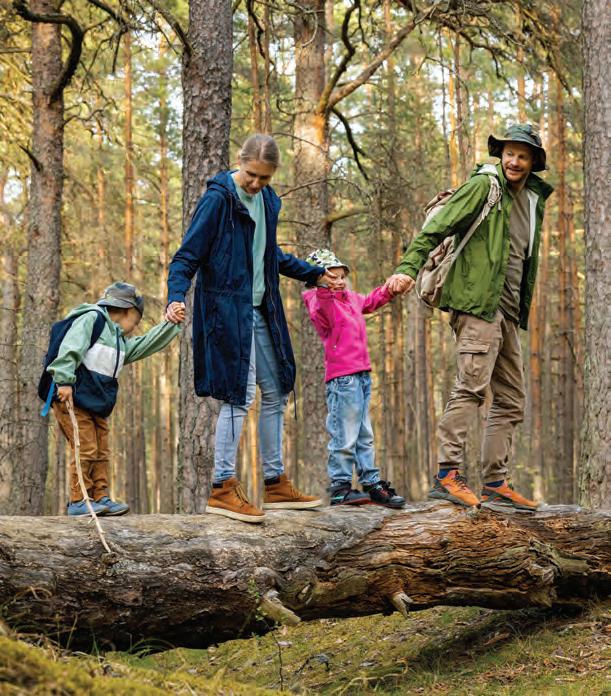
It's a low-snow year, and low-elevation hikes offer adventure close to bases in Bend and Sisters.
COMMUNITY
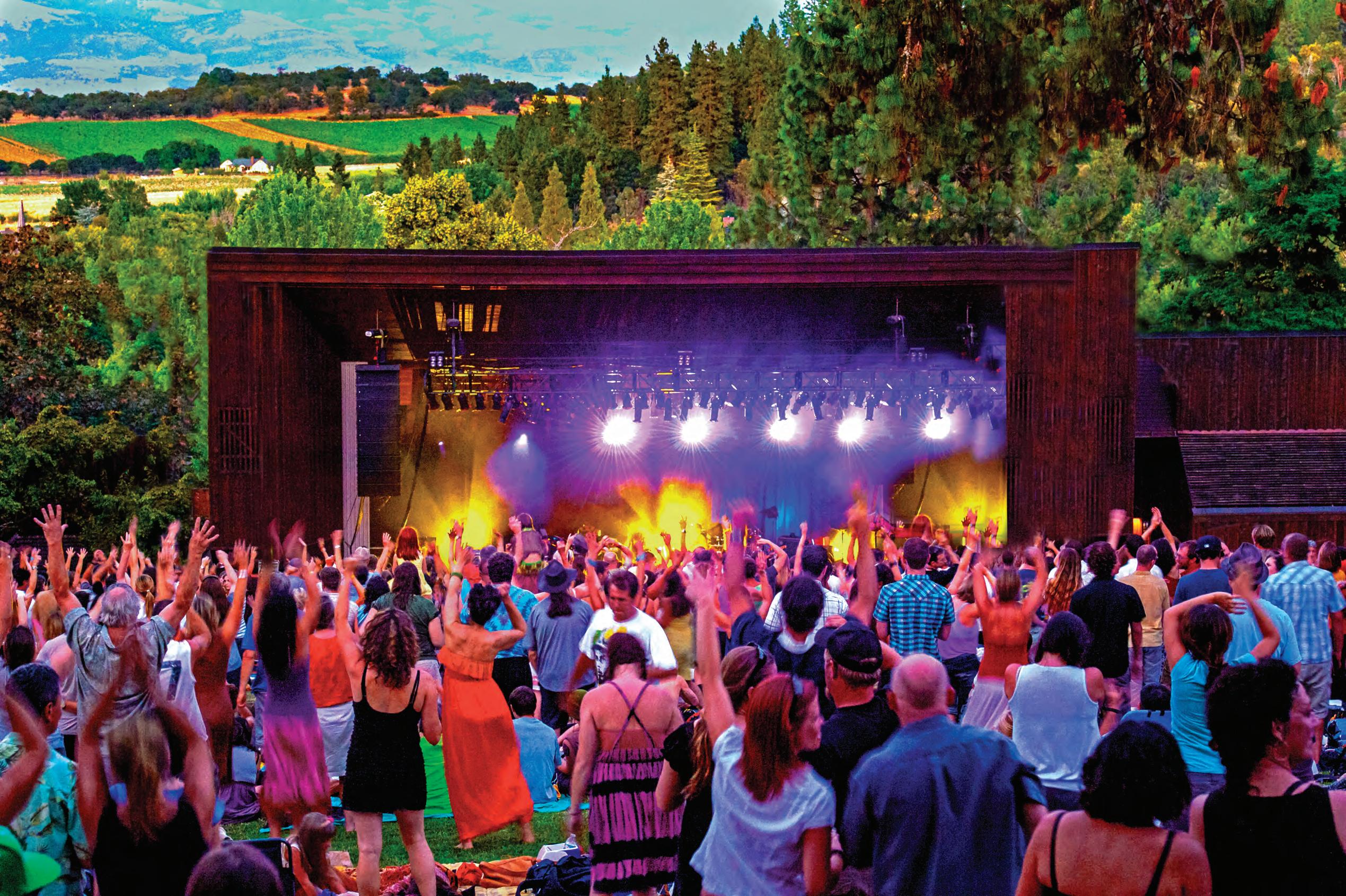
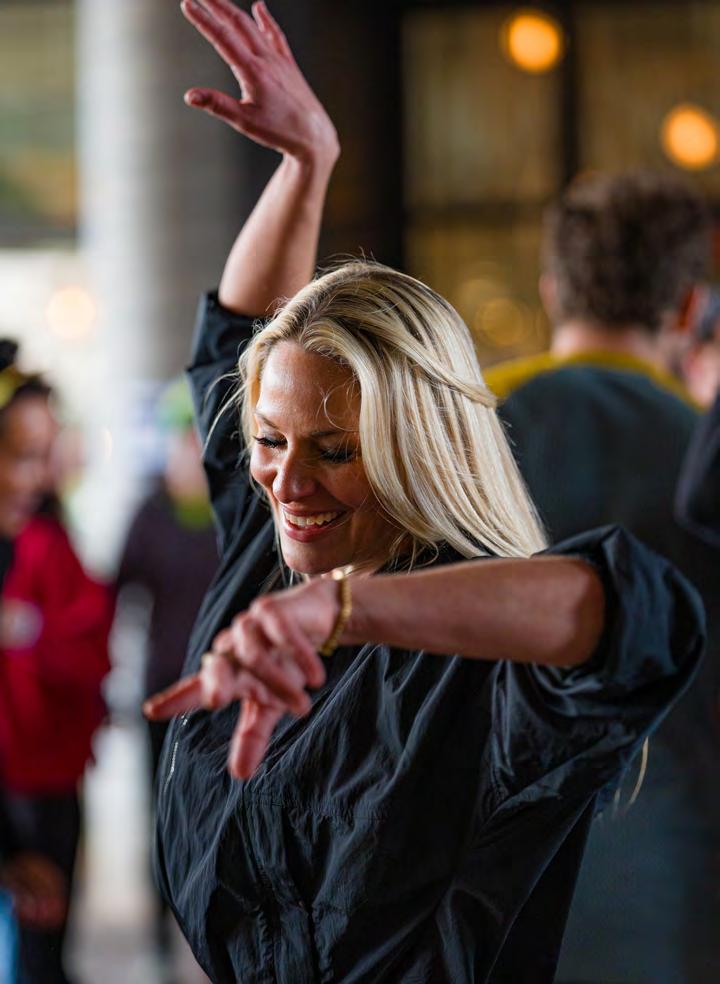
Get up and move at pop-up dance parties in unlikely locations.
PURSUITS
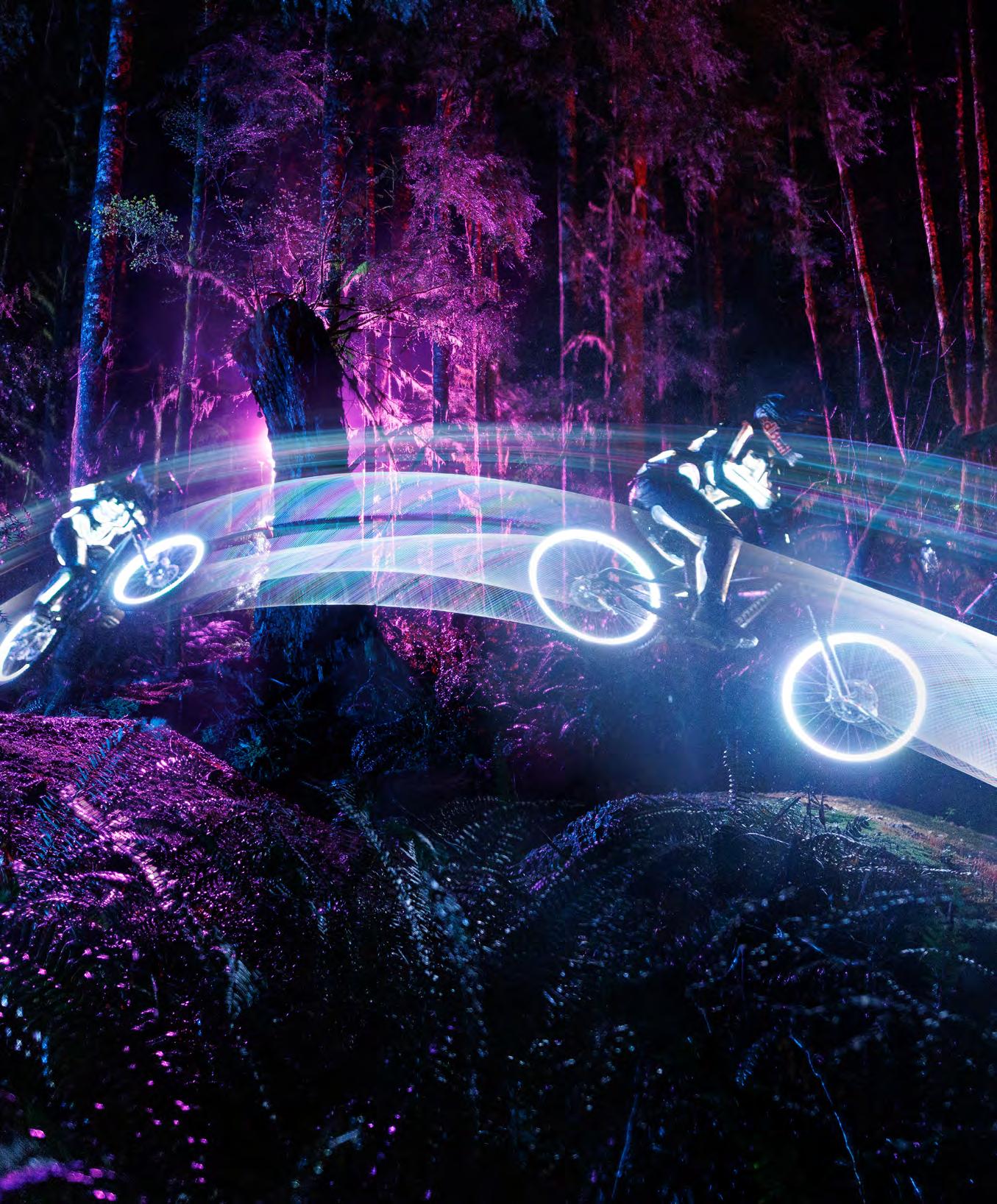
Mountain biker Carson Storch lights up the night trails in a new film.
HOME
A log cabin gets a contemporary update to become an inviting family gathering place.
VENTURES
Farmers markets provide more than produce. Plus, discover WanderHut company.
RESTAURANT
The Hudson reimagines a historic building as Chef George Morris fires up its kitchen.
SAVOR
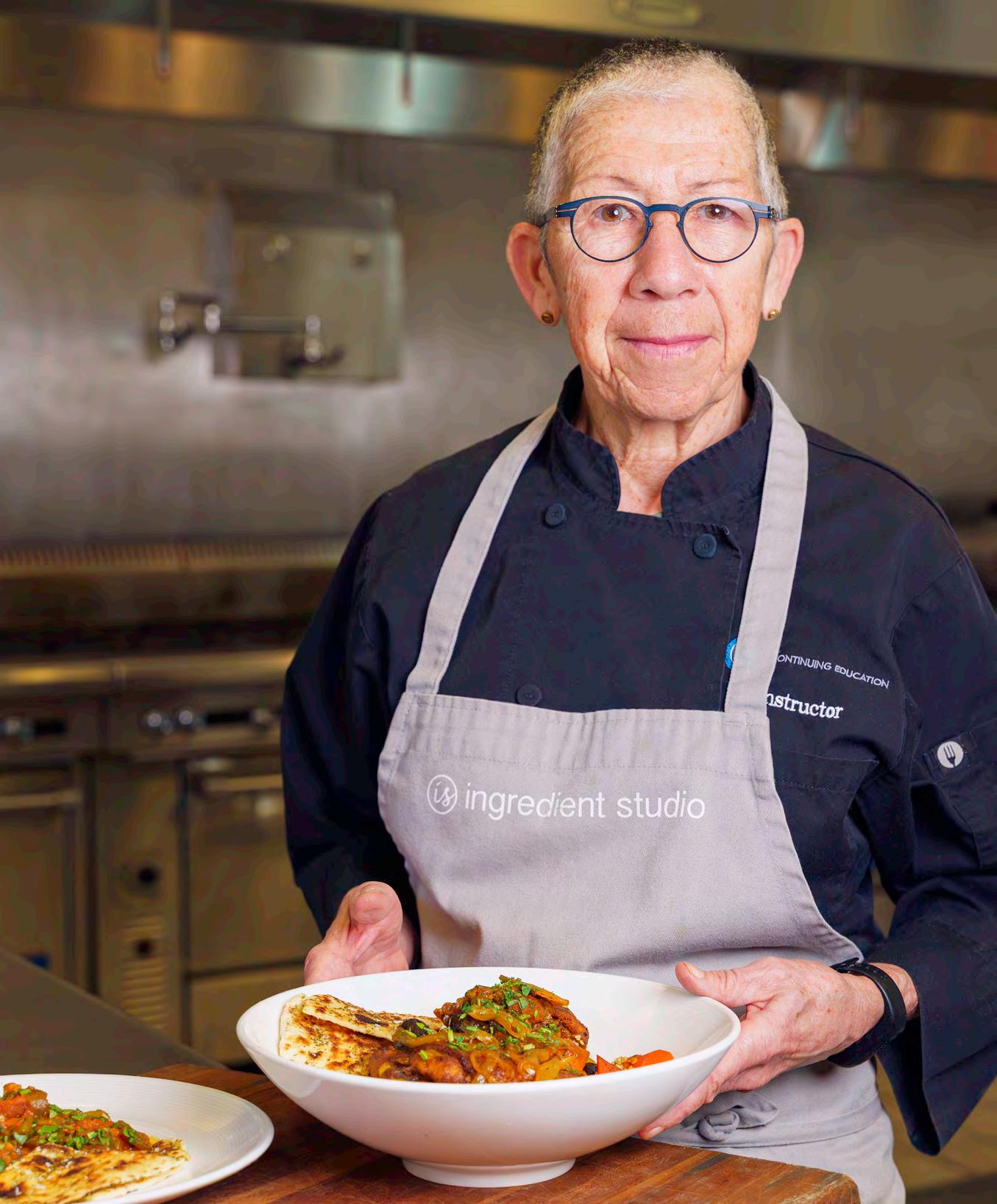
Cooking classes, like those taught by Candy Argondizza, teach techniques and taste.
IMBIBE
Matcha mania strikes, and is served in colorful form at Bend's Pika Pika.
AESTHETIC
A collaboration between Range Revolution and Cyr Beckley yields beautiful results.
ARTIST
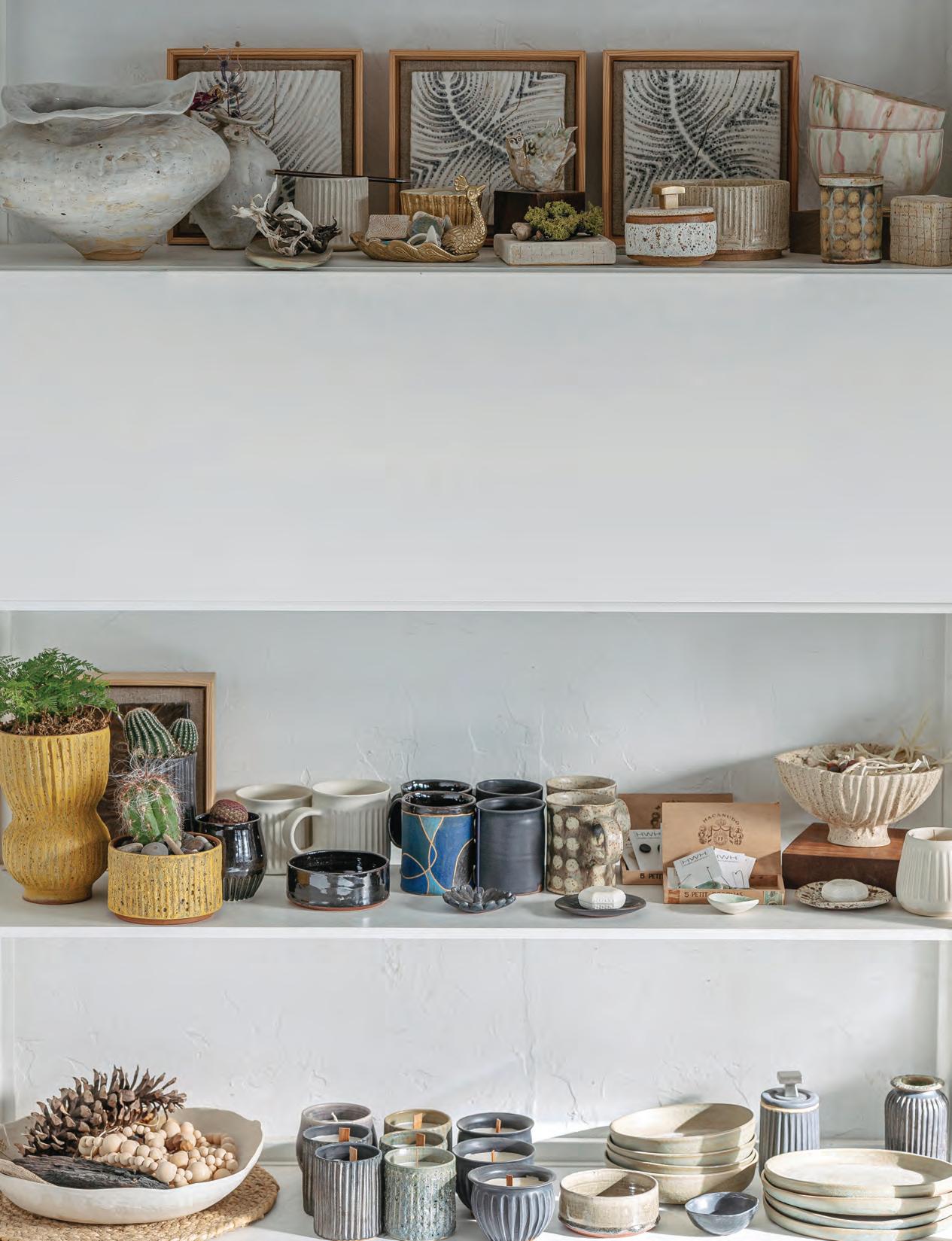
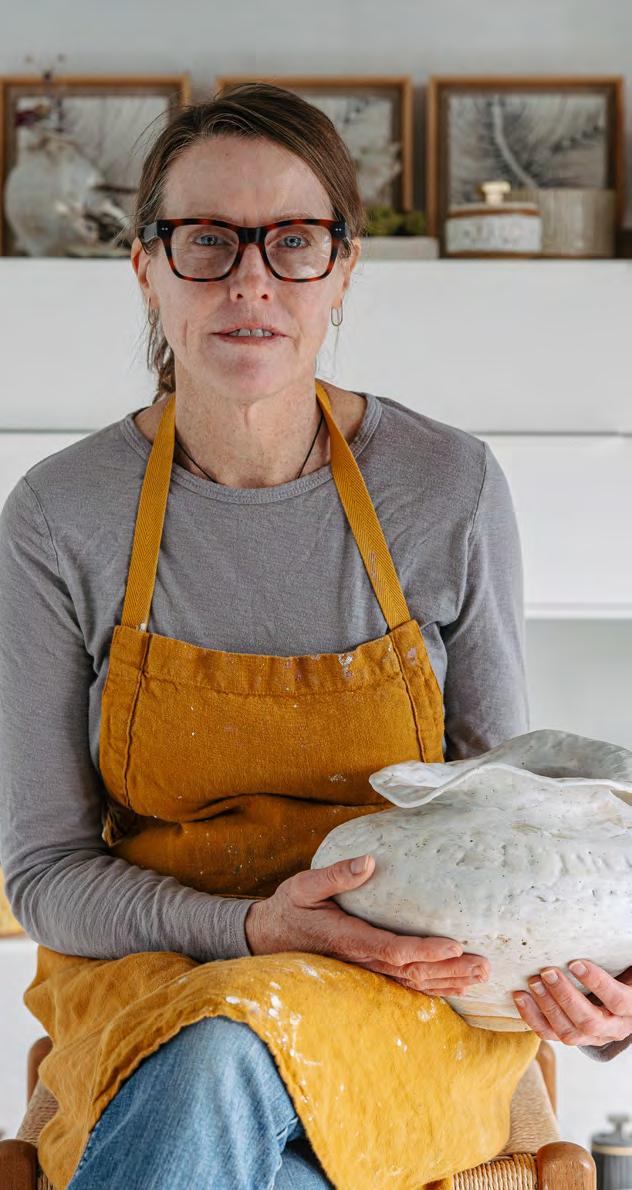
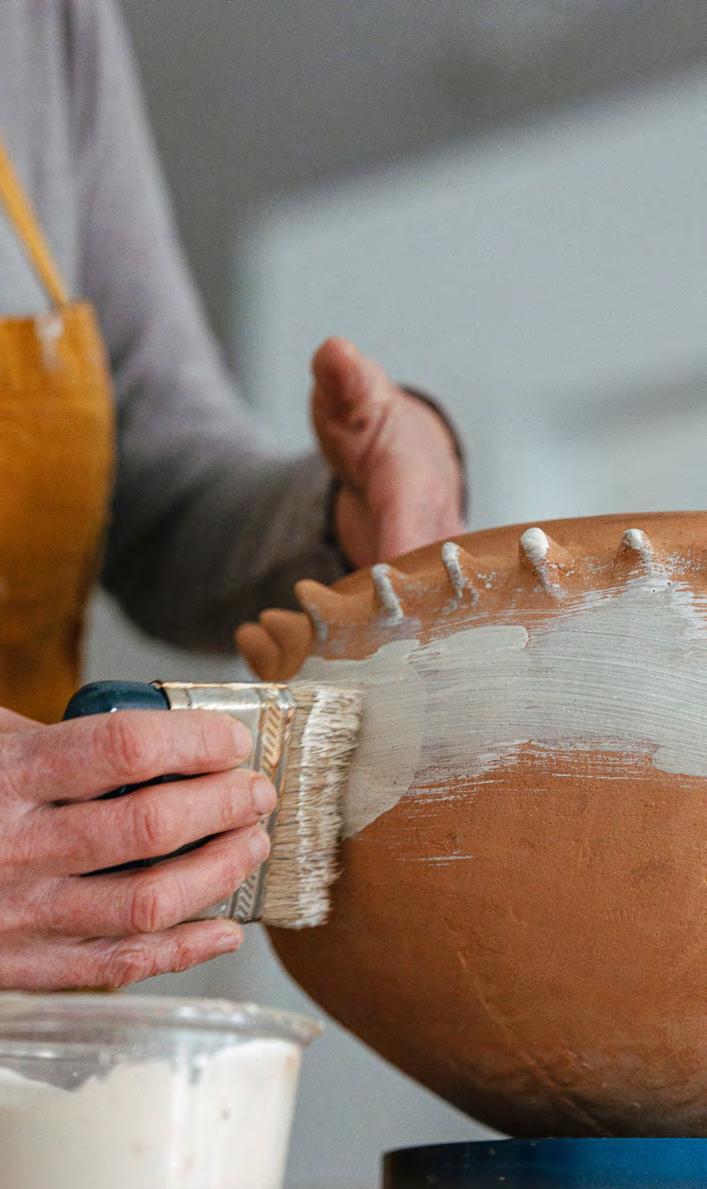
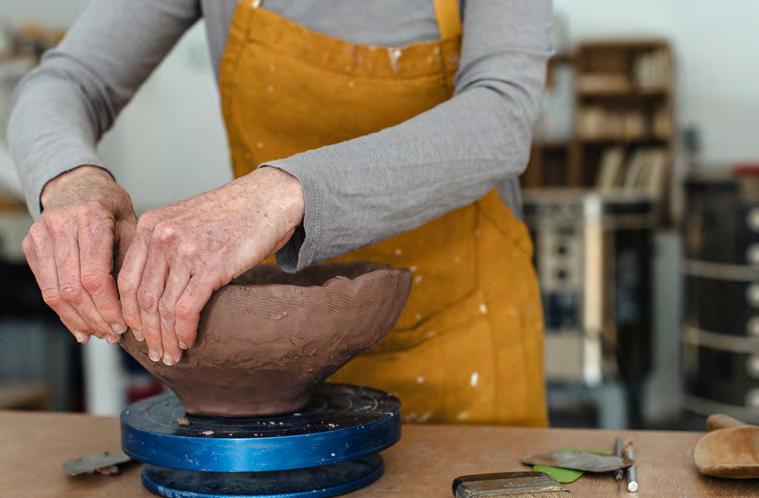
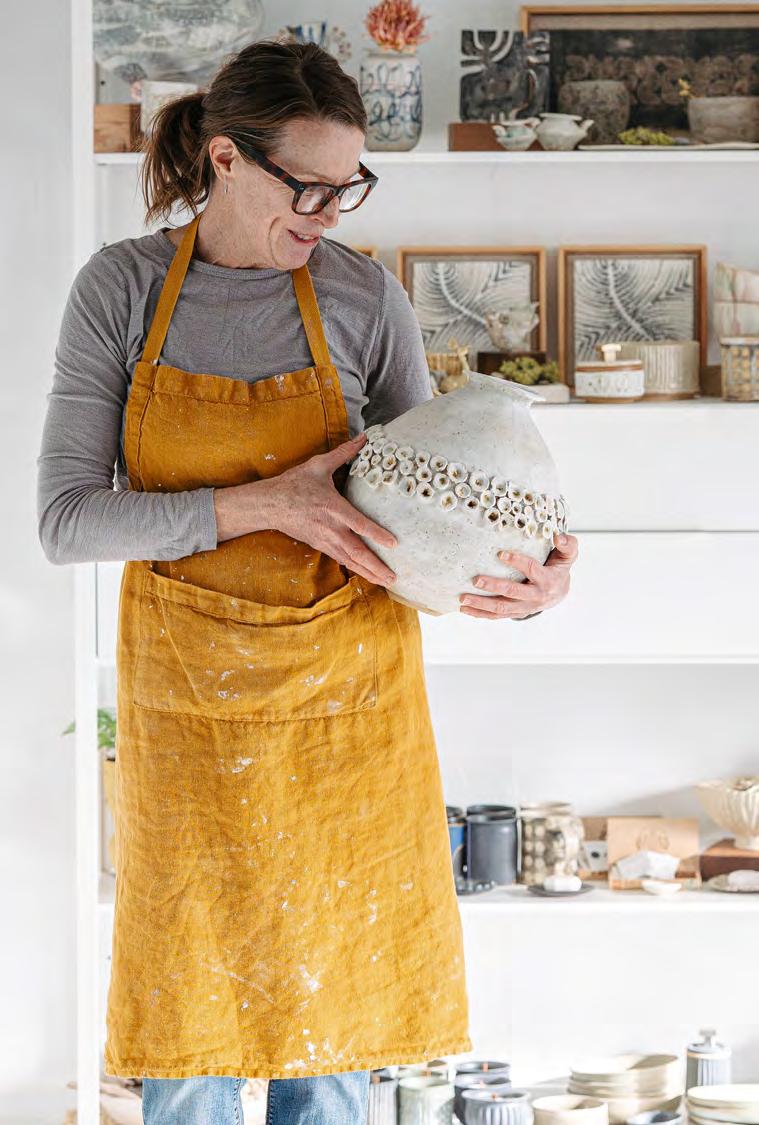
Pottery by Heidi Weiss Hoffman is inspired by nature and simplicity.
CULTURE SHORTS
DIGITAL EXTRAS
Looking for your next favorite restaurant? Search our dining guide to learn more about the top spots at bendmagazine.com/dining-guide.
Learn about what's happening in Central Oregon or upload your upcoming events at bendmagazine.com/calendar.
Sign up for our newsletter to receive weekly seasonal activities and recommendations, read digital-only articles, plus stay connected at bendmagazine.com.
FLOWER FARMERS
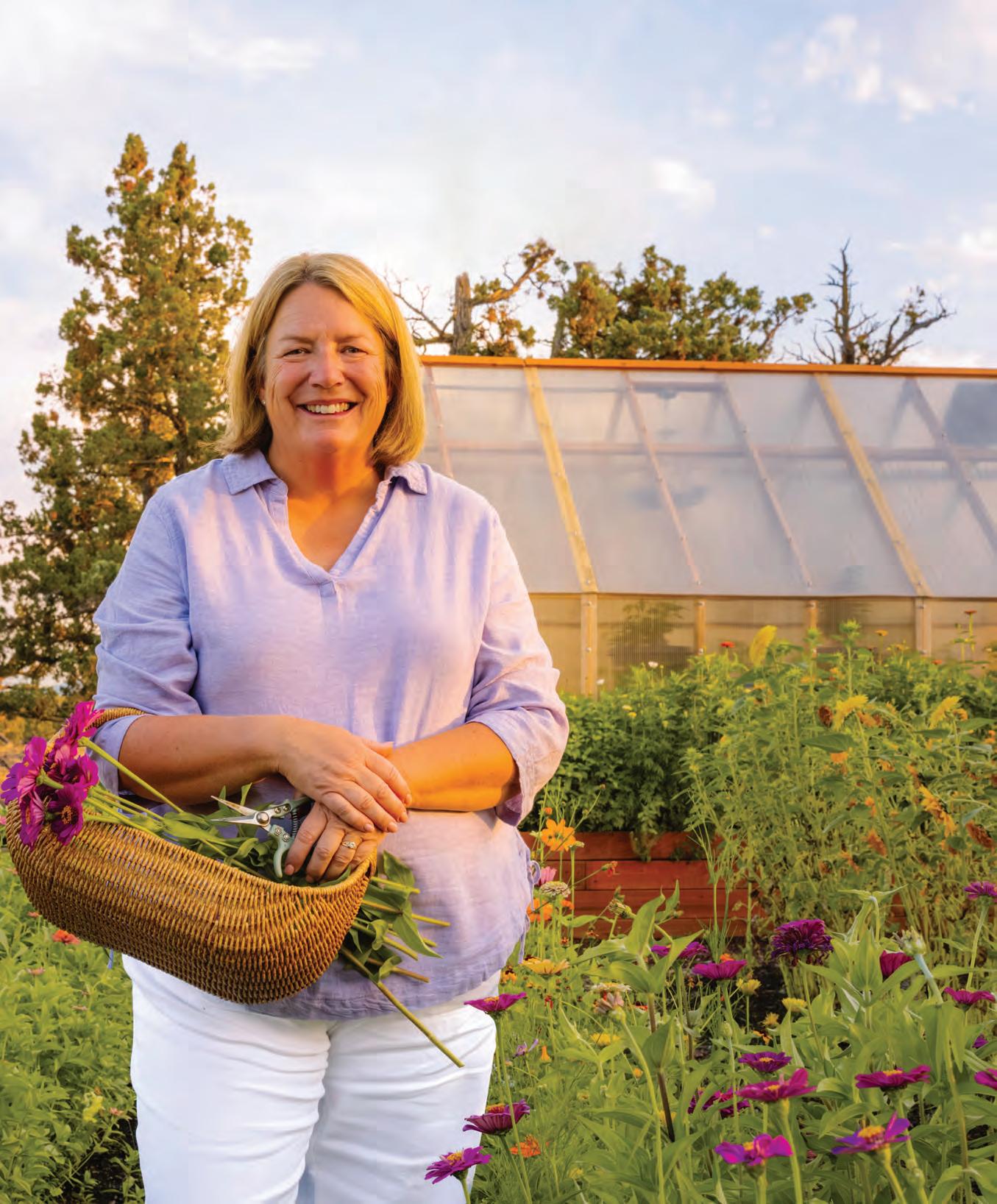
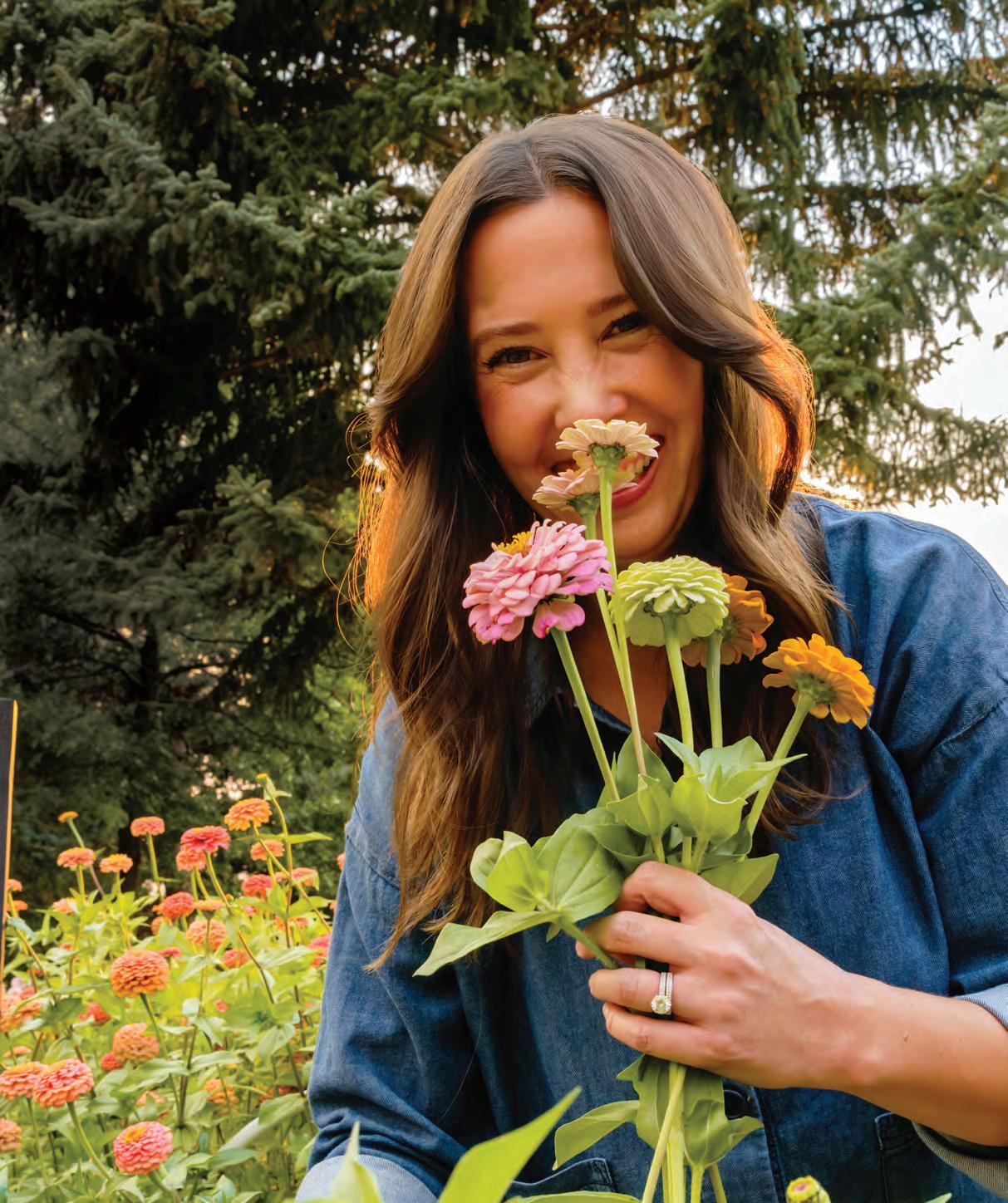
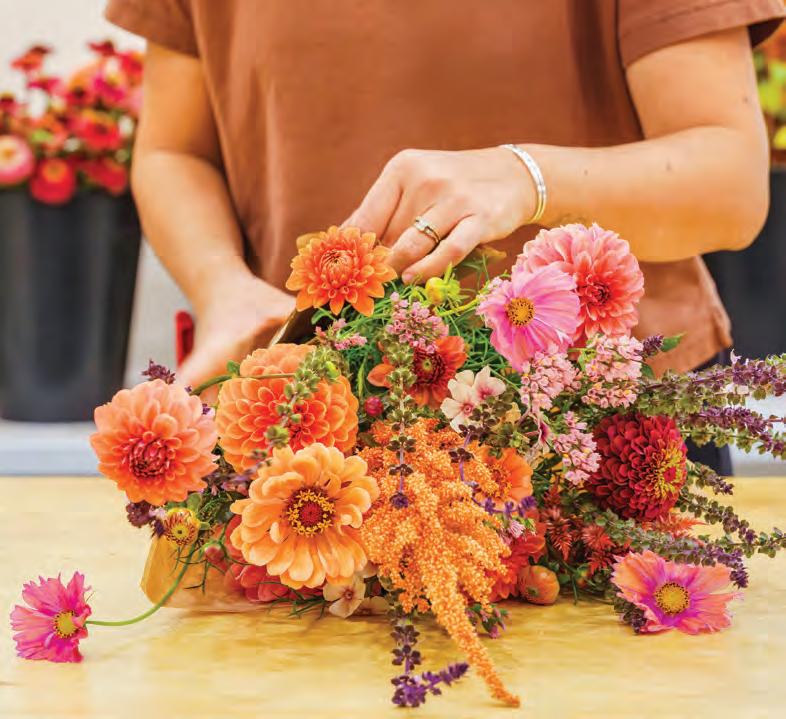
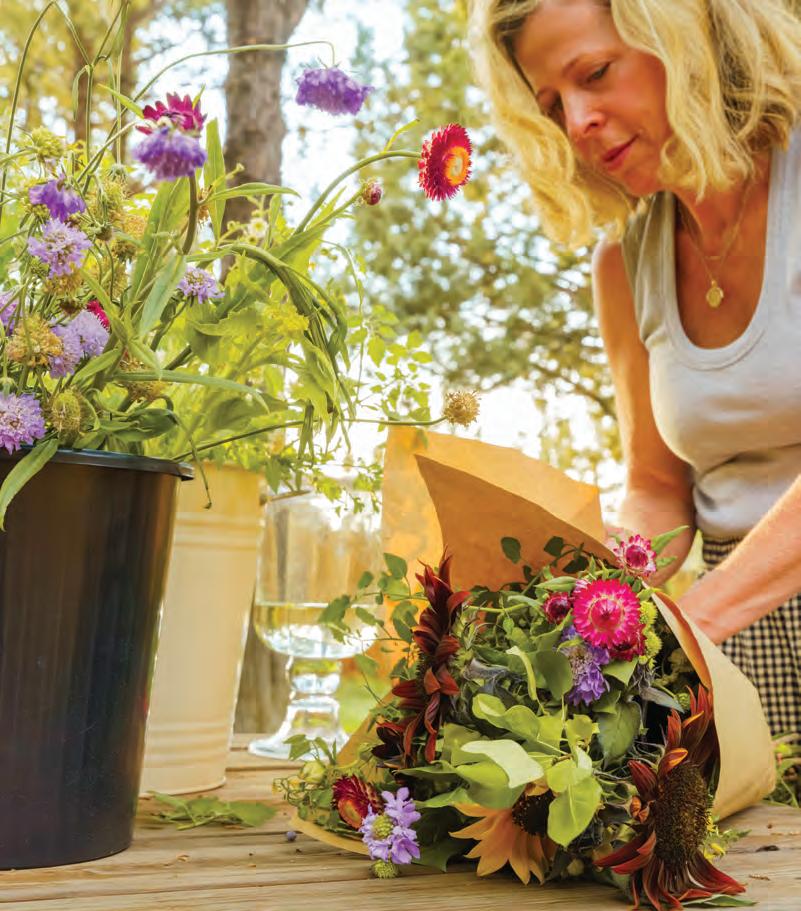
From dahlias to lavender, Central Oregon blooms brighten markets and events.Meet the growers who cultivate not only flowers, but also a resilient community rooted in connection, creativity and care for the land.
Written by Irene Cooper
OLYMPIAN JESSICA MENDOZA
The path from being a gold medalist to an ESPN analyst and advocate reflects a life of hard work. Jessica Mendoza’s impact in the community plays out beyond the softball field.
Written by Mira Hansen.
FOR THE LOVE OF FISHING
Days on the river blend quiet focus with the thrill of the catch. Expert guides turn time on the river into an education that is about more than fly fishing. Written by Suzanne Johnson 78 84 72
ON THE COVER
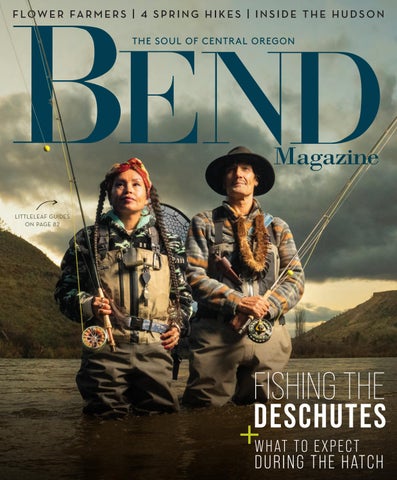
FISHING THE DESCHUTES
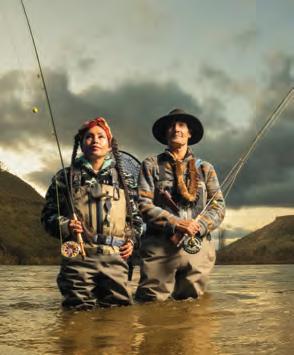
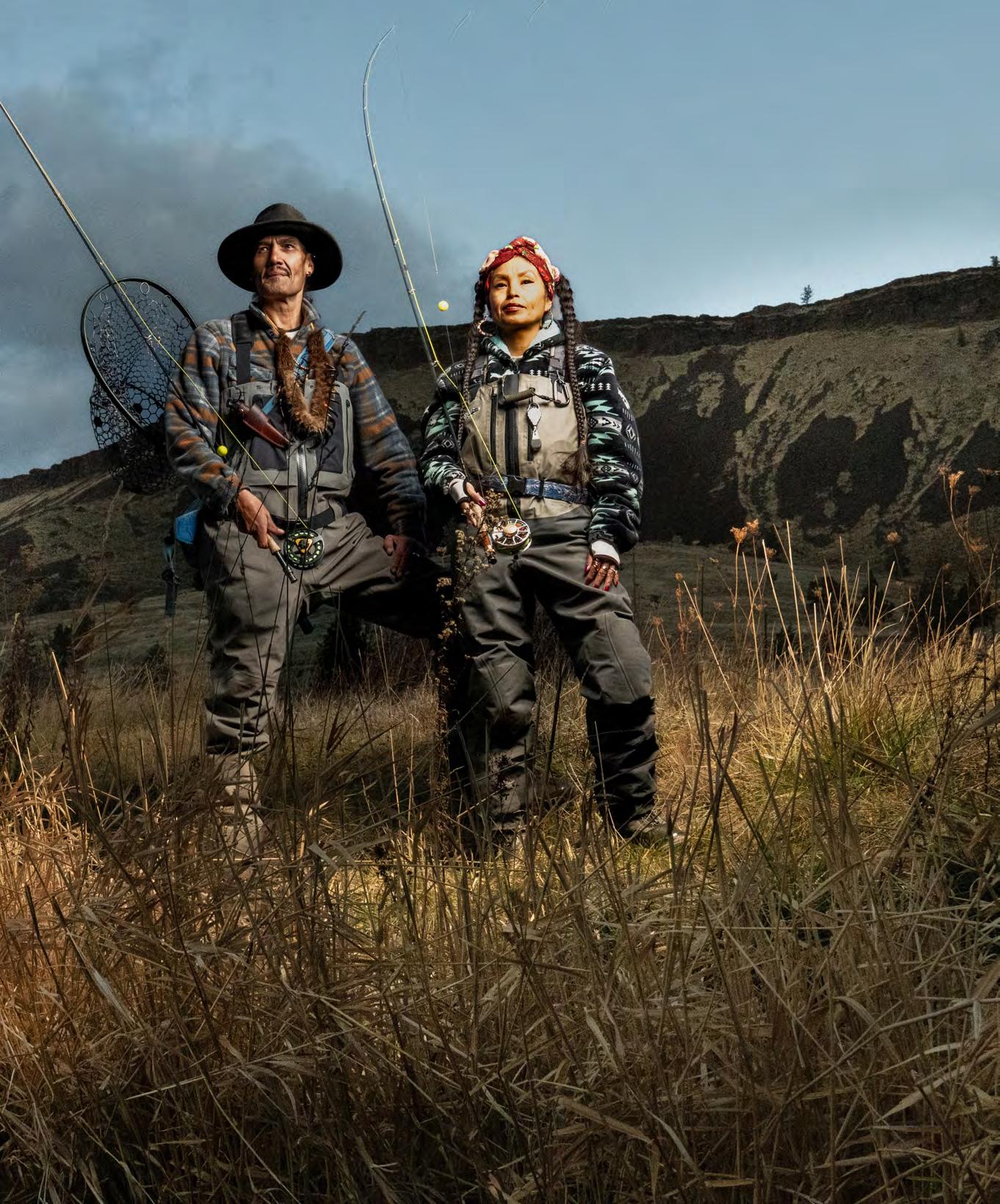
PHOTO OF ALYSIA AND ELKE LITTLELEAF BY CHAD BROWN. READ MORE ON PAGE 82.
PHOTO BY CODY RHEAULT
OUR Con tributors
JOE POTOCZAK WRITER
An award - winning photographer, filmmaker, Navy veteran and conservationist, Chad Brown's work fuses visual storytelling with advocacy for wild places and underrepresented communities. As founder of Soul River Inc. and Love Is King, he champions BIPOC and Indigenous voices while leading Arctic expeditions and national conservation efforts. Brown's new films, UNSEEN and EXPOSURE, debut in November 2026, continuing his mission to inspire action, elevate unheard voices, and protect the wild spaces shaping our collective future. He photographed Alysia and Elke Littleleaf for this month's cover.
Irene Cooper’s poems, stories, essays and reviews appear in Denver Quarterly, The Rumpus, Witness, Diagram and elsewhere, and include the poetry collections spare change (finalist for the Stafford/Hall award); even my dreams are over the constant state of anxiety, and the chapbook octets Cooper is the author of two novels, Committal and Found. She teaches and supports AIC-directed creative writing in Central Oregon, where she lives with her “people” and dog Roxy. In another life she was a chef. In this issue, Cooper writes about the poetry of dahlias, plus the challenges and rewards of farming flowers on page 72.
Photographing food, beverages, restaurants and products are all in a day’s work for Tina Paymaster. From spending hours in the darkroom in high school to studying photography in college, Paymaster loves how the world can transform into something magical through the lens and editing processes. Her journey has led her to careers in graphic design, health, nutrition coaching and commercial photography. Paymaster loves to create imagery that tells a story and leaves the observer hungry for more. For a story on The Hudson, she focused her lens on the food and the founders. See page 91.
A Corvallis-based writer, Joe Potoczak is the digital editor of Paddling Magazine. His articles have appeared in Men’s Journal and Outside, among other publications. He grew up wandering around New Jersey’s Pine Barrens, has paddled on four continents, and is a former member of the U.S. kayak team. Potoczak has always struggled to sit still—and it may seem fitting, given his line of work chasing stories. To this day, when asked his favorite river, he replies, “the one out the door.” For this issue, he wrote about late spring whitewater rafting options close to Central Oregon. Read Potoczak's story on page 33.
Freelance photographer and writer Katie Sox has spent much of her creative career in the bicycle industry, capturing mountain biking and bikepacking events, as well as architecture, real estate, commercial and lifestyle imagery. She loves storytelling and has published work for the independent biking website The Radavist. Sox’s balance is deeply rooted in her work as a practicing massage therapist. When she’s not riding bikes, Sox enjoys life’s simple details, good food and community. Explore the Painted Hills and the bikepacker's Spoke'n Hostel on page 39.
TINA PAYMASTER PHOTOGRAPHER
CHAD BROWN PHOTOGRAPHER
KATIE SOX WRITER + PHOTOGRAPHER
IRENE COOPER WRITER
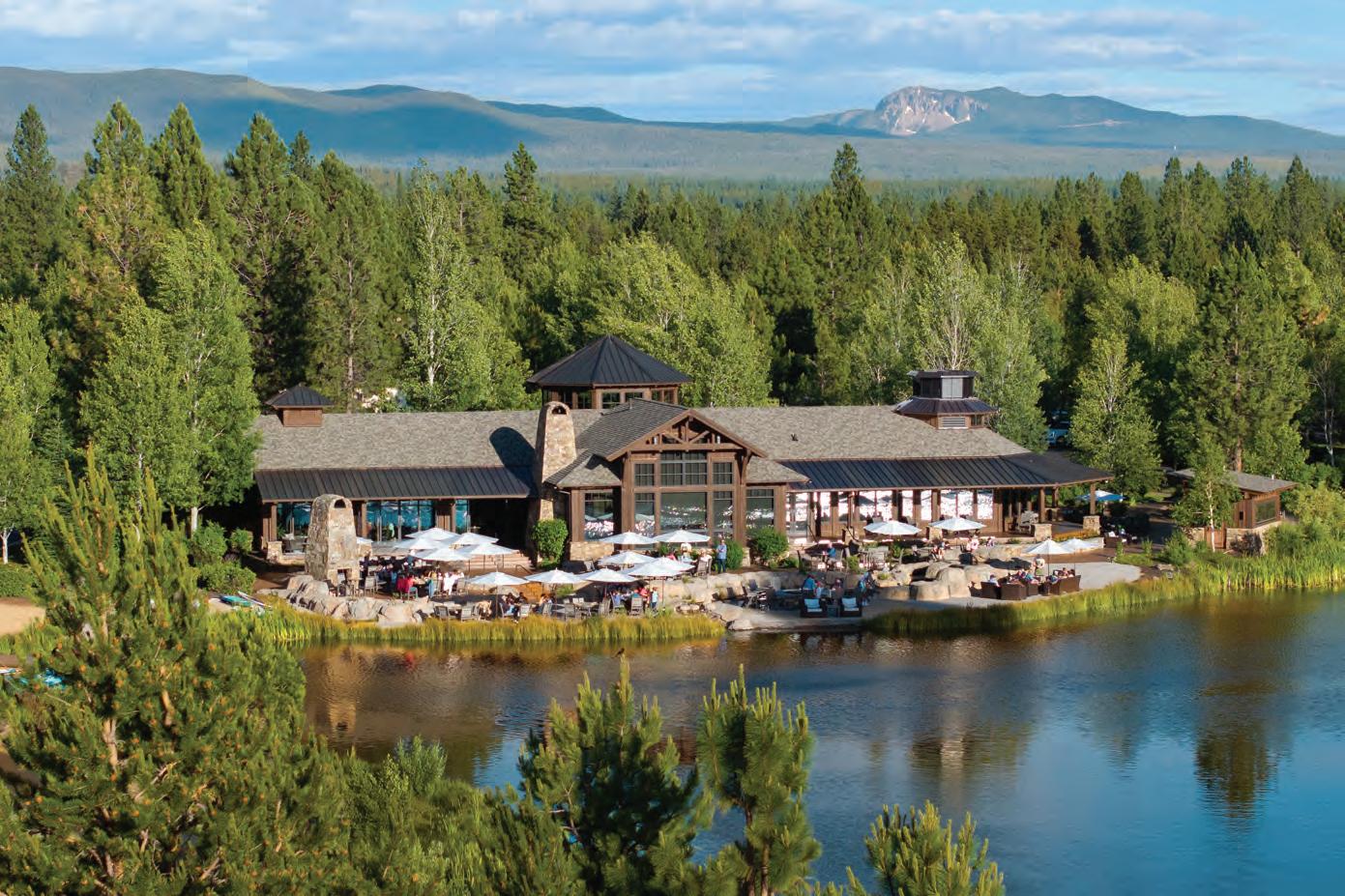
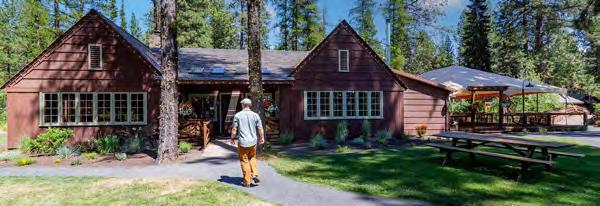
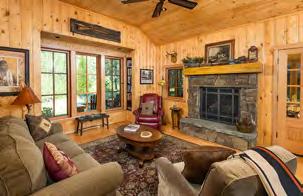
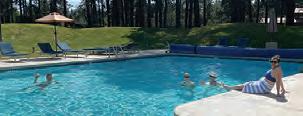
Stay at Historic Lake Creek Lodge
PUBLISHERS
HEATHER HUSTON JOHNSON
ROSS JOHNSON
EDITORIAL
Editor in Chief CHERYL PARTON
Managing Editor KATIE HENRY
Custom Publications Editor HEIDI HAUSLER
Podcast Host ADAM SHORT
Staff Writer SIENA DORMAN
Copy Editors LEE LEWIS HUSK, STEPHANIE BOYLE MAYS
DESIGN
Executive Creative & Brand Director JON TAYLOR CARTER
Creative Director CALI CLEMENT
Senior Graphic Designer JEREMIAH CRISP
Graphic Designer LIBBY MARSDEN
Print Consultant CLARKE FINE
SALES
Sales Manager RONNIE HARRELSON
Senior Account Executive SUSAN CROW
Account Executives BOOTSIE BODDINGTON, BOB GORHAM, KIM MOLNAR
BUSINESS & MARKETING
Marketing Director CALI CLEMENT
Director of Operations HEATHER RENEE WONG
Sales and Marketing Assistant MCKENZIE KLECKER
Office Assistant KIM PAGE
AUDIENCE DEVELOPMENT
Circulation Manager AMARA SPITTLER
Newsstand Coordinator ALAN CENTOFANTE
CONTRIBUTING WRITERS
SUZANNE BELL, CATHY CARROLL, IRENE COOPER, DAMIAN FAGAN, MIRA HANSEN, CASEY HATFIELD-CHIOTTI, SUZANNE JOHNSON, MIKE MACY, JOE POTOCZAK, KATIE SOX
CONTRIBUTING PHOTOGRAPHERS
CYR BECKLEY, CHAD BROWN, AGNIESZKA JAKUBOWICZ, TAMBI LANE, LEAR MILLER, TINA PAYMASTER, MADDIE PHILLIPS, CODY RHEAULT, TYLER ROEMER, KATIE SOX, NATE STEPHENS, MARTIN SUNDBERG, WHITNEY WHITEHOUSE
FIND US ONLINE BENDMAGAZINE.COM INSTAGRAM + FACEBOOK: @BENDMAGAZINE
SUBSCRIPTIONS BENDMAGAZINE.COM/SUBSCRIBE
PUBLISHED BY OREGON MEDIA, LLC 974 NW RIVERSIDE BLVD. BEND, OREGON 97703 OREGONMEDIA.COM BEND MAGAZINE Issue 3 May 2026 (ISSN 29951860) is published bimonthly by Oregon Media, LLC, 70 SW Century Dr. STE 100-474, Bend, OR 97702. Periodicals Postage: Paid at Bend, OR, and at additional mailing offices. Postmaster: Send address changes to Bend Magazine at P.O. Box 291961, Kettering, OH 45429
All rights reserved. No part of this publication may be reproduced or transmitted in any form or by any means, electronically or mechanically, including photocopy, recording or any information storage and retrieval system, without the express written permission of Oregon Media. Articles and photographs appearing in Bend Magazine may not be reproduced in whole or in part without the express written consent of the publisher. Bend Magazine and Oregon Media are not responsible for the return of unsolicited materials. The views and opinions expressed in these articles are not necessarily those of Bend Magazine, Oregon Media or its employees, staff or management. Proudly printed in Oregon.
STYLE in every home.
SOUL in every street.
STRENGTH in every connection.
Find your happy place here. On Bend’s west side, Discovery West is more than a neighborhood—it’s a place where neighbors linger over coffee at the community plaza, and shops, parks, schools, and trails come together seamlessly to make everyday life better. Here, joy is in the little moments, and the best of Bend is right outside your door. Learn more at discoverywestbend.com, visit the Sales Center at Discovery West or call (541) 383-4360.
Edi tor’s LETTER
When salmonflies hatch each May, it’s not just the fish that stir. The cyclical event draws anglers to the Lower Deschutes River in pursuit of a once-in-aseason (or lifetime) catch. And with each cast, they’re linking to something larger.
For me, fishing makes me think of home since it shaped my family culture growing up. I was always a little envious of the language my dad and brother shared on the water. Watching them wrap and resin their handmade rods in the garage, I eventually understood that fishing was a shared space to connect as much as it was about catching Moby Dick. If I wanted to join the conversation, I’d have to cast a line myself.
We’re all part of Central Oregon’s community that welcomes us to connect if we’re willing to take action and join the conversation. This year at Oregon Media, we entered a growth phase of our own with the launch of O.M. Studio—a creative suite we offer for companies seeking content, design and brand strategy stemming from the foundation of our titles: Bend Magazine, Bend Home + Design, Savor and High Desert Weddings. Meanwhile, seasons marched ahead. Spring arrived underfoot, dusted with a few late-arriving snowflakes, which isn’t too surprising—it has been known to snow in Bend on the Fourth of July. In this issue, we bring together stories about planning for the future while being prepared for the unexpected. Meet Central Oregon flower farmers whose work reflects what anglers and gardeners alike
WITH OUR INVESTMENTS IN EACH OTHER, WE CONTINUE TO BUILD OUR COMMUNITY, AND AS YOU READ, YOU MAY LEARN HOW WE’RE ALL A BIT HOOKED ON BEND.”
understand: timing, patience and respect for the elements yield rewards—even in unpredictable conditions, like April snowstorms. I spoke with Alysia and Elke Littleleaf, featured on our cover, who share ancestral Indigenous knowledge through their work as fly-fishing guides on the Warm Springs Reservation. You’ll meet Olympian Jessica Mendoza, who has transformed her career from gold- and silver-medal-winning softball player into an advocate for women in sports.
Mountain biking phenom Carson Storch returned from a freeride expedition in Chile and talked to us about his Oregon ride under night skies for the film Mountains of the Moon. For another story, we woke up early for a pop-up dance party with coffee in hand. Then, with a cocktail in hand, we spent time observing the kitchen with Chef George Morris of The Hudson, whose story stretches from the Basque countryside to our table. Writing about his work reminded me that my mom and I shared our own language—it just happened to be spoken in our family kitchen.
Thank you for spending time with us as we reached back to our roots while also planting seeds for the future growth of Oregon Media and Bend Magazine. With our investments in each other, we continue to build our community, and as you read, you may learn how we’re all a bit hooked on Bend.
Cheryl Parton, Editor in Chief
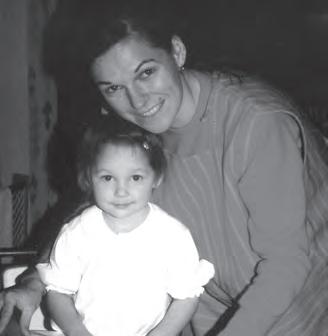
Me and Mom in the kitchen.
PHOTO BY MAILE MASON
ON the WEB
1. BIG PONDEROO: On June 26-27, the music and arts festival returns to Sisters, Oregon. See more at bendmagazine.com/big-ponderoo-festival 2. CALLING ALL DOG LOVERS: Bend had been called Dogtown, U.S.A. Head to bendmagazine.com/the-dog-whisperers-of-bend to find events, daycare or trainers for your pups. 3. IT’S MARGARITA SEASON: Celebrate sunshine in a glass, like these sippers at El Sancho in Bend. Then, take a peek at 42 sample menus from local restaurants in Savor magazine at bendmagazine.com/savor-dining-guide BONUS ISSUES: Get a FREE year of Bend Magazine delivered by mail with code SUMMER4 at bendmagazine.com/subscribe.
What if your effort made all the difference ?
What if your idea launched a program that saved thousands of acres from wildfire? What if you funded school lunches that fed the next generation of Oregonian ingenuity? What if you gave yourself the audacity to ponder how to make Oregon even better? Maybe you start a scholarship. Or support a nonprofit — or become a volunteer. We’re your statewide community foundation, and together we turn your ‘What ifs’ into powerful ‘Why nots.’ What if you joined us?
A Library for the Future
Bend’s Central Library at Stevens Ranch was built for more than books
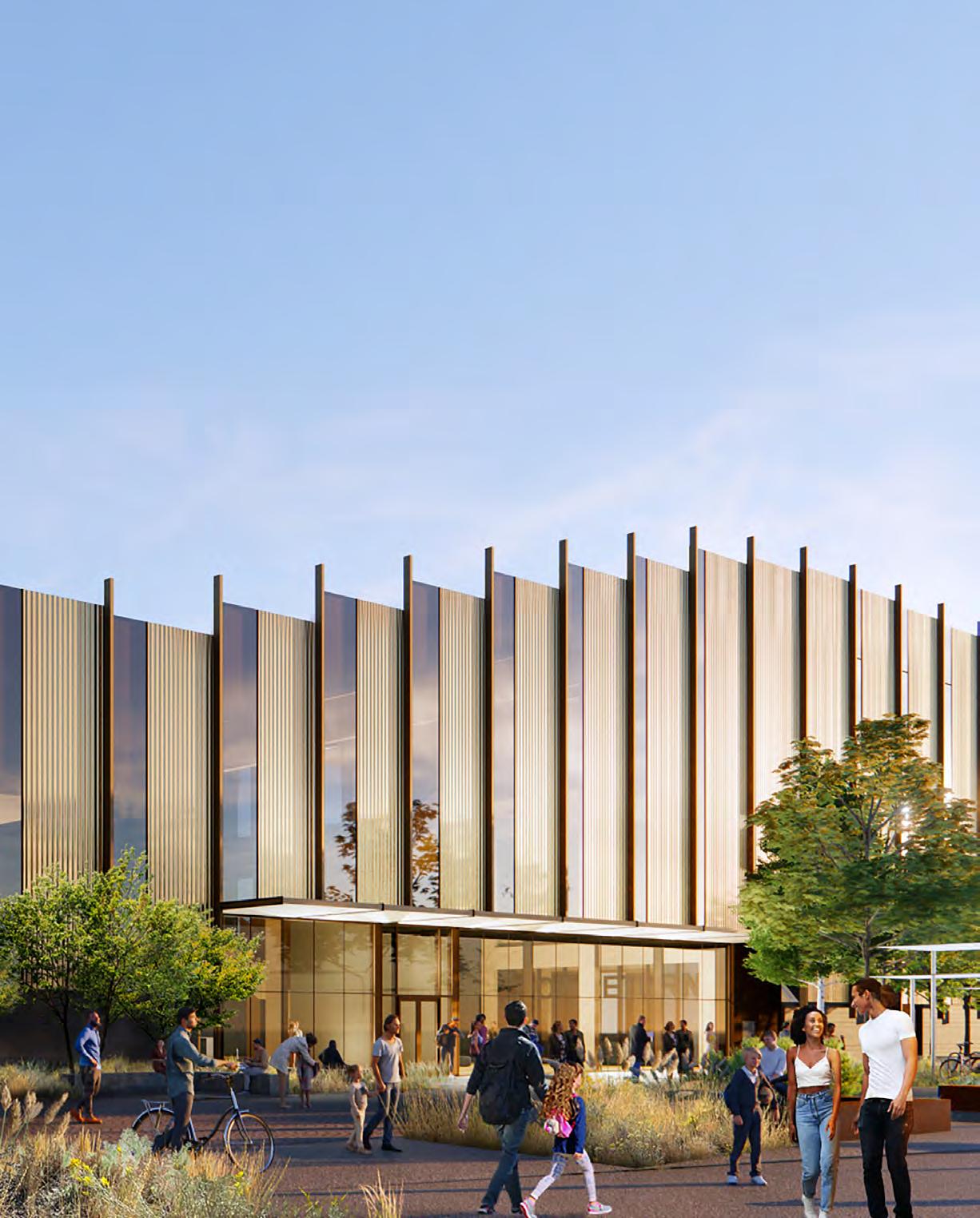
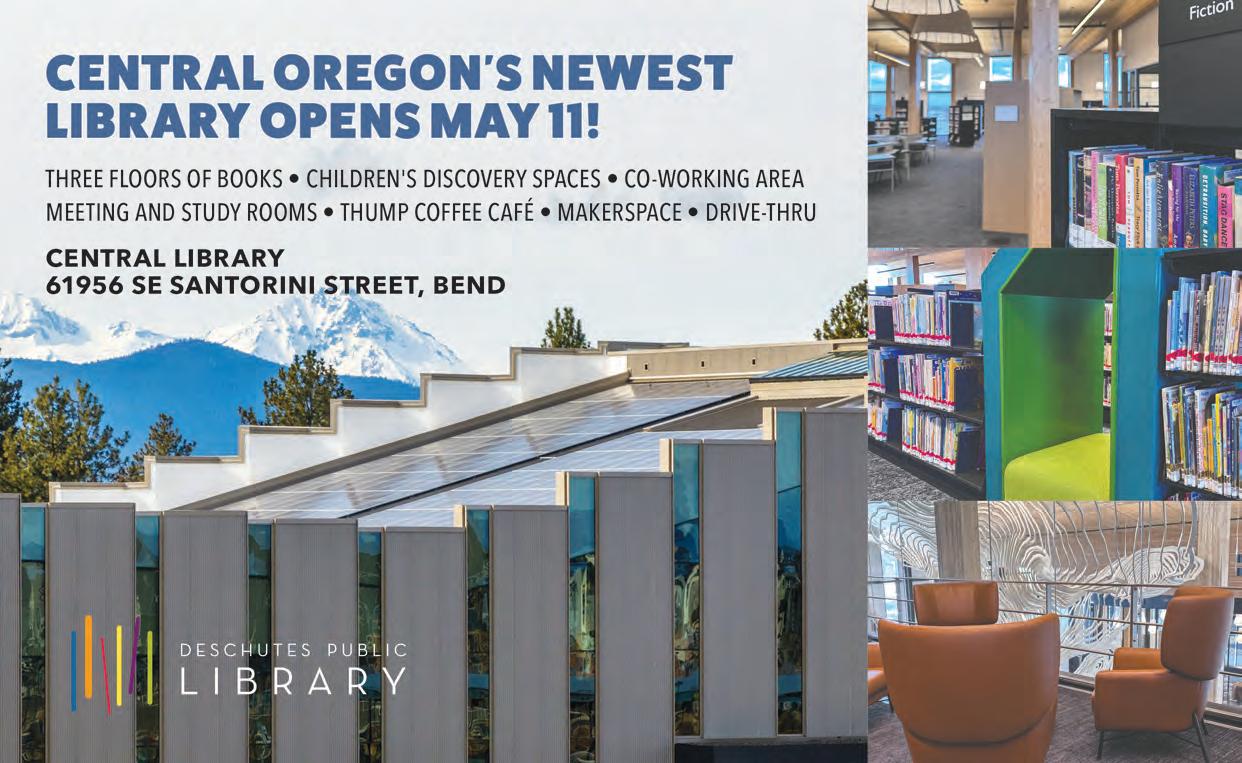
Two years after breaking ground, the new Central Library at Stevens Ranch opened to the public in May 2026 in southeast Bend. The library was designed by Seattle-based Miller Hull Partnership with a sawtooth façade that modulates natural light, and a sloping roofline that echoes Central Oregon’s rugged landscape.
At nearly 100,000 square feet across three levels, the Central Library located on SE Santorini Street is the system’s largest. The interior of the library provides a framework for evolving public use by offering visitors meeting and study rooms, a children’s discovery space, a coworking area for adult collaboration and a maker space for hands-on creativity. Its entryway features a soaring, floating wood sculpture by award-winning artist John Grade suspended above the main staircase. It’s the second work for the library system by Grade. His piece commissioned for the renovated Redmond Library
drew inspiration from sage plants, while the Central Library installation takes the form of a juniper tree. Additional original works by Pacific Northwest artists are displayed throughout the building.
The new facility joins a family of six libraries across Deschutes County, including branches in Bend, Redmond, Sisters, La Pine and Sunriver. Its funding came from a 2020 bond measure to expand and improve libraries across the county, such as renovations of several branches including Downtown Bend’s library, which temporarily closed in April for remodeling. It is slated to reopen in spring 2027. “Bend’s last library was built more than 20 years ago, so it’s essential that our library system keeps pace with our county’s growth,” said Deschutes Public Library Director Todd Dunkelberg. See deschuteslibrary.org
WHAT WE love
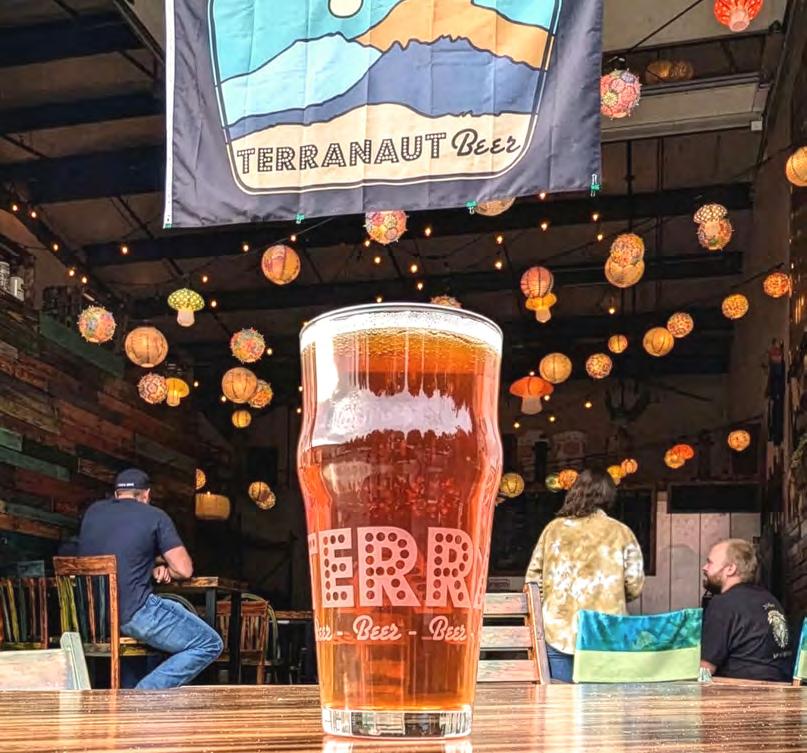
WHAT WE ARE DRINKING: TERRANAUT BEER
Votes from the 2025 Oregon Beer Awards were counted, and Bend’s newest brewery, Terranaut, emerged victorious. We raise a pint to its Small Brewery of the Year award and to a gold medal for its UK-style beer Leave It, B. With 1,054 entries from 100 breweries in more than 29 categories, the awards brought out the best of Oregon craft brewers—and our thirst. See terranautbeer.com.
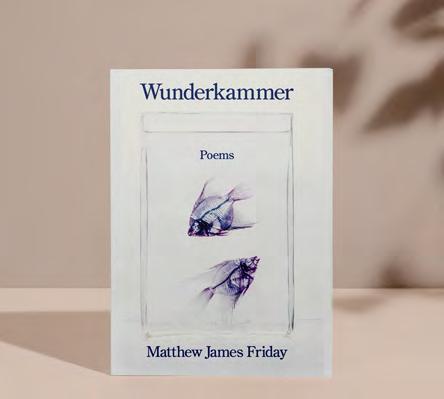
WHAT WE ARE READING: A POETRY COLLECTION OF CURIOSITIES
Leave it to a poet to help us make sense of the world. In his new collection of poetry Wunderkammer, Bend’s Matthew James Friday reflects on themes of nature, science, the exotic and the enigmatic. He writes of his intentions in “Fishing for Poems” to “cast off in the current of images and ideas,” many of which are recognizable: from the Deschutes River or Highway 97 to osprey, otters and Douglas fir. The word wunderkammer translates from German as a cabinet of curiosities, and Friday equates our planet to a shared collection of treasures. See matthewfriday.weebly.com.
WHAT WE ARE WAITING FOR: BEND BLUES FEST
“What’s your progression?” is a question founders of Bend Blues Fest, Bob Dougherty and Mac Leckrone, ask when they meet fellow musicians. They hope to build a progression for the second annual festival to be held June 27 by amplifying its volume and lineup. The spirit of the blues is resilience, expression and community building, and this oneday, multi-artist event at Silver Moon Brewing riffs on all three. The day opens with a Gospel brunch, local and nationally known artists, leading up to the headliner Thunderstorm Artis who is putting together a blues set just for the event. See bendbluesfest.com.
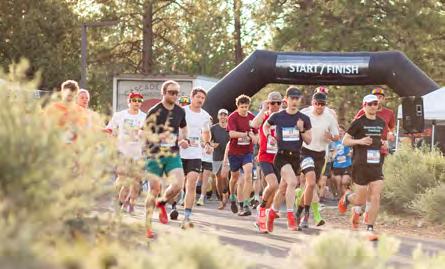
WHAT RACE WE ARE RUNNING: DIRTY HALF AT 25 YEARS
Providing grit, grind and good vibes, the FootZone Dirty Half Marathon celebrates its silver anniversary in 2026. What began as a low-key trail race has grown into a halfmarathon rite of passage with equal parts quad-burn and local bragging rights. As it weaves through the Deschutes National Forest along single-track of Phil’s Trail, the terrain mixes welcome bits of shade with glimpses of the Cascade Range. We love it for the gradual climb, mostly downhill return, post-race celebration at the finish and tell-tale socklines defined by dust. On June 6, we’ll lace up, lock in a pace, and celebrate a quarter-century of getting delightfully dirty. See footzonebend.com.
Large-scale contemporary works designed to define a space. Rotating exhibitions, special events and collaborative showcases from unique artists.
Bend Beauty 809 NW Wall St. bendbeautyspa.com | @bend_beauty_spa
Discover why we were voted Bend’s Best Facial Spa of 2025. Experience advanced, results-driven treatments designed to restore your skin’s natural, healthy glow.
Farmer’s Deli 925 NW Brooks St. | @farmers_deli
Food truck serving quick, grab-and-go sandwiches on Sparrow Bakery bread, plus salads and more—all made with locally sourced ingredients.
Oregon Body and Bath
1019 NW Wall St. | @oregonbodyandbath Boutique with clean, high quality skin care, bath products, candles, luxe bathrobes and sleepwear to create your home sanctuary.
Hot Box Betty 903 NW Wall St. | @hotboxbetty
Dutch + Bow
217 NW Oregon Ave. dutchbow.com | @dutchbow
Chic, planet-friendly women’s fashionstatement clothing and accessories crafted sustainably by small-batch makers who do it differently.
THE soul of CENTRAL OREGON
COLLEEN DOUGHERTY ADVOCATE + PARALYMPIAN
As the 2025 recipient of the Gene Landsmann Gemütlichkeit Award from Travel Oregon, Colleen Dougherty embodies the welcoming spirit of belonging at the heart of the German word gemütlichkeit. A native Oregonian, Dougherty sustained a spinal cord and brachial plexus injury in 1989, leading her to discover adaptive skiing and subsequently launch a program in 1995 that would become Oregon Adaptive Sports (OAS). Today, the nonprofit provides thousands of year-round outdoor adaptive experiences—from snow sports and cycling to golf and paddling—for people with physical and mental disabilities. A Team USA swimmer in the 1996 Atlanta Paralympic Games and regional ambassador for the Kelly Brush Foundation, Dougherty is an OAS board member, artist and home designer, dedicated to creating custom accessible homes in Bend, her home since the late 1990s.
BELLA EMRY
SINGER + AMERICAN IDOL
Earning a golden ticket on Season 24 of American Idol and advancing into the show’s Top 30, Bend singer Bella Emry hopes to turn her love for singing into a full-time music career. The 22-yearold, who moved to Central Oregon from the Yamhill-Carlton area seven years ago, captivated judges with her guitar rendition of Morgan Wallen’s “I’m a Little Crazy.” Before submitting an audition video to the show, singing was a hobby Emry mostly kept to herself—her American Idol performance was only her second time performing in public. When not playing the guitar, she works at Yoli, a Korean restaurant in Bend, and at her family’s business, Superior Concrete Restorations. Emry will be the opening act for the first show of the Summer Kickin’ Concert Series at General Duffy’s Waterhole in Redmond on May 22.
AIDAN O’NEILL SPORTS BROADCASTER
The voice of Bend Elks Baseball Club, announcer Aidan O’Neill recently earned national recognition as the 2026 Intercollegiate Broadcasting System award winner for Best Baseball/Softball Play-by-Play Broadcaster. A current junior studying sports journalism at Arizona State University’s Walter Cronkite School of Journalism and Mass Communication, O’Neill’s love of sports sparked his dream of becoming a professional broadcaster. In college, he serves as Head of Broadcast for the student-run Blaze Radio, coordinating more than 400 broadcasts each season while also hosting an award-winning sports talk show “The Irish Hello.” This summer, O’Neill returns to the broadcast booth at Vince Genna Stadium for another West Coast League season.
Timing the River’s Flow
Find places to hit Oregon’s whitewater this season
WRITTEN BY JOE POTOCZAK
Central Oregon is a place of seasons and cycles, and what winter means to skiing, spring means to whitewater. Rain and lingering snow run downhill, tumbling and frothing as the water fills streams. Boaters anxiously preparing at home watch for river gauges to climb like the slope of South Sister, and rally to catch fleeting peak flows before they recede with the summer. Bend is perfectly situated for river runners to call home, with adrenaline-inducing day trips and epic multidays down forested gorges and desert canyons in every direction. Learning river sections, rapid lines and water levels, though, is a continuing education that is half the fun, but also a puzzle. Fortunately, Bend is home to an array of outfitters offering guided trips or equipment rentals. Shops like Tumalo Creek Kayak & Canoe have all the gear you need and also serve as gathering places for the community to foster river knowledge and find a crew. Once you are ready to rig up, the list below includes information for classic Central Oregon river runs, with options for everyone, whether you are a rookie rafter or your Capilene has been through the wringer.
DAY TRIP ON THE MCKENZIE RIVER
Olallie Campground to Paradise Campground, 8 miles, Class II-III
If there is a river near Bend to see spring water to the fullest, it’s the McKenzie. Just on the other side of the Santiam Pass, the McKenzie River drains the western slope of the Cascade Crest from Three Fingered Jack south past South Sister. During winter and spring, massive amounts of precipitation dump onto the western flank of the panoramic peaks, resulting in rising gauges on the McKenzie.
There are nearly 50 miles of Class II-III access and options from Olallie Campground to the town of Vida. The section from Olallie to Paradise campgrounds is vintage Upper McKenzie at spring levels, with continuous rapids, clear water and the intoxicating scent of Northwest forest. The put-in is also the closest to Bend. Don’t underestimate the McKenzie’s difficulty rating; the fast, shallow rapids test river reading skills and vigilance is required for channel-blocking logs (which are also reported by the Oregon State Marine Board).
No permit limitations on the McKenzie. With the proper gear and some insight on various water levels, rafters can tackle it anytime. Guided trips are also available with Ouzel Outfitters, Horse Creek Lodge or Helfrich McKenzie Rafting.
LEARN TO GUIDE ON THE LOWER DESCHUTES RIVER
Harpham Flat to Sandy Beach, 10 miles, Class III
Every year, rafting outfitters in Oregon are in search of a few good river guides to join their ranks and take thrill-seekers down one of the state’s most popular runs, the Lower Deschutes River. What makes the Lower Deschutes a beloved commercial stretch is also the ideal proving ground. The Lower offers healthy flows in the spring, continuing with reliable flows all summer. The section’s class-III rapids are approachable and reasonably forgiving. River guide or not, it’s one of the best whitewater classrooms to learn the ropes in an oar rig or part of a paddle team.
Bend-based Ouzel Outfitters and Maupin’s River Drifters put recruits through training camps lasting between one to three weeks, beginning with a few days on the Deschutes River to teach raft technique, reading whitewater and rescue skills. Local outfitters see training as a last stage of the process to develop a limited roster of new guides, with some programs starting as early as April and others as late as June. That means if you are reading this in May, the window to make this year’s cut is closing. If you’re dreaming of river legend status, put down this magazine and get in an application.
PHOTO BY RICHARD BACON
Temma Tamai
MULTIDAY TRIP ON JOHN DAY RIVER
Clarno to Cottonwood, 69 miles, Class II-III
Oregon is blessed with more renowned multiday stretches than can be counted on one hand, the 70mile Lower John Day River being one of them. The John Day is free-flowing and at its best median water levels between March and early May, with snowmelt draining from multiple ranges across the Blue Mountains. Spring rafters also beat the armada of summer trippers. Ouzel Outfitters training manager, AJ Untermeyer, wisely acknowledges, however, there is always a compromise on Oregon rivers between water, people and weather. Up until June, the weather can be anything from mild and sunny to snowstorm. If you are prepared, beating the crowds and riding the highest flows is the way to experience this classic trip across several days, making it approachable for families and diverse skill levels.
Outfitted trips are available from Central Oregon companies, including Ouzel Outfitters.
MAGIC ON THE METOLIUS
Riverside Campground to Lower Bridge Campground, 10 miles, Class III
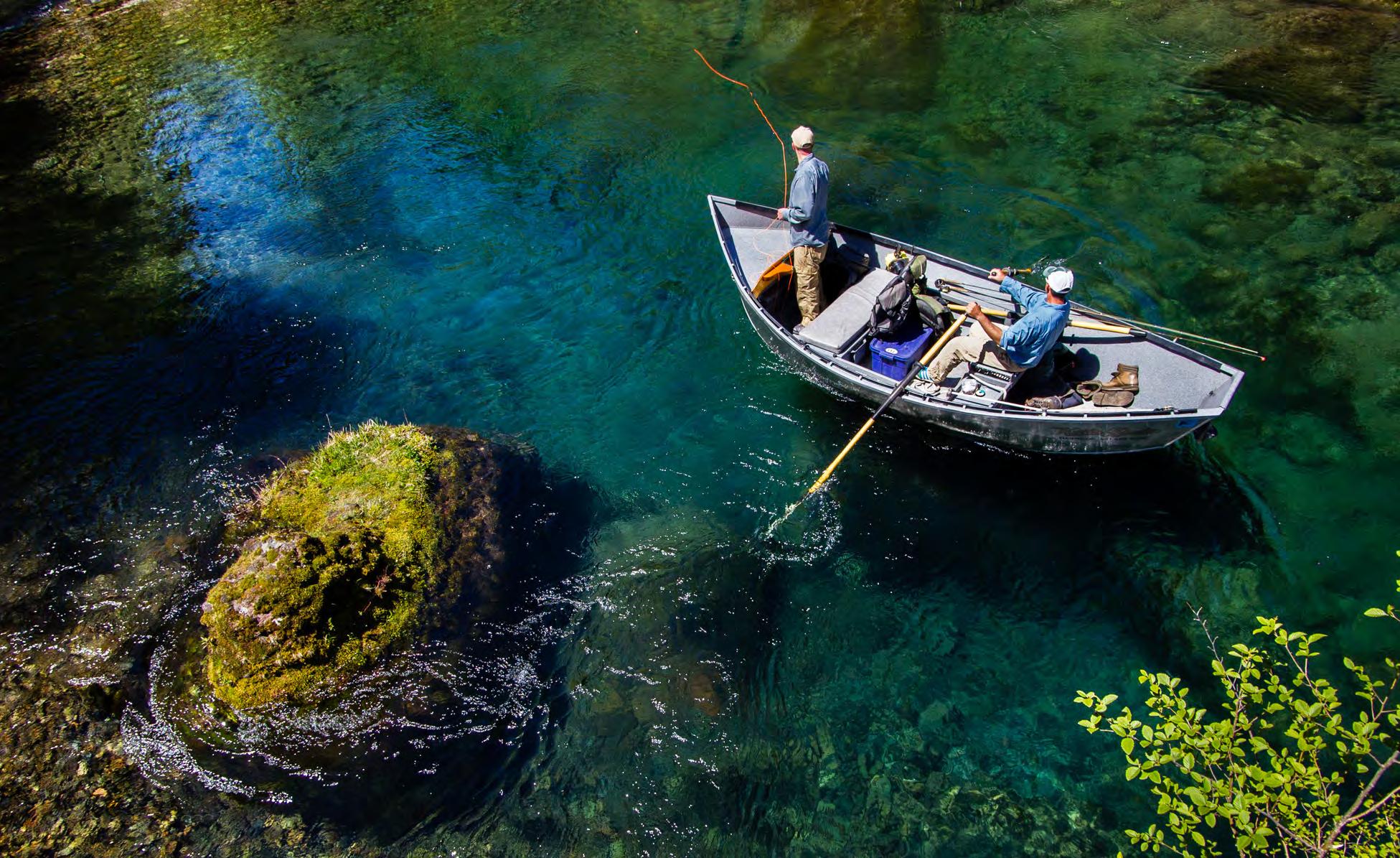
The Metolius River is one of Oregon’s most beautiful rivers and a different kind of spring run. Near the base of Black Butte, the river emerges from an aquifer of volcanic and sedimentary rock, and is at nearly the same water level yearround. This means you can run the Metolius any day and almost be certain what the character of the water level will be. The 10-mile stretch that begins downstream of the headwaters and flows to Lower Bridge Campground is a popular one with multiple access points. The blue water is mesmerizing—and cold—with technical Class II-III whitewater shooting through collapsed lava tubes as you pass along forest and meadows. There are no commercial outfitters on this stretch, so previous rafting experience is required. While the rapids are not the most difficult, it has other hazards such as low bridges and log jams to be aware of in advance. Portages may be necessary. The Metolius is a run suited for a small raft and paddle team, offering fine whitewater and spectacular scenery.
Trailside Congregations
Bikepack the Painted Hills and rest at the Spoke’n Hostel hub
WORDS AND PHOTOGRAPHY
BY KATIE SOX
There is a certain flavor of freedom specific to loading everything you need onto your bike for a self-supported backcountry adventure. Add the magic of riding scenic roads through dense forests, vast high desert landscapes, prehistoric fossil beds and quaint rural communities, and the result is a proper bikepacking odyssey. It shifts one’s perspective to escape civilization for several days without a shower or hot meal. Many find profound bliss in propelling themselves by bike and traveling with only the necessities—the experience makes stopping for the night at a place with a real bed, a bowl of ice cream and a hot shower feel like the greatest luxury on earth.
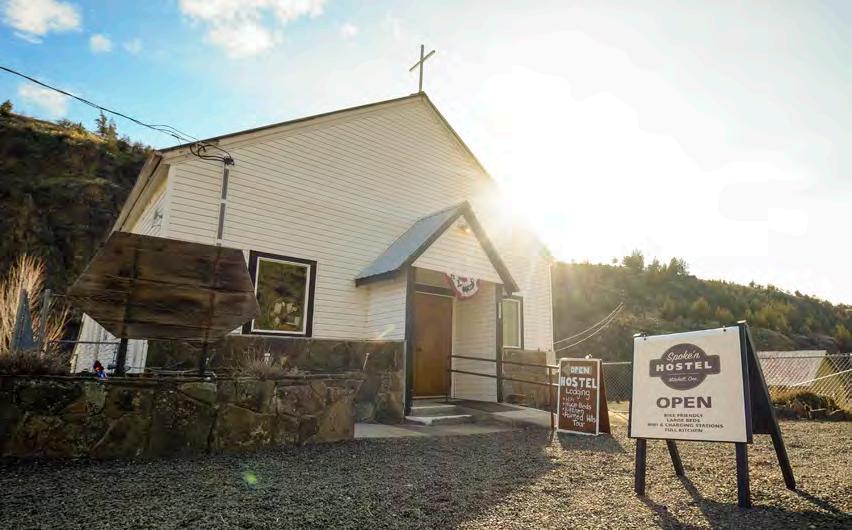
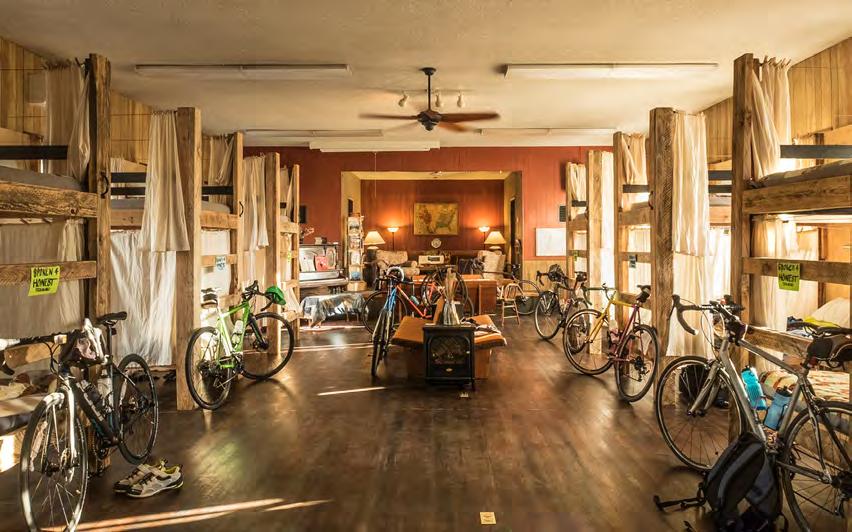
A sanctuary to cyclists, Spoke’n Hostel is a donation-based, 5-star lodging accommodation for anyone exploring Wheeler County. Nestled in the quiet town of Mitchell, Oregon, the hostel offers a unique respite along popular bicycle touring routes including the TransAmerica Trail, a 4,228-mile cycling trip across the United States from Astoria, Oregon, to Yorktown, Virginia. The hostel’s bunk room offers 12 beds with privacy curtains, lights and charging stations. A suggested base donation of $35 per night includes ice cream, a simple breakfast, access to a full kitchen and a shower room with everything needed to freshen up. There’s free Wi-Fi, a bike repair station and hospitality.
Spoke’n Hostel was dreamed up in 2015 when Jalet Farrell and her husband Patrick had a revelation in an old, underutilized church. Coincidentally, Mitchell’s only congregation was soon to be holding its last service. They bought the building, and
with the help of volunteers, remodeled the space to create a hostel. Opening to travelers in 2016, Spoke‘n Hostel also hosts Praise Congregation Sunday services. Now in its 10th season, the establishment has welcomed more than 5,000 travelers, and roughly 90% of them have been cyclists.
CYCLE FOR SIGHTS AND STAY AWHILE
With a population of 136, Mitchell is home to Tiger Town Brewing Co., Bridge Creek Cafe, a grocery store, lumber yard, feed store, post office and Route 26 Espresso drive-thru. Abundant in natural attractions, cycling in this part of Oregon is top-notch. The pristine Ochoco National Forest is a bikepacker’s dream with road surfaces ranging from buttery smooth pavement to dirt and downright rowdy gravel terrain for those who venture up to the Mt. Pisgah Lookout. The surrounding
THIS AND BOTTOM: Spoke‘n Hostel
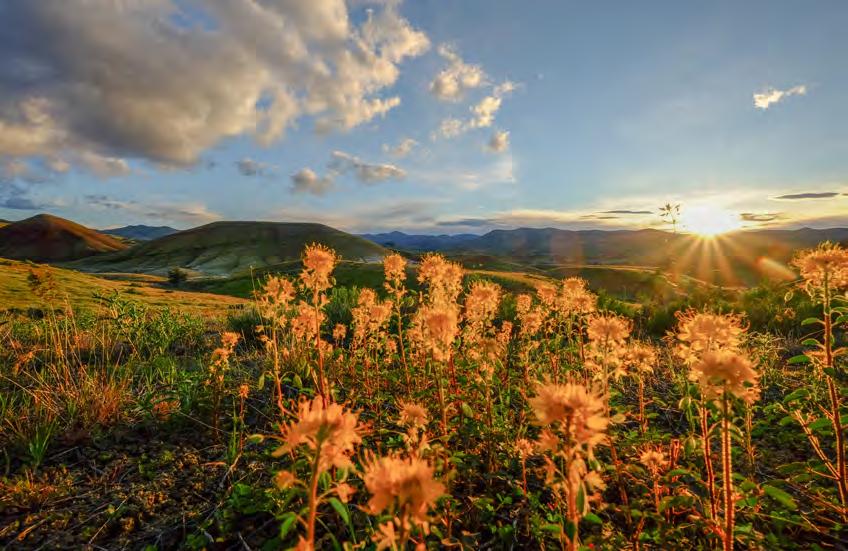
MIDDLE: Painted Hills
area includes the John Day River, which offers world-class steelhead fishing and the Painted Hills, one of Oregon’s Seven Wonders located in the John Day Fossil Beds National Monument.
The charm of Wheeler County is its sparse population and preserved natural beauty, making it well-suited for cyclists. When embarking on a bike, it’s important to understand the route, prepare for big temperature swings typical of the high desert and carry plenty of water through remote, exposed, dry stretches. Bike travelers should also be aware of the thorny “goat head” weed that can cause tire punctures, and know that some roads can turn to sticky mud in rainy conditions. Tubeless tires are highly recommended, as the tire sealant can often fill a puncture and prevent the need for an entire flat repair. Good Bike Co., a bicycle shop in Prineville, is a boon for cyclists traveling the TransAmerica Trail and other popular bikepacking routes like the Oregon Outback Trail. The staff can help dial in your bike and gear, and lend invaluable local riding advice. Whether taking a cross-country bikepacking adventure, day riding on a road bike or exploring the area by car, Spoke’n Hostel offers a hub for travelers that goes the extra mile. Professional adventure cyclist and route developer Sarah Swallow first stayed at the hostel in 2016 while developing the Central Oregon Backcountry Explorer Route, and more recently in 2026, while testing the new Golden Gravel Trail by Adventure Cycling Association. “While they welcome everyone, the hostel is truly a haven for cyclists,” Swallow said. “From the maps on the walls to inspirational notes pinned throughout—every detail is thoughtfully considered for the traveling cyclist. Small touches like that make all the difference.”
For founder Farrell, that is one of the goals. “I love reviving tired cyclists by offering ice cream, a hot shower and comfy bed for them to rest in and lean their bike on. It leads to great stories, and sometimes, lifelong friendships,” she said. Swallow agreed, “They create a place where you feel at home, even when home is sometimes very far away.” See spokenhostel.org
On the Down Low
Four low-elevation hikes near the cities of Bend and Sisters
WRITTEN BY DAMIAN FAGAN | PHOTOGRAPHY BY WHITNEY WHITEHOUSE
Access to roads at high elevation may have arrived early this year with the melting snow, but you don’t have to travel far to enjoy late spring trails in Central Oregon. Close to the cities of Bend and Sisters, hikers can enjoy wildflowers and the calls of songbirds on rambles through ponderosa woodlands, along stretches of the Deschutes River, around Clear Lake, or near the headwaters of the McKenzie River. Here is the lowdown on four trails that are down at lower elevations.
CASCADE LAKES HIGHWAY CLOSER TO BEND
Dillon Falls to Benham Falls
Another out-and-back hike along the Deschutes River Trail is the stretch from Dillon Falls to Benham Falls, two spectacular rapids named for pioneer homesteaders, Leander Dillon and J.R. Benham. The trail starts just upstream of thundering Dillon Falls, then meanders past a recently completed restoration project, which transformed Ryan’s Meadow into a thriving wetland. From here, the trail hugs the river before making a wide bend around The Slough, another seasonally connected wetlands and a good place to look for colorful wood ducks. Hikers end up at an impressive overlook 100 feet above the stairstep Benham Falls. Some 7,000 years ago, an extensive lava flow buried the
Dillon Falls to Benham Falls
historic Deschutes River channel and resulted in a basalt dam that backed up the river to Sunriver, creating Lake Benham. Erosion eventually won out and cut through the dam and created the impressive Benham Falls.
TRIP DETAILS: 6.6 miles round trip | ACCESS: Cascade Lakes Highway to Forest Road 41, parking permit required.
Lava Island to Aspen Day Use Area
This out-and-back hike along the Deschutes River Trail offers exceptional views of the river as it skirts along an approximately 7,000-year-old lava flow from nearby Lava Butte. The trail weaves along the river’s edge past ponderosa pines that smell like vanilla if you give them a sniff. In spring, the willows fill with migrating songbirds such as warblers and flycatchers, which glean insects off the leaves. Just before the turnaround point at the Aspen boat launch, you’ll pass Big Eddy rapid and a chance to watch rafters challenge this class III rapid.
Often overlooked, this forest walk connects Camp Sherman to the Suttle Lake Lodge. The trailhead is less than a mile north of Lake Creek Lodge, and the trail parallels Lake Creek through a forest of western larch, ponderosa pine and incense cedar—a tree at the southern edge of its range. The trail connects to and passes through a portion of the Deschutes Land Trust’s Metolius Preserve. From the preserve’s parking lot, a short side trip to the bridge crossing is a perch to see native bull trout angling for prey in Lake Creek. Continuing on through the preserve, the trail crosses beneath Highway 20 and ends up at the Suttle Lake Lodge on the shore of the glacially carved Suttle Lake.
TRIP DETAILS: 9.0 miles round trip | ACCESS: Camp Sherman Road, no parking permit required.
McKenzie River Trail: Clear Lake Loop
An extensive lava flow from Sand Mountain some 3,000 years ago dammed the McKenzie River and submerged a forest while creating this 142-acre cold mountain lake called Clear Lake. The lake is well named as hikers can still see snags beneath the water’s surface. At the Day Use Area and trailhead, visit the historic picnic shelter built by the Civilian Conservation Corps in the 1930s. The trail twists and turns as it loops around the lake, passing massive old-growth Douglas firs and colorful wildflowers. Two footbridges cross the lake’s inlet and outlet with the outlet considered to be the beginning of the McKenzie River. And those bubble trails breaking the surface of the lake? Look for scuba divers swimming through the frozen-in-time underwater forest. A post-hike ice cream or lunch at the resort is a good ending to a great hike.
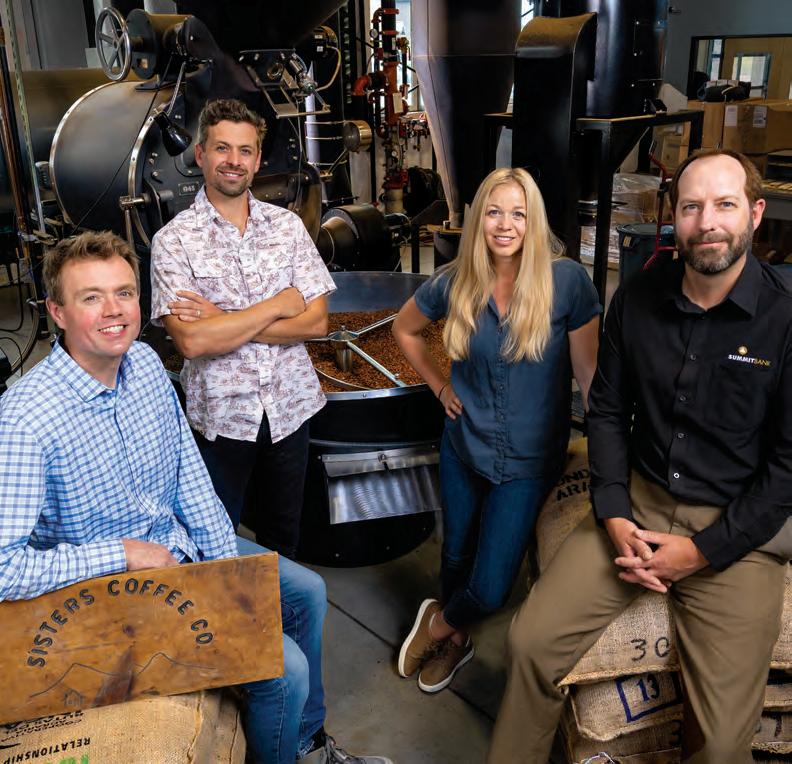
Sisters Coffee Co. owners Justin, Jared, and Jesse Durham with Summit Bank Vice President and Business Client Advisor Zak Sundsten
Rise and Dance
Public spaces become dance floors where everyone is invited
WRITTEN BY MIRA HANSEN
PHOTOGRAPHY BY CODY RHEAULT
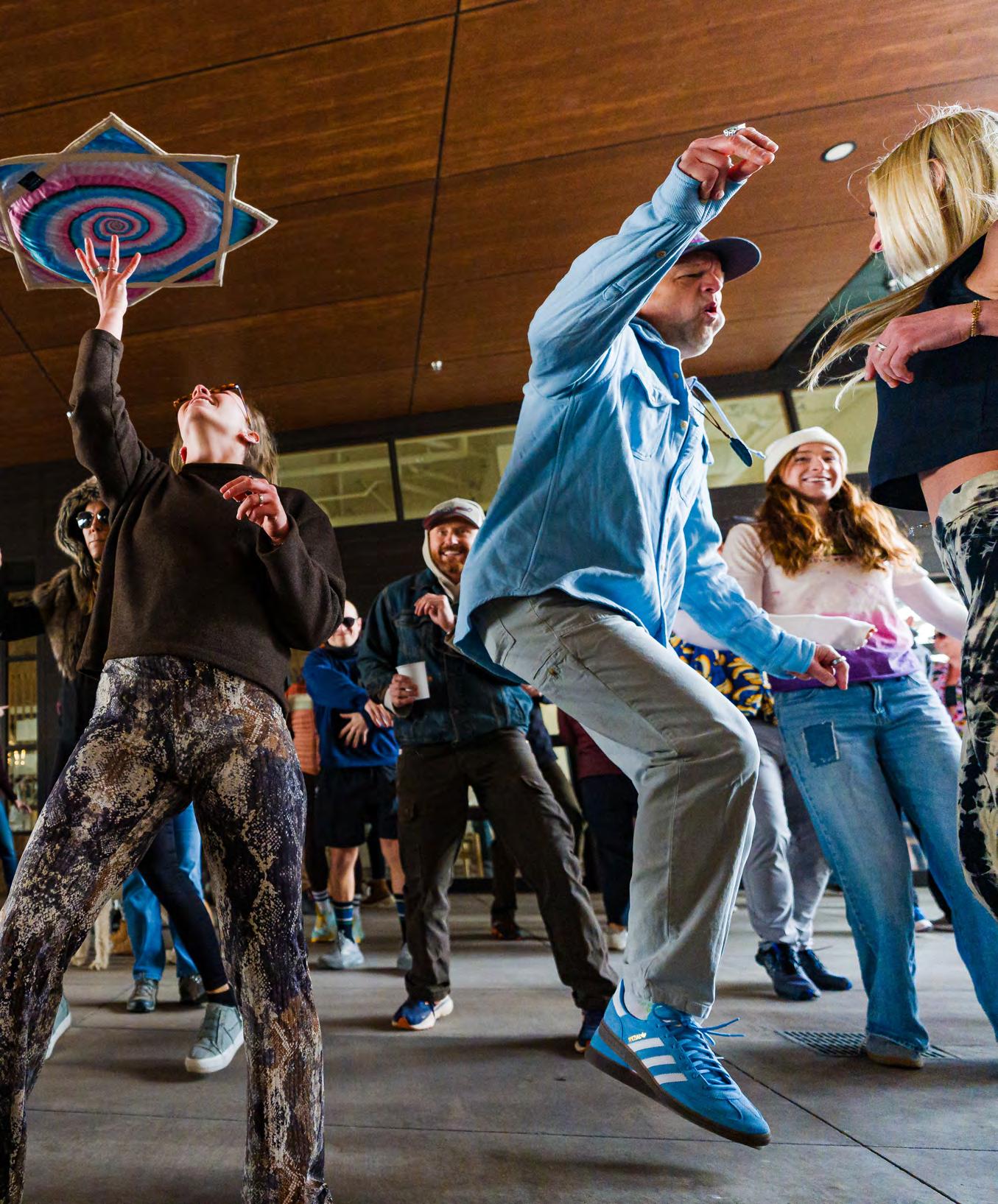
ABend father recalled heading to The Grove with his toddler for a treat when they stumbled upon a group dancing to upbeat electronic music. Before joining the line at Thump Coffee, they veered toward the growing crowd dancing on the patio in the morning sun. Some people were dressed for outdoor adventure; others were still in pajamas. “The communal joy was incredibly infectious,” he said. “We had no idea this was a recurring event.”
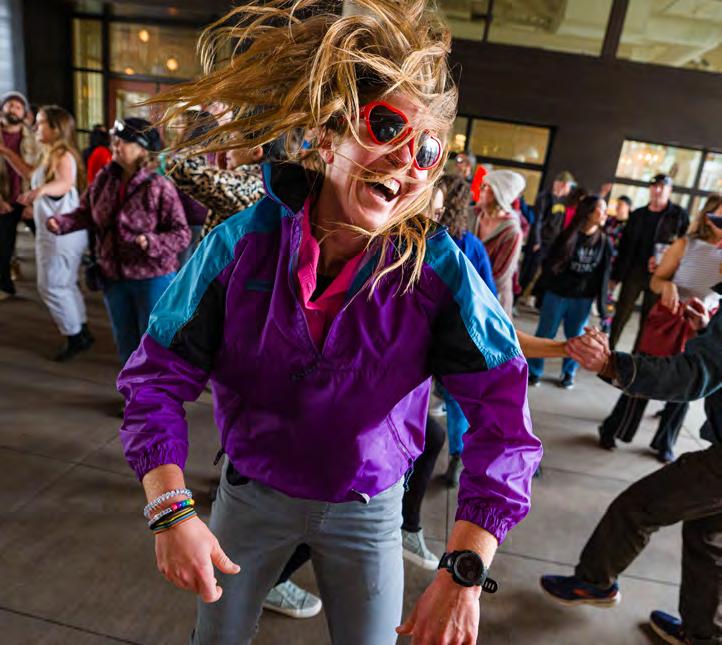
His experience isn’t atypical—at least, not in Bend. Spend enough time in town, and chances are you’ll encounter into one of these pop-up dance parties. They’re hard to miss, sometimes drawing crowds of 100 people or more.
One of the groups behind the movement is Get Up and Groove, organized by Cameron Larson along with his friends Sage Loughlin and Parker Wright. Since 2023, they’ve hosted regular dance parties and cold-plunge events in Bend’s public spaces. “The goal was always community and connection,” Larson said, thinking back to when Get Up and Groove first started.
“And the community I’ve built, the friends I’ve made since then? It feels good.” The events are free, open to all ages, and costumes are welcome.
Larson is also a big believer in the health benefits of dancing, especially in the morning. “Morning is when the nervous system is most elastic and receptive. Before phones, caffeine overload, work stress or social masks set in, the brain is open. Movement and rhythm in this window can shape the tone of the entire day.”
Local mental health therapist Kathryn Kemp agreed. “Dancing is such a wonderful way to tune in and safely reconnect to your body,” she said. “And it shouldn’t require special expertise—or alcohol—to enjoy. It’s great that the community has built a way for people to collectively access the healing that embodied movement provides.”
Wellness perks aside, beginning the day with coffee and a jig is simply fun. One regular at the morning dance gatherings said starting the day with movement outdoors—sun on your face and the smell of coffee in the air—feels like turning the volume dial of energy all the way up. The scene, they said, often turns into a joyful swirl of people laughing, grinning and spinning each other around like guests at Bilbo Baggins’s birthday party.
If you’re not a morning person, good news: not all of Bend’s dance parties start at sunrise. Groups like Mobile Dance Party host evening pop-ups during Downtown’s First Fridays and holiday celebrations. And around town, no matter the time of day, unexpected places regularly transform into dance floors—from Miller’s Landing and Brooks Plaza at The Commons Cafe & Taproom to The Pantry, Century Center and Dandy’s Drive-In.
Get Up and Groove hosts parties nearly every week and shares upcoming dates on social media. Other events are more elusive, with details passed along through word of mouth. So ask around, follow local businesses online and keep your ears open. You never really know when your morning coffee run or evening stroll might turn into a dance party.
See @ getupandgroove
Serving Central Oregon for 80 years, Summit Health is the leading physician-led provider of primary, pediatric, and specialty care. Our team supports you and your family at every stage with accessible appointments, and now offers expanded services locally, reducing the need to travel for care.
This year, every time you donate at checkout, you’re helping provide food for our local neighbors—and we’re matching your donations, dollar for dollar, up to $100,000.
After 50 years of good food and local relationships, taking care of this community isn’t just something we do. It’s who we are. 100% employee owned and locally founded.
Riding by Night
WRITTEN BY CHERYL PARTON
PHOTOGRAPHY BY LEAR MILLER
Carson Storch gets lit in the film Mountains of the Moon
Under the ethereal glow of the moon, forested trails have a different geometry. Shadows lengthen as well-traveled lines and berms look unfamiliar and newly drawn.
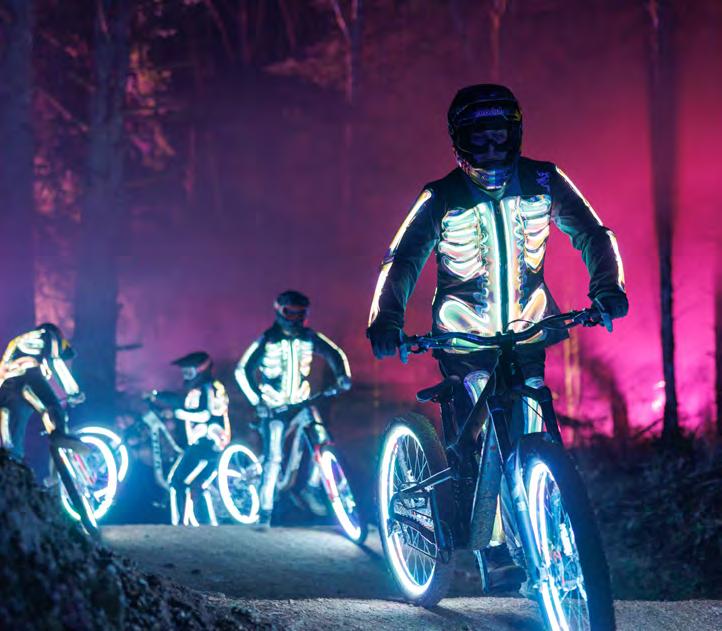
In Mountains of the Moon, filmmaker and professional skier Chris Benchetler turned the night into a backdrop where sports become art on film. Mountain bikers, rock climbers, surfers and skiers moved through the dark landscape in LED-lit gear, set to the improvisational music of the Grateful Dead. As a visual artist, Benchetler had experimented with light for a few years, and the film manifested connections between sports, life, music and the living earth. The film shows how terrain can be rediscovered and seen in a different way.
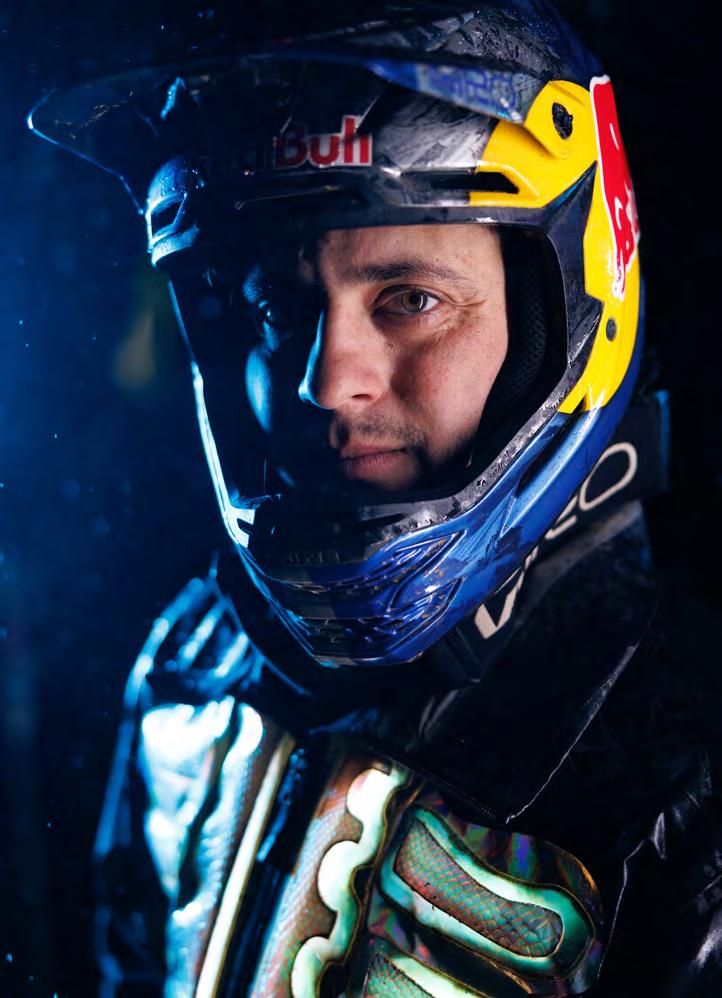
For Bend mountain biker Carson Storch, the project revealed another side of a sport usually defined by daylight, competition and speed. Growing up in Tumalo and mountain biking since the age of 10, Storch developed his freeriding style on international mountain grades and Red Bull Rampage courses. In Mountains of the Moon, Storch traded the sensory stimulation of desert cliffs and stadium tracks for reliance on his heightened senses to navigate in the dark.
“It was hard to comprehend this wild idea of a movie,” Storch said. Benchetler asked him to lead a team of riders—including Hannah Bergemann and Casey Brown—for the mountain-biking segments not only for his talent, “though he’s got that in spades,” Benchetler explained. “We connected on the music, the art and the shared belief that riding is more than performance, it’s expression,” Benchetler said. “We all trusted the process, which was painstaking at times,” Storch added, for what he called a “Hollywood shoot in the middle of the forest.”
From 11 p.m. to 5 a.m. for a week, the mountain bikers dealt with cold temperatures, rain, mud, wheels heavy with lights, all while wearing Grateful Dead-inspired skeleton suits custom-designed by Arc’teryx. At times, mud on the riders’ faces was so thick, they couldn’t see. The filming location on the Oregon Coast was familiar to Storch: he helped the nonprofit TORTA (Tillamook Off-Road Trail Alliance) by flagging and building the trails where biking segments were shot. Eight years in the making, the TORTA circuit made its debut in 2026 as the largest year-round mountain-biking trail system in the Pacific Northwest. Riding the trails in the dark, Storch used years of experience to move with spatial memory, he explained, but there were some features he couldn’t see. “The darkness made the most simple stuff incredibly challenging,” Storch said. “You had to learn to turn your brain off and trust yourself.” Stripped of the cues visible in sunlight, featured athletes relied on muscle memory to connect with varied landscapes under the cover of night. “Representing our sports with style created a piece of art,” he said. After a worldwide tour, Mountains of the Moon will be on streaming platforms in fall, 2026. See chrisbenchetler.com.
Carson Storch
Riders wore custom-made skeleton suits to evoke music from the Grateful Dead.
One of the oldest and most respected construction companies is now offering a complete range of asphalt paving solutions. From driveways, pathways, highways, and airports, JAL Paving and Highway Construction is your source for the most experienced and highest quality work in Central and Eastern Oregon.
Log Cabin Lifestyle
A Saddleback home reinvents America’s most nostalgic architectural style
WRITTEN BY CASEY HATFIELD-CHIOTTI | PHOTOGRAPHY BY AGNIESZKA JAKUBOWICZ
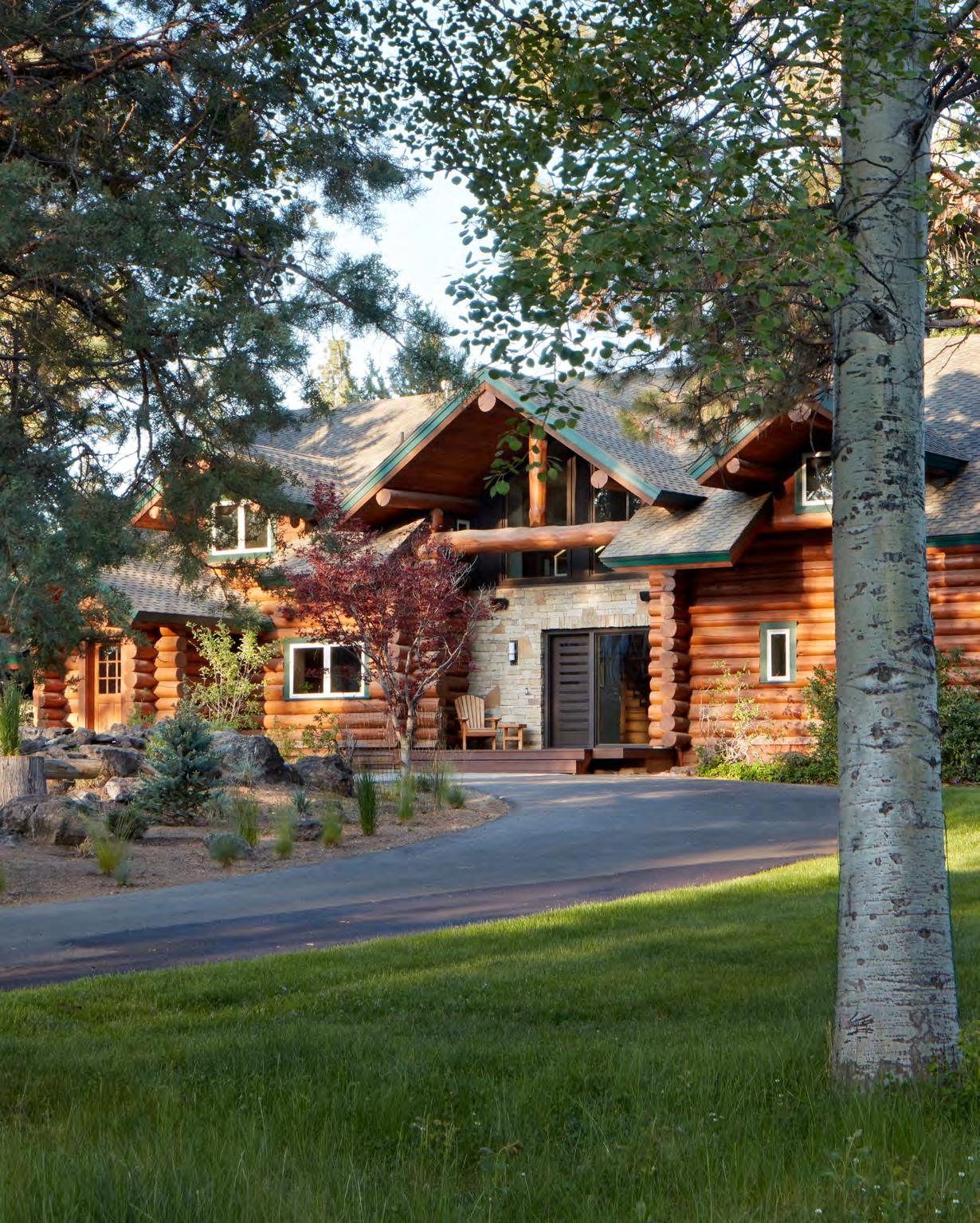
Log cabins spark the imagination and evoke a sense of warmth and nostalgia, from the first time a child interlocks a set of Lincoln Logs to the purchase of one’s very own lifesized log cabin. The sturdy architectural style, providing homes for settlers and pioneers, has endured for centuries. In today’s fast-moving and digitized world, the idea of curling up by a fire in a log cabin after a day of outdoor adventure feels especially enticing. Homes like these typically lean more cozy than contemporary, but the remodel of a log cabin in Bend’s Saddleback neighborhood shakes up the idea of what one can be.
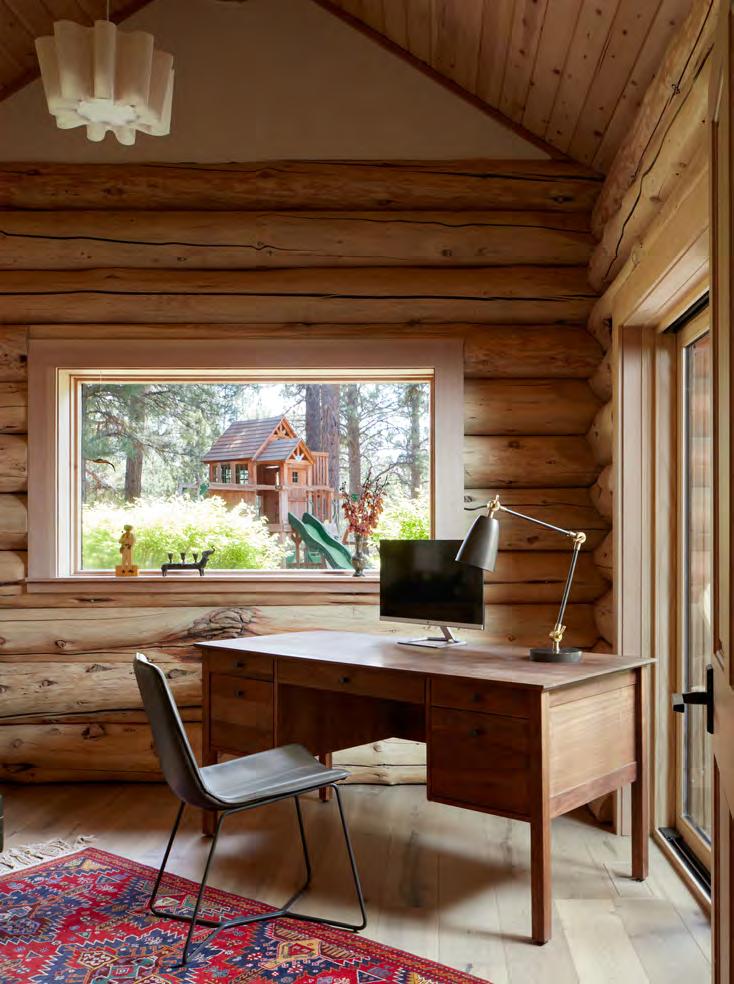
A homeowner, who longed to be closer to nature after living in urban areas for years, moved to Bend with his young family in 2020. He began looking for homes in town but ultimately realized the beauty of Bend was the possibility of living in the forest while being just a 10-minute drive from downtown and its shops and restaurants. “It feels like a special place, a place I am a temporary custodian of,” said the homeowner. Built in 1993, the home on 40 acres has views of Mount Bachelor and the Three Sisters. Careful placement of each pine beam exudes character and craftsmanship. The homeowner hired his friend, architect and interior designer Antje Paiz of Raumfabrik Architecture + Interiors, to remodel the full-time family residence. “I wanted to be honest about what the home is but also modernize and lighten it up,” said the homeowner.
ROUGH-HEWN TO REFINED
At 3,961 square feet, the home is bigger than a typical cabin. “I would jokingly refer to it as a log mansion,” said Paiz, who was intrigued by the prospect of working on a log cabin for the first time. The interiors still felt heavy and cramped so Paiz’s plans included removing a large carport that shaded the entry, relocating the stairs and lightening the wood.
Todd Ashley, principal at Bend’s Bigfoot Contracting, suggested sandblasting all the interior wood surfaces, a bold step that transformed the home.
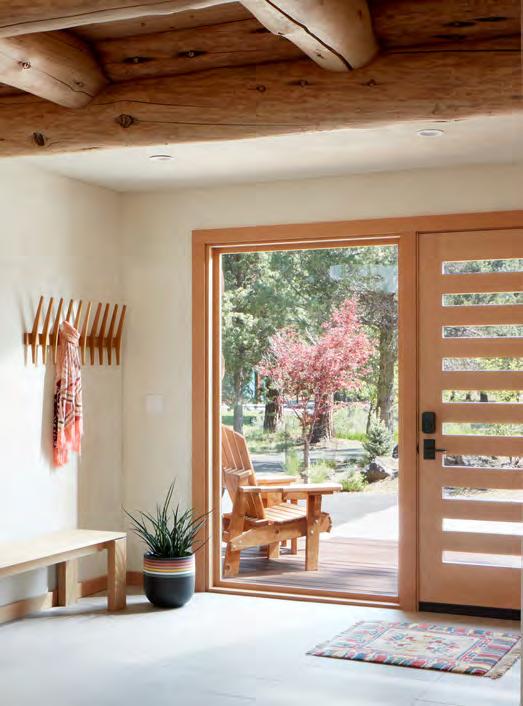
Moving the stairs defined the dining area and created a proper entryway.
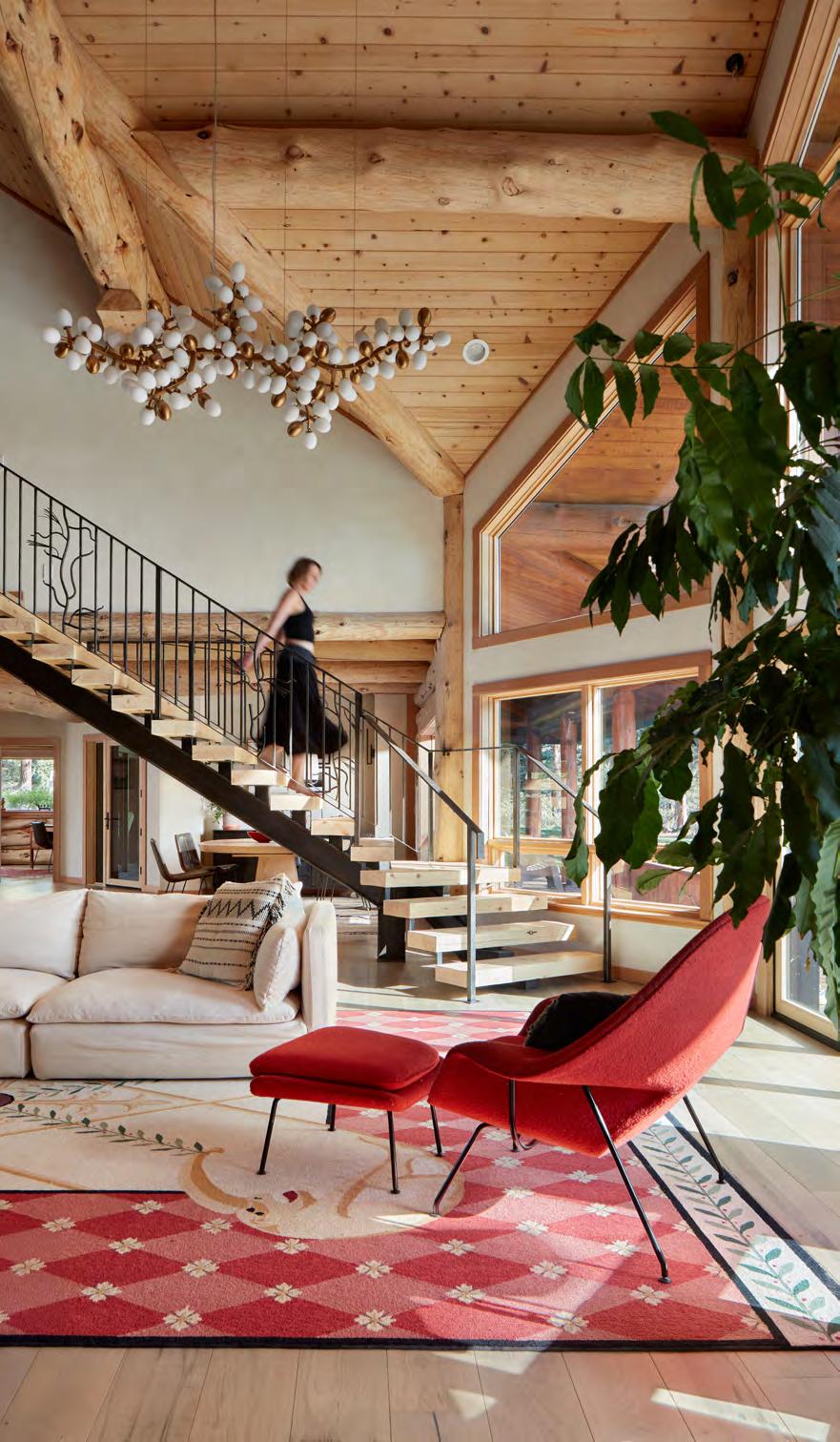
Paiz added tile floors and a dropped ceiling, which marked the transition to the great room with a vaulted ceiling and windows overlooking the parklike property.
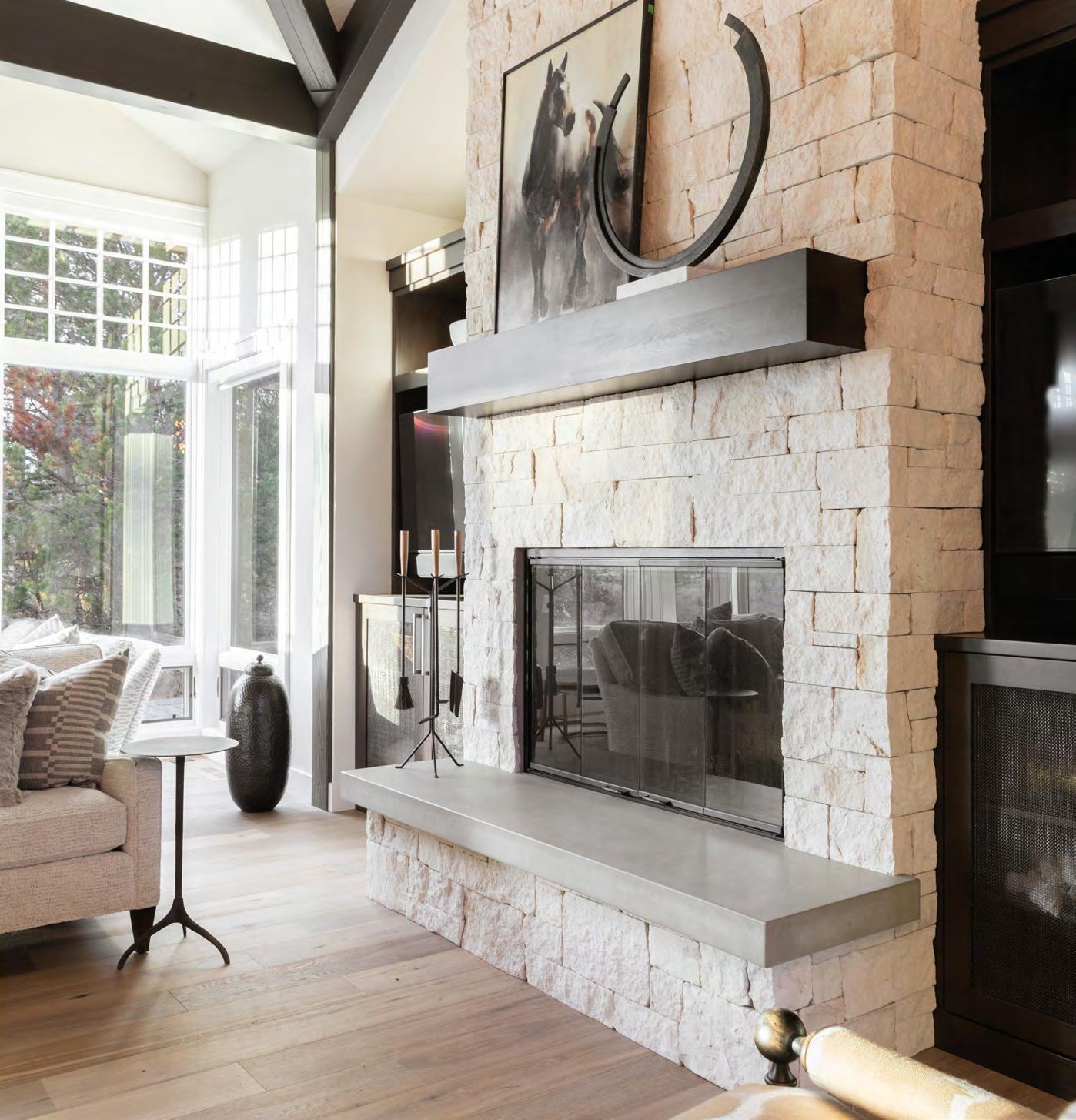
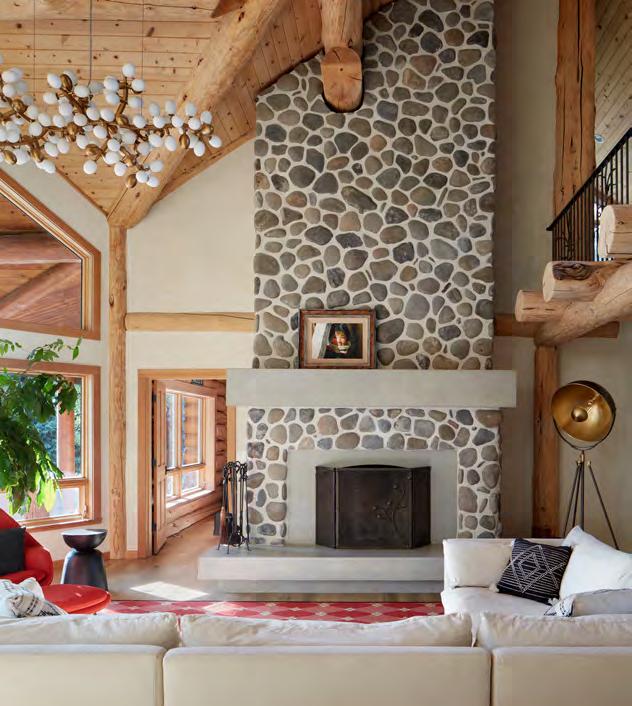
The plans also called for setting back the mezzanine level and a railing to create even more openness, giving the grand fireplace room to breathe. Made from local river rocks, the original fireplace was an important element to keep. Figuring out how to modernize it became a key challenge. The original design featured a traditional arched opening, grooved mortar joints and an undersized mantel. A mason reshaped the opening into a clean rectangle and repointed the stones. Replacing the wood mantel with a floating concrete hearth made it more contemporary.
A FAMILY HOME
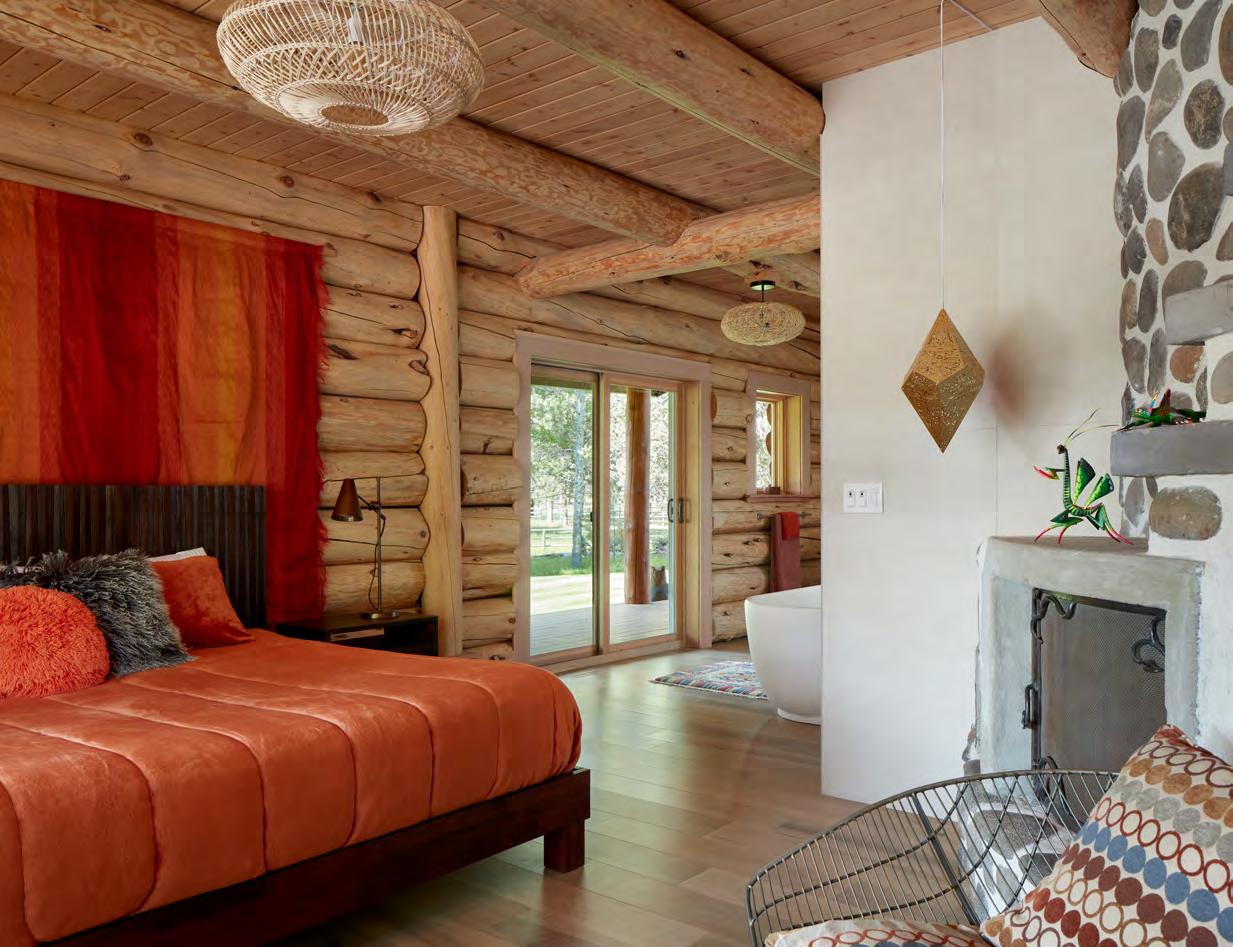
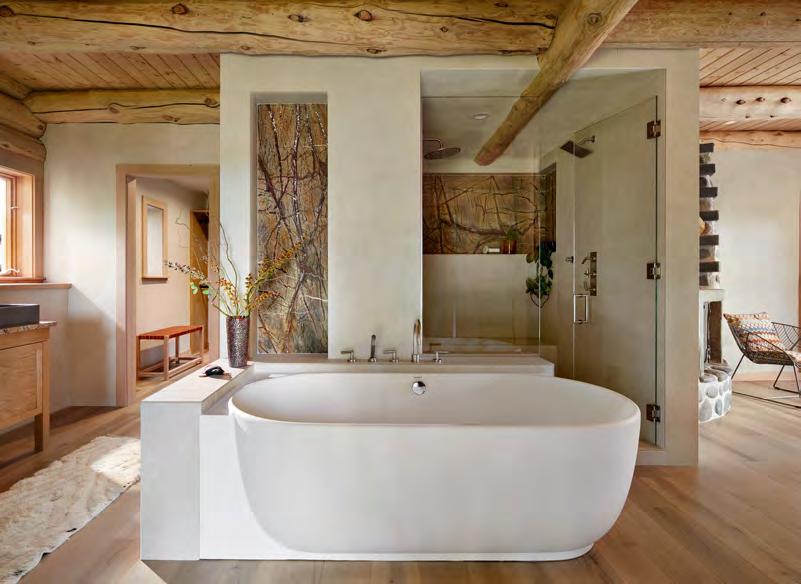
A feeling of openness and whimsy is carried throughout the home. On the ground floor, the primary bedroom flows right into the bathroom like a luxury hotel room.
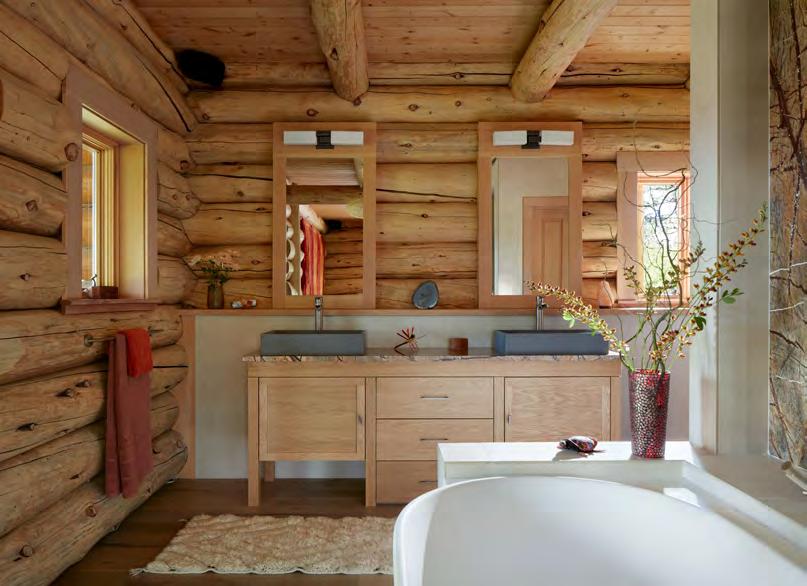
Paiz chose porcelain tile in the same shade as the plaster walls for the shower. The red marble used for the counter and niches adds subtle color yet complements the logs. “Because [the space is] open, continuity in materials and colors was key,” said Paiz. From the shower and tub, the homeowner enjoys views of the yard, connecting the space to the outdoors.
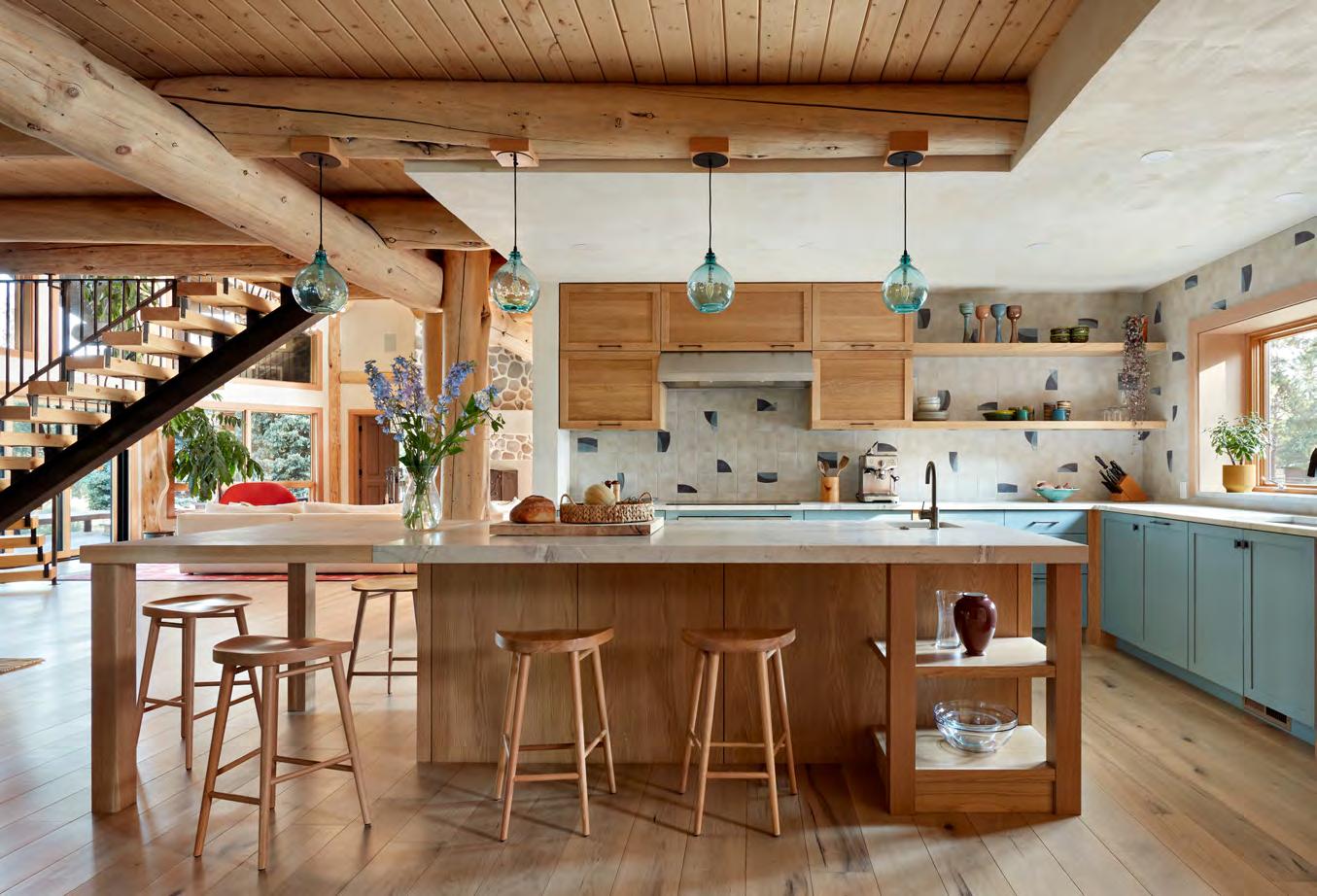
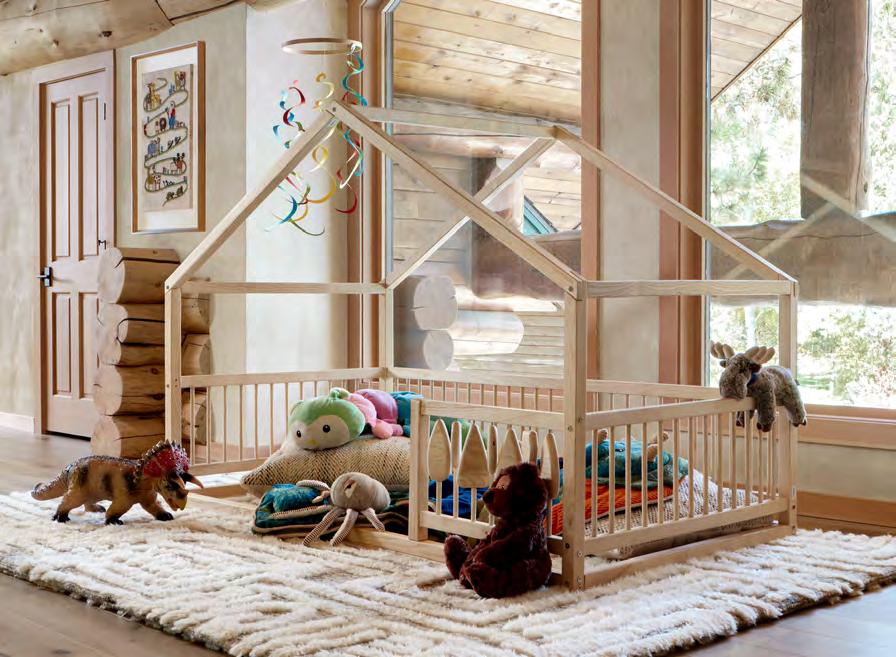
Two children’s bedrooms upstairs have loft spaces accessible via ladders. In the play area, a cozy nook is a comfortable place to relax with a book, and the wall-mounted projector turns it into a space for family movie nights. Paiz selected natural, durable materials—such as maple floors and stone countertops—for the light and spacious kitchen, plus pale blue cabinets and a large island with a butcher-block counter.
The iron handrail, custom work by Orion Forge blacksmith Hunter Dahlberg, features a pine needle detail. The forked log between the kitchen and the living room is simple and natural.
The Zygote chandelier in the living room by Lights of Scandinavia might not be the obvious choice for a log cabin, but the organic shape and raw copper frame complement and modernize the space. “I love how the home is brought together by the center. My kids have space, but we can all hear each other at any time and see each other from nearly anywhere,” said the homeowner.
In true log cabin spirit, unfussy, laid-back comfort is at the home’s heart, where the homeowner doesn’t mind if dogs sit on the couches and the children can run wild.
Experience elevated living with Classic Window Coverings and Shade On Demand —featuring Hunter Douglas and Lutron for sophisticated interiors, paired with elegantly engineered exterior shading for a seamless indoor-outdoor lifestyle.
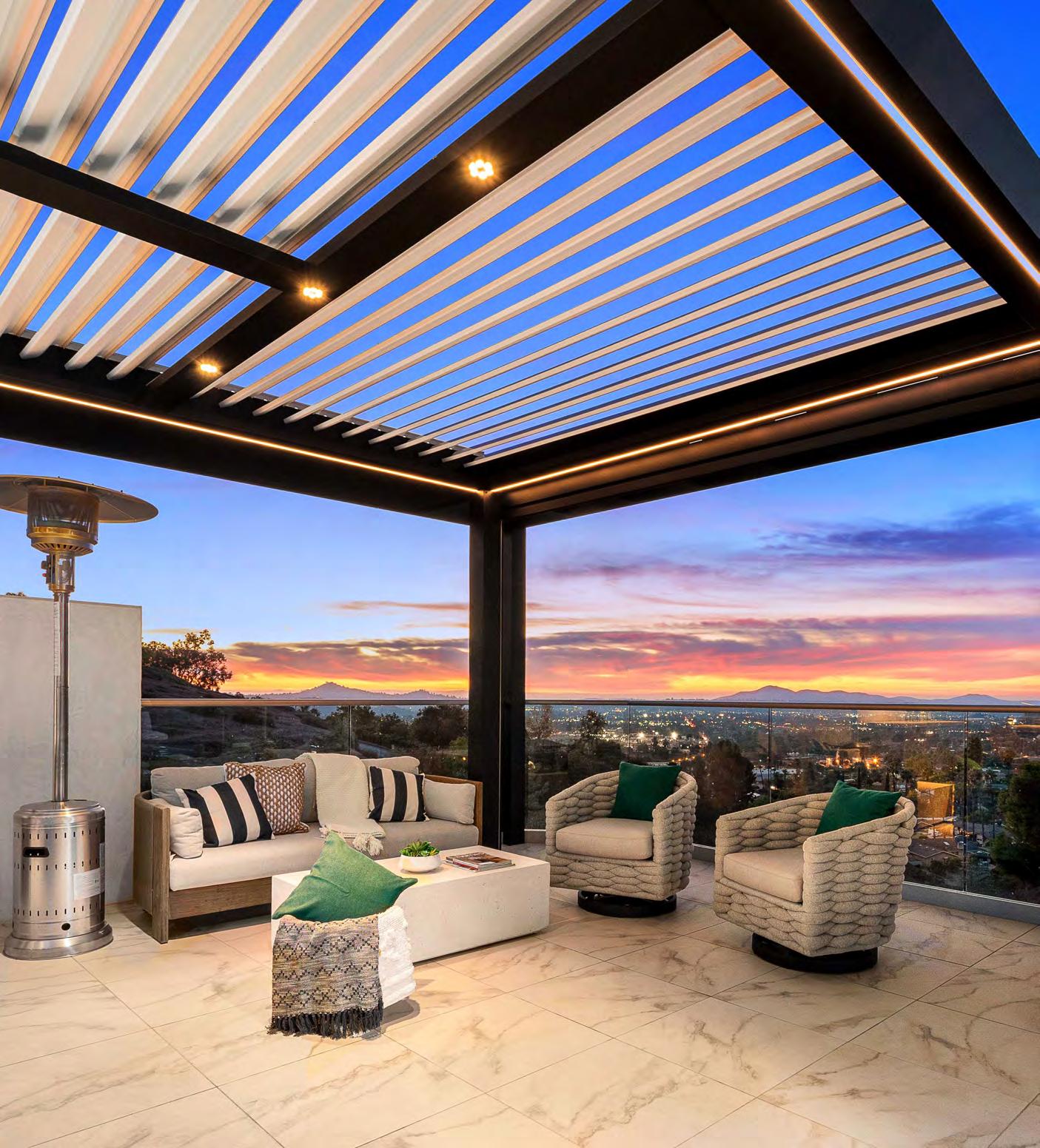
Spring arrives, and a home’s footprint expands to include outdoor living areas. Think of a patio or porch as an extra dining room or as a spot for reading writing or hootenannay. Take chances with design by adding pillows or area rugs for a simple, and inexpensive way to give any room in the house a lift.
Pantone’s Color of the Year is Cloud Dancer, a version of white, but there’s no need to follow trends or ask for permission to create your own colorful world.
Ripe for Business
Bend’s farmers markets sow much more than produce
BY SUZANNE BELL
WRITTEN
PHOTOGRAPHY BY TAMBI LANE
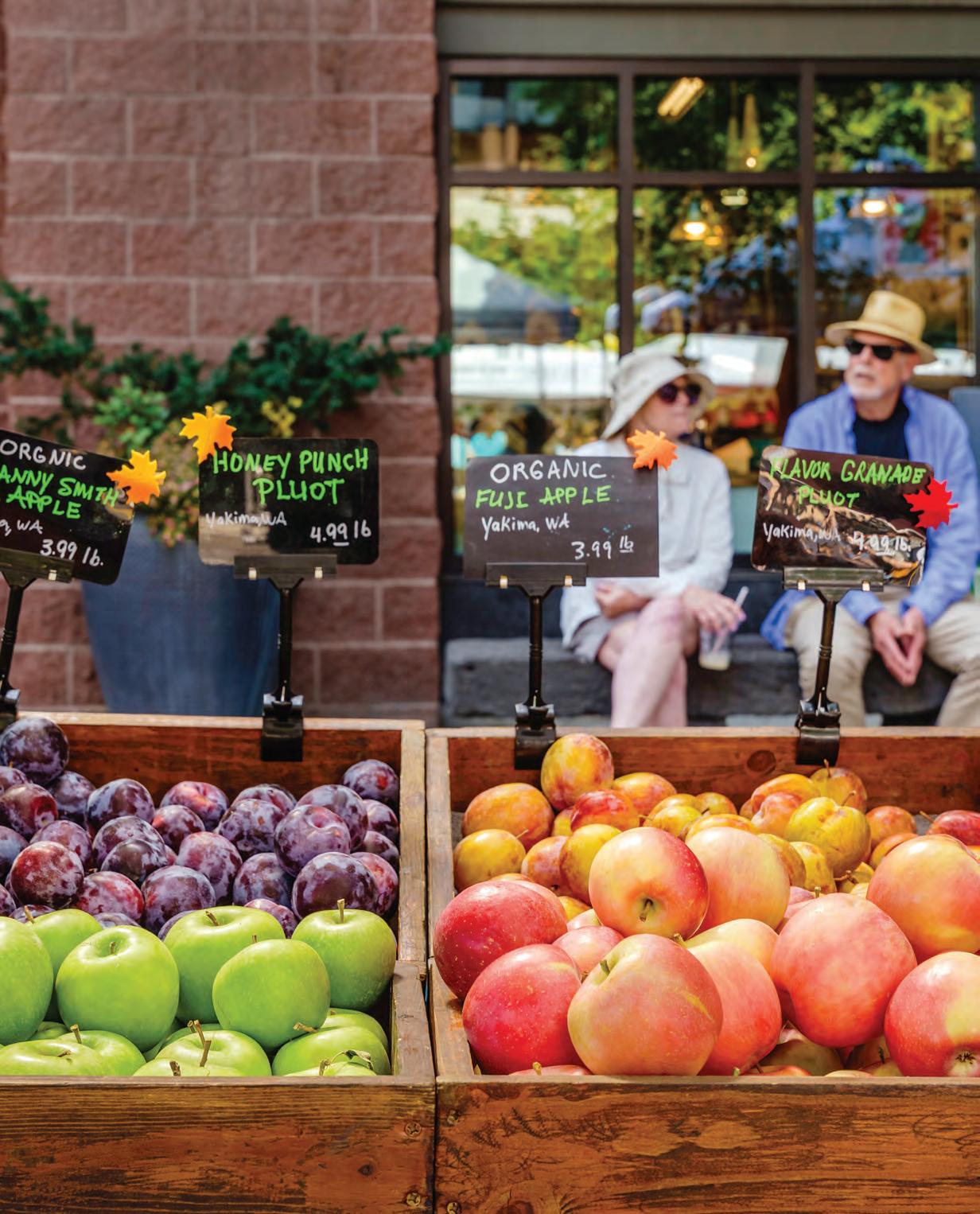
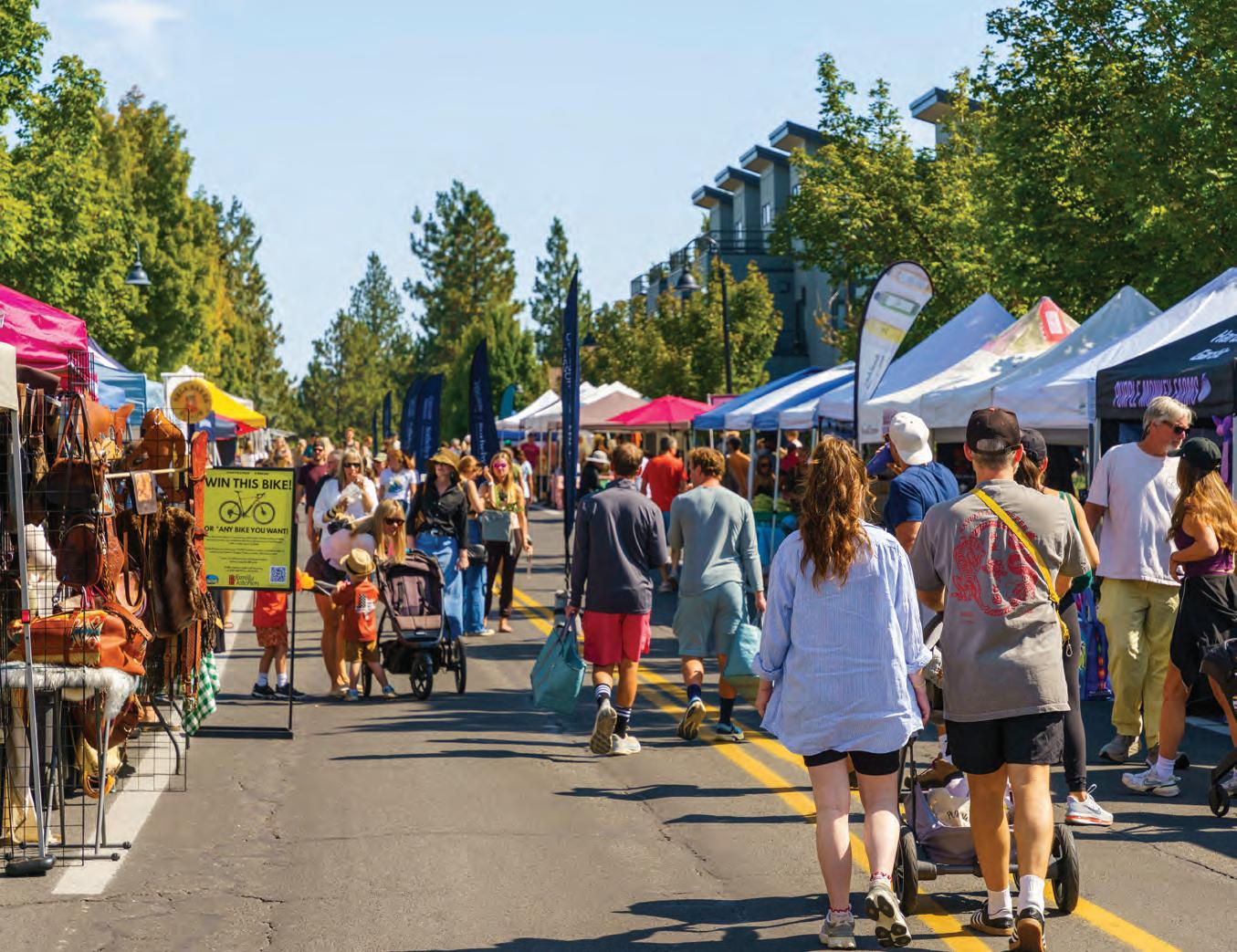
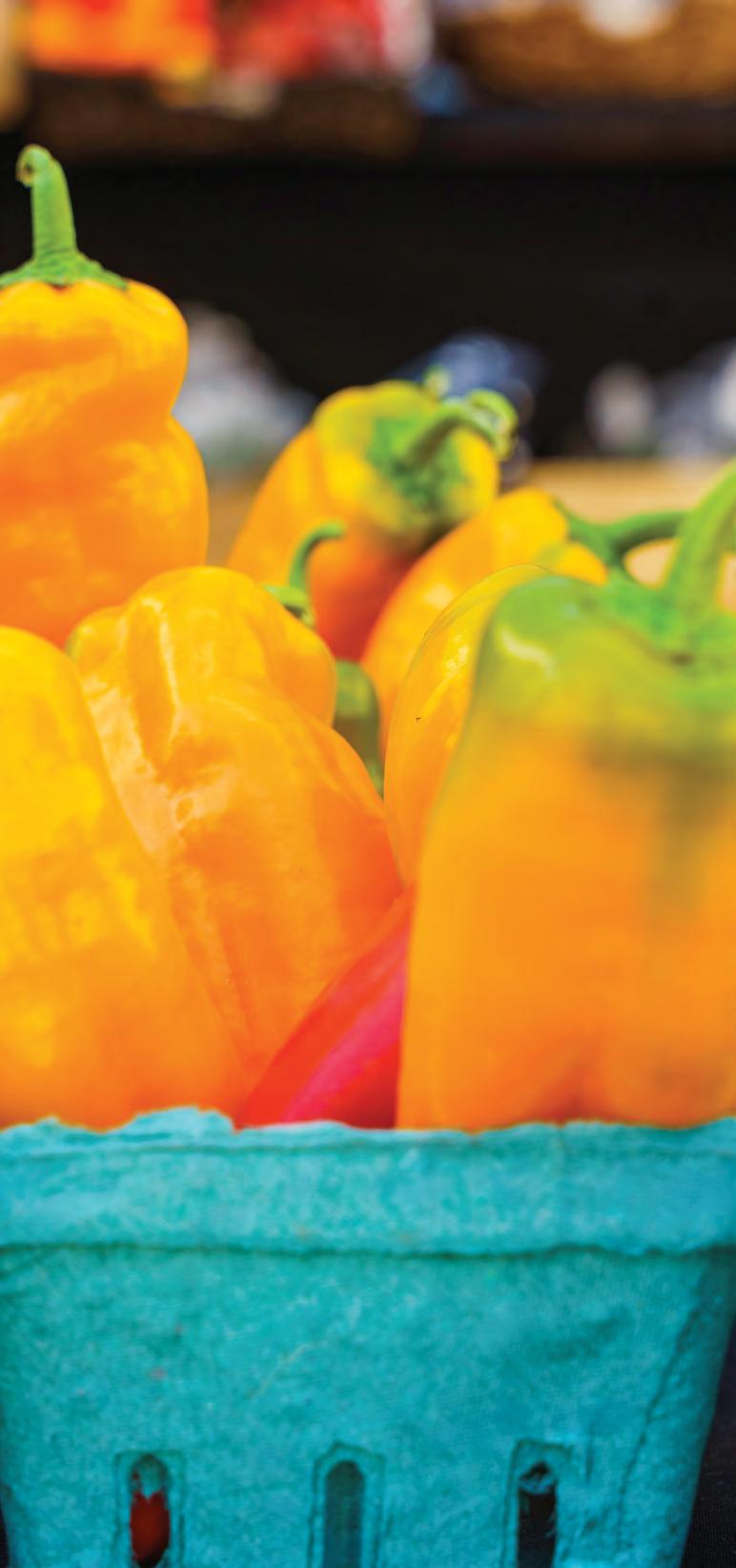
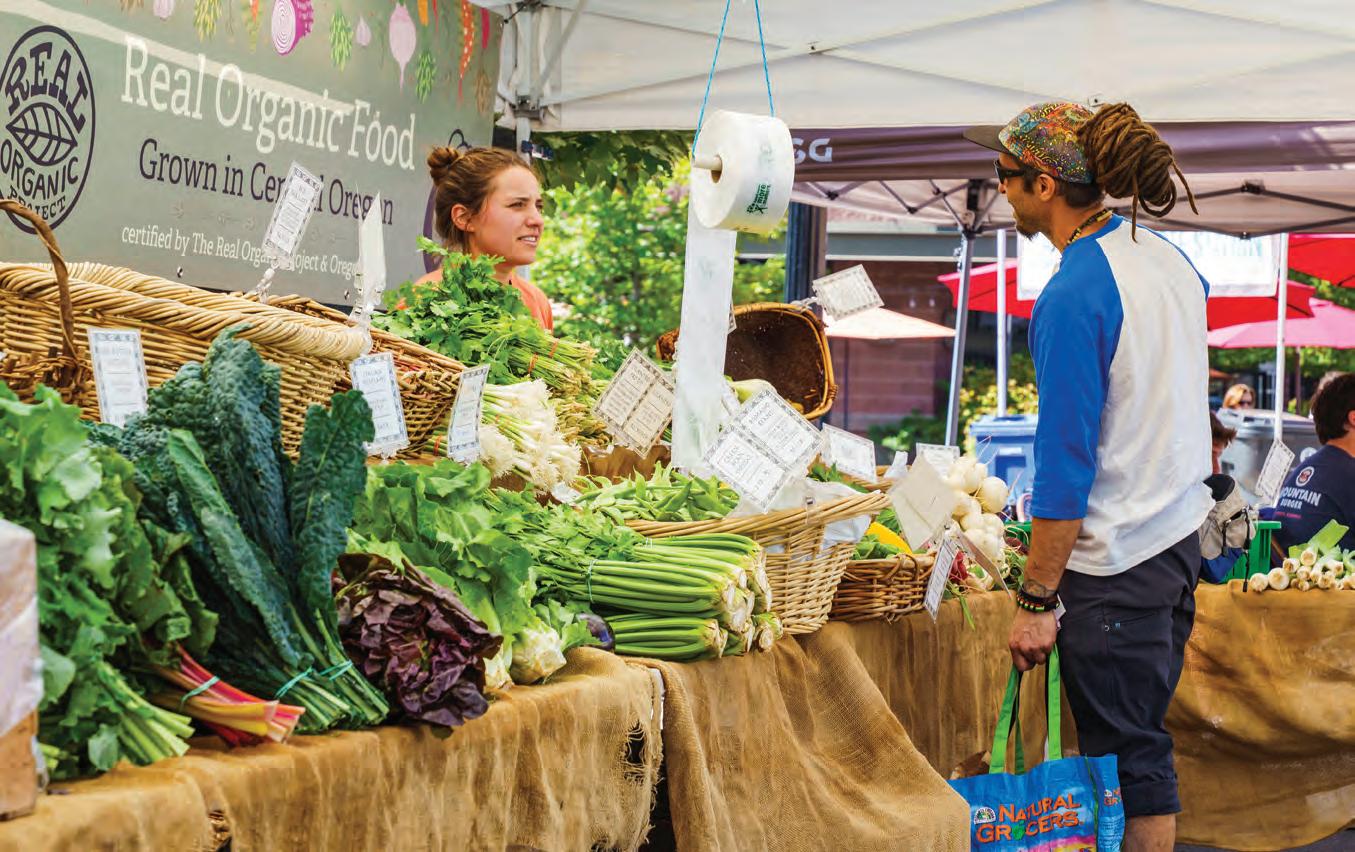
Hot summer streets and vacant lots transform into makeshift booths spilling over with fruit and ripe veggies in a confetti of color. Visitors meander as kids shuffle in flip-flops, their hands sticky with dried drips of local honey, ice cream and juicy berries. If you look closely, behind a parade of sun hats and kiddie wagons, the iconic Bend summer scene is an economic powerhouse. Farmers markets date back to ancient Egypt, making them the first startup hubs long before Silicon Valley hijacked the crown. In Oregon alone, they bring in an estimated $60 million each year and attract nearly 4 million seasonal visitors.
A stroll through the Bend and NorthWest Crossing farmers markets may seem like quintessential seasonal nostalgia, but they provide small farmers and makers with business opportunities they can’t find elsewhere.
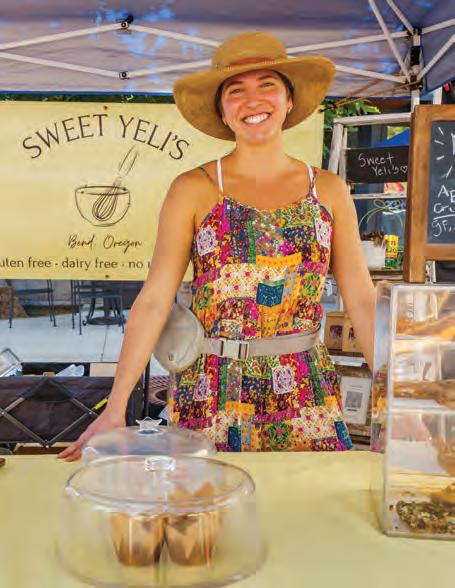
“They are really fantastic incubators,” said Ann Pistacchi-Peck, market director for the Bend Farmers Market and associate director of the High Desert Food and Farm Alliance (HDFFA). “A low barrier to market makes them a great place to start and
test products, try new ideas, and get the most face time with customers,” she said. The nonprofit marketplace includes up to 51 vendors for fresh, farm-direct Oregon produce, protein and products. With support from the HDFFA, Pistacchi-Peck said vendors have access to workshops, cohorts for novice farmers and ranchers, and a built-in community that helps with crop planning, marketing and business growth.
“At the market, you feel like you’re part of something,” said Sarahlee Lawrence, owner of Rainshadow Organics. She launched her farm 18 years ago with two acres of vegetables, selling exclusively through farm stands. Without local market sales, Lawrence said she couldn’t have grown the farm to more than 21 acres of produce and cover crops, along with 20 greenhouses and livestock. Her professional lifeline is the network she’s built with local farmers and producers. “It’s like crowdsourcing for your business,” Lawrence said. They text each other for advice on everything from pest control and seed starts to weather impacts.
NorthWest Crossing Farmers Market
I FEEL BLESSED TO BE A PART OF IT. IT’S SO EXCITING TO SEE VENDORS START OUT HERE AND GO ON TO SELL IN LOCAL STORES.”
—MELISSA KING, NORTHWEST CROSSING FARMERS MARKET DIRECTOR
More than half of vendors at Oregon farmers markets are new entrepreneurs. Learning what sells, what grows and what can be produced consistently at scale are major hurdles, especially in Central Oregon. Challenges such as late and early frosts, volcanic soil and water rights make it difficult for small or artisan producers to meet conventional grocer demands. Neither Bend nor NorthWest Crossing farmers markets take a share of sales, so all proceeds go directly to vendors.
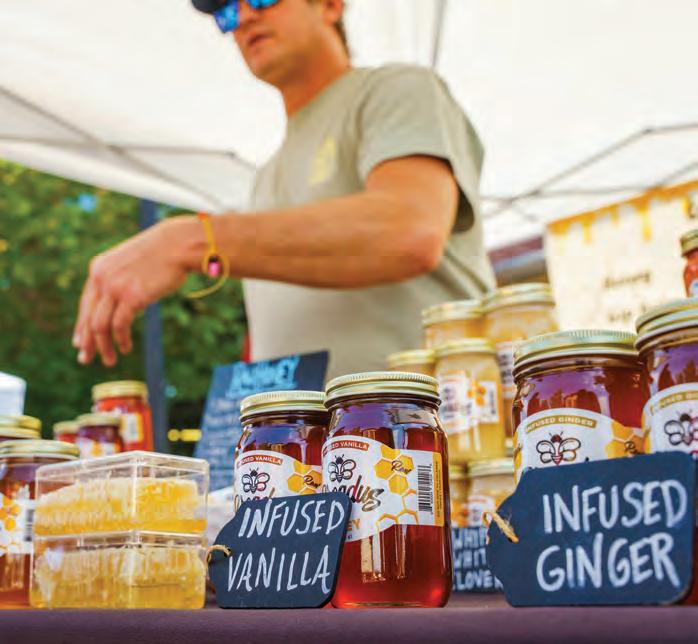
“It’s the number one sales outlet where we get retail prices for our honey,” said James Broadus, owner and beekeeper at Broadus Bees. Through farm stand sales, Broadus expanded to 400 hives across Central Oregon and began selling small batches wholesale.
“I feel blessed to be a part of it. It’s so exciting to see vendors start out here and go on to sell in local stores,” said Melissa King, market director of the NWX Farmers Market, the largest outdoor market in Central Oregon and one of the top five in the state. Within hours, King and her team transform two thoroughfares into an expansive marketplace with 150 vendors selling everything from jewelry and art to farm goods. Cameron Clark, who cofounded the market with support from Brooks Resources, added, “Vendors trade with each other and look out for one another. It’s the kind of community that makes you feel good about where you live.”
Yelina Davis
LOCAVORE BRINGS THE FARM TO TOWN
You can best support local farmers and makers by shopping what’s in season. The nonprofit Locavore is a farmers-first grocer that offers an important go-to-market stepping stone. Vendors get shelf space at lower cost than conventional wholesale (65% of sales go back to owners) and access to programs such as recycled packaging support, the dinner with a farmer series and a CSA pick-up location. Its second location opened at Discovery Corner in spring 2026, and the hope is to expand with satellite hubs across the region. See centraloregonlocavore.org
NorthWest Crossing Farmers Market
Saturdays, May 30 through September 26 10 a.m.–2 p.m., NorthWest Crossing
Bend Farmers Market
Wednesdays, May 6 through October 6 11 a.m.–3 p.m., Brooks Alley, Downtown Bend
Across Central Oregon
Learn about the newest addition, Elevation Farmers Market at the former Bend Factory Stores, held Fridays 3 p.m.-7 p.m. starting May 1. For a complete list of regional farmers markets see bendmagazine.com
Everyday Outdoors
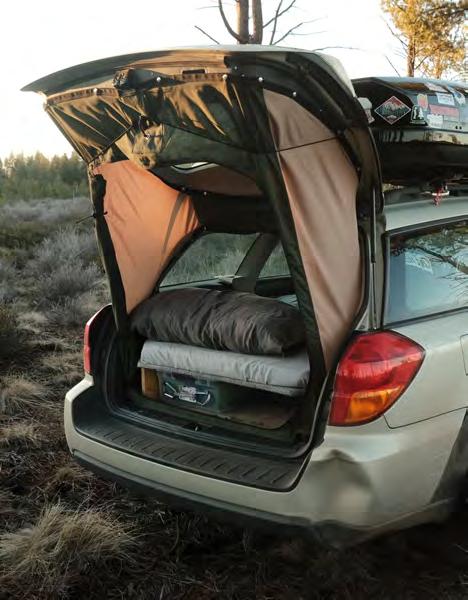
WanderHut is at the intersection of adventure and affordability
Founded by Kai Nevers and Kate Raber, the company WanderHut is carving out a new lane in the outdoor space. The pair developed a compact, vehiclemounted camping pod that transforms everyday cars into ready-to-go adventure rigs, with no van build out or rooftop tent required. What began as a simple idea—to make getting outside easier—has evolved into a mission-driven brand rooted in freedom, flexibility and thoughtful design. As part of Bend Outdoor Worx, and winners of the accelerator’s 2025 BreakOut Pitch Award, Raber and Nevers aren’t just building gear—they’re shaping a more approachable future for adventure travelers.
Describe the spark that led you to start WanderHut.
Kai Nevers: Growing up, I spent a lot of time camping out of a 2002 Volkswagen Eurovan with my family. As I got older, I got into surfing, climbing and snowboarding, almost everything outside, and started sleeping in my Subaru at trailheads and parking lots. I wanted a way to be comfortable without setting up and tearing down a tent every time. I looked at different options and couldn’t find anything that suited me, so I decided to build it myself.
What experiences influenced how you built WanderHut and its culture?
At OSU Cascades, I was surrounded by friends building out their own rigs. We all had a broke-college mindset, so affordable, accessible gear mattered. We didn’t have a Sprinter van budget, so we made what we already drove, work. That mindset still defines the brand.
What gap did you see in the market, and how did that shape your earliest prototype?
Most options fall into two extremes, expensive rooftop tents or clip-on tents that are just as annoying to set up as a ground tent. I focused on speed and usability. The goal was simple: Park and immediately be ready for the night, then pack up just as fast for a 4 a.m. start.
What makes the WanderHut experience special?
We focus on affordable, comfortable camping for vehicles people already own—especially older SUVs like mid2000s Subarus or Honda CR-Vs. You shouldn’t need a new vehicle or a huge budget to sleep outside.
How has founding WanderHut in Bend shaped the company?
Bend is full of people willing to help, from finding factory connections to offering advice to get you to the next step. Programs like Bend Outdoor Worx played a big role in pushing us ahead. The community has filled our knowledge gaps and helped smooth out our journey.
Describe your most surprising challenge. Balancing time, money and knowledge. Costs add up fast—materials, R&D, samples, sourcing. The biggest lesson was to take things one step at a time and focus on what actually moves you forward.
What are the company’s next steps?
Right now, it is about getting the product to market the right way. We are navigating sourcing and market shifts while staying deliberate. Long term, we plan to expand to more vehicles while maintaining fit, speed and usability.
Do you have advice to give other founders?
You don’t need to drop everything to start a business. We built this while working full-time and still living our lives. At one point, I lost sight of why I started and stopped getting outside. Stepping back and protecting that original motivation matters. See wanderhut.co.
Find the full interview with Kai Nevers and Kate Raber on the “Birth of the Brands” podcast series. Bend Magazine’s “The Circling Podcast” with Adam Short can be found on all major podcast platforms.
IN BLOOMCommunity
GROWING FLOWERS IN THE HIGH DESERT IS A TALE OF RESILIENCE AND COLORFUL REWARD
WRITTEN BY IRENE COOPER | PHOTOGRAPHY BY TAMBI
LANE
Roots Wild Floral
lowers speak to us, and for us—spilling from wedding bouquets, extending comfort in times of mourning, bringing beauty to the kitchen table and solace to the backyard. Victorians practiced the art of floriography by sending heartfelt messages without ever penning a note—a red tulip declared one’s love, while begonias said: “beware.” The local flower cart served as a telegraph office, relaying code for every emotion. The tradition may no longer be so specific, but the power of the
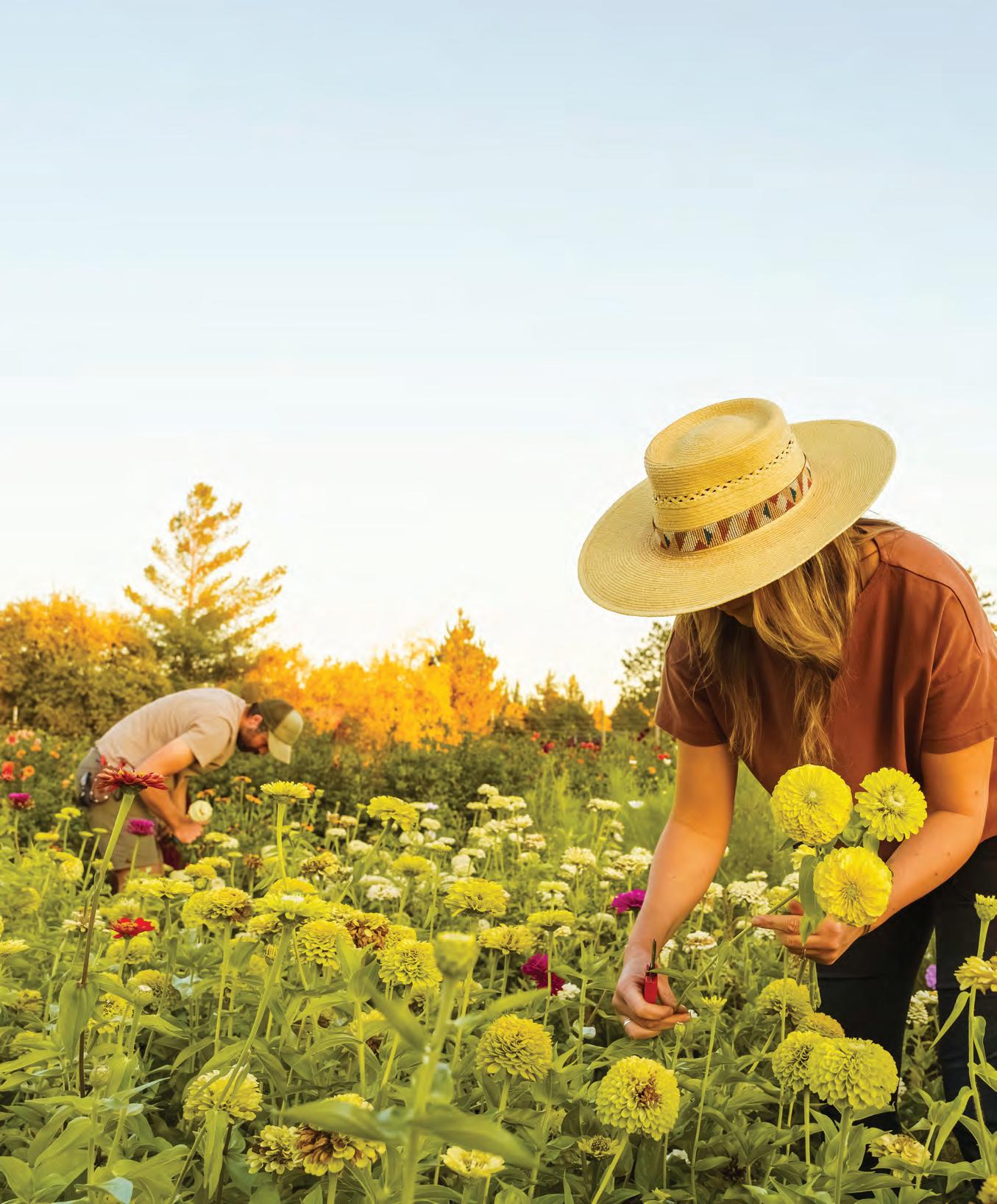
flower remains potent. Even Instagram scrolling stops at the sight of Jeremy Allen White shouldering a heap of fresh-cut blooms. Tulips, lavender, sunflowers, dahlias and more make their fragrant and colorful appearance at area markets and events, thanks to a dedicated group of flower farmers in Central Oregon. Largely women-owned and women-run, regional flower farms represent an alchemy of inspiration and grit. Along with the flowers, these growers cultivate strong relationships with the land and with each other, fostering an agricultural society of shared beauty, resilience and support.
Lindsay Wiley, The Littlest Flower Farm
Laurel Ludwicki
KALMIA FLOWER FARM
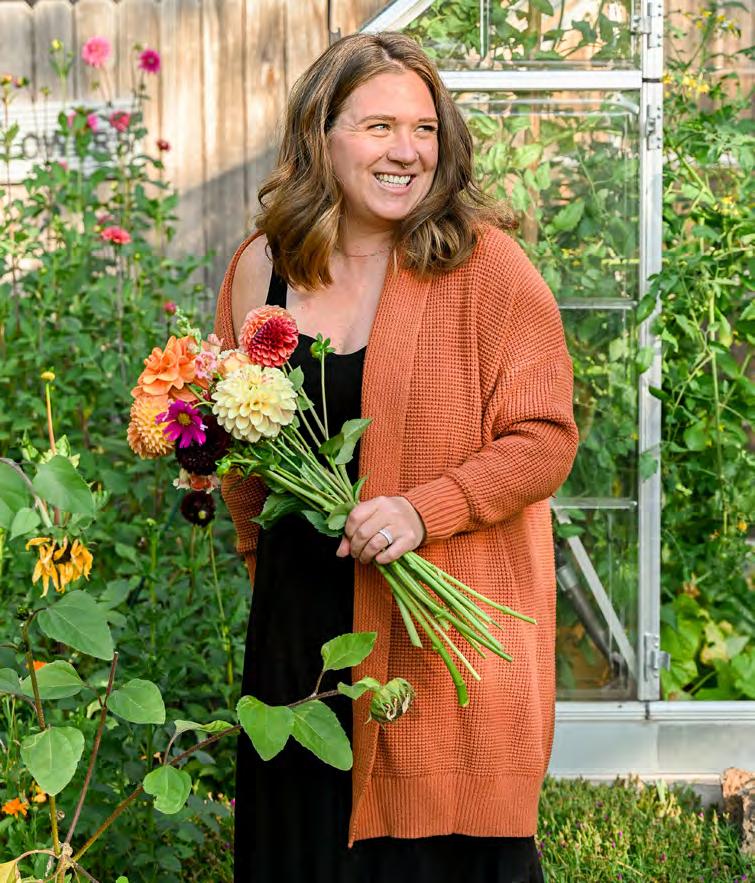
Kalmia Flower Farm in Bend offers à la carte bouquets and a CSA to buy blooms for the season in advance. Owner Laurel Ludwicki’s favorite flower is the dahlia, of which the poet Didi Jackson writes, “Surely they contain all / the colors of our universe.” Dahlias are a “year-round labor of love,” said Ludwicki. They require digging and dividing before they can be sold and shipped. Growing anything in Central Oregon is tough: According to the OSU Extension Service, growers get a mere 80 to 100 days from seed to harvest, barring frost. Ludwicki goes the extra mile, choosing organic practices with a sweet approach to pest control. “I address pests by controlling the sugar content of the plants. By using additives like molasses, I can make the plants less appealing to munch on, without introducing harmful chemicals,” she said, so there can be a larger ecosystem of insects on the farm.
Emily Kotaich
COVEY FIELDS FLOWER FARM & FLORAL STUDIO
Emily Kotaich of Covey Fields Flower Farm & Floral Studio in Powell Butte organizes what she calls garden and gather meet-ups in Redmond and Bend. Held at local businesses, happy hour events are free and feature inspiration for bouquet design and garden planning. Kotaich appreciates the generosity of local growers, reminiscent of her experience with a community garden project she participated in throughout her teen years in Boise. “I only know the things I know," said Kotaich, "because someone stopped and shared it.”
Amy Ochander
WINDY RIDGE LAVENDER
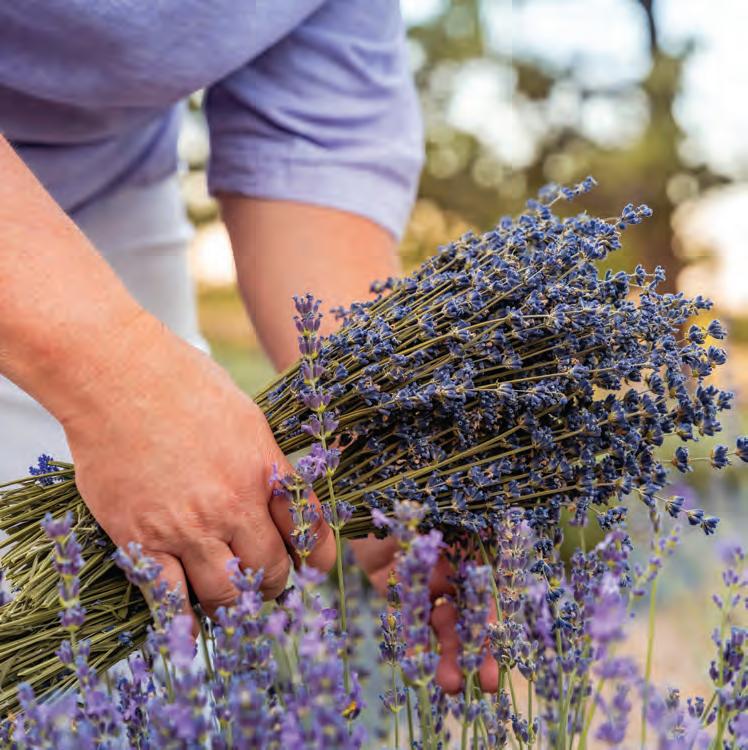
Amy Ochander of Windy Ridge Lavender identifies as a small Tumalo-centric grower, though in addition to 1,500 lavender plants, she’s branched out to tulips, sourcing half her bulbs from the Pacific Northwest. Confident about cultivating hardy lavender, Ochander shared it was an emotional decision to take on the tulip, which volunteers, she said, as “the first sign of spring and hope.” A former school administrator, she loves the combination of art and science, but ultimately, it’s about the people. Growers in Central Oregon, are a “community of optimistic and hopeful people—I’m attracted to that,” she said.
“Flowers bring us together in a world where it can be hard to find hope.”
-Amy Ochander, windy ridge lavender
Lindsay Wiley
THE LITTLEST FLOWER FARM
When she started, Lindsay Wiley paired blooms with food crops, but then decided the flowers had her heart and The Littlest Flower Farm was born. A 10-year resident of Bend with a fulltime marketing career, Wiley said she “felt a sense of impermanence” while working remotely. Becoming a member of the Central Oregon Flower Collective changed everything. The collective, founded and managed by Lisa Shaddox of Hollyhock Hollow farm, streamlines wholesale and retail sales, plus it offers support to more than 14 local farmers. “The sense of community I feel now is really fulfilling,” Wiley said. She tends to her Bend farm early mornings, nights and weekends—squeezing the work in wherever she can, she explained, to produce cut flowers for the wholesale market and for a weekly Saturday market at Pomegranate Home and Garden in Bend. “I find so much peace in the garden, on my knees, squatting and crawling around in the dirt.” Of the business side, Wiley said you must be “brave enough to be bad at something new…You work toward growth and beauty, but if it’s not happening, you have to let it go.”
Eliza Eaton ROOTS WILD FLORAL
Eliza Eaton grew Roots Wild Floral in Bend on the foundation of her floral design expertise and her husband Rob’s farming know-how. Keen to make a difference, Eaton said, “We saw firsthand the immense environmental impact of the global flower trade. Our goal is to provide local and sustainably grown flowers for our community—to connect the flower source to the final floral design.” Weddings are a mainstay of the Bend business, and this will be the CSA's seventh season. “The chaotic whiplash of spring weather in Central Oregon is certainly a challenge, navigating the intense sun and the freezing temperatures,” Eaton admitted, then listing the rewards: “Being outside, working with beautiful flowers, working among this amazing community and seeing the joy and delight on our customers’ faces.”
Chrissy Capri Snider TUMALO FLOWER FARM
Like many local growers, Chrissy Capri Snider of Tumalo Flower Farm came to farming indirectly. Fate intervened when she and her family bought a horse property with no horses, but with two acres of irrigation rights. She asked herself, “What are we going to do here?” The answer was to plant sunflowers in all their glorious colors. She learned to grow plants close together for superior cut blooms, which sell wholesale and through the Central Oregon Flower Collective during highbloom season. Capri Snider feels most like a farmer with buckets of flowers in the back of her car and when she sees her blooms at local florists. Her challenges include freezes and water shortages, and getting the work done while raising young kids. As Tumalo Flower Farm strengthens its roots, she looks forward to “perfecting the art” and her understanding of how to grow blossoms and thrive.
So the question remains: Why farm flowers in an often unforgiving climate? For Ochander, who labors to bring lavender and tulips into bloom, she said, “Flowers bring us together in a world where it can be hard to find hope.”
&
Olympian Jessica Mendoza lives a life of leadership &Advocacy Humility
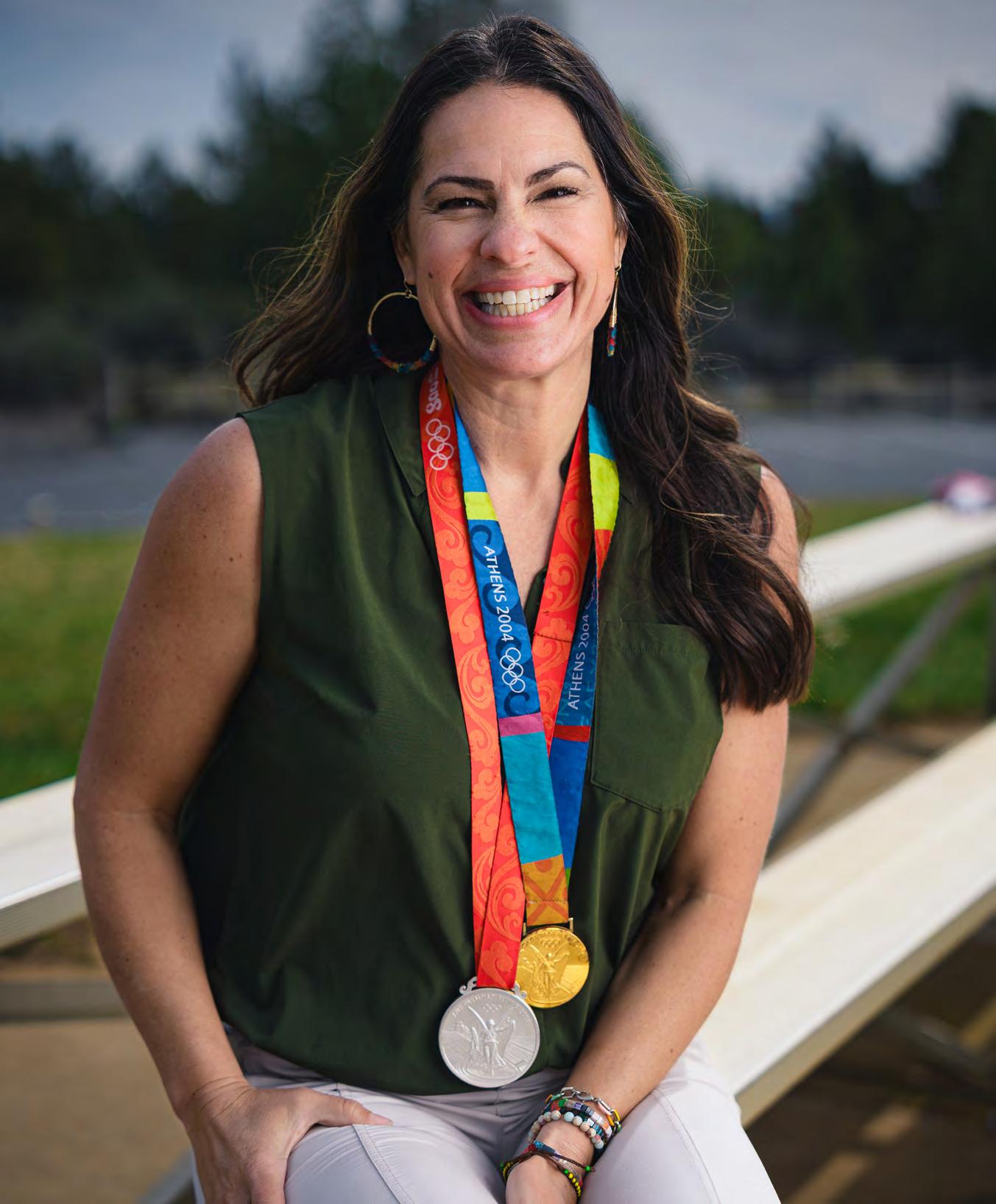
Jessica Mendoza often keeps her Olympic medals in a sock drawer. “I never wear them,” she said. Well, not anymore anyway, she explained. It was different when she won gold with the 2004 U.S. Olympic Softball Team in Athens. “We lived at the Olympic Training Center for a full year,” she recalled. “And you’re training like you’ve never trained before, so when you actually win that gold medal…I took a lot of time to really hold on to that. I don’t think I took it off for two weeks.”
But afterward, Mendoza did what she said a lot of women are trained to do—she downplayed it. “After I won the gold medal, people would be like, ‘Oh, you play softball? Are you good?’ And I’d say, ‘I’m okay.’”
WRITTEN BY MIRA HANSEN
Growing up in Southern California, it didn’t take long for people to realize Mendoza was far better than okay. She had a penchant for most sports—softball included. “As a Hispanic young girl, there were not a lot of Hispanic female athletes to look up to,” she said. “Softball happened to have one of them, and that was Lisa Fernandez.”
Her love for the game, matched by her dedication to school—“I was always a student first,”she said, led Mendoza to Stanford University. There, she broke several batting records, helped lead her softball team to its first Women’s College World Series, and managed to earn bachelor and master’s degrees along the way. Her accolades only piled up from there: She earned three WBSC World Championship titles, three World Cup of Softball titles
Jessica Mendoza celebrates after hitting a home run at the match against Japan during the 2006 Women’s Fast Pitch Softball World Championship in Beijing, China. The team beat Japan 3-0 to win the gold medal.
“I think it’s great to have humility. But at some point, you need to have the balance of confidence when it matters most.”
and two Olympic medals—gold in 2004 and silver in 2008. Amid all of it, she also stepped into advocacy work, serving as president of the Women’s Sports Foundation (WSF) for two years, and launched a broadcasting career at ESPN, where she eventually became the first female analyst for a nationally televised MLB game. In 2019, she was inducted into the National Softball Hall of Fame.
For Mendoza, every opportunity she’s had since Stanford has been completely unexpected and unplanned—but she doesn’t like to think long-term, she explained. “I’m just trying to be present,” she said. “And I’m going to keep getting better. But I’m always going to keep my eyes out for what else I can do.”
While she’s naturally driven and independent, the confidence piece, Mendoza explained, hasn’t always been there. “I feel like humility was important for my grind as an athlete,” she said. “I think it’s great to have humility. But at some point, you need to have the balance of confidence when it matters most.” It’s a lesson she believes is critical for young women to learn—one driving much of her ongoing advocacy work through WSF and the Sports Diplomacy program with the U.S. Department of State, where she travels internationally to empower young girls through sports. “I imagine this whole community being created off those who need to find that way to believe in themselves and to get to the next level.”
Since moving to Bend in 2019, Mendoza has already found a version of that community. “The women here—I’d never realized that women like this existed,” she said. “I’ve been influenced by so many [of them]. It’s like we’re all connected in a way that I’d never felt before.”
When she’s not traveling for work, Mendoza, along with her husband, her two boys and their Bernese Mountain Dog, Vader, leans hard into Bend life: hiking at Green Lakes, camping along Cultus Lake, catching live music at Suttle Lodge, eating at Hablo Tacos and spending plenty of time at On Tap, especially during baseball season.
Recently, Mendoza pulled her Olympic medals out again for her son’s school career day, where she’ll let the kids hold them and try them on. “You know, it’s a female that’s on the front of every Olympic medal,” she said. “It’s Nike, the goddess of victory.”
TOP LEFT: Mendoza and Jaime Foxx at a 2018 celebrity softball game.
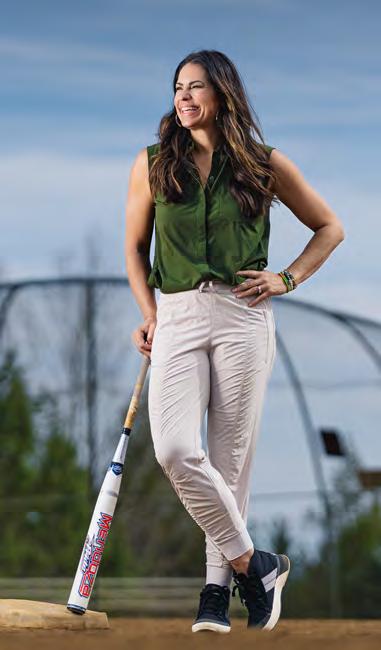
TOP RIGHT: Her career includes time as a commentator for ESPN.
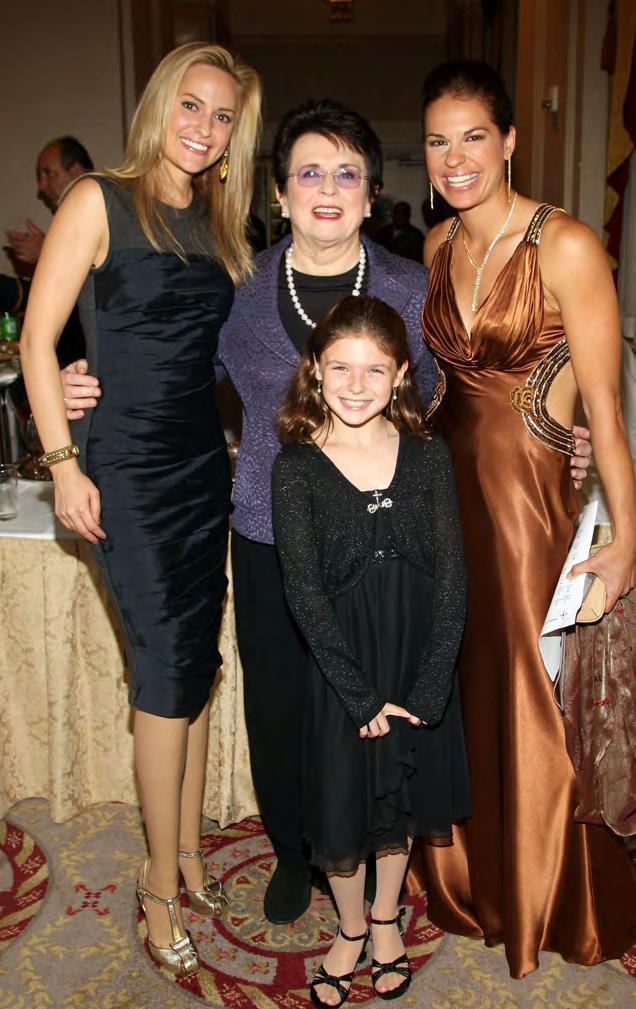
LEFT: Women’s Sports Foundation President Aimee Mullins, tennis player Billie Jean King, Mendoza, and Danielle Stone at the 2008 Salute to Women in Sports Awards.
Protectors OF THE FUTURE
NATIVE GUIDES ARE CARETAKERS OF THE RIVER AND HERITAGE
WRITTEN BY CHERYL PARTON | PHOTOGRAPHY BY CHAD BROWN
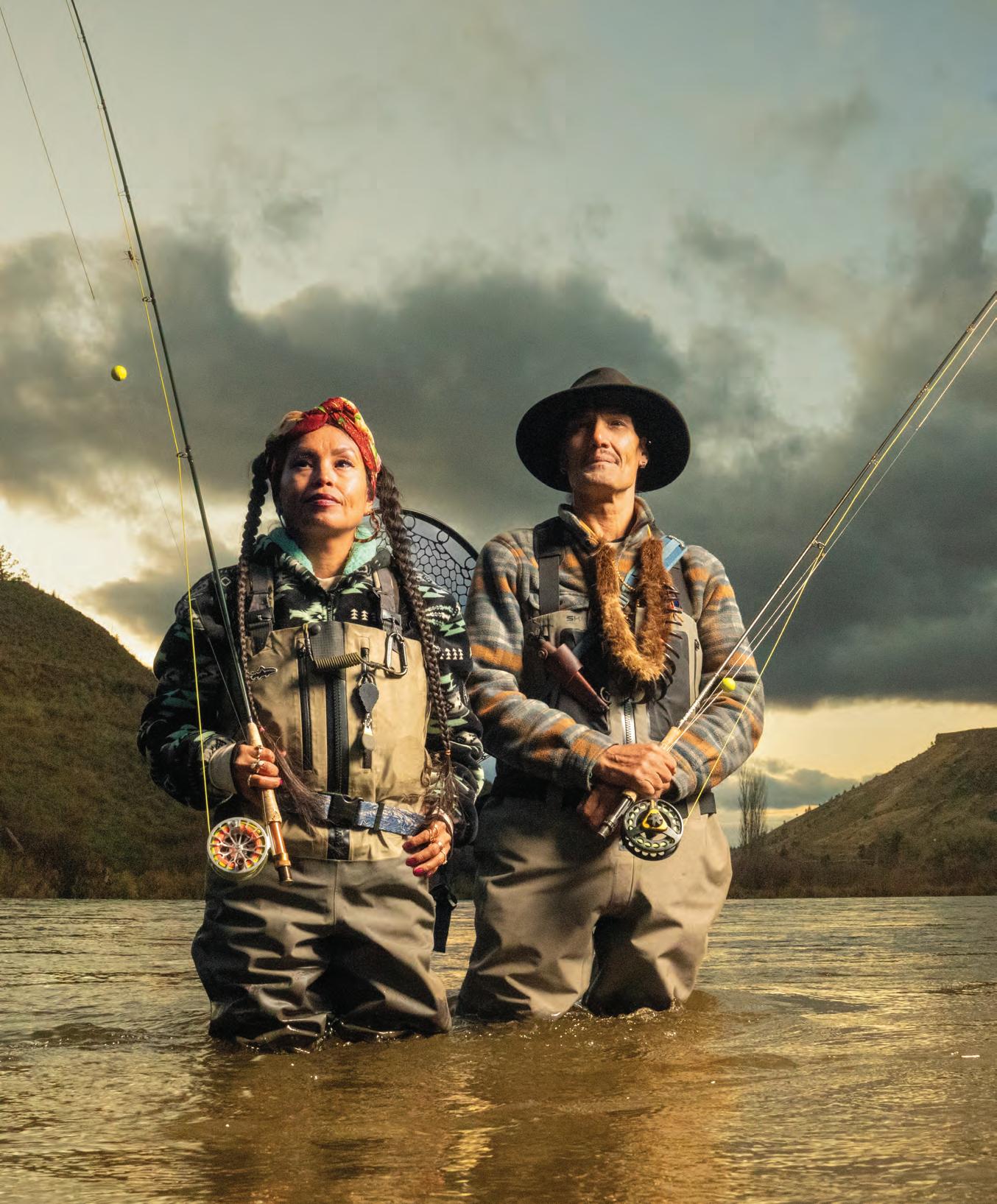
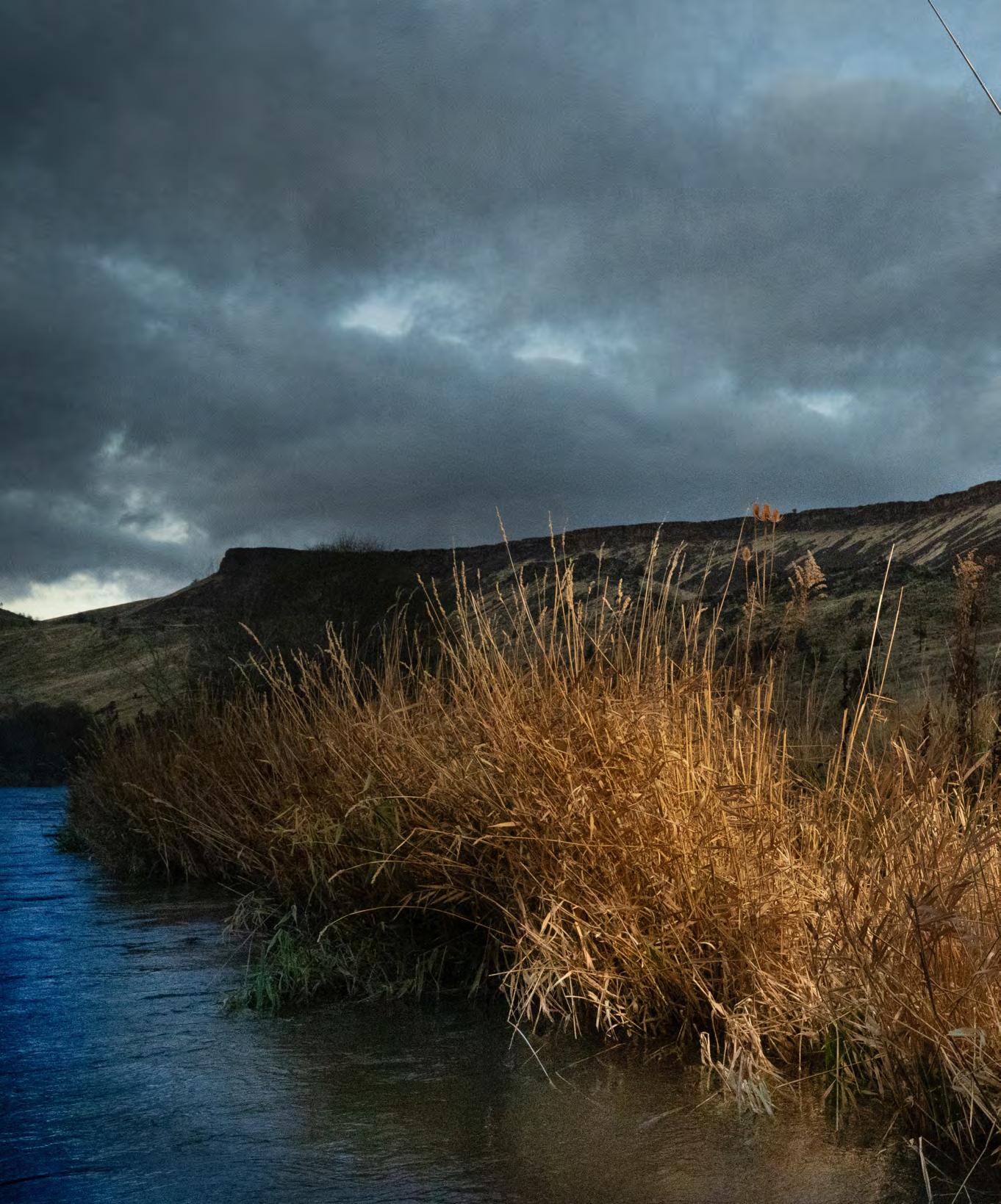
or Alysia and Elke Littleleaf, fishing on the Lower Deschutes River isn’t simply recreation, it’s a way of life. The married pair have been guides on the 39-mile section on the Warm Springs Reservation since 2011, on a portion of the river that has historically teemed with rainbow trout, Coho salmon and steelhead, and that has been a lifesource for Pauite, Wasco and Warm Springs tribes for centuries.
On the river, they say, water is life. “You’re dialed in with Mother Nature, one with the flow. Ultimately,
it’s our duty to instill a moral compass and empathy as a way to protect the future,” Alysia said. They take aspiring anglers of all ages on the river. “People don’t have to be experienced, but our job is to teach them how to be caretakers,” she explained. “We don’t just teach fly fishing, we teach conservation, about our culture and about how to give back to the land.”
Their mission translates into a guiding approach that is respectful of the land, river and fish, and extends to special programs for youth and veterans.
Partnering with Love is King and Soul River, Inc.—nonprofits founded by activist, veteran and artist Chad Brown—the Littleleafs bring groups to camp, teach and to heal. “Most of the kids have never fished a day in their life,” said Alysia.
On the first day of a four-day camp, participants visit the Museum at Warm Springs to learn about tribal history before heading to their campsite. There, to develop self reliance, they learn to cast and tie flies. Camping next to the river culminates
with a ceremony on the final day, where Alysia sings in Wasco while dressed in regalia. Elke accompanies by playing traditional instruments as a way to link to their ancestors. For the fishing groups they lead, especially for veterans, the river is therapy.
“Our family has sought to protect the river and now it’s our job to pass that on,” Alysia said. “We are not just fishing guides,” she said. “We are healers of the rivers as stewards, advocates and conservationists. It’s our way to be protectors of the future.” See littleleafguides.com
AT THE WATER ’ S EDGE
FLY FISHING WHERE
PASSION MEETS PURPOSE
WRITTEN BY SUZANNE JOHNSON
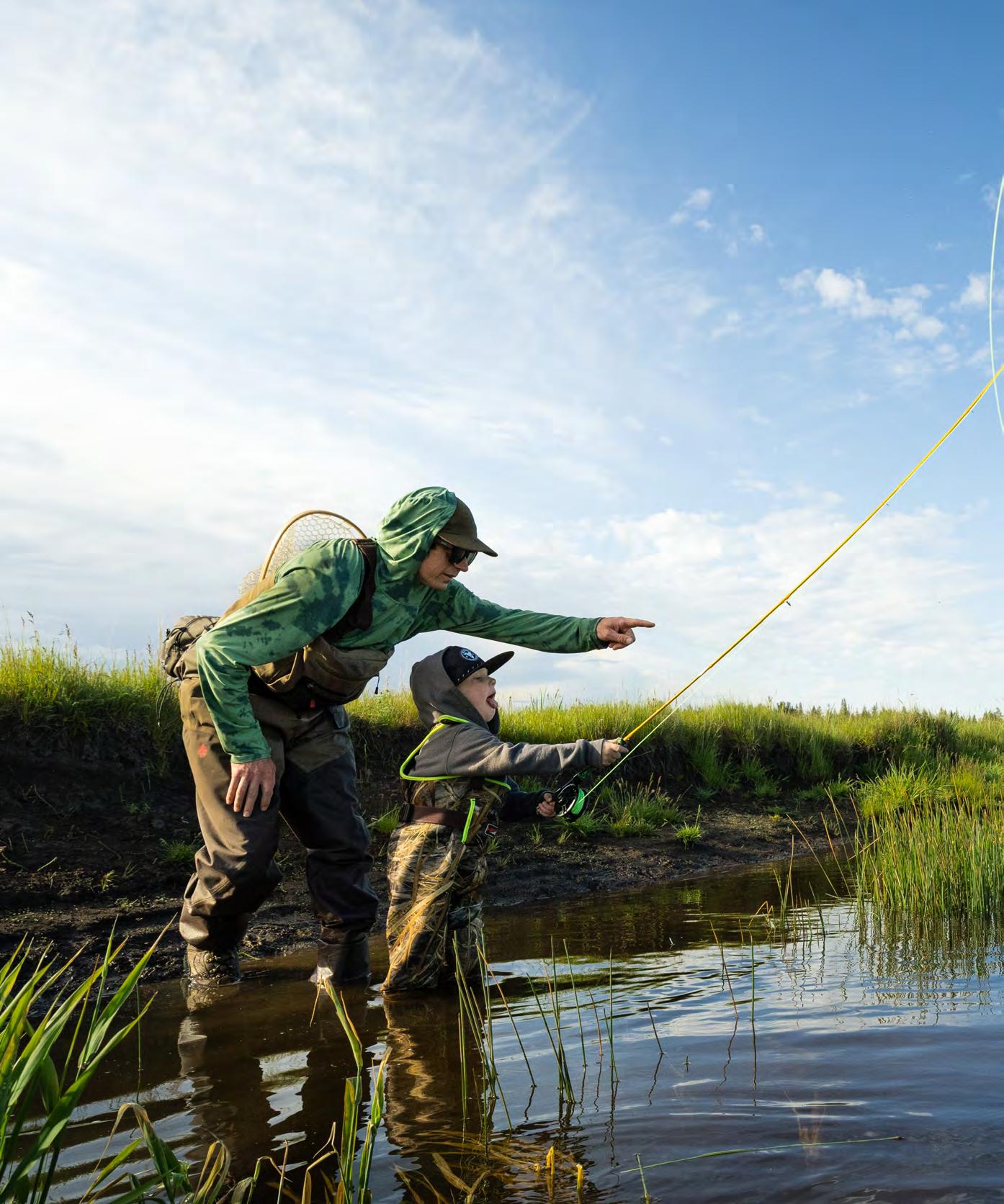
or fly-fishing guides like Steve Erickson and Mattias Holverson, a day on the river rarely means being the one to land a big fish. Erickson and Holverson both guide for The Fly Fisher’s Place in Sisters. Between May and October, each of them spends more than 100 days on the water, helping guests enjoy the serenity of nature and the adrenaline of hooking onto a beautiful wild fish.
“My workday starts the night before, rigging rods and prepping the boat,” said Holverson, now in his fourth year as a professional guide. The job entails more than setting up gear. Guides need expertise in river currents, insect life cycles and casting techniques, knowledge fine-tuned by time and experience. “Learning to read water, change a fly, safely handle a fish—it’s a lifetime journey. Mostly I want people to love fly-fishing as much as I do.”
Erickson, who traded the corporate world for a life in fly-fishing 25 years ago, believes guides need to understand people as well as they understand fish. “Anyone can learn the mechanics of fishing, but the essence of this business is creating a positive, meaningful experience, making great memories,” he said.
Most fly-fishing guides also weave in connections to ecosystem stewardship, as Erickson explained, because their work depends on healthy populations of wild fish. “No one is making more rivers, so as guides, we have to be stewards of our waters—especially as more people join the sport.”
A DREAM DESTINATION FOR ANGLERS
An estimated 8 million people participate in fly fishing in the United States, and industry experts project continued growth. In Deschutes County, fishing brings in more than $27 million in annual spending and supports more than 300 jobs. That rising interest translates to more folks on Central Oregon’s waters, where the multitude of fishable rivers and lakes offers a dream destination for anglers.
According to Peter Bowers, owner of The Patient Angler in Bend for more than 25 years, it’s the variety that makes Central Oregon special. “Few places have the diversity of fish that we find here: salmon, bass, steelhead and trout,” he said. Every
scenario requires specific skills and insights. Hooking a rainbow trout on the Metolius River demands stealth and technical knowhow; landing a steelhead on the Deschutes takes stamina and persistence; catching a brook trout on Hosmer Lake needs little more than a sunny day, a dry fly and a boat to paddle.
Bowers’s shop, founded by John Harken in 1984, survived the shift to online shopping by building solid relationships with customers. “Anything can be bought online, but nothing replaces connecting with a human—someone you trust to set you up with the right gear and teach the basics before you get on the water,” said Bowers. “Your goal is to outsmart a fish, and that takes hyper-local knowledge not available online.”
CASTING, COMMUNITY AND CREATIVITY
For many anglers, immersion in nature and finding solitude is part of the draw, but others might not pass up the chance to share a great fish story, and local shops are making room for that kind of community. In the outdoor space of Bend’s Old Mill District, a five-hole casting course, built by a coalition of community partners, offers a reason to gather and practice casting—it’s like a fly-fishing version of minigolf. Find course maps and score cards at Confluence Fly Shop. Confluence owner Tye Krueger designed his shop to encourage community. Near the front, a nine-tap bar invites visitors to pull up a stool. The back holds flexible event space, between racks of feathers, glittery thread and other flytying materials.
“We want to make fly fishing more approachable and break down obstacles that can be intimidating,” said Krueger. “That includes hosting groups like the Central Oregon Lady Anglers and offering open fly-tying sessions.”
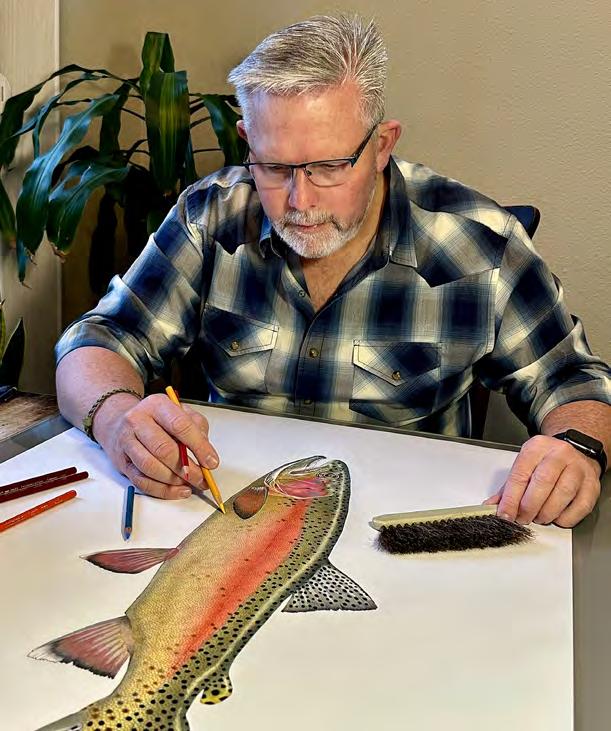
Tying flies keeps people connected to the sport through the off-season months and adds a unique element of creativity to fly fishing. “There’s an art to mimicking every detail of a fish’s natural food, with the nuances specific to the location and season. Catching a fish on your own fly feels authentic and rewarding,” he said. For Krueger, art is another way to share his passion for these beautiful creatures.
RIVER CONSERVATION
“Central Oregon has a long-standing culture of fishing,” said Zavier Borja, destination stewardship director at Visit Bend. From the historical connection of the Confederated Tribes of Warm Springs with salmon and steelhead to today’s spirit of catch-and-release, rivers are central to people’s well-being. But human impact often degrades water quality.
Reducing that impact requires cooperation and intentional stewardship, said Borja. Both Visit Bend and Visit Central Oregon fund river and trail restoration projects, done in partnership with other local organizations. For example, Visit Bend partnered with Trout Unlimited to reduce erosion and improve habitats along the Fall River, the Rimrock Trail, and Tumalo Falls. Beyond Bend, Visit Central Oregon supported Deschutes River Alliance’s Troutfest 2025, an annual celebration of fishing and river recreation along the lower Deschutes River.
On a larger scale, projects like the Deschutes Land Trust’s Priday Ranch Reserve are slowly restoring important tributaries that flow into the Deschutes River. Trout need cold, clear water, structures for cover and shade, and a gravelly riverbed for spawning, explained Rika Ayotte, executive director of the Deschutes Land Trust. The group’s Trout Creek restoration work is one of their success stories.
“Trout Creek is a stronghold for steelhead—up to 30% of steelhead in the Deschutes spawn in Trout Creek. Over time, good spawning habitat has been lost, said Ayotte. ”We’ve partnered with the Confederated Tribes of Warm Springs, agencies and other conservation organizations to bring it back.”
This summer, thousands of anglers will stand knee-deep in a clear, cold Central Oregon river. They’ll cast for the foam line, ready for the tug on the line, and enjoy the peace and quiet. They probably won’t think about the work that’s keeping the rivers healthy, or the artistry that went into their fly, or how their guide came to know so much about caddis flies.
By the end of the day, they may have a new love of fish and rivers and a good story to share.
And according to guides like Holverson and Erickson, that makes the work worthwhile.
“Trout Creek is a stronghold for steelhead—up to 30% of steelhead in the Deschutes spawn in Trout Creek. Over time, good spawning habitat has been lost, said Ayotte. ”We’ve partnered with the Confederated Tribes of Warm Springs, agencies and other conservation organizations to bring it back.”
This summer, thousands of anglers will stand knee-deep in a clear, cold Central Oregon river. They’ll cast for the foam line, ready for the tug on the line, and enjoy the peace and quiet. They probably won’t think about the work that’s keeping the rivers healthy, or the artistry that went into their fly, or how their guide came to know so much about caddis flies. By the end of the day, they may have a new love of fish and rivers and a good story to share. And according to guides like Holverson and Erickson, that makes the work worthwhile.
The Salmonfly Hatch
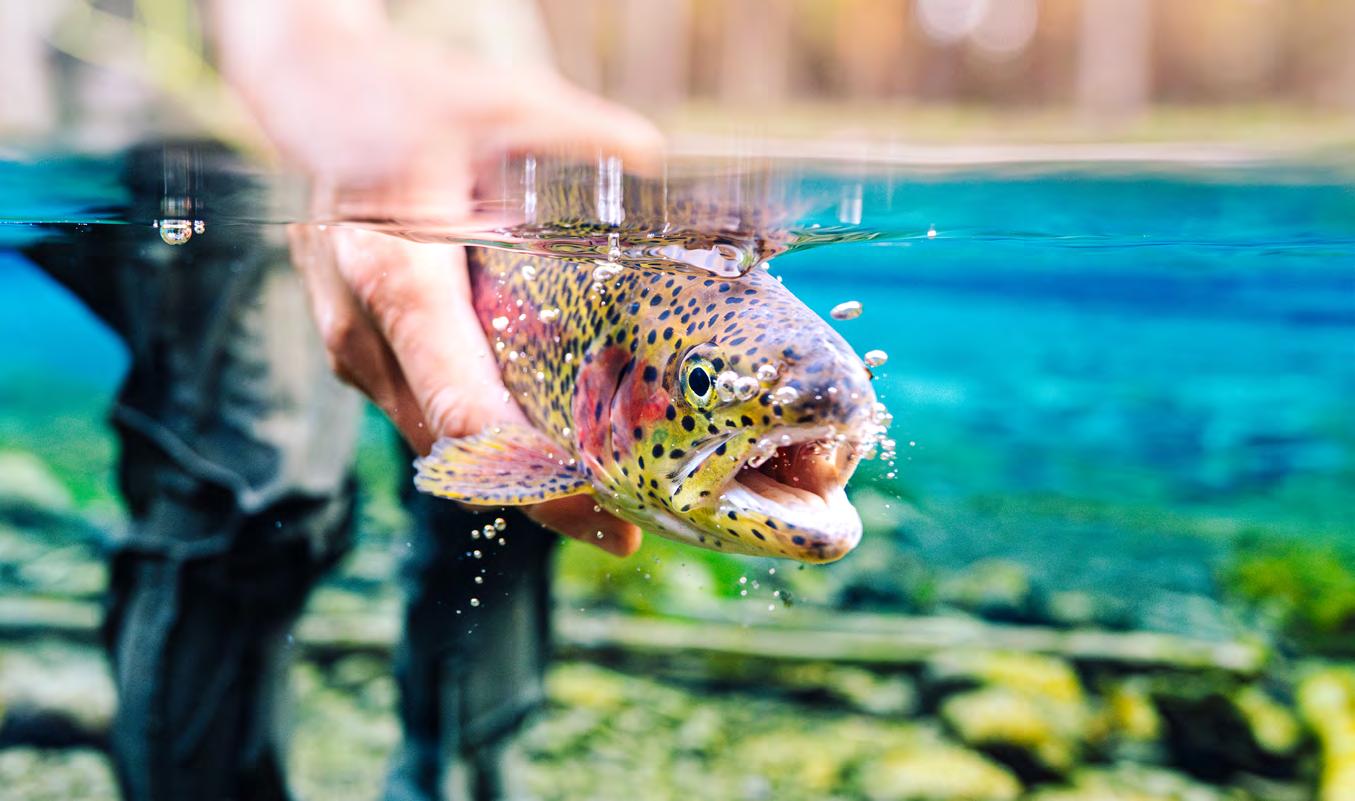
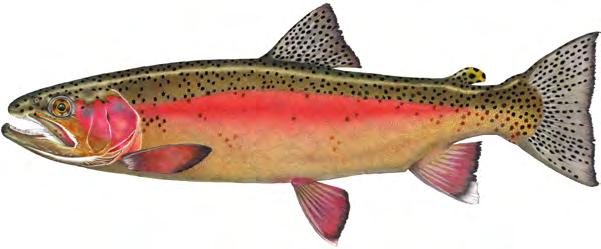
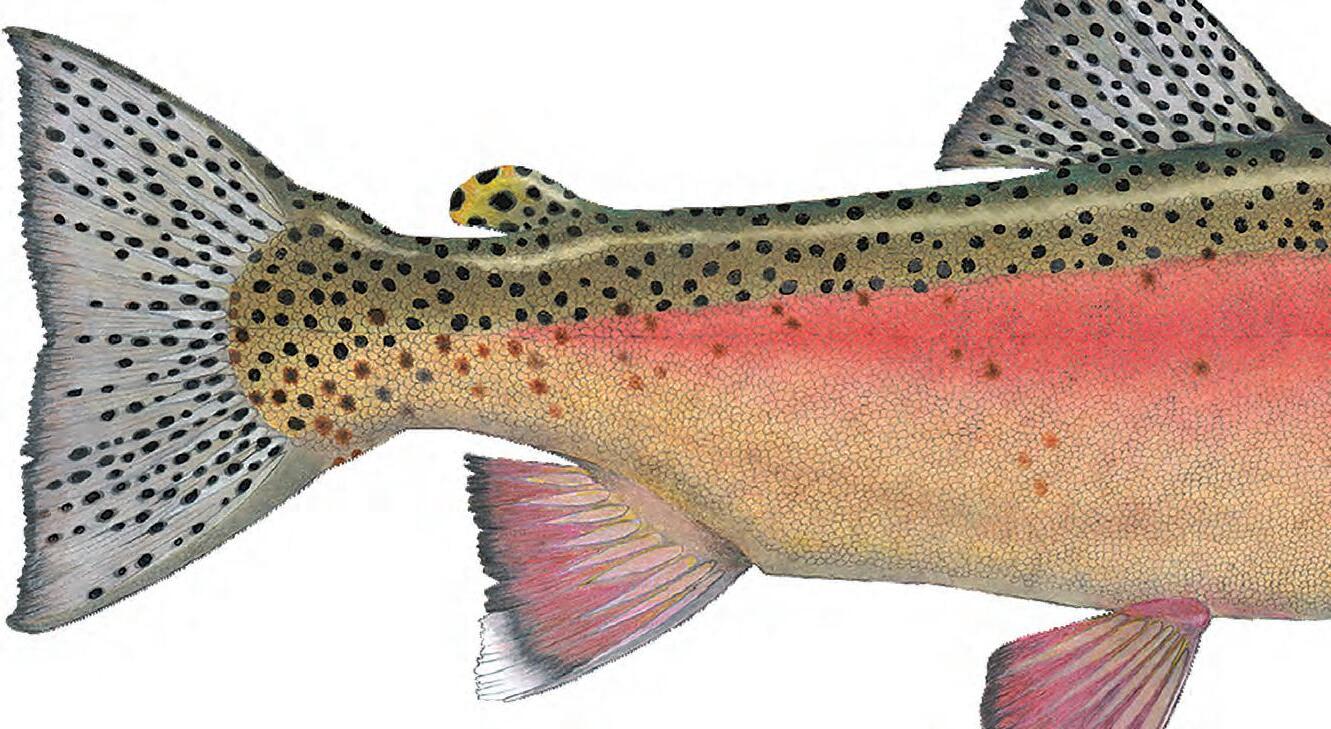
Considered the Masters Week of fly fishing, and the season opener on the Deschutes River, “the hatch” creates the chance to catch a prized redband rainbow trout. A few things to know:
16 - 20 Inches
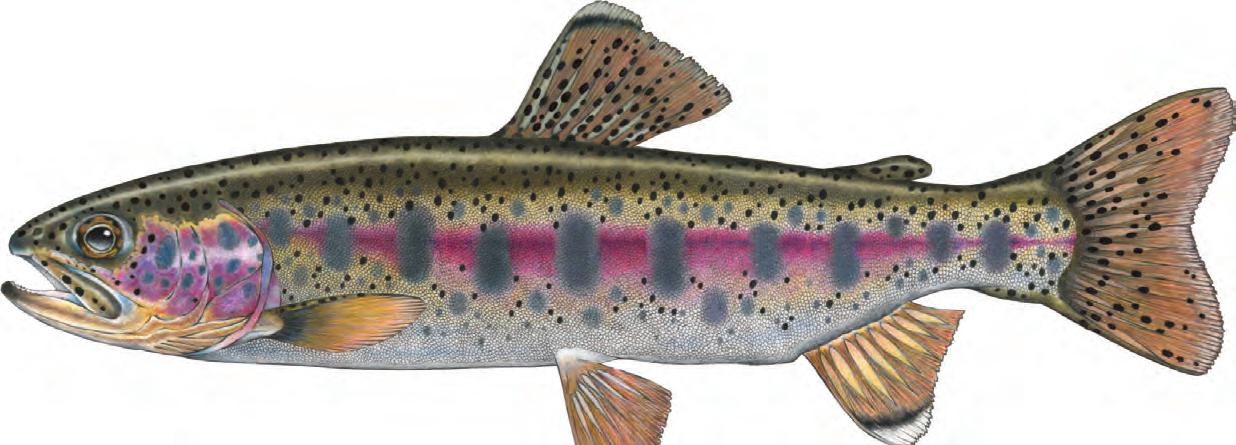
The length of a mature redband rainbow trout. 1,500-3,000 Wild redband trout per mile can be held in peak stretches of the Lower Deschutes.
Tips
Timing is everything. Even though the overall hatch season lasts weeks, any given section of the Deschutes may peak for just 3–5 days. Instead of picking a weekend months in advance, experts watch:
River temperatures for the key trigger of 54–58°F. Weather trends. Warm spells will accelerate the hatch. Pelton Dam releases. Cooler water delay the hatch.
Pick a zone based on timing, not a favorite spot. The hatch starts downstream and pushes upriver 2-5 miles per day.
Early hatch: Near the confluence of the Deschutes and Columbia rivers
Mid: Maupin
Late: Trout Creek upstream sections
Call or stop by fly-fishing shops instead of relying on reports since online reports lag.
Don’t fish too far out. Salmonflies hatch on shore.
Trout illustration by Tye Krueger
ART & SCIENCE CONVERGE
TYE KRUEGER ILLUSTRATES THE COLORFUL WORLD OF FISH
WRITTEN BY MIKE MACY
Like so many kids, Tye Krueger’s love of fishing began with a bargain-basement rod and Zebco spinning reel. Born in Texas, weaned on Southern bass ponds, Krueger landed his first trout after a family move to Canada in the 1970s. So different from bass and bluegills, that rainbow’s shape and coloration hooked him.
He had always drawn animals, never fish. That came after landing a fishing manager position at the Orvis store in Richmond, Virginia, where his hyper-realistic fish illustrations gained notice and quickly evolved from casual pursuit to a formal passion.
With a Bachelor of Science in Agriculture from North Carolina State University, the Marine Corps veteran considers himself a student of science. Each colored pencil drawing is an exercise in anatomical precision and faithful coloration involving more than 100 hours. Totally self-taught, Krueger pursues realism and continually strives to perfect technique, inviting the scrutiny of ichthyophiles. Expertly preserved
under a glossy, protective clearcoat, each completed drawing leaves the fish looking wet and ready to return to its river. Countless hours on the water, thousands of fish brought to hand and exhaustive online research imbue each commissioned assignment or personal project. Krueger finds commissions based on customer-provided photos especially rewarding, capturing the angler’s experience with a specific fish’s unique markings, colors and shapes. Found in numerous private collections and featured in guidebooks, species identification manuals and angling periodicals, his illustrations have also been expertly recreated as stickers, greeting cards, coffee mugs and signed reproductions. The Orvis Company may have brought Krueger to Bend, but when Orvis left, it was Central Oregon’s spectacular landscape, incredible fishing and business opportunities that enticed him to stay. Krueger opened Confluence Fly Shop in 2013 and purchased Deep Canyon Outfitters Guide Service from a colleague in 2016. The combination continues to create meaningful fly-fishing experiences with clients while preserving the memories with his art. See confluenceflyshop.com
The original illustration of a Redband rainbow trout took more than 100 hours to complete.
and to register, visit bendparksandrec.org
MAY
5.1 - EL TEN ELEVEN
5.2 - JELL-O WRESTLING: SMASH BROS.
5.3 - WHITEY MORGAN AND THE 78S
5.7 - HOMEGROWN MUSIC FESTIVAL
5.8 - HOMEGROWN MUSIC FESTIVAL
5.10 - ELECTRIC SIX WITH MOON RATTLES
5.21 - TOMMY GUERRERO
JULY
7.17 - MICKEY AVALON
7.18 - UNOFFICIAL LEVITY & TAPE B AFTER PARTY
7.24 - FUTUREBIRDS
7.29 - THE BROTHERS COMATOSE
7.31 - KR3TURE
5.23 - UNOFFICIAL YELLOWCARD AFTER PARTY
5.30 - COMEDIAN GABRIEL RUTLEDGE
JUNE
6.7 - SKELETON CREWE QUINTET
6.12 - BRETT DENNEN
6.13 - SODOWN WITH ODDLY EAZY
6.16 - THE CRANE WIVES
6.17 - BLIND PILOT & JOHN CRAIGIE
6.18 - TERRAPIN FLYER
6.21 - WAX & DJ HOPPA
6.25 - COMEDY FROM THE CLASSROOM
6.28 - HIGH FADE WITH BRASS CAMEL
AUGUST
8.1 - THE WHITE BUFFALO
8.9 - NICK SHOULDERS
8.19 - KBONG & JOHNNY COSMIC
8.22 - KENNY FEIDLER
SEPTEMBER
9.5 - BEND COMEDY FESTIVAL
Kindling Taste
The Hudson is a chophouse and gathering place
WRITTEN BY CHERYL PARTON
PHOTOGRAPHY BY TINA PAYMASTER
It’s in our nature to be drawn to the warmth of a flame. New this spring, The Hudson restaurant carries a torch from the past to anchor fine dining in downtown Bend, and the fire’s steward is Chef George Morris.
Nine years ago, Morris traveled to Asador Etxebarri in Spain’s Basque countryside, the Michelin-starred restaurant where Chef Victor Arguinzoniz’s wood fire touches every item on the menu and where the desserts taste of smoke. The experience left an imprint on Morris who saw how simple ingredients could be transformed by burning woods in a fine-dining kitchen. Stoked by the flame philosophy and cooking techniques inspired The Hudson, a live-fire chophouse, but don’t call it a steakhouse. “I want to use live fire to show what other proteins can do,” Morris said.
A PLACE IN HISTORY
The Hudson’s address may have inherited civic muscle memory. Wall Street, named for the lava-rock wall erected in the early 1900s before Bend swelled into itself, is a tributary of downtown commerce, paralleling the Deschutes River a block away. In 1919, the Butchwalters Building housed the region’s first full-service sporting goods retailer, and later, the space was a furniture store. In 2002, Chef Jody Denton opened Merenda, and many wondered whether Bend was ready for such a large-scale restaurant with elevated cuisine. Later, 900 Wall anchored the corner for 18 years. The Hudson isn’t simply a successor—it reasserts the space as one of downtown’s defining dining rooms. Inside, hospitality is immediate and visual. A stairway leads to a social club where the intention is for bartenders to know members by name. Concrete floors and exposed brick preserve hints of the building’s commercial history. Look up and the effect softens—chandeliers fan out in gold, and glass orbs float two stories from high ceilings. Smoky mirrors repurposed from the former barback are built into the serving counter. Iron Roots Design’s Celeste McGowan described the interior decor as “marrying two aspects of design, masculine meeting feminine.” Her work brings strong geometric lines tempered by glow and luxe without ostentation. For McGowan, it was important to match what she called “the fiery energy” of Chef Morris through spatial design and decor.
Upstairs, a gold-leaf and plaster mural by Juanita Perdomo traces the topography of the Three Sisters, Broken
Top and Mount Bachelor. In the dining room, aubergine velvet curtains drape the entrance and upholstered barrel chairs sit like punctuation marks along banquettes.
“We wanted the ‘Wow factor,’ said Dale Fuller, a Bend-based investor in The Hudson, “I think people will be surprised when they come in.”
Beneath the stairs, one of those surprises is a glassed greenhouse glowing with plant life. “We’re farmers, too,” Fuller added as he watched Chef Morris clip herbs to accent a freshly-plated dish from the kitchen. At the end of the bar, a dry-aging room was built to display meats like objets d’art and a wine cellar rises above it as an end cap. Sound engineers were brought in during the remodel to tackle acoustics, and the ceiling now absorbs noise rather than amplifying it. A goal was to control the space’s intensity, and the same control is necessary when cooking in the kitchen with flames.
A KITCHEN WITH FIRE
The Hudson’s open kitchen radiates energy, creating temperatures of 700 to 800 degrees Fahrenheit, compared to the 400 and 500 degree temperatures found in conventional kitchens. That might intimidate lesser ventilation systems and cooking staff, but contractor and business partner, Rob Kelleher, took on the task. As founder of Bend construction company Kellcon, Kelleher had built out more than three dozen restaurants in Central Oregon, plus there was a personal interest inspired by memories of his father cooking everything on a grill. “Little did I know you could bring live fire into a kitchen,” he said. But flame is volatile, and as Morris said, “you don’t want to make it mad.” Working with it requires intuition layered atop technique—whether controlling ventilation or cooking. Morris, a Culinary Institute of America graduate who has worked in fine-dining kitchens in Manhattan and Colorado, pairs a charcoal grill at The Hudson with a Rational Combi oven, a highly advanced cooking system. The setup allows him the versatility to add smoke for depth, steam for tenderness or dry heat for crackle.
WHAT’S ON THE MENU
Slow-roasted pork belly arrives after cooking for more than six hours, with fat rendered gradually until its interior becomes silken. Asian pear brings cool crispness; kimchi adds acid and brightness; mustard seed pops against richness; and a reduction sauce glazes the dish as smokiness lingers in the background. Chicken isn’t an understudy, but takes a leading role on the grill. Topped with blistered shishito peppers and a dollop of a pesto-like accompaniment, it is herbaceous with a hint of spice that echoes heat from the fire. Even vegetables command attention: carrots are roasted until their sugars bloom and caramelize; patatas bravas are seared to give them crisp edges with fork-tender interiors. Then, steak lands with bark so deeply lacquered it borders on obsidian. A knife meets resistance, then yields; inside, the meat glows with juices threading across the plate in a shimmering ribbon. The aroma is layered with sweetness and faint smoke.
The strategic counterpoint is a raw bar providing oysters atop crushed ice, with their brine snapping freshly against the palate. A taste of caviar pops with a salty burst. A diner’s choice is between fire, farm or ocean—or having all three—with a menu that encourages experimentation.
Cocktails are engineered with the same variety as the food, plus a bit of playfulness. The Cosmo Kramer, a nod to Seinfeld fans, calibrates citric and malic acids by blending pink and white cranberry juices to refine the sweetness. A Spicy Galleta begins with tequila, dials back agave and layers in a house-made spicy tincture with biscotti liqueur to balance heat and warmth with pastrylike undertones.
Sommelier Zach Haupt curated 160 to 170 labels on The Hudson’s primary wine list, with another 35 to 40 on its Captain’s Reserve menu. The global sweep was designed to mirror the range of the food.
ABOVE: Slow-roasted pork belly
THIS: Chef George Morris
CHOOSING AN EXPERIENCE
Three distinct experiences unfold within The Hudson’s 6,300-square-foot space. A long bar inherits energy from the open kitchen only steps away, and bottles of spirits line a full wall like an encyclopedia from A to Z. The dining room, seating up to 50, offers immersion. Upstairs, the social lounge functions as what Fuller, owner of five restaurants in San Francisco, calls “a second living room downtown” with a separate bar and dining area, tasting room and wine lockers.
“How you become part of a community is by feeding the community and taking care of it,” Fuller said. This earned hospitality, he explained, provides a sense of belonging.
“We want people to say, ‘This is my place.’”
And then there is the name.
Hudson is Morris’s son. But, the chef is quick to clarify, “Hudson is a name, but The Hudson is a place.” The word conjures the Hudson Valley, where Morris went to culinary school, and the river that flows past New York City chophouses—institutions that fuse fire, meat and memory.
“Our primary goal is to be a place the neighborhood celebrates,” said Ken Macias, general manager. “We’ve been given this place in the heart of downtown. It’s been a gathering place, and we want to carry that torch in a fresh and vibrant way.”
The Hudson has preserved the bricks and bones of a historic space and provided a menu that ignites curiosity. As bobbleheads of Morris, Fuller and Kelleher peer out from a wall niche, there’s also a signal to settle in, enjoy their hospitality and have a bit of fun.
TOP RIGHT: Cosmo Kramer cocktail
TOP LEFT: Zach Haupt curates wine and spirits
THIS: Owners Rob Kelleher, Dale Fuller and George Morris
HOME STYLED
Thoughtfully curated home décor and goods, along with personalized staging and styling services for homes and interiors.
251 E SUN RANCH DR., SISTERS WITHHOMESTYLED.COM
THREE FINGER JACK TAVERN
Untamed and ranch-inspired — bold cocktails and comfort food featuring naturally raised meats and wild-caught seafood. 411 E HOOD AVE, SISTERS THREEFINGERJACKTAVERN.COM
Where Confidence Cooks
Chef Candy Argondizza helps home chefs master technique and find joy in the kitchen
WRITTEN BY CATHY CARROLL
PHOTOGRAPHY BY TAMBI LANE
The aroma of chicken simmering in a fragrant sauce of Moroccan spices permeated the steam and chatter as 14 aproned students moved quickly about the kitchen, from their stations to the stove and then to gather around Chef Candy Argondizza demonstrating the next item—za’atar flatbread. They tried it themselves, dropping the rough-edged, flat circles of dough onto sizzling hot pans, watching for them to take shape. Argondizza swept past a skillet where one student’s dough was not quite behaving. “Okay, if they’re not puffing, the heat might need to be a little higher to activate that baking powder,” she advised.The 5-foottall Argondizza, with her closely cropped salt-and-pepper hair, whizzes about the kitchen at the Cascade Culinary Institute with the focused, efficient energy that’s part triathlete, part culinary artist and part award-winning teacher. Trained at the Culinary Institute of America in Hyde Park, New York, she worked at many fine dining restaurants in New York City, where she later taught and was at the helm of the International Culinary Center, working
alongside many of the world’s best-known chefs, including Jacques Pépin, José Andrés, Jacques Torres and André Soltner.
In 2017, she and her partner, Marité Acosta—also a chef—moved to Bend after having visited friends here for a decade. They launched Ingredient Studio, offering custom, in-home classes. Argondizza began offering cooking classes at the Cascade Culinary Institute through the Community Education program at Central Oregon Community College, where she also now offers themed demonstration dinners. Guests watch Argondizza prepare dishes such as zucchini Milanese, spinach and ricotta agnolotti with a light tomato basil sauce and chilled zabaglione with fresh berries, then retreat to the school’s Elevation dining room to sip wine and savor the three-course meal.
“I love to cook and I love to teach—I never get tired of it,” said Argondizza. That was apparent as she guided students through the final stages of the Moroccan dishes during a class in a multiweek Around the World series. In previous weeks, they cooked their way through Korea, Germany, France and China.
Throughout the morning, Argondizza issued calm but firm guidance while boosting students’ confidence. “I tell them that the biggest difference between you and me is seasoning—you have to taste your food—and heat—don’t be afraid of high heat. You’ve got to get that nice sear,” she said. “Students used to say to me, ‘Chef, chef, the chicken’s burning!’ And I’d say, ‘No, it’s not. You’re burning it. So you adjust the heat—you react, right? Reacting. It’s a reactive sport. You practice, practice, practice, and then you execute just like you do in a sport.”
Those are some of the core takeaways. For student Anthony Dorsch, the challenge was multitasking and mis en place, the French term for having all prepped, measured ingredients in place before cooking. “I did get in trouble for not putting the cut vegetables into the bowls, measured and organized,” he said.
Since Erin Stone took the class with her husband, they’ve been cooking more at home. Foundational knowledge—knife skills, regulating heat, how to select oil and salt to use—has made a huge difference, she said.
Edlyn Leonard, a bilingual advocate with Saving Grace, which supports victims of domestic violence, sees the class as a creative outlet and as rejuvenating self-care. She is excited to infuse Korean, German, Mediterranean, Chinese and Moroccan flavors into her repertoire of Mexican dishes.
Amy Tacka, who returned for a second class and had an in-home lesson with Argondizza, has had fun getting comfortable with techniques such as braising and poaching at home.
These nonprofessional students are sometimes more passionate than the professional students she taught in Manhattan, and she teaches with the same firm, fair rigor, Argondizza said. “I give them timelines, and they like that. They react to it. They hear the seriousness that I take, and they want to do well.”
It’s gratifying for all. “What gives me joy is when I see them able to just go to their station and not be fearful,” said Argondizza. “They’re more confident. They send me pictures of the food because I tell them, ‘You’ve seen it here—go home and make it again, because it’ll be fresh in your memory. You’ll remember what it looked like, what it tasted like. You’ll hear my voice in your head. And they do.” See cascadeculinary.com and ingredientstudio.com
LEARN TO COOK
Bend Park & Recreation District
Children and adults learn cooking basics to speciality menus. See bendparksandrec.org.
Central Oregon Community
College Community Education
Hands-on classes covering a range of skills, from baking to perfecting global cuisines. See cocc.edu
Chef Ingrid Rohrer
Students achieve culinary goals in areas of entertaining or creating family dinners. See chefingrid.net.
Dropping Beets
Chef Joe Benevento offers lifestylebased cooking and nutrition classes. See droppingbeets.com.
Kara’s Kitchenware
Classes in the Old Mill District focus on various techniques, ingredients and regional cuisines. See karaskitchenware.com.
Matcha Mania
Sip a strawberry matcha latte
WRITTEN BY SIENA DORMAN | PHOTOGRAPHY BY TINA PAYMASTER
Adrink that was once hard to come by, matcha is now ubiquitous in cafe culture. The finely milled Japanese green tea has long been central to traditional tea ceremonies and today shows up everywhere from pastry cases to skincare products. The fascination with matcha may come from its flavor. It is both striking and grounding: grassy, a little bitter and slightly sweet, with a caffeine lift steadier than coffee’s. Plus, it harbors an abundance of antioxidants and amino acids. Matcha varies in quality, from ceremonial-grade to culinary powders used in baking, it is prized for its vivid green color and refined texture, and is brought to life by tactful whisking to produce its signature silky texture.
The Strawberry Matcha Latte from Pika Pika in downtown Bend takes the drink to another level. Served
over ice from the shop’s cafe window, a reusable cup is filled with a layer of premium grade matcha, milk and strawberry, transpiring into a mouthwatering sunset of colors. An abundance of ice comes into play before the first sip, when a big shake combines the layers.
A pleasing rhythm between fruit and tea follows. Strawberry aromatics open each sip, then slip aside as the matcha arrives with a satin, nutty finish. The tea flavor remains present and, like any good matcha, is free of clumps or chalkiness. Because the strawberry purée is made with real fruit rather than syrup, the matcha gets the chance to speak for itself while the sweet and umami sides of the palate enjoy the harmony. Ice cold, bright in color and portable, this matcha is just the right partner for summer. See @pikapikabend .
Experience ELEVATION BEND, formerly known as Bend Factory Stores. Where the best in fashion, fitness, and lifestyle come together in one place!
Explore a collection of well-known brands including Nike, Pendleton, Victoria’s Secret, and Columbia Sportswear, along with a variety of unique shops offering apparel, accessories, home goods, and more. WHERE EVERY VISIT IS ELEVATED
FARMERS MARKET FRIDAYS! EVERY FRIDAY 3-7 PM ELEVATING SMALL BUSINESSES AND LOCAL CONNECTION
ASSOCIATION
There is a Latin term Cate Havstad-Casad returns to often: genius loci , the spirit of a place. Stand in her studio on the rural pastures of Madras, where light pours through tall windows and onto a ranch alive with animals, and you’ll understand why. This landscape is home, but also her source material.
Designing Agriculture
A Central Oregon collaboration points to the future of fashion
WRITTEN BY SIENA DORMAN | PHOTOGRAPHY BY CYR BECKLEY
Havstad-Casad is the founder of Range Revolution, a Central Oregon brand emphasizing how the most radical thing a designer can do is make lasting pieces from the land. Range Revolution’s spring/ summer 2026 collection is a five-piece leather and linen tote ensemble, the fullest expression of that notion yet, and arrives to tell a much older story.
The collection includes a linen bag with mahogany leather accents. The linen is printed with an image titled “Alter,” a macro photograph of Smith Rock State Park’s stone walls, shot by Bend artist Cyr Beckley. The name is fitting—an altar implies reverence. “This whole collection,” Havstad-Casad said, “is the story of the spirit of Central Oregon.”
What most people don’t know is that Oregon was once one of the world’s great linen producers. During World War II, the Willamette Valley grew flax at industrial scale, spinning it into parachute harnesses and military thread. Then petroleum arrived. Synthetics were cheaper and faster. The flax fields went fallow, and the knowledge almost disappeared.
The year 2021 marked two significant events: Havstad-Casad’s first son was born, and the first fully American-made bag debuted at Range Revolution. She also made a quieter endeavor toward the future that year, sourcing seeds of Linore, a fiber flax variety developed by Oregon State University, and planting a trial crop on her family ranch. There was nowhere to send the harvested flax for processing into textiles. The infrastructure, like the industry itself, no longer exists domestically, according to Havstad-Casad. For this collection, she sourced the linen from Belgium, one of the world’s remaining centers of production. But the seeds of domestic linen production were planted. “What is possible if we design to support the return of these industries to these places?” she asked. Range Revolution diverges from so much of what sustainable fashion usually entails. Havstad-Casad is less interested in the language of ethics than in the language of beauty. “I think you have to lead with beauty first,” she said. That instinct led her straight to Beckley—a photographer and
fellow Bend creative she’s known since around 2008. The two had long moved in the same art-maker circles, drawn together by a shared obsession with craft and Central Oregon’s landscape.
Beckley had originally captured “Alter” as part of a series of macro images taken at Smith Rock, later applying them to furniture pieces for her home goods label, Honor Modern. “It’s one of our first and most loved pieces,” Beckley said. When Havstad-Casad approached her about translating the image onto linen for Range Revolution, Beckley said, “Whatever you’re doing, I want to be a part of it.”
What strikes Beckley is the meaning of an image leaving a home and entering the world. “To have my work on pieces that can travel the world,” she said, “is a whole different experience. The bag is something you carry with you that’s meaningful, that you want to take to special places.” Returning back to Smith Rock, Beckley photographed the finished Range Revolution campaign herself, shooting her own image printed on Havstad-Casad’s bags. “Pretty meta,” she said with a laugh.
This collaboration is something distinctly Central Oregon. “Here, everybody is so interested in what everyone else is doing,” Beckley said. “There’s something about the pace of being closer to nature that breaks down the ego.”
The “Alter” print nearly resembles camouflage until you draw closer, pulling a viewer’s attention first to the texture of the weave, then to the depth of the rock face. Each bag, cut differently from the linen’s continuous print, is one of a kind.
“Time is the greatest revealer of quality,” Havstad-Casad said. The leather will outlast its owner, she said, and so will the linen. But bury the finished bag, and eventurally everything but the hardware returns to earth: beauty, quality and regeneration. “Should you so choose,” HavstadCasad said, “these are talismans that walk with you through life.”
Kitchen to Kiln
Pottery by Heidi Weiss Hoffman is shaped by tradition
WRITTEN BY HEIDI HAUSLER
PHOTOGRAPHY BY MADDIE PHILLIPS
Amid whitewashed walls and shelves lined with clay vessels, wide open surfaces are canvases for discovery at the pottery studio of HWH Ceramics in Tumalo. For Heidi Weiss Hoffman, her journey as an artist began in the kitchen, growing up as the daughter of an artisan baker. Under the guidance of her father—a pastry chef whose career took him to hotels around the world, she learned the art of baking. Shaped by patience, chemistry, heat and an element of unpredictability, the craft laid the foundation for her work in pottery.
When her parents, Hans and Leslie Weiss, opened Hans Restaurant in Bend, she spent the next 24 years immersed in every aspect of the eatery. Years later, after a continued
career in food and beverage, a pottery class at Central Oregon Community College sparked a new creative path and shaped the next chapter of her life—in clay.
From crafting food to making vessels that elevate it, Weiss Hoffman creates work based in experimentation with a quiet presence recalling the minimalist designs of mid-century potters. “The vessel is humankind’s original art form,” she said. With earthy palettes and subtle irregularities, her art has a reverence for the natural world that makes it feel like its extension. Whether making kitchenware garden pots, wall decor or lamps, every piece is formed with organic features that beg to be touched.
When she began her pottery journey, Weiss Hoffman explored throwing pieces on the wheel. Gradually, her focus shifted
to experimenting with hand-building and coiling. “This process is where the meditative space comes into play. I can start a piece, and time slips by,” she said. “Clay is fickle, but it has this plasticity that allows you to be as free as you want to be. It’s so vast—it’s endless.” Slabs of clay await in a corner, and two kilns are busy firing their contents. The studio is alive with pieces in all stages of the process.
“I love the quietness of working with clay,” Weiss Hoffman explained. “It allows flexibility, constant learning, constant questioning and constant movement.” Becoming a ceramicist has pushed her beyond a need for a predictable, blackand-white world, she said, teaching her to embrace imperfection. Like baking, time, touch and the slightest shifts make all the difference. “I may have one idea, but by the time it gets done, it’s completely different,” she said, adding how the process from what was once dirt to the final product may take weeks, and always holds an element of surprise. “I can only build [a piece] so far, then I have to let it rest. And I don’t come by patience naturally,” she admitted. “It’s frustrating at times, but I love it. It brings me so much joy.”
Before becoming a potter full-time, Weiss Hoffman spent three years taking every ceramics course she could find to immerse herself in the local arts community. She credits her instructors and fellow classmates, namely her studio mate of six years Marité Acosta, along with Moe Carolin-Anderson and Erin Hasler. In recognition of her expertise, Weiss Hoffman served as a juror for Art in the High Desert 2025.
An outdoor enthusiast, she garners inspiration from time spent in Oregon’s varied landscapes and from international travel with her husband, John. “My brain is constantly looking and asking, how can I apply what I’m seeing to a vessel?” Weiss Hoffman shared. “I take it all in, and it becomes the fabric of who I am—and hopefully, that translates into my art.” A large vase in progress sits atop the work table, deep ocean blues color its textural sides. “I never liked the color blue until I went to Greece,” she said with a laugh. See hwhceramics.com.
25
Dr. Toogood, Dr. Lee, Dr. Putnam, Dr. Helfrich Dr. Menasco, Dr. Cummings, Dr. Moore
ARTS and CULTURE
OREGON PUBLIC ART PROGRAM AT 50 YEARS
Oregon’s Percent for Art in Public Places program celebrated its 50th anniversary in 2025, highlighting decades of accessible, statewide creativity. One of the nation’s earliest initiatives of its kind, the program requires 1% of state building and renovation budgets to fund art, resulting in a collection of more than 2,500 works by more than 800 artists. Local pieces, including Ka’ila Farrell-Smith’s painting “Pueblo” at OSU-Cascades, were acquired as part of the Oregon Arts Commission’s role in enriching public spaces and community life. See oregon.gov/biz
OPEN ARTS CENTER LAUNCHES IN BEND
The Open Arts Center, a new nonprofit creative hub, has opened in Bend’s Central District at 999 NE Second Street. Designed for teens and adults, the space offers workshops, coworking studio rentals, and free open art hours for youth. A dedicated teen center provides a safe environment for creative exploration, while adult programming fosters collaboration across disciplines. With a focus on accessibility and community, the Open Arts Center aims to cultivate intergenerational creativity and belonging. See theopenartscenter.org.
TEDXBEND RELAUNCHES
TEDxBend returns to the stage on May 30, inviting Central Oregonians into a season of renewal. Centered on the theme of rebirth, the event explores what it means to release what no longer serves us and how to shape what comes next. Through locally grounded ideas and future-facing perspectives, TEDxBend aims to spark action, connection and possibility. The speaker showcase will be held at First Presbyterian Church of Bend and continues its mission of empowering the region with ideas worth spreading, offering attendees a moment to reflect, reset and reimagine what’s possible. See tedxbend.org
SCALEHOUSE GALLERY PRESENTS ARTIST JENNIFER RABIN
“Home,” a solo exhibition by Portland artist Jennifer Rabin, is on view May 1 to 29, 2026, at Scalehouse Gallery. Working with used or unwanted materials, Rabin transforms overlooked objects into sculptural forms that feel both fragile yet protective. Her work is rooted in personal experiences of illness, estrangement and resilience while exploring rebuilding and reimagining the past. Through textures, fibers and found forms, the exhibition becomes a meditation on second chances, inviting viewers to consider how broken things can evolve into something unexpectedly whole. See jenniferrabin.com.
“Pueblo” by Ka’ila Farrell-Smith
“Gear” by Jennifer Rabin
I GO TO NATURE TO BE SOOTHED AND HEALED, AND TO HAVE MY SENSES PUT IN ORDER.”