Emerald THE DAILY
WEDNESDAY, SEPT. 30, 2026
INDEPENDENT JOURNALISM PRODUCED BY STUDENTS, FOR STUDENTS
NEWS
UO students bring the Human Rights Coalition to campus Read story on page 7
ARTS & CULTURE
A Q&A with Cindy Ingram
Continue story on page 24
NEWS
At the Knight Library, it isn’t.
DOJ sues Oregon for in-state tuition for undocumented students Oregon among about two dozen states sued for allegedly violating 1996 immigrant restrictions. Read story on page 9
L
A B C
M N
D E F
O P
G H I J
K
Is cursive really a lost art? Learn the secret history hidden between cursive lines from Linda Long. Though Long is recently retired, her passion for handwriting and the implications it has across campus isn’t one to be understated.
College Happens All Over Town Get your Free LTD bus pass* and plan your trip using the Duck Around map.
transportation.uoregon.edu/bus *In partnership with the ASUO
GAME ON — IT’S FOOTBALL SEASON!!
BROADCASTING 24 HRS A DAY/ 365 DAYS A YEAR REQUEST LINE 541.346.0645
music, news, sports
Get Involved!
NEWSROOM
EDITOR-IN-CHIEF Eva Andrews PRINT MANAGING EDITOR Ty Tilden NEWS EDITOR Corey Hoffman A&C EDITOR Bella Graham SPORTS EDITOR Joe Krasnowski OPINION EDITOR Rachel Ehly PHOTO EDITOR Katie Poluyanksy COPY CHIEF Lucy Forest VIDEO EDITOR Jake Nolan PODCAST EDITOR Bayley Burnham SOCIALS EDITOR Ana Paramo VISUALS EDITOR Sofia Campbell DESIGN EDITOR Asha Mohan DESIGNER Ellery Burton-Tillis
BUSINESS
PUBLISHER AND PRESIDENT Eric Henry ehenry@dailyemerald.com VP OPERATIONS Kathy Carbone kcarbone@dailyemerald.com DIRECTOR OF SALES & DIGITAL MARKETING Shelly Rondestvedt srondestvedt@dailyemerald. com CREATIVE & TECHNICAL DIRECTOR Anna Smith creative@dailyemerald.com
DAILY EMERALD
Wednesday, Sept. 30, 2026
page 3
Scan me on your phone to go to our website
EARLIER THIS WEEK IN PRINT:
READ ONLINE AT DAILYEMERALD.COM Q&A with ASUO President, Quadrian Gill Gill’s top priorities include advocacy and the establishment of a Latinx Cultural Center. By Lily Martin
News Reporter
Running on the UO Student Power slate, Quadrian Gill was elected as ASUO’s president last spring. Gill was the ASUO Speaker of the Legislature during the 2025-26 school year. The Daily Emerald sat down with Gill to ask about his goals and challenges he might face during the upcoming academic year.
Continue story online (Lilly Wall/Emerald)
UO’s beach volleyball court is ready for play The women’s beach volleyball team walked onto the court after decades of planning, advocacy and construction. By Sasha Love
Associate News Editor
On Wednesday, Sept. 23, the University of Oregon women’s beach volleyball team walked through a crowd of cheering family, friends and coaches and onto glistening sand divided by freshly installed nets, to make their first serve on the new court. The court complex, about 159 feet by 94 feet, is located at the site of the demolished Hamilton Hall. Continue story online (Sasha Love/Emerald)
STUDENT SALES MANAGER Elliot Byrne ACCOUNT EXECUTIVES Ava Mreen Daniel Petilli Tyren Viloria
New parking rates could impact commuter students
THE DAILY EMERALD
The city has increased parking rates for certain areas, affecting residents, students and commuters.
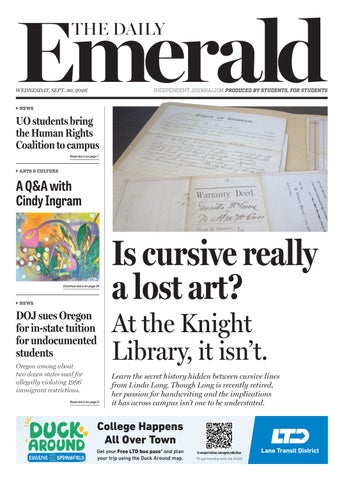
The Daily Emerald is published by Emerald Media Group, Inc., the independent nonprofit media company at the University of Oregon. Formerly the Oregon Daily Emerald, the news organization was founded in 1900. Emerald Media Group 1395 University St.,#302 Eugene, Or 97403 (541)-357-6569 (ON THE COVER) Evans Smith McComas papers, available in the Knight Library. (Bella Graham/Emerald) (ON THE COVER, LEFT) Cindy Ingram’s painting titled “Tired.” (Cindy Ingram/Courtesy)
By Nathan Trammell
News Reporter
Eugene Parking Services has passed new parking rate changes throughout the city in order to keep up with maintaining quality parking options. These changes, effective Sept. 18, are part of the city’s “long-range financial planning,” and are the first to come across the board since 2019, according to the City of Eugene’s website. The changes are meant to support both local businesses and the broader community. Continue story online (Ali Watson/Emerald)
Eugene Gear Traders
MOVING
SALE OCTOBER 3RD & 4th
! s k c u D o G 505 Willamette Street #110 Eugene, Oregon 97401 www.eugenegeartraders.com
The University Florist
www.eugenesflowerhome.com 1193 Harlow, Springfield 541-485-3655
Un
ive Owne rsit d b yo f O y pro reg ud on Alu m
s!
NEWS
DAILY EMERALD
Wednesday, Sept. 30, 2026
page 7
UO students bring the Human Rights Coalition to campus Students interested in discussing and learning about human rights issues will now have a dedicated space to connect. By Billie Corsetti
Associate News Editor
After two years in the making, a student organization solely focused on human rights will be opening itself up to interested University of Oregon students. The Human Rights Coalition officially started as a student organization on June 1, near the end of the 2025-2026 school year. They were officially recognized by the Associated Students of the University of Oregon in May. During the 2025-2026 school year, executive board members connected with potential partner organizations and developed an idea of what they wanted the coalition to look like. “We have a lot of human rights work on campus, but a lot of it isn’t labeled human rights work,” Eesha Gupta, one board member, said. “It’s dispersed all around.” The coalition hopes to serve as a bridge to connect students with more hyperfocused organizations and clubs, and as a way for students to connect over human rights on a more general level. Conversations about human rights can range from large global issues to local poverty, homelessness and food scarcity. The main goal of the coalition is to connect students who are interested in, and intimidated by, human rights. Board members Evelyn Cooper, Tara Sarbacker and Gupta didn’t conceive the idea alone. They were inspired by their peers, Charlie Petrik and Sophia Barghouti, who recognized UO’s lack of a human rights center compared to other Big Ten universities.
“Other schools that are Big Ten, or have similar levels of funding that we do, have it all centralized in one sort of (human rights) center, whether it be a physical building, group or association,” Gupta said. While trying to establish a human rights center, Petrik and Barghouti ran into difficulties such as funding after budget cuts, physical space and faculty support, according to Cooper. “It just became a gargantuan project,” Cooper said. “It was more important to us to start programming as soon as possible and start having actual community events and connections.” Gupta’s first goal was getting people involved. During the school year, board members spent time developing ideas for the coalition. “I think one of the main things that we’re hoping is that we can find a student population to come join us that is interested and passionate about human rights things, but maybe doesn’t really know how to get started or where to get started,” Sarbacker said. “Their major doesn’t line up with classes that discuss human rights issues, or they don’t have any friends who are passionate about these sorts of things.” Board members said they encourage students of all studies and interests to get involved, because human rights touch everything. Sarbacker, a senior majoring in architecture, said professors and guest speakers in classes don’t often address how human rights are a part of their career or studies.
“It’s not a very interactive experience where you can share how you think your discipline is going to be connected to a human rights issue,” she said. “I think there’s probably a lot of students of multiple disciplines who have very similar feelings and notice similar things about their degrees.” Cooper, a senior studying human physiology on the pre-medical track, said she faced a similar situation in her classes. Discussions on insurance and medical ethics weren’t a strong feature. Questioning the systems you work in is an important part of a career, she said. “We just learned systems, biological systems, and you memorize them,” she said. “There isn’t any discussion about who these systems are attached to.” According to Gupta, it’s important for students to know that being an activist for human rights doesn’t always have to be on a global scale. Sometimes, a small act of kindness is enough. Gupta, a senior hoping to work in the tech industry and study artificial intelligence, said human rights will be a big issue facing the world that young generations will have to tackle. The coalition is still new, meaning it’ll take the board trial and error to figure out the format of meetings, but they already have plans. One goal is to provide internship opportunities to members, using their partnerships to connect students with organizations. In November, the coalition is planning to hold a hunger banquet in partnership with Oxfam America, a global nonprofit fighting hunger and poverty. The executive board of the coalition will have a meeting on Monday, Sept. 28, but will start its regular weekly meetings on Mondays from 6–7 p.m., after that, locations will change and be posted in advance on social media.
“
We’re hoping (to) find a student population to come join us that is interested and passionate about human rights things, but maybe doesn’t really know how to get started or where to get started. Tara Sarbacker UO Human Rights Coalition Board Member
(FROM LEFT TO RIGHT) Tara Sarbacker, Eesha Gupta and Violet Ashley at a Human Right Club tabling event.
(Evelyn Cooper /Courtesy)
NEWS
DAILY EMERALD
Wednesday, Sept. 30, 2026
page 9
DOJ sues Oregon for in-state tuition for undocumented students By Carys Sexton-Sayler
News Reporter
The United States Department of Justice sued the state of Oregon on Aug. 27 over the state’s Tuition Equity program, which sets tuition rates for undocumented immigrants at public colleges and universities at the same rate as in-state students’ tuition. Oregon is one of around two dozen states the DOJ has sued for providing in-state tuition for undocumented students, including Washington, Arizona and New Mexico. The Tuition Equity program, House Bill 2787, was signed into Oregon law in 2013 after bipartisan congressional approval and decades of advocacy. Eligibility for the program still hinges on fulfilling several requirements, including attending an Oregon high school for three years before graduating or leaving.
“
I think that we will see a drastic decrease in enrollment from undocumented students, as well as potential rollbacks of support services catered to undocumented and DACA students. If undocumented students are not able to access in-state tuition, it is likely that many students will have to work multiple jobs, complete their programs early, or drop out completely. Amaya Peralta UO Student Body Vice President and UO Latinx Coalition Member
However, the DOJ alleges the state law conflicts with a 1996 federal law on immigrant restrictions. “Oregon has ignored this Congressional prohibition for over a decade,” the lawsuit alleged. Amaya Peralta, UO’s student body vice president and UO Latinx Coalition member, said the lawsuit outcomes could have a trickle-down economic and social impact for undocumented students.
“I think that we will see a drastic decrease in enrollment from undocumented students, as well as potential rollbacks of support services catered to undocumented and DACA students,” Peralta said. “If undocumented students are not able to access in-state tuition, it is likely that many students will have to work multiple jobs, complete their programs early, or drop out completely.” The DOJ is basing its lawsuit using the 1996 law as well as precedent of federal authorities deciding immigration matters, adhering to the Supremacy Clause of the U.S. Constitution. The 1996 law, 8 U.S. Code section 1623, was passed as part of the Illegal Immigration Reform and Immigrant Responsibility Act of 1996. The law states that a person not lawfully present in the U.S. is not eligible on the basis of state residence for any postsecondary education benefit, unless citizens of every other state are eligible for the same benefit on the same terms, regardless of their own state of residence. The DOJ alleged that Oregon’s Tuition Equity program violates the section of the U.S. Illegal Immigration Reform and Immigrant Responsibility Act of 1996 that bars the tying of benefits to residency without extending it nationally to U.S. citizens as well. In order to qualify for the Tuition Equity program, a student must have studied in the U.S. or its territories for five years before graduating high school, attended an Oregon high school for at least three years immediately before graduation, earned a diploma or GED in Oregon, applied for a federal taxpayer ID number and expressed intent to pursue U.S. citizenship or lawful permanent residency when eligible. Qualifying under the law changes only the tuition rate a student is charged; it does not change the student’s underlying immigration or residency status. The Higher Ed Immigration Portal estimates that undocumented students make up roughly 2% — approximately 4,300 — of all college students in Oregon. At the University of Oregon, in-state tuition and fees for the incoming class of 2030 are listed at $17,475, with outof-state students paying $47,466 per year, a difference of roughly $30,000 per year that would apply to any student reclassified if the state’s law is struck down. In a statement announcing the lawsuits, the DOJ’s associate attorney general, Stanley E. Woodward Jr., showed no support for undocumented students. “Our efforts will not cease until President Trump’s promise is fulfilled: illegal aliens will not receive benefits denied to American citizens,” Woodward said. The DOJ is asking federal courts to permanently command enforcement of the state rules requiring public colleges and universities to provide residency-based tuition discounts and financial assistance regardless of immigration status. As a result, the DOJ would force Oregon’s public universities to stop offering the in-state rate to undocumented students altogether while any appeal plays out, unless a court grants a stay. For Diana Rendon Chavez, internal director of UO’s chapter of the Movimiento Estudiantil Chicanx de Aztlán, the lawsuit is one piece of a broader legal pattern. “It is very frustrating to know that the Trump administration claims to be focused on getting rid of ‘illegal criminals’ but is currently attacking laws that make a college degree attainable for undocumented students,” she said, adding that these students are often, “first generation students fighting to get a college degree and make a name for themselves and their families.” Peralta held a similar perspective. “Many of these undocumented students, that the Trump administration is trying to demonize and demoralize, have spent their youth in Oregon, have attended Oregon K-12 schools and are a deeply important part of our communi-
(Sofia Campbell/Emerald)
ties,” Peralta said. “These students, who are often the first in their families to pursue higher education, are just trying to create a life for themselves.” Rendon Chavez also said that Tuition Equity is not an automatic benefit. “Students must meet specific requirements to qualify, including requirements related to their residency, education and an intent to become a U.S. citizen when legally able to do so.” UO MEChA, one of over 70 MEChA chapters across the U.S., aims to promote higher education and educational rights, according to its website. “As a first-generation student, this situation is especially difficult to navigate,” Rendon Chavez said. “Since Trump has gone into office, being a person of any Latine background, or a person of color for that matter, has been truly scary.” Rendon Chavez was critical of UO’s response to the lawsuit so far. “I haven’t heard of anything from them reaching out to students directly, and I haven’t seen them publicly comment on this,” she said. “What frustrates me most is that students shouldn’t have to figure all of this out on their own. Regardless of what happens in the courts, the University of Oregon should be communicating with students who may be affected.” UO has not posted any updates about the lawsuit on its federal immigration updates webpage. Peralta said both ASUO and the UO Latinx Coalition “share the strong sentiment that undocumented students are an integral part of our campus community and stand against the constant attacks by the federal government to harm immigrant and POC communities.” Peralta added that ASUO is still “navigating the impact” of the lawsuit but is committed to providing “safe spaces.” Renden Chavez encouraged anyone unsure whether they’re affected to check their scholarships, especially private state scholarships, noting that “how much this affects a student will ultimately depend on their individual situation and how they pay for school.” In a statement to The Daily Emerald, UO’s Office of General Counsel said, “One of our highest priorities is supporting our students. In light of the pending litigation, we cannot provide additional information at this time.”
OPINION
DAILY EMERALD
Wednesday, Sept. 30, 2026
Benton: Where are all the student protestors? Opinion: Students aren’t showing up at rallies as their parents and grandparents did. That doesn’t mean they’ve stopped fighting.
“
There tends to be upticks in the amount of engagement that matches the current political moment. The key is whether or not (students) stick around after all the protests are done. Carter Franks ROAR Co-director
By Kat Benton
Opinion Columnist
When I pass the federal building on my route to school these days, I usually see one of two scenes: Either a crowd of older adults protesting the current administration or an empty street corner soundtracked by engines and hurried footsteps. But the most interesting part is what’s always missing: students. Student activists have always been widely considered the backbone of American political movements, yet students today remain a minority at both local rallies and nationwide protests. To make things more puzzling, economic conditions are worsening across the country, particularly for young adults. So where are the students? Online publications like “The American Prospect” have suggested students may not view protests as effective or worth the risk. Students now can be forced to choose between peacefully advocating for important issues and keeping a clean student record. If they protest, they could face disciplinary consequences significantly impacting their lives, such as when some universities tried to deny student protesters their diplomas. However, student activists haven’t “gone” anywhere. They’re just focusing on the most effective ways to reach their goals. While classic protests may have worked in a political system that relied on people in power acting in good faith, unorganized protests without a specific goal are largely ineffective in a political landscape that prides itself on crushing dissent. The student-run Radical Organizing and Activism Resource Center has served as a hub and resource
1968
(Courtesy of Special Collections and University Archives) Students organize a 'sleep-in' protest inside Johnson Hall in April 1968.
center for leftist organizations on campus since the early 1970s. ROAR Co-director Carter Franks said that when it comes to protests on campus, “There tends to be upticks in the amount of engagement that matches the current political moment,” and “The key is whether or not (students) stick around after all the protests are done.” And in recent years, students seem to be sticking around more. Each year following the Palestine Solidarity Encampments, organizations under the ROAR umbrella have picked up more and more wins, such as alerts for when immigration agents are in the area, bargaining for student workers, medication abortions for students and allocating $15 million toward decarbonization efforts on campus. Franks added that “protests are just the tip of the iceberg, and they are not the majority of the work” that ROAR does. Protests can be a great tool for change, but “much of the work (ROAR does) is done through the slow process of democracy ... and by the countless meetings that are held before a campaign demand can even be decided.” There may never have been more reasons to get involved in community organizing, especially with so many people struggling through today’s political and economic climate. That may be why the students are more present elsewhere: in the meetings, coalitions and campaigns that rarely make it onto a street corner. So instead of asking where the student activists are, maybe we should ask how we can support them. The next time I pass the federal building, I’ll try to remember that an empty corner isn’t the same as an empty movement.
page 10
Kat is a fourthyear CHC student studying psychology with minors in legal studies and entrepreneurship. She enjoys writing about power dynamics, institutional accountability and the ways political structures shape communities.
2026
(Fred Hall/Emerald) Protestors gather with various signs, chanting and signing along with the various speakers. On May 1, 2026, a May Day rally was held at Johnson Hall at University of Oregon.
IT’ S N E V E R TO O L ATE TO D ECID E TO L E A D. Cadet Summer Training puts you on an accelerated path to leadership as an Army Officer after graduation and can earn you scholarships and a monthly stipend. To get started, Contact Jesse DeBoest at (541) 346-3104.
GOARMY.COM/CROE ©2024 U.S. ARMY. PAID FOR BY THE U.S. ARMY.
WANT TO HELP KIDS THRIVE? There’s a major for that.
The bachelor’s in child behavioral health prepares you to support kids’ and teens’ mental health, blending classroom learning with 700+ hours of real-world training. Scholarships available. childrensbehavioralhealth.uoregon.edu
Jeffrey
Gibson They Teach Love
From the Collections of Jordan D. Schnitzer and His Family Foundation
September 12, 2026 - March 7, 2027
Jeffrey Gibson (American, b. 1972). Untitled Figure 1, 2022. Plastic bone pipe beads, fringe, glass beads, artificial sinew, tin cones, sea glass, acrylic felt, steel armature and powder coat varnish. 71 1/2 x 39 x 26 inches overall. Collection of the Jordan Schnitzer Family Foundation. © Jeffrey Gibson. Courtesy the artist and Hauser & Wirth
Become a Student Member! Welcome to the University of Oregon. Become a student member of the art museum to receive invites to special events, discounts at the Museum Store, and a present when you graduate.
Sign up today: https://bit.ly/4jg7kGX
Night at the Museum Open House for UO Students October 14, 2026 , 5:30 - 7:30 pm University of Oregon students are invited to a free event, Night at the Museum!
RSVP: https://bit.ly/3TEyZaa
jsma.uoregon.edu | 541.346.3027
EO/AA/ADA institution committed to cultural diversity
JOIN THE STUDENT ALUMNI ASSOCIATION STUDENTS TODAY, DUCKS FOREVER The Student Alumni Association (SAA) creates lifelong ducks who are committed to the UO. We’re here to enhance your college experience with great member rewards and connections with alumni and other students! You can learn all about us by following us on IG @uosaa, or visiting our website at uoalumni.com/saa.
10 PERKS OF THE SAA 1. Networking opportunities with our Duck Alumni 2. Beat Tee Handout for the Homecoming game 3. Annual discount at the Nike and Columbia Employee Stores 4. One-time 20% discount to The Duck Store 5. Unlimited energy drinks at our Study Hours Event 6. Exclusive SAA Swag 7. Connect with the UOAA Board of Directors 8. Internship opportunities 9. Chances to volunteer and advocate 10.Make new friends at our social events
JOIN FOR FREE TODAY!
ON THE COVER
Is cursive really a lost art? At By Bella Graham
Arts & Culture Editor
The sound of a keyboard is generationally satisfying for the student population of UO’s campus — so much so that there are extensions for a laptop to produce the clicks and clacks of a much heavier keyboard. If that doesn’t float your boat, you can purchase a keyboard extender guaranteed to turn the subtle press of keys hitting the circuit board into creamy or thocky or marbley clicks.
“
The students yearn to really understand. They really enjoy it because a handson experience is a good way to learn, and it just really brings home what might be challenging for a better understanding of what somebody’s talking about.
At these visits, Long did a presentation about handwriting before handing it over to the students, arming them with pens and ink and letting them practice. “The students yearn to really understand. They really enjoy it because a hands-on experience is a good way to learn, and it just really brings home what might be challenging for a better understanding of what somebody’s talking about,” Long said. So how does she facilitate that understanding? Frequently, she uses material from the Presidential Collection at SCUA — most times starting with a letter by George Washington. It’s unassuming: dateline at the top, a salutation and a closer, a signature, and loopy handwriting sandwiched in between. However, Long turns it into a bit of a game by making students guess who wrote the letter for a “gold star.” Only two people have guessed correctly, according to Long, despite Washington’s signature being on the page and the dateline indicating it was written in Richmond, Virginia, in 1791 (in the midst of his presidency). Because the letter is in cursive (round hand, specifically), to read it requires a familiarity with not only the general conventions of the style of cursive, but also the ability to see past the quirks in handwriting personal to Washington. If someone is unable to decipher cursive, they wouldn’t be able to access this primary source document from our first president, which gets to the heart of the issue for Long. “There’s some information in the letter. There’s evidence of the fact that this person owns some property, but it’s not a big deal. And yet, the letter is probably worth $250,000 if somebody tried to sell that. Why? It’s because it has intrinsic value because it was written by the first president of the United States,” Long said. Next, she’ll pass around a letter from Thomas Jefferson or a photocopy of a 19th century report about the health status of Siletz tribe members on a reservation, also in the SCUA collection. “Again, that piece of paper has virtually no value. It’s just a photocopy. Evidentially, it’s huge. And that’s the kind of document that people want to do research with. Nobody really cares about that presidential letter collection. It’s a trophy collection,” Long said. “The value of it is to demonstrate the accessibility of primary sources through handwriting, and to
show that handwriting.” Once you get past third grade, you rarely see that looped together and legible-ish writing that exudes memories of doctors, history and grandparents, according to Eugene resident Zach Marsh. “Lecture halls were always filled with more open computer screens than a notebook and a pencil,” Marsh said. But who can blame them? “A downside of the younger generation not consistently using cursive, at least what I’ve heard from professors, is that when they give in-class exams or essays, it takes the students longer,” Long said. “The responses to the questions by the students are shorter because it takes them longer to print; versus cursive, they could write more.” And write more they can. Denise Hoover, a first-year master’s student studying electrochemistry, grew up writing in cursive and does so still because it’s faster than printing each letter. “I have children, and I was trying to teach them to sign their names. It was hard to teach someone to sign their name when they don’t know cursive,” Hoover said. “They’re not learning it in school like I did.” Depending on what class Hoover is in, it can be more practical to handwrite notes for other reasons. “It’s hard to write an equation on a computer,” Hoover said. But writing on a computer is ingrained in the academic infrastructure. As more assignments shift to being fully online, it allows students to split-screen with an illicit crossword or game during the lectures. The handwriting that does show up isn’t as practiced, with the letters less flowing and more crashing into each other. But that’s still cursive. “If it’s not connected, it’s not cursive,” Long said. Vice versa, the same thing applies. The other aspect of the style, which is consistent across all scripts, is the reason it’s employed: for speed. It’s also the reason cursive exists in the first place. “The purpose of cursive is to speed up the writing. Just to go back to very early days. I think it was King Edward III, (during) his reign. There was a lot of exchange of property, and his secretaries had to speed up their handwriting because they were making all these contracts, hour after hour, day after day. So instead of just printing each letter, they started to link the letters together, ” Long said. What began as a practical development to keep up with
Linda Long Former Curator of Manuscripts and Senior Librarian Emerit
For some, however, they prefer the experience of feeling graphite drag across paper, flipping pages of a notebook, and buying the newest Leuchtturm1917 or Paper Republic notebook. They might spend their money on a new fountain pen, though it’s hard to blame them. Nothing beats the feeling of a steel nib on paper, flowing through loops and sharp lines bleeding into each other — at least for Linda Long. Up until just a few weeks ago, when she retired (Sept. 16, to be exact), Long spent her time between the shelves and among the tables of the UO library special collections, officially working as a curator of manuscripts and now a senior librarian emerit. More enticingly, she would pore over old documents (reminiscent of faux-ancient maps we made as children with a lighter and a tea bag) and find the secrets held within the flow of inked, cursive words. “I’ve been an archivist for many years, and I’ve had the privilege to handle documents from all different periods of history,” Long said. “I’ve noticed that many of them had different handwriting styles. Some of them had little curly cues that were quite elaborate. Others were much plainer, and so I thought, what’s the difference? How did it develop?” That curiosity developed into expertise, which then led her to leading embedded classes when faculty with their students visited the Special Collections and University Archives at the Knight Library, to help orient them before looking at the works held in the archives.
Evans Smith McComas papers, available in the Knight Library.
(Bella Graham/Emerald)
DAILY EMERALD
Wednesday, Sept. 30, 2026
page 17
t the Knight Library, it isn’t. Evolution of Scripts Secretary Hand Late 15th to early 17th centuries, English Renaissance Period Italic/Humanistic Hand 16th century Round Hand 1700-1840 Modified Round Hand 1840-1865 Spencerian Script 1850-1925 Distinct requirements for writing position, pen holding, and arm movement
Vertical Writing 1890-1900
Abandoned for being too slow
Palmer Method 1894-1950s Zaner-Bloser 1950s-1970s Introduces penmanship through starting with printing, then going into cursive; meant to ease the transition between printing and cursive
D’Nealian 1978-present Print and cursive variations for similar purposes to Zaner-Bloser
(BELOW) Evans Smith McComas papers, available in the Knight Library. (Bella Graham/Emerald)
demand for written work evolved into something indicative of class and privilege, according to Long, before being seen as a hallmark of education and sophistication. “It’s so illuminating to learn how the different handwriting styles were really a part of American culture, and not just American culture, but business and the market economy,” Long said. “Living in colonial America, if you wanted to be in business, you had to use a certain script. If you were a woman, you couldn’t use any other script except for one that was designated for women. Handwriting influenced how people behaved in America.” That influence is reflected in the documents SCUA has. Not only can you see that influence, but you can see the predominant hands of the time — secretary and humanistic — begin to meld and turn into what is known as the round hand, which came to America during the colonial period. The Declaration of Independence? Round hand. The Constitution? Also round hand. The Emancipation Proclamation? If you guessed round hand again, you’d be correct! Many American founding documents (otherwise known as primary sources) are written in and only accessible to those familiar with cursive. Are there versions of it online, neatly typed out? Absolutely. But, according to Long, if we only had the primary source to go off of, which is strictly cursive, many of us would find ourselves shut out of history and left to learn from what others tell us. Long also said that college students much more frequently see secondary sources as opposed to primary sources. Without that exposure, it becomes unfamiliar and inaccessible. “One time, a student in the class was reading some letters, and all of a sudden he looked up and he said, ‘Oh, I get it. When we’re reading the secondary sources, we’re being told what to think. Using the primary sources, we get to formulate our own opinion about what somebody has done. We get to have our own ideas.’ Knowledge is always being created. People are constantly making connections about one thing or another,” Long said. Those perpetually developing connections are why, according to Long, it’s so important to maintain a collection of and be able to examine primary sources. “When I started out as an archivist, so many researchers would be interested in the ideas of westward expansion, and I’m talking about the United States westward expansion. Nowadays people are more interested in what are the consequences of settler colonialism,” Long said. “We can’t even anticipate what kind of ideas or connections that
scholars will be making 10, 15, 20, 50 years from now.” Other instances of cursive are more casual, or don’t fit neatly into an era of cursive. The Coca-Cola Logo? Spencerian script. The cursive practice pages you battled through in elementary school? D’Nealian. Letter from a Birmingham Jail? Written in Martin Luther King Jr.’s personal style of cursive, which was notoriously difficult to read. Those examples aren’t the only ones that tell us about history that are written in cursive. While these aren’t as important, they still have a lot to tell us about the past if we know how to read it. “One time we had a class, and I remember it was centered around wars. We have a lot of collections from soldiers who fought in wars, and so I had a lot of material from World War II out. There were some letters home from a commissioned officer, and he was writing home saying he was so sad that he couldn’t be there for his daughter’s birthday. There’s just something so real about that,” Long said. “Anyway, the student reading it was really moved, and she teared up. She started to cry because it was so moving about the soldier not being there to be with the family and so on. So that was very illuminating about how somebody could experience the war, like just by connecting to those primary sources.” If you’re interested in connecting to primary sources like those, Long has a few recommendations: the Abigail Scott Duniway Oregon Trail Diary, which is available in Oregon Digital; the Evans Smith McComas papers (an example of modified round hand), which you can request from SCUA and access in the Paulson Reading Room in the Knight Library; and the presidential letter archives that SCUA maintains, including documents written by Thomas Jefferson and George Washington. “There’s a scholar that said something really perceptive; that handwriting straddles the cusp between conformity and individuality. For example, if you and I grew up at the same time, and we learned the same form of cursive, your handwriting would have some characteristics of that style, and mine would have characteristics of that handwriting style. But they would still be unique,” Long said. And you can still see that today. Next time you’re doing homework or taking notes with your friends, compare and contrast your handwriting. How do you write your letters differently? What similarities are there? There’s a lot more to learn from those letters than meets the eye.
Going Green Eugene Going Green Eugene — 439 W 1st Ave — Going Green Eugene
— 439 W 1st Ave — — 439 W 1st AvePROGRAM! — CUSTOMER LOYALTY CUSTOMER LOYALTY PROGRAM! CONVENIENT PARKING! CUSTOMER LOYALTY PROGRAM! CONVENIENT PARKING! FRIENDLY BUDTENDERS! CONVENIENT PARKING! FRIENDLY BUDTENDERS! FRIENDLY BUDTENDERS!
DAILY DEALS! DAILY DEALS! DAILY DEALS!
*Must be 21 years of age or older to consume marijuana. *Do not operate heavy machinery under the influence of marijuana. Keep out of reach of children. *Must be 21 years of age or older to consume marijuana. *Do not operate heavy machinery under the influence of marijuana. Keep out of reach of children. *Must be 21 years of age or older to consume marijuana. *Do not operate heavy machinery under the influence of marijuana. Keep out of reach of children.
Daily Deals!
10% Student Discount
Your Local Home, Garden & Gift Store Students Show ID: Save 10% off every Saturday!
YUGO EUGENE
All Houseplants in October
20% OFF!
SKYBOX & COURTSIDE
NOW LEASING FOR FALL 2026 Steps to UO campus, MKA, Market of Choice, USPS, Hirons Pharmacy, and LTD.
Don’t sacrifice quality for affordability -Private rooms in 2, 3, 4-bedroom apartments; roommate matching.
HOME, GARDEN & GIFT
5th & Olive Street 541-342-6820 Mon-Sat 10-6 • Sun 10-5 downtoeartheugene.com
-Competitive, allin pricing. Starting @ $799/bed. -Renovated & fully furnished unit options, including full-size appliances & inunit washer/dryer.
24/7 state-ofthe-art on-site fitness center. Top floor game room, lounge, & deck, equipped with firepit & grill.
See what Yugo has to offer Yu. Send us a message today!
You're so close to beginning something extraordinary!
(541)393-8080 |EugeneSkybox@yugo.com
PUZZLES Weekly Crossword 1
2
3
4
7
8
DAILY EMERALD
5
6
14
15
11
12 13 16
DOWN
1 Lawyer: Abbr. 4 Cry one’s heart out 7 Ostrich relative 9 UFC sport 10 Aggressive honking, maybe 12 Season for long days 13 Season for short days 16 Midday, poetically 18 Dog’s sheddings 19 Creep through the cracks 20 ___Tok 21 ___-Cone
1 Pirate utterances 2 Holier-than-___ 3 Cooperative effort 4 Pastel candies that come in a roll 5 “Woah!”, over text 6 Sweetheart, in slang 8 Executive Branch, in headlines 11 Payments to landlords 14 Garden in Genesis 15 Seized vehicle 16 Bygone “cryptocollectible” trend, for short 17 Parisian assent
19
20
21
Sudoku 6
ACROSS
17
18
1
7
8
4
6
2
Unscramble 5
2 4
4 4
5
3
7
2
4
8
1 2
6
4
9
9
3
1
3
7
5
4 8
7
7
7
2
9
8
1
Sudoku506
Answers
By Nate W
page 23
Puzzles Master, Nate Wong
9
10
Wednesday, Sept. 30, 2026
T P H C A I
C S M U I
C L O K
M R A
What is a tiny robot’s favorite food?
!
By Nate W
MICROCHIPS HAPTIC, MUSIC, LOCK, RAM
Sudoku506
5
3
9
4
6
2
8
9
7
5
4
1
2
8
3
7
1
6
7 1 8 6 2 3 4 5 9
2 3 5 1 4 7 9 6 8
6 8 1 3 9 5 7 2 4
9 7 4 2 6 8 3 1 5
4 5 9 7 1 2 6 8 3
8 6 7 5 3 9 1 4 2
1 2 3 4 8 6 5 9 7
A T T S O B R H E A MMA ROA D R AGE S UMME R W I N T E R NOON T I D E F U R S E E P T I K S NO
ARTS & CULTURE
Q&A with artist Cindy Ingram Local painter and community organizer discusses experience working in art, future projects. By Dakota Zitterkopf
Arts & Culture Writer
Editor’s note: The following responses have been edited for brevity and clarity.
Who gets to be seen as an artist? Whose art do we see and value? Discussions of visibility and recognition for artists of different backgrounds widen the margins around contemporary and canonized art, introducing new voices and ones disregarded in the past. Cindy Ingram, a local painter and community organizer, embodies what years of experience and time spent working across various careers give an older artist. She’s previously worked as a music promoter and booking agent in the Pacific Northwest, and noticed the lack of support for female and younger artists, particularly after the dissolution of the Olympia-based Riot Grrrl scene that aimed to give young women an outlet through punk music; Ingram wanted to help develop support systems and programs to build these artists up. Her interest in community organizing spread out in other ways too: a flower farm homestead in Cottage Grove, teaching about independent events promotion and “getting gigs” at universities and serving as The Eugene Celebration’s assistant director creating new fundraising streams and stages; Ingram’s various career shifts have always involved working with and uplifting others. “When I first started my business in 2006, I realized quickly that I was the only female booking agent and large scale event producer and band manager around…Sexism was alive and thriving in the Eugene music scene. I wanted to create environments where women felt safe to perform and be themselves without being unsafe,” Ingram said. Ingram’s firsthand accounts of discrimination in the Pacific Northwest music scene familiarized her with the disregarding of marginalized artists, her most recent efforts a continuation of the safety and accessibility issues she has navigated for decades. Fighting to be seen and make herself heard is as vital to understanding Ingram’s history as her wide-ranging entrepreneurship.
Ingram’s visual art is similarly informed by personal discoveries of language and outlets for neurodivergence. Her journey as a painter started during pandemic lockdowns, and her use of vivid, highlighter-hue oranges and yellows and twisting psychedelic fauna externalize her perception of the world as a queer, neurodivergent woman. Motherhood also informs her work, seen in her work like the overbearing mother fish that beckons viewers to come hug her as part of her immersive basement exhibit for Porchfest. These kinds of life experiences and major shifts in perspectives are much more difficult to come across in younger artists, and while Ingram’s work isn’t defined by any one part of her identity, the layered mixed-media approach she takes is informed by a life of finding new words and spaces where her view of things has been changed and shaped. Now, a few months after Porchfest and with Ingram at work on constructing a new and bigger exhibit, “The Corporate Office,” The Daily Emerald sat down with her to discuss generational divides, how her artistic process has changed since returning to Eugene and the challenges in building an independent art exhibit.
You mentioned that your neurodivergence has influenced your paintings, such as your art piece that was featured at the Hult Center about being a neurodivergent solo traveler. How does that play into your artistic process? Ingram: I think I have spent a lifetime trying to be more
palatable, more acceptable and more normal. I learned a few years back they call that masking. But throughout my lifetime, until COVID-19, I didn’t have a concept or a word for what I was doing. This compressing and depressing my thoughts and behavior really harmed me physically and emotionally. I was exhausted and sad. Once I started just allowing my uniqueness to come out more, I started feeling more relaxed and authentic. It was an accelerator toward honesty. I started painting while I was alone during COVID. I built a flower farm out in Cottage Grove because I wanted to be surrounded by color; that’s when I started painting abstract flower shapes. I came to realize that my relationship with color was way more intense than the average person, I think. Color has sound and vibrations in my life. The painting you are referring to is called “Everything All At Once.” It was one of the winners in the Eugene Mayor’s art show. It shares the high-pitched excitement of being in a new country for the first time — new sights, new sounds, new scents and written language. It’s an exciting orchestra.
Emerald: You’ve been working in nonprofit and community organizing for a long time. Now moving back to Eugene, what have you noticed about the arts community that has made you want to get involved in running a large exhibition One of the things I found most engaging like “The Corporate Office”? about the immersive exhibit you did for Ingram: I am so inspired by my brave and rebellious Porchfest was how much you were able friends who are younger than me, to be honest. I think to fit into a small space and utilize things something strange has happened where there is a huge like the washer/dryer and the stairs as divide between the generations. It feels like the boomers part of the exhibit. With trying to do a have held onto power longer, and the barriers to entry into much larger art exhibit, what challenges arts environments have become so challenging to overcome. I’m Gen X. It feels like maybe I’m helping to bridge the and opportunities do you have in taking gap and help to legitimize the artistic viewpoints of younger advantage of more space? artists around my Gen X and boomer colleagues. I’m trying Ingram: The “In Depth” underwater immersive art to bring in more diverse viewpoints and lived experiences.
exhibit in my basement was within the theme of trash art. We were purposefully being messy and maximalist in vibes. I was inspired by Meow Wolf in Santa Fe, New Mexico, where there are surprise doors and discoveries around every corner. This is why I put a looping video on an old monitor inside my clothes dryer. It was silly and unexpected. We sure crammed a lot in there. “The Corporate Office” exhibit will be Oregon’s largest ever immersive arts experience. If we get this building downtown, fingers crossed, it will be 40,000 square feet of space. It will not be chaotic and trashy like “In Depth.” It will have its own theme. It’s ‘80s office inspired, so there will be lots of space to wander and explore. Liminal spaces, mystery and discovery. Lots of empty space, like “The Backrooms” and “Severance.” The vibes will be more fine art and minimalist in tone; also more suspenseful.
You mentioned other large exhibits like the “Hospital of Emotions” and Meow Wolf as inspirations and influences on this exhibit you’re planning. What about each exhibit do you find most exciting and interesting to try and incorporate into your exhibit?
View the painting in color on The Daily Emerald website Cindy Ingram’s painting titled “Tired.”
(Cindy Ingram/Courtesy)
DAILY EMERALD
Ingram: I’m planning on combining these two models in a super unique way. The “Hospital of Emotions” model of taking an old, abandoned building and giving it over to artists to interpret its architecture and theme. It’s incredibly artist-forward and experimental. Its focus on artistry and individual artists’ voices is what makes it so powerful -- they all get their own room, independently. Meow Wolf, on the other hand, is a little less of a gallery, featured artist environment. It’s a little more Oregon Country Fair with its far-out collaborations and otherworldly, community environments. “The Corporate Office” will take the things I love most about each of those two models and combine them so there is both an opportunity for individual artists to shine and be celebrated, but also there will be collaborative storytelling as the thematic common areas lead you through the building like the chapters of a book, discovering the clues and encouraging puzzle solving. It’s the best of both worlds! As part of Porchfest and your immersive exhibit, music played an important role alongside the art and vendors — you had a local experimental artist, Don Haugen, create some music for your exhibit — are you planning to include music and sound in a similar way for this future exhibit? Ingram: Absolutely! In immersive arts experiences,
music (or different kinds of orchestrated noise), lights, visuals and literary offerings all come together to help you enter into a new world. In the “In Depth” exhibit in my basement, Don recorded my voice, and he added motion sensors onto my paper-mache mama fish. This made her beg for you to come closer and give her a hug with her mannequin arms that we found from a dumpster. Other audio contributions from Don were original disco tunes in the anglerfish disco corner and a dolphin phone, so that you can talk to a dolphin through a big seashell. The corporate office will encourage artists to incorporate sound, light and interaction whenever possible within their own office exhibits, but my team of world builders (That’s the name of the team who are helping me build this thing) are going to incorporate recordings and original scores throughout the whole experience.
What have been some of the bigger challenges early on with trying to do a big event such as this? Ingram: The biggest step of them all is actual-
ly one of the first. I need to secure the building. Although it is incredibly possible, and we are in talks with the building owner, I don’t have a signed lease yet. Once that is secured, there is the issue of permits and regulations through the city of Eugene. Once that is cleared, I can focus on the fundraising. I’ll launch a GoFundMe campaign soon, followed with fundraising events, grant applications and other efforts to bring in some cash. I hope that everyone can pitch in just a couple of bucks and we can reach our goal. Another big challenge in building this project is far more personal. I have to stand in my strength and follow my gut. I know what I’m doing. I very much want help and support and coaching, but I can’t let others change my course - it’s my art. My vision is clear; I need to bring others in, but I can’t let them take over and change what I’m trying to accomplish. It’s never been done before. This can be a bit intimidating for some. It can be triggering, and others may project their fears onto me and my ability to succeed. I can’t let that in. I’ll use my Wonder Woman wrist shields to bounce those negative comments off one by one. I don’t actually have those, but I can imagine that I do. They will work just the same.
“
It feels like maybe I’m helping to bridge the gap and help to legitimize the artistic viewpoints of younger artists around my Gen X and boomer colleagues. I’m trying to bring in more diverse viewpoints and lived experiences. Cindy Ingram Eugene Artist and Community Organizer
How do you imagine an immersive art exhibit working in Eugene? As a town, what things about Eugene do you think an exhibit like this benefits from culturally? Ingram: “The Corporate Office” will be a pop-up
event. My team and I will build for months at the end of 2027, and then in early 2028 it will be open to the public for maybe four months (from) March to June. This will give folks something to do with their friends when it’s cold and raining. It will also be open during the Olympic Trials in June. The exhibit will feature mostly Eugene-based artists, with some regional and out-of-state as well. It’s looking like there will be about 50 artists; each chosen artist will receive a $1,000 stipend to help cover the cost of their materials. Installation art is one of the hardest for artists to find opportunities. Galleries around here just don’t have the space. Usually, art centers and galleries want to sell your work, so installation art is rarely featured. It doesn’t sell. The corporate office will bring opportunity to artists by giving them lots of space and an invitation to experiment and play. There will be projection, high tech, sculpture and fabrication, graffiti and so much more. We are going to surprise everyone. Really blow them away! In fact, I have quite a few Portland artists that are coming to Eugene for this. It’s usually the other way around. It’s about time we give Portland a run for their money.
Favorite snacks or drinks while working? Ingram: I’m obsessed with these mint crisp
protein bars. I have one almost every day. I also drink basil, mint, kombucha and coconut water.
Wednesday, Sept. 30, 2026
page 25
“Sterling Point” breaks the teen drama curse Amazon Prime’s latest hit series, “Sterling Point,” manages to do what other teen series can’t: create characters that actually resemble real teenagers. By Cassia Littlefield
Arts & Culture Writer
It’s typically safe to assume that teen shows are not going to accurately reflect the teen experience, and will probably also include a bunch of 16-year-old characters who look 30. That sentiment seemed to apply to all teen shows until Amazon Prime’s hit series “Sterling Point” finally broke the curse of failing to represent Gen Z teens on screen. The show, created and directed by Megan Park, came out Aug. 5 with a total of eight episodes. The story follows 17-year-old Annie the summer before her senior year. After her grandfather dies and leaves her a cryptic note about inheriting an island and a secret family member, Annie flees to the fictional Canadian island of Sterling Point to find answers. The show maintains all the best elements of a young adult series. It has themes of romance, grief, friendship, found-family and grapples with the scary feeling of growing up. The show’s creator, Park, told the New York Times that she wants “teenage girls to be given the autonomy and the respect and the authenticity they so deserve.” Park is also the creator of two popular teen movies: “The Fallout” (2021) and “My Old Ass” (2024). “Sterling Point” is the first time she’s ventured to make a young adult series. One thing remains true across all three of these projects: the dialogue is uncannily accurate. “You can just tell that a teen was involved in the words,” said UO sophomore Fiona White. “Whether it was the actors who made it up on the spot, or there was someone in the room who knows how a teenager talks, it just felt very natural.” To write accurate Gen Z dialogue, Park said it’s all about letting go of your own ego and accepting that there are things you don’t know. “I give the actors a lot of freedom,” Park said to Yahoo Canada. “You know what the scene’s about. You know your character. If you wouldn’t say it that way, say it how you feel like your character would say it.” Ella Rubin, the 25-year-old actress who plays Annie, described to Bazaar what it was like to collaborate with Park on dialogue. “It was a really fortunate process to get to not be afraid of sharing your opinion and not be afraid that you’ll be wrong,” she said. Annie’s twin brother, played by 25-year-old Keen Ruffalo, also shared with the Today show that he improvised in “pretty much every scene.” Ultimately, Park’s trust in young actors and a commitment to giving teenagers characters they could actually see themselves in created TV magic. “I think the way that the characters handle all the situations is very realistic,” said White. “I feel like everyone can associate a character with someone they’ve met. It just feels like they actually care about the depth of the characters and gave them a backstory that people can understand.” Most of the time, teen shows feel like a caricature of a teenager’s reality. “They portray teenagers as chasing the high life a lot. Most teenagers are actually trying to blend in and not go through crazy stuff,” said White. The solution is simple: let young actors and teenagers have a say in the shows that are written for them. More often than not, teenagers want to feel seen and be shown that what they’re going through is normal. The plot can still be crazy and interesting while keeping the characters grounded and human — and “Sterling Point” effectively does just that.
SPORTS
DAILY EMERALD
Wednesday, Sept. 30, 2026
page 26
(Rowan Campbell/Emerald) Oregon HC Trent Kersten addresses the team before the match. The University of Oregon Ducks Women’s Volleyball team played the University of Michigan Wolverines in a home match at Matthew Knight Arena in Eugene, Ore., on Nov. 22, 2025.
Oregon volleyball’s 9-2 start looks familiar. Kersten wants a different ending
The Ducks went 9-2 last year too. Now they open conference play with more experience and a coach demanding more. By Jonah Furino
Senior Sports Writer
Oregon volleyball finished its first 11 games with the same record as last season: 9-2. In 2025, the Ducks went 8-12 in conference play. This time, the Ducks enter Big Ten play ranked No. 20, and head coach Trent Kersten is aiming to avoid a repeat. Despite their strong start, Kersten believes the Ducks still have plenty of room to improve and is pushing his team for more ahead of conference play. “We’re 9-1 now, and we are still not close to playing our best ball,” Kersten said after their 3-0 sweep against Oregon State.
“
You don’t want to be playing your best in September. You want to be playing your best in December. Trent Kersten UO Women’s Volleyball Head Coach
Unlike last season, the Ducks are experienced. Oregon returned eight players who lived through last year’s conference slide and added a few transfers with high-level experience. The biggest reason for Oregon’s success so far is its balanced attack; the Ducks have an arsenal of strong hitters across the front line. Even with Alanah Clemente sidelined by an injury, the Ducks are still one of the best hitting squads in the nation. The Ducks have totaled 554 kills so far, with six players tallying over 50 individual kills. Valentina Vaulet has been a major part of that strong hitting mark, leading the team with 136 kills. Vaulet’s hot start is highlighted by her season-high 21-kill performance against Southeast Missouri to open the season. Vaulet has been a factor everywhere on the court, not just in the front row. Defensively, she has 86 digs, third on the team behind libero Reese Sheppard and setter Marina Crownover. From behind the line, she leads Oregon with 18 service aces. The outside hitter position has been lethal for Oregon. Along with Vaulet, Sjakkie Donkers and Laura Eichert have also been on point. Donkers shined in the Ducks’ 3-1 win over San Diego at the Snyder-Park Classic in Tempe, Arizona, scoring a season-high 17 kills on .441 hitting percentage. Eichert has stepped up into a big role off the bench as a true freshman, with 55 kills so far this season. Crownover has been a huge addition for Oregon at the setter position. The fifth-year transfer from Missouri has bolstered the Ducks’ attack this season, averaging 9.89 assists per set. The biggest thing that Crownover brings to this Oregon team is her experience and leadership. Oregon’s myriad hitting options have been crucial in giving Crownover the keys to truly guide the offense. The Ducks opened conference play on the road against No. 6 Wisconsin. “You don’t want to be playing your best in September,” Kersten said. “You want to be playing your best in December.”
(Owen Buriss/Emerald) The University of Oregon Ducks Women’s Volleyball team cheers after defeating in-state rivals, the Oregon State Beavers, 3-0 in a home match at Matthew Knight Arena in Eugene, Ore., on Sept. 20, 2026.
WS! G NE KIN EA BR BRE A KI NG S! W NE
WS! G NE N I K EA R B
BREAKING NEW S!
BREAKING N E W S!
BRE AK IN G
S! W E N
Celebrating & Honoring
UNCOMMON COLLABORATION AND INNOVATION IN SOLVING THE LEGACY CHALLENGES OF THE AMERICAN WEST
Having worked with the late Don Kerr to help establish the High Desert Museum, I have always taken great pride in the fact that there is a world-class museum in Bend, Oregon! In discussions with Dana Whitelaw, Executive Director of the High Desert Museum, I suggested that we create a prize focused on the thirteen Western states and the shared challenges they face, including water rights, wildfires, best ranching practices, tribal and fishing issues. We were honored that 12 extraordinary individuals agreed to serve on our Advisory Committee and they chose this year's Jordan Schnitzer Prize of the West winner Brad Parry, Vice Chairman of the Northwestern Band of the Shoshone Nation and a former employee of the U.S. Bureau of Reclamation, where he served for nearly 20 years. Mr. Parry has been instrumental in helping reclaim his tribe's ancestral lands in Southeastern Idaho. Through collaboration and thoughtful stewardship, his work has helped restore the watershed, allowing much-needed fresh water to flow toward the Great Salt Lake, which is in desperate need of additional water.
CONGRATULATIONS TO THE INAUGURAL WINNER
BRAD PARRY
2026 FINALISTS AMY BOWERS CORDALIS
KELLY DELPIT
JULIE RENTNER
LAURA VAN RIPER
We look forward to this award continuing for many years to come, recognizing individuals who work tirelessly and collaboratively to find solutions that benefit everyone while preserving and enhancing the remarkable Western United States! JORDAN D. SCHNITZER
President of Schnitzer Properties and the Harold & Arlene Schnitzer CARE Foundation JORDAN SCHNITZER PRIZE OF THE WEST ADVISORS
John L. Blackwell, Benjamin F. Carter, Sharon Collinge, Zephyr Frank, Jon Griggs, Michael Hollern, Patty Limerick, Paisley Rekdal, Don Sampson, Jordan Schnitzer, Carly Solström, Dana Whitelaw
2027 NOMINATIONS NOW OPEN For more information, nominations, eligibility, and award cycles, please visit highdesertmuseum.org/schnitzer-prize
Go Ducks!!
1
Twice the (Buy One, Get One FREE)
2 Southwest Salad
Original Yumm! Bowl®
FREE menu item when you purchase an item of equal or greater value at Café Yumm! Eugene & Springfield Present original coupon at time of order. Offer good with purchase of prepared menu items only (excludes gift cards, alcohol, and retail items). Valid this location only. Limit one discount per person. Not valid with any other promotional offer. Offer not valid after December 31,2026. Each Café Yumm! is independently owned and operated by members of the community.
541-485-7776 • vonkleinrentals.com • 1301 Ferry St. #2 /vonKleinPropertyManagement
VINTAGE STYLES
Thrifted. Curated. Iconic.
St.Vinnie’s @SVdPLaneCounty, @ShopStVinnies
BEST. JOB. EVER! APPLY TODAY
We’re currently hiring Lifeguards, Youth Development, Membership staff, and much more—scan the QR to browse our job openings! Be a part of our all-star team helping our community thrive.
Eugene Family YMCA | 541.686.9622 | EugeneYMCA.org
B:11.25" T:11" S:10.5"
T:16"
B:16.25"
S:15.5"