Emerald THE DAILY
MONDAY, AUG. 17, 2026
INDEPENDENT JOURNALISM PRODUCED BY STUDENTS, FOR STUDENTS
NEWS
As fall term draws near, UOPD braces for surge in bike theft UO Police Department has seen a decrease in bicycle theft in 2026, but there is more to be done as fall term approaches. By Corey Hoffman
News Editor
The University of Oregon Police Department has seen a decrease in the number of bicycle thefts on campus, but is bracing for an uptick as fall term approaches. In 2024, there were a reported 119 incidents of bicycle theft on campus. In 2025, there were 102 thefts. As of mid July 2026, there have been 34 incidents of bicycle theft, according to UOPD Police Chief Jason Wade. Continue story on page 5
ARTS & CULTURE
‘Big potato’ things are happening in ‘Spider-Man: Brand New Day’ Spider-Man is back, and he’s making waves at the box office and within the Marvel Cinematic Universe.
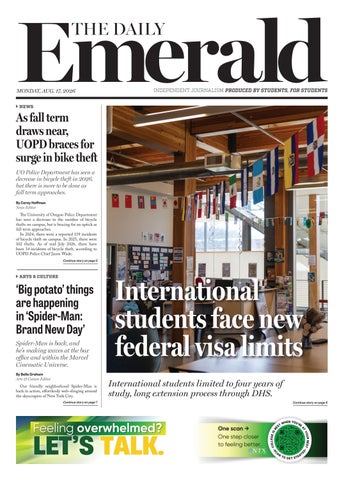
International students face new federal visa limits
By Bella Graham
Arts & Cuture Editor
Our friendly neighborhood Spider-Man is back in action, effortlessly web-slinging around the skyscrapers of New York City.
Continue story on page 7
International students limited to four years of study, long extension process through DHS. Continue story on page 6
I T’ S NE V E R TOO L AT E TO DECIDE TO LE AD. Cadet Summer Training puts you on an accelerated path to leadership as an Army Officer after graduation and can earn you scholarships and a monthly stipend. To get started, Contact Jesse DeBoest at (541) 346-3104.
GOARMY.COM/CROE ©2024 U.S. ARMY. PAID FOR BY THE U.S. ARMY.
NEWSROOM
ARTS & CULTURE
DAILY EMERALD
Monday, Aug. 17, 2026
page 3
EDITOR IN CHIEF Eva Andrews PRINT MANAGING EDITOR Ty Tilden NEWS EDITOR Corey Hoffman A&C EDITOR Bella Graham SPORTS EDITOR Joe Krasnowski OPINION EDITOR Rachel Ehly PHOTO EDITOR Katie Poluyansky COPY CHIEF Lucy Forest VIDEO EDITOR Jake Nolan PODCAST EDITOR Bayley Burnham SOCIALS EDITOR Ana Paramo VISUALS EDITOR Sofia Campbell DESIGN EDITOR Asha Mohan
BUSINESS
PUBLISHER AND PRESIDENT Eric Henry (X317) ehenry@dailyemerald.com VP OPERATIONS Kathy Carbone (X302) kcarbone@dailyemerald.com DIRECTOR OF SALES & DIGITAL MARKETING Shelly Rondestvedt (X303) srondestvedt@dailyemerald. com CREATIVE & TECHNICAL DIRECTOR Anna Smith (X327) creative@dailyemerald.com ACCOUNT EXECUTIVE Maria Jimenez
(ON THE COVER) Flags hang inside the Multicultural Center in the Erb Memorial Union on the University of Oregon campus in Eugene, Ore. The MCC offers space for studying, meetings and student-led activities throughout the academic year. (Max Unkrich/Emerald)
THE DAILY EMERALD
The Daily Emerald is published by Emerald Media Group, Inc., the independent nonprofit media company at the University of Oregon. Formerly the Oregon Daily Emerald, the news organization was founded in 1900. Emerald Media Group 1395 University St.,#302 Eugene, Or 97403 (541)-346-5511
The downtown branch of the Eugene Public Library houses sections for music, audiobooks and movies.
(Alyssa Garcia/Emerald)
For one Eugene librarian, a library is more than just books Eugene Library Services Director Angela Ocaña makes the library a place for everyone. By Gretchen Wackler
Arts & Culture Guest Writer
The second floor of the Eugene Public Library is bathed in sunlight. The windows stretch from the floor to the towering ceilings. The wood paneling on the ceiling ebbs and flows. In combination with the warm, circular light fixtures, the ceiling’s pattern gives the impression of jellyfish, floating serenely in the tide. Even early on a Thursday afternoon, there are very few empty chairs at tables that occupy that vast room. People sit amid the shelves, talking, doing homework, securing victories in Fortnite Battle Royale, and watching the newest season of “Bridgerton” on the computers. The space is peaceful, but not quiet. One voice cheerfully rings through the shelves. Library services director Angela Ocaña wanders through the stacks, greeting each and every coworker. No one slips by without acknowledgment. “Hey, hey, hey!” she sings to coworkers sitting behind desks, pushing carts, or walking, arms loaded with books. For the nearly 30 years she spent as a librarian, it was Ocaña’s arms that were always full, or her face that appeared at the computer below the “Ask here!” sign. However, almost two years ago, Ocaña, 45, left behind her beloved role as a librarian to join the upper administration in the Eugene library system. As library services director, much like the ceiling in the very library at which she works, Ocaña is making waves. A recently passed five-year library levy has only increased Ocaña’s ability to create change in Eugene. The larger budget has helped Ocaña’s dreams of an early literacy program and book-vending kiosks around the city come one step closer to fruition. For Ocaña, though books are important, the core of the library is the relationships it forms. “It’s ultimately in service of people,” Ocaña said. With each program she designs, Ocaña strives to deliver joy beyond just books. As a child, Ocaña’s grandmother would tell her, “Reading is the key to how your life will unfold.” She was right. If reading was the key, the library was the door it unlocked. Now, Ocaña strives to provide every resident of Eugene with the same access, even if they haven’t picked up a book in years. Ocaña, the eldest of three children, was raised by a young, single father who didn’t share her infatuation with books. Her grand-
mother Carolyn, on the other hand, was a different story. A fervent reader, Carolyn fostered Ocaña’s love of reading. Nearly 40 years ago, hand in hand with Carolyn, a young Ocaña walked into the rows of books of a small-town northern California book sale. Her eyes, wide with wonder, consumed nearly all of her small face. Carolyn smiled at her granddaughter. “Go get books,” she said. Ocaña was awed. At only a quarter per book, there was no limit except how many her bag could hold. She ran down the aisles as fast as her short legs could take her. As her bag steadily grew heavier, nothing could bring her down. “I felt so rich,” Ocaña said. “I’m sure most of those books were not great, but that wasn’t the point.” The feeling has stuck with her. If one book sale could open a whole world for her, the possibilities for a library were virtually endless. Despite a high school experience defined by the time she spent at the library, Ocaña never dreamed of having a job behind the desk. “I didn’t want to be one of those shushing librarians,” she said. When she began shelving books at her local library as a teenager, Ocaña had her perception of what it means to be a librarian challenged. Her coworkers at the library would show up each day in leather skirts, fishnet stockings and large, heavy boots. “These were fierce, amazing women who were knocking down the stereotypes of librarianship,” Ocaña said. Her coworkers showed Ocaña a version of a librarian that prioritizes acceptance over conformity. For Ocaña, acceptance and support have always come naturally. She and her siblings lost their mother young, and, as the oldest child, Ocaña was often slotted into a role of caregiver for her younger siblings. “Her whole life she’s been someone that takes people in,” said Joshua, Ocaña’s younger brother, who affectionately refers to his sister as “Ang.” Ocaña utilized this skill in her time as a teen librarian, connecting with kids over coloring, talking through high school drama, and sharing bags of Cheetos. She helped to reimagine the teen room in the library, transforming from a space where teenagers were pushed to the side and forced to share with the library’s CD collection to a designated space for them to thrive. Continue story on page 8
Sponsored by Comcast
Same-Day WiFi Means One Less Thing for Students to Worry About
Back-to-school season is around the corner for the University of Oregon, and for students planning to live off campus that means getting a new home set up (and connected) fast. For students living off campus, reliable Internet access is critical for coursework, communication and entertainment, but it often needs to be arranged independently.
An industry first from a major wired Internet provider, SameDay WiFi is a simple plug-and-play setup and ensures students are ready from day one. How it works is simple. Students sign up for Xfinity Internet, WiFi equipment can either be picked up at a Xfinity store, or for eligible customers in Eugene, delivered to their home, and they’re up and running — all in one day. Sign Up: Sign up for Xfinity Internet at Xfinity.com. Eligible customers select same-day Gateway delivery during checkout. Set Up: An Xfinity Gateway is delivered directly to their doorstep within hours. Customers can simply plug-and-play their device to get up and running. Start Up: Customers self-install and activate service in minutes through the Xfinity app. Immediately connect devices, personalize their WiFi settings, and manage your home network.
This back-to-school season, Xfinity is making it easier to get connected with Same-Day WiFi in Eugene, allowing eligible new customers to sign up and get online that very same day; either through home delivery, where available, or by picking up equipment at the Eugene Xfinity store. Eligible university students living off campus can also take advantage of a special offer featuring 1 Gig speeds for $45 per month for one year, plus Peacock Premium and a $200 virtual prepaid Mastercard.
“In a world where almost everything is instant, home Internet shouldn’t be an exception,” said Eric Jagher, senior vice president and general manager of connectivity. “With Xfinity’s Same-Day WiFi we’re giving customers access to the nation’s fastest, most reliable connectivity the moment they need it.” Whether they’re submitting an assignment five minutes before it’s due, interviewing for that dream internship, streaming the big game, or sharing WiFi with a house full of roommates, Xfinity student plans are built to keep up with college life. Don’t miss out on same-day WiFi and student offers from Xfinity. Learn more at xfinity.com/student and get started today!
Learn more at xfinity.com/student or stop by to speak to Xfinity at UO Parent & Family Marketplace on September 24 and 25.
NEWS/OPINION
DAILY EMERALD
Monday, Aug. 17, 2026
page 5
As fall term draws near, UOPD braces for surge in bike theft NEWS
Continued from page 1
The three anti-bike theft programs currently used by the UOPD are a “bait bike” program, a community awareness program and enhancements in security around bike cages.
“Bait bike” program The “bait bike” program — a sting operation designed to track and catch thieves — was launched at the start of the 2025-26 school year. The initiative has been deployed nine times since, and resulted in two arrests. During a “bait bike” operation, UOPD places appealing bicycles in areas frequented by thieves, Chief Wade said. The bicycles are equipped with technology that allows authorities to track the bicycle in real time if it is stolen. According to Wade, the “bait bikes” that resulted in arrests were “textbook version” of the operation. “(With) the technology with the bait bike, we could track (the thief) back to his location where he was at and arrest him not just for the theft of the bicycle, but also, he had several warrants out for his arrest,” Wade said of one of the arrests. Because the program involves a planned operation, Wade said, UOPD cannot deploy the “bait bikes” frequently. Staffing changes have also limited the number of times UOPD was able to deploy the program, as there are a certain number of staff needed to perform the operation. UOPD also acquired a “bait e-scooter” as an extra incentive for thieves.
Community awareness UOPD is also boosting its community awareness program by stressing the importance of bicycle care to incoming students and their parents during student orientation and promoting its bicycle registration program, Project 529.
“We now — during our introduction to parents — give them suggestions not just for a bike to buy, or not just styles, but just the kind of a value of what’s being seen by our thieves and (the) importance of locking it up and registering the bicycle,” Wade said. A majority of the bicycles that have been stolen on campus, Wade said, are registered with the Project 529 program, which is run through UO Transportation Services and gives UOPD a better chance of recovering or gaining information on stolen bikes. “(The program) allows the Eugene Police Department, Springfield, Lane County and other nearby agencies — (if they) run into our thieves and run the serial numbers on the bikes, we have a better chance to at least recover the bike or recover parts of the bicycle, as we’ve seen some of them chopped up,” Wade said.
Security enhancements UO Housing has also enhanced its security around bicycle cages, including adding more cameras, changing the angles of existing cameras and reducing the ease with which thieves are able to access locked bicycle cages. According to UO Transportation Services, there are 7,066 bike parking spaces on campus. 1,785 of those bike parking spaces — approximately 25% of the available spaces on campus — are access-controlled. The remaining spaces are public bike racks. “This decrease in bicycle theft right now is a combined effort of everything put together. Students and faculty, staff, people riding bicycles are reducing the opportunities by locking them up and securing them, putting them in the cages. We’re getting more practical patrols,” Wade said. UOPD also restructured its schedule so that each month one of its four patrol teams is focused on bicycle theft.
(Rowan Campbell/ Emerald) A deflated and cobwebbed bike is left attached to the bike racks at the Erb Memorial Union on the campus of University of Oregon.
This includes being stationed near “prevalent locations” where bike thefts occur or monitoring cameras. UOPD’s “No Bike Left Behind” program, where students could leave their bikes in a secured location for extended school breaks, was discontinued due to staffing changes and budget cuts. According to Wade, it’s impossible to know the exact number of bicycles actually stolen on campus, as students sometimes choose not to report the theft. But UOPD’s “bait bike” technology, community awareness and enhanced security are a step toward decreasing bicycle theft. “I would rather see a higher level of prevention — more bike cages, more locks, more cameras, more patrol and less thieves,” Wade said.
OPINION
Leininger: Eugene’s Vision Zero action plan won’t work without us Opinion: While Vision Zero is an effective approach for targeting infrastructure developments, a true Vision Zero cannot be achieved without emphasizing driver education and engagement. By Jack Leininger
Opinion Columnist
On May 2, 61-year-old cyclist Morris was killed after being struck by a pick-up truck while riding on River Road. He was the fourth cyclist to die in such an accident in less than a year. On May 20, local officials and community members came together in observance of traffic death victims and to discuss what more could be done. Shortly thereafter, City of Eugene staff released a 2026 Vision Zero Action Plan Update, which included new crash data, but did not change the overall strategy. The plan aims to eliminate fatalities and serious injuries by 2035, with an interim goal of a 50% reduction by 2028. The updated plan reveals why crashes remain prevalent despite years of infrastructure investment. Failure to yield is the most common contributing factor in fatal and serious injury crashes in Eugene. This is true across accidents involving walkers, drivers and cyclists. Claire Moore, a student in UO’s Clark Honors College, experienced this firsthand. “I was biking home from work down Charnelton
and 11th with lights on my bike, and I was riding through a green light in the bike lane. A minivan was turning left and didn’t brake for me and hit me,” Moore said. Bystanders helped her up while the driver apologized profusely. The crash happened in front of two police officers, who asked if she was hurt. Moore hadn’t sustained any injuries, but her bike was totaled. After finding out she hadn’t been injured, the two officers told her they weren’t going to be documenting the incident, according to Moore. “Now whenever I bike, I just don’t assume cars are going to yield to me at all,” Moore said. “I also have to be more aware of what I’m doing, whether I have the right of way or not.” Moore’s story is alarming because she had done everything right, and the crash still happened. Responding officers’ failure to report underscores how far Eugene is from a community-wide commitment to Vision Zero. Olin Webster, a bike mechanic at Arriving By Bike who has worked in bike shops since 2019, sees this tension play out regularly. “There’s a simultaneous gap in awareness and a lack of caring,” Webster said. “It could be nice to
have kind of a both-sided thing, an education for cars and for bikes at the same time.” Webster said he’s fielded questions from new cyclists unsure of basic traffic laws and thinks the city could do more to close that gap. “It could be nice if there was a city of Eugene pamphlet you gave to bike shops, you gave to universities, you put it out at events,” Webster said. “Here’s some basic traffic laws on what to do with your bike.” On why education is necessary, Webster noted biking requires no test or license. There’s no guaranteed baseline of traffic law knowledge among cyclists, unlike drivers who must engage in various programs before getting on the road. Eugene has made effective investments to create safer streets. Vision Zero has produced new protected bike lanes, crossings, roundabouts and an updated High Crash Network. However, infrastructure takes years to build, and it can’t account for a driver who doesn’t yield or a cyclist who doesn’t know the law. Moore’s crash and David Winston Morris’ death occurred because two people weren’t on the same page, not because Eugene doesn’t have sufficient bike lanes. Programs like the pamphlet Webster describes are cheap, fast and could start realigning drivers and cyclists sharing the road. Infrastructure alone can’t solve a gap in education and understanding.
Jack is an Opinion Columnist at the Daily Emerald and a fourthyear student studying journalism and computer science. He has a passion for creative writing, could talk for hours about Cormac McCarthy, and is always looking for new study spots in Eugene.
ON THE COVER
DAILY EMERALD
Monday, Aug. 17, 2026
page 6
New federal rule sets strict visa limits for international students International students limited to four years of study, long extension process through DHS. By Carys Sexton-Sayler and Sasha Love
News Reporter and Associate News Editor
This September, the federal government will end a nearly 50-year policy of allowing international students to remain in the United States for the full length of their academic program. The policy, issued by the Department of Homeland Security, limits most international students to four years of study in the United States, with extra time potentially allowed with additional documentation. The new policy will affect both undergraduate and graduate students with F-1 and J-1 visas. F-1 visas are primarily for students seeking degrees, while a J-1 visa covers exchange students and certain Ph.D. candidates, according to Becky Crabtree, UO’s assistant vice provost for divisional operations and director of International Student and Scholar Services. Before, students could extend their study with ISSS without having to go through U.S. Citizenship and Immigration Services, a part of DHS. “(ISSS staff) work closely with academic advisors and offices; we know what students need to complete their degree, and (the rule) takes some of that control and authority out of our offices and it basically transfers that authority ... to the federal government,” Crabtree said. The rule comes after years of DHS, under the Trump administration, issuing stricter policies for international students, including social media screening, and the detention of an international student journalist. “It’s just been a constant trend of the Trump administration just purging, or attempting to purge, America’s multicultural identity and trying to create an education system that only wealthy people can have access to,” ASUO President Quadrian Gill said. DHS states that the rule is to prevent what it calls “forever students” and combat “rampant visa abuse.” However, the suspected in-country overstay rate is only 2.45% for almost 1.5 million students While international students automatically have four years to finish their degree, there is a process to extend their
Number of Students
1,349
stay if needed, but this could be a lengthy ordeal. Under the old rule, ISSS could extend a student’s status in-house. Under the new rule, it’s now a two-step process where they have to extend with the ISSS office and file a formal application with USCIS. For example, a student admitted for fall 2026 with a fiveyear program, such as architecture, will now be admitted for four years, and in their fourth year they would file a formal extension of stay application with USCIS. The fee is $420 per extension, according to USCIS. Crabtree said the length of the extension might be just one year, or more depending on what ISSS thinks the student needs academically. Extensions that once took ISSS about a week now route through the USCIS, where, Crabtree said, cases take anywhere from several months to “more than a year.” Expedited processing will take less than two months, according to USCIS, but will cost about $2,000 more, and Crabtree said that option isn’t currently available. The rule also limits flexibility to switch schools or programs. To transfer schools or change their major within their first year, undergraduate students will now have to leave the U.S. and come back, according to Crabtree. Graduate students will also need to leave when switching schools or programs, no matter their year in school. The new rule and time-consuming process for extensions, which Gill called a “bureaucratic hurdle,” could discourage students from attending school in the U.S. Still, Crabtree said they are continuing to support students from abroad, holding informational sessions with current students about visa status and providing updates on UO’s website. “I’m hoping we don’t see a drop in international students wanting to come to the U of O because we’re an amazing university. We still offer some amazing programs, lots of opportunities for students to do cutting-edge research at the Knight Campus and all of our different professional schools and colleges,” Crabtree said. “So what we are trying to do is make these changes not an obstacle for students to
International Student Enrollment, 2019-2025
844 570
2019
2020
2021
473
2022
354
2023
303
300
2024
2025
*Data sourced from UO Board of Trustees
want to come here.” Gill said ASUO is currently referring student questions about the rule to ISSS. Since the changes are new, Gill said ASUO has not discussed specific resources for international students yet, but is considering expanding international student emergency loans and continuing outreach.
“
What we are trying to do is make these changes not an obstacle for students to want to come here. Becky Crabtree Director of International Student and Scholar Services
“In the summer, it definitely makes it a little harder to respond to things as quickly right now, which is why we’re kind of relying on ISSS,” Gill said. “But as soon as we find any way we can support students, either giving them more information or creating more support networks with ISSS, which we’ve done in the past … we’d be more than interested in going down those avenues again.” Dennis Galvan, vice provost for global engagement, said UO is also comparing notes with peer institutions and plans to respond by leaning further into international recruitment rather than pulling back. “We will recruit harder, we will be more engaged, we will host more pre-departure information sessions,” Galvan said. “The federal government can do the federal government’s thing, but we’re going to be open to the world.” If international student enrollment decreases due to stricter visa rules, it would not only affect student diversity, but would also put a strain on UO financially. The university has a projected deficit of $65 million, due in part to a decline in out-of-state student tuition revenue. International students and out-of-state students pay significantly more than Oregon residents, and the number of students coming from abroad has sharply decreased over the past several years, according to data presented at a June Board of Trustees meeting. In fall 2019, there were 1,300 incoming international students. In fall 2025, there were 300.
ARTS & CULTURE
DAILY EMERALD
Monday, Aug. 17, 2026
page 7
‘Big potato’ things are happening in ‘Spider-Man: Brand New Day’ Continued from page 1
He has the chief of police on speed dial, fist-bumps New Yorkers whenever he gets the chance and fights crime of the supernatural variety, somehow making it feel like it’s just another day as a beat cop in a red spandex suit. “Spider-Man: Brand New Day” swung into theaters on July 31 and quickly captured the title of the highest-grossing movie in 2026, bringing in over $1 billion in just one week and later beating multiple ticket sale records previously held by “Avengers: Endgame.” A stark contrast from where we left him in “Spider-Man: No Way Home,” Spider-Man fits into the fabric of New York City, its prodigal son once again. *Spoilers ahead!
“Brand New Day” reunites the world with Spider-Man (Tom Holland), oxymoronically so. Everyone in-universe has forgotten who the man behind the mask is after a spell from Doctor Strange erased him from the world’s memory to save the multiverse in “No Way Home” (Spider-Man is Peter Parker, for those who felt the effects through the screen). Unknown to the world, including to his best friend Ned (Jacob Batalon) and former girlfriend MJ (Zendaya), despite promising to tell them, his life is — and there’s really no other way to put it — depressing. He lives in an asbestos-ridden apartment he got in an under-the-table deal; the only food-adjacent things in sight are stacked jugs of protein powder, and the few people who do attempt to talk to him as Peter Parker are quickly rebuffed by the man himself. His self-imposed isolation eventually spurs an onset of heightened senses and him developing organic webs (rendering his mechanical web-shooters useless); not only is he a shattered version of Peter Parker refusing friendship at every turn, but he’s losing himself in the suit and literally becoming more spider than human. Simultaneously, a telepath seems to be wreaking havoc on New York, body-hopping to attempt to break into the Department of Damage Control (DODC) in search of something called “V-Max.” We later find out the telepath is one Jean Grey (Sadie Sink), and Sink makes a splash in her inaugural MCU out-
ing. Once the vengeful villain, Sink quickly turns the tables for Jean to be mired in grief and loneliness, acting somewhat of a character foil for Peter after revealing that DODC kidnapped her sister (also a telepath), and the only message Jean has gotten from her since is “V-Max.” The reveal of what “V-Max” means is utterly devastating, and one worth seeing in theaters. Throughout the movie, her clearly desperate search to discover the meaning behind the word convinces the audience that it’s something she’ll use to compound her already-destructive attacks, but the build-up fails to pay off in the best way possible — realized as a futile message her sister sent with the last bit of her despairing consciousness rather than it being a weapon or drug. That shift integrates Jean Grey into the already heavy-hitting analysis of the weight of grief as told through Peter Parker, and how important community is. While Ned and MJ may not remember Peter and everything he’s been through, he finds a kindred spirit in Jean, and it’s a sibling-like relationship that Marvel should continue in the MCU. Black Widow/Yelena Belova’s (Florence Pugh) appearance is an unexpected highlight. After making Peter strip down to his tighty-whities and mask to join her in her “office” (a pool in a bathhouse), she helps Peter figure out who the telepath is, and later clocks him for his self-imposed isolation, calling him the “sad man.” Yelena also furthers the theme of community, telling Peter, “I’m just so happy the sad man has friends,” after seeing him reunite with MJ and Ned, albeit behind the mask. Yelena is no stranger to a formative and crushing loss of a family member, and her arc from being in a similar position to Peter to now holding court in a bathhouse is the — in a strangely endearing way — light at the end of the tunnel. “Brand New Day” isn’t just another action-filled spectacle of superhero fodder designed to keep us in our seats for 145 minutes. It isn’t reliant on big fight sequences, one-dimensional super villains or invincible mutants. The heroes feel tangible, and it’s rooted in an exploration of loneliness and the bravery of asking for help, a surprisingly poignant discussion of superhuman ethics and autonomy/liberation of the self. Is the use of an ambiguous governmental organization as a main-player-turned-villain in a twist reminiscent of one
(Sofia Campbell/Emerald)
in “Captain America: The Winter Soldier”? Yes. Is there a disparity in how severe injuries should be versus how severe they actually are? Absolutely. Like most Marvel movies, they aren’t lauded as the pinnacle of filmmaking, and as such require you to suspend your disbelief for those 145 minutes. At the end of the movie, raucous crowds cheer for the man in the spidey-suit as he anonymously stands amidst them. He’s no longer the villain of New York, instead somewhere in between the grief-stricken 20-something and the real Peter Parker. A child waves at him, knowingly, and it’s a brand new day for Spider-Man, which means his dominance of the MCU isn’t going away anytime soon.
For one Eugene librarian, a library is more than just books Continued from page 3
“We as librarians hold stories of people,” Megan Prehm, a librarian at the downtown branch, said. Both having worked as teen librarians, Prehm and Ocaña are acutely familiar with the stories of years’ worth of children. With an increased budget and responsibility, Ocaña has big plans for the Eugene Public Library and the people who live in this city. “She doesn’t just have empathy,” says Joshua. “She takes it into action.” Eugene voters passed the recent library levy by a 62.2% vote. “This community just shows up and cares about its library in a way that is so fundamentally different than any community I’ve worked in,” says Ocaña The levy increased the tax rate from 15 cents to 19 cents per $1,000 of assessed property value. It’s projected to raise $4.3 million per year, roughly 23% of the library’s budget. It’s money that is transformative for the Eugene Public Library. It’s already aided in the hiring of a brand new children’s librarian who will visit preschools and elementary schools around Eugene to promote early childhood literacy. In the back of the children’s section of the library sits the
first book-vending kiosk. With the new levy, Ocaña says there will be many more throughout the city. Kids will earn tokens from community programs, which they can exchange for a free book. She’s optimistic that the program will expand the reach of the library and get kids excited about reading. “Families who can’t come to the library,” said Ocaña, “now we’ll come to you.” Through the windows by the book kiosk, children not yet old enough to be in school play on the small playground. They’re not reading by themselves yet, but the library remains a space for them. She watches as they play, chuckling as they squabble over a toy, even as others lie available mere feet away. In glass cases around the children’s room are displays of toys on a month-long loan from local children. They include clay figurines, Legos, and beloved stuffed animals. Ocaña laughs at each exhibit, remarking on the strength of the children who are able to part with their cherished possessions for an entire month. Books are rarely the topic of conversation for Ocaña as she wanders through the four stories of the downtown location of the public library. “We have tons of books,” she says,
“but you already knew that about us.” Instead, she affectionately points out the craft room, the seed exchange, and the “library of things,” which has everything from an acoustic guitar to a tractor-shaped cake pan available for checkout. Ocaña no longer has the same hands-on role that she did when she was a librarian, but her impact is felt in the aisles, reading nooks and computer labs scattered through the library. Her job as director is “far more boring” than her time as a librarian. Ocaña misses working directly with patrons, but she’s “paving the way for others to build those relationships.” To Ocaña, no one should have to change to find joy in the library. “You can make the library anything you want it to be,” she said. Nestled in the corner of the designated “tween” section is a question box. It’s designed so that kids can have their questions about life and growing up answered without any of the typical awkwardness. Ocaña doesn’t notice, but in the clear box, one slip sits unfolded. Written with scraggly, middle-school handwriting, all it says is “I love the library.”
SPORTS
DAILY EMERALD
Monday, Aug. 17, 2026
page 8
Oregon men’s basketball offseason review: Part 1 Oregon’s future looks bright with the addition of two incoming freshmen. By Colin Ernst
Sports Reporter
The University of Oregon’s men’s basketball team finished this past season with a deflating 12-20 record, plagued by injuries that never allowed a coherent starting five to emerge. The Ducks season ended in Chicago at the Big Ten tournament in embarrassing fashion, mustering just 13 points in the first half against the Maryland Terrapins on their way to a first-round exit. However, head coach Dana Altman is not one to dwell on the past, and the transformation that his team has made during the offseason is proof. Before we talk about the additions to this team, because there are quite a few, let’s review which Ducks left the flock. Three standout players who have been staples of the recent Oregon squads the last few years are now nowhere to be found; those include point guard Jackson Shelstad, forward Kwame Evans Jr. and center Nate Bittle. Bittle went undrafted in the 2026 NBA draft, although the seven-footer recently signed an Exhibit 10 contract with the Toronto Raptors on July 10. An Exhibit 10 is a one-year, non-guaranteed training camp deal that pays the league minimum salary. Evans Jr. and Oregon native Jackson Shelstad both chose to enter the transfer portal after this past season. Shelstad was ranked as the No. 3 point guard available and was
picked up by Louisville alongside the first transfer player in the portal, Flory Bidunga. Kwame Evans Jr., a native of Baltimore, decided to take his talents back to the northeast, choosing Villanova as the launchpad for his senior season campaign. Both players are projected to start at their new schools this upcoming season. Now, let’s get into the real meat and potatoes, the players that this Oregon staff has brought in to bounce back from the worst season of Dana Altman’s 16-year tenure in Eugene. The faces and names that will breathe life back into this school’s basketball program.
Tajh Ariza: Small Forward, 6’9, 200 lbs The son of NBA veteran Trevor Ariza, four-star Tajh boasts an over a 7-foot wingspan that makes him uncannily large at the small forward position. Despite his lankiness, he is very fluid when moving around the court, especially in transition, where he showed his high-flying abilities in high school. Ariza is also an effective two-way player thanks to his size and shoots the ball very smoothly. Tajh chose Oregon over the likes of Kansas, North Carolina, Kentucky, Arkansas and Texas.
Seven Spurlock: Small Forward, 6’5, 210 lbs Previously committed to Arizona State, Seven Spurlock was ranked as the eighth or ninth best player coming out of
Texas this year by SportsCenter. Seven most recently played in the Overtime Elite league, where he helped his team go undefeated throughout the playoffs. In game four of the championship series, Spurlock showed his offensive abilities and defensive hustle, scoring 27 points and bringing home the finals MVP trophy. Dana Altman has never been shy about reshaping his roster on the fly, and this offseason might be his boldest change up yet. The names are new, and the ceiling is high, but if even half of these transfers play up to their potential, Oregon won’t just bounce back from last year’s season — they’ll remind the Big Ten that it’s an everything school. (ABOVE) Oregon’s lineup takes the court after a break in play. The Oregon Ducks men’s basketball hosted the Minnesota Golden Gophers at Matthew Knight Arena in Eugene, Ore. on Feb. 17, losing 44-61. (Owen Burriss/Emerald)
Who’s in, who’s out? — Oregon baseball How Oregon baseball will replace some key departures. By Joe Krasnowski
Sports Editor
The cities change, the faces vary. However, the sentiment regarding Oregon baseball remains the same — any season that ends short of Omaha and the College Baseball World Series won’t be good enough for anyone in the program’s stratosphere. This year, it was a young team getting schooled by an SEC juggernaut that ended head coach Mark Wasikowski’s
team’s season. With a significant number of transfer portal departures and a record seven draftees in the 20-round draft, getting back to that point next season will be harder than ever. First, there are the draftees. The MLB Draft saw three Oregon pitchers, Cal Scolari, Miles Gosztola and Devin Bell, drafted, with the trio joined by shortstop Maddox Molony, third baseman Drew Smith, outfielder Jack Brooks and infielder Ryan Cooney. That’s a significant amount of production — not to men-
tion multiple stalwarts in the program — for Wasikowski to replace. None of those players were a shock, however. The reality of Oregon’s emergence as a West Coast baseball power is that players often leave before graduation to go to the next level. That, of course, is a tradeoff Wasikowski will always take. However, the real loss for the Ducks this season came via the transfer portal. Angel Laya, Naulivou Lauaki Jr. and Burke-Lee Mabeus, three pillars of Oregon’s future, all left the program in the offseason to join SEC schools. Laya, who was arguably Oregon’s best player in 2025-26, slashing .296/.396/.538 with a .934 OPS, opted to join Louisiana State University next season instead. Lauaki Jr. opted to transfer to Georgia after emerging as the Ducks’ best power bat late in the season, and Mabeus, a two-year starting catcher, transferred to Mississippi State. Catcher Brayden Jaksa’s emergence as a freshman, where he earned NCBWA Freshman All-American honors, makes Mabeus’ departure more palpable. Lauaki and Laya’s bats, however, will be much harder for Wasikowski to replace. To do so, Wasikowski landed commitments from USC first baseman Adrian Lopez, who slashed .304/382/.534 with a .915 OPS and 13 home runs, and Long Beach’s Jake Evans, who hit .364 with three home runs and a .483 OBP in 2026, among others. On the mound, Oregon landed a commitment from USC right-handed pitcher Michael Ebner, who should compete for a rotation spot in the fall. Additionally, Oregon will rely on the continued emergence of Mabeus along with the return of starters Jax Gimenez, Tanner Bradley and Will Sanford to aid the Ducks’ next push to Omaha. (LEFT) The Oregon baseball team lines up along the first base line for the National Anthem. On May 30, the Oregon Ducks defeated the Washington State Cougars 4-0 in game four of the NCAA D1 Baseball Regional at PK Park, at the University of Oregon, in Eugene, Ore. (Fred Hall/Emerald)
WS! G NE KIN EA BR
BRE A KI NG
S! W NE
WS! G NE N I K EA R B
BREAKING NEW S!
BREAKING NEW S!
BRE AK IN G
S! W NE
Weekly Crossword 1
2
3
4
7
Puzzles Master, Nate Wong
5
6
8
9
10
11 12 15
13
14
16
17
18
19
20
Sudoku 5 8
9
2 6 9
6
4
5
9
8
3
3
1
2 2
8
2 7
6
1
DOWN
1 Enemy, in modern slang 4 Price of admission 7 Word after gray or play 8 Where an affectionate pet may rest 9 University of Cincinnati team 11 Kids’ online game known for Adopt Me! and Dress to Impress 12 Perform a Suplex or Half Nelson, maybe (Southern dialect spelling) 15 The underdogs at sports events, usually 17 Type of avatar made with 16-Down 18 Tenth of a dime 19 ATM ID or 95 #, ex. 20 Uneven?
1 Cookies n cream milkshake ingredient 2 Blockhead 3 Cumulative gambling tactic 4 Superfood unit similar to chia 5 “___ and leave no crumbs” 6 Mini-LPs 7 “___a, Kad___a, Alakazam!” 10 Wholesaler where you might see AJ and Big Justice eating a chicken bake 13 Secure, as an internship 14 CPR specialist 15 Guitarist’s concert necessity 16 2006 Nintendo console
Unscramble 9
7
ACROSS
7
8
Sudoku11
Answers
By Nate W
T S E S R S
U E K A Q
H T A M
U M E
I can tell you every synonym for the word dinosaur; I’ve been reading my
!
By Nate W
Sudoku11
THESAURUS STRESS, QUAKE, MATH, EMU
1
5
3
7
9
4
6
2
4
9
8
3
2
1
5
8
7
6
6 2 8 7 1 5 3 9 4
4 8 3 5 6 9 7 2 1
9 6 1 4 7 2 8 3 5
7 5 2 3 8 1 4 6 9
2 1 6 8 5 4 9 7 3
8 9 5 1 3 7 6 4 2
3 4 7 9 2 6 5 1 8
O P P F E E A R E A L A P B E A R C A T S ROB L OX R A S S L E AWA Y T E AM M I I C E N T P I N OD D