Oregon Hazards Lab expands early wildfire detection with AIintegrated cameras
A donation from Google is supporting the use of AI-integrated cameras to detect wildfires early in the Columbia River Gorge.
By Corey Hoffman Senior News Reporter
As the state of Oregon prepares for an above normal fire season, the Oregon Hazards Lab is using AI-integrated cameras to expand early wildfire detection across the state.
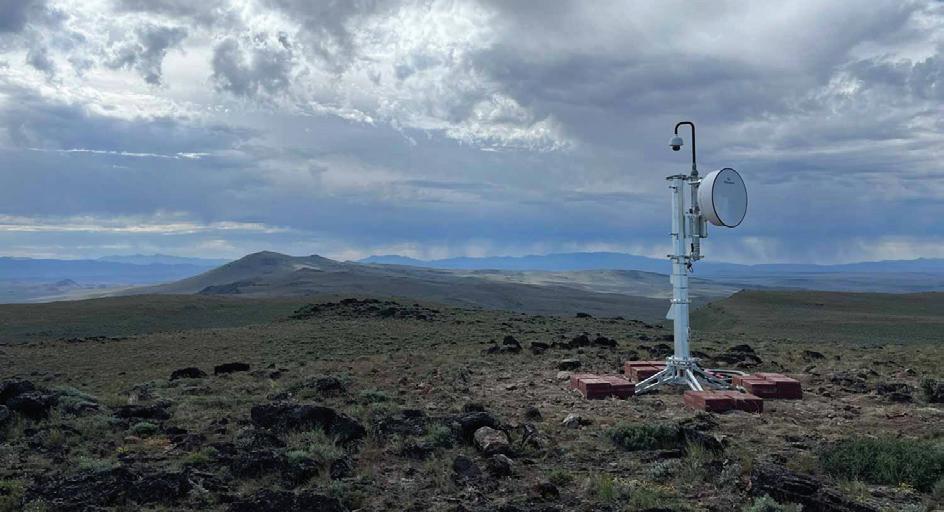
OHAZ, which uses science, data collection and research to monitor natural hazards in the Pacific Northwest, has over 70 AI-integrated cameras mounted across the state that allow firefighters and first responders to respond faster to wildfires.
The cameras perform a 360 degree turn every two minutes, as, OHAZ Associate Director of Research and Development Nick Maggio, said, it takes a panorama image of the landscape.
The images are then sent to the lab’s vendor, AlertWest, where they are processed through an AI algorithm and displayed on the site's public website.
According to Maggio, the AI algorithm is designed to look for smoke during the day and thermal anomalies at night. If a potential fire is flagged by the technology, it is verified by two human reviewers before being sent to emergency personnel.
Continue story on page 5
INDEPENDENT JOURNALISM PRODUCED BY
Enrollment decline to reshape university
Budget cuts stemming from decreased nonresident enrollment alter future University of Oregon staffing.
By Reilly Norgren News Editor
This fall, the University of Oregon will turn 150 years old; at the same time, administrators will confront one of the largest financial crises of the century that will result in sweeping budget cuts across the institution.
The university is preparing to cut roughly $65 million from its budget across the next several years, in addition to last summer’s cuts of about $30 million that
resulted in 176 job cuts across departments, of which 117 were layoffs, 59 were unfilled positions. The new cuts come after the administration projected a decline in out-of-state student tuition revenue, after college decision day, May 1, offered further insight into enrollment numbers.
The impact of last summer’s cuts will begin to be felt this fall, as the faculty union’s bargaining agreement requires one-year layoff notices.
In an announcement on May 14, UO President John Karl Scholz said there
would be an immediate hiring and pay action freeze as well as a limit on non-essential travel, save for September pay increases that the university already committed to.
UO relies primarily on tuition revenue for operational costs — undergraduate tuition accounts for 79% of the Education and General Fund’s revenue as of 2025, with 59% of that number coming from nonresident tuition costs.
EDITOR IN CHIEF
Tarek Anthony
PRINT MANAGING EDITOR
Ryan Ehrhart
DIGITAL MANAGING EDITOR
Ysabella Sosa
NEWS EDITOR
Reilly Norgren
INVESTIGATIONS EDITOR
Ana Narayan
A&C EDITOR
Claire Coit
SPORTS EDITOR
Jack Lazarus
OPINION EDITOR
Gracie Cox
PHOTO MANAGING EDITOR
Corey Hoffman
PHOTO EDITOR
Saj Sundaram
COPY CHIEF
Olivia Ellerbruch
VIDEO EDITOR
Jake Nolan
PODCAST EDITOR
Stephanie Hensley
SOCIALS EDITOR
Ysabella Sosa
VISUALS EDITOR
Noa Schwartz
DESIGN EDITOR
Adaleah Carman
DESIGNERS
Asha Mohan
Ellery Burton-Tillson
Eva Andrews
Izzy Smith
Sign
up
BUSINESS
PUBLISHER AND PRESIDENT
Eric Henry (X317) ehenry@dailyemerald.com
VP OPERATIONS
Kathy Carbone (X302) kcarbone@dailyemerald.com
DIRECTOR OF SALES & DIGITAL MARKETING
Shelly Rondestvedt (X303) srondestvedt@dailyemerald. com
CREATIVE & TECHNICAL
DIRECTOR
Anna Smith (X327) creative@dailyemerald.com
ACCOUNT EXECUTIVES
Camcole Pereira
Elliot Byrne
Maria Jimenez
THE DAILY
EMERALD
The Daily Emerald is published by Emerald Media Group, Inc., the independent nonprofit media company at the University of Oregon. Formerly the Oregon Daily Emerald, the news organization was founded in 1900.
Emerald Media Group 1395 University St.,#302 Eugene, Or 97403 (541)-346-5511
for our daily newsletter, the DailyE
Get the latest news in your inbox each morning
FIND MORE STORIES ONLINE AT DAILYEMERALD.COM
Scottish Festival 2026
Eugene’s Scottish community came together on Saturday to celebrate their heritage with music, food, and a little bit of imagination.
By MCayden Marlar Videographer
UO to close Barnhart Hall, dining facility; Riley Hall to remain vacant
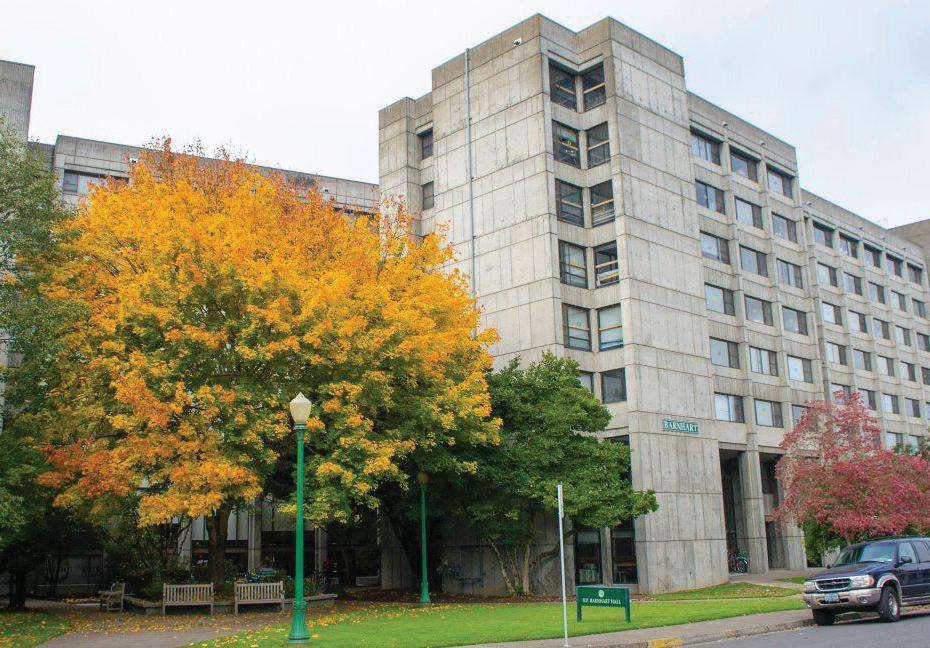
The university will close Barnhart Residence Hall and Dining Hall and leave Riley Hall unoccupied after projecting a decline in on-campus housing demand, despite constructing two new residence halls on the east side of campus.
By Tarek Anthony and Riley Norgren Editor-in-Chief and News Editor
The University of Oregon announced Tuesday that it will close Barnhart Residence Hall and Barnhart Dining Hall for the 2026–27 academic year. The university also plans not to occupy Riley Hall, though it will retain the residence hall as a backup option should housing demand require its use.
In an email to staff Tuesday afternoon, University Housing Director Michael Griffel pointed to
Oregon’s running backs and assistant coach was cited in lieu of custody after allegedly backing his truck into a parked vehicle in downtown Eugene on April 12.
By Owen Murray Associate Sports Editor
Oregon football assistant head coach and running backs coach Ra’Shaad Samples was charged with DUII and reckless driving in April, The Oregonian/OregonLive first reported and The Daily Emerald independently verified Monday. Samples, 31, is entering his third season with the program in 2026.
Human Rights Commission working to approve nonprofits for grant program
The commission is reviewing applications for grant funding from local nonprofits supporting community members impacted by immigration enforcement.
By Billie Corsetti News Reporter
The city of Eugene’s new grant program for nonprofits assisting community members impacted by immigration enforcement is reviewing and approving applicants through the Human Rights Commission.
The Special Human Rights Grant, which was introduced by Councilor Lyndsie Leech of Ward 7 and passed by the city council in a seven-to-one
an estimated 9% to 10% reduction in on-campus housing demand for the upcoming academic year following a significant decrease in out-of-state enrollment. In fall of this year, 1,888 nonresident first-year students are expected to enroll. This is 500 fewer than the typical average the university has used in previous projections. This drop in enrollment is contributing to the $65 million structural budget deficit recently announced by the university that has so far resulted in a wage and hiring freeze across campus.
A Eugene police officer cited Samples in lieu of custody on April 12 at 2:02 a.m. after he allegedly backed his Ford F-150 into a parked Dodge Ram in a downtown Eugene parking lot, EPD spokesperson Melinda McLaughlin said in a statement to The Daily Emerald. According to police, Samples initially left the scene but was flagged down by the Dodge driver near the Hult Center on West Seventh Avenue, a few blocks from the crash.
vote, will use the $50,000 contingency fund previously set aside by the council pending its best use. The city’s Office of Community Equity and Community Engagement recommended that the fund be used to assist the community by providing a one-time funding opportunity for nonprofits giving direct services to immigrant community members.
Oregon Hazards Lab expands early wildfire detection with AI-integrated cameras
“(When) the fire agencies receive this message, it has an image of the fire, it has the geolocation of the fire and it's got a link to the camera so they can jump on and see in real time what's happening with this particular fire and then they can respond accordingly,” Maggio said.
In an email statement to The Daily Emerald, Mid-Columbia Fire and Rescue Chief David Jensen said the cameras “dramatically” improved the department’s ability to assess and respond to incidents as they are happening.
“Throughout our partnership conversations, we've emphasized how this advanced detection technology empow-
ers us to anticipate challenges rather than simply react to them, which is especially valuable in hard-to-monitor regions,” Jensen said.
In May, Google gifted $250,000 to UO to expand wildfire detection in the Columbia River Gorge, where the Rowena Fire burned more than 3,600 acres and destroyed homes in Wasco County in 2025.
According to Maggio, Google and the lab are paying particular attention to the region because winds in the Columbia River Gorge pick up and spread fire easily.
“This was a way for (Google) to have an impact because they recognized that wildfire was a threat to the health and the livelihood of the people in their community,” Maggio said.
Google opened a data center in The Dalles, Ore., in 2006, and today operates five centers in 2006 and now operates five centers in the region with a sixth expected to open in 2026.
OHAZ Director Leland O’Driscoll said that while the AI technology makes the detection process more efficient, it is only one part of a “complete package” that makes the cameras function.
According to O’Driscoll, OHAZ is responsible for securing permits and developing the cameras, as well as the cybersecurity operations, data connections, sending the images to AlertWest and monitoring the functionality of the cameras.
“We also play a heavy role on the back end of all of that. Once the product is available, then we train the fire agencies, along with AlertWest, on how to best use it and coordinate the resource amongst the wide variety of fire professionals in the region,” O’Driscoll said.
The cameras are equipped with privacy measures to protect residents who may live within a camera’s line of sight. According to Maggio, before a camera goes live, a masking layer is added to all “built environments.”
“If there's a house, for example, that you can see within the camera views, we mask that out and that gets done at the hardware level in the camera, so that data never transits a network,” Maggio said. “That's one of the steps that we take to make sure that we try and strike that right balance between privacy and security.”
According to O’Driscoll, in addition to alerting fire agencies of a potential wildfire, the data is also collected and stored for later research, which, O’Driscoll said, aligns with the framework of Oregon Rising.
“We are purpose built to work on environmental resilience as a focal point of what we do. We collect novel data that observe the environment. So it both has practical applications for current research and current hazard monitoring, but also future long term climate change type monitoring,” O’Driscoll said.
Student transportation group creates map
analyzing high-risk areas for pedestrians, cyclists
LiveMove aims to prevent traffic deaths and injuries before they happen with a proactive study on roadway safety.
By Sasha Love Senior News Reporter
The student-created LiveMove is a mapping project that seeks to identify high-risk areas in Eugene for pedestrians and cyclists, which will eventually culminate in a presentation to the city, using the data to advocate for safer roadways.
Cat Colson and Hannah Norris were alarmed by rising traffic deaths in Eugene over the past several years, so they decided to create a survey that lets community members report where they were almost hit or hit while using non-car forms of transportation, like walking or biking.
The study, which has accumulated over 100 responses since its launch approximately two months ago, is designed to be a simple and accessible way to report near-misses and crashes instead of going through a police department.
The Eugene Police Department has a system for reporting roadway complaints, and while Colson and Norris aren’t opposed to the department’s data collection, they think having an alternative to the official system is an important step to representing all community members.
“It’s community-focused and not associated with police or officials so we can represent those marginalized by the justice system,” Colson said.
Using data from the Oregon Department of Transportation, the city currently only tracks crash data and not data on near-misses, something that the LiveMove team calls “reactive.” This crash data, usually collected only after injury or death has occurred, is accumulated into a high-crash network and is used to determine which roadways should be prioritized for improvements.
While LiveMove thinks this data can be helpful, they are hoping to accumulate more than one type of data and track more experiences by collecting near-misses at intersections and roadways before crashes occur, which will allow them to identify the most dangerous places for cyclists and pedestrians.
“Before decisions can be made there has to be data collection and so we’re trying to see how accurate the high-impact networks are,” Colson said.
Norris said their informal study is filling a “silent de-
mand” for making streets safer.
“This data is under the radar and under-reported but it’s not less important,” Norris said.
While grateful for the growing number of responses, Norris and Colson were particularly excited to see that respondents are also providing testimony on their experiences on the roadway.
The survey is anonymous but the team hopes that it gives voice to underlying transportation issues and can be shared with city officials looking at what roadway changes should be made.
“People have a lot to say in their testimony about their experience biking and it is valuable insight and doesn’t fit into the (official) reporting system,” Norris said.
The survey can also be used as a simple alternative to going to city council public comment sessions, which some community members might not have the time to do.
The LiveMove team has presented their findings to members of the UO community at a planning, public policy and management departmental poster session and hopes to share the data with the policy makers trying to end Eugene traffic deaths as part of the “Vision Zero” plan.
“I think there might be incidents that we’ve collected that they don’t have and, at the very least, I would like to share that with them when deciding what streets are a priority,” Norris said.
Norris said it’s important that the engineers and planners designing roadways “see the full picture” of what traffic safety means in Eugene, and she thinks the city incorporating LiveMove’s data is a great way to do this
Marion Barnes, a spokesperson for the Eugene’s public works department said that the city received LiveMove’s data and is considering all input and its traffic safety teams are talking with several “stakeholders” on road design.
Colson said that next year she hopes to get “more minds working together” on the project so that higher-volume data can be quickly organized and the team can come up with creative solutions.
LiveMove is also partnering with transportation groups throughout Eugene and Lane County, including Better Eu-
gene-Springfield Transportation and Lane Transit District, to see how their data can be put to use.
“The community is receptive and supportive. So far we have gotten a load of positive feedback,” Norris said.
To build a more comprehensive database, they want to distribute fliers for the survey beyond the campus and West Eugene areas, and provide residents with physical survey copies.
“I don’t blame the system for not having an integrated near-miss system. It is a gray area, but it’s super important because we don’t have to wait for people to crash and get hurt or die,” Norris.
(Heidi Thalman/Emerald)
LiveMove secretary Hannah Norris presents research on transportation risk reduction. The PPPM Awards took place
A camera located on Acty Mountain uses AI integration to detect wildfire smoke. (Photo courtesy of the Oregon Hazards Lab)
Enrollment decline to reshape university
Most of the fund’s expenses, 79%, go toward compensation packages for faculty and other employees, according to the university’s fiscal stewardship website. Most of the remaining expenses include utility costs, leases, travel and loan payments on academic buildings.
Last summer, projections for 2026-2030 indicated the university would face a $2530 million yearly budget deficit in the E&G fund. During that time, nonresident enrollment was cited as a major issue for the university.
To address that projection in September 2025, the university cut roughly $24.9 million from the E&G fund by laying off university positions, according to a communication from the president’s office.
Language programs in particular saw a significant reduction in academic service. The Swedish and Swahili language programs will be completely phased by this fall. The last cohort of Swedish students had to turn to online instruction through the University of Minnesota to finish their required language courses remotely.
The trend persists
At the final UO Board of Trustees meeting on June 1 and 2, after hearing public comment that raised concerns about budget cuts, Board Chair Steve Holwerda said that the more significant cuts this year were due to unchanged forecasted enrollment.
“One of the reasons for the more significant cuts this year is because last year we chose not to change our forecast of enrollment in future years. Had we made that change, we would have to make more significant cuts last year. We felt it was the right decision to do because we were hoping the decline was temporary,” Holwerda said.
According to budget projections presented to the board by Chief Financial Officer Jamie Moffitt, 1,888 first-year nonresident students are projected to enroll at UO in the fall. This number is lower than this fall’s 2,306 nonresident students, and lower than even fall 2020, which enrolled 1,948 nonresident students.
Resident student enrollment is also expected to decrease, but minimally so in comparison to nonresidents. Overall undergraduate enrollment is projected to continue to get lower: this fall’s projected enrollment is 20,265. By 2031, this number is anticipated to fall to 19,207 students.
Scholz’s opening remarks also touched on the budget cuts, including a brief mention on how the $65 million number is primarily driven by lower nonresident enrollment.
According to Scholz, average out-ofstate net tuition is approximately $40,000 per student. If the university had 500 fewer nonresident students than expected, the resulting shortfall would be around $20 million. Currently, Scholz said the financial projections for next year is a $23 million deficit once “other factors are considered,” but fewer nonresident students represents the bulk of this deficit.
Scholz and Moffitt both attribute these numbers to a blend of less trust in universities, increased competition between UO and peer universities and “political environments that have affected international enrollments.”
Fiscal year 2027’s financial forecast is expected to have an overall 0.7% year to year decrease from last fiscal year. Net tuition and fees is expected to have a 1.7% decrease and other revenues a 3.7% decrease as compared to last year. State appropriation slightly reduces these decreases, resulting in the 0.7% expected decrease.
During public comment at the university’s board meeting on June 2, students, faculty and staff expressed frustration and unease at looming budget cuts, with some questioning why the university had not previously taken steps to address the deficit.
Vice President of United Academics, UO’s faculty union, and professor of Chinese literature Maram Epstein said that last year’s cuts were “devastating for faculty morale and confidence in UO’s commitment to the liberal arts.”
“The first thing I learned after joining the board of a nonprofit was that budgets are an expression of values,” Epstein said. “Increasing class size and laying off faculty and academic support (officers of administration) is counterproductive to our mission.”
Epstein went on to request “greater transparency” from the university in communication with faculty so that decisions can be made to best spend limited resources.
Chris Sinclair, UA’s secretary and an associate professor of mathematics, expressed how important it is to engage students in long classes, and that requires work and support for professors.
Questions raised by campus unions
Current UA president and professor of psychology Kate Mills was informed of the budget cut announcement a day in advance due to her position on the UO faculty senate, which had a meeting regarding cuts on May 13. The university also reached out to the union in advance, according to Mills, but there was little to no details about the hiring and wage freezes.
Mills said that the general response from the union, though not uniform across UA leadership, was frustration. Mills said that
for some, there was surprise to the cuts, but for others it was expected because this is “not the first time that (UA) has seen the administration’s leadership be surprised that they find themselves in this position of potentially not bringing in enough revenue.”
Mills said that the university makes an effort to inform UA of announcements regarding budget cuts before it occurs so faculty are not “blindsided.”
Despite awareness of the announcement, Mills said there is a lot of gray area about how freezes might impact employees going forward. In Scholz’s announcement, he emphasized a strategic hiring plan — which is an area Mills said is lacking specificity.
UO’s budget crisis
$65m projected cuts
$30m cuts in summer 2025, eliminating 117 jobs
$23m projected deficit for next fiscal year
$189,000 total nonresident tuition for four years
$69,900 total resident tuition for four years
“What does it mean if there’s a hiring freeze and then you still have this strategic plan? Who is involved?” Mills said. “Is it a uniform freeze? Or is just another way of saying ‘oh, we’re going to take this how we want and not allow hiring in certain areas versus others.’”
Mills said she is on several department mailing lists that are still hiring or in the process of extending offers for their employees. These departments raised concern over whether or not things like academic “partner hires,” in which the partner of a researcher may be offered a position at the university during the recruitment process, will still move forward or not amid the freezes.
UA is most concerned about any departments that have recently requested more instructional support, according to Mills, because they will not receive that support due to the freeze.
The union will continue to monitor individual academic units for things like workload distribution as freezes go on and cuts are anticipated.
UO Student Workers, the union that represents all student workers across the university, is similarly lacking clarity on how the freeze will affect workers. In a statement to union members, UOSW said they are planning to meet with administration for more clarity on the effects freezes will have on student workers.
At present, the hiring freeze does not affect reappointment of student workers, but departments can choose not to fill student worker positions to cut costs, according to the union’s statement. Reappointment occurs for student positions that do not operate over the summer and students are offered a return to their position after the break.
Per UOSW’s collective bargaining agreement, student workers are scheduled to receive an hourly pay increase of 2.5% on July 1. The pay scales for the three levels of student workers must increase by either 3% or the amount that is needed to comply with minimum wage.
UOSW met with UO Employee Labor Relations on May 27 requesting clarification on the anticipated length of freezes and if workload will increase on remaining student workers when additional positions are cut and how student workers will be included in decision-making.
UOSW did not provide comment to The Emerald on the outcome of this meeting by print deadline.
According to UO spokesperson Angela Seydel, the current hiring freeze does include
Rising tuition
Nonresident students who started at UO in September 2025 pay $47,466 in tuition each year. One nonresident student who graduates in four years would pay approximately $189,000 in tuition fees over the course of their studies.
Resident students, in comparison, would pay an estimated $69,900 across four years.
A joint annoucement from Scholz and Provost Christopher P. Long in May 2025, which marked the first announcement of significant structural changes to the university going forward, identified a downward trend of nonresident students which was expected to continue. The announcement said it is likely more investment would be needed to attract more nonresident students as future cycles continue to predict less enrollment from out of state.
In the same 2025 announcement, Scholz and Long said the university was facing a structural deficit of $25-30 million in the E&G fund which resulted in layoffs across campus. At that time, Scholz and Long estimated a 4% average reduction in administrative unit budgets and a 2.5% average reduction to school and college budgets.
The Academic Modification Advisory Committee, which was formed at a faculty senate meeting on May 20, will provide advice and input related to “significant academic change” to Scholz. It consists of six faculty members, one member representing Officers of Administration, one representing classified staff and one student representative.
AMAC will provide a written report to the university senate with input before significant academic changes are made. The report will include feedback from the university community and the public.
During the board meeting, Long said that the committee will be a primary part of the six-month “process and community dialogue” about cuts.
“However imperfect, the AMAC process builds on the formative efforts we made last summer to create the conditions for the senate to provide meaningful feedback on the difficult decisions we need to make,” Long said. “New habits, especially those that depend on trust, take time.”
Dyana Mason, outgoing senate president, said that the AMAC will have several roles throughout the budget cuts process. One is to ensure that deans have “done their work
to identify” options, alternatives and proposals that will be brought to the committee to be discussed with the provost. Another will be that members of the committee are observing that the input process was “rigorous” and gave department heads and other impacted faculty the opportunity to provide feedback.
Mason said feedback from the senate will be provided during the “private” period of AMAC work, followed by a public period where the committee can seek further community input before plans to enact cuts are finalized.
“People will have a chance to be heard on this matter regardless of what unit they’re from. Will everybody be satisfied? I’m sure the answer to that is no, especially if their unit is one that may be impacted,” Mason said. “All we can do is try to make sure those decisions are well-informed.”
According to the motion that outlines AMAC’s goals, each report will evaluate that the administration’s plan for academic changes will ensure that students are provided opportunities to complete their degree if that department is impacted, that changes are compliant with university policy and procedure, that changes preserve essential academic record and curricular function and mitigate harm to programs and units.
The budget reduction plan that addresses the multi-year deficit, which will be informed by feedback collected in the AMAC process and developed over the next six months, will be presented to the board on Dec. 15, the second day of the university’s board meeting.
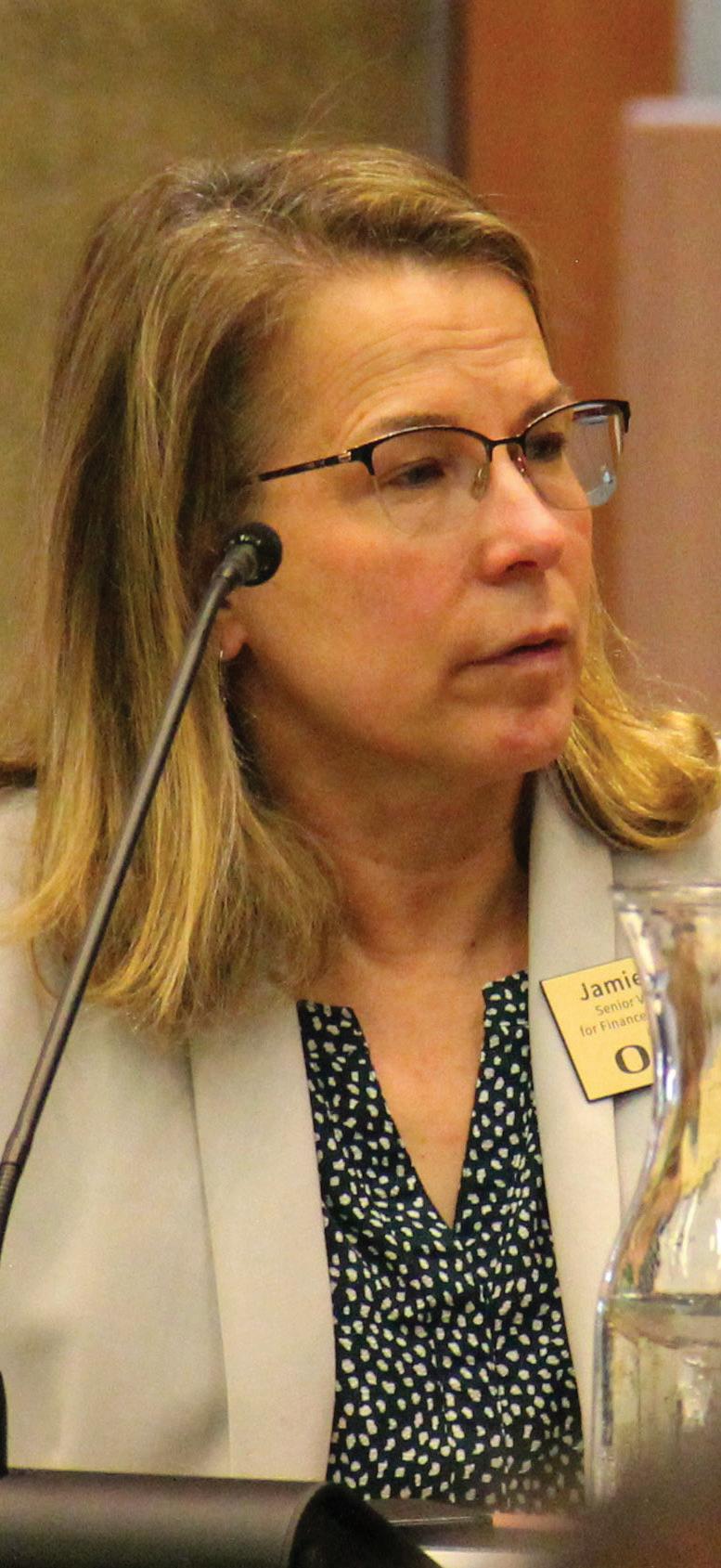
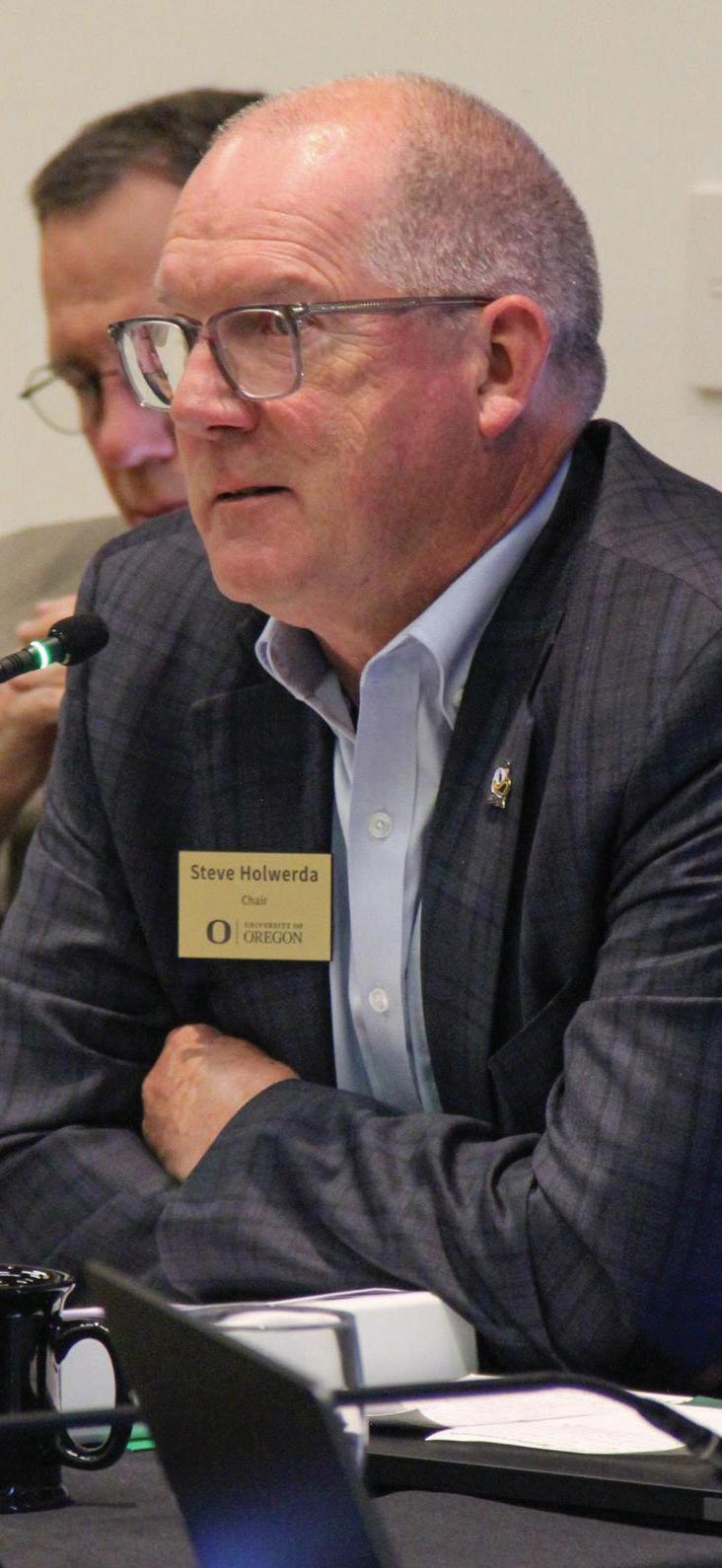
(ON THE COVER) From left, University of Oregon Chief Financial Officer Jamie Moffitt, President John Karl Scholz and Board Chair Steve Holwerda listen during public comment at a Board of Trustees meeting in the Ford Alumni Center in Eugene, Ore. on June 2, 2026.
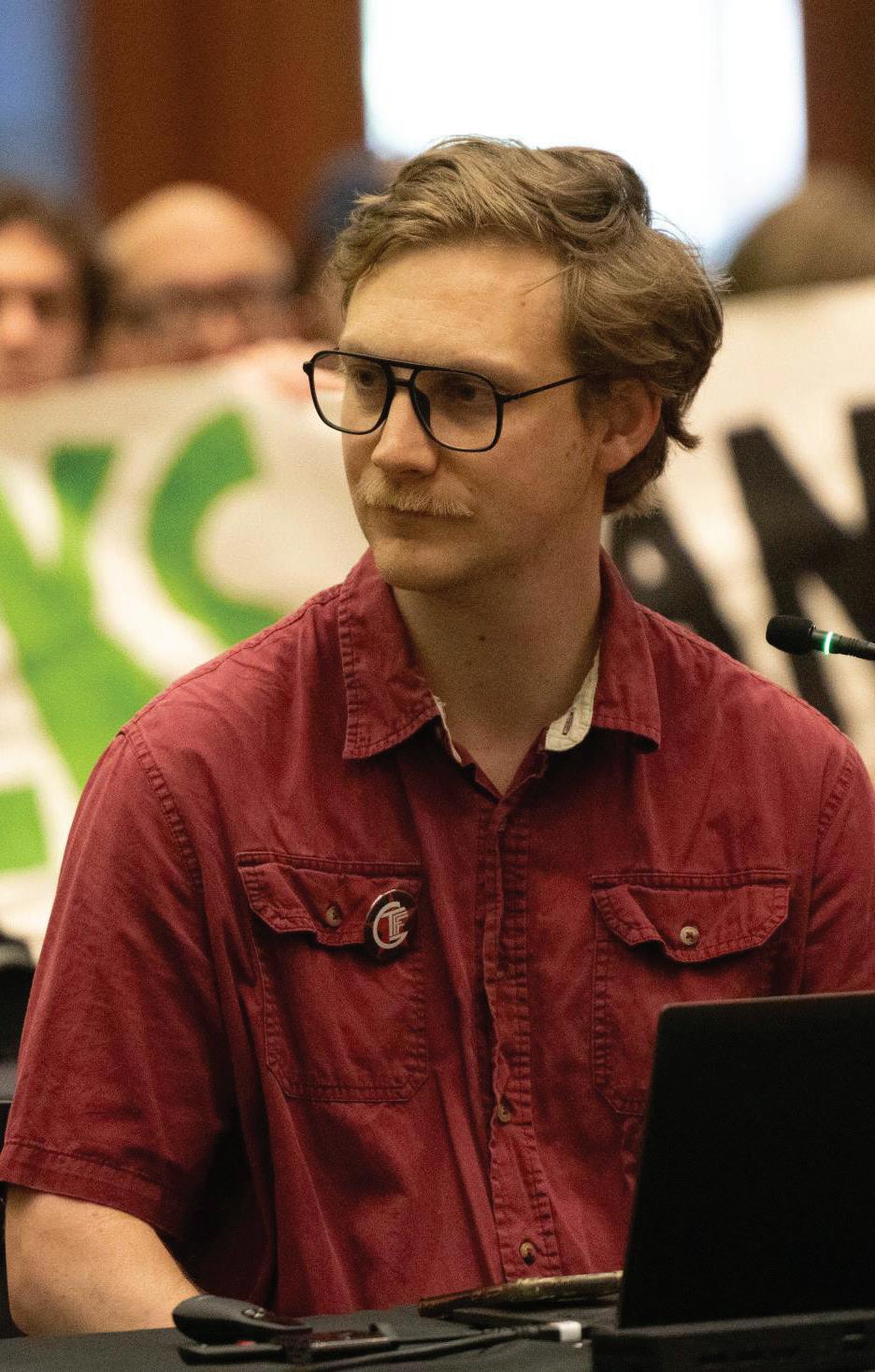
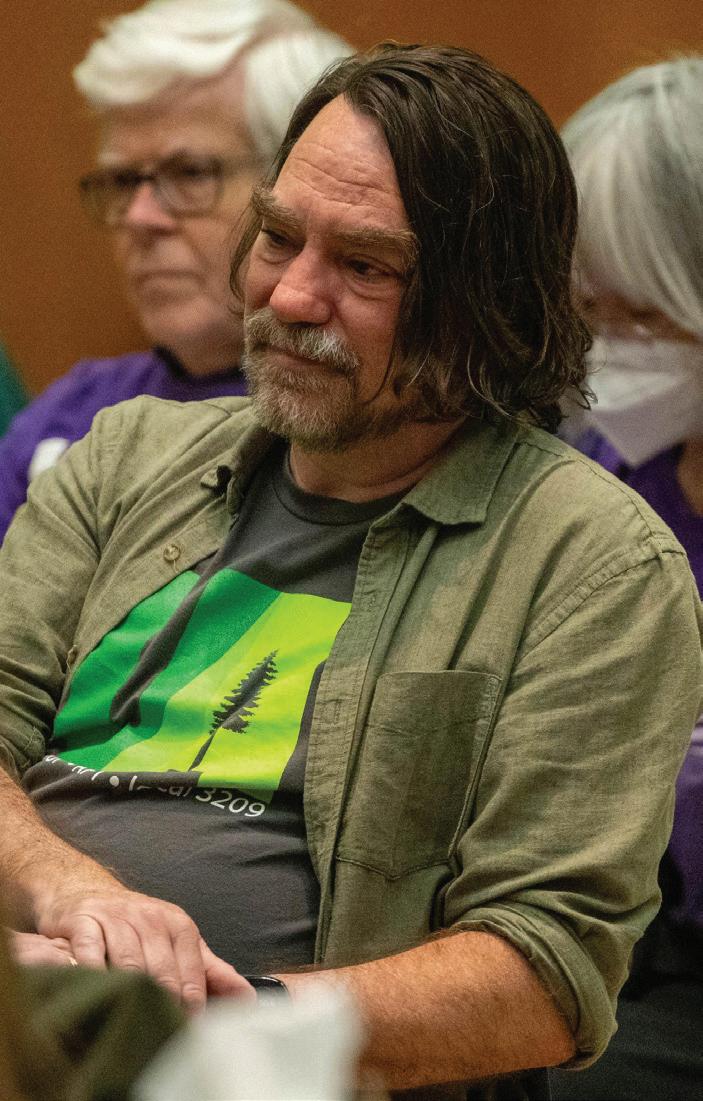
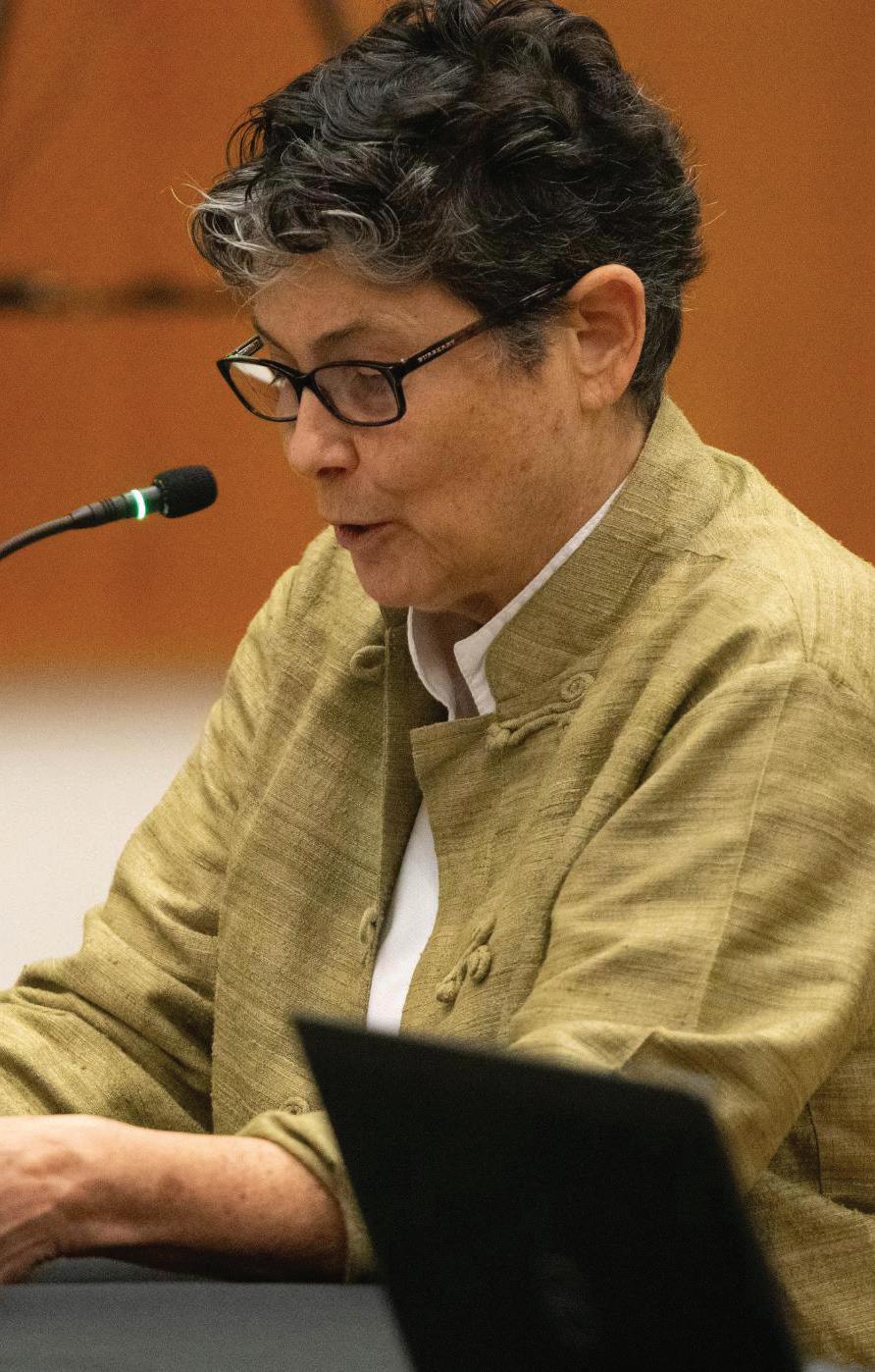
( ABOVE) From left, GTFF representative Jacob Schmidt, SEIU President and incoming Eugene Ward 3 councilor Jennifer Smith, economics professor and United Academics member Mike Urbancic and United Academics Vice President Mara Epstein deliver public comment on impending budget cuts during a University of Oregon Board of Trustees meeting June 2, 2026, at the Ford Alumni Center in Eugene.
(Tarek Anthony/Emerald)
Where do UO’s funds go?
79% toward compensation packages for faculty & employees
21% toward utility costs, leases, travel and loan payments on academic buildings
student workers, but student workers will still receive the raise per their contract in July.
ARTS & CULTURE
Touch grass, pet goats, heal the soul
Founder of Original Goat Yoga, Lainey Morse, believes animal therapy can help people get out of their heads and ground themselves in nature.
By Fiona McMeekin Arts & Culture Writer
“The movement part is totally optional, take it or leave it, but what’s not optional is loving on goats,” Ashley Zawrotny, yoga instructor, said to her class.
Founded by Lainey Morse in 2016, Original Goat Yoga opened its first location in Bellfountain, Ore. Classes are hosted at No Regrets Flower Farm and Animal Sanctuary, where people of all kinds visit Morse and her 10 goats.
This yoga session was filled more with deep laughter than deep breaths, as the goats chose their humans and refused to leave their sides — or even move off their mats.
“What this is doing is getting people outdoors. Maybe they do the yoga, maybe they don’t. We don’t really care,” Morse said. “We’re getting them outside, out of that headspace. And those goats really help, because they’re not focused on anything, but that goat that’s right in your face, and snuggling and making you laugh.”
Luci Brady received a goat yoga experience as a gift from her grandmother to celebrate her graduation from Oregon State. Brady and her family gathered in a fenced grassy area on the property, where mats were laid out for both human and goat participants.
“I love yoga. It’s even more fun with goats,” Morgan Murphy, Brady’s relative, said. “They just want to be loved, and they don’t care who you are or what your opinions are, what you’ve been doing all day.”
Morse echoes a similar sentiment, noting that people were drawn to yoga during increasingly difficult times. “It feels like it’s a happy distraction,” Morse said.
Animals have increasingly been incorporated into wellness regimens to take advantage of their therapeutic nature, and Morse’s goat yoga may have been the catalyst for this trend.
For Morse, her connection to goats was rooted in this healing relationship. In 2015, Morse, facing an early-onset autoimmune disorder, picked up two goats from a Craigslist post.
“I would come home from work and go out in the barn or in the field, and the goats would lay around me,” Morse said. “They were so social and loving, and I was like, ‘What?’ I had no idea that goats were like that.”
Noticing the benefits of cuteness and cuddles from her two new friends, Morse began to share the wealth by inviting friends over to bask in the love of goats. This became known among Morse and her community as “goat happy hour.”
Incorporating yoga into these happy hours was a natural progression. In 2016, during a charity event featuring one of Morse’s goats, Zawrotny, a local yoga teacher, approached her with the idea of combining both their passions.
At the time, the newborn kid, Annie Goatley, became the face of the Goat Yoga logo: a small, white goat with a pink nose, would soon be plastered on barns across the nation.
Goats and yoga, two rising trends of the time, caught a lot of press attention, and since 2016, Morse’s business has expanded to eight locations across the country.
Annie, the goat yoga poster child, passed away on May 30. But Annie’s impact in bringing people out of the chaos of their daily lives and into nature has motivated recognition of animals’ healing capabilities.
There may have been a shortage of mat space, but there certainly wasn’t a shortage of joy.
Tenth Annual ‘Kidz Rock’ festival concludes in Cottage Grove
MEPAA’s festival brought together musicians under 25 across Eugene stages.
By Vinny White Arts & Culture Writer
After a month of music across Eugene, the Music Education & Performing Artists Association’s tenth annual Kidz Rock Music & Arts Festival concluded Saturday, May 30. Starting at Whirled Pies and concluding at The Axe and
Fiddle in nearby Cottage Grove, the festival platformed a variety of bands all featuring young musicians eager to prove their budding ability.
The festival largely sourced musicians from those involved with programs through MEPAA. The nonprofit provides one-on-one tutoring, full band coaching and other musical and artistic resources to people under 25 years old from their Music and Arts Center in west Eugene. MEPAA was founded in 2015 by Executive Director and self-proclaimed “Fairy Rock Mother” Matrisha Armitage as a way to facilitate the Kidz Rock and Grrrlz Rock music festivals and programs.
Armitage arrived in Eugene at the age of 14 in a lastditch effort for her family to escape homelessness. Once settled, she quickly found herself impassioned to help others overcome similarly traumatic situations. She formed a band, Bajuana Tea (now called Stereo Minds) with her eventual husband, Austin Armitage, at 16 years old. Her band began performing at Grrrlz Rock events, which brought young women to stages around Eugene. Once the founder of Grrrlz Rock decided to step down, Armitage took the reins.
She began coaching band practices in the basement of Ophelia’s Place, which offers therapy and other healing after-school activities for young women. In the five years they spent at the location, they established many of the core volunteers, musicians and programs that they are still involved with today.
One of those programs was a band called S.O.N.G. (Sirens of the Next Generation). The band cycles out members as students rotate through the program, with the current incarnation of the group recently taking the stage at The Axe and Fiddle. They performed a set of covers, including “Die Your Daughter” by Susannah Joffe and “GOSSIP” by Måneskin. Each member was allowed to select one song to perform.
Keyboardist Elizabeth Wood, 12, the youngest member of the group, has found the experience to be influential for
both her musical development and sense of community.
“It makes us more disciplined,” Wood said. “If I just (had) my own band in my garage, I probably wouldn’t play music that often; I would just be talking to my friends. But here we can be friends and we can play music and we can get better.”
Kyla Holman, 15, who plays both lead guitar and bass in S.O.N.G., serves on MEPAA’s board as its youth board representative, making her privy to the nonprofit’s financials.
“It’s amazing how much the community supports us,” Holman said. “We get these huge grants and instrument donations and everything. That stuff is really amazing to be able to see.”
Orias, 11, who took to the stage to shred out solo renditions of classics like “Helter Skelter” by The Beatles and “Runnin’ with the Devil” by Van Halen, discovered MEPAA after attending the nearby Sean’s Music Study for music lessons. Soon after, he was invited to perform at their Whirled Pie show and eventually joined a band through Kidz Rock. Though the group has disbanded, Orias is thankful to have been able to perform as much as he has in his young age.
“Honestly, it’s just amazing to have little kids, like me when I was six, being able to go on stage and just figure out their dreams,” Orias said.
With 2026’s Kidz Rock Music & Arts Festival marking the tenth anniversary of MEPAA, Armitage is steadfast in ensuring the organization stays at a manageable size in order to keep contributing to deep community involvement.
“We don’t want to get too big,” Armitage said. “I think a big thing that we have noticed since the pandemic is people just growing too fast for what they could handle financially or hourly wise, so we have a real big core value of ‘deeper, not wider.’ We’d rather have (students that) come three days a week than more students. We want every student to feel really supported and valued and welcomed.”
(Fiona McMeekin/Emerald)
(Vinny White/Emerald)
The American Idiots, a Green Day cover band, perform at the final night of the Kidz Rock Music & Arts Festival. The group, consisting of children aged 10 to 12, performed at The Axe and Fiddle in Cottage Grove, Ore. on May 30, 2026.
Benton: From Minneapolis to Delaney Hall: the deaths we stopped counting
Opinion: Future generations will ask what we did. The honest answer is: not much.
By Kat Benton Opinion Columnist
The deaths of Alex Pretti, Keith Porter and Renee Good still feel like a nightmare that many of us haven’t awakened from yet. When shots rang out in the streets of Minneapolis, the surge in public outcry was intense and immediate. But as the chaos faded into memory, the Trump administration seemed to have achieved exactly what it had wanted for months: the public off its back.
The senseless violence exhibited by ICE agents incited fury from every corner of the country that lasted for months on end. Over time, though, the crowds dwindled as the federal authorities shifted to other, less violent strategies in public, as reported by NBC News.
But as we’re six months removed from these incidents, what has that rage translated into? With government forces now comfortable taking lethal action against Americans, what are our leaders doing to prevent more violence?
Long story short, not enough.
Junior planning, public policy and management student Calder Slingerland said, “I don’t think the media or politicians at the local, state or national levels have appropriately addressed ICE’s continued disappearing of community members,” explaining that, “In many ways, the media is complicit in dropping the story, but government reactions haven’t been strong enough to protect our community. We can’t let injustice go unpunished.”
But unpunished it went. Every agent involved in Porter, Pretti and Good’s deaths kept their jobs. Good’s killer even made hundreds of thousands of dollars off the killing on a GoFundMe set up in his name, but the public’s attention had already shifted to the next hot topic.
Junior Katie Ruecker described the force ICE uses in their operations as “disgusting” and “abhorrent,” condemning the “shooting of innocent civilians” and arrests that even members of Congress have compared to kidnappings.
Yet, despite the story’s eventual fading into the background, the deaths have only continued at an accelerated rate. Except this time, the most vulnerable among us are the ones being targeted: the immigrants in their custody.
Detainees across the country are being mistreated, with people inside fearing for their lives.
At Fort Bliss, Texas, alone, immigrants in custody report poor conditions and threats from guards who
intend to force detainees into signing voluntary deportation paperwork while the voluntary deportation rate is rising. There are accounts of physical and sexual assaults and allegations of torture inflicted by guards.
In another case, immigrants held in New Jersey’s Delaney Hall detention center are currently on a hunger strike, protesting the poor conditions in the facility. In response, community organizers outside quickly mobilized protesters to put pressure on federal authorities. Even New Jersey Sen. Andy Kim showed up outside the building and, while asking to check the conditions inside and exercising his legal right to oversight, was pepper-sprayed by law enforcement.
As of June 3, CBS News has reported that the deaths in immigration custody are on track to hit a new record, with 18 deaths in the first half of 2026 alone. Nearly a fifth of which were suicides — a number rising rapidly, an Associated Press Investigation found.
Grief without consequence is just weather, and anger without action is still complacency.
We have already decided, collectively, that these deaths are acceptable. The outrage came, the cameras left and the killing continues. So how many more are we willing to tolerate before we call it what it is?
Ehly: UO’s student-led sustainability initiatives are
Rachel Ehly is an opinion columnist for The Daily Emerald and is studying journalism and political science. She could talk for hours about all things politics, pop culture and music.
Kat is a thirdyear CHC student studying psychology with minors in legal studies and entrepreneurship. She enjoys writing about power dynamics, institutional accountability and the ways political structures shape communities.
spectacular
Opinion: UO has created an on-campus environment primed for students to make sustainable choices in their personal and professional lives.
By Rachel Ehly Opinion Columnist
When most people think about sustainability, they picture recycling cans, solar panels, paper straws and public transit.
These are all sustainable habits that the University of Oregon utilizes in the dorms, dining halls and around campus. But sustainability at UO runs deeper than these surface-level efforts.
If you walk past the EMU on any given day, you’ll see locally-sourced, fresh produce offered to students for free, clothing swaps and outdoor gear rentals. If you attend an event hosted by Net Impact UO, you’ll see students networking with professionals, conversing about changing sustainability practices in industry.
UO has built a network of programs and student-led organizations that encourage students to practice sustainability in their personal and professional lives.
Programs like the Student Sustainability Center, the environmental leaders academic residential community for first-year students and clubs like Net Impact or the Coalition Against Environmental Racism encourage student sustainability at the intersection between sustainability, social change and their future professional careers.
UO Director of Sustainability Steve Mital notes the importance of UO programs like the Willa-
mette River Natural Area habitat restoration that allows students hands-on experience in conservation and restoration.
Mital also said the UO sustainability dashboard that tracks the sustainability performance of the university has given students the opportunity to analyze data and recommend improvements to campus sustainability policies.
On top of these programs, the SSC offers a plethora of on-campus sustainability efforts for students.
The SSC Food Equity program that runs the Trillium Produce Plus Produce Drops works to tackle food insecurity in college students, providing them with free, locally-sourced produce.
The Waste Reduction program does something similar. This program provides free school and office supplies like iClickers, graduation gowns, menstrual products, home goods, reusable water bottles and travel mugs to UO students and staff.
The Grove Community Garden is a student-run garden facilitated through the SSC to connect students with others who are interested in gardening to build a community.
Students are able to grow their leadership skills, volunteer and learn how to plant and tend a garden. The produce grown in the garden is available to student volunteers to take home or is donated to the Produce Drop or Student Food Pantry.
The SSC even runs a climate anxiety outreach program for students who are experiencing psychological effects due to worrying about the impact of climate change.
Other student-run organizations like Net Impact, Climate Justice League, LiveMove and more work to promote sustainability at UO through active club meetings, campaigns and networking events.
“Net Impact has helped me deepen my understanding of sustainability and explore career opportunities within the field,” Shamica Tendolkar, Net Impact’s vice president of membership, said.
Tendolkar has been part of Net Impact since her first year at UO, and has found that the club has given her unique opportunities to network with professionals and learn more about how sustainable business practices are currently being implemented in the workforce.
“(Through Net Impact) I’ve learned how businesses can create positive environmental and social impact while remaining financially successful,” Tendolkar said.
The sustainability efforts that UO students are building, and the education they are receiving from them, deserve recognition and should be valued and protected.
The SSC, Net Impact and the restoration and sustainable policy efforts from UO students reflect a campus-wide culture where students are given the tools to become more sustainable.
Sustainability is something the university should always prioritize, especially when it comes to student-led efforts.
(Katie Poluyansky/Emerald) The Grove Garden, located on Moss Street in Eugene, Ore.
Offroading vessel
Half a bikini
Beaver sch.
UC Berkeley, by another name
Word after prime or barbecue
Squash, cricket, curling, ex.
Rambled (on)
Like large ocean shores compared to latte art, maybe
Cheadle of Hotel Rwanda
Spanish aunt
Output from someone in Lawrence Hall or the Craft Center
Yada yada yada (abv.)
Basics 2 Cartoonish hidden device over a pitfall 3 FPS game where you might rank Platinum, Ascendant, or Radiant 4 FPS game where you might play as Peter Griffin, Laufey, or MrBeast
“From my point of view...”
___-a-dub-dub
___-com
Hotel Transylvania nickname
Prescription regulating agcy.
Meet the new Oregon Men’s Basketball team
The Ducks replaced nine players this offseason, with hopes of fielding a more competitive squad.
By Jack Lazarus Sports Editor
When the team walked off the court after a subpar performance at the Big Ten Tournament in Chicago, Oregon men’s basketball finished its season with one clear message: things needed to change. 2025-26 became the only season in head coach Dana Altman’s tenure in which the Ducks failed to reach the 20 wins benchmark, finishing 12-20 when the dust settled.
That’s not the only reason Oregon desperately needed a switch up. In the weeks after the season concluded, the Ducks lost nine players to the transfer portal, which left them with just one scholarship player and two walk-ons.
The lone scholarship athlete, forward Sean Stewart, started 23 games this season in place of an injury-riddled starting frontcourt. In line with his starting role toward the conclusion of the season, Stewart should man the center spot for Oregon in 2026-27, a season which will come to define the future for Altman in Eugene.
With that in mind, here are the four other players that Altman brought in who will most likely round out the starting lineup:
Jasper Johnson, guard University of Kentucky
Likely manning the major ball handling role will be University of Kentucky transfer Jasper Johnson, who left Lexington looking for a slightly larger part to play. He looks to be in line to start at the point for Oregon after playing in all but one game in 2025-26, averaging 4.9 points off the bench in his 12 minutes per game. A five-star recruit in the 2025 class, Johnson still maintains a ton of upside, especially after learning for a full year under the tutelage of Wildcats’ head coach Mark Pope.
Replacing Jackson Shelstad will prove no easy feat, especially given his ability to score at a high level, but Johnson’s skillset matches up well.
Tyrone Riley IV, guard/forward University of San Francisco
Rounding out the backcourt is a new look for Oregon in Tyrone Riley, a 6-foot-6-inch forward who adds a great deal of shooting and versatility that the Ducks lacked on the wing this season. A top-100 player in the portal, Riley is the second-highest per game scorer that the
Ducks brought in this offseason, averaging 12.2 points in his sophomore season at USF (Boston College transfer Fred Payne averaged 15.8 points last season; he will likely come off the bench).
Given his variety of offensive weaponry, Riley will likely end up as the top scoring option in the offense next season.
Dwayne Aristode, guard/forward Arizona
Another former highly-touted recruit, Dwayne Aristode moved on from national championship contender Arizona, where he enjoyed a sixth-man role, to step into a starting spot in Eugene. Aristode never filled up the statsheet during his time with the Wildcats, but made his mark as an incredible on-ball defender.
As well as his defense, Aristode’s 3-point shooting is one of his most important attributes, as he shot 46% from beyond the arc in 2025-26. His size also becomes an intriguing factor for Oregon, considering his ability to switch onto any ball handler while never sacrificing height or strength. Last season, the Ducks had no effective two-way wings; this season, they might start two.
Taylor Bol Bowen, forward University of Alabama
Bol Bowen took a step back from sophomore to junior year, but that might be why his transfer to Oregon could become a smart move for his career. For one thing, Bol Bowen being a stretchfour (he shot 3.2 3-pointers a game at the University of Alabama last season) makes him a must-start for Oregon given Stewart’s lack of shooting touch.
Bol Bowen’s rim protection remained consistent in his junior year in Tuscaloosa, to the tune of 1.0 blocks a game, while also having the athleticism to switch onto ball handlers and make an impact at all levels. While he’s not being employed to add a great deal of scoring, Bol Bowen runs the floor incredibly well for his size, which will make him a formidable presence in transition for the Ducks.
Along with the starters, Oregon’s additions of Boston College point guard Fred Payne, San Diego State University forward Pharoah Compton and five-star high school prospect Tajh Ariza should create a roster that can start to compete in the Big Ten.
It’ll be an important season for Altman’s future, and his activity in the portal suggests he’s felt some of the intensity of the hot seat.
Pro Ducks: MLB
A
glance at what Oregon baseball’s MLB alumni are up to halfway to the all-star break.
By Harry Leader Sports Writer
After just over two months of play, the MLB season is in full swing, and the college season is entering the dog days of the postseason. While Oregon baseball has been clashing with some of college baseball's best teams in the Big Ten Tournament and the NCAA Regionals, some former Ducks are making a name for themselves on the world's biggest stage.
Rikuu Nishida OF, Chicago White Sox
After three years in the minor leagues, Japanese sensation Rikuu Nishida was called up to the White Sox and made his debut against the Minnesota Twins on May 25. His debut is one that will live in the record books as he marks the first-ever Japanese-born player that played collegiate baseball to play in the MLB. Performance-wise, his debut was solid offensively, going 1-3 at the dish with a single. His welcome-to-the-MLB moment came in the top of the second inning when Twins catcher Alex Jackson hit a two-out single to shallow right field, which Nishida fielded on the run before immediately rifling the ball back to home plate to throw out Orlando Arcia with plenty of time to spare. During the play, he threw the ball so hard that his shoes flew off.
“Right after I threw, my shoes came off,” Nishida said to reporters postgame. “I tried to find my shoes, and when I looked up, he was already out.”
As of June 3, Nishida is batting .208 with five hits, two RBI and two runs scored in 24 at-bats as the starting right fielder for Chicago. During his time with the Ducks, Nishida spent most of his time in right field as well as second base. Outside of being one of the best hitters on the Ducks roster in 2023 with a .312 batting average and 79 hits, including five home runs, he is also remembered for his unorthodox practice of using a wood bat throughout his college career.
His leadership and coaching skills were also a key part of his game, according to Oregon head coach Mark Wasikowski.
“Whenever he’s finished playing baseball,
he will be an unbelievable coach,” Wasikowski said in a 2023 press conference. “He doesn’t speak English great, and still, he’s probably one of the best coaches we have, including the coaches on the coaching staff right now. He’s just that type of infectious personality, and with that kind of knowledge — It’s really something, to be around that kid.”
Robert Ahlstrom
LHP, Texas Rangers
Another recent call-up to the major leagues is Robert Ahlstrom, who has spent the last five seasons in the minors. The southpaw was selected No. 213 overall by the New York Yankees in the 2021 MLB Draft before being part of a trade that sent him and pitcher Albert Abreu to the Texas Rangers for catcher Jose Trevino.
On June 3, he made his MLB debut in St Louis in a 5-3 loss against the Cardinals. Ahlstrom allowed zero hits and struck out two in 1.1 innings of work. Before making his debut with the Rangers, he was solid out of the bullpen for their Triple-A affiliate, the Frisco RoughRiders. In 21 appearances out of the bullpen, he recorded two saves with a 2.76 ERA and has struck out 33 batters. Ahlstrom was a part of the Ducks for three seasons, from 2019 to 2021. The Eugene native was a member of the AllPac-12 first team, the Pac-12 Conference all-defensive team and the ABCA/Rawlings second-team all-West region in 2021. During that standout year, he started 14 games with a 2.50 ERA, 92 strikeouts and boasted a 9-3 record.
Ryne Nelson
SP, Arizona Diamondbacks
One former Duck who's been on the upand-up following some early-season jitters is Ryne Nelson. The former All-Pac-12 team member has started all 12 games he's appeared in for the D-Backs this season and had a 7.71 ERA through April before cleaning things up with an ERA of 2.95 during his six starts in May. Of the four consistent starters for Arizona, Nelson ranks third in ERA, tied for second in strikeouts (52) and second in opponent batting average (.232).
(Kai Kanzer/Emerald)
Rikuu Nishida (56) is one of the only players in college baseball who uses a wood bat. Oral Roberts punched their ticket to the College World Series by defeating the Oregon Ducks baseball team in Game