MONDAY, JUNE 1, 2026
Highway 99 after dark Ducks take flight in Red Bull Chariot Race
Beach volleyball court project breaks ground
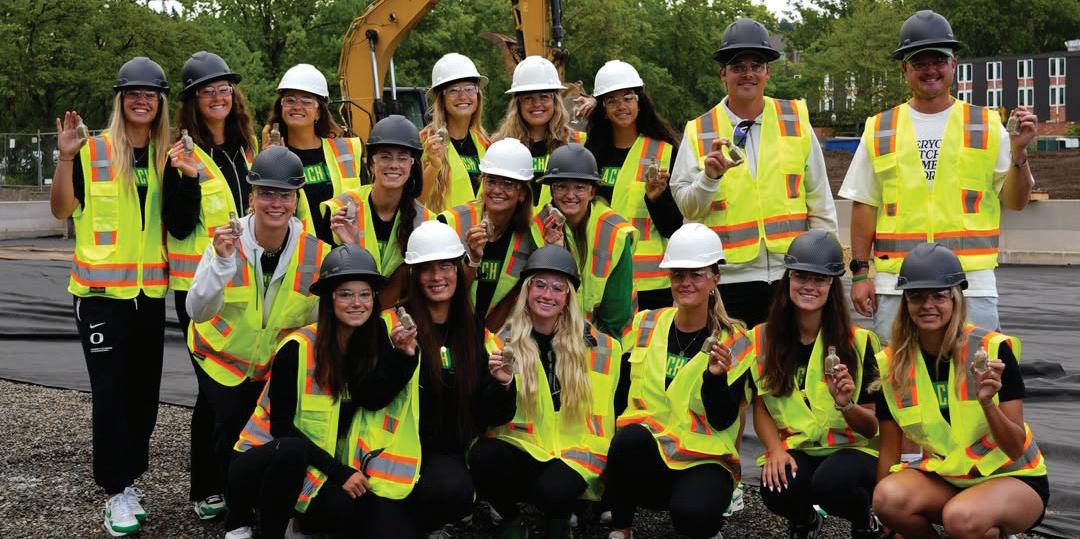
After 12 years without an official facility, the Oregon beach volleyball team will finally have an oncampus home court.
By Erin Reaney News Reporter
Construction has officially begun for the University of Oregon Women’s Beach Volleyball team’s official facility and court, which will be publicly accessible when not used by the team.
As part of the Hamilton Walton Transformation Project, the piece of land freed following the demolition of Hamilton Hall is the site of the new beach volleyball court. The team currently holds its practices at Amazon Park, which is approximately a mile and a half from UO’s campus.
In 2023, the beach volleyball team opened a Title IX lawsuit against the University of Oregon, citing the lack of a permanent facility for the women’s beach volleyball team, among other alleged violations. The suit remains open.
The Red Bull Chariot Race will see 24 teams of students flying through a track and competing in various challenges for a grand prize on June 6.

















NEWSROOM
EDITOR IN CHIEF
Tarek Anthony
PRINT MANAGING EDITOR
Ryan Ehrhart
DIGITAL MANAGING EDITOR
Ysabella Sosa
NEWS EDITOR
Reilly Norgren
INVESTIGATIONS EDITOR
Ana Narayan
A&C EDITOR
Claire Coit
SPORTS EDITOR
Jack Lazarus
OPINION EDITOR
Gracie Cox
PHOTO MANAGING EDITOR
Corey Hoffman
PHOTO EDITOR
Saj Sundaram
COPY CHIEF
Olivia Ellerbruch
VIDEO EDITOR
Jake Nolan
PODCAST EDITOR
Stephanie Hensley
SOCIALS EDITOR
Ysabella Sosa
VISUALS EDITOR
Noa Schwartz
DESIGN EDITOR
Adaleah Carman
DESIGNERS
Asha Mohan
Ellery Burton-Tillson
Eva Andrews
Izzy Smith
ARTS & CULTURE
BUSINESS
PUBLISHER AND PRESIDENT
Eric Henry (X317) ehenry@dailyemerald.com
VP OPERATIONS
Kathy Carbone (X302) kcarbone@dailyemerald.com
DIRECTOR OF SALES & DIGITAL MARKETING
Shelly Rondestvedt (X303) srondestvedt@dailyemerald. com
CREATIVE & TECHNICAL
DIRECTOR
Anna Smith (X327) creative@dailyemerald.com
ACCOUNT EXECUTIVES
Torin Chevalier
Camcole Pereira
Ava Stephanian
Elliot Byrne
THE DAILY EMERALD
The Daily Emerald is published by Emerald Media Group, Inc., the independent nonprofit media company at the University of Oregon. Formerly the Oregon Daily Emerald, the news organization was founded in 1900.
Emerald Media Group 1395 University St.,#302 Eugene, Or 97403 (541)-346-5511

FIND MORE STORIES ONLINE AT DAILYEMERALD.COM
Eugene police seek suspect in alleged downtown bias crime
Police say an Asian man was pushed near the Park Blocks fountain while a juvenile suspect mocked his accent and told him “he shouldn’t be there.”
By Tarek Anthony Editor-in-Chief
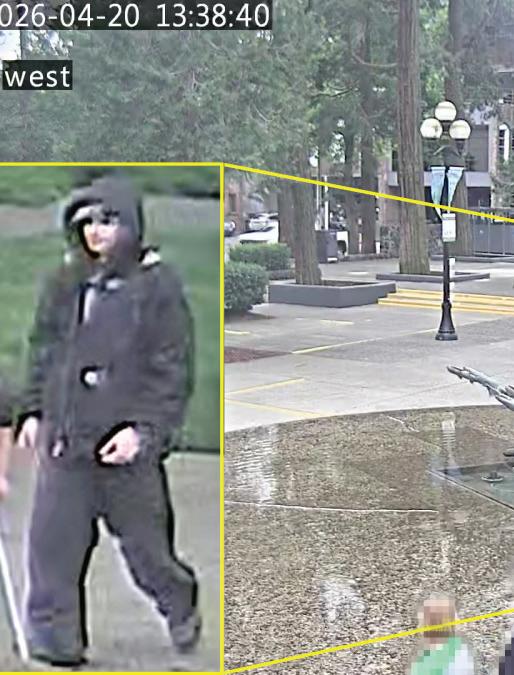
Eugene police are seeking information following an alleged bias crime at the Park Blocks in downtown Eugene on April 20.
An Asian man in his 20s told police he was walking through the Park Blocks near 8th Avenue and Oak Street when a juvenile male traveling with a group approached him from behind and pushed him, causing him to partially fall into the park’s fountain.
Former Eugene Weekly bookkeeper sentenced to prison for embezzlement
Nearly 2.5 years after Eugene Weekly uncovered the theft of $138,000 from the paper, former bookkeeper Elisha Young was sentenced to three years in prison.
By Sasha Love Senior News Reporter
Eugene Weekly’s former bookkeeper, who was arrested for embezzling more than $100,000 from the local paper, was sentenced to three years in prison on two counts of first-degree theft and three counts of first-degree aggravated theft by a judge in Lane County Circuit Court.
Quietude among meows
The Eugene Springfield Cat Lounge offers visitors the chance to de-stress among adoptable rescue cats.
By Fiona McMeekin Arts & Culture Writer
In a quiet room, 12 cats are perched on various cat towers and beds as birds chirp on a large television screen, mounted in the center of the room. A large orange cat named Morra Morra is a friendly greeter, approaching those who enter the lounge.
As a third space, the Eugene Springfield Cat Lounge, tucked away at 537 W Centennial Blvd. in Springfield, provides a stress-free environment for everyone, from families looking to adopt a cat to young adults on first dates. In partnership with local rescue Twitchy Tails, the cat lounge hosts rescue cats on their way to finding their forever homes. Opening in Eugene in January 2024, the lounge, owned by Michelle Wyatt, has found homes for 243 cats.
After retiring from her career as a physician, Wyatt opened the lounge to fill what she saw as a missing niche in Eugene.
“I thought it was a great idea for cats to get adopted in a place for people to visit, instead of like a shelter environment where they’re all in cages,” Wyatt said. But hosting a group of animals is no easy feat, and Wyatt notes that this passion project was not driven by lucrative intentions but rather by a desire to provide the community with something she saw missing.
Visitors can book appointments online or in person, which helps keep the lounge in business while enforcing strict expectations and cleanliness guidelines. Visits are priced from
$5 to $15, or visitors can sign up for community events the lounge hosts, such as cat bingo and paint-with-cats. The front entrance of the lounge is also filled with cat-themed goodies, from treats and toys to locally-made cat artwork.
This structure not only funds the business but helps to set clear expectations for behavior in the lounge. There is a thorough overview of expectations before entering the lounge, especially regarding cleanliness. Hands are expected to be clean, and no shoes are allowed. One of the hardest things to manage, Wyatt said, is the spread of illness, which Wyatt and the team mitigate through rigorous cleanliness (And no children under the age of eight!).
Each cat has its own personality and individual needs. Wyatt and her small team of employees and volunteers work hard to maintain a serene, clean living space for these animals in transition, tending to both the space and the animals.
“I like to see when the shy cats come in, and they’re not used to being around people, and then they really start to enjoy it here after a few days or a few weeks,” Wyatt said.
One of the biggest misconceptions about cats is that they don’t need as much attention as other animals, but Wyatt says this is not true.
The lounge offers a way for rescue cats to get the attention and love they need. And provides visitors, potential adopters or not, to decompress in a low-stress environment.
Beau Valentin and Austin Wartenbee visit the lounge not as potential adopters but as curious community members wanting to support a local business.
Valentin has connected with cats since she was a child, saying she sees some of herself in them. Gaining a cat’s love and trust is something to be earned, and she said this makes the reward of feeling a cat’s love even more special.
A cat lady at heart, Valentin has convinced Wartenbee of the appeal of cats, who, up until meeting Valentin, was strictly a dog person.


The couple stumbled upon the lounge by chance, unaware it existed, but were pleasantly surprised to find a calming, enjoyable date activity that quelled Valentin’s urge to adopt another cat.
Whether someone is in the market for a new furry friend, needs a good first date spot or just wants to decompress, the Eugene Springfield Cat Lounge offers a great opportunity to give love to furry animals in need and to support a local business.
“Even people who seem to be having a bad day, when they come in, (they) always seem like they’re much happier when they leave,” Wyatt said.
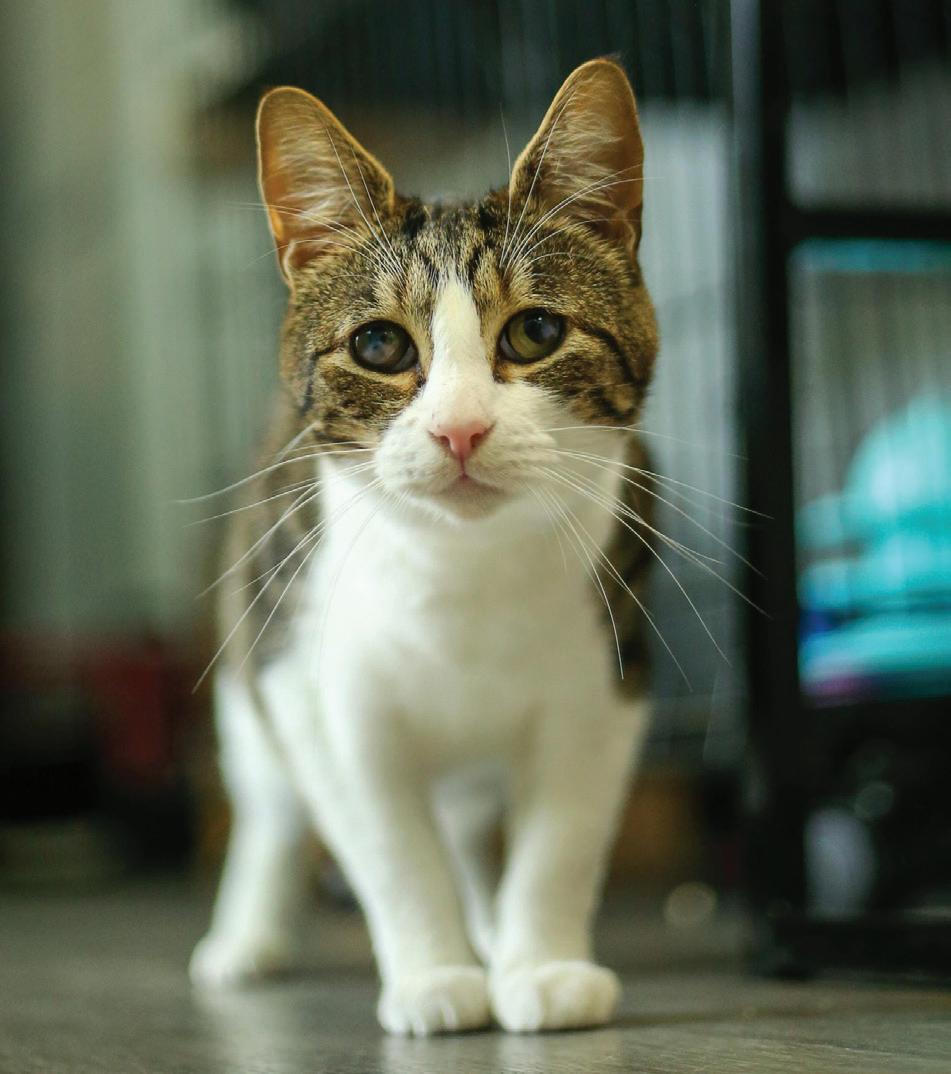
( ABOVE) A short hair white tabby cat looks into the camera. The Eugene-Springfield Cat Lounge partners with local animal shelters to help get cats adopted. (Tyler Graham/Emerald)
(Chris Pietsch/Register Guard)
Services employees push back against wage freeze purposed by Oregon public universities
Service employees and leaders at UO advocate for raises to keep up with inflation and the cost of living.
By Sasha Love Senior News Writer
On May 15, administrators of several public universities across Oregon told members of the Service Employee International Union they would see no raises for at least two years. SEIU represents classified staff at public universities — from dining hall cooks to library technicians.
The University of Oregon employs approximately 1,500 service workers across campus. Many employees have worked at the university for years and expressed frustration at the wage freeze proposal.
“Gas prices are going up, food prices are going up, everything is going up except our wages. Our cost of living isn’t being matched,” Carla Hastie, who has worked in UO Dining Services for two decades, said. “For a long time the university got away with not paying us much and now they are realizing they are going to have to or we are going to strike.”
Rieley Umphress, a lead bargaining delegate for service workers at UO, one of seven universities represented by SEIU, said she was “shocked” to hear the universities’ initial proposal.
“I had a little bit more trust and faith in my employers to be a little bit more understanding of the increase of cost of living and inflation and what’s happening,” Umphress said. “I’m a very realistic person so you can’t deny that there is inflation.”
The universities proposed no across-the-board raises, no cost of living adjustments — COLAs — or merit raises in a contract that would last four years, with economics being re-considered in “early 2028.”
Inflation, meanwhile, is now up to 3.8%, per the U.S. Department of Commerce.
UO’s service employee union is part of the larger SEIU 503, which includes employees at all seven of Oregon’s public universities.
UO recently announced $65 million in budget cuts and other Oregon public universities have also recently proposed cuts. The universities’ bargaining team, represented by University Shared Service Enterprise, states that freezes are a strategy towards “prioritizing preserving core academic operations, maintaining student access and ensuring institutional survival and longterm sustainability,” but many SEIU members said they were not willing to accept 0% raises.
Hastie said that even though she has worked at UO most of her career, her seniority is not considered as much as she’d like.
“It’s really, really disheartening to me that I work 20 years for this wage and if it freezes, if we get a wage freeze on COLAs, the minimum wage will be catching up with me,” Hastie said.
Looking forward, Hastie doesn’t want to move positions or jobs because she is afraid she will be assigned nights or weekends and drive in the dark, so instead Hastie says she plans to stick with her job until retirement.
For those raising a family, money is often squeezed even tighter.
Ben Miller, who works in the kitchen at Unthank Hall, said he might start looking at other jobs if he doesn’t get a raise, but he doesn’t know
how he would be able to juggle working overtime or during the summer while taking care of his three children, two of whom are in elementary school.
“I would probably look for a part-time job, like in the evening when I’m not (at Unthank), but that would be hard because I have things I got to be doing with the kids, activities I got to take them to, so that’s hard to find another gig,” Miller said.
Catrina Chase is also a dining worker at Unthank, and though she doesn’t have children of her own, she cares for her grandchildren and wishes she could take them on more outings to the coast.
“We can’t do a lot of our mini trips because of the gas, the food,” Chase said. “It sucks but we are still here working. We got to make the best of it but I don’t like the freeze, especially when everyone else is still getting their bonuses — the ones that don’t work hard like us.”
Chris Case, who rides his bike from the Whiteaker neighborhood everyday to work in the PathwayOregon office, blames the universities for “balancing the budget” on service workers. Discussing university rhetoric, Case said he and other service employees don’t feel valued in the university ecosystem.
“We’re not all making sacrifices. We are one big happy family until we are not. Until decisions have to be made at our expense, then we’re not a family; then it’s like, you have to join another family and get another job,” Case said.
Jennifer Smith, president of the local SEIU bargaining unit and Ward 3 city councilor, said that SEIU pay also has an effect on the broader Lane County economy because universities are such large employers and economic drivers.
“If we’re not thriving, our communities are not thriving,” Smith said.
Smith said she is optimistic that the union will be able to push back on a lot of the universities’ economic proposals, pointing to previous rounds of bargaining. During the last round of bargaining, employees received at least 6.5% raises the first year and more modest increases in following years.
“This is their version of hardball; I see it as an opening salvo. I do not see it as their bottom line,” Smith said.
Smith and Case both see this moment of financial upheaval as a time for Oregon higher education to take a step back and rethink priorities with workers in mind.
“We need more good faith if we are pushing forward together,” Case said. “Otherwise we are just going to do strictly selfish things, right? We are going to shut this place down until we get what we need, but is that good for the students? No. And that’s what the whole thing’s supposed to be about.”
SEIU will continue bargaining throughout the summer.
UO spokesperson Angela Seydel said that the university “is committed to reaching an agreement with SEIU that accounts for the financial realities facing not only the UO, but all Oregon public universities which are covered by the same SEIU contract.”
(Courtesy
Beach volleyball court project breaks ground
Continued from page 1
Jimmy Stanton, a senior associate athletics director, said in a statement that UO is “thrilled to break ground on our long-planned, on-campus home for Oregon beach volleyball.”
Recently, the locker room for the beach volleyball team was completed inside Matthew Knight Arena, and these new courts are “the next step in reflecting the positive momentum this program has built,” Stanton said. “The new courts will provide our student-athletes with a first-class environment for competition and yearround training.”
According to Stanton, the project is estimated to be completed by late September, around the start of the 202627 academic year.
Liz Rossi, a sophomore on the beach volleyball team, said the construction of the new facility is “super exciting” and that “the girls in the program have been anxiously anticipating the arrival.”
Rossi described passing by the construction site each day and seeing the progress and the excitement of seeing the reveal of the locker room with her teammates. “Getting to witness these milestones together just makes it all the better,” Rossi said.
According to Rossi, not having an on-campus facility has impacted her collegiate career. She said that many people don’t know where the beach volleyball team has been playing their matches, and it’s not as easy to get to as some of the other on-campus stadiums. In addition, Oregon hasn’t been hosting as many tournaments or matches due to its location being off campus.
“Part of being a collegiate athlete is having people come and watch the games,” Rossi said. Being off campus “makes it harder to reach the student demographic.”
Rossi said she is grateful for all the support from alumni and community members who have fought to get these facilities for the team after many years without them.
“It’s awesome seeing the amount of work being put in to get these courts,” Rossi said. “It makes me want to be a better athlete for the former team members who didn’t get to play on these courts every day.”
Gwen Fife is a junior on the beach volleyball team and a lifelong Eugene resident. As well as celebrating her senior season at a home facility, Fife said she is excited for her team to have the opportunity to host more home matches and to “be a more integrated part of campus” and Oregon athletics as a whole.
When she transferred to Oregon two seasons ago, she knew there would be no on-campus facility, but she “also knew the university had a vision” for the team.
Fife said that having home courts will be a “game-changer,” especially with recruiting. Having a locker room and supportive community behind them, on top of having on-campus facilities, is a “really powerful draw for people coming in… I’m excited to pass the torch to them and see what they do to continue to make this program grow bigger and bigger every year,” Fife said.
In addition to the beach volleyball team getting facilities, the courts and green space will also be open for public and non-athlete use. UO senior Celia Hutsell weighed in on the project.
According to Hutsell, “Hamilton was old and needed to come down,” and putting something in its place that will “benefit recreational or club sports, particularly ones that are predominantly female” is a good decision.
UO senior Rishi Sastry said he was “glad to see Hamilton go down,” and that he’s excited for the green space and courts. He said while he was “hoping for more parking space on campus for students,” an outdoor space is also a “good use of space … as long as it’s not limited to a certain group of people.”
Alex Spencer, a UO student, said that he is a “big advocate for sports” and that the new courts are a good opportunity for more recreational activity, especially for local kids.
“I’ve been playing sports my whole life, and I think that it can really help kids, especially struggling ones. Sports can be an outlet to let them express themselves,” Sastry said.
The courts, storage and restroom facility and surrounding green space will be open next year, and will debut its first beach volleyball season using the new courts in spring 2027.
of the University of Oregon Athletics Department)

Meet Jennifer Smith, new Ward 3 city councilor
Jennifer Smith is the only new councilor, fulfilling the open seat left behind by Alan Zelenka, who’s retiring after 20 years on the council.
By Billie Corsetti News Reporter
Jennifer Smith will join the Eugene City Council after defeating John Barofsky in the Ward 3 race during the primary election.
On May 21, The Daily Emerald called the Eugene Ward 3 City Council race with Smith winning with 56.22% of the vote to Barofsky’s 43.37%. She won the only open seat on the council, after longtime Councilor Alan Zelenka announced his retirement.
“I am gratified that the people of Ward 3 resonated with my message,” Smith said. “I think something that really set me apart from my opponent was that I actually have a vision for the future. I have even a utopian ideal of what a community can be and can look like.”
Smith is the current president of UO’s classified workers union, Service Employees International Union 503. She has also worked on the Lane Transit District Budget Committee, the Oregon Higher Education Coordinating Commission and the Eugene Permanent Shelter Task Force.
“It’s been an honor to be able to be invited inside people’s lives in some of the challenges that they’re facing in work,
“
I think something that really set me apart from my opponent was that I actually have a vision for the future. I have even a utopian ideal of what a community can be and can look like.
Jennifer Smith Ward 3 City Councilor
but also how that’s related to their lives at home… I think people want to live in this community because we have a shared culture. People come to Eugene (and) stay in Eugene because they like what we stand for, that we are a special community,” Smith said.
Looking at Councilor Zelenka’s 20-year presence on the council, Smith hopes to similarly be able to entrench herself in the research behind policies put on the table. In her first term, she wants to utilize community engagement and relationships with organizations to learn more about issues facing the city.
Transportation Safety
Since the beginning of 2026, three bicyclists have died from car and bike collisions. On May 20, Mayor Kaarin Knudson and Eugene Police Chief Chris Skinner joined community members and organizations to commemorate the lives lost and discuss how to create safer streets for pe-
destrians, bikers and drivers.
Smith said that Eugene being a safe walkable community is what draws so many people to the city. When it comes to creating safer streets, Smith wants to continue turning to the experts in the community.
“I think that we have a lot of good partnerships in the city, and through Better Eugene Springfield Transportation, working on these very issues,” Smith said. “They have the knowledge of ideas (and) how to move forward.”
Educating pedestrians, bikers and drivers throughout the city on how to safely share the road, and be aware and vigilant about their surroundings, is a major contributor to creating safer streets, Smith said.
“If drivers are coming from very auto-centric places, and suddenly they’re confronted with people crossing the street at every intersection, they might not be ready for that,” Smith said. “I would love to be able to export what we have in Ward 3 to other parts of the city where people do expect to see multimodes on the street, sharing the road.”
East Campus Expansion
The Eugene City Council recently passed three land use applications from the University of Oregon, requesting to amend a city code to allow heightened dormitories, remove a land use overlay near Matthew Knight Arena and amend the special area study between UO and the Fairmount neighborhood.
UO applied for the land use applications for the purpose of expanding the east university campus for more dormitories to accommodate incoming students, as a part of its Next Generation Housing plan.
Surrounding neighbors repeatedly expressed concerns about the effect the buildings would have on the appearance of their neighborhoods, and UO’s alleged lack of collaboration and transparency on the project.
Councilor Zelenka proposed an alternative motion to deny the ordinances and encourage UO and the neighborhoods to work together on a plan, but it failed due to a lack of votes. The concerned neighbors and proposed project are located in Ward 3.
“The university gives our community a lot, gives our ward a lot, and they also take a lot from the neighborhoods and from the community,” Smith said. “This is already a loaded term, but the encroachment of the university into the neighborhood in the south university, east university (and west university) has been complete and total already.”
Smith said that preserving the special and uniqueness of the surrounding neighborhoods is going to be an important part of the process.
“People put decades and decades and decades of time into making our neighborhoods a place that feels welcoming and enjoyable, not just for the homeowner but for anyone who’s walking and biking and evening driving through,” Smith said.
Automated License Plate Readers
For the majority of 2025, many Eugene residents were spending their time protesting automated license plate readers in the city, contracted through Flock Safety. ALPRs are cameras often utilized by law enforcement with the purpose of capturing photos of license plates in a data base for local officers to search for vehicles involved in crimes.
Multiple public meetings were packed with commentators urging the Eugene Police Department and the city to cancel any deals or contracts with the company, due to concerns about data privacy.
EPD cancelled their contract with Flock Safety in December 2025, citing vulnerabilities and limitations found in the system. The announcement said that the department still finds benefits in ALPRs as a technology, but ensuring the vendor’s ability to safeguard data is a priority.
Smith said she remembered after the terrorist attacks in New York City on Sept, 11, 2001, when the USA Patriot Act was promoted as temporary surveillance to mitigate future terrorism.
“That was supposed to be temporary, and it has not been temporary. That act has been reauthorized every time,” Smith said. “So we are just now accustomed to being surveilled, it’s just a norm now. I don’t think it should be.”
With the vast amount of data in each city, Smith said it’s hard to trust that security will be in place to protect personal information. To encourage good behavior on the streets, Smith said she can see the benefits of red light cameras or speed cameras, but still worries about the protection of its data.
“I think we’re all adults here. There’s this moral hazard all the time that’s utilized against some people and not others,” Smith said. “Like we need to be monitored just in case we decide to do a crime. I don’t think that’s a reasonable expectation to have of a community.”
Police Oversight
In early May, a community member released body camera footage from former EPD officer Martin Siller, revealing racist, anti-immigrant and misogynist remarks while he was on duty near the Eugene Federal Building during the Jan. 30 protest.
Siller resigned shortly after the footage was made public, meaning Independent Police Auditor Craig Rentezky was unable to bring misconduct charges against him. Rentezky
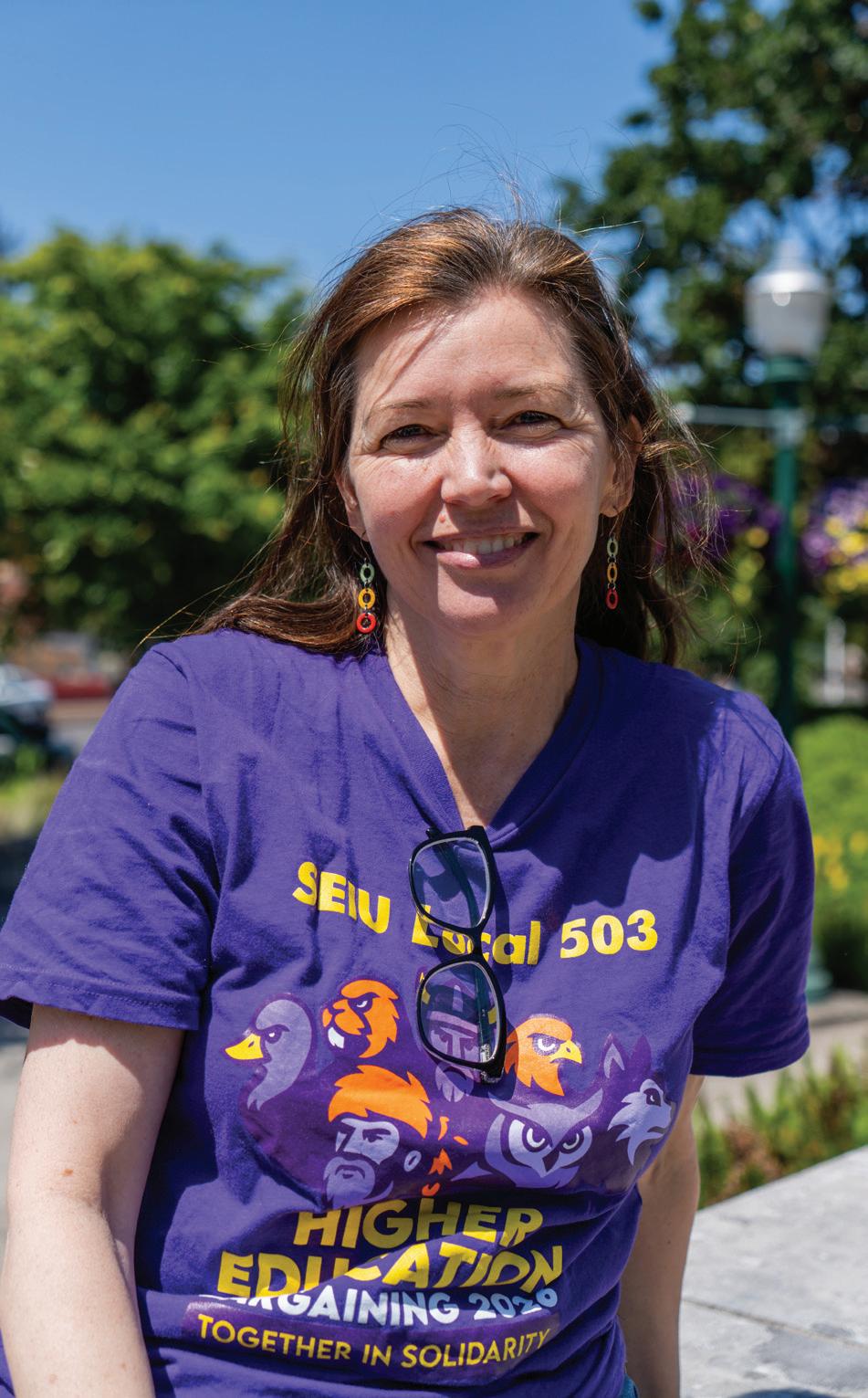
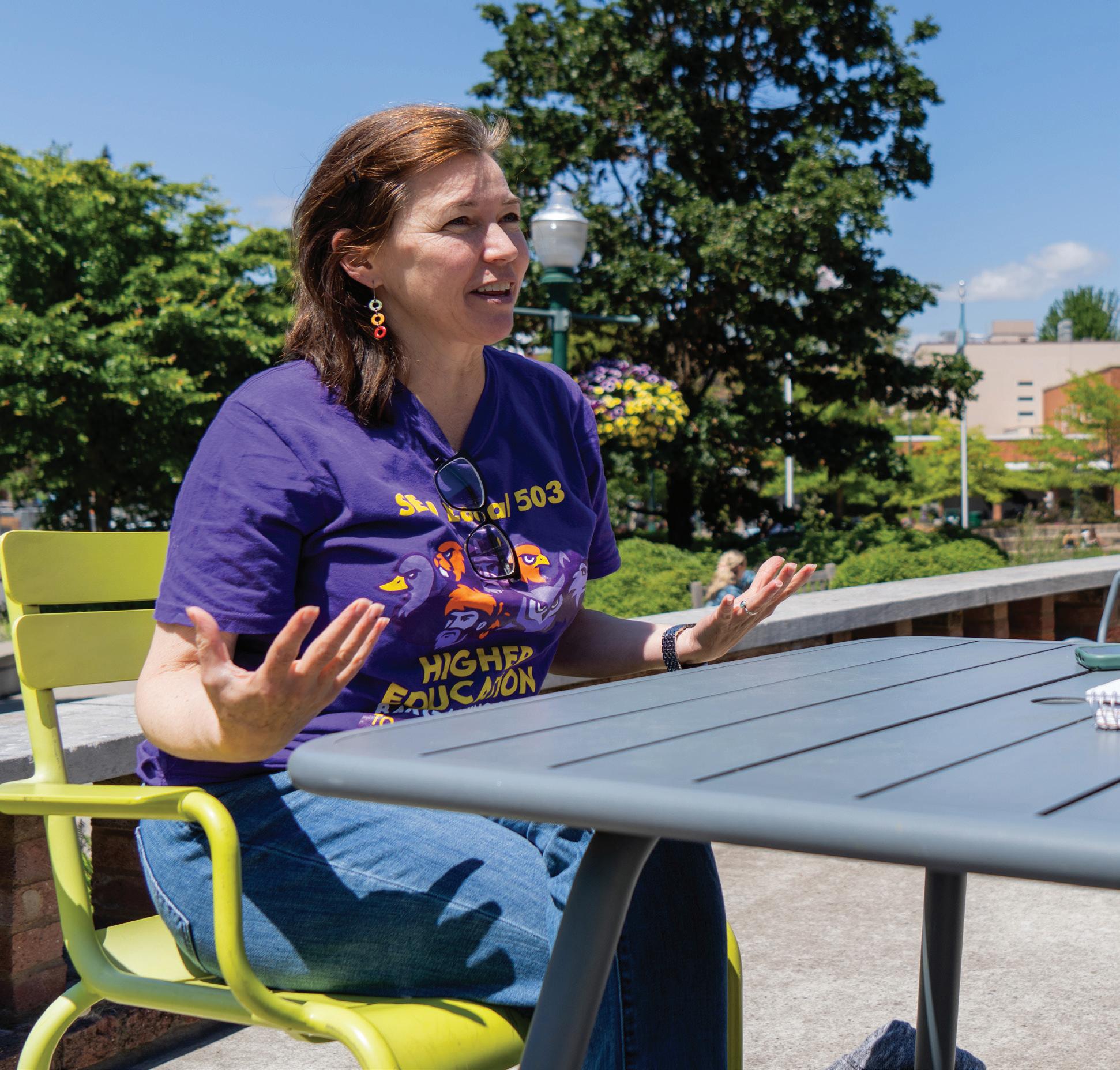
Jennifer Smith, a union leader, community organizer and new Ward 3 representative, sits by the Erb Memorial Union Amphitheater in Eugene, Ore. on May 27, 2026. (Rowan Campbell/Emerald)
and Chief Skinner held a joint press conference to admonish the former officer and address next steps.
During a city council meeting on May 11, Mayor Kaarin Knudson and multiple council members condemned the officer’s actions and urged for better standards and oversight in EPD. Councilor Greg Evans, the council’s only Black member, said that there is a “cultural problem” in the department.
“I think just about every community in America is experiencing the same quandary. How do we reign in bad behavior by the police, while still having an expectation that we are being made safer by having the police?” Smith said. “It’s really interesting to have a stance about what policing means and what ideal policing means, and then to be confronted with the reality of what that entails.”
Police have large amounts of power in all local governments and communities, through the budget and what they represent, Smith said.
“I will be working with other council people on trying to find the balance between having an effective police force that is community minded and paying attention to the issues that our community cares about — unsafe driving, for instance — versus a shadow government by the police,” Smith said.
Climate Recovery Ordinance Goals
One of Smith’s outlined priorities on her campaign website is getting the city back on track for its Climate Recovery Ordinance Goals, which was enacted in 2016. The plan was celebrated as one of the most ambitious climate action projects by a city, with some of its goals aiming to reduce the city’s greenhouse gas emissions and community output by 50% and 50%. A city report in October 2025 revealed that the city has only reduced emissions by 24% and community-wide emissions by 11%.
“I think it’s been very expensive to move towards being fossil free, I think it’s been a choice that people make and they’re stretching financially to do it,” Smith said. “But there’s an appetite for it.”
The rising cost of fuel has made the city reach a point where it makes more economic sense to invest in renewable energy, Smith said.
“The technology has gotten so far, it’s gotten so much cheaper to just do the right thing,” Smith said. “It’s econom-
ically irresponsible to continue going down the same path we have… I don’t know if we’ll reach our goals, but we can really make an effort and hit at least some new benchmarks.”
Affordability
Eugene is currently working through a housing crisis due to a lack of housing available for long-term residents and incoming residents, amid rising costs. The city’s large renting population has faced disproportional costs and wages.
“Way more than 50% of our ward are renters, and housing costs are a huge proportion of someone’s take-home. So we have to stabilize our housing prices, or at least our rental prices, Smith said.
The city is in phase two of its Renters Protection Process and approaching the last phase of the council project to increase renters protections and rights. Smith said she is interested in looking at including multiple policies that have been popular methods in other cities in the next steps of increasing renters protections.
“We have lessons from other cities around the country about what is working, what’s effective. I am interested in a vacancy tax, rent stabilization (and) just cause eviction,” Smith said.
Part of the issue of affordability in the city is related to state-wide and national financial troubles, Smith said. She hopes the city can collaborate with state representatives and senators to economically develop Eugene and share the benefits.
“We know there’s so much wealth here, and yet we’re not participating in the promises of our bounty.. People are feeling quite ripped off, and rightly so,” Smith said. “Being able to capture some of our locally generated money before it exits our community is really important to me.”
CAHOOTS
When White Bird Clinic had to end Eugene’s chapter of the Crisis Assistance Helping Out On The Streets program in April 2025, the city and community members shared concerns about the accessibility of safe places for the unhoused population to turn to.
The city and its safety partners like EPD and the Eugene Springfield Fire Department worked together to analyze
the gaps left behind by the closure of CAHOOTS that were unfulfilled despite efforts from EPD, ESFD and other programs like Mobile Crises of Lane County.
In February, the city released a request for proposal for a peer navigator alternative response pilot program. In April, the city selected Ideal Option, a nationally recognized organization that works with medicine-based treatment, as the provider for the one year pilot program.
Some Eugene residents have expressed concerns that the pilot program won’t be able to match up to the work that CAHOOTS was accomplishing during its three decades in the city.
“I don’t think it’s going to do what CAHOOTS did, it just isn’t. It’s a different program,” Smith said. “CAHOOTS was a model that was scrappy and efficient, and met people where they were, and they were so responsive.”
Smith said she is happy to have some sort of program that the city can learn and develop from, rather than nothing at all.
“In some ways it’s great to be able to have a laboratory, and I’m so grateful that we will have this program to at least meet the most basic needs. But constantly innovating in this space is so important, so when we do get funding, we know what’s going to work,” Smith said.
Immigration Enforcement
Another priority of Smith’s is protecting the human rights of Eugene’s residents as the city faces more federal involvement through immigration enforcement.
The presence and activity of federal officers in the city incited multiple protests during late January and February at the Eugene Federal Building.
Soon after, the city council passed a motion to declare a humanitarian crisis due to federal activity in the city. They also established a grant program through the Human Rights Commission for local nonprofits assisting impacted immigrants in the community to apply and receive grant money to continue their work.
Like transportation safety, Smith said the city should be working closely with nonprofits and organizations in the community that have trust and worked with immigrants.
“We’re only as good as the most vulnerable people in our community,” Smith said. “So whatever we could do to protect our immigrant communities is so important because they are humans, they are our neighbors and they are also contributing to our community economically and culturally, contributing vibrancy and freshness.”
Looking Forward
As she looks forward to starting her first term in January 2027, Smith said that staying connected to students and representing them faithfully as residents of Ward 3 is an important factor of her work on the council.
“(People) come here for a reason, and it’s because they love the dream and promise of Eugene, and that’s exactly the kind of people that we want to have as members of our community,” Smith said. “I really want to keep, in whatever way possible, staying engaged with the campus community and being the best council person I can to represent their specific interests, but they probably have the same interests as most people do in Eugene.”
Smith will start her time as the Ward 3 representative on the first Monday of January 2027, per the Eugene City Charter.
( LEFT ) Jennifer Smith, a union leader, community organizer and new Ward 3 representative, sits by the Erb Memorial Union Amphitheater as she discusses her term plans with Daily Emerald reporter Billie Corsetti in Eugene, Ore. on May 27, 2026.
(Rowan Campbell/Emerald)
Ducks take flight in Red Bull Chariot Race
By Amelia Fiore Arts & Culture Writer
Twenty-four teams. Five weeks of preparation. One winner. On Saturday, June 6, Red Bull will host its Chariot Race on the University of Oregon campus. Twenty-four teams of four will have the chance to compete for the prize for first place: $1,500 in cash and 60 cases of 8.4oz cans of Red Bull. The team who lands second place will receive a “Oneof-a-kind Red Bull experience,” and, in third, a “Red Bull Party experience.”
The event will begin with a short opening ceremony at 2 p.m., followed by 30-second skits performed by each team. Afterwards, the race will begin, starting on the Memorial Quad and circuiting through East 13th Avenue. At the track’s halfway point, teams will be required to complete a puzzle before switching out their riders. They must execute a successful run of the rest of the course with their handmade chariots, and winners will be announced during the award ceremony at 4:30 p.m.
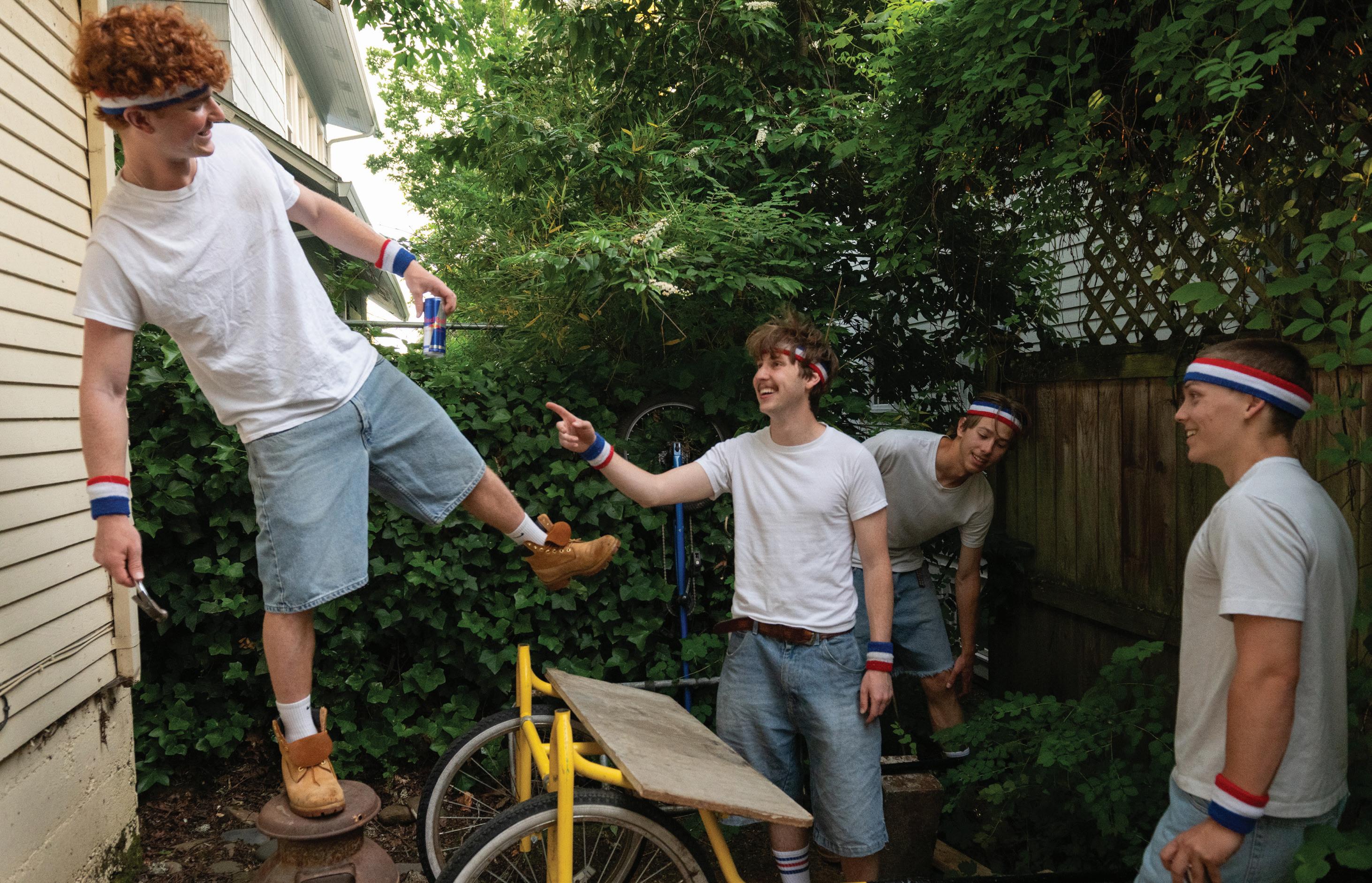
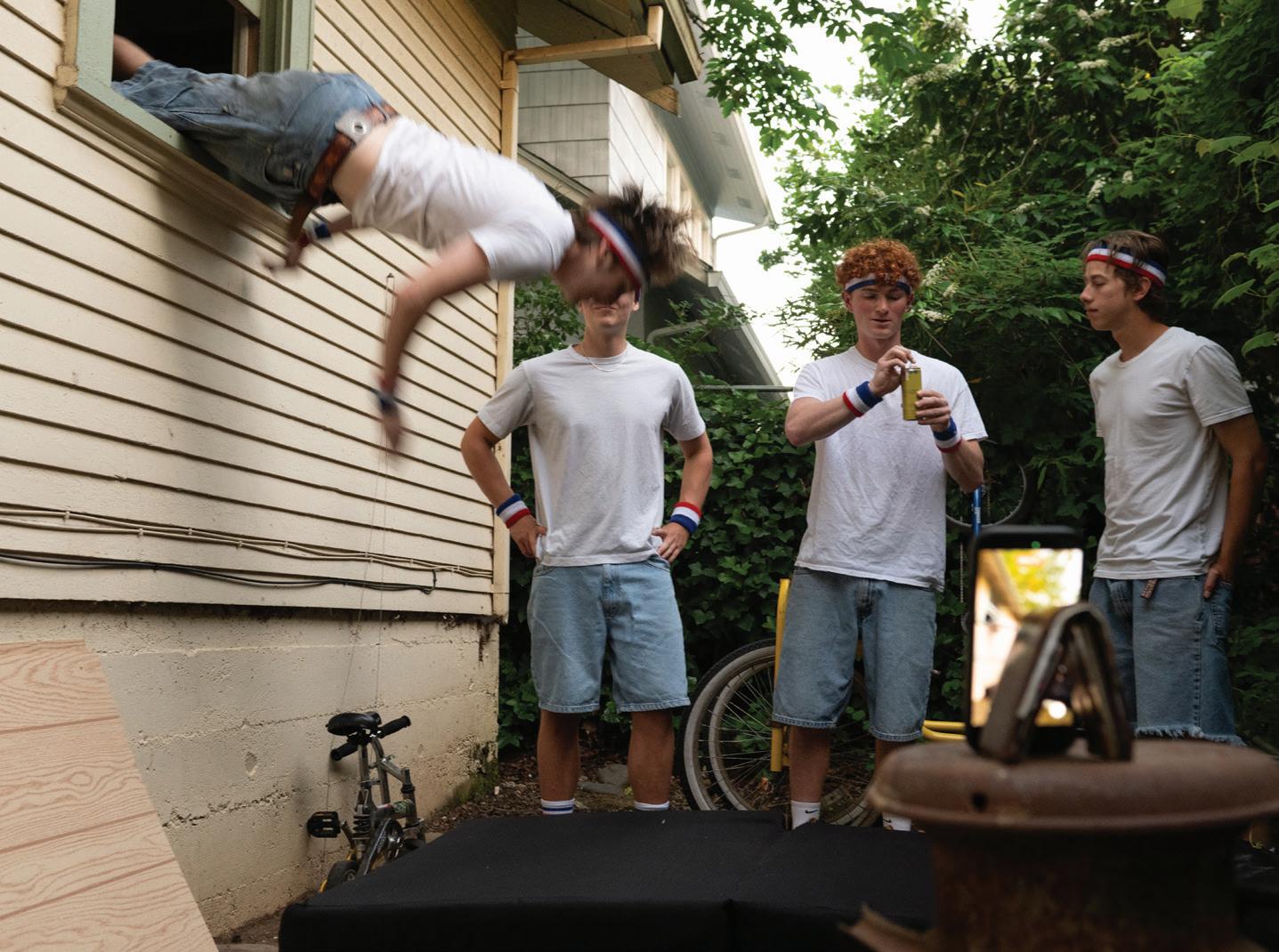
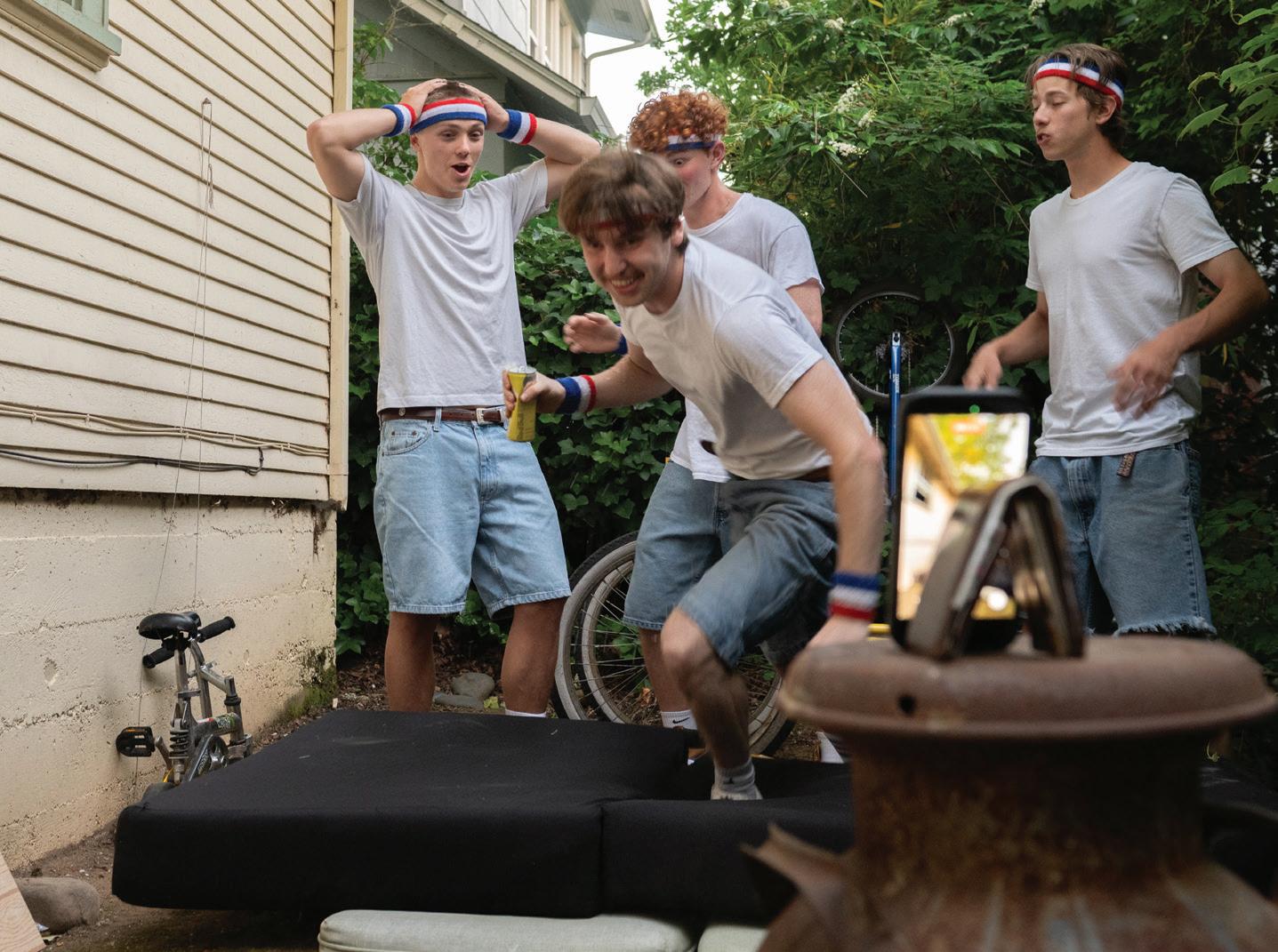
One team has already made a name for themselves from their growing Instagram presence, with one video alone receiving more than 150,000 likes. The Eugene Eaters, composed of Drew Lincoln, Eli Watnick-Wizeman, Miles Wood and Josh Flannery, are nothing if not prepared, seemingly always in the middle of a test run while wearing matching sweatbands.
The group met through mutual friends and the UO Climbing Team, of which Lincoln, a sophomore, is a current member. When Watnick-Wizeman, a junior, learned of the competition, he knew they would make a perfect team.
“I was scrolling the ‘gram one time and then I saw The Nest post it, and then I sent it to Miles immediately and I was like, ‘We have to do this.’ Like, no way we’re not doing this,” Watnick-Wizeman said. “This is our calling, basically. It’s perfect.”
Lincoln described Watnick-Wizeman and Wood as “Eugene’s Phineas and Ferb,” and after taking one look at their home, the comparison makes perfect sense. There are various contraptions, parts to bicycles and a heap of funky knickknacks thoughtfully splayed around the front yard.
Each member adds something deliberately unique to the team. Wood is a professional welder and works in UO Outdoor Program’s Bike Shop. Flannery is a professional chef, Lincoln is a rock climber and Watnick-Wizeman is a “jack of all trades,” acting as the Eaters’ “maintenance man.”
“It’s nice having four people because we do have those opposing ideas, you know what I’m saying? But usually we’re able to kind of take something from each of us and kind of bring it into like a really good solid idea that we have,” Flannery said.
They claim none of them are particularly perfectionists, and collaborative brainstorming has been the key to creat-
ing a chariot that is both functional and showcases a bit of their personalities.
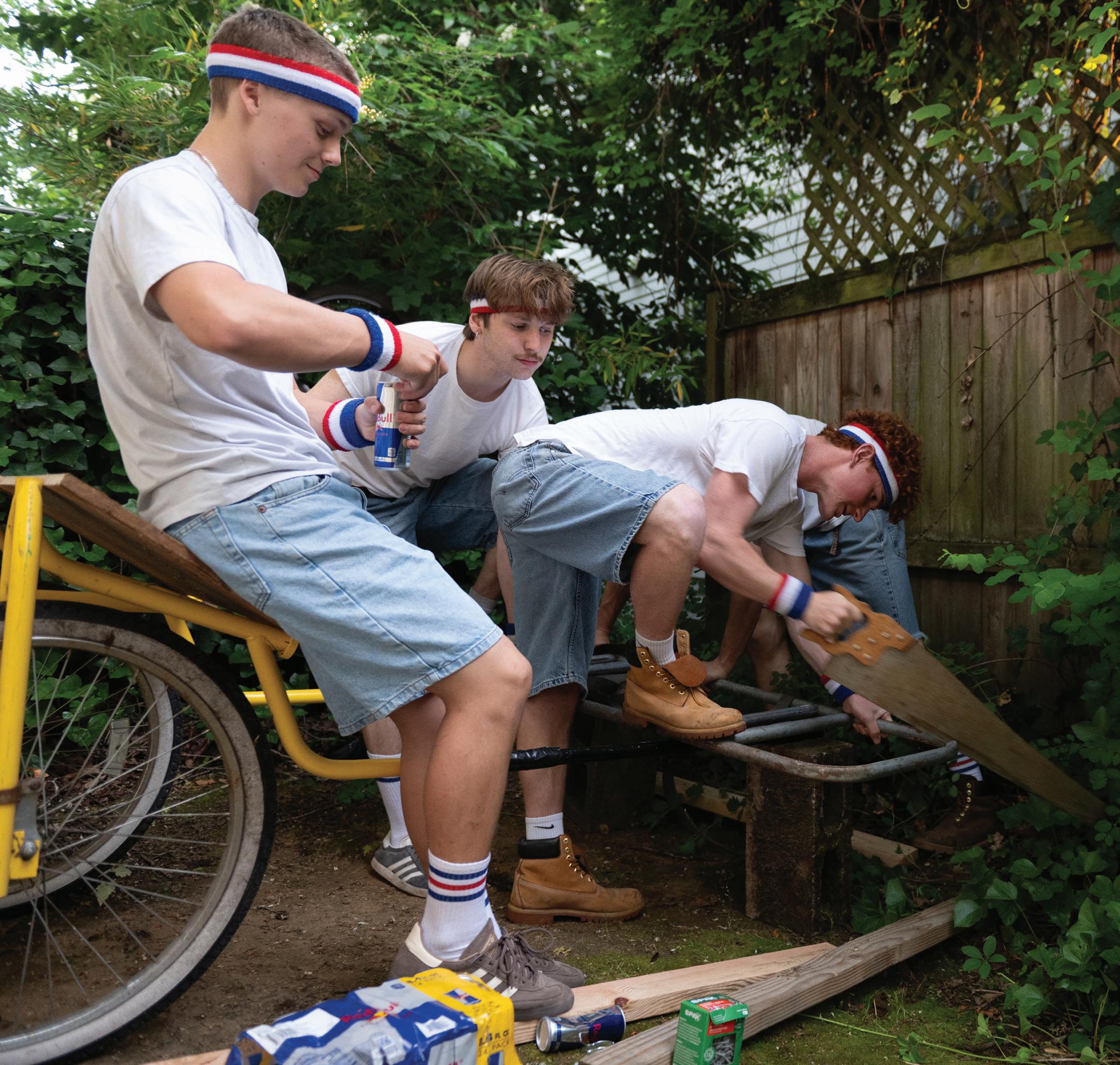
“(There have been) A lot of long nights. We’ve been building our chariot out of a side by side tandem that we cut in half with a hand saw. And then we’re kind of building that into a giant pot because we’re the Eugene Eaters. So, we’re all chef-themed. Two of us are gonna be chefs, two of us are gonna be rats. And then we’ve been training in various ways. We’ve been testing our mental strength against the cannons and against the highest slack line. And then we’ve been training our muscles in various ways, and our stamina,” Lincoln said.
The “Ratatouille”-esque theme came about after the group had acquired a four-foot-tall fork and spoon they found on Facebook Marketplace. Conveniently, they obtained a giant whisk that same week, and knew they had to use whatever props they had at their disposal.
Despite their moments of social media virality, the Eaters say that the most important thing is that people show up and enjoy themselves this Saturday, even if they don’t win first place. “The views are one thing, but it’s also fire being able to spread awareness for the actual event, and then hopefully being able to do more events like this in the future with everyone,” Flannery said.
“Yeah, we knew we trained our hardest at least,” Lincoln said.
Teams are scored comprehensively based on their skit,

chariot design, creativity and time taken to complete the race. The speed at which a team completes the track will be heavily considered, but the multiple elements make for a layered competition.
Charlie Wall and Sage Gassert, both juniors, met when they became roommates their freshman year. Along with Eero Lee and Korbin Martinez, they make up the Goblins; a competing team inspired by the mischievous mythical creature. Goblins have been a sort of inside joke for Wall and Gassert since that year, and when they first started brainstorming chariot themes, they were inspired by the folklore and various fantasy elements.
As for executing this particular theme, Wall said, “Our plan is to go to a bunch of like junkyards and recycling centers and use that. We want it to be kind of like an amalgamation.” Although Wall is a product design major, and knows his way around the Millrace Woodshop, he wanted to include his teammates and have enough space to have fun with the design.
And buying materials from Home Depot could get expensive, so rummaging through a junkyard seemed like more of a suitable option to the team. And it matches the goblin vibe fairly well. “Like how goblins usually get around is like some sort of like sticks and staples-like vehicles,” Gassert said. “We kind of want to emulate that feeling. Like, it looks like it’s about to fall apart, but it won’t.” They are nothing if not dedicated to their theme. Wall has already created an audio snippet for the competition’s skit section, complete with goblin-like chanting. They may also paint themselves green, which they hope is a level of commitment that may tip the judge’s scales in their favor. Wall’s greatest concern is the structure of the chariot, specifically the wheels, which need to be strong enough to sustain the craft for a race through campus. The challenge is apparent in “actually turning and the mechanics of it, but also actually sourcing and finding wheels,” Wall said. Gassert agreed, although he has the right amount of confidence anyone would need for a competition like this one.
“It’ll work out. That’s kind of our philosophy,” Gassert said. None of the teams know what the course is going to look like. Red Bull’s official rule guide states that there will be “obstacles” and “challenges along the way” that teams will have to navigate, so a strong collaborative mindset and cre ative problem-solving skills may be the key to making it on the podium.
The chariot race is open to the public at no cost, and there will be an after-party taking place at Rennie’s Land ing at 5 p.m.
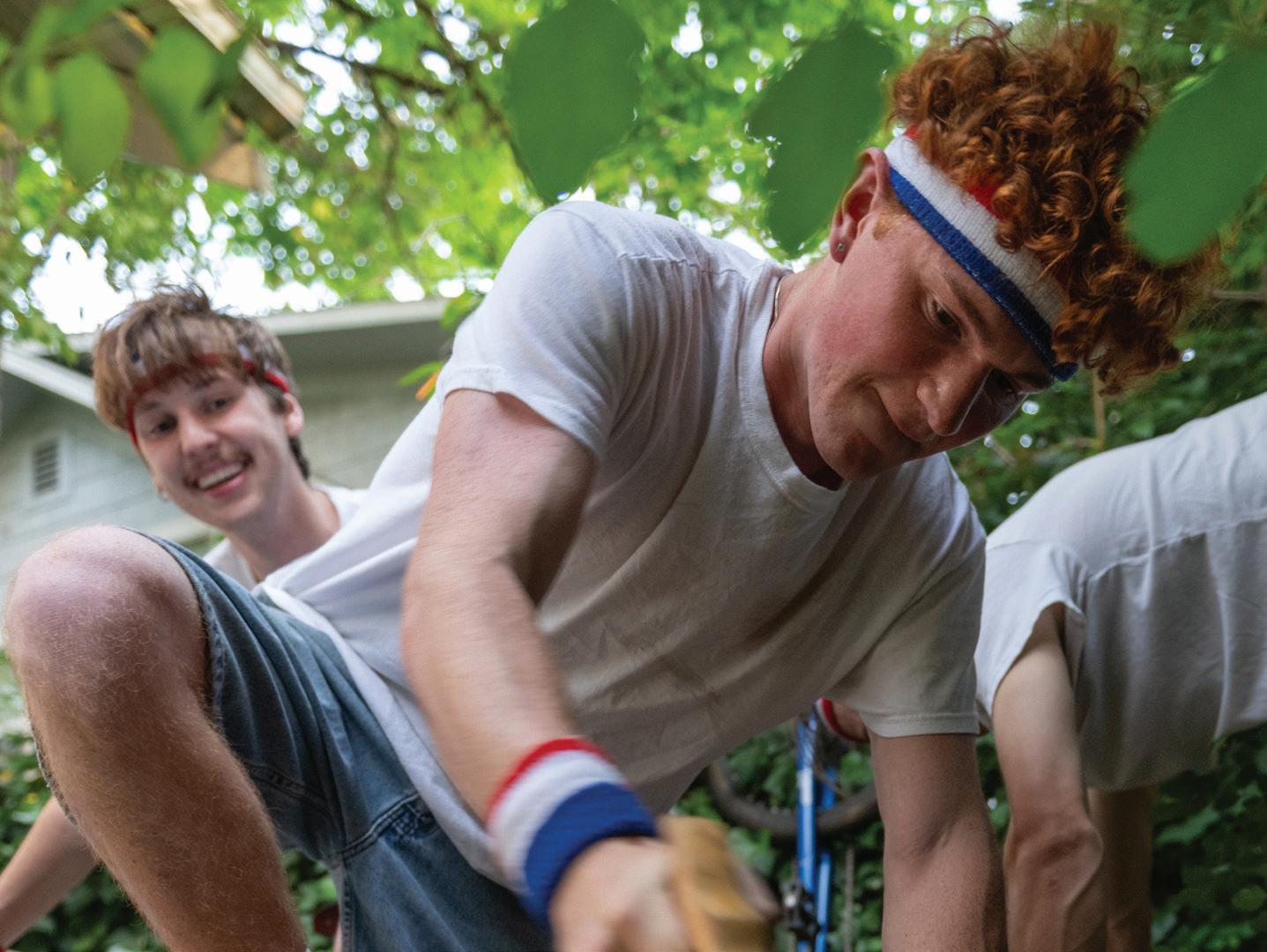
(PHOTOS) Eugene Eaters, a team competing in the upcoming Red Bull Chariot Race on June 6, 2026, at the University of Oregon, build their chariot in their backyard and film stunt-laden promotional videos for Red Bull in Eugene, Ore. on May 22, 2026.
(Chris Castro/Emerald)



The UO’s Master of Science in Management (MSM) can help you move forward with confidence.
LEARN MORE TO SEE IF THE MSM IS RIGHT FOR YOU. uobiz.co/msm-w26


Kahl: Highway 99 after dark
Emma Kahl is an opinion columnist for The Daily Emerald. She is currently a senior, majoring in written journalism and minoring in global studies. Her writing focuses on social commentary, culture and politics.
Opinion: As one of Eugene’s busiest and most dangerous roadways, Highway 99 deserves a safety corridor designation.
By Emma Kahl Opinion Columnist
The stretch from Eugene’s Roosevelt Boulevard to the Randy Papé Beltline houses a bowling alley, coffee shops, hotels, bars and restaurants. As the sun goes down, the lack of lights along the roadway makes it easy to see the stars. My view of the sky is quickly interrupted by the loud rumble of a huge truck racing by. The driver looks down, with the light of his phone illuminating his face, now in the distance. Suddenly, I remember that I’m standing along a highway: Highway 99.
A former barbecue restaurant now stands as an abandoned building covered in vivid and detailed graffiti. Makeshift tarp shelters are somewhat concealed by fences and street signs. There’s a real sense of history and culture around this area, even if it may not be a glamorous one.
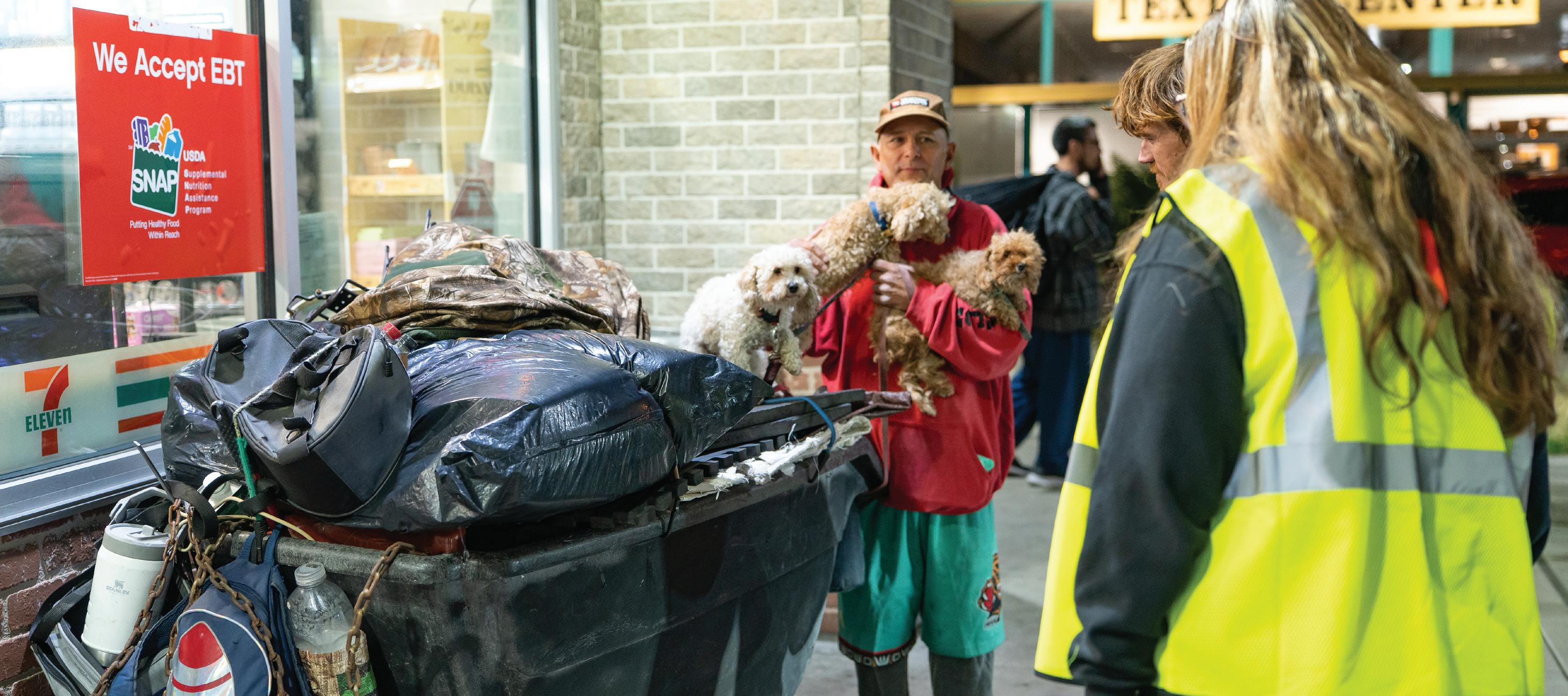
As I walked up to the 7-Eleven on Roosevelt, I began chatting with a man named John. Appear-
ing to be in his late 60s, John was accompanied by his three small dogs: Rambo, Ruckus and Rosie. They sat in a large cart atop all of his belongings as John explained that he has been living on the streets for the past nine years, with most of that time spent along Highway 99.
To John, this area is home. It’s where his friends live, where he finds his meals and where he tries to get a good night’s sleep, often unsuccessfully.
This isn’t an unusual story along Highway 99, as the roadway makes up Eugene’s densest area of resources for homeless members of the community.
St. Vincent de Paul has two shelters located in the area. The Schlies Resource Center and the Lindholm Social Service Center both provide food, showers, clothing and stabilization assistance. There are other community-supported shelters serving those who need medical recuperation housing, women-only and veteran housing. ShelterCare and Carry it Forward provide extensive support resources to the unhoused, and Sponsors
Inc. is an affordable housing non-profit.
Because there are so many resources located in this small stretch, there’s a large population of people sleeping, walking and living along the highway. John explained that there have been high rates of displacement from regular sweeps done by law enforcement, as the area is usually bustling at night. This has made it significantly harder for people to get back to the resource centers located near the highway.
88% of fatal crashes between 2022-2024 involved arterial streets such as Highway 99
Eugene Fatal Crash Report
The same stretch that often provides people a place to stay and an occasional warm meal, also places a vulnerable population right next to highspeed traffic. The combination of a 55 mph speed limit, with late-night traffic from the abundance of bars on this road and the large unhoused population living here, is a catastrophe waiting to happen — and it already has.
The Eugene Fatal Crash Report states that “88% of fatal crashes between 2022-2024 involved arterial streets, such as Highway 99.”
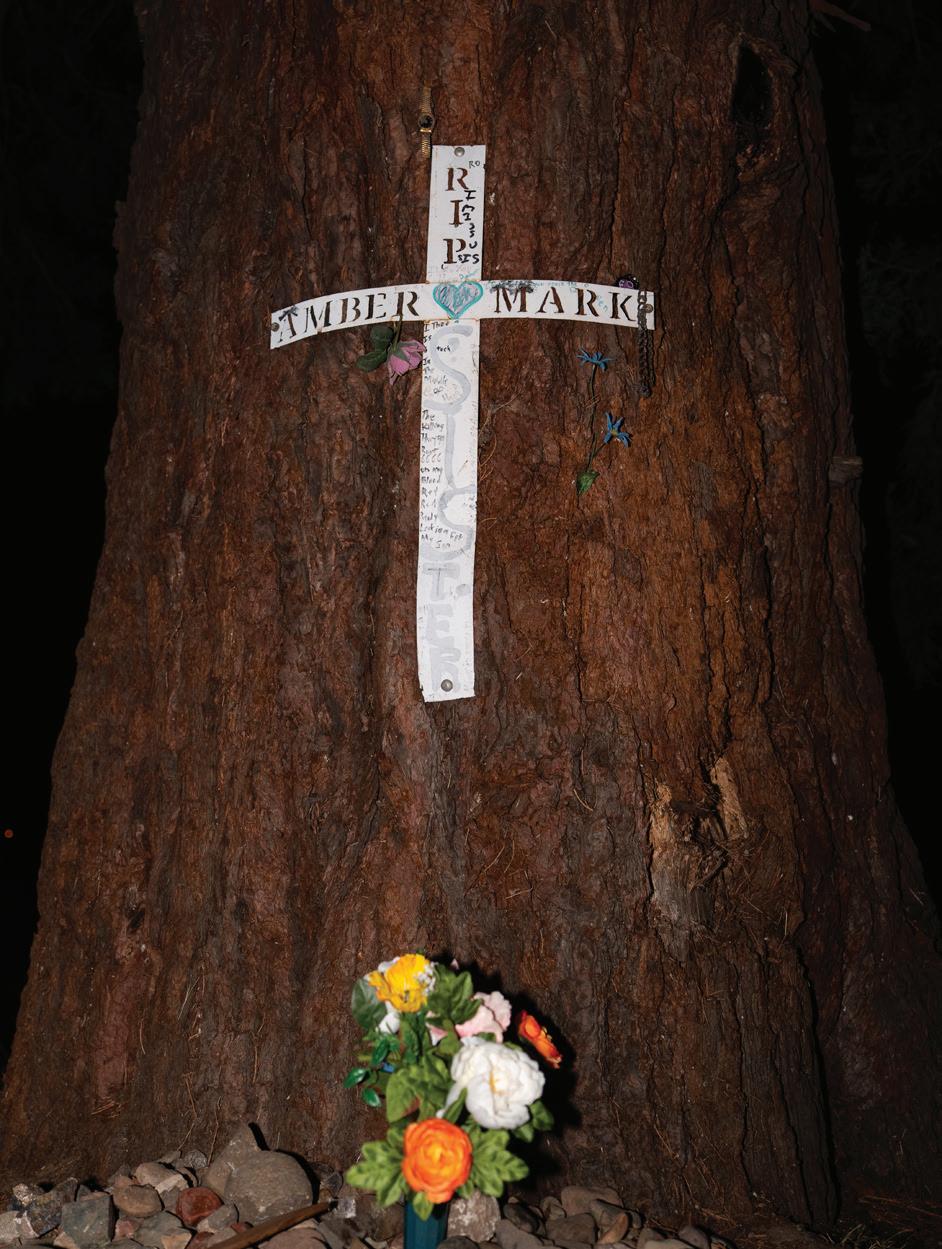
Back in 2022, Amber Mark, a beloved community member experiencing homelessness, was killed on impact when a driver recklessly tore through her tent. A large cross now marks the spot where she was killed, honoring her life and memory.
Merle Dean Sheffield was killed in a hit-andrun while riding his bike through a crosswalk on the Highway in January of this year. As another homeless Eugenian, Sheffield’s life is now honored by a ghost bike chained to the fence outside of the Lindholm Center.
To John, Sheffield’s death was personal. The two spent time living together along nearby train
tracks and quickly became close friends. “He was quite a character,” John said with a chuckle, as though reminiscing on an old memory.
These deaths are not isolated incidents, but part of a larger pattern of hostility from drivers.
John recalled one occasion when a car targeted a group he was walking with on the sidewalk. The driver attempted to hit them and went as far as following the group to the train tracks, where they had to slip through a fence to avoid being struck.
John explained that he sees reckless driving and speeding along the highway daily. “It’s always been like that around here,” he said. Another issue with incidents like these is the lack of accessibility in reporting.
Less than half (44%) of violent victimizations (of people experiencing homelessness) are reported to police
2019 study conducted by the National Coalition for the Homeless
Local homelessness advocate, Sarah Koski, explained that unhoused people frequently receive trespassing citations or other minor infractions simply because they have nowhere else to go. As a result, many fear interacting with law enforcement, let alone feeling safe enough to report an incident or targeted attack.
In a 2019 study conducted by the National Coalition for the Homeless, the Bureau of Justice found that “less than half (44%) of violent victimizations (of people experiencing homelessness) are reported to police.”
While incidents go unreported for many reasons, the danger unhoused people face along Highway 99 should be hard to ignore.
Koski also pointed out that people tend to jaywalk on the highway as there’s a lack of crosswalks and that sidewalks abruptly end in certain areas, which is “bad for mobility.”
Many of the dedicated crosswalks also don’t feel safe. Koski said that with the deaths of Mark, Sheffield and others, the community is forced to choose between unsafely jaywalking or using the same crosswalks where people they know have been killed.
The danger of Eugene’s streets isn’t a secret to city leaders, as Eugene’s mayor and police chief both recently spoke at a community event and press conference on transportation and bicycle safety. Here, Eugene Police Department Chief Chris Skinner emphasized the importance of community reporting.
“We need to hear from you,” Skinner said after he explained that in his 35 years of service, the most aggressive driving he had “ever seen is in Eugene.”
While the city encourages the community to report in order to help make change, many of those being impacted by the accidents on Highway 99 face significant barriers in doing so. This often includes not having access to a phone or the internet in order to make reports.
The possibility of a low reporting rate doesn’t mean that incidents and attacks on this road are rare. What it indicates is that violence against unhoused people is overlooked.
This is where highway safety corridors come into play. Safety corridors are specific stretches of state highways where people are encouraged to drive more carefully and are often located where there are high rates of serious and fatal injury.
Typically, there is more action taken in these corridors to improve safety through enforcement, engineering progress, increased awareness efforts and enhancing coordination of emergency medical services.
Logan Telles, a transportation planner with the city, explained some of the upcoming plans for making the highway safer. He shared that there will soon be an increase in brighter street lights added, as well as sidewalk infill being done in 2027.
While these are important efforts, infrastructure alone won’t fully address the risks many face. A safety corridor designation would acknowledge the highway as a place where vulnerable people are looking to survive, while also helping to prevent further unnecessary deaths.
Lane County just recently designated portions of Marcola Road and Clear Lake Road as Safety Corridors, and beginning in May, traffic fines have doubled for speeding violations. So why wouldn’t the city of Eugene consider this same designation for a portion of Highway 99? One particular stretch was already determined to be one of Eugene’s most dangerous roads for cyclists and pedestrians by LookOut Eugene in 2025.
This area simply doesn’t function as just a highway anymore. Highway 99 is a busy traffic route with high pedestrian activity, a wide range of businesses and is a central point for homelessness resources. Pair this with frequent car crashes, attacks on the homeless and driving under the influence, it’s a recipe for disaster, and we’ve already seen the effects.
In a recent Facebook post, the Lane County Government said that it “previously participated in a state pilot program on London Road that demonstrated safety corridors, combined with signage and public outreach, can significantly reduce deadly and serious crashes.” So by the county’s own reasoning, Highway 99 would likely see substantial improvements in safety from this kind of action and corridor designation.
We continue to treat Highway 99 as only a major roadway when it acts as more of a neighborhood. People commute, live, work, walk, eat and sleep here. They deserve to feel safe doing so.
There’s a serious safety concern here that the city can no longer overlook. While it may be an inconvenience for drivers to have to slow down on Highway 99, a highway safety corridor designation can help to save lives.
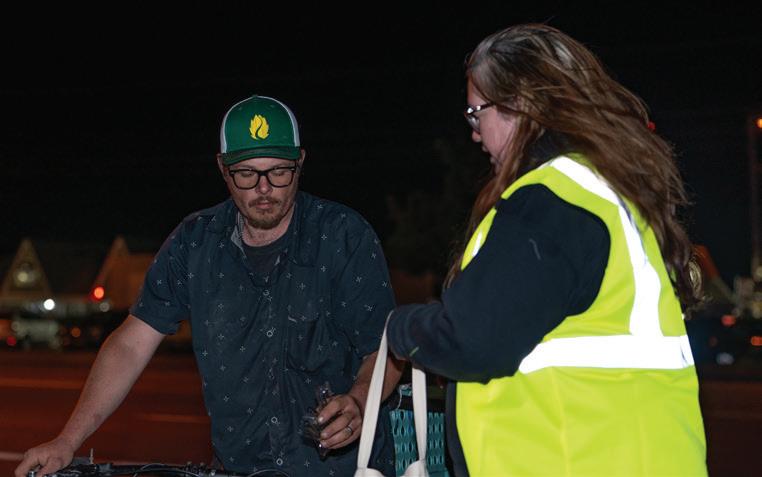
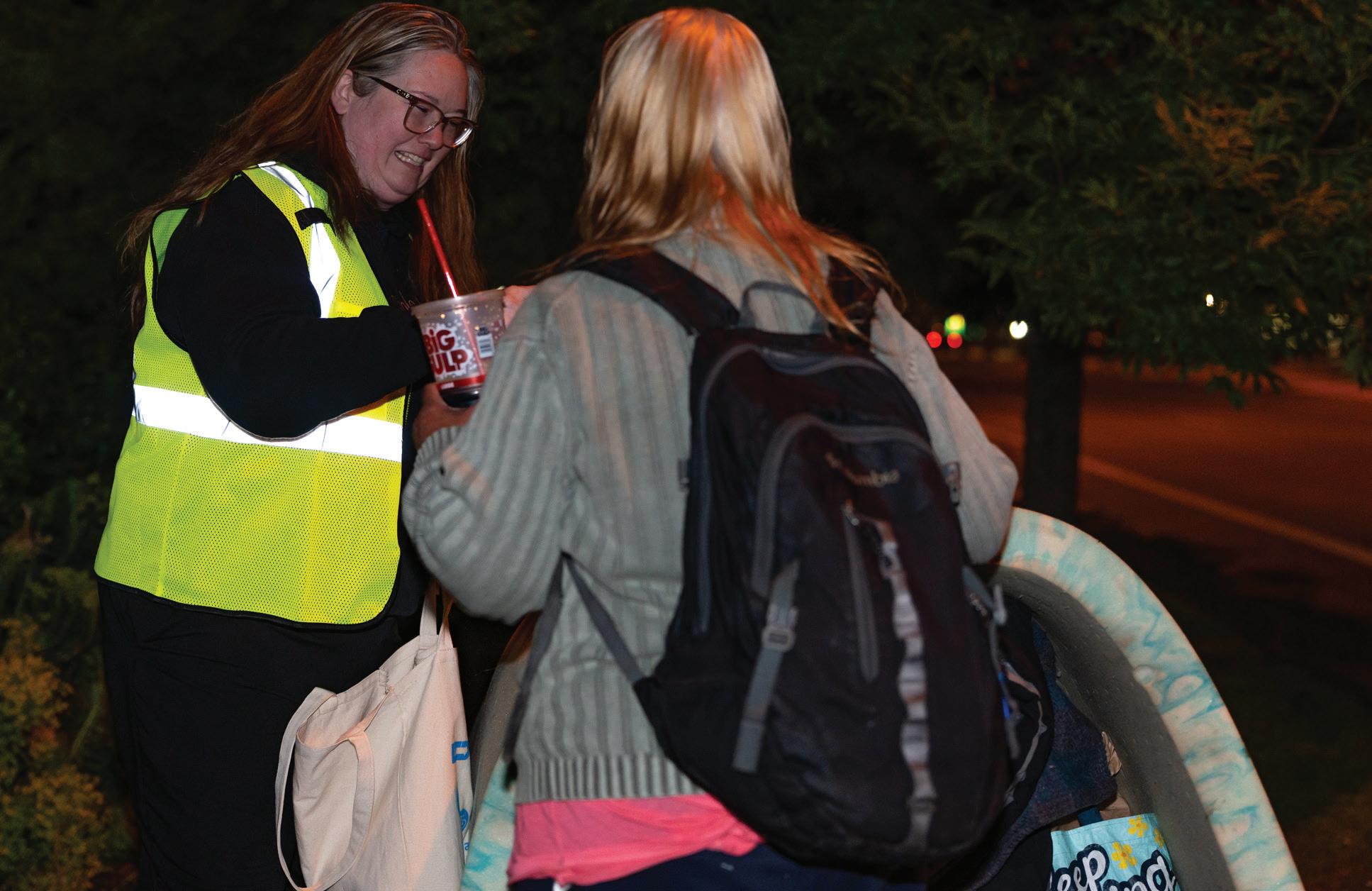
( LEFT, TOP) Sarah Koski, an advocate for the equitable treatment of unhoused individuals, talks with two unhoused individuals, giving them lights to make sure they are visible to passing to motorists.
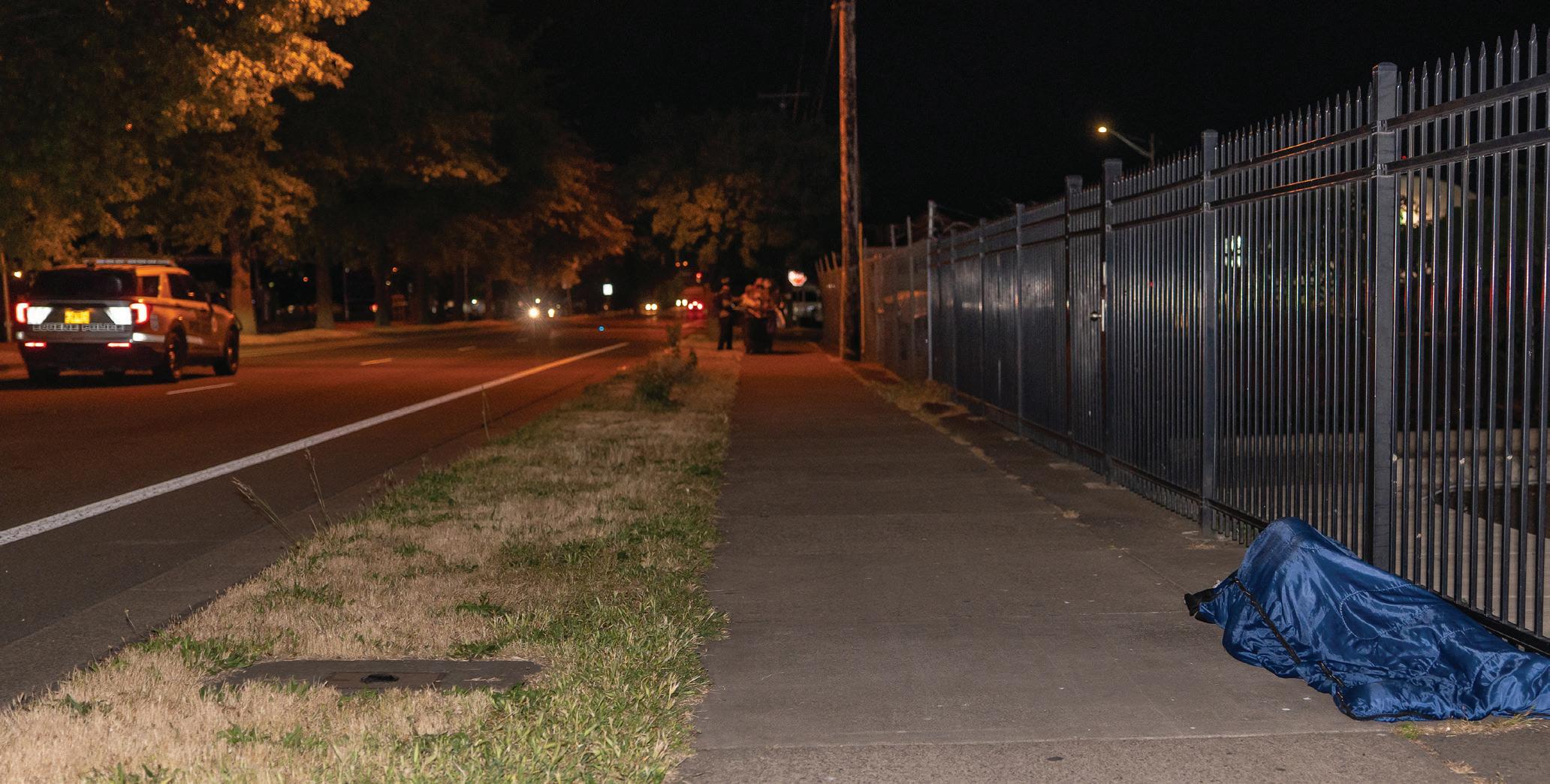
( LEFT, BOTTOM) An unhoused person sleeps in a sleeping bag on the sidewalk of Highway 99 as a Eugene Police Department officer drives by.
( RIGHT, TOP & BOTTOM) Sarah Koski hands out lights to unhoused individuals, aiming to keep them visible to passing motorists on May 19, 2026.
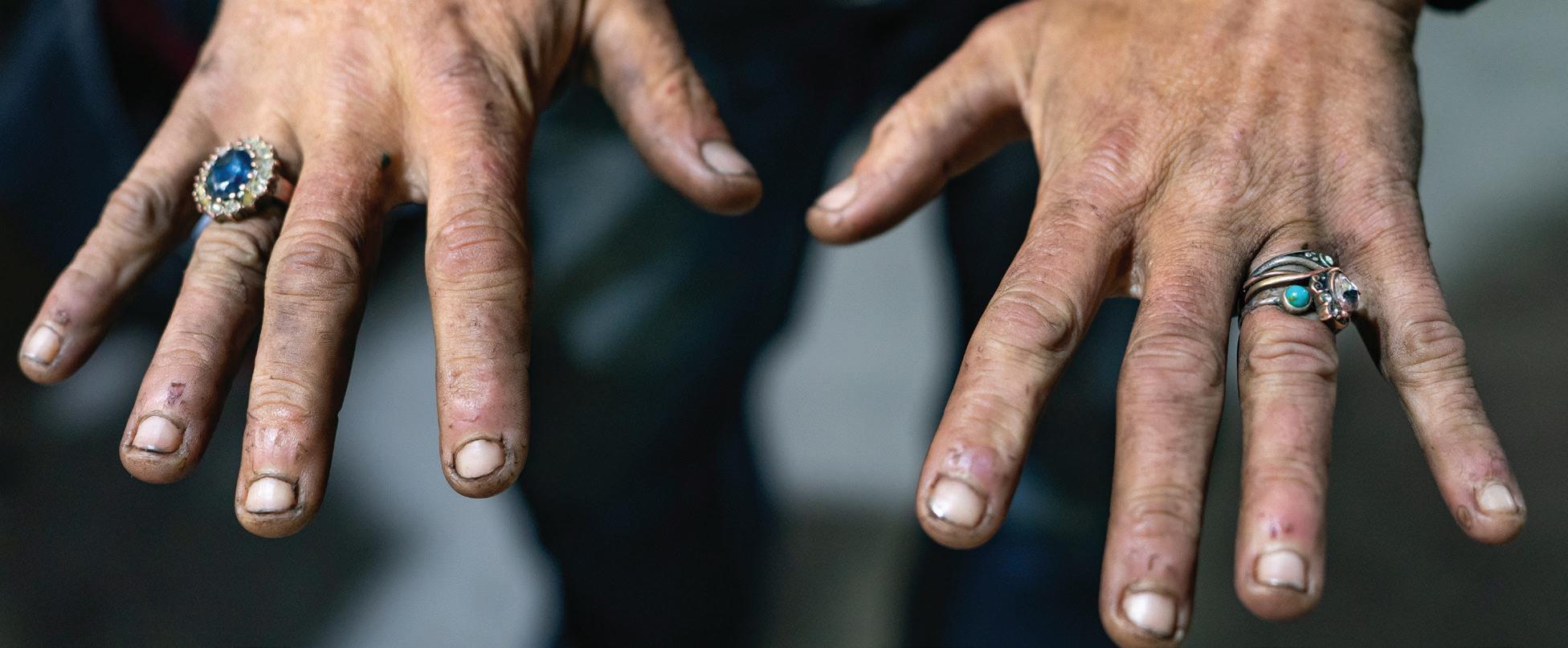
( RIGHT, MIDDLE) An unhoused individual shows his dirt-caked hands from living on the side of Highway 99.
(Saj Sundaram/Emerald)
ACROSS 1 *Rock n Roll instrument that can be slapped 5 *Cape ___ potato chips
“Todo ___ bien” (“Everything’s alright”)
On the ___ (running away)
Machines that refine ore
Site for a valedictorian speech, maybe
Big names on a music festival flyer, essentially
Bed and breakfast
*Citrusy taste
Slang for wealth, with “the”
Prefix for -phant or -ctricity
1 Vanquish 2 Tingly YouTube trend 3 Making tea 4 *Pink, orangey color tone
5 Like some office jobs 6 Canoe steerer
7 Slide into the ___ 11 Up until now
14 “The ___ Reader” (eclectic magazine)
15 Umami food additive
16 Film franchise with mind erasing “neuralyzers”
17 “Blonde” actress de Armas

Nag: The money, the rematch and the law
Opinion: After the 2026 primary election, Kotek and Drazen are set against each other for the gubernatorial race in fall; considering the past precedent for gubernatorial races, Oregon needs to implement campaign finance reform.
By Aishiki Nag Opinion Columnist
During the 2022 midterm elections, individual political donors spent over $70 million in the Oregon gubernatorial race, which was held between democrat Tina Kotek, independent Betsy Johnson and republican Christine Drazan. This was a recorded 89% increase in spending than past gubernatorial races.
Considering Kotek’s dwindling approval ratings in Democratic strongholds, like Portland, and Drazan’s increased push for campaign fundraising — the 2026 general election is also set to be a high spending campaign.
Even within local elections in Eugene, candidates for nonpartisan elections saw an unprecedented increase in campaign donations. Nine candidates within the Lane County elections raised over $100,000: notably Jake Pelroy, a Lane County commissioner candidate, who raised $295,919. Protect Our County, the campaign against the Watersheds Bill of Rights, raised $435,350.
In 2024, the Oregon state legislature passed House Bill 4024, which limits campaign contributions from individuals to $3,300 and political action committees to $30,000. The initiative passed with broad bipartisan support and large amounts of community support. Although the bill is now
set to be implemented in 2027, the Secretary of State’s office should work on taking initiatives to improve campaign finance laws and transparency in campaign spending sooner.
“I think that large private donations like that undermine the importance of the democratic process. It incentivizes politicians to focus on the wants and needs of the donors who are going to give them the most money rather than focusing on the needs of their actual constituents and everyday, middle and (working) class Americans and Oregonians,” Hailey Battrick said. She is a current University of Oregon student studying political science, and a regular voter in Oregon elections.
Phil Knight, the co-founder of Nike, single-handedly donated over $3.7 million to Johnson’s campaign and $1.5 million to Drazan’s campaign in 2022. Money has influenced major elections before, and it continues to dilute the average citizen’s voice within elections.
“It happens without voters even knowing about it, even though it’s technically public information. Voters don’t pay attention to campaign finances and they might not realize that their politicians are taking money from organizations that they might not necessarily support. I think that if you really want to have an ethical grassroots political campaign, then you should be able to get financial
support from everyday middle class Americans because those are the people you’re meant to be representing, not the rich.” Battrick said.
The 2010 Supreme Court case “Citizens United v. Federal Election Commission” ruled that political expenditures by unions, nonprofits and corporations are protected under the First Amendment and not subjected to government restrictions. Overwhelming majorities within the U.S. have consistently disapproved of “Citizens United,” with 22 states and hundred of cities supporting a constitutional amendment to reduce the influence money has on elections.
“I think that the worse we get in terms of large contributions from people with a lot of money, the closer we get to autocracy and being controlled by wealthy interests. If we can’t have some sort of control over how much money gets donated, then I think that we will quickly run into very big issues of interest being compromised,” Shaye Beardsley, a University of Oregon general social studies student, said.
Calls to enforce campaign spending laws continue to rise across the country, and considering the upcoming election, Oregon needs to make a significant effort to increase transparency laws and work on implementing parts of the bill sooner than the proposed deadline.
Aishiki Nag is a senior studying political science and global studies. She likes to cover state and national politics, and international peace-building efforts. When she’s not writing for The Emerald, she likes to read, hike and travel to new places.










GRADUATION GIFT GUIDE
It’s that time of year again! The sun is out, the birds are chirping, and The Ducks, well, they’re graduating! If you’re still on the hunt for the perfect gift for your graduate or searching for a way to commemorate your time at the University of Oregon, look no further. The Duck Store has an array of graduation gifts perfect for your graduate.

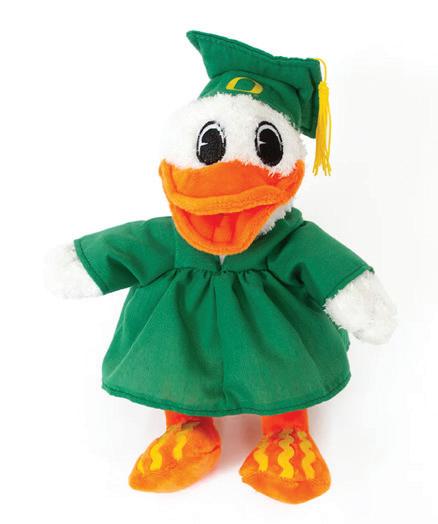
Duck Mascot Graduation Plushie
Who doesn’t want to take The Duck with them after graduation? With this adorable plushie, you can bring the University of Oregon’s iconic mascot with you on all of your post-graduate adventures.

Duck Mascot Mug
Coffee, tea and hot chocolate taste better from this mascot-themed mug. The ceramic cup is dishwasher and microwave safe, and, with a wide-base and easy-to-carry handle, the Duck can be your morning coffee pal. Whether in your hand or displayed on your shelf, this mug is a beautiful way to incorporate Oregon pride into your everyday routine.
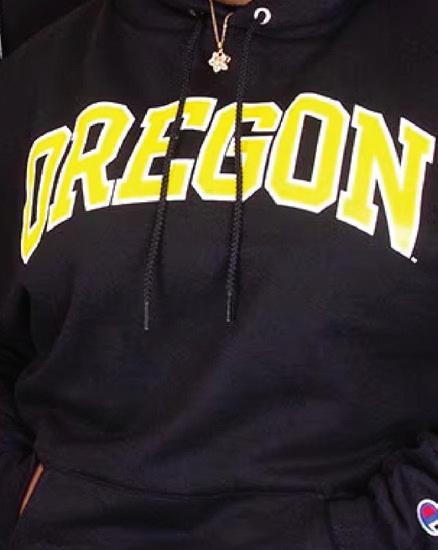
Fleece Oregon Hoodie
How does a Duck stay warm? Obviously in this cozy fleece hoodie. If comfort is your priority, look no further. With a kangaroo pocket, draw strings and pullover hood, this black Champion sweatshirt is great for chilly tailgates, gamedays and everything in between. The yellow, arched design is the perfect accent to represent your Oregon Ducks.


Josten’s Mahogany Diploma Frame
Your grad’s achievements deserve recognition. The diploma you earn is more than just a piece of paper; it reflects years of dedication. There’s no better way to show off your degree than this classic mahogany diploma frame.
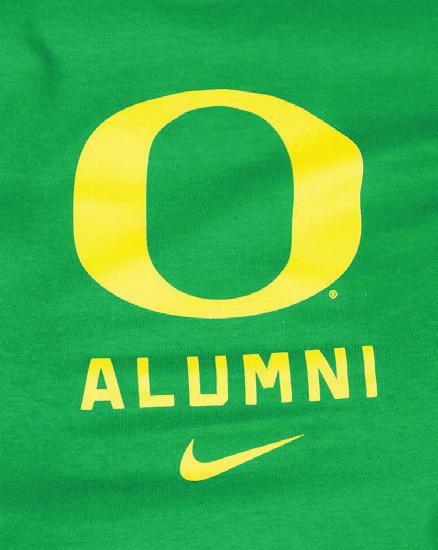
Alumni Crewneck
If there’s one thing a Duck remembers from their time at the University of Oregon, it’s the sea of green and yellow that floods Autzen Stadium on gameday. Whether you make the journey back to Eugene or watch the game from your couch, this alumni crewneck definitely captures the gameday aesthetic.
Fighting Duck Alumni Keychain
For the on-the-go grad, this Duck alumni keychain is the perfect way to show off your school spirit anywhere. It’s colorful and durable, and, at only $18, it makes for a budget-friendly graduation gift. Once a Duck, always a Duck.

Oregon club rugby wins D1AA Sevens title in rebound season
After a first-round exit in 2025, the Ducks returned to the national stage with an eye on revenge.
By Rowan Shea Sports Writer
The University of Oregon Men’s Rugby team fell short last season in the College Rugby Association of America D1AA Sevens Championship.
Though they went undefeated through most of the tournament, a first-game loss to the Iowa State University Cyclones kept the Ducks out of the semifinals, and the team had to wait another year to get back to the tournament.
In the 2026 rendition of the Sevens Championship, the Ducks and the Cyclones butted heads in Game 1 once more. In a chance to right the wrongs of last season, Oregon took control of their opponent, beating Iowa State to get the tournament started.
“I think that was a big point of emphasis,” team captain Liam Weir said. “Getting over that hurdle first thing Saturday morning, I think, inspired the team a lot and gave us a lot of opportunity and hope to then be like, ‘Okay, wait, we can really do this.’”
Playing first thing Saturday morning was not an easy task, especially because of the two-hour time change between Oregon and the Midwest, where the championship is played. The time change bit the Ducks last season as they were playing what felt like two hours earlier than what game time was.
To get over that hurdle, a lot was going to have to go into the Ducks preparation before they even considered the problem of the time change. First, they had to get back in Sevens condition.
“My big thing was like, ‘Hey guys, we need to do a lot of running,’” Weir said. “And I caught a lot of flack from a lot of my teammates because, you know, nobody wants to do running on Monday afternoon after a whole day of classes.”
Being a well-conditioned team is a must for competing in Sevens. Before the Sevens season, teams compete in a 15s season, which is a slower game of Rugby and played fall through winter. Weir described the 15s season as more of a game of chess, while Sevens is full steam ahead from the first whistle, so being well-prepared is a non-negotiable if a team wants to go the distance in the tournament.
That aspect of the game isn’t lost on junior Cormac O’Flaherty who, while also playing on the rugby team, is a walk-on for the Ducks football team.
“Both are major contact sports,” O’Flaherty said. “You can translate between the two (with) just the physical aspect of running, getting faster and getting stronger. That training part, I feel, was the biggest thing.”
With the conditioning side of the game under control, now the Ducks could tackle the time change. The best way the team found to combat it was to change the practice schedule. Weir and the team moved the practices up to earlier in the day to start at 6 a.m. PST so that the 9 a.m. CST game time didn’t feel too early for the Ducks.
“I think it really paid off. For one, getting everybody’s minds ready and getting everyone’s sleeping schedules adjusted, but then also to get the ball in your hands and be like, ‘Okay, wait, I can play this early in the morning and be completely fine,’” Weir said.
The Ducks were completely fine. This time around, they slipped past Iowa State in Game 1 3324, then took it to the University of Wyoming and to Nebraska, beating them 33-19 and 33-10 respectively. One more game stood between the Ducks and the championship, a regional matchup between Oregon and Western Washington University.
Oregon blew by Western Washington, outscoring them 28-5.
Finally, and fittingly, the Ducks were poised to once again go up against Iowa State, this time for the championship.
“We’re pretty familiar with Iowa State as a team,” Weir said. “That team specifically plays a style of rugby that we can kind of take advantage of if we’re on for the day.”
After their thrashing of Western Washington, the Ducks were riding the confidence of a team who knew they could get it done with one more strong game.
Oregon did just that. They put together a 26-21 win for the D1AA Sevens Championship.
“Just a lot of joy, a lot of smiling and messing with each other. Everyone was hugging, high fiving. There’s no better feeling, honestly,” Weir said. “I can’t really describe it because I think I was in a little bit of disbelief at the moment.”
Oregon finished the job. The confidence that was instilled in it following the win will carry it through the offseason, into 15s in the Fall and a potential repeat of Sevens next spring.


Men's golf season ends with ninthplace finish at Columbus Regional
A strong performance from Ramil Saelim headlined the Ducks’ season finale.
By Harry Leader Sports Writer
On May 20, the Oregon men’s golf team finished ninth of 13 teams at the NCAA Columbus Regional and failed to make the final cut to advance in the tournament. The Ducks finished with a total score of 41 over par, 10 strokes behind No. 25 Florida State University, which secured the final qualification spot.
Oregon’s Ramil Saelim and Aiden Krafft led the team with scores of six over and nine over par, respectively. While the result certainly wasn’t what any team wanted in a regional tournament, the Ducks were the second best unranked team at the tournament behind the University of Memphis, which qualified for the NCAA Tournament with a third place finish.
Casper Nerpin finished just behind Krafft with a score of 10 over par, while the rest of the team fell behind. Tim Chang and Sebastian Desoisa bottomed out the scorecard for Oregon with final scores of 16 and 25 over par. Looking back on this season, there were a lot of ups and downs with this group. To start the year, they finished dead last at the Sahalee Players Championship before another last-place finish at The Notah Begay III Match Play weeks later. The ups came shortly after when the Ducks secured a podium finish at the Cal
Poly Invitational, finishing third overall with Desoisa taking home the individual trophy for his firstplace finish. In February, Krafft finished first at The Prestige while the team had a respectable fourthplace finish.
A lot of big highs for individuals this season means the team has some talent to be proud of, especially freshman Desoisa, who will be a key member of the team next season with Krafft graduating.
It’s important to note that Krafft will leave as one of the Ducks’ best players in the program’s history with a seventh-best all-time scoring average of 71.89. He was also an All-Big Ten second team member in his final two seasons at Oregon.
The team may be losing one of its best players, but just by looking at the roster, anyone can see just how stacked this program is with young talent. Desoisa headlines the freshman core alongside Oscar Lent, who has been a contributor this season. Saelim and Chang have been solid contributors as well in their sophomore season, with Saelim leading the charge alongside Krafft in the second half of the season.
It’s safe to say that head coach Casey Martin has a strong underclassmen core at his disposal heading into next year and should be one to watch when they kick off their fall season in early September.
Oregon Rugby (Photo courtesy of Matthew Dalton)
(Courtesy of Oregon Athletics)