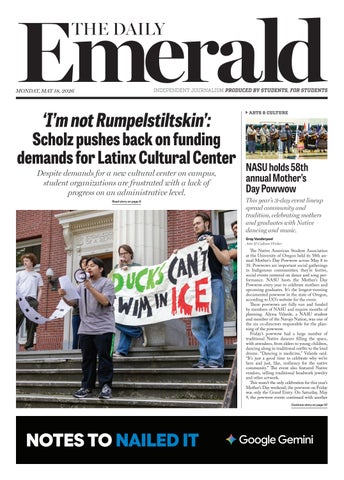
‘I’m not Rumpelstiltskin’: Scholz pushes back on funding demands for Latinx Cultural Center
Despite demands for a new cultural center on campus, student organizations are frustrated with a lack of progress on an administrative level.
Read story on page 6
NASU holds 58th annual Mother’s Day Powwow
This year’s 3-day event lineup spread community and tradition, celebrating mothers and graduates with Native dancing and music.
Gray Vanderpoel Arts & Culture Writer
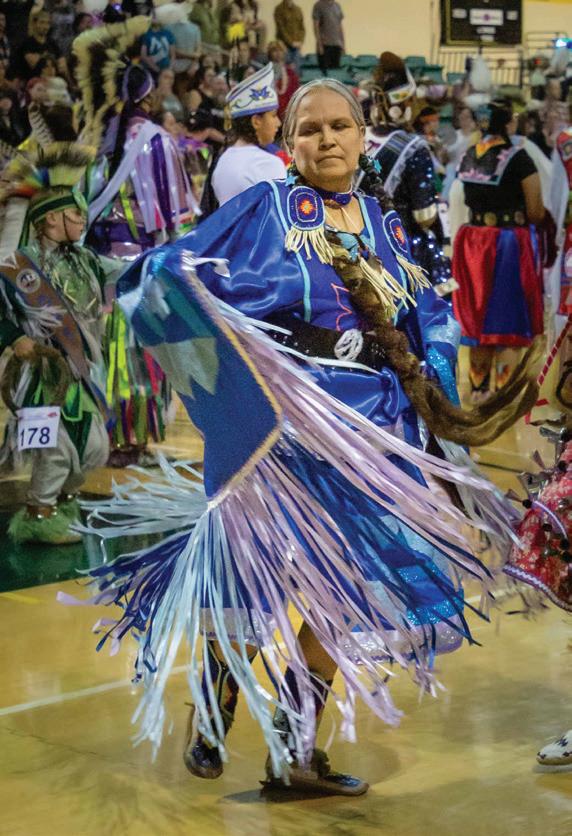
The Native American Student Association at the University of Oregon held its 58th annual Mother’s Day Powwow across May 8 to 10. Powwows are important social gatherings in Indigenous communities; they’re festive, social events centered on dance and song performance. NASU hosts the Mother’s Day Powwow every year to celebrate mothers and upcoming graduates. It’s the longest-running documented powwow in the state of Oregon, according to UO’s website for the event.
These powwows are fully run and funded by members of NASU and require months of planning. Alyssa Velarde, a NASU student and member of the Navajo Nation, was one of the six co-directors responsible for the planning of the powwow.
Friday’s powwow had a large number of traditional Native dancers filling the space, with attendees, from elders to young children, dancing along in traditional outfits to the loud drums. “Dancing is medicine,” Velarde said. “It’s just a good time to celebrate why we’re here and just, like, resiliency for the native community.” The event also featured Native vendors, selling traditional beadwork jewelry and other artwork.
This wasn’t the only celebration for this year’s Mother’s Day weekend; the powwow on Friday was only the Grand Entry. On Saturday, May 9, the powwow events continued with another
Continue
EDITOR IN CHIEF
Tarek Anthony
PRINT MANAGING EDITOR
Ryan Ehrhart
DIGITAL MANAGING EDITOR
Ysabella Sosa
NEWS EDITOR
Reilly Norgren
INVESTIGATIONS EDITOR
Ana Narayan
A&C EDITOR
Claire Coit
SPORTS EDITOR
Jack Lazarus
OPINION EDITOR
Gracie Cox
PHOTO MANAGING EDITOR
Corey Hoffman
PHOTO EDITOR
Saj Sundaram
COPY CHIEF
Olivia Ellerbruch
VIDEO EDITOR
Jake Nolan
PODCAST EDITOR
Stephanie Hensley
SOCIALS EDITOR
Ysabella Sosa
VISUALS EDITOR
Noa Schwartz
DESIGN EDITOR
Adaleah Carman
DESIGNERS
Asha Mohan
Ellery Burton-Tillson
Eva Andrews
Izzy Smith
Nina Rose
BUSINESS
PUBLISHER AND PRESIDENT
Eric Henry (X317) ehenry@dailyemerald.com
VP OPERATIONS
Kathy Carbone (X302) kcarbone@dailyemerald.com
DIRECTOR OF SALES & DIGITAL MARKETING
Shelly Rondestvedt (X303) srondestvedt@dailyemerald. com
CREATIVE & TECHNICAL
DIRECTOR
Anna Smith (X327) creative@dailyemerald.com
ACCOUNT EXECUTIVES
Camcole Pereira
Elliot Byrne
Maria Jimenez
THE DAILY EMERALD
The Daily Emerald is published by Emerald Media Group, Inc., the independent nonprofit media company at the University of Oregon. Formerly the Oregon Daily Emerald, the news organization was founded in 1900.
Emerald Media Group 1395 University St.,#302 Eugene, Or 97403 (541)-346-5511
Tanker crash spills diesel, thousands of gallons of milk into waterway flowing into McKenzie River
EWEB deployed spill response measures May 15 after a tanker truck crashed near Belknap Springs.
By Corey Hoffman Senior News Reporter
The Eugene Water & Electric Board and the Upper McKenzie Rural Fire Protection District deployed spill response measures after a semitruck carrying 275 gallons of diesel and thousands of gallons of milk crashed near a creek that flows into the upper McKenzie River.
At around 4:30 a.m., a tanker truck crashed near Belknap Springs, about an hour and a half east of Eugene. It was estimated to be
carrying between 5,000 and 7,000 gallons of milk, which spilled into the water. McKenzie Watershed Emergency Response partners mobilized to contain the spill and do not expect drinking water to be impacted. The total volume of material that entered the water is still being assessed, according to a press release from EWEB.
Mitigation measures have been implemented, including a boom across Trail Bridge Reservoir, where milk is visible after the spill. EWEB Water Resources and Quality Assurance Supervisor Susan Fricke said in the press release that it would take a “significant amount of time” before the milk and diesel would reach EWEB’s Hayden Bridge Drinking Water Treatment Plant.
Additional responding agencies included Upper McKenzie Fire & Rescue, the
Scholz announces $65 million in budget cuts
UO president announced that a lack of out-of-state enrollment will result in more university-wide budget cuts due to projected fall enrollment numbers.
By Corey Hoffman Senior News Reporter
University of Oregon President John Karl Scholz announced Thursday a $65 million budget cut to “avoid an ongoing annual budget deficit,” via email.
Scholz said the cuts are a direct result of lower tuition revenue due to lower incoming out-of-state enrollment rates.
UO receives approximately 80% of its budget from tuition revenue and relies heavily on out-of-state student enrollment. Lower than predicted out-of-state enrollment has a “disproportionate effect on (the university’s) operations,” according to the statement.
National College Decision Day, or the day high school seniors in the United States must commit to a college or university, occurs May 1. This provides the university with initial information about next year’s enrollment numbers. According to Scholz’s statement, lower tuition revenue is projected due to “significantly lower incoming out-of-state first-year enrollment.”
Based on these numbers, Scholz announced that the university will need to cut $65 million from the Education and General Fund budget in the coming years to avoid an ongoing annual deficit.
Scholz said that the university could take smaller actions, but the administration has “little confidence” that taking smaller actions
Springfield Utility Board, the Oregon Department of Environmental Quality, Region 2 HazMat and the Oregon Department of Fish and Wildlife.
EWEB and its McKenzie River partners conducted a spill response drill at this location last fall, which the release said helped prepare response teams for an incident of this nature.
According to Oregon State Police, the 30-year-old truck driver fell asleep behind the wheel and crashed down an embankment along Highway 126. The driver did not require medical transport, and the vehicle has since been towed.
would not result in additional cuts next year. Effective immediately, Scholz implemented a hiring and pay action freeze, as well as limits to non-essential travel to “conserve resources.”
In the email, Scholz outlined two principles to “secure a more promising future.”
The first principle is to “elevate and invest” in research that can “meet the needs of our communities and industries, attract the best talent and differentiate” the university. Scholz said the university will “hire strategically” with a goal of making UO stand out in “leadership and excellence in specific areas of research.”
The second principle is to invest in the “quality of the student experience and make the University of Oregon a destination of choice for more students.”
Last year, the university announced a $30 million budget cut that resulted in faculty layoffs and cuts to several humanities departments. Fifty-seven positions were laid off in spring 2025 and 117 the following summer. Administration, the UO Senate and other university partners will explore academic and administrative approaches to budget cuts. Additionally, Scholz said there will be opportunities to seek philanthropic support. No final decision will be made during the summer. Updates on cuts will be provided mid-summer, mid-fall and near the end of fall term. This story is breaking and may be updated.
( ABOVE) Milk visible in the water following a semitruck crash near Belknap Springs on May 15, 2026. (Photo courtesy of EWEB)
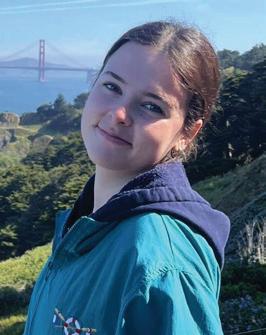
ASUO President Moreno reflects on term as she prepares to leave office
The outgoing president is proud to have reshaped ASUO’s relationship to the campus community and regrets initial stock placed in discussion.
By Elle Kubiaczyk News Reporter
Prissila Moreno nears her final weeks as ASUO President. She considers the course of her presidency a success, and to have succeeded in many of the goals she campaigned on last spring.
Some of those successes include changes to the lottery-based football ticket system, 24-hour libraries, medication abortions at University Health Center, “Week of Relief” to address paused SNAP benefits, the new SSWANA Center and more.
ASUO Executive Chief of Staff Daphne Patrick has worked closely alongside Moreno, starting with her campaign victory in April 2025. Patrick finds Moreno and the current ASUO administration has redefined their relationship with the students.
“For the past couple years people have viewed ASUO as an extension of administration and not much of an extension of just the student body,” Moreno said. “My hope is that students see ASUO now as a real way to deliver on issues that students care about.”
In an exit interview with The Daily Emerald, Moreno reflected on her term:
QWhich accomplishment are you most proud of?
Definitely the libraries because I remembered during campaign season, people being like, ‘I love this platform and I love everything you say you’re going to do. But those libraries, that’s just, that one’s so far out of reach. That’s definitely not going to happen.’ And I’m not only proud to say that it has happened twice this year, but that we are working with the Office of the Provost to find permanent funding to make sure that this happens beyond just my administration and beyond just the bounds of what ASUO is able to give for funding. And it was just really, really cool to see the science library look like a mall during Black Friday. It was just an unreal experience.
Q What’s one thing ASUO could have done differently this year?
That is an interesting question, because I think the only thing that I would have done differently is been a little bit more honest with the administration early on. I had a lot of hope in the beginning that maybe we can do things diplomatically or, you know, accept the bureaucracy of the university... I only have a meeting with the president once a month, so it’s fine. It’ll, it’ll happen, but it’ll just move slowly... I think I would have just given up on some of that false optimism early on, which sounds very pessimistic. It does sound very pessimistic, but I think I could have gotten a lot more done if I didn’t waste so much time believing that things could actually get done in conversations in Johnson Hall.
Q How have students’ perceptions changed about ASUO?
Hmm. Well, I would love to ask them all. Based on the interactions I’ve had, people, for one, know what ASUO is, and to believe in it as an organization that could actually be a change-making vehicle. And I think for the past couple years at least, people have viewed ASUO as an extension of administration and not much of an extension of just the student body. So I think my hope is that students see ASUO now as a real way to deliver on issues that students care about.
Q What was one of the biggest challenges you faced during your presidency?
It might sound like a broken record, but it is the administration stonewalling us at every turn with the things that we want to do, and particularly with the Latinx Cultural Center. I think that has been a fight that I genuinely believed that we could win with the correct messaging in meetings with administration and with the backing of the credibility of ASUO. And it’s so clear to me and obvious that you don’t win things from the top down. And not only do you not win things from the top down because it’s not feasible or possible for them, you don’t win things from the top down because they don’t actually want to. We’re at a direct conflict with administration on what we want. I don’t think they want to give us a center, for example. Direct opposition in interests with administration has been hard.
Q
Biggest lesson you’ve learned?
I think I learned a lot about myself and I learned that a quality that I like about myself is that I’m very resilient. I have always been a leader that doesn’t take ‘no’ for an answer when I believe that something is possible and there’s just some barriers that we need to take down. But there have been a lot of emotionally charged moments during my administration where I was stuck and I didn’t know what to do. And I think that I could have given up a lot of times. I could have given up after Karl Scholz said that essentially, he didn’t care if our community believed that he cared about us or not. Those are moments that are very personal to me and very difficult to get through, and to see myself come out on the other side over and over and over again, I think is central to this role. I think about my time as president in its entirety, I think about every single moment where it could have said, I’m giving up on this and I didn’t. And now I’m really glad that I didn’t because all the great things that I get to say that we accomplish together, were on the other side of just not giving up.
Q
Final words of wisdom?
A message to students at the University of Oregon. This is your university as much as this administration or the systems make it feel like it’s not our university. It really is. Every single thing that we get to enjoy here was demanded and fought for and won by students and we will continue to be pivotal in change that happens, on this campus, but also in the world. The student movement is just everywhere in history and will continue to be at the heart of changing the world. So I hope that people feel like they can. And I hope that they want to as well, because we need more people that want to change the world.
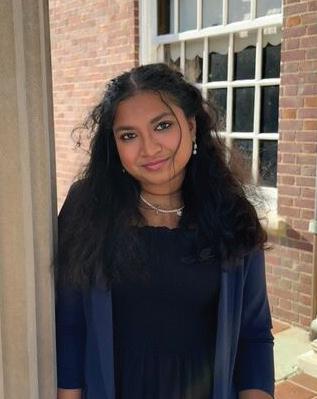
( LEFT ) ASUO President Prissila Moreno (Corey Hoffman/Emerald)
‘I’m not Rumpelstiltskin’: Scholz pushes back on funding demands for Latinx Cultural Center
By Audrey Lynch News Reporter
For months, the student-run Latinx Coalition has made efforts to advocate for a Latinx Cultural Center on campus — only to be met with resistance from university administration.
The Latinx Coalition, made up of five student organizations, including ASUO, has requested the university construct a Latinx cultural center on campus. Research from the coalition proposed a budget estimate, funding opportunities and analyzed how UO compares to other similar institutions.
Members of the coalition still feel as if little progress has been made despite meetings with administration and Scholz’s implementation of a task force.
ASUO President Prissila Moreno and members of the Latinx Coalition met with administrative officials on April 23 to demand a Latinx cultural center be built on campus. As these individuals discussed with University of Oregon President Karl Scholz and Vice President for Student Life Angela Chong, they were denied the opportunity for positive progress.
During this meeting, a task force to “assess the feasibility
and possibility of a center” was proposed, but members of the coalition remain worried this task force will not produce the results the coalition has been advocating for.
Latiné Male Alliance President Gio Bazan-Espain said that UO’s Hispanic Serving Institution Task Force has done significantly less work toward supporting Latinx students than student coalitions have done.
“The Anti-ICE and Latinx Coalitions have done more in two and a half terms than the HSI has in several years,” Bazan-Espain said.
Bazan-Espain said that while the HSI Task Force reportedly meets once a term, whereas the coalition meets once a week.
During the coalition’s meeting with Scholz and Chong, the Latinx Coalition presented a study completed by interns of LMA. The study has three research elements: research into other Big Ten schools, estimated costs for a new building and a proposal to allocate ASUO funds for operational costs of a center.
In the Big Ten Conference, nine of the 18 institutions have a cultural center, according to the study. The study’s goal is to prove that UO is behind when it comes to creating spaces for Hispanic students.
Similar projects and advocacy
The study also compares the building costs of UO’s Lyllye Reynolds-Parker Black Cultural Center and Oregon State University’s Centro Cultural Cesar Chavez. The BCC, which opened in 2015, cost $2.2 million to construct. OSU’s center was a $2.5 million project.
Based on this data, the study estimates that a small center from 3,000 to 6,000 square feet would cost around $2 million to $6 million. The document also states that many projects like the BCC or renovations to campus buildings have been supported by donors and legislative funds.
Amaya Peralta, the vice president-elect and current director of advocacy for ASUO, said that during the April 23 meeting, Scholz said that he was not “Rumpelstiltskin” and could not “make money appear out of nowhere for something like this.”
However, Peralta said that the university was able to fund other similar projects by finding donors and this was often a result of student advocacy.
Student advocacy for the BCC began in 1968 and was reignited in 2015, with student pressure to meet their demands until its construction was confirmed in 2017.
The Many Nations Longhouse first existed within deteriorating World War II barracks in the early 1970s until a new center was built in 2005.
Most recently, the South Asian, Southwest Asian, and Northern African Center was fought for by students for two years before its opening in the EMU in November 2025.
“These centers are 100% rooted in student activism and culture and things like that. But those cannot be separated, and we would not have these centers, if not for people who came before us, who fought for them,” Peralta said.
Beyond the cost of building, the coalition also outlined their understanding that operational costs in the first year may be high.
They are seeking support from ASUO, which provides some or all funding to several cultural centers on campus, including 100% of the Multicultural Center’s operations. In a written proposal, the coalition requested an allocation of $200,000 of over-realized funds from ASUO in April.
Peralta said that this request was approved on May 6, granting the coalition $215,000 that would cover start-up and the first year of operational costs if the center is approved.
Administration response
During the coalition’s meeting with Chong and Scholz, Chong told the students that she “would be the one to bring the do-ers to the table.”
Peralta said Chong’s response was frustrating given the efforts by ASUO and the coalition who are putting in the work to reach their goal.
“She just, like, genuinely doesn’t believe that it can work,” Peralta said.
Cash Kowalski, director of student engagement for ASUO, said he believes the administration’s refusal to cooperate is not about money.
“It’s not that we don’t have the money but the way (administration) chooses to invest money reflects their values and not the values students hold,” Kowalski said.
During the April 23 meeting, Bazan-Espain said he saw this disconnect of values first hand when “Scholz said he wouldn’t implement (a center) even if it was free.”
Peralta encouraged administrators, like Chong, to attend their weekly Latinx Coalition meetings and work directly with students.
“I was asked to be on (administration’s) task force, and I said no, because I believe that this effort will only happen with students… I strongly believe that students are the doers” Peralta said.
In a joint statement from Chong and Provost Christopher Long, they said that the Latiné Cultural Center Task Force was created by recommendations from students and the
HSI work group. The task force will continue “exploratory planning” for a cultural center on campus.
“This group brings together students, faculty, staff and a community partner to gather input, assess needs, and explore what a feasible, sustainable, and culturally responsive model could look like in practice,” they said.
“
Scholz said he wouldn’t implement (a center) even if it was free.
Gio Bazan-Espain
Latiné Male Alliance President
According to Long and Chong, this is the same process that was followed prior to the BCC’s construction.
“The fact that the taskforce is chaired by two university vice presidents is a signal of both our seriousness on this work, but also of the reality that finding an appropriate and available space on our campus for this center is not an easy task,” the two said in the statement.
The statement also pointed to the university’s ongoing budget cuts as an issue for securing funding for a center.
On April 29, the UO senate voted unanimously to affirm the ASUO resolution for a Latinx Cultural Center on campus. While the vote is largely symbolic and does not confirm the creation of the center, Peralta said it was a “step in the right direction.”
In a gathering on campus, May 6, the Latinx Coalition hosted a teach-in about the center’s importance which included speeches, discussion and postcard making. The event allowed students to write their thoughts and suggestions on postcards that would be sent to Scholz and Chong’s personal residences.
“The plan originally was a rally but two days (before) it shifted to something more interactive to give people an opportunity to take action,” Moreno said.
Peralta said she has only had two Latinx instructors during her three years at UO and that this space would provide necessary community.
“I think you lose that sense of culture and community when you’re not surrounded by people who look like you,” Peralta said.
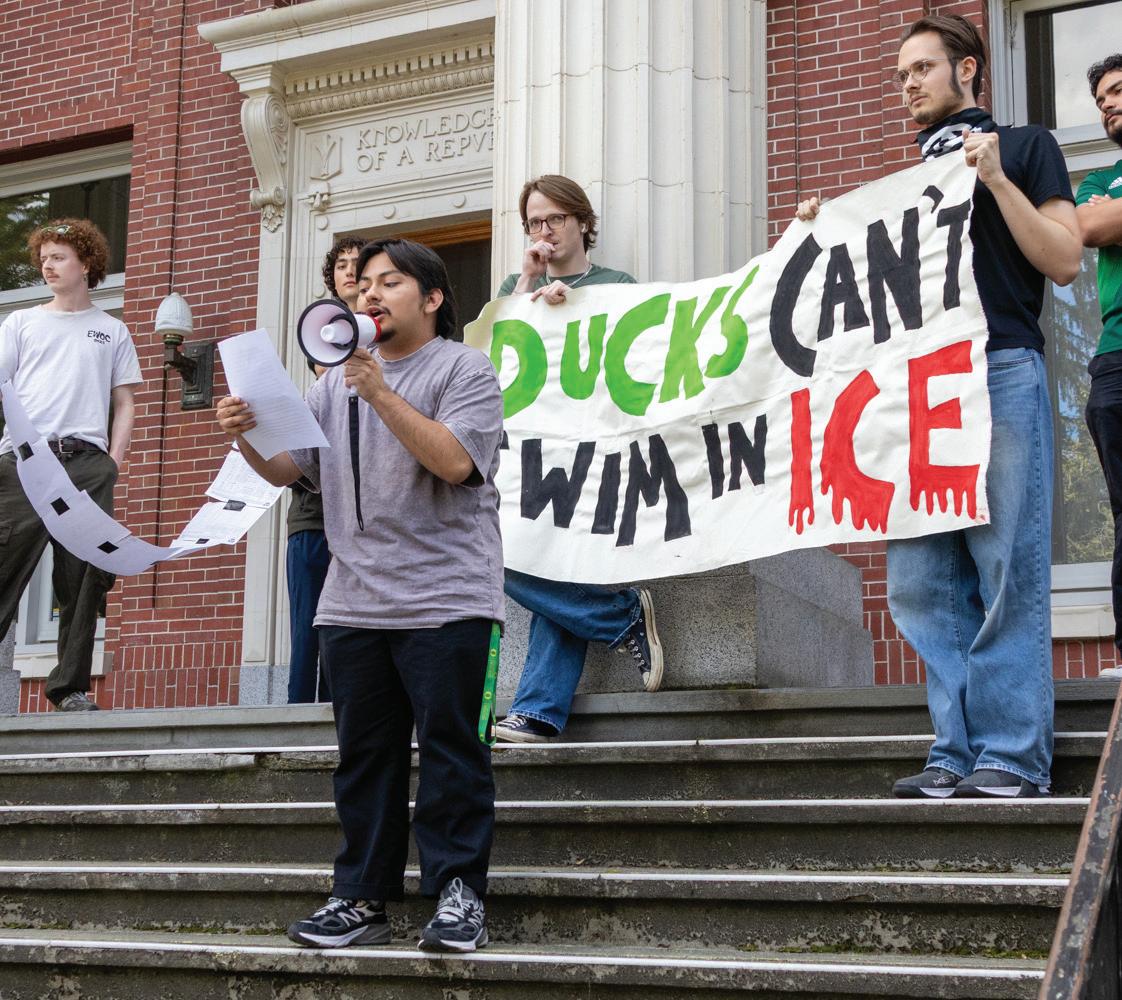
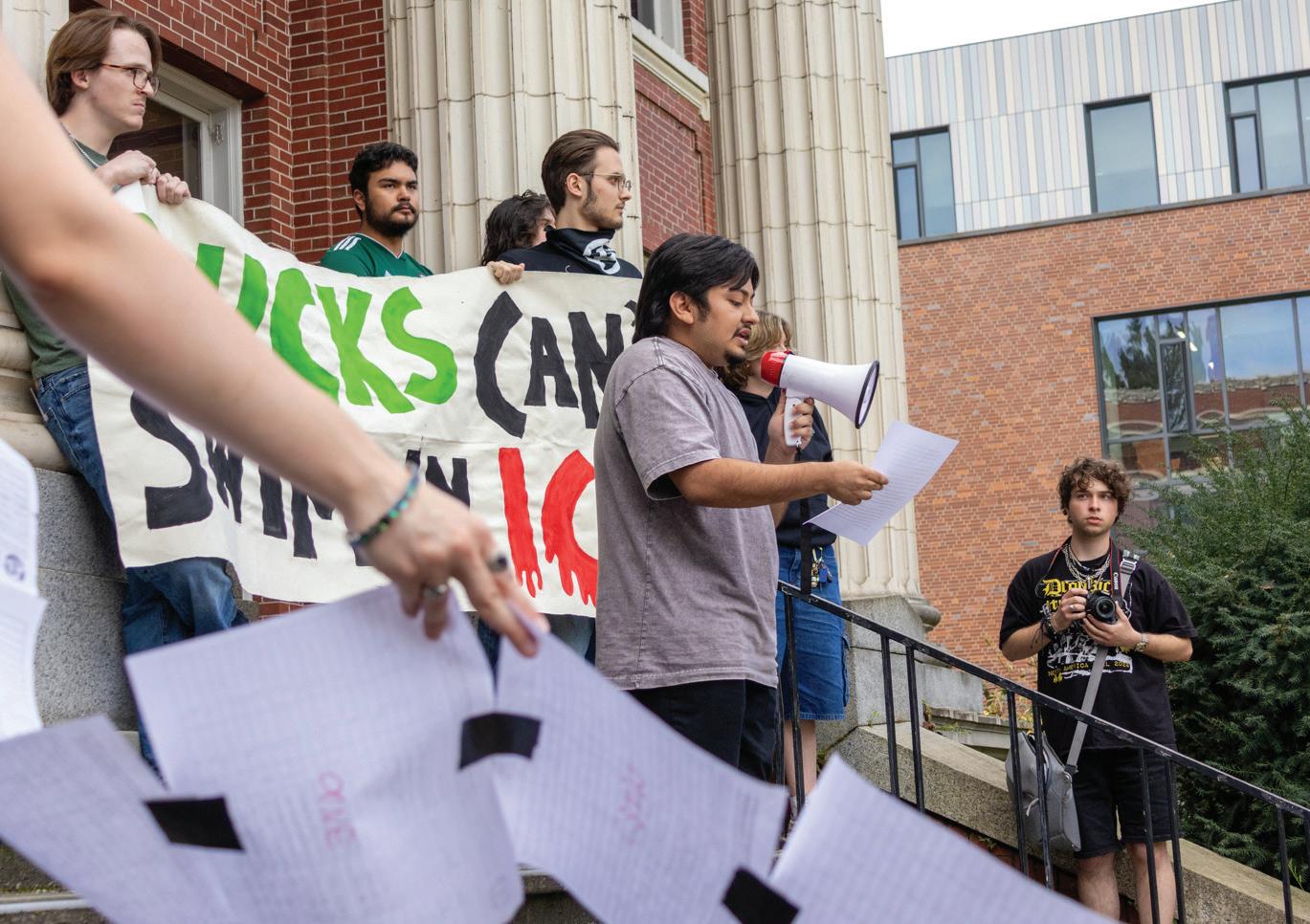
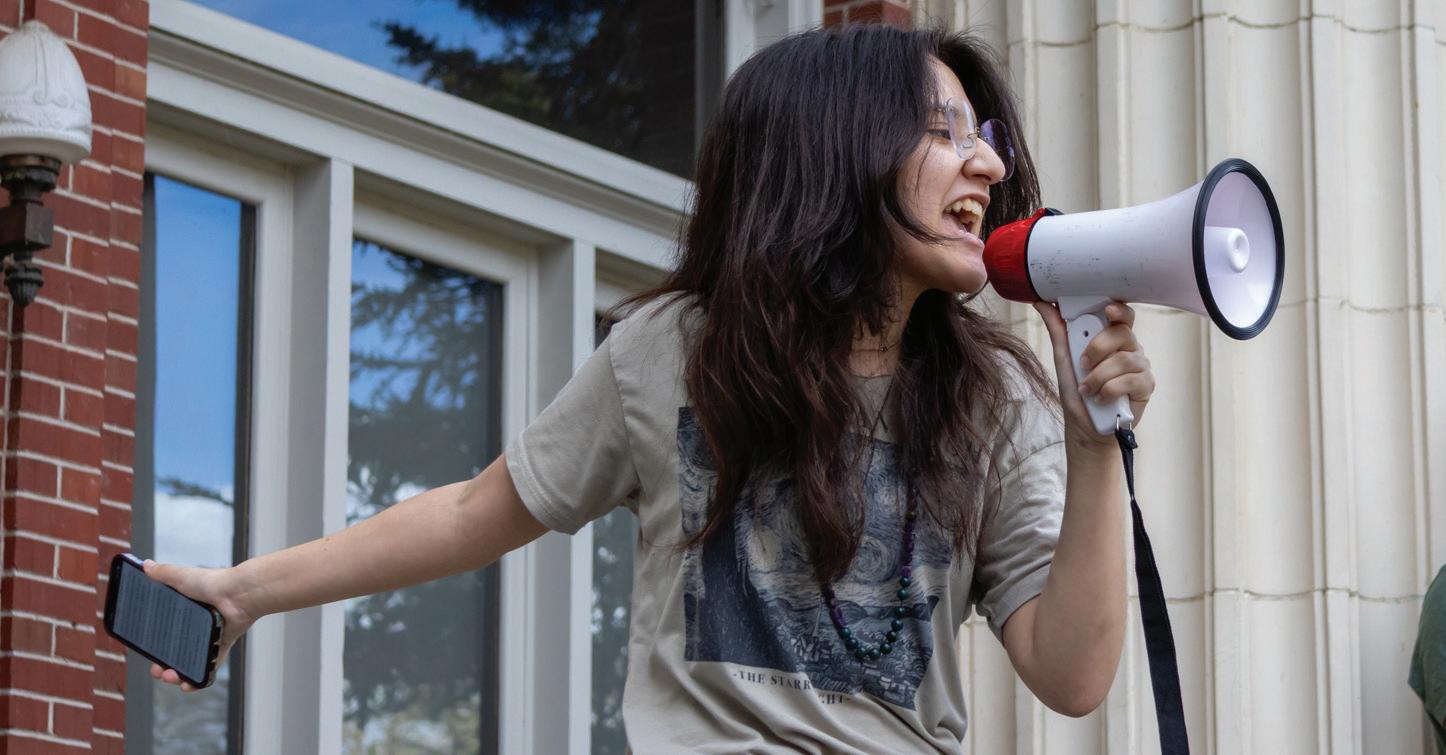
(ON THE COVER, LEFT ) Toby Cole, a representative of UO MEChA and the Young Democratic Socialists of America, speaks on the steps of Johnson Hall before the University of Oregon Anti-ICE Coalition delivered a letter demanding protection from ICE to the office of President John Karl Sholz on April 10, 2026.
(ABOVE) A student speaks on the steps of Johnson Hall after the University of Oregon Anti-ICE Coalition delivered a letter of demands to the office of President John Karl Scholz on April 10, 2026. The coalition’s demands include a campus-wide ICE alert system, a commitment against the use of the code of conduct against those peacefully opposing immigration enforcement, the establishment of a Latinx Cultural Center and a comprehensive safety plan.
(Corey Hoffman/Emerald)
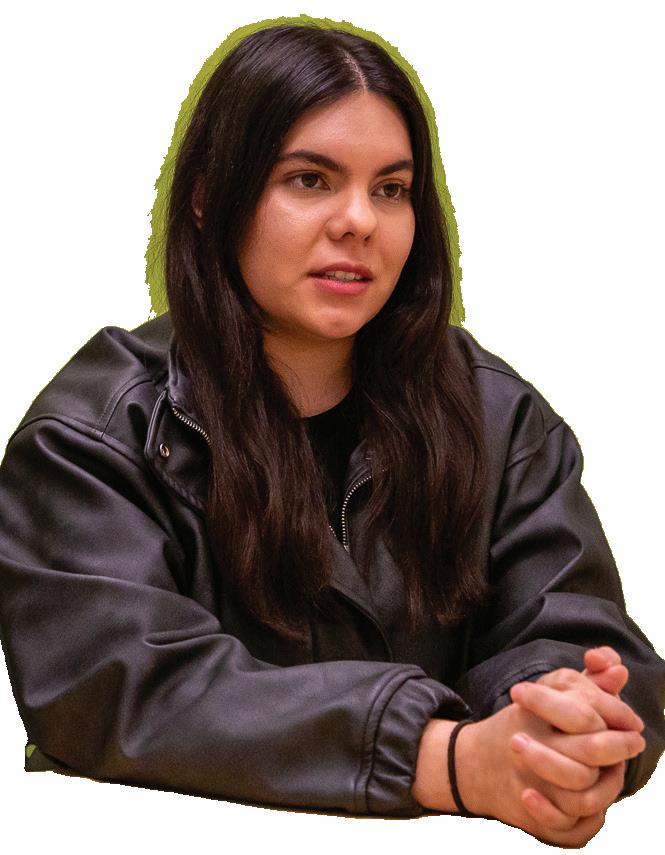
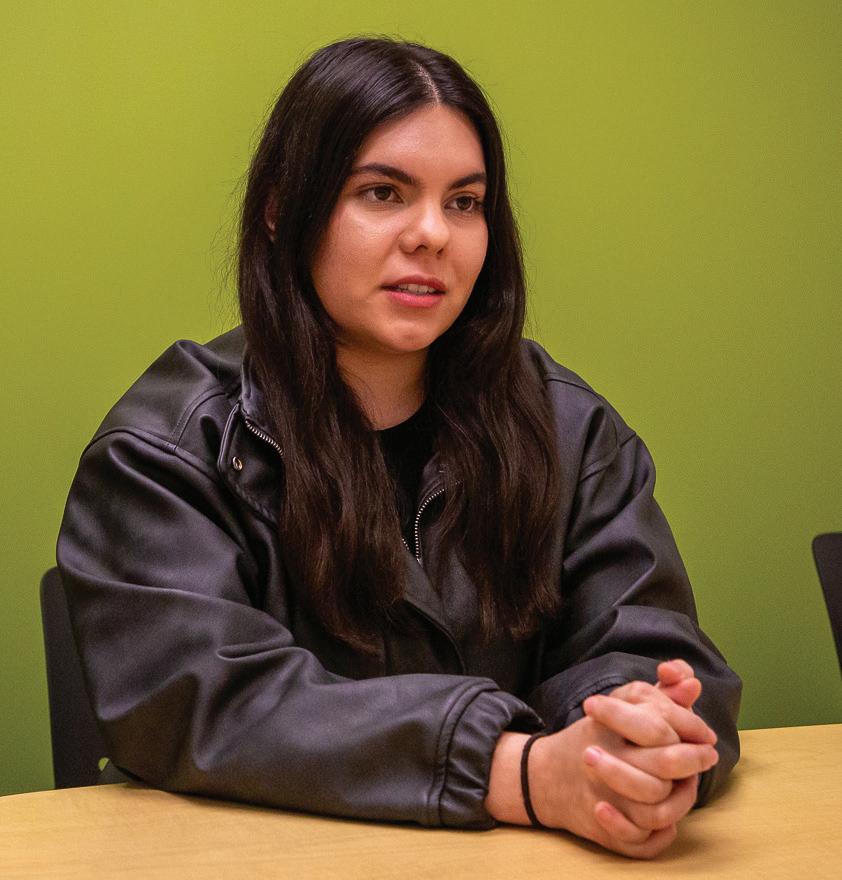
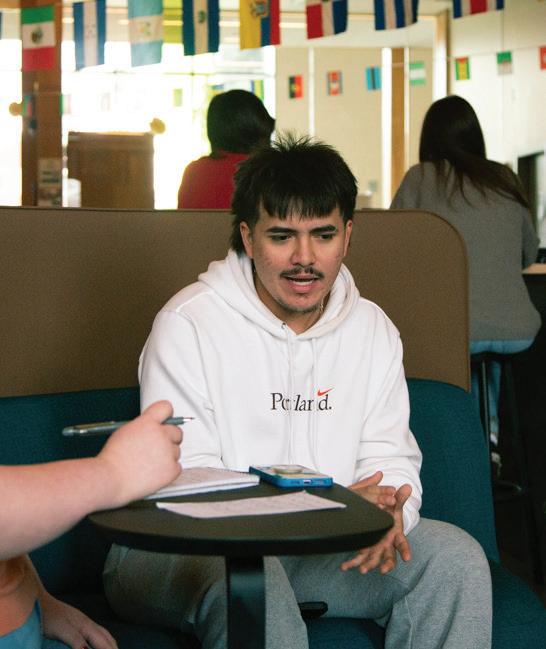
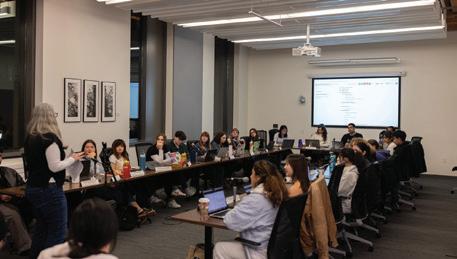
( ABOVE) Gio Bazan-Espain sits with reporter Gabby McIntyre to discuss the goal of a Latinx Cultural Center in the Erb Memorial Union.
(Roshni Ram/Emerald)
Are students voting?
Ballots for primary elections must be postmarked by May 19, but student behaviors indicate little participation in local elections.
By Billie Corsetti News Reporter
Ballots for the 2026 primary election were recently sent out to all registered voters in Lane County, but University of Oregon students may not be among the voting population.
In fall of 2025, UO reported a student population of 24,448, including 20,711 undergraduates. Of the total student population, 52.9% are Oregon residents.
According to the Oregon Secretary of State’s website, Lane County had 283,789 registered voters as of April. The city of Eugene alone holds 123,407 of those voters.
The most recent campus voting report was done in 2022 by the National Study of Learning, Voting and Engagement, when the student population was 22,823. Of the 21,717 that were eligible to vote, 58.5% were registered and 33.5% voted on election day for the midterm election.
“College-educated people vote at higher rates than people who are not college-educated, on average,” Chandler James, associate professor of political science at UO, said. “So there’s something about going to college, whether it be what you learn or how you’re socialized, that generally leads to people being more politically engaged than similarly situated people who don’t go to college.”
For nonprofits like the UO branch of the Oregon State Public Interest Group, increasing the rate of local student engagement has become a priority.
“Voter turnout for state elections is just so much lower, let alone local county elections,” Kali Kleven, vice chair of OSPIRG, said. “What we’ve really focused on is just emphasizing why they’re so important and why they deserve just as much recognition.”
Students who are Oregon residents may be registered to vote in the state, but haven’t necessarily updated their voter registration to Lane County. Ballots are sent back home, rather than to their current mailing address at school. Kleven said outof-state students often don’t even know the primary election timeline.
“So many more decisions are going to be made at the state level, just based on our current administration. Which just means they’re that much more important.” Kleven said. “We’ve partnered with ASUO and the League for Women’s Voters to run voter registration drives leading up to the primaries, where we have a bunch of information from the Lane County Elections Office on the ballot measures and what they would look like if implemented.”
Some students have never considered updating their voter registration, due to being unfamiliar with the local politics and feeling more like a temporary student rather
than a long-term resident of Eugene.
“I haven’t even thought about it,” Kyran Lorio, a junior, said. “I’m not gonna be here very long, but I figured I wouldn’t have much of an impact.”
“I’m only probably gonna be here for college, (but) I spend more time here than I do at home,” Cian Listor, a junior, said. “Like, I don’t usually go home, but I don’t think I’ll ever be like an official resident.”
Both students were Oregon residents and had voted in federal and local elections back home. Another student, sophomore Mari Baker, said they did their own research before voting, often going through the informational pamphlet provided in the ballot. Despite these students’ previous experience in voting, Kleven wasn’t shocked that many hadn’t updated their registration to receive their ballots in Lane County.
“I think for a lot of students, it’s not that they don’t care about voting, but they’re like, ‘I can’t’... Usually, when you talk to freshmen, they’re like, ‘No, why would I change my voter address to my dorm? That doesn’t really make sense for me,’” Kleven said. “But as you get into the sophomore, junior and senior years, you might be living there for three years, in which case it does make sense.”
James believes being an out-of-state student creates complications to voting that sometimes hinder accessibility and motivation.
“You either have to get an absentee ballot or you have to change your registration to your new state, and that is just an additional obstacle for people to participate,” James said. “And so I think a lot of people who go to college are impacted by the kind of complexities with residency that come with going to a school not at home.”
OSPIRG has recently prioritized educating students on how to update their voter registration, which can be done online. In the case of out-of-state students, Kleven said they recognize when registrations in Texas or Florida may be better for the individual to keep.
“Whatever works best for you, as long as you’re doing it,” Kleven said.
Oregon’s primary election will be held on May 19, and voters are able to drop off ballots until 8 p.m. on election day. The university campus has one ballot dropbox outside the Erb Memorial Union next to the amphitheater. Ballots for any Oregon county can be deposited in any dropbox regardless of the county it is located in.
After fall cuts and layoffs, UO librarians reappointed
A neutral arbitrator determined UO did not adequately consider seniority during layoffs at UO libraries.
By Sasha Love Senior News Reporter
The University of Oregon disregarded seniority when sending layoff notices to two UO librarians, according to a third-party arbitrator and attorney.
Librarians were laid off during summer 2025, when 117 positions were eliminated following projections of a $25-30 million projected yearly budget deficit in the university’s education and general fund. These layoffs included the elimination of eight full-time positions at UO libraries to help reduce the libraries’ budget by around $806,000, or 4%.
Layoff notices were sent to the two employees, one senior librarian and one associate librarian, in September 2025, and the layoffs were to take effect one calendar year later. According to United Academics, both librarians had worked at UO for over a decade.
An arbitrator is assigned, according to UA’s Collective Bargaining Agreement, if a grievance procedure is not resolved. Submitting a grievance to arbitration means the two parties present disagreement to a third party arbitrator instead of going to court.
According to UO Associate Director of Employee and Labor Relations Dan Currier, the university determined the junior employees to be a better “fit” to “perform the necessary work of the unit” than senior employees that were given layoff notices. To support this reasoning, UO referred to the higher education status of at least one of the junior employees.
Sally LaJoie, the arbitrator assigned to the case, ruled that both the junior and senior librarians possessed the qualifications to do the work, and thus, according to the contract, seniority should have been considered as a priority.
As the union puts it, the university “misapplied controlling seniority language.”
The university stated that it knew what was best for the library department and thus “interprets the contract language to provide broad discretion in determining the needs of the unit and skills of staff.”
Dan Howard, UA’s chair of the Grievances & Contract Administration Committee, described seniority as a “reward” for being committed to the institution where you serve, but noted that he also sees seniority as a way to encourage contentious dialogue in academia.
“(Senior employees) are feeling a lot of loyalty and investment in the institution, but they may also say ‘There are some things around here that I don’t love the way they’re done.’ So in my view, if you have someone with 10, 15, 20 years of service to the institution, they are more likely to be active in the union and say when they have a problem with certain practices of the (UO) administration,” Howard said.
UO’s position that it can determine which candidate is “best fit,” even if the employee meets the minimum qualifications, “vexes and annoys” Howard.
“This (contract) language does not allow you to do that, because if the university could do that, there would only ever be one best fit,” Howard said. “So, they could always say, ‘You know what, of this pool of employees who are all qualified to do it, we think this one’s the best fit. Therefore, the senior employee is gone.’”
At least one of the layoff decisions was made partly because the employee lacked a Ph.D., according to the arbitration decision, but a doctorate degree was not a requirement, but a preference for the position.
“It was undisputed that the faculty member we were representing had the required degree. So, they (UO) were making an assessment that — even though they both had adequate degrees — they thought that the junior employee’s degree was superior,” Howard said.
UO spokesperson Natalie Hurd said that the university “remains committed to fairly applying the language of the (collective bargaining agreement).”
Additionally, at least one of the librarians was laid off because they worked in a “relatively ‘niche’ role,” in an area of the department with “very few” faculty and students, according to the university’s position in the arbitration decision.
“While the elimination will reduce cataloging support for materials, the scale of these collections has already been significantly reduced, minimizing the impact,” according to the layoff justification memo attached in the arbitration decision. “The need for consultation and instructional support is expected to continue to trend down with enrollments in majors and minors in these areas.”
Kate Thornhill, another librarian who was sent a layoff notice last summer but did not go through arbitration, also works in a specialized part of the library cataloging small and “locally-oriented” collections and digitizing museums and galleries.
Thornhill warned the university to be careful when cutting librarians, because of challenges that come with substituting the work of one specialized librarian with another.
“There are these disciplinary sub-expertise areas and that is why we don’t have a one-size-fits-all librarian even though people assume ‘Oh we don’t need (that) librarian, we just need one of them,’” Thornhill said. “But the thing is, it’s really hard to scale and scope all of the operational functions that a library needs.”
Hurd said that “no layoff decisions are made lightly.”
“The university is focused on completing this review thoughtfully and on continuing to deliver strong library services to students,” Hurd said.
ARTS & CULTURE
NASU holds UO’s 58th annual Mother’s Day Powwow
Grand Entry, traditional music and dance competitions. Sunday was the final day of celebration, featuring a community salmon bake at the Many Nations Longhouse. Salmon is an important food for many Native tribes. It is a crucial part of ecosystems and the economy. Salmon also makes multiple appearances in Native creation stories.
Many important representatives of the Indigenous community were invited and celebrated during the initial powwow. Two UO students, Alexis Maddern and Pachomio Feliz, were named “Miss and Mr. Indigenous.” Head Man Jessi “Redtail” Soliz Jr. and Head Woman Keenas Limon were also celebrated. Head Man and Woman are pivotal members of the Native community, selected for the powwow.
“Being asked to serve as Head Woman is one of the greatest honors that can be received,” Head Woman Limon said. “In this role, it is my duty to serve as a role model for the community and give back to the community that has asked me to serve. At the powwow, it is important to be kind, helpful and present. You should be dancing every song, smiling, helping out wherever possible and enjoying the moment.”
Limon also described how it is standard for the Head Woman to host a “special.” A special event is a specific event to honor certain members of the community. This year’s Mother’s Day Powwow, Limon chose to host a Women’s Fancy Special. A Women’s Fancy Special is a dance, and can also include a gift given away to the women dancers in order to honor them. Limon also gave out snacks, cash and tobacco to the drummers, staff, veterans, NASU and the UO royalty.
She was given the role by Keyen Singer, a co-director of NASU. Limon had already been elected as a Head Woman for PSU’s Naimuma powwow and the Fort Bidwell powwow. She has been attending UO’s Mother’s Day Powwow since she was a little girl, so when she was offered the position, she didn’t hesitate to accept.
“I love, love, love this powwow as my family, and I would always travel to it together, and we always see old friends,” Limon said. “This year felt so wholesome, and I am so grateful to the NASU students for doing such an amazing job. The atmosphere was nothing but good vibes, and everyone was all smiles.”
Velarde and Limon both spoke about the impact these powwows have on the student body. The
Mother’s Day Powwow builds community for the Native students who have left the reservation. The goal is to keep the Native community alive.
“Most of the Native students are leaving the reservation,” Velarde said. “They’re leaving their home, and, you know, it’s a lot of kinship. A lot of Natives leave a lot of their family off the reservation to go to this white area. So having this be available for the Native community, for Native students, and just for everybody in general is very good.”
Especially for college students, as Limon herself stressed, it can be hard to come together with the busy schedule of university, but that’s what makes these events much more memorable and important.
“You are so busy and often away from your roots, which can be hard,” Limon said. “It’s nice to be able to create an atmosphere to be with other students who may be experiencing the same thing and to connect with your community, even if it’s for a weekend.”
Limon also believes showing off their status as higher-education students is beneficial for the younger generation. A demonstration of education and culture at a traditional event like a powwow shouldn’t be overlooked.
“As native people, some of the main ways we are brought together are by dance and laughter, and a powwow is the best way to do that,” Limon said. “I feel the Native American Student Union achieved that and so much more. Chi-miigwech to them, the rest of the powwow staff and the community for making this year’s UO Mother’s Day Powwow an amazing one.”
(
The group bringing Bollywood dance to campus
Desi Ducks, founded last spring, has established itself as UO’s own South Asian dance group. They hold practice weekly and perform at on-campus events to introduce students to the style.
By Amelia Fiore Arts & Culture Writer
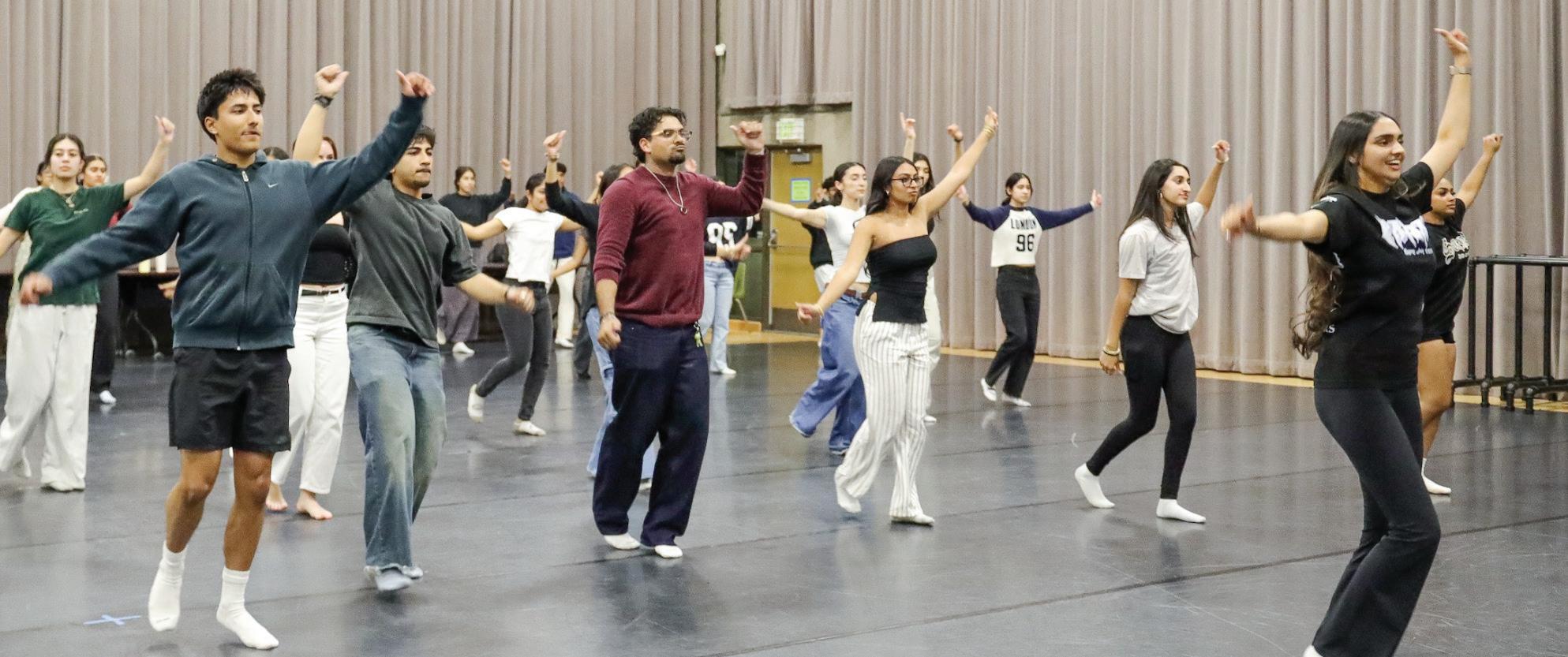
Every Thursday at 7:30 p.m., a group gathers in the Rec Center’s Studio 41. It’s tucked away from the main bustle of the open rooms filled with machines and weights, but it isn’t cramped by any means. Tonight, they’re practicing a routine to “Iski Uski” from the 2014 Indian rom-com, “2 States,” in front of the wide mirror. The team splits into two groups alternating motions. They laugh as they move through the steps together, swinging their arms and stepping side-by-side.
This is a typical session for Desi Ducks, UO’s co-ed Bollywood fusion dance club. Zaara Arora, a sophomore, has been dancing her whole life and teaches each new routine. It’s a role she has established for herself through her co-founding of Desi Ducks, an organization formed out of a desire to create a space on campus for students like herself. In April 2025, Arora, Thara Rao and Anjali Srirama founded the dance group.
Each meeting is dedicated to learning new choreography to popular Indian songs, many derived from Bollywood films. The group has held events sparsely throughout the year; their most recent workshop focused on Bhangra, a high-energy style of Punjabi dance, alongside local all-female dance team Ankhi Mutyaraan. Many of the attendees hadn’t been introduced to the style before, and Desi Ducks enjoyed sharing it with them.
It was also the group’s first independent event. Hosting was “definitely a big learning curve,” according to Arora, as they have only recently become an ASUO-recognized organization eligible for a surplus budget.
“It was really cool because this was the first time that we’ve had Punjabi representation here at Oregon,” Arora said. “But since we hadn’t had a finance person yet, it was definitely a learning experience when it came to filling out the right forms and coordinating, catering and logistics. And it was definitely a lot, but seeing how many people showed up and the support that we got from it was a lot more than I expected.”
Jai Pandhoh and Hridi Bhakta, students who have been members since the beginning, have both enjoyed watching the group evolve over the past year. Bhakta specifically noted that the group’s inclusive environment creates the opportunity for non-South Asian students to learn about culture through dance.
really fun, and it’s a very inclusive community.”
Pandhoh, who helped coordinate the Bhangra workshop, agreed, adding that it’s been exciting to see students from various cultural backgrounds join the group. “I think that’s a beauty of South Asian dancing,” he said. “Something like Bangra is one of the dances that we do, and a lot of people, even if it’s not their type of dance or where they’re from, they still like doing it.”
Both Pandhoh and Bhakta are looking forward to watching Desi Ducks grow while introducing the community to the practice of South Asian dance. A crucial factor in establishing a presence on campus is through collaborating with other student organizations, something they hope to do more of moving forward.
They have worked with several other cultural organizations on campus this year. Most notably, with UO’s South Asian Cultural Alliance for their Navratri celebration in October and their Diwali celebration in November. A standout collaboration, however, was a workshop with UO’s Muxeres in October to a mash-up of “Dil Dooba” and “Con Calma.”
To Ameya Shenoy, vice president of public relations and marketing, Desi Ducks is an initiative to “create a space where our culture is visible and celebrated on campus, especially during these divided times.” Shenoy said, “One of our biggest goals is collaborating with other cultures and just showing people that collaboration is what connects us. Culture is so important, and I feel like we miss that a lot at UO.”
Arora emphasized the importance of keeping Desi Ducks a low-stakes, casual, collaborative environment. She said that as members continue to practice, their skills will naturally improve, but that shouldn’t be the driving incentive behind participation; creating a space of inclusion and cultural appreciation is what matters most. Next year, the Desi Ducks executive board is expanding to include two choreographers and a vice president of finance.
“I mean, I just think it’s incredible how much we have grown in the last year,” Arora said. “I think it just shows the love that people have for it out of something that we built from the ground up. And it’s just been really, really meaningful to see the growth of it. Dance meant so much to me my entire life, it’s part of who I am, and it’s kind of cool that I get to embed that into other people’s lives too.”
(
Student attendees
A
“I like to see non-South Asian people come and do the dances that I kind of grew up doing. It’s very nostalgic and just heartwarming to see. Like, now you’re all grown up and see your nonSouth Asian friends doing it,” Bhakta said. “It’s
ABOVE)
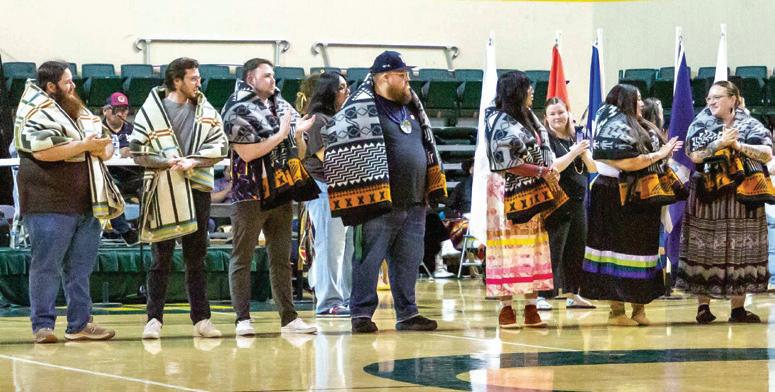
dancer participates in the Grand Entry on day two of the 58th annual Mother’s Day Powwow, presented by the UO NASU in McArthur Court in Eugene, Ore. across May 8, 9 and 10, 2026.
(Corey Hoffman/Emerald)
ABOVE)
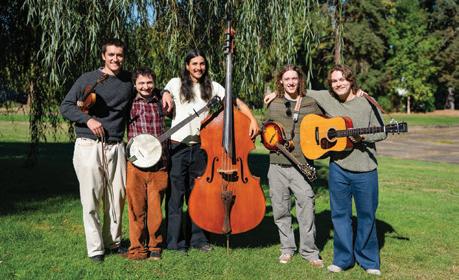
participate in the Bhangra dance workshop, held by the Desi Ducks and Ankhi Mutyaraan, a local all-female college-age Bhangra group.
(Courtesy of Kunal Sambhi)
“I guess that’s fine”
Notorious cobra killer (with a bird that flies in Vs?)
Backlined concert gear
Weakling
Longest tongued land mammal (with an insect that’ll invade your picnic?)
Popular rideshare
___ Club (Costco competitor)
1 24-hr. bank device
2 Half a quartet
3 Bear’s living space 4 Oompa ___
5 Breakfast diner that once tried selling burgers
6 Green rock growth
7 Squeeze (out)
11 Those playing Minecraft or Valorant
13 League with Sparks and Mystics
14 Part of a list
15 Ger. neighbor
16 Grad students’ jobs 17 The night before 18 Agent, for short
Aishiki Nag is a senior studying political science and global studies. She likes to cover state and national politics, and international peacebuilding efforts.
Nag: The labor candidate running for Eugene City Council
Jennifer Smith, running for Ward 3 in Eugene, best captures the interests of local unions and the working class, bringing the promise of changes to the city.
By Aishiki Nag Opinion Columnist
The May 19 election has brought electoral competition to the Eugene City Council elections. Currently, both Jennifer Smith and John Barofsky are running for the Ward Three position for the Eugene City Council.
Barofsky and Smith both have competitive resumes as to why they should be the next councilor to represent Ward 3, but Smith’s background in labor organizing and ongoing grassroots leadership is best suited to address the issues the community is facing.
Ward 3 encompasses the University of Oregon, and primarily where students and graduate teaching staff live. Smith has received numerous notable local endorsements, including those from the Democratic Party of Lane County, the Associated Students of the University of Oregon, the United Academics of the University of Oregon and University of Oregon Student Workers.
Smith has an active focus on making housing affordable and accessible amidst the rising cost of living, with specific focuses on expanding tenant protections and the creation of union jobs. She also is focused on making sure that Eugene is not only on track to meet its climate goals, but that the city becomes a national climate champion. Smith is also an active advocate for human rights, and has publicly condemned ICE within Eugene communities.
“Jen has been an ally of our union, she is the president of the UO classified staff on campus, SEIU, they’re great allies. We like to stand in solidarity with each other across campus labor issues,” said Jonah Dyk, a second year student and a current organizer with the political action committee at UOSW.
Notably, Dyk mentioned that Smith was the only candidate that reached out to UOSW for an endorsement during this race.
“I like her stance on transportation and reducing car infrastructure in Eugene, and swapping that with more bike-friendly infrastructure and policies,” Dyk said. “Personally, she doesn’t own a car, and neither do I. I think they’re expensive, and necessitating owning a car for student workers is a big burden financially that a lot of us can’t afford in Eugene.”
Smith has a long history of labor organizing, serving as the president of SEIU 503 Local 085 and the UO Labor Education Research Center Coordinator. She has also served in the Oregon Higher Education Coordination Commission, adding to her organizing background.
Collin Heatley is a rank-and-file member of the Graduate Teaching Fellows Federation and was most recently the graduate employee at the Labor Education and Research Center on campus. He also reiterated Smith’s commitment to Ward 3.
“I think what resonates with both my community of graduate students and me is her laser
focus on cost of living, particularly on housing,” Heatley said, referencing the power the city council has on shaping housing affordability.
“Having someone that’s going to fight for affordable housing but also do so in a way that’s going to create protections for tenants living in those units, has been my focus and it’s something that affects the graduate student community.”
Heatley also stresses the importance of students and community members voting in the May election. Usually, local and spring elections see low voter turnout among young voters, but this particular election directly determines the future of student housing in this region.
“We are all members of this community while we’re living here, and ideally, there are good job opportunities, and it is an affordable place to live that people want to stay after they graduate,” Heatley said. “The stakes of this election are if we can elect Jen, we will have another pro-labor, pro-working families (councilor) and have somebody with an organizing mentality and ability to build people power in the city council.”
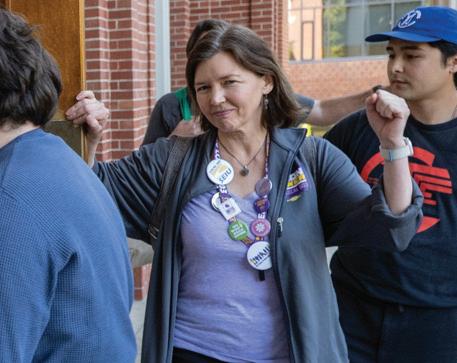
(ABOVE) Presence O’Neal, GTFF President, Jennifer Smith, SEIU Local 503 and others walking inside Johnson Hall to deliver President Scholz a letter of condemnation.
(Saj Sundaram/Emerald)
Kahl: Too many cyclists are being killed in Eugene
The city just had its third fatal bike versus car collision less than halfway through the year. Changes must be made to protect the lives of Eugene’s cyclists.
By Emma Kahl Opinion Columnist
Just five days after Erick Munene Njue died in a collision while riding his bike near the University of Oregon campus, hundreds gathered for a vigil mourning the doctoral student. A stark white ghost bike memorial has since been surrounded by flowers just near the site of the crash. The community should not have to continuously grieve preventable deaths while waiting for safer infrastructure to be implemented.
Early this year, The Daily Emerald examined the local rise in traffic deaths and the seemingly slow response by the city of Eugene. While advocacy is essential in reducing the number of crashes, we have reached a point where direct action is urgently required to protect the broader community.
Darren Isenhour is a sales account manager for a local millwork shop in Eugene. He lives on River Road, directly across from where a traffic accident occurred on May 2 that resulted in the death of David Winston Morris, a local cyclist.
Isenhour explained that the streets of Eugene, and particularly those around River Road, have felt unsafe since he moved there over 10 years ago. He also mentioned that speeding and reckless driving are common occurrences in the area.
“Eugene has changed the speed limit, but that hasn’t changed the speeding. Maybe if people had real consequences for their actions, things would change,” Isenhour said. “I am at the point where I
just don’t believe anyone really gives a damn.”
He also said the area is unfit for children and he doesn’t allow his kids to walk or bike to their nearby school or play in front of their house. “People have become selfish and unaware of their surroundings. It’s only a matter of time before another person is killed on this road,” Isenhour said.
Residents like Isenhour point to reckless driving and weak enforcement as major problems, while some cycling advocates say that Eugene’s inadequate road infrastructure also plays a substantial role in putting bikers at risk.
Kayna Robison is the president of Greater Eugene Area Riders, a nonprofit organization that encourages locals to use bike riding for both transportation and recreation. GEARs also provides safety skills and education and coordinates group rides.
Robison explained that Eugene’s reputation as a “bike-friendly” city can hide some of the very real safety concerns. She said that while the city continues to invest in painted bike lanes and increased cycling efforts, there is missing infrastructure, like protection barriers, that can better protect cyclists.
“Cyclists remain vulnerable when sharing roads with cars, especially on busy arterial streets. Rising traffic deaths nationwide, distracted driving and inconsistent road design also help explain why there have been increased cyclist fatalities despite Eugene having a healthy cycling culture,” Robison said.
The League of American Bicyclists established May as National Bike Month in 1956, and Eugene annually promotes its celebration all throughout
the month by hosting events and group rides.
As Eugene riders take to the streets this month, cyclists must also consider if the city’s streets are actually safe enough to use. If the city encourages more frequent biking without making significant safety improvements, they risk turning this sustainable mode of transportation into a dangerous one.
Kahl is an opinion columnist for The Daily Emerald. She is currently a senior, majoring in written journalism and minoring in global studies. Her writing focuses on social commentary, culture and politics.
Emma
Flowers to remember the loss sit around the bike. A “Ghost Bike” commemorating the recent loss of cyclist Erick Njue sits on the corner of 22nd Avenue and Patterson Street in Eugene, Ore., on Feb. 17, 2026. (Tyler Graham/Emerald)
Bodey Lutes lives out childhood dream at Oregon Twilight meet
Lutes, born in Coos Bay, grew up dreaming of running at Oregon. His first race in Ducks colors brought a personal best.
By Henry Light Sports Writer
Oregon track and field freshman Bodey Lutes continued a streak of breakout performances at Hayward Field with a lifetime-best 1:45.62 in the 800-meter race at the Oregon Twilight meet, earning him Big Ten Freshman of the Week honors.
Lutes’ series of attention-grabbing 800-meter performances at Hayward began last season when he ran a 1:47.74 competing at the Nike Outdoor Nationals for Marshfield High School. That time provided the then Western Oregon University commit an opportunity to flip to Oregon, where he began the 2026 outdoor season with a personal-best 1:46.65 at the Oregon Team Invitational, competing unattached. In his first race in green and yellow, Lutes
set another personal best, continuing the rapid start to his collegiate career.
“I was always sprinting a year ago, and now I think I’m starting to become more of a runner,” Lutes said. “I’m just way more fit. I’m just as fast as I was last year, but I’m 100 times more fit than a year ago today.”
Lutes grew up 110 miles southwest of Hayward Field, where he dreamed of donning the green and yellow that his mother, Amy Nickerson, wore during the 2000 season. Like his mother, an 11-time Oregon state champion, Lutes excelled in high school, catching headlines in 2025 for breaking Steve Prefontaine’s school record 800 time with a 1:53.00.
Later in the season, his lifetime best at the Nike Outdoor Nationals allowed him to trade the black and red of Western Oregon for the green and yellow that he wore growing up as an Oregon sports fan.
Lutes made his collegiate debut in a red uniform anyway due to his unattached status for the Oregon Team Invitational. One week after Lutes ran a lifetime best at that meet, the NCAA moved toward allowing all student athletes five years of eligibility, decreasing the importance of redshirting this season, and opening up the opportunity for Lutes to wear an Oregon logo for the first time in competition.
“We’re hoping that athletes all get five (years), but nobody knows exactly what’s gonna happen,” Oregon head coach Jerry Schumacher said. “Bodey knew, we said, ‘It looks like it’s going that direction. There’s no guarantees on it. What do you want to do?’ and he’s like, ‘I think I want to run in a uniform then,’ so the uniform went on, and he didn’t disappoint.”
In the week leading up to the meet, Lutes didn’t have a second thought about the decision.
“I was going to bed each night, just checking it out, feeling the jersey, like this is what I wanted forever,” Lutes said.
When May 8 arrived, and Lutes stepped on the track wearing an Oregon logo for the first time, he displayed his physical and mental progress as a Duck with a race that was equal parts gritty and disciplined.
Lutes briefly ran on the heels of the pacer early in lap one, before maintaining a tight group with teammates James Harding and Simeon Birnbaum until midway through the second. As he began to fade while pulling into the final 200 meters, grit took the wheel from discipline, and Lutes pushed across the line with the No. 13 time of the 2026 Division I season.
“The plan was to stick behind James. Our goal was just to wait till the last 100, and that’s what I did,” Lutes said. “I think it slowly ramped up throughout the second lap. Maybe not pace-wise, but even effort, and we just slowly, in effort, ramped it up over the second lap.”
The 19-year-old’s streak of personal-best runs projects a bright future for himself and the program that was once his North Star, but his coach is focused on the long season ahead.
“We’re hoping his season goes deep, we’ve got NCAAs that we’re hoping for — Gotta get through regionals, of course — and then for him, he’s got the U20s and the World U20s is here on our track, so it would be incredible if he could make that team,” Schumacher said.
Leader: Breaking down the issues with Oregon's pitching depth
Analyzing the Ducks’ biggest issues out of the bullpen.
Harry Leader Sports Writer
The Oregon baseball team is one of the topranked teams in the Big Ten. Now, that’s not a bad place to be heading into the postseason, but it’s alarming how the Ducks lost a majority of their games: the bullpen.
The depth in the Oregon bullpen is shockingly poor compared to other ranked teams the Ducks have dropped series to, like UCLA and Oregon State, who have multiple relievers with ERAs under 2.00 in over 20-plus appearances as of May 12, which is something that can only be said about Tanner Bradley (1.79), who has been the closer almost all season. That being said, Bradley has only pulled off one save and blew a save opportunity in the series finale against No. 1 UCLA after allowing a walkoff grand slam in just four pitches.
Taking one good look at the bullpen shows that most of the bullpen cannot effectively close
out games after the fourth or fifth inning, with multiple middle relievers like Leo Uelmen, Gabe Howard and Shane Johnson all above a 6.20 ERA in a combined 26 appearances.
Notably, most of the freshman arms in the bullpen, aside from Johnson, barely play, and when they do, they give up a lot of runs. Hudson Carvalho, who didn’t pitch in the entire month of April, still has a 37.80 ERA after four appearances, and Josh Hollis, who has had a somewhat prominent role with five appearances, including one start, has the second-highest ERA (9.53) on the team behind Carvalho.
It isn’t just the freshmen who are struggling, either. Sophomores Luke Morgan and Michael Meckna have been two of the go-to middle relievers with 19 appearances apiece, with Meckna having one start. The issue hasn’t necessarily been their ERAs (5.91 and 4.91, respectively) but more so their inability to perform consistently.
Morgan has had some stellar outings throughout the year with zero hits in eight of 19 appearances, but recently allowed late-game runs that sparked comebacks in both the UCLA and Washington series. Meckna was a part of the pitching
unit that dropped the game in Seattle on May 3 alongside Morgan, but their worst performance together came on April 8 against the University of Portland, where they allowed a combined six runs on three hits, which sealed the upset win for the Pilots in one of the worst pitching games for Oregon this season.
The reason why all of this is so concerning is that this is a team that is expected to not only win in the regionals but also to make a deep run into the postseason. A team with one solid reliever cannot be a contender for a national championship, especially when that team is playing against teams with three or more relievers better than their closer. The Ducks have a solid unit on the hitting side of things and decent starters in Sanford, Clarke and Gosztola, but they won’t be able to be the ones to secure wins late in the game in high-pressure situations.
The Ducks have very little time to make changes, if any, before they likely head off to the Big Ten tournament to start the postseason, and it will take a miracle to turn this bullpen around in time with the way they’ve played in recent games.
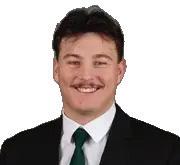
ERA: 5.91
Appearances: 19 (0 starts)
Strikeouts: 26
Opponent Batting Average: .211
Michael Meckna
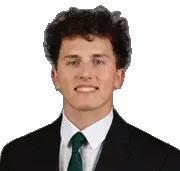
ERA: 4.91
Appearances: 19 (1 start)
Strikeouts: 23
Opponent Batting Average: .293
Luke Morgan
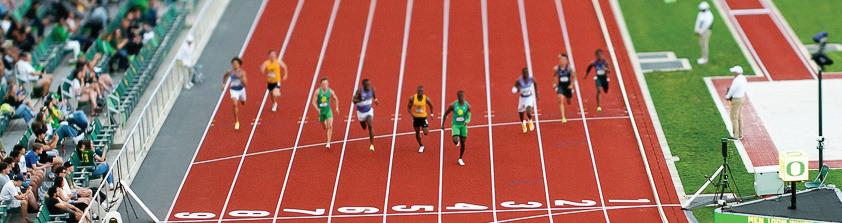
(ABOVE) Sprinters in the men's 100m invite race cross the finish line. The University of Oregon Ducks host the second day of the Oregon Team Invitational at Hayward Field in Eugene, Ore., on April 18, 2026. (Saj Sundaram/Emerald)