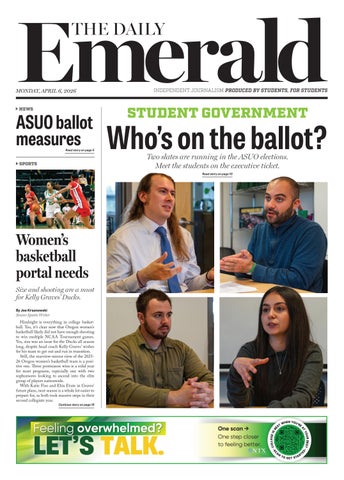
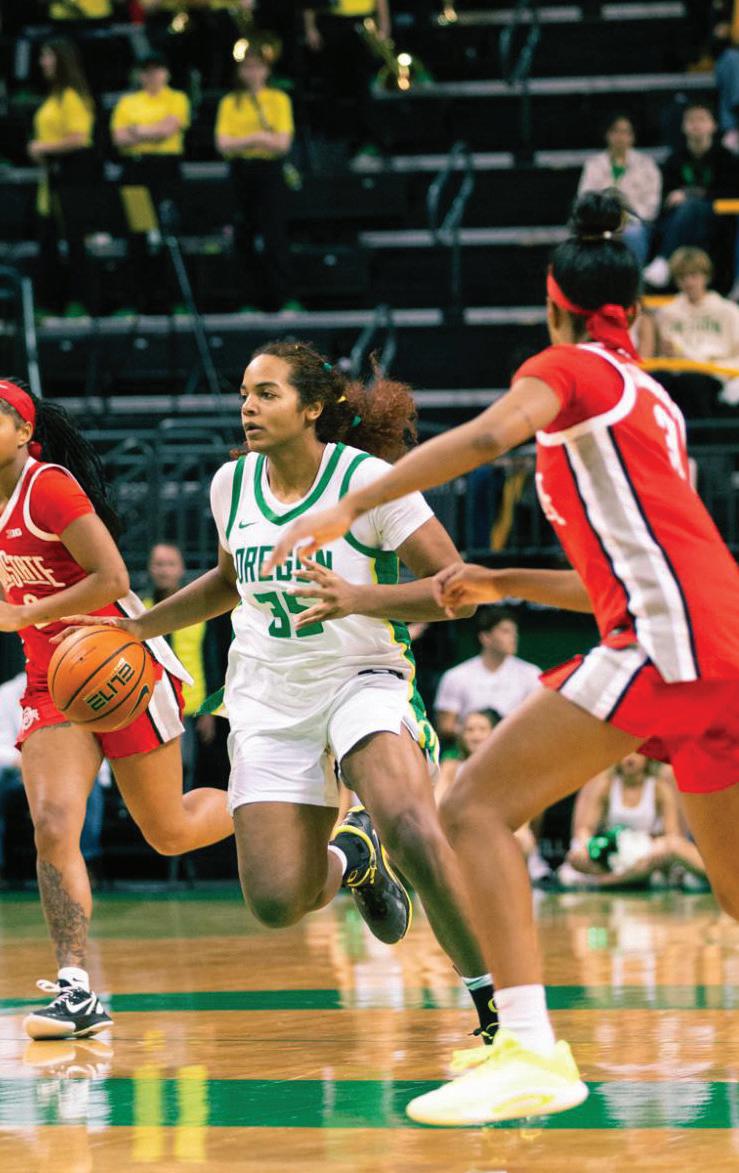
Size and shooting are a must for Kelly Graves’ Ducks.
By Joe Krasnowski Senior Sports Writer
Hindsight is everything in college basketball. Yes, it’s clear now that Oregon women’s basketball likely did not have enough shooting to win multiple NCAA Tournament games. Yes, size was an issue for the Ducks all season long, despite head coach Kelly Graves’ wishes for his team to get out and run in transition.
Still, the rearview-mirror view of the 202526 Oregon women’s basketball team is a positive one. Three postseason wins is a solid year for most programs, especially one with two sophomores looking to ascend into the elite group of players nationwide.
With Katie Fiso and Ehis Etute in Graves’ future plans, next season is a whole lot easier to prepare for, as both took massive steps in their second collegiate year.
Continue story on page 19
NEWSROOM
EDITOR IN CHIEF
Tarek Anthony
PRINT MANAGING EDITOR
Ryan Ehrhart
DIGITAL MANAGING EDITOR
Ysabella Sosa
NEWS EDITOR
Reilly Norgren
INVESTIGATIONS EDITOR
Ana Narayan
A&C EDITOR
Claire Coit
SPORTS EDITOR
Jack Lazarus
OPINION EDITOR
Gracie Cox
PHOTO MANAGING EDITOR
Corey Hoffman
PHOTO EDITOR
Saj Sundaram
COPY CHIEF
Olivia Ellerbruch
VIDEO EDITOR
Jake Nolan
PODCAST EDITOR
Stephanie Hensley
SOCIALS EDITOR
Ysabella Sosa
VISUALS EDITOR
Noa Schwartz
DESIGN EDITOR
Adaleah Carman
DESIGNERS
Asha Mohan
Ellery Burton-Tillson
Eva Andrews
Izzy Smith
Nina Rose
EDITORIAL
BUSINESS
PUBLISHER AND PRESIDENT
Eric Henry (X317) ehenry@dailyemerald.com
VP OPERATIONS
Kathy Carbone (X302) kcarbone@dailyemerald.com
DIRECTOR OF SALES & DIGITAL MARKETING
Shelly Rondestvedt (X303) srondestvedt@dailyemerald. com
CREATIVE & TECHNICAL
DIRECTOR
Anna Smith (X327) creative@dailyemerald.com
ACCOUNT EXECUTIVES
Torin Chevalier
Camcole Pereira
Ava Stephanian
Elliot Byrne
THE DAILY EMERALD
The Daily Emerald is published by Emerald Media Group, Inc., the independent nonprofit media company at the University of Oregon. Formerly the Oregon Daily Emerald, the news organization was founded in 1900. Emerald Media Group 1395 University St.,#302 Eugene, Or 97403 (541)-346-5511
FIND MORE STORIES ONLINE AT DAILYEMERALD.COM
Regina Lawrence selected as next SOJC dean
After a months-long search, the UO Dean Search Committee selected current interim dean Regina Lawrence as the next dean of the SOJC.
By Sasha Love Senior News Reporter
Regina Lawrence, the current interim dean of the University of Oregon’s School of Journalism and Communication, was announced as the next Edwin L. Artzt Dean on Friday, April 3.
The SOJC dean search began in July after former Dean Juan-Carlos Molleda resigned following public scrutiny over his travel expenses during his time as dean.
Man convicted in killing of former UO professor
Scott Stolarczyk, the man accused of killing former UO professor Sharon Schuman, is convicted of second degree manslaughter and DUI.
By Corey Hoffman Senior News Reporter
Scott Stolarczyk, the man accused of killing former University of Oregon professor Sharon Schuman in a motor-pedestrian accident in April 2025, has been charged with second-degree manslaughter and driving under the influence of intoxicants.
Sentencing will begin Wednesday, April 8.
According to court documents, the jury left the room for deliberation at 3:26 p.m. and returned with the guilty verdict at 4:50 p.m.
Letter from the Editor
By Tarek Anthony Editor-in-Chief
Today marks the beginning of the annual five-day election window for the Associated Students of the University of Oregon, the school’s student government body. Each year, every student pays an incidental fee that contributes to ASUO’s $10 million annual budget.
The students elected to the ASUO Senate control this substantial budget and are tasked with deciding how to spend it and which student organizations receive funding. This is an enormous power and responsibility held by your fellow students — and it is therefore your responsibility to vote.
In 2025, nearly 90% of I-fee-paying students did not vote. In the winter election, which passed sweeping reforms including ranked-choice voting, fewer than 100 students voted out of more than 23,000 eligible voters. In 2024, turnout in the runoff elections was under 6%.
This represents an astounding number of students who did not have a say in where their student fees go or who wields the power to allocate them.
Last Wednesday, The Daily Emerald held its annual debates, where the student presidential slates — UO Student Power and Student United Front — discussed
issues including ICE on campus, housing affordability, student program funding and more. In a room designed to hold more than 500 people, approximately 15 attended.
This trend of disengagement is deeply concerning given the scale of money and authority student leaders hold.
ASUO funds programs students rely on every day, including LTD bus passes, rideshare vouchers, PeaceHealth Bikes, child care and basic needs services, among others.
As in elections from the president of the United States to state legislatures to mayoral races, power goes unchecked and unscrutinized when the public is disengaged.
Many students fail to recognize that they have a say in where their tuition dollars go. To exercise that power, they must vote and engage with their elected student leaders.
From shaping university-wide programs like bus passes and bike services to electing leaders who represent specific majors or programs, students hold significant influence through ASUO.
Voting is simple through the Engage platform. Log in, vote for president and your school-specific representatives and know you have contributed to campus democracy — and to decisions about where $10 million a year goes.
But along the way, become informed. Whether by visiting the ASUO office in
the EMU, reading The Emerald’s profiles of each candidate or attending a debate, we strongly encourage you to have your voice heard.
Be part of an election year with turnout higher than 5, 10 or even 15%.
It also goes beyond the money. ASUO leaders are often the first line in holding university administration accountable, lobbying for student interests in Salem and Washington, D.C., and advocating for student rights.
If you’re paying into this system, take 10 minutes this week — get informed, vote and make sure your money isn’t spent without you.
ASUO ballot measures
Students voting in the ASUO elections will have the opportunity to respond to seven ballot measures, most a minor procedural changes within ASUO, in addition to a non-binding vote of no confidence in President Scholz.
By Corey Hoffman Senior News Reporter
In addition to the presidential candidates on the ballot, the 2026 ASUO elections also include seven proposed ballot measures.
Ballot measure one is aimed at streamlining the hiring process of the ASUO Election Board Chair by allowing the ASUO Election Board Chair to be appointed in week 5 of fall term, as opposed to being appointed by the president-elect in the spring.
A “yes” vote would change the ASUO Constitution to reflect that change.
Ballot measure 2: annual document organization
Ballot measure 2 is a proposed amendment to the ASUO Constitution to “require ASUO professional staff to formally correct the document’s organization annually by May 24, subject to review by the incoming speaker of the legislature.”
As of right now, ASUO does not have a constitutional requirement for administrative document corrections.
Ballot measure 3: authorization for the ASUO student senate to amend administrative nomenclature
Ballot measure 3 proposes allowing the ASUO senate to update the titles of ASUO officers and internal bodies by a two-thirds vote without requiring an election ballot measure. Currently, changes to the ASUO Constitution must be voted on by students by way of a ballot measure. A “yes” on
this ballot measure would allow the ASUO senate to make “strictly nomenclature-based updates to the constitution with a two-thirds supermajority vote.”
This amendment would allow the Senate to change the titles of ASUO officers, committees or internal bodies. All changes made by the Senate must be approved by the Constitution Court, which is responsible for making sure title changes do not “ change the power, duties, balance of power or structure of the ASUO.”
If the Constitution Court approves the title changes, the ASUO Constitution may be updated accordingly.
Ballot measure 4: change title of ASUO Student Senate president
Ballot measure four proposes changing the title of ASUO Student Senate President to “Speaker of the Legislature.”
A “yes” vote on this measure would amend the ASUO Constitution to say “All mentions of ‘ASUO Student Senate President’ or ‘Senate President’ across all sections of the ASUO Constitution shall be replaced with ‘Speaker of the Legislature’.”
Ballot measure 5: integration of fulfillment of duties criteria in grievance process
Ballot measure five proposes requiring the Constitution Court to consider specific recommendations and criteria published by the Senate and Finance Committees during grievance processings.
A “yes” vote on this ballot measure would amend the ASUO constitution to allow the Student Senate to write its own criteria to be considered by the Constitution Court during grievance proceedings.
Ballot measure six proposes to update the ASUO Constitution to accurately reflect the number of seats on the Program Finance Committee. Currently, the Constitution “inaccurately defines” the Program Finance Committee as having nine members, when it actually has 10 members.
Ballot measure 7: student vote of no confidence
Ballot measure seven asks students to express their “preferences for or against a vote of no confidence in the University of Oregon President and Chair of the Board of Trustees.”
The question asks students whether they believe that UO President Karl Scholz and UO Board of Trustees chair Stebe Holwerda “failed to take action” on “campuswide concerns.”
Concerns listed on the vote of no confidence include, but are not limited to, the presence of ICE and the “refusal to organize an alert system regarding ICE,” the suppression of labor activities on campus, the reconstructing of Resident Assistant positions, the lack of consultation with students, faculty and staff regarding budget cuts and the “refusal to support divestment from all stocks, funds, endowments and the end all commercial relations with any entity that has been credibly reported as complicit in human rights violations in Palestine.”
While these statements are non-binding, a “yes” vote on this measure would express “disapproval” and “distrust” in President Scholz and Board Chair Holwerda’s “ability to lead the university and defend the rights of students, faculty and staff.
What to know ahead of No. 2 Oregon acrobatics and tumbling vs. No. 1 Baylor University
The nation’s top two teams rematch in Eugene ahead of the NCATA Championships.
By Owen Murray Associate News Editor
No. 2 Oregon acrobatics and tumbling maintained its position in the latest NCATA poll, released April 1. Its opponent on April 6, No. 1 Baylor, did so as well. The Ducks and Bears are the expected top two seeds in the upcoming NCATA Championships, but Baylor is currently holding a five-year winning streak over the rest of the nation ahead of their meet in Eugene on Monday night.
The Ducks (5-1) enter Monday’s meet on the back of a dominant win over No. 15 Hawaii Pacific University. The Sharks dropped two places from the preseason coaches’ poll, but remain a ranked win for Oregon. Fifth-year base Blessyn McMorris was named the NCATA Athlete of the Week following the meet; the award is her second in the category of the season, and third-all time, tying two other Oregon alumni for most wins in a career.
Baylor remains undefeated entering the meet, including a win over the Ducks in Waco, Texas earlier this season. The Bears overcame a fall in pyramid event in that meet to surge past Oregon in the second half with a 278.050272.530 final score, but haven’t been seriously tested since then. Their best win since, over No. 4 Iona University, was a 14.985-point blowout in which they never trailed.
The Bears boast several stars, including reigning NCATA Division I Athlete of the Year Payton Washington. Washington, a junior top/tumbler who dominated as a freshman and cemented herself in a talented tumbling event rotation, poses a threat alongside multi-time 2026 NCATA Division I Freshman of the Week Mo Arthur.
Oregon has freshmen of its own to lean on, including tumblers Nya Womack and Nyla Lassiter, but its tumbling event is anchored by sophomores Briya Alvarado, Morgan Willingham and Carly Garcia. Two more sophomores, Angelica Martin and Cassidy Cu, have put the Ducks’ acro event on their back; they’re averaging 9.900 in five-element and 9.810 in seven-element acro, with 9.950 season-high scores in both.
Monday’s meet is scheduled for 6 p.m., to be broadcast on Big Ten Plus.
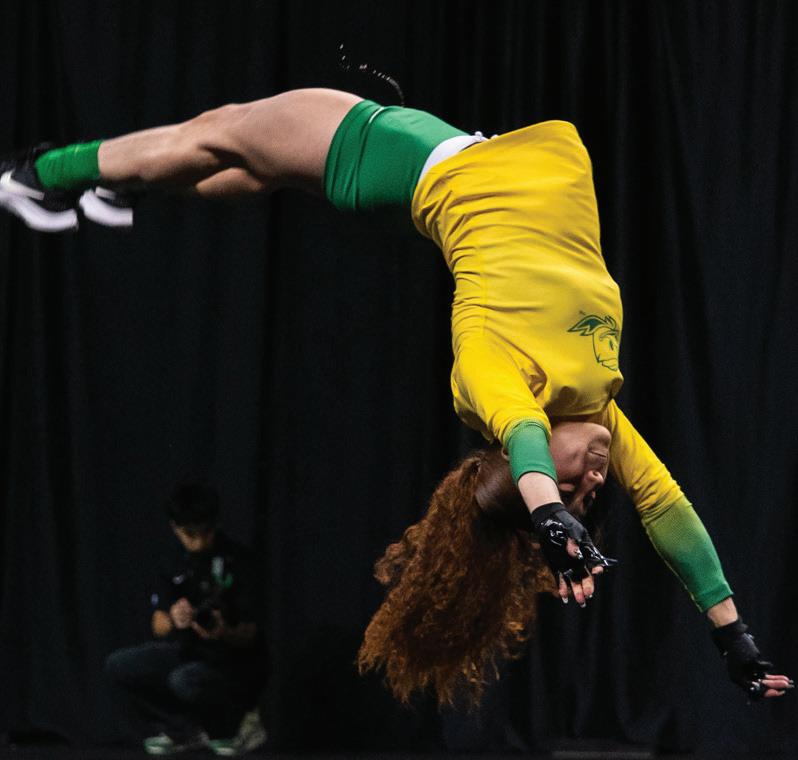
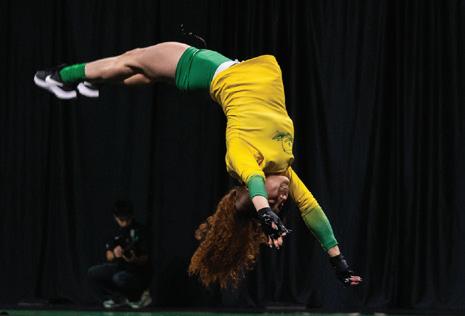
Duck sophomore tumbler Briya Alvarado (25) performs a solo tumbling routine. The University of Oregon Ducks Women’s Acrobatics and Tumbling team defeated the Iona University Gaels in a tight home meet at Matthew Knight Arena in Eugene, Ore., March 15 2026.
ARTS & CULTURE
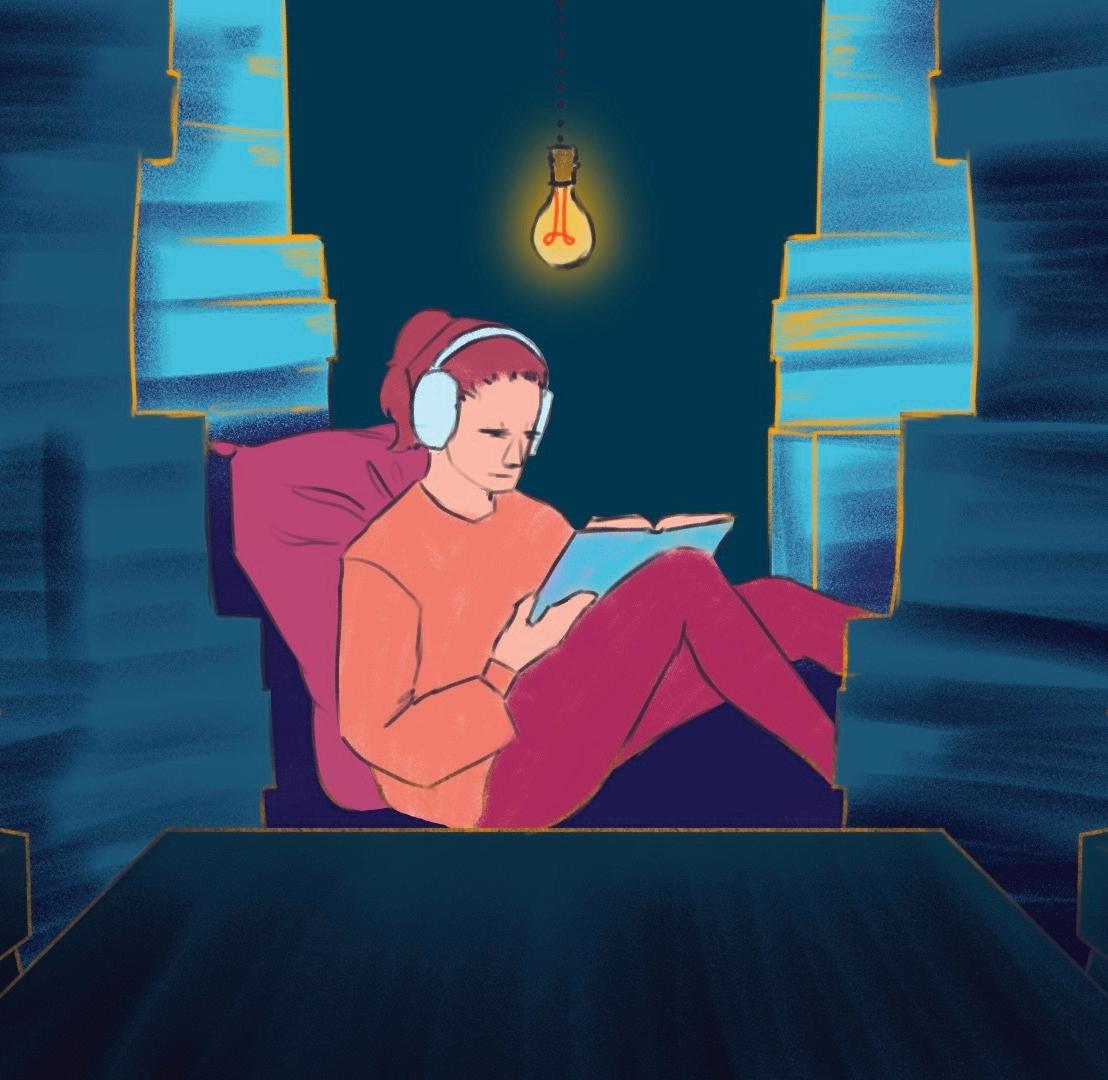
Approachable literature picks for spring readers
Spring is the season of change, rebirth, and new beginnings, and with this list of classic novels, you might find a new definition of what it means for a book to be a “classic.”
By Gray Vanderpoel Arts & Culture Writer
The sun is shining; the rain is freshening the air and springtime is now upon us. After battling finals and coming back from a restful break, what’s better than keeping that energy going and spending your free time sitting in the sun with a good, classic piece of literature?
Reading can be a daunting task, especially reading any “classic” novel with difficult readability, but it doesn’t have to be. With a good collection of classic books, you can instead see modern language with a range of genres and perspectives that differ from Shakespearean riddles and medieval drama.
“The Marrow Thieves”
by Cherie Dimaline
“The Marrow Thieves” by Cherie Dimaline was published in 2017 and labeled as a young adult dystopian novel. While the book is geared toward young adults, the message it gives can have an impact on anyone in any age range. In this book, the world is set in a dystopian universe where people have lost the ability to dream, leading to desperation and madness. Native Americans were the only ones who could dream, and they were hunted for their bone marrow.
The novel echoes Native American history and the past while looking forward and changing dark narratives that might have followed the community. It’s both tragic and heartwarming, revolving around community and culture with easy and smooth reliability. If you are a fan of wellloved dystopian books like “The Hunger Games,” “The Maze Runner,” etcetera, then “The Marrow Thieves” is the perfect addition to your bookshelf.
“The Seven Husbands of Evelyn Hugo” by
Taylor Jenkins Reid
Another beautifully unique and touching story is “The Seven Husbands of Evelyn Hugo” by Taylor Jenkins Reid, published in 2017. This novel, set in the 1950s to 1980s, follows the glamour of the protagonist, Evelyn, as she lives her life as a popular actress and celebrity. This story is known for its LGBTQ+ narrative. Evelyn herself is hiding her bisexual identity as she goes through her seven marriages with men and relationships she had with women.
It is a compelling story that jumps from year-to-year, and the narrative seems to go by almost too quickly. In general, the readability is easy and accessible for a variety of audiences. If you are looking for more historical works of fiction with a queer perspective, Evelyn Hugo is a great character option.
“Fun Home”
by Alison Bechdel
“Fun Home: A Family Tragicomic” by Alison Bechdel is a graphic novel that has made waves in the comic literature realm for its series and family-centered story. It is a graphic memoir of Bechdel’s relationship with her father in early childhood, and again after his sudden death. The novel explores grief, LGBTQ+ identity and coming-of-age themes. It also includes numerous references to classic literature. If you need a faster read and are a fan of visual art, Bechdel’s memoir is the perfect addition to your schedule. But don’t be fooled, the story may be easy to follow, but analyzing the visual art alongside its written word may take longer than you think. It’s a great option that encourages diving headfirst into the graphic novel section of the library without a second thought.
“Howl’s Moving Castle”
by Diana Wynne Jones
If you are a fan of the classic Studio Ghibli film “Howl’s Moving Castle” (2004), you may also know that it was originally a novel written by Diana Wynne Jones, published in 1986. Of all the books described, Jones’ novel has the most difficult syntax choices, requiring a bit more focus and concentration to get through than the others. But if you want to know more about the beautiful story, it is a perfect read.
Reading the original novel leaves you with more than the film, as there are two sequels to Howl’s written story, “Castle in the Air” (1990) and “Many Ways” (2008).
The story is about the life of Howl, a wizard who is sought out in the hopes of breaking a spell cast on a young lady, Sophie, which makes her appear as an old woman. The story’s fantastic and magical elements transport readers into a mythical world with a longing for adventure.
“Lolly Willowes”
by Sylvia Townsen Warner
Last but not least, a novel to look into for this spring is “Lolly Willowes” by Sylvia Townsend Warner. It is one of the older books published in this list in 1926, but its story is one for any modern reader. This novel is definitely heavier in its vocabulary and readability; its hidden message of a feminist and queer storyline is harder to decipher, but the story is unforgettable.
Following the character Laura Willowes, you watch her come into her own independent lifestyle, fighting against the social norms in the early 19th century to move away as a single woman to the countryside. But slowly over time, Laura became integrated into witchcraft and made a pact with the devil. It may be mysterious and difficult to understand, but once you understand the hidden feminist narrative, the novel leaves you with a newfound understanding of witchcraft.
So whether you haven’t read for a lack of time, energy or interest, classic novels range in genres and language that can appeal to anyone. And who doesn’t want to read in the sun in the green Oregon grass?
(Noa Schwartz/Emerald)
Who’s on the ballot?
In addition to executive positions, the following legislative positions will be on the ballot this election:
Contracts Finance Committee At-large 2
Departments Finance Committee At-large 2
Programs Finance Committee At-large 1
Programs Finance Committee At-large 2
Programs Finance Committee At-large 4
Senate Seat 1 – Programs
Finance Committee
Senate Seat 2 – Programs
Finance Committee
Senate Seat 3 – Programs
Finance Committee
Senate Seat 4 – Programs
Finance Committee
Senate Seat 6 — Contracts
Finance Committee
Senate Seat 7 — Contracts
Finance Committee
Senate Seat 8 — Departments
Finance Committee
Senate Seat 9 — Departments
Finance Committee
Senate Seat 10 — Departments
Finance Committee
Senate Seat 11 — Arts & Sciences Undergrad 1
Senate Seat 12 — Arts & Sciences
Undergrad 2
Senate Seat 13 — Arts & Sciences
Undergrad 3
Senate Seat 14 — Arts & Sciences Undergrad 4
Senate Seat 16 — Design, Music, and Dance Undergrad
Senate Seat 17 — Education, Arts & Sciences Undergrad
Senate Seat 18 — Journalism Undergrad
Senate Seat 19 — Business Undergrad 1
Senate Seat 20 — Business Undergrad 2
Senate Seat 21 — First Year & Exploring
Senate Seat 22 — Graduate 1
**Additional positions may be added to this list, according to the ASUO Elections Board website.
By Reilly Norgren News Editor
ASUO will hold its annual campus-wide election from April 6 at 9 a.m. to April 10 at noon. All currently enrolled students who have paid the incidental fee are eligible to participate to vote in student government leader and initiatives and policy questions on the ballot.
Elections are for the two executive positions and legislative positions, senators and at-large finance committee members.
Campaigning began last Monday, with two slates vying for executive and legislative positions. Debates, which were mandatory for president and vice presidential candidates, were held in the Erb Memorial Union April 1.
A slate is a group of candidates running together under a shared name and campaign strategy. The two slates up for election are UO Student Power and Student United Front. Students may also run without a slate.
UOSP is the slate of current ASUO president Prissila Moreno which won 18 legislative positions in last year’s elections, according to last prior results from the ASUO elections website.
ASUO supports over 200 student organizations and oversees approximately $10 million in I-fee money annually. The primary responsibility of the president and vice president includes leading executive action on the I-fee, understanding the needs and interpreting the climate of all three UO campuses, monitoring key university processes, creating and structuring executive cabinet members and hosting campus-wide events.
Additionally, the ASUO president holds veto power over legislative financial decisions.
University of Oregon Student Power
Presidential Candidate: Quadrian Gill
Quadrian Gill and Amaya Peralta first crossed paths in ASUO last year, where Gill was an intern in the advocacy department while Peralta was serving as secretary of diversity, equity and inclusion. Now, the two are running together with a focus on multiculturalism, campus advocacy and academic services.
Gill is a third-year majoring in planning, public policy and management and sociology. Currently he serves as the ASUO speaker of the legislature, and during his tenure has been involved on the legislative side with current UOSP projects such as the 24-hour library pilot program, advocating for a Latinx Cultural Center on campus and working to reestablish the Oregon Student Association or a similar student lobbying group to bring student voice to state legislature.
“There are things we’ve done this year that have (been) seen to fruition that support things like multiculturalism, like the International Student and Scholar support fund,” Gill said about his work this year in ASUO. “There are some smaller projects that build up to bigger ones… this year, if we’re elected, we can see some of these projects we worked on this year just instantly happen and then set a new vision for the future.”
Peralta is a third-year majoring in sociology and political science and minoring in PPPM. She is currently the ASUO director of advocacy. Peralta has been working directly with current ASUO Vice President Max Jensen to restart OSA, and organized the recent student-led lobby day which advocated for HB 4079, or the ICE notification bill, which has since passed.
Vice Presidential Candidate: Amaya Peralta
“A lot of the things that student power ran on last year people said were impossible. 24-hour libraries is one of those things — and that’s something we were able to do this year,” Peralta said. “Working with UO Student Power, I’ve seen how we can actually use student government to ignite and create change for students.”
The pair described their “big three” projects they’d like to focus on under the umbrella of their three primary issues, which is the opening of a Latinx Cultural Center on campus, returning Erb Memorial Union control to ASUO and bringing back OSA.
Peralta said they also have a large focus on civic engagement, which she has been working on in her current role in the advocacy department. She said that, after working on Lobby Day, that is something the pair would hope to introduce more of next year if elected.
“It was really empowering, and we’ve seen really great impacts of student voices in the legislature,” Peralta said.
Gill and Peralta emphasized their excitement to work directly with the student body if they were elected through direct advocacy for student organizations, continuing to host State of the University events and bridging together students through coalitions of different organizations that can collaborate on issues of interest.
ballot? ASUO presidental debate recap
The two slates running for ASUO president fielded questions from The Daily Emerald on April 1, 2026.
Student United Front
QStudent organizations frequently say communication with ASUO is inconsistent and difficult to navigate, making accessing resources a strenuous process. Where do you think ASUO is currently falling short, and what specific structural changes — not just outreach — would you implement to fix it?
Both students in UO School of Law, Brendan Randall and Anton Mandrosov came together on shared ideas on how to better connect student organizations with their student government and how they could organize to bring student issues to the state level.
Randall is a second-year law student who previously earned an undergraduate degree in political science and global studies with minors in legal studies, global health and German. Their studies in law school have focused on international law, constitutional law and criminal law.
Mandrosov earned a bachelor’s degree in political science at California State University, Northridge before coming to UO’s law school. He focuses his studies on contracts, business law and intellectual property. Before attending law school, he worked as a legal assistant helping people recover from wildfires in California.
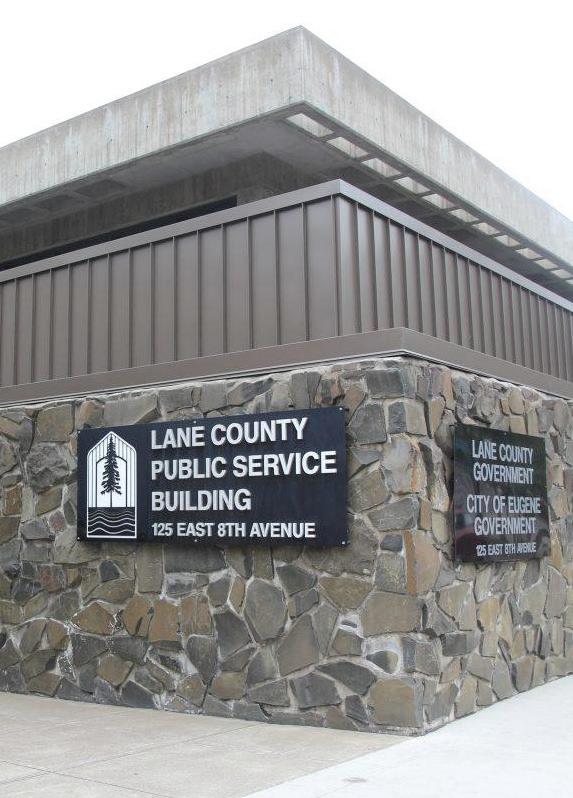
With experience working in the Lane County Office of Legal Counsel, Randall said they want to draw on their experience there to create an “internal mechanism” within ASUO to encourage student advocacy at the state and local level by making it more accessible, as well as focus on ensuring students feel supported by their student government in terms of safety.
“Students are really concerned about federal (agent) enforcement action here on campus and to the fullest extent possible, I’m trying to make sure students feel safe and there is a plan and they know that the ASUO will support them,” Randall said.
Randall and Mandrosov emphasized that they want to expand communication between ASUO and student organizations.
As president of the UO Law of Intellectual Property student organization, Mandrosov said he has faced difficulty obtaining funding and feeling isolated from other student organizations.
“With all the skill sets at our disposal, so many talented students across so many student orgs, we need to have a means of getting together, of networking, of co-hosting, of pooling resources,” Mandrosov said.
Randall said that if elected they would want to constantly survey the student body and have open communication so that they can keep pushing for student interests if they were to be president.
“The way ASUO communicates just isn’t the right format anymore,” Randall said. “Communications is changing, and that might involve working with professors and students to find what the cutting edge is.”
Randall added that as president they would convene committees in addition to changing ASUO’s communication style to better meet students where they are.
The team highlighted that the core of their slate is monitoring Oregon legislation to track how bills might negatively impact students, how they can get student voices heard in the capitol and potentially work to draft legislation themselves through a committee.
“You shouldn’t be able to look at a wall anywhere here on campus without seeing some kind of update from the ASUO just right in front of you.”
Brendan Randall, Student United Front presidental candidate
Gill spoke about work he’s already been doing as senate speaker, which involved establishing an “org liaison committee” that communicates with student organizations to see what they want and need from ASUO.
QWhich groups of students do you think ASUO is currently failing to represent, and how would you change that?
“That is a failure on our institution, and it’s a failure on ASUO for not seeing that through in the past. We’re executing it, and it will happen.”
Quadrian Gill, Student Power presidental candidate
“One of the big focuses of my platform is unity among students to ensure that all student voices and needs are met together. I’m not looking to exclude anyone.”
Brendan Randall, Student United Front presidental candidate
*Erin Reaney contributed to this reporting
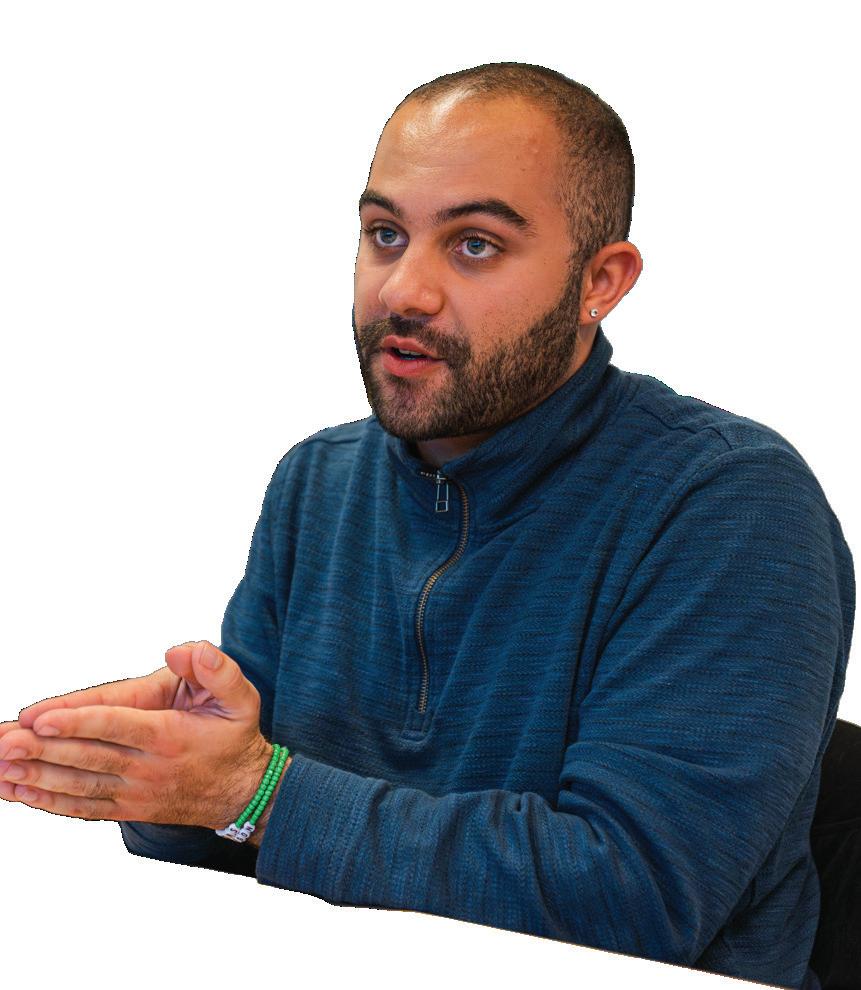
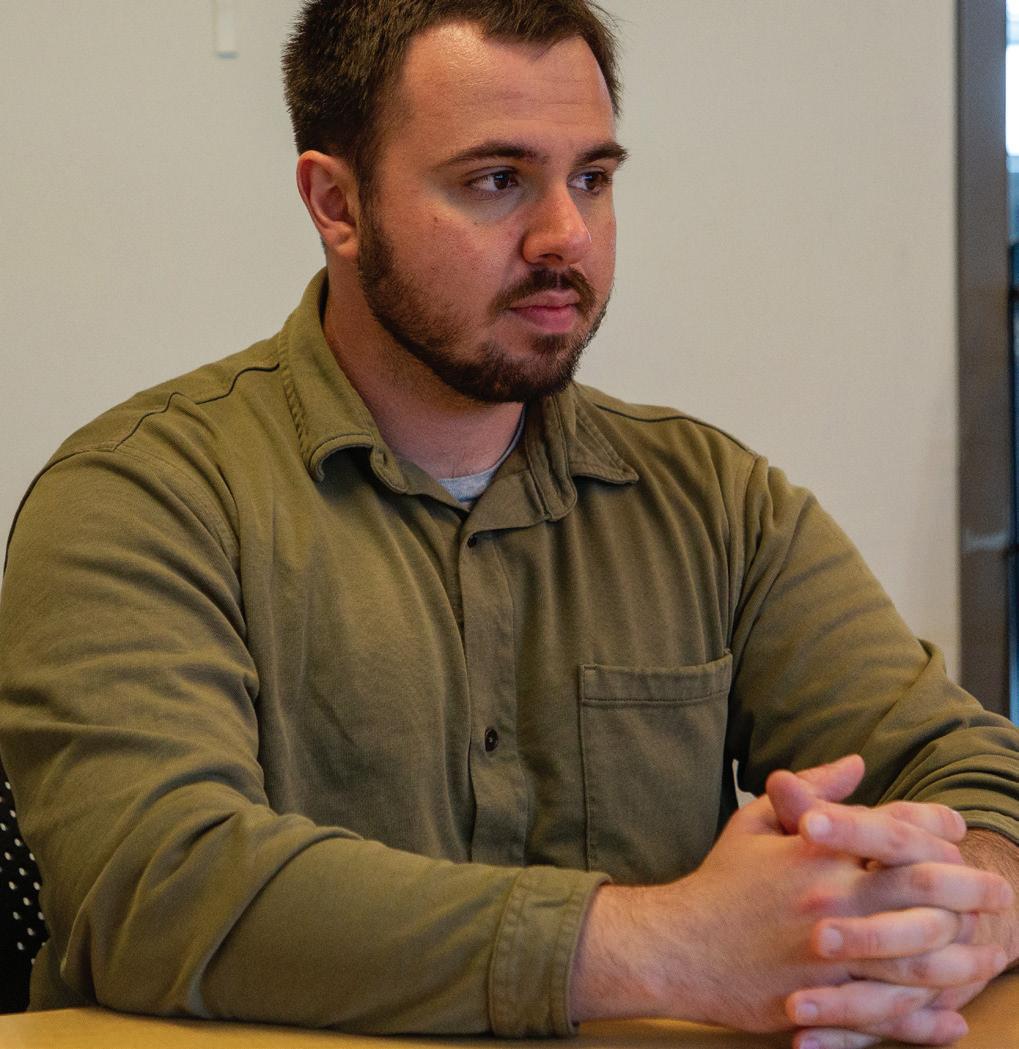
Presidential Candidate: Brendan Randall
Vice Presidential Candidate: Anton Mandrosov Photos
Ferguson: Women’s safety after dark shouldn’t be treated like a personal problem
Opinion: Eugene is a small town, but it should take measures to ensure women feel safe at night.
By Zaida Ferguson Opnion Columnist
Walking home after dark shouldn’t feel like a risk — for many women on college campuses, it still does. Universities love to advertise their commitments to equity and student well-being, but when those opportunities involve being on campus after dark, some have to choose possible opportunities over safety. What remains is a familiar reality: women modifying their routines, gripping their keys and sharing locations.
At the University of Oregon, students feel that gap every day. Kat Newgard, a junior marine biology major, described how a man repeatedly approached her near her home. “I was walking to work, and he came up to me and I felt freaked out because of what had happened,” she said. “I don’t know if I would call it harassment — he’s just been hanging around my house, but it’s scary.”
As women, we tend to downplay fear, rationalize danger and avoid being “dramatic.” But fear shouldn’t require an actualized threat of harm to be considered valid. When women feel unsafe, behaviors and actions change: skipping campus evening events, avoiding certain routes or missing opportunities that require walking alone. These self-protective choices aren’t irrational; they’re learned responses for women in a risky environment.
This issue contributes to another glaring problem: when women’s movement is restricted by fear, men’s freedom expands by default. If women are less able to fully participate in campus social life, then the imbalance becomes self-reinforcing, making safety a gendered privilege.
Zaya Smith, a first-year journalism major said, “I used to run at night by Autzen Stadium but I had a scary interaction with a man in a creepy mask. I ran away and haven’t run at night since.” Most women have scary experiences like this near campus — they occur so often they’re often forgotten about, overlooked or ignored.
Thankfully, daylight saving time solves some of these issues with the sun setting significantly later, pushing back this unspoken curfew a little longer.
Universities often respond to incidents with statements, task forces or one-time fixes. But security is more than a press release or safety alert; it involves changes to standardized procedures, accountability and psychological safety culture. And right now, too many campuses are failing on all three.
UO has a free evening shuttle for all university students, staff and faculty called Duck Rides. Duck Rides’ purpose is to ensure safety, accessibility and reduce nighttime travel risks from 6 p.m. to 12 a.m. via scheduled rides that are scheduled in the app. As resourceful as Duck Rides is, many students don’t know how to access it or aren’t aware of it. The wait times can also deter students from choosing the safer option because the potentially dangerous walk is more convenient than waiting an hour for a free ride. There are some easy solutions to this problem: better lighting, more cameras, reliable nighttime transportation, regular safety audits that actually include women’s voices and training for security staff
that centers gender sensitivity, survivor support and complaint systems (that are transparent, timely and confidential). The implementation of these solutions would require compliance from UO campus safety and administration. If UO took these steps, it may inspire other universities to follow suit, placing a higher expectation on campus safety norms.
Women shouldn’t have to shrink their lives to fit the limits of campus safety. It’s an institution’s responsibility to ensure gender equality in every form — including safety.
Zaida is an advertising major with a minor in philosophy and business at the University of Oregon. She’s passionate about storytelling that amplifies underrepresented voices and critiques systemic issues. In her spare time, she enjoys exploring pop culture, listening to music, and catching up on social trends over coffee with friends.
Mitrovcan Morgan: Private internet, public need
David is an opinion columnist for The Daily Emerald and a senior studying data science, economics and philosophy. In his writing, he enjoys finding the abstract relationships between systems and the decisions we make everyday, weaving them into a tangible story readers can easily digest.
Opinion:
As Wi-Fi becomes indispensable infrastructure, government internet services show how public investment can respond to private market failure.
Mitrovčan Morgan Opnion Columnist
Modern life rests on a peculiar tension: near-total dependence on Wi-Fi paired with a habit of treating it like a lifestyle amenity. Internet access is lumped in with gym memberships and streaming subscriptions, as though it is optional. It is not. Wi-Fi is no longer a luxury.
So, what does that mislabeling do? It asks people to navigate public life with a tool that both the market and the state still regard as nonessential. Gaven Brady, a fourth year General Social Science, said “without Wi-Fi, I’d have to go back to a 1980’s philosophy where I just wait to get something in the mail, then go to deal with it in person.”
While this may work for filing your taxes, try going offline for a week and apply for a job. Turn in homework. Make a medical appointment. Check your bank account. Contest a parking ticket. Most of life’s responsibilities do not afford us the luxury of going back to the 80s.
In practice, the internet of today resembles plumbing more than a perk: easy to forget when
it flows, impossible to ignore when it fails. So, it ought to be a public good.
But first, the term needs sharpening, because importance alone does not place something in that category. Kathleen Mullen, an associate professor in the University of Oregon’s economics department said “public goods are those that are nonrival and nonexclusive,”
In other words, one person’s use does not meaningfully diminish another’s — nonrival — and access cannot easily be limited to a select few — nonexclusive. Think of a lighthouse: one ship’s use of its beam does not dim it for another, and no nearby vessel can realistically be shut out from its light.
Broadband does not fully satisfy either condition. Mullen explained, “the internet… (is) nonrival up to a point… (and) not nonexclusive — you can definitely limit access.”
Fair enough; broadband is no lighthouse. Comcast can shut off your service, a school can password-protect a network and when too many people pile on, the digital freeway clogs.
Because of this, “broadband access is a private good whose consumption is fully internalized by the people who pay for it,” Mullen said. If the person paying for internet service is also the one receiving its benefits, the logic goes, then taxpayers should not be asked to subsidize it.
It is an elegant argument on paper: if broadband is private, let private enterprise have its way. But that logic frays because for many Americans, there is no bustling field of competitors vying for their business. On the contrary, in 2017, 51% of
Americans had access to just one internet provider according to the GAO. Worse still, 10% had none at all, with the Brookings Institute finding the number jumps to 39% in rural communities.
This isn’t a surprise. Building fiber networks requires immense upfront capital, which keeps new competitors out and leaves entrenched providers under too little pressure to compete.
This is market failure in plain view: an industry structured to dull competition and leave entire communities with too little service, too much cost or no access at all. Under these conditions, public intervention is not a distortion of an efficient market providing a private good so much as a response to one that is failing to do so.
And there is evidence that treating it as a public good can work. Chattanooga, Tennessee, built a public fiber-optic network for $162 million. Since launch, the network has provided residents with better service at lower prices and generated $5.3 billion in community benefits from 2011 to 2025, marking a 6-fold return on investment according to a study out of the University of Tennessee.
A government reveals its priorities by what it builds. Roads say mobility matters. Libraries say knowledge matters. Parks say outdoor recreation matters. In 2026, Wi-Fi belongs on that list. Maybe not because it is a perfect public good in theory, but because it has become a practical public necessity in fact.
David
(Noa Schwartz/Emerald)
ACROSS
1 Brown sugary donut flavor
6 Sewer entryway on the road
8 Inhabitants of Africa’s second largest country
10 TV program breaks
11 Pet adoption org.
12 Put some ___ in your step
13 Mocking laugh syllable
14 First letter in “letter”
15 Caesar or Dr. Zaius
16 Put back in place, at the chiropractor
20 “Salt-and-pepper” igneous rock
21 “Deck the Halls”, “Silent Night”, “Joy to the World” DOWN
1 Act of condescending misogyny, in slang
2 Taiwanese filmmaker Lee
3 Vietnamese noodles
4 Internet laughs
5 Animals to be addressed, idiomatically
6 Was naked in class?
7 Prison runaway
8 Bit of garnish used in seafood and pasta
9 Dog-___ (page with a slight fold)
17 Lav
18 Wrath
19 Musician and poet ScottHeron
‘Fear is just a mind game’: Inside the head of Oregon tumbler
Briya Alvarado
By Owen Murray Associate Sports Editor
Spring football is underway.
There’s no change at the most important position for the Ducks, where redshirt junior quarterback Dante Moore is returning after forgoing the NFL Draft; but Oregon is sending seven starters to the pros and swapping offensive coordinator Will Stein for new OC Drew Mehringer. Starting running back Noah Whittington, tight end Kenyon Sadiq and wide receiver Malik Benson need replacements.
QB: Dante Moore, Dylan Raiola, Brock Thomas Moore returns as the undisputed starter for the Ducks, but behind him, it’s an interesting question. Nebraska transfer Raiola has starting experience, but Thomas has been in Oregon’s system for longer, and he earned backup reps last season when Moore missed stretches of games. Expect Raiola to finish the season as the primary backup, but don’t be surprised if Thomas is the go-to in nonconference play.
Rooted in Eugene: Oregon distance runner finds home at Hayward Field
SATURDAY May 9, 2025
Previewing Oregon football’s
2026 offensive skill positions
Oregon returns its starting quarterback, but shuffles its skill positions under a new offensive coordinator.
RB: Jordon Davison, Dierre Hill Jr., Da’Jaun Riggs
It’s difficult to project where four-star recruit Tradarian Ball factors into the equation here, but Davison and Hill’s first years in Eugene leave them with high floors. Balle could be the same. Noah Whittington is headed to the draft, and while Davison missed the Peach Bowl with a broken clavicle, head coach Dan Lanning said on April 1 that he’s practicing, “somewhat, in a limited fashion.” New offensive coordinator Mehringer was a co-offensive coordinator last season, when the Ducks employed heavy 12-personnel usage; and while Davison projects as the more reasonable singleback option with his versatility, there’s still room for those two-back looks. Riggs was still carrying an injury as of that April 1 press conference, but Lanning said he’d “be back.”
TE: Jamari Johnson, Andrew Olesh, Kendre Harrison
Johnson stood out last season, spelling Kenyon Sadiq. The University of Louisville transfer finished with 32 catches for 510 yards and three touchdowns last season in Eugene, and he looks poised to take over full-time responsibilities at the position. Behind him, the Ducks are split between experience elsewhere (Penn State transfer sophomore Andrew
Women’s basketball portal needs
“They’re going to be one of the most productive duos in the country coming back,” Graves said after the season on the Danny and Justin show. “I think the one thing that they did by playing a couple of games in the NCAA Tournament, they got a lot of time in studio, in terms of people watching and talking about them. There’s going to be a buzz around this team next year. Not many teams can say they’re returning four starters off an NCAA Tournament.”
Still, for Oregon to truly take the next step into the Big Ten’s elite, Oregon must prioritize shooting, athleticism, perimeter defense and toughness — four pillars of any successful team — in the portal.
Shooting is a good place for the Ducks to start, and it is one of the few places that Fiso can take the next step in as an offensive player. Mia Jacobs and Sofia Bell were Oregon’s only high-volume 3-point shooting starters this season, and neither were as consistently reliable as Graves would like. Fiso took just 43 shots from range last season, and an ideal portal guard would be able to space the floor while taking some of Fiso’s ball-handling responsibilities.
Size is another factor that Oregon will absolutely have to address, especially with the graduation of Jacobs and Sarah Rambus transferring. Having a true center who can match
up with players like UCLA’s Lauren Betts or an athletic forward who could counter some of Texas’ Madison Booker’s size would be ideal, but height on the wings must be factored in as well.
“There’s nothing she can’t do,” Graves said of Booker after the Longhorns eliminated Oregon from the NCAA Tournament. “We just don’t have anybody physically that can match up with her. If we take Ehis off any of the inside kids, then we’re in big trouble there. It’s just a tough matchup, and she had a great night.”
The great players will always get theirs, but having multiple options for the type of athlete that Graves can counter with is essential.
Of course, retaining Fiso and Etute — which Oregon seems likely to do at this point in the offseason — is essential for any of these portal additions to be fully realized, but growth from some of Oregon’s secondary players will be essential as well. As nice as it would be for any team to be able to retool solely by the portal, the Ducks will likely have just three open scholarship spots to add players and will need players like Avary Cain to become more consistent contributors next season.
Olesh, Clemson TE/DE Markus Dixon) and potential first-time starters (new five-star dual football/basketball recruit Kendre Harrison, redshirt freshman AJ Pugliano). This is Johnson’s room to lead, though.
WR: Dakorien Moore, Jeremiah McClellan, Evan Stewart
Moore, McClellan and Stewart look to be the Ducks’ nailed-on starters here. Moore, despite missing chunks of last year, returns as a dynamic, second-year threat and, with Stewart back from the patellar tendon injury that forced him to miss the entire 2025 season, has another deep threat to play off. McClellan broke out amid the depleted room last season and made a name for himself with some ridiculous catches. There’s more to keep an eye on here, including University of Alabama at Birmingham transfer Iverson Hooks, who could be a slot option, and speedy freshman Gatlin Bair, but expect to see those first three first.
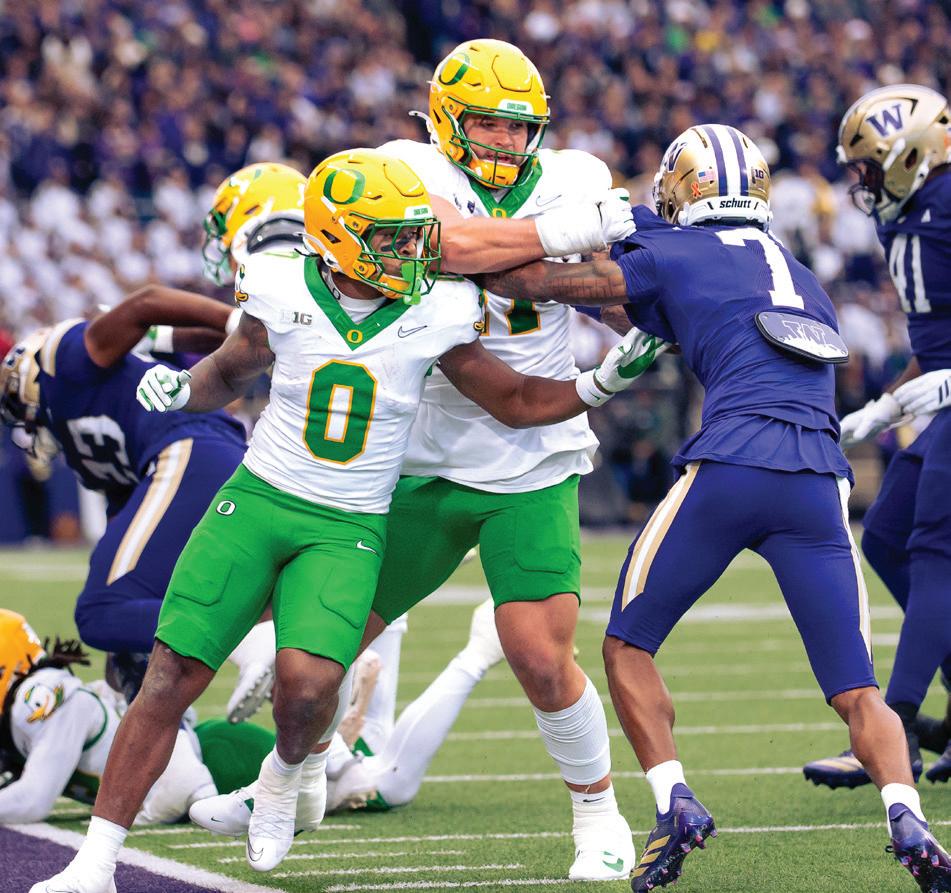
( LEFT ) Running back Jordon Davison (0) and multiple Ducks players are pushed off the field as they attempt to block for running back Noah
(Saj Sundaram/Emerald)
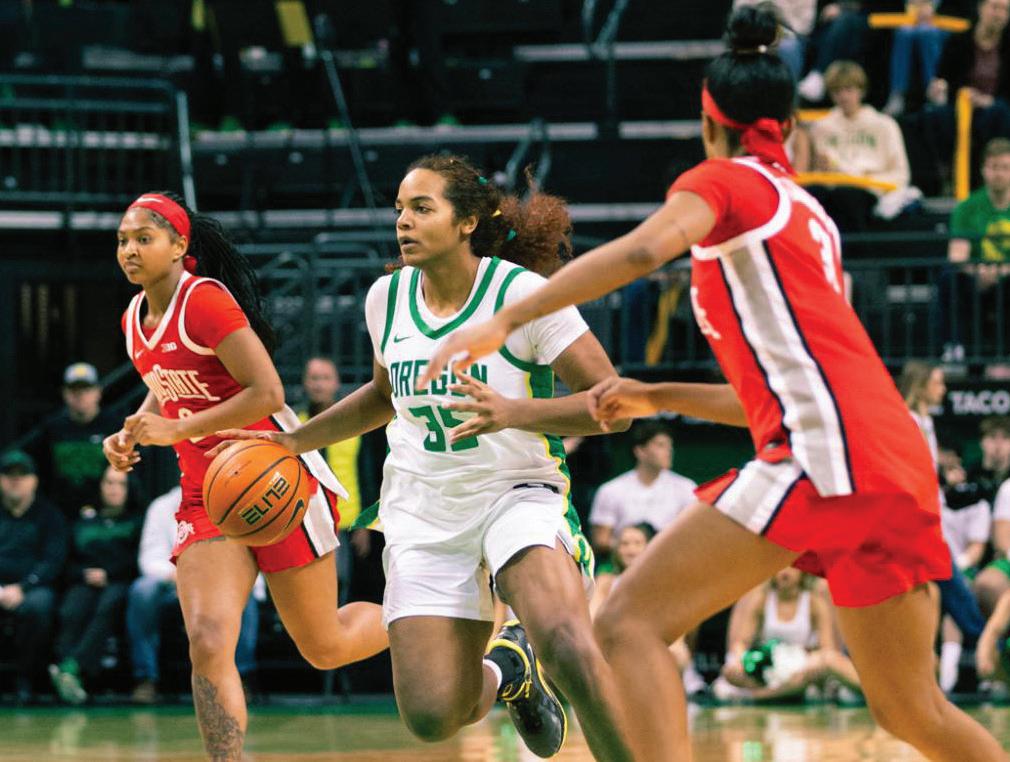
Oregon Ducks Ehis Etute (35) runs down the court. The Ducks were defeated by The Ohio State Buckeyes 80-64 in Eugene, Ore, on Feb. 8, 2026. (Roshni Ram/Emerald)
Oregon vs. Nebraska
The Ducks baseball team gears up to play the Cornhuskers this Saturday afternoon in Eugene, Ore. at 2:05 p.m. PT.
Whittington (6). The Ducks defeated the Washington Huskies 26-14 in Seattle on Nov. 29, 2025.
Oregon acrobatics and tumbling sophomore Briya Alvarado took the NCATA by storm in her first two years.