‘Fear

‘Fear
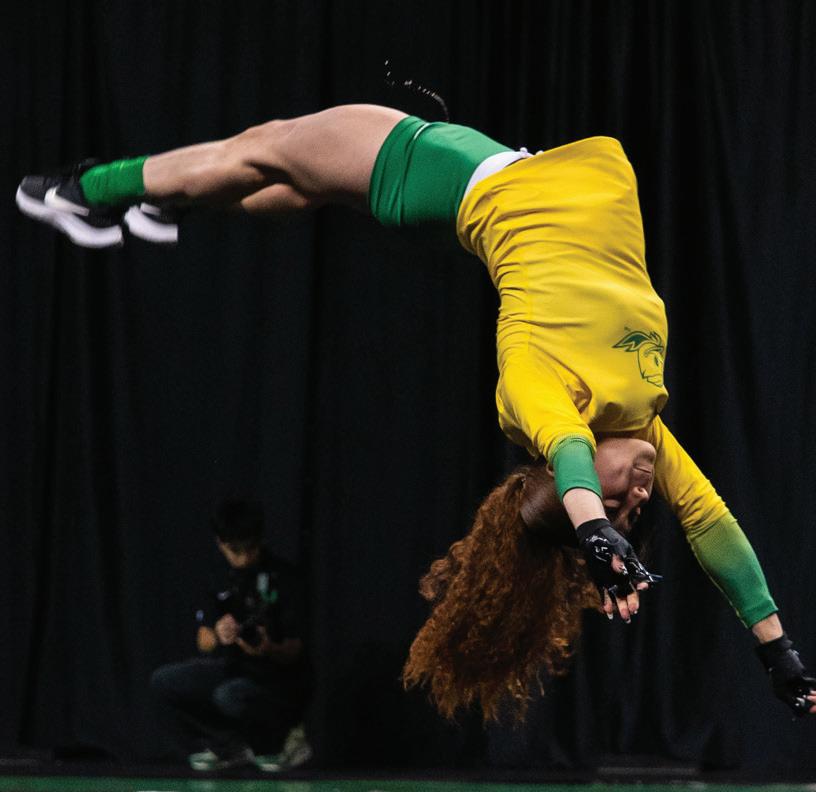
Oregon acrobatics and tumbling sophomore Briya Alvarado took the NCATA by storm in her first two years.

EDITOR IN CHIEF
Tarek Anthony
PRINT MANAGING EDITOR
Ryan Ehrhart
DIGITAL MANAGING EDITOR
Ysabella Sosa
NEWS EDITOR
Reilly Norgren
INVESTIGATIONS EDITOR
Ana Narayan
A&C EDITOR
Claire Coit
SPORTS EDITOR
Jack Lazarus
OPINION EDITOR
Gracie Cox
PHOTO MANAGING EDITOR
Corey Hoffman
PHOTO EDITOR
Saj Sundaram
COPY CHIEF
Olivia Ellerbruch
VIDEO EDITOR
Jake Nolan
PODCAST EDITOR
Stephanie Hensley
SOCIALS EDITOR
Ysabella Sosa
VISUALS EDITOR
Noa Schwartz
DESIGN EDITOR
Adaleah Carman
DESIGNERS
Asha Mohan
Ellery Burton-Tillson
Eva Andrews
Izzy Smith
Nina Rose
PUBLISHER AND PRESIDENT
Eric Henry (X317) ehenry@dailyemerald.com
VP OPERATIONS
Kathy Carbone (X302) kcarbone@dailyemerald.com
DIRECTOR OF SALES & DIGITAL MARKETING
Shelly Rondestvedt (X303) srondestvedt@dailyemerald. com
CREATIVE & TECHNICAL
DIRECTOR
Anna Smith (X327) creative@dailyemerald.com
ACCOUNT EXECUTIVES
Torin Chevalier
Camcole Pereira
Ava Stephanian
Elliot Byrne
The Daily Emerald is published by Emerald Media Group, Inc., the independent nonprofit media company at the University of Oregon. Formerly the Oregon Daily Emerald, the news organization was founded in 1900.
Emerald Media Group 1395 University St.,#302 Eugene, Or 97403 (541)-346-5511


By Reilly Norgren News Editor
The University of Oregon 2026 commencement speaker was announced to be Oscar-winning Deaf actor and activist Marlee Matlin, known for roles in the films “Children of a Lesser God” and “CODA.”
Deaf since she was 18 months old, Matlin is a large advocate for the Deaf community within and outside of the entertainment industry, testifying before Congress to support legislation that would eventually result in closed captions being required for television. Additionally, she has also served as a
spokesperson for organizations in an effort to expand American Sign Language education.
Matlin will speak at the main ceremony in Autzen Stadium on June 15 at 9 a.m.. UO has had several speakers who are in the entertainment industry speak at commencement, including alumna of the university Jana Schmieding last year and actor Ty Burrell in 2021.
The beloved 24-hour restaurant is opening a new diner this Spring.
By Erin Reaney News Reporter
For many University of Oregon students and Eugene residents, Mandy’s Family Restaurant is the go-to place for traditional American diner–style food. The establishment first opened on the corner of West 15th Avenue and Willamette Street in 2019, and is now known and adored for its 24-hour availability, as well as it’s community philanthropy. Now, Mandy’s is expanding — a second location is being built on Franklin Boulevard, and is set to open later this spring.
According to Vali Bell, a waitress at Mandy’s since 2019, the new location should open shortly after Easter. The opening could be pushed back depending on construction.
The new building will be called “Mandy’s Diner” and focus on faster, easier diner food, with a limited bar, Bell said. The diner will be open 24/7, and Mandy’s Family Restaurant will reduce its hours. It will now close at around 11 p.m. Monday through Wednesday, and continue to be open all night Thursday through Sunday.
The new building is decorated with Ducks green and yellow, and will be more “geared towards students,” Bell said. “It's right there across from the Rive (student apartments), and all the sorority houses and fraternities are behind it.”
According to Bell, “it was time” to expand Mandy’s. The building containing Mandy’s Family Restaurant has been a restaurant since the 1960s, and is too old and small to accommodate for the crowds they’ve been getting in recent years.
“It’s an old, old building… It’s been run hard, so it needs a break,” Bell said. Changing the operating hours from 24/7
will give the lights and appliances time to rest, she said.
The diner building, which was previously Manola’s Thai restaurant, has been receiving new floors, paint and all new appliances.
Bell said that some current Mandy’s employees will be moving to the new location, and some will stay at the original restaurant. The need for more staff will most likely provide job opportunities for UO students.
Some UO students are excited about the idea of a Mandy’s closer to campus, Lucia Donovan being one of them.
“I love Mandy’s,” Donovan said. “It's fun because it has such a strong diner feel and there’s so many options too. The staff has always been super kind.”
Donovan said the distance to Mandy’s Family Restaurant makes it a rare occasion for her to visit, but the new diner is right next to her sorority and will allow her to go more.
“I could totally see it being a popular late night place, especially because they’re open 24/7. That’s going to be huge for college students,” Donovan said.
Another student, freshman Ryan Staben, said he’s also excited for the new location to open. He said that the first time he went to Mandy’s, it was the day before his last final exam. He had been studying late in the science library, and didn’t leave until 2:30 a.m.
“I had pounded out two essays and studied for an economics final for three and a half hours, and I was so hungry. I just looked for anything that was 24 hours and I saw Mandy’s, and I started walking towards it,” Staben said.
Staben got to the restaurant at 3 a.m, and said that it was much busier than he would have expected a restaurant to be that late. He is looking forward to another Mandy’s, and said that “closer to campus is very much a plus” after his long journey during finals week.





By Billie Corsetti News Reporter
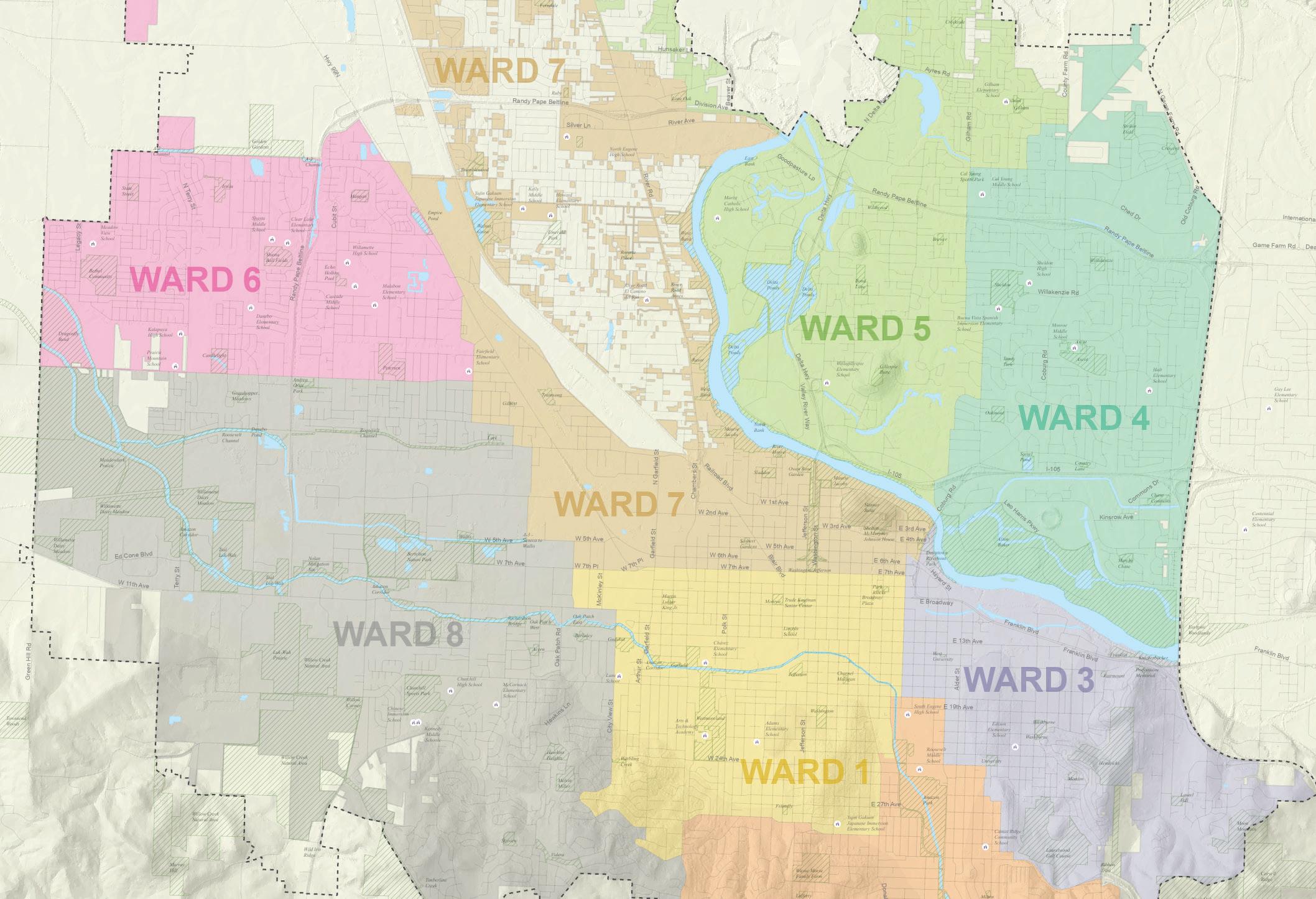
The Daily Emerald has profiled candidates for four wards in Eugene that will hold contests in Oregon’s May 19 primary elections. Ward 6 encompasses the Bethel neighborhood and its surrounding community.
Two candidates are running for the ward’s office: incumbent City Councilor Greg Evans and Tai Pruce-Zimmerman.
The Emerald reached out to both candidates for interviews with the same set of questions. For candidates that did not respond for an interview, The Emerald is using available information from their campaign websites and public history.
Ward 6 candidate Greg Evans did not respond to The Emerald’s request for an interview. His campaign website is unfinished, so all information used as responses to the questions are from public information sources.
Educational Background: Dyke College, Oregon State University
Occupation Experience:
Eugene City Councilor
Council President
Budget Committee
Intergovernmental Relations Committee
Lane Transit District Strategic Planning Committee
Associate Vice-President for Equity and Inclusion, Chief Diversity Officer, Lane Community College
Coordinator/Instructor African American Student Programs, Lane Community College
President of the League of Oregon Cities
National Association for the Advancement of Colored People, Eugene/Springfield
NAACP Washington/Oregon Conference
National League of Cities Board of Directors
NLC Board Finance Committee
President of Lane County Fair Board
Endorsements:
Congresswoman Val Hoyle
Lane County Commissioner Pat Farr
State Senator Floyd Prozanski
Eugene Area Chamber of Commerce
Campaign Website: gregforbethel.com
Hometown: Eugene, Ore.
Educational Background: Southern Oregon University
Occupation Experience: Lithia Motors
Ed Staub & Sons Petroleum
Kendall Auto Group
Lane County Youth Services
Eugene Housing Tools and Strategies Work Group
Eugene Budget Committee
Bethel School District Budget Committee
Bethel School District Long-Range Planning Committee
Bethel School District Strategic Facilities Committee
SquareOne Villages Finance Committee
Board Treasurer at Well Mama
Board Member of the Jewish Federation of Lane
County
Co-Chair of the Active Bethel Community Neighborhood Association
Endorsements:
Eugene City Councilor Eliza Kashinsky
Eugene City Councilor Alan Zelenka
Eugene City Councilor Jennifer Yeh
Eugene City Councilor Lyndsie Leech
Former Eugene Mayor Kitty Piercy
Former Eugene Mayor Lucy Vinis
SEIU 503
Democratic Party of Lane County
Eugene Tenant Alliance
Campaign Website: togetherwithtai.com
What are the biggest issues facing your ward, and Eugene, as a whole?
Greg Evans:
Councilor Evans’ profile on the city website lists his interests and concerns as transportation policy, civil and human rights and education.
His Oregon voter guide website lists his priorities during his decade as a councilmember, heavily focusing on the economic and infrastructural development of west Eugene. Evans has advocated for repairing roads and building parks, like Golden Gardens Park, to help invest in the community.
In 2015, Councilor Evans collaborated with Bethel community members to develop the Build a Better Bethel Plan, which aims to develop commercial property and expand urban growth.
Evans has previously expressed concern regarding the city’s budget and possible future shortfall, and he has encouraged his fellow council members to vote for motions that would look further into the budget.
“At a time when many residents feel their neighborhood has been overlooked, Bethel needs a leader who will keep fighting for our community at City Hall,” the website says.
Tai Pruce-Zimmerman:
Tai Pruce-Zimmerman wants to focus on bringing the Bethel community into the larger city’s fold and developing its presence in Eugene.
“The vast majority of this neighborhood is fairly residential, and it’s almost completely ignored by most of the rest of the city,” Pruce-Zimmerman said. “If you don’t live here, there’s not another reason for people to connect with us. It doesn’t have the political power of south Eugene or the draw of downtown.”
Pruce-Zimmerman believes Bethel’s lack of commercial entities has frustrated the community. As he’s campaigned, he’s found that even the absence of a coffee shop in the area has hurt his ability to connect with voters.
“Everyone wants so many coffee meetings, and people always say, ‘Happy to meet in your ward!’ and I’m like, ‘Can’t! If you want coffee, come to my house.’”
Why do you think you’re best fitted to address those issues?
Greg Evans:
Councilor Evans has been on the Eugene City Council for more than a decade and was voted in as the council’s president in January 2025, giving him years of experience representing Ward 6 and the Bethel community.
“Greg believes leadership should always be about results — not politics — and about putting our community first,” his voter guide website says. “At a time of both challenge and opportunity for Eugene, Bethel needs experienced leadership that will continue standing up for working families and delivering real results for our neighborhood.”
Tai Pruce-Zimmerman:
To address the issues facing his ward, Pruce-Zimmerman wants to keep collaborating with the city and the Bethel community to brainstorm community investment. In 2017, he helped reactivate the Active Bethel Community Neighborhood Association and worked to bring back the annual We Are Bethel celebration.
“I’ve done so much of this groundwork and community-building effort to get a sense of what it is that we need out here, and I’ve exhausted the levers available to me for how I can push that work forward in my current roles,” Pruce-Zimmerman said. “And the next step is to run for council and give myself a few new levers and keep working with the people that I’ve been working with on it, but from a new angle.”
Pruce-Zimmerman’s established community presence has also helped him build trust with the Bethel community.
“In terms of actually accomplishing the change that we all want out here, it takes that presence in the community, the coalition-building aspect of getting out and finding people that disagree and finding the common ground between them,” he said.





As 117 positions were cut, foundation records show millions spent on airfare, prompting calls for transparency from faculty and student leaders.
By Elle Kubiaczyk News Reporter
In June 2025, the University of Oregon laid off 42 positions in the College of Arts and Sciences in response to a budget deficit, with decisions that were allegedly made with little-to-no consultation with affected faculty.
By September, the final count reached 117 filled positions eliminated across the university to address the shortfall.
Meanwhile, in its most recent tax filing, the University of Oregon Foundation — a private charitable organization that manages gifts to the university — lists Wheels Up Private Jets, a prepaid airfare service, as its highest-compensated independent contractor in 2024 at $5 million. The foundation also spent $5 million on private jets in 2023, according to a previously filed tax return.
While the foundation is not specifically obligated to fund academic programs, the juxtaposition between high spending on private travel and cuts to academic programs has United Academics, the faculty union, and ASUO, the student government body, calling for greater financial transparency.
When
athletes and administrators are flying in private planes that cost millions, while academic programs are starved for financial support... it is clearly time for a change.
Bonnie Mann Member of the Executive Council of United Academics and professor of philosophy
“When athletes and administrators are flying in private planes that cost millions, while academic programs are starved for financial support, students are taking on life-long debt to pay tuition and dramatic cuts to academic programs are anticipated statewide; it is clearly time for a change,” Bonnie Mann, a member of the Executive Council of United Academics and professor of philosophy, said.
ASUO President Prissila Moreno agreed.
“I’m wondering how the UO Foundation has millions of dollars, and they were not directed to what was cut this summer,” Moreno said.
The foundation, which reported revenues of $302 million and net assets of $1.8 billion at the end of fiscal year 2024, defends the expenditures.
“Leasing of the jet service was for the benefit of the university. It was funded by philanthropic donors, so there’s no cost to the university,” Paul Weinhold, president and CEO of the foundation, said.
He said the service is intended for senior administrators and athletics. Jimmy Stanton, senior associate athletic director of communications, said the service is “utilized by several sports” for away games and recruitment.
In 2024, UO spent $5 million on private jets
The contract with Wheels Up continues during the current fiscal year. The cost will appear in the upcoming Form 990 tax filing. The foundation’s spending on private jets appears to differ from peer organizations. Thirteen Big Ten public universities use standalone 501(c)(3) foundations to receive and distribute private donations.
The Internal Revenue Service requires nonprofits to list their five largest expenditures over $100,000 on contractors. A review of those 13 foundation tax filings shows tht none disclosed spending on private jets.
In 2024, The Daily Campus, the campus newspaper at the University of Connecticut, reported that the UConn Foundation paid about $200,000 on private jet service for the fiscal year ending in 2022. In 2024 alone, the service cost $1.3 million — a quarter of what the UO Foundation pays.
Private foundations are categorized as 501(c)(3) nonprofit organizations, a common structure at public universities. The UO Foundation is a separate legal entity from the university and is responsible for receiving, managing and distributing private gifts.
“Athletics is a self-sustaining operation, and any revenues are from ticket sales, multimedia rights, conference distributions, licensing and athletics-specific donations, including those for travel,” Stanton said. “Athletics receives no institutional support or general fund dollars.”
“It’s up to the donor — what they want, how they want to donate the money, and the university and the terms that they will accept it,” Weinhold added.
As a result, donor funds are designated for a wide range of purposes, including academic scholarships, athletics, faculty support and facilities. The foundation acts as a fiduciary between donors and the university, with an emphasis on honoring donor intent.
UO joined the Big Ten Conference in August 2024, along with USC, UCLA and Washington — a year after private jet spending appeared in the foundation’s fiscal year 2023 filing.
When asked whether the new conference played a role in the decision, the foundation said it “entered into the contract to support university travel.”
During UO’s 2023 football season, excluding preseason games and the Fiesta Bowl, the farthest away game was played in Tempe, Arizona — about 975 miles from Eugene by air. In 2024, the football team traveled approximately 1,960 air miles to Ann Arbor, Michigan.
In total, Oregon football’s 2024 away games added up to about 12,000 round-trip miles. In comparison, during the 2023 Pac12 season, total one-way road travel was approximately 3,000 miles. Oregon’s move to the Big Ten nearly doubled its conference travel mileage.
Oregon men’s basketball saw an even greater increase. In the 2023 season, the team played nine in-conference games, traveling about 12,000 round-trip miles. In its first Big Ten season, that number rose to nearly 30,000 in-conference miles, excluding postseason tournaments.
Despite its commitments to sustainability, UO’s steam and air-conditioning supply is already the largest source of greenhouse gas emissions in Eugene, according to the Department of Environmental Quality.
Fossil Free Eugene, a coalition advocating for climate action, raised concerns about the foundation’s spending. Meredith Tufts, the coalition’s coordinator, said the spending contradicts the “green image” the university promotes.
“This news is incredibly disappointing given the enormous impact private planes have on climate change,” Tufts said. “A study published in Nature found that private planes add more carbon dioxide during just two hours of flying than the average person does in a full year.”
During the 2025 legislative session, lawmakers introduced House Bill 3213, a measure aimed at increasing transparency in higher education by applying public records laws to university foundations.
The bill failed to advance on June 27, 2025.
“We need robust financial transparency laws so that relationships between administrators, donors, corporations and the contracts awarded to private business interests by public universities are open to public scrutiny, regulation and ethics guidelines,” Mann said.
Travel growth since joining the Big Ten
Oregon athletics has seen the primary growth in air travel spending.
2023
Football traveled 3,000 total season round-trip miles
Men’s basketball traveled 12,000 total season round-trip miles
2024 Football traveled 12,000 total season round-trip miles
Men’s basketball traveled
30,000 total season round-trip miles








‘They’re trying to change our history.’
The Daily Emerald spoke with Congresswoman Val Hoyle about the future of Democrats, possible impacts of the SAVE Act and threats to higher education.
By Billie Corsetti News Reporter
With primary elections only two months away, The Daily Emerald spoke with Congresswoman Val Hoyle, who represents Oregon’s fourth district, about the current war in Iran, what’s going wrong with the Democratic Party and how students can protect higher education.
With the Republican Party holding the majority in both the House of Representatives and Senate, the Democratic Party is reflecting on how they’ve held power in the past. Hoyle believes they’ve wasted it.
“In the past, what Democrats haven’t done is do bold things like we should have when we had control of all chambers,” she said. “We should have done simple things like legalizing cannabis… (or) working to protect our voting rights. The John R. Lewis Voting Rights Act, right? That is an amazing bill, but we should have gotten through whatever we could.”
In 2028, Hoyle wants her party to focus on connecting with the middle class of America, rather than the smaller issues.
“Democrats need to be bolder in focusing on making sure the system and the economy is working for working people, the majority of people,” she said.
When asked what Hoyle believes Democrats could learn from Republicans, she said they need to learn to utilize the power that they have.
“(Republicans) act like they have a mandate, even if they have a small majority,” she said. “They also come together. We have these interparty fights that tend to paralyze us, and we are timid. We don’t do bold things, and that is really what this moment is crying for.”
The SAVE Act was proposed by Congressman Chip Roy (R-Texas) and is strongly backed by President Donald Trump. The bill would require voters to provide documented proof of citizenship while voting, making mail-in-ballots inadmissible.
Oregon was the first state to practice mail-in-voting, and all statewide elections are conducted by mail. This history makes the impact that much more dangerous, Hoyle believes.
“The instances of voter fraud are so infinitesimally small that we’re trying to solve a problem that doesn’t exist by undermining faith in our election system,” Hoyle said. “That’s the first thing, the propaganda because Donald Trump cannot get over the fact that he lost the 2020 election.”
Hoyle also believes the bill is intended to strike fear into minority groups’ hearts, citing when former Trump advisor Steve Bannan recently said that sending ICE agents to airports could be a “test run” for polling places.
“There’s a lot of people that believe there’s tons of fraud and undocumented immigrants that are voting. They are not,” she said. “They’re afraid to go to the grocery store, given the conditions right now.”
Val Hoyle Oregon Congresswoman “
There’s a lot of people that believe there’s tons of fraud and undocumented immigrants that are voting. They are not. They’re afraid to go to the grocery store, given the conditions right now.

Hoyle fears the impact of a smaller inclusion in the SAVE Act, that states would be required to turn in their voter data.
“Every state has to turn over all their voter data to the federal government, who every 30 days can go in and check their systems to see if people are voting illegally,” she said. “The system that they say they’re going to use… is found to have an average of a 14% error rate. So you could show up with your passport with all the things that are demanded by the SAVE Act and still not be able to vote.”
Hoyle and some of her Oregonian colleagues, including Congresswoman Andrea Salinas and Senator Jeff Merkley, recently sent an inquiry to Todd Lyons, the current acting director of ICE, asking for information regarding the possibility of future ICE detention facilities in Oregon.
Lyons confirmed that there were no current or future plans, despite only recently abandoning the possibility of a center in Newport.
“I believe that there are no current plans to build an ICE facility in Oregon, but that could change,” Hoyle said. “We saw in Newport that we weren’t notified.”
When asked about her plan to keep the federal government accountable to having no future detention centers in Oregon, Hoyle cites the protests put on by the Newport community and its surrounding area.
“I’ve had other colleagues ask, ‘What did we do?’ And I’m like, this is a small com-
munity of 10,000 people, and they thought they could just roll,” she said. “But people from all up and down the coast came and protested… This was a matter of us standing up for our communities, and we will do the same thing again.”
The University of Oregon is one among many higher education institutions that is being increasingly regulated by the federal government. Recently, UO was a part of the Department of Education’s Office of Civil Rights' investigation into universities with a history of working with The Ph.D. Project, due to the program allegedly violating Title VI of the Civil Rights Act.
“We are seeing a massive attack on public education, we are seeing a massive attack on education’s freedom of speech," Hoyle said. “The administration wants to control the curriculum. You know they’re getting rid of the Department of Education? Right there, that tells you what their priorities are.”
Alongside attacks against the universities, Hoyle believes attacks are being made against fundamental education.
“They’re trying to change our history. We’re seeing this because I’m on the Natural Resources Committee and we oversee public lands,” she said. “They’re trying to eliminate any reference to slavery, to what happened with the First Nations Native American populations. Anything negative (or) the achievements of people of color and women. They want to erase them.”
To protect their rights to higher education and learning history, Hoyle encourages students and young people to vote.
“Fundamentally, young people need to vote and know that when they vote, their voice matters.”
Hoyle also hopes to see more students involved in organizations that could be beneficial to their future civil duties.
“I was in student government, that’s where I learned a lot of the things that helped me in organization,” she said.” I was also in a union, so I learned how to organize, I learned how to make my voice heard.”
The city of Eugene is currently facing both a budget crisis and housing crisis. The city has cut $31.5 million out of the budget since 2023, and is still navigating a $11.5 budget shortfall. A lack of available and affordable housing has severely impacted residents’ ability to find sustainable living situations. Hoyle believes that city officials, and Oregon officials as a whole, need to change how they prioritize building housing.
“I think we’ve focused on low-income housing, we need housing at all levels,” she said. “Eugene actually has a higher vacancy rate, I think it’s around 2%, then anywhere else in my district. Most of my district has half a percent vacancy rate. So just from that, I think we need to really focus on nodal development.”
The two crises go hand in hand, and Hoyle believes Eugene will have to work together to learn how to prioritize budgets.
“We have to balance knowing that economic development and building housing will have some impact. Without the housing, we can’t have people live and work here,” Hoyle said.
( ABOVE) Val Hoyle hosts a Social Security and Medicare town hall at Lane Community College on April 23, 2025.
(Mathias Lehman-Winters/Emerald)
940 Hilyard Street, Eugene, OR 97401

4–5 bed town house-style units with large bedrooms and spacious living areas. A popular location for students looking to live with friends!
Units include washers and dryers, dishwashers, private patios or balconies and secure garages with space for multiple vehicles.


1125 Ferry Street, Eugene, OR 97401
Modern, spacious design with beautiful loft or studio floor plans, large windows, furnished interiors, and pet-friendly!
Shared kitchens, tenant laundry facilities, secure entry and bike storage.
In the heart of Eugene - just walk to campus or easily access transport options.


Midtown Apartments 362 East 12th Ave, Eugene, OR 97401 University Manor 745 East 15th Ave, Eugene, OR 97401
1–3 bed units in downtown Eugene just a short walk from campus.
Secure entry, elevator, and assigned parking. Units feature in-unit washer/dryer, and spacious layouts. Select units include balconies and A/C.
Perfect for college life or young professionals!


1–3 bed newly renovated units—perfect for a first-time student home!
Conveniently located right by campus with in unit washer/dryer, dishwasher and all new appliances. Bright, clean and modern with just the right touch of homey, these units are a great spot to start your studies at the University of Oregon.
Parking is first-come, first-served for $60 a month.

























By Owen Murray Associate Sports Editor
Briya Alvarado hasn’t stopped moving for three-and-a-half minutes now.
It’s Feb. 21, and the sophomore is waiting for the judges to finish scoring the last tumbling pass in No. 2 Oregon acrobatics and tumbling’s meet against No. 3 Quinnipiac University. She’s not still, not sedentary. The Matthew Knight Arena speakers pump the air above the Ducks full of her chosen Ken Carson soundtrack. Alvarado’s constant movement on the edge of the mat, the dancing, jumping, body-shaking activity, has a couple purposes.
It’s about distraction. She doesn’t get nervous, but she does feel pain. Her spotlight comes hours into the meet, after the cycle of warm-ups and half-minutes on the mat and warm-ups again repeats. All the dancing is about focusing on the present, not on the trainer’s table. She doesn’t have time to feel pain when she’s waiting, so she makes time for dancing and jumping and handstanding. She writhes in joy, not agony, when she waits there.
It’s about entertainment. She believes that her sport is about showing off for the fans. She gets to stand there, in front of a room stocked with seats filled by people — families — who flew Eugene to watch. When the music stops and her name rings out, she’s going to wave and grin.
It’s not out of fear. She’s never felt it, she said, those nerves that people talk about. Not on a final exam. Not speaking in front of a room. And certainly not on the mat. In her head, it doesn’t exist.
“It's just a feeling at the end of the day,” the sophomore tumbler said. “Fear is not real. It's all in your head, so it's just a mind game. It's really all it is.”
When she dances, it’s to the beat. Can’t you tell that she loves this part?
Maybe it’s her rocket-booster-equipped feet — the ones that bounce the sophomore tumbler up and down on the floor as her first walkup song (Carson’s “Freestyle 2”) ticks over to her second (“Overseas,” by the same) on that February evening. Maybe it’s the thought of the first enormous hug she’s going to give Oregon head coach Taylor Susnara afterward, or the second, or the third once she makes it through the tunnel of hands. It’s definitely the stage.
Hers is supposed to be the moment where the pressure comes to a head, when it’s supposed to get in your head. It’s designed that way. Acrobatics and tumbling solo passes are the only time in a three-hour meet that an athlete is on the floor alone,
and they come just before the meet’s final, team event. They get a walkup song. They get a captive audience. They get their face on the jumbotron hanging from the rafters of Matthew Knight Arena.
There’s three passes every night: in order, the aerial, which Alvarado debuted in as a freshman last year; the six-element, in which Morgan Willingham, one of her closest friends, competes; and the open, which is Alvarado’s today. Oregon’s roster is 41 athletes strong, but she is one of just three who gets the chance to make a standalone statement. Its first two tumblers, Nya Womack and Willingham, already made theirs tonight.
Alvarado is the final athlete. She gets the last word, and this is her music, her beat. She’s still dancing, knees in a circle, hands in the air, eyes flitting open and closed between this world and some other one. Fear exists in neither. It’s exactly what used to get her in trouble on the sideline in gymnastics. Now, she turns it up.
The name Grace is nowhere in Veronica Briya Alvarado’s given three. It’s what her mom, Inez Gutierrez, calls her, though. She doesn’t — didn’t — give herself a lot of it. As a freshman at Oregon, she’d feel the frustration when something new didn’t work the first time. She’d be ushered into the hallway by athletic trainer Bri Dixon, where Alvarado would scream her frustration out.
If there’s people in the building, “They could probably hear me,” she said.
First-year acrobatics and tumbling athletes have a lot of new to consume. There’s a new sport, with skill combinations and a thick binder of tenth-of-a-point deductions. They don’t have to memorize it, but they do need to understand it: Keep your feet together on toss landings. Don’t take extra steps in compulsory tumbling. Don’t fall.
The first two decades of Alvarado’s life were spent on elite gymnastics, which came with a need for perfection; “Everything about gymnastics is just more intense,” she said. She was on the elite pathway, through camps, with the Olympics in the front of her mind. She wanted to represent Mexico on the biggest stage in world sports. The constant time she spent staring down the big picture is why, she thinks, she never felt a nerve during those camps.
More intense, too, meant more serious. In gymnastics, Alvarado remembers, she’d get in trouble for having a good time on the sideline — for showing her personality. Now, she keeps dancing.
“
I love to perform and have the crowd be engaged with me and enjoy themselves, because this is a show for them at the end of the day, and I like to show them how incredible we really are.
Veronica Alvarado Tumbler
“I love to perform and have the crowd be engaged with me and enjoy themselves, because this is a show for them at the end of the day, and I like to show them how incredible we really are,” she said.
By the end of her freshman year, Alvarado’s aerial pass had stunned with a debut 9.850 against Morgan State University and steadied at a season-long 9.788 average. She qualified for event finals in the heat with a 9.775 in the first round of the NCATA Championships. Over the summer, though, she didn’t even touch a dead mat. She tumbled maybe three times total in an effort to give her body a break, because she needs
to be able to distract herself from the pain when she waits on the edge of the mat. She can’t get frustrated.
“Doctors appointments, you know, or another X-ray or CAT scan or something like that, or anything, can be frustrating,” she said. “I do get frustrated with myself sometimes. But I know it's gonna be worth it in the end. I'm enjoying myself.”
When Alvarado came back to school for preseason practice, there was something new on the table.
The tumbling style was already a step away from the gymnastics she’d grown up with. Topping was something else entirely — she’d be hoisted in the air, not running across the mat. Susnara wanted her as a top in the Ducks’ six-element acro, a synchronized heat in the second event.
Alvarado had the Greatest Of All Time on her side to help make it happen.
Before every six-element acro heat this year, fifth-year-senior base Blessyn McMorris (whom Alvarado calls “the GOAT”) and Alvarado are away from the crowd, tucked on a corner of the Ducks’ sideline near the stairs. They lock hands. They’re locked in, together; they call it ‘interlink Bluetooth’ when it happens. McMorris is talking to her.
“This is our time,” Alvarado remembers McMorris saying. She doesn’t need cues from someone who holds her up every day. They take a deep breath. She reminds herself to give grace. For her, it’s not about being perfect — and that’s a word she thinks about a lot.
“To be able to succeed, you have to fail, so I really instilled that in myself this year,” she said. “It's not going to be perfect the first time, and you literally have to fail to succeed. You can't just succeed and succeed and succeed. There has to be some failure to be able to succeed.”
There’s plenty of room for failure in that binder of deductions.
“And then it's not going to be perfection, either,” she said. “It's kind of humanly impossible, but it can be close to perfection. So let's try to strive for that and get as close as you can get to perfection and then just take a breather. Just take a deep breath. You're a human at the end of the day, and so that's why I do give myself some grace.”
Before Alvarado danced to Ken Carson on the mat, she turned it all the way up in her car. She bass-boosted her headphones off her ears. The Alvarado on the mat was the same one who dances around her apartment. In that ultimate moment, she’s totally distracted. She’s not thinking about her back, which might hurt sometimes. She’s not thinking about the outside world. She’s maybe thinking about the issue at hand. Her problem is the slim, 0.550-point lead that the Ducks are hanging onto. The nation’s No. 3 team would love nothing more than to upset No. 2 in its own house.
Alvarado, though, just loves the spotlight.
The judges are still scoring Quinnipiac’s open pass by the time “Freestyle 2” ends. The playlist clicks over to “Overseas.” Alvarado closes her eyes, then throws them open with another grin. She gets a hug from Ducks assistant coach Jacie Van de Zilver. Willingham and Martin are split behind her. The music cuts off.
Roundoff. Whip. Whip. Whip. Handspring. One-and-a-half. Tonight, there’s too much power to keep her on the floor. Her feet land — one, two — then bounce off the mat. There’s still the big hug. There’s still the tunnel. There’s a sliver of failure there, too, but the smile emerges.
That’s what this year has been about for her: grace in failure, smiles in stepoffs and dancing instead of fear.
On March 15, back in Eugene, Alvarado had the last word again. It wasn’t No. 3, but No. 4 Iona University on the other side. Over the course of the week, Susnara had pushed Alvarado to prioritize quality repetitions over quantity. Six-element acro hadn’t gone the Ducks’ way, and a fall in the heat left her team trailing. This time, the problem was a 1.850-point deficit.
“Freestyle 2” played. The steps were the same they’d always been. Roundoff. Whip. Whip. Whip. Handspring. One-and-ahalf. The score came back: a career-high 9.900. It’s perfect — or as close as she’d been, with a little room for grace. Her score turned the deficit into an advantage. Oregon’s team event closed out the win.
“Briya’s growth has been really huge,” Susnara said afterward. “She showed out today and her mental toughness, if you will, or her emotional toughness, really, has gotten so much better from freshman year, and so today I was really proud of her for that.” Call it whatever you want: toughness, room for grace, her swag. It’s arrived. She’s arrived. When she’s standing there, dancing on the edge of the mat, the world is hers. You can bet she’s going to own it.
Oregon faces No. 1 Baylor April 6 at Matthew Knight Arena. The meet is scheduled for 6 p.m.
(ON THE COVER) Duck sophomore tumbler Briya Alvarado (25) performs a solo tumbling routine. The University of Oregon Ducks Women’s Acrobatics and Tumbling team defeated the Iona University Gaels in a tight home meet at Matthew Knight Arena in Eugene, Ore., March 15, 2026.
(Katie Poluyansky/Emerald)
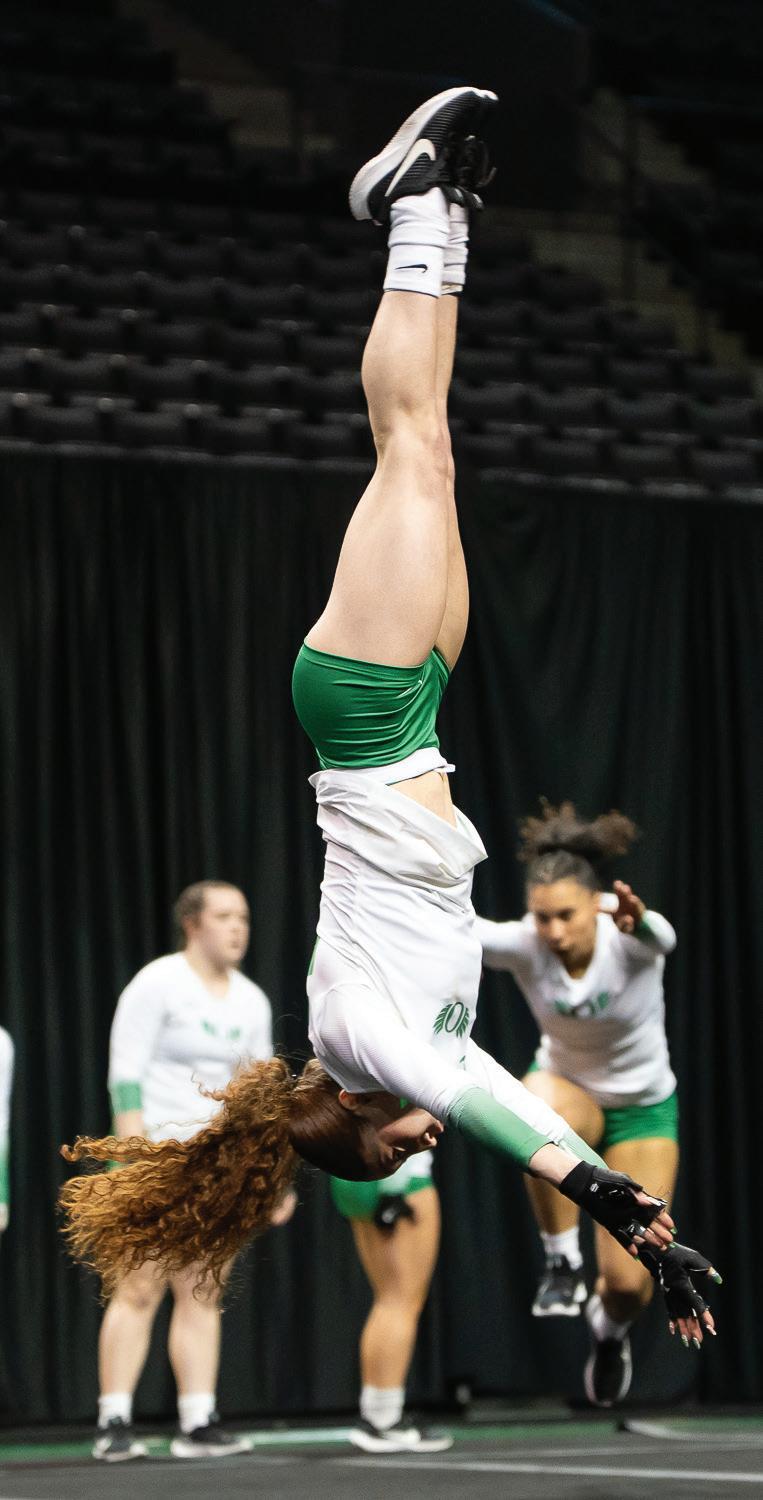
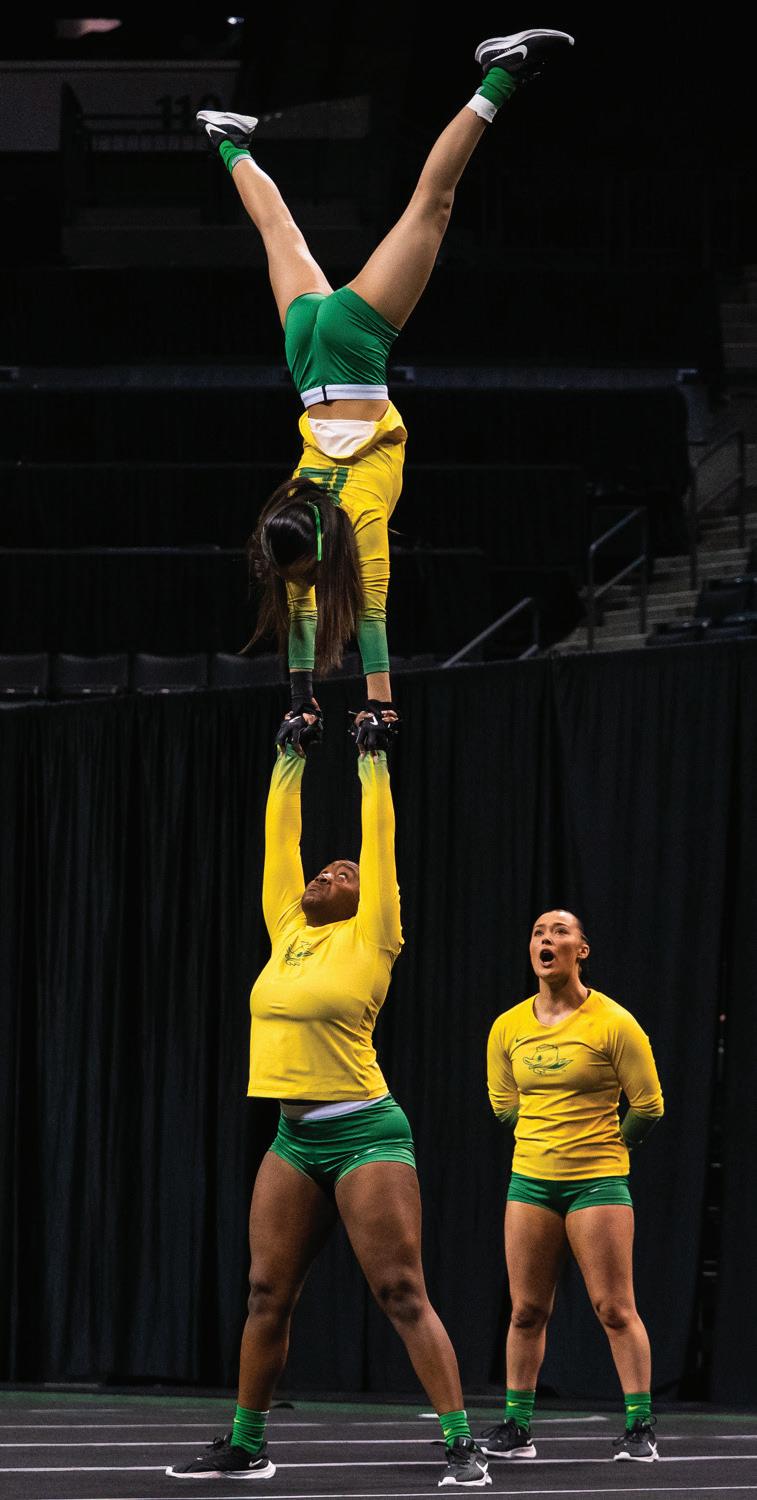
(LEFT) Top/tumbler Briya Alvarado (25) flips through the air. The University of Oregon Ducks Acro and Tumbling team defeated the No. 3 Quinnipiac University Bobcats 270.640 to 265.425 at Matthew Knight Arena in Eugene, Ore., on Feb. 21, 2025.
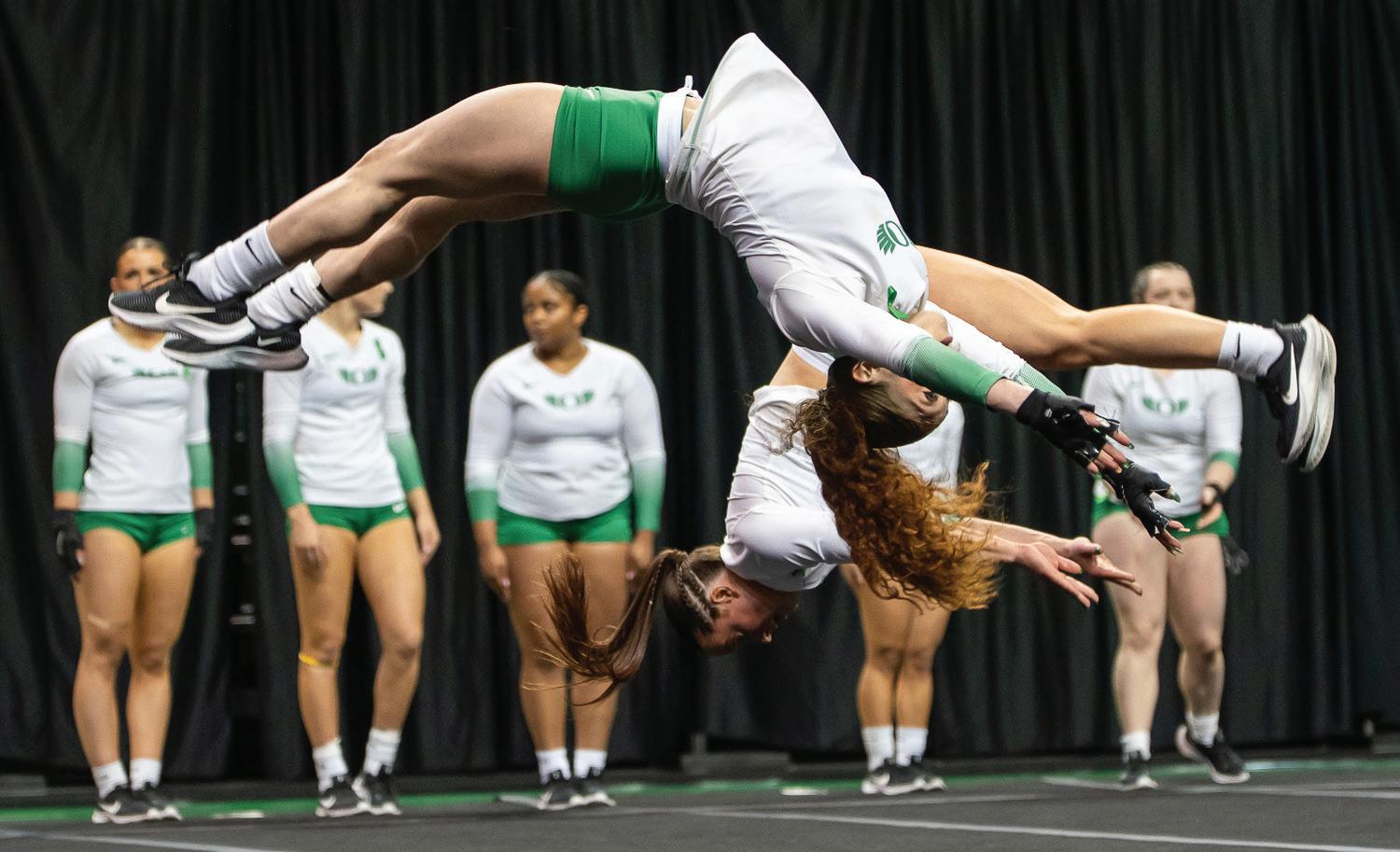
( ABOVE) Top/tumbler Briya Alvarado (25) and top/ tumbler Brynna Mortimer (15) fly through the air.
(Saj Sundaram/Emerald)










With more touring opportunities and festival dates, warmer months are one of the biggest release windows for new music.
By Bella Graham Associate Arts & Culture Editor
As the weather warms up in Eugene, the rainy days wane, and the once-open grass patches on campus fill up with students enjoying the sun. But there’s something else coming out, other than students: new music. Let’s check out what’s in the queue.
“Konnakol” by Zayn on April 17
“Konnakol” is Zayn’s fifth studio album and comes with the wrap-up of his residency in Las Vegas. The album is named after a South Indian vocal percussion style, a nod to his Pakistani heritage.
Singles “Die for Me” and “Sideways” are already out. Both are R&B pop, but “Die for Me” alternates between near rapping and strong falsettos and sits more on the pop side of that duo, where “Sideways” is a slower R&B song with layered vocals and tempo shifts.
“I have always drawn on my heritage for inspiration since I first started making my own music — this album is a development of that understanding, knowing more now than ever, who I am, where I come from and where I intend to go,” Zayn said in a press statement to Billboard.
Listeners can expect more of the R&B pop Zayn has grown to be known for, with some lyrics in Urdu.
“The Great Divide” by Noah Kahan on April 24
“The Great Divide” is Kahan’s first album after his meteoric rise with the release of his song and subsequent album “Stick Season” in 2022. The title track of this album was released Jan. 30, with the second single, “Porch Light” released on March 13.
“The Great Divide” and “Porch Light” are both sonically similar to his previous work (cathartic with a folk vibe), and have lines that are sure to go viral on TikTok, as previous lyrics of his have done, for pulling on your heart strings — “I hope you settle down, I hope you marry rich, I hope you’re scared of all the ordinary shit.”
“From a long silence forms a divide, a great expanse demanding attention. I stare across it. I see old friends, my father, my mother, my siblings, my younger self, the great state of Vermont. I want to scream these feelings, to gesticulate wildly at the figures on the other side, but my voice has grown hoarse,” Kahan said on his website. “The music here is my best attempt to delve deeper into the people, places and feelings that have made me who I am.”
The album was produced by Gabe Simon, who Kahan has previously worked with, and Aaron Dessner, a new collaborator with production credits with artists like Taylor Swift and Ed Sheeran.
“Fenian” by Kneecap on May 1
“Fenian” is the third studio album from Irish hip hop group Kneecap. The group raps in both Irish and English and is known for its music about post-Troubles Northern Ireland and Irish republicanism (which opposes British rule in Northern Ireland) backed by club-oriented production.
The two singles out so far — “Liars Tale” on Jan. 28 and “Smugglers & Scholars” on March 12 — are a more sophisti-
cated version of some of their earlier music. While the songs are still a mix of rap in Irish and English, both have a fuller techno sound and more developed production.
The group, which has historically been outspoken about their political beliefs, is delving into deeper political themes after criticism over their statements supporting Palestinian nationalism.
“Since everything that’s happened, we couldn’t just be talking about partying all day. We wanted to show this other side of us.” Móglaí Bap, a member of the group, said in an interview with the New York Times.
Other new music coming out includes “Age Of The Ram” by Charley Crockett on April 3, “Kehlani” by Kehlani on April 24 or “Middle of Nowhere” by Kacey Musgraves on May 1. Happy listening!

The Annex, a husband-and-wife duo offer bold fusion dishes to the campus community from their food truck.
By Claire Coit Arts & Culutre Editor
customers a colorful menu with fusion dishes that pack a punch, from steam bun tacos to giant protein plates.

Anaiese and Ezra Siegel met in high school, working in the restaurant industry. Now, they run the unique food truck together, alongside their two kids, Avias and Ezekiel.
The opportunity to start Ez Eatz came during the pandemic from their family friend, Nikos Ridge, owner of Ninkasi. He was opening The Annex and was looking for someone to create a food truck for their back patio.
The Siegels took a chance and decided to go for it, putting together a fusion menu based on their go-to dinner choices at home: tofu katsu, teriyaki chicken, citrus slaw and the works.
“Really, almost everything on this menu is something that we would eat once a week at home,” Anaiese said. “I feel like it’s all very easy and approachable.”
The Siegels also wanted their menu to be inviting and accessible for customers, with vegetarian options, room for customization and additional components from some of their favorite international cuisines, like the citrus slaw and the sambal sauce. The name came easily after the Siegels figured out the vibe of their menu: Ez Eatz.
Their most popular menu item, the steam bun tacos, came from a different inspiration: bar food. The taco is essentially a bao bun cut in half, with a choice of protein, a vibrant sauce and pickled vegetables. Customers can choose the fried mushroom taco or the crispy pork.
“We wanted something fun and unique on the menu, too. Whenever we’ve eaten them, I loved them,” Ezra said. “And we have kids, so it’s not something we can eat all the time. The goal for the tacos was to have them for everyone, so they made it to our menu.”
Having a home at The Annex is ideal for Ez Eatz, filled with Ninkasi-lovers on Friday nights or sports fans looking for a quick bite during game day before they head to Autzen Stadium.
With picnic tables lining the edge of the patio and a back entrance, Ez Eatz has its own space, filled with colorful menu items. Anaiese mentioned the beer garden’s friendly
environment and how the back patio has become the perfect home for the truck.
“We’re in a unique situation. A lot of food carts struggle to find a location or they’re moving a lot,” Anaiese said. “With us being on the back patio, we’re kind of like our own little brick-and-mortar restaurant without having to actually have a restaurant.”
Running the food truck together has been great for the Siegels, with the synergy that comes along with being husband and wife. The trust they have in each other is key to Ez Eatz’s success.
“We can communicate without talking and things like that,” Ezra said. “I feel like not every coworker dynamic is like that. So when we’re in here together, it’s honestly super fun. We have a blast, and it flows.”
“We treat the nights we get together here now, when we have a babysitter, like date nights,” Anaiese said. “It makes it a little easier to work with someone you know so well. He’s like, ‘I need that thing,’ and I’m already handing it to him. It’s great.”
From the Siegels to the plate, the food truck is open Tuesday through Saturday, 12 p.m. to 9 p.m. Whether students are hitting $3 pints with their friends on a Friday afternoon, or just looking for something convenient between classes, they might just find their new favorite food by campus on The Annex’s back patio.
(LEFT) Ez Eats owner Ezra Siegel adds sauce to loaded fries at his food truck located at The Annex in Eugene, Ore on March 19, 2026.
(Saj Sundaram/Emerald)




O V E R A L L G P A


U N I Q U E C O U N C I L S
A R E M E M B E R S M E M B E R S












The multi-instrumentalist traveled around the world to pursue his craft, and is happy to be back home.
By Vinny White Arts & Culture Writer
After studying at Paul McCartney’s Liverpool Institute for Performing Arts, touring Europe and performing at sea, Jack McGaughey once again finds himself in his hometown of Eugene, Oregon. His fateful return is characterized by one goal: "I want to be able to leverage my knowledge and connections with the University of Oregon, especially in these trying times, to foster connections in Eugene,” McGaughey said.
McGaughey is a multi-instrumentalist musician currently mastering in music composition at the UO. He exudes a refreshing dedication to local music. Having developed his musical skillset under the tutelage of Scotty Perry, a founding member of longtime local staple The Sugar Beets, McGaughey first encountered Perry at “image that!,” a camp for young children centered around creative expression.
Perry began teaching McGaughey Sugar Beets songs when he was in middle school, and eventually welcomed him into their rehearsals once he reached high school. McGaughey now performs and — thanks to a research scholarship from UO School of Music and Dance — documents the group.
“The goal is really to preserve their music (so) people in the future can appreciate their music, not a lot of it was really written down in any formal capacity,” McGaughey said. McGaughey has spent the last year cataloging the group, even creating a website and compiling a songbook to immortalize their music. His work will culminate in a show at the Richard E. Wildish Community Theater on April 4, in a concert celebrating the 35th anniversary of the group.
While McGaughey is dedicated to the Sugar Beets, he’s built himself quite a reputation outside the band. He studied music performance at LIPA, a university founded by Paul McCartney of The Beatles in England. His three-year course consisted less of academic classes, and more of practical, experience based credits — something that has proven overwhelmingly applicable to his profession.
“Basically they just go over the bare bones theory and they say ‘go out into the city and start your bands,’’’ McGaughey said. “In a lot of ways your assignment, what you actually get credit for, is playing music and booking gigs and networking. They really integrated that into the program in a way that I thought was really awesome. I was just in rehearsal all the time.”
McGaughey became the piano player for a nine-piece funk band, which included a horn section. The university helped him make connections to perform at iconic venues like The Cavern Club, and dip his toes into the European concert scene. He also attended “masterclasses” from music legends such as McCartney and Damon Albarn from Gorillaz. These classes typically consisted of the headmaster interviewing the artists in front of the entire student body.
Toward the end of his first year at LIPA , McGaughey auditioned to join a tour of Spain with LIPA alumni Juan Zelada. The singer welcomed him on his tour, the first of many for McGaughey. His experience led to a connection with U.K. based songwriter PM Warson, who he performed and continues to record with. Simultaneously, he started playing with The Bluejays, a 50s and 60s rock cover group most commonly seen on cruise ships. Suffice to say, McGaughey’s schedule was scarcely light.
“I’ll look at my calendar from those years and it'll be like ‘Monday, Tuesday, Wednesday: Cruise with the Bluejays,’ we’re in the Caribbean and then it would be ‘Come home on Thursday’ and the Friday, Saturday, Sunday ‘We’re going to France with PM Morrison,’” McGaughey said. “We would be on tour, but rarely would I be on tour with one band for more than one week.”
In the summer before his third year at LIPA, he started dating his future wife, Madi McGaughey. The two had been close friends since eighth grade, and decided to date long distance when it came time for McGaughey’s final year at LIPA. That final year came to an abrupt stop when the 2020 COVID-19 pandemic forced him to finish his degree remotely in Eugene. McGaughey moved in with Madi and, following his graduation (which came with the perk of a brief introduction to McCartney himself), the pair moved to Cambridge to support Madi’s studies. They stayed in the U.K. for three years, moving back to Eugene after their marriage.
Both McGaughey and Madi started studying at UO, with Madi getting her teaching license and McGaughey mastering in music composition. He has spent his time in Eugene studying, teaching students and recording piano for musicians like PM Warson. He is interested in eventually becoming a teacher, but is currently content in attending a university. After finishing his degree in the spring, he’ll move to a graduate employee position in the music theory department and start his Ph.D. in the fall.
“I have always really enjoyed school," McGaughey said. “I just feel like I really like being a part of an institution
and I’m passionate about education. I think it just gives me a certain amount of purpose. Believe me, playing music and being in bands and touring, that gives me all the purpose in the world, but I feel very empowered learning things. Relying on touring in that capacity is really stressful, because you never know if or when that next gig is going to come.”
After performing across multiple countries and learning from some of the most talented musicians and teachers he could find, McGaughey is excited to get back to building connections in Eugene and maintaining his place in the city.
“I love this community; I feel really connected here,” McGaughey said.
( BELOW ) McGaughey smiles with his melodica, one of his favorite instruments to take with him on the go, on March 10, 2026. Jack McGuaghey is a









Our search for optimized
By McKinley Coontz Guest Viewpoint
At 13 years old I was told to decide my career path by choosing a “small school.” In 2007, my high school was chosen to be a part of the Oregon Small Schools Initiative funded by the Bill & Melinda Gates Foundation, divided into three small specialized schools to teach students skills to prepare them for future careers. They asked incoming ninth graders to choose which school to commit to for the next four years, and by extension what career path.
While I was lucky to experience a watered-down version of this (the district got rid of the initiative completely the year after I graduated), I still saw its effects on the school community. Until 2020, there was almost no crossover between the small schools; sure they shared a campus, but schedules, grading and cultures were worlds apart. If you were in the business school you couldn’t take art, or if you were in the health school, you couldn’t take computer classes.
The Small Schools Initiative was supposed to “better prepare students… for the demands of today’s economy,” but it just created students who weren’t allowed to explore their many interests and weren’t getting well-rounded educations. Small schools stereotyped kids, meaning any cross-in-
Amelia is a junior at University of Oregon, studying advertising with a food studies minor. In her writing she enjoys pieces on culture and the human condition. In her free time Amelia enjoys journaling, cooking and sketching landscapes.
teraction often resulted in bullying. This especially posed a problem when the district started phasing out the program in 2021. Students from art-focused schools often had a target on their back and were the focus of bullying from the other two.
Students may have been getting specialized skills, but they lacked the interpersonal qualities that everyone needs no matter what path you take. This is one of the biggest reasons that the school district finally decided to end the program.
This program reflects the overachievement culture that has been steadily growing in our education system. I felt pressured to do the absolute most to set myself up for the best outcome. I had to have good grades in middle school or I wouldn’t get into the right classes or clubs in high school (or even the right small school). In high school, I had to be the top of class and in every possible club, or I wouldn’t get into a good college with a good scholarship. In college, I have to take as many credits as possible, be in multiple student orgs with leadership positions, pursue internships and so much more if I want an entry-level job once I graduate. Even if I do that and more, I am not guaranteed a job because there are hundreds of kids exactly like me competing for the same position.

McKinley Coontz is a University of Oregon student interested in how strategic storytelling can bridge sectors and make complex issues accessible and engaging.
In today’s world, we are stuck in the mindset of constant optimization — optimizing education, daily schedules, hobbies, relationships and more. Our culture of overachievement is detrimental. Mental health diagnoses are becoming all too common in teens across the country.
Small Schools did help students develop higher skills. In the 2000s, Oregon students were falling behind; today, they still are. Small Schools were created to give students learning environments that larger classes couldn’t afford. Ultimately, it wasn’t worth it when our mental health and social skills were put at risk due to the pressure of academic excellence and divisive social conditions.
So, now what? Do we all strike and refuse to come back until they make entry-level job requirements, college admission and grading systems realistic again? Yes, change needs to happen, but it will take time.
What we can focus on is creating a counterculture, one that focuses on joy rather than achievement. Do things because they make you happy not because they are going to beef up your resume. Do things just to do things!
Editor’s note: The Daily Emerald welcomes guest viewpoints or letters to the editor from the University of Oregon and Eugene community. This letter reflects the opinions of its writer, McKinley Coontz, and not of The Emerald as an organization.
The youth of America remain lonely due to a lack of gathering places. Third spaces remain underutilized, underappreciated and disappearing.
By Amelia Gavigilo Opinion Columnist
“Great civilizations, like great cities, share a common feature. Evolving within them and crucial to their growth and refinement are distinctive informal public gathering places. These become as much a part of the urban landscape as of the citizen’s daily life,” Ray Oldenburg wrote in “The Great Good Place: Cafés, coffee shops, bookstores, bars, hair salons, and other hangouts at the heart of a community.”
The cafes, coffee shops, bookstores and similar places mentioned in “The Great Good Place” are now commonly referred to as third spaces. Think of your house as a first space, your work as a second space and a third space as any pleasant public place you can hang out at for a long period of time for little to no cost.
Third spaces are dwindling in the United States because they are being replaced with something else or being closed down altogether. According to Bruno V. Manno in the Washington Monthly, 21% of Americans report living with no access to third spaces and no way to connect with their neighbors.
This issue stands out for the youth of America. Adults can go to one of the most common third spaces, a bar, and spend a good amount of time there.
For kids and teens, that isn’t the case. We as a society have created an environment where there are no places for kids and teens to freely socialize, so in turn, they turn to online spaces to find community.
It wasn’t always this way. It seems third spaces were celebrated and lived in for ages. Karen Robinson, 64, grew up in Simi Valley, California. She reminisced about the times she spent in one of her favorite third spaces as a teen.
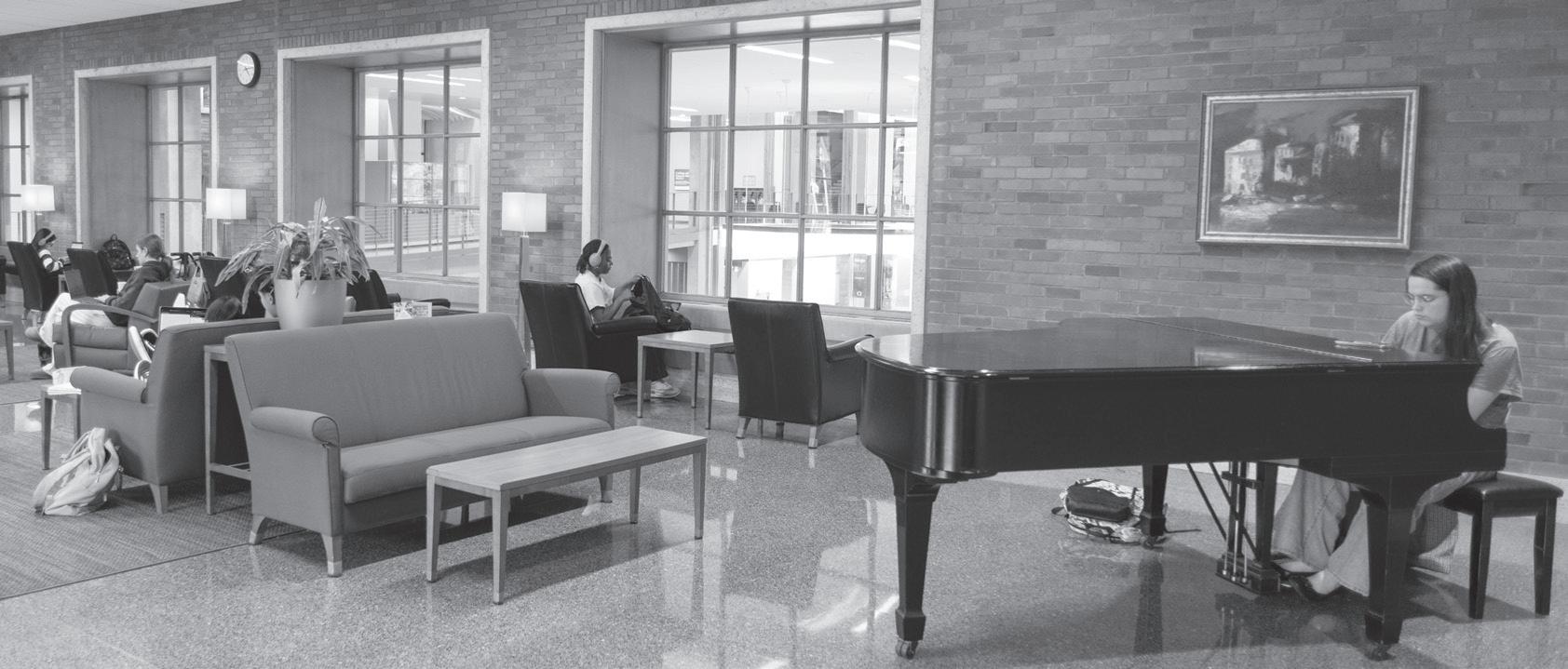
“There was a little restaurant called Ribbies… He (the owner) was super cool with letting the high school kids hang out there… we could just hang out there as long as we wanted,” Robinson said.
But now, times have changed. Aubrey Jane, a 22-year-old student at the University of Oregon, talked about the lack of third spaces while growing up.
“I have two brothers, one six years older and one eight years older. They would go to this bowling alley or this dancing club for teenagers… I feel like our generation doesn’t have that,” Jane said.
One reason third spaces have gone out of style is cost. Going out to the roller rink, bowling alley or arcade used to cost $10 at the most, adjusted with inflation. Now, going to any of these places and maybe buying a drink as well costs at least $30 wherever you go, making it more of an event rather than a hangout spot. Most people just don’t have the money to go out every weekend these days.
However, we can bring more third spaces back. Jane Jacobs wrote in her 1961 book “The Death and Life of Great American Cities,” “A well-used city street is apt to be a safe street.”
This concept, while talking about the importance of people present to make city streets feel safe, applies to third spaces as well. With enough people around, people feel safe. We as a community can do something to bring life back into these common areas by participating in them.
As simple as it sounds, third spaces bring a town together. Seeing a community enjoy a shared space makes people care about each other, and in caring about the community, they care about the town.



The Ducks have won their first three series and have been playing strong across the diamond.
By Rowan Shea Sports Writer
With Oregon’s softball most recent win over Northwestern, via the drop-dead rule, the Ducks have won their first three Big Ten series to start the 2026 season. That winning streak continues one that was set last season and now sits at 11 straight Big Ten series wins for the Ducks.
Oregon softball has been performing solidly to start Big Ten play. The offense has been the focal point of Version 8, and while the pitching has had its ups and downs, it’s still doing its job. As April begins, there is a lot the Ducks have been doing well on the field, and it looks like this squad has what it takes to repeat as Big Ten champions.
The offense is driven mainly by the transfers Oregon brought in: Elon Butler and Amari Harper. They are the firestarters at the plate posting impressive slash lines with Butler carrying a line of .426/.535/.901 and Harper .359/.475/.707. Bolstered by them, Oregon has been slugging its way past teams to begin Big Ten play.
Though, sometimes everything just stalls for the Ducks. In the Northwestern series, Game 1 had that issue. The Ducks got outscored 11-3 in that game and were run-ruled for the first time in the 2026 season, with the rest of the series seeing the Ducks plate eight runners across the last two games.
In the Purdue series, Oregon seemed to fall back into its early season struggles with runners in scoring position. In the series, the Ducks went an abysmal 5-30 with runners in scoring position, but did not have a game where they registered double-digit hits.
When that happens, that’s where the pitching gets put under some pressure.
The pitching to begin the Ducks Big Ten play has been interesting to say the least. Lyndsey Grein has made appearances in eight out of the first nine games, she has thrown complete games in three of those games and across the weekend series in Purdue (and the one game in Indiana that
The Bears have built an unmatched dynasty over the past decade. The Ducks are their eternal challengers. They meet again in Eugene on April 6.
By Owen Murray Associate Sports Editor
It’s been 1,857 days since March 6, 2021. It was the last time Baylor acrobatics and tumbling lost, and it happened in Eugene.
Since then, the Ducks have appointed a new head coach (Taylor Susnara, after the 2021 season), and made the national championship meet twice. Both times, they lost to the Bears. The program has grown, but not past that high-water mark set five years and one month from Monday.
score of the season to that point. It still, however, wasn’t enough.
didn’t count toward conference play), she had over 300 pitches.
The rest of the staff has been on again and off again. Freshman Maddie Milhorn has put in a couple stellar performances so far in the season, one being a 5.0 inning, three hit and one run performance against Penn State. But she’s a young arm and hasn’t been seeing as much time in the circle recently.
Elise Sokolsky and Taylour Spencer are in a different boat. Sokolsky has been working through some struggles in the season and has shown that she is getting out of them. Against Penn State she threw 4.2 innings, only gave up three hits and two earned runs, which was one of her better starts on the year. She left the game in Indiana due to leg discomfort and hasn’t returned.
Spencer has been seeing more time in the circle after Sokolsky went out. Against Northwestern she got tagged in her first outing, but bounced right back in her second and gave the Ducks 3.1 innings of onehit, six strikeout softball. If she can carry that performance into the rest of the season, the Ducks may not have to be as reliant on Grein as they have been so far.
Version 8 has the team being able to cruise through Big Ten play when everything is going right for them. With a lot of time remaining before playoffs, this team has enough time to get all cylinders firing to go into the postseason hot.
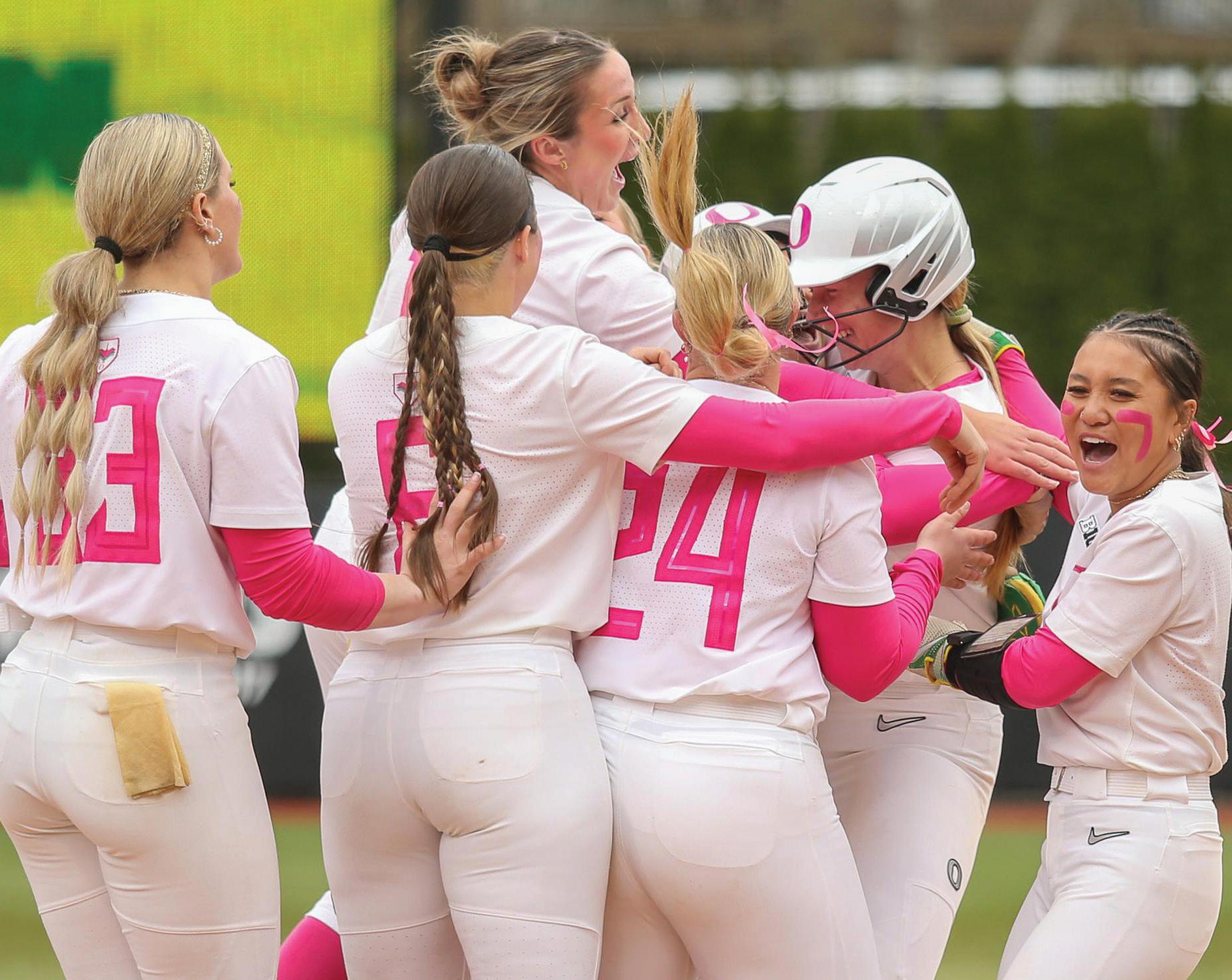
(ABOVE) Oregon catcher Emma Cox (21) is embraced by teammates after a walk-off sacrifice fly ball into right field. The University of Oregon Ducks softball team defeated the Penn State Nittany Lions 6-5 at Jane Sanders Stadium in Eugene, Ore., on March 15, 2026.
(Tyler Graham/Emerald)
No. 2 Oregon acrobatics and tumbling (5-1) faces No. 1 Baylor University (8-0) on April 6 at Matthew Knight Arena. They’re the two best teams in the nation, again, but the historical gap between them and the rest has been matched by the distance between them. Measure it however you want — Baylor’s 10 straight national titles, its 14-straight series wins, or just those 1,857 days — it’s growing until Oregon snaps the streak. The winner of Monday’s matchup will likely take the NCATA’s top seed into the postseason, but the Ducks doing so would mean overcoming a decade of Bears dominance.
Last April in Sioux Falls, South Dakota, then No. 2 Oregon trailed by 2.1 points entering the team event in the championship meet against No. 1 Baylor. The Bears turned in their worst score of the postseason, but so did the Ducks, who scored their lowest team event of the season in the eventual loss. Afterward, Susnara said if they’d hit, they’d have had a shot.
There’s history between these two that stretches back beyond those 1,857 days, too. Baylor head coach Felecia Mulkey was the Ducks’ inaugural coach. She brought the sport’s first four national titles to Eugene before departing for Waco, Texas, where she built another dynasty. The two programs have continued their home-andhome series, which they’ve competed every season except the pandemic-shortened 2020 (still scheduled) since 2011.
Both have been at the forefront of innovation in the sport. Oregon freshmen Angelica Martin and Cassidy Cu competed an all-new slide-to-split skill in that 2025 season, and Nya Womack’s quad-whip pass was something the 2026 freshman picked up in between the Ducks’ first two meets.
In their first meeting, a 278.080272.530 Baylor win in Waco on Feb. 28, the Bears competed their open pyramid heat with four of those slide-to-split skills. A chain reaction of slips, though, sent it tumbling to the ground. Again, Oregon trailed by just over two points before the team event. This time, it turned in its best
Martin and Cu have returned as staples in the Ducks’ acro event. Fifth-year base Blessyn McMorris, tumblers Morgan Willingham and Briya Alvarado and Week 3 NCATA Athlete of the Week Ashlyn Parlett have been more. But the Bears have their stable of stars, too. 2025 Division I Athlete of the Year Payton Washington, tumbler Emily Bott and freshman base Mo Arthur have held them steady. Mulkey is still there. Little has changed between the two schools.
Should the Ducks turn 1,857 into zero on Monday, it won’t win them a national championship. It won’t erase the 10 years of titles, or the five years of losses. It would, however, redefine their relationship with the nation’s top team.
Since March 6, 2021, that definition has been absolute dominance. In Eugene, and then in Azusa, California, at the NCATA National Championship later this month, Oregon wants to change that.
Monday’s meet is scheduled for 6 p.m., to be broadcast on Big Ten Plus.

SUNDAY April 5, 2026

From local youth meets to collegiate competition, Ducks distance runner Hannah Seubert’s journey reflects a deep connection to TrackTown and the community that shaped her.
By Rachel McConaghie Sports Writer
At Hayward Field, the roar of the crowd is familiar, not just from collegiate competition, but from years of growing up in the stands, watching, waiting and imagining what it would be like to run in TrackTown, USA.
Long before she wore an Oregon uniform, University of Oregon distance runner Hannah Seubert was just another Eugene kid chasing a chance to race on the sport’s most iconic stage.
“I remember going to middle school districts … and everyone hyping it up, ‘you have to get to districts because you have to run at Hayward,’” Seubert said. “That was the goal.”
Now, it’s routine.
Her path to that starting line wasn’t built on an early love of running. Like many young athletes, she started across multiple sports — basketball, soccer, volleyball — before turning to track in middle school to improve her speed. Distance running became her lane almost by default. Sprinting didn’t click, but longer races did.
“I would run too fast, and my workouts were so hard, I would end in tears,” Seubert said.
But in a city where running has a deep root, something shined that kept her thinking. The culture, the people and the shared grind kept pulling her back.
“I just started to love the community for track because we’re all going through it together,” she said. “But I really did not like the running component.”
That sense of belonging extended beyond competition. Growing up in Eugene meant constant exposure to Oregon athletics. Attending games, seeing college athletes in the community and imagining herself in their place.
“I was always on (Oregon) campus,” she said. “I loved it. I didn’t really see myself going anywhere else.”
Choosing Oregon felt less like a decision and more like a continuation of something that had always been there.
Even now, her favorite training routes reflect that history. She runs through familiar neighborhoods, looping past her old high school and returns to the same trails she used years ago.
Her journey at Oregon hasn’t been without challenges. Early in her collegiate career, she dealt with five stress fractures across two seasons, setbacks that forced her to step away from the sport she had grown up around. But being in Eugene helped with navigating those hard moments.
“You want to be impressive,” Seubert said. “You want to do your best in every practice, every run, every workout. And I was doing that, but it was just too much for my body, so it broke down.”
Her family, still rooted nearby, is a constant presence at meets. Their voices are easy to pick out in the stands — a reminder that her running career has always been intertwined with Eugene.
“My family’s always at all my home meets … And I feel like they’re also a big part of why I chose running,” she said.
Seubert’s twin brother, Jackson, also grew up an avid runner, creating a strong bond between the two, always pushing each other to the next level.
“It’s been fun having the friendly twin competition, but then also having a supporter and somebody who’s there to experience my lows and highs with me through running,” she said. That support system extends to her teammates and even to the broader Eugene running culture. During injuries, she found ways to stay connected, whether by supporting teammates in workouts or simply remaining present.
“I love giving back to the community that I was raised in because it’s a big part of my success,” Seubert said.
Now healthy, she’s entering one of the most consistent stretches of her career. Last season marked her first full outdoor season as a Duck, including a personal record in steeplechase.
“To experience that with my friends and family who were there,” she said. “I got to do a victory lap, and that was really fun.”
This season, she’s aiming for a 10K steeplechase double, a goal that once felt out of reach. But her ambitions extend beyond the track. A double major in family human services and planning, public policy and management with a minor in legal studies, she plans to attend law school and eventually build a career helping others, a goal shaped, in part, by the community that raised her.
Even as she considers leaving Eugene for law school, she expects the connection to remain.
“I definitely see myself ending up back here eventually if I leave,” Seubert said.
At Hayward Field, where generations of runners have come and gone, her story stands out not for how far she’s traveled, but for how deeply she’s stayed connected. In a city defined by running, she didn’t just find the sport. She found home.
( LEFT ) Hannah Seubert leads in the women’s 3000 meter steeplechase, just after jumping and running through the water. The University of Oregon Track and Field team finished out their regular season home races with the Oregon Twilight meet at Hayward Field in Eugene, Ore., on May 9, 2025.
(Saj Sundaram/Emerald)