Rising gas prices create challenges for commuter students
The product of jiu-jitsu and drag: Eugene’s queer grappling club
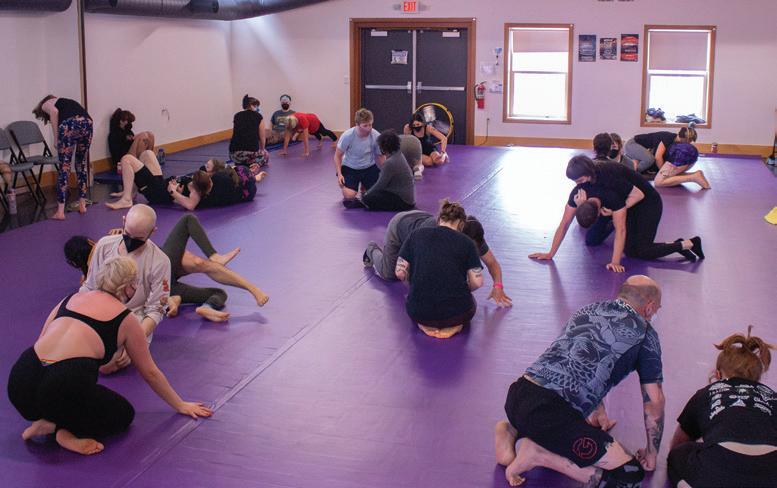
Drag queen Judy Jitsu created an all-queer jiu-jitsu class right here in Eugene to build a safe and comfortable learning environment for LGBTQ+ individuals.
By Gray Vanderpoel Arts & Culture Writer
If you are a queer or transgender individual looking for a new hobby to learn this upcoming term, Judy Jitsu, a two-spirited drag icon, is here to help. Eugene’s queer grappling club, hosted every Sunday from 12 to 1:30 p.m. at Eugene’s Lavender Network, is designed for beginners to higher-level martial artists to make the sport as accessible as possible.
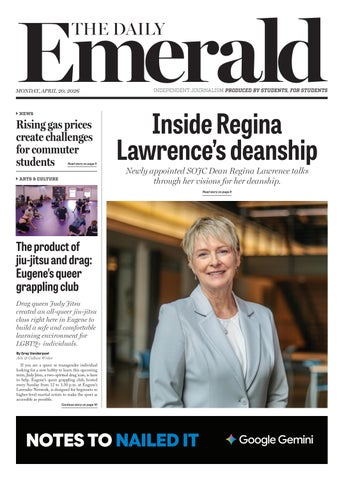
Inside Regina Lawrence’s deanship
Newly appointed SOJC Dean Regina Lawrence talks through her visions for her deanship.
NEWSROOM
EDITOR IN CHIEF
Tarek Anthony
PRINT MANAGING EDITOR
Ryan Ehrhart
DIGITAL MANAGING EDITOR
Ysabella Sosa
NEWS EDITOR
Reilly Norgren
INVESTIGATIONS EDITOR
Ana Narayan
A&C EDITOR
Claire Coit
SPORTS EDITOR
Jack Lazarus
OPINION EDITOR
Gracie Cox
PHOTO MANAGING EDITOR
Corey Hoffman
PHOTO EDITOR
Saj Sundaram
COPY CHIEF
Olivia Ellerbruch
VIDEO EDITOR
Jake Nolan
PODCAST EDITOR
Stephanie Hensley
SOCIALS EDITOR
Ysabella Sosa
VISUALS EDITOR
Noa Schwartz
DESIGN EDITOR
Adaleah Carman
DESIGNERS
Asha Mohan
Ellery Burton-Tillson
Eva Andrews
Izzy Smith
Nina Rose
BUSINESS
PUBLISHER AND PRESIDENT
Eric Henry (X317) ehenry@dailyemerald.com
VP OPERATIONS
Kathy Carbone (X302) kcarbone@dailyemerald.com
DIRECTOR OF SALES & DIGITAL MARKETING
Shelly Rondestvedt (X303) srondestvedt@dailyemerald. com
CREATIVE & TECHNICAL
DIRECTOR
Anna Smith (X327)
creative@dailyemerald.com
ACCOUNT EXECUTIVES
Torin Chevalier
Camcole Pereira
Ava Stephanian
Elliot Byrne
THE DAILY EMERALD
The Daily Emerald is published by Emerald Media Group, Inc., the independent nonprofit media company at the University of Oregon. Formerly the Oregon Daily Emerald, the news organization was founded in 1900.
Emerald Media Group 1395 University St.,#302 Eugene, Or 97403 (541)-346-5511
FIND MORE STORIES ONLINE AT DAILYEMERALD.COM
Eugene residents pack city hall, protest potential federal building fence
The Eugene City Council held a public meeting on April 13, at which used public comment to protest the potential for a fence to be built around the Eugene Federal Building.
By Billie Corsetti News Reporter
The Eugene City Council held a public meeting April 13, at which dozens of residents urged the council to stop planning a potential fence around the federal building.
Activist group 50501 Eugene posted on Instagram days before the meeting, calling on followers and other Eugene residents to pack City Hall and voice their concerns about a fence to be built around the Eugene Federal Building by the federal government.
“I ask that the city immediately cease all cooperation with the feds on this project, publicly condemn the construction of the fence, and provide full transparency regarding the planning and permitting process,” the post said.
A farewell film
As graduation approaches, seniors may find solace in “Goodnight College,” a film that serves as an ode to crazy college nights. Continue story online
By Amelia Fiore Arts & Culture Writer
One graduating senior with a camera, 10 groups of college students and dozens of experiences captured to portray the ultimate college Friday night.
On April 10, filmmaker Shyam Madhav stopped in Eugene on his tour across the country to share his film, “Goodnight College.” The University Film Organization screened the film in Allen Hall, followed by a short Q&A with its creator.
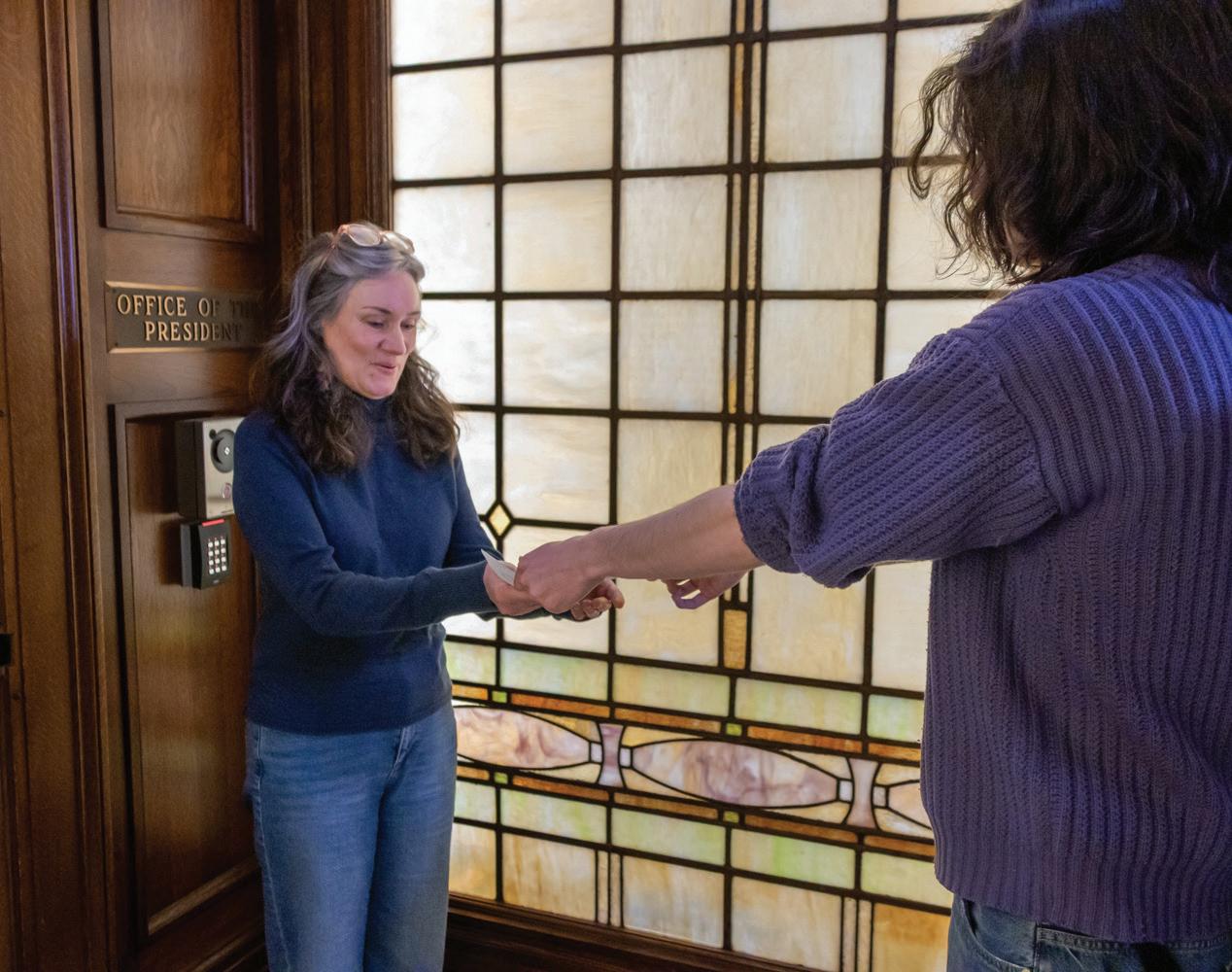
Photos: UO Anti-ICE Coalition
to Office of the President
By Corey Hoffman
Managing Editor
newsletter,
Photo
Grove Community Garden plants a ‘new era’
Grove Community Garden begins planting after relocating over winter term.
By Katarina Ilic News Reporter
A community of gardeners rake dirt to emerge fresh soil, planting crops into their new homes on a section of land outside Kalapuya Ilihi Hall as the new Grove Garden.
Clarissa Nuuja, a University of Oregon Student, said that this is the “new era” of the grove garden.
The Grove Garden workers and student helpers now aim to grow plants in their new location outside of Kalapuya after being forced to relocate at the beginning of the school year. After spending the winter term rebuilding on their new grounds, they’re ready to plant the first seeds.
“We found out that (the university was) moving forward with the east campus development plan, (and) we had to really advocate and push back to get relocated,” Grove Garden Community Engagement and Outreach Coordinator Ella Hayden said. “After fighting pretty hard to make ourselves seen and heard… we were able to get another location.”
The Grove Garden originally started as a side project under the UO Urban Farm program and the Sustainability Coalition in 2012. Now, it will serve as a sustainable community garden where students can assist in planting and, in return, take home produce, with the rest of the rest of which will be taken to the Produce Drop or Student Pantry.
“Students being in charge of (the garden) and providing for other students is a really rare opportunity, and clearly really impactful for people,” Hayden said.
Over the past few terms, the Grove Garden has had to face many challenges, from relocating and rebuilding to, most recently, having its boat stolen. According to Hayden, a boat that had sat on the grounds for quite some time was removed from the property on Monday between 1 and 7 p.m.
but also for people in the community.
“All the kids at the Moss Street Children’s Center really adore the boat. It’s something they’ve always looked at and really cared about,” Hayden said. “It’s just kind of been a staple, especially for students in the dorms around there. It’s a spot to hang out.”
Still, the garden community members continue to truck on, focusing on replanting the garden in its new home outside of Kalapuya.
“It’s nice to kind of have a community and we’re all working together towards a similar goal, especially with this new relocation project,” Nuuja said. “There’s a sense of unity. We are all working together to build something new. The old space was very beautiful (and had) lots of love throughout the many generations of students beforehand.”
Students can contribute to the garden rebuilding by volunteering at work parties every Sunday from 2-4 p.m.
“I think just knowing our members of our community, and getting to know more people and helping out (is great),” UO first-year student Amara Coughlin said whilst planting various seeds.
As for individuals who may know anything about where the boat may be, the Grove Garden urges them to step forward provide information.
“If you happen to see it or hear anything about it, please do not hesitate to let us know. If you took it, no hard feelings. We just want it back!” the Grove Garden stated on their Instagram.
(ABOVE) Students spend their Wednesday helping out at the Grove Garden, located on Moss Street in Eugene, Ore., On Oct. 8, 2025.
(Katie Poluyansky/Emerald)
Rising gas prices create challenges for commuter students
As gas prices continue to increase, commuter students are feeling financial pressure.
By Helen Bouchard News Reporter
Living in a college town can already feel financially burdening due to the urban populated environment, and the increasing gas prices adds another layer of pressure to many students’ everyday lives.
In many cases, the most affordable option for college is commuting to school. With rent options near campus out of reach for many, some choose to drive to school to save money.
However, with the recent increase in gas prices, this option has become more costly.
“Compared to one year ago, there has been almost a 25% increase in the gas prices,” third-year economics Ph.D. student Arvind Sai Chennupati said. “If this is a main source of transportation, it’s going to have a huge impact.”
In Oregon, the current gas price average is $5 per gallon, over a dollar increase since February. For instance, when filling up a 13-gallon car, it would be nearly a $15 increase to fill the tank in a small compact car; with larger vehicles, this number can be even greater.
For commuter students, these costs can add up quickly.
“I haven’t even paid for a full tank of gas since moving to Oregon due to the price,” Willow Biasi, a second-year student who commutes 11 minutes Monday through Thursday, said. “As someone who just recently was able to find a job in the busy college town, all my money has gone to gas.”
Grace Dandini is another commuter student who travels to Portland for work every other week and expressed similar feelings. “I drive a Nissan Altima and it gets pretty good gas, but gas is definitely a bigger chunk of my budget each month, taking up a quarter, even almost half of my paycheck,” Dandini said.
Many are wondering why gas prices have gone up, and according to Chennupati, the Iran war has caused this to happen.
“The Middle East is one of the biggest oil producing regions in the world, as well as Russia, so whenever these
regions come into conflict zones, such as in recent times, there is a supply site disruption, causing demand to increase and prices to go up,” Chennupati said. This unexpected disruption has created a financial crisis for many commuter students, when the goal was to save money on this pathway.
Commuting can save hundreds of dollars a month, but it comes with hidden costs such as gas payments, car maintenance and parking fees. The financial gap between living farther away and living near campus shrinks, forcing students to reconsider what is truly more affordable.
“Next year, when I’m living in an apartment, I’m definitely going to rely on walking and public transportation,” Dandini said.
While prices may stabilize if global supply disruptions decrease, there is no clear timeline for when that will come.
“There is a very good chance that once the conflict subsides, the prices will begin to lower and you will see a 20% decrease,” Chennupati said.
Until then, UO students are left adjusting their routines and budgets and navigating yet another rising cost in an already expensive college environment.
(ABOVE) The 76 gas station located on Franklin Boulevard and Walnut Street in Eugene, Ore., on April 14, 2026.
(Katie Poluyansky/Emerald)
Inside Lawrence’sRegina deanship
By Corey Hoffman Senior News Reporter
Following her appointment as dean of the School of Journalism and Communication, Regina Lawrence sat down with The Daily Emerald to discuss her visions for her tenure.
Lawrence, who has served as interim dean since August 2025, was announced as dean on April 3, after having served as associate dean of the SOJC-Portland since 2015.
“I’m excited because the SOJC sees many, many assets, but I think our biggest asset is our people, our faculty, our staff, our students, who are so bright and eager to learn and passionate and open to innovation and it’s a wonderful community and a great honor to get to lead this community,” Lawrence said.
Lawrence received her undergraduate degrees in history and political science from Metropolitan State University in Denver, her master’s degree in political science from the University of Colorado, Denver and her
“ I see an SOJC within the next few years that has refound itself. That resolidified its core strengths, its sense of identity, purpose and mission.
Regina Lawrence SOJC Dean
Ph.D. in political science from the University of Washington. Her research focuses on media coverage of politics, civic engagement and gender.
Lawrence’s first priority for her deanship is to strengthen the SOJC internally, including building back a sense of community.
“I think there’s more work to be done there to establish just good ongoing communication, transparency and hopefully in that way, building more trust,” Lawrence said. “We need that sense of community and a stronger identity of ourselves as a school to know how to navigate the challenges that are here and that are now.”
Lawrence’s second priority is to continue to attract students to the SOJC and prepare them for a changing world and media landscape.
“I see an SOJC within the next few years that has refound itself. That resolidified its core strengths, its sense of identity and purpose and mission and has figured out how to remain relevant and useful to the professions that we serve and has stepped up our game in terms of preparing students for this world that just shifted underneath our feet,” Lawrence said.
One program Lawrence said she’s excited about continuing to work on as dean and that will help to attract more students to the SOJC is the creation of a sports communication program.
While the program will take time to develop, Lawrence said she’s eager to take advantage of faculty expertise and student interest in the multidisciplinary field of sports communication.
“Across all of the (SOJC) majors, there are faculty who have an interest and expertise on some angle on sports. Whether it’s sports journalism, or managing social media audiences for sports teams or it’s even studying from a media studies perspective, kind of sports culture and fandom,” Lawrence said.
Lawrence said she hopes to collaborate with other schools across campus for this program, including the Lundquist College of Business, which houses the Warsaw Sports Business Center, and UO School of Law, which houses the sports law program.
“It’s a neat opportunity for us to package up some really great curriculum for our students,” Lawrence said.
Another project Lawrence said she began working on during her interim tenure that she’ll continue to work on in the permanent role is “grappling with AI.”
“We have to figure out a balance between making sure that our students are prepared for what is going to be an AI-driven world in many ways, but without losing the foundation of who we are and the training and the skills and the critical thinking that we
“ It’s a wonderful community and a great honor to get to lead this community.
Regina Lawrence SOJC Dean
offer to students,” Lawrence said.
One initiative, Lawrence said, that was difficult to address as interim was getting the school “to a stable and sustainable economic place.”
In June 2025, the university announced that it was facing a $25-30 million deficit, which resulted in university-wide budget cuts and the laying off of 117 faculty and administrative members in September 2025. At the beginning of the 2025-2026 school year, the SOJC budget deficit was around $700,000.
“The market for higher education is changing. The university is experiencing challenges with enrollment and budgets. We have to figure out how to position ourselves so that we last, so that we do what we do well and keep doing it as well as we possibly can and make sure that we’re financially strong for the future,” Lawrence said.
According to Lawrence, a leadership team from the SOJC came together after the announcement to create a plan to meet the newly set budget reductions. The plan aimed
to get the school to “budget neutral” by the 2026-2027 academic year, but, Lawrence said, the school is predicted to reach that goal by the end the 2025-2026 academic year.
Despite that, Lawrence said the school is uncertain if the university will ask for further budget reductions.
“We are doing a lot of internal analysis of our finances, our teaching loads, our schedule, our curriculum, to look for any ways that we can get more efficient. I would already say we’re pretty darn efficient but there may be things that we can do to make sure,” Lawrence said.
As part of that internal analysis, Lawrence said she hopes to address the “mismatch” between the number of enrolled students and the number of faculty, which has left students unable to get the classes they need.
“The irony is that at the SOJC, our enrollment has been growing so we’ve been doing really well in terms of attracting students, but for a whole bunch of reasons right now we have this mismatch, and we don’t quite have all the faculty,” Lawrence said.
According to Lawrence, an important role of a dean is growing the SOJC’s communal, national and international profile.
In order to grow the SOJC’s community profile, Lawrence plans to strengthen the school’s relationship with university administrators in order to better represent the school’s interests, visions and needs.
In order to strengthen the SOJC’s national and international identity, Lawrence hopes to collaborate with deans of other media schools around the Big Ten, as well as increase student participation in national competitions.
One thing Lawrence said the SOJC does well that she hopes to expand upon is “practical and career oriented training of students and the experiential learning” offered to students, as well as the strength of faculty research.
“Part of what attracted me to the SOJC over 10 years ago when I visited was the way that the research faculty and the career faculty, the professionals, the researchers, were just in constant conversation with each other. They were collaborating together on projects and I think that’s a real strength of ours,” Lawrence said.
Under her guidance, Lawrence hopes the student experience is one of inclusion, innovation, purpose and experiential learning where 100% of SOJC students are involved on campus in some way.
“I want every student to really feel like, ‘wow, the SOJC is not only an exciting place to be, where I get to do really fun and interesting things, but also it’s a welcoming place,’” Lawrence said. “That’s really important to me.”
Despite the busy schedule that comes with the position, Lawrence said taking the time to speak with students is one of her key priorities.
“I would just want students to know that even though they might not always feel like they see me physically because I might be pulled in a lot of directions, doing a lot of meetings, having to travel, I’m always happy to talk with students and always want to be here for them,” Lawrence said.
Lawrence’s key priorities
As stated in her introductory presentation to students on March 11 and in her cover letter submitted to the Dean Search Committee.
“Navigate a changing budgetary environment and strengthening the SOJC’s financial outlook”
Embrace and leverage evolving technologies, while maintaining “guiding values of ethics, innovation and social impact”
Work with the associate vice provost of UO Online to “judiciously expand the SOJC’s online course and program offerings”
Develop an SOJC policy regarding AI
“Articulate the role and value of the SOJC as a professional school at a (Research 1) university”
“Move the SOJC past current hardship and building more strategically”
“Manage the school’s budget and growth carefully, always with an eye toward clearly articulated strategic priorities”
Timeline of SOJC dean search
Regina Lawrence accepts one-year term as interim dean
Dean Juan Carlos Molleda resigns Aug. 1, 2025
July 8, 2025
Former SOJC
Deadline for applications closes Jan. 12, 2026. Committee reviews applications, conducts confidential interviews, selects three finalists
SOJC Dean Search Committee forms, nation-wide search for a new dean begins Winter 2026
Fall 2025
Lawrence presents to students
The three dean finalists visit campus for tours and presentations to students March 11
Between March 4 and March 11
Lawrence is announced as the next Edwin L. Artzt Dean of the SOJC
April 3
Spring 2026
Dean Search Committee discusses impressions with the provost, who reviews the recommendations and selects the dean
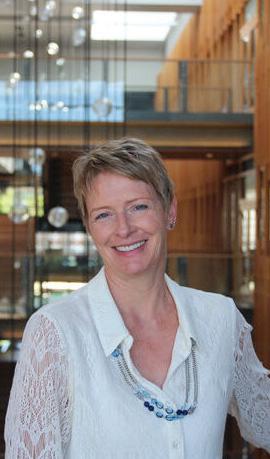
(LEFT) Regina Lawrence was named SOJC dean on April 3, 2026. Photo courtesy of Regina Lawrence
UO’s cybersecurity program is making strides
Domino’s Pizza plans to move into Elk Horn Brewery on Broadway
Domino’s has submitted permits to occupy Elk Horn Brewery; students hesitant about another chain restaurant.
By Sasha Love Senior News Reporter
Domino’s Pizza has submitted permits to the city of Eugene for moving into 686 East Broadway Ave., previously occupied by Elk Horn Brewery. The brewery has been shuttered since 2024.
According to permits, Domino’s plans to convert the basement to office spaces, remodel the restaurant and install a new roof.
Several students living near the proposed Domino’s said they were sad to see a small business close, but would likely still be ordering pizza.
“I think it’s slightly disappointing to see more chains instead of local business-
es; however, I will be shopping at that Domino’s,” Campbell Linsday, a student living at Union on Broadway, said.
Spencer Martin, another UO student, said he thinks that a Domino’s will better suit the needs of college students.
“Breweries are kind of falling out with people my age, and it’s like, I don’t really drink,” Martin said. “I’d rather go to Domino’s over a brewery.”
The building is pending several inspections before Domino’s can make changes to the building and potentially move in.
( ABOVE) The former site of Elk Horn Brewery on the corner of East Broadway Ave and Hilyard St in Eugene, Ore is set to be replaced with a Domino’s Pizza location.
(Sasha Love/Emerald)
UO secures five-year renewal for federal transition center
ED gives $20 million dollar grant to support the program for youth with disabilities.
By Helen Bouchard News Reporter
The University of Oregon has been awarded a grant from the Department of Education to renew the National Technical Assistance Center on Transition: Collaborative program to continue efforts to help youth with disabilities transition into the work force.
Originally housed by the University of North Carolina at Charlotte for the past five years, UO became the lead for the project for the upcoming renewal.
This transition marks a significant development for UO, as it holds itself nationally on the efforts to build support systems for students with disabilities.
When speaking to Deanne Unruh, NTACT:C’s fiscal lead, she said “Our charge is to improve programming for students and youth with disabilities in
each of the states specifically to prepare these students for post-secondary education, training and the foremost competitive integrated employment.”
NTACT:C focuses on helping states, educators and over 13 technical assistance areas to enhance transition programming for students preparing for life after high school.
By building on past achievements,
NTACT:C aims to create more equitable opportunities for youth with disabilities as they pursue education and meaningful careers
As UO steps into this leadership role, the renewed program is expected to expand its horizons and continue developing strategies that support student success nationwide.
With a new National Security Agency designation and numerous outreach programs, the program has more attention than ever.
By Audrey Lynch News Reporter
In September 2025, the cybersecurity program at the University of Oregon once again became a National Center of Academic Excellence in Cyber Research. This designation is awarded by the National Security Agency to universities that go above and beyond in their research.
Once awarded, the designation lasts for five years and must then be renewed. The CAE-R allows for more recognition of individual programs, chances for funding by NSA and creates a community of all designated schools for collaboration.
On the West Coast, there are currently six other schools besides UO with this designation. The only schools outside of Oregon are the University of California, Santa Cruz, the Naval Postgraduate School, Washington and Washington State.
However, Oregon has the most number of designated schools, with Oregon State University, Portland State University and now UO. Department of Computer Science Reza Rejaie said that UO has been working closely with OSU and PSU for years. One product of their collaboration is the Oregon Cybersecurity Center of Excellence, which Rejaie is an associate director of.
OCCOE was created through the passing of HB 2049 in the Oregon legislature in June 2023. Since its creation, the center has aimed to “address cybersecurity problems across the state,” according to Rejaie. It also works to provide awareness and educational training to public and private sectors in Oregon.
Beyond its collaborative work, UO boasts a unique program through its academic and outreach initiatives.
The Bachelor of Science degree in cybersecurity was launched in 2023, and in Fall 2026 there will be a master’s program. The master’s program was officially approved by the Board of Trustees last month and will accept applications until May 1.
Rejaie stresses the importance of a solid first class, expressing a desire for “quality over quantity.” With this in mind, he expects the program will be roughly eight to 10 individuals who will participate in one year of classes and then a nine month co-op.
Students in both programs work closely with regional and national industry partners, which can aid with post-graduation job searching.
Rejaie said, “We have created some really unique experimental learning programs in our department,” which helps to set UO apart. The Cyber Risk Clinic and Teaching Security Operations Center are two examples of programs championed for this cause.
The Cyber Risk Clinic helps to provide risk assessments and supports security programs for public sector organizations and communities across Oregon. This gives much needed support to clients in identifying and combating threats. Through these services, students in the program can obtain hands-on experience in the field.
TSOC provides similar services as the Cyber Risk Clinic, however its clientele is targeted at counties, cities and schools. Instead of just helping to identify security risks and provide education, TSOC helps students learn to respond to incidents and monitor systems in real time.
Beyond the offerings for university students, department faculty have worked together to create connections in the local community and across the state.
Dan Carrere, an associate teaching professor in the cybersecurity department, helps to lead both of the primary community outreach programs.
One is the Nurturing Inclusive Cybersecurity Education program, which Carrere will instruct to high school teachers for the second time this summer.
NICE provides training for high school teachers, in-school field trips for their students, customized campus tours for aspiring UO students and cybersecurity competitions across Oregon. On-site outreach is provided by Kenneth Nnadi, the program director of NICE.
Carrere will also serve for the third time as an instructor this year for the Cybersecurity Summer Camp offered by UO. The camp will take place July 20 to 24 and is free to all high school students.
Alongside outreach, Carrere explained that the “practitioner approach” of the cybersecurity program is incredibly vital.
The cybersecurity industry is seeing a positive job outlook, with approximately “three million open jobs currently,” according to Carrere. This can be explained in part by the increase of computing devices and embedded systems in society.
Carrere said that after 25 years teaching, and an additional 10 years in the industry, there has been a lot of growth. However, he explained, “There is still a lot of work (to be done), and a need for people.”
With the addition of the master’s program in fall 2026, the cybersecurity program at UO will now be larger than ever. Alongside the CAE-R designation, the program will be continuing important research and development in the upcoming academic year.
The product of jiu-jitsu and drag: Eugene’s queer grappling club
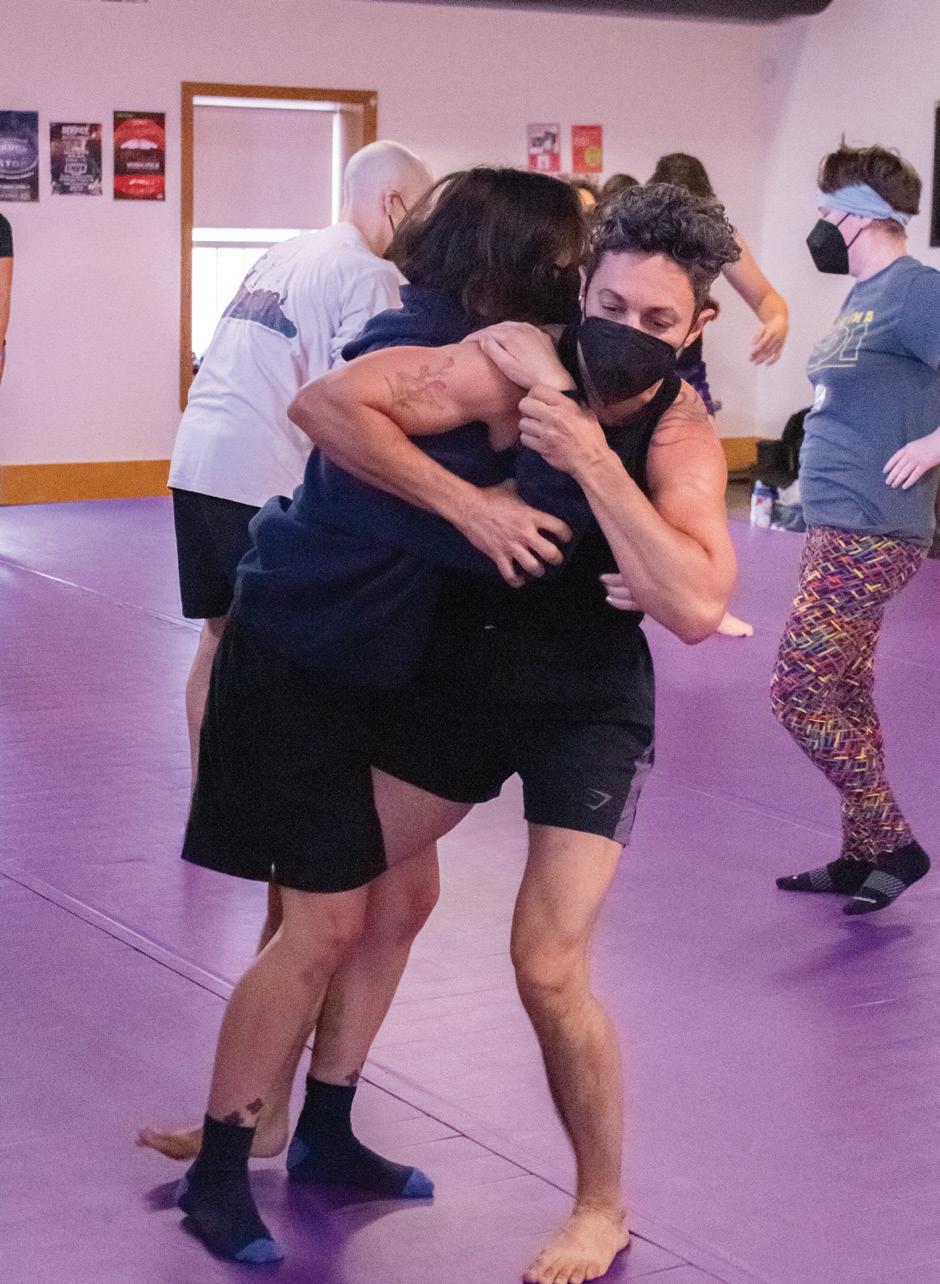
Jitsu herself started the club and is the current instructor. They originally had the idea for this club while doing drag in their persona as Judy Jitsu, a drag queen with a black belt. By holding jiu-jitsu classes in a welcoming environment for and run by queer and transgender individuals, hopes to make an efficient and comfortable learning space for anyone interested in martial arts.
The opportunity to have these all-queer, inclusive spaces for physical activities such as martial arts is a very necessary thing, according to Jitsu.
“It is such an intimate sport and practice,” Jitsu said. “Going into any traditional cis-hetero-catered space, especially for martial arts, can be very difficult for a queer person. You are being asked to engage physically with people that you don’t know.”
Jitsu has been doing martial arts for 16 years and drag for two. The idea of starting this all-queer class lived in the back of their mind, but never left the ground until the Eugene Lavender Network opened and reached out to them.
The Lavender Network is Eugene’s only all-queer LGBTQ+ community center. The center opened September of 2024, taking on the same name of the 1986 Eugene queer community newsletter.
Today, they still host community events and operate the newsletter, but they also helped Jitsu get the club off the ground for Eugene’s queer community.
“February of 2025 was our first class. It was right after Inauguration Day, and I was expecting just like six people to show up. I had a few mats, maybe four people total could fit on. And then 24 people showed up,” Jitsu said.
“So I knew very quickly that it was really important and really needed here.”
The club itself is meant to teach as many people as possible, so accessibility is of high importance. The participants who show every week range in audience size. They have a mix of ages, from students to people in their 40s, as well as a range of occupations. Jitsu also emphasizes the club’s inclusiveness for BIPOC queer individuals.
“Some people in the group practice at other gyms, and I hear the shit that they experience,” Nico, one of the students and a UO graduate, said. “And people just throw transphobic nonsense their way, like off the cuff, because they think they can, and it’s just nonsense.”
Valentia Blackwolf, another student with a blue belt, described a similar experience. Martial arts has been an onand-off part of their life, but after transitioning six years ago, finding a welcoming place to practice became a challenge. “There aren’t a lot of gyms that are very open. They say they’re open, but they don’t get to control what their atmosphere is,” Blackwolf said.
But after joining Jitsu’s class, things changed for the better, where comfort and safety weren’t a question. “It’s just a loving atmosphere,” Blackwolf said. “You don’t have some picture of some guy that everyone worships on the wall, and so it’s just more family-like.”
By having an all-queer space, participants don’t need to worry about comfort, accessibility or even safety. The common understanding of experience and identity creates a loving space where they can focus on learning as effectively as possible.
“You end up with the confidence that you can handle
yourself if you were out in spaces that aren’t as friendly of environments,” Nico said, and despite only joining the group in November of last year, they have already participated in competitions and gained the confidence to continue the sport thanks to the community Jitsu provides.
This all-queer grappling class does a lot for the Eugene queer community. If this is something you are interested in, you are encouraged to stop by, watch or participate to get a feel for the sport and space. Or you can even follow Jitsu’s Instagram for upcoming drag and queer events.
“Jitsu is now an icon persona; she can be a drag persona, but she can also just be a cool, fun person to hang out with and learn jiu-jitsu from.”
‘The Drama’ is worth seeing blind
Starring Robert Pattinson and Zendaya, the film tackles serious issues while remaining hilarious.
By Vinny White Arts & Culture Writer
“The Drama” by director Kristoffer Borgli certainly relied on its star power to pack theaters for its release. Robert Pattinson and Zendaya have proven to be defining actors of their generation with their smorgasbord of heavy-hitting roles. The trailers and other marketing for this film fixated on their dynamic more than any specific plot details, and for good reason — the film’s constant reveals and winding plot work best for a viewer going in blind.
The movie follows Emma and Charlie, a couple whose meet-cute first encounters and dates quickly lead to a marriage. When Emma drunkenly reveals her hearing disability has a bigger story than meets the eye, the pieces of their relationship begin to fall apart.
The script is excellent, and is one that really emphasizes how well the characters know each other. It often feels like you’re left out of an inside joke, which really contributes to the viewer’s investment in the success of this wedding.
The film is littered with memorable side characters, with the most notable being a drug-addicted DJ who serves as a representation of Emma’s double standards. Contrary to the title and sensitive story elements, “The Drama” is a comedy through and through — especially for those who love to watch characters squirm.
Pattinson exudes a constant sense of distress that feels appropriate for his situation. You can see him realize his life is in the process of completely rearranging itself, whether
he likes it or not. Once the film crosses its halfway point, Pattinson largely leads it.
Zendaya as Emma is captivatingly erratic. She shuts down during arguments, gets upset at minor inconveniences and laughs off other issues without a second thought. Her portrayal of the character feels grounded, showing off her great acting chops in a challenging role.
Alana Haim, Mamoudou Athie and Hailey Gates flesh out the main cast as Emma and Charlie’s friends. Haim and Athie’s dynamic plays well on screen, and Gates’ unexpected interjection into the main plot kept the movie’s momentum from slowing down.
“The Drama” really is carried by said momentum, since every detail seems to come back in a way perfectly designed to ruin the lives of the main characters. This is due in part to the movie’s gripping editing. Pleasant moments are fastpaced, while awkward and tragic ones are drawn out to make you feel the pain in the scene. Parts of the film are edited non-sequentially, to contrast the couple’s lives before and after Emma’s confession.
This is a film best fit for a packed audience, especially one ignorant of the greater plot details. Along with raising important questions surrounding forgiveness and American culture, it’s riddled with clever jokes, hand-wringing drama and touching sentimentality that plays well with a crowd.
(Logan Evenhouse/Emerald)
(ABOVE) Two grappling club partners practice fighting. The Eugene Queer Grappling Club met at The Lavender Network, in Eugene, Ore., on April 12, 2026. (Fred Hall/Emerald)
Ehly: Students aren’t paying attention to ASUO
Opinion: UO students need to get more involved in ASUO.
By Rachel Ehly Opinion Columnist
If you ask 93.52% of the University of Oregon student body if they voted in the ASUO elections, they would say no.
April 10 concluded ASUO’s annual spring election to appoint a new student body president and vice president, along with several legislative seats. Inside this year’s ballot was a measure of no confidence against UO President Jogn Karl Scholz and Board of Trustees Chair Steve Holwerda.
By voting “yes” to this measure, students expressed their disapproval of their leadership on a range of campus-wide concerns like the refusal to organize an alert system regarding the presence of ICE on campus, a lack of dialogue regarding recent budget cuts and more.
The measure passed with 93.18% of ballots voting “yes,” totaling 1,274 votes. In total, only 6.48% of the UO student body voted in this year’s ASUO elections.
On a campus made up of tens of thousands of students, fewer than 1,400 people cast a ballot, even on one of the most consequential student votes in recent UO history.
Between class, jobs, stressful internship hunts and the general grind of college life, it’s easy to ignore what is happening in ASUO. But this also shows a failure of visibility.
While ASUO has a significant social media presence and was seen actively canvassing during election week, ASUO elections, ballot measures and meetings are rarely discussed outside of the ASUO bubble and Daily Emerald coverage.
Before joining ASUO as its secretary of design, UO senior Jaden Rai didn’t keep up on the happenings of the student government.
“I remember voting (freshman year) and talking to people on campus who were campaigning,” Rai said. “But I wasn’t too sure about the ongoing events that (ASUO was) throwing, and the changes they were making on campus until, honestly, when I got hired.”
I caught Rai campaigning on the streets of campus, handing out flyers to students to encourage their vote in the 2026 election.
“We’re trying to be very student-oriented. The admin at UO, I feel, is not like that right now, and we have a big responsibility to represent the students in any way possible,” Rai said.
Despite their active campaigning efforts, ASUO election turnout and student support have not increased in recent years. Most students don’t even actively pay attention to what is happening in their own student government.
Political science student Yasmeen Edgar says she only pays attention to ASUO because of the people she knows in the organization.
“I think some aspects (of ASUO marketing to students) are effective,” Edgar said. “At the end of the day, most college students just honestly don’t care as much as they should about certain issues… like accessibility to certain services that universities should provide.”
Edgar said she has thought about joining ASUO in the past, but was hesitant because the organization seems too “bureaucratic and complicated.”
Student government can only thrive if students participate. ASUO has real power; it controls millions of dollars in student fees, advocates directly to the UO administration and so much more.
But none of this matters if students don’t know that it’s happening. ASUO needs to find a way to make students understand the importance of their role as students in our student government.
Rachel Ehly is an opinion columnist for The Daily Emerald and is studying journalism and political science. She could talk for hours about all things politics, pop culture and music.
Ducks wide receiver Dakorien Moore to compete at Oregon Team Invitational meet
The freshman wideout is suiting up for an event at this weekend’s track and field meet.
Oregon women’s golf heads to Big Ten Championship
Kiara Romero is a force for the Ducks. Can her supporting cast help Oregon repeat as conference champions?
By Harry Leader Sports Writer
With the No. 7 Oregon women's golf season coming to a close, it's time to look to the postseason and the upcoming Big Ten Championship, which kicks off on Friday, April 24.
The Ducks currently sit at seventh in the country, with only one Big Ten opponent ranking higher: No. 2 USC. Oregon has fared pretty well against USC this season, surpassing them in the standings at two out of six tournaments.
The Ducks have one advantage over USC and all the other Big Ten schools, and that's Kiara Romero. Romero is the No. 1 women's golf amateur in the world and is the sixth-longest reigning world No. 1 since 2011, with 37 weeks at the top spot. Romero has been solid all year, even taking home the hardware at the Chevron Collegiate and Charles Schwab Women's Collegiate Invitational as an individual. Last season, she won the Big Ten Championship as an individual and was named Big Ten Women's Golfer of the Year, which she could very well repeat in this year's tournament.
College golf is a team sport at the end of the day, though. That will be apparent heading into the postseason, where the contributions of Romero’s teammates will be key in moving on to next week's Big Ten showdown.
Karen Tsuru was a big name heading into this season, but was sidelined with an injury. She made waves in her first appearance of the season at the Chevron Collegiate when she placed seventh with a final score of five under par.
Tsuru’s return marks a big step in the right direction for Oregon, which has struggled with consistent depth in some tournaments, like the Therese Hession Regional Challenge. In that tournament, Shyla Singh and Darae Chung shot 11 and seven over par, respectively, which dropped the Ducks out of the top three teams at the tournament.
Tong An has had a strong season and has been a leader among Oregon's lesser-known names. She finished second at the Jackson T. Stephens Cup and third at the East Lake Cup, which gave the Ducks strong momentum heading into the spring season. Although she hasn't found strong form in the spring, with her best finish coming in 15th, she is someone Oregon can rely on to bolster Romero and Tsuru in a big tournament like the Big Ten Championship.
Last season, the Ducks took home the conference title with the same group of players, which makes their case for a repeat pretty strong. With only one top-ranked opponent at the tournament, it should be a great opportunity for Oregon to take home some hardware before heading to the NCAA regional tournament in early May.
Oregon men’s golf places ninth in regular season finale
SATURDAY
April 24, 2026
Oregon vs. Ohio State
Oregon softball faces one more tough tilt to end 2026 regular season
With the Big Ten Tournament and NCAA playoffs on the horizon, how does Version 8 shape up?
By Rowan Shea Sports Writer
With only a couple of series left for Oregon this season, the smell of playoffs are in the air. But the Ducks can’t lazily float through the air like a cartoon character smelling a cooling pie on a windowsill, they still have a couple series ahead: one against Ohio State and the last against the SoCal giant, UCLA. The Ducks this season have gone on a tear. They’ve carried over their Big Ten series winning streak from the 2025 campaign and have logged their 13th series win, they currently sit at 32 wins on the season and are ranked fourth in the Big Ten with only Washington, Nebraska and UCLA ahead of them. Oregon boasts the second best win streak in the Big Ten in conference play with eight straight wins (only Washington is ahead of them, with 15-straight). Through their 41 games they’ve scored 279 runs (5th), logged 352 hits (T-4th) and they have a team average of .224 (5th).
While the entire team is hitting well, four Ducks bats have been scary all year: Elon Butler, Amari Harper, Taryn Ho and Kaylynn Jones.
Butler has been the hottest bat for Oregon: she’s hit for the first cycle in Oregon softball history, leads in the team in average (.431), OPS (1.401), runs (50), hits (52), doubles (16), home runs (12), RBI (48), slugging percentage (.873) and holds an incredible on-base percentage of (.528).
Freshman Taryn Ho has been a spark plug for a number of rallies this season and holds the second highest average on the team (.386); Harper has been uber consistent at the plate and ranks just behind Butler in most offensive categories; Kaylynn Jones continues to fly somewhat under the radar when talking about this offense but she’s produced a great slash line of .373/.491/.556.
( ABOVE) Oregon catcher Emma Cox (21) celebrates with her team after teammate Taryn Ho (1) tags two Iowa runners out and the play is reviewed fair. The University of Oregon Ducks women’s softball team defeated the Iowa Hawkeyes 6-2 in Eugene, Ore., on April 5, 2026. (Rowan Campbell/Emerald) Read
The offense has the firepower to slug its way through the playoffs. That is, if the bats are on that day. Oregon, like any team in the marathon that is a softball season, has seen games where the fiery offense was extinguished and it was up to the pitching staff to get it done.
The pitching staff is exceptional. Led by senior ace Lyndsey Grein, the Ducks have put up great numbers in the Big Ten this season.
Oregon’s team ERA is 3.28 (4th), with a WHIP of 1.19 (2nd), and it has 304 strikeouts (2nd) and issued 102 walks (4th lowest). While that may be mostly thanks to Grein’s multiple heroic performances this season both to when she starts and out of the pen, the numbers don’t lie: Oregon can carve you up at the plate.
Oregon’s numbers this season put them right in the mix for one of the best softball teams in the conference and the country. But it also means that, when it comes to the Big Ten Tournament in early May, the Ducks are going to have to put everything together. Washington, Nebraska and UCLA are very solid teams and pose the biggest threats to Oregon’s chances.
With just two series left, one against Ohio State and the last against UCLA, Oregon will catch a glimpse into what playoffs might look for this team. While winning the series against both is the preferred outcome, the pragmatic approach is to take the series against the Buckeyes and avoid getting swept against the always potent Bruins.
Before those two series can get underway, the Ducks have one non-conference game against the Oregon State Beavers (whom the Ducks have already taken the season series from) on Wednesday at 6 p.m. at Jane Sanders Stadium. The game will be broadcast on Big Ten Plus (video) and KWVA (radio).