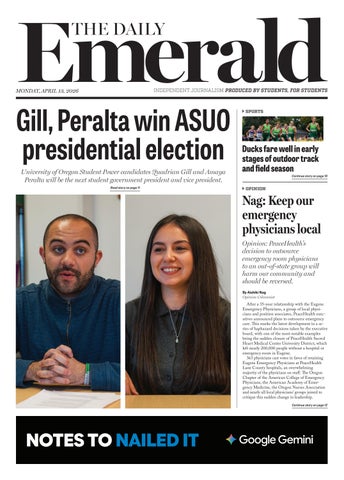
University of Oregon Student Power candidates Quadrian Gill and Amaya Peralta will be the next student government president and vice president.
Ducks fare well in early stages of outdoor track and field season
OPINION
Nag: Keep our emergency physicians local
Opinion: PeaceHealth’s decision to outsource emergency room physicians to an out-of-state group will harm our community and should be reversed.
By Aishiki Nag Opinion Columnist
After a 35-year relationship with the Eugene Emergency Physicians, a group of local physicians and position associates, PeaceHealth executives announced plans to outsource emergency care. This marks the latest development in a series of haphazard decisions taken by the executive board, with one of the most notable examples being the sudden closure of PeaceHealth Sacred Heart Medical Center University District, which left nearly 200,000 people without a hospital or emergency room in Eugene.
363 physicians cast votes in favor of retaining Eugene Emergency Physicians at PeaceHealth Lane County hospitals, an overwhelming majority of the physicians on staff. The Oregon Chapter of the American College of Emergency Physicians, the American Academy of Emergency Medicine, the Oregon Nurses Association and nearly all local physicians’ groups joined to critique this sudden change in leadership.
EDITOR IN CHIEF
Tarek Anthony
PRINT MANAGING EDITOR
Ryan Ehrhart
DIGITAL MANAGING EDITOR
Ysabella Sosa
NEWS EDITOR
Reilly Norgren
INVESTIGATIONS EDITOR
Ana Narayan
A&C EDITOR
Claire Coit
SPORTS EDITOR
Jack Lazarus
OPINION EDITOR
Gracie Cox
PHOTO MANAGING EDITOR
Corey Hoffman
PHOTO EDITOR
Saj Sundaram
COPY CHIEF
Olivia Ellerbruch
VIDEO EDITOR
Jake Nolan
PODCAST EDITOR
Stephanie Hensley
SOCIALS EDITOR
Ysabella Sosa
VISUALS EDITOR
Noa Schwartz
DESIGN EDITOR
Adaleah Carman
DESIGNERS
Asha Mohan
Ellery Burton-Tillson
Eva Andrews
Izzy Smith
Nina Rose
BUSINESS
PUBLISHER AND PRESIDENT
Eric Henry (X317) ehenry@dailyemerald.com
VP OPERATIONS
Kathy Carbone (X302) kcarbone@dailyemerald.com
DIRECTOR OF SALES & DIGITAL MARKETING
Shelly Rondestvedt (X303) srondestvedt@dailyemerald. com
CREATIVE & TECHNICAL
DIRECTOR
Anna Smith (X327) creative@dailyemerald.com
ACCOUNT EXECUTIVES
Torin Chevalier
Camcole Pereira
Ava Stephanian
Elliot Byrne
THE DAILY EMERALD
The Daily Emerald is published by Emerald Media Group, Inc., the independent nonprofit media company at the University of Oregon. Formerly the Oregon Daily Emerald, the news organization was founded in 1900.
Emerald Media Group 1395 University St.,#302 Eugene, Or 97403 (541)-346-5511
Sean VanGordon wants to bring opportunity and growth to Lane County
The primary election will be held on May 19, with VanGordon on the ballot.
By Billie Corsetti News Reporter
Before Sean VanGordon was the mayor of Springfield Ore., he spent a decade representing Ward 1 on the Springfield City Council. Now after five years as mayor, VanGordon has set his sight on the Lane County Board of Commissioners.
VanGordon said he bought his first house in Springfield and soon after got involved in local politics by signing up for the city planning commission.
“And then you kind of fall in love with Springfield,” VanGordon said about his continued involvement in Springfield politics.
As Springfield’s mayor, VanGordon has focused on housing and economic development, tackling projects like the Downtown Refinement Plan and Alma Apartments. After five years in office, VanGordon is looking to take on the Lane County Board of Commissioners as his next project.
“People deserve a government that works. And when I see how dysfunctional and how much drama has been from the county commission this year, it really drove me into that conversation because when you’re a local elected official, time is the most valuable thing you have,” VanGordon said.
He believes that all elected officials are experiencing a feeling of low trust from their constituents, something he wants to improve as a commissioner. VanGordon believes that talking to community members affected by countywide housing and budget crises can help bring some of that trust back.
“The most important thing we can do right now is focus on economic growth, not because it is the one problem that makes all the other problems easier — from environmental issues to cost of living issues — if it felt like the economy was growing a little bit, it would feel just a little bit easier for everybody,” VanGordon said.
VanGordon is interested in work being done with the Southern Willamette Valley Innovation Corridor, where the University of Oregon, Oregon State University, local businesses and city officials are coming together to find ways to connect the wood, technology, scientific industries within Lane County industry to academia.
“In my time in elected politics, this is the first time that somebody’s really sat the table where you’ve got the universities, businesses and local governments sitting at the same table,” VanGordon said. “One gap we do have is that there’s no county commissioner at the table. That is something that we can do on day one.”
VanGordon also wants to help clear up the legislative agenda, and make messaging from local governments to their constituents more clear, like plans for economic development. This is especially important as the cities tackle their budgeting and housing crises, while
supporting a student population that may choose to permanently move to Lane County after graduation.
“Our economies are very complicated. But when you come out of UO, we need to be able to have an economy that’s diversified enough that you can find a job in your career field to stay here,” VanGordon said.
Expanding housing opportunities, beyond one-bedroom apartments, is also something the county and its cities should be focusing on, VanGordon believes. The candidate believes Springfield took a step in the right direction with its updated development code, but that a larger issue lies in creating the environment to build upon.
“Eugene has done a lot of work to open up housing options, so that’s more of a yes community. Springfield’s trying to get to more of a yes community,” VanGordon said. “What I tell people is that the housing problem’s not going to get fixed tomorrow.”
The solution is going to take discipline, patience and the collaboration of minds behind housing and economic development with local businesses and residents, VanGordon said. He’s
also hoping that students will get involved.
“I think anytime you get involved it makes you feel better about our future, and get involved in the way that makes sense to you,” VanGordon said. “If the most you have in you is to vote, then please vote. If you vote and attend a town hall, do that. But walk the journey that you want to have.”
Lane County Board of Commissioners seats will be on the ballot during primary elections on May 19.
(Courtesy of Sean VanGordon)
What Eugene’s mild winter could mean for the summer ahead
Understanding what Eugene’s mild winter weather could mean for summer conditions and how students can prepare.
By Audrey Lynch News Reporter
The fall and winter months in Oregon often consist of cold weather and an excess of rain. However, this past season didn’t see the expected conditions. Reaching record-high temperatures and dipping into a rain deficit, Oregon’s winter was largely mild.
Drier conditions are often a leading contributor to a more intense fire season.
The type of weather pattern can help dictate what the temperatures may look like. Episodes of irregular weather can occur every two to seven years, known as El Niño and La Niña.
These patterns affect each region of the United States differently. In the Pacific Northwest, “El Niño winters often bring warmer than normal temperatures and below normal snowfall,” according to the National Weather Service. La Niña winters bring colder temperatures and more rainfall.
KVAL Weather Reporter Briana Chavez helps Eugene and Springfield residents understand the weather conditions each morning. Chavez explained that this El Niño pattern “can be either wet or dry,” and have higher temperatures.
Since this El Niño winter has been a dry one, many worry that wildfire season will be intensified as a result. However, Chavez states that it is often difficult to predict the nature of fire season given the winter weather.
“In the past, we have seen those extremely wet winters or extremely dry winters, and we’ve had (less hazardous) wildfire seasons,” Chavez said.
Wildfires are most often caused by human activity, so Chavez advises people to be careful of their actions during
the summer. For example, avoiding tossing cigarettes out windows and driving in tall grass.
While dry thunderstorms during the summer always pose a fire risk, Chavez warns that “there could be a little bit more of an impact when it is a drier year.”
Eli Donohue is a third-year at the University of Oregon studying art and technology. They work for the UO Outdoor Program, whose “mission is to make the outdoors more accessible.”
The program has a bike shop and rental barn on campus, which rents gear for a variety of outdoor activities. Donohue said that when going on trips or outdoor adventures during the summer, it is important to avoid starting campfires, bringing lighters or being reckless due to potential wildfire risk.
They advise others to “stay alert with nearby ranger stations and news,” and “try your best to always have water in hand to stay hydrated.”
In addition to being prepared yourself, Donohue mentions the importance of helping others during this season. “Donating to local shelters or organizations who help those who have been misplaced due to the fire season,” Donohue said.
Given the unpredictability of wildfires’ origins and their quick spread, Chavez recommends having a fire evacuation plan in place.
“Make sure you have a go bag, yeah, so food and water, a charger, your personal belongings, whether it’s passport, you take prescription medications, make sure you take those with you, having kind of that checklist ready to go,” Chavez said. In rural areas, Chavez explained having a plan not only for yourself but also for livestock in case of fire is crucial. In higher temperatures, if individuals are without air
conditioning there are many resources to stay cool. Simply going to highly populated areas, like shopping malls or keeping a fan in your window can aid immensely in warm conditions.
For people who are not sure where they can go for resources, Chavez said that “The Egan Warming Center and many other local community areas are really good about opening up (cooling) centers” amid the heat.
Last year, public spaces in Eugene acted as cooling centers during extremely hot temperatures, including the libraries and several community centers.
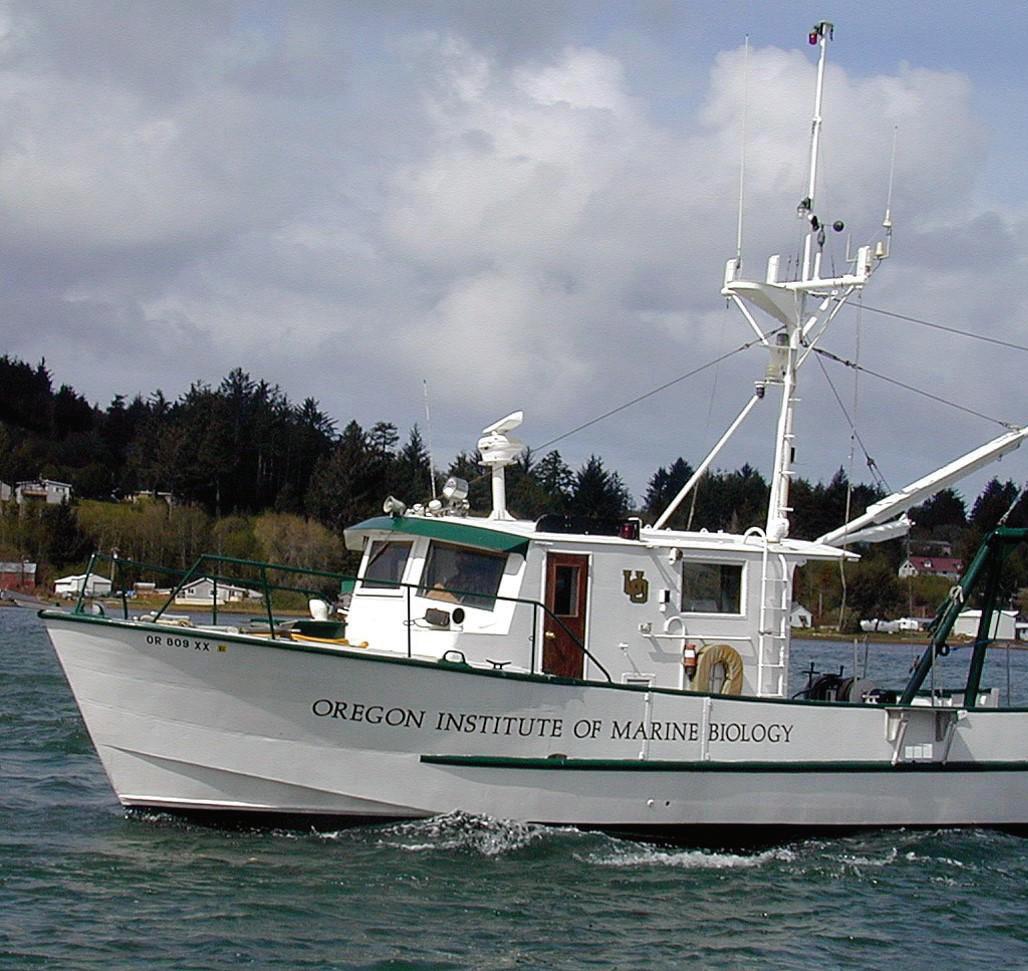
OIMB makes $30,000 investment for tsunami preparation
By Katarina Ilic News Reporter
The Oregon Institute of Marine Biology, the University of Oregon’s marine station located in Charleston, Oregon, was granted a $30,000 one-time investment from the UO Strategic Investment Process for tsunami preparation on campus. Prior to the investment, the OIMB strategic plan in case of a tsunami was to “run uphill and meet at a muster point,” or an assembly point, as soon as the warning was issued after an earthquake, regardless of the size of the earthquake present.
UO’s marine station a one-time investment for tsunami preparation.
“A downside, that we had if one of those massive earthquakes does happen, infrastructure is gonna be down for a while and it’s gonna be important for people to be able to manage on their own, for a few days in a worst case scenario like that,” OIMB Director Amy Moran said.
With the one-time investment, the OIMB plans to prepare a two-step plan in the event of a tsunami. The most important tsunami to prepare for, according to Moran, is one caused by an offshore earthquake, one that would take place near a coastline and that students would have five to 10 minutes to react to.
“If there’s an earthquake in Japan, there’s time for people to drive away from the coast, but if it happens right off the coast, we have to be able to manage,” Moran said.
Sitting near the Cascadia Subduction Zone, OIMB is even more at risk for experiencing a large tsunami.
“Currently, scientists are predicting that there is about a 37% chance that a megathrust earthquake of 7.1+ magnitude in this fault zone will occur in the next 50 years,” the Oregon Department of Emergency Management stated on their website.
Coupled with the fear of a potential 7.0 magnitude earthquake and the tsunami alert that was issued in July 2025 due to an earthquake off the coast of Japan, the OIMB decided it was ultimately time to update their tsunami preparation plan.
“I don’t worry about it minute to minute, but that’s not a non-zero chance of it happening while folks are here,” Moran said.
Part of the two-step plan initiative is the preparation of “go bags” for each student living in the dorms at the OIMB.
These bags contain supplies such as prepackaged sterilized water, a power bar, an emergency blanket, an emergency tube tent and a straw that filters water. According to Moran, the hope is that one of the go bags would contain enough to allow students to last for a few days.
“All of the students that come here are issued one that’s in their dorm room, so if there’s in the middle of the night an earthquake, grab the bag and go, that’s the plan,” Moran said.
The second part of the two-step plan is to have a temporary shelter spot up the hill from the OIMB at the muster point.
“Maybe some people can’t grab their bags, they weren’t in their rooms, and so the idea is to have as close to the muster point, a temporary shelter and more supplies for folks who run up there,” Moran said.
The OIMB ultimately began applying for a one-time investment after a tsunami alert was issued in July 2025 due to an earthquake off the coast of Japan. According to Moran, talks of creating a more in-depth tsunami preparation plan had already been in the works.
“I think (the investment) is really important for the security and the safety and the peace of mind of folks here on the coast because we are in the immediate tsunami inundation zone, so having the resources on campus for students, faculty and staff, to at least survive for a few days until help can come, it helps us all sleep a little better at night,” Moran said.
ARTS & CULTURE
The Racks hosts first vintage market of the year
The Racks sets the tone for Eugene spring with their vintage market on April 4.
By Everette Cogswell Arts & Culture Writer
As the warm spring weather is settling into Eugene, more and more outdoor activities are starting to pop up around the city, and on April 4, The Racks hosted a vintage market in 5th Street Public Market.
The Racks is a vintage store, owned by former UO students, that hosts various vendors in their space. The Racks has vintage, Y2K and handmade clothing available.
Their outdoor vintage market had many vendors selling all kinds of clothing, accessories, shoes and more. But beyond clothes, they also had henna, tooth gems, food, drinks and live DJ’s. For the first sunny weekend of spring term, this was the perfect activity for students and community members to attend.
“The vibes are really good. A bunch of people and a lot of good like clothing and stuff like that. A lot of vendors I’ve never seen before,” Raphael De Leon, a junior at UO, said. It’s normal to see some sellers on campus, especially in the spring. This event had familiar faces, as well as plenty of new people on the selling scene.
“Usually I’m intimidated to go to those just because they’re so small, so I like the bigger area to like, roam and
stuff. I can go to different stalls that might not have as many people,” De Leon said.
While a lot of the vendors were independent sellers, there were also some secondhand stores in Eugene that had booths as well such as St. Vincent de Paul.
The food and drink options added a lot to the market. Similar to the Eugene Saturday Market, there was always a line at the lemonade booth. The live music featured UO students DJing the event which made the environment fun and lively.
“There’s been a lot of people here and a lot of cute animals and the weather has been nice,” Jules Piller, a vintage seller from Portland, said. “I sew and make a lot of clothes but a whole booth of handmade clothes is a lot of work so now it’s mostly vintage.”
Piller said she mostly sells clothes she wishes she could fit into so instead she collects it; she also loves Y2K.
Y2K was the vibe of the day. Most vendors and attendees were sporting Y2K looks, and with the music, it felt like a time capsule back to the year 2000.
“I think it was so smart that they had like food out here. Every time I walk by I’m like ooh yeah, all of the like custom hats and like the tooth gems, I feel like that’s so fun. We gotta do more things like this. It’s spring term, you gotta be outside,” Mikai White, UO senior, said.
With over 30 vendors and free entry, The Racks vintage market was the perfect weekend activity to set off the start or spring term. You can enjoy vintage shopping everyday at The Racks store and keep an eye out for other local independent sellers on campus.
‘Hoppers’ is exactly what animation has been needing, while healing a part of Gen Z in the process
In its newest release, Pixar blends classic comforting animation and raunchy humor to make for a refreshing story for the young adults who grew up with their films.
By Amelia Fiore Arts & Culture Writer
*spoilers ahead
Pixar’s latest creation isn’t too far of a leap from its typical formula: advice from a wise posthumous mentor, a passionate young protagonist and lots of “oops” situations, making for a lighthearted under-two-hours-long popcorn flick. But this time, there’s something different. Its newest film adds a bit of an edge, something the animation studio hasn’t dared to try in, arguably, decades.
“Hoppers” was released domestically on March 6, and it currently sits at a 7.5/10 on IMDb. The general buzz has been strongly attributed to its unapologetic environmental stance and its inclusion of some dark humor and existentialism. “When we were building this movie, we knew that ev ery step of the movie was trying to see how far the audience would go with us,” the film’s director, Daniel Chong, said in an interview with Skwigly magazine.
The story follows 19-year-old college student Mabel Tanaka (Piper Curda) in her desperate attempt to save a sanc tuary she shared with her grand mother, a woodland area known as the Glade. To do so, she must convince the may or of Beaverton, Jerry (Jon Hamm), to halt construction of a new
highway throughout the Glade. The only issue is that, randomly, there are no more animals left at the Glade, and all Mabel would need is one beaver’s presence to halt any further construction.
Mabel is an endearing, slightly reckless protagonist who makes the wrong decision at almost every turn, but she does so out of a desire to do the right thing. She was designed to reflect those hit hardest by the current chaotic state of the world: young adults.
“(The character) would be someone who is thinking a lot about their future and the world that they’re going into, they would certainly be someone about Mabel’s age who is becoming an adult and is looking at their future and going, ‘Do I have one?’ and asking, ‘How can I change the world and make it a better place?’” Chong said.
But no one seems to want to help her. She canvasses around her neighborhood, just to be turned away, and her own professor, Dr. Sam (Kathy Najimy), encourages her to let it go. Just as she begins to lose hope, she discovers Dr. Sam’s secret: a program called Hoppers, which allows a human to transfer their consciousness into a realistic animal robot.
Defying the Hoppers scientists’ pleas, Mabel uses the machine to transfer her consciousness into that of a robot beaver, and integrates herself into the wildlife society in a crusade to lead animals back to the Glade. It’s soon revealed that Jerry had installed ultrasonic repeller devices to drive the animals out of the area, a tactic that is commonly used, mainly for household rodents and insect infestation.
So, Mabel decides to ask for help from the leaders of each animal kingdom (the “Animal Council”). Instead, she accidentally creates a vengeful insect prince. It’s a lot to squeeze into an hour and 45 minutes.
Titus (Dave Franco), the ultimate villain of “Hoppers,” is the son of the Insect Queen (Meryl Streep), whom Mabel accidentally “squishes” in a panic. He is a terrifying preteen, akin to Gideon Gleeful from “Gravity Falls:” snarky, entitled and emboldened with a little too much vengeance for such a short stature.
The stakes rise exponentially when he inhabits a robot Jerry lookalike to enact his master plan of killing a bunch of humans gathered for the mayor’s rally. Mabel is no longer tasked to just save the Glade’s wildlife, but actual people. Titus’s stance is understandable — he watched his mom die, bugs are notoriously killed without a second thought, humans are a selfish species, etc. — which makes him such a layered and interesting antagonist.
Along with the help of her newfound friends, including the beaver King George (Bobby Moynihan) and the rest of the council, Mabel saves the group of humans from Titus’s wrath and the animals from a destructive wildfire.
Although the storyline is sweet, it does carry a sense of naivety in its trust in the goodness inhabited by those in power. When Mabel gives Titus-as-robot-Jerry a chance to do the right thing, and he doesn’t, she signals for a more forceful approach to save the humans. But at the end of the film, she negotiates lightheartedly with Jerry about the future of his highway. Why would she trust the human mayor to take the opposite path? It’s worth noting that while its message is boldly environmentalist, it’s still a Pixar production.
“Hoppers” perfectly captures the dread that unites Gen Z; the feeling of uselessness as you’ve watched the world around you crumble since birth, but never sinking into apathy. It also has that comforting feeling replicated from classic animation, like a grandparent assuring you that everything is going to be okay. It’s an optimistic look into the future of PG animation, untainted by the accustomed flatness and safety of recent releases. It’s bold, visually pleasing and slightly dark, a blend that might revive the genre altogether for a newly-grown-up audience.
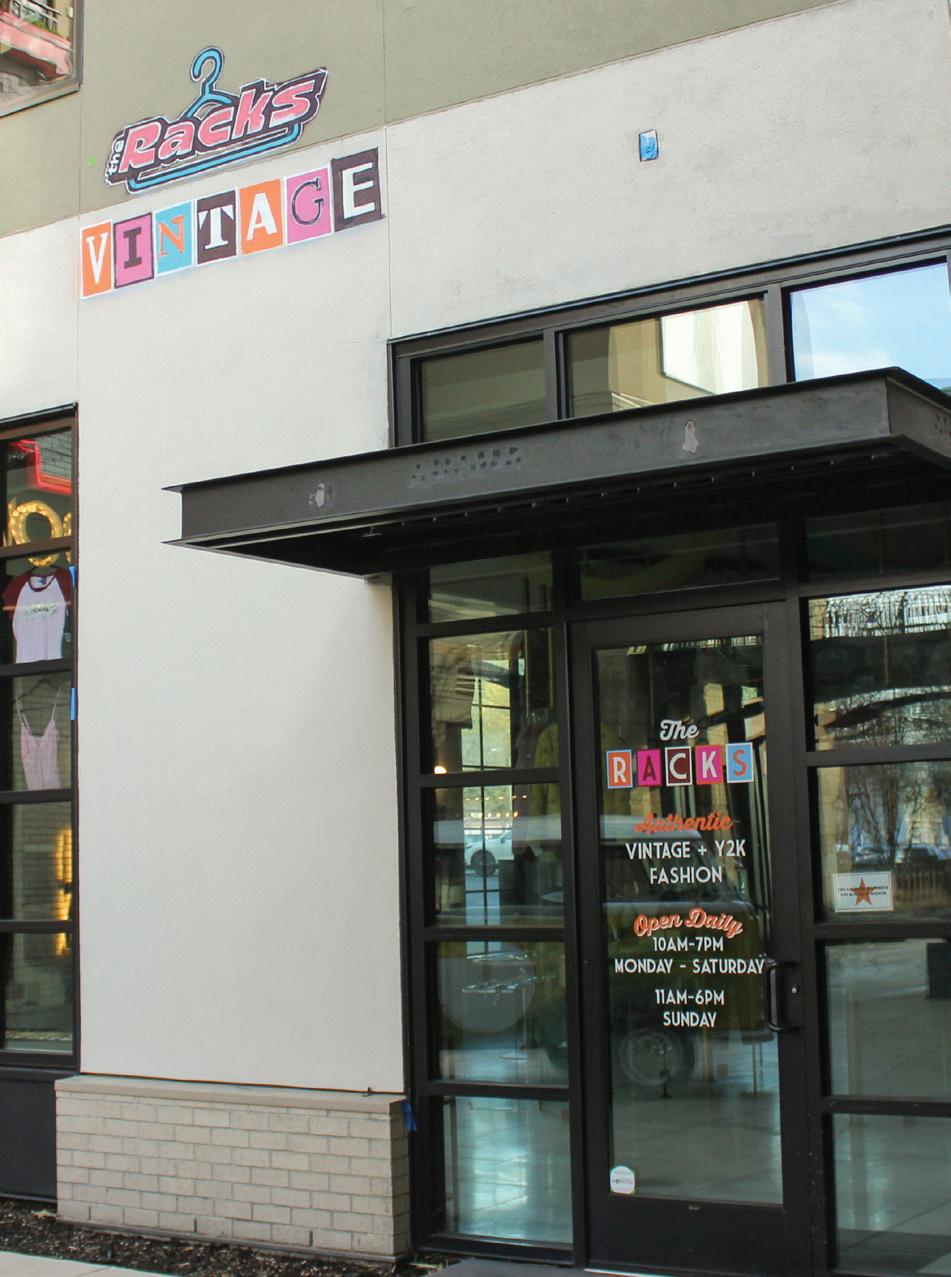
Exterior of the The Racks in 5th Street Market in Eugene, Ore. (Adaleah Carman/Emerald)
UO SSWANA center pushes for more advocacy, independence amid administrative rules
UO’s South Asian, Southwest Asian and North African Center was founded by a coalition of student organizations, who now find themselves facing restrictions on workplace speech as a university center.
By Sasha Love
Senior News Reporter
After its opening in January, some leaders of the University of Oregon’s South Asian, Southwest Asian and North African Center say that they do not have enough independence to speak on SSWANA issues within university policy rules for departmental spaces and university employees.
Administrators say the center’s status as a departmental space is behind these restrictions.
Rayna Patel, a SSWANA Center engagement fellow, and Jai Pandhoh, ASUO director of Communications, alleged that “administrative overreach” has kept them from publishing political statements regarding the Israel-Hamas war and the Iran war on the SSWANA Center’s social media platforms.
“The (Israel-Hamas) war is still going on, there is Iran war now, this is the time we are supposed to be able to take a stance and help the people at this school that need help and also to encourage others, educate others on what’s going on in the region,” Patel said.
The source of these restrictions is the SSWANA Center’s current funding and operational status as a university center rather than an organization.
The center was founded by the SSWANA coalition, made up of student organizations including the Muslim Student Association and the Arab Student Association. The coali-
tion is still an active alliance of student groups but is operated separately from the SSWANA Center, which is a departmental space similar to the Lyllye Reynolds-Parker Black Cultural Center or the Women’s Center.
“The center will continue to advocate for (student’s) needs and speak out on issues that are important, but we have to do it in the framework the university provides us,” Jimmy Howard, the associate vice president for student life and dean of students, said. “The students who work there work for the university and thus have to follow university policies.”
Since the center’s employees are paid hourly and the center is housed in an administrative space in the Erb Memorial Union, the center has different rules regarding political messaging than student organizations. The specifics of these rules are imposed by the university, but based in Oregon law.
There are four employees at the center who are paid hourly and therefore are classified as student workers and public employees. Under Oregon law, public employees generally cannot use work time or resources to engage in public advocacy or campaigning.
Disseminating social media posts and media with political messaging falls under this category, and requires approval from the people who “operate the space,” according to Justine Carpenter, associate dean of students, and Howard.
“No one is telling the students in the center what they can post on their own private pages, on their group’s pages, that’s where
you should post,” Howard said. “Some of it you might post on (the SSWANA Center’s social media pages) but we would have to get it approved by the program director.”
In this case, that would be Multicultural Center and SSWANA Center Program Director Dinorah Ortiz-Carté.
Ortiz-Carté is considered an “operator of the space,” by Howard, and that is who Pandhoh and Patel say SSWANA employees have been required to go through for social media approvals.
As the director of the MCC, Ortiz-Carté controls what they have called the “administrative home” for the SSWANA Center. Ortiz-Carté declined comment, and redirected The Emerald to the university’s spokesperson.
Members of student organizations are not public employees and, as a result, can freely engage in political advocacy and campaigning within the student code of conduct.
Patel and Pandhoh pointed out that Portland State University’s Middle East, North Africa, South Asia Student Center, which is designated specifically as a center and is not under PSU’s list of student organizations, posted “CEASEFIRE NOW” on Instagram in 2024 amid the Israel-Hamas war.
The SSWANA Center has not officially been designated as its own department fiscally, according to ASUO’s Department Finance Committee. Members of DFC have referred to the center as an “extension” of the MCC, because the initial ASUO fund-
ing that formed the center is distributed through the MCC.
MCC’s social media oversight also ties into a general desire from some SSWANA Center employees to be more independent.
“We thought that they were on the same page as us in not just helping us but letting us branch off as our own center and doing a different mission than the MCC currently does but instead they are just treating us like the MCC,” Patel said. “It doesn’t seem like they care too much about making the SSWANA Center its own thing.”
But not all SSWANA Center employees feel the structure of the center is too limited by the MCC. Yasmine Lones, another SSWANA Center employee, said that she has been able to work on cultural dance events and develop other programming focused specifically on the SSWANA region.
“Independent, SSWANA-focused events have been a core part of my work, supported by funds directly allocated to the SSWANA Center,” Lones said.
Anika Vyas, another SSWANA Center employee, holds a similar viewpoint, and said that SSWANA Center employees were “given workarounds for policies that we felt misrepresented the center.”
( ABOVE) A newspaper from the grand opening of the SSWANA center is displayed. The SSWANA center opened on the second floor of the Erb Memorial Union in Eugene, Ore., on April 7, 2026. (Tyler Graham/Emerald)
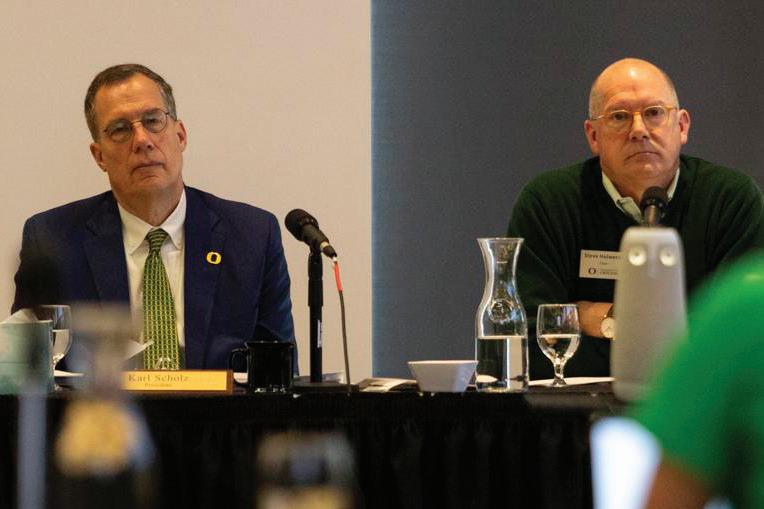
Vote of no confidence against President Scholz, Holwerda passes in ASUO election
ASUO’s election passed seven ballot measures, including a vote of no confidence against UO President John Karl Scholz.
By Reilly Norgren News Editor
Among the seven ballot measures on the ballot during ASUO’s spring election, a student vote of no confidence against University of Oregon President John Karl Scholz and Board of Trustees Chair Steve Holwerda passed along with six other measures.
The measure passed with 1,247 votes, or 93.18% of all students who voted. Voter turnout, at approximately 6.48%, declined from last year’s 10.18%.
The advisory measure expresses student body disapproval of the president and board chair’s approaches on several issues and a general distrust in their ability to lead the university and “defend the rights of students, faculty and staff.”
The measure states that Scholz and Holwerda have “failed” to take action in their:
Silence and compliance with federal attacks on diversity, equity and inclusion in higher education
Silence on Immigration and Customs
Enforcement presence on campus and the refusal to organize an ICE alert system
Increased use of the Student Code of Conduct to suppress political activity on campus, including deploying riot police on striking student workers
Restructuring the resident assistant role following the signing of a UO Student Workers union contract
Refusal to transition the university to electric heating
Lack of meaningful consultation with students, faculty and staff on budget cuts
Refusal to support divestment from stocks, funds or endowments reported to be complicit in human rights violations in Palestine
A yes vote indicated a non-binding statement of disapproval with the approaches President Scholz and Board Chair Holwerda have taken on the listed concerns and lack of trust on their ability to lead the university.
Current ASUO President Prissila Moreno said the measure’s passage demands a response from Scholz and Holwerda.
“Students have cast their ballots and made their voice heard that they do not have confidence in our university leaders,” Moreno said.
Moreno said the measure was inspired by an ASUO executive meeting in which members reflected on the year, their accomplishments and their “support system with the university.”
According to Moreno, ASUO was not given the opportunity for a “collaborative relationship” like it has previously had with the administration.
“We were under the impression, you know, coming into our roles, that we had credibility under this organization that is the recognized student government for decades now, but we found that that wasn’t really the case on key issues,” Moreno said.
ASUO considered a vote of no confidence after learning the faculty senate had explored a similar measure against Scholz amid budget cut discussions, though it ultimately did not move forward.
“We are of the belief that we can’t just let our leaders forget what happened and that it does have a lasting impact,” Moreno said. “Them not meeting the demands of students was really disappointing. And we felt like, if this is our legacy as the ASUO executive 2025 to 2026, we were willing to do a vote of no confidence.”
Moreno said that in her next meeting with President Scholz, she will ask how he plans to respond to the vote. She also plans to raise the issue during her remarks at the next Board of Trustees meeting, scheduled for June 1 and 2.
UOSP wins executive office
By Reilly Norgren News Editor
Quadrian Gill has been elected as ASUO president for the 2026-27 academic year, with Amaya Peralta as vice president, both running under the University of Oregon Student Power slate.
During the election, Gill and Peralta ran against presidential candidate Brendan Randall and vice presidential candidate Anton Mandrosov of the Student United Front slate.
Upon the results’ initial release on Friday afternoon, Gill and Peralta won 1,285 total votes, or 89.8% of the vote. Randall and Mandrosov lost with 10.22% of the vote, or 142 total votes.
The total number of participants in the election was 1,584, or approximately 6% of the student body.
UOSP won the majority of the legislative positions, winning 21 seats out of the 25 that were on the ballot. Seats 12, 21 and 22 had no candidates, and the seats will be filled by appointment. Seat 12 is pending while the Elections Board reviews write-in votes. Seat 13, which only lists a Student United Front candidate, is currently being reviewed by the elections board for the candidate’s eligibility.
Only two legislative seats were contested, Seat 19 by a candidate with no listed slate and Seat 1 of the Programs Finance Committee, contested by a member of Student United Front.
After the announcement, Gill said that he and Peralta are “excited to continue all the advocacy” they started this year and continue working directly with students to accomplish their goals.
“I’m feeling really grateful for our entire slate. It was a UO Student Power sweep again this year, but it wouldn’t have been possible without the canvassing and the phone banking that every single person on (UOSP) did. I’m feeling very grateful and excited,” Peralta said.
“A huge thank you to everyone who voted for us. We appreciate them putting their faith in us and allowing us to continue our advocacy,” Gill said.
Gill and Peralta ran together with three primary focuses: multiculturalism, campus advocacy and academic services. To fulfill these focuses, the candidates said they would advocate for a Latinx
Cultural Center on campus, to bring back student advocacy group the Oregon Student Association and to increase funding and expand academic programs like the 24-hour library program.
In addition to winning the majority of legislative seats, all seven ballot measures put forth by the executive passed. This included a vote of no confidence against UO President Karl Scholz.
According to Gill, there was clear support of this measure while he and Peralta were canvassing and is something of great concern to students as to how administration has “handled safety and the response to the federal government.”
“This is a resounding statement from the student body that clearly defines how they feel,” Gill said.
“I’m just happy that as a student body, we were able to come together and show that we want more from our administration. I think both of us being in ASUO, we’ve seen where admin has fallen short and addressing issues that students really care about,” Peralta said. “I think this is a really, really great and historic first step to making the admin more accountable.”
Turnout at this spring’s election was lower than last year’s and the year before, which were 10.1% and 7.3% respectively.
President Moreno said she believes in UOSP’s mission and that the student government’s proximity to work with administration is not something to take for granted.
“In my personal capacity I was asking people to vote UOSP down the ballot, so to see that that happened really means a lot to me, and I believe that (Gill and Peralta) are going to do really awesome work,” Moreno said.
Last year’s election, Gill won Seat 7 on the Contracts and Finance Committee as part of the UOSP slate. He was also chosen to be ASUO Speaker of the Legislature. Peralta is currently the director of advocacy, a non-elected position. Gill and Peralta will start their tenure in May.
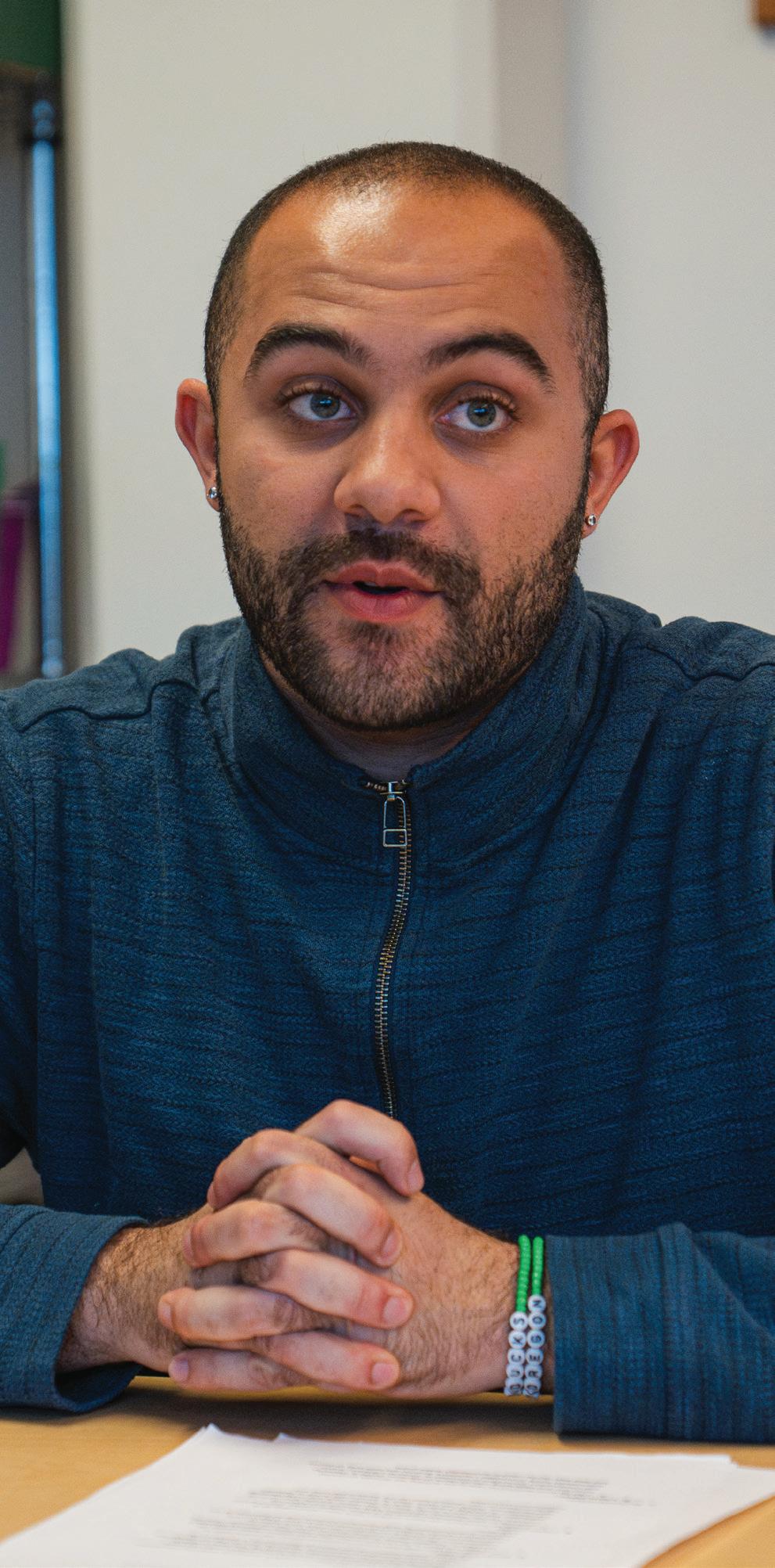
(ON THE COVER) ASUO President-elect Quadrian Gill (left) and Vice President-elect Amaya Peralta (right).
(Lilly Wall/Emerald)
Nag: Keep our emergency physicians local
“This is a 35-year relationship that’s been productive and healthy. There’s been no warning. PeaceHealth decided to hire this national corporate medical group with very little notice or plan on how to shift,” ONA spokesperson Kevin Mealy said.
ONA nurses at PeaceHealth RiverBend recently held a vote of no confidence, with more than 93% voting that they have “no confidence” in PeaceHealth’s Chief Hospital Executive Jim McGovern, M.D., and Chief Medical Officer, Kim Ruscher, M.D., M.P.H., and 98% voting to reverse the decision to outsource emergency medical care. ONA nurses have also begun circulating a petition,
aiming to “save our ER docs.”
“The lack of transparency in this decision-making process is what’s so concerning,” Mealy said.
“PeaceHealth CEO Jim McGovern has been clear that it wasn’t a financial decision — which makes it even more confusing as to why they’re seeking this divorce from local doctors who have done a phenomenal job.”
Kylie Shorack, an ONA member and an emergency room nurse at the PeaceHealth RiverBend, added to the state of fear and uncertainty that many medical workers are facing right now.
“We have our concerns about working with
Apollo and their physicians,” Shorack said. “They have not made conscious efforts to meet the nursing staff — we’ve had one meeting with them dancing around questions — there hasn’t been any forward progress that I’ve seen.”
After the closure of Eugene’s University District Hospital, emergency room nurses and physicians at RiverBend have noted an increase in patient volume. Eugene’s only hospital is currently PeaceHealth RiverBend, and notably the only level two trauma center from Crescent City, California, to Corvallis, Oregon.
Shorack has been an ER nurse for 14 years and was a technician for four years before that. She explained that communication and built relationships between nurses and physicians in the ER are crucial and can be lifesaving.
“Now (there’s) a whole group of doctors that don’t even live here and don’t understand our melting pot of a community,” Shorack said. “They don’t understand demographically how Oregon is and what kind of traumas and sicknesses that brings in … it’s going to be difficult to establish that rapport with the physicians, especially when it already feels like there’s no effort to (meet) with us.”
The doctors who worked at the hospital were deeply embedded in our community, with many volunteering with CAHOOTS and White Bird Clinic, and some holding teaching positions at OHSU or the Western University Clinic. ApolloMD’s model is expected to be based on traveling physicians, according to Mealy, who are historically more expensive than the current model.
“We deserve local healthcare from people who live in the community, who know the community and care about the community,” Mealy said.
Benton: Suing big tech is one thing. Fixing it is another.
Opinion: The ruling against Google and Meta in their social media addiction trial represents a small verdict with enormous implications.
Kat is a thirdyear CHC student studying psychology with minors in legal studies and entrepreneurship. She enjoys writing about power dynamics, institutional accountability and the ways political structures shape communities.
By Kat Benton Opinion Columnist
The verdict was small — after all, $6 million barely makes a dent when it comes to punishing trillion-dollar companies. But the thing about dominoes is that they don’t need to be big to set off a chain reaction. They just need you to tip over the first tile.
The topic of social media addiction has taken the spotlight again after Meta and Google lost their case against a 20-year-old woman. As a result of using their platforms from the age of six, she later developed mental health conditions, such as depression, anxiety and body dysmorphia. It’s been widely known for years that social media platforms are detrimental to developing minds, but this is the first time a company has been forced to pay damages for its addictive algorithms.
This is hardly the first time a social media company has been forced to answer for how its algorithm negatively impacts minors, either.
Banning children from social media is an idea that has increasingly gained traction among the legislative community worldwide, with countries from all over the world going toe-to-toe with these companies and winning. There has already been a social media ban for minors under the age of 16
in Australia, and the European Union has added more privacy protections for minors, with more momentum growing.
Yet despite the United States Congress’ loose grip on the tech landscape, it has somehow taken an even softer approach to regulating social media companies, no doubt because of the money they spend lobbying our legislators.
Now that there have been numerous failed attempts by the legislature to hold Meta and Google accountable, like the stalled Kids Online Safety Act, child safety is now being left to the courts. So now that the courts have demonstrated themselves to be an effective tool to penalize social media companies, what does that mean for the rest of us.
Not everyone is convinced that the verdict will turn into real change. University of Oregon Management Department
Head Laura Lanahan remains skeptical that the verdict will lead to any industry corrective measures, given how difficult it is for new companies to enter
efforts. When she’s not writing for The Emerald, she likes to read, hike and travel to new places.
the market and compete with the larger companies. Because “their positioning in the market is just far too large,” it becomes more difficult for the government to intervene and “put forth corrective market mechanisms,” she said.
But others see a simpler path forward. To students like Addison Sobotta, a senior studying art and technology and environmental studies, the fixes are straightforward — companies just aren’t doing them. Remove the endless scrolling, limit notifications and “if there is intentional addictive engineering going on, (social media companies) should be held accountable,” Sobotta noted.
What’s important to remember is that the story isn’t over yet. In fact, both Meta and Google intend to appeal the judge’s decision.
Our judicial system still has the opportunity to overturn the ruling, making it all the more urgent
Oregon Nurses Association members and supporters protest PeaceHealth’s decision to outsource emergency care, rallying outside PeaceHealth Sacred Heart Medical Center’s RiverBend campus in Springfield, Ore. on March 12, 2026.
(Courtesy of Kylie Shorack and Todd Shorack)
Aishiki Nag is a senior studying political science and global studies. She likes to cover state and national politics, and international peace-building
FLY FURTHER
Join us to learn more about the UO’s new 10-month Master of Science in Management program, designed to build in-demand skills for today’s workplace.
APRIL 16, 6:00–7:00 P.M. 440, LILLIS BUSINESS COMPLEX 955 E 13TH AVE
Molony, Hellman among potential improvement candidates for Oregon baseball
Two of the Ducks’ professional prospects haven’t hit the heights of past seasons and, while Oregon hasn’t struggled, it hasn’t thrived without their bats.
By Joe Krasnowski Senior Sports Writer
Oregon baseball has had about three different seasons just 32 games in.
There was the undefeated start, good for the best nine-game stretch to open a year since 1963; the gritty, find-a-way-to-win slate of games against good competition; and now, what most would consider to be a letdown, the Ducks went just 2-4 over their last six games entering a midweek game against Portland.
It’s just six games, and in the grand scheme of things, the issues that Oregon has dealt with can largely be attributed to the randomness of baseball, but a surefire way for the Ducks to get back on track would be a return to normalcy for Dominic Hellman and Maddox Molony.
Neither player has been bad or even below average compared to the rest of the Big Ten, but head coach Mark Wasikowski likely expects a bit more from his two most seasoned hitters now heading into the meat-and-potatoes section of conference play.
Hellman’s .909 on-base percentage is only disappointing when compared to the .993 mark he posted a year ago. Most of that can be attributed to his average being consistently down due to the loss of protection from the Mason Neville/Jacob Walsh-less offense of a season ago. Hellman is hitting .267 through 116 at-bats, down from a .326 mark a year ago.
Molony’s season has included a more staggering drop-off. Widely considered a sure-fire top round selection in this year’s MLB Draft, Molony has struggled at the plate compared to years past, posting a .776 OPS and a lackluster .234 batting average compared to the impressive numbers he put up in his freshman and sophomore campaigns.
Both hitters’ track records of consistency and success point to better days coming ahead, especially for Molony, but it's fair to
Tennis brothers from down under
How Matthew and Cameron Burton went from playmates to teammates.
By Max Koebel Senior Sports Writer
If you’ve ever watched the Oregon men’s tennis team, you may have noticed that two of the players look somewhat alike. Matthew and Cameron Burton are teammates, roommates and brothers.
Ahead of this season, Cameron, a true freshman, arrived in Oregon to begin his college career on the tennis courts, but he wasn’t the first in his family to pick up a racket in Eugene. After one season of college in Australia, Matthew made the transition to Oregon in 2023 where he still plays today.
Matthew and Cameron grew up in Attadale, Western Australia. Tennis ran in their family as both parents played from the beginning of the boys’ lives.
tralia for the rest of my life,” Matthew said. “I ended up looking at colleges, using my tennis to come here, and now I travel around the world, meet a whole new group of people, network and I love it.”
For Matthew, Eugene was exactly the change of scenery he was looking for with a welcoming community.
“I wanted something completely different from Western Australia in terms of weather, people,” Matthew said. “People here are so welcoming, the facilities are unbelievable, the coaches and the team are so good and all that combined just added up.”
wonder what Oregon baseball’s ceiling is without the absolute best performance from two mainstay starters from last season.
Drew Smith, Angel Laya and Ryan Cooney have all been great stories this season, but as it stands, Oregon’s offense is relatively top-heavy, with more needed from Hellman and Molony. It hadn’t hurt Oregon’s performance in the win column for most of this year, until the Ducks’ recent skid, which included the team’s first series loss of the season to Michigan in Ann Arbor.
Oregon scored just five runs over the four losses, but warmer weather and a return to what has essentially been a season-long effective offense should help the Ducks.
Still, the best remedy for the Ducks might just be the return to form of both Molony and Hellman, two lineup stalwarts who haven’t enjoyed the season many expected.
With the recent skid, Oregon fell three spots in the RPI rankings to No. 38. The Ducks' best chances to improve upon that number come in back-to-back May series with both USC and UCLA, two of the country's top-ranked teams. The team travels to Hillsboro, Oregon on April 14 to face Oregon State at 6 p.m. before heading to Illinois to face the Fighting Illini in a three-game series beginning April 17.
( ABOVE) Oregon designated hitter Dominic Hellman (45) prepares for an at bat against Youngstown State on Feb. 20th. Hellman's batting efforts led to Oregon's first run of the game, as he hit a double sending Max Gimenez home. Oregon would go on to defeat the Penguins 3-0.
(Charlie Mack/Emerald)
“I started when I was really young, maybe like 4 or 5,” Matthew Burton said. “My parents played, so they kind of got me into it. I kept going down, watching my dad play, and my mum, and then I just picked up the racket myself and kept playing.”
It’s no surprise that Cameron followed in the same footsteps with his parents and older brother at the courts so much.
“It was kind of just in the family,” Cameron said. “I always had a tennis racket, so I asked dad if I could go have a hit with him and I loved it from there.”
Matthew Burton didn’t come to the United States immediately upon finishing high school. He started at a college closer to home, but like so many other college tennis players, leaving to come to the U.S. presented the best opportunity to pursue academics and athletics.
“I didn’t want to stay in Western Aus-
Matthew arrived in Eugene in 2023 and immediately found himself in the No. 1 doubles spot with Quinn Vandecasteele. They went 14-9, with four of their wins coming against ranked opponents. In singles, he went 11-11 and gradually moved up to the No. 3 spot in the lineup, where he recorded three of his wins.
Last season, Matthew remained at No. 3 in singles, going 13-11. In doubles, he was paired with Lenn Luemkemann and they went 14-11 from the No. 1 spot. They finished the season as the No. 77 doubles pair in the country.
This season, still at No. 3, he sits at 10-6 in singles. In doubles, Matthew is still in the top spot, now partnered with Pierre Mouesca and they are 14-4. The difference? He is no longer the only Burton on the court.
“Such a special thing now that (Cameron) is here,” Matthew Burton said. “I’m glad I get two years with him here. We’ve had so many fun memories already, and next year and a half is going to have even more.”
Prior to college, Cameron was the Australian U14 National Champion for singles in 2022. Talking with his older brother certainly played a role in his decision to come to Oregon.
“(Matthew) told me all these stories,” Cameron said. “All of them were positive, and he loves it here, so I thought I would love it here too, and I do.”
As a true freshman, Cameron is 10-6 in doubles, primarily partnered with Lachlan Robertson, along with one match with Vlad Breazu, which they won. He’s been rotated in and out of the singles lineup. When he has played, he’s been in the fifth or sixth spot and is currently 4-2.
As the Ducks prepare for their final weekend stance of the regular season at home against UCLA and USC, the Burtons will be looking to lead the team to the best spot possible ahead of the Big Ten and NCAA tournaments before returning for one more season together in Eugene.
(LEFT) Matthew Burton prepares for a serve from his Wildcat opponent. The University of Oregon Ducks men’s tennis team defeated the Northwestern University Wildcats 4-1, securing their spot in the Big Ten Tournament in Eugene, Ore., on April 20, 2025.
(Julia Massa/Emerald)
No. 5 Oregon women’s golf finishes third in regular season finale
A stressful sweep: how each of Oregon softball’s ‘cylinders’ picked each other up in tough weekend series
FRIDAY
April 17, 2026
Oregon vs. University of Washington
Ducks fare well in early stages of outdoor track and field season
Oregon athletes set more personal bests and leading NCAA times in the early outdoor season.
By Rowan Shea Sports Writer
After placing as runner-ups in both the mens and womens events in the NCAA Indoor Track and Field Championships, the Ducks began their outdoor track and field season on March 20 at the OSU PNW Open.
In the first three events of the outdoor season, the Ducks have carried the trend over from the indoor season of setting multiple personal bests per event, setting school records and being ranked as a top performer in their events in the NCAA.
Oregon took home three wins from the event: the men took home one win in the discus event, and the women took home wins in shot put and discus.
The women saw two athletes finish in the discus: Alicia Khunou got into the record book, taking over possession of the tenth all time throw at 54.14m. Wiseman finished fourth at 49.06m. However, Josee Bovele-Linaka was the best on the day as she finished first after she launched a 54.46 meter throw, good enough for eighth all-time in UO record books.
The first track events of the season took place at the Jim Bush Legends Invitational at UCLA’s Drake Stadium in Westwood, Los Angeles, and the records continued to flood in.
One athlete finished first in Los Angeles: Kai GravesBlanks. The junior from Iowa ran a personal best, fourth best in UO history and, most importantly, placed No. 6 in the NCAA with a 13.47 time in the men’s 110-meter hurdle.
While Graves-Blanks was the only athlete to finish first, there were eight other Ducks that earned personal bests at the event: PJ Ize-Iyamu, Graves-Blanks (again), Aiden Carter, Amirah Shaheed (twice), Brazil Neal and Liisa-Maria Lusti.
Ize-Iyamu and Graves-Blanks placed second and eighth in the men’s 200-meter. Ize-Iyamu ran a time of 20.67, and Graves-Blanks a 21.14.
Carter placed fifth in the 110m hurdles with a 14.23 time.
In the women’s 100-meter, Shaheed ran a 11.53. Then, in the 200, she ran an outdoor personal best 23.75. Neal also had an outdoor personal best in the same event as she ran a 24.36.
Finally, in the women’s 100-meter hurdles, Lusti ran a 13.58, which also put her tenth all-time at Oregon.
The first weekend of April saw the Ducks spread from the Stanford Invitational to the Triton Invitational in La Jolla, California at the University of California San Diego, and at the Rebel Elite at the University of Nevada Las Vegas. The Ducks in the field events stood out front the rest, with Simeon Birnbaum turned in the best track performance on the weekend.
At the Stanford Invitational, Simeon Birnbaum finished first with a time of 13:19.73 which was a personal best, a meet record and good enough for sixth all time at Oregon in section one of the men’s 5000-meter (sections are based off of entrance times).
In the Triton Invitational, men and women both took first in the javelin events. For the men, Pat Vialva threw a season best 69.57 meters. For the women, Greyson Glivinski threw a personal best 50.67 meters.
Also of note were Khunou and Bovele-Linaka who finished second and fourth in the women’s discus. Khunou set a personal best 56.27 meters and is in the UO record book at number six. Bovele-Linaka threw 55.25m, a season best and seventh all time at UO.
Finally, at the Rebel Elite, the Ducks didn’t have great performances in either the men’s or the women’s 200. The only performance that stood out was Shaheed’s eighth place finish where she set a personal best of 23.75.
Oregon men are ranked No. 36 in the USTFCCCA poll while the women are ranked No.82.
The Ducks will compete at the Bryan Clay Multis in Azusa, California, at Azusa Pacific University April 9 through April 10. The first home meet for the Ducks will be the following week from April 17 through April 18.
( ABOVE) The Oregon men lead the front pack of the men's 8k with standouts Aiden Smith, Simeon Birnbaum and Connor Burns. The University of Oregon Ducks Cross Country Team won at home in the Bill Dellinger Invitational in Springfield, Ore., on Oct. 10, 2025.
(Rowan Campbell/Emerald)
The Ducks softball team gears up to play the Huskies this Friday evening at Jane Sanders Stadium at