MAR. 2, 2026
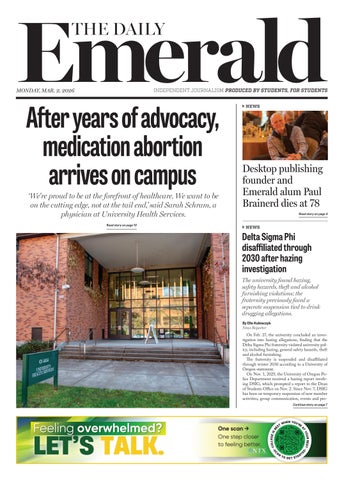
After years of advocacy, medication abortion arrives on campus
‘We're proud to be at the forefront of healthcare. We want to be on the cutting edge, not at the tail end,’ said Sarah Schram, a physician at University Health Services.
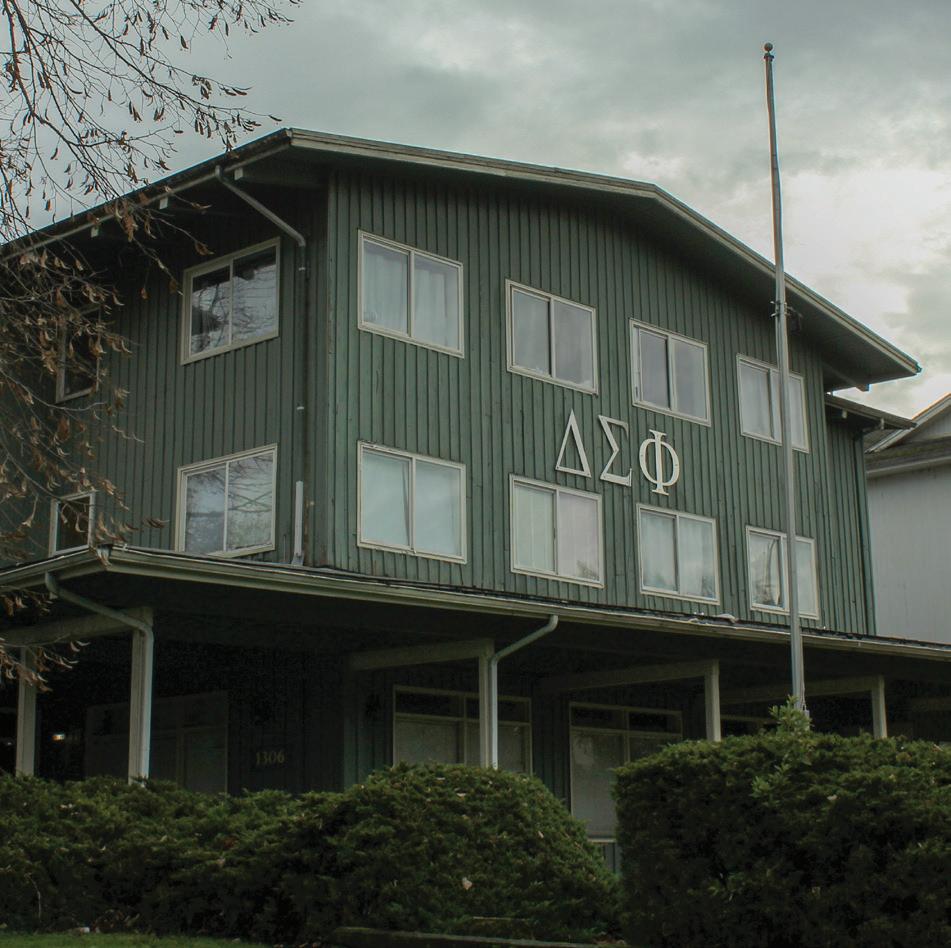
Delta Sigma Phi disaffiliated through 2030 after hazing investigation
The university found hazing, safety hazards, theft and alcohol furnishing violations; the fraternity previously faced a separate suspension tied to drink drugging allegations.
By Elle Kubiaczyk News Reporter
On Feb. 27, the university concluded an investigation into hazing allegations, finding that the Delta Sigma Phi fraternity violated university policy, including hazing, general safety hazards, theft and alcohol furnishing.
The fraternity is suspended and disaffiliated through winter 2030 according to a University of Oregon statement.
On Nov. 1, 2025, the University of Oregon Police Department received a hazing report involving DSIG, which prompted a report to the Dean of Students Office on Nov. 2. Since Nov. 7, DSIG has been on temporary suspension of new member activities, group communication, events and pro-


EDITOR IN CHIEF
Tarek Anthony
PRINT MANAGING EDITOR
Ryan Ehrhart
DIGITAL MANAGING EDITOR
Ysabella Sosa
NEWS EDITOR
Reilly Norgren
INVESTIGATIONS EDITOR
Ana Narayan
A&C EDITOR
Claire Coit
SPORTS EDITOR
Jack Lazarus
OPINION EDITOR
Gracie Cox
PHOTO MANAGING EDITOR
Corey Hoffman
PHOTO EDITOR
Saj Sundaram
COPY CHIEF
Olivia Ellerbruch
VIDEO EDITOR
Jake Nolan
PODCAST EDITOR
Stephanie Hensley
SOCIALS EDITOR
Ysabella Sosa
VISUALS EDITOR
Noa Schwartz
DESIGN EDITOR
Adaleah Carman
DESIGNERS
Asha Mohan
Ellery Burton-Tillson
Eva Andrews
Izzy Smith
Nina Rose
BUSINESS
PUBLISHER AND PRESIDENT
Eric Henry (X317) ehenry@dailyemerald.com
VP OPERATIONS
Kathy Carbone (X302) kcarbone@dailyemerald.com
DIRECTOR OF SALES & DIGITAL MARKETING
Shelly Rondestvedt (X303) srondestvedt@dailyemerald. com
CREATIVE & TECHNICAL
DIRECTOR
Anna Smith (X327) creative@dailyemerald.com
ACCOUNT EXECUTIVES
Torin Chevalier
Camcole Pereira
Ava Stephanian
Elliot Byrne
THE DAILY EMERALD
The Daily Emerald is published by Emerald Media Group, Inc., the independent nonprofit media company at the University of Oregon. Formerly the Oregon Daily Emerald, the news organization was founded in 1900.

Emerald Media Group 1395 University St.,#302 Eugene, Or 97403 (541)-346-5511
UO reviewing web content to meet new ADA standards for accessibility
New rules under Title II of the ADA require public entities to meet web requirements.
By Billie Corsetti News Reporter
The University of Oregon is reviewing its digital content to be more accessible for people with disabilities, per new requirements for public entities under Title II of the Americans with Disabilities Act.
The new rules under the ADA require all public entity web pages to adhere to the Web Content Accessibility Guidelines as the technical standards for implementing digital accessibility. The guidelines provide
a list of ways to prevent visual, audio and learning barriers for people with disabilities trying to access public services.
The compliance date for the new rules is set for Apr. 24. On Feb. 9, UO released an update on its implementation of the new standards.
“The good news is that the main UO website is largely accessible due to efforts over recent years, but because websites are managed at the local level, it is important for anyone who creates or manages content to take a couple of important steps. That includes
training, reviewing and making necessary adjustments to content,” the update read.
UO encouraged staff who have their own websites — including materials in Canvas, digital documents and web-based slideshows — to review their pages and make sure they meet guidelines. The university also said faculty should receive an email soon to take the UO Digital Accessibility Training.
GTFF’s insurance policy helps international students during unforeseen emergencies
In the event of an emergency, GTFF’s insurance plan helps with the repatriation of remains for international graduate employees.
By Corey Hoffman Senior News Reporter
In the event of an unforeseen emergency, union agreements exist to aid international students.
As part of an insurance plan as defined by its collective bargaining agreement, the Graduate Teaching Fellows Federation Union Insurance covers the repatriation of remains back to home countries up to $1 million per incident.
The coverage is part of Graduate Employees’ overall insurance package and is a requirement for international graduate students on an F1 or J1 visa.
F1 visas are non-immigrant visas that allow international students to pursue fulltime academic or language training, while J1 visas are non-immigrant visas that allow international students to participate in work-study exchanges, such as au pairs, students, researchers and interns.
According to UO spokesperson Angela Seydel, the coverage of repatriations is a service purchased by GTFF’s insurance carrier, PacificSource, from Assist America, a partner of Scholastic Emergency Services.
SES is a global assistance program that

provides help with translation, medical evacuation or transport, critical care monitoring, family visits, medical trauma visits, emergency message transmission and reparation and return of remains.
Assist America is a 24-hour emergency service that offers support for medical and non-medical emergencies.
In an emailed statement to The Daily Emerald, GTFF Benefits Administrator Glenn Morris said that because SES are a requirement for international graduate students on F1 or J1 visas, international GE’s may waive out of UO’s International Student Health Benefits plan.
According to Seydel, international students who are not graduate employees also
have repatriation of remains and emergency evacuation services through the International Student Health Benefits Plan, in which students are automatically enrolled each term. Students in this plan pay the $1268 insurance premium out of pocket every term. Under the GTFF Collective Bargaining Agreement, article 24, section 1b, UO pays 95% of premium health insurance costs, while the graduate employee pays 5% of the cost.
(Eric Becker/Emerald)
City Council passes motion moving to further research TOPA for renter protection
The Tenant Opportunity to Purchase Act gives renters an opportunity to buy their buildings before third parties.
By Billie Corsetti News Reporter
During a work session on Feb. 25, the Eugene City Council passed a motion to ask the city manager to bring back more information on the Tenant Opportunity to Purchase Act for the council to discuss as a rental protection. TOPA requires property owners to give notices to building residents if they plan to sell the property, and allows residents to
form a coalition and purchase the building before third parties. The goal of TOPA is to keep prices stabilized and residents in their homes.
The city’s Rental Housing Program presented a slideshow to the council discussing the impacts of Phases I and II of the Renters Protection Process, and mentioned TOPA as a possible protection in the future.
“I want to learn more than what I know right now so I can make the best possible decision,” Ward 5 Councilor Mike Clark
said. “But from what I know at the moment, I would say it sounds like a pretty good idea.”
Ward 4 Councilor Jennifer Yeh moved to pass a motion to ask the city manager to return at a later discussion with more information on TOPA for councilors, emphasizing that the discussion should be prioritized before Phase III implementation planning. The motion passed 7-0.
( ABOVE) The Graduate Teaching Fellows Federation holds a rally before their planned strike on the grounds of the University of Oregon in Eugene, Ore., on Jan. 11, 2024.
Desktop publishing founder and Emerald alum Paul Brainerd dies at 78
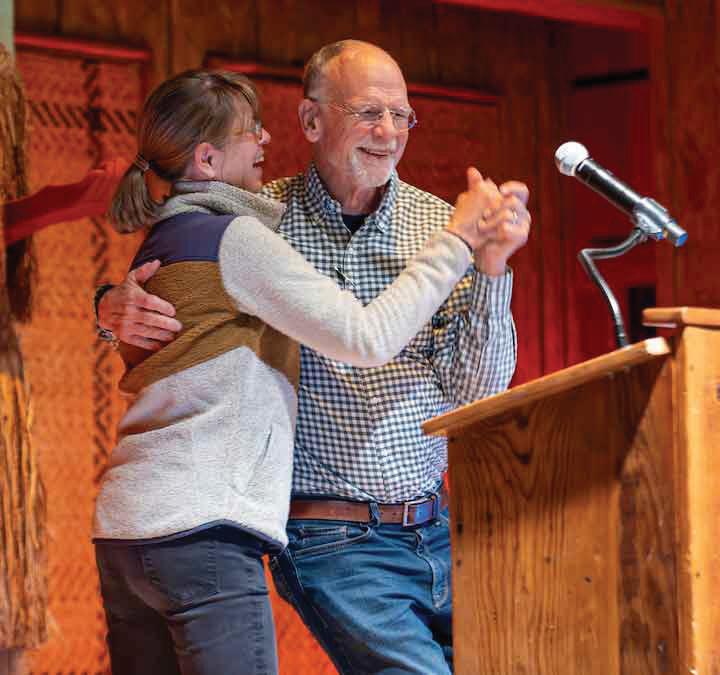
Paul Brainerd was an environmental advocate and businessman, also serving as The Daily Emerald’s editor-in-chief in the early 1970s.
By Reilly Norgren News Editor
Paul Brainerd, businessman and philanthropist who coined desktop publishing, which revolutionized print publication, has died at 78.
Originally from Medford, Ore., Brainerd earned a Bachelor of Arts in business administration from the University of Oregon and went on to receive a Master of Science in journalism from the University of Minnesota. Brainerd co-founded Aldus, which would later produce PageMaker, a desktop publishing software program. Brainerd is said to have created the term desktop publishing, referring to the creation of documents using dedicated software on a desktop computer. This software could generate page layouts and text content, and was widely used by print publications like newspapers, and would later be used for digital content. Aldus would later merge with Adobe in 1994 in an all-stock deal valued at $525 million, or over $1 billion today.
During his time at UO, Brainerd was a photographer and editor at The Daily Emerald, and served as editor-in-chief during the 1969-1970 school year, just prior to when the Emerald became independent from the university.
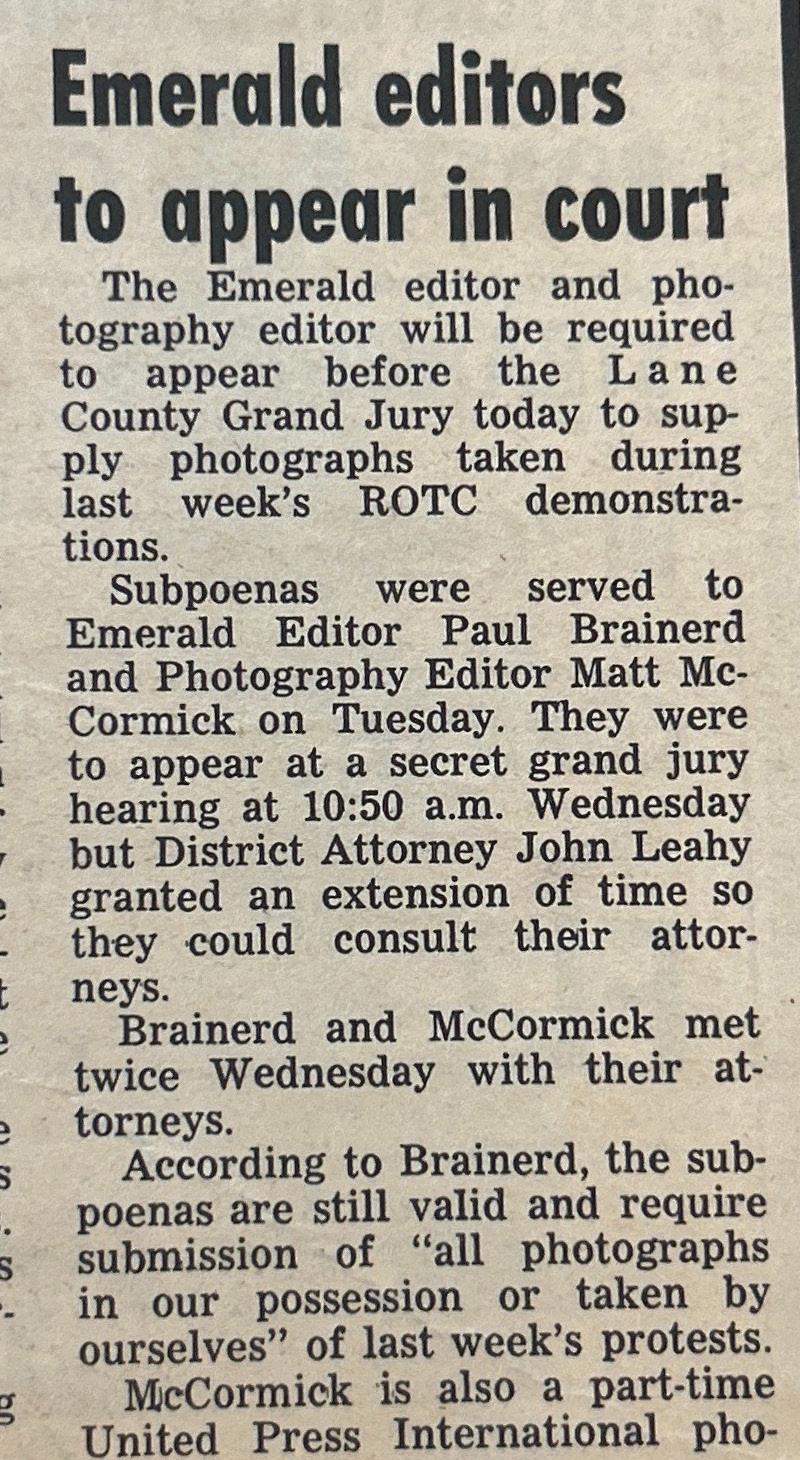
Prior to becoming editor-in-chief, Brainerd documented a two-day sit-in at Johnson Hall where students were demanding the removal of the Reserve Office Training Corps from campus during the peak of anti-Vietnam War protests on campus. This resulted in
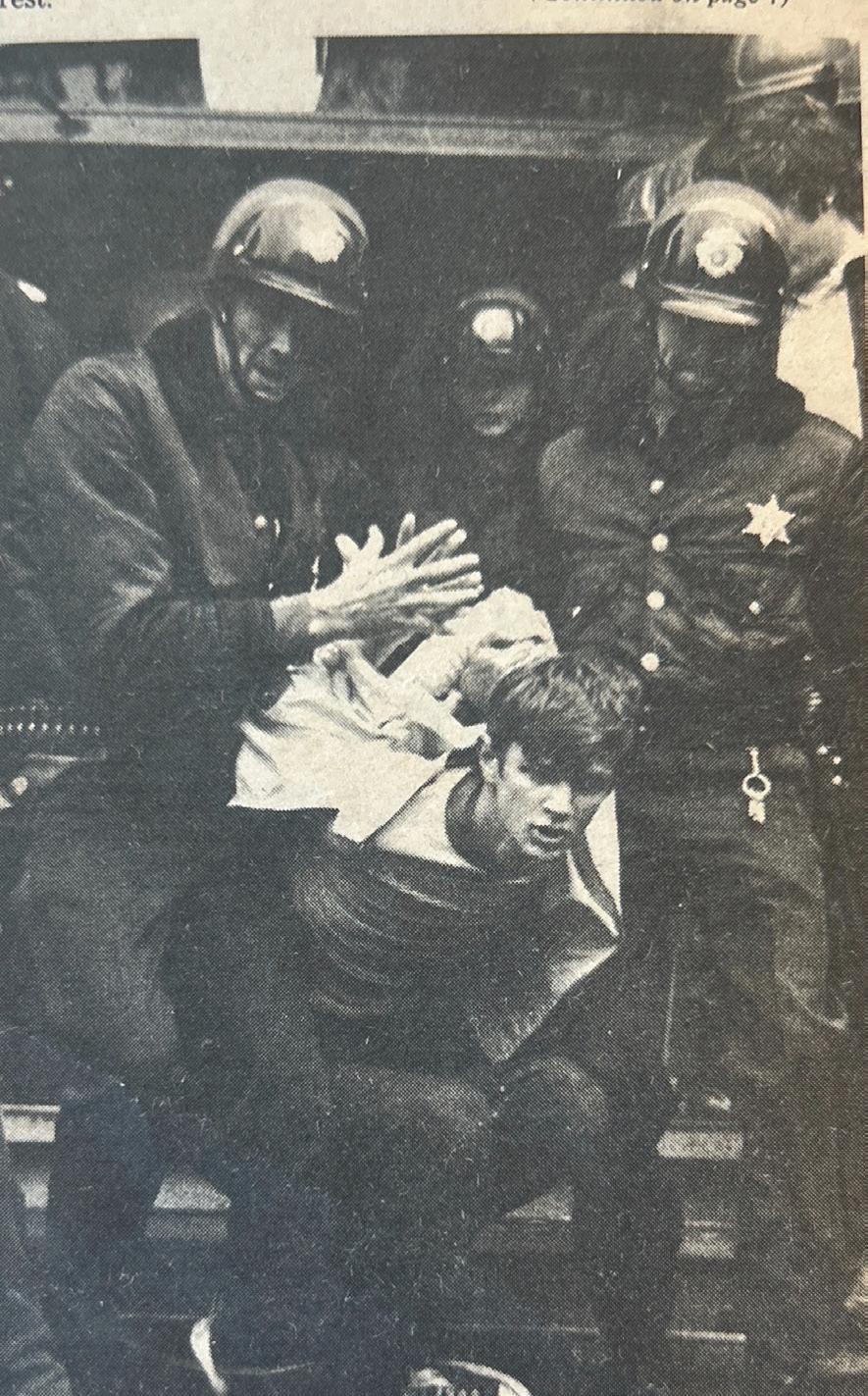
the students being arrested, tear gas being deployed and the presence of the Oregon National Guard. Brainerd’s photos from the event were used on the cover of the paper the next day.
Brainerd would not be head of the Emerald after it split from the university, but played a large role in the shift.
According to an article written by Art Bushnell, who served as news editor under Brainerd during that time and later became editor-in-chief himself, Brainerd had discussions with the acting university president and the university president at the time. The next editor-in-chief, Grattan Kerans, finalized these discussions after Brainerd’s initiation, setting the Emerald up for its independence in 1971.
The university dissolved its publishing board, which had overseen the Emerald, in February 1971. According to Bushnell, that’s when the staff knew the newspaper would make the change, which it officially did in July of the same year.
“He was a visionary,” Bushnell said about Brainerd. “He was not the same kind of day-to-day ‘I want to go cover a hot story’ person. He was thinking about the big picture.”
Bushnell said that independence for the Emerald was Brainerd’s idea because, at the time, state authorities were looking to censor student papers, and Brainerd thought independence was the only way to continue practicing journalism “unfettered and unrestrained.”
After Brainerd’s push for independence from administration, it was Bushnell that became the first independent Emerald editor-in-chief.
“He was a quiet, unassuming guy with a big smile, and he led a newsroom by empowering the rest of us to cover the news while he figured out how to keep us in business,” Bushnell said.
After graduating from UMN, Brainerd went on to work for the Minneapolis Star Tribune. In 1984 he would co-found Aldus, where he would work as president and chief executive for 10 years before stepping down.
Two years after leaving Aldus, Brainerd shifted resources to focus on environmental advocacy in the Pacific Northwest, founding the Brainerd Foundation, a family foundation that funded organizations in the region that advocated for conservation efforts.
Additionally, Brainerd founded Social Ventures Partners in 1997, which worked to match philanthropists to community organizations to provide mentorship. Currently, SVP has 2,100 philanthropist partners.
In the 2000s, Brainerd focused more on environmental and community stewardship, founding IslandWood, a nonprofit educational center for children in the Seattle area, and Headwater Glenorchy Eco Lodge in New Zealand, which was the first net positive energy accommodation in the world.
A statement on IslandWood’s website regarding Brainerd’s passing, wrote that he always had a passion for the outdoors and spent the last phase of his life focused on environment and community stewardship.
Brainerd died on Bainbridge Island, Wa. on Feb. 15. Tarek Anthony contributed to this reporting
A clipping from the Oregon Daily Emerald published April 23, 1970, when then-Editor-in-Chief Paul Brainerd and Photography Editor Matt McCormick were subpoenaed to appear in court over photographs taken during anti-war protests.
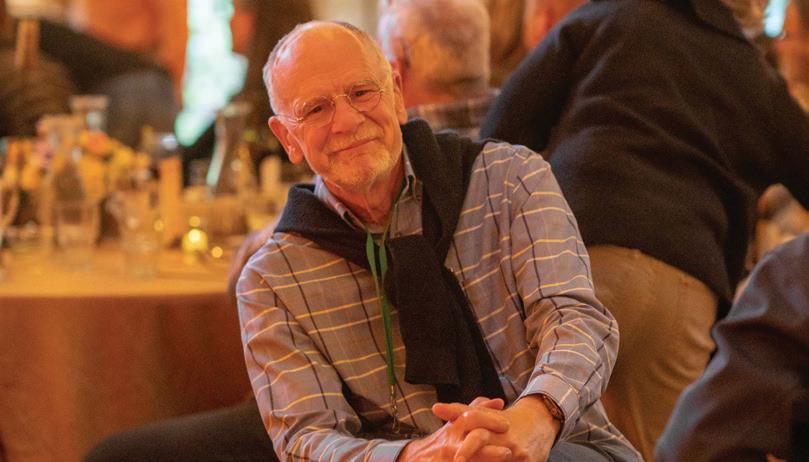
Paul and Debbi Brainerd attend IslandWood’s “Dinner in the Woods” annual event in May 2024. (Courtesy of Islandwood)
Photo published in the Oregon Daily Emerald on April 24, 1970, following an anti-war protest at the University of Oregon in Eugene, Ore.










Delta Sigma Phi disaffiliated through 2030 after hazing investigation
gramming, according to the Greek Conduct website.
During the four-year suspension period, the fraternity cannot operate as a recognized student organization and will lose all privileges associated with affiliation, including the ability to participate in campus activities and events, according to UO spokesperson Angela Seydel.
The organization is eligible to reapply for recognition in spring 2030 if it complies with the terms of its suspension.
The fraternity previously faced multiple allegations of drink drugging in January 2024, which resulted in a separate interim suspension. During that suspension — and amid a university-wide fraternity alcohol event ban following a flurry of drugging allegations in winter 2024 — DSIG was alleged to have held an event involving alcohol in February 2024.
The event — which was “improperly” registered as alcohol-free — placed the fraternity on disciplinary probation through February 2027. According to university policy, probation is a period for a chapter “to reflect upon their choices.” Subsequent violations during the probation period can result in additional sanctions, including suspen-

Aishiki Nag is a senior studying political science and global studies. She likes to cover state and national politics, and international peace-building efforts. When she’s not writing for The Emerald, she likes to read, hike and travel to new places.
sion or expulsion.
It is unclear what any subsequent violations may have included. The Daily Emerald is awaiting the release of public records from the university regarding DSIG’s most recent allegations.
Due to disaffiliation prohibiting fraternities from participating in university-sponsored activities, recruiting new members could prove difficult. Two previously unaffiliated organizations, Alpha Sigma Phi and Sigma Alpha Epsilon, agreed to comply with the terms of their suspension.
“The safety and well-being of students is the university’s top priority. Hazing, retaliation and behaviors that endanger community members or undermine accountability will not be tolerated,” Seydel said.
Yousif Dajani, who served as DSIG president in 2025 and whose term ended in January, declined to comment.
Nag: A missing partnership for affordable housing
Opinion: The Eugene City Council should commit to partnering with ASUO in addressing housing affordability and predatory marketing tactics aimed at college students.
By Aishiki Nag Opinion Columnist
On Jan. 27, the Associated Students of the University of Oregon hosted their annual State of the University. This event covered a range of notable topics, including housing affordability, which many UO students encounter.
Nick Aguayo, the Deputy Director of the Springfield Eugene Tenant Association, spoke at the ASUO forum. SETA is a nonprofit organization that provides education and resources to tenants in Lane County.
“We believe (SETA) is a vital resource – we don’t provide legal services, but we provide education so that tenants can advocate for themselves,” Aguayo said. “We have interpretation services in over 140 languages, so we can make sure that we can provide help and support for anyone who asks.”
For students who choose off-campus housing, the options are numerous and often too expensive for the average student’s salary. According to the NMHC, between 2013 and 2020, student housing costs increased by 25%, while average tuition rose by only 20%.
Aguayo points to a simple explanation for the problem: not enough housing supply.
There were four major areas that contributed to this supply shortage, but one of the main issues lies in zoning laws. Zoning laws are how a city or municipality organizes its city into different zones, such as industrial, commercial or residential zones.
“Historically, in Oregon, there’s been many cities that have a lot of residential zones that are restricted to single-unit housing,” Aguayo said. “Restricting to single-unit housing basically stops the ability to build middle housing, which are two to four unit houses like duplexes.”
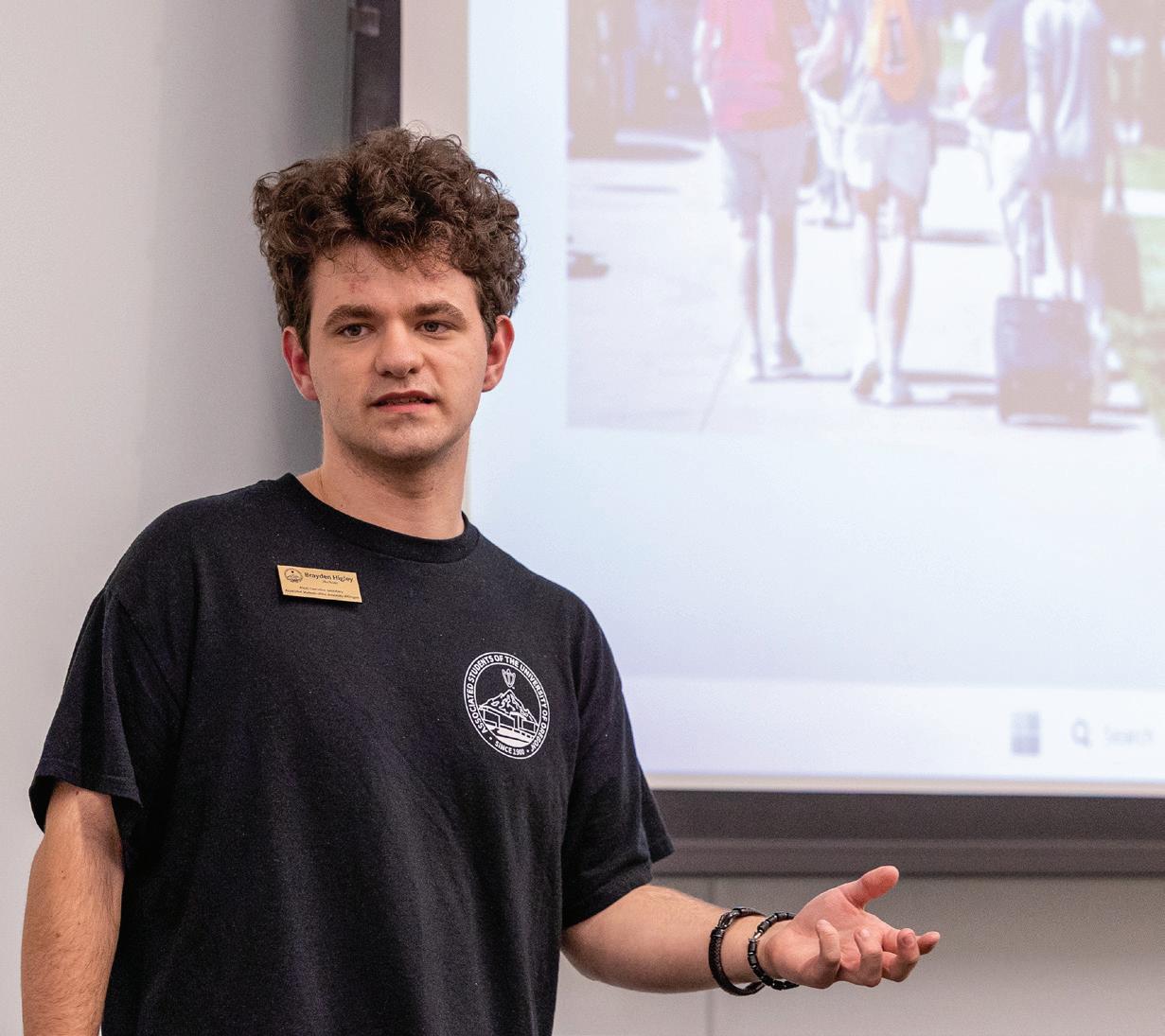
Brayden Higley is the Secretary of Basic Needs at ASUO and is working on an advocacy campaign to partner with the City of Eugene to address affordable housing issues.
Students face a myriad of different challenges throughout the renting process, starting from unclear pricing strategies, rental agreements that are difficult to leave and difficulties in being able to sublet 12-month leases.
“What we’re trying to do is invite the city council to be more involved with students and
start discussions with us around affordable housing,” Higley said.“Without having us involved in the conversation, do we really need another multimillion dollar high rise?”
One student’s story that stood out to Higley was of a student who was promised a bed for $95 a month, but during the final steps of signing the lease, they had noticed that there were two beds per room. Those rooms that are often marketed as affordable can be misleading or advertised with false pretenses.
He is currently organizing an event where students can write letters to the Eugene City Council, share their personal stories about the rental process and deliver them to the city council in hopes of starting a partnership between the ASUO.
“If students are frustrated with the marketing tactics, anything from the start to the end of the renting process, you can come to ASUO and we’re ready to talk to you about it,” Higley said. “We’re going to need to start working with the city council, and ask them to start working with us — currently there is no communication with students on what housing should look like.”
The Eugene City Council needs to work with students on the unique challenges they face in finding affordable housing, and a sustained partnership with the ASUO will bridge the communication gap.
( LEFT ) ASUO Secretary of Basic Needs, Brayden Higley speaks to a group of University of Oregon students attending an ASUO Housing Advocacy Workshop on Feb. 25, 2026.
(Charlie Mack/Emerald)
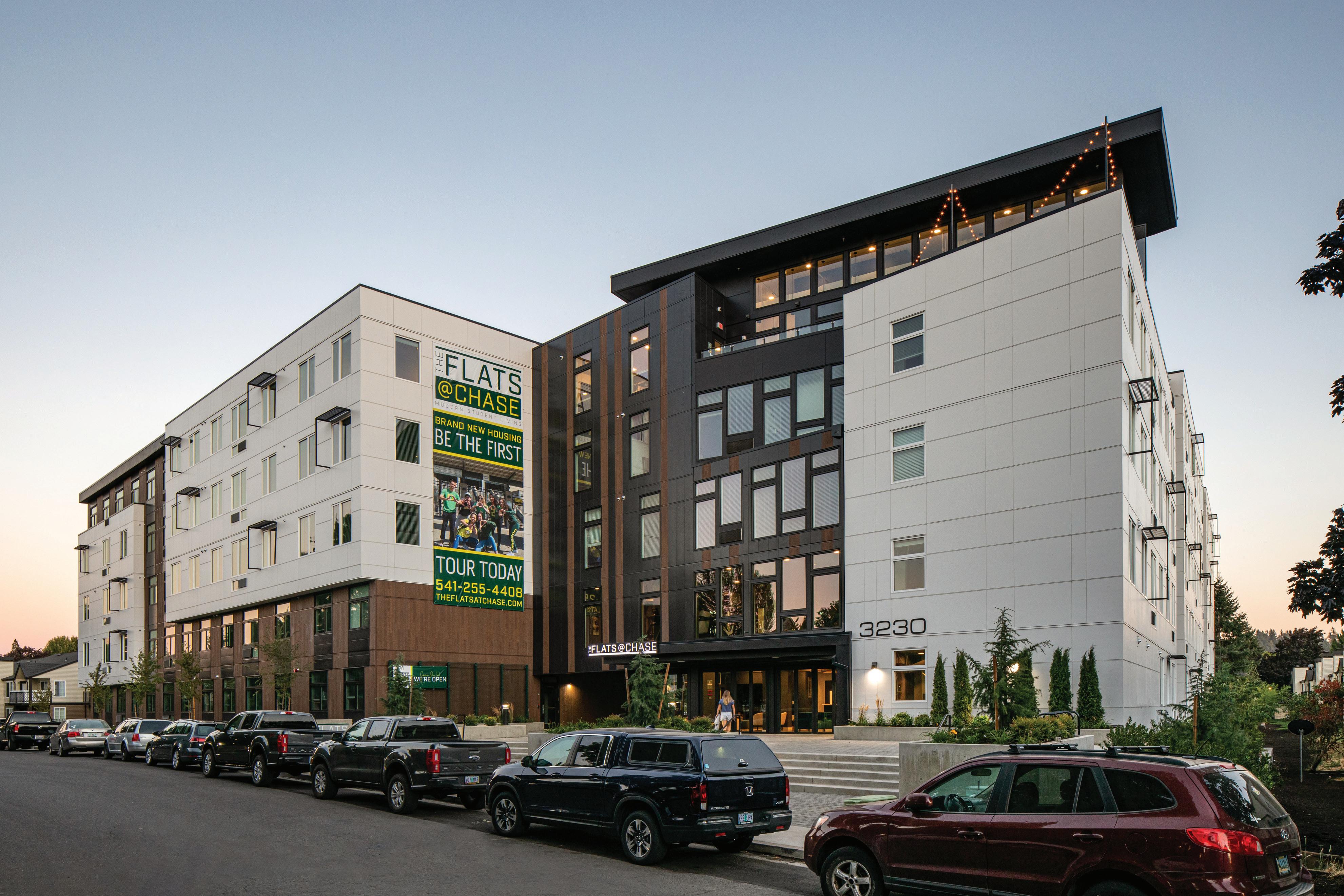
( RIGHT ) Exterior of Delta Sigma Phi on E 18th Ave in Eugene, Ore on Dec. 1, 2025. (Adaleah Carman/ Emerald)

Emerald and UO alumna
Myah Millner brings joy to Portland through monthly flea markets
Cloud City Flea Market serves as a space for marginalized communities to flourish, Myah Millner is at the forefront of it.
By Maria Weyne PDX Bureau Chief
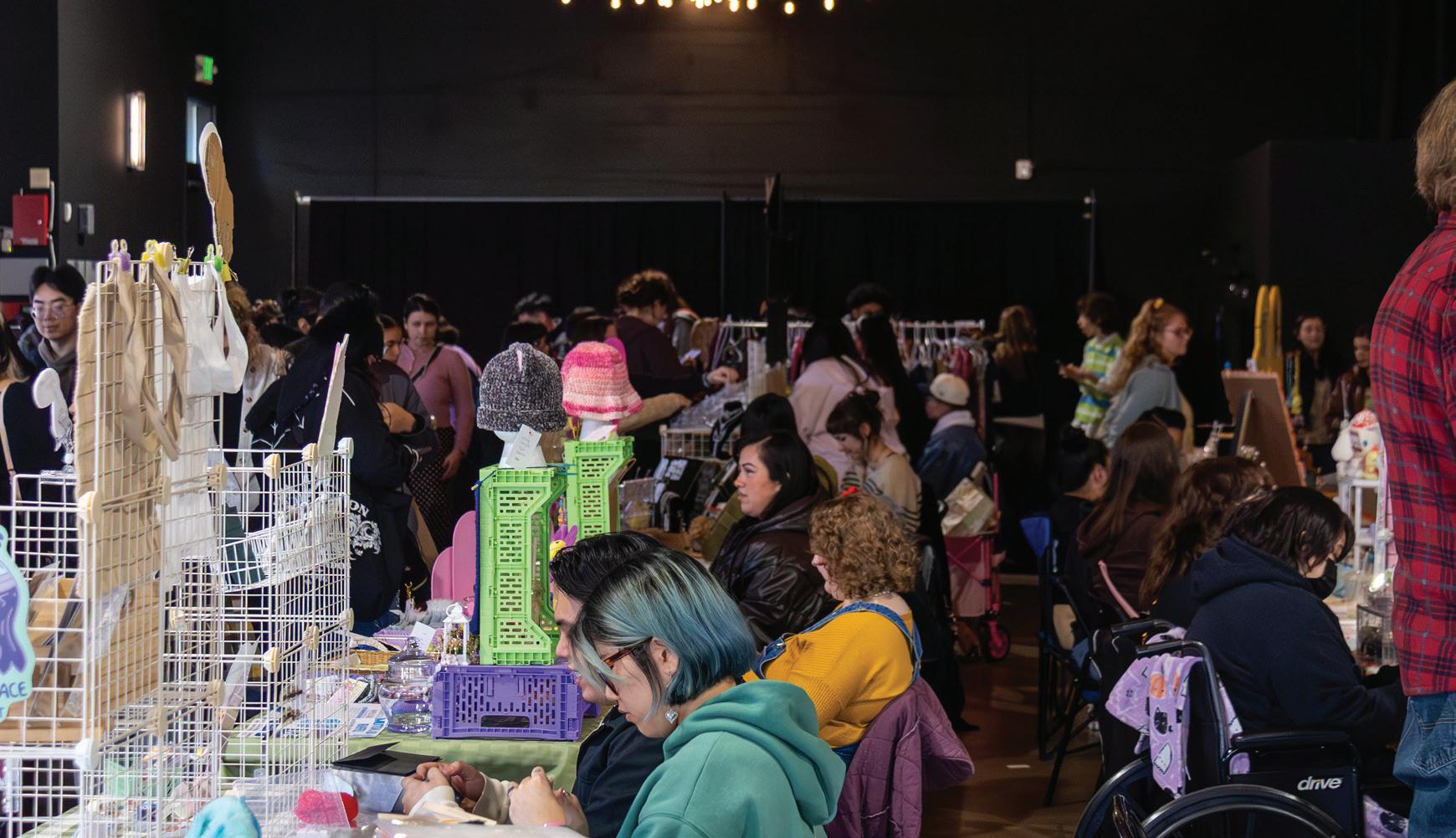
Once a month, Portlanders can attend themed events at Cloud City Flea, where dozens of businesses sell handmade and secondhand products. Myah Millner, a University of Oregon alum, is responsible for this creative haven.
At 24-years-old, Millner owns and operates her own brand and flea market in Portland. with the mission of creating a space for young people of color who are creatives and artists, according to her website.
Millner’s journey began at UO during her undergraduate years, when she launched Stellar Studio Co., a crochet-based fashion business. The interest in the brand grew over time, with Millner amassing over 12,000 followers online.
“Since not everyone has the opportunity to go to college to reach a broader audience, I wanted to have a place for young creatives like me,” Millner said. “I wanted to provide a space to uplift small businesses and local artists by giving them the opportunity to maybe turn their hobby into a business.”
Millner continued to explain she had been visiting vintage markets since her move to Portland. in 2019, and the young crowd was what inspired her to pursue her own space.
“Once I moved to Portland, I started vending at a lot of vintage markets and met some fellow handmakers through vending,” Millner said. “I loved the crowd like my age group from 18-24, and I thought, ‘what if it was like the vintage market but flipped to be a space for handmakers.’”
Having studied journalism at UO, Millner understood the need for an online presence to promote her business. She began creating reels at her events, spotlighting outfits and vendors, eventually having one of the reels take off in March 2025.
“Last March, we hosted a nothing over $35 event, and one of the clips went viral,” Millner said. “It got 14,000 likes, and I was so shocked… ever since then,
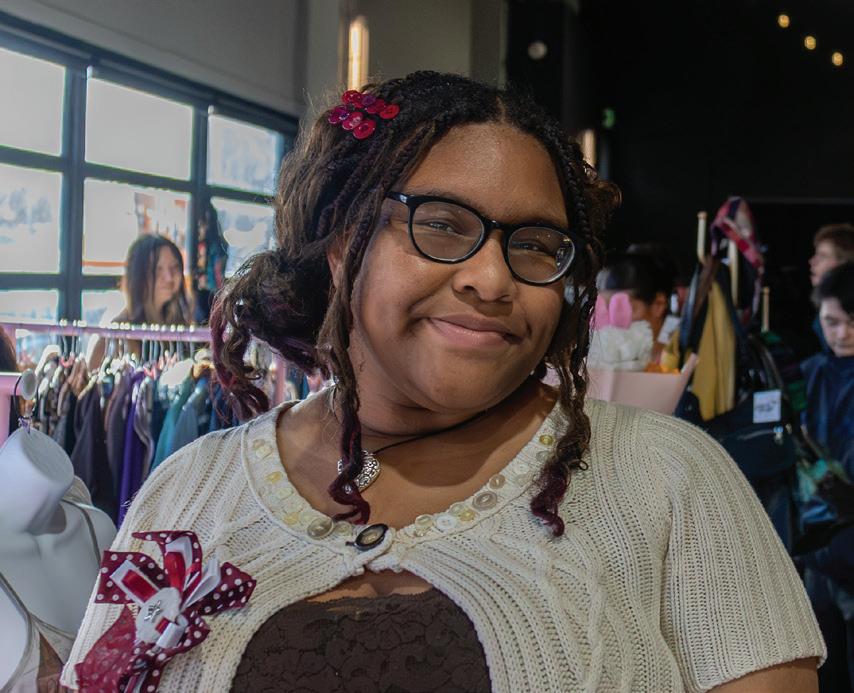
the market blew up, and people started becoming interested to vend or attending the next event. ”
From there, Millner was able to continue to push her mission statement, creating a safe space for those marginalized communities she had always wanted to uplift.
“When I was studying journalism for my stories, I always chose to highlight BIPOC people, and I am translating that to my current business as it's important to showcase businesses that often go unseen or overlooked,” Millner said.
Millner continued by explaining that Cloud City Flea has become a space for everyone, adding that even during the current political turmoil, she hopes to provide a joyful event for others.
“We recognize that our voices hold power, and we want to continue to uplift BIPOC voices,” Millner said. “With our events, we want to provide a community that brings people together through creativity, connections and shared experiences.”
UO signed amended resolution agreement with OCR in October after Title VI investigation
The OCR released a list of universities that ended relationships with The PhD Project after a civil rights investigation on Feb. 19.
By Billie Corsetti News Reporter
The University of Oregon sent the U.S. Department of Education’s Office for Civil Rights an amended agreement to end its partnership with The PhD Project after an investigation concluded the university was violating Title VI of the Civil Rights Act of 1964.
“We signed an agreement in October and heard nothing further,” UO said in a statement to The Emerald. “We consider the matter resolved. We have reviewed all of our practices and believe that we are in compliance with the law.”
On Mar. 13, 2025 OCR launched an investigation into 45 higher education institutions for their partnerships with The PhD Project, a nonprofit that aims to provide doctoral degree pathways for people of color.
In OCR’s email to UO President Karl Scholz, the department claims the organization “(limits) participation based on race,” violating Title VI.
The nonprofit holds a twoday conference once a year, available for students at universities that pay a membership fee to partner with the organization. Members are also invited to host their own booths.
“We paid $5k to the organization for two staff members to staff a table at their annual conference and provide university information to potential PhD candidates,” Angela Seydel, director of issues management at the UO communications team, said in an email to The Daily Emerald.
On Sept. 23, 2025, OCR sent a letter to UO determining that the university violated Title VI by partnering with The PhD Project, calling it a “blatantly discriminatory program designed to benefit certain fa-
vored students based on their race or national origin.”
Attached to the letter was a draft resolution agreement that would rectify the violation by ending any partnership with the nonprofit, if signed by UO. The university responded on Oct. 3, 2025, with a signed and modified agreement, mostly changing some language in the agreement.
The UO also added a paragraph that stated that “this Agreement does not constitute an admission of liability, non-compliance or wrongdoing by the University.”
Seydel said that UO has not heard from OCR since sending the agreement in October.
On Feb. 19, OCR announced a list of universities that signed resolution agreements to end partnerships with The PhD Project in a press release statement. UO was not included on the list.
In a statement to The Daily Emerald, The PhD Project said they remain focused on their mission.
“Our vision is to create a broader talent pipeline of current and future business leaders who are committed to excellence and to each other, through networking, mentorship, and unique events. The PhD Project was founded with the goal of providing more role models in the front of business classrooms and this remains our goal today.”
After years of advocacy, medication abortion arrives on campus
By Elle Kubiaczyk News Reporter
Students for Choice President Karlie Windle remembered walking into a meeting with University Health Services Director Margaret Trout prepared for disappointment. Instead, she learned medication abortions would be offered on campus in the fall.
This comes after years of student groups campaigning for abortion access on campus.
The University of Oregon is the second university in Oregon to offer this service, trailing Portland State University. Nationally, the service was primarily implemented in California, as required under the state’s Senate Bill 24.
“We’re proud to be at the forefront of healthcare. We want to be on the cutting edge, not at the tail end,’ says Sarah Schram, a physician at University Health Services.
Trout, previously employed at a California university, was open to finding ways to provide this service on campus since her start at UO. Hired in January 2025, Trout met with the Young Democratic Socialists of America, one of the student groups heavily involved with campaigns in favor of medication abortion, a few weeks into the job. The push to implement the service at UO lingered in the back of her mind ever since.
“We’re here to listen and to provide what our students need,” Trout said.
‘The multi-generational effort,’ as Windle coined it, was headed by meaningful collaboration between ASUO, S4C, YDSA and UHS.
“It’s just a huge achievement and resource. This will allow students to have a much easier time in terms of decision making, taking care of themselves and advocating for their future,” Windle said.
Medication abortions were at the forefront of ASUO President Prissila Moreno’s campaign in the spring. “Every campaign has its ambitions and it’s easy to lose sense of those promises,” Moreno said. However, Moreno and the coalition kept pushing forward, unfazed by a failed 2024 effort. The campaign fell through, according to Windle, as the pro-Palestine encampment during spring 2024 took priority.
Not all campus groups supported the implementation of the service. Students for Life of America, a pro-life organization active on 1,607 college campuses nationwide, including UO, criticized the decision.
“It makes no educational sense for schools to prioritize ending the lives of future students and the grandchildren of parents often paying tuition, “ Kristi Hamrick, VP of Media & Policy for Students for Life, said. “Chemical abortion pills expose women to injury, infertility, death, and empower abusers.”
Marie Jackson, member of YDSA, said that over 2,300 petition signatures and 200 survey responses proved the need for the service at UO.
Survey responses overwhelmingly showed students preferred UHS to Planned Parenthood for medication abortions. Accessibility and familiarity were at the core of why students preferred UHS, said Jackson.
In the Eugene area, the two nearest Planned Parenthood locations range from a 10-20 minute drive, compared to UHS, which is central to campus. Schram said, “We are well trusted and a bit more familiar and perhaps less intimidating.”
Student groups have been calling for this service at UHS
for years. Anna Hejinian, medical doctor at UHS, finds it all boils down to timing.
When asked why now, Hejinian said that access to abortion care has become a large concern.
“We have advanced our abilities here at UHS, hiring additional gynecology staff and acquiring an ultrasound machine to do appropriate assessments here,” Hejinian said.
Two staff members, including Schram, will be responsible for the new service in the spring. Schram speaks to initial concerns about after-hour support to circumvent the risk of a complication. Currently, conversations are ongoing to “make sure we have a strong and easy flow for students to receive additional care when needed,” she said.
UHS clarifies logistics are still being finalized for fall 2026. However, to obtain the two prescribed medications, mifepristone and misoprostol, Schram anticipates a student simply calling the clinic and scheduling an appointment.
During the “relatively long visit,” Schram or another gynecology provider would walk the student through their options at UHS or Planned Parenthood. This includes cost, potential for additional testing, future contraceptive options and more.
After deciding to proceed down the medication abortion route, UHS would prescribe the medication to be taken orally at home or at the clinic. The abortion pill, according to Eugene Planned Parenthood locations, can be taken up to 11 weeks into pregnancy.
Complications for medication abortions are rare, averaging 1-6% of patients, UHS said.
Both Schram and Hejinian underscore UHS emphasis on maintaining clientele privacy to include reproductive care. Both the pharmacy and the clinics have strict HIPAA privacy rules, Schram emphasizes. “We’re good at keeping secrets. It’s the profession,” Schram said.
Conversations about cost are also underway. On the whole, coverage varies by a student’s insurance plan. The hope at UHS is to make medication abortions as affordable as possible.
An abortion pill costs $580 out-of-pocket on average, reported by Planned Parenthood.
Students who have the Oregon Health Plan and other Oregon-based insurances, would most likely have complete coverage for this service, says Trout. Additionally, UHS is a CCare provider, “which is the state program that pays for contraceptive needs,” Trout said.
However, UHS is applying for a parallel program, AbortionCare, which would extend support to international and undocumented students. AbortionCare clinics can access the Reproductive Health Access Fund, which would make abortion services free for Oregon residents not enrolled in OHP and non-US citizens.
AbortionCare funding does not apply to out-of-state students. UHS is actively researching alternative funding options for these students.
Windle, a senior at UO, has continually advocated for broader reproductive care on campus. Before Windle’s arrival on campus, co-directors of Students for Choice worked tirelessly to push HB 2002, a reproductive health care bill. The House of Republicans walked out, refusing to sign. The House Bill was later passed in 2023, with modifications to some of its broader abortion care provisions.
In 2024, Windle witnessed the failed coalition, making
the current accomplishment all the more impactful. She attests the victory as a testament to effective collaboration, bringing together the strengths of different student groups around a common goal.
YDSA prioritized gathering signatures and quantifying student support.
“For a campaign to be successful you need to connect with people. A campaign needs to be bottom-up not topdown,” Jackson said.
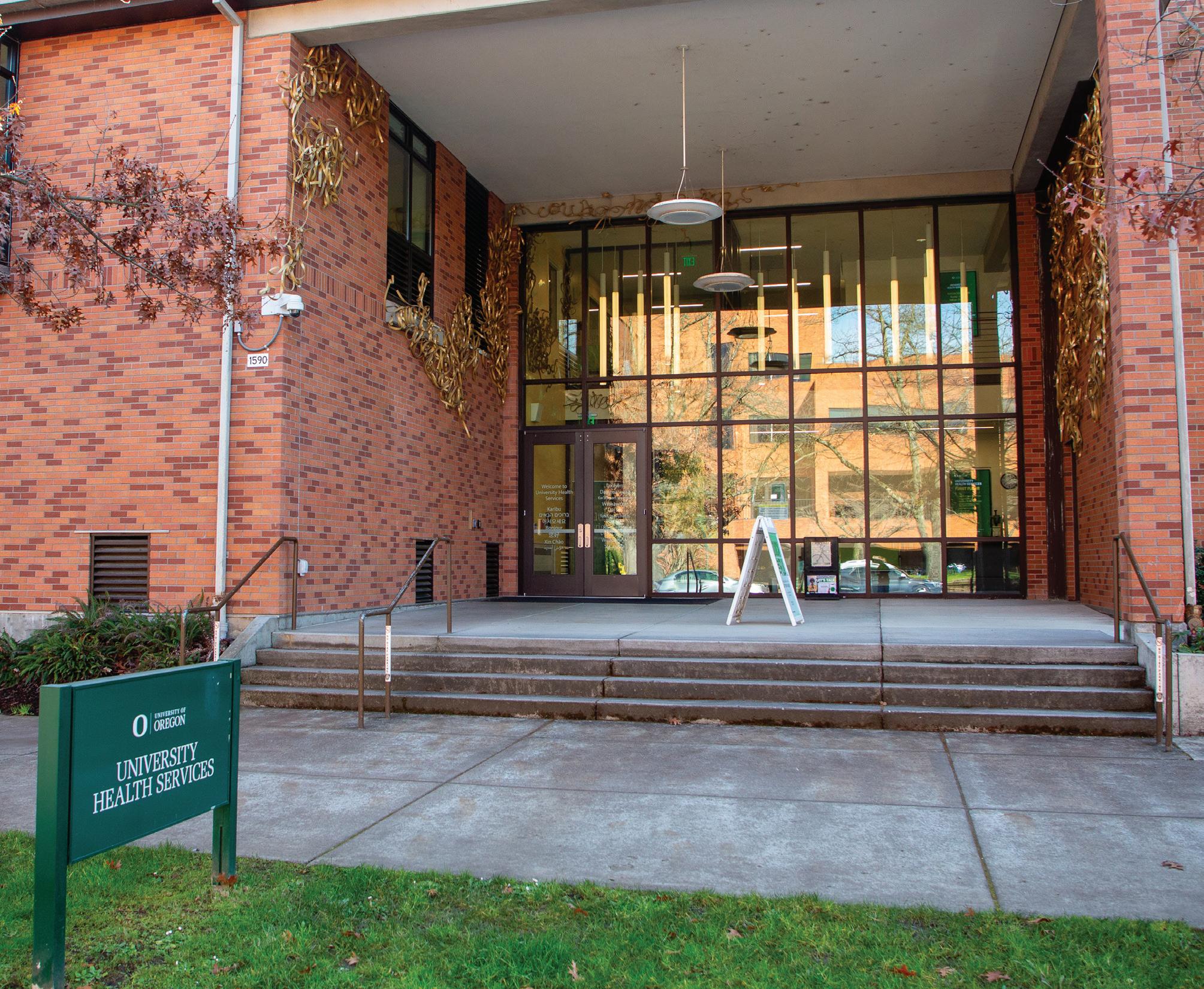
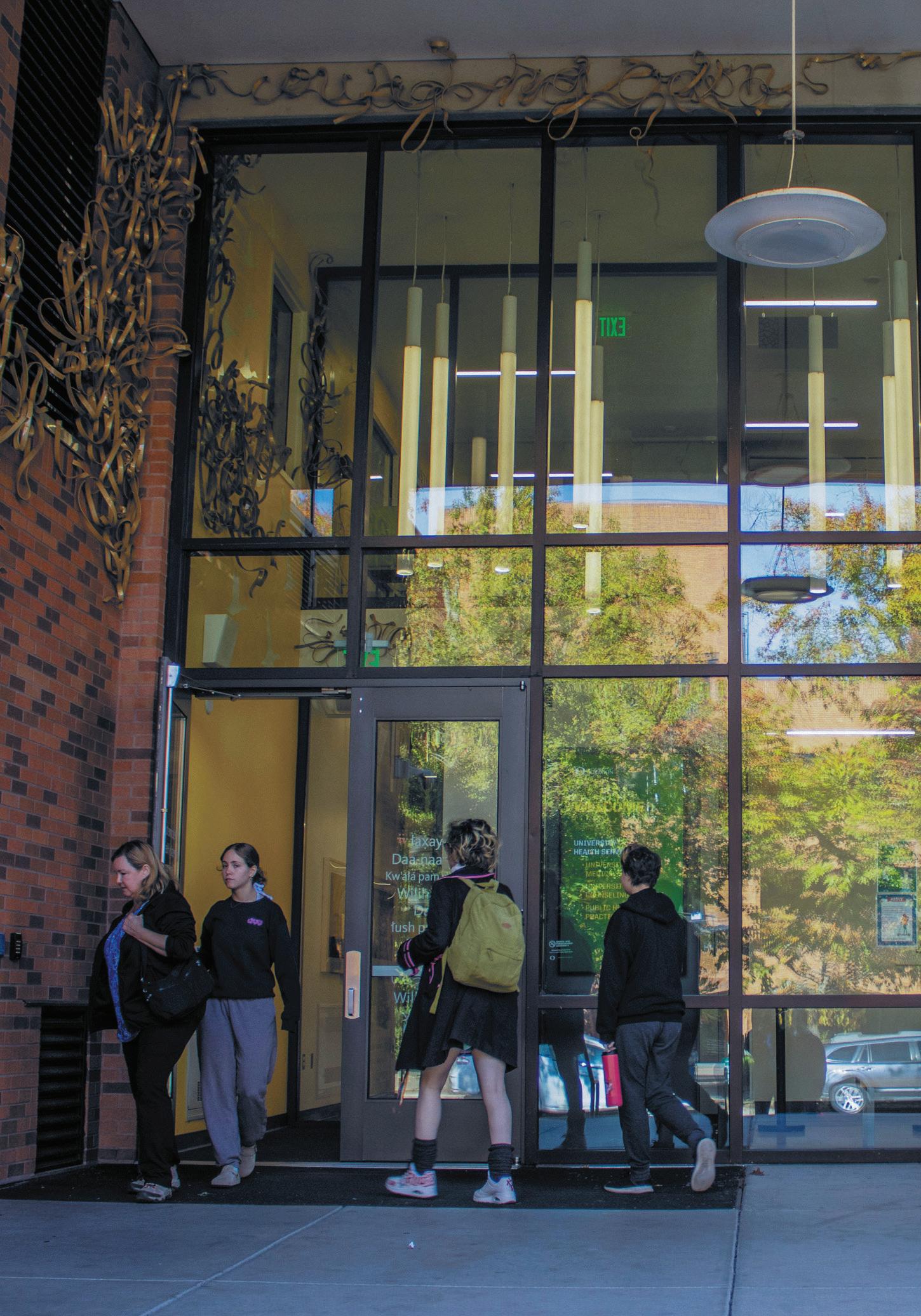
(ON THE COVER) The health center is located on the corner of Agate Street and E 13th Ave.
(Corey Hoffman/Emerald)
( LEFT ) People walk in and out of the entrance of the University of Oregon’s on campus health center. The health center is located on the corner of Agate Street and E 13th Ave.
(Anna Liv Myklebust/Emerald)
Other reproductive services offered by the University Health Center
UHS provides education and access to a large majority of contraceptive methods.
Birth control options
IUS (Mirena, Kyleena, Skyla)
IUD (ParaGard)
Implant (Nexplanon)
Birth Control Pills
Contraceptive ring (NuvaRing)
Sexually transmitted infection testing
Pap smears and HPV testing
Pregnancy options counseling and care
NEWS / SPORTS
‘AI support services’ offered to students and faculty through UO Libraries
University of Oregon Libraries begins offering dropin support and workshops regarding AI use.
By Angelina Handris News Reporter
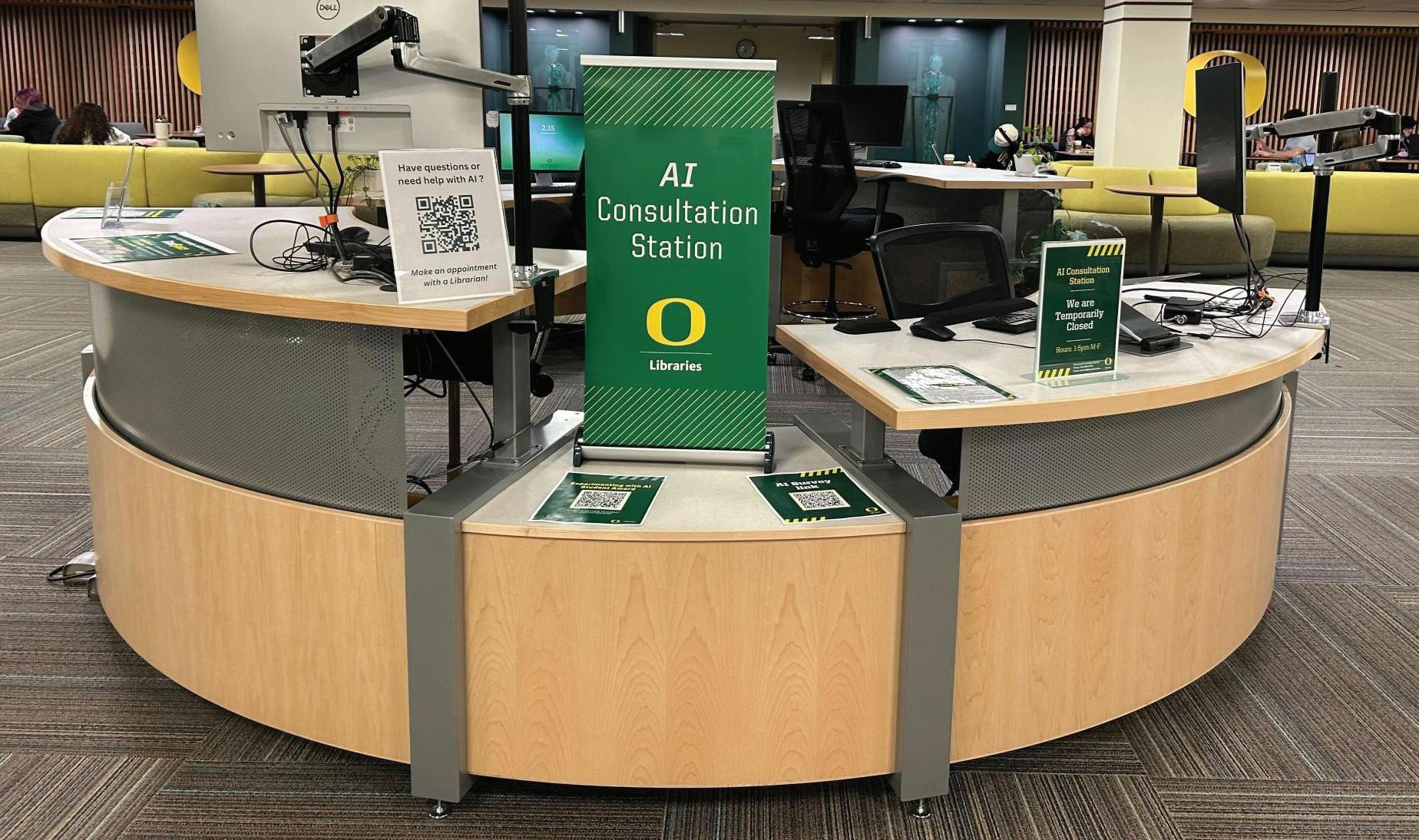
This year, University of Oregon Libraries have begun offering services and resources regarding the use of artificial intelligence. Some of these include dropin consultation about AI use, one-on-one consultations, workshops and an AI resource guide.
The AI Consultation Station is open from 1 to 5 p.m., Monday through Friday, in the Knight Library Learning Commons located on the first floor. During these times, a trained staff member is available to assist students with questions about AI in a drop-in format.
“For example, if a student said, ‘I have an assignment; I’m not sure what to do.’ Basically, what we would do is we’d help the student think through what information is provided by faculty, like, ‘Oh, it says right here in your syllabus.’ This is what you can do with AI, and this is what you need to ask permission for,” Nancy Cunningham, associate vice provost and university librarian for data, access, research and teaching services, said.
Cunningham said the concept of a consultation station came about because many students and faculty members had questions about AI. For example, students didn’t know when or how to use it, and faculty “didn’t necessarily” have a policy about AI use at that point.
According to Cunningham, the AI consultation services are meant to help with inquiries about AI use, and there are limits to what students can use the resource for.
“What the consultation station is not doing is doing the homework for the students. (We’re not) saying, ‘Oh yeah, you can use (generative AI) without checking in with a faculty member,’” Cunningham said. “So it’s a very basic service. But what we’re trying to do here is create a lot of AI literacy in terms of inciting critical thinking.”
One-on-one support services are also offered, which allow students to receive tailored, in-depth instruction and assistance on AI use and literacy.
“We’re kind of thinking about this as another digital tool that we can help guide people in terms of how, and when and if to use it,” Chloe Barnett, undergraduate engagement and student success librarian, said.
Another service offered is AI workshops, which are drop-in workshops that anyone can register to take. The workshops are designed to teach lower-level undergraduates the basics of AI literacy, ethics and how large language models, software that is capable of linguistic analysis and prediction, work.
“The idea of AI literacy is (that) students understand how it works; they understand how they can think about it critically and apply their own judgment to the tools,” Barnett said. “So things like, ‘How do I determine if something is generated by AI? How do I determine if there’s bias, if there’s misinformation? How do I look?’”
Barnett said that a challenge with the AI workshops was that there had been a low attendance rate, with few students showing up to the workshops.
“We really haven’t had a lot of people come, so it’s a drop-in workshop anyone can register to attend, not many people have chosen to attend it,” Barnett said.
Barnett said there were also challenges when deciding what services to offer due to the rapidly changing AI landscape.
“We’re having to learn and learn and learn and learn about this new technology. I think it’s interesting, you know, to be able to do that, but also really challenging,” Barnett said.
“It is hard to know how to prepare people for a future that we don’t quite know what it’s going to look like.”
Oregon lacrosse’s defensive struggles lead to two straight losses
The Ducks gave up 14 and 12 goals to Cal and Eastern Michigan University, respectively, leading to losses in each of those two matchups. To compete in a strong Big Ten field, they’ll need to tighten up.
By Jack Lazarus Sports Editor
Looking at each of the opening weeks of Oregon lacrosse’s (3-2) season individually can tell drastically different things, especially on the defensive end.
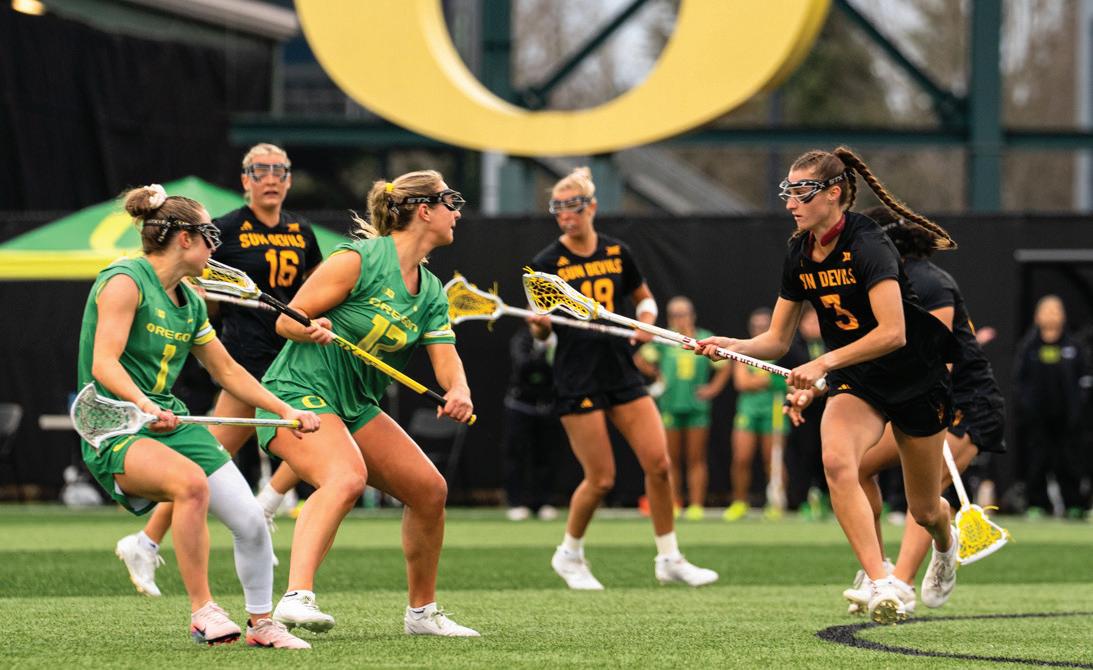
The Ducks opened the season 3-0, highlighted by a 12-11 comeback win in overtime over the ASU Sun Devils, but the defense didn’t always come easy. Throughout the opening three games, Oregon allowed its opponent to score in double-digits twice, which was something that’s come back to haunt the Ducks in the two contests since.
Against the Cal Golden Bears, the Ducks fell behind 7-3 by halftime and 12-4 by the end of the third quarter.
“(The start) was an unfortunate surprise,” head coach Jessica Drummond said, after the 14-9 loss to Cal. “I was like ‘Dang it, we’re not here. We’re still not here yet.’ It just took us a while to show up and play.”
In the opening half, the Ducks were outran, mostly. Five early turnovers led to three Cal goals, which can be attributed to a lack of aggressiveness in midfield, especially on transition.
“The transition really killed us,” Drummond said. “Having those great stops and then losing the ball in transition for them to score off of, those are stops we should be having and then getting the ball to the offense for them to score goals.”
Oregon’s midfielders — especially the team’s nucleus, senior Anna Simmons — failed to control the ball effectively. Simmons, who leads the team on the season with 10 caused turnovers (and is also tied for second-most among Big Ten players), caused just one in the loss, which proved a microcosm of the larger issue at hand: the Ducks struggled to win the ball back.
That became important due to the fact that in each of the two previous losses, Oregon won fewer draws (face-offs) than its opponent against both Cal (12-13) and East-
ern Michigan University (10-13). Winning fewer draws means a team will have the ball much less than its opponent and lack sufficient scoring opportunities.
Against Eastern Michigan, the Ducks grappled with this as they faced an Eagles team that relished the opportunity to move the ball around the point to wait out shot clocks and find the perfect chance at goal.
Eastern Michigan’s slow offense allowed itself to score to take the lead in the second quarter while also becoming an effective tactic in preventing an Oregon comeback in both the third and fourth quarters.
“We have to get the ball on the draw to have the ball on offense,” Drummond said after the loss against Eastern Michigan. “Not letting them have those long possessions (which wear) us down, and we gotta be ready for those at any point in the game.”
It’s worth noting that the Ducks led in draw controls 5-4 after the opening period, which led to a 5-3 lead. Eastern Michigan settled in after that and secured six draws compared to Oregon’s two while also taking a 9-7 lead before halftime.
“I think it matters how we show up. We kind of wait in the first half sometimes, and we keep talking about as a team showing up and starting the game and finishing a full 60 minutes,” Drummond said.
These are all wrinkles that the early part of the season is meant to help smooth out, and can be great signs of things to come if the Ducks can put it all together and figure out a way to string together a few wins heading into conference play.
Oregon will take on Delaware State University at Papé Field this Wednesday at noon. ( ABOVE) Duck junior attacker Gabby Santucci (12) looks to get around sun devil freshman defender Averie Cage (3). The University of Oregon’s women’s lacrosse team opened the season defeating the Arizona State University Sun Devils 12-11 X Papé Field in Eugene, Ore. (Katie Poluyansky/Emerald)
















Spinning

ARTS & CULTURE

‘Wuthering Heights,’ the album
In Charli xcx’s new album “Wuthering Heights,” she leaves her past artistic identity behind and embraces something new and daring.
By Everette Cogswell Arts & Culture Writer
Toward the end of one of the biggest years in her career, Charli xcx received a text from director Emerald Fennell asking her to write a song for the film adaptation of Emily Brontë’s 1847 novel, “Wuthering Heights.” Following the “BRAT” summer takeover, Charli found unexpected inspiration while reading the novel. What was supposed to be a single song turned into an album.
For Charli, this opportunity felt like freedom from the “BRAT” era. This was a chance for her to do something new and show people she’s more than the “crazy party girl” she advertised with her 2024 album.
“I wanted to dive into persona, into a world that felt undeniably raw, wild, sexual, gothic, British, tortured and full of actual real sentences, punctuation and grammar,” Charli said in a Substack essay. “Without a cigarette or a pair of sunglasses in sight, it was all totally other from the life I was currently living.”
“Wuthering Heights” is in a whole different realm than “BRAT,” and yet, her iconic electronic vocals are instantly recognizable as she portrays this story through music. Without losing her sound as an artist, Charli successfully proved her worth as a versatile songwriter and musician.
“I was really surprised to see that Charli was doing the music for it. It almost felt like a joke, and I love Charli’s music,” Sydney Rose, a junior sociology and Spanish major, said. “I appreciated that it was very unexpected, and had a lot of songs that I really enjoyed.”
The album opens with “House featuring John Cale,” an eerie track featuring an open monologue by John Cale of the Velvet Underground. The 3-and-a-half-minute track serves as a tone setter for the rest of the album, giving off the gothic, emotional and dark energy that Charli was going for.
Although rather ominous, this song is crucial to the record as a whole. It immediately puts the listener in the correct mindset for the listening experience. The repetitive closing line
A beginner’s guide to backpacking
Whether you’re in search of fresh air or just a break from campus chaos, here’s how to plan for a safe and smooth backpacking adventure.
By Gigi Roddick Arts & Culture Writer
Are you tired of cramming for finals under stuffy, fluorescent lights? Do you yearn for the outdoors? Backpacking can help — all you need is a destination, a backpack and a plan.
In Preparation
“I think I’m gonna die in this house” has gone viral, with people making videos to the sound.
The other single release of this album, “Chains of Love,” is a perfect encapsulation of the original story, feeling tied down by love, unable to escape and let go. This track has a taste of Charli’s synth-pop past while still offering a mature, dramatic twist to connect to the film.
“As a songwriter, Charli’s directness, rather than her expressiveness, has long been her greatest gift; although a diva as a performer, as a writer she’s still acquiring a taste for the dramatic,” Harry Tafoya, contributor at Pitchfork, said.
Despite the album’s directness, Charli’s versatility is apparent. The combination of pop-like vocal effects paired with orchestral instrumentals makes the soundtrack a very creative collection of songs. For an artist who has built a brand centered around “living life on the wild side,” Charli transcended that persona and wrote a new, more mature narrative for herself.
“Dying for You,” one of the more popular songs off the soundtrack, sounds the most like Charli from the “BRAT” era. Her fast tempo and production tricks are reminiscent of the songs she wrote in 2024, which took the world by storm.
This track displays similar themes to those of “Chains of Love”: the grasp that someone can have on you. In this track, she wrote, “All the pain and torture that I went through / All makes sense to me now, I was dying for you / Dying for you.” With a love story like that of “Wuthering Heights,” these themes come up a lot throughout this album.
“I think Charli does an excellent job trying to capture the emotions that the director wanted to portray. I think ‘Chains of Love’ is an instant hit among Charli’s musical repertoire,” Rose said.
After a whirlwind past two years, Charli bids farewell to the artist who created “BRAT” and sets forth on a new journey. What was supposed to be a single track based on the 19th century novel, turned into a 12song soundtrack, showcasing her talents as a musician, lyricist and most importantly, a storyteller.
( ABOVE) Actors Jacob Elordi and Margot Robbie attend the UK premiere of “Wuthering Heights” in London, Britain, Feb. 5, 2026. (REUTERS/Jack Taylor)
Planning where to go can be one of the most frustrating aspects of your trip, especially if you don’t know where to look. There are a couple of websites that can help. With AllTrails, you can find local hikes using their proximity and trail length specifications. Oregon Hikers is a resource containing almost every trail in the state. Consider checking out the selection of hiking books at the UO Libraries, too. If trails or campsites require reservations, be sure to print out a copy of your receipt to show park officials.
While researching, note the frequency and quality of reported water sources, whether campsites have toilets, any concerns related to the area of the trail itself and secure places to store food (like bear hangs or caches). Consider trail difficulty holistically by taking length, elevation and terrain into account. For example, beach walking, where loose sand and slippery rocks will likely slow your pace and require more exertion, will make trails harder, beyond their reported mileage. Be mindful not to underestimate trails prior to heading out.
Download trail maps well in advance, and check they work by putting your phone in “airplane” mode. Many trailheads are outside of cell reception. Download street maps too, so you can get to your destination without service. Create a trip plan detailing estimated daily mileage and where you’ll be camping each night. Send this plan to at least two other people, like your parents, friends or roommates. Make sure people know where you are going and when to start worrying if you don’t return.
In Your Bag
Once you know where you’re going and how you’re getting there, it’s time to start packing. There are many lists online, including this simple, but complete, one from REI.
Important items many people forget include: a lighter (that works!) for your stove, a portable charger with a cord that fits all your devices for longer trails, toilet paper, hand sanitizer, utensils and extra plastic and garbage bags (which can be carriers for wrappers and food, impromptu rain jackets, waterproof stuff sacks or patches for your tent.)
Find somewhere to spread out all your gear while you pack. Have a list on-hand and only cross items off as they go into your pack — never before. Start by putting a garbage bag, or other waterproof liner, in your backpack. Into that, fit your sleeping bag, warm layers and anything else that you won’t need until the end of the day. Tie or wrap the garbage bag so no water can enter it while you hike, in case of rain. Next, store your tent, and on the very top of your bag, put items you’ll reach for throughout the day like food, an extra layer and your map.
Today’s the day!
Before leaving, check the weather; double-check you’ve got the water, maps, downloaded music and gas you need, and triple-check you’ve locked your door. If you’re driving, bring a clean pair of clothes to change into once you’re done hiking. Feeling gross is a given, whether you’re gone for a day, or a week.
Once you’re on your way, be mindful when sharing the trail. Let people pass, and only play music in your headphones, not out loud. Pack in what you pack out; all garbage and food scraps need to leave the trail with you. Camp in designated areas so as to not disturb the foliage.
Most of all, enjoy the experience you’ve spent so long preparing for! Take your time to appreciate the beauty of the great outdoors.

(Ava Land/Emerald)
Oregon baseball — what we know through two weekends


The Ducks are off to their best start in years — here’s what we know through eight games.
By Joe Krasnowski Senior Sports Writer
Oregon baseball’s 2026 season getting off to its best start since 2014 (8-0 both seasons) is certainly worth something. Maybe it’s due to inferior competition at the start of the year, an improved pitching staff or just plain luck — but eight wins is eight wins.
72 innings in, fans can only react to what they know — here’s three takeaways from an early slate of nonconference contests.
Sanford, a “Friday guy”
From Jace Stoffal to RJ Gordon to Grayson Grinsell and now Will Sanford, Oregon baseball has had a bevy of talented arms starting off its weekend series. His entire freshman year, Sanford had the stuff of a true ace, and now in his second year in Eugene, he looks to have the makeup to back it up.
Through two starts, he’s thrown 11 scoreless innings and dominated batters with a fastball that has been up to 95 mph. His last time out, he went six innings scoreless and back-andforth with a Youngstown State University starter who could start at “anywhere in the country,” per head coach Mark Wasikowski.
The value of a “Friday guy” in college baseball is simple: have your best starter kick off the series and go as deep as possible in game one to save relievers’ arms for late in the series. While Sanford started the second game of a series with three blowouts, the value of having someone who can be near-pen ciled-in to go five or six innings is tremendous.
“We’ve been looking for a closer game just knowing I can put up zeros and get our offense back out there and just slow the game down,” Sanford said postgame. “I wanted a close game, (a) nice little pitcher’s duel.”
Another Sanford Friday start would put the righty in line to take on Arizona in Game 1 of the Live Like Lou Las Vegas College Baseball Classic.
Bullpen looks legit
There’s a certain type of wiry, long-levered, effectively wild arm and delivery prototype of a reliever that all the best pro grams nationwide seem to have. Thus far in 2026, Oregon seems to have that caliber of arm at its disposal with Tanner Bradley and Devin Bell its primary catalysts in high-leverage situations thus far.
Those two were the main arms that Wasikowski opted to utilize in Oregon’s lone close game of the season — a 3-0 Game 2 win over Youngstown State.
Bradley entered in relief of Sanford and looked elite, showcasing plus pitches and striking out three over two innings of work. Bradley entered for a third frame but ran out of gas, with Bell showcasing veteran poise and getting out of a bases-load ed, one-out jam to secure the win.
“I liked that it was a close game,” Wasi kowski said. “You get to learn a lot about your team.”
Miles Gosztola, a 6-foot-2-inch ju nior transfer from Gonzaga University, looks to be of a similar build that could be utilized as a lefty specialist multiple times a series.
“I think we have the best staff in the nation,” Sanford said. “I think every guy in the pen can shut a
game down. Having Tanner and Devin follow me after that, I have so much faith in those guys to shut it down and, you know, they put up three zeros.”
No top dog on offense — and that’s OK.
It’s a bit outlandish to say there isn’t a true, every-at-bat threat in a lineup with four sluggers batting over 0.400, but that’s the case through eight games for the Ducks. Maybe it’s the lineup construction — one that has seen top hitter Drew Smith batting sixth — or just a lack of Jacob Walsh/Mason Neville home run threats that leave Oregon’s offense missing a true No. 1 guy, but through eight games, that’s the reality for now.
Maddox Molony and Dominic Hellman will likely take over that top spot soon, but both batters have their own issues — mainly strikeouts and general consistency — that might keep them from being a 1A threat. Still, Oregon has enough really good hitters that this likely won’t matter until much later on in the season. Even then, most postseason baseball games come down to pitching and defense — something the Ducks seem to have no shortage of thus far.
( LEFT ) Oregon pitcher Will Sanford (28) walks off pitchers mound in celebration on Feb. 20, 2026 against Youngstown State in Eugene, Ore.
(Charlie Mack/Emerald)
( BELOW ) University of Oregon senior infielder Dominic Hellman (45) swings. On Feb. 21 2026, University of Oregon men’s baseball team took on Youngstown State Penguins for the third game in the series at PK Park in Eugene, Ore.
(Katie Poluyansky/Emerald)














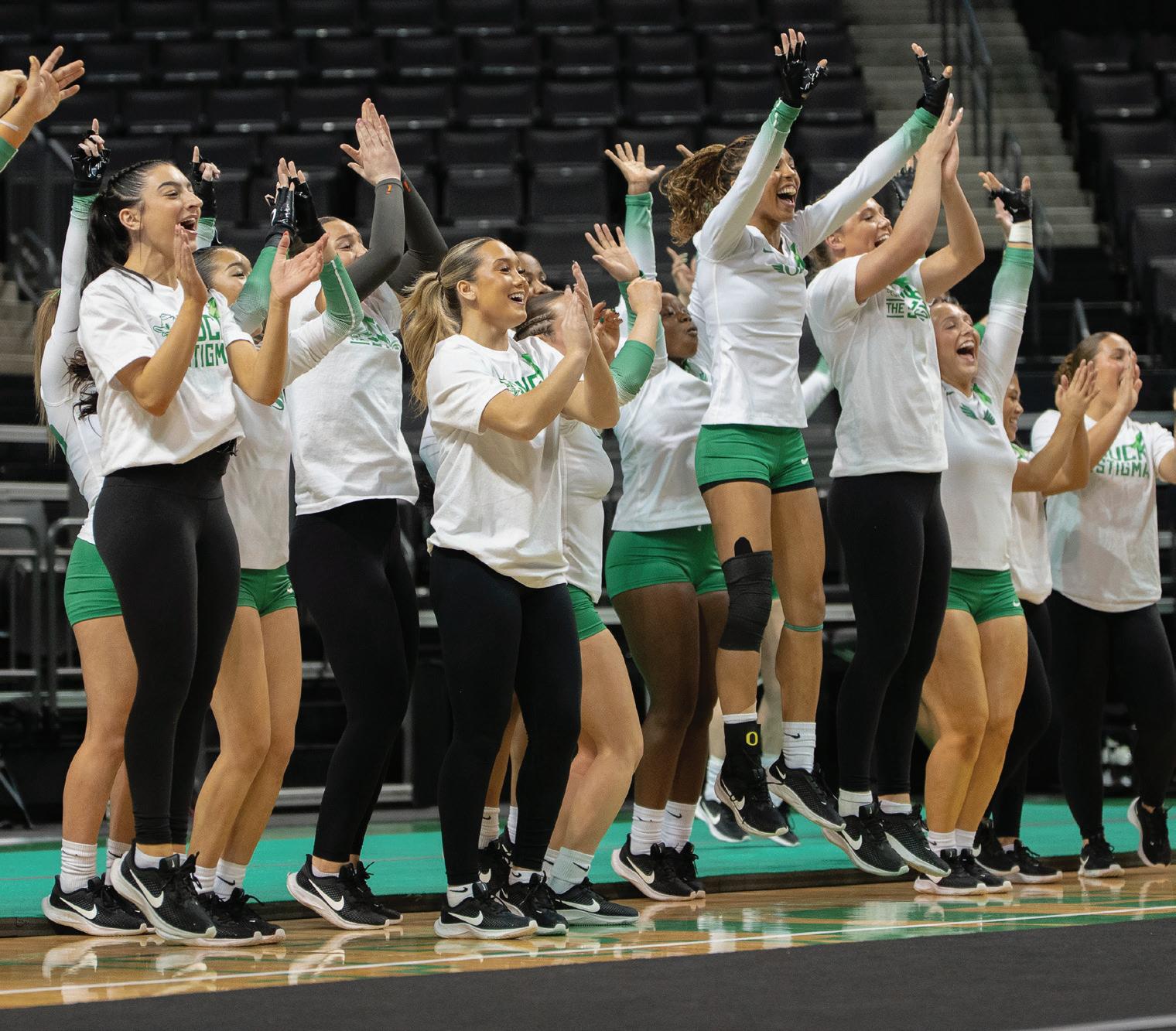
Acro & tumbling vs. Quinnipiac University
The Oregon Acro and Tumbling team took on the No. 3 Quinnipiac University at Matthew Knight Arena in Eugene, Ore. on Feb. 21, 2025, winning 270.640 to 265.425.
By Saj Sundaram




Members of the Oregon Acro and Tumbling team are held in the air by their teammates.
A member of the Oregon Acro and Tumbling team is tossed into the air by her teammates.
A member of the Oregon Acro and Tumbling team fly through the air.
The Oregon Acro and Tumbling team cheer on their teammates performing on the mat.