MONDAY, MARCH 16, 2026

MONDAY, MARCH 16, 2026
The union is pushing for expanded healthcare, workplace safety and summer positions
By Sasha Love News Reporter
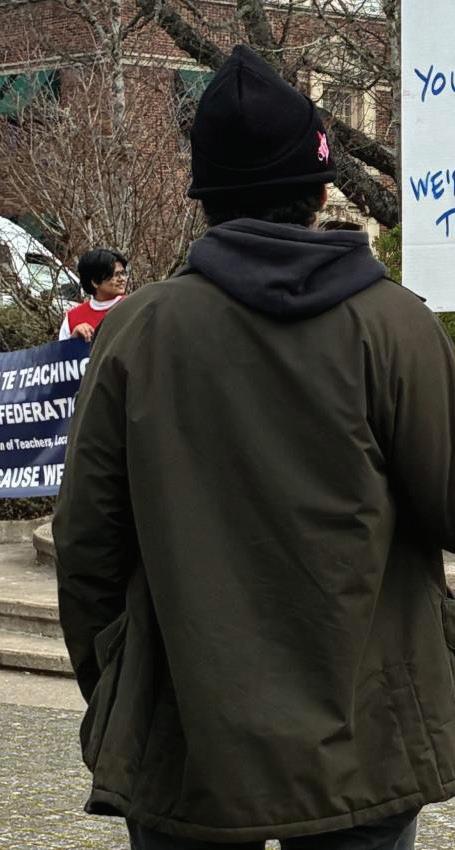
The Graduate Teaching Fellows Federation started bargaining on March 9, advocating for expanded healthcare, workplace opportunities, safety precautions and pay. The union has been on campus for 50 years and its current contract, ratified January 2024, expires June.
The bargaining session was preceded by a “kickoff” rally of about 60 people in the Erb Memorial Union Amphitheater where GTFF’s bargaining team was introduced and leaders from UO Stu-
By Ana Haapala | Ethos Writer
Eugene’s housed residents are constantly witnessing the city’s homelessness crisis: tents, people sifting through bins for cans, sleeping bags on the sidewalk and individuals carrying their belongings in trash bags.
With the visibility of those forced to conduct their lives out in the open, it can be difficult to reconcile with what is invisible. That is the goal of the Homelessness Policy and Health research group at the University of Oregon’s Global Health Lab: to understand the often-unseen conditions, health impacts and narratives of living unhoused.
The research group, headed by several UO professors and supported by research from both UO undergraduate and graduate students, attempts to move past public perceptions. Instead, they collect qualitative and quantitative data from people experiencing homelessness to create a more representative, nuanced picture of what it means to be unhoused in Eugene.
When Dr. Leslie “Jo” Weaver moved to Eugene eight years ago, it was her first time living on the West Coast. According to the National Alliance to End Homelessness, the West Coast, including Oregon, Washington and California, has high homelessness rates compared to other areas of the country.
As a medical anthropologist who studies how social and cultural forces determine the health of certain groups, Eugene’s high level of public homelessness was particularly jarring, Weaver said.
“I was really struck by visible homelessness here and the health challenges that people were having in public space,” Weaver said.
Continue story on page 14







EDITOR IN CHIEF
Tarek Anthony
PRINT MANAGING EDITOR
Ryan Ehrhart
DIGITAL MANAGING EDITOR
Ysabella Sosa
NEWS EDITOR
Reilly Norgren
INVESTIGATIONS EDITOR
Ana Narayan
A&C EDITOR
Claire Coit
SPORTS EDITOR
Jack Lazarus
OPINION EDITOR
Gracie Cox
PHOTO MANAGING EDITOR
Corey Hoffman
PHOTO EDITOR
Saj Sundaram
COPY CHIEF
Olivia Ellerbruch
VIDEO EDITOR
Jake Nolan
PODCAST EDITOR
Stephanie Hensley
SOCIALS EDITOR
Ysabella Sosa
VISUALS EDITOR
Noa Schwartz
DESIGN EDITOR
Adaleah Carman
DESIGNERS
Asha Mohan
Ellery Burton-Tillson
Eva Andrews
Izzy Smith
Nina Rose
PUBLISHER AND PRESIDENT
Eric Henry (X317) ehenry@dailyemerald.com
VP OPERATIONS
Kathy Carbone (X302) kcarbone@dailyemerald.com
DIRECTOR OF SALES & DIGITAL MARKETING
Shelly Rondestvedt (X303) srondestvedt@dailyemerald. com
CREATIVE & TECHNICAL
DIRECTOR
Anna Smith (X327) creative@dailyemerald.com
ACCOUNT EXECUTIVES
Torin Chevalier
Camcole Pereira
Ava Stephanian
Elliot Byrne
THE DAILY EMERALD
The Daily Emerald is published by Emerald Media Group, Inc., the independent nonprofit media company at the University of Oregon. Formerly the Oregon Daily Emerald, the news organization was founded in 1900.

Emerald Media Group 1395 University St.,#302 Eugene, Or 97403 (541)-346-5511

By Tarek Anthony Editor-in-Chief
My last Letter from the Editor came in our first edition of fall term, back in September 2025. In it, I wrote about being followed home by drones after covering a protest at the Eugene Federal Building. At the time, it felt like one of the most egregious attempts at intimidation imaginable in a country that has had freedom of the press and freedom of speech enshrined in its spine for nearly 240 years.
Either that feeling was incredibly naive, or our country over the five months has moved toward unimaginable levels of repression. After much reflection, I have concluded the truth is lost somewhere in between.
For on the third day of winter term, Renée Nicole Good — a peaceful protester in Minneapolis — was gunned down in her vehicle by a federal agent. Two and a half weeks later, it happened again. This time it was 37-year-old Alex Pretti — disarmed and gunned down in the street amid a tussle with federal agents.
Three days later, our Emerald team was back at the Eugene Federal Building covering a peaceful candlelight vigil for Pretti when federal agents — unprovoked — began chasing protesters and press alike, firing tear gas canisters and pepper balls.
Three days after that, we were back out being tear gassed during what the Eugene Police Department declared an “active riot.”
The next night brought more of the same — dozens of agents outnumbering protestors and the press, firing across streets and parking lots, aiming at anyone in sight.
I personally, that third night, was chased through the bushes by a Department of Homeland Security agent who was shooting pepper balls while I yelled “press, press, press” — which I ironically rank as the second most naive thought of the year — to think that in our modern day my glowing
press jacket, camera or verbal announcements of my role mattered to agents in the slightest. In fact, I would argue it was an even bigger target on my back.
I don’t provide this anecdote in search of sympathy or pity, but rather because I believe it defines not only our campus, city or even our country — but our new world reality. From Eugene, Oregon, to Minneapolis to Tehran, Iran and so many more places, the fundamental value of free speech has proven to be far less free than many of us once believed.
None of this is to suggest that America is not a free country. Compared to a place like Iran — where thousands have been killed in recent crackdowns for expressing dissent — it plainly is. But that freedom exists on a morally warped scale, where the benchmark for liberty becomes simply not being the worst place in the world to speak.
As if the past few months could not feature anything more unprecedented than chemical munitions being routinely used on peaceful protesters in a small American city, and speaking of Iran, our term is ending in the midst of war in the Middle East — sparked by yet another unprecedented U.S. attack on Iran.
The last print edition of each term at the Emerald tends to be a photo story of our top images that tell the story of the term. When considering the photos of the term for this final edition of winter term, I initially pulled pictures of tear gas, then the typical roundup of basketball, acrobatics and tumbling, softball and public events.
But it quickly dawned on me that this term was anything but typical — one marred by violence in every sense of the word, from Eugene to Tehran and now across the broader Middle East. Mixing protest photos with sports or campus events would risk diluting something so extraordinary and unacceptable into just another dot on the map of a long, event-filled term.
Therefore, we dedicated this edition to our top protest photos and coverage from the term — because the moment calls for it.
In recent weeks, I’ve continually found myself reflecting on how recent world events have made the events of late January in Eugene, Oregon — and what our community and Emerald team experienced — feel almost minuscule. But then I have to remind myself that I’m slipping back onto that scale that begins with repression and ends with mass casualty, a scale that no truly free society should ever have to measure itself against.
So whether that injustice takes place here in Eugene at the hands of a power-tripping DHS agent with a pepper ball, or through the American military dropping bombs on girls’ schools in Iran, the principle remains the same.
These photographs are not just images from a turbulent term or a chaotic month — they are a record of a moment that deserves to be seen, remembered and questioned, regardless of where it falls on that scale.
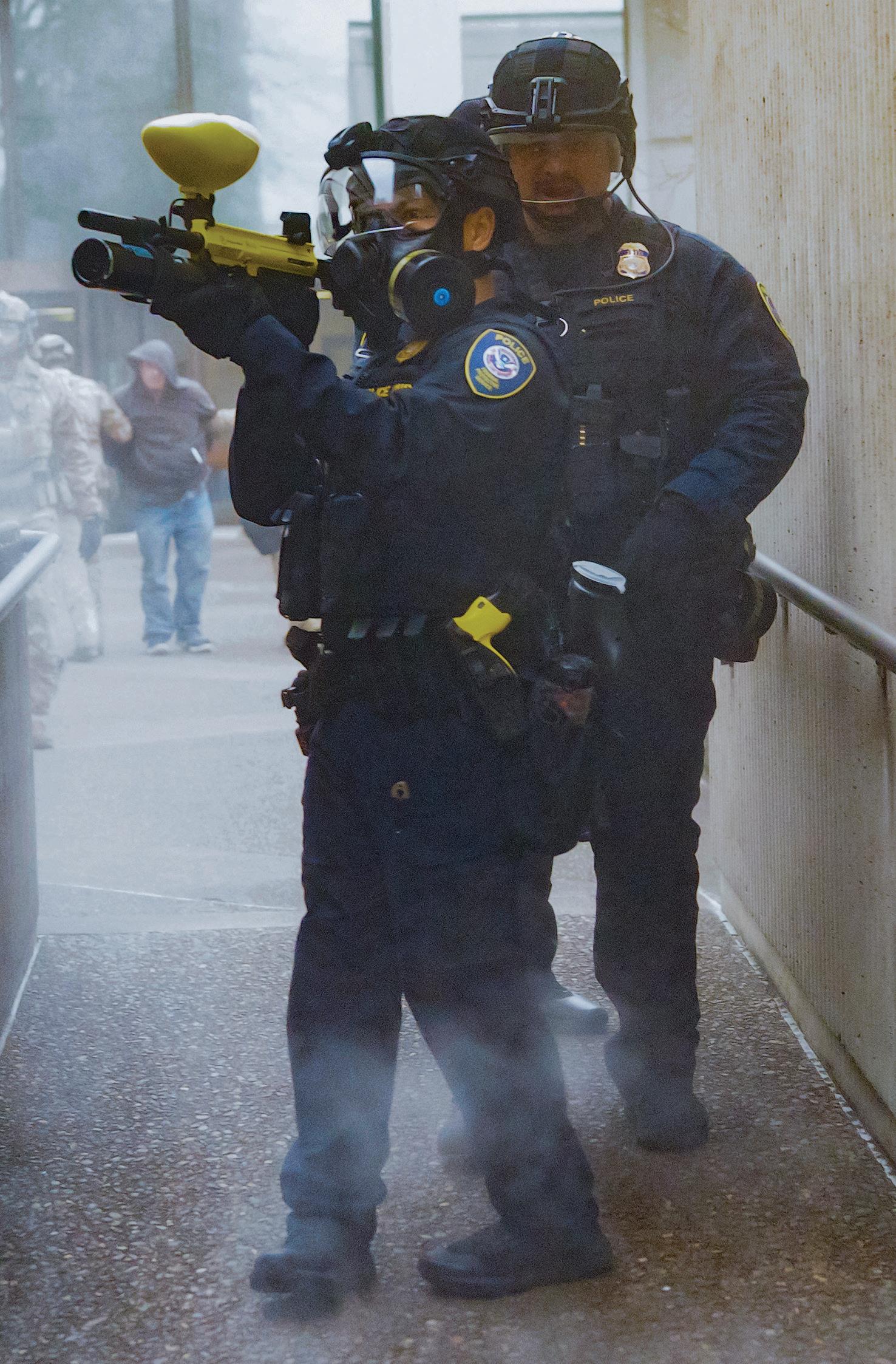
( ABOVE) Two Customs and Border Patrol Special Response Team members fire crowd control munitions at protesters on the edge of the sidewalk from the courtyard of the federal building. Around 8 p.m., Department of Homeland Security and Customs and Border Patrol Special Response Team agents rushed out of the building, deploying large amount of tear gas, pepper spray and other crowd control munitions into a crowd of roughly 30 protesters at the Eugene Federal Building in Eugene, Ore. on Jan. 31, 2026.
(Saj Sundaram/Emerald)
Students continue to be affected by multiple construction zones on East 13th Avenue.
By Erin Reaney News Reporter
For University of Oregon students living along East 13th Avenue, walking to school means walking past numerous construction zones and crossing the street multiple times due to closed sidewalks along East 13th Avenue.
High-rise apartment buildings are being constructed on the corner of East 13th Avenue and Alder Street, as well as on the former site of Espresso Roma. Further up the street, the PeaceHealth hospital is being demolished.
The construction continues on campus, too, with active renovations to Friendly Hall and the demolition site of Hamilton Hall to the east.
UO sophomore Jessica Brannan lives at the Westgate apartment complex on East 13th, across the street from the former PeaceHealth hospital demolition.
“I don’t even know where all the noises are coming from,” Brannan said. “It feels like our whole block is a demolition zone.”
Brannan said it takes longer to walk to school now because she has to maneuver her way through the different projects. She said she feels “out of the loop” because she doesn’t know how long the projects will take, or when they will end.
PeaceHealth’s Sacred Heart Medical Center on 13th Avenue closed in 2023 after “sizable financial losses and the need for large-scale renovations and seismic retrofitting to continue using the facility,” PeaceHealth spokesperson Jim Murez said.

The land went on the market in 2025, part of which was bought by Bushnell University. According to Murez, PeaceHealth’s Behavioral Health Unit remains operating on this land, as PeaceHealth continues to lease back from Bushnell.
The rest of the buildings are currently undergoing demolition work by Landmark Properties.
A Landmark Properties spokesperson said, “The work is expected to be fully complete later this year.”
In addition to the hospital, PeaceHealth is also selling the parking garage on the corner of East 13th and Patterson Street. The garage, Lot 302, is currently being used for hospital parking and monthly student parking for nearby residents.
ASUO again sponsors 24-hour science library resources for week 10 and finals week of winter term.
By Helen Bouchard News Reporter
ASUO is sponsoring 24-hour science library access during week 10 and finals week for a second term.
ASUO’s main goals for this year were to advocate for student services after University of Oregon’s $29.2 million in budget cuts over the summer. ASUO President Prissila Moreno and the Student Power campaign started a 24-hour library pilot program during fall, allowing all-day access to the Allan Price Science Commons and Research Library.
After meeting with library staff and receiving funding from the ASUO senate, the pilot program succeeded.
According to ASUO’s Director of Student Engagement Cash Kowalski, reports showed ASUO that during those two weeks, students used the library an additional 12,420 hours, and they received almost 1,000 responses on their feedback survey about how impactful the program was.
“Building from the fall, we wanted to make this term’s 24-hour pilot program even better,” Kowalski said. “We have added a quiet zone, expanded snack options and worked even harder to get the word out to students.”
This week, the library has already seen double the number of students compared to last term.
Lilly Harhay, a human physiology major, said she used the longer access during fall finals week and plans to use it again this term.
“It has allowed me to feel extra prepared for my exams as I do my best studying in a third space separate from my living room and bedroom,” Harhay said.
While talking about the library resource, she said she wished that this was not only a finals week opportunity.
“I think that it would do me a lot of good if the libraries were open for extended hours year-round,” Harhay said. “I know my friends from other universities have libraries that are open until 2 a.m., and I feel having that option would be beneficial for me and a majority of my peers.”
ASUO will continue to provide free energy drinks and snacks to students Monday through Friday of week 10, starting at 9 p.m. while supplies last.
“We hope to see even more students use the library so we can show University of Oregon administrators just how important library access services are to students’ success in classes,” Kowalski said.
In an email sent out to all monthly parking permit holders, permits will continue to be sold until May, and will be valid until May 24 of this year, after which students will have to find alternative parking for the last three weeks of the spring term.
( ABOVE) Demolition with heavy machinery continues at the site of The Peace Health Hospital in Eugene, Ore.
(Rowan Campbell/Emerald)
A public hearing is set for April 20 to hear more from the applicant and opponents.
By Billie Corsetti News Reporter
The Eugene City Council voted unanimously to request a public hearing on April 20 regarding the University of Oregon’s three land use applications, giving opponents the opportunity to discuss updates made by the university to its proposals.
UO is requesting the city’s approval for three land use applications: a code amendment, a zone change and a refinement plan amendment. If passed, UO could begin construction in the east campus area for the school’s Next Generation Housing development plan.
Neighbors surrounding the east campus area have expressed concerns regarding development plans in the area, and proposed amendments to the UO/Fairmount Special Area Study, a collaborative agreement between the university and the surrounding Fairmount neighborhood on future development.
The city previously held a public hearing on Jan. 20 to hear from supporters and opponents of the proposed amendments. After the public hearing, the council passed a motion to keep the record for any written testimony from concerned residents, and per state law, reserved the last seven days of the open record for the applicant.
During those seven days, UO submitted a proposal that modified its original amendment applications. Due to the last seven days being reserved only for the applicant, opponents were unable to submit written testimonies in response to the modifications.
At the March 9 public meeting held by the city council, the city manager recommended the council to schedule another public hearing and reopen the record so that concerned parties can have the opportunity to respond to the applicant’s modifications.
“In my nearly 20 years on the council, I’ve never seen this happen before, where an applicant so dramatically revised their proposal so it no longer looked anything like the original proposal,” Ward 3 Councilor Alan Zelenka said. “In this case, the applicant appears to have listened to — in part — to the objections of the opponents and removed some, but not all, of the objectionable opinions.”
The city attorney said that if the council rejected the application based on the criteria process, it was likely the applicant would appeal to the Oregon Land Use Board of Appeals.
The city council voted unanimously, 8-0, to open the record and schedule a public hearing on April 20.




The three finalists for SOJC dean present to students as their final bid for the job.
By Corey Hoffman Senior News Reporter
The School of Journalism and Communication Dean Search Committee has released the names and CVs of the three finalists for dean of the SOJC after the candidates visited campus the week of March 2 and March 9.
The nationwide search for a new dean began in Fall 2025 and included application reviews and extensive interviews.

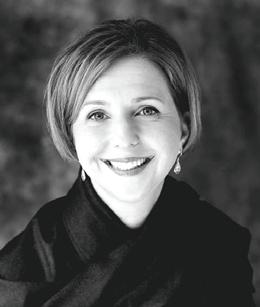
Emily Metzgar has served as director of the School of Media and Journalism at Kent State University since 2020. Before that, she served as director of Undergraduate Studies at Indiana University’s Media School.
Metzgar received her Ph.D. in media and public affairs from Louisiana State University, her master’s degree in international politics from George Washington University and her undergraduate degrees political science and French from the University of Michigan.
During her introduction to students, Metzgar explained five ideas that she said would serve as a “shared roadmap” for the future of the SOJC.
The first pillar, Metzgar said, will be to bridge the Eugene-Portland corridor, with the goal of connecting undergraduate students to the Portland campus’ “state-of-the-art facilities” and exposing Portland’s resources to “a new population of students.”
The second pillar Metzgar proposed was translating research to new audiences by “moving research funding from the journal page to the front page,” including the creation of a "knowledge translation unit.” The goal of this pillar, Metzgar said, is to make the SOJC a nationally recognized center for communication research, grant partnerships and expertise.
The third pillar Metzgar introduced was “serving the public good,” with small journalism “operations” centered around community-focused journalism.
“Students would produce content under a Creative Commons license with stories focused on underserved areas,” she said. Metzgar said the idea behind this pillar “scales,” allowing it to be practiced both in a classroom and in the community.
In her cover letter released by the Dean Search Committee, Metzgar said she has a strong commitment to building relationships across academia and beyond and that, if chosen as dean, she would work to expand the SOJC’s campus and community “footprint.”
The fourth pillar Metzgar proposed was “perfecting the ungated student journey,” which involves connecting students to professional mentors to prepare them for post-graduation success.
The final pillar Metzgar introduced was “reclaiming (the) SOJC’s position as (a) regional and national powerhouse.” The goal of this pillar, Metzgar said, is to solidify the SOJC’s “reputation as the place for teaching and research, focused on the contemporary communication ecosystem in the region and around the country.”
In her cover letter, Metzgar said after arriving at Kent State University in 2020, she led the school through “complex curricular and diversity challenges” and said she would prioritize integrity, collaboration and equity while at the SOJC. Metzgar described her leadership style as “collaborative, strategic, transparent and kind” and said her “professional trajectory” closely aligns with the SOJC’s goal of finding a leader who is “visionary, innovative and engaged.”

Director,
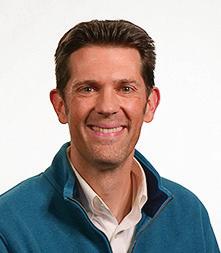
Temple Northup is the director of the School of Journalism and Media Studies at San Diego State University, after previously serving as director of the School of Communication at the University of Houston.
He received his Ph.D. in mass communication from the University of North Carolina, Chapel Hill, his masters degree in media studies from Syracuse University and his undergraduate degree in anthropology from Wake Forest University.
In his cover letter released by the Dean Search Committee, Northup outlined four “ideals” that he said have been his “guiding light” in his current position and that he would apply while dean of the SOJC.
The first ideal Northup outlined is that students should be trained as “critical thinkers,” by teaching them to “critically analyze everything they encounter.”
“By having that ability, it provides students the foundation to understand the implications of everything they do,” Northup said.
The second idea Northup introduced in his cover letter is training students to be strong communicators, with the goal of helping them stand out in “crowded fields.”
“By making sure that all of our students are able to communicate effectively, regardless of discipline, it will help our graduates set themselves apart from the competition,” he said.
The third ideal Northup outlined is to “instill in our students an entrepreneurial mindset — a curiosity to constantly learn and innovate,” in order to set students up for success in navigating ever-changing industries.
“If we want to create graduates who have long careers, we must instill in them a natural curiosity to constantly ask questions and learn new things, while understanding the ethical implications behind them,” Northup said.
In his introduction to students on March 9, Northup explained that he plans to provide students access to mentors, internships and job opportunities.
“I think a really important part of my job is going out and creating really strong ties in the industry,” Northup said. “The stronger I have those relationships or the school has those relationships, the more they’ll offer internships, the more they’ll hire our students.”
The final ideal Northup proposed was ensuring that students are taught the importance of equity, social justice and inclusivity.
“It is imperative for our students to not just appreciate this diversity, but to be advocates for change and equity no matter the industry in which they find themselves,” Northup said.
During his introduction to students, Northup broke down three challenges he saw for a future dean, including budget, the changing media landscape and AI. Northup said that while these are issues to address, using transparency, trust, innovation and collaboration, he also sees these challenges as opportunities.
( LEFT ) SOJC Dean finalist Emily Metzgar. (Photo courtesy of Kent State University) ( ABOVE) SOJC Dean finalist Temple Northup. (Photo courtesty of San Diego State University) ( RIGHT ) SOJC Dean finalist and current interim Regina Lawrence. (Photo courtesy of University of Oregon)

Regina Lawrence Interim Dean, School of Journalism and Communication, University of Oregon
Regina Lawrence has served as interim dean of the SOJC since August 2025 and previously held the position of Associate Dean for SOJC Portland.
Lawrence received her Ph.D. in political science from the University of Washington, her master’s degree in political science from the University of Colorado, Denver and her undergraduate degrees in history and political science from Metropolitan State College in Denver.
In her cover letter released by the Dean Search Committee, Lawrence outlined what she sees as the challenges, opportunities and priorities for the next SOJC dean.
The first challenge Lawrence addressed was “navigating a changing budgetary environment and strengthening the SOJC’s financial outlook,” which Lawrence said was a major focus for her while serving as interim.
“The next dean of the SOJC will need to stay on track toward balancing our budget, while effectively representing the SOJC’s needs in developing and implementing the university’s new budget model, identifying new revenue opportunities and further enhancing our fund raising,” Lawrence said.
The second priority, Lawrence said, is to embrace and leverage evolving technologies, while maintaining “guiding values of ethics, innovation and social impact.”
“Sometimes, the type of innovation gets a little lost and I would like to to lean into our love of innovation and remember that in the midst of all of today’s technological disruptions, we are innovators at the SOJC,” Lawrence said during her introduction to students on March 11.
If chosen as dean, Lawrence said that she would look for opportunities to work with the associate vice provost of UO Online to “judiciously expand the SOJC’s online course and program offerings,” as well as continuing her work of developing an SOJC policy surrounding AI.
Lawrence also emphasized the need for trust-building within the SOJC community and beyond.
“A top priority has been to rebuild trust through realignment with our own policies, establishing ongoing transparent communication and creating more opportunities for collaborative learning and socializing,” Lawrence said.
In her cover letter, Lawrence said that if chosen, she would work to “articulate the role and value of the SOJC as a professional school at a (Research One) university” by demonstrating the “unique values” of the SOJC.
Lastly, Lawrence introduced the idea of “moving the SOJC past current hardship and building more strategically.”
Lawrence said that the next dean should “manage the school’s budget and growth carefully, always with an eye toward clearly articulated strategic priorities.”
To achieve this goal, Lawrence said she plans to collaborate with the SOJC community, listen to advice from faculty, academic and industry networks and external research, but that the goal must fit within the SOJC’s values of ethics, innovation and social impact.
“The next dean will have an important opportunity to lead the school into a new era,” Lawrence said.





















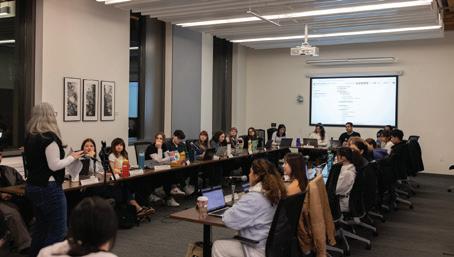

dent Workers Union, United Academics and the local Service Employees International Union joined showed support for graduate employees.
Here is a breakdown of some of GTFF’s bargaining proposals:
More summer opportunities and protections
International students face difficulties working off campus due to visa guidelines, and during a March 9 rally GTFF leaders said it can be difficult to make ends meet when classes slow for the summer.
To address uncertainty, Omar Barahona Barahona, a graduate employee and speaker at the GTFF rally, said he wants UO to “guarantee (graduate employees) summer jobs.”
During the following bargaining session, GTFF’s bargaining team also pushed for more summer positions.
GTFF would like to maintain the standard balance of UO covering 95% of graduate employee healthcare while students pay 5% of costs from fall through spring terms, while also decreasing the cost of summer healthcare for graduate employees who are not granted summer positions.
“A lot of times people are GEs in the spring and GEs in the fall but only about a third of our GEs get employed in the summer, so if you are not em ployed, it is already more expen sive, and then on top of that, you are paying more for health insur
ance,” Ben Mannix, GTFF’s vice president for organizing said. Pay increases
Similarly to the requests of UO’s faculty union last year, GTFF is asking for wages to account for inflation.
“We are asking for reasonable updates to keep up with the cost of living,” Allison LaSalvia, a bargaining team co-lead negotiator, said. “If you recruit people to come and work in Eugene, they should be able to live in Eugene.”
According to Mannix, GTFF is not looking for UO to overhaul its water infrastructure, but the union is asking the university to “do more testing and better labeling.”
“There is actually high lead content in the water and there is no warning, no labeling, even though we know,” Mannix said.
Most buildings on Eugene’s campus, with a major exception being the Paleoecology Lab, have an amount of lead below the Environmental Protection Agency’s threshold where action must be taken to fix the issue.
According to UO’s Environmental Services Manager Adam Jones, the paleoecology building is provided with alternative drinking water.

That said, GTFF would like to see even lower levels of lead in the faucets and drinking fountains.
“Our living conditions are our working conditions and improvements in the workplace lead to improvements in our broader life and communities,” Amelia Cuomo, a bargaining team co-chair, said.
The union also mentioned broader protections for international students, expanded “academic freedom” and advocated for more time to prepare for teaching labs.
According to GTFF’s website, the date and time of the next bargaining session has not

why some UO students can’t get the classes they need
University of Oregon students struggle to secure required classes as highdemand courses are limited in availability.
By Helen Bouchard News Reporter
As spring term arrives, class registration takes a toll on many students at the University of Oregon. Enrolling in required courses can be difficult as registration priority, class sizes, the number of sections offered and course scheduling all impact whether students can secure the schedule they need.
UO has roughly 20,000 undergraduate students. The College of Arts and Sciences, the largest on campus, enrolls more than 11,000 of them.
With thousands of students competing for courses each term, classes fill quickly.
Registration priority is largely determined by the number of completed credits. Undergraduate students with more credits register earlier, giving seniors priority over sophomores or first-year students.
Certain groups also receive priority registration including students receiving veterans benefits, those with disability accommodations through the Accessible Education Center, TRIO Student Support Services students, Clark Honors College students and student athletes.
“We understand that it can be frustrating if you are unable to register for your preferred classes or a required course,” Angela Seydel, university spokesperson and director of Issues Management, said. “Academic advisors are a fantastic resource for discussing alternative options or paths depending on your major.”
Students who register later often struggle to enroll in high-demand courses, usually gateway and core classes. Departments sometimes add sections or increase enrollment numbers, but classroom availability, instructor workloads and efforts to maintain smaller class sizes can limit how many seats are added.
Some schools at the university manage course planning differently. In the School of Journalism and Communication, courses are scheduled through the school rather than each department. Administrators work with directors across journalism, advertising, public relations and media studies to determine how many sections and seats to offer.
“We look at the required gateway classes first, so students can move on to specialty and mastery courses later,” Deb Morrison, associate dean of undergraduate affairs for the SOJC, said. “Some courses fill quickly, and we pull levers to add seats or open new sections when we can.”
For students in highly populated majors, such as psychology, limited availability can feel stressful. While speaking to psychology student Sasha Coates said her experience logging into MyUO only to find her required courses were already full.
“I wasn’t able to get many of the courses I needed, and have had this struggle in the past as well,” Coates said. “It’s stressful because many of my classes are prerequisites to the next courses I need for my major.”
Coates is one of the many students facing this issue, and with advising drop-in hours having two-hour long waits, it can be hard to get the resources that are needed.
The Office of the Provost works to track course demand as part of the university’s Oregon Rising strategic plan, which was made to improve pathways for graduation and student schedules. However, with a large public university, it can be difficult to provide for all students.
“Majors grow and shrink, and student demand for courses also shifts from term to term,” the registrar said. “Because it is a dynamic situation, it’s helpful for us to be informed about obstacles that students are encountering.”
Students are encouraged to connect with advisors and register as early as possible, remaining flexible when planning schedules.
( ABOVE) A student navigates the University of Oregon new
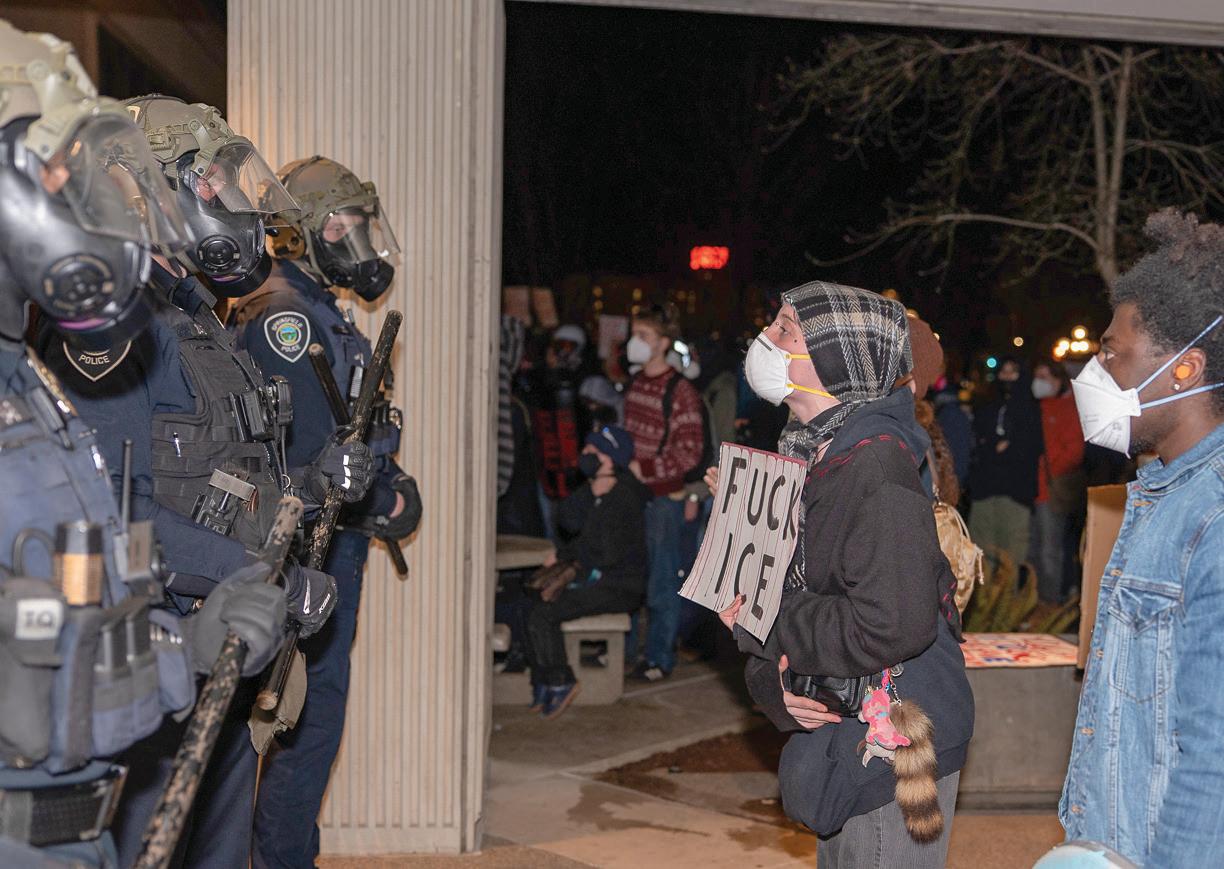
Week after week, crowds gathered outside the Eugene Federal Building and across the city. These photographs capture the tear gas, tension and determination that defined a term of unrest.
Protesters hold up homemade shields that read
“Free them all” as they face off against members of the Eugene and Springfield Mobile Response Teams. The protest joined the nationwide day of action calling for no attendance at school or work, and no purchases of any kind, following a similar shutdown in Minneapolis on Jan. 23.
(Saj Sundaram/Emerald)

protester
Jan. 30th, 2026






A closer look at the owners of women-owned clothing stores in celebration of Women’s History Month.
By Fiona McMeekin Arts & Culture Writer
Decorated in soft lighting and wooden accents, Kin Clothing Exchange is curated in a chaotic yet familiar style, evoking the comfort and ease of someone’s bedroom more than the neat rows of racks found in larger, corporate-owned secondhand stores. It’s an intriguing mix of casual curation and a careful mess.
Workers chat with customers like longtime friends. Persian rugs layer the floor, and bright gold signage adds a touch of soft glamour, infused with a hint of antiquity.
A wooden, vintage vanity displays handmade earrings and candles in teacups, created by Kin staff, blending the new with the old. This theme is echoed throughout the clothing on display, from ornate wedding dresses and upcycled items to stretchy neon tops. Creating space for all kinds of clothing and all kinds of shoppers, Kin embodies its name.
“When you give people something extra special, it’s like a mutual respect goes on,” owner Dagua Webb said about the intention behind Kin. “So, people come in, and they feel like we’ve done a little more than average… and I think people really pick up on that, and they’re kind of looking for that. They’re craving that experience.”
Several women-owned clothing stores are shaping Eugene’s fashion culture through sustainability efforts, mutual support and their own creative flair. Owners of Kin Clothing Exchange, The Clothes Horse and Savona’s Bitchin’ Bohemian Boutique are longtime figures in the Eugene fashion scene, whose stories often intertwine.
In 2018, Mariah Melson bought The Clothes Horse, another secondhand vintage store across town, which originally opened in 1992 by Webb’s mother, Ann Hathaway. Both women, Melson and Webb, credit Hathaway as a mentor and major inspiration for pursuing their passions.
“Some people are just unassuming; you don’t realize what powerhouses they are,” Webb said about her mother. “But I look back on my life with my mom, and she’s just someone who has a vision and then will really see it through. And I think it is a teachable thing.”
Melson has built upon the structured joy Hathaway brought to her business, continuing the tradition of writing personal notes on the tags of every item, holding up a lace, ombre greyand-black prom dress with the tag “mall goth princess.”
Though it takes hope and whimsy, running a business also requires a healthy dose of reality. Two years after taking over, Melson faced the difficulties of operating a business during COVID-19.
Having to pivot, Melson began posting sales on Instagram. This turned out to be a silver lining, as she amassed a large following of both local and non-local clients.
Melson spoke to the kindness of the Eugene community as another big part of helping the business get by. “Eugene is a place where people really show up for small businesses,” she said.
Melson said hope is something she comes back to, and even in times of desperation, there is value in the joy economy. Picking up a prominently displayed turtle hat, Melson said, “We were joking about it; I was like, “Should I price it


really high, so it never sells and we just smile at it every day?’”
Another hallmark of Eugene’s fashion scene is Savona Cook, the owner of Savona’s Bitchin’ Bohemian Boutique. Cook’s mother helped found the Oregon Country Fair and the Saturday Market, so her ties to Eugene run deep.
Today, Savona owns and operates a small shop that emulates her eclectic childhood. Cultural textiles, colorful artwork and cases of chunky jewelry surround racks of flowy clothing that replicate the bohemian style sported at the Oregon Country Fair.
Attributing her love of fashion to her mother, Cook said her mother’s degree in textiles drew her to fabrics and natural fibers, which has influenced her decision to source ethical products for her store.
The boutique’s name reflects Cook’s mixed background, growing up in a bohemian household and her later punk influences. She hopes the name will act as a kind of filter for her clientele.
“I thought anybody like me would come in, and it would keep out people who might be offended,” Cook said. “I don’t want them in here anyway.”
(ABOVE) Clothes Horse, the woman-owned resale boutique is located at 295 E. 5th Ave. in Eugene, Ore.
(Lilly Wall/Emerald)



Her previous experience working with public health inequality in South Asia prompted her to consider how her research expertise could be utilized to fully comprehend and support homeless communities in Eugene.
The research group was ultimately born from a merging of individual minds and backgrounds. For Weaver, a “key part” of the equation was Mackenzie Ní Flainn, a current graduate student in the biological anthropology department at UO.
As a self-described “activist-scholar,” Ní Flainn uses her medical background to
causes, impacts on personal health and the experiences of those who are affected by it.
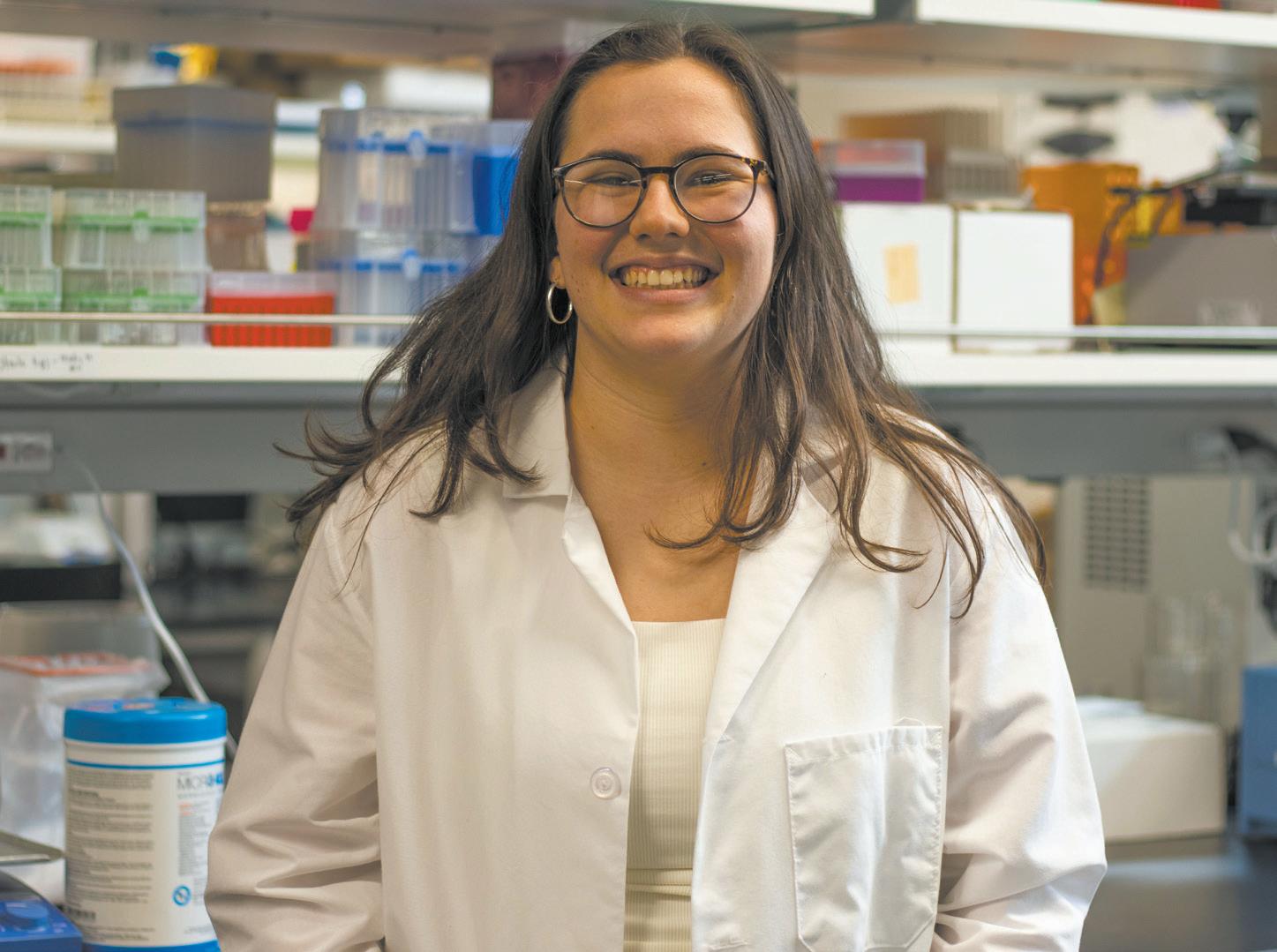
Bella Albiani, a senior multi-disciplinary science undergraduate, operates on the quantitative side of the project. Albiani wears many hats. She obtains informed consent from participants, administers questionnaires, conducts on-site health tests, collects samples and works in the lab.
Albiani works with two types of numerical data: statistical data and biomarker data.
Statistical data encapsulates broad trends about housing history, health issues and
“And you can’t do that with only numbers.”
As outlined by Weaver and Ní Flainn, the combination of these two modes of research can reveal and strengthen holistic patterns about unhoused lives, point to common root causes and provide evidence for what support is needed.
In one instance, Albiani, who concentrates on food insecurity, discovered that her statistical data showed 87% of homeless individuals on Oregon’s Supplemental Nutrition Assistance Program — better known as SNAP — were still food insecure.
Pairing the quantitative and qualitative data, the group has been able to clarify several misconceptions about homelessness in Eugene. Podrabsky described popular misconceptions as fitting within four categories: mental illness, trash, criminality and drugs.
While each topic is nuanced, according to Podrabsky, drug use in Eugene’s homeless population is a major research theme and, namely, the stereotype that many people experiencing homelessness



Albiani said the research group noticed a quantitative data trend showing that many people experiencing homelessness started to use drugs to cope with or control symptoms from chronic health issues. This stems from recorded, qualitative obstacles to receiving appropriate medical care for those who lack resources like a roof over their head.
Similarly, this research group demonstrated that many people experiencing homelessness, especially women, began using stimulants like methamphetamine to stay awake for long periods of time and protect themselves from violence, particularly gendered violence.
To illustrate this, Albiani shared one woman’s story — a mother living in a tent on the street with her children. This individual felt she needed to stay awake and alert for days at a time to protect her children and herself at night and, as Albiani said, “How do you do that other than with substances?”
“There are a few people that I’ve met that say they ended up on the streets because they used meth,” Albiani said. “That is not most people’s story.” However, Albiani has noticed “that’s most people’s assumption of most people’s stories.”
As research progressed, Weaver and her colleagues have come to appreciate the socalled “myth busting” power of their data. Many of their conclusions have the ability to disprove misconceptions that, according to Weaver, “redirect our attention away from the big causes and the big solutions that we need to address homelessness and put the blame on individuals who are suffering incredibly.”
Though contributors to this research group have a deep understanding of the lives and struggles of people experiencing homelessness, according to Weaver, in the beginning, they had to untangle their own unconscious biases.
For the past two summers, Podrabsky spent four to five days a week in Eugene’s public parks, administering questionnaires and, later, conducting life history interviews.
He remembers when he began frequently sharing spaces with people experiencing homelessness; “At first, and I think this is telling, I was a little uncomfortable,” he said. But Podrabsky said that once they started connecting with people, that uncomfortable feeling quickly went away and was replaced by understanding and compassion.
“I think it’s really hard not to extend your empathy and understand that people are simply experiencing a very different life from what you’re used to,” Podrabsky said.
Before Podrabsky became the research group’s resident life history expert, they administered many of the surveys. While going through survey questions, Podrabsky described an interaction with one man who had become homeless after he was imprisoned. When Podrabsky met him, the man had recently fallen in love, and the relationship was inspiring him to have hope for the future.
Podrabsky said he didn’t interact with this man again until months later. The man was leaving the grocery store as Podrabsky came in. He was carrying a large tub of laundry detergent. Podrabsky knew what
that laundry detergent could represent. He hoped it meant this man who had once been unhoused, now had a place to call home, access to a washing machine and clean clothes to wear.
“We didn’t say a word,” said Podrabsky. “We just looked at each other, and we just nodded and smiled.”
Next time the two, the man was in a permanent supportive housing location, a rental that offered housing assistance and other resources for those experiencing housing insecurity.
Ní Flainn expressed similar moments of inspiration at the resilience of people experiencing homelessness in Eugene, as well as moments of poignant sadness she said.
One homeless community that Ní Flainn and Black Thistle Street Aid interacted with often was settled together near a railroad area. The community had constructed several wooden crosses to honor the lost lives of other people experiencing homelessness.
After three years building the memorial, railroad crews reportedly demolished the memorials to make way for more train tracks.
“It was beautiful to watch people carve these places out,” Ní Flainn said. “And then it was heartbreaking to watch sanitation workers come in and literally bulldoze their work.”
Vision vs. voice
On paper, the goal of the Homelessness Policy and Health research group is to understand the experience of homelessness and its impacts on health. But, for Weaver, this research is also a way to give a voice to the experiences that housed Eugene residents can only see from a distance. It’s a way to listen.
“I think, especially in groups of people who aren’t often listened to, the act of listening, like, compassionately listening, is a powerful act,” Weaver said.
Podrabsky, whose research focuses on the stigmatization of homelessness, said he has learned to think about unfamiliarity through the lens of visibility. In their opinion, much of the stigma of homelessness is due to how visible the condition is.
“People are out there experiencing some of the worst things in their life,” said Podrabsky. “And they have to do it in public.”
This is why Podrabsky believes the voices and experiences of the participants are so crucial to this research: the story behind the image contextualizes what is seen in public.
After almost three years of research, the Homelessness Policy and Health research group is moving on to work that is more community-based and has what Ní Flainn described as a “political ethos.” There are two longform projects upcoming that will support the voices of people experiencing homelessness and encourage compassionate listening.
The first is an advisory committee that will serve as a place of collaboration support between the researchers and individuals experiencing homelessness in Eugene. The active connection will allow the team to continue to help these communities, make change, and provide resources for those experiencing homelessness to create their own projects.
The second project is a podcast to translate the concept of community voices into a tangible

everyone living in Eugene. And the best way, he says, to start is by learning and listening.
The Homelessness Policy and Health research group is composed mostly of Generation Z and millennial staff. Albiani said she sees her place within a group of young people who still have the opportunity and motivation to explore and experiment.
“I think as young people we’re at a really cool stage in our life where we don’t have to just think about ourselves,” Albiani said.
Podrabsky echoed Albiani.
“I think us, as a generation, have seen enough of the impacts of systems and structures that have failed us in many ways,” Podrabsky said. “So, I think that maybe sets us up to see other sorts of systemic failures where things are falling apart, where things are hurting people and be willing to start making those changes.”
Weaver and Ní Flainn said they also have hope in the younger generation.
“The generation of activists that are coming up are tenacious and aimed in the right direction,” Ní Flainn said.
As the Homelessness Policy and Health research group demonstrates, the first step to changing societal perspectives is changing personal ones.
Podrabsky, reflecting on his own changed perspective, believes it all comes down to recognizing a shared humanness amongst
“It’s only once you move past the image, once you hear the voice,” Podrabsky said. “That’s what does it.”
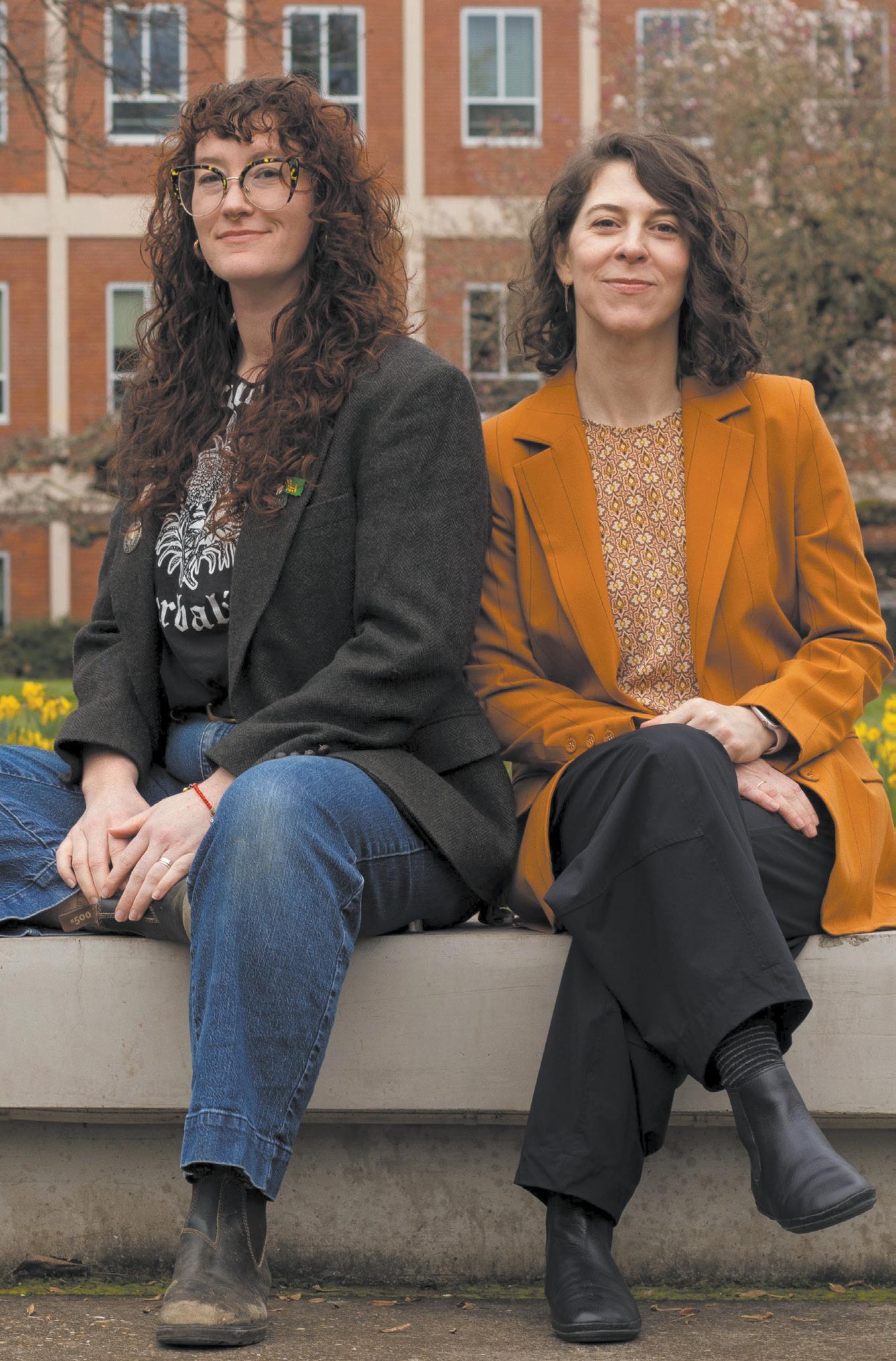
(ON THE COVER) Mackenzie Ní Flainn, is a biological anthropology graduate student at the University of Oregon. Dr. Lesley “Jo” Weaver, is a medical anthropologist and an associate anthropology professor in the department of Global Studies at the University of Oregon. They are involved at Global Health Lab with a group of faculty and students to conduct research that addresses multiple global health issues.
( LEFT ) The Outreach kit is used by the Homelessness Research Group during on-site health tests. The outreach kit includes various vitamins including ashwagandha, ginger, folic acid and other supplements to provide as needed through the tests.
( LEFT ) Researchers use test strips while giving health tests to collect the glucose and lipid panel levels of the participant. The test strips data that gets recorded goes towards gaining an understanding of their living conditions.
(ABOVE) Bella Albiani, is a fourth-year multidisciplinary science student at the University of Oregon. Albiani works in the Global Health Lab, conducting on-site health tests and working with research participants. She assists in collecting samples for the lab work and works with the statistical data.
( ABOVE) Bella Albiani demonstrates how the group pipettes samples from their on-site health test. Once in the lab, the samples go on a well plate and run an Enzyme Linked Immunosorbent Assay that measures cortisol levels from the hair collected from participants.
(Alyssa Garcia/Emerald)







Opinion: University Housing needs to give resident assistants adequate guidelines and policies to follow if ICE comes to campus – the current lack of training is insufficient for residents as well as student workers.
By Ashiki Nag
Opinion Columnist
Feb. 26, Ellie Aghayeva, a student at Columbia University, came home after a night of studying. She was later detained by federal immigration agents, who the university alleged used false pretenses to enter her residential building. She was later released after New York City Mayor Zohran Mamdani raise the issue as a point of concern with President Donald Trump.
But Aghayeva’s story highlights a critical gap in UO’s infrastructure and draws attention to something that student workers have been struggling with since the start of the school year. Although the University Housing maintains strict policies for Residential Assistants in nearly

all situations, it does not have a clear policy on ICE or federal officers requesting entry into a residence hall.
Nathaniel Pratt, a current sophomore at UO and an RA in Kalapuya Illihi, mentioned the various responses they are trained in to address a myriad of situations, such as fires in the building, potential earthquakes or police activity. The document he showed was over 250 pages long, and was updated annually – and there was not a single mention of immigration enforcement activities.
“In my eyes, dorms areas are one of the highest risk areas for ICE activity, and the fact we haven’t really gotten anything specific is getting more and more concerning,” Pratt said.
Pratt mentioned how ICE had briefly come up in his RA training, and they were instructed to contact pro-staff.
With the recent legislative win for ICE alerts for K-12 institutions and higher institutions, UO will have to use its emergency notification system to contact students when there is ICE activity on campus. However, Pratt raised scrutiny against the speed of the system.
“Our alert system isn’t always the fastest – I know what I’m supposed to do (in emergencies), but I don’t know what will happen and that’s a very concerning feeling,” Pratt said. “I’ve had residents ask about it and I know that people are worried.”
Diego Duarte, a senior at UO and RA at Global Scholars Hall, echoed similar concerns.
“I’ve not received a single word from anybody officially or unofficially in leadership or my management sphere,” Duarte said. “It’s been really frustrating, like this is a thing that students care about and are scared about.”
Duarte referenced Ellie Aghayeva’s case and highlighted the importance of these conversations and the real-world impacts of not adopting clear training protocols around ICE. After Aghayeva’s case, Columbia University adopted a stricter code and additional steps to protect students from further ICE encounters.
“As employees, what’s our safety in interacting with ICE?” Duarte said. “If this student worker were an immigrant, would they be required by their job to interact with ICE if it’s unsafe – could they lose their job for fleeing?”
Duarte is also a member of the UO Student Workers Union, which has been vocal about student worker and campus community safety in adopting holistic ICE policies.
“Explaining the differences between judicial and administrative warrants, clarifying what to say to officers when they request information or request access to spaces and clarifying that workers who might be threatened by federal officers can leave the situation without risk to their jobs,” Duarte said. “Those are all things that we want the university to clarify and provide training on to employees in relevant public-facing jobs.”
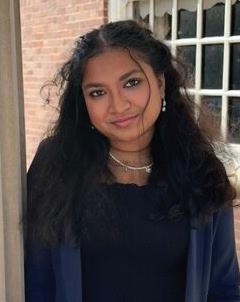
Aishiki Nag is a senior studying political science and global studies. She likes to cover state and national politics, and international peace-building efforts. When she’s not writing for The Emerald, she likes to read, hike and travel to new places.
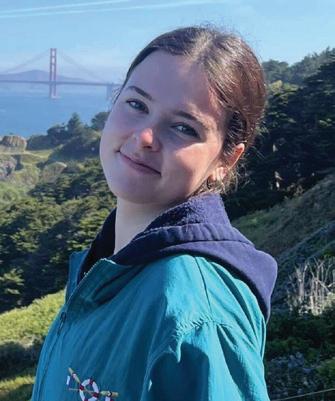
Emma Kahl is an opinion columnist for The Daily Emerald. She is currently a senior, majoring in written journalism and minoring in global studies. Her writing focuses on social commentary, culture and politics.
Opinion: Taking a minor can broaden your perspective, liven up a resume and provide new passions.
By Emma Kahl Opinion Columnist
Initially, I didn’t plan to take a minor because I only wanted to study journalism. After finding out that I had to take one as a graduation requirement with my major, I was pretty frustrated. I already knew the path I wanted to take, so why did I have to add a bunch of extra classes I probably wouldn’t be that interested in?
I ended up declaring my global studies minor after realizing that I had already taken about half the credits I would need to finish a minor in the program. This was one of the best decisions I ended up making in college.
Senior McKenzie Leary faced a similar situation. As a public relations major, she was required to choose a minor, but she said that she probably would have chosen to take one regardless.
“It allows me to pursue my other interests outside of what I’m studying, and I think it gives you more competitiveness in the job market,” Leary said.
“I think it gives you specificity, and I also just think it’s fun,” she noted. “It’s pushing me outside of what I would normally take.”
Having even a small amount of knowledge in a more niche subject can make you a valuable asset in a post-grad world, especially if it complements your major.
Some students see a minor as a strategic way to explore new topics and stand out, while others
may view it as an unnecessary add-on. Both perspectives are valid; it just depends on your priorities and long-term goals.
Ivonne Lopez, a third-year human physiology major, came into college with a bunch of psychology credits that she didn’t want to waste. This was her main motivation for declaring a minor.
She explained the extensive overlap between the two subjects and that taking both aligns well with her goal of going into the healthcare field. Despite her minor’s usefulness, she also said that many challenges can come with taking on extra classes.
For some, adding a minor to a degree can also add on extra terms and therefore increase a student’s financial burden. This can also increase the stakes during registration and make advising appointments that much more complicated.
“There is a lot of stress that comes with it, and I feel like for me and some friends I’ve talked to, you have to really decide whether it’s worth it,” Lopez said.
When asked if she would recommend other students take a minor, Lopez said that it truly depends on the person, their goals and what the minor is.
“I really do like psychology, and I think it’s been super beneficial for me,” Lopez said.
If I weren’t required to take a minor, I may not have found my passion for international relations. Because of the interesting and in-depth courses
I’ve taken in international human rights, international cooperation and conflict, and others, I am now applying to master’s programs to continue these studies.
Sometimes it’s the classes you didn’t even plan to take that end up shaping your academic experience. While everyone’s goals look different and taking a minor may or may not be for you, it can be an opportunity to grow or widen your interests.
(Sofia Campbell/Emerald)




















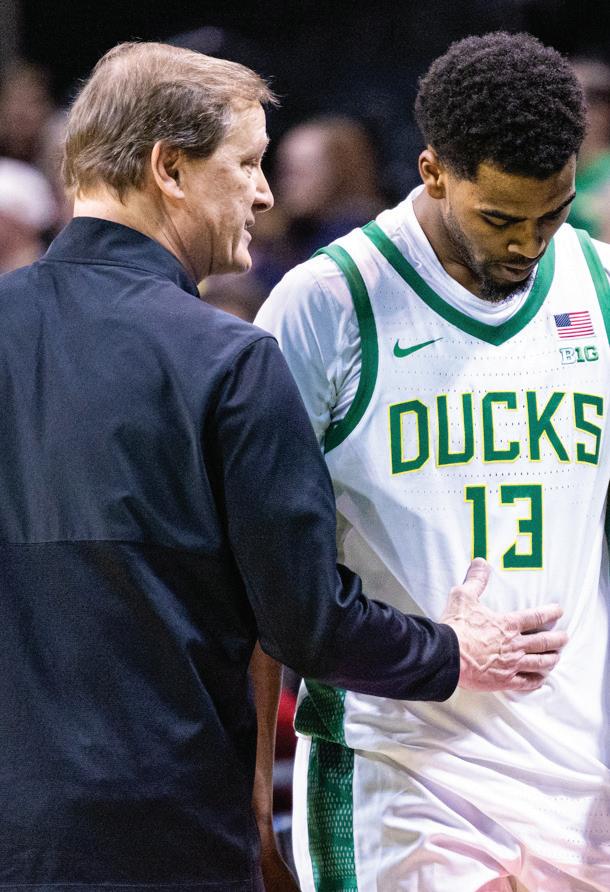
A subpar 12-20 season left the Ducks out of the NCAA Tournament.
By Jack Lazarus

On March 11, Oregon men’s basketball’s (12-20, 5-15 Big Ten) season ended after the 16-seeded Ducks fell to the 17-seeded Maryland Terrapins 70-60 in the first round of the Big Ten Tournament.
The game became a reflection of the season itself, as it became head coach Dana Altman’s first without reaching 20 wins, the least successful of his tenure in Eugene.
Against the Terps, Oregon scored a season-low 12 points in the first half. On top of that, half of those points came from free throws, which meant the Ducks only made three field goals in the opening frame. While a 48 point second half where Oregon did cut the deficit to single-digits late in the game made the final scoreline slightly sweeter, it didn’t reflect Maryland’s overall dominance throughout the contest.
After two consecutive NCAA Tournament appearances and being voted in the AP Top 25 at some point in six of the previous seven seasons, Oregon’s season ended quietly in Chicago. Why?
The most obvious answer would be the lack of depth. Simply, any team without multiple rotational pieces for long periods of time will find itself in trouble. But Oregon’s issues went a lot deeper than that. Star point guard Jackson Shelstad never played in 2026, as his Dec. 28 injury in a 80-57 win against the University of Nebraska-Omaha kept him sidelined for the remainder of the season. When he played, he was effective.
Shelstad averaged 15.6 points and 4.9 assists per game in the 12 games he played this season, which was production that the Ducks found irreplaceable almost as soon as they began Big Ten play. In the portion of the campaign after he was shut down, Oregon went 5-14 with 11 of those losses coming by double-digits.
The offense couldn’t score enough to keep track of the gauntlet of Big Ten powerhouses the Ducks faced. Shelstad’s absence was felt in the lack of efficient passing as a team, something he spurs with both his on-ball playmaking and his offball movement.
On top of the starting point guard, early-season starting forward Devon Pryor went down with a groin injury, backup center Ege Demir succumbed to a shoulder injury and, most notably, starting center and top scorer Nate Bittle missed time due to an ankle problem that he never fully recovered from.
Without crucial pieces of the frontcourt rotation, Oregon’s defense allowed opponents to control the paint and hit 3-pointers at an effective rate. This season, the Ducks allowed teams to shoot 51% on twos and 33% on threes; not exactly numbers that will have a team still dancing in late March.
The offseason means that players will depart, via transfer portal, graduation or otherwise, and Altman will have to retool his roster, but a season in the basement of the Big Ten can’t be the end of the world for this program.
“We’ve gotta get some experience in the portal,” Altman said. “We’ve gotta get some talented freshmen... and we’ve gotta get a core group back.”
Record-breaking seniors and talented underclassmen made the Ducks’ 14-13 season memorable.
By Henry Light Sports Writer
Oregon club hockey set new individual and team standards on the way to accomplishing head coach Jack Hyman’s goal of winning 10 games against American Collegiate Hockey Association Division I opponents for the first time in club history in the 2025-26 season.
“The goal is to make (the national tournament), but if you can break it down into bite-sized chunks, like we tried to do, it makes it a little bit more palatable,” Hyman said. “Hitting four out of our five goals was obviously a great feeling.”
The four goals the Ducks accomplished were finishing with a winning record (14-13), winning at least 10 Division I games (11), finishing with a winning record at home (8-4, 5-1 ACHA DI) and posting a positive goal differential (+7). The fifth goal, which Oregon fell short of, was improving its ranking, dropping from No. 50 last season to No. 54 in the 81-team division.
“We finished (No.) 54, and sometimes that happens, but steps in the right direction for sure with all the other things we accomplished,” Hyman said. “The ultimate goal of making the national tournament one day is obviously the biggest one that we want to achieve.”
Although Oregon’s progress toward the tournament has been slow since joining Division I in 2022, this was the fourth straight season in which the Ducks have improved their record. Hyman’s modest goals reflect the long road Oregon has to make the national tournament, but 2025-26 was the Ducks’ largest step in that direction.
Oregon’s most prominent seniors, Hunter Voyles and Jackson Henningsgard, set new standards for the club, which they helped transition to the Division I level. Voyles broke the club record for career games played in his fifth year, finishing with 113, and Henningsgard set its Division I single-season points record with 38 in 22 games.
“There’s a sense of internal competition where, if this guy can do it, so can I,” Hyman said. “Voyles and Hennings-
gard helped this team grow in their final years, which was great and important, and I think we have a lot of guys that are coming up right behind them that are gonna push this team even further.”
Oregon’s 15 underclassmen will bring strong continuity to next season’s roster, after building plenty of chemistry because of the sheer number of them.
“They’re only gonna get more mature, more experienced, and the chemistry, and the brotherhood and the culture is only going to get stronger,” Hyman said. “I have some players that are playing together as freshmen, and I have no reason to split them up… they’re gonna only get better with time, so I think the future is bright.”
Inde Abresch and Jackson Ebbott led the freshman class in points, with 22 and 18, respectively, playing on a line with Henningsgard. Freshman Austin Kluksdahl led all Oregon defensemen with 14 points, while freshman goalie Thomas Cafarelli emerged as a starter in an all-underclass goalie trio, holding opponents to a 2.79 goals against aver age en route to six wins in 11 starts.
Oregon also saw improvements from several sopho mores — a class that Hyman noted for its leadership as they became upperclassmen. Noah Easterson fin ished third on the team with 19 points as an assis tant captain, while Dylan Chapman improved from eight points in his freshman year to 17 and Alex Ulyanov improved from zero to 15.
Next year’s senior class of forwards, Arthur Corbin and Jionni Esposito, and defenseman Vic tor Lazzaretti all joined the team as walk-ons ahead of Hyman’s first season in Eugene, and he praised their work ethic and coachability as “glue guys.”
The home success, along with a continued expansion of the team’s marketing efforts through merchandise sales and community engagement, led to an improved home environment in 2025-26. That environment at The Rink Exchange is shaping the future of the club.
“When you talk to a recruit, and you can tell them you had a winning record, that helps a lot more than telling them you went 7-13,” Hyman said. “If you tell a kid you average, you know, 1,500-plus fans a game, and when you go play outdoors (in Bend), you get 1,100 fans every night, and the place sells out, that catches their attention, so that’s easy to pitch.”
The club that Voyles and Henningsgard helped usher into ACHA Division I hockey moves on with their names in its record books and access to a new level of talent to pursue goals that were more distant when they joined the team.
( BELOW ) Forward Jackson Ebbott (2) raises his stick in celebration after his goal. On October 18, 2025, the University of Oregon Ducks lost to the Logan Lake Miners (5-3) at the Rink Exchange, in Eugene, Ore.
(Fred Hall/Emerald)