WORTH THE COST?
Football forced Oregon to the Big Ten, is it worth the cost for other Duck sports?
BY JOE KRASNOWSKI Senior Sports Writer
What's good for the goose is good for the gander.
The Ducks, however?
Yes, Oregon football is meant to be in the Big Ten, given the current climate of college sports. And yes, success in football is measured at a higher level than in any other collegiate sport, but along with all the extra travel miles and all that comes with Oregon hosting or traveling to teams on the far East Coast, there lies a relatively unexplored topic revolving around the Oregon sports stratosphere.
Is the Big Ten too hard or too easy for most, if not all, of the Ducks’ other sports?
Take basketball, for example. Based on precedent, it's unrealistic for Oregon to compete with the very elite in the country in terms of NIL investment and revenue sharing. That, along with the realities that come with the Ducks playing in a historically elite conference — in both women’s and men’s hoops — means Oregon is losing a numbers game before those have even started.
For diamond sports (baseball and softball), the reality is almost flipped. Oregon is competitive enough financially and blessed
with its location on the baseball and softball-dominant West Coast. This allows the Ducks to recruit at a relatively high level to regularly be among the top 20 teams nationally, especially given the general apathy surrounding diamond sports in the Big Ten.
This reality has put both softball head coach Melyssa Lombardi and Oregon baseball head coach Mark Wasikowski’s Ducks in an interesting spot. Schedule-wise, Oregon will likely play significantly fewer teams with a high RPI — a commonly used ranking system that takes into account strength of schedule and quality of wins — meaning that Oregon will have fewer chances throughout the season to bolster its postseason resume than teams with stronger opponents.
With the help of nonconference tournaments, teams can get creative with their scheduling, but that’s often easier said than done due to the Ducks’ high-level talent.
“There are a lot of teams that also won’t play us right now, which is unfortunate," Wasikowski said. "We’ve gone as far as to try to go on the road and not even ask for a return series against SEC teams to just go and show up and play them at their place without even a guarantee to come, and we’ve been told no."
There are individual sports, of course, where conference placement is not an issue. Both the women and men of Oregon won the Big Ten Indoor Track and Field Championships. In acrobatics and tumbling, there are so few teams nationally that travel and competition are considered a necessary evil, according to Owen Murray. In tennis and golf, NIL is less of a factor compared to international recruiting.
There are realities that everyone in the Oregon athletic department must face. Women’s lacrosse head coach Jessica Drummond insists that the things top teams in the Big Ten do — a conference with four teams ranked in the top 25 nationally — are all things Oregon can emulate. All coaches within the athletic department would almost certainly agree, too.
It’s a necessary evil that is simply accepted. Football makes enough money to keep Ducks athletics afloat, and realistically, that’s good for everyone.
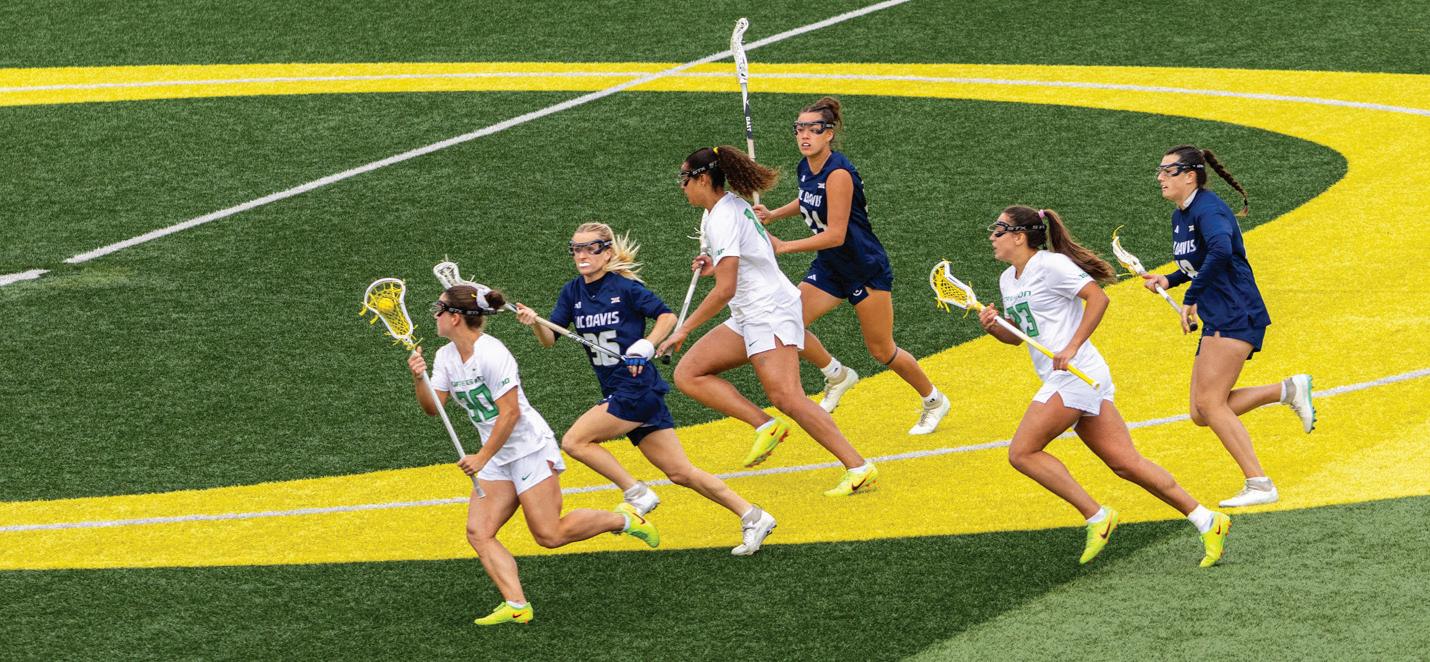
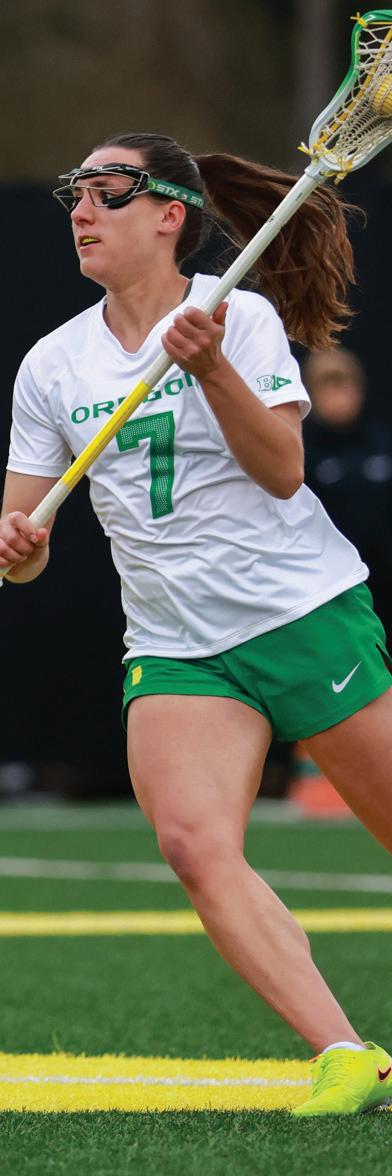
( ABOVE) Oregon midfielder Anna Simmons (30) leads the run down the field with the ball in her stick, followed closely by UC Davis midfielder Audrey Carr (36). The Oregon Ducks women’s lacrosse defeated the UC Davis Aggies 10-9 at Pape Field in Eugene, Ore. on Feb. 28, 2026. (Owen Burriss/Emerald)
HOW DEVELOPMENT IS DRIVING OREGON ACROBATICS AND TUMBLING’S TITLE PUSH
Under head coach Taylor Susnara, the Ducks’ depth and year-over-year improvement has been fueled by a culture of leadership with measurable impact.
BY OWEN MURRAY Associate Sports Editor
College sports are dominated by the transfer portal.
One or two-year rental players have been keystones of championship teams since its inception. Cinderellas have their slippers stolen by bigger programs who can pay more for the best talent and feed them to a machine that demands instant success.
That’s not the story in acrobatics and tumbling. In Eugene, fifth-year senior base Blessyn McMorris is the No. 2 Ducks’ key piece. She’s surrounded by a sophomore class which was recruited and developed by a program headed by alumni and former athletes. In 2026, Oregon is chasing a first championship in more than a decade behind the philosophy that those athletes — those people — build an inimitable culture of leadership and community which won’t appear overnight.
“I think that I've done a good job at finding a happy medium in a place where I know when my voice is needed, but also not getting too wrapped up into myself,” McMorris said before the Ducks’ first home meet. “Because while I am a leader on this team, it's not my team. And when I leave, it's going to be their team.”
Four years ago, McMorris was named the NCATA’s Freshman of the Year. Since, she’s added six weekly awards to go alongside an All American nod and an open pyramid event championship in 2025. She recovered from an Achilles tear that held her out of her junior season to return, boost the Ducks to an NCATA Championship appearance last season and reintroduce the culture that pushed her first-year success.
That’s why she’s back. She’s not just here to be one of the nation’s most experienced athletes. She’s not just here to win a national title. She’s here to make sure that the culture that built her continues to build others.
That’s why sophomore tumbler Briya Alvarado sat on that podium before the Ducks’ first home meet and said she’d trust McMorris with her life.
The 2025 freshman class had a quantifiable impact. By the time the Ducks made it to that championship meet in Sioux Falls, South Dakota,
last April, five freshmen made waves: Alvarado, Morgan Willingham, Carly Garcia, Cassidy Cu and Angelica Martin. Those five were some of the Ducks’ best, yes, but they had growth ahead that would open more doors.
“Your freshman year, you're getting your feet wet, you're learning the new techniques, working with different types of skills,” Oregon head coach Taylor Susnara said. “Even if you don't compete your freshman year, you're still building that awareness, body awareness, mental awareness.”
This season, Alvarado has stepped into the Ducks’ empty open pass slot and competed in heats as a top. She’d never done that before. Martin and Cu, who introduced a new-to-competition five-element acro skill as true freshmen, took it up a level and now compete both five and seven-element acro. Willingham and Garcia are both crucial parts of a tumbling event that lost multiple key contributors to graduation.
That’s not all. After the Ducks scored a twoyear low 7.600 in six-element acro in their opening meet, Susnara inserted sophomore top Maya Khauv. Unlike Alvarado, Willingham, Garcia, Cu and Martin, Khauv didn’t compete in 2025. She benefited from that offseason too, though, and Susnara said Khauv’s first start, against No. 3 Quinnipiac University on Feb. 21, “surprised us in the best way.”
The staff offered to simplify their skills, for an athlete starting her first meet.
“She was like, ‘No, I can do it all,’” Susnara said. “That was a really cool coaching moment for me, because I was like, ‘Dang. Mentally and physically, she is in it and pushing herself.’”
That’s the culture they’re chasing. It’s not built in a season. It’s built on the sidelines, in their fall term and in between heats. It’s about setting up the next generation of athletes with a plan.
In Eugene, it’s working.
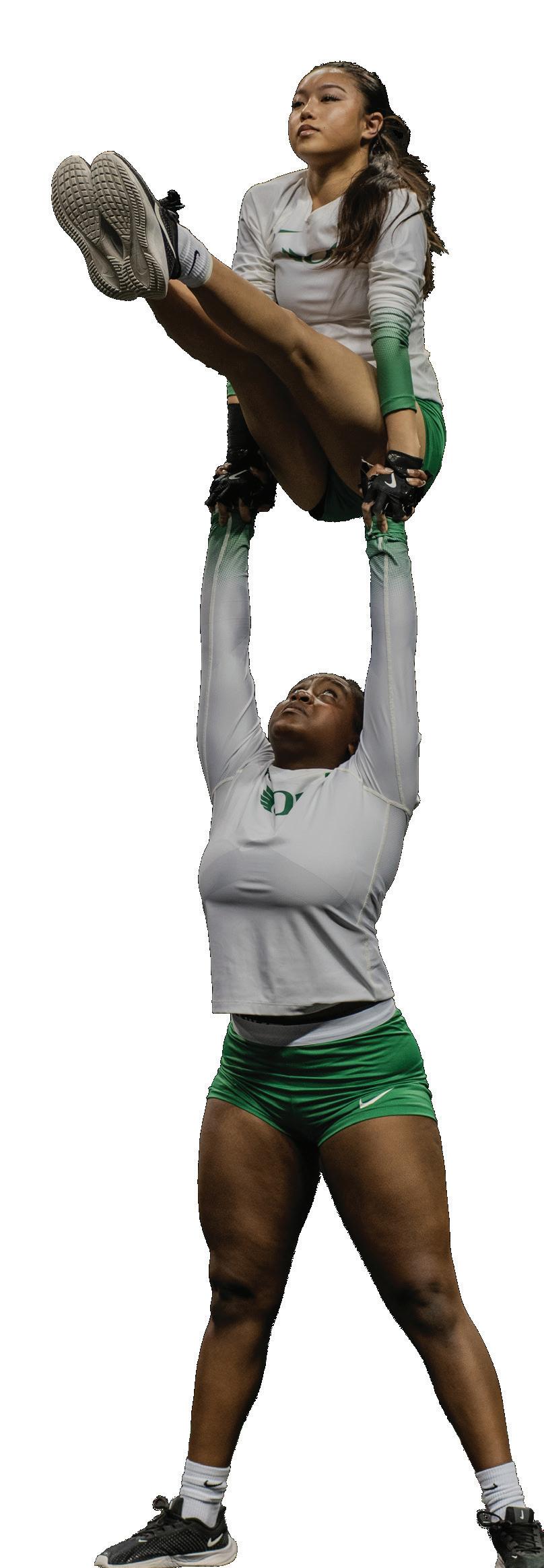
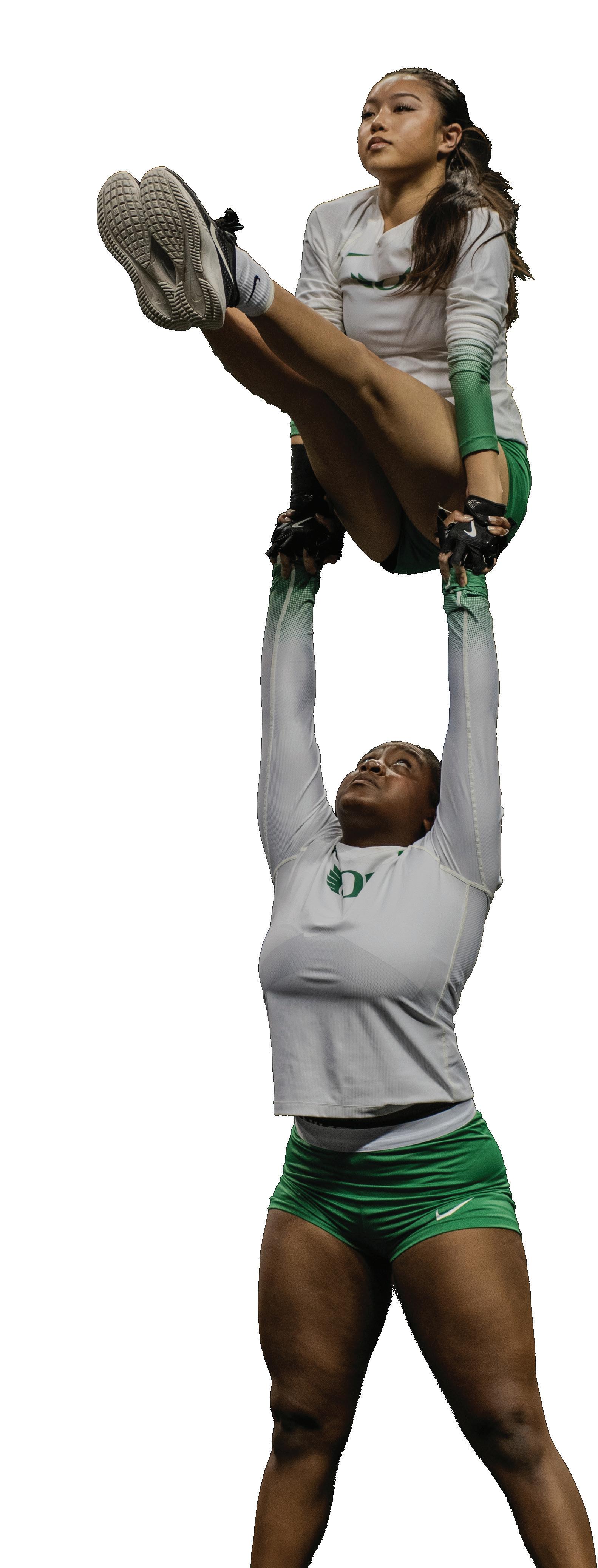
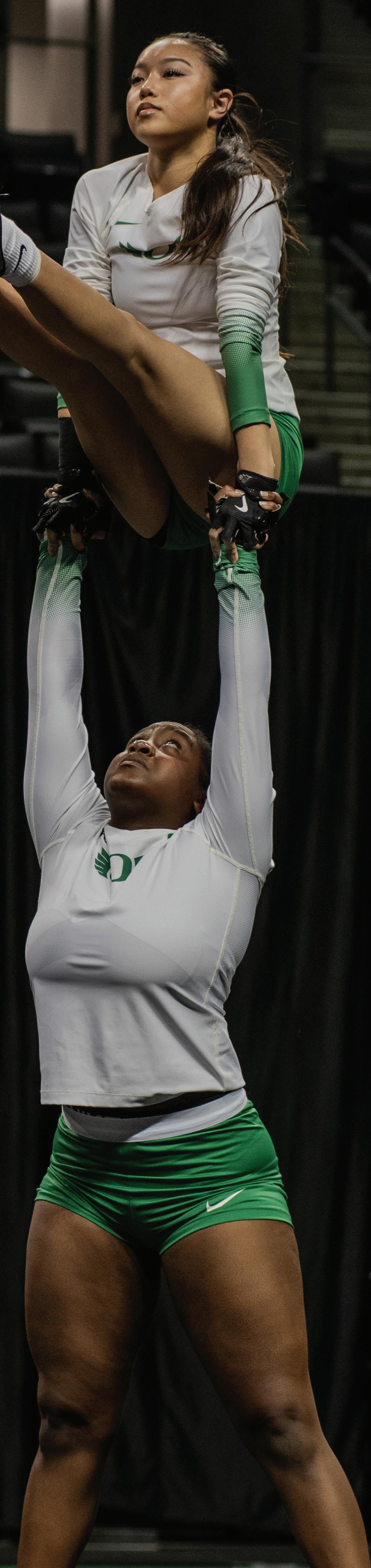
( RIGHT ) Oregon Base Angelica Martin (59) holds up Top Cassidy Cu (19) in the Acro portion of the meet. The Oregon Acro and Tumbling team took on Quinnipiac University at Matthew Knight Arena in Eugene, Ore. on Feb. 21, 2026. (Chris Castro/Emerald)
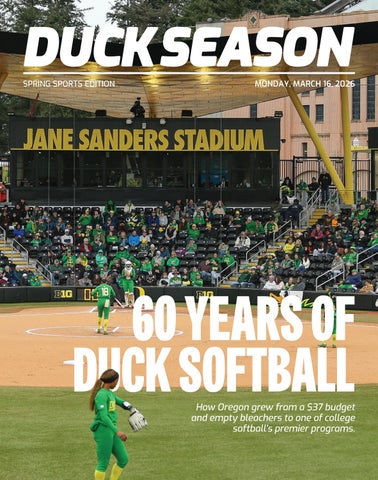
“I'm just so happy to go there every time,” PJ Rees, the public address announcer and member of the Oregon softball program from 1974-1976, said about Jane Sanders Stadium. “I've been doing it for 10 years now, and it's still, it just feels like such a pleasure.”
The Ducks have called Jane Sanders Stadium home since it opened in March 2016, but the softball program has been around for much longer. The original program started back in 1966 with no stadium, few fans and hardly any money. But those early teams went out every week in the spring and played, purely because they loved the game.
The first coach for Oregon softball in 1966 was also the women's athletic director, Becky Sisley.
“She was the athletic director, and a full professor, and the head coach of softball and the head coach of field hockey,” Rees said about Sisley. “She was doing everything. She had four jobs, essentially.”
But Sisley managed the team through those early years that were tough for the program. They did not have a home field, playing most of their games out at Amazon Park just off of East 24th Avenue and not drawing a lot of supporters.
“We’d, on a good day, have 20 people watching us,” Rees said. “We truly just played it because we loved it.”
The money was tight, the team didn’t have a budget to travel and members had to make their way to the games on their own. The team also did not have a locker room, and eventually the school resorted to sectioning off a part of the physical education shower room with plywood — an area that became the women's treatment facility.
But, despite the early growing pains of getting the Ducks’ softball program established, Oregon made headway.
In 1976, Oregon made its first appearance in the Women's College World Series. It was Rees’ junior year, and while the team didn’t go all the way and win, losing to Indiana State 14-6 in the TK round, the seeds continued to grow and Oregon softball looked to be a mainstay in the athletic program.
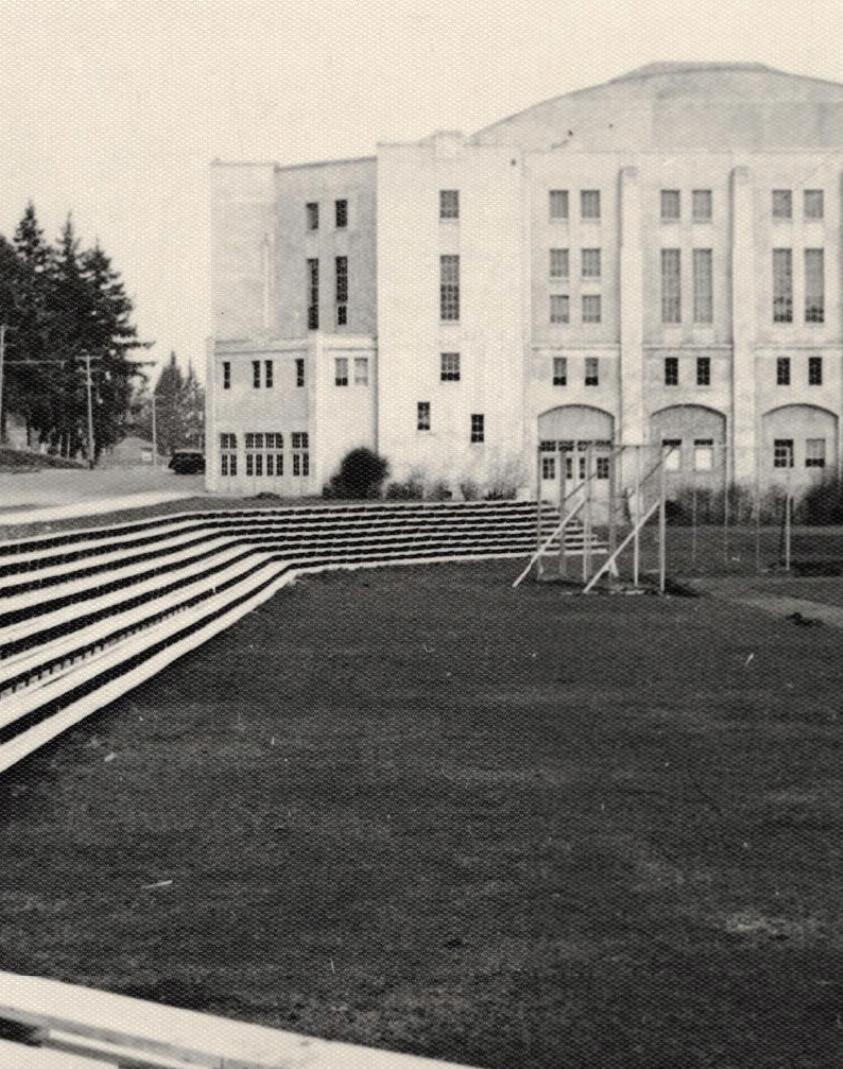
To become a true mainstay at Oregon, the school would have to provide a designated place for the team to play and practice. The spot eventually given to the softball team was Howe Field — previously the baseball field at the University of Oregon from 1936 until 1981 when the baseball team was removed from the athletic department due to a budgeting issue. The field sat on the same grounds as Jane Sanders Stadium does today, but just a bit closer to the street. Six years after the baseball team
played its final game at Howe Field, the university gave the stadium to the softball program and just like that, the team got their field on campus.
Though the program got their field, it still wasn’t perfect. To put it simply, Howe Field lacked basic facilities. Kelly Schukart, who played from 1998-2001, recounted that the locker rooms were in McArthur Court, the old basketball arena that still stands next to Jane Sanders Stadium.
“We didn't have locker rooms built-in or anything,” Schukart said. “So we went and shared locker rooms with, I think it was like volleyball visiting teams and cheerleaders and whoever else had to use them sometimes.”
Along with the issues in the facilities, the stadium didn’t cater well to the fans either. Both Rees and Schukart described the bunker-like concrete structures that were the dugouts. Since Howe Field was on ground level, the concrete protection blocked the view of fans down the line and above the dugouts.
“The dugouts blocked half of the view for the fans,” Schukart said. “So fans would sit up and around where you could see.”
Rees, who had long since left their playing days, returned to the UO to become the public address announcer for the softball team. The press box, just like the dugouts, was poorly built and had many problems.
“The press box was a small plywood room that sat about five people across six on a crowded day. (It) sat on top of the concession stand that didn't face the field,” Rees said. “So if this is the field,” Rees said, gesturing to the imaginary field in front of them, “the press box faced the tennis courts. So we sat in the building and faced down the third base line and had to look this way (to the left). You'd be sitting on these stools at a counter and the stools ram your knees into the, into the counter. So you were uncomfortable the whole time.”
Though Howe Field had its issues, the teams that played there continued to be successful. From the time that the Ducks used Howe Field as their field, they went to the NCAA WCWS four times, the super regional six times and NCAA Tournament on 16 occasions.
“Howe about them Ducks!” Schukart said, remembering the slogan that was on T-shirts during her playing days.
Howe Field finally closed its gates after the 2015 season. The Ducks went 51-8 that season and were ranked No. 2 nationally. Though they would lose 7-1 to conference rival UCLA in round one of the WCWS that season, they gave Howe Field one final showing.
Jane Sanders Stadium began construction immediately after Howe Field was demolished on May 26, 2015, just three days after the stadium saw a record attendance of 2,061 fans and a 9-3 win over North Carolina State University.
“I was in on the demolition of Howe Field because I got to take down the old press box,” Rees said. “And then I
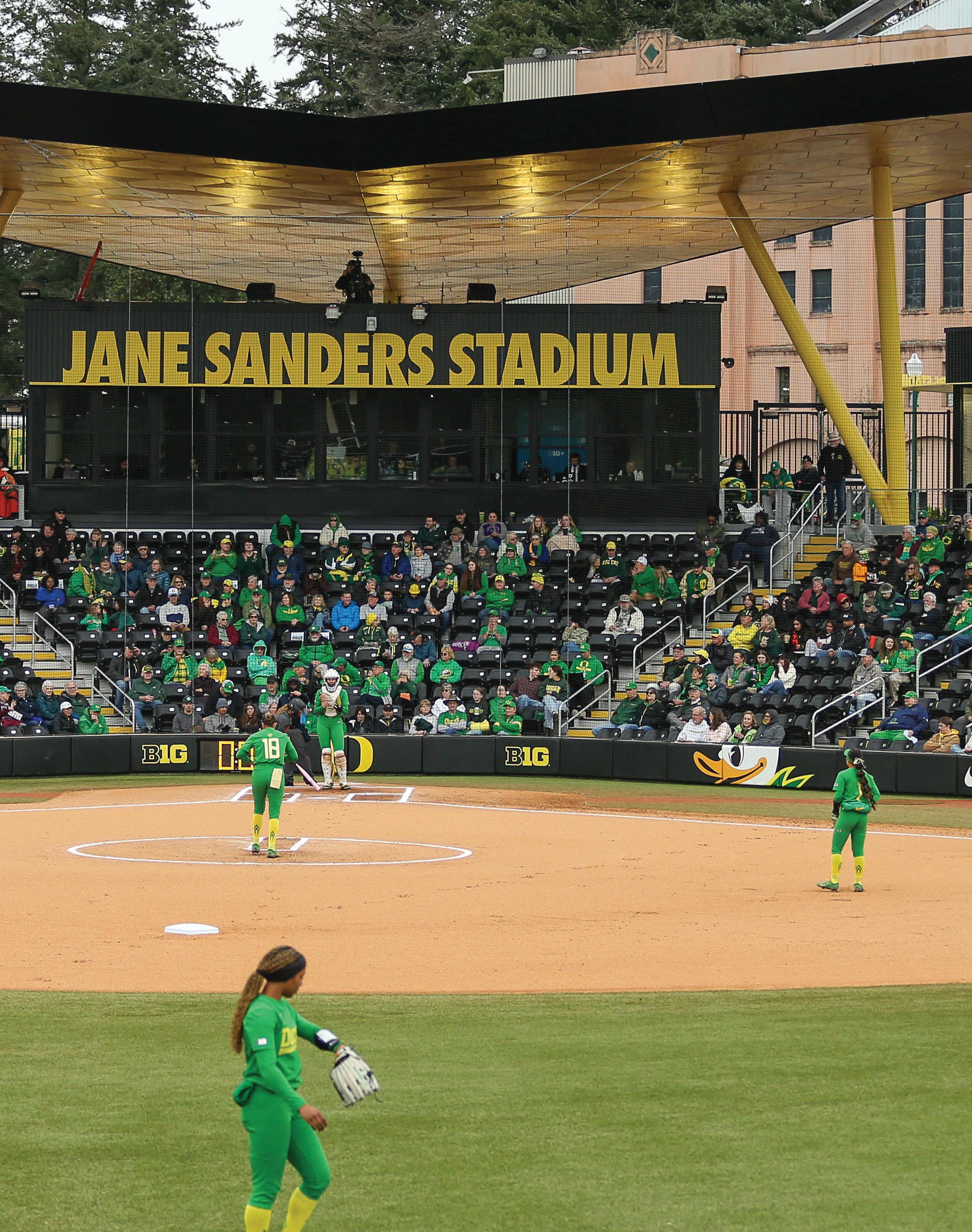
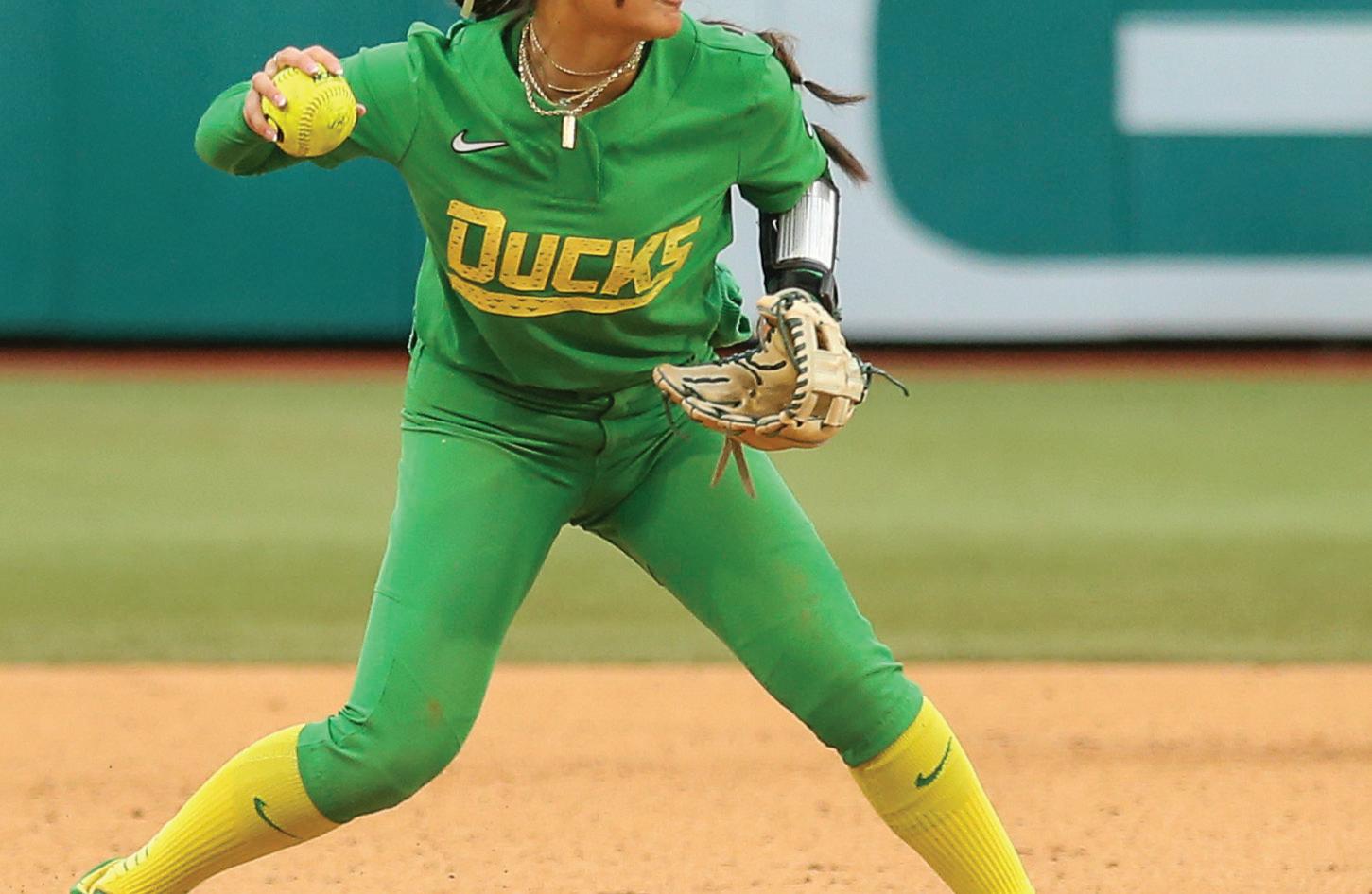
Oregon Softball takes on Stetson University in the Oregon Classic at Jane Sanders Stadium in Eugene, Ore., on Feb. 27, 2026, winning 10-1. (Julia Massa/Emerald)
got to have a little input on the new press box, things that I thought we wanted and needed. And then I watched the thing go up.”
Jane Sanders Stadium, aptly nicknamed “The Jane,” opened on March 24, 2016. It was in stark contrast to Howe Field because it was truly softball's own, and it had state-of-the-art facilities.
“Working there with the quality of structure that it is, with the amenities that we have, it just feels like the big time,” Rees said, talking about what it's like to show up to a quality softball stadium every day for work.
The stadium had everything that the softball team would need. It now supplied a training room, a meeting room and a Sports Performance Center that gave Oregon an incredible hitting facility.
“I will say the first time I got a behind the scenes tour of The Jane, and it was like the locker room that made me cry,” Schukart said. “It was like, oh my god, like you have a home away from home. There's bathrooms. We didn't have bathrooms. We didn't have showers. We didn't have anything.”
The 2016 team went 48-10 and made it to the Eugene Super Regionals. The 2017 and 2018 teams made it back to the WCWS, with the 2017 team making it to the semifinals.
The Jane has frequently been named one of the most challenging places to play. Oregon has gone to the WCWS three times since the stadium opened, and hosted the Super Regionals twice. Melyssa Lombardi is the longest tenured coach during Oregon softball's time at The Jane and has put up a season above .500 each year she’s been here except her first season.
Now, “Version Eight” gets to be the team to carry the 60th anniversary of Oregon softball and the 10th anniversary of The Jane. From the original team that started off with a budget of $37.32 and played their games in front of almost no crowd at Amazon Park, to the teams that got to call Howe Field home for 28 years, to the Ducks who now nest at The Jane, one thing has remained the same: they love to play.
Fans who attend any game at The Jane this season will hear Rees over the speakers reading out a message detailing why this season is a special one for the program and The Jane. The official celebration of both anniversaries will be the weekend of April 17-19 against the Huskies.
Howe Field & McArthur Court 1935.
(Courtesy of University of Oregon Library Archives)
YOUNG DUCKS GROWING UP FAST
Underclassmen
are carving out major roles six games into the season.
BY RACHEL MCCONAGHIE Sports Writer
The future of Oregon women’s lacrosse arrived ahead of schedule as a talented core of freshmen and sophomores has become the backbone of the Ducks' 5-2 start to the 2026 season. From electric offensive playmaking to certified defensive stands, the team’s youngest players are not just participating; they’re leading.
A sophomore surge has emerged as attacker Lilly Fortin has become one of the most efficient offensive threats on the roster. In just four games, Fortin has racked up 15 points, including a teamhigh eight assists and seven goals. Her efficiency is staggering, boasting a .700 shooting percentage. Fortin’s impact was most visible during a high-stakes comeback against UC Davis, where she netted the game-winning goal late in the contest.
“Just working together as a unit, like hitting those cuts like and just like running our motions, but knowing that we still have to do things intentionally,” Fortin said in a post game conference after playing Delaware State. “Taking advantage of opportunities when they're there and kind of using this to just build our confidence as a team and work together, get some new faces in and capitalize off of that.”
Fortin is joined in the sophomore class by midfielder Liv Kozitza, who has appeared in all seven games and contributed five goals. Midfielder Audrey Thompson has also shown her skills in her limited game appearances, recording four points, two goals and two assists in just two games. Jaeda Jensen has added to the sophomore scoring depth, tallying two goals and providing stability in the midfield.
The Ducks’ defensive identity is being forged by a trio of sophomores who have started nearly every game this season. Hailey Russell has been a model of consistency, starting all seven contests and recording six ground balls and six caused turnovers. Alongside her, Ella Lewandowski has earned six starts, contributing four caused turnovers to disrupt opponent attacks. Shea Stone has rounded out the young defensive unit with three
starts, tallying three ground balls and three caused turnovers.
“Just all the grit and seeing so many like faces from freshman to all different like classes,” Riley Taylor, redshirt senior, said of her underclassmen in the Delaware State post game press conference. “Defense, offense, midies, just so many different scoring opportunities and feeding opportunities. So many different points, so many different names that got points. So, that was awesome to go in there knowing that we have people on the bench other than our starting lineup.”
In the net, sophomore Kate Shields has been the primary anchor for the defense. Shields has appeared in six games with four starts, totaling over 222 minutes of action. She currently leads the underclassmen goalkeepers with 29 saves and holds a 1-2 record.
The freshman class is also making its mark with Sydney Saracene providing an immediate spark in her debut against Delaware State, scoring a goal and recording three caused turnovers in a single game.
“It's just exciting that today, like this, of being able to get everybody in, to have that opportunity,” head coach Jessica Drummond said in the Delaware State post game. “Like today is such a team win, and that feels so special for everybody that's on this team.”
In the midfield, Nya McElroye has been a reliable, versatile player by totaling one goal, one assist and five draw controls across five appearances. Freshman Caitlin Beckman has also been a force in the opening of the circle, securing five draw controls and scoring a goal of her own. Defensively, Katie Day and Gabby Jackson have both seen action, with Jackson recording her first ground ball in the recent win over Delaware State.
With these underclassmen already producing at a high level, the Ducks have built a foundation that is delivering results in the present while promising a formidable future.
(Julia
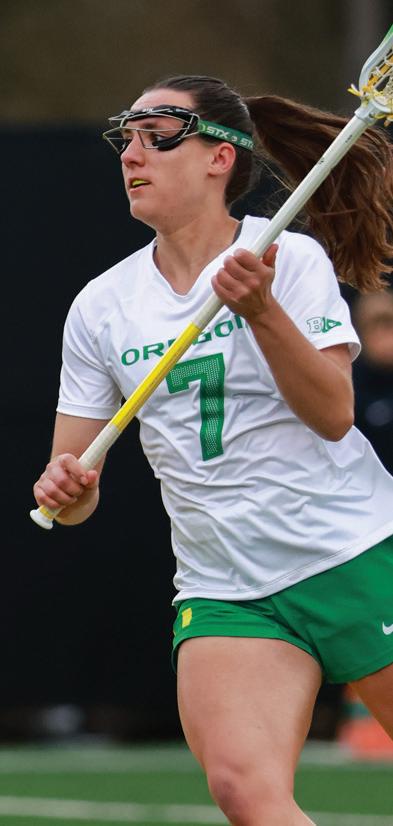
( RIGHT ) Duck ophomore Liv Kozitza (7) runs the ball towards the oposing goal. The University of Oregon women’s lacrosse team took on the California Golden Bears losing 14-9 at Pape Field in Eugene, Ore., on Feb. 19, 2026.
Massa/Emerald)
OREGON BASEBALL: STRENGTHS AND WEAKNESSES
A look at the best and worst performers through the first 12 games.
BY HENRY LEADER
Sports Writer
As of March 5, the Ducks were 10-2 and encountered both sufficient highs and lows to start the season with big blowout wins and sloppy losses against tough teams. The Ducks currently sit in the top 25 on most polls, and they’ve gotten there through strong performances despite some weaknesses. The Daily Emerald breaks down some of the best and worst performers through the season so far.
Strength: Angel Laya and Drew Smith
Freshman outfielder Angel Laya and senior third baseman Drew Smith have been absolutely clobbering the ball through the first 12 games, boasting batting averages of .372 and .472, respectively, and four home runs apiece.
Laya has been one of the best freshmen in the country, taking home freshman of the week honors from both the Big Ten and Perfect Game following the first series of the season against George Mason. Smith is one of the nation's top-hitting third basemen, ranking No. 4 in the nation in RBIs among third basemen.
“I think Drew’s played really well in the early season,” head coach Mark Wasikowski said. “He’s played good defense, and he's hit very well.”
Weakness: Gabe Miranda
First baseman Gabe Miranda has had a rough start in 2026. He's hitting .158 with six hits in 38 at-bats with two home runs. He currently ranks last on the team in batting average and ranks first in strikeouts with 18.
As a first baseman, he's held his ground in the field with only one error and a .989 fielding percentage. There are oth-
er players, such as Josh Schleichardt and Dominic Hellman, who have experience playing first base and have tallied better hitting stats so far this season who might be worth a look in the position.
Strength: Sanford and Scolari
The Ducks’ flamethrowing duo on the mound, Will Sanford and Cal Scolari, have started the season a combined 4-0 with ERAs of 0.00 and 0.64, respectively. Their ability to set down batters and set up the bullpen has been critical in their six appear ances through the first 12 games.
Sanford has improved so much since his freshman season, when he had a 6.39 ERA in 10 starts. He’s also gotten his strikeout numbers up, retiring 18 batters through three games, which puts him on track to tie his previous total in just four more games.
Scolari came to Oregon a winner, already named the WCC pitcher of the year as a redshirt freshman, as well as being named to the All-WCC first and freshman teams.
Weakness: Bullpen depth
With starters with below 1.00 ERAs, it’s clear that a large part of the reason Oregon lets up runs consistently has been the bullpen. At first glance, there are some relievers with alarmingly high ERAs like Gabe Howard (27.00 ERA), Shane Johnson (20.25 ERA) and Hudson Carvalho (16.20), but they’ve only made minimal appearances so far, and Carvalho and Johnson are freshmen, so it’s too early to sound the alarm on them just yet.
The main relievers that have made appearances so far are mostly in the 5.50 to 9.00 ERA range, which is not ideal, but some bright spots who are sitting below that range include Michael Meckna (1.42 ERA, 6.1 IP), Ryan Featherston (0.00 ERA, 9.0
who have been solid in their outings.
Depth in the bullpen is hard to come by at the collegiate level, but the expectation for a top program like Oregon is to be able to pitch nine innings at a high level through a three-game series, which is not currently happening for the Ducks.
The Ducks have a lot of issues to address as they head into conference play, but they also have a lot of strengths that can carry them through the dog days of the season. It will be interesting to see what changes Oregon and head coach Wasikowski will make going forward.
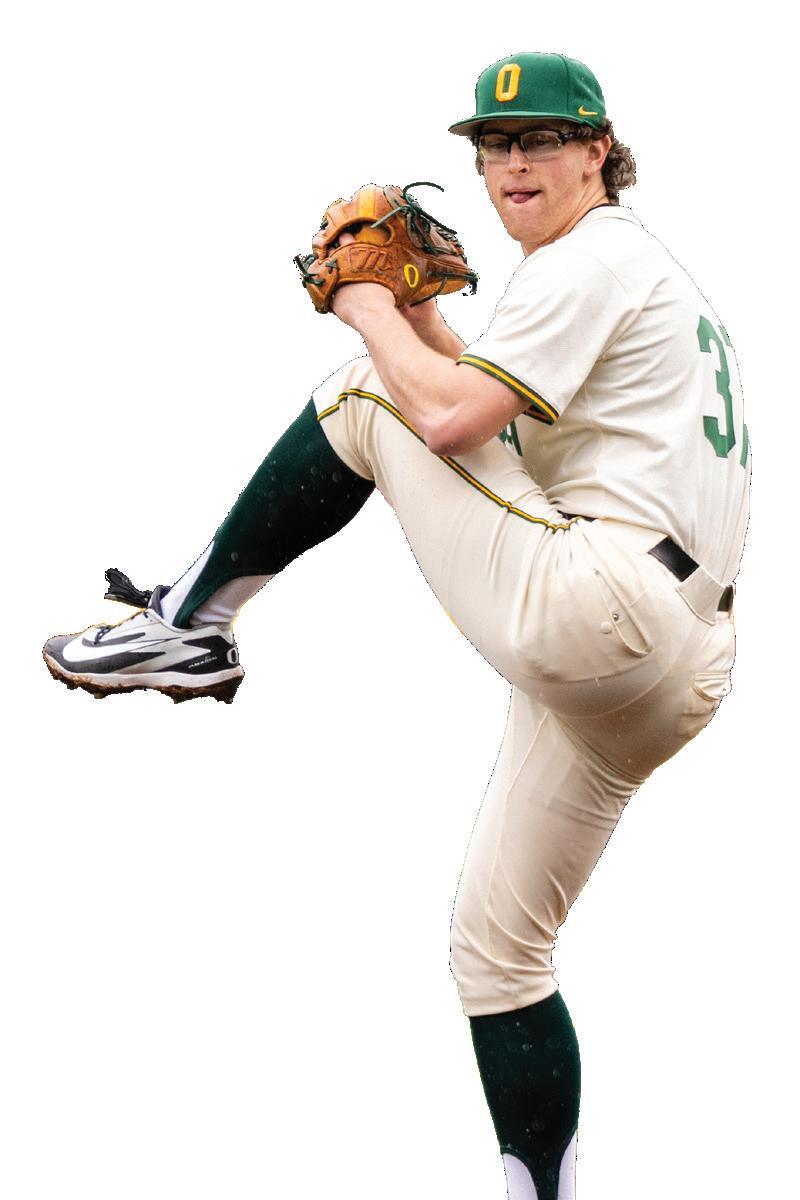
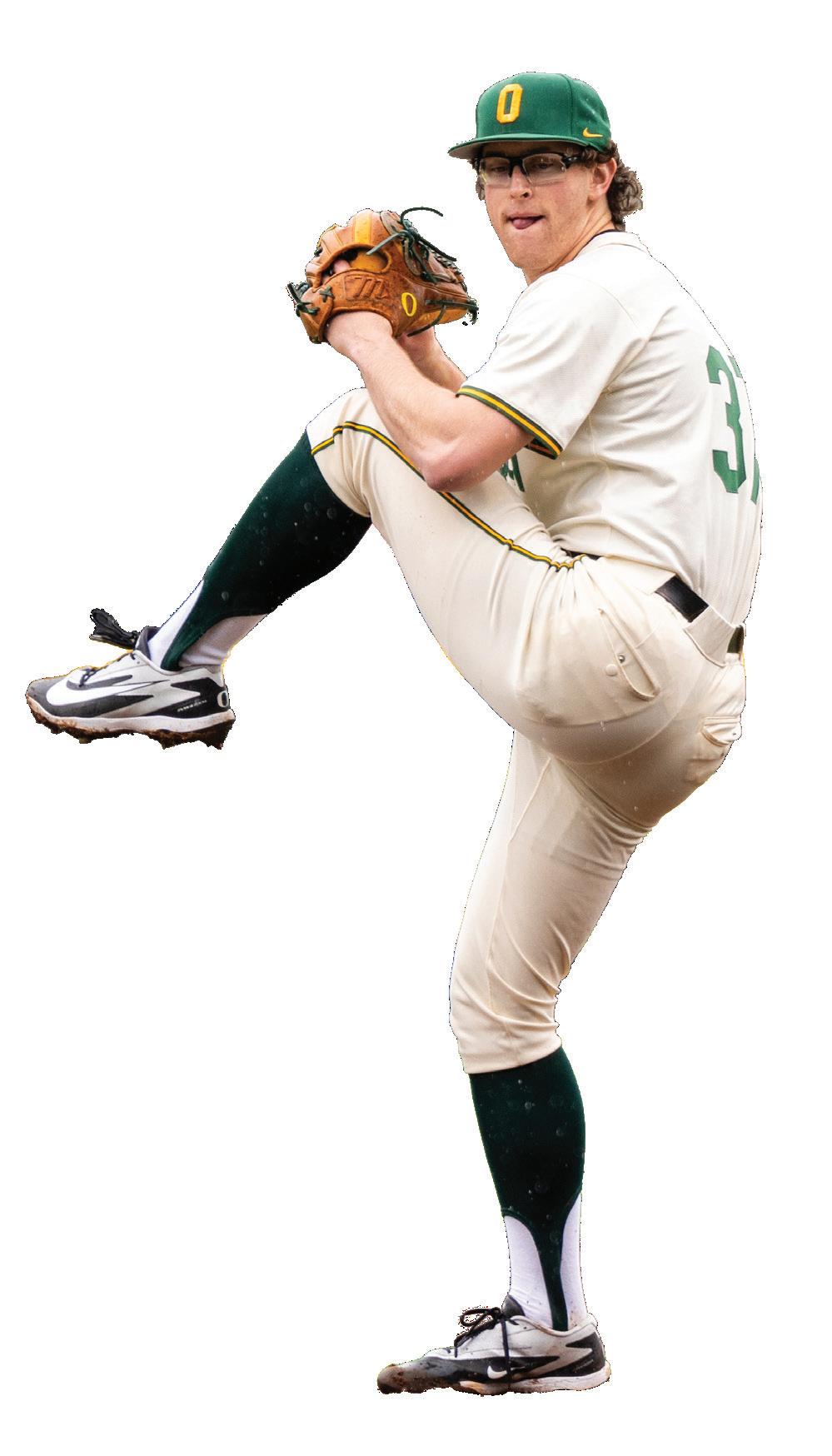
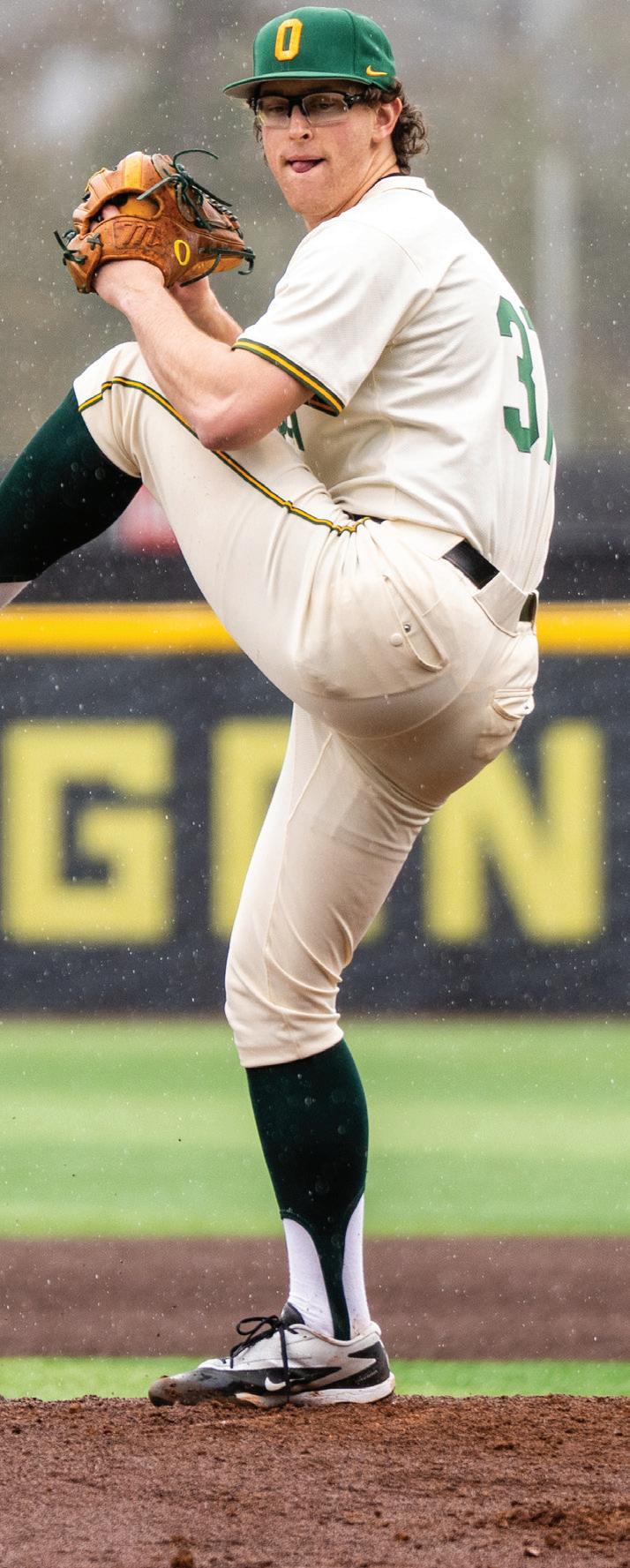
( ABOVE) Oregon Ducks pitcher Cal Scolari (37) winds up to pitch. The University of Oregon Ducks baseball team defeated the Youngstown State University Penguins 15–6 at PK Park in Eugene, Ore. on Feb. 22, 2026. (Rowan Campbell/Emerald)
IP) and Tanner Bradley (0.00 ERA, 8.2 IP),