INDEPENDENT


Opinion: There is a clear climate of fear on campus for students of color and undocumented immigrants — the university needs to adopt an ICE alert system to keep their students safe.
By Aishiki Nag Opinion Columnist
A couple of weeks ago, my parents talked to me about what to do if ICE were to interrogate or detain me; as a family, we decided that the safest course of action would be for me to carry my passport on me. So for the past couple of weeks, I have been carrying identification in case I get racially profiled or questioned by ICE — including when I’m on campus.
There is a real sense of fear and uncertainty, and these feelings no longer make campus feel safe. The University of Oregon has failed to adopt clear ICE policies to protect students on campus and has instead asked students to bear the responsibility of protecting one another.
At the Jan. 14 ASUO Senate meeting, there was one clear request students wanted — action from the university. Students advocated for an ICE alert system, similar to the police alerts,

EMU’s ‘Aperture Gallery’ displays controversial AI imagery
Walter Portz’s collages feature AI-generated elements is leading to contention among students.
By Vinny White Arts & Culture Writer
The Erb Memorial Union is filled to the brim with excellent art pieces. Whether it’s the Taylor Lounge’s abstract work by Nelson E. Sandgren, Marta Ramirez-Oropeza’s large mural depicting the history of the Chicano movement on the large green marble stairs, or the ever-rotating art featured in the Adell
McMillian Gallery, one needn’t look far for interesting paintings.
The “Aperture Gallery,” the wall opposite the U.S. Bank, sees its art pieces cycled out every quarter. Winter quarter, the wall features the work of photographer, graffiti artist, painter, and artificial intelligence proponent Walter Portz. Each of the eight pieces displayed contains a central image generated with AI, which has led to criticism in the form of
younger Oregonians, software is absorbing many beginner tasks, altering many entry-level jobs.
By Lucas Hellberg News Reporter
During his software engineering internship at Microsoft last summer, Nicholas Laureano was expected to consult artificial intelligence tools before asking a coworker for help.
“My mentor was Copilot,” said Laureano, a University of Oregon computer science student graduating in March.
Laureano said the practice reflected an AI-first approach on his team, where members are expected to use AI
tools before reaching out to a coworker for assistance.
Across Oregon, younger workers are starting their careers in jobs where AI now performs many of the routine tasks that once defined entry-level work. AI systems are drafting early versions of documents, gathering data and assisting with analysis — work that previously allowed new hires to learn through repetition, feedback and supervision.
But business and industry leaders say the AI changes are not resulting in widespread job losses. Instead, they say it is changing how early work experience is gained, narrowing the number of roles built around learning by doing. New hires are now expected to arrive with stronger skills and years of experience, even as industry experts say opportunities to devel-
op those skills become harder to find.
“If those projects and tasks are being automated by AI, you don’t necessarily need the junior hire — or as many of them,” said Skip Newberry, president and CEO of the Technology Association of Oregon.
Recent labor data shows that AI has an uneven effect on the workforce.
According to researchers at Stanford University’s Digital Economy Lab, employment among U.S.-based workers ages 22 to 25 fell by 6% in occupations they described as most AI-exposed — such as software development and customer support — between late 2022 and September 2025. However, during the same time period, employment in those same positions for workers ages 35 to 49 rose by 8%, the researchers found.









EDITOR IN CHIEF
Tarek Anthony
PRINT MANAGING EDITOR
Ryan Ehrhart
DIGITAL MANAGING EDITOR
Ysabella Sosa
NEWS EDITOR
Reilly Norgren
INVESTIGATIONS EDITOR
Ana Narayan
A&C EDITOR
Claire Coit
SPORTS EDITOR
Jack Lazarus
OPINION EDITOR
Gracie Cox
PHOTO MANAGING EDITOR
Corey Hoffman
PHOTO EDITOR
Saj Sundaram
COPY CHIEF
Olivia Ellerbruch
VIDEO EDITOR
Jake Nolan
PODCAST EDITOR
Stephanie Hensley
SOCIALS EDITOR
Ysabella Sosa
VISUALS EDITOR
Noa Schwartz
DESIGN EDITOR
Adaleah Carman
DESIGNERS
Asha Mohan
Ellery Burton-Tillson
Eva Andrews
Izzy Smith
Maya Gooneratne
Nina Rose
PUBLISHER AND PRESIDENT
Eric Henry (X317) ehenry@dailyemerald.com
VP OPERATIONS
Kathy Carbone (X302) kcarbone@dailyemerald.com
DIRECTOR OF SALES & DIGITAL MARKETING
Shelly Rondestvedt (X303) srondestvedt@dailyemerald. com
CREATIVE & TECHNICAL
DIRECTOR
Anna Smith (X327) creative@dailyemerald.com
ACCOUNT EXECUTIVES
Torin Chevalier
Camcole Pereira
Ava Stephanian
Elliot Byrne
THE DAILY EMERALD
Veteran services move from the federal building to Chad Drive following ongoing protests.
By Billie Corsetti News Reporter
Due to ongoing protests, veterans previously receiving care at the old Eugene Federal Building are now receiving their services at the Veterans Affairs Health Care Center.
“Due to ongoing protest activity near the Eugene Federal Building, all VA services have been relocated to the Eugene VA Health Care Center effective Tuesday, January 27, 2026,” the VA Public Affairs office said in a statement to The Daily Emerald.
Anti-ICE protests have been occurring at theEugene Federal Building daily since January. Protests have escalated, with federal agents using tear gas and other crowd dis-
persing chemicals at several protests. Around 7 p.m. on Jan. 27, after the vigil held in honor of Alex Pretti, an ICU nurse fatally shot by federal officers in Minneapolis, Department of Homeland Security agents began deploying tear gas and flashbang grenades on an estimated 250 protestors. A similar incident occurred on Jan. 30, when the Eugene Police Department declared the protest to be an “active riot.”
A week before the “active riot,” veterans received word that they would no longer be able to receive in-person care at the old federal building due to protests. Appointments were held on video call only. Since Jan. 27, veterans have been able to resume in-person appointments at the VAHCC.
Stricter rules for international students and unexpected federal actions over the past year have encouraged university and community groups to increase support.
By Sasha Love Senior News Reporter
International students have faced increasing legal and fiscal challenges recently, with visa revocations, reported graduate employee cuts and a nationwide trend of international students being harshly prosecuted for minor crimes.
Last year, hundreds of students across the country had their visas unexpectedly revoked, including four University of Oregon students. Now, some UO and community groups are offering resources for international students who find themselves needing emergency legal help or support.
“I don’t even know how they (international students) are surviving. The political situation is causing stress about going home, and you don’t know what the future holds for you. So people are just going faster to finish their degree or master’s, afraid you will be affected by anything,” Daniel Appiah Gyekye, international graduate student and ASUO secretary of diversity, equity and inclusion advocacy, said.
ASUO Legal Services offers a starting place for international students facing a legal emergency or simply trying to find out how a new law impacts them.

The Daily Emerald is published by Emerald Media Group, Inc., the independent nonprofit media company at the University of Oregon. Formerly the Oregon Daily Emerald, the news organization was founded in 1900. Emerald Media Group 1395 University St.,#302 Eugene, Or 97403 (541)-346-5511
“We are basically not turning anyone away from initial consultations,” Ilona Givens, the director of the program, said.
ASUO Legal Services has explored many more resources for international students since last year, when the visa revocations happened.
“Everyone got together in a panic, and as a result of that, they came up with tools,” Givens said.
During last year’s visa revocations, ASUO called on extra money from the Incidental Fees to support students through the legal process. According to ASUO President
“This step was taken to ensure the safety of veterans, staff and visitors while continuing to provide the right care, at the right time, in the right place — honoring veterans’ preference for face-to-face appointments, as well as virtual care options,” the VA Public Affairs statement read. “Veterans with scheduled appointments have been contacted directly regarding changes to their appointments.”
At present, it is unknown when services for veterans will resume at the old federal building. Daily protests are still ongoing.
Prissila Moreno, $150,000 from this “prudent reserve” fund was requested and approved, but only about $1,000 was used because the affected students were able to find reduced-cost legal services.
One lower-cost legal service that has been increasingly utilized, according to Givens, is Equity Corps of Oregon. The nonprofit group of lawyers has provided free income-based legal services to numerous international and immigrant students. Givens said she knew of several lawyers who had joined the ECO as a way to “give back” to the community.
“Everybody is helping each other out to get served as quickly as possible,” Givens said.
Givens said the dynamic federal landscape makes having cost-effective and reliable resources on hand particularly important.
“Since last spring, not a lot of heat has changed, but the heat hasn’t gone down,” Givens said. “Anything could happen at any time.”
For students facing fiscal emergencies, UO provides emergency financial aid through International Student and Scholar Services. Currently, aid packages are limited to $1,500, according to ASUO, which has been meeting with ISSS, and the amount of aid that can be distributed is limited.
To help the fund reach more students, Moreno, Appiah Gyekye and others in ASUO are working to allocate $50,000 from the senate’s surplus fund toward this emergency aid program.
“It was born out of identifying that international students are going through more financial trouble than just needing legal fees covered,” Moreno said.
Appiah Gyekye said the ASUO executive branch was expecting to request the money from the ASUO senate on Feb. 11.
Moreno said ASUO is also exploring

options to “widen the scope” of how the prudent reserve fund can be used in collaboration with university officials, and Appiah Gyekye said he wants to see a separate “structured” and more permanent fund for international students managed by ASUO.
“ASUO represents everyone, and just imagine there is no (ASUO) fund that supports international students on campus when they are going through difficult times,” Appiah Gyekye said.
Appiah Gyekye said he would like to see the fund be pulled from the Incidental Fees, a mandatory fee all students pay to the student government, and be a resource for all international students, independent of year or major.
“They pay I-fees, so they should get the benefits of it,” Appiah Gyekye said. “There are not many people advocating for them, but they need more attention and more support.”
Appiah Gyekye said he would like this separate fund to be more accessible than the ISSS emergency funds, which enforce several background checks to determine eligibility, and can generally only be used for one term.
He said this is particularly important due to alleged recent cuts to graduate employees who didn’t have the time to apply for the ISSS fund or didn’t know about the fund, which is distributed only in week seven of each term.
Eugene City Council heard from both university officials and residents regarding proposed zone changes to the eastern campus area.
By Billie Corsetti News Reporter
The Eugene City Council listened to testimonies on Jan. 20 from University of Oregon officials, supporters and concerned neighborhood residents regarding the university’s proposed zone changes and amendments that would advance the next generation housing development plan.
UO has been purchasing property in the east campus area since the 1960s to eventually expand housing. Due to anticipated growth, UO stated there is an “immediate need to build additional student housing” with the Next Generation Housing Development Plan.
“In addition to the total number of incoming students, which has been incrementally growing, and we anticipate over time will (continue to) incrementally grow, a greater number of those students are staying at the UO and graduating at higher rates,” UO Director of Housing Michael Griffel said.
The Next Generation Housing Development Plan outlines two phases of housing development, with each phase dedicated to the construction of each residence hall. Phase One is expected to be completed by fall 2027, but Phase Two is delayed until the city approves the proposed code and zoning changes.
UO is asking the city to approve three different applications: a code amendment, a zone change and a refinement plan amendment.
The code amendment would address the land use overlay over the east campus area where the residence hall’s construction is proposed. This would allow student dormitories in the area and increase the allowed building height.
The zone change is requesting the removal of a land use overlay that covers nine properties by Matthew Knight Arena, which is where the Graduate Village apartments are.
The refinement plan amendment’s purpose is to update the Fairmount/University of Oregon special area study to include the changes that would be made by the code amendment, including the increased building heights.
The special area study started in 1982 as a way for the university and the surrounding Fairmount neighborhood to work together through housing expansion.
Jeff Philpot, co-chair of the Fairmount Neighbors Association, said the plan was made to integrate the university and the Fairmount neighborhood.
“The refinement plan was started as a sort of way to give tools to the planning process, to be inclusive between the city, the neighborhood and the university, (and) recognizing the university’s need to expand,” Philpot said.
Some Fairmount residents are concerned about the proposed amendments to the refinement plan, specifically on how increased building heights and residence halls will respect the “graceful edge,” or the transitioning zone between taller university buildings and neighborhood homes.
“Resident halls were explicitly prohibited in this area for one reason: they’re fundamentally incompatible in a transition buffer zone,” Steve Gab, one public commentator at the Jan. 20 hearing, said.
Other concerns ranged from the preservation of the neighborhood as low-density, traffic congestion and engagement opportunities.
Commentators in support of the amendments expressed a desire to combat Eugene’s affordable housing crisis by expanding student housing opportunities.
“I recognize some neighbors may be concerned with the character of the neighborhood changing. Change is scary
and there will be no easy solutions to our housing crisis; every choice will have impacts and there might be more traffic after this development is built,” Peter Simmeth, a supporter at the hearing, said. “But quite frankly, I think it is more important that my generation gets to have a home, and this development would build those homes exactly where we need it.”
Many commentators in opposition to the expansion felt that their concerns could have been addressed through better collaboration with the university.
“There was no meaningful engagement around the full scope of the refinement plan changes and our concerns about conflicting statements, inconsistencies and factual inaccuracies remain unaddressed,” Mary Jaqua, a long-term resident in the Fairmount area, said.
Karen Hyatt, director of community relations at UO, works as the neighborhood liaison alongside Matt Roberts, the associate vice president of community relations. Roberts also works with city government interfaces. Hyatt has kept residents informed about the university’s next steps through the next generation housing website.
“There were a number of focus group meetings and open houses that we had with the community, where everyone was invited,” Hyatt said. “Some of those were with the neighbors, some of those were with the students and some of those were two ways: student-focused and community-focused.”
The city of Eugene confirmed that the university met all specific requirements for public involvement in a land use application.
The public hearing ended with the city council passing a motion to keep an open record for parties to submit any additional written testimony in support or opposition of the applications, which will end on Feb. 10. The council will deliberate on a decision on March 9.
Both the university and the residents expressed a desire for continued collaboration and engagement as neighbors.
“There’s a huge desire for collaboration. There is no interest at all in moving fast and not being considerate of folks,” Griffel said.
“It’s not a binary thing; it’s not us versus them or anything like that. It’s just getting the project done right,” Philpot said.
( BELOW ) Workers on site continue upward additions to the future Chapter Alder building on East 17th Ave. on Feb. 6, 2026.
(Owen Burriss/Emerald)




















Harry Styles announced his new album “Kiss All The Time. Disco, Occasionally.” and world tour after a four-year hiatus.
By Sadie Mordan Arts & Culture Writer
It’s been four years since Harry Styles released his third studio album, “Harry’s House,” and just when fans thought the singer-songwriter would tease a fifth year sans new music, he announced “Kiss All The Time. Disco, Occasionally.,” his fourth studio album.
Styles last performed on July 22, 2023, in Italy when he closed his seven-leg tour, “Love On Tour.” After nearly two years on the road, Styles left audiences with an “I love you. I’m gonna miss you. I’ll see you soon.”
Queue four years of Styles sightings posted to social media which had fans thinking, “He’s everywhere but the studio.” Styles watched the announcement of Pope Leo XIV at St. Peter’s Basilica, ran marathons in Tokyo and Berlin, attended the Glastonbury Festival in Pilton, England and attempted to park a fan’s car in Rome, for starters.
Then, without warning, a video titled “Forever, Forever” was posted to Styles’ YouTube page on Dec. 27, 2025. The video chronicles the final “Love On Tour” show, featuring an unreleased 4 minutes and 45 seconds piano piece Styles wrote and performed for the first time that night. The video was unaccompanied by a caption, but three words appeared on the
screen once the piano ballad ended: “we belong together.”
His fandom erupted online. The consensus was that a tour was coming, and if a tour was coming, so was new music.
On Jan. 15, Styles announced that “Kiss All The Time. Disco, Occasionally,” would drop on March 6.
The album’s title hinted at a new sound from Styles given his pop-heavy discography with its traces of rock.
“Aperture,” the first single on the album, was released on Jan. 22 and confirmed that Styles had turned to a new sound.
“It’s very different from what he’s done in the past… obviously he’s there and I can feel hints of what he’s done before, but it’s such an evolution of what he’s done in the past that I’ve been a little unsure about it,” third-year advertising student Zoe Goldstein said of “Aperture.” “I’ve only listened to it a couple of times so far, but I’m very interested to see the transition into the new album and how he’s gonna take his music there while still staying genuine to the artist that won (Album Of The Year) in the past.”
The day Styles released “Aperture,” he announced the “Together, Together” world tour — a series of residencies set in seven major cities: Amsterdam, London, São Paulo, Brazil, Mexico City, New York City, Melbourne and Sydney, Australia. The tour will begin on May 16 in Amsterdam.

“I would’ve loved to go to a concert, but I can’t get my butt to New York for 30 days. So, I’m actually really sad and a little like, ‘Wow, that’s kind of a sellout move,’ so that kind of bothered me,” second-year psychology student Elyssa Gutman said. “Like if you can, do it. But also, go somewhere else. Spread the love.”
11.5 million people registered for the presale which began on Jan. 26, setting the record for the highest presale volume recorded. Ticket prices reflected the high demand, listing as high as $1,182.40, a pre-determined price cap, according to alerts in the Ticketmaster queue.
There is speculation that Styles will add shows in Los Angeles to the residency lineup. West Coast fans can only hope it’s true.
retaliatory art pieces and notes stuck to the wall describing the pieces as “lazy” and “AI B.S.” While it is presently unknown what individuals are leaving their notes of descent, other artists at the University of Oregon are similarly upset.
“I find the university promoting this use of AI to be incredibly disheartening and disappointing,” Art Ducko artist Seth Avila said. “I feel like, of all places, a university should be encouraging people to put in the work to do things, especially when it comes to artwork.”
Though the Aperture Gallery is overseen by the Center for Student Involvement, Craft Center director Jennifer Salzman
is largely in charge of selecting the art. When the artist initially intended to exhibit their work dropped out three weeks before winter quarter, Salzman reached out to Portz, with whom she previously attended the University of Minnesota.
“Walter did us a favor by stepping in,” Salzman said. “I told him he could show whatever he wanted. When Walter showed me this stuff, I was like ‘okay, not exactly what I had envisioned’, but I was very excited to put it up.”
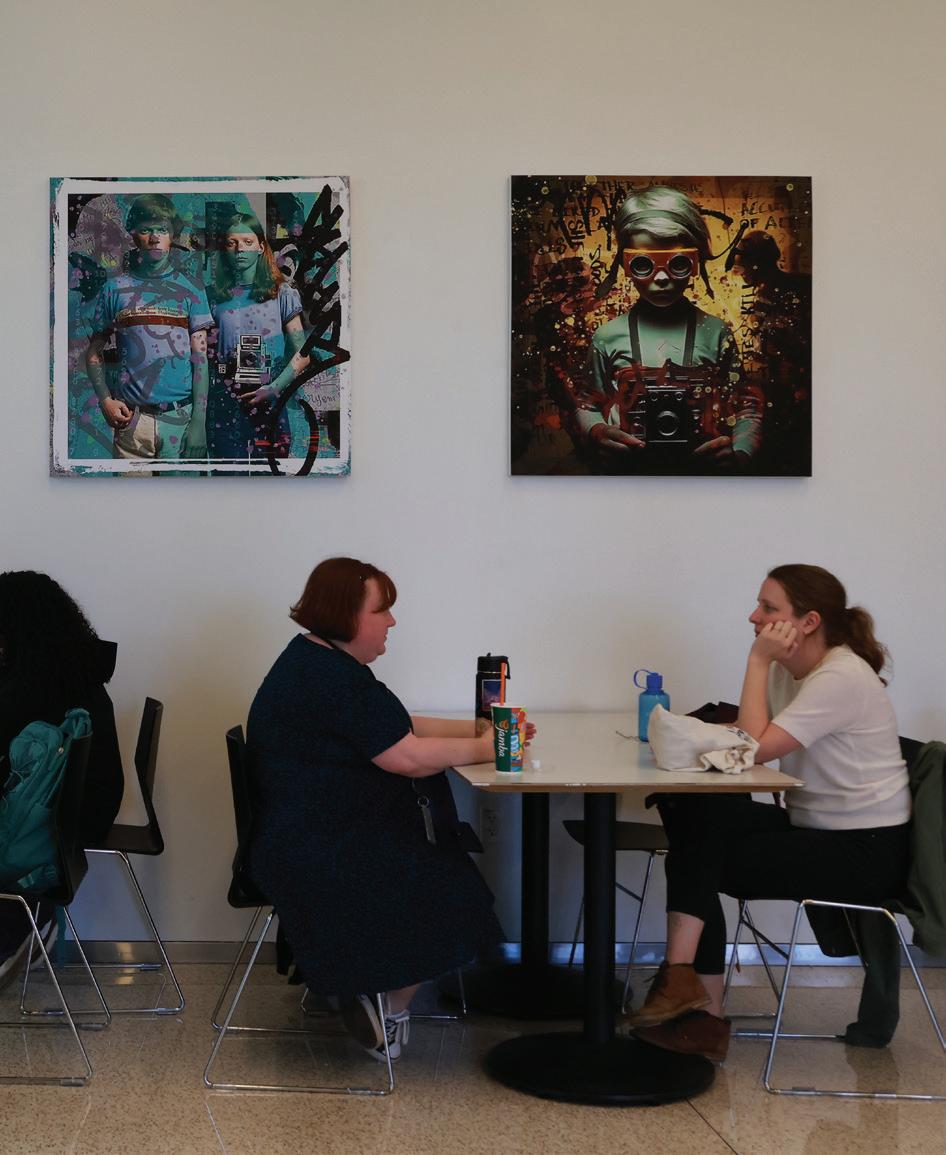
Portz’s pieces are composites of his photography, pictures of graffiti tags he took while traveling, and more. The central AI element was generated by feeding his own images into Midjourney, a popular AI generation program. Originally, the viewer was supposed to scan a QR code that allowed the user to use their phone to see each individual layer of the work via augmented reality. The program, Adobe Aero, shut down shortly before the exhibit went up, after the pieces were already printed. While much of the work in the collage was created by Portz, the question of human authenticity still plagues the work.
“I’m not a fan of AI, I think it’s so removed from humanity,” August Reitan, former director and current artist for Art Ducko said. “ If they created that part, why couldn’t they have used their art to make the whole thing?”
Portz, having gotten involved with digital art programs like Adobe Photoshop before it was widely accepted by the art world, is well acquainted with criticism from artists. He’s found that wider audiences are typically more accepting of his work.
“As far as artists go, I got the same response in the 90s when I was doing collage art,” Portz said. “People were very critical and I kind of developed a thick skin. The general public f*cking loves the work. I’ve had elementary and high school art teachers ask me to come speak to their classes, because it’s a technology that’s not going away.”
AI-generated work has accrued a reputation for being displeasing to the eye, even ugly. In fact, “AI slop” is now a common phrase to identify AI-generated images. The aesthetic quality seems to be of less concern to Salzman than the artistic statement, and she views not featuring the art as censorship.
“Do they really want me to start censoring artwork on whether or not they think it’s ugly?,” Salzman said. “That’s a slippery slope. There’s nothing inappropriate with the content. There’s nothing inappropriate with Walter as a person. Those are the two criteria that I would be obligated to censor things. My job is not to hang art that everybody’s gonna like, my job is to hang art that is going to stimulate and create conversation.”
Of course, aesthetics are an important part of curation, a fact that Salzman recognizes in relation to long term exhibits.
“If I was curating for, say, the permanent collection, where something is going to hang indefinitely on a wall for the next five years—that might become a different conversation. This is a short term, 90-day moment in time, it’s gonna rotate out.”
The display is temporary, but the message it sends is lasting. AI-generated images are already prevalent at UO. Be it in lectures, in club posters, even as advertisements for the Adell McMillian Gallery, the persistence is impossible to deny. Portz’s pieces are seen by some as an extension of the growing prevalence of AI images.
“It definitely goes to show the normalization of the usage of generative AI, specifically because generative AI has been seeping into classrooms,” Art Ducko artist Mona Nazandarani said. “AI expanding to the hallways, with the [the university’s] full awareness of it, goes to show that they are beginning to normalize it. It’s really starting to consume social norms quite a bit.”
Ultimately, both Salzman and Portz take the response as a net positive.
“As an artist myself, I always say any reaction is a good reaction. Even if somebody is upset that we decided to hang this work, it’s creating dialogue,” Salzman said, “ It’s getting the blood flowing.”
Portz similarly welcomes the criticism.
“Some of the students have been putting notes by it, which I’m actually totally good with,” Portz said. “I would love to sit with students and let them ask me questions and criticize me.”
For Oregon’s youngest workers, the shift is reshaping how their careers begin. As AI changes how work is organized and experience is gained, educators and policymakers say they face a growing question: how to prepare young workers as entry-level pathways narrow.
AI changes are immediately noticeable in the tasks that workers are asked to do.
Business and industry leaders say AI adoption by companies has been uneven, with efficiency gains showing up first in routine production work where new graduates do on-the-job learning.
Newberry said some of the earliest AI-driven shifts are appearing in computer programming, marketing, customer service, and content production. He said the changes have not led to major job losses.
At Intel, AI tools are changing how projects begin. Bob Duffy, director of consumer AI within the company’s PC Ecosystem team, said work that once required larger teams in the early stages can now be done by fewer people because AI now handles parts of that work.
“A very small team can essentially do a lot of that work,” Duffy said. “It compresses the time and makes you more productive.”
Andrew Busche, a recent UO graduate working in investment banking, said AI can now handle some of the administrative work that junior analysts used to do.
“AI has just taken over the manual entry, the very tedious tasks, and I’ve really valued that, because it’s given me more time to focus on other things,” Busche, who graduated in 2025, said.
At smaller companies, the focus is often on effi-
ciency — not eliminating positions.
Vonnie Mikkelsen, president and CEO of the Springfield Chamber of Commerce, said many small businesses are already using AI in their daily operations. She said 65% of small businesses in Oregon now use a generative AI platform, citing a recent report from the U.S. Chamber of Commerce.
But Mikkelsen said the technology hasn’t led to widespread layoffs in the Eugene-Springfield area.
“We’re not necessarily seeing massive replacement of jobs,” Mikkelsen said. “There’s still a human element that is critical.”
That human element, though, increasingly involves reviewing or directing work produced by AI, instead of completing the repetitive tasks that once helped beginners learn how to work.
As AI continues to automate many routine tasks, entry-level jobs are becoming fewer and harder to get.
Oregon’s labor market appears to be narrowing in opportunities for early-career workers. The U.S. Bureau of Labor Statistics reported 83,000 job openings in Oregon in August 2025, down about 30% from August 2023. A survey by the Oregon Employment Department found that 62% of job vacancies in the spring of 2025 required prior experience, up five percentage points from spring 2024 — a decline in positions accessible to early career applicants.
“Anecdotally, we’re seeing companies post fewer junior roles in some cases, and we’re also hearing from junior workers that it’s harder to find opportunities,” Newberry said. “There’s fewer openings out there.”
Hank Childs, a computer science professor at UO, echoed Newberry, saying hiring in the tech
sector has slowed overall. But he cautioned against attributing the shift to AI alone.
“AI could be part of the story, although it may be more about the economy and internationalization,” Childs, who’s also the director of UO’s undergraduate computer science program, said.
Mikkelsen concurred with Childs, saying AI automation does not explain the hiring slowdown.
“There’s broader economic conditions that play into it,” Mikkelsen said.
State education and workforce officials, though, say the effect of AI on the job market has been uneven so far.
Ben Cannon, executive director of the Oregon Higher Education Coordinating Commission, said AI-driven job disruptions have been modest overall and concentrated in certain industries — like software development.
However, Ryan Kounovsky, director of workforce strategy and innovation at the Lane Workforce Partnership, said traditional early-career pipelines have changed significantly in recent years.
“Employers are expecting a 22-year-old to come with four to six years of experience, where they might only have a year of experience,” Kounovsky said.
How are institutions responding
As entry-level work changes, educators say higher education is under pressure to adapt.
Childs said tech sector employers now expect recent graduates to have more experience than they did in the past.
“There’s a new bar for employment” that requires computer science “students to have more practical experience,” Childs said. “It’s not a matter of companies saying, ‘we’ll take someone on, and we’ll
train them up.’” Companies want people who “already have a lot of that training.”
At the same time, Childs said tech sector internships have slowed in recent years, reducing one of the primary ways for students to gain experience. In response, he said UO’s computer science department is working to create opportunities intended to give students experiences that are similar to internships.
Childs said the changes include instructors redesigning assignments to prevent AI from short-circuiting learning, a new entrepreneurship class centering around faculty mentoring and AI-assisted software development, and a new capstone class in which students develop projects for companies like Intel.
“We’re hoping that what we’re doing is going to provide our students a competitive advantage,” Childs said.
At nearby Lane Community College, faculty are also redesigning the school’s curriculum to reflect recent developments in AI.
Brian Bird, the lead instructor for the school’s two-year software development degree, said the program will soon reduce the number of required coding classes from five to three, replacing them with two classes focused on higher-level skills like software design and architecture.
“In the future, a lot of coding is going to be done by AI,” Bird said. “The employees that are going to be in demand are the ones who can direct the AI — the architects and the designers that tell the AI what to do.”
Newberry echoed Bird. He said some companies are more risk-averse right now, often only hiring people with “proven experience and a deeper set of skills.”
They want to “get a return on those positions quicker than they would with a more junior role, where they might have to invest longer in training,” Newberry said.
But some business leaders say technical skills alone are no longer enough, as employers look for people with a more well-rounded skill set.
In the Eugene-Springfield area, Mikkelsen said communication writing is one of the most in-demand skills, and something that many employers now expect at the entry level. But she said the skill set is not where it needs to be, with many early-career professionals falling short of employers’ expectations.
Mikkelsen also said soft skills — like critical thinking, the ability to see the bigger picture and being creative — still matter, saying they are more important than ever before.
Bird agreed. “Even in the age of AI, the most important thing is soft skills,” he said.
As routine tasks become more automated, workforce leaders say the question is no longer whether early careers are changing, but how young workers now gain experience that was once built through repetition.
Newberry said much of what prepares workers for senior roles comes from repeated exposure to everyday work problems and tasks.
“A lot of how you get to that senior level is based on really repetitive exposure to different scenarios,” Newberry said. “If you’re automating all of that, then how do you create more senior-level workers over time?”
Oregon AFL-CIO President Graham Trainor echoed Newberry, saying he’s also concerned about how rapid AI adoption affects workers’ long-term development.
“AI should improve the jobs we do — not replace us,” Trainor said. “It should make work safer, and not expose workers to more safety and health concerns.”
State lawmakers say they are only beginning to grapple with how automation may affect early-career work.
Oregon State Rep. Emily McIntire, R-Eagle Point, told The Daily Emerald that she’s concerned about how growing costs are impacting businesses. She also said she’s worried that companies may need to replace humans with AI or other types of automation to remain profitable.
State Sen. Janeen Sollman, D-Hillsboro, said the Oregon state government has an AI governance

structure in place through its Artificial Intelligence Advisory Council. But she said state lawmakers could benefit from additional hearings about how AI is displacing early-career professionals and other AI-related workforce issues.
As labor leaders and lawmakers debate automation’s impact, employers and young workers are navigating the shift with open questions. Industry leaders and early-career professionals say there is no clear standard for how experience should be built or how readiness should be judged when entry-level jobs become harder to find.
Major employers are being watched closely. Nike Inc. and Palo Alto Software, which is based in Eugene, did not respond to multiple requests for comment for this story. The Daily Emerald also reached out to Microsoft, but a spokesperson said the company was unable to accommodate an interview request ahead of publication.
Newberry said employers and job seekers are operating without a shared playbook.
“It’s kind of the Wild West, in a sense,” he said. “There’s a lot of disruption happening, a lot of people experimenting, and a lot of frustration all around — at least as it relates to the hiring process right now.”
At the same time, Newberry said software has changed what junior workers can produce, sometimes masking gaps in experience.
“Junior workers working with AI tools have been able to produce output that’s equivalent to more senior workers,” Newberry said. “Now, what the junior hires lack is the experience to be able to recognize when AI is hallucinating or has produced something that is subpar.”
That tension — between productivity and learned experience — has surfaced repeatedly in interviews that The Emerald conducted for this story and is now shaping workforce and policy discussions in Oregon.
Cannon said state leaders are still planning with limited visibility.
“There are big unknowns about how AI will change the way that people work and the skills that people need to be effective in jobs,” Cannon said.
For Busche, early in his finance career, the future feels uncertain.
“If AI gets better and better and better, I could see it taking jobs,” Busche said. “I just don’t see it doing anything now. It’s just hard to predict right now.”
He added: “If AI tried to do my job now, it would be awful.”
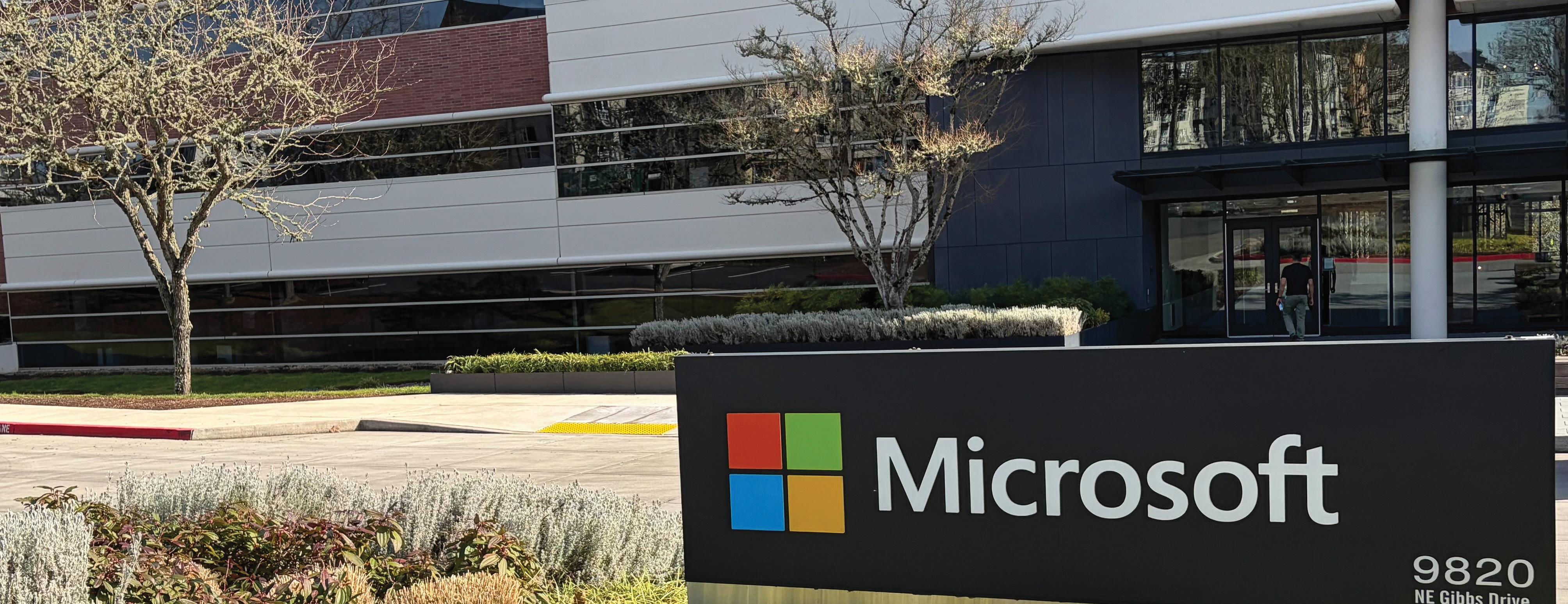
( LEFT ) Microsoft office at 9820 NE Gibbs Drive in Hillsboro, Ore., on Feb. 4, 2026.
( ABOVE) Hank Childs, a computer science professor at the University of Oregon, poses for a photo after his class on Jan. 16, 2026. (Lucas Hellberg/The Daily Emerald)
UO Phi Beta Kappa hosted Margo Schlanger as part of national chapter’s Visiting Scholars Program.
By Corey Hoffman Senior News Reporter
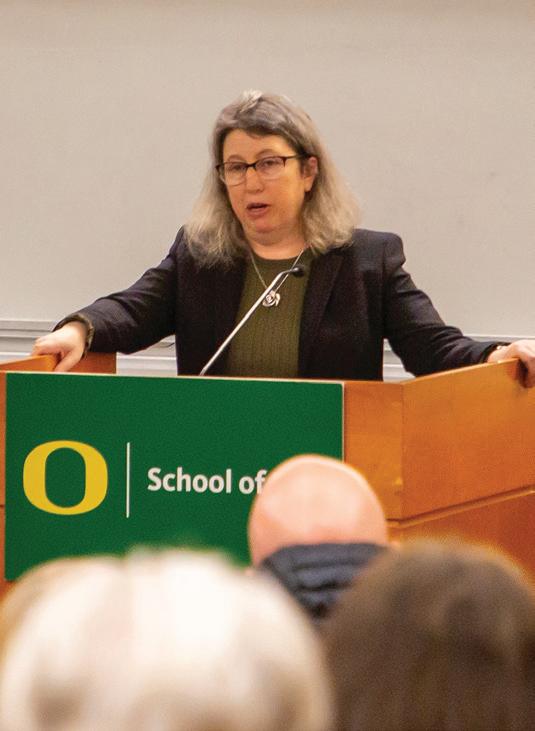
The University of Oregon Phi Beta Kappa Visiting Scholars Program hosted guest lecturer Margo Schlanger for a talk titled “Federal Civil Rights Cases by and against the Trump Administration” in the William W. Knight Law Center on Jan. 29.
Schlanger, who is the University of Michigan’s Wade H. and Dores M. McCree Collegiate Professor of Law, spoke to roughly 100 students and community members.
“The Trump administration is working to radically transform the landscape of American civil rights,” Schlanger said.
During the lecture, Schlanger addressed four issues: Diversity, Equity and Inclusion, the recognition of transgender identities, birthright citizenship and the ongoing situation in Minneapolis.
On the topic of DEI, Schlanger argued that the Trump Administration is actively working to reverse a “shared understanding” of integrated equality set during the 1960s and 1970s.
“The federal government is currently taking the position that integration itself is invidious, that the integration idea is an invidious goal and that the constitution’s equal protection clause bans integration efforts,” Schlanger said.
According to Schlanger, the Trump Administration is litigating that disparate impact, which is when a neutral policy or action unintentionally causes disproportionate negative harm to a group, is illegal.
“The stakes are, can the Trump Administration persuade the courts and the Supreme Court that integrated measures (and) barrier removal is constitutionally suspect? Can the Trump Administration defend the proposition, move the proposition into the mainstream, that integration is invidious?” Schlanger said.
On the topic of transgender identities, Schlanger explained several Executive Orders issued in the early weeks of Trump’s presidency and the subsequent cases that have since emerged against them.
“The federal government’s assault on trans people is rife with just evident malice, like its decision to use prior names on government portraits of trans officials from prior administrations.
This kind of gleeful unkindness tells,” Schlanger said.
Schlanger briefly discussed birthright citizenship, breaking down an executive order aimed at stripping citizenship rights from those born in the United States if their parents are both non-citizens.
“What I want you to notice, why I’m doing this in a civil rights talk, is that what the Trump Administration is seeking is permission to create a permanent racialized underclass,” Schlanger said.
Schlanger closed the lecture by briefly discussing the ongoing situation in Minneapolis, explaining several of the litigation claims brought against the Trump Administration, including that the federal presence in Minneapolis violates the 10th Amendment’s state sovereignty.
Schlanger finished the lecture by asking those in attendance what kind of country they want to live in and taking audience questions.
In a statement to The Daily Emerald, the Alpha of Oregon Phi Beta Kappa Chapter said that the purpose of the Visiting Scholars Program — which is sponsored by the national chapter of Phi Beta Kappa — is to “contribute to the intellectual life of the campus” by bringing “some of America’s most distinguished scholars, artists and researchers.” Through the Visiting Scholars Program, scholars spend two days at institutions around the country, engaging with students, faculty and staff by participating in classroom discussions, workshops, meals and public lectures.
(ABOVE) UO Phi Beta Kappa hosted the University of Michigan's Wade H. and Dores M. McCree Collegiate Professor of Law Margo Schlanger for a lecture titled “Federal Civil Rights Cases by and against the Trump Administration,” on Jan. 29, 2026.
(Corey Hoffman/Emerald)



Aishiki Nag is a senior studying political science and global studies. She likes to cover state and national politics, and international peace-building efforts. When she’s not writing for The Emerald, she likes to read, hike and travel to new places.
which would alert all students when there is confirmed ICE activity on campus. The infrastructure to implement this already exists; however, university administration is hesitant to take action.
“The university feels as though their hands are tired, and all we can do is give the community space to voice their grievances,” ASUO Senator Cole Stevenson said. “I think it is incredible that they would have a report system for police but not for ICE — that’s a very interesting cutoff.”
Stevenson conveyed that the university feels immense pressure to retain potential funding from the federal government, and didn’t want to overstep boundaries in order to keep a favorable position with the current presidential administration.
“If you are neutral in situations of injustice, you have chosen the side of the oppressor,” Giovanni Bazan-Espain said, quoting Desmond Tutu. He is a sophomore at UO and the president of the Latiné Male Alliance. Bazan-Espain has been very vocal about implementing an alert system on campus to protect students.
At the ASUO senate meeting, Bazan-Espain criticized the current UO administration for not using its resources to protect immigrant students on campus. Notably, General Counsel Kevin Reed was vocal about the potential of “false
reports” through this system, and recommended students to carry documents on them and cooperate with the Department of Homeland Security when asked for proof of residency.
“I can’t begin to express my disdain, and honestly, my disgust with this administration — even if it was (a false report), I would rather be safe than sorry,” Bazan-Espain said. “What implementations are being put (to) protect documented and undocumented students, but most of all people who look like us?”
Bazan-Espain reiterated that the infrastructure for sending out campus-wide emails and alerts already exists, and has been used frequently to alert students of police activity on or around campus. That same logic could easily be applied to warning students about DHS activities.
“There are issues like this on the table where they can legally implement it, but they choose not to — since they aren’t willing to step on anyone’s toes to protect people,” Bazan-Espain said. “They keep putting out these blanket statements that they are for dreamers, international students and the immigrant communities on campus — but words are cheap, what actions are you doing to prove it?”
This small action can lead many students to feel

safe and bring back security on campus. There has been ICE activity all over Eugene, and protestors have been detained less than a mile from campus. What is stopping the university from standing up for students?
“It doesn’t have to happen to you for you to stand up and say something,” Bazan-Espain said.
“Karl Sholtz, Kevin Reed, if you choose to be neutral right now with the issue of ICE, you’re siding with the oppressor.”


















Given a long losing streak amid a string of untimely injuries, head coach Dana Altman is working to make sure his top-scorers have been accounted for.
By Jack Lazarus Sports Editor
One of the most difficult parts of dealing with a major swath of injured players is having to replace output on the floor. While a “next man up” mentality can be positive, the reality of losing the top two scorers (point guard Jackson Shelstad and Nate Bittle), the top rebounder and top playmaker all in one swoop is often hard to reconcile with.
“You just gotta keep grinding,” head coach Dana Altman said. “There’s no easy answer, there’s no quick fix. There’s no strategic (way). You just play as hard as you can and try to keep the guys together.”
Between the two stars, the Ducks now have had to replace almost 31 points, 10 rebounds, seven assists, 26 shot attempts per game and seven free throws with an uninspired roster made up almost entirely of role players at this point.
The Oregon men’s basketball (record after Feb. 7) season has moved on past the original goals lined out for it. The Ducks, now with 15 losses, are a far cry from any meaningful postseason involvement and a large part of that can be attributed to the injury crisis.
Here’s how the Ducks’ most meaningful contributors have fared through this now nine-game losing streak:
Takai Simpkins, starting shooting guard
While being a reliable piece of the rotation earlier in the season, when Shelstad was healthy, Simpkins’ role increased tremendously as the season progressed. A true twoguard, Simpkins is a willing, albeit not particularly strong, passer, so shoehorning him into a playmaking role has only proved to confuse things.
His assist numbers haven’t jumped, he’s attempted more field goals (about 3-4 more per game over the last five games) and his field goal percentage dropped from the high 40s to the mid-to-low 40s (44% as of Feb. 37).
Statistically speaking, Simpkins’ contribution in a more accountable offensive role hasn’t been super suc-

cessful. That being said, it would be a mistake to label his production as negative.
Without Simpkins, this team would be in the dumps. His defense remained consistent throughout January, highlighted by a four steal effort in a loss against No. 2 Michigan. He takes a great deal of shots, but none of the other players seem willing to make up the difference caused by the specific absences. While his deep-three or contested drive-in floater might not always be the shot of choice, given the current circumstances, his aggressiveness forces the action at times where that’s needed.
Kwame Evans Jr., starting power forward
Evans clearly decided to shoulder more responsibility as the injuries started coming in. Coming into the most recent five-game stretch, Evans had shot over 10 field goals just three times. During this current stretch, Evans has averaged 13.6 field goals per game.
His 24-point, eight rebound and two block effort dragged the Ducks to a much closer game than they deserved in their 73-57 loss at home to UCLA. A three-year veteran on the team, Evans is used to being in the win column much more, as Oregon made March Madness in each of his first two seasons.
“It’s not easy (to stay focused). (Evans) has been here two years and we’ve gone to the tournament both years; he’s been a big part of that,” Altman said.
Defensively, Evans started playing much more actively in the paint. Losing one of the best shot-blockers in the country in Bittle placed the onus of cleaning up Oregon’s weak perimeter defense on Evans. He jumped his block numbers up to 2.2 per game over the recent skid, which is impressive since Evans recently started defending smaller players onball and has been incredibly effective.
With the injury to Bittle and a season-ending shoulder operation for backup big man Ege Demir, Stewart stepped into the incredibly important five spot.
While offensively-erratic at times, Stewart has made up for the deficiencies in rebounding and interior presence that the Ducks lost with the injuries to the frontcourt. He constantly moves, creating a great deal of space for other scorers while also cleaning up boards, increasing his numbers to now 7.1 per game this season.
Stewart only started six games until injuries rocked this roster; he’s now started the last eight games and counting. While those games have all been losses, Stewart’s impact falls under the same umbrella as Simpkins’: while he hasn’t taken the world by storm in his increased minutes, he’s carved out a crucial role.
While none have been able to replicate the production of the team’s stars, each of these three players has been partially responsible for this season not turning into a complete disaster. Simpkins, Evans and Stewart are currently the heart and soul of this team, and if the Ducks are going to pick it up, it’ll be on the backs of these three players.
( ABOVE) University of Michigan at Matthew Knight Arena, where the ducks were defeated 81-71 on Jan. 17, 2026.
(Roshni Ram/Emerald)
( BELOW ) The Oregon Ducks were defeated by the Iowa Hawkeyes 81-71 at Mathew Knight Arena in Eugene, Ore. on Feb. 1, 2026.
(Julia Massa/Emerald)
Transitioning option that might use androgens or estrogens, briefly
“Yippee!”


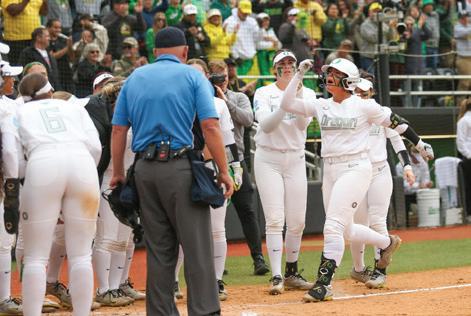
As the Ducks prepare for Sunday’s season-opener, The Daily Emerald breaks down notable storylines from last season — and how they’ll affect the 2026 edition.
Read story online at Dailyemerald.com

SATURDAY
Feb. 14, 2026
Oregon vs. Seattle University
The senior forward who joined the team in its first Division I season has shattered its previous points record at the level, while setting it up for future success through a crucial leadership role.

By Henry Light Sports Writer
After Jackson Henningsgard finished his junior season with six points in Oregon’s final five games to tie for the team lead with 16 points, he knew his senior year would bring an increased role.
Henningsgard spent his offseason on the ice and in the weight room preparing to be one of the Ducks’ best players, but when he returned to Eugene, the role had drastically changed. With the departure of several seniors, Henningsgard was left as the only senior in Oregon’s forward group, thrusting him into an unexpected leadership role.
“It was a shock at the beginning of the year when we had to lose some guys that we weren’t expecting to, but you just have confidence in the team around you,” Henningsgard said. “It doesn’t really matter their age, we’re all playing the same sport — we’re all playing on the same ice.”
Despite the chaotic start to his senior season, Henningsgard has shattered the club’s previous Division I single-season points record of 19, sitting at 29 with four games remaining. Henningsgard joined the team ahead of its first Division I season in 2022, and in his senior year, he is setting it up for the future, playing on a line with freshman points leader Inde Abresch and runner-up Jackson Ebbott.
“Being one of the few seniors that we have, especially up front, he’s been a great role model for all the new guys that have been coming in,” Oregon head coach Jack Hyman said.
Henningsgard overcame the tumultuous offseason to record points in Oregon’s first six ACHA games, totaling 10 in that span. While Henningsgard retained his production from the end of his junior season, Abresch matched the senior’s point total in his first six ACHA games.
“The recruits that we brought in this year are great. I don’t think it’s a hard school to recruit to — I think people want to come here, and I think it’s only going to get better,” Henningsgard said. “You can see the freshman class having a great year this year, so that’s just going to extend into the following seasons, and this program will keep exponentially growing.”
Henningsgard’s consistency lapsed in Oregon’s most difficult stretch of the season, but he finished 2025 with 14 points in 12 games.
On Dec. 13, 2025, Henningsgard was held off the scoresheet in a 9-1 loss to the University of Nevada, Las Vegas. Since then, Henningsgard has recorded a point in six straight games to match his early-season streak.
The streak began with eight points across two games against San Diego State University. Henningsgard diverted from his typical playmaker role in game two to record his first career hat trick.
“I’ve always been a pass-first kind of player, so really having confidence in my shot right now is pretty fun because I’m still able to make those pass-first plays, but when I can shoot it, my teammates expect me to shoot it,” Henningsgard said.
Before the puck dropped for the Bend Outdoor Classic the next weekend, the most public-facing product of Henningsgard’s increased involvement in the club’s operations was revealed. In game one against the University of Alabama, the Ducks debuted a black alternate jersey, which Henningsgard helped produce.
“Truth be told, Jackson Henningsgard sort of took the reins on this,” Hyman said. “He was like, ‘I think it would be very cool to surprise the team with the black jerseys for Bend.’ He ran with that, and we did a little private reveal in our locker room Thursday night, so none of the guys knew what was gonna happen, and it was great.”
“It’s really cool to be a part of, to see this program grow, and even to add a fourth jersey this young in a program is pretty spectacular,” Henningsgard said.
The jerseys were well-received by both players and fans, and Henningsgard cut through the noise of the special series in alternate jerseys to tie the opening game 1-1 early in the second period. While the Ducks dropped the opener 3-2, they salvaged a split thanks to two Henningsgard goals in a 2-1 win.
Oregon was swept by North Carolina State University the next weekend, but Henningsgard continued to power the Ducks’ offense with four points in the series.
Henningsgard came to Eugene from his hometown of Amery, Wisconsin, four years ago, knowing the University of Oregon for nothing besides its “football team and funny basketball court.” With four games remaining in his college hockey career, he has set a new standard for a team that has grown exponentially during his career.
“It’s been a lot of hockey throughout my life. I started skating when I was two or three years old, and it’s been my passion. It’s my favorite thing to do, and to be able to end it in this jersey is pretty awesome,” Henningsgard said. “We’ve got four games left, and I’m just looking forward to those, and then I think the reflecting will really set in.”



Eligibility:
Research conducted by: Sophia Sinsheimer, M.A., PhD Student, University of Oregon
Affiliation: School of Journalism and Communication (SOJC)