Emerald THE DAILY
MONDAY, SEPT. 21, 2026
INDEPENDENT JOURNALISM PRODUCED BY STUDENTS, FOR STUDENTS OPINION
Leininger: UO steps up amidst uncertainty in the federal research funding landscape
SEIU votes to authorize potential Sept. 28 strike — what’s next? What a service employee strike would mean for the university community.
Opinion: UO’s Research Resilience Committee acts as an imperative support system as the federal government continues to attack the humanities. However, as UO faces its own budget constraints, it remains an open question whether this support system can remain intact. Continue story on page 7
OPINION
Novak: The university must play a bigger environmental role Opinion: With millions of acres of burned land across the state of Oregon, it is becoming crucial that any and all land should be used to create habitat for displaced wildlife, help regulate the climate and ward off drought. Continue story on page 7
NEWSROOM
EDITOR-IN-CHIEF Eva Andrews PRINT MANAGING EDITOR Ty Tilden NEWS EDITOR Corey Hoffman A&C EDITOR Bella Graham SPORTS EDITOR Joe Krasnowski OPINION EDITOR Rachel Ehly PHOTO EDITOR Katie Poluyansky COPY CHIEF Lucy Forest VIDEO EDITOR Jake Nolan PODCAST EDITOR Bayley Burnham SOCIALS EDITOR Ana Paramo VISUALS EDITOR Sofia Campbell DESIGN EDITOR Asha Mohan
BUSINESS
PUBLISHER AND PRESIDENT Eric Henry ehenry@dailyemerald.com VP OPERATIONS Kathy Carbone kcarbone@dailyemerald.com DIRECTOR OF SALES & DIGITAL MARKETING Shelly Rondestvedt srondestvedt@dailyemerald. com CREATIVE & TECHNICAL DIRECTOR Anna Smith creative@dailyemerald.com ACCOUNT EXECUTIVE Elliot Byrne
NEWS
DAILY EMERALD
Monday, Sept. 21, 2026
page 3
Measles cases are rising in Oregon: Here are UO’s vaccine guidelines Despite some exemptions, UO strictly enforces vaccines for measles and other viruses. By Lily Martin
News Reporter
The state of Oregon has experienced an uptick of measles cases, a disease considered eliminated in the U.S. in 2000. According to the Oregon Health Authority, there have been 58 measles cases in the state in 2026. Although exceptions are available for both medical and nonmedical reasons, the University of Oregon requires students to provide documentation proving they meet the immunization requirements for measles, mumps, rubella, chickenpox, tetanus, diphtheria and pertussis. The university enforces the measles, mumps and rubella vaccine requirement most strictly. Domestic students who do not meet these requirements will be prevented from registering for a second term. International students who do not meet the qualifications can face holds on their registration for their first term. For medical exemptions from MMR, varicella, Tdap or meningococcal ACWY, students are required to give documentation from a licensed physician explaining the medical condition that makes the vaccination unsuitable. “We are here to listen and provide accurate information, review their individual records and help (UO students) understand what they need to meet the requirements. But it truly is a partnership with the students being the ultimate decision maker in their health,” Emily Hooten, infectious disease nurse at University Health Services, said. Nonmedical exemptions have a different process. To receive a nonmedical exemption for the MMR vaccination, students
are required to complete UO’s vaccine education module online or meet with a health care professional and complete the required education certificate. For the other required vaccinations, students are able to request an exemption through University Health Services after an immunization consultation takes place. “We don’t really have any sort of requirement. It’s really just a personal choice and so we honor those,” Hooten said, in reference to non-required vaccines. However, in the case of an outbreak, students who have exemptions to required vaccines may be excluded from campus, according to UO Admission Requirements and Review Policy. These requirements are not made by the university but they come from state requirements and recommendations for public health. “Our requirements are based on public health recommendations and state requirements with some consideration for our unique college campus. They’re pretty standard across the board,” Hooten said. These recommendations surround required immunizations, tuberculosis screenings, health histories and exemptions. Because these vaccines are not required, students’ registration or enrollment is not affected. UO also strongly recommends various vaccines that are not currently mandatory, including COVID-19, meningococcal B, hepatitis A and B, human papillomavirus and annual influenza vaccines. UHS maintains student immunization records, creating UO-specific data that dif-
fers from the vaccination data that the state makes available to schools. Currently, the number of UO students compliant with MMR vaccination requirement is 21,183, according to Sherri Wolf, UO immunization compliance coordinator. The number of students who have MMR exemptions is 369. Wolf said exemptions for the MMR vaccine have been rising in recent years, but a more cohesive tracking system for immunizations has led to more streamlined compliance. While UO’s student population is not directly comparable to Oregon’s K-12 population, statewide vaccination data offers context for the bigger conversation about immunization data. According to the Oregon Health Authority, 85.6% of Oregon kindergartners were up-to-date on required vaccines during the 2025-26 school year. Of the students, 10.9% submitted non-medical exemptions. While vaccination rates are high, communicable diseases, including measles, remain a public health concern in the state. OHA reported that 36% of Oregon K-12 schools with at least 10 students had MMR vaccination rates below 93%, a level the agency uses as a target for measles protection. Students with incomplete records are recommended by UHS to start by contacting UHS’s immunization clinic, where nurses can review their records and determine what they still need to fulfill the requirements. If a student is missing a required vaccination, UHS can administer it. “Our goal is to really just help students understand exactly what they need to help them meet compliance and be successful while they’re here at the University of Oregon,” Hooten said.
THE DAILY EMERALD
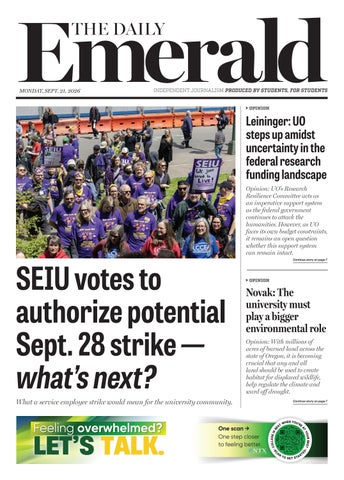
The Daily Emerald is published by Emerald Media Group, Inc., the independent nonprofit media company at the University of Oregon. Formerly the Oregon Daily Emerald, the news organization was founded in 1900. Emerald Media Group 1395 University St.,#302 Eugene, Or 97403 (541)-357-6569 (ON THE COVER) SEIU members march into Johnson Hall on the University of Oregon campus amid ongoing bargaining on May 15, 2026. (Tarek Anthony/Emerald)
(Alyssa Garcia/Emerald) University Health Services on East 13th Ave. is where many UO students and faculty receive vaccinations for COVID-19, influenza and other communicable diseases.
o u y r d n p i u F o rp se
.
Fin d your Y.
APPLY TODAY
WE’RE HIRING!
“I love the culture of the Y! It feels welcoming, happy, high energy and full of life.” —Y Staff
Eugene Family YMCA 541.686.9622 | eugeneymca.org
NEWS
DAILY EMERALD
Monday, Sept. 21, 2026
page 5
Residents voice concerns over data centers, public safety at city council meeting The Eugene City Council held its first meeting of the fall session, drawing over 70 community members for public comment. By Audrey Lynch
News Reporter
The Eugene City Council returned Sept. 14 from their summer break to a room packed full of residents. All members of the council, barring Ward 3 councilor Alan Zelenka, were in attendance. Mayor Kaarin Knudson expressed her appreciation for those in attendance, who would later share their thoughts during public comment.
Mayor Knudson’s proclamations Knudson then moved on to acknowledge the Fiesta Cultural and Cascade Chorus Barbershop Harmony Day events, which took place earlier this month. Knudson also highlighted the Society for the Legitimization of the Ubiquitous Gastropod Queen Celebration Week, which will take place Sept. 20 through 26. Following these proclamations, council members were given the opportunity to speak on items of personal interest. These comments largely regarded the 25th anniversary of 9/11. Ward 2 councilor Matt Keating read the words of a plaque he visited this summer at the United States Capitol building, which honors United Airlines Flight 93 and said, “May we never forget.” Randy Groves, councilor representing Ward 8, highlighted the annual stair climb hosted at Autzen Stadium by local firefighters in remembrance of first responders who died at the World Trade Center on 9/11. He spoke to his personal experience on that day as a former local firefighter and fire chief of Eugene Springfield Fire. “Our first priority, of course, was always to protect this community,” Groves said. Knudson closed by encouraging community members to reflect on their personal experiences regarding that tragedy. “It is important to think about what we do when we feel afraid and how we decide to walk into the future with courage and compassion,” Knudson said.
Dozens of public commentators speak to council Approximately 72 individuals were signed up to give public comments, while more spectated. The public comment period is restricted to 90 minutes or ending at 10 p.m., whichever comes first. Only 43 of those 72 were able to address the council before time expired. The majority of public comment was in response to a recent proposal to use the former Hynix site for a data center. Residents expressed everything from environmental concerns to personal beliefs as reasons for councilors to bar this land use. Many called for a moratorium, a legally authorized period of delay, which could allow for further public discussion and regulations to be put in place. However, Knudson revealed that this action would not be necessary since the construction of a data center at this site is already not allowed under city zoning regulations. In a Sept. 8 letter, the city outlined that the site is within an E-1 or Campus Employment zone, which does not currently list data centers as a permitted use for the land. Additionally, a city council work session is currently scheduled for Dec. 14 to discuss data centers in more detail. This letter’s content and city action were acknowledged by numerous public commentators as a step in the right direction, however, they still advocated for more work to be done. Theo Milligan, a resident of Ward 5, explained that Eugene’s nature and greenery are among its defining characteristics. Milligan expressed their belief that “a data center would be the antithesis of our entire community.” With the Willow Creek Preserve near the proposed site, they worry that a data center would poison the land, saying, “We cannot let this happen.” Later on in the public comment, Ellen Bridges, a lifelong resident of the Pacific Northwest, sang a song for the councilors.
2026 EUGENE CITY COUNCIL SCHEDULE SEPTEMBER
OCTOBER
1
2
3
4
5
1
2
3
6
7
8
9
10
11
12
4
5
6
7
8
9
10
13
14
15
16
17
18
19
11
12
13
14
15
16
17
20
21
22
23
24
25
26
18
19
20
21
22
23
24
27
28
29
30
25
26
27
28
29
30
31
NOVEMBER
DECEMBER
1
2
3
4
5
6
7
1
2
3
4
5
8
9
10
11
12
13
14
6
7
8
9
10
11
12
15
16
17
18
19
20
21
13
14
15
16
17
18
19
22
23
24
25
26
27
28
20
21
22
23
24
25
26
29
30
27
28
29
30
31
“I am going to sing out for the love of clean water, ... of clean air, (and) the freedom of silence,” Bridges said. They explained their belief that while data centers are not necessary, these things are for the health of a city. Finally, Bridges thanked the council and urged them to set a good example, ending their statement with, “The only data center that I want is a library.” Nate Rhoads, during their comments, cited NPR, which said that despite political polarization both the Democratic and Republican parties can agree on two things. “One: Dolly Parton was a saint. And two: the majority of voters ... opposed data centers in their communities,” Rhoads said. They went on to explain that as a constituent and a taxpayer, they are “somehow (the) boss” of council members, with Rhoads stating, “As one of your many bosses, I am telling you, just say ‘no’ to large-scale data centers.”
“
The only data center that I want is a library. Ellen Bridges Lifelong Resident of the Pacific Northwest
In addition to comments regarding data centers, residents also raised concerns about public safety and policing in Eugene. One resident shared the effects that losing the CAHOOTS program has caused. Jacob Trewe of Ward 1 said, “There is a clear and evident gap in public safety that needs addressing.” Trewe went on to cite a study by the Rohlfs Lab at the University of Oregon that showed that of the 235 calls that CAHOOTS used to cover, now 126 calls per week are being unaddressed. Eugene Neighbors Feeding Neighbors Board President, Lisa Levsen, spoke out regarding the policing in Washington Jefferson Park, where meals are served. “We have people who are afraid to come for meals because they don’t want to be arrested,” Levsen said. Levsen went on to urge councilors to create further conversation and positive change to “take care of our most fragile citizens.” The next Eugene City Council meeting will be held Monday, Sept. 28.
ON THE COVER
SEIU votes to authorize potential Sept. 28 strike — what’s next? By Sasha Love
Associate News Editor
Service Employees International Union local 503, which represents classified staff at Oregon’s seven public universities, voted to authorize a Sept. 28 strike with an overwhelming majority of 97% ‘yes’ votes. “Administrators (are) walking around on this campus making more than six figures, meanwhile our employees cannot even really afford rent. We continue to bargain but overwhelmingly our members said that if we can’t keep up with the cost of inflation, we will have to strike,” Melissa Unger, SEIU’s statewide executive director, said. If union leaders and university management don’t reach an agreement this week, the University of Oregon could see a strike coincide with the beginning of fall term. The union — which represents about 1,500 workers at UO — and Oregon’s public universities’ management have been bargaining for several months, but major disagreements over compensation remain unsettled. Union leaders have said that a strike would slow down campus life for the affected universities, but that members and their families need relief from hard decisions over which bills to pay as inflation rises. “We know it’s hard. We don’t want to do this for the students. But we have to think about our families too … I hope this is a fast strike not because I want to make it easier for administration, but we want to make it easier for the students we work for,” Jo Hickerson, the chair of SEIU Local 503’s bargaining team and an Eastern Oregon University lab worker, said. The universities’ management team said they “acknowledge and respect” SEIU members’ vote. The last time the union voted to authorize a strike was in 2019. That year, the union came just hours away from a strike and pay was similarly a major sticking point.
REPRESENTED UNIVERSITIES •
University of Oregon
•
Eastern Oregon University
•
Western Oregon University
•
Southern Oregon University
•
Portland State University
•
Oregon State University
•
Oregon Institute of Technology
Who are classified staff UO’s classified staff cover a variety of university responsibilities, such as custodial work, dining hall services, library staffing and technology support. Employees must pay dues to be considered union members. Temporary positions may fall under SEIU’s jurisdiction, but not always. Union leadership has said that lacking staff could mean reduced dining services and less “safe and secure” buildings across campus. “Our health workers are really concerned because … (custodians) keep things clean, but more importantly we keep things sanitary so you don’t catch a virus when you visit the washroom,” SEIU 503’s statewide president, Johnny Earl, said. Rieley Umphress, a UO delegate bargaining for SEIU, said that UO may only operate one dining hall for the projected incoming freshman class of around 5,500 students. The university management team and UO have not shared specific plans regarding how a strike may play out for the university community, but said it is engaged in “contingency planning.”
“Should SEIU ultimately decide to notify the OPUs that it intends to strike on a date certain, the OPUs will implement plans designed to continue student-centered services that provide a welcoming environment for our students,” Zakary Gosa-Lewis, a spokesperson for Oregon public universities, said in a press statement.
Sticking points at the bargaining table Union leaders have said they want to see pay more closely align with the rate of inflation. SEIU is proposing 3% raises in November 2026 and July 2027. The university management team is looking at 1.5% raises in November 2027 and 1% raises in November 2028. The consumer price index, an inflationary measure, is at 3.4%. Union leaders also want to maintain “step” raises for seniority throughout their entire contract, whereas the management team is proposing a step freeze during fiscal year 2027. “Salary step increases for eligible employees will cost the universities over $12 million in fiscal year 2027 alone. The temporary pause on steps between July 1, 2027 and June 30, 2028, will help with cost containment,” Gosa-Lewis said. Further, SEIU is bargaining for several economic-related measures beyond pay, including parking vouchers for lower-paid employees, inclement weather benefits and less expensive healthcare plans. The universities’ management team has said their benefits package, which includes healthcare and a “6% annual contribution” to employee retirement, is highly competitive. “Third party analysis shows (it) is the best of any public employees in all of the western states,” Gosa-Lewis stated.
Striker compensation
TIMELINE OF EVENTS Feb. 12: SEIU begins exchanging proposals in open bargaining July 21: SEIU begins “mediation” or bargaining with a third-party mediator to help move things forward Sept. 10: SEIU declares a strike authorization vote
According to UO’s SEIU President Jennifer Smith, pay would be a maximum of $80/day and $400/week for those on strike. The union also maintains a “hardship” fund for emergency or additional expenses, which members can apply to. Because of a recent change in legislation, employees on strike may also be eligible for unemployment benefits if they meet certain requirements. Employees who join a strike are not eligible for sick pay, compensatory paid leave or vacation pay that has not already been approved by their employer, according to the University Shared Services Enterprise website.
Sept. 14 & 15: SEIU members vote
Oregon’s university funding environment UO faces a projected budget deficit of $65 million amid lower non-resident enrollment numbers and a challenging state funding environment. As a result of these projections, UO has instituted a number of cost cutting measures, including over 100 faculty layoffs in fall 2025 and reductions in linguistics classes. According to UO’s website, employee salaries and benefits make up over 75% of UO’s education and general fund budget, resulting in tensions between administrators and employees. Other Oregon universities face similar funding landscapes. The state ranks 44th for higher education funding and the legislature has commissioned the Oregon Higher Education Coordinating Commission to re-evaluate the state’s needs and goals, potentially merging services and universities for “sustainability.” SEIU commissioned a study that pointed to a similar problem, which the HECC labeled as an “every campus for itself ” model.
Union action at UO is not new Most of UO’s labor force is unionized and disagreements mainly over pay and economic measures led UO’s Student Workers Union to strike in spring 2024, and faculty to nearly strike the same year. UO’s graduate student union is currently in mediation and has been holding “strike school” this month and providing strike FAQs through their Instagram account. The union and university management will hold another mediation session on Sept. 24.
Sept. 17: SEIU officially passes its strike authorization vote
WE ARE HERE
Sept. 28: SEIU may go on strike if an agreement is not reached
Sept. 18: SEIU delivers its intent to strike
OPINION
DAILY EMERALD
Monday, Sept. 21, 2026
Novak: The university must play a bigger environmental role By Shane Novak
Opinion Columnist
Walking to class at the University of Oregon, you’ll see lots of manicured lawns and ornate gardens designed to look clean and decorative. While these spaces may be aesthetically pleasing, they don’t function as habitat for the native wildlife that call the Willamette Valley home. This year, we’ve seen a record-breaking fire season, with 2.5 million acres burned as of Aug. 26. These fires, along with 90% of the state experiencing “moderate” to “exceptional” drought, serve as a stark warning of worsening climate impacts to Oregon. Against that backdrop, a campus full of ornamental plants looks like a mistake. Land that could be regulating the local climate, sheltering displaced wildlife and recharging groundwater is instead mowed, watered and left bare of ecological purpose. These choices, along with other activities that are causing worsening climate disasters, can point some toward the conclusion that humans are the problem, and that we must remove ourselves from the equation for environmental work to be fully effective. Student Sustainability Program Director Taylor McHolm argues otherwise. McHolm said that the idea that humans themselves are the problem for the environment “is incredibly dangerous.” Many indigenous communities continue to maintain their connection to the environment, with it being a “vital part of
their worldview and practices.” Our disconnection with the environment around us starts with these landscaped areas we live around. Emily Hamblen, UO’s campus natural areas steward, oversees roughly 30 acres of restoration work across the Willamette River and Millrace Natural Areas. “Our long-range goals are guided by the 20-year Willamette River Natural Area Management Plan and 5-year Millrace Natural Area Action Plan,” Hamblen said. “Our metrics are not focused on a specific number of plants or wildlife species. Instead, we are increasing the species density and diversity, which supports increased ecosystem resiliency.” Trees planted today will eventually create a canopy that shades future understory plantings and cools the water underneath them. Pollinator gardens, native plantings and “nurse logs and trees” left in place are examples of ways that landscaping has already changed for the better on campus. “Trees provide shade and reduce evaporation; stormwater improvements support wildlife, and healthy waterways and rivers; and pollinator plantings provide food and habitat for birds and other species,” Hamblen said. The case for restoration goes beyond ecology, too. McHolm argued that it reshapes how students relate to the place they live and study. Direct, physical contact with the land teaches something a classroom can’t.
“Seeing it up close, smelling it, getting it under your fingernails, picking a berry and popping it into your mouth can show us that we don’t necessarily need to be removed from our environment,” he said. “We can give to it in ways that it gives to us.” That connection builds community among those who take part in restoration work. Converting more of the university’s lawns and gardens into native, self-sustaining ecosystems is a chance to let the campus reflect both our surrounding natural environment that’s in need of desperate attention, and the student community that calls this place home.
page 7
Shane is a second year student studying political science and planning, public policy, and management. He’s interested in local transportation, housing affordability, and shifting cities away from car dependency, and he enjoys spending time outdoors.
(Sofia Campbell/Emerald)
Leininger: UO steps up amidst uncertainty in the federal research funding landscape Jack is an Opinion Columnist at the Daily Emerald and a fourthyear student studying journalism and computer science. He has a passion for creative writing, could talk for hours about Cormac McCarthy, and is always looking for new study spots in Eugene.
By Jack Leininger
Opinion Columnist
In spring 2025, the Department of Government Efficiency utilized ChatGPT to cut approximately 97% of appropriated humanities grants. This proposed termination would affect more than 1,400 National Endowment for the Humanities grants, totaling over $100 million.
(Calista Espino/Emerald)
The University of Oregon’s Research Resilience Committee was established by the Office of the Provost and the Office of the Vice President for Research and Innovation in summer 2025. The committee’s creation came in response to “significant disruption and uncertainty in the federal research funding landscape,” UO spokesperson Angela Seydel said. “The committee developed a set of guiding principles focused on supporting people, protecting research continuity and infrastructure, safeguarding time-sensitive research activities, and making data-informed decisions to sustain excellence across the university’s research enterprise,” The Office of the Vice President for Research and Innovation said. These guiding principles were employed when DOGE terminated Mattie Burkert’s $350,000 NEH grant to expand the London Stage Database, a free public archive documenting 140 years of London theater history. Burkert, an associate professor of English and Digital Humanities at UO, was able to continue a downsized version of her work through the committee’s bridge funding. In May 2026, U.S. District Judge Colleen McMahon ruled the mass termination unconstitutional, ordering the grants restored. It remains unclear whether individual awards like Burkert’s have been reissued. Burkert is continuing her work on the London Stage Database during a current research sabbatical, according to her out-of-office reply. The ruling, however, hasn’t stopped the federal government from levying attacks against the humanities. Trump’s FY2026 budget proposed eliminating the NEH, before Congress rejected the cut and funded the agency $207 million. The FY2027 budget again proposes eliminating the
NEH, the National Endowment for the Arts, and the Institute of Museum and Library Services. It is undeniable that the University took proactive measures by creating the Oregon Research Resilience Committee and establishing its Bridge Funding Support Program. At a glance, this appears to reflect a thorough appreciation of the humanities and researchers within the field. However, the program’s future is far from guaranteed. In June 2025, UO laid off 42 employees in the College of Arts and Sciences, then announced 20 faculty layoffs in September, as the university worked to close a $29.2 million budget deficit. According to United Academics, UO’s faculty union, several humanities departments were slated for elimination. The American Association of University Professors called on UO to drop the plans, and over 2,000 individuals signed a faculty union petition opposing the cuts. It is unclear whether the committee’s establishment constitutes an ideological shift in the treatment of the humanities or an attempt to make up for the university’s previous actions. The university has not shied away from making difficult decisions regarding the humanities when facing budget uncertainty. That uncertainty is exacerbated by UO’s ongoing $65 million budget deficit, which has already triggered a hiring and pay freeze affecting the entire university. Whether UO can sustain the Research Resilience Committee amid these constraints remains to be seen. When I reached out to the university for a statement on the committee’s purpose and whether it could be sustained amid budget cuts, the latter question went unanswered. For now, bridge funding feels more like a stopgap than a permanent solution.
ARTS & CULTURE/SPORTS
DAILY EMERALD
Monday, Sept. 21, 2026
page 8
ARTS & CULTURE
Outdoor Pursuits: How you can go backpacking for college credit Highlighting the unique outdoor pursuits credits offered at the University of Oregon. By Everette Cogswell
Arts & Culture Associate Editor
(Sofia Campbell/Emerald)
The University of Oregon offers several classes centered around outdoor recreation. From Wilderness Survival to Backcountry Cuisine, the Outdoor Pursuits courses are beginner friendly and will teach you everything you need to know about successful camping, hiking, bouldering and more. PEO 351 Backpacking is a course designed for students with little to no backpacking experience. The class prepares students for a three-day-long backpacking trip to the Oregon coast. However, in order to partake in PEO 351, one must take PEO 285 Wilderness Survival as a prerequisite for all backcountry oriented classes. Wilderness Survival is a two-credit once a week course that teaches students about proper clothing for comfort and safety, nutrition and hydration, map and compass, environmental injuries, weather, backcountry ethics and much more. “There was a lot more that I didn’t know about like what can happen when you’re in the backcountry and just basically the overarching theme of the class was just like so much planning needs to go into it,” Isabel Deumling, junior psychology major, said. “Everything needs to be planned out and you can’t really leave that much room for error.” After taking Wilderness Survival, those interested can embark in PEO 351 Backpacking, PEO 353 Backcountry Cuisine, PEO 356 Backcountry Navigation, PEO 362 Mountaineering, PEO 371 Snow Camping, PEO 392 Back-
country Survival and many other curriculums specific to outdoor adventures. The first step after taking Wilderness Survival, however, tends to be the backpacking course. With a three day trip typically around week eight or nine of the term, this class stands out as a unique physical education course offering. The class meets a few times before the outing, as well as afterwards. This past spring term, the class met during weeks one, seven and eight followed by the trip over Memorial Day weekend. “The trip was really cool, it was around the Tahkenitch Creek trailhead at the dunes,” Donovan Selfridge, junior linguistics and communication disorder sciences major, said. “The class and trip involve a lot of navigation off-trail so for most of the time we were bushwhacking, you have to consider the best path and where you are in conjunction with camp and how you’re gonna get past obstacles like thick bushes.” The course mostly covers topics surrounding gear, knots and compass navigation. It also shows students resources for accessing the correct gear and includes a fitness test for students to be able to go on the trip. The fitness test has two options: running two miles in under 20 minutes, or a hike on Mount Pisgah that must be completed in 30 minutes. “The course prepared me in terms of teaching me what kind of gear I need, as well as knots that helped me set up my tent in the sand,” Selfridge said. “I’m confident now that I can pack for a trip of similar scale on my own.” Additionally students are given a worksheet to complete that’s all about compass and map skills, a large component of the trip. Once these two tests are completed, students are able to attend the three day adventure. Trip attendees are accompanied by the instructor as well as student guides that lead groups through the route.
SPORTS
Five countries, one team Five Oregon volleyball players have traveled from four continents to find a new home in Eugene and compete for the Ducks. By Hannah Hiiva
Sports Writer
From Brazil to the Netherlands, Argentina, Serbia and Romania, the University of Oregon women’s volleyball team stretches far beyond Eugene and even the United States. Five of the sixteen players on the Ducks’ roster have international backgrounds, bringing different cultures, experiences, and volleyball journeys to the same court. Maila Ribeiro, Sjakkie Donkers, Valentina Vaulet, Iva Šucurovic and Dalia Vîrlan all traveled from different parts of the world before finding their way in Oregon. Ribeiro, a sophomore libero/defensive specialist from Rio de Janeiro, Brazil, is one of the five international players. Before coming to Oregon, she attended Arizona State University. Her journey from Brazil to the United States has taken her from one college volleyball program to another as she continues her career with the Ducks. Oregon head coach Trent Kersten praised Ribeiro’s experience, saying she “immediately raises the level of competitiveness and professionalism” in the gym. Donkers, a junior outside hitter from Brabant, Netherlands, also arrived at Oregon after beginning her college career elsewhere, having previously played at Gonzaga University. Kersten also had great things to say about Donkers: “What stands out about Sjakkie is how she’s succeeded everywhere she’s been; two conferences, two different environments and consistent growth throughout.” He also added that her “re-
silience and upward trajectory” fit what Oregon values. The international group also includes senior outside hitter Valentina Vaulet, from Córdoba, Argentina. Vaulet, who stands at 6-foot-1, previously played at the University of Michigan before transferring to play for the Ducks. “Valentina is a dynamic athlete who has proven herself as an opposite in the Big Ten, improving her game with each passing season. She brings an elite arm into our gym that goes along with her international experience and maturity,” Kersten said. Junior middle blocker Dalia Vîrlan also brings experience from the University of Pittsburgh, after making her trek across the pond all the way from Brasov, Romania. “Dalia brings elite size, international experience and a proven NCAA track record into our gym. She’s been part of two Final Four runs and understands the standard required to play deep into December,” Kersten said. Their backgrounds also represent the increasingly international nature of college athletics. Players from around the world come to the United States to continue their education while competing at a high level, creating teams that can bring together athletes who may have grown up thousands of miles apart. For Oregon, that means its volleyball team is made up of athletes with a wide variety of experiences and backgrounds, all coming together in Eugene. On the court, the differences between Brazil, the Netherlands, Argentina, Serbia and Romania disappear. The play-
INTERNATIONAL UO WOMEN’S VOLLEYBALL PLAYERS
#1
Maila Ribeiro
#3
Sjakkie Donkers
#8
Valentina Vaulet
#14
Iva Šucurovic
#17
Dalia Vîrlan
Rio de Janeiro, Brazil
Brabant, Netherlands
Cordoba, Argentina
Zrenjanin, Serbia
Brasov, Romania
ers share the same goal, helping Oregon succeed. But beyond the scoreboard, the five international Ducks represent something larger. Their journeys show how far volleyball can take an athlete, not only across a court, but also across borders and oceans.
PUZZLES
DAILY EMERALD
WEEKLY CROSSWORD 1
2
3
4
Guest Contributer Sarah Porter 5
10
11
12
13
14
page 11
Monday, Sept. 21, 2026
6
7
8
ACROSS
9
1 Brain scans that use magnets 5 Welcoming post-it note on leftovers in the fridge, say 10 The G in BFG 11 What your rich friends did in Aspen or Whistler
15
16
17
12 She’s raggedy, famously 13 A barista’s bread and butter
18
14 “Sorry... you’re cutting... Wifi... hear me”? 16 Canadian Rock duo with 1999 hit “Steal My Sunshine”
19
20
21
23 26
22
24 27
28
29
31
32
34
35
17 American singer-songwriter who dated Katy Perry, Taylor Swift and Jennifer Aniston 19 1999 psychological thriller starring Brad Pitt, with Letterboxd review “I’m not supposed to talk about it”
25
23 Artist that pickpockets 24 Fitzgerald nicknamed the “first lady of Jazz”
30
26 This green pond dweller that causes Eutrophication 30 You’re it!
33
31 Deceptive skirt 32 Famed Italian Plumber 34 “These” in Spanish 35 Harry’s was a lightning bolt
DOWN 1 Nicki who is the ‘Queen of Rap” 2 2011 Animated Western with Letterboxd review “I didn’t drink a single drop of water in solidarity to my anthropomorphic friends”
UNSCRAMBLE What do medieval guards experience while sleeping?
3 ___-n-out 4 Infectious disease...or a wedding invite? 5 Foreign Exchange Students visiting America might take this class, abrv. 6 Alias 7 “Log that on Letterboxd!” for this puzzle 8 English literature term referring to basic rhythmic structure of a line within poetry 9 Adam and Eve municipality 10 “Guy” antonym
1
4
8
3
2
6
3
8
1
7
5
4
6
2
9
1
6 9 4 5 3 7 8
7 4 9 2 1 5 3
4 1 6 3 2 8 7
1 7 5 8 9 4 6
6 2 5 7 9 8 1 4
4 1 9 8 2 6 7 3 5
8 7 5 3 1 4 6 9 2
By Nate W
4
3
3 9
Sudoku504
5
3
8
33 Heat wave luxury
2
2
4
29 Text msg
5
7
9
9
7
8
2
5
6
3
2
28 Aliens, abrv.
1
1
27 Sibling of Asexual, for short
3
4
25 Past
4
1
7
23 Detective’s assignment?
7
Sudoku504
22 Waldorf who dreamed of attending 18 Down
2
By Nate W
21 Super
8
9
9
20 Gold Minecraft brick
5
19 Looney Tunes closing- “Thats all ___!”
ANSWERS INMATE GRAVE HIKE SET
SUDOKU
KNIGHTMARES!
18 New Haven Ivy League School
MR I S E A T ME G I A N T S K I E D A N N D L A T T E L A G S L E N J OH NMA Y E R A A F I GH T C L U B CON E L L A A L G A E S T A G S K OR T MA R I O E S T O S S C A R
15 To do the Devil’s Tango, across the pond
Go off (text)book. Build real-world skills at AWS Builder Center for experience that you won’t find on a syllabus.