Corporate Maldives Feb 2026

Page 1


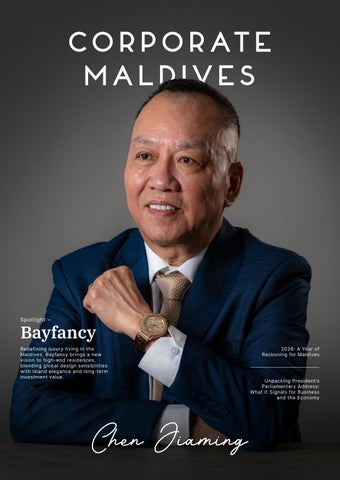
Spotlight –

Bayfancy

Redefining luxury living in the Maldives, Bayfancy brings a new vision to high-end residences, blending global design sensibilities with island elegance and long-term investment value.

2026: A Year of Reckoning for Maldives

Unpacking President’s Parliamentary Address: What It Signals for Business and the Economy

Chen Jiaming

GO DIGITAL GO SERVERLESS

Run your IT operations at Ooredoo Tier III ready Industry grade Data Center Facility

Chief Executive Officer

Akhmeem Abdul Razzaq

Chief Content Officer

Mohamed Khoorsheed

Chief Digital Officer

Ibrahim Areef

Chief Operating Officer Ahmed Nasir

Chief Creative Officer

Zaya Ahmed

Chief Design Officer

Hamdhoon W.

Chief Commercial Officer Raaya Abdulla

Chief Editor Nashama M.

Managing Editor Ibrahim Maiz

Content Manager Ali Rishfan

Managing Editor Ali Yoosuf

Marketing Manager Aminath Suha Mohamed

Marketing Manager

Maanee Mohamed

Assistant Editor Ahmed Shaif

Multimedia Journalist

Mahuroos Ismail Shafeeq

Multimedia Journalist

Fathimath Lamya Abdulla

Office Assistant Mohammad Ratan

Published by

Copyright c 2026 Orca Media Group. All rights reserved throughout the world. Reproduction in any manner is prohibited. Opinions expressed in the articles are of the authors and do not necessarily reflect those of the editor or publishers. While the editors do their utmost to verify information published they do not accept responsibility for its absolute accuracy. Materials in this publication may not be reproduced, whether in part or in whole, without the consent of Orca Media Group.

Email marketing@orcamedia.group

Website orcamedia.group

Address

Orca Media Group Pvt. Ltd

4th Floor, Ma. Oliveena

Chandhanee Magu, Male’ Republic of Maldives

Publisher’s Note

This issue’s Corporate Maldives Spotlight focuses on Bayfancy, a residential development that reflects a more deliberate approach to urban living in the Maldives. In an interview with Chairman Chen Jiaming, we explore the role of long-term thinking, engineering discipline, and delivery in a market where quality is increasingly defined by durability rather than display.

Beyond the Spotlight, this edition examines a country operating under growing pressure. Our Government and Economy section looks at the fiscal realities approaching in 2026 and the balance between ambition, accountability, and execution. In Climate and Technology, we explore how environmental vulnerability, regional challenges, and the rapid spread of artificial intelligence are reshaping policy, planning, and everyday life.

Across these pages, the stories reflect a Maldives navigating constraint while rethinking how growth, governance, and resilience are sustained over time.

Thank you for reading.

08

CORPORATE MALDIVES SPOTLIGHT: BAYFANCY

30 20

CORPORATE MALDIVES DATA

GOVERNMENT & ECONOMY

46

CLIMATE

TRANSPORT & CONSTRUCTION

54

HUMAN RESOURCES

BANKING & FINANCE

58 72

TECHNOLOGY & INNOVATION

FOREIGN POLICY TRADE

65 60 70 82 88

HUMAN RESOURCES

EDITORIAL

CORPORATE MALDIVES SPOTLIGHT

Bayfancy

With a career spanning more than 30 years across education, finance, hospitality and real estate, Chen Jiaming has built his work around capital discipline and long-term value rather than short-term returns. Now as Chairman of Bayfancy, he brings that philosophy to the Maldives at a moment when residential development is becoming more considered and complex. In this interview, Chen reflects on the principles that shaped his career, the lessons drawn from operating across multiple markets, and why Bayfancy represents a commitment to quality, delivery and long-term livability.

You have built a career spanning more than 30 years across education, finance, hospitality and real estate. Looking back, what first drew you into business in the early 1990s?

Your work has taken you across China, the Philippines, Malaysia, Singapore and the Maldives. How have these different markets shaped your perspective as a business leader?

When assessing new markets today, what factors matter most to you, and how did the Maldives perform against those benchmarks during your research?

Among the opportunities you explored, Bayfancy stood out as the right entry point. What about the project gave you confidence to take on a leadership role rather than remain a passive investor?

I entered business not for short-term profit, but out of a deep interest in capital discipline and long-term asset value. In the early 1990s, I saw that sustainable wealth is created by combining sound management with assets that meet real social and economic needs. Influenced by Confucian values, I believed it was more meaningful to empower others than to pursue success alone.

This belief led me to invest in vocational and technical education, particularly for young people who had not succeeded in China’s college entrance examinations. Providing them with practical skills and better employment opportunities was not only an educational mission, but also a way to help individuals build a foundation for life and contribute meaningfully to society. From the beginning, I chose industries that are resilient across economic cycles and avoided chasing quick profits. That same philosophy continues to guide my work today.

Every market has its own rhythm. China taught me scale and the importance of structure during periods of rapid growth. The Philippines and Malaysia showed me the value of cultural respect and regulatory balance. Singapore reinforced my belief in governance, financial transparency, and institutional discipline.

These experiences shaped a leadership style that balances strength with empathy, and places emphasis on building systems that are durable, disciplined, and people-centred.

I focus on three key factors: long-term stability, alignment between development policies and real economic needs, and the integrity of local partners. In the Maldives, I found a welcoming society, a clear national vision, and a commitment to managed economic growth.

I was impressed by the country’s openness, its emphasis on planned development, and the opportunities across tourism, marine product processing and export, and other emerging sectors. Most importantly, I observed a growing demand for highquality housing driven by people’s pursuit of a better quality of life. These indicators confirmed that the Maldives is a place where responsible investment can create lasting value.

Bayfancy was more than a project; it was a platform with longterm potential. Its architectural vision, respect for local context, and the professionalism and cohesion of its management team aligned closely with my standards.

My involvement provided strong financial backing to ensure the project remains on schedule and is delivered as promised. Beyond capital, I have worked closely with the team to further refine the final product, guided by a commitment to craftsmanship and quality. For more than 30 years, my business philosophy has been rooted in fulfilling commitments and delivering value, and I apply these principles to Bayfancy with the same discipline.

Residential development in the Maldives is entering a new phase, particularly at the luxury end. In your view, what defines a truly luxury residence in a small island nation?

A defining feature of your business legacy is financial discipline, including maintaining zero bank-loan liabilities across your companies. How does this philosophy shape decision-making in capital-intensive developments like Bayfancy?

Bayfancy is being positioned as an energy-efficient and carefully planned residential environment. How do sustainability and long-term livability factor into your approach to development today?

Looking beyond Bayfancy Residence, what role do you hope your investments and leadership will play in supporting the Maldives’ longterm development?

True luxury is not defined by materials or size alone. In an island context, it is about creating an integrated lifestyle that respects residents’ needs, connects with nature, and offers privacy, comfort, and peace of mind.

A luxury residence should demonstrate excellence in architecture, thoughtful spatial planning, and attention to detail. It must balance sustainability, functionality, and aesthetic value, while offering something residents feel proud to own, live in, and preserve for the future.

Financial discipline begins with rational decision-making and avoiding excessive pursuit of high returns. We maintain balance by prioritising sectors with stable cash flow and resilience across economic cycles, while keeping exposure to high-risk investments deliberately limited.

In capital-intensive projects such as Bayfancy, we commit real capital upfront and avoid pressure from short-term capital recovery or market fluctuations. This approach allows us to focus on long-term value rather than immediate returns, and to build trust with buyers and partners through delivery and consistency, rather than ambition alone.

Sustainability is no longer a trend; it is a responsibility. We do not build for handover, we build for decades. This means selecting durable materials, designing for energy efficiency and climate responsiveness, and creating living systems that are healthy and low-maintenance.

At Bayfancy, our focus is on shaping a lifestyle that is efficient, harmonious, and enduring. The goal is not simply to deliver homes, but to create a community that remains livable, valuable, and relevant over time.

I hope to contribute to raising standards in real estate development and to demonstrate what disciplined, long-term investment can achieve. Beyond Bayfancy, I intend to invest in areas such as education, training, hospitality, tourism services, and marine product processing and export.

These are sectors that generate employment, strengthen capabilities, and support sustainable growth. Ultimately, development must be rooted in partnership, mutual respect, and long-term thinking that serves future generations.

As the Maldives’ residential sector evolves, Chen Jiaming’s emphasis on discipline, planning and delivery offers a grounded perspective on sustainable development. His approach at Bayfancy places long-term value, engineering integrity and livability at the centre of decisionmaking, reflecting a broader belief that meaningful development is measured not by speed or scale, but by what endures over time.

Engineering Quality That Endures

Quality in residential development is established through discipline, planning, and execution long before a building reaches completion. At Bayfancy, engineering quality is approached as a structured process, guided by clear benchmarks, skilled workmanship, and consistent oversight across every stage of development. This approach reflects an understanding of the demands placed on high-rise residential buildings in the Maldivian environment, where durability and long-term performance are essential.

From the outset, strong emphasis has been placed on planning and construction discipline. Detailed scheduling, defined roles, and continuous supervision guide progress on site, ensuring that work is carried out with accuracy and accountability. Construction is supported by experienced teams, including specialists with international construction expertise, operating under technical oversight that prioritises workmanship and consistency. This structured approach allows quality to be achieved through methodical execution rather than reliance on finishes alone. Workmanship and finishing quality are treated as outcomes of process. International construction knowledge and professional standards inform how work is carried out, with practices adapted carefully to local climatic conditions. Attention is given to alignment, detailing, and sequencing across structural and finishing stages, ensuring control is maintained throughout the build. Ongoing inspection and follow-up form part of this process, reinforcing responsibility at each stage of delivery.

Material selection is approached as a supporting element within this engineering framework. Components are chosen based on performance, durability, and suitability for a coastal, highhumidity environment. In areas such as bathrooms, where hygiene and reliability directly affect daily living, internationally recognised sanitary systems have been specified to support long-term usability and ease of maintenance. Fixtures and fittings throughout the residences are similarly selected for durability and consistent operation under frequent daily use.

Building services are planned as coordinated systems rather than isolated features. Main living areas are served by centralised climate control, while service spaces operate independently to

support practical comfort and efficiency. Climate control, water heating, and kitchen systems are integrated to ensure dependable performance under sustained demand, reducing operational complexity while supporting everyday functionality across the home.

Surface finishes are specified with long-term protection in mind. Interior and exterior coating systems are selected for moisture resistance, durability, and the ability to maintain finish quality over time. Consideration is also given to indoor environmental quality, with selected solutions supporting healthier living conditions through low-odour and low-emission properties. In coastal settings, these protective measures play a critical role in preserving construction quality over the life of the building.

Beyond visible finishes, structural and façade systems are engineered to meet recognised international performance benchmarks. Door and window systems are specified to address wind resistance, water tightness, corrosion protection, and structural stability appropriate for high-rise residential environments. Hardware components across the building support safety, functionality, and consistent operation, contributing to reliability in everyday use.

Engineering discipline at Bayfancy extends beyond individual residences into shared spaces and building operations. Circulation planning, access control, and service coordination are structured to support clarity, security, and efficient movement throughout the building. These systems are designed to function together smoothly, ensuring operational stability while supporting daily routines.

Overall, Bayfancy’s approach to quality engineering is defined by disciplined planning, skilled execution on site, and consistent oversight throughout development stages. Materials and systems are selected to support this framework, reinforcing durability and long-term performance rather than defining quality on their own. The result is a residential environment shaped by engineering integrity, careful execution, and a clear commitment to reliability over time.

Luxury as a Lived Experience

Luxury, in residential living, is most clearly felt in how a home supports everyday routines. It is reflected in spaces that feel intuitive to move through, environments that remain calm throughout the day, and layouts that adapt easily to different moments of life. At Bayfancy Residence, luxury is approached as a lived experience, shaped by comfort, functionality, and ease rather than display.

Each residence is planned around real patterns of daily living. Layouts are designed to allow effortless movement between spaces, with open living and dining areas forming the centre of the home and more private zones set apart for rest and focus. This spatial clarity ensures that daily activities unfold naturally, without congestion or overlap, supporting both shared moments and personal retreat within the same residence.

Natural light and ventilation are integral to this experience. Homes are oriented and arranged to maximise daylight and airflow, creating interiors that feel bright, breathable, and comfortable throughout the day. Bedrooms benefit from soft morning light, living spaces remain well-lit without feeling exposed, and bathrooms receive natural sunlight that enhances comfort while supporting energy efficiency. These design choices contribute directly to wellbeing and ease of living.

Space allocation across each home reflects a careful balance between openness and privacy. Kitchens, living areas, bedrooms, bathrooms, and an additional multi-purpose room are proportioned to support modern lifestyles without excess. Open-plan kitchens connect seamlessly with dining and living spaces, encouraging interaction, while bedrooms are positioned to maintain privacy and quiet. Balconies extend the living environment outdoors, offering space to relax, socialise, or simply enjoy time in the open air.

Each of the eleven residences is individually positioned within the building, shaped by its orientation and relationship to its surroundings. Rather than repeating a uniform layout, every home follows its own spatial logic, giving residents a sense of individuality and a living environment that feels considered and personal.

Shared spaces are designed to complement daily life rather than sit apart from it. The residential lobby functions as a welcoming common area, combining seating, greenery, and soft lighting to create an environment where residents can pause, meet, or transition comfortably between home and city. Its double-height proportions and integration of natural elements contribute to a sense of openness and ease from the moment of arrival.

Above, the dedicated lifestyle floor offers a flexible shared environment that supports a range of daily activities. Fitness, leisure, work, and social spaces are brought together within a single level overlooking the Indian Ocean, allowing residents to move easily between routines without leaving the building. Panoramic views, open terraces, and thoughtfully arranged amenities create a setting that accommodates both activity and rest.

Social gathering areas, family-friendly lounges, quieter corners, and meeting spaces coexist within this level, ensuring that different needs are met without conflict. Whether used for exercise, focused work, time with family, or informal gatherings, these spaces are designed to support daily life as it naturally unfolds.

At ground level, outdoor gathering areas integrated with greenery further extend the living experience. These spaces encourage interaction while remaining relaxed and open, allowing residents to engage with neighbours or enjoy moments of calm at their own pace. Circulation and capacity are planned to ensure shared areas remain comfortable and accessible for all residents.

Day-to-day living is supported by professional property management, with experienced oversight ensuring shared spaces are well maintained and operations run smoothly. Security systems are integrated thoughtfully, prioritising safety while preserving ease of movement and a sense of openness throughout the residence.

Bayfancy’s location adds another practical layer to this lifestyle. Proximity to international schools and a nearby mosque supports family life, daily routines, and spiritual needs, allowing residents to remain connected to the wider community with minimal disruption. Life at Bayfancy is shaped by spaces that respond to everyday needs with clarity and care. From the way light enters a room in the morning to how shared spaces support work, rest, and connection, the living environment is designed to make daily life feel considered, comfortable, and balanced.

Principles That Guide Bayfancy’s Development

Every residential project is shaped by a framework of decisions that determine how it is planned, built, and ultimately lived in. At Bayfancy, development is guided by a set of principles that place long-term thinking, disciplined execution, and responsibility to people at the centre of the process.

A long-term development perspective informs how Bayfancy approaches each project. Planning decisions prioritise durability, relevance, and sustained performance, with attention given to how buildings will function over time rather than at the point of completion alone. This outlook influences structural planning, spatial organisation, and operational considerations, ensuring that residential environments remain dependable and relevant as needs evolve.

Responsibility is treated as a practical development principle. Decisions are made with accountability to homeowners, project partners, and the surrounding urban environment. At Bayfancy

Residence, this responsibility is reflected in the choice to maintain an exclusively residential development, preserving privacy and residential character while ensuring that essential services remain accessible through nearby, purpose-planned commercial facilities. Safety, quality, and privacy are addressed as core considerations throughout development.

Discipline in planning and execution provides structure and reliability across development stages. Clear roles, defined systems, and consistent oversight support progress control and risk management. Construction planning is supported by timely procurement, experienced teams, and established management processes. This approach has enabled steady progress against defined milestones and reflects a commitment to accountable delivery.

Respect for people and place shapes both design and development choices. Residential layouts are planned with consideration for

comfort, privacy, natural light, ventilation, and security, supporting resident wellbeing in everyday life. At the same time, the project responds to its location within Hulhumalé Phase 2, recognising the importance of integration with the surrounding community and sensitivity to local climatic conditions.

A people-centred living philosophy underpins how homes are conceived. Spaces are designed to support comfort, dignity, and ease across different stages of life, recognising that residential needs change over time. Layouts prioritise functional clarity and flexibility, while shared spaces are positioned to support community interaction without imposing it. This approach allows residents to engage with their living environment in ways that suit individual routines and preferences.

Trust is established through transparency and consistency. Bayfancy emphasises clear communication, realistic commitments, and visibility around development progress. Prospective buyers are kept informed of construction milestones

and timelines, reinforcing confidence through openness and follow-through. Accountability in delivery forms part of this trustbuilding process, supported by quality control and oversight at each stage.

An understated confidence guides how quality is expressed across the project. Decisions are informed by restraint, thoughtful detailing, and consistency, ensuring that development outcomes remain coherent and reliable. Attention is given to essential elements of planning, construction, and long-term operation, supporting a residential environment that performs as intended over time.

These principles collectively shape the way Bayfancy develops residential projects. They guide decision-making from early planning through execution and into long-term operation. At Bayfancy Residence, the result is a development informed by longterm responsibility, disciplined planning, and a clear commitment to the people who will live there.

Odoo is Powerful. Crowe makes it

Unstoppable.

Choosing a system is only half the journey. Choosing the right partner is what makes it a long term success. With Crowe, your Odoo implementation turns technology into measurable business value. Local statutory compliant setups. Tailored to your industry & workflows. Growth oriented solutions that scale with you. Contact us

The Maldives’ tourism sector has opened 2026 on firmer ground, with visitor numbers showing steady expansion in the first seven weeks of the year.

As of 21 February 2026, total arrivals reached 418,034, reflecting a 9.5 percent increase compared to the same period last year. February has been the stronger month so far, recording 190,836 arrivals by 21 February, up 15.2 percent year-on-year, indicating improved momentum within the peak season window.

Tourists accounted for 415,624 of total arrivals, while business travellers and cruise passengers represented a marginal share. Air travel continues to dominate entry flows, with Velana International Airport handling nearly all international arrivals.

Resorts remain the backbone of the sector, accommodating 68.2 percent of tourists, while guesthouses account for 26.8 percent. The distribution highlights the continued dual structure of Maldivian tourism, where luxury island resorts and local island guesthouses operate in parallel.

China leads source markets so far this year with 67,185 visitors, followed by Russia, Italy, the United Kingdom and Germany. The mix reflects a combination of returning European demand and sustained Asian market strength.

On the supply side, 1,279 tourist facilities are currently in operation, offering a total of 67,047 beds. Capacity growth remains measured, suggesting that the increase in arrivals is being absorbed within an expanding but controlled accommodation base.

With nearly half a million visitors recorded before the end of February, 2026 is tracking ahead of last year, setting the tone for the months ahead as the sector navigates the transition toward the mid-year period.

Maldives Financial Position - January 2026

Total Assets

Local Currency Financial Assets

Total Liabilities

Foreign Currency Financial Liabilities

Currency Financial Liabilities

Equity

JAN 2026

JAN 2026

The MMA’s financial position strengthened in January 2026, with asset growth outpacing increases in liabilities. Higher local currency assets and steady foreign reserve accumulation supported the balance sheet, while equity continued to improve modestly, pointing to stable liquidity management at the start of the year.

Inflation - 2025

Inflation is the percentage change in the general price level in the economy during a given period.

Inflation in the Maldives eased markedly through the second half of 2025, extending the downward trend that began in May. After peaking at 5.9% in April, inflation declined steadily to 4.6% in May and remained at 4.0% in both June and July, before easing further to 4.1% in August and 3.9% in September and October. The disinflationary trend accelerated sharply towards the end of the year, with inflation falling to 1.4% in November and just 0.4% in December. Earlier in the year, inflation had remained elevated, hovering between 5.4% and 5.6% from January to March.

The pronounced moderation in price pressures suggests a significant easing of cost dynamics, likely reflecting improved supply conditions and the dissipation of earlier increases in food and utility prices. While price levels remained higher than in late 2024 for much of the year, the sharp deceleration in the final quarter points to a more balanced domestic demand environment heading into 2026.

Import & Export 2025

Value in Millions - USD

Imports fluctuated through 2025, falling to a low of USD 255.55 million in June before rising to USD 316.63 million in August and increasing further to USD 346.04 million in December. Exports remained subdued, declining from USD 55.71 million in January to USD 25.47 million in June, before recovering to USD 50.22 million by November. Overall, the data suggests seasonal and pricerelated movements rather than a structural shift in trade activity.

MIRA - Revenue Collection

January 2026

Tax revenue collections rose sharply year on year in January, but still fell short of what had been projected, highlighting how monthto-month gains can mask gaps against budget expectations. The Maldives Inland Revenue Authority (MIRA) reported total revenue of MVR 4.45 billion for January 2026, inclusive of USD collections, alongside USD revenue collection of USD 180.42 million.

MIRA said January’s total represented a 33.1% increase compared with January 2025, attributing the rise mainly to stronger collections from Bank Profit Tax, land acquisition and conversion fees, and tourism sector GST. The authority also linked the performance to higher tourist arrivals in December 2025, which it said increased proceeds from Tourism GST, Green Tax, and airport-related taxes and fees. It further noted that an interim payment deadline for income tax fell within the period, contributing to higher Bank Profit Tax collections.

Despite the year-on-year growth, revenue was 4.9% lower than forecast. MIRA attributed the shortfall to lower collections from Corporate Income Tax, Tourism Sector GST, and Departure Tax. It also reported that 7.6% of monthly revenue came from payments related to past deadlines, while a further 25.9% was secured through targeted initiatives aimed at recovering outstanding dues.

The month’s revenue mix remained heavily concentrated in a few streams. GST accounted for 40.4% of total revenue, equivalent

to MVR 1,793 million, followed by Income Tax at 34.7% or MVR 1,541 million. Land acquisition and conversion fees contributed 6.1% (MVR 271 million), while Green Tax accounted for 5.0% (MVR 222 million). Airport Development Fee and Departure Tax contributed 4.3% (MVR 189 million) and 4.1% (MVR 181 million), respectively.

For USD revenue, Tourism GST made up the largest share at 44.3% (MVR 80 million), followed by Income Tax at 20.9% (MVR 38 million). Land acquisition and conversion fees contributed 9.8% (MVR 18 million), Green Tax 8.0% (MVR 14 million), and both Airport Development Fee and Departure Tax contributed 6.8% and 6.5% (MVR 12 million each).

MIRA’s longer-term comparison shows January collections have fluctuated over the past five years. Total revenue was MVR 2,378.2 million in January 2022, rising to MVR 3,402.2 million in January 2023 and MVR 3,615.0 million in January 2024, before easing to MVR 3,337.7 million in January 2025. January 2026 marked the highest total in that period at MVR 4,440.2 million, reflecting a stronger start relative to recent years.

The report also points to a continued role for enforcement and arrears recovery in monthly performance. Enforced collections totalled MVR 532 million in January, including MVR 306 million through reminder notices and MVR 96 million through reminder calls and emails. Installment plans accounted for MVR 71 million, dues clearance for MVR 51 million, and account freezing policies for MVR 8 million.

Consumer Price Index (CPI) - 2025

Inflation in the Maldives accelerated in 2025, with the All Groups CPI rising by +4.04%, compared to +1.40% in 2024, according to the Maldives Bureau of Statistics.

Price pressures were largely driven by sharp increases in the Tobacco and Araca nut group, alongside higher food prices. Meanwhile, housing and transport recorded overall declines compared to the previous year.

On an annual basis, the index excluding fish rose by +3.85%, while food and non-alcoholic beverages (excluding fish) increased by +3.98% in 2025.

Price Decreases Were Notable In:

The decline was mainly due to lower electricity unit prices (-9.98%), water-based paint (-3.24%) and cement (-3.00%), reflecting policy interventions and changing consumption patterns. This was partially offset by higher water disposal services (+8.59%) and water services (+5.99%).

Transport prices fell overall in 2025 compared to 2024. The decline was driven by lower prices for petrol (-4.66%), diesel (-2.15%), motorcycles (-4.52%) and domestic airfare (-0.71%). Higher international airfares (+2.29%) and vehicle cleaning services (+9.40%) partially offset the drop.

Prices in this category continued to trend downward due to regulatory measures and shifting consumer usage patterns. Mobile phones (-9.11%), mobile service unit prices (-6.99%), tablets (-6.47%) and computers (-3.96%) were key contributors to the decline.

In 2025, the Tobacco and Araca nut group recorded a substantial increase of 80.63% compared to 2024. The surge was mainly driven by higher import duties on cigarettes and increased demand following the government’s ban on the use, sale, and advertisement of vaping devices. Prices rose significantly for cigarettes in restaurants and cafés (+96.15%), cigarettes (+92.77%) and araca nut (+9.87%).

Food prices rose due to foreign currency shortages and currency pressures affecting imports. Significant increases were recorded in coconut (dry nut) (+61.42%), tuna curry cut (+24.74%), apples (+12.71%), frozen beef (+16.93%) and lettuce (+16.79%).

This was partially offset by lower prices for onion (-21.01%), frozen seafood (-7.60%) and pumpkin (-5.96%).

Fish prices increased primarily due to climate-related supply disruptions. Tuna curry cut (+24.74%), tuna (+14.21%), reef fish (+9.91%) and fish paste (+13.41%) were among the main contributors.

Health prices continued their upward trend in 2025. Higher prices for balm (+20.05%), general doctor outpatient services (+8.37%), and selected medicines contributed to the increase.

Decreased by 3.55%, mainly driven by lower cigarette prices (-3.86%) and aracanut (-2.08%).

Regional Differences:

The CPI increased by 0.65%, notably driven by restaurants and accommodation services (+4.55%), reflecting higher prices for lunch packs, coffee, short eats, and pasta meals. Conversely, the information and communication sector saw a decline of 2.59%, driven by reduced prices for mobile phones (-10.40%) and tablets (-16.11%).

Experienced a slight decline in CPI by 0.13%, despite a significant increase of 2.71% in food and beverages, particularly reef fish (+11.00%) and onions (+18.10%). A notable decrease occurred in tobacco prices (-17.71%).

Overall, January 2025 saw continued inflation driven by essential categories such as food and restaurants, while information and communication prices offered some relief. Regional differences persisted, with Malé experiencing higher overall inflation compared to the Atolls, driven largely by rising food service costs.

Maldives National Debt (2015–2025)

Annual Government Debt Figures (2015–2025)

SOURCES: Data is compiled from official Maldivian government sources – primarily the MINISTRY OF FINANCE (Debt Management Department reports and Fiscal Strategy documents) and the MALDIVES MONETARY AUTHORITY (MMA) statistical database

2026: A Year of Reckoning for Maldives

Maldives has a habit of turning tomorrow’s constraints into today’s politics. But 2026 is different, because the constraint has a date on it. In April 2026, the country faces a USD 500 million sukuk principal repayment. That is not a slow-moving trend, it is a calendar event. And it lands in an economy that already runs tight on foreign currency, where the state’s balance sheet is intertwined with state-owned enterprises, and where debt management has become less like long-term planning and more like continuous emergency plumbing.

Start with the plainest picture of where we are. By Q3 2025, public and publicly guaranteed (PPG) debt stood at about MVR 151.1 billion, around 129.9 percent of GDP. Most of that is central government debt, with domestic borrowing doing a lot of the heavy lifting, but external liabilities matter more than their share suggests because the binding constraint is dollars, not rufiyaa. In that same quarter, total PPG debt service cost was about MVR 3.6 billion, a reminder that even before the big maturities arrive, debt is already eating fiscal space.

Now widen the lens to the part that makes 2026 feel like a cliff rather than a slope. The World Bank’s Maldives Development Update points to external debt service obligations remaining above USD 1.5 billion in 2026, with the spike driven by “bullet repayments” including the USD 500 million sukuk and a USD 100 million private bond placement. That is the sort of number that rewrites the government’s degrees of freedom: it is not only about paying, it is about finding the foreign exchange to pay.

The IMF has been warning about this shape of risk. In its 2024 Article IV consultation material, it flags that external refinancing pressures are expected to peak in 2026, with rising amortisations and large interest payments making refinancing risk central to the story. In other words, this is not a one-off problem of a single maturity, it is a moment when several parts of the debt profile become due at once, in a country whose market access is constrained.

Here is the uncomfortable arithmetic that sits underneath the headlines. A small tourism-driven economy can run high public debt for a long time if it can reliably roll it over, if it has reserves that buy time, and if lenders believe reforms will eventually stabilise the trajectory. Maldives is under strain on all three. The World Bank notes that the Sovereign Development Fund’s liquid balance was estimated at around USD 80 million in July 2025, far short of what is coming due. That means the “we will set money aside” strategy, while sensible, is not yet remotely sized to the problem it is supposed to solve.

So what, concretely, must happen for April 2026 not to become a national stress test that spills into everything else? There are only a few pathways, and all of them have trade-offs.

One option is refinancing: replace maturing external debt with new external debt. But refinancing is not a neutral action. It depends on price and credibility. A country facing large near-term repayments and limited reserves is negotiating from weakness, which tends to mean higher coupons, tighter terms, or collateral-like structures that effectively pre-commit future revenues. When refinancing becomes the plan, the real question is whether the plan comes with a believable fiscal adjustment that convinces markets this is a bridge, not a treadmill.

A second option is external official support, whether through bilateral partners, multilateral institutions, or structured facilities. Maldives has already relied on rollovers and support mechanisms in recent years, including India’s rollover of a USD 50 million Treasury bill subscription in 2025, framed publicly as breathing space for reforms. But repeated reliance on rollovers also signals that the system is living close to the edge, and it does not eliminate the 2026 hump.

A third option is domestic financing. That is easier mechanically, because rufiyaa can be raised at home. But it does not solve the external payment problem unless it can be converted into dollars without draining reserves, and it can deepen the sovereignbank nexus. The World Bank points to increased exposure of the Maldives Monetary Authority and the banking sector to the sovereign, which is a polite way of saying the state increasingly borrows from institutions that are supposed to anchor stability.

A fourth option is adjustment: close the fiscal gap so the state needs less financing, leaving more resources to meet external repayments. In theory, this is the cleanest route. In practice, it is politically brutal because Maldives’ fiscal model has long been redistributive, using tourism-linked revenues to fund wages, subsidies, and public services across the atolls. The World Bank’s

framing is blunt: limited fiscal space can become a threat not only to the budget, but to household welfare, especially if adjustment is done suddenly, with arrears, or through blunt cuts to capital spending that then resurface later as higher costs and stalled projects.

This is where the debt story stops being only about finance and becomes about governance. The Q3 2025 debt bulletin shows a meaningful stock of sovereign guaranteed debt alongside central government debt, and the World Bank warns about fiscal risks from guaranteed and on-lent loans and pressures linked to stateowned enterprises. When SOEs borrow externally or accumulate obligations that the state is expected to backstop, the sovereign balance sheet becomes a mirror of the whole public sector, not just the budget. And that means “fiscal consolidation” cannot be credible if it ignores SOE reform, procurement discipline, and the quiet accumulation of contingent liabilities.

The deeper point is that 2026 is forcing a reckoning with a question Maldives has postponed: what is the country’s actual strategy for living within its external means? Tourism brings dollars, but the state’s external obligations are rising sharply, and import dependence is structural. If a government responds to a repayment spike primarily by deferring capital spending and building arrears, it may temporarily improve cash flow while eroding growth capacity and public trust. If it responds primarily through expensive refinancing without reforms, it buys time at the cost of making the next cliff higher. If it responds through abrupt subsidy removal without targeting, it risks pushing the adjustment costs onto households least able to bear them, creating political backlash that then derails the reform programme.

There is a way through, but it requires sequencing and honesty. First, publish and socialise a credible financing plan that matches the maturity calendar, not just optimistic revenue assumptions. Second, prioritise reforms that improve the state’s dollar position quickly: better targeting of subsidies, tighter control of discretionary spending, and practical measures to reduce leakages and arrears.

Third, treat SOE risk as sovereign risk, because markets already do. And finally, stop pretending this is only a 2026 problem. The IMF is clear that refinancing pressure peaks in 2026, which also means it is building in the years before and echoing in the years after.

If you want the simplest way to say it: Maldives does not just need to pay a bill. It needs to convince the people who lend it money, and the people who live under its policies, that the bill is part of a plan rather than a recurring surprise.

Maldives in 2025: An Economy Under Strain and a Presidency That Centralised Power

The Maldives closed 2025 grappling with two intertwined realities. The first was economic pressure that could no longer be softened by headline growth figures or tourism arrivals alone. The second was a steady consolidation of political authority under President Mohamed Muizzu, reshaping how power, decision-making, and accountability functioned within the state.

Taken together, the year revealed a country attempting to manage fiscal constraints while simultaneously centralising control in the executive branch, often at the expense of institutional balance.

Economic management dominated public discourse throughout the year. Government messaging frequently pointed to infrastructure investment, financial inclusion strategies, and long-term resilience. Yet beneath these ambitions lay persistent liquidity stress. Delayed payments by state-owned enterprises to suppliers became one of the most tangible economic issues faced by businesses, particularly small and medium enterprises. Companies reported carrying tax obligations and operational costs

without receiving funds owed by government-linked entities, creating a cycle of strain that rippled through the private sector.

Repeated announcements of payment deadlines reflected the seriousness of the issue, but also highlighted its structural nature. By the latter half of the year, the focus shifted from promises of clearance to discussions around regulatory adjustments and legal mechanisms. This shift suggested an acknowledgment that the problem was not one of timing alone, but of how public finances and state-owned enterprises were managed.

Capital expenditure told a similar story. While development plans were expansive, actual disbursements lagged. Infrastructure launches, including airport expansions and logistics upgrades, created visible milestones, but fiscal reports showed that execution remained uneven. The economy did not stall, but it moved cautiously, constrained by debt servicing, limited fiscal space, and reliance on external inflows.

Tourism, as ever, provided stability, but 2025 marked a quieter evolution. Rather than a surge of new developments, the year was characterised by ownership transfers, management changes, and portfolio reshuffling. Resorts increasingly appeared less as symbols of national expansion and more as mature financial assets within global hospitality networks. The sector remained profitable, but it no longer masked weaknesses elsewhere in the economy.

Alongside economic pressures, the structure of governance changed in subtler but more consequential ways. President Muizzu’s administration demonstrated a clear preference for centralised authority, often framing this approach as necessary for efficiency and discipline. Regulatory reforms and administrative decisions were frequently driven from the centre, reducing discretion at lower institutional levels.

Independent bodies and regulatory agencies continued to function, but their autonomy appeared increasingly circumscribed by executive priorities. Decisions that might once have emerged through broader consultation were more often communicated as final outcomes. This approach streamlined governance in appearance, but raised concerns about institutional resilience, particularly in moments of disagreement or policy failure.

Public administration reforms, including changes to long-standing regulations, were among the year’s more practical achievements. Rules surrounding vehicle deregistration, garage permits, and administrative bottlenecks were finally addressed, resolving issues that had lingered for years. These measures were widely welcomed, but they also illustrated the broader governing style of the year. Problems were solved decisively, but largely through topdown intervention rather than systemic reform.

Foreign policy in 2025 remained measured and pragmatic. Diplomatic engagements focused on trade, education, tourism, and multilateral participation. The Maldives maintained visibility without courting confrontation, reinforcing its position as a small state navigating regional and global forums through steady presence rather than ideological alignment.

By the end of the year, the shape of 2025 had become clear. The Maldives did not face economic crisis, but it operated under constraint. Growth existed, but so did fragility. Governance functioned, but with diminishing institutional independence. President Muizzu’s administration projected control and decisiveness, yet this consolidation of power raised questions about long-term accountability and balance.

2025 will likely be remembered not as a year of dramatic rupture, but as one where pressure accumulated. Economic stress tested existing systems, and political authority narrowed in response. The consequences of these shifts may not be fully visible yet, but the direction they set is likely to define the years that follow.

Fiscal Reform, Except for the People Who Wrote the Budget

The government’s 2026 state budget continues to signal fiscal strain despite claims of progress. Presented by Finance Minister Moosa Zameer, the record MVR 64.2 billion proposal comes at a time when international financial institutions warn that the Maldives remains at high risk of debt distress.

According to the World Bank’s latest update, debt service payments could consume up to 70 percent of government revenue by 2026, leaving limited fiscal space for essential sectors such as healthcare, education, and welfare. While the government maintains that fiscal discipline has been achieved through a reported budget surplus and timely debt servicing, data shows that the surplus largely reflects delayed capital spending rather than structural reform.

The government’s fiscal narrative centres on a 40-week budget surplus and higher reserve levels. However, official figures indicate that the surplus has declined sharply, from MVR 1.2 billion in June to just MVR 6.3 million by late October. The apparent surplus resulted primarily from under-execution of capital projects, with only MVR 4.2 billion of the allocated MVR 12.5 billion spent by late October.

At the same time, arrears have continued to accumulate. Government entities collectively owe billions to contractors, utilities, and healthcare providers. The National Social Protection Agency (NSPA) and Aasandha have outstanding payments exceeding MVR 1.15 billion to hospitals, clinics, and pharmacies. Despite these constraints, the 2026 budget increases allocations for private insurance to MVR 99 million, compared to MVR 55 million in 2025 and MVR 46 million in 2024. Expenditure under this budget line covers judges, ministers, MPs, and other designated officials, as well as state assets such as six military drones purchased last year. Insurance spending for ministers alone will double, from MVR 2.5 million this year to MVR 5.3 million in 2026. In contrast, funding for Aasandha remains unchanged at MVR 2 billion, despite service interruptions and continued arrears to healthcare providers. This stagnation comes as the national health insurance system faces operational and financial pressures, including hospitals abroad suspending services to Maldivian patients due to delayed payments.

The disparity between private insurance and public healthcare funding highlights a wider concern in fiscal prioritisation. Rather than strengthening Aasandha to improve accessibility, efficiency, and reliability, the state continues to maintain a dual system in which higher-level officials benefit from private coverage while the universal scheme struggles to remain solvent.

Internationally, comparable small states and developing economies have focused fiscal consolidation efforts on strengthening universal healthcare systems as a means of ensuring equitable access and containing long-term costs. The Maldives, however, appears to be moving in the opposite direction, expanding privileges for a limited group while maintaining flat funding for public health services.

While the government has pledged to achieve “macro-fiscal stability” through tighter revenue administration and debt management, key structural reforms remain pending. These include restructuring state-owned enterprises, rationalising subsidies, and improving efficiency in health and social spending— all of which were proposed in 2024 but have seen no substantive progress.

If fiscal reform is to take hold, analysts argue that it must begin with spending rationalisation that protects essential services rather than privileged entitlements. Redirecting non-critical insurance expenditure towards strengthening Aasandha, clearing arrears, and improving health system governance would send a stronger signal of commitment to equitable reform.

The 2026 budget, however, reflects the opposite: continued fiscal pressures, delayed reforms, and increased benefits for a select few.

Maldives Can’t Ignore the Deficit

Any Longer

There are years when the deficit is just a number in a budget book. And then there are years when it becomes the organising principle of the entire economy.

The Maldives appears to be entering the latter.

According to the Ministry of Finance, the approved 2026 budget projects a deficit of MVR 8.8 billion, roughly 7.1% of GDP. Interest payments alone are expected to exceed MVR 5 billion. In isolation, those figures are manageable. In combination with a heavy external debt calendar and constrained foreign exchange liquidity, they become structural.

The World Bank’s latest Maldives Development Update estimates total public and publicly guaranteed debt at nearly 127% of GDP in early 2025. External debt service obligations are projected at around US$900 million in 2025 and close to US$1.5 billion in 2026, including a US$500 million sukuk maturity. In an economy where gross reserves have at times covered less than a month of imports, those numbers carry weight.

This is why deficit reduction is no longer an abstract policy preference. It is becoming a macroeconomic stabilisation strategy.

The IMF’s 2025 Article IV assessment described restoring fiscal and debt sustainability as the country’s immediate policy priority. That language is unusually direct. It reflects a concern that growth alone will not close the fiscal gap quickly enough.

Tourism remains strong. Arrivals have recovered. The current account deficit is projected to narrow compared to 2024. But the structure of public finances has shifted over the past decade. Recurrent expenditure, debt service and transfers to state-owned enterprises consume a growing share of the budget. When capital expenditure is cut to produce short-term fiscal improvements, it risks simply postponing pressure rather than resolving it.

The fiscal debate in Malé now revolves around three unavoidable questions.

First, can growth outpace obligations? Structural reforms that deepen tourism value chains, expand non-tourism exports and improve productivity could broaden the tax base. But growth must be durable and diversified to materially reduce debt ratios.

Second, where can spending realistically adjust? Subsidy targeting, SOE reform and health scheme sustainability are frequently cited by multilateral institutions. These are politically sensitive areas. They are also fiscally significant.

Third, how should revenue evolve? Strengthening tax compliance and reducing leakages through MIRA may yield incremental gains. More structural tax adjustments, however, would require political consensus and careful timing in a cost-of-living sensitive environment.

What makes the current moment different is financing. Credit rating downgrades and higher global interest rates have narrowed the margin for policy error. External borrowing is more expensive. Domestic borrowing competes with private sector liquidity. Large bullet repayments compress timelines.

Deficit reduction in the Maldives is therefore less about ideological preference and more about sequencing risk. The state must refinance, repay and maintain confidence simultaneously. That requires credibility in fiscal planning.

The conversation is shifting from whether to consolidate, to how quickly and through which mix of measures. And in a small, open economy that imports almost everything it consumes, fiscal arithmetic inevitably feeds into exchange rate stability, business sentiment and household purchasing power.

The deficit is no longer a line item. It is a constraint shaping the next phase of economic policy.

Gov’t Outlines Policy on Import Duty and Fee Exemptions for Key Economic Activities

A new policy setting out how exemptions on import duties, royalties and revenue fees will be granted has been gazetted, establishing a structured framework for supporting activities considered economically significant to the Maldives.

The policy outlines how discretionary authority can be applied to grant full or partial exemptions for goods imported to initiate, implement or operate activities deemed beneficial to the national economy. It also provides for exemptions tied to public benefit during special circumstances, as well as for goods linked to strategic economic projects involving imports, exports or reexports.

Eligible exemptions extend to capital equipment, spare parts, raw materials and operational supplies connected to qualifying activities. The policy identifies sectors such as boat building and vessel repair, fisheries development, and agricultural inputs imported by small and medium enterprises as areas that may receive relief. Activities expected to reduce import dependency, expand exports, increase trade or employment, and generate foreign currency inflows are also included.

The framework further accommodates emerging sectors not yet established domestically, diversification initiatives and projects supporting SME growth, including those financed through

government backed loans or grants. Tourism related provisions allow exemptions for new investments and for capital expenditure or renovation work on existing projects where spending exceeds 25 per cent of the original investment value.

Geographic targeting is also incorporated. Materials imported for resort development in atolls with comparatively lower tourism activity including Haa Alifu, Haa Dhaalu, Shaviyani, Thaa, Laamu and Addu are eligible, alongside imports tied to halal tourism resort development. Marine fuel imported and re exported by licensed Maldivian businesses for bunkering foreign vessels is also covered.

The policy sets parameters on the scope and duration of exemptions and requires that any agreement by a state institution containing such provisions receive approval from the President’s Office. Regulations issued by the Ministry of Economic Development and Trade specify that applications may be submitted by entities registered under the Business Registration Act, as well as by local councils and state institutions.

The framework formalises how fiscal incentives can be applied across sectors while introducing clearer administrative procedures for approvals and oversight.

Unpacking President’s Parliamentary Address: What It Signals for Business and the Economy

Macroeconomic Position and Public Finances

President Mohamed Muizzu inaugurated the 2026 session of the People’s Majlis with a Presidential Address outlining the Administration’s economic priorities, policy intentions, and performance claims across public finance, business conditions, infrastructure, and labour.

While the address ranged across multiple sectors, several areas carry direct implications for businesses and the broader economy. The sections below summarise key themes as presented by the President, viewed through a corporate and economic lens.

The President said the Administration remains focused on reducing inherited debt while pursuing what he described as more resilient financial outcomes. He stated that official gross reserves have surpassed USD 1.13 billion, which he characterised as the highest level recorded to date.

According to the President, state revenue and grants increased by 12 per cent in 2025 compared to the previous year. Based on current economic performance, he projected total state revenue and grants for 2026 at MVR 40.4 billion. He also said the Government has secured USD 100 million in non-tax revenue expected to be received within the next 45 days.

The President further stated that foreign currency earnings reached USD 1.2 billion in 2025 and that new foreign exchange regulations resulted in USD 492 million being exchanged through the Maldives Monetary Authority over the year.

On fiscal management, he said the 2025 budget concluded without the need for a supplementary budget, describing this as a first in five years. He added that while the average budget deficit over the previous five years exceeded 9 per cent of GDP, the 2025 deficit is projected at 5 per cent of GDP. He also stated that the budget remained in surplus for the first 40 weeks of the year.

Government Payments and Business Liquidity

Addressing payment delays, the President said the Government disbursed MVR 6.3 billion to local businesses in 2025 for goods and services provided.

He also stated that MVR 882 million was disbursed to state-owned enterprises to settle long-standing unpaid obligations, which he described as legacy bills. According to the President, an additional MVR 1 billion was paid directly to clear SOE debts. These measures were presented as efforts to ease cash flow pressures faced by businesses supplying the public sector.

Macroeconomic Position and Public Finances

and Operating Costs Digital Payments and Market Access

The President said the Administration remains focused on reducing inherited debt while pursuing what he described as more resilient financial outcomes. He stated that official gross reserves have surpassed USD 1.13 billion, which he characterised as the highest level recorded to date.

According to the President, state revenue and grants increased by 12 per cent in 2025 compared to the previous year. Based on current economic performance, he projected total state revenue and grants for 2026 at MVR 40.4 billion. He also said the Government has secured USD 100 million in non-tax revenue expected to be received within the next 45 days.

The President further stated that foreign currency earnings reached USD 1.2 billion in 2025 and that new foreign exchange regulations resulted in USD 492 million being exchanged through the Maldives Monetary Authority over the year.

On fiscal management, he said the 2025 budget concluded without the need for a supplementary budget, describing this as a first in five years. He added that while the average budget deficit over the previous five years exceeded 9 per cent of GDP, the 2025 deficit is projected at 5 per cent of GDP. He also stated that the budget remained in surplus for the first 40 weeks of the year.

The President outlined several measures intended to reduce operating costs for businesses, particularly small and medium enterprises. He said the airport clearance period for imports has been extended from 80 hours to 124 hours, demurrage fees have been waived, and storage periods at Malé and Hulhumalé ports have been increased from five days to ten days.

He announced that registration fees for small and medium cafés and restaurants will be halved for the next two years. In addition, he said companies employing fewer than 20 expatriate staff will be exempt from annual quota fees from March 2026.

The President identified the absence of a secure online payment system as a major challenge for SMEs and said this would be addressed through efforts to facilitate the introduction of PayPal.

In this context, the President highlighted the launch of Swipe, a Maldiviandeveloped multi-currency digital wallet introduced by Bank of Maldives. He also referred to an agreement with Alibaba, which he said would enable Maldivian businesses to access a broader export market.

According to the President, 400 vendors affiliated with Authentic Maldives have been provided with a dedicated platform on Alibaba as part of this initiative.

Access to Finance and Targeted Support

Transport and Infrastructure Development

The President outlined several financing facilities aimed at addressing funding gaps in specific sectors. These include the Thijara Rashu Fathuru scheme for businesses engaged in local tourism, a vessel financing facility of up to MVR 500,000, and additional facilities of the same amount for content creators and film producers.

He said these measures are intended to expand access to finance for smaller operators and emerging industries.

The President said establishing an integrated transport network across land, sea, and air is essential to improving mobility, facilitating trade, and supporting economic growth.

He stated that multiple airport development projects are underway and that upgrades have enabled all operational airports to facilitate night landings. He also said integrated air connectivity services using Twin Otter aircraft began on 1 February, connecting southern atolls under the Integrated Development Zone.

The President added that seaplane services are being expanded to additional regions, including the commencement of flights to N. Velidhoo. On land transport, he announced plans to procure modern equipment for the Road Development Corporation by the end of April, which he said would allow projects to be implemented more efficiently across multiple islands.

He also stated that sand roads in islands with active local tourism will be upgraded with proper drainage systems.

Tourism Policy and Revenue Distribution

The President announced plans to develop at least 10 resorts through a stateowned enterprise over the next three years. He said a portion of profits from these resorts would be distributed equally to all Maldivian citizens in foreign currency on an annual basis.

He also stated that a new law will designate every Maldivian citizen as a shareholder in these resorts, with benefits expected to begin reaching the public by 2030.

The President declared 2027 as Visit Maldives Year and said the Maldives Monetary Authority forecasts tourism revenue of USD 5.6 billion in 2026. He added that the Government aims to increase tourist arrivals to 2.5 million. Further remarks included efforts to expand tourism, including Halal tourism, in underdeveloped atolls, and updates on tourism projects in Addu City.

Fisheries and the Blue Economy

The President said the fisheries sector had experienced prolonged neglect and that the Administration is working to restore its economic contribution. He identified limited cold storage capacity as a key constraint and said projects in eight regions are scheduled for completion within the next 15 months.

Fuel affordability was also highlighted. The President said fuel skids providing access to fuel at State Trading Organisation rates are being rolled out nationwide, following the inauguration of the first facility in R. Dhuvaafaru in December 2025. According to the President, payments to fishermen have been processed within 48 hours since December 2024, with more than MVR 1 billion disbursed under this arrangement. He also said measures are being introduced to support the yellowfin tuna industry, including subsidised fuel and the commencement of work on a modern packing facility in Hulhumalé.

The President stated that expanding the Fish Aggregating Device network remains a policy priority and said 41 FADs were installed last year. He also highlighted the establishment of a National Register of Fishermen, stating that all active fishing vessels have been registered.

Regional Development and Addu City

The President announced a three-year programme beginning in 2027 to support small and medium enterprises in Addu City, including special concessions and designated business areas. He said the initiative is intended to stimulate employment and position Addu as a future IT hub.

He also reaffirmed that the relocation of the commercial harbour to Thilafushi will be completed by November 2027, which he said would reduce cargo unloading times and ease storage pressures in Malé.

Labour Market and Employment

On employment, the President said policies implemented since November 2023 have resulted in the creation of 21,174 job opportunities, including 6,724 in the private sector. He stated that at least 25,000 additional jobs are expected over the next year.

He also announced that, effective from February 2027, only Maldivians will be permitted to work as cashiers. Addressing expatriate labour, the President said 11,496 undocumented expatriates have been repatriated since November 2023 and that operations to resolve the issue permanently will conclude by May 2027.

Haze Over the Maldives Highlights a Regional Pollution Problem

A spell of haze continues to affect parts of the Maldives, reducing visibility and impacting air quality. The episode has again drawn attention to a recurring feature of the northeast monsoon season: how pollution generated thousands of kilometres away can travel across the Indian Ocean and settle over small island states with little control over its source.

Meteorologists in the Maldives have attributed the haze to polluted air masses arriving from northern India and the Himalayan region, a pattern that scientists have documented for decades. During the winter months, prevailing winds and stable atmospheric conditions over South Asia can trap emissions close to the ground, allowing fine particles from transport, industry, power generation, household burning and, seasonally, agricultural fires to build up and then move downwind over the ocean. Research linked to the Maldives Climate Observatory at Hanimaadhoo describes the Maldives as a “receptor site” for long-range transport of pollutants, including what has been termed the atmospheric brown cloud.

That does not mean the Maldives is a passive bystander in every sense. Local sources like traffic, diesel generators, harbour activity and open burning can add to background pollution, particularly in densely populated areas. But the sharp, seasonal character of the haze, and the country’s geography far from major industrial belts, help explain why transboundary pollution is often the dominant driver during the northeast monsoon. Measurements and studies of the South Asian outflow over the northern Indian Ocean consistently show that wintertime aerosol loads are shaped by emissions transported from the subcontinent.

For the public, haze is not just an inconvenience or a spoiled skyline. It is a health issue because the most harmful component is often PM2.5, fine particulate matter small enough to penetrate deep into the lungs and enter the bloodstream. The World Health Organization links particulate exposure to cardiovascular and respiratory disease risks and has steadily tightened its guideline levels as evidence has grown. Even when air quality readings fall short of emergency thresholds, repeated episodes can still matter for vulnerable groups, including children, older people, and those with underlying heart or lung conditions.

Haze can also carry economic and operational consequences. Reduced visibility affects aviation procedures and marine navigation, while perceptions of poor air quality can sit uneasily alongside the Maldives’ image as a pristine, open-air destination. The larger concern is what these episodes reveal about the region’s shared exposure: a country can meet domestic environmental goals and still face pollution that arrives on the wind.

If there is a policy lesson for the Maldives, it may be that air quality is not only a national issue but a diplomatic one. South Asia already has a regional framework that, at least on paper, anticipates this challenge. The Malé Declaration on Control and Prevention of Air Pollution and Its Likely Transboundary Effects for South Asia, adopted in 1998 under the South Asia Co-operative Environment Programme (SACEP), was created to encourage monitoring, information-sharing and cooperative action on crossborder air pollution. In practice, its visibility in public debate has been limited, and its ambitions have often been constrained by the wider politics of regional cooperation.

A more credible regional approach would treat haze the way the region increasingly treats cyclones and disease outbreaks: as a shared risk requiring shared systems. That could include coordinated seasonal forecasting and early-warning advisories, common standards for monitoring stations and data transparency, and practical cooperation on the biggest emission sources. In South Asia, that often means sustained work to cut wintertime PM2.5 at the source through cleaner industrial fuels, tighter vehicle and power-plant controls, and alternatives to open burning in agriculture and waste management, paired with financing and technology support that make compliance realistic rather than symbolic. Scientific institutions like ICIMOD, alongside UN agencies and regional bodies, could help anchor the work in shared evidence rather than national blame.

For the Maldives, the immediate advice during haze episodes remains simple: reduce exposure when air quality worsens, especially for high-risk groups. But the longer-term answer lies beyond national borders. The haze that drifts over the atolls each dry season is, in effect, a reminder that for small island states, environmental security is often inseparable from regional cooperation.

The Mirage of Sustainability: Can SEZ Townships Deliver What They Promise?

When the Maldives amended its Special Economic Zones Act in late 2025, it introduced a new category of mega-development known as the sustainable township. These projects are conceived as self-contained islands that combine tourism, housing, healthcare, education, and commercial activity. Each must attract at least USD 500 million in investment. Each must generate most of its energy from renewable sources and handle its own waste and utilities. The law presents them as islands that would run almost independently, with sustainability embedded into their foundations.

What is easy to miss in the promotional language is that the responsibility for building all this does not sit with the government. It sits almost entirely with private investors. The state sets the requirements, but it is the developer who must design, fund, and operate the systems that make a township sustainable. The role of the government becomes one of oversight rather than construction.

In theory, this arrangement should be efficient. Investors bring capital and expertise, while the government offers land, status, and regulatory incentives. The problem is that genuine sustainability in the Maldives demands more than a checklist. It requires enforcement, auditing, technical capacity, and long-term monitoring. That burden falls squarely on the state, and this is where the risks gather.

Energy is the clearest example. The law says a township must produce most of its power through renewable sources. For an isolated island, this means extensive solar fields, high-grade storage, maintenance teams, and constant monitoring. An investor might install the panels and batteries, but it is the government that must verify the energy mix. Without consistent and credible oversight, the requirement becomes little more than a claim on a brochure.

Waste management follows the same pattern. Investors are expected to handle all waste and wastewater on-site. This is ambitious in a country where even the capital region continues to face waste challenges. If a private developer cuts corners, the consequences reach beyond its island. Waste can travel by sea, leach into groundwater, or create smoke that drifts across atolls. A

sustainable township that manages its waste poorly affects people and ecosystems far beyond its boundaries. Regulation therefore becomes as important as construction.

Food production introduces similar tension. The amendment gestures at local food production as part of sustainability, but the Maldives has limited land and harsh agricultural conditions. A developer may introduce small-scale hydroponics to check the box, yet the scale would almost certainly fall short of meaningful food security. Again, it is the government’s responsibility to define what counts as compliance and to measure whether the promise matches reality.

The social dimension adds another challenge. These townships target high net worth investors and long-stay visitors. Sustainability risks becoming a luxury feature rather than a public good. A development that advertises green credentials may still function as a private enclave with limited integration into the national economy. Unless rules on employment, services, and local access are monitored carefully, the township could create more separation than benefit.

All of this returns to a simple truth. The investor builds the physical structure, but the government must uphold the idea. Sustainability is not a switch that investors can turn on. It is a regulatory system that must be enforced continuously, especially in an environment where infrastructure is dispersed and fragile. Without strong monitoring, the townships may achieve their architectural ambitions while falling short of their environmental ones.

The sustainable township model offers a vision of a Maldives that is diversified, modern, and green. But visions require grounding. For the model to succeed, the government must develop the capacity to inspect energy systems, test waste facilities, audit environmental reporting, and hold developers accountable over decades. Otherwise, sustainability may become a decorative label rather than a lived reality.

The mirage appears credible from a distance because the concept is appealing. The real work begins when the first township is approved and the country must decide whether it is building sustainable islands or simply the appearance of them.

How Climate Pressures Are Influencing Malé City’s Urban Planning

Climate vulnerability has emerged as a central force shaping longterm infrastructure planning in Malé City, according to the Malé City Council’s Voluntary Local Review (VLR) 2025. The report, which assesses the capital’s progress towards the United Nations Sustainable Development Goals, outlines how rising climate risks are influencing decisions on urban development, public services, and capital investment in one of the world’s lowest-lying cities.

The VLR notes that Malé faces existential threats from sea level rise, with most of the city sitting barely one metre above sea level. Based on current projections cited in the report, nearly 95 percent of the city’s land area could be at risk of flooding by 2100, placing significant constraints on how and where future development can occur. These risks, combined with extreme population density, have pushed climate resilience to the forefront of urban planning.

One of the most prominent responses highlighted in the review is the strategic shift towards land reclamation and planned urban expansion. Hulhumalé was developed as a reclaimed island elevated to around two metres above sea level, double the height of most natural islands. The report frames Hulhumalé as a climate-resilient urban hub intended to ease congestion in Malé while providing a safer platform for housing, transport networks, and public utilities over the long term.

The review also draws attention to weaknesses in Malé’s drainage and sanitation systems, many of which are more than four decades old. Frequent heavy rainfall regularly overwhelms existing infrastructure, resulting in flash flooding and damage to homes and businesses. In response, long-term planning priorities now include the modernisation of stormwater drainage, with projects such as the Maldives Urban Development and Resilience Project aimed at improving flood management and reducing climaterelated displacement.

Water security features prominently in the VLR’s assessment of infrastructure vulnerability. Saltwater intrusion and pollution have rendered groundwater unusable, leaving the city almost entirely dependent on reverse osmosis desalination for drinking water. While this has ensured supply, the report notes the high energy costs involved. As a result, planners are focusing on expanding water storage capacity and piloting desalination systems powered by renewable energy to limit environmental impacts and exposure to fuel price fluctuations.

Energy demand is another area shaped by climate conditions. The VLR highlights how dense construction and limited vegetation cover, estimated at less than three percent, have intensified the urban heat island effect. Real-feel temperatures frequently reach

35 to 40 degrees Celsius, driving up electricity consumption for cooling. This has reinforced the need for grid upgrades and accelerated investment in renewable energy, including solarlinked infrastructure at sites such as Velana International Airport. The report also points to the importance of incorporating green and open spaces into urban design to reduce heat stress.

Transport connectivity is similarly framed through a climate lens. Ferry services, which remain vulnerable to rough seas and tidal conditions, are increasingly supplemented by fixed links. The VLR references infrastructure such as the Sinamalé Bridge and the ongoing Greater Malé Connectivity Project as key investments intended to ensure reliable movement between islands, support economic activity, and encourage decongestion of the most exposed and overcrowded areas.

Institutionally, the report suggests that climate vulnerability has reshaped the role of local government. The Malé City Council has moved beyond routine municipal services to take on a broader role in resilience planning. The council’s 2026 to 2030 Strategic Action Plan embeds climate resilience as a core investment pillar, alongside the development of a City Disaster Management Plan and participation in global initiatives such as Making Cities Resilient 2030. According to the VLR, these frameworks are intended to ensure that future infrastructure spending is guided by evidence-based risk assessments rather than short-term needs.

Together, the findings of the Voluntary Local Review 2025 present climate vulnerability not as a future concern, but as an immediate and defining factor in how Malé City plans its infrastructure, allocates resources, and prepares for long-term urban survival.

BBNJ Treaty Enters into Force as Maldives Reaffirms Commitment to High Seas Protection

The Biodiversity Beyond National Jurisdiction (BBNJ) Treaty has entered into force, marking a significant moment in global ocean governance with the adoption of the first legally binding international framework dedicated to protecting biodiversity in the high seas.

The high seas account for nearly two thirds of the world’s ocean and lie beyond the jurisdiction of any single country. Despite their ecological importance, these areas have long been governed by fragmented rules under existing international law, leaving marine ecosystems vulnerable to overexploitation, pollution, and emerging activities such as deep sea mining. Negotiations on the BBNJ Treaty, conducted under the auspices of the United Nations, sought to address these gaps by creating a comprehensive framework for conservation and sustainable use.

In a statement shared on social media, the Ministry of Tourism and Environment described the treaty’s entry into force as a historic milestone in ocean governance. The Ministry said the agreement represents a major step forward in safeguarding biodiversity in the high seas and reaffirmed the Maldives’ commitment to marine conservation through multilateral cooperation.

The treaty introduces mechanisms to strengthen global cooperation on ocean protection, including the establishment of marine protected areas in international waters, requirements for environmental impact assessments for activities that may affect high seas ecosystems, and frameworks for sharing benefits derived from marine genetic resources. These measures are intended to balance conservation with sustainable use, particularly for developing and small island states that depend heavily on healthy ocean ecosystems.

Minister of Tourism and Environment Thoriq Ibrahim also welcomed the treaty’s entry into force, stating that the Maldives celebrates the achievement as an important advance in ocean governance and biodiversity conservation. He reiterated the country’s commitment to protecting the high seas, strengthening marine protected areas, and safeguarding marine ecosystems and resources through international cooperation.

For the Maldives, a low lying island nation highly dependent on the ocean for food security, livelihoods, and economic activity, the BBNJ Treaty carries particular significance. The agreement aligns with the country’s long-standing advocacy for stronger international action to protect marine ecosystems, recognising that threats to biodiversity beyond national boundaries ultimately affect coastal and island states.

The entry into force of the BBNJ Treaty is widely seen as a turning point in global ocean governance, shifting the focus from voluntary cooperation to binding commitments. For countries like the Maldives, it reinforces the principle that protecting the high seas is a shared responsibility and a necessary step toward ensuring the long-term sustainability of the world’s oceans.

HUMAN RESOURCES

Why Targeting the Workforce the Maldives Relies On May Backfire

Nationalism is often sold as protection. In practice, it frequently begins with classification, moves into suspicion, and ends with exclusion. In small economies, especially those that rely on mobility, services, and openness, that progression rarely stops at rhetoric. It reshapes policy.

Over the past weeks, the Maldives has entered that progression decisively.

Foreign worker quotas are being phased out across a wide range of professions, including nurses, teachers, engineers, pilots, accountants, beauticians, and dive instructors, with timelines

ranging from two to five years. At the same time, police and immigration authorities have begun a nationwide programme to stop and question expatriates found in public spaces between midnight and six in the morning, following a directive announced by President Dr Mohamed Muizzu on social media. On the first night of the programme, 23 expatriates were questioned. One was arrested for violating existing laws and handed over to Immigration.

The government describes these actions as regulation and enforcement. Taken together, they represent something more coherent and more troubling: the steady normalisation of a

worldview in which expatriates are no longer treated primarily as workers within an economy, but as a social problem to be managed.

This shift matters because the Maldives is not an economy that can function on symbolism alone. Census-based data shows that roughly one in four people living in the country is a foreign national. Expatriate workers dominate employment in tourism and construction, the two sectors that generate income, foreign exchange, and infrastructure at scale. Healthcare, education, logistics, and technical services rely on smaller but indispensable pools of foreign professionals. These are not marginal roles that can be substituted casually. They are embedded in how the country operates.

Localisation is a legitimate policy goal. But localisation without capacity is not policy. It is theatre.

Nursing cannot be replaced on a political timetable. Teaching cannot be scaled without years of training, mentoring, and retention. Aviation and marine professions operate under international licensing regimes that do not bend to domestic sentiment. Even service roles such as beauticians or guest relations officers persist not because employers prefer foreigners, but because demand exists and supply does not meet it consistently.

The revised expatriate employment regulation illustrates the problem clearly. After initial backlash, baby sitters were quietly removed from the phase-out list, an implicit acknowledgement that some decisions were made without basic labour market logic. Yet nurses, teachers, and pilots remain on the clock. The state reserves the right to revise lists again, which suggests awareness that labour availability may not cooperate with ideology. What remains unaddressed is the disruption risk during the interim.

Alongside labour restrictions, enforcement has taken on a distinctly performative character. Police are not stopping people because they are committing offences. They are stopping them because they are expatriates, in public, at certain hours. Behaviour becomes secondary to identity. This is not neutral law enforcement. It is profiling, justified by vague appeals to social norms.

That distinction is important. Illegal employment, proxy ownership, labour exploitation, and undocumented migration are real problems. They deserve serious enforcement. But enforcement aimed at illegality looks very different from enforcement aimed at visibility. When the state instructs police to question people based on who they are rather than what they are doing, it crosses from regulation into suspicion.

This is how nationalism hardens.

Extreme nationalism in small states often presents itself as defence of sovereignty and social order. In practice, it reframes structural economic challenges as cultural ones. Labour shortages become moral failings. Regulatory gaps become character flaws. Foreign workers stop being inputs in a production system and start being treated as contaminants.

The Maldives is not unique in facing these pressures. Small island economies across the world rely on migrant labour to sustain tourism, healthcare, and infrastructure. Those that function best do not deny this reliance. They manage it. They regulate entry, enforce standards, protect workers, and require skills transfer, while accepting that openness is not weakness but necessity.

What makes the current Maldivian moment distinctive is the convergence of labour policy, policing, and rhetoric. Biometric data has now been collected from more than 191,000 expatriates, with deportation threatened for non-compliance. Illegal businesses are being shut down in large numbers. Quotas are being cancelled. Night-time questioning is being normalised. Each step is defended as reasonable. Together, they create an atmosphere in which foreigners are constantly reminded that their presence is provisional and suspect.

Opposition figures have begun to articulate the concern more bluntly. Meekail Naseem, an opposition MP, described the policy direction as xenophobic and warned that it signals an erosion of civil liberties that will not stop with migrants. That warning should not be dismissed as partisan exaggeration. History suggests that when states normalise selective policing and identity-based suspicion, the boundary of who counts as suspect rarely stays fixed.

There is also a quieter cost that nationalism rarely accounts for. Economies do not respond to mood. They respond to capacity. When staffing gaps widen, service quality declines. When professionals leave, systems strain. When investors perceive unpredictability in labour access, they hesitate. None of this announces itself immediately. It accumulates.

The irony is that the Maldives is attempting to assert control over a workforce precisely because it is indispensable. That is not strength. It is misdiagnosis.

A serious labour policy would separate illegality from identity, enforcement from spectacle, and localisation from deadline politics. It would acknowledge that expatriates are not a temporary inconvenience, but a structural component of the economy the country has chosen to build.

Nationalism promises order. What it often delivers, instead, is fragility.

Performance Reviews Are Changing Fast. Here’s What Employers Should Keep, Drop, and Measure Next

The old rhythm of performance reviews, a once-a-year meeting built around a score and a salary conversation, is steadily losing credibility across many workplaces. Global research and practice have moved towards more regular, lighter-touch check-ins that focus on clarity, coaching, and problem-solving in real time. In small labour markets like the Maldives, where relationships matter and teams can be tight-knit, the shift is not just a management trend. It is a practical response to how quickly priorities change, how hard it is to hire and keep good people, and how risky it can be to discover performance issues only when frustration has already built up.

What is increasingly seen as outdated is not feedback itself, but the idea that performance can be fairly captured through a single annual rating. A widely cited example from the corporate world is Deloitte’s redesign of performance management, which questioned traditional ratings and pushed managers towards frequent judgement calls and coaching conversations aimed at improvement rather than paperwork. More recent guidance from organisations such as CIPD also points to the limits of infrequent, formal review meetings and makes the case that the quality and timing of feedback matters more than the ceremony of the appraisal.

For Maldivian employers, this matters because a “late discovery” model is expensive. Many businesses, particularly in hospitality, construction, retail, logistics, and professional services, run on tight schedules and seasonal or project-based workloads. If an employee is underperforming, the cost shows up quickly in guest experience, rework, delayed handovers, and stress on colleagues. Waiting months to address it is not efficient, and it is rarely fair to the employee either.

A better question than “How do we rate people?” is “What evidence should we gather, consistently, so performance is visible?” The strongest modern systems tend to measure outcomes, observable behaviours, and growth. Outcomes are the easiest to understand, things like sales closed, cases resolved, campaigns delivered, errors reduced, or on-time completion. But outcomes need context, because not every role has clean numbers and not every month has the same conditions. That is why organisations increasingly pair results with leading indicators that show whether someone is doing the right work in the right way, such as responsiveness, reliability, quality checks, customer feedback, safety compliance, and teamwork. CIPD’s evidence review on feedback stresses that what works is specific, timely feedback that people can act on, rather than vague judgements delivered long after the fact.

In the Maldives, there is also a legal and operational reason to get this right. Employment decisions, especially termination for poor performance, are safer and more defensible when employers can show reasonable cause and demonstrate that steps were taken to address performance gaps. Maldives’ Employment Act sets out that dismissal should be tied to appropriate cause, and points to the need for measures such as discipline or upgrading skill deficiencies before dismissal for performance-related issues. A modern performance system, done properly, doubles as a fair process for the employee and a clear record for the employer.

Where AI enters the picture is in how organisations collect signals, summarise patterns, and support managers to make better judgements without drowning in admin. HR teams globally are already using AI to analyse review data for trends, help employees prepare for reviews, and even identify potential bias in evaluations, according to SHRM’s research on AI adoption. Separately, the OECD has warned that “algorithmic management”, where software influences scheduling, monitoring, and performance decisions, is spreading and can bring productivity benefits but also real risks, including privacy concerns, intensified work pressure, and unfair outcomes if governance is weak.

That warning matters in the Maldivian context because the workforce is diverse, with many businesses relying on expatriate staff alongside Maldivians, and because power dynamics can be sharper in smaller organisations. If AI tools are used to summarise performance, managers should treat them as assistants, not judges. A practical rule is that AI can help with consistency and insight, but final decisions must remain human, explainable, and grounded in evidence that an employee can understand and respond to. Worker trust is easily lost if people feel they are being scored by a system they cannot question. SHRM has also highlighted concerns that workers expect transparency about what data is used and want the ability to correct errors, especially as organisations adopt more data-driven HR practices.

There is also the data question. If a business is collecting more performance data, from customer comments to productivity dashboards, and then feeding that information into AI tools, it raises privacy and governance issues. A UNDP policy note on the Maldives’ digital landscape points to a Privacy and Personal Data Protection Bill being in draft form, alongside existing rights frameworks. Even before any new law fully takes effect, good practice is straightforward: collect only what is relevant, keep it secure, limit access, and be open with employees about what is tracked and why.

The future of performance review is less about a single “review” and more about a simple operating system for performance. The most effective direction is a rhythm of regular check-ins, clear goals that can be adjusted, and coaching that helps people improve while work is still underway. Gartner’s performance management guidance also frames this as moving towards a more flexible and sustainable approach that supports performance in the flow of work, rather than treating it as an annual event. For Maldivian business owners, the takeaway is not that performance management must become complicated. It is that it should become more continuous, more evidence-based, and more human.

If there is one practical shift that travels well into the Maldives, it is to separate development from pay discussions. Use regular monthly or quarterly conversations to talk about goals, progress, obstacles, and skill-building. Then use a separate, more structured process for compensation that draws on a year’s worth of evidence. This lowers anxiety, reduces gaming the system, and helps managers give honest feedback without the conversation turning into a bargaining session.

The businesses that will win the next few years are likely to be the ones that treat performance as something you build every week, not something you judge once a year. Done well, modern performance management is not softer. It is clearer, fairer, and more useful for both employer and employee, which is exactly what the Maldivian labour market needs as competition for talent rises and operational standards keep climbing.

The Maldives Monetary Authority has outlined an ambitious plan to reshape how financial services are accessed and used across the country, with the launch of the National Financial Inclusion Strategy 2026 to 2030. The strategy responds to the country’s geographic realities and persistent inclusion gaps, despite high levels of basic account ownership.

According to the strategy, while around 91 percent of adults in the Maldives hold a bank account, usage remains uneven. Women, older citizens, young people, and micro, small and medium enterprises continue to face structural barriers that limit meaningful participation in the financial system. The plan shifts focus from account access alone to financial deepening, resilience, and long-term sustainability.

Geography remains a central challenge. With more than 1,200 dispersed islands, maintaining physical banking infrastructure outside the Greater Male’ region is costly and inefficient. Although mobile internet penetration stands at close to 90 percent, this has not translated into equal use of digital financial services. Among citizens aged 65 and above, fewer than four in ten use mobile banking, while understanding of basic financial concepts remains limited.

The strategy highlights gender disparities as well. Women are significantly more likely to be unbanked than men and are far less likely to borrow from formal financial institutions. For MSMEs, unmet demand for private sector lending is estimated at MVR 11.1 billion, largely due to lack of acceptable collateral and informality in business operations.

Climate vulnerability also features prominently. A large majority of citizens recognise the need for financial tools linked to climate resilience, yet uptake of insurance and other risk management products remains low.

To address these gaps, the strategy is structured around five pillars. The first focuses on access to finance, including the introduction of alternative credit scoring models that draw on utility and telecom payment histories, and the creation of a central collateral registry allowing movable assets to be used as security. Housing finance for first-time buyers in the Greater Male’ region is also identified as a priority.

Islamic finance forms the second pillar, aiming to expand inclusion for those who avoid conventional banking for religious reasons. Proposed measures include integrating social finance instruments

such as Zakat and Waqf into financial products, alongside capacity-building initiatives to improve public understanding of Islamic finance.

Digital finance is another core area, seeking to capitalise on high mobile usage. Plans include improving interoperability between banks and payment providers, enabling cross-border payments through integration of local systems, and establishing a centralised electronic know-your-customer platform to simplify account opening.

The fourth pillar addresses inclusive green finance. Measures include introducing a national green taxonomy to guide sustainable investment, developing frameworks for carbon credits linked to protected areas, and offering technical assistance and grants to MSMEs adopting environmentally sustainable practices.

Consumer empowerment and financial literacy underpin the final pillar. Financial education is to be integrated into school curricula, while a formal consumer redress mechanism is planned to handle complaints against financial institutions in a transparent and timely manner.

Supporting these pillars are reforms to financial infrastructure, legal and regulatory frameworks, and partnerships across government, the private sector, and civil society. Oversight of the strategy will rest with a National Financial Inclusion Steering Committee co-chaired by Maldives Monetary Authority and the Ministry of Finance, supported by technical committees aligned with each pillar.

Several high-priority actions are scheduled for early implementation. These include establishing the consumer redress mechanism and enacting new legislation on credit information and secured transactions in 2026, followed by the rollout of green finance frameworks and cross-border payment integration through 2027.

Together, the measures outlined in the NFIS 2026 to 2030 aim to build a more inclusive, resilient, and digitally enabled financial system that reflects the Maldives’ unique economic and geographic context.

Sri Lanka Incident Exposes Gaps in Maldives’ Foreign Policy Accountability

A familiar foreign policy problem resurfaced recently, not through a formal dispute between governments, but through the words of a Maldivian envoy speaking to the media. In an interview published by Sri Lanka’s Daily News on 8 January 2026, Maldives’ High Commissioner in Colombo, Masood Imad, complained about what he described as discriminatory visa treatment for Maldivians and suggested the Maldives could respond by revising visa policy affecting Sri Lankan professionals in the Maldives.

The substance of the grievance is not hard to understand. Sri Lanka is still a second home of sorts for many Maldivians: a place for medical appointments, university intakes, school terms, and quick weekend travel. Even in the Daily News account, the complaints were framed around long queues, inconsistent processing, and thez sense that applicants doing things “the proper way” were

being punished for it. But in diplomacy, method matters as much as message. When a serving envoy turns a consular complaint into a public warning, it narrows the space for quiet correction and makes the relationship itself the headline.

That is why the reaction at home has been as loud as the original comments. Maldivian outlets reported criticism from seasoned diplomats who argued the matter should have been handled through bilateral channels rather than through the press, and that publicly floating retaliation is not standard practice for a mission posted in a friendly capital. The issue escalated further after Masood met Sri Lankan opposition figure Namal Rajapaksa, a move that drew fresh questions about judgement and optics, given how sensitive Colombo politics can be.

The political system has also moved to formalise the discomfort. Foreign Minister Abdulla Khaleel has been summoned to the People’s Majlis for questioning over whether the envoy’s approach aligned with diplomatic norms. On its face, that is a healthy reflex: if foreign policy is conducted in the name of the state, then officials should be answerable when they risk turning day-to-day consular friction into a bilateral problem.

Still, the deeper issue is not one envoy’s interview. It is the Maldives’ uneven culture of accountability when foreign relations are put at risk by individuals, whether they are diplomats posted abroad or political appointees at home. The precedent is messy. In 2024, three deputy ministers were suspended after derogatory posts about India’s Prime Minister triggered a regional backlash. They remained in position for an extended period after the initial disciplinary action. And two are now employed by SOEs. Whatever one thinks of that episode politically, it left a lingering public impression: consequences depend on who you are, not what you did.

Another example sits inside the foreign service itself. In November 2024, Maldives’ envoy to Pakistan, Mohamed Thoha, was removed after an unauthorised meeting with a Taliban representative, an incident that raised immediate questions about whether a diplomat

had freelanced on one of the most sensitive recognition issues in the region. Yet by late November 2025, Maldivian media reported Thoha had returned to his post in Islamabad. The message received by the public is not simply that mistakes happen, but that institutional memory is short, and that disciplinary actions can look temporary rather than principled.

That matters because Maldives-Sri Lanka relations are not a symbolic friendship. They are practical, daily, and human. Sri Lanka is a major source of labour for the Maldives, particularly across services and skilled professions, while the Maldives is an important market for Sri Lankan exports. In moments of crisis, the relationship has also been emotional and real. In late 2025, the Maldives government and public mobilised significant support for Sri Lanka after Cyclone Ditwah, including funds raised through a national telethon, with official breakdowns published by the Foreign Ministry. When ties are that interwoven, it is reckless to treat them as a stage for domestic applause lines.

A disciplined approach would have been straightforward: document the visa bottlenecks, raise them formally, and pursue fixes through reciprocal administrative cooperation. If Maldivians genuinely face discrimination, the remedy should be specific and evidence-based, not a broad threat that drags Sri Lankan workers in the Maldives into a dispute they did not create. Quiet diplomacy is not weakness. In a relationship this close, it is usually the faster route to a real solution.

The risk now is that the Maldives ends up with the worst of both worlds: strained goodwill with a neighbour, and no tangible improvement for Maldivians trying to study, seek care, or live in Sri Lanka. The choice is not between defending citizens and respecting diplomacy. A serious state does both, and it does so with consistency. If Parliament’s questions lead to clearer standards for envoys, and if the Foreign Ministry is willing to enforce those standards regardless of personality or faction, this incident could still become a corrective moment rather than another entry in the country’s growing list of avoidable foreign policy self-inflicted wounds.

Minilateral Trade Partnerships

Offer Lessons for SIDS Like the Maldives

Smaller economies and island states are increasingly turning to flexible, issue-based cooperation frameworks to safeguard trade and economic interests, as traditional global institutions face mounting pressure and slower decision-making.

According to the 2026 Global Cooperation Barometer, co-authored by the World Economic Forum and McKinsey & Company, this shift towards “minilateralism” reflects growing strain within established multilateral systems such as the World Trade Organization. Rather than relying solely on large, consensus-driven forums, smaller and trade-dependent economies are increasingly forming targeted partnerships built around shared interests and practical outcomes. One example highlighted in the report is the Future of Investment and Trade (FIT) Partnership, launched in September 2025. Coconvened by Singapore and New Zealand, alongside the United Arab Emirates and Switzerland, the initiative brings together 14 small and medium-sized economies to pilot forms of trade cooperation that protect the gains of economic integration at a time of global uncertainty.

The report also points to regional cooperation models focused on access to essential goods. In the Caribbean, the Organisation of Eastern Caribbean States has scaled a collective procurement approach that reduced the price of insulin across member states. By coordinating trade priorities at a bloc level, participating countries were able to strengthen bargaining power and stabilise access to critical medicines.

Minilateral arrangements are also being used to support energy security and infrastructure needs. Singapore’s participation in cross-border power trading through the Laos PDR–Thailand–Malaysia–Singapore Power Integration Project is cited as an example of how smaller states can secure cleaner energy supply while reducing exposure to domestic constraints. Similar approaches are emerging around critical minerals and frontier

technologies, where small groups of countries pool influence to secure supply chains.

Environmental and maritime cooperation feature prominently in the report’s assessment. The expansion of marine protected areas by French Polynesia is cited as part of a wider trend in natural capital cooperation, while the United Nations High Seas Treaty, expected to enter into force in 2026, introduces a legally binding framework to protect oceans beyond national jurisdictions, a development of particular relevance to island and maritime states.

For the Maldives, the report’s findings raise questions about how foreign policy and economic engagement are structured in an increasingly fragmented global environment. As a small, tradedependent island state with heavy reliance on external supply chains, the Maldives faces many of the same vulnerabilities highlighted in the analysis, from access to essential goods to exposure to geopolitical shifts in trade and energy flows.

While the Maldives continues to engage actively in multilateral forums, the experience of other small states suggests there may be scope to complement this approach through more targeted, interest-based partnerships. The report indicates that minilateral groupings allow countries to match the format of cooperation to specific challenges, whether related to trade, health, energy, or environmental protection, rather than relying on broad, slowmoving global mechanisms alone.

The Global Cooperation Barometer notes that data on small island states is often aggregated within broader categories, masking distinct vulnerabilities and policy needs. Against this backdrop, the growing use of minilateralism by peer economies highlights an emerging pathway that could inform how the Maldives re-examines its foreign policy toolkit in response to shifting global dynamics, without abandoning multilateral engagement altogether.

Maldives’ Chagos Claim Meets the World as It Is

For decades, the Chagos Archipelago was a distant colonial quarrel between London and Port Louis, a dispute that seemed remote from Malé’s daily concerns. That distance has now collapsed. What once looked like a legal technicality over maritime coordinates has become one of the most consequential foreign policy challenges facing the Maldives in a generation.

At the heart of the matter lies a layered dispute. In 2019, the International Court of Justice issued an advisory opinion that Britain’s continued administration of the Chagos Islands was unlawful and that sovereignty should return to Mauritius. That opinion, while technically advisory, reshaped the diplomatic terrain. In 2023, the International Tribunal for the Law of the Sea, relying on that earlier opinion, drew a maritime boundary between Mauritius and the Maldives in waters south of Addu. The tribunal divided an overlapping area of roughly 95,000 square kilometres, granting the Maldives a slightly larger share but awarding nearly half to Mauritius.

To the previous Maldivian administration, the ruling was a technical clarification

of a boundary that had never before been formally determined. To its political opponents, it was the loss of sovereign waters. The controversy became a rallying cry in the 2023 presidential election. President Dr. Mohamed Muizzu came to office promising to recover what he and his party described as forfeited territory.

Since then, the dispute has expanded beyond the maritime boundary. The President has asserted that the Maldives has the strongest historical claim to sovereignty over Chagos itself, citing proximity and historical ties. He has moved to retract a letter sent by his predecessor acknowledging Mauritian sovereignty, announced plans to amend domestic law to enshrine a full 200 nautical mile Exclusive Economic Zone, and established a commission to examine how the previous government handled the case.

In a striking development, the government deployed coast guard vessels and surveillance drones to patrol waters that the Hamburg tribunal allocated to Mauritius. The move signalled that the dispute would not remain confined to courtrooms and diplomatic notes.

But this is not a contest occurring in isolation. The United Kingdom has agreed to transfer sovereignty of the Chagos Archipelago to Mauritius while retaining control of the strategically vital Diego Garcia military base under a 99-year lease to the United States. Washington has endorsed the arrangement as the most viable option available. India has firmly backed Mauritius, integrating the handover into its broader Indian Ocean strategy. A high-level American delegation is preparing to deepen security ties with Port Louis.

In other words, on the question of Chagos, the major powers have largely aligned.

For a small state like the Maldives, this alignment matters. International law, for all its imperfections, is the currency of small nations. The Maldives ratified the United Nations Convention on the Law of the Sea in 2000 and participated fully in the ITLOS proceedings. Its judgments are final and binding. While revision is theoretically possible under narrow circumstances, ignoring a ruling carries reputational risks that extend far beyond a single dispute.

The temptation to frame the issue as a simple matter of patriotism is strong. Sovereignty is emotive. Territorial integrity is central to national identity. Yet foreign policy is not conducted in slogans. It is conducted in a world where power is asymmetrical and where small states survive by navigating carefully between larger interests.

The Maldives has learned this lesson recently. The rupture in relations with India early in the current administration’s tenure, followed by a recalibration, revealed the costs of misreading geopolitical realities. Development assistance slowed. Strategic trust wavered. Repairing that relationship required quiet diplomacy rather than public confrontation.

Chagos presents a similar dilemma, but on a broader stage. The

dispute is not only about a maritime boundary. It is also about sovereignty over islands that host one of the most significant American military installations outside North America and Europe. It is about decolonisation claims long advanced by Mauritius and endorsed by the United Nations General Assembly. It is about the rights of displaced Chagossians who were removed from their homeland to make way for a base and who remain largely excluded from decisions about its future.

The Maldives must decide what objective it is truly pursuing. If the goal is to overturn the ITLOS boundary, the path lies in law and diplomacy, not patrol vessels. If the ambition is to assert sovereignty over Chagos itself, that requires building a sustained international case, grounded in history and supported by alliances, not sudden declarations. If the priority is safeguarding potential continental shelf resources in the long term, that is a separate and ongoing legal process before the United Nations Commission on the Limits of the Continental Shelf.

Conflating these three questions risks weakening all of them.

There is also the matter of credibility. Small states rely on consistent adherence to international norms. The Maldives has often invoked international law in climate negotiations, in calls for protection of small island states, and in its own maritime claims. To disregard a binding tribunal decision when it proves politically inconvenient would complicate that posture.

None of this means that the Maldives must abandon its claims or cease defending its interests. It does mean recognising that strength for a small nation is measured not by displays of force but by disciplined strategy. Consultation with Mauritius, engagement with Britain and the United States, and coordination with regional powers are more likely to yield tangible gains than rhetorical escalation.

Even those sympathetic to the government’s position acknowledge that courtrooms have largely run their course. If a different outcome is sought, it will be achieved through negotiation. Major powers pursue their interests pragmatically. There is no reason the Maldives cannot do the same.

History offers perspective. The Chagos Islands were severed from Mauritius in 1965. Their inhabitants were displaced. For decades Britain resisted international pressure to relinquish control. Yet the arc of that dispute ultimately bent toward a negotiated settlement once the legal and diplomatic costs grew too high. Power shifted not through confrontation at sea but through persistence in international forums.

The Maldives, too, must decide what long game it is playing. Presidents change. Political cycles turn. But states endure. A foreign policy built on patience, alliance management and respect for international law may not deliver immediate applause, yet it preserves the credibility upon which small nations depend. Chagos is not only about what was lost or gained on a map. It is about how the Maldives understands its place in a world shaped by larger forces. Sovereignty matters. So does strategy.

Maldives Flags Concerns for Small States at Extraordinary

OIC Session

The Minister of Foreign Affairs, Dr Abdulla Khaleel, participated in the 22nd Extraordinary Session of the Council of Foreign Ministers of the Organisation of the Islamic Cooperation, held in Jeddah, Saudi Arabia. The meeting was convened to discuss recent developments following the recognition of Somaliland as an independent state.

In his remarks, Dr Khaleel expressed the Maldives’ concern over actions affecting the sovereignty and territorial integrity of the Federal Republic of Somalia, stating that such moves run counter to established principles of international law and the United Nations Charter. He noted that respect for sovereignty and territorial integrity remains a core principle underpinning international relations.

Placing the issue in a broader context, the Minister referred to ongoing regional instability, including the situation in Palestine and Gaza, and said continued disregard for international law risks weakening the rules based international order. He cautioned that this erosion sets a concerning precedent for small states such as the Maldives, which rely on international norms and multilateral frameworks to protect their independence and territorial integrity.

The OIC, which comprises 57 member states, continues to engage on political and humanitarian challenges facing the Muslim world and has maintained a long-standing focus on issues affecting Palestine. The Maldives has been an active member of the organisation since joining in 1976.

Maldives Announces Candidature for UN Human Rights Council Term 2028–2030

The Maldives has formally announced its candidature for a seat on the United Nations Human Rights Council for the 2028 to 2030 term, positioning the bid within a broader message on multilateral engagement and the defence of universal human rights standards. Delivering the national statement at the Council’s 61st session in Geneva, Foreign Minister Abdulla Khaleel reaffirmed the country’s commitment to the principles of the Universal Declaration of Human Rights, describing them as enduring foundations for international cooperation. He recalled the declaration’s assertion that all people are “born free and equal in dignity and rights,” framing it as a shared obligation for states to uphold.

The statement linked the Maldives’ candidature to its emphasis on constructive engagement within international mechanisms. Khaleel referred to ongoing national efforts related to democratic governance, rule of law, institutional accountability, and anti corruption work, alongside measures aimed at supporting vulnerable groups including women entrepreneurs, persons with

disabilities, and children. Progress in social services and the completion of the country’s fourth Universal Periodic Review were also noted as part of continued interaction with the international human rights system.

The minister stressed the need for strengthened multilateral cooperation to address emerging global challenges while maintaining credibility and impartiality in the human rights framework. He also reiterated calls for meaningful participation by Least Developed Countries and Small Island Developing States in Council processes, a position frequently advanced by smaller states seeking stronger representation.

Closing remarks urged the Council to sustain credible standards and inclusive processes capable of producing practical outcomes, while reaffirming the Maldives’ commitment to the universality, indivisibility, and interdependence of human rights both domestically and internationally.

Henley Index: Maldives Passport Holds Steady, Progress Slows

The Maldivian passport has been ranked 52nd globally in the 2026 edition of the Henley Passport Index, providing visa-free or visaon-arrival access to 92 destinations worldwide.

The ranking places the Maldives in the middle tier globally and positions it comparatively well within South Asia. Among South Asian countries, the Maldives ranks ahead of India, which stands at 80th with access to 55 destinations, and Sri Lanka, ranked 93rd with access to 39 destinations. This gives Maldivian passport holders a broader level of global mobility than most of the region, despite the country’s small size and population.

However, the picture shifts when comparisons are drawn with Indian Ocean island states and higher-performing Asian economies. Seychelles ranks 24th globally with access to 154 destinations, while Mauritius ranks 27th with 147 destinations, both significantly outperforming the Maldives. These countries have benefited from long-standing visa liberalisation strategies and sustained diplomatic engagement aimed at improving travel access for their citizens.

Across Asia more broadly, the Maldives also trails several East and Southeast Asian passports. Malaysia ranks ninth globally with access to 180 destinations, while Singapore tops the index with access to 192 destinations. Thailand and Indonesia, ranked 60th and 64th respectively, illustrate how consistent diplomatic outreach and reciprocal visa negotiations can gradually expand passport strength over time.

The index evaluates 199 passports against 227 destinations, measuring visa-free, visa-on-arrival, and electronic travel authorisation access. While the Maldives’ current position reflects steady gains accumulated over previous years, recent rankings suggest progress has slowed, with limited expansion in visa-free access in the past year.

Notably, there has been little public indication of targeted diplomatic initiatives by the Ministry of Foreign Affairs aimed specifically at strengthening the Maldivian passport. Unlike peer countries that actively pursue visa waiver agreements as part of broader foreign policy objectives, efforts in this area appear muted, with no major new access arrangements announced in recent times.

As global mobility becomes increasingly tied to diplomatic influence, trade relations, and economic integration, the Maldives’ stable but static position points to an opportunity cost. While the passport continues to perform relatively well within South Asia, the absence of a visible, coordinated strategy to expand travel access risks leaving Maldivians behind regional peers that have treated passport strength as a policy priority rather than a passive outcome of diplomacy.

Fisheries Sector Leads Initial Implementation of Maldives–China FTA

The Maldives–China Free Trade Agreement has completed its first year in force, with early implementation efforts centred largely on fisheries exports and regulatory alignment rather than broadbased trade expansion.

The agreement, which came into effect on 1 January last year, is the only Free Trade Agreement currently operational for the Maldives. It was positioned as a tool to reduce tariffs, expand market access and deepen economic ties between the two countries.

Over the past year, thirteen Maldivian companies have completed registration with China’s General Administration of Customs, enabling them to export fish products directly to the Chinese market. This administrative step is necessary for access to China and marks a procedural milestone for firms seeking to diversify export destinations.

The fisheries sector appears to be the first area where the agreement is being operationalised. Officials have indicated that the FTA framework could support a shift from exporting unprocessed fish at lower margins to carrying out more processing locally before export. If realised at scale, such a transition would

increase domestic value retention. However, data detailing changes in export volumes, pricing or market share during the first year have not yet been publicly released.

On the import side, the agreement provides for tariff reductions on selected goods from China. The extent to which this has translated into lower consumer prices or reduced input costs for businesses remains unclear, as price movements are influenced by shipping costs, exchange rates and domestic market dynamics.

China is already one of the Maldives’ largest trading partners, particularly in imports. The broader economic impact of the FTA will therefore depend on whether it materially alters export capacity and investment flows rather than simply formalising existing trade patterns.

The government has described the agreement as part of a wider effort to diversify the economy and strengthen trade resilience. One year into implementation, the clearest developments relate to export registration in fisheries, while the longer-term structural effects on trade balances, industrial capacity and employment will require more time and transparent data to assess.

Generative AI Reshapes the Roles of Teachers, Students, and Institutions

Generative artificial intelligence is reshaping education by altering the roles of teachers, students, and institutions, shifting the focus away from simple task completion towards greater human oversight, judgment, and strategic decision making, according to the OECD’s Digital Education Outlook 2026 report.

The report finds that for teachers, GenAI is increasingly acting as an enabler rather than a replacement. By automating routine tasks such as lesson planning and resource preparation, teachers are gaining time to focus on pedagogy and student engagement. Evidence cited in the report shows that secondary science teachers in England were able to reduce planning time by nearly a third without compromising quality. This has encouraged a move towards a teacher AI teaming model, where educators act as pedagogical orchestrators who define learning goals, guide AI behaviour, and intervene where professional judgment is required.

Beyond productivity gains, GenAI is also influencing teacher development. New tools allow novice educators to practise with simulated students or receive real time guidance during tutoring sessions, while classroom analytics provide feedback on instructional practices such as how effectively teachers draw out student thinking. At the same time, the report notes growing awareness of the risks of over reliance on AI, highlighting the emerging responsibility of teachers to monitor how students interact with these systems and to design learning environments that preserve independent thinking.

For students, the report describes a shift from passive consumption of information to more active, reflective learning. GenAI is enabling personalised and conversational tutoring that adapts to individual needs through Socratic style dialogue rather than rigid question and answer formats. Students are also using AI as a collaborative

partner in group work and creative tasks, particularly when encouraged to engage in slower, iterative exploration instead of instant content generation.

However, the OECD warns of the risk of what it describes as metacognitive laziness, where students rely on AI as a shortcut for effortful thinking. While task performance may improve, actual learning can weaken once AI support is removed. As a result, the report stresses the importance of AI literacy, with students needing to understand when to delegate tasks to AI and when to engage directly with complex reasoning themselves.

At the institutional level, administrators are also adapting to new possibilities. GenAI is being used to streamline programme alignment and credit recognition across institutions, reducing the manual burden of evaluating course equivalencies. Curriculum and workload analytics are helping institutions identify mismatches between credit values and actual student effort, supporting redesigns aimed at improving retention and outcomes.

The report also highlights innovation in assessment and research. Institutions are experimenting with AI generated assessment items that can be tested using synthetic student responses to calibrate difficulty, while privacy preserving synthetic datasets are opening new avenues for analysing sensitive administrative data that was previously inaccessible.

Overall, the OECD concludes that generative AI is not simply a tool for efficiency but a catalyst for redefining human roles in education. Its impact, the report argues, will depend less on technical capability and more on how well systems support human agency, accountability, and critical thinking across classrooms and institutions.

Dhiraagu Wins Broadband Telecom Company of the Year at Asian Telecom Awards 2026

Dhiraagu has been recognised as the Maldives’ Broadband Telecom Company of the Year at the Asian Telecom Awards 2026, reflecting the company’s nationwide rollout of fibre broadband infrastructure and continued expansion of next-generation connectivity.

The recognition highlights Dhiraagu’s achievement in extending high-speed fibre broadband access to households across all inhabited islands, alongside full nationwide mobile broadband coverage. The company now provides 100% 4G broadband coverage across inhabited islands, resort islands, and major industrial islands, while Fibre to the Home connectivity is available to every household across inhabited islands.

Dhiraagu’s 5G network has reached 73% of the population, signalling an ongoing transition towards higher capacity networks as demand for data-driven services grows across households and businesses. The recognition comes as telecom operators continue investing heavily in infrastructure to support digital services, remote work, e-commerce, fintech adoption, and public sector digitalisation.

Commenting on the award, Dhiraagu CEO and Managing Director Ismail Rasheed said the recognition reflects the company’s commitment to delivering a strong broadband experience nationwide and advancing digital inclusion, noting that both mobile broadband coverage and fibre connectivity now reach all inhabited islands.

The company has also recently received recognition from Ookla Speedtest Awards based on first-half 2025 data, including Fastest 5G Network, Best 5G Network, and Best 5G Gaming Experience.

The latest recognition places emphasis on infrastructure scale rather than incremental upgrades, reinforcing how connectivity coverage has become a baseline expectation for telecom operators rather than a differentiator. The focus is shifting towards service quality, pricing competitiveness, and the commercial use of high-capacity networks across sectors, including tourism, finance, education, and government services.

Why Maldives Needs an AI Strategy

Before the Technology Decides for Us

Artificial intelligence has moved beyond novelty. What was once framed as experimentation has now entered a phase where countries are being shaped by how, where, and under whose rules AI systems are deployed. For a small island state like the Maldives, this shift carries particular weight. The question is no longer whether AI will be adopted, but whether the country shapes its use deliberately or allows its economy, data, and public services to be shaped by external systems.

The Maldives is small, fragmented, and constrained by geography. Those same characteristics make the stakes around AI higher. A country spread across more than a thousand islands depends heavily on logistics, connectivity, service delivery, and efficient coordination. Artificial intelligence, if deployed with intent, can reduce many of these structural disadvantages. If adopted passively, it risks deepening dependency on foreign platforms, foreign data centres, and foreign legal frameworks.

The experience of other small economies shows that the earliest choices tend to lock in long-term outcomes. Once public services, banks, tourism operators, and government platforms are built on external AI stacks, reversing those dependencies becomes difficult and expensive. This is why an AI strategy for the Maldives cannot be treated as a technology policy alone. It is a matter of economic resilience, governance, and sovereignty.

One of the clearest lessons emerging from global research is that AI systems increasingly operate in the physical world. For the Maldives, this matters more than for most countries. Maritime transport, energy delivery, waste management, healthcare access, and even environmental monitoring are all shaped by physical distance and ocean conditions. AI-enabled vessels, drones,

and even environmental monitoring are all shaped by physical distance and ocean conditions. AI-enabled vessels, drones, and robotic systems can reduce costs and improve reliability across atolls, but only if the supporting infrastructure exists. Without reliable connectivity, resilient power supply, and local maintenance capacity, these systems risk becoming short-lived pilots rather than lasting solutions.

This has already been a pattern in the Maldives. Pilot projects attract attention, donor funding, and press releases, but struggle to scale. AI introduces a new risk here. Unlike traditional digital systems, AI requires clean data, continuous monitoring, and ongoing governance. Deploying advanced tools without these foundations creates fragile systems that fail quietly and expensively. A national AI strategy must therefore prioritise infrastructure and governance before large-scale deployment.

Data governance sits at the centre of this challenge. The Maldives generates valuable data through tourism, financial services, and digital government platforms. At present, much of this data is processed using foreign cloud infrastructure and foreign AI models. This creates legal and economic exposure. Data stored and processed abroad is subject to foreign laws, foreign access regimes, and foreign commercial interests. Without clear domestic legislation defining data ownership, consent, and cross-border flows, the Maldives has limited leverage over how its data is used or monetised.

Passing comprehensive data protection and privacy legislation is therefore not optional. It is the legal foundation on which any credible AI strategy must rest. Without it, claims of digital sovereignty are symbolic rather than enforceable. Legislation

must clarify where sensitive data can be processed, how automated decisionmaking affects citizens’ rights, and who is accountable when AI systems fail or discriminate.

The public sector presents both an opportunity and a risk. Platforms such as OneGov and e-Faas have already digitised many services, but digitisation alone does not guarantee better outcomes. AI systems that automate eligibility checks, application processing, or compliance decisions can improve efficiency, but they also introduce new forms of error and bias. If poorly governed, automated decisions risk undermining trust in government rather than strengthening it. Any public sector use of AI must therefore retain human oversight, clear audit trails, and accessible appeal mechanisms.

Tourism, the backbone of the Maldivian economy, is likely to be one of the earliest adopters of advanced AI systems. Personalisation, logistics optimisation, and predictive maintenance can increase value per visitor and reduce operational strain. At the same time, the sector generates some of the most sensitive commercial and personal data in the country. Allowing this data to be captured and analysed entirely by external platforms risks shifting value creation offshore. An AI strategy must recognise tourism data as a national economic asset, not just a private operational resource.

Workforce implications cannot be ignored. AI will not simply replace jobs, but it will change them. In a country already grappling with youth unemployment alongside heavy reliance on expatriate labour, this transition must be managed deliberately. Training Maldivians to supervise, maintain, and govern AI systems offers a path to higher-value employment that aligns with the country’s longterm development goals. Without such planning, the benefits of AI adoption risk accruing elsewhere, while local workers are left behind.

Perhaps the greatest risk for the Maldives is delay. Global AI systems are evolving quickly, and regulatory norms are being set by larger economies. Waiting for international standards to settle before acting may feel safe, but it increases dependence. A proactive AI strategy allows the Maldives to set its own priorities, identify where sovereignty matters most, and decide where partnerships are acceptable.

Artificial intelligence will shape how the Maldives moves goods, delivers services, protects its environment, and governs its citizens. The choice facing the country is not between adoption and resistance. It is between deliberate design and quiet dependence. Acting early, with clear legal frameworks and strategic intent, offers the chance to turn structural constraints into advantages. Failing to do so risks letting the technology decide instead.

Performance Reviews Are Changing Fast. Here’s What Employers Should Keep, Drop, and Measure Next

Artificial intelligence is no longer a novelty in Maldivian workplaces. From drafting emails and presentations to analysing data and automating routine tasks, AI tools have quietly become part of everyday work life across corporate offices, stateowned enterprises, and even small businesses. Yet despite this widespread usage, AI is still failing to meaningfully change how most organisations in the Maldives operate.

The gap lies between usage and impact. Many employees are experimenting with AI daily, often on their own initiative, but organisations themselves are not seeing corresponding shifts in productivity, innovation, or organisational structure. AI is being used tactically rather than strategically. It helps individuals work faster, but rarely reshapes how work is designed, decisions are made, or talent is developed.

This disconnect is particularly relevant in the Maldivian context, where organisations already face tight labour markets, skills shortages, and high reliance on a small pool of experienced professionals. In such an environment, AI should, in theory, be a force multiplier. Instead, it risks becoming just another productivity hack layered onto existing pressures.

For HR leaders, the challenge is not whether employees are using AI, but how that use is supported, governed, and aligned with organisational goals. Many Maldivian professionals are already engaging in what could be described as informal or unsanctioned AI use, selecting tools they believe fit their roles better than those officially provided. This reflects a broader reality: technology is moving faster than internal policy, procurement, and training cycles.

The real opportunity for HR lies in recognising that AI adoption rests on three interconnected pillars. The first is skills. AI literacy, practical training, and role-specific upskilling remain

uneven across organisations. Without deliberate learning and development strategies, AI remains underutilised or misused. The second is mindset. If performance metrics, targets, and leadership expectations do not encourage thoughtful AI use, employees will continue to treat it as optional or experimental rather than integral to their work. The third is tools. Employees need access to reliable,

secure, and relevant AI systems that align with organisational needs, not just consumer-grade tools adopted out of convenience. This raises a delicate but necessary conversation around governance. HR and leadership teams must balance data protection, confidentiality, and compliance with the reality that employees will continue to explore new tools independently. Blanket restrictions may feel safe, but they often push AI use further into the shadows. A more sustainable approach involves listening to how employees are already using AI, understanding what genuinely improves performance, and then formalising those practices within clear boundaries.

The stakes are only set to rise. As AI tools become more advanced and autonomous, employees will increasingly move from doing the work themselves to supervising, validating, and refining outputs generated by intelligent systems. This will fundamentally change job design, accountability, and performance evaluation. Organisations that delay addressing this shift may find themselves reacting too late, constrained by outdated policies and mismatched skills.

In the Maldives, where organisations are often smaller and hierarchies tighter, HR has a unique opportunity to lead this transition with clarity and intent. AI does not need to be a grand transformation overnight. But without a coherent strategy that connects people, technology, and purpose, it risks becoming a missed opportunity rather than a competitive advantage.

Ooredoo Maldives has been recognised as the Best Fixed Network in the Maldives for the second half of 2025, becoming the first telecommunications provider in the country to receive the Ookla Speedtest Award for fixed network performance.

The award, issued by global network intelligence firm Ookla, is based on consumer-initiated Speedtest data collected during the period. The evaluation relies on a Speed Score calculated from download and upload speeds, as well as network responsiveness, reflecting how customers experience broadband services in real-world conditions.

For Ooredoo Maldives, the recognition signals a competitive advantage in the fixed broadband segment, particularly as demand for reliable high-speed connectivity continues to grow across households and businesses. Fibre broadband infrastructure, home connectivity solutions, and network responsiveness have become central to how users assess service quality, especially in an archipelago where geographic dispersion can pose operational challenges.

In a statement, Shadi Qawasmi, Managing Director and CEO of Ooredoo Maldives, described the award as a milestone and said the company’s network was built to address the country’s unique geography while supporting communities and businesses through digital services.

As the Maldives advances its digitalisation agenda, fixed broadband performance carries broader economic implications. High-speed connectivity supports remote work, online education, tourism operations, fintech platforms, and enterprise services. Recognition from an independent global benchmarking entity such as Ookla may also influence consumer perception and competitive positioning within the domestic telecommunications market.

The award is based on Ookla Speedtest Intelligence data for the second half of 2025.

AI Adoption in the Maldives Demands

a Workforce Reset

As artificial intelligence moves from pilot projects to everyday workflows, Maldivian organisations are beginning to confront a deeper question than software procurement or automation targets. The real adjustment is not technical. It is human.

Across the Maldives, from banks and telecom operators to tourism groups and government agencies, AI tools are quietly reshaping how work is organised. Chatbots are being deployed to handle customer queries. Data analytics platforms are refining pricing models in resorts. Financial institutions are experimenting with automated compliance monitoring. The public sector, through digital initiatives such as eFaas and broader digital government programmes, is working to streamline citizen services.

Yet the central challenge emerging within boardrooms and HR departments is not whether AI can perform tasks. It is whether the workforce is prepared to work alongside it.

In a small, service-driven economy like the Maldives, human interaction has long been a competitive advantage. Tourism, which accounts for the largest share of GDP and foreign exchange earnings, depends on personalised service and cultural nuance. Financial services rely on trust and relationship management. Even in logistics and fisheries, tacit knowledge built over years plays a decisive role.

As AI systems begin to automate reporting, scheduling, forecasting and certain administrative functions, the skills that differentiate employees are shifting. Technical literacy will increasingly be expected. However, adaptability, communication, judgement and creativity are likely to become more valuable rather than less.

Local employers are already adjusting recruitment and training priorities. Banks have invested in digital literacy programmes for staff as mobile banking and online services expand. Telecommunications firms have introduced data analytics teams and retraining pathways. Resorts are exploring how AI can enhance guest profiling and operational efficiency, while maintaining the human touch that defines the Maldivian hospitality experience.

This shift suggests that AI transformation in the Maldives is as much about workforce strategy as it is about technology. New tools require new competencies. Data governance frameworks demand new compliance expertise. Automation in back-office operations may reduce repetitive tasks but increase the need for higher-order problem solving.

For HR professionals, the implications are structural. Hiring criteria may place greater emphasis on learning agility and crossfunctional thinking. Performance management systems may need to account for collaboration between humans and automated systems. Training budgets may shift towards digital fluency and ethical AI awareness.

Inclusion and engagement also matter. In smaller labour markets such as the Maldives, where talent pools are limited and expatriate labour fills critical gaps, confidence in new technologies can influence adoption rates. Employees who feel secure in their roles and supported in reskilling are more likely to experiment with AI tools. Without that trust, resistance can slow digital initiatives and undermine expected productivity gains.

The public sector faces parallel considerations. Government agencies tasked with implementing digital services must build internal capacity to manage AI-driven systems responsibly. This includes understanding data privacy risks, algorithmic bias and cybersecurity vulnerabilities. It also means ensuring that digital reforms do not marginalise segments of the population with limited digital access.

The economic stakes are significant. As regional competitors accelerate their own digital strategies, the Maldives cannot afford to treat AI adoption as a purely technical upgrade. Productivity growth, cost management and service innovation increasingly depend on how effectively human capital strategies align with technological change.

The narrative, therefore, is not one of replacement but of reconfiguration. AI may change how reports are written, how forecasts are generated, or how customer queries are answered. But the broader transformation concerns how organisations design roles, develop talent and define value in a digital-first environment.

In the Maldivian context, the question is less whether AI will become embedded in everyday work. That trajectory is already visible. The more pressing issue is whether institutions are integrating HR, training and culture into their digital roadmaps early enough to avoid costly recalibrations later. As automation expands, the competitive advantage may lie not in who adopts AI first, but in who aligns people strategy with it most effectively.

HUMAN RESOURCES

Board Leadership Is Now a Full-Time Discipline

The board chair used to be a figure of stature. A seasoned executive. A steady hand who kept meetings orderly while management ran the business.

That version of the role is quietly expiring.

Today, chairing a board means navigating climate exposure in a frontline island nation, overseeing digital transformation in a cash-tight economy, managing debt risk that can move markets overnight, and balancing stakeholder pressures that extend far beyond shareholders. The job has become less about seniority and more about synthesis.

The pressure is structural. Companies operating here face geopolitical shifts that redirect tourist flows, global interest rates that reshape refinancing costs, and regulatory changes that alter foreign exchange access almost instantly. Add sustainability reporting, AI adoption, cybersecurity oversight, and shifting public expectations around governance, and the boardroom is no longer

a ceremonial checkpoint. It is a risk nerve centre.

That shift has altered what effective leadership at the top looks like.

Deep executive experience still matters. But chairs who rely solely on past strategic victories often find today’s complexity overwhelming. The modern chair must absorb financial data, regulatory updates, environmental risk assessments, and stakeholder signals, then identify patterns and contradictions that are not immediately obvious.

In a tourism group, expansion may look compelling on paper. Beneath that, however, sit climate adaptation costs, labour constraints, foreign exchange exposure, and political sentiment around land use. The chair’s job is not to dictate the answer. It is to orchestrate the right conversation.

That orchestration begins with culture.

Many boards remain hierarchical. Directors may hesitate to challenge senior figures, particularly when those figures are founders, major shareholders, or politically influential personalities. Yet in a volatile environment, boards that silence dissent do so at their peril. The most effective chairs create psychological safety in the room. They encourage disagreement early, when it is productive, rather than allowing it to resurface later as resistance.

This does not mean endless debate. It means structured debate.

Strong chairs separate discussion from decision. They allow competing views to surface fully, return to contentious points at the end of meetings when positions have softened, and aim for consensus where possible rather than narrow majority votes. In a small corporate ecosystem, fractured board relationships quickly spill into operational dysfunction.

At the same time, chairs must avoid becoming shadow CEOs. Boards frequently include former ministers, influential investors, or industry veterans. The temptation to dominate discussions is real. But influence exercised too forcefully weakens collective intelligence.

The most effective chairs speak last.

They facilitate, summarise, and connect threads. They offer perspective in a way that invites refinement rather than submission. In doing so, they preserve independence while preventing paralysis.

Board composition is evolving too. Cybersecurity specialists sit alongside hospitality veterans. Sustainability experts join former bankers. Directors with digital platform experience are now common in sectors that once relied purely on traditional business models.

This diversity creates opportunity and friction in equal measure. When one director is labelled the AI expert or the ESG specialist, others may defer too quickly. Yet strategic decisions are never isolated. Investment in cybersecurity affects capital allocation. Sustainability upgrades influence pricing power. A chair must ensure expertise informs discussion without narrowing it.

Skill audits are becoming essential. Periodically assessing whether the board’s capabilities align with emerging risks allows recruitment to be intentional rather than symbolic. Functional relevance matters more than token representation.

Curiosity matters just as much.

Board packs are often dense and sometimes arrive late, leaving little time for reflection. Chairs who insist on earlier information distribution and shorter presentations create space for genuine inquiry. The value of a board lies not in slide decks but in the questions that surface blind spots.

Stakeholder management has also grown more complex. A resort developer must weigh shareholder returns against community concerns and regulatory scrutiny. A bank must balance profitability targets with compliance expectations and public anxiety over foreign currency access.

These tensions are no longer public relations issues. They are strategic trade-offs.

Effective chairs encourage structured mapping of stakeholder interests and potential risks. They ask not only what a decision will cost financially, but who it will alienate and what that alienation could trigger. In a tightly connected society, reputational damage travels quickly.

Perhaps the most delicate evolution concerns the relationship with the CEO.

Boards demand more information than ever, including stress testing against debt scenarios, climate exposure modelling, AI strategy roadmaps, and compliance updates. Senior executives already operate in compressed environments. The board’s appetite for data can become an operational burden.

An effective chair acts as a buffer.

This does not mean shielding management from scrutiny. It means prioritising requests, coordinating committee output, and preventing duplication. Informal pre-meeting conversations can surface concerns early, reducing surprises and avoiding public confrontations that erode trust.

Trust between chair and CEO is the cornerstone. Without it, the board becomes adversarial or passive, neither of which serves the company.

The broader context makes this evolution unavoidable. Climate vulnerability is immediate. Political shifts can alter regulatory landscapes quickly. Infrastructure decisions reshape entire sectors. Access to financing can tighten abruptly. Boards are being asked to navigate not just commercial risk but systemic risk.

In that environment, the chair is less a figurehead and more a conductor.

The role demands more time, more emotional intelligence, and more intellectual agility than it did a decade ago. It demands comfort with ambiguity and the patience to hold competing truths in the same conversation.

Companies that succeed will likely have boards capable of managing complexity without collapsing into conflict.

And at the centre of those boards will be chairs who understand that authority today is not about control. It is about synthesis, balance, and the discipline to let collective intelligence work.

The Middle Manager Squeeze

Corporate attention rarely settles in the middle. Annual reports highlight visionary leadership at the top. Recruitment campaigns spotlight energetic young hires at the bottom. In between sits a layer that carries much of the operational weight but very little of the recognition: the middle manager.

Across companies here, middle managers translate boardroom ambition into day-to-day execution. They sit in weekly budget meetings, manage supplier constraints, navigate staffing shortages, respond to compliance updates and, increasingly, field late-night messages when something operational goes wrong. They are expected to understand strategic direction and frontline realities at the same time. They deliver results, maintain morale and absorb pressure, often quietly.

In recent years, the demands placed on this layer have intensified. Currency constraints, rising import costs, regulatory adjustments and tighter liquidity conditions have reshaped corporate planning cycles. Targets have not necessarily softened. Reporting requirements have expanded. What might once have been an informal update now comes with dashboards, forecasts and scenario modelling. The pressure to justify numbers moves quickly down the hierarchy. Middle managers are often the ones expected to provide clarity when macro conditions are anything but clear.

At the same time, workforce expectations are shifting. Younger professionals are more mobile and more vocal about career progression, flexibility and workplace culture. In a relatively small labour market, retaining skilled employees is not simply about salary. It is about opportunity and trust. Middle managers frequently become the emotional buffer. They must explain cost controls, hiring freezes or delayed promotions that they did not design, while maintaining the confidence of teams who look to them for advocacy.

This dual accountability creates structural tension. Upwards, they are measured on financial and operational performance. Downwards, they are measured on leadership and retention. Yet their authority often remains limited. Many do not control final hiring decisions, compensation approvals or strategic budget allocations. They carry accountability without full decision-making power.

In a corporate environment where networks overlap and reputations travel quickly, that imbalance shapes behaviour. Risktaking narrows. Managers become cautious, focused on avoiding missteps rather than pursuing innovation. Information sometimes gets filtered as it moves upward, not out of dishonesty but out of self-preservation. Over time, organisations can begin to mistake stability for strength, when in reality it may be hesitation.

There is also a social dimension to the role. Promotion into management can happen quickly in small organisations, especially when technical competence is strong. But technical expertise does not automatically translate into people leadership. Formal leadership training remains uneven across sectors. Many managers learn through experience, trial and error, and observation of those above them. Some thrive. Others quietly struggle.

The psychological cost is rarely discussed. Middle managers often describe feeling caught between expectations. They are no longer fully part of the peer group they once worked alongside, yet they are not fully integrated into senior leadership circles. They attend strategy briefings but may not shape them. They lead teams but still answer to tight oversight. The result can be isolation masked as authority.

For companies seeking resilience in a more volatile economic climate, this layer deserves closer attention. Strategy in board decks means little without disciplined execution. Cultural values stated in recruitment campaigns mean little without consistent leadership at departmental level. Strong middle management is the connective tissue that turns ambition into measurable output.

Organisations that invest in structured leadership development, clearer delegation of authority and realistic workload design tend to see more consistent execution. Giving managers genuine input into planning processes can also improve alignment and reduce friction when conditions shift. Equally important is redefining performance metrics to reflect both delivery and team sustainability, especially in an environment where burnout can quickly lead to turnover.

Much of the corporate conversation today focuses on chief executives navigating uncertainty or employees adapting to new expectations. The space in between receives less scrutiny. Yet it is this middle layer that absorbs operational shocks, translates policy into practice and maintains continuity when conditions tighten.

In a compact and interconnected corporate ecosystem, pressure points travel quickly. The middle manager is one of them. How organisations design, support and empower that layer may determine whether strategy becomes execution or remains an internal presentation slide.

Debt, Rent and the Race to Keep Up: A Portrait of the Maldivian

Middle Class

On most evenings in Malé, the signs of prosperity are easy to spot. New cafés stay busy late into the night, motorbikes pack the streets and phones glow with banking apps and food delivery orders. At first glance, this looks like the surface of an upper middle income success story. In 2024, nominal GDP reached MVR 108,672 million, a 6.7 per cent increase from the previous year, and GDP per capita rose to about USD 11,721. These figures tell a story of growth and resilience.

Yet beneath those headline numbers, another story is taking shape. Inflation, particularly for essentials, has gnawed at household budgets. Food and non alcoholic beverage prices rose by 6.20 per cent in 2023, followed by another 4.76 per cent in 2024. In a country that imports most of what it consumes, each revision of a price tag translates almost immediately into stress. Families have begun shifting to smaller shopping trips, picking up only what they can manage in a single day. Parents talk about feeling the difference in lunch boxes, the price of fruit, the cost of milk. Even when headline inflation eases, the grocery bill rarely does.

Housing has become an even heavier weight. High demand in a small, crowded capital makes renting the default for a large share of households. Those in social housing towers also feel the strain of monthly payments, maintenance fees, transport costs and rising utility bills. The math gets tighter each year. People who once imagined moving into their own home now find the step financially out of reach. Even staying put feels like holding on by the fingertips. Conversations about rent have become as common as conversations about weather.

Public finances add another layer of pressure. Treasury bills and bonds continued to play a significant part in financing government obligations. Overall debt remains substantial. Every rufiyaa spent on debt servicing is one not spent on easing the pressures felt by households. That reality shadows debates about wage revisions, subsidies and housing support.

Economic growth itself reveals a structural imbalance. In 2024 and early 2025, activity was largely driven by public administration, transport and communication, real estate, retail trade, construction and tourism. These sectors create momentum, but their benefits are uneven. Tourism remains the backbone of the economy, but not everyone finds a foothold in it, and not every job there provides the stability or pathways needed to support a middle income life in Greater Malé. Other sectors, including fisheries and certain forms of manufacturing, have contracted, narrowing the range of opportunities available. The ladder to the middle has fewer rungs.

This tension becomes visible in daily life. Many households rely on multiple incomes to make ends meet. People take second jobs, evening shifts, freelancing work or short term gigs to cover rising costs. Young graduates speak openly about waiting for public sector vacancies because these roles provide predictability, allowances and a sense of security absent in much of the private sector. When ministries advertise entry level positions, hundreds apply, often competing for just a handful of posts. For many young Maldivians, the dream of a stable middle income life begins with a queue.

Loans have quietly become the bridge holding everything together. Banks increasingly market personal loans as a way to cover education, medical bills, home repairs and general household needs. What once would have been long term savings plans now turn into borrowing decisions. This is not a sign of irresponsibility. It is a sign of households plugging persistent gaps between income and the cost of living. But it also means more families are vulnerable to shifts in interest rates, unexpected expenses or delays in salary payments.

Daily life in Malé makes the strain visible long before it appears in an economic bulletin. Families share small apartments across three generations. Parents juggle the cost of school supplies with loan instalments. Couples postpone having children until they feel financially secure enough. Small business owners try to navigate thin margins as shipping costs rise and demand fluctuates. Even leisure, the cafés, the restaurants, the delivery apps, begins to feel like a delicate balance between treat and risk.

The paradox is clear. The Maldives is growing. Resorts expand, visitors return, construction continues and economic indicators show momentum. Yet the middle of society feels increasingly fragile. The gap between macro level confidence and household level uncertainty grows wider each year. The country is not becoming poorer. It is becoming more uneven, with stability slipping out of reach for those without high incomes, family wealth or secure public jobs.

The consequences reach beyond economics. When a middle class becomes overstretched, social confidence erodes. People become more anxious about the future, more dependent on short term fixes and more exposed to financial shocks. The sense of being one emergency away from falling behind shapes how people vote, how they work and how they view the country’s direction. It shapes community life, expectations and even personal relationships.

Building a more resilient middle class will require more than new housing schemes or one off allowances. It will depend on whether future economic growth creates stable, fairly paid jobs outside tourism, whether housing becomes genuinely affordable relative to incomes and whether policies encourage a more diverse private sector capable of supporting families rather than only investors. It will depend on debt management that frees fiscal space for long term social investment rather than short term relief. It will require, above all, an honest recognition that headline growth cannot mask household level strain.

Across Malé’s streets, in its crowded apartments and busy cafés, people already feel the shape of what is happening. The middle is thinner, stretched and increasingly uncertain. The real question for the coming decade is whether the country can turn recorded prosperity into lived prosperity before the gap becomes too wide to close.

Maldives’ Plan to Align Elections Tests the Country’s Built-In Checks on Power

The government has been selling a deceptively simple idea: run the presidential and parliamentary elections together, save money, and spare the country the churn of back-to-back campaigns. In practice, the plan is not just an administrative tweak. It is a redesign of how Maldivians get to reward, punish, or restrain power.

The People’s Majlis has already cleared the necessary constitutional amendment with a lopsided vote, sending the final decision to the public. The referendum is scheduled for 4 April 2026, timed to coincide with local council elections, and it asks voters to approve a permanent alignment of the two national polls starting in 2028, achieved by shortening the current parliament’s term by roughly six months. Supporters frame this as a clean-up of the electoral calendar. Opponents see it as something closer to a five-year lock-in.

The government’s headline case is financial. Elections in the

Maldives are expensive in ways that cannot be wished away: boats and planes, ballot distribution across widely scattered islands, security deployments, and the repeated hiring and training of temporary officials. The pro-merger argument says the state is paying twice for the same national mobilisation, and that combining the polls could cut the bill by tens of millions of rufiyaa each cycle, with proponents citing a range that reaches into the low hundreds of millions. In a debt-stressed moment, even a “small” saving becomes politically useful, because it can be presented as discipline to creditors and a public that hears, weekly, about tighter budgets and bigger repayments.

There is also a practical argument that is less cynical than either side likes to admit. Schools double as polling stations on most islands. Separate election cycles mean repeated closures, repeated disruption, repeated weeks when politics drowns out everything else. For families, teachers, and students, a single

consolidated season every five years sounds like sanity. For small businesses, one period of campaign noise may be easier to tolerate than two.

But the democratic objection is not really about the transport budget. It is about timing, and how timing becomes a check. Under the current arrangement, the presidential vote happens first, and the parliamentary vote follows months later. That gap is short, but it still functions as a second test. It forces a new president to return to voters with a record, however early, and it gives the public a chance to send a different set of representatives to the Majlis if the first months feel arrogant, chaotic, or simply disappointing. It is not a full mid-term election, but it still creates friction, and friction in a presidential system is often the difference between scrutiny and obedience.

Once you collapse the two elections into a single day, you also collapse that second test. Voters will choose a president and a parliament at the same moment, in the same emotional climate, under the same campaign narrative. The best-known political effect of this design is the “coattail” phenomenon: the presidential contest becomes the main story, and legislative candidates ride the brand of the top ticket. Voters may be pulled into straight-party voting when both ballots are cast together.

In the Maldivian context, coattails do not land on neutral ground. The parliamentary system is first-past-the-post, which tends to exaggerate seat totals even when the vote share is not overwhelming. If you then add a concurrent presidential race that dominates public attention, you increase the odds that a president begins day one with a compliant legislature, not because every MP is individually admired, but because party alignment becomes the shortcut choice. That is the heart of the fear: not that the government will win, but that it will be structurally easier for any government to win big, and then stay unbothered.

That fear gets sharper when you place the plan alongside the country’s evolving rules on party discipline. The Anti-Defection Act, ratified in 2024, sets out conditions under which elected members can lose their seats after leaving or being expelled from the party under whose ticket they were elected. The government has described this as accountability to voters, but critics have long argued it can make MPs more answerable to party leadership than to constituents. If a president’s party wins large in a combined election, and MPs face strong disincentives to break ranks, the Majlis can start to resemble an extension of the executive rather than a counterweight to it.

So what do other presidential democracies do, and what do they reveal?

The United States is the most familiar example of a built-in electoral check. Presidential and congressional elections are held together every four years, but mid-term congressional elections arrive two years later, and they reliably serve as a referendum on the president’s performance. Political scientists have documented this pattern for decades, and newer work continues to examine

why the president’s party so often loses seats in mid-terms. The American design is not simply “separate elections”; it is a deliberate rhythm of accountability.

Brazil, by contrast, elects its president and legislature on the same day, and yet presidents frequently lack stable congressional majorities. The reason is not magic. It is the electoral system and the party landscape. Comparative research on concurrent elections shows that timing interacts with rules, and that the effects of concurrency vary depending on whether legislative elections are majoritarian or proportional, and how voters behave under each. Brazil’s system tends to produce fragmentation rather than sweeping majorities, forcing bargaining. The Maldives does not have Brazil’s electoral rules, its federal structure, or its tradition of legislative plurality. The comparison is useful mainly as a warning against copy-pasting reforms without the surrounding safeguards.

Mexico offers a more uncomfortable lesson for the Maldivian debate. Mexico’s 2024 election showed how a presidential victory can translate into large legislative power at the same time, raising alarms about weakened checks and balances when one movement dominates both branches. This is not an argument that concurrency always leads to dominance, but it is evidence that it can, and when it does, the consequences are constitutional, not cosmetic.

Indonesia adds another dimension: electoral design is not only about efficiency, it is also about legitimacy and the judiciary’s role in shaping rules. Debates over thresholds and electoral architecture have run through its democratic life, with courts and lawmakers repeatedly revisiting how elections should be structured. The takeaway for the Maldives is straightforward: once you shift the cycle, you are not merely saving money, you are setting a new baseline that future governments will fight over.

The government’s argument, then, is not frivolous. A country with tight finances and complicated logistics is right to examine whether it is paying too much for repeated election machinery. But the opposition’s argument is not sentimental either. Elections are not only a mechanism to select leaders. In a presidential system, they are also the most reliable instrument the public has to interrupt momentum.

That is the real question Maldivians are being asked on 4 April 2026. Not whether the state can save money by collapsing two national mobilisations into one, but whether the country is comfortable trading a recurring opportunity for correction for a cleaner calendar. If you compress the moments of judgement into a single day every five years, you should be ready to strengthen everything that is meant to carry accountability in the long months between them: oversight bodies, parliamentary committees, civil society scrutiny, and a media environment that can ask hard questions without fear.

Otherwise, the country may discover that the most expensive part of an election is not the logistics, but the accountability you do not get back once you have voted it away.

EDITORIAL

The Politics of Projects and the Arithmetic of Debt

The Maldives is in the middle of a building spree that looks, from the air, like certainty. Lagoons being re-shaped into city plots. Runways stretching into islands that used to end at a tree line. Policy documents describing ports, bunkering hubs, and Special Economic Zones as if the only remaining work is to pour the concrete.

On paper, it is a country trying to outbuild its geography.

In practice, the past two years have exposed a harder truth: the Maldives is announcing and contracting faster than it can execute, finance, supervise, and maintain. The gap is no longer anecdotal. It shows up in audit findings, monthly fiscal releases, contractor balance sheets, and the way capital spending has lurched from overshoot to sudden stop.

Start with the Public Sector Investment Programme, the government’s main pipeline for capital projects. The Auditor General’s review of the 2024 budget position found that PSIP

expenditure reached MVR 11.937 billion against an approved allocation of MVR 8.913 billion, an overshoot of 34%. Yet in the same year, 1,311 budgeted projects recorded zero financial progress, tying up MVR 3.227 billion in allocations that did not move. The report also flagged spending on 100 projects that were not in the approved or supplementary budgets, and 480 projects that exceeded their allocations by more than 10%, with overexpenditure totalling MVR 4.690 billion.

Over-spending and standstill should not coexist in a functioning investment programme. In the Maldives, they do. That is the paradox.

It becomes easier to understand when you look at what is being attempted at once. Ras Malé, the flagship urban development in the Fushidhiggaru lagoon, has been framed as an answer to the Greater Malé housing crunch at a scale the country has not tried before. The project’s history also reads like a case study in ambition colliding with delivery. Work began in late 2023 under

a contractor-financed model, then the contract was terminated in 2024 over delays, followed by a settlement reported at around USD 21 million, with the completed dredging cited at roughly 29 hectares. After the reset, official communications continued to present progress updates, including plans that reference reclaiming 1,153 hectares and developing tens of thousands of housing units.

Meanwhile, the decentralised airport push has been moving not only through construction, but through institutional improvisation. In late 2024, operations of nine domestic airports were transferred from the Regional Airports Company to MACL after the decision to dissolve RACL. MACL’s own public comments about the handover were blunt: facilities were in poor condition, with safety and firefighting equipment needing urgent replacement, including a temporary closure at Fuvahmulah after a fire truck breakdown. The message underneath the procurement language is uncomfortable. It suggests the state has been better at adding assets than sustaining them.

Even where projects proceed, the logic has sometimes looked more political than operational. The Magoodhoo airport project in Faafu Atoll was suspended in early 2024 without a public explanation, triggered protests, then resumed months later, all while the government also promised an airport for nearby Nilandhoo. The result is not simply delay. It is duplication risk in an economy where every runway, fire tender, and navigation system eventually becomes an annual cost.

Then there is the new growth story the government wants to outsource: Special Economic Zones and “sustainable township” developments. In early 2026, the government announced revised SEZ thresholds, setting a USD 100 million minimum for strategic investments and USD 500 million for sustainable township developments. Around the end of 2025, the government signed an investment agreement for a project billed at more than USD 790 million under the SEZ framework. The pitch is clear: attract large capital, build enclaves with their own infrastructure, and reduce pressure on the state-led PSIP.

But even that approach does not remove the core constraint. It shifts it. Mega-developments still draw on the same limited pool of local capacity: approvals, utilities interface, labour systems, port logistics, environmental oversight, and banking liquidity. A state that struggles to execute 1,311 budgeted projects in a year does not magically gain infinite bandwidth because a project label changes from “public” to “investment”.

The fiscal ceiling is already visible in the monthly numbers. In late 2025, capital expenditure fell sharply year on year: 57.6%

lower in September compared to September 2024, 45.9% lower in October, and 62.7% lower in November. That contraction may improve a monthly balance, but it has an aftertaste: delayed payments, stalled sites, and a construction sector that keeps working in fits and starts.

Contractors have been describing the same story in financial language. MTCC’s 2024 annual report attributes the decline in revenue from its construction and dredging segment to delays in receiving project receivables, a polite formulation for a payment system that is not keeping pace with contracts signed. When the state’s main contractor is squeezed, it is not only MTCC’s problem. It becomes a supply chain problem, a project timeline problem, and eventually, a cost inflation problem.

Construction costs are, in fact, rising. Maldives Bureau of Statistics price index reporting shows double-digit increases in constructionrelated price measures, with building construction up 13.62% year on year in the referenced period and road construction up 6.91%, linked to import prices, import market shifts, and labour costs. In a country that imports most of its materials and heavy equipment, cost inflation is not a side issue. It is the multiplier that turns delays into fiscal damage.

Hovering over all of this is the macro picture that turns execution weakness into national risk. The 2026 budget projects a deficit of MVR 8.8 billion, equal to 7.1% of GDP. The World Bank’s October 2025 Maldives Development Update estimates public and publicly guaranteed debt at US$9.5 billion, about 126.9% of GDP in early 2025, and notes that the reduction in expenditure in 2025 was driven by liquidity concerns, with arrears likely accumulating.

This is the execution reality: the Maldives is trying to build a future at the speed of announcement, while paying for the present at the speed of cash flow. When those clocks diverge, the result is not only half-finished sites. It is a credibility problem. Investors price it. Contractors ration it. Banks tighten around it. And ministries, often quietly, start keeping projects alive on paper because cancelling them has political cost.

The infrastructure question is no longer whether the Maldives needs development. It does. The question is whether the state can admit that capacity is an economic variable, not an attitude. A pipeline that is too large for the system does not deliver faster. It delivers waste, arrears, and rising vulnerability at exactly the moment the country needs stability.

If there is a way out of the paradox, it begins with a less glamorous skill than dredging: choosing what not to do.

EDITORIAL

When Great Powers Clash, Small Economies Adjust

There is a particular kind of anxiety that settles over small economies when the world’s largest powers begin behaving unpredictably. It is not loud. It does not trend on social media. It shows up instead in spreadsheets, shipping schedules, insurance premiums and in the quiet recalibration of investment committees who begin asking different questions than they did a year ago.

In Malé, this shift feels both distant and immediate. The Maldives does not send troops abroad. It does not levy retaliatory tariffs. It does not sit at the centre of trade wars. And yet, its economy, more than most, is exposed to the moods of the international order. When great powers drift away from a rules-based system toward one defined by rivalry, leverage and coercion, small island states do not have the luxury of indifference.

The global environment is moving from predictability to contestation. Trade is increasingly politicised. Sanctions regimes expand and contract with electoral cycles. Strategic sectors such as energy transition, digital infrastructure and artificial intelligence

are being folded into national security calculations. Even geography, once a neutral fact, is being recast as a bargaining chip. For the Maldives, this creates a paradox. The country depends on openness. Tourism relies on frictionless travel, stable currency flows and confidence in global mobility. Construction depends on imported materials. Energy security hinges on fuel shipments that pass through contested sea lanes. Development financing is shaped by geopolitical alignments, not merely by project feasibility.

In a world defined by cooperative institutions and relatively stable trade norms, the Maldives could plan within a known framework. Access to markets, multilateral financing and development partnerships operated within recognisable boundaries. Today, those boundaries feel softer. Bilateral relationships carry greater weight. Aid and investment are more explicitly tied to strategic interests. Even climate diplomacy, once a moral arena where small island states held persuasive authority, now intersects with industrial policy and supply chain security in larger economies.

For Maldivian businesses, the consequences are subtle but real. Cost volatility becomes harder to model when tariffs and trade restrictions are deployed as negotiating tools. A hotel importing fittings from one country may find those goods subject to new export controls. A renewable energy project may depend on components caught in a dispute between manufacturing hubs. Insurance premiums adjust quietly to reflect regional instability. Shipping timelines lengthen as logistics firms hedge against risk

. The most exposed sector remains tourism. The Maldives welcomes visitors from Europe, China, India, the Middle East and beyond. When geopolitical tensions flare between major markets, travel advisories, currency swings and air connectivity can shift with little notice. A downturn in one source market can be cushioned by another, but only if diplomatic relations and air service agreements remain stable. The industry’s apparent resilience masks a delicate interdependence.

Finance professionals in the Maldives increasingly operate in this atmosphere of layered uncertainty. Forecasting is no longer a matter of projecting occupancy rates or construction timelines; it involves mapping scenarios tied to elections abroad, sanctions regimes, energy prices and shipping chokepoints. The language of risk management has expanded to include geopolitical exposure, strategic sector classification and reputational positioning.

There is also a reputational dimension for the state itself. In an era of great power rivalry, alignment is scrutinised. Infrastructure projects, digital partnerships and defence agreements are interpreted through strategic lenses. The Maldives has historically balanced relationships among larger powers while maintaining its sovereignty narrative. That balancing act grows more intricate when competition intensifies and the margin for perceived neutrality narrows.

Yet volatility does not eliminate opportunity. As supply chains reconfigure, smaller economies can position themselves as stable nodes within uncertain regions. The Maldives’ location along major Indian Ocean shipping routes is not merely a geographical fact but a strategic attribute. Ambitions to develop transshipment hubs, special economic zones and renewable energy capacity intersect with broader geopolitical currents. Investors, wary of instability elsewhere, may value regulatory clarity and political predictability where they can find it.

Resilience, in this context, becomes less about insulation and more about agility. It requires understanding how global tensions map onto domestic sectors. Which industries could be viewed as strategically sensitive by external powers? Which financing sources carry geopolitical strings? How exposed are energy supplies to regional disruptions? These are no longer abstract policy questions; they are operational ones.

For a small island state, the fading of a predictable international order does not manifest as dramatic rupture. It arrives as a series of incremental adjustments. A financing term changes. A shipment is delayed. A partner country recalibrates its priorities. Each adjustment, taken alone, appears manageable. Together, they redefine the terrain.

The Maldives has long navigated vulnerability, whether climatic, economic or geographic. Geopolitical volatility adds another layer to that inheritance. The task now is not to predict every shock but to recognise that the shocks are structural, not episodic. Planning horizons may shorten, but strategic awareness must lengthen. In the calm of a turquoise lagoon, the global order can feel far away. In the balance sheets of resorts, ports and public accounts, it is already present.

BUSINESS PROFILES

Showcase your business with detailed profiles to boost visibility in the Maldivian market.

TARGETED ADVERTISING

Promote your products and services with tailored ad campaigns.

ORGANISATIONS

ORGANISATIONS

HEADHUNTING PROFESSIONALS

Helps to attract and recruit the top talent for your business needs.

ORGANISATIONS

INTERACTIVE EVENTS

Navigate venues with detailed floor plans and receive real-time event notifications for a seamless experience.

ORGANISATIONS & PROFESSIONALS

PROFESSIONAL PROFILES

Empower your team with detailed profiles that showcase their skills and experience, fostering stronger networking opportunities.

PROFESSIONALS

MANAGE SUBSCRIPTIONS

Manage your account, subscriptions & payments.

ORGANISATIONS

TEAM MEMBER PROFILES

Enroll your team members to provide them with powerful networking tools.

PRE-SCHEDULED MEETINGS

Over 5,000 meetings can be pre-scheduled among organisations / professionals.

NETWORKING TOOLS

Build strong corporate connections through direct messaging and secure document sharing features.

JOB OPPORTUNITIES

Discover top talent with advanced search filters and efficiently manage your recruitment process.

ORGANISATIONS

ORGANISATIONS & PROFESSIONALS

ORGANISATIONS & PROFESSIONALS

PROFESSIONALS

Turn static files into dynamic content formats.

Create a flipbook