VEHICLE TECHNOLOGY ENGINEER
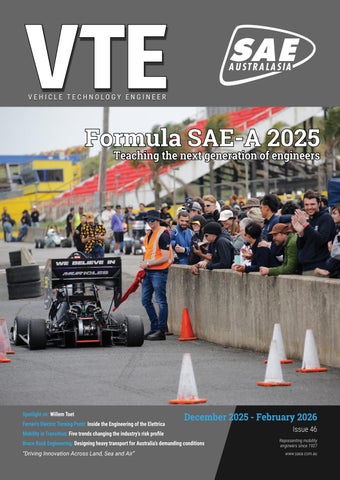
Formula SAE-A 2025
Teaching the next generation of engineers
Spotlight on: Willem Toet Ferrari’s Electric Turning Point: Inside the Engineering of the Elettrica
December 2025 - February 2026
Mobility in Transition: Five trends changing the industry’s risk profile Bruce Rock Engineering: Designing heavy transport for Australia’s demanding conditions “Driving Innovation Across Land, Sea and Air”
Issue 46 Representing mobility engineers since 1927 www.saea.com.au
VTE | Contents
Contents
Spotlight on – Willem Toet
12
Ferrari’s Electric Turning Point
14
Formula SAE-A 2025
18
Bruce Rock Engineering
26
Mobility in Transition
30
December 2025 - February 2026 Special Features 12 Spotlight on – Willem Toet 14 Ferrari’s Electric Turning Point: Inside the Engineering of the Elettrica 18 Formula SAE-A 2025: Teaching the next generation of engineers 26 Bruce Rock Engineering: Designing heavy transport for Australia’s most demanding conditions 28 AutoTest: Understanding the Brake Triangle 30 Mobility in Transition: Five trends changing the industry’s risk profile
VTE News 6
Australia & New Zealand
10 International
Society News 4
Notes from the President
5
SAE-A News
About the cover Formula SAE-A 2025: Teaching the next generation of engineers
About the SAE-A SAE-A was founded in 1927 to address the need for further education for all facets surrounding Automotive Engineering, and now encompasses all mobility engineering industries in the Australasian region. SAE-A is a non-profit organisation that works to serve the needs of its members and to promote the relevance of mobility related technologies to governments, industry and the community in general.
The editor, publisher, printer, the Society of Automotive Engineers – Australasia (SAE-A) and their employees, directors, servants, agents and associated or related entities (Publishing Entities) are not responsible for the accuracy or correctness of the text, pictures or other material comprising the contributions and advertisements contained in this publication or for the consequences of any use made of the products, services and other information referred to in this publication. The Publishing Entities expressly disclaim all liability of whatsoever nature for any consequences arising from the use or reliance on material contained in this publication whether caused to a reader of this publication or otherwise. The views expressed in this publication do not necessarily reflect the views of the Publishing Entities. The responsibility for the accuracy or correctness of information and other material is that of the individual contributors and the Publishing Entities do not accept responsibility for the accuracy or correctness of information or other material supplied by others. To the extent permissible by law, the Publishing Entities exclude all liability pursuant to the Competition and Consumer Act 2010 (Cth) or other applicable laws arising from statute or common law. Readers should make their own inquiries prior to the use of, or reliance on, any information or other material contained in this publication, and where necessary seek professional advice. All rights reserved. Reproduction in whole or part without the written permission of SAE-A is strictly prohibited.
www.saea.com.au
VTE | 3
Introduction | President - Society of Automotive Engineers – Australasia
VTE Published By: Society of Automotive Engineers - Australasia ABN:
95 004 248 604
Address: VACC House 650 Victoria Street, North Melbourne VIC 3051 Phone: Email: Web:
0403 267 166 info@sae-a.com.au www.saea.com.au
General Manager Angela Krepcik Email: angela@sae-a.com.au Membership & Subscriptions Rose De Amicis Email: rose@sae-a.com.au Events Email: events@sae-a.com.au
Board of Directors: Martha Oplopiadis (President) Paul Nation (Treasurer) Angela Krepcik (Board Director) Mohammed Fard (Conference Director) Bernie Rolfe (FISITA & SAE-A Liaison) James Soo (Autonomous/EV) Dennis Savic (Board Director) Samsone Lagozzino (Board Director) Stephen Haughey (Board Director) Johann Tay (Board Director)
Magazine Production: Editor Allan Edwards Email: editor@sae-a.com.au Mobile: 0409 570 643 Design Brigid Fraser Email: fraseram@optusnet.com.au Mobile: 0413 009 122 Advertising Jill Johnson Jill Johnson Media Email: jj@jilljohnsonmedia.com.au Mobile: 0409 217 624
VTE Industry Partner: Excellerate Australia
Follow SAE – Australasia:
4 | December 2025 - February 2026
After the chequered flag:
What Formula SAE-A tells us about the future of mobility Martha Oplopiadis, President of SAE Australasia, reflects on Formula SAE-A and the role it plays in preparing students for Australia’s evolving mobility engineering sector. As Formula SAE-A wraps up for another year, I find myself reflecting not just on what happened at Calder Park, but on what it tells us about where mobility engineering – and the Society of Automotive Engineers – Australasia – is heading. Formula SAE-A remains our flagship event for good reason. Over several intense days, we see students turn theory into practice, pressure-test their ideas and demonstrate the skills that industry repeatedly tells us it needs. Design, validation, cost control, teamwork, communication and resilience are all on display, often under conditions that feel uncomfortably close to the real world. That discomfort is where learning happens. But this year, more than ever, Formula SAE-A also reinforced why SAE-A itself must continue to evolve. The automotive landscape has changed dramatically. Australia is no longer home to largescale passenger vehicle OEM manufacturing, yet engineering has not disappeared – it has diversified. We now see innovation occurring across smaller, highly specialised companies working in smart mobility, vehicle modification, secondstage manufacturing and solutions that extend well beyond road transport into land, sea and air. Improving safety, accessibility and sustainability is now as central to mobility engineering as performance once was. This shift is exactly why, over the past six months, the SAE-A board and leadership team have been focused on resetting our strategy. We are deliberately broadening our definition of mobility and ensuring that SAE-A reflects the industries and technologies our members are actually working in. Formula SAE-A sits at the centre of that effort, not as a standalone competition, but as a gateway into a much wider ecosystem.
What stood out to me this year was not just the technical capability of the teams, but the engagement between students, volunteers and industry. More than 150 technical experts gave their time to assess, mentor and challenge students. These conversations – in the pits, in design reviews, and trackside – are where careers often begin. Formula SAE-A is not only a competition; it is one of the most effective recruitment and capabilitybuilding tools our sector has. That is why, post-competition, our work is far from done. We have already begun deeper student and industry engagement, including discussions around structured mentoring and clearer pathways from university programs into industry roles. Students should finish Formula SAE-A with a sense of direction – an understanding of where their skills can take them, and how organisations across the mobility sector can support that journey. At the same time, SAE-A continues to strengthen its advocacy role. We are actively engaging with transport bodies, government departments and related organisations to ensure that the voice of mobility engineers is heard as Australia navigates complex challenges around transport, infrastructure, sustainability and skills development. Formula SAE-A shows us what is possible when education, industry and professional bodies work together. The challenge now is to carry that momentum forward – to do things smarter, more sustainably and more collaboratively. If the passion, capability and ingenuity that was on display at Calder Park are any indication, the future of mobility engineering in Australia is in very good hands.
SAE-A | News
SAE-A launches Formula Kidz A Plan for the future The Society of Automotive Engineers Australasia (SAE-A) has launched ‘Formula Kidz’ for up and coming, enthusiastic kids to encourage the uptake of STEM (Science, Technology, Engineering and Mathematics) in primary schools from years 4-6, or ages 8 to 12 years through the annual Formula SAE-A competition. Working in partnership with Motorsport Australia and Real Time Learning, Formula Kidz visited the Formula SAE-A competition, at Calder Park Raceway from December 11-14 to witness the drive and passion of over 1000 role model students that had built their very own formula style vehicle whilst studying at university in various engineering disciplines. The aim of Formula Kidz is to inspire and encourage an interest in STEM subjects and expose them to the many industries that are seeking the best and brightest engineers to join their workforce. Formula Kidz will undertake various workshops that are practical and thought provoking whilst learning about problem-solving in a team environment. All this alongside their bigger
‘brothers and sisters’ as they bring to an exciting end, their yearlong university project, they were truly inspirational role models! Ms Martha Oplopiadis, President of the Society of Automotive Engineers, Australasia said “that SAE-A is proud to introduce Formula Kidz to the Formula SAE-A event, as it reflects our commitment to ensuring young kids get exposed to STEM subjects and see their future role models in action. “Formula Kidz will be offered the most
innovative, dynamic and practical experiences possible to ensure they too think about an exciting career in engineering one day,” she said. “Most of all, Formula Kidz will have fun exploring what it’s like to solve problems in a team and project management setting”. This year was the introduction of Formula Kidz and the SAE-A is confident the initiative will become an important part of Formula SAE-A’s future.
Minister declares new Walkinshaw facility open Driving growth in Victoria’s automotive industry Australia’s largest automotive remanufacturing company, the Walkinshaw Group, has opened a new, state-of-the-art facility in Melbourne’s south-east. Minister for Industry and Advanced Manufacturing Colin Brooks recently opened Walkinshaw Group’s new $114 million headquarters and expanded manufacturing facility in Dandenong South, boosting capabilities and confidence in Victoria’s – and Australia’s – world-class automotive supply chain, and creating 155 new local jobs. Walkinshaw Group has grown to become Australia’s largest automotive remanufacturing company, specialising in vehicle enhancements and left-hand-drive to right-hand-drive conversions for global brands including General Motors, Toyota, Volkswagen and Isuzu. The 155 new jobs created at the company’s new facility are across production, engineering and administration – delivering a major boost to local employment and economic growth. The 100,000-square-metre site – the equivalent of five MCGs, making it one of the largest manufacturing facilities in the country – brings together operations from www.saea.com.au
three existing sites and can accommodate up to 1,500 employees. Walkinshaw will manufacture more than 10,000 vehicles a year for the Australian market.
automotive manufacturers, including ARB, Premcar and APV, and the state’s broader automotive industry – employing more than 50,000 Victorians.
“We truly believe in the strength of Australian manufacturing and engineering, especially here in Victoria, and this should show everyone how committed we are for the long term,” Walkinshaw Group CEO, Ryan Walkinshaw, said.
The state government continues to back the manufacturing sector through the recently launched Victorian Industry Policy and the new $150 million Victorian Investment Fund, helping businesses expand, innovate and create skilled jobs across the state.
The new site includes Australia’s most advanced automotive engineering centre and more than four production lines and features a renewable solar energy system to support future projects. Victoria is home to several renowned
“Victoria is Australia’s leading advanced manufacturing state, and this state-of-theart facility is a testament to the strength and resilience of our automotive industry,” Minister for Industry and Advanced Manufacturing, Colin Brooks, said. VTE | 5
News | Australia & New Zealand
Robotaxis set to shake up Australia’s motor insurance market Are these driverless vehicles the death of motor insurance as we know it? Waymo, Google’s self-driving car project, is expected to have driverless taxis on London streets by next year. Insurance Business Magazine has reported that the firm’s first major robotaxi deployment outside the United States follows large scale tests in US cities like Phoenix and San Francisco.
As the global race for autonomous mobility accelerates, Australia is apparently gearing up to join the action. According to Insurance Business Magazine, the National Transport Commission (NTC) is working on a regulatory framework that could see autonomous vehicles trialed by 2026 with the aim of commercially deploying robotaxis across the country soon afterwards. Driverless vehicles, like these autonomous taxis, introduce a range of new insurance implications that fundamentally reshape the motor industry’s traditional risk, liability and coverage models.
Insurance Business Magazine interviewed Simon Donovan, executive general manager of fleet focused underwriting agency DKG Insurance Group, and asked if this could mean the death of motor fleet insurance as the industry knows it? The interview can be found here https://www.insurancebusinessmag.com/au/ news/auto-motor/robotaxis-set-to-shake-upaustralias-motor-insurance-market-550596.aspx 6 | December 2025 - February 2026
Hyundai Xcient Fuel Cell Truck joins Coregas fleet in Australian first Hyundai’s Xcient Fuel Cell Truck, one of the first hydrogen-powered heavy-duty trucks, has secured its first Australian customer, industrial gas manufacturer and supplier, Coregas. Hyundai Motor Company Australia (HMCA) has taken a major step in its hydrogen journey, with Coregas confirmed as the first local customer for the Xcient Fuel Cell Truck, one of the world’s first hydrogen-powered heavy-duty trucks. After debuting at the 2025 Brisbane Truck Show, the Xcient is set to hit Australian roads in Coregas’ daily fleet. By integrating the Xcient into its logistics network, Coregas will not only reduce emissions from its own operations but also showcase the practical potential of hydrogen-powered freight to the wider industry.
These characteristics make the Xcient an ideal solution for Coregas’ gas cylinder transport operations, where reliability and efficiency are critical. By combining cutting-edge technology with everyday practicality, the vehicle showcases hydrogen’s ability to meet the realworld needs of heavy transport fleets.
The Xcient Fuel Cell is already proven globally, with over 10 million kilometres clocked in realworld operations across Europe and Asia. In Australia, where freight significantly contributes to greenhouse gas emissions, the Xcient represents a game-changing opportunity for fleets to transition to eco-friendly transport without compromising on range or power.
A partnership of first movers
This milestone forms part of Hyundai’s broader vision to decarbonise commercial transport in Australia, with the Xcient undertaking a comprehensive program of evaluation and technical assessment to meet the needs of Australian operators. Securing Coregas as its first customer demonstrates confidence in the technology and sets the stage for broader adoption of hydrogen mobility in the heavy vehicle sector.
Coregas leads the way with hydrogen mobility Coregas is no stranger to innovation in hydrogen mobility. In 2023, the industrial gases company launched the Coregas H2Station, Australia’s first hydrogen refuelling station for heavy transport. The H2Station, located in Port Kembla, New South Wales, is already helping stimulate Australia’s emerging hydrogen sector by proving that hydrogen-powered trucks can be a viable alternative to diesel fleets. In line with its commitment to building a greener future, Coregas will now integrate the Hyundai Xcient Fuel Cell Truck into its day-today operations, using it to transport industrial, medical and specialty cylinders to its Australian customers.
Xcient Fuel Cell Truck: Power, range, and safety The Xcient Fuel Cell Truck has been designed to deliver performance equal to diesel while producing zero tailpipe emissions. With a long driving range and fast refuelling times, the Xcient offers fleets a pathway to decarbonise heavy transport while maintaining efficiency and uptime.
With Hyundai’s leadership in hydrogen mobility and Coregas already established as an early mover with its hydrogen compression and distribution infrastructure, the partnership represents an important moment for Australia’s transition to clean energy. Don Romano, CEO, HMCA, sees the achievement as an exciting step forward. “The partnership with Coregas shows how hydrogen mobility can move beyond concepts and trials into real-world operations. We are proud to bring the world’s first fuel cell heavy-duty truck to Australian roads and to demonstrate how it can deliver both sustainability and performance for local fleets,” he said. Alan Watkins, executive general manager, Coregas, said the partnership represents the firm’s commitment to embracing hydrogen technology and demonstrating its suitability for heavy transport applications. “This partnership brings together two organisations committed to accelerating the clean energy transition and showing industry how hydrogen can play a vital role in decarbonising heavy transport,” he said.
Building momentum for Australia’s hydrogen sector Both Hyundai and Coregas see a significant opportunity for hydrogen in Australia. This collaboration is not only an important milestone for the two companies but also for the broader hydrogen industry in Australia. It provides a proof point that hydrogen fuel cell vehicles can operate successfully in local conditions and demonstrates the role hydrogen can play. The data and insights gained from this partnership will help inform fleet investment decisions, support government policy development, and build confidence in hydrogen across the transport and logistics sector.
Australia & New Zealand | News
ANCAP announces new rating approach from 2026 The official body for crash testing and providing safety ratings in Australia will change its methodology. ANCAP has declared that vehicle safety is entering a new era. Over the past 30 years, manufacturers have responded well to the safety demands of consumers, improving the structural integrity of their vehicles and, more recently, the safety technology on board. This approach is only part of the picture when it comes to making sure road users are protected at all stages of their journey. Last year, 1,592 Australians and New Zealanders lost their lives in vehicle-related crashes. A bleak reminder of the need for policymakers, infrastructure providers, vehicle manufacturers, enforcement agencies, advocacy groups, employers, and everyday road users to keep pushing for improved outcomes. As part of the collective approach, vehicle safety remains a key driver in improving road safety outcomes. From 2026, ANCAP will refresh its vehicle rating criteria – a notable update that strengthens how it evaluates the safety of new cars across the Stages of Safety: Safe Driving, Crash Avoidance, Crash Protection and PostCrash.
Increasingly popular electrically-operated door handles – which sit flush with bodywork when not in use – should remain operable after any crash. Electric cars should isolate their high-voltage battery after a serious crash, and the vehicle should be able to notify first responders of the crash.
This approach re-organises safety assessment based on the Haddon Injury Prevention Matrix which examines what happens before, during and after a crash.
As part of aligning testing with the consumers’ experience, ANCAP will be performing more on-road testing to better track the real-world capability of the technology on board. This on-road evaluation will examine how well the vehicle’s technology reads and responds to road conditions, and will give ANCAP more detailed insights into a driver’s experience beyond the test track.
“You’ve spoken and we have listened. The Stages of Safety approach will allow ANCAP to incorporate useful feedback, enhance existing tests and incorporate new areas of focus,” ANCAP chief executive, Carla Hoorweg, said.
The updates ensure ANCAP’s testing, analysis and ratings remain the authoritative guide for consumers and fleets which value independent information on the safety of the latest cars, SUVs, utes, and vans.
“This new approach also provides a structure that can adapt to the technological developments that will shape the automated driving future.”
“Our role is to continually push for improvements in all areas of vehicle safety, and our 2026 protocols reflect that,” Hoorweg said.
Developed in collaboration with Euro NCAP’s leading vehicle safety experts, the contemporised approach to independent vehicle safety testing provides a shared international benchmark – ensuring Australians and New Zealanders continue to benefit from the world’s most advanced crash testing and assessments.
“The outcome will be better protection of vehicle occupants and those around them, through the active prevention of crashes, superior protection in the event of a crash, and improved post-crash management.”
Every three years ANCAP re-examines the star rating criteria with a sole focus on reducing vehicle-related deaths and serious injuries. The 2026-2028 protocols further strengthen the rigour and relevance of the tests, rewarding vehicles that perform well across all stages of safety – before, during and after a crash. Several changes have been made specifically in response to consumer feedback. Active driver assistance systems – often criticised for their abrupt or irritating interventions – will be rewarded for smooth, intuitive operation as well as technical performance. www.saea.com.au
2026: Stages of Safety at a glance The four assessment areas evaluated from 2026, known as the Stages of Safety, are: SAFE DRIVING – Considers the vehicle technologies and features that assist in providing a safer driving experience for the driver and vehicle occupants. CRASH AVOIDANCE – Assesses the crash avoidance systems that help prevent or mitigate critical incidents through warnings or autonomous intervention. CRASH PROTECTION – Evaluates the performance of traditional crash protection elements, including vehicle structure, seatbelts, airbags and head restraints to
mitigate injuries to vehicle occupants, pedestrians and cyclists. POST CRASH – Addresses the ‘golden hour’ of emergency response through post-crash rescue information and assistance systems. Each of the four stages will be scored out of 100 points and – as is currently the case – expressed as a percentage for consumers seeking that next level of information beyond the simple star rating. Minimum thresholds will also continue to apply for each stage – determining the overall star rating. Acknowledging post-crash response time that plays a critical part in crash survival, from next year ANCAP will place greater emphasis on the availability and performance of eCall systems. More than 40 per cent of all new vehicles sold in Australia in 2024 featured technology capable of automatically connecting with emergency services following a crash, known as eCall. “Our updated protocols set a clear benchmark for emergency call systems fitted in vehicles. We want to encourage manufacturers to enhance existing systems and provide an incentive for all brands to fit this life-saving technology,” Hoorweg said. Despite this progress, deployment of eCall technology remains limited in New Zealand, with fewer than 10 per cent of new vehicles sold last year equipped with the system. “New Zealanders should not be left behind when it comes to life-saving technologies such as eCall, the potential for it to make a difference on New Zealand’s road is too big for manufacturers to ignore,” Hoorweg said. “Through these upgraded protocols, ANCAP is setting a clear bar that will continue to challenge industry beyond regulation, inform consumers, and help reduce road trauma. “Our goal remains focused: helping you stay safe, every drive. “We look forward to seeing vehicle manufacturers continue to meet the highest levels of safety in a competitive market.” VTE | 7
News | Australia & New Zealand
IAG launches major ADAS driver-behaviour study Insurance giant, IAG, has launched an Australian-first ADAS research program to understand why drivers switch off safety tech and how to improve on-road outcomes. Insurance giant, IAG, has launched a landmark national study into how Australian drivers use Advanced Driver-Assistance Systems (ADAS), amid growing concern that life-saving vehicle safety technology is being switched off, misunderstood or underused. The research, conducted with QUT and the iMOVE Cooperative Research Centre, aims to uncover why ADAS features are not delivering the expected reductions in crashes, despite being standard in all new vehicles. The insurer says the Australian-first field study will analyse real-time driver behaviour when operating systems such as autonomous emergency braking (AEB), adaptive cruise control and lane-keeping assistance. The project includes controlled driver observation sessions at the RACQ Mobility Centre in Brisbane.
IAG Research Centre Head Shawn Ticehurst said the study seeks to understand the behavioural barriers and knowledge gaps preventing motorists from using ADAS correctly. According to IAG’s consumer research, 60 per cent of drivers admit to switching off ADAS features, while 80 per cent say they learned to use them purely through trial-and-error. A further 70 per cent want more information on how to maximise the safety benefits. The timing is significant for the automotive sector. From March 2025, all new vehicles sold in Australia must include car-to-car autonomous emergency braking under the Australian Design Rules. From August 2026, car-to-pedestrian AEB will also become mandatory. These changes mean new vehicles will increasingly rely on sophisticated sensor suites – including cameras, radar and, in some cases, LiDAR – to manage crashavoidance functions. QUT Professor Sebastien Glaser said the
research is vital, with ADAS-equipped vehicles forecast to make up 40 per cent of the national fleet by 2031. He said adoption is rising rapidly, but Australia is yet to see the technology’s full life-saving potential because many drivers lack confidence or understanding. The study will also explore several technical questions tied directly to the repair and insurance sectors, including how ADAS performance degrades over the life of a vehicle and whether radar sensors can be safely reused after a collision. Understanding these variables is increasingly important as repairers manage a growing mix of camera and radar-dependent vehicles requiring precise calibration to restore safety systems. IAG will publish its findings in 2026, with the results expected to influence future driver education programs, insurer repair frameworks and national road-safety policy as Australia adapts to a more automated vehicle fleet.
It’s cheaper to own a car in the USA and South America than in Australia Australia was ranked 15th out of 26 countries across the world, but European countries were ranked the most expensive for car ownership. The rising cost of living is impacting so many essential expenses, and car ownership costs have been heavily impacted too. Compare the Market Australia has crunched the numbers and found that Australia escapes ranking in the top 10 for most expensive countries to own and maintain a car, but it’s still nowhere near the cheapest. Australia sat below the halfway point at 15th place out of 26 – not quite ranking as well as Ecuador, Czechia and Poland, but placing above countries like France, Uruguay, Canada and Spain. The average annual total for key yearly car spending figures was $8,205. While Australia’s fuel price was cheaper per litre than many European countries, licensing fees were some of the most expensive in the entire index. Major expenses such as maintenance, repairs and fuel expenses made up a significant portion of total spending. Fuel costing an average of $2,769 per year while repairs and maintenance cost an average of $1,033. Car insurance was another significant cost at an 8 | December 2025 - February 2026
average of $1,223 per year – the ninth most expensive out of all 26 countries. While Aussie drivers will be feeling the sting on their wallets, the costs are worse overseas. European countries in general were very expensive for car ownership in comparison to other countries on the list. Every single country in the top 10 was in Europe. Denmark was the most expensive, followed by the Netherlands and Norway. On the flip side, Argentina was ranked the cheapest country, followed by Russia and Colombia. The accompanying table below shows a truncated view of the top 15 most expensive countries in the index, showcasing total annual spending, fuel prices per litre, and licensing fees in Australian dollars. As costs rise across the world, executive general manager Adrian Taylor urges Australians to take action on their car insurance costs.
“It only takes a few minutes for car owners to review the available car insurance policies available to them. When you get your policy renewal, it pays to compare what’s out there,” Taylor said. “Compare the Market makes it really easy to compare. You can weigh up prices, coverage limits, exclusions and other features to find a similar policy for a cheaper price, or another policy that offers more in a competitive deal. Don’t let potential savings drive on by. In this environment, every dollar saved matters.” To learn more about the rankings and methodology, visit here https://www.comparethemarket.com.au/ car-insurance/features/the-most-expensivecountries-for-car-ownership/
News | International
World-first technology leads Mazda’s new to faster EV charging time environmental Hydrohertz launches breakthrough battery technology tested cooling technology enabling ultra-fast Japanese manufacturer begins demonstration experiment of on-board CO2 capture system. Mazda Motor Corporation has begun demonstration experiments of Mazda Mobile Carbon Capture, Mazda’s unique CO2 capture system. The Japanese manufacturer announced the technology under the theme ‘The Joy of Driving Fuels a Sustainable Tomorrow,’ at the recent Japan Mobility Show 2025.
10 minute EV charging.
Hydrohertz, a leader in advanced automotive thermal management systems, has launched a world-first battery cooling technology which it claims not only delivers a step change in EV fast-charging times, but also significant improvements in battery range, life, and safety. Hydrohertz’s breakthrough technology is the patented Dectravalve, a compact, intelligent, multi-zone valve system that delivers incredibly precise heating, cooling, or energy recovery of an EV battery. “Optimising the operating temperature of an EV battery is crucial to both its short and longterm performance,” Hydrohertz CTO, Martyn Talbot, said.
Mazda says it is aiming to realise mobility where “driving more leads to CO2 reduction” by 2035. Mazda believes that if its vehicles run on carbon-neutral fuel and capture the CO2 emitted, it will be possible to reduce the amount of CO2 in the atmosphere in proportion to the distance travelled. In the Super Taikyu Series Round Seven – held on November 15 and 16 – the ‘Mazda Mobile Carbon Capture’ was installed in the Mazda Spirit Racing 3 Future Concept (Car No.55) race vehicle for the first time.
The vehicle ran on biodiesel fuel (HVO), a carbon-neutral fuel that has been put to practical use in Europe. The device uses zeolite with a porous structure as a CO2 adsorbent and demonstrated that it can adsorb CO2 in exhaust gas. Mazda will continue demonstration experiments in the Super Taikyu Series next season to increase CO2 recovery rates. Building on insights gained, Mazda will advance its technology and equipment, which it hopes will contribute to the realisation of a sustainable mobility society. 10 | December 2025 - February 2026
“Unlike traditional systems which treat the entire pack uniformly, the Dectravalve system allows for targeted heating or cooling of individual modules within the battery. This means it can keep every part of the battery pack at a consistent, optimum temperature, maximising the performance of the cells across the entire pack.”
optimum temperatures during all conditions – i.e. not just when charging – the efficiency of the battery can be increased, delivering up to 10 per cent more real-world driving range. With a typical mid-sized EV that could mean another 50-65 kilometres, providing more usable driving distance per charge, reducing EV running costs and energy consumption.
In an ultra-fast charging test with leading independent battery experts Warwick Manufacturing Group (WMG), a 100kWh Lithium Iron Phosphate (LFP) EV battery equipped with Dectravalve kept its hottest cell at under 44.5°C, maintaining a temperature difference of only 2.6°C across the whole pack.
Safety is also significantly enhanced as maximum cell temperatures can be capped, preventing overheating, minimising risks of lithium plating (internal damage to cells) and thermal runaway (overheating leading to thermal incidents). And because the whole battery is operating at optimum temperature, Dectravalve can also extend its life, putting each cell under less strain so it can stay within a safer temperature range, protecting state of health (SoH) and enhancing overall lifespan.
This compares favourably to typical fastcharging conditions in today’s EVs, where peak cell temperatures regularly rise to as much as 56°C and the temperature difference across the pack can exceed 12°C. Once cells push beyond 50°C, charging power must be throttled to avoid ‘lithium plating’ (internal damage to cells) and long-term damage to the pack, meaning fast charging tapers off much earlier than advertised, significantly increasing the overall charge time.
Hydrohertz claims Dectravalve can optimise the performance of any EV battery – and future systems too. It is also incredibly costeffective, bringing game-changing benefits for a fraction of the cost of developing an entirely new pack. Collectively, Dectravalve from Hydrohertz can help to transform EV useability, while also boosting residual values of used vehicles, and enhancing second-life potential of the battery pack at the end of the vehicle’s time on the road.
In contrast, the Dectravalve-equipped battery never left the optimum high-power zone. It kept every module performing at peak efficiency, with no thermal weak spots holding the system back. Simply put, the Dectravalveequipped battery stayed cool, even when pushed to its limits.
“The Dectravalve solves a fundamental problem of EV battery thermal management systems – how to achieve true independent zone control of temperature without the complexity, weight, and energy waste of multiple valve arrays,” Talbot said.
In the same test, Dectravalve demonstrated that charging times can be slashed by up to 68 per cent, meaning a typical 30-minute 10-80 per cent charge on a 350kW fast charger could drop to around 10 minutes, putting EV charging on a par with conventional petrol/diesel vehicle refuelling times. And because the cells are operating at
“Our innovation is elegantly simple: a single, digitally controlled unit that can manage four or more cooling zones separately. “With Dectravalve, each cooling zone is completely independent, so coolant flows from the pump to the battery and back again in a specific loop. There are no unwanted, efficiency-sapping, leaks of warm coolant between zones.”
International | News
Recycling end-of-life cars now possible For the first time, fossil raw materials have been completely replaced by circular, automotive waste through a gasification process to produce new plastics. Porsche AG and BASF SE, in collaboration with technology partner BEST - Bioenergy and Sustainable Technologies GmbH – have successfully completed a pilot project on recycling mixed waste from end-of-life vehicles. The pilot project demonstrates the recyclability of high-performance plastics from automotive shredder residues (ASR) together with renewable raw materials. This mixture of plastic, film, paint, and foam residues is so complex that it can currently only be thermally recycled. The pilot project shows that these automotive wastes can be recycled through gasification, a special type of chemical recycling, and returned to the automotive cycle. This pilot project validates the viability of new sources of plastics and applications for chemical recycling in components. The ultimate goal is to source less primary material in the future and increase the proportion of recycled materials in vehicles. As part of the project, the chemically recycled material was used in the manufacturing process for steering wheels. “Pilot projects like these allow us to evaluate how we can further develop the circular economy as a sustainability field at Porsche and how we can anchor chemical recycling in our strategy in the long term,” head of sustainability at Porsche AG Dr Robert Kallenberg, said. “We are testing new recycling technologies with our direct partners in order to increase recirculate quotas, gain access to previously unusable recirculate sources and evaluate new processes for waste streams that are currently being thermally utilised.” Porsche aims to use recycled materials in its vehicles and close resource cycles. In this context, the company has set itself the goal of increasing the proportion of verifiable secondary materials in its vehicle production. The pilot project can evaluate the potential of automotive shredder residues as a future recycling source and thus as a secondary raw material. It is thus a complementary alternative to mechanical recycling, which often cannot achieve this high quality. In addition, demand-driven scaling is possible in the future in connection with the so-called mass balance approach. www.saea.com.au
Defossilisation: First fully non-fossil gasification for the production of new plastics In this project, a combined waste stream consisting purely of automotive waste and biomass was recycled in a gasification process for the first time. The resulting recycled raw material – the so-called synthesis gas and its derivatives – replaced the fossil raw materials in BASF’s integrated value chain. Within its production network, BASF then produces the polyurethane formulation needed for the steering wheel using a mass balance approach. The recycling innovation uses modern gasification technology from BEST GmbH to convert plastic waste and other residues into synthesis gas at high temperatures. “In our plant, we have previously converted biomass such as wood or straw into chemical raw materials. In this pilot project together with BASF and Porsche, we have now used this gasification technology for the first time to convert complex plastic waste streams together with biomass into synthetic crude oil, known as syncrude,” BEST’s Dr. Matthias Kuba explained. “This form of chemical recycling has great potential for converting complex, mixed waste streams into new, valuable raw materials. It thus represents a sensible alternative to waste
Keeping the technology spectrum broad President of BASF’s performance materials division, Dr. Martin Jung, said the company co-ordinates its sustainability efforts on its plastics journey – which consists of three key steps in the product lifecycle: make, use and recycle. “For the latter, we offer a wide range of recycling solutions because we are convinced that many methods need to complement each other to achieve recycling goals,” he said.
“We prioritise mechanical recycling and continuously improve its efficiency. At the same time, the type of waste and the degree of sorting determine which technology is best suited. “We are convinced that complementary technologies such as chemical recycling, which includes pyrolysis, depolymerisation and gasification, are necessary to further promote the circular economy and reduce the plastic waste that still ends up in landfills or is incinerated today. “To optimally utilise the various waste recovery options and further develop all technologies in parallel, the appropriate regulatory framework is essential.”
Background: Chemical recycling and mass balance Chemical recycling can process plastic waste that cannot be mechanically recycled for technical, economic, or ecological reasons. Gasification is a variant of chemical recycling that can convert particularly mixed waste streams into valuable new raw materials, for example: plastic production. When fed into large, complex, and continuously operated production plants such as the BASF Verbund facility, these new circular raw materials are mixed with conventional fossil raw materials and processed into plastic precursors. The new (secondary) raw materials are attributed using the mass balance approach. Products and sites are certified by independent auditors according to internationally recognised systems such as ISCC PLUS or REDcert. Due to the high quality of the new raw materials, the resulting products have the quality of new goods and meet the demanding requirements of high-performance plastics, as they are particularly needed for safety-relevant automotive components. VTE | 11
Feature | Spotlight
Spotlight on Willem Toet: The Aerodynamicist who taught Formula 1 how to think Few engineers have shaped modern motorsport aerodynamics as profoundly – and as quietly – as Willem Toet. Over more than four decades in racing, Toet has moved seamlessly between elite Formula 1 teams, advanced aerodynamic research, and education, leaving a legacy defined not by a single breakthrough, but by a relentless, methodical way of thinking about airflow, performance, and learning. Born in the Netherlands but raised in Melbourne, Toet’s pathway into motorsport was grounded as much in hands-on experience as academic training. After completing a Bachelor of Science at La Trobe University, he immersed himself in racing at a practical level – competing on motorcycles and in cars and preparing race vehicles for others. Among those he worked with were trailblazing female racer Robyn Hamilton and Australian touring car legend Kevin Bartlett, experiences that gave Toet early insight into how engineering decisions translate directly into driver confidence and lap time. That combination of theory and practice would become a defining trait of his career. Toet’s move back to Europe marked the beginning of a remarkable ascent through the upper echelons of international motorsport. After early work on Le Mans sports cars, he 12 | December 2025 - February 2026
secured a foothold in Formula 1 at a time when aerodynamics was rapidly becoming the dominant performance differentiator. Over the following decades, Toet progressed through the sport’s most demanding technical roles, ultimately leading aerodynamics departments at Benetton, Ferrari, BAR/Honda, and BMW Sauber.
Toet was deeply involved in the evolution of these methods, helping teams extract meaningful performance gains from increasingly restrictive regulations. Throughout this period, discretion was mandatory. Formula 1’s culture of secrecy meant that breakthroughs were rarely publicised and never attributed to individuals.
In each case, he was responsible not merely for designing parts, but for setting the intellectual framework by which aerodynamic performance was pursued, evaluated, and validated.
Yet within the paddock, Toet developed a reputation as a clear thinker – someone capable of simplifying extraordinarily complex flow problems into structured, solvable questions.
His tenure coincided with some of Formula 1’s most significant aerodynamic shifts – the increasing sophistication of wind tunnel testing, the rise of CFD as a development tool, and the growing importance of understanding interactions between components rather than viewing parts in isolation.
A recurring theme in Toet’s work is the idea that aerodynamics is never about a single wing, flap, or device. Instead, it is about how flow structures interact across the entire car. This philosophy is evident in his later non-F1 work, including projects that demonstrated dramatic performance improvements through subtle aerodynamic additions.
Spotlight | Feature
One such program culminated in an outright Australian Hillclimb Championship victory in 2022, achieved after the introduction of a carefully engineered lower rear wing concept that significantly increased downforce with relatively modest drag penalties. The lesson, Toet argues, is universal: aerodynamic performance does not come from brute force, but from understanding where energy exists in the flow – and how best to exploit it. Parallel to his professional career, Toet has always been deeply invested in education. Today, he serves as Professor of Motorsport Engineering at the University of Greater Manchester and lectures at other institutions, bringing real-world experience into the classroom.
He has served for many years as a judge and ambassador in the UK and, when time permits, in Australia. In recent years, Toet has extended his educational reach further through the ‘Aerodynamics Unlocked’ course developed with Driver61, helping make high-level aerodynamic understanding accessible to a global audience. After more than 40 years in motorsport, Willem Toet remains what he has always been – a problem-solver, a teacher, and one of the quiet architects of modern racing performance. Beyond his technical achievements, Toet’s influence is perhaps most clearly seen in the people he has mentored along the way.
Toet has a rare ability to demystify aerodynamics without trivialising it – to show students why a flow behaves as it does, rather than asking them to accept results on trust.
Engineers who passed through his departments in Formula 1 or encountered him through Formula Student frequently describe the same traits: patience, intellectual honesty, and an insistence on understanding fundamentals before chasing solutions.
This approach underpins his long-standing involvement with Formula Student and Formula SAE, competitions widely regarded as among the most effective project-based engineering training environments in the world.
That mindset has become increasingly relevant as motorsport and automotive
What sets him apart as an educator is not simply what he knows, but how he explains it.
www.saea.com.au
He has long argued that software tools, no matter how powerful, are only as effective as the thinking that guides them.
engineering grow more reliant on simulationdriven development. Toet has been vocal about the dangers of treating CFD or wind tunnel results as answers rather than evidence. In his view, data must always be questioned, cross-checked, and interpreted in context – particularly in highly constrained rule environments such as Formula 1, where small errors in interpretation can lead development down costly dead ends. Looking ahead, Toet remains optimistic about the future of aerodynamics and motorsport engineering. Regulatory change, he believes, does not stifle creativity but redirects it, forcing engineers to search for performance in less obvious places. Whether analysing the aerodynamic implications of new Formula 1 regulations or exploring emerging computational techniques, he continues to approach problems with the same curiosity that defined his early career. It is this enduring enthusiasm – coupled with a willingness to share hard-earned knowledge – that ensures Willem Toet’s impact will extend well beyond the cars he helped design. VTE | 13
Feature | Ferrari EV
Ferrari’s Electric Turning Point: Inside the Engineering of the Elettrica
Ferrari has entered a new era – not with a design teaser or a speculative announcement, but with a detailed, component-level reveal of the engineering that underpins the marque’s first fully electric production car. The Ferrari Elettrica marks a significant milestone in the Prancing Horse’s transition to a multi-energy future, and the Italian company has intentionally placed engineering, rather than styling, at the forefront of its story. What has been shown so far is the structure that defines the car: the chassis, battery, axles, motors, inverters and suspension. It is an unconventional approach in an industry that often hides hardware beneath dramatic bodywork. But Ferrari wants the world to understand something fundamental: the brand’s first EV has been built with the same obsessive attention to detail and mechanical purity that shaped its most celebrated combustion models. The Elettrica represents more than simply compliance with global electrification trends. It is built upon 15 years of electrification research, beginning with the 2009 F1 KERS system and evolving through the 599 HY-KERS prototype, LaFerrari’s hybrid V12 architecture, and the plug-in hybrid technologies of the SF90 and 296 GTB. The Elettrica stands as the culmination of that development pathway – and the first time Ferrari believes electric technology has matured enough to deliver the performance and driving engagement expected of the marque. 14 | December 2025 - February 2026
Ferrari EV | Feature
A platform engineered around dynamics Ferrari engineered the Elettrica on a clean-sheet platform with a shortened wheelbase reminiscent of the company’s mid-engined lineage. The driver sits close to the front axle, an arrangement chosen not for packaging convenience but to maximise steering feel and precision. Integrating the battery directly into the chassis structure presented one of the greatest engineering challenges. EVs typically carry the penalty of mass and increased inertia, but Ferrari used integration to its advantage, lowering the car’s centre of gravity by 80 millimetres compared to an equivalent ICE model. With most of the battery mass concentrated below the floor, the car’s agility improves rather than diminishes. Crash behaviour dictated new solutions. The front shock towers now contribute structurally to energy absorption. The positioning of the front motors and inverter has also been engineered to channel loads away from the cabin. Along the sides, carefully managed spacing between cells and sills acts as a controlled deformation zone. Underfloor cooling plates double as protective elements, absorbing impact forces from below. Ferrari has also introduced notable sustainability measures. Seventy-five per cent of the chassis and bodyshell aluminium is recycled, avoiding 6.7 tonnes of CO2 emissions per vehicle. Although environmental gains are not the headline here, the material strategy demonstrates an engineering decision that ties efficiency and performance to reduced environmental impact.
A new subframe philosophy One of the most technically significant components of the Elettrica is the rear subframe – Ferrari’s first elasticised mechanical subframe and its largest one-piece hollow casting ever produced. Electric vehicles create different NVH challenges compared with combustion cars. Without engine noise masking mechanical frequencies, every vibration is more noticeable. Ferrari tackled this by developing a structure that behaves rigidly laterally, ensuring sharp handling, but flexes longitudinally and vertically to absorb vibration. Specially engineered elastomeric bushes further isolate the cabin from road harshness and electric axle harmonics. Despite its complexity, the subframe allows the battery, rear axle and suspension to be serviced independently. This is a surprisingly practical consideration for a high-performance EV and reflects the company’s intention to design a serviceable, long-life product rather than a sealed, monolithic EV platform. Some weight has been added compared with a rigid subframe, but Ferrari determined that the gain in refinement and the preservation of dynamic integrity justified the trade-off. The result is improved day-to-day usability without diluting the car’s sporting character. www.saea.com.au
VTE | 15
Feature | Ferrari EV
E-Axles: Designed, developed and manufactured in Maranello Ferrari’s decision to engineer its e-axles in-house reflects its traditional philosophy of total control over the powertrain. Both front and rear axles contain dual independent motors, torque vectoring capability, integrated inverters and bespoke castings produced in Ferrari’s foundry using secondary aluminium alloys. The front axle delivers up to 210 kW and can fully decouple at any speed, switching the car into rear-wheel drive when efficiency is prioritised. Under acceleration, it can send as much as 3500 Nm to the front wheels. The rear axle, however, is the powerhouse: 620 kW peak and up to 8000 Nm of torque in Performance Launch mode. Power density at 4.8 kW/kg underscores Ferrari’s relentless pursuit of lightweight solutions even within the heavier EV domain. The decoupling system is a major advancement. Borrowing gear synchronisation principles from modern transmissions, the unit is 70 per cent lighter than previous solutions and can engage or disengage the front axle in 500 milliseconds. This not only aids efficiency but gives the car the ability to dramatically alter its driving character on demand.
Motors pushing the boundaries of materials science Ferrari’s permanent magnet synchronous motors represent some of the most advanced in the automotive sector. The front motors spin to 30,000 rpm, the rears to 25,500 rpm – figures typically reserved for motorsport prototypes. Halbach array rotor configurations increase magnetic flux concentration while reducing mass. Ultra-thin 0.2 mm laminations in the stator reduce electrical losses, while a vacuum-impregnated highconductivity resin enhances heat transfer and structural rigidity. A key innovation is the carbon sleeve encasing the rotor magnets. Only 1.6 mm thick and weighing mere grams, it must withstand centrifugal forces equivalent to 390 bar at maximum rpm. This solution allows the magnets to run just 0.5 mm from the stator, significantly improving torque density. Ferrari has industrialised processes normally used only in prototypes, enabling these highly stressed components to be produced reliably at scale.
16 | December 2025 - February 2026
A battery that acts as structure The Elettrica’s battery achieves nearly 195 Wh/kg, currently the highest stated energy density of any upcoming series-production EV. The pack’s structure integrates directly into the chassis, so the vehicle body absorbs much of the crash load rather than relying on heavy battery enclosures. Approximately 85 per cent of the battery mass sits beneath the floor, with the remainder located under the rear seats. The configuration delivers an ideal weight balance of 47–53 per cent and reduces rotational inertia. Cooling plates are integrated into the battery’s aluminium shell, and the coolant passages are unified into a single circuit that maintains temperature uniformity across all modules. Cells are concentrated centrally, with surrounding space used as a deformation buffer in crash scenarios.
Ferrari EV | Feature
The electrical system operates at ~800 volts with peak currents up to 1200 A. A primary fuse interrupts the circuit in three milliseconds if a short is detected. Importantly, Ferrari has engineered the battery to be removable and repairable, reflecting the company’s long-standing philosophy of designing cars with lasting service life.
Inverters as high-precision controllers The inverters represent another major leap, especially the front unit, which is integrated directly into the axle and weighs only 9 kg while providing up to 300 kW. Silicon carbide MOSFETs allow switching frequencies of 10–42 kHz, each value calibrated for efficiency, NVH and torque precision. Ferrari’s toggling strategy on the rear inverter periodically shifts the unit between active and standby modes, allowing it to operate at optimal efficiency points without affecting performance. This approach can extend highway range by approximately 10 kilometres. A software suite called Ferrari Order Noise Cancellation eliminates unwanted harmonics from the motors, refining the acoustic character of the electric drivetrain.
An active suspension system for an electric era Ferrari’s third-generation 48-volt active suspension system evolves the technology used on the Purosangue and F80. With a lower centre of gravity, engineers tuned the system for both improved comfort and more precise handling. A recirculating ball screw with 20 per cent longer pitch reduces inertial forces transmitted through the chassis, while the electric motor controlling each damper maintains consistent behaviour across temperature conditions. Each wheel can actively manage vertical force independently, an ability that, when paired with four-wheel steering and the four-motor layout, gives the Elettrica unprecedented fine control over vertical, lateral and longitudinal dynamics.
Driver controls and energy management Ferrari has retained its signature Manettino – a rotary dial – on the right side of the steering wheel while introducing the new eManettino on the left. The eManettino governs energy architecture, switching between Range, Tour and Performance modes, each with different axle engagement and power availability. www.saea.com.au
Torque Shift Engagement, controlled via the right paddle, provides five progressively stronger acceleration levels. The effect mimics rising torque curves traditionally associated with internal combustion engines, delivering a sensation of continuous thrust. The left paddle increases regenerative braking, producing a controlled and involving deceleration feel. A Vehicle Control Unit sampling data 200 times per second coordinates all subsystems, predicting chassis behaviour and ensuring consistency across motors, suspension and steering.
A mechanical sound in an electric world Rather than synthesise combustion noise, Ferrari amplifies the genuine mechanical vibrations produced by the powertrain. A sensor mounted at a rigid point on the rear axle captures these frequencies, which are then projected into the cabin and surroundings. The system remains quiet at cruise, activating only when the driver requests torque, reinforcing the connection between input and response.
Engineering the first electric ferrari – without compromise With the Elettrica, Ferrari has applied its traditional engineering principles to the EV category: structural integration, lightweight materials, precision control and uncompromised driving dynamics. By revealing the car’s technical foundation before its exterior, Ferrari has made its priorities unmistakable. Every component – from castings to control software – has been engineered to ensure that the first electric Ferrari still behaves unmistakably like a Ferrari. The exterior will come later. But the engineering core, Ferrari insists, already tells the full story. VTE | 17
Feature | Formula SAE-A 2025
Formula SAE-A 2025:
Teaching the next generation of engineers By the time Formula SAE-A 2025 arrived at Calder Park Raceway, the outcome of the competition had already been shaped long before a single car turned a wheel.
Formula SAE-A, Feeney explained, is deliberately structured to mirror professional engineering environments. Teams are required to operate within strict technical regulations, manage risk, document decisions and justify design choices under questioning.
Months – in some cases years – of design decisions, manufacturing compromises, testing setbacks and late-night problem solving were about to be exposed to scrutiny.
The inspection process is designed to reveal understanding, not just compliance.
Formula SAE-A occupies a unique position in the engineering education landscape. For the more than 1,000 students who travelled to Calder Park in late December – most towing their cars, tools and spares on trailers behind cars and vans – the event represented the final checkpoint in a year-long engineering process. While Formula SAE-A is often described in motorsport terms, the competition is not designed to reward speed. It is structured to assess engineering judgement. Every system on the car is evaluated not only on how it performs, but on how and why it was designed that way. That philosophy was reflected from the very beginning of the event. Adrian Feeney, Chair of the Formula SAE-A Organising Committee outlined the role the competition plays in developing industry-ready engineers.
That emphasis on process over outcome is embedded throughout the event.
Only after clearing scrutineering are teams allowed to progress to the static judging events: engineering design, cost and business presentation. These sessions form the backbone of Formula SAE-A and account for a substantial portion of the overall score. Dynamic events – acceleration, skidpad, autocross and endurance – follow later in the weekend, but by that point much of the competition has already been decided. In 2025, the paddock at Calder Park reflected the continuing evolution of Formula SAE-A. The event also continued to grow internationally. In 2025 as well as teams from all over Australia and New Zealand, universities from Japan, Indonesia, Saudi Arabia and Taiwan were represented. Across the paddock, one theme was consistent: Formula SAE-A is not about building the perfect car. And at Calder Park in 2025, those qualities were tested relentlessly.
Electric Vehicle Overall Class Winner University of Canterbury
18 | December 2025 - February 2026
The role of Formula SAE-A – more than just a competition Feeney positioned the competition not as a race meeting, but as an education and capability-building program that deliberately mirrors the realities of professional engineering. “This is not a racing competition in the conventional sense,” Feeney said. “The car is the visible outcome, but the real product is the process that sits behind it.” That distinction has become increasingly important as Formula SAE-A has evolved.
Formula SAE-A 2025 | Feature
Feeney emphasised that this evolution has not been accidental.
exposing students to different approaches, cultures and constraints is part of the learning.”
“The competition is designed to force decision-making,” he said.
From an industry perspective, Formula SAE-A offers something that is increasingly difficult to assess through conventional recruitment pathways: how young engineers behave when projects don’t go to plan.
“Students are required to justify why they’ve made certain choices, what trade-offs they’ve accepted, and how they’ve managed risk. Those are exactly the conversations that happen in professional engineering environments.”
“The value isn’t just in what the students build,” Feeney said.
“It’s in how they respond when something fails, how they communicate under pressure, and how they take responsibility for outcomes.” While the event would ultimately reveal which cars were fastest, most efficient or most reliable, the competition itself was always about something broader – preparing the next generation of engineers for the realities they will face beyond university.
That philosophy is evident long before a car ever reaches the event. Teams are assessed not only on performance, but on documentation, safety justification and the ability to defend engineering decisions in front of experienced practitioners.
FORMULA SAE-A 2025 RESULTS ELECTRIC VEHICLE
Feeney also acknowledged the scale of the commitment required from students. Unlike many university projects, Formula SAE-A extends well beyond a semester or academic year.
University of Queensland
“Very few undergraduate engineers get the opportunity to work on a project of this size and complexity,” Feeney said. “Formula SAE-A compresses years of professional learning into a very short timeframe.” For SAE–A, international participation reinforces the program’s relevance beyond national borders. “It’s important that Formula SAE-A remains outward-looking,” Feeney said. “Engineering doesn’t happen in isolation, and www.saea.com.au
1st Place
OVERALL CLASS WINNER University of Canterbury
COST
DESIGN
University of Auckland
BUSINESS PRESENTATION University of Queensland
SKID PAD
University of Canterbury
ACCELERATION
University of Auckland
AUTOCROSS
University of Newcastle
ENDURANCE
University of Queensland
EFFICIENCY
University of Canterbury
2nd Place
3rd Place
University of Queensland
University of Newcastle
Monash University
University of Western Australia
University of New South Wales
Monash University
University of Newcastle
Monash University
University of Auckland
University of New South Wales
University of Newcastle
University of New South Wales
University of Canterbury
University of New South Wales
University of Auckland
University of Canterbury
Queensland University of Technology
University of Newcastle VTE | 19
Feature | Formula SAE-A 2025
Engineering judgement under scrutiny While the dynamic events at Formula SAE-A attract the most visible attention, many competitors acknowledge that the most demanding aspects of the competition take place away from the venue. Design judging, in particular, subjects teams to a level of scrutiny that closely mirrors professional engineering reviews. Innovation alone is not rewarded. Students are expected to defend material selections, explain simulation assumptions, justify safety margins and demonstrate how failures encountered during development informed subsequent design changes. MA Inspiring Motorsport Award Winner Swinburne University
Scrutineering, safety and the reality check
For international teams, passing scrutineering carries additional significance.
If Formula SAE-A is where student engineering meets reality, scrutineering is the moment when that meeting becomes unavoidable.
“As an international team, passing technical inspection on the first day meant a great deal to us,” Mohamad Abou Jeouid from Saudi Arabia’s Al Faisal University said.
Vehicles are assessed against a detailed rulebook covering structural integrity, braking performance, steering geometry, driver egress, fuel or high-voltage systems, electrical isolation, accumulator construction and emergency response requirements. For many teams, scrutineering represents the most intense and confronting phase of the entire competition. Every assumption must be defensible. The tilt-table test remains one of the most visible demonstrations of engineering fundamentals, providing a clear measure of centre-of-gravity management and rollover stability. For electric vehicle teams, the process is even more demanding.
“We learned a lot through Formula SAE-A, and the entire team was very proud to reach that point.” That sentiment was echoed across the paddock. Importantly, the process does not reward perfection. The experience serves as a powerful reminder that engineering is not judged by intent alone. By the time a car leaves scrutineering and enters the dynamic events, it has already passed one of the most demanding assessments most students will encounter before entering industry.
Cost judging introduces a different but equally confronting discipline. Every component – from machined uprights to fasteners and wiring – must be documented and priced as if the vehicle were entering low-volume production. For many students, this is the first time technical ambition is explicitly tied to commercial consequence. The business presentation completes the static evaluation by shifting focus from technical execution to value proposition. Together, the static events ensure Formula SAE-A rewards judgement, systems thinking and professional maturity.
Manufacturing reality and engineering compromise One of the most consistent lessons reinforced at Formula SAE-A 2025 was that good engineering is rarely about ideal solutions. For many teams, the transition from design to manufacture remains the most confronting phase of the Formula SAE journey. CAD models, simulations and spreadsheets inevitably collide with the realities of
FORMULA SAE-A 2025 RESULTS INTERNAL COMBUSTION VEHICLE 1st Place
OVERALL CLASS WINNER Edith Cowan University
COST
Edith Cowan University
DESIGN
Edith Cowan University
BUSINESS PRESENTATION Edith Cowan University
SKID PAD
Edith Cowan University
ACCELERATION
Tokyo Denki University
AUTOCROSS
Edith Cowan University
ENDURANCE
Edith Cowan University
EFFICIENCY
Australian National University 20 | December 2025 - February 2026
2nd Place Australian National University Griffith University Flinders University Griffith University Australian National University Edith Cowan University Flinders University Australian National University Edith Cowan University
Internal Combustion Vehicle Overall Class Winner Edith Cowan University
Formula SAE-A 2025 | Feature
Adelaide University: Learning by doing at full scale For the Adelaide University Motorsport Team, Formula SAE-A represents an opportunity to apply engineering theory at a scale rarely encountered within the confines of a traditional university course.
LEAP Award for Best Use of Simulation winner Edith Cowan University
machining tolerances, material availability and workshop access. Students across multiple teams described manufacturing not as a final step, but as an ongoing design influence. Supply chain disruption also continued to shape outcomes. Where parts became unavailable, substitutions were often required, testing the flexibility of underlying architectures. The teams who could clearly explain these compromises – why a particular solution was chosen, what alternatives were considered, and how risk was mitigated – were rewarded more consistently than those who focused solely on theoretical optimisation. Manufacturing discipline also extended to documentation and process control. Ultimately, Formula SAE-A 2025 reinforced that engineering credibility is built as much in the production process as it is in the vehicle’s actual ability in the real world.
International teams and global benchmarking at Calder Park Formula SAE-A 2025 was not just a national student competition. The number of international teams reinforced Formula SAE-A’s growing status as an AsiaPacific focal point for student engineering development. For these international teams, participation represented far more than a chance to compete. Inspection pressure is magnified for international entrants. Cars are built far from the competition venue, often without the luxury of transporting extensive spares or remachining parts on site.
“You come into Formula SAE-A thinking it’s all about CAD and calculations,” Vale said. “But you very quickly realise it’s also about communication, scheduling, sponsor relationships and making decisions when you don’t have perfect information.” With around 50 students involved across engineering and business disciplines, Adelaide’s Formula SAE-A program mirrors the multidisciplinary environment graduates are likely to encounter in industry. Technical ambition must be balanced against cost, manufacturability and time – constraints that are impossible to ignore once a car must pass inspection and complete endurance..
That reality sharpens the learning experience. “We’re very happy to be here,” Abou Jeouid said. “Competing at Formula SAE-A has been a very positive experience for our team.” For students from Institut Teknologi Sepuluh Nopember (ITSN) in Indonesia, Formula SAE-A participation also represented longterm personal and technical growth. Team member Zamir Salsabila said the program has continually pushed both individual and collective limits. “This is my third time competing in Formula SAE,” Salsabila said. “I’ve competed previously in Japan, and every time I’ve learned something new. I feel like I’ve grown a lot through the program, and as a team we’ve pushed our limits further each time.” Teams from New Zealand faced similar challenges, particularly around transport and time pressure, yet continued to feature strongly across both static and dynamic events. The University of Canterbury’s eventual success in the Electric Vehicle category underscored that international participation was not symbolic, but genuinely competitive. Exposure to different competitions, judging styles and engineering expectations is a defining strength of Formula SAE. While the rulebook provides a common technical
www.saea.com.au
Business manager Alicia Vale said the program quickly moves beyond technical calculation and into the realities of real-world engineering delivery.
Chief engineer Hamish Treehearne pointed to the team’s first monocoque chassis as a defining learning experience. “On paper it all made sense,” Treehearne said. “But the reality of manufacturing and integration forces you to rethink things very quickly. Even at competition, you’re still learning what you’d change next time.” That learning process is central to Adelaide’s Formula SAE experience. Design decisions are tested not only in simulation, but through physical build, scrutineering and on-track performance, with immediate feedback on what works – and what doesn’t. For Adelaide’s students, Formula SAE-A is less about a single event outcome and more about developing judgement under pressure – a skill that carries well beyond the paddock at Calder Park. VTE | 21
Feature | Formula SAE-A 2025
University of Canterbury: built for consistency, rewarded with results For the University of Canterbury, Formula SAE-A is not treated as an extracurricular exercise, but as a structured engineering program embedded directly into the final year of study. The New Zealand team’s Formula SAE entry is built as part of a capstone project, with students assessed not only on performance outcomes, but on process, documentation and decision-making. That academic structure was evident at Calder Park Raceway, where Canterbury’s electric vehicle combined consistency across static judging with reliable execution in dynamic events. Team principal Moss Benton said the program is deliberately run to mirror industry expectations. “It operates much more like a startup than a student club,” Benton said. “There are deliverables, reporting requirements and clear accountability. That changes how decisions are made.”
That approach prioritises system integration, risk management and repeatability over headline performance. Rather than chasing peak outputs, the Canterbury team focused on reliability, energy management and endurance execution – areas that ultimately defined the 2025 competition. Endurance performance proved decisive, with the Canterbury car completing the event cleanly and efficiently, reinforcing the value of disciplined engineering and conservative decision-making under pressure. International logistics added another layer of complexity, with the team transporting its car, tools and spares from New Zealand to Australia. Benton said that challenge forms part of the learning experience. “Just getting to the event forces you to think differently about preparation,” he said. “You have to be confident in what you bring, because you don’t have the option to go back.” That combination of academic structure, engineering discipline and operational realism ultimately paid off, with the University of Canterbury emerging as the overall Electric Vehicle winner at Formula SAE-A 2025. 22 | December 2025 - February 2026
language, teams quickly discover that execution, interpretation and engineering culture vary significantly across regions. For organisers and judges, the international presence strengthens the competition as a whole. For the students themselves, the benefit is more immediate.
Dynamic events and endurance test reality If the static events reward intent, planning and justification, the dynamic events at Formula SAE-A exist to expose reality. Autocross, efficiency and endurance collectively strip away speculation and reveal whether a car has been engineered as a complete, integrated system. Over the course of the competition, teams quickly learn that outright speed is only one part of the equation. Consistency, reliability and control are what ultimately define success. Autocross serves as the first major reality check. Short, technical and unforgiving, it demands precision rather than bravery. For electric vehicles in particular, autocross exposes weaknesses in torque control strategies, traction control calibration and thermal management. A car that looks strong on paper but behaves unpredictably at the limit is quickly found out. Efficiency runs in parallel with performance, reinforcing the core Formula SAE philosophy that engineering excellence is not defined solely by maximum output. Energy management, regenerative braking strategies and drivetrain losses all come under scrutiny. Teams that prioritised clean power delivery and disciplined energy use were able to score strongly without chasing peak lap times. Judges noted that many of the most competitive cars were not the fastest in isolation, but the most repeatable. Meanwhile, endurance remains the defining event. Kilometres of sustained running place every subsystem under prolonged load: powertrain, cooling, electronics, braking,
Technical Inspection Award Winner University of Newcastle
suspension and driver ergonomics. Minor issues that can be masked in short runs become terminal failures in endurance. Overheating accumulators, marginal cooling loops, loose connectors and fatigue-induced mechanical failures all surface here, often without warning. For teams, endurance is where engineering decisions made months earlier finally converge. Component selection, packaging, serviceability and fault tolerance all matter. So too does operational discipline. Driver changes, pit procedures and fault-response planning are not afterthoughts; they are integral parts of the system. As one competitor observed, finishing endurance is itself a mark of success. Completing the distance demonstrates not only that the car works, but that the team understood its limits and engineered within them. Across the field, the pattern was consistent. Cars that prioritised reliability, thermal stability and controllability tended to rise through the rankings, while those chasing outright
Formula SAE-A 2025 | Feature
FORMULA SAE-A 2025 SPECIALTY AWARDS MA Inspiring Motorsport Award Swinburne University Awarded to the team that shows the best spirit LEAP Award for Best Use of Simulation Edith Cowan University Awarded to the team that best uses simulation SAE-A Harry Watson Award UNSW Canberra Awarded to the team that makes a distinct contribution Technical Inspection Award University of Newcastle Awarded to the team most organised during TI Caterpillar Automated Vehicle Drive Award University of Queensland Awarded to Formula SAE-A participants who demonstrate excellence in automation and engineering performance without sufficient margin were more likely to falter. In that sense, endurance functions as Formula SAE-A’s most honest judge. It does not reward optimism. It rewards preparation. Together, the dynamic events reinforce a central lesson of the competition: speed is impressive, but durability, efficiency and repeatability are what define real engineering success.
Industry, sponsors and the engineering workforce pipeline While Formula SAE-A is framed first and foremost as an educational competition, its relevance to industry was evident throughout the 2025 event at Calder Park Raceway. Major automotive and engineering organisations including Caterpillar, Walkinshaw Group, Bruce Rock Engineering, ADF Careers, Toyota, Ford, iMove, MathWorks, Loctite, Supacat, Tesla Energy, PLS and Leap Australia maintained a visible presence across the event, not simply as brand supporters, but as active observers of student capability, behaviour and decision-making under pressure. Unlike traditional recruitment environments, Formula SAE-A allows industry representatives to see how future engineers perform in realistic conditions. Darcy Burke, representing the Walkinshaw Group, said Formula SAE-A provides insight that is difficult to replicate through conventional graduate recruitment pathways. “Formula SAE gives you a real sense of how students think and operate as engineers,” Burke said. “You can see who understands systems, who communicates clearly, and who can work effectively as part of a team when the pressure is on. Those are exactly the skills industry is looking for.” www.saea.com.au
Burke said the value of the competition extends beyond technical capability alone. “It’s not just about whether the car is fast,” he said. “It’s about judgement, accountability and the ability to explain why decisions were made. That’s what makes Formula SAE-A such a strong development platform.” That sentiment was echoed by Caterpillar representative Casey Eastham, who highlighted the alignment between Formula SAE-A and modern engineering roles across heavy industry, automation and advanced manufacturing. “Competitions like this expose students to the realities of engineering much earlier,” Eastham said. “They’re learning how to balance performance, cost, safety and reliability – exactly the same trade-offs professional engineers deal with every day.” Eastham noted that the multidisciplinary nature of Formula SAE-A mirrors the structure of contemporary engineering teams, particularly in large industrial organisations. “Engineering today is rarely done in isolation,” he said. “You need people who can work across disciplines, communicate clearly and understand the downstream impacts of their decisions. Formula SAE-A does a very good job of developing those skills.” For organisations such as Bruce Rock Engineering and ADF Careers, the competition also offers a rare opportunity to engage with students before graduation, at a point where career pathways are still being shaped. Teams regularly reported informal technical discussions with industry representatives throughout the event, ranging from
manufacturing processes and materials selection to systems integration and safety management. For many students, these conversations provided their first exposure to how engineering decisions are viewed outside an academic environment. The presence of Walkinshaw Group at the event reinforced the competition’s relevance not only to motorsport and automotive engineering, but to advanced manufacturing, systems integration and high-performance engineering more broadly. Walkinshaw’s involvement reflects the crossover between Formula SAE-A skillsets and the demands of modern engineering enterprises operating well beyond the racetrack. Collectively, industry partners see Formula SAE-A not as just a sponsorship obligation, but as a long-term investment in capability. As Formula SAE-A continues to evolve, its value to sponsors remains grounded in that realism.
Why Formula SAE-A still matters After more than two decades, Formula SAE-A continues to justify its place not as a student motorsport spectacle, but as one of the most effective applied engineering education programs operating in Australia and the region. What separates Formula SAE-A from conventional university coursework is not simply the scale of the task, but the permanence of its outcomes. Students are required to make decisions that cannot be easily undone, to live with the consequences of those decisions, and to defend them under professional scrutiny. In doing so, they experience engineering not as an abstract discipline, but as a responsibility. Unlike controlled laboratory environments or short-term assessment tasks, Formula VTE | 23
Feature | Formula SAE-A 2025
University of Sydney: Learning leadership under pressure For University of Sydney, Formula SAE-A is as much about leadership and decision-making as it is about engineering execution. Team principal Sam Palad describes the competition as a rare environment where students are forced to take responsibility for outcomes in real time, rather than working within the safety net of traditional university assessment.
“You don’t need to be an engineer to contribute, but you do need to be able to make decisions and take responsibility when something goes wrong,” Palad said. With a large, multidisciplinary team structure, University of Sydney places strong emphasis on communication, accountability and adaptability – qualities that become critical once the car reaches competition week. Issues can’t be deferred or worked around quietly; they have to be addressed publicly, quickly and collaboratively.
SAE-A exposes students to uncertainty. Designs fail. Manufacturing does not go to plan. Components arrive late or not at all. Simulations diverge from real-world behaviour.
and between teams and judges, becomes critical. These are not skills that sit neatly within a single subject outline, yet they are among the most valued by employers.
That exposure to uncertainty is precisely what gives Formula SAE-A its long-term educational value. Graduates who have been through the program leave with a clear understanding that engineering is rarely about finding a single “correct” answer. Instead, it is about balancing competing requirements – performance, safety, cost, manufacturability, reliability and time – and making defensible decisions with incomplete information.
For many students, Formula SAE-A represents the first time their work is assessed by practising engineers rather than academics alone. That external scrutiny carries weight.
“You can’t hide from it,” she said.
The competition’s structure reinforces that lesson. Static judging rewards understanding and justification rather than novelty. Dynamic events reward consistency and system integration over peak output. Endurance exposes every weakness in a design and every gap in preparation. The result is a learning environment that closely mirrors professional engineering practice.
“Everyone sees what happens, and that’s where the learning really happens.”
Formula SAE-A also continues to evolve alongside industry.
For University of Sydney’s students, Formula SAE-A offers a practical education in leadership, teamwork and resilience – skills that extend well beyond the pit lane and directly into professional engineering and industry environments.
Just as importantly, the competition develops engineers who understand accountability. Decisions made during the design phase surface months later at competition. Documentation is not an academic exercise but a survival tool. Communication within teams,
Palad said that exposure to that pressure is one of the most valuable outcomes of the program.
Caterpillar Automated Vehicle Drive Award Winner University of Queensland
The international presence at the 2025 event further underlined Formula SAE-A’s relevance. Ultimately, Formula SAE-A endures because it does something few educational programs manage: it makes learning unavoidable. Success cannot be achieved by theory alone, nor can it be salvaged by last-minute effort. It requires sustained commitment, collaboration and reflection. As the cars were loaded back onto trailers at Calder Park, many teams were already discussing what they would change next year. That instinct – to analyse, to improve, and to try again – is perhaps Formula SAE-A’s most enduring outcome. It produces graduates who do not see engineering as a finished process, but as a continual one. And that is why, year after year, Formula SAE-A still matters.
Recognition at the end of endurance After days of scrutiny, problem-solving and sustained pressure, Formula SAE-A 2025 concluded with formal recognition of the teams that best demonstrated engineering excellence across the competition’s full breadth. For many teams, simply reaching the awards ceremony represented an achievement in itself – evidence that their car had passed inspection, survived dynamic events and completed endurance. For others, the results validated years of program development, institutional support and learning. The full results from Formula SAE-A 2025 are available online at https://www.saea.com.au/2025-results
24 | December 2025 - February 2026
Feature | Bruce Rock Engineering
Designing heavy transport for Australia’s most demanding conditions From its origins in Western Australia’s Wheatbelt to its position as one of the country’s largest trailer manufacturers, Bruce Rock Engineering (BRE) has been shaped by Australian operating conditions and a deeply practical engineering philosophy. Rather than pursuing scale for its own sake, the business has built its reputation on bespoke design, structural efficiency and an ability to engineer solutions for environments that few manufacturers elsewhere in the world encounter. From agricultural service to engineering manufacturer BRE was founded more than 45 years ago by Mike and Gay Verhoogt as a small agricultural service operation. Based in the Wheatbelt, the business initially focused on maintaining and repairing farm machinery critical to local producers. Its transition into manufacturing was driven not by strategy but by necessity. When customers expressed dissatisfaction with the grain tippers available on the market, Mike Verhoogt elected to design and fabricate his own. Working largely alone in a shed, he built the first Bruce Rock grain tipper, embedding a problem-solving mindset that continues to define the company. “The business didn’t start with the idea of becoming a manufacturer,” says Ryan Du Plessis, Head of Engineering. “It started because there wasn’t a product on the market that met customers’ needs.”
Engineering for a unique operating environment Australia’s freight requirements present engineering challenges that differ significantly from those faced in overseas markets. Long distances, low population density, extreme payloads and remote operating conditions have driven the development of some of the longest and most complex road trains in the world. Performance-Based Standards (PBS) – an Australian standards scheme that ensures vehicles are ‘fit for purpose’ for the weight and mass of the freight they are intended to carry – axle loadings and route-specific compliance requirements create design envelopes that have little global precedent. As a result, BRE cannot simply adopt international solutions. “Quite often, the technology that exists overseas just doesn’t translate,” Du Plessis says. “We’re engineering for unique Australian conditions with some products specifically designed to comply with unique Western Australian needs. 26 | December 2025 - February 2026
Bruce Rock Engineering | Feature
Weight, strength and structural efficiency Across its product range, BRE places strong emphasis on tare-to-payload optimisation. For fleet operators, this metric directly influences productivity, fuel consumption and whole-oflife cost. Achieving favourable ratios at extreme scale requires careful material selection, structural modelling and manufacturing discipline. The company works closely with suppliers such as SSAB to utilise advanced high-strength steels that allow reduced section thickness while maintaining fatigue performance. “Weight reduction isn’t about making something lighter at all costs,” Du Plessis says.
Designing at scale: the ultra quad side tipper One of BRE’s most technically demanding products is its Ultra Quad side tipper, designed primarily for the mining sector. These PBSapproved combinations operate in road trains extending to 60 metres – among the longest in the world. Deployed extensively across the Pilbara and Goldfields, these combinations must deliver predictable handling, structural durability and long service life under continuous heavy loading. Some mining clients operate fleets exceeding 200 Ultra Quad combinations, placing a premium on reliability and consistency. “At that scale, small engineering decisions have a big operational impact,” Du Plessis says. “You’re not just designing a trailer; you’re designing a system that has to perform every day, often in very remote locations.”
“It’s about making the structure as efficient as possible while still meeting durability and safety expectations. “An example of this is BRE’s preference to use steel due to its predictable field performance and ease of repair.”
Bespoke manufacturing as a core engineering discipline Unlike manufacturers focused on general freight equipment, BRE operates predominantly in the bespoke segment of the market. While the company maintains around a dozen core product families, most units are configured to suit specific customer requirements. Engineering decisions routinely account for payload distribution, route compliance, axle configuration and integration with existing fleet infrastructure. This approach demands rigorous configuration control, documentation discipline and close coordination between engineering, production and quality teams.
Recent deliveries to interstate logistics operators, including large custom builds in South Australia, demonstrate how this capability extends beyond Western Australia. While regulatory constraints differ between states, the underlying engineering principles remain consistent.
Developing engineering capability BRE currently employs around 12 engineers supported by a broader technical workforce. The company places strong value on practical experience, systems thinking and the ability to work across disciplines. To strengthen its future capability, the business is preparing to introduce a formal two-year graduate development program. Graduates will rotate through engineering, production and operational functions and be supported by both technical and business mentors. “We’re looking to develop engineers who understand how decisions made on the screen translate to the factory floor and the field,” Du Plessis says.
Engineering beyond passenger vehicle manufacturing With the closure of Australia’s passenger vehicle OEMs, companies such as BRE represent a technically demanding but often under-recognised segment of innovative Australian engineering and manufacturing. Designing and manufacturing heavy transport equipment from first principles requires expertise in structures, materials, compliance and systems integration – skills that remain critical to Australia’s industrial capability.
Engineering the next phase BRE’s growth strategy is focused on diversification rather than volume. With a growing presence and increasing recognition in the eastern states, continued expansion involves adapting designs to suit different regulatory frameworks and operating conditions across regions. For the engineering team, that challenge is an extension of what the company has always done: applying disciplined engineering to real-world problems shaped by Australian conditions. From a Wheatbelt shed to large-scale mining and freight operations across 4 sites with a workforce of 380 people, BRE continues to demonstrate how engineering, when grounded in environment and application, can scale without losing purpose. www.saea.com.au
VTE | 27
Feature | Autotest
Understanding the Brake Triangle: An Integrated Approach to Vehicle Braking Safety Braking performance is widely acknowledged as one of the most critical safety functions in any vehicle. Yet discussions about braking tend to focus almost exclusively on the friction components—pads, discs and drums— while overlooking the interconnected systems that govern how braking force is generated, transmitted and ultimately delivered to the road. Engineers have long recognised that vehicle stopping capability is influenced not by a single subsystem, but by the interaction of three essential elements: the brake system, the brake fluid, and the suspension (shock absorbers). Collectively referred to as the brake triangle, these components work in unison to maintain stability, traction and predictable deceleration. A deficiency in any leg of the triangle compromises the performance of the entire system.
Brakes: The Primary Torque-Generating System Modern braking systems translate driver input into braking torque through a series of hydraulic and mechanical components. Among these, brake pads play a critical role by generating the friction force required to decelerate the rotor or drum. When friction material is worn, misaligned or contaminated, symptoms often manifest early. High-pitched squeal, vibration, uneven rotor surfaces, or extended pedal travel may indicate degraded components or misbehaviour within the friction system. Responding to these indicators promptly
is essential because changes in noise, pedal feel or thermal behaviour often precede measurable reductions in braking performance. Braking performance is traditionally evaluated using stopping distance, peak or average deceleration, or a derived measure of braking effectiveness. Each method has limitations. Early regulatory frameworks such as the United Kingdom’s adoption of mandatory braking performance criteria in the mid1960s, relied heavily on stopping-distance measurements using chalk-gun equipment. As electronic measurement systems evolved, peak deceleration measurements using inclinometers or Tapley meters became common, although these devices captured the highest instantaneous deceleration rather than the sustained deceleration demanded by type-approval regulations.
The braking event itself is a dynamic process involving coast-down drag, mechanical reaction time, tyre-road friction transitions, and heat-transfer phases as friction interfaces reach operational temperature. Modern data acquisition shows that deceleration varies significantly over the braking cycle, reinforcing the need to evaluate braking performance through representative and repeatable measures rather than singlepoint peaks.
Brake Fluid: The Hydraulic Link Brake fluid characteristics directly influence the consistency and reliability of braking performance. Glycol-ether-based fluids (DOT 3, 4 and 5.1) are widely used due to their thermal stability and lubricity, but their hygroscopic nature presents long-term challenges. Moisture ingress occurring through hoses, seals and atmospheric exposure reduces boiling point and increases compressibility. After one year in service, brake fluid may contain approximately 2% water, and after several years 7–8% is not uncommon. The consequences are twofold: 1. Boiling-point reduction, increasing susceptibility to vapour lock under hightemperature operation. 2. Elevated compressibility, altering pedal travel and reducing the driver’s ability to modulate brake force consistently. These effects are especially problematic in vehicles equipped with ABS, traction control or stability control, where rapid modulation of hydraulic pressure is essential. Brake fluid viscosity is also critical; fluids outside
28 | December 2025 - February 2026
Autotest | Feature
specification can impede solenoid valve response or alter the behaviour of electronic control systems. From an engineering perspective, brakefluid performance must be considered as a lifecycle variable rather than a fixed design parameter. Long-term moisture accumulation and viscosity changes introduce uncertainties that affect both braking stability and regulatory compliance over the vehicle’s service life.
Shock Absorbers: Maintaining Tyre–Road Contact The third leg of the brake triangle—shock absorbers—ensures that tyres remain in stable contact with the road surface during braking. Without effective damping, tyres oscillate, reducing available traction. Since braking force depends fundamentally on tyreroad friction, inadequate damping directly increases stopping distance and degrades directional control. Shock absorbers are hydraulic dampers that convert kinetic suspension movement into thermal energy. When damping diminishes due to wear, overheating or fluid leakage, symptoms may include: •
longer stopping distances,
•
steering-wheel vibration after impacts,
•
increased body roll or pitch,
www.saea.com.au
•
excessive rebound (“bouncing”),
•
uneven tyre wear, and
•
reduced stability during emergency manoeuvres.
From a systems engineering standpoint, these behaviours reduce the vehicle’s ability to maintain optimal wheel load distribution during braking. On uneven surfaces— common in real-world braking—damping performance becomes even more critical.
Regulatory Context: A Historically Fragmented Landscape The evolution of braking regulations has varied widely across jurisdictions. Some countries rely on stopping-distance thresholds; others use average or peak deceleration; still others use rolling dynamometer measurements at low speeds. Australian Design Rules (ADR 31, 33 and 35), originating in the mid-1970s, align closely with ECE Directive 71/320 and require performance evaluation under laden, unladen and partial-failure conditions. Despite global efforts toward harmonisation under UNECE frameworks, test methods remain diverse. For in-service vehicles, roadside or workshop testing commonly uses decelerometers or inclinometers, each with inherent limitations. Peak-deceleration devices, for example, cannot capture
sustained deceleration values required by type-approval standards. Understanding these differing methodologies is crucial for engineers who design, certify or test braking systems. Measurement technique can significantly influence reported performance—even when the underlying braking capability is unchanged.
Conclusion: A Systems-Level Approach to Brake Safety The brake triangle concept highlights a fundamental engineering truth: braking performance is not determined by any single component, but by the interaction of friction, hydraulic and suspension systems. Brake-pad condition affects friction generation. Brake-fluid integrity affects hydraulic transmission. Shock-absorber performance affects tyre-road adhesion. Weakness in any one area degrades overall stopping capability—often in ways that traditional peak-deceleration tests fail to detect. For engineers, regulators and workshop professionals, a comprehensive approach to brake evaluation that considers all three legs of the triangle is essential to ensuring safe, predictable vehicle behaviour throughout its service life. VTE | 29
Feature | Mobility in Transition
Mobility in Transition: Five trends changing the industry’s risk profile The mobility industry is undergoing profound transformation. New technologies, business models and market players are changing the rules of the game, often faster than legislation and market structures can keep up.
Gorav Dheer, Underwriter Digital Solutions & Strategic Advisor Liability Global Risk at HDI Global, explains the key developments shaping the mobility industry. He outlines how companies can minimise risks and seize opportunities.
The mobility ecosystem is more diverse than ever Mobility no longer stops at vehicle manufacturing. Today, it encompasses far more than just the car and extends to mobility solutions, connected services and sustainable concepts that are shaping the entire ecosystem. From micro-mobility, cars and trucks through to drones, smart traffic lights, road guardrails and even whole cities, today’s ecosystem covers a wide range of technologies and stakeholders. Successful companies consider not only their own product, but also the entire supply and service chain. Those who understand the interfaces and work closely with partners who appreciate the complexity of this network lay a solid foundation for innovation.
New usage models are changing expectations The trend is increasingly moving away from classic car ownership and towards leasing and more importantly, flexible subscriptionbased models, as many customers are seeking shorter contract terms. One major reason is the rapid technological development in electric vehicles, with new and improved models constantly entering the market. Many customers therefore want to remain flexible and be able to respond quickly to innovations. For providers this means pricing and service concepts must be tailored to shorter cycles and variable usage patterns – including appropriate cover solutions.
Electric mobility brings new values and risks The battery is the heart of an electric vehicle and one of its greatest cost factors. Its condition, lifespan, residual values and the charging infrastructure are now central
issues. Regular monitoring of battery health and protections such as residual value or guarantee solutions strengthen trust in electric mobility and stabilise business models.
Autonomous driving requires early engagement Autonomous technologies are no longer a vision of the future; in some markets, the first serial applications are already a reality. However, regulations and laws in many areas remain unclear and ethical questions unresolved. Companies investing in this field should work with experienced partners to develop risk coverage concepts at an early stage. This is especially important where there is little historical data or claims experience. A targeted approach can reduce uncertainties and secure a head start.
Experienced partners ensure planning security In the mobility sector, it is more important than ever to look beyond your own product. Companies that are willing to adopt new perspectives and systematically analyse the entire supply and service chain create the foundation for sustainable innovation and stability. Solo efforts, on the other hand, carry the risk of failing to keep pace with the speed of innovation. New technologies and business models are changing mobility faster than many expect. Companies that identify key trends early can secure decisive competitive advantages. Innovative solutions and experienced partners are the key to managing risks and unlocking the diverse opportunities of tomorrow’s mobility.
30 | December 2025 - February 2026