KM INSIGHT RESEARCH BRIEF May 2025
Knowledge Management
Opportunity Graduates People Out of Poverty Holistic Programs to End Ultra Poverty in Haiti, Malawi, and Colombia Show Results Research Overview In Haiti, Colombia, and Malawi, Opportunity International (Opportunity) delivers a holistic set of services to people living in ultra poverty to help them graduate out of poverty. Over the course of 18 months, these programs offer clients comprehensive solutions to address multi-faceted challenges facing people living in ultra poverty. Launched in 2007, the Haiti program has served some 18,000 clients (3,750 with Opportunity support) and has a graduation rate of 95%. In two new programs, launched in 2023 in Colombia and Malawi, 354 clients have completed the program, with 82% graduating in Colombia and 90% in Malawi. Key Insights The following key insights emerged from the program generated data and learning group discussions among staff: 1. Personal transformation is as important as material change. 2. Addressing women’s empowerment directly pays off. 3. Community-centric tailoring and collaboration makes the program effective in different contexts. 4. Local government engagement supports success. 5. Innovation and adaptability are required for crisis response. 6. Vision building and planning are critical to client graduation. 7. Clients role-model success for the community. 8. Staff mentors are key to client change, need sufficient support. Next Steps Opportunity has started a new program in Madagascar. The organization is also continuing work to systematize and streamline data collection/reporting and to engage our funding partners.
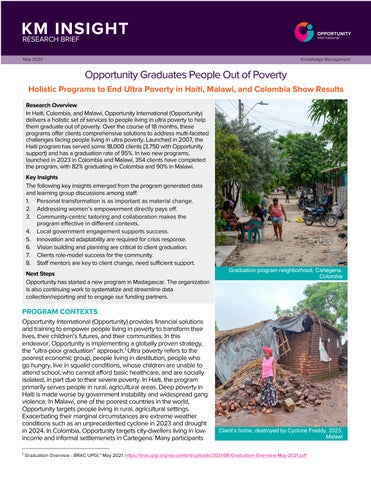
Graduation program neighborhood, Cartegena. Colombia
PROGRAM CONTEXTS Opportunity International (Opportunity) provides financial solutions and training to empower people living in poverty to transform their lives, their children’s futures, and their communities. In this endeavor, Opportunity is implementing a globally proven strategy, the “ultra-poor graduation” approach.1 Ultra poverty refers to the poorest economic group, people living in destitution, people who go hungry, live in squalid conditions, whose children are unable to attend school, who cannot afford basic healthcare, and are socially isolated, in part due to their severe poverty. In Haiti, the program primarily serves people in rural, agricultural areas. Deep poverty in Haiti is made worse by government instability and widespread gang violence. In Malawi, one of the poorest countries in the world, Opportunity targets people living in rural, agricultural settings. Exacerbating their marginal circumstances are extreme weather conditions such as an unprecedented cyclone in 2023 and drought in 2024. In Colombia, Opportunity targets city-dwellers living in lowincome and informal settlemenets in Cartegena. Many participants 1
Client’s home, destroyed by Cyclone Freddy, 2023. Malawi
Graduation Overview - BRAC UPGI,” May 2021. https://bracupgi.org/wp-content/uploads/2021/06/Graduation-Overview-May-2021.pdf
are Venezualan refugees or were displaced by violence in rural Colombia. High crime and gender-based violence also impact this target population. All three programs target women, and have a high portion of clients who are single parent households. ♦
OPPORTUNITY’S ULTRA-POOR GRADUATION PROGRAMS Participants. Cumulatively, the Haiti program has Table 1: Demographic Data served around 18,000 clients, and served 1,232 in Haiti Malawi Colombia 2024. The new programs in Malawi and Colombia have graduated just one class or “cohort” of clients. # Participants 1232 120 252 The programs primarily serve women who make up % Female 95% 92% 96% 95% of participants in Haiti, 92% in Malawi, and 96% % Female headed households 32% 43% in Colombia. Many of these women (32% in Malawi, and 43% in Colombia) are heads of household. The % Youth 59% 33% age range is mixed. Participants in the Malawi Average household size 5 4.9 4.5 program are young, with 59% being under 35. Colombia participants are older, with only 33% being under 30. On average client household size is between 4 and 5 (see Table 1). As of March 2025, the program in Haiti was serving 1,232 participants (950 with Opportunity support), Colombia 250, and Malawi 120. The Core Components. Graduation program s, originating from BRAC in Bangladesh, have demonstrated significant success in transitioning people from ultrapoverty into sustainable livelihoods and greater wellbeing across various dimensions. As is typical of these programs, Opportunity’s graduation programs incorporate the following components: u Social Protection: Clients initially receive cash to support household consumption, especially food, as well as crisis relief like urgent housing repair, and access to essential services such as healthcare and education. u Livelihood Promotion: Next, programs provide clients with assets and training that enable people to earn a living as a farmer, herder, or entrepreneur. u Financial Inclusion: To sustain financial wellbeing, clients gain access to formal or informal financial services including financial education to support savings and responsible borrowing. With Opportunity, clients are encouraged to form or join informal savings and loans groups. u Social Empowerment: Throughout the programs, staff work intensively with clients, training and coaching them to develop life skills that enhance resilience and cultivate community connections.
In addition to these standard components, Opportunity’s graduation programs in Malawi and Colombia feature a holistic development training, Pathways to Wellbeing. Based on the biblical concept of shalom, the curricula facilitates an empowerment process in which clients strengthen their relationship with themselves, their families, communities, physical world, and God.2 “Pathways to a Better Life” – Innovations in Haiti. In Haiti, the graduation program is implemented by Fonkoze, a non-profit organization that empowers Haitians, primarily women, with financial and development services to lift their families out of poverty. Fonkoze’s graduation program forms part of a staircase out of poverty that the organization offers. After graduation, clients have the opportunity to join solidarity groups to access training and financial services and, ultimately, to graduate to individual loans and formal finance. From 2022-2024, Fonkoze’s graduation program developed and piloted a more pro-active approach to women’s empowerment, building women’s agency, addressing their double workload, and engaging male partners to adjust their attitudes and practices to better support women’s economic and household activities. Having demonstrated important progress, Fonkoze plans to Client with her goat “assets” and improved house. replicate the program changes throughout the Haiti graduation program.
2
See Pathways to Wellbeing Brochure and “Pathways to Wellbeing Training Participants Show Growth.” 2
“Pathway of Opportunity” – Innovations in Colombia. Opportunity’s graduation program in Colombia, called “Pathway of Opportunity,” is one of the few urban graduation programs in the world. The program in Cartegena faces a complex task of supporting a wide diversity of businesses – from catering to hair salons – in somewhat disjointed communities, due to the high concentration of displaced people and refugees. A key innovation in this program is to assign two specialized staff to each client household, a social worker and a business expert. This configuration enables the program to address complex social and business situations. In addition, the Colombia program is supported by the City of Cartegena. Government partnerships such as this have led to substantial scale-up in some other countries.
Client receiving a freezer as a business asset. Colombia
“Poverty Has Ended” – Innovations in Malawi. Opportunity’s graduation program in Malawi is typical of rural graduation programs, but delivers innovations in the area of women’s empowerment and crisis adaptation. Through training and coaching, Opportunity promotes joint-decision-making within households and collaborative vision-setting, budgeting, and spending between spouses. It also has had to adapt to crises, particularly in 2023 when a devastating cyclone hit Malawi causing terrible destruction to homes and farms. At that time Opportunity collaborated with relief and health agencies to address immediate needs, replaced productive assets (especially animals) that were lost, rebuilt homes, and created a recovery lending fund to recapitalize savings and loan groups. ♦
RESULTS FROM THE GRADUATION PROGRAMS Data Capture and Reporting Methods. As is the case with all graduation programs, Opportunity’s graduation work is data intensive. Data capture starts with surveys to identify and select eligible clients from a set of locally adapted criteria. Once clients are in the program, staff capture data monthly on client participation and on key development objectives that make up the graduation criteria. This data is used to customize support and to channel extra support to clients who need it. At the 18 month point, staff identify the clients who have met all the graduation criteria and hold a graduation ceremony for them and their families. Graduation Results. The graduation programs have achieved strong graduation rates, with 90% in Malawi and 82% in Colombia graduating. Table 2 presents the rate of success for key common graduation criteria for both programs. In addition, some indicators had particularly noteworthy differences between pre- and post-program status: •
• • •
Table 2: Success Rate for Various Graduation Criteria
Haiti
Malawi Colombia
Overall Graduation Rate
95%
90%
82%
Livelihoods
97%
90%
94%
Food Security
83%
86%
94%
Financial inclusion: Prior to the program, only 11% of Health 81% 87% 93% clients in Malawi and 9% in Colombia had ever had 83% 100% 95% access to any financial product or service, but by the end Education of the program, 97% of clients in Malawi and 100% in Financial Inclusion 83% 97% 100% Colombia were regularly using savings and loan groups. Savings: Prior to the program, clients in Colombia had no cash savings, but by the time they graduated, clients had on average US $95. In Malawi, 97% of clients reached the goal to save the amount agreed within their saving group on a weekly basis. Food security: In Colombia, prior to the program, only 4% of clients ate three meals a day, but by graduation, 93% of clients were eating 3 meals a day. In Malawi, 86% of clients were eating three meals a day at the end of the program. Poverty eradication: Prior to the program 98% of clients in Colombia were living below the local poverty line, and by the end, 96% were living above the loval poverty line.
3
Client Story – Precious, Malawi Precious is a 38 years old mother of four. When she joined the graduation program she was doing seasonal farm work, but could not afford enough to eat, much less send her children to school. Now, she has seven pigs, 5 chickens, 3 goats, and a grocery store, from which she earns enough to feed her family. Now, all her children are in school.
Client Story – Valeria, Colombia Valeria is a mother of 3 girls, and lived in a humid house that caused health problems for the family. With support from the graduation program, she moved to a better premises. Now, Valeria and her family are much healthier. The program also helped her start a business from her new home. The program provided her with a freezer. Now, Valeria makes and sells food such as cheese sticks, empanadas, and cakes. Before the program, Valeria eked out a living on only US 83 cents per family member per day, but now she earns an income of $2.60 for each family member. In total, she has saved $181 during the program, providing a financial cushion in case of emergency.
Challenges. The graduation approach is labor and resource intensive, compared to lighter-touch financial inclusion approaches, which raises some challenges when it comes to scale-up. • • • •
•
•
•
Addressing women’s empowerment: Although women are economically empowed and also increase their confidence through graduation programs, studies of the Fonkoze program concluded that women’s empowerment encountered resistance from partners, and that the excessive burden that women bear in caretaking hinders progress. Staffing: The model in Colombia whereby each household has two coaches is very effective for catalyzing client transformation in both their social and business lives, but not all programs can afford to support this model. Staff selection and training: To be cost-effective, graduation programs need to determine the best staffing model: hiring more costly, experienced staff vs. hiring less experienced staff and training them for the work. Staff support to reduce staff burn-out (and turn-over): The job of coaching people living in ultra poverty is challenging and emotional. Clients struggle with daily physical survival and suffer mental health challenges like depression and post-traumatic stress. Competitive markets make running a business difficult; and, weather conditions make agriculture and animal husbandry risky. Staff have to practice constant empathy and bring positive energy to their clients, even as they navigate dangerous neighborhoods and long distances on rough rural roads. Under these conditions, front-line staff also need both material and moral support. Pressure to control costs can cut into this support, which then reduces effectiveness and increases staff turnover. Data capture and management: Graduation programs are necessarily data intensive. Programs need to have strong data capture and reporting systems. The more efficient these are, the less time managers have to spend on reporting, the more they can focus on staff support, and the easier it will be to get to scale. Partnerships: Graduation programs rely heavily on partners to work in tandem to link clients to social services. Managing partnerships and coordinating services takes time and skills. Aligning different budget and program cycles can be a challenge. Scale/Fundraising: A crtical element to reaching scale is mobilizing sufficient funding. In some countries, NGOmanaged programs have demonstrated the viability of Staff member counselling a client at her home. the approach in their context to governments, and Malawi governments have partnered to scale-up the programs – sometimes contracting with the NGOs to implement them. But programs need to reach moderate scale before this can be done. In Colombia, so far, the City of Cartegena is partnering with Opportunity at this pilot level, which indicates good prospects to eventual scale-up. Until then, resource availability determines scale.
Next Steps. The Malawi and Colombia programs have taken on their next cohorts of clients and are looking toward continued implementation and expansion. In its second group of 320 clients, the Malawi program expanded to two locations. In Colombia, so far the second cohort is the same size as the first, but they have proposed to double the number of people served. In addition to the Malawi and Colombia programs, Opportunity has supported the graduation program in Haiti since 2017, implemented by Fonkoze, since 2007; and, they have launched a program in Madagascar. Opportunity’s Knowledge Management team facilitates a graduation program learning group to share experiences and challenges, and brainstorm solutions. ♦ 4
KEY INSIGHTS Program implementors in Malawi and Colombia highlight lessons they feel are important for other practitioners implementing the graduation approach, as well as for supporters and potential funders: 1.
Personal Transformation is as Important as Change in Circumstances: Program staff reflect that graduation is about more than meeting a set of physical benchmarks. It can also be felt – and seen – in clients’ dramatic shift in self-confidence, in how they present themselves and engage with the world. 2. Addressing Women’s Empowerment Pays Off: Addressing women’s empowerment directly reduces men’s resistance to women’s economic empowerment and engages men in domestic work, reducing the uneven burden on women, both of which helps families thrive. 3. Community-centric Tailoring and Collaboration Strengthens Programs: Nagede, a client from Central Haiti The programs build trust with target communities, align programs with local before and after the program. needs and government initiatives, and partners with other organizations Haiti active in the community. 4. Local Government Engagement Supports Success: Collaboration with local governments and community committeees is instrumental in obtaining program approval and ensuring effective implementation. 5. Vision Building and Planning are Critical to Success: The programs conduct vision-building and planning workshops that help clients set their sights on key goals, and lay out practical steps to achieve them. 6. Clients Role-Model Success for the Community: Both programs have seen households not directly enrolled in the program benefit from client knowledge and practices, and from seeing others living in ultra poverty rapidly improve their lives. 7. Staff Mentors are Powerful Change Agents, Need Sufficient Support: Staff who engage and mentor clients are powerful change agents of graduation programs. They require training, sufficient material and emotional support, and a reasonable staff-to-client ratio in order to work effectively in physically and emotionally challenging situations. ♦
Clients celebrating at a graduation ceremony. Malawi
Client and daughter in her shop. Colombia
This study shows Opportunity’s strengths in – • Effectively addressing extreme poverty – Adapting best practice solutions to reach and serve the ultra poor. • Collaborative partnerships – Collaborating with NGOs operating in different sectors and also with governments to access expertise and funding and to explore the potential for large-scale interventions. • Data capture and reporting – As part of routine service delivery, capturing, using, and reporting complex client data. • Facilitating and capturing learning across countries – Convening learning exchange among programs using the same strategy in different contexts to leveral experience and learning.
5