Pathways to Wellbeing Training Participants Show Growth

Opportunity Knowledge Management and Partners have developed and tested a holistic development training program in Ghana, Malawi, and Colombia.
Overview
Opportunity has developed an unique, holistic development training program entitled Pathways to Wellbeing (“Pathways”) – a training that conscientizes clients to the different areas where they and their households can develop Using real-life stories – presented as videos or flashcards – around which discussions can take place, facilitators encourage participants to begin to own their own development and begin a journey toward wellbeing in various aspects of their personal, household, and community life. Opportunity partners in Ghana, Malawi, and Colombia piloted the training in different institutional settings – microfinance, savings groups, and churches – from 2022-23 Positive outcome findings show that it is highly likely that clients and staff of programs engaging extreme poverty would welcome this program given the need and expectations for deep engagement.
Key Research Findings:
• Tested: Across 3 countries, 9,142 participants were trained in 2 modules: “Foundations” and one other module, with the topic chosen depending on the context/partner.
• Program Use Context: Warm reception by savings groups and churches showed promise for further use by them and by Graduation programs. Success in the FSP context required strong leadership commitment.
• Participant Outcomes: The satisfaction rate was 100% in both Malawi and Colombia. Across a wide range of life aspects, outcomes indicators from the pilot suggest positive change due to the training.
PROJECT CONTEXT
People living in poverty experience barriers and opportunities in multiple aspects of their spiritual, social, and physical lives. Because of poverty’s multi-faceted nature, specific, singular interventions often have a limited impact. At the same time, most development organizations cannot efficiently deliver services across multiple technical areas. The Pathways to Wellbeing program offers a middle ground: a way to address multiple dimensions of poverty while staying focused on a primary intervention. This seamlessly fits savings group, Graduation, and church contexts by addressing the multi-faceted development needs of those living in poverty. For financial institutions, Pathways can also support business goals by enhancing client retention, strengthening loan repayment, and engendering customer loyalty and stability.
THE CURRICULUM
The Pathways to Wellbeing Program is based on the concept of “Shalom” which drives the objectives and structure of the training curriculum. The Christian worldview from which this concept arises posits a God whose desire is for joyful human flourishing through restored relationships with God, with ourselves, with others, and with Creation 1 The 6 training modules relate to these dimensions (see Figure 1) Each module consists of 4 lessons, with options for 30-, 60-, or 90minute sessions.
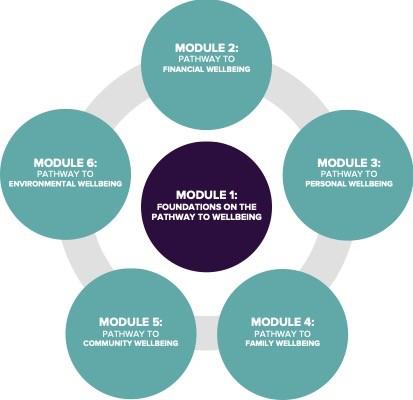
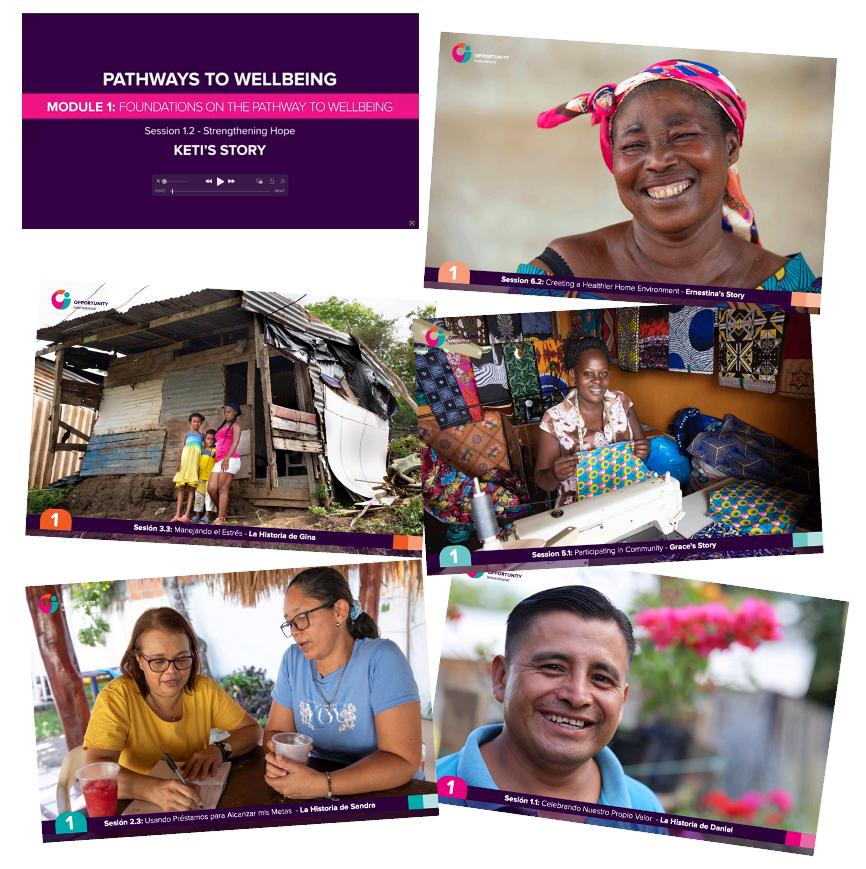
Pathways uses adult learning best practices and is story-based. Each conversation session is structured in the same way, with a real client story of struggle and success at the center for participants to discuss and relate to their own experiences. The stories are presented in half of the lessons as videos and in story-card or presentation format in the other half. The
1 This and other embedded values, while arising from one tradition, are values/concepts that can be readily appreciated by other value traditions.
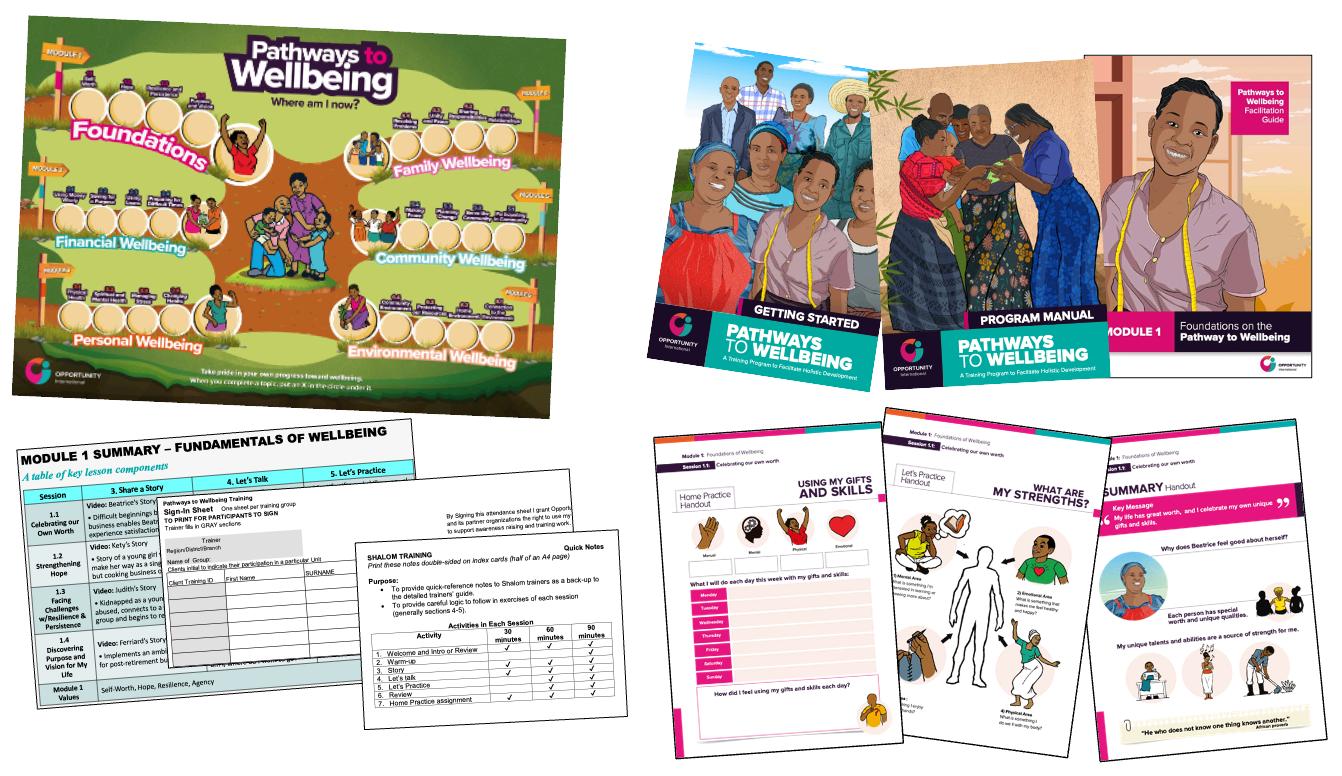
story is supplemented by warm-up exercises, structured discussion, games, and “home practice” in which participants apply lessons to their own lives. The facilitation materials are user-friendly for amateur/volunteer facilitators, and appropriate for low-literacy adults. So far, there is an “African” version –with African stories in English and three African languages – and a “Spanish” version with stories from Latin-America in Spanish (see Figure 2 right). The training of facilitators also includes a unit on adult learning principles to help inexperienced facilitators grasp the difference between traditional lecturebased training and adult participatory methods used in the program. The curriculum is supported by a rich set of materials that includes a Facilitation Guide, Program Manual, Worksheets, M&E templates, and other materials (see Figure 3 left).
“I found inspiration from the training videos, particularly the story of Beatrice, depicting a woman who faced adversity when her business was destroyed by a truck. She was able to rebuild by taking a loan.” Participant, Mercy, Ghana
THE PILOT PROGR AM
From an implementation perspective, the training was designed to “piggy-back” alongside other services being delivered in order to minimize costs and maximize convenience for training institutions and participants. The pilot gave our partners an opportunity to test the Pathways training program in different country and institutional contexts. It was field-tested by Opportunity International Savings and Loans (OISL) in Ghana, Opportunity International Malawi (OIM), and AGAPE in Colombia. Opportunity Knowledge Management managed the program, built capacity for training trainers, and facilitated peer-to-peer learning. The total number of participants trained in the pilot was 9,142 (81% women).
Table 1 below presents the three pilot programs, their outreach channels, the number of participants trained and contextual comments.
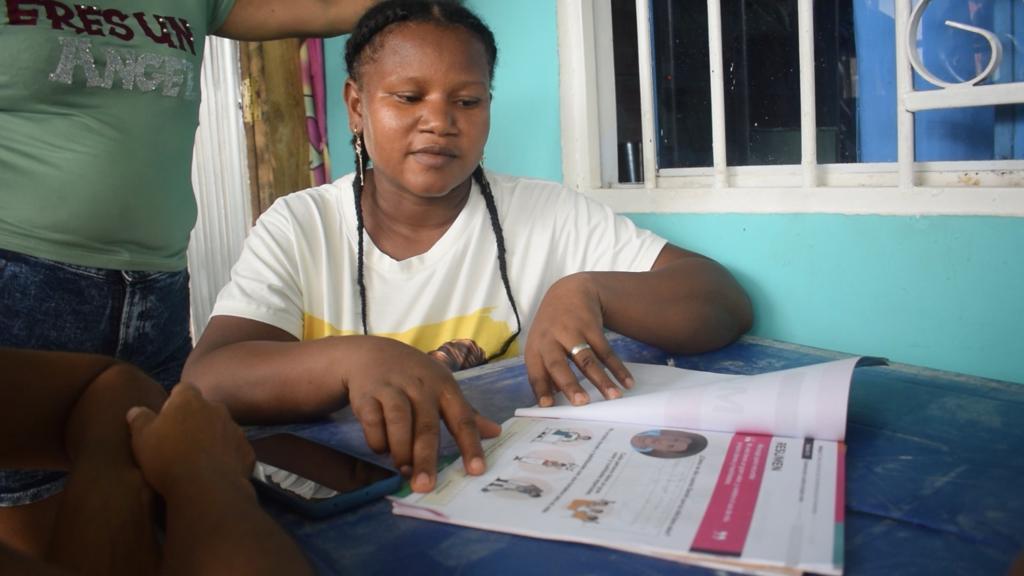
Within the structure of the program, significant freedom was given to our partners to deliver the program in a manner that fit their clients and programmatic needs. Below are images training discussions taking place with participants in Colombia (see Figures 4-5 below).
EVALUATION SURVEY RESULTS (MALAWI AND COLOMBIA)
Opportunity partners carried out a participant evaluation survey to capture changes in values, knowledge, and behavior linked closely to the training topics. This involved a pre-training and post-training survey of a sample of participants. We share the key findings from Malawi and Colombia below. Because the two countries chose different modules, the topics and data outputs are different between the two countries. The most substantial changes could be seen in the following areas:
u Malawi: Sense of financial security; ability to practice hope and set goals; improved sense of self-worth.
u Colombia: Sense of self-worth, hope, resilience; hope for families becoming strong/healthy and improving wellbeing.
Both surveys also assessed client satisfaction, which was 100% in both Malawi and Colombia.


Malawi Results
After the training, more clients–
• Practiced hope, improving their well-being (36% à 76%)
• Set goals and took steps to reach them (38% à 64%)
• Saved to reach goals (32% à 44%)
• Prepared themselves financially for difficult times and emergencies (40% à 52%)
• Had a mobile money account (36% à 64%)
• Felt financially secure (17% à 28%)
• Made household decisions independently (36% à 52%)
The results strongly suggest positive impact.
In Malawi, the Foundations Module addressed values increasingly recognized as key to development
• Sense of identity and self value
• Purpose and vision
• Hope
• Resilience and perseverance
While the topics seem ordinary, the Financial Wellbeing Module discussed them differently.
• Understanding money
• Saving for the future
• Using loans to reach goals
• Preparing for crises
“These trainings helped my thinking capacity and my wisdom changed, too. The training is helping both spiritual and physical life. I benefitted a lot from the training. Before, I just wished, but now I have learned to take action. ”
Participant Abigail, MalawiIn Colombia, clients chose the dimensional training module that they wanted to take following the Foundations Module (module, % that chose):
• Financial Wellbeing (M2; 14%)
• Personal “ (M3; 5%)
• Household “ (M4; 74%)
• Community “ (M5; 5%)
• Environmental “ (M6; 3%)
Here, too, results are promising.
Colombia Results
After the training, more clients–
• Felt a greater sense of self-worth (39% à 61%)
• Practiced hope and improved their wellbeing (50% à 69%)
• Greater ability to push forward amidst challenges (23% à 33%)
• Set goals and took steps to reach their goals (66% à 82%)
• Felt worthy, hopeful and resilient (24% à 61%)
• Able to construct healthy relationships in their families (29% à 39%)
• Divided household work equally btw men/women in family (53% à 70%)
• Managed emotions, contributing to peace in family (66% à 81%)
• Families faced and resolved problems together (47% à 57%)
• Felt their families were becoming strong and healthy (46% à 66%)
“The training impacted me. It awakened hope in me, that spark that had been extinguished when I left behind everything I had achieved in Venezuela. Now, I think that, if I managed to prosper before, I can also do it here in this country.” Participant, Rusmery, Colombia
KEY PROGRAM INSIGHTS
u Bringing senior leaders onboard. A session for senior leaders that exposed them to Pathways stories proved very valuable.
u Strong use case w/Savings Groups, Graduation Programs, Churches. They responded well to the training.
u Staff turnover is a special challenge because the unique training philosophy requiring trained facilitators.
u Committed leaders key for Financial Institutions. Visionary and committed leadership is key for financial partner success. The value of this for staff and clients, for reputation and retention, and for enhanced repayment given improved client wellbeing must be shown and understood.
u Story presentation requires forethought and innovation. Videos require equipment, seating, and lighting. Videos for Mobiles exist, but the small size is difficult to use. A laptop with a Bluetooth speaker can work with smaller groups, but a larger screen remains preferable.
u Incentives for facilitators is recommended. This worked for Savings Groups and Churches; incentives would have been useful for FI staff; full-time facilitators, rather than per-training hires is better.
u The curricula was very well-received by trainers and participants and showed strengths of components. The stories were the highlight and stimulated strong responses. Also noted were the value of the facilitation guide; effectiveness of engaging (internal) values; value of a participatory approach to enable clients to own their own development; importance of a flexible framework with client choosing topics and lesson length.
u Many programs remain pressed for time as expected. The 30 minute version was consistently chosen by partners; conversation sessions usually went over-time.
u Gathering participants for 8 sessions without life events interfering remains difficult. In most cases, additional planning for contingencies became necessary.
u Different rigor in M&E is possible and will require case-by-case calibration in the future. The Pilot required monitoring of each participant’s attendance. This may change in the future.
“As a training facilitator of [Pathways], I can feel such great satisfaction, to be able to take to all the communities messages that touch the hearts and minds of the participants, that they then replicate in their families and that even I replicate in my own.”
This study shows Opportunity’s strengths in:
Facilitator, Carmen, Colombia
• Holistic client engagement that empowering clients to own their own development.
• Opportunity’s “last mile outreach” that connects our programs to lives that flourish.