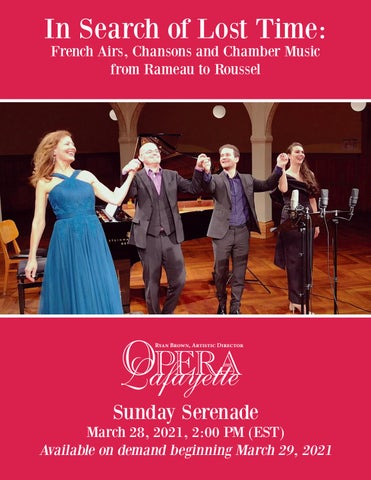
In Search of Lost Time: French Airs, Chansons and Chamber Music from Rameau to Roussel
Ryan Brown, Artistic Director
Sunday Serenade
March 28, 2021, 2:00 PM (EST) Available on demand beginning March 29, 2021
Artists LAETITIA GRIMALDI STEPHANIE HOUTZEEL
Soprano Mezzo-Soprano
AMMIEL BUSHAKEVITZ CHARLES BRINK
Piano Flute
Production Team AMMIEL BUSHAKEVITZ LISA MION ALTA BODE DOUG TUSING
Video and Audio Producer Production Manager Stage Manager Video Technician
Recorded at Villa Elisabeth in Berlin, Germany
Program Jean-Philippe Rameau (1683-1764) - Airs & Duo Aux langueurs d’Apollon (Platée) Laetitia Grimaldi, Ammiel Bushakevitz Temple sacré, séjour tranquille (Hippolyte et Aricie) Stephanie Houtzeel, Ammiel Bushakevitz Traversez les plus vastes mers (Les indes galantes) Laetitia Grimaldi, Stephanie Houtzeel, Ammiel Bushakevitz Frédéric Chopin (1810-1849) Ballade No. 1 in G minor Ammiel Bushakevitz Claude Debussy (1862-1918) Trois Chansons de Bilitis: La flûte de Pan La chevelure Le tombeau des Naiades Stephanie Houtzeel, Ammiel Bushakevitz Louis Aubert (1877-1968) Duet : Cache-cache Laetitia Grimaldi, Stephanie Houtzeel, Ammiel Bushakevitz Reynaldo Hahn (1874-1947) À Chloris Néère L’Heure exquise Quand je fus pris au pavillon Laetitia Grimaldi, Ammiel Bushakevitz SONGS WITH FLUTE Jacques Ibert (1890-1962) Mon amante a les vertus de l’eau (Deux stêles orientées) Stephanie Houtzeel, Charles Brink Albert Roussel (1869-1937) Ciel, aer et vent (Deux poèmes de Ronsard) Laetitia Grimaldi, Charles Brink Maurice Ravel (1875-1937) La flûte enchantée (Shéhérazade) Stephanie Houtzeel, Charles Brink, Ammiel Bushakevitz Léo Delibes (1836-1891) Viens, Mallika…Sous le dôme épais (Lakmé) Laetitia Grimaldi, Stephanie Houtzeel, Ammiel Bushakevitz
A Note from the Artistic Director Stephanie, Laetitia, Ammiel and Charlie’s recital gives us a wonderful opportunity to appreciate French music of the late 19th and 20th centuries in the light of the French baroque. After a trio of Rameau vocal works from three different operas – a comedy, a tragedy, and an opéra-ballet - Ammiel reminds us of the intervening 19th century with a tour de force of Chopin for solo piano. Then the artists delve into a later French repertoire inspired in part by various composers’ own rediscovery and appreciation of 18th century French music. Rameau’s operas were published in the early 20th century in a ‘complete’ edition prepared under the auspices of Camille Saint-Saëns and published by Durand, part of a larger rediscovery by French composers of their somewhat distant forerunners. In works of Debussy and Ravel, as well as Hahn, Ibert, Roussel, the lesser-known Aubert and of course the well-known duet by Delibes, we have the opportunity to connect the sensuality, wit, clarity and expressiveness of 18th century French composers with their musical descendants. – RB
Program Notes from Guest Artist Stephanie Houtzeel Debussy’s Trois Chansons de Bilitis, composed in 1897, have their roots in a tale of deception. Thought to be direct translations of ancient Greek poetry, the poems were in fact entirely invented by the French poet and friend of Debussy, Pierre Louÿs. According to historian Roger Nichols, Louÿs “took great pleasure in having perpetrated one of the greatest literary spoofs ever,” successfully evoking an ancient Greek world – not from direct translation, but from the fantasy of a 19th century poet! As performers of these magnificent songs, however, it is not our job to give away Louÿs’ little secret, but to join him and Debussy on their journey through an imagined Greek world, full of sensuality, secret settings and landscapes, characters and costumes – much like we would take in a faraway land presented on an ancient fresco. Debussy’s faux-Greek world imagines three phases of a young woman’s awakening to love: a first sensual encounter during a flute lesson (La flûte de Pan), a passionate affair acted out while entangled in her flowing hair (La chevelure) and the slow dying out of love’s glow (Le tombeau des Naiades), described in a wintery landscape with colder, more distant exchanges between the girl and her lover. Debussy does all of this through sensuous lines in the voice, impressionistic harmonies in the piano, but also in texts that are practically spoken, so close are they to the inflections of the French language. Debussy is very precise in his rhythmic and dynamic markings. The challenge for the performer, in my view, is to “get out of the music’s way” – to follow Debussy’s markings and rhythms as closely as possible and not overload his music to the point of suffocating it. It seems the simplest task, to just get out of the way, but it is, for those of us steeped heavily in the more indulgent Italian and German traditions, often the biggest challenge. In a way, the best way for me to prepare these songs is to think back on my experiences with the French baroque repertoire – the title role of Lully’s Armide (which I performed with Opera Lafayette) being the perfect example: the extensive recitative writing in Lully’s opera came most alive when we simply did exactly what he wrote, sticking to his precise rhythms, which were a perfect recreation of the flow of the French language. The opening lines of Debussy’s La flûte de Pan - and perhaps even more so, this song’s final lines - seem to me a perfect continuation of this precise, yet stunning French tradition. If the Bilitis songs are considered “among the most perfect” when it comes to French word-setting, this connection to text is reflected in all of the songs we performed here. In the mezzo songs, Ibert’s Mon amante a les vertus de l’eau and Ravel’s La flûte enchantée are both wonderful in their “speaky” places, where they are chatty and recitative-like, as well as in their lyrical moments, when they indulge more in emotion than narration. The Ibert song misleads us with its gorgeous intro of lyrical flute writing: we are lured into thinking this is going to be a sensuous ode to a woman, whose qualities are like that of pure, flowing water. But alas! The water turns out to be mud, leaving the spurned lover cupping a clump of dirt rather than the kiss of his beloved. Ibert uses long lines in both the flute and the voice to seduce - and then sharp rhythms and crisp text to bring us down to earth. Ravel’s La flûte enchantée, the second song from his gorgeous Shéhérazade cycle, also creates a faux world, much like Debussy’s songs, in this case an imagined Arabian setting full of story tale sheiks and harems. We hear Shéhérazade bemoan her captivity until the tones
of her lover’s flute appear, and she comes alive with hopeful, excited, soaring vocal lines. I love the interplay of voice and flute here, both mischievous and romantic. Like the songs of Debussy, Charlie and I found the most success with these when we simply paid full attention to the notation. The exacting rhythms and commitment to text, intertwined with fantastical harmonies and lyricism, set up each song to be its own unique little world. If there is one piece on the program where I let myself drift away, oh-so slightly, from textual declamation and indulge more in the lyrical, harmonic experience, it is Aricie’s opening aria from Rameau’s Hippolyte et Aricie, “Temple sacré, séjour tranquille.” I have always loved the solemn dreaminess of this short aria, which sets up Aricie’s love and devotion to Hippolyte so beautifully. In reality, a mezzo-soprano like me would probably not be cast in the role of Aricie; opera companies usually opt for a brighter, lighter voice for this romantic character, while using a mezzo for the jealous, dramatic Phèdre. The fact is, I just could not resist taking on this lovely musical gem! A note about the three duets on our program: each of them highlights a different challenge for voices singing in duo. Where the duets from Rameau’s Les indes galantes and Aubert’s Cache-cache both play with the idea of singing in canon, Rameau brings the voices more readily into parallel lines, so the listener can settle into hearing a clear high and low voice blend. Aubert, on the other hand, is playful and mischievous from the get-go – leaving the voices purposefully out of sync, in order to highlight the flirty, devilish nature of the nymphs they are imitating. Aubert’s short duet is devilish to prepare as well! Laetitia and I rehearsed it at slow tempi several times before taking on the cheeky allegro that Aubert calls for - and which the duet’s character absolutely demands. Finally, the duet from Lakmé: this is probably one of the most famous duos for two female voices in the repertoire, thanks in part to British Airways! Here the singers must be absolutely in sync, as their voices run in parallel or intertwine constantly. The duet requires a mixture of intimate singing and operatic lyricism, with a willingness, like in all French music, to be true to all of the composer’s dynamic markings. It was a great pleasure to sing with Laetitia again, two years since we first met to perform those gorgeous – if perilous! - duets in OL’s production of Jommelli’s Cerere placata. We hope you enjoy this recital! – S.H., March 2021
Artist Biographies Since her Carnegie Hall debut in 2013, LAETITIA GRIMALDI has sung in many renowned halls, opera stages and international festivals worldwide: Kennedy Center (USA), Shanghai & Forbidden City Concert Halls (China), Festival Croisements (China) Festival Pitic (Mexico), Festival Musica Classica (Canada), Verbier Festival (Switzerland), Ravinia Festival (USA), Festival d’Aix-en-Provence (France), Melbourne Festival (Australia). Laetitia’s debut album is a CD of 19th-Century French female composers which includes numerous world-premiere recordings. The album will be released worldwide by the Swedish label, BIS Records. In 2017 Laetitia was awarded the first prize in three international competitions: 1st prize at the Concours International de Mélodies Françaises in Montreal, Canada, the 1st prize at the Concours International Robert Massard in Bordeaux, France as well as the 1st Prize at the Concours International Pro Musicis in Paris. Born in France, Laetitia Grimaldi spent her childhood in Lisbon and London. After beginning her vocal studies with Teresa Berganza, she continued her education at the Juilliard School, NY. She has received mentorship with some of the world’s leading artists, including Sir Thomas Allen, Dame Emma Kirkby, Alfred Brendel, Ileana Cotrubas, François le Roux and Dalton Baldwin. Recent performances include extensive recital tours in China, Australia, New Zealand, Mexico, South Africa, Canada, the USA as well as performances with orchestras in Canada, the USA, Brazil, China, South Africa, the United Kingdom and throughout Europe. Laetitia has performed Charpentier, Rameau, and Jommelli with Opera Lafayette Mezzo- Soprano STEPHANIE HOUTZEEL was born in Kassel, Germany and grew up near Boston. She studied Political Science and French at Middlebury College before obtaining her Master’s at the Juilliard School. She won top honors at the Queen Elisabeth of Belgium Competition and at the Juilliard Vocal Arts Debut Competition. She has been a member of the Vienna State Opera ensemble since 2010 where her roles have included Octavian, der Komponist, Ariodante, Dorabella, Orlofsky, Nicklausse or Jenny Hill. She created the role of Miranda in the Vienna world premiere of Adès’ The Tempest and the role of La Haine in Vienna’s first production of Armide (Gluck). The Strauss “trouser-roles” have taken Stephanie around the world: among others, she sang Der Rosenkavalier at the Kennedy Center, the Opéra Bastille-Paris and der Komponist (Ariadne auf Naxos) in Zurich, Vienna and Tokyo under Fabio Luisi, Sir Jeffrey Tate, Franz Welser-Möst and Marek Janowski. A personal highlight has been the title role in Handel’s Serse, both at the Komische Oper Berlin, the Deutsche Oper am Rhein and in Graz, which garnered Stephanie a nomination for Austria’s Music Theatre prize. Further engagements have taken her to the Salzburg and Bayreuth Festivals, to Dresden, New York City Opera, Lyon, Copenhagen, Theater an der Wien, Strasbourg, the Israeli Opera, the Vlaamse Opera, Düsseldorf and Lisbon. She has performed Lully, Gluck, Mozart and Jommelli with Opera Lafayette. Stephanie has performed in concert with many of the world’s leading orchestras and ensembles including the Vienna Philharmonic, the Royal Concertgebouw Orchestra and the Hong Kong Philharmonic. She has collaborated with conductors Valery Gergiev, Jaap van Zweden, Christoph Eschenbach, Adam Fischer, Dennis Russell Davies, Philippe Jordan, Phillippe Herreweghe and Teodor Currentzis. Ms. Houtzeel’s recordings include her recent Lieder album ‘Nostalgia‘ with pianist Charles Spencer. She recorded the title role in Lully’s Armide with Opera Lafayette and the title role in von Suppé’s Fatinitza. She also appears as the alto soloist in Mozart’s Requiem under Teodor Currentzis. | stephaniehoutzeel.com
Born in Jerusalem, Israel and raised in South Africa, AMMIEL BUSHAKEVITZ performs regularly as a pianist at notable venues across Europe, North America, Africa, Asia and Australia. He regularly performs at London’s Wigmore Hall and at the festivals of Salzburg, Bayreuth, Lucerne, Aix-en-Provence, Shanghai and Melbourne, the Festival Pontino di Latina in Rome, the Pablo Casals Festival in Barcelona, the Jerusalem Schubertiade, the Festival Classica de Montréal in Canada, the Leeds Piano Series and the Festival Pitic in Mexico. Ammiel is one of the last private students of the late Dietrich Fischer-Dieskau and is a graduate of the Hochschule in Leipzig, Germany and the Conservatoire de Paris, France. His mentors included Boris Berman and Alfred Brendel. Ammiel has also worked with other notable singers including Thomas Hampson, Matthias Goerne, Thomas Quasthoff, Barbara Bonney, Dame Felicity Lott and Teresa Berganza. Passionate about education, Ammiel has been invited to present masterclasses at the University of Queensland (Australia), the University of Barcelona (Spain), the Sichuan Conservatory (China), the Victoria University National School of Music (New Zealand) and the University of Colorado (USA). He regularly offers masterclasses to young pianists at the Jerusalem Music Academy in Israel. Ammiel’s discography includes recordings with critical acclaim and 5-star reviews on labels such BIS (Sweden), Hänssler Classics (Germany), SOLFA (Spain), Naxos (Hong Kong) and Gramola (Austria). Upcoming recordings of his will be released by Pentatone, Edel Classics and Harmonia Mundi. Ammiel is president of the International Association “Les Voix d’Orphée” in Paris and was named Edison Fellow of the British Library, London. CHARLES BRINK began his flute studies with Jacob Berg in his native St. Louis. He holds degrees from the New England Conservatory (Boston), the San Francisco Conservatory and the Royal Conservatory of Music in The Hague. Since devoting himself primarily to historical flutes in 1998, he has toured and recorded with, among others, the Amsterdam Baroque Orchestra, Wiener Akademie, Les Musciens du Louvre, The Four Nations Ensemble and Les Nouveaux Caractères. From 2005-2009 Charlie lead the Grand Tour Orchestra (New York City), which he founded. With this ensemble he conducted the US premiers of works by C.Ph.E. Bach and N. Jommelli. His recordings can be heard on West German Radio, Middle German Radio, Dutch Radio and Television, Austrian Radio and the EMI, Raumklang (Germany), Fuga Libera (Belgium) and Orchid Classics (London) labels. In 2018 Mr. Brink conducted the modern premiere of Niccolò Jommelli’s Cerere placata with Opera Lafayette at the Kennedy Center and the Times Center (New York). In the coming year Mr. Brink will begin his PhD studies in musicology (Niccolò Jommelli and the Orchestra) at the University of Bayreuth (Germany). Charlie lives in Vienna, Austria with his wife, Stephanie Houtzeel, and their son Jacob.
Ryan Brown, Artistic Director