

Opera Carolina, one of Charlotte’s longest-standing cultural institutions, is operating at a pivotal moment in its organizational history. As the performing arts sector across the United States continues to evolve, many regional opera companies are confronting structural financial pressures driven by rising production costs, shifting philanthropic priorities, and changing audience behavior.
In this environment, Opera Carolina’s financial trajectory and organizational structure merit careful review. The organization’s publicly available IRS Form 990 filings provide an objective view into the company’s financial performance, revenue composition, and long-term sustainability.
This report examines key financial indicators, structural assumptions regarding the organization’s resources, and the broader outlook for Opera Carolina as it navigates financial challenges while continuing to produce artistic programming for the Charlotte community.
Opera Carolina’s most recent Form 990 filing for the fiscal year ending June 2024, the organization reported the following financial results:
• Total revenue: approximately $2.74 million
• Total expenses: approximately $3.61 million
• Total assets: approximately $814,000
• Total liabilities: approximately $4 million
The fiscal year, therefore, concluded with a net operating deficit of approximately $870,601, with liabilities exceeding assets on the balance sheet.
It is important to note that this filing reflects financial activity that occurred prior to the current leadership administration.
Opera Carolina’s revenue structure reflects the broader funding model of the American opera industry, where philanthropic support plays a central role.
According to the most recent filing, revenue sources are distributed as follows:
• Contributions and donations: $2.02 million (73.8%)
• Program service revenue (ticket sales): $601,695 (21.9%)
• Fundraising events: $79,860 (2.9%)
• Other income: $37,115 (1.4%)
This indicates that nearly three-quarters of the organization’s revenue is derived from philanthropic contributions, with ticket sales covering a smaller portion of operating costs.
The organization’s primary fundraising event generates under $100,000 in net proceeds, representing a relatively modest contribution to the overall operating budget.
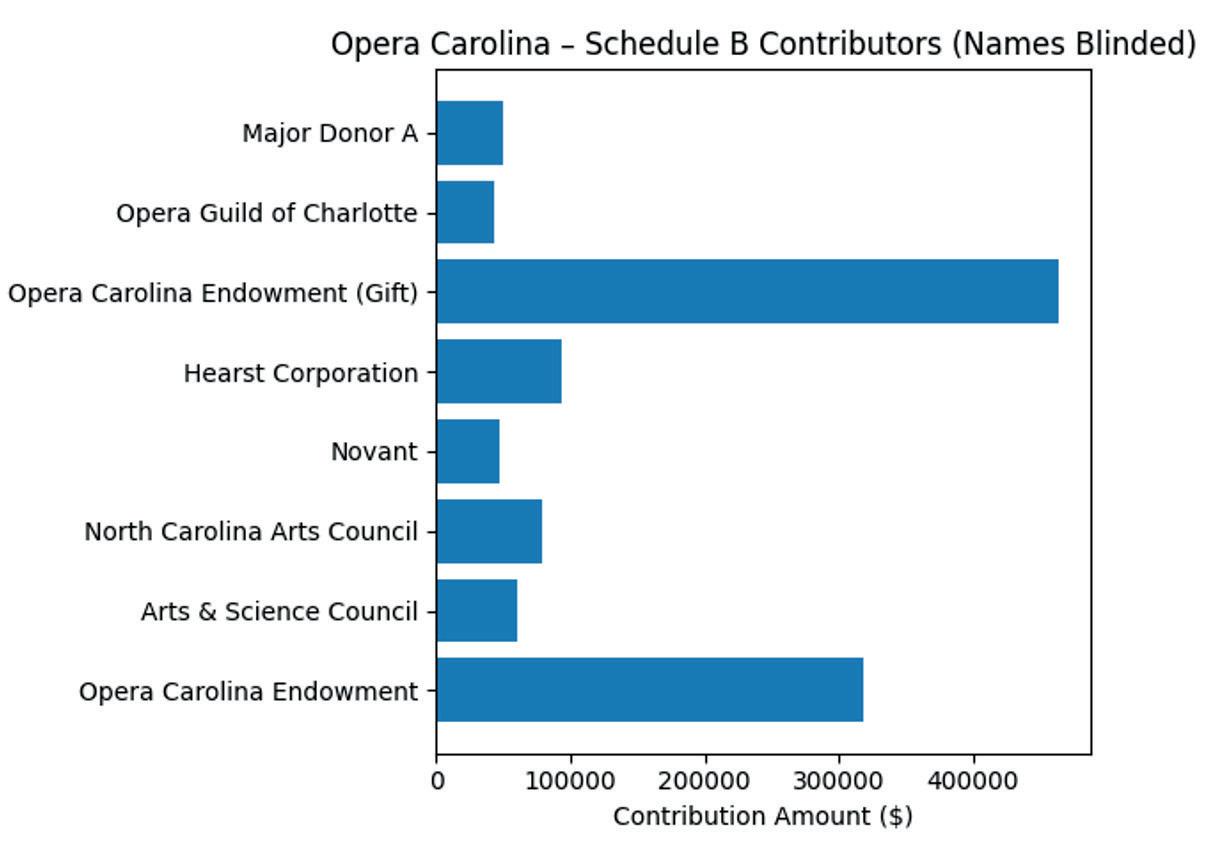
A horizontal bar chart displays the major contributors listed in Schedule B of the Form 990 , showing the relative size of each donation. Each bar corresponds to a contributor and extends horizontally according to the amount given.
The largest contribution, approximately $464,000, comes from the Opera Carolina Endowment, indicating a major transfer from the organization’s affiliated endowment.
The second-largest contribution, about $318,000, also comes from the Opera Carolina Endowment.
Other contributions include:
• Hearst Corporation — approximately $93,775
• North Carolina Arts Council approximately $78,500
• Arts & Science Council (Charlotte-Mecklenburg) approximately $60,000
• Major Donor A (name blinded in the chart) — approximately $50,000
• Novant — approximately $46,677
• Opera Guild of Charlotte approximately $43,000
The chart visually demonstrates that endowment transfers represent the largest portion of Schedule B contributions, while corporate, institutional, and individual gifts make up smaller amounts.
Opera production is among the most resource-intensive forms of performing arts.
Opera Carolina’s cost structure reflects several significant expense categories, including:
• venue rental and performance costs at Blumenthal Performing Arts facilities
• engagement of the Charlotte Symphony Orchestra for orchestral performances
• artist fees, chorus, technical crews, and production infrastructure
These elements together represent a substantial portion of the cost required to stage grand opera productions.
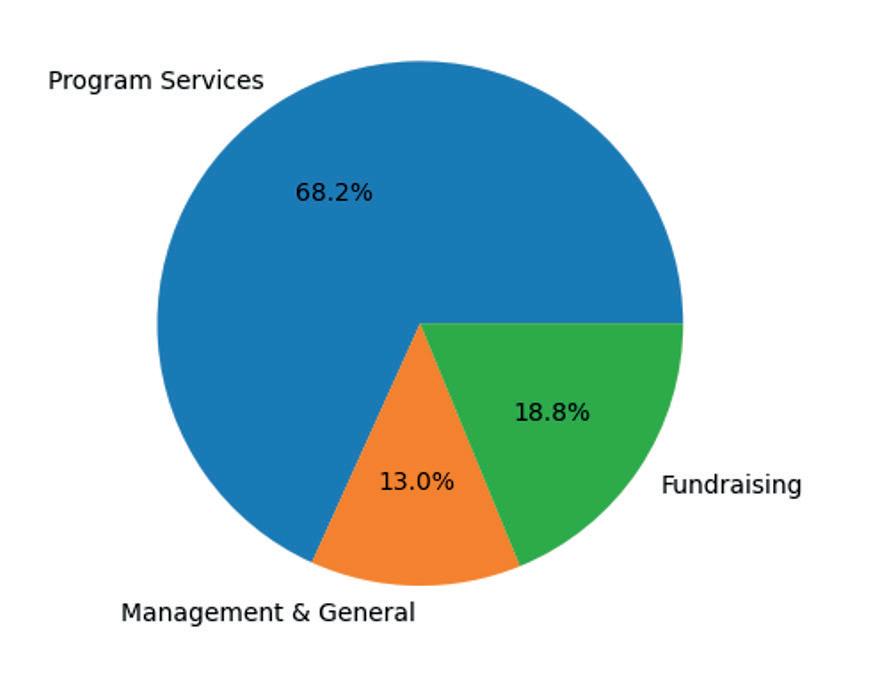
Fig 2 illustrates how Opera Carolina allocates its total annual expenses of approximately $3.6 million. The chart is divided into three colored sections representing the major expense categories.
• The largest section, about 68% of the chart, represents Program Services, totaling roughly $2.46 million. This includes costs related to opera productions, artists, education programs, and outreach initiatives.
• A smaller section representing Management and General expenses accounts for about 13%, or roughly $468,000, covering administrative operations such as leadership, accounting, and governance.
• The remaining 19% represents Fundraising expenses, totaling about $679,000, associated with donor cultivation, fundraising events, and development activities.
The visual emphasizes that the majority of expenditures are directed toward programmatic artistic and educational work, with smaller portions supporting organizational administration and fundraising.
An examination of Opera Carolina’s Form 990 filings over the past decade reveals a pattern of operating volatility with recurring deficits.
The following table summarizes the organization’s reported annual surplus or deficit
2015 ($177,053)
2016 ($337,177)
2017 $114,973
2018 ($461,779)
2019 ($518,226)
2020 ($115,397)
2021 $96,047
2022 $179,090
2023 ($345,284)
2024 ($870,601)

Over this ten-year period, Opera Carolina generated a cumulative deficit of approximately $2.4 million.
While fluctuations in revenue and expenses are typical in performing arts organizations—particularly those producing large-scale opera productions—the trend highlights structural pressures within the organization’s operating model.
Opera Carolina benefits from the existence of the Opera Carolina Endowment, a separate nonprofit entity designed to support the long-term financial sustainability of the organization.
Our most recent 990 reports net assets exceeding $3 million. However, a review of the financial statements indicates that a substantial portion of these assets has already been deployed to support the operating organization.
Specifically, the filings report intercompany balances indicating that the endowment has extended approximately $2,211,372 to the operating company.
This type of financial relationship between an operating nonprofit and its endowment is not uncommon. However, it does mean that a portion of the endowment’s reported assets is effectively functioning as working capital for the organization rather than remaining fully invested.
Given the importance of the endowment to the long-term stability of Opera Carolina, careful stewardship and transparency regarding its use are essential.
As stakeholders committed to the future sustainability of the organization, we believe it is our fiduciary responsibility to seek additional clarity regarding the historical movement of endowment resources. To that end, consideration is being given to submitting a formal inquiry to the North Carolina Office of the State Auditor to determine whether the organization’s endowment activity meets the criteria for a formal review.
The purpose of such an inquiry would not be adversarial, but rather to ensure transparency, reinforce governance best practices, and support the responsible rebuilding and stewardship of endowment resources for the long-term benefit of Opera Carolina and the community it serves.
Ensuring that these resources are managed in accordance with nonprofit governance standards will be an important component of strengthening the organization’s financial foundation moving forward.
Opera Carolina previously owned a historic property on Elizabeth Avenue that served as its administrative headquarters. Public property records indicate that this property was sold prior to the COVID-19 pandemic.
The organization now leases the property from Novant Health, removing a potential asset liquidation option from its financial toolkit.
For many years, Opera Carolina maintained two large warehouse facilities that housed production assets, including costumes, props, sets, and technical equipment. One of these facilities also included the organization’s set construction workshop in Lowell, North Carolina.
Over time, the cost of maintaining these facilities became increasingly disproportionate to their operational value. Both locations had accumulated significant arrears extending back more than two years, creating financial pressure on the organization. After careful review, management made the fiscally responsible decision to close the larger of the two facilities, which carried the majority of the outstanding obligations.
A repayment and settlement agreement was reached outside of litigation, and the assets housed in that facility were liquidated through a combination of sales to public institutions, private organizations, and individual buyers.
While the insured value of the inventory had previously been estimated at more than $1 million, subsequent review determined that the actual market value of many of these items was considerably lower. In several cases, the cost of storing or disposing of aging sets and materials exceeded their resale value. Additionally, many of the production assets had not been utilized or rented in several years, reflecting a broader industry trend in which regional opera companies increasingly rent or share production sets rather than maintain large inventories. Opera Carolina currently relies primarily on rented productions from other companies, which has proven to be a more cost-effective model.
Looking ahead, the organization continues to work toward resolving arrearages associated with the remaining facility. Addressing these obligations remains an important priority, as they represent an ongoing pressure on cash flow. At the same time, the reduction in warehouse footprint represents a meaningful step toward aligning operational infrastructure with the company’s current production model and long-term financial sustainability.
Many of you are aware of the litigation dispute Opera Carolina was involved in with a former employee, Michael Baumgarten. This matter was limited in scope and was settled amicably without prolonged trial.
There is no ongoing litigation related to this matter or any other.
While employment disputes can occur in organizations of any size, the resolution of the matter means that there is no additional impact on the organization.
Despite the financial pressures reflected in recent filings, recent programming suggests continued artistic activity and engagement.
Recent productions—including 9/11: The Story of Us, A Night to Remember, Suor Angelica & Gianni Schicchi, and the Black History Concert—have attracted audiences that appear younger than those historically associated with opera audiences.
Reports indicate that “A Night to Remember” filled Belk Theater, an outcome that is uncommon for opera performances in Charlotte.
Additionally, the company has continued to attract national and international artists making company debuts, suggesting continued professional relationships within the broader opera industry.
While the financial data highlights structural challenges facing Opera Carolina, it also presents an opportunity for strategic realignment. Across the performing arts sector, organizations that have successfully navigated similar pressures have done so by strengthening financial discipline, broadening revenue sources, and deepening community engagement.
Looking ahead, Opera Carolina’s long-term sustainability will likely depend on a focused set of strategic priorities designed to stabilize the organization financially while expanding its cultural impact within the Charlotte region.
Stabilizing the organization’s financial position will be the most immediate priority. This includes reducing structural deficits, improving cost predictability for major productions, and aligning programming scale with available resources.
Long-term sustainability may also require rebuilding financial reserves and establishing a clearer pathway toward balanced operating budgets.
Endowment capital plays a critical role in the financial resilience of arts organizations. Strengthening the endowment would allow Opera Carolina to generate predictable annual income that can support operations while reducing reliance on year-to-year fundraising.
Future fundraising strategies may focus on expanding the endowment base and restoring its role as a long-term investment in the organization’s future.
Opera Carolina currently relies heavily on philanthropic contributions. While donor support remains essential, long-term stability may benefit from a broader mix of revenue sources.
Opportunities may include expanded corporate partnerships, enhanced patron engagement programs, strategic collaborations with cultural institutions, and innovative programming designed to attract new audiences.
Audience development will remain central to the company’s longterm success. Recent performances suggest encouraging signs of younger audience participation, which could signal opportunities to broaden the company’s reach.
Investments in marketing, community partnerships, and accessible programming may help sustain and grow this momentum.
Opera Carolina occupies a unique place within Charlotte’s cultural landscape. Beyond performances, the organization contributes to arts education, supports local and international artists, and strengthens the region’s cultural identity.
Future strategy may focus on reinforcing these civic contributions while strengthening partnerships with educational institutions, cultural organizations, and local government.
Opera Carolina’s financial trajectory reflects the broader pressures facing performing arts organizations nationwide. Sustaining large-scale artistic programming requires significant financial resources, strategic leadership, and consistent community support.
While recent filings highlight financial challenges, they also underscore the enduring importance of community investment in sustaining cultural institutions.
Opera Carolina’s future will likely depend on the continued collaboration of patrons, donors, corporate partners, and civic leaders committed to preserving opera as a vital part of Charlotte’s cultural ecosystem.
With thoughtful leadership and strategic alignment, the organization has the opportunity not only to stabilize its financial position but also to strengthen its role as a cultural institution serving the region for generations to come.