Don Ritenburgh Business Adviser ritenbur@oakland.edu
248.370.2533
CORRECTIONS CORNER: The Oakland Post corrects all known errors of fact. If you know of an error, please email editor@oaklandpostonline.com.
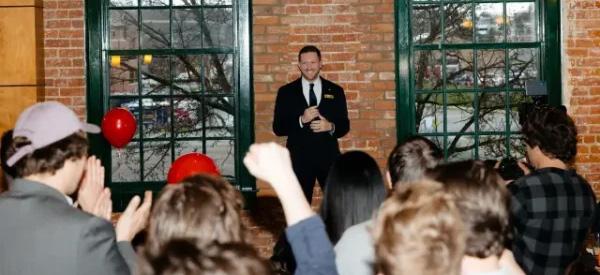
MEADOW BROOK BALLIN’ Hugh Jackman, actor and vibrato extrodinaire, spotted at the 52nd celebration of the student-run dance with WXOU General Manager and OU campus celebrity Maya Kirksey. This photo stands as the only coverage of the event, after a grizzly and vicious animal attack on beloved OP reporter, Andrew May.
PHOTO BY MATTHEW VIGELIUS
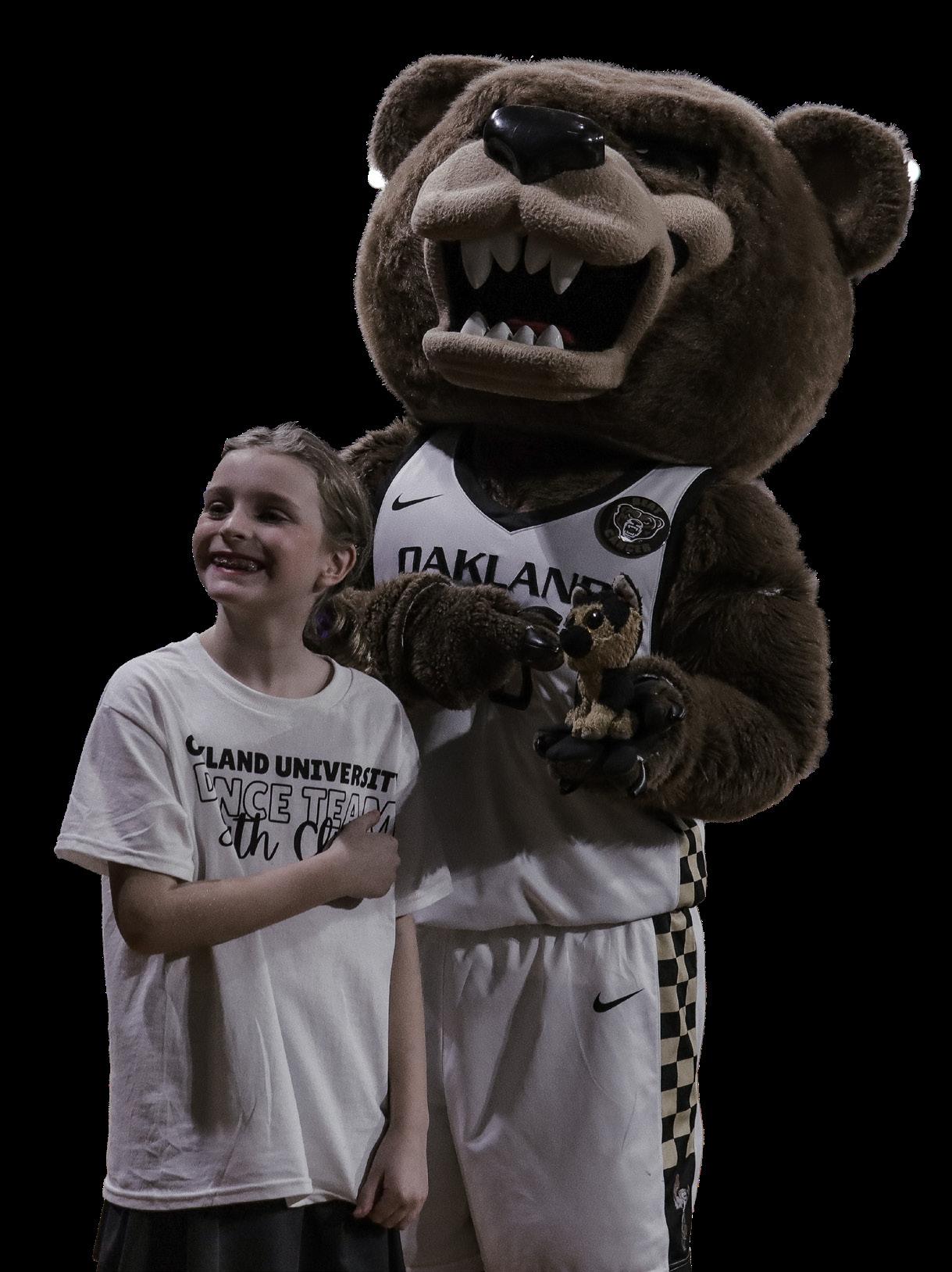
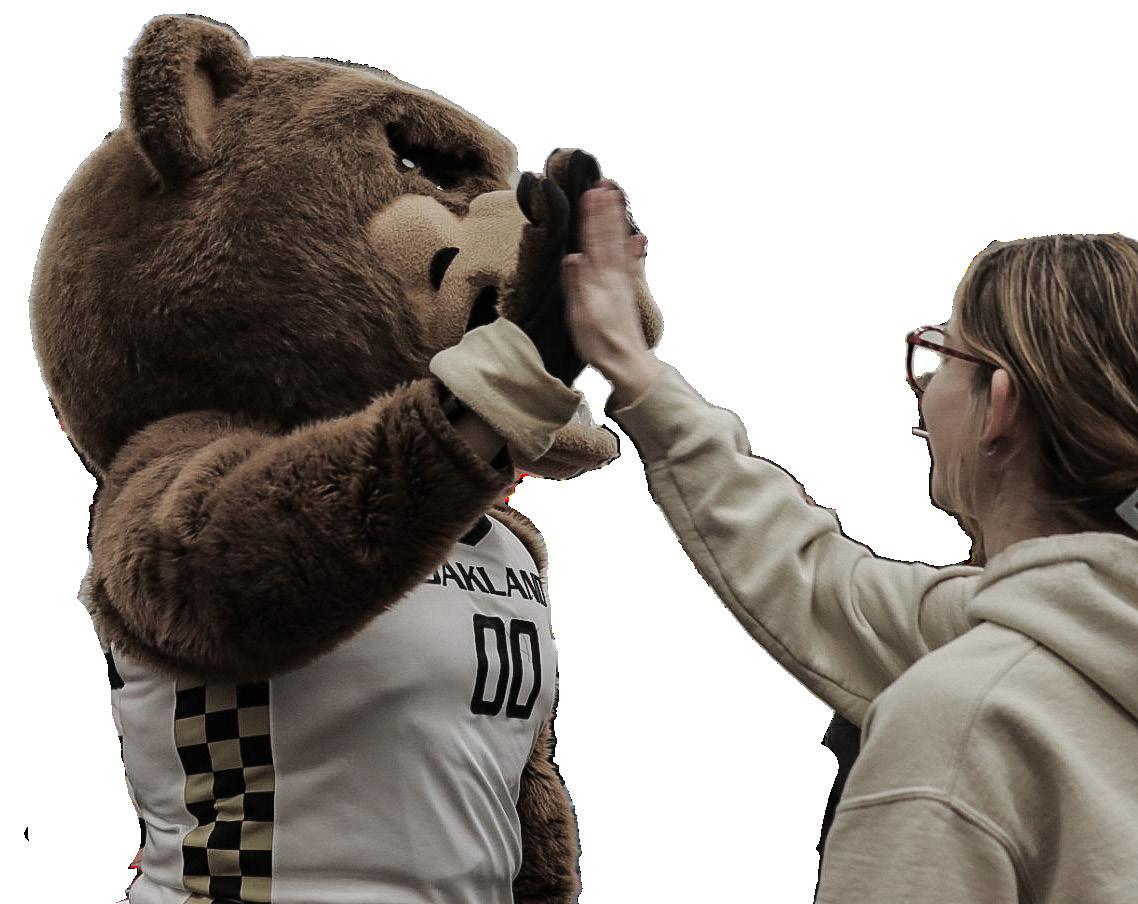
April Fools’: Grizz sightings stir April Fools buzz at OU
JENNIFER THOMASMA Campus Reporter
A series of reported sightings involving a figure resembling Grizz, the Golden Grizzly mascot, has sparked confusion and curiosity across Oakland University as part of an apparent April Fools’ week prank.
Reports first began circulating late Monday evening, when social media posts described a large, bear-like figure moving near Varner Hall and the Oakland Center.
Images accompanying the posts, though unclear, appeared to show a figure similar in size and shape to the university’s mascot traveling along campus walkways.
As the posts gained attention, additional sightings were reported in other areas of campus, including residence halls, parking structures and open green spaces.
By Tuesday morning, the reports had spread widely among students, prompting questions about whether the figure represented an actual presence or a staged appearance tied to April Fools’ activities.
University officials have indicated there is no confirmed presence of a wild animal on campus and no immediate safety concern. The absence of any verified threat has reinforced the likelihood that the sightings are connected to a coordinated campus prank rather than a real animal.
Grizz, widely recognized as the Golden Grizzly mascot, is a familiar presence at athletic events and
student gatherings.
While there has been no official announcement regarding the mascot’s involvement, the resemblance described in the sightings has led to speculation that the figure may be intentionally portraying the character.
The timing of the reports, occurring in the days leading up to April Fools’ Day, has contributed to the growing belief that the sightings are part of a planned effort designed to engage students.
The idea of a “missing” or roaming mascot has gained traction as students continue to share images and discuss the situation across online platforms.
Despite the uncertainty surrounding the figure’s identity, the reports have contributed to a noticeable increase in campus attention.
Students have continued to monitor updates, track locations of reported sightings and observe campus spaces for additional appearances, particularly during late evening hours and in quieter campus areas.
Campus organizations and student groups have also engaged with the situation, referencing the sightings in online posts and contributing to ongoing speculation. While no group has publicly confirmed involvement, the consistency and timing of the reports suggest intentional coordination across multiple areas of campus.
University communication has remained focused on reassurance, emphasizing that there is no danger to students, faculty or staff.
The lack of detailed information has allowed the story to develop primarily through student interaction
and digital sharing across multiple platforms.
The continued reports, combined with limited confirmation, have created an atmosphere of uncertainty consistent with the lighthearted tone often associated with April Fools’ week.
The situation has drawn widespread attention without disrupting normal campus operations or scheduled university activities.
As April Fools’ Day approaches, sightings of the figure resembling Grizz continue to circulate, reinforcing the likelihood that the mystery is less about a missing mascot and more about a campuswide prank that has engaged students across campus in recent days.
Future Leader Dog Club welcomes inspiring Leader Dog client
SARAH BULGARELLI Campus Reporter
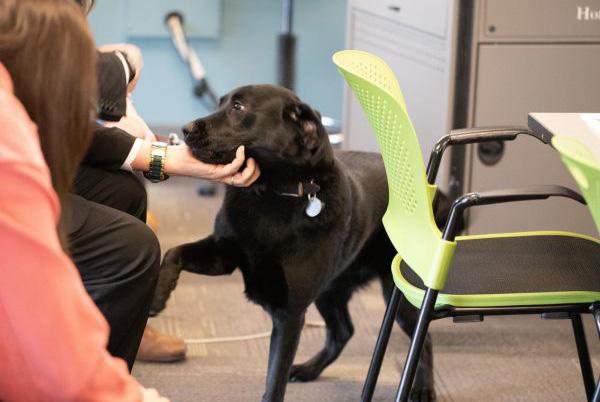
On March 23, the Future Leader Dog Club welcomed a Leader Dog client to the Laidlaw Room of Oakview Hall, where they discussed insights on life with a leader dog and the impact of the partnership.
Caleb Railsback, a Leader Dog client, attended alongside Leader Dog Rosie to share how the partnership supports independence and confidence in navigating everyday environments.
Rosie’s role in building independence, particularly when navigating obstacles, was highlighted. Demonstrations of Rosie’s abilities, such as patterning to locate specific objects, helped students understand the skill involved in these partnerships.
It was explained that the handler and dog communicate through the harness and leash, illustrating the two-way bond that allows both to work effectively. These techniques support safety in daily activities.
Attendees participated in an exercise simulating the matching process used by Leader Dogs for the Blind.
Working in teams, participants received fictional profiles and dog descriptions, then chose the best dog for each handler. The activity emphasized the careful considerations involved in pairing a dog with the right client.
The personal impact of having a leader dog was
described, highlighting how the partnership shapes daily routines and interactions.
“Having a leader dog has granted me confidence to go about life when challenges may occur,” Railsback said. “She’s also my best friend.”
Railsback elaborated on how Rosie provides support in both expected and unexpected situations.
“She supports me even when there are situations that I may not need the support, which is amazing,” Railsback said.
The partnership also creates opportunities to connect with others and share experiences.
“It is also a great opportunity to connect with people about different parts of life, because everyone loves dogs,” Railsback said.
Maintaining the partnership requires ongoing effort beyond basic guidance, including consistent care and attention.
“It’s like having a toddler,” Railsback said. Patience and mutual support are essential factors of the relationship.
“It’s a constant everyday battle between love and patience, and I think that I wish more people understood that at the end of the day, they are just dogs,” Railsback said. “You also have to help them and support them as much as they support you.”
Ella Talbot, president of the Future Leader Dog Club, emphasized the value of showing the impact of leader dogs and encouraging student involvement.
“Being able to show how someone who receives a leader dog relies on them and uses them in everyday life is extremely important, and it really just shows why people should raise future leader dogs and explains what life is like if you may not be able to see,” Talbot said.
The importance of hearing directly from a leader dog client was noted.
“I think it’s really important for students to hear firsthand about the life of a client with a leader dog because it’s a very different experience than just seeing puppies around campus and not really understanding what they are going to do,” Talbot said. “Having Caleb come to speak as a college student with a working guide dog really can open up the mind of all of the students around campus.”
The presentation emphasized the dedication and teamwork behind a leader dog partnership, showing the real impact on a client’s life.
PHOTO BY ADRIAN JIMENEZ MORALES
PHOTO COURTESY KAITLYN BULGARELLI
SVP Mackey addresses data center concerns
CAEL TANNER
Features Editor
On March 26, Oakland University administrators outlined early-stage plans for the proposed AI institute and data center during a campus town hall meeting in the Oakland Center Founders Ballroom. The well-attended meeting, hosted by Senior Vice President for Finance and Administration Stephen W. Mackey, consisted of a presentation and an extended question-and-answer segment open to students, faculty and community members.
The meeting aimed to clarify the scope of the project and address concerns surrounding its development specifications and purpose.
“Our data center is not an AI data center,” Mackey said. “We are building an enterprise data center that is going to have its own location with for-profit companies. We are building a data center for our high-compute needs… It’s very different in size, magnitude and environmental impact, and we are a long way from having a shovel in the ground.”
Mackey emphasized the benefit of the new data center as a singular education environment encompassing research partnerships, internships and employment opportunities for students. He also pointed to the necessity of relocating existing data centers on campus into a specifically-designed space equipped for high-powered computing.
“Our current infrastructure is housed in super inefficient spaces,” Mackey said. “The world is getting faster… and we are not keeping up. We are getting passed by without modern data center equipment.”
The proposed data center would be developed through a public-private partnership (P3) agreement with Fairmount Properties, an Ohio-based real estate development firm with experience in higher education and innovation districts.
“There will be no construction cost to OU,” Mackey said. “Our agreement is that they bear the finances and they build the data center.”
Mackey said the administration is seeking faculty input on potential partnerships with tenant companies to operate in the data center. The university would retain final approval over all tenants, selecting companies based on their willingness to collaborate through internships, scholarships, research financing or similar opportunities.
Through May, the project will remain in the initial feasibility phase, with no final decisions made regarding design or construction. Mackey identified key steps in the feasibility phase, including obtaining certifications from the power provider — DTE Energy — and the Internet service provider, as well as assessing specific computational needs and financial viability.
“It’s really to identify a purpose-built facility that’s going to drive our campus innovation forward,” Mackey said. “That’s happening in the feasibility study — and we could decide that this is unfeasible, and we would not move forward.”
If the project moves forward, it will be presented to the OU Board of Trustees in June, leading into the pre-development “due diligence” phase later this summer. Through fall 2027, the administration will evaluate the conditions of development and undertake environmental studies through shared governance. Mackey stressed that finalization is still not assured at this point.
The next phase — design — would involve technical evaluation and building layout decisions.
Mackey explained that this phase will provide many of the certainties necessary to engage community members with answers to lingering questions.
The final development phase would oversee construction throughout an approximate 18-month period. The administration is currently reevaluating the P-35 parking lot as a potential development site and taking other options into account.
“Again, at the end of design, if we can’t build it or it won’t work, there’s an exit ramp for us and Fairmount to exercise, should it not be viable to move forward,” Mackey said. “We’re about three years out from having a project — minimum, three years.”
Concerns raised during the town hall largely centered on environmental impacts and sustainability goals. One student asked about the precedent OU could be contributing to by moving ahead with construction of another data center in the Great Lakes region, noting concern for freshwater resource consumption.
Mackey highlighted tax incentives and statutes posed by the state government against the drilling of new wells, indicating that water for cooling must be sourced from the local municipality. He also drew a parallel to recent, ruinous cases of excessive water consumption from data centers in Nevada, precluding similar situations on campus due to both Michigan’s state statutes and OU’s values as an institution.
“We are committed to exploring the most efficient cooling systems that we can use based on the design of the center and the type of compute that is going to be in there.” Mackey said. “We are also, as an institution, committed to protecting our resources, and that means that these questions have to be answered before we put a shovel in the ground.”
Another student levied concerns about the facility causing further strain on campus utilities following this winter’s high temperature hot water pipe leaks. Mackey stated that the new facility would relieve the worn infrastructure by diverting excess heat to ideal locations.
“Our plan is to take [the Mathematics and Science Center] and heat and cool that building with the heat
offtake off of the data center, which will reduce the consumption coming out of the central heating plant and reduce the pressure and the temperatures coming out of that system,” Mackey said. “So that would actually help reduce that risk.”
Students also questioned the differentiation between the AI institute and the facility itself.
“An institute is a cluster of thought leaders — it is not a machine,” Mackey said. “The institute is not what we are building. [It] is a byproduct of the facility.”
Should the university choose not to follow through with the project, the issue of OU’s outdated current infrastructure will still need to be addressed.
Mackey explained that while resolving current infrastructural concerns with the new partnered facility — which will draw on a previously unused 26 megawatt surplus from a DTE substation on campus — is the most cost-effective solution, the most likely fallback would be to issue debt to cover independent construction fees, which would be paid from tuition.
“With a P3 opportunity, what you’re doing is you’re using what we call ‘other people’s money’... and so they carry the capital stack, but they also generate the revenue to pay for it,” Mackey said. “To upgrade our current infrastructure into a modern data center would probably take a bond issuance of 10s of millions of dollars, and then that would have to be covered off of general fund revenue.”
Mackey said that as pre-development continues, so will community engagement efforts. He emphasized the importance of students attending OUSC meetings and encouraged interested parties to follow updates through the project’s website, which includes a regularly updated FAQ and timeline. One may also fill out the forum or write to datacenter@oakland.edu.
“As I have said all along, we share the information as we get it,” Mackey said. “We are going to continue these conversations — you have my full commitment to that.”
“If we find that the project isn’t right for us, we will not move forward.”
PHOTO BY LILIANA VALENZA
A different kind of game night outside campus
JENNIFER THOMASMA Campus Reporter
College routines often center around classes, assignments and familiar spaces. Stepping outside those routines can create opportunities for growth, independence and new experiences.
On Wednesday, March 26, a family board game event at the Livonia Public Library offered an example of how small decisions to try something new can lead to unexpected forms of connection.
The event created a relaxed environment where participants engaged in interactive gameplay and highlighted the importance of exploring activities beyond academic settings.
Board games encouraged communication, strategy, and collaboration in ways that differ from traditional classroom environments.
The event was designed to showcase the library’s board game collection while promoting accessibility. According to materials provided at the event, the library offers a range of games, puzzles and other items available for checkout through its “Library of Things” collection.
The collection includes more than 250 board games, along with video games, puzzles and console kits available for public use. These resources provide accessible options for entertainment and engagement within the community.
The board game event reflects a broader effort by the library to provide community-based programming, including book clubs, concerts and
workshops. These offerings create opportunities for individuals to explore new interests while connecting with others.
Games at the event ranged from simple party games to more strategy-based options, allowing participants with different levels of experience to engage comfortably while exploring new types of gameplay. The programming focused on accessibility and community engagement.
Librarian Noelle Lomas said the goal was to create programming that highlighted the collection while remaining approachable.
“We wanted to create programming around our board game collection that highlighted and made use of the fantastic resource,” Lomas said.
Themed game selections introduced participants to different styles of play. These rotating themes helped maintain interest while encouraging participants to try unfamiliar games.
“We market the program as appropriate for ages 8+, so I focus on selecting family and party games with that age rating,” Lomas said. “I try to select games based on a theme to highlight different areas of our collection.”
Attendance varied throughout the program, reflecting common challenges for community events. Participation often extended beyond a single session as attendees explored other library offerings.
“While attendance has been lower than I would have liked, attendees have gone on to participate in other library programs,” Lomas said.
Future programming will depend on continued community interest and engagement. Adjustments
to event formats are often made to reflect participation trends.
“It really does depend on community interest,” Lomas said. “Future library board game events will probably follow formats that have shown stronger attendance.”
Experiences such as the board game event highlight the value of stepping outside familiar routines. Trying something new can encourage independence, confidence and new forms of connection.
For students who commute from surrounding communities, including Livonia, local spaces can offer accessible opportunities for engagement outside of campus.
Public libraries and community programs provide options for social interaction.
For college students, growth often occurs outside structured academic settings. Exploring new activities can contribute to independence and a more balanced college experience.
Rebirth of the American Sign Language club
MARYAM SOMO Campus Reporter
The American Sign Language (ASL) club made its long-awaited return, reestablishing a supportive and inclusive space for students to connect, communicate and grow.
After years without a dedicated community, the club once again brought together those who are learning, interested in learning, or passionate about American Sign Language, while also promoting awareness of Deaf culture and fostering meaningful connections among its members.
ASL professor Christie DeSano, who has been at Oakland University for three years, led the effort to revive the club. With help from student organizer Alicia Leach, the club successfully held its first meeting on March 24.
Under new leadership, the club’s mission is simple: to create a welcoming, supportive space where students can practice, learn and develop a deeper appreciation for ASL and Deaf culture.
Students of all experience levels, whether beginners or fluent, hearing or Deaf, are encouraged to participate.
“Back in the day, there was an ASL club, but then it kind of fell apart, which is fine, because now we are going to restart it, and I’m really excited,” DeSano said. “Alicia is one of my former students. She’s awesome. She’s been helping me kind of navigate this whole thing.”
Many attendees were current or former students of
DeSano; however, the strong turnout was evident as students filled and overflowed the room, reflecting clear interest in the club.
“I did not expect this at all. I was so happy and excited about everyone coming in,” Leach said. “This is my first time as a leader of an organization. I’m kind of learning everything as I go, day by day. But the amount of people who came out is great. We really want to make this a thing on campus and I want even more people to come next time. Yeah, I love and live for this.”
At the start of the meeting, DeSano emphasized the importance of studying ASL, noting that its ultimate goal is to foster communication between the Deaf and hearing communities.
She reassured attendees that regardless of their experience level, they would be supported by both her and others in the room, as the group was, at its core, focused on building a community.
Among the attendees was a member of the Deaf community whom DeSano acknowledged,
encouraging those who were able to sign to feel comfortable doing so.
“The ASL meeting was a nice place to see students studying different levels of ASL and all being together in one room,” Soreen Shawka said. “It was also a great opportunity to communicate and connect with someone who was from the deaf community.”
After the introduction, attendees participated in three activities.
First, everyone went around the room, introducing themselves and sharing how they found the club, with encouragement to use sign language.
Next, Leach taught basic signs, which participants then practiced with a partner.
Finally, the group took part in a “guess the sign” game, learning a variety of fun and interesting signs before signing them for others to guess. Many added their own twist by choosing and sharing a personal favorite sign that had not been taught during the activity.
“I wanted to make it very interactive so that everyone was able to learn something new and leave here on the first meeting feeling like there’s already a community for them,” Leach said.
Throughout the activities, attendees gradually grew more comfortable and began helping one another.
Many already knew each other from previous classes, yet everyone welcomed newcomers with open arms and willing hands.
With the community that was built during this meeting, it’s clear the ASL club is set to continue thriving, with many more events and opportunities for connection in the future.
PHOTO BY JENNIFER THOMASMA
PHOTO COURTESY OF UNSPLASH
Nuestras Voces: A polyglot window into the student experience
ADRIAN JIMENEZ MORALES Editor-in-Chief
From helping with their medical school application to strengthening family ties, students attested to the personal and professional enrichment multiple languages bring to Oakland University. During the 17th celebration of the “Nuestras Voces” publication, the department of modern languages celebrated this year’s poetry and prose journal issue, highlighting the importance of bilingual careers.
Translated to “Our voices,” the language magazine features student works from amongst the most dedicated and intentional in the academic year. The literary night on March 25 celebrated over two dozen students and their linguistic journeys.
“Nuestras Voces provides a vital platform for student creativity and self-expression,” Cecilia Saenz-Roby, Spanish professor and event organizer, said. “Through their writing, students reflect on their emotions, concerns and aspirations, often finding a sense of catharsis in the process.”
With faculty and family members invited to the event since 2010, students deliver excerpts from their works to show their language skills and open a window to their experience. From diverse backgrounds, the occasion brought together recent graduates and even a high school student who reinaugurated the German section of the publication this year.
“I’m actually a dual enrollment student… I finished the German curriculum at my high school and then I got a four on AP German,” Eliza Pizzuti, a high school
senior, said. “I didn’t want to stop because I want to do German when I go to college.”
Taking language classes at OU, Pizzuti also took advantage of courses given in the target language like a German culture class and World War II. She highlighted that dual enrolment programs are just as important as entry-level courses to ensure continuity for language learners.
“I think there’s a lot of different curriculum that, you know, OU offers and in collegiate language learning that just isn’t available anywhere else,” Pizzuti said. “It’s a really unique privilege to learn about these things that I wouldn’t be able to otherwise in a language that I’m passionate about and a language that will build a skill that I can use in my future.”
The polyglot event featured works in prose and verse in Spanish, French, German, Chinese and Japanese.
Board games and global bonds
ALEXA DUDEK Campus Reporter
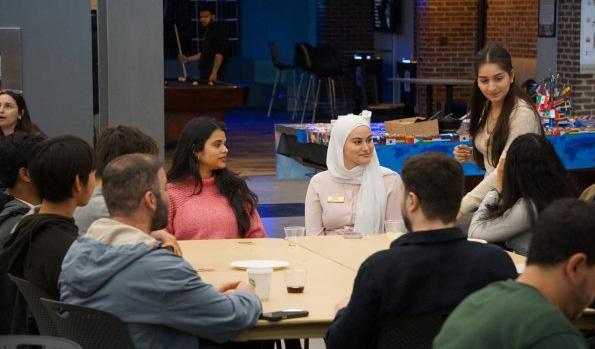
Creating American and International Relationships (CAIR) has served as Oakland University’s premier cultural exchange program since 2009. Operating out of the International Students and Scholars Office, the program is committed to promoting hospitality and cultural exchange through work with student organizations, university departments and local partners.
Natali Salaytah, president of CAIR, emphasizes making the program inclusive while fostering unity among students through volunteer efforts and campus events.
“The CAIR program serves two purposes: to match newly arrived international students with domestic volunteers to help them adjust and integrate into American culture,” Salaytah said. “Secondly, to organize programming and events for the OU community to promote belonging, prioritize value to our members and to celebrate the mosaic of cultures that make up our diverse campus.”
On Friday, March 26, CAIR hosted a game day in the Habitat from 12:00 p.m to 3:00 p.m.
As the event kicked off, attendees were provided with a variety of halal and vegetarian foods to accommodate everyone.
“We ordered foods from multiple countries so that our international students could feel celebrated and at home while giving our domestic students a taste of something international,” Salaytah said.
While planning the event, CAIR prioritized meeting cultural considerations for attendees.
“We avoided scheduling a daytime buffet during Ramadan or Lent to be as mindful as possible about cultural considerations,” Salaytah said.
After surveying CAIR members, the program organized a game day in March to give attendees a chance to relax during a stressful point in the school year.
“We planned it for March because that tends to be a typically stressful time of the year for students, faculty and staff alike,” Salaytah said. “We thought it would be a nice opportunity to take a break, have fun, play some games and enjoy some international foods.”
During the event, attendees had the chance to expand their horizons by trying new foods, participating in games and connecting with others. Activities included games from a variety of cultures, helping create an
PHOTO BY LILIANA VALENZA
These are selected from a competition in the fall and are later workshopped alongside professors to produce the magazine.
“Publication also serves as a valuable credential for graduate school and job applications, as it demonstrates advanced proficiency in a second language,” SaenzRoby said. “For the department, Literary Night is the highlight of the academic year. It showcases students’ passion for languages and cultures while inspiring them to continue their studies.”
Students, like the recently graduated Ayah Neiroukh, explained how language classes allowed them to advance academically and connect in the community.
“I was also nominated by the Spanish department for the meritorious achievement award, which had me speak at graduation and [it’s] something I’m very thankful for and I will never forget, really,” Neiroukh, a soon-to-be medical school student, said. “So Spanish was a huge part of my application to medical school as well and I was asked about it in several of my interviews.”
From a Spanish-only publication in 2009, Nuestras Voces is looking to expand to Arabic next year as the Department of Modern Languages undergoes a revamp in its class offerings.
“In the College of Arts and Sciences, we believe deeply in the importance of communication, creativity and cultural understanding,” Kristin Landis-Piwowar, Vice Provost for Academic Affairs, said. “Nuestras voces embodies all three. It reminds us that language is not just something that we learn, it’s something we live, we use to connect and something we use to tell our stories.”
environment where everyone felt welcome.
“We asked our members directly about the games they grew up playing in their home cultures and communities so we could use our budget in the most inclusive way possible,” Salaytah said.
College students often struggle to build connections, and CAIR aims to address this through informal events like the game day. The event brought together domestic and international students, as well as staff and faculty, creating a relaxed environment where people could meet and form connections.
“My team often talks about getting people out of their comfort zones as one of the main goals with our events, and while we know it can be challenging, we hope that we can help our attendees create positive experiences and good memories at our events,” Salaytah said.
As a program, CAIR highlights the importance of a strong commitment to inclusivity. Attending an international college can be challenging, and CAIR strives to ensure that every student feels valued and celebrated.
“We want everyone to feel like they are seen, like they belong and that they are celebrated as they are,” Salaytah said.
CAIR’s game day brought attendees together while strengthening a sense of community among both domestic and international members of the Oakland University community.
PHOTO BY ADRIAN JIMENEZ-MORALES
YHC students bring happiness from classroom to community
ALEXA DUDEK Campus Reporter
During the COVID-19 pandemic, college students experienced increased mental health challenges as social media use rose and face-toface interactions declined.
Professors at Oakland University place a strong emphasis on mental health. Donna Voronovich, a special lecturer, teaches a course on happiness for the Donna and Walt Young Honors College.
“As a result of mental health challenges during the pandemic, I began my own research into various topics related to better understand what had happened to us, and how to make it better,” Voronovich said.
Partially in collaboration with Arthur C. Brooks, a professor at the Harvard Business School, this course aims to study happiness.
“In short, we are studying happiness; what it is, why people want it, how to achieve it, and what are the obstacles,” Voronovich said.
Voronovich emphasizes that a strong foundation is key to leading a successful and happy life.
“Having solid relationships, a good understanding of yourself and a realistic set of goals for your life are all crucial,” Voronovich said. “The most important of those is to have a good understanding of yourself and others, and that’s where happiness begins.”
Brooks co-authored the book “Build the Life You Want: The Art and Science of Getting Happier” with Oprah Winfrey, exploring the four pillars of
happiness and strategies for finding joy even in challenging circumstances.
HC 2060 combines the book with Voronovich’s personal research. In the course, students work on a final project to present to the campus community.
Freshman Mila Yurenka and Genny Zielinski aim to create a space where students can openly discuss their feelings. With the introduction of “happiness chats,” they provide an outlet for expressing both positive and negative emotions while incorporating strategies from the book.
College students often face feelings of loneliness, and Yurenka and Zielinski hope these chats will foster connection and support within the community.
“In the book, the authors talk about how human interaction builds connections and happiness overall,” Zielinski said. “There’s a big push of individualism in the workaholic American society, so we miss out on a lot of those connections and happiness.”
48% of all podcast listeners from the ages of 18 to 29 report listening to podcasts multiple times during a week.
Freshman Channing Hagen and senior Aamina Farooqi plan to launch a podcast discussing the ideas in Brooks and Winfrey’s book, aiming to engage a broad audience of listeners.
“We want to delve into some of the things that we had disagreements about when reading the book, and we think a podcast would be really great to expand,” Farooqi said.
The book outlines four pillars of happiness: family relationships, friendships, work, and faith. The authors stress the importance of nurturing
connections with family and friends, finding fulfillment through service at work, and upholding core values that promote inner peace.
“We want to hit on the four pillars and dive deeper into the questions that we’ve grappled with in class,” Hagen said. “Only the class and the professor know what we are talking about, so getting people to listen to a podcast would help others learn.”
Freshman Raymond Johnson-Mack plans to create a website dedicated to exploring and sharing ideas about happiness online.
“I know that’s a big modern thing, where parents are having problems with happiness, or with their children having happiness watching stuff online,” Johnson-Mack said.
Johnson-Mack observed that Brooks did not explore the relationship between happiness and the internet, and he plans to address this topic on his website.
“The book only mentions the internet in a negative way, and you could expand on how the internet can be good for you,” Johnson-Mack said. “It’s really how you manage the internet, in my opinion.”
As the semester ends, students are aiming to present the projects to the community.
“On April 13 and 15, we are hoping to present some of our findings at events in the Oakland Center that engage with the campus community,” Voronovich said.
Counseling at OU helps patients and emerging professionals
ADRIAN JIMENEZ MORALES Editor-in-Chief
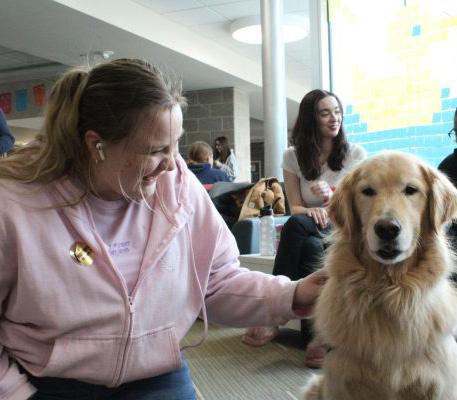
Leaving seasonal depression behind with the arrival of warmer spring days, Oakland University students gathered at Oakview Hall to learn about mental health resources and unwind at the Rise of the Grizzlies event.
Put on by the Counseling Center (CC), the wellness fair brought therapy dogs, arts and crafts, free food and mental health resources to students who might be feeling under the weather by the end of the semester.
“The theme is kind of like a ‘come out of a hibernation’ event and I want to give full credit to my undergraduate interns,” Counseling Center Director David Schwartz said. “They came back with this idea of, ‘hey, we know that a lot of students spend the winter staying in their dorm rooms and then they run to class and right back to the dorm room’ … so the idea behind this was to have an event to tell people ‘spring is here, right around the corner.’”
The event was a campus-wide collaboration with the Rec-Well directing stretching exercises, the Office of Student Involvement offering arts and crafts and the School of Education and Human Services (SEHS) offering resources.
“It is the first time we put it on, but it’s been pretty good,” Caymon Carter, undergraduate intern at the CC and event organizer, said. “Just being able to get out there to help franchise the Counseling Center so more students will know about it and just
being able to help is a lot.”
In hopes of doing one mental health fair per semester at Oakview and Hillcrest Halls — to meet students where they are at — the CC saw a steady stream of students interested in the event.
“This is actually our busiest time of the year, even more than October, just because, with summer coming up, people get stressed out about having to go home, graduation, summer jobs, internships,” Schwartz said. With a waitlist of only a week, the CC offers four free therapy sessions for OU students, even after they graduate.
“For students who are graduating, it would feel really cruel to be like, ‘you’re graduated now, bye, never come back.’ No, that’s not how we work,” Schwartz said. “We give them up to a semester after their graduation to still work with their therapist. Or if they haven’t met with us, they can call us.”
Sophia Stout, counselor in training at the SEHS, explained that they also have a counseling service available for students and anyone in Michigan during the semester.
“The counselor you see is a counselor in training through the Master of Arts in counseling program here at Oakland University. So you’re part of their education,” Stout said. “It’s a learning environment. They are supervised while seeing you, but they help you and you help them, essentially.
Like Stout, Carter explained that the counseling services at OU not only provide help to students in need but also to those seeking a career in various fields.
“I know we’re going to have the opportunity,
thanks to Dr. Schwartz, to speak to more graduate interns and more people in the office to see about how we want to pursue our careers if we want to go to graduate school, or what that will look like,” Carter said.
Students interested in meeting a counselor can call the OUCC at (248) 370-3465. Michigan residents can schedule a session with the SEHS counseling center at oakland.edu/counseling/sehs-cc/.
OCHN Behavioral Health Job and Resource Fair
ERIN BANES Campus
Reporter
The Oakland Community Health Network hosted a Behavioral Health Job and Resource Fair on Tuesday afternoon, March 24, connecting Oakland University students with employers, career resources and same - day interview opportunities in the behavioral health field.
The fair was held from 2-6 p.m. in the Founders Ballrooms at the Oakland Center and was hosted by the Social Work and Counseling departments at Oakland University in collaboration with the Career and Life Design Center.
Students were offered professional headshots, resume advice, networking opportunities and direct access to behavioral health organizations seeking interns and full - time employees through employers.
Events like the job fair offer students a personal way to explore career options, ask questions, build professional connections and gain insight into the behavioral health field beyond what online job postings provide.
Kelly Dorner, director of the Career and Life Design Center, said the event was designed to help students better understand the wide range of career pathways available within community mental health and behavioral health fields.
“The main goal of this event is to connect students to opportunities and to help educate them about what’s available in community health,” Dorner said. “There are partners here offering full - time
jobs, internships and even on - site interviews, so students can walk away with real opportunities.”
Dorner said connecting with employers face - to - face allows students to learn more about potential career paths while building professional relationships that may benefit them after graduation.
Anna Jessup, manager of substance use disorder services at Oakland Community Health Network, said the fair also aimed to address workforce needs within the behavioral health field while introducing students to nonprofit and community‑based career options.
“In behavioral health, there are staff shortages, so this is about increasing awareness of job opportunities and the value of working in community mental health,” Jessup said. “We want students to see the different pathways available to them and hopefully walk away with an interview or a job opportunity.”
Students who attended the fair said its targeted focus helped them gain a clearer understanding of potential careers within behavioral health.
Juan Goudy, a psychology major at Oakland University, said he chose to attend because the fair was geared specifically toward students interested in behavioral health rather than a general job market.
“I decided to come to this fair because it’s more specific to certain majors,” Goudy said. “It gives you a broader look at what kinds of jobs are available once you graduate.”
Graduate students also found value in the networking opportunities the event provided.
Ta’Niyah Harris, a Master of Social Work student, said attending allowed her to connect with organizations she may work with professionally in the future.
“It’s a way to put yourself out there,” Harris said. “Even if you’re not interested in working somewhere, it can still be a good resource for the future, especially in behavioral health and social work.”
The event encouraged students to continue using campus career resources and attending similar events to explore career options, gain industry insight and build professional connections before graduation.
PHOTO BY ADRIAN JIMENEZ-MORALES
PHOTO COURTESY OF UNSPLASH
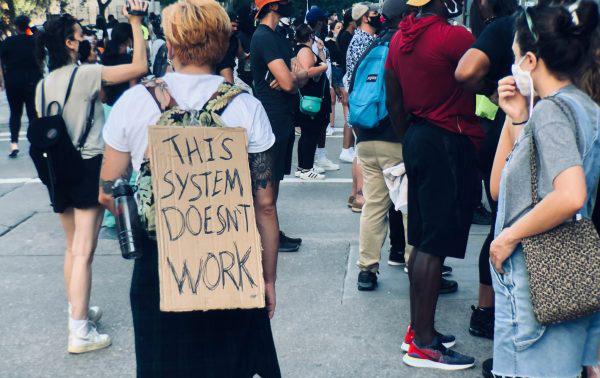
Why Gen Z is rejecting the 9-5 outright
MADI TURNER
Features Reporter
Gen Z isn’t trying to climb the corporate ladder. They’re trying to avoid it.
For many college students, the traditionally stable and reliable 9-5 job has become symbolic of stress and burnout. Across campuses and online spaces, a growing number of Gen Z students are questioning whether the standard career path is worth pursuing at all. Instead of chasing corporate roles, many are prioritizing flexibility, independence and control over their time.
According to the Deloitte 2025 Gen Z and Millennial Survey, only 6% of Gen Z respondents said their primary career goal is to reach a senior leadership position. Rather than equating success with titles or corner offices, many young people are redefining achievement through personal fulfillment, creative autonomy and the ability to sustain a healthy life outside of work.
The same report found that work-life balance and mental well-being are among the top priorities shaping how Gen Z approaches their careers. The idea of “making it” has become more individualized and less tethered to validation through the workplace.
“Gen Zs and millennials launched their careers in the shadow of a global pandemic and a financial crisis — events that respectively shaped their expectations of work and what success looks like,” Elizabeth Faber, Deloitte global chief people and purpose officer, said.
Far from random, the unprecedented shift in workplace ideals indicates the effect that instabilities and key shared experiences have had on not just what Gen Z workers want to do, but how they want to do it.
Growing up alongside rapid technological change, economic volatility and constant connectivity has created a generation that is both highly aware of risk and uniquely positioned to adapt. They have seen industries transform in real time and learned to remain flexible in response.
A 2024 study from the Pew Research Center also reflects growing dissatisfaction with traditional employment structures. The report found that only 30% of workers report being extremely or very satisfied with their pay, while a majority say their wages are not keeping up with the cost of living.
For students preparing to enter the workforce, the dissatisfaction breeds hesitation. When Gen Z considers the reward for committing to a conventional career path to be insufficient, they naturally gravitate toward alternate options.
And for many Gen Z workers, loyalty to a company no longer feels guaranteed or rewarded.
According to workforce trends reported by Gallup, employee engagement among younger workers continues to decline, particularly in traditional fulltime roles.
Layoffs, corporate restructuring and economic instability have made job security feel uncertain at best. This decline is not disengagement from work itself, but disinterest in systems that do not respond to employee needs.
Younger workers are still motivated, but they are more selective about where and how they invest their energy. Instead of planning decades with one company, many are thinking in shorter timelines.
Short-term planning allows for adaptability, enabling Gen Z to pivot quickly when circumstances
change. It also shows that permanence in employment may no longer be realistic, encouraging a mindset that values resilience.
Visibility is also an influential factor in the shift away from traditional work models. Students are increasingly asking how their education will translate into this flexibility, and whether the systems that worked before will still work now. Degrees are still valued, but they are no longer seen as the only pathway to success.
Social media has exposed Gen Z to alternative career paths that previous generations did not have access to. Content creation, freelancing and online businesses have become realistic income streams.
Platforms that once served primarily as entertainment hubs have evolved into marketplaces of opportunity, where individuals can monetize their skills, build audiences and establish brands. This exposure reshapes expectations by demonstrating that success can exist outside traditional career frameworks.
Higher education is being evaluated practically. Students want to know whether their investment will provide adaptable skills, meaningful opportunities and the freedom to pursue varied career trajectories.
According to a network trends report by Handshake, 82% of college students say remote work should be an option, and nearly 80% say work-life balance is essential to career success.
These preferences highlight a broader cultural shift toward integrating work into life, rather than structuring life around work. Flexibility is no longer viewed as a perk, but as a baseline expectation for a sustainable career.
For Gen Z workers, the qualities of a potential job revolve not just around salary, but overall quality of life and the autonomy to live their own way when not on the job, unrestrained by after-hours pressures.
This emphasis on autonomy reflects a deeper desire for boundaries, where personal time is protected and
professional obligations do not extend indefinitely into private life. The ability to disconnect has become a critical component of well-being.
At the same time, economic pressure continues to grow.
According to the U.S. Bureau of Labor Statistics, inflation has consistently impacted purchasing power — particularly for younger workers entering the job market — making many traditional career paths feel less reliable.
As costs rise and wages struggle to keep pace, financial stability becomes harder to achieve through conventional means alone. This disconnect further motivates exploration of supplemental or alternative income streams.
Mental health is also playing a major role in this shift.
According to the American Psychological Association, younger adults report higher levels of stress related to work and financial uncertainty than older generations. These findings were reflected in their report, entitled “Stress in America 2025: A Crisis of Connection.”
“Concerns about the future of the country are weighing heavily on the minds of many across the country,” APA researchers said in the report. “Three quarters of adults reported they are more stressed about the country’s future than they used to be.”
Taken together, these factors illustrate a generation navigating uncertainty with a heightened awareness of its own limits and priorities. Rather than passively accepting the systems they have inherited, Gen Z is actively questioning them, weighing their benefits against their costs and choosing paths that align more closely with their values.
It is not the system that has changed, but the mindset of the new generation. Gen Z is no longer asking how to fit into it — they’re deciding whether it deserves them at all.
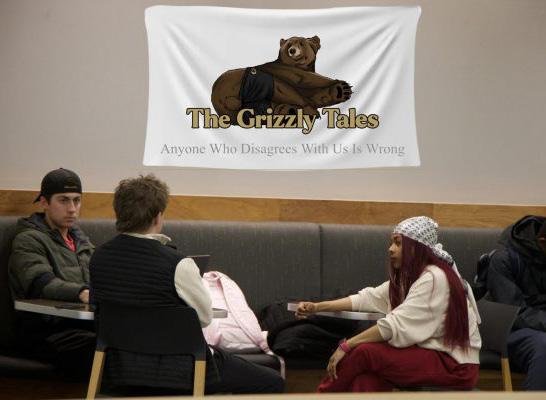
The Grizzly Tales roars, The Oakland Post whimpers
ANDREW MCNAMARA MAY Features Reporter
For as long as there has been news, people have upheld the proud tradition of parodying it. Even the Acta Diurna, an ancient official post of the Roman Empire dating to the second century, has surviving parodies written by several of the period’s great writers.
Somewhere tucked between dusty bookshelves in an old crevice, hidden in the twisted ancient trees of Oakland University, a great modern mind has carried forward this storied tradition.
The Grizzly Tales (not to be confused with the children’s story of an eerily similar name) is Oakland’s own The Onion. Layered, complex, sometimes juvenile … but always good for a chuckle.
Between the lines of stories, the jokes do not end with The Grizzly Tales.
The stories are authored by local convicts and others of ill repute. They even hire dog-kickers.
It reports on the facts that the cowards and ideologues at The Oakland Post — too comfortable in their leather-cushioned office — are far too afraid to cover.
In only their few months of activity, the Tales have demonstrated that they are bound to none of those chains of domesticity.
Their stories offer revelations on less-reported happenings on campus.
One of their most compelling pieces is an exclusive sttement from Oakland University on the
campus’s data center. No other outlet has managed that level of scoop.
They also covered an initiative by WXOU to start playing good music by 2032. Progress on that initiative is unclear. Tuning in at the right time can pull in music from actual PS2 games. Nerds.
They also highlighted the praise that the university has received due to its student body downloading record amounts of same sex entertainment.
Stunning and truly brave coverage.
The Tales do not limit themselves to happenings at Oakland’s kinda small campus, however.
They also cover the edgiest and most relevant happenings in politics, such as Jeffrey Epstein’s role in the Epstein criminal saga. The situation undoubtedly becomes clearer as new documents are published.
In contrast, the tin foil-haters at The Oakland Post have veered towards wild conspiracy theories,suggesting that the scariest part of the newly released documents is that people other than Epstein might be involved.
The school’s second newspaper also has a sports section.
William Dunlap took time out of his life sentence for a 2009 Flint homicide to utilize his insider access directly from the Michigan Department of Corrections to give the real thorn in OU’s basketball side this past season.
Not in the form of injuries or mismanagement. But chronic, explosive toilet tantrums.
These are secrets the world needs to know.
Satire and parody are often conflated with fake
Addie’s Albums: Absolutely
ADDISON KOCH
Campus Editor
With Absolutely, his debut studio album, Dijon delivers a deeply personal and emotional project that blends indie rock, R&B and lo-fi experimentation.
The album, released on November 5, 2021, through R&R and Warner Records, feels less like the polished studio release we see every day and more like a lived experience, being imperfect and intimate at the same time.
The album opens with the song “Big Mike’s,” a chaotic and gripping introduction that immediately sets the tone for the album. Built on improvised sound, it captures themes of instability and heartbreak that are heavily prevalent further on through the project.
In the second song, “Scratching,” minimalist piano is paired with lyrics about emotional exhaustion and the inability to escape past mistakes. Memories “scratching at your heels” reinforces the album’s focus on relationships that linger long after they end.
“Many Times” explores the emotional toll of repeating painful cycles in a relationship. Lines about having “been here a thousand times” reflect the difficulty of leaving someone who continues to cause harm.
In “Annie,” Dijon leans into insecurity and hesitation, presenting a relationship filled with uncertainty. We see the willingness to let Annie “change her mind,” highlighting emotional instability and fear of commitment.
“Noah’s Highlight Reel” introduces us to nostalgic
imagery that depicts intense longing and the need for validation. Its dreamlike quality captures the highs and lows of a complicated relationship.
“The Dress” shifts into a more reflective tone, focusing on regret and lingering hope. The song captures the tension between missing someone and recognizing the flaws that led to separation.
“God in Wilson” feels like a stream-ofconsciousness journey through guilt, shame, and spirituality, capturing the messy and complicated
news. This is an unfair comparison. Fake news and disinformation are intellectual cancers, and often agents of psychological warfare.
Satire and parody, meanwhile, are acts of love.
Your drunk uncle does not talk about everything wrong with America on Thanksgiving because he hates this country like a tetanus shot, but because he loves it more than anything.
One suspects that just so is The Grizzly Tales’ relationship with the Post.
As for The Oakland Post?
The drunk uncle has always been our favorite family member.
emotions that come with questioning one’s actions and place in the world.
“Did You See It?” offers a brief, surreal reflection on shared experiences and disorientation. These moments add depth to the album, showing Dijon’s willingness to experiment both sonically and lyrically.
“Talk Down” brings the focus back to intimacy, highlighting a quiet, emotional connection during a car ride. Asking to “turn the radio down” symbolizes removing distractions to fully focus on the other person and their vulnerability.
Nearing the end of the project, “Rodeo Clown” uses metaphor to depict unrequited love and devotion to someone. The imagery of performance and distance highlights the imbalance within the relationship, reinforcing the album’s recurring themes of longing and feeling invisible.
As the album closes, “End of Record” gives us a moment to reflect. It captures the reality of the creative process, showing the audience the exhaustion and vulnerability that come with it.
Lastly, “Credits!” offers a shift in tone, ending the album with a sense of release and optimism. This song offers a sense of freedom and relief after an emotionally heavy journey, allowing space for joy without dismissing what came before.
My favorite songs on the album are “Many Times” and “The Dress,” because both of them feel deeply human and have a way of weaving into your own life and lived experiences.
Not to say the other tracks don’t do the same.
PHOTO BY COURTESY OF UNSPLASH
PHOTO BY ANDREW MCNAMARA MAY
Bossa nova, brass and bopping: Latin Jazz and Big Band
MARIA MAGNOLI Arts Reporter
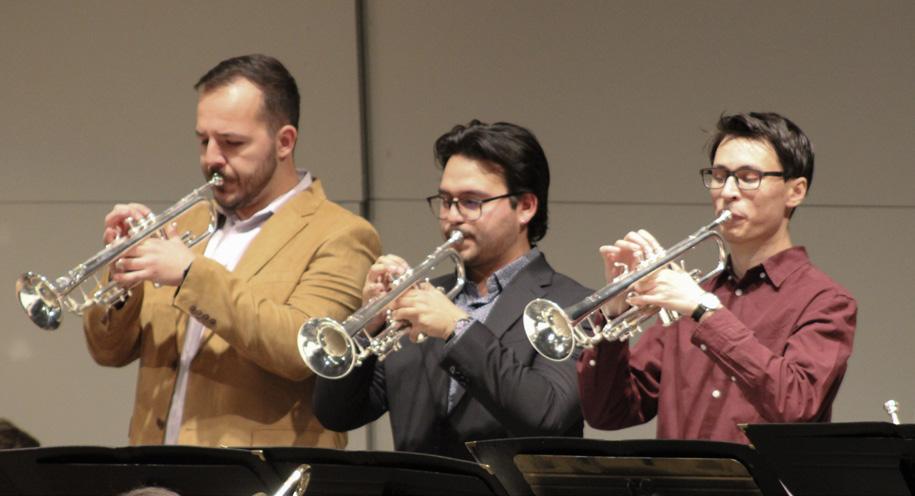
The Oakland University Latin Jazz Ensemble and the Oakland University Big Band performed their semi annual recitals in Varner Recital Hall to share the sensational tradition of their respective genres to more than 150 attendees.
Led by professors Patrick Fitzgibbon and Amanda Ross, the two jazz groups share a stage each semester to showcase music beyond the classical repertoire. For many students, these ensembles provide a laidback environment to sit back, relax and jam with fellow musicians.
The first half of the evening began with the Latin Jazz Ensemble, under the direction of Fitzgibbon. Each piece performed features numerous solos demonstrating the rhythmic and dynamic capabilities of each performer. Matthew Perkins received some major applause in “Una Mas” — a funky cha cha tune — following their tremendously executed passage work.
Brazilian bossa nova style, featured vocals by Isabella Barba, a senior majoring in interdisciplinary studies. Barba is a multi-instrumentalist, playing violin, piano and singing. In both English and Portuguese, she possessed a smooth, enchanting tone that songs like “The Girl From Ipanema” demonstrate. “I really love singing in Portuguese or Spanish, because they are such romantic languages,” Barba said. “Usually, I am staring at either the violin or locked in at the piano. But with singing, I can look
out at everyone and interact with the audience.”
“Berimbau” also highlighted the Brazilian instrument of the same name — a wooden bow, metal wire and gourd resonator — played by Donovan Marlin. To produce sound, the musician strikes the wire with a stick while changing tones by moving a stone, adjusting it against the player’s
body. Succeeding a gorgeous vocal section with extensive berimbau accompaniment, an equally beautiful piano interlude was played by music technology major Maddy Weil.
Additionally, Weil experimented with the steel pans during “Dance Class.” The piece was written by Andy Narell, a dear friend of the OU School of Music, Theatre and Dance (SMTD) community. An artist from St. Lucia, he volunteered his time teaching OU students about the instrument when they study abroad on the outrageously stunning island.
Incredible drumming was completed by master student Wil Angliss, who performed his last concert with the group. Erin Tomczak on vibes and Joe Willard on bass kept everyone together with their steady beat, and they certainly wowed the audience with their improvisational skills as well.
After the intermission, Ross introduced the Big Band. With more than 20 musicians, the group opened with “Backrow Politics,” written by the late, highly acclaimed jazz artist Gordon Goodwin. The roaring brass sound had a striking resemblance to the brass lines in Pixar’s “The Incredibles” — a film which won Goodwin a Grammy.
delivered by Je’lyn Higgins on alto saxophone with shredding piano improvisation by Adam Scarchilli.
To contrast the opening, the low humming beauty of the jazz standard “I Remember Clifford” resonated with concertgoers. Written as a tribute to Clifford Brown, Amanda Eatherton was the featured soloist on flugelhorn. Her control and fluidity marked a heartwarming moment in the evening. Mike Benoit played cascading harmonies on piano that paired perfectly with Eatherton’s exquisite interpretation.
Martyna Gogołkiewicz, double major in piano performance and piano pedagogy with a jazz minor, sang “Falling in Love with Love,” a staple sung by artists like Frank Sinatra, Ella Fitzgerald and Diana Krall. With a voice as smooth as butter, she had an absolutely glorious tone. The famous saxophone solo was played to complete perfection by Adam Gregerson.
“Airport Codes” by Aubrey Logan, transcribed by OU alumna Cayla Stus, succeeded the classic. Mike Benoit on piano and Joe Willard on bass supported Gogołkiewicz’s lines about “LAX, JFK, CDG and LGA.”
“I used to play with a big band in high school, so coming back to this kind of environment in college was the ultimate thrill for me,” Gogołkiewicz said. “The music combined with the adrenaline of a huge audience is the most magical experience for a performer.”
More vocals continued with Carlos Perez-Hijar, instrumental performance major and graduating senior, singing “Beyond the Sea.” The enormous brass interludes made the perfect pairing with his suave vocals as he played trumpet in between.
“It has been a pleasure to work with this group over the years,” Perez-Hijar said. “The rehearsals for ‘Beyond the Sea’ were part of such a transformative process, and I’m so glad I was able to sing a piece that both the audience and I loved.”
“To You,” written by Pontiac, Michigan composer Thad Jones, featured Axel DiCarlantonio on trombone, and “Time for a Change” by Hank Levy featured senior tenor saxophone soloist Thomas Baker.
Now the closing of the concert: nothing short of flawless. Master student Dallas Kelly opened virtuoso jazz artist Charles Mingus’ “Moanin’” with a commanding baritone saxophone solo. A vibrant piece overall, there was even a trombone duel between DiCarlantonio and Tony Gratti. Audience members were hollering and clapping from their seats, rooting for the ending of the spectacular evening.
“They [the two groups] all did an excellent job tonight,” Joseph Walkup, Wayne County resident, said.
“They are phenomenal, and that’s putting it lightly. I have been in multiple bands myself as a drummer, and I can positively say that these bands are pure, flat-out excellent; this performance went far above and beyond what I have ever seen.”
Kelly stepped off stage with immense pride after a roaring finish and was honored to share the stage with the talented musicians he calls “great friends.”
“I myself did not choose this piece, but when it was presented, I was selected to be the soloist right away,” Kelly said. “I am so grateful for the faith that Amanda had in me. I absolutely loved playing it, and especially the opening.”
For more jazz-influence concerts in the SMTD, be sure to check out the Jazz Combos and Creative Jazz Ensemble concert on Tuesday, April 7 at 7:30 p.m, and the Golden Grizzly and Blue Grizzly Jazz Singers concert on Sunday, April 12 at 7 p.m. — both in Varner Recital Hall.
PHOTO BY CLAIRE SANDERLIN
PHOTO BY CLAIRE SANDERLIN
GRAPHICS BY DYLAN HECKER
GriZz tO ENTer the TRAnsfEr
poRTal :(
In a stunning development that sent shockwaves through campus Friday morning, Oakland University mascot Grizz has officially entered the transfer portal, becoming the first costumed figure in Horizon League history to test the open market.
The decision marks the end of an era for the program. Grizz, who first debuted in 1998 when Oakland transitioned to Division I athletics, has been the face of the university for nearly three decades. He has appeared in more than 450 basketball games, logged an estimated 6.2 million high-fives and leads the conference in flexes per 40 minutes.
But according to multiple sources close to the situation, Grizz is ready for a new challenge.
“After long conversations with my family and my inner circle, I’ve decided to explore new opportunities,” Grizz said in a statement released through his growl translator and publicist. “I will always love Oakland, but it’s time to evaluate programs that better align with my long-term goals.”
Those goals, apparently, include fish consumption and TV screen time.
Early reports indicate Grizz is leaning toward Saint Louis University after watching its recent success in the NCAA Tournament and considering the Mississippi River’s salmon supply.
Grizz is looking for an opportunity to be the starting mascot, and Saint Louis is currently home to the Billikens — a centuryold doll that represented a mythical creature that only the university can define.
“The Billiken is a mythical good-luck figure who represents ‘things as they ought to be,’” the university says.
“What the hell is a Billiken?” everyone else says.
“I want to go somewhere I can be the man,” Grizz said. “And I think that’s likely in Saint Louis.”
Oakland coaches and administrators were caught off guard by the announcement.
“We respect his decision, but we’re disappointed,” Coach Greg Kampe said. “You don’t replace a veteran presence like Grizz overnight. He anchored our timeouts. He stabilized our halftime shows. He brought an edge to the mascot position that you just don’t teach.”
Players echoed that sentiment.
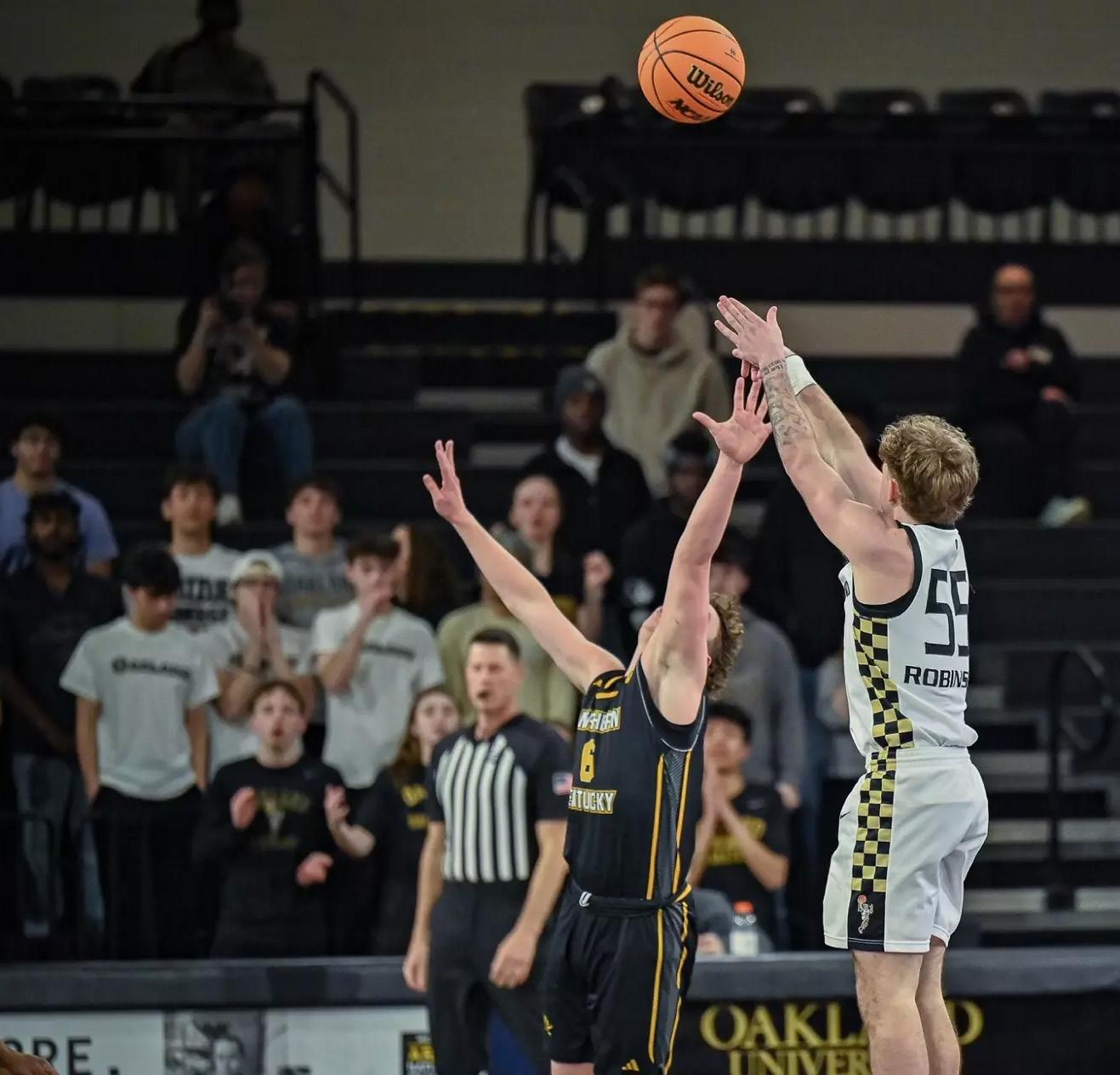
“He was our emotional leader,” senior guard Brody Robinson said. “When you looked over and saw him pounding his chest, you knew it was time to lock in. Who’s going to do that now? The dance team?”
Grizz’s departure comes after what he described as “creative differences” with the athletic department. According to sources, he was frustrated by a reduced role in promotional videos, a lack of NIL opportunities and a failed request to be listed on the official men’s basketball roster as a “6-foot-4, 375-pound hybrid forward.”
Grizz also reportedly wanted more involvement in in-game strategy.
“He kept trying to sit in on film sessions,” one assistant coach said. “We love him, but it’s hard to break down ball-screen coverages with a grizzly bear growling aggressively every time one of our guys gets fouled.”
Despite the tension, Grizz remained productive this season. He posted a career-best 14.7 crowd-engagements per game, ranked top five nationally in mascot-to-child interaction efficiency and recorded a season-long 38-second dance break during a January win over Youngstown State.
But the portal waits for no mascot — and rival programs have already begun their recruitment pitches.
Saint Louis reportedly offered Grizz “full creative freedom,” including the ability to relegate the Billiken to local St. Louis Community College.
Tulsa University is looking to replace its current starting mascot, the Golden Hurricane, after a graduate student finally identified that the school is nowhere near an ocean — and the program is prepared to offer Grizz a lifetime pass to the campus Chick-fil-A.
Florida’s Stetson University, currently the Hatters, has offered an NIL deal that rewards Grizz for actually wearing the current mascot on his head.
For now, Oakland is left to pick up the pieces.
“We’ll explore all options,” an athletics spokesperson said. “We’ve already received inquiries from a raccoon, two different dogs and something that might have been a possum. We’re evaluating the tape.”
Oakland Athletics even considered adopting Oakland Community College’s former mascot, since OCC shifted from the Raiders to the Owls — before someone finally remembered that Raiders are actually already represented in the Horizon League by Wright State, depicts its “Raider” as a wolf.
Some are considering drawing inspiration from Chicago’s Moody Bible Institute Archers — named not after a bowman, but a piece of campus architecture — and adopting “The Oakland University Towers” or even “The Oakland University Kresge Library Fourth Floors.”
Whether Grizz ultimately winds up at Saint Louis or elsewhere — or withdraws from the portal — remains to be seen. But one thing is certain: Oakland’s most recognizable figure has shaken the mascot landscape to its core.
And if this is truly the end, he leaves behind a legacy defined by passion, presence and an unmatched ability to fist-bump strangers.
story by James Elling graphic by August Wicker
Analyzing my completed Google Tasks
MALLORY WALIGORA
Content Editor
Google Tasks is an extension that keeps track of all your important to-do items. You’re able to add details or notes to each task, assign a due date and get notifications from the platform.
This is not a paid promotion, but it’s a system that I use on a daily basis. According to Google, I completed 1,307 tasks.
Another fun fact about the platform is that you’re able to revisit your completed tasks in the archive section. You can look through every single task you’ve ever marked complete.
Since my Google account for Oakland University will be deleted in a few months (hello, graduation), I decided to take a trip down memory lane to see some of the things I marked completed while at Oakland University over the last four years.
At first glance, I found a list of completed to-dos: homework assignments, chapters to read before class and small, minuscule reminders.
But I also found a timeline to my journey here at OU – a record of shifting priorities and past versions of myself at Oakland University.
Apparently, my university career can be summarized in 1,307 checkmarks.
“Czech language homework,” completed June 15, 2023
I was about two months into living in Prague, and at that point, language homework was a part of my daily routine. It was one of the only structured things in a life that felt very chaotic and confusing.
Every night, I would sit down in the kitchen of my apartment, go through the words I learned that day and pronounce them out loud. At the time, I could tell I was making real progress: I was no longer flustered ordering dinner or asking for directions. Going to the grocery store was no longer an anxiety-inducing task.
Now I can’t speak more than two words in Czech, but I remember feeling somewhat confident in my skills at the time. Seeing that task brought me back to a time when I was adapting and deciphering a new language.
Apply for PSA, completed Nov. 11, 2023
PSA stands for Pi Sigma Alpha, the political science honors society I’m a part of. Every spring, the group heads to Washington, D.C., to present research at the national conference.
At the time, submitting my application felt like nothing. I had to write a quick abstract about my research. It was another item on my long list of responsibilities.
My application got accepted, and that small task turned into a trip to D.C. in the spring of 2024. The weekend ended up being one of my favorite memories: exploring the city and laughing with friends.
Email WB, completed Nov. 23, 2024
WB stands for William Beaumont, where I worked in the marketing department for six months.
The task was a pretty simple one: send a cold email with my resume and writing samples. I knew they hired interns, but I saw no job posting online. I wanted to let them know I was interested in the position.
I guess the email worked because they emailed me back and asked me to come in for an interview. I got the job.
Grovel, completed Dec. 4, 2024
One recurring theme about going through my old tasks is that, in all honesty, I don’t always know what they mean.
For those who don’t know, groveling is defined as “behaving with too much respect towards someone, in order to show that you want to please them or want them to forgive you.”
“And, although it’s not widely known, it is also the season of groveling. So, if you felt like calling me back I’d be more than happy to do the traditional Christmas groveling,” Billy Crystal said in “When Harry Met Sally.”
Amen, Billy, because I apparently had some seasonal groveling to do during the holiday season.
I hope I groveled well – maybe a friend, a professor, a missed deadline or a situation I had to smooth over. We’ll never know.
I guess there’s something comforting about the fact that I don’t remember what I had to grovel for. Things smooth over as time passes. Whatever it was, it felt big enough to write down, and small enough, eventually, to forget.
I assume I groveled well because it was marked as complete.
Cancel LSAT subscription, completed Dec. 6, 2024
Here’s a fun fact about me: I used to be pre-law and seriously studied for the LSAT.
Starting in May, I had a subscription to an LSAT prep website. I had a structured process: I would take a handful of practice tests every week, and when I was not doing practice tests, I was reviewing my past mistakes and reading through prep materials.
I canceled the subscription in December. The LSAT kicked my butt.
I changed my mind and cancelled my subscription after finally succumbing to the fact that logic games are not fun. They will never be fun. Godspeed to any pre-law students.
Study Abroad Scholarships Due- OU Platform, completed on Jan. 10, 2025
This is one of the few completed tasks I remember vividly.
I was sitting on the top floor of the Oakland Center near the fireplace, with my laptop open, writing an essay to the university as to why they should give me money.
I edited and reworded some things, but I eventually submitted it with a mix of uncertainty and foolish hope.
Less than five months later, I was unlocking the door to my apartment in Paris. I threw my luggage in the corner and headed out to explore the city.
I did end up getting some scholarship money, which is always super helpful.
Scrolling through these tasks taught me that smaller things make up a bigger experience. They aren’t always dramatic milestones, but they’re sometimes necessary steps in moving forward.
Google Tasks, you didn’t just keep me organized. You also accidentally documented my life over the past four years – marking milestones, class readings and vague and confusing notes to self.
Before my archive disappears, I’m glad I looked back.
PHOTO COURTESY OF SUPERHUMAN COMMUNITY
Martial artist and stuntman Chuck Norris passes away at 86
SARAH WASIELEWSKI Arts Reporter
Iconic martial artist and stuntman Chuck Norris passed away on March 19 at the age of 86. Best known for his long-term role in the 1990s series, “Walker, Texas Ranger,” the multi-hyphenate was a martial artist, actor, screenwriter and author.
Born Carlos Ray Norris in 1940, he spent the majority of his childhood in Oklahoma before moving to Kansas and then California after his parents’ divorce. He had two younger brothers and was incredibly shy and introverted growing up.
Neither athletic nor academically gifted, Norris enlisted in the Air Force once he turned 18 and was stationed in South Korea. There, he had his first introduction to martial arts, studying the Korean martial art Tang Soo Do.
After four years, Norris was discharged from the Air Force and returned to California, opening what would become a chain of martial arts studios and competing with increasing success in martial arts tournaments. Several celebrity students at Norris’s martial arts studio include Steve McQueen and Priscilla Presley.
Through his friendship with Steve McQueen, Norris started making forays into the acting world in the early 1970s. His breakthrough came when he played Bruce Lee’s nemesis in the martial arts film “Return of the Dragon.” In subsequent films, including “Good Guys Wear Black” and “A Force of One,” Norris also served
as the martial arts choreographer.
In 1993, Norris took on his longest-lasting role, playing Sergeant Cordell Walker in the action show “Walker, Texas Ranger.” The series centers on Norris’s character and his fight against criminals. The show aired until 2001 on CBS and received generally positive reviews and ratings. The role also earned Norris the title “Honorary Texan,” and in 2010, Texas Governor
Banksy: Unmasked at last?
SARAH WASIELEWSKI
Arts Reporter
Allegedly, the secret identity of the enigmatic street artist Banksy has been revealed as a 53-year-old man from Bristol, England, by the name of Robin Cunningham. Working under the pseudonym Banksy, the artist represents Britain’s working class with street art that critiques the government.
A hidden identity meant ordinary people could relate to Banksy’s art without any of the prejudices of race or social class entering the picture. For many people, the reveal of Banksy’s identity is disappointing, while others have been searching to reveal the artist’s true identity for decades.
As early as 2008, the Daily Mail reported that Banksy’s true name was Robin Cunningham. More recently, a Reuters investigation published on March 13, 2026, also claimed that Robin Cunningham is Banksy. The article alleges that Cunningham changed his name to the common British name David Jones after the Daily Mail article came out, which helped keep the artist’s true identity secret.
Banksy’s work is illegal, as the artist paints on public buildings and signage and according to British law, could be fined or sentenced to community service. However, Banksy has always maintained a certain amount of immunity. Last year, the artist was not charged with any crimes after painting a critical mural on the side of
London’s Royal Courts of Justice.
That may change with the reveal of the artist’s identity. It may also become more difficult for Banksy to create street art, much of which must be done under the cover of darkness due to its illegality.
Many wonder whether Banksy will continue to create art, while others lament the fact that Banksy’s art might lose value from this revelation.
For the artist, the mystery of his true identity was inextricable from his larger-than-life murals and social presence. Visual arts are unique in that
Rick Perry gave him an honorary “Texas Ranger” title.
Beyond earning black belts in Tang Soo Do, Taekwondo, Karate, Brazilian Jiu-Jitsu and Judo, Norris also established two new unique martial arts systems. In 1966, Norris developed American Tang Soo Do, which contained elements of traditional Tang Soo Do, Judo and Karate. Later in 1990, he established Chun Kuk Do, which later became known as the Chuck Norris System and was influenced by his martial arts training in South Korea.
Norris also has a lengthy list of tournament wins and accolades. In 1968, he won Professional Midweight Karate Champion, a title he held for six consecutive years. The next year, Norris won Karate’s triple crown for having the most tournament wins of the year. A star on the Hollywood Walk of Fame in 1989 was followed by an induction into the Martial Arts History Museum’s Hall of Fame in 1999.
Outside of Norris’s many accomplishments, he was also very involved in philanthropy. In 1990, he established United Fighting Arts Federation and Kickstart Kids, focused on helping at-risk children by involving them in martial arts to focus their energy on a positive outlet and help build a better future for themselves.
After a brief hospitalization in Hawaii, Chuck Norris passed away on March 19. He is survived by his wife, five children and multiple grandchildren.
the creator may remain anonymous. Banksy, the nameless hero speaking up for the voiceless, had taken on an almost superhero-like status.
Hidden identities have long been the trademark of artists and authors. The Brontë sisters wrote under the names Currer, Acton and Ellis Bell. Jane Austen, who published her works through her brother, had her novels attributed as “by a lady.” While these women were avoiding the impropriety of being working women in 19th-century England, modern examples also abound.
Brian Donnelly created illegal street art under the name KAWS for years before revealing his real identity. However, for Donnelly, the reveal worked out in his favor, and he was able to create a recognizable brand off his distinctive style, collaborating with brands such as Dior and Uniqlo. His reach is nationwide, as demonstrated by the large KAWS statue near Campus Martius in downtown Detroit.
To some, Banksy is just a criminal, vandalizing private property and escaping without punishment. Others see Banksy as a social justice hero, giving a global platform to the common people’s plight. The pseudonym protected the artist from retaliation and censorship.
In typical Banksy fashion, the artist refused to engage with the article, neither confirming nor denying the accusation. While this means the allegation that Robin Cunningham is Banksy cannot be taken as fact, the news will undoubtedly affect the artist’s future.
PHOTO COURTESY OF GETTY IMAGES
PHOTO COURTESY OF GETTY IMAGES
Golden Recommendations: April Fools’ funnies
MARIA MAGNOLI & MARISSA GETSCHMAN
April Fools’ Day may not be as ceremonial as Christmas, Hanukkah or Eid, but there is always at least one person who never fails to remind their peers of the occasion with a facetious joke. This year, don’t allow another “April Fools!” exclamation to slide by without an intentional laugh. Here are some picks guaranteed to make someone laugh this April Fools’ Day.
“School of Rock” (2003)
Starring the one and only Jack Black as the iconic idiot, Dewey Finn, “School of Rock” is the perfect foolery film to watch on April Fools’ Day. When Dewey answers a phone call meant for his best friend and roommate, Ned Schneebly, seeking a long-term substitute teacher at a private school, he does what any broke rocker would do … He pretends to be Mr. Schneebly for a paycheck.
At the school, he meets a class full of students who are used to rigid structure and restrained individuality. Dewey is in no way ok with such rules and decides to teach the kids how to rock, roll and rebel. If he’s stuck playing the role of a private school teacher, he figures he might as well have some fun and teach what he knows.
The comedy film is endearing as well as hilarious and earned itself a Broadway adaptation with music by the legendary Andrew Lloyd Webber and Glenn Slater in 2015, starring Alex Brightman as Dewey. The soundtracks for both versions are incredibly fun and worth the listen for anyone who would rather embark on the musical journey, especially the Broadway adaptation.
Also featuring the skills of Miranda Cosgrove as Summer Hathaway, Mike White as Ned Schneeby, Joan Cusack as Rosalie Mullins and Sarah Silverman as Patty Di’Marco, “School of Rock” is a PG-13 funfilled film for anyone to enjoy.
“Mrs. Doubtfire” (1993)
The 1994 winner of two Golden Globes in 1994 for Best Motion Picture - Comedy and Best Performance by an Actor in a Motion Picture - Comedy, “Mrs. Doubtfire” is a family favorite film featuring none other than the late Robin Williams.
When Daniel (Williams) and Miranda (Sally Field) Hillard divorce on the premise of their marital troubles, Miranda begins the search for a housekeeper to run the household. After numerous calls, she is
delighted by the sound of “Mrs. Doubtfire,” an older English woman who is unknowingly her ex-husband.
The methodical voice actor hilariously transforms himself into a woman, thanks to his brother’s artistic talents. Mrs. Doubtfire runs an efficient operation that the Hillard children — Chris, Lydia and Natalie — must follow. Before Miranda returns from work, homework is done, chores are completed and the children have consumed a healthy, nutritious meal.
Miranda begins dating her old friend ‘Stu,’ portrayed by the handsomely irresistible Pierce Brosnan, sending Daniel into a hilarious fit of rage. Amid the humor, Mrs. Doubtfire is a conglomerate of characteristics that Daniel lacked: dependable, attentive and orderly.
Despite the initial encounter, the children grow to love and appreciate her. Miranda and Mrs. Doubtfire build a strong bond, providing Daniel with intel on getting his family back together. He cleans up his act and impresses Miranda immensely, but it’s only a matter of time until they discover who the person is behind the mask.
While there are many laughable moments, the story is also heartbreaking as it demonstrates the lengths Daniel is willing to go to remain in his children’s lives.
Monty Python and the Holy Grail (1975)
The best known claim to fame for the British comedy troupe by the name of Monty Python, “Monty Python and the Holy Grail,” is a parody, spoof-style comedy film following the story of King Arthur. The humor is ridiculous and leaves pleasantly entertained audiences wondering, at times, what the heck they are watching.
The film has earned a fiercely loyal fanbase that has prevailed for just over fifty years now. Younger audiences might not know that “Monty Python and the Holy Grail” is one of five films and three television series starring the troupe of six.
The film was written by and stars all six members: Terry Jones, John Cleese, Eric Idle, Terry Gilliam, Graham Chapman and Michael Palin. Gilliam and Jones were each also directors. Direction varies amongst the other films, but fans wanting more of the troupe can still see them shine throughout each story.
Fans of the Arthurian legend and fans of comedy alike are bound to have a blast watching “Monty Python and the Holy Grail.”
“Vegas Vacation” (1997)
“Vegas Vacation” marks Chevy Chase’s finale of the National Lampoon films. For the fourth and final time, Clark Griswold (Chase) makes plans to take an old-fashioned family vacation to the “number one family vacation destination in America” — anything but that — Las Vegas. Like any Griswold excursion, it is crazy right from the start.
Staying at the fabulous Mirage hotel, Clark and Ellen (Beverly D’Angelo) arrive with airplane toilet-stained clothing beside their two children, Audrey (Marisol Nichols) and Rusty (Ethan Embry). Mesmerized by the slot machines, roulette wheels, poker, craps and blackjack tables, it isn’t long until Clark has a full-fledged gambling addiction.
Just when he thought all was pleasant, cousin Eddie (Randy Quaid) and his family barged into the Griswold family vacation, hosting them at their redneck-style mobile home in the desert, where they grill chicken on rocks and round up rattlesnakes. Later, they take a tour of The Hoover Dam, a tour that Clark ends up in — literally.
Audrey and Rusty, both under 21, are met with boredom and frustration and take trips of their own. Cousin Vicky — who has her risqué pictures plastered all over Las Vegas — takes Audrey out for the ‘showgirl’ experience. Rusty obtains a fake ID and rolls a pretty lucky hand at craps, landing him a luxury suite and lots of ladies.
Ellen winds up at Shenandoah, Wayne Newton’s home, after eyeing her at the casino. Sending her a dress before attending his show with the whole family, he spots the glittering gown immediately and invites Ellen on stage. Between his three family members and his gambling fetish, he has his hands full.
PHOTO COURTESY OF WOMEN’S AGENDA
PHOTO COURTESY OF NETFLIX
PHOTO COURTESY OF THE GUARDIAN
PHOTO COURTESY OF NETFLIX
UN concludes Transatlantic slave trade was “the gravest crime against humanity”
SOPHIA CURRAN Political Editor
On March 25, 123 Member States in the United Nations voted in favor of Resolution A/80/L.48, titled the “Declaration of the Trafficking of Enslaved Africans and Racialized Chattel Enslavement of Africans as the Gravest Crime against Humanity.”
Understanding the Transatlantic slave trade
For nearly 400 years, European colonizers and slave traders kidnapped approximately 12.5 million African men, women and children onto Atlantic slave ships to be shipped to the Americas for labor.
Around 11 million survived the Middle Passage, while the 1.5 million who did not make it either passed from sickness or starvation, jumped ship or were intentionally thrown off by tying chained Africans to heavy rocks — intentionally meant to drown and sink slaves to the bottom of the Atlantic.
Slavery has existed throughout human history, even being found on the world’s oldest written set of laws, the Code of Hammurabi, and even in the Old Testament as well.
However, the Transatlantic slave trade was the first time in recorded human history that Africans, under a race-based chattel system, were treated as commodities used for labor in Europe’s economy. They were taken for pure economic interest, not as prisoners of war.
Once in the “New World,” African slaves endured traumatic, inexplicable abuse from White slave owners. Originally, slaves were primarily forced to work on tobacco, rice, sugar and coffee plantations on the North American Atlantic coast.
However, the invention of the cotton gin in the late 18th century led to a boom in England and the U.S.’s textile industry, causing an increasing need for higher cotton production. Slaves were forced to meticulously pick cotton plants day and night in the scorching southern heat to meet the demands of their White owners.
The African slave trade was deemed illegal by the U.S. Congress in 1808. However, by 1860, the slave population had reached nearly 4 million, most of whom were on southern plantations.
Treatment of those enslaved in the U.S.
The following segment includes a discussion of sexual and physical abuse.
Plantation owners worked to ensure that their free source of labor could never leave, thus prohibiting slaves from being able to read and write. If slaves did not agree to the orders of their plantation owners, then they could be whipped, beaten, forced to work in even more inhuman conditions or even killed.
Many enslavers also sexually assaulted women who had no legal right to refuse such advances. In addition, these women had no legal right to their children, and families could be easily separated and sold off to different plantations for profit.
The end of slavery
During the American Civil War, 16th President of the United States Abraham Lincoln issued the Emancipation Proclamation, declaring that “slaves within any State, or designated part of a State … in rebellion, ... shall be then, henceforward, and forever free.”
While it did not immediately grant freedom to those enslaved, it was a step forward.
In 1865, the Civil War ended when the Union won against the heavily slave-populated Confederacy, and the U.S. Congress adopted the 13th Amendment to the Constitution. The amendment formally abolished slavery and involuntary servitude throughout the U.S., unless as a punishment for a convicted crime.
Modern effects
While slavery was banished in 1865, its effects still reverberate today. Through the Jim Crow era, lasting health defects found in African Americans from slavery, modern issues with police brutality, disproportionate incarceration rates amongst Black Americans and now the ongoing battle of erasing this shameful side of American history, Black Americans in the U.S. and Africans overall have never been able to face any justice for such trauma.
‘Reparatory justice’
“Today, we come together in solemn solidarity to affirm truth and pursue a route to healing a reparative justice,” Ghanaian President John Dramani Mahama, speaking on the behalf of the 54-member African group, said at the UN conference.
Resolution A/80/L.48 calls to acknowledge “the trafficking of enslaved Africans and racialized chattel enslavement of Africans as the gravest crime against humanity by reason of the definitive break in world history, scale, duration, system nature, brutality and enduring consequences that continue to structure the lives of all people through racialized regimes of labour, property and capital.”
“There are spirits of the victims of slavery present
in this room at this moment, and they are listening for one word only: justice,” Esther Phillips, Poet Laureate of Barbados, said.
The resolution is set to affirm the historical wrongdoings set upon Africans and those of African roots in a way that will establish global justice, human rights, dignity and healing, while also emphasizing that reprimandation leads to healing.
The act of a “reparatory justice” includes those who partook in the Transatlanic slave trade providing formal apologies, establishing initiatives that prioritize truth-seeking, memorialization, educating, medical and psychosocial support and compensation.
“To deliver reparatory justice, States and other actors must implement a comprehensive approach that includes reparations in various forms,” UN High Commissioner for Human Rights Volker Türk said.
Pushed by Ghana, 123 countries and territories voted in favor of the resolution. Three countries— Argentina, Israel and the United States—voted against the decision. 52 territories and countries, including many amongst the European continent, abstained from the vote.
Institutions around the world have listened to the resolution and are taking their own steps to give back to those affected by the slave trade.
Some countries have removed public spaces that dedicate statues to those who contributed to African slavery. Countries instead are beginning to memorialize Black and African figures who have contributed to social justice.
In addition, museums that have been found guilty of withholding objects from looted African communities during the slave trade are now working to return stolen artifacts.
In October of 2025, the Detroit Institute of Arts (DIA) formally reopened their “newly reimagined” African American art galleries to the public following Ghana’s initiatives set to return their artifacts back to the country. While the DIA has been dedicated to returning artifacts, the new galleries have expanded exhibition space in the museum to provide more Black and African history to gallery viewers.
Even though the resolution received abstained and rejected votes, African leaders demanding reparations and healing at the same global scale of their oppressors is a step towards centuries worth of injustices.
PHOTO COURTESY OF GETTY IMAGES
PHOTO COURTESY OF GETTY IMAGES
PHOTO COURTESY OF GETTY IMAGES
Interview with Alex Hawkins, Michigan House candidate for District 55
MARYAM MOSS Political Reporter
On Tuesday, March 24, The Oakland Post sat down with Alex Hawkins, a candidate for the Michigan House of Representatives in District 55, to discuss the strategy that informs his campaign.
Hawkins, 31, a former US Army veteran, ran for the U.S. House in Michigan’s 10th Congressional District and advanced to the primaries. Then-candidate Trevis Harrold superseded him.
Since announcing his bid for the Michigan House, Hawkins has received endorsements, including one from the College Democrats of OU.
This interview, conducted online, was edited and condensed for clarity.
The Oakland Post: Can you please tell us about your experience working with then- Congresswoman Elissa Slotkin and Senator Gary Peters?”
Hawkins: “I worked for then Congresswoman Slotkin as my title was a green and gold congressional aide. It’s a program for veterans that is separate from active duty who are looking to work in congressional offices. And so I was doing a two-year fellowship, and I had a chance to work alongside her staff in Lansing doing field representative work.
When I worked for her, I had a chance to do veteran casework and constituent work, as well as working with multiple veteran organizations across the state. It was the second most rewarding job I had, being able to help constituents fight federal agencies for the things that they’re entitled to and the things that they deserve, such as veterans who were being denied certain benefits.
We had a gentleman who was getting kicked out of the army. He was trying to hit his 20 years [in active service] so that he could retire, but had to fight for his medical retirement. It was months of us working with this specific service member, pulling all of his medical records from the federal database and making sure that we had everything in line … civilian doctors that he had seen, and phone calls to the appropriate personnel in the Department of Defense at the time. We had a chance to make sure that he got the U.S. Army retirement that he deserved and medical retirement, which are two different things that he was able to achieve because of our relentless work.
The way Senator Slotkin thinks about things and goes about things, it was always very constituentfirst, and she was always on top of her entire constituent services team— making sure that we were delivering to the people of Michigan.
I had a chance before that to work for Senator Peters. It was during the first Trump impeachment that I worked for him, and so I got to answer phones and talk to constituents—in a very different way than when I worked for Congresswoman Slotkin. I talked with people who were very upset [who expressed agreement or disagreement], and had to learn to de-escalate those situations. It was my job to hear them out and make sure that I was reporting that information to the Senator at the time so that he could make the strongest informed decision about what his constituents wanted.”
The Oakland Post: “Do you think we could identify an alternative source of revenue apart from the property tax— especially when it comes to funding schools?”
Hawkins explained that, while he supports property-tax reform, he believes it would be difficult to find another avenue to finance social services. Talks in the legislature of abolishing the property
tax—introduced by Speaker Matt Hall—could lead to lost revenue for schools.
Hawkins:
“I think this is correct, that there have been proposals to not require people without children to pay property taxes that would go towards schools. While I don’t have any children, I’m a product of the public schools here in Oakland County. And I think that as a society, if we want to have successful people, whether they go into the trades or whether they go into higher education or whatever it is, we can’t continue to kneecap our schools. But I think that property taxes in the city of Detroit are very different than the city of Rochester and the city of Bloomfield. How those numbers are calculated, and the services that are provided per municipality and where the money goes, could be far more equitable than it is.”
The Oakland Post: What would be your approach to keeping communities safe from ICE, drawing on your expertise in law enforcement?
Hawkins: I’m a reserve, a reserve sheriff’s deputy. There’s been a few resolutions that the Rochester Democratic Club and the Oakland County Board Commissioners had presented to the Rochester City Council, that would encourage the cities and municipalities [like the Rochester Police Department, or the Oakland County Sheriff’s Office] to not enter contracts with ICE, saying that they will not participate in any activity that isn’t signed by a judicial warrant, or doesn’t meet certain criteria.
Our argument is that normal people who have been here for five, 10, 15, 20 years, who have kids and families and jobs, are getting sent away to God knows where, and that we have the ability to control our local law enforcement, our county law enforcement, and our state law enforcement, to actually support the people that fund them, and that they are sworn to protect.
The Oakland Post: “When it comes to getting more young people into elected office, what barriers do you think exist? How can we work towards supporting these candidates?”
Hawkins: “I think the first thing is making it accessible. Let’s say you’re double majoring and you’re working because you are trying to have less student loans—you don’t have time to volunteer, but maybe you do have time to come to a campaign event.
I always have a free option or say, hey, reach out if you can’t afford it, because we have to make things accessible. And everybody, whether you
have a million dollars or you’re in debt $50,000 you should be able to come to any event.
I’m also currently getting my master’s degree in public administration. And actually, my capstone focuses on how normal people can run for office. I think that it’s something that is incredibly difficult to break into because of the finances of having to buy exposure to people as well as supporting candidates financially, because a campaign cannot work without money. And money in politics is a huge issue.
One of the things that we could do is champion and support public publicly funded campaigns. It gives younger people who don’t have the means or don’t have the ability to quit their job and run full time [or don’t have the network to raise $150,000 for a primary race] a chance.”
The Oakland Post: What distinguishes your approach from other candidates in the race?
Hawkins: “I think one of the things that distinguishes me is my drive to not stop. I’m out [canvassing door-to-door] when the sun comes up, and sometimes even after the sun goes down. I think the way that we did so well last cycle was by knocking on people’s doors, and I’m going to do that again. I think that as for my primary and general opponents, I know for a fact that I’m going to knock more doors than they will.
It should not matter, but I think I fit the profile of this district. Well, it is a very purple, very moderate district. And you know, this district has voted for Elissa Slotkin and voted for the Republican who currently holds the seat right in the same year. And so I think being a military veteran, being a reserve law enforcement officer for Oakland County, having all my roots here in Oakland County, and growing up here and volunteering here at the park (the yearly Apples and Arts Festival). I think when all of those things come together in a purple district, it requires someone who’s going to put in all the work—which I know that I will—and has those roots, and has the experience already running in this district.I think when you put all those into one little bucket, it gives me the best possible opportunity to flip this seat.
My job, ultimately, is to surround myself with people who have different perspectives, who have different thoughts, who have better ideas or different perspectives, to drive me and my decision making.”
Costa Rica comes to deportees’ rescue
MATILDE RABAJOLI Political Reporter
After the ongoing news of ICE and deportations, the U.S. has been globally criticized for its ongoing methods to reduce illegal immigration.
Once work and student visas became insecure and the famous green card lottery for incoming immigrants was suspended, a new reality of harsher borders was solidified for the U.S.
Recent news has come through the wire, however, as neighboring countries have notified the U.S. government of their wish to step in and help.
As of March 23, President Rodrigo Chaves of Costa Rica and former Secretary of Homeland Security, Noem Kristi, had met and signed an agreement where the country of Costa Rica promised to accept a number of migrants rejected by the American border.
The deal was made for multiple purposes and with multiple conditions, whereas the country of Costa Rica could handpick which migrants were allowed to come into its borders. A flexible number of 25 per week was said to be used to trial the deal, and it was done with the hopes of creating better relations with the U.S. government.
“We are very proud to have partners like [Rodrigo Chaves] and Costa Rica, who are working to ensure that people who are in our country illegally have the opportunity to return to their countries of origin,” Noem said after the deal had been signed.
Noem was sent as a special envoy from President Donald Trump for the new coalition, Shield of the
Americas, which held its first summit in Florida at the beginning of the month.
This “brand-new military coalition” is meant to “eradicate the criminal cartels plaguing our region,” President Trump said during the first summit.
He reported that the U.S. military was “knocking the hell out of them, where we can and we’re going to go heavier.” Looking at the 17 regional leaders that have joined this new coalition, he said: “We need your help, you have to—just tell us where they are.”
President Chávez said that the deal was entirely voluntary and that it would require help from both the U.S. and Costa Rica. The U.S. and the International Organization for Immigrations department was said to cover the financial burden of moving the immigrants to Costa Rica; housing and meals were going to be covered by a United Nations agency.
Critiques have been made in the past of similar efforts that the Costa Rican government made last year, when 200 U.S.-bound immigrants were accepted into the country for asylum.
However, though it was a noble agreement, the conditions with which the migrants were treated led to the ultimate decision of either letting them stay in Costa Rica with special refugee status or having them leave to return to their home countries.
“If the person has a well-founded fear of returning to their country, we will never send them back,” Omer Badilla, director for Costa Rica’s migration authority, said. “We will protect them.”
Though Badilla had initially disputed the deportees’ claims for the less-than-preferred conditions of living that the migrants had to first go through, he was then
scolded by Costa Rica’s ombudsman.
This time around, the country of Costa Rica seems more prepared to help the distressed individuals that come from places as far as Asian, African and Eastern European countries.
“Costa Rica is prepared to see this flow of people,” Mario Zamora Cordero, the Costa Rican minister of public security, said.
Hungarian election creates problems for EU’s ambitions
MATILDE RABAJOLI
Political Reporter
The rise of populism and nationalism around the world has begun to gain traction, starting in Europe. Between right-wing leaders and political parties gaining more and more traction are western and southern European countries, and Hungary stands as a symbol of nationalism’s rise.
The Hungarian Prime Minister, Viktor Orbán, has been in office since 2010. He famously won his second term, and then has re-won every election since, the latest one being from the election year of 2022.
His standing as prime minister is one of representation of the Fidesz and Hungarian Civic Alliance and is known as an example of right-wing incumbents.
His record-breaking career for the longest time in office in the EU may come to a possible end with the upcoming election on April 12, 2026.
The results have been recently discussed as a defining factor of their influence on the renowned EU fiscal plan, hinging on democratic values and requirements, which Premier Orbán is expected to veto. Various different European leaders who were granted animosity shared their dread of Orbán winning a fourth term, as it would “derail budget negotiations.”
The famous budget that European leaders are discussing is the Multiannual Financial Framework (MFF) that would range from 2028 to 2034. This plan is meant to follow the current MFF that has been in place since 2021.
The current MFF is focusing on being a “recovery instrument” for the continent postCOVID. The incoming plan would be legally binding, and set spending ceilings on budgets that will feature more flexibility, more streamlined EU programmes, local needs dictating the budget, a competitiveness boost and a balanced package of new own resources that will minimize pressure on national public finances.
During negotiations regarding this new MFF, the Hungarian government has called to dismantle the democratic standards that are linked to EU payments, which are pillars of the foundation of the EU.
“One can easily imagine how a discussion on the rule of law will be more difficult if a government [led
by Viktor Orbán] that has had the most difficulties and recorded breaks of the rule of law stays in power,” Poland’s deputy minister for EU funds, Jan Szyszko, said. “That’s clearly a risk.”
The Hungarian election, therefore, will be closely monitored as it will hold the EU’s possible success, as the MFF requires unanimous approval amongst all its member states and the Council of Ministers.
Prime Minister Viktor Orbán may soon be faced with real competition as ex-Fidesz member Péter Magyar has been campaigning against the current administration. He has accused Orbán’s government of impoverishing the country and running a “mafia regime.”
Peter Magyar and his political party, Tisza, have been gaining traction as he recently defended the party against incoming allegations of scandals.
The upcoming election will give space for Hungarians to improve their reputation as a populist, though Tisza remains a center-right-wing party. If Péter Magyar wins, Hungary will also lessen Russia’s influence on NATO and the EU, as Viktor Orbán has been a key player in keeping President Putin and Russia looped into the ‘cool kids clubs’ it remains excluded from.
PHOTO COURTESTY OF BBC
PHOTO BY MAYELA LOPEZ
Profile: Aisha Farooqi for Congress
MARYAM MOSS Political Reporter
Aisha Farooqi, an attorney and congressional candidate running for Congress in Michigan’s 11th District, doesn’t just advocate on behalf of the realities that form a working-class life, but lives them.
Michigan’s 11th District seat, formerly held by Rep. Haley Stevens, is now open as Stevens, along with Michigan Doctor Abdul El-Sayed and Michigan Senator Mallory McMorrow, eye the senatorial seat occupied by Senator Gary Peters. Peters, last year, announced that he would not seek reelection in 2026.
While growing up in Detroit and Farmington Hills, Farooqi experienced socioeconomic disparity firsthand, but remains driven by the grit of family and the communities she has represented throughout her legal career.
Her family’s chapter in the United States might have begun like that of countless other immigrant families, but was paved by another driving force entirely.
Her mother’s pursuit of a scholarship from the University of Detroit Mercy was what ultimately moved them from Lahore, Pakistan, to Detroit in 1993. While she worked towards completing her degree, Farooqi’s father was employed by a small auto-supplier business, owned by the Leonelli family. At a young age, she was inspired by the integrity of her parents, who, despite financial stressors, always looked for opportunities to give back.
However, at times, she found that the American Dream did not live up to its expectations due to a stark wealth gap.
“During one semester, we [Farooqi and her sister] didn’t have textbooks and my teacher, Mr. White, made copies of the lesson plan…and that’s something that stayed with me because we came here for a better life, for the freedoms and the opportunities that America once stood for,” Farooqi said of attending an underserved school.
To this day, some schools in the Detroit Public School Community District (DPSCD) are slated for eventual closure, as state and federal funds become incompatible with the cost-per-student.
Farooqi’s early experiences, in conjunction with the high cost of living and inequities faced by her constituents, set a tone for her campaign, which she defines as one built around affordability, government accountability and protecting civil liberties.
Farooqi saw legal advocacy as a way to honor her parents, who had sacrificed to lay a foundation of opportunity for their daughters.
After graduating with a law degree from her mother’s alma mater, Farooqi worked at the Wayne County Circuit Court before opening her own law firm, often providing pro-bono legal services to clients with low incomes.
She counts her time at Lakeshore Legal Aid, a clinic that provides free or low-cost representation and resources to clients with limited income, as one of the most formative experiences of her career. The needs she encountered throughout her work ultimately motivated Farooqi’s campaign for elected office— a decision she sees as furthering a mission of service.
Farooqi said that, in working across the domains of private and public law, clients’ struggles become evident.
“I’m having conversations with individuals and they’re talking about their premiums going up. They’re worried that their utility bills are too high. They’re worried about gas prices. They’re worried about not being able to afford groceries,” she said.
When Detroit lifted its moratorium on evictions in 2022, returning the rate to pre-pandemic levels, Farooqi represented a woman who was on the verge of losing her home. She notes that the crisis continues to be a nightmare for many families. It especially impacts single parents, whose children are at higher risk of being placed into foster care after an eviction.
Family and immigration law comprise two other backbones of her legal background. For Farooqi, who worked in the juvenile division, it is about giving the potential of youth—limited by institutionally-created conditions— a second chance to flourish.
An accolade of her specialization in this division came on May 22, 2025, when she was appointed by Gov. Gretchen Whitmer to the Child Abuse and Neglect Prevention Board. Created in 1982 by the state legislature, it reflects Farooqi’s career-long endeavor to promote health, stability and welfare among Michigan families.
As a naturalized citizen, Farooqi understands the barriers to becoming a U.S. citizen. If elected, she says she will prioritize reforms to the immigration system that streamlines the process and creates a pathway to citizenship for the now adult DREAMers—a generation of children raised in the U.S. whose parents arrived undocumented.
She referred to America’s unique identity as a
nation settled by historic waves of immigration. The constitutional principles that protect intellectual, religious and ethnic diversity are part of an American experiment of co-creation. Farooqi described the Trump Administration’s mass deportations as incompatible with this founding vision.
“I think that our nation is for the people, by the people… and what’s happening right now is—this is not who we are,” she said.
Farooqi acknowledged a difficult tradeoff in grassroots campaigns like her own, which aren’t financed at the same level as those backed by corporate PACs. Despite this challenge, she identified one strength of a bottom-up approach: the spirit of the people involved.
“A lot of people who are involved in the campaign are involved in the campaign, not because they’re getting a lot of money out of it. It’s because they genuinely want to see their communities thrive ... so that’s been really…that’s brought me a lot of joy—seeing people getting involved simply because they want to do good,” Farooqi said.
Farooqi also believes that being her own representative affords a more personal, direct link to constituents.
“When I go and have a conversation with an individual from a community, it’s more about listening to them,” Farooqi said when explaining how her approach differs from canvassing.
“It doesn’t hurt to be kind and to just have conversations with community members and say, ‘ Hey, it’s gonna get better,’ and to inspire hope in others. I think we all need a little bit of that,” she said.
PHOTO COURTESY OF MICHIGAN LEAGUE OF CONSERVATION
Grizzlies face full reset after offseason departures
MIKE OKORONKWO Sports Reporter
The atmosphere in Rochester Hills shifted the moment the final buzzer sounded on that heartbreaking 85-84 loss to Northern Kentucky. In the modern era of college athletics, the “offseason” no longer begins with a slow period of reflection; it begins with a sprint toward the exit.
For the Golden Grizzlies, the speed of this year’s roster turnover has been jarring. Players moved quickly to make decisions about their futures, and almost immediately, the floodgates opened for the transfer portal.
As it stands today, Greg Kampe is staring at a total program reset. Between five key graduations and five portal entries, the 2026-27 squad is currently a massive wild card. While we’ll dive into the nitty-gritty of recruitment targets next week, this article serves as a definitive audit of where the roster stands right now — and the context surrounding the departures.
The departure news: A mix of regression and misfits
While the graduation of the senior class was expected, the five names entering the transfer portal tell the story of a season that grew increasingly difficult as conference play wore on. This wasn’t just about players seeking NIL opportunities; it was about fit, health and a clear physical gap.
Isaac Garrett (Junior): Perhaps the most “surprising but not surprising” entry. Garrett flashed high-major potential early in the season, but his efficiency dwindled as the year progressed. The turning point was the rivalry game against Detroit Mercy, where he was benched for the final minutes. That loss of trust in a high-leverage moment seemed to be the catalyst for his decision to seek a fresh start.
Khoi Thurmon (Junior): Thurmon was brought in to be that secondary spark, but he never fit the “second point guard” mold the staff envisioned off the bench. His struggles to manage the offense led to an over-reliance on the starters and ultimately made his departure a logical conclusion for both sides.
Nate Deer (Senior): A season defined entirely by what-ifs. Sidelined by injuries for nearly the whole year, Deer’s fit in the Oakland system was never truly explored. Without enough tape to determine whether he could be a long-term piece, he enters the portal with a clean slate elsewhere.
MJ & Donny Yeager (Freshmen): While Donny redshirted and did not see a single minute this season, his twin, MJ, showed flashes of being a decent prospect. But the reality of Division I physicality hit hard. Both are relatively small guards who lack the explosiveness and physical frame that allowed players like Brody Robinson to overcome a lack of height. They likely need years of physical development and consistent minutes to reach a high D-I level, making a move to a strong D-II or lower D-I program — where they can get 30 minutes a night — the best path for their growth.
The graduates: Losing the veteran heartbeat
We cannot overlook the experience gap created by the outgoing seniors. These five players didn’t just provide stats; they provided the culture that has kept Oakland in the Horizon League conversation.
Brody Robinson: The A+ engine. His ability to facilitate and get to the line kept the offense afloat at times.
Tuburu Naivalurua: A consistent paint threat and veteran presence.
Michael Houge: The necessary muscle in the paint.
Brett White II: A constant 3-and-D presence and a vital leader off the bench.
Ziare Wells: An athletic wing with a high motor and excellent rebounding instincts.
The “Foundation Five”: Who is staying?
With 10 players heading for the exit, the remaining roster is a skeletal crew of five returners. But there is a legitimate reason for optimism regarding the ceiling of this group.
The Mashhour brothers: The most intriguing development is the elevation of Nassim Mashhour. During his sophomore year — despite missing time with a knee injury — he averaged 9.3 points, 1.3 assists and 2.9 rebounds while shooting 37.7% from three on 5.3 attempts per game. We saw flashes of his ceiling when he caught fire against Purdue; if he can channel that consistently, he’s an All-League caliber wing with real two-way upside.
Beside him is Hamoudy Mashhour, coming off a redshirt year. Hamoudy is an athletic combo guard who can really shoot it, and his debut is arguably the most anticipated aspect of next season’s rotation.
William Kassi: A fascinating prospect due to his length, mobility and frame. If he adds muscle, he could become a wildcard scoring option next season.
Camden Thompson: A raw, two-sport athlete with elite athleticism. His summer development
will determine whether he can handle high-leverage frontcourt minutes.
Warren Marshall IV: A returning prospect due for a breakout. He came into his own late in the season, providing a consistent two-way presence — especially defensively. His willingness to hustle, dive for loose balls and buy into the zone will be essential.
The new blood: Incoming recruits
To help bridge the athleticism gap, Oakland has two key additions who address specific needs left by departing veterans and portal exits.
Nate Ahner (JUCO): A standout from the College of Southern Idaho who brings wing athleticism and scoring punch. His JUCO experience should translate immediately.
Deuce Hamilton (HS): The son of NBA legend and Detroit Pistons icon Richard “Rip” Hamilton. Beyond the name recognition, Deuce brings a 6-foot-5 frame and a professional pedigree to the guard/wing spot.
Final thoughts
This roster is currently in a state of flux, but the Foundation Five offers a glimmer of hope. The key will be how Greg Kampe uses the remaining scholarship spots to fill the rebounding, floor-spacing and floor-general voids left by the departures — and the existing weaknesses.
PHOTO COURTESY OF GOLDEN GRIZZLIES
From chaos to clarity: Sweet 16 tightens the race to the finals
MARYANNE SANFORD Sports Reporter
March Madness has reached the point where the good teams are sifted away from the great ones.
With both the men’s and women’s NCAA tournaments narrowed down past the Sweet 16, the intensity, stakes and level of play have all elevated. What began as a field of 68 teams is now a battle among the nation’s best, with every possession carrying the weight of a season.
This year’s Sweet 16 delivered a mix of dominance, close finishes and emerging contenders, setting the stage for a highly competitive run to the finals.
For the men’s tournament, the Sweet 16 largely followed a chalk narrative, with many top-seeded teams advancing — but not without a fight.
Programs like Duke, Arizona and Michigan continued to assert themselves as championship contenders. Duke’s narrow 80-75 win over St. John’s highlighted the Blue Devils’ ability to execute in high-pressure moments, relying on composure and balanced scoring late in the game.
Michigan has also impressed throughout the tournament, combining offensive efficiency with strong rebounding and depth. Arizona, known for its fastpaced offense, has continued to overwhelm opponents with consistent scoring output.
However, the Sweet 16 proved that seeding still leaves room for disruption.
Illinois emerged as one of the biggest winners of the round, knocking off Houston in a game defined by defensive pressure and forced turnovers. Illinois’s ability to control tempo and limit scoring opportunities has positioned the team as a legitimate contender moving forward.
Meanwhile, No. 9 seed Iowa continued its surprising run, advancing deeper into the tournament and reinforcing one of March Madness’ core truths: momentum can outweigh expectations. The Hawkeyes have relied on balanced scoring and second-half adjustments to stay competitive against higher-seeded opponents.
Tennessee also added to the unpredictability with a physical, hard-fought win over Iowa State. In a tournament where games are often decided in the final minutes, Tennessee’s ability to remain composed under pressure proved crucial.
Despite the presence of top seeds, the margin for error has been slim. Many of the Sweet 16 matchups came down to execution in the closing moments, emphasizing how evenly matched the remaining teams are.
The Sweet 16 didn’t just determine winners — it created compelling matchups moving forward.
One of the most anticipated games features Duke and UConn, two programs with strong tournament pedigrees and championship expectations. UConn’s win over Michigan State showcased its defensive discipline and ability to control the pace of the game.
As the men’s tournament progresses, three factors are likely to determine success: defensive consistency, rebounding and late-game decision-making. Teams that can limit mistakes while capitalizing on key moments will have the edge.
On the women’s side, the Sweet 16 showcased both the dominance of top programs and the increasing parity across the sport.
No. 1 seeds continued to lead the way with commanding performances. South Carolina delivered
one of the most dominant wins of the round, defeating Oklahoma 94-68 and reinforcing its status as a national title favorite.
UConn also made a strong statement, defeating North Carolina 63-42 behind a defensive effort that limited scoring opportunities and controlled the pace throughout the game.
UCLA continued its impressive run with an 8056 victory over Minnesota, showcasing both depth and offensive efficiency. Texas advanced with a 7654 win over Kentucky, using a balanced attack and strong defense.
While top seeds advanced, the round was not without surprises.
Notre Dame pulled off one of the most notable upsets, defeating No. 2 seed Vanderbilt 67-64 in a tightly contested matchup. The win highlighted Notre Dame’s resilience and ability to perform in clutch moments.
Duke also delivered a statement performance, edging LSU 87-85 in one of the most exciting games of the round. The matchup featured high-level scoring and showcased the growing competitiveness across the women’s tournament.
Michigan added to the Big Ten’s strong showing, defeating Louisville 71-52 with a dominant defensive performance.
Beyond the results, the Sweet 16 reflected the continued growth of women’s college basketball.
The gap between top programs and the rest of the field is narrowing, leading to more competitive games and fewer predictable outcomes. Teams across conferences are demonstrating the ability to compete at a high level, contributing to the overall excitement of the tournament.
Star players have also played a major role, delivering standout performances in key moments.
Whether through scoring, defense or leadership, individual contributions have shaped the outcomes of several games.
At the same time, team-oriented play has remained essential. Programs that emphasize ball movement, communication and effective shot selection have consistently found success against even the toughest opponents.
While the early rounds of March Madness are known for upsets and unpredictability, the Sweet 16 represents a shift in focus.
By this stage, every remaining team has proven its ability to win under pressure. Games become more strategic, with coaching adjustments and preparation playing a larger role.
The pace often slows, defenses tighten and possessions become more valuable. Execution — especially in the final minutes — can determine whether a team advances or sees its season come to an end.
For players, the pressure intensifies. Each game presents an opportunity to move closer to a championship, but also the risk of elimination. That balance creates the drama that defines March Madness.
As the tournaments move into the Elite Eight, the path to the Final Four becomes clearer but no less challenging.
On the men’s side, top seeds remain in control, but challengers like Illinois and Iowa have shown they are capable of disrupting expectations.
In the women’s tournament, dominant programs like South Carolina, UConn, UCLA and Texas continue to lead the way, while teams like Notre Dame and Duke have proven they can compete at the highest level.
With only a few games separating teams from the Final Four, every possession, every adjustment and every moment matters.
One thing is certain: The madness is far from over.
Tigers open season 2-1 in series with Padres
MATT LEWAKOWSKI Sports Reporter
The Detroit Tigers wrapped up a competitive earlyseason interleague series this past week against the San Diego Padres, offering a strong measuring stick for both clubs as the 2026 MLB season begins to take shape.
While the sample size remains small, the series revealed both encouraging signs and areas of concern for Detroit as it prepares for its home opener.
Detroit entered the series looking to build early momentum, and at times, the offense showed flashes of the consistency the organization has been working toward. The Tigers demonstrated improved plate discipline, working deeper counts and creating more opportunities with runners on base.
Timely hitting was a key factor in keeping games competitive, particularly in the middle innings where Detroit capitalized on Padres pitching mistakes.
However, consistency remains a work in progress. The Tigers struggled at times to string together hits, particularly against San Diego’s deeper bullpen.
The Padres, widely viewed as a playoff contender, showcased their offensive firepower throughout the series. Their lineup applied constant pressure, using a mix of power hitting and situational baseball to generate runs.
Pitching was another mixed bag for Detroit. The starting rotation showed promise, with solid outings that kept the Tigers within striking distance. Command and efficiency were positives, especially early in games, but bullpen struggles proved costly.
Late-inning execution continues to be an area Detroit must address, as a few key moments in the series swung in San Diego’s favor due to missed locations and defensive lapses.
Defensively, the Tigers were generally steady, but small mistakes, misplayed balls and missed opportunities proved significant in tight games. Against a team like the Padres, those details matter, and Detroit will need sharper execution moving forward.
Despite the challenges, there are positives for Detroit to carry forward. Young players continue to develop, and the team’s overall approach at the plate appears improved compared to previous seasons. If the Tigers can tighten up their bullpen and maintain offensive consistency, they have the potential to compete more effectively in close games.
Looking ahead, attention now shifts to the Tigers’ highly anticipated home opener at Comerica Park. Opening Day in Detroit is always a significant event, and this year carries added excitement as fans look to see whether the team can take a step forward in the American League Central.
The home opener presents an opportunity for the Tigers to reset and establish momentum in front of their fans. Key players will be under the spotlight, particularly the starting pitcher, who will be tasked with setting the tone early. A strong outing on the mound could help stabilize the bullpen and give Detroit a much-needed confidence boost.
Offensively, the Tigers will look to carry over their improved approach while finding greater consistency. Getting production from the top and middle of the lineup will be crucial, especially in generating early runs and putting pressure on opposing pitchers.
From a broader perspective, the home opener is about more than just one game; it’s about setting the tone for the season. A win would energize the fan base and reinforce the belief that Detroit is moving in the right direction. A loss, while not devastating, would highlight the need for continued adjustments.
Ultimately, the series against San Diego served as an early benchmark. The Tigers showed they can compete, but also revealed the gap that still exists between them and elite teams.
As Detroit takes the field in Comerica Park for its home opener, the focus will be on execution, consistency and proving that progress is turning into results.