Don Ritenburgh Business Adviser ritenbur@oakland.edu
248.370.2533
CORNER: The Oakland Post corrects all known errors of fact. If you know of an error, please email editor@oaklandpostonline.com.
OUWB INSTRUCTORS BREAK IT DOWN for the anatomy lab. A tribute to a decades-old Oakland Post photo featuring the “bodies in the basement,” Dr. Tracy Bee reenacted the scene now on the new human anatomy laboratory at the top of Hannah Hall.
PHOTO BY ADRIAN JIMENEZ MORALES
Students for Recovery’s Sober St. Patty’s Day Celebration
MARYAM SOMO Campus Reporter
St. Patrick’s Day is often portrayed as a holiday centered on heavy drinking and all-night parties, especially on college campuses. However, not everyone wants to celebrate in that way, and they don’t have to.
For students who were seeking an alternative, Oakland University offered a different kind of celebration that provided a more inclusive option.
On March 17, OU’s Students for Recovery (SFR) hosted a St. Patrick’s Day celebration for students who wanted to celebrate without the pressure of alcohol. Held from 6 to 8 p.m. in the Habitat of the Oakland Center, the free event welcomed all students and featured a variety of activities and food.
SFR is a student organization dedicated to reducing the stigma of addiction, fostering a judgment-free community and promoting healthy alternatives for students in or seeking recovery. The group also works to provide supportive events and resources that encourage connection and well-being across campus.
“It’s an organization that’s aimed at supporting people who choose how to use substances or drink for whatever reason,” Alaina Humphreys, president of Students for Recovery, said. “Recovery is one of those, but we love to bring the campus community in to support those people who might feel isolated.”
SFR works closely with Grizz Recovery, Oakland
University’s Collegiate Recovery Program (CRP), but what sets them apart as a student-run organization is their focus on making recovery enjoyable, engaging and fun. By combining support with social connection and positive experiences, they create an environment where recovery isn’t just about healing but also about enjoying the journey.
“I feel like it’s common to kind of see that, like students going out to the party or to a bar,” attendee Jasmin Carmona-Almanza said. “But sometimes we can’t all do that because we have different circumstances, so just being able to have a safe space where people don’t have to worry about relapsing or things like that. I think it’s really just important to have that on camp.”
Humphreys emphasized the organization’s goal of hosting sober events, especially during holidays that are often centered around drinking, to provide students with a positive, inclusive experience where they can connect, celebrate and have fun without alcohol.
“I would encourage people to always try them
out,” Humphreys said. “They’re free events. They’re always fun. You might even see your classmates here. It’s nice to, you know, spend some time with people in a safe community and not have a mentor on campus.
To support this goal, the event included a variety of engaging activities, such as a DJ playing music, festive crafts, and interactive games like ‘Find Someone Who…’ bingo, Leprechaun Pong, the Pot O’ Gold Treasure Hunt and more.
“It makes people feel included, like, regardless of what their struggles are,” OU alumnus Marisa Cohen said. “So I think it’s great that like the school brings on like events like these.”
Through its continued efforts, SFR has shaped itself into a strong and dependable community for students navigating addiction. The care and intent behind organizing engaging sober events also highlight the organization’s commitment to making recovery feel both welcoming and genuinely worthwhile.
The Courage to Right a Woman’s Wrongs: A Review
ADDISON KOCH
Campus
Editor
Oakland University’s Department of Theatre presented the play “The Courage to Right a Woman’s Wrongs,” Ana Caro’s sharp and spirited Golden Age comedy, on March 19, 2026, at 8 p.m. in the Varner Hall Studio Theatre.
Directed by Oscar Quiroz, the production delivered a lively blend of humor, adventure and social commentary that remains as engaging today as it was when it was first written.
This production showcased the relevance of Caro’s work, exploring themes of courage, gender, identity and more while keeping the audience entertained.
The story follows Leonor, played by Denetria Gibson, as she boldly transforms herself into the male disguise “Leonardo” to pursue her unfaithful lover, Juan, all the way to Brussels, Belgium. In this guise, Leonor navigates a world of duels, deception, and desire, using her wit, courage and combat skills to restore her honor and confront those who have wronged her.
Gibson’s performance anchored the play, capturing both Leonor’s emotional challenges and triumphs while managing the physical demands of her dual role. Her portrayal made the character’s struggles and successes relatable to the audience.
Supporting Gibson, Gavin Carcamo as Don Fernando delivered a performance that was both funny and charismatic, while Bradley Jacobs
brought animated expressions and perfectly placed comedic timing to Prince Ludovico.
Isabeli Buendia portrayed Countess Estela with a perfect blend of intelligence and charm. Jay Harrison, as Ribete, Leonardo’s sidekick, provided consistent comic relief and Nate Stelzer as Tomillo contributed additional humor that kept the audience laughing from start to finish.
The set design was beautiful and reminiscent of larger-scale productions such as Hamilton, featuring a multi-level wooden structure decorated with green vines. It allowed for dynamic movement and action, creating a space that accommodated sword fights, quick entrances and fast-paced interactions.
Costumes blended the style of stories like “The Three Musketeers” with the elegant, more periodinspired aesthetics of Bridgerton, capturing both the romantic intrigue and the action-driven elements of the story. They also clearly marked Leonor’s transformation into her male disguise, Leonardo, making her dual identities easy for the audience to follow.
Spanish dialogue was woven throughout the performance, adding authenticity while keeping interactions clear and further drawing the audience into Leonor’s and the others’ journeys.
One of the production’s most captivating elements was the frequent breaking of the fourth wall. At key moments, the actors spoke directly to the audience, giving viewers insight into Leonor’s choices and actions. These moments, combined with quickwitted dialogue and strong comedic timing, kept viewers laughing while also highlighting the
societal pressures and limitations faced by women in the play’s historical context.
Beyond just humor and adventure, the play addressed contemporary issues such as gender identity, social expectation, and LGBTQ+ representation. Leonor’s bold defiance of convention, her pursuit of justice, and her refusal to be confined by societal norms made the play extremely relevant.
Through its engaging performances, the play showed that classic works can remain relevant and entertaining for modern audiences, celebrating a story of courage, transformation and determination, one that proves a woman’s spirit cannot be confined by social boundaries.
PHOTO COURTESY
PHOTO COURTESY OF OAKLAND UNIVERSITY
Data center protests at OU meet administrative lag
JENNIFER THOMASMA & ANDREW MCNAMARA MAY
On March 19, from 1–2 p.m., students and community members gathered to protest the planned construction of a data center at Oakland University. Demonstrators raised concerns about transparency, environmental impact and whether student needs were being prioritized in decision-making.
The protest began at Elliott Tower, where attendees met before marching across campus. The group continued outside Wilson Hall, holding signs and speaking out against the project.
“This is our campus as students, and there should be more information about what is being built here,” Anikya Whitner, a student protester, said
According to protesters, the proposed data center would replace Parking Lot 35 and extend into areas near the university’s biological preserve, a Native American heritage site and Hillcrest Hall. Many participants expressed concern about how construction and the long-term operation of the facility could affect these sensitive areas.
Protesters raised multiple environmental concerns, including the potential for noise pollution, ecological disruption, and impacts on wildlife and campus green space. Data centers are known for high energy and water usage, which attendees warned could strain existing infrastructure and increase utility demands.
“Is this worth the impact that it’s going to cause to the community and environment?”Lilia Stenger, a protester, asked. “I have an extreme hatred for AI and the amount of energy and water that it uses.”
Financial priorities were also questioned. Some participants pointed to ongoing infrastructure challenges across campus, including issues with the heating system, and questioned whether additional large-scale projects were appropriate at this time.
“As an OU student, it is unclear how this will benefit students,” Jahzeel Hernandez, a protestor, said. “It feels more profit-driven than student-oriented. Whoever proposed this shows where their priorities align.”
Additional concerns focused on potential environmental and community consequences. Protesters warned that the data center could lead to higher utility costs and contribute to air pollution, affecting both wildlife and students.
“It is a bad idea, with AI becoming more advanced, there are concerns about its role in education. The project could also increase noise and raise utility costs for people living on campus and in the surrounding area, along with potential air pollution affecting wildlife and students,” Dwaine Watkins, a protester, said.
The project is part of a broader expansion of data infrastructure across Michigan and the United States, driven in part by increasing demand for technology and artificial intelligence systems. Some attendees expressed concern about the pace of development and its long-term sustainability, questioning whether the university is weighing short-term progress against long-term consequences.
Despite their concerns, the demonstration remained peaceful throughout the hour.
Participants engaged in discussion and shared information about the project. Small groups formed, allowing attendees to exchange perspectives and raise additional issues.
Stephen W. Mackey, senior vice president for finance and administration and treasurer to the Board of Trustees, said the university has entered a feasibility phase in partnership with Fairmont Properties. This
phase includes evaluating power supply, internet capacity and potential site options.
Mackey emphasized that the project is not finalized and must pass multiple stages before moving forward, including environmental review and financial viability assessments. The feasibility phase is expected to continue through late May, with a potential presentation to the university’s board in June.
A campus town hall meeting is also scheduled to gather feedback from students and faculty.
Oakland University has not publicly responded to the protest. Meanwhile, the construction project continues to generate discussion across campus as students seek more information.
The Aftermath: A debate on mute
Protesters expressed frustration at the lack of open dialogue with the university administration. Many stressed that, during town halls and board meetings, their concerns are often dismissed in favor of profitoriented considerations.
The march from Elliott Tower was sponsored by the Young Democratic Socialists of Oakland University, the College Republicans and the College Democrats, uniting students across political lines.
“We have had some people here from several local clubs,” Clover Devore, president of the College Democrats at Oakland, said. “I know we have had some people come out of Troy. We have some people out of Saline Township.”
Saline recently faced its own data center debate, with Oracle proposing a project near the University of Michigan. Protesters drew parallels between the two conflicts, emphasizing the importance of considering community and environmental impacts.
While many students advocated for dialogue, proponents of the data center, including administration, IT faculty and engineering students, were largely absent from the protest.
University Chief Financial Officer Stephen Mackey was also questioned about scheduling press conferences, talks and meetings on Tuesdays and Thursdays, which are generally the busiest days for students. Protesters argued that this scheduling gives the appearance of faculty being uninterested in student input.
The timing of the due diligence phase, scheduled
for the summer months, further aggravated students. They argued that key decisions are being made while many students are off campus, working jobs or completing internships.
Demonstrators framed this as a disservice to all parties, suggesting that the lack of student engagement undermines the fairness and transparency of the process.
Participants stressed the importance of open debate. They said that universities should provide safe spaces for constructive discussion, allowing students to engage with challenging topics rather than leaving decisions to closed-door meetings.
Sustainability versus progress represents one of the major debates in higher education today. Older faculty may reflect on civil rights and second-wave feminism, while younger faculty consider privacy, technology and environmental concerns.
Protesters emphasized that students will not graduate from Oakland without engaging in these debates, and the university should support those conversations while they are still on campus.
Students argue that the issue is not necessarily whether the data center is “right” or “wrong,” but that meaningful dialogue is absent. They say they feel condescended to and neglected, with little opportunity to speak directly with administrators.
After months of demonstrations, protesters reported having no more than ten meaningful minutes to discuss the project with decision-makers, often split into brief two-minute intervals at the end of long protest days.
The demonstrators stressed that conversations about artificial intelligence, technological infrastructure and campus development are essential. With the increasing reliance on data systems, universities face the risk of lagging behind without proper investment.
However, the students argued that this discussion should not take place behind closed doors and that transparency is critical to fostering trust.
Both supporters and critics agree that the ingredients for an open debate exist, but the challenge is making the conversation accessible to all stakeholders. Protesters at Oakland University said that until these discussions occur, the community will continue to feel frustrated and sidelined.
PHOTO BY JENNIFER THOMASMA
APMS first meeting brings together aspiring healthcare students
SARAH BULGARELLI Campus Reporter
The Anesthesiology & Perioperative Medicine Society (APMS) held its first meeting on March 17 at 4 p.m. in room 125 of the Oakland Center.
The meeting introduced the leadership team, outlined the club’s mission and provided an overview of its future plans.
Members learned about anesthesiology and perioperative medicine, including the roles of healthcare professionals before, after and during surgery.
The event highlighted mentorship, networking and hands-on learning opportunities planned for members.
Students had the opportunity to ask questions and engage directly with the leadership team, gaining insight into upcoming events, workshops, and shadowing opportunities.
Destin Meadows, founder and president of APMS, outlined the goals and opportunities for members.
“APMS aims to provide members with a variety of opportunities, including guest speakers from the medical field, educational workshops, volunteer opportunities within the community, and discussions about different healthcare career paths related to surgery and anesthesia,” Meadows said.
Meadows explained the inspiration behind starting the club on campus.
“The inspiration for APMS came from my own interest in anesthesiology and the realization that many students are not exposed to this field early in their academic careers,” Meadows said.
The club seeks to give students more exposure to anesthesiology and a better understanding of operating room practices.
“I wanted to create a space where students interested in medicine, nursing, anesthesia and other healthcare fields could learn more about what happens in the operating room and the broader perioperative environment,” Meadows said.
APMS emphasizes helping students grow professionally while learning more about healthcare careers.
“Ultimately, our goal is to help members explore their interests in medicine while also developing leadership, service, and professional skills,” Meadows said.
Yousif Saleh, vice president of APMS, spoke about the benefits students can gain from attending
the organization’s first meeting and becoming more actively involved.
“I hope the meeting gives students a clear understanding of what APMS offers and encourages them to get involved, learn more about perioperative healthcare, as it’s not talked about much, and connect with other students who share similar interests,” Saleh said.
Klea Saraci, secretary of APMS, shared her perspective on the sense of community within the club.
“As a pre-med student and aspiring physician, I wanted to be part of a community of students who are on a similar path as me,” Saraci said. “APMS is a great source of opportunities for growth, leadership, and meaningful connections, while also creating a supportive environment where students can learn from one another.”
Leopold Gach, treasurer of APMS, described his interest in the field of anesthesia and involvement in the club.
“I was interested in joining APMS because of my interest in the field of anesthesia, specifically the career path of becoming a CRNA,” Gach said. “Being involved in the club allows me to learn more about the profession and better prepare myself for furthering my education in the field of anesthesiology.”
The meeting marked the beginning of a series of efforts aimed at building a supportive and informative community for students interested in healthcare careers, with a particular focus on anesthesiology and perioperative medicine.
Shamrock Social connects business and STEM students
ERIN BANES
Campus Reporter
Oakland University Students gathered at the Stinson Center on March 17 for the Shamrock Social, a St. Patrick’s Day-themed networking event hosted by the Association of Latino Professionals for America (ALPFA) in collaboration with Business Professionals of America (BPA). The event aimed to bring students together in a relaxed setting while encouraging meaningful and professional connections across campus organizations.
Held from 4 p.m. to 5:30 p.m., the Shamrock Social was open to all students, but was directed primarily toward business and STEM students. The social featured themed decorations and informal conversation as students moved throughout the space, meeting peers from different majors and student organizations.
Camila Carbajal, the event coordinator and president of ALPFA, said the goal of the event was to foster connections between students while maintaining a fun and welcoming atmosphere.
“The purpose of this Shamrock Social event is to bring STEM and business students at OU together to meet new people, connect and have a good time,” Carbajal said.
Several student organizations collaborated to host the event, including Business Professionals of America for Oakland University and the Electric Racing Association. Organizers said the partnership helped broaden participation and showcase the social
side of professional organizations.
Guillermo Valenzuela Gomez, president of the Electric Racing Association, said collaboration helps break down barriers between disciplines that often work together outside of college.
“Business and engineering students often clash, and they need to be able to come together to work properly,” Valenzuela Gomez said. “Events like this allow us to work more efficiently when we’re more in sync.”
Students who attended said the casual setting made networking feel more accessible. Emily Romero, an
attendee, said she attended after being invited by a friend and appreciated the laid-back environment.
“There should be more emphasis on events like this,” Romero said. “They bring professional opportunities just by spending a couple of hours conversing and getting to know each other.”
Other attendees emphasized the value of meeting students outside their usual academic circles.
Jeremy Abraham, an electrical engineering student, said he had not attended many networking events earlier in his college career but now sees their importance.
“It’s a great opportunity,” Abraham said. “I didn’t realize that this many people would show up, so it’s cool to see.”
Izabela Camaj, co-sponsor of the event and president of BPA at Oakland University, said the collaboration reflected how business and engineering fields intersect in the professional world.
“In the real world, these are the two fields that communicate with each other the most,” Camaj said. “This gives students a chance to meet and collaborate early on.”
Events like the Shamrock Social also highlight the role of student organizations in shaping campus culture. By creating inclusive spaces centered on connection rather than competition, organizers said they hope to encourage long-term involvement and collaboration among students from different academic backgrounds.
As the event continued, students exchanged contact information and discussed shared interests. Organizers said the Shamrock Social demonstrated how studentled collaboration can create inclusive spaces that blend community building with professional development.
PHOTO COURTESY OF GETTY IMAGES
Calm Collective: The OU mental health fair
ALEXA DUDEK Campus Reporter
Approximately 39% of college students do not complete degrees due to mental health struggles. With 45% of college students dealing with mental health, the need for accessible resources and community support becomes urgent.
On Thursday, March 19 from 11:00 a.m to 2:30 p.m, students gathered in the Habitat for the Mission Kindness Mental Health Fair. The fair brought together student organizations and community members to raise mental health awareness, offering a day of education, connection, activities and giveaways for attendees.
Joey Zieman, outreach coordinator for Mission Kindness, initially created this event while working for Oakland University’s Student Program Board. After a brief discontinuation of the event, Zieman brought back the fair after joining the board of Mission Kindness.
Mission Kindness aimed to combine mental health education with engaging opportunities for attendees.
“We have several stations at the event with free items you can sit down and work on, such as stone painting and coloring pages,” Zieman said. “We also have a volunteering opportunity where people can help out Growing Grizzlies by volunteering their time to decorate bags that they’d use to sell fruits and vegetables in the fall.”
A long list of notable Oakland University organizations were present at the fair, including
Oakland University’s Women’s soccer team, Oakland University’s Counseling Center, Psi Chi and more.
“The reason why I wanted to bring so many groups from all around campus together is to show that everyone has their own ways of dealing with mental health,” Zieman said.
Bailey Giddings, a junior on the women’s soccer team, emphasized the importance of mental health awareness for everyone, including athletes. Athletes often struggle to balance schedules between work, school and sports, increasing stress.
“We’re really passionate about mental health here on campus, but as athletes it adds another layer,” Giddings said. “Having the added stress of sports can be hard, especially when we don’t have very much time during the day.”
Oakland University’s chapter of Psi Chi, promoted mntal health to the community, educating students on mental health management techniques. Sophia Vecchi, a member of Psi Chi, offered students worksheets for stress management, mindfulness and grounding techniques.
“Being able to use resources and have techniques to lower stress, anxiety and depression is important for mental health, especially for college students,” Vecchi said.
Ula Tuskenyte, an intern for the Oakland University Counseling Center, staffed a table at the fair to educate students about the resources offered by the counseling center. The counseling center hopes to increase mental health awareness through outreach and education.
“Each student gets four free counseling sessions on campus, which not everyone is aware of,”
Tuskenyte said.
Zieman emphasized the importance of mental health awareness, noting that many deal with mental health.
“It doesn’t matter if you’re an athlete, fully at Oakland University for academics, or involved in an organization,” Zieman said. “Everyone deals with mental health in one way, shape or form.”
The Mission Kindness Mental Health Fair fostered awareness by prioritizing community outreach and education, while also working to destigmatize conversations surrounding mental health and encourage students to seek support and use available resources.
Dao Jensen shares leadership lessons in OU webinar
JENNIFER THOMASMA
Campus Reporter
In celebration of Women’s History Month, Oakland University’s Women’s Employee Resource Group (OU WERG) and Michigan American Council on Education (MI-ACE) hosted a virtual webinar featuring Dao Jensen, president of Compass UOL North America.
The event focused on leadership, resilience and lifelong learning, highlighting the importance of developing strong leadership skills, adapting to challenges and maintaining a commitment to continuous personal and professional growth.
A Vietnamese boat refugee and single mother of four, Jensen spoke about overcoming adversity while redefining success through continuous growth. She also emphasized the importance of adapting to a rapidly evolving, technology-driven world.
Jensen encouraged attendees to rethink traditional ideas of education, emphasizing that learning should not be limited to earning a college degree.
Instead, she said education should be viewed as an ongoing process that continues throughout life through experiences such as professional development, selfguided learning and real-world application.
“Some of my best education has come from seminars or programs that have just been a one-time thing, or books.” Jensen said. “There are so many modules and modalities of learning.”
Jensen described how artificial intelligence may transform education into shorter, more accessible formats, including brief courses and real-time
learning tools tailored to everyday experiences. She said these approaches can make education more flexible and adaptable.
Jensen added that these alternatives can provide value equal to traditional education, particularly for individuals balancing personal goals with family expectations. She noted that flexible learning options can help people continue their education while managing other responsibilities.
Jensen also addressed the pressure many young women face when trying to honor family sacrifices while defining success on their own terms. She said expanding the definition of education can help bridge generational gaps in opportunity.
“That’s how you can be of value to your family and bring it back to them.”
Jensen connected this idea to sharing knowledge
PHOTO COURTESY
with family members who may not have had access to formal education. Continuous learning, Jensen said, allows individuals to honor their background while creating new paths.
Jensen also reflected on parenting and leadership. As a single mother, Jensen emphasized that values are often taught through actions rather than words.
“The biggest thing you pass on to your children is by example.”
Jensen shared pursuing acceptance into Harvard at age 42 as a way to demonstrate perseverance. That decision aimed to show that achievement is not limited by age or circumstance.
“I wanted to prove to my children that a mother at 42 could still get a scholarship and get into Harvard.”
Jensen said children often learn by observing behavior in everyday interactions. These observations shape how values are carried into adulthood.
“They learn a lot, not just your title, but how you are with your friends – your colleagues and your customers.”
Jensen’s story demonstrated that success is defined by growth, persistence and purpose.
The event provided students with insight into how leadership can be shaped by personal experience. Jensen’s perspective reinforced the idea that success is not limited to a single path, but can evolve through learning, reflection and determination.
OF UNSPLASH
PHOTO COURTESY OF
What Works: CETL hosts Student-Faculty Roundtable discussions
CAEL TANNER
Features Editor
On March 19, Students and faculty at Oakland University gathered in the Founders Ballroom for a new kind of close and reflective conversation about learning through small-group dialogue at the Center for Excellence in Teaching and Learning’s “Students as Partners: Student–Faculty Roundtables on What Works.”
The annual event, organized in collaboration with OU Student Congress, brought students and educators together for rotating discussions on topics ranging from inclusive teaching practices to artificial intelligence in the classroom. More than ever across the event’s three previous years of operation in different forms, the new roundtable format emphasized face-to-face conversation, allowing more voices to be heard and heeded.
“The students have inspired this event,” Christina Moore, associate director of the Center for Excellence in Teaching and Learning, said. “This is actually our first time doing this particular event, because it used to be a panel event, which has been great, but we wanted more student involvement and more back and forth,” Moore said.
Moore said the idea for the event has been in development for several years, but this is the first time it has taken the form of interactive roundtables rather than a panel.
“There are really only a few ways that faculty can get input from students,” Moore said. “It’s normally
the students in their own classroom, while they’re in the class.”
The shift in format aimed to address a common challenge in higher education: how faculty gather meaningful student feedback. Moore said that while traditional methods such as course evaluations can be helpful for collecting general feedback, they often fall short of capturing the full range of student experiences.
“Not all students are alike, and students can have totally different ideas on what works for them,” Moore said. “We have to keep talking to students and ideally work together on solutions.”
Throughout the event, participants rotated through several discussion rounds, each guided by student facilitators. The roughly 40 participants used the opportunity to hash out any potential concerns in a civil, structured manner and, in turn, consider suggestions from the other parties.
“It’s not them versus us… we all care about the same things,” Moore said. “It’s really just about sharing perspective, understanding, and ideas that people may have.”
Each table also included a transcriptionist compiling key takeaways into a shared document. Moore said the collected insights will guide future faculty development and educational policy.
“We keep a record of these insights, and that can help inform what we ultimately do with faculty going forward,” she said.
OU Student Congress legislator Lance Markowitz, who helped initiate the program, said previous panel events saw fluctuating attendance, prompting a shift to amplify participation.
“We realized that by incorporating more students, we would get more of a student buy-in,” Markowitz said. “Hopefully by changing things up for the faculty that have come to the panels in the past, it feels like a fresh spin.”
Markowitz also established a new Classroom Engagement Chair position within Student Congress to ensure the event continues annually.
“Their goal, specifically, is to tie Student Congress to CETL to ensure that not only are student representatives of CETL actively participating in the pedagogical partnership, but that people from Student Congress are also participating and helping with programs like this one,” he said.
Those interested in learning more about CETL activities or the Classroom Engagement Chair role can get in contact with CETL at cetl@oakland.edu or through the Get in Contact with CETL form.
PHOTO BY BRIAN BIERLEY
OUCMT demands livable wages during contract negotiations
ADRIAN JIMENEZ MORALES
Editor-in-Chief
Demanding dignified wages at a time of rising cost of living, the Oakland University Campus Maintenance and Trades (OUCMT) Union is negotiating its contract after more than four months of bargaining. With workers leaving for jobs with better pay, the union has reached tentative agreements on overtime equalization and is working to increase wages near the minimum living standard.
Negotiations between OUCMT’s bargaining team and the university began in late August, after the 20222025 agreement expired on Oct 31. With more than 26 meetings to date, from which about 15 have been managed by a state mediator, an increase in wages near $22.17 — the minimum living wage according to the MIT living wage calculator — is still being discussed at the negotiation table.
“We worked time and a half almost every day to help satisfy the needs with other heaters,” Joseph Lee, OUCMT member, says about the union’s work during the HTHW pipe crisis that paralyzed the campus last year. “We’d be on call, and we would get a list of 12 different buildings to run to check the heaters that ran out of gas or it was too cold for them to run different things, different breakdowns.”
“We carried them through that big crisis. Never really got much of a thank you, maybe a bunch of cupcakes or something. You know, we’re always treated like this. I think we excel constantly in our skilled trades department and yet, there’s a high amount of attrition,” Lee says.
The contract will determine working conditions for 141 employees, of whom almost 100 are dues-paying members of OUCMT. Since the early 70s, the union has represented operations and maintenance workers in HVAC, the central heating plant, plumbing, electrical, structural, campus cleaning, custodial, skilled trades and groundskeeping, among many other departments.
“We have our economic proposal broken down as custodians, skilled trades, and then grounds, greenskeepers, movers, mail room and others, so we have three different economic wage proposals out there.” Dylan Baade, union president and campus cleaning custodian, says. “We’re fighting for human dignity, wages that actually give us raises above inflation — dignified wages that people can raise their family on.”
Wages up to the MIT living standard
OUCMT has dedicated a major portion of its bargaining to advocate for custodian wages, which are the lowest in the union. Custodian wages stand between $15.92 and $17.43, earning less than the minimum living wage in Oakland County — $22.17 in a household without children.
Lamp specialists, service movers and some level one skill trades workers also find themselves below the living wage. “As we said at the Board of Trustees (BOT), our guys are leaving because wages are going down,” Baade said.
“There was a guy on grounds, he [did] all the automobile repair. He says, ‘Look, I gotta have three hours more or I gotta have an assistant,’ because he’s taking care of every single vehicle,” Lee explains. “It’s the most work anyone has on campus, changing tires, fluid, transmission issues, so he left and now the University is without him and all their trucks are going to the dealerships, which is much more money.”
Overtime equalization policy
Also discussed during the six-hour bargaining
sessions was the overtime equalization policy, which states that “overtime hours shall be divided as equally as possible among employees in the same classifications in their department,” the former contract explains.
An overtime equalization list ensures that the least senior employees are offered overtime first, Lee explained. Recently, the custodial team approached the Human Resources (HR) department after realizing that overtime offers were not being made according to the agreement, something that, although now resolved, raised concern going into the bargaining season.
“The end goal of it is to make sure that one person or group of people isn’t eating up all the overtime, but also at the same time that people also aren’t being overworked,” Baade said.
Crisis actions for dignity
Describing it as a “crisis action,” the union voiced its concerns at the Feb. 13 BOT meeting, where workers shared testimonies of how union members were leaving the university for better-paying jobs, leaving those who stayed with more work or precarious conditions.
“People are getting restless, but, you know, people are happy that we’re pushing being what I call aggressive but responsible,” Baade said. “People want their contract and it seems like the members are willing to get involved and they’ve been waiting for the opportunity to get involved.”
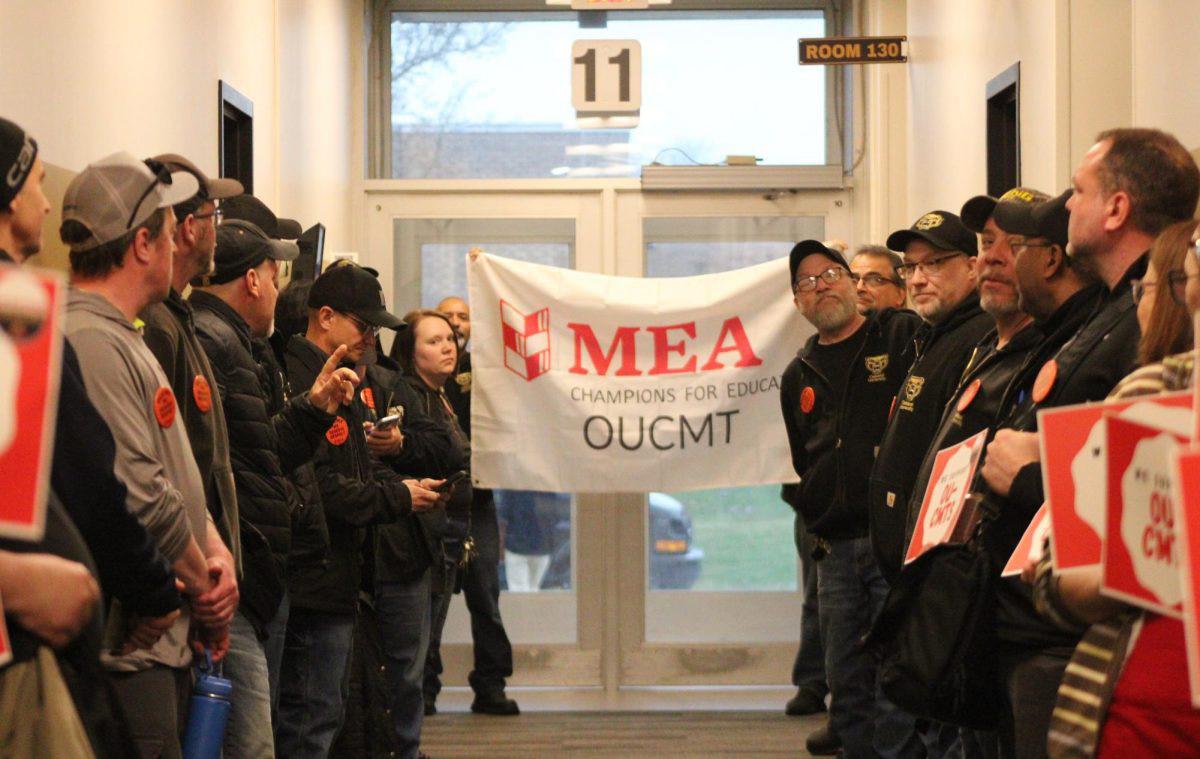
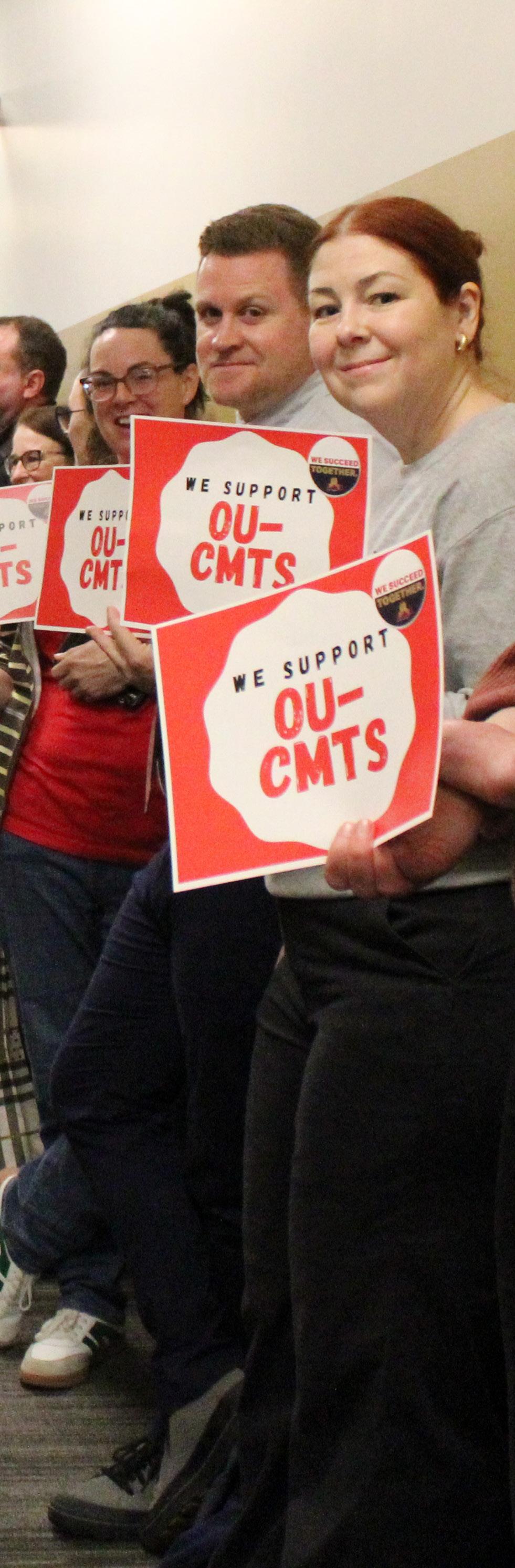
On March 11, OUCMT members lined the halls of the Oakland Center before a bargaining session with the administration as a second crisis action, now in the form of a silent protest. In both instances, they were joined by members of OUAAUP.
“What we’re fighting for [with] custodians is to have living wages,” Baade said. “We’re fighting for a market adjustment for the skilled trades for the first year, you know, to get them that raise above inflation.”
The university has not elaborated on the administration’s team experience at the bargaining table but has expressed support for workers.
“The University has been, and will continue to be, willing to meet on any of the dates the Mediator is available,” VP of Human Resources Joi Cunningham says. “Thus far, the Union has had more limited availability and also declined the University’s offer to meet virtually.”
With bargaining sessions ongoing, now with the help of a mediator, OUCMT expresses enthusiasm for the nearing of an agreement that improves working conditions on campus.
“We’re feeling somewhat hopeful that we’re going to be able to reach a deal,” Baade said. “Since our last crisis action at the Board of Trustees got them to move the most, hopefully, our most recent one gets them to move again.”
PHOTOS BY ADRIAN JIMENEZ MORALES
The other March Madness
MADI TURNER
Features Reporter
Missiles don’t need brackets to create chaos.
In March, what many associate with buzzerbeaters and brackets has taken on a far more dangerous meaning — one tied to rising global tensions, economic uncertainty and fear that stretches far beyond any arena.
What is typically a season defined by celebration and school spirit has instead become a moment marked by unease, where headlines carry a different kind of urgency, replacing excitement with anxiety and uncertainty.
This is a different kind of March Madness, and it is unfolding in real time.
Across the Middle East, tensions involving Iran, Israel and the United States have escalated in ways that are capturing global attention and concern. Long-standing geopolitical rivalries, shifting alliances and the accumulation of decades of conflict have once again moved to the forefront.
According to recent reporting from BBC News, military exchanges and strategic threats have intensified throughout early 2026, raising alarms about the possibility of broader regional conflict. These developments are part of a recurring pattern in the region.
With little warning, the fragile calm can quickly give way to escalation. For many Americans, these threats across the pond may feel somewhat distant, but the impacts are closer than they seem.
Economic ripple effects are already being felt, particularly in energy markets. Data from the U.S. Energy Information Administration shows that geopolitical instability involving major oilproducing regions often leads to spikes in global oil prices, which can directly affect gas prices and cost of living in the United States, often within days of major developments.
For college students already navigating rising costs, this kind of instability adds another layer of pressure. Tuition, rent and everyday expenses have already been climbing, and fluctuations in fuel and food prices only compound those challenges, stretching already tight budgets even further and forcing difficult financial decisions.
Beyond economics, there is a deeply human layer to this story. For Iranian Americans and families with ties to the region, the tension moves beyond political lines to become a personal concern. News alerts serve as constant reminders of fears and concern for loved ones abroad, as well as an omnipresent uncertainty about the future.
According to the Council on American-Islamic Relations, the nation’s largest Muslim civil rights organization, reports of discrimination and fear within Muslim and Middle Eastern communities have increased alongside global conflict.
From January to June 2024 alone, CAIR documented nearly 5,000 bias complaints nationwide, reflecting a sharp increase in incidents tied to global political tensions.
CAIR Government Affairs Director Robert S. McCaw warned that the rise in incidents of discrimination and hate reflects a broader climate of fear affecting communities across the country. That reality is playing out across the United States, including in Michigan.
Earlier this year, a man in Michigan was charged after attacking a place of worship connected to
the Iranian community. Law enforcement reports indicated the act was tied to personal grief and anger connected to conflict overseas.
Instead of just political tension, the cost of conflict is also measured in billions.
The United States has already spent more than $11 billion within the first week of the Iran war, according to a congressional briefing reported on by Reuters. Officials said the estimate only indicates the early days of the conflict and does not include the full cost moving forward, signaling that the financial impact is likely to grow as the situation develops.
Statements from The White House and international allies have stressed the importance of de-escalation while also reinforcing national security priorities in an effort to balance diplomatic reactions with defense concerns.
Meanwhile, Iran’s leadership has continued to issue warnings and strategic messaging through state channels, contributing to an atmosphere of uncertainty.
For students and young adults, the challenge is understanding what all of this means for their lives. Unlike previous generations, today’s college students are constantly connected to global events through social media, news alerts and digital platforms, making it harder to disengage and step away.
According to research from Pew Research Center, younger audiences are more likely to consume news through digital channels, increasing both awareness and emotional proximity to global crises.
For students and young adults, the challenge is understanding what all of this means for their lives. Constant exposure to global events through social media and digital platforms can make distant conflicts feel immediate and overwhelming. Research from Pew Research Center shows younger audiences are more likely to consume news this way, increasing both awareness and emotional proximity to global crises.
The problem raises a difficult balance: staying informed without becoming consumed.
For many students, that balance does not come naturally. The same tools that make information accessible also make it inescapable, creating an environment where stepping away for even a moment can feel like falling behind.
News app notifications, trending topics and algorithm-driven feeds are designed to keep users engaged. They often prioritize urgency with little attention paid to actual reflection. It becomes far too easy to confuse constant exposure with meaningful understanding.
To combat this swirl, students do not have to disengage from the news cycle entirely. Setting clear boundaries can be a powerful method for keeping peace. In practice, this may look like choosing specific times to check the news, turning off notifications or being more selective about sources.
It can also take the form of recognizing when coverage shifts from informative to purely overwhelming, and giving yourself permission to step back. Awareness is valuable, but it should not come at the cost of well-being.
Ultimately, staying informed is not about knowing everything as it happens. It is about understanding enough to remain engaged without losing perspective.
Conflicts like this do not happen in isolation. They are shaped by political decisions, historical tensions and global power dynamics that stretch back decades. As questions about accountability and what comes next continue to surface, one thing remains clear.
This version of March Madness has no bracket, no predictable outcome and no final buzzer — only consequences that extend far beyond a game, and a reminder that what happens across the world never remains there exclusively.
Introversion: One week outside the comfort zone
MADDIE SHORT Features Reporter
As an introvert, your day might begin with waking up and getting ready for work. During your commute, you might place an online order for coffee to limit time spent inside a busy cafe. Once you arrive, you may head straight to your desk, focusing on the tasks ahead. At the end of the day, returning home can feel like a welcome opportunity to recharge in a quieter environment.
In some ways, this scenario may seem exaggerated. It may even seem to some that a person who behaves this way may harbor a dislike of others. Genuine disinterest is rarely the case — the truth is, these individuals simply tend to prefer a low-stimulation environment.
An introvert is generally defined as someone who is more reserved and values alone time greatly. Introversion can come with many strengths, including amplified focus, independence and thoughtfulness. Psychologists often emphasize that introversion exists on a spectrum and can vary depending on context and energy levels.
At the same time, there may be situations where stepping outside of one’s comfort zone can be helpful. While many people are comfortable with introversion, certain environments — such as workplaces or social settings — may strongly encourage more outward engagement.
These expectations are often shaped by cultural norms that prioritize collaboration, visibility and communication, as is the case with many traditional workplaces in the U.S.
The Guardian published an article by Sirin Kale describing her experience trying to act more naturally outgoing. She approached social situations with a sense of curiosity and resilience, even when small talk felt unfamiliar or uncomfortable. Her experiment was rooted in an interest in whether personality traits may be flexible rather than fixed.
“New research has found that being an extrovert makes you happier,” Kale said. “So I spent a week attending social events to see if I could trick myself into being more naturally outgoing.”
During that week, Kale followed a set of personal guidelines and reflected on what she observed. She concluded that “people are kinder than you think and it is often easier to be truthful with strangers.”
She also noted that everyone brings their own experiences into interactions, and that trying something new may not be as daunting as it first appears. Her reflections highlight the role of perception in shaping her social experiences, which proved more mutable than previously believed.
After seven days of introducing herself to new people, making connections and participating in social activities she had previously avoided, Kale found that these experiences were more manageable than she expected.
“I’m still an introvert and I don’t see that changing soon,” Kale said. “But perhaps you will see me a bit more often from now on. Maybe.”
Psychology Today has also reported on research suggesting that acting more extroverted — such as engaging socially more frequently and trying new activities — can increase feelings of happiness and satisfaction for some people, compared with remaining more reserved. However, researchers note that results can differ based on personality, environment and individual comfort levels.
For those interested in expanding their experiences, occasionally adopting more extroverted behaviors may offer new perspectives. Engaging in social interaction or trying activities that spark interest can contribute to a sense of fulfillment, even if it feels unfamiliar at first.
Taking a similar approach to Kale’s — such as gradually trying new situations, introducing yourself to others or spending more time outside your usual routine — may offer insight into what feels comfortable and rewarding over time.
GrizzHacks collaborative coding returns to OU this weekend
MADDIE SHORT
Features Reporter
GrizzHacks is a 24-hour hackathon scheduled for March 28-29 in Oakland University’s Engineering Center, organized by OU students. During the event, college students collaborate on projects while building connections with recruiters, sponsors and peers who share interests in information technology, engineering and computer science.
With more than 170 participants last year, organizers expect even greater attendance this weekend. No prior experience is required to participate, making the event accessible to students of varying skill levels. GrizzHacks offers four tracks: artificial intelligence and machine learning, social good, fintech and the secretive “Hell’s Kitchen” track.
Sean Collins, president of GrizzHacks and lead of the logistics team, emphasized that GrizzHacks is not meant to be an intensely competitive environment, nor does it strictly align with common perceptions of “hacking.”
“A lot of it is just about making connections with other people in the field,” Collins said. “It’s about creating a project.”
The artificial intelligence and machine learning track invites participants to explore how algorithms can influence industries, often by applying data to real-world challenges. The social good track focuses on using technology to create positive change, encouraging students to develop solutions that address issues affecting individuals, communities and the environment.
The fintech track blends finance and technology, challenging participants to rethink financial systems and improve accessibility in areas such as digital transactions and banking tools. Meanwhile, the Hell’s Kitchen track remains undisclosed until the event begins, adding an element of surprise for those who choose it.
Collins said the Hell’s Kitchen track will likely be the most challenging. Participants who select it will not receive details in advance, instead discovering the theme only after arriving at the event.
Seven sponsors are supporting the event this year, including OU Credit Union, 365 Retail Markets, 24G,
the OU School of Engineering and Computer Science, Free Wili, the OU Donna and Walt Young Honors College and Light Guide Systems. Representatives from these organizations will attend to connect with participants and identify potential talent.
Sponsors also play a role in shaping the event’s tracks. For example, the company backing the Hell’s Kitchen track helped determine its focus, contributing to the mystery surrounding it.
Students have considerable flexibility in how they approach the hackathon. Participants can form teams of up to four people and choose the track that best fits their interests. While teams may discuss ideas and plan ahead, Collins noted that all coding and project development must begin at noon on the day of the event.
In previous years, some participants have strategically selected tracks with fewer competitors to increase their chances of winning prizes. However, organizers continue to stress that the primary goal is collaboration and learning rather than competition.
Additional information about GrizzHacks is available on its website and Instagram page. The event is scheduled to begin at 10 a.m. March 28 and conclude at 3 p.m. March 29.
As students work together throughout the 24-hour period, they not only develop technical skills but also build relationships within their academic and professional communities. To many students, the sense of connection and shared purpose, Collins said, often becomes one of the most valuable aspects of the experience.
“It’s a nice feeling of optimism with all the people there,” Collins said. “Everyone seems very excited.”
PHOTO COURTESY OF GRIZZHACKS
PHOTO COURTESY OF UNSPLASH
Aiden Stempnik boosts “SYSTEM-32x”
MARISSA GETSCHMAN
Arts Editor
Aiden Stempnik, an Oakland University student majoring in interdisciplinary studies with a focus in music technology and video game studies, released a song on March 6 titled “SYSTEM-32x.”
The sound of the song resembles that of a video game soundtrack. One can easily visualize a pixelated story coming to life on the screen, accompanying the audio, though there is no such visual. It is entirely up to the listener to interpret.
One might picture a platformer game, complete with adventure and exciting boss battles. One might picture a game similar to “Undertale” or “Pokémon.” There are no wrong answers, and the music is enjoyable even without imagining what story might progress in the mind.
Stempnik first dove into the music world as a trombone player in sixth grade, switching to saxophone by the end of his seventh-grade year. It was not until his freshman year of high school that he began to look into composing.
“When COVID started in high school, I started working on doing some music composition,” Stempnik said. “Then over the years of going through high school, I was like ‘oh, I kind of want to do this as a form of employment.’ I want to go into music composition for video games.”
Part of becoming a composer or musician is exploring different genres and styles of music. Engaging with the arts and finding different aspects
to include to better one’s own art. Stempnik cited artists like BoyWithUke, Bruno Mars and Michael Jackson when asked about inspiration.
“If I were to state inspiration exactly [for “SYSTEM-32x”], I would say Xenoblade,” Stempnik shared. “But truthfully, when I was making this piece last summer, it was just kind of me messing around and finding my own kind of sound.”
Stempnik describes the song as electronic rock, also crediting pop music for his writing style. Specifically, the form of pop music: verse, chorus, verse, bridge, chorus.
“I had a lot of fun writing the piece in general,” Stempnik said. “I showed it off once at the composer concert last semester.”
Stempnik went into detail about the naming process behind his music. When he debuted the piece at the composer concert, it had a different, demo name: “Trial Ass Beat.” He is composing another song to be released at a later date that is now titled “Ondoyance,” but was once called “Psychodel0.”
Stempnik also engages with the arts through a role-playing game he plays over calls with his friends. He composes background music to further immerse himself and his friends in the game, namely for investigative scenes.
Stempnik composes and records his music entirely digitally. “SYSTEM-32x” was mixed on a digital audio workspace called Reaper, using various small audio files, MIDI files and virtual instruments.
Stempnik credits Oakland University professors Terry Herald and Joshua Tomlinson for their help as
“Forever is a Feeling”: One year later
ALEXA DUDEK
Campus Reporter
Lucy Dacus released her album “Forever is a Feeling” on March 28, 2025, one year after Boygenius went on hiatus. In 2026, the album is a cozy 43 minute journey exploring Dacus’ feelings toward Boygenius bandmate, Julien Baker.
The opening track, “Calliope Prelude” sets the tone for the album. The track is an instrumental, consisting of an arrangement of string instruments. While the track is brief, fans noticed the shift from Dacus’ typical guitar-centered sound. A year later, fans view the track as an essential introduction to the album.
“Big Deal” explores themes of unrequited love. In 2026, the song is mature, capturing the sense of guardedness Dacus felt when falling in love with a friend. Dacus discusses themes of intense yearning in “Ankles.” A year later, fans adore the track, appreciating the unapologetic romanticism.
“Limerence” is one of the album’s most devastating moments. The track explores the early stages of obsession that come alongside infatuation. In 2026, the song remains a standout with fans who relate to experiencing limerence.
“Modigliani,” named after famous painter Amedeo Modigliani, expresses feelings of platonic love and longing for longtime friend, Phoebe Bridgers. Fans value this song for relatability, experiencing the conflicting emotions associated with missing a friend.
“Talk” explores the breakdown of communication in a relationship as connection is lost. Fans connect to the track, relating to losing communication.
“For Keeps” discusses finding love with a partner in fleeting moments. A year after release, fans enjoy the intimate connection Dacus provides with this track.
The title track on the album, “Forever is a Feeling” discusses the state of forever as fleeting. Departing from the usual indie-rock sound, this track instead utilizes a soft pop sound. A year later, the track remains a musical reminder that forever is a fleeting feeling, not a guarantee.
“Come Out” is a vulnerable, diaristic track, exploring a plea to a partner who is not ready to be open about a relationship. The standout track explores the complexities of Dacus’ experiences with same-sex relationships and the desire for
his music technology teachers.
Stempnik’s music can be found on Spotify, Apple Music, iTunes, Deezer and iHeartRadio. He can also be found on Instagram @aiden_stempnik, where he posts updates on his music.
public acknowledgement, enshrining a fan-favorite legacy in 2026.
The track “Best Guess” explores the vulnerability of choosing a romantic partner. The track remains a refreshing entry in Dacus’ discography, drawing fans in through the romantic sound and vulnerable lyricism.
“Bullseye,” featuring Hozier, provides an intimate sound as the duo sing about the intense feelings brought on by the pain of a breakup. The track quickly gained popularity, uniting fans of the performers. One year later, fans connect deeply with the track, finding relatability in the pain of a breakup.
“Most Wanted Man,” one of the album’s most touching moments, addresses Dacus and Baker’s relationship directly, with lyrics referencing Dacus capturing the most wanted man in West Tennessee, where Baker is from. One year later, this track is adored by fans for the intimate vocals of the duo. Skeptics of the softer songs appreciate the highenergy contrast provided by “Most Wanted Man.”
“Lost Time” provides a devastating, but tender look into love, expressing regret for withholding acknowledgement of love. In 2026, the song is viewed as a perfect closer, uniting feelings of vulnerability and yearning.
The release of “Forever is a Feeling: The Archives” on Oct 10, 2025, solidified the album’s deep emotional impact by allowing listeners to gain an appreciation for the original tracks through listening to the acoustic versions.
Overall, this album is Dacus’ sweetest, most hopeful release.
PHOTO COURTESY OF AIDEN STEMPNIK
PHOTO COURTESY OF ROLLING STONE
A postcard from Japan:
“Going for a PR?” the lady in line behind me asked.
It was six hours into my flight to Tokyo, and I was stuck waiting for the bathroom under the dim blue lights of the cabin.
“What do you mean?” I asked, blinking at her.
“For the marathon,” she said, as if it were the most obvious thing in the world.
That’s when everything clicked: I would be in Tokyo during the Tokyo marathon. My flight was just two days before the race.
Suddenly, a lot of things started making sense: the absurd number of people stretching in the aisles, lunging in the galley and squatting near the emergency exit. Everyone in the economy section looked young and fit.
I smiled and took the compliment. There are worse things to be mistaken for than a marathon runner. I was flattered and told her I ran the occasional holiday Turkey Trot. I declined to give her my 5K time.
Universal girlhood
On my second day in Tokyo, I met with a Japanese delegation of women: a group of 10 young Japanese women, all either in university or young professionals.
To be honest, Tokyo was confusing. I was overwhelmed. I didn’t speak Japanese. I was insanely jetlagged.
We were supposed to talk for an hour over tea. What would we even talk about?
Apparently a lot. I asked the girl next to me what she liked doing for fun.
“Going to cute coffee places with friends, watching movies and baseball,” she said.
I smiled because I love all three of those things too.
“Oh my gosh, Shohei Ohtani is so hot!” another girl added.
We all giggled and scooted our chairs closer to each other. I found myself grinning and nodding along. It felt like I was having a conversation with my friends back home.
One of the girls was traveling to D.C. in a few weeks. I sent her my Google Maps recommendations – a few brunch spots, dinner places, the works. I gave her tips on buying a Metro Pass and told her the best neighborhoods I think she would like to visit.
I then asked her about shopping, because I was on the lookout for good – not too tacky – Shohei gear. That night, I got an Instagram DM from her with a pinned location.
“This is where I get all my jerseys from. Enjoy Japan!”
Even thousands of miles from home, I found comfort in something simple: girlhood. You can cross an ocean and still find someone who fangirls over the same baseball player and understands your coffee obsession. Somehow, that
made Tokyo feel just a little smaller – and a lot more like home.
Walking in Tokyo alone
After a long twelve-hour day in Tokyo, our group split up. The last stop of the day was Don Quixote, but I had already been there once and honestly didn’t have anything more to buy.
“I can figure it out,” I told them with a shrug and smile.
I mapped my route on Google Maps and headed to the metro station alone. Tokyo's metro is not only one of the transportation systems in Japan but in the entire world. Nonetheless, I took a deep breath and descended the steps.
There’s something quietly empowering about navigating public transportation in a foreign country. Every correct transfer feels like a small victory. You feel like a local. After two successful transfers, I stepped out of the station with pride.
If I can figure out the Tokyo metro – alone, jetlagged and confused – I thought, I can do anything.
On the walk back to the hotel, I stopped at 7-Eleven for ice cream. I have a fierce passion for a specific brand, Choco Monaka Jumbo, which can’t be found in the U.S. I bought two.
The streets were quiet. It was late, and I was alone. I felt completely safe.
This may feel like a small detail, but it isn’t. I’ve been in places alone where I’ve felt uneasy. In Paris, catcalling could get bad. Even in Detroit, I walk extra fast to my parking deck after work. But in Japan, I wasn’t rushing or holding onto my purse. I was simply walking.
That night, I met my friends for dinner at a sushi restaurant and ordered a draft beer and an enormous sushi dinner. Everything felt perfect in that moment: successfully navigating the metro alone, indulging in my favorite ice cream and sharing a nice dinner with friends. I felt incredibly lucky.
Working on a wasabi farm
After a whirlwind, and honestly quite exhausting, few days in Tokyo, I escaped to rural Japan to work and stay in the countryside on a wasabi farm near Mt. Fuji, in a city called Gotemba.
I slept on wooden mats on the floor and stayed with an older couple who spoke no English. Luckily, I was there with my friend Madeliene,
which made the whole experience infinitely more fun and slightly less terrifying.
Each day, I donned rain boots, put on my Shohei Ohtani baseball cap and harvested fresh fruit and vegetables. There was mud everywhere, but the air was impossibly clean, and somehow it made every squishy step worth it. Without exaggeration, it was the best food I’ve ever eaten. The host made homemade sake in his garage, which I seriously considered buying and bringing home to pop for my graduation, but my luggage had other plans.
For breakfast, I ate yogurt drizzled with fresh honey straight from his bees. One night, we sat on plastic chairs in his garage, feasting on vegetables slow-roasted in foil over a fire. No seasoning needed. Every meal was a full-on farm-to-table experience.
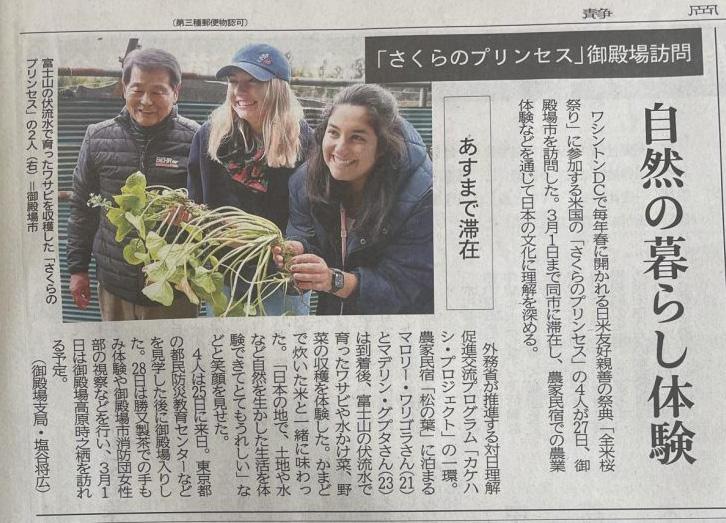
One afternoon, a reporter showed up. I think he was confused and curious about what two American girls were doing in the middle of rural Japan, digging up wasabi. We smiled and posed with our harvests.
The next morning, while eating my honey and yogurt breakfast and drinking my green tea, our host handed us a newspaper.
There we were – on page 14 –grinning like fools, each of us holding up a chunk of wasabi we had just pulled from the ground. I took a copy home, and to this day, it remains one of the coolest souvenirs I’ve ever had.
“What if we die?”
Madeline and I showered and got ready for bed. We were staying in the guest house, which meant we had to walk in clogs to the main house to shower.
The walk from the guest house to the main house was scary at night. On the walk back to the guest house, I sprinted in my hoodie with wet hair to minimize outdoor exposure. I silently prepared myself as an attacker.
The farmland felt eerily quiet after dark – acres of open land, only a handful of people in the village. I shut off my phone and put my head down.
“Mallory?” Madeline whispered. “Yeah?” I replied, turning to face her.
“What if they kill us tonight and this is just a trap?”
My stomach dropped, and I squealed.
“Think about it,” she
continued. “Acres of land. No one is really nearby. We’re in the middle of nowhere.”
I thought about it. Just five minutes away was the ancient shrine where we had prayed that morning. We were surrounded by centuries of tradition, but also centuries of spirits. It felt like the opening to an A24 horror movie.
By the morning, of course, nothing had happened. The sweet elderly couple woke us up with fluffy pancakes. I took a warm bite of my pancake and smiled.
Legends and prayers
I was staying near Mt. Fuji during a particularly foggy stretch of time, which meant the mountain was rarely visible. Day after day, I surveyed the landscape and was repeatedly disappointed by the clouds blocking the view. By the end of my time in Gotemba, I had accepted the fact that I wasn’t going to get an Instagramperfect photo.
Then someone told me something strange.
“Oh, but this is excellent news, you haven’t gotten a good view.”
I scrunched my eyebrows and frowned. Of course I wanted to see Mt Fuji.
“Legend says Mt. Fuji hides her beauty from beautiful women when they’re nearby,” they explained. “She gets jealous and doesn’t want them to see, so she hides the view.”
What an honor it was to have Mt. Fuji consider me beautiful. I smiled. If I wasn’t going to get a perfect view, at least I had thousands of years of Japanese legend backing my looks. I decided to take the compliment.
It was my last day in Gotemba, and to celebrate, our hosts prepared a farewell lunch. The older couple I had been staying with whispered something to the translator.
“They said they would like to go to the local shrine to pray for your future.”
So we set off together, walking about 15 minutes down a narrow road to the local shrine. It wasn’t glamorous or ornate, but it had the peaceful, weathered charm that places like this always seem to have.
They handed me a small wooden block and explained that I could write a wish and hang it on the rope between the trees. I wrote down my wish for good fortune, new adventures and the chance to return to Japan one day.
Then I stepped back and watched as the old man and woman bowed, tossed a coin into the offering box and clasped their hands together in prayer.
Maybe it’s just the placebo effect, but knowing that an elderly couple I had only just met was praying for my future made me feel strangely hopeful.
On our walk back to lunch, the clouds finally cleared, and Mt. Fuji appeared. For a moment, I held my breath – fog rolling back like a curtain and sunlight hitting the peak just right. Just hours before leaving, the mountain decided to show herself, as if giving me a private, last-minute hello.
I quickly snapped a few photos, grinning like an absolute tourist, thrilled that I finally got to meet Mt. Fuji face-to-face. I forgave her for hiding all this time – all I wanted was a quick visit.
“Do you think I woke up ugly today?” I asked, slightly offended.
A few days later, on my ride to Haneda airport, it started raining. It felt serendipitous: I had made it through the entire trip without rain, which felt like a miracle considering I was visiting in March, when the weather is usually damp and unforgiving.
“It’s a good sign it’s raining,” the guide said. “In Japan, people see it as a kind of rebirth. The earth needed it.”
Somehow, that felt like a good way to leave Japan – with a minor ego boost from Mt. Fuji, an elderly farm couple praying for my future and a symbolic rebirth to send me on my way.
story by Mallory Waligora graphic by August Wicker
Golden Recommendations: Must-watch films directed by women
MARIA MAGNOLI AND SARAH BULGARELLI
To celebrate Women’s History Month, it is fun to look back on classic movies directed by women that many know and love. These timeless favorites have brought laughter, inspiration and memorable characters to audiences over the years. Each film feels unique, but they all highlight the creativity and perspective women directors bring to storytelling.
“A League of Their Own” (1992)
Directed by Penny Marshall, “A League of Their Own” follows a group of women who join a professional baseball league during World War II. The film shows how the players learn the game, build friendships and face challenges along the way. It focuses on players like the team’s catcher, Dottie Hinson (Geena Davis) and her teammate, Kit Keller (Lori Petty). It blends humor and sports, making it both entertaining and inspiring. It is the kind of movie that makes audiences laugh while also appreciating the history behind it.
Marshall’s direction brings the characters to life. The women on the team are determined and supportive of each other, showing how they overcome obstacles while still having fun. The film offers a woman’s perspective on baseball and highlights the role of women during that time. It emphasizes teamwork and friendship, making it a perfect pick for Women’s History Month. Even decades later, it remains a classic that continues to entertain audiences. It is easy to see why it remains such a favorite.
“The Substance” (2024)
Receiving an Oscar for Best Makeup and Hairstyling at the 97th Academy Awards in 2025, “The Substance” is a psychological thriller exploring the dangers of body dysmorphia — particularly for women in the spotlight. Directed by French filmmaker Coralie Fargeat, the picture was created based on her personal experience with societal pressures to fit a particular beauty standard.
An aging celebrity, Elisabeth Sparkle — played by Demi Moore — faces internal struggle when she is fired from her aerobics show by her sexist boss. As her career deteriorates, she is left feeling helpless; that is when she encounters “The Substance.” A potion promising youth, vitality and beauty, Sparkle injects herself, hoping she will see her younger face again.
To her surprise, the concoction is anything but that. Instead of simply becoming younger, it creates a second, younger version of herself — portrayed by Margaret Qualley — that she must switch between. With prosthetics and body doubles, the horror lies in the grotesque versions Sparkle sees of herself, wishing she had never taken the drug. The film was highly acclaimed for its messaging surrounding aging, identity and societal pressure.
“Clueless” (1995)
Directed by Amy Heckerling, “Clueless” is an iconic teen film that has remained a favorite over the years. The story follows Cher Horowitz (Alicia Silverstone), a popular and fashionable high school student, as she navigates friendships, relationships and everyday life in Beverly Hills. On the surface, it is light and funny, but it also touches on personal growth and learning to understand others. It remains just as fun today as it was when it first came out.
Heckerling’s direction is what gives the film its charm and personality. Cher and her friends are memorable and easy to connect with and the dialogue is still quoted today. “Clueless” balances humor with relatable moments as Cher learns through important life lessons
as a teenage girl. This film balances a strong female perspective with an entertaining and enjoyable story. It is iconic for a reason and continues to resonate with audiences.
“Marie Antoinette” (2006)
“Marie Antoinette” is a 2006 historical drama directed by Sofia Coppola, illustrating the playful side of the Queen of France. Starring Kirsten Dunst as Marie Antoinette, the Austrian teenager is sent to France as a political token to marry the future king, Louis XVI. As the monarchy hopes to bridge the relationship between the countries, she is forced into the rather rigid world of Versailles. Despite its grandeur, the strict customs and isolation associated with royalty become quite lonesome.
For a time, she embraces her lavish lifestyle, but it grows clear that it is only temporary. To escape her struggles, she finds solace in the extravagant fashion, parties, food and gambling that await every corner. As she becomes unfavorable to the public, her reputation quickly declines — leaving her susceptible to scrutiny. Through Coppola’s brilliant directing, viewers watch a young, carefree girl transition to a public, yet isolated figure during a time of political unrest.
“The Parent Trap” (1998)
Directed by Nancy Meyers, “The Parent Trap” follows twin sisters Annie James and Hallie Parker (Lindsay Lohan), who were separated at birth and meet at a summer camp, where they decide to swap places to reunite their divorced parents. The film is full of clever schemes, funny moments and heartfelt scenes
that make it enjoyable for all ages. It has a playful tone that makes it easy to revisit and enjoy more than once.
Meyer’s direction highlights the twins’ creativity and independence while focusing on their personalities and growth. The film is centered around family, connection and working together toward a goal. It is a comfort movie that audiences can come back to again and again. It remains a classic that fits perfectly with the message of Women’s History Month.
“Little Women” (2019)
American director Greta Gerwig, known for films like “Barbie” (2023) and “Lady Bird” (2017), is known for her devotion to amplifying women’s voices. “Little Women” was nominated for a total of six Academy Awards, including Best Picture. An incredibly starstudded cast, the picture features Saoirse Ronan, Florence Pugh, Eliza Scanlin, Laura Dern, Bob Odenkirk, Timothée Chalamet, Emma Watson, Meryl Streep and many more.
Following the lives of the four March sisters, raised by their mother amid the Civil War, the girls must learn to survive while their father serves as a chaplain. As they learn to navigate love, loss and ambition, each sister has different goals worth striving for.
Jo, the second-oldest sister portrayed by Saoirse Ronan, dreams of being a writer. She struggles to balance a life of independence with responsibility to her family in a society that limits women’s choices. All four sisters must decide what is best for their future in a time that presents significant turmoil.
Academy Awards 2026: Winners, losers and drama queens
SARAH WASIELEWSKI
Arts Reporter
March 15 was one of the entertainment industry’s biggest nights, with all the famous and prominent gathering in Los Angeles’ Dolby Theatre for the 98th Academy Awards.
The night was one of several firsts. “Sinners” received 16 nominations, breaking the previous record of 14 held by the films “La La Land,” “Titanic” and “All about Eve,” but also setting the record for most nominations lost at 12.
The evening also debuted a new category, the Academy Award for Best Casting, which was awarded to Cassandra Kulukundis for “One Battle After Another.” In a surprising twist, the Oscar for Live Action Short Film was awarded to both “The Singers” and “Two People Exchanging Saliva,” the first tie since 2013. Meanwhile, Jessie Buckley became the first Irish woman to win Best Actress with her work in “Hamnet.”
Conan O’Brien hosted the event for the second year in a row. While delivering his typical style of humor, he also kept away from any jokes too scathing or political. Despite 17.9 million people tuning in for the live stream, viewership was still down 9% from last year. However, streaming numbers may no longer be a relevant statistic for engagement, as social media impressions were up and videos on the Academy’s social media platforms received millions of views. Reflecting this changing viewership, the Academy Awards will transition from broadcast to a YouTube live stream in 2029.
In a highly criticized move, several winners were cut off mid-speech, either because the microphone was turned off or because the orchestra started playing over them loudly. Theoretically, the Oscars operate under the rule that any speech over 45 seconds risks being cut off. There seems to be some concessions made for the bigger awards, as Best Actress Jessie Buckley and Best Actor Michael B. Jordan both spoke for almost three minutes uninterrupted.
Clocking in at three hours, the Academy Awards are admittedly a lengthy show and have to keep up the pace to stay on time. Yet in an effort to make the show more watchable, skits introduced by the presenters ended up taking away time from the actual Oscar winners.
Robert Downey Jr. and Chris Evans presented the Oscars for Best Original Screenplay and Best Adapted Screenplay, but spent several minutes on a lackluster comedy skit. Later, several actresses from “Bridesmaids” spent nearly six minutes in a tribute to the 15th anniversary of the film, before presenting the awards for Best Original Score and Best Sound.
Some categories result in multiple people coming up onstage, and the winners will take brief turns at giving their acceptance speeches. But when “Golden” won for Best Original Song, the mic was cut after just one person spoke, and the broadcast went to commercial break.
There seems to be something fundamentally wrong with an award show that will not allow the winners adequate time to accept their awards. The whole point of an award show is to honor and recognize the talent and craftsmanship in the movie industry; instead, winners are rushed along in search of viewership and engagement.
“A Little Less Conversation”: A little more Elvis, please
MARIA MAGNOLI Arts Reporter
“I learned very early in life that: ‘Without a song, the day would never end; without a song, a man ain’t got a friend; without a song, the road would never bend – without a song.’ So I keep singing a song,” Elvis Presley once said.
A few of many monumental words spoken by the King of Rock and Roll, audiences of Elvis fans worldwide now have the opportunity to see “EPiC” — Elvis Presley in Concert. Featuring all-time favorites like “That’s Alright Mama,” “Burning Love” and “Suspicious Minds,” theatergoers are transported back in time to Presley’s sold-out crowds of the 1960s and 70s.
Legendary Australian director Baz Luhrmann directs the documentary-style special featuring neverbefore-seen footage and previously unheard music of Presley. Known for directing films such as “The Great Gatsby” and “Moulin Rouge,” “EPiC” is a response to his 2022 biopic “Elvis,” starring Austin Butler as the Memphis artist and Tom Hanks as his deceitful manager, Colonel Tom Parker.
Upon the release of “Elvis,” a surge of nostalgic fervor reignited, leaving loyal fans and new ones in a frenzy. Less than four years later, Luhrmann created “EPiC” to “let Elvis tell his own life.” To uncover the lost footage, Luhrmann sent researchers to a salt mine in Kansas, where they found 65 reels of footage — roughly 10 – 16 hours. Additionally, a 40-minute interview of Presley from his “Elvis on Tour” (1972) concert film was unearthed.
“[The tape] was our light-bulb moment,” Luhrmann said. “Because Elvis was off camera when it was taped, I think he was really unguarded and really open hearted. We thought, ‘What if we use this in the film so that Elvis tells his story himself?’”
Large segments of the film showcase his 636 performances delivered throughout his residency at The International Hotel in Las Vegas. Avid “Elvis” viewers will instantly recognize the meticulousness Luhrmann possessed when watching this movie. Specific shots of Butler, like the scenes of him walking with his entourage, are spot on to what is seen in real life; the look, pacing, demeanor and expressions evoke a strong sense of déjà vu.
Nevertheless, Butler is no match for the sheer aura that was Presley. His ability to captivate women was overwhelmingly apparent, and every man would have died to be him. All six feet of him, draped in his low-cut white jumpsuit, looked like a complete Adonis with those blue eyes, luscious hair and that charismatic smirk.
And the accessories! Bling, bling and more bling. With the variety of rings and belts this man had, every theatergoer is bound to have a favorite. All different shapes, sizes and colors, yet always adorned in gold. His silk, vibrant dress shirts worn in his rehearsal sessions, paired with his TCB — Taking Care of Business — shades, accentuated his larger-than-life stage persona.
Presley worked like a dog. Colonel Parker would book him for several performances a day, cast him in more than 30 films that he despised and kept him trapped in the United States, despite his desire to tour the world. Receiving countless questions from reporters, he was often asked if he was satisfied with the image he had built.
“Well, the image is one thing, and the human being is another,” Presley said — implying that underneath the glamor, no individual can endure the struggles of stardom.
The rehearsal footage was the centerpiece. Watching his purposeful dance moves, paired with the spontaneity of his personality, was such an intimate experience. In those sessions, his intuitive musicality was entirely evident, particularly in gospel songs. A genre taught to him by African American congregations and artists, it was a style he often returned to.
PHOTO COURTESY OF ACADEMY MUSEUM
Harry and Meghan: Controversial as ever
SARAH WASIELEWSKI Arts Reporter
Meghan Markle and Prince Harry’s highly criticized production deal with Netflix dissolved after nearly six years of partnership, and with it the streaming service ended support of Meghan’s lifestyle brand, As Ever.
The couple’s company, Archewell Productions, teamed up with Netflix in 2020. Originally, Archewell Productions was supposed to create a variety of scripted and unscripted content for all ages, but increasingly became exclusively about promoting Meghan Markle and her brand, As Ever.
Rumors swirl that Netflix officials were frustrated with Meghan and Harry continually repurposing the same story of their departure from the royal family. Compounding the strain in the business relationship is the fact that the second season of “With Love, Meghan,” released in the summer of 2025, saw a drastic drop in viewership.
The first season of the show performed on par with comparable Netflix lifestyle shows, and despite heavy criticism, was renewed for another season. However, in light of the poor performance of the second season, the show was cancelled, although it may return for seasonal specials.
In the beginning, Meghan and Harry seemed destined for success. Their tell-all docuseries
“Harry & Meghan” was Netflix’s most-viewed
documentary debut. Archewell Productions quickly followed up with several other docuseries, including “Heart of Invictus” in partnership with the Invictus Games and “Polo” in 2024.
Last year, Meghan launched her lifestyle brand As Ever. Originally, Netflix promoted the brand in conjunction with its streaming deal. The initial product launch in April of 2025 sold out less than an hour after going live, but the total quantity of items sold was never disclosed.
The brand sells teas, candles, spreads and has plans to expand into tableware and glassware. Some detractors find the cost of the products
prohibitive, as the signature candle costs $64 while a nine-ounce jar of sage honey retails for $32. However, reviewers acknowledge it is a luxury brand, and the items were elegantly packaged and of high quality.
Some reports claim that Meghan would frequently dsappear from Zoom business meetings for long periods of time because she was offended by what was said. Others allege that Meghan would frequently interrupt Prince Harry mid-sentence, touching him on the arm before taking over the conversation.
Last year, Netflix announced that it would not be renewing its deal with the couple, but instead retained first-look rights for any projects by Archewell Productions. However, the streaming giant ended their partnership with Meghan’s lifestyle brand, As Ever, earlier this year.
“As Ever is grateful for Netflix’s partnership through launch and our first year. We have experienced meaningful and rapid growth and As Ever is now ready to stand on its own,” a spokesperson for the brand responded. “We have an exciting year ahead and can’t wait to share more.”
Many feel that As Ever breaking from Netflix is just the beginning of the couple’s fracturing relationship with the streaming service. Netflix’s Chief Content Officer Bela Bejaria refuted the rumors, saying “Don’t believe everything you read” and suggesting that people do “a little more fact-checking.”
PHOTO COURTESY OF GETTY IMAGES
Why the rise in data centers? A policy analysis
MARYAM MOSS Political Reporter
Data centers are proliferating across Michigan and the Midwest at unprecedented speed. The state government sees Michigan as well-positioned for construction due to its water resources, natural advantages and distinguished workforce — despite the concerns raised by local communities.
In 2024, Gov. Gretchen Whitmer signed the Enterprise Data Center Sales & Tax Use Exemptions legislation, which outlines eligibility requirements for participating entities. The act incentivizes development by withdrawing the 6% sales and use tax on data center construction and equipment purchases. This applies to entities that became qualified by meeting requirements.
Since then, Michigan has also expanded exemption eligibility for enterprise data centers, including facilities for private use and Brownfield properties. These include unused historic resources, functionally obsolete or contaminated sites — made eligible for redevelopment under Act 381, which also promises tax breaks after completion. Although most often used by local developers, Brownfields could now be an option for data center building projects.
Besides an initial $250 million investment, these include the adoption of policies that are intended to benefit communities. Under the requirements, a center must create a projected 30 jobs that are compatible with the median wage for an area and refuse electric rates that are passed onto consumers.
Despite these guardrails, certain risks can remain for the environment and communities.
Although the state mandated a quota for job creation, companies like the Nevada-based Switch Inc. had only created 26 jobs by 2022, whereas it had pledged 1,000 back in 2015.
Furthermore, there is a risk that job creation
itself, a byproduct of the costs saved by tax breaks, can be passed onto taxpayers. Exemptions could cost taxpayers $42.5 million, an analysis by the Michigan Senate Fiscal Agency finds. This raises a question worth asking: Does a marginal return in job growth outweigh the other burdens associated with data-center development?
Not only do tax incentives catch the eye of developers, but state resources are another factor, and their visibility may be driving company investments in Michigan.
Data centers need large quantities of water to function. Michigan Public estimates that usage can range from 300,000 to between 1 and 5 million gallons per day, depending on the scale of a center. This is equivalent to powering 1,000 homes for a median-sized facility. For a hyperscale, it equates to a small city.
Second to powering a data center is a kind of feedback system. Computer servers within a facility generate heat, and cooling mechanisms are needed to keep temperatures level. One of these methods is air-based cooling, in which water is evaporated to cool the surrounding area yet doesn’t directly return to a watershed. This is an energy-efficient but water-intensive process. Other methods include closed-loop circulation systems, dry air cooling and hybrid methods.
Closed-loop circulation is considered more sustainable in the process of water preservation. It recycles water by allowing cooler currents to lower heat levels in these facilities. The heated, used water then goes through a cooling tower before it can be ready for use again. This recycling procedure reduces freshwater use by up to 70%.
Michigan’s wet, humid continental climate is believed to reduce cooling costs, making it an ideal site for startups.
The Great Lakes region makes it an ideal location for meeting high water demands. However, as critics
note, even a grand water supply is far from being inexhaustible. Although the Great Lakes contain 20% of the world’s freshwater, only 1% of that capacity is restored by inflows. In addition, the line that shuttles water to a data center is intertwined with municipal water systems that tap into aquifer beds. This becomes a concern in light of groundwater shortages across every state in the Midwest.
Rural areas in Michigan, in the case of a data center opening, could carry the greatest burden in keeping a facility running.
Michigan Rural Water Assets (MRWA) notes that “the nearly 45,000 water systems in rural America are anchor institutions in their communities.”
Per USDA data, a rural area is defined as one that lies outside census places and includes blocks that have a population density of 1,000 or more people. Some of these are also classified, according to a definition from the Office of Management and Budget (OMB), as areas that are economically integrated with an urban core. Others take the form of outlying tracts with less integration. It is these areas, due to their large land availability, that are often looked to as hosts for potential data centers. A weak connection to urban areas, which have a greater advantage infrastructurally, makes the most rural counties vulnerable. The water-intensive operations of a data center could potentially lower water tables, deplete wells and increase competition for municipal water supplies—diverting a critical resource away from communities.
Data centers, as a University of Michigan report finds, can become more sustainable—in the context of both the environment and communities hosting them—by being transparent about objectives, scope of need and predicted returns.
This transparency restores agency to local governments and their constituents, offering them tools to negotiate with, or refuse, the terms of a planned facility.
Mehdi Hasan’s Zeteo as a trendsetter for journalism
MARYAM MOSS Political Reporter
Independent journalist Mehdi Hasan is bringing a new vision for journalism with his media company, Zeteo. Founded in 2024, his company seeks to develop an authentic voice through enterprise reporting methods.
Mehdi Hasan has been a journalist for over 20 years. He has worked as a producer for Al-Jazeera English, Channel 4 and the Huffington Post, where he served as political director.
Now, he is taking a direction similar to other legacyaffiliated anchors-turned independents like Don Lemon, who have forged new, nontraditional paths for themselves. This quiet exodus from newsrooms is paralleled by growing opportunities for freelancers, who are taking advantage of digital tools that provide new ways to reach audiences.
Hasan founded Zeteo on the slogan of “a bias toward democracy and human rights,” branding the company’s identity as a service mission.
Most notable is its visual-interactive focus.
Zeteo presents audiences with full-length documentaries, “Ask The Editor” episodes where hosts answer live questions and “Mehdi Unfiltered,” a show more reminiscent of a traditional news segment. These offer diversified options in a market where legacy news organizations struggle to attract subscribers and outlets like The Washington Post downsize content offerings.
Alternative media has long been a challenge for legacy news organizations, as consumers increasingly seek out personalization, interactivity and exposure to perspectives that aren’t communicated in the mainstream.
However, Zeteo gains appeal in suiting its delivery style to this new trend.
“Beyond Israelism,” a series featured on the platform, balances professional flair and personability. Hosted by activist Simmone Zimmerman, it centers on an intergenerational reckoning with the state of Israel, inviting scholars of both Palestinian and Jewish identity to share personal narratives.
Uniquely, Zimmerman builds trust in the way that a YouTuber or social media creator does: by being vulnerable with an audience. She does not position herself as an expert, but is willing to arrive at negotiated meanings through dialogue with her guests and viewers.
Zeteo also integrates itself into a network of independents and the tools of amateur content creation— positioning itself as a contrast to the gatekeeping often
involved in newsroom routines.
For one, it is a product of Substack, an interface similar to Medium where audiences can follow their preferred creators or sources and interact with content. This positioning immediately distinguishes Zeteo from other news outlets that often separate traditional production processes from those of the tools used by amateur, non-journalistic actors with whom they compete for attention.
Zeteo ultimately rebuilds trust in journalism by holding journalistic practices themselves up to critique, portraying them as flexible and interpretative, rather than rigid principles.
In an episode of “Ask The Editor,” attention is drawn to the way in which journalists covered responses to the death of ICU nurse Alex Pretti at the hands of federal immigration officers. Episode host Prem Thakker argues that, in this case, the principle of balance was distorted to laud GOP members who called for an investigation as breaking with party ranks.
This keeps with a theoretical perspective that holds balance, instead of developing the full picture, which can distort impressions, giving confirmation to viewpoints that don’t deserve to be validated. In Thakker’s view, too much pomp is given to what should be a moral instinct: to condemn cruelty.
Derived from the ancient Greek word for “seeking out” and “striving,” Zeteo ultimately aims to mirror the tireless inquiry employed by the giants of philosophy. It proclaims its core values as journalistic accountability, service, and transparency — engaging a quest for truth that doesn’t stop at all sides of the story coverage, but interrogates conditional patterns of thinking.
Acknowledging the climate crisis in
MATILDE RABAJOLI
Political Reporter
The increase in gas prices hasn’t gone unnoticed.
Climate change worries have been slowly peeking out in headlines as the Ukrainian War rages on in its fourth year and the Middle Eastern conflict with Iran is about to slide into its first month.
The recent international affairs that have involved the U.S. have, in one way or another, impacted the life of an American.
Inflation has been increasing after President Trump’s first tariff procedures in his first year of reelection. Its most recent spikes in prices have brought disapproval for President Trump. The cost of living rose to 63% from his previous 41% during his first return to the White House.
“Until we see a meaningful resumption of oil flows through the Strait of Hormuz, upward pressure on fuel prices is likely to persist,” Patrick De Haan, head of petroleum analysis at the app GasBuddy, said. “At the same time, seasonal forces are beginning to intensify as several regions complete the transition to summer gasoline, creating a double headwind that could continue driving pump prices higher in the weeks ahead.”
Among the countries that rely on Iranian oil for gas and energy, the most are that of the United Arab Emirates (UAE), China, Oman and Afghanistan. The numbers of imports range from a gross net worth of hundreds of millions to multiple billion USD spent last year.
The Iranian conflict has recently also driven for strikes to hit the region. Almost 40 oil refineries or other energy entities have been damaged or successfully targeted since the beginning of the war.
“It could become a lot worse if the craziness continues to prevail,” Charif Souki, a former chief executive of Houston-based Cheniere Energy, said. “But there are so many people who have a vested interest in not letting it get too far out of hand.”
Though this situation has held the attention of the world, there is a more dooming domino effect that may be these wars’ ultimate consequence. The loss of human life is rightfully the largest property for governments, but it is often followed by the reconstruction of one’s country and livelihood.
Reconstruction creates further pollution following the military pollution that actually occurs during wars. The further depletion of natural resources and destruction of ecosystems drives for wars to have lasting effects on more than just human memory.
What this truly means goes beyond the enriching of everyday life. While American citizens may be facing intense prices, other citizens worldwide are now facing the possibility of an acceleration of climate disasters.
Nearly 120 million were displaced from their homes at the end of 2023, and one can only imagine how that number has worsened in the last two years.
Countries such as Chad, Central African Republic, Eritrea, Democratic Republic of Congo, Sudan, Sierra Leone, Madagascar and Afghanistan have already borne the most of climate change’s consequences. Modern conflicts will only worsen developing countries’ staggering survival.
The UN warns that Ukraine alone holds the need for nearly 34.6 billion USD in order to recuperate from the war, and rid Ukrainian soil from war material such as land mines and ordinances. Other sources have noted that the state of Ukraine seeks about 44 billion USD for emission damages from Russia.
“A lot of damage was caused to water, to land, to forests,” Pavlo Kartashov, Ukraine’s deputy minister for economy, environment and agriculture said. “We have huge amounts of additional CO2 emissions and greenhouse gases.”
The need for globalization of renewable energy and official detachment from fossil fuel misuse has never been clearer.
PHOTO COURTESY OF AL JAZEERA
Japan and U.S. meet at the White House, discuss ongoing Iran conflict
MATILDE RABAJOLI Political Reporter
Following the recent strikes on Iran, President Donald Trump has been looking for allies to add alongside partner Israel.
On Thursday, March 19, Japan’s first female prime minister, Sanae Takaichi, was invited to the White House to improve Japanese and U.S. relations.
This invite falls during the famous Cherry Blossom time in Washington D.C., commemorating the very gift that Tokyo Mayor Yukio Ozaki gave to the city of Washington D.C. in 1912 as a symbolic way of creating a firmer friendship between the U.S. and Japan.
Relations with Japan—as of late—have been very good, as President Trump reportedly said that he would help Premier Takaichi with “any favor” she may need. He also mentioned that the two of them had become “very close friends” and added that Takaichi “is a winner.”
While meeting, Premier Takaichi and President Trump discussed the ongoing conflict in the Middle East, specifically with the U.S. and Israel’s recent airstrikes on Iran.
“Iran must never be allowed to develop nuclear weapons,” Premier Takaichi stated on behalf of Japan’s current position on the conflict.
As the international supply of energy begins to raise concerns among many international leaders, Japan is focusing on de-escalating the ongoing airstrikes and restoring peace in the Middle East.
Specifically, Premier Takaichi aims to strengthen Japanese and American relations to expand the production of U.S.-sourced energy by sourcing home-sourced, Alaskan oil.
The meeting can’t be discussed, however, without acknowledging the awkward moment between the two global leaders.
Following a reporter’s question regarding why the U.S. chose not to notify Japan or other countries in their decision to bomb Iran, Trump responded with the following comment:
“We didn’t tell anybody about it because we wanted surprise. Who knows better about surprise than Japan?” President Trump said. “Why didn’t [Japan] tell me about Pearl Harbor? Right?”
On Dec. 7, 1941, Japan bombed a U.S. naval station in Pearl Harbor, Hawaii, killing 2,390 U.S. military and civilians—thus officially introducing U.S. involvement in World War II.
As per the New York Times, they have reported that President Trump has begun adding pressure to Premier Takaichi’s first visit to the White House, as he wishes for Japan to dispatch minesweepers and maritime forces to help reopen the Strait of Hormuz — a waterway that is vital to the transport of goods. President Trump has pressured this summit by suggesting that the U.S. is owed at least this for the defense aid it has gifted Japan in the past.
Japan has been disturbed by the war in the Middle East due to its heavy dependence on the importation of oil from that same region. About 85% of the country’s energy consumption is based on this importation.
Premier Takaichi has been more active regarding the conflict in the Middle East, unlike her European counterparts. She has said that it would be a “legally difficult” charge to take on. She also declared that the situation in Iran is not yet dire enough, or “survival threatening,”
for Japan to defensively respond.
She is still currently considering what the next steps are in de-escalating the ongoing situation.
“Regarding the ongoing tense situation in Iran, we confirmed the importance of swiftly calming the situation and ensuring the safety of navigation in the Strait of Hormuz and the stable supply of energy,” Premier Takaichi posted on social media following the summit.
Furthermore, traveling to and from Japan and the Middle East has decreased. The worst occurred on Feb 28 when all Osaka-directed flights from and to the Middle East were cancelled. Hotels are seeing a rising number of cancellations, airlines are cancelling flight trajectories and plans have led touring companies to follow suit as well.
European leaders have reportedly stepped away from the Iranian conflict. Though the proximity has pushed them to discuss the matter at a Summit in Brussels on March 20, no executive decision was made.
The conference was said to be unproductive in its 12 hours of meeting, and has left the European leaders with the ultimate reality that none will currently be capable of stepping in to intervene in either the conflict in Iran or Ukraine.
“In these very troubled moments in which we are living, more than ever it’s decisive to uphold the international rules-based order,” said European Council President António Costa, as he chaired the Summit in Brussels. “The alternative is chaos. The alternative is the war in Ukraine. The alternative is the war in the Middle East.”
The initial Iranian protests against the country’s former leader, Ayatollah Ali Khamenei, have quickly led to newer headlines of nuclear rumors in the country, and the conflict has now grown to an Israel-aided attack by President Trump, which lacks Congressional approval.
Although it has not even reached one month since the initial airstrikes, more and more players are now being invited to join, as Lebanon has restarted its conflict with Israel, and Japan might soon be persuaded into playing a part as well.
PHOTO COURTESY OF THE PRIME MINISTER’S OFFICE OF JAPAN
PHOTO COURTESY OF ISTOCK
Trump administration moving to cut the pay of migrant farmworkers
SOPHIA CURRAN Political Editor
The discussion on cutting H-2A wages stems all the way back to October of 2025, when the Department of Labor (DOL) announced a policy that would reduce the wages of H-2A workers.
In a statement published by the DOL, the new wage rate would reportedly save American farmers nearly $2.5 billion per year.
“Michigan Farm Bureau members have led the national conversation about H-2A reform for years,” Ben LaCross, president of the Michigan Farm Bureau, said. “With this new rule, farmers will have more certainty about their labor costs from year to year.”
However, cutting wages may cause farmers to lose one of their most important assets, their H-2A workers.
The H-2A temporary agricultural workers program is a visa that assists American farmers in employing foreign workers to fill their farms.
The program is meant to provide a safety net for American employers who anticipate few job applications on their farms. These locations include farms, plantations, ranches, nurseries, ranges, greenhouses, orchards and other agricultural sites.
During the swift spring months when fields are full of workers planting seeds so they can be ready by autumn’s tedious harvest, farms need helpful, hardworking and dedicated hands to provide labor during these exhausting seasons.
Migrant workers can not only apply for seasonal work but also for temporary work, which lasts no longer than one year.
In Michigan, the current minimum wage for H-2A workers is $18.15 per hour or more. Michigan is also one of the top 10 states to
be home to migrant farmworkers here on H-2A visas, supplying labor to nearly 15,000 farmlands in the state.
Under the new rule, H-2A applicants will be split into two tiers — 92% of applicants will become classified as “unskilled” and therefore their pay will be set to the 17th percentile of wages.
The wages of migrant workers would fall between $5 and $7 per hour, and the overall minimum wage for many farmers would be reduced to $13.70 an hour, compared to the national average of $17.43 last year.
Within the past few years, farmers have expressed their worries of not being able to supply sufficient wages, transportation and housing to migrant workers while also being able to maintain the high costs of the harvest season.
In November of 2025, the United Farm Workers of America (UFWA) and UFW Foundation filed a lawsuit against the Trump administration regarding the new wage cuts, arguing that cutting wages for H-2A workers promotes the susceptibility of employers to expand to cut to every worker, American or not.
The two organizations argue that the Trump administration’s decision not to notify the agriculture community publicly and consider the feedback violated the Administrative Procedure Act.
An attorney representing the Trump administration admitted that “there aren’t enough Americans to take these jobs” while at the federal court hearing in Fresno, CA, defending the policy to cut wages.
Economists argue that this new rule could result in a $4.4 to $5.4 billion annual loss to farmworkers across the country.
The UFWA and UFW Foundation also argued that the policy will create a more “exploitative”
H-2A program.
With there being no cap on the number of H-2A applicants that can work in the U.S., the foundation warned of the negative effects this leaves on the farming industry. By providing cheaper work for the same efficiency, more Americans will be fired to make way for the same work at a lower price.
In addition, the lack of regulation with the programs has resulted in cases of human trafficking, forced labor, sexual violence, wage theft, unsafe housing conditions and other human rights violations, according to the foundation.
Alejandrina has been working as a farm worker for 37 years in the United States, working across the southeast region of the U.S.. She, like many other migrant farmworkers, often is left doing the tedious work, including handpicking fruits and vegetables, removing each topping off of tobacco plants and baling pine straw.
After decades of work, Alejandrina now struggles with her eyesight due to the sun’s brightness. She has also frequently gotten sick from the heat, enduring dizziness, nausea and exhaustion.
“If I am not working then they are not making money, which causes them to yell at us to continue working, “ Alejandrina said when accounting her hardships experienced while working in the fields. “They tell us not to stop, quit standing, continue moving and don’t take breaks.”
While these conditions have taken a physical toll on Alejandrina’s body, she stated that it’s the only choice she has.
“We can’t waste time on this,” she said. “Field work is hard, but when you’re just starting in the States, we have no other choice.”
U.S. District Judge Kirk Sherriff plans to release the lawsuit’s ruling soon.
PHOTO COURTESY OF DAMIAN DOVARGANES VIA THE ASSOCIATED PRESS
2025-26 Oakland basketball: Player report card
MIKE OKORONKWO
Sports Reporter
The 2025-26 Oakland men’s basketball campaign was a season of profound statistical contrast. While the offense remained a productive component of the team’s identity, the defensive end told a different story, ranking 343rd nationally and placing the program in the bottom 25. This defensive disconnect ultimately defined the 16-16 record, as high-level individual scoring was frequently neutralized by systemic lapses on the other end. The following is a blunt, data-driven assessment of every player on the roster who saw the floor this year, providing an unfiltered look at the contributions that shaped the season.
The Elite Backcourt Engine
Brody Robinson (#55) | Senior | Grade: A+
Robinson was a force from day one, serving as the vocal leader and the undeniable engine of the Oakland offense. He solidified his status as one of the premier facilitators in the Horizon League, a high-IQ player who would be a coach’s dream for any top-five conference program. Despite standing 5-foot-11, his muscular frame and elite twitch allowed him to play with extreme physicality on both ends.
He was particularly adept at manipulating defenders to get to the free-throw line, finishing the season ranked top 60 nationally in free-throw rate. Statistical indicators back up his impact: a 120.3 offensive rating and an elite 31.4% assist rate. By the midway point of the first half in nearly every contest, the physical toll of his workload was visible, yet he continued to feed the post and find shooters like Brett White II with precision.
While his size contributed to a 47.9% finishing rate at the rim and struggles against longer defenders, his 247 free-throw attempts proved he was the most difficult cover in the conference. He remained the heartbeat of the team, carrying an immense burden for nearly 40 minutes a night while maintaining his role as a coach on the floor.
The Frontcourt Narrative
Tuburu Naivalurua (#12) | Senior | Grade: B+
Naivalurua delivered a nuanced season defined by high-level interior scoring and defensive growing pains. Offensively, he possessed a sophisticated bag in the paint, using his strength to bump off defenders and finish through contact. He was an elite back-to-thebasket threat, shooting 63.4% at the rim and posting a 127.7 offensive rating in conference play.
Defensively, the zone often placed him in disadvantageous positions where his timing faltered. He frequently played with his hands down in the dunker spot, making him a target for opposing offenses. Despite these flaws, he improved late in the year, often performing as the most impactful player on the court during his late-season surge.
Isaac Garrett (#32) | Senior | Grade: B Garrett’s season was a tale of two halves. He opened the year with dominant performances against national contenders like Houston and Michigan, but his motor became inconsistent as the season progressed. Defensively, he lacked the vertical pop and athleticism required for consistent rim protection or elite rebounding.
This inconsistency eventually led to a loss of coaching trust, most notably in a January matchup against Detroit Mercy where he was subbed out with four minutes remaining and did not return. While capable early on, his inability to stretch the floor or pass effectively out of double teams made him predictable for conference opponents.
Michael Houge (#6) | Graduate | Grade: C+
Houge was an efficient interior finisher, but his defensive shortcomings were a major factor in the team’s low national defensive rating. He was consistently caught out of position in the zone and routinely late on closeouts, often leaving corner shooters open. His indecisiveness contributed to numerous negative defensive sequences.
Offensively, he averaged double figures and shot 53%, but his production cratered against top-100 competition, where his turnover rate spiked to 34.1%. His -3.9 box plus-minus reflected the team’s struggles to maintain efficiency during his minutes.
Defensive Grit and the Bench Spark Ziare Wells (#2) | Senior | Grade: B-
Wells was the defensive heartbeat of the roster and a vital senior role player. In a season defined by defensive lapses, he provided the necessary grit often absent from the starting rotation. He led the team with 43 steals, showcasing an elite ability to disrupt passing lanes and generate transition opportunities.
Offensively, he contributed 9.9 points per game, offering steady scoring when the primary stars needed rest. His impact was felt most on the end of the floor where the team struggled most.
Brett White II (#10) | Senior | Grade: B
White was a microwave off the bench whose shooting prevented several potential blowouts. He embraced his role as a pure spacer, with all of his made threes coming off assists. While he offered little in terms of shot creation or defense, his ability to hit high-difficulty threes was essential to the team’s spacing.
He finished with a 119.2 offensive rating, proving he was one of the most reliable weapons when the ball found him on the wing.
Warren Marshall IV (#13) | Redshirt Freshman | Grade: B-
Marshall’s impact came from pure energy and hustle. He was the team’s most reliable transition defender and a constant source of effort plays. His athleticism was
elite, reflected in a perfect 6-for-6 mark on dunks and a 75% finishing rate at the rim.
Offensively, he remains raw due to a slow release that allows defenders to recover. Even so, his defensive upside and locked-in mentality made him more impactful than several veterans.
Developmental Evaluations and Fit
Khoi Thurmon (#21) | Junior | Grade: D+ Thurmon struggled to find a fit and was largely a non-factor in high-stakes environments. Against top100 opponents, he posted a -18.5 box plus-minus. His inability to provide relief for Robinson forced the senior guard into unsustainable minute loads.
With a 40.8% finishing rate at the rim and 20% from deep, his offensive struggles often left the team at a disadvantage, and he struggled defensively against smaller guards.
MJ Yeager (#5) | Freshman | Grade: C-
Yeager showed flashes of potential, but his lack of physical development was a major hurdle. While similar in height to Robinson, he lacked the strength to absorb contact at the Division I level. He appeared outpaced in high-stakes environments where size and functional strength were essential.
A developmental route through JUCO or Division II may help him build the necessary frame and confidence until he grows into his skill set.
Incomplete and Redshirt Status
Nassim Mashhour opened the season with high energy and effective shooting, but an early injury derailed his year. His absence was felt significantly as the season progressed.
Nate Deer provided veteran leadership in practice but saw insufficient game action for a formal grade.
The redshirt trio of Hamoudy Mashhour, Donny Yeager and William Kassi spent the year in developmental roles, focusing on strength and conditioning ahead of major roster turnover in 2026-27.
Madness is here: Round of 64 tests teams across both brackets
MARYANNE SANFORD Sports Reporter
Once March arrives, every college basketball team lucky enough to enter March Madness has the same goal: keep fighting to survive and advance to the next round.
The Round of 64 is where that goal is immediately tested. It’s where dreams begin and end just as quickly. While the 2026 NCAA Tournament delivered its usual intensity, the opening round told a story fans have become used to.
Across both the men’s and women’s brackets, higher seeds held their ground. But it only takes a few moments to define March Madness, and this year, those moments came in the form of one shocking upset on the women’s side.
On the men’s side, the Round of 64 reminded everyone exactly why March Madness owns the sports world this time of year. Teams survive, no matter how messy it gets. For every team that cruises, there’s another team fighting just to stay alive.
This was the case for the Wisconsin men’s basketball team, which found itself on the wrong side of the tournament’s biggest early shock. The Badgers looked to be in control for most of the game; they were dictating the tempo and building what seemed like a comfortable second-half cushion. But March Madness doesn’t care about control — it cares about moments.
And the High Point men’s basketball team seized theirs.
The No. 12 seed stormed back late, knocking down big shots and capitalizing on Wisconsin’s mistakes before delivering the final blow: a go-ahead basket in the final seconds to secure an 83-82 win. Just like that, Wisconsin’s tournament run was over before it ever got a chance to begin.
In March Madness, experience, seeding and expectations can disappear in a matter of minutes. All it takes is one run, one lapse, one team that refuses to believe it’s supposed to lose.
While High Point delivered the bracket-busting moment fans wait for every year, another game showed just how close history can come to repeating itself.
No. 1 seed Duke didn’t lose, but came uncomfortably close to that fate.
Facing No. 16 seed Siena, Duke looked nothing like a top seed in the first half. Siena controlled the pace, knocked down shots and built a double-digit lead, putting Duke in a position no powerhouse ever wants to be in: vulnerable, tight and suddenly playing not to lose. For a moment, it felt like it could happen again — another upset, another collapse to shake the tournament.
But Duke responded like a team built for March.
Behind a second-half surge and star power taking over when it mattered most, the Blue Devils flipped the game, erased the deficit and escaped with a 71-65 win. It wasn’t pretty or dominant, but it was enough.
In March Madness, enough is all you need. That game may not go down as an upset, but it will be remembered as a warning. Even the best teams are not immune to the pressure, unpredictability and momentum swings that define the tournament.
Outside of those two games, however, the men’s bracket leaned more toward stability than chaos. Several top seeds advanced without major resistance, continuing a growing trend in college basketball where powerhouse programs maintain stronger control early in the tournament.
The transfer portal and NIL have allowed top teams to build deeper, more experienced rosters, making it increasingly difficult for mid-major programs to consistently pull off major upsets. While moments like
High Point’s win still exist, they are becoming more selective — flashes of chaos rather than the norm.
Still, the tension remains.
Because even in a chalky year, every possession matters. Every run feels bigger, and every underdog still believes it can be the next story.
The men’s bracket had its share of drama with limited chaos, and the women’s tournament took that trend even further.
On the women’s side, the Round of 64 was defined almost entirely by dominance from top seeds. Programs like South Carolina and UConn handled their matchups with ease, showcasing the depth and consistency that have made them perennial contenders.
Many games were decided early, with higherseeded teams asserting control and never looking back. Compared to the unpredictability often seen in the men’s tournament, the women’s bracket followed a much more straightforward script.
But even in a round taken over by the favorites, one result stood out.
No. 10 seed Virginia delivered the lone notable upset, defeating No. 7 Georgia 82-73 in overtime.
Virginia showed resilience, battling back late in regulation before taking control in overtime to secure the win. In a tournament where upsets were scarce, Virginia’s
performance served as a reminder that opportunities still exist, even if they are harder to come by.
The contrast between the men’s and women’s tournaments was clear.
In the men’s bracket, even with fewer upsets than usual, there were still flashes of unpredictability — moments where the game hung in the balance and anything felt possible.
In the women’s bracket, control was the story. The best teams looked like the best teams, and there were few signs of vulnerability.
But that doesn’t mean the excitement was missing.
March Madness is about more than just upsets. It’s about pressure, momentum and knowing that one stretch of play can define an entire season.
For teams like Duke, the early scare could serve as a wake-up call moving forward. For programs like High Point and Virginia, the opening round provided validation — proof that they belong on college basketball’s biggest stage.
As the tournament continues, the stakes continue to rise. Because if the Round of 64 showed anything, it’s that the madness doesn’t need constant chaos to be compelling. Sometimes, all it takes is one moment, one shot, one comeback, one upset for everything to change in an instant.
PHOTO
Venezuela stuns U.S. to win first World Baseball Classic title
MATT LEWAKOWSKI
Sports Reporter
The 2026 World Baseball Classic championship game delivered one of the most dramatic and historic moments in international baseball, as Venezuela defeated the United States 3-2 to capture its first title. Played on March 17, 2026, at LoanDepot Park in Miami, the game showcased elite talent, late-game heroics and the growing global intensity of the sport.
From the opening innings, the game was defined by strong pitching and defensive execution. Venezuela struck first, gradually building a 2-0 lead behind timely hitting and disciplined at-bats. Its pitching staff proved dominant, limiting a powerful U.S. lineup to few opportunities. The American team, featuring some of Major League Baseball’s biggest stars, struggled to generate offense through the early and middle innings, managing only a handful of hits.
Despite the slow start, Team USA found life late in the game. In the eighth inning, Bryce Harper delivered a two-run home run that tied the game at 2-2, electrifying the crowd and shifting momentum. For a moment, it appeared the United States might complete a comeback similar to past international triumphs.
However, Venezuela responded immediately in the top of the ninth. After a key stolen base put a runner in scoring position, Eugenio Suárez stepped up and delivered the defining moment of the tournament — a go-ahead RBI double that gave Venezuela a 3-2 lead. The hit not only changed the outcome of the
game but instantly became one of the most iconic plays in World Baseball Classic history.
In the bottom of the ninth, Venezuela turned to its bullpen to secure the final outs. Pitcher Daniel Palencia rose to the occasion, throwing a perfect inning under immense pressure. With the final out recorded, Venezuelan players erupted in celebration, marking a historic achievement for their country and its baseball tradition.
The victory carried deep significance. It was Venezuela’s first World Baseball Classic title and its first major international baseball championship since 1945, ending decades of near misses and unfulfilled potential on the global stage.
The team’s success was fueled by a combination of experienced stars and emerging talent, including tournament MVP Maikel García, whose consistent performance helped guide Venezuela through a challenging bracket.
For the United States, the loss was a heartbreaking one. It marked the team’s second straight defeat in the championship game, following its loss to Japan in 2023. Despite a roster filled with elite players, the team struggled offensively throughout the knockout rounds, highlighting the increasing competitiveness of international baseball.
Beyond the result, the 2026 championship game symbolized the continued globalization of baseball. Venezuela’s triumph demonstrated that the sport’s power is no longer concentrated in a few traditional nations. Instead, countries across Latin America, Asia and beyond are producing world-class talent capable of competing at the highest level. The electric atmosphere in Miami, combined with millions of viewers worldwide, reflected the growing popularity and importance of the tournament.
In the end, the 2026 World Baseball Classic final was more than just a game — it was a statement about the future of baseball. With unforgettable moments, passionate national pride and a historic champion, it reinforced the tournament’s role as the sport’s premier international showcase and left fans eagerly anticipating the next chapter.
Costly innings doom Oakland in Horizon League opening series
MATT LEWAKOWSKI Sports Reporter
The Oakland baseball team opened Horizon League play at home with a tough two-game stretch against Northern Kentucky on March 20 and 21, falling in both contests despite flashes of offensive production.
The series began Friday with a 9-6 loss in the home opener, a game largely defined by one explosive inning from the Norse. Northern Kentucky used a five-run third inning to seize control early and never fully relinquished momentum. A three-run home run by Josh Williams highlighted the rally, capitalizing on the Golden Grizzlies’ defensive miscues and unearned scoring opportunities.
Despite the early deficit, Oakland showed resilience late. The Golden Grizzlies mounted a ninth-inning rally, scoring three runs to cut the deficit to 9-6. However, the comeback effort ultimately fell short, leaving Oakland unable to overcome the damage done in the middle innings.
Oakland’s offense actually out-hit Northern Kentucky in the opener, but pitching inconsistencies and defensive errors proved costly. The Norse capitalized on key opportunities, turning limited extra-base production into efficient scoring. Meanwhile, Oakland struggled to deliver timely hits in critical situations, a theme that carried into Saturday’s matchup.
Game two on March 21 saw another offenseheavy contest, but once again Northern Kentucky emerged on top, this time by a score of 13-8. The Norse offense erupted for 17 hits, including a
dominant stretch across the fifth and sixth innings where they combined for 10 runs.
That midgame surge broke open what had been a competitive contest early. Oakland managed to stay within striking distance through the first few innings, even tying the game in the fourth.
However, Northern Kentucky’s lineup overwhelmed Oakland pitching shortly after, taking advantage of walks, hit-by-pitches and consistent contact to extend the lead.
Individually, Northern Kentucky received strong performances throughout the lineup. Mark Nowak drove in four runs, while multiple players contributed multi-hit games in a balanced offensive attack. Their ability to string together hits and sustain rallies proved to be the difference-maker across both games.
Oakland, however, did not go quietly. Catcher Aidan Schuck led the offensive effort in game two, finishing with three hits and three RBIs. Kyle Revere also had a standout performance, collecting three hits and scoring twice.
Even with those contributions, Oakland’s pitching staff struggled to contain Northern Kentucky’s offense, allowing 13 runs on 17 hits. The bullpen was particularly challenged in the middle innings, where the Norse effectively turned small opportunities into big innings.
Through two games, a clear pattern emerged: Northern Kentucky’s ability to capitalize on mistakes and deliver timely hitting separated the two teams. Oakland showed offensive potential but was hindered by defensive lapses and inconsistent pitching.
The series reflects early-season struggles for Oakland, which dropped to 3-17 overall and 2-3 in Horizon League play following the losses. Meanwhile, Northern Kentucky improved to 1011 overall and 3-2 in conference action, gaining valuable momentum on the road.
For the Golden Grizzlies, the focus moving forward will center on tightening defensive execution and stabilizing pitching performances. While the offense has shown it can compete, particularly in late-game situations, reducing costly innings will be key to turning close contests into wins.
As conference play continues, Oakland will look to bounce back and regroup, aiming to build consistency and capitalize on the lessons learned from a challenging opening series against a surging Northern Kentucky squad.
PHOTO COURTESY OF MLB
2026 NFL mock draft: Trenches dominant
JAMES ELLING Sports Editor
In the midst of the NFL offseason, fans cling to the draft as a chance to deliver their team a handful of new stars.
The 2026 NFL draft class is deep, but it lacks the blue‑chip talent at premium positions we’ve seen in recent years, making it an especially unpredictable and fun group to mock.
This mock draft is based on a blend of team needs and best player available, emphasizing how each front office has historically approached roster building.
1. Raiders — Fernando Mendoza, quarterback, Indiana
Mendoza gives Las Vegas a poised, accurate distributor to build around. He’s not a traits outlier, but his processing and timing are some of the best we’ve seen in any class.
2. Jets — Arvell Reese, edge rusher/linebacker, Ohio State
Reese brings explosive hybrid versatility to a defense that desperately needs splash plays. His range and versatility distinguish him from the other top rushers.
3. Cardinals — Sonny Styles, linebacker, Ohio State Styles’ size and speed allow him to erase space and tight ends. Linebacker isn’t Arizona’s most pressing need, but Styles is too talented to pass up.
4. Titans — Reuben Bain, edge rusher, Miami Bain adds a violent, high‑motor pass rusher to Tennessee’s rebuilt front. He’s disruptive and versatile, filling one of many holes on the Titans’ roster.
5. Giants — Carnell Tate, wide receiver, Ohio State Tate gives New York a polished complement to Malik Nabers with his route running, size, body control and reliable hands. Plus, he’s already accustomed to thriving as a WR2, so the transition into the role could be smoother than for other elite receivers.
6. Browns — Monroe Freeling, offensive tackle, Georgia
Freeling’s elite traits make him the first of many first‑round tackles off the board. He offers Cleveland the hope of a long‑term solution to stabilize a reshuffled offensive line.
Love brings explosive burst and three‑down versatility to Washington’s backfield. His elite speed gives the offense a much‑needed home‑run element.
8. Saints — David Bailey, edge rusher, Texas Tech Bailey adds twitch and bend to a Saints defense that surged late in 2025. In a thinner edge class, New Orleans grabs the last tier‑one pass rusher available.
9. Chiefs — Kenyon Saddiq, tight end, Oregon Saddiq is a freak athlete with some polish and strong football IQ. He provides both a succession plan for Travis Kelce and an immediate impact as a versatile weapon.
10. Bengals — Caleb Downs, safety, Ohio State
The fourth Buckeye in the top 10, Downs might be the most complete safety prospect since Eric Berry in 2010. His instincts, tackling and versatility help stabilize a struggling Cincinnati defense.
McCoy brings length, fluidity and ball skills to a thin Miami secondary. He missed 2025 with an injury, but his 2024 tape is the best of any corner in the class.
12. Cowboys — Mansoor Delane, cornerback, LSU
Dallas could go in several directions on defense, but Delane’s versatility stands out. He’s instinctual against both the pass and the run.
13. Rams — Francis Mauigoa, offensive tackle, Miami
Mauigoa is a strong, tenacious run blocker who can develop into a long‑term anchor. The Rams can start him inside or kick him out to tackle immediately.
14. Ravens — Spencer Fano, offensive tackle, Utah Fano gives Baltimore an athletic long‑term tackle who can start at guard while the team transitions from Ronnie Stanley. His physicality in the run game offers instant value.
Mesidor brings inside‑outside versatility and relentless effort to Tampa Bay’s front. His power profile fits their hybrid scheme and strengthens a rotation with Yaya Diaby and Al‑Quadin Muhammad.
16. Jets — Jordyn Tyson, wide receiver, Arizona State
New York needs weapons, and Tyson is the most explosive receiver in the class. This is an easy pick for a team desperate for playmakers.
Detroit has likely been in love with Proctor since his freshman year at Alabama. His massive frame and power perfectly match the Lions’ physical identity, and his explosiveness is beyond rare for his size.
18. Vikings — Dillon Thieneman, safety, Oregon Thieneman’s elite combine testing complements his versatility and strong tape. He fits seamlessly into Brian Flores’ disguise‑heavy scheme as a unique weapon.
Despite his small size, Terrell is one of the most physical corners in the draft. He’s sticky in coverage, a willing tackler and uniquely gifted at forcing fumbles.
20. Cowboys — Caleb Lomu, offensive tackle, Utah Dallas has other needs, but Tyler Guyton has struggled, and Lomu may be the best player available. He offers long‑term stability at a premium position.
21. Steelers — Ty Simpson, quarterback, Alabama Simpson gives Pittsburgh an upside passer with mobility and arm talent. It’s a reach, but the Steelers are hungry for a long‑term answer at quarterback.
22. Chargers — Vega Ioane, guard, Penn State Ioane brings power and finishing ability to what was arguably the league’s worst offensive line last season. His run‑blocking fits Jim Harbaugh’s renewed commitment to physicality.
23. Eagles — Keldric Faulk, edge rusher, Auburn Faulk gives Philadelphia a long, explosive edge rusher to pair with its dominant interior. His upside fits the Eagles’ trench‑heavy philosophy.
24. Browns — Makai Lemon, wide receiver, USC Cleveland desperately needs receiving help, and Lemon’s slide creates a dream scenario. His well‑rounded skill set fits perfectly with the Browns’ offense.
25. Bears — Peter Woods, defensive tackle, Clemson Woods gives Chicago the disruptive interior pass defender they lacked a season ago. His ability to collapse pockets in pass rush gives him the edge over other defensive tackles.
26. Bills — Emmanuel McNeil‑Warren, safety, Toledo McNeil‑Warren brings range and physicality to a secondary in transition. His explosiveness and instincts could generate much‑needed takeaways.
27. 49ers — Max Iheanachor, offensive tackle, Arizona State
Iheanachor is raw, but his size and movement skills make him an ideal developmental successor to Trent Williams.
28. Texans — Kayden McDonald, defensive tackle, Ohio State
With the top offensive linemen off the board, Houston addresses its lone defensive weakness by selecting the best run stopper in the class.
29. Chiefs — Malachi Lawrence, edge rusher, UCF Lawrence is relatively unproven, but he checks every major box: length, explosiveness, bend, a quick first step and a developing arsenal of pass‑rush moves.
30. Dolphins — Omar Cooper Jr., wide receiver, Indiana
Cooper brings reliable hands and route polish to Miami’s depleted receiver room. He’s a strong foundational piece for a unit that needs reinforcements.
31. Patriots — TJ Parker, edge rusher, Clemson Parker gives New England a polished, high‑floor power rusher who can contribute immediately.
Howell is a twitchy, explosive pass rusher who only fell this far because of arm length concerns. His first‑step quickness fills a major need after the loss of Boye Mafe.
With much of the class’s talent concentrated in the trenches — and teams investing in the line of scrimmage more than ever — offensive and defensive linemen make up more than half of the first round.
When the draft arrives in Pittsburgh from April 23–25, there will be trades, reaches, slides and surprises that reshape the board. But these player‑team fits are worth watching as the process unfolds.