Ontario’s Arts, Culture, and Creative Industries Strengthening Competitiveness and Communities | Author: Neeky Dalir, Policy Analyst, Ontario Chamber of Commerce
Introduction
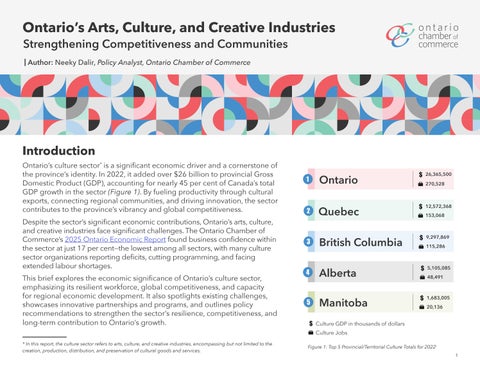
Ontario’s culture sector* is a significant economic driver and a cornerstone of the province’s identity. In 2022, it added over $26 billion to provincial Gross Domestic Product (GDP), accounting for nearly 45 per cent of Canada’s total GDP growth in the sector (Figure 1). By fueling productivity through cultural exports, connecting regional communities, and driving innovation, the sector contributes to the province’s vibrancy and global competitiveness. Despite the sector’s significant economic contributions, Ontario’s arts, culture, and creative industries face significant challenges. The Ontario Chamber of Commerce’s 2025 Ontario Economic Report found business confidence within the sector at just 17 per cent—the lowest among all sectors, with many culture sector organizations reporting deficits, cutting programming, and facing extended labour shortages. This brief explores the economic significance of Ontario’s culture sector, emphasizing its resilient workforce, global competitiveness, and capacity for regional economic development. It also spotlights existing challenges, showcases innovative partnerships and programs, and outlines policy recommendations to strengthen the sector’s resilience, competitiveness, and long-term contribution to Ontario’s growth.
Ontario
26,365,500
Quebec
12,572,368
British Columbia
9,297,869
Alberta
5,105,085
Manitoba
1,683,005
270,528
153,068
115,286
48,491
20,136
Culture GDP in thousands of dollars Culture Jobs
* In this report, the culture sector refers to arts, culture, and creative industries, encompassing but not limited to the creation, production, distribution, and preservation of cultural goods and services.
Figure 1: Top 5 Provincial/Territorial Culture Totals for 2022i 1
Ontario - The Cultural Capital of Canada
Fueling Productivity and Competitiveness on a Global Scale While Canada’s productivity lags relative to other countriesii, the nation’s culture sector has proven resilient. Canada is an important player in the international trade of cultural goods, products and services. The global creative economy is currently worth an estimated USD $985 billioniii and is predicted to grow 40 per cent by 2030iv. In 2022, Canada’s cultural exports reached $24.5 billionv, up 8.6 per cent from 2021. Key sub-domains such as crafts, film and video, interactive digital media, and multi-arts contributed $17.18 billion (Figure 2) to the country’s cultural exports, solidifying Canada’s trade position and influence on the world stage. Ontario’s culture sector is a significant player in this global landscape. In Ontario alone, a record-breaking 419 film and television productions generated $3.15 billion in economic activity in 2022, creating over 45,000 high-value, full-time equivalent jobs directly and through spin-off employment opportunitiesvi. These figures account for nearly half of Canada’s GDP and employment within the sector, underscoring Ontario’s leadership. Integrating the culture sector into Ontario’s broader economic strategy is essential to strengthening provincial and national creative and cultural supply chains. By continuing to produce, import, and export high-value products, activities, events, and talent, Ontario can cement its position as a global leader in the creative economy.
$24.54B
In 2022, exports of Canadian culture products totaled $24.54 billion
$13.56B
2014
$15.08B
2016
$16.72B
2018
$19.18B $18.28B
2020
2021
2022
Canada exported the most culture products to United States, United Kingdom, and France
The Crafts, Film and video, and Interactive media sub-domains contributed the most to culture exports
TOP 5 Countries - Culture Exports
TOP 5 Sub-domains - Culture Exports
United States
$16.75B
Crafts
$6.65B
United Kingdom
$0.86B
Film and Video
$5.57B
France
$0.68B
Interactive Media
$2.11B
Germany
China
$0.66B $0.57B
Design
Advertising
$1.66B $1.19B
Figure 2: International Trade of Culture Products for 2014-2022, Canadavii 2
Recommendations
Government Municipal Provincial Federal
Industry Academia
Develop a comprehensive Culture Sector Strategy that prioritizes and ensures the sector’s inclusion in economic action plans. The strategy should be crafted in collaboration with industry**, academia, nonprofit organizations, government agencies, small and medium-sized enterprises, artists, business associations, equity-deserving*** and Indigenous communities, and other relevant stakeholders. Collaborate across all levels of government to enhance Ontario’s global competitiveness and attract international investment in the sector. This can be achieved through: • • • • • • •
Trade missions Marketing campaigns Cultural delegations and showcases (e.g., international arts festivals, expos, and biennales) Networking events and international forums (e.g., World Cities Culture Forum, UNESCO Culture Forum, and partnership forums). Residency and exchange programs (e.g., collaborating with international cultural hubs) Trade shows and Business-to-Business (B2B) marketplaces Accelerators and incubator programs
Expand funding mechanisms within existing programs to support cultural exports, including dedicated streams to strengthen marketing, national and international touring, circulation, partnerships, and market development, for Ontario culture sector institutions, businesses, and artists.
** Industry encompasses private, non-profit, and other non-government stakeholders. *** Equity-deserving groups encompass racialized peoples, LGBTQ2S+ individuals, people living with a disability (visible and non-visible), newcomers, low-income youth, women, and gender-diverse individuals.
3
Case Study 1
Music Publishers Canada’s Women in the Studio National Accelerator Program
Launched in Ontario in 2019 and expanded nationally in 2020, Music Publishers Canada’s Women in the Studio National Accelerator Program addresses gender imbalance in music production by supporting women, non-binary, and gender non-conforming producer-songwriters. Participants receive comprehensive support through workshops, education, and networking that develop critical skills in technical production, financial literacy, and marketing/branding — foundational elements for a sustainable career in this industry. Ontario Creates has strongly supported the program, recognizing its potential to drive growth, innovation, and diversity in Ontario’s creative industries. The initiative has already made significant strides, working with 40 participants nationwide, with 55 per cent based in Ontario. Program alumni have reached incredible heights on the global stage, facilitated in part by the lessons learned and skills built within the program. Some highlights include: •
Toronto-based FJØRA’s music has carved out a niche within film, television, and video game, and her music can be heard globally on global platforms like Fortnite, Disney+, TIFF, Blumhouse Productions, Netflix, and HBO.
•
Kitchener’s 99Makaveli has accumulated over 170k followers on TikTok, with over 2 million impressions on the platform, showcasing her music production skills.
•
Steph Copeland is a Toronto-based, multi-award-winning screen composer, producer, and recording artist. She has earned multiple Canadian Screen Awards for her music composition work. She has seen her songs featured in series such as Netflix’s Tiny Pretty Things and in campaigns by NBA Canada, Destination Toronto and The North Face.
4
Unlocking Potential
Workforce Resilience in Ontario’s Culture Sector Ontario’s culture sector continues to demonstrate employment growth across various sub-industries. As of October 2024, the sector’s workforce included 273,478 direct jobs – nearly double Quebec’s 143,526 and more than double British Columbia’s 112,365, making it the largest culture sector workforce in Canadaviii. Even amid challenges such as the pandemic, high interest rates, inflation and rising living costs, total employment within the top 16 subindustries has consistently grown over the last four years (Figure 3), surpassing employment levels in real estate, auto manufacturing, forestry, and mining combinedix.
Figure 3: 2019-2022 Ontario Culture and Sports Indicators by Domain and Sub-Domainx 5
Regionally, the sector’s upward workforce trends can be seen in initiatives such as the Cultural Industries of Ontario North (CION). North Bay, for instance, hosted 94 film productions over 10 years, generating $167 million, hiring local talentxi, directly supporting workforce development, and filling labour gaps in the region. At a hyper-local level, the Nottawasaga Futures Film Liaison Office, which oversees the region of the Township of Adjala-Tosorontio, and Essa, and the Towns of Bradford West Gwillimbury, Innisfil, and New Tecumseth, supported 92 film and television productions over a decade, contributing $3 million in economic impactxii across its municipalities. While workforce composition and trend data are readily available in major metropolitan hubs such as Toronto, there is a pressing need to map real-time data on culture investments, workforce demographics, especially in rural, remote, underserved, and Indigenous communities, as well as for various sub-industries (e.g., creative technology). These types of tools and resources will better support local workforce development programming, mentorship, and placement opportunities. Although labour shortages have improved since 2024, they remain a pressing issue in Ontario, with 28 per cent of arts, entertainment, and recreation businesses and 17 per cent of information and cultural industries facing challengesxiii, hindering innovation and economic growth. Addressing these shortages requires stronger connections between skilling, upskilling, reskilling, and workforce pathways to build a robust talent pipeline. Collaboration between government, academic, and industry stakeholders is essential to creating a resilient workforce. Strengthening talent attraction and retention through innovative initiatives, including more opportunities for equity-deserving groups and Indigenous communities, will enhance inclusivity, diversity, and Ontario’s global competitiveness in a rapidly evolving cultural economy.
Ala Ebtekar, Thirty-Six Views of the Moon, 2023, Artist proof edition, Cyanotype prints on found book pages exposed to moonlight. Courtesy of the artist and The Third Line. Photo provided by the Aga Khan Museum. Photographer Raheel Azim. 6
Recommendations
Government Municipal Provincial Federal
Industry Academia
Expand and strengthen local workforce and skills development programs, mentorship, placement, and experiential learning opportunities for careers in the culture sector, focusing on high-demand positions and cross-sectoral, transferable skills. This could include working with academic institutions to provide tools and resources to better inform students about culture sector job opportunities, particularly those relevant to their fields of study. Promote careers in the culture sector as viable employment options through intentional outreach to underrepresented communities. This initiative should also involve incorporating arts-, culture- and creative industries-related programming at earlier educational stages (K-12). Collaborate with post-secondary institutions and arts, culture, creative industries organizations, and funders, to create a publicly accessible Arts and Culture Data Explorer, similar to the Arts Council of England data hub, to map real-time data on culture investments. This could include: •
Culture sector workforce trends
•
Demographics and composition by region, including data on representation from equity-deserving and Indigenous communities
•
Areas of underinvestment
•
Updated culture sector workforce statistics that align with geographic boundaries and current administrative divisions (e.g., provincial ridings)
Leverage and fund third-party expertise and resources (e.g., employment services organizations, business associations, and community groups) to help address labour gaps. 7
Case Study 2
OCAD U LiVE
OCAD U LiVE is OCAD University’s experiential learning program for video content creation. It is an innovative model for fostering talent, granting valuable professional experience and building a strong community of dedicated creative minds. Housed in a street-front studio in the TIFF Lightbox on King Street West, LiVE welcomes students from every OCADU program and provides access to training, mentoring, and networking sessions as well as studio space and equipment. Students are given the tools they need to succeed in Canada’s booming content creator, film and television industries. Since its inception in 2020, LiVE has employed over 200 students, who have produced a wide variety of programs including talk shows, cooking shows, and music shows, with new content constantly being curated. Its production house works with small business clients and generates revenue that is reinvested back into the program. The program includes the following initiatives: •
OCAD U LiVE Channel: A digital streaming channel where students create content for new weekly, biweekly and monthly shows, one-off videos, and pre-existing work. Content creators are paid for their work.
•
Youth Content Creator (YCC) Program: A free program for high school students to develop their digital content creation skills, funded by a grant from the Ministry of Training, Colleges and Universities. Using industry-standard equipment, the program covers the basics of video and podcast production over a six-week period. Students receive mentoring from experienced content creators and have access to OCAD U LiVE’s studio space.
•
OCAD U LiVE Short Film Program: Supports students in creating short, time-based pieces in formats including short films, documentary, music-led videos, AR/VR experiences, and animation. Grant recipients showcase their work through OCAD U LiVE and get support for applying to short film festival circuits.
•
Production House: More experienced students create videos for real clients, including businesses and non-profits. In 2023, the production house generated nearly $100,000 in revenue.
8
From the Stage to the Streets
Culture’s Role in Regional Economic Development Investments in Ontario’s culture sector have yielded significant community-wide benefits. The Government of Ontario’s 202122 Celebrate Ontario Blockbuster and Reconnect funding generated an estimated $1 billion in economic impact across the province, with every dollar of provincial funding driving nearly $21 of visitor spendingxiv. Though temporary, these investments underscore the regional economic value of supporting arts and culture in communities across the province. For example, in 2023, the world-famous Stratford Festival generated an overall economic impact of over $276 million. Of that, $147.3 million was spent within Stratford and the surrounding area. Restaurants benefited the most with $24.4 million spent by visitors to the Festivalxv. The Festival also supports the region’s local workforce, employing over 1,400 workers.
While the bounce back was slow from the pandemic, the Stratford Festival theatre has been full ever since. Restaurants and local businesses in the area are doing well, and tourism in the region has been strengthened by both domestic and international visitors. The area’s appeal attracts retirees, young professionals, and families that want to establish roots in the region, fostering community growth, increasing local investments, boosting the region’s economy. Stratford’s growing community is also fostering new and creative cultural events, such as the Provocation Ideas Festival, an in-person festival aimed at building a vibrant, inclusive space for art exhibitions, performances, and discussions on community issues, fostering globally informed, locally rooted public engagement in communities across Ontario. - Aaron Martin, General Manager at the Stratford and District Chamber of Commerce 9
White Owl Film Studios, an Indigenous-owned company based in Sudbury, Ontario, is a compelling example that exemplifies the sector’s potential for economic growth across all regions. Led by Rory Roque, a member of Wahnapitae First Nation, the studio has garnered strong community support to develop a 20,000-squarefoot soundstage on reserve in partnership with Los Angelesbased film production company Volume Capitalxvi. This initiative draws in investment and creates opportunities to attract and retain Indigenous talent, highlighting the sector’s potential for driving regional growth and fostering inclusive innovation.
The success of initiatives such as the Stratford Festival, White Owl Film Studies, and investments in Canada’s creative and cultural industries, demonstrates the multiplier effect of culture sector investments, driving visitor attraction, job creation, and supporting local businesses. To catalyze regional economic development, Ontario must expand investments in smaller regions, connect communities through accessible transit networks, and build culture-based infrastructure to ensure long-term economic health and community prosperity.
Galleries, libraries, archives and museums (GLAMs) also have a significant compounding economic impact in the communities they serve. In Canada, for every dollar invested in non-profit art galleries, there is a social return of 4 dollarsxvii, including enhanced learning, stronger community connections, improved well-being, and cultural heritage preservation. In Ontario, despite the pandemic and high inflation, Ontario Arts Councilfunded museums generated $239 million in capital assets (tangible assets such as buildings and equipment) over the last five yearsxviii, supporting the operation and growth of cultural hubs such as the Aga Khan Museum.
Grass Dance by Chris Mejaki at the Provocation Media Launch in October in the band shell bordering the Avon River. Photo provided by Provocation Ideas Festival.
My Dead Mom. Photo by Amanda Matlovich. Photo provided by Ontario Creates.
10
Recommendations
Government Municipal Provincial Federal
Industry Academia
Diversify investments and funding through regional strategies, including local economic development corporations, regional cultural offices, cultural organizations, and business associations. This should include expanding investments and incentives geared towards rural, remote, underrepresented and Indigenous communities.
Invest in new and existing purpose-built cultural infrastructure, such as art centres, museums, sound stages, and multi-use spaces, while addressing gaps in public transportation to enhance accessibility and support capacity-building projects in regional communities.
Incentivize local travel and tourism by reintroducing and developing targeted initiatives (e.g., Ontario Staycation Tax Credit).
11
Case Study 3
Toronto’s Thriving Esports Landscape
Toronto has become an incubator for the esports industry and is the second-largest tech hub in North America. The City of Toronto’s Level Up: Esports Strategy (2022-2026) spotlights esports as a key growth sector within the creative technology industry. Ontario hosts over 900 interactive digital media companies based in Toronto, creating 12,000 high-level, full-time jobs and generating $1.7 billion in revenue. With two international airports, integrated transit networks, diverse accommodations, and premier venues such as Scotiabank Arena, Metro Toronto Convention Centre, and Red Bull Gaming Studio, Toronto is well-positioned to attract and host large-scale esports events. This thriving esports ecosystem strengthens Ontario tourism, supports local businesses in video game, music, and events industries, and positions Toronto as an attractive destination for the next generation of professionals and innovators. Did you know…
Toronto has three professional esports teams: • • •
Toronto Ultra (Call of Duty League) Raptors Uprising (NBA 2K League) Toronto Defiant (Overwatch League)
The City has hosted top-tier esports events that attract thousands of local and out-of-town visitors, bolstering Ontario’s tourism sector, including: • • • • •
Get On My Level 2024 Bell Esports Challenge 2024 at the Mattamy Athletic Centre Call of Duty League Major III 2024 at the Mattamy Athletic Centre Esports Travel Summit 2023 at the Westin Harbourfront Castle Conference Centre North American League of Legends Championship 2017 at Scotiabank Arena
OverActive Media, Canada’s largest esports ownership group, is investing $500 million in a 7,000-seat, purpose-built stadium in Toronto to host esports tournaments and business events. This state-of-the-art venue will boost economic growth, support regional economic development, create jobs, foster skills, and expand opportunities for businesses and SMEs across Ontario.
12
Cultural Pathways
A Cross-Sectoral Accelerator for Economic Growth Beyond fueling regional economic growth and workforce development opportunities, Ontario’s culture sector has significant cross-sectoral impacts, particularly in tourism.
Though comprising only 13 per cent of all visitors, arts and culture tourists in Ontario account for 30 per cent of total tourist spending. Additionally, 40 per cent of these tourists stay three days or more (compared to only 13 per cent of nonculture visitors)xix. This further supports local nonculture-based businesses, drives revenues for hotels, restaurants, and other SMEs, and amplifies economic benefits across communities.
This growth is also evident in Canada’s live music industry. According to the Canadian Live Music Association’s 2025 Report, in 2023, company operations and tourism spending related to Canadian live music was estimated to be $10.92 billionxxii. Unique cultural experiences such as festivals, concerts, events, and exhibitions are key tourist draws highlighting the significant role cultural tourism plays in Ontario. In Central Ontario, artists have been leading the way in building culture sector investment opportunities for the region.
For example, the cross-sectoral economic impact is evident when domestic and international tourists visit the Shaw Festival in Niagara-On-The-Lake. For every dollar spent at the Festival, more than seven dollars of additional spending is added by theatre patrons at local restaurants, wineries, and attractions, resulting in more than $240 million per year in additive economic activityxx. Ontario’s culture sector also demonstrates cross-sectoral resiliency and growth. The OCC’s State of the Tourism Industry Report found that Ontario’s tourism industry represented $36 billion of the province’s GDP in 2022xxi, with part of this growth linked to the culture sector, solidifying the relationship between arts, culture, and tourism.
13
I pitched the Central Ontario Film Initiative to the city of Peterborough, seeking funding to establish a regional database in collaboration with film officers, that aggregates resources and business information across the regions of Peterborough, Kawartha Lakes, and Northumberland. Backed by my investment, and community and municipal support, we’ve already enrolled over 40 businesses - from restaurants, the local Chamber of Commerce, and hotels, to local talent, legal services, and equipment rentals. In addition, I’m working with Fleming College to develop experiential learning, apprenticeships, and certification courses in skilled trades for arts and culture production. With existing regional tax incentives, this initiative aims to attract investment and expand the area’s capacity for diverse productions, supporting local economic growth, SMEs, and workforce demands in central Ontario. Additional funding would strengthen and expand our economic development efforts in the region. - Pawel Dwulit, Principal and Cinematographer of Paradigm Pictures/PWD Visuals Ltd.
Many international jurisdictions recognize the broad economic impact of the culture sector. Australia’s A New Approach Report highlights how the culture sector drive productivity by continually introducing innovative products and servicesxxiii. In the U.K., similar insights reveal that 34 per cent of the overall creative workforce (including support workers in creative businesses) are embedded in non-creative sectorsxxiv. This intersectionality illustrates the culture sector’s far-reaching economic impact across multiple sectors in Ontario. Modernizing data collection methods would help Ontario better measure the culture sector’s cross-sectoral economic contributions. Targeted, real-time insights could identify emerging trends and guide strategic investment in high-impact and growing areas to boost regional and provincial cultural activities and events. 14
Recommendations
Government Municipal Provincial Federal
Industry Academia
Work with Tourism Industry Association of Ontario (TIAO) and Regional Tourism Organizations (RTOs) to expand regional culture sector development and other culture-based tourism activities (e.g., agrifood, theatre, festivals, visual arts exhibitions).
Modernize data collection methods (e.g., Statistics Canada) for more accurate and actionable insights, and emerging trends. This could include data on cross-sectoral impact to better measure economic contributions cultural products, activities, and services has on other sectors, and other potential economic growth areas.
Explore emerging markets and support the growth of promising new cultural tourism products and production areas, including intercultural exchanges with Indigenous and francophone culture sectors.
15
Connected Communities
Cultivating Belonging through Culture Culture is a connector that creates a sense of belonging and inclusion. A 2024 Nanos survey for Business/Arts and the National Arts Centre found that close to two in three culture-goers say that attending arts and cultural events positively (30 per cent) or somewhat positively (33 per cent) impact their sense of belonging to Canadaxxv.
The sector fosters self-expression and social cohesion, with 79 per cent of Ontarians believing that the arts are important to their mental healthxxvi, contributing to a higher quality of life for themselves and their communities. Arts and culture festivals, events, and activities are uniquely positioned to serve as a nexus where residents, newcomers, and tourists create shared experiences that enhance their sense of community and belonging. Several municipalities are centering economic development strategies around arts and culture as a unifying force. In October 2024, the City of Toronto launched Culture Connects: An Action Plan for Culture in Toronto, a 10-year plan envisioning the culture sector’s role locally and beyond. This plan aims to develop one million square feet of new cultural and artistic spaces in the city, increase investment by $35 million, expand access to free cultural events, and support 1,000 new creative export and artist exchange projects. Ultimately, the plan seeks to fortify Toronto’s cultural ecosystem and expand its infrastructure for long-term growth.
Photo by Mahsa Alikhani | Instagram: @mahsaalikhani60 | mahsaalikhani.com | Project funded by the Toronto Arts Council’s Newcomer and Refugee Arts Mentorship Grant Program. 16
Markham is also embedding arts and culture into its infrastructure to boost economic growth. Markham Centre’s new urban downtown core is set to grow from 21,000 to 106,000 residents. The city is prioritizing its Main Street as a hub for the arts, culture, and business. Its strategy includes investments in tech and innovation, community events, inclusive public spaces, art, and new amenities such as a performing arts centre. In Northern Ontario, Sudbury is leveraging cultural and creative activities to attract residents back to the downtown core after experiencing 25 per cent less mobility to workplaces (travel to workplace) compared to surrounding Census Metropolitan Areasxxvii. One notable initiative is the Up Here Festival, which transforms downtown Sudbury into an urban art gallery featuring dozens of muralists, musicians, and installation artistsxxviii. Despite recent funding reductions, since 2013, the festival has generated over $5 million in economic impact, paid over $700,000 in artist fees, attracted over 75,000 festivalgoers, created more than 100 paid positions, and produced 73+ new public art piecesxxix, revitalizing Sudbury’s streets, and nurturing local creativity. These initiatives in Toronto, Markham, and Sudbury showcase how the sector serves as a powerful bridge, enriching community life and strengthening local economies. By transforming urban landscapes and creating inclusive and affordable spaces for residents, visitors, artists, and newcomers, these projects reflect a commitment to embedding culture in regional planning. As more regions recognize the value of culture sector investment and as populations continue to grow, it is important for regional strategies to match community needs. 17
Recommendations
Government Municipal Provincial Federal
Industry Academia
Incorporate culture sector activities, products, and events into economic development plans. This can include: • • •
Leveraging surplus public lands, and other assets to develop affordable and multi-use cultural spaces. Incorporating culture sector activities, products, and events in new and existing Main Street infrastructure projects, especially for regions experiencing population growth. Strengthening relationships between local municipalities, businesses, Business Industry Associations, Chambers of Commerce, Boards of Trade, equity-deserving and Indigenous communities, and culture sector organizations to maximize mutual economic development opportunities.
Allocate funding from existing housing funds for the development of housing options along the continuum for artists and studio spaces, to meet diverse housing needs throughout the province, including purposebuilt rental housing, missing middle housing, and affordable home ownership (e.g., through dedicated funding streams, tax credits and exemptions). Build stronger relationships and funding pathways with newcomer and immigration programs and relevant ministries to bolster communitybuilding. This includes: • •
Developing comprehensive information systems to guide newcomer artists upon arriving in Canada. Encouraging culture sector organizations to diversify programming and investment opportunities to include voices from newcomer, immigrant, and refugee communities. 18
Case Study 4
Toronto Arts Council’s Program for Newcomers and Refugees (PNR)
Canada continues to see an increase in immigration, with international migration (including permanent and temporary immigration), so far, accounting for 92 per cent of all population growth in 2024xxx. While housing, employment and language skills often dominate settlement discussions, emerging research highlights the role of arts in newcomer integration. A research report, set to release in 2025, in partnership with the Toronto Arts Council and the Canada Excellence Chair in Migration and Integration at Toronto Metropolitan University, provides an analysis on the importance of public arts funding for newcomer integration. Programs like the Toronto Arts Council’s Program for Newcomers and Refugees, exemplify this approach. The Program empowers newcomer artists by providing mentorship opportunities for them to integrate into local arts scenes. From its inception in 2018 until 2023, the PNR has allocated more than $2.5 million in grants to 32 different organizations and 158 individual artists. Components of the program include: • •
Newcomer and Refugee Arts Engagement Newcomer and Refugee Artist Mentorship
By providing mentorship and fostering artistic collaboration, this initiative creates meaningful pathways for newcomer artists to develop their artistic practices and contribute to the cultural richness of the city.
19
Catalyzing Funding and Investments for Inclusive Growth Investments in the culture sector have been shown to deliver significant benefits and a high rate of return. For example:
Ontario Arts Council (OAC)-supported organizations generate $1 billion annually for the province’s GDP (based on organization expenditures). For every dollar the OAC invests, $25 is generated from other revenue sourcesxxxi. In 2022, Ontario Creates-supported industries contributed over $3.6 billion to Ontario’s GDP, generated over 44,000 jobsxxxii, and exported over $3.8 billion in products and services internationallyxxxiii. Yet, rising costs of living, inflation, and high interest rates have affected artists, organizations, and SMEs in the sector. Financial pressures forced the permanent closure of the Just for Laughs Festival, the temporary shutdown of the Hot Docs Ted Rogers Cinema, and the downsizing and financial restructuring of Toronto’s Open Studio. This trend is echoed in the Ontario NonProfit Network’s 2024 Report, where 30 per cent of non-profit arts organizations forecast being at high risk of closing within three years, with nearly half unable to sustain operations for more than 12 monthsxxxiv, spotlighting the difficult balancing act between survival and growth. These challenges are compounded by historic underinvestment, demand exceeding public funding capacity, and declining private sponsorships.
Financial barriers contribute to the precarity of Ontario’s culture sector. For artists in Ontario, incomes are low, with one-half of responding artists (51per cent) having total personal incomes below $40,000xxxv, and 95 per cent of individuals and groups finding it challenging to continue working in the artsxxxvi. In the film and television industry, productions face disruptions due to delays in credit applications and processing backlogs, caused by staffing shortages and capacity constraints. The high volume and complexity of the application process exacerbate these challenges, prolonging interest costs and straining cash flow, leaving businesses, organizations and artists to shoulder the costs. The climate of interest rate cuts offers a timely opportunity to reinvest in Ontario’s culture sector. By promoting flexible, innovative funding solutions, increasing access to resources, streamlining tax credits, and supporting businesses and artists facing financial strain, Ontario can build a sustainable, equitable framework for long-term growth.
20
Workplace diversity is good for business, predominantly in sectors driven by creativity and innovation. A 2017 report found that overall, a 1 per cent increase in ethnocultural diversity resulted in an average 6.2 per cent increase in revenues for the information and cultural industries, surpassing gains in transportation, business services, and manufacturingxxxvii. However, restrictive funding models and barriers to entry limit opportunities for equity-deserving and Indigenous businesses, SMEs, and artists to share their stories and scale their work. Funding fatigue disproportionately impacts culture sector organizations, SMEs, and artists, particularly from underrepresented communities. The Indigenous Screen Office revealed that participants struggle with the overwhelming burden of repeatedly producing extensive supporting documentation for funding applications. This administrative demand significantly strains community members, who must invest time and resources to navigate complex application processesxxxviii. Similarly, a 2022 Black Screen Office report further substantiated these challenges, highlighting barriers such as complicated and convoluted application forms, laborious application processes, biased evaluation criteria, and often ambiguous selection processesxxxix.
Smaller Indigenous organizations in the culture sector vying for funding have more constraints than larger firms, such as proving revenue streams and securing insurance. This limits the organization or artist’s opportunities to scale up in the marketplace. Indigenous culture and communities are entrenched in their arts and history. For Indigenous storytelling to be heard and seen, we need to reduce red tape and make access to capital and funding easier for Indigenous culture-sector businesses, nonprofits, and artists. Despite these barriers, I am using creative technology to share Indigenous stories with wider audiences. I launched an online stock photo store, inviting Indigenous artists to showcase their work with fair remuneration and royalties. I am also developing a virtual museum, in partnership with industry stakeholders, on Indigenous history in Canada, including a 3D/VR experience, and creating voice-recognition games in Indigenous languages. - Marc Poirier, Indigenous Business owner of Leo Pixel Studios
Prototype of an Indigenous Museum created in VR that was showcased at the Public Policy Forum in 2024. Photo provided by Leo Pixel Studios.
Ontario’s rich cultural diversity is an economic advantage, a revenue generator, and boosts productivity. To fuel inclusive growth in the culture sector, special attention must be paid to reducing barriers to entry, mitigating administrative burdens in accessing funding, and creating flexible funding models that can better support SMEs and artists in the long term.
21
Recommendations
Government Municipal Provincial Federal
Industry Academia
Improve access to private capital and credit for small- and medium-sized culture sector businesses through a combination of tax policies, capital market reforms, and loan guarantees. This could include: •
Impact investing through blended capital structures – which combine concessionary capital from philanthropic and nonconcessionary sources.
Develop a Cultural Impact Development Fund, similar to the U.K.’s fund, which can provide small-scale repayable finance options to culture sector organizations, matching the current economic/fiscal climate.
Enable sponsorship strategies and partnerships to support capacity building and scaling of operations for culture sector institutions, organizations, SMEs, and artists.
Streamline and simplify application processes for funding and grants. This includes: • •
Simplifying first-time applications and the renewal of funding agreements across all levels of government. Exploring opportunities to incorporate long-term project agreements and funding. 22
Recommendations
Government Municipal Provincial Federal
Industry Academia
Align resources at all levels of government to improve efficiency and effectiveness of grants and services to applicants. This includes: • •
Small business funding for creative and cultural professions that are not included in other programs. Flexible loan guarantee programs for culture sector workers and SMEs (e.g., flexible financing).
Reinstate an Indigenous independent review panel for all Indigenous funding applications and identity support documents, with leadership from Indigenous culture sector organizations.
Build development programs that target key decision-making roles where equity-deserving and Indigenous professionals are most significantly underrepresented.
Collaborate with third-party economic development corporations and non-profit business associations (e.g., Chambers of Commerce, Boards of Trade) to support culture organizations when applying for federal, provincial, and municipal grants and funding.
23
Case Study 5
Ontario Arts Council’s Support for the Ojibway Cultural Foundation
In 1974, the Ojibway Cultural Foundation was established to safeguard and revitalize the language, traditions, spirituality, arts, and heritage of the Anishinaabe People on Mnidoo Mnising (Manitoulin Island) and nearby regions. Receiving funding from Ontario Arts Council since 1978, the foundation is located on M’Chigeeng First Nation, and includes a museum, public art gallery, language resources, a healing lodge, and a performance amphitheatre, creating an inclusive space where Indigenous artists can showcase their work, and share their stories. Some of their offerings include: •
The Enaamjige Yaang Studio – A studio and program designed for Indigenous artists of all ages and art backgrounds, offering an opportunity to create, collaborate, exchange knowledge and learn new skills.
•
Anishinaabe Aadziwin: A Series of Teachings - A series of teachings and activities about all things Anishinaabe.
•
Nish Tales: Walking and Talking with Nanabush - A language learning and story-sharing site for kids and adults wishing to learn Ojibwe.
Support for Indigenous culture sector organizations such as the Ojibway Cultural Foundation builds capacity across Ontario’s business community to advance economic reconciliation, reflective of Call to Action 92 of the Truth and Reconciliation Commission. It also supports Indigenous communities and the preservation, revitalization, and strengthening of Indigenous languages and cultures, reflective of Call to Action 14 of the Truth and Reconciliation Commission.
24
The Creative Convergence of Technology and Culture
The Rise of Emerging Technologies Artificial Intelligence (AI) and emerging technologies are powering new ways of doing business. By the second quarter of 2024, one in four businesses in the information and cultural industries (24.1 per cent) were already using generative AIxl. Ontario’s expanding creative tech corridor offers new pathways for culture sector institutions, SMEs, and artists.
For example, in the media and entertainment sector, AI adoption has the potential to generate USD $80 to130 billion more in revenue, with the highest impact in marketing and sales, software engineering, and supply chain and operationsxli. On the other hand, the rise of generative AI tools such as Midjourney and DALL-E also bring regulatory, policy, and ethical challenges.
Neural Ballet Redux performances at Gallery Stratford, accompanied by AI generated graphics. Photo provided by Provocation Ideas Festival.
The sector is waiting to hear from the federal government on the scope of The Artificial Intelligence and Data Act (AIDA). The legislation is unclear and lacks detail on what regulatory guidelines will impact the broader culture sector. The current framework is not consistent with other international frameworks that are risk- and principle-based, such as the EU AI Act. This could stifle productivity, responsible adoption, and global competitiveness. Other jurisdictions have made promising strides in setting adaptable accountability, privacy, and Intellectual Property (IP) protections for AI technology. For instance, SAG-AFTRA’s agreement with Hollywood studios includes rules for using digital and AI-generated “Synthetic Performers,” and provisions around consent and compensation. Additionally, the proposed NO FAKES Act, shaped by extensive consultation with industry, academia, and government, would hold individuals or companies liable for damages for producing, hosting, or sharing a digital replica of an individual performing in an audiovisual work, image, or sound recording that the individual never actually appeared inxlii. Aligning Canada’s current framework with other jurisdictions by prioritizing consent, accountability, privacy, transparency, and IP protections can help strengthen compliance while fostering responsible innovation and supporting the Canadian economy. In addition, expanding equitable access to cultural markets for cultural goods and servicesxliii can support inclusive growth. As AI transforms cultural products, policies must aim to ensure the technology enhances rather than replaces human creativity. 25
Recommendations
Government Municipal Provincial Federal
Industry Academia
Incentivize reskilling and upskilling workforce programs in digital adoption (e.g., AI, AR/VR) within culture sector organizations. This can be achieved by: •
Working with post-secondary institutions, culture sector SMEs, equity-deserving and Indigenous organizations, and industry on developing and expanding programs.
Increase investments in skills development funds, such as the Ontario Skills Development Fund, to address growing technology innovation needs in the culture sector.
Adopt a principles-based framework in AIDA, establishing clear rules and standards within the policymaking process. This can include: • •
Providing clear definitions of industry standards, information sharing, and best practices around risk assessments, government staff training, technology adoption, and insurancexliv. Continuing consultation and engagement opportunities with culture sector institutions, businesses, SMEs, artists, equity-deserving and Indigenous communities on AI policy and its foreseen and unforeseen impacts.
26
Recommendations
Government Municipal Provincial Federal
Industry Academia
Pursue a risk-based approach through regulation under Bill 194, Strengthening Cyber Security and Building Trust in the Public Sector Act, 2024. This can be achieved by: • •
Conducting frequent gap analyses to identify emerging and ongoing risks of AI use, especially from within the culture sector. Ensuring the addition of informed consent, transparency, fair remuneration, and diversity and inclusion is embedded in AI-related regulations and policies.
Harmonize Intellectual Property (IP) and copyright laws to enhance protections for culture sector workers and their products/goods. This can include: •
Amendments to the copyright framework that outlines provisions around AI-assisted and AI-generated works and digital replicas.
Invest in AI, emerging, digital, and interactive technology tools and resources that promote awareness, education, and training.
27
Conclusion
Ontario’s culture sector drives creativity, strengthens communities, and catalyzes economic growth, delivering measurable economic and social value in every region across the province. This dynamic sector supports hundreds of thousands of jobs across diverse communities – from urban centers to rural, remote, equity-deserving and Indigenous populations. This helps fuel local and provincial economies, while painting a powerful cultural mosaic that fosters a sense of belonging and community. Ontario’s culture sector is well-positioned to set new standards in innovation and collaboration, making the province an attractive destination for global investment and creative professionals, while unlocking new pathways for cross-sectoral, inclusive growth. By recognizing the sector as a strategic asset, we can leverage creativity to enhance Ontario’s competitiveness – while strengthening its communities.
28
Endnotes Government of Canada. “Culture Satellite Account.” Canada.ca, July 5, 2024. https://www.canada.ca/en/canadian-heritage/corporate/publications/ general-publications/culture-satellite-account.html. i
OECD Global Forum on Productivity, 2024. https://www.oecd.org/content/ dam/oecd/en/about/programmes/global-forum-on-productivity/events/ paris-2024/ppts/Session_2_3_Jonathan_BARR_Canada_ISED.pdf. ii
The Policy Circle. “The Creative Economy.” The Policy Circle, 2024. https:// www.thepolicycircle.org/minibrief/the-creative-economy/. iii
Deloitte. “The Future of the Creative Economy.” June 2021. https://www2. deloitte.com/content/dam/Deloitte/uk/Documents/technology-mediatelecommunications/deloitte-uk-future-creative-economy-report-final.pdf. iv
Statistics Canada. Trade of Culture and Sport Products, 2022, October 9, 2024. https://www150.statcan.gc.ca/n1/daily-quotidien/241009/dq241009b-eng.htm. v
Ontario Creates. Industry Profile - Film & TV, December 2023. https://www. ontariocreates.ca/research/industry-profile/ip-filmtv. vi
Government of Canada. Culture Satellite Account, November 19, 2024. https://www.canada.ca/en/canadian-heritage/corporate/publications/generalpublications/culture-satellite-account.html vii
Statistics Canada. Employment by industry, monthly, unadjusted for seasonality, January 3, 2025. https://www150.statcan.gc.ca/t1/tbl1/en/ cv!recreate.action?pid viii
Ontario Arts Council. Backgrounder – Arts across Ontario Preliminary Results, October 10, 2024. https://www.arts.on.ca/news-resources/updates/updatesfaqs-and-resources/2024/backgrounder-%E2%80%93-arts-across-ontariopreliminary-results. ix
Statistics Canada. Culture and Sport Indicators by Domain and Sub-Domain, by Province and Territory, Product Perspective, June 3, 2024. https://doi. org/10.25318/3610045201-eng x
South Georgian Bay Media Association. Attracting Film Production to Small Town Ontario, February 2024. https://drive.google.com/file/d/1agzIuFjLG2IH OYctI42tOj2yWBX0jDNl/view. xi
South Georgian Bay Media Association. Attracting Film Production to Small Town Ontario, February 2024. https://drive.google.com/file/d/1agzIuFjLG2IH OYctI42tOj2yWBX0jDNl/view. xii
Ontario Chamber of Commerce. 2025 Ontario Economic Report, February 2025. https://occ.ca/interactive-oer2025/. xiii
Government of Ontario. Ontario Makes Historic Investment in Safe, Innovative Festivals and Events, August 4, 2021. https://news.ontario.ca/ en/release/1000650/ontario-makes-historic-investment-in-safe-innovativefestivals-and-events. xiv
Miller, Scott. Stratford Festival Celebrates 2023 Surplus Amidst Attendance Jump, March 20, 2024. https://london.ctvnews.ca/stratford-festival-celebrates2023-surplus-amidst-attendance-jump-1.6815464. xv
Sudbury Star. Indigenous Businessman to Open White Owl Film Studios near Sudbury, September 30, 2024. https://www.thesudburystar.com/ entertainment/local-arts/indigenous-businessman-to-open-white-owl-filmstudios-near-sudbury. xvi
Oxford Economics. “Value Study of GLAMs in Canada.” Canadian Museums Association, December 2019. https://museums.ca/uploaded/web/New_ Website_docs/announcements/studyglamscanada2020.pdf. xvii
CADAC. Explore Our Data, January 8, 2025. https://account-compte.cadac. ca/en-CA/explore-our-data/.
xviii
Ontario Arts Council. New Report: Arts and Culture Tourism in Ontario has Triple the Economic Impact, November 16, 2023. https://www.arts.on.ca/ news-resources/news/2023/new-report-arts-and-culture-tourism-in-ontariohas-triple-the-economic-impact. xix
Jennings, Tim. “Opinion: The Economic Case for More Funding for the Arts.” The Globe and Mail, April 24, 2024. https://www.theglobeandmail.com/ business/commentary/article-the-economic-case-for-more-funding-for-thearts/#:~:text=In%20a%20recent%20analysis%20by,that%20in%20social%20 and%20health. xx
Ontario Chamber of Commerce. State of the Ontario Tourism Industry Report, 2022. https://occ.ca/wp-content/uploads/State-of-the-OntarioTourism-Industry-Report-December-13-2022-FINAL.pdf. xxi
Canadian Live Music Association (CLMA). The Study Telling the Story of Canada’s Live Music Industry, 2025. https://www.canadianlivemusic.ca/ economic-impact-assessment. xxii
29
A New Approach. Accelerate: Reframing Culture’s Role in Productivity, November 2023. https://newapproach.org.au/wp-content/uploads/2023/11/ ANA-Accelerate_-Productivity-Insight-Report-2023.pdf. xxiii
NESTA. Beyond the Creative Industries: Making Policy for the Creative Economy , February 2008. https://media.nesta.org.uk/documents/beyond_the_ creative_industries.pdf. xxiv
Business/Arts, National Arts Centre, and Nanos. National Survey | Summary Conducted by Nanos for Business / Arts and the NAC, 2024. https://www. businessandarts.org/wp-content/uploads/2024/09/2024-2647-BAA-JulyPopulated-report-Updated.pdf. xxv
Ontario Arts Council. Arts and Quality of Life for Ontarians, October 10, 2023. https://www.arts.on.ca/research-impact/research-publications/arts-andquality-of-life-for-ontarians. xxvi
Business Data Lab. Mobility to Workplaces, 2024. https:// app.powerbi.com/view?r=eyJrIjoiZDNlMjZiODEtMDRiOC00NG U2LThjNmMtNDU3MmVlNmQ0OWQ1IiwidCI6IjhjMjMxOGVk LTdmZmItNGJjZi04ZGIzLWE2NjM4MzliODYzNiJ9. xxvii
xxviii
Up Here, 2024. https://uphere.com/
Up Here. Scaling Back, Rising Ip: Overcoming Funding Cuts at Up Here, July 1, 2024. https://uphere.com/news/2023/8/31/scaling-back-rising-upovercoming-funding-cuts-at-up-here-9. xxix
Statistics Canada. Canada’s Population Estimates, Third Quarter 2024, December 17, 2024. https://www150.statcan.gc.ca/n1/dailyquotidien/241217/dq241217c-eng.htm. xxx
Ontario Arts Council. Backgrounder – Arts across Ontario Preliminary Results, October 10, 2024. https://www.arts.on.ca/news-resources/updates/ updates-faqs-and-resources/2024/backgrounder-%E2%80%93-arts-acrossontario-preliminary-results. xxxi
Statistics Canada. Provincial and Territorial Cultural Indicators, 2022, June 3, 2024. https://www150.statcan.gc.ca/n1/daily-quotidien/240603/ dq240603a-eng.htm. xxxii
Statistics Canada. Trade of Culture and Sport Products, 2022, October 9, 2024. https://www150.statcan.gc.ca/n1/daily-quotidien/241009/dq241009beng.htm. xxxiii
Ontario Non Profit Network. 2024 State of the Sector – Policy Report, October 8, 2024. https://theonn.ca/publication/2024-survey-policy-report/. xxxiv
Hill , Kelly. How are Canada’s artists doing? Analysis of a Survey of Affordability and Working Conditions in Early 2024 , June 4, 2024. https:// www.culturalhrc.ca/sites/default/files/research/arts2024/CHRC-KellyHill-artistsanalysis-2024.pdf. xxxv
Canada Council for the Arts. Arts Community Pulse Survey, December 13, 2024. https://canadacouncil.ca/research/research-library/2024/06/artscommunity-pulse-survey. xxxvi
Momani, Bessma, and Jillian Stirk. “Diversity Dividend Canada’s Global Advantage.” The Centre for International Governance Innovation, 2017. https://www.cigionline.org/static/documents/documents/DiversitySpecial%20 Report%20WEB_0.pdf. xxxvii
Indigenous Screen Office, APTN, and Archipel Research and Consulting Inc. Building Trust and Accountability: Report on Eligibility in the Indigenous Screen Sector, 2023. https://iso-bea.ca/wp-content/uploads/2023/09/ISO_ Building_Trust_and_Accountability_EN.pdf. xxxviii
Black Screen Office. BEING HEARD: Black Canadians in the Canadian Screen Industries, October 25, 2022. https://static1.squarespace. com/static/62f54f0922940942c15b8840/t/631f92a6031f82633d485f 6d/1663013547281/BSO+Being+Heard+report+r1+AODA.pdf. xxxix
Statistics Canada. Which Canadian Businesses are using Generative Artificial Intelligence and Why?, March 18, 2024. https://www.statcan.gc.ca/o1/ en/plus/5847-which-canadian-businesses-are-using-generative-artificialintelligence-and-why. xl
Chui, Michael, Eric Hazan, Roger Roberts, Alex Singla, Kate Smaje, Alex Sukharevsky, Lareina Yee, and Rodney Zemmel. The Economic Potential of Generative AI: The Next Productivity Frontier, June 14, 2023. https://www. mckinsey.com/capabilities/mckinsey-digital/our-insights/the-economicpotential-of-generative-ai-the-next-productivity-frontier#industry-impacts. xli
Coons, Chris, Marsha Blackburn, Amy Klobuchar, and Thom Tillis . “NO FAKES Act One-Pager.” Chris Coons, July 31, 2024. https://www.coons.senate.gov/ imo/media/doc/no_fakes_act_one-pager.pdf. xlii
UNESCO. “UNESCO World Conference on Cultural Policies and Sustainable Development – MONDIACULT 2022.” UNESCO.org, January 16, 2023. https:// www.unesco.org/en/articles/unesco-world-conference-cultural-policies-andsustainable-development-mondiacult-2022. xliii
Ontario Chamber of Commerce. In Data We Trust: Unlocking the Value of Data in Ontario, June 16, 2020. https://occ.ca/wp-content/uploads/OCCDataReport.pdf. xliv
ISBN: 978-1-998700-00-4 | © 2025 Ontario Chamber of Commerce. All rights reserved. | Design: Wan-Chiao Hsu, Graphic Designer, Ontario Chamber of Commerce
30