OFFICIAL PUBLICATION OF THE BEEF FARMERS OF ONTARIO
BEEF O NTAR I O
LEARNING ACROSS BORDERS: INSIDE VIRGINIA’S BEEF INDUSTRY • ONTARIO BEEF TAKES CENTRE STAGE AT QUEEN’S PARK • ‘LET COWS BE COWS’ GUIDES OPERATION: A SPOTLIGHT ON MACARTHUR FARMS • AUGUST 2026
NEW FEDERAL PROCESSING CAPACITY STRENGTHENS
ONTARIO’S BEEF VALUE CHAIN
Canadian Publications Mail Product Sales Agreement Number 0040007029
ONTARIO HEREFORD SALES SEASON
RIVER VALLEY HEREFORD GENETICS DESIGN September 18th, Newburgh
ELM-LODGE POLLED HEREFORDS AND FRIENDS SOURCE FOR SUCCESS XXIV September 19th, Indian River
STONEWOOD GRANGE 1ST ANNUAL FEMALE SALE September 19th, Lakefield
MEDONTE HIGHLANDS POLLED HEREFORDS AND FRIENDS AUTUMN ALLIANCE September 20th, Orillia
FALL ROUND UP HEREFORD SALE
October 3rd Hoards Station Community Livestock Exchange, Campbellford
We will see you there! ROOTS & WINGS FARMS Ian, Tara, Connor, Kaleigh, Cooper & Jacob McNaughton Oro Medonte, Ontario 705-394-7770 Visitors Always Welcome Bulls, Females and frozen Genetics Available! HIDDEN-VIEW POLLED HEREFORDS Joe and Karen Paszternak NORWOOD, ON 705-9573739 or 705-957-7470 karen.paszternak@gmail.com Bulls & Females for sale
MEDONTE HIGHLANDS POLLED HEREFORDS 3055 Universal Dr. Mississauga, Ontario (905) 625-3151 maria@standardmechanical.com “6 Star Breeder” LIAN MOR POLLED HEREFORD Wally & Fern Pugh MONO, ON Wally & Fern Pugh lianmor48@gmail.com · 519-941-8515 Trevor & Amy tpugh27@yahoo.com · 519-939-7489 Breeding Stock Available
www.ontarioherefordassociation.com
WHISKEY LANE LIVESTOCK Herford and Angus Scott, Paula, Jason and Shelby Cornish INDIAN RIVER, ON 705-295-2925 705-878-3248 (Scott’s Cell) 705-341-3220 (Paula’s Cell) wll@nexicom.net Visitors Always Welcome
JDL CATTLE CO. & D&S LIVESTOCK David & Shirley Lasby Josh Lasby, Justin & Jaimie Lasby & Family, Jessica Lasby & Travis Fulford & Family MULMUR, ON 519-943-4147 or 519-278-6819 jessica.lasby@hotmail.com Good-looking, Sound, Functional Cattle!
O’SHEA FARMS Jamie and Mel O’Shea DENFIELD, ON 519-477-1238 osheafarms@hotmail.com Bulls and Females for sale
WHITNEY BALL | Coldwater, ON • 705-321-5206 • whitneyjball@gmail.com PRESIDENT
JESSICA LASBY | Meaford, ON • 519-939-0283 • ontarioherefordassociation@outlook.com SECRETARY MANAGER
OFFICIAL PUBLICATION OF THE BEEF FARMERS OF ONTARIO
BEEF ON T A R I O
August 2026
Volume 67, Number 3
COMPLIMENTARY MEMBER-SUPPORTED PUBLICATION
4 Ahead of the Heard 6 The Beef Beat 8 Ontario Beef Takes Centre Stage at Queen’s Park 10 The Herd Line 12 New Research Award Honours Dr. Ira Mandell’s Lasting Contributions to Ontario’s Beef Sector 16 ‘Let Cows be Cows’ Guides Operation: A Spotlight on MacArthur Farms 20 Learning Across Borders: Inside Virginia’s Beef Industry 23 Next-Gen Cattle Producers Gather in Lambton County for Youth Alliance Tour 30 OMAFA Update: Does It Pay to Skip Pregnancy Checking and Sell Cull Cows in the Spring? 32 Beef Farmers of Ontario Launch New Initiative to Support Ronald McDonald House Families 34 New Federal Processing Capacity Strengthens Ontario’s Beef Value Chain 36 LRIC Update: From Lab to Livestock: Mentorship Shaping the Next Generation of Researchers 38 North American Grazing Lands Congress Shows International Leaders the Role of Canadian Grasslands 40 Focus on Herd Health: The Importance of Body Condition Scoring Your Herd 44 Fall Stocker Sale Listing 47 Market Information 52 Calendar of Events 54 Wellness on the Farm
8
34
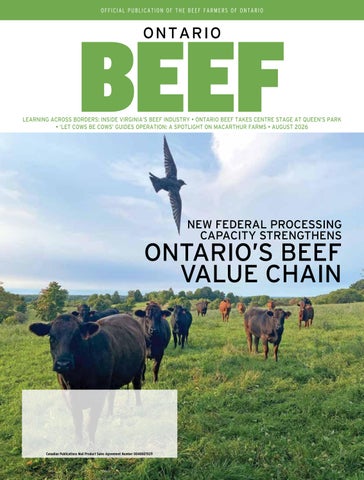
ON THE COVER: Thank you to Blake Edwards from Vasey, Ontario for this issue’s cover photo. Blake’s son captured the image when checking cattle and includes a curious raven. This issue celebrates the people, ideas and partnerships shaping Ontario’s beef sector. We take you to Queen’s Park for BFO’s annual barbecue and advocacy day, visit MacArthur Farms to learn how environmental stewardship and profitability go hand in hand, and travel south of the border to explore innovation and collaboration within Virginia’s beef industry. We also highlight the next generation of our industry—from young cattle producers gathering in Lambton County to researchers building their careers through mentorship—and recognize the lasting contributions of Dr. Ira Mandell through a new research award. Plus, read about new investments in Ontario’s beef processing capacity, the role of Canadian grasslands on the international stage, practical advice on pregnancy checking and body condition scoring, BFO’s new initiative supporting Ronald McDonald House families, and the latest market information, fall stocker sale listings, events and farm wellness resources. Don’t miss out on submitting your photos for our October issue. Please send your fall-inspired photos by September 15th to be considered for the cover. Digital photos in portrait orientation that are at least 300dpi are preferred, and can be emailed to info@ontariobeef.com.
ONTARIO BEEF • Beef Farmers of Ontario 130 Malcolm Road, Guelph, ON N1K 1B1 • Phone: 519-824-0334 • Toll Free (for Ontario callers only) 1-866-370-BEEF (2333) Fax: 519-824-9101 • info@ontariobeef.com EDITOR LeaAnne Wurmli CIRCULATION COORDINATOR Charlene Yungblut ADVERTISING MANAGER Cathy Lasby, Preferred Agri-Marketing Services Guelph, ON Phone: 519-763-8833 • Fax: 519-763-8833 pams@sentex.net DESIGN and LAYOUT Prism Studios Advertising and Design Inc. Guelph, ON PRODUCTION and PRINTING Beck’s Printing Services, Brantford, ON
PROVIDING A FORUM FOR THE ONTARIO BEEF INDUSTRY Ontario Beef is the official publication of the Beef Farmers of Ontario. Contents of this publication may be reproduced only by permission of the Editor and with credit acknowledged. Opinions expressed herein are those of the author and/or editor and do not necessarily reflect the opinion of the Beef Farmers of Ontario. Publication of advertisements does not constitute endorsement or approval by Ontario Beef or the Beef Farmers of Ontario of products or services advertised. Advertising deadlines are January 10, April 15, July 15, September 15 and November 15. The publisher reserves the right to refuse or cancel any advertising, including advertising that is inconsistent with BFO’s Sponsorship Policy, available at www.ontariobeef.com. Every effort is made to ensure the accuracy of material published, however no responsibility can be assumed for advertising not received in clear, type-written form. Ca na d ia n P ub l i c at i on s M ai l P r od uc t S al e s A g r e e m e n t N um b e r 0 0 4 0 0 0 7 0 2 9 POSTMASTER: Return undeliverable Canadian addresses to: Beef Farmers of Ontario, 130 Malcolm Road, Guelph, ON N1K 1B1
AHEAD OF THE HEARD By Jason Leblond, BFO President info@ontariobeef.com • www.ontariobeef.com
From Blueprints to Building Progress A
t home, I’ve been spending some time on a new bedroom project for my grandson. The construction includes framing a new room in the basement, drywall, flooring and painting. Like many projects, it’s had to fit around a full schedule, life on the farm, and more than a few competing priorities. The room is not quite finished yet, but progress is being made and our next step is painting! In many ways, the experience reminds me of our work at BFO: there is always another task demanding attention, and meaningful results rarely happen all at once. What matters is setting clear priorities, bringing the right people together, and continuing to move forward. At the national level, we have continued to work closely with our provincial counterparts on the future governance and structure of the Canadian Cattle Association (CCA). These discussions have been constructive. While they have not always been easy and the proposed changes are significant, they are essential to ensuring that Canada has a strong and effective national organization representing the needs of beef producers from east to west for years to come. In August, provincial representatives will meet again in Manitoba during the Canadian Beef Industry Conference and the CCA semi-annual meeting. We are hopeful that a new governance structure will be approved and that we can begin working toward its implementation heading into CCA’s Annual General Meeting in March. Trade relations have also remained a significant focus. Alongside the CCA and the National Cattle Feeders’ Association, BFO has continued to raise serious concerns about the proposed Canada–Mercosur trade agreement. We have been clear that additional beef imports from countries with lower production standards and costs could put Canadian producers at a competitive disadvantage, particularly in Ontario, where most of these imports enter the country. There has also been encouraging progress. We were pleased to see the removal of the 100-day residency requirement for cattle destined for South Korea, as well as movement toward harmonization of specified risk material (SRM) regulations, which has long been anticipated.
BFO BOARD OF DIRECTORS 2026
Jason Leblond (Northern Director) – President Email: jacres5@gmail.com Don Badour (Cow-Calf Director) – Vice President Email: don.badour@gmail.com Don Hargrave (Cow-Calf Director) Email: dchargrave@gmail.com Jim Whitley (Cow-Calf Director) Email: modelaranch@hotmail.com Joost van der Heiden (Background Director) Email: jcvdheiden@hotmail.com Nick Martin (Feedlot Director) Email: nickolas@pureislandbeef.com Jairus Maus (Feedlot Director) Email: ellengowanfarms@gmail.com Lisa Pallister (Feedlot Director) Email: lisa@pallisterfarms.ca Denise Byers (Southern Director) Email: byersdimmick@yahoo.com Don Scott (Eastern Director) Email: sparetimelivestock@gmail.com Ralph Eyre (Director-At-Large) Email: ralph@eyrefarms.ca Kim Jo Bliss (Director-At-Large) Email: kimjobliss@gmail.com Emily Bromley (Youth Director) Email: fondoak@live.ca
4
O N T A R I O BE E F • AUGUST 2026
Traceability and animal care have been another major area of work. As proposed federal traceability regulations continue to evolve, BFO has established an Ontario Traceability Working Group. It will bring together producers, transporters, auction markets, community pastures, and other industry representatives to ensure Ontario’s perspectives help shape the National Traceability Task Force that has been formed. BFO also submitted detailed comments on the revised Beef Code of Practice for the Care and Handling of Beef Cattle. Our feedback emphasized the importance of keeping the Code outcome-based and practical while responsibly addressing weather conditions, calving, water access, handling practices, pain mitigation, body condition scoring, and euthanasia. Closer to home, BFO has continued to work with the Ontario Ministry of Agriculture, Food and Agribusiness (OMAFA) on several important issues, including improvements to the carcass condemnation process. We have advocated for greater transparency, stronger validation procedures, and a meaningful appeals process so producers can have greater confidence in the system’s consistency and fairness. BFO representatives remain active in provincial working groups, with recommendations expected later this fall. Throughout the summer, BFO directors, members and I have appeared before the Standing Committee on the Interior to express our support for the Province of Ontario’s Bill 109, the Protecting Ontario’s Food Independence Act, 2026. The proposed legislation would amend the Beef Cattle Marketing Act to create a more consistent approach to check-off collection. It would also expand opportunities for Registered Veterinary Technicians to help improve access to veterinary services in underserved areas and increase access to Crown land for agricultural purposes. Public hearings will continue across the province in the coming weeks. Our advocacy has also focused on establishing a government-backed Breeder Loan Guarantee Program. This initiative would improve access to competitive financing for breeding cattle and support the long-term expansion of Ontario’s cow herd.
BFO STAFF Executive Director Richard Horne • richard@ontariobeef.com Manager of Policy and Issues Thomas Brandstetter • thomas@ontariobeef.com Senior Policy Advisor Evan Chaffe • evan@ontariobeef.com Policy Advisor Aynur Izzettin • aynur@ontariobeef.com Director of Communications LeaAnne Wurmli • leaanne@ontariobeef.com Manager of Public Engagement and Digital Strategy Jennifer Kyle • jennifer@ontariobeef.com Engagement Coordinator Charlene Yungblut • charlene@ontariobeef.com Communications Assistant Kara Sickle • kara@ontariobeef.com Member Information Coordinator Jamie Gamble • jamie@ontariobeef.com
Accountant Amber McIntyre • amber@ontariobeef.com Office Manager Lisandra Lima • lisandra@ontariobeef.com Manager of Producer Relations & Director of the Ontario Beef Youth Alliance Jaclyn Horenberg • jaclyn@ontariobeef.com Producer Relations Specialist Chadd Taylor • chadd@ontariobeef.com Producer Relations Specialist Mel Reekie • mel@ontariobeef.com Manager of Compliance Chris Millar • chrism@ontariobeef.com Supervisor of Provincial Programs Barb Caswell • barb@ontariobeef.com
Many of these issues were front and centre at our annual Queen’s Park Barbecue and Lobby Day in May, one of our most valuable advocacy events of the year. More than 700 MPPs and staff joined us for an all-Ontario meal featuring Ontario Corn Fed Beef. The event gave us an important opportunity to showcase the quality of our product and the contribution our industry makes to the province. Throughout the day, directors and staff held a record 29 meetings with MPPs from all political parties to discuss key priorities, including the proposed Breeder Loan Guarantee Program. I would also like to recognize CCA President Tyler Fulton and Jennifer Babcock for joining us and helping to reinforce our advocacy efforts. You can read more about our day on page 8. Of course, advocacy extends beyond meetings with government. It also means ensuring the voice of Ontario’s beef farmers is represented in public conversations and throughout the broader industry. As part of that work, I participated in an interview with Canadaland about Ontario’s Security from Trespass and Protecting Food Safety Act. I emphasized the importance of protecting farms, livestock, biosecurity, and the safety of farm families, while ensuring the public has accurate information about modern beef production. I also attended the Ontario Livestock Dealers Convention in Waterloo, where I provided an industry update to livestock dealers and partners from across the province. Advocacy is only one part of BFO’s work. Producer education remains a major focus, supported through initiatives such as our Ontario Beef Youth Alliance and Cow-Calf Management Tour. In July, members of our Ontario Beef Youth Alliance travelled to Lambton County, and you can turn to page 23 to read more about their experience. Meanwhile, our producer relations team is preparing for our Cow-Calf Management Tour, which will take place in Lanark County at the end of August. Supporting producers also extends beyond the farm gate. We continue to build consumer confidence and demand for Ontario beef while supporting opportunities that strengthen our provincial value chain. In July, I had the opportunity to participate in the grand opening of Blue Lakes Premium Meats, a new federally inspected processing facility in Parkhill. Founded in 2016 as Parkhill Meats, the company has grown from a provincially licensed abattoir into a federally inspected operation serving
wholesale distributors, restaurants, foodservice operators, and export markets in Ontario, across Canada, and internationally. You can read more about their new facility on page 34. Consumers will also see Ontario beef promoted throughout the summer and fall through digital advertising, influencer partnerships, and new billboards along major cottage-country travel routes. Special thanks to BFO Director Ralph Eyre for capturing this photo in Sarnia earlier this summer. As the season draws to a close, we look forward to sharing more highlights and results from the campaign in our next edition. Finally, I am proud to highlight a new initiative that reflects our commitment to the communities that support us. This year, BFO launched a province-wide partnership with Ronald McDonald House. The partnership includes financial support for family meal programs featuring Ontario beef, volunteer meal preparation in Toronto, London, Hamilton and Ottawa by BFO directors and staff, and opportunities for county and district associations to participate through local fundraising and volunteer activities. It is a meaningful way for Ontario’s beef farmers to support families facing difficult circumstances while demonstrating the values at the heart of our industry. Like that bedroom project waiting for me at home, our work is built through steady effort and progress along the way! As the days grow shorter and harvest season gets underway, please stay safe on the roads and in the fields. I wish everyone a safe and successful harvest, along with strong sales and steady prices throughout the fall. OB
Already one of the most sustainable in the world, and still improving. Blank Spot Visit to learn more!
grandvalley.com Advanced Animal Nutrition for Improved Human Health
ON TA RIO BE E F • AU GU ST 2026
5
THE BEEF BEAT By Aynur Izzettin, BFO Policy Advisor and Evan Chaffe, Senior Policy Advisor aynur@ontariobeef.com • evan@ontariobeef.com • www.ontariobeef.com
Advocacy in Action Municipal Advocacy
Provincial Advocacy
BFO has become increasingly involved in municipal issues in recent years. With the municipal election taking place on October 26, BFO has developed a Municipal Election Toolkit to help producers engage with local candidates. The toolkit includes key questions about issues affecting Ontario’s beef sector. Although BFO has previously developed toolkits for provincial and federal elections, many of the issues addressed in those resources are also relevant at the municipal level. These include access to veterinary services, taxation of small- and medium-sized abattoirs, plant-based food initiatives and land-use policies.
BFO hosted its 18th annual Queen’s Park Barbeque on May 27, welcoming more than 700 attendees, our largest turnout to date. The event provided an opportunity to meet with the Premier, the Minister of Agriculture, Food and Agribusiness, Cabinet Ministers, and MPPs to discuss BFO’s key advocacy priorities. In total, we held 29 meetings that day, including Premier Ford, eight Ministers, opposition party leaders and MPPs from all parties. Our top priority was seeking a government guarantee for the Ontario Beef Breeder Co-operative Program to improve access to affordable financing and support growth in the cow-calf sector. BFO also advocated for increased investment in large-animal veterinary capacity through the Veterinary Incentive Program, amendments to the PAWS Act, streamlined access to Crown land in northern Ontario, enhancements to the Risk Management Program, and greater investment in meat processing capacity while reducing taxation burdens for small and medium sized abattoirs. The first round of Canada–Mercosur trade negotiations was underway during BFO’s advocacy week in Toronto. The Canadian Cattle Association (CCA), represented by President Tyler Fulton and Chief Government and International Affairs Officer Jennifer Babcock, reinforced the industry’s position that beef must remain off the negotiating table.
ONTARIO’S 2026 MUNICIPAL ELECTION
Federal Advocacy
ELECTION TOOLKIT FOR BEEF FARMERS 6
O N T A R I O BE E F • AUGUST 2026
In early May, Ontario’s CCA directors participated in a Lobby Day on Parliament Hill, meeting with members of Parliament, ministers and senior government officials to discuss the Canadian beef industry’s policy priorities. The most pressing issue during the Ottawa meetings was Canada’s ongoing negotiations toward a free trade agreement with the Mercosur bloc of countries, consisting of Brazil, Argentina, Uruguay, and Paraguay. BFO continues to oppose an agreement that would provide greater access for lower-cost beef imports while offering limited export opportunities for Canadian producers. Such a deal would create unfair competition for Canadian farmers who operate under some of the world’s highest standards for animal care, food safety, environmental stewardship, and sustainability. Ontario would be particularly affected given its large consumer
market and role as a major entry point for imported beef. To reinforce these concerns, BFO President Jason Leblond participated in a Parliament Hill press conference alongside representatives from other national cattle organizations and members of the Official Opposition. Together, they called attention to the risks of what the industry views as a one-way trade agreement. Throughout the lobby meetings, BFO also emphasized the importance of maintaining a strong and competitive North American trading relationship through the Canada–United States–Mexico Agreement (CUSMA). Discussions focused on preserving the highly integrated North American beef supply chain, with both live cattle and boxed beef moving efficiently across the Canada–U.S. border. Maintaining this integrated market remains essential to the success and competitiveness of Ontario beef producers. One of BFO’s longest-standing trade advocacy priorities was achieved this year with the removal of the United States’ 100-day residency requirement for Canadian cattle entering the U.S. for processing and subsequent beef exports to South Korea. Effective April 10, U.S. processors exporting beef to South Korea can now source Canadian cattle directly without having to segregate animals that had spent fewer than 100 days in the United States. The removal of this unnecessary trade barrier improves market access, reduces costs and administrative burdens for exporters, and strengthens the competitiveness of Ontario and Canadian beef in international markets. This achievement follows years of coordinated advocacy by BFO, the Canadian Cattle Association, Canada’s beef sector and the Government of Canada. It demonstrates the value of sustained collaboration between industry and government in resolving long-standing trade issues and expanding export opportunities for Canadian producers. Another significant development this year was long-awaited progress on Specified Risk Material (SRM) removal requirements at Canadian abattoirs. For many years, Canada’s Enhanced Feed Ban has imposed significantly more burdensome SRM regulations than those in the U.S., increasing processing costs and reducing the competitiveness of Canada’s beef sector.
The publication of proposed amendments to Canada’s Enhanced Feed Ban in the Canada Gazette, Part I, on July 11, marks an important step in the right direction. The proposed changes launched a 60-day public consultation aimed at better aligning Canadian SRM requirements with U.S. standards while reducing unnecessary processing costs. BFO welcomes this long-awaited movement on an issue that has been an advocacy priority for many years. While there is still work to be done, the proposed amendments represent meaningful progress toward a more practical, science-based, and competitive regulatory framework for Canada’s beef industry. Together, these advocacy efforts demonstrate BFO’s continued commitment to protecting market access, removing unnecessary regulatory barriers, and ensuring Ontario beef farmers remain competitive. OB
ON TA RIO BE E F • AU GU ST 2026
7
Ontario Beef Takes Centre Stage at Queen’s Park By BFO Staff
U
nder sunny skies, the Beef Farmers of Ontario (BFO) visited Queen’s Park at the end of May to host its highly anticipated annual barbecue and lobby day on the lawn of the Ontario Legislature, and just prior to Ontario’s Local Food Week, which takes place the first week of June and celebrates the abundance of food grown by Ontario farmers. The BFO Board of Directors and staff proudly served more than 700 attendees an all-Ontario meal featuring Ontario Corn Fed Beef and fresh salads prepared with local ingredients. Tyler Fulton, President of the Canadian Cattle BFO appreciated Premier Ford taking the time to meet with directors and his help to serve beef Association (CCA), was also in attendance during the barbecue. to support the event and engage with A government-backed guarantee would help support young industry and government leaders throughout the day. farmers entering the industry by improving access to competitive In addition to hosting the barbecue, BFO Directors and staff met financing for the purchase of breeding cattle. The program with numerous MPPs throughout the day to discuss key priorities for would also support the expansion of Ontario’s cow herd, while Ontario’s beef sector. A central focus of those discussions strengthening food security and economic competitiveness across was the proposal for a government-backed Breeder Loan the province. Guarantee Program.
BFO’s leadership team met with Premier Ford prior to the barbecue.
BFO directors Don Badour and Jairus Maus rolled up their sleeves to help serve more than 700 attendees.
BFO’s leadership team met with Trevor Jones, Minister of Agriculture, Food and Agribusiness early in the day.
8
O N T A R I O BE E F • AUGUST 2026
Green Party Leader Mike Schreiner met with BFO directors and staff during the day, and helped to serve beef.
Interim Liberal Leader John Fraser joined the event to help serve beef.
“More Ontario-born cattle would mean less reliance on imported animals and greater certainty for farmers, processors, retailers and consumers in the province,” said Jason Leblond, BFO President. “A government-backed Breeder Loan Guarantee Program is a practical, low-risk, high-impact tool that would strengthen the competitiveness of Ontario’s beef farmers, and benefit rural communities and the entire beef value chain.” Additional priorities discussed throughout the day included addressing the shortage of large animal veterinarians through enhanced incentive programs; aligning the Provincial Animal Welfare Services (PAWS) Act with industry-approved standards of care; and expanding agricultural opportunities through the development of community pastures and improved Crown land access in northern Ontario for food production. CCA President Tyler Fulton and BFO Directors also urged MPPs to engage with their federal counterparts in Ottawa regarding concerns surrounding the proposed free trade agreement with Mercosur countries, which includes Brazil, Argentina, Uruguay and Paraguay. There is significant concern within the Canadian beef sector that expanded market access for Mercosur beef could be used as a concession during negotiations, posing material risks to Ontario and the broader Canadian beef industry. “Expanding market access for beef in a Mercosur deal would have immediate and disproportionate consequences here in Ontario,” said NDP Leader Marit Stiles joined the event to Leblond. “The vast help serve beef. majority of imported beef entering Canada lands in Central Canada, particularly Ontario. That means any increase in imports doesn’t get spread evenly across the country. Ontario farmers would feel the impacts first, and they would feel them most.” The beef sector strongly supports free trade agreements that are meaningful, reciprocal, and fair. Mercosur fails to meet those standards. The proposed agreement poses a serious risk to Canadian beef farmers by placing downward pressure on domestic prices and undermining the competitiveness of farmers who uphold some
CCA’s Tyler Fulton and Jennifer Babcock attended the barbecue with a focus on discussing the current Mercosur negotiations. of the highest standards in quality, food safety and sustainability. These pressures would come at a particularly challenging time as the industry works to rebuild the national cow herd. International trade opportunities must not come at the expense of Canadian beef farmers or undermine the long-term viability and stability of Canada’s domestic beef sector. BFO extends its sincere thanks to Premier Doug Ford for taking the time to meet with the organization’s leadership team, as well as to Trevor Jones, Minister of Agriculture, Food and Agribusiness, and Parliamentary Assistants Bill Rosenberg and Paul Vickers for helping serve beef to attendees during the barbecue. BFO also appreciated the participation of Ontario NDP Leader Marit Stiles, Ontario Interim Liberal Leader John Fraser and Green Party Leader Mike Schreiner, who each joined in serving beef during the lunch event. OB
STRAIGHT CANADIAN GENETICS GENOMICALLY TESTED AND SELECTED FOR TENDERNESS SINCE 2008
JPC 2H [TENDERNESS 9] SHE SELLS OCT. 17 AT THE BLUE WATER SALE Her 2025 calf was the top selling calf to Booneco Angus in Alberta. Her 2026 heifer calf is being retained. Our bull calves are powerful and ready for reservation for 2027.
No one ever regretted buying quality.
In addition to lunch, attendees were offered a bar of beef tallow soap sourced from Enright Cattle Company.
DON & JEANNETTE CURRIE 2234 Conc. 11, R R #1, Nottawa, Ontario L0M 1P0 Phone/Fax: 705-445-1526 Cell: 705-715-2234 • Email: doncurrie@glenislay.com ON TA RIO BE E F • AU GU ST 2026
9
THE HERD LINE By BFO’s Producer Relations Team jaclyn@ontariobeef.com • www.ontariobeef.com
New Faces, New Column W
elcome to The Herd Line, a new column from the Beef Farmers of Ontario (BFO) Producer Relations team. This dedicated space focuses on advancing beef cattle production practices and sharing technical insights gained from industry events and producers across the province. As our team travels throughout Ontario, we have the opportunity to meet with many progressive producers and hear from a variety of beef industry experts. The intent of this column is to bring these boots on the ground insights directly to you, providing practical management practices and concepts that can drive continuous improvement on your own farm. With the launch of this new initiative, we have archived the Rural Ramble column. This transition stands as a tribute to our recently retired colleague, Dan Ferguson. Dan’s dedicated work over the years has brought genuine inspiration to many, and we hope his stories continue to serve as a lasting legacy. With Dan’s retirement, and Robert McKinlay stepping back to focus fulltime on his home farm operation, our team is evolving. We want to thank Robert for his dedicated service to Ontario’s beef sector and we wish him all the best. We are pleased to formally welcome Mel Reekie and Chadd Taylor to our Producer Relations team. Both Mel and Chadd bring a diverse background of experience in the agriculture and beef sectors that will serve as a significant asset to our provincial initiatives. They are already well-connected within the industry and look forward to meeting and working alongside producers across Ontario. Please feel free to reach out to Mel and Chadd to welcome them to their new roles. In their own words, here’s a little bit about them.
Meet Mel Joining the BFO team feels like a natural extension of what I have long been passionate about. I’m thankful for the opportunity to serve Ontario’s beef farmers and eager to contribute to the strength of our sector. Across more than 26 professional years in Canada’s agriculture industry, I’ve gained a practical, well rounded understanding of the agricultural value chain and the people who shape it. My national and provincial roles in crop production, purebred cattle, and the grain sector have each contributed to a deeper appreciation for the producers who form the backbone of our industry. The years I spent with the Canadian Charolais Association placed me in the centre of breed improvement and genomic advancements, producer engagement, and national leadership and representation both at home and abroad. As Member Relations Manager with Grain Farmers of Ontario, I worked to strengthen the connection between grassroots producers and organizational leadership across the province. 10
O N T A R I O BE E F • AUGUST 2026
Most recently, I served as Manager of Intellectual Property Programs with Seeds Canada, collaborating with members, clients, retailers, and producers to increase awareness of intellectual property rights, stewardship, and compliance. I focused on knowledge transfer to ensure both industry and producer were set up for success with the innovation tools available to them. Whether supporting cattle breeders, grain farmers, or industry stakeholders, I have always chosen to bring a producer focused lens to every role. The triumphs and challenges you face as Ontario beef farmers are shared by my own family, friends, and neighbours. I am honoured and feel privileged to champion the people and practices that shape our beef sector through grounded, approachable communication, and a splash of humour! I am looking forward to work alongside you and excited for the conversations, connections, and progress ahead.
Meet Chadd There is one Christmas I’ll never forget. Instead of opening my gift under the tree, my parents sent me on a scavenger hunt around our farm. Each clue led me closer to the final surprise, my very first beef calf. I was 10 years old at the time and that Christmas gift sparked a passion that has shaped my life ever since. Growing up on our family farm, I developed a deep appreciation for agriculture from an early age. Through 4-H and countless hours spent caring for cattle, it quickly became clear that the beef industry was where my heart belonged. While my career initially led me into retail agronomy and rewarding roles as an Account Manager with two seed and crop protection companies, my passion for the cattle industry never wavered. Today, alongside my immediate and extended family, I am proud to help build our purebred Angus herd, where we calve close to 50 head each year. Our focus is on producing and marketing quality breeding stock while also raising stocker calves. Showing cattle has always been one of my greatest passions, and there is nothing more rewarding than watching my nieces succeed in the show ring. Now, seeing my son, Jackson, begin his own journey with cattle makes it even more meaningful. Like every farm family, we’ve experienced both the challenges and the rewards that come with this lifestyle. Farming isn’t always easy, but it’s an industry built on resilience, dedication, and community and I wouldn’t trade it for anything. Joining BFO is truly a dream come true. The opportunity to talk cattle every day, continue learning about every aspect of our evolving industry, and connect with producers from across Ontario is something I am incredibly grateful for. I look forward to meeting and collaborating with all of you as we continue working together to strengthen and advance Ontario’s beef industry. OB
Understand The Cost
I I I I I I I I I I I
I I I I I I I I I I I
Informed Decision Making
WHAT ARE WE TRYING TO LEARN? • The amount of shrink • Impact of post-weaning management • The potential revenue implications of shrink at marketing • More data is needed under Ontario production conditions
I I I I I I I I I I
EB
I I I I I I I I I I I
?
Dao Contribute to Ontario Data
Advance Industry Knowledge
WHO ARE WE LOOKING FOR? • Cow/Calf Producers Producers who are able to weight calves at time of shipping • (individual OR truck weights) • Producers who can share auction sale weight or arrival weight at destination farm
BE PART OF THE
OMAFA CALF SHRINK PROJECT FOR FURTHER INFORMATION AND TO PARTICIPATE PLEASE CONTACT OMAFA BEEF CATTLE SPECIALISTS: Chad Mader: 1289-404-0324, Chad.Mader@ontario.ca or James Byrne: 705 6481498, James.Byrne@ontario.ca ON TA RIO BE E F • AU GU ST 2026
11
New Research Award Honours Dr. Ira Mandell’s Lasting Contributions to Ontario’s Beef Sector T
he Beef Farmers of Ontario (BFO) is pleased to announce the establishment of the Dr. Ira Mandell Research Award and University of Guelph PhD student Madeline McLennan as its inaugural recipient. The award and its first recipient were announced in July during BFO’s Summer Meeting at the Nottawasaga Resort and Conference Centre in Alliston. The annual $2,500 award recognizes exceptional research that advances knowledge, innovation and sustainability within Ontario’s beef sector. It honours the life and legacy of the late Dr. Ira Mandell, a respected professor and researcher in the University of Guelph’s Department of Animal Biosciences.
Calf Care Corner From science to practical solutions
Your go-to go-to e-newsletter e-newsletter for calf management
Scan the QR code Scan the QR to sign up. code to sign up.
Discover practical practicaltools, tools, Discover science-backedadvice, advice,and and science-backed featuresto tohelp helpyour your new features calves calves thrive. thrive. Broughtto to you Brought youbyby
Follow us on social
@CalfCareCorner
Follow us on social @CalfCareCorner 12
O N T A R I O BE E F • AUGUST 2026
Throughout his career, Dr. Mandell made significant contributions to beef production and meat-quality research, Presented annually by Beef Farmers education and critical of Ontario upon the recommendation research infrastructure. of the BFO Research Committee, the He played an influential $2,500 Dr. Ira Mandell Research Award recognizes exceptional research that role in developing advances the knowledge, innovation, the Ontario Beef sustainability and competitiveness Research Centre, of Ontario’s beef sector. The award helped modernize is open to Master’s, PhD and postthe University’s meat doctoral researchers at recognized research facilities and Ontario universities or colleges whose served as an advisor work has direct relevance and practical value for the province’s beef industry. to BFO’s Research Candidates must be nominated Committee for more or supported by their academic than 20 years. In this supervisor or principal investigator. role, he helped shape research priorities that continue to benefit Ontario beef farmers. “Dr. Mandell understood the importance of connecting academic research with the practical needs of beef farmers and the broader industry,” says Jason Leblond, BFO President. “This award is a fitting way to recognize his remarkable legacy while encouraging emerging researchers to pursue innovative work that will benefit Ontario’s beef sector for years to come.” A PhD student in the University of Guelph’s Department of Animal Biosciences, McLennan is exploring nutritional strategies that could improve the performance and efficiency of finishing beef cattle while enhancing carcass value and meat quality. Specifically, her research examines how supplementation with guanidinoacetic acid (GAA) and rumen-protected methionine affects muscle energy metabolism, feed efficiency and beef quality. Her findings could help Ontario beef farmers improve productivity, manage production costs and continue delivering high-quality beef to consumers. The research may also support the future approval of GAA as a feed ingredient for beef cattle in Canada, potentially providing producers with an additional science-based nutritional tool. “Madeline’s research is a great example of the practical, industryfocused work this award was created to recognize,” says Kim Jo Bliss, Chair of BFO’s Research Committee. “Her work could help farmers improve feed efficiency and animal performance while continuing to produce high-quality beef. It reflects Dr. Mandell’s commitment to research that addresses real-world challenges and delivers practical value for Ontario beef farmers.” McLennan completed both her undergraduate and master’s degrees at the University of Guelph and is now pursuing her PhD in ruminant nutrition, physiology and meat science. She has built a strong record of applied research, industry engagement and producer outreach, contributing to projects at the Ontario Beef Research Centre and presenting her work at producer meetings, industry conferences and research events across Canada. OB
ABOUT THE DR. IRA MANDELL AWARD
ON TA RIO BE E F • AU GU ST 2026
13
RESEARCH ROUNDUP From Intake to Absorption: Getting More from Your Mineral Program By Beef Cattle Research Council
Y
ou can provide the best mineral package on the market, but if cattle can’t absorb those nutrients, much of that investment is left on the table. Trace minerals play a critical role in fertility, immunity, milk production and calf development, yet their effectiveness depends on more than what’s included in the mineral feeder. Understanding how minerals are absorbed, and what can get in the way, can help ensure your herd gets the full benefit of every bite.
What Does a Mineral Deficiency Look Like? A mineral deficiency occurs when an animal’s intake of essential minerals is insufficient to meet bodily requirements. This results in impaired growth, reduced immunity or lower reproduction. Deficiencies can be categorized as primary (low nutrient levels in feed) or secondary (dietary antagonists block nutrient absorption). Trace mineral supplementation has been shown to mitigate stress and positively affect growth and health of beef calves. Similarly, copper status has been associated with conception rates, with increased open rates in cows younger than 10 years old when copper intake is reduced.
When Antagonists Strike Antagonists are compounds or minerals that interfere with the absorption or utilization of essential trace minerals, such as copper, zinc, manganese and selenium. Even when cattle consume adequate minerals, antagonists can prevent those nutrients from reaching the animal. These interactions can take place in the digestive tract or at the site of metabolism. Common mineral antagonists include: Molybdenum can tie up copper and make it unavailable to cattle. The problem gets worse when sulfur levels are also high. In the rumen, molybdenum and sulfur combine to form compounds called thiomolybdates, which bind to copper and reduce how much the animal can absorb. As a result, cattle can become copper deficient even when the diet appears to contain enough copper. Sulfur is found in all feeds and can also be present in water. High sulfur levels can interfere with copper and selenium nutrition. Sulfur works with molybdenum to reduce copper absorption and can also directly tie up copper and selenium, making these important minerals less available to the animal. Iron is an essential mineral needed to prevent anemia. It is generally abundant in cattle diets, but has an antagonistic relationship with some trace minerals, particularly copper.
It Is Not Just What You Feed, It Is What They Absorb Providing trace minerals is one thing. Getting them into an animal where they can do their job is another. Inside the rumen, minerals compete for absorption. With many traditional (inorganic) mineral sources, a portion of what is fed never gets absorbed. That is where bioavailability comes into play.
14
O N T A R I O BE E F • AUGUST 2026
Chelated and hydroxy trace minerals are designed to protect the mineral as it moves through the digestive system, thus increasing bioavailability. Think of them as having a VIP pass in the rumen as they are not tied up by antagonists and available for absorption and use by the animal. This can be especially important during high-demand periods such as breeding season, calving or transportation. Inorganic trace minerals are the most widely used form in beef cattle supplementation, typically provided as sulfates, oxides or carbonates. They supply essential trace minerals at an economical cost, making them a practical baseline option for many herds. However, these minerals are also the most reactive form within the rumen, making them more prone to antagonisms with other minerals, reducing bioavailability. The absorption of inorganic minerals from the gastrointestinal tract can be less than five per cent. Therefore, they may not be sufficient in highproduction or high-stress conditions. Organic trace minerals are bonded to amino acids, proteins or organic acids in a way that makes it more bioavailable to the animal. Examples include zinc methionine, copper proteinate and manganese amino acid complexes. Organic sources of selenium differ from organic copper, zinc and manganese. Hydroxy trace minerals have a crystalline structure that protects them and allows the minerals to bypass rumen digestion, thereby increasing bioavailability. Although they’re technically in an inorganic form, they share the same covalent bond structure as organic forms which prevent breakdown by rumen microbes.
Small Nutrients, Big Impact Trace minerals may be required in small amounts, but their impact on cattle performance is anything but small. From supporting reproductive success and immune function, to promoting calf development and overall herd productivity, these nutrients play a critical role throughout every stage of production. However, simply providing trace minerals is not enough. Factors such as mineral antagonists can significantly reduce absorption, limiting the benefits those nutrients are intended to provide. By understanding the interactions that occur within the rumen and selecting mineral sources with greater bioavailability, beef producers can help ensure cattle receive the nutritional support they need. Investing in an effective trace mineral program is an investment in healthier cows, stronger calves and improved long-term herd performance. OB The Beef Cattle Research Council (BCRC) is Canada’s national industry-led funding agency for beef, cattle and forage research. The BCRC’s mandate is to determine research and development priorities for the Canadian beef cattle industry and to administer Canadian Beef Cattle Check-Off funds allocated to research. Visit www.BeefResearch.ca to learn more.
‘Let Cows be Cows’ Guides Operation: A Spotlight on MacArthur Farms By Canadian Cattle Association
G
rowing up on his family’s beef farm, Will MacArthur often wondered if there was a better management strategy. Like many livestock operations, the farm followed conventional practices that relied on high inputs and often resulted in tight margins. While these methods were common, Will saw an opportunity to do things differently. Determined to find a more sustainable and profitable path forward, he pursued a university education, participated in the Ranching for Profit program, and sought out mentors and industry leaders who challenged traditional thinking. Along the way, he discovered a simple idea that would become the foundation of the family operation: let cows be cows. For the MacArthur family, cattle are managed in a way that allows them to express their natural behaviors in grazing for most of the year. Today, the family runs a cow-calf operation consisting of approximately 100 cow-calf pairs, 40 replacement heifers, and 20
steers. They also purchase an additional 50 stocker cattle that are backgrounded with a total of 200–250 head of stockers using both dry-lot and pasture-based systems throughout the year. In addition to their beef operation, the family runs a broiler chicken barn and 300 acres of rotated crops. What makes the operation unique is its commitment to extended grazing. The herd is fed baled feed for only about 45 days each year, spending the remainder of the year grazing pastures, cover crops, corn stalks, and standing corn. The family also interseeds cover crops with corn and uses a rotational strip-grazing system, giving fields time to recover and strengthening the relationship between livestock and the land. The extended grazing offers benefits economically, including labour, fuel, equipment repairs, and depreciation savings for the operation. While Will has helped shape the farm’s direction, the future remains a family focus. The MacArthurs place great value on teaching their children where food comes from and fostering a deep appreciation for agriculture. They hope the next generation will gain experiences and knowledge beyond the farm and one day bring those insights home.
300 Days of Grazing On approximately 220 acres of permanent rotational pasture, the MacArthur family follows a grazing management system that keeps cattle grazing for more than 300 days each year. Their annual cycle begins in May when cows calve on fresh green grass. Rather than remaining in one area for long periods, cattle are moved quickly through large paddocks, allowing forage plants time to recover and thrive. As the seasons change, the herd transitions onto cover crops in the fall before moving to strip-grazed fields and corn stalks. Following weaning, cows graze standing corn, extending the grazing season well into winter. Continued on page 18.
16
O N T A R I O BE E F • AUGUST 2026
LEAHY SELECT BULL AND FEMALE SALE
SATURDAY, OCTOBER 24TH - 12 NOON • 496 COUNTY ROAD 8, DOURO, ON Featuring Guest Consignor M&L Cattle Co. Online Bidding and Catalogue DLMS.CA Simmental, Full French Charolais, Angus F E AT U R I N G P R O G E N Y A N D S E R V I C E F R O M
Wheatland Bull 4144M
IRCC Lookout 311L
Bulls, Replacement Females, Bred Heifers, Bred Cows F e a t u r e G r o u p o f C o m m e r c i a l B r e d H e i f e r s - Ta n s , R e d s , B l a c k s Lunch Served- Live Entertainment to Follow Patrick Leahy: 705-927-3126 Bernard Leahy: 705-927-2946 Roger Maloney: 705-761-7316 Consignors Academy Hill Livestock, Armstrong Angus, Webster Farms Sale Managed by TBarC – Ben Wright: 519-374-3335
ON TA RIO BE E F • AU GU ST 2026
17
Continued from page 16. – ‘Let Cows be Cows’ Guides Operation: A Spotlight on MacArthur Farms
Technology has also become an important tool in supporting the grazing system. Virtual fencing collars allow cattle to be moved efficiently without the need for extensive permanent fencing, making daily management easier and more flexible. The MacArthurs have also taken a proactive approach to protecting water resources. Across owned and rented land, cattle access to drainage ditches and sensitive riparian areas has been restricted through fencing, helping protect water quality and preserving natural ecosystems. For Will, these practices are simply part of good farm management. “For us, sustainability isn’t a trend—it’s just how we farm,” says Will MacArthur. “If you look after your soil and manage your pastures properly, everything else falls into place. We focus on keeping our land productive, protecting our water, and making sure our cattle have what they need. At the end of the day, we want to leave our farm better than we found it.”
Healthy Land, Healthy Future At the heart of the MacArthur farm is a commitment to improving soil health, protecting water quality, increasing biodiversity, and building a resilient farming system for the future. Several drainage ditches and waterways run through the property, making water stewardship a top priority. Limiting livestock access to these areas helps maintain clean waterways while supporting healthy riparian areas. The family has also moved away from using pour-on insecticides, recognizing the important role insects and soil organisms play in nutrient cycling and overall ecosystem health. By reducing unnecessary inputs and encouraging biological activity, they are helping to create healthier soils from the ground up. Cover crops are another key part of their strategy. These crops help improve soil structure, reduce erosion, increase organic matter, and support nutrient cycling, creating benefits that extend far beyond a single growing season. Over time, Will has found that many environmentally beneficial practices also strengthen the financial performance of the farm. “The right thing for the environment seems to go hand in hand with the economic side of the operation.”
Partnerships that Support Progress The MacArthurs’ journey has not happened in isolation. Along the way, they have benefited from programs, organizations, and mentors who have helped them implement new ideas and continue improving their operation.
18
O N T A R I O BE E F • AUGUST 2026
Support and guidance have come through partnerships with the Ontario Soil and Crop Improvement Association (OSCIA), the Ontario On-Farm Climate Action Fund (OFCAF), and the Species at Risk Farm Incentive Program (SARFIP). Mentorship from grazing specialist Jack Kyle has also played an important role in refining the farm’s grazing management practices and long-term vision. These relationships have provided both practical knowledge and resources, helping the family turn ideas into action. However, in the operation, Will shares the most important decision any farmer makes is in their spouse. “The most important partnership I’m involved in is with my wife Tara. The strong support and confidence that the changes we implement will put our family and farming business in better shape to succeed generations into the future.”
Building for the Next Generation The story of the MacArthur farm is still being written. Looking ahead, the family plans to continue adopting management practices that improve environmental outcomes while maintaining productive and resilient livestock and cropping enterprises. Their focus remains on developing cattle that perform efficiently on foragebased diets, thrive within extended grazing systems, maintain strong reproductive performance, and require minimal intervention. They also hope to expand their land base and continue working with partners, neighbours, and available programs to grow the operation in a way that remains sustainable for both the farm and the environment. Most importantly, the MacArthurs want to ensure that the land is healthier tomorrow than it is today.
A Legacy of Stewardship and Innovation What began as a young farmer questioning the status quo has evolved into a farming philosophy built on stewardship, innovation, and trust in natural systems. By focusing on healthy soils, productive pastures, clean water, and cattle that thrive in their environment, the MacArthur family has shown that sustainability and profitability can go hand in hand. Their story is not one of doing more, but of doing things differently. It is a story of working with nature rather than against it, of challenging conventional thinking, and of building a farm that can thrive for generations to come. As they continue to look ahead, the MacArthurs remain guided by a simple goal: to leave the land, the farm, and the opportunities it provides better than they found them. OB
ON TA RIO BE E F • AU GU ST 2026
19
Learning Across Borders: Inside Virginia’s Beef Industry By Mel Reekie, BFO Producer Relations Specialist
B
eef Farmers of Ontario (BFO) was grateful to receive an invite from Virginia Cattlemen’s Association (VCA) to join them in the Commonwealth in early-July for producer visits and attend the Virginia Beef Cattle University conference at the renowned Virginia Tech University. Producer Relations Specialist, Chadd Taylor and I, were fortunate to represent BFO in Blacksburg, Virginia for a few days of networking and education sessions that were second to none. Agriculture is Virginia’s largest private industry with over $82 billion in economic impact. Livestock production accounted for 63 per cent of farm cash receipts in 2021. Broilers lead the pack as Virginia’s top farm commodity, bringing in the highest agricultural cash receipts in 2024. Cattle and calves hold a strong second place behind broilers and remain a major driver of the state’s farm economy. The vast majority of farming operations in Virginia are family owned with an average farm size just shy of 200 acres and an average beef cow herd size of 35 head. Virginia has received below-average rainfall the last three years and at the time of our visit, the entire state was under some level of measured drought. Approximately 50 per cent of the alfalfa hay ground in America was experiencing drought this season as well as 22 per cent of corn production and 67 per cent of barley production. Producers in the area were up to 10 inches short on rainfall this season. Consumer demand for beef remains strong with most Americans including it in their diet and consuming an estimated 50 billion hamburgers annually. Consumption has been trending upwards with over 29 billion pounds of beef consumed per year, making U.S. the largest consumer of beef in the world. For perspective, the U.S. consumes nearly 14 times more beef than Canada. Ground beef is a major part of household food spending and the strong demand reflects on both cultural preference and the role it plays in everyday meals. The strength in the cattle industry is also found deeply rooted in the state of Virginia. Associations like the National Cattlemen’s Beef Association (NCBA) aren’t able to serve the industry without the support and strength put forward by the individual states, and
20
O N T A R I O BE E F • AUGUST 2026
Virginia holds a strong voice. The producers and industry stakeholders we met were progressive, innovative and genuinely passionate. Initiatives are met through the collaboration of many players across the sector – producers, industry associations, university extension, and the State Department of Agriculture. Originally organized in 1944 to promote profit potential of the industry, the Virginia Cattlemen’s Association (VCA) is the umbrella organization and trusted voice for the Virginia cattle industry. VCA operates with three main areas of focus: cattle marketing, policy and member services. Their mission is to meet the cattle marketing, legislative, and educational needs of the Virginia cattle producer. They strive to maximize profitability of Virginia cattle and provide resources and information that producers need to best manage their herds. The Cattlemen’s Beef Board and the Virginia Beef Council collect $1.00 per head sold for check-off with 50 cents going to the Cattlemen’s Beef Board (the national organization) and the other 50 cents going towards the Virginia Beef Council. The Virginia Cattle Industry Board has a separate assessment collecting 50 cents per head sold. In Virginia, check-off is a total $1.50 per head. Virginia Cattlemen’s Association plays an integral role in assisting producers with marketing their cattle and helping buyers meet their needs. They work to unbiasedly promote Virginia cattle in a variety of ways, one of them being their feeder cattle Tel-O-Auctions (TOA). Tel-O-Auction sales are organized and held Mondays at 6 p.m. on dates scheduled by VCA. Sale dates are published in advance with August being their busiest month. Any Virginia producer or group of producers can consign load lots (approximately 50,000 pounds) of feeder cattle to VCA’s Tel-O-Auctions sales. Consignors pay $1.75 per head promo fee when selling through TOA plus any other marketing costs to VCA and if applicable, any fees to local feeder cattle association or livestock market. Minimum requirements on standard operating procedures must be met by consignors to ensure the efficient marketing of larger groups of uniform feeder cattle. As part of those procedures, to be eligible, calves sold must be produced by the consignor and yearlings owned at least 60 days. All cattle must be graded (frame size and muscle) and grouped by representatives of the Virginia Department of Agriculture and Consumer Services (VDACS). Cattle must weigh between 300 and 1,300 pounds. All cattle should be dehorned and healed or naturally polled. Horned cattle may be sold, but must be identified on sale lot information. Steers must be properly castrated and healed and no heifers are guaranteed unless specifically stated and guaranteed by the consignor. No ills or dwarfs or defective cattle are accepted. State representatives work with consignors and collect information on each sale lot and forward the information to VCA at least one week in advance of the scheduled sale date. The VDACS representatives collect lot information that includes number of head, estimates on
average weights and weight ranges, grades, breeds/ colours, flesh and clean scores, health program information, feeding program, weighing conditions, and other pertinent information. All of these efforts provide uniform and predictable lots of cattle for buyers. VCA hosted a Tel-O-Auction watch party for our group at Virginia Tech and it was interesting to witness. Cattle are predominantly Angus and Simm-Angus across the region and as such Charolais crosses must be identified and noted on the sale lots. Black and black white-faced cattle were the desired premium while reds had to also be identified in the sale lot information; reds automatically took a standard 10-cent discount. No pink noses or purebred Charolais were permitted in the sale. To oversimplify VCA’s Tel-O-Auctions process, feeder cattle are graded at the consignors within two weeks of the online sale date. Lots and with their weight estimates and specifications sell online through a Monday auction. Within seven days of the sale, cattle are weighed at pick-up (on-farm where certified scales are available or at a livestock market yard), cattle are then paid based on actual weights. The state of Virginia also has a Virginia Quality Assured Feeder Cattle Program (VQA). The VQA program was initiated by the Virginia Cattlemen’s Association in the 1990s and helps cattle producers add value to their calves through documented health and genetics standards and offers buyers a certified, value-added product. VQA is a long-standing and well-respected program with approximately 20,000 head going through the program annually. You must be part of the national Beef Quality Assurance (BQA) program to qualify for VQA. The BQA is a national program administered at the state level that educates and certifies producers in best management practices. BQA pairs good husbandry practices with scientific knowledge in efforts to raise cattle under optimum management conditions. In addition to BQA program specifics, the VQA encourages the use of scientifically-based cattle health and management procedures for feeder cattle. There are no VQA audits but the requirements are third-party verified. Virginia Cattlemen’s Association also host VQA specific sales that have higher standards of practice in addition to the minimum TOA sale requirements.
Additional sale requirements under the VQA program have further required health and vaccination protocols, minimum grading and weight requirements, heifers are guaranteed open, all calves are polled or dehorned and healed, and calves must be weaned for a minimum 45 days prior to shipment. Calves are also broke to eat forage/commodity feed from a bunk and are able to drink from an automatic waterer. There are two tiers with the VQA program, a Gold Tag and Purple Tag. Under the Purple Tag, in addition to program minimums, sires used by producers are verified to be in the top 30 per cent for Yearling Weight EPD in their birth year or Terminal Sire Index. Virginia Tech (VT) is a premier land-grant research university with approximately 35,000 students and focuses heavily on three pillars of teaching, research, and cooperative extension programs. Virginia Tech is powerhouse of knowledge and home to long-established faculty and industry champions that are highly regarded across the country. The University has approximately 3,000 acres of land and about half of that operating within town limits in Blacksburg, Virginia. The beef operation at VT has both commercial and purebred herds for a total of about 750 cows that have calving groups in spring and fall. Undergrad students in the Livestock Merchandising class manage an annual Hokie Harvest Sale and gain unmatched experience in organizing and conducting a livestock sale of universityowned beef cattle and horses. Proceeds from the sale are re-invested in various programs within the School of Animal Sciences. Over $4.5 million has been generated from Hokie Harvest Sales in the 30-plus year history of this undergraduate course. Continued on page 22.
HARPREY FOREVER LADY 34N SHE SELLS
September 5, 2026 Autumn Angus Classic Sale Hanover ON
FOR DETAILS CALL • Allan: 519-375-5541 • Jarrett: 519-374-5516 harprey@gmail.com • 307483 Centre Line A, Proton Station, ON, N0C 1L0 ON TA RIO BE E F • AU GU ST 2026
21
Continued from page 21. – Learning Across Borders: Inside Virginia’s Beef Industry
The 33,000 square-foot Beef Nutrition and Physiology Research Barn at VT opened in July 2022. Notably, the open-sided barn has 20 pens that are equipped with SmartFeed feeders, a feed mixing room, laboratory space, and a handling system down the middle equipped with a Silencer chute. The commercial calves on trial in the research barn are all from the University’s cow herd. Research trials are currently looking at stress responses (measured through blood tests) and are testing AI cameras for behavioural patterns in cattle pens. While at Virginia Tech, we were part of the 300 cattle industry members that attended the third annual Virginia Beef Cattle University, an intensive educational program that equips cattlemen with the critical tools and foresight needed to boost profitability, withstand industry challenges, and manage for herd sustainability. The initiative seamlessly integrates national industry outlooks and forecasts with practical on-farm management solutions. Sessions were thought provoking, had functional relevance to industry, and provided the information and resources needed for informed decision making at home. General session speakers provided insight on a number of topics. Agricultural economist Dr. Dave Kohl provided insights on economic trends and consumer shifts, Dr. Kenny Burdine offered an in-depth overview of the current cattle market to help producers guide operational decisions, and Dr. Dan Thomson discussed the beef supply chain and feedlot sector. Breakout sessions covered a variety of topics, including but not limited to EPDs that add value, preparing for bad times, feeding through drought, vaccines, and quality assurance training. One very interesting discussion I had during our few days was about the Virginia Department of Corrections (VADOC) agribusiness program. The VADOC maintains approximately 9,500 acres of crops and pastures. Cattle and crops raised provides products to correctional facilities across the commonwealth. Specifically, the VDAOC beef cattle program partners with Virginia Tech and Dr. John Currin of the Virginia-Maryland College of Veterinary Medicine for a mutually beneficial relationship to better Virginia agriculture. For over two decades, veterinary students have been providing care on the prison systems’ farms for their 2,000-head cow herd. The partnership is an invaluable resource and provides hands-on teaching opportunities for vet students that include anything from injections to performing their first C-sections.
22
O N T A R I O BE E F • AUGUST 2026
TAKE FIVE: INSIGHTS FROM THE FIELD 1. Virginia’s beef sector is built on family farms, strong producer organizations and close collaboration among industry, government and university extension. 2. Despite prolonged drought conditions, beef demand remains strong, reinforcing the need for resilient forage, feeding and herd-management strategies. 3. The Virginia Cattlemen’s Association’s Tel-O-Auctions help market uniform truckload lots of feeder cattle through consistent grading, detailed documentation and clear production standards. 4. T he Virginia Quality Assurance program helps producers add value through verified health, management and genetic standards, including vaccination, weaning and sire-performance requirements. 5. Virginia Tech demonstrates how research, education and industry partnerships can strengthen beef production through hands-on student learning, advanced technology and practical producer education. The commonwealth herd is also ahead of the curve on technology. They conduct extensive research from breeding protocols to manufacturer trials and have completed roughly 8,000 genomic tests on the herd to date. The prison system herd is the taxpayers’ herd and their operations and research directly benefit the people of Virginia with leading industry research, hands-on experiences for vet students and training for inmates that help prepare them for the workforce. Reflecting on Virginia, it’s a challenge to isolate highlights. Our time was filled with insights, perspectives, and camaraderie from progressive producers, industry members, and very talented and dedicated Virginia Tech researchers, professors, and staff. There wasn’t a single moment to define the experience, instead, it was the collective energy of all sectors of the beef industry coming together with purpose. As consumer demand remains strong and our industry works to rebuild cow numbers, there’s no better time to work together as one industry to push the boundaries of knowledge, share our story, and shape the future of beef production with intention and collaboration. OB
Next-Gen Cattle Producers Gather in Lambton County for Youth Alliance Tour By Jaclyn Horenberg, Manager of Producer Relations
F
orty-five young beef producers from across Ontario gathered in Lambton County in mid-July for the Ontario Beef Youth Alliance (OBYA) Tour. Over two days, participants explored innovative production practices, direct-to-consumer marketing successes, and real-world succession planning while visiting a diverse range of beef operations. The tour began at J & J Miller Farms, where Josh and Jody Miller shared their journey as first-generation farmers. Starting with 10 acres and one Jersey cow in 2015, they have grown into a 100-acre operation with a Purebred shorthorn herd, along with raising four kids and continuing their business producing quality hay and straw. During a pasture tour, participants viewed the Millers’ new rotational grazing system, funded through the On-Farm Climate Action Fund (OFCAF) and delivered by the Ontario Soil and Crop Improvement Association (OSCIA). Josh also discussed their arrangement with a local Shorthorn breeder, from whom they lease a bull for the breeding season. Although they have faced challenges along the way, the Millers are grateful for the lessons they have learned and the support they have received from family, friends and neighbours. Josh and Jody expressed excitement about the future as they work toward expanding their cow-calf herd and hay operation and adding another hay-storage shed. They were also encouraged to see so many young beef producers participating in OBYA. The next stop brought the group to visit J & E Meats in Croton, a thriving birth-to-table business founded by Josh and Emma Butler.
Emma inspired the crowd by sharing how they scaled their Limousininfluenced cow herd and direct-to-consumer beef operation from a garage into a multi-million-dollar business in just seven years, all while managing a busy household of four young children. Emma explained that J & E Meats has a simple goal: to connect consumers with their food and give them confidence in where it comes from, how it is raised and who raises it. The visit began in the retail store, which features the Butlers’ home-raised beef, chicken and lamb alongside products from nearly 50 other local businesses. By establishing an on-farm butchering division, the Butlers gained greater control over the processing chain while strengthening consumer confidence in locally raised food. Their fresh beef cuts are dry-aged for a minimum of 21 to 25 days. After a quick shopping spree in the store, participants got a tour of their farming operation including a newly completed WeCover barn for their cow herd. Natural light and excellent ventilation provide an ideal environment for calving cows, and the centre feed alley makes for efficient feeding of a TMR. Emma also shared that they have focused on natural breeding with seven bulls on-farm, but are interested in using artificial insemination for more genetic improvement. Emma is determined to reshape how local food is raised, sold, and experienced by families across Ontario. She is honoured to be involved with the Canadian Cattle Young Leaders program as a mentor to Ellen Rice-Hogan. Continued on page 24. ON TA RIO BE E F • AU GU ST 2026
23
Continued from page 23. – Next-Gen Cattle Producers Gather in Lambton County for Youth Alliance Tour
From there, the tour stopped briefly at the Lambton St. Clair Community Pasture site to see the progress being made on this new venture before continuing to Eyre Farms Limited in Courtright. Ralph and Brenda Eyre, along with two of their three boys, Colin and Riley, welcomed us to their farm for the evening. Colin and Riley showed us their cow herd which includes brockle-faced cows from Saskatchewan. They emphasized the importance they put on calving ease, which can mean lower birth weights, but with good maternal traits and milking ability, they have been happy with the weaning weights of the calves. At the home farm, the Eyres discussed their diversified operation, which includes Ralph and Brenda’s 60-head, Gelbvieh-influenced cow-calf herd, 2,000 acres of cash crops and a custom-feeding enterprise. A WeCover barn built in 2016 is used to custombackground cattle. Ralph shared about the targeted average daily gains, the value of a good handling facility, and importance of building quality relationships with partners in the beef sector. Ralph spoke to the value of getting involved and opportunities to learn from other farmers as the key to continuous improvement. Members of the Lambton Cattlemen’s Association (LCA) prepared a locally produced dinner for the group, featuring steaks from Murray and Sandi Shaw of Bluewater Beef. The LCA were thanked for their hospitality and sponsorship of the tour. Farm Credit Canada (FCC) was a Prime Sponsor of the tour, with representatives joining the tour throughout the day. Ryan Clubb
TAKE FIVE: INSIGHTS FROM THE FIELD 1. Protect your cash flow with creative resource sharing: You do not need to own every asset right away; stretch your startup capital by leasing herd bulls for the breeding season instead of buying them outright; or considering custom feeding cattle instead of owning your own. 2. Tap into public funding and community partnerships: Use costshare programs like the On-Farm Climate Action Fund (OFCAF) to build infrastructure, and look into local community pastures to access grazing land without high land-purchase costs. 3. Align family goals for better communication: If you are transitioning into an existing family operation, have every family member fill out an independent questionnaire about their personal and business goals to clear the air and prevent future friction. 4. T ailor your management to your cattle type: Whether you are feeding cattle, or raising cows, knowing your own goals, management style, and environment will help you select cattle that will perform. 5. Build business skills through industry programs: Take advantage of structured youth initiatives, such as the FCC Launch program for financial literacy, or look into sustainability incentives like the Canadian Roundtable for Sustainable Beef (CRSB) to boost your opportunities. joined to speak about FCC’s support of youth in agriculture and their commitment to providing skills and funding for the next generation of producers. Ryan encouraged participants to get involved in the FCC Launch program which is a virtual learning experience for young producers to build their business management and financial literacy skills. Innovative producers are key to growing a more sustainable future for agriculture, and Ryan said that FCC acknowledges that these changes require research, time and capital. To enhance their commitments to sustainability, FCC offers a Sustainability Incentive Program for beef producers that are certified with the Canadian Roundtable for Sustainable Beef (CRSB). FCC has continued to be a strong supporter of youth initiatives and their support of the OBYA was acknowledged. Brian Jackson from WeCover Structures spoke as a AAA Sponsor of the OBYA Tour. He expressed his appreciation for the young producers on the tour and their commitment to the beef sector. We value the continued support from the WeCover team. AA Sponsors, Elanco Animal Health, Masterfeeds Canada, and TD were also thanked for their generous support. MyLivestock, Stratford Farm Equipment, and the Lambton Cattlemen’s Association were also appreciated for their A sponsorship. Chad Anderson then spoke on behalf of the Lambton St. Clair Community Pasture board, which also consists of Blair Williamson, Tim Fugard, Murray Shaw, and Ralph Eyre. Chad explained that it all began with an outreach from BFO to all conservation authorities in Ontario. The St. Clair Conservation Authority was interested in learning more about the value of having livestock grazing on the land. Through a lot of hard work by the board members, a relationship was formed and a lease has been established for the 200-acres to be used as a community pasture. The community pasture has been established with three goals in mind: to support the breeding Continued on page 26.
24
O N T A R I O BE E F • AUGUST 2026
P I N P ’ U ANTE
the
Charolais Female Sale FRIDAY, OCTOBER 16, 2026 • 7:00 PM MAPLE HILL AUCTION, HANOVER, ON
50 SELECT PUREBRED CHAROLAIS FEMALE LOTS Heifer Calf Prospects, Bred Yearlings, Cows and Pairs JUNIOR INCENTIVE PROGRAM Cash incentive program for a project animal purchased from the Uppin’ the Ante Female Sale $500 to the Grand Champion at the CCYA National Junior Show $500 to the Supreme Champion at the Canadian Junior Beef Show (Royal Winter Fair) $250 to the Reserve Grand Champion at the CCYA National Junior Show $250 to the Overall Grand Champion at the Junior Exhibitor’s Regional 4-H Show $100 for the completion of the 4-H project CONSIGNORS Rollin’ Acres Charolais: 705-627-0672 Saunders Charolais: 519-372-6196 Whiskey Hollow Cattle Co: 705-930-1924 Cornerview Charolais: 613-312-0270 Medonte Charolais: 705-627-2348 Double B Charolais: 519-718-9005 Fergus Family Charolais: 519-942-7532 Moyer Cattle Co: 519-993-5010 Alton Century Farms Ltd: 519-440-6580
ACCOMMODATIONS Travellers Inn, Hanover: 519-264-1911 Best Western, Walkerton: 855-436-3030 SALE STAFF Chester Tupling, Sale Chair, Blockman: 705-627-0672 Carl Wright, Auctioneer: 519-369-7489
Contact the breeders or sale staff for a catalogue or view it online at www.charolaisbanner.com ON TA RIO BE E F • AU GU ST 2026
25
Continued from page 24. – Next-Gen Cattle Producers Gather in Lambton County for Youth Alliance Tour
herd expansion in the area, to support young producers, and to be a demonstration farm to showcase innovation and pasture management. It was very encouraging for the members of the OBYA to hear about the opportunity being provided to young producers in the area with a focus on herd expansion. Additionally, Jasper Norwood, a representative of the Youth Cow-Calf Committee, also discussed his efforts to expand his cow herd and his innovative approach to developing a succession plan with another local farmer. On Saturday morning, the conversation shifted to long-term sustainability and the important topic of farm transition. The first stop was Mooregrove Farms, a sixth-generation operation run by the Anderson family. Chad Anderson shared the history of the farm, which has evolved to manage 150 Hereford, Shorthorn and Angus cow-calf pairs. The family highlighted its commitment to rotational grazing, feeding by-products and maintaining Verified Beef Production Plus (VBP+) certification. Chad’s daughter, Kendyl, explained that she and her husband, Ed, launched a direct-to-consumer business called Full Circle Stock Farm in 2024. Their focus is on bringing sustainably raised beef directly from their farm to consumers. Kendyl, who is completing her PhD, shared that she had never expected to become involved in the family farm. Her passion for connecting consumers with their food and explaining how it is produced ultimately brought her back. Although she recognizes the additional work and dedication required for direct-to-consumer sales, she and Ed have decided that the effort is worthwhile as long as they continue to enjoy it. As the family navigates succession planning, Kendyl shared a practical strategy that has helped guide their discussions: asking each family member to independently complete a questionnaire outlining their personal goals and vision for the farm’s future. This simple exercise helped align expectations early and opened the door to honest conversations.
26
O N T A R I O BE E F • AUGUST 2026
Chad thanked OBYA members for demonstrating their commitment to continuous learning and relationship-building by attending events such as the tour. He credited many of the improvements on his farm to his involvement with organizations such as the Lambton Cattlemen’s Association, where he currently serves as president, and OSCIA, where he is a past president. Kendyl also emphasized the value of becoming involved and saying yes to opportunities. She currently serves on both the BFO Cow-Calf Committee and her local cattlemen’s association board. The final farm tour was hosted by Triple A Feedlot in Wyoming, operated by Al and Marlene Noorloos and their sons, David and Andrew. Al explained that the family crops just over 3,000 acres and feeds approximately 2,200 head at the home farm and 400 calves at a neighbouring barn. The family is also building a new barn with capacity for 1,600 head. In response to cattle markets and inventory levels, the Noorloos family has shifted toward feeding primarily Holstein-cross cattle. Al explained their arrangement for starting calves in Quebec and showed participants a converted turkey barn used to raise approximately 400 calves. Al discussed some of the differences involved in feeding Holsteincross calves, citing their higher water intake and ability to begin on a higher-energy ration. While describing the farm’s feeding and implanting programs, he highlighted the importance of high-quality facilities and adequate ventilation in keeping cattle clean, dry and performing well. As a past president of the Ontario Cattle Feeders’ Association and a founding member of the Ontario Corn Fed Beef program, Al emphasized the value of industry involvement, asking questions and taking every opportunity to learn from other producers. The OBYA Tour concluded with lunch at Refined Fool Brewing Company in Sarnia. Participants returned home with new connections and fresh ideas to consider for their own operations. We thank all participants for taking the time to attend the Ontario Beef Youth Alliance Tour. We are also grateful to the farm hosts, who generously welcomed the group and openly shared their management practices. OB
2026 Fall Sales
2 0 2 6 O N T A R I O FA L L S I M M E N T A L S A L E S AUGUST 29
OCTOBER 3
OSA Bus Tour in Central Ontario Check out website for more info.
Ontario Simmental Solution Sale Staffa, ON
SEPTEMBER 12
OCTOBER 3
Ontario Autumn Classic Simmental Sale Hanover, ON
Futures One Simmental Online Sale Ennismore, ON
SEPTEMBER 17
OCTOBER 4
Next Generation Tag Sale Woodstock, ON
SEPTEMBER 26
Ferme Gagnon & Guests Production Sale Cheneville, QC
IRCC Quality Control Sale Indian River, ON
OCTOBER 5
Koyle/Stewart/Miller 3rd Annual Online Sale Iona Station, ON
SEPTEMBER 27
Eastern Harvest Simmental Heifer Sale Sainte-Sophie-de Levard, QC
OCTOBER 13
Highwood’s Family Affair Online Sale Brome, QC
OCTOBER 17
Stars of the Valley Sale Metcalfe, ON
OCTOBER 18
RPCC and Guests Fall Gala Sale Glencoe, ON
OCTOBER 18
Dunraven Raising the Bar Sale Calumet Island, QC
NOVEMBER 14
Cattleman’s Choice Sale Campbellford, ON
NOVEMBER 21
Prime Bred Heifer and Cow Sale Hanover,ON
Check out these sales for your next Simmental or Simmental Influenced female. Remember purchasing a registered Simmental from an OSA member enters you into a draw for one of 6 chances of winning $500!
Visit us online: OntarioSimmentalAssociation.com for more info on these sales as the sale date is closer
Ontario Simmental Association Dylan Foley President 613-913-9423
foleysimmentals@gmail.com
Blair Williamson Member Services 519-808-0516
memberservices.osa@gmail.com ON TA RIO BE E F • AU GU ST 2026
27
28
O N T A R I O BE E F • AUGUST 2026
ON TA RIO BE E F • AU GU ST 2026
29
OMAFA UPDATE
Does It Pay to Skip Pregnancy Checking and Sell Cull Cows in the Spring? By Kelsie Armstrong, Beef Livestock Assistant, OMAFA
A
ccording to the 2023 Canadian Cow-Calf Survey, 26.2 per cent of respondents reported that they do not pregnancy check their cattle because they assume they can “sell the open cows after calving when sale prices are higher” (Canadian Cow-Calf Survey, 2023). This assumption can be evaluated using five-year averages from Beef Farmers of Ontario’s (BFO) weekly market reports. For this analysis, spring cull cow prices were compared with prices from the previous fall over the five-year period from fall 2021 to spring 2026. On average, cull cow prices increased by approximately 15 per cent between fall and spring, with additional week-to-week variation. Steve Duff, Senior Economist with the Ontario Ministry of Agriculture, Food and Agribusiness, explained the seasonal increase: “In the fall, there will be a higher volume of cull cows—beef and dairy—and that will temper demand and prices. As we approach spring and cows are being put back out on pasture, the numbers should fall and push prices higher.” Although the assumption that cull cow prices generally rise between fall and spring is correct, choosing not to pregnancy check on this basis can be a false economy because it overlooks the cost of carrying an open cow through the winter. As noted by the Beef Cattle Research Council (BCRC), pregnancy checking helps producers avoid this expense, a benefit that becomes even more significant when feed supplies are limited or pasture conditions are poor. Pregnancy checking also creates a natural point in the production cycle to address herd-health needs, such as administering booster vaccinations and maintaining a current veterinarian-client-patient relationship (VCPR).
Beyond confirming pregnancy status, palpation may reveal reproductive or physical concerns. Pregnancy checking also provides an ideal opportunity to assess body condition scores (BCS) and plan nutritional requirements for the months ahead. Together with its other management benefits, these advantages make pregnancy checking a valuable component of herd health and reproductive management. The cost of pregnancy checking can be difficult to estimate because the time required varies considerably. Efficiency depends on factors such as producer preparedness, the quality of the handling facilities and how readily the cattle move through the system. Veterinarians may charge either a per-head rate or an hourly fee, resulting in significant variation in costs across the industry. Despite this variability, the economic and management benefits of pregnancy checking generally outweigh the cost. By identifying open cows early, producers can make timely management decisions, avoid unnecessary winter-feeding expenses and improve overall herd efficiency.
Evidence To determine the real value of any increase in cull cows between fall and spring, it is important that all costs of production are critically analyzed. With feed presenting the largest share of production costs in a cow-calf operation, its role in determining the break-even point is critical. To assess whether the 15 per cent seasonal price increase is sufficient to justify the 26.2 per cent of respondents who skip pregnancy checks, hay data from 2021 to 2026 was analyzed. Data from the Statistics Canada Hay
TABLE 1: OVERVIEW OF RESULTS Purchased
Average Daily Gain (lb)
Hay Price ($/tonne)
Total Gain (lb)
Total Feed Cost ($/Head)
Value of Gain ($/Head)
Feed ($/lb of Gain)1
Expected Cost of Gain ($/Head)2
Net Return ($/Head)3
Eastern
1.00
174.49
180.00
534.00
506.00
2.97
790.00
-284.00
Eastern
1.25
174.49
225.00
534.00
568.00
2.37
791.00
-223.00
Eastern
1.50
174.49
270.00
534.00
630.00
1.98
792.00
-162.00
Central
1.00
212.03
180.00
646.00
506.00
3.59
902.00
-396.00
Central
1.25
212.03
225.00
646.00
568.00
2.87
903.00
-335.00
Central
1.50
212.03
270.00
646.00
630.00
2.39
904.00
-274.00
Home Produced
1.00
155.43
180.00
478.00
506.00
2.66
733.00
-227.00
Home Produced
1.25
155.43
225.00
478.00
568.00
2.12
734.00
-166.00
Home Produced
1.50
155.43
270.00
478.00
630.00
1.77
735.00
-105.00
1. Feed ($/lb of Gain) is calculated as Total Feed Cost ($/Head) divided by Total Gain (lb). 2. Expected cost of gain ($/Head) includes feed, health & vet. Expenses ($/Head), marketing/trucking ($/Head), yardage, and interest. 3. Net Return ($/Head) calculated as Value of Gain ($/Head) less Expected Cost Gain ($/Head). 30
O N T A R I O BE E F • AUGUST 2026
TABLE 2: OVERALL CULL COW MARKET AVERAGES FROM FALL 2021 TO SPRING 2026 Spring Averages2
Fall Averages1 Year
Volume
Price ($/ cwt)
Year
Volume
Price ($/ cwt)
2021
2,674
64.82
2022
2,148
90.43
2022
2,239
91.07
2023
2,103
110.65
2023
2,451
112.21
2024
1,981
129.29
2024
2,068
149.83
2025
1,897
166.11
2025
2,006
183.72
2026
2,008
193.44
5-Year Average
2,287
120.33
2,028
137.98
1. Fall Averages include weekly volume and price ($/cwt) averages from the months of September 2021 to December 2025 2. Spring Averages include volume and price ($/cwt) averages from the months of February 2022 to May 2026 Survey shows that hay is a highly regional commodity. On average, from fall 2021 to fall 2025, the hay price in Eastern Ontario was $174 per tonne, while Central Ontario prices were more than 21 per cent higher at $212 per tonne. To compare purchased hay with homegrown feed, the cost of producing hay on farm was calculated at $155 per tonne using the OMAFA Pub 60 Field Crop Budgets 2021 to 2025 for an alfalfa timothy mix. When converted to a price per pound, both Eastern Ontario and home-produced hay fall below the commonly referenced benchmark of $0.10 per pound. In contrast, Central Ontario hay reached approximately $0.138 per pound due to factors such as weather conditions, supply levels, and market demand. All pricing reflects annual operating and overhead expenses, providing a realistic estimate of true market value. Given the regional nature of hay, factors such as climate, quantity, quality, storage, and trucking significantly influence hay production costs. As shown in Table 1, these differences result in a wide range of total feed costs—from $478.00 to $646.00—for the 180 day feeding period. Despite the 15 per cent rise in cull cow prices from fall to spring (Table 2; $120.33 to $137.98), the net return remains negative once feed costs are included, even after adjusting for varying rates of average daily gain.
Profitable Scenarios for Holding Cull Cows Until Spring (Net Return >/= $0.00) Using the Short Keep Calculator available from OMAFA, the average daily gain (ADG) and sale price required for producers to break even based on the average fall cull cow value ($1.20 /lb) and spring cull cow value ($1.38) observed over the five-year period were evaluated. With typical ADGs for an in-calf cow ranging from 1.0 to 1.5 pounds per day, and with net losses of $105.00 to $396.00 per head across different regions (see Table 1), an ADG of 2.00 to 2.75 pounds per day would be needed to reach the breakeven point. This level of gain would be necessary to cover the production costs of maintaining open cows from fall to spring. Although ADG of 2.00 to 2.75 pounds is possible, expecting such gains when under the assumption the animal is in-calf, thus solely being fed hay, would not be feasible. An ADG of 2.00-2.75 pounds would require the addition of grain in the diet, which would not be an appropriate feeding regime for cows assumed to be in-calf. When analyzing the sale price increase required to breakeven, an increase above and beyond the 2022-2026 spring average of 21-36 per cent, is needed. This range accounts for variation in ADG from 1.0 to 1.5 pounds per day, as well as considers the various feed costs which are regionally dependent based on hay prices.
For example, if the purchase price of a cull cow on any given week throughout the fall (September–December) is $2.00 per pound, and we assume a hay price of $0.10 per pound (Average sale price of hay in Ontario), the sale price in the spring must be between $2.52 - $2.901, assuming 21-23 per cent increase required to break even.
Conclusion In conclusion, neglecting to pregnancy check cows under the assumption that higher spring prices will cover production costs is a flawed assumption. Our analyses have shown that this assumption is inaccurate when all costs of production are accounted for. Although it adds an extra step to herd management, pregnancy checking represents a small cost within the overall operation and provides significant benefits, including decreased overwintering costs, improved herd health, better resource allocation, and more informed decision making. While a spring price increase of 21–36 per cent has been achievable recently, producers should recognize that rising spring prices are often matched by rising fall prices, resulting in narrower margins than expected. Overall, based on the five-year averages using the BFO market reports, the higher spring value of cull cows does not outweigh the increased cost of production associated with keeping open animals through the winter. Holding onto these cows raises expenses beyond the value of any additional weight gain, reinforcing the importance of pregnancy checking as a sound and economically responsible practice. References available upon request. OB 1. Sale Price ($/lb) is equal to $2.00 multiplied by 1.26-1.45% (Sale price increase to break even)
JONES
STRESSFIGHTER
Start them Right, Finish them Better!
that are optimized ~ Feeds with improved nutrition
technologies for weaning calves and starting cattle
that use heightened ~ Feeds vitamin and mineral levels for stressed calves
available as ~Feeds premix, supplements or complete feeds
staff and ~ Experienced nutrition teams that can
consult on feed and transition
1-800-265-8735
519-698-2082
www.jfm.ca
ON TA RIO BE E F • AU GU ST 2026
31
Beef Farmers of Ontario Launch New Initiative to Support Ronald McDonald House Families By BFO Staff
B
eef Farmers of Ontario (BFO) is proud to announce a new province-wide partnership with Ronald McDonald House (RMH) locations across Ontario, providing meaningful financial support, Ontario beef for meal programs and volunteer service to help nourish families staying close to their children while receiving medical care. As part of the initiative, BFO is making a significant financial commitment to the four Ronald McDonald House locations in London, Hamilton, Toronto and Ottawa. The funding will support the purchase of Ontario beef for meal programs that provide comfort, nourishment and a sense of home for families during challenging times. In addition to the financial contribution, BFO board directors and staff will volunteer their time preparing meals for families through RMH meal programs at all four Ontario Houses throughout the summer. “This partnership reflects the values of Ontario beef farmers and our commitment to giving back to the communities we serve,” said Jason Leblond, President of Beef Farmers of Ontario. “As farmers, we understand the importance of caring for others and the role a nutritious meal can play in bringing comfort and connection. We are honoured to support Ronald McDonald House and the families who rely on these Houses during some of the most difficult times in their lives. Through this initiative, Ontario beef farmers are proud to provide not only high-quality Ontario beef, but also our time and support.”
32
O N T A R I O BE E F • AUGUST 2026
Each year, Ronald McDonald House supports thousands of families by providing a place to stay close to their hospitalized child, helping ease the emotional and financial burden of accessing medical care away from home. The partnership marks the launch of a new social impact initiative for BFO focused on supporting families and communities through meaningful contributions of food, funding and volunteerism. Through this initiative, BFO also hopes to inspire its local associations and beef farmers across the province to support their nearest Ronald McDonald House through donations, volunteer opportunities and community fundraising efforts. “Ontario beef farmers have a long history of supporting their local communities,” added Leblond. “We know the impact local support can have on families facing difficult circumstances, and we encourage others across our sector to find ways to get involved and make a difference in their own communities.” The photos included with this article were captured during our visit to the Toronto Ronald McDonald House. Watch for a highlight of all of our visits to Toronto, Hamilton, London and Ottawa in our next edition. OB
ON TA RIO BE E F • AU GU ST 2026
33
New Federal Processing Capacity Strengthens Ontario’s Beef Value Chain By Jeanine Moyer
F
or Ontario’s beef industry, processing capacity has long been recognized as a critical link in the value chain. Every investment in processing infrastructure creates new opportunities to market more Ontario-raised cattle closer to home, strengthen domestic supply chains and expand access to national and international markets. That made the July opening of Blue Lakes Premium Meats’ new federally inspected processing facility in Parkhill, Ont. an important milestone – not only for the company, but for Ontario’s beef sector as a whole. Blue Lakes began in 2016 when entrepreneur Yaser Al Qayem purchased Parkhill Meats, a provincially licensed abattoir. Over the following decade, the business worked toward a larger vision: building a federally inspected processing facility capable of serving wholesale, foodservice and export markets with premium Ontario beef and lamb. Today, the Parkhill facility has the capacity to process up to 300 head of cattle and 600 lambs each week, with room to expand as demand grows. “Federal inspection allows products to move across provincial and international borders, but very few new federal plants have been built in Canada lately because of the cost and complexity involved,” says Yaser Al Qayem, president and CEO of Blue Lakes Premium Meats. “Being able to add processing capacity is significant, not only for our business but for Ontario’s beef industry.”
34
O N T A R I O BE E F • AUGUST 2026
Connecting Farm and Processor A key feature of the Blue Lakes model is its direct relationship with its cattle supplier, Van Osch Farms. Rather than sourcing cattle from multiple operations, Blue Lakes has built its business around a singlesource supply chain, allowing every animal processed at the facility to be traced back to the same farm. “We’ve raised corn-fed Angus cattle in this region for generations, and by working with a federally inspected processing partner in southwestern Ontario, we can ensure our beef is a true single-source product from farm to table,” says Brendon Van Osch. “Our customers can trace every cut back to the cattle raised on our farm, and that’s something we’re incredibly proud of.” Al Qayem says that level of traceability is increasingly important to wholesale, foodservice and export customers looking for consistent
quality backed by documented production practices. “Our singlesource business model means the same feeding program, the same animal welfare standards and consistent grading outcomes,” he says. “It allows us to deliver a level of consistency that’s difficult to achieve when cattle come from multiple farms.” The proximity between the farm and processing plant also supports animal welfare. Located about 10 minutes from Van Osch Farms, Blue Lakes is able to minimize transportation time and reduce stress on livestock prior to processing. “Our experience in the meat industry since 2016 shaped every aspect of how this plant was designed,” says Al Qayem. “From animal handling through processing and logistics, efficiency and animal welfare were considered from the beginning.”
Expanding Opportunities The benefits of new processing infrastructure in Ontario extend beyond the plant itself. Blue Lakes currently employs approximately 35 people and expects to increase that number to about 60 over the next two years, creating new jobs while strengthening the agricultural economy in Parkhill and Middlesex County. The company serves wholesalers, distributors, grocery retailers, independent butchers, restaurants and foodservice operators throughout Ontario while also targeting export markets in the Gulf Cooperation Council countries – including United Arab Emirates, Saudi Arabia, and Qatar – as well as Japan. Every product processed at the facility is halal certified, positioning the company to serve Ontario’s growing halal market as well as international customers where certification is required. Al Qayem points out that Ontario is the centre of Canada’s halal meat demand, with nearly 1 million Muslim residents concentrated mainly in the GTA. He says that market is growing by 10 to 15 per cent each year. “Halal isn’t an add-on for us,” says Al Qayem. “It’s been built into how the plant operates from day one.”
Looking Ahead
ONTARIO BEEF EXPORTS
Blue Lakes’ immediate focus is increasing production While Ontario beef exports to to meet demand, with plans all international markets were to expand capacity as markets lower in volume by 2 per cent in continue to grow. 2025, they were up by 9 per cent in value, totalling $4,349,299,730. For Ontario beef producers, however, the significance Here’s a look at 2025 Ontario beef exports to select countries, of the new facility reaches including key markets that are beyond the company’s growth current importing Blue Lakes plans. Investments in federally Premium Meats. inspected processing help Japan build a stronger, more resilient • Volume up 8% beef sector by creating • Value up 11% at $44,724,180 additional capacity, supporting Vietnam regional agriculture and • Volume down 1% improving access to higher• Value down 3% at $12,640,687 value domestic and export UAE markets. • Volume down 8% As Ontario’s beef industry • Value down 3% at $3,185,078 looks to the future, facilities Saudi Arabia like Blue Lakes Premium Meats • Volume down 21% demonstrate how investment • Value up 11% at $10,704,750 in processing infrastructure can help keep more value within the province while strengthening the connection between Ontario farms and the customers they serve. OB
What Does the Dam of Your Next Herd Sire Look Like?
Jamie, Mel & Blake O’Shea Denfield, ON 519-477-1238
For updates follow us on:
osheafarms@hotmail.com
MORE Docility, fertility, efficiency & longevity ON TA RIO BE E F • AU GU ST 2026
35
RESEARCH UPDATE
From Lab to Livestock: Mentorship Shaping the Next Generation of Researchers By Lilian Schaer for Livestock Research Innovation Corporation (LRIC)
O
ntario’s livestock sector depends on research that is practical, relevant, and grounded in real on-farm challenges. For many early career scientists, however, especially those coming from labbased or non-agricultural backgrounds, building those connections doesn’t always come naturally. That gap is exactly what Livestock Research Innovation Corporation (LRIC) set out to address when it launched its Early Career Mentorship Program almost six years ago – followed the next year by the complementary Early Career Researcher Award (ECRA). Together, these programs work to help new faculty better understand livestock farmers and their day-to-day realities and challenges, while also building the relationships and early research capacity needed for strong science to become practical solutions. One researcher who has experienced this impact is Dr. Nicole Ricker, an associate professor in the Department of Pathobiology at the Ontario Veterinary College who was part of the program’s second cohort in 2021-22. She first joined the University of Guelph faculty in late 2018, bringing a strong background in bacterial genomics, with graduate training at the University of Toronto and postdoctoral work at the USDA National Animal Disease Center in Iowa. But like many researchers entering veterinary academia, she had limited direct experience with livestock production systems – precisely the kind of gap the mentorship program was designed to overcome. “The mentorship program was a fantastic opportunity to build networks, learn about different species and sectors, and, most importantly, get onto farms to see how things actually work,” said Ricker, whose work focuses on antimicrobial resistance (AMR) in bacterial pathogens and the development of antibiotic alternatives. Through the program, Ricker connected with farmers, feed companies, and producer organizations across multiple sectors where she learned about disease pressures on-farm, differences between commodity groups, and areas with research gaps. “I was really impressed with how well it was run,” Ricker says. “A lot of effort was put into making sure we had diverse opportunities to engage with farmers, feed producers, and industry groups. When we were able to visit farms, that was especially valuable.” Those firsthand experiences helped connect the dots between laboratory research and on-farm realities. For Ricker, understanding what producers are dealing with on a daily basis —and where they need better tools or information — has been critical in shaping her research direction. It wasn’t just a learning experience for Ricker; rather, it directly influenced the direction and design of her research program. 36
O N T A R I O BE E F • AUGUST 2026
“The mentorship program really moved my research forward,” she says. “The connections I made with industry partners helped identify key gaps, and we built a research project directly from those conversations.” That work began with an Ontario Ministry of Agriculture, Food and Agribusiness (OMAFA)-supported Egg Farmers of Canada grant developed with partners she met through the program, including farmers and feed companies. The project focused on evaluating alternatives to antibiotics for avian pathogenic E. coli. Building on that initial success, it has since grown into a larger, collaborative project supported by the Canadian Poultry Research Council (CPRC), expanding into areas such as bacteriophage-based control strategies for Salmonella. “What farmers told us was that they don’t always know which products to try or how to evaluate them,” Ricker explains. “So, we designed a project where they could test products on-farm, while we conducted controlled trials at the University of Guelph in parallel. That combination of real-world testing and scientific validation is incredibly valuable.” Ricker was also one of the inaugural recipients of LRIC’s Early Career Researcher Award, which provides flexible funding to help early career scientists establish and grow their programs by letting them direct resources where they are most needed. That could be equipment, personnel, or early-stage project development, which Ricker says can be key in determining whether promising ideas can grow into fully funded research programs. One of the most surprising and lasting benefits of the mentorship experience for Ricker has been the network it created, not just with industry, but also in academia. “It’s not just about meeting farmers,” she says. “You also meet other faculty members and researchers working in completely different areas. For example, I learned about engineering researchers developing sensors—something that could easily connect with my work down the road.” She also points to the ongoing support from LRIC staff as a key strength, noting that the organization continues to connect participants with new opportunities, events, and people. It’s one of the many reasons she’s quick to recommend the program to others. “If you want to understand the sector, build meaningful connections, and develop research that truly makes a difference, this is an incredible opportunity,” she says. By build connections between researchers and farmers early, LRIC’s mentorship program and Early Career Researcher Award are strengthening the bridge between science and the farm gate — and helping turn promising ideas into practical solutions that can benefit Ontario’s livestock sector for years to come. Livestock Research Innovation Corporation is funded in part by the Sustainable Canadian Agricultural Partnership (Sustainable CAP), a five-year, federal-provincial-territorial initiative. This article is provided by LRIC as part of its ongoing efforts to report on research, innovation, and issues affecting the Canadian livestock industry.
Don’t Be Complacent
Optimize Your Hybrid Vigour With
SHORTHORN GENETICS
Commercially Compatible Commercially Complimentary Photo compliments of Pure Island Beef (The Martin’s), Gore Bay, ON
TIBS SHORTHORNS Pat Thibodeau Georgetown, ON 416-319-1901 tibsshorthorns@gmail.com
TRAILVIEW SHORTHORNS Shannon Kingston & Ross Laycock 1327 6th Av West, Owen Sound, ON 519 477-1526 or 519 372-5414 hockeymama@live.ca
GLENROTHES FARM Beaverton, ON Doug Brown: 905-431-8496 Nancy Brown Andison: 416-817-0369
COLDSTREAM FARM Flesherton, ON Don Jack: 519-924-1540 Shea O’Neill: 519-373-6599 Heifer, Bulls, Show Prospects Breed Leading EPDs
RED ROSE FARM Martin & Liz Mason & Sons 747710 Twp Rd 4,Drumbo, ON Cell: 519-771-7066 John Mason: 519-636-6634 martin.mason@redrosefarm.com
LOCUSTVIEW SHORTHORNS Steve, Joyce & Dan Bartlett Almonte, ON 613-256-3042 locustviewshorts@outlook.com
Jessica Stevens, President - 519-400-3160 email: jesscurrie@hotmail.com
HILL HAVEN FARM Duntroon, ON Dale Asser: 705-444-9403 Matt (herdsman): 519-378-5508 hillhavenshorthorns1@gmail.com www.hillhavenshorthorns
CRAWFDOWN FARMS Glencoe, ON Gord & Sally Crawford 519-870-2396 Reed & Jane,Shelby&Josie 519-857-7333
MARTIN FARMS Gore Bay, ON Jim: 705-348-1294 Nick: 705-348-1022 Alex: 705-782-4725 Bulls, Females, Commercial Cattle
FLIGHTPATH Caledon, ON David&Joanne Currie& Family David: 647-400-2844 Jessica: 519-400-3160 farm.flightpath@gmail.com
For a complete list of Shorthorn Breeders in Ontario, go to
www.ontarioshorthorns.com ON TA RIO BE E F • AU GU ST 2026
37
North American Grazing Lands Congress Shows International Leaders the Role of Canadian Grasslands By Public and Stakeholder Engagement Staff
R
anchers, conservation organizations, social media content creators, and industry leaders joined federal government representatives and a delegation from the United Nations Food and Agriculture Organization (FAO), including the Director General, on a ranch tour in southern Alberta. The tour celebrated the International Year of Rangelands and Pastoralists (IYRP) and offered guests from around the world the chance to see modern day pastoralism alive and well in Canada. Hosted by Public and Stakeholder Engagement, a division of the Canadian Cattle Association, the southern Alberta tour was the first leg of the North American Grazing Lands Congress, with the second portion hosted in Utah by the U.S. Roundtable for Sustainable Beef. Both tours brought participants onto the landscape to see firsthand how ranchers are preserving lands that support food production, wildlife habitat, biodiversity, carbon sequestration, and rural communities. Sponsorship for the event was provided by Cargill, the Canadian Cattle Foundation, the Canadian Forage and Grasslands Association, and the Western Stock Growers Association. Starting at UNESCO World Heritage Site Head-Smashed-In Buffalo Jump, attendees learned how North American grasslands evolved with bison as a keystone grazing species and Indigenous peoples as stewards of the land. The tour then took guests to the South Porcupine Ranch, run by Bill and Nancy Newton and family, and the Waldron Ranch Grazing Co-operative, demonstrating both traditional principles and innovative techniques to care for grazing lands to ensure they are healthy and thriving. The North American Grazing Lands Congress is part of a series of events that Public and Stakeholder Engagement is hosting across Canada to raise awareness of the importance of Canadian beef producers as today’s stewards of grassland ecosystems during the International Year of Rangelands and Pastoralists. Events have been moving from west to east, with tours in British Columbia and Saskatchewan taking place in June. Manitoba and Maritime stops are still to come this year with plans for a combined influencer project with Beef Farmers of Ontario as well.
38
O N T A R I O BE E F • AUGUST 2026
Beyond guests of the event, Public and Stakeholder Engagement is leveraging social media influencers and media to expand the impact of messaging. Just one week after the event, a press release covering the tour had been picked up by 214 newspapers, online news sites, and other outlets, with a potential audience of 49.8 million and more social and traditional media content still to come. “Canadian beef cattle farmers and ranchers are critical to preserving grassland ecosystems that house numerous species at risk, capture carbon, and support the production of highquality protein in the form of beef,” said Tyler Fulton, President of the Canadian Cattle Association. “The International Year of Rangelands and Pastoralists reminds us that today’s beef producers are fulfilling a cultural, economic, and environmental role that these landscapes and our communities were built upon.” Participants observed the cultural significance of grasslands to both Indigenous communities and ranching families in the area. Guests saw firsthand how grazing management has been contributing to improving grassland health and even witnessed its benefits to biodiversity firsthand, seeing countless plant species and even spotting wildlife. Discussions also highlighted the increasing pressures threatening ranchers, including fluctuating economic and weather patterns and conversion of grassland ecosystems to other uses with higher financial incentives. “Ranchers have been long-term caretakers for grazing lands in North America,” said Dr. Samantha Werth, Executive Director of the U.S. States Roundtable for Sustainable Beef. “Preserving these ecosystems and producing protein for our growing population offer a service to society that should be recognized and supported.” The International Year of Rangelands and Pastoralists was declared by the United Nations General Assembly to raise awareness of the economic, environmental and social importance of rangelands and the people who steward them. In Canada, the initiative serves as a platform to educate the public, celebrate stewardship successes and advance policies that support both ranchers and the landscapes they manage. The event concluded with a call for continued collaboration among producers, governments, Indigenous communities, conservation organizations and the public to ensure North American ranchers are empowered and supported to continue preserving healthy, productive and resilient grazing lands for future generations. OB
We have over 40 products designed with
one purpose. First class solutions for stronger starts. At Grober Nutrition, everything begins with a commitment to better beginnings for your calves. With one focus: delivering first-class solutions for stronger starts. Grober provides nutrition programs designed to support healthy growth, consistency, and performance in young calves. Through innovation, quality, and care, Grober develops more than just milk replacers that help calves thrive from day one. Discover how Grober can help you raise healthier calves and achieve better results in your operation.
More than milk replacer. | grobernutrition.com GROBER, GROBER NUTRITION, and other names, logos, product names, service names and slogans, displayed in connection with Grober Nutrition Ltd.’s products and services are trademarks and/or registered trademarks of Grober Nutrition Ltd. No licence or right to use any trademark displayed herein is granted without the prior written permission of Grober Nutrition Ltd. ON TA RIO BE E F • AU GU ST 2026 39 © 2026 Grober Nutrition Ltd. All rights reserved. Unauthorized use, reproduction, or distribution of any content is prohibited.
FOCUS ON HERD HEALTH By Daniel Pecoskie, DVM, Metzger Veterinary Services
The Importance of Body Condition Scoring Your Herd A
s we approach weaning and fall-time processing of our cowcalf herds, we have a great opportunity to check on cow health as they are moved through the chute. While we usually focus on vaccines and de-worming of the cattle herd, remember to watch and record signs of lameness, check udder and eye health, and assess the body condition of your animals. Body condition scoring is the assessment of the layer of fat cover over the ribs, topline, hips and tailhead of the cattle. Cow productivity can be directly related to the amount of fat they carry on their body during breeding, pregnancy, calving and early lactation. Body condition score (BCS) is a 5-point scale, or 9-point scale in the U.S., used to assess fat cover on an animal by visual assessment and manually palpating areas on the body of the cows. Scores are determined as seen in the simplified chart below: BODY CONDITION SCORE Underconditioned/Thin 1.0
1
1.5
2
2.0
3
Ideal Condition 2.5
4
3.0
5
3.5
6
Overconditioned/Obese 4.0
7
4.5
8
5.0
9
• Prominent bones visible with little to no fat cover along spine, ribs, hips and tailhead
• Body has smooth appearance, ribs only felt with firm pressure • Hook and pin bones of pelvis are rounded with fat • Apparent fat deposits, lose ability to feel the bones of the topline, cannot feel ribs even with firm pressure • Excessive fat can change mobility
Ideal body condition of cattle would be 3/5 to 3.5/5, and maintaining your herd at near ideal body condition can highly influence productivity during all stages of a cow’s life. Body condition score can vary in cows throughout the year due to nutrition, especially with available energy and protein in the feed. Energy demands are highest in the cow during late pregnancy and during the first 6-weeks of her lactation after calving. Additional demands on the body can occur during the winter depending on availability of high-quality feed and the additional demands on the body for heat production to stay warm. Energy is used in the cow for maintenance, growth and reproduction, and if energy is not available in the feed at appropriate levels, reproductive performance is usually the first thing impacted. 40
O N T A R I O BE E F • AUGUST 2026
For cows to have one calf a year, producers are required to get cows bred back within 80-85 days after they have a calf. Thin cows (BCS 1/5 to 2/5) can show a delayed return to heat after calving, taking upwards of 88-days post-calving to return to estrus and get bred back. That is compared to cows in ideal condition, that can begin to cycle as soon as 59-days post-calving. This can be seen in your herd as a longer calving window, and higher number of cows that calve late in the season or cows that are open (not in calf). Cows with BCS 1/5 to 2/5 have lower pregnancy rates, as fewer of these cows catch on the first or second service compared to cows in ideal condition. Ideally for pregnancy rates, we see 95% of the herd become pregnant in a 60-90-day breeding season. Cows that calve late in the calving season will typically wean a lighter calf, which can directly decrease your income when selling calves. Thin cows produce poorer quality colostrum and have decreased immunoglobulin content in the first milk, which can impact calf immunity. Overweight and obese cows can typically get bred back so they produce one calf in a 365-day window, but they do experience other difficulties. Excessive fat can affect cows’ mobility, and long-term lead to joint pain and lameness. Fat can accumulate in the udder, decreasing milk production, or in the pelvic canal, which can make natural delivery during calving difficult, often resulting in having to manually pull the calf. There may also be an association with overweight cattle experiencing long labour, overexertion, low calcium and muscle weakness leading to increased risk for uterine prolapses. Continued on page 42.
The Angus Advantage 2025
Ontario farmers know Angus cattle are low-maintenance, adaptable, resistant to harsh weather, undemanding, good natured, mature early and have a high carcass yield with marbled meat. Canadian Angus cattle work well in bothValley purebred The Ottawa Angusand Club is proud to recognize commercial Campbell Farmsoperations. as our 2025 Commercial Breeder of the Year. docile nature makes Their them unrivaled leaders in Campbell Farms is a multigenerational operation located the beef industry. in Renfrew, Ontario, where family values and strong stockmanship are at the heart of everything they do. Running approximately 200 head of cattle, their program reflects a thoughtful and consistent commitment to quality commercial beef production.
Commercial Breeder of the Year
Campbell Farms
Beyond their own operation, the Campbell family is actively involved in the broader cattle community. Several of the boys can often be spotted in the show ring, assisting their cousin and gaining valuable experience. As the hosting club for the Ontario Angus Association, this recognition also names Campbell Farms as the Ontario Angus Association Commercial Breeder of the Year — an achievement that highlights not only their local impact, but their broader provincial recognition.
Visit the Angus Association website The Ontario Ottawa Valley Angus Club is proud to celebrate Their success is rooted in the strategic and effective use for more information find listings of Campbell Farms for and theirtodedication, commitment, and of Angus genetics, with an appreciation for purebred contribution to Angus genetics in our region. influence within their herd. That attention to breeding ongoing Ontario purebred sales: decisions continues to elevate both performance and consistency within their commercial program. www.cdnangus.ca/ontario-angus-association
Contact anyany of of thethe breeders privateviewing viewingofofcattle cattlefor forsale. sale. Contact breedersbelow belowtotoarrange arrangefor for your your private CairnleeAcres Acres Cairnlee
Victor, Yvonne Andrew Richardson Victor, Yvonne && Andrew Richardson 6193 Walkers Strathroy, ON 6193 Walkers Dr,Dr, Strathroy, ON Vic Cell: (519) 871-4240 Vic Cell: (519) 871-4240
CambrayLivestock LivestockCompany Company Cambray Luke, Matt, Joe and Carl Jewell Luke, Matt, Joe and Carl Jewell 1153 The Glen Road, Woodville ON 1153 The Glen Road, Woodville ON 705-934-2853 705-934-2853
HarpreyFarms Farms Harprey
Allan Hargrave/Don Hargrave Allan Hargrave/Don Hargrave 307483 Centre Line 307483 Centre Line AA Proton Station, ON N0C 1L0 Proton Station, ON N0C 1L0 Allan 519-375-5541 | Don 519-375-1500 Allan 519-375-5541 | Don 519-375-1500 harprey@gmail.com harprey@gmail.com
MapleLine LineFarm Farm Maple Ian & Tim Rudkin
SilverSprings SpringsFarm Farm Silver
James, Joan, Robert and Emily McKinlay James, Joan, Robert and Emily McKinlay 609027 12th Sideroad RR#1 609027 12th Sideroad RR#1 Ravenna, ON N0H 2E0 Ravenna, ON N0H 2E0 519-599-6236 | jmckinlay@bmts.com 519-599-6236 | jmckinlay@bmts.com
TullamoreFarms Farms Tullamore Bill & Sylvia Jackson
Bill & Sylvia Jackson 260 Regional RD 260 Regional RD 3939 Zephyr, ON L0E 1T0 Zephyr, ON L0E 1T0 Cell 647-990-2697 Cell 647-990-2697 tullamore.angus@gmail.com tullamore.angus@gmail.com
FallisLand Landand andCattle Cattle Fallis Mike, Lisa and Cole Fallis
Ian & Tim Rudkin 3320 Bradburn Road, Blackstock, L0B 1B0 3320 Bradburn Road, Blackstock, OnOn L0B 1B0 Ian 905-718-5331 | Tim 905-213-6518 Ian 905-718-5331 | Tim 905-213-6518 maplelinefarm@hotmail.com maplelinefarm@hotmail.com
GilchristFarms Farms Gilchrist
JJ Deslippe 922580 Mary’s, ON N4X 1C7 922580 RdRd 9292 RRRR ## 4,4, StSt Mary’s, ON N4X 1C7 519-275-1739 | 519-275-1739meadowbridge14@gmail.com | deslippe@quadro.net
Scott, Paula, Jason Shelby Cornish Scott, Paula, Jason && Shelby Cornish 2295 Hwy Indian River, ON K0L 2B0 2295 Hwy 7,7, Indian River, ON K0L 2B0 705-341-3220 | wll@nexicom.net 705-341-3220 | wll@nexicom.net
Don & Betty McNalty 634514 Road RR#2 634514 Road 6363 RR#2 Singhampton, ON N0C 1M0 Singhampton, ON N0C 1M0 705-446-4740 | robroyangus@gmail.com 705-446-4740 | robroyangus@gmail.com
Darcy Courtney McMorris Darcy && Courtney McMorris 573333 Boot Jack Ranch Road 573333 Boot Jack Ranch Road Priceville, ON N0C 1K0 Priceville, ON N0C 1K0 226-203-4506 | windcroftfarms@gmail.com 226-203-4506 | windcroftfarms@gmail.com
Scott Elizabeth MacDonald Scott && Elizabeth MacDonald 4169 Highway 4169 Highway ## 66 Hagersville, ON N0A 1H0 Hagersville, ON N0A 1H0 Scott 519-820-1272 | Elizabeth 226-971-0015 Scott 519-820-1272 | Elizabeth 226-971-0015 scomaclivestock@gmail.com scomaclivestock@gmail.com
Kyle, Rachel, Jordyn and Mason Petherick Kyle, Rachel, Jordyn and Mason Petherick 950 County 950 County RdRd 88 Campbellford, ON K0L 1L0 Campbellford, ON K0L 1L0 705-768-3560 | worth-mor@hotmail.com 705-768-3560 | worth-mor@hotmail.com
Mike, Lisa and Cole Fallis 1273 6th Line, Selwyn, ON K9J 6X5 1273 6th Line, Selwyn, ON K9J 6X5 705-740-4878 | sunsetacres@nexicom.net 705-740-4878 | sunsetacres@nexicom.net Brad Kristie Gilchrist Brad && Kristie Gilchrist 1269 Grey Ave RR#5 1269 Grey OxOx Ave RR#5 Lucknow, ON N0G 2H0 Lucknow, ON N0G 2H0 519-440-6720 | brad@gilchristfarms.com 519-440-6720 | brad@gilchristfarms.com
GlenIslay IslayAngus Angus Glen Don Currie
Don Currie 2234 Conc 11, Nottawa, ON L0M1P0 2234 Conc 11, Nottawa, ON L0M1P0 705-715-2234 | doncurrie@glenislay.com 705-715-2234 | doncurrie@glenislay.com
LovalFarms Farms Loval
Scott Sandra Honey Scott && Sandra Honey 127 Honey Road, Warkworth, ON K0K 3K0 127 Honey Road, Warkworth, ON K0K 3K0 705-924-3809 | lovalfarms@gmail.com 705-931-3810 | lovalfarms@gmail.com
MeadowBridge BridgeAngus Angus Meadow JJ Deslippe RobRoy RoyAngus Angus Rob Don & Betty McNalty
SCOMACLivestock Livestock SCOMAC
WhiskeyLane LaneLivestock Livestock Whiskey WindcroftFarms Farms Windcroft
Worth-MorCattle Cattle Worth-Mor
Continued from page 40. – Focus on Heard Health
If you do see cattle with thin body condition, the ideal time to try to increase condition in your cattle is during the late summer/ early fall. This would be before the increased energy demands seen in the winter due to heat production for warmth and the growing fetus within the cow. Feed costs are often the highest cost for the producer, so we want to ensure the energy and protein we feed are contributing to cattle growth and maintenance. Energy demands in a thin cow will increase as the temperature drops, so the sooner we can increase her body condition before the winter the better as more energy will be diverted away from growth and towards maintenance and heat production. Cows bred during the summer will be in early to mid-pregnancy during the early fall, and out of peak lactation, especially after summer calves are weaned. Therefore, it is our best opportunity to feed cows to increase body condition. Handling cows through the chute during fall processing allows you an opportunity for hands-on assessment of body condition. Cows can even be sorted at this time, so you can supplement thin cows with additional energy in the ration in the form of grains or ensiled feeds. Below are a few key points regarding the importance and benefits of body condition scoring your cattle: • Cows with a BCS of 3/5 can breed back up to 30-days sooner than cows with thin body condition. • Ideal body condition post-calving is an important factor for cows to rebreed within 80-85 days, to keep on schedule to have one calf every year.
• To increase BCS by 1-point (from thin to ideal) cows require 20% more energy in the ration over a 90-day period, or 30 per cent more energy over a 60-day period. Make sure to appropriately step cows up to higher energy rations over a few weeks to avoid digestive upset. • Pregnancy rates can increase by 32 per cent in cows with ideal body condition compared to thin cows, resulting in fewer open cows and a tighter calving season. (Beef Cattle Research Council, 2026) In addition to insufficient available energy and protein in your cattle diets, thin cattle can also be an indicator for disease, particularly in cattle that lose body condition suddenly over several weeks, or show signs of diarrhea, weight loss and dullness. Thin cows can present in your herd because of: • High energy demands of late pregnancy and early lactation • Malnutrition, poor quality feed available • Gastrointestinal parasites • Illness – Johne’s Disease, hardware disease, chronic pneumonia, etc. Work with your veterinarian and nutritionist to determine why you are seeing thin cows in you herd, and to test feed samples to assess nutritional quality. Further bloodwork and manure testing can also rule out parasites or other disease in your herd. OB
Better Data. Better Insight. Better Action Whether you’re building a stronger cow herd, selecting replacement females, evaluating herd performance, or making breeding decisions, AgSights gives Ontario beef farmers the tools & support to move forward with data-driven insights. - Save time managing records - Improve herd performance and proftiability - Turn herd records into practical management insights - Performance evaluations that support your recommendations - Seedstock tools that work for commercial herds - Compare year to year to know what is working
Founded in Ontario, where being a member means you are giving back to support your industry. 42
O N T A R I O BE E F • AUGUST 2026
ON TA RIO BE E F • AU GU ST 2026
43
2026 FALL STOCKER SALES
Schedules are subject to change given the conditions of the industry. Please contact the auction market to confirm details. Sale results will be posted on our website the next business day under Individual Auction Market Reports. 26-Aug
12 p.m.
27-Aug 1 p.m.
Aylmer Stockyards Inc.
Fall Stocker Sale
Vankleek Hill Livestock Exchange
Stocker Sale
03-Sep 11 a.m. Ontario Livestock Exchange
Special Vaccinated Calf Sale
04-Sep 7 p.m. Cargill Auction Market
Char. & Exotic Yearlings - Steers & Heifers
05-Sep
Autumn Angus Classic
5 p.m.
Maple Hill Auctions Ltd.
09-Oct 9 a.m. Keady Livestock Market
Special Grass Yearling Sale
10-Oct 11 a.m. Denfield Livestock Exchange
Vaccinated Calves & Yearlings
10-Oct 1 p.m. Brussels Livestock
4-H Show & Sale - All proceeds go to 4-H members & club
15-Oct 11 a.m. Ontario Stockyards Inc.
Special Fall Yearling Sale
16-Oct
Brussels Livestock
Charolais Influence Sale
Temiskaming Livestock Exchange
Special Calf and Yearling Sale
12-Sep 1 p.m. Maple Hill Auctions Ltd.
Ontario Autumn Simmental Classic
15-Sep 10 a.m.
Yearlings, Farm Fresh, 80% Vaccinated
16-Oct 12 p.m.
17-Sep 11 a.m. Ontario Stockyards Inc.
Special Fall Yearling Sale
16-Oct 7 p.m. Maple Hill Auctions Ltd.
“Upin the Ante” Charolais Female Sale
25-Sep 9 a.m. Keady Livestock Market
Special Grass Yearling Sale
17-Oct 8:30 a.m. Stratton - Rainy River Cattlemen’s Sale
Fall Stocker Sale
25-Sep 11 a.m. Hoards Station Sale Barn
Quinte Cattlemen’s Mixed Sale, Vaccinated Preferred, CataloguedFarm Fresh
17-Oct 10 a.m. Thessalon - Algoma Co-op Livestock Sales
Calves - Farm Fresh, 90% Vaccinated and sold in farmer lots
25-Sep 7 p.m. Cargill Auction Market
Char. & Exotic Yearlings - Steers & Heifers
19-Oct 7 p.m. Maple Hill Auctions Ltd.
Limousin Influence Calf Sale
26-Sep 8:30 a.m. Stratton -Rainy River Cattlemen’s Sale
Fall Stocker Sale
21-Oct 10 a.m.
KLC Calf & Yearling Sale
26-Sep 11 a.m. Denfield Livestock Exchange
Vaccinated Calves & Yearlings
24-Oct 9 a.m. Keady Livestock Market
Bruce Peninsula Presorted Charolais Calf Sale
26-Sep
1 p.m.
Brussels Livestock
Bred Cow Sale
30-Sep
12 p.m.
Aylmer Stockyards Inc.
Fall Stocker Sale
24-Oct 11 a.m. Denfield Livestock Exchange
Vaccinated Calves & Yearlings
Vankleek Hill Livestock Exchange
Stocker Sale
24-Oct
1 p.m.
Brussels Livestock
Bred Cow Sale
24-Oct
7 p.m.
Maple Hill Auctions Ltd.
Speckled Park Sale
30-Sep 1 p.m.
Thessalon - Algoma Co-op Livestock Sales
10 a.m.
Kawartha Lakes Community Sale Barn
01-Oct 11 a.m. Ontario Livestock Exchange
Special Vaccinated Calf Sale
26-Oct 7 p.m. Maple Hill Auctions Ltd.
Local Vaccinated Calf Sale
01-Oct 11 a.m. Ontario Stockyards Inc.
CDN Angus Program/ CDN Hereford Association Sale
27-Oct 9 a.m. Keady Livestock Market Presorted Charolais X Calf Sale - No regular sale
Georgian Bay
28-Oct
12 p.m.
Aylmer Stockyards Inc.
Fall Stocker Sale
02-Oct 9 a.m. Keady Livestock Market
Special Grass Yearling Sale
28-Oct
1 p.m.
Vankleek Hill Livestock Exchange Stocker Sale
02-Oct 10 a.m. Brussels Livestock
Simmental Influence Sale
02-Oct 7 p.m. Cargill Auction Market
Char. & Exotic Yearlings - Steers & Heifers
03-Oct 1 p.m. Maple Hill Auctions Ltd.
Maple Hill Youth Market Lamb Show & Sale
07-Oct 10 a.m.
KLC Calf & Yearling Sale
Kawartha Lakes Community Sale Barn
29-Oct 9 a.m. Keady Livestock Market
Bluewater Calf Sale Presorted Black & Red Calf Sale
29-Oct 12 p.m. Wiarton-Grey Bruce (TBD) Livestock Co-op
Fall Calf Sale - 90% Vaccinated Note new start time
30-Oct 10 a.m. Brussels Livestock
Angus Influence Sale/ Hereford Influence Sale
07-Oct 11 a.m. Maple Hill Auctions Ltd.
Maple Hill Bred Holstein Heifer Sale
30-Oct 11 a.m. Hoards Station Sale Barn
Quinte Cattlemen’s 100% All Vaccinated, Catalogued-Farm Fresh
08-Oct 11 a.m. Ontario Stockyards Inc.
Special All Vaccinated Calf Sale
30-Oct 12 p.m. Temiskaming Livestock Exchange
Bred Cow Sale
44
O N T A R I O BE E F • AUGUST 2026
30-Oct
7 p.m.
Cargill Auction Market
Local Calf Sale
31-Oct 9 a.m. Keady Livestock Market
Central Calf Sale Vaccinated & selling in owner lots
31-Oct 11 a.m. Maple Hill Auctions Ltd.
Top Cut Bred Heifer Sale
04-Nov 10 a.m. Kawartha Lakes Community Sale Barn
Peterborough Cattlemen & Victoria Beef Farmers
05-Nov 11 a.m. Ontario Livestock Exchange
03-Dec 11 a.m. Ontario Stockyards Inc.
Special All Vaccinated Calf Sale
04-Dec 5 p.m. Keady Livestock Market
Special Bred Heifers Sale
05-Dec
Bred Cow Sale
1 p.m.
Brussels Livestock
05-Dec 1 p.m. Maple Hill Auctions Ltd.
Eastern Showcase Limousin Sale
10-Dec 11 a.m. Ontario Stockyards Inc
Special Fall Yearling Sale
Special Vaccinated Calf Sale
11-Dec 5 p.m. Keady Livestock Market
Special Bred Cows & Bred Heifer Sale
05-Nov 11 a.m. Ontario Stockyards Inc.
Special All Vaccinated Calf Sale
12-Dec
12 p.m.
Ontario Stockyards Inc.
Bred Cow Sale
06-Nov 9 a.m. Keady Livestock Market
Special Local Calf Sale Selling in owner lots
15-Dec
9 a.m.
Keady Livestock Market
Final Sale of 2026
06-Nov 7 p.m. Cargill Auction Market
Local Calf & Yearling Sale
07-Nov 8:30 a.m. Stratton - Rainy River Cattlemen’s Sale
Fall Stocker Sale
07-Nov 11 a.m. Denfield Livestock Exchange
Local Vaccinated Calf Sale
07-Nov
Bred Heifer & Cow Sale
1 p.m.
Maple Hill Auctions Ltd.
12-Nov 11 a.m. Ontario Stockyards Inc.
Special Angus/ Hereford Sale
13-Nov 9 a.m. Keady Livestock Market
Special Grass & Yard Yearling Sale
14-Nov 1 p.m. Maple Hill Auctions Ltd.
Ontario Shorthorn Association Fall Classic
18-Nov 10 a.m. Kawartha Lakes Community Sale Barn
Peterborough Cattlemen & Victoria Beef Farmers
19-Nov 11 a.m. Ontario Stockyards Inc.
23-Dec Brussels Livestock
Closed for the holidays from December 23 to January 2 2027
22-Jan 11 a.m. Hoards Station Sale Barn
Quinte Cattlemen’s 100% Vaccinated, Catalogued-Farm Fresh
27-Jan 10 a.m. Kawartha Lakes Community Sale Barn
Peterborough Cattlemen/ Victoria Beef Farmers
March 11 a.m. Hoards Station Sale Barn (TBD)
Quinte Cattlemen’s Vaccination Preferred, Catalogued-Farm Fresh
21-Apr 10 a.m.
KLC Calf & Yearling Sale
Kawartha Lakes Community Sale Barn
01-May 10 a.m. Thessalon - Algoma Co-op Livestock Sales
Stockers - Farm Fresh, 85% Vaccinated, Sold in farmer lots
Special All Vaccinated Calf Sale
05-May 10 a.m. Kawartha Lakes Community Sale Barn
Peterborough Cattlemen/ Victoria Beef Farmers
20-Nov 9 a.m. Keady Livestock Market
Special Local Calf Sale Selling in owner lots
19-May 10 a.m.
KLC Calf & Yearling Sale
21-Nov 11 a.m. Denfield Livestock Exchange
Bred Cow & Cow-Calf Pair Sale
21-Nov
12 p.m.
Ontario Stockyards Inc.
Bred Cow Sale
May (TBD) 10 a.m. Hoards Station Sale Barn
Quinte Cattlemen’s 100% All Vaccinated, Catalogued-Farm Fresh
21-Nov
1 p.m.
Maple Hill Auctions Ltd.
Bred Heifer & Cow Sale
25-Nov
12 p.m.
May (TBD) 12 p.m.
Stocker Sale – 90% Vaccinated
Aylmer Stockyards Inc.
Fall Stocker Sale
25-Nov 1 p.m.
Vankleek Hill Livestock Exchange
Stocker Sale
25-Nov 7 p.m.
Kawartha Lakes Community Sale Barn
Bred Cow Sale
27-Nov 11 a.m. Hoards Station Sale Barn
Quinte Cattlemen’s 100% All Vaccinated, Catalogued-Farm Fresh
27-Nov 5 p.m. Keady Livestock Market
Special Bred Heifers Sale
28-Nov 11 a.m. Denfield Livestock Exchange
Vaccinated Calf & Yearling Sale
02-Dec 10 a.m.
KLC Calf & Yearling Sale
Kawartha Lakes Community Sale Barn
03-Dec 11 a.m. Ontario Livestock Exchange
Kawartha Lakes Community Sale Barn
Wiarton - Grey Bruce Livestock Co-op
Special Vaccinated Calf Sale
ON TA RIO BE E F • AU GU ST 2026
45
Adding Value to
Ontario Beef Through
Quality Assurance
Interested in organizing an in-person training session? Contact Jaclyn to discuss!
Steps to become VBP+ Certified:
s T e P s T e P
AUDIT PREP During the training webinar, you will learn about the audit requirements. Operations must have at least six months of records for cow-calf producers and three months of records for feedlots.
s T e P
ON-FARM AUDIT Schedule an on-farm audit with a trained auditor coordinated through the national office. Complete any Corrective Action Requests from the audit to successfully become a VBP+ Certified operation.
s T e P
1 2 3 4
TRAINING Currently offered as a free, live webinar. Please email jaclyn@ontariobeef.ca for upcoming training dates.
MAINTAIN ACTIVE VBP+ STATUS Complete yearly record requirements to ensure that you are still in compliance with the program. On-farm audits are completed once every five years.
Ontario feedlots also have the option to be certified under the Ontario Corn Fed Beef Quality Assurance Program through the completion of training, assessments and an on-farm audit. For more information on the OCFBQA, please contact
Audit Audit Level Level
Operation TypeOperation Type
1 Level 1 2 Level 2 3
• COW-CALf •• SHORT-TERM Cow-Calf BACKGROUNDING
LeveL LeveL
LeveL
Audit AuditCost Cost
OR LESS) • (4 MONTHS Short-term backgrounding (4 months or less) • BACKGROUNDING (MORE THAN 4 MONTHS)
••FINISHING Backgrounding (more than 4 months) FinishingCOW-CALF AND •• COMBINED
$1,250
ON QA Rebate ON QA Rebate ON QA Rebate First-Time Audit Audit Renewal
$937
$1,250
$1,250
$937
$1,750
$1,750
$1,312
$1,750 $2,000
$1,312
$1,500
John Baker
BACKGROUNDING (more than 4 months) • Combined cow-calf and backgrounding COW-CALF TO FINISH $2,000 $2,000 $1,500 Level 3 • (more than 4 months) • of 75% Cow-Calf toaudit finish * Ontario's QA Rebate Incentive of the VBP+ cost is available until December 31, 2021 on a first-come, first-served basis. Funding for this program is
john@ontariocornfedbeef.com
Jaclyn Horenberg jaclyn@ontariobeef.com
46
provided by the Beef Farmers of Ontario (BFO) and the Joint Marketing Committee (JMC), a partnership between BFO and the Ontario Cattle Feeders’ Association.
O N T A R I O BE E F • AUGUST 2026
MARKET INFORMATION UPDATE By Jamie Kerr, Market Analyst for Canfax and BFO markets@ontariobeef.com • www.ontariobeef.com
F
ed cattle prices shot higher throughout the second quarter, pushing to new record highs. Estimated feedlot cash margins have been mostly positive so far this year supporting calf and feeder prices. Feeder cattle showed impressive resolve to begin the second quarter, with only modest price correction in June. Canadian corn production for 2026-27 is projected to be record large, while the U.S. corn crop is forecast to be the second largest on record. Year-to-date eastern Canadian beef production is down only modestly from last year.
PRICES
there was a $43/cwt jump. Leverage is beginning to shift, with the fed market showing signs of softening by mid-July. For the feeding period ending mid-July (with various placement months) margins on the cash market (with no risk management) were positive for all classes of steers and heifers. There have only been short periods of negative margins in 2026: heifer calves in March and most recently yearling steers in April and May. Steer calf margins have been notably larger than for yearling steers through the first six months of 2026. Feedlot discipline has allowed some equity to be regained.
The U.S. packing industry has been subject to some structural changes in recent months. JBS announced the closure of its Souderton plant in Pennsylvania effective August 14th. This may have an impact on eastern Canadian feedlots heading into the first quarter of 2027. As competitiveness for fed supplies will be reduced. It was expected that during this point in the cattle cycle some plants would close, and that closures may or may not align with regional supplies. But rather would be driven by the age of the facility, efficiency, and the cost to upgrade.
FED CATTLE
Ontario fed steers found notable tailwinds during the second quarter, rallying to new record highs. Prices remained supported, with only one week during the second quarter where the market tone softened. Of note, there were four weeks where live steer prices increased $5/cwt or more from the previous week. As feedlots were looking at tight supplies and maintained most of the leverage with packing plants. The Ontario fed steer market averaged $558/cwt in the second quarter (on a railgrade basis), up $60/cwt from the second quarter of 2025 and a $29/cwt increase from the first quarter.
Pointing to some of the strength in the market as the calendar moved through spring, there was a strong $29/cwt jump from the first quarter. This was the third strongest quarter-to-quarter increase since 2020 behind 2023 with a $49/cwt move higher and 2025 when
In the second quarter, the Ontario cash market was at a 4.8 per cent discount to Nebraska, steady with the three-year average and modestly stronger than last year (-5.1 per cent). From a historical standpoint, the Ontario-to-Nebraska cash basis strengthens through the spring, narrowing from April to June. However, that was not the case this year. Muted momentum in Ontario compared to the Nebraska market widened the cash basis this spring.
A softer price tone has been noted in Ontario to begin July with steers in the $350/cwt range. However, a larger decline in the U.S. has narrowed the cash basis with fed prices moving to a modest one per cent discount to Nebraska. Continued on page 48. ON TA RIO BE E F • AU GU ST 2026
47
Continued from page 47. – Market Info
FEEDER CATTLE
Calf and feeder markets continued to be impressive in the second quarter. Steer calves under 700 pounds shot $48-73/cwt higher while heifer calves climbed $60-89/cwt. Feeder steers over 700 pounds climbed $15-35/cwt with feeder heifers moving $25-51/cwt higher. Calves and feeder cattle were impacted by modest price correction as the calendar turned from May to June. With steers finding more downside movement compared to heifers.
Fall born lightweight 4-500-pound steer calves were steady through the second quarter, just shy of $730/cwt, up $154/cwt from last year. And with only a very modest $4/cwt drop from April to June. Prices were above last September’s peak for the entirety of the second quarter.
Light heifers from 4-500-pounds rallied higher through the second quarter, averaging $640/cwt, up $89/cwt from last year. And by June, they managed to overtake their September peak. In the second quarter, 450-pound heifers were priced at a 12 per cent discount their steer mates, with the five-year average at a 15 per cent discount. Furthermore, a 12 per cent discount puts 4-weight heifers at one of their narrowest points to same-weight steers since the end of the last expansion cycle in 2016, when these light heifer calves were only at an 8 per cent discount. Light 7-800-pound grass-weight feeder steers and heifers moved
48
O N T A R I O BE E F • AUGUST 2026
in lockstep in the second quarter, with both classes putting in a move higher from March to April. Additionally, both steers and heifers peaked in May and found some price pressure in June. Ontario 7-weight feeder steers averaged $563/cwt in the second quarter, up $96/cwt from last year. And were supported by a push to $569/cwt in May.
Their same-weight heifer counterparts averaged $487/cwt in the second quarter, up $75/cwt from last year. A strong May pushed prices to $490/cwt. Looking at historical trends, a late spring price correction should not be unexpected as both classes of grass-weight cattle show a first half of the year peak in May and a softer June. As the majority of spring buying for summer grass cattle will have already been completed by June. Heavy-weight 9-weight steers and heifers bucked the trend that was weighing some other classes of feeder cattle with prices advancing from April to June.
These heavy feeder steers averaged $483/cwt in the second quarter, up $84/cwt from last year.
Perhaps most impressive, were 9-weight heifers, which have managed to put in the longest rally of all classes of Ontario feeders this year. In the second quarter, prices averaged $402/cwt, up $54/ cwt from last year. Lightweight 750-pound feeder heifers were at a 13 per cent discount to same-weight steers in the second quarter, largely stable with the five-year average of 14 per cent. On the other hand, heavy 950-pound heifers were at a 17 per cent discount, compared the five-year average of 14 per cent. Price spreads have widened from last year (12 per cent and 13 per cent discount respectively), suggesting that grass buyers and feedlots may not be as aggressive on the feeder heifer market. Looking regionally, Ontario 450-pound steer calves averaged a $53/cwt discount to the Alberta market in the second quarter and may encourage some cattle to move west. Light feeder cattle had a smaller regional price spread, with Ontario 750-pound feeder steers averaging a $3/cwt premium to Alberta, likely limiting east-west movement. Ontario auction volumes totaled just over 112,000 head in the second quarter, up 4 per cent (4,000 head) from last year. Stronger feeder prices compared to the first quarter may have encouraged producers to market cattle a little earlier than they otherwise would. And may pull from second-half volumes.
Cow exports have followed very closely along seasonal trends. And have been mostly below both last year and the five-year average. On the other hand, bull exports are elevated compared to last year and the five-year average, driven by historically large volumes in March.
COWS
The cull cow market found support through the spring, though price increases moderated by June. Both D2 and D3 cows put in a new peak in the second quarter. With prices for D2 cows reaching $236/cwt and D3 cows near $197/cwt. Historical trends suggest there may be more upside to the non-fed market in the third quarter.
LIVE EXPORTS
Year-to-date (January to May) Ontario fed cattle exports were down 7 per cent from last year. Exports have stabilized since March, ranging from 7,500-7,900 head/month. Steer exports have supported volumes this spring. While heifers have been declining, dropping below the five-year average in May.
MONTHLY LIVE CATTLE EXPORTS - ONTARIO January YTD % Change Change from LY - May from LY YTD YTD (head) Steers 24,272 -6% -1,615 Heifers 16,705 -8% -1,485 Cows 20,148 -9% -1,902 Bulls 536 +77% +234 Feeders 2,590 -6% -176 Total 64,251 -7% -4,944
Continued on page 50. ON TA RIO BE E F • AU GU ST 2026
49
Continued from page 49. – Market Info
Year-to-date, feeder exports to the U.S. were down 6 per cent from last year. Exports stabilized in April and May, above a year ago. The Canadian dollar was steady through April and May, near US$0.7275. But softened in June to just above US$0.7100. A weaker dollar may encourage feedlots to market a few more of their fed supplies South.
GRAINS
A slow, wet start to the planting season in some areas gave way to hot, humid conditions in June, supporting crop growth. Through April and May, a steady tone was noted with prices in a tight $257269/tonne. By June, the corn market softened to $243/tonne, reducing cost of gain.
Agriculture and Agrifood Canada projects Canadian corn production for the current crop year to be the largest on record going back to 1982-83. Prices are currently forecast to be at $230/ tonne this year, up a modest 2 per cent from last year. USDA projects the U.S. corn crop to be the second largest on record since 1981-82, following last year’s estimated record crop.
50
O N T A R I O BE E F • AUGUST 2026
Volatility on the futures market is expected throughout the growing season, reflecting variability in weather and moisture forecasts. USDA forecasts corn to average US$4.40/bushel this year, up 6 per cent from last year.
BEEF PRODUCTION
Ontario processing volumes continue to run below year ago levels, down 3.5 per cent year-to-date. Fed processing makes up 85 per cent of total processing volumes, and mirrored the overall decline; also down approximately 3.5 per cent. The decline in fed processing has been driven by a reduction in steers (-7.5%) with larger heifer volumes (+9.5%). As there were three steers processed for every heifer. Non-fed processing is down a more modest 2.5 per cent. With cows accounting for the entire decline in volumes. Ontario steer carcass weights (federally inspected) remain heavy, averaging 1,011 pounds year-to-date. April and May showed no signs of seasonally lighter weights. A shift in June, with more fed calves entering processing lines, shifted carcass weights into more of a seasonal pattern, lightening as the month wore on. The first week of July saw steer carcass weights lighten even further, and was the first time this year being under 1,000 pounds. From a seasonal standpoint, carcass weights are their lightest in early August.
Year-to-date, eastern Canadian beef production is down a modest 0.3 per cent from last year. Fed production, up 0.3 per cent, has supported beef availability. While non-fed production is down a moderate 4.3 per cent. Reduced non-fed production may have eastern Canadian markets relying more heavily on beef imports to support consumption as the cattle cycle continues to move through some of its tightest domestic supplies.
YTD DOMESTIC BEEF PRODUCTION tonnes Canada East 2026 % chg 2026 % chg Fed 489,295 -0.2% 106,641 +0.3% Non-fed 75,070 -1.3% 14,923 -4.3% Total 564,365 -0.4% 121,564 -0.3% Source: CBGA Quality grading continued to hold up, even as carcass weights dipped. Year-to-date (to week ending July 4th) eastern Canadian Prime + AAA grading was 78.9 per cent of all A grades compared to 75.2 per cent during the same period last year. Prime grading is 9.2 per cent year-to-date, up from 7.7 per cent last year. Providing consumers with a consistent supply of high-quality beef.
BEEF TRADE
January-to-May beef export volumes were up 5 per cent from last year with the value up 13 per cent. Larger exports compared to the same period last year were driven by April and May, which both saw a 19 per cent increase from their respective months last year. Exports to Mexico surged 28 per cent with the U.S. up 1 per cent. Japan (-24 per cent), and South Korea (-54 per cent) have been impacted by weak currencies, which make imports more expensive. Additionally, with China once again importing Canadian beef, some products that would have been shipped to Japan and South Korea are now being diverted to the more competitive Chinese market. Jan- May 2026 United States Mexico Japan Vietnam South Korea Total
YTD Tonnes 145,492 18,085 13,987 6,326 3,073 205,192
% Change from LY +1% +28% -24% +37% -54% +5%
Change from LY (tonnes) +1,142 +3,980 -4,337 +1,694 -3,617 -9,822
January to May beef import volumes were up 16 per cent from last year with the value up 23 per cent. Among the largest suppliers, imports from the U.S. were down 12 per cent, but were higher from Australia (+73 per cent), New Zealand (+36 per cent), and Mexico (+7 per cent).
The proportion of beef imports from Mercosur suggest consumers in eastern Canada are much more exposed than the west. In 2025, 95 per cent of Mercosur imports went into Ontario (47 per cent) and Quebec (48 per cent). Although larger imports are important when domestic production is reduced, there is concern that product of lower or unknown quality may erode beef demand. And that consumers who move to pork or poultry may not return to the beef section of the meat counter when domestic supplies increase. BEEF IMPORTS – CANADA (AAFC) YTD % Change Change from LY tonnes from LY (tonnes) United States 31,541 -12% -4,116 Australia 25,977 +73% +10,942 Mercosur 22,566 +26% +4,628 New Zealand 19,229 +36% +5,062 Mexico 5,425 +7% +356 EU-27 (beef/veal) 5,366 -16% -1,006 Other 1,079 -4% -127 Total 113,054 +16% +15,738 Non-CUSMA 76,089 +35% +19,499 Jan-May 2026
Beef Farmers of Ontario offers several free tools to help producers stay up to date on current cattle pricing and market information. Visit www.ontariobeef.com and click on Market Info, and choose from a variety of market reporting options. Individual Auction Market Reports are posted the following day under Auction Markets – Individual Auction Market Reports. A Noon Report is posted daily with updates from sales currently in progress. Daily and Weekly Reports are posted by 4:30 p.m. and include the day’s sales information, updates from other markets, and Chicago Mercantile Exchange closing figures. The Daily Report is available on the website or by email or fax. The Weekly Report is available on the website, by email, fax, or regular mail every Friday afternoon. To receive any of these reports free of charge, please contact the office at 519-824-0334. OB Disclaimer: Canfax tries to provide quality information, but we make no claims, promises, or guarantees about the accuracy, completeness, or adequacy of the information. Canfax does not guarantee, and accepts no legal liability arising from or connected to, the accuracy, reliability, or completeness of any material contained in our publications. In the duplication of any part of this publication, Canfax and BFO should be credited.
ON TA RIO BE E F • AU GU ST 2026
51
CALENDAR
Ontario Beef Industry Events August 26-29 – Junior Limousin Impact Show, Walkerton
September 22-26 – International Plowing Match and Rural Expo. Walkerton
October 16 – Uppin’ The Ante Charolais Sale, Hanover
August 28-29 – Cow-Calf Management Tour. Lanark County. Visit www.ontariobeef.com for details.
September 26 – Ferme Gagnon and Guests Simmental Production Sale, Cheneville, QC
October 17 – 76th Bluewater Angus Sale, Cargill
August 29 – Ontario Simmental Bus Tour
September 27 – Eastern Harvest Simmental Heifer Sale, Sainte-Sophie-de-Levard, QC
September 5 – Autumn Classic Angus Sale, Hanover
October 3 – Fall Roundup Hereford Sale, Campbellford
September 12 – Ontario Autumn Classic Simmental Sale, Hanover
October 3 – Ontario Simmental Solutions Sale, Staffa
September 15-17 – Canada’s Outdoor Farm Show. Woodstock September 17 – Next Generation Simmental Tag Sale, Woodstock September 18 – River Valley Hereford Genetic Design Sale, Newburgh September 19 – Elm-Lodge Polled Herefords and Friends Source for Success Sale, Indian River
October 17 – Stars of the Valley Simmental Sale, Metcalfe October 18 – RPCC and Guests Fall Gala Simmental Sale, Glencoe October 18 – Dunraven Raising the Bar Simmental Sale, Calumet Island, QC
October 3 – Futures One Simmental Online Sale, Ennismore
October 24 – Leahy Select Simmental, Charolais and Angus Bull and Female Sale, Douro
October 3 – National Blonde d’Aquitaine Show, Markham Fair
October 24 – Cream of the Crop Blonde d’Aquitaine Sale, Campbellford
October 4 – Ontario Provincial Limousin Show, Markham Fair
November 5-6 – 2026 National Charolais Show, Royal Agricultural Winter Fair, Toronto
October 4 – IRCC Quality Control Simmental and Angus Sale, Indian River
September 19 – Stonewood Grange 1st Annual Hereford Female Sale, Lakefield
October 5 – Kyle/Stewart/Miller 3rd Annual Online Sale, Iona Station
September 20 – Medonte Highlands Polled Herefords and Friends Autumn Alliance Sale, Orillia
October 13 – Highwoods Family Affair Online Simmental Sale,Brome, QC
November 14 – Cattlemen’s Choice Simmental Sale, Campbellford November 21 – Prime Bred Heifer and Cow Sale, Hanover December 5 – Eastern Showcase Limousin Sale, Hanover
BEEF BUSINESS LEADERS Martin BOOMER Owen 4550 Ament Line
CREEK Wallenstein Ont. N0B 2S0 LIVESTOCK
C. 519-501-2207 E. owenmartin4550@gmail.com
Purebred Red & Black Simmentals
HAMMER MILLS FOR RENT Call today for all your feed processing needs. AgRig • Moorefield, Ontario • Ed Koster Jr. • 519-501-3624
Advertise in
BEEF BUSINESS LEADERS Very reasonable rates! Deadline for October 2026 issue is September 15. Call 519-763-8833 for information
52
O N T A R I O BE E F • AUGUST 2026
Advertise in
BEEF BUSINESS LEADERS Very reasonable rates! Deadline for October 2026 issue is September 15.
Call 519-763-8833 for information R.R #5 HOARDS STATION Campbellford, Ontario SALE BARN Dave DeNure 705-653-3660 •Auction Sale Since 1949•Sale Every Tuesday 12 p.m. •Three Rings – Beef, Dairy, Pigs •Quinte Cattlemen’s Stocker Sales•Spring and Fall Member of O.L.A.M.A
ONTARIO MAINE-ANJOU ASSOCIATION
Q: Where’s the Beef? A: It’s in MAINE-ANJOU Offspring
We have both Red and Black Breeding Stock AVAILABLE to help improve your Weaning Weights and Carcass Quality. Contact: OMAA Secretary: Jenna Perry 613-449-1719 or Facebook
jennalperry07@gmail.com
Manure Aeration Compost Aeration
905-269-6518 manure.aeration@gmail.com manure-aeration.com
Mi ller Land & Li vestock Charolais Bulls, Hay, Straw, Feedlot George & Dianne, Dwayne, Ashley and Cowal Miller RR 1, Jarvis, ON N0A 1J0
Ph (519) 587-2755
Cell (519) 429-5902
Pete Coleman Brantford, ON
Where Quality Counts
Cell: 519-865-3453 pete.bridgeview@gmail.com www.qualityseeds.ca
8400 Huntington Road, Vaughan, ON 1-877-856-SEED (7333) • Fax: 905-856-7509
BEEF FARMERS OF ONTARIO PRIVACY STATEMENT
The Beef Farmers of Ontario (BFO) is committed to protecting the privacy and security of producers’ personal information in compliance with the Personal Information Protection and Electronic Documents Act (PIPEDA). Subscribers to Ontario Beef magazine, the official publication of the Beef Farmers of Ontario, do so on a voluntary basis. By subscribing, subscribers are consenting to have their contact information used for the purposes of receiving the magazine and developing an BFO mailing list. This mailing list will be used for the distribution of the BFO magazine. The BFO will not sell, trade or otherwise share its Ontario Beef mailing list under any circumstances. A service may be provided whereby items are submitted to the BFO and mailed internally with the magazine but all materials must be approved by and acceptable to the BFO. In rare instances where external, non-commercial organizations, like the provincial or federal government, wish to use the Ontario Beef mailing list to distribute information, the government must provide their mailing materials in a finished format to BFO and/or its mailing house. BFO will then coordinate the mailing, at the requesting organization’s cost, thus maintaining confidentiality of the list. In cases where the BFO may commission a mailing, the company providing the service is required to sign a mandatory confidentiality agreement. Subscribers to the Ontario Beef mailing list who wish to have their names removed, should call 519-824-0334 or email info@ontariobeef.com. Please allow 15 business days to allow us to update our records accordingly. BFO’s complete privacy statement, covering areas of information including the electronic update system, Website, membership list and market information can be viewed on its Website at http://www.ontariobeef.com/privacy.asp
Adding Value To Ontario Beef Through Quality Assurance Thank you to the Lanark County Beef Farmers for hosting an on-farm VBP+ training session at Thurston Livestock. Ivor and Katrina Thurston see value in the VBP+ program because it helps them showcase their commitment to best management practices and continuous improvement. VBP+ training focuses on animal care, environmental stewardship, biosecurity and on-farm food safety. If your county or district would like to host a VBP+ training session, please contact Jaclyn Horenberg at jaclyn@ontariobeef.com Beef Farmers of Ontario will continue to offer the Rebate Incentive Program until the end of 2026, which provides a 100 per cent rebate for first time assessments and a 75 per cent rebate for re-assessments.
PUREBRED SHORTHORNS MAPLE SYRUP
MARTIN & LIZ MASON & SONS 747710 Township Rd 4 Blandford-Blenheim Drumbo ON N0J 1G0 519.771.7066 martin.mason@redrosefarm.com
SILVERTIP LAND & CATTLE HUGH MACNEIL
519-861-2722 hugh.macneil@outlook.com
322 Burt Road St. George, Ontario N0E 1N0
Embryos and Live Cattle for sale.
redrosefarm.com
Garry Smart
“Industry Accepted since 1978”
137606 Grey Rd. 12, RR # 2, Meaford, Ontario N4L 1W6 Cell: 519-372-7459 smartlimousin@gmail.com www.smartlimousin.com
Breeding Stock Available at All Times.
8669 Concession 6 Listowel, ON N4W 3G8
Gates, Hutches, Fencing, Scales, Chutes & More
sales@steelheadag.com • 519-266-6877 • www.steelheadag.com
Advertise in
Advertise in
Very reasonable rates! Deadline for October 2026 issue is September 15.
Call 519-763-8833 for information
Silver Springs Farms James, Joan, Robert & Emily McKinlay R.R. 1, Ravenna, Ontario N0H 2E0 Tel: 519-599-6236 jmckinlay@bmts.com
Breeders of Quality Cattle Simmental • Red Angus • Crossbreds
Call 519-763-8833 for information
SUNRISE ANGUS (since 1995)
Purebred Black Angus Cattle
Bulls and females sold private treaty Consigning to Bluewater Angus Sale in October
Joel & Irene Thomas • 477285 3rd Line Melancthon ON L9V 1T5
Phone: 519 925 5661• Cell: 519 940 1258 Email: sunriseangusfarm@outlook.com
BEEF BUSINESS LEADERS
845040 Morrow Rd, New Liskeard Ontario, P0J 1P0
BEEF BUSINESS LEADERS
Very reasonable rates! Deadline for August 2026 issue is July 15.
Advertise in
Commercial Angus Purebred Red Angus Purebred Black Angus Purebred Hereford
The Seed Family • Greg: 705-648-4274 seesonranch@outlook.com
Advertise in
BEEF BUSINESS LEADERS
BEEF BUSINESS LEADERS Very reasonable rates! Deadline for October 2026 issue is September 15. Call 519-763-8833 for information
Very reasonable rates! Deadline for October 2026 issue is September 15.
Call 519-763-8833 for information WAYDAMAR SIMMENTALS
Simmental Bulls is our Business & Heifers that can Produce them
Black & Reds • Performance • Ultrasound Tested
Contact: Dave: 519-375-0122 Josh: 519-362-5373 • Grant: 519-387-0429
Wright’s R.R#1, #402144 Hanover, ON N4N 3B8 Tel: 519-369-3658
Carl Wright Cell: 519-369-7489 Ben Wright Cell: 519-374-3335 Laurie Wright Ofc: 519-369-3658
ON TA RIO BE E F • AU GU ST 2026
53
WELLNESS ON THE FARM By Workplace Safety & Prevention Services
Cattle Handling Safety: What Every Farm Worker Needs to Know “C
attle are sentient beings, and each animal is unique. They feel stress, anxiety, and aggression. They can behave unpredictably, which can lead to critical crushing injuries, so steps must be taken to protect workers,” says Ryan Dick, Health and Safety Consultant with Workplace Safety & Prevention Services (WSPS). Handling cattle comes with risks, but these risks are higher when workers are inexperienced. “One of the biggest issues I have been seeing lately when it comes to working with cattle is the lack of training,” says Ryan, referring to the fact that farm operators are hiring unskilled labour more often these days. “Even if a new worker has some farm experience, they may have never handled cattle before,” he says. “And if you do not know what to do, you could unintentionally put yourself or others at significant risk.”
same way,” says Ryan. The animal may not feel well, or they may be experiencing hormonal changes that affect mood. “An animal that is usually calm may not be so calm one day. You have to be prepared for that.” Loud noises, such as traffic or vehicle horns, can cause cattle to become agitated. Isolation can also make them very anxious. “When you are handling cattle, the last animal that you put through the gate will become more stressed because they are alone,” explains Ryan. This is something farm workers need to be aware of so that they respond accordingly. When livestock are stressed, they often show signs of aggression, and their behaviour can become unpredictable. “A stressed animal will take 20-40 minutes to calm down,” notes Ryan. “During that time, you do not want to do anything that will increase the animal’s agitation and make the situation worse.” Ryan is referring to things like yelling or making noise, waving arms or jumping around the animal, and trying to get too close or approaching the animal from behind. “If you get into an animal’s personal space, or flight zone, that may cause their anxiety levels to rise even more,” says Ryan.
Four Tips to Manage Cattle Safely
On the other hand, farmers who have been dealing with livestock for their whole lives can become complacent. “When people have worked with large animals for many years and become very comfortable doing it, they often forget about what could happen and the severity of the types of injuries we’re talking about,” explains Ryan. Whether you are a new farm worker or someone who has grown up handling cattle, you need to be aware of the risks, familiar with the animals, and understand how to protect yourself.
Watch for Signs of Aggression Just like people, cattle can become stressed or anxious for various reasons. Also, like people, they can be crankier than usual when sick. “You should not assume livestock will always behave in the 54
O N T A R I O BE E F • AUGUST 2026
Cattle thrive on consistency and familiarity,” says Ryan. If introducing new people or an environment, expect the animals to be anxious at first and give them some time to adjust. He offers this advice to keep yourself and your workers safe when handling cattle. Create positive memories. “Cattle and animals have memories,” says Ryan. “So, if every time they enter a chute it ends with pain, they are going to get very agitated at the sight of it.” He recommends running cattle through the system without doing anything to them so that they do not immediately associate it with pain. Use the proper equipment. Do not manually handle cattle. The risk of injury is too high. Use curved chutes, halters, and headgates. Always provide training on how to safely use this equipment. Avoid working alone. Farm operators should always know where people are working on the farm and should have emergency contact numbers posted in case something goes wrong. Do not handle cattle alone. Have an escape route. When working with cattle, never stand in a position where you cannot access the exit. Never stand directly behind an unlatched gate and avoid getting backed into a corner. Get more advice from farm safety experts. Visit the Workplace Safety & Prevention Services farm safety centre online for more information on legislation and training and to access free resources. OB