INVESTING IN THE FUTURE
HOW YOUTH VOICES ARE SHAPING ONTARIO’S BEEF SECTOR
THE CHAMPIONS OF 2025
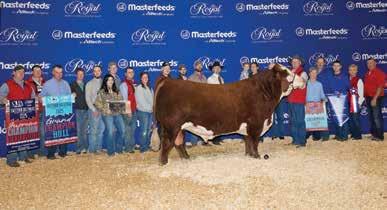
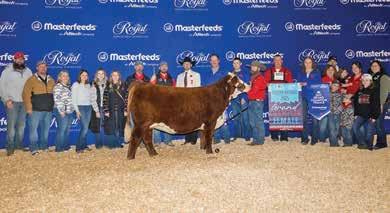
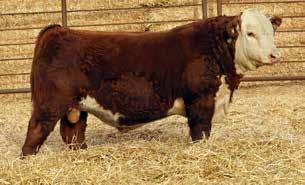
MLPH CARLA 308F 122M The Lasby Family Jeff, Annalynn, Maggi & Abby Murray

HIDDEN-VIEW POLLED HEREFORDS
Joe and Karen Paszternak NORWOOD, ON 705-9573739 or 705-957-7470 karen.paszternak@gmail.com Bulls & Females for sale
JDL CATTLE CO. & D&S LIVESTOCK
David & Shirley Lasby
Josh Lasby, Justin & Jaimie Lasby & Family, Jessica Lasby & Travis Fulford & Family MULMUR, ON 519-943-4147 or 519-278-6819
jessica.lasby@hotmail.com
Good-looking, Sound, Functional Cattle!
LIAN MOR POLLED HEREFORD
Wally & Fern Pugh MONO, ON
Wally & Fern Pugh lianmor48@gmail.com · 519-941-8515
Trevor & Amy tpugh27@yahoo.com · 519-939-7489
Breeding Stock Available
MEDONTE HIGHLANDS POLLED HEREFORDS
3055 Universal Dr. Mississauga, Ontario (905) 625-3151
maria@standardmechanical.com
“6 Star Breeder”
O’SHEA FARMS
Jamie and Mel O’Shea DENFIELD, ON 519-477-1238
osheafarms@hotmail.com Bulls and Females for sale
WHISKEY LANE LIVESTOCK Herford and Angus Scott, Paula, Jason and Shelby Cornish INDIAN RIVER, ON 705-295-2925
705-878-3248 (Scott’s Cell) 705-341-3220 (Paula’s Cell) wll@nexicom.net
Visitors Always Welcome
BEEF
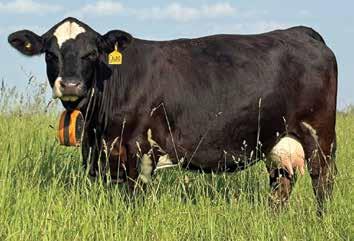
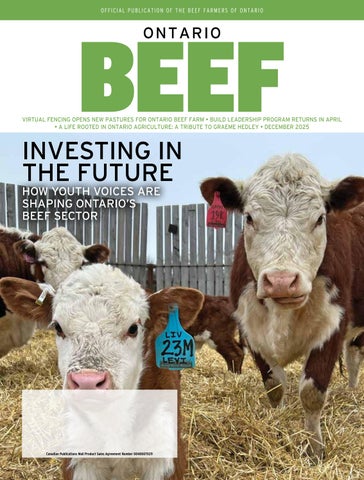
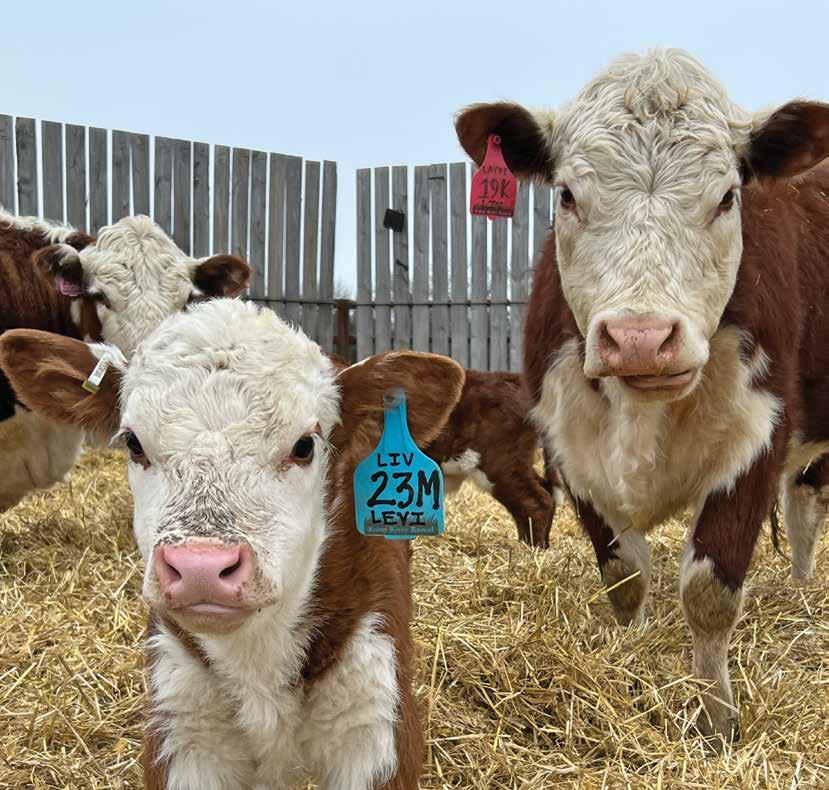
ON THE COVER:
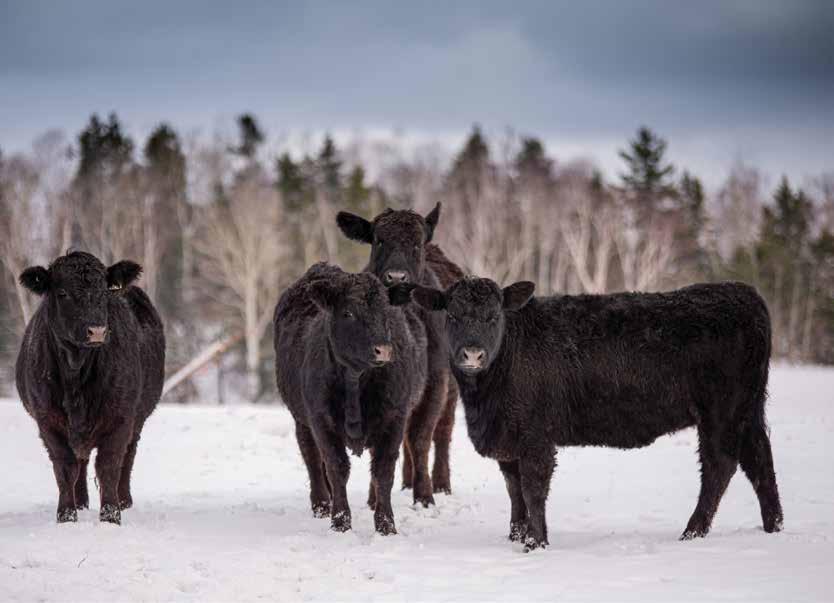
Thank you to BFO Director Kim Jo Bliss from the Rainy River District for sharing this cover photo! In this issue, you can learn about upcoming BCRC webinars to support producers and veterinary teams, and find dates for BFO county and district AGMs in January. Discover how Canadian beef farmers are leading globally in sustainability, explore an Ontario farm adopting virtual fencing technology, and meet the youth shaping the future of the beef sector. On page 34, you will find a convenient roundup of holiday schedules for Ontario’s auction markets.
Don’t miss out on submitting your photos for our February issue. Please send your winter-inspired photos by January 15th to be considered for the cover. Digital photos in portrait orientation that are at least 300dpi are preferred, and can be emailed to info@ontariobeef.com.
ONTARIO BEEF • Beef Farmers of Ontario 130 Malcolm Road, Guelph, ON N1K 1B1 • Phone: 519-824-0334 • Toll Free (for Ontario callers only) 1-866-370-BEEF (2333) Fax: 519-824-9101 • info@ontariobeef.com
EDITOR
LeaAnne Wurmli
CIRCULATION COORDINATOR
Charlene Yungblut
ADVERTISING MANAGER
Cathy Lasby, Preferred Agri-Marketing Services
Guelph, ON Phone: 519-763-8833 • Fax: 519-763-8833 pams@sentex.net
DESIGN and LAYOUT
Prism Studios Advertising and Design Inc. Guelph, ON
PRODUCTION and PRINTING
Beck’s Printing Services, Brantford, ON
PROVIDING A FORUM FOR THE ONTARIO BEEF INDUSTRY
Ontario Beef is the official publication of the Beef Farmers of Ontario. Contents of this publication may be reproduced only by permission of the Editor and with credit acknowledged.
Opinions expressed herein are those of the author and/or editor and do not necessarily reflect the opinion of the Beef Farmers of Ontario. Publication of advertisements does not constitute endorsement or approval by Ontario Beef or the Beef Farmers of Ontario of products or services advertised.
Advertising deadlines are January 10, April 15, July 15, September 15 and November 15. The publisher reserves the right to refuse or cancel any advertising, including advertising that is inconsistent with BFO’s Sponsorship Policy, available at www.ontariobeef.com. Every effort is made to ensure the accuracy of material published, however no responsibility can be assumed for advertising not received in clear, type-written form.
Canadian Publications Mail Product Sales Agreement Number 0040007029
POSTMASTER: Return undeliverable Canadian addresses to: Beef Farmers of Ontario, 130 Malcolm Road, Guelph, ON N1K 1B1
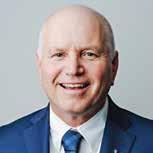
A Life Rooted in Ontario Agriculture A Tribute to Graeme Hedley AHEAD OF THE HEARD
By Craig McLaughlin, BFO President info@ontariobeef.com • www.ontariobeef.com
Our beef and agricultural community suffered a collective loss when Graeme Walker Hedley passed away on November 6, 2025, at the age of 83. Over the course of his life, Graeme helped shape the province’s beef and livestock sectors, and inform how we think about animal welfare, marketing, sustainability, and innovation. His legacy is broad, lasting, and worthy of celebration.
Graeme’s career began humbly, yet purposefully, in the 1960s as a Livestock Specialist with the Ontario Ministry of Agriculture, where he provided expert advice across beef, swine, and sheep sectors. In 1970, he took on what would become his defining role as Executive Director of the Ontario Cattlemen’s Association (OCA), now known as the Beef Farmers of Ontario. For 31 years, he guided our association through a period of transformation, equipping it to face the rising complexities in agriculture, evolving consumer expectations, and shifting regulatory landscapes while supporting 30 Association presidents during his tenure.
Under his leadership, he guided the Ontario check-off system’s implementation, enforcement, reporting, and the management of check-off dollars from its early formative years. In the years following, the beef sector experienced significant transformation, shifting from a strictly commodity-based marketing approach toward one that emphasized the differentiation of beef through quality and nutritional value. During this period, Graeme and OCA played a pivotal role in strengthening rural and urban relationships, engaging the public in meaningful conversations about animal welfare and environmental stewardship within livestock production. These efforts ultimately contributed to the creation of the Ontario Farm Animal Council
BFO BOARD OF DIRECTORS 2025
Craig McLaughlin (Eastern Director) – President
Phone: 613-504-1863 • Email: cmblackhorse@gmail.com
Jason Leblond (Northern Director) – Vice President
Email: jacres5@gmail.com
Don Badour (Cow-Calf Director)
Email: don.badour@gmail.com
Don Hargrave (Cow-Calf Director)
Email: dchargrave@gmail.com
Jim Whitley (Cow-Calf Director)
Email: modelaranch@hotmail.com
Joost van der Heiden (Background Director)
Email: jcvdheiden@hotmail.com
Nick Martin (Feedlot Director)
Email: nickolas@pureislandbeef.com
Jairus Maus (Feedlot Director)
Email: ellengowanfarms@gmail.com
Tom Kroesbergen (Feedlot Director)
Email: tomkroes50@hotmail.com
Denise Byers (Southern Director)
Email: byersdimmick@yahoo.com
Ralph Eyre (Director-At-Large)
Email: ralph@eyrefarms.ca
Kim Jo Bliss (Director-At-Large)
Email: kimjobliss@gmail.com
Emily Bromley (Youth Director)
Email: fondoak@live.ca
(OFAC), an organization dedicated to promoting responsible animal care and fostering greater understanding between farmers and consumers.
Perhaps one of Graeme’s most enduring contributions was his vision and implementation of electronic cattle sales. He developed a pilot project demonstrating the feasibility of digital auctions. That
BFO STAFF
Executive Director
Richard Horne • richard@ontariobeef.com
Manager of Policy and Issues
Thomas Brandstetter • thomas@ontariobeef.com
Senior Policy Advisor
Evan Chaffe • evan@ontariobeef.com
Policy Advisor
Aynur Izzettin • aynur@ontariobeef.com
Director of Communications
LeaAnne Wurmli • leaanne@ontariobeef.com
Manager of Public Engagement and Digital Strategy
Jennifer Kyle • jennifer@ontariobeef.com
Engagement Coordinator
Charlene Yungblut • charlene@ontariobeef.com
Member Information Coordinator
Jamie Gamble • jamie@ontariobeef.com
Accountant
Amber McIntyre • amber@ontariobeef.com
Office Manager
Lisandra Lima • lisandra@ontariobeef.com
Manager of Producer Relations & Director of the Ontario Beef Youth Alliance
Jaclyn Horenberg • jaclyn@ontariobeef.com
Senior Producer Relations Advisor
Dan Ferguson • dan@ontariobeef.com
Producer Relations Specialist
Robert McKinlay • robert@ontariobeef.com
Manager of Compliance
Chris Millar • chrism@ontariobeef.com
Supervisor of Provincial Programs
Barb Caswell • barb@ontariobeef.com
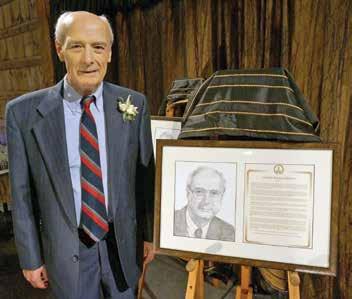
Graeme was inducted into the Ontario Agriculture Hall of Fame in 2016
concept was later adopted and scaled by the Ontario Livestock Exchange (OLEX), ultimately transforming how cattle are traded.
As well, Graeme helped steer the beef industry through financial turbulence. During a period in the late 1980s marked by high interest rates and mounting producer debt, he guided OCA in creating support systems for farmers. Working with lenders and producers, he helped launch the Feeder Finance program, now known as the Ontario Feeder Cattle Loan Guarantee Program, which continues to be a financial lifeline for farmers, particularly for new and beginning farmers.

Graeme was a strategic thinker. Recognized as an astute agricultural policy analyst, he shaped and influenced programs that addressed industry challenges proactively. He helped orchestrate the divestment of the Ontario Stockyards from government ownership, establishing the Toronto Stockyards Land Development Fund. The proceeds - amounting to millions - were reinvested in livestock organizations across Ontario, funding genetic improvement and research projects that continue to significantly benefit our association today.
He also assisted the Ontario Cattle Feeders’ Association to become established to successfully market and brand Ontario Corn Fed Beef. This initiative helped differentiate Ontario beef in both domestic and international markets and eventually grew to market more than half of Ontario’s fed cattle. The OCFA also implemented, thanks to Graeme’s leadership, a ledger-account program to help feedlot operators manage business risk.
Beyond beef, Graeme’s influence extended to commodity coordination and industry-wide governance. He served as Secretary of the Ontario Agricultural Commodity Council (OACC), a coalition of 31 commodity organizations advocating for coordinated policy, research investment, and risk management strategies. He also served as long-time secretary-treasurer of the Association of Community Pastures. In this role, he oversaw the negotiation, rate calculation, record-keeping and reporting elements of the Community Pasture program and created a model that other provinces have since followed. Lastly, he chaired the Canadian Beef Grading Agency from 1999 to 2015, helping standardize beef grading nationally to support marketing, production decisions, and quality assurance.
In recognition of his lifelong service and extraordinary impact, Graeme was inducted into the Ontario Agricultural Hall of Fame in 2016, an honour reserved for those whose vision, leadership and innovation have permanently shaped Ontario’s agriculture. His induction serves as formal confirmation of the breadth of his contributions to our sector.
As we navigate ongoing challenges like global markets, trade relations, climate change, evolving consumer values, Graeme’s legacy remains a guiding light. His work created policies and programs that continue to benefit our members, and standards that set Ontario apart.
To recognize Graeme’s outstanding contributions to our association and the broader agricultural community, and as a nod to his legacy, BFO’s boardroom will now carry the official name Graeme Walker Hedley Boardroom. OB
OnPolitics, Policy and Plenty of Beef THE BEEF BEAT
By Evan Chaffe, BFO Senior Policy Advisor evan@ontariobeef.com
behalf of our members, we participated in three focused lobby and advocacy days this fall. Two of these were held in Ottawa in collaboration with the Canadian Cattle Association (CCA) and the National Cattle Feeders’ Association (NCFA), with the third taking place at Queen’s Park in Toronto. Each event provided an opportunity to revisit ongoing priorities, update elected officials on emerging issues, and reinforce the needs of Ontario’s beef sector.
By sharing firsthand experiences from all segments of the beef value chain—from cow-calf operations to feedlots and processors— we strengthen our relationships with policymakers and ensure Ontario’s beef sector remains front and centre in policy discussions. These lobby days reflect our continued commitment to advancing a strong, competitive, and sustainable beef sector in Ontario and across the country.
Our first lobby day took place in early October in partnership with CCA and focused on three key priorities: trade, business risk management (BRM) programs, and the need to harmonize Specified Risk Material (SRM) regulations with the United States. Throughout


the day, our team met with representatives from both major federal parties as well as Senators, giving us the opportunity to share our priorities across the political spectrum.
We emphasized the importance of maintaining stable, predictable trade with the United States and underscored the value of CUSMA for our sector. We also highlighted the need for BRM programs that accurately reflect the risks producers are facing and advocated for updated SRM rules that align with current science and market realities. We also raised the ongoing situation at the Joyceville abattoir, outlining its significance to the local beef market and the broader local food movement in the region.
Following a full day of meetings, we attended a reception hosted by CCA and NCFA. This provided a valuable opportunity to connect with additional policymakers and stakeholders we had not met with earlier in the day.
Our second lobby day, led by NCFA, focused on several critical issues facing the Canadian beef industry, including trade, labour shortages, access to innovation, BRM programs, and supply chain and infrastructure challenges. On trade, we underscored the

CALL FOR NOMINATIONS BFO POSITIONS
The degree to which Beef Farmers of Ontario (BFO) can provide leadership in responding to industry needs is heavily dependent on the competencies and leadership of the BFO Board of Directors, committee members and BFO representatives to the Canadian Cattle Association (CCA). As a producer-driven organization, elected officials of BFO play a key role in identifying and prioritizing issues to better the Ontario beef sector, and provide direction in developing and advancing solutions to address a variety of issues in the areas of economic sustainability, animal health and welfare, food safety, environment, and domestic and export market development.
BFO is currently seeking nominations for various positions with the BFO Board of Directors, BFO Committees, and representatives to the Canadian Cattle Association (CCA). Candidates will be elected at the BFO Annual General Meeting (AGM) taking place on February 18 & 19, 2026 in Toronto.
2026 POSITIONS FOR ELECTION
BFO Board of Director Positions
• Cow-Calf Director (1)
• Background Director (1)
• Feedlot Director (2)
• Eastern Director (1)
BFO Committee Positions
• Cow-Calf Members (3)
• Feedlot Members (3)
• Background Member on Feedlot Committee (1) Directors to CCA Positions
• CCA Representatives (2)
Ontario Beef Youth Alliance Positions
• Youth Member on BFO Cow-Calf Committee (1)
• Youth Member on BFO Feedlot Committee (1)
Anyone interested in becoming a candidate must be elected as a voting delegate at their local annual meeting, and must be a member in good standing of BFO.
Interested candidates are asked to submit their nomination form(s) and photo to the BFO office by Monday, January 19, 2026. Nominations will not be accepted after 4:30 p.m. on February 3, 2026. Nominations package and forms can be found at www.ontariobeef.com.

RESEARCH ROUNDUP BCRC Hosts Free Webinars for Beef Farmers and Veterinary Teams
By Beef Cattle Research Council
Registration is now open for the Beef Cattle Research Council’s 2025-2026 four-part webinar series. Each session will dig into topics that have an impact on your bottom line, including whether hormone implants are the right fit for your calves, how water quality and systems lead to better herd performance and what you can do to reduce the risk of calf losses.
To Implant or Not? What Cow-Calf Producers Need to Know
January 21, 2026, 7:00 PM MT
Speakers: Dr. Lauren Younker, TELUS Agriculture, and Betty Green, G7 Ranch
Hormone implants are one of the most researched and costeffective tools available to beef producers, yet uncertainty and misconceptions often keep them from being used. This webinar will break down the facts – what implants are, why they work, how to administer them and where they can benefit cow-calf operations.
Practical
Approaches for Managing Stock Water
February 18, 2026, 7:00 PM MT
Speakers: Dr. Cheryl Waldner, Western College of Veterinary Medicine, and Karla Hicks, Bluestone Stock Farms
Even water that looks clean and clear can be poor quality — and insufficient access to good-quality water can reduce beef cattle performance faster and more dramatically than any other nutrient deficiency. This webinar will explore the hidden risks of poor-quality water, discuss its implications for herd health and productivity, and provide practical tools and strategies to ensure your cattle have clean, safe and adequate water supplies.
Strategies for Reducing Calf Losses: Eastern Canadian Veterinary Insights
March 18, 2026, 7:00 PM EST
Speakers: Dr. Lisa Freeze, Field Veterinarian Supervisor with Government of New Brunswick, and additional speaker TBD
Are you struggling with calf losses? Join this 90-minute webinar where vets who work with operations like yours discuss what is actually working on the ground to help prevent the most common causes of calf losses. There will be plenty of time to answer your questions with the extended Q & A session.
Strategies for Reducing Calf Losses: Western Canadian Veterinary Insights
March 25, 2026, 7:00 PM MT
Speakers: Dr. Allison Pylypjuk, Beausejour Animal Hospital; Dr. Katie Waine, University of Calgary Faculty of Veterinary Medicine, and additional speaker TBD
Are you struggling with calf losses? Join this 90-minute webinar where vets who work with operations like yours discuss what is actually working on the ground to help prevent the most common causes of calf losses. There will be plenty of time to answer your questions with the extended Q & A session.
BCRC webinars are available free of charge thanks to guest speakers who volunteer their time and expertise to support advancements in the Canadian beef industry through the BCRC’s knowledge mobilization work funded by the Canadian Beef Cattle Check-Off and Canada’s Beef Science Cluster.

All four webinars will be available for continuing education (CE) accreditation for veterinarians and registered veterinary technologists and technicians across Canada.
Want to register but don’t know if you can attend? Regardless of whether or not you attend the live sessions, by registering you will receive links to attend or watch the webinar recordings after the event has ended. You will also receive event reminders and additional resources on each topic.
The Beef Cattle Research Council (BCRC) is Canada’s national industry-led funding agency for beef, cattle and forage research. The BCRC’s mandate is to determine research and development priorities for the Canadian beef cattle industry and to administer Canadian Beef Cattle Check-Off funds allocated to research. Visit www.BeefResearch.ca to learn more.





REGIONDATETIMEDETAILS
Niagara Jan. 56 p.m.Wellandport Community Centre, 5042 Canborough Road, Wellandport Dinner at 6 p.m. and meeting to follow
Simcoe Jan. 57 p.m.Sunnidale Corners Community Centre, 12391 County Road 10, Stayner
Waterloo Jan. 512 p.m.Crowsfoot Smokehouse, 1872 Sawmill Road, Conestogo
Algoma Jan. 67 p.m. Bruce Stations Hall, 109 Station Road, Bruce Mines
Prince EdwardJan. 67 p.m.Friendship United Church, 2765 County Rd. 5, Demorestville
Leeds Jan. 77 p.m.Athens Lions Club, 12 Wellington Street East, Athens - Doors open at 6 p.m.
Perth Jan. 76 p.m.Listowel Ag. Society Hall, 180 Tremaine Ave. S., Listowel
Lennox/AddingtonJan. 87 p.m.Centreville Hall, 4504 County Road 4, Centreville
Dufferin Jan. 97 p.m.Shelburne Ag Hall, 377 Williams Street, Shelburne
Cochrane Jan. 10 11:30 a.m.Porquis Junction Agricultural Hall, 38 Edward Street, Porquis Junction Lunch at 11:30 a.m. and meeting to follow
Dundas Jan. 10 1 p.m.DFA Hall, Nelson Laprade Centre, 9 William Street, Chesterville
Stormont Jan. 10 9 a.m.Cornwall Township Lion's Club, 17413 McPhail Road, St. Andrew's West
Temiskaming Jan. 10 6 p.m.Kerns Community Hall, 279279 Milberta Rd., New Liskeard Dinner at 6 p.m. and meeting to follow
Grenville Jan. 11 12 p.m.The Goose and Gridiron, 317 St Lawrence St, Merrickville
Victoria Jan. 12 7 p.m.Fenelon Township Community Centre, 2255 Elm Tree Road, Cambray
Brant Jan. 13
6 p.m.Best Western, 19 Holiday Drive, Brantford
Bruce Jan. 13 11 a.m.Tara Legion, 86 River Street, Tara
Glengarry Jan. 13 6 p.m.Alexandria Restaurant, 127 Main St. South, Alexandria
Peterborough Jan. 13 7 p.m.Douro Community Centre, 2893 Highway 28, Peterborough
Wentworth Jan. 13 7:30 p.m.Ancaster Fairground, Main Building, 630 Trinity Rd. South, Jerseyville
Huron Jan. 14 6 p.m.Brussels Legion 620 Turnberry St, Brussels Dinner at 6 p.m. and meeting at 7 p.m.
Lambton Jan. 14 5:30 p.m.Plympton-Wyoming Fairgrounds, 595 Main Street, Wyoming Manitoulin Jan. 14 11 a.m.Spring Bay Community Hall, Spring Bay
Prescott Jan. 14 6 p.m.Le Chardo Restaurant, 374 St. Philippe Street, Alfred Russell Jan. 14 6:30 p.m.4762 Rockdale Road, Navan
Thunder Bay Jan. 14 7 p.m. Murillo Hall, 4569 Oliver Road, Thunder Bay
Elgin Jan. 15 7 p.m.Lawrence Station Community Hall, 12344 William Street, Southwold Frontenac Jan. 15 7:30 p.m. Sydenham Library, 4412 Wheatley Street, Sydenham Haldimand & Norfolk Jan. 15 6:30 p.m.Haldimand Agricultural Centre (Kohler Agricultural Hall), 1084 Kohler Road, Cayuga Haliburton Jan. 15 6 p.m.Castle Antiques, 223 Highland St, Haliburton Dinner at 6 p.m. and meeting to follow
Hastings Jan. 15 6:30 p.m.White Hall, Tweed Agricultural Building, 617 Louisa Street, Tweed Dinner at 6:30 p.m. and meeting to follow Middlesex Jan. 15 6 p.m.Coldstream Community Centre, 10227 Ilderton Road, Coldstream Tradeshow at 6 p.m., Dinner at 7 p.m. and meeting to follow
Oxford Jan. 15 6:30 p.m.Unifor Hall Local 636, 126 Beale Street, Woodstock - Dinner at 6:30 p.m.
Rainy River Jan. 15 7 p.m.Our Lady of the Way School, 17 Boucherville Road, Stratton Renfrew Jan. 15 7:30 p.m.Cobden Agricultural Hall, 43 Astrolabe Road, Cobden Durham & York Jan. 16 6 p.m.Uxbridge Legion, 109 Frankiln Street, Uxbridge Doors open at 6 p.m. and dinner at 6:30 p.m.
Kenora Jan. 16 6 p.m. Oxdrift Community Hall, 18946 17 Highway, Oxdrift Lanark & Ottawa Jan. 17 10 a.m. New Brunton Hall, Beckwith Municipal Office, 2022 Beckwith Park Lane, Carleton Place
Muskoka/Parry Sound/Nipissing Jan. 17 8:30 a.m.Magnetawan Friendship Centre, Magnetawan
Northumberland Jan. 17 6 p.m. Alderville Community Centre, 8913 County Road 45, Alderville Tradeshow at 5 p.m., Dinner at 6 p.m. and meeting to follow Sudbury/West Nip. Jan. 17 9:30 a.m.Caruso Club, 385 Haig Street, Sudbury (Lower Hall)
Wellington Jan. 17 6:30 p.m.Central Pentecostal Church, 7674 Colborne Street, Elora Grey Jan. 22 11:30 a.m. Grey County Ag. Services Building, 206 Toronto Street South, Markdale Lunch at 11:30 a.m. and meeting to follow
At the time of printing, AGM details for Essex and Kent had not yet been confirmed.
&


Visit the Ontario Angus Association website for more information and to find listings of future Ontario Angus events: www.cdnangus.ca/ontario-angus-association from the
Contact any of the breeders below to arrange for your private viewing of cattle for sale.
Cairnlee Acres
Victor, Yvonne & Andrew Richardson
6193 Walkers Dr, Strathroy, ON Vic Cell: (519) 871-4240
Cambray Livestock Company
Luke, Matt, Joe and Carl Jewell 1153 The Glen Road, Woodville ON 705-934-2853
Fallis Land and Cattle
Mike, Lisa and Cole Fallis 1273 6th Line, Selwyn, ON K9J 6X5 705-740-4878 | sunsetacres@nexicom.net
Gilchrist Farms
Brad & Kristie Gilchrist
1269 Grey Ox Ave RR#5 Lucknow, ON N0G 2H0 519-440-6720 | brad@gilchristfarms.com
Glen Islay Angus
Don Currie
2234 Conc 11, Nottawa, ON L0M1P0 705-715-2234 | doncurrie@glenislay.com
Loval Farms
Scott & Sandra Honey 127 Honey Road, Warkworth, ON K0K 3K0 705-924-3809 | lovalfarms@gmail.com
Harprey Farms
Allan Hargrave/Don Hargrave 307483 Centre Line A Proton Station, ON N0C 1L0 Allan 519-375-5541 | Don 519-375-1500 harprey@gmail.com
Maple Line Farm
Ian & Tim Rudkin 3320 Bradburn Road, Blackstock, On L0B 1B0 Ian 905-718-5331 | Tim 905-213-6518 maplelinefarm@hotmail.com
Meadow Bridge Angus JJ Deslippe
922580 Rd 92 RR # 4, St Mary’s, ON N4X 1C7 519-275-1739 | meadowbridge14@gmail.com
Rob Roy Angus
Don & Betty McNalty 634514 Road 63 RR#2
Singhampton, ON N0C 1M0 705-446-4740 | robroyangus@gmail.com
SCOMAC Livestock
Scott & Elizabeth MacDonald 4169 Highway # 6
Hagersville, ON N0A 1H0 Scott 519-820-1272 | Elizabeth 226-971-0015 scomaclivestock@gmail.com
Silver Springs Farm
James, Joan, Robert and Emily McKinlay 609027 12th Sideroad RR#1 Ravenna, ON N0H 2E0 519-599-6236 | jmckinlay@bmts.com
Tullamore Farms
Bill & Sylvia Jackson 260 Regional RD 39 Zephyr, ON L0E 1T0 Cell 647-990-2697 tullamore.angus@gmail.com
Whiskey Lane Livestock
Scott, Paula, Jason & Shelby Cornish 2295 Hwy 7, Indian River, ON K0L 2B0 705-341-3220 | wll@nexicom.net
Windcroft Farms
Darcy & Courtney McMorris 573333 Boot Jack Ranch Road
Priceville, ON N0C 1K0 226-203-4506 | windcroftfarms@gmail.com
Worth-Mor Cattle
Kyle, Rachel, Jordyn and Mason Petherick 950 County Rd 8
Campbellford, ON K0L 1L0 705-768-3560 | worth-mor@hotmail.com
Proof in Numbers: Canadian Beef Farmers Lead in Global Sustainability
By Jenna Sarich, M.Sc., Technical Consultant and Analyst, Canadian Roundtable for Sustainable Beef
As a Canadian beef farmer, you have a powerful story to tell. Thanks to generations of land and cattle stewardship and the daily dedication of producers like you, beef raised in Canada is recognized globally as being among the most sustainable in the world.
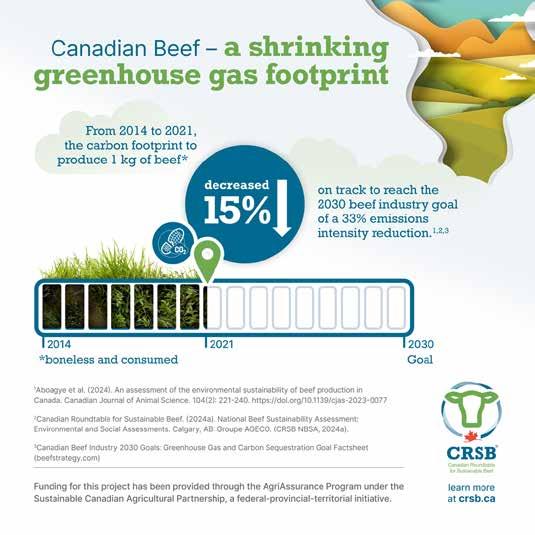
Canada is one of the most efficient beef-producing countries in the world, generating 52 per cent fewer greenhouse gas (GHG) emissions per kilogram of beef when compared to the global average. From 2014 to 2021, greenhouse gases to produce each kilogram of Canadian beef declined by 15 per cent, a result of advanced genetics, feed efficiency, and management practices. This puts the Canadian beef industry on track to reach its 2030 goal of a 33 per cent reduction in emissions intensity while achieving healthier and more productive cattle. This is a win-win both for producers’ pocketbooks and the sector’s footprint.
The story of Canadian beef cannot be told without the story of Canada’s grasslands. Land used for grazing cattle is one of the country’s most important ecosystems. Backed by science, metrics from the Canadian Roundtable for Sustainable Beef’s (CRSB) National Beef Sustainability Assessment (NBSA) make it clear that Canadian beef is more than just food.
According to a 2025 consumer research survey, 70 per cent of Canadians hold a positive view of beef farmers, reflecting a seven-point increase in just one year. In Ontario, this trust is even higher, with 73 per cent expressing positive perceptions, up 13 per cent over the last year.
According to the CRSB’s 2024 sustainability assessment, land used to raise beef cattle stores 1.9 billion tonnes of soil organic carbonnearly 40 per cent of all carbon in Canada’s agricultural soils. Most of this carbon is found in Canada’s native grasslands (67 per cent), followed by tame pastures (24 per cent) and cropland (9 per cent).
To put it into perspective, the total carbon these landscapes currently store is equivalent to the annual emissions from over two billion passenger vehicles. Beyond carbon, land used to raise beef cattle provides critical wildlife habitat. While the overall habitat capacity across Canada’s agricultural land has declined, the share provided by grazing land used for beef cattle has actually increased. When considering all crop and pastureland combined, land used for grazing beef cattle provides 74 per cent of reproductive and nesting habitat and 55 per cent of feeding habitat for Canada’s wildlife. When considering all of Ontario’s agricultural land, only 17 per cent is used to raise beef cattle, yet it provides 29 per cent of the reproductive and nesting habitat on which Ontario’s wildlife depends. Over 60 species at risk rely on grasslands - landscapes maintained by farmers and ranchers, because of grazing, not in spite of it.

Beef cattle also contribute to local circular economies by upcycling what humans can’t or won’t eat – in fact, 86 per cent of global livestock feed is not fit for human consumption. In Canada, beef cattle consume by-products such as culled vegetables, distillers’ grains, crop residues, and downgraded crops, converting them into high-quality protein, while diverting food waste from the land fill and supporting food security and local economies.
Canadians have a strong and growing level of trust in beef farmers and ranchers. According to a 2025 consumer research survey conducted through Public and Stakeholder Engagement, 70 per cent of Canadians hold a positive view of beef farmers, reflecting a seven-point increase in just one year. In Ontario, this trust is even higher, with 73 per cent expressing positive perceptions, up 13 per cent over the last year. Support for beef as part of an environmentally friendly diet is also on the rise. Nationally, 74 per cent of Canadians agree beef is an environmentally friendly food choice, up 14 per cent since 2023, and Ontario saw similar numbers with 75 per cent agreeing beef if environmentally friendly, up 13 per cent.
Canadian beef is more than just a source of protein - it’s providing ecosystem services, maintaining grasslands, supporting the Canadian economy, while contributing to a resilient Canadian food system.
These numbers reflect your hard work and dedication. Earlier this year, CRSB showcased that story through a public-facing campaign that we estimated to reach over 19 million Canadians. You can share this story, adding your voice to show your contribution to building a sustainable food system here in Canada.
The dedication Canadian farmers and ranchers have towards caring for the animals, protecting the land, and providing nutritious protein is the foundation of Canada’s reputation as a leader in beef production. Behind every positive metric is a lot of hard work and commitment from people like you raising Canada’s beef cattle, and for that, we as Canadians are very proud. References available upon request. OB

BFO Participates in Tri-National Agricultural Accord
By BFO Staff
In October, agricultural leaders from across North America gathered in Morelia, Michoacán, Mexico for the 34th Annual Tri-National Agricultural Accord. The event brought together government and industry representatives from Canada, the United States, and Mexico to strengthen cooperation on shared agri-food priorities ahead of the 2026 CUSMA/USMCA/T-MEC renegotiations.
The Canadian delegation was led by Ontario Minister of Agriculture, Food and Agribusiness Trevor Jones, who served as one of the Accord’s co-chairs. The beef sector was well represented, with delegates from the Canadian Cattle Association (CCA), National Cattle Feeders’ Association (NCFA), and Beef Farmers of Ontario (BFO) in attendance. Other Ontario-based commodity leaders included representatives from the Grain Farmers of Ontario, Ontario Pork, and the Ontario Greenhouse Vegetable Growers.
The overarching goal of BFO and its partners was to defend and promote tariff-free, science-based trade across North America, while advancing discussions on regulatory cooperation. Other key issues for BFO at the accord included:
• Enhancing labour access and mobility across jurisdictions for both primary production and processing
Throughout the meetings, BFO engaged with numerous U.S. state departments of agriculture and was encouraged by the widespread support for the continuation of CUSMA/USMCA/T-MEC. Despite political headwinds surrounding trade and tariffs, delegates reaffirmed the value of free and open North American trade to all three countries.
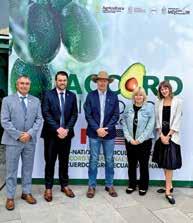
A key highlight came from the National Association of State Departments of Agriculture (NASDA), who discussed internal U.S. advocacy efforts focused on preserving and strengthening North American free trade. As reflected in the official accord communiqué signed by all three countries, states and provinces also expressed strong support for extending CUSMA/USMCA/T-MEC for an

Home grown tools for Ontario Beef Farmers

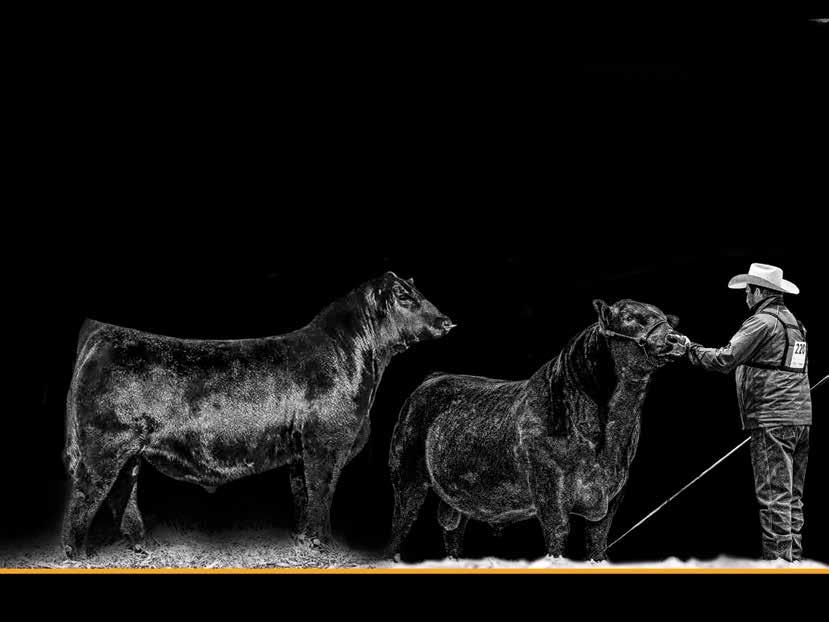
StrongHER in Beef A New Event Celebrating the Strength of Women in Ontario’s Beef Sector
Ontario’s beef sector is built on strong foundations, and many of those foundations are held up by women. From on-farm decision-making to veterinary clinics, feed and nutrition services, research, communications, sales, and industry support, women play an essential role in keeping the sector thriving. Beef Farmers of Ontario is proud to launch StrongHER in Beef, a new event created to celebrate, empower, and connect the women who contribute to our industry every day.
Taking place March 5, 2026, in Elora, StrongHER in Beef is built around three pillars: Confidence. Community. Cattle. It’s designed for women in every role within the beef sector—those working hands-on with cattle, working beside family in multi-generational operations, or supporting producers through professional careers. No matter their path, participants will find value, inspiration, and connection.
The day features a balanced agenda blending practical learning, personal development, and opportunities to network and recharge. Sessions will explore wellness and resilience, business confidence, hands-on cattle skills, leadership growth, and access to industry programs and supports. Each session is designed with women in mind, acknowledging the unique challenges they navigate and the strengths they bring to the table.
Equally important is the sense of community woven throughout the event. From morning coffee to a chef-led closing experience, StrongHER in Beef encourages conversation, shared experiences, and genuine connection. Many women in agriculture juggle multiple
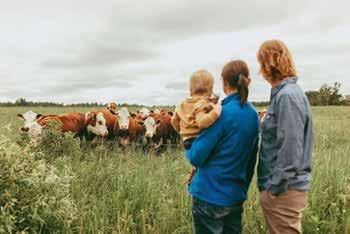
responsibilities—on the farm, at home, and in their careers—and this event offers a supportive space to be seen, heard, and celebrated. StrongHER in Beef is more than a single day; it’s the beginning of a growing community of women who strengthen Ontario’s beef sector through their leadership, skill, care, and resilience. We hope you’ll join us as we come together to build confidence, foster community, and celebrate our shared commitment to cattle and the future of the industry.
Registration will open in the new year, and seats will be limited, so be sure to watch for details on our website and social channels. OB
ONTARIO BEEF FARMERS: WE NEED YOU
Raising beef is vital to your family, your farm, your community, and Ontario as a whole. The product you raise deserves to reach appreciative family tables close to home, ensuring you receive the best value for your hard work. At VG Meats, we’ve partnered with small beef farmers across Ontario who share our commitment to quality, sustainability, and continuous improvement. Now, we’d like to work with you.
We’re looking to purchase your finished cattle and provide you with valuable data on each animal’s tenderness, yield, quality, and weight. This information not only helps you secure a premium for your beef but also supports better management and genetic decisions for generations to come. By working together, we can help regenerate the lives, profits, and land of Ontario’s beef farming families.
Over the years, we’ve also expanded our connections across Ontario’s retail landscape, creating more opportunities for locally raised beef to reach appreciative consumers. You can learn more about this exciting initiative and how it benefits Ontario farmers at harvesttogather.ca
If your family finishes cattle and you’re ready to explore this opportunity, reach out to me, Cory Van Groningen, at cory@vgmeats.ca, and I’ll share the details of our program. Let’s schedule a time to discuss how VG Meats can help bring your beef to market while supporting your farm’s growth. We look forward to hearing from you soon.





CHOOSE SHORTHORN
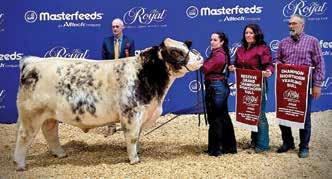
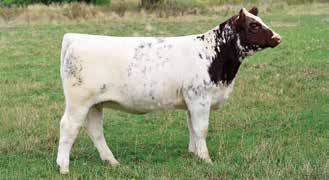
MCC MURRAY 1M
Reserve Grand Champion Bull 2025 RAWF Miller Cattle Co., Bright
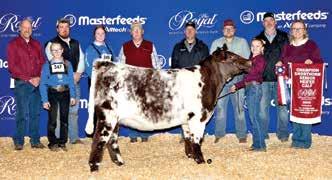
CORNERVIEW NELLY BELL 2N
OSA Fall Sale
High Selling Heifer Calf at $8000 For Cornerview Charolais, Cobden
CRAWFDOWN LUCY 6N
Champion Senior Heifer Calf 2025 RAWF Crawfdown Farms, Glencoe
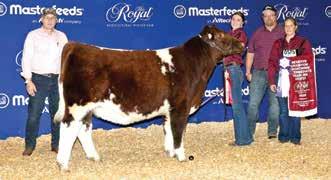
CLOVERLEAF MEREDITH 8M
OSA Fall Sale
Top Seller at $11,000 For Cloverleaf Farms, Renfrew

TIBS SHORTHORNS
Pat Thibodeau Georgetown, ON 416-319-1901 tibsshorthorns@gmail.com
COLDSTREAM FARM
Flesherton, ON
Don Jack: 519-924-1540
Shea O’Neill: 519-373-6599
Heifer, Bulls, Show Prospects Breed Leading EPDs

TRAILVIEW SHORTHORNS
Shannon Kingston & Ross Laycock 1327 6th Av West, Owen Sound, ON 519 477-1526 or 519 372-5414 hockeymama@live.ca
RED ROSE FARM
Martin & Liz Mason & Sons
747710 Twp Rd 4,Drumbo, ON
Cell: 519-771-7066
John Mason: 519-636-6634 martin.mason@redrosefarm.com
GLENROTHES FARM
Beaverton, ON
Doug Brown: 905-431-8496
Nancy Brown Andison: 416-817-0369
LOCUSTVIEW SHORTHORNS
Steve, Joyce & Dan Bartlett
Almonte, ON 613-256-3042 locustviewshorts@outlook.com
Franki Byrne, President - 519-809-5853 email: frank.byrnebbo@gmail.com
HILL HAVEN FARM
Duntroon, ON
Dale Asser: 705-444-9403
Matt (herdsman): 519-378-5508 hillhavenshorthorns1@gmail.com www.hillhavenshorthorns
MARTIN FARMS
Gore Bay, ON
Jim: 705-348-1294
Nick: 705-348-1022
Alex: 705-782-4725
Bulls, Females, Commercial Cattle
CRAWFDOWN FARMS
Glencoe, ON
Gord & Sally Crawford 519-870-2396
Reed & Jane,Shelby&Josie 519-857-7333
FLIGHTPATH
Caledon, ON David&Joanne Currie& Family
David: 647-400-2844
Jessica: 519-400-3160 farm.flightpath@gmail.com
Virtual Fencing Opens New Pastures for Ontario Beef Farm
By Agriculture Adaptation Council
Anewkind of fence is helping Enright Cattle Company near Tweed, Ontario, make the most of every acre. Instead of posts and wire, their boundaries now exist on a smartphone screen — and those virtual fences can be moved with a few taps on that screen instead of by hand in the field.
The Enrights are among the first Ontario beef producers to adopt virtual fencing technology, using solar-powered GPS collars that train cattle to stay within invisible boundaries. It’s innovation that’s helping them manage pastures more efficiently, expand their herd, and save time and money — all without hammering in a single fence post.
“Even in a drought year, we were able to keep cows out on pasture longer,” says co-owner Kara Enright, who farms with her husband Darold and children Corben and Evelyn. “We managed our grazing better, got more production off the land, and didn’t spend time or money building interior fences. It’s been a game-changer for us.”
The project was made possible through the Agri-Tech Innovation Initiative (ATII), and for Enright Cattle Company, virtual fencing offered a way to overcome one of their biggest barriers to growth: limited access to fenced pasture.
“Our biggest limitation to expanding the cow herd was pasture,” Enright explains. “A lot of the land we use is rented, and it doesn’t make sense to invest in permanent fencing there. We wanted a way to make better use of what we already have — or to graze areas that just weren’t practical to fence.”
Based on conversations with fellow producers already using the technology, the Enrights chose the eShepherd system by Gallagher. When cattle approach the invisible boundary, they first hear a warning beep; if they continue forward, they receive a mild pulse, prompting them to back away.
The virtual fence approach is ideal for rotational grazing on both owned and rented land, and can even be used on temporary feed crops, making it easier to graze cover crops or extend the grazing season in fall.
“It’s helping us get more out of the same land,” she says. “And it saves a lot of work. We don’t have to set up or move fencing every day.”
Virtual fencing has also allowed the Enrights to experiment with new grazing strategies. Calves, which are too small for collars, can
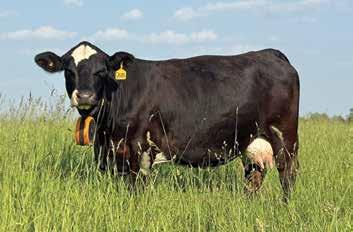
move beyond the boundary lines to reach the best grass — a kind of natural “creep grazing” system that promotes growth and pasture efficiency.
ATII funding helped cover part of the equipment cost and made it feasible for the Enrights to test the technology.
“It’s a big investment, and we couldn’t have done it without the funding,” says Enright. “The support helped us take that step to try something new while reducing the financial risk.”
The Agri-Tech Innovation Initiative is delivered by the Agricultural Adaptation Council and funded in part by the Sustainable Canadian Agricultural Partnership (Sustainable CAP), a five-year, federalprovincial-territorial initiative. It represents up to $22.6 million in investment from the governments of Canada and Ontario to expand production capacity and boost energy efficiency across the agriculture and food sector.
For Enright Cattle Company, the investment has already paid off.
“It’s about working smarter, not harder,” says Kara. “This technology gives us flexibility, better grazing management, and more confidence to grow. It’s the future of how we’ll manage cattle.” OB ATII supports farms and food businesses adopting technology to expand production and improve efficiency — key goals of Ontario’s Grow Ontario Strategy, which aims to increase locally grown and prepared food by 30 per cent by 2032.
Unsung Conservationists
By Public and Stakeholder Engagement Staff
Theconnection between beef cattle and conservation took centre stage at a conference where agriculture topics are seldom part of the program. The Latornell Conservation Symposium is an annual event where environment and conservation leaders, practitioners and advocates gather to learn and network.
A session at the two-day event hosted in Woodbridge, Ontario, gave attendees the opportunity to watch the short documentary “Homes on the Range.” The film, which highlights the role beef cattle farmers and ranchers play in preserving critical wildlife habitat on Canada’s grazing lands, was followed by an expert panel discussion on the same topic.
Homes on the Range set the stage for the audience by demonstrating the variability that can be seen in beef farms and ranches across the country, the diverse and passionate people serving as caretakers of the land, and the vast array of wildlife that share the landscape with grazing cattle in all cases. The panel that followed provided further perspectives on cattle and conservation and included panelists Sandra Vos, a beef farmer from Brant County in Ontario; Carolyn Callaghan, Senior Wildlife Biologist at the Canadian Wildlife Federation and a key personality in the film; and Andrew Campomizzi, Research Scientist at Bird Ecology and Conservation Ontario (BECO). The panel was moderated by Jennifer Kyle from the Beef Farmers of Ontario.
Working at a national level, Callaghan shared that regardless of the province, the more extensive the type of farming (like grazed lands and perennial hay fields), the higher the biodiversity that is found. “As a society we need to recognize that farmers who sustain this type of farming are providing a public service,” she stressed.
Carolyn goes on to state in the film, “we’re learning from each other – beef farmers might grow new eyes for a bird species and where it nests when I point it out on their farm. I grew new eyes about farming –the more I learn about the practices and constraints to beef producers, the more I’m aware of how together we can find solutions that are going to work for everyone.”
Sandra offered a firsthand perspective on what stewardship looks like at the ground level. She described how she uses rotational grazing, buffer zones, and fenced-off waterways to promote healthier pastures and richer wildlife habitat. “It’s about balance,” she said, “I have seen how specific management decisions have benefited my cattle, pastures and brought in biodiversity, all at the same time - that’s how I know it is working well on my farm.”
Andrew complemented Sandra’s comments with examples of specific bird species, including species at risk, that benefit from such management changes. Some of BECO’s research has been conducted at the Grey-Dufferin community pasture, which also practices rotational grazing. BECO has quantified how rotationally grazing beef cattle can support Bobolink breeding success, for example, by grazing areas with known nesting birds later in the season – a practice now used by the pasture manager in some fields.
“We’ve seen real conservation wins when we work directly with farmers,” Andrew noted, pointing to partnerships that have improved nesting success for grassland birds. “These producers are stewarding lands and vital bird habitats that might otherwise be lost if they weren’t being used for grazing cattle.”
Audience members, many of whom came from conservation authorities and environmental organizations, were surprised and enthusiastic about what they learned. The conversation quickly turned toward the potential for deeper collaboration among beef farmers,
conservation groups, and local authorities to advance shared goals. An example provided that demonstrates this type of cross-sector collaboration is the recent agreement to establish a new community pasture in Lambton County. The partnership between the local cattlemen’s association and the St. Clair Region Conservation Authority will provide young beef farmers access to grazing land, providing revenue for the conservation authority and stability for the land and its ecosystems.
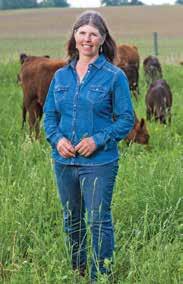
After the screening and panel, Sandra and Jennifer had several people approach them to say that the session was a highlight of the day. People appreciated the real-life stories of producers in the film and panel, and the expertise of the scientists working in the space.
Attendees remarked that the film and panel helped reframe their view of beef production - not as separate from conservation, but as an essential partner in it. Or in Carolyn’s words, attendees “grew new eyes about beef farming.”
To watch Homes on the Range, visit @raisingcdnbeef on YouTube. OB

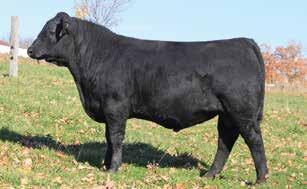
Cell: 705-715-2234 • Email: doncurrie@glenislay.com GLEN ISLAY TENDERLINE 3K [TENDERNESS SCORE 10] • SEVERAL SONS AVAILABLE
The bull calves are weaned, looking really strong, and genomically tested either 9 or 10 for tenderness.
Now is the time to reserve your bulls for 2026, and we will semen test them and deliver them when you want them. Thank You to our customers and

DON & JEANNETTE CURRIE 2234 Conc. 11, R R #1, Nottawa, Ontario L0M 1P0 Phone/Fax: 705-445-1526
Beef farmer, Sandra Vos, Brant County
Investing in the Future How Youth Voices Are Shaping Ontario’s Beef Sector
By Jeanine Moyer
Investing in the next generation of beef farmers isn’t just good strategy, it’s vital to the future of Ontario’s beef sector. As our industry navigates shifting consumer expectations, market fluctuations, innovations, and increasing demands for environmental leadership, it’s more important than ever that we look to young producers who can offer fresh insight, energy, and forward-thinking solutions.
That’s why Beef Farmers of Ontario (BFO) has taken a progressive step by creating three youth representative positions and inviting emerging leaders to participate directly with three of the organization’s standing committees – Cow-Calf, Feedlot and Research.
As Sarah Alton and Kendyl Anderson wrap up their inaugural two-year terms on the Cow-Calf, and Feedlot committees, their experience shows how important it is to give young people a voice, bring new perspectives to the table and invest in future industry leaders. Their experiences prove that involving young producers in policy discussions and industry engagement will help build a stronger, more sustainable beef industry. And, based on their feedback, the future of Ontario’s beef sector is in good hands.
Building Confidence
“This experience has given me more confidence in my own ideas, expanded my knowledge of the industry, and exposed me to new concepts that I can bring back to my own farm,” says Anderson, who began her term on the BFO Cow-Calf committee in 2024. “I was excited to take on the position and eager to learn. I believe this role is an amazing opportunity for young producers to have a voice and represent our generation in the industry.”
Anderson comes from a 150 head cow-calf farm in Mooretown, Ont. where she works alongside her dad, Chad and fiancé, Ed Gilgeous. Since 2024, Anderson and Gilgeous have expanded the family operation to finish cattle to supply their new direct-toconsumer business. It was Anderson’s idea to sell their beef to local customers, and she’s been amazed by how much support they’ve received from the community. “We want to make good, quality, locally raised beef accessible to everyone, and in the process we’re able to engage with our customers and educate them about our farm and industry too,” she says.
While Anderson is completing her PhD at Western University, working as a registered kinesiologist, and helping with the farm’s dayto-day operations, she’s also planning to grow their direct-to-consumer business and continue her involvement in the beef industry. She says her time as a youth representative has given her the certainty and motivation to stay involved in leadership roles within the industry, both locally and at a provincial level.
Sarah Alton of Kenruth Farms in Lucknow, Ont., also speaks highly of her time as the youth representative on BFO’s Feedlot Committee. She
admits she was a bit intimidated to attend industry events at first, but the experience has given her confidence and a new industry network that’s she’s grateful for. Alton is also thankful for the encouragement and mentorship from BFO staff along the way.
“I didn’t know much about the industry beyond the farm, and looking back I’m glad I took the step to join the committee because I’ve learned so much,” she says.
Alton joined her dad, George, on the farm after she graduated from the University of Guelph Ridgetown Campus in 2018. Her focus at the time was to upgrade the farm’s record keep system to enhance efficiencies and inform better business decisions. The family finishes 2,800 head in their feedlot that has seen significant improvements to their data systems and processes since Alton joined the farm full-time.
“I’ve always been interested in the business side of the farm, and I’ve enjoyed bringing new innovations that have helped us maximize our margins,” she says, noting she’s also responsible for the day-to-day farm operations and animal health protocols.
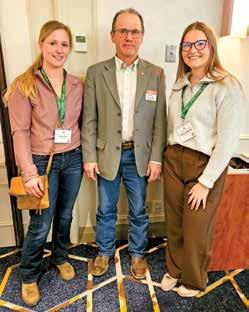
(LtoR) Sarah Alton, BFO Past President Jack Chaffe, Kendyl Anderson
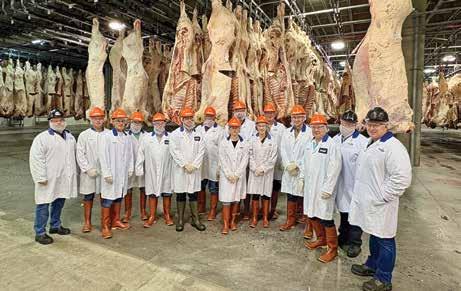
Alton participated in a tour of the Cargill Guelph facility with the BFO Feedlot Committee.
Path to Leadership
To become youth representatives, both Anderson and Alton followed the written application process and were elected by their Ontario Beef Youth Alliance (OBYA) peers. Both positions are two-year terms as non-voting members and applications are now being accepted for the 2026-2028 term position.
“I’ve always been interested in what goes on behind the scenes at BFO and how policy is determined,” says Anderson, who says that she first got involved in industry events by attending OBYA farm tours. Anderson admits she was still relatively new to the industry when she joined the Cow-Calf Committee but was eager to dive in and learn. “So, when the youth position opened up, I was eager to apply.”
Alton took the same approach to her position, leveraging a new opportunity to learn about the beef industry while strengthening her own skills. She says she’s gained a broader perspective by actively participating in discussions and feels that her voice has always been welcomed and heard by fellow committee members. Alton also notes the time commitment as a youth representative was manageable. Many meetings coincided with industry events, like the BFO Annual General Meeting and the summer meeting, and many of the meetings were also held virtually.
“I encourage everyone to apply to the youth representative position,” says Alton. “It’s a great way to get your foot in the door, meet people, and learn.”
Industry Exposure
BFO’s youth roles involve more than just meetings and boardroom discussions for the young producers. Alton says the highlights of her term included a committee tour of the Cargill Protein facility in Guelph, Ont. and participating in an incoming market development trade mission tour with delegates from Saudi Arabia and the United Arab Emirates.
“This experience has increased my understanding of processor requirements and what buyers are looking for when they source Canadian beef,” reflects Alton, noting the on-farm tours across the province and networking opportunities with fellow feedlot producers were also key takeaways from her time on the committee.
Farm tours also topped Anderson’s favourite experiences, but she also found the boardroom discussions just as engaging. She says she was most interested in policy and issues discussions, but the checkoff increase topped her list of engaging topics. “I was fortunate to be involved during such an important transition for our industry,” says Anderson. “I got to listen to producers’ opinions and see how BFO staff responded to their questions and concerns. It really showed me what it takes to keep this industry going.”
Both Anderson and Alton encourage anyone considering applying for the BFO Youth Representative position to take the chance. They both agree that the networking, tours, events, and exposure to industry discussions have been incredibly valuable and rewarding, especially at this stage of their farming careers. Alton also notes that being exposed to fellow producers who have experience and achieved success is inspiring too. “This opportunity has inspired me to get involved in the industry,” she says.
Anderson agrees and says she feels encouraged to continue contributing to the leadership of Ontario’s beef sector. “I went into
the position with some uncertainty, but I always felt included and accepted,” says Anderson. “Every question and opinion I had was welcomed and answered, and I always felt valued.” OB
BFO YOUTH REPRESENTATION
In an effort to further engage with Ontario’s next generation of beef farmers and to increase youth participation within BFO, members of the Ontario Beef Youth Alliance (OBYA) have the opportunity to elect candidates to BFO’s standing committees at our AGM for two-year terms and as non-voting members.
At the 2025 BFO AGM, the Ontario Beef Youth Alliance elected a representative to the BFO Research Committee for a twoyear term. Prior to the 2026 BFO AGM, the OBYA will elect one representative to the BFO Cow-Calf and one representative to the BFO Feedlot Committees for two-year terms. The election will be conducted online and will take place in advance of the BFO AGM.
The BFO Cow-Calf and Feedlot Committee members are expected to undertake duties and review policy matters of relevance to the respective sectors. The committees provide a forum for discussions on issues related to the cow-calf and feedlot sectors, and members of the committees will advise on issues and provide recommendations to the BFO Board of Directors.
Eligibility
• Must be between the ages 18-35 as of January 1st, 2026
• Must be a check-off paying member in good standing as per BFO membership guidelines (includes those who have purchased memberships)
• Must be actively engaged in the raising of cattle and have a keen interest in the Ontario beef sector
• Are not required to be a voting delegate from their local association at BFO’s annual general meeting
• Successful candidates can only serve as a youth committee member for a maximum of one term of two-years Interested candidates will be required to complete and submit an OBYA Candidate Form, by no later than February 3, 2026 (preferred by January 19, 2026).
If you have any questions, please reach out to Charlene Yungblut at charlene@ontariobeef.com or Jaclyn Horenberg at jaclyn@ontariobeef.com.
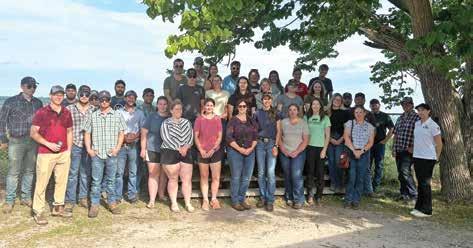
Kendyl joined the Ontario Beef Youth Alliance Tour, which visited Manitoulin Island in July.

















BUILD Leadership Program Returns in April
By BFO Staff
Between 2012 and 2024, Beef Farmers of Ontario (BFO) delivered six iterations of its BUILD Leadership Program in partnership with the Rural Ontario Institute (ROI), graduating 110 leaders and emerging leaders from across the beef sector. Designed to strengthen the leadership skills of both current and future BFO contributors, the program has helped equip farmers with the tools and confidence needed to advance Ontario’s beef industry.
In 2026, the BUILD Leadership Program will return with a refreshed three-session format, with each session building on the skills developed in the previous one. The program will begin with a virtual kick-off evening on April 8, introducing participants to the curriculum, encouraging meaningful selfreflection, and helping them articulate their motivations for becoming stronger leaders.
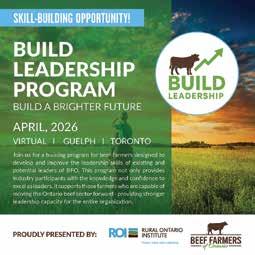
The second sessionLeadership and Governance Excellence - will take place April 13-15 in Guelph.
Over three days, facilitators will
lead participants through a wide range of topics, including personality types, conflict management, effective communication, financial literacy, governance best practices, and strategies for managing personal burnout.
The program will conclude in Toronto on April 26-27 with the Leadership in Action session. This two-day experience will highlight advocacy, government relations, political processes, and media engagement, and will include a visit to Queen’s Park.
While the program emphasizes personal growth and leadership development for its participants, our broader goal is to strengthen leadership capacity across the entire BFO organization.
Spaces in the 2026 program are limited. If you, or someone you know, would be an excellent candidate for this unique learning and growth opportunity, the application process is now open. Please contact Charlene Yungblut at the BFO office for more information or complete the application form available on the BFO website.
As with previous offerings, there is a $150 deposit required to reserve a spot. This fee will be fully refunded upon completion of the program, provided the participant attends all sessions.
Spotlight on Our Graduates
“I’ve gained a great deal of respect and a deeper appreciation for everything our guest speakers have accomplished in their leadership roles. Listening to the lessons and stories that were shared will help guide my path in current and future leadership roles. Great course packed with great leadership training and skills.”
- Geordie MacLaren
“The program starts with a focus on understanding who you are and how your personality shapes your approach to leadership. From there, it shows you how your strengths can truly benefit a team. I’d recommend this program to anyone - it really opens your eyes to everything that happens behind the scenes and gives you a new appreciation for the people working tirelessly for our industry.”
- Micha Gerber OB
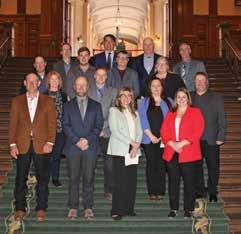
2024 BUILD Leadership Program graduates visit Queen’s Park.

CCA UPDATE Advocacy Efforts Continue Amid Ongoing Trade Pressures
By Tyler Fulton, CCA President www.cattle.ca
By all signs, 2025 will end much as it began: with uncertainty, volatility, and geopolitical challenges.
CCA held a rare press conference on October 23 after legislation was tabled to welcome the United Kingdom into the Comprehensive and Progressive Agreement for Trans-Pacific Partnership (CPTPP). Due to non-tariff trade barriers, the UK market remains inaccessible to Canadian beef while imports of UK beef into Canada have been welcomed. The situation has become even more inequitable to Canadian beef producers as the value of UK beef imports into Canada rose from $16.6 million in 2023 to $42.5 million in 2024, a 156 per cent year-over-year increase. From January to August 2025, imports totalled $32.2 million, up 19 per cent from the same period in 2024.
As the UK walked away from bilateral negotiations, CCA called on the Government of Canada to terminate the trade continuity agreement and ensure bilateral negations can begin again, where our barriers can be properly addressed. Beef Farmers of Ontario (BFO) was quick to publicly support our position, for which we are very grateful. It is important that our industry stands united in our requests and opposition.
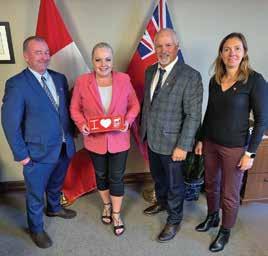
We were united and focused earlier this fall when representatives from Ontario, Quebec and Alberta were in Ottawa at the same time for CCA-hosted producer fly-ins. BFO President Craig McLaughlin, Vice President Jason LeBlond, staff Evan Chaffe, and CCA director and beef producer Don Hargrave joined CCA staff in meetings with MPs, Senators, and Parliamentarians, including MPs Lianne Rood, Emma Harrison, Pauline Rochefort and Shelby Kramp-Neuman.
Among the topics discussed at these meetings were business risk management programs, tariffs and non-tariff trade barriers, trade and market access, regulatory burdens, the need for regulatory alignment with the U.S. and other international trade partners, and the importance of enhanced preparedness for foreign animal diseases. None of these topics were new issues, but it takes several meetings stretching over weeks, months or years and time to build momentum to effect change.
Meetings with government officials allow us to discuss topics of both national and regional importance. We engage in meaningful conversations with Parliamentarians on priorities that matter most to our industry and to beef producers in each region, ensuring your voices are heard at the national level. It is an opportunity for education, relationship building and advocacy.
As we look back over this year, uncertainty over the Canada-U.S. trade relationship has seen CCA busier than usual advocating for the continued integration
of the North American beef industry. The U.S. and Canada have the largest two-way trade in live cattle and beef in the world and 70 per cent of Canadian beef exports are bound for the United States. Small- and medium-sized American processors and local and regional food systems rely on Canadian cattle to thrive and stay in business. Canadian producers import live cattle from many states and high-value genetics in the form of semen and embryos are regularly bought and sold on both sides of the border. This integration of our live cattle and beef markets is why CCA places huge emphasis on advocacy efforts in the U.S.
CCA also welcomes and celebrates market expansion and new market opportunities. This year, we have seen the Australian market open for Canadian beef, the signing of the Indonesia-Canada Comprehensive Economic Partnership Agreement (CEPA), and the launch of Canadian beef in 41 Costco locations across Mexico. The global demand for beef is increasing and there is growing momentum for Canadian beef in the Indo-Pacific region. Indonesia is forecast to become the world’s fourth-largest economy by 2050. With a growing population and growing consumer demand, there is significant opportunity to gain market share. We look forward to seeing this market expand.
Throughout the year we also welcomed announced improvements to AgriStability, Livestock Tax Deferral for regions impacted by extreme weather, and increased compensation for producers who have had their herds depopulated due to disease control efforts. As the end of the year approaches and thoughts turn toward the new year, it is a good time to review your business plan, emergency response plan, biosecurity protocols, and the business risk management programs available to you. Your provincial association and government, our national government and the beef and agricultural industries all offer tools and programs to help support your work in raising beef cattle and producing high quality genetics. While not every program will work for every producer or operation, it’s important to regularly evaluate the tools and support programs available to you to ensure you are not missing opportunities.
If you have questions about CCA’s advocacy efforts or specific challenges, we encourage you to reach out to us at contact@cattle.ca or (403) 275-8558. We welcome your questions and feedback. On behalf of all of the elected member representatives and staff of the Canadian Cattle Association, we wish you a Merry Christmas and a healthy, prosperous and happy new year. OB
BFO President Craig McLaughlin and Vice President Jason LeBlond joined CCA staff in meetings with MPs, Senators, and Parliamentarians, including MPs Lianne Rood, Emma Harrison, Pauline Rochefort and Shelby Kramp-Neuman.


CANADA BEEF UPDATE Canada Beef Shines at the Royal Winter Fair
By Gina Teel, Director, Stakeholder Communications, Canada Beef
The Royal Agricultural Winter Fair 2025 proved to be a busy time for Canada Beef. The fair was packed with students, many of whom visited the Canada Beef booth, and Canada Beef’s culinary activations on the fair’s cooking stage sold out.
Canada Beef’s crowd-pleasing culinary activations featured participants who cooked along with top Toronto chefs and created recipes for two people. Canada Beef also sponsored a Dinner Series where participants tasted Canadian beef over a three-course meal and held three Canadian Beef Taste
Challenges that featured underutilized cuts of beef to gain insight into consumer’ preferences.
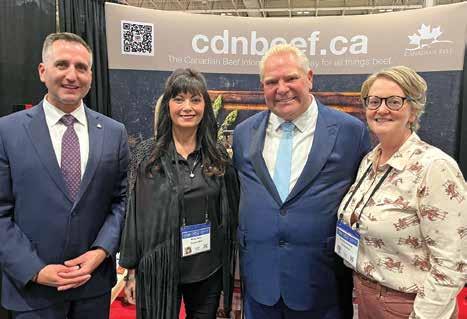
Ontario Premier Doug Ford and Minister of Agriculture, Food and Agribusiness Trevor Jones, stopped by the Canada Beef booth and chatted with Canada Beef staff Michele McAdoo and Kelly Hyde.
The booth highlighted a key Canada Beef initiative - the Canadian Beef Information Gateway (Retail Gateway). To help drive traffic to and within the platform, a special contest, The Great Canadian Steak Search Contest, was launched. Attendees were encouraged to visit the Gateway to participate. Each person could earn up to three entries, with each entry requiring them to answer a question about the proper cooking method for a specific steak cut. The contest was also promoted through social media.
Prizes included a $1,000 cash award (equivalent to roughly 40 steaks at $25 each) and a ‘Canadian Steak Your Claim’ kit featuring a variety of fun and practical Canada Beef promotional items. Both the contest and the Gateway received positive feedback from producer and consumer audiences.
Canadian Beef Centre of Excellence (CBCE) staff, also in Toronto in November, participated in Taste Canada’s Cooks the Books competition. Chef Mathieu Paré served as a judge along with other leading Canadian chefs. The culinary student teams toured the Ontario Beef Research Centre in Elora, Ontario, the next day as part of the educational component of the Taste Canada Awards’ - Cooks the Books, national student culinary competition.
Chef Paré and Canada Beef staff McAdoo, Executive Director, Consumer Marketing, and Karin Rekunyk, Director, Health and Nutrition, helped lead the tour and engaged with the students, instructors, and research teams, all the while reinforcing Canadian beef’s quality, nutritional value, and sustainability story.
The importance of evidence-based health and nutrition messaging for beef was underscored recently at the World Meat Congress in Cuiabá, Brazil. Hosted by the International Meat Secretariat, the event focused on the global structural shift underway in how food is produced, traded, consumed, and valued.
At the same time, demand for beef is growing, sustainability and production practices remain key topics, and consumers more than ever are at the forefront of priorities, noted Canada Beef President Eric Bienvenue.
Managing both paths effectively will require clear communication, leadership in sustainability, scientific credibility in health messaging, and proactive global engagement. Bienvenue noted many of the topics discussed in Brazil intersect with initiatives developed by Canada Beef in recent years to heighten visibility and profile in domestic and international export markets, and that the team will continue to build off these successes going forward. Canada Beef is well-positioned to manage the challenges and opportunities that lay ahead.
Canada Beef’s proposed investment plan for fiscal 2026-2027 represents a recalibration of strategies to drive value for Canadian beef and veal and protect market share during a challenging period defined by a shifting global protein landscape, ongoing market volatility, and trade tensions. A continuation of the tight supply – high demand scenario throughout this period will place sustained upward pressure on retail beef pricing. Prolonged exposure to increasingly expensive beef may test consumers’ resilience.
The plan will manage this and other factors with a variety of tactics and strategies. For example, increased emphasis will be placed on enhancing Canada Beef’s credible nutrition and health narrative about beef as a health-supporting food and new and meaningful ways for consumers to connect with Canadian beef and deepen brand affinity will be implemented. Digital engagement will be enhanced and resources optimized to increase mindshare with consumers. The development of Artificial Intelligence approaches which leverage the Beef Information Database, with a focus on development of generative chat bot (virtual assistant) tools for use by Canada Beef as well as industry partners, will continue. These awareness building efforts will also boost public engagement with important consumer initiatives like the Canadian Beef Information Gateway. Collaboration with industry partners will increase to improve marketing efficiency.
Ontario Premier Doug Ford and Ontario Minister of Agriculture, Food & Agribusiness, Trevor Jones, stopped by the Canada Beef booth to say hello to Kelly Hyde and Michele McAdoo.
Market diversification will remain a priority given the evolution of geopolitical tensions, ongoing tariff threats, Made in America, and the renewal of the Canada-United States-Mexico Agreement (CUSMA) in 2026. While the U.S. remains Canada’s most important export market, efforts must continue to open markets to maximize returns with other export customers.
Canada Beef delivers marketing initiatives in more than 20 countries, working with Canadian beef suppliers, importers, distributors, retailers, foodservice operators, and government partners. Marketing programs are tailored to each region with messaging focusing on attributes most important in each market. These efforts ensure Canadian beef maintains and grows its presence and market share in highly competitive markets, getting the right cut to the right market to maximize carcass cut-out values.
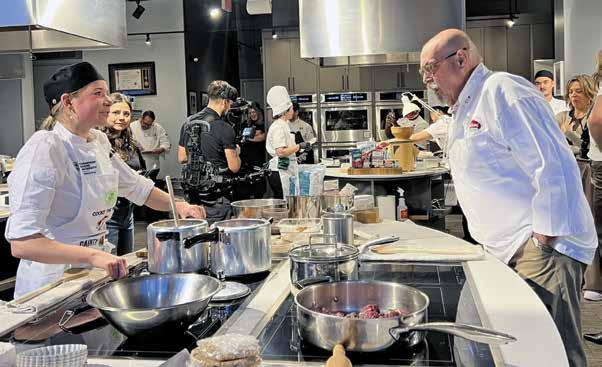
Canadian Beef Centre of Excellence staff participated in Taste Canada’s Cooks the Books competition. Chef Mathieu Paré served as a judge along with other leading Canadian chefs.
Lastly, with the Christmas holidays fast approaching, Canada Beef would like to thank the nation’s beef producers for their continued support.
Canada Beef has refreshed its International Market Intelligence videos, find the latest efforts here and see how Canada Beef continues to evolve its offerings to build awareness that supports bridging to new opportunities.

On behalf of the entire Canada Beef team, please accept our best wishes for a happy and healthy holiday season and a new year filled with peace, joy, and prosperity. OB
VANCISE CATTLE COMPANY FEMALES AVAILABLE
SHOW HEIFER PROSPECTS
Purebed Red Angus and Red Angus X (pictures available on request)
OPEN REPLACEMENT HEIFERS
F1 Red Angus x Simm and Red Angus X Hereford
BRED HEIFERS
Red Angus and Red Angus cross heifers bred to calving ease Red Angus bull
Hereford heifers bred to calving ease Hereford bull
I would like to extend a big THANK YOU to all those who purchased bulls and females this year.





RESEARCH UPDATE Staying on Top of Emerging Issues: Perspectives from the Value Chain
By Lilian Schaer
Staying on top of emerging trends is essential for ensuring the longterm success and competitiveness of Ontario’s livestock sector.
That’s where LRIC’s Emerging Trends and Opportunities Committee (ETOC) comes in. Bringing together forward-thinking leaders from across the value chain — from farms and research labs to processors and retailers — ETOC uses the collective expertise and real-world experience of its members to identify and explore the “big picture” issues shaping animal agriculture.
By keeping an eye on what’s ahead, the committee helps the sector anticipate change, embrace innovation, and stay ahead of the curve in an increasingly complex and fast-moving world.
The committee’s members represent the breadth of the livestock value chain. Chair Ian Ross (Grand Valley Fortifiers) is joined by Rene Van Acker (University of Guelph), consultant Jim White, LRIC staff Kelly Somerville and Jean Howden, consultant Paul Uys (retail), consultant Ted Bilyea (processing), Stacie Sopinka (Sobeys Inc.), Dave Vandenberg (University of Guelph), Arnold Drung (Conestoga Meats), Stuart McGregor (Alltech), consultant Al Mussell (economics), and Mike Von Massow (University of Guelph).
In this article, we speak with Stacie Sopinka, Vice President Own Brands at Sobeys, and Stuart McGregor, Vice President of Commercial Business with Alltech Canada, on what they see as the biggest disruptors facing the livestock value chain and how research can help address them.
Sopinka’s team manages Sobey’s national Own Brands program, overseeing new product development including packaging, compliance, and go-to-market strategy.
McGregor oversees Alltech’s Canadian business, including sales and marketing, and providing key account support
Q: How long have you been involved with LRIC, and what drew you to the ETOC?
Sopinka: I’ve been part of ETOC since it began about two years ago. Early in my career, I had the pleasure of working in conjunction with Grand Valley Fortifiers, which exposed me to the value of creating dialogue across the supply chain. Visiting farms that produced for retailers really showed me the importance of agriculture and livestock, and the families and businesses they support. I also find ETOC eyeopening and educational because I learn so much from peers across the chain.
McGregor: Alltech has been a partner member of LRIC from early on, and I’ve been part of ETOC since its inception a couple of years ago. What first drew me in was a conversation with Ian Ross about the committee’s focus — everyone in the livestock sector is looking for new opportunities to strengthen Canada’s brand through sustainability, animal health, and productivity. Being part of a group where we can regularly sit around the table, share ideas, and discuss what’s coming next for Ontario and Canadian agriculture is an incredible opportunity.
Q: What do you see as the biggest disruptors facing the livestock value chain?
Sopinka: Consumer behaviour is changing rapidly. People are very value-oriented and making shifts in how much or which proteins they buy. Demographics are also shifting—diverse populations mean
demand for culturally-specific products like Halal, for example, which changes the assortment we need. Finally, geopolitical issues ripple through global supply chains and add layers of complexity.
McGregor: One of the biggest challenges is maintaining competitiveness — both within Canada and in export markets. Issues like tariffs, shifting political landscapes, and upcoming policies such as Voluntary Country of Origin Labelling in the U.S. all have ripple effects that influence how competitive we can be.
Ongoing disease pressures are another major disruptor, creating both challenges and opportunities for innovation.
Q: From the retail perspective, what’s most pressing?
Sopinka: The ability to source Canadian-made products when customers want them. Consumers increasingly ask for Canadian, but supply can be limited. Value is also key—not just lowest cost, but the value as customers perceive it.
Q: From the animal nutrition perspective, what is the biggest priority?
McGregor: At the end of the day, our goal is to ensure that our customers and producers see a strong return on investment for what they put into nutrition, genetics, and management. We need to make sure Canada remains sustainable and self-reliant while continuing to access diverse markets so that our products — from ingredients to meat, milk, and eggs — remain affordable and appealing to consumers.
Q: How can LRIC and research help – and what research gaps do you see?
Sopinka: One of the biggest benefits of LRIC has been democratizing research—making it more accessible and usable across the value chain. It’s also created a network so you know who to call when you have questions. That helps break down silos, build empathy for different perspectives, and make sure research is relevant to all stakeholders.
I think more work is needed on how social media and livestreaming affect Canadian consumer perceptions of livestock. U.S. media strongly influences Canadians, and decisions around protein choices are often driven by emotion, not facts. Better understanding this would help the whole sector.
McGregor: We need fundamental research that continues to drive sustainability, efficiency, animal health, and innovation so Canada can stay competitive on the local and global stage. At Alltech, our logo includes a microscope — a reminder that science and discovery are at the core of who we are. But research can’t happen in isolation. There’s incredible work being done by private companies and universities across the country, yet too often those efforts happen independently. That’s where LRIC plays such an important role — bringing people together from across sectors to collaborate, share ideas, and identify common priorities so we can foster stronger partnerships between private industry and public research.
LRIC is funded in part by the Sustainable Canadian Agricultural Partnership (Sustainable CAP), a five-year, federal-provincial-territorial initiative.
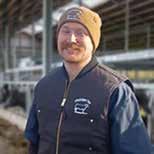
WhenFOCUS ON HERD HEALTH
By Cole Radbourne, DVM, Metzger Veterinary Services
Water Belly: Detection and Prevention
it comes to beef cattle health challenges, some conditions are loud and obvious—like a limping steer or a coughing calf. But others can sneak up quietly and cost you an animal before you realize anything is wrong. One such issue is urolithiasis, more commonly known as “water belly.”
Despite its nickname, water belly has nothing to do with water intake. Instead, it’s a painful and potentially fatal condition caused by urinary stones (uroliths) forming in the kidney, bladder or urethra (the tube that carries urine out of the body). When these stones block the flow of urine, pressure builds in the bladder and can eventually lead to rupture. This is where the term “water belly” comes from—urine leaks into the abdomen, creating swelling and fluid accumulation.
Let’s take a closer look at how to spot this condition early, why it happens, and most importantly, what can be done to prevent it.
What Is Urolithiasis?
Urolithiasis refers to the formation of mineral stones - similar to kidney stones in humans - anywhere in the urinary tract. In beef cattle, the most common location for problems is in the urethra (the tube that carries urine out of the body), particularly in steers.
Why steers? The urethra of a steer is narrower and longer than that of an intact bull, and during castration, testosterone-driven growth of the penis and urethra is halted. This makes it easier for a stone to get lodged, especially in a key anatomical pinch point called the sigmoid flexure - a natural S - shaped curve in the penis that allows it to retract inside the body. This creates a “bottleneck” where the tube narrows or bends sharply, making it harder for a stone to pass through.
The early signs of urolithiasis are subtle—but if you know what to watch for, early detection is possible:
• Straining to urinate: You might see a steer arching its back, dribbling urine, or posturing to urinate without producing any.
• Tail twitching or kicking at the belly: These signs of discomfort often go unnoticed in a busy feedlot pen.
• Swelling around the sheath or under the belly: This may be urine backing up or leaking under the skin.
• Acting Depressed or off-feed: As the bladder becomes distended or ruptures, toxins build up in the bloodstream.
• Sudden death: Unfortunately, this can be the first sign producers notice, especially in cases of bladder or urethral rupture.
One of the most common ways this condition first gets noticed is when a producer calls about a “gut obstruction.” The steer is straining, passing no manure, and may even have a slight rectal prolapse. In reality, the animal has pushed out all its manure and is straining because it can’t urinate — not because the intestines are blocked.
Once a rupture occurs, the prognosis worsens significantly. Catching it early improves your chance of saving the animal with surgical intervention, but prevention is far more effective than treatment.
Types of Uroliths in Feedlot Cattle
Phosphate stones – including struvite (magnesium ammonium phosphate) and apatite (calcium phosphate). These form in alkaline (less acidic) urine, common in grain-heavy diets that are low in effective fiber. High-phosphorus rations, especially those based on cereal grains, increase the risk — especially if calcium levels are too low.
Calcium carbonate stones – more common in cattle eating a lot of legumes (like alfalfa) or when calcium-to-phosphorus balance is off.
Silica stones – increasingly seen in stocker cattle brought in from western Canada, where silica levels in soil and water are naturally high. These cattle often show signs of blockage within about 10 days of arriving in Ontario feedlots.
While some stones may remain small and pass without issue, others grow and clump together, especially in animals with sluggish water intake or poor urine flow.
Why Does It Happen?
Several factors contribute to stone formation in cattle, and most are nutritional or management-related:
1. High-Concentrate, Low-Fiber Diets
Grain-heavy rations promote alkaline urine. In alkaline conditions, phosphate-based stones are more likely to crystallize.
2. Imbalanced Phosphorus and Calcium Ratios
Diets with too much phosphorus (often from grain) and not enough calcium encourage phosphate stone formation. The ideal Ca:P ratio should be 2:1 or higher to reduce the risk. Some of our high-performance finisher diets can see ratios around 1.5:1 but will need proper formulation to be safe an effective.
3. Low Salt Intake
Salt drives thirst and water intake. If cattle don’t consume enough salt, they may not drink enough water to keep the urinary tract flushed and healthy. Low sodium is often linked with decreased feed intake as well, ultimately hurting average daily gain.
4. Poor Water Intake
Whether due to cold weather, frozen waterers, or social dynamics around the trough, any reduction in water consumption can concentrate the urine and promote stone formation.
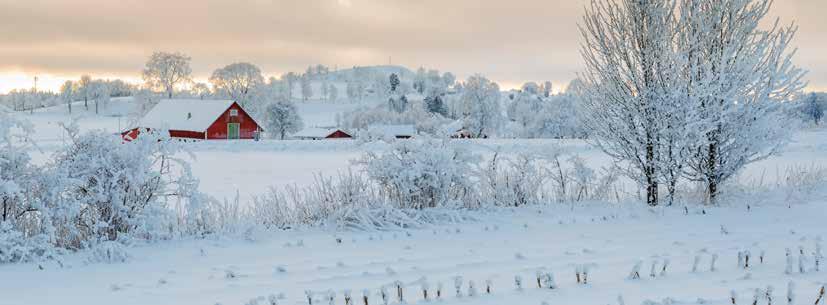
Prevention Strategies: Managing the Risk
Urolithiasis is largely preventable with attention to nutrition, hydration, and mineral balance. Here are key steps you can take:
1. Balance the Ration
Work with a nutritionist or vet to ensure the diet has:
• A calcium to phosphorus ratio of at least 2:1
• Adequate long-stem fiber to keep rumen pH stable and reduce phosphorus excretion in urine.
• Appropriate use of high-phosphorus ingredients, like cereal grains or certain by-products.
Adding calcium sources like limestone or calcium carbonate can help correct certain imbalances.
2. Ensure Consistent Salt Intake
• Offer loose salt or mineral mix rather than blocks, especially in colder months when cattle may not lick as often.
• Consider adding salt directly to the TMR to drive water consumption.
Increased water intake helps flush the urinary tract and dilute minerals before they crystallize.
3. Monitor Water Availability
• Make sure all animals can access clean, fresh water at all times.
• Check for frozen troughs, clogged lines, or dominant animals preventing others from drinking.
• Consider heated waterers in winter months.
4. Collect Samples and Investigate Losses
If you lose a steer to suspected water belly, call your veterinarian to perform a post-mortem. Collecting and analyzing urinary stones can
help determine what type of mineral is forming—and guide ration adjustments. Consider submitting feed samples to evaluate mineral levels, especially calcium, phosphorus, and sodium, to ensure the diet matches the animal’s production stage. A few diagnostic steps can prevent future losses and save you money in the long run.
5. Watch for Early Warning Signs
Train staff and caregivers to notice:
• Changes in urination
• Steers that separate from the group or stand hunched
• Any abdominal swelling or sheath distension
Prompt intervention - especially before rupture - can mean the difference between treatment success and a loss.
Treatment Options
If a steer shows signs of urinary blockage, contact your veterinarian immediately. In some cases, a urethrostomy (surgical opening of the urethra ahead of the blockage) can relieve pressure and save the animal. However, animals with ruptured bladders or extensive urine accumulation often have a poor prognosis and may need to be euthanized on welfare grounds.
Final Thoughts
“Water belly” is a frustrating and costly condition in feedlot steers. By the time you see signs, it may already be too late. But with good nutritional planning, salt and water management, and keen observation, urolithiasis can be significantly reduced in your herd.
Talk with your veterinarian or nutritionist about your current feeding program and what adjustments might reduce the risk. A few small changes in diet formulation and management could save you the headache—and cost—of losing otherwise healthy animals to this silent threat. OB
Changes to Ontario Licensed Dealers List
No Longer Licenced
Abattoir
Northern Meat Packers & Abattoir Ltd.
Trout Creek, ON
The Ontario Beef Cattle Financial Protection Program is administered by Agricorp. The listing of licensed dealers is updated regularly and the complete listing can be found on the Agricorp website. OB
Aylmer Stockyards Inc.
Brussels Livestock

Auction Markets’ Holiday Sales Schedule 2025/26
Dec. 17 - Regular Sale
Dec. 24 - Closed
Dec. 31 - Regular Sale & Month End Stocker Sale
Dec. 16 - Fed Cattle & Cow Sale
Dec. 18 - Veal & Lamb, Sheep & Goat Sale
Dec. 19 - Stocker Sale
Dec. 21 - Jan. 4, 2026 - Closed, but open for receiving cattle on Jan. 5th
Jan. 6 - Regular Schedule Resumes - Fed Cattle and Cow Sales
Maple Hill Auction Market
Ontario Livestock Exchange Inc.
Cargill Auction Market Closed for the holidays
Ontario Stockyards Inc..
Closed for the holiday season. Sales will resume in the new year. For more information call 519-379-1370.
Dec. 16 - Regular Tuesday Sale - Fed Cows, Veal, Sheep, Lambs, Goats
Dec. 17 - Regular Wednesday Special Vaccinated Stocker Sale
Dec. 18 - Regular Thursday Sale - Beef, Fed Cows, Stockers, Dairy & Bob Calves
Dec. 22 - Regular Tuesday Sale Held on MondayCows, Veal, Lambs, Goats & Sheep
Dec. 23 - No Sale - Office and barn closing at 4 p.m.
Dec. 24-28 - Closed
Dec. 29 - Open for receiving from 4 p.m. to 10 p.m.
Dec. 30 - Regular Tuesday Sale - Fed Cows, Veal, Sheep, Lambs, Goats
Dec 31 - Regular Wednesday Special Vaccinated Stocker Sale
Jan 1, 2026 - Closed, barn receiving from 4 p.m. to 10 p.m.
Jan 2 - Regular Thursday Sale Held on Friday - Beef, Fed Cows, Stockers, Dairy & Bob Calves
Jan 3 - Horse Sale
Dec. 15 - Regular Sale - Veal, Lambs, Goats, Sheep
Dec. 17 - Regular Sale - Fat Cattle, Cows, Bulls
Dec. 18 - Regular Sale - Stocker Sale
Dec. 21 to Jan. 2, 2026 - Closed
Jan. 3-4 - Open for recieving livestock
Jan. 5 - Regular Sale - Veal, Lambs, Goats, Sheep
Denfield Livestock Exchange
Dec. 16 - Regular Tuesday Sale
Dec. 23 - Closed
Dec. 30 - Regular Tuesday Sale
Jan. 6, 2026 - Regular Schedule Resumes
Ottawa Livestock Exchange/ Embrun Livestock
Hoards Station Sale Barn
Kawartha Lakes Community Sale Barn Inc.
Keady Livestock Market Ltd.
Dec. 16 - Regular Sale
Dec. 21 - Jan. 4, 2026 - Closed
Jan. 5 - Open for receiving livestock
Jan. 6 - Regular Schedule Resumes - Livestock Sale
Dec. 20 - Regular Saturday Sale
Dec. 27 - Regular Saturday Sale
Jan. 3, 2026 - Regular Schedule Resumes
Dec. 16 - Regular Sale and Last Sale of 2025
Beef ring at 9 a.m. - Hog barn at 12 p.m. (noon)
Dec. 17 - Closed for the holidays
Jan., 2026 - Sales Resume - Call the Office to Confirm the Date
Renfrew Pontiac Livestock
Temiskaming Livestock Exchange
Vankleek Hill Livestock Exchange Ltd.
Dec. 15 - Regular Embrun Sale
Dec. 18 - Regular Ottawa Sale
Dec. 22 - Regular Embrun Sale
Dec. 23 - Open
Dec. 24-26 - Closed
Dec. 29 - Regular Embrun Sale
Dec. 30 - Open
Dec. 31 - Jan. 2, 2026 - Closed
Jan. 5, 2026 - Regular Schedule Resumes
Dec. 16 - Regular Sale
Dec. 23 - No Sale, Closed
Dec. 30 - No Sale, Closed
Jan. 6, 2026 - Regular Schedule Resumes
Dec. 15 - Regular Sale
Dec. 22 - No Sale, Closed
Dec. 29 - No Sale, Closed
Jan. 5, 2026 - Regular Schedule Resumes
Dec. 22 - Regular Sale
Dec. 24 - Closed
Dec. 29 - Regular Sale
Dec. 31 - Closed

PRICES FED CATTLE
MARKET INFORMATION UPDATE
By Jamie Kerr, Market Analyst for Canfax and BFO markets@ontariobeef.com • www.ontariobeef.com
Since putting in new all-time highs in September, Ontario fed steer and heifer prices softened in October, easing $8-10/cwt lower from September’s highs.
During the second half of October and the first half of November, President Trump made several announcements aimed at lowering retail beef prices. First, was an increase to Argentina’s beef quota level, quadrupling to 80,000 tonnes. There was also an order to open up federal lands for grazing in an effort to rebuild the U.S. cattle herd. In November, there was a pledge to investigate packer collusion, which also impacted live cattle futures. Reciprocal tariffs, first announced April 2, have also been removed from beef. Australian beef coming into the U.S. is now tariff-free. On November 20, there was the removal of the 40 per cent tariff on Brazilian beef imports. Then, Tyson announced they would be closing their Lexington, Nebraska plant in January and reducing to one shift at Amarillo, Texas.
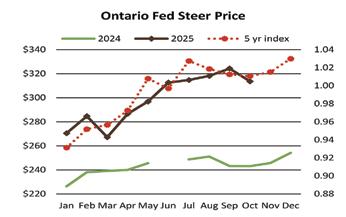
Despite a softer October, fed steer prices were up $70/cwt from last year. Fed heifer prices kept pace with their steer counterparts in October, up $71/cwt from last year. A softer tone was noted in November, with prices back to May/June levels.
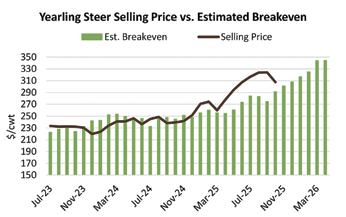
Ontario fed steers have been at a premium to Alberta fed steers for eight of the first ten months of 2025. September and October saw Ontario steers average a $10/cwt premium to Alberta but a C$10/cwt discount to the U.S. (all area average).
Fed steers sold on the cash market (with no risk management) have seen positive margins for 11 straight months. Between November 2024 and October 2025, margins averaged $24/cwt in the black. Cash margins in September and October averaged $33/cwt.
Estimated feedlot breakeven levels have steadily climbed, with a notable increase occurring since September. Looking out to March and April 2026, estimated breakeven levels are just shy of $345/ cwt. Risk management strategies play an important role in reducing exposure.
The Ontario-to-Nebraska cash basis has been largely steady with last year since June. In October, it was -13 (+3 from last year).
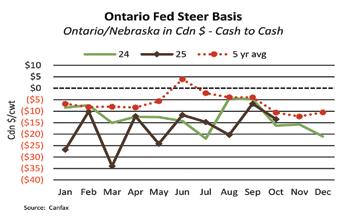
U.S. fed steer prices have softened C$22/cwt over the last 12 weeks since putting in their annual high mid-August. In comparison, Ontario fed steers have been a more modest $7/cwt softer, helping strengthen the cash basis.
As of time of writing, live cattle and beef trade data for September was not available. Ripple effects from the 43-day U.S. government
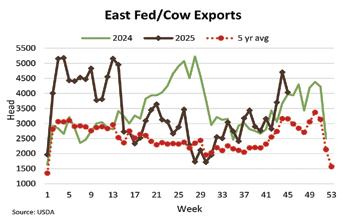
Continued from page 35. – Market Info shutdown has delayed Statistics Canada publications (see August data in the table below). Some U.S. analysts are projecting the U.S. needs up to two months to update all their reports.
Based on USDA weekly data, YTD (to the week ending November 7), eastern Canadian fed cattle and cow exports to the U.S. were just shy of 151,000 head. Volumes are steady with last year. Export volumes were up 6 per cent in September and October, following seasonal trends.
MONTHLY LIVE CATTLE EXPORTS – ONTARIO
January Year to % Change YTD Change from - August Date from last year last year YTD (head)
Steers 35,963 -10% -4,213 Heifers 25,495 -3% -821 Cows
-5%
Total 94,450 -4% -3,534
Source: Statistics Canada
FEEDER CATTLE
While the Alberta market dropped with negative news out of the U.S., the Ontario market showed remarkable resilience with the price adjustment not showing up until the second week of November. Producers may have looked past volatility in the futures market, recognizing North American feeder supplies are tight.
Ontario 550-lb steer calves climbed above the $540/cwt mark in October, putting in a new all-time high. These light-weight calves were up $225/cwt from last year. The first half of November sales suggest a softer market.
Ontario 550-lb steer calves averaged a $38/cwt discount against Alberta in September and October, but were at a C$27/cwt premium to the U.S. Ontario-U.S. steer calf price spreads may have attracted imports this fall.
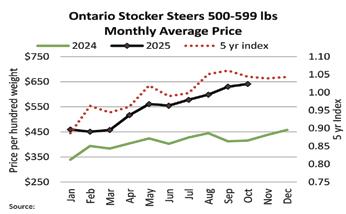
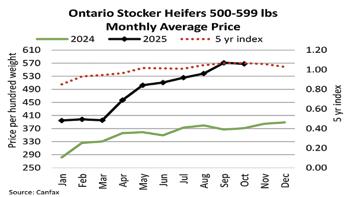
During the fall run, 550-lb heifer calves were priced at 89-91 per cent of steer calves, which was similar to last year. Price ratios have slowly but inconsistently narrowed since the end of 2022 when heifer calves were priced at 79 per cent of their steer counterparts.
For the second consecutive month, Ontario 850-lb yearling steers averaged above $500/cwt, ending the month near $504/cwt. Yearling steer prices were up $170/cwt from last.
Ontario 850-lb feeder steers were the premium market during the peak fall run. Averaging a very slight $0.50/cwt premium to Alberta and a C$21/cwt premium to the U.S., attracting feeders.
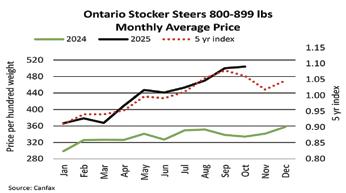
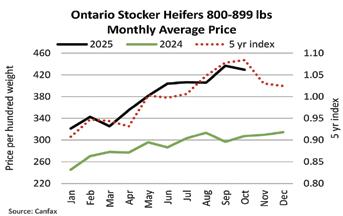
Heavier-weight (850 lb) feeder heifers were priced at 85-87 per cent of their steer mates. This was moderately narrower compared to last year when heifer prices ranged from 88-92 per cent of steers. Price ratios narrowed between January and October 2024 and have been shown some variability since.
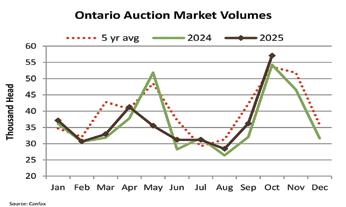
Year-to-date, Ontario auction volumes total 387,000 head, up 1 per cent from last year. Monthly auction volumes have been above a year ago for much of the year, with the exception of May (-32%), and July (-2%). During the heart of the fall run in September and October, auction volumes were 8 per cent larger than last year.
To week ending November 7, eastern Canadian feeder exports were 37,000 head, down 20 per cent from last year. Weekly feeder export volumes generally moved steady with last year through much of the first nine months of 2025, except for the first quarter, due to tariff uncertainty. Since the second half of September, volumes have followed the five-year average. As noted in the feeder section, both the Ontario calf and yearling markets were at a premium to the U.S. in September and October, keeping more feeders at home.
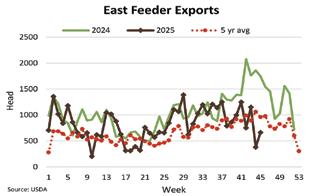
FEED GRAINS
Ontario corn prices put in their annual low in August, a couple of months before the beginning of the 2025 corn harvest season. By October, corn prices averaged $239/tonne, up $15/tonne from August. The October corn price was up $22/tonne from last year. First half of November corn trade is above $245/tonne. Cost of gain has slightly deteriorated for feedlots.
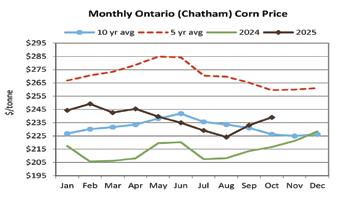
Omaha corn prices have been steady to lower than a year ago since May. Omaha corn also put in their annual low in August and have rebounded slightly higher since. By October, Omaha corn was just shy of US$4/bushel. Ontario corn was at a premium to Omaha corn in October, putting Ontario feedlots at a feeding disadvantage.
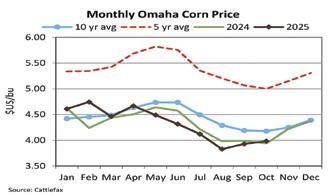
The November USDA World Agriculture Supply and Demand Estimates (WASDE) report showed a 65-million-bushel reduction in the U.S. corn crop. However, this year’s corn crop, at 16.8 billion bushels, is still projected to be record large, up 12 per cent from last year. Larger production is projected to offset increases in ethanol use (+3%) and total domestic use (+6%).
U.S. corn ending stocks are projected to be 2.2 billion bushels, up 41 per cent from last year. If realized, a record-large corn crop may provide some relief on the feed grain side going into 2026.
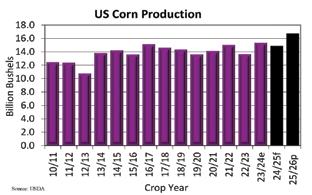
CULL COWS
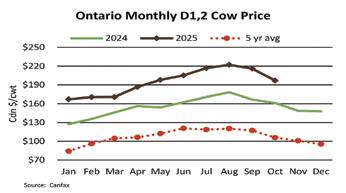
Ontario D2 cows have followed historical trends this year, albeit at a premium. In October, Ontario D2 cows averaged $197/cwt, up $36/ cwt from last year. Ontario D2 cows were the least expensive in North America in September and October. Averaging a $17/cwt discount against Alberta D2 cows and a C$23/cwt discount against U.S. Utility cows.
Cull cow auction volumes totaled 16,300 head in September and October, up 8 per cent from last year. Beef cows were down 9 per cent while dairy cows were up 14 per cent. Seasonally, beef cow volumes peak in November, while dairy volumes peak in January.
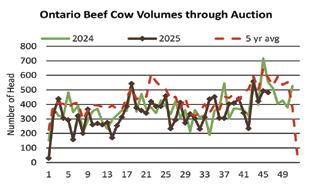
GRADING
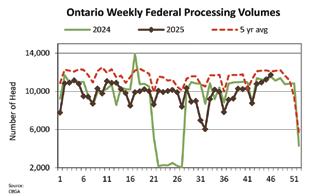
Ontario processing (FI only) is up 5 per cent year-to-date from last year, but down 11 per cent from the five-year average. After running below year ago volumes from mid-July through mid-October, since mid-October weekly processing has rebounded to be steady with last year in the first part of November. In September and October, Ontario processing was down 8 per cent from last year.
Ontario steer carcass weights were mostly steady with seasonal trends in September and October. Carcass weights averaged 972 lb, down five pounds from the same period last year. The first week of November saw steer carcass weights touch 1,000 lb for the first time since April 2024 (omitting the six-week period from the end of May to the beginning of July 2024 when the Cargill packing plant was closed).
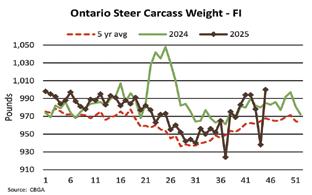
Seasonally, carcass weights in November and December re-visit their first quarter levels, ending the year just short of their first quarter highs. Three of the past five weeks have carcass weights above a year ago. Leverage plays a role in carcass weights.
DOMESTIC BEEF PRODUCTION
Source: CBGA
The week ending November 8th domestic beef production is down 5 per cent from last year. Fed production is down 5 per cent with non-fed production down 2 per cent. Production volumes are primarily driven by the west. In the east, domestic beef production is up 4 per cent with fed production up 3% and non-fed production up 9 per cent.
Year-to-date eastern Canadian carcasses grading either AAA or Prime were at 73.5 per cent, steady with last year. Quality grading in September and October was 72.2 per cent, down one percentage point from the same period last year.
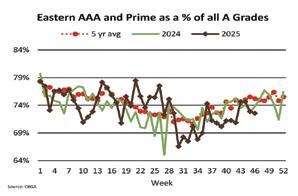
BOXED BEEF
Choice cutouts trekked higher through most of the second and third quarters, peaking at US$396/cwt in September. A softer market was noted in October. With a weak rally before the U.S. Thanksgiving holiday. Reduced lean trim supplies pulled some end meats into grinding lines for ground beef. Cutouts values in September and October were up 18-30 per cent from last year. The removal of tariffs on imported beef is expected to provide modest relief in January.
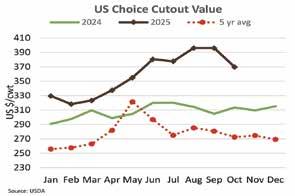
BEEF TRADE
BEEF EXPORTS – CANADA (AAFC) Jan 1- Aug 31, 2025 YTD % Change Change from LY tonnes from LY (tonnes)
United States 233,522 -4% -8,733
Japan 28,073 -10% -3,280
Viet Nam 8,015 5% 373 Mexico 21,653 4% 922 South Korea 9,883 -1% -140 Total 313,017 -4% -12,440
Jan 1 – Nov 8,
Beef Farmers of Ontario has many options to help producers track current pricing, all free of charge. You can access current market information at www.ontariobeef.com. Auction market results are
posted the next day under Auction Markets - Individual Auction Market Reports. A noon report is posted daily with updates from sales in progress that day. Daily and Weekly reports are also posted by 4:30 p.m. with information on the sales of the day, other markets and the Chicago Mercantile Exchange closing figures. The Weekly is available on our website, via email, fax and by regular mail every Friday afternoon. If you are interested in receiving any of the reports free of charge, please call the office at 519.824.0334 to be added to the distribution list. OB
Disclaimer: Canfax does their best to provide quality information, but make no claims, promises, or guarantees about the accuracy, completeness, or adequacy of the information. Canfax Research Services does not guarantee, and accepts no legal liability arising from or connected to, the accuracy, reliability, or completeness of any material contained in our publications.
Hope Grootenboer Receives BFO-Sponsored Veterinary Scholarship
By BFO Staff
BeefFarmers of Ontario (BFO) is pleased to support a new veterinary scholarship initiative designed to help address Ontario’s growing shortage of large animal veterinarians. Nine students pursuing veterinary medicine or veterinary technology were recognized in November at the Ontario Federation Agriculture (OFA) Annual General Meeting in Toronto as the first-ever recipients of this farmer-funded initiative.
Each student received a $2,000 scholarship made possible through the support of Ontario’s livestock commodity groups and industry partners. The program was introduced by OFA earlier this year to complement their existing awards supporting students in agriculturerelated fields.
Hope Grootenboer was awarded the BFO-sponsored scholarship. Grootenboer grew up on her family’s dairy farm in Murillo near Thunder Bay. After completing her undergraduate studies at Lakehead University, she began her first year at the Ontario Veterinary College (OVC) this fall as part of the new northern cohort. Hope plans to pursue a mixed animal veterinary career in the Thunder Bay region following graduation.
“We were pleased to congratulate Hope with a veterinary scholarship in recognition of her dedication to veterinary medicine,” said Craig McLaughlin, President of Beef Farmers of Ontario. “We also extended our sincere appreciation to all of this year’s applicants and to the Ontario Federation of Agriculture for supporting this important initiative.”
BFO, alongside Dairy Farmers of Ontario, Veal Farmers of Ontario, Ontario Sheep Farmers, and EastGen, contributed financial support to the initiative’s inaugural year.
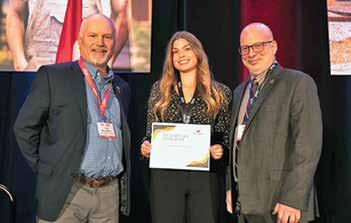
The shortage of large-animal veterinarians is a longstanding challenge for beef farmers in many parts of northern and rural Ontario. Reliable access to veterinary care is essential to the success and sustainability of the beef sector. Healthy cattle are the foundation of every farm, and veterinarians play a critical role in animal health and welfare through disease prevention, early diagnosis, herd-health planning, and effective treatment.
In addition to this new OFA-led scholarship initiative, BFO annually awards two scholarships of its own – a DVM Entrance Scholarship and DVM Convocation Award - to students enrolled in the Ontario Veterinary College at the University of Guelph who are pursuing a career in large animal health and welfare.
“Continued investment in veterinary care and services is essential to ensure the long-term health and productivity of our herds and the resilience of our sector,” added McLaughlin. OB
CHECK-OFF DEDUCTION REMITTANCE FORM
Every cattle seller (including sales by private treaty) is required under Regulation 54 of the Beef Cattle Marketing Act to pay a $4.50 per head Ontario license fee and a $2.50 per head national levy, for a total of a $7.00 per head check-off. Breeding stock, cull dairy cows, and beef calves are included. Exemptions exist only for cattle sold for the production of milk and veal (which is governed by separate marketing regulations specific to the veal and dairy sectors). Fees are payable by the 15th of the month following deduction. Licenced Livestock Dealers who sell cattle within seven business days of having purchased them may apply for a rebate with proper documentation.
HST Registration No:
Period Covered by this Report:
a) Number of Head Sold: Finished: Stocker:
Breeding Stock Females: Culls:
Breeding Stock Bulls: Calves:
b) Total BFO Check-off ($7.00xa)
c) HST on BFO Check-off (bx13%)
d) Total Amount Owing (b+c)
Submit form and payment to:
Beef Farmers of Ontario 130 Malcolm Road Guelph, Ontario N1K 1B1 amber@ontariobeef.com
1.866.370.2333
Cheque, e-transfers and payment by credit card are all accepted. Please contact the office to arrange payment by e-transfer or credit card. Please retain one copy of this form for your files.
I declare that this information represents a true and accurate statement of check-off deductions required to be made under Regulation 54 of the BCMA and the Canadian Beef Cattle Research Market Development and Promotion Agency.
Date:
Signature:
Print Name:
Address:
HST# R107797128



CALENDAR
Ontario Beef Industry Events
December 30 – Premier and Guests Falls View Production Sale, Toronto 2026
January 7 – Grey Bruce Farmers’ Week, Beef Day, Elmwood, Ontario
January 8-10 – Beef Industry Convention, Best Western Plus Lamplighter Inn, London. beefindustryconvention.com
January 29 & February 5 – Virtual Beef Symposium
February 17 – Cattle Academy. Hosted in conjunction with BFO’s AGM, Delta Hotels Toronto Airport and Conference Centre. To join virtually, visit www.ontariobeef.com
February 18-19 – BFO Annual General Meeting, Delta Hotel Toronto Airport & Conference Centre
February 25 – Beck McCoy Annual Bull Sale, Milestone, SK
March 7 – Harprey Angus Farms Bull and Female Sale, Proton Station
March 14 – Source for Quality Simmental, Hereford and Angus Bull Sale, Indian River
March 22 – Darling Farms Limousin Open House, Castleton
March 27 – Clarke Family Farms Inc Angus and Simmental Bull and Female Sale Volume V, Blenheim
March 29 – Posthaven Limousin Open House, Alma
April 4 – Smart Limousin Open House and Private Treaty Sale, Meaford
April 6 – Bee Zee Acres Private Treaty Sale, Glencoe
BEEF FARMERS OF ONTARIO PRIVACY STATEMENT
The Beef Farmers of Ontario (BFO) is committed to protecting the privacy and security of producers’ personal information in compliance with the Personal Information Protection and Electronic Documents Act (PIPEDA).
Subscribers to Ontario Beef magazine, the official publication of the Beef Farmers of Ontario, do so on a voluntary basis. By subscribing, subscribers are consenting to have their contact information used for the purposes of receiving the magazine and developing an BFO mailing list.
This mailing list will be used for the distribution of the BFO magazine.
The BFO will not sell, trade or otherwise share its Ontario Beef mailing list under any circumstances. A service may be provided whereby items are submitted to the BFO and mailed internally with the magazine but all materials must be approved by and acceptable to the BFO. In rare instances where external, non-commercial organizations, like the provincial or federal government, wish to use the Ontario Beef mailing list to distribute information, the government must provide their mailing materials in a finished format to BFO and/or its mailing house. BFO will then coordinate the mailing, at the requesting organization’s cost, thus maintaining confidentiality of the list. In cases where the BFO may commission a mailing, the company providing the service is required to sign a mandatory confidentiality agreement.
Subscribers to the Ontario Beef mailing list who wish to have their names removed, should call 519-824-0334 or email info@ontariobeef.com. Please allow 15 business days to allow us to update our records accordingly.
BFO’s complete privacy statement, covering areas of information including the electronic update system, Website, membership list and market information can be viewed on its Website at http://www.ontariobeef.com/privacy.asp
SILVERTIP





Sheila’s Cell: 519-379-4877 smartlimousin@gmail.com www.smartlimousin.com


WELLNESS ON THE FARM
By Lesley Kelly Farmer and Co-Founder of The Do More Agriculture Foundation
Breaking the Silence: Understanding Stigma in Farming and Mental Health
The narrative in agriculture is evolving. Caring for the land, animals, and equipment has always come first; now farmer well-being belongs on that list. For centuries, the culture in agriculture has valued resilience, self-reliance, and hard work. These are important qualities that have built our farms and fed our world. Yet these same values have, unintentionally, helped create one of the biggest barriers to farmer mental health: Stigma. Stigma shows up as silence, hesitation, fear and shame, making farmers feel they must carry their struggles alone rather than reach out for support.
Decades in the Making
The roots of those feelings - fear and shame towards mental health in agriculture stretch back decades, woven into the history of rural life. Farmers have been expected to endure hardship quietly, whether it was a drought, market crash, or a barn fire. Generations grew up hearing phrases like “tough it out” or “pull yourself up by your bootstraps.” Asking for help, especially for mental or emotional struggles, was often seen as a weakness that could tarnish a family’s reputation or cause the community to question a farmer’s ability to manage their operation.
Even the most tragic situations were spoken about in hushed tones. In many rural areas, the whisper of suicide was exactly that: a whisper. Families grieving such losses would face heartbreak and silence. Causes of death might be softened or not discussed openly, reinforcing the message that these topics are shameful and therefore should remain private.
Language Matters
The words we use matter. In agriculture, language around mental health is often full of stereotypes, bias, and even prejudice. Calling someone “crazy,” “unstable,” or “not tough enough” for the farm sends a damaging message: That mental health struggles are a flaw in character rather than a health condition. This language discourages farmers from speaking up and makes it harder for communities to offer meaningful support.
Thankfully, more farmers and farm organizations are now talking openly about anxiety, depression, burnout, trauma and mental illness. And while language is shifting, the habits of dismissing or downplaying these struggles can still linger.
Family Dynamics, Privacy, and Risk
On many farms, the family is also the business. This can create an added layer of pressure, not just to succeed financially, but to uphold a legacy. A farmer may fear that speaking openly about mental health challenges could be viewed as letting the family down, creating worry, or even putting the farm’s future in question.
In close-knit rural communities, privacy can be hard to maintain. News travels quickly, and farmers may worry about being judged if
others know they are struggling. This fear isn’t only about reputation. It can extend to concerns over losing land, market relationships, or even securing financial loans. For some, the risk of speaking out feels too high. It’s why some will go to lengths to remain unseen, parking their vehicle around the block from a mental health counsellor’s office, booking appointments far from home, or avoiding local services entirely.
The Impact of Fear and Shame About Mental Health
The consequences of fear and shame can be profound. Farmers experiencing mental health challenges may delay or avoid getting support at an early stage, when help can make a huge difference. Too often, they wait until they are in crisis. They might isolate themselves, rely on unhealthy coping strategies including heavy drinking or drugs, or push themselves beyond safe limits. Not reaching out for help because of fear and shame affects individual well-being, safety, and the long-term sustainability of farm operations. The better you’re feeling, the better your farm will do.
Breaking Down Barriers
Helping reduce the feelings of fear and shame around mental health in agriculture requires both cultural change and practical action, both as individuals and as a community:
Open Conversations: Opening mental health discussions in everyday farm settings like at the coffee shop, in producer meetings, or at the rink makes it easier to talk before problems escalate.
Role Models: When respected farmers share their own experiences, it sends a powerful message that seeking help is a sign of strength.
Language Shift: Choosing respectful and supportive words reduces shame and invites understanding.
Moving Forward
The culture of fear and shame about mental health has been reinforced through generations of silence, whispered tragedies, and unspoken rules about toughness in agriculture. And just as farmers adapt to new markets, technologies, and weather patterns, we can adapt our attitudes toward mental health and cultivate a culture of mental well-being across Canadian agriculture.
By speaking openly, showing compassion, and making mental health part of everyday conversations, we can create a culture where asking for help is as natural as calling the vet for a sick calf or repairing a broken piece of equipment.
Because in the end, the most important thing we grow on our farms isn’t just crops or livestock, it’s healthy, thriving people. OB
2026
28TH ANNUAL BEEF INDUSTRY CONVENTION
January 8-10, 2026
Best Western Plus Lamplighter Inn and Conference Centre, London, Ontario
Hosted by Ontario Cattle Feeders’ Association and Ontario Corn Fed Beef
Once again, the Ontario Cattle Feeders’ Association and the staff of the Plus Best Western Lamplighter Inn & Conference Centre are pleased to offer our Industry Partners, Associations and all Stakeholders opportunities to share, learn and socialize at this beautiful venue.
As one of the leading agricultural information sessions in Ontario and Canada, the OCFA is committed to meeting everyone’s expectations once again. We feel this venue is a perfect fit for us, as well as for our attendees and their families.
You, and the organizations you represent, are the future of the beef industry and your active participation is key to the success of this Convention.
We look forward to working with you and your organization. www.beefindustryconvention.com or call 519-686-6226
AGENDA
Thursday, January 8, 2026
4:00pm - Exhibitors Hall opening
5:30pm - Ontario Corn Fed Beef
Welcome Reception/Supper
7:00pm - Evening Speakers
Industry Sponsored Reception
Note: programming and times are approximate and subject to change.
FEES (including 13% HST)
Complete Registration Package
$420.00 (includes all meals, breaks and convention handouts)
Thursday Supper
ACCOMMODATIONS
Friday, January 9, 2026
8:00am - Registration, Coffee, Exhibitors Hall opening 9:00am - Morning Session Speakers
12:00pm - Lunch
1:00pm - Afternoon Session Speakers re-convene 4:00pm - Trade Show
5:30pm - Exhibitor Networking and Cocktails
6:00pm - Banquet
8:00pm -Live Auction
- Industry Sponsored Reception
Saturday, January 10, 2026
8:00am - Sponsor Breakfast
$103.00
Best Western Plus Lamplighter Inn & Conference Centre 591 Wellington Rd. S., London, ON N6C 4R3 • Tel:519-681-7151 • Fax:519-681-3271 • www.lamplighterinn.ca
Reservations are to be made on an individual call-in basis directly to the hotel or to the toll free number above. Callers must quote “Ontario Cattle Feeders Association” to the Reservation Agent to receive the discounted rates. Alternatively, reservations can also be made online using the link below: https://www.bestwestern.com/en_US/book/hotel-rooms.66016.html?groupId=1S9FV3S3
Pricing for our event:
Assorted Room Types: Thursday, January 08’26 > $169 to $209 plus applicable taxes. Friday, January 09’26 > $209 to $379 plus applicable taxes. Average price for both nights is $189-$279.
A block of bedrooms have been set aside for this event. Room rates vary depending on location. Rooms not reserved prior to January 04, 2026 will be released and subject to availability.
Registration and payment deadline is December 31, 2025.
Please email wendy@ontariocornfedbeef.com to
or please call 519.686.6226 fax