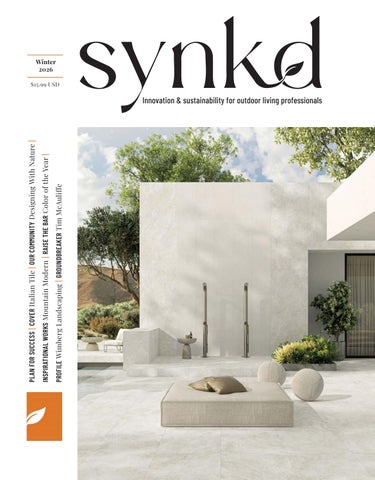
SYNKD Winter 2026 Planning for a Successful Year Ahead

Page 1


Looking to stand out from the competition? Coastal Source is redefining what’s possible outdoors with a portfolio of highperformance, weatherized, luxurious lighting and audio solutions engineered to Defy the Elements ™ Create a transformative outdoor experience clients deserve so they can spend more time enjoying their property investment.

Coastal Source delivers award-winning products in a myriad of sizes, form factors, configurations, installation options, and performance levels that enhance wide-ranging applications in any outdoor environment. We’ll help you wow your clients! Learn more at CoastalSource.com/EVO

inspirational works our community

06

08 From the Publisher Stronger Together: Looking Ahead With Intention and Purpose in 2026

News Clippings

Vectorworks Highlights Industry Trends, Durante Joins Takeuchi’s Network, Project EverGreen Teams Up In Texas, Nature Sacred Marks a Milestone, and a Preview of Coverings’ Educational Programming

12

LEAD STORY WHERE WETLANDS LEAD THE WAY

Natura Gardens and the Art of Designing with Nature

16

Designing With Wood in Exterior Spaces

Column: Angelica & Matt Norton Open Envelope Studio

18 22

Project: Three Projects, Two Firms, One Vision Collaborating on a Retreat Minutes From the Nation’s Capital

Project: Mountain Modern Contemporary Design Meets the Natural Landscape

26

Charging for the Sales/Design Process

Column: Eric McQuiston Eric R. McQuiston, LLC

28

GROUNDBREAKER

TIM MCAULIFFE An Award-Winning Next Chapter

32 34

38

Q&A Navigating Industry Challenges

Company Profile

Wimberg Landscaping Evolving to Build Like Nature

The Landscape Designer’s Perspective Handling Challenges with Confidence, Part 2

For latest content, to view digital issues & to find out about upcoming events, visit www.synkd.io Follow us on these social media platforms:

Cover photo: Ceramiche Supergres | Outdoor Kave collection

323 Polk Street Lafayette, LA 70501

The Quiet Season Decides

Everything

Column: Chris Cooper Vine & Compass

SYNKD Live 2026

Let’s build the future of our industry—together. Bring your expertise. Bring your questions. Bring an open mind. Join us in Phoenix.

Stop Guessing

Column: Kelly Dowell onlawn 47 48 50

Seeds of Wisdom

Short Takes From the Podcasts of Synkd On Air

Pantone’s New Color of the Year

Shaping Garden Palettes for 2026

PHOTOsynthesis

ELEVATE 2025

Bring your expertise. Bring your questions. Bring an open mind.

FOUNDER & CEO

Angelique Robb angelique@synkd.io | (337) 852–6318

SALES DIRECTOR

Tom Schoen tom@synkd.io | (773) 490–9557

EDITOR

Erin Z. Bass

GRAPHIC DESIGNER

Trisha Klaus

WRITERS & CONTRIBUTORS

Jenifer Bar-Nur | pg. 12

Angelica & Matt Norton | pg. 16

Ibi Pashaei | pg. 18

Dave Marciniak | pg. 18

Adam Frederico | pg. 22

Eric McQuiston | pg. 26

Tim McAuliffe | pg. 28

Chris Semko | pg. 32

Pierre Bridger | pg. 32

Ryan Hogan | pg. 32

Joe Guida | pg. 32

Chad Diller | pg. 32

Peter Wimberg | pg. 34

Mardi Dover | pg. 38

Tom Schoen | pg. 40, 50

Chris Cooper | pg. 43

Kelly Dowell | pg. 46

Jonathan Torres | pg. 47

Zech Strauser | pg. 47

Paul Voresis | pg. 47

Katie Dubow | pg. 48

PRINTED BY Modern Litho | www.modernlitho.com

Published by ©SYNKD

SYNKD is published four times a year and distributed to 10,000 qualified members of the green industry.

Postmaster: Send address changes to 323 Polk St., Lafayette, LA 70501.

Next Issue: SYNKD Spring 2026 The Green Issue

SYNKD verifies information as much as possible. The views expressed by editorial contributors and the products advertised herein are not necessarily endorsements of the publishers. Reproduction of any part of this magazine is strictly forbidden. 40 43 44 46 Tile, the Italian Way Stories from Cersaie 2025

Contact Angelique Robb at angelique@synkd.io for more information on how you and your company can be featured in upcoming issues.

LEARN MORE

FLOWERFULL

SMOOTH HYDRANGEA ®

Hydrangea arborescens ‘BAIful’ PP35,613 CPBRAF

STRONG STEMS THAT DON’T FLOP, EVEN WITH WIND OR RAIN

LUSH GREEN FOLIAGE THAT PROVIDES WONDERFUL CONTRAST TO THE BLOOMS

— FROM THE PUBLISHER —

STRONGER TOGETHER Looking Ahead

With Intention and Purpose in 2026

As we look ahead to 2026, we’re excited to bring you the Winter Issue of SYNKD magazine—an issue centered on reflection, intention, and planning for what’s next.

This edition is all about helping you prepare for the year ahead with clarity and purpose. Inside, you’ll find insights from industry leaders on the challenges companies faced in 2025 and the real, practical ways they’re addressing them moving forward. These conversations aren’t just retrospective—they’re meant to spark ideas, encourage better decision-making, and help you approach the next year with confidence.

You’ll also find excerpts from our podcast in Seeds of Wisdom, where guests share the lessons, turning points, and perspectives that shaped their journeys. Alongside that, we’re proud to showcase standout projects, company profiles, and leaders who continue to raise the bar for our industry. As always, this issue reflects the innovation, resilience, and creativity that make this community so strong.

We encourage you to take a moment—sit down, slow down, and truly absorb what’s here. Then reach out and tell us what resonates. Your feedback matters. Our goal is to keep SYNKD relevant to you and your business, and to continue providing content that challenges, supports, and elevates the industry as a whole.

We also want to share our excitement coming off the heels of SYNKD Live in New Orleans. What started as an event has evolved into something deeper—SYNKD Live 2.0. This new chapter is more intimate, more collaborative, and focused on meaningful conversations that go beyond the surface.

And we’re just getting started. Mark your calendars for SYNKD Live 2026 in Phoenix, happening September 29 through October 1. The theme, “The Details Matter,” will take a deep dive into technical detail across design, construction, and enhancements, as well as business improvements to help you today. If you’re ready to sharpen your skills and push your work further, this is one you won’t want to miss.

Thank you for being part of the SYNKD community. Here’s to learning, planning, and raising the bar—together.

-Angelique

SEPT. 29-OCT. 1, 2026

PHOENIX, ARIZONA

Vectorworks Highlights 2026 Industry Trends Shaping the Future of Design

Global design and BIM software provider Vectorworks, Inc. reveals its 2026 industry trend insights, outlining the key forces set to define the architecture, interior architecture, landscape architecture and design, and live events industries. The trends reflect input from global practice, industry commitments on climate and biodiversity, and Vectorworks’ own research into how designers are evolving their workflows.

For architects, the 2026 trends emphasize the convergence of BIM, AI, and sustainable design analysis as the new baseline for competitive practice. Architects are also looking ahead to increased use of digital twins, AR/ VR, and open interoperability to extend value across the entire building lifecycle.

For interior designers, Vectorworks’ highlights the growing expectation that interior projects contribute meaningfully to carbon reduction and occupant well-being, not just aesthetics. Building on this shift, the trends point to flexible, shape-shifting spaces, holistic sustainability, and embodied

carbon calculation as defining themes for the year ahead.

For landscape architecture, the 2026 trends are anchored in climate responsibility, with national and international action plans setting a new bar for emissions

reduction, biodiversity, and long-term ecological performance.

Read the full trend report here: https:// www.vectorworks.net/en-US/newsroom/ aec-trends-2025-report. n

Durante Equipment Joins Takeuchi’s Dealer Network

Takeuchi has expanded its dealer network with the addition of Durante Equipment at 3285 S. Military Trail in Lake Worth, Florida. The new location will provide Takeuchi customers with new equipment sales, parts, and service support, while Durante will make a full line of Takeuchi machines available for rent from its corporate headquarters in Hollywood, Florida.

“We look for dealer partners who understand their markets and can support customers with the right machines and expertise, and Durante Equipment does exactly that,” says Eric Wenzel, Southeast regional business manager for Takeuchi-US. “With their growing presence in South Florida and the new Lake Worth location, they’re well positioned to help contractors throughout Palm Beach County discover the difference Takeuchi compact equipment can make on their productivity and bottom lines.” n

Nature Sacred Expands Leadership Team, Marks

Major Milestone

Nature Sacred, a national organization dedicated to creating and supporting healing green spaces within communities, has announced significant leadership expansion and the completion of its ambitious five-year goal of adding 100 new Sacred Places to its pipeline. The organization now supports a national network of 200 Sacred Places—a scale comparable to the park systems of cities like San Francisco or Pittsburgh—with 135+ already open and thriving.

Unlike traditional city park systems, Nature Sacred operates through a distinctive model rooted in community-led design, non-ownership of land, and ongoing stewardship of the people and relationships that sustain these spaces. Rather than owning or managing properties, Nature Sacred guides communities through a creative process that transforms design into community building, then maintains long-term relationships to support both the physical and emotional life of each space.

“Cities maintain parks. We help communities create and sustain Sacred Places—green spaces born from care, and kept alive by it,’ says Alden Stoner, Nature Sacred’s CEO. “Across time, the reflections within them have become a living, temporal record of how nature connects and heals us. This leadership expansion ensures we can continue this work with the depth and care it deserves.” n

Project EverGreen & Community Partners Team Up to Restore Athletic Field

Project EverGreen, members of the Sports Field Management Association, the Texas Sports Field Management Association, the Texas Turfgrass Association, and the City of Corinth (Texas) Parks & Recreation Department teamed up in December at Corinth Community Park Field #4 to give this well-used field a $55,000 makeover.

More than 60 sports field and landscape professionals joined forces to deliver a renovated baseball field for aspiring youth athletes and neighborhood residents. The project will transform Field #4, an aging but well-loved space into a safer, more functional, and environmentally healthier green asset for local families, athletes, and neighbors to enjoy for years to come.

The comprehensive makeover—made possible by material donations and volunteer field work —will modernize field infrastructure while enhancing long-term sustainability. Their shared expertise and commitment illustrate how cross-industry partnerships can create greener, healthier, and more accessible public spaces. n

Coverings 2026 Previews Conference

Education Ahead of Las Vegas Show

Coverings, the largest and most influential event in North America dedicated to ceramic tile and natural stone, has unveiled extensive educational programming for Coverings 2026, taking place March 30–April 2, 2026, at the Las Vegas Convention Center in Las Vegas, Nevada. Coverings 2026 attendees will gain impactful insights to strengthen professional skills, deepen market intelligence, and support leadership growth across the tile, stone, design, and construction industries. Show registrants and prospective attendees can explore the full scope of educational sessions and partner programs for Coverings 2026 by visiting the official 2026 show schedule at coverings2026.eventscribe.net. n

Photo: Project Evergreen
Photo: Coverings

Where Wetlands Lead the Way

Natura Gardens & the Art of Designing with Nature

In South Florida, where development and delicate ecosystems often exist in uneasy proximity, a new residential community is offering a compelling alternative narrative—one in which nature is not an obstacle to be managed, but the foundation of design.

Natura Gardens, an award-winning residential development in Miami Dade County, is built around a simple yet radical idea: let the land lead. At the heart of the project lies more than 10 acres of protected wetlands, a living system that shapes every pathway, amenity, and moment of daily life within the community. Rather than pushing the wetlands to the margins, the design brings residents to its edge—close enough to experience its beauty, rhythm, and ecological importance, but thoughtfully distanced to ensure its long-term protection.

Behind this vision is Landscape Design Workshop, led by Cofounder and Director Jenifer Bar-Nur, whose firm has spent nearly two decades shaping South Florida’s urban and residential landscapes. For Bar-Nur, Natura Gardens represents not just a successful project, but a culmination of values her team has refined over years of collaborative, ecology-driven design.

A Practice Rooted in Collaboration

Founded in 2007 and based in Boca Raton, Landscape Design Workshop specializes in landscape architecture and urban planning, with a portfolio spanning large-scale masterplanned communities to multifamily residential developments. What distinguishes the firm

is not a singular aesthetic, but a consistent philosophy: landscapes should bring people together—with each other and with nature.

“We’re very focused on creating environments that encourage connection,” Bar-Nur explains. “That means connection to place, connection to community, and connection to the natural systems that already exist.”

That philosophy is reinforced by longstanding partnerships. Natura Gardens was developed in collaboration with Terra Group, a developer with whom Landscape Design Workshop has worked repeatedly, alongside

PPK Architects and specialized wetland consultants. Years of shared experience meant that collaboration was fluid and trust was established early.

“When you work with the same teams over time, communication becomes easier,” Bar-Nur says. “Everyone understands what the other disciplines need, and that allows the work to reach a higher level.”

At Natura Gardens, this collaboration proved essential—because the site itself demanded restraint, creativity, and shared respect.

We’re very focused on creating environments that encourage connection.

Honoring the Ecosystem

The first visit to Natura Gardens revealed what Bar-Nur describes as “the heart of the site.”

An expansive wetland bordering much of the property wasn’t just a regulatory consideration, but an emotional and visual anchor.

“It stood out in a way that told us everything else should be designed around it,” she adds.

The development encompasses roughly 40 acres, with approximately 10 acres dedicated to wetlands and 30 acres designated for residential buildings and amenities. While a wetland consultant oversaw the preservation and restoration of the protected area, Landscape Design Workshop was responsible for integrating the surrounding community in a way that honored the ecosystem rather than disrupting it.

Designing at the Edge, Not Within

The guiding question became: How can residents experience the wetlands as part of daily life—without causing harm? And the answer lay in proximity without intrusion. Rather than placing amenities inside the wetland, the design positions social and recreational spaces along its edge, creating constant visual and sensory engagement while preserving ecological integrity.

The experience begins at the entrance. Instead of a conventional roadway cutting through the site, residents enter via a raised road that passes through the wetlands. This subtle move transforms arrival into a moment of immersion—an immediate reminder that nature, not architecture, sets the tone.

Once inside the community, a linear green spine connects buildings, amenities,

and gathering spaces, all oriented toward the wetlands. The layout encourages walking, chance encounters, and outdoor living, reinforcing a sense of shared space.

“Everything was positioned to surround and relate back to the wetland,” Bar-Nur explains. “We wanted people to feel connected to it without ever stepping into it.”

Amenities That Reflect the Landscape

Every major amenity at Natura Gardens is designed to echo the natural surroundings. A playground is centered around a mature gumbo limbo tree, whose broad canopy provides shade while referencing the hardwood hammocks of the Everglades. Pools, cabanas, and a raised jacuzzi are aligned along the wetland edge, offering uninterrupted views of native vegetation and wildlife.

Even the dog park—a staple of modern residential communities—was intentionally placed near the wetlands, transforming a routine activity into an encounter with nature.

Planting choices further blur the line between built and natural environments. Royal palms line the central linear park, while live oaks and native grasses populate parking areas, reinforcing continuity between the developed landscape and the wetland beyond.

“Using native species was critical,” BarNur notes. “They require less irrigation, less maintenance, and they support the existing ecosystem rather than competing with it.”

Respecting Indigenous Heritage

One of Natura Gardens’ most distinctive features is its series of traditional chickee huts— open-air wooden structures with thatched roofs historically used by the Seminole Tribe. Positioned along the wetlands, these structures serve as shaded gathering areas while acknowledging the cultural history of the land.

Recognizing the deep connection between the Seminole people and South Florida’s wetlands, Landscape Design Workshop invited members of a local Seminole tribe to help build the huts using traditional methods.

“It was important to us to honor the indigenous heritage of the area,” Bar-Nur says. “The Seminole people lived in and around these wetlands for generations. Bringing that history into the project felt both respectful and meaningful.”

While the huts were constructed using traditional techniques, the design team worked closely with tribal builders to ensure modern safety codes were met. The result is

a series of authentic, functional structures that add cultural depth to the community.

Surrounding the huts, sand and seating areas create a relaxed, resort-like atmosphere—inviting residents to sit near the water, listen to wildlife, and slow down.

Spaces for Every Kind of Gathering

Beyond aesthetics, Natura Gardens was designed to support a wide range of social experiences. Quiet moments and communal celebrations coexist seamlessly.

The beach-entry pool encourages casual interaction, while cabanas and shaded seating offer more private retreats. A summer kitchen and outdoor dining terrace invite residents to cook and gather outdoors, extending living spaces beyond their homes. A fountain adds sound and movement, creating a sensory focal point even for those who prefer to stay dry.

Landscape should never be an afterthought. When it leads the design, everything feels more cohesive .

Children gather at the playground beneath the gumbo limbo tree, while pet owners connect at the dog park. Together, these spaces form a network of daily touchpoints—places where neighbors naturally cross paths.

“We know a project is successful when people choose to spend time outside,” BarNur reflects. “When amenities become part of daily routines, not just special occasions.”

A Living, Thriving Ecosystem

Equally important is what residents don’t see: the wetland itself, thriving undisturbed. For Bar-Nur, seeing native vegetation flourish and wildlife return is one of the most rewarding measures of success.

“The fact that the wetland is healthy tells us we did our job,” she says. “It means the balance between development and preservation is working.”

This balance has earned Natura Gardens significant recognition, including honors from the Architecture MasterPrize and Muse Design Awards—affirmation that environmentally sensitive design can also achieve architectural and aesthetic excellence.

Lessons for the Industry

After nearly 20 years in practice, Bar-Nur believes the lessons of Natura Gardens extend beyond a single project.

“The most important thing is letting the site guide the design,” she says. “Too often, places are designed to look good in renderings but not to be truly experienced.”

She emphasizes designing for longevity— using durable materials, native plants, and flexible spaces that evolve over time. Equally critical is early collaboration across disciplines, ensuring landscape architects have

a voice from the outset rather than being brought in late.

“Landscape should never be an afterthought,” Bar-Nur adds. “When it leads the design, everything feels more cohesive.”

While large sites like Natura Gardens offer unique opportunities, she notes that the same principles apply to smaller, denser projects. The key is scale—adapting ideas rather than abandoning them.

“You can still create meaningful spaces on a pool deck or rooftop,” she explains. “It’s about understanding who lives there and giving them places to connect, rest, and gather.”

Designing for the Future

In a region increasingly defined by climate challenges, Natura Gardens offers a hopeful model that respects the land while enhancing human experience. By centering wetlands rather than fencing them off, the project educates residents about their importance as flood protectors, wildlife habitats, and living systems.

“Land should always be treated as precious,” Bar-Nur says. “Whether there’s a wetland or not, every site has value that deserves respect.” n

All photos are courtesy of Landscape Design Workshop.

FOR MORE INFO

Jenifer Bar-Nur

Cofounder & Director

Landscape Design Workshop

Boca Raton, FL

info@landscapedesignworkshop.com www.landscapedesignworkshop.com

DESIGNING WITH WOOD IN EXTERIOR SPACES

Understanding Species, Treatments, and Detailing for Durable Outdoor Performance

Continuing our conversation exploring materials in the landscape, we’re focusing on wood—why we would use it, how we select soft or hard woods, what environmental conditions shape those choices, and the range of products available.

Why We Use Wood

We like wood for both experiential and practical reasons. Experientially, it brings lightness,

warmth, and a perceived softness to a space. Practically, skilled labor is widely available, it’s lighter to handle than steel or stone, and construction generally has a lower impact on the site.

How Site Conditions Shape Wood Selection

Wood choice depends on whether it’s used structurally (like framing) or as cladding (like privacy screens), and whether the application is indoors or outdoors. In landscapes, the main concerns are moisture exposure, drying ability, and weathering. Rot can be mitigated through thoughtful detailing so water doesn’t get trapped, using flashing and drainage where needed.

Softwoods vs. Hardwoods

Soft woods grow quickly and are relatively inexpensive and easy to work with, though less resilient outdoors. Pine, Douglas fir, and cedar are common examples. They typically need paint, stain, or sealant to slow visual aging. Weathering doesn’t always indicate failure, but not everyone appreciates the silvered patina, and some materials like stone, steel, or concrete tend to weather more gracefully.

Hardwoods grow more slowly, giving them a tighter grain and higher density. This makes them more resilient for exterior use and often more aesthetically appealing, though heavier and more challenging to work with.

Treated Woods and Modified Woods

Softwoods can be made more durable through treatment. “Pressure-treated

lumber” is a catchall for lumber infused with liquid preservatives, usually copper-based, forced deep into the wood in a pressurized chamber. This significantly improves rot resistance and is common for concealed structural components, though less suitable for seating or high-contact elements.

Thermally modified woods, such as Accoya and Thermory, undergo a heat-andpressure process that changes the wood at a cellular level. This increases stability, predictability, and overall resilience, making them excellent for cladding and other nonstructural elements.

For structural applications, avoiding rot is critical, because failures can be dangerous. Treated woods are often preferred unless the structure is fully exposed and carefully detailed. Stability also matters: wood can twist, cup, or bow as it dries, and good carpentry anticipates this—like installing deck boards “bark up.”

Wood is abundant, renewable, and used widely in the U.S. Its performance outdoors depends on thoughtful selection and detailing, but when used well, it brings a warmth few materials can match. n

Coastal Source Redefines

Outdoor Lighting & Sound

With the debut of the revolutionary EVO outdoor lighting line, Coastal Source delivers an elegant fusion of design, technology, and performance. EVO offers unmatched versatility, seamlessly integrating into landscapes and architectural elements while casting stunning, functional illumination.

Every Coastal Source product is meticulously engineered to endure the harshest environments, providing unmatched durability and reliability. From transformative lighting solutions to immersive sound experiences, Coastal Source enhances outdoor living with innovative designs and precision craftsmanship.

Whether you’re a homeowner looking to create a welcoming retreat or a professional seeking high-quality, dependable systems, Coastal Source combines the expertise with innovation to redefine and enrich every outdoor space.

Learn more at www.coastalsource.com/EVO.

Three Projects, Two Firms, One Vision

A collaborative approach results in a relaxing retreat just minutes from the nation’s capital.

Asuccessful landscape project requires two key components: a great design and a skilled team to execute that design. What if two separate companies collaborated to make this happen? Landscape Design Lab and Northern Virginia Landscaping have worked together on numerous projects to delight landscape clients. Dave Marciniak is the owner and lead designer for Landscape Design Lab, a Virginia-based landscape design firm that works with homeowners and landscape contractors all over the U.S. Ibrahim “Ibi” Pashaei is the owner of Northern Virginia Landscaping, a premier landscape installation company in the Washington, D.C., metro area.

They worked together on a countryside retreat to create a landscape where the outdoor spaces reflect the homeowner’s personality as much as the indoor ones. Here, they discuss why the project was such a great fit for their skillsets and how they came together to overcome challenges and produce an end result that’s both functional and cohesive.

The Rural Retreat

Marciniak: This project felt like it was tailor-made for me. These clients were building a fabulous custom home on a large piece of land in the countryside west of the D.C. area. Their home was designed to be a modern, sophisticated take on a farmhouse, and they wanted the landscape to both reflect the character of the house and the character of the property.

Working closely with the builder, we designed everything, from the approach to the house to the front walk, and the succession of patios in the back. The screened porch that the architect and the builder created is great, but we wanted to make sure the client would want to use all of their outdoor living space. One of the biggest challenges was taking a large home and making all the spaces feel just right—not too big and not too small.

The plantings and lighting were the final touches that pulled everything together.

Traditional “farmhouse” plantings like boxwoods, spirea, and daylilies were used close to the house. The bigger planting areas feature pollinator-friendly plants and Virginia native plantings.

Pashaei: First, we met the client on site to discuss the total scope of what would be happening with the builder, and then we took photos and videos to provide to Dave for review once our scope was defined. With the site data we provided for Dave, he was able to accurately depict elevations, create construction drawings, and have everything

we needed to build the job with an exceptional level of detail. As with any newly built home, we discovered at installation that the builder made some changes along the way that impacted our part of the project. We all worked together to quickly resolve issues and come up with solutions that, personally, I think made the final result even better.

A Garden Oasis Minutes From D.C.

Marciniak: We lucked out on this one, because the client was passionate about plants. Not only did she have a lot of input on the plant selections, she has done an amazing job of maintaining the landscape to become what we envisioned during the design process. We designed a series of outdoor spaces, including a huge, custom cedar pergola and an outdoor kitchen, and used the planting design to create a cohesive, relaxing oasis.

Pashaei: The client wanted to eliminate any turfgrass in the backyard and go lawn-free, so we needed a lush, heavy planting plan that didn’t leave any gaps. Dave’s team mixed a variety of native and non-native plants in the design to come up with a super cool layout. It has character, variety, and depth. It also reflects the homeowner’s personality, and there’s something for all four seasons. We met the client at local nurseries to hand pick the specimen trees that are key to the landscape’s success.

The structural design of the pergola was very unique, simple, and fitting to a minimalist, modern style. The heavy cedar beams were a challenge to get into place, but once we had it up and stained in place, wow, did it make a big statement! The pergola is a one-of-a-kind element that anchors the entire landscape design—and that the client absolutely loves.

A Modern Entertaining Space

Marciniak: I got off the initial zoom call with these clients super excited about what we were doing. They were very clear about what kinds of spaces they wanted, and the inspiration photos they shared fit perfectly with the architecture of the home. They wanted a modern backyard that still felt warm and welcoming. Space planning and material selection were key to success.

Pashaei: Sometimes the smallest spaces present the biggest challenges. This tight backyard was packed with details. Stone veneer, custom ironwork, and cedar accents combine to make this a unique space that will only get better as the plantings mature. The firepit is a great example. We used a ready-to-finish firepit that allowed us to pull the cedar detail from the back wall of the kitchen, and we used the same granite top on the firepit as the outdoor kitchen counter. These small details helped us make sure the whole space was cohesive.

It’s the ultimate outdoor space with an amazing look, aesthetic, and feel. I was surprised we fit so many things in such a small space when we were done with the project. All the landscape plantings and variety of texture, colors, and finishes really gave the backyard depth that made it feel bigger than it did prior to the work.

The End Result

For Marciniak and Pashaei, a successful collaboration means clients who are delighted with the end result. They combine innovative landscape design and exceptional craftsmanship on every landscape, and clients love their team approach to projects. They are also deeply invested in the landscape business, sharing their knowledge with others in the local industry. n

All photos are courtesy of Northern Virginia Landscaping and Landscape Design Lab

FOR MORE INFO

Ibi Pashaei

Northern Virginia Landscaping Arlington, VA

www.nvalandscaping.com

Dave Marciniak

Landscape Design Lab Culpeper, VA www.landscapedesignlab.com

Mountain Modern

Where Contemporary Design Meets the Natural Landscape

Perched at the edge of a quiet mountain neighborhood in Utah, this family home is a compelling study in balance—between architecture and environment, family life and retreat, modern precision and organic form. Adam Frederico with Frederico Outdoor Living refers to the style as “Mountain Modern,” a term that may not yet be formalized in design textbooks, but one that feels immediately intuitive when experienced on-site.

At its core, Mountain Modern is about contrast and cohesion. It takes the strict geometry, right angles, and industrial elements of modern architecture and softens them through a thoughtful relationship with the surrounding landscape. Rather than imposing a manicured aesthetic on a rugged mountainside, this project allows the home and landscape to feel as though they belong there nested into the terrain, shaped by it, and responsive to it.

Designing with the Mountain, Not Against It

The home sits at the end of a single road, far removed from any urban context. From the outset, the location dictated the approach. This was not a cityscape in need of clean borders and formal lawns, but a mountainside environment that demanded respect. The surrounding views—rolling hills, distant valleys, and the Rocky Mountains beyond— became one of the project’s most important design elements.

Rather than framing the house with tall plantings that might obstruct these vistas, Frederico and his team intentionally kept much of the landscaping low and open. The result is a front yard that feels expansive and inviting, offering uninterrupted sightlines into the surrounding landscape. Standing on the property, the home feels

less like a boundary and more like a viewing platform into nature.

This sense of openness was essential to the homeowners, who value time outdoors and wanted their property to feel like an extension of the mountains themselves.

A Collaborative Beginning

One of the defining strengths of this project was the timing. Frederico was brought in early—while the home was still under construction—through a referral from a custom homebuilder with whom his family had a long-standing relationship. That early collaboration allowed the landscape design to evolve alongside the architecture, rather than being treated as an afterthought.

Being part of the process from the beginning meant walking the site while it was still an open canvas. Slopes, sightlines, runoff patterns, and access challenges were all considered in real time. This design-build partnership allowed for a level of integration that’s difficult to achieve once a home is already complete.

The site itself presented significant challenges. The property sits on a steep hillside, with elevation changes that required extensive retaining walls and thoughtful grading to create usable outdoor space. Machine access was limited, particularly in the upper portions of the property, requiring creative solutions— including pulley systems—to move trees and materials into place.

A Family-Centered Vision

While the aesthetic is refined, this was never meant to be a purely showpiece landscape. The homeowners are a family with children, and the design needed to support both play and relaxation.

One of the most prominent family features is a custom in-ground, spring-free

trampoline set into an artificial turf play area behind the home. Rather than surrounding it with decorative plantings, the space was intentionally left open and durable, allowing kids to run, tumble, and play freely. It’s a pragmatic decision that reflects an understanding of how families actually use their outdoor spaces—without sacrificing the overall design integrity.

At the same time, the parents wanted an oasis of their own. Throughout the property, quieter moments are woven into the layout: secluded seating areas, meandering paths, and water features designed to draw adults outdoors and encourage pause.

Water plays a central role in the emotional experience of this landscape. Multiple water features are strategically placed to provide both visual interest and ambient sound. One of the most meaningful is positioned near the primary bedroom. From inside the home, the homeowners can see the water feature through the window—and even hear it from bed. That sensory connection to the outdoors was intentional, reinforcing the idea that nature is not something you visit occasionally, but something you live alongside every day.

Meandering Paths and Intentional Movement

One of the most striking aspects of the design is how it encourages movement. Paths wind gently around the home, deliberately avoiding straight, utilitarian routes. Instead of leading directly from point A to point B, the walkways curve, turn, and reveal new perspectives as you move through the space.

This design choice slows people down. It transforms everyday movement into an experience—one that invites observation, reflection, and appreciation of the surroundings.

The paths are not racetracks or shortcuts; they are invitations to look up, notice the mountains, and engage with the landscape.

Closer to the home, the pathways incorporate clean concrete lines and modern stepping patterns that echo the architecture. As you move farther away, those elements gradually give way to more natural materials, softer plantings, and organic forms. It’s a subtle but powerful transition that reinforces the Mountain Modern philosophy.

Sustainability Through Material Choice

Sustainability is embedded throughout the project, often in ways that feel natural rather than performative. Plant selections focus heavily on native and water-wise species well suited to Utah’s climate. These plants provide seasonal interest while minimizing water use and long-term maintenance.

Artificial turf was used selectively in high-use areas where traditional lawn would require constant mowing and irrigation. In contrast, large portions of the property are finished with decorative rock, weed fabric, and meadow-style plantings that allow the landscape to mature naturally over time.

Stone retaining walls are another defining feature, and many of them were built using materials sourced directly from

This project exemplifies what Mountain Modern can be: a design philosophy that honors both human needs and natural context .

on-site excavation. In mountainous regions, boulders are often an unavoidable byproduct of construction. Rather than hauling them away, Frederico’s team reused these stones to create walls that feel inherently connected to the site. The result is a landscape that looks as though it emerged organically from the ground.

Managing Water on a Mountainside

With steep slopes comes the challenge of water management, especially during snowmelt and heavy rains. This project addresses runoff thoughtfully through grading, drainage, and the inclusion of a dry creek bed that winds down the hillside.

The dry creek bed serves both functional and aesthetic purposes. During periods of runoff, it channels water safely through the

property. During dry seasons, it becomes a visual feature—an echo of natural mountain streams, framed by evergreens and textured stone.

As plantings mature and trees grow taller, much of this infrastructure will become more subtly integrated into the landscape, further enhancing the sense that the property is part of a living, evolving ecosystem.

Designing for the Present— and the Future

Not every area of the property is fully programmed, and that’s by design. Some spaces were intentionally left open, finished simply with compacted gravel, to allow flexibility as the homeowners grow into the space.

This approach acknowledges an important truth: people don’t always know how

they’ll use a new landscape until they live in it. By avoiding over-design in certain areas, the project leaves room for future phases— whether that means outdoor dining, hosting large gatherings, or adapting the space as children grow and family needs change.

Many of the photos captured shortly after completion show young plants and newly installed features. But this project was always envisioned as something that would evolve. Trees planted along the upper hillside will eventually restore the natural canopy disturbed during construction. Groundcovers will fill in around stepping stones. Meadow areas will soften and blend more seamlessly into the surrounding terrain.

Over time, the contrast between modern structure and natural landscape will become even more pronounced—and more harmonious. This project exemplifies what Mountain Modern can be: a design philosophy that honors both human needs and natural context. It’s family-friendly without feeling casual, modern without feeling cold, and sustainable without feeling restrictive. The result is a place where architecture and environment coexist, where play and tranquility find equal footing, and where the mountains are not just a backdrop, but an integral part of daily life. n

All photos are courtesy of Frederico Outdoor Living

adam@fredericooutdoor.com www.fredericooutdoor.com

— GUEST COLUMN —

CHARGING FOR THE SALES/DESIGN PROCESS

A Smarter Approach for Landscape Contractors

In residential landscape design/build, there’s a hidden cost that every contractor knows too well—the time and effort spent in the sales, design, and estimating process. It’s not unusual to spend hours meeting with clients, walking properties, sketching ideas, and refining estimates, only to have the project fall through. Those lost hours represent real overhead, and over time, they can take a toll on your bottom line.

The question, of course, is how to recover those costs legally and professionally while maintaining a strong, client-friendly image.

The Legal Limitation

In most states, a contractor cannot charge for landscape design unless that design is prepared or overseen by a licensed landscape architect. That leaves many contractors in a difficult position—especially those who rely on conceptual sketches and layouts as part of their sales process. The solution isn’t to skirt the law, but rather to redefine what you’re actually offering.

What you’re providing at that early stage isn’t a formal design—it’s professional consultation, concept development, and project planning.

And that’s worth something.

Positioning the Fee

There are several ways to structure this fee in a way that is transparent, professional, and well-received by clients.

1. Consultation or Site Analysis Fee

Call it a site consultation, concept review, or property evaluation. This fee covers your time to meet, listen, assess, and offer guidance. You might include a written summary

or rough concept, but make it clear that the intent is advisory, not design.

Typical range: $150–$500

Tip: Credit the fee toward the installation if the client moves forward—this turns it into an investment rather than an expense.

2. Planning Retainer or Development Deposit

This is often the most effective approach. A planning retainer or design development deposit secures the contractor’s time for measurements, layout work, and detailed estimating. It also signals that the client is serious about moving forward.

Typical range: $500–$1,000 (credited to the project upon approval)

3. Tiered Discovery Packages

Some firms offer tiered packages that match the client’s needs and budget.

• Tier 1: On-site consultation and written summary – $250

• Tier 2: Consultation + conceptual layout – $500

• Tier 3: Consultation + digital layout and estimate – $750–$1,000

Each tier communicates professionalism and choice, helping clients feel empowered while protecting your time.

Why This Matters

Charging a consultation or planning fee isn’t about squeezing more from the client—it’s about valuing your expertise. Every hour spent developing an estimate or sketch is an hour not spent producing income in the field. By recovering part of that cost, you’re not only improving your margins, you’re building a more sustainable business model.

It’s also an effective client-qualification tool. Homeowners who are serious about their project will have no issue paying a reasonable consultation or planning fee. Those who balk were likely to waste your time anyway. This simple filter saves countless hours in unproductive meetings and gives you more time to focus on qualified, paying clients.

And, finally, presenting this fee professionally elevates your image. It communicates that you run a legitimate business built on expertise, not free estimates and hand-drawn giveaways. Clients respect what you respect—and when you value your time, they tend to do the same.

Integrating It Into Your Process

If you haven’t done so already, make this fee part of your standard operating procedure.

1. Explain the value up front—that this service helps them make informed decisions.

2. Include it in your marketing materials so it feels standard, not optional.

3. Credit it toward the project to keep the conversation positive.

A clear, written explanation builds trust and reduces confusion n

ABOUT THE AUTHOR

Eric McQuiston

Landscape Architect & Consultant

Eric R. McQuiston, LLC ermcquiston@gmail.com www.ericrmcquistonllc.com

• Versa Wall XT keeps a lush full look throughout the season.

• Versa Wall XT keeps a lush full look throughout the season.

• Easy to design, install, and maintain, living green walls for landscapers to add to their range of services

• Easy to design, install, and maintain, living green walls for landscapers to add to their range of services

• GSky green walls mount to a variety of surfaces, inside or outside, with an irrigation system or integrate with the landscape irrigation.

• GSky green walls mount to a variety of surfaces, inside or outside, with an irrigation system or integrate with the landscape irrigation.

• Interchangeable with ease— one gallon potted plants can be changed out as the seasons change or as the client desires.

• Interchangeable with ease— one gallon potted plants can be changed out as the seasons change or as the client desires.

VERSA WALL XT

GROUNDBREAKER

An Award-Winning Next Chapter

The “Outdoor Living Designer” shares his secrets to starting over with a small firm but a big vision.

Tim McAuliffe doesn’t just design landscapes—he builds relationships, teams, and award-winning outdoor experiences. After trading Texas for the coastal charm of Wilmington, North Carolina, he launched a new firm with a clear goal: get back to doing the design work he loves, put clients first, and create outdoor spaces that truly elevate how people live.

That approach paid off fast. In just over a year, his firm earned 14 Awards of Excellence at the National Association of Landscape Professionals (NALP) ELEVATE conference, an achievement that signals both a successful launch and national recognition of his design expertise. With

Tim McAuliffe

decades of experience across Pennsylvania and Texas, he brings a rare mix of creative vision, operational know-how, and a relationship-driven mindset to every project. The result? Thoughtful, sustainable coastal designs—and a firm that’s already setting records while building an exciting next chapter.

What caused you to move from Texas to North Carolina?

My wife and I wanted a change back to work/life balance for our family. I had the opportunity to join a local firm in the Carolina coastal area of Wilmington. We have family in Pennsylvania and in Florida, so the Wilmington area was the perfect spot

in between. The move also kept me in the same planting zone, and I love working with the same Texas plants. But the biggest plus was the freedom to go back to doing the design work I love.

What made you decide to start a brand-new firm versus keeping your old name and branding from Texas?

I initially started with a local firm, but my style, moral compass, and client-first approach were not the same fit, so after nine months of navigating the local market, I moved on to start my own branded firm in the coastal Wilmington area.

Did your prior knowledge from running a business in Texas allow you to get established more quickly?

Yes, my previous experience owning my own firm in Pennsylvania, then selling and joining the Texas firm in 2018, was a great framework for growing my understanding. In Texas, I leveraged subcontractors to scale my book of business within the firm. You only have so much bandwidth through your in-house crews, right? So, you have to find subs if you want to scale your business bigger. And you’re going to take less margin when you scale with subs, but if you pay your subs the right way, they’re going to take care of your clients.

What were some of the hardest adjustments moving from Texas to North Carolina?

We thought I would retire in Texas, so that was a major adjustment for my family, but the tradeoff work/life balance was the upside. Also, staying true to myself in a new market and remembering that what I do as a designer is a relationship-based business.

Relationships matter at all levels. And when you’re selling to somebody, you’re building a relationship with that client to best understand what they want and also to be able to deliver the solutions that you’re providing. You don’t want to look at it like features and benefits, you want to look at it like I’m creating a solution.

Relationships matter at all levels. And when you’re selling to somebody, you’re building a relationship with that client to best understand what they want ...

What is your company’s current size?

I have myself and two employees. We work with 15 different subcontractors with my crew for our installations. Hopefully, in 2026, my friends will be joining our firm from Mexico on the H2B Visa program!

What do you think sets your landscape designs apart from the competition?

We listen to understand in all phases; a client-first approach always; sustainability factors for the coastal area; years of experience; and being a national brand.

How has your NALP membership helped you navigate this transition?

The NALP membership has helped me to grow this new firm and brand over the first year in business. I cannot say enough about the support and help available to me as a member.

Tim’s

Top 6 Trends

1. Smart technology by integration of tech or apps for your irrigation, low-voltage lighting, along with fire and water features

2. Container gardens for low-maintenance beauty and seasonal color changes—less upkeep is appealing to all ages

3. Modern and natural materials like stone, gravel, and reclaimed wood for authenticity

4. Landscape design to enhance distinct outdoor spaces for dining, lounging, cooking, and/or gaming

5. Custom concrete pools for a resortstyle experience to the home

6. Seamless indoor to outdoor transitions with sliding or pocket doors

What does it mean to you that your firm earned 14 awards this year at ELEVATE?

Everything! A successful start to the newest chapter in my life and national recognition of my expertise over time. My ability to design, create, and elevate any outdoor space for any client in any state. I am so blessed to, once again, get to do what I love. They kind of said it was unprecedented that a small firm could win 14 awards in one year. We never thought in a million years that we were going to win everything we submitted.

How do you plan to earn over 20-plus Awards of Excellence next year?

By growing my brand and my team, while working with my coastal clients to create one-of-a-kind outdoor transformations that showcase the coastal community and the design trends for 2026. We are hoping to create another record for a small firm in a single year! n

www.theoutdoorlivingdesigner.com

All photos are courtesy of Cylinda and Rab Nelson and NALP.

The Harvest Group, Florida

Companies are spending $30–40k on recruiters, bringing in great talent, and losing them because the culture fit wasn’t right. It’s not a failure of skill or effort—it’s a mismatch of values and expectations. When culture isn’t clearly defined and screened for early, both employers and employees end up frustrated, and the cost goes far beyond the hiring fee.

NAVIGATING INDUSTRY CHALLENGES

WHAT ARE THE TOP 2-3 CHALLENGES THAT COMPANIES RAN INTO IN 2025?

Indiana

We know a lot of the admin work shouldn’t be done manually anymore. Automation and AI are clearly the future—we’re just working through the learning curve to get there. The challenge isn’t whether the tools exist, it’s figuring out how to implement them in a way that actually saves time and lets our team focus on clients, selling, and growth.

Vibrant Outdoors,
Pierre Bridger

Labor has been a challenge for everyone, so we’ve had to get creative—partnering with trusted people in the industry and bringing them into our company. By working with operators we already knew and respected, we were able to fill critical gaps while maintaining our standards and culture. It’s been less about just filling seats and more about building the right team the right way.

If a landscaper tells you staffing and training aren’t their biggest challenges, they’re lying. Finding good people is hard, but developing them the right way is even harder. That’s why we’re focused on investing time in training, supporting our teams, and giving them clear expectations—because first-class quality starts with well-trained people.

Landscape Leadership Pennsylvania

There’s more sales resistance this year than I’ve seen in a long time. Clients are more cautious, deals take longer, and fear is playing a bigger role in decision-making. Even when there’s demand, uncertainty around the economy, budgets, and long-term commitments is slowing everything down and forcing companies to be more intentional, more responsive, and sharper in how they sell.

Ryan Hogan
Joe Guida
Diller

COMPANY PROFILE

Wimberg Landscaping: Evolving to Build Like Nature

For over four decades, Wimberg Landscaping has served Cincinnati, Ohio’s, residential market with a full suite of design, build, and maintenance services. But it’s not longevity alone that makes Wimberg stand out, it’s how they’re evolving the industry by embracing landscapes that are as functional and beautiful as they are ecologically sound.

At the heart of this transformation is Peter Wimberg, the company’s founder and driving force. What began as a lawn-mowing route at age 10 has grown into a 65-person operation with 40 trucks, serving hundreds of clients across greater Cincinnati. And, now, the company is boldly shifting the

way it designs—not just for people, but for pollinators, biodiversity, and the future of the planet.

Rooted in Nature From the Start

While Wimberg studied finance in college, he never left the landscape world. His passion for the outdoors, cultivated from a young age, always pulled him back to the soil. That grounding in nature—and his years hiking through the Great Smoky Mountains—deeply inform how he sees landscape design today: not as a static, ornamental display, but as a living, evolving system that works in harmony with the land.

“I just always liked that look, wild, natu-

ral, full of life,” he reflects. “The woods, the meadows, the texture, that’s what I wanted in my own yard, long before anyone was really talking about pollinator gardens.”

The Turning Point

About five years ago, Wimberg Landscaping began formally embracing naturalistic design.

The shift started with a local park garden through an “adopt-a-plot” program. When a fellow board member and former managing editor of Horticulture magazine suggested rethinking the space, Wimberg said yes and watched the transformation unfold.

The inspiration? The iconic work of Piet Oudolf, known for designing the New York

There’s no lawn out front anymore. And we’re not just maintaining it, we’re learning from it .

High Line and Chicago’s Lurie Garden. Together, they tore out the boxwoods and annuals and installed a meadow-like garden full of native plants, seasonal interest, and biodiversity. The public responded with awe.

A Living Showroom for Regenerative Design

When Wimberg moved offices in 2020 to a five-acre property outside Cincinnati, its founder saw an opportunity to turn theory into practice. Where there was once turf, there is now a thriving garden—nearly an acre filled with pollinator plants, winding paths, and habitat for everything from goldfinches and monarchs to praying mantises and turtles.

“There’s no lawn out front anymore,” he says. “And we’re not just maintaining it, we’re learning from it. Our staff, our clients, the public, everyone who visits starts to see that there’s another way.”

The gardens have become a destination in their own right. They’ve been featured on local tours and won awards. College classes and garden clubs now visit for tours and lectures, and Wimberg even speaks at the Cincinnati Zoo & Botanical Garden’s Native Plant Symposium, one of the most respected gatherings on the topic nationwide.

Changing Minds and Yards

While Wimberg is clear that traditional landscapes still have a place, he believes the industry is overdue for more creativity and courage.

“I counted 500 boxwoods in front yards during a walk through my neighborhood,” he recalls. “Boxwoods aren’t cheap, and they’re under threat from box tree moths. We need to offer clients more interesting, more sustainable options.”

In 2023, his team sent letters to 300 homeowners on two of Cincinnati’s most visible streets, offering to transform their front lawns into pollinator gardens. The response? Over 25 replies resulting in more than a dozen new front-yard meadows.

These weren’t tucked-away backyard experiments. They were bold, public examples. And they’re already inspiring others. “Some of them will be on next year’s local

Ferunt adi nullenem qui recae quia qui conserferunt a pernam laudit, sitiantibea quas as dipitiam quia sime molorem dis ex esto optiore non rem harunt molo moluptati natinctem quo molorru ptionsed expero blant demodita sitasperum suntotatur ma dolesse ctibus enisci odi blam, verchil lacillent andaept

garden

Designing for Resilience, Educating for Impact

Wimberg Landscaping doesn’t just install these gardens—they maintain them, too. That creates new challenges and opportunities for their crews. Native-focused gardens

3D Rendering

Mobile Companion App

require a different kind of knowledge. Maintenance isn’t just about neatness; it’s about knowing which seedlings to pull, which to let grow, and how to read a landscape in flux.

“We tell our team, when in doubt, don’t cut anything,” Wimberg laughs. “It’s a mindset shift. But we’re training crews who are now proud to be plant experts and that builds value for our business.”

Wimberg has created a pollinator-specific newsletter, built a classroom on site, and invested in public outreach. “It’s a different conversation now. People don’t just want pretty, they want purpose,” he explains.

A New Type of Beauty

He knows this movement isn’t for everyone—yet. But the momentum is building.

Clients are more open to ditching turf in underused front yards. His office gardens are proof that wildness can be elegant. And he is helping lead the charge toward a new aesthetic, one that’s ecologically rich, seasonally expressive, and deeply rooted in place.

“It’s not about being anti-lawn,” he says. “Lawns have a role. But we’re showing people they have options. And once they see it,

really see the life, the movement, the texture—they’re in.”

Looking Ahead

Wimberg Landscaping’s evolution isn’t about abandoning its legacy. It’s about expanding its vision. Today, the company balances traditional residential services with forward-thinking ecological design. And it’s found a growing audience ready to reimagine their yards, their neighborhoods, and their relationship with nature.

“We’ve just scratched the surface,” Wimberg says. “This isn’t a trend. It’s the future.” n

All photos are courtesy of Wimberg Landscaping

The Landscape Designer’s Perspective

“The Landscape Designer’s Perspective” is a three-part series exploring how landscape designers can navigate difficult situations in their practice with professionalism and ease. Each article offers practical strategies to strengthen client relationships, refine business processes, and turn challenges into opportunities for growth.

Mardi Dover is the founder of MardiDover.com, where she combines her expertise as a landscape designer, educator, and business consultant to help other designers build profitable, enjoyable design practices. She also owns Gardens by Mardi, LLC, a thriving residential design practice in Asheville, NC. She is a Certified Professional Landscape Designer, former North Carolina Landscape Contractor, and former clinical social worker. She has earned gold and bronze awards from the Association of Professional Landscape Designers, where she now serves on the national board and as a Certification Review Panel Expert.

Clear Boundaries: The Backbone of a Thriving Landscape Design Practice Handling Challenges With Confidence

The most challenging moments in a landscape design practice sometimes aren’t about the plants, the plans, or even the process— they’re about people. Designers often find themselves navigating emotionally charged conversations, unclear expectations, or mismatched assumptions. The good news? There’s a tool that consistently transforms these interactions from draining to productive: boundaries.

Boundaries are often misunderstood in our industry. Some designers worry they’ll come across as rigid, unhelpful, or difficult. However, boundaries are the opposite. They are the structures that actually make your client experience work. Rather than pushing clients away, they create clarity, trust, and

consistency: qualities every homeowner or commercial client values. Boundaries aren’t a barrier; they’re a framework that helps you deliver your best work and run a profitable, sustainable business.

Designers benefit from establishing boundaries in three essential categories: operational, relational, and creative.

Operational Boundaries

Operational boundaries define how your business runs—communication hours, timelines, revision limits, payment milestones, and site visit policies. They form the “rules of engagement” with clients, contractors, and collaborators. These boundaries reduce ambiguity, prevent misunderstandings,

and protect your workflow, so you can stay focused and productive.

When these operational expectations are stated clearly upfront, ideally in your proposal, contract, and welcome packet, most potential conflicts dissolve before they ever arise. Clients know what to expect, and you gain the stability needed to do your best creative work without unnecessary interruption or decision fatigue.

Relational Boundaries

Relational boundaries are the emotional and interpersonal guardrails that define how you interact with clients and colleagues. Without them, it’s easy for others, often unintentionally, to pull you into roles you were never meant to play: mediator, therapist,

on-call fixer, or someone responsible for soothing every worry that arises during the project. These situations drain your energy, dilute your authority, and create confusion about what you are actually responsible for delivering.

When you set and keep clear relational boundaries, you reinforce your role as a trusted design expert who is leading a structured, predictable, collaborative process. The result is professional relationships that feel balanced, respectful, and enjoyable for both you and others.

Creative Boundaries

Creative boundaries are just as essential as operational and relational ones because they protect the very heart of your work: your design expertise. Every landscape designer has experienced the moment when thoughtful client feedback crosses the line into full-scale redesign requests—or when

sions, diluted design vision, or a patchwork of ideas driven by client whims rather than professional judgment.

By outlining details such as how many revisions are included, what type of feedback is helpful, and how final approvals work, you maintain both your creative integrity and energy. The result is a cohesive, successful project where the design remains strong, intentional, and aligned with the original vision.

The Bottom Line

Clear boundaries aren’t constraints—they’re the foundation of a thriving landscape design practice. When you define how you work, how you communicate, and how creative decisions are made, you remove guesswork for your clients and colleagues, and establish a process that supports mutual respect. Boundaries ensure you’re able to show up as the professional you are,

confidence. Clients feel more assured and aligned, projects unfold more smoothly, and your business becomes more profitable and sustainable. When you honor your boundaries, you elevate not only your practice, but also the entire client experience n

In the final installment of this series, we’ll look at how to talk about money with clarity and confidence—without discomfort, defensiveness, or avoidance. You’ll learn how transparent pricing, proactive communication, and thoughtful framing turn budget discussions into moments of trust-building rather than tension.

ABOUT THE AUTHOR

Mardi Dover, CPLD

Landscape Designer/Business Consultant

The Landscaping Industry’s First Workforce

Tile, the Italian Way

At Cersaie 2025, Italian-made tile proved it’s not just about surfaces— it’s about sustainability, feeling, and the stories spaces can tell.

Between the endless arcades, golden-hour terracotta buildings, and plates of pasta that deserve their own passport stamps, Bologna felt like a love letter to slowing down and savoring everything. Days started with cappuccinos, ended with lambrusco, and somehow included getting delightfully lost in design more than once {on purpose}. If inspiration had a flavor, Bologna would be rich, layered, and unapologetically indulgent.

Whisked off to Casalgrande Padana tile factory, we received a firsthand look at how the sauce was made—from raw materials to finished, design-forward surfaces. Then off to Acetaia Leonardi for a vinegar infusion and a long lunch, because in Italy, even the schedule knows when to slow down.

Enter Cersaie 2025, a global pulse check on where design is heading. Ideas that make you stop mid-aisle and say, “OK … wow.” Trade show? Please. This was tile in full glam,

strutting under spotlights. Bold surfaces, thoughtful materials, and a renewed focus on sustainability and storytelling filled the halls {er, runways?}. It wasn’t just about tile and finishes; it was about how spaces make us feel and how design shapes the way we live.

It was a reminder that great design should surprise you, make you feel something, and maybe even spark a few new obsessions. I left Bologna inspired, tired, and already dreaming about how these ideas

PHOTO CREDITS | Opposite page. Top left: Supergres, Top right: Gardenia & Ariana, Bottom left: Fioranese, Bottom right: Versace Ceramics | This page. Below: Tagina

could translate back home—because the best trips don’t just show you what’s new, they change how you see everything afterward.

This experience was courtesy of the wonderful people at Ceramics of Italy. May we suggest creating your next project with these Italian materials? We know we want to. Be sure to take a virtual visit at ceramica.info/en. And since three pages weren’t enough, see more coverage at synkd.io. n

Inside the Experience

PHOTO CREDITS |Left: Cimento, Right: Caesar

— GUEST COLUMN —

THE QUIET SEASON DECIDES EVERYTHING

Why Spring Success Is Built During the Winter Months

Every winter, landscape companies look peaceful from the outside. The trucks are parked, the phones slow down, and the pace finally softens. But owners know better. Winter is where the real season is won or lost. Spring only reveals what you built in the quiet months before. If your mind is scattered, your systems incomplete, or your leadership unsteady, March Madness will expose it instantly.

Preparing for the upcoming season has very little to do with equipment or estimating software or contract renewals. Those matter, but they sit downstream of something far more important: the state of the owner. If your head is not clear before the season starts, the season will define your year for you. And it rarely defines it in your favor.

I teach three pillars in my consulting work. They are simple, practical, and uncomfortable because they turn the spotlight back on the person in charge. Entering a season with clarity of mind, clarity of systems, and clarity of leadership changes everything. Entering without them guarantees the same year you had last year, just louder.

The first pillar is mental clarity. Most owners live in a constant state of reactivity and call it hard work. It feels normal because it has been there for years. When every decision depends on your involvement, when your team mirrors your stress, when your calendar looks like a crime scene, it is easy to assume the problem is workload. It rarely is. The problem is scattered thinking.

Mental clarity comes from slowing down long enough to tell yourself the truth. What actually drained you last season? What problems kept returning? What fires did you put out five times that should have been prevented once? Before you adjust processes, you have to understand your patterns. Before you demand more from your team, you have to understand what you have been

modeling for them.

Sit still long enough to recognize the tension you have grown accustomed to carrying. Most owners are not broken. They are buried. And winter is the only time of year that gives you the oxygen to dig yourself out.

The second pillar is structural clarity. It is where most owners want to start because it feels concrete. But structure only works when the mind behind it is steady. Systems are simply the stored decisions of a clear-headed leader. If you do not define how your company operates, your company will define it for you. Usually through stress, inconsistency, and crisis decision making.

Winter is the time to rebuild the framework you want to live inside next season. Clean up your calendar. Redraw your ideal week. Organize your routes with intention instead of history. Tighten your estimating process so it does not depend on mood or memory. Give your supervisors simple playbooks that eliminate guesswork.

Structure is not rigidity. It is relief. Good systems create space. They remove hundreds of unnecessary decisions. They give your team confidence, because they finally know what you expect. They give you margin, because your days stop being controlled by emergencies. When owners tell me they want peace, they are almost always asking for structure without realizing it.

The third pillar is leadership clarity. This is the harder one because it demands personal responsibility. A company will never outgrow the internal life of the person leading it. If you go into spring scattered, reactive, or emotionally exhausted, your team has no chance of rising above it. They cannot exceed the temperature you set.

Leadership clarity is not about personality or energy. It is about steadiness. It is about being the same person on a stressful Monday that you are on a quiet Thursday in February.

It is about deciding who you will be this season instead of becoming whatever the season forces you to be. And that decision is made now, not when the phones start ringing.

Ask yourself what kind of leader your team needs this year. A calmer one. A more consistent one. A clearer one. Then build your days, your systems, and your boundaries around that identity. When leaders settle internally, companies mature externally. Production becomes smoother. Margins strengthen. The noise drops. And the owner can breathe again.

Preparing for the upcoming season has nothing to do with hope and everything to do with clarity. A clear mind gives you direction. Clear systems give you predictability. Clear leadership gives your team something steady to follow. Put those three in place, and spring stops being a battle. It becomes a rhythm you can manage without losing your soul in the process.

And if anything in this stirred something awake in you, pay attention to it. The season will come quickly. Winter is your one chance to decide how you intend to meet it.

The future has a habit of favoring the owner who prepares before it arrives. n

After 34 years in the green industry, Chris Cooper has learned that structure is the only real shortcut. A former Marine with a soft spot for order and coffee, he now helps landscape owners build systems that make room for both profit and peace.

ABOUT THE AUTHOR

Chris Cooper

Operations Consultant, Human Edition Vine & Compass chris@vineandcompass.com www.vineandcompass.com

Design + Build + Enhance

PHOENIX, Arizona | SEPT. 29-OCT. 1, 2026

What is SYNKD Live?

SYNKD Live isn’t just an event — it’s a movement raising the standard in design, build, and enhancements. We’re redefining how professionals learn, position themselves, and attract ideal clients who truly value quality and craftsmanship. If you’re ready to lead the shift and elevate your reputation, SYNKD Live is where it begins.

“The takeaway that I feel like I really got that I wasn’t expecting was how much I learned about what I need to do for my business to grow it.”

Listen to the feedback from our re-designed SYNKD Live event held in New Orleans in January 2026. GOLD SPONSOR

“What I like about this year [SYNKD Live] is it’s a lot more intimate. It allows everybody to let their guard down and really ask the questions that they really want the answers to and not feel like they’re less than anybody else.

—Jeremy Talboy, Owner, North Georgia Landscape Management & Georgian Landscape Design

REGISTER ABOVE

Most landscape business owners don’t struggle with posting online. They struggle with deciding what deserves to be posted.

The internal dialogue is familiar. Is this worth sharing? Is it too much? Not enough? Will anyone care? That hesitation leads to overthinking, saved drafts, and eventually silence. Great work happens, but none of it ever gets shared.

Opening LinkedIn and asking, “What should I post today?” forces you to rely on inspiration instead of intention. Intentional personal brands don’t plan captions on the fly. They plan categories that support outcomes.

The “3 Ps” Framework: Three Categories That Make Posting Simple

The “3 Ps” framework simplifies personal brand planning into three clear content lanes:

1. Projects

This lane covers the work itself. Projects you’re proud of, progress along the way, and behind-the-scenes moments that don’t always make it into a polished case study.

Examples:

• A quick shot of mulch delivery day with a note about volume ordered

• A screenshot of your proposal template with a caption about clarity in pricing

• A photo of you walking a property during a routine check-in

Why it matters: Projects build credibility. They show experience without selling. You’re not telling people you’re good at what you do; you’re letting the work prove it.

2. People

— GUEST COLUMN

STOP GUESSING

What to Post and How to Start Posting With Intention

This lane highlights the humans behind the work. Team members, clients, crew leaders, mentors, or even family moments connected to your professional life.

Examples:

• Spotlight a crew member who’s been with you for five-plus years and what makes them great

• Post a team lunch photo after closing a big project

• A crew huddle photo from the morning safety meeting

Why it matters: People build trust. They humanize leadership and quietly signal values without needing to state them outright. In an industry built on relationships and referrals, showing who’s behind the work matters as much as the work itself.

3. Perspective

This lane includes lessons learned, opinions, industry insights, and beliefs shaped by experience in the landscape industry.

Examples:

• “Three mistakes I see homeowners make when planning hardscape projects”

• A lesson you learned from a project that went sideways and how you fixed it

• Your prediction for the biggest landscape design trend next season and why

Why it matters: Perspective builds authority. It positions you as a thought leader, not just a doer. This is where leadership shows up most clearly through how you think, not just what you execute.

How to Use the “3 Ps” Framework for Weekly Planning

Instead of planning individual posts, plan a scheduled rotation.

If you post once a week: Week 1: Projects | Week 2: People | Week 3: Perspective (then repeat)

If you post three times per week: Monday: Projects | Wednesday: People | Friday: Perspective

Either way, the “3 Ps” framework removes decision fatigue. You never start from zero again. Your daily work becomes your content.

Start Posting With Intention

You don’t need to post more. You need to post with intention.

When planning is clear, confidence increases. When confidence increases, consistency follows. And when consistency follows, personal brand growth becomes sustainable.

This year, stop guessing and start showing up as the leader your clients want to hear from. n

ABOUT THE AUTHOR

SEEDS OF WISDOM

Shor t takes * from

In 2018, I finally opened my eyes—I was tired of the system, tired of the cell. I knew if I didn’t change, I’d spend the rest of my life in there. After 16 years surrounded by concrete and dirt, I found a new appreciation for landscape—trees, shrubs, grass, it didn’t matter. Being outside, seeing life grow again, helped me see a different future for myself, and that’s what ultimately changed everything.

Jonathan Torres Project Kinship www.projectkinship.org

*Edited for clarity

It’s not just about trade skill. If people don’t know how to hire, lead, or run a P&L, we’re going to be missing a huge piece. You can be great at the work and still struggle if you can’t build a team, price correctly, manage cash, or create systems that scale. The next level for the trades isn’t only training better technicians—it’s developing stronger leaders and operators who can actually run a business.

Zech Strauser Urture www.urture.com

The market right now doesn’t reward service and quality—but it’s the right time to carve your reputation for what’s coming next. When the economy is soft, cost becomes the loudest part of the conversation, and the temptation is to meet the market by cutting corners. But if you protect your standards now—when it’s hardest—you preserve trust and position your company as the go-to provider when the market shifts back to curb appeal, tenant competition, and long-term value.

Paul Voresis

Delta Landscape Inc. www.delta-landscape.com

How Pantone’s New Color of the Year Will Shape Garden Palettes for 2026

Pantone has spoken, and their 2026 “Color of the Year” is sparking conversation everywhere, especially in the garden design world.

PANTONE 11-4201 Cloud Dancer, a soft, billowy white, arrives at a moment when many are craving simplicity, calm, and a visual reset. According to the color-forecasting firm, after several years of overstimulation across digital and physical spaces, this shade serves as an exhale, a return to quiet, softness, and intentional design.

While social media reacted with everything from disbelief to delight (“Another white?!” “White is actually the absence of color!” and more), the choice reveals something important about where consumers are emotionally. White isn’t a blank slate; it’s a refuge. Cloud Dancer brings a grounding effect to gardens, landscapes, and outdoor living spaces.

And, yes, white gardens are back Let’s dig into what this means for garden palettes in the year ahead.

Why Cloud Dancer Works in the Garden White has long held a special place in garden design. From moon gardens to contemporary minimalist landscapes, white blooms offer unmatched versatility. They reflect light, brighten shade, calm busy spaces, and blend effortlessly with any style. Cloud Dancer’s soft, almost velvety quality complements this beautifully.

1. A Return to Calm Design: Gardeners are embracing “quiet gardening,” a trend centered on simple plant palettes, layered textures, and calming tonal harmonies. Cloud Dancer naturally supports this movement. White blooms and cream-variegated foliage help simplify garden beds that may otherwise feel chaotic.

2. White Blooms Extend the Day: From traditional moon gardens to extending the day in the garden, white flowers glow

in morning light and shimmer under evening skies. For homeowners spending more time outdoors at dusk, Cloud Dancer-inspired plants help gardens transition into night gardens without additional lighting.

3. A Perfect Backdrop for Soft Color: Pantone’s selection underscores the importance of softness. Even when color appears in 2026 landscapes, it’s gentle, never overwhelming. Cloud Dancer provides the canvas.

Plants That Capture Cloud Dancer in 2026

Across both gardens and patios, expect significant consumer demand for white blooms and cream-variegated foliage. Here are standout varieties shaping next year’s palette:

• White Wedding® Hydrangea – Large, cloudlike blooms on sturdy stems on these stunners from Southern Living Plant Collection

• Autumn Ivory® Encore® Azalea –Compact, reblooming, and perfect for containers

• It’s a Breeze® Rose, Ivory Blush – Lowmaintenance ivory and blush blooms all season from Southern Living Plant Collection

• Thai Constellation Monstera – Trendy, cream-variegated houseplant from Costa Farms for indoor houseplant collectors

• Cloud 10 Rose – Full, creamy white blooms with a soft, cloudlike form on this climbing rose from Jackson & Perkins

• Clouds of Glory Rose – This hybrid tea from Jackson & Perkins glows with soft luminosity, bringing graceful form and beauty to the garden

• Pothos Albo – Striking, cream-variegated houseplant for beginners from Costa Farms

These varieties embody Cloud Dancer’s softness while complementing Pantone’s broader palettes.

Pantone’s “Powdered Pastels” Palette Pantone didn’t stop with Cloud Dancer. They also released a companion palette, Powdered Pastels, a dreamy collection of muted, comforting tones that pair effortlessly with Cloud Dancer.

What’s remarkable is how closely this harmonizes with Garden Media Group’s 2026 Color of the Year: Faded Petal, part of the broader Kusumi palette of soft, grounded, almost weathered hues.

Faded Petal is a gentle, dusted pink—subtle, atmospheric, and emotionally expressive without overwhelming the senses. It mirrors the current desire for softness and serenity but goes a step further by infusing the palette with a touch of warmth and humanity.

Where Cloud Dancer brings clarity and quiet, Faded Petal introduces tenderness and optimism.

The Kusumi palette is built around washed, nostalgic tones—think sun-faded petals, foggy mornings, and the patina of wellloved gardens. These colors blur the boundary between natural and neutral, and they pair perfectly with Pantone’s Powdered Pastels.

Designers can use Cloud Dancer as the anchor and layer in Kusumi tones to build subtle gradients with blush, peach, dusty lavender, or misty green.

A Calming Direction for 2026

Pantone’s Cloud Dancer captures more than a moment; it captures a mood. Homeowners are seeking restorative outdoor spaces that quiet the mind, soften overstimulation, and create room for reflection. With white blooms, gentle pastels, and atmospheric contrasts leading the way, 2026 gardens will feel lighter, slower, and more intentional.

Cloud Dancer doesn’t signal a lack of color. It signals a shift toward hues that soothe rather than shout. And in the garden world, that’s a trend worth embracing. n

Katie Dubow is a nationally recognized garden trend expert. She leads the creation of the annual “Garden Trends Report” and works with leading horticultural brands to translate global design and consumer shifts into meaningful opportunities.

ABOUT THE AUTHOR

Katie Dubow

President, Garden Media Group

Chester County, PA katie@gardenmediagroup.com www.gardenmediagroup.com

Clouds of Glory Roses Cloud 10 Rose
Autumn Ivory® Encore® Azalea Pothos Albo
White Wedding® Hydrangea
Thai Constellation Monstera
It’s a Breeze® Rose, Ivory Blush
Photo: Encore
Photo: Southern Living Plant Collection
Photo: Costa Farms
Photo: Costa Farms
Photo:Jackson & Perkins

— PHOTO synthesis — Industry Meets Its Moment at ELEVATE 2025

The National Association of Landscape Professionals’ ELEVATE 2025 in Phoenix, Arizona delivered a high-energy mix of education, networking, and next-gen innovation—bringing together thousands of landscape professionals for four days of industry momentum. With 50+ education sessions spanning leadership, operations, HR, technology, sustainability, and business growth, the conference doubled down on what matters most right now: building smarter, stronger companies in a fast-changing market.

On the expo floor, ELEVATE continued its rapid climb as one of the industry’s fastest-growing events, showcasing the latest in equipment, materials, and solutions designed to improve efficiency and performance. Between the packed sessions, nonstop conversations, and a show floor built for discovery, ELEVATE 2025 proved that landscaping isn’t just a trade—it’s a modern, evolving industry with serious scale, talent, and ambition.

Off the floor? An incredible outdoor dinner scene with live music and a rodeo. Not too shabby. Who’s heading to Tampa? www.landscapeprofessionals.org/ELEVATE

Turn static files into dynamic content formats.

Create a flipbook