2026 - UNSW International Undergraduate Student Guide
Acknowledgement of Country
UNSW is located on the unceded territory of the Bidjigal (Kensington campus), Gadigal (City and Paddington campuses) and Ngunnawal peoples (UNSW Canberra) who are the Traditional Owners of the lands where each campus of UNSW is situated.
Progress starts with you
The world faces monumental challenges. It always has. But if you look around, progress is everywhere. People are coming together, creating a better future. From advances in climate science and sustainable cities to improvements in public health and human rights, the progress we make together can improve people's lives worldwide.
You may not know what, how or why yet, but your unique potential, interests and drive will be the key to unlocking solutions to real issues. Our academics will guide you to build on your strengths and identify opportunities that will shape your interests into a fulfilling career.
Discover the progress you can make with UNSW Sydney.
Global top 20
university
Ranked among the world's top 20 for three consecutive years
QS World University Rankings, 2024–2026 A Go8 university
A member of the prestigious coalition of Australia’s leading research-intensive universities
Most employable graduates
Ranked #1 in Australia and #32 globally for employment outcomes
QS World University Rankings, 2026
Highest graduate salaries
Highest median graduate salaries of Go8 universities
QILT Graduate Outcomes Survey (medium-term), 2023
Your guide goes beyond these pages. Dive into new videos, articles, events and more at unsw.to/international-students.
What's inside
Join Australia's most employable university graduates
Australia's #1 university for employment and career outcomes
Australian Financial Review Best Universities Ranking, 2024
QS World University Rankings, 2026
Most employable university for six years in a row
Australian Financial Review Top100 Future Leaders Awards, 2020–2025
Highest median graduate salaries of Go8 universities
QILT Graduate Outcomes Survey (medium-term), 2023
At UNSW, we are incredibly proud that our graduates are recognised as some of the most innovative, creative and entrepreneurial in Australia.*
UNSW will support you to grow your skills, build experience and develop meaningful connections with industry professionals. That is why our graduates work with some of the top employers and global organisations, such as Baker McKenzie, Deloitte, Ernst & Young, Google, Goldman Sachs, HSBC, JPMorganChase, Meta, Microsoft, NASA, PwC, Siemens, Tata Consultancy Services, Tesla, TikTok, UNESCO and Unilever.
*QS Graduate Employability Rankings, 2022
UNSW facilitated a few of my initial internships, providing a solid foundation for me to develop my skill set and go out and find more internships. –
Holly Lin
UNSW Business graduate
Product Growth Manager at Canva
Watch more of our alumni stories to discover what your future could look like with a degree from UNSW: unsw.to/our-alumni
Accelerate your career growth
When it comes to getting career-ready, every student has a unique path. All students have access to our dedicated career support service, UNSW Employability, at any stage of their degree. Our 'Roadmap to Employability: Discover, Launch, Grow' will support your unique career goals and enable you to become an in-demand graduate.
Build your employability through individual career coaching and mentoring, Work Integrated Learning (WIL), internships and industry networking, local and global curricular project-based courses, and tailored career planning workshops. Visit unsw.edu.au/employability
Be job-ready with Work Integrated Learning
Gain real-world work experience and earn credit for your UNSW degree. Work Integrated Learning (WIL) involves placements, internships and other work-integrated experiences as part of your degree program. This allows you to apply your UNSW education in real-world settings by working directly with partner organisations on actual projects and solving genuine workplace problems.
UNSW offers a wide range of WIL opportunities through its faculties, international placements and WIL Central courses, all designed to help you build professional skills and progress towards your dream career.
For more information, visit wil.unsw.edu.au
Join our global alumni network
Our alumni network spans more than 140 countries, giving you meaningful connections with industry leaders around the globe. Your alumni community will become your professional network, supporting you throughout your degree and unlocking doors after graduation.
Harness our alumni network and be inspired by where their degree has taken them. Visit unsw.to/our-alumni
Launch your startup
At UNSW, we are proud to be Australia’s most entrepreneurial university. The UNSW Founders program, launched in 2017, has helped create more than 1000 startups, offering workshops, accelerators and mentoring. Eighty-two of our Founders Accelerator startups have raised more than $A141 million in investment capital post program.^
If you are passionate about starting your own business, UNSW is the university for you. UNSW Founders is one of the biggest student and alumni startup programs in Australia#, and it is designed to help you build entrepreneurial skills to take into the workplace.
Discover our mentoring, accelerator program and networking opportunities. Visit unswfounders.com
^News reports in Australian Financial Review: ‘UNSW claims title of Australia’s most entrepreneurial uni, again’ (2 February 2024); ‘The top four Australian universities for producing CEOs’ (20 March 2022); ‘The unis turning students into entrepreneurs (riding unicorns)’ (1 August 2023).
#Top Entrepreneurial Universities, The Australian, 2023
Start your career in Sydney
Kick off your career in Australia’s business and technology capital with a post-study work visa, which allows you to apply to work full time in Australia for two to four years* upon completing eligible university studies.
Sydney offers numerous opportunities to enter the Australian job market and start your graduate career in one of the world's most resilient economies.
Make the most of the chance to study, live and work in Australia. Visit unsw.to/global-career
*Subject to Australian Department of Home Affairs (DoHA) visa policy change. For more information, including visa eligibility and application requirements, please visit homeaffairs.gov.au
Scholarships that reward your ambition
UNSW is where ambitious and high-achieving students from around the world study and succeed. In 2024, UNSW awarded scholarships totalling more than $30 million to international students, empowering them to realise their potential.
Our scholarships are not just based on your grades; they take into consideration leadership skills, extracurricular interests and your passion to study with us. Our international scholarships and awards recognise academic excellence, help you to gain financial support and stand out to future employers.
International Scientia Coursework Scholarship
Alongside academic merit, we invite you to show us your passion to become a leader, how you have engaged in extracurricular interests and why UNSW is the university for you.
What you receive:
• A full scholarship to cover your tuition fees, or
• $A20,000 per annum for the minimum duration of your program towards tuition fees.
You will also have access to support, networking events and awards, as well as guaranteed entry into the UNSW Professional Development Program.
Australia’s Global University Award
If you have strong academic merit and are passionate about achieving your goals through university study, you will be considered for Australia’s Global University Award.
What you receive:
• $A10,000 for one year towards tuition fees.
International Student Award
International students from eligible countries and programs will be considered for the International Student Award if they start studying with UNSW in 2026.
This award is not applicable to students studying any program offered by AGSM, UNSW Online, UNSW Canberra or Study Abroad, UNSW Foundation program and Transition Program Online students.
What you will receive:
• 15% contribution towards your tuition fees each term for the duration of the program.
UNSW College Academic Award
This award is for students with strong academic achievement who complete the UNSW College Foundation Studies program.
What you receive:
• $A10,000 for one year towards tuition fees.
For the most up-to-date information, all eligibility requirements and instructions on how to apply, and to explore all the scholarships available, visit scholarships. unsw.edu.au
The scholarship opened up many doors for me to explore diverse cultures, interact with peers from various backgrounds, and get myself out of my comfort zone. Now, I’ve found my purpose and confidence through the UNSW community.
Evellyn Kumala Wijaya
Bachelor of Engineering (Honours) (Civil)
International Scientia Coursework Scholarship recipient
Welcome to Sydney
Ready to embark on an unforgettable journey? Sydney is more than just a city –it is a vibrant, multicultural hub that welcomes students from around the world.
This city offers countless business and career opportunities – it is Australia’s financial and economic powerhouse. There is always something to do in Sydney, and UNSW is right in the heart of it all.
Join a diverse, welcoming community
Imagine yourself surfing at world-famous beaches, exploring bustling markets and savouring diverse cuisines. As an international student, you will be part of a thriving community where you can connect with like-minded people, make lifelong friends, and experience a truly global lifestyle.
Immerse yourself in Australian culture, learn local slang, try your hand at sports like rugby and cricket, and embrace a new way of life. From the Italian charm of Leichhardt to the Asian vibrancy of Cabramatta and Strathfield, Sydney offers a unique blend of cultures.
With its stunning natural beauty, friendly locals and endless opportunities, Sydney is the perfect place to study and grow.
Feel safe and secure
Sydney is consistently ranked as one of the safest cities in the world*, offering a secure and welcoming environment for international students.
You will be surrounded by friendly locals and a supportive community. At UNSW, we go the extra mile to ensure your safety with 24/7 security staff on campus and night shuttle bus services to help you get around after dark. So relax, explore and make the most of your study abroad experience.
*4th Safest City, The Economist Intelligence Unit’s Safe Cities Index, 2021
Great weather year-round
Sydney's stunning weather is one of the top reasons international students choose to study here. Enjoy sunny days and warm temperatures year-round –perfect for beach days, outdoor activities and a vibrant lifestyle.
From December to February, bask in the summer sun with average temperatures reaching 25°C or more. During the winter months of June to August, experience mild temperatures between 9–17°C, ideal for exploring the city and its stunning natural surroundings. If you are craving a winter adventure, snow resorts are just a short trip away.
Take a break and explore
Sydney is a lively city with world-class beaches, iconic landmarks, and a vibrant cultural scene. Whether you are into arts, sports, or simply relaxing by the water, there is something for everyone.
From the world-famous Sydney Opera House to the stunning Royal Botanic Garden, there are endless opportunities to explore and experience the city. Immerse yourself in the excitement of major sporting events, like cricket matches and rugby games, or attend cultural festivals such as Vivid Sydney and Chinese Lunar New Year. Art lovers can explore the renowned Art Gallery of New South Wales, home to a large collection of Australian and international art.
With so much to see and do, Sydney is the perfect place to take a break from your studies and create unforgettable memories.
Keep exploring what you can do in Sydney and learn about international student perks with our local guide: unsw.to/sydney-life
Sydney is so beautiful. find it a very multicultural city, which is great – especially with all the different food options! The people are really friendly and always smiling. Sydney is a wonderful city and UNSW is a great university. There are so many resources here for students.
–Juan Camillo Zapata Trujillo Doctor of Philosophy (PhD) in Computational Spectroscopy
Data Scientist at The Social Research Centre
4th safest city in the world
The Economist Intelligence Unit’s Safe Cities Index, 2021
6th best place to live and study in the world
QS Best Student Cities, 2026
6th most liveable city in the world
The Economist Intelligence Unit’s Global Liveability Index, 2025
Live in the heart of everything
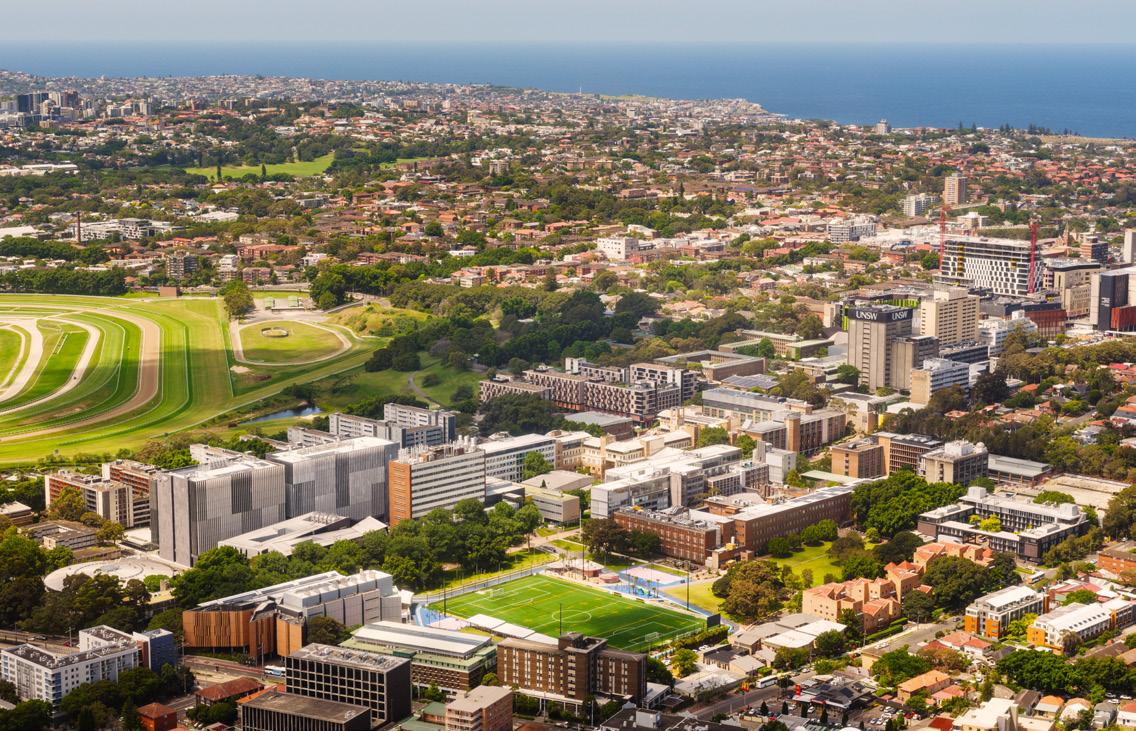
UNSW’s primary campus is located in Kensington, a welcoming and diverse inner-city neighbourhood perfectly placed between the beach and the city, so you will enjoy the best of what Sydney has to offer.
There are train, bus and light rail options that run from UNSW campuses throughout Sydney at all hours of the day. Explore Sydney city by light rail in just 20 minutes, or visit beautiful Coogee Beach, just eight minutes away by bus.
Numerous restaurants, shops, healthcare services and amenities are available around campus to meet your daily needs.
Take a virtual tour
Join us for the ultimate campus tour to explore our university and its surroundings. See where you will be eating, sleeping, playing and studying when you are in Sydney.
Coogee
Uni life, your way
Our academic calendar is uniquely designed to give you the flexibility to structure your studies around your goals.
The current UNSW 3+ academic calendar has three 10-week teaching terms each year, commencing in February, May and September, with an optional summer term in January. With UNSW 3+, you will have access to:
Flexible study structure
Customise your timetable to your needs and career aspirations. Add one extra course per year to finish one term early* or spread out your study load with fewer courses per term^ to create time for extracurricular activities and internships.
Industry opportunities
Internships and practicums integrate into the 3+ structure. Set yourself apart with industry experience through Work Integrated Learning (WIL), without extending your degree.
Global connections
Aligned with Northern Hemisphere university calendars, 3+ enables you to study abroad without extending your studies. Explore short courses, internships or exchanges at 300+ international partners.
Introducing the UNSW
flex-semester calendar from 2028
Our new flex-semester calendar has been created to support your unique learning and career needs. We will launch this structure for our undergraduate students and most postgraduate students from 2028, centring on delivering the best learning experiences and outcomes for all our students throughout their education journey.
What will a flex-semester look like?
Our new flex-semester calendar will include two 12-week teaching semesters, and summer and winter terms suitable for intensive or catch-up courses and accelerated study.
How will the new calendar benefit me?
With a 12-week semester, you will be able to engage more deeply with course material. Our new flexsemester will also provide flexibility and choice around study load, learning mode and balancing other life commitments such as paid work and extracurricular activities.
When will the new calendar be introduced?
Learn more about UNSW’s academic calendar. Visit unsw.to/terms
*Early completion of your program may impact your stay on an Australian Student Visa. Visit unsw.to/visa-information
^Minimum
We aim to introduce our new flex-semester calendar in 2028. If you are commencing at UNSW in 2026, your program might span both the current UNSW 3+ calendar and the new flex-semester calendar. We will endeavour to support a smooth transition, working with you to manage your study load and facilitate the completion of your degree program on time.
you need
Study and academic English success
Get the most from your studies with free consultations and academic writing workshops to help with essay and report writing, exam preparation, presenting with confidence and many other university skills.
Peer-Assisted Study Sessions (PASS)
Run by senior students, these sessions can help you improve your grades and make friends by studying with other students in your course.
Visit unsw.to/pass-program
myEnglish Week
Attend fun and interactive sessions before term starts to build your academic English language skills, make friends and learn how to succeed at UNSW.
Visit unsw.to/myEnglishWeek
Academic
Skills Toolkit
Get quick self-help guides and online resources to improve your academic skills.
Visit unsw.to/academic-toolkit
For more information, visit student.unsw.edu.au/skills and student.unsw.edu.au/English
their mental health and wellbeing and reach their academic potential. For more information, visit student.unsw.edu.au/counselling
Under 18 Care Program
Peer support mentors and special support programs for young students under 18 years of age are also available. For more information, visit student.unsw.edu.au/visa18
Disabilities and health conditions
If you have a disability or a medical or mental health condition that affects your studies, you can register with Equitable Learning Services (ELS) to obtain educational adjustments. These adjustments are actions or changes within your learning environment that allow you to study without disadvantage. Educational adjustments do not give you an unfair advantage over other students. ELS is a confidential service. Your teachers will not know details about your condition and it will not affect your visa.
To watch a video with subtitles in different languages and learn more, visit student.unsw.edu.au/els
Get the full experience
We support your journey
At UNSW, we want you to feel welcomed and supported from the moment you enter the country. To ensure you have a smooth arrival and an unforgettable experience, we offer a range of services for commencing international students.
Before your trip
Book your free airport pick-up service and get matched with a cultural mentor – a senior student ‘buddy’ who will answer all your questions about UNSW and Sydney.
After you arrive
Your mentor can help you learn about Australian culture, customs and settling into student life at UNSW.
Before term starts
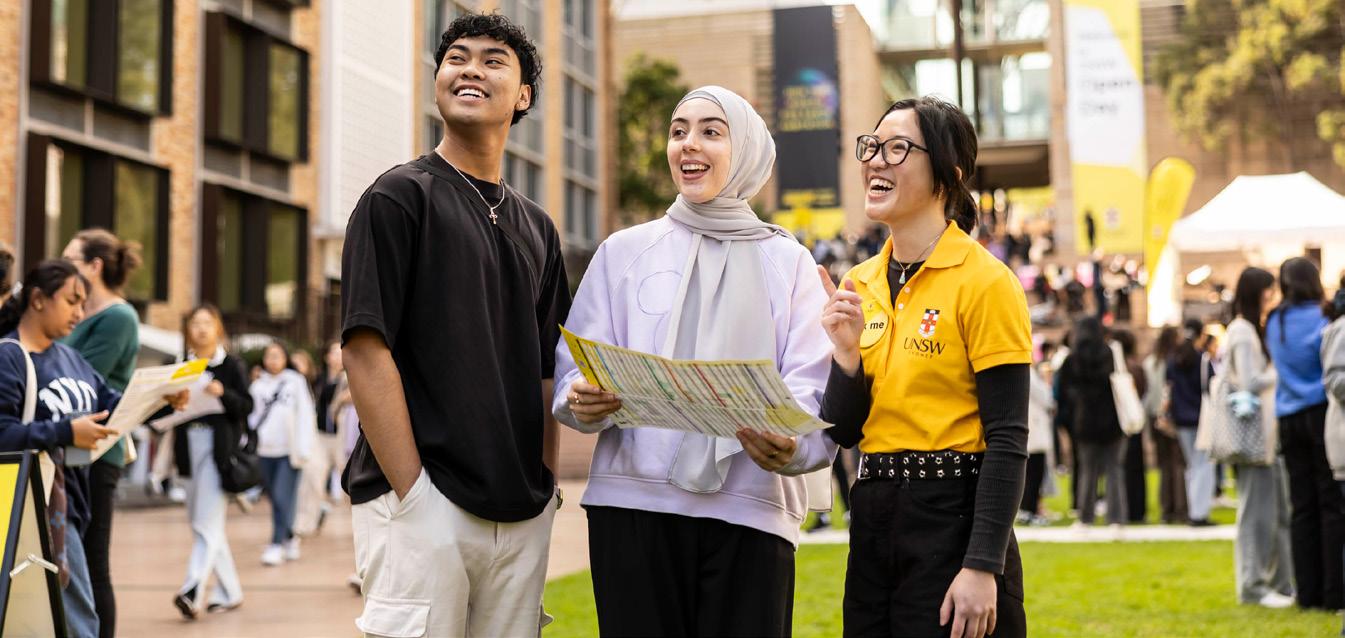
There are lots of welcome and orientation activities to familiarise you with the campus and university life. Join our new-arrival workshops, campus tours, myEnglish Week and O-Week!
Our dedicated International Student Welcome Centre and Student Support Advisers provide personalised advice and information on university life, student visas, wellbeing and academic performance. They cannot wait to meet you in person!
For more information, visit student.unsw.edu.au/international
Your safety matters
The safety and wellbeing of our students is our number one priority.
You will feel safe and secure on campus with our 24/7 security services, which include safety escorts and night shuttle buses. Our SafeZone app allows you to easily access personalised emergency assistance and report safety concerns at your fingertips.
Enjoy diverse community activities
Studying abroad is about more than just textbooks and lectures. You will meet people from around the globe, discover yourself in a new environment and shape your view of the world.
At UNSW, there are so many ways to explore, experience and enjoy university life.
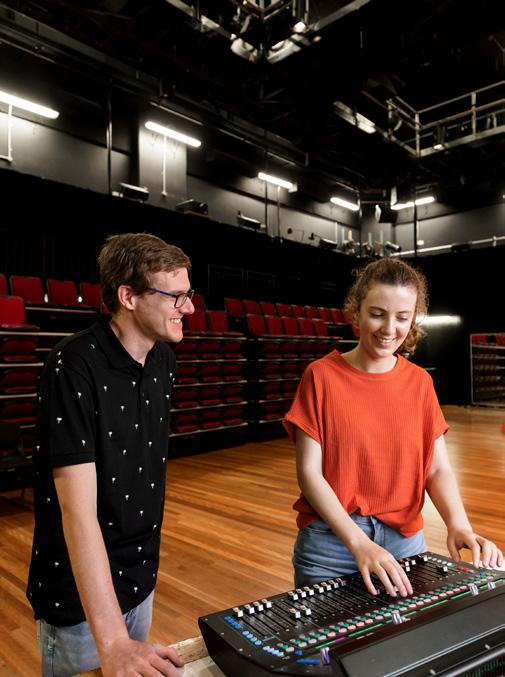
• Music Performance Unit: Take your musical talents to the next level, connect with fellow music enthusiasts or chill out at an on-campus concert.
• Cultural clubs: Feel at home and make friends from around the world with our 37 cultural clubs. Celebrate UNSW’s diverse and dynamic culture with events such as the International Night Markets, where you can taste iconic street food from different countries and meet new people.
• Religious Centre: Connect with diverse faith communities on campus. Find support through worship services, spiritual guidance and prayer meetings, with dedicated spaces for various faiths.
I came to UNSW for Open Day, where I realised the university has a fantastic student life and also has a stunning location just down from the beach.
Tom Houlden Bachelor of Economics (Honours) graduate
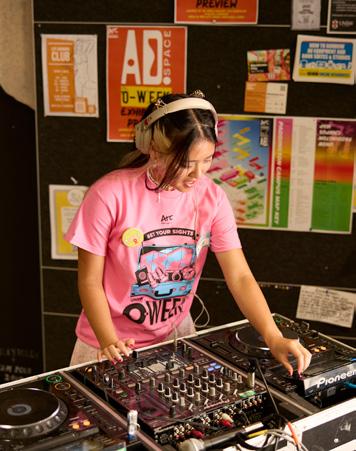
• Arc | UNSW Student Life: Step away from the books with Arc, our student-led organisation. Arc is home to more than 350 clubs and hosts year-round events, sports, volunteering opportunities, health and wellness sessions... the list goes on. Build connections and find your people at arc.unsw.edu.au
UNSW’s Village Green – your playground on campus
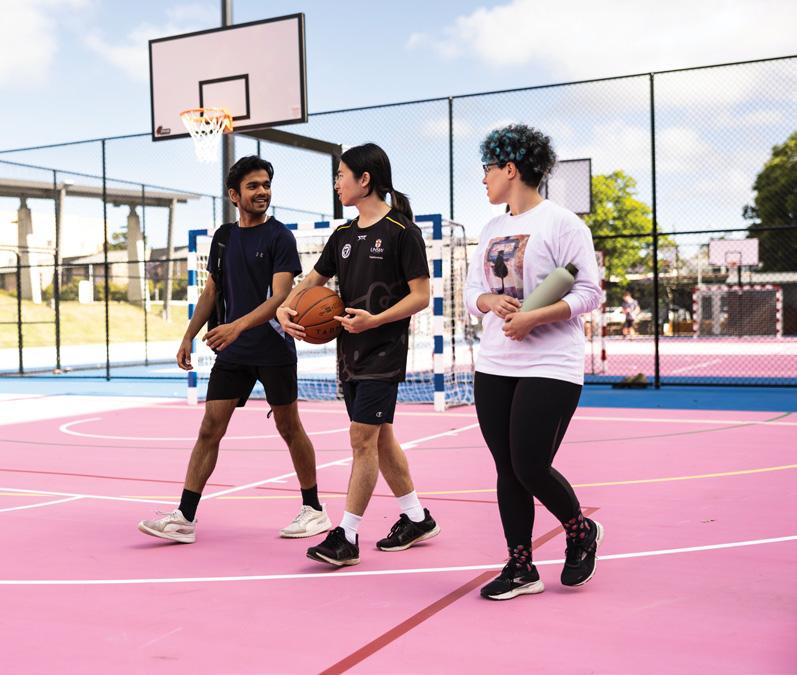
The Village Green Precinct is your home for sport, recreation and wellness at UNSW. Our state-ofthe-art facilities include multipurpose courts and sports fields, a running track, outdoor fitness equipment, a bouldering wall and landscaped social spaces. The Village Green is an inclusive space where you can connect with other students, staff and community members to play, exercise, socialise and relax.
UNSW's Village Green
Find your new home
Feel at home with our range of award-winning accommodation options at UNSW. Walk to your lectures, enjoy easy access to Sydney’s vibrant city and stunning beaches, and make lifelong friends with people from around the world.
UNSW Accommodation
More than just comfortable living spaces, our buzzing student community offers an unbeatable lifestyle and the flexibility to shape your university journey your way. Fully immerse yourself in university life in a fun, nurturing community centred around you and your education.
Colleges
Residential colleges provide a truly inclusive and supportive living environment that fosters academic excellence and social engagement. Our on-site teams are available to provide academic guidance and personalised wellbeing support.
Apartments
Located on and off campus, UNSW apartments provide an independent, self-sufficient style of living for undergraduates and postgraduates, including couples and families.
Every room operated by UNSW Accommodation includes utilities, fast Wi-Fi and secure facilities. Many options include room cleaning services, catered meals to suit all dietary needs and staff on hand to support your needs at no extra cost.
Learn more about your accommodation options and find the home that is right for you at unsw.to/accommodation
UNSW affiliated accommodation
Our affiliated colleges and apartments, including communities with religious foundations, offer independent living options on campus. Embracing diverse traditions, these residences welcome students from all backgrounds. Discover what is available at unsw.to/accommodation
Off-campus accommodation
Private rentals
Choose from numerous student accommodation and rental properties surrounding UNSW.
Homestay
Hosted accommodation can offer an enriching cultural exchange and flexibility. Your host family provides a bedroom and utilities while you take care of your own cooking, cleaning, laundry and phone costs.
Off-campus accommodation support
Our team can guide you in finding safe and conveniently located off-campus housing options. To book an appointment, visit student.unsw.edu.au/accommodation
Temporary accommodation
If you are yet to secure long-term accommodation, consider arranging temporary lodging before arriving in Sydney. Aim to come three to four weeks before your degree starts so you can explore options and settle in.
Under 18s
Students under 18 years of age require arrangements that comply with Australian government regulations. For further details, please refer to student.unsw.edu.au/visa18
Explore our database to find available options at studystays.unsw.edu.au
Student Visa application process. Up-to-date information is available on the Department of Home Affairs website.
*Costs will vary depending on the type of accommodation and catering offered.
^UNSW residential college contract periods are 44 weeks.
How to apply
Step 1: Choose your program
Choose your program at unsw.to/degrees or from the pages of this guide and make a note of the program code.
Step 2: Check your entry requirements
You need to meet your chosen program’s minimum entry requirements (see from page 76 for the requirements specific to your program). You also need to meet UNSW’s English language requirements (see page 74 or visit unsw.edu.au/elp).
Step 3: Submit your application online
Submit your application at UNSW Apply Online, applyonline.unsw.edu.au. Click ‘Register now’ and fill out your details. Upload your supporting documents and pay your application fee.
Step 4: Track your application
Once you have submitted your application you will be able to easily track its progress via your Apply Online account. You will also be able to upload any additional documents we need.
Step 5: We will send you a letter of offer
We will notify you of the outcome of your application via email. If your application is successful, you will receive a full offer, or a conditional offer if more steps are required. If you are receiving assistance with your application, your nominated agent will also receive a copy of the email.
Step 6: Accept your offer
If you receive a full offer, you will also receive an email with a link to your personalised offer page. Your page will guide you through the process of accepting or deferring your offer. Once you have accepted and paid your deposit, you will receive an electronic Confirmation of Enrolment (eCoE) which is required for your student visa.
Please note, your offer may have an expiry date, so note down the date and take the necessary steps before your offer expires.
Step 7: Enrol online
Once enrolment for your degree is available, you can enrol in your degree and courses online at Accept Online, acceptonline.unsw.edu.au
Other ways to apply
You can also apply to UNSW at an exhibition or event we are attending, or through a UNSW agent located in your country. Find out more at unsw.to/apply-international-students
Application deadline
You should submit your completed application as early as possible to ensure it will be processed in time for your preferred start term. Some high-demand programs such as engineering, and faculties with limited places such as Medicine & Health, may have an earlier application deadline or commencement date.
For more information, go to applyonline.unsw.edu.au
How to apply for a scholarship
UNSW undergraduate scholarships
UNSW scholarships for international students support you with some of the costs associated with studying at UNSW. Scholarships recognise students who demonstrate academic achievement or other outstanding qualities, such as leadership skills or contributions to the wider community. To be considered for a scholarship, you must submit a separate application in addition to your admission application.
Other scholarship providers
There are many scholarships offered by organisations other than UNSW, including the Australian government, industry partners and organisations in your home country.
Australian government scholarships
*Dates may be adjusted. For most recent dates, please visit student.unsw.edu.au/calendar
Some programs may have different dates. Please refer to student.unsw.edu.au/calendar
Assumed knowledge
We do not have formal subject prerequisites for any of our degrees. Our degrees have 'assumed knowledge', which will help ensure you are off to a strong start in your first year. If you have not studied the assumed knowledge subjects, it will not stop us from making you an offer, but we strongly recommend bridging courses if you do not have the assumed knowledge for your degree of interest.
You can find the assumed knowledge for all degrees at unsw.to/degrees
Contact us
If you have any questions regarding your application, our team is here to help.
T: +61 2 9385 1844 (10am–4pm, Sydney time) W: enquiry.unsw.edu.au
Australia Awards are international scholarships, fellowships and short courses funded by the Australian government. They offer emerging leaders from developing countries an opportunity to undertake study, research and professional development in Australia and empower them to make an impact when they return to their home country. For more information, visit australiaawards.gov.au
Step 1: Search
Visit scholarships.unsw.edu.au. Make sure you select ‘International’ in the residency search box to see the list of scholarships available to you.
Step 2: Register
Before applying for your chosen scholarship, register for a future student account by following the instructions on the page. To be considered eligible for international scholarships, you will need to lodge your admission application and receive an offer to study by the scholarship deadline.
Step 3: Apply
To apply, log in using your registered login and password. Some scholarships may have specific questions or require supporting documentation. Double-check the requirements on the UNSW Scholarships website at scholarships.unsw.edu.au
Some awards, such as the Australia's Global University Award and the UNSW College Academic Award, do not require an application and are automatically awarded.
Step 4: Submit
Submit your application by the due date. Do not forget to check the website regularly for application deadlines and updates.
Please check our website regularly for any new scholarships that may become available. For more information about UNSW scholarships, visit scholarships.unsw.edu.au
Arts, Design & Architecture
Step out of your comfort zone and into your potential. Become one of Australia’s most employable graduates by studying a degree in architecture and built environment, creative arts, design, education, humanities or social sciences at UNSW.
Creative and analytical skills are projected to be two of the most essential workplace skills by 2030. In fact, 66% of employers rank creative thinking as the most important soft skill on the rise by 2030.*
*World Economic Forum, Future of Jobs Report, 2025
Ranked in the top five in Australia for Architecture and Built Environment, Art History, Communication and Media Studies, Politics, Social Policy and Social Sciences and Management.
QS World University Rankings by Subject, 2025
Craft your career from day one
Want to gain real-world experience and build professional connections? At UNSW, we offer a range of opportunities to connect with industry experts and explore your future career.
Work Integrated Learning
Every degree offers hands-on experience through internships and professional placements, so you can graduate job-ready with the skills employers are looking for.
Professors of Practice
Ranked #1 in Australia for Social Sciences and Management and #1 in Sydney for Architecture and Built Environment – with both ranked #23 globally.
QS World University Rankings by Subject, 2025
Choose from more than 75 study areas and 40 double degrees. Whether you are designing the cities of tomorrow or tackling complex social challenges, you will graduate ready to seek out and solve problems to improve life on Earth.
Progress awaits
Progress is predicting the unpredictable
At UNSW, art and science are coming together to prepare for the next extreme fire event. In a world-first AI simulation, iFire, our researchers are challenging the expectations of first responders to help prepare them for ever-increasing wildfire scenarios and the effects of global warming.
Progress for climate action starts with your creativity. What progress will you make with UNSW?
Learn from industry leaders who bring cutting-edge expertise directly into your classroom. Work on realworld challenges, collaborate with professionals and gain insights that set you apart in a competitive job market.
Career Discovery Mentoring Program
Our tailored mentoring program pairs you with experienced industry professionals to guide your career journey. Build your network and gain insights to help you transition from study to work with confidence.
Unleash your creativity
At UNSW, creativity has no limits. Explore stateof-the-art studios, virtual simulation rooms and workshops at our Art & Design campus. Experiment in the Design Futures Lab, Makerspaces and Esme Timbery Creative Practice Lab, and find inspiration at our museum-standard gallery.
Build connections and community
From day one, you will connect with a vibrant student community and an extensive network of industry partners, gaining real-world experience through internships, professional placements and hands-on projects. Immerse yourself in more than 350 clubs and societies, engage with fellow students, alumni and industry leaders, and develop connections to propel your career to new heights.
For more information, visit unsw.to/ada
Bachelor of Arts Bachelor of Design
Program code 3409
CRICOS code 001916C
Duration 3 years (+ 1 year honours option)
Entry February, May and September
Estimated first year tuition $A49,000 Units of credit (per year/total) 48/144
Pursue your passion for the humanities, creative arts and social sciences. Gain critical thinking, problem-solving and communication skills while tackling challenges that are relevant to areas like climate change and cultural diversity.
Career outcomes
Kick-start a rewarding career by studying the most popular degree for non-executive directors in Australia’s top 100 public companies.* Graduate with the skills to make a genuine impact in roles across a range of industries, including:
• Consulting • Education
• Government and public service
• Media and journalism
• Non-profit organisations
*Apollo Communications – ASX-100 Board of Directors
2020 Report
Majors
• Asian Studies
• Criminology
Creative Writing
• English
• Environmental Humanities
• European Studies
• Film Studies
• Geographical Studies
• Global Development History
• Indigenous Studies
• Languages (Chinese, French, German, Japanese, Korean and Spanish)
• Linguistics
• Media, Culture and Technology Music Studies
• Philosophy
• Politics and International Relations
• Sociology
• Studies in Psychology
• Theatre and Performance Studies
Minors
Choose a minor from the list above or from the following:
• Art History and Theory
• Australian Studies
• Game Art
• Gender Studies
• Indonesian Studies
• International Political Economy Italian Studies
• Modern Greek Studies
• Policy, Power and Government Security Studies
I chose to study the Bachelor of Arts because of the scope of courses I could pursue. UNSW’s location in Sydney was also a big selling point for me. I wanted to be in a city that held opportunities, and to be part of a wider global community. Engagement with my peers played a big part in my university studies, and the experience of bouncing ideas and opinions off one another made me feel very comfortable in my degree.
–
Cammy Gee
Bachelor of Arts graduate
Senior Customer Planning and Activation Executive at Bacardi
You can complete a third minor in one of the study areas in the previous list, or choose one of the below:
• Criminology
Economics
• Human Resource Management
• Indigenous Studies Innovation, Strategy and Entrepreneurship
• International Business
• Marketing • Studies in Psychology
Double degrees
• Advanced Mathematics (Hons)
• Advanced Science (Hons)
Commerce
• Computer Science
• Economics
• Education (Secondary)
• Engineering (Hons)
• Environmental Management
• Fine Arts Law
• Media
• Medical Studies/Doctor of Medicine Science
• Social Work (Hons)
Program code 4825
CRICOS code 110651E
Duration 3 years (+ 1 year honours option)
Entry February, May and September
Estimated first year tuition $A46,500
Units of credit (per year/total) 48/144
Make your mark transforming creativity into real-world design solutions with lasting impact. Choose from three distinct specialisations where you will gain practical skills and develop your independent thinking, so you can challenge the everyday and forge a lifelong creative career.
Career outcomes
Take advantage of opportunities to gain industry experiences through internships, studio projects and networking events while you study. After graduation, you will be ready to challenge conventional methods and find new solutions to age-old problems in a career that celebrates your passion and purpose each day. Potential careers include:
• Experience and event designer
• Film, television and digital media producer
• Graphic designer Jewellery or textile designer
• UX designer
• Visual communicator or exhibition illustrator
Specialisations
• Computational Design
• Industrial Design
• Integrated Design 3D Visualisation
• Experience
• Fashion Graphics
• Interaction
• Object Textiles
Double degrees
• Commerce
• Education (Secondary) Media
Bachelor of Fine Arts
Program code 4830 CRICOS code 110652D
Duration 3 years (+ 1 year honours option)
Entry February, May and
Build technical skills in a creative field that matters to you. With a specialisation in Animation and Moving Image, Art Theory, Music or Visual Arts, you will develop your artistic practice through workshops, studios and industry events.
Career outcomes
Specialise in your passions and set yourself up with the technical skills and professional acumen to succeed in your chosen field as a creative professional. Seek out inspiring career opportunities, such as:
• Animator or visual effects artist
• Art critic or gallery curator
• Advertising or creative director
• Film producer
• Digital publisher or content specialist Sound designer or music producer
Specialisations
• Animation and Moving Image
• Art Theory
• Music
• Visual Arts
Double degrees
Advanced Science (Hons)
• Arts
• Commerce
• Computer Science
• Education (Secondary)
• Engineering (Hons)
• Law Media
• Science
The Bachelor of Fine Arts equipped me with a diverse range of skills beyond the development and production of visual art. Visibility and collaboration are at the nucleus of the arts, and these skills have been vital across the progression of my career, whether this be when I work with artists, audiences and stakeholders, or when I am writing for and about exhibitions.
–Sarah Rose
Bachelor of Fine Arts graduate
Associate Curator and Executive Assistant at Artspace
In
Bachelor of Politics, Philosophy and Economics
Program code 3478
CRICOS code 098376B
Duration 3 years (+ 1 year honours option)
Entry February and September
Estimated first year tuition $A48,500 Units of credit (per year/total) 48/144
Get to the heart of how our world works and learn to create solutions to global challenges. You will gain indepth knowledge and a unique skill set to drive important social, political and economic change.
Career outcomes
Your expanded worldview and specialised insights will help you carve out a career in public policy, diplomacy and economic analysis. Work in a range of areas, including: • Humanitarian groups Non-government agencies • Political parties
Bachelor of Social Sciences
Program code 3325
CRICOS code 110657K
Duration 3 years (+ 1 year honours option)
Entry February, May and September
Estimated first year tuition $A49,500 Units of credit (per year/total) 48/144
Shape an inclusive tomorrow that is better for all. Understanding social systems and advocating for thoughtful social policy has the power to transform our communities. Gain skills that impact policy, drive change and make a real difference to local and global communities at a social sciences school that is ranked
These momentous events would not have been possible without social sciences. With this degree, you will be primed to create positive change through critical analysis and political influence, working in careers such as:
Political adviser
• Research officer Specialisations Economics
• Environmental Humanities
• Geographical Studies
• Global Development
• Human Resource Management
• Indigenous Studies
• Innovation, Strategy and Entrepreneurship
International Business
• International Studies
• Marketing Media, Culture and Technology
• Politics and International Relations
• Sociology
degrees Advanced Science (Hons)
• Law
• Social Work (Hons)
The Bachelor of Social Sciences provides a broad range of specialisations and double degree options, allowing you to tailor your studies... The interdisciplinary nature of my studies has enriched my understanding of complex societal issues while equipping me with the skills to analyse and address them from both legal and social perspectives.
Olivia Froio Bachelor of Laws/Social Sciences
Bachelor of Media
Program code 3341
CRICOS code 110658J
Duration 3 years (+ 1 year honours option)
Entry February, May and September
Estimated first year tuition $A46,500 Units of credit (per year/total) 48/144
Choose from five specialisations and develop the expertise you need to enter the evolving world of media. Develop practical on-the-job skills along with conceptual, strategic, creative and critical capabilities to make your mark in a range of exciting media industries.
In my degree, there are a lot of international students, so I really feel I belong to the environment. You are not only going to write essays and give presentations; you will learn a lot of practical skills through different activities, like making a real campaign or advertisement.
The School of Media also offers an internship every term. If you like content creation, making campaigns and staying up to date with social media, this would definitely be the best degree for you.
Cami Vu Bachelor of Media (Public Relations and Advertising)
Career outcomes Unlock the professional and practical skills you need to thrive in your media career. With a steady increase in demand for artistic directors, media producers and presenters*, graduates can step into the workforce as one of Australia’s most employable graduates.^ Explore opportunities in fields such as:
and
Nurture your creative skills in our Esme Timbery Creative Practice Lab
Bachelor of Education (Secondary)
Drive meaningful impact with a career as a dedicated secondary school educator. Learn to support your students in a constantly changing world and help to shape and inspire future generations. As part of your degree, you will complete up to 80 days of supervised work experience.
Career outcomes
Pursue a meaningful and reliable career as a secondary school teacher. Jobs in the Australian education industry is projected to grow 13% over the next decade.* You will graduate with a formal accreditation from the NSW Education Standards Authority (NESA) and can explore job opportunities in areas such as:
• Corporate trainer • Curriculum officer
• Education consultant
• Government and non-government secondary schools (domestic and international) *Labour
Education (Secondary) double degrees
Bachelor of Education (Primary) (Honours)
Make a real impact on the lives of primary school children with hands-on experience from your first year. Learn from world-class practitioners and complete 80 days of supervised work experience to become a confident, professionallyaccredited teacher. You will be primed to apply the latest research to shape the future of education.
Career outcomes
Primary education careers in Australia offer a promising path, with a projected 21% increase in school students by 2030.* With accreditation from the NSW Education Standards Authority (NESA), you will be equipped to make an impact in the classroom and beyond, working in roles across:
• Education consulting • Education policy Government and non-government primary schools
*Australian Bureau of Statistics, 2022
Specialisations
• English
• Mathematics
Bachelor of Social Work (Honours)
Make a difference in the lives of those who need it most. Gain practical skills through two professional placements to shape healthier, happier relationships and communities, with direct guidance from industry professionals and practising social workers.
Career outcomes
Social workers play a crucial role in supporting wellbeing, social justice and social development in our communities. In Australia, employment in the sector has grown at a rate of 4.75%.* This important work spans many fields, from mental health to policy development.
Bachelor of Architectural Studies
Design buildings and places that improve the lives of people and communities. Learn how to use space, materials, technologies and the natural environment to create innovative architecture that considers sustainability, inclusivity and connectivity.
With formal accreditation from the Australian Association of Social Workers, you will be primed to drive important outcomes in areas such as: Child protection
• Community development
• Government departments Human rights advocacy
• Mental health support
• Social justice Welfare agencies
*Australian Bureau of Statistics, 2024
Double degrees
• Arts
• Criminology and Criminal Justice
• Law
• Social Sciences
Career outcomes
As cities expand and transform globally, demand for architects is projected to grow 35% over the next 10 years.*
Combine your degree with UNSW’s Master of Architecture for professional recognition from the NSW Architects Registration Board. With this, you will be qualified to practice as a registered architect in Australia and around the world. Potential roles include:
• Architect Building scientist
• Environmental consultant
• Interior design architect
*Labour Market Insights, 2023
Bachelor of Interior Architecture (Honours)
Program code 3256
CRICOS code 088833J
Duration 4 years
Entry February and September
Estimated first year tuition $A48,500
of credit (per year/total) 48/192
I love making communities happy and creating places that support life. I love learning about the cultural landscapes around us and how we can design to honour them. It provides a culturally appropriate means for me to reconnect with Indigenous communities and learn about cultural knowledge in a way that still allows me to use my creativity.
–
Kaylie Salvatori
Bachelor of Landscape Architecture (Honours)
Innovate and improve the interior environments where we work, rest and play. Study and practice in a design community that collectively reimagines and reshapes the interior environments within our homes, workspaces and cities.
Career outcomes
Graduate with the confidence, connections and career-ready skills to turn your creativityand critical thinking into real-world solutions. You will gain professional recognition from the Interior Designer/Interior Architecture Educators Association (IDEA) and be eligible for membership to the International Federation of
Interior Architects/Designers (IFI) and Design Institute of Australia (DIA).
Your potential job opportunities include:
• Interior architect
• Interior designer (specialising in multi-storey residential, retail, hospitality, medical, hotel or exhibition design)
• Designer (in architecture and design practices)
• Private consultant (specialising in residential, retail, workplace or hospitality settings)
Optional minors
• Computational Design
• Construction Management and Property Industrial Design
• Landscape Architecture
Bachelor of Landscape Architecture (Honours)
CRICOS code 089363D
Duration 4 years
Design high-performing urban and regional landscapes that are adaptive and resilient to humaninduced climate change. Explore the landscape systems of the Sydney region and experiment with novel design solutions that foster a socially and environmentally just world.
Career outcomes
As cities and communities increasingly work to create sustainable environments in urban and rural settings, this is your opportunity to drive progress in this important field. With a degree accredited by the Australian Institute of Landscape Architects (AILA), you will graduate with the practical skills and industry backing to pursue careers including:
Design and policy strategist
• Landscape architect
• Parks and recreation manager
Project manager
• Urban designer
Bachelor of City Planning (Honours)
Program code 3362
CRICOS code 088837E
Duration 4 years (includes practice year)
Entry February
Estimated first year tuition $A48,500
of credit (per year/total) 48/192
Shape the communities of tomorrow by designing sustainable, equitable and inspiring built environments. Consider city economics, transport, environmental science, sociology, urban design and more to get to the heart of what makes a place thrive.
Additionally, develop workplace skills in a ‘practice year’ of Work Integrated Learning (WIL). You will turn your creativity and critical thinking into real-world solutions.
Career outcomes
Gain the confidence and job-ready skills to thrive as a successful urban planner. With a highly regarded degree accredited by the Planning Institute of Australia (PIA), you will be able to address the local and global challenges facing our natural and built environments.
Careers include:
• Environmental planner
• Heritage officer Property developer
• Social and community planner
• Urban planner Urban policy analyst
Double degree
• Law
Bachelor of Construction Management and Property
Program code 3332
CRICOS code 088764F
Duration 3 years (+ 1 year honours option)
Entry February and September
Estimated first year tuition $A48,500
of credit (per year/total) 48/144
Bring sustainable places to life with specialist knowledge of how people, processes and products work together. You will gain essential management and technology skills in construction and property economics, and will put theory into practice through high-level problemsolving and leadership opportunities.
Career outcomes
Complex construction projects need leaders who can meet the demands of a constantly evolving industry. Upon graduation, you will receive formal accreditation from The Australian Institute of Quantity Surveyors (AIQS). Being among Australia’s most employable graduates*, you will have the skills, knowledge and industry backing to pursue roles in:
• Construction planning and management Property development
I wanted to study at UNSW because of its positive learning environment and reputation within the construction industry. The motivated educators at UNSW brought their unique experiences to the classroom and supported our learning. During my studies, I obtained a cadetship in the construction industry. It was a real light bulb moment when I was able to bring classroom concepts to work and use them to make sense of real-life situations!
–
Hamza Arshi
Bachelor of Construction Management and Property graduate
Senior Manager Commercial at Sydney Metro
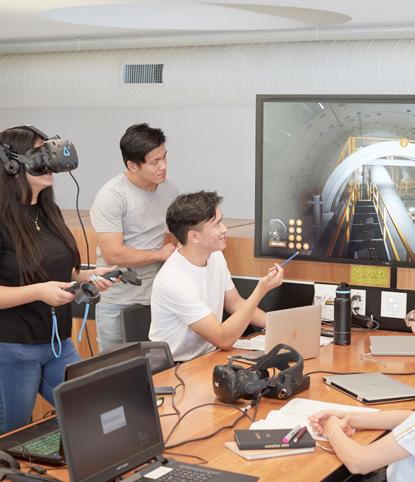
Cutting-edge teaching techniques using virtual reality visualisation of construction sites
UNSW Business School
Build the skills to drive progress and shape a better future. With a career-focused business education, you will develop the adaptive thinking needed to thrive in our rapidly evolving world.
Employment for business, human resource and marketing professionals is projected to grow 20.8% by 2034.*
*Jobs and Skills Australia, 10 year change to May 2034
#1 business school in Australia
Australian Financial Review (AFR) BOSS Best Business Schools, 2022–2024
Career Accelerator
Our distinctive degrees bring the boardroom to the classroom with hands-on professional learning opportunities provided by a dedicated Career Accelerator, a program that is exclusive to UNSW Business School students. Career Accelerator ensures you will graduate career-ready, prepared to hit the ground running.
Beyond the classroom
#1 in Australia for Accounting and Finance, Business and Management, and Marketing
QS World University Rankings by Subject, 2025
#1 worldwide for Actuarial Studies and Risk Management
UNL Global Research Rankings of Actuarial Science, and Risk Management and Insurance, 2024
Join a business club or society and fill your calendar with social, industry and networking events. UNSW Business Society (BSOC) is the University’s largest society. BSOC offers more than 75 events annually, including first-year camps and mentoring to help you settle in.
Professional networking
Expand your network with our 10-week Career Mentoring Program, attend Business Insights events and connect with your peers through career development workshops and engagement events.
Internships
#1 in Australia for Information Systems
Association for Information Systems, 2024
Progress awaits
Progress is solving real-world challenges together
Access to business education can improve economic and social outcomes for generations. Researchers at UNSW use Playconomics, an innovative gamified learning platform, to equip future business leaders and problem-solvers with the skills to tackle real-world challenges and shape a more prosperous and inclusive society.
Progress in challenging business environments starts with you. What progress will you make with UNSW?
Gain business experience while earning course credit with internships through Career Accelerator. Take advantage of exclusive industry placements or pursue your own – the choice is yours.
Global opportunities
Experience international business practices with a range of global electives, practicums and exchange programs. Through our Global Business Practicum, you can consult on projects in major hubs like Seoul, Hong Kong, Bangkok and Jakarta.
For more information, visit unsw.to/business
The Bachelor of Commerce’s industry focus and real-world application, as well as its breadth and wide skill set, have helped me land internships in various industries, including Wellington Management, PwC and 26 Degrees Global Markets. The career support provided by the Career Accelerator team played an integral part in me landing these roles.
Matthew Kuk
Bachelor of Law/Commerce
Bachelor of Commerce
Career outcomes
Harness the power of UNSW Business School’s global industry network to launch an impactful career in the private sector, government (local or international) or the not-for-profit arena. Demand for business professionals is rising, and the business sector has enjoyed consistent annual employment growth.^ UNSW’s Bachelor of Commerce opens doors to diverse and highimpact roles, such as:
• Accountant
Empower yourself to drive progress in the world of business with adegree from Australia’s #1 business school.*
Build essential skills from day one. Guaranteed industry learning opportunities and the award-winning MyBCom online portfolio will ensure you succeed as one of Australia’s most employable business graduates.
*Australian Financial Review (AFR) BOSS Best Business Schools, 2022–2024
• AI integration specialist
• Business development manager
• Business analyst Consultant
• Data analyst
• Environmental, Social and Governance (ESG) consultant
• Economist
• Human Resources (HR) specialist Innovation manager
• Financial adviser
• Investment banking analyst
• Marketing/brand manager
• Portfolio manager
^Australian Bureau of Statistics, 2024
Majors
You can choose up to two of the following majors:
• Accounting
• AI in Business and Society
• Behavioural Economics
• Business Analytics
• Business Economics
• Business Sustainability and Social Impact
• Cybersecurity Management
• Finance
• Financial Technology
• Human Resource Management Information Systems
• Innovation, Strategy and Entrepreneurship
• International Business
Marketing
• Marketing Analytics
• Taxation
Double degrees
Actuarial Studies
• Advanced Mathematics (Hons)
• Advanced Science (Hons)
Arts
• Aviation (Management)
• Computer Science
Design
• Economics
• Education (Secondary)
• Engineering (Hons)
• Fine Arts
• Information Systems
• Law
Materials Science and Engineering (Hons)
• Media
• Science
I would recommend my program for students seeking a combination of mathematical rigour and a chance to learn more about the business environment we live in. Embedded within my program were Sandbox projects that allow you to work on assignments related to industry partners and their real-life problems.
–
Harrison Hu Bachelor of Actuarial Studies/Economics
Bachelor of Actuarial Studies Bachelor of Commerce (International)
Join one of the world’s top actuarial programs, which attracts the highest-performing business students in Australia and offers global accreditation with leading actuarial bodies. Learn from worldclass academics and industry leaders as you build the cuttingedge expertise required to evaluate complex risks and opportunities, harness data-driven insights and craft innovative solutions that will empower organisations to make critical decisions.
Career outcomes
Shape your future in a world where data drives decisions and risk shapes outcomes. Actuarial Studies equips students with highly sought-after skills, giving graduates strong earning potential right out of university. Your unique blend of quantitative skills and business acumen will open up a wide range of career opportunities in insurance, superannuation and financial
services. Opportunities extend beyond the financial services sector to include exciting, cutting-edge fields such as artificial intelligence, machine learning and data analytics in various industries. Graduate roles include:
• Actuarial analyst or consultant
• Asset management analyst
• Credit analyst Data science actuary
• Insurance analyst
• Investment banker Quantitative trader
• Risk officer
• Statistical research analyst Wealth management analyst
Upon meeting the academic standard requirements, you will gain exemptions for accreditation with the Actuaries Institute (Australia), which provides mutual recognition at major international actuarial bodies in the UK and US.
Optional majors
• Actuarial Risk Management and Analytics
• Computational Data Science
• Quantitative Data Science
• Or select a Bachelor of Commerce major*
*Students wishing to study a Bachelor of Commerce major may need to undertake additional units of credit to complete program requirements.
Double degrees
• Advanced Mathematics (Hons) Commerce
• Computer Science
• Economics Information Systems
• Law • Science
Expand your horizons in global business with a degree that builds on the opportunities of the Bachelor of Commerce with a powerful international perspective. Gain an in-depth understanding of international practices and cultures through a one-year overseas exchange, supported by a $A5000 scholarship.
Career outcomes
Kick off a global career in business with opportunities to work across the private sector, government and non-government organisations. You will be eligible for membership to a range of professional organisations, depending on your chosen majors. Prepare for diverse roles in fields such as:
• Accounting
• Consulting Foreign affairs
• Global business development
• Global supply chain
• Human resources
• International finance
• International trade Investment banking
• Marketing • Policy Business majors Students can complete 24 UOC in a single International Studies discipline stream and can use free electives for an additional major or minor in their chosen area. See page 34.
Example International Studies discipline streams
• Asian Studies
• European Studies
• Global Development History
• International Relations
• Languages (Chinese, French, German, Japanese, Korean and Spanish)
• Politics
Bachelor of Economics
Program code 3543
CRICOS code 001920G
Duration 3 years (+ 1 year honours option)
Entry February, May and September
Estimated first year tuition $A54,000 Units of credit (per year/total) 48/144
Join a global top 40 economics school* and develop a deep understanding of economic theory, policy and practice. Examine how the choices of individuals, businesses and institutions influence economic systems and social outcomes. Through industry exposure and hands-on experiences, you will learn how to tackle pressing challenges in business and government in order to make a lasting impact on society and the economy.
*QS World University Rankings by Subject, 2025
Career outcomes
Graduate with comprehensive and rigorous skills in logic, data, mathematics and statistics that will set you up for a successful career in diverse fields. Depending on your chosen majors, you will be eligible to join a range of professional organisations to bolster your network and expand your career opportunities. Explore roles such as: Data scientist
• Economic consultant
• Economic adviser or analyst Financial analyst
• Forecaster
• Investment analyst Market research analyst
• Policy analyst
• Property analyst
• Researcher Majors
• Data Analytics and Econometrics
• Economic Policy and Society Macroeconomics and Financial Markets
Optional second majors
Accounting
• Behavioural Economics
• Business Analytics Business Sustainability and Social Impact
• Cybersecurity Management
• Finance
• Financial Technology
• Human Resource Management
• Information Systems
• Innovation, Strategy and Entrepreneurship
International Business
• Marketing
• Marketing Analytics Taxation
Double degrees
• Actuarial Studies
• Advanced Mathematics (Hons)
• Advanced Science (Hons)
• Arts
• Commerce Computer Science
• Education (Secondary)
• Law Science
Honours
Gain a competitive edge by adding a one-year honours program to your undergraduate degree from Australia’s #1 business school.* Specialise in an area you love with an independent research project and advanced coursework to open up career opportunities and prepare for postgraduate studies or higher degree research.
Why honours?
Become an expert
Drive progress for all by becoming a specialist in a field you are passionate about.
Accelerate your career
Make your résumé stand out with research, problemsolving, communication, creative and analytical skills.
Industry expertise
Learn from successful senior executives and start building your professional network.
*Australian Financial Review (AFR) BOSS Best Business Schools, 2022–2024
Bachelor of Information Systems
Program code 3979
CRICOS code 068782C
Duration 3 years
Entry February, May and September
Estimated first year tuition $A54,000
Units of credit (per year/total) 48/144
Drive digital innovation and transform the future of business with Australia’s top-ranked information systems degree.* Harness the power of AI and emerging technologies to design and implement business solutions that seamlessly integrate people, technology, and processes for greater efficiency, smarter decision-making and real impact. Providing you with technical expertise, design thinking, problem-solving skills and hands-on experience, this program prepares you to lead digital transformation and deliver real business solutions in a rapidly evolving world.
*Association for Information Systems, 2024
Career outcomes
Through real-world industry projects and Work Integrated Learning (WIL), you will sharpen your technical skills and professional mindset to stand out in the job market. With demand for information and communication technology (ICT) professionals growing over the last five years^, you will graduate with a suite of in-demand roles at your fingertips, including:
• Business analyst
• Cyber security specialist e-Commerce specialist
• Information security analyst
• Information systems/information technology architect or consultant
• Management consultant
• Network developer
Accredited by the Australian Computer Society (ACS), this degree will allow to you graduate with a professional-level qualification and a competitive edge in the industry.
^Labour Market Insights, 2024
Double degrees
• Actuarial Studies
• Commerce Computer Science
The Bachelor of Information Systems provides a robust foundation for tech-driven careers in the business environment. It equips you with invaluable technical and soft skills, from mastering data visualisation tools like Python to presenting a technology solution pitch to industry consultants.
–Diamond Huynh Bachelor of Commerce/ Information Systems
Engineering
Challenge yourself at a globally renowned engineering faculty, where fearless thinking, creativity and collaboration combine to create solutions for a better world.
Job opportunities for engineering professionals are projected to grow by 21% over the next 10 years.*
*Jobs and Skills Australia, Employment Projections, 2023-33
#1 Engineering and Technology faculty in Australia
QS World University Rankings by Subject, 2025
The ChallENG Program
Connect with academics and industry to work on real-world, project-based learning initiatives. Prepare for your future career as you gain practical experience working in multidisciplinary teams, build your technical skills and earn academic credit or meet industrial training requirements.
For more information, visit unsw.to/challeng
Industrial training
UNSW Engineering offers the largest range of disciplines in Australia. Study emerging areas like quantum and renewable energy engineering.
Improve lives through real-world projects in our unique ChallENG program.
Connect with students, academics and companies to gain the professional experience you need to stand out.
Test and refine your skills in the field during 60 days of work experience as part of your engineering degree. Industrial training gives you real experience in an engineering environment and allows you to put your learning into practice.
For more information, visit unsw.to/industrial-training
Student societies
Join our flagship Engineering Society (EngSoc) to forge friendships and grow your network. Enjoy yearround professional development and social activities across our wide range of societies.
Women in Engineering
Our Women in Engineering (WIE) community offers dedicated support through workshops and events. With industry scholarships, mentoring and a full calendar of events, engineering students emerge from UNSW as highly employable and qualified professionals.
For more information, visit unsw.to/wie
Progress awaits
Progress is advancing clean energy
Solar technology is harnessing natural resources to improve access to the world’s most affordable form of energy. Technology developed by UNSW researchers is now used in 90% of the world’s solar panels.*
Progress in renewable energy starts with your ideas. What progress will you make with UNSW?
*China Photovoltaic Industry Association, 2022
Meeting global challenges
Combine your creativity and passion to address the world’s most pressing problems. Giving you access to cutting-edge facilities and world-class research, as well as strong partnerships with leading organisations and Non-Governmental Organisations (NGOs), UNSW Engineering empowers you to innovate for a sustainable and equitable future. Our students work on real-world projects that make a tangible difference, like fighting food insecurity for children in Indonesia, developing solar-powered freezers for remote Fijian communities and supporting drought-resistant farming in Uganda.
For more information, visit unsw.to/engineering
Bachelor of Engineering (Honours)
Program code 3707
CRICOS code 056835E
Duration 4 years
Entry February, May and September
Estimated first year tuition $A58,500 Units of credit (per year/total) 48/192
Bring your ideas to life and learn to tackle technical challenges through a combination of mathematics, natural sciences and computing. This unique program provides the foundational research and analytical skills that are essential for a successful engineering career. With many disciplines to choose from, you can align your interests with your career aspirations.
Bachelor of Engineering (Honours) specialisations
Flexible First Year
Not sure which specialisation to choose?
You can decide during the first year of your degree. You will complete core courses and electives before choosing your specialisation.
The Flexible First Year stream is not available in Bachelor of Engineering (Honours) double degree programs.
Minors
Optional minors in:
• Humanitarian Engineering*
• Nuclear Engineering**
*This minor is only available to students studying Chemical, Chemical Product, Civil, Photovoltaics and Solar Energy specialisations. Environmental, Aerospace, Mechanical, and Mechanical and Manufacturing Engineering are also available with approval from the Unit Coordinator.
**This minor is only available to students studying Aerospace, Chemical, Chemical Product, Civil, Environmental, Electrical, Mechanical and Manufacturing, Mechanical or Mechatronic specialisations.
Estimated first year tuition $A58,500 Units of credit (per year/total) 48/192
Immerse yourself in the science and practice of air and space flight.
Learn how to design, operate and analyse air and space vehicles as you develop specialist skills in aerodynamics, flight mechanics, propulsion and spacecraft.
Career outcomes
Graduates with accreditation from Engineers Australia are well-positioned for promising career opportunities in a market where demand for qualified engineers remains high. The labour shortage and demands for skills in Australia’s engineering industry are at the highest level for over a decade.* Work in dynamic fields, such as the space industry, national security, transportation, aviation, maritime construction and consulting.
*Engineers Australia, 2023
Master the foundations of bioinformatics, a field at the intersection of computing and life sciences. You will gain the skills to develop technologies for storing, extracting, organising and interpreting vast amounts of genetic information.
Career outcomes
Accredited by Engineers Australia and the Australian Computer Society, this degree prepares you for roles across bioinformatics, pharmaceuticals, agritech, finance, big data, consulting, software engineering and more. Earn an above-average wage* and make meaningful contributions to the field.
*Australian Government Jobs and Skills Atlas, 2024
You really get immersed in the practical and theoretical components in the aerospace program. Opportunities like visiting the undergraduate labs and using equipment like wind tunnels and tensile and compression testing equipment give you an in-depth understanding of the content you are learning in the course.
–
Kelly Pan Bachelor of Engineering (Honours)(Aerospace Engineering)
Biomedical Engineering (Honours)
Program code 3707
CRICOS code 056835E
Duration 4 years
Entry February, May and September
Play a transformative role in the future of health care. Combining engineering expertise with a deep understanding of biology and medicine, this program empowers you to design cutting-edge solutions to medical challenges. You will gain the skills to drive progress in the medical field, whether it is developing life-saving devices, enhancing robotic surgery or creating implantable bionics.
Career outcomes
With hands-on experience through 60 days of industrial training and accreditation from Engineers Australia, you will graduate ready to tackle real-world challenges in fields such as medical device design, robotic surgery and advanced imaging technologies. Work across diverse sectors, including health care, research, manufacturing and government.
Program code 3707
CRICOS code 056835E
This broad degree bridges the study of the chemical and physical sciences with engineering. You will learn to design and optimise the systems used in chemical, industrial and biological processes to produce materials including fuels, fertilisers, wine and pharmaceuticals.
Career outcomes
Job opportunities for chemical engineering graduates are varied and plentiful, with the field experiencing 7% annual employment growth.* Graduates are accredited by Engineers Australia and the Institution of Chemical Engineers,and can explore fields such as food and drink development, environmental management, mining and minerals, oil and gas, packaging, water treatment and recycling.
*Australian Government Jobs and Skills Atlas, 2024
Build the technical and entrepreneurial skills to innovate and develop new chemical and consumer products. You will master the development process from start to finish, test new product ideas and extrapolate small-scale chemistry into industrial-scale production.
Career outcomes
Graduates are accredited by Engineers Australia and the Institution of Chemical Engineers. You will join a growing field with in-demand roles; positions include materials engineer, chemist, food and wine scientist, production manager, plant engineer, product tester, and research and development manager.
Put theory into practice in our undergraduate labs
Mechanical and Manufacturing Engineering (Honours)
Program code 3707
CRICOS code 056835E
Duration 4 years
Entry February, May and September
Estimated first year tuition $A58,500 Units of credit (per year/total) 48/192
Become a leader in the design, construction and management of sustainable modern infrastructure.
Gain the technical skills and practical field experience to shape everything from roads and railways to water management facilities and humanitarian engineering initiatives, so you can make an impact in the communities that need it most.
Career outcomes
Qualified civil engineering graduates can expect varied job opportunities and high salaries as demand reaches a decade-high.* With accreditation from Engineers Australia, you will be able to seek out roles within professional consulting firms, construction companies, government organisations, and financial and management consultancies.
*Australian Government Jobs and Skills Atlas, 2024
Get hands-on skills on how to design, construct and maintain the hardware and software components within computer systems. Combining computer science and electronic engineering principles, this program equips students with the skills to build components for personal computers, vehicle operating systems, medical devices and more.
Career outcomes
Launch your career in a field with 8% annual employment growth and above-average salaries.* With dual accreditation from Engineers Australia and the Australian Computer Society, this degree prepares you to meet the technology needs of societies by working across hardware design, embedded systems, network architecture, and the integration of hardware and software.
*Australian Government Jobs and Skills Atlas, 2024
Learn to design, develop and manage devices and systems using electricity and electronics. Graduate ready to develop new technologies and improve existing systems to enhance efficiency and performance. Created by industry leaders, this program equips students with expertise across telecommunications, photonics, signal processing, wireless networks and more.
Career outcomes
Unlock a higher-than-average salary (compared to non-engineering graduates)* and launch your career as a globally accredited electrical engineer. You will be well-positioned to explore roles in fields such as electronics, quantum computing, networking, power distribution and robotics.
*QILT Graduate Outcomes Survey, 2023
Develop a sought-after combination of scientific and engineering knowledge as you learn to design commercially viable products and the machines that create them. You will develop the skills to research, build and maintain equipment used in a variety of industries, from power plants and renewable energy systems to robots and cars.
Career outcomes
Enter the workforce as one of Australia’s most employable graduates* and help to fill the current skills gap in this critical field. With accreditation from Engineers Australia, you will be ready to take up roles in industries including the automotive, defence, aerospace, transport, power generation or insurance industries, and more.
Learn how to safely and responsibly extract minerals that are crucial to the development of modern technologies, including clean energy solutions. You will build foundational engineering knowledge alongside mining-specific expertise in geomechanics, ventilation, mine planning and minerals processing.
Career outcomes
Enter the workforce as one of Australia’s most employable graduates.* With accreditation from Engineers Australia, you will be ready to work in technical roles as a drilling or mine planning engineer. You could also work in consulting, project management, and research and development, or with regulatory agencies.
Prepare for one of the most advanced and interdisciplinary fields in engineering. You will gain the expertise to design, operate and manage nuclear systems, from fusion reactors to radiopharmaceutical production. By developing a nuclear mindset, you will learn to uphold the highest standards of nuclear safety, security and safeguards.
Career outcomes
Graduate with compelling nuclear technology skills that are applicable across many industries in Australia and worldwide. You will be prepared to work across key roles in the energy sector, as well as in nuclear medicine, nuclear science research, defence, advanced manufacturing and the aerospace industry. Australia’s nuclear workforce is projected to grow by 10,000–30,000 jobs*, providing opportunities to trailblaze in these diverse and critical sectors.
*Australian Government, 2023
Learn to drive progress in the critical field of environmental engineering. Learn to identify, resolve and mitigate environmental impacts caused by engineering projects and work collaboratively with biologists, ecologists, geologists and engineers to improve environmental outcomes.
Career outcomes
Explore a broad range of career opportunities, including roles across the water, construction, energy and manufacturing industries. With a globally accredited degree, you will graduate ready to make an impact in Australia or overseas, with opportunities to work within non-profits, government agencies and the private sector.
Gain the skills and practical training to lead the global energy transition. Study an industry-aligned curriculum that combines petroleum engineering and renewable energy solutions, as you learn to extract geothermal energy, store harmful substances and harness future renewable energy sources like hydrogen.
Career outcomes
Geoenergy and geostorage will play a critical role in creating a net-zero future, placing engineering graduates in high demand. With 60 days of work experience under your belt, you will be ready for roles in diverse fields, such as carbon capture and storage, subsurface resource management, environmental consulting, energy system analysis and more.
Gain advanced scientific and engineering expertise as you learn to design and produce technologies that solve society’s biggest problems. You will build foundational knowledge in composite structures, fluid dynamics, CAD and CAM software and thermodynamics, allowing you to engineer technologies and products ranging from small sensors to vehicles.
Career outcomes
After applying your knowledge to real-world projects during 60 days of industrial training, you will graduate as a globally accredited mechanical engineer, ready to work in roles across industries including automotive, biomechanics, manufacturing, robotics and more.
Immerse yourself in the manufacture and use of solar cells that capture and convert sunlight into electricity. Study technology development, manufacturing, quality control, reliability, policy and system design, and build practical skills through 60 days of industrial training.
Career outcomes
With this globally-accredited degree, you will be ready to join a growing industry that is creating a more sustainable future. Explore roles in manufacturing, quality control and implementation, as well as in opportunities in policy formation and non-profit organisations.
Sunswift, UNSW’s student-built solar-powered car
Quantum Engineering (Honours)
Program code 3707
CRICOS code 056835E
Duration 4 years
Entry February, May and September
Estimated first year tuition $A58,500 Units of credit (per year/total) 48/192
Study the world’s first undergraduate quantum engineering degree.
Develop foundational knowledge in microelectronics, microwave and telecommunications, and learn how to work with a range of quantum systems, from high-frequency signals to very small electronic circuits.
Career outcomes
Quantum engineering graduates are in high demand across diverse industries. Work for industry leaders such as Microsoft and IBM, which have large quantum engineering efforts internationally, or make your impact within startups in Australia or internationally. This stream is provisionally accredited by Engineers Australia.
Renewable Energy Engineering (Honours)
Robotics and Mechatronics Engineering (Honours)
Program code 3707
CRICOS code 056835E Duration 4 years
Entry February, May and September
Estimated first year tuition $A58,500 Units of credit (per year/total) 48/192
Discover how to utilise and capitalise on renewable energy technologies including solar thermal systems, photovoltaics and wind. Explore key areas such as biomass, tidal and wave energy, and solar architecture, and apply your learning to real-world projects.
Career outcomes
With our career-focused, hands-on approach, you will join a highly regarded crop of UNSW graduates. Our students typically go on to earn higher salaries than the graduates of other Australian Go8 universities.* As an accredited renewable energy engineer, you will unlock roles in the public and private sectors, or drive progress in the field through research.
*QILT Graduate Outcomes Survey, 2023
Software Engineering (Honours)
Surveying (Honours)
Program code 3707
CRICOS code 056835E
Duration 4 years
Entry February, May and September
Estimated first year tuition $A58,500
Become an expert in creating high-quality, reliable software systems. Gain foundational knowledge in computing, software development and system design, and get hands-on experience through team-based projects.
Career outcomes
You will graduate with a dual accreditation from Engineers Australia and the Australian Computer Society. Prepare to launch a career as a software engineer in sectors like big data, logistics, security, defence, telecommunications, education, health and banking.
Surveyors provide critical support to those working in construction, infrastructure, mining and other building projects. Learn to define boundaries, harness digital mapping software and create 3D models of the built and natural environment.
Career outcomes
Launch a career with a balance of office and field work. As a surveyor accredited by Engineers Australia, you will unlock opportunities in various specialisations, including mining, cadastral, hydrographic and photogrammetric surveying. Enjoy higher-than-average salaries* and job security in this high-demand sector.
*QILT Graduate Outcomes Survey, 2023
Program code 3707
CRICOS code 056835E Duration 4 years
Entry February, May and September
Estimated first year tuition $A58,500 Units of credit (per year/total) 48/192
Understand the full spectrum of smart machine design. You will develop valuable skills in autonomous system development, such as selfoperating robots and vehicles, and a thorough knowledge of industrial automation. Study key areas, such as control systems, electronics, mechanical design and robotics.
Career outcomes
Australia’s robotics sector produces around $A18 billion annually and is primed for growth with recent advancements in AI technology.* Graduate with robotics and mechatronics skills, which are highly valued in a variety of sectors, including manufacturing, automotive, aerospace, defence, mining, cargo handling and agriculture.
*Robotics Australia Group, 2022
Telecommunications (Honours)
Program code 3707
CRICOS code 056835E
Duration 4 years
Entry February, May and September
Estimated first year tuition $A58,500 Units of credit (per year/total) 48/192
Explore the theory and application of a broad range of telecommunications systems, such as telephone and data networks, radio and TV, satellites, as well as deep space applications. Learn to design, develop and maintain information transmission by exploring various methods used worldwide.
Career outcomes
Telecommunications engineering professionals are in high demand, earning $A880 above the weekly workforce median.* With accreditation from Engineers Australia, you could pursue roles working for telecommunications service providers, major equipment and device manufacturers, large private industrial groups, small-to-medium service and technology providers or startups.
*Australian Government, Jobs and Skills Atlas, 2024
Bachelor of Engineering (Honours) double degrees
Software engineering at UNSW gives you so many opportunities to gain experience... You will have the opportunity to get hands-on exposure with cuttingedge technology, from AI to cyber security, with all of these experiences integrated directly into your degree.
–Eamonn Lee Bachelor of Engineering (Honours)(Software)
Bachelor of Food Science (Honours)
Program code 3061
CRICOS code 001881J
Duration 4 years
Entry February, May and September
Estimated first year tuition $A58,500
Units of credit (per year/total) 48/192
Address global food challenges or innovative new products through mathematics, natural science and applied science. You will engage in food product design and enquiry projects, professional food practice and food systems management – specialising in your choice of technology or nutrition.
Career outcomes
Roles in food and wine science are set to grow in the future, while nutrition professionals consistently earn almost $A400 above the median weekly wage in Australia.* The Bachelor of Food Science (Hons) curriculum is approved by the US Institute of Food Technologists, so
you can enter the workforce with an education that aligns with global industry needs. Explore roles across a variety of exciting food-related professions, including:
• Dietetics
Food technology
• Production and laboratory management
• Product development
• Product testing
• Quality assurance
• Safety inspection
*Australian Government Jobs and Skills Atlas, 2024
Majors
Food Science and Nutrition
• Food Science and Technology
Optional minor
• Humanitarian Science and Technology
Bachelor of Civil Engineering with Architecture (Honours)
Program code 3635
CRICOS code 059439D
Duration 4 years
Entry February
Estimated first year tuition $A55,500
Units of credit (per year/total) 48/192
Combine conceptual thinking with a hybrid of aesthetic and structural expertise. Pairing your civil engineering degree with a foundation in architectural principles will allow you to develop a holistic understanding of building and design, so you can effectively collaborate to deliver projects that balance functionality and style.
Bachelor of Engineering (Honours)/ Master of Engineering (Electrical Engineering)
Career outcomes
Career outcomes
Take advantage of competitive salaries and ample job opportunities in a field that is growing by 3% every year.* You will graduate with an Engineers Australia-accredited degree and a broad set of skills that bridge the technical and creative, priming you for roles with:
• Airport and harbour authorities
• Construction and contracting companies Federal, state, and local government organisations
• Financial organisations
• Management consultancies
• Project developers
• Specialist structural engineering consultancies
*Australian Government Jobs and Skills Atlas, 2024
Bachelor of Engineering (Honours)/Master of Biomedical Engineering
Program code 3768
CRICOS code 085911B
Duration 5 years
Entry February, May and September
Estimated first year tuition $A58,500 Units of credit (per year/total) 48/240
Develop advanced electrical engineering expertise with a unique dual degree from Australia’s #1 faculty for electrical engineering.* This hands-on program helps you build your creative problem-solving, analytical, critical thinking and interpersonal communication skills through immersive learning and real-world projects.
*QS
You will develop a rare skill set, combining multiple facets of electrical engineering. Depending on your chosen electives, you will be in high demand for roles across electronics, quantum computing, networking, power distribution, robotics and more. With formal accreditation from Engineers Australia, plus access to various industry bodies (based on your chosen discipline), you will graduate with a strong network, ready to leverage opportunities in areas such as:
• Electronics, networking and computing Energy
• Infrastructure
• New technologies, services or products
• Transport manufacture
Broadening disciplines
You will complement your electrical engineering education with a minor in a discipline outside the fold of electrical engineering. These include:
• Accounting
• Business Economics
• Computing Finance
• Human Resource Management
• International Business Internet of Things
• Management
• Marketing Photovoltaics
Learn to design, build and implement new solutions across the vast field of engineering. This double degree allows you to gain a solid engineering background in mathematics, natural sciences and computing, and go deep into the development of healthcare solutions in fields such as bionics, prosthetics and robotic surgery.
Career outcomes
UNSW Engineering graduates are some of the most sought-after engineers in Australia and abroad. Additionally, with accreditation by Engineers Australia and access to a range of industry bodies depending on your chosen
Bachelor of Science (Computer Science)
Program code 3778
CRICOS code 015784F
Duration 3 years (+ 1 year honours option)
Entry February, May and September
Estimated first year tuition $A58,000 Units of credit (per
Develop your understanding of the design, construction and use of computer systems. Learn the principles behind computing tools, operating systems, compilers, translators and computer hardware, and put your skills to the test with realworld projects throughout your studies.
Career outcomes
Roles in the computer science field are rocketing in Australia, with a projected growth of 410,000 new jobs by 2033.* Accredited by the Australian Computer Society, your degree will equip you with the skills and knowledge you need to work in areas such as:
• Database development
• Digital security
• Game development
• Software engineering and development Systems analysis
*Australian Government Jobs and Skills Atlas, 2024
Majors
• Artificial Intelligence Computer Networks
• Database Systems
• Embedded Systems
Programming Languages
• Security Engineering
Bachelor of Advanced Computer Science (Honours)
Program code 3779
CRICOS code 111284D
Duration 4 years
Entry February, May and September
Estimated first year tuition $A58,000 Units of credit (per year/total) 48/192
Use your advanced analytical skills to research and design the technologies of the future. Establish a solid foundation in programming, software engineering, data structures and algorithms
discipline, you will be ready to pursue a career in fields such as:
• Biotechnology
• Cell and tissue engineering
• Medical device manufacturing
• Orthopaedic devices
• Pharmaceuticals
• Robotic surgery
Scientific research
Disciplines
• Bioinformatics Engineering Chemical Engineering
• Computer Engineering
• Electrical Engineering
• Mechanical Engineering
• Mechatronic Engineering
• Software Engineering
• Telecommunications
Optional minors
• Accounting • Finance Information Systems
• Mathematics • Marketing Psychology
Double degrees
• Actuarial Studies
• Advanced
Science (Hons)
• Engineering (Hons)
•
before specialising with advanced computing electives and an honours thesis that will open the door to Higher Degree Research.
Career outcomes
This dynamic honours degree is ideal for students seeking to make meaningful contributions to research in the computer science field. Software and applications programmers have experienced an 8% employment growth over the last year, while demand for systems analysts has grown by 5%.*
Leverage your highly desirable skill set to gain roles such as:
• Chief technology officer
• Consultant
Database developer
• Game programmer
• Researcher
• Security researcher
• Software engineer
• Systems analyst
*Australian Government Jobs and Skills Atlas, 2024
Majors Artificial Intelligence
• Computer Science
• Security Engineering
Optional minor
• Mathematics
Exclusive careers service
Law & Justice
Tackle tomorrow’s big challenges by immersing yourself in the real-world application of law and justice. Sharpen your mind by exploring complex ideas and learn from a faculty that is driven by an ethos of justice for all.
Career opportunities for legal professionals are projected to grow 17.6% by 2033.*
*Jobs and Skills Australia, Employment Projections, 2023–33
Ranked #12 in the world and #1 in Australia
QS World University Rankings by Subject, 2025
#1 in Australia for Employer Reputation
QS World University Rankings by Subject, 2025
Graduate job-ready and navigate your career opportunities with a careers service exclusive to Law & Justice students. Plan your career, gain tips on work experience and attend events to help you stay up to date with topical issues across the legal and criminology professions. You will also have access to MyLaw where you can look for jobs, clerkships and graduate programs.
Interactive, hands-on learning
Benefit from interactive learning in our small classes and refine your professional skills with mooting, mediation and negotiation. Bridge theory and practice through a variety of Work Integrated Learning opportunities. Apply what you learn to real-world contexts at our oncampus community legal centre or with credit-based work placements in criminal justice agencies.
Build your community
Australia’s leader in progressive and rigorous legal education and research for more than 50 years.
Progress awaits Progress is equal access to justice
Changing human outcomes of the legal system could require a non-human approach. In a world first, UNSW researchers are leveraging new artificial intelligence (AI) technology to identify systemic biases against refugees in Australia’s asylum claim process.
Progress in the justice system starts with you. What progress will you make with UNSW?
Grow your network and make lifelong friends through events and activities that bring like-minded students together. UNSW Law Society is one of Australia’s most respected student-run law organisations and UNSW Criminology Society has a rich history of advocating for social justice.
Global opportunities
Take your studies to the world with international experiences that are built into your degree. Choose from 120+ experiences including exchange, bespoke programs offered by groups such as the Centre for Transnational Legal Studies, overseas electives, international competitions, internships and more. Broaden your perspective and gain valuable insights that will help you become the world leader we train you to be.
End-to-end legal education
UNSW’s legal education will enable you to graduate with all the qualifications you need to launch your legal career.
Step 1 – Complete your Bachelor of Laws (LLB) Your first step to becoming a lawyer.
Step 2 – Complete your Practical Legal Training (PLT)
All law graduates in Australia must complete PLT to practise as a lawyer. At UNSW, this is the Graduate Diploma in Legal Professional Practice (GDLPP).^
^This program is not CRICOS registered. International students are not eligible for an Australian student visa for this program.
Step 3 – Apply to the Supreme Court in Australia for admission to practise
For more information, visit unsw.to/plt
For more information, visit unsw.to/law-justice
Bachelor of Laws (LLB)
Launch your career at Australia’s #1 law school^ with a double degree that allows you to combine your legal studies with a non-law field for an in-depth understanding of the wider social implications of law. Through internships, mooting and work experience, you will develop vital skills such as reasoning, legal research, negotiation and analysis to set you up for success in the workforce.
^QS World University Rankings by Subject, 2025
Career outcomes
Demand for judicial and legal professionals is growing in Australia, with a 5% annual growth rate in the sector.* You will emerge from your studies ready to meet this demand and make an impact in your chosen field as one of Australia’s most employable graduates.**
With 20 double degree options that vary from Arts and Social Sciences to Engineering, Commerce and Computer Science, you will be empowered to follow your passion and establish a rewarding career where you can drive justice for all. *Australian Government Jobs and Skills Atlas, 2024 **Australian Financial Review Top100 Future Leaders Awards, 2020–2025
Double degrees
Khushaal Vyas
Bachelor
Senior
Bachelor of Criminology and Criminal Justice
Program code 3422
CRICOS code 038415G
Duration 3 years (+ 1 year honours option)
Entry February, May and September
Estimated first year tuition $A48,000
Units of credit (per year/total) 48/144
Explore the complexities of the justice system and examine social structures with Australia’s #1 Criminology and Criminal Justice program.^ You will interrogate pressing real-world issues such as Indigenous over-incarceration, sexual violence, drug and alcohol policy, and work on real-life community cases as part of your studies. Learn from world-class scholars and develop in-demand skills in qualitative and quantitative research, policy writing and critical thinking.
^EduRank, 2024
Career outcomes
The public order, safety and regulatory services sector is predicted to grow significantly in coming years, with 259,000 roles required by 2033.* As a graduate of Australia’s top criminology program^, you will have a range of rewarding career pathways at your fingertips. Internships and Work Integrated Learning opportunities will give you the skills and experience to make meaningful contributions to various fields, including:
• Community safety
• Customs and border security Fraud and crime prevention
• Intelligence and cybercrime
• Justice-focused Non-Governmental Organisations
• Law enforcement
• Research and policy
• Youth work
*Australian Government Jobs and Skills Atlas, 2024
Double degrees
Social Work (Honours)/ Criminology and Criminal Justice Criminology and Criminal Justice/Law
Criminology and Criminal Justice/ Psychological Science Criminology and Criminal Justice/Psychology (Honours)
UNSW offers a progressive and insightful approach to criminology and criminal justice, and encourages a wide range of perspectives… My degree exposed me to different viewpoints and allowed me to evaluate my own biases when applying theory to the real-world experiences. –
Nakshathra Suresh
Bachelor of Criminology and Criminal Justice graduate
Co-Founder at Eiris and Casual Academic at UNSW School of Law, Society and Criminology
Law & Justice building
Medicine & Health
Experience hands-on clinical training and interact with patients and health professionals in some of Australia’s largest hospitals and health organisations – from the first year in many of our degrees. Help shape the future of health and join a community focused on improving life for all.
*Jobs and Skills Australia, 10 year change to May 2034
Led by experts in the field
Recognised as one of the top medical faculties in the world*, we play a leading role in health education and research in Australia. Our programs are led by practitioners, clinicians and academics who are committed to training future global leaders in health. Join us in delivering real-world impact in key areas including medicine, exercise physiology, pharmacy, dietetics and food innovation, public health, vision science and more.
*QS World University Rankings by Subject, 2025
World-class
biomedical and clinical training facilities
Develop a creative, open-minded approach to health care. Build your research, analytical and communication skills to become a compassionate innovator and leader in health.
Take advantage of clinical training in some of Australia’s largest metropolitan and rural hospitals. You will also benefit from UNSW’s leadership role in the broader Randwick Health & Innovation Precinct development and have access to cutting-edge learning environments that translate research into community impact.
Hands-on learning
Learn to tackle global health challenges through hands-on training, where you will use your skills to treat real patients, making an immediate difference in their lives. You will develop confidence through clinical training and professional practice, which is embedded in most degrees, plus access to internships and placement opportunities.
Progress awaits Progress is advancing health care
Heart disease remains one of the biggest health challenges facing the global population. UNSW Medicine & Health teams have partnered with the Victor Chang Cardiac Research Institute and St Vincent’s Hospital to create game-changing technology called Heart in a Box. This technology has improved heart transplant success by 25%.
Progress in health care starts with you. What progress will you make with UNSW?
Advancing breakthrough innovations
Our internationally recognised research centres and institutes are translating groundbreaking research into cures, treatment strategies and therapies to extend life expectancy beyond that of any previous generation. UNSW is home to leading research institutes including the National Drug & Alcohol Research Centre, the Centre for Healthy Brain Ageing and the Australian Centre for NanoMedicine.
For more information, visit unsw.to/medicine-health
Bachelor of Medical Studies/ Doctor of Medicine
Program code 3805
CRICOS code 077423G
Duration 6 years
Entry February
Estimated first year tuition $A91,500 Units of credit (per year/total) 48/288
Start your career in medicine with the most in-demand undergraduate degree for high school leavers in NSW.* You will learn in real hospitals and at UNSW’s state-of-the-art Clinical Skills Centre, gaining hands-on experience and the clinical skills to tackle complex, constantly evolving issues in the medical industry.
The Bachelor of Medical Studies emphasises collaborative learning and teamwork, exploring the basics of medical and social sciences, the human life cycle, and legal and ethical issues. The Doctor of Medicine goes even deeper, with an Independent Learning Project (ILP) or honours, as well as clinical courses, including an elective that you can undertake interstate or overseas.
*UAC first preference data
Career outcomes
The demand for medical practitioners continues to grow in Australia, with an additional 800,000 professionals required by 2033.^ Upon graduation, you will be provisionally registered by the Medical Board of Australia to intern for at least one year in selected hospitals before obtaining final registration as a medical practitioner. Once fully registered, you will be able to work in hospitals and private practices, and can pursue specialisation within key areas of medicine, including: Cardiology
• General practice
• General surgery Health policy
• Medical education
• Medical research
Oncology
• Orthopaedics
• Paediatrics
• Pathology
• Psychiatry
• Radiology
^Australian Government Jobs and Skills Atlas, 2024
Applying for the Bachelor of Medical Studies/Doctor of Medicine
If you are an international student applying to study at UNSW Medicine & Health, you will be ranked according to the following criteria:
1. Academic merit
2. Admissions tests (ISAT or UCAT ANZ)
3. An interview with UNSW Medicine & Health
We combine these three measures to rank all applicants. Selection is based on the highest rank determined by all three measures.
Academic merit
Secondary and high school students
Academic merit is based on your academic results from secondary school or high school. View academic eligibility requirements for each UNSW Medicine & Health degree on page 78–79 of this guide.
How to apply
Applicants with the International Baccalaureate (IB) or an Australian or New Zealand secondary qualification
UNSW Foundation Studies
UNSW Foundation Studies is an alternative entry pathway to study at UNSW.
There is no set GPA for the UNSW Medicine & Health program as only the top candidates are accepted. However, international students undertaking Foundation Studies must have a minimum GPA of 9.0 to be considered for the program.
UNSW Medicine & Health will also consider Foundation Studies results from other Australian Group of Eight (Go8) universities.
Admissions tests (ISAT or UCAT ANZ)
The International Student Admission Test (ISAT)
The ISAT is a general aptitude test that measures critical and quantitative reasoning. The three-hour examination can be taken at testing centres around the world.
All international applicants are required to complete the ISAT with a minimum score of 165 for consideration. For more information about ISAT or to locate a test centre, visit isat.acer.org
The University Clinical Aptitude Test for Australia and New Zealand (UCAT ANZ)
The UCAT ANZ is a two-hour computer-based test. It assesses a range of abilities through four separately timed subtests.
Applicants must reach the 50th percentile on the UCAT ANZ to be considered for the interview stage of the application process. The Situational Judgement mark from the UCAT ANZ will not be considered.
To learn more or to register for the test, please visit ucat.edu.au
Double degree • Arts
Details Closing Date1
Step 1 University application form – apply through Universities Admissions Centre: uac.edu.au 30 November 20252
Step 2 Apply for and sit the International Student Admission Test (ISAT) or the University Clinical Aptitude Test for Australia and New Zealand (UCAT ANZ) For application deadlines and testing dates, visit isat.acer.org or ucat.edu.au
Step 3 Medicine application form – complete online at apply.med.unsw.edu.au
Step
Step
Details
Step
Step
Step
1
2
Tap into experiential learning opportunities in the UNSW Lifestyle Clinic
Health
Professional Programs
Accelerate your career with a bachelor’s and master’s degree in pharmacy, physiotherapy, exercise physiology, or dietetics and food innovation.
Graduate job-ready with practical experience and training. Develop the skills you need to take your practice to the real world and provide life-changing health care, with degrees focused on advocacy, equity and social justice.
To find out more, visit unsw.to/futureofhealth
Real-world experience
Your hands-on training starts in year one with clinical placements and experiential learning opportunities.
Prepare for practice
Develop your professional skills while learning alongside students from other health programs.
Shape a better future
Learn how to understand the needs of diverse populations and solve complex health care challenges.
Bachelor of Nutrition/ Master of Dietetics and Food Innovation
Program code 3894
CRICOS code 109397B
Duration 5 years
Entry February
Estimated first year tuition $A59,500 Units of credit (per year/total) 48/240
Learn how food and nutrition can optimise health, treat illnesses and prevent chronic diseases so you can help build healthier communities. You will gain foundational training in anatomy, physiology, chemistry, biology and biochemistry. You will examine all aspects of the food
value chain, from agriculture, food technology, manufacturing and the retail sector to innovations and digital technologies.
Career outcomes
This sought-after combination of knowledge in nutrition, dietetics and food innovation unlocks a range of career possibilities, with the food and beverage sector accounting for 65% of all manufacturing jobs in Australia.* Possible areas of work include:
• Advocacy
Consulting
• Dietitian (in hospitals, private practices and health organisations)
Food innovation (in areas such as regulation, product development and innovation, agriculture and not-for-profit organisations) Government policy
• Marketing
• Research
• Sustainability
*Food Innovation Australia, 2024
Professional accreditation Program status: pre-accreditation. To undergo accreditation in early 2026.
UNSW has commenced the accreditation process with Dietitians Australia (DA). Our program is on track to meet all accreditation requirements ahead of our first cohort’s graduation. A graduate of an accredited program is eligible to join the Accredited Practising Dietitian (APD) Program.
Full details of the stages in the DA accreditation process are available at dietitiansaustralia.org.au Enquiries regarding the progress of the program’s accreditation review should be directed to the Dietetics program authority, Associate Professor Sara Grafenauer.
Exercise Physiology students in the UNSW Lifestyle Clinic
Bachelor of Exercise Science/ Master of Physiotherapy and Exercise Physiology
Program code 3896
CRICOS code 109399M
Duration 5 years
Studying a degree that allows you to move from the kitchen to the chemistry lab, lecture theatre and the community garden, all without the loss of relevance nor momentum, is the ideal environment to learn in.
UNSW elevates this by pushing the content and structure to be more involved and forward-thinking than any other dietetics program in the country.
–Grace Milton Bachelor of Nutrition/Master of Dietetics and
Food Innovation
Entry February
Estimated first year tuition $A60,000 Units of credit (per year/total) 48/240
Help people recover from injury and illness and maintain long-term health with this innovative combined degree that pushes the boundaries of traditional practice.
You will graduate with a strong understanding of interprofessional education, communication, teamwork and evidence-based practice, with expertise across exercise science, physiotherapy and exercise physiology.
Career outcomes
Graduate ready to make a positive impact on both healthy and chronic diseaseaffected populations.
This program is accredited for two years with conditions by the Australian Physiotherapy Council (APC) until 31 December 2026 and has qualifying accreditation from Exercise and Sports Science Australia (ESSA) at the level of
Bachelor of Applied Exercise Science/ Master of Clinical Exercise Physiology
Help people and communities manage a wide range of health conditions and prevent the onset of common illnesses. This double degree explores the science of human performance and how exercise is used as a rehabilitative and preventative therapy.
You will be equipped to work as an exercise scientist and/or exercise physiologist, caring for both healthy patients and those with chronic diseases.
Exercise Science and Exercise Physiology. The program will be submitted for consideration of full accreditation at the required stage.
Demand is steadily growing in the field of exercise science* and opportunities for physiotherapists are predicted to grow 17% by 2028.^ You will graduate ready for an exciting career in clinical or non-clinical settings, such as:
• Aged care Community exercise and physical activity programs
• Mental health clinics Private practice
• Public and private hospitals
• Sporting organisations Workplace health and rehabilitation *NSW Health, 2024 ^NSW Government, 2024
Career outcomes
With practical training from year one, you will enter the workforce as an experienced and confident health care professional. Steady growth in the sector* will open a range of opportunities for graduates in regional and metropolitan areas, and across various settings, including:
• Aged care
• Community exercise and physical activity programs
• Mental health clinics
• Private practice
• Public and private hospitals
• Workplace health and rehabilitation
*NSW Health, 2024
Professional accreditation
This
for consideration of full accreditation at the
Hands-on learning with kitchen ingredients in the lab
Bachelor of Pharmaceutical Medicine/Master of Pharmacy
Be at the forefront of contemporary health care delivery and become a skilled, confident graduate witha comprehensive understanding of pharmaceutical sciences, pharmacy practice and management. You will develop skills in a range of current and future areas of practice, so you will be ready to expand into advanced clinical practices that go beyond traditional pharmacy.
Career outcomes
This program has been granted accreditation by the Australian Pharmacy Council and is approved by the Pharmacy Board of Australia as a qualification leading to registration as a pharmacist in Australia. Pharmacists are essential to our health care system and they are in increasingly high demand, with 4% annual employment growth.* Launch an impactful career in a range of settings, including:
• Aged care
• Clinical trials
• Community and hospital pharmacy
• Consulting
• Drug development
General practice
• Government and non-government organisation roles
Medicines information and marketing
• Regulatory affairs
• Research positions at academic and research institutions
*Australian Government Jobs and Skills Atlas, 2024
Bachelor of Vision Science
Program code 3181
CRICOS code 092962K
Duration 3 years
Entry February
Estimated first year tuition $A59,000 Units of credit (per year/total) 48/144
Hands-on training for
Give back to communities and improve how people see and interact with the world. You will get hands-on experience and develop a deep understanding of sensation and perception, psychophysics, optics, anatomy and the functioning of the eye, oculo-visual disorders and more.
Career outcomes
You will be equipped to work across the eye health sector spanning clinical settings, health
promotion in government and non-government organisations and the ophthalmic industry. You might choose to work in research laboratories to develop novel corrective vision devices or continue your studies with the Master of Clinical Optometry. This pioneering degree opens you up to varied opportunities across:
• Health and occupational policy
• Imaging technology Ocular implant development
• Optometry
• Paediatric eye care
• Private practice
• Public health
• Scientific research
Bachelor of Vision Science/Master of Clinical Optometry
Program code 3182
CRICOS code 092960A
Duration 5 years
Entry February
Estimated first year tuition $A59,500 Units of credit (per year/total) 48/240
Improve vision and eye health for all by combining the theory behind vision science with the clinical
expertise of primary eye care.
You will study the physiology of the eye, the diagnosis and management of ocular disease and special needs, the psychophysics of vision and the neuroscience of the brain.
Career outcomes
Join an industry in high demand, with occupation growth for optometrists expected to reach 15.9% by 2028.* Upon graduation, you will be eligible to register with the Optometry Board of Australia,
along with a range of other registration boards in New Zealand and Asia where our program is recognised. With a sought-after double degree under your belt, you will be able to pursue rewarding roles as a:
• Consultant
• Contact lens specialist
• Health policy adviser
• Low vision specialist
• Ophthalmic specialist Optical dispenser
• Optometrist
• Researcher
Vision scientist
*Jobs and Skills Australia, 2023
Science
Prepare for the jobs of tomorrow with a leading science degree. You will nurture your scientific mindset through career training, problem solving and hands-on, collaborative learning.
Employment opportunities for natural and physical science professionals are set to grow 17.4% by 2034.*
*Jobs and Skills Australia, 10 year change to May 2034
Nine subjects ranked in the world’s top 50 QS World University Rankings by Subject, 2025
Embrace a career with impact
Prepare to solve complex challenges and transform our world. Demand for skilled scientists is growing, and you can feel confident jumping into future career and leadership opportunities with the guidance of our leading industry partners.
Learn from globally renowned teachers
Go beyond the lab. At UNSW Science, you will gain career-ready skills and make a lasting impact through internships with talented scientists, work placements and global exchange opportunities.
Study with innovative, passionate and pioneering educators. Our faculty includes celebrated quantum physicists and scientists, Australian of the Year awardees, Nobel laureates and NSW Premier’s Prize winners.
State-of-the-art facilities
UNSW has invested more than $A450 million into its facilities to give students, teachers and researchers access to the latest technology to drive learning and discovery. Take your studies to the next level in our cutting-edge laboratories, clinics, simulators and biological imaging facilities.
Join a community of leading researchers, educators and students using science to drive progress around the world.
SciConnect
We have developed a toolkit to help UNSW Science students master uni life. SciConnect is a hub for advice, resources and professional development, helping you build a portfolio that showcases your skills to future employers.
Industry experience
Tap into our network of 400+ industry and research partners to start building your professional connections while you study.
Progress awaits Progress is turning waste green
With high-value metals found in almost every device we use, recovering these critical resources is essential to the future of our society. Researchers at UNSW are turning waste materials from electronics and solar panels into innovative new Green Metals.
Progress for a sustainable future starts with you. What progress will you make with UNSW?
Students can apply for Work Integrated Learning (WIL), which allows you to gain hands-on professional experience while you study. Additionally, our Research Integrated Learning (RIL) takes you from the lab to the field from your second year. Previous students have interned with organisations including Qantas, Surf Life Saving and the Atlas of Living Australia.
STEM Career Launchpad
The STEM Career Launchpad offers personalised career guidance for UNSW Science students. We will help you explore and prepare for different STEM careers through work experience, professional development, networking and job opportunities.
For more information, visit unsw.to/science
Bachelor of Science
Program code 3970
CRICOS code 015780K
Duration 3 years (+ 1 year honours option)
Entry February, May and September
Estimated first year tuition $A57,500
Units of credit (per year/total) 48/144
Rapid advances in the science and technology fields are transforming the jobs of tomorrow. Nurture your scientific mindset by combining hands-on learning and job-ready skills so you graduate ready to drive progress in your chosen field. Choose from 28 majors across the physical, natural and human sciences, and bring your learning to life through internships, research and Work Integrated Learning.
Career outcomes
You will complete three employability experience courses as part of your degree, helping you build your professional skills and shape your career aspirations. You will also get access to SciConnect, your essential toolkit designed to support your professional and personal development throughout your program.
Jobs in STEM are predicted to grow twice as fast as other sectors*, so you will find no shortage of pathways into exciting roles across fields like:
Data science
• Environmental research and industry
• Forensic science
• Meteorology
• New product manufacturing
• Occupational health and safety
• Oceanography
Optics
• Pharmaceutical and medical research
• Public policy
Science education and communication
*National Skills Commission, 2022
Majors
• Anatomy
Bioinformatics
• Biology and Biodiversity
• Biophysics
• Biotechnology
• Chemistry
• Climate Systems Science
• Earth Science
Ecology and Conservation
• Food Science
Genetics
• Geography
• Immunology
Marine and Coastal science
• Materials Science
• Mathematics
• Mathematics for Education*
• Microbiology
• Molecular and Cell Biology
• Neuroscience Pathology
• Pharmacology
• Physical Oceanography
Physics
• Physiology
• Psychology^
Statistics
• Vision Science
*The Mathematics for Education major is only available in the Bachelor of Science/Education (Secondary) program.
^The Psychology major is a three-year undergraduate sequence in Psychology accredited by the Australian Psychology Accreditation Council. It is the first step on the six-year pathway to becoming a registered professional psychologist.
Double degrees
• Actuarial Studies
• Arts Commerce
• Computer Science
• Economics
Education (Secondary)
• Engineering (Hons)
• Fine Arts Law
• Social Sciences
Bachelor of Advanced Science (Honours)
Program code 3962
CRICOS code 088842G
Duration 4 years
Entry February, May and September
Estimated first year tuition $A57,500 Units of credit (per year/total) 48/192
Join the next generation of thought leaders in science as you develop specialist knowledge and undertake independent research from your first year. Choose from 25 majors across the physical, natural and human sciences, and engage in authentic scientific research from year one.
You will study advanced courses and conduct an independent research project, working alongside world-leading scientists in cuttingedge facilities. Excel with the Talented Students Program (TSP), designed for high-performing students who want to further nurture their passion for science.
Through Work Integrated Learning and the Talented Students Program, I have completed six independent three-month placements at different scientific institutions. Through this, I have gained industry networking opportunities and incomparable practical experience beyond theory. I have also received invaluable support to intern at both UNSW-affiliated and non-affiliated institutions, including the Lowy Cancer Research Centre and Kirby Institute at UNSW.
–
Sania Parekh Bachelor of Advanced Science (Honours)
For more information about the Talented Students Program, visit unsw.to/tsp
Career outcomes
Lead the next wave of scientific discovery and apply your advanced skills in a range of settings, from research in universities and government institutes to emerging startups and the private sector. Fields like environmental science, chemistry and psychology are experiencing steady annual employment growth*, and as a graduate you will be primed to apply your advanced skills in a range of roles, including as a:
• Biostatistician
• Data scientist Ecologist
• Geoscientist
• Microbiologist
• Neuroscientist
• Pharmacologist
• Physicist
You will also get access to SciConnect, an essential toolkit designed to support your professional and personal development throughout your program.
*Jobs and Skills Australia, 2024
Majors
Advanced Physical Oceanography
• Advanced Physics
• Anatomy
• Bioinformatics
• Biology and Biodiversity
• Biophysics
• Biotechnology Chemistry
• Climate Systems Science
• Earth Science Ecology and Conservation
Genetics
• Geography
• Immunology
Marine and Coastal Science
• Materials Science
• Mathematics
• Microbiology
• Molecular and Cell Biology
• Neuroscience
• Pathology
Pharmacology
• Physiology
• Psychology*
Statistics
Double degrees
• Arts
Commerce
• Computer Science
• Economics
• Engineering (Hons)
• Fine arts
• Law
• Social sciences
Bachelor of Aviation (Flying)
Program code 3980
CRICOS code 017227G
Duration 3 years
Entry February
Estimated first year tuition
$A58,500 (does not include flying fees)
Units of credit (per year/total) 48/144
Gain the education and real-world experience you need for a successful career as a pilot, with up to 200 hours of flight training and around 30 hoursof simulator training.
Career outcomes
Bachelor of Aviation (Remotely Piloted Aircraft Systems)
Demand for new pilots is at an all-time high, with Australia currently experiencing a shortage of pilots, flying instructors and air transport professionals.* You will graduate with the skills and professional recognition required to work as a pilot within organisations such as:
• Aerial survey firms
• Airlines (regional and international) Air freight companies
• Training centres
*Jobs and Skills Australia, 2024
Professional recognition
The Professional Pilot Program includes the required flight training, flight tests and simulator training to attain a Commercial Pilot Licence (CPL), Instrument Rating – Multi Engine (IR-ME) Aeroplane and Air Transport Pilot Licence (ATPL) status.
UNSW is the highest ranked and the only Go8 university with a stand-alone aviation school that offers aviation degrees, operates flight training under its own Air Operator’s Certificate and undertakes research. Prepare to take on global opportunities within the aviation sector, and increase your employability with the Qantas Group as part of the Q-ACE program.
Important information
You will need to pay for the flight training portion of this degree. In 2025, the anticipated standard cost of flight training to obtain the minimum of a CPL and IR-ME is $A150,000. Additional flying costs may be incurred depending on your choice of third year flying practicum and if more than 200 flight hours are required to achieve proficiency in any aspect of the flight training. Students will be notified of their flight training costs in October of the year before they undertake the training.
Additional selection criteria
If successful in gaining admission to the program, you will need to obtain a Class 1 Civil Aviation Safety Authority (CASA) medical certificate before flying training commences in your second year. There are additional selection criteria required for this program, please visit unsw.to/aviation-flying
Bachelor of Aviation (Management)
The Bachelor of Aviation (Management) helped me forge a solid foundation in aviation fundamentals, which I carry with me now in my career. I learnt invaluable skills in not only project management through assignments and projects, but also in-depth knowledge on safety and situational awareness, as well as process improvements and operating costs.
–Volkan Ozyurteri Bachelor
of Aviation (Management) graduate Airport Operations Excellence Specialist at PrimeFlight Skytanking (Europe and Asia)
Launch your remote piloting career with the first university course in drone management and operations focused on entrepreneurship. With at least 40 flight hours
Aviation students during simulator training
Bachelor of Biotechnology (Honours)
Program code 3053
CRICOS code 088871C
Duration 4 years
Entry February, May and September
Estimated first year tuition $A57,500
Units of credit (per year/total) 48/192
Harness the power of cell biology and chemistry to create solutions to global challenges in medicine, food and energy.
Explore cutting-edge fields such as synthetic biology, bioprocessing, and medical applications, while delving into the commercialisation of scientific breakthroughs. Through a research-based honours year, you will gain further experience and confidence in the practice of scientific methods.
Career outcomes
Launch your career in the rapidly expanding field of biotechnology. Work at the forefront of biopharmaceuticals, develop new methods for chemical synthesis or create novel solutions for environmental remediation. In an industry primed for growth over the next five years*, you will be able to carve out a dynamic career, including roles in:
• Biotech investment and finance
• Business development
• Clinical trials
Government regulation and policy
• Industry regulatory affairs
• Intellectual property management
Marketing
• Research and development management
*IBISWorld, 2024
Bachelor of Data Science and Decisions
Program code 3959
CRICOS code 093085J
Duration 3 years
Entry February, May and September
From your phone to global systems, data shapes everything. Learn to leverage its power and reveal the insights that transform our world. Become invaluable to businesses and governments with specialist skills in the analysis, interpretation and communication of data – one of the most in-demand fields of the future.
Choose from three majors and develop the practical and theoretical skills to help drive better decision-making.
Career outcomes
Data engineer is one of LinkedIn’s top 25 jobs on the rise.* As a graduate, you will help meet the demand for key insights across diverse industries, including health, defence, finance, agriculture, media and technology. UNSW’s School of Mathematics and Statistics is ranked #2 in Australia** and will open doors to a range of careers, including:
• Business analyst
• Data architect
• Data scientist, engineer or analyst
Database consultant
• Predictive model data scientist
• Reporting analyst Statistician
*LinkedIn, 2024
**QS World University Rankings by Subject, 2025
Studying data science involves exploring an interdisciplinary field that integrates mathematics, economics and programming. This program leads to practical implementations in various sectors, highlighting the substantial influence of data science on modern issues and positioning graduates as valuable resources in navigating the datacentric landscape.
–
Salma
Ghaisani
Bachelor of Data Science and Decisions
Bachelor of Environmental Management
Program code 3965
CRICOS code 080468A
Duration 3 years (+ 1 year honours option)
Entry February, May and September
Estimated first year tuition $A56,500
Units of credit (per year/total) 48/144
Want a purpose-led career centred around preserving our natural environment? Learn to tackle realworld environmental problems, such as climate change and sustainability challenges, and help shape policy and regulations that create a balance between economic, social and environmental concerns.
Majors
• Business Data Science
• Computational Data Science
• Quantitative Data Science
Double degrees
• Law
Career outcomes
UNSW ranks among the top three universities in Australia for Environmental Sciences, Geology, Geophysics, and Earth and Marine Science.* You will graduate ready to work within industry or government, including the National Parks and Wildlife Service or the Environmental Protection Authority, in roles such as:
• Earth scientist
• Environmental consultant Field biologist
• Geophysicist or geoscientist
• Natural resource manager Policy adviser
• Science educator
*QS World University Rankings by Subject, 2025
Majors
• Biology
• Earth Science
• Ecology
• Environmental Chemistry Geography
• Marine and Coastal Science
Double degrees Arts
Bachelor of Medicinal Chemistry (Honours)
Program code 3999
CRICOS code 088848B
Duration 4 years
Entry February, May and September
Estimated first year tuition $A57,000 Units of credit (per year/total) 48/192
Be at the forefront of new drug design and development, from concept to clinic stages, with a combination of contemporary
biology, biochemistry, pharmacology and essential chemistry studies. Conduct a supervised research project in your honours year and graduate ready to launch your career in pharmaceuticals and science.
Career outcomes
Graduates are in demand across the pharmaceutical, biotechnology and research sectors. With your deep knowledge of drug design, synthesis and development, and professional accreditation from the Royal Australian Chemical Institute, you will be
Bachelor of Medical Science
Program code 3991
CRICOS code 030459E
Duration 3 years (+ 1 year honours option)
Entry February
Estimated first year tuition $A58,500
Units of credit (per year/total) 48/144
Explore how the human body functions and responds to disease and drug treatments, as well as the role genetics plays in human health. Choose a major that suits your interests and set yourself up for
As part of my role, I get to analyse environmental data, make meaningful interpretations and report on those outcomes. My degree really set me up to do these things and I really enjoy the work.
–Tashya Miranda
Bachelor of Environmental Management graduate
Environmental Scientist at Sydney Water
well-equipped for roles in the lab and beyond, including as a:
• Biochemist or biotechnologist Chemist
• Clinical research associate
• Forensic scientist
• Laboratory manager
• Medicinal chemist
• Pharmacologist
• Product developer Toxicologist
Double degrees
• Law
a career in immunology, neuroscience, biomedical research, or for graduate medical or paramedical studies.
Career outcomes
The public health sector is poised for continued growth after the number of registered health care professionals jumped by 37% from 2013–2022.* Through practical training and a supervised research project, you will be ready to drive advancements in medicine and shape the future of health care in areas such as:
• Biotechnology Health policy
• Market research and product development
• Medical laboratory science Medical research
• Paramedical professions
• Patents and intellectual property Pathology and forensic science
• Pharmaceuticals
*Australian Institute of Health and Welfare, 2024
Majors
Human Anatomy
• Human Pathology
• Medical Immunology
Medical Microbiology
• Medical Pharmacology
• Medical Physiology
• Molecular Biology
• Molecular Genetics
• Neurobiology
The Bachelor of Psychology (Honours) combines transferable academic skills with practical internship opportunities, setting UNSW apart as a leader in the field. The opportunity to study psychology not only individually but also in group settings has honed my critical thinking, research and analytical skills, which are invaluable for careers in law, psychology and beyond.
–
Raiha Syeda Bachelor of Psychology (Honours)/Law
Bachelor of Science (Advanced Mathematics) (Honours)
Program code 3956
CRICOS code 088843G
Duration 4 years
Entry February, May and September
Estimated first year tuition $A57,500 Units of credit (per year/total) 48/192
Channel your high-achieving mathematical mind into a growing range of quantitative careers with an honours degree from UNSW’s School of Mathematics and Statistics, ranked #2 in Australia for Mathematics.*
Bachelor of Psychology (Honours)
You will study memory, learning, cognition, perception and neuroscience, alongside other critical aspects of psychology, and hone your research skills through an honours thesis.
Career outcomes
Understand the inner workings of our minds and behaviour while developing strong research, analytical and communication skills.
This degree provides provisional registration with the Psychology Board of Australia and is your first step on the six-year pathway to becoming a registered professional psychologist.
Trained psychologists are in high demand with 31% projected growth over the next 10 years.*
Bachelor of Psychological Science
Program
Gain practical experience exploring the brain and mental health as you apply psychological principles to personal, social and global issues. With psychology rapidly becoming one of the most relevant fields of study for both clinicians and corporate professionals, you will set yourself up for success with a degree from one of Australia’s top universities for psychology.*
*QS
Career outcomes
You will be accredited with the Australian Psychology Accreditation Council (APAC) and will have taken the first step on the six-year pathway to becoming a registered professional psychologist. Depending on your major, you could apply your education to a career in:
• Advertising and marketing Business and retail management
• Clinical psychology^
• Community and occupational health
• Counselling and mental health services
• Human resources, recruitment, training and development
• Journalism
Management consultancy
• Statistical and data analysis
^Future study is required to enter this accredited profession.
Explore roles within public and private sectors, such as:
• Clinical psychologist^
• Counsellor
Human resources (HR) specialist
• Management consultant
• Neuropsychologist^
• Organisational psychologist^
• Researcher
• Social worker^
*Jobs and Skills Australia, 2024
^Further training and/or qualifications required
Double degrees
• Criminology and Criminal Justice
• Law
Majors
In addition to Psychology core courses, students may complete an optional complementary major in one of the following:
• Criminology
Human Resource Management
• Linguistics
• Marketing Neuroscience
• Philosophy
• Vision Science
Double degrees
Criminology and Criminal Justice
• Law
You will combine advanced coursework with an honours-level research project in a mathematical field of your choice.
*QS World University Rankings by Subject, 2025
Career outcomes
With employment for mathematicians and statisticians set to grow 25.1% by 2033^, graduates with advanced mathematical skills are primed for roles across: Banking
• Biostatistics
• Cryptography Data forensics
• Environmental modelling
• Game design
• Insurance and investment
Bachelor of Engineering (Honours) (Materials Science and Engineering)
Program code 3131
CRICOS code 088873A
Duration 4 years
Entry February, May and September
Estimated first year tuition $A58,500 Units of credit (per year/total) 48/192
Innovate more sustainable manufacturing processes to create lighter, greener and stronger materials with this industry-aligned degree, which is boldly focused
on social impact and ranked #1 in Australia.* You will study the underlying science and engineering needed for developing highperformance materials and the design of sustainable processes and products.
*QS World University Rankings by Subject, 2025
Career outcomes
The current shortage of materials engineers places graduates in high demand across Australia.^ As part of this degree, you will gain accreditation from Engineers Australia.
After graduation, you will be ready to work with nanotechnology, biomedical materials and electronic materials in roles such as: Additive manufacturing specialist
• Biomaterials engineer
• Forensic materials engineer
• Materials data scientist
• Nanotechnologist
• Polymer scientist
^Jobs and Skills Australia, 2024
Double degrees
Commerce
• Engineering Science (Chemical Engineering)
• Master of Biomedical Engineering
Learn essential techniques in our labs
Entry requirements
To gain entry to UNSW, you will need to meet the academic and English language requirements.
Academic entry requirements
High school studies
Direct entry applicants to UNSW must hold acceptable high school qualifications for admission. At a minimum, you must have, or be studying towards, a qualification considered equivalent to a Year 12 qualification (completion of high school) in Australia. Some of the qualifications UNSW accepts are listed on pages 76–82. If your qualification is not listed, check whether it is recognised by contacting us at enquiry.unsw.edu.au
UNSW College pathway programs
UNSW College offers pathway programs for international students who do not meet the entry requirements for a UNSW degree program, or whose high school qualifications are not recognised by UNSW. Your ideal program depends on your academic strengths, English language proficiency and desired degree at UNSW.
Progress to your chosen UNSW degree via:
• Foundation Studies: Prepare for first-year entry by developing your English and academic skills.
• Diplomas: Advance directly into the second year of your chosen degree at UNSW upon completing one of these 12-month programs.
• Academic English: Gain essential language skills to meet UNSW or UNSW College English requirements and unlock your degree aspirations.
For further information about UNSW College pathway programs, see pages 84–85, or visit unswcollege.edu.au
Recognised prior study
Prior study can be recognised for applicants with diplomas from recognised institutions. Entry is based on academic achievement during your studies. If you intend to use a diploma or equivalent as a pathway to UNSW, we recommend you confirm accreditation before committing to a program.
To find out whether your study can be recognised, visit enquiry.unsw.edu.au
University transfer
To transfer from your current university to UNSW you must have completed at least one year (full-time equivalent) of tertiary study at a recognised university. Entry is based on your academic results during these studies. Your high school results may also be taken into consideration.
To confirm your admission and whether your studies can be recognised, visit enquiry.unsw.edu.au
English language entry requirements
If English is not your first language, you must provide evidence that your English language ability meets our requirements. You must submit results from an acceptable English language test taken in the two years prior to starting your studies at UNSW.
The table on page 74–75 outlines some common English qualifications. UNSW also accepts a number of other English language tests and English preparation courses, which can be undertaken to meet the University's English language requirements.
For further information about UNSW’s English language requirement policy, visit unsw.edu.au/elp
Undergraduate English entry requirements
Arts, Design & Architecture
6.5 overall (min. 6.0 in each subtest)
Exceptions:
• Education (Secondary): 7 overall (min. 6.5 in writing and reading, 7.5 in speaking and listening)
• Education (Primary) (Hons): 7.5 overall (min 7.0 in writing and reading, 8.0 in speaking and listening)
• Social Work (Hons) and its related programs: 7 overall (min. 7.0 in each subtest)
90 overall (min. 23 in writing, 22 in reading, listening and speaking)
Exceptions:
Education (Secondary): 94 overall (min. 25 writing, 23 in reading, 27 listening, 24 in speaking)
Education (Primary) (Hons): 102 overall (min. 27 in writing, 24 in reading, 28 in listening, 26 in speaking)
• Social Work (Hons) and its related programs: 94 overall (min. 27 in writing, 24 in reading and listening, 23 in speaking)
64 overall (min. 54 in each subtest)
Exceptions:
• Education (Secondary): 65 overall (min. 58 in writing and reading, 73 in listening and speaking)
• Education (Primary) (Hons): 73 overall (min. 65 in writing and reading, 79 in listening and speaking)
• Social Work (Hons) and its related programs: 65 overall (min. 65 in each subtest)
176 overall (min. 169 in each subtest)
Exceptions: Education (Secondary): 185 overall (min. 176 in writing and reading, 191 in speaking and listening)
• Education (Primary) (Hons): 191 overall (min. 185 in writing and reading, 200 in speaking and listening)
• Social Work (Hons) and its related programs: 185 overall (min. 185 in each subtest)
180 overall (min. 180 in each subtest)
Exceptions: Education (Secondary): 185 overall (min. 180 in writing and reading, 191 in speaking and listening)
• Education (Primary) (Hons): 191 overall (min. 185 in writing and reading, 200 in speaking and listening)
• Social Work (Hons) and its related programs: 185 overall (min. 185 in each subtest)
UNSW College University English Entry Course (UEEC) Foundation Program from an Australian Group of Eight (Go8) university and NCUK International Foundation Year
C+ overall (min. C in Writing)
Exceptions:
• Education (Secondary): B overall (min. C+ in writing and reading, B+ in speaking and listening)
• Education (Primary) (Hons): B+ overall (min. B in writing and reading, A in speaking and listening)
• Social Work (Hons) and its related programs: B overall (min. B in each subscore)
Grade C+ or 70% in English
• Please note that the Australian National University Foundation students need to complete Advanced Academic English and the University of Melbourne Foundation students need to complete English for Academic Purposes.
Exceptions
The following programs require B+ or 85%:
• Bachelor of Education (Primary) (Hons)
• Bachelor of Nutrition/Master of Dietetics and Food Innovation
The following programs require B or 80%:
• Business
• Laws (except Bachelor of Criminology and Criminal Justice)
• Bachelor of Medical Studies/ Doctor of Medicine (including double degree)
Law & Justice 7.0 overall (min. 6.0 in each subtest)
Exceptions:
• For Social Work (Hons)/Law, please refer to ‘Social Work (Hons) and its related programs’ in Arts, Design & Architecture program requirements above.
• Criminology and Criminal Justice: 6.5 overall (min. 6.0 in each subtest)
Medicine & Health
6.5 overall (min. 6.0 in each subtest)
Exceptions:
Bachelor of Nutrition/Master of Dietetics and Food Innovation: 7.0 overall (min. 7.0 in each subtest)
The following programs require 7.0 overall (min. 6.0 in each subtest):
• Bachelor of Medical Studies/ Doctor of Medicine (including double degree)
• Bachelor of Exercise Science/Master of Physiotherapy and Exercise Physiology
• Bachelor of Pharmaceutical Medicine/ Master of Pharmacy
Bachelor of Applied Exercise Science/ Master of Clinical Exercise Physiology
94 overall (min. 25 in writing, 23 in reading, listening and speaking)
Exceptions:
• For Social Work (Hons)/Law, please refer to ‘Social Work (Hons) and its related programs’ in Arts, Design & Architecture program requirements above.
Criminology and Criminal Justice: 90 overall (min. 23 in writing, 22 in reading, listening and speaking)
90 overall (min. 23 in writing, 22 in reading, listening and speaking)
Exceptions:
• Bachelor of Nutrition/Master of Dietetics and Food Innovation: 94 overall (min. 27 in writing, 24 in reading and listening, 23 in speaking)
The following programs require 94 overall (min. 25 in writing, 23 in reading, listening and speaking):
• Bachelor of Medical Studies/Doctor of Medicine (including double degree)
Bachelor of Exercise Science/Master of Physiotherapy and Exercise Physiology
• Bachelor of Pharmaceutical Medicine/ Master of Pharmacy
• Bachelor of Applied Exercise Science/ Master of Clinical Exercise Physiology
65 overall (min. 54 in each subtest)
Exceptions:
For Social Work (Hons)/Law, please refer to ‘Social Work (Hons) and its related programs’ in Arts, Design & Architecture program requirements above.
• Criminology and Criminal Justice: 64 overall (min. 54 in each subtest)
64 overall (min. 54 in each subtest)
Exceptions:
Bachelor of Nutrition/Master of Dietetics and Food Innovation: 65 overall (min. 65 in each subtest)
The following programs require 65 overall (min. 54 in each subtest):
• Bachelor of Medical Studies/ Doctor of Medicine (including double degree)
• Bachelor of Exercise Science/Master of Physiotherapy and Exercise Physiology
• Bachelor of Pharmaceutical
Medicine/Master of Pharmacy
Bachelor of Applied Exercise Science/ Master of Clinical Exercise Physiology
185 overall (min. 169 in each subtest)
Exceptions:
• For Social Work (Hons)/Law, please refer to ‘Social Work (Hons) and its related programs’ in Arts, Design & Architecture program requirements above.
• Criminology and Criminal Justice: 176 overall (min. 169 in each subtest)
176 overall (min. 169 in each subtest)
Exceptions:
• Bachelor of Nutrition/Master of Dietetics and Food Innovation: not accepted
The following programs require 185 overall (min. 169 in each subtest):
• Bachelor of Medical Studies/ Doctor of Medicine (including double degree)
• Bachelor of Exercise Science/ Master of Physiotherapy and Exercise Physiology
• Bachelor of Pharmaceutical Medicine/Master of Pharmacy
• Bachelor of Applied Exercise Science/Master of Clinical Exercise Physiology
185 overall (min. 180 in each subtest)
Exceptions:
• For Social Work (Hons)/Law, please refer to ‘Social Work (Hons) and its related programs’ in Arts, Design & Architecture program requirements above.
• Criminology and Criminal Justice: 180 overall (min. 180 in each subtest)
180 overall (min. 180 in each subtest)
Exceptions:
• Bachelor of Nutrition/Master of Dietetics and Food Innovation: not accepted
The following programs require 185 overall (min. 180 in each subtest):
• Bachelor of Medical Studies/ Doctor of Medicine (including double degree)
• Bachelor of Exercise Science/ Master of Physiotherapy and Exercise Physiology
• Bachelor of Pharmaceutical Medicine/Master of Pharmacy
• Bachelor of Applied Exercise Science/Master of Clinical Exercise Physiology
B overall (min. C in Writing)
Exceptions: For Social Work (Hons)/Law, please refer to ‘Social Work (Hons) and its related programs’ in Arts, Design & Architecture program requirements above.
• Criminology and Criminal Justice: C+ overall (min. C in Writing)
C+ overall (min. C in Writing)
Exceptions:
The following program requires B overall (min. B in each subscore):
• Bachelor of Nutrition/Master of Dietetics and Food Innovation
The following programs require B overall (min. C in writing):
• Bachelor of Medical Studies/ Doctor of Medicine (including double degree)
• Bachelor of Exercise Science/ Master of Physiotherapy and Exercise Physiology
• Bachelor of Pharmaceutical Medicine/Master of Pharmacy
Bachelor of Applied Exercise
Science/Master of Clinical Exercise Physiology
• Bachelor of Exercise Science/ Master of Physiotherapy and Exercise Physiology
• Bachelor of Pharmaceutical Medicine/Master of Pharmacy
• Bachelor of Applied Exercise Science/Master of Clinical Exercise Physiology Social Work (Hons) and its related programs
• Education (Secondary)
The following program does not accept the UNSW Foundation Study or Foundation Program from any Australian GO8 University:
• Aviation (Flying)
The English language entry requirement for NCUK International Foundation Year:
• English for Academic Purposes (EAP), English for Academic Purposes for Proficient Users (EAPPU) or Research and Communication Skills (RSC) subject scores need to meet the IELTS requirement for relevant programs for both subtests and total. Refer to the below table for the equivalent scores.
Undergraduate direct entry requirements
Entry requirements to bachelor’s and diploma programs may not appear equivalent across INT ATAR and GCE AL. This is due to different assessment rubrics used by UNSW Sydney and UNSW College. ^These entry requirements reflect our 2025 entry requirements. With changes to the assessment of qualifications, these will be updated in due course. Refer to our website for latest updates at unsw.to/degrees. 1For UNSW College Diplomas only,
This table is a guide only and actual entry requirements may be higher or lower than those indicated. In all cases, admission will be determined upon the receipt of an application. The University reserves the right to change entry requirements from those published without notice. For table key and notes, refer to pages 80–83. For a full list of entry requirements, visit unsw.to/direct-entry
B
Direct entry table key and notes
Entry guide key Program information
This degree can be combined with other degrees. Refer to the UNSW Degree Finder for double degree combinations. Admission based on the higher entry requirement of the two programs.
There are limited places available in this program. While offers will be made progressively on receipt of application, applicants should be aware that strict quotas apply for this program and early submission of application is advised. Scores indicated are a guide to the minimum required.
Special program notes.
Aviation (Flying)
In addition to the Universities Admissions Centre (UAC) or direct admission applications, there are additional selection criteria required for this program, please visit unsw.to/aviation-flying
Students will need to obtain a Civil Aviation Safety Authority (CASA) Class 1 medical certificate for the Flying program and a CASA Class 2 medical certificate for the Remotely Piloted Aircraft Systems program before beginning flying training.
Fine Arts
The Music specialisation has additional selection criteria. All applicants must pass the UNSW Musicianship test and, if successful, submit a performance audition for consideration by the School of the Arts & Media. Find further details at unsw.to/music-auditions
Medicine
All international applicants are required to either sit the International Student Admissions Test (ISAT) or the University Clinical Aptitude Test (UCAT ANZ). Applicants must also submit an online registration form (available from unsw.to/medhowtoapply) and read the faculty admissions information carefully.
UNSW College Diplomas
Diplomas in Architectural Studies, Business, Computer Science, Engineering, Landscape/ Interior, Media and Communication and Science are a pathway to the second year of a UNSW Bachelor of Architectural Studies, Bachelor of Commerce, Bachelor of Engineering (Hons), Bachelor of Interior Architecture (Hons), Bachelor of Landscape Architecture (Hons), Bachelor of Media, Bachelor of Science (Computer Science) and Bachelor of Science.
Honours year programs
A number of options are available. For further details refer to unsw.to/degrees.
1 Entry requirements for UNSW Foundation Studies will be confirmed prior to the commencement of UNSW study and at the time of printing are still subject to confirmation from some academic areas.
2 Includes Aerospace, Bioinformatics, Chemical, Chemical Product, Civil, Computer, Electrical, Environmental, Mechanical, Mechanical and Manufacturing, Mechatronic, Mining, Photovoltaics and Solar Energy, Renewable Energy, Software, Surveying, Telecommunications and Quantum.
3 Includes Law combined with: Advanced Mathematics (Hons); Advanced Science (Hons); Arts; City Planning (Hons); Commerce; Computer Science; Criminology and Criminal Justice; Data Science and Decisions; Economics; Engineering (Hons); Fine Arts; Media; Medicinal Chemistry; Politics; Philosophy and Economics; Psychological Science; Science; Social Sciences; and Social Work (Hons).
British Columbia Senior Secondary School Graduation Diploma (2004 graduation program)
Calculate the grade average from all Grade 12 subjects except Graduation Transition based on A=4, B=3, C+= 2.5, C=2, C- =1, F=0. Graduation Diploma must be awarded.
Canadian Ontario Secondary School Diploma (OSSD)
Ontario Secondary School Diploma is based on overall average score including best six grade 12 university preparation courses or university/college preparation courses, including English (ENG4U).
General Certificate of Education Advanced Level (GCE A-Level)
All applicants must present a minimum of two Advanced Level (A2) subjects. You may apply with provisional results. Entry scores are calculated from the best two, three or four A2 Level subjects (excluding repeated subjects) using the following values: A*=6, A=5, B=4, C=3, D=2 and E=1.
Hong Kong Diploma of Secondary Education (HKDSE)
Entry requirements are based on the aggregate of the best 5 achieved category A subjects (category B and C subjects are not considered).
For subjects other than Citizenship and Social Development level 5**=7 points, level 5*=6 points, level 5=5 points, level 4=4 points, level 3=3 points, level 2=2 points, level 1=1 point, Level U=0 point. For subject Citizenship and Social Development : Attained=2 points, Unattained=0 point. Citizenship and Social Development will only be counted towards the aggregate if the 2 points awarded for Attained ranks among the student's best five scoring subjects.
If Mathematics Compulsory Part and Extended Part (Module 1 or 2) are both presented, both scores can be counted.
Indian Central Board of Secondary Education (CBSE)
Awarded by CBSE, average percentage marks across English or Hindi and your best four remaining subjects.
The entry requirements for predicted results differ. Please refer to the correct column of the undergraduate direct entry requirement table.
Indian Certificate of Secondary Education (ICSE)
Awarded by ICSE, overall average from English and the best three externally examined subjects.
India State Boards (Indian Higher Secondary School Certificate)
Average of English and the best three subjects in the Higher Secondary School Certificate (HSSC) in the states of Maharashtra, Tamil Nadu and Karnataka. India HSSC issued by other states is not accepted.
For UNSW College Diplomas only, India State Board results depend on the state's category: Category A – 75% minimum aggregate: Maharashtra, Tamil Nadu, Delhi, Gujarat, Bengal, Bihar, Uttar Pradesh, Kerala, Karnataka, Madhya Pradesh, Northeast India, Telangana, Goa; • Category B – 85% minimum aggregate: Chandigarh, Rajasthan, Jammu and Kashmir, Himachal Pradesh.
International Baccalaureate (IB) Diploma or Bilingual Diploma
Entry criteria is based on scores required for entry into UNSW in 2025 and are only applicable if the diploma has been completed. Students currently attempting the IB Diploma or Bilingual Diploma can apply directly to UNSW or through the Universities Admissions Centre (UAC) using their provisional result. For more details visit uac.edu.au.
Gaokao
Entry requirements are based on the percentage average of all attempted subjects in the National Higher Education Entrance Examination (Gaokao). Refer to the Gaokao Table (see below) for the maximum marks of each province.
Maximum marks are reviewed annually by the Chinese government.
Province Indicative Points
Anhui 525 (70%) – 675 (90%) / 750
Beijing
Chongqing
Fujian
Gansu
Guangdong
Guangxi
Guizhou
Hainan
Hebei
525 (70%) – 675 (90%) / 750
525 (70%) – 675 (90%) / 750
525 (70%) – 675 (90%) / 750
525 (70%) – 675 (90%) / 750
525 (70%) – 675 (90%) / 750
525 (70%) – 675 (90%) / 750
525 (70%) – 675 (90%) / 750
630 (70%) – 810 (90%) / 940
525 (70%) – 675 (90%) / 750
Heilongjiang 525 (70%) – 675 (90%) / 750
Henan
525 (70%) – 675 (90%) / 750
Hubei 525 (70%) – 675 (90%) / 750
Hunan 525 (70%) – 675 (90%) / 750
Inner Mongolia
525 (70%) – 675 (90%) / 750
Jiangsu 525 (70%) – 675 (90%) / 750
Jiangxi 525 (70%) – 675 (90%) / 750
Jilin 525 (70%) – 675 (90%) / 750
Liaoning 525 (70%) – 675 (90%) / 750
Ningxia 525 (70%) – 675 (90%) / 750
Qinghai 525 (70%) – 675 (90%) / 750
Shaanxi 525 (70%) – 675 (90%) / 750
Shandong 525 (70%) – 675 (90%) / 750
Shanghai 462 (70%) – 594 (90%) / 660
Shanxi 525 (70%) – 675 (90%) / 750
Sichuan 525 (70%) – 675 (90%) / 750
Tianjin 525 (70%) – 675 (90%) / 750
Xinjiang 525 (70%) – 675 (90%) / 750
Xizang (Tibet) 525 (70%) – 675 (90%) / 750
Yunnan
525 (70%) – 675 (90%) / 750
Zhejiang 525 (70%) – 675 (90%) / 750
Korea Republic College Scholastic Ability Test (CSAT) (2018 onwards)
Entry requirements are based on overall grades from the sum of four standard scores in Korean Language, Mathematics and the best two subjects in Science or Social Studies.
Sijil Tinggi Persekolahan Malaysia (STPM)
Entry requirements vary depending on the number of Advanced Level subjects chosen. The direct entry requirements table is based on four Advanced Level subjects where A=7, A-=6, B+=5, B=4, B-=3, C+=2, C=1.
Subjects at Advanced Level must be taken in the same academic year.
Malaysian Unified Examination Certificate
Entry requirements are based on overall average of the best five subjects (excluding vocational subjects) where A1=1, A2=2, B3=3, B4=4, B5=5, B6=6, C7=7, C8=8, F9=0.
Scholastic Aptitude Test 1 (SAT1) taken from March 2016 onwards
Entry is based on the total scores of Math, Evidence Based Reading and Writing.
This must be provided in conjunction with evidence of successful completion of senior secondary studies. Advanced Placement tests (APs) with grades 4 or 5 can be used to lower the required SAT scores for entry. A maximum of two AP grades can be considered, except Calculus AB subgrade.
Advanced Placement (AP)
Entry is based on the total of a minimum of three (and a maximum of four) AP subjects with grades 3 and above. Applicants must provide a Student Score Report with the letterhead ‘AP College Board’.
This must be provided in conjunction with evidence of successful completion of senior secondary studies.
Singapore A Levels Due to changes to the GCE A Level Curriculum and University Admissions Score (UAS) calculation effective 2026, UNSW assessment is currently under review. For updates, refer to the entry requirements on our Degree Finder at unsw.to/degrees.
South African National Senior Certificate Entry requirements are based on the percentage average awarded for the best four subjects, excluding Life Orientation. This is only applicable if the certificate has been awarded and the candidate is eligible for university entrance in South Africa.
Sri Lankan General Certificate of Education
Based on the best three A-level subjects where A=4, B=3, C=2, S=1, F=0.
Commonly accepted secondary qualifications
Region Accepted qualifications Recognised high school qualification
Africa
Argentina
Australia
Bangladesh
Belgium
Brazil
Canada
China (PRC)
Colombia
Denmark
European Union
Fiji
B D H Tanzanian Advanced Certificate of Secondary Education, Uganda Advanced Certificate of Education or ZIMSEC GCE Advanced Level
B D
B D H Senior Secondary School Certificate with ATAR
B4
B D H Belgian Certificate of Access to Higher Education
B D
B D H Canadian OSSD or other provincial equivalents
B D H National Higher Education Entrance Examination (Gaokao)
B D
B D H Danish Studentereksmen or equivalent
B D H European Baccalaureate
B D H Fiji Year 13 Certificate
Finland B D H Finnish Matriculation Certificate
France B D H Baccalauréat Général or Option Internationale du Baccalauréat (OIB)
Germany
Hong Kong, China
B D H German Abitur
B D H Hong Kong Diploma of Secondary Education (HKDSE)
India B D H India CBSE, Indian School Certificate (Grade 12) or Indian Higher Secondary School Certificate (Indian State Boards of Maharashtra, Tamil Nadu and Karnataka)
Indonesia
Ireland
Israel
B D
B D H Republic of Ireland Leaving Certificate or equivalent
B D H Israel Teudat Bagrut
Italy B D H Italian High School State Exam
Japan B D H National Center Test for University Admission (Sentā) and evidence of successful completion of the Japanese Upper Secondary School Diploma
Jordan
Korea
Lebanon
Malaysia
Mexico
New Zealand
B D
B D H Korea Republic College Scholastic Ability Test (CSAT)
B D
B D H Sijil Tinggi Pelarjaran Malaysia (STPM), Malaysian Matriculation Certificate (Matrikulasi) or Unified Examination Certificate
B D
B D H National Certificate of Educational Achievement NCEA Level 3 and must meet the requirements for University Entrance (UE)
Norway B D H Norwegian Certificate of Completion of Upper Secondary School Examination or equivalent
Oman
Pakistan
B D
B4
Philippines B D
Portugal
Russia
Saudi Arabia
Singapore
South Africa
Spain
Sri Lanka
Sweden
Switzerland
Taiwan, China
Thailand
The Netherlands
United Arab Emirates
United States of America
Vietnam
B D H Portuguese Certificate of Secondary Education
B D
B D
B D H Singapore-Cambridge GCE Advanced Level
B D H South African National Senior Certificate
B D H Spanish Titulo Bachillerato with Prueba de Acceso a la Universidad
B D H Sri Lankan GCE Advanced Level
B D H Swedish Upper Secondary School Leaving Certificate (Slutbetyg fran Gymnasieskolan)
B D H Swiss Federal Maturity Certificate or federally recognised Cantonal Maturity Certificate
B D H Taiwanese General Scholastic Aptitude Test (GSAT) and evidence of successful completion of high school
B D H Thailand Ordinary National Education Test (O-NET)
B D H Dutch Diploma of Pre-University Education
B D
B D H Scholastic Aptitude Test (SAT) or American College Test (ACT) and evidence of successful completion of high school
B D H Vietnamese High School Graduation Certificate from approved high schools
The qualifications listed on this page will be considered for entry into undergraduate programs. Students are assessed on actual results achieved and not simply completion of the qualification.
For further information, or if you have completed a qualification not listed on this page, please contact us.
T: +61 2 9385 1844 (10am–4pm, Sydney time)
W: enquiry.unsw.edu.au
Other accepted qualifications Foundation Year programs from any Australian Group of Eight university.
NCUK International Foundation Year: Entry requirements are based on the aggregate of three subject modules completed in the NCUK International foundation program. English for Academic Purposes (EAP), English for Academic Purposes for Proficient Users (EAPPU) or Research and Communication Skills (RSC) are excluded. Total score is calculated using following values: A*=6, A=5, B=4, C=3, D=2 and E=1.
General Certificate of Education (GCE) Advanced Level (A2) subjects only: Comparable qualifications include the PearsonEdexcel International Advanced Levels and the University of Malta Matriculation Certificate examination.
International Baccalaureate (IB) Diploma: Completion of the IB Diploma or Bilingual Diploma.
Forecast or predicted results
Forecast or predicted results will be considered for the following qualifications only:
• Central Board of Secondary Education (CBSE) (All India)
• GCE A-Level
• IB Diploma
• Indian CBSE
• Korean CSAT September Mock Exam NCUK
• Singapore A Levels
Forecast results must be presented in the following format:
• Be issued on an official school letterhead and include the institution stamp and signature of the Principal, Registrar or Academic Director.
Be dated after 1 May for Term 1 (February intake) and 1 November of the previous year for Term 3 (September intake).
• For IB only: Forecast results must have the total predicted score as well as the individual scores for each subject.
The total predicted aggregate must be the equivalent of two points higher than the total final aggregate required for admission.
These results are not accepted for Law, Medicine and Optometry programs.
Accepted qualifications key
B Completion of the first year of a recognised university bachelor’s degree.
B4 Completion of the first year of a four-year bachelor’s degree at a recognised university, otherwise a completed two- or three-year bachelor’s degree.
D Completion of a recognised college or polytechnic diploma.
H Completion of a recognised high school qualification.
The Universities Admissions Centre (UAC) processes undergraduate program applications for institutions in the Australian state of New South Wales and the Australian Capital Territory.
Do I need to apply through UAC?
International students who are completing one of the following qualifications must apply through UAC:
• An Australian Year 12 qualification in Australia OR overseas
• The International Baccalaureate (IB) in Australia OR overseas (optional)
The New Zealand National Certificate of Educational Achievement (Level 3).
If you do not fall into the above categories, you must apply directly to UNSW at applyonline.unsw.edu.au.
How do I apply through UAC?
International students within the above mentioned categories must apply through UAC International. The website will guide you through the process and has a section with frequently asked questions. Alternatively, UNSW-authorised agents can assist you with the application process. During the process, you will receive a UAC application number and UAC PIN. You will need these details to log in to the UAC website to check or change your program preferences and to access your offer (should you meet the entry requirements of your chosen program).
When do I need to apply?
Visit the UAC website at uac.edu.au for information on application dates.
What is the cost to apply via UAC?
There is a non-refundable processing charge payable by credit, debit card or via PayPal. This charge covers applications to multiple programs and universities.
How are my results released to UAC?
UAC requires you to provide your permission to allow your results to be released directly to UAC. Contact your school’s IB/HSC coordinator before the UAC deadline to confirm that your school has submitted the permission on your behalf.
I am an IB student. Can I receive an offer based on my predicted grades?
Applicants completing the IB Diploma can be considered for admission in Term 3 (September intake) based on predicted grades. The total predicted aggregate must be two points higher than the total final aggregate required for admission. The statement of predicted grades must:
• Be issued on a school letterhead and signed by the Principal, School Director, Deputy School Director or Registrar
• Include the date of issue, expected date of graduation, expected results release date, predicted mark for each subject undertaken, and your predicted total aggregate
• Results should be dated after 1 January for entry in Term 3 (September intake).
When will I receive my offer?
Offers are released from:
• September to January for Term 1 (February intake)
• May for Term 2 (June intake)
• June to August for Term 3 (September intake)
Progress to your dream degree via UNSW College
Get the best start to university with our pathway programs.
Pathway programs are designed to prepare international students for success at university.
Gain the academic knowledge and English language skills you need to meet the entry requirements for a university degree. With support from expert teachers and staff who also teach at UNSW Sydney, you’ll progress to UNSW Sydney with confidence.
If you do not meet the entry requirements for your preferred UNSW degree, UNSW College can help you get there via pathway programs.
Wholly owned by UNSW Sydney, UNSW College offers world-leading university pathway programs at UNSW Sydney campus and international campuses.
Make it happen with a pathway program
Explore UNSW College’s university pathways and achieve your academic and career goals.
Diploma
Complete equivalent subjects and assessments to UNSW first-year students and progress directly to the second year of a UNSW bachelor’s degree in Architecture, Business, Computer Science, Engineering, Media and Communications or Science.
unswcollege.edu.au/study/diplomas-overview
Foundation Studies
A range of programs that run for four to 12 months (depending on your ability) to help build your academic and English skills. Progress to first year in any of UNSW’s bachelor’s degrees upon completion and meeting UNSW’s entry requirements.
UNSW College provides students with a supportive learning experience through:
Assisted learning
classes
1st Foundation Studies Program in Australia, founded in 1989 50% of UNSW international students study at UNSW College
Personalised learning
Academic support
feedback
Social support
support English language support Study workshops and groups
clubs and societies
Scholarships
activities
125,000+
UNSW College graduates
50+ years of experience supporting students with English language skills
20 students per class (on average) so you receive individual attention and support 20% extra time with lecturers to strengthen your understanding and ask questions
Be rewarded for your ambition. Scholarships are available for high-achieving students.
For more information, visit unswcollege.edu.au/apply/scholarships
First year at
Academic English
Build your English skills for entry into Diploma and Foundation Studies programs or directly prior to starting your chosen UNSW degree.
unswcollege.edu.au/study/academic-englishoverview
English program*
At UNSW College, I took the same first-year courses as UNSW Sydney students, but with 12 weeks instead of 10. The extra time helped me adjust to the new environment and teaching style, and made sure was ready for later courses, especially in electrical fundamentals.
Megan Michelle Wong
Diploma in Engineering graduate^ and Bachelor of Engineering (Honours) (Electrical) graduate from UNSW Sydney
*An English pathway may be required prior to commencing your program. For more information, see page 86. Students are required to meet minimum entry requirements for progression to UNSW Sydney. For more information, visit unswcollege.edu.au ^Graduate of UNSW Diploma in Engineering, now known as UNSW College Diploma of Engineering.
Note: Diploma of Business (113045C) students must achieve a Satisfactory Grade (min. 80%, equivalent to IELTS 7.0) for the Communication and Academic Literacy course. Students must also achieve an average mark of 60% across all successfully completed business courses and maintain a minimum Weighted Average Mark (WAM) of 50% overall to progress to the second year of the Bachelor of Commerce at UNSW. Students studying a Diploma of Architecture (113044D), Computer Science (113046B), Engineering (113047A), Media and Communications (113048M) or Science (113049K) must achieve a Satisfactory Grade (equivalent to IELTS 6.5) for the
Diploma
Improve your English language skills
Prepare for success at UNSW and for your
future career
UNSW College’s academic English programs are designed to help you enhance your English skills and meet the language requirements for your UNSW degree. You willl develop the language proficiency needed for success at university and in your future career. Whether you are aiming for an undergraduate or postgraduate degree, we offer an English pathway tailored to your needs.
For more information, visit unswcollege.edu.au/study/academic-english-overview
Why study academic English at UNSW College?
• Choose from a range of flexible courses tailored to your level and goals.
• Learn at Australia’s first and leading university language centre.
• Benefit from more than 50 years of expertise in language education.
• Access UNSW’s world-class facilities and vibrant social community.
Academic English program options
University English Entry Course (UEEC)
UNSW College’s University English Entry Course will help you meet the UNSW English language entry requirements. Depending on your current level of English, you may need to complete a 10-, 15- or 20-week course.
For more information, visit unswcollege.edu.au/ueec
Tertiary Orientation Program (TOP)
UNSW College’s Tertiary Orientation Program (TOP) is a five-week course that will help you prepare for Australian university culture, understand university requirements and develop academic English skills for success in your studies. You only need to have a full offer from UNSW to be eligible for this course.
For more information, visit unswcollege.edu.au/top
For more information on how to apply, visit unswcollege.edu.au/apply or contact UNSW College’s admission office at admissions@unswcollege.edu.au
UNSW College™ delivers its Academic English Program under CRICOS Provider Code 01020K and TEQSA Provider ID: PRV13020 (Institute of Higher Education). See unswcollege.edu.au/esos for more information.
Each degree is different and so are the costs. This guide gives you an idea of potential fees.
Arts, Design & Architecture
Architecture
Arts
Built Environment
Design
Education
Engineering
Law & Justice
Criminology
Medicine & Health
Medicine
Medicine
Public
Vision
Science
$1040 $1090
$940 $985
$1005 $1055
$950 $1000
$990 $1040
$1220 $1280
$1120 $1175
$920 $965
$1985 $2085
$1260 $1325
$835 $875
$1260 $1325
$1220 $1280
Business $1125 $1180 * Indicative fee only
Because each student’s study choices are different, it is not possible to provide a definitive cost of studying at UNSW. Here are a few things to consider when calculating your expected fees.
Fees are course-based
Fees for international students are set according to the course (subject) and not the program. They reflect the relative cost of delivering the course and are calculated per unit of credit (UOC). For example, a science course is likely to cost more than an arts course. Therefore, your total tuition fees will vary depending on which courses you choose.
Fees vary each year
Fees for courses (subjects) change from year to year. The tuition fees provided are for students commencing in 2026. The fees for 2026 are indicative only; fees are subject to change. Actual fees for 2026 will be released in late 2025.
Fees are charged based on the year of commencement
For example, if you start in Term 3 (September)2025, the fees for your first term will be calculated at 2025 rates. Your second term (Term 1 2026) will be calculated at 2026 rates. If you are required to complete a course again, you will be charged at the rate applicable to the year you re-take the course.
Estimating your tuition fees
While it is not possible to give a fixed annual fee for each program, it is possible to provide an estimate. Estimates for each program are outlined in the undergraduate degrees section, starting from page 22. Most programs comprise 48 units of credit (UOC) per year. Most courses (subjects) are six UOC. General Education course fees are charged at the rate set by the relevant faculty. As an example, ADAD2610 Art and Design for Environmental Challenges is calculated using the Faculty of Arts, Design & Architecture ‘Arts’ rate.
For more information about UNSW fees, including the refund of fees and overpayments, visit student.unsw.edu.au/fees/international
Other study costs per year
Compulsory non-tuition costs (approximate per year)
Indicative living costs (including set-up costs)
Indicative compulsory Overseas Student Health Cover (OSHC) 1 year (2025 for single cover)
Total indicative first year costs
Other study-related costs
Some programs and courses have costs that are additional to the tuition fees, such as costs relating to laboratory kits, equipment and field trips. Textbooks are not considered compulsory and the costs vary by subject. In Australia, the average cost of a textbook can range from $A50–$A150, but may be as high as $A200–$A350. Each course may require a textbook and the cumulative cost is estimated to be $A1000 per year. An estimate of your total costs (tuition and other study-related costs) will be shown on your Confirmation of Enrolment (CoE) which will be issued on acceptance of an offer of admission to UNSW.
Living costs
Living costs vary depending on each student’s requirements. The Department of Home Affairs has financial requirements that international students must meet to receive a student visa. From 10 May 2024, a single student must show they have the financial capacity to cover living costs of at least $A29,710 AUD per year. This does not include the cost of large non-essential items like electrical equipment or a car. In addition, you will need extra funds when you arrive in Sydney to cover initial expenses such as a rental bond payment (security deposit); electricity, gas, and telephone connection fees; and basic furniture and household items.
For more information, visit unsw.to/cost-of-living
Overseas Student Health Cover
(OSHC)
If you are in Australia on a student visa, you will need to pay for health insurance through the Overseas Student Health Cover (OSHC) scheme and maintain insurance for the duration of your visa.
All international students must be covered by health insurance from the date they arrive in Australia until the date they depart, regardless of when they start or complete their program. It is your responsibility to ensure your health insurance policy matches your arrival and departure dates.
The only exception is for students from Belgium and Norway, and students from Sweden who are covered by the Swedish National Board of Student Aid (CSN) or Kammarkollegiet (Swedish students not covered by these agencies will need OSHC). These students will need to provide proof of official health insurance cover from their home government provider.
$A
$1000
$38,000
$650
$39,650
Registered providers of OSHC
The six registered providers are Medibank Private (UNSW’s preferred provider), Allianz Care Australia, Australian Health Management, BUPA Australia, CBHS International Health and NIB Health Funds Ltd.
Medibank comprehensive insurance is the preferred cover for all UNSW students. Medibank OSHC will pay benefits towards your medical and hospital treatment, medically necessary ambulance transport and most prescription medicines.
Be aware that there may be some exclusions for pre-existing conditions and you may have to serve a waiting period to receive some services. Some services are not covered by Medibank’s policies. These include optical, physiotherapy, dental and some pharmaceuticals. If you want to be covered for these expenses, you will need to take out additional insurance.
For more information about Medibank OSHC and terms and conditions, visit medibankoshc.com.au/unsw
International student loans
If you are from Canada, Denmark, Norway, Sweden or the UK, and have applied for a student loan or grant from your home country, we can help you certify your enrolment at UNSW. Please send the certification form to financialaid@unsw.edu.au
If you are a citizen of the US, we can help you fund your UNSW degree through a US Private Loan or the Veteran Affairs (VA) program. Please note that UNSW does not participate in the US Federal Direct Loan Program.
For more information, visit unsw.to/financial-aid
Supporting you when plans change Deferrals
If you have a UNSW offer and wish to defer your enrolment to an alternative commencing term, you must let us know as soon as you can. Deferrals are considered at UNSW’s discretion and, where permitted, can be for up to one year after your initial planned intake.
For more information on deferrals, visit student.unsw.edu.au/deferment
Important information about online/distance learning
UNSW prides itself on being able to offer you flexible study options when you plan your course enrolment. Your student visa places certain limitations on the total number of units of credit (UOC) you can undertake online or by distance during your program and during each compulsory study period. These include:
• Of your total program, 67% or more must be completed in a face-to-face setting.
• You must enrol in at least one face-to-face course in each compulsory study period.
All international students on a student visa who are studying a face-to-face degree will need to come to Australia to start their degree in order to be compliant with the ESOS Act 2000 and The National Code (see fine print). Under the ESOS Act international students who hold student visas can complete no more than one-third of their degree online and must study at least one course face to face each term.
Contact us
UNSW Future Students
UNSW Sydney Sydney NSW 2052
T: +61 2 9385 1844
(10am–4pm, Sydney time)
W: unsw.edu.au/study
Ask a question: unsw.to/contact
Social media
@UNSW
WeChat ID: UNSW 官微
Applying to UNSW
Apply Online applyonline.unsw.edu.au
Degree Finder unsw.to/degrees
UNSW College unswcollege.edu.au
CRICOS Provider Code: 01020K
UNSW scholarships scholarships.unsw.edu.au
Student services
Accommodation unsw.to/accommodation
Arc, UNSW’s student organisation arc.unsw.edu.au
UNSW Employability unsw.edu.au/employability
Academic skills student.unsw.edu.au/skills
English language support student.unsw.edu.au/english
International student support unsw.edu.au/student/support/ services/international
Government resources
Student visas immi.homeaffairs.gov.au
Australia Awards australiaawards.gov.au
Australian diplomatic missions dfat.gov.au/mission
Have questions?
Contact Future Students for advice or ask a question.
+61 2 9385 1844 (10am–4pm, Sydney time) unsw.to/contact
DISCLAIMER: UNSW programs, courses and any arrangements for programs and fees including staff allocated, as stated in the guide or any other University publication, announcement or advice of the University, are an expression of intent only and are not to be taken as a firm offer or undertaking. The University reserves the right to make alterations to any matter contained within this publication without notice. Information in this Guide is accurate as of July 2025, but may be amended without notice by the University. All costs and fees are provided in Australian Dollars ($A). Any agreement with the University does not remove the right to take action under Australia’s consumer protection laws.
COMPLIANCE: The Education Services for Overseas Students (ESOS) Act 2000 sets out the legal framework governing delivery of education to overseas students studying in Australia on a student visa. UNSW in providing education services to overseas students complies with the ESOS framework and the National Code of Practice for Registration Authorities and Providers of Education and Training to Overseas Students 2018 (The National Code). For a description of the ESOS framework, visit education.gov.au/esos-framework
UNSW Future Students Staff
Connect with our extensive international network of staff and agents.
UNSW China office 1687 Changyang Road, Yangpu District, Shanghai, China
T: +86 21 6288 5993
E: china@unsw.edu.au
East India, Maharashtra and Sri Lanka
Aayushi Pandey
T: +91 82 8771 9354
E: aayushi.pandey@unsw.edu.au
North India and Nepal
Nishal Thaikattil
T: +91 82 8784 6690
E: n.thaikattil@unsw.edu.au
North and Central India
Vikrant Vashisht
T: +91 99 9131 7999
E: vikrant.vashisht@unsw.edu.au
South India and Bangladesh
Ramesh Veluchamy
T: +91 99 4496 2333
E: r.veluchamy@unsw.edu.au
UNSW Indonesia office (by appointment)
Menara Karya 28th Floor, Suite 26, JL. HR. Rasuna Said Blok
X-5, Kav 1-2, Kuningan, Jakarta Selatan, Indonesia
Nur Fatmah Syarbini
T: +62 21 5789 5856
M: +62 811 813 7052
E: n.syarbini@unsw.edu.au
Stefen Yungpriady
T: +62 813 8478 5804
E: s.yungpriady@unsw.edu.au
Yulita Tjahjono
T: +62 851 8667 1127
E: yulita.tjahjono@unsw.edu.au
Malaysia, Brunei, Singapore
Soon Choo Chua
T: +60 3 3319 2811
E: soonchoo.chua@unsw.edu.au
Thailand
Kakanang Kittikovit (Wahn)
T: +66 905 924 246
E: k.kittikovit@unsw.edu.au
Vietnam and Mekong
Thanh-Thao Ngo
T: +84 906 233 447
E: thanhthao.ngo@unsw.edu.au
Vietnam
Hai Ha Hoang
T: +84 962 042 544
E: hai_ha.hoang@unsw.edu.au
Americas, Philippines, Pakistan, New Zealand, UK and Europe
Julian Nicholls
T: +61 2 9385 8428
E: julian.nicholls@unsw.edu.au
Whatsapp: +61 431 310 070
Hong Kong and North Asia
Frankie Yau
T: +852 9822 1231
E: frankie.yau@unsw.edu.au
Africa, Middle East and CIS countries
Alex Weightman
T: +61 414 040 781
E: a.weightman@unsw.edu.au
West Africa
Abimbola Rotimi
T: +234 806 292 6244
E: a.rotimi@unsw.edu.au
Middle East
Rory Edmunds
T: +61 447 329 959
E: r.edmunds@unsw.edu.au
International students in Australia
Anthony Badgery
T: +61 422 763 788
E: a.badgery@unsw.edu.au
UNSW agents
Find a local UNSW agent in your country, visit unsw.to/agents
Top 20 in the world
QS World University Rankings, 2024–2026
#1 in Australia for employment outcomes
QS World University Rankings, 2026
Highest median graduate salaries of Go8 universities