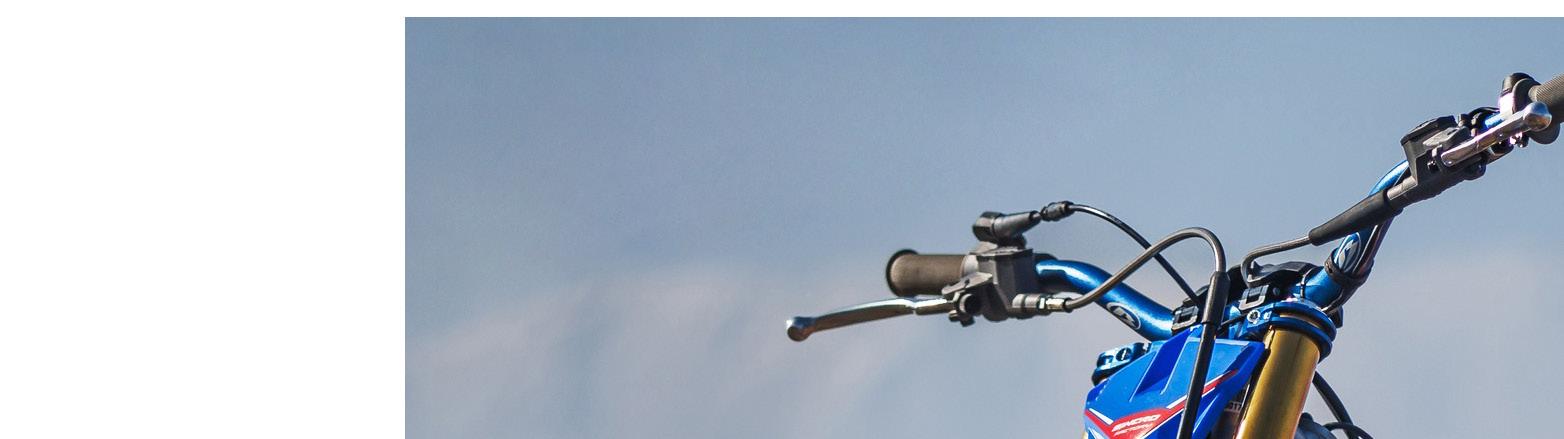
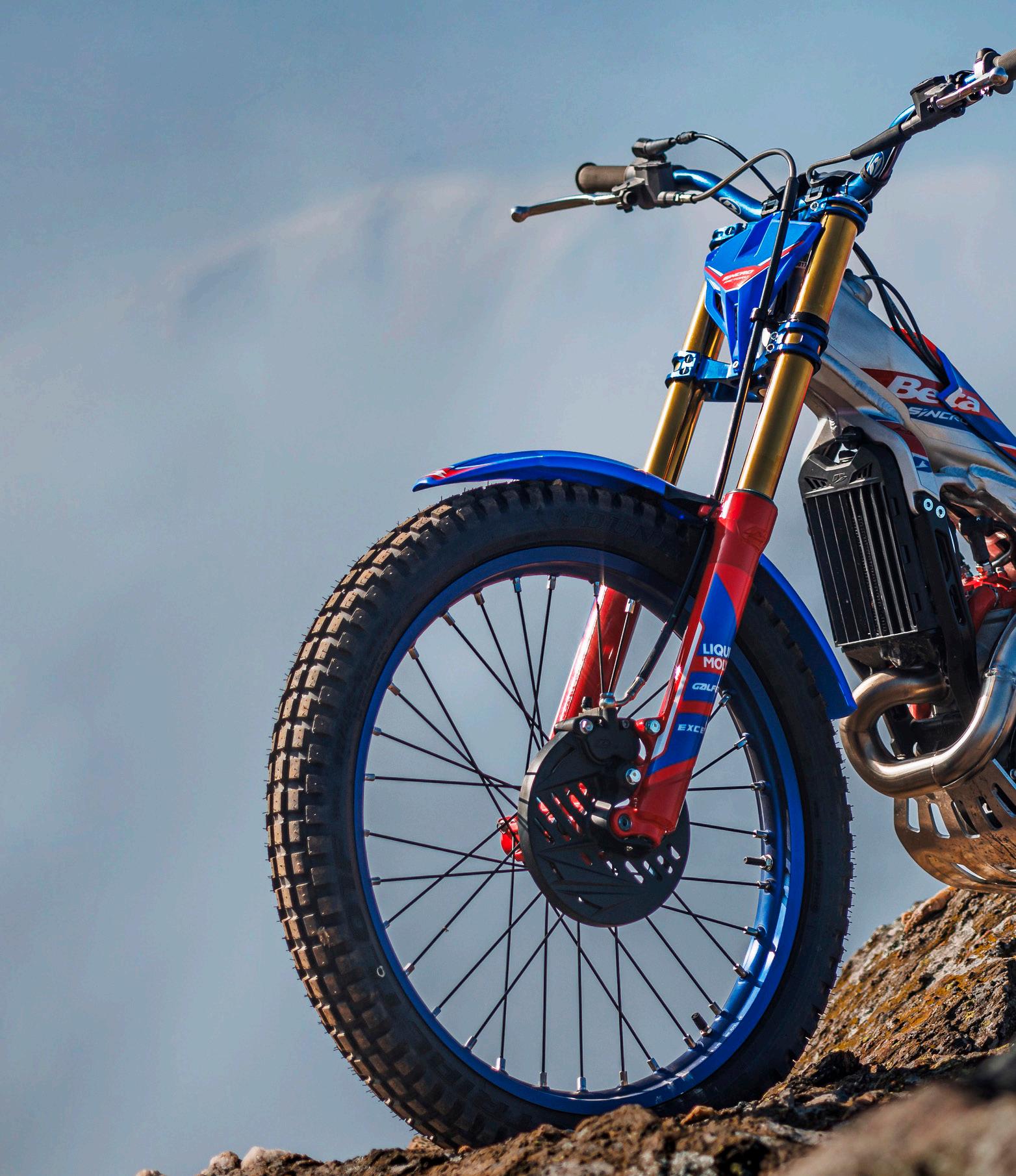
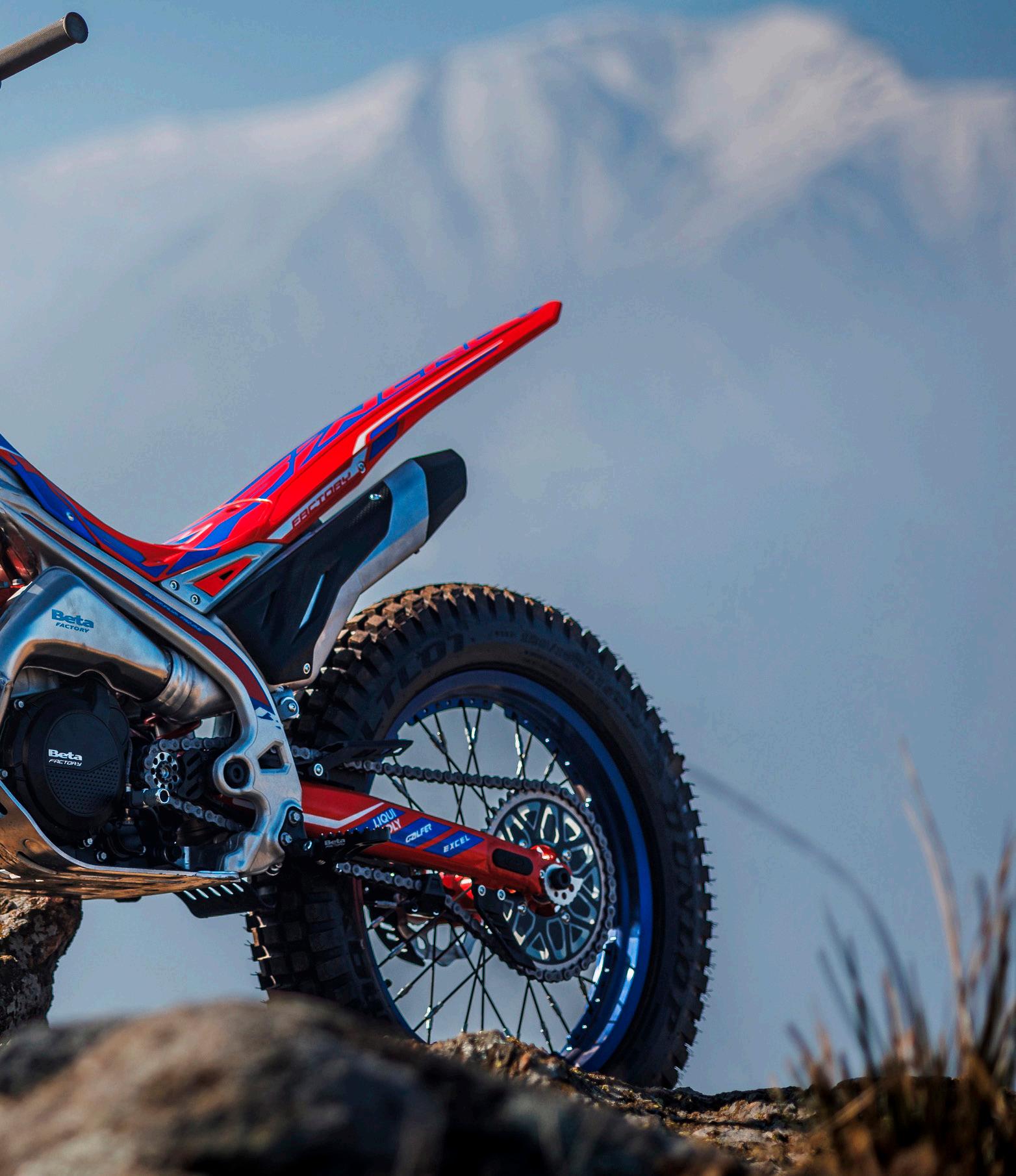
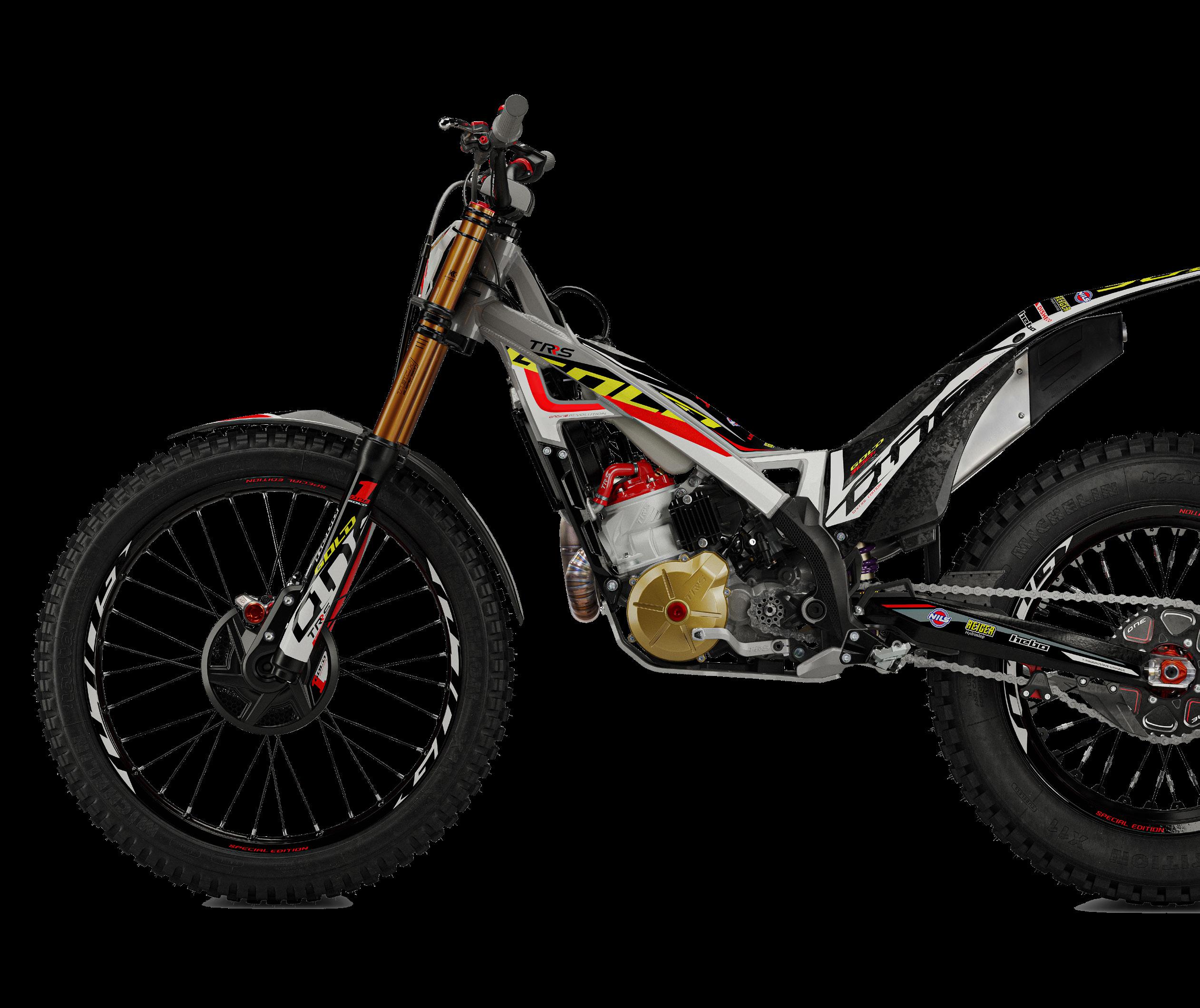
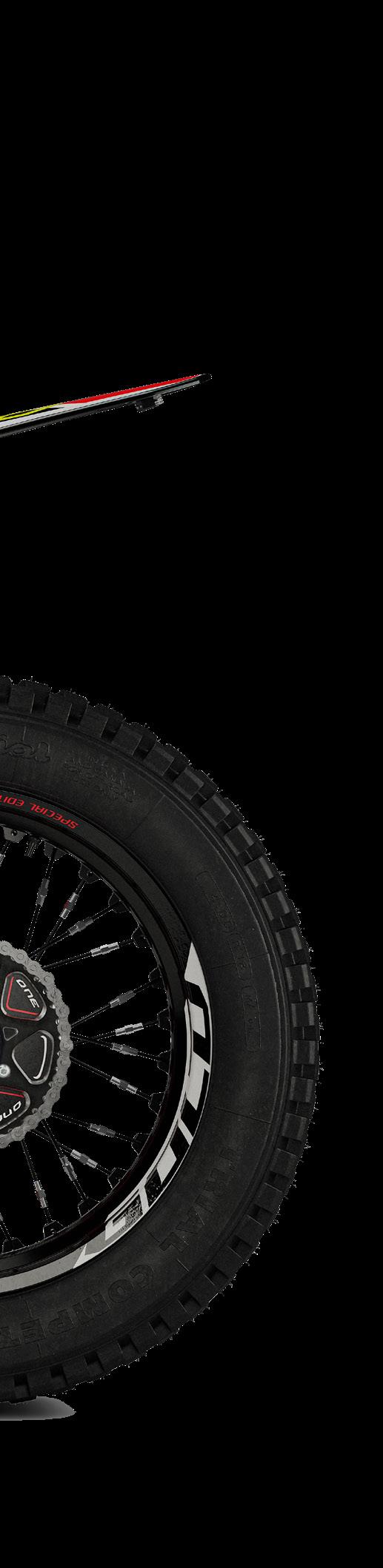
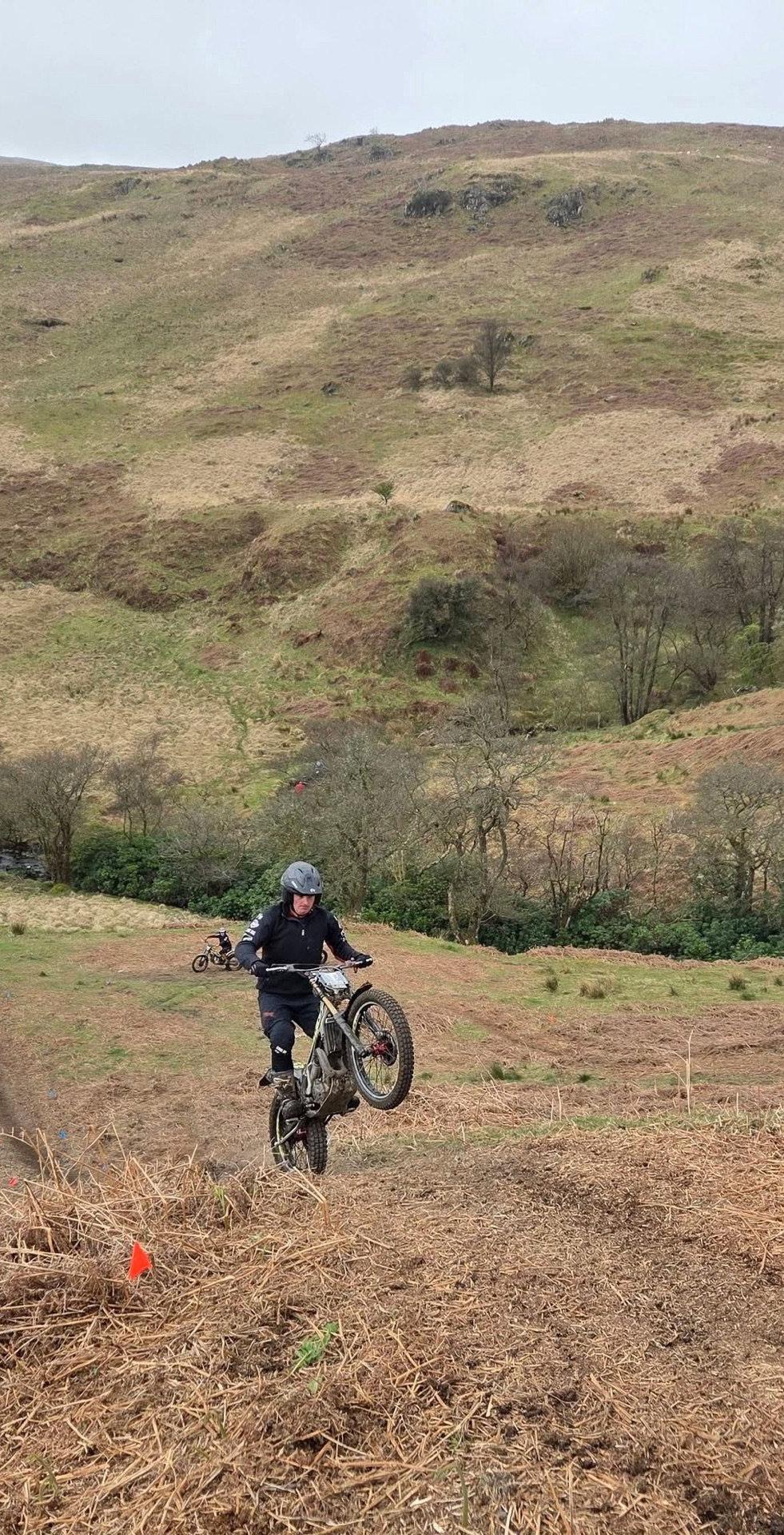
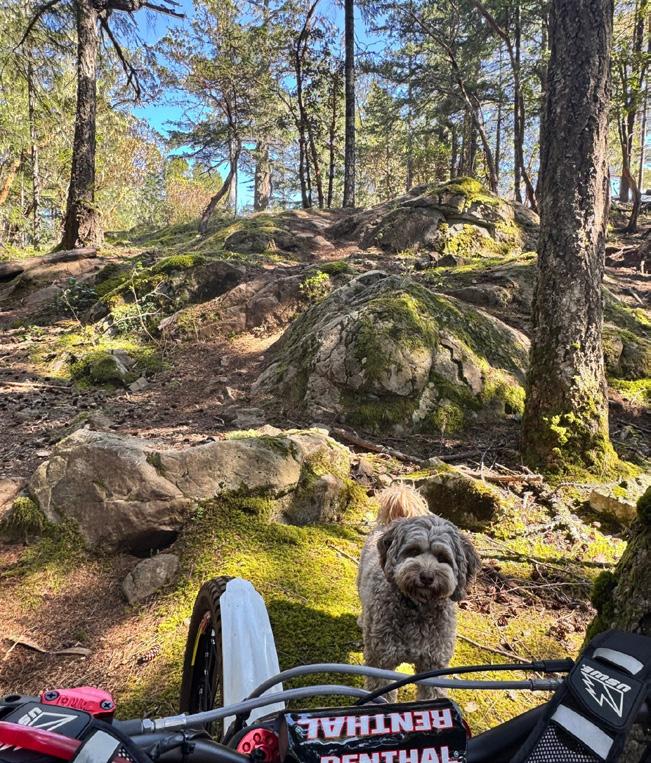
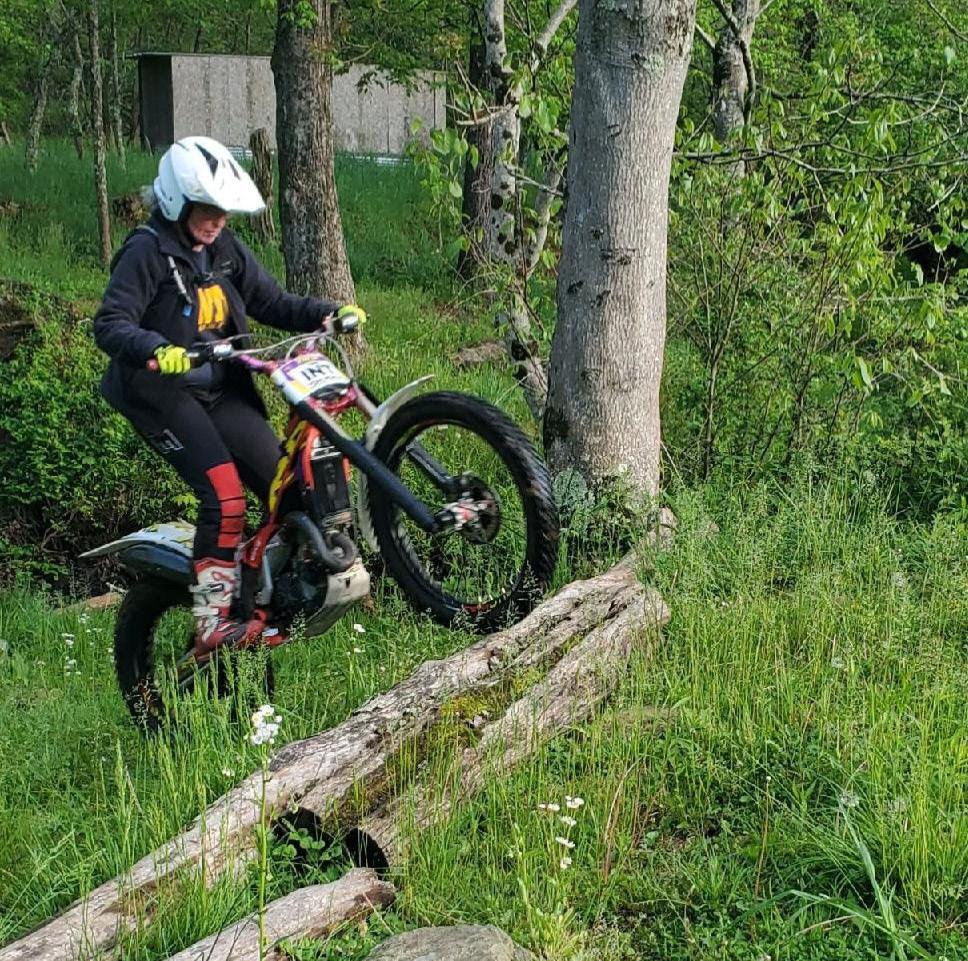
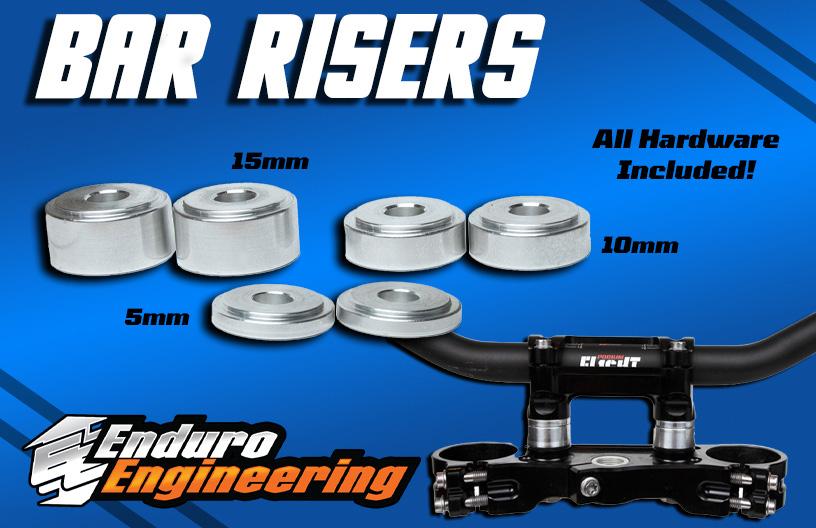
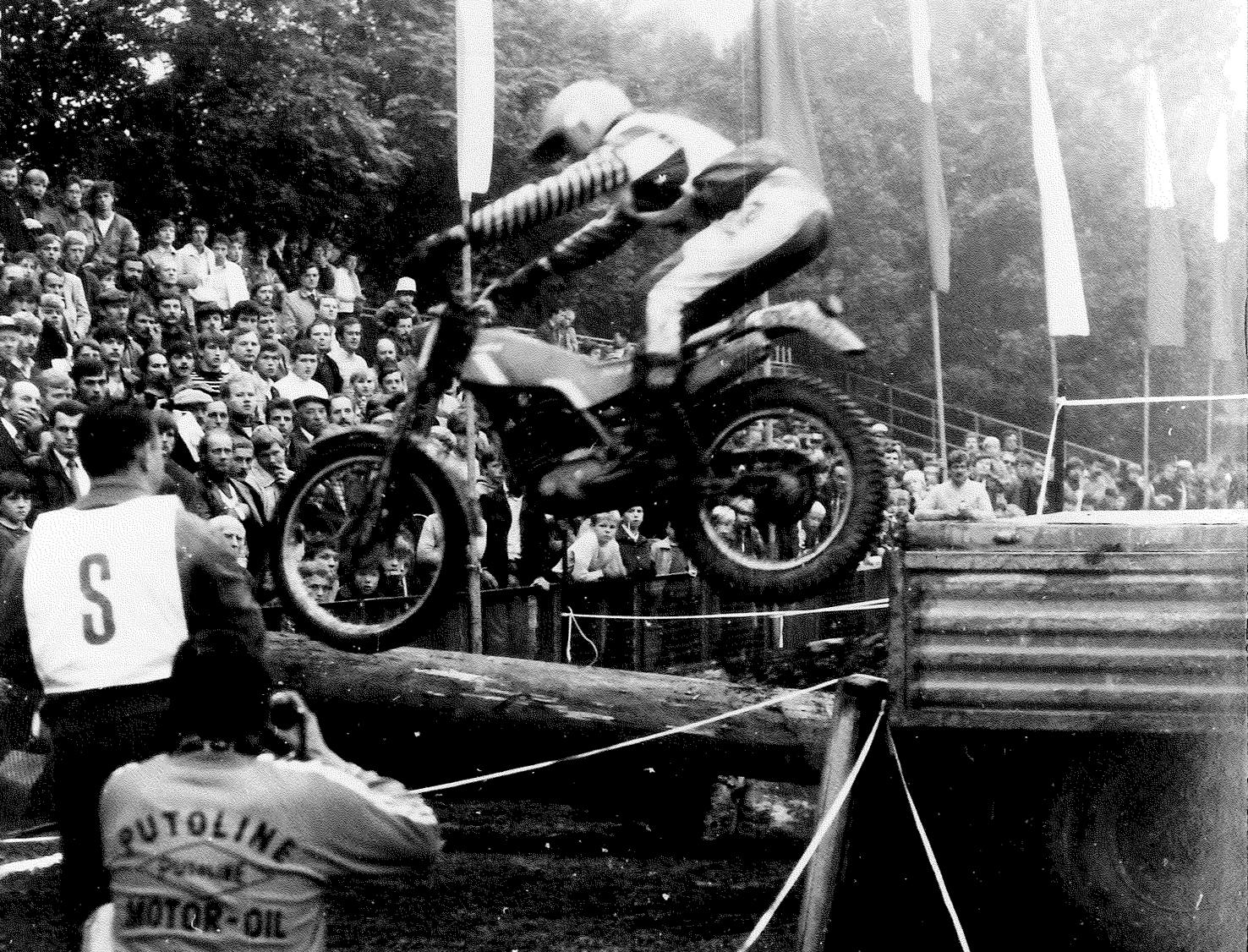
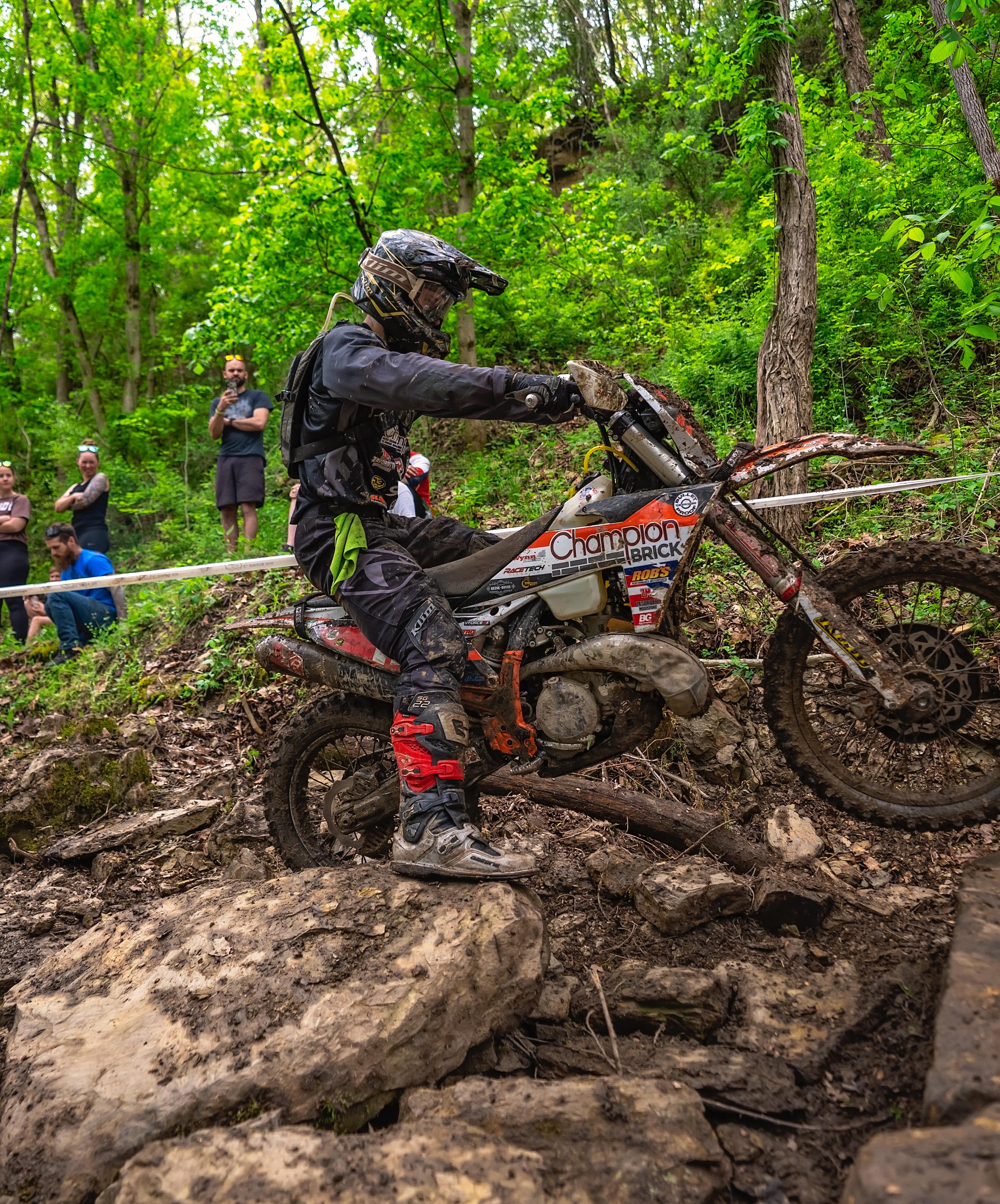
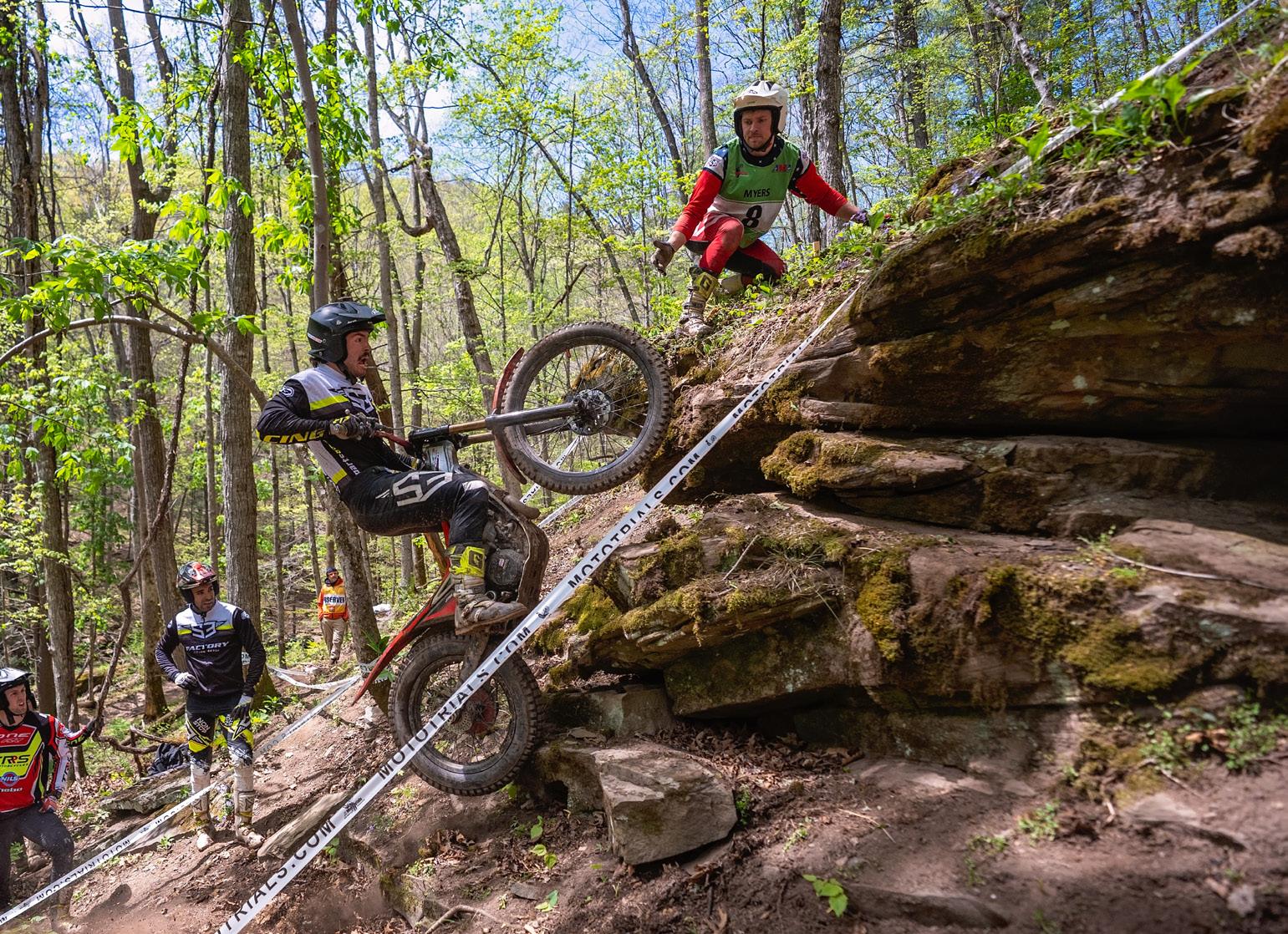
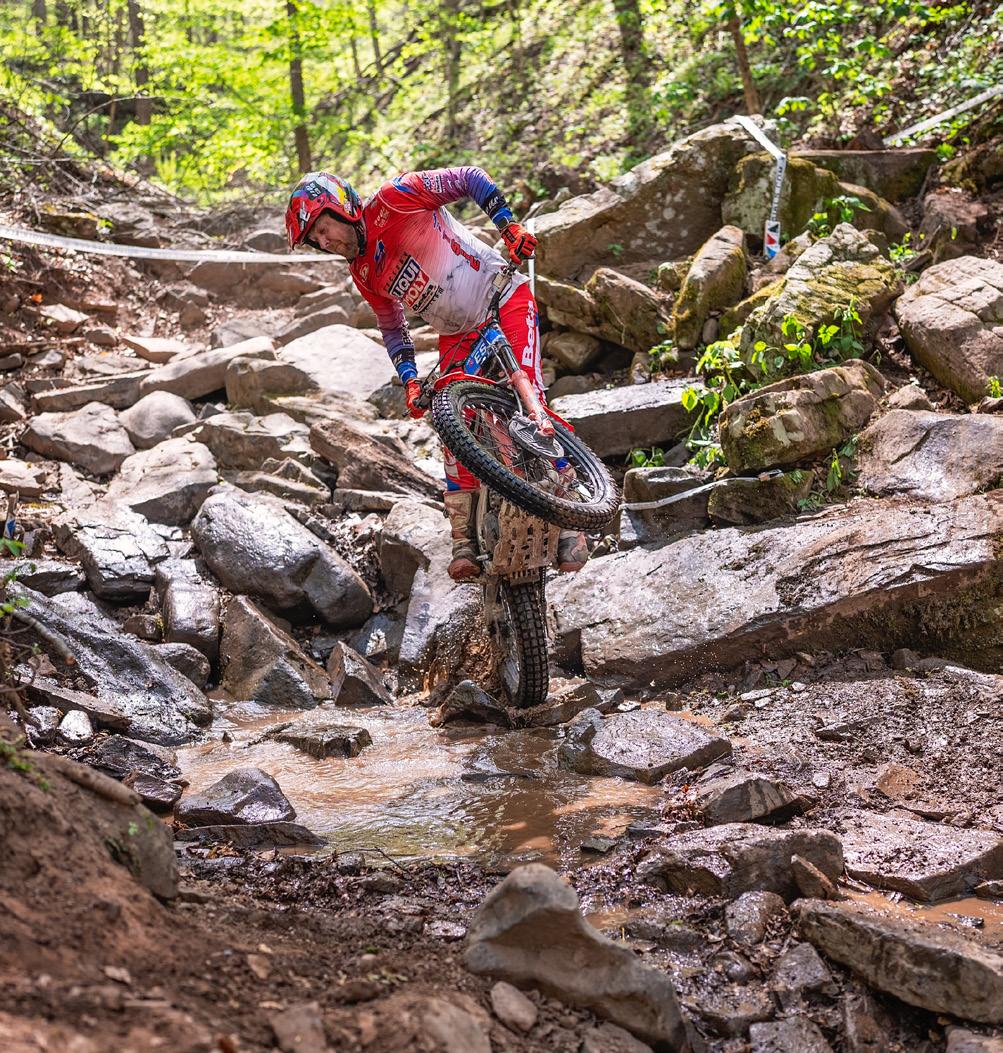
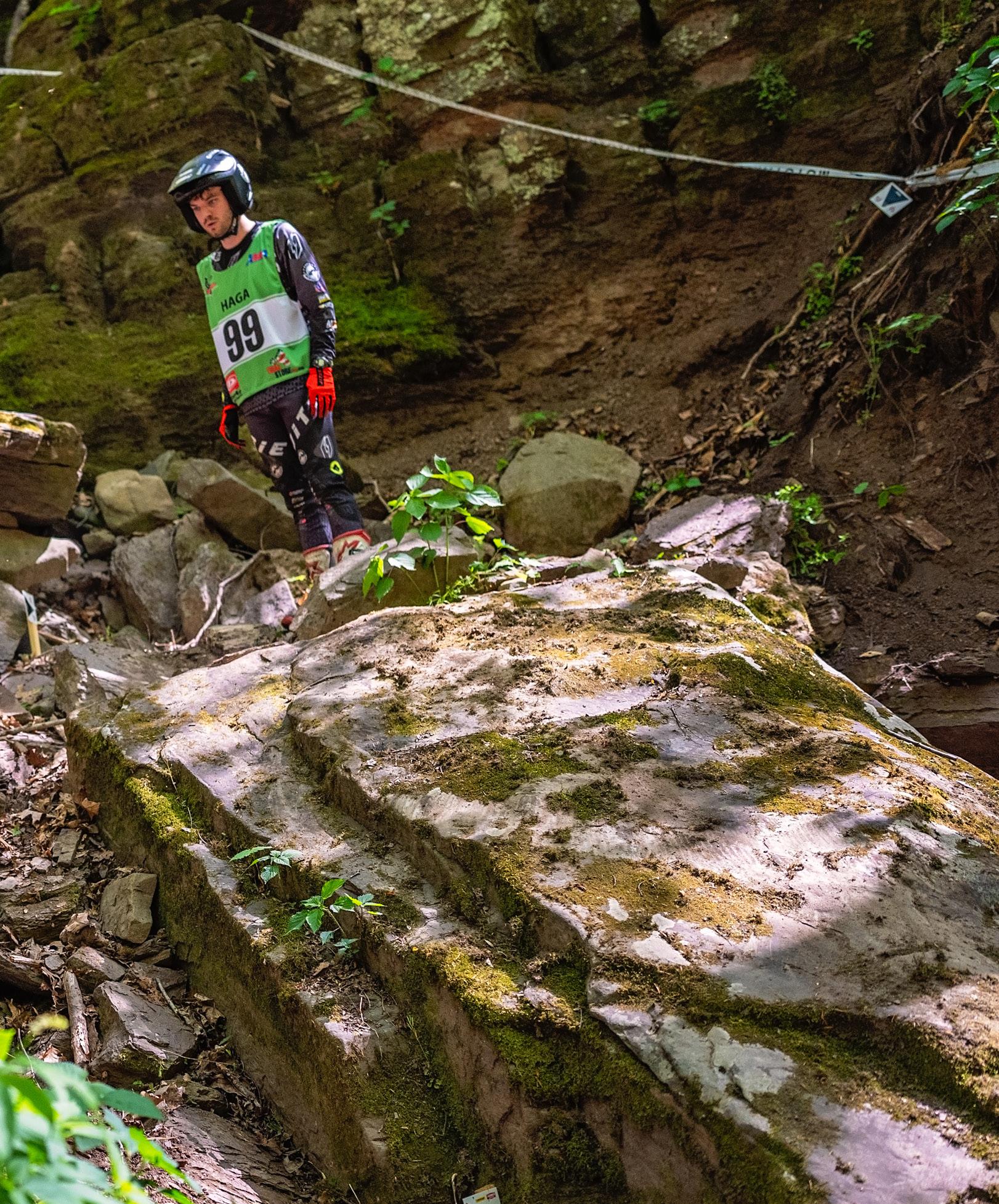
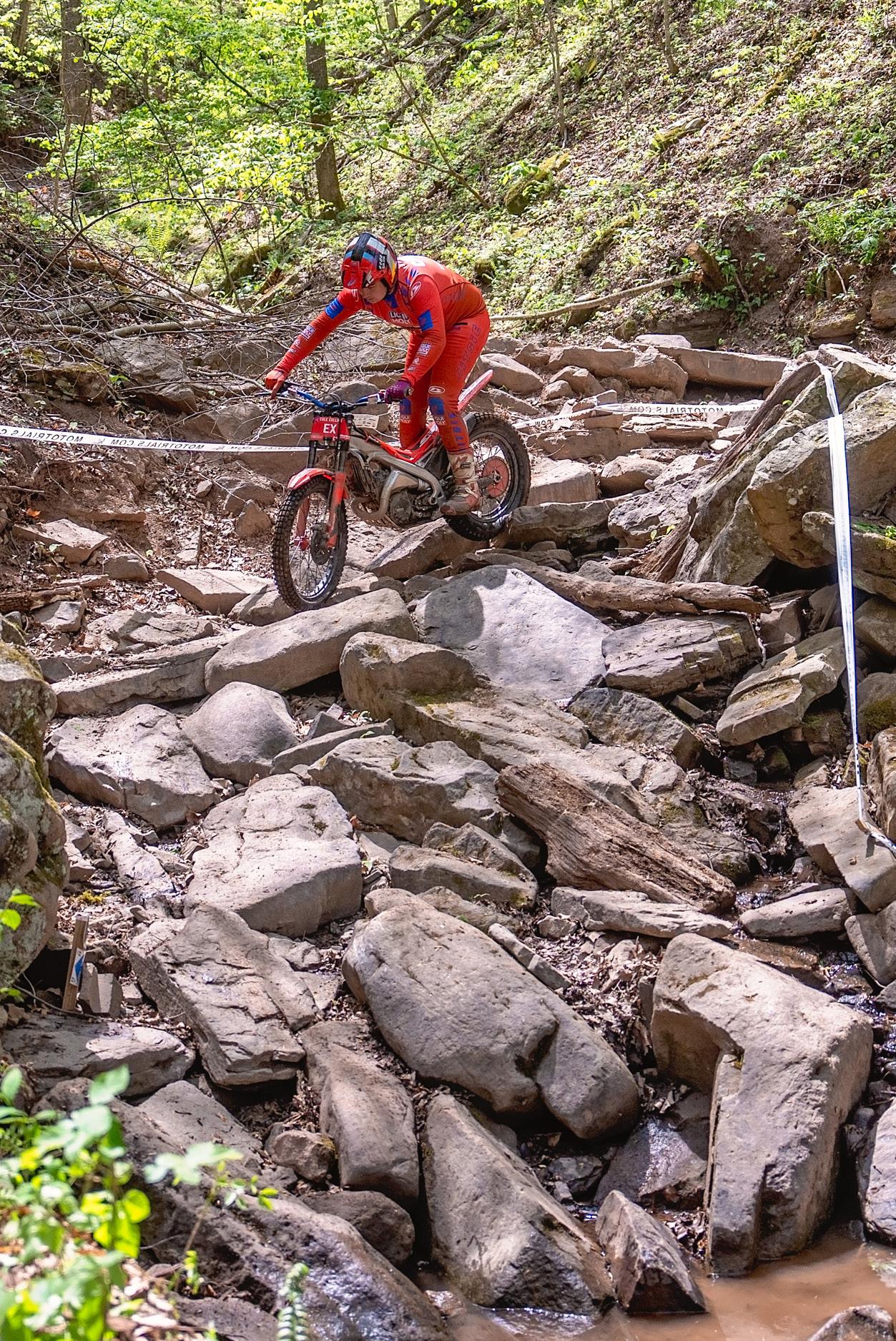
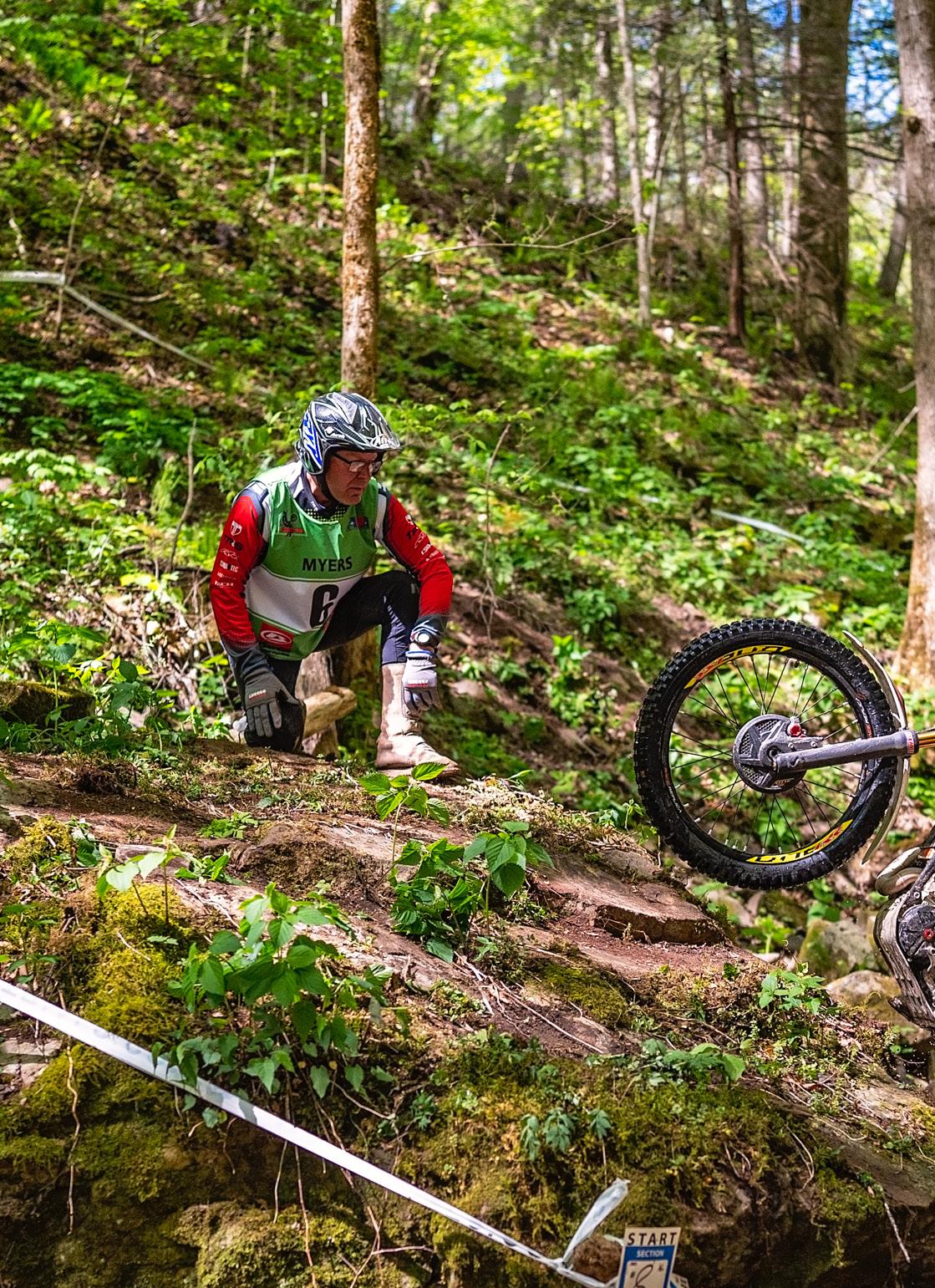
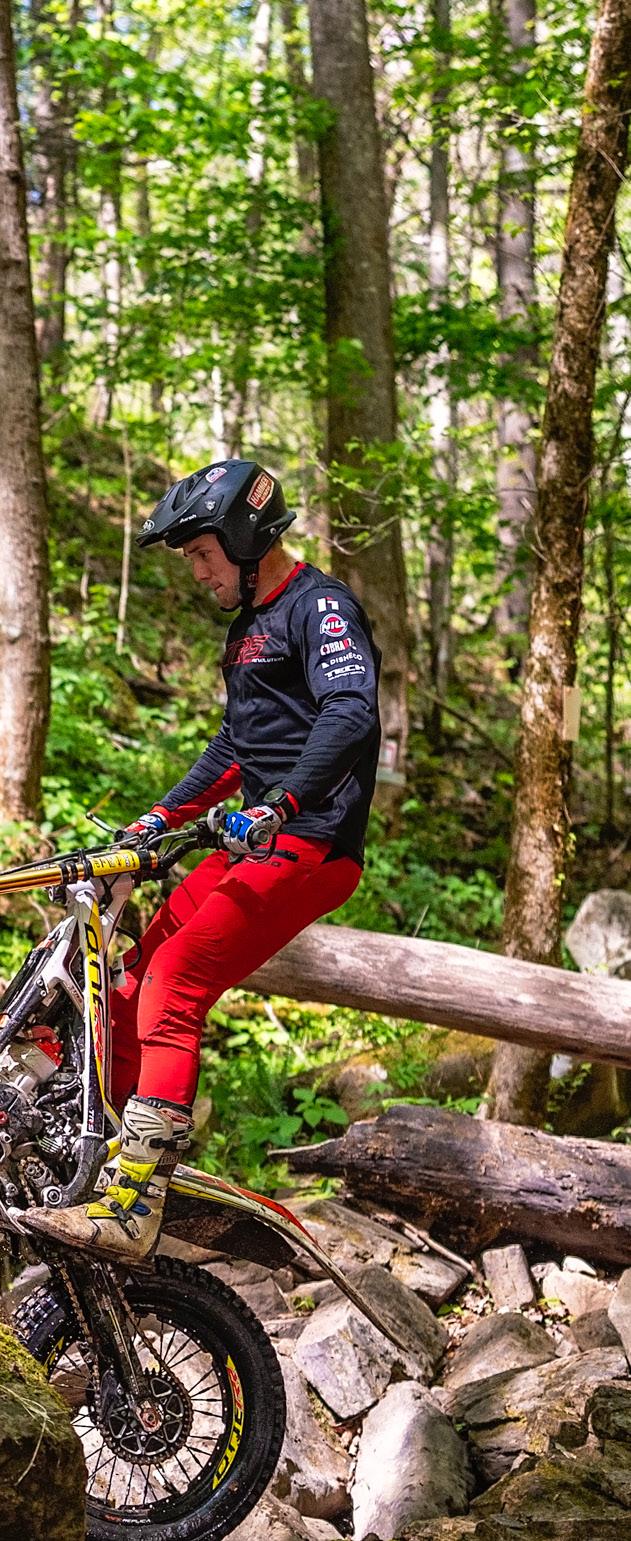
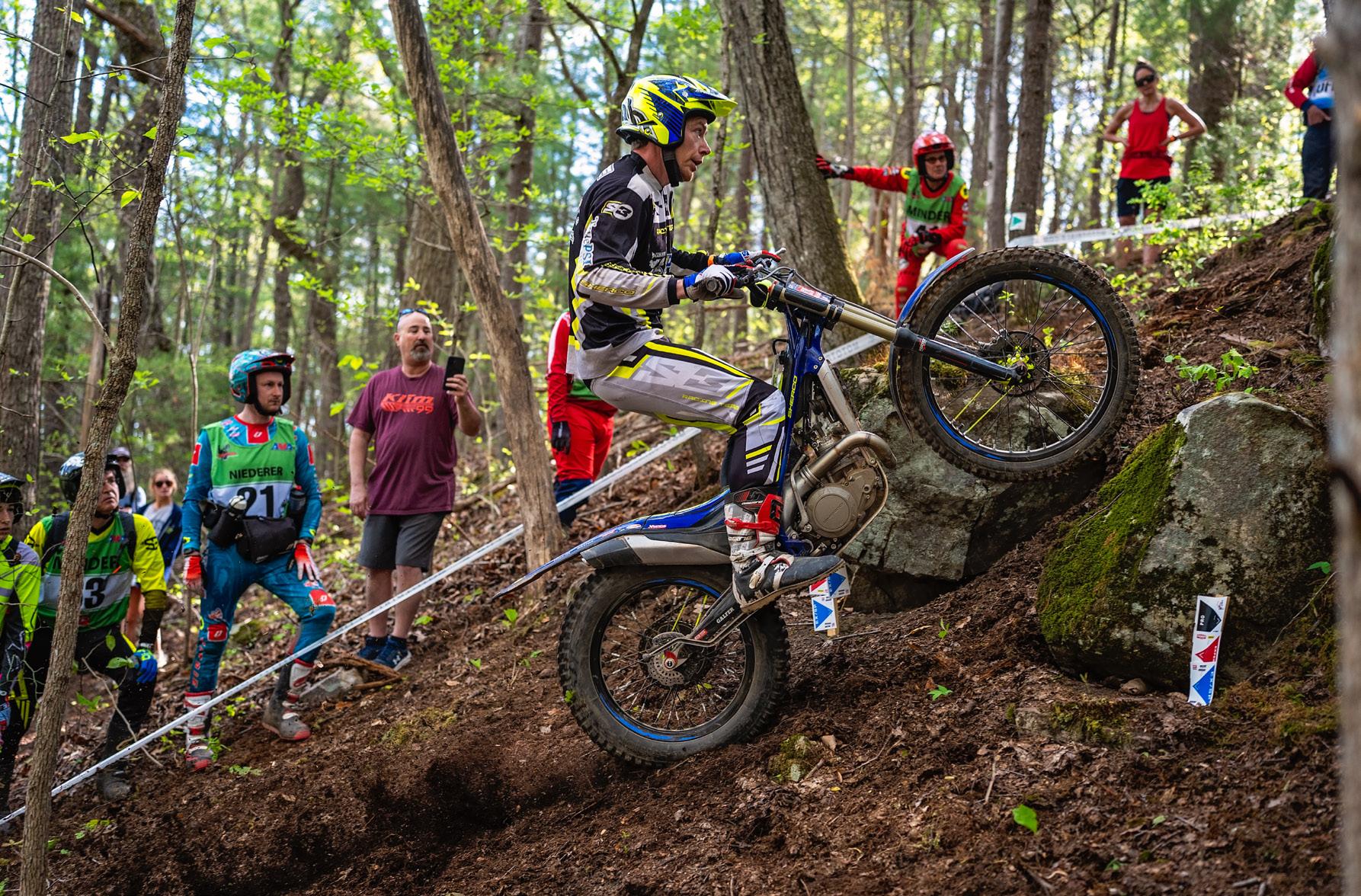
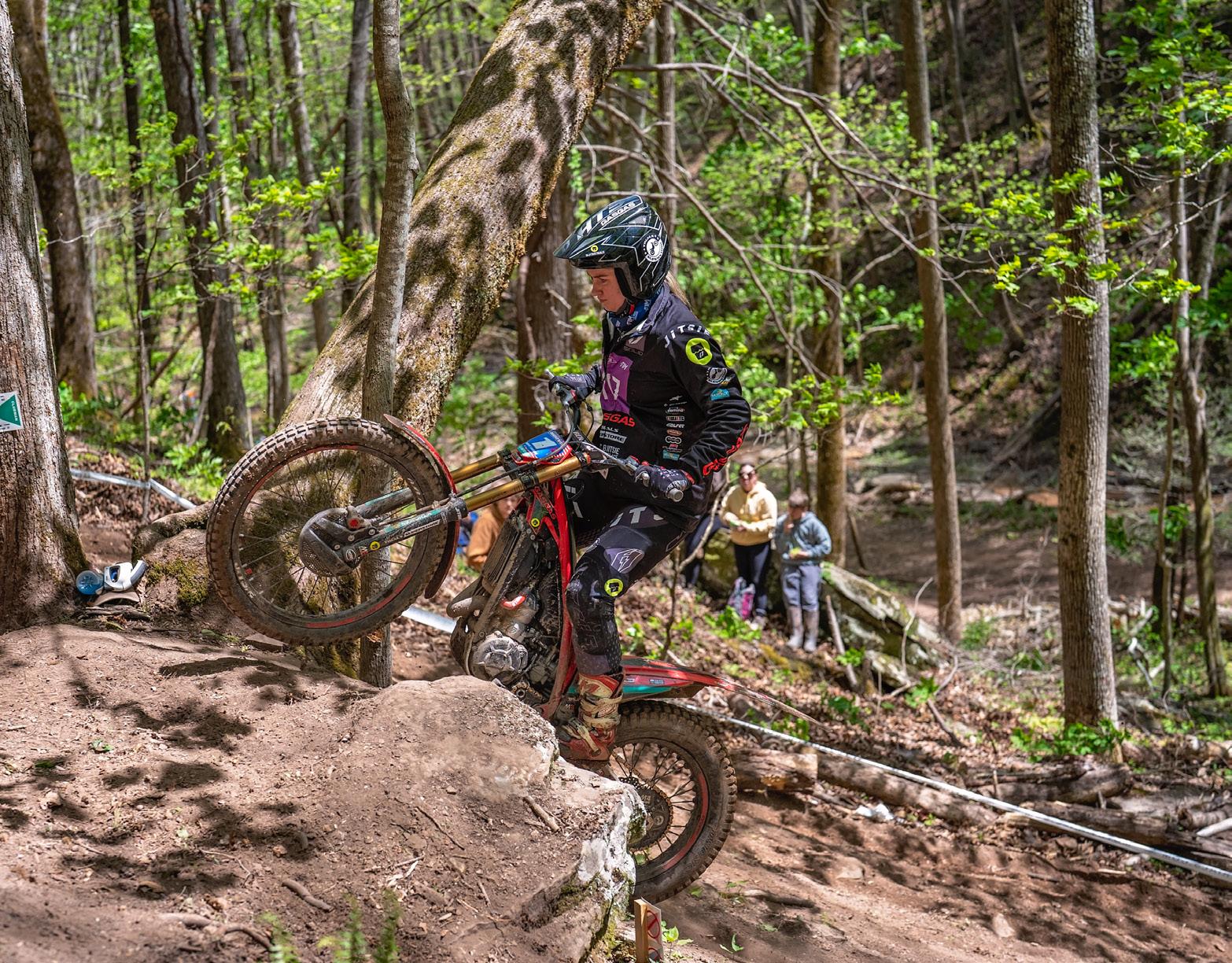
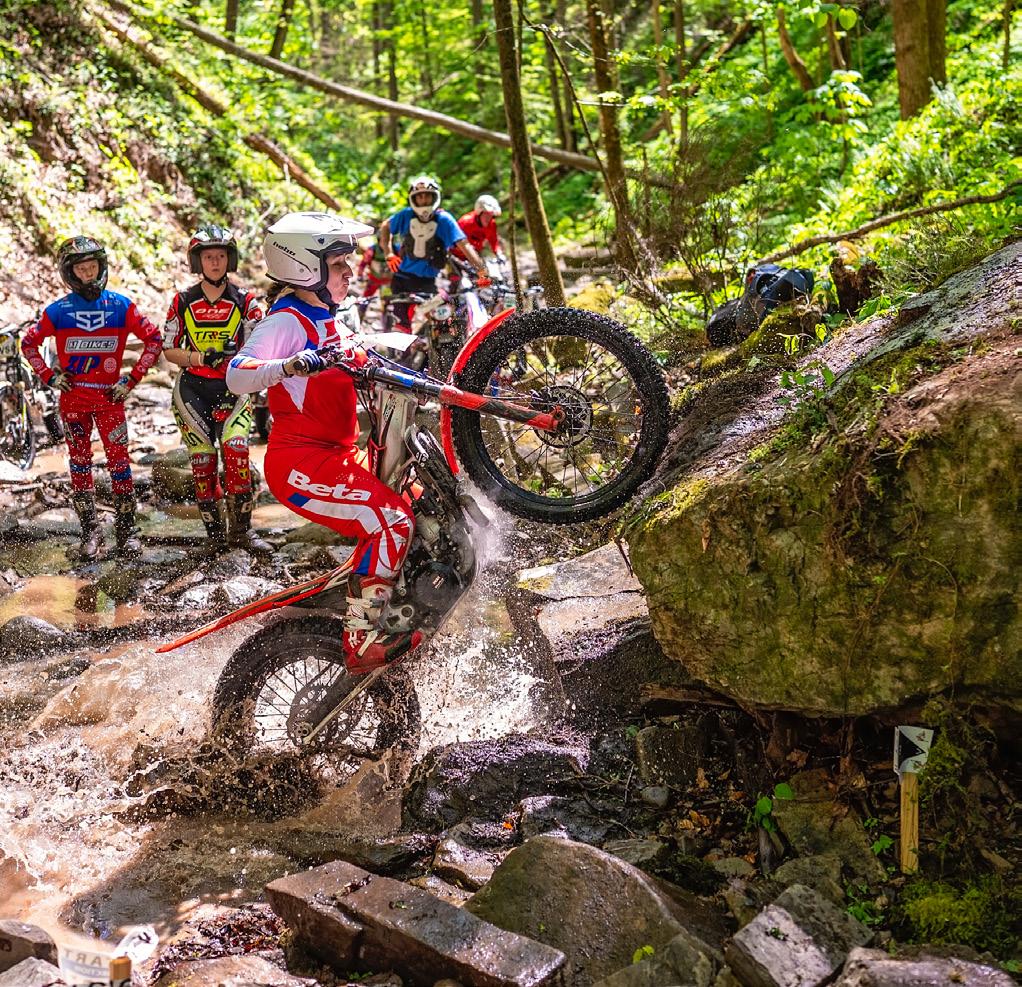
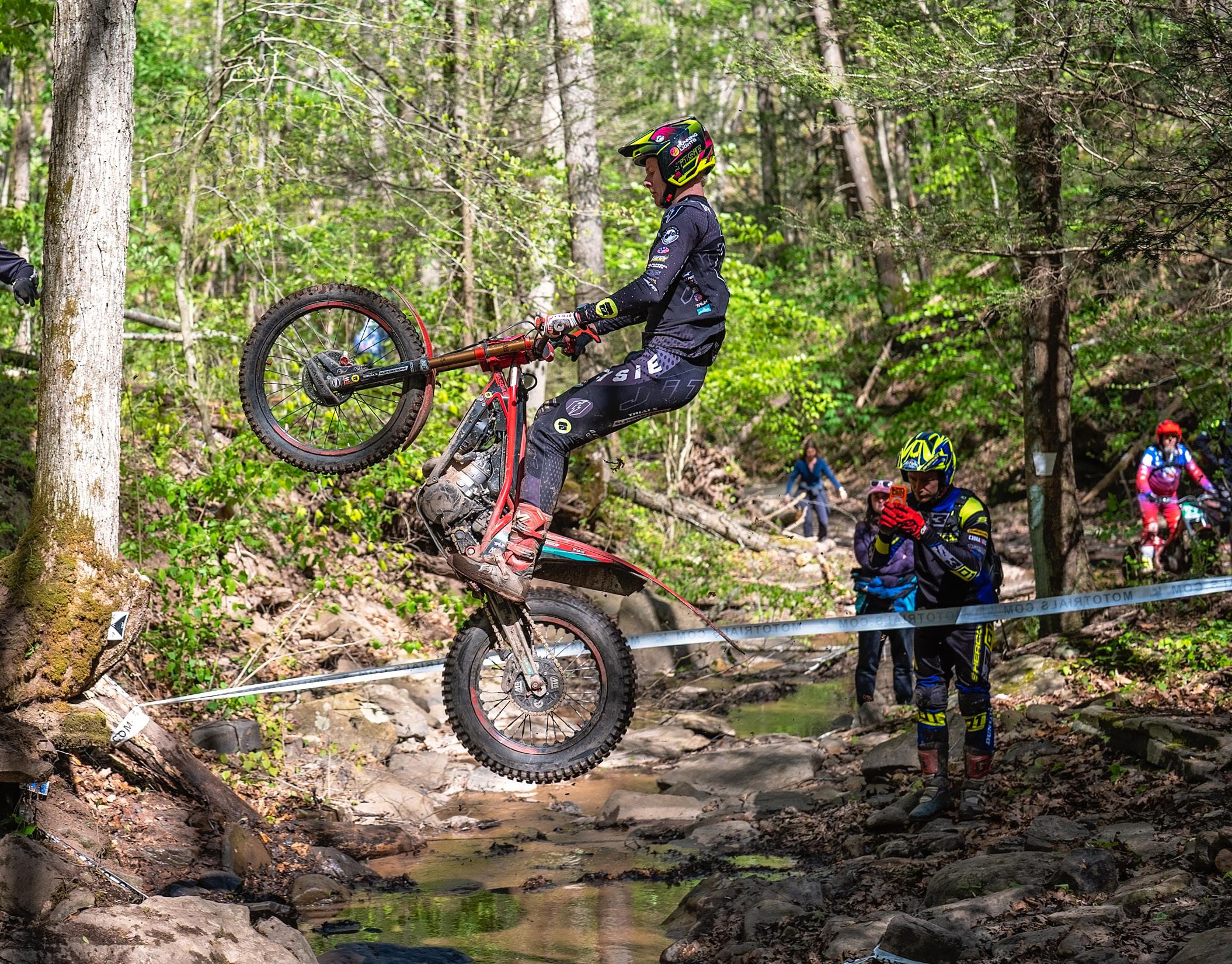
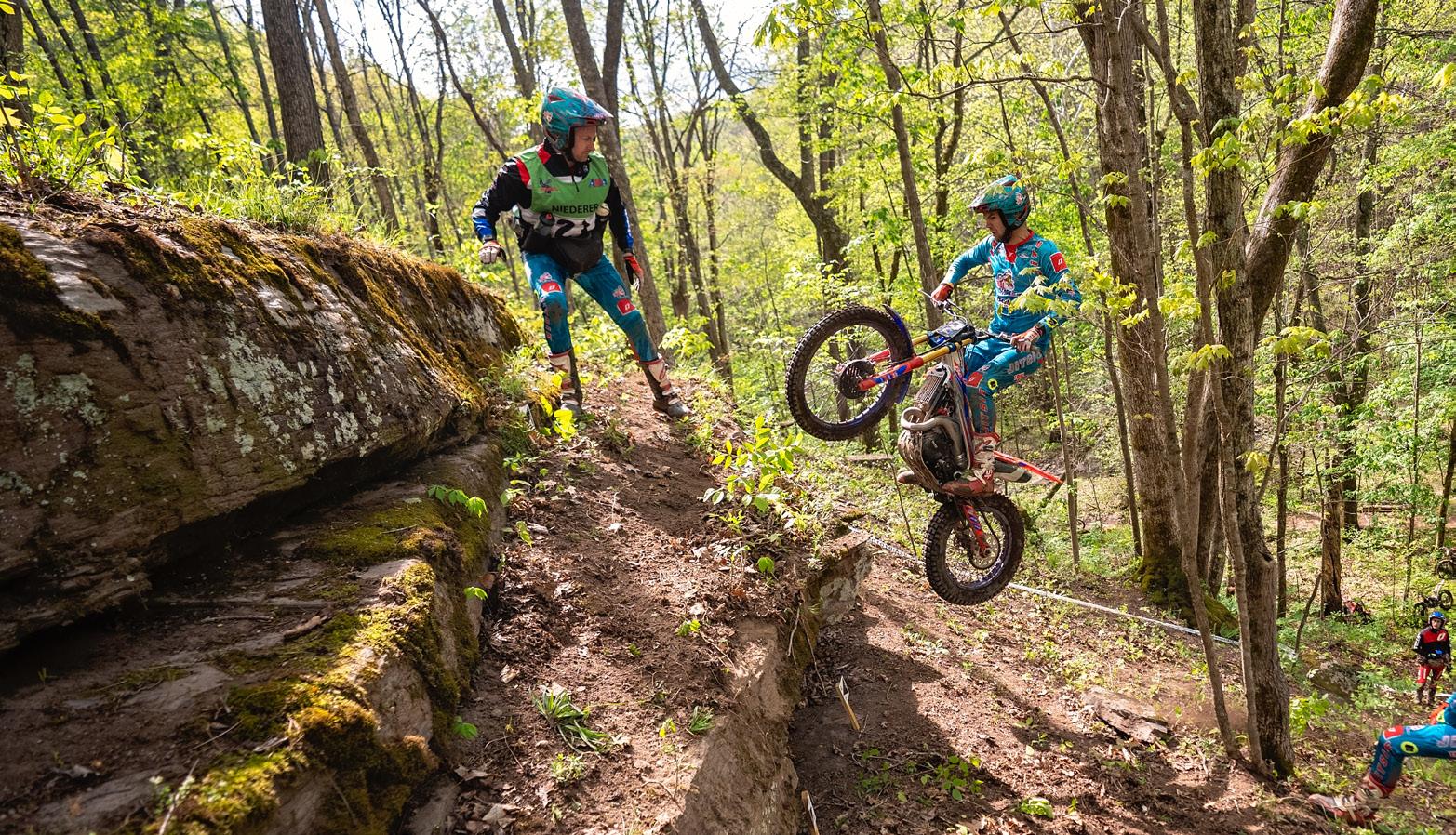
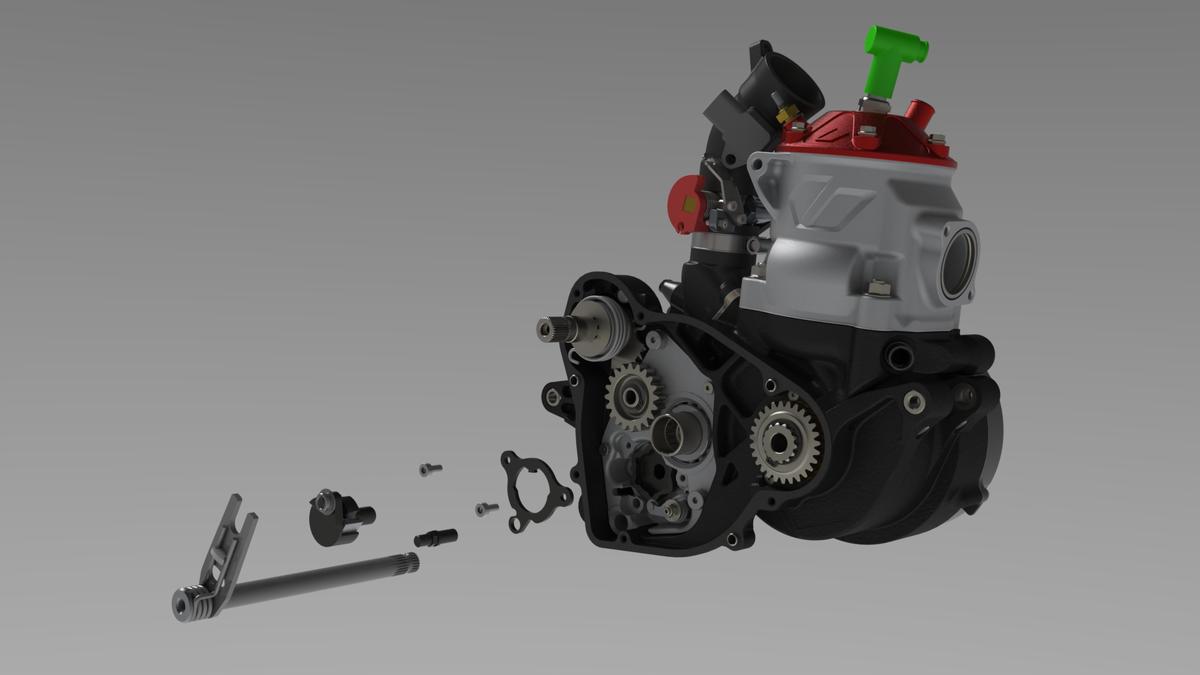
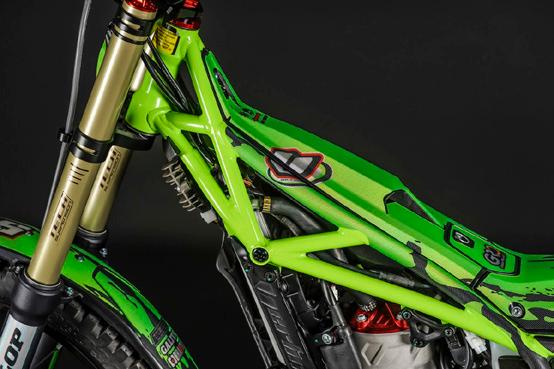
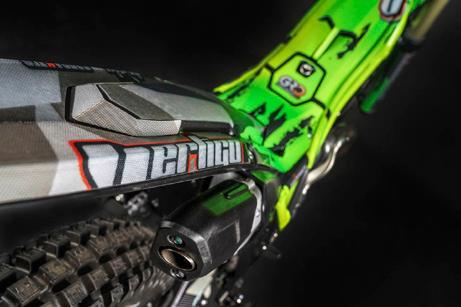
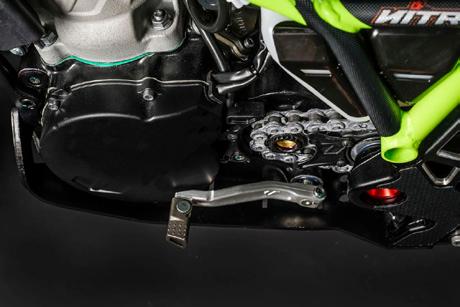
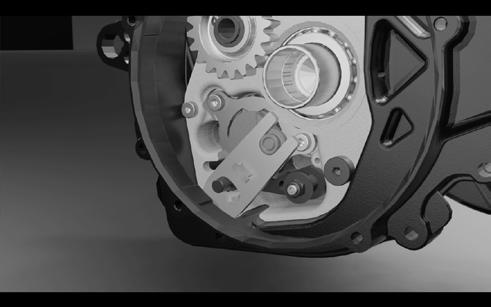
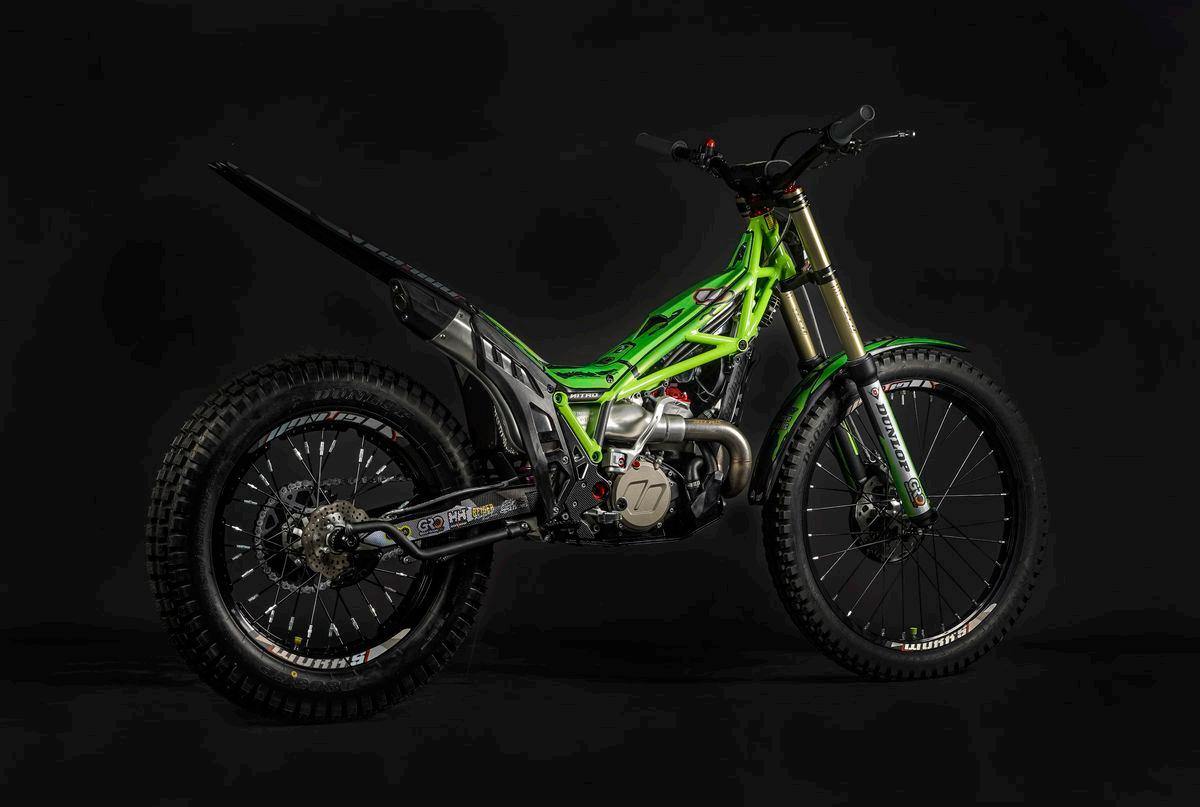
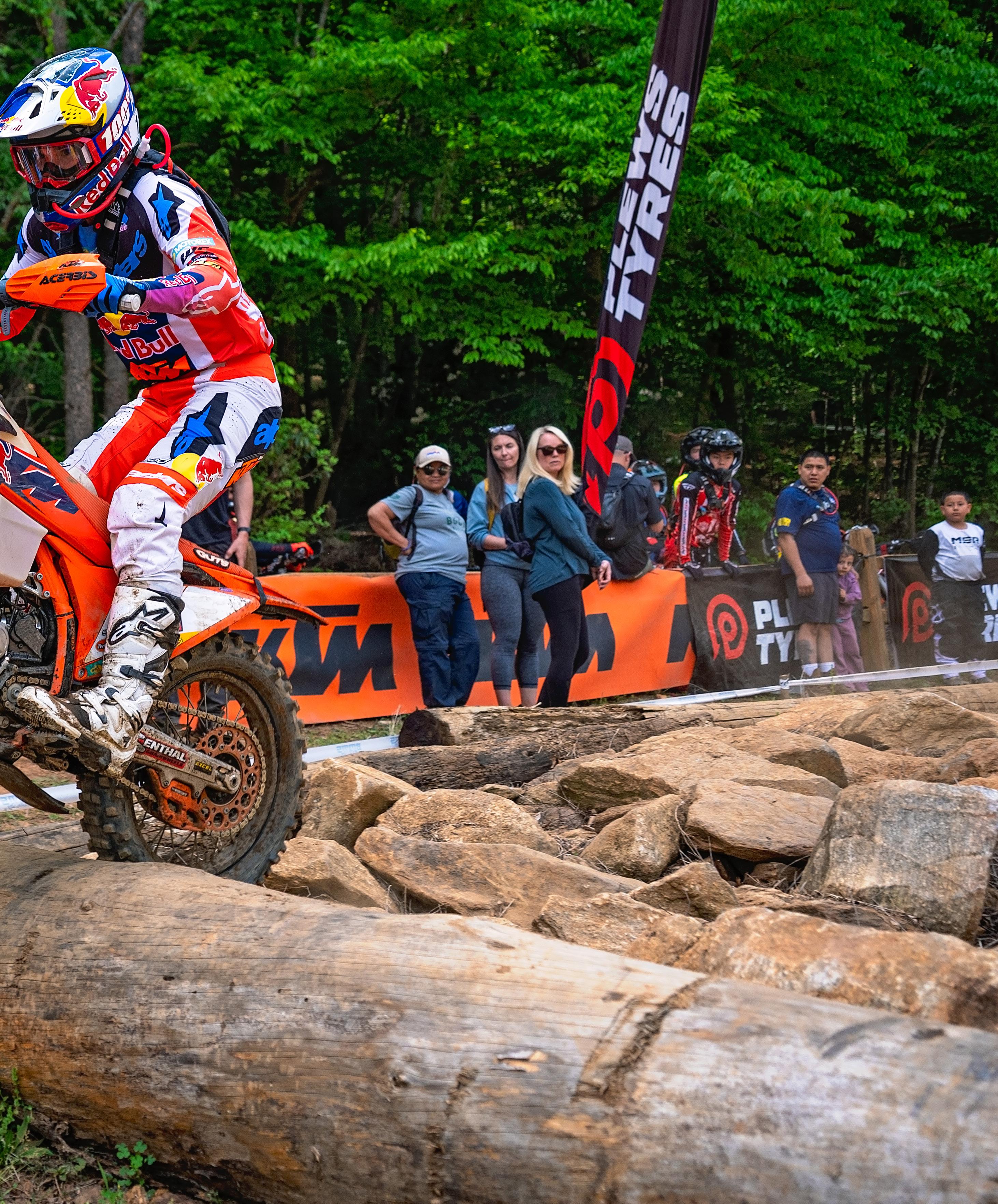
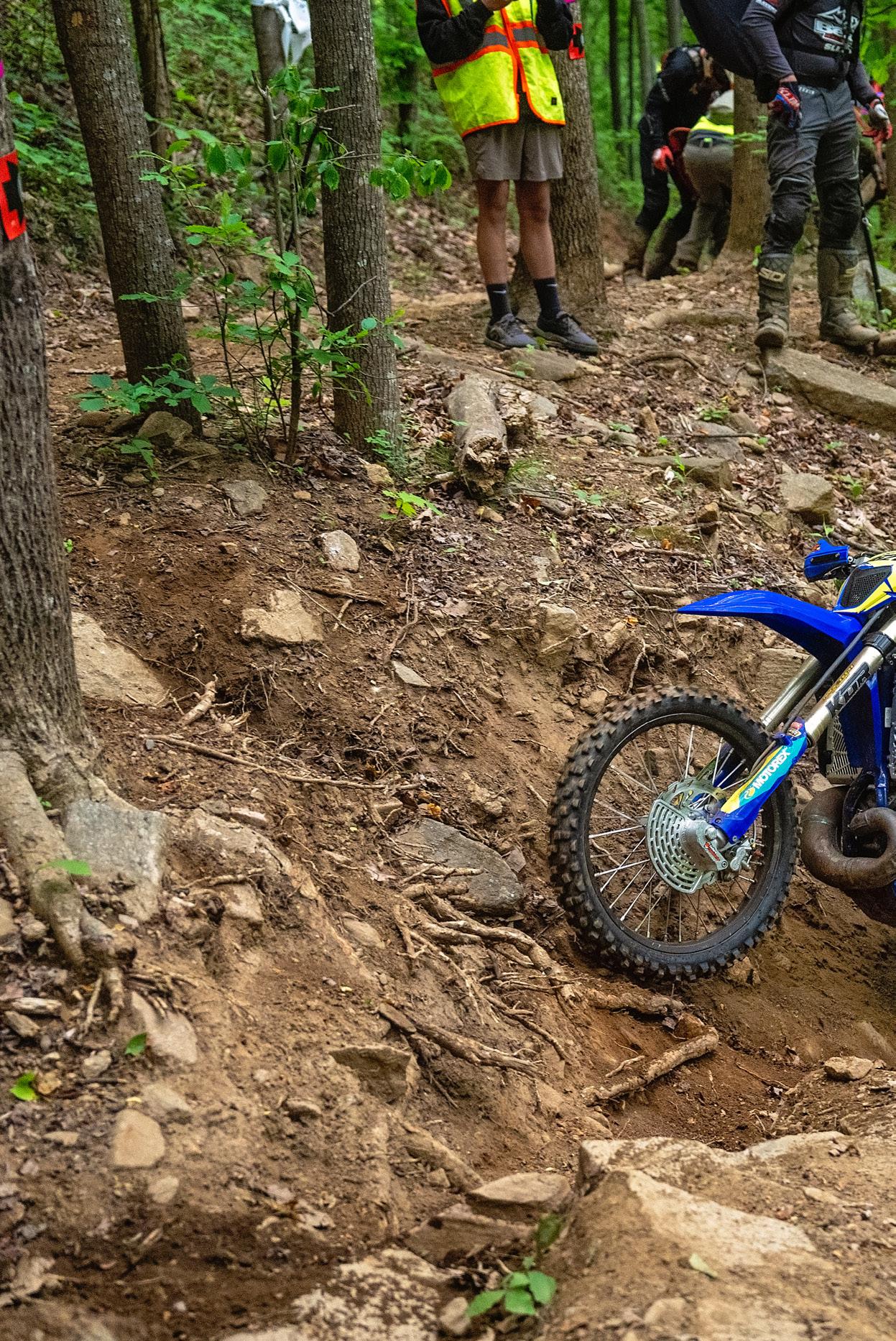
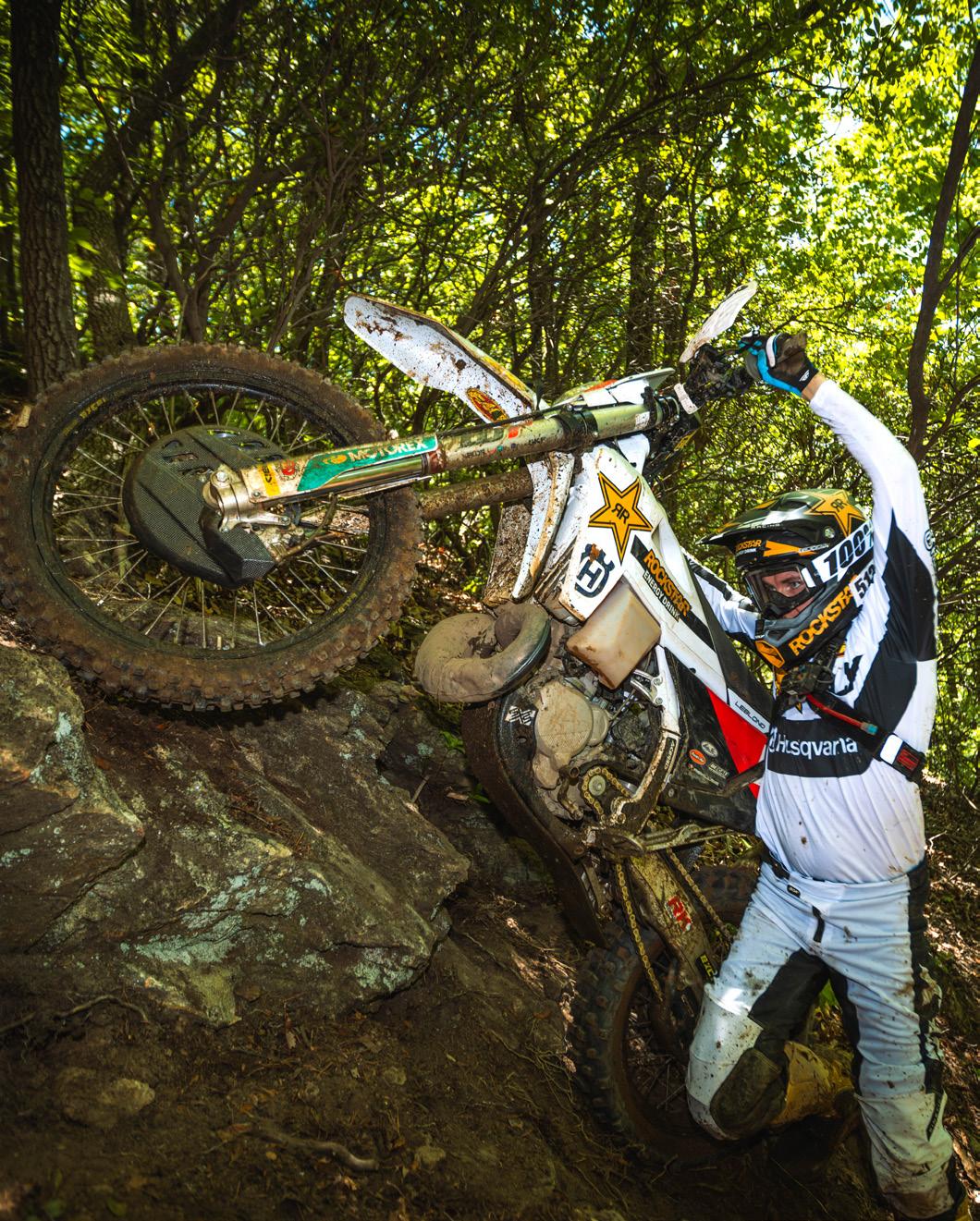
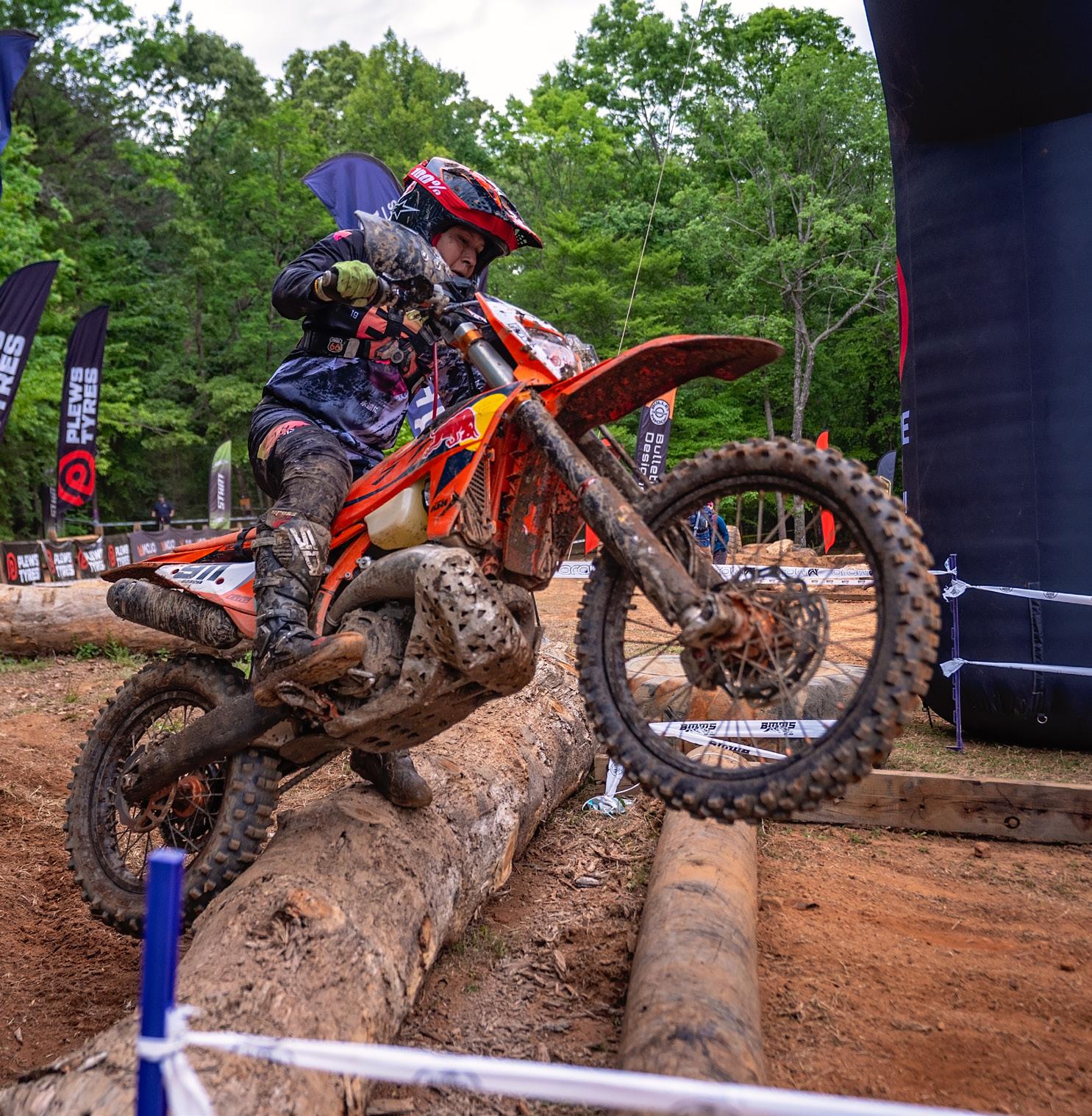
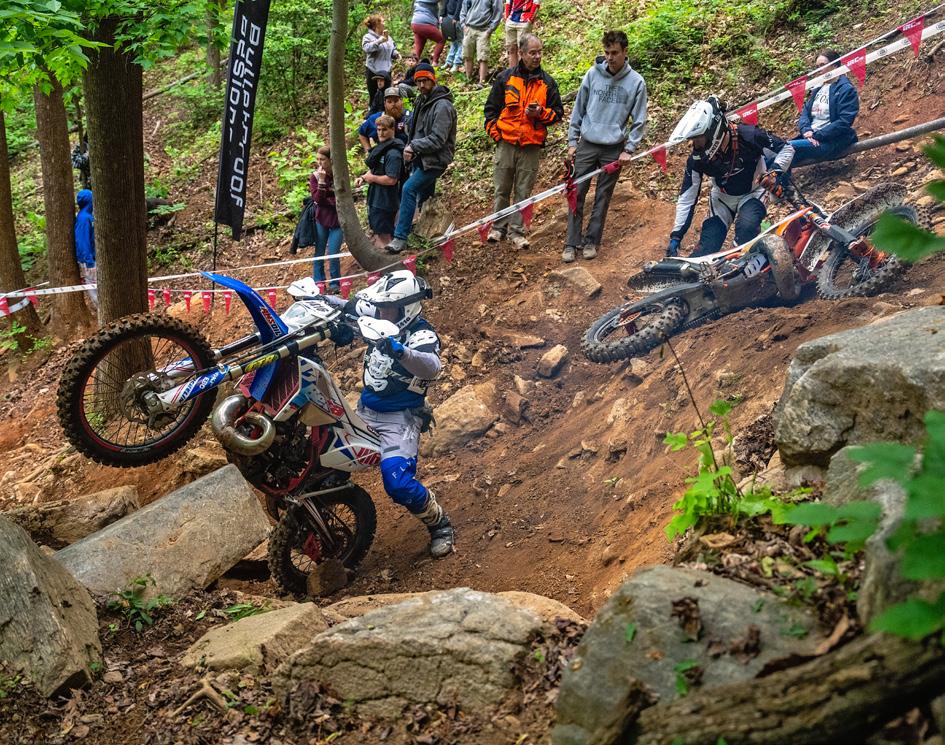
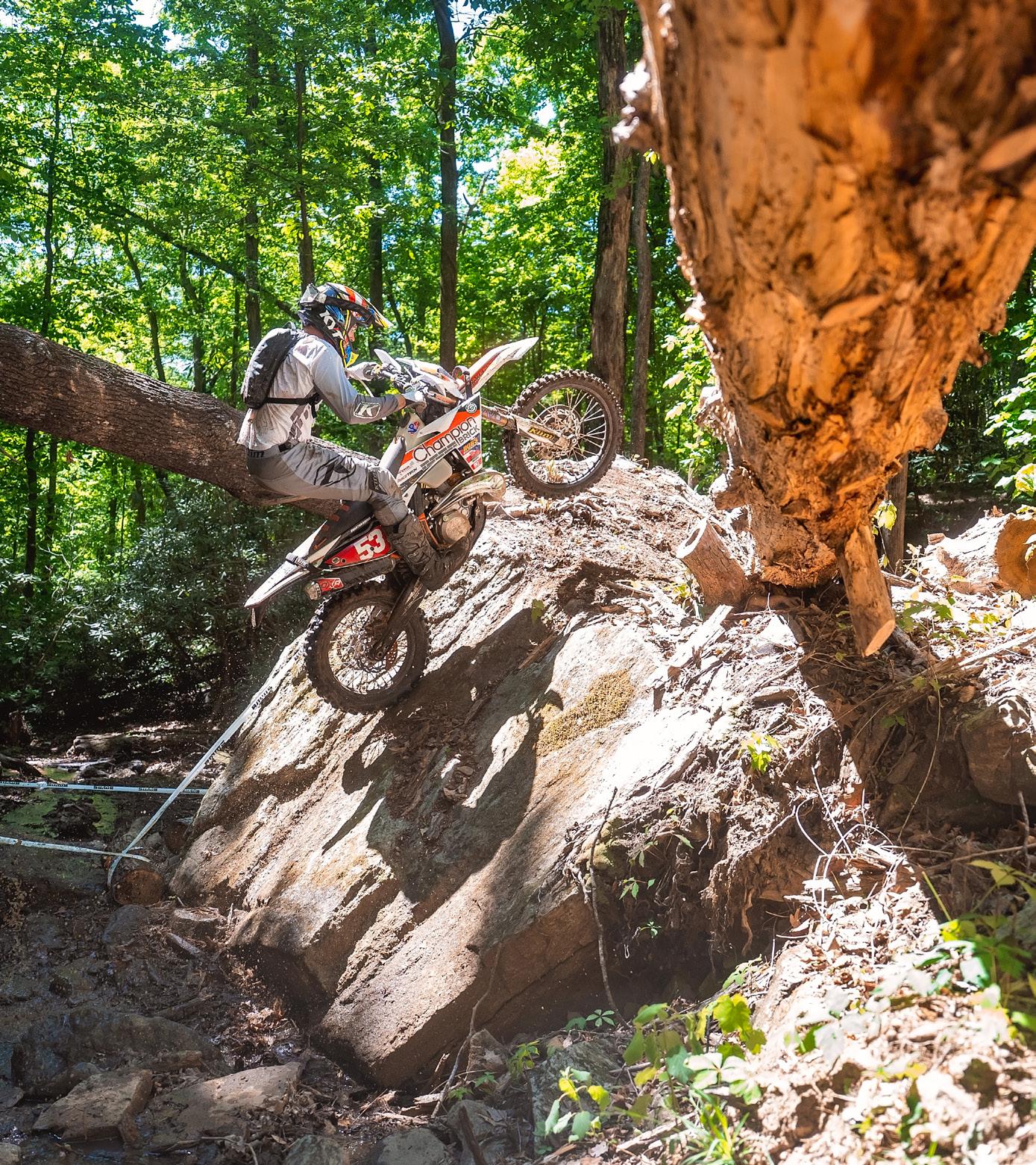
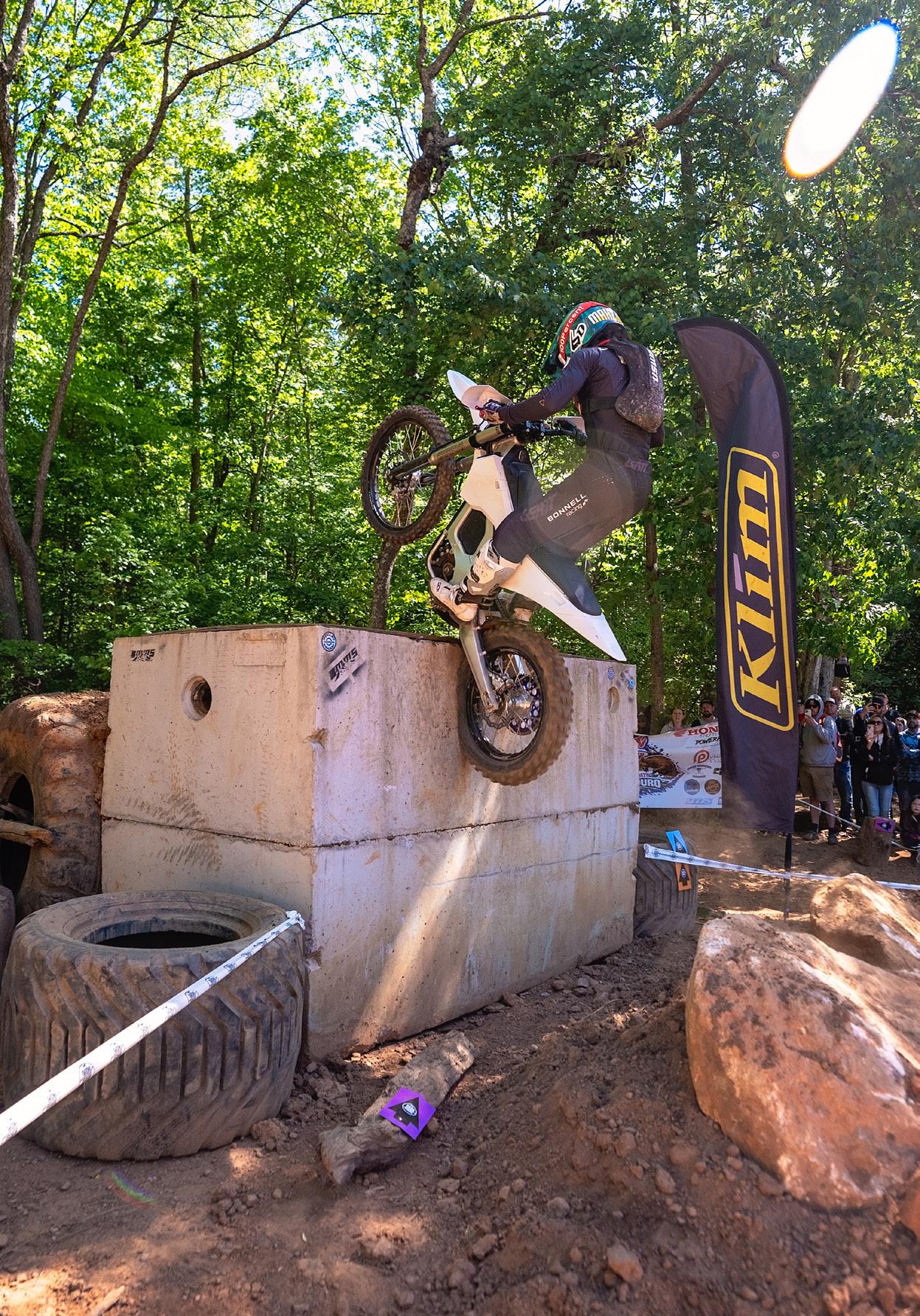
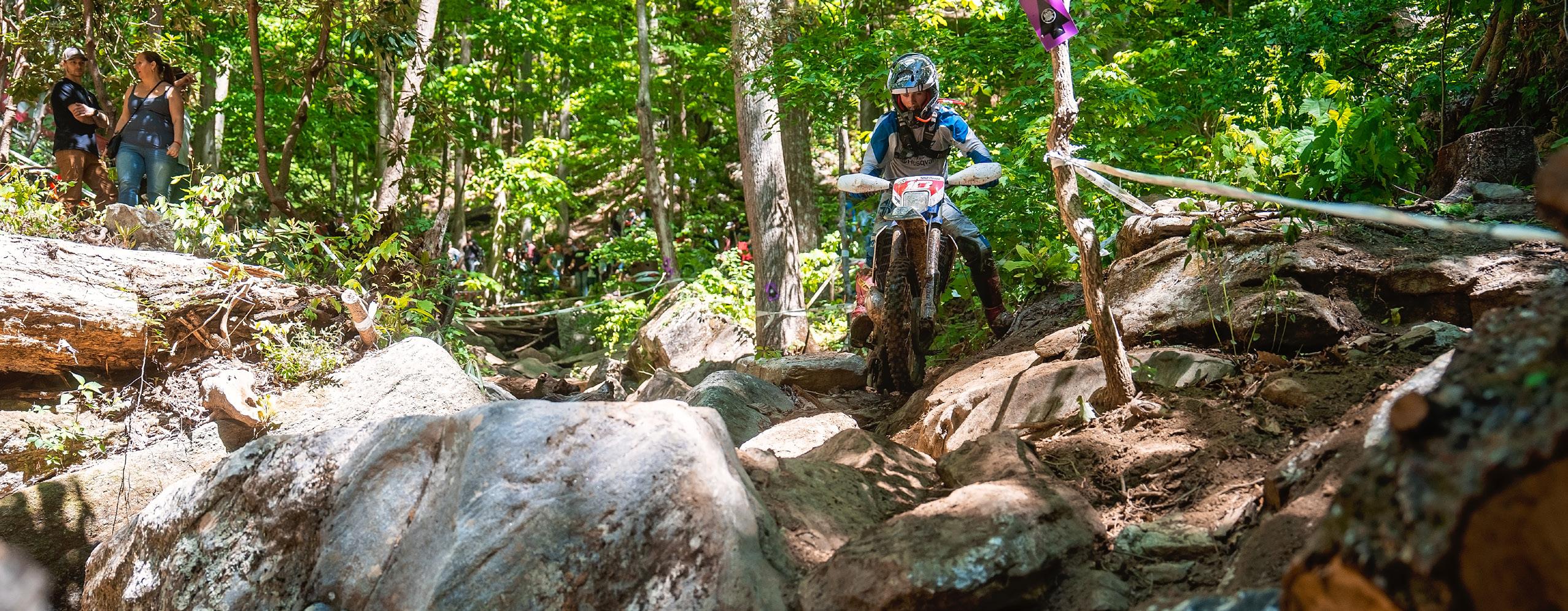
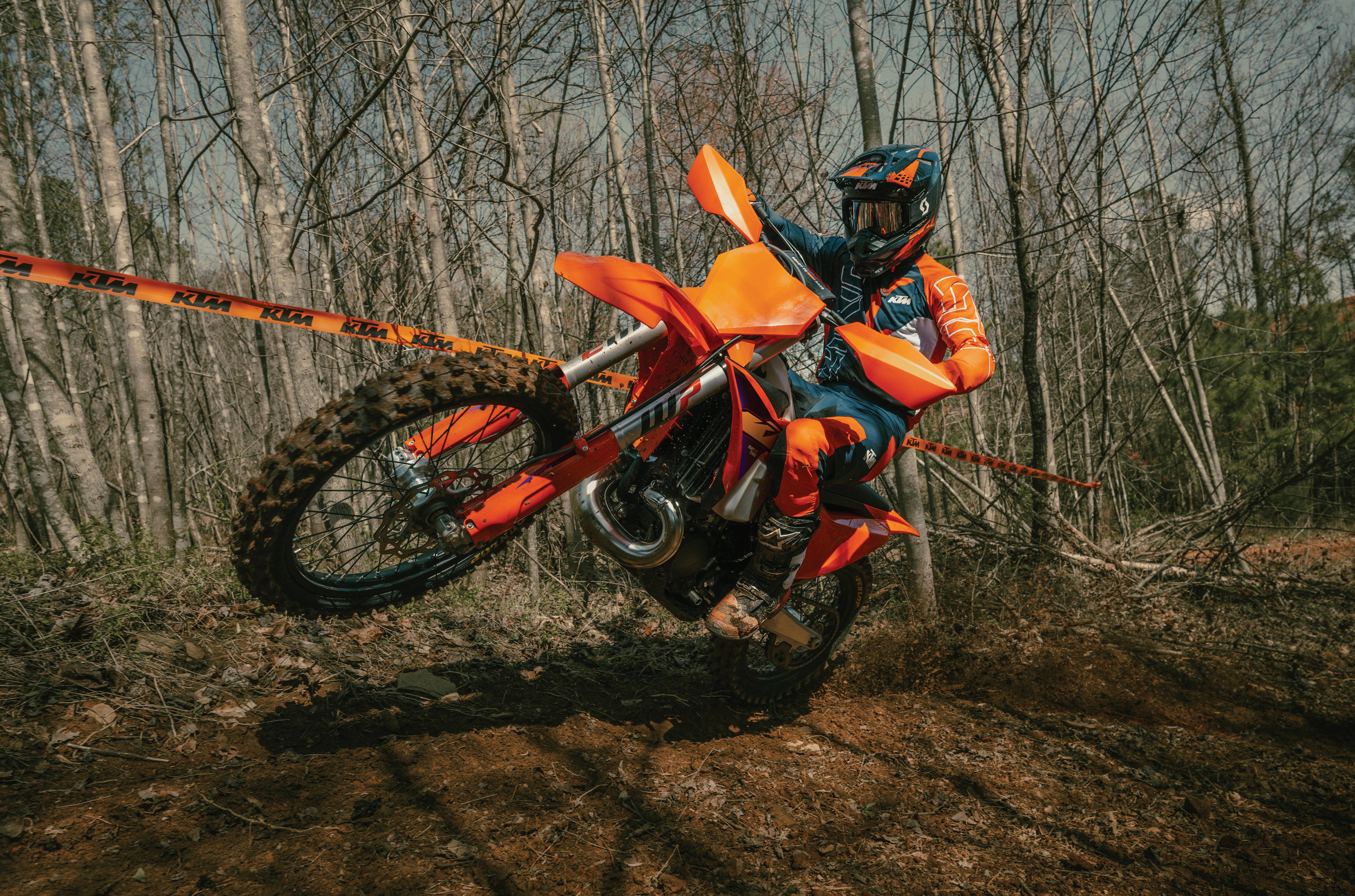
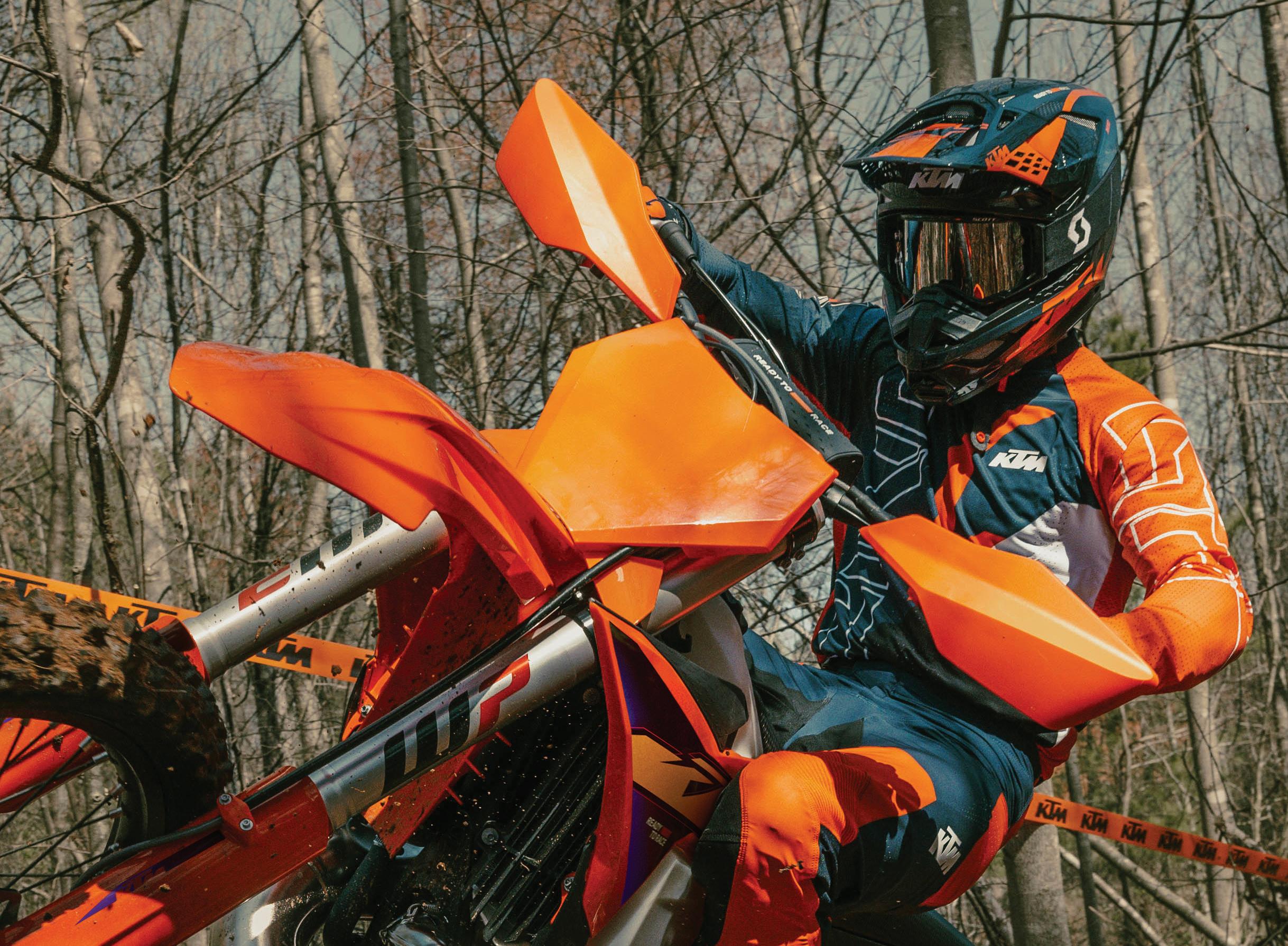
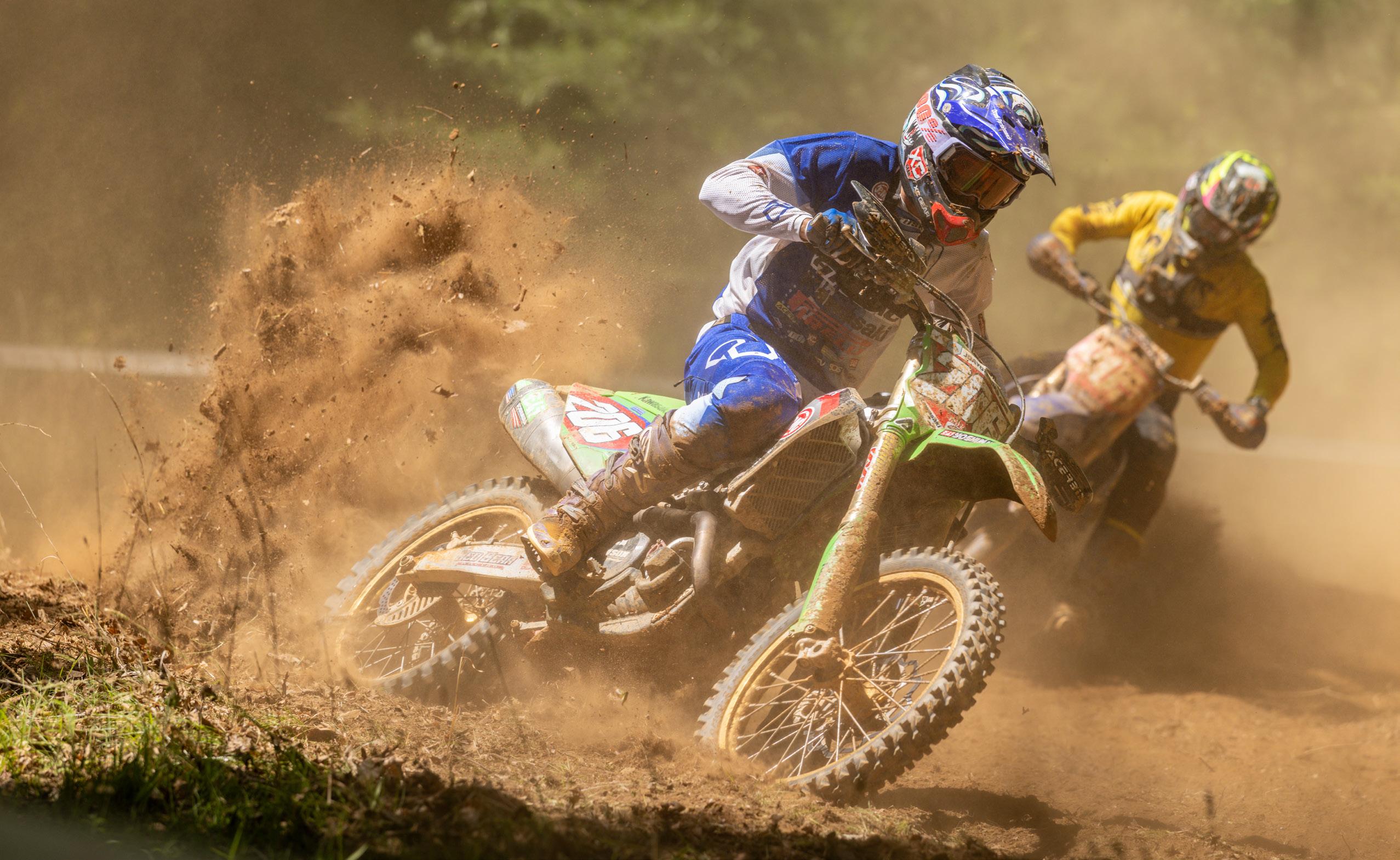
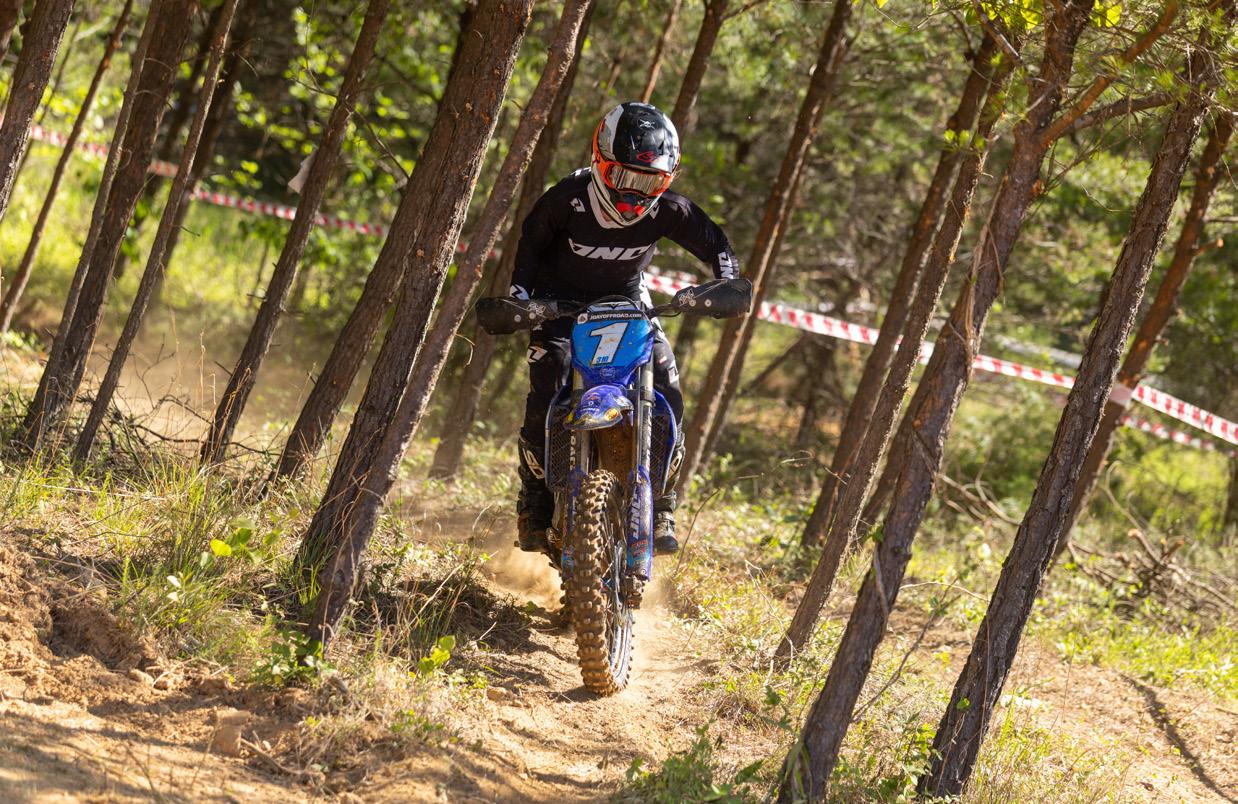
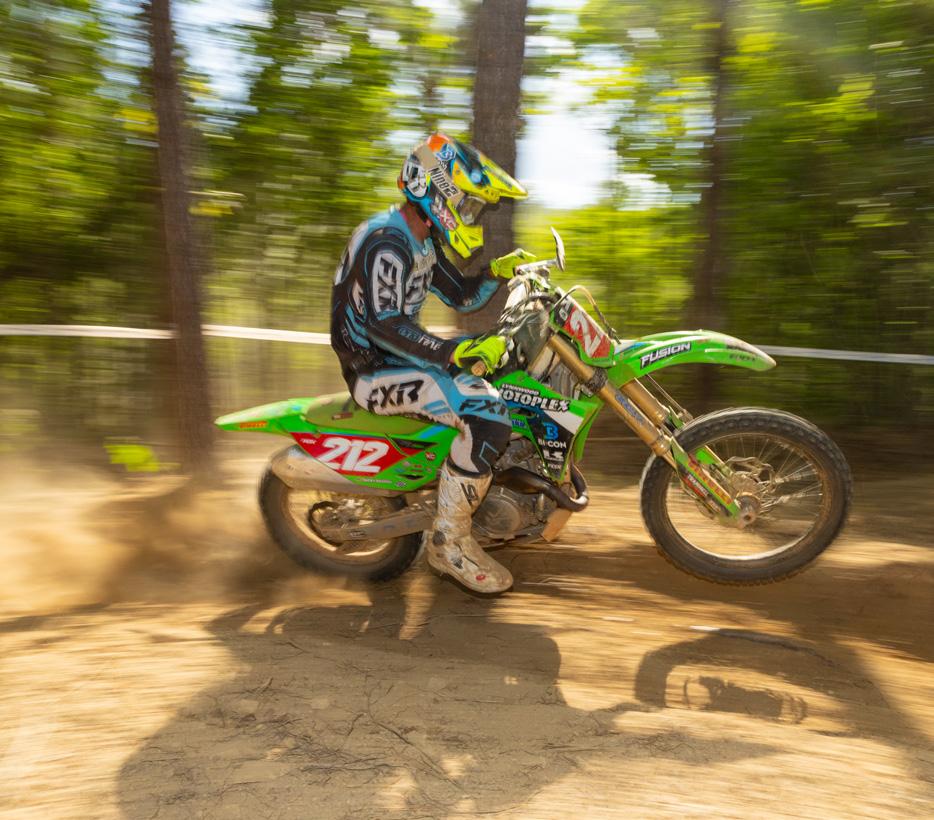
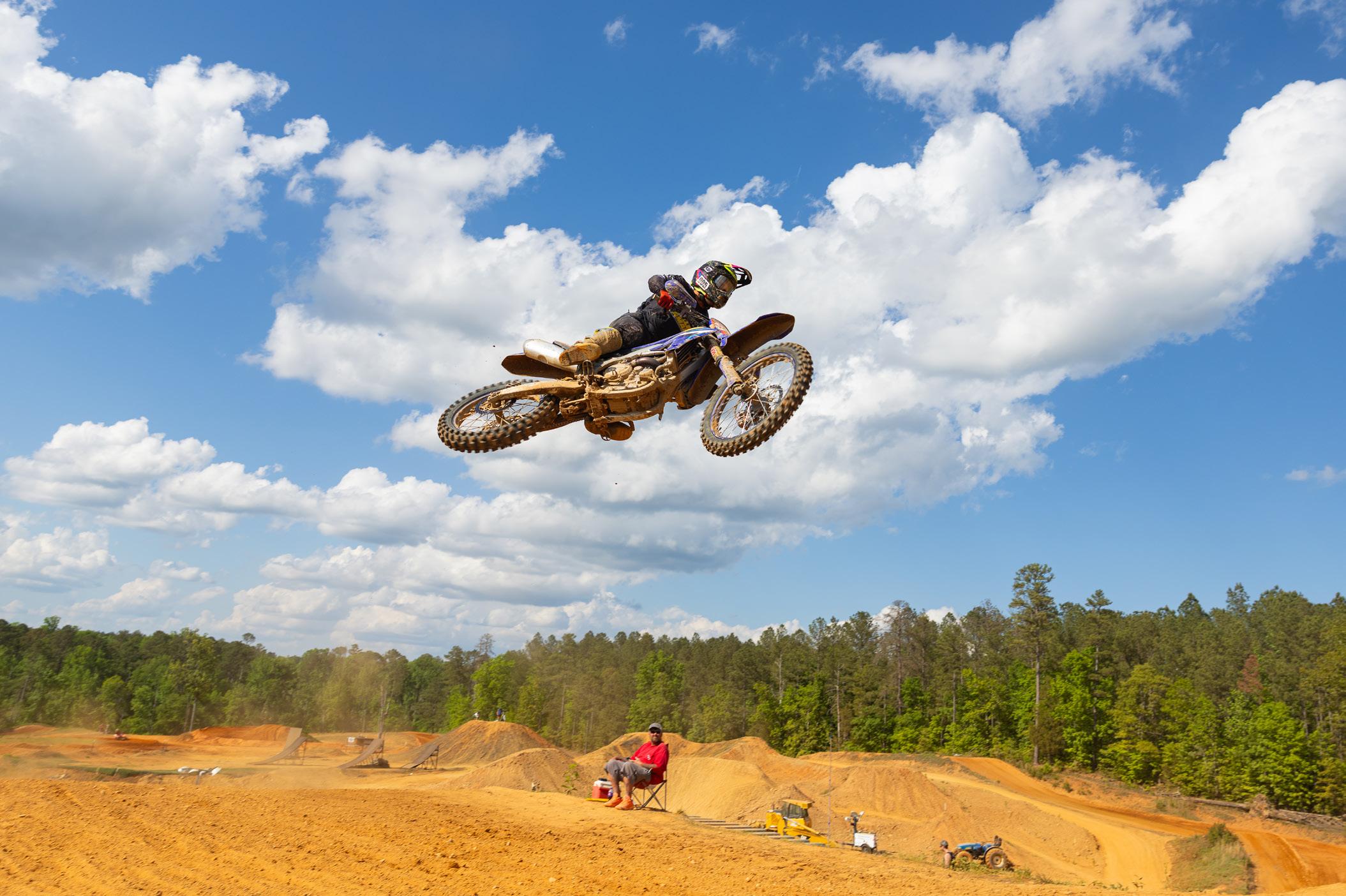
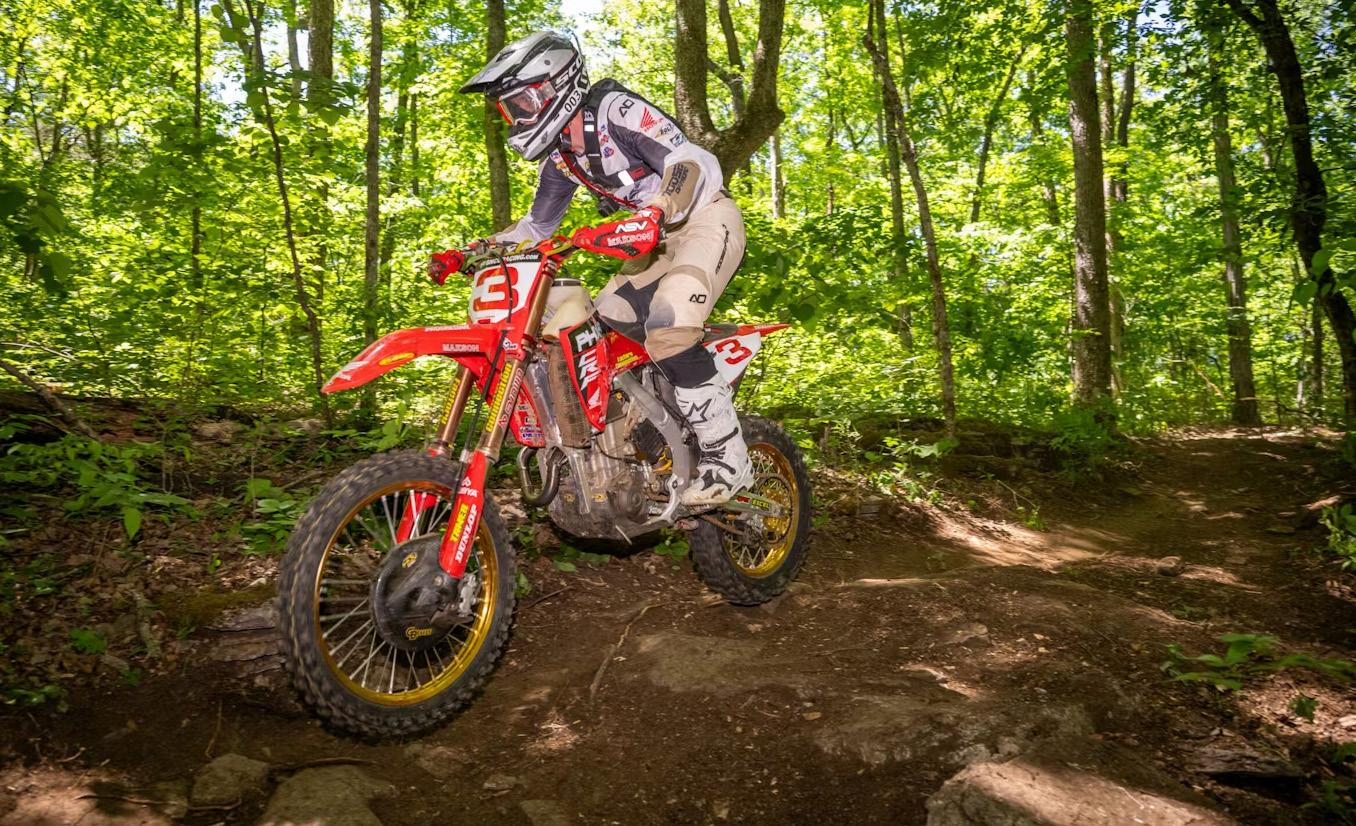
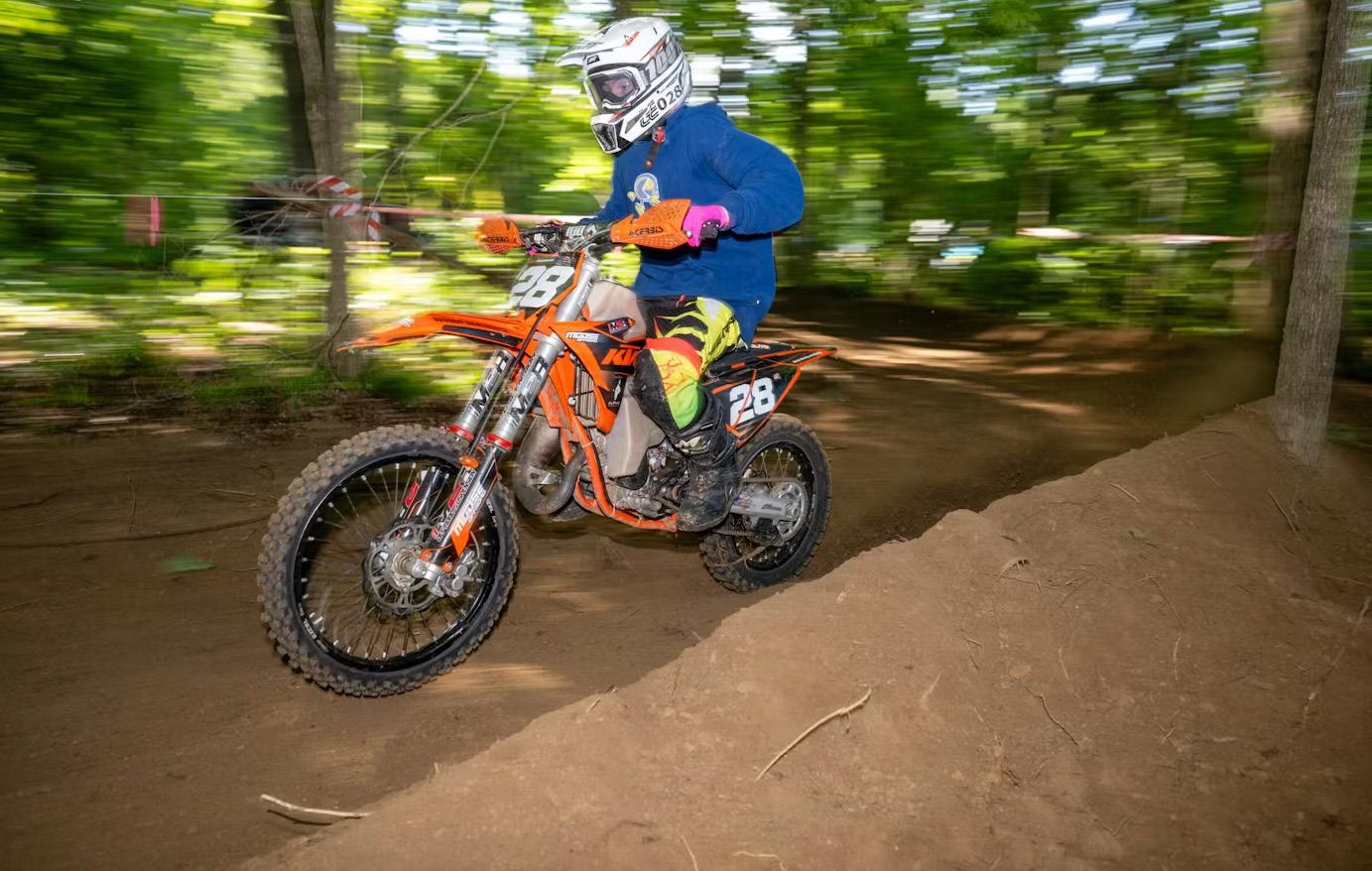
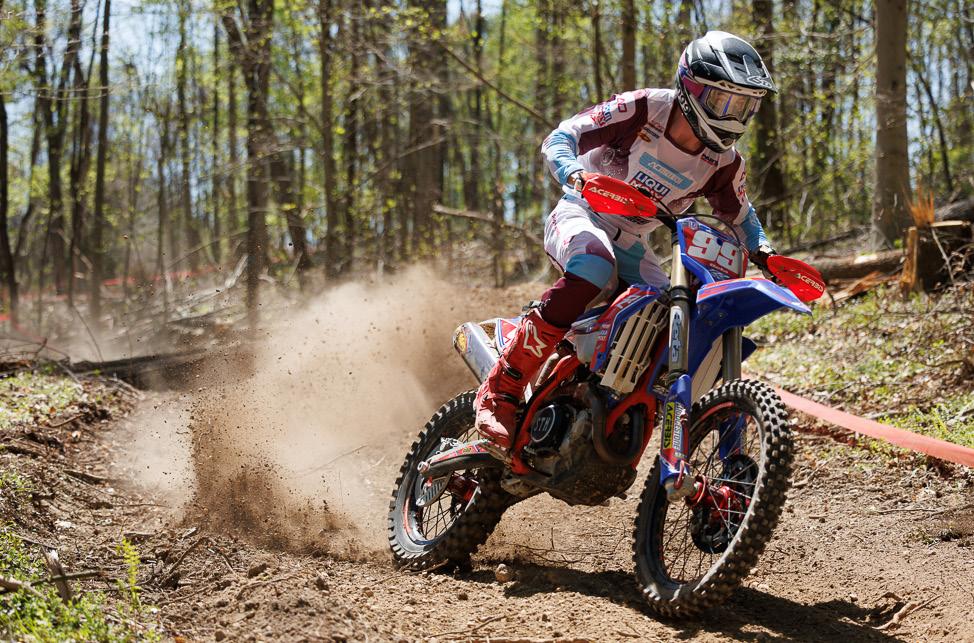
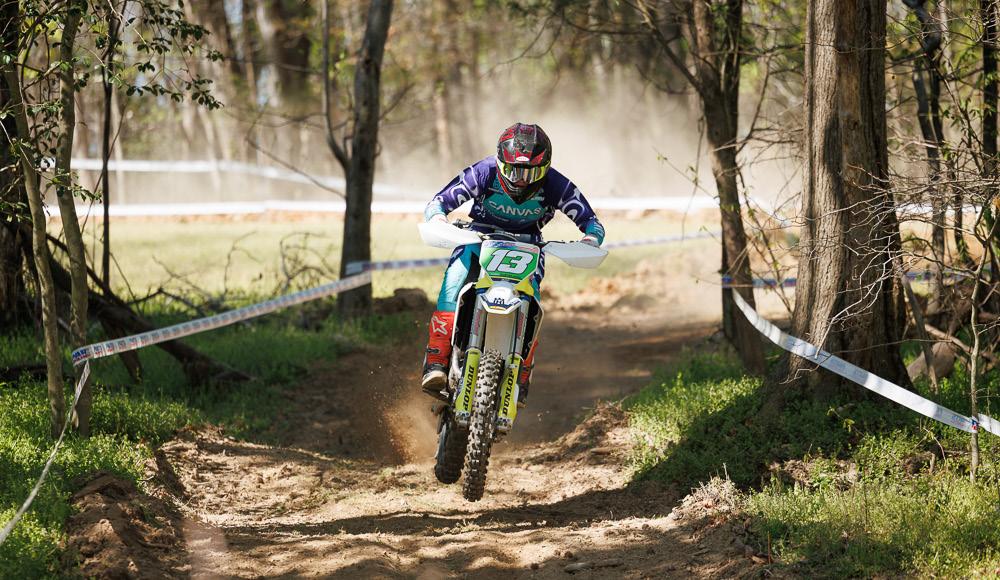
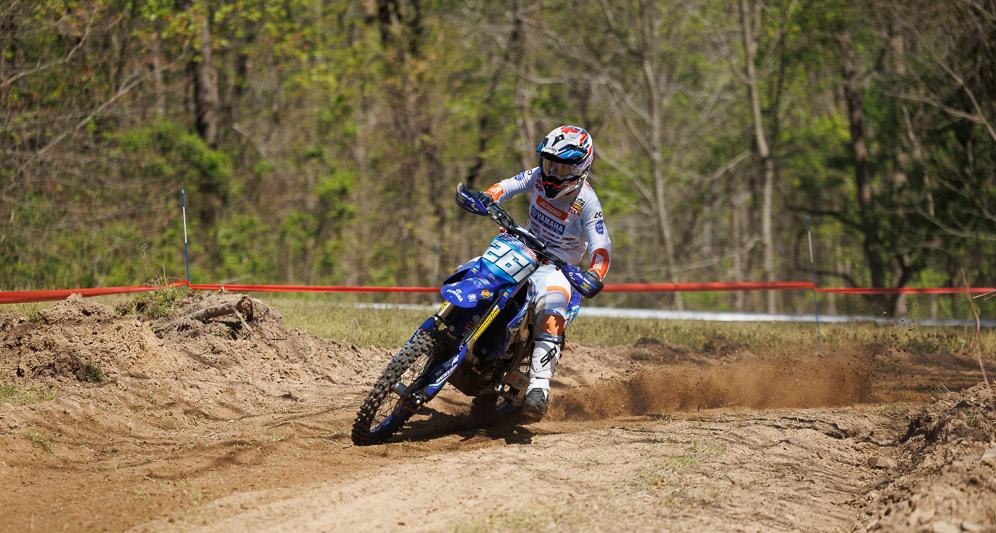
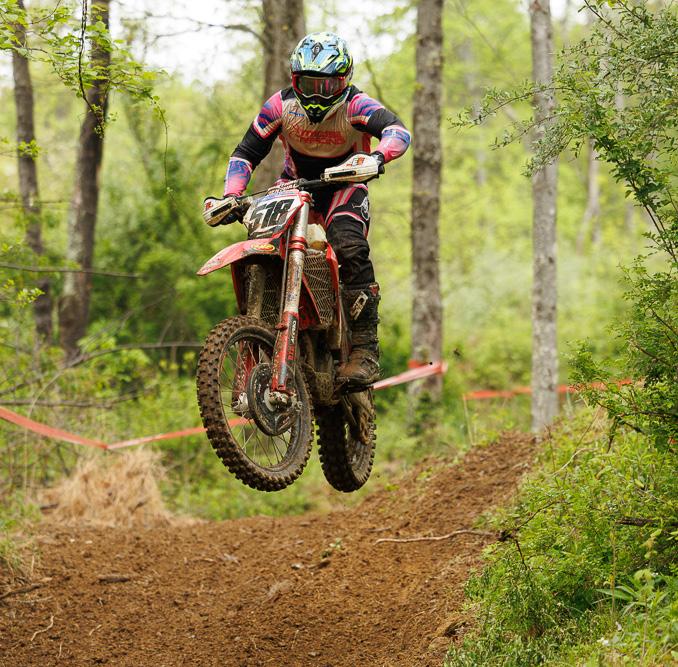
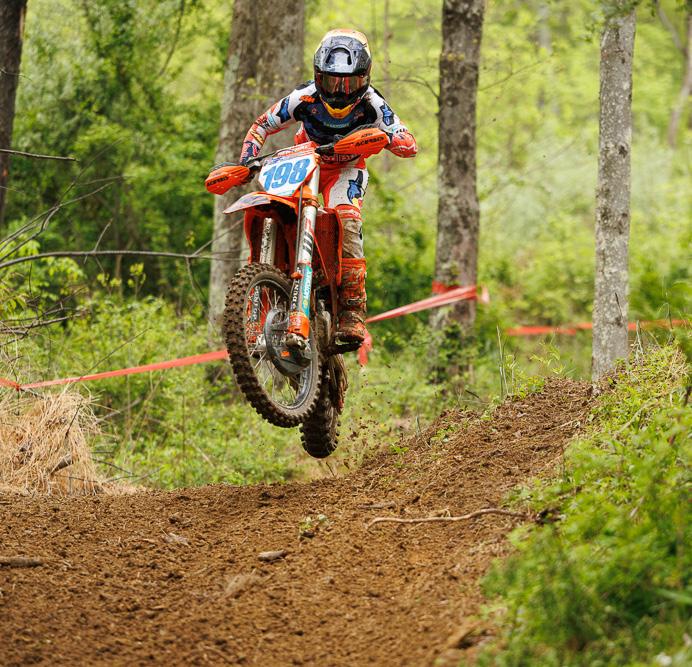
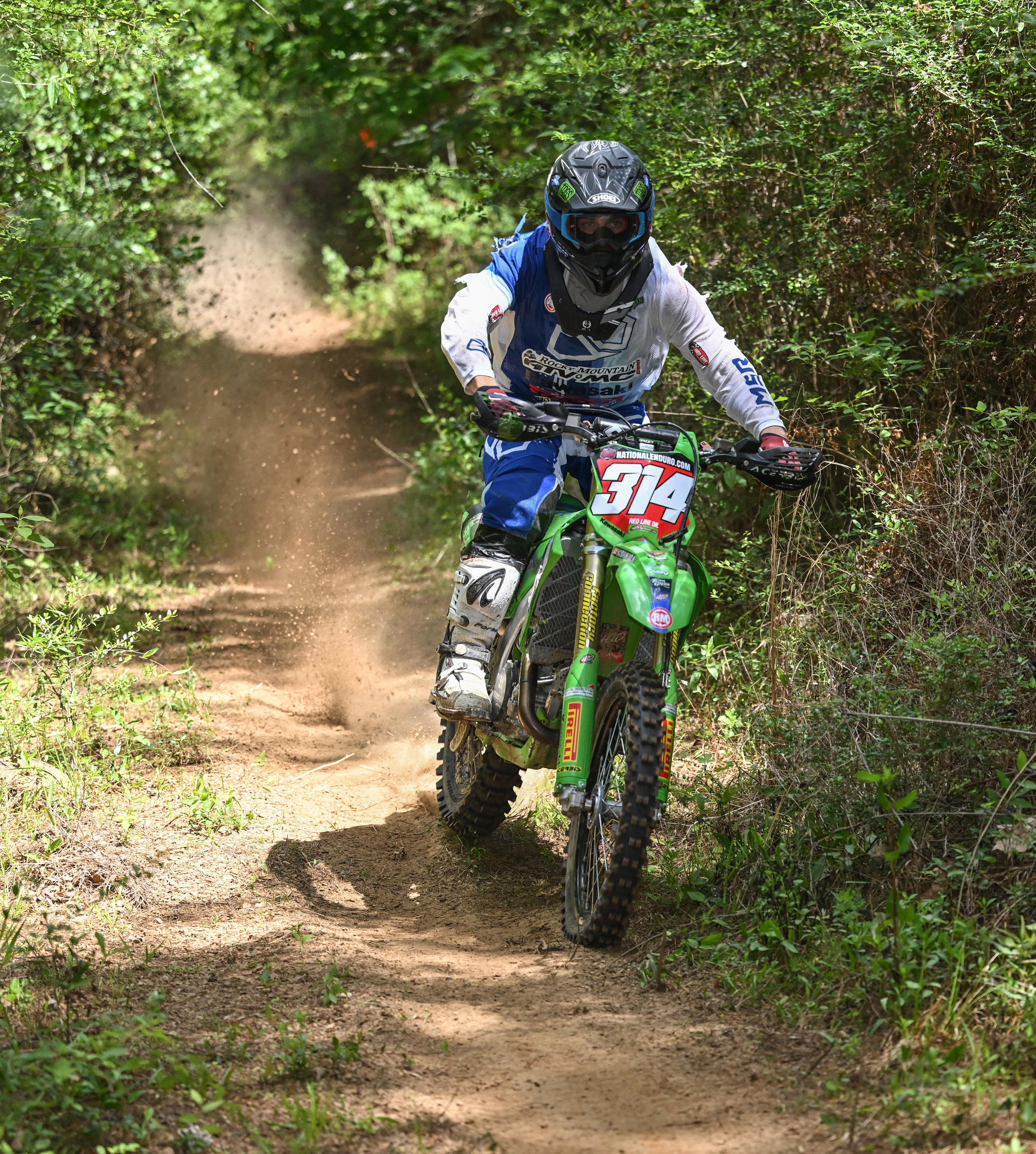
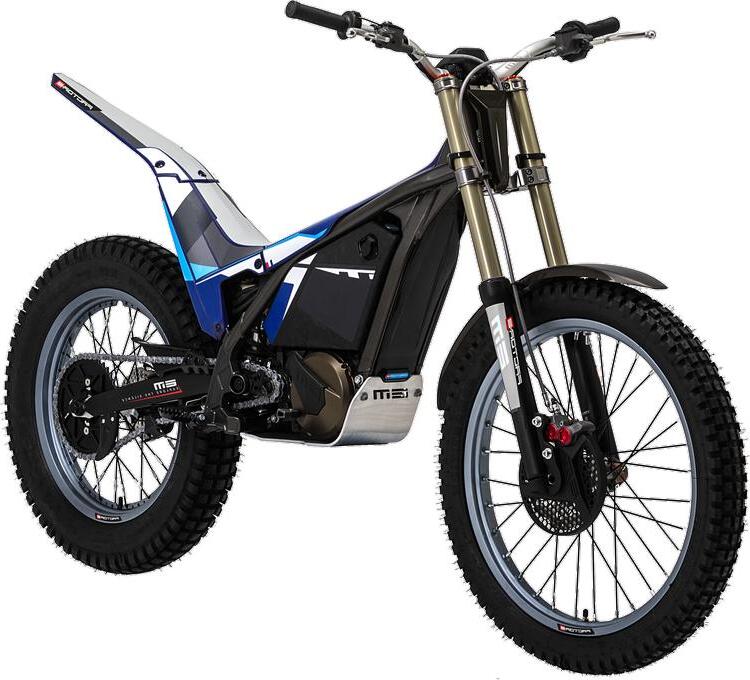
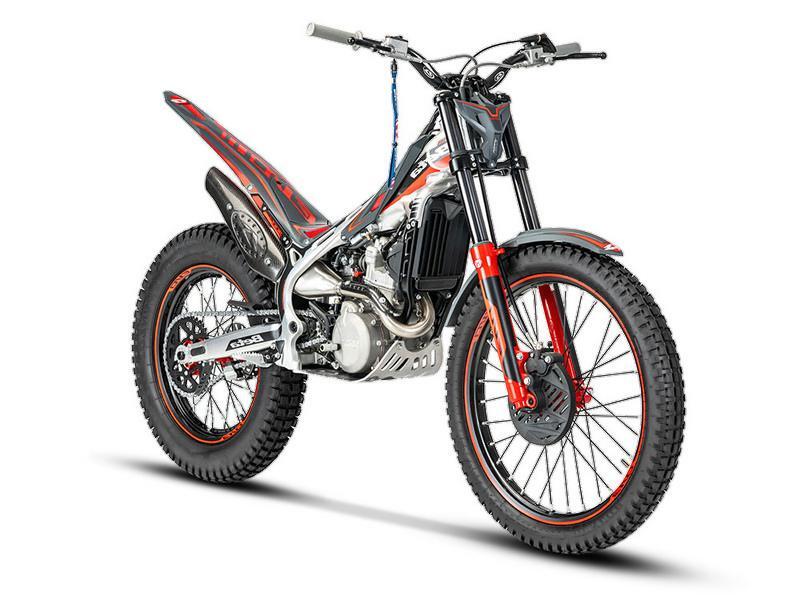
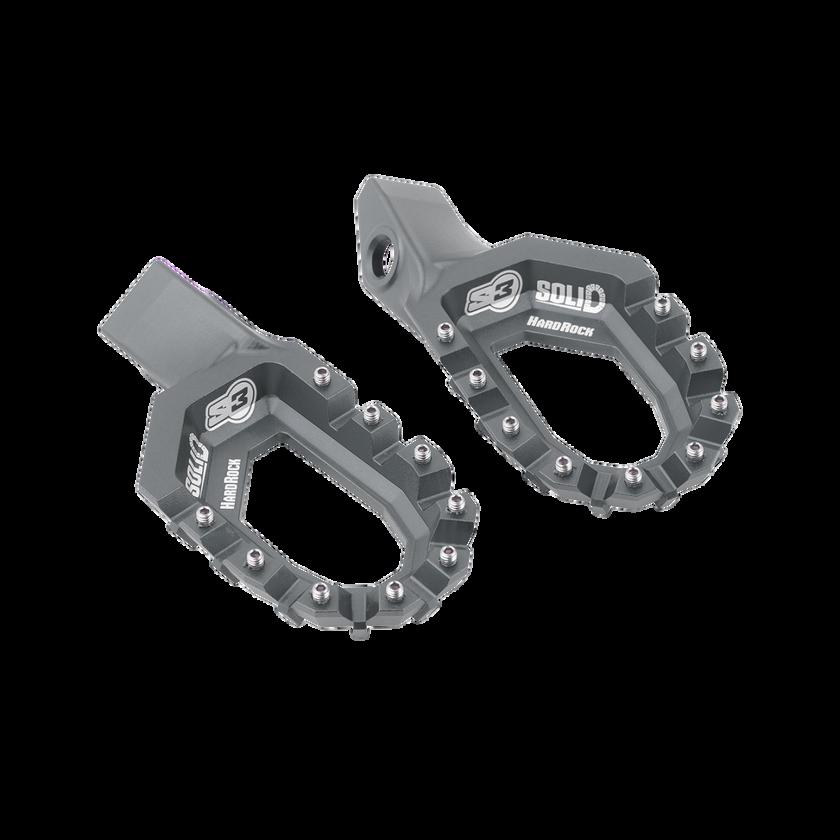
The Sincro Factory is engineered for riders demanding the highest level of performance. Every component has been refined to shed weight, sharpen responsiveness, and create an unfiltered connection between rider and terrain. Combining premium racing components with an aggressive new design, the Sincro Factory is built to conquer the world’s most technical sections with absolute precision.
check out www.on-the-pegs.com for details on how you can get this issue in print SUBSCRIBE
On the Pegs is covering the events, personalities, and machinery of GNCC, enduro, trials and more with beautiful photography in a free monthly digital magazine.
To get involved or send content, email stephanie@onthepegsmagazine.com
On the Pegs is published monthly by On the Pegs, LLC On the Pegs considers its sources reliable and verifies as much data as possible, although reporting inaccuracies can occur; consequently, readers using this information do so at their own risk. On the Pegs is printed in the USA and all rights are reserved. Reproduction of this work in whole or in part without the written consent of the publisher is strictly prohibited. The articles contained in this magazine are works of journalism and do not represent the opinions or ideas of On the Pegs On the Pegs and the publisher assume no responsibility for the content of advertisements. Print copies of this publication are available via www.on-the-pegs.com; price will vary due to issue length and printer service utilized.
Dirt Riders West
USA DEALERS
Mike Carlton
(602) 370-7546
Lewisport USA
Balance Trials Supply
TDK Trials
Trial Store USA
Aloha Trials
Hawaii Rides
Tom's Toys
Ninety One Powersports
TRS Kentucky
Daisy Imports
Jack's Cycles
ROK Trials Team
Mossy Rock Trials
Competition Wheels
Gwyn Motorsports
HVC Cycle
Moto Works USA
Miller Ranch Trials
Trials Training Center
MOTOTRIALSPORT
Thumbs Up Trials
Everett Powersports
Adrian & Mandy Lewis
Bill Haskell
Tony Keady
Alex Niederer
Clayton Oshita
Sam Bird
Tom Littlefield
Payden Campbell
Sam Fastle
Ben Schaeffer
Stuart Preston
Rick Agans
Dan Larson
James McKenzie
Kenny Gwyn
Brad Obidowski
Carl Madsen
Aaron & Andy Miller
Larry Smith
Tom Batchelor
Steve Davis
Sales
(209) 785-6878
(720) 207-7715
(719) 207-6680
(941) 404-0757
(808) 652-0725
(808) 621-6686
(815) 636-6446
(316) 804-9391
(505) 920-2266
(410) 489-9334
(207) 337-1274
(217) 246-3305
(406) 930-0227
(704) 906-3238
(336) 354-2454
(402) 817-4795
(505) 210-4248
(607) 765-8362
(251) 209-4694
(972) 754-9686
(801) 376-2447
(425) 347-4545
AZ, Phoenix CA, Copperopolis CO, Arvada CO, Howard FL, Bradenton HI, Kapaa HI, Wahiawa IL, Roscoe KS, Conway Springs KY, Louisville MD, Woodbine ME, South Berwick MO, St. Louis MT, Big Timber NC, Concord NC, Mt. Airy NE, Lincoln NM, Albuquerque NY, Corning TN, Sequatchie TX, Midlothian UT, Provo WA, Everett
WHY FARM 14'S TWO-DAY ENDURO FORMAT MIGHT BE THE FUTURE OF AMERICAN ENDURO
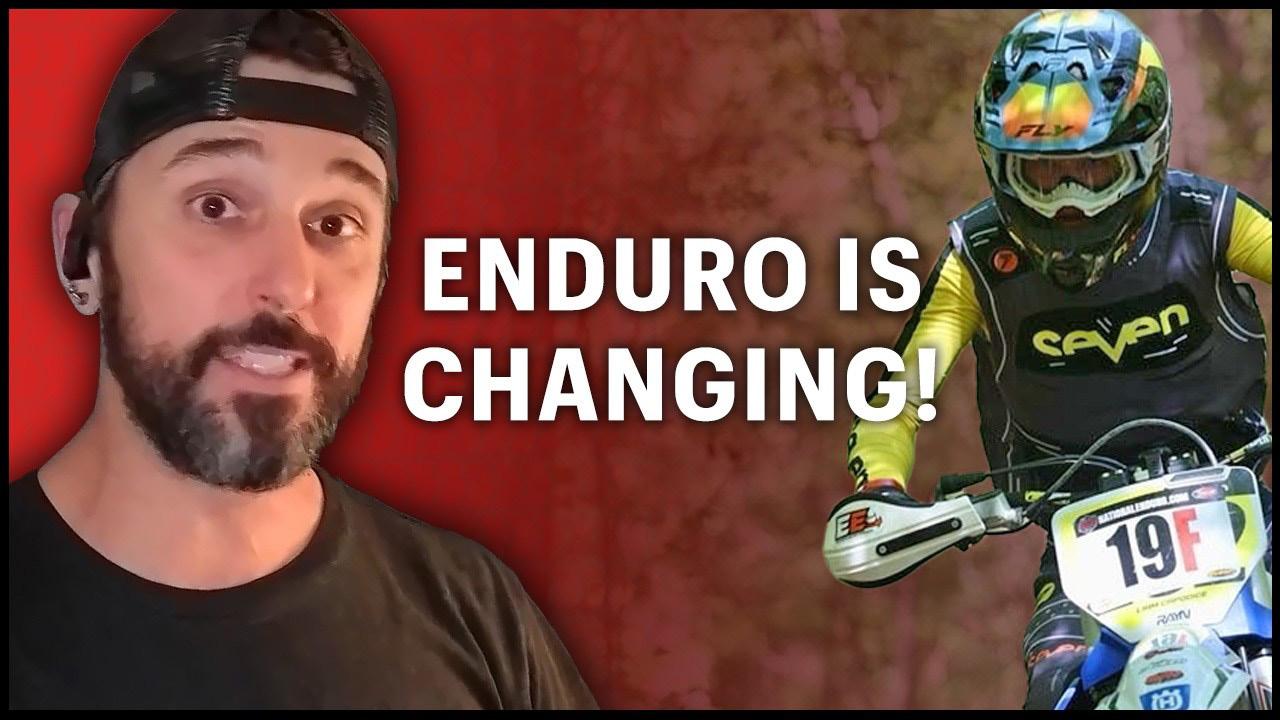
The Farm14 National Enduro was American National Enduro Championship’s (ANEC) first attempt at its version of a two day enduro format. Classes were split between Saturday and Sunday, A racers got extra tests, and the whole thing took place on Kevin Windham’s Farm14 Training Facility. Many enduro enthusiasts were skeptical if it would showcase the spirit of enduro, while also challenging every rider who showed up. This Seat Time Podcast Roundtable tries to unpack how the weekend went, and how excited riders are for more two-day enduros under the ANEC banner.
A NATIONAL-WORTHY WEEKEND, NOT JUST ANOTHER RACE
When I talked with both Matt Musgrove (USHE) and Steward Baylor Jr (ANEC) about their respective series format changes, the common
thread wasn’t “how do we squeeze in more racing,” it was “how do we build a weekend people actually want to be at.” That’s what I saw from afar watching the videos from the Farm14 National Enduro. With classes split across two days and the head-to-head super test brought back, there was room for spectating and hanging out, instead of driving in just in time for the rider’s meeting the day of the race.
The guys on the podcast roundtable backed that up in their own ways, even if they didn’t all stay for the full weekend experience. Ryan Moss and Liam Capodice liked that they could race Saturday, watch some action like the super test or Stu skimming the pond, and still hit the road early enough to be home Sunday. John Yantek talked about grilling with buddies, helping with pits, and getting to spectate pros and fast amateurs in spots you’d
normally never see them. The nice part of the two day layout was that it gave riders options: you could make it a long, social weekend, or you could treat it as a more flexible in and out trip and still feel like you got more out of it than a traditional local enduro.
The biggest drawback to the weekend seemed to come from the pits clearing out come Sunday. The goal was to bring the “Pro pits” back to the races, but if the rigs
leave Saturday evening, Sunday begins to feel like a ghost town. If the goal is to have a national-worthy weekend that racers can’t get anywhere else, another go at this format would be to bring the big rigs in on Friday, have Amateurs race Saturday, then have B racers and up race Sunday. Yes, you’ll loose some spectators to Sunday, but those that choose to stay can begin to see and feel the growth of what ANEC is trying to build.
BRIAN PIERCE ART PEPIN, TREE DODGER RACING
WORDS PHOTOS
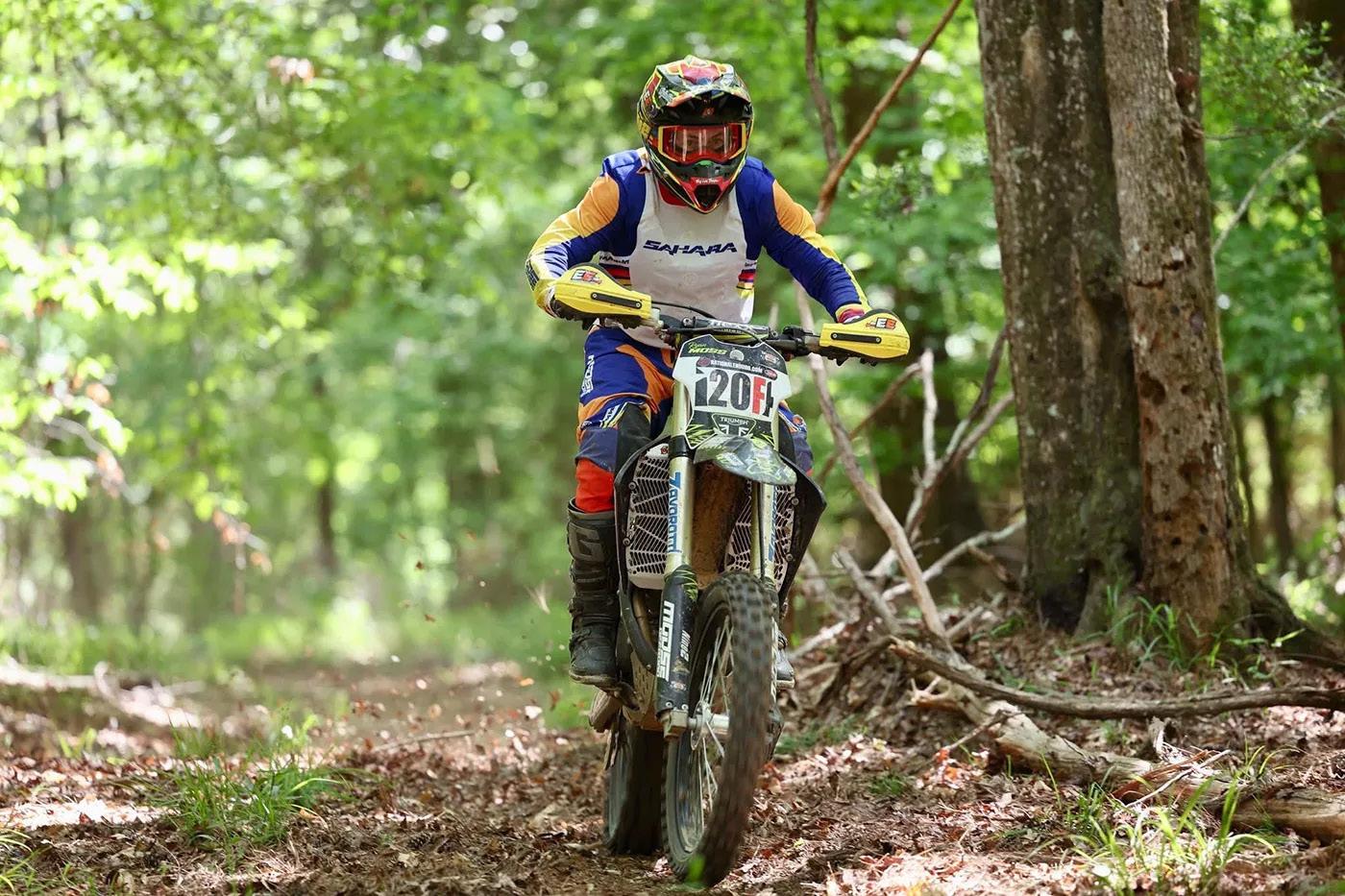
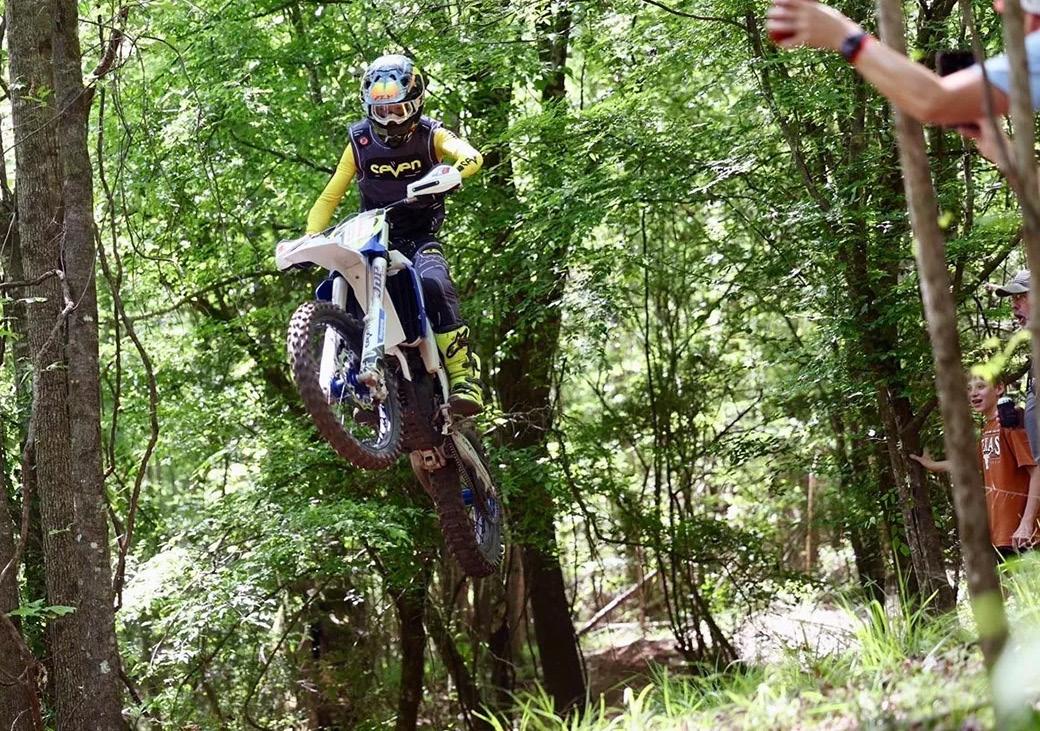
LEFT: John Yantek RIGHT: Ryan Moss charging his way to an A50 win
LESS TRAFFIC, MORE RACING
One of the big wins from the weekend was how the two day split fixed the passing problem that we’ve all just accepted as part of enduro. Unless you’re winning the entire event, there’s a 90% chance you’re going to get passed by a faster rider. The etiquette is to get out of the way as quick as possible, but some take their time because they’re scared, they’re tired, or they’re ignorant (yeah, I said it). With classes broken up between Saturday and Sunday, Ryan and Liam both talked about how much less traffic they dealt with and how different it felt to race every section, not navigate slower riders you catch from earlier rows.
The other cool part was hearing that Farm14 delivered old school, bar banging woods and tight trees that rewarded bike handling over raw speed. Tighter, more technical trails keep the speeds down and ask more skill of the racers; this shouldn’t be ignored. If all amateurs were mixed in with the pros in these tighter sections, more shenanigans with passing can occur. Even John, who’s strategic about which row he signs up for to dodge traffic, mentioned how good the conditions were for where he started. If ANEC can keep the entry numbers healthy and the class split smart, the two-day format gives us more of what we show up for: technical singletrack, less guessing about where to pass, and more time looking way past the front of our fender.
CHANGE AND GROWTH IS HARD
The comments on this video, and the interview with Stew last year, weren’t all positive. You can tell many riders and racers don’t want change. They like the status quo of the enduro they know, and if someone tries to change it, they immediately push back. That’s pretty normal human
behavior, especially if you’re only chasing comfort. But I don’t ride dirt bikes or race enduros to chase comfort. I ride and race dirt bikes to push myself past what makes me comfortable.
So I challenge all the negative commenters to show up to a National Enduro this year put on by ANEC. I ask you to stop holding this sport, and yourself, back by death gripping this idea of a sport you didn’t create. I’ve had to reflect on my thoughts on what an enduro is, and was,
after years of riding with my dad and now my son. At its core, an enduro is a day in the woods with your buddies on dirt bikes. A National Enduro is the next step beyond that. I at one point wanted them to be organized trail rides, but they can’t be that at the professional level. If we want to see racers supporting themselves with a salary in a professional sport, we have to give that avenue the ability to grow. We have to see if there is a way for riders to ride and racers to race on the same weekend. That’s what Steward Baylor Jr is trying to
do with the American National Enduro Championship: support a community of riders while growing a sport of professionals. Yes, it’s harder than it sounds. Give him your support, not only your opinions.
www.seattime.co
or scan to watch Brian's YouTube video
RIGHT: Overall B racer, Liam Capodice
MAY FOCUS: WHEELIES
If turning is the foundation, and clutch and throttle are the language of trials, then wheelies are how you start to have a real conversation with the bike.
This month is all about getting comfortable lifting the front wheel with intention. Whether you are a brand new rider chasing your first balanced wheelie or a seasoned trials competitor refining your launch into a hop, wheelies build the skills that show up everywhere in our sport.
For May, focus on things like:
• Lifting the front cleanly with throttle and body position rather than yanking the bars
• Finding the balance point and learning to recognize it before you reach it
• Using the rear brake as a precision tool to control how high the front comes up
• Carrying the wheel through small obstacles, ledges, and elevation changes
• Building toward bigger techniques: zaps, double blips, and committed splatters
Wheelies can feel intimidating, especially for riders who came up on bigger or heavier bikes. Start small, start low, and keep it controlled. Even short, wellexecuted wheel lifts on flat ground will pay off the next time you face an awkward step or a rolling log.
As always, ride within your skill level, wear your gear, and treat May as a chance to add one more tool to your toolbox.
THANK YOU TO OUR APRIL SPONSORS
April was made possible by the riders, friends, and supporters who keep this challenge rolling.
Our giveaway sponsor was TDK Trials, who provided two sets of high-quality levers for our April winners. If you have not checked out their lineup, do yourself a favor and take a look. Congratulations to Don Conrad and Toni Roach for being the April prize winners!
Our postage sponsor was YOU. Yes, you. April postage was funded entirely by readers and challengers who chipped in through the challenge Ko-fi page. Every sticker pack mailed in April was made possible by your generosity, and it is a reminder of how special this community really is. If you would like to help keep stickers and prizes flowing to riders around the world, the Ko-fi page is open yearround at ko-fi.com/happiabi.
MAY PRIZES
May is shaping up to be one of the biggest months of the challenge so far, with support from two great companies:
GIVEAWAY SPONSOR: Boyesen — ten (yes, ten) sets of Pro Series Reeds going out to May finishers. Boyesen reeds are a favorite for a reason, and this is an incredible way to put proven performance parts into the hands of riders who are putting in the work.
POSTAGE SPONSOR: Six Mile Industries, helping us keep sticker packs and prizes shipping to challengers across the country and around the world. Their continued support has been a huge part of making this challenge feel like a community rather than a contest.
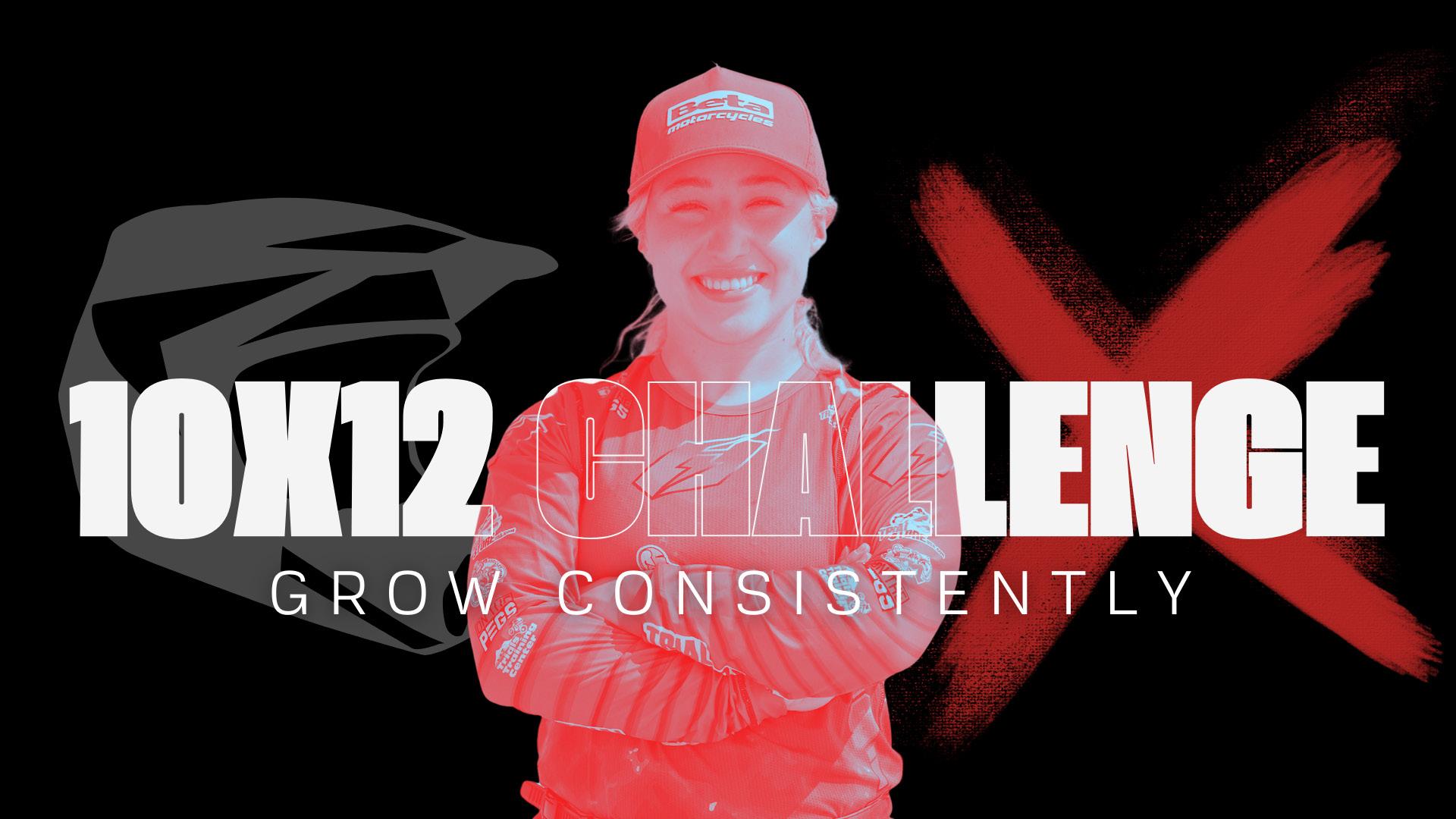
Complete your May 10×12 to be eligible. Turn in a photo of your calendar inside the TrialsProgression community app, and you are entered.
THE 10X12 COMMUNITY
It still blows me away how much this challenge has grown. We now have more than 150 riders from around the world taking part, with stickers and packages headed everywhere from Estonia to Australia, Canada to Colombia, the UK to right down the road from you.
Watching riders cheer each other on inside the TrialsProgression community has become my favorite part of the entire project. Every photo of a calendar full of X marks, every clip of a hard-won wheelie, every rider sharing a tough day and getting back on the bike anyway, that is the real prize. The reeds and levers are just bonus. If you are not already in the community, jump in. The 10×12 community on the TrialsProgression app is free for challengers and is where everything happens.
Show up. Put in the reps. Get the wheel up. Let's make May a great one.
ABIGAIL BUZZELLI WORDS
APRIL FINISHERS
Alex Le
Don Conrad
Heidi Brenner
Jakeb Holden
Jason Robb
Jim Baird
Joseph Payne
Juan Felipe
Judy Li
Karl Faruzel
Marcus Sysum
Norman Foley
Robb Reeves
Scott Brenner
Shaun Hunt
Todd West
Tom Trantow
Tommy Justice
Toni Roach
Zack Guelde
Clockwise from right: Alicia Lim, Toni Roach, Jim Baird
America's First Trial des Nations
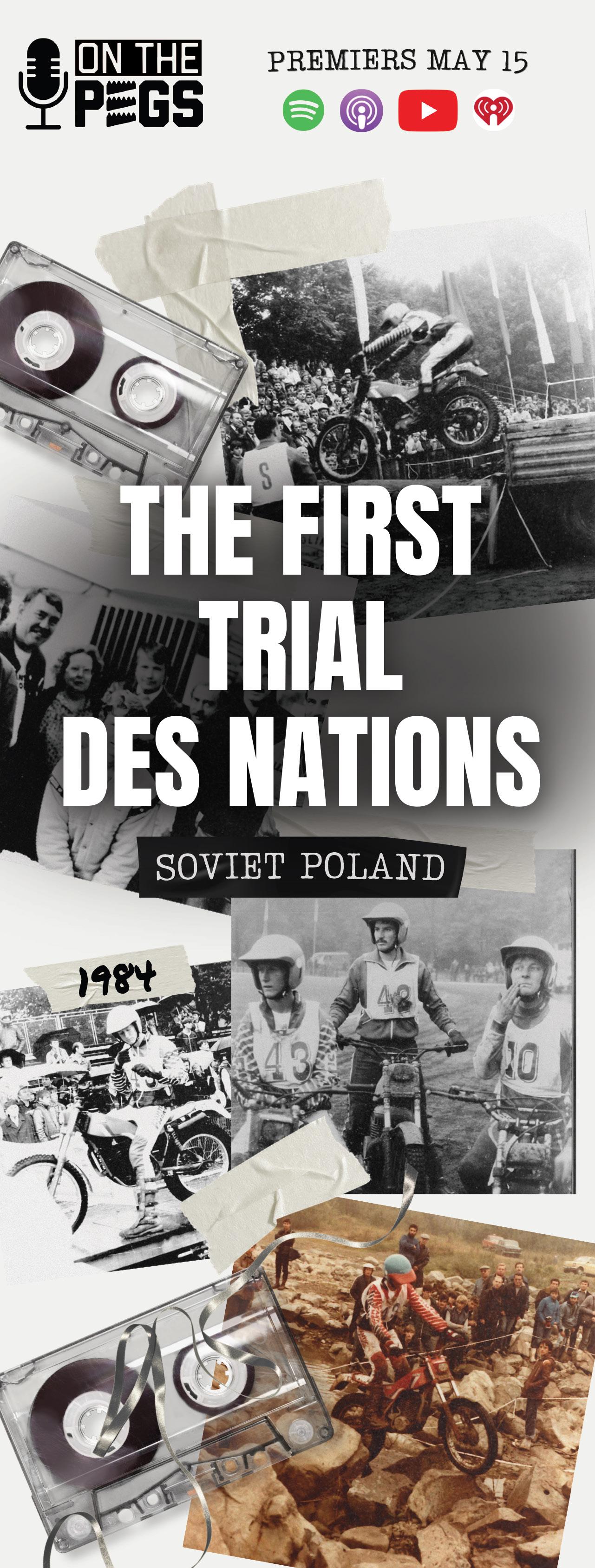
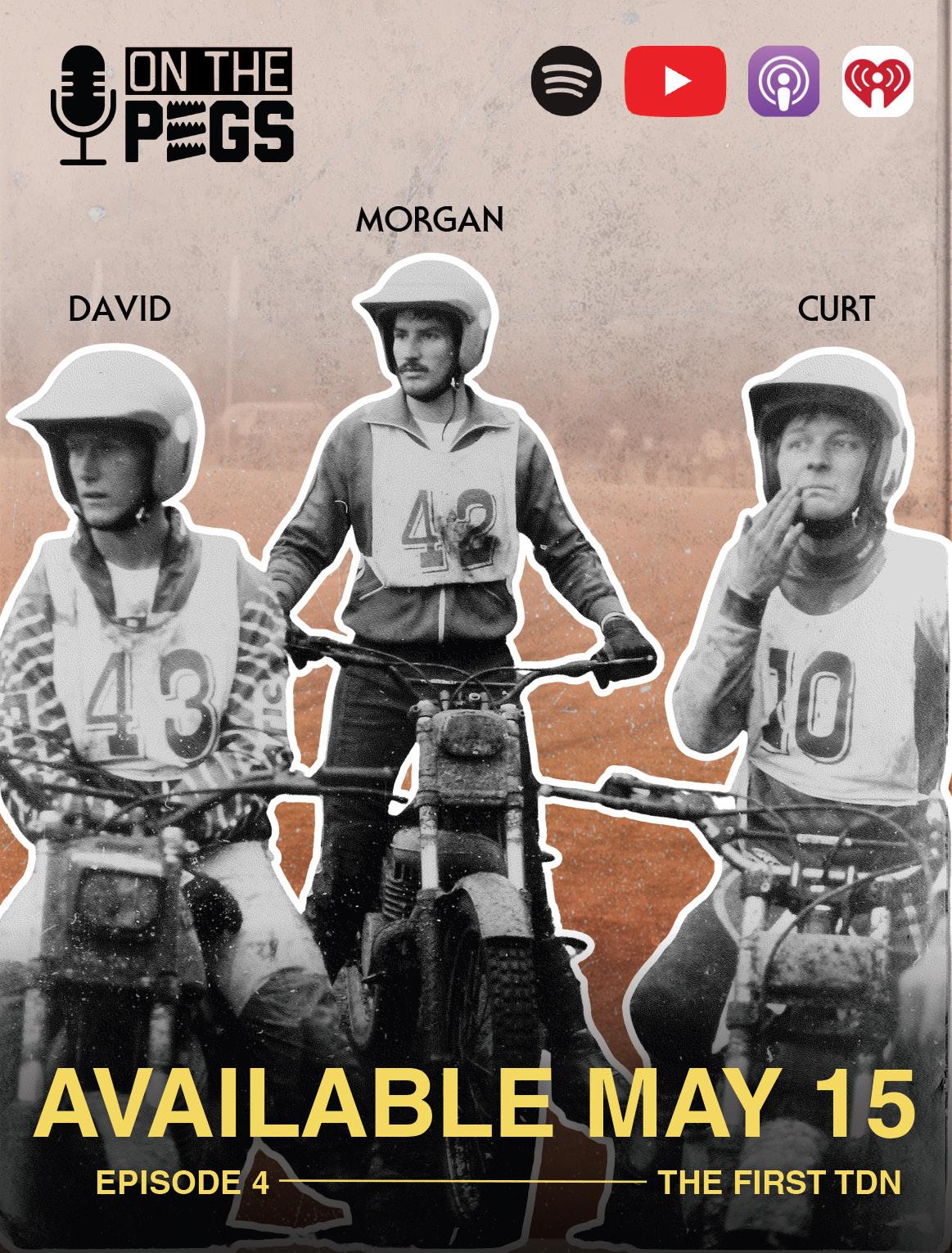
Ahead of the 2026 Trial des Nations team unveiling at the NATC’s Round 3/4 weekend in New Mexico on May 23-24, the latest episode of the On the Pegs Podcast looks back to where the American TdN story began.
Recorded at the AMA Hall of Fame in Pickerington, Ohio, the episode brings Abigail Buzzelli together with David Pyle and Curt Comer, two members of the U.S. team that competed at the very
first Trial des Nations in 1984. Held in what was then Soviet-controlled Poland, that inaugural event was unlike anything American trials riders had experienced before. More than four decades later, this conversation marks the first time Pyle and Comer have sat down together to publicly reflect on that trip, its challenges, and the lasting significance of representing the United States on the world stage.
For modern listeners, especially those following the current U.S. TdN effort, the episode offers a rare bridge between generations. Abigail, having recently attended the 2025 Trial des Nations in Italy, frames the discussion around both contrast and continuity. The event has grown dramatically since 1984, with larger teams, women’s representation, challengeclass opportunities, and a more formalized international structure. Yet the emotional
core remains familiar. Then as now, wearing U.S. colors carried weight.
Comer’s background reflects an era many still consider a golden age for American trials. Growing up in a motorcycle family in the Southeast, he began riding trials at age 12 and came of age during the mid-1970s boom, when nearly every major manufacturer had trials bikes on showroom floors. Comer rode for Kawasaki in 1975 and 1976
before moving to Montesa, eventually winning the 1981 U.S. Championship and earning factory support in the years leading into the first TdN.
Pyle’s path began in 1972, after his father encouraged him to learn trials before motocross. What started as a skill-building exercise became a career-defining passion. He developed in the Pacific Northwest, advanced through the expert ranks, worked with importers, rode nationals, and gained international experience at events such as the Scottish Six Days Trial and world championship rounds in Europe.
By 1984, both riders had the qualities needed for an event with no established blueprint. Pyle, Comer, and Morgan Kavanaugh were selected not only for their ability, but because they could serve as strong ambassadors, handle themselves abroad, and maintain their own machines with little outside support. Marilyn Wicker played a major role in fundraising, traveling to nationals, selling T-shirts, collecting donations, and helping make the effort possible at a time when there was no internet, no online campaigns, and little public understanding of what the Trial des Nations even was.
The logistics of the trip sound almost unimaginable today. The riders disassembled their bikes and carried them as luggage, packing engines, wheels, forks, swingarms, shocks, tools, riding gear, oil, and other essentials into makeshift bundles. Comer even carried the fiberglass gas tank and seat unit from his Montesa as carry-on luggage, explaining to airport officials that it was fragile and essential to his role representing the United States.
Once in Poland, the Americans entered a world shaped by Cold War realities. The event took place before the fall of the Berlin Wall, during the period of the Solidarity movement. Both Comer and
Pyle describe being clearly identifiable as Americans, dressed in red, white, and blue while surrounded by a society where most people wore muted colors. They needed approved Polish escorts and had to document where they were staying and who they were with. Yet both emphasize the warmth they received from local trials people and ordinary citizens alike.
The Polish motorcycle community left a lasting impression. Local riders were passionate but lacked access to Western bikes, tires, gear, clothing, and parts. Comer recalls trading stickers, T-shirts, tires, shocks, grips, and other pieces of equipment for keepsakes. What might have been routine items to an American rider were deeply valuable to Polish enthusiasts who could not obtain them otherwise.
The event itself was brutally demanding. Starting from a school venue with a running track, soccer field, and stadiumstyle opening section, the trial unfolded over a muddy, wet, technical loop that both riders compare to a world championship round of the era. They remember steep banks, streams, slippery climbs, heavy rain, long hours, and difficult sections.
Pyle calls it
one of the hardest days he ever spent on a motorcycle. Comer remembers fighting mud-packed cooling fins, overheating issues, broken fenders, and exhaustion.
Yet amid the hardship, the honor of the moment remains central. Comer recalls the opening ceremony, walking in front of the grandstands behind the USA sign and American flag. Even decades later, the memory brings emotion. He compares the feeling to an Olympic-style experience, a rare moment in which a trials rider stands not only for himself, but for his country.
That emotional thread connects directly to today’s U.S. TdN program. Abigail describes the modern Parade des Nations and the pride of carrying the American flag at the 2025 event. The teams
are larger now, with men’s, women’s, and challengeteam representation, but the symbolism remains intact. The riders who carried the U.S. flag in 1984 and the riders preparing to represent the country in 2026 are part of the same lineage.
In the end, the episode is not simply about the first Trial des Nations. It is about stewardship. Pyle and Comer helped open a door for American trials riders in 1984, and every U.S. team since has walked through it. As the 2026 team announcement approaches in New Mexico, their stories serve as a reminder that TdN has always been bigger than a single weekend. It is a shared national effort, carried forward by riders, families, clubs, fundraisers, mentors, and the trials community that continues to rally behind the flag.
miller survives chaos at black rock
ROUND 2 - Black Rock LOCATION: Chesterhill, OH
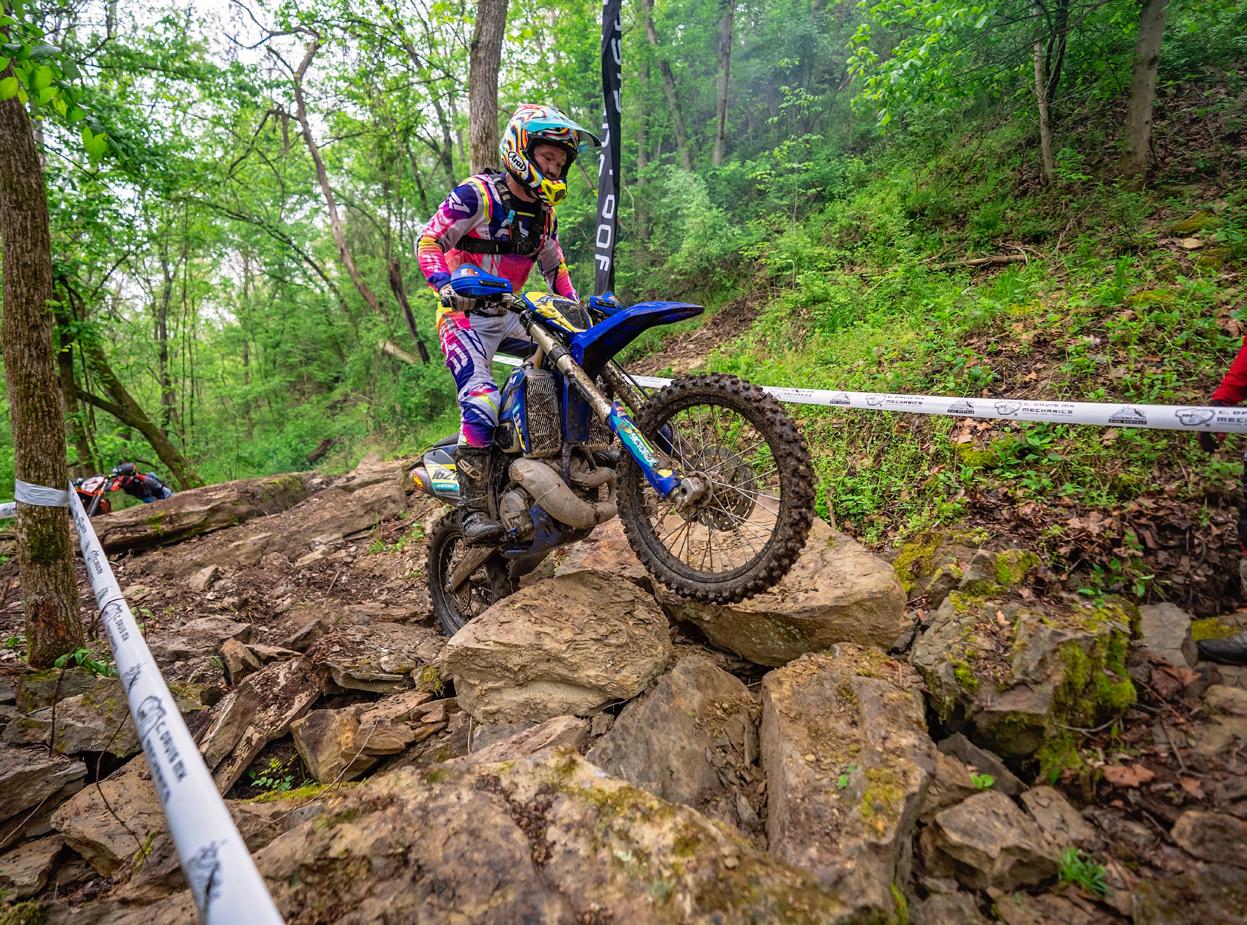
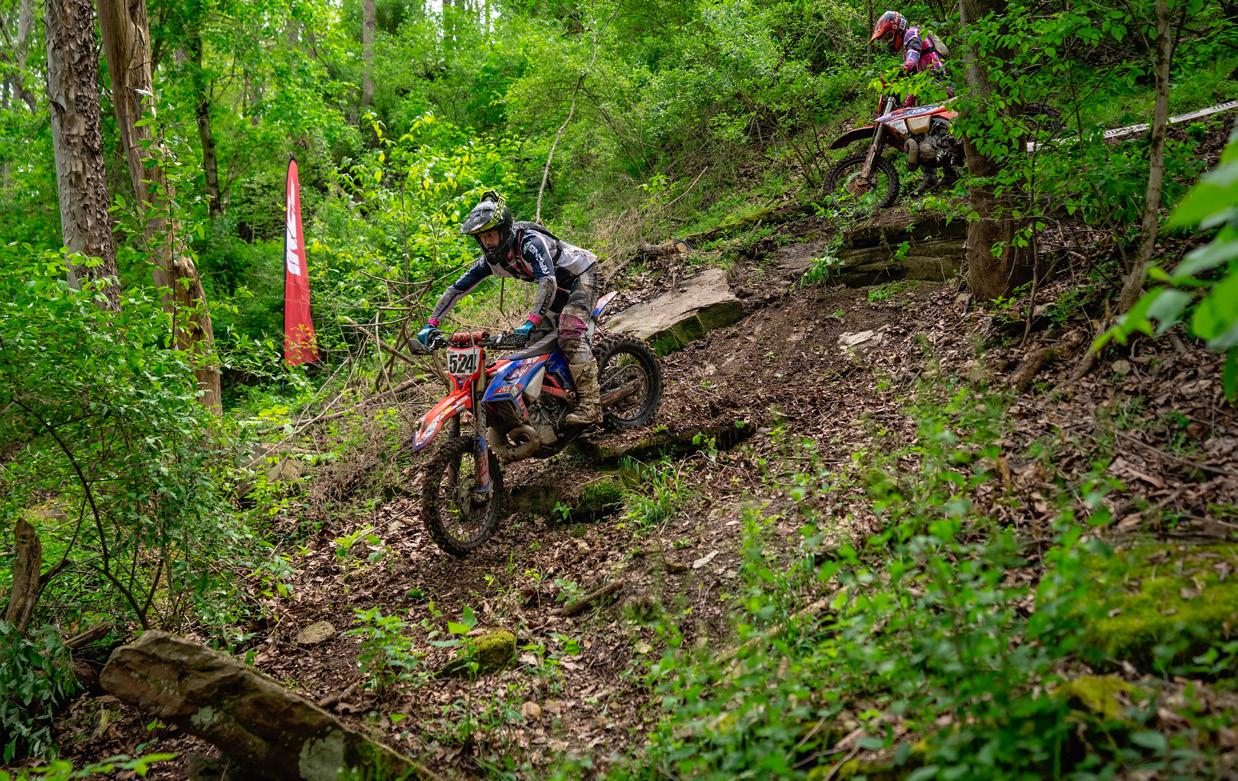
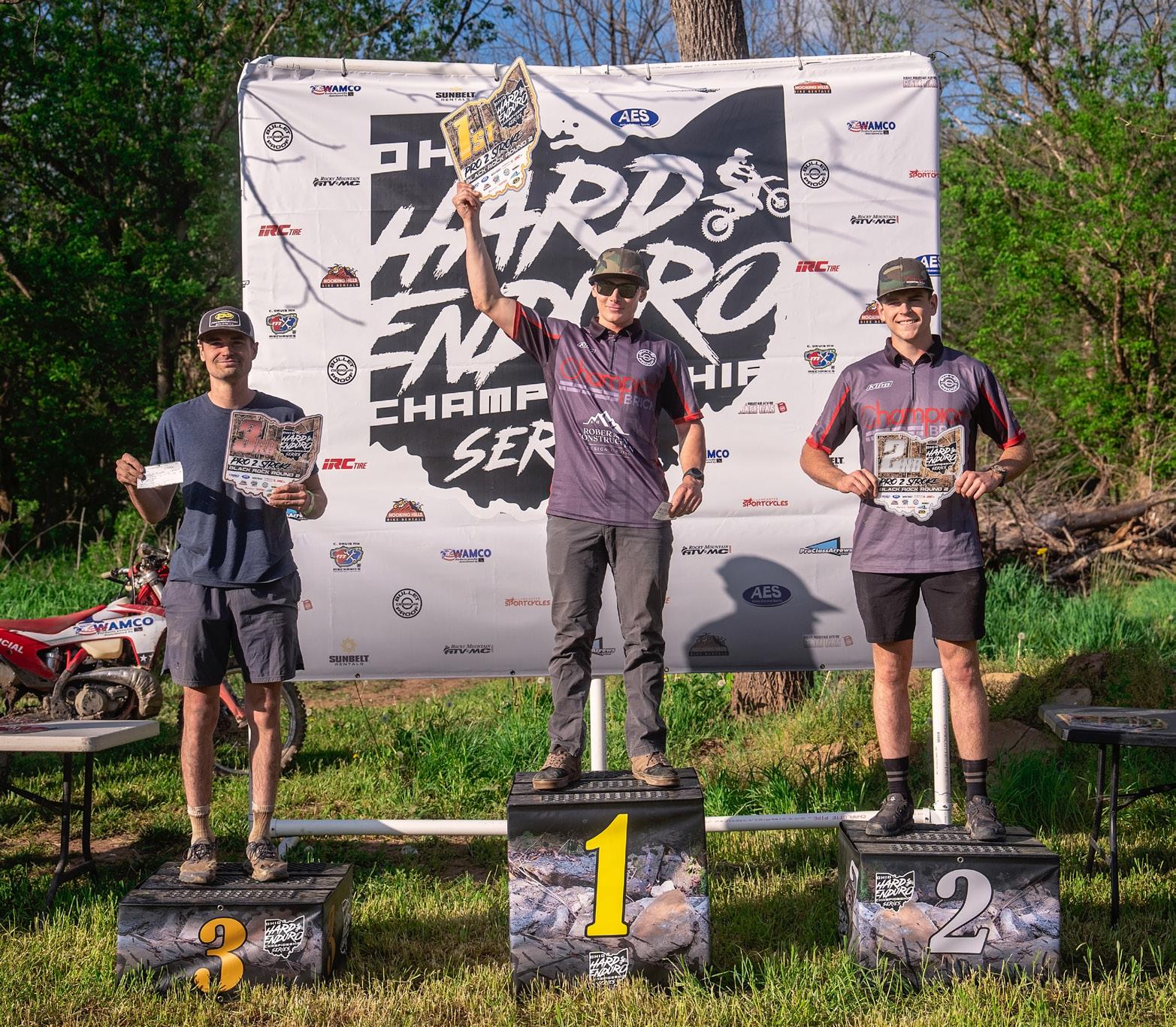
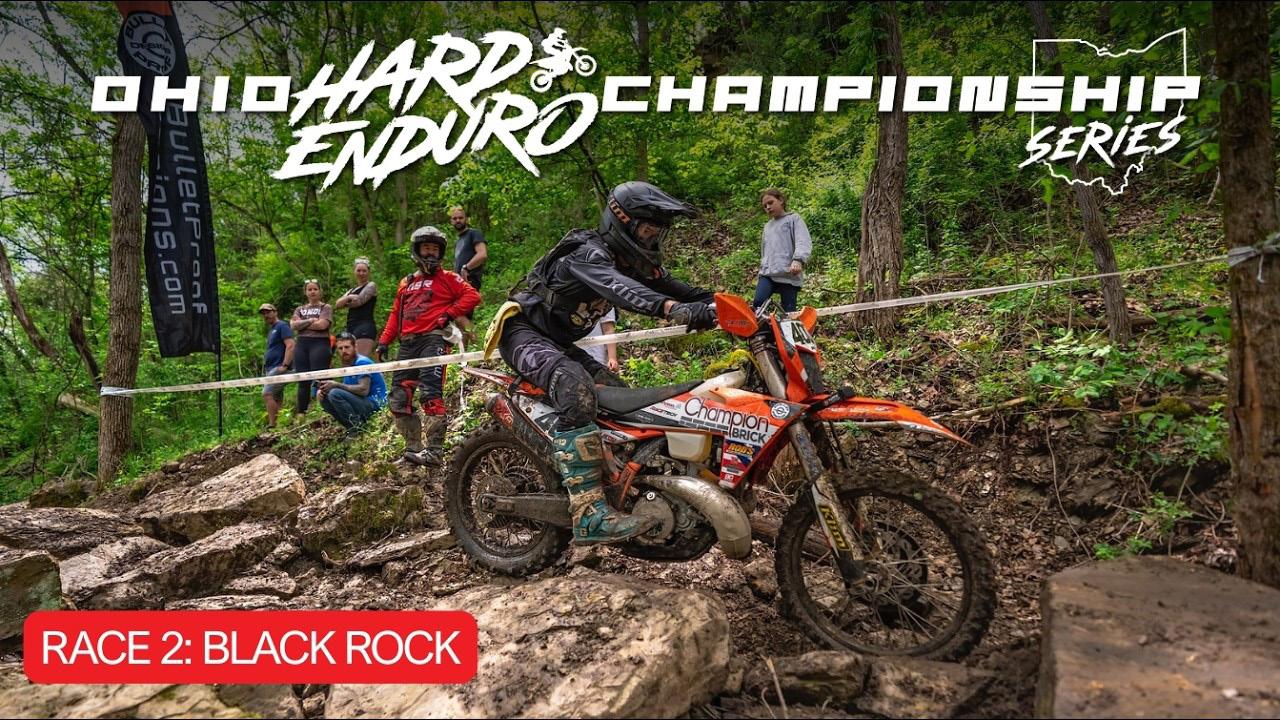
Round two of the Ohio Hard Enduro Championship Series brought riders to Black Rock, where changing conditions, slick terrain, and nonstop lead battles combined to create one of the most competitive races the young series has seen so far. What began as a fast and flowing race through the Ohio woods quickly evolved into a survival test as overnight rain and scattered showers transformed the already technical terrain into a polished ribbon of mudcovered rock, greasy roots, and unpredictable hill climbs.
Built by veteran course designer Jeff Husted, the approximately 10-mile circuit
blended traditional Midwest single-track with the kind of technical challenge sections riders expect from modern hard enduro. The amateur and pro classes shared much of the same layout, though the Pro/A
field faced several additional splits designed to increase the difficulty level and separate the front-runners from the rest of the pack. Tight trees, rock gardens, steep descents, creek crossings, and slick hill
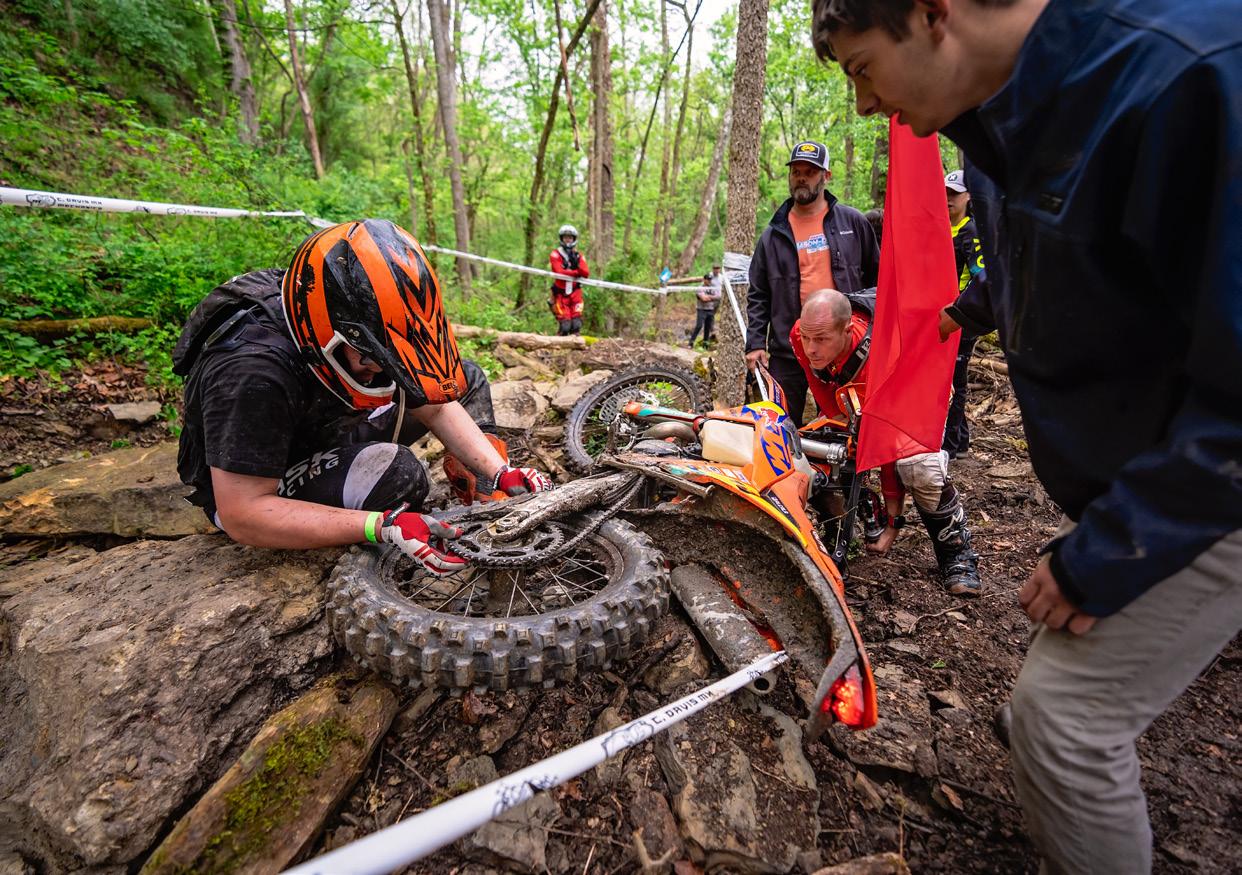
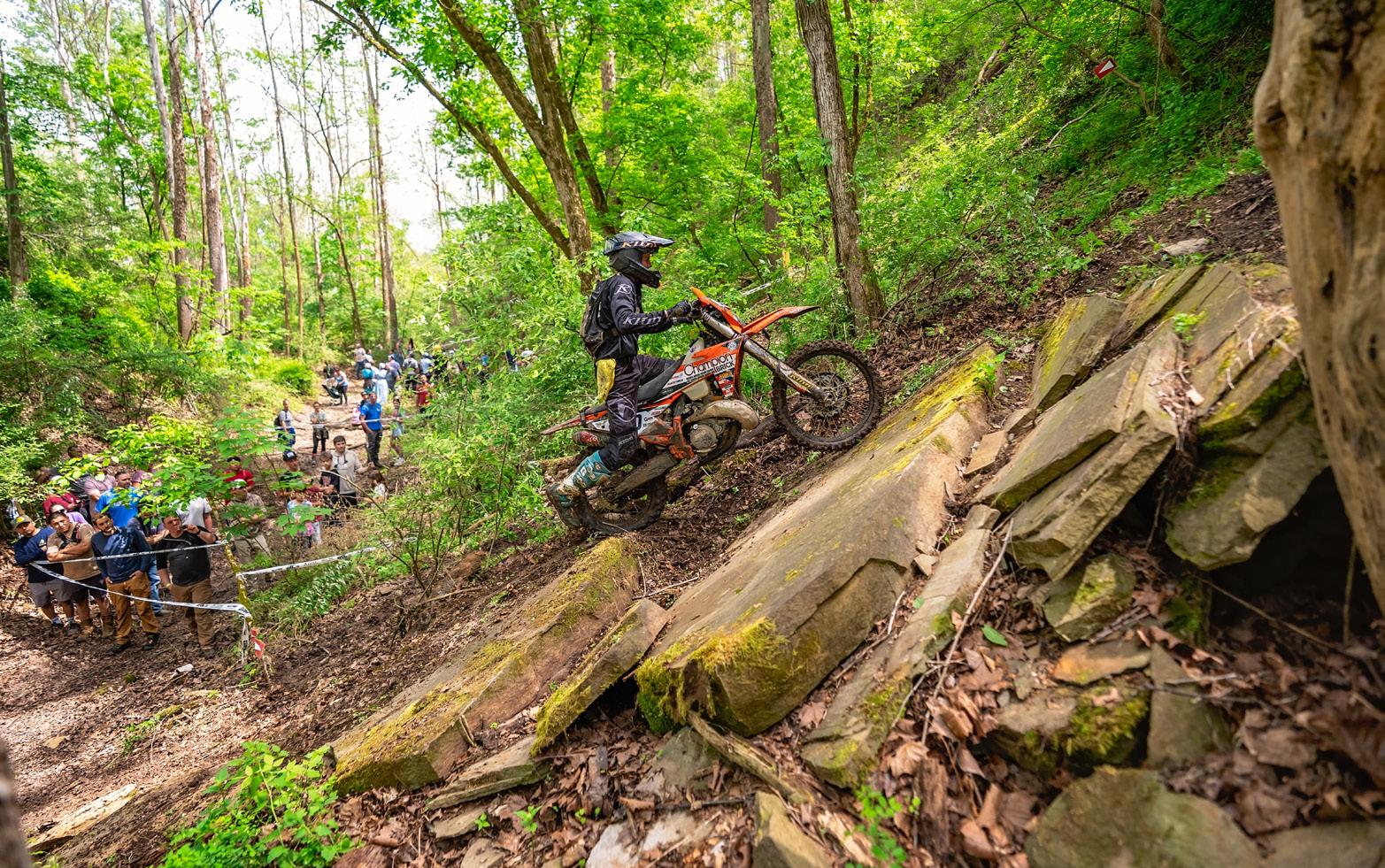
LEFT : Tobin Miller (17) RIGHT: Dawson Alcala threw his chain in the JCB Rock Pile STEPH
climbs ensured there was little opportunity for riders to settle into any sort of rhythm for long.
The day opened with the amateur race, a threehour, two-lap battle that immediately became a war of traction and momentum. Rain during the race only added to the challenge, particularly in the rock gardens and offcamber sections where even small mistakes could cost riders valuable time. The top 25 finishers earned the
opportunity to move into the afternoon’s Pro/A race, adding another layer of intensity to the morning competition.
For much of the amateur race, it appeared Bentlee Bredekamp had the overall win under control. Bredekamp built a commanding sevenminute lead and looked untouchable heading toward the closing checkpoints, but mechanical trouble changed the complexion of the race late in the day. A bent chain guide repeatedly caused his chain
to derail in the rock sections, allowing Cory King to capitalize in the final stretch.
King’s eventual overall victory came after one of the most chaotic and entertaining rides of the day. Battling both the terrain and the conditions, King described a race that demanded complete commitment while constantly threatening disaster.
“It was super fast. Real slimy. Nasty,” King said afterward. “The first lap I was all
cramped up, felt like poop. Then me and Chase got lost for a second. We overseen one of the arrows, and then we're like, where are we at? And then we turned around and come back. We just started just flowing real good. It was a blast.”
One of the defining moments of the amateur race came late when King caught Bredekamp in a steep, root-covered hill section. Instead of escalating into frustration, the two riders worked together to get through the bottleneck before resuming their fight for position—a moment that perfectly captured the strange blend of competition and camaraderie unique to hard enduro racing.
King eventually broke free and charged to the overall victory, surviving multiple close calls along the way as the rainsoaked descents continued to deteriorate throughout the race.
Bredekamp held on for second despite the chain issues, while Luke Barto completed the overall podium after steadily working his way forward throughout the race. Barto became tangled in traffic during the opening lap’s rock garden and briefly found himself trapped underneath his motorcycle while trying an aggressive passing line. Instead of unraveling after the mistake, he regrouped and used his comfort level on the steep hill sections to claw back positions and secure third overall.
By the time the Pro/A race rolled to the line later in the afternoon, the course had changed dramatically. The first amateur race had carved deep ruts into many of the climbs, while moisture sitting on top of the exposed rock created a surface that riders repeatedly described as deceptively slick. The Pro/A format consisted of three laps over the same 10-
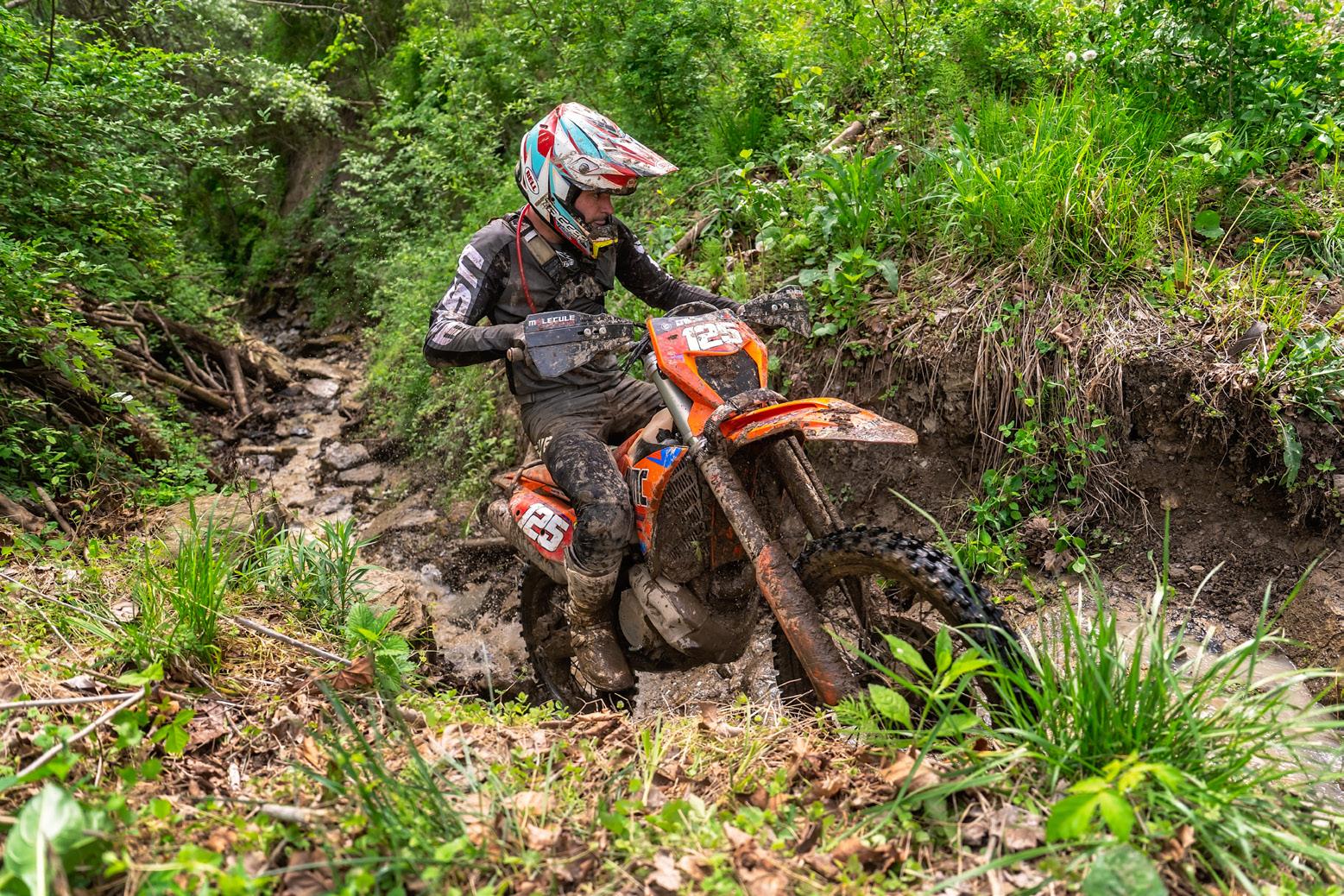
LEFT: Makana Barger (400) BELOW: Maverik Thaxton (125) through the Cell Tower Creek
mile course, though the added challenge sections increased both the technical difficulty and the physical demand.
Early on, Mark Fortner jumped into the lead and looked poised to control the race, but by the middle of lap one the battle for victory had narrowed to three riders: Tobin Miller, Braxton Hintze, and Maverik Thaxton. From that point forward, the race transformed into an all-out sprint where the lead changed hands repeatedly at nearly every major obstacle and checkpoint. At times, the top three were separated by as little as two seconds.
Miller’s pace in the faster sections ultimately became the deciding factor. Known for his speed in tight woods terrain, Miller used the flowing single-track to offset the time he occasionally lost in the technical rock sections. The strategy paid off, but not before surviving one of the closest battles of the season so far.
“I’m feeling really good,” Miller said after the win. “This kind of brings me back to my roots of just Midwest hare scramble racing. Lots of tight, twisty trees, little logs, angled logs, all of it. But then Chris did a really good job
throwing in some really gnarly sections.”
The slick rock sections became the defining feature of the race. Riders repeatedly described the mud-covered rocks as more difficult than the creek crossings themselves, with traction disappearing almost instantly if a line choice was even slightly off.
“There’s a rock creek out there that it was really hard and it was tough to find a line on it,” Miller explained. “Maverik passed me. Braxton passed me multiple times. Everybody was fast there.”
As conditions evolved throughout the afternoon, the race constantly changed character. Lap one proved to be the most difficult as riders struggled to adapt to the slick surface. By lap three, however, the terrain had begun to tack up in places, increasing speeds considerably and rewarding riders willing to push the pace.
Miller knew the final lap would determine everything. Rather than risk arriving at the most technical sections side-by-side with Hintze and Thaxton, he gambled on
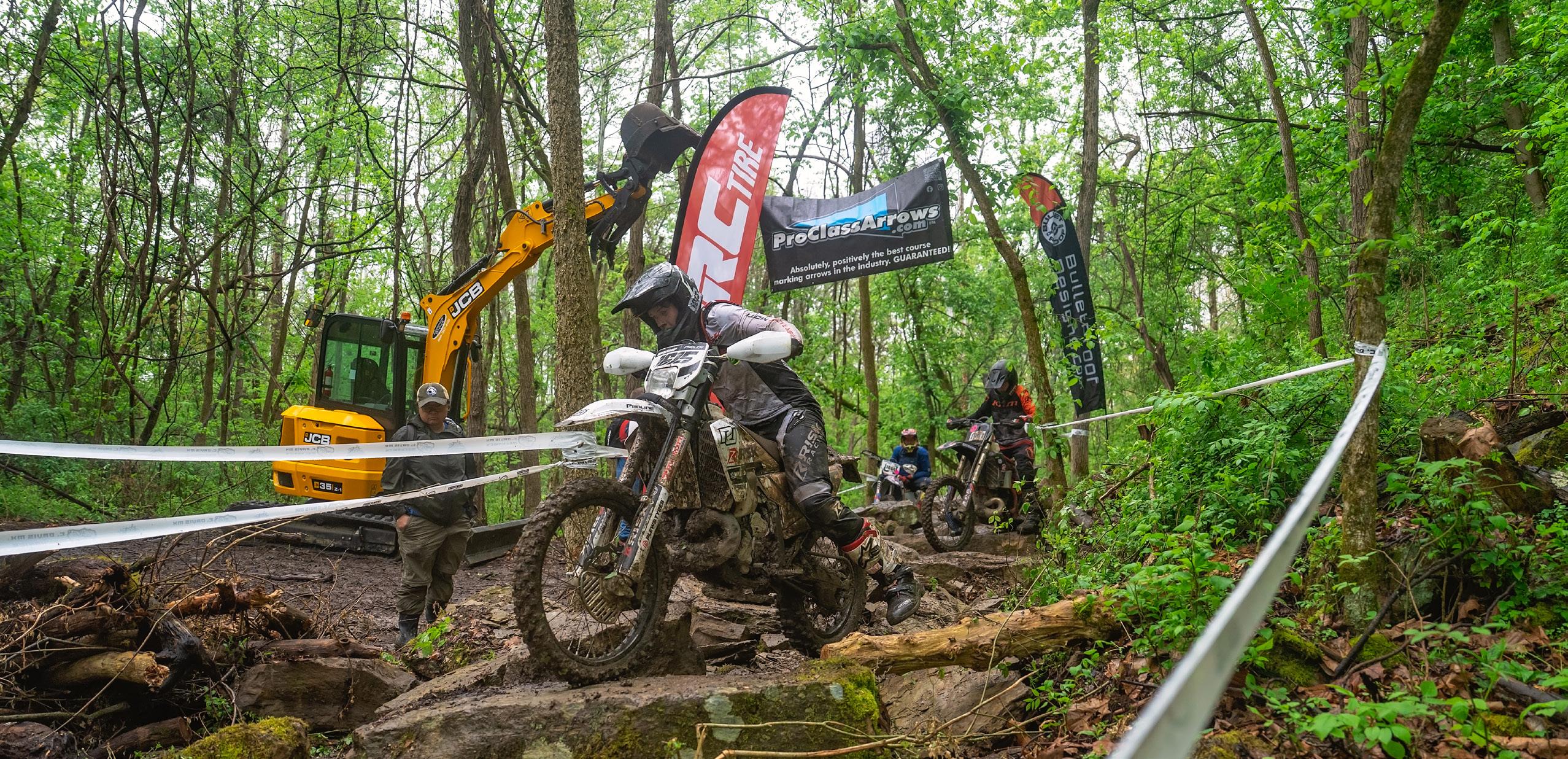
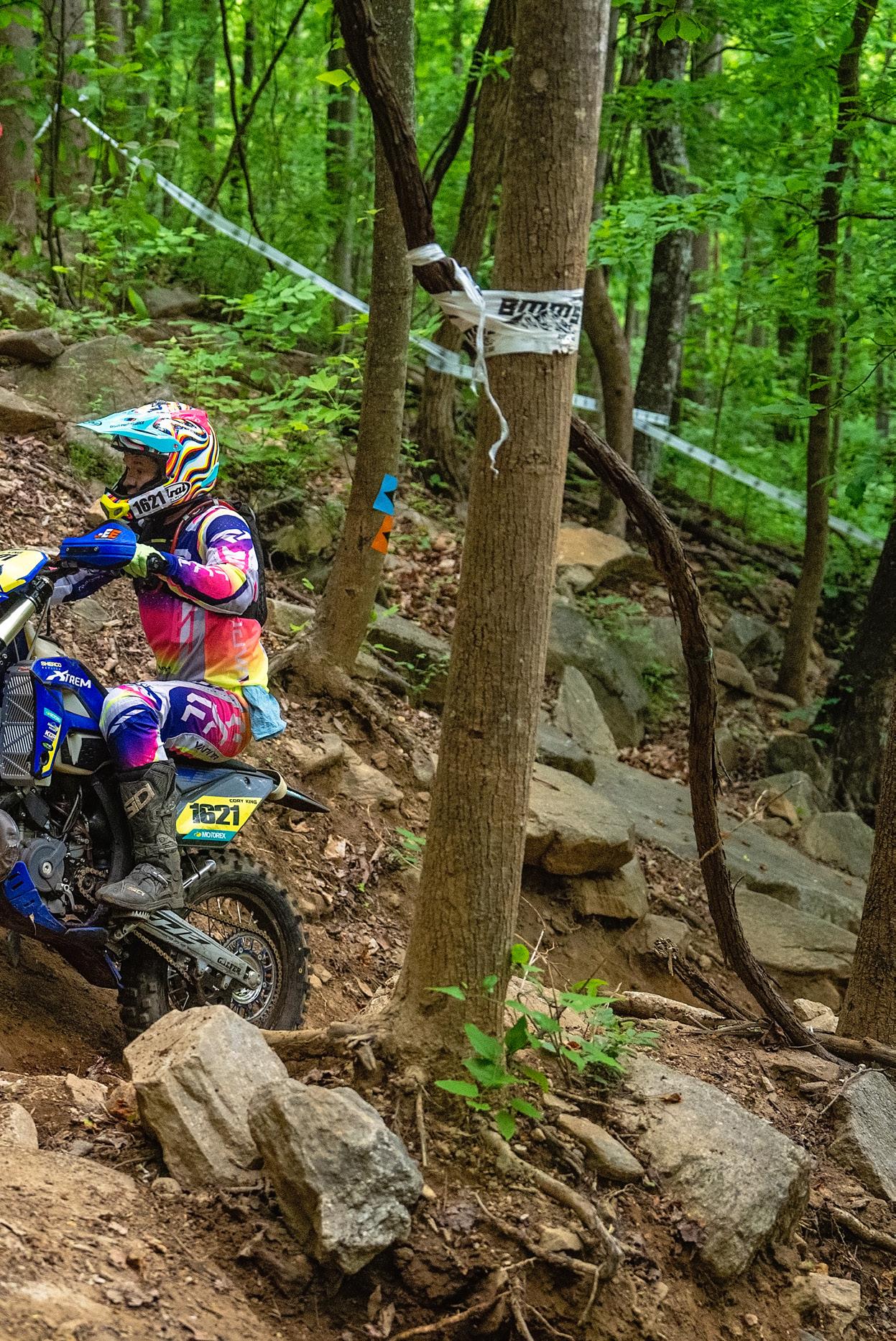
TOP TO BOTTOM : Bentlee Bredekamp (1615), Cory King (1621), Zach Klamfoth (524)
creating a gap before reaching them. Immediately after a quick fuel stop, he attacked the single-track and opened the separation he needed to finally break the elastic battle at the front.
Behind him, Braxton Hintze remained within striking distance for much of the race despite battling mechanical issues late in the event. Hintze repeatedly matched the leaders in the harder sections but struggled to maintain the same pace through the tight Ohio woods. On the final lap, attempts to work around lapped riders forced him into alternate lines that ultimately damaged his shifter and disrupted his momentum.
“Me, Tobin and Maverik were absolutely flying,” Hintze said. “Any sort of mistake one of us made, the person behind capitalized.”
Even with the setbacks, Hintze remained impressed with both the course and the potential of the venue itself.
“The Pro sections are sick,” he said. “This place has some good potential to be super, super hard.”
Thaxton rounded out the podium after another gritty ride just one week removed from the demanding Moab Hard Enduro national round. Still recovering from heatrelated illness suffered the previous weekend, Thaxton admitted the cumulative fatigue lingered throughout the race. Even so, he consistently made up time in the roughest sections of the course and repeatedly closed back onto the leaders whenever the terrain became more technical.
“I definitely think I was better in the harder stuff,” Thaxton explained. “Every time we'd get into some rocky creek or a downhill or something like that, I feel like I was able to close back in pretty quickly.”
While Miller ultimately emerged with the overall win,
the biggest takeaway from Black Rock may have been just how competitive the Ohio Hard Enduro Championship Series has already become. The constant lead changes, varying rider strengths, and rapidly evolving course conditions created a race where no advantage felt secure for more than a few minutes at a time.
Black Rock delivered exactly what hard enduro is supposed to be: physically exhausting, mentally draining, and unpredictable until the very end. Riders fought not only each other, but also changing terrain, failing traction, mechanical problems, and sheer fatigue. By the time the final checkered flag waved, round two had firmly established itself as one of the most memorable stops on the Ohio Hard Enduro calendar so far.
The championship continues with Round 3, the Yellowbush Hard Enduro, scheduled for June 6 in Racine, Ohio.
EVENT RESULTS
OVERALL - PRO/A
1. Tobin Miller (KTM)
2. Braxton Hintze (KTM)
3. Maverik Thaxton (KTM)
4. Mark Fortner (BET)
5. Makana Barger (KTM)
6. Nick Fahringer (SHR)
7. Leiber Ponce (KTM)
8. Donnie Alborn (KTM)
9. Tim Burwick (HSQ)
10. Daniel Fortner (BET)
OVERALL - AMATEUR
1. Cory King (SHR)
2. Bentlee Bredekamp (HSQ)
3. Luke Barto (KTM)
4. Cory Jones (KTM)
5. Graham Kobak (SHR)
6. Caleb Covington (KTM)
7. Emmett Covington (KTM)
8. Joel Rockwell (SHR)
9. Marty Robbins (KTM)
10. Gustavo Garcia (KTM)
Maverik Thaxton (125, Pro class)
Mar 6-8: Downhill Southeast Mtn Bike Race
Mar 28-29: Trials Training Days
May 16-17: Spring Splash Trial (STRA)
Jun 15-18: Family Camp
Jun 19-21: AMA/NextGen Mototrials Youth & Women's Eastern Regional Championship
Jun 22-25: Invitiational Teen Camp
Aug 28-30: 16th Annual Red Bull Tennessee Knock Out Extreme Enduro
Oct 24-25: 34th Annual 58K Fall Trial (STRA)
Dec 5: 20th Annual Xmas Toy TrialFun Gate Trial
October 3-4
November 14-15
www.ryanyoungtrialsschools.com
"Show 'em the problem & Show 'em the exit"
NATC OPENS AT KAIROS WITH A CHAMPIONSHIP-LEVEL TEST
ROUND 1/2 - Kairos Wilderness Resort
LOCATION: Glen Lyn, VA
The 2026 AMA NATC Mototrials Championship Series, Presented by Trial Store USA, opened at Kairos Wilderness Resort in Glen Lyn, Virginia, with a weekend that immediately recalibrated expectations. After several seasons in which riders had quietly suggested the national rounds were trending too forgiving, rounds one and two at Kairos offered a decisive answer. This was not
a soft launch into the season. This was a full technical examination, one built around balance, precision, patience, throttle control, and the ability to solve multiple problems inside the same section.
Ray Peters set the sections, and that detail alone carried weight. Peters is known less for building spectacle around one enormous obstacle and more for designing sections that demand complete riding. At Kairos, that meant off-
camber hill turns feeding directly into rock ledges, ledges leading into steep climbs, and climbs requiring riders to commit to the throttle without losing the precision needed to stay inside the lines. In many places, gates were minimal. Some of the lower lines had no gates at all, leaving riders to navigate by avoiding every other class marker rather than simply following a heavily defined route. The result was a trial that rewarded complete
riders rather than single-skill specialists.
Saturday’s opening round was harsh from the start. With temperatures climbing to 87 degrees under sunny skies, heat became part of the test before the riders had even settled into the day. Section 1 established the standard immediately. Most riders failed to complete it, either timing out under the 90-second section limit or being stopped by an obstacle
before they could reach the exit. From there, the day never truly relented. The sections varied in difficulty within each class line, but the loop itself was also demanding enough that it became part of the competition. Riders were not simply moving from section to section; they were working between them.
In the Pro class, the opening day delivered the kind of battle the series needed. Sondre Haga, back for a full NATC
campaign after making a limited appearance in 2025, struck first. The Norwegian GasGas rider won Saturday with 46 points and 20 cleans, splitting his day into loop scores of 19, 12 and 15. It was not a perfect ride, but it was exactly the kind of resilient performance required on a day when the ground, the clock and the section design all worked against the field.
Haga was quick to acknowledge both the
difficulty and the margins. Having ridden only the Ohio round the previous season, he said Kairos was “obviously harder” and said that based on what he’s seen, it was one of the toughest NATC events of recent years. Section 1, in particular, stood out to him as nearly too much, at least before the line changed and the ground settled in. Time was also a concern; Haga said the final loop was completed
in roughly an hour, leaving him exhausted and pushing to make the card. Even with a tire puncture in the final loop, he and minder Brian worked through the issue and held the ride together.
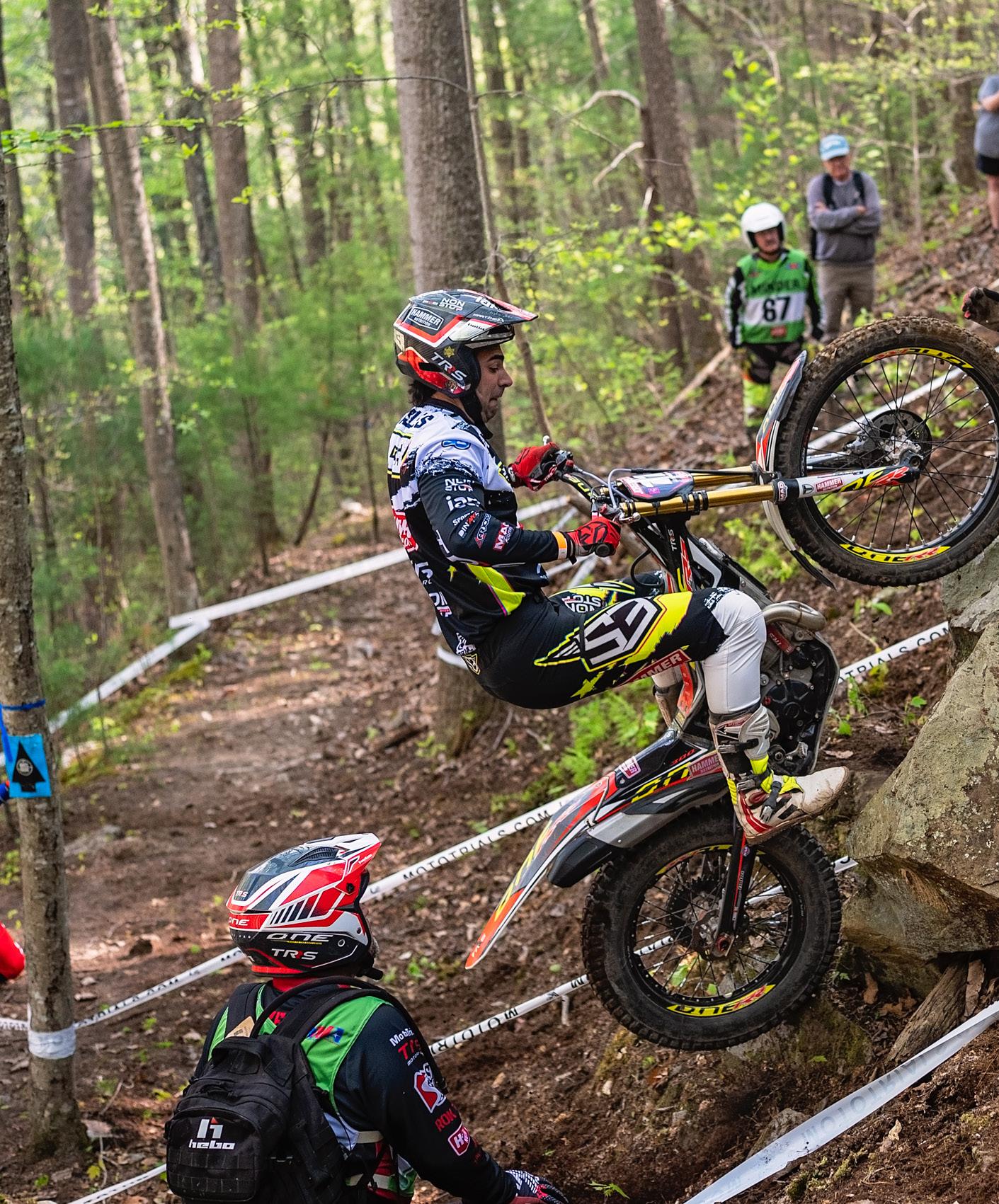
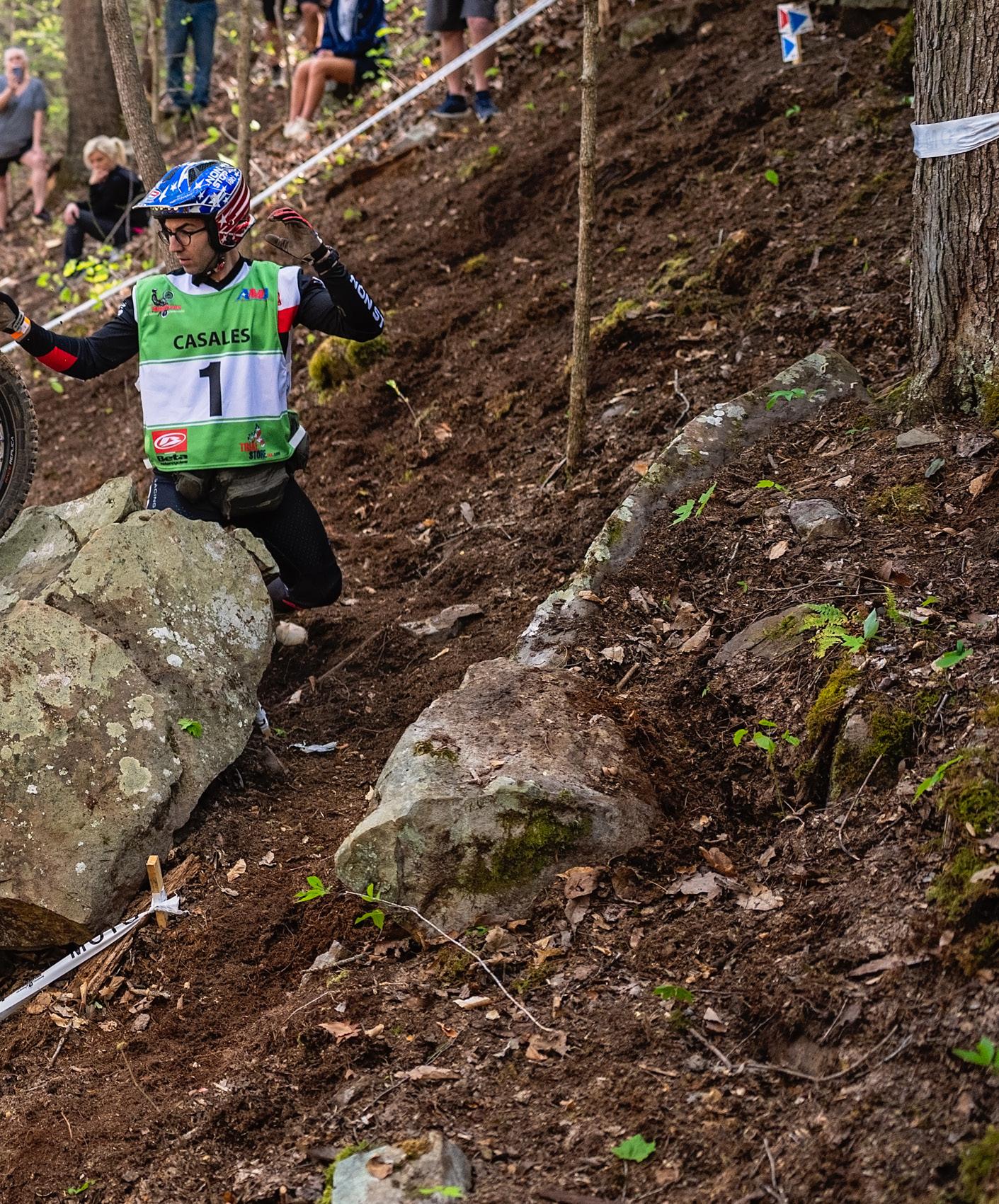
PREVIOUS: TRS Hammer Nutrition's Jorge Casales
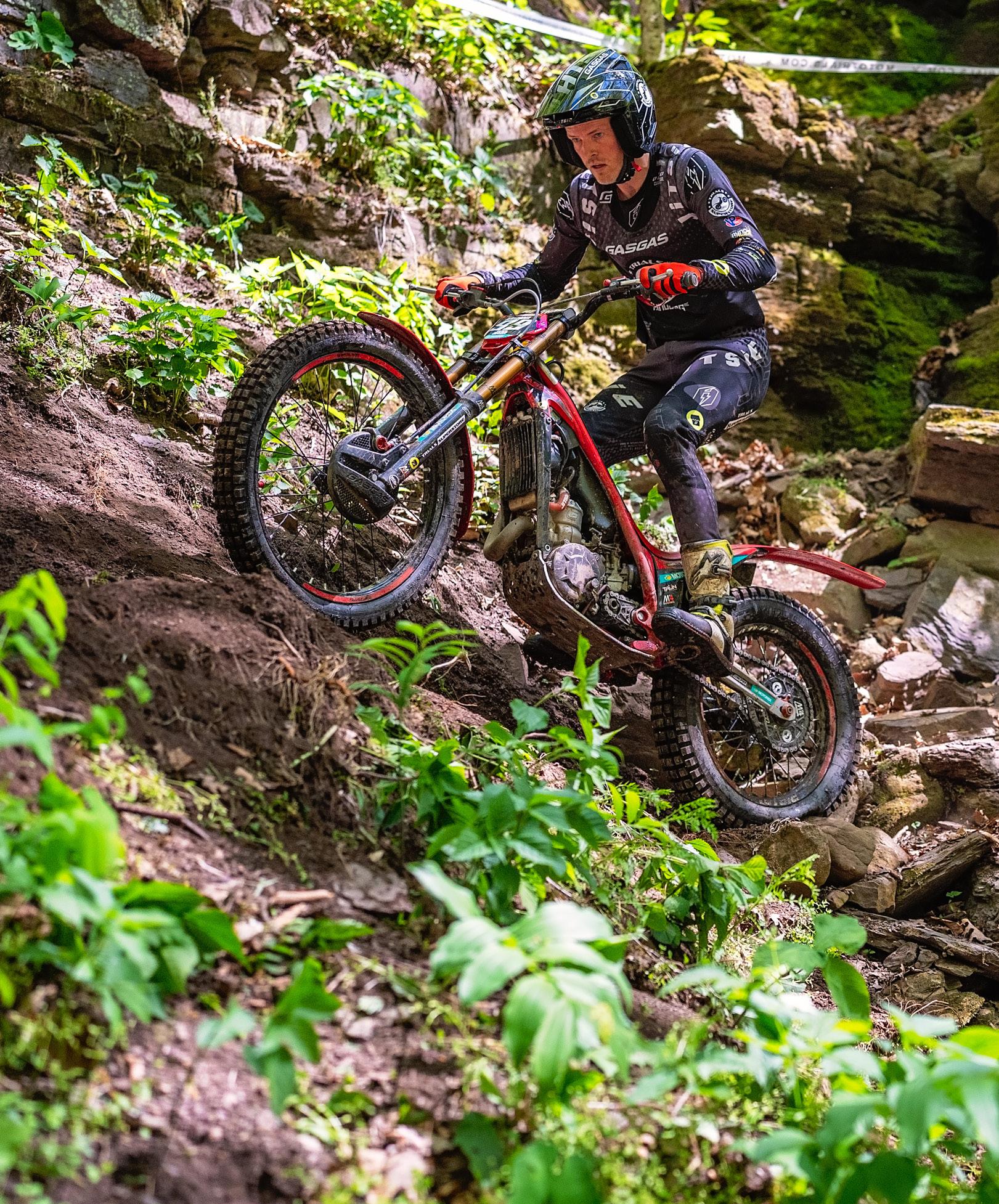
THIS PAGE: Trials Superstore GasGas's Sondre Haga (main), Beta Maryland's Will Myers (inset, top), Beta USA's Jay Gregorowicz (inset, bottom)
Jorge Casales made sure Haga’s opening win came under pressure. The TRS rider, returning after contesting the full 2025 NATC season, finished second on Saturday by just one point, scoring 47 with 23 cleans. Casales had actually recorded more cleans than Haga, but a time penalty and mechanical issues proved costly. His loop scores told the story: an excellent opening loop of 11 points, followed by 14 and then a heavier 21-point third loop as problems mounted.
Casales was still encouraged. He described the level of the sections as strong and said the difficulty allowed riders to show their true level. Even after carburetor-related trouble forced him to punch sections and manage the clock, he remained within one point of the win. For a rider of Casales’ caliber, that was both a missed opportunity and a warning
shot. If Saturday was about surviving complications, Sunday would be about converting speed and precision into a win.
Behind the two TrialGPcaliber riders, Alexander Myers delivered the strongest ride among the American contenders on Saturday, finishing third with 74 points and 13 cleans. On a day where the Pro line exposed mistakes quickly, Myers’ ride was significant. Now aboard TRS USA machinery, he admitted he entered the weekend without fully knowing what to expect and was not necessarily committed to the full series. Yet he kept himself in the fight, cleaning up first-loop mistakes and finding enough consistency to hold the final podium position.
Myers’ result became more impressive in context. Will Myers was fourth on 77, Josh
fifth on 78, Murphy Aaron sixth on 81, and Alex Niederer seventh on 99 in his return to the Pro ranks after spending 2025 in Expert. Only five points separated third through fifth, and only seven separated third through sixth, making every dab and every decision to ride or punch a section matter.
The Expert class also reflected the tone of the day. Logan Bolopue, a former Pro-class contender who last rode Pro in 2016 before shifting his focus to hard enduro, won Saturday’s Expert class with 67 points, while Cole Cullins—dropping down from Pro while still not fully recovered from injury—finished second on 86. Cullins was characteristically blunt about the day, calling it “brutal” and one of the hardest Expert nationals he could remember. Still working back from injury and short on race fitness, he admitted the first two loops were rough before
he simplified his approach, stopped overthinking the sections, and managed to recover enough to finish second. In Expert Sportsman, Jerome Gregorowicz led the way with 50 points, while Bennett Hubner topped the Junior Expert Sportsman riders with 67.
Outside the Pro class, Sherco US’s Pat Smage created one of the weekend’s most interesting subplots. The multi-time champion made a last-minute shift from Pro to Exhibition Expert 125, riding a Sherco 125, and dropped just 11 points on Saturday. The move was not about chasing a conventional result; it was about rediscovering enjoyment and giving himself a different kind of challenge.
ABOVE: TRS USA's Alex Myers
LEFT: Beta USA's Cole Cullins
RIGHT: Sherco US's Pat Smage
Roper
“It was really just fun,” Smage said. “Definitely felt weird taking off and just not knowing what I was going to be thinking mentally, but I was able to just enjoy it and not worry too much while I was in the section.” The 125 changed the way he had to ride. “Some of the stuff I was looking at, I really didn't know if I could make it or not, so the plan was just hold it wide open, use some body, slip the clutch and hope for the best,” he said. “But it was surprising and fun to see what I could do with it.”
Smage admitted the smallerdisplacement bike made the Expert line harder, but that was part of the appeal. “I mean, it made things harder for sure. I had to work for it, but that's what I was looking for riding the expert line,” he said. With less power available, he had to adjust his technique. “When you have power, you can do that. When you don't have as much power, you need to use
momentum, so I was able to figure out some ways to do that, and it was fun to think a little bit differently.”
His perspective also reinforced how difficult the event was, even below the Pro line. “Well, it was good for me. I liked the [sections], but I think for some of the guys, that was a little bit too much at times,” Smage said of the Expert sections. “[One section] felt like a Pro section to me, on the 125 anyway.”
The Women’s Pro class carried its own storyline. Madeleine Hoover opened the season with a clear win, scoring 69 points with 10 cleans on Saturday.
Abigail Buzzelli, making the move from Women’s Sportsman to Women’s Pro for 2026, finished second on 156. The scoring gap was large, but the significance of Buzzelli’s debut was not defined purely by points. Moving onto the blue line at a technical national is a major step, and Kairos offered very little margin for easing into the class.
Hoover described Saturday as long, difficult, and unusually demanding for recent NATC standards. Some sections were long and jumbled, almost hard-enduro-like in their physicality, while others were short enough that riders had to flip their mental approach
quickly. The loop added another layer, with multiple areas requiring riders to fight their way out. Still, Hoover welcomed the challenge, calling it refreshing to ride something that hard and that technical.
Buzzelli approached the day strategically. She and her minder, Eric Olmstead, identified sections that were realistic to attempt and others where punching made more sense, either because the obstacle was beyond reach or because the 90-second clock made a full attempt impractical. Her goal became building consistent threes where possible and gaining experience without wasting energy or taking unnecessary risks. For a first day in Women’s Pro, the result was less about the scorecard and more about surviving, learning and continuing to attack.
If Saturday was defined by heat and heavy technical punishment, Sunday brought a different kind of test. Temperatures dropped dramatically, hovering around 50 degrees under sunny skies, and the sections were eased slightly. But easier did not mean easy. The character of the event shifted toward hills, steep ups and midhill obstacles, asking riders to generate traction, stay
committed and maintain balance in situations where stopping or hesitating could be costly.
Casales responded with the ride of the weekend. After narrowly missing Saturday’s win, he took Sunday decisively with 32 points and 29 cleans. His loop scores—18, 5 and 7—showed how quickly he took command once the day settled in. Even with two penalty points included in his final score, Casales was comfortably clear. The clean count was the most telling statistic. On a day that still challenged the entire field, he cleaned 29 of 36 sections.
For Casales, Sunday was closer to the trial he wanted. He said the level was “perfect” and praised the direction of the section design, noting that the event was hard enough to require pushing but still possible to ride at a very high level. The proof was in his own score. He and Haga both produced low-point loops, but Casales found the critical advantage in sections where Haga faltered.
Haga finished second on Sunday with 51 points and 19 cleans, adding loop scores of 23, 14 and 13. It was still an excellent result, and across the opening weekend he proved he will be a central figure
in the 2026 championship. But Sunday belonged to Casales. Haga admitted as much, saying Casales was simply better on the day. One section in particular made the difference, with Haga needing until the third loop to solve it while Casales handled it from the start.
Even in defeat, Haga found value in the intensity of the fight. The time pressure returned, and he described the day as having a real race feeling—an important point in a discipline that can sometimes become overly controlled when sections are too forgiving. At Kairos, the clock mattered. Decisions mattered. Fatigue mattered. That made the battle feel alive.
Myers again completed the Pro podium, finishing third on Sunday with 96 points and 10 cleans. His weekend total was not close to the European front-runners, but his position was secure where it mattered: third on both days, and clearly established as the domestic benchmark leaving Virginia.
Myers called Sunday another very hard day and admitted he punched some sections out
of caution after seeing a few failed rides and assessing the risk. That decision-making may not produce highlight reels, but it often produces championships—or at least strong finishes—over the long term. Myers also dealt with a mechanical issue, damaging a water pump in one section before TRS USA helped get him repaired and back
underway. Through it all, he said he was happy with his riding and encouraged by the progress he had made adapting to the new bike.
Josh Roper improved to fourth on Sunday with 103 points, while Alex Niederer moved up to fifth on 110. Will Myers was sixth on 110.5, and Murphy Aaron seventh on 121. Niederer’s weekend, in particular, carried a notable storyline. After stepping back from Pro to ride Expert in 2025, he returned to the top class for 2026 with no illusions about the difficulty. His Saturday score of 99 and Sunday fifth-place finish showed both the challenge and the satisfaction of testing himself again against the premier line.
In Women’s Pro, Hoover completed the sweep with another win on Sunday, though she was far from satisfied with the ride. She scored 89 points with six cleans, improving significantly after a difficult first loop. Her loop scores—42, 28 and 19— showed a rider recovering her rhythm as the day unfolded.
Hoover felt Sunday’s sections were just as hard, perhaps harder, but different in style. Rather than Saturday’s long, jumbled sections, Sunday leaned more heavily on steep ups and another side of the Kairos property. She struggled to find flow early, later saying the time pressure actually helped pull her into a better rhythm on the final two loops. For an experienced rider, the result was still a win; for Hoover personally, it was also a reminder of how unforgiving a technical national can feel when the first lap goes wrong.
Buzzelli again finished second in Women’s Pro, scoring 162. Yet her Sunday ride represented visible growth. After failing to get through sections on the first loop, she made adjustments on the second and third loops, eventually recording more complete rides and even a one-point section. She came away with a clear lesson: she needed to practice not just individual ledges or hills, but combinations—hills into ledges, throttle into balance, and the layered skills that Kairos demanded all weekend.
ABOVE: Trials Superstore GasGas's Maddie Hoover
BELOW: Beta USA's Abigail Buzzelli
Across the two rounds, the Pro class left Kairos with a rivalry already forming. Casales took the best combined score of the weekend at 79 points, backed by his Sunday win and Saturday runner-up finish. Haga left with the opening victory and a two-day total of 97. Myers, with backto-back thirds, totaled 170 after a demanding start to the year. The scoreboard showed Casales and Haga separated from the field, but it also showed Myers capable of capitalizing when the sections became chaotic and the margins behind the leaders tightened.
In Women’s Pro, Hoover was the clear class of the field with wins on both days and a two-round total of 158. Buzzelli’s scores were heavy, but the weekend should prove valuable as a foundation for the rest of her rookie Women’s Pro campaign. If Saturday was about adapting to the blue line, Sunday was about identifying exactly what needs to be sharpened before the next round.
That may be the broader story of Kairos. The opening rounds did not simply crown winners; they exposed strengths, weaknesses and the shape of the season ahead. Haga showed he can win immediately in NATC conditions. Casales showed he can respond with authority when the machinery and timing cooperate. Hoover showed she remains the standard in Women’s Pro, while Buzzelli showed the grit required to step into a much harder class.
Most importantly, Kairos restored the bite. The sections were technical. The loop mattered. The weather changed. The riders were rushed, tested and forced to make decisions. For a national championship opener, that is exactly the kind of message that resonates beyond a single weekend. The 2026 NATC season did not ease into motion in Virginia. It launched with pressure, precision and a reminder that at this level,
ABOVE:
the best riders are not merely those who can clear the biggest obstacle—they are the ones who can solve every problem before and after it.
NEXT UP : Round 3/4: May 23/24
Location: San Ysidro, NM
EVENT RESULTS
SATURDAY - PRO SUNDAY - PRO
1. Sondre Haga - 46 pts
2. Jorge Casales - 47 pts
3. Alex Myers - 74 pts
4. Will Myers - 77 pts
5. Josh Roper - 78 pts
6. Murphy Aaron - 81 pts
7. Alex Niederer - 99 pts
1. Jorge Casales - 32 pts
2. Sondre Haga - 51 pts
3. Alex Myers - 96 pts
4. Josh Roper - 103 pts
5. Alex Niederer - 110 pts
6. Will Myers - 110.5 pts
7. Murphy Aaron - 121 pts
SATURDAY - WOMEN'S PRO SUNDAY - WOMEN'S PRO
1. Maddie Hoover - 69 pts
2. Abigail Buzzelli - 156 pts
1. Maddie Hoover - 89 pts
2. Abigail Buzzelli - 162 pts
TOP : Trials Superstore GasGas's Murphy Aaron
Trial Store USA's Josh Roper
RULES BATTLE OF THE GOATS
LOCATION: Taylorsville, NC
For years, Battle of the Goats at Brushy Mountain Motorsports Park has built its reputation on misery.
Rain-soaked clay.
Bottomless ruts. Hillsides so slick they resemble ice more than dirt. Entire races defined not by speed, but by survival. Riders have come to expect Brushy Mountain at its absolute nastiest, where simply finishing feels like an accomplishment.
But the 2026 edition delivered something few in the paddock could remember seeing: a dry Battle of the Goats.
The change in conditions altered the personality of the race without softening it. Instead of axle-deep mud and impassable climbs, riders were met with tacky “hero dirt” on the hillsides, faster transfer sections, and creeks that became deceptively treacherous. Without heavy flowing water to continually wash the rocks clean, the creek beds held a thin layer of mud and moss that made traction inconsistent and unpredictable. Momentum suddenly became everything.
And at the end of another grueling weekend in North Carolina, one thing remained unchanged.
Trystan Hart still stood on top.
For the sixth consecutive year, Hart conquered Battle of the Goats, continuing a remarkable streak at one of the most respected—and feared— events on the AMA National Hard Enduro Championship calendar.
But unlike some of his previous victories at Brushy, this one was anything but comfortable.
Battle of the Goats has evolved significantly in recent years. The 2025 edition introduced a shorter, more condensed layout that emphasized repeated technical sections and sustained intensity rather than sprawling mileage. That philosophy carried into 2026, with organizers once again building a course that blended iconic Brushy sections with modern hard enduro pacing.
The Pro and A main event centered around a five-hour, three-lap format across a roughly 7.5-mile course that
incorporated fan-favorite sections like Wentzel’s Waterslide, Chicken Fight, and Lost My Balls Creek, while also including an endurocross section to keep riders under pressure from start to finish.
Although Pro and A riders shared much of the same course, the Pro class faced additional split lines that introduced even more technical, high-consequence obstacles. The goal wasn’t simply to make the race harder—it was to create separation among the best riders in the country.
And nowhere was that separation more evident than inside Lost My Balls Creek.
The notorious section featured a waterfall climb that became the defining obstacle of the race. A clean ascent could save valuable minutes. A failed attempt could destroy an entire lap.
Everyone in the paddock knew it would matter.
Saturday’s amateur race at Brushy Mountain Motorsports Park may not have carried the same spotlight as Sunday’s Pro showdown, but it delivered an early reminder that Battle of the Goats punishes every rider equally, regardless of class.
The B and C competitors were greeted with cool temperatures and cloudy skies, but the relatively mild weather did little to soften the challenge ahead. Riders faced a roughly 6.5-mile course over three laps with a five-hour time limit, and
ROUND 5 - Battle of the Goats Hard Enduro
while the dry conditions made the race significantly faster than in years past, they also introduced a different type of technical difficulty.
Instead of fighting endless mud bogs and impassable clay hills, riders found themselves battling slick rock faces, off-camber creek beds, and high-speed terrain that rewarded commitment just as much as technical skill. The hills carried traction, allowing racers to attack more aggressively than they typically could at Brushy Mountain, but the creeks remained unpredictable. Without heavy flowing water to continually clean the rock
surfaces, many sections became polished and greasy, forcing riders to stay light on the controls while carrying momentum whenever possible.
At the front of the field, Bentlee Bredekamp established himself as the rider to beat almost immediately. Riding with confidence and consistency, Bredekamp handled the faster pace better than anyone else in the amateur field and steadily worked his way through traffic while avoiding the costly mistakes that plagued many riders throughout the day.
“I feel really good. It was great to win again,” Bredekamp said after securing
PREVIOUS: Trystan Hart (1)
LEFT: Ryder LeBlond (513)
ABOVE : Cory King (1621)
RIGHT: Cody Webb (2), James Flynn (55)
the overall victory. “The course was awesome; it was really flowy. There were a lot of creeks.”
Even with the faster conditions, there were still moments where the race slowed to a crawl. One muddy creek crossing created the race’s biggest bottleneck, swallowing riders and forcing others to improvise alternate lines around stalled traffic.
“There was just one bottleneck; it was a really muddy creek,” Bredekamp explained. “The C-class riders moved out of the way for me, so it was really good.”
Like many riders throughout the weekend, Bredekamp identified Lost My Balls Creek as one of the course’s defining sections. The lengthy uphill creek climb demanded balance, throttle control, and commitment, while the slick rock slab at the top punished any hesitation.
“Lost My Balls Creek was really noteworthy,” he said. “It was a really long uphill creek; at the top there was a big hillclimb with a flat rock that was really slippery. It was fun.”
Behind Bredekamp, local North Carolina rider and GNCC competitor Ethan Harwell turned in one of the standout rides of the day. Despite limited hard enduro experience, Harwell adapted quickly to the terrain and used his hare scramble background to stay competitive in the faster sections.
“I’m from Jonesville, NC, only about 45 minutes from here,” Harwell said. “I’ve ridden here before, but I’ve never done like a full hard enduro race like this.”
Harwell admitted the technical creek sections pushed him outside his comfort zone, particularly the slick waterfall rocks scattered throughout the course. For Harwell, simply completing a lap had originally been the goal coming into the weekend, making his runner-
up finish even more impressive.
“There were a lot of slick waterfall rocks; I’ve never rode much like that before,” he explained. “A lot of my skills from hare scramble racing—like keeping your momentum on hills—helped a lot. I’m feeling pretty good. My goal was only to make a lap.”
Third-place finisher Brock Harris relied heavily on his familiarity with Brushy Mountain to navigate the constantly changing conditions. Having ridden the property several times before, Harris knew where patience mattered and where aggression could pay off. The dry weather suited his style, particularly in the technical creek sections where traction remained inconsistent, and he credited preparation for helping him stay strong late into the race.
specifically to one muddy creek section that trapped riders and created heavy traffic.
“Today was a little bit familiar riding, which was nice to know the lines,” Harris said. “I rode a good two months prior, two days a week, just trying to grind it out. First lap I felt like I didn’t know how to ride, but second and third lap was much much better.”
Further back in the field, one of the tightest battles of the day unfolded between Chase Delong and Graham Kobak in the B class. The pair traded positions repeatedly during the final lap, with momentum swings happening almost corner by corner. Delong described the course as deceptively difficult despite the dry conditions, pointing
“Me and Graham had a really good battle,” Delong said. “I was leading until about half of the last lap and then we were just back and forth multiple times until the end. There was a creek section that was just really deep mud, and everybody was stuck in it. You had to just fight your way around the lappers.”
“Somebody louped their bike out and the handlebar came down and hit me straight on the thigh,” Kobak said. “Other than that, it was awesome. It was fast to where it was fun, and then it was hard where it was actually challenging. I think it was set up perfect.”
One of the most unique stories of Saturday came from Charlie Golwyn, who entered his first-ever hard enduro aboard a Surron Ultra Bee after primarily racing downhill mountain bikes. Borrowing
Max Beaupre’s personal machine, Golwyn approached the event with minimal seat time and virtually no expectations beyond finishing laps.
“I’ve only ridden this bike three times before coming out here,” Golwyn said.
The transition from short downhill runs to multi-hour motorcycle racing proved eyeopening. “I race downhill, so I’m used to a three-minute run and that’s it, not four hours or however long I just rode for,” he laughed.
Even so, Golwyn adapted impressively and completed two laps, battling deep mud sections and difficult climbs along the way.
“The most challenging part of the race for me was the climb with the deep mud,” he explained. “When I would get stuck in it, the mud was so thick that this thing wouldn’t even move.”
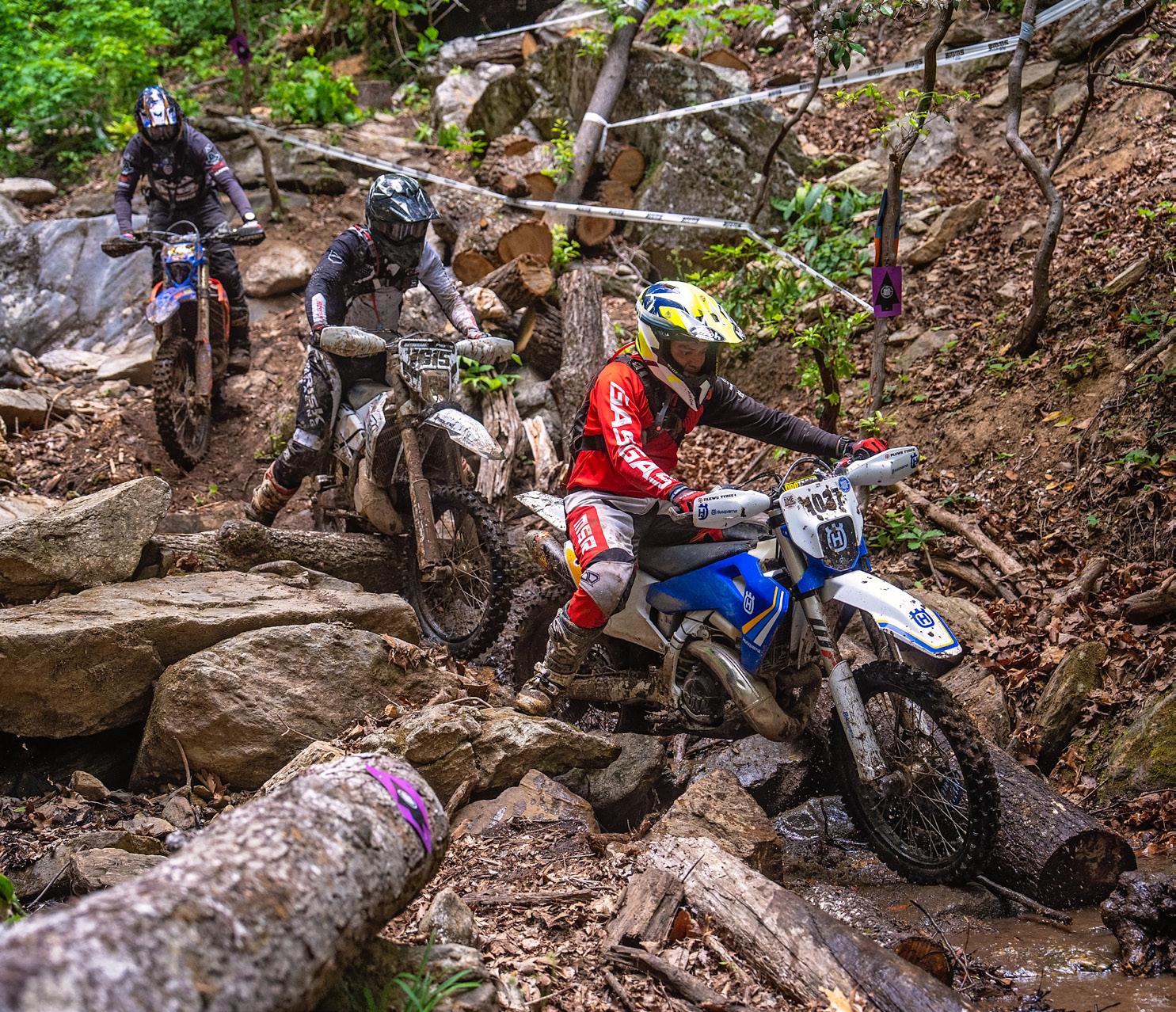
Wesly Garcia (1037), Bentlee Bredekamp (1615), Jonathan Ball (1614)
Then there was Alica Paxson, whose weekend embodied the spirit of amateur hard enduro competition as much as anyone’s. After taking Max Gerston’s riding clinic just one day before the race, Paxson lined up for her first-ever hard enduro on her birthday. Though she ultimately missed the checkpoint cutoff, Paxson left the event encouraged by what she accomplished.
“I’m pretty sore, but I feel good about even trying it,” she said. “I never would imagine I could do some of the stuff I’ve done, like a year ago.”
As in previous years, Saturday afternoon’s Prologue played a pivotal role in shaping Sunday’s race.
With passing opportunities limited in many sections, starting position mattered immensely. Clean air could mean the difference between
maintaining momentum and getting trapped behind another rider in the creeks or on technical climbs.
Hart once again delivered when it mattered, securing the Prologue win and earning the first gate pick for Sunday’s main event.
It would prove critical.
When the Pro race began Sunday morning, Hart wasted little time capitalizing on his position, grabbing the holeshot and immediately controlling the pace.
But unlike many of his previous Brushy victories, this race never settled into a comfortable rhythm.
Ryder LeBlond stayed close from the opening lap, refusing to allow Hart any breathing room. At times, Hart appeared poised to pull away. Minutes later, LeBlond would reappear
directly behind him. The race evolved into a three-hour chess match defined by mistakes, recoveries, and constantly shifting momentum.
“This place has been pretty good to me,” Hart said afterward. “Kind of similar to last year, Ryder was really keeping me honest. He scared the crap out of me, to be honest. We were going back and forth a bit, trading mistakes.”
LeBlond’s speed on the hills kept him within striking distance throughout the race. The drier conditions suited his aggressive climbing style, allowing him to attack terrain that would normally become nearly unrideable in wet conditions.
But the creeks told a different story.
“I made a lot of mistakes the
whole race,” he admitted. “I could never really clean anything that well. I was like two or three minutes back the first two laps the whole time, and that’s even with a lot of issues, so we must have been trading mistakes because the time stayed the same for a while. I definitely lost 99% of my time in the creeks; I was pretty useless in those.”
That imbalance ultimately defined the race.
As lap three began, the margin between Hart and LeBlond remained dangerously close.
Both riders knew exactly where the race would likely be decided: Lost My Balls Creek.
The waterfall climb inside the section had already created problems throughout the race, but on the final lap—with fatigue setting in and pressure mounting—the obstacle became even more consequential.
Hart arrived first and immediately made a mistake. A second failed attempt could have opened the door completely for LeBlond. Instead, Hart delivered one of the defining moments of the race.
“I actually threw my bike down it pretty good my first try,” he admitted. “I was stressing. The second try,
I absolutely just gave it everything I had and cleaned it.”
That clean ride gave Hart the breathing room he needed to close out the victory.
LeBlond, meanwhile, continued to fight the creeks all day long. Even while acknowledging the mistakes, he never stopped charging.
“For a second, I gave up,” he said of the closing laps. “Then I told myself I was going to go as hard as I could until the finish.”
It nearly worked.
While Hart and LeBlond battled for the lead, Rocky Mountain Yamaha’s Cody Webb quietly pieced together one of the strongest recovery rides of the weekend.
Webb’s race nearly unraveled during the opening lap. A combination of arm pump, poor line choices, and repeated mistakes left him frustrated and searching for answers.
Things worsened when he bent his rear brake pedal and struggled to manage the technical creek sections while physically exhausted.
“First lap, I was literally cussing at myself,” Webb admitted. “It wasn’t even the track; it was fully on me making really bad mistakes. I literally came in the pits after the first lap just to get a rest and regroup.”
The reset worked. As the race continued, Webb’s pace improved dramatically. The drier terrain and developing lines allowed him to ride more aggressively, and by the final lap he was closing ground on the leaders. Although he ultimately settled for third, Webb’s late-race speed suggested that another lap could have produced an even more dramatic finish.
“For me, I think the course got better,” Webb said. “But I think I just got better mentally out there. Normally, I don’t want a fourth lap, but today, it would’ve been nice.”
The A-class race delivered its own compelling battle, centered around a back-and-forth duel between Boogie Rivera and Champion Brick’s Makana Barger.
The two riders spent much of the race swapping momentum and pushing each other deeper into uncomfortable territory. Rivera eventually made a decisive pass late in lap two and focused on staying composed rather than forcing the pace unnecessarily. That composure proved critical. By the finish, Rivera had secured the victory, his first of the season, and carried momentum forward into the remainder of the season.
“Makana and I were going back and forth for a little bit,” Rivera said. “Back home [in Hawaii], it’s way more slippery, so to have that mindset that things have traction and I just need to commit. I think the fast stuff like the transfer sections, that’s where I find myself making up time.”
Barger admitted afterward that the mental side of the race became increasingly difficult as the gaps fluctuated and the pressure mounted.
“I had a ton of fun out there,” said Barger. “I was pushing as hard as I could. I felt like it was just like Moab – no breaks, we were just pushing non-stop. It was pretty insane. Boogie [Rivera] was on one this weekend. I just could not keep up with him. I started pushing harder and taking lines shorter and not making it. Overall, it was a mind game today.”
Another intriguing storyline throughout the weekend came from the growing presence of electric motorcycles in hard enduro competition.
Max Beaupre claimed the Pro E-Moto victory aboard the new Bonnell 805 despite dealing with major adversity throughout the weekend. After blowing a controller during the Prologue, Beaupre and his crew managed to repair the bike overnight using parts borrowed from a spare Surron. The machine itself generated significant interest in the paddock.
“This is the brand new Bonnell 805,” Beaupre explained. “This bike is actually 56 horsepower versus the Surron Ultra Bee’s 30, so it’s just about double the horse and you can most definitely feel it.”
Despite suffering a rear brake failure during the race, Beaupre still guided the bike to a strong finish while continuing development on what remains a pre-production platform.
“I went up the new right line around Wentzel’s Waterslide,” Beaupre explained. “And then on the way back down, you go up, do a loop, and then when you come back in, I just like tipped over and everything exploded. I was like, ‘all right, it's gonna make the last quarter or half of the lap just a little bit sketchy,’ you know, because I don't have a foot brake. It definitely made it a bit interesting and kept me on my toes. We’re still in the pre-production phase now, so just for it to survive this one course, even one lap, that’s all we’re asking.”
When the final checkered flag waved Sunday afternoon, the headlines were familiar.
Hart had done it again: six straight wins at Battle of the Goats.
Yet the 2026 edition may have
ABOVE: Braxton Hintze (53) RIGHT: Max Beaupre (7), Niko Piazza (10)
been one of his hardest-earned victories at Brushy Mountain. The dry conditions increased speed but also amplified the consequences of even small mistakes. Riders couldn’t rely solely on surviving brutal terrain—they had to execute with precision.
For Hart, it was another chapter in an already remarkable legacy at Brushy Mountain. For the rest of the field, it was a reminder that no matter the forecast, Battle of the Goats always finds a way to test every limit.
And as the series moves forward, one thing remains certain: whether it’s mud or dust, rain or shine, Brushy Mountain never gives anything away.
With six consecutive Battle of the Goats victories now to his name, Trystan Hart continues to tighten his grip on the 2026 AMA National Hard Enduro Championship, Presented by IRC Tire. Following another hard-fought win at Brushy Mountain, Hart now holds a 40-point advantage over Ryder LeBlond in the standings, while Cody Webb sits third, 43 points back. But with some of the toughest races of the season still ahead, the championship battle is far from settled. The series resumes May 23-24 with the Locked-N-Loaded Hard Scramble in Sugarloaf, Pennsylvania, where the fight for the Premier title will once again head into the rocks, trees, and chaos that define American hard enduro.
The JDAY Off-Road Regional Series continued its relentless early-season stretch with back-to-back rounds that tested every aspect of off-road racing, from outright speed to survival. Rounds three and four, held at the CGI Facility in Edgefield, South Carolina and Lake Sugar Tree in Axton, Virginia, delivered two very different race environments, but both
produced the same result: elite-level battles across the Pro AA field and racewinning performances built on precision, adaptability, and grit.
Round three at the CGI Facility, presented by FMF, was one of the harshest tests riders had faced all season. Thick dust hovered over the hard-packed clay surface while exposed roots and embedded rocks punished mistakes lap after lap. The demanding South Carolina terrain rewarded patience and line choice just as much as
aggression, creating the kind of technical, punishing layout that separated contenders from survivors.
Joey Crown proved untouchable in the conditions, sweeping both motos to secure the overall victory. The Yamaha rider managed the deteriorating track with remarkable consistency, controlling the pace while under constant pressure from a stacked field. Crown worked his way to the front in Moto 1 after an early challenge from Ricky Russell, eventually building enough breathing room to secure the win. Moto 2 brought another intense fight, this time with Tyler Medaglia pushing late, but Crown once again delivered a composed, nearly mistake-free ride to complete the perfect 1-1 scorecard.
Russell’s steady 2-4 finishes earned him second overall, while Medaglia’s strong second moto secured third. Jiggs Fustini quietly pieced together one of his most complete rides of the season to finish fourth overall, while Justin Cokinos rounded out the top five after grabbing the Moto 1 holeshot and battling near the front early in the day.
Beyond the Pro AA battles, Round 3 showcased the depth of talent throughout the JDAY paddock. Landon Wentz emerged as the Amateur Overall winner with a clean, calculated ride in brutal conditions, while Phoenix Honda’s Tayla Jones claimed victory in the Women’s Pro division after handling the rough South Carolina terrain with authority. Kayla O’Neill and Mallory Pickard added another layer of intensity to the weekend with a hard-fought
battle for second place that lasted throughout the motos.
One week later, the series shifted north to Virginia’s legendary Lake Sugar Tree for Round 4, presented by Red Line Oil. While CGI was defined by survival, Lake Sugar Tree delivered a more varied challenge. Riders faced everything from dusty grass-track sections and creek crossings to deeply rutted clay and technical split-lane options that forced split-second decisions throughout the day.
Josh Toth mastered the changing conditions better than anyone. After Justin Cokinos once again grabbed the holeshot and led the early
laps, Toth charged forward midway through Moto 1 and quickly established control of the race. Once out front, the Kawasaki rider steadily extended his advantage and claimed the opening moto win by 13 seconds over Medaglia.
Behind Toth, the battle intensified. Angus Riordan delivered one of the rides of the weekend, climbing from seventh to third in Moto 1 before carrying that momentum into Moto 2. But the defining storyline
Josh Toth (206, top left), Kayla O'Neill (1, bottom left), Ricky Russell (212, right), Tyler Medaglia (905, below)
of the afternoon became the infamous Kurt Caselli section, where riders faced a highrisk creek jump that could either gain massive time or completely derail a race.
Fustini was the first rider willing to fully commit to the jump, immediately opening a gap on the field and charging to his first Pro AA moto victory of the season. Riordan eventually followed suit and worked his way into second, while Toth battled back from fifth to third to secure enough points for the overall win. Russell once again demonstrated his trademark resilience, recovering from an early creek-crossing incident to salvage a fourth-place moto finish.
When the overall scores were finalized, Toth stood atop the podium ahead of Riordan and Fustini, with Medaglia and Russell rounding out the top five.
The amateur and women’s classes continued to deliver standout performances as well. Cole Johnson captured the Amateur Overall and A Open victory, while Dylan DelaCruz and Aaron McAfee Jr. topped the A250 and A200 divisions respectively. In Women’s Pro competition, Kayla O’Neill capitalized on a strong second moto ride to earn the overall after Lily Sheets suffered a crash while leading the charge earlier in the day.
Through four rounds, JDAY Off-Road has already delivered wildly different race conditions and no shortage of drama. From the brutal red-clay punishment of South Carolina to the technical chaos of Lake Sugar Tree, the series continues to showcase some of the toughest and most competitive off-road racing in the region.
OVERALL - CGI FACILITY GP
1. Joey Crown (YAM)
2. Ricky Russell (KAW)
3. Tyler Medaglia (YAM)
4. Jiggs Fustini (KTM)
5. Justin Cokinos (YAM)
6. Ben Kelley (KTM)
7. Josh Toth (KAW)
8. Alex Lugar (KAW)
9. Rivers Morris (KAW)
10. Alex Phaneuf (YAM)
OVERALL - LAKE SUGAR TREE
1. Josh Toth (KAW)
2. Angus Riordan (HON)
3. Jiggs Fustini (KTM)
4. Tyler Medaglia (YAM)
5. Ricky Russell (KAW)
6. Gavin Simon (HSQ)
7. Justin Cokinos (YAM)
8. Cole Johnson (HON)
9. Dylan DelaCruz (BET)
10. Nash Peerson (KTM)
ASHBURN SECURES HOMETOWN WIN IN TENNESSEE
MACK FAINT WORDS PHOTOS
KAYLA BOLTON
ROUND 6 - The Specialized Old Gray GNCC
LOCATION: Monterey, TN
The Progressive Grand National Cross Country (GNCC Racing) Series, an AMA National Championship, rolled into Monterey, Tennessee for Round 6, The Specialized Old Gray GNCC, where an exciting day of motorcycle racing unfolded across the rugged and historic course on Sunday, May 3. With favorable conditions welcoming racers, the Old Gray terrain set the stage for
intense battles and standout performances as the nation’s top off-road racers tackled the demanding layout. As the championship fight continues to heat up, The Old Gray’s bike race delivered pivotal moments, with competitors pushing the pace and showcasing their endurance in the hills of Tennessee.
Phoenix Racing Honda’s Jordan Ashburn and Rocky Mountain Red Bear Kawasaki’s Steward Baylor put on a thrilling battle at the front of the pack during the three-hour pro race at the
2026 Old Gray GNCC. The duo pushed each other from the opening laps, navigating the rugged Tennessee terrain with speed and precision while keeping the intensity high throughout the race. Ashburn maintained a slight edge during key moments, but Baylor remained within striking distance, applying constant pressure and capitalizing on every opportunity to challenge for the lead. In the end, Ashburn held strong to secure the overall victory, with Baylor crossing the line just behind
him after an all-out effort in one of the day’s most exciting showdowns.
AmPro Yamaha’s Kailub Russell delivered an impressive charge through the field, steadily working his way forward to earn a third overall finish. After starting outside the early lead group, Russell found his rhythm as the race wore on, making key
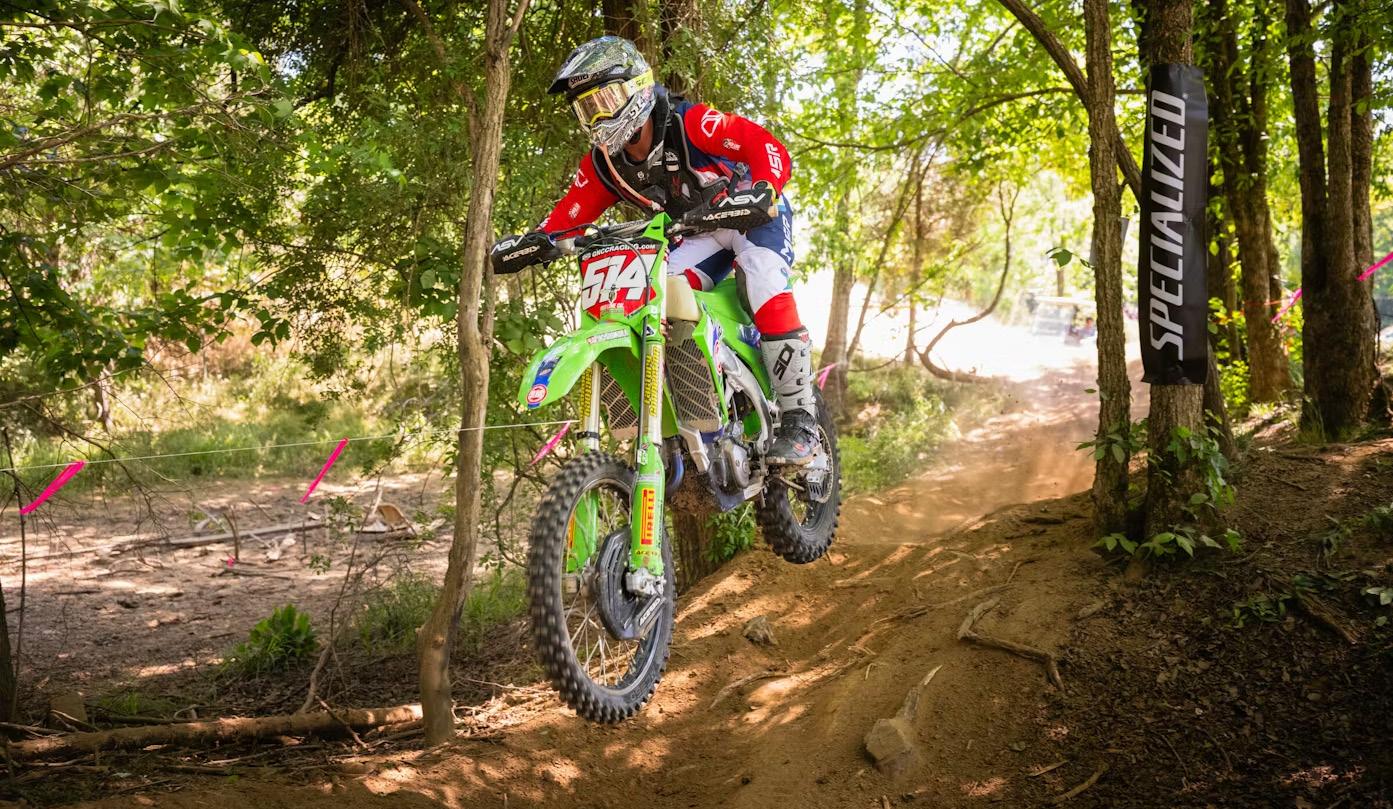
Phoenix Racing Honda's Jordan Ashburn (3), Rocky Mountain Red Bear Kawasaki's Steward Baylor (514), AmPro Yamaha's Kailub Russell (557)
passes and capitalizing on his experience in the demanding Old Gray terrain. His ability to maintain a strong pace and push through the pack showcased his veteran race craft, ultimately securing him a well-earned spot on the overall podium.
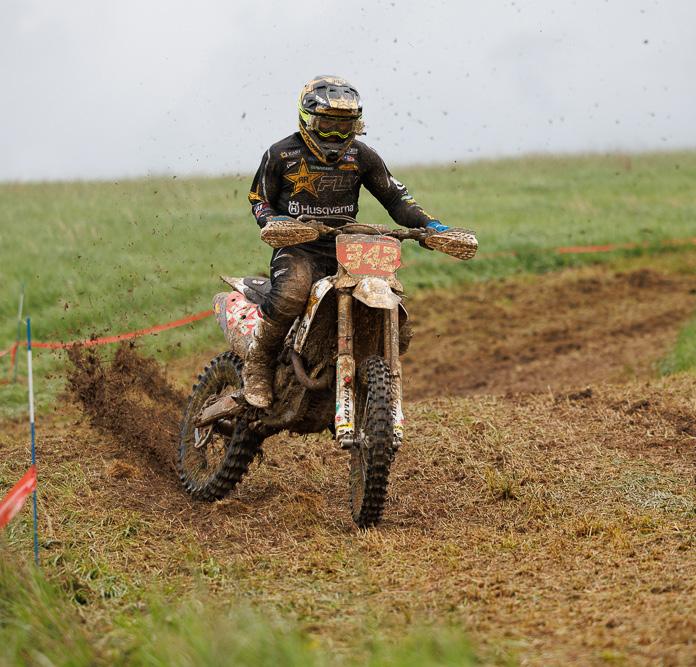
Rockstar Energy Husqvarna Factory Racing’s Craig
DeLong and Phoenix Racing Honda’s Michael Witkowski rounded out the top five overall finishers at round six of the 2026 GNCC Racing Series with solid, hard-earned performances. DeLong secured a fourth-place finish after running a consistent pace throughout the three-hour race, staying within reach
of the front-runners while managing the demanding Tennessee trails. Just behind him, Witkowski put together a determined ride to claim fifth overall, battling through the field and maintaining momentum in the latter stages of the race.
FMF KTM Factory Racing’s Jason Tino put together
another great performance at The Old Gray GNCC, capturing his second-straight XC2 250 Pro class win while also earning an impressive sixth overall finish. Tino maintained a strong and consistent pace throughout the race, positioning himself well among the top overall contenders as he battled
through the demanding Tennessee terrain.
AmPro Yamaha’s Liam Draper put together a strong ride to finish seventh overall after starting back in 10th on the opening lap. Draper steadily worked his way forward throughout the race, making key passes and maintaining a consistent pace to gain valuable positions against a competitive field.
Phoenix Racing Honda’s Angus Riordan and Liqui Moly Factory Beta Racing’s Jhak Walker completed the XC2 250 Pro podium with strong rides, finishing second and third in class while securing eighth and ninth overall, respectively. Riordan delivered a consistent performance throughout the race, keeping himself in contention among the frontrunners and maintaining a steady pace to lock in the runner-up spot. Walker, meanwhile, put together a determined effort to earn third in XC2, battling through the demanding conditions and continuing to push forward over the course of the race.
Liqui Moly Factory Beta Racing’s Josh Strang continued to showcase his veteran experience with a 10th overall finish and seventh in the XC1 Open Pro class. Battling through the challenging conditions, Strang remained consistent throughout the race, using his knowledge and strength to secure another solid top 10 result.
As for FMF KTM Factory Racing’s Ben Kelley and Grant Davis, both were running inside the top 10 at the beginning of the race, but an early crash put Davis out of the race, whereas a last lap crash also set back Kelley making both unable to finish within the top 20 overall and score any points at round six. Kelley now sits third in the points standings.
Rocky Mountain Red Bear Kawasaki’s Josh Toth
was awarded a GNCC Sportsmanship award at the start of the race in Tennessee for his efforts at last round, The Dukes, when he halted his race to assist a fellow racer who had gone down in front of him. As for his race, Toth was only able to complete five laps of racing before having to retire for the day.
The XC1 Holeshot Award was sponsored by Monterey Foods and would go to Craig Delong, as Jhak Walker picked up the XC2 Holeshot Award sponsored by Landers Trade. The 250 A class also earned a Holeshot Award thanks to The Grind Coffee Bar and was earned by Collier Martinez.
Coming through to take the Top Amateur honors at The Specialized Old Gray GNCC was Hunter Smith who earned the 250 A class win and finished 15th overall. Ryan Piper would come through second on the podium with a 17th overall finishing position and a second-place finish in 250 A. Brayden Baisley 18 overall and first in 4-Stroke A Lites
The WXC class delivered another exciting race as FMF KTM Factory Racing’s Brandy Richards and AmPro Yamaha’s Danielle McDonald battled at the front from start to finish. The two frontrunners traded the lead
multiple times throughout the race, each capitalizing on different sections of the course and pushing the pace at every opportunity. Richards ultimately managed to edge ahead when it mattered most, using her experience and late-race charge to secure the win. McDonald stayed within striking distance the entire time, applying constant pressure and turning in an impressive ride of her own to finish a close second after an intense back-and-forth duel.
Caleb Johnson put in an outstanding ride in the AM Bike race, with the 150 B Schoolboy (12–17) competitor charging to an impressive third
overall finish against a deep and competitive field. Johnson maintained a strong pace throughout the race, ultimately earning one of the top overall spots of the day. Just behind him, Rockstar Energy Husqvarna Factory Racing’s Korie Steede delivered a solid performance of her own, rounding out the WXC class podium with a third-place class finish and securing fourth overall.
Making the pass for the Youth Bike Overall win on the last lap, in the last turn headed towards the checkered flag was Hunter Hawkinberry. This would be Hawkinberry’s second overall and YXC1 Super Mini Sr. (14-15) class win of the season. Bentley Saxon put in a good ride, battling for the lead until the very end. Saxon would get up and hold on for second overall and in YXC1. Coming through to take third overall in the Youth Bike race was Braxtyn Chaney, who also earned the 85 Big Wheel (14-15) class win as he came through the finish line. Ace Tokar rounded out the top three in the YXC1 class.
Earning the YXC2 Super Mini Sr. (12-13) class win was Deegan Caplinger, while Jase Jackson and Maverick Boyer took second and third in the class. In the 85 Big Wheel (1113) class it was Colt Chaney earning the win, James Razor won the 85 (12-13) class, Tripp Lewis earned the 85 (11) class win, Cash Knecht earned the 85 (7-10) class win, Davey Fairfield took home the 65 (10-11) class win, while Peyton Austin earned the 65 (9) class win. Kayson Lanier earned the 65 (7-8) class win, Baylee Arsenault took the Girls Super Mini (12-16) class win, Aubrey Tsakanikas came through to earn the Girls 85 (7-13) class win, and Jhorjie Walker would come through to take the Girls 65 (7-11) class win. Grant Janyssek would take the Trail Rider (7-15) class win.
On Saturday morning, the Micro Bike Overall win was Peyton Austin, while
also coming through to earn the MXC1 (8-9) class win. Austin would push himself throughout the race, earning the center spot on the podium as the checkered flag flew. Jacobi Duvall would come through to take second overall in the Micro Bike race, while also earning his second MXC2 (6-8) class win. Kayson Lanier rounded out the overall podium in third overall, while also securing second in the MXC2 (6-8) class.
Ryder Cordell and Kash Brummage would finish
second and third in the MXC1 class, rounding out the top three in that class, while Carson Zink finished third in the MXC2 class at The Old Gray GNCC. In the 50 Sr. 1 (7) class it was Kolt Morrison taking the win, Landon Babineau earned the 50 Sr. 2 (6) class win, Weston Rose earned the 50 Jr. 1 (6-7) class win and Kanton Lanier earned the 50 Jr. 2 (4-5) class win. In the Girls (6-9) class it was Rylee Huff taking the class win, while Nathan Zhang earned the Micro-E (7-8) class. Jagger Weston took home the
Micro-E (4-6) class, Brody Bowen would come through to take the Micro-E (4-6) Limited class, while Wake Taylor earned the Micro (4-6) Shaft Dr. class. Roxen Cole earned the Micro-E (4-6) Sportsman class win and Nolan Hamson earned the Trail Rider (6-9) class win.
NEXT UP : Round 7: May 15-17 Location: Powerline Park; St. Clairsville, Ohio
USSE'S WILD MIDSEASON MOMENTUM SHIFT
SHAN MOORE & STEPH VETTERLY JADE BARNES WORDS PHOTOS
ROUND 4 - Olde Mill Farm
Sprint Enduro
LOCATION: Carlotte Hall, MD
ROUND 5 - High Voltage
Sprint Enduro
LOCATION: Maidsville, WV
The 2026 US Sprint Enduro Series continued its unpredictable early-season run through rounds four and five with two dramatically different weekends that may ultimately define the championship battle. What began in Maryland as a razor-thin showdown between
Liqui Moly Beta’s Cody
Barnes and FMF KTM Factory Racing’s Grant Davis quickly shifted into a potential turning point for the series two weeks later in the mud and rain of West Virginia, where Davis capitalized on Barnes’ absence to seize momentum heading into the final rounds.
At round four’s Olde Mill Farm Sprint Enduro in CharlottThe 2026 US Sprint Enduro Series has rapidly evolved into one of the most fiercely contested off-road championships in the country, and rounds four and five only
reinforced that reality. Over the course of two dramatically different weekends in Maryland and West Virginia, the series delivered everything that has come to define sprint enduro racing at the highest level: razor-thin margins, shifting weather, punishing terrain, and championship momentum swings that could reshape the title picture overnight.
What began at the Olde Mill Farm Sprint Enduro in Charlotte Hall, Maryland, as a tense duel between Liqui Moly
Beta’s Cody Barnes and FMF KTM Factory Racing’s Grant Davis ultimately transitioned into a pivotal turning point two weeks later at the High Voltage Sprint Enduro in Maidsville, West Virginia. By the end of round five, Davis had transformed himself from title contender into championship favorite after delivering a dominant performance in brutal conditions while Barnes watched from the sidelines recovering from injury.
Coming into Maryland, the 2026 season had already produced three different winners through the opening three rounds, a reflection of just how deep and competitive the current sprint enduro field has become. Barnes, however, arrived at Olde Mill Farm determined to establish himself as the rider to beat.
The Beta rider wasted no time doing exactly that, storming to victory in Saturday’s opening cross test by 5.5 seconds and immediately placing pressure on Davis and the rest of the field.
But if Barnes expected Davis to fade, the KTM rider responded instantly. Davis countered in the enduro
test, edging Barnes by just one-tenth of a second before continuing to chip away at the deficit in the third test. The two factory riders quickly separated themselves from the rest of the field, turning the Maryland round into a heavyweight fight defined by momentum swings and microscopic margins.
Behind the lead battle, KTM USA’s Orange Brigade rider Cooper Jones quietly assembled another strong ride in the Pro 2 ranks. Jones consistently hovered near the overall podium while maintaining a steady advantage in class competition. Husqvarna-mounted Toby Cleveland and Brody Johnson
also remained firmly in the mix, while Colton Shields emerged as the standout in the Pro-Am category with an aggressive ride through the roughening conditions.
As the weekend progressed, Olde Mill Farm’s terrain became increasingly demanding. The cross tests developed deep silt berms and braking bumps, while the enduro sections became rougher and more technical with each passing lap. Riders who initially attacked the course with confidence were forced to adjust as the layout deteriorated under heavy traffic.
Barnes later admitted that the changing conditions began working against his riding style as the weekend wore on. Although he opened the event with impressive speed in the fresh grass-track style cross test, the evolving terrain forced him to rethink his approach.
“I got off to a really good start in the first cross test,” Barnes explained. “It was obviously a fresh grass field, and I was able to really roll the corners and set some stuff up. But at the end of the day, it seemed like I went backwards on the cross test while Grant picked it up.”
Even so, Barnes continued finding ways to answer Davis every time the KTM rider appeared ready to seize control. Saturday’s racing came down to the final few tests, where Barnes delivered exactly when he needed to, winning two of the last three tests to secure the day win by just over five seconds. Jones completed the overall podium while Cleveland and Johnson reinforced Husqvarna’s growing presence near the front of the field.
If Saturday established the tone of the weekend, Sunday elevated the intensity even further.
Davis struck first with another strong cross-test performance, beating Barnes by 3.5
seconds and immediately applying pressure. Cleveland once again inserted himself into the conversation with another impressive ride in Pro 2, while Jones remained consistently near the front overall. Barnes answered in test two by clawing back nearly eight seconds to retake the provisional lead, only for Davis to swing momentum back in his favor during test three.
The battle see-sawed throughout the afternoon until the entire weekend ultimately came down to the final test.
At that point, Davis held a slim four-second advantage
and appeared poised to leave Maryland with the overall victory. Barnes, however, delivered one of the defining rides of the season, attacking the final test with complete urgency. By the finish, the Beta rider had overturned the deficit by beating Davis by 6.1 seconds in the closing test, allowing him to secure the overall victory by a mere 2.1 seconds.
“Today was a little rough,” Barnes admitted afterward. “I really struggled in the cross test with the silt and Grant made a lot of time on me there. I made up a lot of time in the enduro test, but I crashed in the silt in that last cross test
and threw away any chance of getting the day win for Sunday, but I sent it in that last test of the day and made up enough time to take the overall win.”
Davis, despite the disappointment of narrowly missing the overall, still left Maryland with confidence after claiming the Sunday day win and matching Barnes virtually test for test throughout the weekend.
“I couldn’t keep it off the ground,” Davis said. “I started picking up speed in the enduro test on day two and I flowed well. It was kind of sketchy in places with some square
Jones ultimately secured third overall and first in Pro 2, continuing what has quietly become one of the strongest campaigns in the class. Cleveland finished fourth overall and second in Pro 2, while Shields rounded out the top five as the leading Pro-Am rider.
The Women’s Pro division once again featured a familiar but highly competitive battle between FMF KTM’s Brandy Richards and AmPro Yamaha’s Danielle McDonald. Richards maintained control throughout the weekend, but McDonald kept the pressure on from the opening test forward. Yamaha rider Lillie Sheets completed the podium with another solid performance.
Richards praised the constantly evolving nature of the Maryland course afterward, particularly the expanding line choices in the cross tests.
“It was a little bit dryer this year, but I loved the cross test,” Richards said. “Lots of lines opened up and it was fun getting some creative line choices.”
Just two weeks later, however, the entire complexion of the championship shifted dramatically.
Round five’s High Voltage Sprint Enduro in Maidsville, West Virginia, arrived under far different circumstances. Barnes, fresh off his hardfought Maryland victory, was sidelined after suffering a hard crash in Kentucky the previous weekend. The injury was expected to keep the Beta rider out for the remainder of the season, immediately opening the door for Davis to seize control of the championship fight.
Davis responded emphatically. From the opening moments of Saturday’s racing, the KTM rider looked entirely comfortable in the soaked, slick conditions that
challenged much of the field. He edged Pro 2 standout Toby Cleveland in the opening cross test while former series champion Josh Strang made an immediate impression in his return to sprint enduro competition aboard the Liqui Moly Beta machine.
Strang’s return added significant intrigue to the paddock. Although several
years removed from consistent sprint enduro competition, the veteran Australian quickly reminded everyone why he remains one of the most respected off-road racers in the country. His ability to immediately run near the podium demonstrated both his experience and raw speed despite limited recent seat time in the discipline.
Saturday’s conditions at High Voltage were miserable in the best possible sprint enduro sense. Rain transformed the course into a greasy, unpredictable mess where traction disappeared almost instantly and even small mistakes carried major consequences. Riders constantly searched for grip while navigating deep ruts,
slick roots, and deteriorating braking zones.
Despite the chaos, Davis only seemed to grow stronger as the day progressed.
He backed up his opening-test pace with another win in test two before Rockstar Energy Husqvarna’s Craig DeLong briefly interrupted the KTM rider’s momentum with a victory in test three. Davis responded immediately by winning the final three tests of the day, including a dominant final cross test where he beat Cleveland by over nine seconds.
By the end of Saturday, Davis had established a commanding 31-second advantage over Cleveland. Strang completed the podium ahead of Jones and DeLong, while Will Sievenpiper topped the ProAm category after a strong and consistent ride in the difficult conditions.
Sunday brought even heavier rain and further deteriorated terrain, but Davis once again set the tone early by winning the opening cross test. Cleveland remained his closest challenger throughout the day, while Jones, DeLong, and Strang continued battling inside the top five overall.
One of the standout rides of the weekend came from Brayten Baisley, who earned top Amateur honors in the opening Sunday test with a 10th-overall finish while competing in the 250A class. Baisley later secured top Amateur honors for the weekend overall, further highlighting the depth of young talent currently progressing through the sprint enduro ranks.
As the course conditions worsened, Davis continued
managing the event with impressive composure. He steadily expanded his lead through the middle portion of Sunday’s racing before effectively managing the gap late in the event as heavy rain made survival nearly as important as outright speed.
Cleveland, meanwhile, continued building his reputation as one of the series’ most consistent riders. The Husqvarna rider not only secured second overall and the Pro 2 class victory, but also managed to take an outright enduro test win over Davis during Sunday’s racing.
“My best test was when I smoked Grant in the enduro test today by about a second, so I’m pleased with the weekend,” Cleveland said afterward.
Jones completed the overall podium despite battling multiple crashes in the nearimpossible conditions.
“It was basically like ice out there,” Jones admitted. “But it was still a solid weekend.”
Strang ultimately finished fourth overall in his return,
a result that could become increasingly significant if the veteran continues racing additional rounds later in the season.
“Honestly, the rain made things tough for me,” Strang said. “I’m still finding my rhythm and was off the pace this weekend, but I really like this format and the layout was awesome.”
Richards once again topped the Women’s Pro division at High Voltage after another close early battle with McDonald. While the pair remained separated by only seconds after day one, Richards gradually extended her advantage on Sunday to complete another perfect 1-1 weekend sweep.
Away from the racing itself, both rounds also highlighted the continued growth of the series’ Six-Day Futures initiative, a developmental program designed to educate younger riders about racecraft and International Six Days of Enduro preparation. Richards led the instructional session in Maryland before Davis took over mentoring duties in West Virginia, guiding participants
Will Sievenpiper (34), Cole Whitmer (518), Brandy Richards (198)
through line selection and race strategy discussions directly on the course.
Now, with only two rounds remaining in the 2026 US Sprint Enduro Series, the championship landscape looks dramatically different than it did just a few weeks earlier.
Barnes’ gritty Maryland victory briefly positioned the Beta rider as the man to beat, but Davis’ dominant West Virginia performance — combined with Barnes’ injury absence — may ultimately prove to be the decisive swing in the title fight. Still, if the opening five rounds have proven anything, it is that sprint enduro momentum can change instantly.
Between unpredictable weather, rapidly evolving terrain, and one of the deepest fields the series has seen in years, nothing about the 2026 championship has come easily. And with the season entering its final stretch, the intensity is only continuing to build.
EVENT RESULTS - OLDE MILL
OVERALL
1. Cody Barnes (BET, Pro 1)
2. Grant Davis (KTM, Pro 1)
3. Cooper Jones (KTM, Pro 2)
4. Toby Cleveland (HSQ, Pro 2)
5. Colton Shields (HSQ, Pro-Am)
6. Brody Johnson (HSQ, Pro 2)
7. Cole Whitmer (GG, Pro-Am)
8. Will Sievenpiper (KAW, Pro-Am)
9. Lane Whitmer (GG, Pro-Am)
10. Brayden Baisley (YAM, 250A)
PRO WOMEN
1. Brandy Richards (KTM)
2. Danielle McDonald (YAM)
3. Lilley Sheets (YAM)
OVERALL
1. Grant Davis (KTM, Pro 1)
2. Toby Cleveland (HSQ, Pro 2)
3. Cooper Jones (KTM, Pro 2)
4. Josh Strang (BET, Pro 1)
5. Craig Delong (HSQ, Pro 1)
6. Colton Shields (HSQ, Pro-Am)
7. Will Sievenpiper (KAW, Pro-Am)
8. Cole Whitmer (GG, Pro-Am)
9. Brody Johnson (HSQ, Pro 2)
10. Brody Amos (HSQ, 250A)
SERIES STANDINGS
PRO 2 PRO-AM PRO WOMEN PRO 1
1. Grant Davis - 270 pts 2. Cody Barnes - 200 pts 3. Johnny Girroir - 129 pts
4. Craig Delong - 46 pts
4. Josh Strang - 46 pts
6. Henry Symanski - 42 pts
6. Hunter Smith - 42 pts
8. Liam Draper - 39 pts
9. Jack Edmondson - 18 pts
1. Cooper Jones - 253 pts
2. Brody Johnson - 214 pts
3. Toby Cleveland - 175 pts
4. Collier Martinez - 99 pts
5. Gavin Simon - 86 pts
6. Jhak Walker - 84 pts
7. JoJo Cunningham - 62 pts
8. Jason Tino - 35 pts
1. Colton Shields - 253 pts
2. Cole Whitmer - 241 pts
3. Will Sievenpiper - 239 pts
4. Lane Whitmer - 165 pts
5. Lane Smith - 137 pts
6. Henry Symanski - 74 pts
7. James Janekins - 73 pts
8. Ryan Piper - 70 pts 9. Hunter Smith - 48 pts 10. Thorn Devlin - 45 pts
Brandy Richards - 285 pts
Danielle McDonald - 265 pts 3. Lilley Sheets - 196 pts 4. Emma Smith - 82 pts
The Redline Oil American National Enduro Championship (ANEC) Presented by MSR Racing debuted a brand new format for round three. Classes were split over a two day period which saw our pro action going down on Saturday of the FMF Farm 14 National Enduro.
The Farm 14 property is folklore in the moto community and Kevin Windham was gracious enough to let ANEC come blaze through the woods of his 2,000+ acre property in the Mississippi countryside for the first time ever.
For the third straight race this season Rocky Mountain ATV/MC Red Bear Racing Kawasaki’s Steward Baylor would set the pace of the day, winning test 1. However, right after that is when his younger brother and SOS Rocky
Mountain ATV/MC’s Grant Baylor would take over and dominate the rest of the day. Grant bested everyone in test 2 and used that momentum to win out the remaining tests on the day heading into Super Test 7.
Points Leader and AmPro Yamaha’s Liam Draper was locked in battle throughout the day for the final podium position. Heading into the Super Test, every second mattered and Draper was able to earn the 2nd best time of the test, solidifying 3rd place overall.
In the Pro 2 ranks, FMF Red Bull KTM’s Jason Tino grabbed 5 of 7 test wins on the day and his way to the class victory. Liqui Moly Factory Beta rider Jhak Walker never missed a class podium throughout the day and earned FMF Top Two Stroke Performer honors and 2nd place in Pro 2. Defending champion and points leader, Rocky Mountain ATV/MC Red Bear Racing Kawasaki’s Nick DeFeo, also rode
consistent times throughout the day while dialing in his bike.
He managed to win Super Test 7 but would settle for 3rd in Pro 2 after coming into the day undefeated.
In the Pro Women class Rockstar Energy Husqvarna’s Korie Steede had nearly a perfect day, taking 6 of 7 test wins. Her lone 3rd place in test 2 was the result of missing her key time to start the test. However she rebounded through the day to remain unbeaten on the season, taking her third straight win. Enduro Engineering’s Shelby Turner was who capitalized on Steede’s timing mishap to take the test 2 win. Turner continues to make her self an ANEC staple as she takes the runner up spot once again finishing 2nd best on the day. Brooke Cosner was able to battle back and forth with Turner as the two swapped positions throughout the day. But at the end it was Cosner in the final Pro Women podium spot.
TYLER SHEPARDSON ART PEPIN WORDS PHOTOS
Grant Baylor (314)
The main spectacle of the day came in the afternoon for the return of Super Test 7. All pro and A class riders battled in a head to head format on a one mile, motocross inspired track for fans to gather and watch. Riders started on the inside or outside and navigated and over-under section to swap sides for their second and final lap.
Taking the Super Test victory was Rockstar Energy Husqvarna’s Craig DeLong with a time of 2 minutes and 34 seconds. AmPro Yamaha’s Liam Draper took the 2nd place spot and Rocky Mountain ATV/MC Red Bear Racing Kawasaki’s Steward Baylor took third in a battle with his brother and eventual overall winner, Grant Baylor.
4 of ANEC will take place May 23 & 24, in Greensboro, GA for the Rocky Mountain ATV/ MC Cherokee National Enduro.
EVENT RESULTS
OVERALL - PRO 1
1. Grant Baylor (KAW)
2. Steward Baylor Jr (KAW)
3. Liam Draper (YAM)
4. Ryder Lafferty (HON)
5. Josh Toth (KAW)
6. Evan Smith (KTM)
7. Craig Delong (HSQ)
8. Ben Kelley (KTM)
OVERALL - PRO 2
1. Jason Tino (KTM)
2. Jhak Walker (BET)
3. Nicholas Defeo (KAW)
4. Ryan Piper (KTM)
5. James Jenkins (HSQ)
6. Trevor Hulin (HON)
7. Jack Maki (YAM)
OVERALL - PRO WOMEN
1. Korie Steede (HSQ)
2. Shelby Turner (TRI)
3. Brooke Cosner (KAW)
Steward Baylor Jr (1x), Brooke Cosner (580), Shelby Turner (32A)