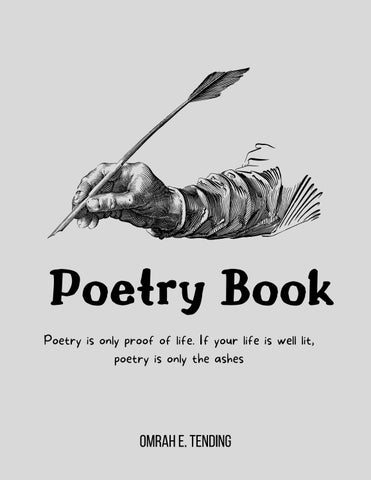
Poetry is only proof of life. If your life is well lit, poetry is only the ashes
Poetry Book Omrah E. Tending
Acknowledgements
First and foremost, I would like to express my deepest gratitude to the Creator, who has given me the gift of words and the ability to create poetry. Without this gift, this book would not have been possible.
I would also like to thank my family and friends for their unwavering support and encouragement throughout the writing process. Your love and belief in me have been a constant source of inspiration and motivation. To my mentors and teachers, who have guided me on my journey as a poet, I am forever grateful for your wisdom and guidance. Your expertise and feedback have been invaluable in helping me refine my craft. I would also like to thank the poetry community, both local and global, for providing a space for me to grow and learn as a poet. Your support and encouragement have meant the world to me. Finally, I would like to thank the readers who will pick up this book and take the time to read my words. I hope that my poetry brings you joy, inspiration, and a deeper understanding of the human experience. Thank you all for being a part of this journey
Photo by Y
Table of Contents
Chapter 1
•What is Poetry
•Poetic Elements
•Types of Poetic Forms
Chapter 2
•What is Dramatic Poetry
•Forms of Dramatic Poetry
•Dramatic Devices
Chapter 3
•What is Fun Poetry
•Elements of Fun Poetry
Chapter 4
•What of Shape Poetry
•Types of Shape Poetry
Chapter 5
•What is Poetry
•Comprehending Poetry
Photo by Kevin Z li
Foreword
Welcome to a journey through the enchanting world of poetry, where words dance on the page and emotions come alive through verse. In this book, we embark on a transformative exploration of the power of poetry as a tool for expression, connection, and understanding. Teaching poetry is an art that requires not just knowledge but also passion and creativity. It is a journey of discovery, both for the teacher and the student, as we delve into the depths of language, imagery, and emotion to uncover the beauty and complexity of poetic expression.
Through the pages of this book, you will find a treasure trove of strategies, activities, and insights designed to inspire and empower both educators and learners. From exploring different forms and structures to unlocking the mysteries of metaphor and symbolism, each chapter offers a pathway to deeper engagement with the poetic craft. As we navigate the landscapes of rhythm, rhyme, and metaphor, we invite you to embrace the magic of poetry and unleash your creativity. Whether you are a seasoned educator or a novice enthusiast, this book is a resource to ignite your passion for teaching and learning poetry. May this book serve as a guiding light on your journey to inspire, educate, and empower through the transformative power of poetry.
Happy teaching and happy writing!
Warm regards,
Omrah Tending

Teaching Poetry CHAPTER 1
GENRES&LITERARYDEVICES
WHAT IS POETRY
•Poetry is a type of literature that conveys a thought, describes a scene or tells a story in a concentrated, lyrical arrangement of words. Poems can be structured, with rhyming linesand meter, the rhythm and emphasis of a line based on syllabic beats. Poems can also be freeform, which follows no formal structure.
•The basic building block of a poem is a verse known as a stanza. A stanza is a grouping of lines related to the same thought or topic, similar to a paragraph in prose. A stanza can be subdivided based on the number of lines it contains.
Couplet - a two line stanza
Tercet- a three line stanza
Quatrain- a four line stanza
Quintet- a five line stanza
Sistet- a six line stanza
Septet- a seven line stanza
Octave- an eight line stanza
What Is Meter in Poetry?
A poem can contain many elements to give it structure. Rhyme is perhaps the most common of these elements: countless poetic works, from limericks to epic poems to pop lyrics, contain rhymes. But equally important is meter, which imposes specific length and emphasis on a given line of poetry.
What Is a Stanza?
In poetry, a stanza is used to describe the main building block of a poem. It is a unit of poetry composed of lines that relate to a similar thought or topic—like a paragraph in prose or a verse in a song. Every stanza in a poem has its own concept and serves a unique purpose. A stanza may be arranged according to rhyming patterns and meters—the syllabic beats of a line. It can also be a free-flowing verse that has no formal structure.
What Is a Rhyme Scheme?
There are many different types of rhymes that poets use in their work: internal rhymes, slant rhymes, eye rhymes, identical rhymes, and more. One of the most common ways to write a rhyming poem is to use a rhyme scheme composed of shared vowel sounds or consonants.
Photo by Dari E t i
TYPES OF POETIC FORMS
1.
Blank verse. Blank verse is poetry written with a precise meter—almost always iambic pentameter— that does not rhyme.
2.
Rhymed poetry. In contrast to blank verse, rhymed poems rhyme by definition, although their scheme varies.
3.
Free verse. Free verse poetry is poetry that lacks a consistent rhyme scheme, metrical pattern, or musical form.
4.
Epics. An epic poem is a lengthy, narrative work of poetry. These long poems typically detail extraordinary feats and adventures of characters from a distant past.
5.
Narrative poetry. Similar to an epic, a narrative poem tells a story. Henry Wadsworth Longfellow’s “The Midnight Ride of Paul Revere” and Samuel Taylor Coleridge’s “The Rime of the Ancient Mariner” exemplify this form.
TYPES OF POETIC FORMS
6. Haiku. A haiku is a three-line poetic form originating in Japan. The first line has five syllables, the second line has seven syllables, and the third line again has five syllables.
7. Pastoral poetry. A pastoral poem is one that concerns the natural world, rural life, and landscapes. These poems have persevered from Ancient Greece (in the poetry of Hesiod) to Ancient Rome (Virgil) to the present day (Gary Snyder).
8. Sonnet. A sonnet is a 14 line poem, typically (but not exclusively) concerning the topic of love. Sonnets contain internal rhymes within their 14 lines; the exact rhyme scheme depends on the style of a sonnet. Learn about Petrarchan sonnets here.
9. Elegies. An elegy is a poem that reflects upon death or loss. Traditionally, it contains themes of mourning, loss, and reflection. However, it can also explore themes of redemption and consolation.
10. Ode. Much like an elegy, an ode is a tribute to its subject, although the subject need not be dead—or even sentient, as in John Keats’ “Ode on a Grecian Urn”
TYPES OF POETIC FORMS
11. Limerick. A limerick is a five-line poem that consists of a single stanza, an AABBA rhyme scheme, and whose subject is a short, pithy tale or description. Learn more about limericks here.
12. Lyric poetry. Lyric poetry refers to the broad category of poetry that concerns feelings and emotion. This distinguishes it from two other poetic categories: epic and dramatic.
13. Ballad. A ballad (or ballade) is a form of narrative verse that can be either poetic or musical. It typically follows a pattern of rhymed quatrains. From John Keats to Samuel Taylor Coleridge to Bob Dylan, it represents a melodious form of storytelling.
14. Soliloquy. A soliloquy is a monologue in which a character speaks to him or herself, expressing inner thoughts that an audience might not otherwise know. Soliloquies are not definitionally poems, although they often can be most famously in the plays of William Shakespeare.
15. Villanelle. A nineteen-line poem consisting of five tercets and a quatrain, with a highly specified internal rhyme scheme. Originally a variation on a pastoral, the villanelle has evolved to describe obsessions and other intense subject matters, as exemplified by Dylan Thomas, author of villanelles like “Do Not Go Gentle Into That Good Night.”
What Is Imagery in Poetry?
In poetry and literature, imagery is the use of figurative language to evoke a sensory experience in the reader. When a poet uses descriptive language well, they play to the reader’s senses, providing them with sights, tastes, smells, sounds, internal and external feelings, and even internal emotion.
What Is Mimesis in Poetry?
Copying is something writers usually strive to avoid. And yet, the literary theory of mimesis says that artists copy constantly, as a matter of necessity. Does this make their art bad?
Centuries of thinkers from Plato and Aristotle onwards have attempted to answer this question by debating the nature of mimesis.
What Is Onomatopoeia in Poetry?
Usually, how words sound bears no relationship to what they mean. That’s not true in the case of onomatopoeia, where words sound like what they are. The English language is littered with these mimicking words, from meowing cats to babbling brooks. In poetry and literature, the onomatopoeic effect is something writers can harness to create vivid imagery without verbosity.
DEVICES IN POETRY
LITERARY
What Is Enjambment in Poetry?
Poetry is a structured literary form, with patterns and rhythms that dictate the flow of verses. Lineation in poetry is how lines are divided and where they end in relation to a clause or thought. Having a line break at the end of a phrase or complete thought is a regular and expected pattern in poetry. Poets subvert this expectation by using a technique called enjambment.
What Is Dissonance in Poetry?
The human brain instinctively looks for harmony. When it is denied harmony, it can create a powerful moment—whether that’s for the purposes of creating tension, capturing inner turmoil, or bringing a bit of levity. Dissonance injects discomfort into text through inharmonious sounds and uneven rhythms. .
What Is Consonance in Poetry?
In poetry, rhyme isn’t the only way to introduce memorability and musicality. Consonance presents poets with the possibility of playing around with the repetition of consonant sounds.
DEVICES IN POETRY
LITERARY
What Is Assonance in Poetry?
From William Wordsworth to Kendrick Lamar, generations of poets have used assonance as a looser alternative to strict rhymes. Assonance, the repetition of vowel sounds, is distinct from consonance, which refers to the repetition of consonant sounds. Along with rhyme and alliteration, it is a powerful poetic device that writers can use to make their words stand out.
What Is Alliteration in Poetry?
Sometimes called initial rhyme or head rhyme, alliteration is one poetic device that’s unmissable in our everyday world. Poets, advertisers and headline writers all regularly take this approach of repeating initial letter sounds to grab people’s attention. In poetry, it also injects focus, harmony, and rhythm.
LITERARY DEVICES IN POETRY
SOME SAMPLE POEMS
HAIKU
“The Old Pond”
by Matsuo Bashō
An old silent pond
A frog jumps into the pond
Splash! Silence again.
BLANK VERSE POEM
Rain by Edward Thomas
Rain, midnight rain, nothing but the wild rain
On this bleak hut, and solitude, and me Remembering again that I shall die
And neither hear the rain nor give it thanks
For washing me cleaner than I have been
Since I was born into this solitude.
SOME SAMPLE POEMS
RHYMED POEM
Friends by Abbie Farwell Brown
How good to lie a little while And look up through the tree! The Sky is like a kind big smile Bent sweetly over me. The Sunshine flickers through the lace
Of leaves above my head, And kisses me upon the face Like Mother, before bed. The Wind comes stealing o'er the grass
To whisper pretty things; And though I cannot see him pass, I feel his careful wings. So many gentle Friends are near Whom one can scarcely see, A child should never feel a fear, Wherever he may be.
FREE VERSE POEM
Fog by Carl Sanburg
The fog comes on little eat feet.
It sits looking over harbor and city on silent haunches and then moves on.
Teaching Dramatic Poetry
GENRES&LITERARYDEVICES
CHAPTER 2
 Photo by Fritz Kellman
WHAT IS DRAMTIC POETRY
•Dramatic poetry is written in verse and is meant to be spoken or acted out, usually to tell a story or portray a situation. Most dramatic poetry is in the form of dramatic monologues, which are long speeches by one actor to another or the audience, or soliloquies, which are one’s thoughts spoken out loud, regardless of whether anyone hears them or not.
•Dramatic poetry differs from narrative poetry in that it is written and told by the perspective of the character, while narrative poetry is a story told by the narrator. Another form of dramatic poetry is known as “closet drama”. Closet drama is poetry that’s intended to be read and not performed
EXAMPLES OF DRAMATIC POETRY
”Home-Thoughts From Abroad” by Robert Browning Inferno by Dante Paradise Lost by John Milton
”The Seven Ages of Man” by William Shakespeare
”Poetics” by Aristotle
”Ulysses” by Alfred Tennyson
”Ode on Indolence” by John Keats
”Songs of Innocence and Examples: The Tyger” by William Blake
FORMS OF DRAMATIC POETRY
1.DRAMATIC MONOLOGUE
. a combination of drama and poetry
Presents the speech of a single character"in a specific situation at a critical moment"
The speaker addresses one or more persons who ar present and who are listening to the speaker, but remain silent
The speaker's personality and character, his relationship to others, his sense of values and attitudes towards life are indirectly gleaned from hi monologue
EXAMPLES OF DRAMATIC POETRY
Example of a Dramatic Monologue Ferrara
That's my last Duchess painted on the wall, Looking as if she were alive. I call That piece a wonder, now: Frà Pandolf's hands Worked busily a day, and there she stands. Will't please you sit and look at her? I said "Fra Pandolf" by design, for never read Strangers like you that pictured countenance, The depth and passion of its earnest glance, But to myself they turned (since none puts by The curtain I have drawn for you, but I' And seemed as they would ask me, if they durst, How such a glance came there; so, not the first Are you to turn and ask thus. Sir, 'twas not Her husband's presence only, called that spot Of joy into the Duchess' cheek: perhaps Frà Pandolf chanced to sav "Her mantle laps Over my Lady's wrist too much," or "Paint Must never hope to reproduce the faint
FORMS OF DRAMATIC POETRY
2. SOLILOQUY
A passage spoken by a speaker in a poem or a character in a play
No one present to hear the speaker
The thoughts expressed, the emotions displayed, and the revelations made, freely and without inhibition, give deep insights into the character
Used in poetic dramas to enrich and vivify characterization
Inform the audience about other developments in the play
EXAMPLES OF DRAMATIC POETRY
Example of a Soliloquy HAMLET
To be, or not to be--that is the question:
Whether 'tis nobler in the mind to suffer
The slings and arrows of outrageous fortune Or to take arms against a sea of troubles And by opposing end them. To die, to sleep-No more--and by a sleep to say we end The heartache, and the thousand natural shocks
That flesh is heir to. 'Tis a consummation Devoutly to be wished. To die, to sleep--To sleep-perchance to dream: ay, there's the rub,
For in that sleep of death what dreams may come
When we have shuffled off this mortal coil, Must give us pause. There's the respect That makes calamity of so long life.
For who would bear the whips and scorns o time,
Th' oppressor ' s wrong, the proud man ' s
I To be, or not to be--that is the question:
Whether 'tis nobler in the mind to suffer
The slings and arrows of outrageous fortune Or to take arms against a sea of troubles And by opposing end them. To die, to sleep--
No more--and by a sleep to say we end The heartache, and the thousand natural shocks
That flesh is heir to. 'Tis a consummation Devoutly to be wished. To die, to sleep--To sleep--perchance to dream: ay, there's the rub,
For in that sleep of death what dreams may come
When we have shuffled off this mortal coil, Must give us pause
There's the respect That makes calamity of so long life. contumely
The pangs of despised love, the law's delay, The insolence of office, and the spurns That patient merit of th' unworthy takes,
When he himself might his quietus make IT With a bare bodkin?
Who would fardels bear.
To grunt and sweat under a weary life, But that the dread of something after death, The undiscovered country, from whose bourn
No traveller returns, puzzles the will,
And makes us rather bear those ills we have Than fly to others that we know not of?
Thus conscience does make cowards of us all.
And thus the native hue of resolution
Is sicklied o ' er with the pale cast of thought, And enterprise of great pitch and moment With this regard their currents turn awry And lose the name of action. - Soft you now.
The fair Ophelia! - - Nymph, in thy orisons Be all my sins remembered.
FORMS OF DRAMATIC POETRY
3. CHARACTER SKETCH
_• A poem in which "the writer is concerned less with matters of story, complete or implied, than he is with arousing sympathy, antagonism or merely interest for an individual"
Poet - serves as observer and commentator
Incorporates the element of suspense, conflict, or tension
EXAMPLES OF DRAMATIC POETRY
Example of a Character Sketch
Abou Ben Adhem: James Henry Leigh Hunt
Abou Ben Adhem (may his tribe
Replied the Angel. Abou spoke increase!) more low, Awoke one night from a deep dream
But cheerily still; and said, " pray of peace, thee, then, And saw, within the moonlight in his
Write me as one who loves hisr oom, fellow men.
Making it rich, and like a lily in bloom, An Angel writing in a book of gold: The Angel wrote, and vanished.
The next night
"And is mine one?" said Abou. "Nay, not so. " may his tribe
Replied the Angel. Abou spoke more low, om a deep dream
But cheerily still; and said, " pray thee, then, › moonlight in his
Write me as one who loves his fellow men. " like a lily in bloom, a book of gold: ad made Ben e in the room he
* ' * The Vision raised
The Angel wrote, and vanished.
The next night
Exceeding peace had made Ben It came again with a great Adhem bold, wakening light, And to the Presence in the room he And showed the names whom said love of God had blessed, "What writest thou?" The Vision raised l its head. the rest!
It came again with a great wakening light, And showed the names whom love of God had blessed And, lo! Ben Adhem's name led all the rest!
And with a look made of all sweet accord Answered, "The names of those who love the Lord."
DRAMATIC DEVICES
Speech directions
word in brackets that tell the actor how to say the lines.
Asides when a character temporarily turns away from another character and speaks directly to the audience.
Entrance & Exits
*It is important to notice when characters exit and enter a scene. Pay particular attention to what is being said as they enter or what they say as they leave.
Scenes & Acts
*It is important to pay attention to when a playwright chooses to end a scene and an Act (a number of scenes). It is usually significant in building audience expectations of what is to come.
Symbolism when an object is used to represent something else
 Photo by Claudiu Maxim
Fun Poetry CHAPTER 3
WHAT IS FUN POETRY?
• Fun poetry is playful, witty, and often aims to make readers laugh or smile. This style of poetry can be a delightful change of pace from the often serious and heavy content of other poetic styles. In this blog post, we’ll explore more about what makes poetry fun and how it can help readers and writers explore the lighter side of life.
ELEMENTS OF FUN POETRY
Rhyming
The repetition of sounds and syllables can add a musical quality to the poem and make it easier to remember. Rhyme also makes poems playful and helps to create a sense of harmony between the words.
Puns and wordplay
Puns and wordplay are commonly used to create fun and witty poems.
Surprise Endings
Surprise endings can be used to create a sense of irony or to play with the reader’s expectations.
Absurd Imagery
Fun poems often use silly or absurd imagery to create a playful tone. By creating whimsical characters or settings, poets can take readers on a journey through a fantastical world.
Examples of Fun Poetry
Limericks
No.1 No.2
There once was a poet named Joe Whose favorite line, he loved to show. He’d say with great cheer, “My rhymes are so clear, Even my dog could understand, you know!”
No.3
There was a young woman named Bright, Whose speed was much faster than light. She set out one day, In a relative way, And returned on the previous night.
There was a young lady named Cager Who, as the result of a wager, Consented to fart
The complete oboe part Of Mozart’s quartet in F major.
No.4
There was an odd fellow named Gus, When traveling he made such a fuss. He was banned from the train, Not allowed on a plane, And now travels only by bus.
Shape Poetry CHAPTER4
WHAT IS SHAPE POETRY
As the name suggests describes an object and is written in the shape of that object. It is sometimes called a "Concrete Poem" or a "Calligram" It has something to do with the physical form of words on the paper. While words, writing style and literary devices may all impact the meaning of the poem, the physical form of the poem takes is also of significance.
TYPES OF SHAPE POETRY
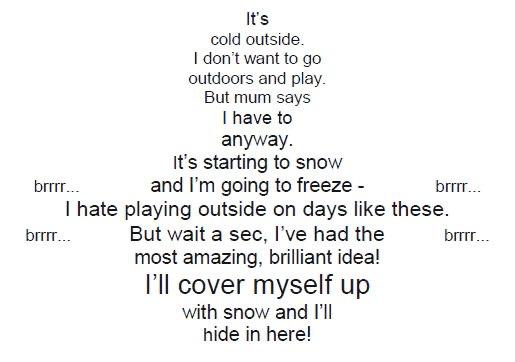
1.OUTLINE POEM
A visual structure that reflects the subject of the poem that fills in an outlined shape relating to the topic of the poem.
Example:
TYPES OF SHAPE POETRY
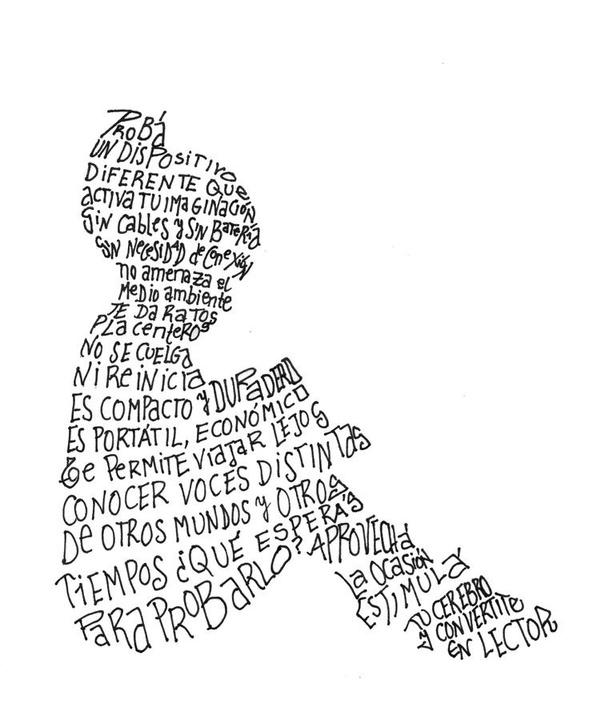
2.DRAWING POEM
This uses the lines of words to make the lines of the drawing.
Example:
Comprehending Poetry CHAPTER5
WHAT IS POETRY?
P O E T R Y
erception of life through words and rhyme, bserving the world in rythm and time, xpressing emotions in verses that chime, ransforming thoughts into a lyrical climb, evealimg truths in a melodic prime,
earning to capture the essence of every paradigm
COMPREHENDING POETRY
COMPREHENDING
POETRY
Howdowecomprehendapoetry?
Here are the strategies and guidelines in reading and analyzing poetry.
STRATEGIES
Reading the Poem
1. Read the poem through 1-3 times and see how much of the author's meaning you can immediately grasp.
•Ask yourself:
•Who is speaking?
•Who is the audience?
•What is the topic?
•Where and when is the action taking place?
•What is motivating the speaker?
COMPREHENDING POERTY
STRATEGIES
2.Then, go back through the poem, line by line. Define all the images and symbols, if necessary, referring to outside reference works or to other poems by the same author.
3.If you are still having difficulty understanding the poem, consider "translating" each line into prose. Or substitute simpler words for the more difficult ones. You may need a dictionary.
4. When you understand all the basic words and ideas in the poem, reread the poem a few more times and pull it all back together again.
COMPREHENDING POERTY
INTERPRETINGTHEPOEM
1.Look at the title--it's often as important as any line.
2. Follow the punctuation like a road map.
3.Look for symbols, allusions and other clues to meaning.
REFERENCES
https://www.scribd.com/document/641742740/COMPREHE NDING-POETRY https://gayweddingsmag.com/what-is-afun-poetry/?
fbclid=IwAR1aRNeRFhQL31QJQ1fFOtLQq65lLDLOzZS2054 H-aiEl95Hw1bOwXo5kdI _ aem _AYiny0F5T15xpuRmZh5HgOp2s8TySv6jnNyZ_xYpQJ4lwzjZGayPC9Qi gFV1YaSSZM
https://www.scribd.com/document/340874945/DramaticPoetry?
fbclid=IwAR0XPuN6oKj5oHgYS9Rngn4deyNP8v0X3zZ56kLnbxefqYgBYrhcqaQdDU aem AYhiVz CYWTc4xxtrZTDBHzKyEIXQzHsADn1JKhKQclkOluAHCOD Vb oMn5nofQdmOVQ
https://www.masterclass.com/articles/poetry-101-learnabout-poetry-different-types-of-poems-and-poetic-deviceswith-examples?
fbclid=IwAR34XAWnNlTL6YRONq27Z3bmceUum2l4OkpcI mkQo ziVk1W66DSk2hrpy8 aem AWrNeLnuZeIFSD25xSgj DgeBK7MLEAdjE7Pf_TaUku_HZVAoYgMiLRyHIT0FdFShEq A