![]()


In the heart of our city. In the soul of our state. The stories that shape your world are now in one place. Omaha Magazine and The Good Life Network have joined forces to bring you unparalleled access to the culture of Omaha and the character of Nebraska, from the page to your screen. The complete experience. $7/month.
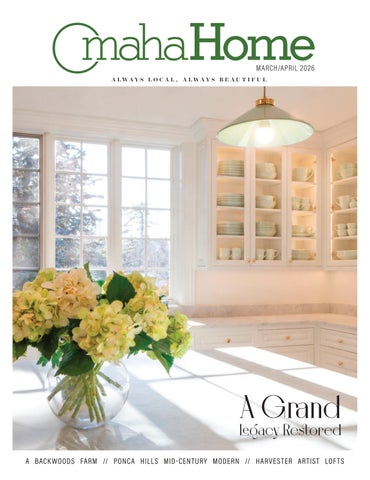
T here’s a certain kind of magic that happens when a place is shaped by the people who love it—and this issue of OmahaHome is full of those moments.
Inside these pages, you’ll find stories rooted in care, creativity, and a deep sense of belonging. From visiting a maker and their space—where the land sets the pace and tradition is honored—to a thoughtfully executed basement remodel that proves the most overlooked spaces can become the most meaningful, each feature reminds us that home isn’t just about square footage. It’s about intention.
We also cross the river to Council Bluffs, where historic artist lofts are breathing new life into old buildings. These spaces celebrate imperfection, creativity, and the beauty of adaptive reuse—showing how homes can evolve alongside the people who inhabit them. They’re a powerful example of how art, architecture, and community can intersect in unexpected ways.
What ties these stories together is not a single style or trend, but a shared mindset: a belief that homes should reflect the lives lived inside them. Whether that means mud on the boots, a gathering space built for connection, or a loft that doubles as a studio, each story honors authenticity over perfection.
As always, our hope is that these homes inspire you— to look at your own space with fresh eyes and imagine what’s possible.
Cheers,


ARCHITECTURE Ponca Hills Mid-Century Modern SPACES Downstairs Done Right

Cara Crawford Guest Editor Cara Loves Omaha


Editorial
EXECUTIVE EDITOR
DOUG MEIGS
ASSOCIATE EDITOR
NATALIE VELOSO
ASSIGNMENT EDITOR
ISAAC NIELSEN
EDITORIAL INTERN
NAOMI HEU
CONTRIBUTING WRITERS
MARIA CORPUZ · DIANA FAILLA
JEN LITTON · HOLLY MCATEE
SEAN MCCARTHY · LISA MCCOID
NATALIE MCGOVERN · JONATHAN OROZCO
CREATIVE DIRECTOR
RACHEL BIRDSALL
SENIOR GRAPHIC DESIGNER
RENEE LUDWICK
GRAPHIC DESIGNER II
NICKIE ROBINSON
GRAPHIC DESIGNER I
JOEY WINTON
CHIEF PHOTOGRAPHER
SARAH LEMKE
CONTRIBUTING PHOTOGRAPHER
MANDY MCGREGOR
EXECUTIVE VICE PRESIDENT
SALES & MARKETING
GIL COHEN
DIRECTOR OF BUSINESS & DEVELOPMENT
CAROLE SPRUNK
BRANDING & DIGITAL SPECIALISTS
GREG BRUNS · DAWN DENNIS
FRANCINE FLEGG · SANDY MATSON
TIM MCCORMACK
DIGITAL ADVERTISING SALES SPECIALIST
TRAVIS FISHER
SENIOR SALES COORDINATOR
ALICIA HOLLINS
SALES COORDINATOR
JESSICA LINHART · SANDI MCCORMACK
Operations
BUSINESS MANAGER
KYLE FISHER
AD TRAFFIC MANAGER
DAVID TROUBA
DIGITAL MANAGER
LUIS DE LA TOBA
DISTRIBUTION MANAGER
CARSON KRUSE
Executive
PUBLISHER
TODD LEMKE
ASSOCIATE PUBLISHER
BILL SITZMANN


STORY - MARIA CORPUZ | PHOTOGRAPHY - SARAH LEMKE | DESIGN - RENEE LUDWICK
the hustle of city life, a quiet oasis offers the perfect escape. A Backwoods Farm in Louisville, Nebraska, provides exactly that through hands-on pottery workshops and intimate long-table dinners. Gina and Eric Maas offer one-of-a-kind experiences that invite people to slow down, create, and gather with intention.
Once their five children flew the coop, Gina found herself focusing on self-discovery as boredom started creeping in. Eric suggested she attend a pottery class, and she immediately fell in love with the process. She focused on handbuilding pottery for its creative freedom and unique, organic forms.
"With hand-building, there are so many more imperfections and I love that...it adds beauty that shows it was handmade," Gina said.
The endless possibilities in texture, design, and glaze options kept her curious. Gina continued attending different pottery workshops, eventually leading her to "The Art of Gathering" in Colorado. There, she realized the importance of not only teaching an art, but emphasizing the experience of gathering. With her home in the country, she realized it was the perfect place to start A Backwoods Farm.
Gina and Eric renovated their barn to create a studio on their wooded property, dreaming of offering experiences that feel personal, welcoming, and unhurried. With garage doors that open to offer a breeze in warmer months and a fire pit for colder ones, A Backwoods Farm offers a retreat where guests feel relaxed the moment they arrive.
In 2024, Gina started offering hands-on, no-experience-required pottery workshops focused on functional pieces for the home: wavy charcuterie boards, cake platters, and flower vases. Guests are greeted with wine, charcuterie, and wood-fired pizza courtesy of Eric. Together, they offer people a chance to sit outside and open their senses to crickets, frogs, lightning bugs, and stars. Gina invites folks to gather as she works through the process step-by-step.
While guests work on the same project, Gina encourages them to personalize their work with texture and color. She offers textures from items she's collected: burlap, lace, wildflowers, and herbs. Next, they explore glazes in various earth tones.
"People are so proud of what they make, often surprised by how easy it was. They are able to release their anxiety and then create," Gina said.
Between workshops, Gina works on her own pottery pieces. Many feature foraged plants pressed into the clay, offering viewers a glimpse into the quiet country environment she creates in. Her pieces can be found at local shops in Omaha, Ashland, and Lincoln.
Another gathering opportunity at A Backwoods Farm is the long-table dinner an intimate evening with twelve guests. Gina and Eric partner with Chef Tay Westberry, who was featured on MasterChef, to host a curated meal inside the barn studio. Chef Tay brings guests on a journey of flavor and heartfelt connection through seasonal menus, often featuring ingredients from the Maas' garden or honey from their bees. Dinner is served on Gina's pottery, giving guests a glimpse into the studio haven she's created.
Whether digging hands into clay or feasting on a seasonal meal, A Backwoods Farm is a place for gathering.
"People come curious to walk around and see the spaces and ready to meet new people," Gina said.
Visit abackwoodsfarm.com for more information and other offerings from the farm.


STORY - Natalie McGovern
PHOTOGRAPHY - Sarah Lemke
DESIGN - Renee Ludwick


Built in 1939, this reimagined Georgian Revival estate in Fairacres at 6600 Underwood is a majestic portrayal of grandeur. A European-inspired home with a brick exterior, it boasts 10,993 square feet on 1.34 acres. The home has experienced many add-ons and upgrades over time, including a recent massive renovation of the main level and upper floors.
The home was gutted in 2024 to make room for customized additions, but its history remains. The five-bedroom, nine-bath home makes a strong impression, with a symmetrically rectangular layout organized around multiple axial views. It features two basements, a guesthouse, an in-ground pool, couture walk-in closet, Sub-Zero and Wolf appliances, and dual private baths. As a home listed in a National Register of Historic Places neighborhood, this stately Georgian Revival mansion is a piece of history with modern functionality and high-end amenities.
The owners, who had lived in an ancestral home dating to the 1700s in Ireland, contracted Craig Tuttle Construction to redesign their Fairacres historic home from top to bottom. Most of the rooms in the house were broken up and spaces needed to be reorganized.Tuttle helped expand them. Serving as both the builder and designer on the project, he said the renovation took a little over two years to complete.
“As far as the design process, the intent was to definitely create a better flow through the formal parts of the house,” Tuttle recalled. “The original house was very choppy. There was a stairwell to the second floor with stairs stacking below on the lower level that was right inside the front door.”


A central focus was to have lines of sight with continuous views. The renovation was designed to create long, uninterrupted vistas, with sightlines stretching from one end of the house through corridors concealed behind a gilded mirror. The mirror opens discreetly, revealing a staircase to the lower level.
Structural changes were also made throughout to reinforce and support freestanding Tillinge ceramic tiled stoves weighing more than 1,000 pounds, imported from the coast of Sweden in Timmernabben.
“All of the beautiful things about the property are still here they’ve been improved upon,” Tuttle said.
Built in 1907, the Fairacres neighborhood is a historic district originally designed to be a garden suburb, a type of automobile-accessible urban community that can be found in London or New York. Fairacres became a haven amid a bustling metropolis, a stark contrast to the industrial housing common in Omaha at the turn of the 20th century. National landscape architect George Kessler designed the homes in the area, aiming to beautify communities through meticulously designed landscapes and curvilinear streets through the City Beautiful movement.
Along with the Gold Coast neighborhood, Fairacres became an enclave for wealthy and prominent residents. Further developed by Kessler, it was designated as a commuter village until its annexation by the City of Omaha in 1941. Homes were built in several architectural styles, including Georgian Revival, Tudor, and Colonial.

“All of the beautiful things about the property are still here — they’ve been improved upon.” Craig Tuttle


Upon entering the foyer, there are two powder baths on either side. Down a hallway from the mudroom entrance is a parlor-like billiard room enclosed with floor-to-ceiling mahogany wall panels. Adjacent to the billiard room is a chef’s kitchen, which opens into a large butler’s pantry and several other spacious walkin pantries.
It features luxury amenities such as an electric appliance garage with a retractable backsplash, concealing items such as coffee makers or crockpots. At the center of the room, a Carrera marble island imported from Italy anchors the space, serving as a welcoming place for shared meals and family time.
Down a long hall, the formal dining room sits on one side, with the library on the other. A solid Italian gray Breche marble fire surround from Jamb serves as the focal point, elevating the space. Several 18thcentury fire surrounds appear throughout the home, from the great room to the dining room and library.
The great room, ideal for entertaining and hosting parties, showcases towering ceilings and floor-to-ceiling rotunda-style alcove windows with natural lighting shining through, overlooking a manicured backyard. A Neoclassical fireplace in Bardiglio marble graces the room elegantly with a Balfour Fire surround from Jamb, featuring egg and dart moldings.
World-renowned London designer Hugh Henry was brought on to create one-of-akind bespoke furnishings, pieces such as a Howard & Sons ottoman with bullion fringe and a King George III Neoclassical side replica table in a walnut finish. Henry designed the Royal Opera House, Somerset House, and Althorp, the ancestral Spencer home of Lady Diana, Princess of Wales.


FEATURE
“As far as the design process, the intent was to definitely create a better flow through the formal parts of the house.”
—Craig Tuttle
At the opposite wing of the house is a primary suite with his and hers separate bathrooms and a spacious custom walk-in closet. Upstairs is a "pajama lounge" TV area for the kids, several bedrooms with Jack-and-Jill bathrooms, and a kitchen-loft play area complete with a skylight.
The lower level features a cinema room and two additional rooms that can be used as an office or gym. A separate basement on the other side of the house easily serves as a space for a wine cellar or storage for skiing and equestrian gear. A refurbished pool and guesthouse add to the charm of this historic property.
It’s important to maintain the integrity of a historic estate, and the Craig Tuttle Construction team did that with their focus on quality service and exceptional craftsmanship.


“When we did the remodel, the new ‘family’ room, which used to be the dining room, was actually right next to the kitchen. When we took down the pantry walls, we were able to open up the kitchen into a family room, which for a Dundee house is rare.”
— Jennifer Taylor
Tucked among the generous shade trees lining Davenport Street just north of Dodge is a charming, historic, fivebedroom home.
The 1918 dwelling is home to Jennifer Taylor and her husband Darin, along with their two kids, Cece and Chuck, and three adopted dogs.
“I’ve lived in Dundee most of my life. I grew up on 51st and Dodge. I live three blocks from my childhood home. Two blocks from my dad’s childhood home,” Taylor said. Her parents, Matt and Donna Johnson, live on California Street, and her dad grew up on 52nd between Dodge and Farnam.
Dundee-Memorial Park’s historic district contains a number of Period Revival homes, including Colonial, Georgian, and Tudors that have endured the decades and maintained their unique architectural heritage.
“I love the neighborhood. I love houses, and they all have history. And they all have just kind of neat, unique aspects to them in architecture. That’s why I love living in an old neighborhood,” Taylor said.
Stepping into the home’s front porch-turned-study, the cozy space radiates sophisticated intelligence with worldly books and curious artifacts. A treasured curio cabinet that holds mementos was a gift from her grandmother. “She had it in her house for as long as I can remember,” Taylor said.


The family worked with LK Design, who carefully envisioned the distinctive look and feel the Taylors were hoping for, and T. Hurt Construction brought it to life with the remodeling.
Further along into the stately and inviting dining room, one can gaze at a distinctively dark damask wallpaper, offset with warm touches of sunlight dappling through the windows.
The foundation for entertaining the home’s dining room table was a wedding gift from her grandparents and is a Dundeearea artifact dating back several decades.
A lot of the major pieces of furniture are family heirlooms, and Taylor enjoys consignment shops to coordinate her home aesthetic. “I love old furniture. I like things that have a story. I have a lot of furniture that is in the style of the 1920s,” she said.
Over a century ago, this home served as a steward to a storied history. The home’s second owner was National Omaha Bank president W. Dale Clark, the namesake of the Omaha Public Library's former downtown branch.
On a crisp October night in 1926, President Calvin Coolidge gained some respite at Clark’s home while on a national tour. Coolidge was in town to speak at the American Legion Convention. In his speech, Coolidge said, “Your right to be here results from what you dared, and what you did, and the sacrifices made for our common country.”
One can say the Taylors possess the same daring spirit that Coolidge spoke of.
As the deputy city attorney for the City of Omaha, Taylor also serves as chair of her alma mater’s fundraising efforts. Central High School Foundation’s Generation “C” helps secure the growth of opportunity for future Central High School grads. “It’s been a wonderful opportunity to show off our Central roots,” she said.


Make the leap to homeownership with our My First Home Program, specially designed for first-time homebuyers. With My First Home, you could enjoy:
Up to 105% financing*
As little as $1,000 minimum contribution*
Ability to use gift funds for the down payment
No PMI required
Plus, our local mortgage experts are here to help you every step of the way.
Checking, Savings & Loans | Mortgage | Auto | Business Banking


This spring, their daughter Cece will graduate from Central. She’s captain of the varsity swim team, a varsity golfer, and serves as activities director of the National Honor Society. She’s also active in advanced academic programs, including the Haddix STEM Corridor and the UNMC High School Alliance.
Their son Chuck will attend Central in a few years, currently in the seventh grade at Lewis and Clark Middle School. He's also an avid golfer in the Nebraska Jr. Golf League and enjoys basketball, football, swimming, baseball, and chess. “He’s got himself an 8-plus handicap, so he’s proud of himself. He loves golf, basketball, and he has just started playing tackle football, which he loves,” Taylor said.
Taylor has also been instrumental over the past two decades in raising funds for the Nebraska Humane Society and the Omaha Public Library. She adopted three dogs from NHS that round out her family. There’s Zoey, an Australian Shepherd-chow mix; Finn, a basset hound-terrier-pit bull mix; and Leo, a beagle-Boston Terrier mix.
A few years back, the couple spruced up the backyard space by adding patios and pergolas to the deck space to make it more functional. It’s just off the three-car garage, and is the spot to be on game days. “Most people come over on a Saturday afternoon and watch football or basketball,” Taylor said. “We’ve had movie nights, and it’s a nice space.”
The remodel was an ambitious task. The family moved to a home nearby for a year while the work took place. The remodel spanned two floors, the main floor and basement, and included a complete kitchen remodel with granite and a basement overhaul. The home was taken down to the studs, was redone, and now features new woodwork, doors, and trim.
“The basement stairs were originally in the back corner, and we relocated the stairs so now they come up into the dining room, which we then made bigger,” Taylor ex-
plained. T. Hurt Construction removed stairs and a low-tower wall on the first floor. In the basement, they moved walls, redesigned the entire bathroom, and squared off the laundry room.
The kids hang out in the basement a lot. Their friends come over and that’s where they hang out, Taylor said. “The basement’s big TV, big couch, and table works well for the kids,” she added. The home also has refinished laundry and a new bathroom.
The most unique aspect is the impressive fish tank set into the wall. Working with Ruff Waters Inc., they upgraded her 90-gallon tank to a 180-gallon freshwater tank that is home to mollies, plecos, tetras, and cichlids.
Previously, the home had a front parlor room and a dining room, but Taylor moved the rooms’ purposes around by flipping the contents. “I took the chandeliers and the sconces, and all of the original dining room fixtures, and I put them into the parlor room and turned that into our dining room. We turned the dining room into a family room.”
“When we did the remodel, the new ‘family’ room, which used to be the dining room, was actually right next to the kitchen. When we took down the pantry walls, we were able to open up the kitchen into a family room, which for a Dundee house is rare,” Taylor said.
This turned into a great space for the family. “We have a wonderful, large, warm living room. We have a beautiful, formal dining room that we occasionally eat at, but it’s great for entertaining,” she said.
“I always joke to call it the ‘mullet house,’ like you’ve got a formal dining room, and formal living room up front, and then the back is where everyone kind of hangs out,” Taylor said. “We spend a lot of time in the kitchen, and at the peninsula, and in the family room that’s our living space.”


STORY - DIANA C. FAILLA
PHOTOGRAPHY - SARAH LEMKE
DESIGN - RENEE LUDWICK
Akitchen is far more than the place where meals are made; it’s the emotional and practical center of a home, the room where mornings begin and where conversations linger after dinner. A kitchen holds memory in a way few other rooms can recipes passed down, celebrations prepared, and quiet moments shared over coffee. It’s a space that reflects the values of the people who use it. In many ways, the kitchen is the home’s heartbeat, shaping how a family lives and the way a house truly feels.
In the previous issue of OmahaHome , we learned about the process of refurbishing fireplace tile in the Dundee neighborhood Victorian home of John and Vera Brennan located at 4824 Davenport St. This issue continues with the home remodel of the Brennan kitchen.
The remodel of a kitchen isn't for the faint of heart it’s not just another weekend project. It isn’t often that one looks forward to washing dishes in the basement bathtub, not being able to bake or cook, eating mostly crackers and cheese, or having to walk through four doorway zippered plastic shields so as not to let the drywall dust make its way into the entire area of the home.
The Brennans endured the process of going without home-cooked meals and a kitchen sink for five months while creating the kitchen of their dreams.
“It’s definitely Vera’s kitchen,” John said, beaming with pride over the remodel. The kitchen is newly painted Spun Honey yellow, a Valspar Satin paint. Vera says ALL kitchens must be yellow. The north
side of the kitchen holds two long 2.5-by-6.5-foot original wooden windows, allowing for the bright yellow sunshine of the outdoors to enter the room.
What makes it especially Vera’s kitchen is the center island that seats eight people. At first, John believed that the island would be too large. However, upon completion and after holding about 17 people who congregated in the kitchen on Jan. 1 for brother Paul’s cornbread and chili night he changed his mind. The island is just right, he said.
The island countertop is consistent with the new kitchen countertop made of marble-patterned white and gray quartzite. Quartzite is basically maintenance-free, as it will not stain, it does not burn when heat is placed on it, and it’s a little less expensive than granite. The countertops cost approximately $5,000 to have installed. John was pleased with the work provided by A1 Kitchen and Bath of Omaha, which was completed in a total of two weeks from choosing the material to installation.

“We use this kitchen. It’s comfortable and lived in. It’s not a showroom.” John Brennan
The kitchen remodel began in June 2025 with the removal of many old layers of previous materials from past remodels, a most tedious, heavy, and laborious job. There have been many previous kitchen remodels, an estimated five to seven by previous owners, in this old home.
While the overall kitchen is a good size for a Victorian home at 14.5 feet by 14.5 feet, there was simply not enough cabinetry space with only six original cabinets.
The new Brennan kitchen envisioned 20 cabinets, new lighting and flooring, a ceramic backsplash, a large island, new stainless steel appliances, renovated windows, and repurposed trim.
The work began by tearing down the ceiling and walls, all the way down to the brick and studs. Plaster was giving way and water intrusion from the third floor caused bulging. It was reinvented with drywall this time, which was easier to
work with than plaster, quicker, and still durable. Once the tear down began, John decided it must continue to completion, which lasted two long days. Old cabinets were also demolished.
The ceiling held three layers of drywall and two layers of plaster. One entire dumpster was filled to make for three tons of material removed and hauled away. Vera and four faithful friends broke it down and hauled discarded material in five-gallonbucket increments to the dumpster. Back and forth they went for two straight days. Three inches of ceiling height was gained by the demolition, making the kitchen 9 feet high.
As a construction engineer, John knew he needed to fix and better support the ceiling joists. They were cracked, bending, and barely carrying their weight. He had seen this done in commercial work and by watching This Old House. He knew he had to support them in the middle. It
took him seven days to structure the ceiling properly. The cost of new drywall was approximately $1,000.
The north side exterior wall was also a feat. There were bricks missing and chipped, water was in the wall, and the mortar needed help. It took him several weekends to complete this portion of the exterior wall, since it required mixing and drying, tuckpointing, and more.
The wooden trim around the doors, windows, and baseboards was shellac, painted over about seven times in various colors such as beige, white, pink, and dark and light green. The wood trim is not new, but John has used a mix of original trim, renovated trim, and some salvage trim to complete the framing and adornment of trim in white. The trim and other miscellaneous expenditures equal an estimated $3,000.

Cabinets were ordered online from Atlanta. They came ready to assemble after John sent in 3D renderings and worked with a company designer online. The cabinets are white and were delivered on a pallet onto his driveway.
John said it made him nervous to click “send” on a $10,000 purchase, but he trusted himself and his constant communication with the company’s designer.
The cabinets came from the Ready to Assemble Cabinets Store, and arrived completely unassembled. He had 48 hours to catch a mistake, ask for a refund, and exchange a faulty cabinet. In many ways, John put in what he calls “sweat equity” in assembling the cabinets. He had a feeling ordering online was a much quicker process from ordering to installation. He was right. It took him about three 10-hour days to assemble all cabinets.
John advises not to work alone if possible, although he worked alone for most all of the kitchen remodel. Installing kitchen cabinets alone required a French cleat, which sits behind the cabinets and allows for proper leveling when working alone. A French cleat is a way of securing a cabinet to a wall. It is a molding with a 45-degree slope used to hang cabinets or other objects. The method is simple and strong, and it can be mounted hidden behind a cabinet.
There is often something that could go desperately wrong when remodeling a kitchen. One major potential disaster was thwarted thanks to John’s expertise. A major vent running from the oven space to the third floor and roof started to come down while John was cutting and fixing plumbing connections. The 75-pound, quarter-inch-thick and two-inch-diameter galvanized vent pipe started crashing down into the kitchen, potentially shutting down the entire house of six for what could have been days or weeks. John was working alone when this happened. He stopped the crash by rigging a wooden clamp to
the pipe and put in a riser support, which was then supported by the brick wall and mortar, allowing him to compete the fixing and realigning of the vent.
His advice is to hire a pro when in doubt, don’t work alone, and never put yourself at risk, especially when working with electricity. In this case, he would have needed a roofer and plumbers to help him with the vent pipe. The cost to fix it could have been $1,800.
The original kitchen lighting held one center fan light that was 12 years old. It now holds four can lights, under cabinet lighting, and three shaded pendant lights to light the island. The lights were purchased from Menards and The Light Palace Omaha for an estimated $1,000 installed.
The kitchen floor held all kinds of materials, such as plank, pine, and linoleum. It was too hard to clean back to the pine wood. The new floor is sheet vinyl, in diamond squares of white and gray with dark navy blue accents purchased and installed by Menards for $1,500.
Two other features that make this kitchen unique is the under-cabinet microwave and a mirror, which sits just behind the sink to allow for a view of the backyard and the kids playing in the mirror. The gold-trimmed mirror truly opens up the sink space.
The total cost of the kitchen ran about $30,000, which also includes a new stainless steel refrigerator, stove and dishwasher. Not included is the labor hours. John worked at least 800-1,000 hours to complete the kitchen. “It’s really a second job.” A second job he loves, he said. Young grandchildren, Ken, Delilah, and Harmony York, ages 4-7, lent a hand when needed. The girls helped hang the last cabinet, and Ken helped assemble the cabinets.
Vera had given John a Christmas deadline to complete the kitchen, which he met. By Christmas 2025, she was able to bake 600 cookies of many kinds with her six grandkids to give to coworkers and friends. She also evicted John from honing the usual kitchen junk drawer under the microwave. He had to be out! There is no junk drawer in the kitchen any longer.
John said the new kitchen is not a historic restoration remodel except for the windows. It’s more semi-traditional, modern and functional, but definitely doesn’t clash with the old Victorian house. The Brennans hope to continue making memories in the kitchen as the grandchildren play in the outdoor playground that the kitchen overlooks. “We use this kitchen. It’s comfortable and lived in,” John said. “It’s not a showroom.”
In a house where character, craftsmanship, and architectural detail tell a story, this house and kitchen serve as an opportunity to honor the elegance of the past while embracing the fruits of homespun hard work to create the comfort and functionality of modern living.
Diana Failla is a former Landmarks Heritage Preservation Commissioner. She is currently on the board of Preserve Omaha, a nonprofit dedicated to recognizing, celebrating, and advocating for Omaha’s historic places. Failla is an active member of the community and serves as president of Midtown Neighborhood Alliance, the renowned historic landmark district in the heart of the city.


PHOTOGRAPHY - COLIN CONCES
DESIGN - RENEE LUDWICK

A Thoughtful Renovation That Honors a Home’s Original Intent

Most homeowners have faced the following dilemma when it comes to a large-scale renovation: what to keep versus what to toss. Which endearing elements fit like a beloved, well-worn pair of sneakers, and which make easy candidates for the dumpster?
Husband-and-wife architects Brian and Andrea Kelly redesign homes with a specific focus on the homeowner’s personality, having a reverence to the original source material.
“At a time when we keep making new houses and we keep throwing away buildings…we love to come into an existing home and see the original intention behind the design,” Brian said.
In 2018, Darby and Andrew Whealy purchased a mid-century modern home in the Ponca Hills. The home, which was built in 1968, had only one owner and minimal renovations.
“It was a bit of a time capsule,” Brian said.
Speaking from her home on a Zoom call, Darby said she aimed to create a space that was conducive to human connection and could accommodate big holiday gatherings. Darby also wanted to keep some original elements of the house’s footprint.
“It has a lot of interesting, irregular-shaped windows that we loved. We didn’t want to change those,” Darby said.
Darby heard about Brian and Andrea through her friend Cheryl Dyer. The Kellys renovated the Dyers’ home, and the Whealys tapped the architects to turn their Brady Bunch-style home into a bright, modern hub for family activity.
The renovation was split into two phases. Phase one began in the fall of 2018, and phase two concluded at the end of 2023. The first phase focused on opening up the house and completely remodeling the kitchen. It required the Whealys to live in the basement and be without a kitchen for almost two years. To get by, they borrowed Dyer’s hot plate.
“I heated many, many pots of Trader Joe’s turkey bolognese on that plate. I have never wanted to eat it again since,” Darby said with a laugh.


The desired level of openness for the home required the removal of both loadbearing and non load-bearing walls. The Kellys worked with structural engineer Jeff Ehler and steel fabricator Dale Luebbert to design an innovative Y-column that could support a significant portion of the roof’s weight. This meant using diagonal struts to reduce the span lengths of the composite ridge beam. For Ehler, this was another example of his collaborative partnership with the Kellys.
“Brian tries to play structural engineer, I try to play architect, and we kind of cross over each other’s areas and bounce ideas off of each other,” Ehler said.
The renovation’s general contractor, Doug Kiser, also worked on the Y-column setup. He said the new Y-column required merging the original timber beam of the house with a newly engineered wood beam. The old beam had a twist while the new one was straight.
“We ended up wrapping both of them and tying them together with a fauxJapanese joint,” Kiser said.
Other efforts at creating a more open, airy space included using white oak and reflective materials. The Kellys refrained from cutting any new windows to add additional light.
“Every window that’s there, skylights included, are all existing,” Brian said.
One of the most distinct design features of the Whealys’ home is a spanning “book bridge” on the mezzanine level. The space has a small nook for kids to read in peace. One side of the bridge looks down to the kitchen while the other side looks below at the large living space.
“So, when you’re in the kitchen looking up, you see all the spines of the books,” Andrea said.
The south kitchen wall is specifically set up for plants. In a “blink and you’ll miss it” detail, Kiser worked with the Whealys to bring special meaning even to the shelves. He asked the Whealys for a word to sum up their renovation project, and Darby said “joy.” Taking that for inspiration, Kiser designed the wall so the shelves spelled out the morse code translation for the word “joy”.
In addition to drawing joy from family gatherings, books, and plants, the Whealys also have a passion for art. To prevent the need to pound nails into the wood panels, the Kellys set up an art gallery-like cable hanging system, hidden behind perforated steel panels. This lets the Whealys easily swap out pieces of art to display.
Exterior improvements were part of the phase two renovations. Because concrete costs rose significantly during COVID, the Kellys used design strategies like building gabion wall structures, which are cages or baskets filled with rocks.
“Phase two really became a lot about the organization of outdoor space and how to create experience,” Andrea said.
In the five years it took to complete both building phases, the Whealys’ two boys went from elementary to high schoolaged kids. Darby said pool parties are common for their boys, and the family has hosted “Shakespeare on the screen” nights where movie adaptations of the playwright's works are shown outdoors. The flexibility of the exterior renovations has kept up with the Whealys’ evolution as a family.
“I have an ongoing experience of being delighted with this place every day,” Darby said.


“At a time when we keep making new houses and we keep throwing away buildings…we love to come into an existing home and see the original intention behind the design.” Brian Kelly
When Megan and Sean O’Connell moved into their home in Armbrust Acres, they had a 2-year-old and a baby, busy with the hustle and bustle of life on the main floors of their home. They never came down to the basement. As the kids got older, they looked for a way to make the space work better for their family.
Through renovations, they now have a new functional space for their family that’s the perfect place for their daughter to hang out with her friends, their son to play video games, and for Megan and Sean to entertain their friends.
“The basement remodel was challenging because the area is small," Megan said. "We wanted to maximize the space and make it more usable. Since the remodel, we’ve used it more."
The biggest change to their basement was adding a guest bedroom with a full bathroom. The goal was for guests to have their own space separate from the bedrooms in the rest of the house. Just outside the guest bedroom is a small seating area with a perfect little nook to relax and read. Megan and Sean’s parents come to visit a lot, and now they have the perfect retreat area.
The O’Connells worked with Leah Scheppers, founder and principal designer with Archive Interiors, on the design for the project. “Leah put together a design board for us to pick from," Megan said. "It made the process much easier. She gave me options and would say, 'All of them would work for the space what do you like the best?'”
Megan describes her style as transitional. She’s traditional, but likes a little spunk, like a splash of artwork.
Scheppers went with darker colors for the redesign in shades of blue, green, and wood tones. “When the space is smaller, we don’t want to create a lot of high visual contrast,” Scheppers said. “Instead, we paired similar col-
ors and patterns together. Keeping things monochromatic and adding the texture creates interest. We used different elements, but in the darker and moodier tones. It makes the look blend together and is interesting, while not breaking up the space.”
The space has a unique shape, so the color schemes helped to define each area. “We used a wallpaper accent wall and a wood wall. It gives it a speakeasy feel. It’s a hang out, relax, and put your feet up-type of place,” Scheppers added.
Mike Gitt with Mike James Renovation was the contractor for the renovation. According to Gitt, “The goal overall was to make this space functional for the homeowners. We worked hard to make sure it was done properly and to create a great finished project, while being stewards of their money to make sure their money went as far as possible.”
The layout of the bar didn’t change, but they replaced the countertop with quartz, added a full refrigerator, and updated the cabinetry. Before the remodel, they had open shelving. The new area has closed cabinets that lock with glass fronts.
The original drop-down ceiling tiles were replaced with new contemporary ceiling tiles that you can’t tell are drop-down. It gives the room a more modern look.
New pieces of furniture were also added to the space, including a large custom-made consul table that fits behind the couch. This is a great place for the kids to do homework, or for people to eat when the O’Connells are entertaining.
There were many updates to the audio-visual system. “My favorite part of the basement remodel is the audio-visual enhancements made. Omaha Custom AV Solutions provided awesome solutions for the space, which is perfect for entertaining a group for a game or watching a family movie,” Sean said.
The O'Connells agree that the new space is very comfortable and inviting. “I think it’s been a good place for our family to hang out and feel disconnected, because it’s away from the everyday chaos of upstairs,” Megan said.

PHOTOGRAPHY

Gardeners seeking hardy ornamental plants can find ample free resources at the Omaha Public Library.
The Common Soil Seed Library available at library branches across the metro lets residents “check out” seed packets for home gardens with no return needed. Seeds range from vegetables to herbs, pollinator-friendly flowers, and more.
The seed library launched at the Benson Branch in 2013, and its reach has steadily grown ever since. Library staff observed a 54% increase in seed checkouts during 2025 over the prior year, and the Common Soil seed inventory has increased the volume and variety of available seeds in response to community demand.
Plants at the new Central Library branch at 72nd and Dodge are featured in the collection. An on-site city garden designed by the library’s landscaping and garden partner, Mulhall’s, will showcase native plants that support pollinators, sustainability, and celebrate seasonal changes throughout the year.
“We're making a deliberate effort to include seeds that showcase the plants being grown at the Central Library,” said Courtni Kopietz, the library’s marketing manager.
“The city garden will be a space for the community to come together, a quiet, green space wrapped by the library building to buffer the normal busyness of that intersection,”
Kopietz said. “It's a space we anticipate people using for reading and studying, but we'll also host programs and have other educational opportunities there.”
Year-round gardening classes (for all skill levels) are another way to start planning your garden with help from the Omaha Public Library. From winter through early spring, library locations host workshops covering starting seeds indoors, soil preparation, and early-season care. Registration is required.
Beginning in March, the library will roll out a pollinator garden program, offering practical guidance on designing gardens that bloom from spring through fall. Educators from the Nebraska Extension in Douglas-Sarpy Counties will lead the classes.
Visit omahalibrary.org/seed-library for more information.


STORY - DOUG MEIGS
DESIGN - RENEE LUDWICK
Seeds for the following native plants are available in the Omaha Public Library’s Common Soil Seed Library. The highlighted grass and flowers are also featured in landscaping at the new Central Library.
Wild columbine ( Aquilegia canadensis): A spring-blooming native with red-and-yellow nodding flowers that attract hummingbirds and early-season pollinators.
Blue grama (Boutelona gracilis): A drought-tolerant native grass that adds texture and structure to pollinator gardens while supporting beneficial insects.
Cardinal flower (Lobelia cardinalis): A striking late-summer bloomer with vivid red spikes that are especially attractive to hummingbirds and butterflies.
Hoary vervain (Verbena stricta): A hardy native wildflower with tall purple flower spikes that provide reliable nectar for bees through summer.
Golden Alexanders (Zizia aurea): An early-blooming native with bright yellow flower clusters that support spring pollinators, including specialist bees.


“I’ve
never gone hungry or without, because we do actively look out for each [other],” said Patty Talbert, a resident of the Harvester Artists Lofts in Council Bluffs. “I have lived at Harvester since the beginning…It was and is a big deal for artists to have an affordable functioning work/live space.”
Talbert, whose work is notably across the Omaha Metro area, participated in the “Art+ ORBT” project in 2020, an initiative by Omaha by Design and Omaha Metro Transit, painting a station with her iconic stripes. As
part of another project, this time in collaboration with Rachel Ziegler, she created a mosaic mural at Millwork Commons.
For artists like Talbert, the Harvester has long been a place where artists can find space and authentic community.


The Iowa West Foundation approached Artspace, a nonprofit real estate organization focused on creating affordable housing for artists and creatives with over 59 properties in operation, in 2006 to see if the International Harvester Warehouse could be transformed into apartments for artists. What was once a warehouse is now a 36-unit space for artists in Council Bluffs to live and work.
Uniquely, among the criteria to be a resident is a panel interview with three current residents that is scored to see if you would be a culture fit in the building.
The space goes beyond just being an apartment building. Another long-time resident, Trac Schacht, has lived in the space for 14 years. During that time, she has created countless poems alongside her neighbors. For Schacht, the apartment is more than just being a spacious room for creativity, but about the experience of living in a unique community of creatives.
“I had to break away from a man because he was not good,” Schacht said. “And I moved here, broke the lease and moved in here, never looked back. Things have been great. I’ve said, with the cancer, I was really scared, but people here took care of me. That's what this building does.”
During a tour of the building, Schacht walked me through every floor, each with walls covered in art made by previous and current residents. On the first floor is a gallery that residents can book to curate their own exhibitions. On another floor were large-scale works by Talbert, with her iconic colorful stripes.
One current resident named Jesse Medina, who is originally from the Philippines, has been living in the Harvester since it opened in
2011. His skillful realistic paintings are often commissioned by private collectors, with the Omaha World-Herald among his previous clients.
On the second floor are large paintings of flowers by Ann Brugenhemke. Originally from Council Bluffs, Brugenhemke studied art at UNO, later moving to Taos, New Mexico. Life circumstances brought her back to the metro area, and after another move to Lincoln, she decided she wanted to move back to her hometown and applied at the Harvester Artists Lofts.
“I thought, ‘Well, I just sold my house. I’m not going to buy another house. That seems like way too stressful to do right now,’” she said. “‘What’s a quick fix? How can I move to Council Bluffs?’”
After a wait period of a few months, Brugenhemke was accepted as a resident and has been living in the space for 10 years.
In her two-bedroom studio overlooking an industrial area of Council Bluffs, Brugenhemke lives with her daughter. Her art is deeply influenced by nature and yoga. During hikes in nature, she finds flora that inspires her to paint sometimes gestural, sometimes precise, compositions.

She picked up ceramics more recently, both to teach and to make art of her own. She recently crafted thousands of teardrop-shaped beads she strings into strands, or larger suspended bunches that remind viewers of raindrops.
“I made a lot of these wall-mounted sculptures,” Brugenhemke said. “I made these in quite a frenzy, and I love the way that they were like pendants, and they clustered together like grapes, and they sound like rain… After I made all of them, I realized that they had to do with support and attachment.”
Though the Harvester Artists Lofts building is
located in a fairly industrial area in Council Bluffs, it’s within walking distance to the city’s downtown.
Pottawattamie Arts, Culture & Entertainment, also known as PACE, is right next door, and not too far away are many historic museums, like the Railwest Railroad Museum and the Pioneer Trail Museum, among other historic buildings in the U.S. National Register of Historic Places.
From opera singers to fashion designers, to traditional painters and writers, every single artist is leaving their mark on the culture of the building as they come and go. Others sometimes end up living in other Artspace buildings in the United States, but the building and neighborhood supports every resident when they need it.
Visit harvesterartistlofts.com for more information.

STORY - LISA MCCOID
PHOTOGRAPHY - TOM KESSLER, KESSLER PHOTOGRAPHY
LAYOUT DESIGN - RENEE LUDWICK

Every home I design has a unique personality. Some interiors are bold and brazen, with saturated paint colors and graphic patterns in wallpapers, tiles, and fabrics. Others are traditional and romantic, filled with millwork details, ambient lighting, and charming nooks for dining, reading, or relaxing. With personalities as varied as the people who inhabit them, due diligence in planning makes all the difference in defining each home’s character. A home’s personality is communicated visually, but it is also felt and experienced by its occupants. Details matter, which is why clients’ needs, wants, wishes, and points of inspiration are always top of mind in every design decision.
Nestled in a serene suburban enclave, this custom-built residence was envisioned as a sanctuary that marries Aspen-inspired rustic vibes with sleek modern functionality. The clients, empty-nesters, approached me during the initial construction phase, seeking to infuse their new home with warmth, versatility, and subtle luxury essentially looking to downsize, but upsize their use of spaces. Drawing from the natural beauty of the outdoors by leaning into earthy tones, textured stones, and wood accents, I transformed standard areas into multifaceted zones for relaxation, gatherings, and daily life, all while capturing 180-degree views through open, unobstructed sightlines.
The heart of the home revolves around the open-concept great room and kitchen, where a striking stone-wood clad fireplace surround serves as the focal point. Horizontal wood accents and bands were purposefully designed to seamlessly integrate the natural stone, wood veneers, and layers of lighting into the feature wall. The exposed wood beams span the ceiling, adding structural warmth and empha-
sizing the Aspen influence. Flanking the fireplace are cozy leather sofas in deep brown hues, adorned with blue patterned pillows and knitted throws for tactile comfort. A wooden coffee table anchors the seating area, while nearby armchairs invite intimate conversations. Large windows frame evening views and flood the space with natural light.
Flowing seamlessly into the kitchen, the design is practical without sacrificing style. A large quartzite island with swirling bluegreen veins doubles as a prep space and casual dining area. Wooden cabinetry in warm oak tones contrasts with the stone backsplash


behind the range, featuring the veined pattern mirroring the island. Overhead, recessed lighting and a linear chandelier illuminate the space, tying into the adjacent dining area. The palette here is neutral yet inviting soft beiges, taupes, and hints of blue creating a calming backdrop that aligns with the home's overall harmony.


Entertainment extends to a dedicated bar area in the lower level, perfect for hosting friends. Warm cabinetry, topped with white quartz countertop and backed by a shimmering blue-green tile mosaic creates an energetic focal point to the space. Nearby, a vibrant powder room bursts with personality: bold geometric wallpaper in reds, oranges, and blues covers the walls, paired with a navy vanity, gold hardware, and whimsical artwork for a playful contrast to the home's more subdued areas, contributing to the downstairs fun and functional vibe.
Challenges arose in balancing the open layout with defined zones, but strategic use of materials like wood beams and stone ensured visual harmony. The result is a home that feels both grounded and elevated, reflecting the clients' love for nature and social connection. This project earned ASID recognition for its innovative blend of textures and functionality, proving that thoughtful design can turn a house into a timeless retreat.
This design was a gold winner and received an Impact Award for Best Use of Space at the 2025 NE/IA ASID Project Awards.
Lisa B. McCoid, AIA, ASID, NE RID #00019, is co-owner of D3 Interiors. This project was built by Echelon Homes and photographed by Tom Kessler of Kessler Photography. Visit d3interiors.net for more information.